You are currently viewing a new version of our website. To view the old version click .

Tomography, Volume 9, Issue 1

February 2023 - 36 articles

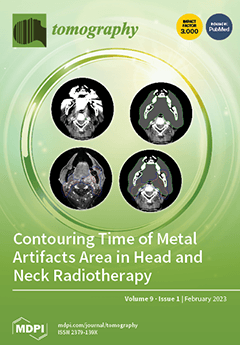
Cover Story: The impacts of metal artifacts (MAs) on the contouring workload for head and neck radiotherapy have not yet been clarified. Therefore, we evaluated the relationship between the contouring time of the MA area and MAs on head and neck radiotherapy treatment planning. The contouring time of MAs showed moderate positive correlations with the MA volume and the number of CT images containing MAs. Interobserver reliability of the extracted MAs volume and contouring time were excellent and poor, respectively. From our results, it was suggested that the contouring time of MA areas is related to individual commitment rather than clinical experience. Therefore, the development of software combining metal artifact reduction methods with automatic contouring methods is necessary for reducing interobserver variability and contouring workload. View this paper
  • Issues are regarded as officially published after their release is announced to the table of contents alert mailing list .
  • You may sign up for email alerts to receive table of contents of newly released issues.
  • PDF is the official format for papers published in both, html and pdf forms. To view the papers in pdf format, click on the "PDF Full-text" link, and use the free Adobe Reader to open them.

Articles (36)

  • Review
  • Open Access
15 Citations
6,226 Views
14 Pages

Advances in the Assessment of Coronary Artery Disease Activity with PET/CT and CTA

  • Jacek Kwiecinski,
  • Rafal Wolny,
  • Alicja Chwala and
  • Piotr Slomka

1 February 2023

Non-invasive testing plays a pivotal role in the diagnosis, assessment of progression, response to therapy, and risk stratification of coronary artery disease. Although anatomical plaque imaging by computed tomography angiography (CTA) and ischemia d...

  • Article
  • Open Access
2 Citations
5,056 Views
13 Pages

Structural Relationship between Cerebral Gray and White Matter Alterations in Degenerative Cervical Myelopathy

  • Chencai Wang,
  • Francesco Sanvito,
  • Talia C. Oughourlian,
  • Sabah Islam,
  • Noriko Salamon,
  • Langston T. Holly and
  • Benjamin M. Ellingson

31 January 2023

Patients with degenerative cervical myelopathy (DCM) undergo adaptive supraspinal changes. However, it remains unknown how subcortical white matter changes reflect the gray matter loss. The current study investigated the interrelationship between gra...

  • Article
  • Open Access
2 Citations
2,839 Views
16 Pages

Accelerated Simultaneous T2 and T2* Mapping of Multiple Sclerosis Lesions Using Compressed Sensing Reconstruction of Radial RARE-EPI MRI

  • Carl J. J. Herrmann,
  • Ludger Starke,
  • Jason M. Millward,
  • Joseph Kuchling,
  • Friedemann Paul and
  • Thoralf Niendorf

31 January 2023

(1) Background: Radial RARE-EPI MRI facilitates simultaneous T2 and T2* mapping (2in1-RARE-EPI). With modest undersampling (R = 2), the speed gain of 2in1-RARE-EPI relative to Multi-Spin-Echo and Multi-Gradient-Recalled-Echo references is limited. Fu...

  • Case Report
  • Open Access
6,334 Views
14 Pages

Ligamentum Flavum Rupture by Epidural Injection Using Ultrasound with SMI Method

  • Manabu Maeda,
  • Nana Maeda,
  • Keisuke Masuda,
  • Yoshiyuki Kamatani,
  • Shimizu Takamasa and
  • Yasuhito Tanaka

30 January 2023

The loss of resistance (LOR) method has been used exclusively to identify epidural space. It is difficult to find the epidural space without the risk of dural puncture. Various devices have been developed to improve the accuracy of the LOR method; ho...

  • Review
  • Open Access
4 Citations
4,875 Views
11 Pages

Labeling T Cells to Track Immune Response to Immunotherapy in Glioblastoma

  • John Y. Rhee,
  • Jack Y. Ghannam,
  • Bryan D. Choi and
  • Elizabeth R. Gerstner

30 January 2023

While the advent of immunotherapy has revolutionized cancer treatment, its use in the treatment of glioblastoma (GBM) has been less successful. Most studies using immunotherapy in GBM have been negative and the reasons for this are still being studie...

  • Article
  • Open Access
2 Citations
2,955 Views
10 Pages

Radiation Dose Assessment for Myocardial Perfusion Imaging: A Single Institution Survey

  • Essam Alkhybari,
  • Salman Albeshan,
  • Bandar Alanazi,
  • Raghad Alfarraj,
  • Rakan Alduhaim,
  • Intidhar El Bez Chanem and
  • Rima Tulbah

30 January 2023

Objective: This study aims to establish a local diagnostic reference level (LDRL) for single-photon emission tomography/computed tomography (SPECT/CT) and positron emission tomography/CT (PET/CT) with respect to myocardial perfusion imaging (MPI). Ma...

  • Article
  • Open Access
2 Citations
2,448 Views
9 Pages

30 January 2023

Acute lower extremity ischemia (ALI) is a cardiovascular emergency resulting from embolic and thrombotic causes. Although endovascular techniques have advanced, surgical thromboembolectomy is still the gold standard. Emergency thromboembolectomy surg...

  • Article
  • Open Access
3 Citations
6,542 Views
8 Pages

Can Intrapartum Ultrasonography Improve the Placement of the Vacuum Cup in Operative Vaginal Deliveries?

  • Rocio Garcia-Jimenez,
  • Irene Valero,
  • Carlota Borrero,
  • Jose Antonio Garcia-Mejido,
  • Ana Fernandez-Palacin,
  • Rosa Serrano and
  • Jose Antonio Sainz-Bueno

27 January 2023

Although the fetal head position has traditionally been evaluated by digital examination (DE), it has a failure rate ranging between 20 and 70%; hence, intrapartum transabdominal ultrasonography (TUS) has become relevant. We aimed to evaluate the uti...

  • Review
  • Open Access
16 Citations
6,312 Views
30 Pages

Diagnostic Management of Gastroenteropancreatic Neuroendocrine Neoplasms: Technique Optimization and Tips and Tricks for Radiologists

  • Fabio Pellegrino,
  • Vincenza Granata,
  • Roberta Fusco,
  • Francesca Grassi,
  • Salvatore Tafuto,
  • Luca Perrucci,
  • Giulia Tralli and
  • Mariano Scaglione

27 January 2023

Gastroenteropancreatic neuroendocrine neoplasms (GEP-NENs) comprise a heterogeneous group of neoplasms, which derive from cells of the diffuse neuroendocrine system that specializes in producing hormones and neuropeptides and arise in most cases spor...

  • Review
  • Open Access
61 Citations
17,847 Views
22 Pages

Pros and Cons of Dual-Energy CT Systems: “One Does Not Fit All”

  • Ana P. Borges,
  • Célia Antunes and
  • Luís Curvo-Semedo

27 January 2023

Dual-energy computed tomography (DECT) uses different energy spectrum x-ray beams for differentiating materials with similar attenuation at a certain energy. Compared with single-energy CT, it provides images with better diagnostic performance and a...

of 4

Get Alerted

Add your email address to receive forthcoming issues of this journal.

XFacebookLinkedIn
Tomography - ISSN 2379-139X