


Abstract
Background/Objectives: Although cefazolin is the recommended antibiotic for surgical prophylaxis, patients with a penicillin allergy label (PAL) frequently receive second-line antibiotics due to misconceptions regarding β-lactam cross-reactivity. Despite robust evidence supporting risk-stratified cefazolin use, implementation remains inconsistent. We evaluated the effect of a behaviour-informed, multidisciplinary implementation strategy on appropriate cefazolin utilisation among PAL patients undergoing surgery. Methods: A before-and-after quality improvement study was conducted at Singapore General Hospital. Following revision of the institutional surgical prophylaxis guidelines, a hospital-wide implementation strategy informed by the Capability–Opportunity–Motivation Behaviour (COM-B) framework was implemented through clinician education, workflow redesign, point-of-care prescribing prompts, multidisciplinary governance and organisational endorsement. The primary outcome was the median weekly proportion of eligible PAL patients receiving cefazolin. Secondary outcomes included perioperative allergic reactions and surgical site infections (SSIs). Results: A total of 126 patients in the pre-intervention period and 133 patients in the post-intervention period were included. The median weekly proportion of PAL patients receiving cefazolin increased from 22% to 50% (p < 0.01), with sustained improvement throughout the intervention period. Three patients (2.3%) developed suspected allergic reactions following cefazolin administration; one reaction was mild (urticaria), one was moderate (rash and chest tightness without haemodynamic instability), and one was suspected anaphylaxis. Significantly, no cases resulted in intensive care admission or cancellation of surgery. No statistically significant difference in SSI incidence was detected between patients receiving cefazolin and those receiving alternative antibiotics (0/96 vs. 5/163, p = 0.161); however, the small number of events limits interpretation of this exploratory safety outcome. Conclusions: A behaviour-informed implementation strategy combining COM-B-guided intervention design, multidisciplinary governance and anaesthesiologist-led implementation was associated with a safe increase in cefazolin use for surgical prophylaxis in PAL patients. These findings suggest that interventions addressing behavioural and organisational barriers may support the implementation of evidence-based recommendations and improve cefazolin uptake in routine perioperative practice, although the impact on clinical outcomes requires further evaluation.
1. Introduction
Cefazolin, a first-generation cephalosporin, is the recommended antibiotic for surgical antimicrobial prophylaxis for most procedures due to its activity against common skin flora (including Staphylococcus aureus and streptococci), favourable pharmacokinetic profile, low toxicity and cost-effectiveness [1,2,3]. Despite this, patients carrying a penicillin allergy label (PAL) frequently receive alternative antibiotics for surgical prophylaxis because of misconceptions regarding β-lactam cross-reactivity [4].
Avoidance of cefazolin in PAL patients is increasingly recognised as problematic. When PAL patients receive second-line surgical antibiotic prophylaxis such as clindamycin or vancomycin, there are higher rates of surgical site infection (SSI) [5], as well as increased risks of methicillin-resistant Staphylococcus aureus (MRSA) and Clostridioides difficile infections [6].
It has been established that cross-reactivity between penicillin and cefazolin is uncommon, largely because cefazolin possesses a distinct R1 side-chain structure from penicillin [4]. Accordingly, the risk of cross-reactivity between penicillins and cephalosporins is very low at 1–2% [7]. Furthermore, up to 90–99% of patients with reported penicillin allergy are found not to be truly allergic following formal allergy evaluation [8]. True β-lactam hypersensitivity encompasses both immediate IgE-mediated reactions and delayed, predominantly T-cell-mediated reactions. The latter range from benign maculopapular eruptions to rare severe cutaneous adverse reactions (SCARs), including drug reaction with eosinophilia and systemic symptoms (DRESS), acute generalised exanthematous pustulosis (AGEP), and Stevens–Johnson syndrome/toxic epidermal necrolysis (SJS/TEN) [9]. Despite this spectrum of hypersensitivity reactions, the structural dissimilarity between penicillins and cefazolin contributes to the low observed rate of clinical cross-reactivity.
Despite robust evidence and updated international guidelines [1,2,3], adoption of cefazolin for PAL patients remains inconsistent. Clinicians remain reluctant to administer a β-lactam to patients labelled as penicillin-allergic because of uncertainty surrounding allergy assessment, concerns regarding adverse reactions, and organisational culture that prioritises avoidance of patient harm [10]. Such implementation challenges are also common to our centre, Singapore General Hospital (SGH). The challenge no longer lies in establishing the safety of cefazolin, but in translating this evidence into routine perioperative practice.
A baseline audit performed at SGH demonstrated that only 22% of eligible PAL patients received cefazolin prophylaxis despite local hospital safety data. Root-cause analysis (Supplementary Figure S1) identified several modifiable barriers, including limited awareness of contemporary evidence demonstrating the low risk of cefazolin cross-reactivity, uncertainty surrounding allergy risk stratification and definitions of true penicillin allergy, under-recognition of the risks associated with alternative antibiotics, lack of point-of-care prescribing support, and clinicians’ concerns regarding adverse reactions. Additionally, the institutional pursuit of “Zero Harm” fostered a risk-averse prescribing culture that discouraged cefazolin use in PAL patients, despite contemporary evidence supporting its use. These findings reinforced that the primary challenge was not the lack of evidence but rather its translation into routine clinical practice.
Recognising that the principal challenge was behavioural rather than informational, we implemented a multidisciplinary, anaesthesiology-led quality improvement programme informed by the Capability–Opportunity–Motivation Behaviour (COM-B) framework [11]. The intervention combined education, environmental prompts, workflow redesign and organisational governance to address key behavioural determinants influencing perioperative antibiotic prescribing. We evaluated the effect of this hospital-wide implementation strategy on cefazolin utilisation among PAL patients undergoing surgery, while assessing perioperative safety and surgical site infection outcomes following implementation.
2. Materials and Methods
2.1. Study Setting and Design
This quality improvement study was conducted at SGH, a 1800-bed tertiary academic hospital in Singapore. A before-and-after study design was used to evaluate this anaesthesiology-led, hospital-wide implementation strategy, informed by the COM-B framework, to increase appropriate cefazolin use for surgical antimicrobial prophylaxis in PAL patients.
The intervention was implemented across surgical specialties in which cefazolin was the recommended prophylactic antibiotic under institutional guidelines, including Orthopaedics, Plastic & Reconstructive Surgery, Upper Gastrointestinal & Bariatric Surgery, Hepatobiliary Surgery, Neurosurgery, General Surgery, Vascular Surgery, Breast Surgery, Cardiology and Cardiothoracic Surgery. Specialties for which non-cefazolin prophylaxis was recommended were excluded.
Baseline data were collected between September and November 2024. Revised institutional surgical antimicrobial prophylaxis guidelines were introduced in April 2025, followed by a 6-week implementation period. Outcome data were subsequently collected from May to July 2025.
2.2. Quality Improvement Intervention
2.2.1. Guideline Revision and Roll-Out
The Antibiotic Stewardship Unit (ASU) championed the revision of institutional surgical prophylaxis guidelines and worked with the Allergy team to facilitate a systematic and structured roll-out. Guideline revision was preceded by the advocacy for systematic PAL assessment and risk stratification, discussions regarding the safety of cefazolin use at multiple platforms with key stakeholders, and endorsement by the Infectious Disease department and Hospital Clinical Governance. Following this, surgical prophylaxis guidelines were revised, and later adopted hospital-wide, with support from surgical and anaesthesiology stakeholders.
Revision of the institutional surgical prophylaxis guidelines formed the foundation of the implementation strategy. Through multidisciplinary engagement, consensus was achieved regarding patient selection, perioperative safety and governance processes prior to hospital-wide adoption of the revised recommendations. The resulting implementation strategy was subsequently delivered using the COM-B framework.
2.2.2. Intervention Design and Implementation
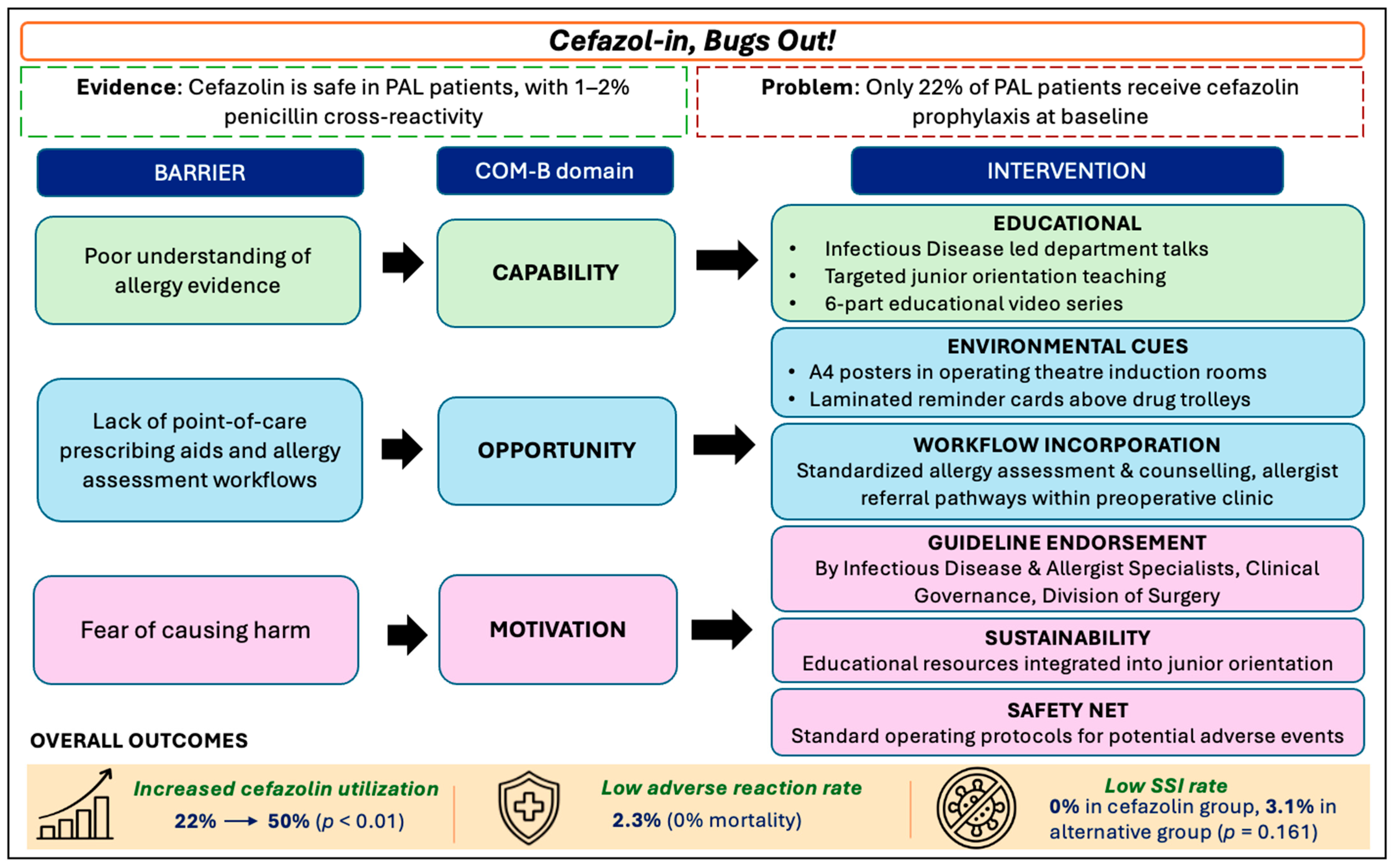
The “Cefazol-in, Bugs Out!” campaign was developed using a structured quality improvement methodology. Root-cause analysis identified barriers to cefazolin prescribing (Supplementary Figure S1), which were prioritised using Pareto analysis (Supplementary Figure S2) and a prioritisation matrix (Supplementary Figure S3) before being mapped to the COM-B framework to guide intervention selection (Figure 1).
Figure 1.
A systematic approach using the COM-B framework to increase the use of cefazolin surgical prophylaxis in patients with a penicillin allergy label.
Capability
Capability interventions focused on improving clinicians’ knowledge and confidence in penicillin allergy assessment and cefazolin prescribing. Educational activities included departmental teaching sessions, targeted orientation sessions for junior doctors, and a six-part asynchronous educational video series emphasising updated evidence, allergy risk stratification and the revised institutional guidelines (Supplementary Figure S4).
Opportunity
Opportunity interventions restructured the clinical environment to facilitate evidence-based prescribing. Standardised allergy assessment, counselling and allergist referral pathways were embedded within revised Anaesthesia Preoperative Evaluation Clinic (PEC) workflows, while point-of-care prescribing support was reinforced through posters and laminated reminder cards displayed within operating theatres (Supplementary Figures S5 and S6).
Motivation
Motivation interventions aimed to increase clinicians’ confidence in adopting the revised prescribing practice. Emerging international evidence, local safety data and baseline audit findings were communicated throughout the implementation process, supported by endorsement from Infectious Diseases, Allergy and Clinical Governance. Sustainability was reinforced through the incorporation of educational resources into mandatory junior doctor orientation and the establishment of an online adverse reaction surveillance system.
2.3. Outcome Measures
The primary outcome was the median weekly proportion of PAL patients receiving cefazolin prophylaxis pre- and post-intervention.
Secondary outcomes include comparing the proportions of patients who developed (a) allergic reactions and (b) SSI between those who received cefazolin and those who received alternative antibiotics in the post-intervention period.
A post hoc exploratory subgroup analysis was performed to assess cefazolin utilisation according to PEC attendance.
2.4. Data Collection and Definitions
Perioperative antibiotic administration data were extracted from electronic anaesthesia records and operating theatre documentation for all eligible patients with a documented PAL. Baseline data included age, gender, allergy history and surgical procedure. A total of 126 eligible PAL patients undergoing surgery were identified.
Patients with PAL were risk-stratified according to the institutional guidelines developed by the ASU and the Department of Allergy & Immunology (Table 1). Direct full-dose cefazolin was recommended for low- and moderate-risk patients, while a graded-dose protocol was recommended for high-risk patients. Cefazolin was not recommended for patients with a history suggestive of severe reactions such as SCARs, including DRESS, SJS/TENs, generalised bullous fixed drug eruption (GBFDE) and AGEP. Further details are provided in the Supplementary Information (Supplementary Figure S7).
Table 1.
Risk categorization of patients with penicillin allergy labels based on institutional guideline.
Perioperative allergic reactions were identified through clinician self-reporting and classified according to study-defined severity scale based on clinical consequences and treatment requirements into mild, moderate or severe (Table 2). Anaphylaxis was defined operationally as an acute-onset reaction involving skin/mucosal tissue together with respiratory compromise and hypotension, or involvement of two or more organ systems following drug exposure. Reactions requiring pharmacological treatment but not meeting operational criteria for anaphylaxis were classified as moderate. These included reactions with subjective respiratory symptoms, such as chest tightness or breathlessness, in the absence of objective respiratory compromise or haemodynamic instability, and which responded to first-line treatment (e.g., antihistamines) without adrenaline. None of the PAL patients underwent a formal drug allergy challenge test prior to surgery as wait times to a dedicated allergy clinic are long, and direct oral penicillin challenge was not practised nor supported by the surgical teams to avoid delays in surgery. Surgical site infections (SSIs) were identified from electronic medical records and classified according to the National Healthcare Safety Network (NHSN) Surgical Site Infection surveillance definitions—including superficial incisional, deep incisional, and organ/space SSIs occurring within 30 days of surgery (or 90 days for selected implant procedures) [12].
Table 2.
Classification of reaction type based on clinical consequences and intervention requirement.
2.5. Statistical Analysis
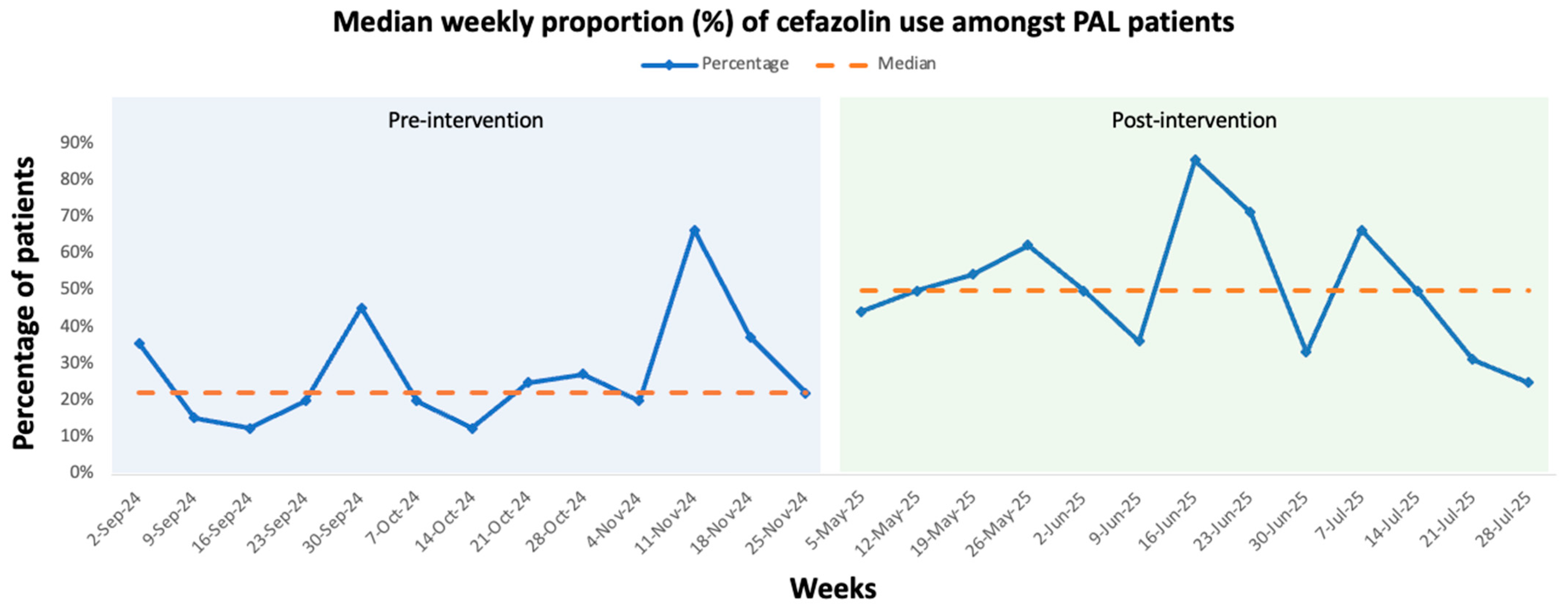
All statistical tests were performed using SPSS (Version 26.0, IBM Corp., Armonk, NY, USA). Non-parametric continuous data were analysed using the Mann–Whitney U test, whereas categorical data were analysed using the Chi-Square test (or Fisher’s exact test, where relevant). Continuous data are presented as the median (interquartile range), whereas categorical data are presented as numbers (percentages), unless otherwise specified. The primary outcome, defined as the median weekly proportion of PAL patients receiving cefazolin, was compared between pre- and post-intervention periods using the Mann–Whitney U test. Sustained change over time was additionally assessed by applying Statistical Process Control (SPC) run-chart rules to the weekly utilisation data presented in Figure 2. A run of eight or more consecutive post-intervention weekly observations above the pre-intervention median was considered evidence of a statistically non-random shift, indicative of special-cause variation.
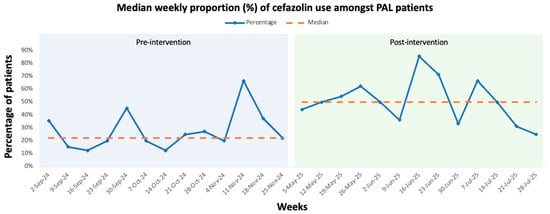
Figure 2.
Median weekly proportion (%) of PAL patients receiving cefazolin surgical prophylaxis pre- vs. post-intervention periods.
3. Results
A total of 126 and 133 PAL patients undergoing surgical procedures for which cefazolin prophylaxis was recommended were included in the pre- and post-intervention periods, respectively. Baseline characteristics were comparable between both groups, comprising predominantly older patients, a female majority, a case mix dominated by orthopaedic procedures, and a similar medium-risk penicillin allergy (Table 3). The predominantly older and female population likely reflects the underlying case mix, particularly the high proportion of orthopaedic procedures which are commonly performed in older adult populations. Many of these procedures are also performed for age-related degenerative and fragility-related conditions, which are more prevalent among older women. Notably, the proportion of patients undergoing hepatobiliary/upper gastrointestinal surgery differed significantly between periods (13.5% pre-intervention vs. 6.0% post-intervention, p < 0.05), but they accounted for <15% of cases. Because antibiotic selection practices may vary by surgical specialty, this difference in case-mix is considered a potential confounder of the primary outcome and is discussed further in the Limitations section.
Table 3.
Baseline characteristics of patients pre- and post-intervention. Continuous data are presented as the median (interquartile range), whereas categorical data are presented as numbers (percentage), unless otherwise specified. * Other surgery types include cardiovascular, cardiothoracic, hand, ophthalmology, and plastics. ** Refer to Table 1 for risk stratification.
3.1. Primary Outcome
The median weekly rate of cefazolin use amongst PAL patients increased significantly from 22% (IQR 20.0–35.7%) pre-intervention to 50% (IQR 42.4–63.5%) post intervention (p < 0.01) (Figure 2). This improvement was sustained, with all 12 consecutive post-intervention data points above the pre-intervention median, which meets the SPC run-chart criterion for a shift (a run of ≥ 8 consecutive points on one side of the median) and indicates a statistically significant non-random improvement in cefazolin utilisation.
3.2. Secondary Outcomes
3.2.1. Allergic Reactions
Three PAL patients (2.3%) developed suspected allergic reactions following cefazolin administration (Table 4), with one patient experiencing a mild reaction, one a moderate reaction, and one a severe reaction. All reactions were non-fatal, and surgery was completed without the need for ICU admission. The severe reaction involved rash, wheezing and hypotension consistent with anaphylaxis. For this patient, as blood pressure improved following intravenous adrenaline and surgery was already underway for an oncological indication, surgery was completed with close monitoring, followed by postoperative observation in a high-dependency unit.
Table 4.
Summary of reported adverse reactions to cefazolin during the intervention period. * Based on institutional criteria for penicillin allergy risk stratification.
3.2.2. Surgical Site Infections
Overall, SSI rates were low across both the pre- and post-intervention periods. Five SSIs occurred among 163 patients who received alternative antibiotics (3.1%), compared with none among 96 patients who received cefazolin (0%); however, no statistically significant difference in SSI incidence was detected between the groups (p = 0.161). No prosthetic joint infections (PJIs) were identified in either group.
3.3. Post Hoc Patient-Level Subgroup Analysis
A post hoc subgroup analysis was performed to assess intervention fidelity according to PEC attendance. Among patients evaluated through PEC, cefazolin utilisation increased significantly from 27.5% (25/91) pre-intervention to 51.5% (50/97) post-intervention (OR 2.85, 95% CI 1.55–5.24, p < 0.01). Within the post-intervention cohort, cefazolin utilisation was numerically higher among patients evaluated through PEC than among those managed through non-PEC pathways (51.5% [50/97] vs. 38.9% [14/36]), although this difference was not statistically significant (p = 0.194).
4. Discussion
This quality improvement initiative achieved institution-wide practice change, increasing cefazolin utilisation for surgical prophylaxis among patients with a PAL from 22% to 50%, exceeding the pre-specified target of 40%. Three suspected allergic reactions occurred, including one case of suspected anaphylaxis, with no ICU admissions or surgical cancellations. No significant difference in SSI incidence was detected between antibiotic groups, although the study was not powered for this secondary outcome. These findings provide preliminary reassurance regarding the safety of risk-stratified cefazolin use but warrant cautious interpretation. The increase in cefazolin utilisation among PEC patients following implementation suggests successful uptake of the intervention within the PEC pathway. However, the absence of a statistically significant difference between PEC and non-PEC patients in the post-intervention cohort suggests that PEC exposure alone did not account for cefazolin adoption. This likely reflects the multimodal nature of the intervention, with prescribing decisions remaining influenced by clinician practices at the point of perioperative care.
4.1. Safety Outcomes
Only three patients (2.3%) developed allergic reactions following cefazolin administration, and our findings are concordant with published systematic reviews which have shown that the rates of penicillin-cefazolin cross-reactivity are low (1–2%) [4,5,7]. However, one was severe and consistent with anaphylaxis, illustrating that clinically significant hypersensitivity remains possible. This also highlights the importance of appropriate risk stratification of PAL patients, prompt recognition and treatment of hypersensitivity reactions, and continued perioperative vigilance when implementing cefazolin use in patients with a PAL. For the three affected patients, all reactions were successfully managed without mortality or ICU admission.
These local data were important to provide contextual reassurance to prescribers who were more conservative and risk-averse to the development of drug allergies. Notably, two of the three reactions occurred after clinicians elected to administer a test dose despite institutional guidance recommending direct full-dose cefazolin. This is informative as it suggests possible ongoing concerns regarding untoward allergic reactions with cefazolin use in PAL patients despite established international and local data [13], as well as workflows approved by Hospital Clinical Governance. Rather than viewing this as implementation failure, this observation highlights that adoption of evidence-based practice is often gradual and influenced by clinicians’ perceptions of risk. As such, these events instead informed iterative refinement of the programme, prompting development of a standardised perioperative allergic reaction management pathway and additional educational reinforcement to further support evidence-based cefazolin prescribing.
An important implementation finding was that none of the three patients who developed reactions attended the recommended formal outpatient allergist evaluation; two defaulted and one appointment was not scheduled due to an administrative error. This highlights implementation gaps between medical recommendations and follow through of allergy assessments. We postulate that cultural issues, patients’ healthcare literacy, and healthcare cost considerations could have been barriers to follow through with allergy testing [14]. In addition, administrative processes either through better care-coordination by healthcare personnel or reminder systems to ensure completion of allergist referral could be an important area for future programme refinement. Missed opportunities for penicillin-cefazolin allergy assessments may not have immediate impact but would certainly restrict the available therapeutic options in the subsequent management of infections, with the attendant’s issues of poor infectious diseases outcomes, the use of excessively broad, and potentially less effective antibiotics, and higher healthcare costs [15].
While no SSIs were observed among patients who received cefazolin prophylaxis (0/96), compared with five events among those receiving alternative antibiotics (5/163), the overall event rate was low, and the study was not powered to detect statistically significant differences in SSI rates. These findings should therefore be interpreted cautiously and do not establish superiority, non-inferiority, or equivalence of cefazolin with respect to infection-related outcomes. Nevertheless, the observed findings are consistent with existing evidence supporting cefazolin as the preferred agent for prophylaxis [16].
Beyond improving cefazolin use in surgical prophylaxis, our findings suggest that translating evidence into routine perioperative practice requires more than solely publishing revised clinical guidelines. A behaviour-informed implementation strategy, underpinned by the COM-B framework, multidisciplinary governance and anaesthesiology-led implementation, was associated with a marked increase in cefazolin prescribing within a more conservative, risk-averse healthcare environment; however, given the before-and-after design and the multifaceted nature of the intervention, this study cannot determine which specific component(s) were responsible for the observed change, nor establish that the underlying behavioural mechanisms targeted by the COM-B framework were directly modified.
4.2. Behavioural Barriers Drive Persistent Cefazolin Avoidance
The principal barrier to implementing guideline-concordant cefazolin prescribing was behavioural rather than informational. Although substantial evidence supports cefazolin use in appropriately selected PAL patients, adoption remains inconsistent across healthcare institutions. Our root-cause analysis identified clinicians’ reluctance to administer a β-lactam to PAL patients as the key barrier to implementation. In a healthcare culture strongly oriented towards patient safety, concerns regarding allergy assessment and fears of causing harm may outweigh awareness of contemporary evidence, contributing to risk-averse prescribing [17]. These findings suggest that successful implementation depends not only on delivering evidence, but also on addressing the behavioural factors that influence prescribing decisions [18].
4.2.1. COM-B Provided Practical Implementation Framework
Behaviour-informed implementation frameworks provide a practical approach to addressing behavioural barriers to implementation, with the COM-B framework being one such approach that we applied [11]. Tailoring antimicrobial stewardship interventions to locally identified behavioural barriers using multifaceted strategies, including education, clinical decision support, institution-specific guidelines and optimisation of antibiotic allergy assessment, is also aligned with recommendations from the World Health Organization [19].
Applying the COM-B framework, we addressed the following domains simultaneously: clinicians’ Capability, Opportunity, and Motivation [11]. Our interventions extended beyond traditional education, which has repeatedly been shown to produce modest and often transient improvements when delivered in isolation [20]. These educational efforts addressed clinicians’ capability by improving understanding of penicillin allergy and contemporary evidence supporting cefazolin use. These efforts were supplemented by point-of-care prompts and workflow redesign that increased opportunities for evidence-based prescribing within routine practice (Figure 1). Multidisciplinary governance and institutional endorsement strengthened clinicians’ motivation by increasing confidence in the safety and appropriateness of the revised prescribing recommendations. Collectively, these complementary interventions targeted multiple behavioural determinants simultaneously, facilitating translation of contemporary evidence into routine prescribing behaviour.
4.2.2. Multidisciplinary Governance Supports Practice Change
Among these interventions, multidisciplinary governance appeared to be important in reducing prescribing uncertainty and creating an environment that supported practice change. Although established data recommends cefazolin as the first-line surgical prophylaxis agent in patients with PAL, dissemination of updated evidence alone was insufficient for practice change due to prescribers’ fear of repercussions in the event of an adverse reaction to cefazolin [10,18]. Therefore, we adopted a multi-pronged approach for practice change.
- The institutional surgical prophylaxis guidelines were revised with multidisciplinary input in consultation with Infectious Diseases, Antimicrobial Stewardship, Allergy, Surgery and Anaesthesiology. In the process, specialty-specific concerns were addressed. In addition, we had in-house data demonstrating that cefazolin use in PAL patients undergoing orthopaedic surgeries was safe, providing an additional layer of reassurance to local prescribers [13].
- Standardised pathways for allergy clarification, risk stratification, perioperative antibiotic selection, adverse reaction management and allergist referral were established.
- The processes were endorsed by Infectious Diseases, Allergy & Immunology and Hospital Clinical Governance.
- Eventually, the above-mentioned pathways were integrated into routine clinical workflows in the Anaesthesia PEC.
Importantly, the establishment of this multidisciplinary governance provided organisational oversight and consensus across specialties. Uncertainty around prescribing surgical prophylaxis in PAL allergic patients was reduced, and clinicians were empowered to adopt the revised recommendations. Clinicians’ fear of medico-legal implications should adverse reactions develop was addressed and allayed.
4.3. Anaesthesiologists as Perioperative Implementation Champions for Best Practice
Anaesthesiologists are advocates for best practice in perioperative medicine and are uniquely positioned to act as implementation champions [21]. In the context of surgical prophylaxis, they are central to preoperative allergy assessment [22], antimicrobial selection, antibiotic administration, recognition of perioperative adverse reactions [21], and postoperative allergy follow-up. Consequently, they are well placed to implement antimicrobial stewardship recommendations at the point of perioperative prescribing. Contemporary antimicrobial stewardship is founded on multidisciplinary collaboration involving clinicians across the patient care pathway [23], and traditional stewardship programmes coordinated by Infectious Diseases physicians or Antimicrobial Stewardship teams alone may have limited influence over real-time prescribing decisions because they are not routinely embedded within perioperative workflows.
In our institution, anaesthesiologists operationalised the revised institutional guidance by integrating allergy assessment and evidence-based antibiotic selection into routine perioperative practice. Supported by multidisciplinary governance and institutional endorsement, they translated revised recommendations into day-to-day clinical practice through repeated prescribing opportunities and close collaboration with surgeons, allergists and infectious diseases physicians. Our findings support a collaborative perioperative model in which anaesthesiologists play a more significant role in translating evidence into routine clinical practice.
4.4. Implications for Perioperative Antimicrobial Stewardship
Our findings highlight that effective perioperative antimicrobial stewardship extends beyond antibiotic selection on the day of surgery. Behaviour-informed implementation, supported by multidisciplinary governance and anaesthesiologist-led delivery, may facilitate the translation of evidence into routine clinical practice. These findings are consistent with previous health-system initiatives to improve cefazolin use in patients with a penicillin allergy label [24]. Standardised allergy assessment, structured documentation, validated risk stratification and timely referral for formal allergy evaluation should be integrated into routine perioperative care [25], while upstream delabelling initiatives, including direct oral challenge for appropriately selected low-risk patients, may further optimise antimicrobial selection and support long-term antimicrobial stewardship [26].
Although our COM-B-informed intervention demonstrated favourable improvements in cefazolin prescribing over the initial three-month evaluation period, its long-term sustainability remains to be established. Continued multidisciplinary collaboration will be essential to sustain practice change, with anaesthesiologists well placed to champion future perioperative antimicrobial stewardship initiatives.
4.5. Limitations
This study has several limitations. First, its before–after design precludes definitive causal attribution, as temporal changes or concurrent institutional initiatives may have influenced prescribing behaviour and clinical outcomes. Second, this single-centre study included a predominantly older and relatively homogeneous population, potentially limiting generalisability to younger, more diverse populations and other healthcare settings. Third, adverse reaction surveillance relied on anaesthesia records and voluntary clinician reporting, introducing the potential for ascertainment bias, particularly for mild reactions. Furthermore, the small number of suspected hypersensitivity reactions precludes definitive conclusions regarding the risk of rare severe reactions. The three-month follow-up period may also have been insufficient to evaluate long-term sustainability of practice change. Fourth, although baseline characteristics were broadly similar between periods, the proportion of hepatobiliary/upper gastrointestinal procedures differed significantly. As these procedures comprised <15% of the study population, no adjusted analysis was undertaken; however, residual confounding from differences in case mix cannot be excluded. Fifth, quantitative process metrics—such as attendance at departmental teaching sessions, viewing rates of educational video series, or electronic medical record allergy-assessment template compliance—were not systematically tracked, limiting our ability to assess intervention uptake and implementation fidelity. Finally, patients were classified according to documented penicillin allergy labels without formal allergy verification. Future studies incorporating structured allergy assessment or formal allergy testing would better characterise the PAL population, distinguish true IgE-mediated allergy from non-IgE-mediated, delayed hypersensitivity reactions and from undocumented or inaccurate labels, and optimise patient selection for cefazolin.
5. Conclusions
This study demonstrates that a behaviour-informed, multidisciplinary quality improvement initiative was associated with increased cefazolin utilisation for surgical prophylaxis in patients with a penicillin allergy label. Safety outcomes were reassuring, although the small number of events and limited study power warrant cautious interpretation. These findings suggest that addressing behavioural and organisational barriers through multidisciplinary governance and anaesthesiology-led implementation may facilitate the translation of contemporary evidence into institution-wide prescribing practice. The COM-B framework may provide a useful approach for identifying and addressing locally relevant barriers in future perioperative antimicrobial stewardship initiatives.
Supplementary Materials
The following supporting information can be downloaded at https://www.mdpi.com/article/10.3390/allergies6040043/s1, Figure S1: Root cause analysis (identification of causes leading to low incidence of cefazolin use in PAL patients); Figure S2: Pareto Chart (identification of key causes that contribute most significantly to low rates of cefazolin use); Figure S3: Prioritization matrix (potential solutions evaluated against 4 criteria: time efficiency, cost-effectiveness, feasibility within existing workflows, and sustainability); Figure S4: Screenshots from six-part educational video series; Figure S5: Reminder card placed above drug trolleys as point-of-care reminder; Figure S6: Laminated posters placed in induction rooms and changing rooms; Figure S7: Updated institutional guidelines on management of PAL patients.
Author Contributions
Conceptualisation, C.S.Y., B.T.S.W., B.Y.K.W., A.L.E.Q., Y.P.Z., S.J.C. and L.H.Y.; Methodology, C.S.Y., B.T.S.W., B.Y.K.W., A.L.E.Q., Y.P.Z., S.J.C. and C.L.S.G.; Data Curation, B.T.S.W., B.Y.K.W. and A.L.E.Q.; Formal Analysis, B.T.S.W., B.Y.K.W. and A.L.E.Q.; Writing—Original Draft Preparation, B.T.S.W., B.Y.K.W. and A.L.E.Q.; Writing—Review and Editing, C.S.Y., S.J.C., Y.P.Z. and C.L.S.G.; Supervision, C.S.Y. All authors have read and agreed to the published version of the manuscript.
Funding
This research received no external funding. The QI initiative was supported by internal departmental resources of the Department of Anaesthesiology and Perioperative Medicine, Singapore General Hospital, with inputs from ASU and Allergist.
Institutional Review Board Statement
This study, a review of a qualitative initiative in partnership with the ASU, was exempt from our institutional ethics board review (SingHealth Institutional Review Board Reference 2022/2560).
Informed Consent Statement
Patient consent was not required as per the study’s exemption from our institutional ethics board review. De-identified data were used for analysis in this study.
Data Availability Statement
The original contributions presented in this study are included in the article/Supplementary Material. Further inquiries can be directed to the corresponding author.
Acknowledgments
We are grateful to the anaesthesiologists, surgeons, and nursing staff of the SGH Operating Theatre Complex for their participation and support for this initiative, and to Chua Xin Ni (Division of Organisation Planning and Performance) for patiently guiding our team through the process of developing this QI initiative. During the preparation of this manuscript, the authors used ChatGPT (Open AI, GPT-5.6) to assist with language editing to improve clarify and organisation, and for formatting text and references. The AI tool was not used to generate, analyse or interpret research data or graphs, or to make scientific conclusions. All outputs were critically reviewed, verified, and edited by the authors, who take full responsibility for the accuracy and integrity of the manuscript.
Conflicts of Interest
The authors declare no conflicts of interest.
References
- Bratzler, D.W.; Dellinger, E.P.; Olsen, K.M.; Perl, T.M.; Auwaerter, P.G.; Bolon, M.K.; Fish, D.N.; Napolitano, L.M.; Sawyer, R.G.; Slain, D.; et al. Clinical practice guidelines for antimicrobial prophylaxis in surgery. Am. J. Health-Syst. Pharm. 2013, 70, 195–283. [Google Scholar] [CrossRef] [Scilit] [PubMed]
- World Health Organization. Global Guidelines for the Prevention of Surgical Site Infection, 2nd ed.; World Health Organization: Geneva, Switzerland, 2018. [Google Scholar]
- Australian and New Zealand College of Anaesthetists and Surgical Infection Society of Australia and New Zealand. Antibiotics in Anaesthesia: Position Statement; Australian and New Zealand College of Anaesthetists: Melbourne, Australia, 2023. [Google Scholar]
- Sexton, M.E.; Kuruvilla, M.E. Management of penicillin allergy in the perioperative setting. Antibiotics 2024, 13, 157. [Google Scholar] [CrossRef] [Scilit] [PubMed]
- Shenoy, E.S.; Blumenthal, K.G.; Hurwitz, S.; Hooper, D.C.; Banerji, A. Impact of a reported penicillin allergy on surgical site infection risk. Clin. Infect. Dis. 2018, 66, 329–336. [Google Scholar] [CrossRef] [Scilit] [PubMed]
- Blumenthal, K.G.; Lu, N.; Zhang, Y.; Li, Y.; Walensky, R.P.; Choi, H.K. Risk of meticillin-resistant Staphylococcus aureus and Clostridioides difficile in patients with a documented penicillin allergy: Population-based matched cohort study. BMJ 2018, 361, k2400. [Google Scholar] [CrossRef] [Scilit] [PubMed]
- Picard, M.; Robitaille, G.; Karam, F.; Daigle, J.-M.; Bédard, F.; Biron, É.; Tardif, M.R.; Lacombe-Barrios, J.; Bégin, P. Cross-reactivity to cephalosporins and carbapenems in penicillin-allergic patients: Two systematic reviews and meta-analyses. J. Allergy Clin. Immunol. Pract. 2019, 7, 2722–2738.e5. [Google Scholar] [CrossRef] [Scilit] [PubMed]
- Shenoy, E.S.; Macy, E.; Rowe, T.; Blumenthal, K.G. Evaluation and management of penicillin allergy: A review. JAMA 2019, 321, 188–199. [Google Scholar] [CrossRef] [Scilit] [PubMed]
- Minaldi, E.; Phillips, E.J.; Norton, A. Immediate and Delayed Hypersensitivity Reactions to Beta-Lactam Antibiotics. Clin. Rev. Allergy Immunol. 2022, 62, 449–462. [Google Scholar] [CrossRef] [Scilit] [PubMed]
- Reali, S.; Kwang, Y.C.; Cho, J.G.; Alffenaar, J.; Aslani, P. Factors influencing physicians’ antimicrobial prescribing decisions: A systematic review of qualitative studies. Br. J. Clin. Pharmacol. 2025, 91, 1330–1351. [Google Scholar] [CrossRef] [Scilit] [PubMed]
- Michie, S.; van Stralen, M.M.; West, R. The Behaviour Change Wheel: A new method for characterising and designing behaviour change interventions. Implement. Sci. 2011, 6, 42. [Google Scholar] [CrossRef] [Scilit] [PubMed]
- Centers for Disease Control and Prevention. National Healthcare Safety Network (NHSN) Patient Safety Component Manual: Chapter 9. Surgical Site Infection (SSI) Event; Centers for Disease Control and Prevention: Atlanta, GA, USA, 2025. Available online: https://www.cdc.gov/nhsn/pdfs/pscmanual/9pscssicurrent.pdf (accessed on 22 July 2026).
- Lee, T.; Kang, C.H.; Zhou, P.Y.; Wang, Y.; Lee, H.Y.; Tay, D.K.J.; Chlebicki, M.P.; Chung, S.J. Time for change: Cefazolin prophylaxis is safe for penicillin-allergic patients undergoing joint arthroplasty: A single-centre experience. Open Forum Infect. Dis. 2026, 13, ofaf695.1095. [Google Scholar] [CrossRef] [Scilit]
- Augustino, A.; Alvarez, K.S.; Kassem, L.; Roy, L.; Termulo, C.; Smartt, J.; Sparks, M.; Mercadel, C.; Chow, T.G. Patient perceptions of penicillin allergy testing in a public health system. J. Allergy Clin. Immunol. Pract. 2024, 12, 3337–3345.e2. [Google Scholar] [CrossRef] [Scilit] [PubMed]
- Krah, N.M.; Jones, T.W.; Lake, J.; Hersh, A.L. The impact of antibiotic allergy labels on antibiotic exposure, clinical outcomes, and healthcare costs: A systematic review. Infect. Control Hosp. Epidemiol. 2021, 42, 530–548. [Google Scholar] [CrossRef] [Scilit] [PubMed]
- Norvell, M.R.; Porter, M.; Ricco, M.H.; Koonce, R.C.; Hogan, C.A.; Basler, E.; Wong, M.; Jeffres, M.N. Cefazolin vs second-line antibiotics for surgical site infection prevention after total joint arthroplasty among patients with a beta-lactam allergy. Open Forum Infect. Dis. 2023, 10, ofad224. [Google Scholar] [CrossRef] [Scilit] [PubMed]
- Mabaya, G.; Evans, J.M.; Longo, C.J.; Morris, A.M. A behavioral analysis of factors that influence antibiotic prescribing in hospitals: A metasynthesis of reviews. Open Forum Infect. Dis. 2024, 12, ofae728. [Google Scholar] [CrossRef] [Scilit] [PubMed]
- Grol, R.; Wensing, M. What drives change? Barriers to and incentives for achieving evidence-based practice. Med. J. Aust. 2004, 180, S57–S60. [Google Scholar] [CrossRef] [Scilit] [PubMed]
- World Health Organization. Behavioural and Social Sciences for Better Health: Practical Guidance; World Health Organization: Geneva, Switzerland, 2022; Available online: https://iris.who.int/ (accessed on 12 July 2026).
- Davis, D.A.; Taylor-Vaisey, A. Translating guidelines into practice: A systematic review of theoretic concepts, practical experience and research evidence in the adoption of clinical practice guidelines. Can. Med. Assoc. J. 1997, 157, 408–416. [Google Scholar]
- Birgand, G.; Biccard, B.; Deslandes, A.; Mbamalu, O.; Bonaconsa, C.; Boutall, A.; Mendelson, M.; Leone, M.; Ndoli, J.; Leather, A.; et al. Role of anaesthesia providers in infection-related care across the perioperative pathway: A global survey. Br. J. Anaesth. 2024, 132, 430–439. [Google Scholar] [CrossRef] [Scilit] [PubMed]
- De Luca, J.F.; Vogrin, S.; Holmes, N.E.; Reynolds, G.K.; Waldron, J.L.; Cox, F.; Nazareth, J.; Guha, R.; Douglas, N.; Hardigde, A.; et al. Perioperative penicillin and cephalosporin antibiotic allergy assessment and testing: The PREPARE pilot randomized clinical trial. JAMA Surg. 2025, 160, 518–525. [Google Scholar] [CrossRef] [Scilit] [PubMed]
- Dyar, O.J.; Huttner, B.; Schouten, J.; Pulcini, C. What is antimicrobial stewardship? Clin. Microbiol. Infect. 2017, 23, 793–798. [Google Scholar] [CrossRef] [Scilit] [PubMed]
- Belmont, A.P.; Son, M.; Hyman, J.B.; You, L.; Su, C.; Kashyap, N.; Topal, J.E.; McManus, D.; Martinello, R.A.; Kwah, J. Improving cefazolin administration for surgical prophylaxis in reported penicillin allergy: A retrospective study of a health system intervention. J. Allergy Clin. Immunol. 2024, 4, 100377. [Google Scholar] [CrossRef] [Scilit] [PubMed]
- Blumenthal, K.G.; Shenoy, E.S.; Wolfson, A.R.; Berkowitz, D.N.; Carballo, V.A.; Balekian, D.S.; Marquis, K.A.; Elshaboury, R.; Gandhi, R.G.; Meka, P.; et al. Addressing inpatient beta-lactam allergies: A multihospital implementation. J. Allergy Clin. Immunol. Pract. 2017, 5, 616–625.e7. [Google Scholar] [CrossRef] [Scilit] [PubMed]
- Kuruvilla, M.; Shih, J.; Patel, K.; Scanlon, N. Direct oral amoxicillin challenge without preliminary skin testing for low-risk penicillin allergy. Allergy Asthma Proc. 2019, 40, 57–61. [Google Scholar] [CrossRef] [Scilit] [PubMed]

Disclaimer/Publisher’s Note: The statements, opinions and data contained in all publications are solely those of the individual author(s) and contributor(s) and not of MDPI and/or the editor(s). MDPI and/or the editor(s) disclaim responsibility for any injury to people or property resulting from any ideas, methods, instructions or products referred to in the content. |
© 2026 by the authors. Licensee MDPI, Basel, Switzerland. This article is an open access article distributed under the terms and conditions of the Creative Commons Attribution (CC BY) license.