


Abstract
Personal naming traditions in Bekwarra communities of Cross River State serve as vital cultural repositories encoding memory, identity, and collective experience. While names have historically reflected lineage, spirituality, and communal values, contemporary socio-cultural shifts threaten the continuity of these meanings. This study examines how Bekwarra personal names function as carriers of ancestral history and how their significance is negotiated within modern contexts. It addresses the gradual loss of historical awareness among younger generations, who face pressures from Western naming practices, urban lifestyles, and weak intergenerational storytelling. The objectives of the study are to describe the forms and semantic categories of Bekwarra personal names (for example, those derived from lineage, events, occupation, objects, and animals); to analyse the sociolinguistic functions of personal names in Bekwarra communities (identity, kinship, history, and social norms); to document oral narratives (including Ogar Agba) that connect names to community memory and values; to examine processes of change affecting naming practices, including colonial legacies, religious conversion, urbanisation, and globalization; to assess community attitudes toward name retention, change, and revitalisation strategies; and to propose community centred recommendations (documentation methods, educational materials, and digital tools) for safeguarding Bekwarra naming heritage. The study adopts Cultural Memory Theory, a framework that explains onomastics by arguing that names are social symbols whose meaning is kept alive through collective interaction, not just etymology. It explains how names operate as mnemonic devices and sites where tradition and modernity intersect. Findings reveal that Bekwarra personal names function as living archives, encapsulating events, moral values, kinship ties, and ancestral encounters. The study also notes a widening generational gap between elders who retain deep name knowledge and many youths who recognize meanings only superficially. Despite this, there is emerging evidence of cultural revival, as younger individuals increasingly reclaim indigenous names as markers of heritage pride. The study recommends strengthening family-based storytelling, documenting naming histories through publications, and integrating indigenous onomastics into local school curricula to safeguard the cultural reservoir embedded in Bekwarra personal names and ensure continuity across generations.
1. Introduction
Bekwarra is a Benue–Congo language of the larger Niger–Congo family spoken in Cross River State, Nigeria (Stanford 1967). The language displays a complex tone system and distinctive morphosyntactic patterns in nominal and verbal phrases, making it an important subject for linguistic description and analysis (Stanford 1967). Beyond structural interest, Bekwarra encodes social knowledge: personal and place names function as markers of identity, kinship, history, and communal values. Oral narratives such as the Ogar Agba story preserve collective memory and social norms, demonstrating how names and storytelling operate as living archives that sustain historical consciousness (Batoma 2020).
Historically, Bekwarra naming practices reflect lineage, spirituality, life events, occupation, and material surroundings, features common across African onomastic systems. Names derive from animals, markets, objects, birth circumstances, and other locally meaningful referents; they transmit cultural knowledge and reinforce social cohesion. However, these indigenous naming systems are under threat. Colonial policies, missionary practices, religious conversion, urbanization, globalization, and technological change have promoted foreign or religious names, displaced indigenous forms, and weakened the symbolic meanings that underpin community identity (Uluocha 2015; Njagi et al. 2023; Gwerevende and Mthombeni 2023; Rakgogo 2024). Scholars warn that hybridization and the semantic erosion of names have consequences for cultural continuity, social belonging, and intergenerational knowledge transmission (Ndlovu 2021; Mensah et al. 2022; Wagtingan 2024).
The recent literature calls for systematic documentation, revitalisation, and community-centred strategies to safeguard indigenous naming and related intangible heritage (Gwerevende and Mthombeni 2023; Banda et al. 2024; Babalola and Sedisa 2025; Chigwada et al. 2025). However, studies specifically focused on Bekwarra onomastics remain limited. Existing descriptive work emphasizes phonology and syntax (Stanford 1967) but provides only partial treatment of the social functions and evolving dynamics of names in contemporary Bekwarra communities. This gap is significant because without contextualised, interdisciplinary documentation, the meanings embedded in names and the oral practices that sustain them are likely to be lost as cultural practices shift under external influences.
This study aims to document and analyse Bekwarra personal naming practices and their roles in transmitting cultural knowledge across generations with the following objectives; to describe the forms and semantic categories of Bekwarra personal names (for example, those derived from lineage, events, occupation, objects, and animals); to analyse the sociolinguistic functions of personal names in Bekwarra communities (identity, kinship, history, and social norms); to document oral narratives (including Ogar Agba) that connect names to community memory and values; to examine processes of change affecting naming practices, including colonial legacies, religious conversion, urbanisation, and globalization; to assess community attitudes toward name retention, change, and revitalisation strategies; and to propose community-centred recommendations (documentation methods, educational materials, and digital tools) for safeguarding Bekwarra naming heritage.
The research is urgent for three reasons. First, ongoing language endangerment and rapid cultural change increase the risk of losing intangible heritage. Second, names and narratives are repositories of local history and social knowledge that support identity and cohesion. Third, evidence from related contexts shows that timely, community-engaged documentation and revitalisation efforts can help preserve and transmit intangible cultural assets (Njagi et al. 2023; Gwerevende and Mthombeni 2023; Babalola and Sedisa 2025). By combining linguistic description, ethnographic interviews, and community-oriented preservation strategies, the study contributes both to academic understanding of Bekwarra and to practical efforts to sustain indigenous naming practices. The findings will inform language-and-culture revitalisation initiatives that leverage oral traditions and digital technologies to keep Bekwarra names and their meanings alive for future generations.
2. Literature Review
Although empirical literature specifically on Bekwarra naming traditions is limited, existing ethnographic work suggests that names typically reflect birth circumstances, ancestral memory, kinship history, and social values. Oral accounts indicate that Bekwarra names have historically functioned as mnemonic devices for tracing lineage and recalling significant family events. However, no comprehensive empirical study has systematically explored how these meanings are transmitted or lost across generations, particularly under contemporary socio-cultural pressures. This gap underscores the need to investigate how Bekwarra’s personal names continue to carry history amid modern influences.
Comparative anthroponymy reveals both similarities and differences in naming practices across cultures, highlighting the social, historical, and philosophical meanings encoded in personal names (Etu et al. 2024). African names often encapsulate a society’s ideas, morals, and worldview, reflecting circumstances of birth, social position, and aspirations (Makondo 2009; Chola and Simwinga 2021). In some communities, parents consciously teach children to use appropriate names to construct identities, comment on society, and negotiate power relations, including those shaped by gender and environmental change (Mokala 2020; Mensah et al. 2022; Matfunjwa et al. 2024). Studies of Igbo, Tiv, Basotho, and Swati societies show that names perform both referential and connotative functions.
An ethno-pragmatic framework clarifies how names act as communicative performances that convey meanings, values, emotions, and historical memory to members of the same culture (Mensah 2023a; Etu et al. 2024). Loan-names and ethnonyms recorded in comparative studies, such as Chinese-origin names appearing in non-Chinese contexts, illustrate how names archive contact, influence, and cultural negotiation. Examining the multicultural and multilingual dimensions of naming further demonstrates that names are sites where ethnicity, language, and identity are negotiated. Recent research shows that names carry complex social, cultural, and political meanings; they do more than label identity and actively shape individuals’ lives and group relations (Loveday 2022).
The concept of onomastic capital highlights that names function as social assets that signal prestige, class, ethnicity, and gender, and therefore are not neutral (Lindsay and Dempsey 2017). Research indicates that names can serve as informal markers of social class and affect outcomes such as educational opportunity, hiring, and network access (Sørensen et al. 2022). Studies in different contexts, such as middle-class Australian families, show how parents choose names to convey aspirations for social distinction, while experimental work demonstrates how names cue perceptions of race, ethnicity, and gender (Lindsay and Dempsey 2017; Elder and Hayes 2023). Onomastic capital thus plays a role in reproducing privileged or marginalized social positions (Puzey et al. 2021).
Naming establishes social boundaries by enabling inclusion, exclusion, and ordering based on class, ethnicity, gender, and religion. Among children of migrants, name choices reflect struggles for recognition and visibility at the intersection of majority and minority naming practices (Antonsich 2021). Practices such as name-calling and the assignment of racially distinctive or derogatory names in educational settings can be instruments for asserting status, reinforcing group boundaries, and marginalising peers (Devine et al. 2008). Theoretical perspectives from Bourdieu and Butler underscore the constitutive power of naming: names do not merely describe social reality but help produce identities and boundaries (Bourdieu 1991; Butler 1999). Consequently, naming practices warrant study as arenas of contestation over identity, belonging, and social hierarchy (Ndlovu 2021).
From an ethno-pragmatic angle, names convey affective and contextual meanings beyond simple reference. Individuals may adopt foreign names for self-definition or reject them to resist particular social affiliations, thereby negotiating power relations through onomastic choices (Wu 2023). In Malaysia, names are believed to shape psychological development and interpersonal relations, illustrating perceived self-fulfilling effects of naming (Cheng 2008). Practically, names are used to assert national, ethnic, and religious identities, and to perform resistance or conformity to prevailing social norms and power structures (Mensah et al. 2022; Uwen and Ukam 2024). Ethno-pragmatic analyses show that names both encode and enact culturally defined scripts, values, and worldviews.
Recent work in indigenous education and language revitalisation suggests that programs centred on language and naming practices promote cultural knowledge, empowerment, and social justice (McCarty 2020). Holistic education for language revitalisation (ELR2) links home, school, and community to support intergenerational transmission and the recovery of indigenous values such as mutuality, respect, and relationality (McCarty 2020). Indigenous methodologies can reinforce cognitive and cultural development and support decolonisation, sovereignty, and self-determination outcomes that contribute to sustainable diversity and social justice (Lowe et al. 2020).
The intersection of names, oral tradition, and social memory demonstrates the methodological importance of onomastics in African historiography. Names carry significant cultural meaning, embody history, and serve as tools for identity formation across Africa (Machaba 2004; Ndlovu 2021; Mensah et al. 2022). Onomastic studies show that African names possess social, historical, spiritual, and political meanings and frequently recount family stories, honour ancestors, and express cosmological views (Völkel et al. 2023; Wagtingan 2024; Lusekelo and Mtenga 2020; Mensah et al. 2022). For example, the Rombo-Chagga of Tanzania select names that reflect birth circumstances, clan calendars, and notable family events, while in Nigeria, some names signal gender roles, religious beliefs, or resistance to colonial and patriarchal impositions (Lusekelo and Mtenga 2020; Mensah et al. 2022).
Theoretical contributions to art history include viewing names as cultural texts that encode narratives and iconographies, linking naming traditions to material culture and memory, and using onomastic evidence to visualise hybridity and contact in artistic forms. Combining ethno-pragmatics, onomastics, and oral history offers art historians interdisciplinary methods to read objects as mnemonic devices embedded within naming practices, thereby enriching interpretations of provenance, function, and symbolic meaning.
3. Theoretical Framework
This study is grounded in an integrative theoretical framework comprising Cultural Memory Theory, Onomastics, and Symbolic Interactionism. These three perspectives collectively illuminate how personal names function as repositories of collective memory, carriers of cultural identity, and dynamic symbols shaped by social interaction.
3.1. Cultural Memory Theory
Cultural Memory Theory, as developed by Assmann (2008), distinguishes between two forms of memory: communicative memory and cultural memory. Communicative memory refers to informal, everyday recollections transmitted orally across generations, typically spanning about eighty years. In contrast, cultural memory is formalized and preserved through institutions, rituals, texts, and symbolic artifacts, often enduring for centuries. In Communities such as the Bekwarra, names encode narratives of lineage, significant family events, and moral expectations. By analyzing names through the lens of Cultural Memory Theory, researchers can understand how historical knowledge is transmitted across generations and how modern influences shape or disrupt this continuity.
He argued that societies do not rely only on individual or spoken memory to preserve their past. Instead, they create a second, more stable layer of memory that allows a group to maintain identity across many generations. This theory has become central in memory studies, history, literature, and onomastics.
At the heart of Assmann’s theory is the distinction between two forms of memory: communicative memory and cultural memory. Communicative memory refers to the informal, everyday recollections shared among contemporaries. It covers roughly three to four generations, about eighty to one hundred years, and it depends on living witnesses. Once the last eyewitness dies, this type of memory fades. Cultural memory, in contrast, is long-term and institutionally supported. It reaches back to what Assmann calls a “foundational past,” a set of events, figures, and myths that a society treats as its origin and purpose. While communicative memory is fluid and changes with conversation, cultural memory is formalized, ritualized, and preserved in stable symbolic forms.
Assmann identifies several key characteristics of cultural memory. First, it is identity-concrete. It answers the question “Who are we?” by selecting specific events, heroes, or traumas that define the group. Second, it is reconstructive. Cultural memory is not a passive record of the past. Each generation reinterprets and re-presents the past to make it relevant to the present. Third, it is formed. Memory is not stored in an abstract way, but is objectified in concrete “figures of memory” such as texts, monuments, rituals, festivals, calendars, and names. Fourth, it is organized. Because cultural memory requires specialists to maintain it, societies rely on institutions such as schools, churches, museums, priests, griots, or scribes. Fifth, it is obligatory. There is a cultural duty to remember certain things and to forget others. What is included becomes canon, while what is excluded falls out of collective consciousness. Finally, it is reflexive. A society that has cultural memory can also reflect on its own act of remembering, which produces history writing, myth, and literature.
For Assmann, proper names are one of the most important figures of memory. A personal name, a place name, or the name of an event can function as a condensed archive. It stores a past occurrence, circulates it through daily use, and stabilizes group identity. For example, Efik names such as Ekpenyong, meaning “I will not die again”, carry the memory of child mortality and family survival. Place names such as Atakpa or Creek Town keep alive the memory of migration, trade, and colonial contact. As long as these names are used in ritual, storytelling, or naming practices, the memory they encode remains active. If the practice stops, the name may survive as sound, but the memory it once carried is lost.
In summary, Jan Assmann’s Cultural Memory Theory shows that memory is not only a psychological process but also a cultural and political one. Societies survive by transforming the short-lived, conversational memory of individuals into a durable, symbolic system. Through texts, rites, monuments, and names, a group creates a shared past that can be passed down and reactivated. In this way, cultural memory becomes the basis of collective identity, and onomastics becomes the study of how names serve as vessels of that identity.
3.2. Integrative Importance for Bekwarra Naming Practices
The integration of these three theoretical perspectives offers a comprehensive lens for studying Bekwarra names. Cultural Memory Theory explains the historical preservation function of names; Onomastic Theory provides the tools to decode their meanings, origins, and linguistic structures; and Symbolic Interactionism clarifies how individuals and communities breathe life into these meanings through ongoing social practice. Together, they reveal Bekwarra naming as a dynamic process in which history, language, and social interaction converge.
4. Results and Findings
A careful, multi-dimensional analysis of the genealogical, linguistic, and socio-cultural dynamics that underpin Bekwarra identity, drawing on the Ogar Agba lineage. The results are organized into subsections and supported by tables and graphs.
4.1. The Genesis Archive: The Ogar Agba Lineage
The names and oral histories of the ancestors within the Ogar Agba lineage carry the foundation of Bekwarra identity. According to Omagu (2006), the Ogar Agba family biography essentially constitutes the history of the Bekwarra nation.
4.1.1. The Progenitors as Ethnonyms
Oral tradition holds that Ogar Agba was a patriarch who lived more than 400 years ago. His offspring became the eponymous ancestors of the major ethnic groups in the region: Obudu Agba, Igede Agba, Ubube Agba (Mbube), and Bekwarra Agba. The term “Agba” serves as both a linguistic and a genealogical marker, marking a common biological origin despite subsequent linguistic differentiation (Stanford 1967). (Table 1).
Table 1.
Progenitors and Their Ethno linguistic Legacy (Omagu 2006).
Across these assorted groups, the consistency of the “Ágbá” suffix serves as a living archive of common ancestry, even when differentiation in language and culture occurred as seen in Table 1 (Stanford 1967).
4.1.2. The “Ádìé” and “Ódéy” Lineages
The Bekwarra people frequently employ the names Adie and Odey as personal and clan names.
Adie Lineage. On Table 2, Ádìé, a major ancestor credited with the move from Obudu, and alongside Odama, was responsible for the migration to Bekwarra (Robert 2017). The name is perpetuated in clan names like Eye-Ádìé and, although masculine in origin, it is now used as a surname by females in contemporary contexts (e.g., Ádìé Ellah) (Table 2).
Table 2.
Distribution and Functions of Key Lineage Names (Robert 2017).
Odey Lineage. The name Odey, generally believed to be a variant of Ogar, is indigenous and often used in genealogies.
4.1.3. The Living Archive: Name Recurrence and Social Memory
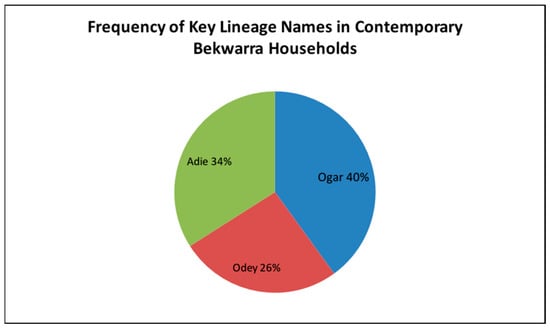
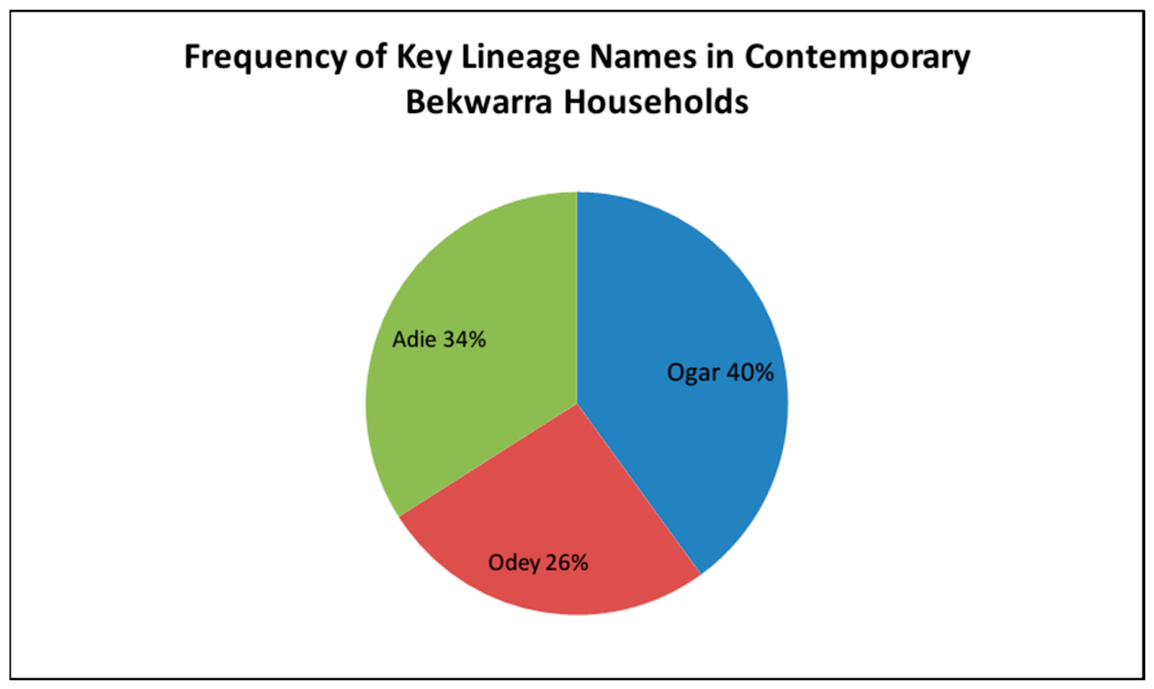
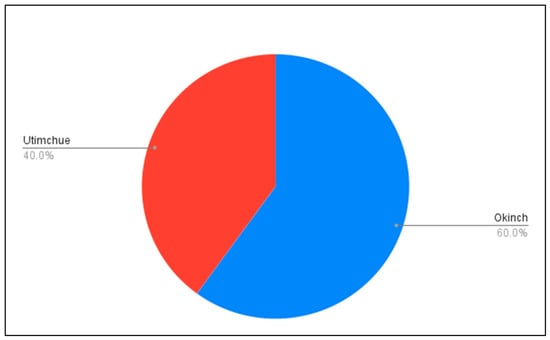
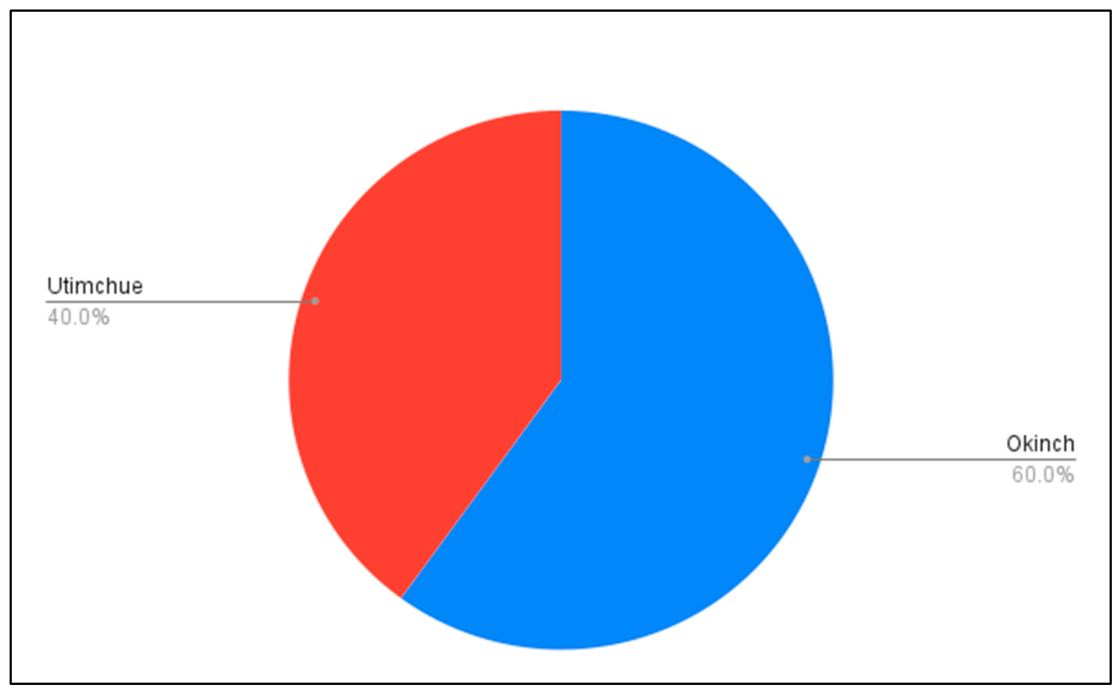
The names Ogar, Adie, and Odey keep appearing in different generations as a way of preserving collective memory as seen on Table 2. When a modern-day Bekwarra man is named Ogar, this is not just a way to remember him. Rather, it is a way for him to come back through ancestry so that he lives on forever in their community’s memory (Omagu 2006) (Table 3). The distribution is presented in Figure 1.
Table 3.
Frequency of Key Lineage Names in Contemporary Bekwarra Households.
Figure 1.
Key Lineage Names in Contemporary Bekwarra Households.
4.1.4. Morphological Retention and Divergence
Even though Igede has diverged into the Idomoid family and Durkwarra into the Bendi cluster, ethnic names retaining the “Agba” suffix suggest strong genealogical recognition (Stanford 1967).
4.1.5. The Role of Names in Social Organization
Names do not merely identify people but also reflect their past, social structure, and political legitimacy. The functions of names genealogy, time, god, and society show that language and society are interwoven (Makai and Oko 2019).
4.2. The Chronometric Archive: Market Day Names
The impact of cyclical time on the five-day market week.
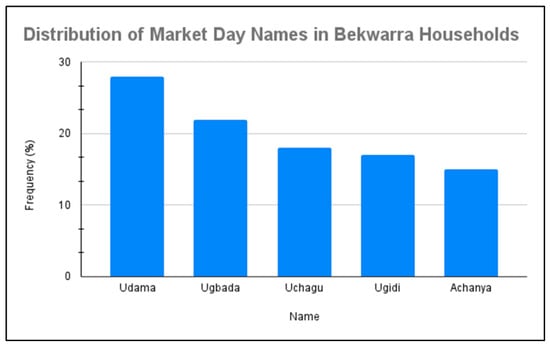
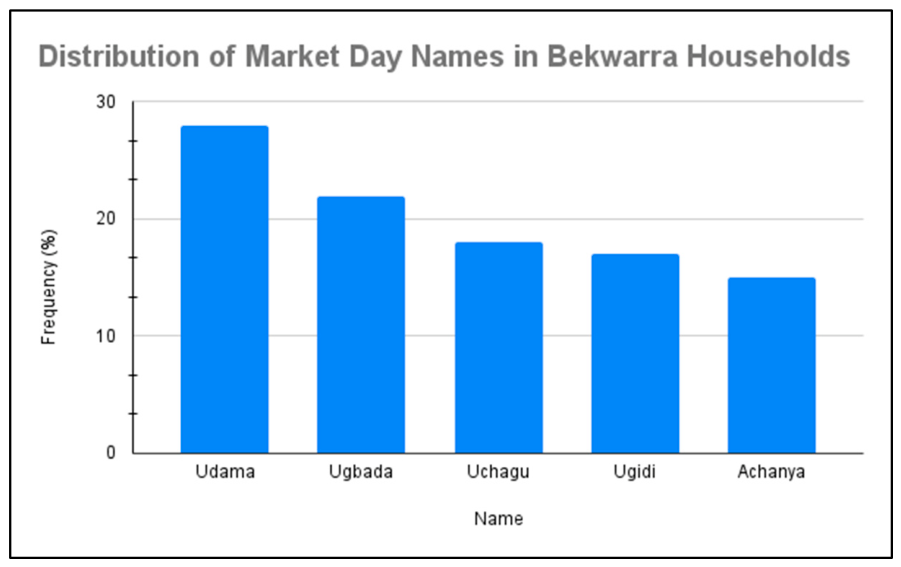
In the Bekwarra cosmology, the concept of time is cyclical and is focused on a 5-day market week. The economic cycle is not just the economy’s cycle. It is also embedded in the personal naming system. This phenomenon is known as Chronometric Naming. Each market day has its own character and thus associates people with the rhythm of the community and the past (Table 4 and Table 5). Figure 2 shows the relative frequency of these market-day names.
Table 4.
The Bekwarra Market Week and Associated Names (Omagu 2006).
Table 5.
Distribution of Market Day Names in Bekwarra Households.
Figure 2.
Relative frequency of market day names among Bekwarra individuals.
The Udama/Udam Distortion: Genealogy and Inter-Ethnic Relations.
The significance of the name Udama is very high. Odama, one of Bekwarra Agba’s children, led the migration that created the Bekwarra identity. The Tiv adjustment of the name Udama to Udam to Agidi is both linguistic and ethnic boundary-making. Though “Udam” can refer to “other” or “enemy” in derogatory terms among neighbors, it has an etymological root that refers to nobility. Thus, a name can encode these meanings, as well as all past vectors of alliance and rivalry (Omagu 2006). (Table 6).
Table 6.
Genealogical and Inter-Ethnic Dimensions of Udama/and Ugidi Udam (Omagu 2006).
4.3. The Sociopolitical Archive: Ushie and Ogamode
4.3.1. Ushie (Justice): Etymology, Topography, and Symbolism
The name Ushie (or Oshie), which is quite common in Bekwarra, means a person who is just and fair (Ushie 2001). This site is geomorphologically connected to the Oshie ridge in the Sankwala Mountains. It records the migration route and historical geography of the community. The une-ushi cowry, which was significant to the original dispute and the migration, contains the root ushi. This shows how the cowry’s physical loss is not accompanied by its moral loss. People expect children named Ushie to have qualities of justice. (Table 7).
Table 7.
Symbolic and Topographical Dimensions of Ushie (Ushie 2001).
4.3.2. Ogamode (Leadership): Political Authority and Family Legacy
Ogamode is the traditional title of a chief or clan head who eventually becomes a surname that records the family’s political history (Robert 2017). The head Irifen (Family) and the Ukani (Politics) are represented through the title.
4.3.3. Agricultural Festivals and Naming: The Case of Ipem Ihihe
The New Yam Festival (Ipem Ihihe), celebrated in September, is the cultural zenith of the Bekwarra calendar. Names bestowed during this period often reflect themes of harvest, abundance, and gratitude, reinforcing the agricultural ethos of the community (Robert 2017). (Table 8).
Table 8.
Festival-Related Names and Their Meanings.
4.4. Gender and Naming
4.4.1. Unisex and Gendered Names: The Case of Úké
While names like Ogar are distinctly male, Úké is a notable unisex name in Bekwarra society. Its usage by both males and females is either a linguistic borrowing from Bette/Bendi, where “Úké” denotes gift, or a unique local evolution (Cross River State Bureau of Statistics 2024). (Table 9).
Table 9.
Gender Distribution of Selected Bekwarra Names (Cross River State Bureau of Statistics 2024; Robert 2017).
4.4.2. Names Denoting Female Status: ‘Úngíé’
The term ‘‘Úngíé is a word for woman or wife. It is used in names to denote the female line of the individual. It might indicate one’s relationship to a wife or woman. This clarifies how one is related to the ‘Úngíé. The term ‘Úngíé may also appear in the name to indicate a woman’s female line and lineage continuity (Table 10) (Mensah 2023b).
Table 10.
Gender Distribution of Selected Bekwarra Female Names. Ref. (Cross River State Bureau of Statistics 2024).
4.5. Sociolinguistics of Nicknames
4.5.1. Nicknames as Social Regulation
Nicknames in Bekwarra are more than mere nicknames: they are living archives of character and reputation, social and personal (Onyi and Ukaegbu 2018). They help keep the community regulated through their alertness to behavioral dispositions. (Table 11). Frequency data are summarised in Table 12. Figure 3 presents the corresponding frequency pattern.
Table 11.
Common Bekwarra Nicknames and Social Functions (Onyi and Ukaegbu 2018).
Table 12.
Frequency of Selected Bekwarra Nicknames.
Figure 3.
Frequency of Nickname Usage in Social Contexts.
Agricultural Toponymy and Cultural Identity.
Theoretical Foundations of Toponymy and Cultural Heritage.
Toponymy: The study of place names, also known as toponymy, can help us deconstruct the relationship between language and landscape. Moreover, it can help formulate a possible approach towards the construction of cultural identity.
Place names certainly contain the socio-cultural and historical memory (Penko Seidl 2019; Miftahul Fahmi et al. 2025) of the community, besides the physical geography.
Analysis of Place Names and Agricultural Heritage: Local place names often reflect agriculture, topography, and resource management. Aeeh names like blang (rice field) and alue (ditch) that are used in Aceh resumes have a farming nature. This indicates the farming culture of the people (Miftahul Fahmi et al. 2025). Microtoponyms or field names still exist as a language marker of agricultural tradition (Penko Seidl 2019, p. 50). (Table 13).
Table 13.
Agricultural toponyms and their meanings in Aceh (Penko Seidl 2019).
4.5.2. Festival-Driven Naming Practices
Seasonal festivals like the New Yam Festival (Ipem Ihihe) play very important roles in giving names. Names given during these periods often symbolize plenty, renewal, and a strong sense of community. Festival-related names indicate development and continuity. The names of food festivals in the United States, for example, often use geographic and agricultural elements to strengthen the local identity (Kesgin et al. 2021). (Table 14).
Table 14.
Prevalence of naming components in food festival names.
Festival Names as Cultural Branding: The name of a festival is a cultural brand that mediates identity and image for residents and visitors. Using a place and food name in festivals increases the attractiveness of a destination while maintaining cultural continuity (Kesgin et al. 2021).
4.5.3. Gendered and Unisex Naming Patterns
Names often inform others about a person’s gender because they have male or female markers. In both Vietnamese and English-speaking cultures, people still keep gendered names. However, the trend of using unisex and gender-neutral names is increasingly popular due to globalization and social changes (Nguyen-Viet 2025; Lê 2025). (Table 15).
Table 15.
Distribution and Evolution of Gendered Names.
Sociolinguistic implications of Unisex Names: There is a rise in unisex names these days due to society’s changing perception of gender. Moreover, many parents prefer these types of names to even modern names, as there are closer social relationships among younger generations and urban people. Refs. (Lê 2025; Le and Nguyen 2025).
5. Material and Methods
This study adopts a qualitative research design because it enables the researchers to interact with and observe the participants in their ethnographic setting. Qualitative research design refers to the overall approach or strategy that informs the choice of methods used. The ethnographic paradigm, which allows the researcher to enter into participants’ lived realities and capture emic aspects that would escape a quantitative methodology, is particularly suited to socio-onomastic inquiry. Qualitative research typically depends on four methods of information gathering, which include participating in the setting, observing directly, conducting in-depth interviews, and analyzing previous material or documents.
Alongside ethnography, the Descriptive Linguistic method, which studies linguistic morphology by breaking names down into constituent morphemes, was adopted. Complementing this, the Historical Comparative method was used to track genealogical links and changes in naming practices over time. This approach reveals how names evolve in response to shifting socio-political and cultural circumstances.
5.1. Data Sources
The data for this study were drawn from several primary and secondary sources, ensuring methodological rigor and depth. For this study, the researchers employed participant observation and conducted in-depth interviews with selected Bekwarra native speakers. The researchers held in-depth interviews with the interviewee (20) in the area, covering both sexes and ages. The interviews were structured in nature in order to enable the research to achieve the aim of the study. In addition, the researchers freely interacted with native Bekwarra speakers to observe their use of naming in conveying different messages within their culture.
Information on the Ogar Agba genealogy and the Une-Ushi controversy was collated from recorded oral histories and interview transcripts. These oral resources are treated as integral to historical reconstruction, as they can hold “underground memory” and serve to augment or challenge the official memory preserved in archives. The interviewer’s positionality and the dialogic nature of oral accounts were taken into consideration to account for subjectivity and contextual dependence.
Linguistic data, including word lists and classification data that place Bekwarra within the Bendi/Obe cluster, were utilized to guide linguistic analysis and to contextualize naming practices in relation to neighboring languages.
Historical records, such as colonial administrative papers and documents recording name corruption, were used to verify oral claims and to corroborate the archival function of names as historical repositories. By employing archival ethnography, power dynamics and biases inherent in archival collections may be critically engaged (Sousa Lopes and Ipiranga 2021). Academic journals and peer-reviewed publications providing theoretical frameworks and comparative perspectives in contemporary onomastic studies were also utilized.
5.2. Data Analysis Methods
Several analytical methods were employed in the analysis of the data.
5.2.1. Morphological Decomposition
It involves breaking names down into prefixes, roots, and suffixes to study their meaning and function. This linguistic technique helps decipher the internal structure of each name.
5.2.2. Thematic Coding
It involves using both deductive and inductive approaches, and was applied to classify names into domains such as genealogical, chronometric (time-related), theophoric (divine/religious), and sociopolitical. The coding process was iterative and reflexive, allowing for the recognition of native categories and patterns that are not immediately obvious.
5.2.3. Cross-Referencing
Historical records, while validating oral claims embedded in names, constitute a fundamental procedure in historical onomastics. A systematic cross-check and triangulation of information guarantees dependability and validity, as no single source is considered definitive.
Through this rigorous approach, integrating ethnographic immersion, linguistic analysis, and historical methods, the study aims to achieve a comprehensive understanding of Bekwarra naming practices, opening new pathways into the cultural workings of the community.
6. Conclusions
The way people name their children is not static. It changes with each new generation. Moreover, it keeps changing with modernization and globalization. Names that have religious and traditional roots are still in vogue, but there is a definite trend among youth for hybrids, names with a global flavour, and creations. Names are still one of the most important markers of group identity, social integration, and cultural negotiation, thus reflecting either very firm patterns or adaptive patterns of individuals and communities.
To the Bekwarra, ‘what we call ourselves’ is ‘who we are’ and ‘where we came from’. Their naming system is a clever and decentralised archiving technology, which has kept the history of the tribe for ages without the benefit of text. The term Ogar Agba relates to the genesis, while Bekwarra refers to the migration and resistance. Similarly, Udama refers to the economic cycle, and Ushie refers to the moral code of justice.
However, this technology depends on oral transmission. A growing number of urban youth are adopting anglicised names, and in the process, they are losing touch with their ‘deep language,’ which is quite sad. Ogboja’s forgotten etymology severs Bekwarra’s conceptual connection to the “fertile soil”.
Author Contributions
Conceptualization, T.A.O. and J.T.T.; methodology, T.A.O. and J.T.T.; formal analysis, T.A.O. and J.T.T.; investigation, T.A.O. and J.T.T.; data curation, T.A.O. and J.T.T.; writing—original draft preparation, T.A.O. and J.T.T.; writing—review and editing, T.A.O. and J.T.T.; visualization, J.T.T.; supervision, T.A.O. and J.T.T. All authors have read and agreed to the published version of the manuscript.
Funding
This research received no external funding.
Institutional Review Board Statement
The study was conducted according to the guidelines of the Declaration of Helsinki, and approved by The University of Calabar Ethical Review Board (protocol code UC/FA/EA/25/0027 and date of approval: 10 December 2025).
Informed Consent Statement
Informed consent was obtained from all participants involved in the study.
Data Availability Statement
The original contributions presented in this study are included in the article. Further inquiries can be directed to the corresponding author.
Acknowledgments
The authors acknowledge the Bekwarra community members and native speakers who contributed oral accounts and cultural information used in this study.
Conflicts of Interest
The authors declare no conflict of interest.
References
- Antonsich, Marco. 2021. What’s in a name? Children of migrants, national belonging and the politics of naming. Social & Cultural Geography 23: 1078–96. [Google Scholar] [CrossRef] [Scilit]
- Assmann, Jan. 2008. Communicative and Cultural Memory. In Cultural Memory Studies: An International and Interdisciplinary Handbook. Edited by A. Erll and A. Nünning. Berlin: De Gruyter, pp. 109–18. [Google Scholar] [CrossRef] [Scilit]
- Babalola, David Ayo, and Neo Sedisa. 2025. Digital heritage and contemporary African identity formation through social media. e-Bangi Journal of Social Science and Humanities 22: 709–26. [Google Scholar] [CrossRef] [Scilit]
- Banda, Lazarus Obed Livingstone, Chigonjetso Victoria Banda, Jane Thokozani Banda, and Tapiwa Singini. 2024. Preserving cultural heritage: A community-centric approach to safeguarding the Khulubvi Traditional Temple Malawi. Heliyon 10: 37610. [Google Scholar] [CrossRef] [Scilit] [PubMed]
- Batoma, Atoma. 2020. African ethnonyms and toponyms: An annotated bibliography. Electronic Journal Africana Bibliography 10. [Google Scholar] [CrossRef] [Scilit][Green Version]
- Bourdieu, Pierre. 1991. Language and Symbolic Power. Edited by J. B. Thompson. Translated by G. Raymond. Cambridge, MA: Harvard University Press. [Google Scholar]
- Butler, Judith. 1999. Gender Trouble: Feminism and the Subversion of Identity, (10th anniversary ed.). London: Routledge. [Google Scholar]
- Cheng, Karen Kow Yip. 2008. Names in multilingual-multicultural Malaysia: Names. A Journal of Onomastics 56: 47–53. [Google Scholar] [CrossRef] [Scilit]
- Chigwada, Josiline, Jacob Mapara, Patrick Ngulube, and Tavhiringwa Chabvutagondo. 2025. Influence of Indigenous data governance principles on Indigenous knowledge management: Lessons from the Southern African Intangible Cultural Heritage Project. IFLA Journal 52: 38–47. [Google Scholar] [CrossRef] [Scilit]
- Chola, Musonda, and John Simwinga. 2021. Sokalikwenda ‘Calamity that moves’: Some social aspects of Tumbuka personal names. The International Journal of Humanities and Social Sciences 9: 425–30. [Google Scholar] [CrossRef] [Scilit]
- Cross River State Bureau of Statistics. 2024. Demographic and Cultural Profiles of Cross River State. Calabar: CRSBOS. [Google Scholar]
- Devine, Dympna, Mairin Kenny, and Eileen Macneela. 2008. Naming the ‘other’: Children’s construction and experience of racisms in Irish primary schools. Race Ethnicity and Education 11: 369–85. [Google Scholar] [CrossRef] [Scilit]
- Elder, Elizabeth Mitchell, and Matthew Hayes. 2023. Signaling race, ethnicity, and gender with names: Challenges and recommendations. The Journal of Politics 85: 764–70. [Google Scholar] [CrossRef] [Scilit]
- Etu, Mercy, Imeobong John Offong, and Idongesit Imohowo Eyakndue. 2024. Something that looks like money: Ethnopragmatic analysis of wealth-related title names among young Igbo businessmen. Languages 9: 385. [Google Scholar] [CrossRef] [Scilit]
- Gwerevende, Solo, and Zama Mthombeni. 2023. Safeguarding intangible cultural heritage: Exploring the synergies in the transmission of Indigenous languages, dance and music practices in Southern Africa. International Journal of Heritage Studies 29: 398–412. [Google Scholar] [CrossRef] [Scilit]
- Kesgin, Muhammet, Rajendran S. Murthy, and Rick Lagiewski. 2021. Profiling food festivals by type, name and descriptive content: A population-level study. British Food Journal 124: 530–49. [Google Scholar] [CrossRef] [Scilit]
- Le, Thi Minh Thao, and Huang Quang Nguyen. 2025. Understanding names: A comparative study of Vietnamese and Chinese naming structure. Forum for Linguistic Studies 7: 1046–57. [Google Scholar] [CrossRef] [Scilit]
- Lê, Thi Minh Thao. 2025. The sociolinguistics of gendered naming in English-speaking societies. Tạp chí Khoa học Trường Đại học Mở Hà Nội 124: 73–84. [Google Scholar] [CrossRef] [Scilit]
- Lindsay, Jo, and Deborah Dempsey. 2017. First names and social distinction: Middle-class naming practices in Australia. Journal of Sociology 53: 577–91. [Google Scholar] [CrossRef] [Scilit]
- Loveday, Leo. 2022. An onomastic banquet of intercultural relations. Вопросы Ономастики 19: 259–63. [Google Scholar] [CrossRef] [Scilit]
- Lowe, Kevin, Iliana Skrebneva, Cathie Burgess, Neil Harrison, and Greg Vass. 2020. Towards an Australian model of culturally nourishing schooling. Journal of Curriculum Studies 53: 467–81. [Google Scholar] [CrossRef] [Scilit]
- Lusekelo, Amani, and Victor Mtenga. 2020. Historicity of personal names in Tanzania: The case of the names in the Rombo-Chagga community in Kilimanjaro. International Journal of Modern Anthropology 2: 100–21. [Google Scholar] [CrossRef] [Scilit]
- Machaba, M. 2004. Naming, Identity and the African Renaissance in a South African Context. Doctoral dissertation, University of Natal, Pietermaritzburg, South Africa. [Google Scholar]
- Makai, J., and E. Oko. 2019. Naming and identity in Nigerian societies. Journal of the Linguistic Association of Nigeria 22: 45–62. [Google Scholar]
- Makondo, L. 2009. Intended and Implied Meanings of Names in Shona Society. Doctoral dissertation, University of South Africa, Pretoria, South Africa. [Google Scholar]
- Matfunjwa, Muzi, Respect Mlambo, and Nomsa J. Skosana. 2024. Nicknames among Swati clans: A socio-cultural analysis. Literator 45: 2020. [Google Scholar] [CrossRef] [Scilit]
- McCarty, Teresa. 2020. The holistic benefits of education for Indigenous language revitalisation and reclamation (ELR2). Journal of Multilingual and Multicultural Development 42: 927–40. [Google Scholar] [CrossRef] [Scilit]
- Mensah, Eyo O. 2023a. Death is the cause of my predicament: A cross-cultural study of death-related personal names in Nigeria. Death Studies 48: 641–51. [Google Scholar] [CrossRef] [Scilit] [PubMed]
- Mensah, Eyo O. 2023b. Husband is a priority: Gender roles, patriarchy and the naming of female children in Nigeria. Gender Issues 40: 44–64. [Google Scholar] [CrossRef] [Scilit]
- Mensah, Eyo O., Josephine Alexander, and Queen Ayeni. 2022. The ethnopragmatic functions of Owe and Tiv personal names in Nigeria. Language Sciences 89: 101–12. [Google Scholar]
- Miftahul Fahmi, Said, Zulfadli Abdul Aziz, Yunisrina Qismullah Yusuf, and Cut Dewi. 2025. Exploring dominant naming patterns in West Aceh and Nagan Raya: A linguistic and geographical analysis. EduLite: Journal of English Education, Literature and Culture 10: 160–76. [Google Scholar] [CrossRef] [Scilit]
- Mokala, Ntsoaki. 2020. Basotho naming systems and practices: A sociolinguistic-onomastics approach. International Journal of Linguistics, Literature and Translation 3: 220–27. [Google Scholar]
- Ndlovu, Sambulo. 2021. Naming and othering in Africa. In African Identities. London: Routledge. [Google Scholar]
- Nguyen-Viet, Khoa. 2025. The linguistic landscape of gender in Vietnamese personal names. Names: A Journal of Onomastics 73: 20–31. [Google Scholar] [CrossRef] [Scilit]
- Njagi, Serah Njoki, Martha Muraya, and Humphery K. Ireri. 2023. The role of colonialism in the transformation of the indigenous naming system of the Amuthambi of Tharaka Nithi County, Kenya, 1920–1963. International Journal of Culture and History 10: 82–101. [Google Scholar] [CrossRef] [Scilit]
- Omagu, Donald. 2006. Oral Traditions and the Genealogy of the Bekwarra People. Calabar: University of Calabar Press. [Google Scholar]
- Onyi, Prince Agbor, and Eunice Kingsley Ukaegbu. 2018. Sociolinguistic Analysis of Bekwarra Nicknames. Humanitatis Theoreticus Journal 1: 36–51. [Google Scholar]
- Penko Seidl, Nadja. 2019. Engraved in the landscape: The study of spatial and temporal characteristics of field names in the changing landscape. Names: A Journal of Onomastics 67: 16–29. [Google Scholar] [CrossRef] [Scilit]
- Puzey, Guy, Jani Vuolteenaho, and Matthias Wolny. 2021. Signals of onomastic capital. Nordisk tidskrift för socioonomastik/Nordic Journal of Socio-Onomastics 1: 115–55. [Google Scholar] [CrossRef] [Scilit]
- Rakgogo, Tebogo. 2024. Neither Sepedi nor Northern Sotho/Sesotho sa Leboa is onomastically correct: A colonial imposition. Southern African Linguistics and Applied Language Studies 42: S207–S223. [Google Scholar] [CrossRef] [Scilit]
- Robert, A. 2017. Migration and Settlement Patterns in Northern Cross River. New Delhi: Heritage Publishers. [Google Scholar]
- Sousa Lopes, Luma Louise, and Ana Silvia Rocha Ipiranga. 2021. Ethnographing historical archives: Possible ways to research in organization studies. Organizações & Sociedade 28: 35–53. [Google Scholar] [CrossRef] [Scilit]
- Sørensen, J., J. Freese, C. Crabtree, S. M. Gaddis, J. B. Holbein, and E. N. Larsen. 2022. Racially distinctive names signal both race/ethnicity and social class. Sociological Science 9: 454–72. [Google Scholar] [CrossRef] [Scilit] [PubMed]
- Stanford, Ronald. 1967. The Bekwarra Language of Nigeria: A Grammatical Description. Doctoral dissertation, School of Oriental and African Studies, University of London, London, UK. [Google Scholar]
- Uluocha, Nna. 2015. Decolonizing place-names: Strategic imperative for preserving indigenous cartography in post-colonial Africa. African Journal of History and Culture 7: 180–92. [Google Scholar] [CrossRef] [Scilit]
- Ushie, G. O. 2001. A Contrastive Analysis of Morphological Processes in English Language and Bèkwárra Language. Master thesis, University of Calabar, Calabar, Nigeria. [Google Scholar]
- Uwen, God’sgift Ogban, and Edadi Ilem Ukam. 2024. This is the sacrifice: Language, ideology and religious identity performance in Erei personal names. Languages 9: 326. [Google Scholar] [CrossRef] [Scilit]
- Völkel, Svenja, Sambulo Ndlovu, and Nico Nassenstein. 2023. Naming and Labelling Contexts of Cultural Importance in Africa: An introduction. International Journal of Language and Culture 10: 145–50. [Google Scholar] [CrossRef] [Scilit]
- Wagtingan, Mae Sandra. 2024. Unveiling indigenous names: A preservation of culture. International Journal of Research Publications 141: 41–64. [Google Scholar] [CrossRef] [Scilit]
- Wu, Xinran. 2023. Stories of names: Exploring Chinese high school language-other-than-English learners’ foreign name(s) usage and its role in multilingual identity construction. Journal of Multilingual and Multicultural Development 45: 4415–29. [Google Scholar] [CrossRef] [Scilit]

Disclaimer/Publisher’s Note: The statements, opinions and data contained in all publications are solely those of the individual author(s) and contributor(s) and not of MDPI and/or the editor(s). MDPI and/or the editor(s) disclaim responsibility for any injury to people or property resulting from any ideas, methods, instructions or products referred to in the content. |
© 2026 by the authors. Licensee MDPI, Basel, Switzerland. This article is an open access article distributed under the terms and conditions of the Creative Commons Attribution (CC BY) license.