


Abstract
Botswana provides a setting in which to examine pastoral power. Customary authority, Christian institutions, public-health programmes, and state law have each helped to shape the social regulation of gender and sexuality. This systematic review brings together Botswana-specific scholarship on the ways care, counselling, scriptural interpretation, and institutional support affect lesbian, gay, bisexual, transgender, intersex, queer, and other gender- and sexually diverse people. The review followed PRISMA 2020. Web of Science, Scopus, ScienceDirect, SpringerLink, and Google Scholar were searched from database inception to 15 May 2024, and a supplementary search of publisher sites, indexes, and citation networks was updated to 31 July 2026. Five independent sources met the eligibility criteria: one qualitative interview study, one field-informed country report, and three documentary, legal, church-historical, or biblical analyses. The CASP qualitative checklist and the JBI text-and-opinion checklist were used for design-appropriate appraisal. Across this small and varied literature, four patterns recurred: the moral authority assigned to scripture and culture; care that was conditional or incomplete; interaction among religious, health, legal, and civil-society institutions; and dialogical alternatives to exclusion. Evidence is strongest for public discourse, institutional positions, and reported counselling experiences; no included source directly observed a pastoral ritual. Religious care may offer belonging and support, but it may also carry expectations of conformity. Broader claims will require ethnographic and participatory research developed with, and responsive to, LGBTIQ+ Batswana.
1. Introduction
Gender and sexual diversity in postcolonial African settings are not regulated by any single institution. Customary authorities, churches, families, health services, civil-society organisations, and the state all participate, sometimes in tension with one another. Botswana is especially instructive because these domains have long developed in close relationship. Historically, the authority of the kgosi (chief) combined political leadership with responsibility for collective welfare. Missionary Christianity and colonial administration later introduced additional moral vocabularies and institutional arrangements (Maundeni 2002). Churches continue to occupy a prominent place in public life. Christian umbrella organisations participate in debates about HIV, sexuality, morality, and cooperation with civic bodies (Nkomazana 2014).
Botswana has also undergone an important legal transition. In 2019, the Botswana High Court ruled that provisions criminalising consensual same-sex conduct violated constitutional rights. The Court of Appeal upheld that judgment in 2021 (Esterhuizen 2019; Dinokopila 2023). Legal reform, however, does not automatically dislodge stigma within congregations, families, health services, or everyday relationships. The coexistence of constitutional inclusion with continuing religious and cultural disapproval makes Botswana a setting in which to ask how support and regulation can operate simultaneously. Foucault’s account of pastoral power offers a way into this question.
Drawing on the image of the shepherd and the flock, Foucault described an individualizing authority concerned with guidance, protection, confession, and the direction of conduct (Foucault 1982). Pastoral power is not simply coercive; it works through attention to well-being and through claims about what a proper life should be. In this review, ritualized care denotes recurrent, socially authorized practices such as prayer, counselling, healing, moral instruction, referral, and organized support through which institutions respond to vulnerability. The term does not presume that care is necessarily disciplinary. Rather, it helps distinguish support that is offered without conditions from support tied to expectations about sexuality, gender expression, or religious belonging.
Foucault alone cannot account for the Botswana setting. African feminist, postcolonial, liberation, and queer theologians have shown that biblical interpretation must be read against histories of mission, colonialism, patriarchy, HIV and AIDS, and local struggles for life and dignity. Dube’s work in and from Botswana foregrounds gender, community, public health, and the life-giving or harmful consequences of interpretation (Dube 2012). Maluleke cautions against treating ‘Africa’ as a uniform cultural authority while overlooking gendered exclusions (Maluleke 1997). Chitando and Mateveke (2017) call for African-centred concepts and vocabularies in debates about homosexuality, while van Klinken (2018, 2019) treats queer African stories as sources of theological knowledge rather than merely objects of pastoral concern. Feminist scholarship associated with Nadar likewise keeps power, embodiment, and lived experience at the centre of theological analysis (Phiri and Nadar 2006; Sistig and Nadar 2011). These scholars therefore enter the analysis as interlocutors with Foucault, not as local illustrations of a theory developed elsewhere.
Botswana-focused scholarship on these questions remains dispersed across theology, biblical studies, law, development, and health. Studies have often considered public attitudes, legal rights, and religious teaching separately, leaving the relationship among pastoral practice, institutional programmes, and moral discourse less clearly understood. The strength of the evidence is also difficult to assess because earlier syntheses have not reported design-specific appraisal, transparent coding, or an evidence table. Research in Botswana is less developed than comparable work from South Africa, Kenya, Zambia, and Zimbabwe, where queer theology, narrative methods, and church-related public discourse have received more sustained attention (Chitando and Mateveke 2017; van Klinken 2018, 2019).
Against this background, the review asks three related questions. First, how do published sources describe pastoral power operating through care, counselling, healing, or moral guidance in Botswana? Second, how are care, discipline, inclusion, and exclusion represented across religious, cultural, health, legal, and development settings? Third, what does the available evidence imply for the recognition and welfare of LGBTIQ+ Batswana? The purpose is to establish what the sources support, to judge the strength of that support, and to identify both the usefulness and the limits of pastoral power as an interpretive frame.
2. Materials and Methods
2.1. Review Design and Protocol
The review was reported in accordance with PRISMA 2020 (Page et al. 2021), and the completed PRISMA 2020 checklist is provided as Supplementary Material. During revision, a protocol was registered with OSF Registries using the OSF Preregistration template (CC0 1.0 Universal; https://osf.io/e2ctf; https://doi.org/10.17605/OSF.IO/E2CTF (accessed on 24 August 2026). Registration followed the initial search and is therefore retrospective rather than prospective. The registered protocol records the clarified eligibility criteria, expanded terminology, appraisal procedures, and synthesis plan applied in the revised review.
2.2. Information Sources and Search Strategy
The initial search covered Web of Science, Scopus, ScienceDirect, SpringerLink, and Google Scholar from database inception to 15 May 2024. Together, these sources provided coverage across social science, theology, religious studies, public health, and African studies, while also allowing books and grey academic literature to be located. No publication-date restriction was applied. Eligible publication types included English-language books, chapters, journal articles, dissertations, and academic reports.
Following peer review, the search terminology was broadened and a supplementary search was completed on 31 July 2026. Three concept blocks were combined: geographical terms (Botswana, Batswana, and Setswana); terms for gender and sexual diversity; and terms for pastoral authority, religion, and care. Syntax, truncation, and spelling variants were adjusted for each platform. Searches of publisher websites and relevant indexes were supplemented by backward and forward citation searching of eligible sources. Appendix A reports the reproducible core Boolean structure and explains the platform-specific adaptations.
2.3. Eligibility Criteria
A source was eligible when it met three conditions: it focused on Botswana or presented Botswana-specific findings; it addressed lesbian, gay, bisexual, transgender, intersex, queer, same-sex, or other gender- or sexually diverse identities and practices; and it examined religious authority, pastoral care or counselling, healing, prayer, scriptural interpretation, church or faith-based programmes, or a closely related form of moral regulation. The review included qualitative and mixed-methods studies, as well as documentary, historical, legal, critical-biblical, and pastoral-theological analyses, because the question concerns both observed practice and the ideas that authorise it. Sources were excluded when Botswana appeared only incidentally, when gender was discussed without attention to sexual or gender diversity, when pastoral or religious authority was absent, or when the work was exclusively biomedical or epidemiological.
2.4. Study Selection
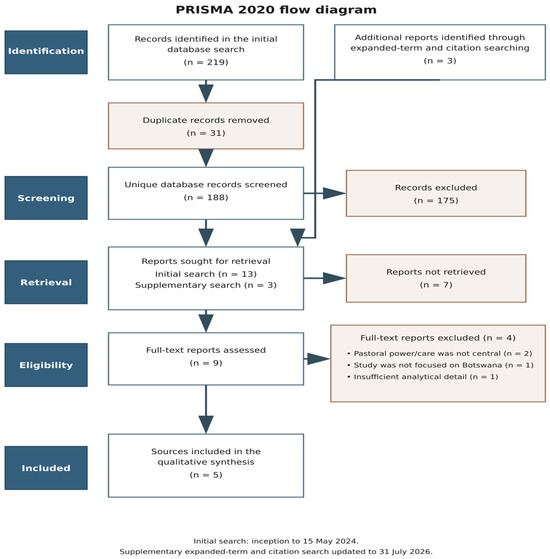
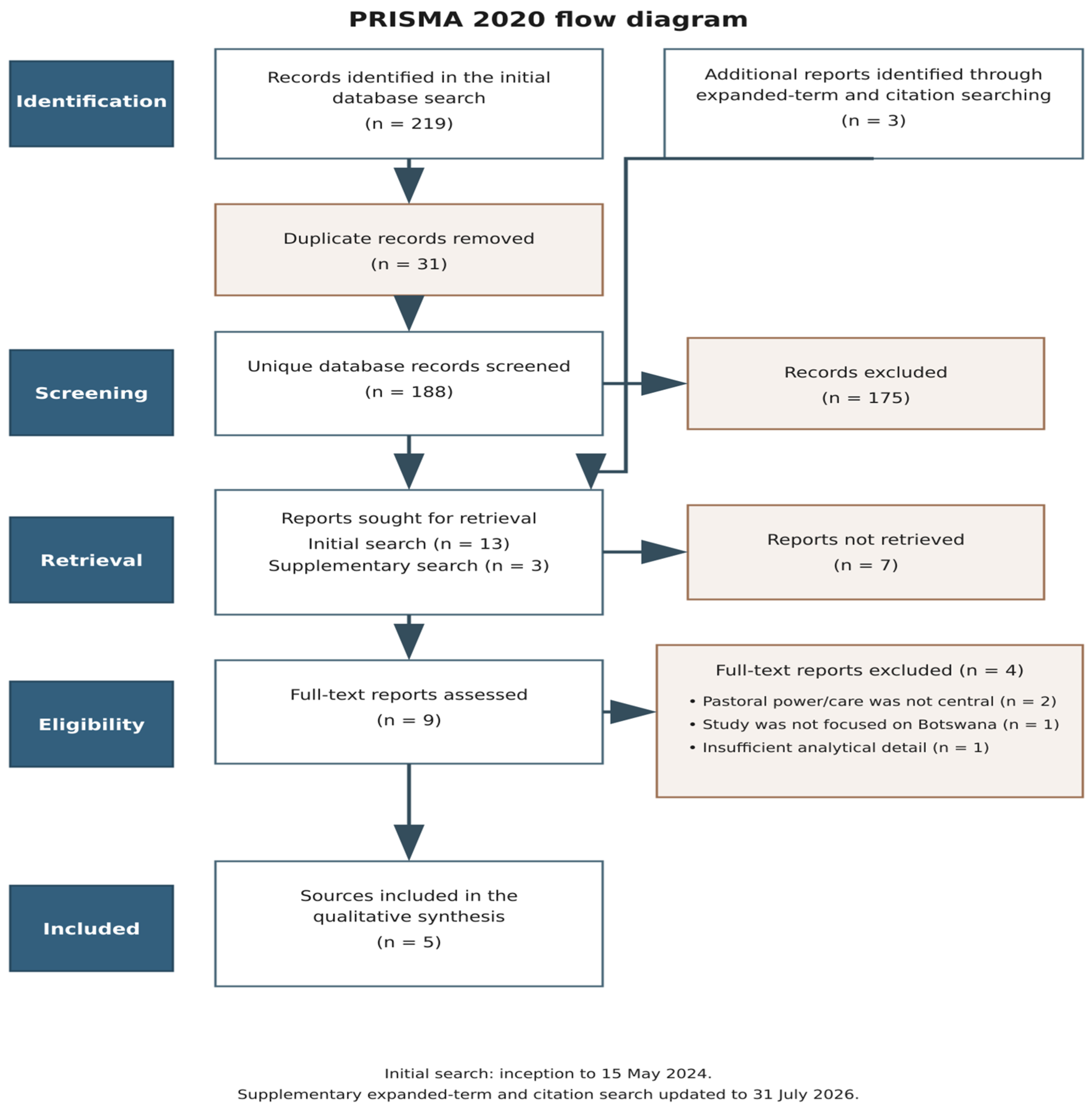
The author screened titles and abstracts independently before assessing the retrieved full texts. Differences were assessed. The initial search returned 219 records. Removal of 31 duplicates left 188 records for screening, of which 175 were excluded. Thirteen reports were sought and seven could not be retrieved; six full texts were therefore assessed. Four failed to meet the eligibility criteria because pastoral or religious authority was not central, Botswana was not the substantive focus, or the report did not contain enough analytical detail. The initial search yielded two included sources. Three further eligible reports were identified through expanded-term searching and citation tracking, producing a final corpus of five independent sources (Figure 1).
Figure 1.
PRISMA 2020 flow diagram showing identification, screening, eligibility assessment, and inclusion of sources in the systematic review.
2.5. Data Extraction and Quality Appraisal
Data were entered into a structured extraction form covering authorship, year, publication type, aim, design, data source, participants where applicable, analytical approach, institutional setting, population, reported findings, and limitations. The peer-reviewed qualitative interview study was appraised with the Critical Appraisal Skills Programme qualitative checklist (CASP 2018). The four documentary, legal, church-historical, biblical, or organisational analyses were assessed with the Joanna Briggs Institute checklist for text and opinion (JBI 2020). The latter considers author expertise, clarity and logic of argument, the evidential basis of the claims, engagement with relevant literature, and consistency with the interests of the population concerned. Appraisal shaped the weight assigned to each claim but did not operate as a mechanical threshold for exclusion.
2.6. Coding and Thematic Synthesis
The results and discussion sections of each source were coded line by line, following the logic of thematic synthesis (Thomas and Harden 2008). Initial codes stayed close to the language of the sources and included terms such as ‘biblical condemnation’, ‘cultural authority’, ‘service omission’, ‘safe space’, ‘partnership’, and ‘legal recognition’. The author compared these codes across sources, grouped related material, and developed descriptive themes. Only then was a second, interpretive stage undertaken to consider the themes in relation to pastoral power and African feminist, liberation, and queer theological scholarship. This order kept source descriptions in Section 3 and theoretical interpretation in Section 4. Contrary or qualifying evidence, including affirming biblical readings and calls for inclusive care, was retained rather than absorbed into a single account of religious repression.
2.7. Researcher Reflexivity
The review was conducted by a single researcher with knowledge of Botswana’s theological and institutional landscape and familiarity with the relevant literature. The author did not contribute to any of the five sources included in the review. Because study selection, appraisal, coding, and synthesis were undertaken by one researcher, particular attention was given to maintaining a transparent distinction between findings reported in the included sources, recommendations made by their authors, and interpretations developed through the synthesis. Eligibility criteria and design-appropriate appraisal tools were applied consistently, and claims that could not be traced directly to an included source were either removed or identified as questions requiring further investigation. The absence of independent duplicate screening and coding is acknowledged as a methodological limitation.
2.8. Methodological Limitations
In addition, study selection, quality appraisal, coding, and synthesis were undertaken by a single researcher rather than independently duplicated, which may have increased the possibility of selection and interpretive bias. Relevant scholarship in Setswana and other local languages may have been missed because the review was limited to English-language sources, and searches of Google Scholar and publisher websites are less reproducible than searches of bibliographic databases. The five sources also differ in purpose and design. Only one provides a detailed qualitative study; one country report draws on field engagement but provides little procedural detail; and three are documentary, legal, historical, or biblical analyses. Furthermore, the protocol was registered during revision rather than before the initial search. This review maps a small and heterogeneous field; it cannot estimate the prevalence or effects of any pastoral practice. Figure 1 presents the PRISMA 2020 study-selection flow diagram.
3. Results
3.1. Study Selection and Publication Pattern
Five independent sources published between 2002 and 2024 met the eligibility criteria. Their distribution suggests an emerging field rather than an established body of empirical research. One peer-reviewed study reported in-depth interviews with 15 LGBTI+ adults. A country report combined documentary analysis with organisational engagement, interviews, and focus-group material. The other three sources examined public debate, legal and Anglican materials, or the history and public positions of Pentecostal umbrella bodies. None directly observed a pastoral counselling session, healing ritual, or prayer meeting involving an LGBTIQ+ service user. One study did, however, record a participant’s account of a counsellor introducing a church-based ‘deliverance’ response.
3.2. Characteristics of Included Sources
Table 1 sets out the design, contribution and limitations of each source. Stiebert (2002) considered Botswana’s public debate alongside competing interpretations of Hebrew Bible texts. Quansah (2008) examined law, religious freedom, and the Anglican tension between condemnation and a duty to minister regardless of sexual orientation. Nkomazana (2014) traced Pentecostal and Christian umbrella organisations, including an Evangelical Fellowship of Botswana position that linked opposition to legalisation with culture and morality. Muzenda (2017) documented church dialogues, family advocacy, religious discrimination, and quiet forms of institutional support within a wider study of LGBTI activism. Mangwegape et al. (2024), drawing on interviews with 15 LGBTI+ adults in Gaborone, showed how stigma including the introduction of a religious ‘deliverance’ narrative during counselling could discourage help-seeking.
Table 1.
Evidence summary of included sources.
3.3. Quality Appraisal
Confidence in the qualitative interview study was moderate to high, while confidence in the four documentary or field-informed sources was moderate overall (Table 2). Mangwegape et al. (2024) described its sample, recruitment, ethics, data collection, coding, co-coding, and reflexive procedures with unusual clarity for this small literature. Stiebert (2002) was explicit about the restricted basis of the Botswana analysis. Quansah (2008) and Nkomazana (2014) developed coherent arguments from identifiable legal or institutional materials, although sexuality was not the sole focus of either source. Muzenda (2017) contributed valuable community and church detail but reported sampling and analytical procedures only partially. These weaknesses do not invalidate the sources; they do, however, limit claims about prevalence, consistency across institutions, and impact.
Table 2.
Design-appropriate quality appraisal.
3.4. Descriptive Thematic Findings
3.4.1. Scripture and Culture as Sources of Moral Authority
Scripture, culture, and church teaching emerged in three sources as prominent forms of moral authority. However, this authority was neither exclusive nor uncontested. Stiebert (2002) identified positions in Botswana’s public debate that ranged from conservative rejection to affirming and queer readings. Quansah (2008), on the other hand, pointed to an unresolved Anglican tension between condemnation and the obligation to minister to all. Nkomazana (2014) described a Pentecostal umbrella body’s use of culture, nature, and morality in opposing legalisation. Taken together, these sources show a religious discourse with considerable public influence but no single, settled position.
3.4.2. Conditional Care and Institutional Omission
Conditional care was most visible when an offer of support carried an expectation of change. In Mangwegape et al. (2024), a participant recalled a counsellor moving away from mental-health support and instead recommending a church and prophet said to deliver people from homosexuality. The participant associated that encounter with a reluctance to seek counselling again. Quansah (2008) described a related institutional tension: a church could affirm its duty to minister to everyone while continuing to condemn same-sex intimacy. Muzenda (2017) reported both religious discrimination and less visible forms of support, including churches that made space available to LGBTI groups without publicly declaring an affirming position. The evidence concerns particular encounters and institutional statements; it does not support a claim about uniform practice across Botswana’s churches.
3.4.3. Interfaces Among Pastoral Care, Health, Law, and Development
Religious authority also appeared at the boundaries of health, law, and development. Nkomazana (2014) showed Pentecostal umbrella organisations addressing homosexuality, HIV prevention, public morality, and cooperation with civic organisations. Muzenda (2017) connected church dialogue with family advocacy, LGBTI activism, mental health, public health, legal recognition, and engagement with traditional leaders. Mangwegape et al. (2024) demonstrated how a religious claim could enter an ostensibly clinical counselling encounter. These sources reveal institutional overlap, although none evaluates a completed church–health or church–community intervention.
3.4.4. Dialogical and Liberative Alternatives
The literature did not speak only of exclusion. Stiebert (2002) disputed the claim that the Hebrew Bible provides a single, unambiguous judgment. Quansah (2008) stressed a ministerial duty not limited by sexual orientation, while Muzenda (2017) described church and family discussions, calls for SOGI sensitisation, and support from some religious leaders. These discussions matter because they may create opportunities for further dialogue and liberative practice. However, their effects have not been assessed. The sources offer descriptions and normative possibilities, not evidence of effects on individual well-being, access to services, or community belonging.
4. Discussion
The evidence supports a more qualified argument than a general account of religious regulation would allow. In Botswana, pastoral authority is visible in public biblical interpretation, church statements about sexuality and morality, legal discussion of a duty to minister, family and church dialogue, and the entry of religious claims into a health-counselling encounter. These practices resonate with Foucault’s account because they connect concern for well-being with guidance about conduct (Foucault 1982). At the same time, the sources do not reveal a single, integrated ‘pastoral ecology’, nor do they show that care invariably becomes discipline. Condemnation, conditional support, institutional silence, dialogue, and affirming interpretation coexist in a contested field.
Evidence of conditional care appears clearly in two places: the reported counselling encounter in which professional support became an invitation to religious deliverance, and the Anglican dilemma of ministering to people whose relationships remained condemned. Foucault helps to identify the connection between care and the direction of conduct. African theological scholarship, however, makes the local stakes more visible. For instance, Dube’s life-centred and postcolonial work asks whether interpretation sustains life amid conditions shaped by gender and HIV (Dube 2012). Chitando and Mateveke (2017) resist reducing African debates about sexuality to imported binaries. Nadar’s feminist critique assesses whose experience is authorised within religious argument (Phiri and Nadar 2006; Sistig and Nadar 2011). Together, these approaches move the analysis beyond a choice between religion as oppression and religion as liberation. They focus instead on who defines care, whose accounts of harm are heard, and whether people can be supported without compromising their sexual or gender identity. The Botswana findings resemble those reported elsewhere in Africa, although the local empirical base is much weaker. Scholarship from Zimbabwe has documented the use of biblical and cultural arguments in public debates over homosexuality (Gunda 2010; Chitando and Mateveke 2017). Kaoma (2018) places protective homophobia within the wider church and political systems of sub-Saharan Africa. Kenyan work has shown that queer Christians use narrative, art, and religious language to claim belonging and develop theology from their experience (van Klinken 2018, 2019). Feminist scholarship in South Africa has also examined gendered and heteronormative assumptions underlying opposition to same-sex marriage (Sistig and Nadar 2011).
Similar arguments appear in the Botswana corpus. However, direct observation is uncommon, and very few first-hand accounts have been gathered specifically to investigate religion. Legal change brings this evidential gap into focus. Constitutional decriminalisation has changed the formal legal status of same-sex intimacy (Esterhuizen 2019; Dinokopila 2023). The sources in this review fall on both sides of that transition. Quansah (2008), Nkomazana (2014), and Muzenda (2017) describe earlier legal and ecclesial positions, while Mangwegape et al. (2024) show that religiously framed stigma could still enter a counselling encounter after the law had changed. This does not establish how churches, counsellors, or customary institutions have responded collectively. Instead, it raises a question that the literature cannot answer: how do particular congregations, chiefs, health providers, and families respond concretely to legal reform? The notion of ritualised care should also be qualified. Prayer, counselling, healing, and moral instruction are present in the Botswana literature, but none of the five sources observed these practices as they unfolded with LGBTIQ+ people.
Mangwegape et al. (2024) offer a first-person account of a counsellor recommending church-based deliverance. This is evidence of a remembered encounter, not direct observation of pastoral practice. The review can therefore support conclusions about discourse, institutional positions, and reported experience, but not a comprehensive genealogy of ritual action. Future work should examine how people enter or avoid pastoral spaces, what takes place in counselling and prayer, how consent and confidentiality are handled, and how recipients themselves assess these encounters.
Three research priorities follow from these limitations. Ethnographic and participatory studies should involve LGBTIQ+ Batswana as research partners and knowledge producers, with sustained attention to transgender, intersex, bisexual, rural, young, and disabled people’s experiences. Evaluations of church–community and health–faith partnerships should report not only service access and intended benefits but also safety, mental and spiritual well-being, and unintended harm. Finally, scholarship should examine affirming congregations, indigenous ethical resources such as botho, and everyday forms of resistance with the same care given to exclusion. Such research would retain the analytical value of Foucault without allowing it to displace African histories, concepts, or lived theological knowledge.
5. Conclusions
This review identified five Botswana-focused sources at the intersection of religious authority, pastoral care, and gender or sexual diversity. These sources show how biblical interpretation, church positions, public morality, legal duties, and counselling practice can shape the terms on which LGBTIQ+ people are addressed. They also point to other possibilities, including plural biblical readings, a commitment to minister without discrimination, church and family dialogue, institutional sensitisation, and collaboration with LGBTI organisations.
The conclusions remain modest. Only one included source reports a fully described qualitative study. One country report provides field-informed material with limited methodological detail, and no source directly observes a pastoral ritual or counselling session. The review therefore does not show that pastoral care throughout Botswana is disciplinary, nor does it assign a single meaning to institutional silence. What it establishes is that care and moral authority are closely connected and require direct, ethically grounded investigation.
A decolonial account of care in Botswana needs to place Foucault in conversation with African feminist, liberation and queer scholarship, particularly work that recognises lived experience as knowledge. The next task is not to make another general claim about African religion and sexuality. It is to document carefully how particular people and institutions practise care, how LGBTIQ+ Batswana judge that care, and what conditions allow support to become safe, affirming, and accountable.
Supplementary Materials
The following supporting information can be downloaded at: https://www.mdpi.com/article/10.3390/genealogy10040134/s1. The completed PRISMA 2020 checklist accompanies this manuscript as non-published supplementary review material.
Funding
This research received no external funding.
Institutional Review Board Statement
Not applicable. This study synthesised previously published and publicly available material and involved no new research with human participants or animals.
Informed Consent Statement
Not applicable.
Data Availability Statement
All sources included in the review are identified in the article. The review protocol is available through OSF Registries at https://doi.org/10.17605/OSF.IO/E2CTF. Additional search and appraisal records are available from the corresponding author on reasonable request.
Conflicts of Interest
The author declares no conflicts of interest.
Appendix A. Core Search Strategy
The core Boolean structure was: (Botswana OR Batswana OR Setswana) AND (“gender divers*” OR “sexual divers*” OR sexuality OR queer OR LGBT* OR LGBTIQ* OR lesbian* OR gay OR homosexual* OR bisexual* OR transgender* OR intersex OR “same-sex”) AND (“pastoral power” OR “pastoral care” OR “pastoral counsel*” OR “rituali?ed care” OR church* OR Christian* OR religio* OR theolog* OR healing OR prayer OR inclusion OR exclusion OR moral* OR stigma* OR discrimination). Web of Science used TS=(…), and Scopus used TITLE-ABS-KEY(…). The string was adjusted to the field syntax and character limits of ScienceDirect and SpringerLink. Because Google Scholar cannot reliably process a Boolean string of this length, it was searched using shorter combinations that retained Botswana together with at least one diversity term and one religion-or-care term. Reference lists and records citing eligible sources were also screened.
References
- Chitando, Ezra, and Praisegod Mateveke. 2017. Africanizing the Discourse on Homosexuality: Challenges and Prospects. Critical African Studies 9: 124–40. [Google Scholar] [CrossRef] [Scilit]
- Critical Appraisal Skills Programme (CASP). 2018. CASP Qualitative Checklist. Oxford: CASP. [Google Scholar]
- Dinokopila, Bonolo Ramadi. 2023. The Decriminalisation of Homosexuality in Botswana. Journal of Homosexuality 70: 2201–25. [Google Scholar] [CrossRef] [Scilit] [PubMed]
- Dube, Musa W. 2012. Youth Masculinities and Violence in an HIV and AIDS Context: Sketches from Botswana Cultures and Pentecostal Churches. In Redemptive Masculinities: Men, HIV and Religion. Edited by Ezra Chitando. Geneva: World Council of Churches, pp. 323–54. [Google Scholar]
- Esterhuizen, Tashwill. 2019. Decriminalisation of Consensual Same-Sex Sexual Acts and the Botswana Constitution: Letsweletse Motshidiemang v The Attorney-General (LEGABIBO as Amicus Curiae). African Human Rights Law Journal 19: 843–61. [Google Scholar] [CrossRef] [Scilit]
- Foucault, Michel. 1982. The Subject and Power. Critical Inquiry 8: 777–95. [Google Scholar] [CrossRef] [Scilit]
- Gunda, Masiiwa Ragies. 2010. The Bible and Homosexuality in Zimbabwe: A Socio-Historical Analysis of the Political, Cultural and Christian Arguments in the Homosexual Public Debate with Special Reference to the Use of the Bible. Bamberg: University of Bamberg Press. [Google Scholar]
- Joanna Briggs Institute (JBI). 2020. Checklist for Text and Opinion. Adelaide: JBI. [Google Scholar]
- Kaoma, Kapya J. 2018. Christianity, Globalization, and Protective Homophobia: Democratic Contestation of Sexuality in Sub-Saharan Africa. Cham: Palgrave Macmillan. [Google Scholar] [CrossRef] [Scilit]
- Maluleke, Tinyiko S. 1997. The ‘Smoke Screens’ Called Black and African Theologies: The Challenge of African Women Theology. Journal of Constructive Theology 3: 39–63. [Google Scholar]
- Mangwegape, David S., Mofatiki E. Manyedi, and Boitumelo J. Molato. 2024. Risk Factors to Mental Health Challenges among the LGBTI+ Community in Gaborone, Botswana. Curationis 47: a2543. [Google Scholar] [CrossRef] [Scilit] [PubMed]
- Maundeni, Zibani. 2002. State Culture and Development in Botswana and Zimbabwe. Journal of Modern African Studies 40: 105–32. [Google Scholar] [CrossRef] [Scilit]
- Muzenda, Glenda. 2017. Canaries in the Coal Mines: An Analysis of Spaces for LGBTI Activism in Botswana. Johannesburg: The Other Foundation. Available online: https://theotherfoundation.org/wp-content/uploads/2017/06/Canaries_Botswana_epub_Draft2_CB2.pdf (accessed on 22 July 2026).
- Nkomazana, Fidelis. 2014. The Growth of Pentecostalism and Christian Umbrella Organisations in Botswana. Studia Historiae Ecclesiasticae 40: 153–73. [Google Scholar]
- Page, Matthew J., Joanne E. McKenzie, Patrick M. Bossuyt, Isabelle Boutron, Tammy C. Hoffmann, Cynthia D. Mulrow, Larissa Shamseer, Jennifer M. Tetzlaff, Elie A. Akl, Sue E. Brennan, and et al. 2021. The PRISMA 2020 Statement: An Updated Guideline for Reporting Systematic Reviews. PLoS Medicine 18: e1003583. [Google Scholar] [CrossRef] [PubMed]
- Phiri, Isabel Apawo, and Sarojini Nadar, eds. 2006. African Women, Religion, and Health: Essays in Honor of Mercy Amba Ewudziwa Oduyoye. Maryknoll: Orbis Books. [Google Scholar]
- Quansah, Emmanuel Kwabena. 2008. Law, Religion and Human Rights in Botswana. African Human Rights Law Journal 8: 486–504. [Google Scholar]
- Sistig, Johanna, and Sarojini Nadar. 2011. Who’s in Charge in a Genderless Marriage? A Feminist and Queer Analysis of the Opposition to Same-Sex Marriage by the Marriage Alliance of South Africa. Journal of Gender and Religion in Africa 17: 77–92. [Google Scholar]
- Stiebert, Johanna. 2002. Homosexuality in Botswana and in the Hebrew Bible: An Impression. Verbum et Ecclesia 23: 196–208. [Google Scholar]
- Thomas, James, and Angela Harden. 2008. Methods for the Thematic Synthesis of Qualitative Research in Systematic Reviews. BMC Medical Research Methodology 8: 45. [Google Scholar] [CrossRef] [Scilit] [PubMed]
- van Klinken, Adriaan. 2018. Autobiographical Storytelling and African Narrative Queer Theology. Exchange 47: 211–29. [Google Scholar] [CrossRef] [Scilit]
- van Klinken, Adriaan. 2019. Kenyan, Christian, Queer: Religion, LGBT Activism, and Arts of Resistance in Africa. University Park: Pennsylvania State University Press. [Google Scholar] [CrossRef] [Scilit]

Disclaimer/Publisher’s Note: The statements, opinions and data contained in all publications are solely those of the individual author(s) and contributor(s) and not of MDPI and/or the editor(s). MDPI and/or the editor(s) disclaim responsibility for any injury to people or property resulting from any ideas, methods, instructions or products referred to in the content. |
© 2026 by the author. Licensee MDPI, Basel, Switzerland. This article is an open access article distributed under the terms and conditions of the Creative Commons Attribution (CC BY) license.