1. Introduction
Tej laug naj txis piv txuj lug has tas, “Nplooj tsi zeeg tes zoov tsi kaaj.”1
Elders have always said, “If leaves do not fall, the forest will never see light.”
—Hmong Proverb
When I first began teaching Hmong language and culture, I expected the greatest challenges to Hmong language education to come from English dominance, limited resources, or the demands of schooling. Instead, some of the deepest tensions came from within our own community, where questions of authenticity, correctness, and authority often overshadowed the work of helping the next generation learn. Over the next ten years of teaching Hmong language and culture, I found that the work was met with both encouragement and skepticism from some parents and community members. The ways my students and I approached Hmong language, poetry, and cultural practice were sometimes dismissed as incomplete, inauthentic, or not “Hmong enough.” Students who struggled to produce Hmong tones or spoke with English-influenced pronunciation were often viewed as incapable of becoming proficient speakers, as if early difficulties meant they could never carry Hmong oral traditions or ceremonial knowledge.
These critiques were painful because they came from the very people whose knowledge I hoped to honor. I began justifying their words with the thought that I was a Hmong daughter and simply too young to do this work. When I shared these doubts with my father, he simply said, “Maiv aws, kuv has koj, nplooj tsi zeeg tes lub zoov hod yeej tsi kaaj le mas.” He explained that a forest whose trees do not shed their leaves will never see light. At the time, I understood his words as a gentle critique of elders who struggled to make space for younger generations to assume responsibility. I did not yet understand the depth of what he was teaching me, but his words gave me the courage to continue the work taking shape around Hmong language and culture.
Years later, while hiking the Stevens Trail near Colfax, California, with my family, I found myself returning to my father’s words. As we descended upon the first section of the trail, we entered a dense forest canopy where very little sunlight reached the ground below. Even on a hot summer day, it was cold and dark beneath the towering oaks and laurels. Yet in other parts of the hike where older trees had shed their leaves, the forest floor came alive. Light filtered through the branches, revealing vines, wildflowers, mosses, fungi, and young saplings emerging from layers of fallen leaves and decaying wood. We paused to photograph only the flowers, and in that moment, I realized that what first appeared to be signs of loss had become the very conditions that also sustained new life. The leaves that had fallen nourished the soil, opened space for light, and created the conditions through which the forest continually renewed itself.
This experience changed how I understood the proverb and, eventually, how I thought about Hmong language continuity. Continuation does not require the next generation to remain unchanged. It requires conditions through which another generation can grow. This article begins from this wondering and considers the conditions that make it possible for another generation of Hmong people to learn, practice, and eventually carry cultural knowledge forward. This concern takes on particular urgency within the history of Hmong displacement. Hmong communities began resettling in the United States as refugees following the Secret War in Laos and the collapse of the U.S.-supported Royal Lao Government in 1975. Forced migration did more than move Hmong people across national borders. It transformed the social, relational, educational, and linguistic environments through which Hmong children had historically learned how to participate in Hmong life. Before displacement, language learning was embedded within relationships and everyday responsibilities. Children learned alongside parents, grandparents, extended family, and community members through storytelling, sung poetry, ritual and ceremonial practices, textile arts, agricultural work, and daily life. Hmong was not simply something children learned; it was a language through which life and relationships were practiced (
Duffy 2007;
C. Y. Vang 2010;
M. Vang 2021). Today, Hmong is spoken across communities in China, Laos, Thailand, Vietnam, and throughout the Hmong diaspora, including the United States. Hmong includes multiple language varieties, with
Hmoob Dawb (White Hmong) and
Moob Leeg (Green Hmong/Mong Leng) commonly spoken within Hmong American communities. In this article, I use Hmong language broadly to include the everyday and specialized forms of language carried through Hmong cultural life.
The United States is home to approximately 340,000 Hmong people, with communities concentrated mostly in California, Minnesota, and Wisconsin (
Pfeifer 2024). More than fifty years after the first refugees arrived, Hmong communities are undergoing significant generational change. As the generation that carried cultural and linguistic knowledge from Laos ages, communities face growing concerns about what will happen to the knowledge they carry. At the same time, younger generations are growing up under very different conditions, including English-dominant schooling, wage labor, geographic dispersal, changing family structures, and fewer opportunities to learn Hmong through everyday participation with elders. Hmong communities have responded by building dual-language programs, heritage language courses, community schools, cultural organizations, weekend programs, and other spaces for language and cultural learning (
Cushing-Leubner 2024;
C. Y. Vang 2010).
Research has documented Hmong language shift and the growing efforts of families, schools, and communities to sustain Hmong in the United States. Yet these conversations can make certain people and forms of language work more visible than others. Hmong language does not live only in classrooms or everyday conversation. It is also carried through oral poetry, ceremonial speech, qeej performance, spiritual practice, textile knowledge, weddings, funerals, and other cultural domains in which language and cultural knowledge are inseparable. The people who carry these practices are therefore also doing important language work, even when they are not formally recognized as language teachers.
Drawing from six portraits of Hmong cultural practitioners, I return to the wondering that first led me to this study: Who sustains Hmong language continuity after displacement, and what makes continuity possible? I look to practitioners whose work spans teaching, ceremonial practice, oral traditions, textiles, documentation, and community life to understand who carries Hmong language and cultural knowledge, how they came into this work, and what makes it possible for that knowledge to continue across generations.
2. Literature Review
To understand who sustains Hmong language and what makes continuity possible, it is important to consider both the changing conditions of Hmong language use in the United States and the cultural practices through which Hmong knowledge continues to be carried. The literature reviewed here moves from research on Hmong language shift and maintenance to language as cultural practice, and finally to the people and relationships through which cultural knowledge moves across generations.
2.1. Hmong Language Shift and Maintenance in the United States
Research on Hmong language in the United States has consistently documented an intergenerational shift toward English. Earlier studies found that first-generation Hmong adults continued to use Hmong at higher rates, while younger generations increasingly relied on English in school, with peers, and eventually within their families (
Withers 2004). At the same time, Hmong adults continue to express strong commitments to maintaining Hmong language and cultural knowledge for future generations (
Xiong-Lor 2015). Yet maintaining that continuity has become increasingly complex as the conditions for learning and using Hmong have changed.
Her (
2024) shows how responsibility for Hmong language maintenance is also changing as dual-language programs expand. Historically, the family has been understood as one of the most important domains for intergenerational language transmission. However, the development of Hmong dual-language programs has created a new relationship between home and school, with some families increasingly looking to schools to provide Hmong language instruction. This shift creates important opportunities for Hmong language learning, but it also raises questions about where responsibility for language continuity resides and what parts of language schools are positioned to teach.
School-based Hmong language education has expanded considerably since Hmong refugee resettlement began. Hmong communities have developed heritage language courses, dual-language immersion programs, charter schools, secondary language courses, and postsecondary programs, particularly in California, Minnesota, and Wisconsin. As of 2023,
Cushing-Leubner (
2024) documented 39 school-based Hmong language and culture programs across these three states, including 22 secondary heritage-language elective programs, 9 Hmong community charter schools, and 8 heritage-language dual-language programs. At least five U.S. colleges and universities also offered Hmong heritage-language and culture courses. More recent work by
Xiong-Lor et al. (
2026) shows the community labor behind the creation of these programs. In Minnesota, Hmong families, educators, youth, and community leaders worked across schools, policy spaces, and community networks to advocate for programs and create the resources and structures needed to sustain them. Their work shows that formal opportunities for Hmong language learning were created through decades of community effort, even as programs continued to navigate limited resources and institutional support.
Recent scholarship also shows some of the tensions that emerge when Hmong language moves into formal educational spaces.
Cushing-Leubner et al. (
2026), for example, describe how schools may separate students and instruction by Hmoob Dawb (White Hmong) and Moob Leeg (Green Hmong/Mong Leng), even though Hmong speakers often draw across dialects in their everyday language practices. Decisions about which dialect to teach, how words should be spelled or pronounced, and what counts as “correct” Hmong can therefore privilege some ways of speaking while positioning others as less legitimate. Cushing-Leubner et al. argue that Hmong language reclamation must leave room for the linguistic practices Hmong communities already use instead of forcing them into expectations developed for dominant languages.
Taken together, this scholarship shows that sustaining Hmong language depends on more than whether individuals choose or want to speak it or whether opportunities to learn it are available. Families, schools, institutional structures, educational policies, language ideologies, and community relationships all shape how Hmong can be learned, used, and carried across generations. Research on school-based Hmong language education also shows the work Hmong people have done to create the opportunities for language learning within formal institutions. Much of the existing research has understandably centered home and school as important sites of language transmission (
Her 2024).
McCarty and Nicholas (
2014) similarly show that schools are only one part of Indigenous language reclamation and emphasize the broader community and social supports needed for intergenerational language transmission. Looking beyond home and school makes other people, spaces, and forms of Hmong language learning visible, including cultural practitioners who carry specialized language and knowledge through cultural practice.
2.2. Language as Cultural Practice
Hmong language and cultural knowledge have long been carried through oral traditions. Dab neeg/lug ntsuag (stories), paj ntsha lus taum (poetry), nkauj yas suab/suab paj nruas (instruments), and kev cai dab qhuas/kab lig kev cai (ceremonial speech and ritual procedures) have served as ways of passing knowledge, values, histories, and responsibilities from one generation to another. These traditions also carry forms of language that extend beyond everyday conversation. Different cultural practices require particular vocabulary, poetic structures, forms of speech, and ways of communicating that are learned through participation in the practices themselves.
Kwv txhiaj (
lug txaj in the Moob Leeg dialect) offers one example of this relationship between language and cultural practice.
Briain (
2012) describes
kwv txhiaj as a Hmong oral tradition embedded in social life and used to communicate experiences, relationships, and understandings of the world.
Moua (
2023) similarly describes
kwv txhiaj as a way of conveying feelings, knowledge, and experience. Reflecting on learning to compose
kwv txhiaj as a Hmong American adult, Moua shows how learning the practice also required learning its structures and regional forms while confronting her own linguistic insecurities. Through this process, she came to recognize how much Hmong language she already carried and how cultural practice could deepen her relationship with the language.
The
qeej (bamboo instrument) provides another example. Although commonly described as a musical instrument, the
qeej also carries language.
Falk (
2004) documents how funeral texts are communicated through
qeej performance, carrying specialized language, imagery, metaphor, and knowledge connected to Hmong understandings of death and the ancestral world.
Y. J. Thao (
2006) similarly describes
qeej knowledge as an oral tradition and raises concerns about how this knowledge can be sustained in the United States, where learning is largely organized around literacy and formal schooling.
Together, these forms of oral tradition complicate what it means to sustain Hmong language. Language continuity cannot be understood only through whether younger generations speak conversational Hmong or learn to read and write it. Cultural practices carry forms of Hmong language that may only become available through participation in the practices themselves. A person may therefore speak, read, and write Hmong without knowing the specialized language carried through kwv txhiaj/lug txaj, qeej, funerals, weddings, spiritual practices, and other cultural domains. Likewise, people may carry highly specialized forms of Hmong linguistic knowledge and that knowledge is not formally recognized within schools or other educational institutions.
2.3. Cultural Practitioners and Intergenerational Continuity
If Hmong language is carried through cultural practice, then language continuity also depends on the people who carry that knowledge and make it available to others. Indigenous scholars have emphasized that knowledge cannot be separated from the people and relationships through which it is learned.
Wilson (
2008) describes knowledge as relational and tied to responsibility, while
Smith (
2021) connects Indigenous knowledge to community histories, lived experiences, and ways of knowing. Within Hmong scholarship,
Vue and Mouavangsou (
2021) similarly center Hmong people as knowledge holders and producers and describe Hmong epistemology as rooted in life, art and culture, coherence, and spirituality. Cultural knowledge, then, is not simply information that can be handed from one person to another. Learning a funeral song, a textile pattern, a ceremonial role, or an oral tradition often means spending time with people who carry that knowledge, watching what they do, participating, practicing, asking questions, and gradually taking on greater responsibility.
Younger generations are also not simply waiting for elders to pass this knowledge down to them.
Vue (
2025), for example, worked with Hmong youth who primarily preferred English and had varying levels of Hmong literacy, yet actively drew on their own experiences with Hmong language and culture to create language reclamation materials. Through music, clothing, technology, and other forms of cultural expression, youth made decisions about what knowledge mattered to them and how they wanted to represent it. Vue argues that Hmong youth should therefore be understood not simply as future recipients of cultural knowledge, but as knowledge producers who are already participating in language reclamation. This is important because continuity also depends on what younger people do with the knowledge available to them: how they engage it, question it, practice it, remake it, and eventually carry responsibility themselves.
But wanting to learn does not always mean that a pathway to learning is available. Age, family and clan relationships, mentorship, gender, cultural responsibilities, and community recognition can shape who has access to particular forms of cultural practice. Hmong social and cultural life has historically been organized through patrilineal clan and family structures, with particular responsibilities connected to a person’s relationships and position within the community (
C. Y. Vang 2010). Someone may want to learn a ceremonial role or specialized form of language but still need access to a knowledgeable practitioner, opportunities to observe, and a relationship through which they can participate and practice. This makes access to people and relationships just as important as the desire to learn.
At the same time, focusing only on formally recognized or male-centered cultural roles can overlook other forms of cultural knowledge and labor.
Vang et al. (
2016) challenge portrayals of Hmong women as simply constrained by patriarchal structures and show the different ways women make decisions, maintain relationships, contribute to family and community life, and create spaces for themselves.
Craig’s (
2016) work on
paj ntaub (Hmong textile arts) offers one example. Through textiles, Hmong women have carried cultural knowledge, expressed identity, and responded to changing social and political conditions. Importantly, the meanings carried through
paj ntaub are not fixed; women have continued to interpret and remake these forms across changing contexts.
Together, this scholarship suggests that intergenerational continuity involves more than preserving knowledge or passing it unchanged from elders to youth. Knowledge is carried through relationships, but younger generations also seek and contribute to knowledge. Access to that knowledge is shaped by family, community, gender, mentorship, and cultural responsibilities, while cultural knowledge itself can be practiced and carried through different spaces and forms. These perspectives broaden who should be recognized as participating in Hmong cultural continuity and where that work takes place. Yet less attention has been given to the cultural practitioners themselves: how they came to carry specialized forms of Hmong knowledge, what relationships and experiences shaped their pathways into practice, and what happens to those pathways after displacement. Examining cultural practitioners therefore allows this study to ask not only how cultural knowledge moves across generations, but what makes it possible for people to become practitioners and, eventually, to make that knowledge available to others.
2.4. Conceptual Framework: From Cultural Deprivation to Cultural Security
Discussions of Hmong language and cultural continuity in the United States often begin with war, forced migration, refugee resettlement, and the language shift that followed. These histories are necessary for understanding the challenges Hmong communities face today, but they are not where Hmong language and cultural knowledge begin. As the oral traditions discussed above demonstrate, Hmong people carried ways of knowing, speaking, teaching, creating, and practicing cultural life long before their displacement and resettlement in the United States. We can hear these histories in our songs, our cries, and the sounds of our instruments.
Allender and Allender-West (
2024) describe Cultural Deprivation through multiple forms of disconnection from culture, including forced assimilation into dominant languages and cultures and the absence of culturally enriching or stimulating experiences in one’s environment. Applied to the Hmong experience, deprivation can be seen in the disruptions produced by war and forced migration, but it does not end with resettlement. It can also continue through the institutions and environments in which later generations are expected to learn Hmong. Although schools have become important sites for Hmong language learning, access to sustained Hmong language and cultural learning remains uneven. Hmong language programs are often positioned as electives, provide limited instructional time, and offer few sustained pathways into advanced language and cultural learning (
Cushing-Leubner 2024). Cultural Deprivation therefore helps me think beyond whether Hmong language is simply available. A Hmong course can exist while students still have limited access to the culturally rich environments, relationships, specialized language, and forms of practice through which Hmong knowledge is carried. Access to introductory language instruction is not necessarily the same as access to the depth of cultural knowledge that carries language as described in the previous sections.
I use Cultural Security (
Allender and Allender-West 2024) as a way to look beyond disruption and loss and toward the knowledge Hmong people have continued to carry across generations. Cultural Deprivation helps name what has been disrupted or made difficult to access. Cultural Security allows me to also see what remains, what is carried forward, and what Hmong people intentionally practice to remain connected to culture. Allender and Allender-West describe Cultural Security through daily and intentional practices organized around four interconnected areas: Ancestry, Indigeneity, Relationships, and Mindfulness. Together, these areas provide a way of understanding cultural continuity as something people practice in everyday life rather than something they simply possess or lose. This orientation is particularly important for understanding Hmong cultural continuity after displacement.
Additionally, I use Cultural Security in this study to understand the cultural work of the six practitioners within a longer history of Hmong culture continuity. Their knowledge did not begin with the threat of language loss. Their practices carry knowledge with histories that precede displacement while continuing to live within the changing realities of Hmong life in the United States. Cultural Security therefore allows me to examine continuity through what practitioners are already doing: returning to and carrying ancestral knowledge, sustaining relationships, practicing Hmong ways of knowing, and making intentional choices about how that knowledge continues.
3. Materials and Methods
This article draws from data I collected for my dissertation, a larger qualitative portraiture study on Hmong language and cultural sustainability in the United States (
C. P. Z. Thao 2025). I used portraiture methodology (
Lawrence-Lightfoot and Davis 1997) to learn from six Hmong cultural practitioners and understand their lives, knowledge, and cultural practices through the framework of Cultural Security (
Allender and Allender-West 2024). I chose portraiture because it allowed me to center participants’ voices while attending to the relationships, communities, and cultural contexts surrounding their work. For this article, I returned to the six portraits and the larger dataset with a more focused set of questions. No new data were collected. Instead, I revisited interview transcripts, observations, field notes, reflective memos, and cultural materials, including parts of the dataset that were not included in my dissertation findings.
3.1. Researcher Positionality
As a second-generation Hmong American, Hmong language educator, and Hmong speaker of Moob Leeg and Hmoob Dawb dialects, I came to this research with a lifelong relationship to learning and teaching Hmong language and cultural practices. These experiences shaped my access to participants, the questions I asked, and how I understood what participants shared with me. They also shaped what I could and could not access. As a Hmong woman, there are cultural and ceremonial practices in which I cannot fully participate because some forms of Hmong knowledge and practice remain gendered. At the same time, my role as an educator and scholar gave me opportunities to observe these practices, ask questions, and enter spaces that I may not otherwise have been invited into. I therefore occupied a complicated position within the research where I was both a member of the community with cultural knowledge and relationships and a researcher and educator whose institutional role sometimes gave me access beyond what my gendered position within the community might ordinarily allow. These tensions required me to continually reflect on my own understandings of knowledge, authority, access, and participation.
3.2. Study Context and Participant Selection
My dissertation study included six Hmong cultural practitioners living in California and Minnesota. I selected these two states because they have large Hmong populations and different community and educational spaces where Hmong language and cultural knowledge are practiced and taught. Five participants lived in California and one, Bounthavy Kiatoukaysy, lived in Minnesota. Participants ranged in age from 29 to 77 and included two women and four men.
I used purposeful sampling to identify practitioners with cultural expertise who were actively sharing their knowledge with others. I came to know of their work through my years as a Hmong language educator and through their visible participation in Hmong community events, cultural ceremonies and spaces, educational programs, and public-facing work. Each practitioner carries a specialized form of cultural knowledge held by a limited number of practitioners and is sought out to perform, teach, or provide cultural expertise. I included their occupations, but I did not select participants based on professional titles or formal teaching credentials. Instead, I sought practitioners whose knowledge had been developed through family, apprenticeship, lived practice, and relationships with other knowledge holders. I also understood teaching and learning broadly because Hmong cultural knowledge is not always shared through formal teacher–student relationships. Learning may happen communally through observation, participation, assistance, listening, and repeated engagement in cultural practice. For this reason, sharing knowledge could take many forms, including teaching a class, mentoring an apprentice, practicing alongside family members, or simply creating opportunities for others to observe and participate. I therefore included practitioners who shared their knowledge with children, grandchildren, relatives, apprentices, students, and community members. I also considered gender because access to some forms of Hmong cultural knowledge and practice remains gendered.
Participants’ professional lives were often separate from their roles as Hmong cultural practitioners. Some worked in education, social work, government, manufacturing, or other fields, while their cultural expertise came from other forms of learning and practice.
Table 1 provides participants’ professional roles, areas of cultural expertise, and primary data sources.
Consistent with my dissertation study, I identify practitioners by name
2. Keeping their names visible was important to me because their knowledge and cultural labor did not begin or end with this research. Their practices carry the knowledge of those who came before them, reflect their own years of learning and labor, and shape what may be available to their children, grandchildren, students, and future generations. Naming them therefore serves as a form of recognition and honor, connecting their contributions to the lineages of knowledge they carry. My decision here also reflects
Watson’s (
2019) call for research practices that resist distancing researchers from the people and communities with whom they work and instead recognize research as relational and accountable.
3.3. Data Collection and Sources
I collected data from November 2024 to March 2025 using interviews, observations, field notes, reflective journaling, photographs, recordings, written materials, and other cultural materials. Because participants practiced different forms of cultural knowledge, observations took place in the spaces where their knowledge was practiced and shared. Each participant completed two semi-structured interviews lasting approximately one to two hours. The first focused on the participant’s upbringing, life experiences, cultural knowledge, and pathway into their practice. The second took place after observations and allowed me to clarify what I had observed and learn more about participants’ teaching strategies, adaptations, and understandings of their practice. Interviews were conducted primarily in Hmong, although English was also used when appropriate. I conducted and audio-recorded the interviews, transcribed the recordings in Hmong, and translated excerpts presented in this article into English
3. Participant quotations presented in the findings come from interviews as well as conversations that occurred during observations and were documented as part of the study.
Observations differed according to each practitioner’s work, as shown in
Table 1, and included funerals, community classes, ceremonies, homes, and online teaching spaces. I considered these observations alongside books, instructional resources, textile materials, audio recordings, photographs, videos, and digital media. Txaj Xeem was the only practitioner I was unable to observe in person. He is a
Txiv Qeej (
qeej expert) and
Mej Koob (Hmong wedding expert and ceremonial mediator). My observation period overlapped with Hmong New Year and what is considered the end of the year, a time when Hmong weddings are traditionally avoided because marrying during this period is considered a bad omen. Because Txaj Xeem was not participating in weddings during this time, I turned instead to his online collection of
qeej and ceremonial instruction. At the time of my dissertation study, his YouTube channel included more than 500 instructional videos on Hmong oral and cultural traditions. I paid particular attention to his
qeej and wedding videos as another way of learning from his practice within the constraints of the research timeline.
3.4. Data Analysis
For my dissertation, I analyzed interviews, observations, field notes, cultural materials, and my own reflections through an ongoing process of inductive coding, portrait construction, and comparison across portraits. I allowed patterns to emerge from participants’ stories, practices, and experiences. I also recorded reflective voice memos after interviews and observations to capture questions, reactions, memories, and interpretations that I wanted to return to during analysis.
I looked for patterns across participants and data sources while also paying attention to places where their experiences did not align. Consistent with portraiture, I examined both convergence and divergence, recognizing that tensions, contradictions, and different perspectives could deepen an emerging interpretation (
Lawrence-Lightfoot and Davis 1997). Portrait construction also took place through several iterations. I developed participant profiles, written narratives, and visual portraits in collaboration with a Hmong artist. These were shared with participants to clarify, revise, and affirm how they were represented. Together, the written narratives, visual portraits, and
kwv txhiaj/lug txaj became the multimodal portraits developed through my dissertation analysis.
For this article, I returned to these six multimodal portraits and the larger dissertation dataset with a more focused research question. I revisited interview transcripts, observations, field notes, reflective memos, and cultural materials, including portions of the dataset that were not included in my dissertation findings. I approached this second analysis with the same relational commitments that guided my dissertation research, keeping participants’ words connected to the relationships, histories, and cultural contexts in which they were shared (
Wilson 2008). My interpretations were also informed by cultural intuition, recognizing my own cultural knowledge, lived experiences, and relationships within the Hmong community as part of how I made meaning from the data (
Delgado Bernal 1998).
In this second analysis, I looked across participants’ stories for moments that helped me understand the different ways practitioners carried Hmong language and cultural knowledge and what made continuity possible. I returned to the larger dataset surrounding these moments and compared them across participants, looking for patterns as well as differences and contradictions in how practitioners learned, practiced, adapted, taught, and carried their knowledge forward. Emerging patterns led me back to particular interviews, observations, and materials, while differences across participants helped me reconsider or refine what initially appeared to be shared. These patterns became the basis for the findings presented in this article.
4. Results
The findings show that Hmong language and cultural continuity were sustained through different practitioners, pathways, relationships, and forms of cultural labor. Across the six portraits, I found both shared patterns and important differences in how practitioners came to their knowledge, carried it in their lives, and made it available to others. The following findings trace these patterns while attending to the different ways they appeared across practitioners.
4.1. Practitioners Grow Through Pathways to Knowledge
Across the portraits, practitioners’ pathways into cultural knowledge were relational, although those pathways did not always look the same. Some grew up in close proximity to people who carried specialized cultural knowledge, where listening and observing became early forms of learning. Others had to seek relationships that connected them to knowledge that was not immediately available. Bounthavy and Meej illustrate these different pathways.
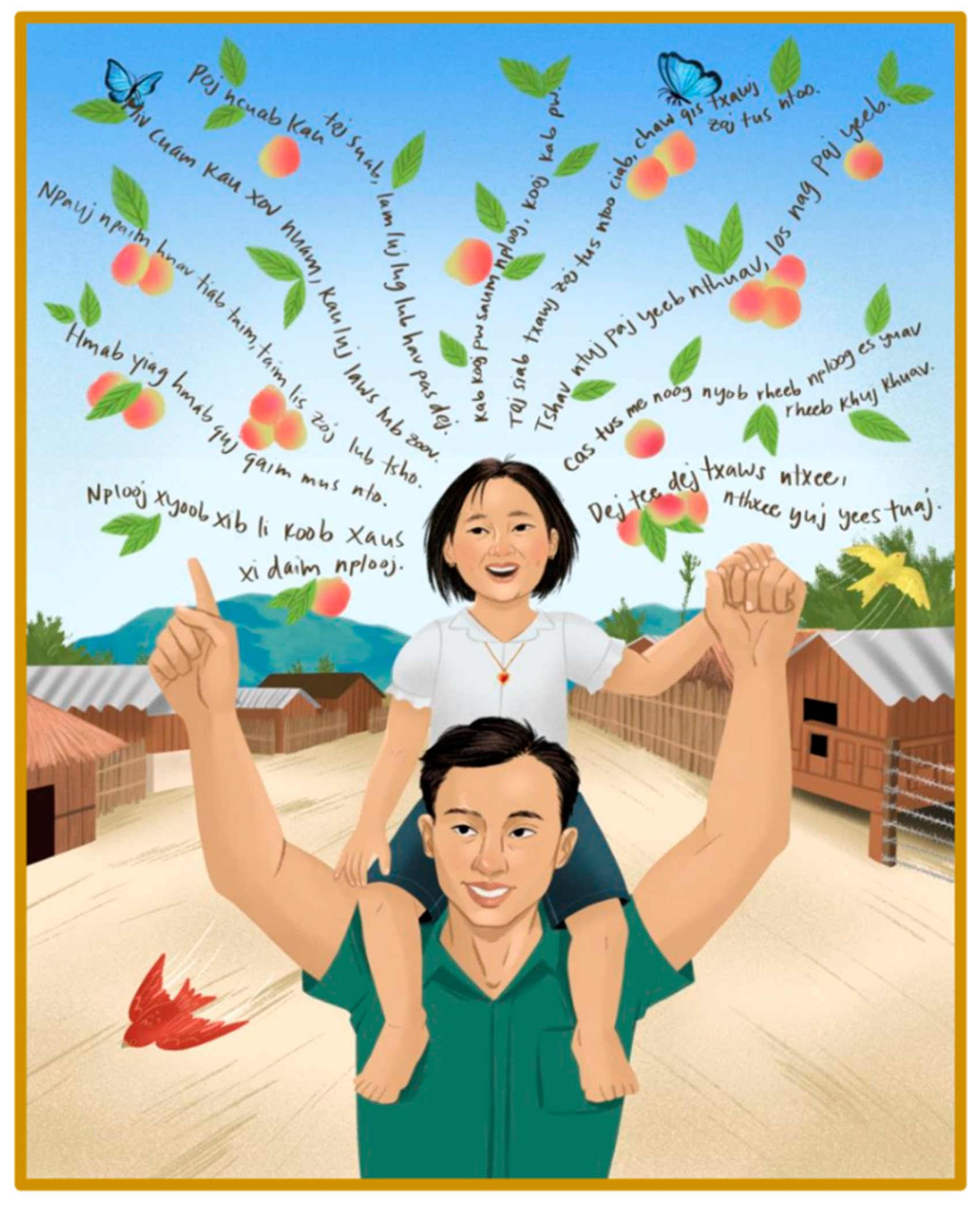
Bounthavy’s relationship with Hmong oral traditions began through her father, a well-known and respected funeral expert and orator. As his firstborn daughter, she remembered accompanying him to funerals and remaining close as he carried out his responsibilities. She recalled, “
Kuv yeej mus saib kuv txiv, nrog kuv txiv nyob. Luag tej pom kuv mas tseem hais rau kuv tias cas khuv xim kuv tsis yog ib leeg tub, los kuv txiv yeej tsis hais li cas” (“I would go watch my dad and stay with him. When people saw me, they would say, ‘Oh, what a shame that I was not a son,’ but my dad never said anything”). Her father did not formally invite her into his practice or set out to teach her his ceremonial role but he also did not send her away. Bounthavy remained close enough to watch and listen. As a child in the refugee camp, she carried these observations into her play. Laughing as she recalled the memory, she explained, “
Kuv muab cov me nyuam zaum ces kuv sawv ua li kuv txiv ua” (“I would sit the kids down, then I would stand up and do what my dad did”). Long before becoming a
kwv txhiaj/lug txaj practitioner herself, Bounthavy was already listening, observing, imitating, and playing with the forms of Hmong oral language she encountered through her father (
Figure 1).
Meej’s pathway developed differently. He lost his father when he was young and, unlike his older siblings, he had fewer opportunities to grow up alongside his grandparents. His mother was the primary elder in his home, and his pathway toward specialized cultural knowledge required more intentional seeking. Before becoming a Txiv Neeb, Meej learned the Qeej (bamboo flute) and Hmong wedding songs. One bamboo flute song, an orphan song, became particularly meaningful to him. He explained, “There is one qeej ntsuag (orphan song) that I like. And after listening to that orphan song, it really just gave me another perspective.” The song tells of an orphan watching others move through life supported by parents, siblings, and extended family while he has no one to rely upon. It eventually turns the orphan toward his bamboo flute and what he can do for himself and others. Meej adapted portions of the song to reflect his own circumstances. The song gave him a way to make sense of his own experience through Hmong language and cultural knowledge. When his shamanic calling later emerged through his mother’s family lineage, he continued seeking pathways into cultural knowledge, traveling regularly to Stockton to learn from a shaman elder connected to his maternal grandfather’s spiritual lineage.
Placed alongside one another, Bounthavy’s and Meej’s experiences show that cultural knowledge does not move through a single or uninterrupted path from one generation to the next. Bounthavy’s pathway grew through proximity to her father’s practice, while Meej’s required him to seek relationships that could connect him to knowledge and lineage. Their experiences converge in the importance of relationships but diverge in how those relationships became available. Pathways to cultural knowledge could emerge through everyday proximity, but they could also be sought when earlier pathways were no longer available.
4.2. Practitioners Interpret Cultural Knowledge
Across the portraits, practitioners did more than carry specialized cultural knowledge. They also interpreted the practices they encountered, drawing from their own experiences and cultural expertise to explain what those practices meant. Their interpretations did not always converge, and these differences became especially visible when I brought questions from my own experiences into our conversations.
Throughout the study, I often struggled with how to express the depth of gratitude I felt toward practitioners who invited me into their classrooms, ceremonial spaces, and homes. As a Hmong woman, I was particularly aware that kneeling and bowing, a gesture through which Hmong men may express profound gratitude and respect, was not available to me in the same way. I brought this tension to Nom Hwm and asked why Hmong women were not expected to bow. He immediately responded, “Aws! Hmoob mas Hmoob pheej xav tias poj niam Hmoob pe los tsis muaj txiaj ntsim” (“Yes! Hmong people keep thinking that a Hmong woman’s bow does not have value to them”). His exclamation and repetition of “Hmoob mas Hmoob” carried a sense of critique and annoyance as he explained how he understood the practice. His response did not come across as a rule he was imposing, but as a practice he recognized and was making sense with me.
I later returned to this question with Meej following a shamanic ceremony, where the men bowed to him in gratitude for performing the ceremony. Meej recognized that women did not bow in the same way but understood their expressions of gratitude differently. He explained, “Ib tug quas puj cov lug tseem muaj nuj nqis tshaaj cov txiv neej lub hauv caug” (“A woman’s words carry more weight than a man’s knee”). He continued, “Tug nam tsev has ib lu lug ua tsaug rua kuv xwb, kuv twb zoo sab tsi txawj taag” (“The mother of the household saying just one word of thanks to me already makes me incredibly happy”). For Meej, the fact that women did not bow did not diminish their expressions of gratitude. Their words already carried the weight of gratitude.
Placed alongside one another, Nom Hwm’s and Meej’s responses converge in recognizing the same gendered practice but diverge in how they interpret its meaning. Nom Hwm described a practice in which a woman’s bow was understood as carrying no value, while Meej located that value in a woman’s words, describing them as carrying more weight than a man’s knee. Their different interpretations do not mean that one is more culturally correct than the other. Instead, their divergence shows how practitioners draw from their own cultural knowledge and experiences to make sense of practices they both recognize.
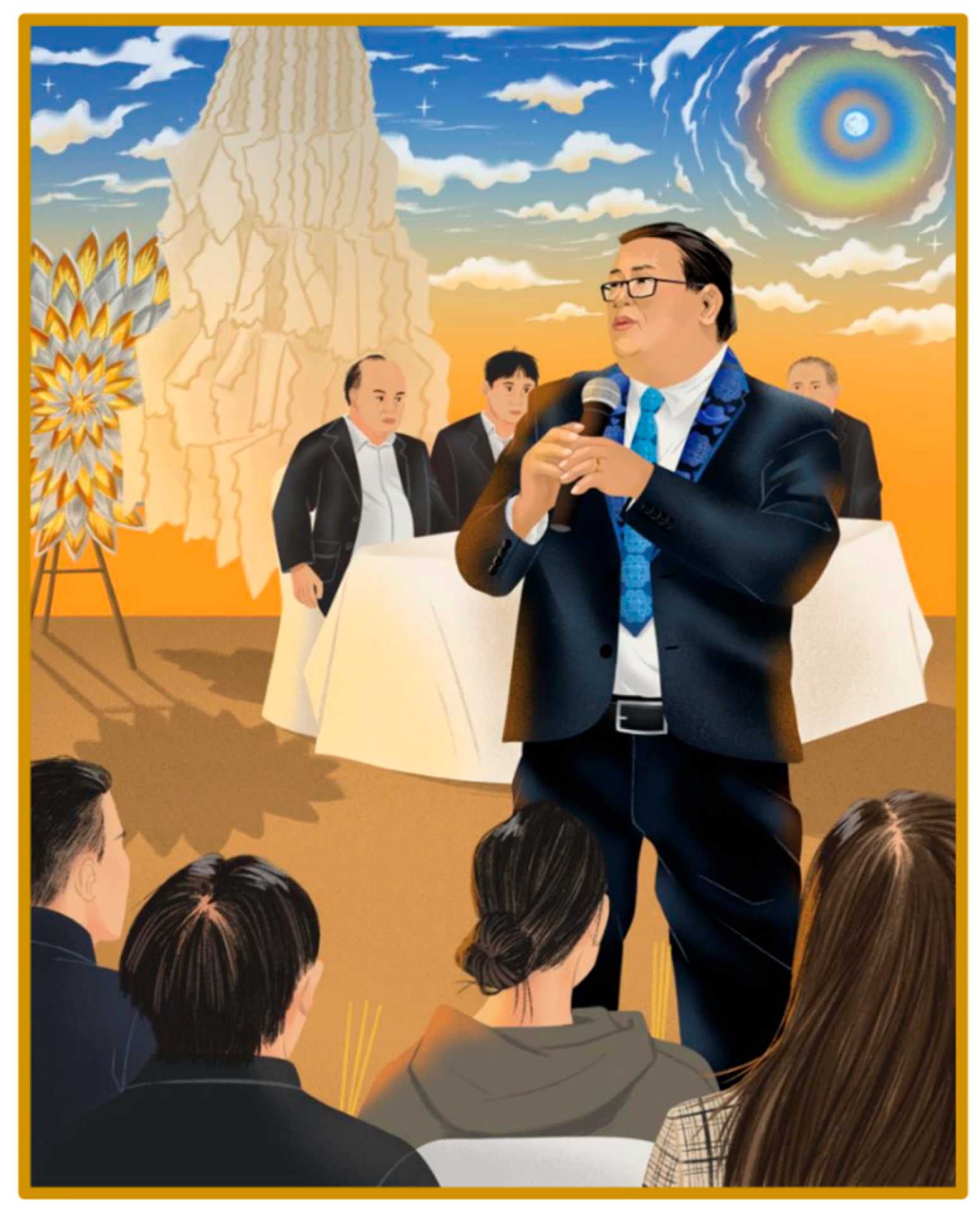
This interpretive work was also visible within cultural practice itself. During a funeral I observed, Txawj Teeb paused while performing ceremonial songs for the children of a mother who had passed away. Aware that younger family members were present, Txawj Teeb made an intentional choice to address them in English. He later explained that he wanted them to understand what was happening and to make a connection between the ceremony and the loss they were experiencing. Visibly emotional, he paused the ceremonial performance and spoke directly to them (
Figure 2):
Please bear with me as I take a moment to steady myself. If you see me cry tonight, do not be alarmed. You see, I have lost my mother, too, and since then, I have never been able to keep my composure during ceremonies like this. If you see my tears, know that I, too, feel your pain. I know I cannot take your mother’s place. I cannot restore her strength or bring her back to you, but I am here to ensure that the ties she wove will not be severed. In Hmong, we have a saying: Choj lov ces kev neej kev tsa tu (If the bridge breaks, then family relationships will too). But tonight, this bridge will not break.
Aside from the Hmong proverb, Txawj Teeb delivered this message in English. His movement into English was intentional. He understood that carrying out the ceremonial songs was only one part of what the moment required of him; he also wanted the younger people present to understand the relationships and responsibilities the ceremony was working to hold together. The Hmong proverb remained at the center of his explanation, but he interpreted its meaning through a language he knew could reach the younger generation in the room. In this moment, Txawj Teeb was not simply performing cultural knowledge for them. He was making a conscious choice about how to help them understand what that knowledge meant.
4.3. Practitioners Build New Pathways for Knowledge to Continue
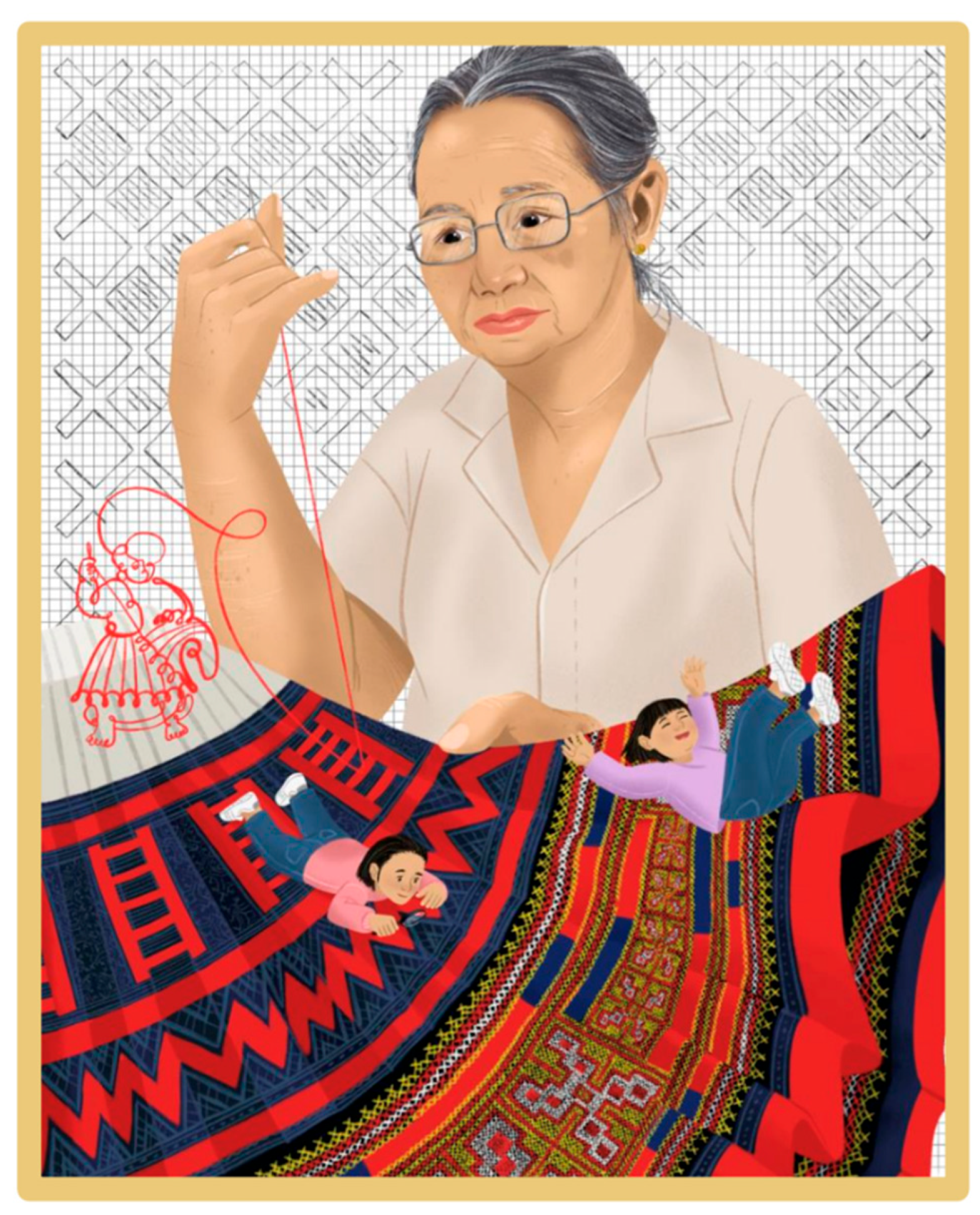
Practitioners also created new pathways for cultural knowledge to remain in practice and available to others. These pathways did more than preserve cultural practices; they created spaces for specialized forms of Hmong language, history, and meaning to continue. Maiv often spoke about her fear of forgetting the textile knowledge she had learned from her mother and the women who came before her. As she aged, she worried that the patterns she carried might eventually be lost if she did not continue practicing them. During our time together, she brought out a notebook filled with batik patterns she had drawn on grid paper, a practice she had continued for about 13 years. She explained that the idea came to her while shopping, when she noticed that the squares on the paper resembled the grid she had learned to make on fabric as a little girl. Because Hmong families in the United States no longer commonly make their own skirts, the notebook gave Maiv another way to return to patterns she might otherwise have fewer opportunities to practice.
When I later watched Maiv work on fabric, I saw the connection between the notebook and the practice she carried in her hands. She first used a spoon to mark the grid onto the cloth and then used raab dlav ntsaaj tab, a bamboo spoon used to collect and distribute wax, to draw the patterns. Speaking about her own experiences with writing, she held up the wax spoon and giggled, “Kuv tsi txawj sau ntawv, kuv tsi txawj tuav tug xuam los tug nua tes yog zoo le ib tug xuam lawm hab” (“I don’t know how to write. I don’t know how to hold a pencil, but this is like a pencil too.”).
The patterns Maiv recorded carried more than designs. Some were complex patterns she had learned from her mother that she explained were difficult to make and were not commonly seen anymore. Reproducing them on the grid paper required Maiv to remember how each part of the design fit together and where it belonged. When she was able to recreate one of her mother’s patterns, Maiv seemed almost surprised by what she still remembered. “Cov qauv nua yog cov thaud ub kuv nam qha kuv ua,” she explained (“These patterns are the ones my mother taught me to make long ago”). Other patterns carried histories and meanings of their own. “Cov nua cov laug tas yog laj yog teb,” she said (“These patterns, the elders say, are fields and land”). Her notebook therefore held more than designs she wanted to remember. It brought together the specialized knowledge required to make them, the Hmong vocabulary and meanings attached to them, and the teachings she had received from her mother.
As materials became less accessible, Maiv worked with what she had, substituting candle wax for beeswax and adding yellow food coloring so she could see her markings. Her own efforts to practice also became an unexpected opportunity for teaching and learning. As her grandson watched her work, he became interested and wanted to learn. Maiv responded to his curiosity by beginning with patterns he could successfully complete so that he could “
txawj hab paub txug Moob” (“know and understand Hmong people”). What began as Maiv’s effort to remember what she knew also created a place for her grandson to begin learning it. Through these practices, Maiv kept the knowledge, language, and histories carried within textiles in use (
Figure 3).
Txaj Xeem created another pathway by drawing on relationships he had built over years of cultural practice. Through the weddings, funerals, and other ceremonies in which he served as a practitioner, he came to know cultural experts from different families, clans, and lineages. He recognized that each carried particular forms of knowledge and that practitioners themselves could continue learning from one another. Drawing on these relationships, Txaj Xeem created what he called the Master’s Club, a dedicated playlist within his larger YouTube collection. He reached out to practitioners he had come to know, asked for their photographs, and invited them to share specific songs, procedures, and teachings connected to weddings, funerals, and other Hmong cultural and ritual practices. At the time of this study, the Master’s Club included 84 videos, organized so that people interested in these practices could learn from the practitioners who carried them. He described its purpose as “Qha peb tej txuj ci, txawm tug laug, tug hluas los peb pum tas nwg txawj yaam dlaab tsi” (“To create a space where our cultural experts, regardless of age, could share their knowledge and be recognized for their lifelong work”).
The Master’s Club was one part of Txaj Xeem’s larger digital collection of more than 500 videos. Across this collection, he documented and organized Hmong cultural and language knowledge that people might otherwise encounter through weddings, funerals, ceremonies, or direct relationships with practitioners. Making these recordings available online meant that learning no longer had to happen only in the moment a ceremony or cultural practice was taking place. People could return to a song, teaching, or procedure after the ceremony had ended and engage with it on their own time, when they were interested and ready to learn. This was important to Txaj Xeem, who did not believe cultural learning should be forced. The archive created a place people could return to when they chose to learn and allowed the voices and teachings of practitioners to remain accessible even after they were gone.
As Txaj Xeem explained, “
Kuam tej laug dlua taag los, tej tub hluas ntxhais hlua muaj chaw kawm” (“So that when the elders have passed, young people will still have a place to learn”). He saw the importance of this work when family members later encountered recordings of relatives who had passed. One person told him, ‘
Thaum kuv yawm nyob, tsi muaj leej twg kaw tau kuv yawm tej zaaj, zoo sab koj tseem khaws tau’ (“When my grandfather was alive, no one captured his teachings. I’m grateful that you did”). The archive therefore became more than a collection of instructional videos. It created a place where people could return to cultural knowledge after ceremonies had ended, learn when they were ready, and revisit the voices and teachings of people who were no longer there (
Figure 4).
Maiv and Txaj Xeem worked through different forms, but both created new places for cultural knowledge to continue. Maiv moved knowledge across wax, cloth, pencil, grid paper, and teaching relationships, while Txaj Xeem moved cultural encounters into recorded and digital spaces. In both, specialized language remained connected to the practices through which it held meaning. Their work shows how continuity can involve creating new places for Hmong language and cultural knowledge to live.
5. Discussion
The findings of this study shift attention from whether Hmong language and cultural knowledge are being passed down to the conditions that make it possible for people to learn, participate, and carry that knowledge forward. Cultural Security is useful for understanding this work because it is not simply a state of being culturally secure, but a conscious and purposeful practice grounded in Ancestry, Indigeneity, Relationships, and Mindfulness (
Allender and Allender-West 2024). Across the portraits, practitioners engaged in these practices through their relationships, teaching, interpretation, cultural work, and continued engagement with Hmong knowledge. I understand this work as condition-making, the cultural labor through which practitioners create and remake the conditions for Hmong language and cultural life to continue across generations. Like Cultural Security, condition-making is ongoing. It is made through what people repeatedly do to keep cultural knowledge present, meaningful, and available within everyday life.
The distinction between opportunities and conditions is important. Hmong communities have created important opportunities for cultural participation through schools, community programs, ceremonies, and celebrations. For example,
C. Y. Vang (
2010) describes Hmong New Year as an important space through which Hmong people gather, participate in cultural practices, and maintain connections to community. Yet, an annual celebration remains bound to a particular time and place. The same can be true of a weekend program, cultural workshop, or school course. These opportunities matter, but they cannot by themselves provide the repeated relationships and participation through which language and cultural knowledge become part of people’s lives.
Her (
2024) similarly draws attention to the relationship between schools and families in Hmong language reclamation, particularly the importance of Hmong language use within the home even as schools take on greater roles in language learning. Condition-making extends this conversation by asking what happens across and between these spaces: whether people have ongoing access to knowledge, relationships through which to learn, places to practice, and ways to return to cultural knowledge over time. The portraits show cultural learning taking place across homes, schools, ceremonies, community spaces, relationships, and increasingly digital spaces.
Condition-making also changes how we understand who a cultural practitioner can be. The six practitioners in this study differed in age, gender, expertise, and pathways into their work. Some held highly visible ceremonial roles, while others carried knowledge through textiles, language, teaching, documentation, or family relationships. This matters because cultural expertise can be overlooked when practitioners are defined too narrowly.
Keown-Bomar and Vang (
2016), for example, challenge deficit-based portrayals of Hmong women by showing that agency can be exercised through family relationships, linguistic work, community service, and other relational responsibilities. Their work helps make visible forms of cultural labor that may not resemble formal leadership. Maiv’s textile practice demonstrates this clearly. Her knowledge includes specialized vocabulary, histories embedded in patterns, teachings inherited from her mother and grandmother, and knowledge she now shares with younger generations. Although Maiv described herself as someone who did not know how to write or even hold a pencil, she compared her wax spoon to a pencil. Her practice asks us to consider what we recognize as literacy, expertise, and cultural authority.
The findings also complicate assumptions about when someone becomes ready to carry cultural knowledge. There was no single pathway into practitionership among the participants. Knowledge could develop through family proximity, mentorship, observation, responsibility, deliberate study, or a person’s own desire to learn.
Vue’s (
2025) work with Hmong youth similarly recognizes young people as active participants in remembering and living Hmong language and culture, not simply as a generation waiting to receive it. The portraits in this study extend this conversation by showing how younger people can also emerge as cultural practitioners and knowledge holders. Meej is particularly important in this sense. As the youngest practitioner in the study, he took responsibility for one of the oldest Hmong spiritual traditions at a young age and before reaching social milestones, such as marriage, that have traditionally signaled readiness for greater cultural responsibility. His experience suggests that displacement and changing family life have unsettled established timelines without eliminating cultural responsibility itself. Younger people do not need to wait until a particular age, marital status, or life stage to begin carrying knowledge. Bounthavy’s pathway was different. Her knowledge developed through years of proximity to her father, watching, listening, imitating, and eventually carrying those experiences into her own practice of
Kwv txhiaj. Together, their experiences suggest that becoming a practitioner does not follow a single timeline or pathway. At the same time, becoming a practitioner is not simply an individual declaration. Across the portraits, expertise developed through relationships with elders, teachers, family members, other practitioners, and communities. Practitionership is therefore relational. People grow into cultural responsibility through practice, accountability, relationships, and connections with others.
These relationships also shape how cultural practices are renewed from within Hmong knowledge. The practitioners were not simply preserving practices exactly as they had received them, nor were they changing them because Hmong knowledge was inadequate for contemporary life. They were interpreting what continuity required under changing conditions. Txawj Teeb’s decision to explain an important moment of a funeral ceremony in English illustrates this distinction. His use of English was intentional because he wanted the younger family members present to understand the relationship being restored through the funeral songs. Yet he anchored that interpretation in the Hmong proverb, Choj lov ces kev neej kev tsa tu (If the bridge breaks, then family relationships will too). In doing so, he used English to help younger people understand a Hmong way of thinking about family, community care, love, and the relationships that hold people together. Maiv’s use of candle wax and yellow food coloring when traditional materials were unavailable reflects a similar process of working from what she knew while responding to what was available to her inside of her home. Txaj Xeem’s work responds to another changing condition: what happens to cultural knowledge when the people who carry it are no longer here. He recalled hearing from community members, ‘Thaum kuv yawm nyob, tsi muaj leej twg kaw tau kuv yawm tej zaaj, zoo sab koj tseem khaws tau’ (“When my grandfather was alive, no one captured his teachings. I’m grateful that you did”). By recording practitioners and placing cultural teachings online, Txaj Xeem creates another way for people to return to those voices and teachings across time and distance. His archive does not replace the relationships through which cultural knowledge is learned, but it helps those relationships and teachings extend beyond a single encounter. In each case, practitioners create ways for cultural knowledge to remain part of people’s lives beyond a single performance, ceremony, or learning opportunity. These are forms of renewal grounded in Hmong knowledge. The changes are not made simply to conform to what dominant communities are doing, but to help cultural knowledge remain usable, meaningful, and connected to the people and relationships that give it life.
This grounding is especially important because there is no single, uniform Hmong experience from which all practitioners work.
Vue and Mouavangsou’s (
2021) articulation of Hmong epistemology recognizes the heterogeneity of Hmong ways of knowing and being. The practitioners in this study similarly encountered differences across dialects, clans, families, generations, genders, and cultural practices. Txaj Xeem described this difference as part of the value of bringing practitioners together. Experts from different families may perform or understand a practice differently, and those encounters allow them a joyous occasion to learn from and challenge one another. Interpretation, then, should not automatically be understood as movement away from tradition. It is one of the ways cultural knowledge remains alive. Practitioners make judgments about what can shift, what requires explanation, what needs to remain, who can participate, and how knowledge can be carried forward. Importantly, those judgments emerge from their relationships to Hmong knowledge and communities. This flexibility also creates space for emerging practitioners to find their own relationships with cultural knowledge and responsibility.
Cultural Security becomes particularly important for understanding this kind of renewal. Cultural Security does not require culture to remain unchanged. Instead, it provides a grounded place from which people can determine how they will move forward. The practitioners in this study remained connected to lineages of people, language, practices, and knowledge even as they worked under conditions their parents and grandparents could not have anticipated. Maiv’s grid-paper notebook is connected to the hands and teachings of her mother and grandmother. Txawj Teeb’s English interpretation remains connected to a Hmong proverb and the relational responsibilities of the ceremony. Txaj Xeem’s digital archive changes where and when learning can happen while remaining grounded in relationships among practitioners. Their work shows that Hmong cultural life does not have to wait for a designated event, classroom, ceremony, or other moment of cultural participation to exist. Through deliberate cultural labor, practitioners create conditions in which Hmong knowledge can continue to be lived on Hmong terms. These examples suggest that renewal does not have to come at the expense of cultural grounding. Roots do not prevent growth; they make growth possible.
In this way, language continuity is not only about whether Hmong continues to be spoken or taught. Language carries relationships, histories, specialized knowledge, and ways of interpreting the world.
Valdés (
2001) reminds us that heritage language learners bring varied histories of language exposure, use, and proficiency, and that language maintenance must consider the contexts in which heritage languages are meaningfully used. For the practitioners in this study, Hmong language lived within funeral ceremonies, spiritual healing rituals, textile vocabulary, wedding speech, proverbs, storytelling, family conversations, and relationships between learners and knowledge holders. Maintaining Hmong language therefore also means maintaining the conditions in which these forms of language and knowledge remain meaningful, usable, and connected to everyday life.
Condition-making ultimately shifts the question from whether Hmong language and culture will survive to what Hmong people are making possible for those who come next. The practitioners in this study are already doing that work. They create places to learn, interpret knowledge for younger generations, document what might otherwise become difficult to access, make room for emerging practitioners, and renew practices in ways that remain accountable to Hmong knowledge. Their work does not wait for cultural participation to be made available to them. It creates additional spaces, relationships, and possibilities through which Hmong cultural life can continue. In this sense, condition-making is a form of world-making where people are not simply responding to conditions produced for them but actively creating conditions in which Hmong ways of knowing, speaking, relating, and becoming remain possible. Cultural continuity, from this perspective, is neither preservation without change nor change without grounding. It is the ongoing work of remaining connected to one’s lineages while creating the conditions for others to learn, participate, interpret, and carry that knowledge forward.
6. Conclusions
This study began with a simple but urgent question: Who sustains Hmong language continuity after displacement, and what makes continuity possible? The portraits suggest that the answer lies not in preservation alone, but in people. The practitioners in this study crossed generations, genders, cultural roles, and pathways into practice. Some grew into their knowledge through close relationships with family members and elders, while others sought teachers, practitioners, and cultural knowledge for themselves. Across these different pathways, they sustained Hmong language and cultural knowledge through teaching, mentoring, documenting, adapting, performing, and creating spaces where others could learn and belong. More importantly, they did not simply carry knowledge forward. They created the conditions through which future practitioners could emerge. Their work shows how continuity can become a collective act of renewal, one that grows from within Hmong knowledge, relationships, and ways of life.
These findings challenge narratives that position Hmong language primarily through loss, decline, or endangerment. Seeing Hmong history beyond the disruptions of colonialism, war, displacement, and resettlement matters. Hmong people had ways of sustaining language, knowledge, relationships, and cultural life long before arriving in the United States. These disruptions transformed many of the pathways through which Hmong language and cultural knowledge were once transmitted, but they did not erase the knowledge or relationships needed to rebuild them. The practitioners in this study demonstrate the capacity of communities to reconstruct the conditions for continuity through relationships, mentorship, community spaces, ceremonies, artistic practice, and digital technologies. By shifting attention from opportunities to conditions, this study extends Cultural Security through the concept of condition-making: the deliberate cultural labor through which people make Hmong language and cultural knowledge available, meaningful, and possible for others to carry forward before, between, and after visible opportunities for cultural participation. Languages endure not simply because they are taught, but because people continually create the social, relational, and cultural conditions that allow others to grow into the responsibilities of carrying them forward. Cultural Security, then, is more than the survival of culture. It is also the ongoing capacity to reconstruct the conditions necessary for its future.
This study also has limitations. The six practitioners represented here primarily carry Hmong ancestral, ceremonial, oral, artistic, and spiritual practices and do not represent the full range of ways Hmong people sustain language and cultural knowledge. For example, this study does not examine Hmong Christian churches and faith communities, which have also become important spaces for Hmong language, relationships, and community life after displacement. The findings should therefore be understood as reflecting these particular forms of Hmong cultural practice and not the full range of ways Hmong people sustain language and cultural knowledge.
Although these findings are grounded in Hmong experiences, condition-making may also offer a way of thinking about language and cultural continuity in other diasporic, refugee, Indigenous, and minoritized communities. The specific practices will differ, but the broader questions may be similar: Who carries cultural knowledge? Who has access to it? Where can it be practiced and learned? What happens when communities must sustain their ways of knowing and being within social and institutional structures that were not created with those ways of life in mind? These questions invite greater attention to how dominant cultural expectations shape the conditions available to minoritized communities and how those communities create their own conditions for continuity.
The Hmong proverb that frames this article, Nplooj tsi zeeg tes zoov tsi kaaj (“If leaves do not fall, the forest will never see light”), reminds us that continuity requires change. Forests survive because each generation of growth creates conditions for what comes next. Likewise, Hmong language and cultural life continue when people make room for new practitioners to learn, participate, interpret, and grow. The future of Hmong language will not be secured by holding tightly to every leaf. It will depend on whether light continues to reach the forest floor, where new generations can grow and carry Hmong language and cultural life forward.