Article

Everyone Is Ndukwo: An Onomastic Appraisal of Namesake Practices Among the Bende People


by
Eunice Kingsley Ukaegbu
1,*,
Kwita Ojong Adomi
2 and
Genevive Chimezie Osuji
1
1
Department of Linguistics, University of Calabar, Calabar 540242, Nigeria
2
Department of Mass Communication, University of Calabar, Calabar 540281, Nigeria
*
Author to whom correspondence should be addressed.
Genealogy 2026, 10(3), 79; https://doi.org/10.3390/genealogy10030079
Submission received: 25 March 2026 / Revised: 3 May 2026 / Accepted: 1 July 2026 / Published: 3 July 2026

Abstract

Traditional namesake practices are indisputable naming conventions among the Bende people, through which old names are maintained without infiltrating the community with new ones. It is believed that, when a person who had lived earlier on, had led an impactful life, there is the need to keep their memories immortalized in the life of another, rather than creating an entirely new one. Thus, the Bende people in Abia State have been consciously identified by the recurring naming identity pattern in which as many as qualified people can bear a particular name in a particular extended family. This peculiar onomastic practice has been so misunderstood by others that it has become imperative to study and investigate why certain names are repeated, by whom, and to also identify the cultural events that herald such processes. To achieve this, this study adopted a descriptive qualitative research design to investigate the linguistic and cultural significance of namesakes. Forty participants were selected, using purposive sampling from the area of study, through whom data was elicited. Participant observations, semi-structured interviews, and focus group discussions were primarily used for data collection. The collected data were translated and analysed using thematic analysis to identify and categorise patterns. This study was based on socio-onomastic theory, and revealed the names recycled, the reasons behind them, the cultural significance of this onomastic practice, the conditioning of names in Bende, the namesake ritual, and the perceptions of the namesake pattern by the community.

1. Introduction

Naming is an important cultural artefact in Nigeria and Africa at large. Names borne in all African communities are not arbitrary but spring from the cultural components and beliefs of the people themselves. Uwen and Ukaegbu (2024, p. 1) assert that “the Igbos conceive child naming as a serious event in one’s life because it has a way of influencing the destiny and fortunes of the bearer”. They insist that names are more than tags used to identify people. It is believed that names link us to where we come from and carry pieces of our history. Agyekum (2006) maintains that, in every tradition, names have cultural and social content that identify the bearers. He argues that people are almost invariably named, and indeed, a human being without a name would be socially and psychologically less human. Every name holds a story. In many cultures, names are chosen with care because they reflect values, beliefs, and history. Ukaegbu and Okon (2024) add that the naming patterns of any society not only reflect the language behaviour of that society, but represent the interaction of language and culture in that particular society, as the use of language to capture the societal values and beliefs is better preserved in names among other cultural resources.
Onyi and Ukaegbu (2021) aver that names and naming practices have further defined the boundaries of identification in local and trans-local space, given that every community uses its naming system as a form of unique reference and social identity. In African communities, for example, names often connect to events, days of the week, personality traits, or future hopes. Thus, Ukaegbu and Okon (2024) also add that, in some clans and villages, the grandparents name the children after some rituals have been performed, while in other clans and villages, it is the father’s sole prerogative and, depending on the circumstances surrounding the child’s birth, the relative they resemble, the market day they were born, the season they were born in, the number or sex of older children in the family, the ease or difficulty of the labour, or the conditions of previous pregnancies in the family, all these influence the general outcome of the naming process. Naming a child has significance in the parents’ life, as it is often seen that name-bestowal reveals the situation surrounding a child’s birth. Names carry a deep cultural significance and reflect the rich tapestry of human history and identity.
The Genealogist (2024) asserts that, in modern societies, names continue to hold significant cultural value, influencing social dynamics, personal identity, and even legal matters. Understanding the cultural significance of names today helps us appreciate the enduring power of this aspect of human life. Names often carry deep social and familial significance, impacting relationships and societal roles. In many cultures, names are a crucial part of inheritance and lineage. Surnames, in particular, are passed down through generations, preserving family heritage and identity. This practice reinforces the connection to ancestors and maintains family continuity.
Naming traditions vary significantly across different regions of the world. Each region’s practices offer unique insights into its cultural values, social structures, and historical influences. Across the globe, naming traditions offer fascinating insights into the values, beliefs, and social structures of different societies. However, this is not the case in all Igbo societies, the Igbo people of Southern Nigeria have a lot of peculiar naming patterns, which distinguishes them exceedingly. Names in the Igbo context are intertwined with culture, serving as a reflection of identity, familial ties, and social status. Distinct naming experiences abound; thus, the Bende people of Abia State exhibit a unique feature in naming. The Bende people are found in Abia State, Nigeria. Abia is bound in the north by Cross River State, Afikpo, and Ohaozara, and in the South by Arochukwu and Ohafia, while in the East and West by Ikwuano LGA and Umuahia LGA, respectively. Abia is composed of thirteen (13) communities, namely Alayi, Bende, Ezeukwu, Igbere, Item, Itumbuzo, Nkpa, Ntalakwu, Ozuitem, Ugwueke, Umu-imenyi, Umuhu-Ezechi, and Uzuakoli. The Bende LGA has climatic conditions typical of the tropics, and agriculture is widely the occupation of the people; it is a major rice producing area in Abia State.
The Bende people are often referred to as “Ndi ogboo”—“the namesake people”—originating from their never-ending recycling of names. Among the Bende people, the namesake practice is an indispensable traditional artefact that signals a child’s natural place in his cultural environment. This is equivalent to what is obtainable in some parts of Ebonyi, especially the parts that were severed from Abia to form the new Ebonyi State. Naming patterns among the Ogboo people are centralised and regularised, they move away from the tradition of parents naming the children, to a culture of parents already knowing the names of their children, as the choice has nothing to do with the circumstances surrounding the birth of the child. The names are predetermined based on the existing names of family members, therefore eroding the possibility of novel names coming into the family. The research therefore seeks to fulfil the following objectives:
i.
to explore the peculiarity of this naming practice, contrary to what is obtainable in other Igbo communities, and
ii.
to understand the statutory conditions for this recurrent pattern.

2. Reviews on Naming and Namesake Practices

Naming ceremonies among the Bende and Igbo people, in general, have been a long-standing tradition, deeply rooted in the people’s history and spirituality. According to Felix-Joe et al. (2025), child naming is a form of tradition contracted under native law customs, which is viewed from the traditional perspective. Child naming is more of a social and religious affair than a personal affair involving several parties. In Babylonia, the name was used to establish the social identity of its bearer (Joanńes 2024). Names attested to the piety of the family through frequent references to the protection of divinity of the city or country. The use of name also marked the place of an individual within their kinship group. The frequent use of family names by the urban elite of the millennium BCE, often referring to a prestigious ancestor, made it possible to mark a person from a well-recognized family group (Joanńes 2024).
Naming is a serious event in Bende-Igbo, as it showcases the origin and nativity of an individual. Names are not mere labels or tags for bags and baggage, but a mark of one’s identity, culture, and tribe. Tyumbu (2017) asserts that names are chosen based on a particular cultural context, taking into consideration the belief and worldview, ethical and social values, events at the birth of the child, as well as the place of birth of the child. In the words of Michael et al. (2026), names are linguistic expressions that are translated into use based on the socio-cultural values of the society in question.
The concept of naming has been studied in depth in such diverse fields as Linguistics (Mensah 2024; Michael and Mensah 2025; Ukaegbu and Okon 2024), Anthropology (Tuppat and Gerhads 2020), and Semiotics, among other fields. Compared to other studies of names and naming, the systematic study of name-sake practices has attracted little attention. Regardless of academic discipline, only a small amount of empirical research exists. In Igboland, namesake practices are a blend of traditional beliefs, personal philosophies, and modern influences, serving a critical cultural rite that embodies the values, history, and identity of the people; hence, more vigorous research is needed to increase the existing literature on the subject matter. This work therefore studies personal names from the genealogical perspective, which is anchored in the semantic (meaning) and socio-cultural context of names and naming.
Beyond identifying an individual, the continuous use of a name could communicate the whole personality of the individual, as well as the identity of his environment and society. According to Lyons (1977), names have characteristic referential and vocative functions. The referential function draws the hearer’s attention to the presence of the person being named, while the vocative function attracts the attention of the person being called or summoned. As Ezenwafor-Afuecheta and Onyeocha (2021) rightly put it, names play vital roles in the society. They further assert that the practice of naming is a universal process that could differ across cultures. In African culture, names not only serve as labels, but reflect our conception of the world.
In line with the foregoing, Anyachonkeya (2014) posits that, in Africa, and probably Asia, naming is unique and meaningful, even among people of different subcultures within a speech community. This is the reason Cookey and Ijioma (2019) note that the naming ritual is an important ceremony, and that every society has a unique way of accomplishing it. The Bende people in the Bende Local Government in Abia State believe in the namesake practice, as it marks a process of continuity in their lineages. This practice among the Bende people is an age-long tradition that cannot be easily erased from their culture and tradition. The practice is known as ògbòo practice, which means renaming a child after an elder, mostly their grandparents, to ensure continuity in the family lineage. Usually, people give their children particular names for various reasons: the appeal of the name, the circumstances surrounding the child’s birth, in honour of a loved one either dead or living.
The namesake system of the Bende people is a unique naming practice and, as a result of this, they are referred to as Ndi ogbòo. According to the Merriam-Webster dictionary, a namesake is one that has the same name as another; especially one who is named after another or for whom another is named. Most commonly, it refers to an individual who is purposely named after another. For instance, a name like Ogbonna (‘father’s namesake’) or Ogbonnaya (‘his father’s namesake’) is a common name in Igboland. The original bearer, usually a male, was named after his father (or sometimes grandfather, depending on the context). Similarly, a name like Ogbonne (‘mother’s namesake’) is usually borne by females, meaning the mother’s namesake. Generally speaking, the ògbòo naming system is not limited to the Bende people alone, it is also practiced by the Afikpo people in Ebonyi State, who were formerly in Abia State before the creation of Ebonyi State. Amadi (2021) asserts that this namesake practice has a more profound significance in Ebonyi State society than in Imo State. In a typical Ebonyi society, a bride is perpetually referred to as Nnogbo—a contraction of “Nne Ogbo” (Mother of namesake(s). The term expresses the general expectation that the new wife would bear children who will be the people’s namesakes. The children at home are often referred to as Ndiogbo because they are presumably the namesakes to various persons.
It is important to note that the original, older name-bearer, as well as the younger namesake, are both cross-referred to as Ògbò. For instance, Emeka is his grandfather’s ògbò and the grandfather, in turn, is Emeka’s ògbò. Amadi (2021) further states that, in ample cases, though not statutory in Ebonyi State, the first male child in a home is usually the paternal grandfather’s ogbo, while the first female child, usually named Nnenna, is the paternal grandmother’s ogbo. The second son often goes to the maternal grandfather while the second daughter goes to the maternal grandmother. Subsequent children usually have no such predetermined ogbo. It depends on whom, whether alive or dead, the parents could consider worthy of being their child’s ogbo. The parents could as well name any of their children after themselves. The continued practice of naming a child after the parent or grandparent may result in several relatives (e.g., cousins) being namesakes of one another despite not having been named after each other. Namesaking is commonly performed to honour a parent, grandparent, or ancestor, to preserve a family name, to maintain a cultural or dynastic identity, and to symbolize the inheritance of values, status, and legacy. For example, Martin Luther King Jr. was named after his father, Martin Luther King Sr., George W. Bush was also named after his father, George H. W. Bush, Pope John Paul II also took his name to honour Pope John Paul. The British dynastic line similarly includes multiple Kings named King George and King Charles, reflecting continuity within the English Monarchy.
In the same vein, Langin-Hooper and Pearce (2021) hold that the practice of naming individuals after a loved one (namesake practice) is also obtainable in Greek. They further state that the Greek names used for boys are often those of fathers or grandfathers of women with Greek names who married into these Babylonian families. They argued that the incorporation of Greek names into Babylonian families of Hellenistic Uruk cannot be assumed to be straightforward evidence of impulses toward “Hellenization”. Rather, this evidence indicates that Greek names were given to sons in such families within the context of traditional Babylonian maternal-line naming practices. Chapin (2023) rightly noted that naming a child is fundamentally an act of identity-creation, one that affects the name-bearer but even more reflects the identity of the name-giver. The names given to children often reflect both the values and aspirations of the name-giver. In cultures that value tradition, a common practice is to name a child after a member of the family, typically someone in the ancestral line. Naming after a father or grandfather (paternal or maternal) is frequent for male children, and likewise for the mother or grandmother (paternal or maternal) for female children, although names may also come from other members of the family, such as aunts and uncles. Many families around the world name children after grandparents or respected elders. This tradition keeps the memories and influence of loved ones alive across generations and builds pride in family history.In cultures like those in Turkey or Greece, children often receive names from grandparents. These names carry meaning and history, keeping a connection between generations strong.
Alderman (2016) explained that, “when it comes to naming a child after someone, naming is a powerful vehicle which is used for promoting identification of one’s past and trying to locate oneself within the wider networks of memory”. Therefore, “they are chosen carefully with special care and consideration to the traditional meaning of the names being emphasized with the African naming system and intention” (Wappa and Wada 2019). Personal names are meant to function as identifiers of an entity, and so be able to single out many similar types, especially those that are closely associated with what it refers to (Al-Zumor 2009). Consequently, names are used to tag a bearer and, at the same time, show the bearer’s peculiar identity. Personal names therefore are cultural and applicable to all environments, and serve as the individuals’ identities, and represent them individually and in different ways. Wappa and Wada (2019) go further to add that the names given in a society exemplify who the bearers are, what they represent in the past based on their name progenitor, as well as tell the persons who they are or expected to be. They legitimatize the bearers. They are given social identities by the personal names. Thus, studies in personal names, according to Alford (1988) can be analysed by merging different perspectives, disciplines, and frameworks, such as anthropology, linguistics, and philosophy together.
Eke (2014) shed more light on the name giving practice in Bende when he asserted that, “In the Bende tradition, the naming process often involves the “Namesake” method, where a child is named after a family member. This method helps preserve traditional names and identities within families. For example, the first son may be named after his grandfather, the second after his father, and so on. This practice serves as an identification tag and is rooted in the cultural significance of names in Bende Igbo society”. He explains that “There are two methods of naming a child, and there are two types of names. A Bende Igbo name may be a traditional repeated name or philosophical name. The first method, I will entitle ‘Name-sake or Repeating method’. This method uses name-sakes to keep the traditional names of each family intact and within the family. It also creates a buffer from extinction of the original family names”. According to him,
the “Name-sake method” in Bende tradition serves as an identification tag, with which an individual could be traced or identified. It also functions in part like a proper noun. In this method a parent does not select the name of a child in advance. There are traditional rules and laws separating names by gender. The Name-sake method is logical. Not only does it preserve the original names and the identities of the founding fathers of a family, but also provides useful information on the type of life they lead. This is done through the titleship names and other nick-names of a family. The most valuable quality of the Name-sake method is its identification properties which make it easier to trace an individual to a particular village, town, or even a particular locality in the state or region.
(Eke 2014, p. 2)

3. Methodology

The qualitative ethnographic research design was adopted for this study, situated within the framework of ethnopragmatics. The design is considered apt for examining naming as a culturally embedded communicative practice, where meaning is shaped by shared social knowledge, norms, and values (Goddard 2006). Ethnography allows the researcher to capture unique perspectives on the pragmatic and symbolic meanings associated with namesake in Bende.
This study is conducted in the Bende Local Government Area of Abia State, Nigeria, an Igbo-speaking community with a strong tradition of kinship-based naming practices. Naming in Bende extends beyond individual identification to index lineage, social belonging, and communal identity, making the area particularly suitable for an ethnopragmatic investigation of namesaking.
The population of this study is the entire indigenes of the Bende LGA of Abia State, Nigeria. According to the figures available from the National Population Commission (NPC), the 2016 census carried a figure of about 192,621 people, but projected about 300,000 people by 2026. The Bende Local Government Area has thirteen communities, and the participants for this study were drawn from different age groups and social categories, including elders, adults, youths, cultural custodians, and individuals who understand the phenomenon of the namesake.
To effectively carry out this study, the simple random technique was employed to select the villages used. This selection was performed in such a way that all the villages had equal chances of being heard. The Bende Local Government Area has thirteen communities, namely Alayi, Bende, Ezeukwu, Igbere, Item, Itumbuzo, Nkpa, Ntalakwu, Ozuitem, Ugwueke, Umu-imenyi, Umuhu-Ezechi, and Uzuakoli. From the selection, four (4) communities were used for this study, they are Item, Alayi, Igbere, and Ugwueke. This study employs purposive sampling to select participants from the four communities who demonstrate cultural knowledge of naming practices, complemented by snowball sampling to identify any additional relevant participants through community networks. A total of 40 participants were engaged, which is considered adequate for achieving data saturation in qualitative ethnographic studies.
Data for this study were collected using multiple qualitative methods to ensure triangulation. Firstly, participant observation, introspection, and semi-structured interviews were conducted to explore the participants’ perceptions of the cultural significance of the namesake, the circumstances under which namesakes are assigned, and the social expectations attached to the giver and the bearer of the name. Interviews were conducted in Igbo and English, audio-recorded with consent, and later translated.
Secondly, the researchers engaged participant observation during naming ceremonies, community gatherings, church services, funeral ceremonies, family meetings, and informal interactions. This enabled the observation of how the namesake functions pragmatically as a marker of solidarity, kinship, and social positioning in natural discourse. Thirdly, the researchers used focus group discussions (FGDs) to elicit data from the most intelligent elderly group of the population. This group is purposively selected for their level of understanding of the phenomenon under review. Four focus group discussions were conducted to elicit shared cultural understandings and collective interpretations of namesake practices. The FGDs facilitated interactional data that revealed commonly held assumptions about the social meaning of the namesake.

4. Theoretical Framework

This study is anchored in the theory of socio-onomastics. The theory is situated within the framework of onomastics (the study of names), which examines how naming functions within specific social and cultural contexts. The theory explains the origin, history, differences in context, and meaning as it relates to the bearers of the names, as well as the givers and name users. It focuses on how personal names function within society, culture, and social relationships, and concerns itself with how names are used to reflect personal, geographical, cultural, and institutional roles within society, showing identity, power relations, cultural heritage, and social change. Socio-onomastic theory emphasizes that names are not just mere labels but socially entrenched signs that carry meaning, values, and ideologies (Ainiala and Ostman 2017). Similarly, Hough (2016) asserted that naming systems must be examined within the context in which they operate. Names often carry historical continuity, collective memory and shared values. Socio-onomastics view naming as a dynamic social process through which individuals negotiate identity and group membership.
This theory is relevant to the present study since it analyses personal names not just because of the meanings attached to it, but it explores what function the name performs in the social context. It is particularly useful because the namesake is not only a linguistic prerogative but a social and cultural practice. In this study, it focuses on how the namesake is used in the Bende community to reflect kinship, friendship, communal living, and memory preservation. The theory also argues that names are dynamic social tools that serve as vehicles of identity, ideology, and markers of cultural continuity. In the Bende community, the practice of the namesake is used to demonstrate a respect for kinship, family lineage and ancestry, solidarity and social obligation, and community identity, thereby strengthening the tenets of this study that see names not just as identity markers but as social construct that carry culture, history, and values.
This study thus uses socio-onomastic theory to examine the social and cultural significance of namesakes, and dissects the relationship between personal names as markers of identity, social relationship, and cultural heritage within a community. Socio-onomastics explains that names are not just tags, but carry social meaning, and the namesake practice is one way the society will uphold their culture and family heritage.
In many African societies, names go beyond individual identification to reflect communal structures, kinship, and relational values. The Igbo people confer names on individuals along genealogy, religion (belief in ‘Chi’), and other cultural factors that link the bearers of the name to ancestry, lineage, and religious beliefs. The growing literature on naming practices in Nigeria has focused more on the socio-semantic significance of the names and the shift in naming practices (Ukaegbu and Okon 2024; Michael et al. 2026; Nkamigbo 2019) and not how genealogy has impacted on the naming system. Limited attention has been paid to namesakes within African communities, this is why this present study examines the namesake phenomenon in Bende through socio-onomastic theory.

5. Results

Data were collected to explore various aspects of the Bende naming process to enable one to understand what is obtainable in the Bende culture. The data report the cultural significance of namesake practices, the participants’ perceptions of the namesake process, the circumstances under which namesakes are assigned, the conditioning of names in Bende, and provide insights into the namesake ritual.

5.1. Cultural Significance of Namesake Practices

Namesake as symbolic kinship: The Bende people assert that “nwanne du na mba”, which means that a relative can be found abroad, which signals that blood ties are not all encompassing when relationships are being considered. Namesake patterns construct symbolic kinship relationships beyond blood ties. Thus, naming a child after someone, whether a relative, friend, or neighbour, automatically open doors of close knitted relationships, as the process releases a sort of bond that endears families to each other. Choosing someone as a namesake for your child shows how deeply you regard and love this person, and wish your child to follow his footprints; thus, this adult’s acceptance is followed with a genuine love and bond for this child, as he/she often stand in as a guardian for the child in the absence of the parents all through life.
“When you share a name with someone, you are already family. Even if you are not from the same compound”, Uduma (67).
“It is a duty and burden accepting the responsibility of having a child named after you, having a namesake is like adopting a child that is not yours but carrying the child’s joy, happiness, burdens and sorrow till the day you die”, Martha (56).
Namesake and Identity construction: The practice of the namesake gives a child a sense of belonging and acceptance, making him or her aware that it is a form of collective identity. It explains how a person’s name, especially when being named after someone else, shapes one’s sense of self-belonging, expectation, and self-development. Many scholars have explained how the namesake functions as a symbolic tool in shaping identity. A name on its own is the first social label we receive, and labels influence how we see ourselves and how they treat us. The Bende people believe that being a namesake to someone shapes identity, as the latter struggles with inherited expectations (if a child is named after a successful grandparent, or a deceased relative, they may be pressured to live up to the person’s achievement or continue the tradition, and peradventure if he or she falls contrary to the expectation, or decides to follow his self-identity, he is seen as not being a replica of his original namesake, this can lead to pride and purpose or anxiety and identity conflict. This child suffers from individuality versus continuity, i.e., either to continue living in someone’s skin or to have his own life.
“The worst nightmare of my childhood and adult years was the constant comparison between my Ogbo and I, my parents kept comparing me with her and never forgot to mention the many things she had achieved when she was my age. Even when I delayed in getting a job and being married, my mother never ceased to query why the good parts and good fortunes of my Ogbo never rubbed off on me, and how I ended up so unfortunate, I had to keep up with this constant fight between my self-identity and the bogus expectations awaiting me. My only consolation was that my Ogbo herself, was my greatest source of inspiration as she is always there to ensure everything went smoothly for me, and as expected, when I eventually got married, I ensured that everything that was written on the Ogbo’s part of the marriage list was mandatorily provided by my husband’s people, but I had decided I will not support the imposition of any name on my children, as I it is psychologically tasking and draining to place a shoe too big for a child’s feet to fill, just like wearing a borrowed robe”, Nnennaya (43).
The namesake pattern raises a key socio-onomastic tension, which is ‘collective identity vs. individual distinction’, the implication being that high name repetition may blur individuality in formal contexts, but within the community, additional markers, such as titles, lineage, and contexts will likely differentiate people. Socio-onomastics would likely describe this as identity being multi-layered, not dependent on names alone.
Namesaking as social alignment: The namesake automatically aligns children with other members of the society; it makes all the namesakes align and presents a united front culturally. For example, there is the statement, “oh, you are Ndukwo too? Then, we are one”. This kind of statements already creates a social bond between the bearers and naturally aligns them culturally. It minimizes social distance among the bearers and has a performative function of establishing a social bond among the bearers of the same name in the same community. The namesake can reinforce family alliances, community connections, and gratitude towards elders and benefactors. In this way, the act of the namesake creates a social tie almost like a symbolic contract. Names like ‘Ndukwo’ may reflect the authority of elders in naming decisions, and from this socio-onomastic lens, naming becomes a site of power negotiation, thus individuals may have limited agency in choosing or altering names.
Namesaking and lineage continuity: In Bende communities, naming a firstborn son after a grandfather symbolizes continuity and honour. If a family or patriarch is known for a particular thing, it is believed that his name successor or namesake should traditionally embody his physical, spiritual, and emotional traits. Namesakes are given to revere the dead, to protect the memory of loved ones, and to maintain and protect family lineage and history. Lineage continuity ensures legacy transmission, immortalization through memory, and maintaining family unity and pride. From the socio-onomastic lens, this repetition by renaming may signal belonging to a lineage, deity, or cultural ideology. It emphasizes group solidarity, a key feature of many African naming systems.
“My daughter was named after my mother who was a chief in my village, she orchestrated a lot of political movements in the early 60’s, and our civic hall was even built in her memory, even till now, whenever we visit, people still refer to my daughter as my mum, and very traditional Chiefs still bow their heads in respect while greeting my daughter, as they believe that culturally, the girl is a living representative of my mother, and continues to transmit the legacy and immortalizing her name”, Agu (66).
A participant explained how she, being of a different origin, did not accept to name her first daughter after her mother in-law, the expectation was out of place for her, and she had stood her ground that every child should be named intentionally. She added that, even after accepting to name her child, to reduce the family feud which had arisen as a result of her disobedience, when she went back to the city, she gave the child an English name which she bore happily, and relegated the other name to whenever they travelled back home.
She noted the following:
“I had passed through a lot of confrontations and frustrations in my marriage, and my mother in-law had proven time and time again to be more than a mother, that one person that stood up for me in good times and bad times, thus when my daughter was about entering High school, I personally went and officially changed her first name to her original name as my mother-in-law’s namesake, and used the English name as her middle name. It gave me fulfillment, and made me pray that such a beautiful soul could reign and be continuously mentioned in my home, and that enlarged my husband’s heart further towards me, my sweet mother-in-law died a year later, after having started calling me nne ogboo—mother of my namesake. Even in death, I still feel she exists in my home”, Adaora (40).
Namesaking as social obligation: A namesake is someone named after another person, and the idea of a namesake alone portrays a social obligation. This obligation refers to the cultural expectation that a person named after someone else carries a responsibility, symbolic or real, to honour, continue, or reflect the identity. In Bende, naming is not just a tag, but becomes a social responsibility tied to identity and community expectation.
“It is a duty and burden accepting the responsibility of having a child named after you, having a namesake is like adopting a child that is not yours but carrying the child’s joy, happiness, burdens and sorrow till the day you die”, Martha (56).
Namesaking as a reflection of Bende cultural ideology: The namesake practice is a reflection of the cultural ideology of the Bende people. It is an age-long tradition that seeks to immortalize both the living and the dead, to memorialize what the bearers represent in the secular world. The namesake is not just personal, it is relational and moral, when you are given someone’s name, it naturally creates expectations to preserve family reputation, to continue tradition, to carry on the admired traits of the original person.
“When my Ogbo died, and I visited as a distant relative, her husband brought two of her wrappers, which according to him, she had insisted I should get in case she dies. She had had a protracted illness for more than five years, and I have always visited with gifts whenever I was in town, we even spoke a night before she passed on, and she blessed me. I was surprised she had left instructions on what should be given to me. I am sure she gave her children some, but she still wanted me to have some”, Rhoda (56).
It can be seen from this interview that even the Ogbo has benefits and entitlements as regards a younger Ogbo, this even continues to the point that some people include their Ogbo in their will. This has often led to a lot of conflicts in some families, as the person’s children may disapprove of the entitlements bequeathed to a namesake.
From a socio-onomastic perspective, this reflects strong communal identity over individual differentiation, and replicates an equity situation that is culturally constructed. Thus, the phrase “everyone is Ndukwo” suggests a collective naming pattern, where a name becomes widespread within the Bende group. If everyone bears similar names, this points to normative pressure in naming practices; families may follow traditional naming conventions rather than personal preference, and deviating from such norms might be socially discouraged. This aligns with socio-onomastic theory, which holds that naming is governed by implicit social rules, and communities have the capacity to enforce acceptable identity markers.

5.2. Conditioning of Names in Bende

Genealogical namesake patterns
In other Igbo communities, names are given based on the circumstances surrounding a child’s birth or the choice of the parents or grandparents but, among the Ogboo people, names are naturally bequeathed to people, the names are even already existing, awaiting the birth of the bearer.
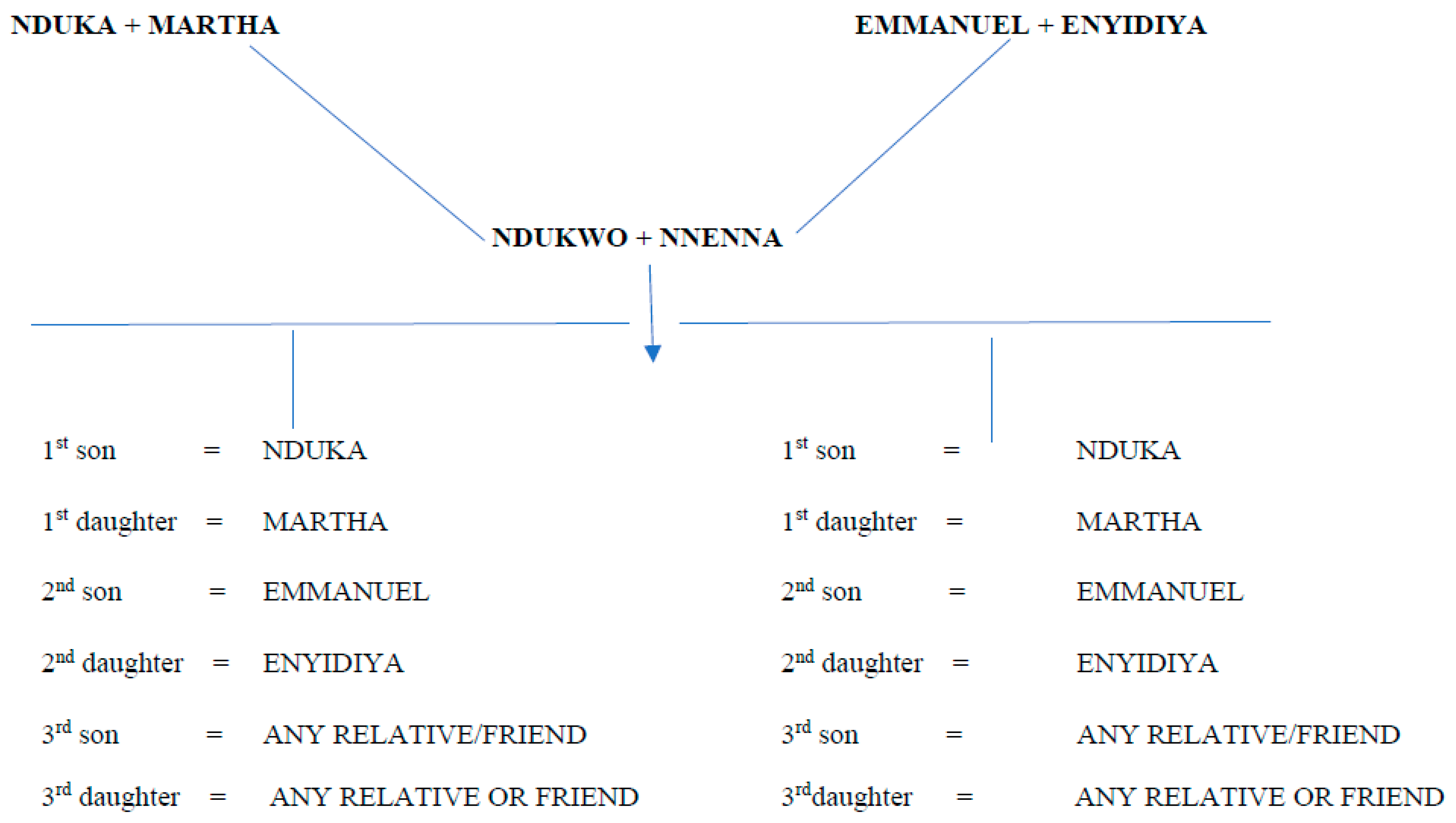
First son—Naturally predisposed to bear the name of the patrilineal grandfather.
First daughter—Naturally predisposed to bear the name of the patrilineal grandmother.
When the mother’s maiden lineage is not from a Bende community, the parents are naturally obliged to name the other children after an extended family member, but when the mother is from the Bende community, her second son is naturally obliged to bear the name of the matrilineal grandfather, and the second daughter bears the name of the matrilineal grandfather, in which case other children, irrespective of their sex, can be named after other extended relatives, thus recycling the same set of names across generations, but these names naturally fade out after two generations, because descendants of that grandson bearing the grandfather’s name, will not continue to bear the grandfather’s name, but will now become namesakes of the grandchild’s immediate parents, thus all the siblings of that grandchild will have their first daughters and first sons being the namesakes of the grandchild’s immediate parents. This is exemplified as follows (Figure 1):
From these analyses, the first Nduka (‘life is more’) naturally via genealogy knows that his first son will bear Ndukwo (‘if life permits’), while he has borne his grandfather’s name, his own son will bear the latter’s grandfather’s name. Note that the two men do not have the same grandfather, The father has his own grandfather whose name he bears; thus, the child will bear his own grandfather’s name. Hence, from these narrative, you can find five siblings having all their first sons bearing the same name, the difference lies in the addition of your own father’s name before the surname; for example, one can have, Emmanuel’s Ndukwo, Joseph’s Ndukwo, Obinna’s Ndukwo, Ebere’s Ndukwo, and Elechi’s Ndukwo, thus Everyone is Ndukwo, and can now be distinguished by using; Ndukwo Emmanuel Udensi, Ndukwo Joseph Udensi, Ndukwo Obinna Udensi, Ndukwo Ebere Udensi, and Ndukwo Elechi Udensi. All five brothers would now have an Ndukwo, except for the brother who does not have a male child. It is worthy of note that these Ndukwo are not age mates but, despite the positioning of the first male child, he will eventually bear Ndukwo, so everyone becomes Ndukwo eventually, named after their grandfather.
Traditional Namesake patterns: Apart from the first two sons and the first two daughters, whose names have been genealogically assigned, the next child can be named via the traditional namesake method in which the parents choose a respectable member of the society to become their child’s Ogbo. Ogbo does not have to be an immediate family member. He or she could be an outsider, from another village, town, or even another country. He must be someone with good conduct who commands respect in his community. However, everyone may not qualify to be an ogbo. For example, a person with a tainted background, a common criminal, or a thief will find it difficult to find parents willing to name their child after him.
Choice names: These are names that can be arbitrarily given, names that parents heard and wanted for their children, or coinages they formed on their own, saw in movies, or read about in books. They can also be circumstantial names chosen based on the circumstances surrounding the child’s birth. These names can be given to Bende children when they do not find any close relative, they wish to name their children after, but mostly for the thirdborn, the third male or female downward, as the names of the first two have genealogically be predetermined.

5.3. The Namesake Ritual (Ima Ogbo Nzu)

When a child is born and begins to grow, he or she is given a big party, like a ritual ceremony, known as Ima Nzu by his namesake. This ceremony is a milestone for the child, and is a very essential process for the child, his parents, and his namesake, it is a ritual that bonds them and stands as a solemnization of a will, in which a parent traditionally initiates the senior namesake to be part of his child’s life. This tradition just looks like a traditional adoption festival, wherein the latter is officially handed over to his or her Ogbo as a guardian. It is an agreement between the parents and whomever they choose to name their child. The child, however, does not necessarily have to stay with his/her Ogbo, who must not be a member of the family nor the community, but is a guardian who always checks up on the child following up his progress in life. The chosen adult is often a responsible one, one who has exemplary character, influence, and goodwill; he or she does not have to be a double standard individual or one with a questionable personality. This is so because no parent, otherwise pushed by greed or selfishness, would want his or her child to be named after a common criminal, serial offender, or one with a tainted background. The relationship between a child and his Ogbo is rightly encapsulated in an old Bende adage, which says that “Ebe nwanta n’akwa akwa n’atu aka, ma nne ya n’ nna ya a noghi ya ogb oya no”, meaning that “where a child cries and points his finger, if his mother and father are not there, then his namesake is”.
In these modern days, what the ogbo could do for his Ogbo has been extended to include paying for school fees, starting a business, paying for a dowry, building a house, and even including the ogbo in a will. Ima ogbo nzu is a traditional ceremony in which the older namesake in turn officially accepts the responsibility to love, care, guide, and direct his younger self through life and its challenges, he says some prayers and gifts the child according to his financial capacity, but these gift items must include the following items for a male namesake: Nzu, akpa, ndi, oji, ego, mayi, aji (native chalk, bag, yams, kola nut, cowries, palm wine, traditional cloth). However, if the child is a female, she must receive the following items: Nzu, akpa, ndi, oji, mayi, olokpo. This ritual establishes the beginning of a lifelong bond between the parents and whomever they have deemed fit to choose to be their child’s namesake, and flows to the adult and the newly named child.

5.4. Perception of the Namesake Culture

Love: Over the years, it has been agreed that it takes a level of love for a mother or father to allow their baby to be named after a certain individual, as some people believe that the negative tendencies of an individual is bound to follow an innocent child who is named after her.
Acquisition of wealth: People have come to believe that many families use namesakes for their children on the basis of how deep the individual’s pocket is, they think the namesake practice would be an escape from poverty, so parents have to carefully pick from the pool of the many generous and affluent men in the community.
Lack of originality: It is believed that the namesake pattern not only makes someone receive a name tag that is not originally his or hers, but creates a false impression and need of a child to behave in a way similar to the original bearer of the name. It raises false impressions to toe the path of a relative, benefactor, or friend in order to fit into societal expectations, and denies the child the opportunity to lead his own life within his own terms. This corresponds to the literary work, “The Namesake”, by Lahiri (2004), who experienced identity struggles connected to being named after someone.
Social status: Ogbo does not have to be an immediate family member. He or she could be an outsider, from another village, town, or even another county. He must be someone with good conduct who commands respect in his community. However, everyone may not qualify to be ogbo. For example, a person with a tainted background, a common criminal, or a thief will find it difficult to find parents willing to name their child after him.
Imposition on Parents right: Some members of the community have reported that the namesake practice is a breech on their rights as parents, as names they do not like, which are borne by grandparents they had met or have never met were being imposed on their children. They have reported that even parents who never treated them well are being made to be parts of their life forever, especially as these children are made to bear these names for life. In the same vein, a participant noted the following: “After I had left home at a tender age due to a lot of betrayal from mum, I got my life back and got married to the woman I loved, but disaster began to loom when an age long tradition of namesake was brought to my knowledge, that my daughter would culturally bear the name of my mum, a woman who hurt me most and made life unbearable for me”. He added that “it wasn’t as if I did not know this tradition existed, but I thought after many years, it would not be as firm as it has always been”, Chidi (51).
Another participant added that “In this time and age where the knowledge of God is sacrosanct, my family insisted I name my son after my Dad, a name that represents a Deity, meanwhile I was a Christian. I refused to give my child that name, and gave him a Christian name, and this brought about a major rift in my family till today, that when my father died, he willed all his properties to my younger brother, who according to him, had regarded him and named his son after him”, Chukwu (49).

6. Conclusions

Namesakes exist in all Igbo communities, as every parent has the right to give their child the name of a relative, friend, or close associate, but in Bende, the namesake is a mandatory practice, as names cannot be given haphazardly. Parents do not have the sole responsibility of the namesake, and from the time a woman is married, the names of her first two sons and daughters have already been predetermined. This is why naming ceremonies are not a common practice in Bende, rather the namesake ritual is the most important ceremony for a newborn. Using socio-onomastics, this work can be understood as demonstrating that, among the Bende people, names are deeply social artefacts, not arbitrary tags, they encode identity, belief systems, and social order. The recurrence of names like Ndukwo reflect collective values, continuity, and cultural cohesion, even as they raise questions about individuality in a changing world. Socio-onomastic theory has rubbed off on all aspects of this research because it explains the relationship between personal names and social structures. The theory has also helped to analyse how namesakes reflect cultural traditions, family relationships, and social identity within a community. This study has therefore properly explored the underlying processes of the namesake distribution, and has highlighted the cultural significance of this tradition, the conditioning of names in Bende, and the perception of namesake patterns by the community.

Author Contributions

Conceptualization, E.K.U.; methodology, K.O.A.; validation, E.K.U., K.O.A. and G.C.O.; formal analysis, E.K.U., K.O.A. and G.C.O.; investigation, E.K.U. and G.C.O.; writing—original draft preparation, E.K.U., K.O.A. and G.C.O.; writing—review and editing, E.K.U. and K.O.A.; supervision, E.K.U.; project administration, E.K.U., K.O.A. and G.C.O. All authors have read and agree to the published version of the manuscript.

Funding

This research received no external funding.

Institutional Review Board Statement

The study was conducted according to the guidelines of the Declaration of Helsinki, and approved by the Ethical committee of the Faculty of Arts, University of Calabar (protocol code UC/FA/EA/25/0026 and date of approval: 2025/12/06).

Informed Consent Statement

Informed consent was obtained from all subjects involved in the study.

Data Availability Statement

The original contributions presented in this study are included in the article. Further inquiries can be directed to the corresponding author.

Acknowledgments

I acknowledge the assistance of the Bende People and the Item Co-operative society members who allowed some of their members to give me information. The authors have reviewed and edited the output and take full responsibility for the content of this publication.

Conflicts of Interest

The authors declare no conflict of interest.

References

  1. Agyekum, Kofi. 2006. The sociolinguistics of Akan personal names. Nordic Journal of African Studies 15: 206–35. [Google Scholar]
  2. Ainiala, Teri, and Jan-Ola Ostman. 2017. Socio-Onomastics: The Pragmatics of Names. Armsterdam: John Benjamins. [Google Scholar]
  3. Alderman, Derek. 2016. Place, Naming and the Interpretation of Cultural Landscapes. In The Ashgate Research Companion to Heritage and Identity. Edited by Brian Graham and Peter Howard. Boca Raton: CRC Press, pp. 195–213. [Google Scholar]
  4. Alford, Richard. 1988. Naming and Identity: A Cross-Cultural Study of Personal Naming Practices. New Haven: HRAF Press. [Google Scholar]
  5. Al-Zumor, Abdulwahed. 2009. A Socio-Cultural and Linguistic Analysis of Yemeni Arabic Personal Names. GEMA Online Journal of Language Studies 2: 15–27. [Google Scholar]
  6. Amadi, Kelechi Ihunanya. 2021. The ‘Ògbò’ Namesake System of the Igbos (Part One). Available online: https://www.facebook.com/groups/httpsyoutube.comchannelucwgna8mhaahnoxhhxlpi/posts/5493653620706527/ (accessed on 18 March 2026).
  7. Anyachonkeya, Ngozi. 2014. Naming in Igbo land. A linguistic and cultural study. Mediterranean Journal of Social Sciences 5: 113–22. [Google Scholar]
  8. Chapin, Michael. 2023. “My Mother Is Precious” Names and Naming Practices in the First Dynasty of the Sealand (CA 1500 BCE). Maryland: John Hopskins University. [Google Scholar]
  9. Cookey, Scholastica, and Patricia Ijioma. 2019. A panoramic study of names in Igbo society. In Politics and Identity Formation in South Eastern Nigeria: The Igbo in Perspective. Edited by Apollos O. Nwauwa and Ogechi E. Anyanwu. Lanham: Lexington Books. [Google Scholar]
  10. Eke, Williams. 2014. Bende Igbos and their Method of Determining What a Child Should Be Named via Chapter 15: What A Child Should Be Named | The-Way-We-Were. Available online: https://nnambe0.wixsite.com/the-way-we-were/blank (accessed on 18 March 2026).
  11. Ezenwafor-Afuecheta, Chikelu Ihunanya, and Ifeka J. Onyeocha. 2021. The dynamics of name-taking in Igbo society. Ochendo: An African Journal of Innovative Studies 2: 316–25. [Google Scholar]
  12. Felix-Joe, Chibunkem, Godswill Nwokedi, and Francis Madukasi. 2025. Revisiting the importance of ceremonies in Igboland. Journal of Arts Humanities and Social Sciences (SSARSAHSS) 2: 91–99. [Google Scholar]
  13. Genealogist. 2024. The Cultural Significance of Naming Traditions Around the World. Retrieved on January 26th 2025 via The Cultural Significance of Naming Traditions Around the World—Genealogy Voyage. Available online: https://genealogyvoyage.com/specialized-searches/the-cultural-significance-of-naming-traditions-around-the-world/ (accessed on 18 March 2026).
  14. Goddard, Cliff, ed. 2006. Ethnopragmatics: A new paradigm. In Ethnopragmatics: Understanding Discourse in Cultural Context. Berlin: Mouton de Gruyter, pp. 1–30. [Google Scholar]
  15. Hough, Carole. 2016. The Oxford Handbook of Names and Naming. Oxford: Oxford University Press. [Google Scholar]
  16. Joanńes, Francis. 2024. Social Aspects of Babylonian Names. Cambridge: Cambridge University Press. [Google Scholar]
  17. Lahiri, Jhumpa. 2004. The Namesake. New York: HarperCollins. [Google Scholar]
  18. Langin-Hooper, Stephanie, and Laurie Pearce. 2021. Mammonymy, maternal-line names and cultural identification: Clues from the onomasticon of Hellenistic Uruk. Journal of the American Oriental Society (JAOS) 134: 185–202. [Google Scholar] [CrossRef]
  19. Lyons, John. 1977. Semantics. Cambridge: Cambridge University Press, vol. 1. [Google Scholar]
  20. Mensah, Eyo. 2024. Death is the cause of my predicament: A cross-cultural study of death-related personal names in Nigeria. Death Studies 48: 641–51. [Google Scholar] [PubMed]
  21. Michael, Akumjika, and Eyo Mensah. 2025. Child of an outcast: Cultural context of naming among the Nsirimo (Igbo) people in Nigeria. Cogent Arts & Humanities 12: 2442827. [Google Scholar] [CrossRef]
  22. Michael, Akumjika, Olubunmi Funmi Oyebanji, and Victoria Etim. 2026. Nurturing Igbo Identity: A socio-pragmatic study of naming practice among diasporic Igbo. Genealogy 10: 7. [Google Scholar] [CrossRef]
  23. Nkamigbo, Linda. 2019. The sociolinguistics of Igbo personal names. Journal of Linguistics, Language and Culture 6: 45–60. [Google Scholar]
  24. Onyi, Prince, and Eunice Ukaegbu. 2021. Sociolinguistic Analysis of Bekwarra Nicknames. Humanitatis Theoriticus Journal 1: 36–51. [Google Scholar]
  25. Tuppat, Julia, and Jürgen Gerhards. 2020. Immigrants’ First Names and Perceived Discrimination: A Contribution to Understanding the Integration Paradox. European Sociological Review. Online first.
  26. Tyumbu, Martina. 2017. Etulo personal names as a mirror of culture. Journal of Linguistics 20: 144–49. [Google Scholar]
  27. Ukaegbu, Eunice, and Bassey Okon. 2024. Shift in Igbo personal naming practices. Languages 9: 312. [Google Scholar] [CrossRef]
  28. Uwen, Godsgift, and Eunice Ukaegbu. 2024. God is life: A Sociolinguistic and Ethnopragmatic Conceptualization of Chi in Igbo naming Practices. Journal of Black Studies 55: 25–45. [Google Scholar]
  29. Wappa, John, and Richard Wada. 2019. Kamuə Female Personal Names and Identity in Cultural Contexts. Open Journal of Modern Linguistics 9: 104–14. [Google Scholar] [CrossRef]
Figure 1. Bende naming practices and generational transmission of names within a family lineage.
Genealogy 10 00079 g001
Disclaimer/Publisher’s Note: The statements, opinions and data contained in all publications are solely those of the individual author(s) and contributor(s) and not of MDPI and/or the editor(s). MDPI and/or the editor(s) disclaim responsibility for any injury to people or property resulting from any ideas, methods, instructions or products referred to in the content.