


Abstract
Earthquakes can disrupt hospital functionality through damage to nonstructural components, yet the seismic behavior of transportable, caster-supported medical equipment has received little dedicated attention. This systematic review, reported according to the Preferred Reporting Items for Systematic Reviews and Meta-Analyses (PRISMA) 2020 statement, synthesized evidence on the seismic response of wheeled, non-anchored medical equipment and on related mitigation strategies. PubMed, Scopus, Web of Science, EBSCO, PsycINFO and Google Scholar were searched for English-language studies published from January 1990 to December 2025, supplemented by backward and forward citation searching. Eligible studies were peer-reviewed experimental or numerical investigations reporting the seismic response of wheeled medical or hospital equipment. Methodological quality was appraised with a nine-item checklist adapted for experimental and numerical earthquake-engineering studies, and the findings were synthesized narratively and in structured tables following the Synthesis Without Meta-analysis (SWiM) guideline, because study designs and outcome metrics were too heterogeneous for meta-analysis. Of 789 records, six studies conducted in Japan, China, Canada, New Zealand and Chile were included. Fully locked casters consistently suppressed translational motion but increased acceleration amplification, rocking and overturning, whereas controlled sliding dissipated energy at the cost of larger displacements. A base-width-to-center-of-gravity-height ratio of at least 0.4 markedly reduced overturning, and diagonal partial-lock or switching-lock configurations offered the most favorable balance between displacement and stability. The evidence is limited by the small number of studies and heterogeneous seismic inputs. Static wheel locking alone is therefore an incomplete safeguard, and equipment-specific, adaptive stabilization strategies should be incorporated into hospital seismic preparedness.
1. Introduction
Earthquakes pose a critical threat to healthcare systems, not only through structural damage to hospital buildings but also through the failure of nonstructural components that are essential for maintaining clinical functionality [1]. Even when hospital structures remain intact, damage to medical equipment, utilities, and internal systems can result in significant interruptions to patient care, delayed emergency responses, and secondary injuries to patients and healthcare workers [2]. Consequently, post-earthquake hospital functionality has emerged as a key indicator of disaster resilience, extending beyond conventional assessments of structural safety [3].
Among nonstructural components, medical equipment is one of the most vulnerable yet underaddressed elements in hospital earthquake preparedness [4]. In modern healthcare environments, a substantial proportion of medical devices, such as ventilators, anesthesia machines, infusion pump carts, mobile imaging systems, and patient monitoring units—are designed to be transportable and are commonly mounted on wheels to enhance clinical efficiency. Although mobility improves workflow under normal conditions, it introduces substantial seismic risk during earthquakes, as wheeled and unanchored equipment are prone to rolling, sliding, overturning, and colliding under ground motion [1,2].
Previous investigations of earthquake damage have consistently reported that unsecured medical equipment contributes to blocked evacuation routes, interruption of critical care services, damage to lifelines, and direct physical injuries [1,2,3,4]. Studies of hospital performance during past seismic events have shown that nonstructural failures, including equipment displacement and loss of operational capacity, often account for a greater proportion of functional downtime than structural damage itself [5]. These findings underscore the importance of addressing equipment vulnerability as a central component of hospital seismic safety strategies. The performance of nonstructural medical components in past damaging earthquakes is discussed in detail in Section 4.1.
Despite growing recognition of these risks, earthquake preparedness policies and guidelines have historically prioritized structural reinforcement and building-level mitigation measures, while giving comparatively limited attention to the dynamic behavior of transportable medical equipment. Moreover, existing research on seismic risk reduction has largely examined nonstructural components in aggregate, often grouping medical devices together with architectural finishes, utilities, and furnishings [6]. As a result, the specific vulnerability mechanisms of wheeled medical equipment such as caster locking failure, inadequate frictional resistance, and mass distribution effects remain unclear.
This gap is particularly relevant in South Korea, where the perception of seismic safety has historically limited the adoption of hospital-specific earthquake mitigation measures [7]. However, recent seismic events and updated national hazard assessments indicate that Korea can no longer be regarded as seismically safe. In this context, hospitals represent critical infrastructure that must remain operational during and after earthquakes, necessitating proactive strategies to mitigate the risks associated with non-anchored and mobile medical equipment. In particular, the 2016 Gyeongju (local magnitude, ML 5.8) and 2017 Pohang (ML 5.4) earthquakes were the largest instrumentally recorded events in the country and demonstrated that damaging earthquakes can affect Korean communities and their healthcare facilities.
The objective of this study is to systematically review the existing literature on the seismic vulnerability of transportable medical equipment in hospital settings and to identify key risk mechanisms, mitigation strategies, and research gaps. Using a Preferred Reporting Items for Systematic Reviews and Meta-Analyses (PRISMA)-based systematic review methodology, this research aims to (1) synthesize evidence on the seismic behavior of wheeled and non-fixed medical devices, (2) examine reported effects on hospital functionality and safety, and (3) highlight the need for automated or standardized safety control measures tailored to transportable medical equipment. By reframing medical devices as critical nonstructural elements of hospital seismic resilience, this review seeks to provide an evidence-based foundation for future policy development, engineering solutions, and clinical safety protocols.
2. Materials and Methods
2.1. Study Design
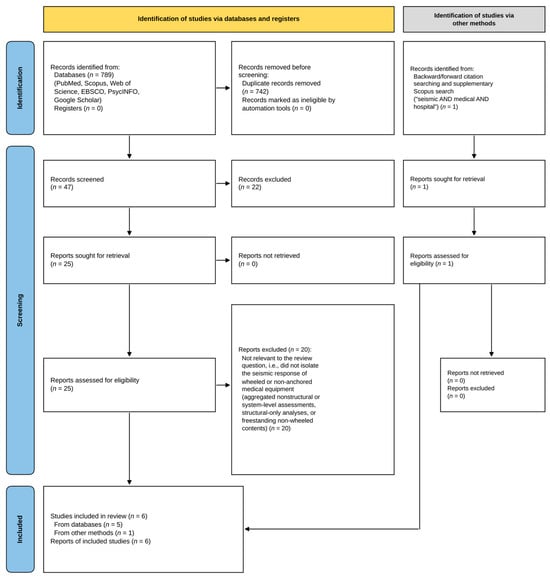
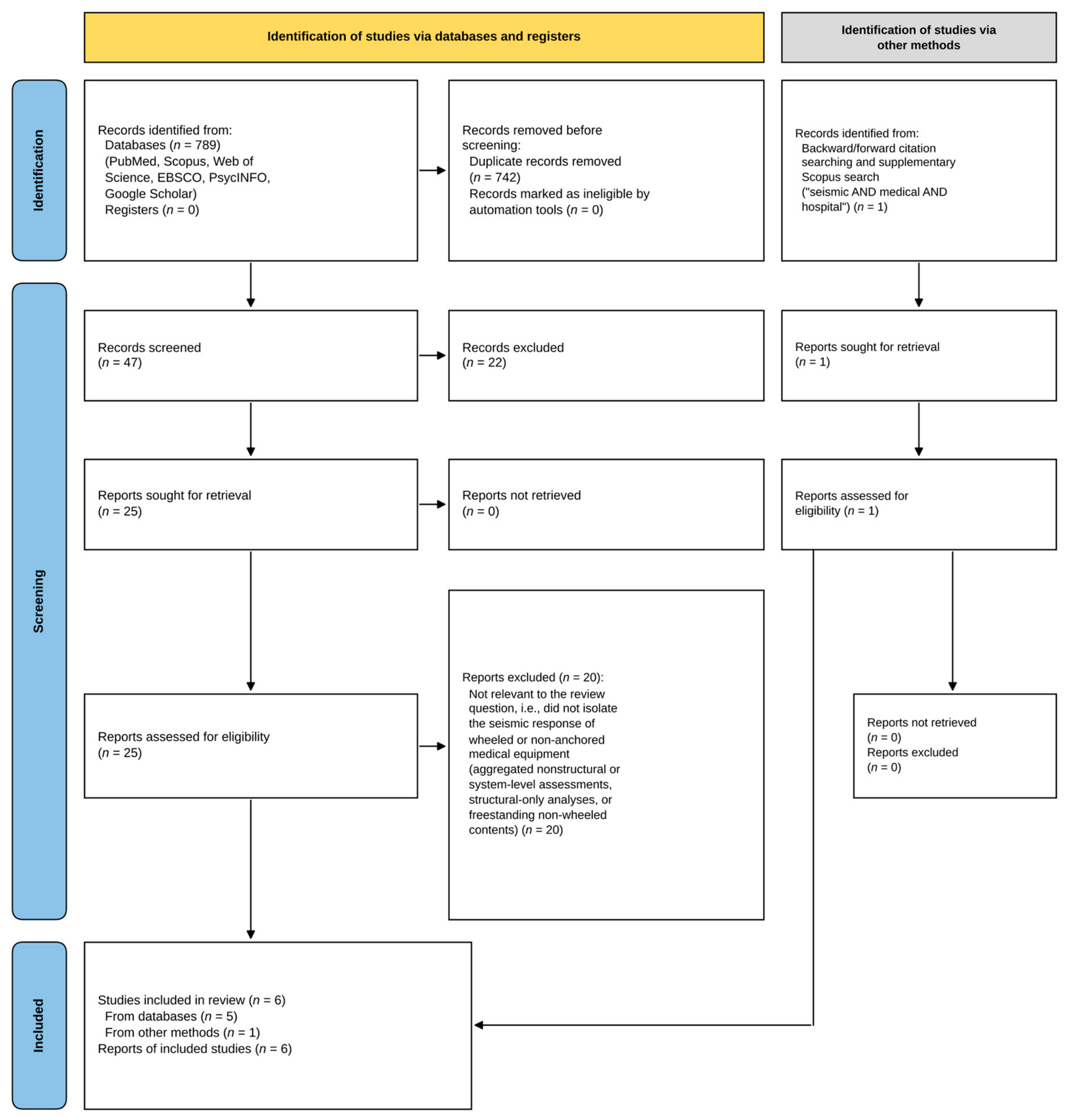
This systematic review was conducted and reported in accordance with the Preferred Reporting Items for Systematic Reviews and Meta-Analyses (PRISMA) 2020 statement [8,9]. The completed PRISMA 2020 checklist, indicating the page on which each item is reported, is provided in Supplementary Table S1, the PRISMA 2020 for Abstracts checklist in Supplementary Table S2, and the PRISMA 2020 flow diagram in Figure 1. Because the included studies were engineering experiments and simulations with heterogeneous designs and outcome metrics, a meta-analysis was not feasible; the synthesis was therefore conducted and reported following the Synthesis Without Meta-analysis (SWiM) guideline [10]. The review protocol was not prospectively registered. The primary objective was to examine how nonstructural seismic risks in hospitals have been assessed in the literature, with particular emphasis on whether medical devices are analyzed independently or aggregated with other nonstructural components, and how this affects interpretations of hospital functionality and mitigation strategies.
Figure 1.
PRISMA 2020 flow diagram of study identification, screening and inclusion. The right-hand column shows the additional study identified through citation searching and the supplementary Scopus search.
2.2. Search Strategy
A comprehensive literature search was performed using the PubMed, Scopus, Web of Science, EBSCO, PsycINFO, and Google Scholar databases.
The search covered studies published from January 1990 to December 2025, reflecting the period during which the nonstructural seismic performance of hospitals was increasingly discussed following major seismic events worldwide.
Search terms were combined using Boolean operators and included: “earthquake” OR “seismic,” “hospital” OR “healthcare facility,” “nonstructural components,” “medical equipment” OR “medical devices,” “hospital functionality” OR “operational continuity,” “seismic risk reduction” OR “mitigation”. The search was structured around four concept blocks—(i) seismic hazard, (ii) hospital or healthcare setting, (iii) nonstructural components or medical equipment, and (iv) functionality or mitigation outcomes—combined with the Boolean operator AND, with synonyms within each block combined with OR. Truncation, field tags and limits (publication years 1990–2025; English language) were adapted to each database. The full search string used for Scopus was: TITLE-ABS-KEY((earthquake* OR seismic*) AND (hospital* OR “healthcare facilit*” OR “health care facilit*”) AND (“nonstructural component*” OR “non-structural component*” OR “medical equipment” OR “medical device*”) AND (“hospital functionality” OR “operational continuity” OR “seismic risk reduction” OR mitigat*)) AND PUBYEAR > 1989 AND PUBYEAR < 2026 AND (LIMIT-TO(LANGUAGE, “English”)). The complete database-specific search strings for all six databases are reported in Supplementary Table S3.
To minimize the risk that eligible studies were missed, a supplementary search was performed comprising (i) backward citation searching of the reference lists of all included studies, (ii) forward citation searching of the included studies using the “cited by” function of Google Scholar, and (iii) an additional Scopus search with the keyword combination “seismic AND medical AND hospital”. Grey literature, including Federal Emergency Management Agency (FEMA), World Health Organization (WHO) and national guidance documents, was consulted to inform the Discussion but was not treated as eligible evidence, because such documents do not report primary experimental or numerical data on the seismic response of wheeled equipment.
The low number of eligible studies reflects the deliberately narrow scope of the review—primary experimental or numerical evidence on caster-supported medical equipment—rather than a restrictive search: most of the retrieved records addressed hospital nonstructural components in aggregate (e.g., partitions, ceilings, piping and anchored equipment) or hospital functionality at the system level, without isolating the response of wheeled equipment. Moreover, the earliest eligible study identified was published in 2017, indicating that this is a young research field despite the 35-year search window.
2.3. Inclusion Criteria
Studies were included if they:
- Addressed seismic events or earthquake risk in hospital or healthcare facility settings.
- Investigated wheeled (caster-supported) or otherwise non-anchored medical or hospital equipment as a distinct object of analysis.
- Reported quantitative seismic response outcomes (e.g., displacement, acceleration, rocking, overturning, damage states or fragility) or outcomes related to functional disruption, operational downtime, and loss of service capacity.
- Used experimental (e.g., shake-table) and/or numerical (analytical or simulation) methods.
- Were published in peer-reviewed journals, full-length peer-reviewed conference proceedings, or authoritative technical reports.
- Were written in English.
2.4. Exclusion Criteria
Studies were excluded if they:
- Focused exclusively on structural performance without reference to nonstructural elements.
- Examined nonstructural components only in non-healthcare buildings.
- Examined only freestanding equipment or contents without wheels or casters (e.g., cabinets, shelving or desktop laboratory equipment).
- Were conference abstracts without full papers, editorials, commentaries, or non-systematic narrative reports.
- Lacked sufficient methodological detail to assess relevance or quality.
2.5. Study Selection
All identified records were imported into reference management software, and duplicates were removed. Two reviewers independently screened titles and abstracts to assess eligibility. Full-text articles were then retrieved and reviewed for studies that met the inclusion criteria or for which eligibility was unclear.
Discrepancies in study selection were resolved through discussion among the reviewers. Records identified through the supplementary search were screened by the same two reviewers using identical procedures and criteria.
2.6. Data Extraction
Data were extracted using a standardized form developed specifically for this review, capturing:
- Author(s) and year of publication.
- Country or region of the study.
- Type of seismic event or hazard considered.
- Classification framework for nonstructural components.
- Explicit versus aggregated treatment of medical devices.
- Reported effects on hospital functionality.
- Proposed or evaluated mitigation strategies.
- Study design (shake-table experiment, numerical simulation or both), equipment type, dimensions and caster configuration.
- Seismic input (ground or floor motion, intensity measure and directionality).
- Response metrics (displacement, acceleration amplification, rocking/overturning, damage states and fragility parameters).
- Consequence metrics, where reported (repair or replacement cost, life-safety risk and operational downtime).
Extraction accuracy was verified through cross-checking by the authors conducting the review.
2.7. Quality Assessment
Because all included studies were engineering experiments or numerical simulations, clinical critical-appraisal instruments, such as the Joanna Briggs Institute [11] and Critical Appraisal Skills Programme [12] checklists, were not considered appropriate: their core bias domains (participant selection, confounding, blinding and follow-up) have no direct counterpart in shake-table testing or rigid-body simulation. Methodological quality was therefore appraised with a nine-item checklist adapted from the Standard Quality Assessment Criteria for quantitative studies [13] and tailored to experimental and numerical earthquake-engineering research. The items were: Q1, clearly stated objective; Q2, representativeness of the specimen or model (real medical equipment, mass, geometry and caster type); Q3, definition of boundary and support conditions (floor surface, friction, caster-lock state and adjacent obstacles); Q4, characterization of the seismic input (ground or floor motions, intensity and directionality); Q5, adequacy of the instrumentation or numerical formulation; Q6, adequacy of the test matrix or parametric range (number of trials, records and configurations); Q7, validation (numerical–experimental or theoretical cross-checking); Q8, clear definition and quantitative reporting of outcomes; and Q9, discussion of limitations and applicability.
Each item was scored 2 (yes), 1 (partial) or 0 (no), or marked as not applicable (NA; e.g., Q7 for purely experimental studies). The summary score was expressed as a percentage of the maximum applicable score, and studies were rated as high (≥85%), moderate (65–84%) or low (<65%) quality.
Multiple reviewers independently conducted quality appraisals. Any discrepancies in appraisal judgments were resolved through discussion and consensus among the reviewers. The results of the quality assessment informed the interpretation of the findings rather than serving as exclusion criteria.
2.8. Data Synthesis
Studies were grouped by mitigation strategy (full locking, full unlocking, partial or diagonal locking, switching or adaptive locking, geometric modification and building support condition) and by outcome domain (horizontal displacement, acceleration or impact demand, and rocking/overturning). For each strategy–outcome pair, the direction of effect relative to the comparator condition tested in the same study was tabulated (vote counting based on the direction of effect), as recommended by SWiM when effect estimates cannot be pooled [10]. Quantitative indicators (stability thresholds, test numbers and fragility parameters) were extracted as reported. Fragility functions and consequence metrics were compared descriptively with respect to the intensity measure, damage-state definition and derivation method.
3. Results
3.1. Overview of Included Studies
The database search identified 789 records. After 742 duplicate records were removed, 47 records were screened by title and abstract, of which 22 were excluded. Twenty-five full-text reports were assessed for eligibility, and 20 were excluded because they did not isolate the seismic response of wheeled or non-anchored medical equipment (e.g., aggregated nonstructural assessments, structural-only analyses, or freestanding non-wheeled contents [14,15]). Five studies met the inclusion criteria. The supplementary citation and Scopus search identified one additional eligible study [16], resulting in a total of six included studies (Figure 1). All included studies directly investigated the seismic behavior of wheeled, non-anchored medical or hospital equipment, with a primary focus on rocking, sliding, rolling, impact and overturning responses under earthquake excitation. Two were shake-table experiments [17,18], three combined shake-table testing with numerical modeling [16,19,20], and one was a rigid-body numerical simulation [21]. The studies were conducted in Japan [19,21], China [20], Canada [18], New Zealand in collaboration with Japan [17], and Chile, based on full-scale five-story building shake-table tests [16]. Together, they provided complementary experimental and analytical evidence of the seismic vulnerability of medical equipment supported by casters.
3.2. Methodological Characteristics
The methodological characteristics and appraisal results are summarized in Table 1 and Table 2. All studies explicitly examined the influence of caster-lock condition, caster configuration or building support condition on the seismic response. Using the adapted engineering appraisal checklist (Section 2.7), four studies were rated as high quality [16,17,19,20] and two as moderate quality [18,21]. Common strengths included clearly defined objectives, well-controlled boundary conditions and transparent reporting of response measures. The main limitations were a single equipment type and unidirectional input [18], the absence of experimental validation [21], and a limited number of equipment types or ground motions, which constrains generalizability across the wide range of transportable equipment used in hospitals.
Table 1.
Methodological quality appraisal of the included studies using the nine-item checklist adapted for experimental and numerical earthquake-engineering studies (Q1–Q9; see Section 2.7).
Table 2.
Summary of included studies focusing on the seismic vulnerability of wheeled (non-anchored) medical equipment (study titles are given in the reference list).
3.3. Seismic Response Under Different Caster Lock Conditions
Across the five included studies that explicitly varied the caster-lock condition [17,18,19,20,21], fully locked caster conditions were consistently associated with increased rocking and overturning risks during seismic excitation (Table 2). Shake table experiments demonstrated that severe rocking, uplift, and overturning occurred predominantly when all casters were locked, whereas unlocked or partially locked conditions permitted sliding, which dissipated seismic energy and reduced rotational instability. Numerical simulations corroborated these findings, showing that static all-lock and all-free strategies were both suboptimal, either amplifying acceleration demands or allowing excessive displacement. Recent experimental evidence further indicates that caster configuration significantly influences the response characteristics, with certain partial-lock or diagonal-lock arrangements achieving a more favorable balance between displacement control and stability. The sixth study showed that nonlinear rolling and toppling models validated against full-scale building tests can reproduce the observed equipment response in both base-isolated and fixed-base buildings, unless severe lateral impacts or significant mass changes occur [16].
3.4. Influence of Geometric Parameters
Three studies quantitatively evaluated the influence of equipment geometry on seismic stability. In particular, the ratio between base width (b) and center-of-gravity height (h) emerged as a critical governing parameter. Overturning probability decreased markedly as the b/h ratio increased, and overturning became negligible when b/h ≥ 0.4, even under strong seismic inputs corresponding to rare, high-intensity earthquake scenarios. These findings were consistent across experimental observations and numerical analyses, underscoring the importance of geometric stability in wheeled medical equipment.
3.5. Effectiveness of Adaptive or Conditional Locking Strategies
Four of the six studies provided evidence supporting the effectiveness of adaptive-, conditional-, or configuration-based locking strategies. Periodic or switching wheel-lock conditions reduced both horizontal displacement and overturning risk compared with static locking approaches. Experimental studies evaluating automated or semi-automated locking mechanisms have demonstrated improved seismic performance by allowing controlled sliding during strong motion while preventing excessive post-event drift. Collectively, these results indicate that dynamic or conditional control of caster behavior offers a promising mitigation strategy, outperforms conventional static locking practices, and provides a feasible alternative to permanent anchoring for transportable medical equipment.
3.6. Quantitative Summary of Mitigation Effectiveness
Table 3 summarizes, for each mitigation strategy, the number of studies providing evidence and the direction of effect for the three outcome domains. Because the studies used different equipment, input motions, intensity measures and response metrics, and most did not report variance estimates, effect sizes could not be pooled; the vote count therefore indicates the consistency of the direction of effect rather than the magnitude of benefit. Nevertheless, the evidence was directionally consistent: no study reported that full locking reduced rocking or overturning, all studies that evaluated full locking against unlocked conditions reported higher rotational instability, and every study that evaluated partial, switching or geometric measures reported improved stability relative to full locking.
Table 3.
Quantitative summary (vote counting based on the direction of effect) of mitigation strategies evaluated in the included studies.
4. Discussion
This systematic review clarifies a previously underrecognized dimension of hospital seismic safety by identifying wheeled, non-anchored medical equipment as a distinct risk category within nonstructural components. While prior research has consistently shown that nonstructural failures account for a substantial proportion of hospital functional downtime following earthquakes, medical equipment has largely been treated as a homogeneous group, often implicitly assumed to be anchored or sufficiently restrained. The findings synthesized in this review challenge this assumption and show that caster-supported equipment exhibits fundamentally different seismic behavior from that of anchored devices and other nonstructural elements [19,23,24].
4.1. Performance of Nonstructural Medical Components in Past Earthquakes
Post-earthquake reconnaissance has repeatedly shown that hospitals lose function more often through nonstructural than through structural damage. After the 1994 Northridge earthquake, several hospitals in the Los Angeles area had to be evacuated, in many cases because of nonstructural failures such as water leakage and damage to utilities and equipment [25]. In the 2010 Maule (Chile) earthquake, damage to ceilings, partitions, piping, elevators and equipment caused the partial or complete loss of function of numerous hospitals [26], and a detailed functional-loss assessment of one hospital showed that nonstructural and equipment damage, rather than structural damage, governed the reduction in its service capacity [27]. Similar patterns were documented in the Canterbury hospital system after the 2011 Christchurch earthquake [28] and in Japanese hospitals after the 2016 Kumamoto earthquake [4]. In Mexico City, the 1985 earthquake eliminated approximately 5800 hospital beds, and the 2017 earthquake affected 1147 beds, and the recovery of the healthcare system depended strongly on whether the main hospitals retained their functionality [29].
Where wheeled equipment is mentioned, reconnaissance reports describe displaced and overturned carts, monitors and devices, collisions with walls and obstructed corridors, but they rarely record the lock state, geometry or floor motion needed to explain the observed behavior. This gap is precisely what the experimental and numerical studies synthesized in this review address, and it also motivates recent efforts to classify hospital medical equipment according to the appropriate seismic retrofitting mode, as proposed for Taiwanese hospitals [30]. In South Korea, the 2016 Gyeongju and 2017 Pohang earthquakes demonstrated that damaging events can occur in a region historically perceived as seismically safe [7], but systematic documentation of equipment performance in Korean hospitals is not yet available.
4.2. Interpretation of Caster-Lock Mechanisms and Geometric Stability
A key interpretive insight is that the seismic response of wheeled medical equipment is governed less by peak acceleration demand and more by the interaction between mobility constraints and rotational stability [19,24]. In the reviewed studies, fully locked caster conditions were repeatedly associated with increased rocking and overturning risk. Full locking redirects seismic energy into rotational modes by suppressing translational motion, thereby destabilizing tall or top-heavy equipment [19,24]. This mechanism is consistent with established rigid-body rocking theory, which shows that restricting sliding reduces energy dissipation and increases rotational demand [31].
In contrast, controlled sliding provides an alternative energy dissipation pathway that reduces the overturning potential [32]. This finding aligns with nonstructural seismic research indicating that partial flexibility can limit force transmission and improve stability. Accordingly, wheeled medical equipment should be treated as dynamic systems whose seismic performance depends on how mobility is managed rather than eliminated [17,19].
Geometric factors further modulate this behavior. The base width-to-center-of-gravity height ratio (b/h) has emerged as a consistent, quantifiable determinant of seismic stability in several studies [23,33]. Thresholds identified in the reviewed studies provide a quantitative basis for evaluating existing equipment and designing retrofit measures such as adding safety weights, widening support footprints, or lowering the center of gravity [33,34]. These measures are particularly relevant for legacy equipment already deployed in clinical environments, where permanent anchoring is impractical or operationally undesirable.
From a system-level perspective, adaptive or conditional wheel-locking strategies represent a conceptual shift from static immobilization to functional adaptability [14,17,24]. Automatic or switchable lock mechanisms allow equipment to remain mobile during routine care while responding more safely under seismic excitation [17,19]. This approach aligns with resilience-oriented frameworks in disaster medicine that prioritize continuity of function and adaptive capacity over rigid protection [14,18].
These equipment-level strategies complement, rather than replace, structural approaches to resilience. At the building level, energy dissipation and seismic mitigation technologies, as well as prestressed self-centering systems, are important approaches for resilience enhancement, because they limit structural damage and residual drift and allow the rapid recovery of architectural function after strong earthquakes [35,36]. Base isolation similarly reduces floor accelerations in hospitals, although the associated long-period floor motion can increase the displacement of unrestrained equipment on wheels or casters [22,37]. Because floor acceleration and velocity demands ultimately govern whether equipment slides, rocks or overturns, structural resilience measures and equipment-level controls should be designed together under a common performance objective for hospital functionality.
4.3. Fragility Functions Reported for Wheeled Medical Equipment
Fragility functions express the probability that a component reaches or exceeds a defined damage state as a function of a seismic intensity measure (IM), typically in the lognormal form P(DS ≥ ds | IM = x) = Φ[ln(x/θ)/β], where θ is the median capacity and β is the logarithmic standard deviation [38]. They are the core input to performance-based assessment of nonstructural components [39]. Table 4 compares the fragility-related information reported in the reviewed literature. Among the included studies, one derived fragility curves explicitly for real wheeled equipment using incremental dynamic analysis [20]; one proposed a deterministic geometric stability threshold (b/h ≥ 0.4) that can be interpreted as a capacity limit for the overturning damage state [19]; and one developed experimentally validated rolling and toppling models [16], which the same group subsequently used to derive analytical fragility curves for unanchored medical equipment in emergency rooms, intensive care units and operating rooms of base-isolated and fixed-base buildings [22]. Shake-table-based fragility curves for complete hospital rooms have also been reported [15].
Table 4.
Comparison of fragility-related information reported for wheeled or unanchored medical equipment.
A direct numerical comparison of median capacities across studies is not meaningful at present, because the studies differ in (i) the IM adopted (input ground motion versus floor motion), (ii) the damage-state definitions (excessive displacement, impact with adjacent walls, uplift, overturning or functional failure), and (iii) the equipment and support conditions. Two consistent observations nevertheless emerge: fragility is strongly specific to the equipment and the lock condition, and damaging responses, including equipment malfunction, can occur during low-intensity earthquakes that cause only minor building damage [22]. Harmonizing IMs, preferably floor-level IMs such as peak floor acceleration and velocity, and damage-state definitions for wheeled equipment is therefore a research priority.
4.4. Floor Acceleration Demand: Peak Floor Acceleration and Floor Response Spectra
Seismic codes characterize the demand on nonstructural components and building contents through floor-level rather than ground-level motion. In the equivalent static approach of ASCE/SEI 7-16 [40], the design force is Fp = 0.4apSDSWp(1 + 2z/h)/(Rp/Ip), bounded by 0.3SDSIpWp ≤ Fp ≤ 1.6SDSIpWp, in which the term 0.4SDS(1 + 2z/h) is a simplified estimate of the peak floor acceleration (PFA) that increases linearly from the ground (z = 0) to the roof (z = h), and ap accounts for the dynamic amplification of flexible components; here, SDS is the design short-period spectral response acceleration, Wp the component operating weight, Rp the component response modification factor, Ip the component importance factor, z the height of the point of attachment and h the average roof height. ASCE/SEI 7-22 [41] replaces the linear profile with a floor amplification factor that depends on the building period and introduces component resonance and ductility factors, while Eurocode 8 [42] adopts an analogous expression in which the component acceleration depends on the ratio of the component period to the fundamental period of the building. The Korean seismic design code (KDS 41 17 00) also uses an equivalent static formulation of this type [43]. PFA is therefore the primary response index for checking whether freestanding or wheeled equipment will begin to slide (PFA > μg, where μ is the effective friction or rolling-resistance coefficient) or to rock (PFA > (b/2h)g for a rigid block with base width b and center-of-gravity height h) [33,34].
The floor response spectrum (FRS) method provides a more complete description of floor demand by computing the response spectrum of the floor acceleration history, thereby capturing the amplification that occurs when the period of a component approaches one of the dominant periods of the supporting building [44,45]. The Eurocode 8 expression itself is a simplified floor spectrum, and both ASCE/SEI 7 and Eurocode 8 permit floor demands derived from dynamic analysis of the supporting structure [41,42]. For wheeled equipment, whose response is dominated by sliding, rolling and rocking rather than by linear elastic vibration, FRS cannot be applied directly: PFA governs the onset of motion, whereas floor velocity and the frequency content of the floor motion govern the amplitude of rocking and the likelihood of overturning, consistent with rigid-body rocking theory [31,34]. Some included studies applied floor motions [16,18], whereas others applied scaled ground or input motions, which partly explains the heterogeneity of the reported responses. Future experiments should report PFA, peak floor velocity and FRS for every test so that results can be mapped directly onto code-based demand estimates.
4.5. Consequences of Equipment Damage and the Role of Mitigation Strategies
The consequences of nonstructural damage are conventionally expressed through three decision variables—repair or replacement cost, casualties (life-safety risk) and repair time or downtime—as formalized in the FEMA P-58 methodology [39] and in resilience frameworks for healthcare facilities [3]. For wheeled medical equipment, these consequences arise through distinct mechanisms (Table 5). Financial losses result from damage to high-value devices through overturning, impact with walls or other equipment, and internal malfunction. Life-safety risks arise from equipment toppling onto patients or staff, impact against occupied beds or incubators, disconnection of life-support devices and obstruction of evacuation routes [19]. Operational downtime arises when critical devices, such as ventilators, anesthesia machines, dialysis units and incubators, are unavailable during the post-earthquake surge in demand, which can force the evacuation or transfer of patients even when the building is structurally intact [22,27].
Table 5.
Consequences of seismic damage to wheeled medical equipment and the mitigation strategies that reduce them.
None of the included studies quantified consequences in monetary or time units; instead, they reported physical response quantities (displacement, acceleration, rocking and overturning) that act as precursors of consequences. Table 5 therefore maps each mitigation strategy to the consequence type that it primarily reduces, based on the response mechanisms established in the included studies. Strategies that suppress overturning and impact (partial or switching locks, geometric modification and floor-engaging stabilizers) primarily reduce life-safety risk and direct repair cost, whereas strategies that limit displacement (locking and tethering) primarily preserve access routes and utility connections, thereby reducing operational downtime. Because these objectives can conflict—full locking limits displacement but increases overturning—the choice of strategy should be explicitly linked to the consequence that matters most in each clinical area.
4.6. Illustrative Application of Mitigation Measures
To illustrate how these findings can be applied in practice, consider a mobile ventilator cart (base width b = 0.40 m, center-of-gravity height h = 0.90 m, b/h = 0.44) and an infusion-pump pole stand (b = 0.30 m, h = 1.00 m, b/h = 0.30) located on the top floor (z/h = 1) of a hospital with an illustrative short-period design spectral acceleration SDS = 0.50 g. Using the ASCE/SEI 7-16 expression, the estimated PFA is 0.4 × 0.50 × (1 + 2 × 1) = 0.60 g, compared with 0.20 g at ground level [40]. For an equivalent rigid block with all casters locked, rocking initiates when PFA exceeds (b/2h)g, that is, at approximately 0.22 g for the ventilator cart and 0.15 g for the pole stand; both thresholds are exceeded on the top floor, and the pole stand would also rock on the ground floor.
The findings of this review translate into a three-step screening and retrofit procedure. (1) Geometric screening: the pole stand (b/h < 0.4) is classified as overturning-prone and prioritized for geometric retrofit; adding a base weight that lowers the center of gravity to h ≈ 0.70 m, or widening the base to b ≈ 0.42 m, raises b/h above 0.4 [19]. (2) Lock configuration: for both devices, locking all casters is avoided when the device is parked on upper floors, and a diagonal partial-lock configuration or an automatic switching lock is used instead to permit limited, energy-dissipating motion while limiting drift [17,21]. (3) Placement and restraint: devices are parked away from walls and beds with a clearance at least equal to the expected displacement [20], and devices that remain stationary for long periods are fitted with a floor-engaging stabilizer or a flexible tether, consistent with FEMA E-74 and FEMA 577 guidance [46,47,48]. The example is deliberately simplified—rocking initiation does not imply overturning, which also depends on the size of the block and the frequency content of the floor motion [31,34]—but it shows how PFA estimates, geometric thresholds and lock-configuration evidence can be combined into a transparent screening procedure for hospital equipment.
4.7. Evidence Gaps, Regional Implications and Limitations
Despite these advances, the evidence base remains small. Although the six included studies originate from five countries (Japan, China, Canada, New Zealand and Chile), none was conducted in South Korea, the United States or Europe, and most experimental data come from a few laboratories. The mechanisms identified, however, are governed by physical parameters—friction or rolling resistance, caster-lock state, equipment geometry and floor motion—that are not region-specific, and the experimental findings are consistent with established rigid-body rocking theory [31,33,34]. Their implications for South Korea should therefore be read as evidence-informed hypotheses rather than validated policy prescriptions. In South Korea, historical perceptions of seismic safety have likely delayed the systematic evaluation of hospital-focused countermeasures [7], and wheeled medical equipment remains largely absent from existing guidelines, design standards and facility-level preparedness planning. This absence reflects a lack of targeted assessment rather than a lack of risk, and shake-table testing of equipment representative of Korean hospital inventories is needed before national policy recommendations can be finalized.
This gap also reveals a fundamental limitation of prevailing mitigation strategies, which have predominantly relied on caster-level locking mechanisms. While wheel locks restrict rolling motion, the reviewed evidence indicates that such approaches may be insufficient to control seismic-induced rocking and overturning, particularly under strong ground motions. As an alternative, greater attention should be directed toward stabilization mechanisms attached to the lower central body of medical equipment that directly engage the floor surface [46]. When the equipment is stationary, incorporating a non-wheel-based stabilizing element at the lower surface of the device can provide additional restraint against unintended motion, complementing rather than replacing the caster functionality. Implementing such measures is essential for safeguarding hospital staff and patients during earthquakes and supporting the continuity of clinical operations in the immediate post-event period [49,50].
This review has several limitations. First, only six studies met the eligibility criteria, and although they come from five countries, the experimental evidence derives from a small number of laboratories and equipment types; generalization to other hospital infrastructures, equipment inventories and regulatory environments should therefore be made with caution. Second, the studies were heterogeneous in equipment type, experimental setup, seismic input and outcome measures, which precluded meta-analysis; the vote-counting synthesis conveys the consistency of the direction of effect but not its magnitude. Third, the appraisal checklist was adapted for engineering studies and has not been externally validated, and no formal certainty-of-evidence grading was applied because frameworks such as the Grading of Recommendations Assessment, Development and Evaluation (GRADE) framework are designed for clinical intervention studies. Fourth, the search was limited to English-language publications, and grey literature was used only for context; relevant Japanese- or Chinese-language technical reports may therefore have been missed. Future studies should test the identified strategies empirically, report floor-level intensity measures and fragility parameters in a harmonized format, and quantify consequences in terms of cost, life-safety risk and downtime.
5. Conclusions
This systematic review identifies transportable wheeled medical equipment as a distinct and insufficiently addressed source of seismic risk in hospitals. Six experimental and numerical studies from five countries support four core conclusions.
First, fully locking all casters is not a reliable seismic safeguard: it limits sliding but redirects seismic energy into rocking and impact, increasing acceleration amplification and overturning risk, whereas controlled sliding dissipates energy at the cost of larger displacements.
Second, equipment geometry is a quantifiable determinant of stability; a base-width-to-center-of-gravity-height ratio of at least 0.4 markedly reduced overturning and provides a simple screening criterion for existing equipment.
Third, configuration-based and adaptive locking strategies, such as diagonal partial locking or switching lock control, offer the most favorable balance between displacement and stability, and equipment-level stabilizers that engage the floor when the device is stationary are a promising complement that separates mobility from stability.
Fourth, the evidence base is still small and methodologically heterogeneous; fragility functions, floor-level intensity measures and consequence metrics (repair cost, life-safety risk and downtime) are reported inconsistently, which currently prevents quantitative pooling.
For practice, hospitals should inventory their transportable equipment, screen it using floor acceleration demand and geometric criteria, and replace blanket full-locking rules with equipment- and location-specific protocols. For research and policy, particularly in regions such as South Korea where no local data exist, harmonized shake-table testing, the development of fragility functions and the explicit inclusion of wheeled equipment in nonstructural seismic guidelines are needed to improve hospital seismic resilience and maintain continuity of care.
Supplementary Materials
The following supporting information can be downloaded at: https://www.mdpi.com/article/10.3390/safety12060138/s1, Table S1: PRISMA 2020 checklist; Table S2: PRISMA 2020 for Abstracts checklist; Table S3: Full search strategies for each database.
Author Contributions
Conceptualization, Y.H. and S.P.; methodology, Y.H. and S.P.; validation, S.P.; formal analysis, Y.H.; investigation, Y.H.; data curation, Y.H.; writing—original draft preparation, Y.H.; writing—review and editing, S.P.; visualization, Y.H.; supervision, S.P.; project administration, S.P. All authors have read and agreed to the published version of the manuscript.
Funding
This research received no external funding.
Institutional Review Board Statement
Not applicable.
Informed Consent Statement
Not applicable.
Data Availability Statement
No new data were created in this study. All data analyzed in this review were obtained from previously published studies, which are cited in the reference list.
Conflicts of Interest
The authors declare no conflicts of interest.
Abbreviations
The following abbreviations are used in this manuscript:
| PRISMA | Preferred Reporting Items for Systematic Reviews and Meta-Analyses |
| SWiM | Synthesis Without Meta-analysis |
| PFA | Peak floor acceleration |
| FRS | Floor response spectrum |
| IM | Intensity measure |
| DEM | Discrete element method |
| IDA | Incremental dynamic analysis |
| MCE | Maximum considered earthquake |
| b/h | Base width to center-of-gravity height ratio |
| FEMA | Federal Emergency Management Agency |
References
- Al-Mandhari, A. Earthquakes as triggers for public health disasters: WHO and health systems’ response. East. Mediterr. Health J. 2023, 29, 165–167. [Google Scholar] [CrossRef] [Scilit] [PubMed]
- Achour, N. Estimation of Malfunction of a Healthcare Facility in Case of Earthquake; Kanazawa University: Kanazawa, Japan, 2007. [Google Scholar]
- Hassan, E.M.; Mahmoud, H. An integrated socio-technical approach for post-earthquake recovery of interdependent healthcare system. Reliab. Eng. Syst. Saf. 2020, 201, 106953. [Google Scholar] [CrossRef] [Scilit]
- Achour, N.; Miyajima, M. Post-earthquake hospital functionality evaluation: The case of Kumamoto Earthquake 2016. Earthq. Spectra 2020, 36, 1670–1694. [Google Scholar] [CrossRef] [Scilit]
- Tokas, C.V. Nonstructural Components and Systems-Designing Hospitals for Post-Earthquake Functionality. In AEI 2011: Building Integration Solutions; ASCE Publishing: Reston, VA, USA, 2012; pp. 378–389. [Google Scholar]
- Solarino, S.; Musacchio, G.; Eva, E. Reducing Seismic Vulnerability of Non-Structural Elements to Support Sustainable Development Goals. Infrastructures 2025, 10, 294. [Google Scholar] [CrossRef] [Scilit]
- Lee, S.; Oh, S. A comprehensive seismic risk assessment map of South Korea based on seismic, geotechnical, and social vulnerability. Environ. Earth Sci. 2022, 81, 33. [Google Scholar] [CrossRef] [Scilit]
- Han, Y.-G.; Kim, M.-K. The Effect of Task-Oriented Treadmill Training on Gait Function in Patients with Stroke: A Systematic Review and Meta-Analysis. Korean Soc. Phys. Med. 2024, 19, 131–142. [Google Scholar] [CrossRef] [Scilit]
- Page, M.J.; McKenzie, J.E.; Bossuyt, P.M.; Boutron, I.; Hoffmann, T.C.; Mulrow, C.D.; Shamseer, L.; Tetzlaff, J.M.; Akl, E.A.; Brennan, S.E.; et al. The PRISMA 2020 statement: An updated guideline for reporting systematic reviews. BMJ 2021, 372, n71. [Google Scholar] [CrossRef] [Scilit] [PubMed]
- Campbell, M.; McKenzie, J.E.; Sowden, A.; Katikireddi, S.V.; Brennan, S.E.; Ellis, S.; Hartmann-Boyce, J.; Ryan, R.; Shepperd, S.; Thomas, J.; et al. Synthesis without meta-analysis (SWiM) in systematic reviews: Reporting guideline. BMJ 2020, 368, l6890. [Google Scholar] [CrossRef] [Scilit] [PubMed]
- Jun, H.; Yoon, S.-H.; Roh, M.; Kim, S.-H.; Lee, J.; Lee, J.; Kwon, M.; Leem, J. Quality assessment and implications for further study of acupotomy: Case reports using the case report guidelines and the Joanna Briggs Institute critical appraisal checklist. J. Acupunct. Res. 2021, 38, 122–133. [Google Scholar] [CrossRef]
- Long, H.A.; French, D.P.; Brooks, J.M. Optimising the value of the critical appraisal skills programme (CASP) tool for quality appraisal in qualitative evidence synthesis. Res. Methods Med. Health Sci. 2020, 1, 31–42. [Google Scholar] [CrossRef] [Scilit]
- Kmet, L.M.; Lee, R.C.; Cook, L.S. Standard Quality Assessment Criteria for Evaluating Primary Research Papers from a Variety of Fields; Alberta Heritage Foundation for Medical Research: Edmonton, AB, Canada, 2004. [Google Scholar]
- Huang, B.; Hu, Z.; Tang, C.; Guan, X.; Lu, W. Shaking table tests of a nonstructural freestanding object with variable center of gravity. Soil Dyn. Earthq. Eng. 2024, 177, 108361. [Google Scholar] [CrossRef] [Scilit]
- Cosenza, E.; Di Sarno, L.; Maddaloni, G.; Magliulo, G.; Petrone, C.; Prota, A. Shake table tests for the seismic fragility evaluation of hospital rooms. Earthq. Eng. Struct. Dyn. 2015, 44, 23–40. [Google Scholar] [CrossRef] [Scilit]
- Guamán-Cabrera, J.; de la Llera, J.C.; Mery, D. Seismic performance assessment of medical equipment using experimentally validated rolling and toppling nonlinear models. Earthq. Spectra 2023, 39, 1810–1836. [Google Scholar] [CrossRef] [Scilit]
- Xu, C.; Ma, Q.T.; Beskhyroun, S.; Kurata, M. A Shake Table Study on Caster Configuration in the Seismic Response of Rolling Equipment. J. Earthq. Eng. 2025, 29, 2724–2747. [Google Scholar] [CrossRef] [Scilit]
- Nikfar, F.; Konstantinidis, D. Shake Table Study on the Seismic Response of Medical Equipment on Wheels. In Proceedings of the 16th World Conference on Earthquake Engineering, Santiago, Chile, 9–13 January 2017. [Google Scholar]
- Hitomi, M.; Kurata, M.; Aida, S.; Shimoto, M.; Cho, K.; Ohtsuru, S. Medical equipment seismic performance evaluation for preventing rocking and overturning. Trans. Jpn. Soc. Med. Biol. Eng. 2022, 60, 139–148. [Google Scholar]
- Liu, J.; Zhai, C.; Yu, P.; Zhang, C.; Li, H. Experimental and numerical analysis of wheeled medical equipment with adjacent wall subjected to earthquakes. J. Build. Eng. 2023, 72, 106635. [Google Scholar] [CrossRef] [Scilit]
- Kawanishi, Y.; Kohiyama, M. Seismic response control for equipment with casters using switching wheel lock condition. In Proceedings of the 13th World Congress on Computational Mechanics (WCCM XIII) and 2nd Pan American Congress on Computational Mechanics (PANACM II), New York, NY, USA, 22–27 July 2018. [Google Scholar]
- Guamán-Cabrera, J.; de la Llera, J.C.; Rossetto, T.; Enberg, L.; Ioannou, I. Fragility curves for unanchored medical equipment accounting for building and content interaction. Eng. Struct. 2026, 346, 121494. [Google Scholar] [CrossRef] [Scilit]
- Huang, S.; Loh, C. Control of Equipment Isolation System using Wavelet-based Hybrid Sliding Mode Control. In Sensors and Smart Structures Technologies for Civil, Mechanical, and Aerospace Systems 2017; SPIE: Bellingham, WA, USA, 2017. [Google Scholar]
- Abbracciavento, L.; Chiaia, B.; De Biagi, V.; Reggio, A. Seismic analysis of medical equipment in Ospedale Mauriziano (Torino): A resilience-based approach. Procedia Struct. Integr. 2023, 44, 750–757. [Google Scholar] [CrossRef] [Scilit]
- Schultz, C.H.; Koenig, K.L.; Lewis, R.J. Implications of hospital evacuation after the Northridge, California, earthquake. N. Engl. J. Med. 2003, 348, 1349–1355. [Google Scholar] [CrossRef] [Scilit] [PubMed]
- Miranda, E.; Mosqueda, G.; Retamales, R.; Pekcan, G. Performance of nonstructural components during the 27 February 2010 Chile earthquake. Earthq. Spectra 2012, 28, S453–S471. [Google Scholar] [CrossRef] [Scilit]
- Mitrani-Reiser, J.; Mahoney, M.; Holmes, W.T.; de la Llera, J.C.; Bissell, R.; Kirsch, T. A functional loss assessment of a hospital in the 27 February 2010 Maule (Chile) earthquake. Earthq. Spectra 2012, 28, S473–S502. [Google Scholar]
- Jacques, C.C.; McIntosh, J.; Giovinazzi, S.; Kirsch, T.D.; Wilson, T.; Mitrani-Reiser, J. Resilience of the Canterbury hospital system to the 2011 Christchurch earthquake. Earthq. Spectra 2014, 30, 533–554. [Google Scholar] [CrossRef] [Scilit]
- Tena-Colunga, A. Seismic performance and recovery of medical infrastructure in Mexico City related to the September 19, 1985 and 2017 earthquakes. Int. J. Disaster Risk Reduct. 2024, 113, 104886. [Google Scholar] [CrossRef] [Scilit]
- Wu, S.-Y.; Chang, S.-H.; Chen, M.-F.; Lin, K.-P. Development of a classification and decision-making workflow for seismic retrofitting modes of hospital medical equipment: The case of Taiwan. Health Technol. 2026, 16, 489–502. [Google Scholar] [CrossRef] [Scilit]
- Gesualdo, A.; Iannuzzo, A.; Minutolo, V.; Monaco, M. Rocking of freestanding objects: Theoretical and experimental comparisons. J. Theor. Appl. Mech. 2018, 56, 977–991. [Google Scholar] [CrossRef] [Scilit]
- Whittaker, A.; Soong, T. An overview of nonstructural components research at three US Earthquake Engineering Research Centers. In Proceedings of Seminar on Seismic Design, Performance, and Retrofit of Nonstructural Components in Critical Facilities; Applied Technology Council: Redwood City, CA, USA, 2003; pp. 271–280. [Google Scholar]
- Ishiyama, Y. Motions of rigid bodies and criteria for overturning by earthquake excitations. Earthq. Eng. Struct. Dyn. 1982, 10, 635–650. [Google Scholar] [CrossRef] [Scilit]
- Housner, G.W. The behavior of inverted pendulum structures during earthquakes. Bull. Seismol. Soc. Am. 1963, 53, 403–417. [Google Scholar] [CrossRef] [Scilit]
- Xie, Y.; Yu, F.; Huang, L.; Tong, C. Research on the hysteretic behavior of self-centering timber frames considering the influence of floor slabs. Buildings 2026, 16, 1793. [Google Scholar] [CrossRef] [Scilit]
- Wang, S.; Zhou, X.; Yuan, G.; Zhang, D.; Huang, L.; Wei, Y. Seismic performance and architectural function recoverability for self-centering precast concrete frames with enhanced post-stiffness and energy dissipation. Buildings 2025, 15, 3949. [Google Scholar] [CrossRef] [Scilit]
- Nikfar, F.; Konstantinidis, D. Experimental study on the seismic response of equipment on wheels and casters in base-isolated hospitals. J. Struct. Eng. 2019, 145, 04019001. [Google Scholar] [CrossRef] [Scilit]
- Porter, K.; Kennedy, R.; Bachman, R. Creating fragility functions for performance-based earthquake engineering. Earthq. Spectra 2007, 23, 471–489. [Google Scholar] [CrossRef] [Scilit]
- FEMA. Seismic Performance Assessment of Buildings, Volume 1—Methodology, 2nd ed.; FEMA P-58-1; Federal Emergency Management Agency: Washington, DC, USA, 2018.
- ASCE/SEI 7-16; Minimum Design Loads and Associated Criteria for Buildings and Other Structures. American Society of Civil Engineers (ASCE): Reston, VA, USA, 2017.
- ASCE/SEI 7-22; Minimum Design Loads and Associated Criteria for Buildings and Other Structures. American Society of Civil Engineers (ASCE): Reston, VA, USA, 2022.
- EN 1998-1:2004; Eurocode 8: Design of Structures for Earthquake Resistance—Part 1: General Rules, Seismic Actions and Rules for Buildings. European Committee for Standardization (CEN): Brussels, Belgium, 2004.
- KDS 41 17 00; Seismic Building Design Code. Ministry of Land, Infrastructure and Transport (MOLIT): Sejong, Republic of Korea, 2019.
- Sullivan, T.J.; Calvi, P.M.; Nascimbene, R. Towards improved floor spectra estimates for seismic design. Earthq. Struct. 2013, 4, 109–132. [Google Scholar] [CrossRef] [Scilit]
- Vukobratović, V.; Fajfar, P. A method for the direct determination of approximate floor response spectra for SDOF inelastic structures. Bull. Earthq. Eng. 2015, 13, 1405–1424. [Google Scholar] [CrossRef] [Scilit]
- Christovasilis, I.; Riparbelli, L.; Fioravanti, M. The role of friction in the response of cross-laminated timber buildings under low-amplitude seismic loads. Eng. Struct. 2025, 327, 119622. [Google Scholar] [CrossRef] [Scilit]
- FEMA. Reducing the Risks of Nonstructural Earthquake Damage—A Practical Guide; FEMA E-74; Federal Emergency Management Agency: Washington, DC, USA, 2012.
- FEMA. Design Guide for Improving Hospital Safety in Earthquakes, Floods, and High Winds; FEMA 577; Federal Emergency Management Agency: Washington, DC, USA, 2007.
- Lee, Y.-B.; Kim, J.-B.; Lee, G.-C. The effects of training using Pedalo equipment on balance of post-stroke patients: Pilot study. J. Korean Soc. Phys. Med. 2013, 8, 387–395. [Google Scholar] [CrossRef] [Scilit]
- Song, J.-M.; Park, S.-W. Development of the ICF/KCF code set the people with nervous system disease: Based on physical therapy. Korean Soc. Phys. Med. 2023, 18, 99–110. [Google Scholar] [CrossRef] [Scilit]

Disclaimer/Publisher’s Note: The statements, opinions and data contained in all publications are solely those of the individual author(s) and contributor(s) and not of MDPI and/or the editor(s). MDPI and/or the editor(s) disclaim responsibility for any injury to people or property resulting from any ideas, methods, instructions or products referred to in the content. |
© 2026 by the authors. Licensee MDPI, Basel, Switzerland. This article is an open access article distributed under the terms and conditions of the Creative Commons Attribution (CC BY) license.