


Abstract
Musculoskeletal disorders (MSD) are an international problem in female agricultural workers. The rates of musculoskeletal disorders in women are higher than in men. Stress, sleep, and joint and muscle pain are interconnected. This study aimed to better understand these relationships in women actively engaged in agriculture in the Midwestern US. A brief survey was mailed to 5018 addresses purchased from an agricultural marketing company. There were 235 responses and after removing those respondents not working on the farm, 202 were analyzed. A latent class analysis was used to identify subgroups based on a set of eight questions asking about pain, stress, sleep, exercise, and seeking medical care. Two groups emerged based on musculoskeletal impact severity. The group of 67 (33.2%) showed mild impacts and the larger group of 135 (66.8%) showed more severe impacts. The severe group exercised less frequently, experienced more frequent pain, and more frequent problems with sleep and stress. The women reported that the most likely relationship between pain and stress was bidirectional. Pain, stress and sleep were interconnected. Prevention of an MSD is important for quality of life, but after an MSD, reducing stress levels and improving sleep can reduce the burden of an MSD.
1. Introduction
In 2022 there were 1.2 million female farmers working 407 million acres and contributing $222 billion dollars in agricultural sales in the United States [1]. They tended to be younger and newer to agriculture than male farmers. Although they were less likely to be involved directly with crop and animal work compared to men, over 50% of them reported making daily decisions about the farm and ranch work. Despite a substantial number of women working on farms and ranches, there have been few studies addressing their unique health and safety needs. The fact that they tend to work fewer hours on the operation than males and do different types of farmwork makes comparing injury rates in men and women a confounded association since increased time on a task and the intensity of the task are risk factors for musculoskeletal symptoms [2]. In a 2025 scoping review of peer-reviewed papers on women working in agriculture, only eight of ninety-three publications examined health and safety issues [3]. Health and safety issues derive partly from the struggle women have with finding personal protective equipment that fits them and using farm machinery designed for male bodies [4].
Musculoskeletal disorders (MSD) are load–capacity misalignments within the movement systems of bodies such as muscles, tendons, ligaments, nerves, spinal discs, and the blood vessels that support these structures. Misalignments cause pain and discomfort resulting in symptoms due to ergonomic risk factors resulting in prolonged exposure to physical stresses such as repetitive motions, forceful exertions, heavy lifting, kneeling, squatting, bending, prolonged awkward positions, twisting motions and environmental hazards such as vibrations from machinery [5]. Biological differences cause differential impacts of these strains on male and female bodies resulting in different MSD prevalences and risk factors.
There are few studies which provide an estimate of the prevalence of occupationally related MSD in women, and even fewer in farming women. MSD rates will vary by country and commodity. A 2012 systematic review of the prevalence of MSD in primarily developed countries found that females had a 10% higher prevalence of MSD than males [6]. The prevalence range for males was 71.0% to 82.1% and for females was 83.3% to 92.9%. In countries such as India where agricultural work is not mechanized and manual labor is required for all tasks, the MSD rates among women are estimated to be 74.4%, with lower back pain, neck/shoulder pain, and elbow/hand pain being the most frequent body parts affected [7]. The young women involved in rice, vegetable, and apple cultivation were exposed to repetitive motions and prolonged awkward postures [7].
A study of 1216 male and 336 female livestock producers (79%), crop producers (29%) and both (1%) in Northern Cyprus found that 69.4% had pain in at least one body region in the past 12 months; 40.2% restricted their activity due to the pain [8]. Females reported 2.65 times greater wrist pain, 2.29 times greater knee pain, 1.78 times greater neck pain, 1.70 times greater upper back pain, and 1.63 times greater lower back pain than males. Moderate and high levels of stress were significantly associated with a number of MSD regions including the neck, shoulder, and back. These differences were attributable to anthropometry, muscle composition, and differences in muscle strength and may be due to well-established developmental and biological differences between men and women [9]. In the 2004 to 2008 National Health Interview Survey, females had a higher previous three-month prevalence rate for MSD for all body regions except the elbow compared to men, but only neck pain and wrist/hand pain were significantly more prevalent in multivariable models [10].
In the US, much of the agricultural work is mechanized; however, MSD prevalence remains high. Studies examining prevalence usually stratify by body regions affected into upper extremities, core, and lower extremities. Temporality also differs, with some studies asking about pain over the past two weeks, past month, past three months and up to the past year, making comparisons difficult. Asking agricultural operators about MSS will lead to different responses depending on the season because planting and harvesting tasks are different to off-season tasks. Past three-month shoulder pain was significantly higher in agricultural workers compared to all other industries (prevalence rate 1.28; 95% confidence interval (CI) 1.02–1.61) [10]. Although these data captured smaller operations with ten or fewer employees not covered by the USDA, it also includes those not actively engaged in agricultural production such as farm managers.
Previous reports have observed that injuries, musculoskeletal symptoms (MSS), work-related stress, sleep deprivation, and fatigue are associated in complicated ways. The association between pain and sleep has been characterized in many studies [11,12,13,14,15,16]. Although prior research has linked MSD pain to psychosocial work stressors in nursing [17], teaching [18], and depression among migrant farmworkers [16], these findings may not generalize to agricultural operators, who face unique and distinct stressors.
Fethke et al. (2014) found that occupational psychosocial stress (job strain) was a confounder on the association between the exposure (task performed) and pain in the neck/shoulder and elbow/hand/wrist, explaining greater than 15% of the association [2]. In 2005 Korean female farmers aged 60 and older, psychological well-being had a stronger association with musculoskeletal pain than sleep or ergonomic risk factors in a structural equation model aimed at assessing directionality of effects [19].
In a US study of both men and women, work-related stress was reported by 24% of those who did not experience an injury, 36% in those who reported a single injury, and 66% in those who reported experiencing two or more injuries [20]. Similar results were observed for sleep deprivation and injury, as well as fatigue and injury. In men and women agricultural operators, MSS was the most important classifier for those experiencing work-related stress, sleep deprivation, or fatigue compared to those not experiencing these conditions [21]. Using an XGBoost classifier with 1529 female agricultural operators, the most important predictors of injury were MSS, sleep deprivation, work-related stress, and age [22].
The purpose of this study was to assess the perceptions of the roles of musculoskeletal symptoms, stress, and sleep in female agricultural operators. All of these conditions influence one another but trying to understand how they are related cannot be ascertained in cross-sectional data from previous studies, so we directly surveyed women in agriculture to understand their perceptions of these relationships. Designing a longitudinal study to assess causation would be nearly impossible, which is why there are no estimates of incidence rates. We hypothesized that two or more different groups could be identified based on factors associated with MSS, sleep, and stress. We were also interested in the role of exercising to prevent MSS, working only on the farm compared to working both on the farm and off the farm in the identified groups, and how women perceived the causal role of stress and MSS.
2. Materials and Methods
An invitation letter included graphical information about prevalence of MSS by body region in female agricultural operators in seven Midwestern states to inform women about the extent of the MSS problem. We sent out paper surveys to 5018 addresses with female operators purchased from U.S. Farm Data (Omaha, NE, USA). Addresses included seven states in the Midwestern region of the US (North Dakota, South Dakota, Minnesota, Nebraska, Kansas, Missouri, and Iowa). The survey was mailed out the first week of March 2026, and responses returned through the end of April were included in the analysis. The survey was designed to be as brief as possible to increase response rates. The survey was deemed exempt by the University of Nebraska Medical Center Institutional Review Board due to it being part of surveillance and not human subjects research (IRB #0071-23-EX).
The analysis included only those who reported being female and actively engaged in agricultural work. The survey asked about sex (female, male, prefer not to say), age in four categories (19–29, 30–49, 50–69, and 70 or older), and type of operation in four categories (farm, ranch, both, other). We also asked about the time spent working in agriculture and the time spent working off the farm per week in four categories (0, 1–19,20–35, >35). The frequency of past year pain (never, a few times, monthly weekly, daily), past month exercise (never, 1–2 times, 3–4 times, 5–6 times, daily), pain interfering with sleep and pain increasing stress levels (never, 1–2 times per month, weekly, most days, daily) were recoded from a five-category variable to a three-category variable by collapsing the two infrequent responses, keeping the middle response, and collapsing the two most frequent responses. This recoding was done due to small cell sizes in the extreme ends of the Likert scale.
A second set of eight questions asked about exercise, MSS, injury, sleep, stress, and whether a medical professional was sought with possible responses of yes, no, or does not apply to me. A final question asked about whether stress worsens MSS pain, pain increases stress, both occur, or stress and pain are independent of one another. There were a total of 20 questions in the survey, including an open-ended question asking about other impacts of MSS experienced by the agricultural operator. Descriptive statistics were calculated using counts and percentages for the categorical variables and tested for significance by class membership using chi-square tests. Associations were considered significant at p < 0.05. These analyses were conducted in SAS version 9.4 (SAS Institute Inc., Cary, NC, USA).
Latent class analysis (LCA) was used to identify homogeneous groups within the sample. We hypothesized that we would identify classes based on the severity of impacts of MSS. The eight binary variables were intended to measure a latent concept of adverse MSS impacts on exercise, injury risk, sleep, and stress. By identifying similar groups, this approach provides a summary of the eight items that can be used in subsequent analyses and is person-centered so it describes the individuals in the sample. The eight items were recoded to produce a binary variable for the LCA. The categories “no” and “does not apply to me” were collapsed into the “no” category and recoded to 0 = no and 1 = yes. Two items (sleeping 7 to 8 h per night and exercise helps prevent pain) were reverse-coded from positive responses to negative responses in order to reflect the same direction of effects as the other six items. The questions asking about seeing a doctor for pain or for sleep was used as a measure of severity, assuming the more severe the problem, the more likely the operator would seek medical care.
The LCA tested for the best-fitting model using from one to five classes. The models were run using integration, the robust maximum likelihood estimator (MLR) and also with the Fisher scoring for robust standard errors (MLF), a logit link, 2000 random starting values, and 200 optimizations at the final stage to identify any potential saddle points and to assure that the final solution could be reproduced. The sample size of 202 is less than the recommended size of about 300, but a greater number of questions and better class separation shows robust results with only 20 subjects per subgroup in simulation studies [23]. Model fit was tested using the Akaike Information Criterion (AIC), Bayesian Information Criterion (BIC), bootstrapped likelihood ratio test (BLRT) with 1000 bootstraps, and entropy. Smaller values for the AIC and BIC indicate a better-fitting model, a p-value less than 0.05 in the BLRT indicates that k classes are a better fit than k-1 classes, and higher values of entropy indicates a more accurate classification of the items into classes. The class probabilities for each of the eight items were plotted for visualization using ggplot2 in R version 4.6.1 [24] and run in R Studio version 2026.06.0+242 [25]. The LCA was conducted in MPlus version 9 [26].
The classes identified were tested to assess whether the groups of women were significantly different in the frequency of reporting past-year MSS, past-month exercise, past-month sleep interference, and past-month increases in stress levels. If the classes represent the impacts of MSS on their lives, the more severe class should report greater frequency of pain, exercising less due to pain, sleep issues, and greater stress. Individual logistic regression models were used to validate these groups and estimate the effect sizes. We further tested whether class membership was associated with hours working on the farm or hours working off the farm. We hypothesized that we would identify a class that had more frequent pain, less exercise, more sleep interference, and greater stress and that this group was working both on the farm and off the farm.
3. Results
3.1. Sample
Of 5018 surveys mailed, 65 were returned as undeliverable, leaving a total of 4953 valid addresses. Of the 376 agricultural operators who responded, there were 58 retirees, 15 deceased, and 6 males, leaving an eligible sample of 235 women. The final response rate was 6.34%. By state, 25.2% responded from Missouri, 20.7% from Nebraska, 15.6% from South Dakota, 12.2% from Iowa, 9.63% from North Dakota, 8.15% from MN, 7.04% from KS and 1.48% from IL and WY. We had 33 respondents who completed the survey but who reported that they did not work on a farm, although they lived on a farm. We did not restrict the survey only to those actively engaged in farmwork, but it is likely that those who did not actively engage in farmwork did not respond, which would explain the low response rate. A total of 202 women reported being actively engaged in farmwork. This was the first attempt at reaching women in the agricultural community using a marketing research database in the Midwest, so we had no information about what the response rate might be.
The majority (57.3%) of the 202 active farm women were 50–69 years of age; 38.2% were at least 70 years of age (Table 1). Only nine respondents were younger than 50. About half were working on a farm operation (50.5%) with the other half working on a ranch, both, or other type of agricultural business. Nearly half (49.5%) were working off the farm and 32.7% of them worked greater than 35 h a week on the farm.
Table 1.
Characteristics of 202 female agricultural operators in the Midwest US, 2026.
The majority of respondents felt that exercise prevented pain, that pain could lead to injury, and that pain impacted mood and increased stress (Table 2). The majority sought medical care for pain in the past year but not for sleeping issues. Most also reported changes in sleep during their busy periods.
Table 2.
Endorsement of the eight LCA items in 202 female agricultural operators in the Midwest US, 2026.
3.2. Latent Class Analysis
The LCA identified a two-class model as the best fit to the data (Table 3). The results were the same whether using MLR or MLF estimators. The AIC was lowest for the two-class and five-class solutions. The BIC was lowest for the two-class solution and increased with each additional class. The BLRT showed that the two-class model fit better than a one-class model and adding classes did not show a significant improvement. The entropy also showed that the five-class model fit the data the best, with the two-class model fitting above the 0.80 threshold for a good fit. Taken together, the two-class model seems to best explain the clusters in this sample with this set of items. The model classified women in class 1 with an accuracy of 94.3%, and for class 2 the accuracy was 95.2%.
Table 3.
Model fit indicators from a latent class analysis of 202 active agricultural women in the Midwest US, 2026.
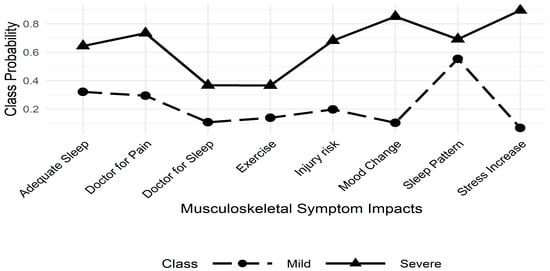
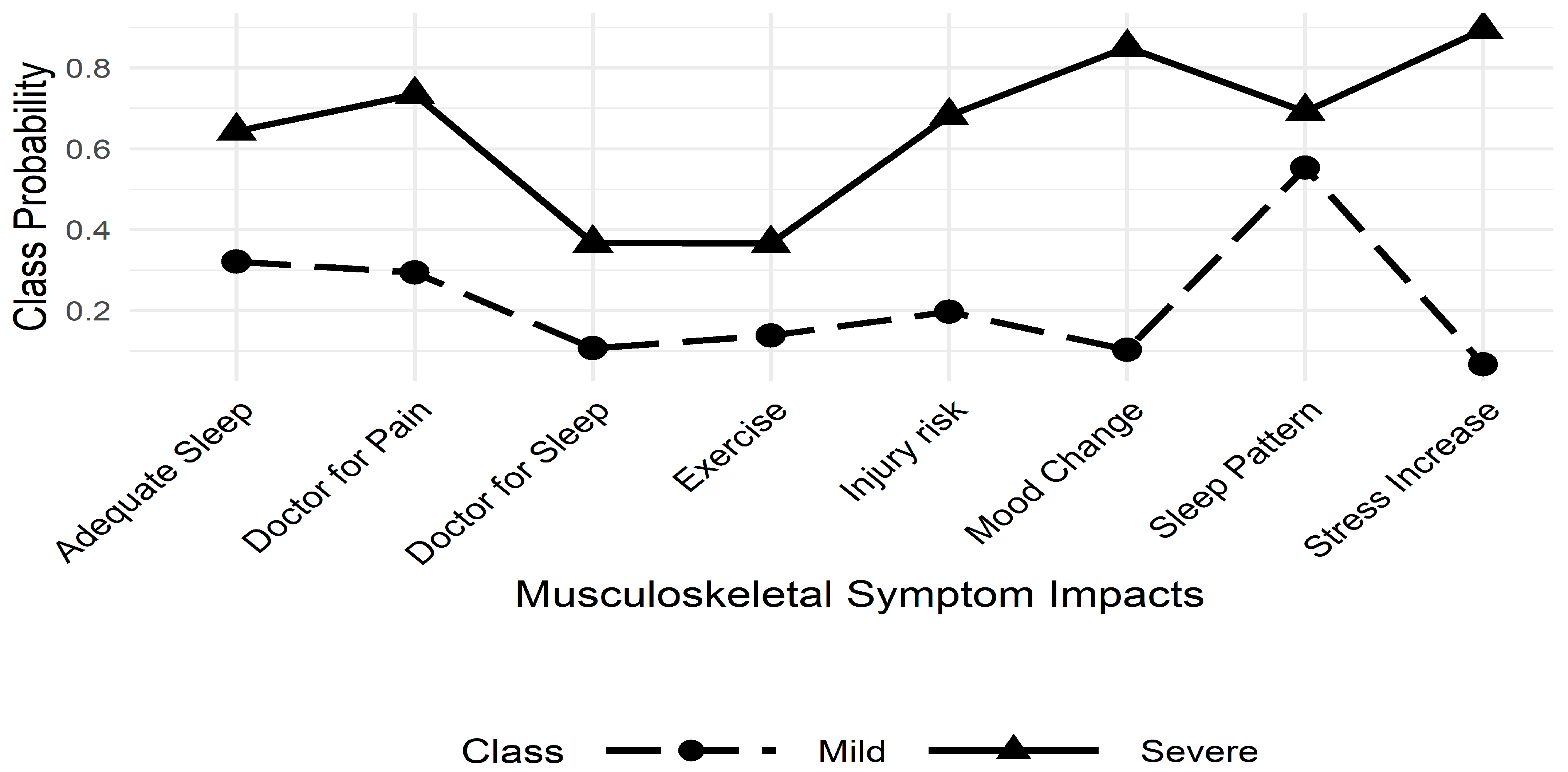
The two-class solution showed two distinct groups. The first, a group of 67 (33.2%) with lower probabilities of endorsement of the items and a second group of 135 (66.8%) with higher probabilities of endorsement. The lines in the class probability plot do not cross, indicating complete separation of the groups (Figure 1). The most frequent impact in the low-impact group was the change in sleep pattern by season and the lowest was increased stress. The larger class endorsed nearly all eight items, with mood and stress changes showing the highest probabilities.
Figure 1.
Item class probability plot showing two groups with mild and severe impacts from experiencing muscle and joint pain in 202 agricultural female operators, 2026.
The classes did not differ by age, type of agricultural operation, hours of working on the farm, or hours working off the farm (Table 4). They significantly differed by frequency of reporting past-year MSS, past-month sleep interference, and past-month increases in stress levels, but were marginally different in using exercise to prevent pain.
Table 4.
Demographic characteristics and frequency of MSS impacts by class membership in 202 female Midwestern agricultural operators, 2026.
Table 5 shows the effect sizes represented by the odds ratios (OR) and 95% confidence intervals (CI) comparing class 2, who reported many MSS impacts to the class with few impacts. As expected, the differences are greatest for the more frequent impacts compared to the lowest level of impact but even moderate vs. low frequency responses were significantly elevated for pain interfering with sleep and increasing stress.
Table 5.
The effects of pain, exercise, sleep, and stress on being in the highly impacted class of 135 women compared to the 67 less impacted class of agricultural operators, 2025.
The final research question addressed was the perceived causal order for MSS and stress. “Stress increases pain and pain increases stress” (both occur) showed the largest odds of being in the high-impact group compared to the low-impact group (Table 6). Pain increasing stress was the second largest effect and stress increasing pain was third. The independence of pain and stress did not differ between the two classes. The women who were impacted by MSS believed that pain and stress were connected and one caused the other.
Table 6.
Causal order of MSS and stress comparing high-impact group to low-impact group on four possible causal pathways in 202 female agricultural operations in the Midwest US, 2026.
4. Discussion
Two-thirds of the sample were experiencing levels of MSS, stress, and sleep problems that impacted their lives and for which they sought medical care. These MSS impacts were not attributed to hours working on the farm or hours working off the farm, nor could they be explained by age or the type of farm or ranch work they were engaged in. These women were older than 50 and probably were not caring for young children. The impacts were validated by questions asking about the frequency of pain, pain interfering with sleep, and pain increasing stress. The group reporting the greatest number of impacts also reported the higher frequency of these specific outcomes. Those with greater MSS severity were also exercising less frequently than the low-impact group, possibly due to pain. It could also be that the greater MSS severity group had never exercised, which may have led to the increased pain. They perceived that the relationship between their pain and their stress was not independent, but one worsened the other.
According to the USDA, the average age of female agricultural operators in the US is 57.8 [1], which is close to the 57.3% in the middle of our 50 to 69 age bracket. Only 9% are under the age of 35 [1], so it is not surprising that our sample did not capture younger women in the 4953 valid addresses we used for survey distribution since there would be an expected 446 women in this age group. What is surprising is that the group with severe MSS impacts was not overrepresented in the 38.2% who were older than 70. According to the USDA, 37% of female agricultural operators are at least 65 years of age. Our 70 and older group was 38.2% of the sample. In terms of age distribution, our sample appears to be closely representative of the female agricultural producers in the US, but we had slightly more older women.
It is not surprising that MSS would interfere with sleep, and many studies have documented this relationship. The strong relationship between stress and MSS is surprising. The studies cited above show an association between workplace psychosocial stresses and MSD [17,18], but in many of those studies, the stress is more strongly connected with the pain than the likely cause of the pain, e.g., the ergonomic and environmental risk factors for MSD [19,21]. The relationship might be explained by the chronic nature of MSDs. Once the initial incident causing the MSD resolved, the ongoing MSS chronic effects of residual pain act as a stressor because tasks require more time to complete, increase the effort for completion, and result in additional discomfort over time. Farmers and ranchers do not take a break when they are hurting and have adapted to working through their pain, but this may result in experiencing greater stress.
The results of this study of 202 women actively doing agricultural work shows that the effects of MSS coalesce and are difficult to disentangle. Exercise is thought to alleviate some of the pain and prevent further MSD injury, but it may become too difficult to exercise with severe pain and a lack of sleep. The types of exercise agricultural women are doing is also not well documented nor is training that addresses the types of exercise that might prevent an MSD.
Technology is providing tools that can aid with better understanding of ergonomic risk factors in agriculture. Surface electromyography can measure muscle and joint involvement and kinematic data can be used to assess posture body movement. These tools may help with understanding what tensions and forces are required for a particular task [27]. These analyses may be able to provide data for better exercise interventions to promote flexibility and strength in the joints and muscles where it is needed. Farm safety training programs could address the ergonomic considerations and MSD risks within their training, emphasizing the importance of stretching, taking rest breaks, and being thoughtful about their movements when lifting and moving objects.
Ergonomic assessment could also be improved by examining how well tools, machinery, and workstations fit individual women farmers. Making sure tools fit women’s hands; evaluating reach distances on tractors and all-terrain and utility vehicles; measuring grip strength requirements for gates, controls, and hand tools; and applying posture-analysis apps to identify high-risk movements would all be beneficial in reducing exposure leading to MSDs. Safety training conducted by Extension and other safety professionals could include these activities. It is also important to promote adjustable and customizable equipment and technology such as electric wheelbarrows, portable hoists, bale movers, mobile lifting tables, smaller tillers and other ergonomic tools. Given the costs of some of these technologies, it would be helpful to identify affordable technologies that reduce forceful exertions. With the prices of wearable technology decreasing, smart watches, back posture sensors, vibration monitors, and exoskeletons have become more affordable. Ideally, women trained in leading participatory ergonomics teams to teach other women to identify hazards, redesign tools, improve workflow, and make purchasing decisions could reduce MSD injuries in females. Social media could be used to promote women helping women. At the healthcare level, more training of MSD prevention and treatment of rural providers is needed because there are so few physical therapists or chiropractors residing in rural communities.
The women in our sample were more likely to visit a doctor for pain than for a sleep issue. We asked whether they felt their doctor understood that being in agriculture could cause high levels of stress and interfere with sleep to assess whether this might explain seeking medical care. In the total sample, about half of the women responded that their doctor understood these challenges but another 29% responded that their doctor did not understand (20.5% said this question did not apply to them). The women in the severe impact group were more likely to say that the doctor did not understand the stress and sleep challenges in their occupation than those in the less impacted group (p < 0.03). Continuing efforts are needed to educate rural medical and behavioral health professionals in rural areas about the nature of agricultural work and its stressors.
The limitations of this study include the cross-sectional survey data and the low response rate. The survey was designed with the understanding that causal relationships cannot be determined and the goal was to understand the perceptions of women involved in agricultural work. It is possible that women named in our commercial address list were not actively engaged in farmwork and did not respond to the survey. We had 59 women who replied to the survey saying that the survey did not apply to them because they did not do farmwork. Many of them were landowners but rented out the property. Many of them had retired. To receive this number of returned surveys suggests that there were many women who received the survey and who did not reply because they did not work on the farm. Many farm and ranch women contribute to the operation by managing the finances and administration tasks and are not doing the manual labor and farmwork tasks. An additional limitation is the lack of specific data about the tasks these women were performing on the farm. The final limitation is that the sample size was smaller for the LCA than is recommended, but simulation studies show that results can be accurate if the groups separate well and there are a sufficient number of items that measure the latent construct.
5. Conclusions
The knowledge gained from this study is that it is critical to reduce the risk of MSD because the prevalence of this debilitating condition is far too high. In this study, 42.6% reported experiencing pain daily. However, after MSS is present, reducing stress and addressing sleep issues can reduce the overall burden of the MSS. The greatest impact reported from these women is that stress and pain exacerbate one another. If stress can be reduced, so might the pain. Behavioral health professional working in rural areas and organizations addressing mental health in agricultural populations should focus on teaching women stress reduction strategies. Exercise interventions need to be designed and tested for effectiveness. This is an area of study that has been neglected for too long. As more women move into agricultural operations, the problem will only worsen.
Author Contributions
Conceptualization C.L.B. and E.G.D.; methodology, software, validation, analysis, C.L.B.; formal, writing—review and editing, C.L.B. and E.G.D. All authors have read and agreed to the published version of the manuscript.
Funding
This research was funded by the Centers for Disease Control and Prevention, National Institute for Occupational Safety and Health, grant number U54 OH010162.
Institutional Review Board Statement
The survey was deemed exempt by the University of Nebraska Medical Center Institutional Review Board due to it being part of surveillance and not human subjects research (IRB #0071-23-EX).
Informed Consent Statement
Not applicable.
Data Availability Statement
The datasets presented in this article are not readily available because the data are part of an ongoing study. Requests to access the datasets should be directed to corresponding author.
Conflicts of Interest
The authors declare no conflicts of interest. The funders had no role in the design of the study; in the collection, analyses, or interpretation of the data; in the writing of the manuscript; or in the decision to publish the results.
Abbreviations
The following abbreviations are used in this manuscript:
| MSD | Musculoskeletal Disorders |
| MSS | Musculoskeletal Symptoms |
| LCA | Latent Class Analysis |
| MLR | Maximum likelihood—Robust |
| MLF | Maximum likelihood—Fisher |
| AIC | Akaike Information Criterion |
| BIC | Bayesian Information Criterion |
| BLRT | Bootstrap Likelihood Ratio Test |
References
- United States Department of Agriculture (SDA). National Agriculture Statistical Service. Female Producers. June, 2024. Available online: https://www.nass.usda.gov/Publications/Highlights/2024/Census22_HL_FemaleProducers.pdf (accessed on 13 May 2026).
- Fethke, N.B.; Merlino, L.A.; Gerr, F.; Schall, M.C.; Branch, C.A. Musculoskeletal pain among Midwest farmers and associations with agricultural activities. Am. J. Ind. Med. 2014, 58, 319–330. [Google Scholar] [CrossRef] [Scilit]
- Wheeler, R.; Nye, C. The health and well-being of women in farming: A systematic scoping review. J. Agromed. 2025, 30, 132–152. [Google Scholar] [CrossRef] [Scilit]
- Allin, M.; Wilbur, B.; Watson, H. Expanding Opportunities for Canadian Agriculture by Understanding the Experience of Farm Women; Farm Management Canada: Ottawa, ON, Canada, 2023; 45p, Available online: https://casa-acsa.ca/wp-content/uploads/Understanding-the-Experience-of-Farm-Women.pdf (accessed on 14 May 2026).
- NIOSH. Musculoskeletal Disorders and Workplace Factors. A Critical Review of Epidemiologic Evidence for Work-Related Musculoskeletal Disorders of the Neck, Upper Extremity, and Low Back Pain. 1997. Available online: https://archive.cdc.gov/#/details?url=https://www.cdc.gov/niosh/docs/97-41/default.html (accessed on 15 May 2026).
- Osborne, A.; Blake, C.; Fullen, B.M.; Meredith, D.; Phelan, J.; McNamara, J.; Cunningham, C. Prevalence of musculoskeletal disorders among farmers: A systematic review. Am. J. Ind. Med. 2012, 55, 143–158. [Google Scholar] [CrossRef] [Scilit]
- Dev, A.; Ganaie, M.I.; Mayer, I.A.; Singh, H. Risk of musculoskeletal disorders in female farmers and its socioeconomic determinants in Kashmir Valley. Clin. Epidemiol. Glob. Health 2025, 31, 101871. [Google Scholar] [CrossRef] [Scilit]
- Gilanlioglu, E.; Yurt, Y.; Angin, E.; Depreli, O. Investigating the prevalence and risk factors of musculoskeletal disorders among farmers. Work 2025, 81, 3014–3020. [Google Scholar] [CrossRef] [Scilit]
- Tosi, L.L.; Boyan, B.D.; Boskey, A.L. Does sex matter in musculoskeletal health?: The influence of sex and gender on musculoskeletal health. J. Bone Jt. Surg. 2005, 87, 1631–1647. [Google Scholar] [CrossRef] [Scilit]
- Lee, S.J.; Tak, S.; Alterman, T.; Calvert, G.M. Prevalence of musculoskeletal symptoms among agricultural workers in the United States: An analysis of the National Health Interview Survey, 2004–2008. J. Agromed. 2014, 19, 268–280. [Google Scholar] [CrossRef] [Scilit]
- Finan, P.H.; Goodin, B.R.; Smith, M.T. The association of sleep and pain: An update and a path forward. J. Pain 2013, 14, 1539–1552. [Google Scholar] [CrossRef] [Scilit]
- Haack, M.; Scott-Sutherland, J.; Santangelo, G.; Simpson, N.S.; Sethna, N.; Mullington, J.M. Pain sensitivity and modulation in primary insomnia. Eur. J. Pain 2012, 16, 522–533. [Google Scholar] [CrossRef] [Scilit]
- Babiloni, A.H.; De Koninck, B.P.; Beetz, G.; De Beaumont, L.; Martel, M.O.; Lavigne, G.J. Sleep and pain: Recent insights, mechanisms, and future directions in the investigation of this relationship. J. Neural Transm. 2020, 127, 647–660. [Google Scholar] [CrossRef] [Scilit]
- Jansson-Fröjmark, M.; Boersma, K. Bidirectionality between pain and insomnia symptoms: A prospective study. Br. J. Health Psychol. 2012, 17, 420–431. [Google Scholar] [CrossRef] [Scilit]
- Sørensen, L.; Jensen, M.S.A.; Rathleff, M.S.; Holden, S. Comorbid insomnia, psychological symptoms and widespread pain among patients suffering from musculoskeletal pain in general practice: A cross-sectional study. BMJ Open 2019, 9, e031971. [Google Scholar] [CrossRef] [Scilit]
- Sandberg, J.C.; Grzywacz, J.G.; Talton, J.W.; Quandt, S.A.; Chen, H.; Chatterjee, A.B.; Arcury, T.A. A cross-sectional exploration of excessive daytime sleepiness, depression, and musculoskeletal pain among migrant farmworkers. J. Agromed. 2012, 17, 70–80. [Google Scholar] [CrossRef] [Scilit]
- Bernal, D.; Campos-Serna, J.; Tobias, A.; Vargas-Prada, S.; Benavides, F.G.; Serra, C. Work-related psychosocial risk factors and musculoskeletal disorders in hospital nurses and nursing aides: A systematic review and meta-analysis. Int. J. Nurs. Stud. 2015, 52, 635–648. [Google Scholar] [CrossRef] [Scilit]
- Ng, Y.M.; Voo, P.; Maakip, I. Psychosocial factors, depression, and musculoskeletal disorders among teachers. BMC Public Health 2019, 19, 234. [Google Scholar] [CrossRef] [Scilit]
- Shin, D.S.; Jeong, B.Y. Older female farmers and modeling of occupational hazards, wellbeing, and sleep-related problems on musculoskeletal pains. Int. J. Environ. Res. Public Health 2022, 19, 7274. [Google Scholar] [CrossRef] [Scilit]
- Bai, H.; Beseler, C.L.; Baccaglini, L.; Rautiainen, R.H. Work-related stress as a risk factor for farm injuries in the central United States. J. Agric. Saf. Health 2022, 29, 1–13. [Google Scholar] [CrossRef] [Scilit]
- Chengane, S.; Beseler, C.L.; Duysen, E.G.; Rautiainen, R.H. Occupational stress among farm and ranch operators from a seven state surveillance system in the midwestern United States. BMC Public Health 2021, 21, 2076. [Google Scholar] [CrossRef] [Scilit]
- Beseler, C.L.; Rautiainen, R.H. Using machine learning to understand injuries in female agricultural operators in the Central US. Safety 2025, 11, 9. [Google Scholar] [CrossRef] [Scilit]
- Dalmaijer, E.S.; Nord, C.L.; Astle, D.E. Statistical power for cluster analysis. BMC Bioinform. 2022, 23, 205. [Google Scholar] [CrossRef] [Scilit]
- R Core Team. R: A Language and Environment for Statistical Computing; R Foundation for Statistical Computing: Vienna, Austria, 2024; Available online: https://www.R-project.org/ (accessed on 20 May 2026).
- Posit Team. RStudio: Integrated Development Environment for R; Posit Software, PBC: Boston, MA, USA, 2025; Available online: http://www.posit.co/ (accessed on 20 May 2026).
- Muthén, L.K.; Muthén, B.O. Mplus, version 9.0; [Computer Software]; Muthén & Muthén: Los Angeles, CA, USA, 1998–2026. [Google Scholar]
- Fethke, N.B.; Schall, M.C., Jr.; Chen, H.; Branch, C.A.; Merlina, L.A. Biomechanical factors during common agricultural activities: Results of on-farm exposure assessments using direct measurement methods. J. Occup. Environ. Hyg. 2021, 17, 85–96. [Google Scholar] [CrossRef] [Scilit]

Disclaimer/Publisher’s Note: The statements, opinions and data contained in all publications are solely those of the individual author(s) and contributor(s) and not of MDPI and/or the editor(s). MDPI and/or the editor(s) disclaim responsibility for any injury to people or property resulting from any ideas, methods, instructions or products referred to in the content. |
© 2026 by the authors. Licensee MDPI, Basel, Switzerland. This article is an open access article distributed under the terms and conditions of the Creative Commons Attribution (CC BY) license.