


Abstract
Background: Vulnerable road users (VRUs), including children and older adults, face a high risk of fatal road traffic accidents (RTAs) due to limited protection and greater injury susceptibility. Romania reports some of the highest child and elderly RTA mortality rates in the European Union. This study analyzed medico-legal autopsies from the Timisoara Institute of Legal Medicine (TILM) between 2017 and 2021 to compare fatalities in these two groups and identify key risk factors. Methods: A retrospective analysis was conducted on autopsy records of children (0–17 years) and older adults (>70 years) who died in RTAs during the study period. Data on demographics, type of road user, traumatic injuries, cause of death, and accident circumstances were extracted and supplemented by police reports. Comparative statistical analyses were performed for categorical and continuous variables. Results: Among 395 RTA autopsies, 23 (5.8%) involved children and 51 (12.9%) older adults. Most child victims were passengers (56.5%), whereas elderly fatalities occurred mainly among pedestrians (33.3%) and cyclists (25.5%), with statistically significant differences between age groups. Polytrauma was the leading cause of death in both categories, though isolated cranio-cerebral trauma was proportionally more frequent in children. Crash circumstances also showed age-related patterns, with children more involved in high-energy collisions and older adults more frequently struck as pedestrians. Survival intervals showed a similar distribution across groups. Conclusions: Child and elderly RTA fatalities in Romania share common determinants, primarily driver-related behaviors and insufficient safety measures, while also exhibiting distinct age-related vulnerabilities. Autopsy-based data highlights these patterns and can guide targeted interventions such as stricter law enforcement, public education, and infrastructure improvements.
1. Introduction
The 2023 World Health Organization (WHO) report on road safety states that, when all ages are considered, traffic accidents rank as the 12th most common cause of death [1,2]. Every year, road traffic accidents (RTAs) cause 1.3 million deaths and millions more injuries or disabilities worldwide [2].
Vulnerable road users (VRUs), such as cyclists, pedestrians, and users of motorized two-wheelers, require special attention since they are more likely to sustain significant injuries in traffic accidents due to the lack of a protective shell [3,4]. VRUs are responsible for 39% of traffic fatalities in the European Region overall [3]. When considering all ages, both children and the elderly represent VRUs [5,6]. In the WHO European Region, road traffic injuries constitute the primary cause of premature death among youths ages 5 to 29 [7]. Children are among the most vulnerable road victims, particularly in low- and middle-income countries (LMICs), where the death rate from traffic is about six times greater than in high-income countries (HICs) [5]. Seniors have the second-highest fatality rate of any age group in European Union (EU) road traffic, with an average of about 64 senior fatalities per million senior citizens [8]. The aging population has coincided with an increase in the total number of senior road users, including both walkers and car occupants [9].
At the European level, these global patterns are reflected in persistently higher mortality rates among VRUs in Central and Eastern European countries, where rapid motorization has not been accompanied by proportional improvements in road safety infrastructure, traffic law enforcement, or pedestrian-friendly urban planning. Several analyses by the European Transport Safety Council and WHO have shown that countries in this region continue to face systemic road safety challenges, including insufficiently developed infrastructure, lower implementation of vehicle safety technologies, and uneven enforcement of traffic regulations [10,11].
Within this regional context, Romania stands out as one of the countries with the highest RTA mortality rates in the EU, a position largely attributed to structural factors such as underdeveloped pedestrian infrastructure, inconsistent traffic law enforcement, and limited implementation of safety technologies.
These broader trends underscore the relevance of Romania as a case study, given its consistently elevated road traffic mortality rates compared with that of other EU countries [12,13,14].
The country has repeatedly ranked among the highest in the European Union in terms of fatality rates, and vulnerable road users, including children and older adults, are disproportionately affected.
In addition, epidemiological data derived from medico-legal autopsies in this region remain limited in the literature, with only a few recent studies addressing fatal road traffic injuries in Romanian children or older adults [8,15].
Addressing this gap is essential, as autopsy-based analyses offer a high degree of diagnostic certainty and provide insights into injury patterns and crash mechanisms that are often absent from police or hospital datasets.
Romania had the highest child death rate among EU countries in 2018–2020 when comparing the number of road fatalities among children aged 0–14 per million inhabitants [16]. Romania ranks third with a relative mortality rate of 0.43, which is determined by dividing the mortality rate for children by the mortality rate for all ages; the average for EU nations is 0.27. This indicates that, compared to the European average, children in Romania are more likely to be the victims of fatal RTAs [16]. Additionally, Romania has the highest senior mortality rate per million population in 2022, according to European statistics. Compared to the European average of 63.6, Romania’s mortality rate was 119.8 [8].
Although Romania contributes standard aggregated mortality data to European statistical systems such as CARE and Eurostat [17,18], these databases lack detailed information regarding crash dynamics, injury biomechanics, or pre-impact behaviors.
Eastern European countries, including Romania, have been repeatedly highlighted by the European Transport Safety Council as having structural limitations in data collection systems and insufficiently developed road safety infrastructure [10].
Unlike countries with dedicated in-depth crash investigation systems—such as GIDAS in Germany, NASS/CDS or CIREN in the United States, or CIDAS in China [19,20,21], Romania does not maintain an integrated dataset that links crash circumstances, environmental conditions, vehicle characteristics, and injury patterns. As a result, medico-legal autopsy records remain the most complete and diagnostically reliable source of information for understanding fatal RTAs in this setting.
In Romania, when the cause of death is unknown or there is a violent or suspicious death, a medico-legal autopsy must be conducted. This applies to all traffic fatalities, disregarding the time between the victim’s surviving after the collision and their passing [22]. The epidemiological evaluation of RTAs heavily relies on medico-legal autopsy [23]. Important information that can be utilized in public efforts to lower traffic fatalities across all age groups can be collected by examining medico-legal autopsy results.
Therefore, the aim of this study is to analyze the medico-legal autopsies performed at Timisoara Institute of Legal Medicine (TILM) over a period of five years (2017–2021) on victims of RTAs, to assess the involvement of children aged 0–17 years in comparison to the elderly population (age above 70 years), by evaluating the risk factors that led to such tragedies in these two groups of VRUs. These two age groups were selected because children and older adults are internationally recognized as the most vulnerable road users, with some of the highest fatality rates in Europe, including Romania. The medico-legal autopsy database also allowed consistent identification of these categories, enabling a focused comparative analysis.
The goal is to find a common denominator that leads to road deaths in VRUs to aid in the outset of approaches and preventive actions aimed at lowering RTAs. To the best of our knowledge, this is the first study to compare the experiences of older individuals and children in Romania who have died in RTAs. This analysis aims to identify the factors that have contributed to the incidents and develop preventive and protective measures, aimed at these two categories of ages. This research will yield new evidence to support the body of research on the risk factors for RTAs in VRUs, especially children and older adults.
2. Materials and Methods
Romania’s medico-legal system includes five regional Institutes of Legal Medicine (ILMs), and smaller county-level medico-legal services, each responsible for forensic autopsies within a defined territorial jurisdiction, under the coordination of the National Institute of Legal Medicine (INML) in Bucharest. The TILM serves as the designated regional forensic authority for the western region of the country, covering Timiș County and, when required, neighboring counties such as Arad, Caraș-Severin, Oradea or Hunedoara. All fatal RTAs occurring within this catchment area and requiring medico-legal autopsy are examined at TILM. This structural context ensures that the cases included in the present study represent all legally mandated forensic autopsies for fatal RTAs within the TILM jurisdiction. In accordance with Romanian medico-legal regulations, all fatal road traffic collisions within the TILM jurisdiction undergo mandatory forensic autopsy. This legal requirement ensures complete case ascertainment for the study period.
This is a retrospective analysis of medico-legal autopsy records from 1 January 2017, to 31 December 2021, from TILM. The aim of this study is to evaluate the participation of children aged 0–17 years old and older adults (age above 70 years), in fatal RTAs, in a comparative manner, which includes a focus on risk factors and related preventive techniques, along with interventions meant to lower RTAs.
This study was conducted in accordance with the Declaration of Helsinki and was approved by the Research Ethics Committee of “Victor Babes” University of Medicine and Pharmacy Timisoara registered under the decision number 88/19.12.2022 rev 2024.
Inclusion and exclusion criteria: Medico-legal autopsy records at TILM of children between 0 and 17 years old and adults aged above 70 years old, who were victims of fatal RTAs in the period of 2017–2020, were included. Medico-legal autopsy records of people aged between 18 and less than 70 years, who were not victims of RTAs, and records not pertaining to the period mentioned in the inclusion criteria were excluded.
Study tool: The medico-legal autopsy records for children aged between 0 and 17 years old and people aged above 70 years old, that had died in a RTA were manually collected and grouped according to the victims’ demographics (age and gender), date of the accident, type of road user (driver, passenger, pedestrian, cyclist, motorcyclist), circumstances of the accident. The traffic police reports, which are preserved in the archives with the autopsy records, provided the circumstances behind the collisions. Age was grouped into equal-width categories within each population. For children, the subjects were further stratified into six groups based on age intervals, using 3-year bands: 0–2 years, 3–5 years, 6–8 years, 9–11 years, 12–14 years and 15–17 years. For older adults, the subjects were stratified into five age-groups, using 5-year bands: 71–75, 76–80, 81–85, 86–90, and above 91 years. Correlations between gender, age, and type of road user were performed, with analysis of traumatic injuries. All the correlations were sustained in a comparative analysis between the children and elderly. Toxicological data (blood alcohol concentration or illicit drug screening) were not analyzed in the present study because they were not consistently available for all cases.
The data for fatal RTAs in children and older adults were collected and entered into an Excel spreadsheet (Microsoft Office 365 suite) and subsequently analyzed using descriptive and inferential statistics. Continuous variables (e.g., age, time from crash to death) are presented as mean and standard deviation or median and interquartile range, as appropriate. Categorical variables (e.g., sex, type of road user, cause of death, survival interval, and crash circumstances) are reported as absolute frequencies and percentages. Comparisons between children and older adults were performed using chi-square or Fisher’s exact tests for categorical variables and Mann–Whitney U tests for continuous variables, given the small sample size and non-normal distribution of several variables. A two-sided p value < 0.05 was considered statistically significant. Logistic regression or other multivariable models aimed at identifying independent predictors of fatality could not be performed because the dataset consists exclusively of fatal cases and therefore lacks a non-fatal comparison group required for such analyses. This constraint is also acknowledged in the Limitations section.
3. Results
Between 2017 and 2021, TILM conducted 395 medico-legal autopsies on RTA victims, accounting for 10.5% of all 3752 autopsies during that time. A total of 23 fatal RTAs involved children under the age of 18, while 51 cases involved adults over 70. The annual distribution for the victims is represented in Table 1.
Table 1.
Comparative analysis of the annual distribution of victims of fatal road traffic accidents (RTAs) that had a medico-legal autopsy at Timisoara Institute of Legal Medicine (TILM) in Timis county, Romania, in a 5-year period (2017–2021), regarding children (age below 18) and older adults (age above 70).
3.1. Age and Gender Variations
The children subjects were further stratified into six groups based on age intervals: 0–2 years (n = 2), 3–5 years (n = 7), 6–8 years (n = 2), 9–11 years (n = 1), 12–14 years (n = 2) and 15–17 years (n = 9). For older adults, the subjects were stratified into five age-groups: 71–75 years (n = 25), 76–80 years (n = 12), 81–85 years (n = 9), 86–90 years (n = 3), and above 91 years (n = 2).
The children included in the study (n = 23) had a mean age of 9.9 ± 6.36 years (median 9 years), while older adults (n = 51) had a mean age of 77.3 ± 5.83 years (median 76 years). As expected, based on the predefined age categories, the age distributions differed significantly between the two groups (Mann–Whitney U test, p < 0.001).
With respect to sex distribution, 56.5% of child victims and 66.6% of older adults were male. The male-to-female ratios (1.3:1 for children and 2:1 for older adults) did not differ significantly between the groups (chi-square test, p = 0.56). These results indicate that sex was similarly distributed among child and elderly victims, whereas age stratification followed the intended sampling structure.
Age and gender distribution of cases are represented in Table 2.
Table 2.
Comparative analysis of the age and gender distribution of victims of fatal RTAs that had a medico-legal autopsy at TILM in Timis county, Romania, in a 5-year period (2017–2021), regarding children (age below 18) and older adults (age above 70).
3.2. Type of Road User
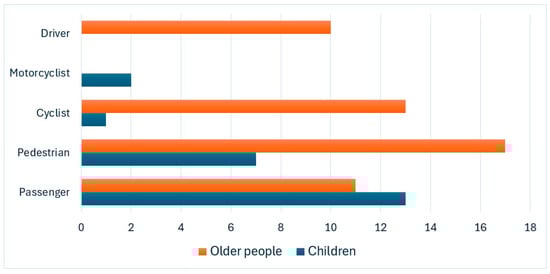
Most child fatalities occurred among passengers (n = 13), while most older adult deaths involved pedestrians (n = 17). For elderly, passengers accounted for 11 cases, while there were 13 cases for cyclists. For children, pedestrians accounted for seven cases, while only one cyclist was noted. In children, two motorcyclists were seen, while this type of road user was not seen in older people. For older adults, ten victims were drivers. The distribution of victims regarding the type of road user, for both children and older people, is represented in Figure 1.
Figure 1.
Distribution of victims regarding the type of road users for children (age below 18) and older people (age above 70) based on medico-legal autopsy records at TILM in Timis county, Romania, in a 5-year period (2017–2021).
The distribution of road user categories differed substantially between children and older adults. Among children, most fatalities occurred among passengers (56.5%), followed by pedestrians (30.4%), cyclists (4.3%), motorcyclists (8.7%), and drivers (0%). In contrast, older adult fatalities were most common among pedestrians (33.3%) and cyclists (25.5%), followed by passengers (21.6%) and drivers (19.6%); no elderly motorcyclist fatalities were recorded.
A chi-square test demonstrated a statistically significant association between age group and type of road user (p = 0.001), indicating that children and older adults differed markedly in their exposure patterns. Children were significantly more likely to be passengers, whereas older adults were more frequently pedestrians or cyclists. This pattern highlights distinct vulnerability profiles for each age group.
3.3. Traumatic Injuries and Cause of Death
The cause of death for most victims, both children and older adults, was polytrauma, with 45 cases (88.2%) among older people and 15 cases (65.2%) among children. Cranio-cerebral trauma was identified as the cause of death in eight children and five elderly individuals, and a case of vertebra-medullary trauma was observed in the older group. The distribution of causes of death for both age groups is presented in Figure 2. For the purpose of this study, polytrauma was defined as severe traumatic injury involving at least two distinct body regions. Isolated injuries confined to a single anatomical region were not coded as polytrauma.
Figure 2.
Cause of death for children (age below 18) and older people (age above 70) based on medico-legal autopsy records at TILM in Timis county, Romania, in a 5-year period (2017–2021).
When examining injury patterns in relation to the crash circumstances summarized in Table 3, several descriptive associations can be observed. In the pediatric group, high-energy mechanisms such as loss-of-control events and two-vehicle collisions were more frequently present in cases with cranio-cerebral trauma or polytrauma, which is biomechanically consistent with rapid deceleration forces acting on the pediatric head and torso. Among older adults, most fatalities occurred in pedestrian impacts, particularly outside marked crosswalks, where lateral collisions with a vehicle typically result in severe thoracic, pelvic, or combined injuries. Although the available documentation does not allow for a complete case-matched statistical analysis across both age groups, the overall distribution of injury types aligns with the crash mechanisms observed in our cohort and reflects established biomechanical patterns reported in the literature.
Table 3.
Consolidating circumstances leading to fatal RTAs in children and older adults (2017–2021). Values represent number of cases (percentage within age group).
Polytrauma was the predominant cause of death in both groups, accounting for 65.2% of fatalities among children and 88.2% among older adults. Cranio-cerebral trauma was proportionally more common in children (34.8%) than in elderly victims (9.8%), whereas vertebra-medullary trauma was observed only among older adults (2.0%).
A chi-square test indicated a statistically significant association between age group and cause of death (p = 0.01). Children exhibited a higher proportional frequency of isolated cranio-cerebral trauma, whereas older adults were significantly more likely to die from multifocal polytrauma. This reflects age-related biomechanical differences: children tend to sustain fatal head injuries even at lower impact forces, while older adults show increased vulnerability to multi-system injuries due to reduced tissue resilience and higher frailty.
3.4. Survival Interval Analysis
To explore differences in post-impact survival between children and older adults, we generated a heat map illustrating the distribution of survival intervals (“death at scene”, “same-day death”, “1–7 days”, “>7 days”) across the two age groups (Figure 3). Both children and older adults showed the highest proportion of deaths occurring at the scene, followed by same-day deaths. The overall distribution of survival intervals did not differ significantly between groups (chi-square test, p = 0.77). The heat map visually reinforces the similarity in survival patterns across age groups despite marked differences in crash mechanisms and injury distribution.
Figure 3.
Heat map of survival intervals among children (0–17 years) and older adults (>70 years) who died in road traffic accidents between 2017 and 2021, based on medico-legal autopsy records from TILM.
3.5. Risk Factors and Circumstances of Fatal RTAs
The circumstances that led to fatal RTAs in children and older adults over the five-year study period, as documented in medico-legal autopsy records and associated police reports, are summarized in Table 3. As shown in Table 3, distinct patterns emerge: loss-of-control events and two-car collisions were proportionally more frequent among children, whereas pedestrian impacts, particularly those occurring outside designated crosswalks, and general car-to-pedestrian collisions were more common among older adults. In a significant proportion of cases (eight children and eighteen older adults), no additional contextual details were available in the documentation. A fully expanded version of Table 3, containing the original detailed classification of all crash circumstances, is provided in (Table 4).
Table 4.
Detailed classification of circumstances leading to fatal RTAs in children and older adults over a five-year period, based on medico-legal autopsy records and police reports from TILM.
The distribution of crash circumstances differed significantly between children and older adults. Among children, loss-of-control events (21.7%) and two-car collisions (17.4%) were proportionally more frequent, reflecting their higher involvement in high-energy impacts typically associated with driver-related errors. In contrast, older adults were more commonly fatally injured as pedestrians, particularly in general car-to-pedestrian impacts (21.6%) or collisions occurring outside marked crosswalks (13.7%). Pedestrian impacts at marked crosswalks were also more frequent among older adults (7.8% vs. 4.3%).
A chi-square test confirmed a statistically significant association between age group and crash circumstance (p = 0.03). Children were disproportionately involved in events involving vehicle instability and high-velocity dynamics, whereas older adults experienced a substantially higher burden of pedestrian collisions, consistent with age-related mobility limitations and reduced road-crossing safety. “No information available” remained common in both groups (34.8% of children, 35.3% of adults) but did not alter the overall pattern of group differences.
4. Discussion
The present study assessed the involvement of children aged 0–17 years in comparison to older people aged above 70 years, in fatal RTAs, in a five-year period, as illustrated by medico-legal autopsy records and police reports from TILM, Romania. As stated by Ungureanu et al., researching child traffic fatalities can provide invaluable information for creating safety protocols and reducing the contribution of risk variables to RTAs [13]. Regarding the elderly, inadequate road safety measures for this vulnerable group are the cause of the high rate of RTAs and fatalities among them, and present policies are still mainly ineffectual [24]. Because all road fatalities must undergo a medico-legal autopsy, Romanian autopsy-based research provide an epidemiological profile of traffic accidents. Information obtained from autopsy results can help ensure that appropriate preventive measures are implemented in the future [8].
To the best of our knowledge, this is the first study that provides a comparison between road fatalities in children and older people over a 5-year period by studying medico-legal autopsy records. It is important to understand if these events, in these two types of VRUs, have a common denominator and to explore targeted interventions aimed at reducing the burden of road fatalities.
When analyzing the circumstances that led to fatal RTAs, in finding a common denominator for both children and older adults, most cases happened due to a maneuver performed by a driver. These differences in crash mechanisms were statistically significant when comparing children and older adults (chi-square test, p = 0.03). Human factors, particularly those pertaining to the driver, are the primary risk factors that must be considered [3]. Most road traffic accidents in this study were attributed to speeding and non-compliance with traffic regulations. Reckless behaviors, including unsafe overtaking, driving into oncoming lanes, or using the wrong side of the road, were frequently observed. Additionally, loss of vehicle control (often due to excessive speed or driver inattention) resulted in collisions with pedestrians, cyclists, and roadside structures. Road injury risk is increased by risky driving behaviors such as impairment, distraction, speeding, and aggressive driving [4].
Road fatalities among children were linked to driver distractions, such as using a cell phone, sending texts, or engaging in other activities such as eating while operating a motor vehicle [4]. In the elderly population, driver-related factors accounted for 52% of deaths among UK drivers aged ≥ 60 [25], and for 64% and 67% of deaths among drivers aged ≥ 65 in Florida, USA [26] and Australia [27], respectively. Older drivers are frequently described as having a high rate of road fatalities. This greater fatality rate may be caused by more serious injuries as well as a higher accident participation rate [9].
The consolidated analysis of crash circumstances (Table 3) highlights meaningful age-related differences in the mechanisms leading to fatal RTAs. Children were more frequently involved in high-energy impacts such as loss-of-control events and two-car collisions, suggesting that high-velocity dynamics and driver-related errors disproportionately affect this age group. This distribution of road user types differed significantly between children and older adults (chi-square test, p = 0.001), underscoring distinct exposure patterns across age groups.
These findings are biomechanically consistent with pediatric vulnerability. The proportionally larger head-to-body ratio, incomplete ossification of the cranial sutures, and reduced cervical muscle strength in children make them particularly susceptible to severe cranio-cerebral trauma when exposed to high-energy mechanisms such as loss-of-control events or two-vehicle collisions. The elastic but less robust thoracic cage further contributes to the risk of catastrophic internal injuries even at moderate impact speeds [28,29].
In contrast, older adults were more often fatally injured as pedestrians, particularly in collisions occurring outside marked crosswalks, which is consistent with evidence showing reduced crossing speed, diminished visibility, and mobility limitations in elderly pedestrians. These patterns are further supported by the detailed crash descriptions provided in (Table 4), which offer granular insight into the specific sequences of events associated with each fatality.
In older pedestrians, these behavioral exposures interact with age-related biomechanical fragility. Reduced thoracic compliance, osteoporosis, and increased tissue brittleness greatly amplify the lethality of pedestrian collisions, even at lower vehicle speeds. Furthermore, slower walking speed, reduced peripheral vision, and impaired reaction times increase the likelihood of being struck outside crosswalks and simultaneously intensify the severity of thoracic and pelvic injuries observed in this age group [29].
These findings are consistent with recent analyses of pedestrian crash patterns in older adults. A 2025 study published in Vehicles demonstrated that elderly pedestrians are significantly more likely to be struck outside marked crosswalks compared with younger age groups, primarily due to age-related declines in walking speed, visual acuity, peripheral field awareness, and the ability to correctly estimate vehicle approach distance and velocity [30]. Older adults also exhibit reduced mobility and slower initiation of crossing maneuvers, which prolongs their exposure time in traffic lanes and increases collision risk. When combined with inadequate pedestrian infrastructure or insufficiently illuminated roadway environments, these functional limitations create a disproportionately hazardous situation for elderly pedestrians. The pattern we observed in our dataset (older adults being fatally injured outside designated pedestrian areas more often than children) is therefore highly consistent with these biomechanical and behavioral vulnerabilities.
These age-specific patterns are consistent with the statistically significant association observed between age group and crash circumstance (p = 0.03). The combined findings emphasize the need for age-specific preventive strategies addressing both driver behavior and pedestrian vulnerabilities, especially for senior road users.
Age-specific biomechanical factors also help explain the differences observed in injury severity between children and older adults. Children have larger head-to-body ratios, incomplete ossification of the thorax, and more elastic chest structures, making them particularly vulnerable to severe head trauma even at lower impact speeds. In contrast, older adults exhibit reduced tissue elasticity, osteoporosis, decreased thoracic compliance, and increased fragility of ribs and pelvis, which contribute to a higher likelihood of rib fractures, pelvic fractures, and hemorrhagic complications under similar impact forces. Age-related physiological changes, including slower hemodynamic and compensatory responses, further increase fatality risk in the elderly. These biomechanical considerations have been widely recognized in injury-prevention research and align with the age-specific differences identified in our cohort [31,32,33]. These observed biomechanical differences are reflected in our findings, where the distribution of causes of death differed significantly between children and older adults (chi-square test, p = 0.01).
Taken together, these biomechanical vulnerabilities align closely with the crash circumstances identified in our dataset. High-energy dynamics disproportionately affecting children translate directly into severe cranio-cerebral trauma, while pedestrian impacts occurring outside crosswalks disproportionately affect older adults whose reduced musculoskeletal resilience heightens the likelihood of thoracic and pelvic fractures. Thus, the injury patterns observed in our study reflect a convergence between age-specific physiological susceptibility and the distinct exposure profiles documented in the crash mechanisms [34].
The increased severity of injuries in older adults may also be influenced by age-related medication use, particularly anticoagulants, which can worsen bleeding and trauma outcomes during crashes [35,36].
Although crash mechanisms and injury patterns differed significantly by age group, post-impact survival intervals showed no significant differences between children and older adults (chi-square test, p = 0.77). The heat map demonstrated similar patterns, most deaths occurred at the scene, followed by same-day deaths, suggesting that in both age groups the injuries sustained were incompatible with prolonged survival.
The behavior of pedestrians and bike riders are other human elements that must be considered. On one hand, children become perfect victims because they may enter traffic regardless of the consequences, whether it is due to their tiny size or their age and lack of sense of danger [4,5,37]. In this context, the most important factor is parental vigilance regarding children near road traffic. When watching their young children engage in outdoor activities like riding bikes, parents must exercise caution. Driveway occurrences, which primarily use sports utility or four-wheel-drive vehicles, account for other deadly child pedestrian injuries; parents of small children should be mindful of the risks that driveways provide [37]. On the other hand, for the elderly pedestrians, the situation of a pedestrian crossing the street outside of a marked crosswalk needs to be addressed. The primary risk factors for pedestrian fatalities can be attributed to speed, alcohol consumption, a lack of pedestrian-friendly infrastructure, and poor pedestrian visibility [38]. As people aged, the proportion of pedestrian incidents increased significantly. Because older individuals are more likely to be involved in collisions with vehicles, improving street crossing conditions and intersections is crucial to boosting senior pedestrian safety [39]. The situation of cyclists that were veering, disregarding the traffic behind them, was encountered in the present study. Intersections and other complex traffic scenarios can be especially difficult for older riders to handle. Older bikers may be more unpredictable in their conduct and may make last-minute decisions due to physical limits [40].
This study has several limitations that should be acknowledged. First, toxicological data (blood alcohol concentration and screening for illicit substances) were not analyzed because these results were not consistently available for all cases. In Romania, such analyses are performed only when specifically requested by the police and when the victim was not hospitalized prior to death; therefore, toxicology results were incomplete and unsuitable for systematic comparison between children and older adults. Second, information regarding chronic medication use (e.g., anticoagulants or sedatives) was not systematically available in the medico-legal documentation and therefore could not be included in the analysis, although age-related pharmacological factors may influence injury severity in older adults. Third, environmental and infrastructural characteristics of the crash locations were not recorded in the medico-legal or police documents analyzed. Apart from indicating whether pedestrians were crossing inside or outside a marked crosswalk, no information was available regarding pedestrian traffic signals, lighting conditions, road signage, road design features, weather, or traffic volume. As a result, the influence of environmental factors on fatal crash patterns could not be assessed. Detailed information on safety equipment uses (seatbelts, helmets, child restraints) and on the characteristics of the non-fatal drivers involved in the crashes (age, sex, driving experience, medical conditions) was not available. The medico-legal documentation included data only on the deceased victims, who in many cases were not the drivers responsible for the crash. As these variables were not recorded in either the autopsy files or the associated police reports, they could not be analyzed. Fourth, the descriptive information provided by police reports varied significantly in completeness. In several cases (eight involving children and nineteen involving older adults), no additional contextual details beyond the basic accident classification were available, limiting the ability to fully reconstruct the circumstances leading to the fatal event. In addition, logistic regression or other multivariable modeling could not be performed because the dataset consists exclusively of fatal cases, without any surviving controls, resulting in no variability in the dependent outcome required for such analyses. Finally, this study is based on autopsy cases from a single forensic institute, which may limit the generalizability of the findings to other regions. In addition, the exclusive reliance on fatal autopsy cases introduces inherent selection bias, as non-fatal crashes and less severe injury mechanisms are not represented in this dataset. Autopsy-based datasets do not capture non-fatal crashes, and the absence of complementary data sources, such as national traffic statistics, environmental datasets, or behavioral assessments, may introduce selection bias. Despite these limitations, the available data provided a reliable basis for identifying age-specific patterns and for comparing key crash circumstances between children and older adults, which represented the primary objective of this study.
To summarize, road traffic fatalities and injuries represent a significant but often overlooked public health issue that calls for teamwork to implement successful and long-lasting preventive initiatives in VRUs. Proper public health educational campaigns and public involvement regarding the necessary measures aimed at reducing RTAs in vulnerable populations such as children and older people, but adapted for all road users, represent the targeted interventions designed to maximize road safety and minimize traffic-related injuries among vulnerable and general populations alike. In this manner, derived from this study, based on literature findings [8,13,24,41,42,43,44,45,46,47], we propose the following targeted interventions for preventive campaigns aimed at reducing RTAs in children and older adults (Figure 3).
Based on the patterns identified in this study, targeted prevention measures are summarized in Figure 4, each aligned with the specific risk factors observed among children and older adults. The intervention framework proposed in Figure 3 is grounded in the empirical patterns identified in our dataset. For children, the predominance of severe head injuries and the high proportion of pedestrian fatalities occurring outside marked crosswalks highlight the need for improved school-zone safety, traffic-calming measures, and enhanced supervision. For older adults, the large share of crashes associated with distraction, loss of control, and vulnerability to thoracic and pelvic injuries supports interventions such as senior-friendly pedestrian infrastructure, better lighting, and policies aimed at reducing risky driving behaviors among aging drivers. Each component of the framework reflects a specific risk pattern observed in the present study and therefore targets modifiable factors identified through the analysis.
Figure 4.
Our proposed targeted interventions aimed at reducing RTAs in both children and older adults.
5. Conclusions
The findings of this study illustrate the necessity of understanding the circumstances and risk factors that lead to fatal RTAs in vulnerable populations, such as children and older adults, to develop targeted age-appropriate intervention strategies aimed at reducing these fatalities.
The comparative analysis of road deaths in VRUs highlights distinct exposure patterns and age-related vulnerabilities, underscoring the importance of public educational campaigns tailored to drivers, pedestrians, and cyclists alike.
These results provide insight into the particularities of fatal RTAs among children and older adults and offer guidance for designing preventive measures aimed at reducing the burden of fatal crashes in these high-risk groups of VRUs.
Author Contributions
Conceptualization, Ş.U., C.-O.M. and V.C.; methodology, Ş.U., C.-O.M. and V.C.; software, A.-C.B.; validation, C.-O.M., A.E. and V.C.; formal analysis, E.S. and R.D.; investigation, Ş.U., O.V. and E.D.; resources, Ş.U., E.S., O.V. and E.D.; data curation, Ş.U., R.D. and A.-C.B.; writing—original draft preparation, Ş.U. and C.-O.M.; writing—review and editing, C.-O.M. and V.C.; visualization, Ş.U. and V.C.; supervision, V.C. All authors have read and agreed to the published version of the manuscript.
Funding
This research received no external funding.
Institutional Review Board Statement
The study was conducted in accordance with the Declaration of Helsinki and was approved by the Research Ethics Committee of “Victor Babes” University of Medicine and Pharmacy Timisoara registered under the decision number 88 from 19.12.2022 rev 2024.
Informed Consent Statement
Not applicable.
Data Availability Statement
The data presented in this study is available on request from the corresponding author. The data is not publicly available due to confidentiality reasons.
Acknowledgments
We would like to acknowledge “Victor Babes” University of Medicine and Pharmacy Timisoara for their support in covering the costs of publication for this research paper.
Conflicts of Interest
The authors declare no conflicts of interest.
References
- World Health Organization. Global Status Report on Road Safety 2018. 2018. Available online: https://iris.who.int/handle/10665/276462 (accessed on 10 February 2025).
- Global Status Report on Road Safety 2023: Summary. Available online: https://www.who.int/publications/i/item/9789240086456 (accessed on 28 July 2024).
- Zambon, F.; Sethi, D.; Racioppi, F. European Status Report on Road Safety: Towards Safer Roads and Healthier Transport Choices; WHO Regional Office for Europe: Copenhagen, Denmark, 2009; 161p. [Google Scholar]
- Cloutier, M.-S.; Beaulieu, E.; Fridman, L.; Macpherson, A.K.; E Hagel, B.; Howard, A.W.; Churchill, T.; Fuselli, P.; Macarthur, C.; Rothman, L. State-of-the-art review: Preventing child and youth pedestrian motor vehicle collisions: Critical issues and future directions. Inj. Prev. 2021, 27, 77–84. [Google Scholar]
- Al-Hajj, S.; Arjinian, S.; Hamadeh, Z.; Al-Zaghrini, E.; El Asmar, K. Child transport injuries and deaths in Lebanon: A multicentre retrospective study. BMJ Open 2020, 10, e037973. [Google Scholar] [CrossRef] [Scilit] [PubMed]
- Dziechciaż, M.; Filip, R. Biological psychological and social determinants of old age: Bio-psycho-social aspects of human aging. Ann. Agric. Environ. Med. 2014, 21, 835–838. [Google Scholar]
- Jackisch, J.; Sethi, D.; Mitis, F.; Szymanski, T.; Arra, I. 76 European facts and the Global status report on road safety 2015. Inj. Prev. 2016, 22, A29. [Google Scholar]
- Ungureanu, S.; Muresan, C.O.; Ciocan, V.; Dumache, R.; Stan, E.; Gavrilita, G.D.; Enache, A. Silent Dangers: The Growing Vulnerability of Older Adults in Fatal Road Traffic Accidents. Cureus 2025, 17, e80712. [Google Scholar] [CrossRef] [Scilit] [PubMed]
- Etehad, H.; Yousefzadeh-Chabok Sh Davoudi-Kiakalaye, A.; Moghadam, D.A.; Hemati, H.; Mohtasham-Amiri, Z. Impact of road traffic accidents on the elderly. Arch. Gerontol. Geriatr. 2015, 61, 489–493. [Google Scholar] [CrossRef] [Scilit] [PubMed]
- ETSC. 17th Annual Road Safety Performance Index (PIN Report). 2023. Available online: https://etsc.eu/17th-annual-road-safety-performance-index-pin-report/ (accessed on 4 December 2025).
- European Regional Status Report on Road Safety 2019. Available online: https://www.who.int/europe/publications/i/item/9789289054980 (accessed on 4 December 2025).
- Miruna, M. Siguranța Rutieră în România: Accidente Rutiere, Cauzele Lor Și Soluții. TrackGPS. 2024. Available online: https://trackgps.ro/siguranta-rutiera-in-romania-accidente-rutiere-cauzele-lor-si-solutii/ (accessed on 14 September 2024).
- Poliția Română—Statistici. Available online: https://politiaromana.ro/ro/structura-politiei-romane/unitati-centrale/directia-rutiera/statistici (accessed on 14 September 2024).
- Ungureanu, Ş.; Ciocan, V.; Mureșan, C.O.; Stan, E.; Gavriliţă, G.D.; Sirmon, A.; Pop, C.; Enache, A. The Impact of the COVID-19 Pandemic on Fatal Road-Traffic Accidents: A Five-Year Study on Medicolegal Autopsies in Timis County, Romania. Safety 2024, 10, 86. [Google Scholar] [CrossRef] [Scilit]
- Ungureanu, Ş.; Ciocan, V.; Mureșan, C.O.; Stan, E.; Gavriliţă, G.D.; Sirmon, A.; Pop, C.; Enache, A. Road Fatalities in Children Aged 0–17: Epidemiological Data and Forensic Aspects on a Series of Cases in a Single-Centre in Romania. Children 2024, 11, 1065. [Google Scholar] [CrossRef] [Scilit]
- European Commission. European Road Safety Observatory. Facts and Figures—Children—2022. Available online: https://road-safety.transport.ec.europa.eu/document/download/7f00b402-9aa2-44c7-b3c0-aaa6f81e0abd_en?filename=ff_children_20220706.pdf (accessed on 24 July 2024).
- Facts and Figures—European Commission. Available online: https://road-safety.transport.ec.europa.eu/european-road-safety-observatory/data-and-analysis/facts-and-figures_en (accessed on 8 March 2025).
- Home—Eurostat. Available online: https://ec.europa.eu/eurostat (accessed on 4 December 2025).
- Home|GIDAS. Available online: https://www.gidas.org/start-en.html (accessed on 4 December 2025).
- Crashworthiness Data System|NHTSA. Available online: https://www.nhtsa.gov/national-automotive-sampling-system/crashworthiness-data-system (accessed on 4 December 2025).
- Chen, Q.; Chen, Y.; Bostrom, O.; Ma, Y.; Liu, E. A Comparison Study of Car-to-Pedestrian and Car-to-E-Bike Accidents: Data Source: The China In-Depth Accident Study (CIDAS); SAE Technical Paper; SAE: Warrendale, PA, USA, 2014. [Google Scholar]
- Khurshid, A.; Sohail, A.; Khurshid, M.; Shah, M.U.; Jaffry, A.A. Analysis of Road Traffic Accident Fatalities in Karachi, Pakistan: An Autopsy-Based Study. Cureus 2021, 13, e14459. [Google Scholar] [CrossRef] [Scilit]
- Kotabagi, R.; Charati, S.; Jayachandar, D. Clinical Autopsy vs Medicolegal Autopsy. Med. J. Armed Forces India 2005, 61, 258–263. [Google Scholar] [CrossRef] [Scilit]
- Ang, B.H.; Chen, W.S.; Lee, S.W.H. Global burden of road traffic accidents in older adults: A systematic review and meta-regression analysis. Arch. Gerontol. Geriatr. 2017, 72, 32–38. [Google Scholar] [CrossRef] [Scilit]
- Clarke, D.D.; Ward, P.; Bartle, C.; Truman, W. Older drivers’ road traffic crashes in the UK. Accid. Anal. Prev. 2010, 42, 1018–1024. [Google Scholar] [CrossRef] [Scilit] [PubMed]
- Alam, B.M.; Spainhour, L.K. Contribution of Behavioral Aspects of Older Drivers to Fatal Traffic Crashes in Florida. Transp. Res. Rec. 2008, 2078, 49–56. [Google Scholar] [CrossRef] [Scilit]
- Koppel, S.; Bugeja, L.; Smith, D.; Lamb, A.; Dwyer, J.; Fitzharris, M.; Newstead, S.; D’ELia, A.; Charlton, J. Using medico-legal data to investigate fatal older road user crash circumstances and risk factors. Traffic Inj. Prev. 2018, 19, 133–140. [Google Scholar] [CrossRef] [Scilit] [PubMed]
- Sjögren, H.; Björnstig, U.; Eriksson, A.; Öström, M. Differences between older and younger drivers; characteristics of fatal car crashes and driver injuries. Saf. Sci. 1996, 23, 63–77. [Google Scholar] [CrossRef] [Scilit]
- Saukko, P.; Knight, B. Knight’s Forensic Pathology, 4th ed.; CRC Press: London, UK, 2015; 680p. [Google Scholar]
- Yamada, M.; Takeda, A.; Moriguchi, S.; Nakamura, M.; Hitosugi, M. The Detection of Pedestrians Crossing from the Oncoming Traffic Lane Side to Reduce Fatal Collisions Between Vehicles and Older Pedestrians. Vehicles 2025, 7, 76. [Google Scholar] [CrossRef] [Scilit]
- Margulies, S.S.; Thibault, K.L. Infant Skull and Suture Properties: Measurements and Implications for Mechanisms of Pediatric Brain Injury. J. Biomech. Eng. 2000, 122, 364–371. Available online: https://asmedigitalcollection.asme.org/biomechanical/article-abstract/122/4/364/459525/Infant-Skull-and-Suture-Properties-Measurements?redirectedFrom=fulltext (accessed on 25 November 2025). [CrossRef] [Scilit] [PubMed]
- Kent, R.; Lee, S.H.; Darvish, K.; Wang, S.; Poster, C.S.; Lange, A.W.; Brede, C.; Lange, D.; Matsuoka, F. Structural and Material Changes in the Aging Thorax and Their Role in Crash Protection for Older Occupants; The Stapp Association: Ann Arbor, MI, USA, 2005; Available online: https://saemobilus.sae.org/papers/structural-material-changes-aging-thorax-role-crash-protection-older-occupants-2005-22-0011 (accessed on 25 November 2025).
- Yoganandan, N.; Pintar, F.A.; Stemper, B.D.; Gennarelli, T.A.; Weigelt, J.A. Biomechanics of side impact: Injury criteria, aging occupants, and airbag technology. J. Biomech. 2007, 40, 227–243. [Google Scholar] [CrossRef] [Scilit]
- Lopez-Valdes, F.J.; Duprey, S.; Forman, J.; Svensson, M.Y. Editorial: Understanding Age and Sex-Related Differences in the Biomechanics of Road Traffic Associated Injuries Through Population Diversity Analyses. Front. Bioeng. Biotechnol. 2022, 10, 869356. [Google Scholar] [CrossRef] [Scilit]
- Rudisill, T.M.; Zhu, M.; Davidov, D.; Leann Long, D.; Sambamoorthi, U.; Abate, M.; Delagarza, V. Medication use and the risk of motor vehicle collision in West Virginia drivers 65 years of age and older: A case-crossover study. BMC Res. Notes 2016, 9, 166. [Google Scholar] [CrossRef] [Scilit]
- Delaney, J.A.; Chris; Opatrny, L.; Suissa, S. Warfarin use and the risk of motor vehicle crash in older drivers. Br. J. Clin. Pharmacol. 2006, 61, 229–232. [Google Scholar] [CrossRef] [Scilit]
- Stevenson, M.; Sleet, D.; Ferguson, R. Preventing Child Pedestrian Injury: A Guide for Practitioners. Am. J. Lifestyle Med. 2015, 9, 442–450. [Google Scholar] [CrossRef] [Scilit] [PubMed]
- World Health Organization; FIA Foundation for the Automobile and Society; Global Road Safety Partnership; World Bank. Pedestrian Safety: A Road Safety Manual for Decision-Makers and Practitioners; World Health Organization: Geneva, Switzerland, 2013; Available online: https://iris.who.int/handle/10665/79753 (accessed on 29 July 2024).
- Kim, S.; Ulfarsson, G. Traffic safety in an aging society: Analysis of older pedestrian crashes. J. Transp. Saf. Secur. 2018, 11, 323–332. [Google Scholar] [CrossRef] [Scilit]
- Accident Research Centre. Older Vulnerable Road Users—Measures to Reduce Crash and Injury Risk. Available online: https://www.monash.edu/muarc/archive/our-publications/reports/muarc218 (accessed on 18 February 2025).
- Rivera-Izquierdo, M.; Valverde-Cano, L.M.; Martínez-Ruiz, V.; Sánchez-Pérez, M.R.; Atienza-Martín, F.J.; Martín-Delosreyes, L.M.; Jiménez-Mejías, E. Prevention of road crashes in older adults: Perspectives on facilitators, barriers and the role of the family doctor. BMC Geriatr. 2021, 21, 635. [Google Scholar] [CrossRef] [Scilit]
- Age-Friendly Environments in Europe: A Handbook of Domains for Policy Action. Available online: https://www.who.int/publications/i/item/9789289052887 (accessed on 16 February 2025).
- Thompson, J.P.; Baldock, M.R.J.; Mathias, J.L.; Wundersitz, L.N. An examination of the environmental, driver and vehicle factors associated with the serious and fatal crashes of older rural drivers. Accid. Anal. Prev. 2013, 50, 768–775. [Google Scholar] [CrossRef] [Scilit]
- Ichikawa, M.; Nakahara, S.; Inada, H. Impact of mandating a driving lesson for older drivers at license renewal in Japan. Accid. Anal. Prev. 2015, 75, 55–60. [Google Scholar] [CrossRef] [Scilit]
- Siren, A.; Meng, A. Cognitive screening of older drivers does not produce safety benefits. Accid. Anal. Prev. 2012, 45, 634–638. [Google Scholar] [CrossRef] [Scilit]
- Tay, R. Ageing driver licensing requirements and traffic safety. Ageing Soc. 2012, 32, 655–672. [Google Scholar] [CrossRef] [Scilit]
- Bucsuhazy, K.; Zůvala, R.; Mikulec, R.; Transport Research Centre. Seniors in Road Traffic. Czech In-Depth Accident Study. Available online: https://www.vyzkumnehod.cz/files/seniors-in-road-traffic2.pdf (accessed on 25 November 2025).



Disclaimer/Publisher’s Note: The statements, opinions and data contained in all publications are solely those of the individual author(s) and contributor(s) and not of MDPI and/or the editor(s). MDPI and/or the editor(s) disclaim responsibility for any injury to people or property resulting from any ideas, methods, instructions or products referred to in the content. |
© 2025 by the authors. Licensee MDPI, Basel, Switzerland. This article is an open access article distributed under the terms and conditions of the Creative Commons Attribution (CC BY) license (https://creativecommons.org/licenses/by/4.0/).