


Abstract
This paper analyzes the evolution of packaging waste recycling rates in four Central and Eastern European EU Member States—Bulgaria, Hungary, Poland, and Romania—in comparison with the EU-27 average over the period 2014–2023. The analysis is based on Eurostat data on total packaging waste recycling rates (percentage of generated waste recycled) and employs a linear trend model estimated for the EU-27, which is used as a reference trajectory. This reference trend does not aim to predict future recycling rates or to validate absolute national performance levels; rather, it serves as an analytical benchmark for assessing the relative convergence or divergence of national trajectories over time. Descriptive statistics and linear regression techniques are applied to characterize long-term tendencies and year-to-year dynamics, including potential disruptions during the 2020–2021 period. The results indicate that the EU-27 recycling rate remains high and relatively stable (average 78.7%), albeit with a slight downward trend (−0.44%) across the analyzed interval. Poland and Bulgaria record overall improvements relative to their initial levels, while Hungary—and particularly Romania—exhibit declining trends and persistent negative gaps compared to the EU-27 benchmark. Poland stands out by surpassing the EU-27 average after 2019, reporting exceptionally high recycling rates in several years, whereas Romania consistently records the largest deviation, with an average gap exceeding 20% in the later period. These findings reveal substantial heterogeneity in the implementation of EU packaging waste policies and highlight the need for targeted, country-specific interventions in Member States facing structural constraints in recycling capacity and collection systems.
1. Introduction
The transition towards a circular economy constitutes a core pillar of European Union environmental and resource policy, with packaging waste management occupying a central position due to its high volumes, visibility, and direct linkage to consumption patterns in municipal waste streams [1,2,3,4]. Packaging waste has therefore been subject to progressively more stringent policy targets, with Member States required not only to increase recycling rates, but also to ensure the long-term stability and effectiveness of their packaging waste management systems across all material fractions [5,6,7,8,9].
Despite operating under a common regulatory framework, Member States exhibit markedly different recycling outcomes. These differences are particularly pronounced between long-established waste management systems in Western and Northern Europe and those in Central and Eastern European (CEE) countries. The latter face persistent challenges related to legacy infrastructure, uneven development of separate collection systems, and variable institutional and administrative capacity [10,11,12,13]. At the same time, CEE countries are subject to identical legal obligations and targets, raising concerns about the risk of structural divergence within the EU if implementation gaps persist over time. Assessing how these countries perform relative to the EU-27 average therefore provides valuable insight into the effectiveness of EU policy implementation and the robustness of national waste management systems.
Existing empirical research has predominantly adopted either single-country case study approaches or cross-sectional comparisons, often focusing on specific waste streams or short time horizons. Moreover, many studies—particularly for CEE countries—end in 2020 or earlier, thus failing to capture more recent developments, including post-COVID-19 disruptions, changes in consumption patterns, and the initial implementation of new national instruments such as deposit–return schemes. At the same time, the transition from the Packaging and Packaging Waste Directive (PPWD) toward the new Packaging and Packaging Waste Regulation (PPWR) underscores the need for updated empirical evidence that can serve as a baseline for evaluating future policy impacts.
Against this background, the present study is motivated by the need for a comparative, longitudinal assessment of packaging waste recycling performance in CEE countries, situated explicitly within a broader EU-27 benchmark. Rather than developing a predictive model, the study adopts a trajectory-based analytical approach that enables the identification of convergence and divergence patterns over time. This perspective is particularly relevant for countries undergoing structural transition, where short-term fluctuations may obscure longer-term dynamics.
The empirical analysis covers the period 2014–2023, which represents the most recent time span for which consistent and comparable official data are available across all selected countries at the time of analysis. Data for 2024 and 2025 were not included because, at the time of data extraction, Eurostat statistics for these years were either provisional, incomplete, or not yet harmonised across Member States. The chosen period nonetheless captures both pre- and post-pandemic dynamics and provides a robust basis for trend analysis under the PPWD framework, establishing a reference point for future evaluations of PPWR implementation.
The aim of the paper is twofold. First, it constructs a simple, general trend model for the EU-27 average packaging waste recycling rate over 2014–2023, which serves as a benchmark reference path. Second, it compares the trajectories of Hungary, Poland, Bulgaria, and Romania against this benchmark in order to identify convergence or divergence patterns and to highlight structural differences in system performance. The analysis relies exclusively on official Eurostat data and focuses on total packaging waste recycling rates, an indicator directly linked to EU compliance monitoring and policy targets.
The novelty of the paper lies in its integrated benchmarking approach, which combines updated post-2020 data with a trajectory-based comparison across a coherent group of CEE countries. By shifting the focus from static performance levels to dynamic convergence and divergence patterns, the study contributes new insights into how national packaging waste systems evolve under common EU policy constraints. The findings offer practical lessons not only for CEE countries, but also for other Member States facing similar implementation challenges, highlighting the importance of institutional stability, system design, and long-term policy coherence in achieving and sustaining high recycling performance.
In this study, the concept of a reference trajectory is employed to facilitate a comparative assessment of national packaging waste recycling trends. The reference trajectory is constructed by estimating a linear trend for the EU-27 average recycling rate over the analyzed period and serves as an analytical benchmark against which the evolution of individual Member States is evaluated. Importantly, this trajectory is not intended to predict future recycling performance or to validate the accuracy of reported national recycling rates. Instead, it provides a standardized point of comparison that allows for the identification of relative convergence or divergence patterns across countries, highlighting differences in long-term dynamics and policy implementation outcomes. By focusing on relative positioning rather than absolute values, the reference trajectory supports a more nuanced interpretation of cross-country heterogeneity in recycling performance.
2. Literature Analysis
2.1. EU Policy Framework and Statistical Evidence
European packaging waste management is strongly shaped by the Packaging and Packaging Waste Directive 94/62/EC (PPWD) and by newer initiatives under the EU Circular Economy Action Plan (CEAP). Recent policy developments, including the proposed PPWR, tighten recycling, reuse and eco-design requirements and aim to make all packaging recyclable by 2030 [14]. Eurostat data show that packaging waste has increased significantly over the last decade, with EU citizens generating around 180–190 kg of packaging waste per person per year, while the overall EU-27 recycling rate for total packaging is around two-thirds and relatively stable [15,16].
The European Environment Agency (EEA) provides complementary indicator sets and 2025 country profiles for municipal and packaging waste, which highlight that several CEE Member States remain at risk of missing 2025 and 2030 recycling targets [17].
These policy and statistical sources set the context for national performance but generally do not provide more granular econometric analysis or a focused assessment of convergence between individual CEE Member States and the EU-27 average.
2.2. Extended Producer Responsibility (EPR) and Packaging Waste Systems
A substantial body of work examines Extended Producer Responsibility (EPR) as the main governance instrument for packaging waste in Europe. Early studies on EPR design and performance analyzed differences in legal and institutional frameworks across multiple European systems and highlighted the crucial role of local authorities and producer responsibility organisations (PROs) in collection and financing [18,19,20,21,22].
More recent research has moved towards quantitative evaluation assemble a large panel dataset to assess the effectiveness and cost-efficiency of packaging EPR schemes across EU Member States, distinguishing between monopoly and competitive PRO structures and demonstrating that higher fees do not automatically translate into higher recycling rates [23,24,25]. Ahlers et al. [26] provide a comprehensive comparative analysis of Extended Producer Responsibility schemes across European countries, highlighting institutional diversity and governance challenges in their design and implementation. Complementarily, Ahlers and colleagues [27] focus on the analytical assessment of EPR schemes, drawing attention to persistent issues related to composite packaging, data availability, and monitoring practices. Together, these contributions underline structural limitations that affect the comparability and effectiveness of packaging waste management systems across the EU.
Tran [27] reviews the surge of EPR-related research in the last five years, noting an increasing focus on packaging but still a limited integration of economic, environmental and social dimensions in a single quantitative framework. Several case-based works analyse the financial and operational performance of packaging systems. Studies for Portugal, Spain, Italy and France emphasise cost–benefit trade-offs, fee structures and local authority involvement, often using life-cycle costing or data-envelopment approaches. These contributions collectively show that institutional design matters, but they rarely focus on CEE Member States and seldom consider time-series convergence versus the EU-27 benchmark [28,29,30].
2.3. Determinants of Recycling Performance and Cross-Country Comparisons
Econometric and efficiency-oriented studies using European and international datasets have provided more nuanced evidence on the drivers of waste generation and recycling performance. The study conducted by the GREEN Research Centre of Bocconi University [31] applies efficiency screening techniques to packaging waste management systems across European countries and demonstrates substantial heterogeneity in performance, even among countries with similar income levels. The authors show that higher recycling rates are not necessarily associated with higher system efficiency, as institutional design, governance structures, and Extended Producer Responsibility (EPR) implementation play a decisive role in explaining cross-country differences.
Using a panel of European OECD countries, Jorge [32] investigates the macro-determinants of municipal waste generation and finds that GDP per capita is positively associated with waste generation, while population density and demographic structure exert mediating effects. In particular, higher population density tends to reduce per-capita waste generation, whereas population ageing modifies the income–waste relationship, indicating that socio-demographic factors can offset purely economic drivers. These results suggest that economic growth alone does not automatically translate into improved waste outcomes.
Complementing this perspective, Sabina and Jeyshankar [33] analyse the relationship between GDP and productivity in solid waste management research across G7 and BRICS countries. Their findings indicate that higher GDP levels do not uniformly correspond to higher productivity or effectiveness in waste management systems, underscoring the importance of institutional capacity and policy coherence. Together, these studies highlight that recycling performance and system efficiency are shaped by a complex interaction of economic, demographic, and institutional factors, rather than by income effects alone.
Recent research has increasingly focused on post-consumer plastic packaging waste, with particular emphasis on material-specific flows rather than on aggregate packaging performance. Antonopoulos et al. [34] examine post-consumer plastic packaging waste in the EU by mapping collection, sorting, and treatment pathways and identifying barriers that limit effective material recovery. In a complementary analysis, Meys et al. [35] assess the environmental potential of chemical recycling technologies for plastic packaging, evaluating their role in closing material loops within a circular economy framework. Together, these studies advance the understanding of plastic packaging flows and recovery options at the EU level. At the national level, Lombardi et al. [36] and Lopez-Aguilar et al. [37] apply material flow analysis (MFA) to plastic packaging systems in Italy and Spain, respectively, providing detailed assessments of plastic packaging inputs, losses, and recovery routes.
While these studies substantially advance the understanding of plastic packaging material flows, their scope is either material-specific or country-specific. Consequently, they do not offer a systematic, longitudinal comparison of total packaging waste recycling performance across Central and Eastern European Member States, nor do they assess convergence or divergence dynamics over time within this regional context.
2.4. Central and Eastern Europe and Country-Specific Evidence
The body of literature explicitly addressing Central and Eastern European countries, and Romania in particular, remains relatively limited and is dominated by qualitative analyses or single-country case studies. Several recent studies focusing on the Romanian context apply indicator-based and scenario-driven frameworks to assess sustainability and circular-economy performance in waste management systems [38,39,40]. These analyses consistently document recycling rates for municipal waste streams that remain well below the EU average, typically reported in the range of 30–45%, depending on the waste fraction and reference year considered. In parallel, other contributions highlight a continued reliance on landfilling, with disposal rates frequently exceeding 60–70% of total treated waste, reflecting structural constraints in treatment capacity and system design [41,42]. Across this literature, institutional fragmentation, uneven implementation of circular-economy instruments, and governance-related challenges are repeatedly identified as key factors limiting overall system performance.
Focusing specifically on packaging waste, Gavrilescu et al. [43] conduct a sustainability assessment of Romanian packaging waste management by combining conventional performance indicators with the US EPA WARM model for the period 2018–2020. Their results indicate modest environmental benefits and limited socio-economic gains under existing system configurations. However, this analysis remains confined to a short time horizon and does not explicitly benchmark Romanian performance against the EU-27 average or assess longer-term convergence dynamics, as has been done for Western and Southern European contexts in studies such as Rigamonti et al. and Rubio et al. [44,45].
For Poland, early work investigated legislative alignment and quantitative trends in packaging waste between 2010 and 2012, highlighting rapid growth of separate collection and indicating that increasing recycling requirements could assess the risk of Poland failing to meet EU recycling targets for municipal and packaging waste [22,46,47,48,49,50].
For Bulgaria and Hungary, most data available analyses are policy or NGO reports rather than peer-reviewed articles [51,52,53,54]. EEA country factsheets and early-warning assessments indicate that both countries are at risk of missing future recycling targets, with only modest improvements in Hungary and significant discrepancies between official packaging statistics and actual municipal recycling performance in Bulgaria. Broader regional analyses of circular economy in CEE note that the EU-11 face particular implementation challenges and slower progress compared with older Member States [55,56,57,58].
Overall, the literature treats CEE mainly as part of larger cross-country panels or via single-country case studies; systematic, comparative examinations of packaging recycling trajectories vis-à-vis the EU-27 average are scarce.
2.5. Sustainability, Circularity and Emerging Instruments
A complementary stream of research approaches packaging waste management from a broader sustainability and circular-economy perspective. Recent review studies synthesise evidence on sustainable packaging design, reuse and refill models, and circular business strategies, showing that environmental performance improvements are often accompanied by trade-offs in economic costs and social acceptability [59,60,61,62,63,64,65]. These reviews consistently emphasise the need to assess packaging systems using integrated indicator frameworks that capture environmental impacts (e.g., emissions and resource use), economic costs, and social effects, rather than relying solely on recycling rates as a performance metric.
Within this literature, deposit–return schemes (DRS) have attracted growing attention as a policy instrument that can complement Extended Producer Responsibility (EPR), particularly for beverage packaging. Empirical evidence from Western and Northern Europe indicates that DRS implementation is associated with collection rates for plastic bottles and metal cans exceeding 85–90%, alongside improvements in material quality and reductions in littering. More recent studies analysing countries such as Spain and Sweden assess the environmental and cost implications of introducing or expanding DRS, generally finding net environmental benefits but also highlighting higher system costs and distributional effects across stakeholders. Importantly, Poland has already introduced a national DRS in recent years, underscoring the growing relevance of this policy instrument in Central and Eastern Europe. However, existing studies largely focus on specific packaging fractions and short-term impacts and do not yet provide a systematic assessment of how DRS interacts with overall packaging waste recycling performance or long-term convergence dynamics at country level.
For CEE, empirical evaluations of newer instruments are only starting to emerge. Country reports for Romania and media analyses document the rapid rise in the national DRS for beverage containers since 2023 and its potential contribution to raising collection rates, but also the limited coverage of other packaging types and the still low overall recycling rate. Similar gaps exist for Bulgaria, Hungary and Poland, where DRS implementation and packaging system reforms are ongoing but only partially covered in research articles [66,67,68,69].
2.6. Identified Gaps in the Literature
Summarizing, the following gaps remain insufficiently addressed:
- Comparative, time-series analysis focused on CEE packaging recycling: most studies either analyse all EU Member States with macro-level regressions or treat CEE countries as single case studies. There are few works that track, in detail, the evolution of total packaging recycling rates in a small group of CEE Member States relative to the EU-27 average over a full decade (2014–2023).
- Integration of multiple performance dimensions within a simple, policy-oriented framework: existing quantitative analyses often concentrate on either cost-efficiency of EPR schemes, specific material streams, or sustainability indicators in a single country.
- Few studies combine: a benchmark trend model for the EU-27, country-level deviations from that model, volatility of recycling performance, and distance to regulatory thresholds, in a single coherent comparative assessment.
- Explicit focus on convergence and divergence within the EU-27: although some work addresses “early warning” risks for individual countries, systematic analysis of convergence or divergence trajectories—identifying over-performers, under-performers and unstable performers among CEE countries—remains fragmented.
- Use of simple but informative multivariate techniques for comparative positioning: hierarchical clustering and principal component analysis are widely used in environmental and socio-economic research, yet they have rarely been applied to positioning CEE countries according to their packaging recycling profiles and dynamics over time.
- Updated empirical coverage beyond 2020: A substantial share of existing case studies—particularly those focusing on Romania—end in 2020 or earlier and therefore capture packaging waste dynamics primarily under the former Packaging and Packaging Waste Directive (PPWD) framework. As a result, they do not reflect more recent developments associated with the transition toward the Packaging and Packaging Waste Regulation (PPWR), nor do they account for the implementation of new national policy instruments, such as deposit–return schemes, or for post-COVID-19 shifts in packaging consumption patterns and recycling performance. Extending the empirical coverage beyond 2020 is thus essential to establish a robust baseline against which the impacts of the forthcoming PPWR requirements can be assessed.
3. Discussion
3.1. Descriptive Analysis
The results highlight pronounced differences in the trajectories of packaging waste recycling across Central and Eastern European (CEE) Member States when benchmarked against the EU-27 average. While the EU-27 exhibits a stable, near-saturation pattern, national performances reveal divergent dynamics that reflect underlying structural, institutional, and policy-related factors.
The slight downward trend observed at EU-27 level (β ≈ −0.44 p.p./year) should not be interpreted as a systemic failure of European waste policy. Instead, it is consistent with a mature recycling system approaching a saturation point, where incremental gains become increasingly difficult. Similar plateau effects have been documented in previous studies analyzing long-term recycling performance in advanced waste management systems [22,25,26].
In this context, year-to-year fluctuations—particularly the decline around 2020–2021—are likely driven by exogenous shocks, such as the COVID-19 pandemic, changes in consumption patterns, or revisions in reporting methodologies, rather than by a weakening of policy instruments. The EU-27 trend therefore provides a meaningful reference model rather than a normative target trajectory.
The comparative analysis reveals that convergence toward EU-average performance is neither uniform nor automatic within the CEE region. Instead, three distinct patterns emerge.
Poland (Rapid Convergence and Over-Performance) stands out as a clear case of successful convergence, followed by over-performance relative to the EU-27 benchmark. The strong positive trend coefficient and the sustained improvement in deviations suggest that Poland has undergone a structural transformation in its packaging waste management system. This may be linked to investments in recycling infrastructure, improvements in collection systems, and the progressive strengthening of Extended Producer Responsibility (EPR) mechanisms.
However, the extremely high reported value in 2022 (above 100%) warrants cautious interpretation. As highlighted in both the academic and institutional literature, unusually high reported recycling rates do not necessarily correspond to domestic physical recycling performance. Instead, they may reflect methodological differences in national reporting systems, the treatment of cross-border flows of recyclable materials, or accounting practices embedded in Extended Producer Responsibility schemes [8,15,16,31]. Nevertheless, even when treated conservatively, Poland’s trajectory clearly indicates a successful narrowing of the gap with the EU-27.
The inclusion of values exceeding 100% does not undermine the analytical validity of the study, provided that these data are interpreted as indicators of system throughput rather than of household behaviour. High reported recycling rates may therefore capture the operational role of a country within the European recycling market, including its processing capacity and integration into cross-border waste flows, rather than reflecting purely domestic waste generation [8,15,31].
For the purposes of convergence analysis, such values remain informative, as they signal a structural shift in system capacity and integration into transnational recycling flows.
Bulgaria (Episodic Convergence without Stabilisation) trajectory illustrates a pattern of intermittent convergence, characterised by sharp improvements followed by equally sharp regressions. Temporary over-performance relative to the EU-27, as observed in 2021, demonstrates that high recycling rates are achievable. However, the inability to sustain these gains suggests underlying institutional fragility, such as fluctuating policy enforcement, limited capacity for consistent collection and sorting, or reliance on short-term measures.
This finding aligns with previous assessments of waste management systems in CEE countries, which emphasizes the role of governance stability and administrative capacity in determining long-term outcomes. Bulgaria’s case highlights that convergence is not only a matter of reaching numerical targets but also of ensuring systemic resilience.
Hungary and Romania (Structural Divergence) both exhibit persistent divergence from the EU-27 benchmark, albeit from different starting points. Hungary’s decline from early over-performance to sustained under-performance can be interpreted as indicative of weakening system effectiveness. Institutional analyses point to the role of policy changes, unstable financing arrangements, and shifts in responsibility allocation within the waste management sector, which have been shown to adversely affect recycling performance in Hungary and other Central and Eastern European countries [8,22,53,55]. Romania, by contrast, displays a long-standing structural gap that widens over time. The absence of sustained improvement, despite temporary fluctuations, indicates deep-rooted challenges related to infrastructure, institutional coordination, and enforcement. These results are consistent with earlier studies highlighting Romania’s reliance on landfilling and the slow uptake of advanced recycling systems.
The observed divergence patterns have important implications for EU waste governance. First, they suggest that uniform policy instruments may produce uneven outcomes across Member States. While EPR schemes and recycling targets have proven effective in some contexts, their impact depends critically on national implementation capacity.
Second, the results underline the importance of policy sequencing and complementarities. For countries such as Romania and Hungary, incremental adjustments to existing systems may be insufficient. Instead, more comprehensive reforms—potentially combining EPR strengthening, deposit–return systems (DRS), and targeted investment support—may be required to reverse declining trends.
Third, the EU-27 benchmark should be interpreted not as a static target but as a dynamic reference path. Countries that already exceed EU-average performance face different challenges from those struggling to reach minimum thresholds. This supports the argument for differentiated policy pathways, tailored to national starting points and trajectories.
While the analysis provides clear insights into convergence and divergence dynamics, several limitations should be acknowledged. The use of linear trend models simplifies potentially non-linear processes and does not capture structural breaks explicitly. Missing observations and provisional data may also affect the precision of estimated trends, particularly for Poland and Bulgaria. Nevertheless, the consistency of patterns across multiple analytical dimensions—descriptive statistics, trend coefficients, and deviation analysis—strengthens the robustness of the conclusions.
Alternative specifications, such as segmented regressions before and after the COVID-19 pandemic, indeed yield positive slopes in both sub-periods. However, the choice of a single linear benchmark is deliberate and motivated by comparability. Introducing segmented trends would complicate cross-country comparisons and obscure the central research question, which concerns relative convergence and divergence vis-à-vis a common reference.
Future research could explicitly model structural breaks and non-linear dynamics, particularly to disentangle pandemic-related shocks from longer-term policy effects.
By focusing explicitly on long-term convergence and divergence relative to the EU-27 benchmark, this study complements existing research that either concentrates on single-country case studies or broad EU-wide panels. The combination of descriptive, trend-based, and deviation-based analyses provides a nuanced perspective on how CEE countries are positioned within the evolving European circular economy landscape.
The high variability observed in EU waste statistics, including packaging waste recycling rates, should be interpreted in light of known differences in national counting practices. Previous studies have shown that variations in reported waste generation and recovery across Member States may arise from differences in system boundaries, inclusion of commercial waste streams, or accounting for cross-border movements of recyclable materials. Consequently, cross-country differences do not necessarily imply proportional differences in consumption behaviour.
In this context, the contribution of the present study lies not in establishing absolute rankings of countries, but in analysing how reported performance evolves over time within a harmonised reporting framework, thereby offering insights into institutional dynamics and policy outcomes.
3.2. Policy Implications
The findings of the present study carry several important implications for European waste governance and for the design of national packaging waste management policies, particularly in Central and Eastern European (CEE) Member States.
First, the results demonstrate that convergence toward EU-wide recycling targets is not automatic and cannot be assumed to follow from the mere transposition of EU directives into national legislation. While the EU-27 average reflects a mature and relatively stable recycling system, the diverging national trajectories observed in Hungary and Romania indicate that formal compliance with EU policy frameworks does not necessarily translate into effective implementation. This underscores the need for stronger monitoring mechanisms and for closer alignment between policy design, institutional capacity, and enforcement at national level.
Second, the contrasting experiences of Poland and Bulgaria suggest that policy stability and systemic consistency are crucial determinants of long-term performance. Poland’s sustained improvement points to the effectiveness of cumulative investments in infrastructure, the gradual strengthening of Extended Producer Responsibility (EPR) schemes, and improved collection and sorting systems. By contrast, Bulgaria’s episodic convergence illustrates that short-term gains—while valuable—are insufficient in the absence of institutional continuity and stable financing mechanisms. From a policy perspective, this highlights the importance of long-term planning horizons and predictable regulatory environments for recycling systems.
Third, the persistent divergence observed in Hungary and Romania suggests that incremental policy adjustments may be inadequate for countries facing structural under-performance. In such contexts, more comprehensive reform packages may be required, combining multiple instruments rather than relying on EPR alone. These may include the expansion of deposit–return systems (DRS), targeted investments in separate collection infrastructure, enhanced public awareness measures, and stronger economic incentives to discourage landfilling. EU-level funding instruments and technical assistance could play a critical role in supporting these transitions.
Fourth, the use of the EU-27 trend as a benchmark highlights the potential value of differentiated policy pathways. Member States already operating close to the EU average face diminishing returns from marginal improvements, whereas lagging countries require transformative interventions to close large performance gaps. This suggests that future EU waste policy could benefit from a more trajectory-based approach, taking into account starting positions, observed trends, and volatility rather than focusing exclusively on uniform percentage targets.
Overall, the policy implications of this study point toward the need for greater flexibility, differentiation, and integration of instruments within the EU waste management framework, particularly if convergence toward circular economy objectives is to be achieved across all Member States.
4. Results
4.1. Statistical Analysis
Figure 1.
EU–27 observed series and fitted linear trend (2014–2023).
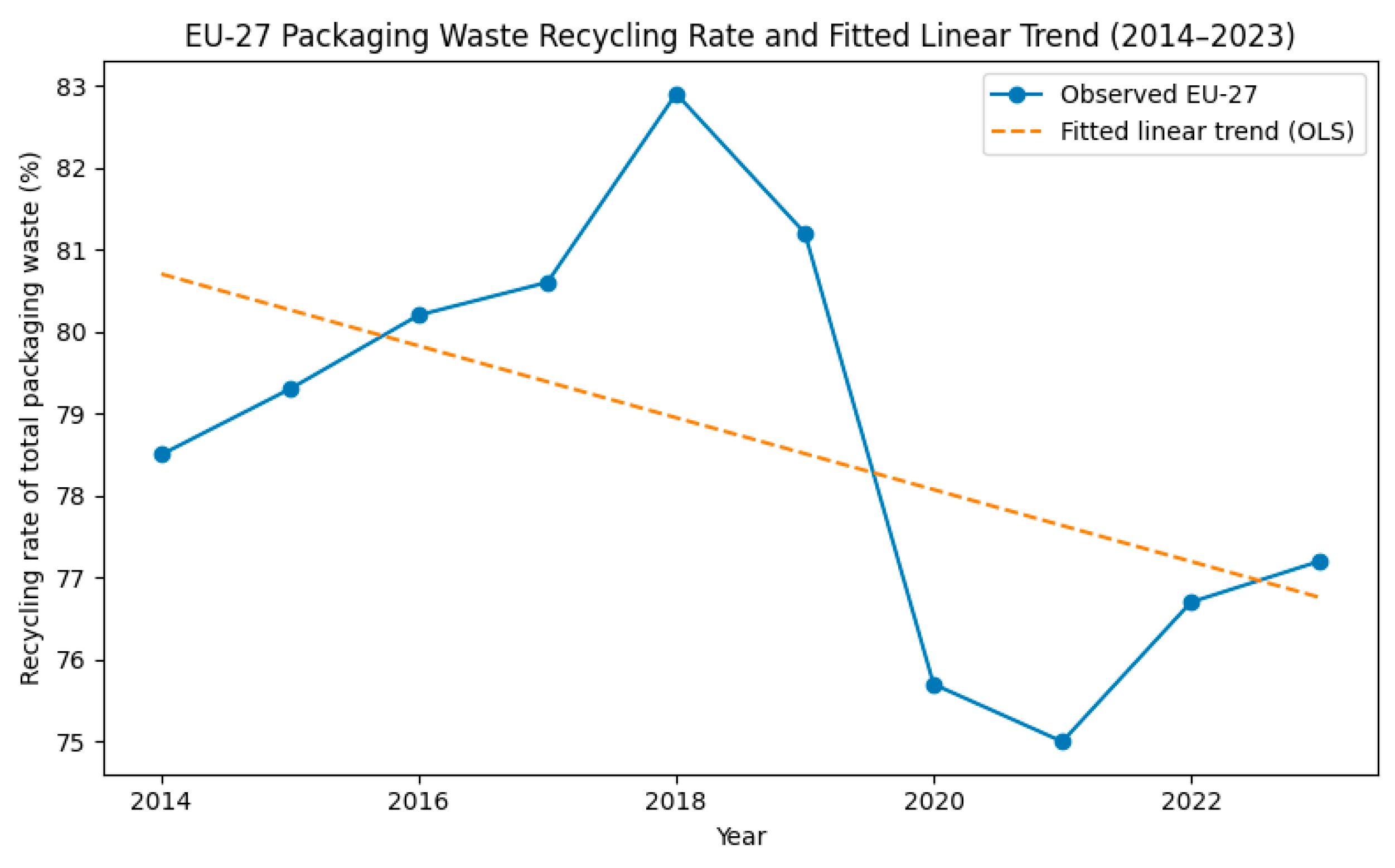
Table 1.
Estimated trend coefficients (intercepts and slopes) for EU–27 and selected Member States (OLS, 2014–2023).
Figure 2.
Country–specific observed series.
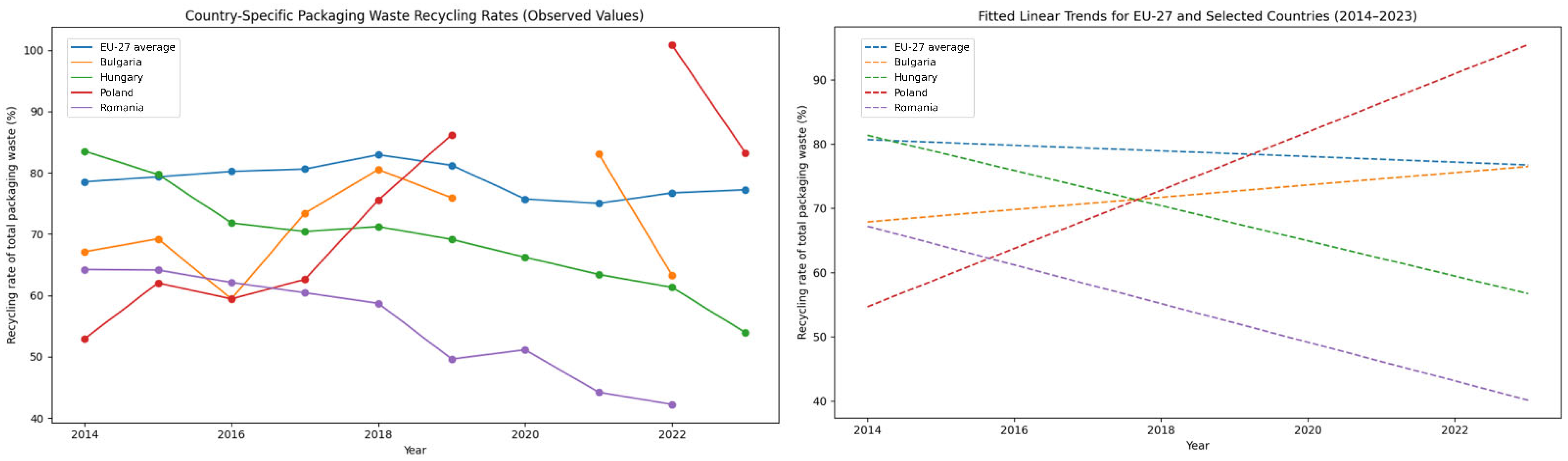
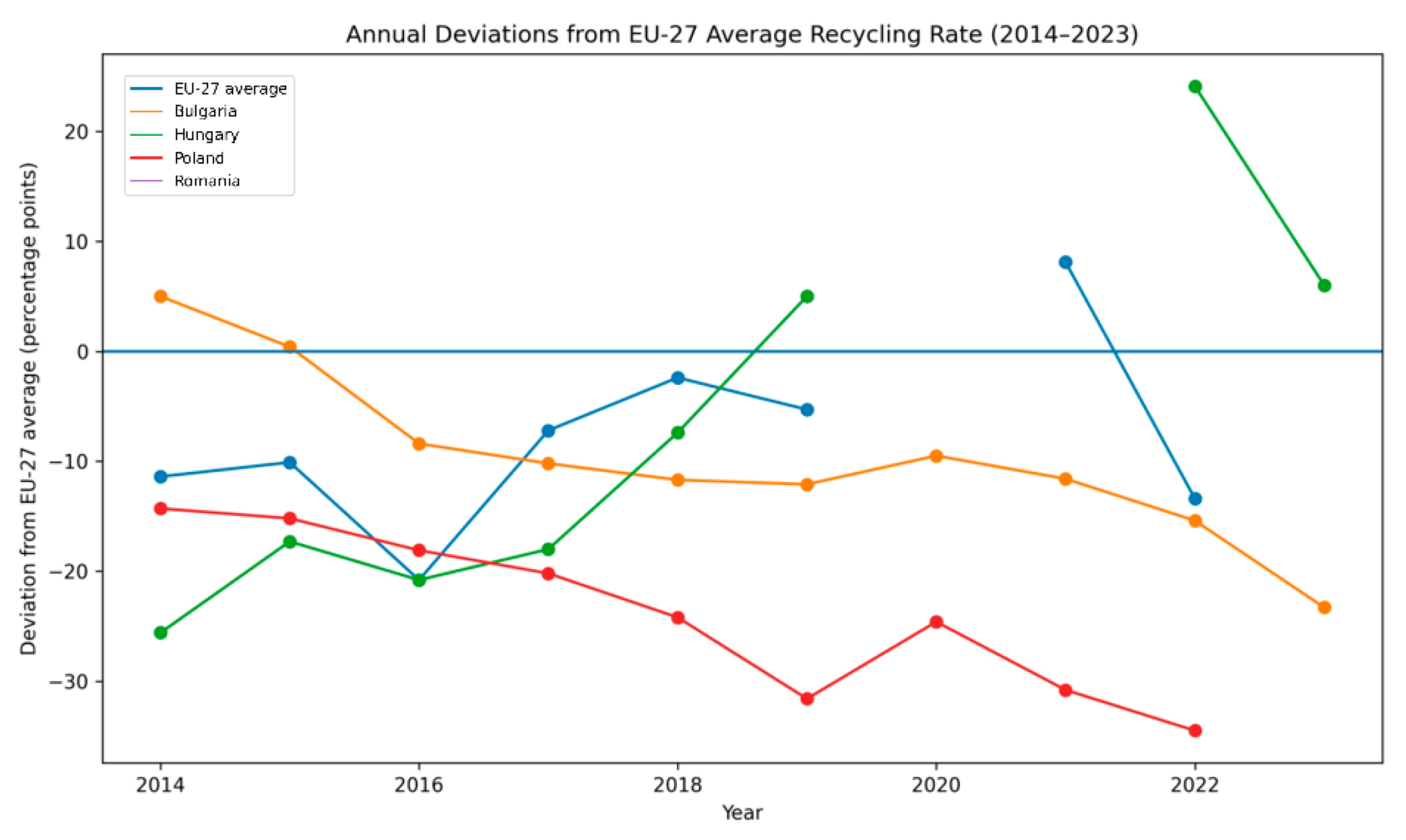
Figure 3.
Annual deviations from the EU–27 average packaging waste recycling rate (2014–2023).
The estimated negative slope of the EU-27 linear trend should be interpreted with caution. While the overall OLS regression for 2014–2023 yields a slightly negative coefficient, year-to-year changes indicate increases in recycling rates in the majority of years. The apparent contradiction arises from the pronounced system-level disruption observed during 2020–2021, which introduces a structural break in the time series.
The purpose of the linear trend in this study is not to claim a continuous deterioration of EU packaging recycling performance, but to provide a parsimonious benchmark against which national trajectories can be compared. In this sense, the EU-27 trend functions as a reference path rather than as a literal depiction of uninterrupted system behaviour.
4.2. General EU-27 Model Results
The EU-27 packaging waste recycling rate remains consistently high throughout the period 2014–2023, fluctuating between 75.0% and 82.9%. The peak in the series is recorded in 2018 (82.9%), followed by a moderate decline during 2020–2021, which coincides with structural changes in reporting and potential disruptions in waste management systems. A slight recovery is observed by 2023, when the rate reaches 77.2%, remaining near the long-term mean.
To analyse the underlying trend, a linear regression model was estimated:
which can be equivalently expressed relative to the base year 2014:
The slope coefficient: indicates a very mild downward trend, amounting to a reduction in less than half a percentage point per year on average. This suggests that the EU-27 system is operating near a maturity plateau, where substantial improvements in aggregate recycling rates become increasingly difficult, and interannual variations are shaped more by economic, administrative, or methodological shifts than by structural declines.
The observed data and fitted trend are displayed in Figure 1, which confirms the stability of the EU-27 trajectory over the examined decade.
4.3. Descriptive Comparison for Bulgaria, Hungary, Poland and Romania
The descriptive analysis reveals substantial heterogeneity in the evolution and overall level of packaging waste recycling rates among the four analysed Member States—Bulgaria, Hungary, Poland, and Romania—when compared with the EU-27 benchmark. Over the period 2014–2023, the average recycling rate at EU-27 level reaches 78.7%, reflecting a mature and relatively stable system. By contrast, all four countries record lower mean values, albeit with markedly different trajectories and degrees of variability.
Poland and Bulgaria display intermediate average performance levels, with mean recycling rates of 72.8% and 71.5%, respectively, indicating partial convergence toward the EU-27 average. Hungary follows with a mean value of 69.0%, while Romania records a substantially lower average of 55.2%, highlighting a persistent structural gap relative to the European benchmark. Importantly, although all four countries start the period below the EU-27 level in 2014, their subsequent trajectories diverge considerably, pointing to fundamentally different dynamics of progress, stagnation, or decline (see Table 3).
Bulgaria exhibits a distinctly non-linear and volatile trajectory, characterised by alternating phases of improvement and regression. In the initial years (2014–2015), recycling rates remain at moderate levels (67–69%), approximately 10–11% below the EU-27 average. A sharp deterioration is observed in 2016, when the rate drops to 59.4%, widening the gap with the EU-27 to more than 20%. This decline is followed by a rapid recovery during 2017–2018, culminating in 80.5% in 2018, a level approaching the EU-27 average.
Subsequently, Bulgaria experiences another downturn in 2019, before recording an exceptional peak in 2021 (83.1%), temporarily outperforming the EU-27 by more than 8%. However, this convergence proves unsustainable, as the recycling rate falls sharply again in 2022 (63.3%), returning Bulgaria to a position well below the European average. Overall, Bulgaria’s trajectory reflects episodic convergence without long-term stabilisation, suggesting sensitivity to short-term policy, institutional, or reporting changes rather than a steady structural transformation (Figure 2).
Hungary presents a contrasting pattern, characterised by a persistent and monotonic decline throughout most of the period. The country starts in 2014 with a recycling rate of 83.5%, exceeding the EU-27 average. However, from 2015 onward, Hungary enters a continuous downward trajectory. By 2016, the recycling rate falls below the EU-27 level, and the gap widens progressively thereafter (Figure 2).
Between 2016 and 2023, Hungary’s recycling rate declines from 71.8% to 53.9%, while the EU-27 remains broadly stable in the mid-to-high 70% range. By the end of the period, the negative deviation exceeds 20%, indicating a clear case of structural divergence. Unlike Bulgaria, Hungary does not display recovery phases, suggesting deeper systemic issues affecting the effectiveness of packaging waste management.
Among the four countries, Poland demonstrates the most dynamic and sustained improvement in packaging waste recycling. Starting from a comparatively low level in 2014 (52.9%), more than 25% below the EU-27 average, Poland shows rapid progress from 2016 onward. By 2018, the recycling rate reaches 75.5%, significantly narrowing the gap with the EU benchmark.
An exceptional value is reported in 2019 (86.2%), placing Poland above the EU-27 average. Although data are missing for 2020–2021, the reported rate for 2022 (100.8%) substantially exceeds both historical EU-27 levels and typical recycling benchmarks. While this extremely high value may partly reflect methodological or reporting issues, the broader trend clearly indicates strong convergence and eventual over-performance relative to the EU-27. The value recorded in 2023 (83.2%) confirms that Poland maintains recycling rates above the European average toward the end of the period.
The exceptionally high recycling rate reported for Poland in 2022 (exceeding 100%) requires careful interpretation. Such values do not imply that domestic consumption generates negative waste or that citizens recycle more waste than they produce. Rather, they reflect the structure of national reporting systems, which may account for cross-border movements of packaging waste and the processing of imported recyclables.
Similar phenomena have been documented in other EU Member States with significant recycling capacity, where recovered quantities exceed domestically generated waste due to net imports of recyclable materials.
Romania consistently underperforms relative to the EU-27 and displays a worsening long-term trend. In the early years (2014–2016), recycling rates remain at moderate levels (approximately 62–64%), already 14–18% below the EU-27 average. From 2017 onward, a steady decline sets in, reaching 49.6% in 2019 and widening the performance gap to more than 30%.
A modest and temporary improvement is observed in 2020 (51.1%), but this is followed by renewed deterioration in 2021–2022, when recycling rates fall to 44.2% and 42.2%, respectively. By 2022, Romania’s recycling rate lies more than 34% below the EU-27 average, making it the weakest performer among the analysed countries. The absence of sustained recovery phases suggests persistent structural constraints in packaging waste management.
4.4. Convergence and Divergence Results Relative to the EU-27 Benchmark
The estimated trend coefficients reported in Table 1 reveal pronounced cross-country differences. While the EU-27 exhibits a slightly negative slope
indicating a broadly stable but marginally declining aggregate trend, national trajectories diverge substantially around this reference path (data available in Table 1).
Countries with positive slope coefficients—namely Poland and Bulgaria—display an overall upward trend in packaging waste recycling rates over the study period. In contrast, Hungary and Romania show negative slopes that are considerably steeper in absolute value than the EU-27 trend, signalling sustained decline.
Poland records the strongest positive slope
which indicates rapid convergence toward, and eventual over-performance relative to, the EU-27 benchmark. Bulgaria also exhibits a positive trend
suggesting gradual improvement; however, as discussed below, this trend masks substantial interannual volatility.
By contrast, Hungary and Romania show pronounced negative slopes of
respectively. These values indicate divergence from the EU-27 path at a rate significantly faster than the modest decline observed at EU level. The fitted linear trends displayed in Figure 2 visually reinforce these findings, clearly separating converging (Poland), unstable (Bulgaria), and diverging (Hungary and Romania) trajectories.
To further characterise convergence dynamics, annual deviations from the EU-27 benchmark are computed as:
where positive values indicate performance above the EU-27 average and negative values indicate under-performance. The evolution of these deviations is presented in Figure 3.
The deviation analysis highlights four distinct patterns:
- Poland shows a clear case of strong convergence followed by over-shooting. The deviation improves from approximately −25.6% in 2014 to +24.1% in 2022, before stabilising above the EU-27 level in 2023. This trajectory reflects both rapid improvement and a fundamental structural shift in national recycling performance.
- Bulgaria exhibits intermittent convergence, with deviations fluctuating between substantial under-performance and temporary over-performance. While the country exceeds the EU-27 average in 2021 (+8.1%), this achievement is not sustained, and deviations turn sharply negative again in 2022. This oscillatory pattern suggests sensitivity to short-term policy or reporting factors rather than a stable convergence process.
- Hungary transitions from slight over-performance in the early years (+5.0% in 2014) to persistent and deep under-performance, reaching approximately −23.3% by 2023. The steadily widening negative deviation indicates systematic divergence from the EU-27 benchmark.
- Romania remains consistently and increasingly below the EU-27 average throughout the period. The deviation deteriorates from −14.3% in 2014 to around −34.5% in 2022, representing the most pronounced and persistent divergence among the four countries.
Taken together, the trend coefficients and deviation patterns allow the classification of the four Member States into distinct performance typologies relative to the EU-27 linear model:
- converging and over-performing: Poland, characterised by strong positive trends and sustained positive deviations;
- partially converging but unstable: Bulgaria, showing episodic convergence without long-term stabilisation;
- structurally diverging: Hungary and Romania, both exhibiting steep negative trends and increasingly negative deviations from the EU-27 benchmark.
In this sense, the EU-27 linear trend serves as a general reference model against which national dynamics can be evaluated. While some Member States demonstrate the capacity to rapidly align with or surpass EU-average performance, others display entrenched structural challenges that lead to sustained divergence. These contrasting patterns underline the need for differentiated policy responses rather than uniform EU-wide instruments.
5. Material and Methods
Considering the gaps emerged from the literature analysis, the present work defined a methodology to contribute to the literature in at least four ways:
- Decade-long, EU-27-anchored analysis for four CEE countries using Eurostat’s official indicator “Recycling rates of packaging waste for monitoring compliance with policy targets, by type of packaging” to construct a consistent time series for 2014–2023 and uses the EU-27 average as an explicit benchmark to assess Bulgaria, Hungary, Poland and Romania.
- Integrated analytical framework focused on trajectories rather than single-year snapshots combining descriptive statistics, linear trend estimation, deviation analysis, and volatility measures to classify countries into three performance patterns: converging and over-performing (Poland), partially converging but unstable (Bulgaria), and diverging under-performers (Hungary and Romania). This approach directly addresses the neglected question of convergence/divergence of CEE packaging systems relative to the EU-27.
- Application of multivariate tools to position CEE Member States, hierarchical clustering and PCA employed to map similarities and differences among the four CEE countries and the EU-27 reference trajectory, offering a concise visual typology of packaging waste management performance.
- Policy-oriented interpretation linked to the evolving EU framework by combining up-to-date recycling performance data with recent EU policy developments (PPWR negotiations, early warning assessments, and national reforms such as Romania’s DRS), drawing concrete implications for the likelihood of target attainment and for the design of EPR, DRS and complementary instruments in CEE.
So, while the existing literature offers rich insights into EPR design, packaging waste flows and sustainability assessments at EU level, it only partially covers the comparative, long-term evolution of packaging recycling in Central and Eastern Europe. The present work seeks to fill this gap by delivering a focused, data-driven assessment of four CEE Member States vis-à-vis the EU-27 average, over a ten-year period and in the context of a rapidly changing EU regulatory landscape.
The adopted methodology is then described as follows and includes a data preview.
5.1. Data, Variables and Notations
The empirical analysis draws on the Eurostat dataset “Recycling rates of packaging waste for monitoring compliance with policy targets, by type of packaging”, which provides harmonized information on packaging waste management across Member States. The subset used in this study includes five geographical units: the European Union—27 Member States (from 2020), Bulgaria, Hungary, Poland, and Romania. The temporal coverage spans 2014–2023, enabling a decade-long assessment of national performance and convergence or divergence relative to the EU-27 average.
In this study, packaging waste refers to all waste materials generated from packaging used for the containment, protection, handling, delivery, and presentation of goods, in line with the definitions applied in EU statistical reporting. The analysis considers total packaging waste, aggregating all major material fractions—including paper and cardboard, plastic, glass, metal, and wood packaging—as reported by Eurostat. Recycling rates therefore reflect the share of total generated packaging waste that is reported as recycled, irrespective of the specific treatment pathway or final recycling technology employed. This aggregated indicator is widely used for monitoring compliance with EU packaging waste policy targets and provides a consistent basis for cross-country and longitudinal comparison, although it does not capture material-specific performance differences or qualitative aspects of recycling outcomes.
The used indicator is the recycling rate of total packaging waste, defined as the percentage of generated packaging waste that is recycled within the same year. This indicator is extensively employed for monitoring Member States’ progress toward EU waste policy targets, including the revised PPWD and the CEAP.
The raw dataset (Table 2) contains several entries flagged with symbols such as “:” (missing values), “i” (Eurostat estimate), and “p” (provisional values). In the present study, the
- values marked “:” were systematically treated as missing (NaN) and excluded from all computations;
- numeric values flagged as estimated (“i”) or provisional (“p”) were retained as reported, while acknowledging this as a limitation due to potential future revisions.
This approach preserves the integrity of the underlying time series while enabling consistent cross-country comparison over the ten-year horizon.
Table 2.
Raw dataset of total packaging waste recycling rates (2014–2023) for EU-27, Bulgaria, Hungary, Poland, and Romania.
Where
: recycling rate for the EU-27 in year .
: recycling rate for country in year .
: calendar year ranging from 2014 to 2023.
These series reveal substantial heterogeneity across Member States in both the level and direction of change. Missing data (MaN) reflect gaps in national reporting and are treated conservatively.
Data harmonisation and counting practices represent a well-known challenge in cross-country waste management analyses. Although Eurostat applies a common methodological framework for packaging waste statistics, including standard definitions, reporting templates, and validation procedures, the actual collection and aggregation of data remain the responsibility of national authorities. As a result, differences across countries may partly reflect variations in accounting practices, reporting boundaries, or treatment of cross-border waste flows, in addition to differences in actual waste generation and recycling performance.
This study explicitly acknowledges these limitations. Rather than interpreting national recycling rates as exact physical measures of domestic waste generation and recovery, the analysis treats Eurostat indicators as policy-relevant performance metrics that reflect how national systems function within the current EU statistical framework. The focus is therefore placed on relative trajectories, trend direction, and convergence or divergence patterns over time, rather than on absolute cross-country level comparisons in a single year.
5.2. Statistical Approach
The analytical framework follows three methodological steps designed to capture the
- descriptive characteristics of national recycling performance;
- long-term trends;
- convergence or divergence relative to the EU-27.
To characterise the overall performance of each unit in the dataset—the EU-27 average and the four Member States—the authors first compute a set of descriptive statistics that summarise the behaviour of recycling rates over the period 2014–2023. These included the mean recycling rate (which provides a general indication of the long-run performance level), the minimum and maximum observed values (which capture the range within which annual outcomes fluctuate) and the identification of local turning points, highlighting years in which countries reach peak performance or experience notable declines.
In addition, the degree of variability over time was assessed (Table 3) to determine the stability or volatility of national recycling trajectories. Together, these descriptive measures enable a preliminary classification of countries into relatively stable performers, those exhibiting consistent improvement, and those showing signs of persistent decline, thereby providing an essential foundation for the subsequent trend and convergence analysis.
Table 3.
Descriptive statistics of packaging waste recycling rates (2014–2023).
A linear regression model was considered and ordinary least squares (OLS) were used for the development of the paper:
where
: the calendar year
: the intercept
: the slope (annual change)
: the error term
For greater interpretability, the trend has also been re-expressed with respect to the base year 2014:
The slope parameter indicates whether the EU-27 system exhibits a positive, negative, or neutral long-term trajectory.
For each country , a country-specific trend model was estimated:
Also, the annual deviation from the EU-27 reference was computed:
where
Positive values of denote performance above the EU-27 average.
Negative values reflect below-average performance.
Missing values are excluded from trend estimation and deviation analysis.
This step enables the evaluation of convergence (narrowing gaps), divergence (widening gaps), and instability (oscillating deviations) among the four Member States.
5.3. Convergence and Divergence Relative to the EU-27 Benchmark
To assess whether national packaging waste recycling systems are converging toward or diverging from the EU-27 benchmark, linear trend coefficients and annual deviations from the EU-27 average are jointly analysed. This approach allows for a dynamic interpretation of performance, going beyond static comparisons of average levels and focusing instead on direction, magnitude, and stability of change over time.
The objective of the proposed analytical framework is not to develop or validate a predictive model of packaging waste recycling rates, but to provide a comparative, trajectory-based assessment of convergence and divergence among a specific group of Central and Eastern European (CEE) Member States. For this reason, the analysis deliberately focuses on Bulgaria, Hungary, Poland, and Romania, which share broadly comparable institutional legacies, economic structures, and waste management challenges.
While it is true that several Western and Northern European countries (e.g., Germany, the Netherlands, Denmark, Belgium) provide highly detailed and long-established packaging waste statistics, these countries operate within mature and structurally different waste management systems. Applying the same modelling framework to such countries would therefore address a different research question, namely the fine-grained validation of statistical estimation techniques, rather than the assessment of relative dynamics within a transitioning regional group.
In this study, the EU-27 aggregate is intentionally used as a benchmark reference rather than as a validation case, as it captures the integrated outcome of heterogeneous national systems within the same statistical reporting framework. This allows the analysis to highlight relative positioning, direction of change, and stability of national trajectories within CEE, which constitutes the primary contribution of the paper.
6. Conclusions
The present paper examined the evolution of packaging waste recycling rates in four Central and Eastern European Member States—Bulgaria, Hungary, Poland, and Romania—relative to the EU-27 average over the period 2014–2023. By combining descriptive statistics, linear trend analysis, and deviation-based benchmarking, the analysis provides a comprehensive assessment of convergence and divergence dynamics within the European Union.
The results show that the EU-27 exhibits a stable, near-saturation pattern, with only minor fluctuations over time. Against this backdrop, national trajectories diverge substantially. Poland emerges as a clear case of convergence and eventual over-performance, Bulgaria displays episodic and unstable convergence, while Hungary and Romania exhibit sustained divergence and declining recycling performance. These findings indicate that progress toward EU recycling targets is highly uneven and strongly conditioned by national circumstances.
From a methodological perspective, the study demonstrates the value of using the EU-27 trend as a general reference model for evaluating national performance. This approach allows for a dynamic interpretation of recycling outcomes and highlights not only differences in levels but also differences in direction and stability over time.
From a policy perspective, the results suggest that achieving EU circular economy objectives will require more than uniform targets and harmonised legislation. Instead, differentiated policy responses, tailored to national trajectories and structural constraints, are needed to ensure that lagging Member States can close persistent performance gaps.
Future research could extend this analysis in several directions. First, incorporating additional explanatory variables—such as EPR fee structures, investment levels, or the introduction of deposit–return systems—would help identify the drivers behind observed trends. Second, expanding the scope to include other packaging materials or municipal waste streams could provide a more granular understanding of recycling performance. Finally, the application of non-linear or structural break models could further refine the analysis of long-term dynamics.
This study is subject to several limitations. First, the analysis relies on officially reported Eurostat data, which, despite harmonisation efforts, may reflect differences in national counting practices and cross-border waste flows. Second, the use of linear trend models abstracts from potential structural breaks, such as those induced by the COVID-19 pandemic. Third, unusually high reported recycling rates, as observed for Poland, highlight the need to distinguish between domestic waste generation and system-level processing capacity.
These limitations point to promising avenues for future research, including micro-level waste flow analyses, explicit modelling of cross-border movements of recyclables, and the application of non-linear or segmented trend models to better capture system disruptions.
In conclusion, this study contributes to the literature by offering a focused, data-driven assessment of packaging waste recycling convergence in Central and Eastern Europe, highlighting both successful pathways and persistent challenges in the transition toward a more circular European economy.
Author Contributions
Conceptualization: I.G.-P.; methodology: R.G. and I.G.-P.; validation: R.G., I.G.-P. and E.C.R.; formal analysis: I.G.-P. and R.G.; investigation: R.G., I.G.-P. and E.C.R.; writing—original draft preparation: R.G. and I.G.-P.; writing—review and editing: R.G., I.G.-P. and E.C.R.; visualization: R.G., I.G.-P. and E.C.R.; supervision: I.G.-P. and E.C.R. All authors have read and agreed to the published version of the manuscript.
Funding
This research was supported by the project EDU4PlastiCircular–Education for Plastic in a Circular and Climate Neutral Economy-Preventing Waste Ending Up into the Environment, grant number 1-RO01-KA220-HED-000166242, and the EU-ERASMUS+ Program.
Data Availability Statement
The original contributions presented in this study are included in the article. Further inquiries can be directed to the corresponding authors.
Conflicts of Interest
The authors declare no conflicts of interest.
References
- Mehta, J.; Dilbaghi, N.; Deep, A.; Hai, F.I.; Kaushik, A.; Kumar, S. Plastic waste upcycling into carbon nanomaterials in circular economy: Synthesis, applications, and environmental aspects. Carbon 2025, 234, 119969. [Google Scholar] [CrossRef] [Scilit]
- Egúsquiza Rodríguez, M.J.; Paz Campaña, A.E.; López Padilla, R.D.P.; Romero Mendoza, C.S.; Villanueva Mendoza, N.N. Sustainable packaging in circular economy business models, the green revolution to reduce global pollution: A literature review. In Proceedings of the 23rd LACCEI International Multi-Conference for Engineering, Education, and Technology: “Engineering, Artificial Intelligence, and Sustainable Technologies in Service of Society”, Hybrid Event, Mexico City, Mexico, 16–18 July 2025. [Google Scholar] [CrossRef] [Scilit]
- Terzioğlu, N.; Ceschin, F.; Jobling, S.; Tarverdi, K. Archetypes to classify upstream packaging strategies for a circular economy. Resour. Conserv. Recycl. Adv. 2024, 21, 200211. [Google Scholar] [CrossRef] [Scilit]
- Rada, E.C. Circular Economy: Origin, Evolution and Role of MSW. Environ. Clim. Technol. 2023, 27, 989–998. [Google Scholar] [CrossRef] [Scilit]
- Giurea, R.; Precazzini, I.; Ragazzi, M.; Achim, M.I.; Cioca, L.I.; Conti, F.; Torretta, V.; Rada, E.C. Good practices and actions for sustainable municipal solid waste management in the tourist sector. Resources 2018, 7, 51. [Google Scholar] [CrossRef] [Scilit]
- Vučkovski, B.G.; Ćurčić, N.V.; Gheorghe, I.G. Circular Economy as a Driver of Sustainable Growth: Quantitative Analysis of the Role of Recycling and Secondary Raw Materials in the EU. Sustainability 2025, 17, 5181. [Google Scholar] [CrossRef] [Scilit]
- Saldaña-Pierard, C.; Nguyen, P.M.; Debeaufort, F.; Vitrac, O.; Auras, R. Impact of emerging packaging regulations on international trade and product safety with emphasis on plastic reuse and recycling in Europe and North America. J. Ind. Ecol. 2025, 29, 1473–1504. [Google Scholar] [CrossRef] [Scilit]
- Di Foggia, G.; Beccarello, M. An Overview of Packaging Waste Models in Some European Countries. Recycling 2022, 7, 38. [Google Scholar] [CrossRef] [Scilit]
- Torkelis, A.; Dvarionienė, J.; Denafas, G. The Factors Influencing the Recycling of Plastic and Composite Packaging Waste. Sustainability 2024, 16, 9515. [Google Scholar] [CrossRef] [Scilit]
- Tsimnadis, K.; Kyriakopoulos, G.L. Investigating the role of municipal waste treatment within the European Union through a novel created common sustainability point system. Recycling 2024, 9, 42. [Google Scholar] [CrossRef] [Scilit]
- Kirillova, A.; Musinova, N. Potential of separate waste collection technologies. Transp. Res. Procedia 2022, 63, 1556–1560. [Google Scholar] [CrossRef] [Scilit]
- Kalambura, S.; Racz, A.; Jovičić, N.; Toth, M. Perception of issues, possibilities and habits of separate waste collection. Soc. Ekol. časopis Za Ekološku Misao I Sociol. Istraživanja Okoline 2016, 25, 271–287. [Google Scholar] [CrossRef] [Scilit]
- Rada, E.C. Effects of MSW selective collection on waste-to-energy strategies. WIT Trans. Ecol. Environ. 2013, 176, 215–223. [Google Scholar] [CrossRef] [Scilit]
- Regulation (EU) 2025/40 of the European Parliament and of the Council of 19 December 2024 on Packaging and Packaging Waste, Amending Regulation (EU) 2019/1020 and Directive (EU) 2019/904, and Repealing Directive 94/62/EC (Text with EEA Relevance). Available online: http://data.europa.eu/eli/reg/2025/40/oj (accessed on 15 November 2025).
- Eurostat, Statistics explained, Packaging Waste Statistics. Available online: https://ec.europa.eu/eurostat/statistics-explained/index.php?title=Packaging_waste_statistics (accessed on 15 November 2025).
- European Environment Agency. Recycling Rates in Europe by Waste Stream. Available online: https://www.eea.europa.eu/en/analysis/indicators/waste-recycling-in-europe/recycling-rates-in-europe-by?utm_source=chatgpt.com&activeTab=570bee2d-1316-48cf-adde-4b640f92119b (accessed on 15 November 2025).
- European Commission–DG Environment, Final Report Development of Guidance on Extended Producer Responsibility (EPR). Available online: https://ec.europa.eu/environment/pdf/waste/target_review/Guidance%20on%20EPR%20-%20Final%20Report.pdf?utm_source=chatgpt.com (accessed on 15 November 2025).
- Anggayasti, U.H.; Effendy, F.S.W.; Pinilih, S.A.G. The Producer Responsibility in Plastic Waste Management: A Balance between Consumer Protection and Environmental Sustainability. In IOP Conference Series: Earth and Environmental Science; IOP Publishing: Bristol, UK, 2025; Volume 1537, p. 012026. [Google Scholar] [CrossRef] [Scilit]
- Dixit, A.; Singh, P. Circular Solutions: Leveraging Extended Producer Responsibility to Tackle Plastic Waste. Indian J. Environ. Prot. 2025, 45, 563–572. [Google Scholar]
- Anh, T.T.Y.; Herat, S.; Prasad, K. A Review on Extended Producer Responsibility Schemes for Packaging Waste Management and Research Gaps in the Field. Nat. Environ. Pollut. Technol. 2025, 24, D1662. [Google Scholar] [CrossRef] [Scilit]
- Tumu, K.; Vorst, K.; Curtzwiler, G. Global plastic waste recycling and extended producer responsibility laws. J. Environ. Manag. 2023, 348, 119242. [Google Scholar] [CrossRef] [Scilit]
- Colelli, F.P.; Croci, E.; Bruno Pontoni, F.; Zanini, S.F. Assessment of the effectiveness and efficiency of packaging waste EPR schemes in Europe. Waste Manag. 2022, 148, 61–70. [Google Scholar] [CrossRef] [Scilit]
- da Cruz, N.F.; Simões, P.; Marques, R.C. Costs and benefits of packaging waste recycling systems. Resour. Conserv. Recycl. 2014, 85, 1–4. [Google Scholar] [CrossRef] [Scilit]
- da Cruz, N.F.; Ferreira, S.; Cabral, M.; Simões, P.; Marques, R.C. Packaging waste recycling in Europe: Is the industry paying for it? Waste Manag. 2014, 34, 298–308. [Google Scholar] [CrossRef] [Scilit] [PubMed]
- Ahlers, A.L.; Krichewsky, D.; Moser, E.; Stichweh, R. Democratic and Authoritarian Political Systems in 21st Century World Society. Vol. 1: Differentiation, Inclusion, Responsiveness; (Global Studies & Theory of Society, 5); Transcript Verlag: Bielefeld, Germany, 2021. [Google Scholar] [CrossRef] [Scilit]
- Ahlers, J.; Hemkhaus, M.; Hibler, S.; Hannak, J. Analysis of Extended Producer Responsibility Schemes. Adelphi/European Commission 2021. Available online: https://adelphi.de/en/publications/analysis-of-extended-producer-responsibility-schemes (accessed on 15 November 2025).
- Tran, Q.T. Negotiating Digital Heritage Infrastructures: Setting the Scene for Participation, 1st ed.; Routledge: London, UK, 2025. [Google Scholar] [CrossRef] [Scilit]
- Ile, A.L.; Caizer, A.D.; Dragan, A. Challenges in Transitioning to a Circular Economy: A Spatial Analysis of Socioeconomic Factors Affecting the Adoption of the Deposit-Return System. Environments 2025, 12, 142. [Google Scholar] [CrossRef] [Scilit]
- Ram, N.; Ahmad, P.; Toth-Peter, A.; de Torres de Oliveira, R.; Acharyulu, G.V.R.K. Developing a circular economy framework for e-commerce packaging materials: A study on behavioural intentions of online consumers. Bus. Strateg. Environ. 2025, 34, 982–1006. [Google Scholar] [CrossRef] [Scilit]
- Jiang, T.; Sun, Y.; Jin, Q. The environmental, economic, and social influences of government subsidies on express delivery packaging supply chain. Environ. Sci. Pollut. Res. 2023, 30, 29681–29698. [Google Scholar] [CrossRef] [Scilit] [PubMed]
- GREEN Research Centre of Bocconi University. Screening the Efficiency of Packaging Waste in Europe. 2021. Available online: https://www.conai.org/wp-content/uploads/2022/06/Study_CONAI_BOCCONI_final_report_EN.pdf?utm_source=chatgpt.com (accessed on 15 November 2025).
- Jorge, E. Exploring the impact of population aging, population density, and GDP on municipal waste generation in European OECD Countries-When do mediation effects matter? Soc. Sci. Humanit. Open 2025, 11, 101432. [Google Scholar] [CrossRef] [Scilit]
- Sabina, M.T.; Jeyshankar, R. Relationship between GDP and Productivity of G7 and BRICS Countries in Solid Waste Management Research Literature. Int. J. Inf. Sci. Manag. 2025, 23, 75–90. [Google Scholar] [CrossRef]
- Antonopoulos, I.; Faraca, G.; Tonini, D. Recycling of post-consumer plastic packaging waste in the EU: Recovery rates, material flows, and barriers. Waste Manag. 2021, 126, 694–705. [Google Scholar] [CrossRef] [Scilit]
- Meys, R.; Frick, F.; Westhues, S.; Sternberg, A.; Klankermayer, J.; Bardow, A. Towards a circular economy for plastic packaging wastes–the environmental potential of chemical recycling. Resour. Conserv. Recycl. 2020, 162, 105010. [Google Scholar] [CrossRef] [Scilit]
- Lombardi, M.; Rana, R.; Fellner, J. Material flow analysis and sustainability of the Italian plastic packaging management. J. Clean. Prod. 2021, 287, 125573. [Google Scholar] [CrossRef] [Scilit]
- López-Aguilar, J.F.; Sevigné-Itoiz, E.; Maspoch, M.L.; Peña, J. A realistic material flow analysis for end-of-life plastic packaging management in Spain: Data gaps and suggestions for improvements towards effective recyclability. Sustain. Prod. Consum. 2022, 31, 209–219. [Google Scholar] [CrossRef] [Scilit]
- Giurea, R.; Tulbure, A.; Popescu, L.G.; Adami, L.; Ragazzi, M.; Rada, E.C. Fostering sustainability: Integrating circular economy practices to manage plastic waste in universities. In Journal of Physics: Conference Series; IOP Publishing: Bristol, UK, 2025; Volume 3028, p. 012018. [Google Scholar] [CrossRef] [Scilit]
- Gavrila-Paven, I.; Giurea, R.; Tulbure, A.; Capatana, C.; Adami, L.; Ragazzi, M. Comparative study of waste management and recycling in the context of circular economy: Insights from Romania. WIT Trans. Ecol. Environ. 2025, 265, 151–162. [Google Scholar] [CrossRef] [Scilit]
- Enache, M.M.; Gavrilescu, D.; Teodosiu, C. Comparative Analysis of Plastic Waste Management Options Sustainability Profiles. Polymers 2025, 17, 2117. [Google Scholar] [CrossRef] [Scilit] [PubMed]
- Rada, E.C.; Cioca, L.I.; Ionescu, G. Energy recovery from Municipal Solid Waste in EU: Proposals to assess the management performance under a circular economy perspective. Matec Web Conf. 2017, 121, 05006. [Google Scholar] [CrossRef] [Scilit]
- Rada, E.C.; Istrate, I.A.; Panaitescu, V.; Ragazzi, M.; Cirlioru, T.M.; Apostol, T. A comparison between different scenarios of Romanian municipal solid waste treatment before landfilling. Environ. Eng. Manag. J. 2010, 9, 589–596. [Google Scholar] [CrossRef] [Scilit]
- Gavrilescu, D.; Seto, B.C.; Teodosiu, C. Sustainability analysis of packaging waste management systems: A case study in the Romanian context. J. Clean. Prod. 2023, 422, 138578. [Google Scholar] [CrossRef] [Scilit]
- Rigamonti, L.; Ferreira, S.; Grosso, M.; Marques, R.C. Economic–financial analysis of the Italian packaging waste management system from a local authority perspective. J. Clean. Prod. 2015, 87, 533–541. [Google Scholar] [CrossRef] [Scilit]
- Rubio, S.; Ramos, T.R.P.; Leitão, M.M.R.; Barbosa-Póvoa, A.P. Effectiveness of extended producer responsibility policies: The case of Portuguese and Spanish packaging waste systems. J. Clean. Prod. 2019, 210, 217–230. [Google Scholar] [CrossRef] [Scilit]
- Zajemska, M.; Korombel, A.; Ławińska, O. Risk Factors for Poland to Achieve the European Recycling Targets. Energies 2024, 17, 1171. [Google Scholar] [CrossRef] [Scilit]
- Waszczyłko-Miłkowska, B.; Bernat, K.; Zaborowska, M. Direct Measurements of the Mass of Municipal Biowaste Separated and Recycled at Source and Its Role in Circular Economy—A Case Study from Poland. Sustainability 2025, 17, 7252. [Google Scholar] [CrossRef] [Scilit]
- Zarębski, A.; Zarębska, J.; Marosek, K. Implementation of the Deposit System in Poland as a Tool for Implementing the Circular Economy. Energies 2024, 17, 5489. [Google Scholar] [CrossRef] [Scilit]
- Kasznik, D.; Łapniewska, Z. The end of plastic? The EU’s directive on single-use plastics and its implementation in Poland. Environ. Sci. Policy 2023, 45, 151–163. [Google Scholar] [CrossRef] [Scilit]
- Mrkajić, V.; Stanisavljevic, N.; Wang, X.; Tomas, L.; Haro, P. Efficiency of packaging waste management in a European Union candidate country. Resour. Conserv. Recycl. 2018, 136, 130–141. [Google Scholar] [CrossRef] [Scilit]
- Dimitrova, K.; Panayotova, T. Analysis of Packaging Waste Management in Bulgaria. In Sustainable Innovation for Engineering Management (SIEM). ISCME 2024. Advances in Science, Technology & Innovation; El Khatib, M., Alzoubi, H.M., Angelova, Y., Eds.; Springer: Cham, Switzerland, 2025; pp. 45–58. [Google Scholar] [CrossRef] [Scilit]
- Ivanov, I. A regional aspect of municipal waste management disparities: The case of Bulgaria. Int. Multidiscip. Sci. GeoConf. SGEM 2020, 20, 11–17. [Google Scholar] [CrossRef] [Scilit]
- OECD. Towards a National Circular Economy Strategy for Hungary; OECD Publishing: Paris, France, 2023. [Google Scholar] [CrossRef] [Scilit]
- OECD. The Circular Economy in Cities and Regions of the European Union, OECD Urban Studies; OECD Publishing: Paris, France, 2025. [Google Scholar] [CrossRef] [Scilit]
- CEE Bankwatch Network. Waste Management and the Circular Economy in Central and Eastern Europe. Report 2025. Available online: https://bankwatch.org/wp-content/uploads/2025/03/2025_03_Waste-management-and-the-circular-economy-in-central-and-eastern-Europe.pdf (accessed on 15 November 2025).
- Mihai, F.C.; Ishchenko, V.; Iordachi, V.; Ivanova, V.; Dzebisashvili, N. Circular Economy and Waste Management in Eastern Europe. Circular Economy. Academy of Sciences and Arts of the Republic of Srpska, Banja Luka, Monograph LX:57–95. Available online: https://doisrpska.nub.rs/index.php/KE/article/view/11646/11230 (accessed on 15 November 2025).
- Vajda, B.; Drăgan, G. Circular economy discourses in the Central and Eastern European countries. CES Work. Pap. 2023, 15, 310–340. Available online: https://ceswp.uaic.ro/articles/CESWP2023_XV3_VAJ.pdf (accessed on 15 November 2025).
- Gheorghiu, A.; Szajczyk, M. The Circular Economy in Central and South-Eastern Europe. In Strategica Conference Proceedings; Bucharest University of Economic Studies: Bucharest, Romania, 2018; pp. 155–167. Available online: https://strategica-conference.ro/wp-content/uploads/2022/05/14.pdf (accessed on 15 November 2025).
- Sundareswari, M.; Prathaban, M.; Thilagavathy, P. Sustainable biocompatible packaging for foods: Exploring material properties, advantages, and practical applications. Polym. Bull. 2026, 83, 70. [Google Scholar] [CrossRef] [Scilit]
- Yang, J.; Cao, T.; Li, X.; Yang, M. Uncovering the optimal corporate social responsibility bearer in express packaging waste management system considering consumer surplus and echelon utilization. Waste Manag. 2025, 202, 114835. [Google Scholar] [CrossRef] [Scilit] [PubMed]
- Park, J.; Waqar, Z.; Snyder, W.R. Environmental analysis of returnable packaging systems in different eCommerce business and packaging management models. J. Ind. Ecol. 2024, 28, 1493–1506. [Google Scholar] [CrossRef] [Scilit]
- Medrek, M.; Wiechetek, L.; Banas, J.; Pastuszak, Z. Modeling the carbon footprint in the life cycle of PET and glass packaging for beverages. Environ. Impact Assess. Rev. 2026, 117, 108140. [Google Scholar] [CrossRef] [Scilit]
- Haslinger, A.S.; Nhu, T.T.; Cadena, E.; Thomassen, G.; Dewulf, J.; Huysveld, S. Life cycle assessment and life cycle costing of emerging circular flexible plastic food and non-food packaging. Resour. Conserv. Recycl. 2026, 226, 108674. [Google Scholar] [CrossRef] [Scilit]
- Kumrawat, A.; Unnikrishnan, S. Barriers hindering life cycle assessment implementation in packaging design to achieve carbon neutrality-a case of emerging economy. Environ. Dev. Sustain. 2025, 27, 24083–24106. [Google Scholar] [CrossRef] [Scilit]
- Haslinger, A.S.; Huysveld, S.; Cadena, E.; Dewulf, J. Guidelines on the selection and inventory of social life cycle assessment indicators: A case study on flexible plastic packaging in the European circular economy. Int. J. Life Cycle Assess. 2025, 30, 1397–1414. [Google Scholar] [CrossRef] [Scilit]
- Aydın, S.; Güneysu, S.; Ciner, M.N.; Ozbas, E.E.; Ozcan, H.K.; Öngen, A. The effect of volume reduction methods on beverage packaging waste recycling in the deposit return system. Int. J. Environ. Sci. Technol. 2025, 22, 13135–13154. [Google Scholar] [CrossRef] [Scilit]
- Piontek, W.; Sidorczuk-Pietraszko, E.; Rachwał, T. Will deposit-return system will be effective in achieving the objectives of single use plastic directive for plastic bottles in Poland? Econ. Environ. 2024, 90, 970. [Google Scholar] [CrossRef] [Scilit]
- Spătaru-Negură, L.C. Short considerations regarding the Romanian deposit return system–“How imperfect but perfectible” the system really is now?! J. Agric. Environ. Law 2024, 19, 153–180. [Google Scholar] [CrossRef] [Scilit]
- Agnusdei, G.P.; Gnoni, M.G.; Sgarbossa, F. Are deposit-refund systems effective in managing glass packaging? State of the art and future directions in Europe. Sci. Total Environ. 2022, 851, 158256. [Google Scholar] [CrossRef] [Scilit] [PubMed]

Disclaimer/Publisher’s Note: The statements, opinions and data contained in all publications are solely those of the individual author(s) and contributor(s) and not of MDPI and/or the editor(s). MDPI and/or the editor(s) disclaim responsibility for any injury to people or property resulting from any ideas, methods, instructions or products referred to in the content. |
© 2026 by the authors. Licensee MDPI, Basel, Switzerland. This article is an open access article distributed under the terms and conditions of the Creative Commons Attribution (CC BY) license.