


Abstract
Used lubricating oils (ULOs) represent one of the largest hazardous liquid waste streams globally and pose significant environmental risks if improperly managed. This study presents a structured review of ULO management pathways, including regeneration, reprocessing, and energy recovery technologies, within a sustainability and circular economy framework. The review systematically categorizes treatment options based on recovery efficiency, waste generation, environmental performance, and technical feasibility. To contextualize environmental risk, a conceptual numerical spill dispersion analysis using the SIMOIL model is included as an illustrative case study under simplified marine conditions. The simulation highlights the rapid dispersion potential of ULOs in coastal environments, reinforcing the need for preventive management strategies. The analysis indicates that refining technologies generally offer higher material circularity potential, while thermochemical processes provide viable alternatives for heavily contaminated oils. The study identifies critical gaps in technoeconomic comparability, regulatory harmonization, and source segregation practices. Strengthening integrated management systems is essential to minimize environmental impact and enhance resource recovery.
1. Introduction
This article presents a review study supported by numerical simulations, focused on the environmental impacts of used lubricating oils (ULOs) and on the evaluation of regeneration techniques and sustainable management strategies.
Used lubricating oils of automotive origin are classified as hazardous wastes with a high polluting potential, requiring environmentally responsible management. Their improper disposal on soil or into water bodies and streams, including sewage networks, causes severe impacts on ecosystems as well as on groundwater and soil quality. These wastes contain a wide variety of highly toxic chemical compounds, including heavy metals (chromium, cadmium, arsenic, lead, among others), polycyclic aromatic hydrocarbons (PAHs), benzene, chlorinated solvents, and, in some cases, polychlorinated biphenyls (PCBs). Exposure to these substances has direct adverse effects on human health, several of which are recognized as carcinogenic [1].
Contamination of surface waters and soils by used lubricating oils compromises not only human health but also ecosystem integrity, as oil alters exchange processes within biological systems. Uncontrolled burning of these wastes can release significant amounts of lead into the environment, in some cases exceeding emissions from other industrial sources. Moreover, the incineration of oils contaminated with PCBs at insufficient temperatures promotes the emission of dioxins and furans, both compounds with well documented carcinogenic properties. Similarly, PAHs generated during combustion processes in internal combustion engines represent a significant risk to both human health and the environment [1].
From a functional perspective, lubricating oils are primarily intended to reduce friction and wear between moving metallic surfaces, thereby extending equipment service life and optimizing resource and energy use. From a classification standpoint, lubricants are commonly grouped into automotive, process, industrial, and marine oils. Their typical composition consists of approximately 80–90% base oil and 10–20% additives and functional compounds that impart specific physicochemical properties [2].
Additionally, mineral lubricating oils are classified according to their chemical composition into paraffinic, naphthenic, and aromatic oils. This classification is relevant, as it directly influences refining and regeneration processes applied to used oils [2].
When lubricating oils reach the end of their service life, they are classified as waste lubricating oils and recognized as hazardous residues. Within the European Union, ULOs represent the largest stream of hazardous liquid waste, with approximately 1.6 million tons collected annually according to 2017 statistics [3]. From a regulatory perspective, ULOs are generally categorized under hazard properties HP7 (carcinogenicity), HP5 (specific target organ toxicity/aspiration toxicity), and HP14 (ecotoxicity) [4].
Comprehensive toxicological and ecotoxicological assessments have demonstrated that elevated concentrations of toxic metals contained in these residues can induce metabolic inhibition and reduced growth in plant species, in addition to causing deleterious effects on the reproductive and immune systems of terrestrial and aquatic organisms [5]. Furthermore, waste lubricating oils derived from automotive traffic constitute a critical source of environmental contamination, as they frequently reach water bodies through illicit discharges into drainage networks or via surface runoff associated with rainfall events [6].
In parallel, the search for alternative fuels has gained increasing attention due to their potential contribution to environmental sustainability [7]. Within this framework, regulatory drivers and environmental policies have stimulated research efforts aimed at developing alternative energy sources, where waste lubricating oil has emerged as a promising candidate for valorization as an energy resource [8].
The Waste Framework Directive (WFD) establishes guidelines to mitigate the negative impacts of waste generation and management on the environment and human health, while promoting efficient resource use, which is essential for achieving a circular economy.
In this context, the central problem addressed in this work is the inadequate management of used lubricating oils, which leads to soil, water, and air pollution. This study addresses the issue through a comprehensive review of regeneration techniques, an economic evaluation, and scenario-based dispersion modeling using the SIMOIL model [9].
According to historical data from 2002, global demand for lubricating oils was estimated at approximately 38 million tons. The Asia Pacific/Oceania region accounted for the largest share, with around 31% of worldwide consumption, followed by Europe with 27% and the United States with 24% [10]. Considering that nearly 50% of lubricants ultimately become waste lubricating oils, while the remainder is lost during operation through combustion, leakage, evaporation, and other degradation processes, it is estimated that in 2006 the European Union consumed approximately 5.8 million tons of lubricants, generating nearly 3 million tons of ULOs [11]. By 2010, global annual consumption of lubricating oils had increased to 42 million tons; however, only about 20 million tons were effectively collected and managed as ULOs. According to the most recent European Commission waste implementation reports and Eurostat data releases (2023–2024), updated figures confirm the continued relevance of used lubricating oils as a significant hazardous waste stream in the European context [12].
Among the different recovery and regeneration strategies applied to ULOs, solvent extraction stands out as the most commonly employed technique. This process enables the production of regenerated lubricating oils with physicochemical properties comparable to those of virgin lubricants; nevertheless, it entails the generation of considerable volumes of petroleum-contaminated acid clay sludge, which requires subsequent treatment and disposal [13]. It is also noteworthy that the reutilization and valorization of used lubricating oils have increased progressively over time, driven primarily by the high and volatile cost of crude oil and the accelerated depletion of fossil fuel reserves [14].
Used Lubricating Oils
Used lubricating oil refers to any oil that has undergone a refining process from crude petroleum or any synthetic oil and has subsequently been used. It is considered a complex mixture of aliphatic and aromatic hydrocarbons [15].
2. Materials and Methods
2.1. Methodological Framework
This study adopts an integrated methodological approach combining (i) numerical simulation of accidental used lubricating oil (ULO) spills in marine environments, (ii) a structured literature review of regeneration, recycling, and energy recovery technologies for ULOs, and (iii) a comparative technical–economic assessment of the most relevant treatment alternatives. The objective is to evaluate both the environmental risks associated with improper ULO management and the sustainability of available recovery strategies within the framework of the circular economy.
For clarity and to avoid conceptual ambiguity frequently found in the literature, this review distinguishes three main management pathways for used lubricating oils (ULOs):
- (i)
- regeneration processes aimed at recovering base oil suitable for lubricant production;
- (ii)
- reprocessing and partial purification techniques that improve oil quality without fully restoring base oil properties; and
- (iii)
- energy recovery or thermochemical conversion routes in which ULOs are transformed into fuels or energy carriers.
This classification is adopted throughout the manuscript to ensure consistent terminology and to prevent the conflation of regeneration and recovery processes.
2.2. Numerical Simulation Model: SIMOIL
The environmental impact of ULO spills in marine environments was evaluated through numerical simulation using the SIMOIL model. SIMOIL is a computational oil spill dispersion model developed by the ECoMMFiT research group at Rovira i Virgili University (Tarragona, Spain) and is designed to simulate the spatial and temporal evolution of accidental oil spills under simplified but realistic environmental conditions.
The model is based on partial differential equations that describe the conservation of mass of the oil slick and incorporates advection and diffusion mechanisms. Wind and marine currents are assumed to be spatially constant, and wind-induced drift is represented as 3% of the wind vector measured at 10 m above sea level. The governing equations are solved in a two-dimensional domain using the finite difference method, with first order accuracy for convective terms and second order accuracy for dispersive terms. Temporal integration is performed using the Alternating Direction Implicit (ADI) method, ensuring numerical stability and second order temporal accuracy [16].
Limitations of the Numerical Simulation
The numerical spill-dispersion analysis presented in this study is conceptual and illustrative in nature. The model assumes constant wind and current conditions, excludes tidal variability, shoreline interaction, stochastic turbulence effects, and chemical weathering processes beyond simplified evaporation.
Therefore, the simulation does not aim to quantify real spill impacts or predict specific environmental damage. Instead, it provides a qualitative understanding of dispersion dynamics under controlled conditions. Further studies incorporating hydrodynamic variability, shoreline sensitivity mapping, and ecological impact modeling would be necessary for comprehensive risk assessment.
2.3. Mathematical Formulation
The temporal evolution of the oil slick thickness is described by the following equation:
where h is the thickness of the oil slick (m); t is time (s); A is the drift vector accounting for wind, ocean currents, and tidal effects; C is a pseudo-diffusion coefficient (dimensionless); and ∇2h3\nabla2 h3∇2h3 represents the diffusion of oil on the sea surface.
∂h/∂t + div(hA) − C ∇2h3 = 0
The divergence operator allows the quantification of the net transport of oil caused by hydrodynamic forcing, making it possible to simulate the dispersion and accumulation patterns of the contaminant in marine environments [16].
2.4. Simulation Scenario and Input Parameters
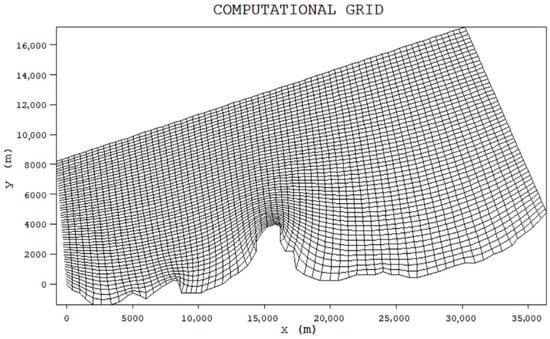
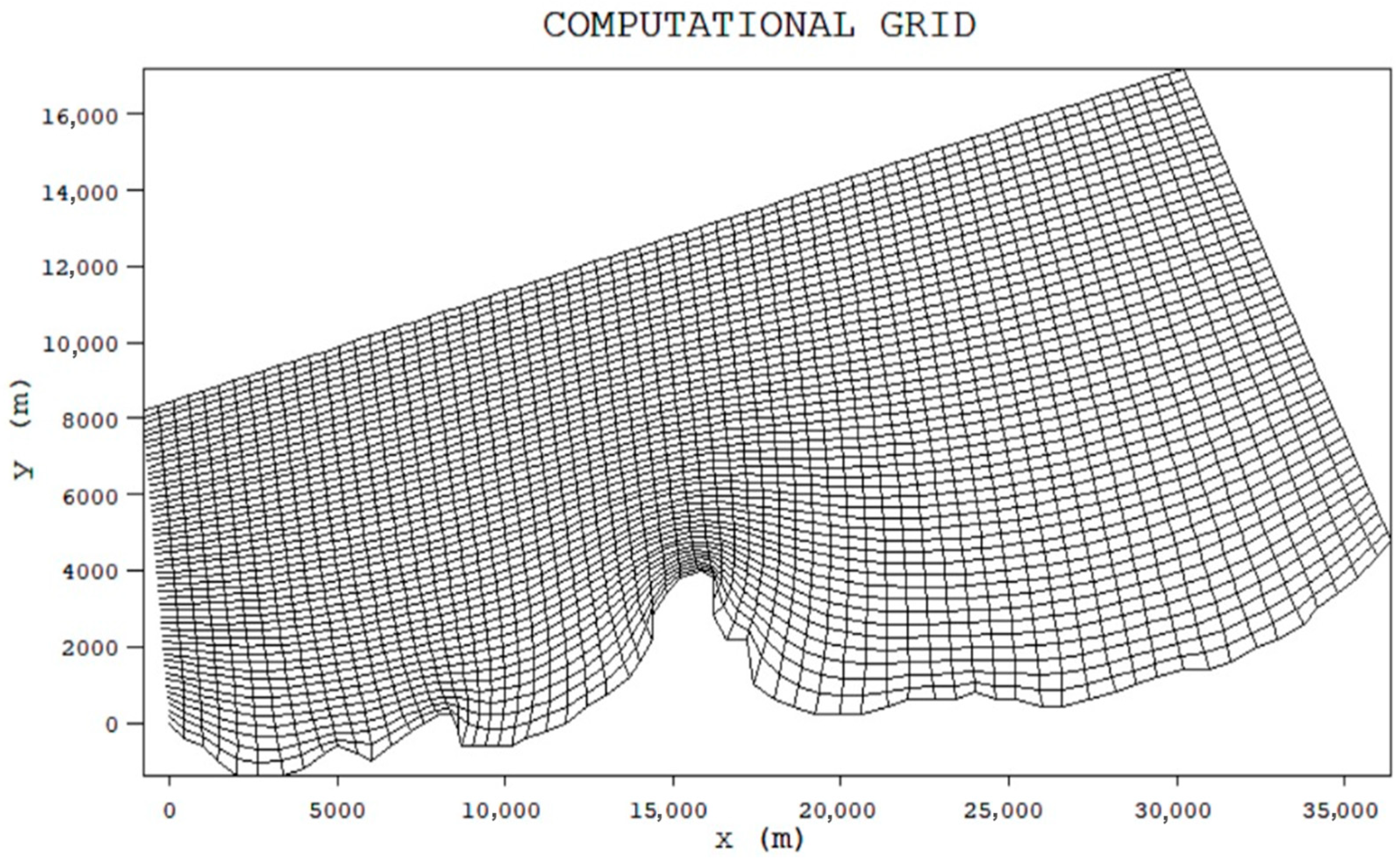
A hypothetical accidental spill scenario involving a sudden release of 50,000 m3 of used lubricating oil was simulated (Figure 1). The release was assumed to be instantaneous, with no continuous discharge during the simulation period. Evaporation effects were enabled, while tidal and variable wind conditions were disabled to isolate the influence of constant forcing conditions.
Figure 1.
Mesh of the computational domain used in the simulation.
The main input parameters used in the simulation are summarized below:
Oil properties
- Oil density: 901 kg/m3 [17]
- Friction factor between oil and water: 0.01
- Evaporation: enabled
Environmental conditions
- Wind velocity: Wx = 5.0 m/s, Wy = 0.0 m/s
- Ocean current velocity: 0.15 m/s
- Seawater density: 1030 kg/m3
- Tide and variable wind: not enabled
Spill configuration
- Initial spill coordinates:
- ○
- x1 = 3000, x2 = 8000
- ○
- y1 = 3000, y2 = 5000
- Time step: 500 s
- Total simulation time: 6000 s
The computational mesh was adapted to the coastal geometry of Tarragona, Spain, allowing a realistic representation of the dispersion process in nearshore marine environments [16].
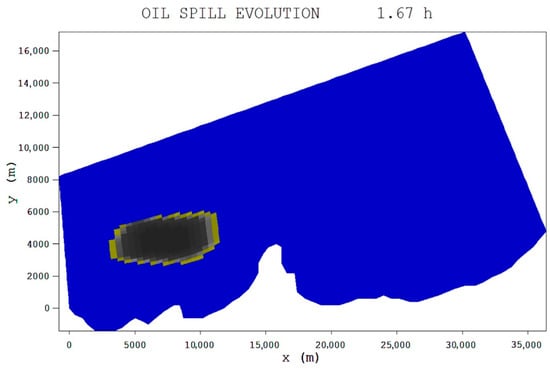
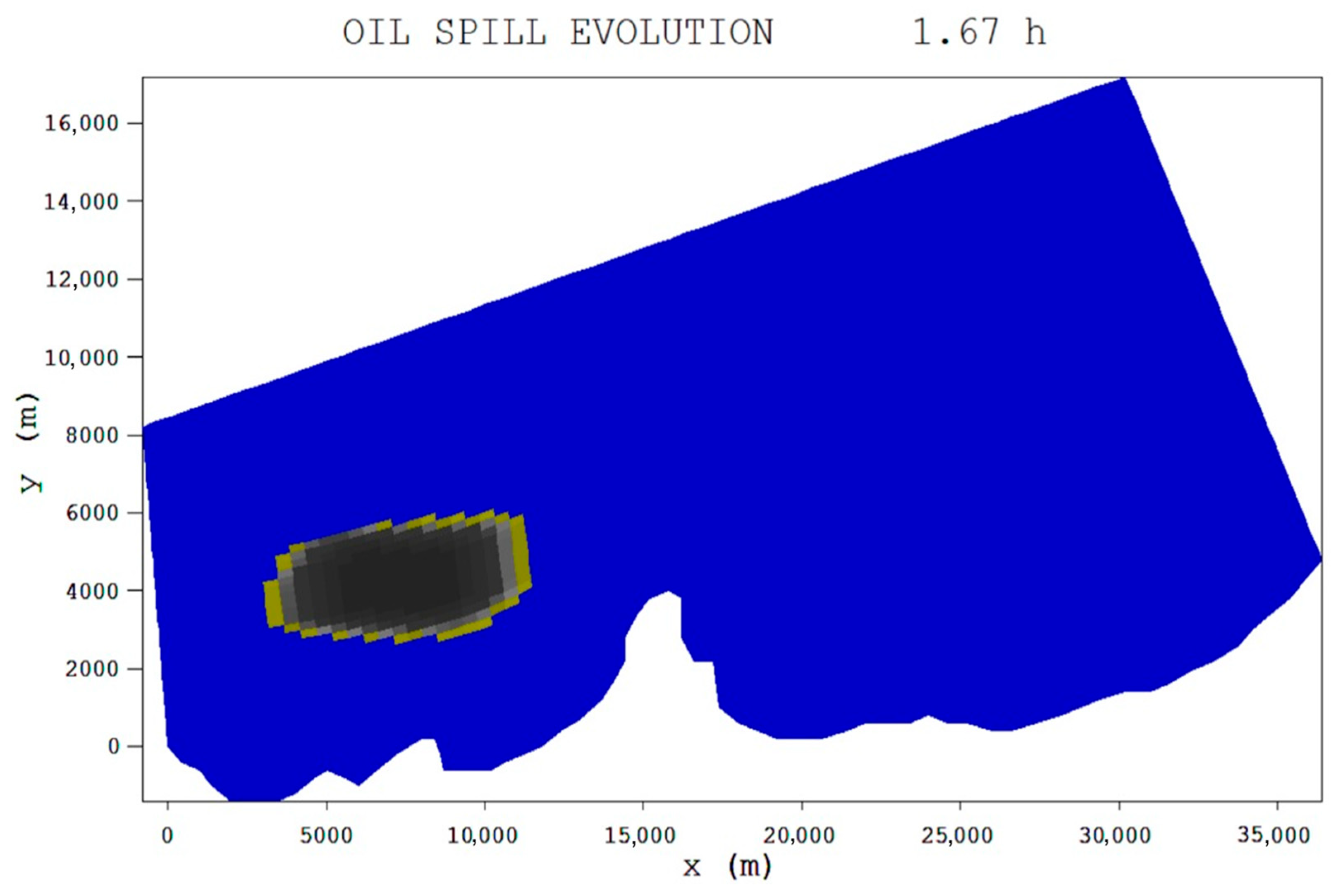
In Figure 2, the trajectory of the used lubricating oil over 1.67 h is shown. This numerical simulation using the SIMOIL model serves as an effective tool to predict the behavior of oil spills in marine environments. It allows for the analysis of the spatial and temporal dispersion of crude oil based on partial differential equations and real environmental parameters. By using specific variables such as oil density, wind speed, and ocean current, as well as evaporation and friction conditions, it is possible to recreate a realistic and controlled scenario that facilitates the understanding of environmental impact in marine settings following an accidental spill.
Figure 2.
Dispersion of a used lubricating oil spill in a marine environment.
The model outputs should be interpreted as indicative of potential dispersion patterns rather than as predictive environmental impact assessments.
2.5. Literature Review and Data Sources
A comprehensive literature review was conducted to analyze current technologies and management strategies for used lubricating oils. Peer-reviewed journal articles, technical reports, and regulatory documents were reviewed, covering regeneration, re-refining, filtration, adsorption, thermochemical conversion, and energy recovery processes.
The review also incorporated physicochemical characterization studies (e.g., viscosity, total acid number, heavy metal content), life cycle assessment (LCA), material circularity indicators (MCIs), and statistical analyses such as ANOVA and multivariate techniques. Regulatory and statistical data were obtained from official sources, including the European Commission, the Waste Framework Directive (WFD), the UK Environment Agency, and the U.S. Department of Energy.
Izza et al. (2018) [13] highlight that used lubricating oil (ULO) is a hazardous waste capable of contaminating groundwater and soils if improperly managed, while recycling reduces environmental impacts and the demand for virgin oils. Their study demonstrates that solvent extraction is an effective refining method, with oil recovery strongly influenced by both solvent type and solvent-to-oil ratio.
Emam and Shoaib (2013) [18] compared solvent extraction and vacuum distillation followed by hydrotreating for ULO re-refining. Solvent extraction provided superior improvements in base oil quality (TAN, pour point, ash content), whereas vacuum distillation achieved higher oil yields (≈84%). Both techniques significantly reduced contaminants and enhanced oil properties.
Saleem and Rahim (2019) [19] reported that vacuum distillation combined with thin-film evaporation and clay treatment produces re-refined oils that meet ASTM specifications, confirming the suitability of this technology for ULO recycling.
Widodo et al. (2020) [20] demonstrated the effectiveness of ultrafiltration using hydrophobic polypropylene membranes, achieving high removal efficiencies for ash, water, carbon residue, acidity, and metal contaminants, thereby improving oil quality under optimized temperature and pressure conditions.
López et al. (2018) [15] evaluated the energetic valorization of ULO in the Ecuadorian cement industry, reporting calorific values above 9500 kcal/kg. Substitution of up to 60% of conventional fuel showed no significant impact on combustion performance or emissions, supporting ULO use as an alternative fuel aligned with hazardous waste management policies.
Tejada et al. (2017) [1] conducted a physicochemical characterization of used engine oils and concluded that, despite the presence of wear-related metals and additives, ULOs are recyclable after appropriate acid and thermal treatments. Their results support the economic and environmental viability of oil recycling as a sustainable waste management strategy.
Parekh et al. (2024) [21] proposed a cost-effective recycling process combining distillation, acid treatment, bleaching, and adsorption using polyaniline–zeolite composites. Characterization analyses confirmed effective removal of heavy metals and aromatic impurities, yielding oils with improved density and viscosity. In a related review, Parekh et al. (2022) emphasized adsorption with conductive polymers as a promising alternative to conventional regeneration methods, offering high efficiency with reduced secondary waste generation [22].
Xu et al. (2023) [23] investigated ULO pyrolysis under different heating modes, showing that higher heating rates increase gas production and promote PAH formation, particularly toxic high-ring compounds. The study highlights the importance of controlling thermal conditions to balance product recovery and environmental risks.
Ortiz (2019) reviewed ULO management and recovery options, concluding that re-refining and controlled combustion can provide energetic benefits, provided that strict regulatory frameworks are applied to minimize emissions and environmental impacts [24].
Pinheiro et al. (2017) [25] analyzed over 30,000 ULO samples and identified contamination by water, sediments, chlorine, and glycol compounds as key barriers to regeneration. The authors emphasize the need for improved segregation and collection systems to maximize recycling efficiency within a circular economy framework.
Silva et al. (2022) [26] compared re-refining and combustion of ULO using life cycle assessment and circularity indicators, concluding that re-refining offers significantly lower environmental impacts and higher material circularity. Nevertheless, controlled combustion in cement kilns can be environmentally acceptable when replacing fossil fuels.
Salem et al. (2015) demonstrated that sulfuric acid-activated nanoporous bentonite is an efficient adsorbent for ULO regeneration, outperforming natural and nitric acid-treated clays by improving oil color, viscosity, and contaminant removal [27].
Pinheiro et al. (2018) characterized the thermophysical properties of ULO and developed predictive correlations for viscosity and surface tension, providing valuable data for optimizing treatment and regeneration processes [28].
Mamaghani et al. (2022) proposed converting solid waste from ULO refining into zeolite materials with high cation-exchange capacity, offering a sustainable solution for waste valorization with potential applications in water treatment [29].
Bhaskar et al. (2004) showed that catalytic cracking using Fe/SiO2 catalysts effectively desulfurizes and cracks ULO into lighter hydrocarbons, producing cleaner liquid fuels despite gradual catalyst deactivation by coke formation [30].
Uçar et al. (2005) demonstrated that co-pyrolysis of waste tires and ULO yields liquid fuels with improved quality and reduced heavy fractions, representing a viable route for recycling difficult-to-dispose wastes [31].
Pinheiro et al. (2018) further showed that solvent extraction using green solvents is effective for regenerating ester-based synthetic oils, significantly reducing viscosity, acidity, and contaminant content under optimized conditions [32]. In a complementary study, Pinheiro et al. (2017) highlighted the importance of classifying ULOs prior to alkaline treatment to avoid coagulation-related regeneration failures [33].
Kiran et al. (2023) demonstrated that fuels derived from pyrolyzed ULO, especially when combined with hydrogen, improve engine thermal efficiency and reduce most emissions, although NOx increases remain a challenge requiring further mitigation strategies [34].
Moses et al. (2023) [35] reviewed emerging ULO recycling technologies, identifying catalytic cracking as a cost-effective and sustainable option. The authors emphasize the importance of integrating technoeconomic and life cycle assessments to support decision making.
Manzanarez (2022) emphasized that used oils are valuable waste streams and that re-refining is the preferred option for producing high-quality base oils, while reprocessing and controlled incineration remain viable alternatives depending on contamination levels [36].
Cortés and Nielsen (2019) identified liquid propane extraction as one of the most efficient re-refining technologies, supporting the commercialization of regenerated base oils [37].
Muñoz et al. (2019) highlighted the environmental and health risks associated with improper ULO disposal and stressed the need for stricter regulations and improved treatment systems to enable safe reuse and material recovery [38].
Flores et al. (2019) demonstrated that biodegradation of oil-contaminated bentonite using bacterial consortia can achieve up to 50% hydrocarbon removal under extended treatment times, enabling potential reuse of the clay [39].
Aguilar (2019) showed that acid-activated bentonite significantly improves oil purification efficiency, reducing acidity and increasing viscosity index, with competitive economic performance [40]. Similarly, Armundaraín (2019) demonstrated that acetic acid extraction combined with SiO2 nanoparticles produces recovered oils with properties comparable to new lubricants, while generating less waste [41].
Zenteno (2019) confirmed the technical and economic feasibility of the acid–clay method for regenerating ULOs, producing oils that meet ASTM standards [42]. Mendoza (2015) further showed that filtration-based recovery of ULOs can achieve efficiencies of 85–90%, generating substantial economic and environmental benefits while reducing improper disposal practices [43].
2.6. Technical and Economic Evaluation Criteria
To compare the sustainability of different ULO management strategies, a conceptual technical–economic evaluation framework was defined. The assessment considered the following criteria:
- Process efficiency: percentage of base oil recovered and contaminant removal efficiency.
- Yield: proportion of usable regenerated oil relative to the initial ULO volume.
- Waste generation: quantity and hazardousness of secondary residues produced.
- Operating and investment costs: relative capital and operational expenditures as reported in the literature.
- Environmental performance: emissions, resource recovery potential, and contribution to circular economy objectives.
This framework was applied as a structured comparative tool across regeneration, filtration, adsorption, and energy recovery technologies to facilitate qualitative evaluation of their technical feasibility and sustainability implications.
The economic performance of regeneration technologies varies depending on scale, contamination level, regulatory framework, and energy costs. While literature sources frequently highlight the economic potential of solvent-based re-refining, direct quantitative comparisons across all management pathways remain limited and context dependent.
2.7. Comparative Analysis Tools
Based on the defined criteria, comparative tables were developed to synthesize the performance of the analyzed techniques. These tables cross-reference technical efficiency, economic feasibility, and environmental implications, providing a structured basis for discussion and decision making regarding sustainable ULO management strategies.
3. Sustainable Alternatives for Used Lubricating Oils
The sustainable management of used lubricating oils (ULOs) is a key challenge within the framework of hazardous waste treatment and circular economy implementation. Numerous technologies have been developed to recover base oils, remove contaminants, or valorize ULOs as alternative energy sources. This section reviews and discusses the most relevant regeneration, separation, adsorption, and thermochemical conversion strategies reported in the literature, highlighting their technical performance, environmental implications, and limitations.
3.1. Regeneration and Re-Refining Technologies
Re-refining is widely recognized as the most effective strategy for recovering high-quality base oils from ULOs, as it enables the reintegration of regenerated lubricants into the production cycle while reducing the demand for virgin oils. Among the available techniques, solvent extraction and vacuum distillation are the most extensively applied.
Solvent extraction processes remove contaminants such as sludge, oxidation products, metals, and additives by selective dissolution. Studies have demonstrated that both solvent type and solvent-to-oil ratio significantly influence recovery yield and oil quality. Izza et al. [13] reported recovery efficiencies close to 80%, with solvent selection playing a critical role in contaminant removal. Similarly, Pinheiro et al. [32] showed that green solvents such as 1butanol and methyl ethyl ketone (MEK) are effective in removing sludge and reducing total acid number (TAN), particularly for ester-based synthetic oils.
Vacuum distillation, often combined with hydrotreatment, enhances oil recovery by separating volatile fractions under reduced pressure. Emam and Shoaib [18] reported oil yields of approximately 84%, with significant improvements in viscosity index, flash point, and acidity. Thin-film evaporation, a variation of vacuum distillation, further improves thermal efficiency and preserves oil properties, as demonstrated by Saleem and Rahim [19].
Traditional re-refining methods using acid and clay treatment remain economically attractive due to their simplicity and low capital cost. However, these processes may generate hazardous secondary waste if not properly controlled [42]. The use of activated bentonite clays has been shown to enhance contaminant adsorption and improve oil clarity and viscosity index, offering a more sustainable alternative to conventional acid–clay processes [27,40]. The distinction between regeneration and recovery is essential when evaluating circular economy performance, as only regeneration pathways reintegrate material value into lubricant production cycles.
3.2. Separation and Filtration-Based Techniques
Membrane-based separation and filtration technologies have gained increasing attention as pretreatment or complementary processes for ULO regeneration. Ultrafiltration using hydrophobic membranes effectively removes water, ash, suspended solids, and metallic contaminants. Widodo et al. [20] reported removal efficiencies of up to 99% for ash and over 80% for water, significantly improving oil quality.
Microfiltration and coalescence techniques have also demonstrated high recovery efficiencies (85–90%), with reduced energy consumption compared to thermal methods. Mendoza [43] highlighted the economic and environmental benefits of these processes, particularly for industrial scale applications where the objective is partial purification or fuel grade oil recovery.
However, membrane fouling, high material costs, and the need for precise temperature and pressure control remain major limitations that restrict largescale deployment of these technologies.
3.3. Adsorption Using Conductive Polymers and Advanced Materials
Adsorption-based purification has emerged as a promising strategy for removing toxic contaminants from ULOs while minimizing secondary waste generation. Conductive polymers such as polyaniline (PANI), polypyrrole, and their composites with zeolites or clays have shown high adsorption capacities due to their macroporous structures and π–π interactions.
Parekh et al. [21,22] demonstrated that polymer-based adsorbents effectively remove heavy metals, aromatic compounds, and sludge, producing oils with reduced density and viscosity and improved physicochemical properties. Similarly, studies on acid-activated bentonites, zeolites, and nanoparticle-based adsorbents confirm their effectiveness in contaminant removal and oil clarification [27,29,40].
Although adsorption techniques are efficient and environmentally favorable, challenges related to adsorbent regeneration, disposal, and process scalability must be addressed to ensure long-term sustainability.
3.4. Thermochemical Conversion and Energy Recovery
Thermochemical processes such as pyrolysis, co-pyrolysis, catalytic cracking, and controlled combustion offer alternative routes for ULO valorization, particularly when regeneration is not technically feasible. Pyrolysis converts ULOs into liquid fuels, gases, and char; however, it may generate polycyclic aromatic hydrocarbons (PAHs) and other hazardous byproducts if thermal conditions are not carefully controlled [23].
Co-pyrolysis of ULOs with waste tires has been shown to improve fuel quality and reduce heavy fractions, producing liquid fuels with lower aromatic content [31]. Catalytic cracking processes further enhance desulfurization and molecular breakdown, yielding lighter and cleaner hydrocarbons [30,35].
The use of ULOs as alternative fuels in cement kilns and internal combustion engines provides high calorific values and contributes to fossil fuel substitution. Nevertheless, these applications require strict emission control systems to mitigate air pollution and comply with environmental regulations [15,26].
Overall, while energy recovery routes offer practical solutions for heavily contaminated oils, they generally exhibit lower circularity compared to re-refining strategies.
4. Results: Environmental Impact Assessment in Marine Environments
4.1. Oil Spill Dispersion Results
The numerical simulation conducted using the SIMOIL model provides insight into the spatial and temporal behavior of a hypothetical accidental spill of 50,000 m3 of used lubricating oil under constant wind and current conditions. The computational mesh adapted to the coastal profile of Tarragona enabled realistic representation of nearshore marine dispersion patterns (Figure 1).
Figure 2 illustrates the evolution of the oil slick over a simulation period of 1.67 h (6000 s). The results indicate a rapid horizontal displacement of the contaminant driven primarily by wind-induced drift and ocean currents. Even in the absence of tidal effects or variable wind conditions, the oil slick exhibited significant spreading, covering a wide marine area in a relatively short time.
4.2. Environmental Implications of the Simulated Spill
An analysis of the management and disposal of used lubricating oils (ULOs) across different geographic and sectoral contexts indicates a widespread lack of adequate infrastructure for their collection and treatment. This deficiency results in significant environmental impacts, particularly affecting soils and water bodies. For example, Tabango and Heredia (2011) [44] report that in Ecuador the low proportion of properly treated ULOs is mainly due to the absence of structured management systems and limited coordination among local authorities. Similarly, Torres (2014) [45], Romel (2020) [46], and Torres and Reyes (2021) [47] emphasize that the implementation of comprehensive collection and management plans could substantially mitigate these environmental impacts.
A common finding among the reviewed studies is the proposal of corrective measures, including the establishment of treatment plants and the development of environmental best practice guidelines. Hernández (2017) [48], Sosa et al. (2013) [49], and Salazar (2015) [50] propose the construction of treatment facilities to convert used oils into alternative fuels, such as diesel-like fuels. In contrast, Pozo (2016) [51] and Villanueva (2021) [52] stress the need to strengthen local regulatory frameworks to ensure the proper management of hazardous wastes. These approaches highlight the importance of integrating both technological and regulatory solutions.
Notable differences among the studies are observed in the specific solutions proposed. While Aguilar (2021) [53] and Pita (2019) [54] focus on the regeneration of ULOs through filtration and distillation processes, Eregie et al. (2023) [55] and Wen et al. (2019) [56] explore innovative treatment alternatives, including the use of nanoparticles and enhanced ozonation techniques. Additionally, Sarmiento (2023) [57] and Rivero (2018) [58] advocate for the establishment of community-based collection centers to facilitate the safe collection and temporary storage of used oils, underscoring the role of local communities in waste management.
Several authors, including Zaragoza (2006) [59], Hurtado et al. (2022) [60] (pp. 192–205), Ponce (2023) [61], Betancourt (2017) [62], Castro and Molina (2008) [63], Erazo (2017) [64], Zamora (2015) [65], Caicedo (2001) [66], Pastás (2014) [67], Padilla et al. (2022) [68] (pp. 1626–1644), Vázquez (2013) [69], and Márquez and Pucuna (2015) [70] emphasize the importance of training programs and the implementation of adequate storage and collection systems. These measures, supported by appropriate regulations, are essential for promoting sustainable practices and reducing soil and water contamination.
Lizbeth et al. (2020) [71] investigated biostimulation techniques for the remediation of soils contaminated with residual automotive oils, demonstrating the effectiveness of mineral solutions and vermicompost as low-cost and environmentally friendly alternatives.
Overall, the reviewed literature provides a comprehensive overview of the challenges associated with ULO management. Despite the diversity of contexts, there is a clear consensus on the need to improve infrastructure, strengthen regulatory frameworks, and promote environmental education and training. Furthermore, innovative strategies, such as advanced treatment technologies and community-based collection systems, emerge as key components of an integrated approach to mitigating the environmental impacts of these hazardous wastes.
The simulation results further underscore the high environmental risk associated with accidental ULO spills in marine environments. The rapid dispersion observed indicates that sensitive coastal ecosystems could be affected shortly after a release, significantly reducing the time available for emergency response and containment.
The numerical model identified zones of higher oil concentration and preferential transport pathways, which are critical for planning mitigation strategies and allocating response resources. The inclusion of diffusion and drift vectors enabled the identification of potential accumulation areas where ecological damage would likely be more severe.
Importantly, the results demonstrate that even under relatively stable environmental conditions, in the absence of extreme meteorological events, ULO dispersion can substantially compromise marine ecosystems. This finding reinforces the need for predictive modeling tools and robust emergency response systems to minimize ecological damage and enhance preparedness for accidental spills.
4.3. Implications for Risk Management and Emergency Planning
The SIMOIL-based simulation confirms the value of numerical modeling as a decision-support tool for environmental risk assessment. By integrating physicochemical oil properties with real environmental parameters, the model enables the prediction of spill trajectories and affected areas with reasonable accuracy.
These results emphasize the importance of preventive measures, rapid response protocols, and regulatory enforcement to reduce the probability and impact of ULO spills. From a broader perspective, they also support the argument that improving ULO regeneration and management practices can significantly reduce the likelihood of environmental contamination events.
The numerical simulation illustrates the spatial dispersion patterns and potential transport pathways of used lubricating oil under simplified and controlled hydrodynamic conditions. The model results describe the temporal evolution of surface spreading and concentration gradients, allowing qualitative assessment of dispersion dynamics. However, the simulation does not quantify ecological damage, toxicity levels, or shoreline impact. Instead, it provides a conceptual representation of how accidental releases may propagate within marine environments, supporting preventive management and risk awareness strategies.
5. Discussion
The management of used lubricating oils (ULOs) constitutes a complex environmental and technical challenge due to their hazardous composition, persistence in the environment, and potential impacts on human health and ecosystems. The presence of heavy metals, polycyclic aromatic hydrocarbons (PAHs), and degraded additives classifies ULOs as hazardous waste requiring controlled handling and treatment to prevent soil, water, and air contamination [1]. The results of this study, combined with the reviewed literature, allow a comparative evaluation of the most relevant treatment and valorization strategies within a sustainability and circular economy framework.
Among the analyzed technologies, solvent-based re-refining emerges as the most effective option for recovering high-quality base oils with physicochemical properties comparable to those of virgin lubricants. This approach offers significant environmental advantages by reducing the demand for crude oil extraction and refining, thereby lowering associated emissions and resource consumption [18]. However, the generation of secondary residues, such as contaminated sludge or spent solvents, remains a limitation that requires appropriate treatment and disposal strategies to avoid shifting environmental burdens [13].
Thermochemical conversion processes, particularly pyrolysis, represent an alternative pathway for managing ULOs that are unsuitable for regeneration due to severe contamination or degradation. Pyrolysis enables the conversion of ULOs into fuels and chemical feedstocks, contributing to waste volume reduction and energy recovery [23]. Nevertheless, the formation of PAHs and other toxic byproducts during thermal degradation poses environmental and health risks if process conditions are not carefully controlled, emphasizing the need for advanced emission treatment systems and strict operational standards [72]. Consequently, while pyrolysis offers flexibility and energy recovery potential, its overall circularity is lower than that of re-refining processes.
Adsorption-based purification using conductive polymers has been identified as a promising emerging technology, particularly as a complementary step within re-refining schemes. Materials such as polyaniline, polymer–clay composites, and zeolite-based adsorbents have demonstrated high efficiency in removing heavy metals, aromatic compounds, and sludge, leading to substantial improvements in oil quality [21]. Although this approach is still under development, its low operational complexity and high contaminant removal efficiency suggest strong potential for integration with vacuum distillation, membrane filtration, or solvent extraction processes, enhancing overall recovery yields and sustainability [20].
The comparative overview presented in Table 1, Table 2, Table 3 and Table 4 highlights the structural differences among regeneration, reprocessing, and energy recovery pathways. As summarized in Table 1, regeneration technologies aim to recover base oil and reintegrate material value into the production cycle, whereas Table 2 illustrates that reprocessing techniques primarily improve oil quality without fully restoring base oil properties. In contrast, Table 3 shows that thermochemical and energy recovery routes convert ULOs into secondary fuels or energy carriers, thus limiting material circularity. Table 4 presents energy recovery and thermochemical conversion pathways. This structured comparison clarifies the distinct sustainability implications associated with each pathway and supports the need for differentiated regulatory and management strategies.
Table 1.
Comparison of physicochemical properties between new oil and used oil [14].
Table 2.
Regeneration technologies for base oil recovery.
Table 3.
Reprocessing and Filtration Techniques for Used Lubricating Oils.
Table 4.
Energy recovery and thermochemical conversion pathways.
From a broader sustainability perspective, the energetic use of ULOs as alternative fuels—particularly in cement kilns—offers a viable option for waste valorization when regeneration is not feasible. This strategy contributes to fossil fuel substitution and energy recovery, provided that strict emission control measures are implemented to mitigate air pollution [15]. However, the long-term environmental implications, including greenhouse gas emissions and cumulative pollutant release, require further assessment to ensure compliance with climate and air quality objectives.
A critical barrier to sustainable ULO management remains the lack of adequate collection infrastructure, regulatory enforcement, and economic incentives, especially in developing regions. Insufficient policies and limited public awareness have resulted in widespread improper practices such as illegal dumping and uncontrolled burning, exacerbating environmental degradation [4]. Strengthening regulatory frameworks, promoting extended producer responsibility schemes, and enhancing environmental education are essential measures to improve collection rates and ensure environmentally sound treatment.
Overall, the comparative analysis indicates that solvent re-refining, particularly when combined with advanced adsorption techniques, offers the most favorable balance between technical efficiency, economic feasibility, and environmental performance. These approaches allow recovery rates of up to 85–90% of the original oil volume while minimizing waste generation, aligning closely with circular economy principles and sustainable resource management objectives [43].
Effective regeneration of used lubricating oils strongly depends on adequate source segregation and classification prior to treatment. Mixing mineral, synthetic, and industrial oils may significantly reduce regeneration efficiency, increase processing complexity, and generate additional waste streams. Different lubricant formulations contain varying additive packages, contaminants, and degradation products, which influence both the technical feasibility and economic performance of re-refining processes. Therefore, segregated collection systems and categorized storage practices are essential to enhance base oil recovery rates, reduce operational costs, and improve the overall sustainability of the regeneration pathway. Strengthening upstream segregation mechanisms represents a critical step toward optimizing circular economy performance in ULO management.
6. Conclusions
Used lubricating oils constitute a significant hazardous waste stream due to the presence of heavy metals, degraded additives, and polycyclic aromatic hydrocarbons, requiring specialized management strategies to prevent environmental and human health impacts. The conceptual numerical simulation presented in this study illustrates the potential dispersion dynamics of accidental ULO releases under simplified marine conditions, highlighting the importance of preventive measures, adequate collection systems, and emergency preparedness.
The structured comparison of treatment pathways indicates that regeneration and re-refining technologies generally offer higher material circularity potential, as they enable the recovery of base oil suitable for reintegration into lubricant production. However, their environmental and economic performance depends strongly on contamination levels, process configuration, and effective upstream segregation practices. Emerging adsorption and advanced material-based purification technologies may further enhance contaminant removal efficiency, although their scalability and long-term sustainability require further investigation.
Thermochemical processes such as pyrolysis and catalytic cracking provide alternative management routes for heavily contaminated oils unsuitable for regeneration. These pathways primarily contribute through energy recovery and therefore present lower material circularity, while requiring strict emission control to minimize secondary environmental impacts. Similarly, controlled use of ULOs as alternative fuels may support energy substitution strategies when aligned with appropriate environmental safeguards.
The analysis also underscores the importance of proper classification and pretreatment of ULOs. Segregated collection systems and differentiated handling of mineral, synthetic, and industrial oils can significantly improve regeneration efficiency and reduce secondary waste generation.
Overall, sustainable ULO management requires integrated regulatory frameworks, technological innovation, and improved collection infrastructures. Future research should prioritize harmonized technoeconomic assessments, standardized life cycle comparisons, and enhanced spill-risk modeling approaches to strengthen decision making and advance circular economy implementation.
Author Contributions
Conceptualization, C.C.-E. and J.M.-G.; methodology, V.D.-G.; validation, R.R.-M. and E.P.-V.; formal analysis F.C.-C.; investigation C.C.-E. and V.D.-G.; resources, J.M.-G.; data curation, F.C.-C.; writing—original draft preparation, R.R.-M.; writing, E.P.-V.; supervision, C.C.-E.; project administration, V.D.-G. All authors have read and agreed to the published version of the manuscript.
Funding
This research received no external funding.
Data Availability Statement
No new data were created or analyzed in this study.
Acknowledgments
We thank the research group “Eficiencia Energética en el Transporte Marítimo” (RNM920) for their support of this research.
Conflicts of Interest
The authors declare no conflicts of interest.
Abbreviations
Note: In this manuscript, the acronym ULO (Used Lubricating Oil) is used consistently.
The following abbreviations are used in this manuscript:
| ANN | Artificial neural network |
| ANOVA | Analysis of variance |
| ASTM | American Society for Testing and Materials |
| CEC | Cation-exchange capacity |
| CONAMA | The National Council for the Environment |
| FESEM | Field emission scanning electron microscopy |
| FTIR | Fourier-Transform Infrared Spectroscopy |
| LCA | Life Cycle Assessment |
| LOUC | Lubricant Oil Used and Contaminated |
| LTA | Linde Type A |
| MCI | Material Circularity Indicator |
| MEK | Methyl ethyl ketone |
| PAH | Polycyclic aromatic hydrocarbon |
| PAHs | Polycyclic aromatic hydrocarbons |
| PANI | Polyaniline |
| PCB | Polychlorinated biphenyl |
| PCBs | Polychlorinated biphenyls |
| PCT | Passenger car tire |
| PSR | Percent sludge removal |
| RSM | Response surface methodology |
| SCW | Spent coolant waste |
| SN | Saponification number |
| TAN | Total acid number |
| Tg | Glass transition |
| TPH | Total petroleum hydrocarbon |
| TT | Truck tire |
| Tx | Dynamic crossover |
| ULO | Used lubricant oil |
| ULOs | Used lubricant oils |
| UVVis | Ultraviolet visible |
| WFD | Waste Framework Directive |
| WLF | Williams–Landel–Ferry |
| XRD | X-ray diffraction |
References
- Tejada, N.; Quiñones, E.; Fong, W. Physicochemical characterization of used engine oils for recycling. Prospectiva 2017, 15, 135–144. [Google Scholar] [CrossRef] [Scilit]
- Yash, P.M. Refining of used lubricating oil. Int. J. Sci. Eng. Res. 2015, 6, 329. Available online: https://www.semanticscholar.org/paper/Re-refining-of-used-lubricating-oil-MeraiYash/675cd57d2c5ee63b41fb14ce515ed39a3c5fc214 (accessed on 15 November 2025). [CrossRef] [Scilit]
- Stahl, H.; Merz, C. Study to Support the Commission in Gathering Structured Information and Defining Reporting Obligations on Waste Oils and Other Hazardous Waste; European Commission: Brussels, Belgium, 2020. [Google Scholar]
- Hazardous Waste: Segregation and Mixing. Environment Agency, GOV.UK, 4 April 2014 (last updated 1 October 2020). Available online: https://www.gov.uk/guidance/hazardous-waste-segregation-and-mixing (accessed on 15 November 2025).
- Morkunas, I.; Woźniak, A.; Chung, V.; Rucińska, R.; Jeandet, P. The role of heavy metals in plant response to biotic stress. Int. J. Mol. Sci. 2018, 19, 232. [Google Scholar] [CrossRef] [Scilit]
- Vazquez, R. Environmental impact of used motor oil. Sci. Total Environ. 1989, 79, 1–23. [Google Scholar] [CrossRef] [Scilit]
- Belkhode, C.; Sakhale, A.; Bejalwar, L. Evaluation of experimental data to determine the performance of a solar chimney power plant. Mater. Today Proc. 2020, 27, 102–106. [Google Scholar] [CrossRef] [Scilit]
- Basha, S.; Gopal, K.; Jebaraj, A. A review on biodiesel production, combustion, emissions, and performance. Renew. Sustain. Energy Rev. 2009, 13, 1628–1634. [Google Scholar] [CrossRef] [Scilit]
- European Commission. Circularity of Mineral and Synthetic Lubrication and Industrial Waste Oil Management in the EU; Waste Framework Directive Report; European Commission: Brussels, Belgium, 2023. [Google Scholar]
- U.S. Department of Energy. Used Oil ReRefining Study to Address Energy Policy Act of 2005 (Section 1838); U.S. Department of Energy: Washington, DC, USA, 2006.
- European Commission. Waste Oils. 2019. Available online: https://ec.europa.eu/environment/waste/oil_index.htm (accessed on 15 November 2025).
- European Commission. Report from the Commission to the European Parliament and the Council on the Implementation of Directive 2008/98/EC on Waste Oils 13; European Commission: Brussels, Belgium, 2023. [Google Scholar]
- Izza, H.; Abdessalam, B.; Bouida, M.; Haddad, A. Recycling of used motor oil as an alternative feedstock for conversion processes. Pet. Sci. Technol. 2018, 36, 1511–1515. [Google Scholar] [CrossRef] [Scilit]
- Rajan, K.; Manoj, A.; Paladi, R.; Nallusamy, S.; Senthil, K. Performance assessment of a DI diesel engine using waste transformer oil at different compression ratios. Int. J. Ambient. Energy 2020, 43, 3536–3544. [Google Scholar] [CrossRef] [Scilit]
- López, J.; Allauca, F.; Veloz, F.; Zambrano, T. Energy valorization of used lubricating oil in thermal combustion systems of the Ecuadorian cement industry. Novasinergia 2019, 1, 60–70. [Google Scholar]
- Grifoll, J. Environmental Flows and Contaminant Dispersion. Ph.D. thesis, Rovira i Virgili University, Tarragona, Spain, 2025. [Google Scholar]
- Negasa, A.; Babu, R.; Alemayehu, G. Optimization, characterization, and GC-MS analysis of recycled used engine oil by solvents and adsorbent extraction. Sci. Rep. 2025, 15, 517. [Google Scholar] [CrossRef] [Scilit]
- Emam, E.A.; Shoaib, A.M. Re-refining of used lube oil by solvent extraction and vacuum distillation followed by hydrotreating. Pet. Coal 2013, 55, 179–187. [Google Scholar]
- Saleem, H.; Rahim, A. Rerefining of used lubricating oil by vacuum distillation and thin wiped film evaporation. Pet. Sci. Technol. 2019, 38, 1–8. [Google Scholar] [CrossRef] [Scilit]
- Widodo, S.; Khoiruddin, K.; Ariono, D.; Subagjo, S.; Wenten, I. Rerefining of waste engine oil using ultrafiltration membranes. J. Environ. Chem. Eng. 2020, 8, 103700. [Google Scholar] [CrossRef] [Scilit]
- Parekh, K.; Gaur, R.; Shahabuddin, S. A facile approach for refining waste lubricant oil: A hazardous water contaminant. Mater. Today Proc. 2024. [Google Scholar]
- Parekh, K.; Shahabuddin, S.; Gaur, R.; Dave, N. Prospects of conducting polymers as adsorbents for used lubricant oil reclamation. Mater. Today Proc. 2022, 62, 7053–7056. [Google Scholar] [CrossRef] [Scilit]
- Xu, L.; Yu, J.; Wang, W.; Wan, G.; Lin, L.; Sun, L. Upgrading and PAHs formation during used lubricating oil pyrolysis under different heating modes. J. Anal. Appl. Pyrolysis 2023, 169, 105813. [Google Scholar] [CrossRef] [Scilit]
- Ortiz, M. Used Lubricating Oils as an Alternative Energy Source. MiamiDade, Bachelor’s Thesis, Universidad Tecnológica de La Habana "José Antonio Echeverría" (CUJAE), La Habana, Cuba, 2019. [Google Scholar]
- Pinheiro, T.; Ascensão, R.; Cardoso, M.; Quina, J.; GandoFerreira, M. Overview of waste lubricating oil management systems. J. Clean. Prod. 2017, 150, 301–317. [Google Scholar] [CrossRef] [Scilit]
- Silva, R.; Rodrigues, O.; Braga, N.; Christoforo, L.; Silva, L. Rerefining or combustion of used lubricating oil in cement plants? Sustain. Prod. Consum. 2022, 33, 360–371. [Google Scholar] [CrossRef] [Scilit]
- Salem, S.; Salem, A.; Babaei, A. Application of nanoporous Cabentonite for recovery of waste lubricating oil. J. Ind. Eng. Chem. 2015, 23, 154–162. [Google Scholar] [CrossRef] [Scilit]
- Pinheiro, T.; Pais, F.; Ferreira, M.; Quina, J.; GandoFerreira, M. Thermophysical properties of waste lubricating oils. J. Chem. Thermodyn. 2018, 116, 137–146. [Google Scholar] [CrossRef] [Scilit]
- Mamaghani, A.; Salem, A.; Salem, S. Conversion of spent lubricant oil refinery waste into zeolitepacked beds. Process Saf. Environ. Prot. 2022, 159, 500–510. [Google Scholar] [CrossRef] [Scilit]
- Bhaskar, T.; Uddin, A.; Muto, A.; Sakata, Y.; Omura, Y.; Kimura, K.; Kawakami, Y. Recycling of waste lubricating oil into fuels using iron oxide catalysts. Fuel 2004, 83, 9–15. [Google Scholar] [CrossRef] [Scilit]
- Uçar, S.; Karagöz, S.; Yanik, J.; Saglam, M.; Yuksel, M. Copyrolysis of scrap tires with waste lubricating oil. Fuel Process. Technol. 2005, 87, 53–58. [Google Scholar] [CrossRef] [Scilit]
- Pinheiro, T.; Pais, F.; Quina, J.; GandoFerreira, L. Regeneration of waste lubricating oil using green solvents. J. Clean. Prod. 2018, 200, 578–587. [Google Scholar] [CrossRef] [Scilit]
- Pinheiro, T.; Ascensão, R.; Reis, S.; Quina, J.; GandoFerreira, M. Datadriven study of coagulation phenomena in waste lubricating oils. Sci. Total Environ. 2017, 599–600, 2054–2064. [Google Scholar] [CrossRef] [Scilit]
- Kiran, S.; Martin, J.; Sonthalia, A.; Varuvel, G. Synergistic effect of hydrogen and waste lubricating oil in compression ignition engines. Int. J. Hydrog. Energy 2023, 48, 23296–23307. [Google Scholar] [CrossRef] [Scilit]
- Moses, K.; Aliyu, A.; Hamza, A.; MohammedDabo, A. Recycling of waste lubricating oil: A review. J. Environ. Chem. Eng. 2023, 11, 111273. [Google Scholar] [CrossRef] [Scilit]
- Manzanarez, A. Recovery Alternatives for Used Lubricating Oils. Epistemus 2022, 16, 12. [Google Scholar]
- Cortés, A.; Nielsen, M. Valorization of Used Automotive Lubricating Oil as a Business Opportunity. Bachelor’s thesis, Universidad El Bosque, Bogotá, Colombia, 2019. [Google Scholar]
- Muñoz, E.; Montoya, D.; Muñoz, A. Management of used motor oil pollution in Colombia. Rev. Ambient. ÉOLO 2019, 18, 87–108. [Google Scholar]
- Flores, J.; Patiño, A.; Erazo, R. Biodegradation of lubricating oil residues retained in bentonite using bacterial consortia. Sci. Agropecu. 2019, 85, 163–174. [Google Scholar]
- Aguilar, J. AcidActivated Bentonite for Purification of Used Automotive Lubricating Oils. Bachelor’s thesis, Escuela Politécnica Nacional, Quito, Ecuador, 2019. [Google Scholar]
- Armundaraín, O. Recovery of Used Lubricating Oils Using Acetic Acid Extraction and SiO2 Nanoparticles. Bachelor’s thesis, Universidad Central de Venezuela, Caracas, Venezuela, 2019. [Google Scholar]
- Zenteno, E. Implementation of An Acid–Clay Treatment System for Used Automotive Oil Refining. Bachelor’s thesis, UNTELS, Lima, Peru, 2019. [Google Scholar]
- Mendoza, I. Recovery of used lubricating oils. Cienc. UNEMI 2015, 1, 16–21. [Google Scholar]
- Tabango, R.; Heredia, G. Management Alternatives for Contaminated Fluids in Automotive Workshops. Bachelor’s thesis, ESPE University, Ibarra, Ecuador, 2011. [Google Scholar]
- Torres, P. Design of A Collection and Rerefining Plan for Used Lubricating Oils in Loja. Bachelor’s thesis, UID, Quito, Ecuador, 2014. [Google Scholar]
- Romel, P. Hazardous Waste Management Plan for An Automotive Company. Bachelor’s thesis, Universidad Continental, Huancayo, Peru, 2020. [Google Scholar]
- Torres, R.; Reyes, R. Management of Used Lubricating Oils and Soil Quality Criteria. Bachelor’s thesis, ESPAM MFL, Calceta, Ecuador, 2021. [Google Scholar]
- Hernández, G. Energy Valorization of Used Lubricating Oils Under Law 20.920. Master’s thesis, UTFSM, Valparaiso, Chile, 2017. [Google Scholar]
- Sosa, E.; Castillo, C.; Talbot, J. Production and Commercialization of Lubricating Base Oils From Used Oil. Master’s thesis, ESPOL, Guayaquil, Ecuador, 2013. [Google Scholar]
- Salazar, R. Management and Disposal of Liquid Waste Lubricating Oils. Bachelor’s thesis, Universidad de San Carlos, Guatemala, Guatemala, 2015. [Google Scholar]
- Pozo, Y. Municipal Ordinance for Environmental Management of Lubricating Oils and Hydrocarbon Solvents. Bachelor’s thesis, UNIANDES, Ibarra, Ecuador, 2016. [Google Scholar]
- Villanueva, G. Sustainable Management of Used Mineral Oils in Vehicle Lubrication Facilities. Bachelor’s thesis, UTEQ, Quevedo, Ecuador, 2021. [Google Scholar]
- Aguilar, D. Design of a Regeneration System for Used Multigrade Lubricating Oils. Bachelor’s thesis, USAT, Chiclayo, Peru, 2021. [Google Scholar]
- Pita, A. Optimization of Liquid and Solid Waste from Car Wash and Lubrication Facilities. Bachelor’s thesis, UPSE, La Libertad, Ecuador, 2019. [Google Scholar]
- Eregie, B.; Sanusi, A.; Kana, B.; Ademola, O. Biodegradation of spent lubricating oil using microalgae and nanoparticles. Bioresour. Technol. Rep. 2023, 24, 101627. [Google Scholar] [CrossRef] [Scilit]
- Wen, C.; Wang, H.; Wang, L.; Lou, Z.; Sun, Z.; Zhou, Z. Zerodischarge reduction of waste lubricating oil distillate by ozonation. J. Clean. Prod. 2019, 240, 118194. [Google Scholar] [CrossRef] [Scilit]
- Sarmiento, F. Community collection center for used lubricating oils. Polo Del Conoc. 2023, 8, 1062–1080. [Google Scholar]
- Rivero, J. Reuse Project for Residual Automotive Oils in Lima Metropolitan Area. Bachelor’s thesis, Universidad Alas Peruanas, Lima, Peru, 2018. [Google Scholar]
- Zaragoza, U. Waste management policy: Used oils. Rev. De Econ. Apl. 2006, 42, 81–100. [Google Scholar]
- Hurtado, S.; Chávez, A.; Castillo, E. Lubricant management in automotive workshops. Rev. Cienc. Norandina 2022, 5, 192–205. [Google Scholar]
- Ponce, D. Situation Analysis of Used Lubricating Oil Management in Automotive Centers. Bachelor’s thesis, UNDAC, Cerro de Pasco, Peru, 2023. [Google Scholar]
- Betancourt, J. Proposal for Recycling Used Lubricating Oils from Automotive Workshops. Bachelor’s thesis, UNL, Loja, Ecuador, 2017. [Google Scholar]
- Castro, D.; Molina, D. Environmental Impacts of Lubricating Oils Used by Vehicle Fleets. Bachelor’s thesis, UDLA, Quito, Ecuador, 2008. [Google Scholar]
- Erazo, G. Pollution Caused by Used Lubricating Oils and Constitutional Environmental Rights. Bachelor’s thesis, UNIANDES, Ambato, Ecuador, 2017. [Google Scholar]
- Zamora, D. Management of Used Lubricating Oils in Car Wash and Lubrication Facilities. Bachelor’s thesis, UTEQ, Quevedo, Ecuador, 2015. [Google Scholar]
- Caicedo, R. Guide for the Management of Used Oils in Industry and Automotive Sectors. Bachelor’s thesis, Universidad de La Salle, Bogotá, Colombia, 2001. [Google Scholar]
- Pastás, L. Cost Systems and Sustainable Production of Recyclable Automotive Byproducts. Bachelor’s thesis, UISEK, Quito, Ecuador, 2014. [Google Scholar]
- Padilla, C.; Buenaño, L.; Audelo, M.; Sánchez, D. Assessment of lubricating oil contamination in automotive workshops. Dominio De Las Cienc. 2022, 8, 1626–1644. [Google Scholar]
- Vázquez, J. Integrated Management of Recyclable Automotive Oil in Cuenca. Master’s thesis, Universidad de Cuenca, Cuenca, Ecuador, 2013. [Google Scholar]
- Márquez, F.; Pucuna, F. Environmental Impact of Solid and Liquid Waste from Car Wash Facilities. Bachelor’s thesis, UNEMI, Milagro, Ecuador, 2015. [Google Scholar]
- Lizbeth, P.; Liliana, M.; Cruz, L.; Yáñez, S.; Sánchez, J.; Suelo, N. Environmental management studies in the Selva Andina region. J. Selva Andin. Res. Soc. 2020, 11, 84–93. [Google Scholar]
- Osses, A. Sustainable development: Used Lubricating Oils in Punta Arenas—Generation and Treatment Options. Bachelor’s Thesis, Universidad de Magallanes, Punta Arenas, Chile, 2014. [Google Scholar]

Disclaimer/Publisher’s Note: The statements, opinions and data contained in all publications are solely those of the individual author(s) and contributor(s) and not of MDPI and/or the editor(s). MDPI and/or the editor(s) disclaim responsibility for any injury to people or property resulting from any ideas, methods, instructions or products referred to in the content. |
© 2026 by the authors. Licensee MDPI, Basel, Switzerland. This article is an open access article distributed under the terms and conditions of the Creative Commons Attribution (CC BY) license.