


Abstract
This study investigates the material recycling potential of discarded wind instrument reeds (Arundo donax), which are conventionally incinerated, by compounding them with thermoplastics (thermoplastic polyolefin, TPO; polybutylene succinate, PBS). After recovered reeds were pulverized and injection-molded at 10 and 30 wt% concentrations, their mechanical and interfacial properties were evaluated. Experimentally obtained results indicate that waste reeds function as effective reinforcing agents, particularly when combined with biodegradable PBS. Incorporating 30 wt% reed flour into PBS enhanced flexural strength by approximately 1.7 times and flexural modulus by 2.8 times compared to the neat resin. This superior performance relative to TPO composites is attributed to robust interfacial hydrogen bonding among PBS carbonyl groups and the hydroxyl groups on the reed surface. Additionally, thermal and spectroscopic analyses revealed that these strong interactions elevate the crystallization temperature and generate a “Rigid Amorphous Phase” (RAF) that facilitates efficient stress transfer. These research findings demonstrate the feasibility of creating high-quality, bio-based composites, offering a sustainable method to reduce petroleum reliance and carbon dioxide emissions by upcycling musical waste.
1. Introduction
The progression of global warming, manifesting as climate change, sea-level rise, and ecosystem degradation, poses severe threats to global sustainability. Particularly, anthropogenic carbon dioxide (CO2) emissions are considered the primary driver of global warming. Their mitigation is a crucially important international challenge. According to the Sixth Assessment Report of the Intergovernmental Panel on Climate Change (IPCC), the waste management sector accounts for approximately 3.9% of global greenhouse gas emissions, with the majority attributed to waste incineration [1]. Furthermore, the European Environment Agency (EEA) and the United Nations Environment Programme (UNEP) have pointed out that incineration is, in the long run, incompatible with establishment of a resource-circulating society [2,3].
Incineration is a hygienic and immediate disposal method, but it hinders the reuse of resources. Moreover, it is not necessarily optimal from a sustainability perspective. The incineration of waste with a recycling potential that is not fully recognized, so-called “unutilized biomass”, is viewed as particularly problematic in terms of both environmental load and resource wastage. A prime example of such unutilized resources is the great amount of reeds used for woodwind instruments.
Generally, reeds are made from Arundo donax (giant cane), a natural material composed primarily of cellulose. Whereas this material is lightweight, flexible, and possessed of excellent acoustic properties, its natural origin results in considerable variation in quality. Individual reeds that fail to meet players’ standards are often discarded unused. Currently, a great number are incinerated annually on a national scale, by schools, musical organizations, and individuals [4]. The total annual production of musical instrument reeds worldwide is estimated to reach approximately 30 million pieces [5]. This indicates a broad user base, ranging from professional musicians to amateurs and students, consuming reeds on the premise of regular replacement. The demand structure for reeds is heavily dependent on the prevalence of instruments and their adoption within educational institutions, with clarinets and saxophones accounting for the majority of total production.
Bio-based composites obtained by filling thermoplastic resins with natural fibers have recently attracted attention. Cellulose fibers especially possess superior characteristics such as light weight, high strength, and high rigidity. They have been reported as promising environmentally friendly reinforcement materials capable of replacing conventional inorganic reinforcement fillers (e.g., glass fibers). Abou-Zeid et al. [6] fabricated composites by kneading natural reed fibers into thermoplastic resins such as polypropylene (PP), polystyrene (PS), and polyethylene (PE), demonstrating improved interfacial adhesion and consequent mechanical property enhancements through benzylation treatment. Similarly, Ortega et al. [7] clarified that the reed material used for instruments is effective as a new bio-source, suggesting potential for high performance through heat treatment, chemical modification, and fiber shape optimization.
Furthermore, Suárez et al. [8] developed a semi-automated method for quantitative evaluation of the dimensions and orientation of natural fibers kneaded into thermoplastics via image analysis, enabling the assessment of how fiber shortening and dispersion during extrusion affect the mechanical properties of composites. Suárez et al. [9] also reported that rotationally molded articles using PLA and PE filled with reed fibers achieved both mechanical performance and biodegradability, contributing to both functionality and reduced environmental impact.
Common to these preceding studies is the recognition that thermoplastic composites using natural fibers are next-generation materials contributing to a circular society. Additionally, research is being conducted focused on developing new composite materials using waste scheduled for incineration, with the aim of reducing carbon dioxide emissions. For example, Mohanty et al. review the scientific challenges and innovative solutions in developing composite materials using renewable resources [10]. Das et al. provide a comprehensive review of research on reusing agricultural waste (almond shells, coconut shells, rice bran, etc.) and industrial waste (fly ash, marble powder, discarded printed circuit boards, etc.) as reinforcing materials in polymer composites [11]. Taurino et al.’s report focuses on strategies for utilizing solid waste in thermoplastic and thermosetting resin matrices for sustainable material production [12]. Formela et al. detail recent technological advances in recycling wood–polymer composites (WPC), polyurethane (PUR) foam, and rubber [13]. They also identify the greatest barriers to waste utilization as the chemical composition heterogeneity and quality instability of feedstocks, clearly outlining challenges for upscaling from laboratory to industrial scale.
Furthermore, the mechanical properties of thermoplastic composite materials utilizing natural fibers exhibit significant variability regardless of the manufacturing process. This is largely attributed to the considerable individual variation inherent in natural fibers. In contrast, the musical instrument reeds targeted in this research are highly refined reed products. By pulverizing these reeds and dispersing them within thermoplastic materials, it is anticipated that biomass composites with stable mechanical properties can be produced.
For use in this study, unused and waste-scheduled woodwind reeds were pulverized and melt-kneaded with thermoplastics to fabricate lignocellulosic-filler-reinforced composites. Additionally, by evaluating the mechanical properties and fracture behavior of the obtained composites, this study was designed to clarify the effectiveness of reed-derived lignocellulose as a reinforcement filler and to elucidate its potential for reducing environmental impact through recycling. It is anticipated that this research, from the novel perspective of musical instrument waste, will serve as a starting point for the development of new materials that contribute to the high functionalization of biomass recycling and CO2 emission reduction.
2. Results
2.1. Density of Pulverized Reeds
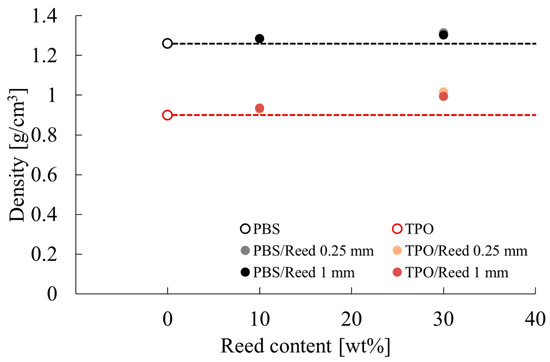
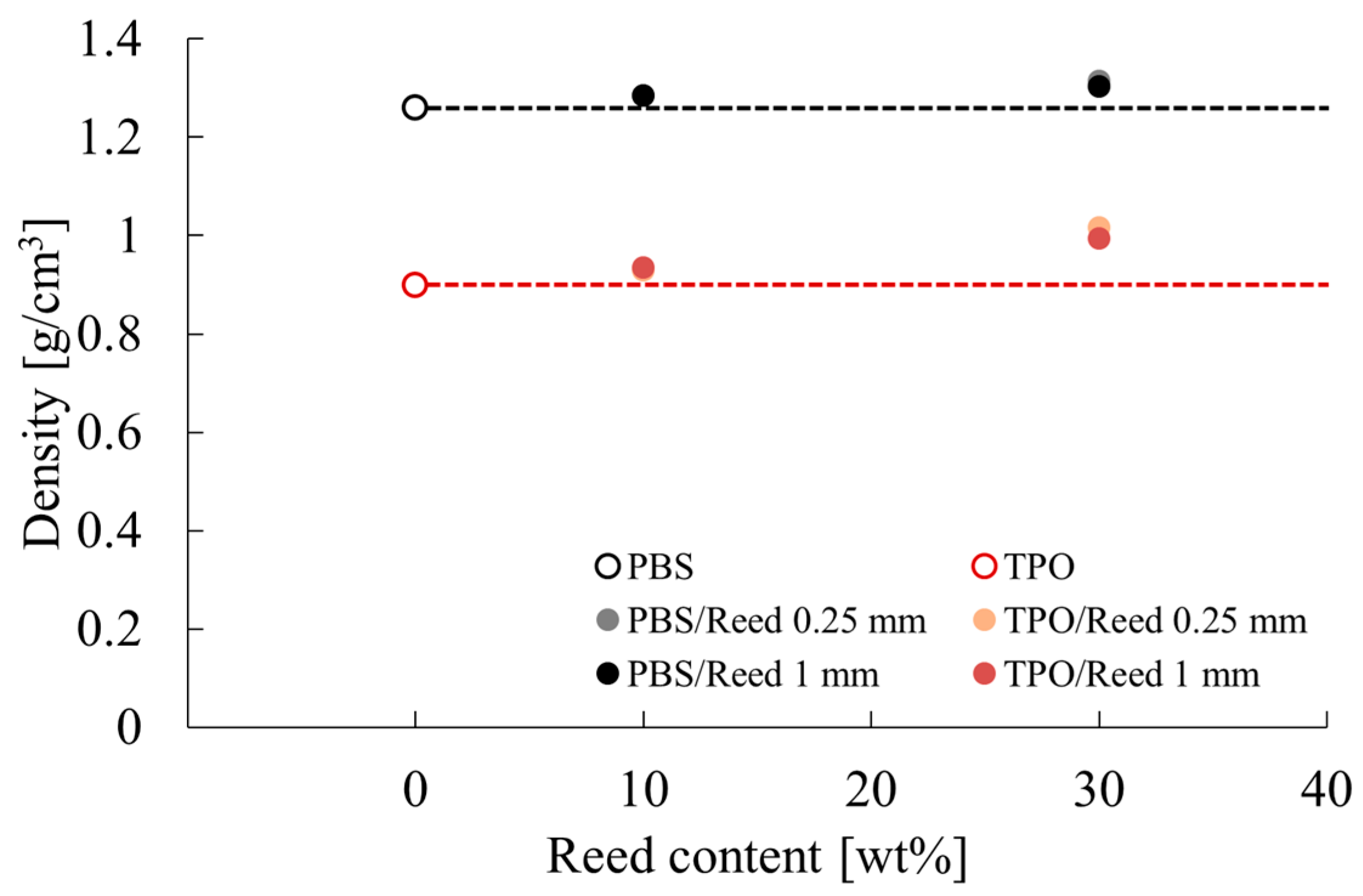
Figure 1 presents the density evaluation results of the injection-molded products. With PBS as the matrix, the density increased marginally because of reed dispersion. Specifically, with 30 wt% reed content, the density rose from 1.26 g/cm3 to 1.30–1.31 g/cm3. Similarly, when TPO was used as the matrix, an increasing trend was observed, with density rising from 0.90 g/cm3 to 0.99–1.02 g/cm3 with 30 wt% dispersion. The estimated reed density, as calculated using Equation (1), was 1.40 g/cm3 for a sieve size of 1.0 mm and 1.46 g/cm3 for 0.25 mm.
Figure 1.
Density of PBS/reed and TPO/reed composites as a function of reed fiber content. Open circles represent the neat matrix polymers. Solid circles represent the composites. Dashed horizontal lines represent the baseline density of the neat PBS (approx. 1.26 g/cm3) and TPO (approx. 0.90 g/cm3) obtained by the same method as composites.
In that equation, ρ denotes the density, W represents the weight content, and subscripts m, f, and c respectively represent the matrix, reinforcement filler, and composite material.
2.2. Flexural Properties of Reed-Dispersed Composites
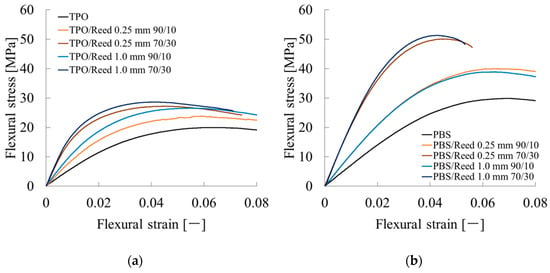
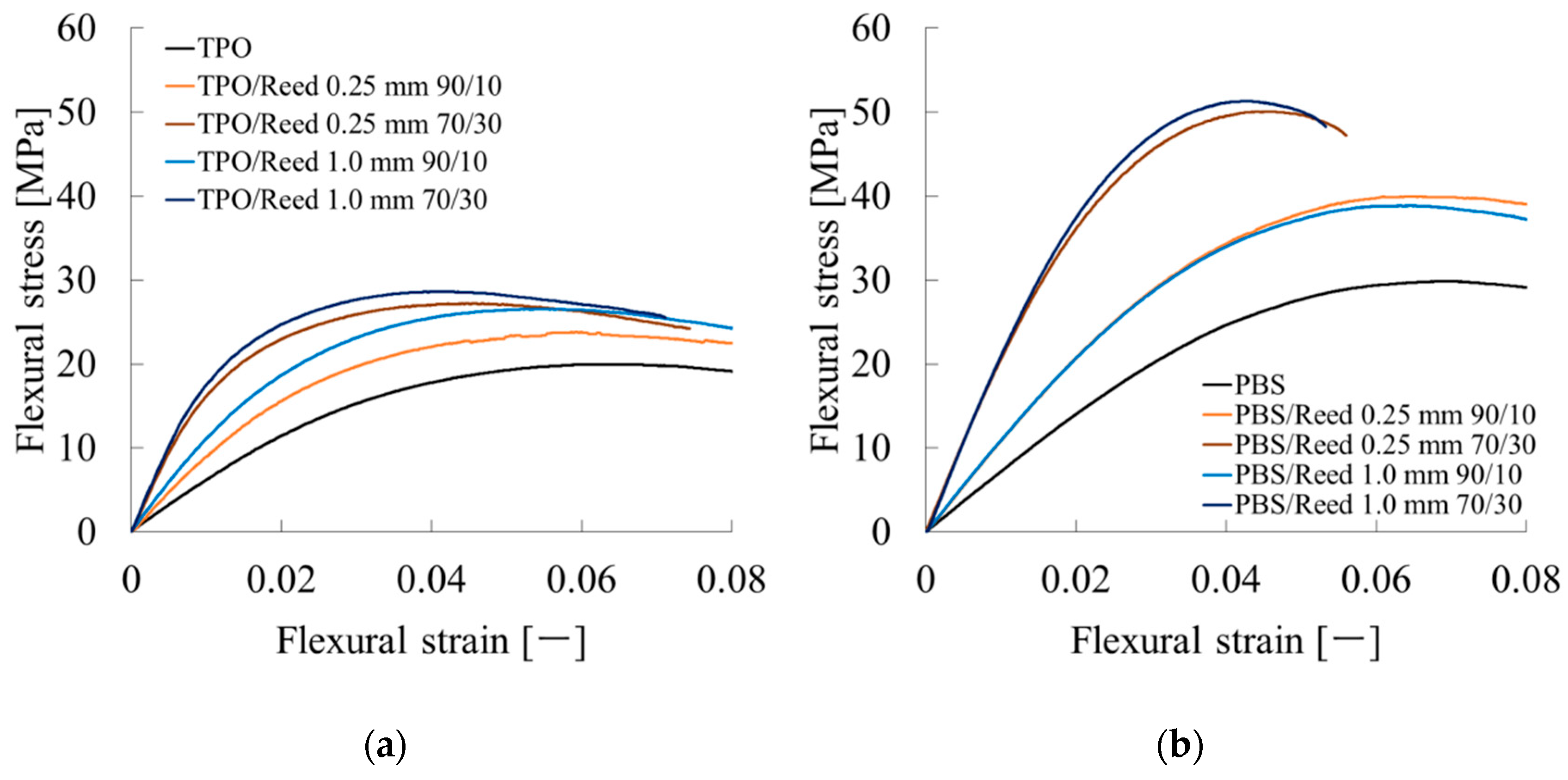
Figure 2 portrays the flexural stress–strain curves of reed composites using TPO and PBS matrices.
Figure 2.
Representative flexural stress–strain curves of (a) TPO/reed composites and (b) PBS/reed composites.
As shown in Figure 2a, all composites with pulverized reeds dispersed in the TPO matrix initially exhibited a linear stress–strain response, with subsequent softening after reaching peak stress. The composite with 30 wt% reed content demonstrated significantly higher flexural strength and modulus than those of the 10 wt% composite. It is noteworthy that the TPO/Reed 1.0 mm 70/30 composite exhibited maximum flexural stress of approximately 29 MPa: the highest among all TPO composites. The TPO/Reed 0.25 mm 70/30 composite showed similarly high strength, confirming that the TPO composites’ modulus and strength increase with increasing reed content. Generally, composites with 1.0 mm reeds displayed higher flexural stress and modulus than those with 0.25 mm reeds. This difference was particularly pronounced for 30 wt% dispersion, suggesting that larger reed particles function more effectively as reinforcement within the TPO matrix.
Similarly, the PBS matrix composites shown in Figure 2b exhibited an initial linear response followed by softening after peak stress. However, the PBS composites demonstrated distinctly higher flexural modulus and strength compared to the TPO composites. The 30 wt% PBS composites showed a marked increase in flexural strength compared to the 10 wt% material. For both 0.25 mm and 1.0 mm reeds, the maximum flexural stress reached approximately 50–51 MPa. This finding reveals that the reinforcing effect of pulverized reed dispersion is particularly pronounced in the PBS matrix. At 30 wt% content, the difference in flexural strength attributable to particle size (1.0 mm vs. 0.25 mm) was slight, although the 1.0 mm reeds showed a slightly higher trend. At 10 wt%, the reed length effect on flexural strength was even smaller, showing nearly equivalent behavior.
These results indicate that pulverized reeds function as effective reinforcement in both TPO and PBS composites, with the effect being most pronounced at high loading (30 wt%) and larger particle size (1.0 mm). Significant difference was found in the manifestation of the reinforcing effect depending on the matrix resin: PBS demonstrated greater reinforcement in flexural strength and modulus due to reed dispersion than TPO did.
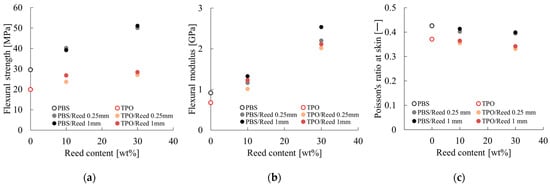
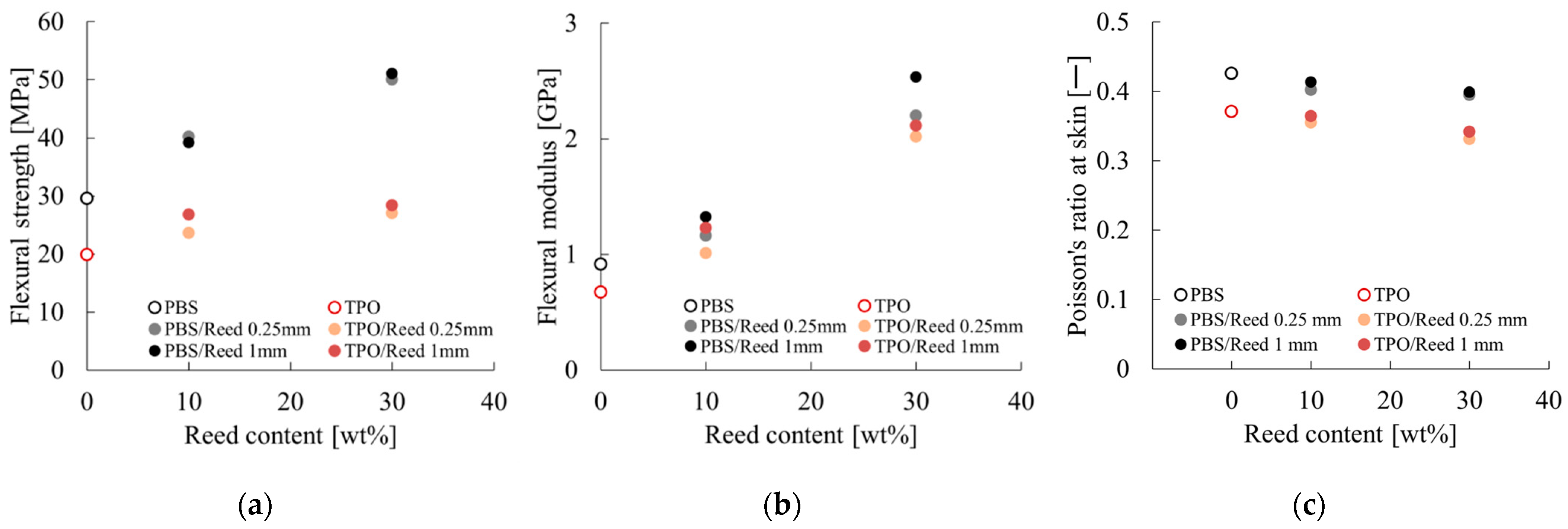
Figure 3 presents details of changes in flexural strength, flexural modulus, and Poisson’s ratio at the onset of yielding for PBS and TPO composites. The standard deviation for each characteristic value was shown as an error bar, but the variation was so small that it was obscured by the symbols. First, regarding flexural strength (Figure 3a), pure PBS exhibited high strength of approximately 29 MPa. By contrast, pure TPO was lower at approximately 20 Mpa, thereby clarifying that PBS possesses higher inherent strength as a substrate. Dispersing reeds in PBS resulted in a marked reinforcement in strength; at 10 wt%, strength increased to approximately 40 Mpa for both 0.25 mm and 1.0 mm reeds. The slightly higher value for 1.0 mm suggests that the increased particle size contributes to the reinforcing effect. Furthermore, at 30 wt%, strength reached approximately 49 Mpa for 0.25 mm and 51 Mpa for 1.0 mm, representing about 1.7 times the strength of the unreinforced polymer. The particle size effect was strongly evident, with 1.0 mm reeds exhibiting higher strength.
Figure 3.
Mechanical properties of PBS/reed and TPO/reed composites as a function of reed fiber content: (a) flexural strength, (b) flexural modulus, and (c) Poisson’s ratio at the skin.
For TPO, a slight strength reinforcement was found at 10 wt% dispersion, reaching about 24 Mpa for 0.25 mm and 26 Mpa for 1.0 mm. At 30 wt%, strength remained at approximately 27 Mpa irrespective of the reed length. No marked reinforcement comparable to that of PBS was observed.
Next, regarding the flexural modulus presented in Figure 3b, unreinforced PBS showed a modulus of approximately 0.9 Gpa, whereas TPO showed approximately 0.7 Gpa, indicating higher rigidity for PBS. Dispersing reeds in PBS further increased rigidity: at 10 wt%, it increased to approximately 1.2 Gpa (0.25 mm) and 1.3 Gpa (1.0 mm). At 30 wt%, it reached approximately 2.2 Gpa (0.25 mm) and 2.5 Gpa (1.0 mm), showing about 2.8 times the modulus of the unreinforced state. The greater reinforcement with 1.0 mm reeds confirms that larger particles exert a higher reinforcing effect. Also, TPO was found to have increased rigidity, increasing to approximately 1.0–1.1 Gpa at 10 wt% and 2.0–2.1 Gpa at 30 wt%. However, the change was not as large as that found for PBS, indicating that TPO is inferior to PBS in terms of rigidity enhancement as well.
Regarding Poisson’s ratio at the onset of yielding shown in Figure 3c, a downward trend was observed with reed dispersion. For PBS, Poisson’s ratio was approximately 0.42 without reeds; it was between 0.39 and 0.41 at 10 wt% and 30 wt%, confirming a slight decrease. Similarly, for TPO, the ratio decreased from approximately 0.36 (unreinforced) to a range of 0.30–0.36 after dispersion, exhibiting a downward trend with increasing reed content. It is noteworthy that Poisson’s ratio tended to drop to approximately 0.30 for TPO with 30 wt% content and 0.25 mm reeds. Overall, the Poisson’s ratio of PBS was higher than that of TPO. The influence of reed dispersion was smaller when compared to other mechanical properties.
In summary, waste reed fibers were found to be effective reinforcement materials for increasing the flexural strength and modulus of PBS matrix composites. Findings obtained from this study suggest that high-performance bio-based composites can be designed by adjusting reed fiber content and particle size appropriately. The reinforcement effect was limited in TPO, perhaps because of the influences of differences in interfacial adhesion with PBS or matrix characteristics. Poisson’s ratio tended to decrease with reed dispersion.
2.3. Interfacial Shear Strength of Reed-Dispersed Composites
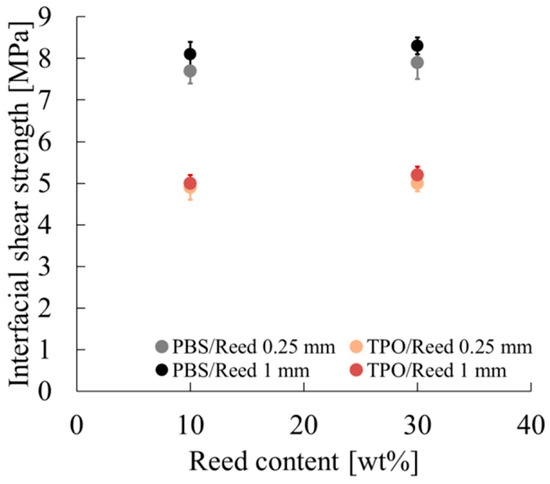
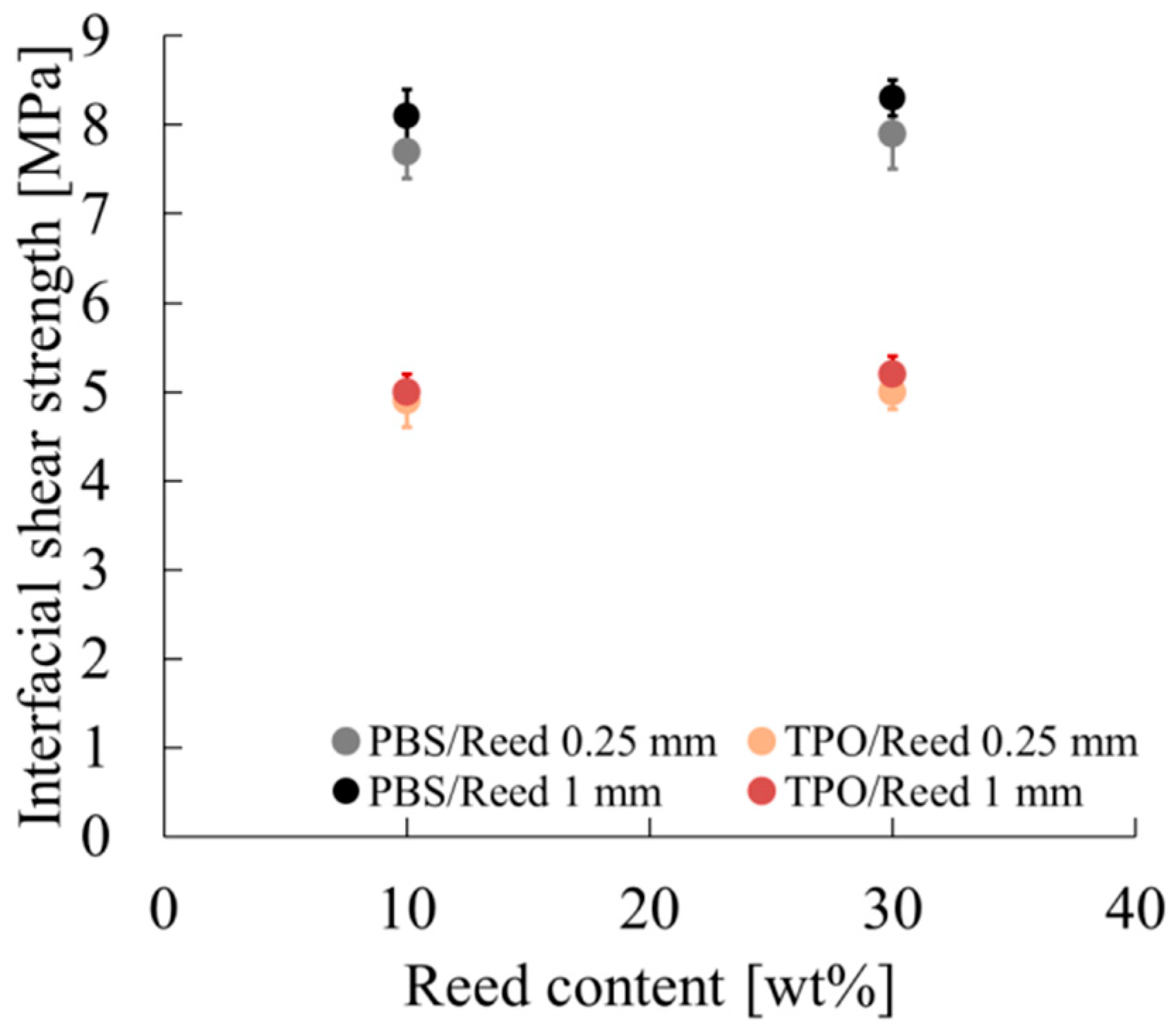
Figure 4 depicts results of the interfacial shear strength (IFSS) evaluation. The error bars in the figure represents standard deviations. For PBS matrix composites at 10 wt% reed content, IFSS was approximately 7.7 MPa for 0.25 mm fibers and 8.1 MPa for 1 mm fibers. At 30 wt% content, the values were approximately 7.9 MPa (0.25 mm) and 8.3 MPa (1 mm), representing a slight increasing trend with higher content.
Figure 4.
Interfacial shear strength (IFSS) of PBS/reed and TPO/reed composites evaluated at different reed fiber contents. The error bars in the figure represents standard deviations.
For TPO matrix composites at 10 wt%, IFSS was approximately 4.9 MPa for 0.25 mm fibers and 5.0 MPa for 1 mm fibers. At 30 wt%, IFSS showed a marginal increase to approximately 5.0 MPa (0.25 mm) and 5.2 MPa (1 mm). Comparison of the matrices shows that PBS composites exhibited IFSS values that were approximately 2.8–3.1 MPa higher than those of TPO composites. This difference is probably attributable to differences in chemical interaction and wettability between the matrix (PBS) and the reed fiber surface.
Regarding fiber size, a trend was observed in both matrix systems where 1 mm fibers showed higher IFSS values than 0.25 mm fibers. This difference was small in both systems, recognized at approximately 0.2 MPa for both 10 wt% and 30 wt%. This result suggests that the specific surface area of the interface affects the stress transfer mechanism at the interface.
These trends clarify that selection of the matrix resin is the most influential factor for optimizing the interfacial properties of reed fiber-reinforced composites. Although fiber size is also a factor that must be considered, its influence was less than that of matrix selection. Furthermore, the results suggest that adjustment of fiber content contributes little to interfacial strength. It should therefore be determined based on requirements for other mechanical properties (e.g., modulus, strength).
3. Discussion
3.1. Effect of Pulverized Reed Size on Composite Density
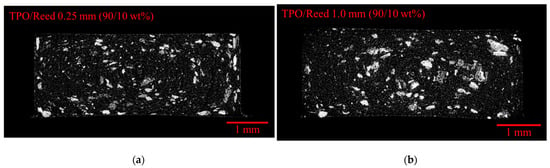
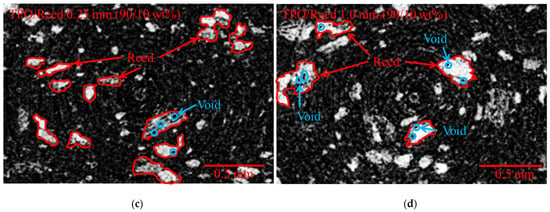
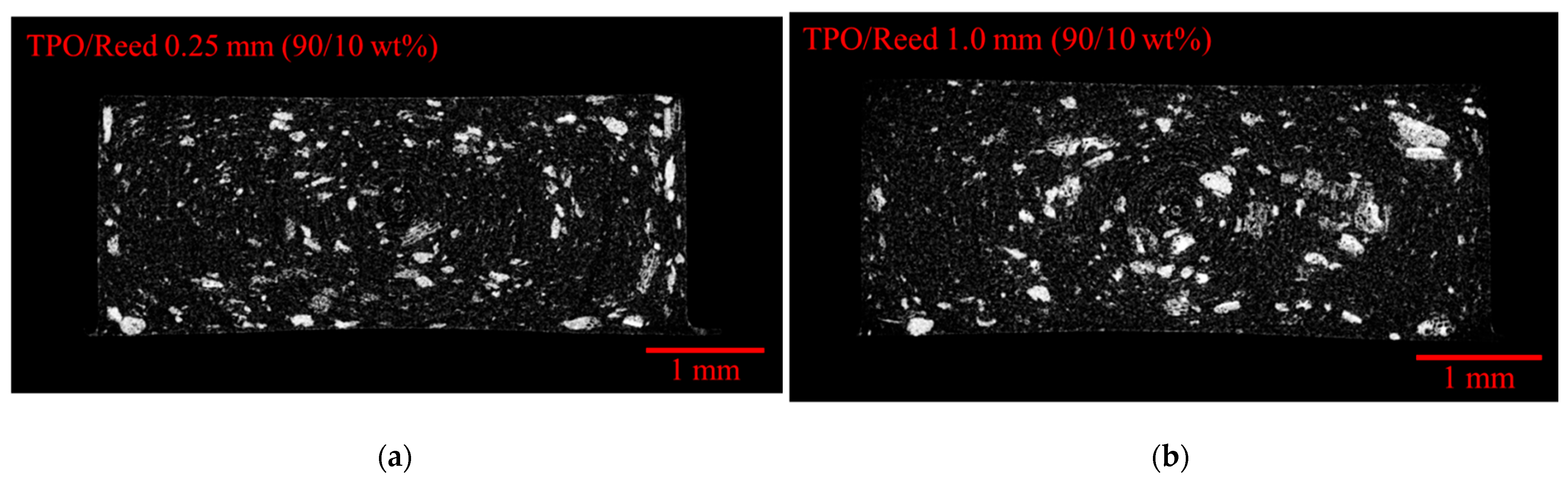
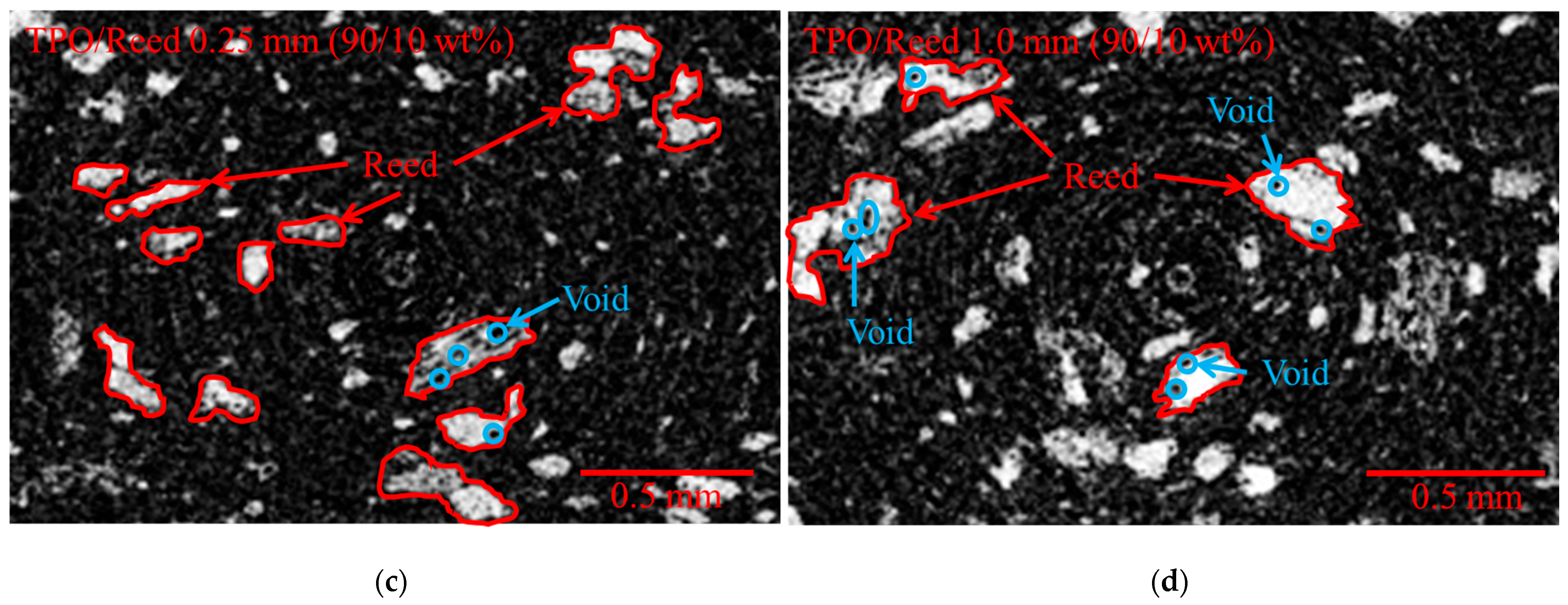
Section 2.1 described that the apparent density of reed powder varies depending on the size after pulverization. This section presents discussion of factors underlying this variation based on the cross-sectional structure of the reeds after pulverization. Figure 5 presents result of observations made in the WD–TD direction using X-ray CT. Comparison of the matrix types shows that the internal structure of the reeds could be identified more clearly when TPO was used. This clarity is attributable to the fact that the TPO density is lower than that of PBS, leading to a greater density difference from the reeds, which produced higher contrast in X-ray CT images.
Figure 5.
X-ray computed tomography (CT) cross-sectional images of TPO/Reed (90/10 wt%) composites prepared with different reed particle sizes: (a,c) 0.25 mm and (b,d) 1.0 mm sieve diameters. Panels (a,b) present the full cross-sectional views of the injection-molded specimens (scale bars: 1 mm). Panels (c,d) provide high-magnification views (scale bars: 0.5 mm) highlighting the filler morphology. Red outlines indicate the dispersed reed particles, and blue arrows/circles point to internal voids within the reed structure.
Furthermore, detailed observation of cross-sectional images of the TPO/Reed composite revealed that reeds with cross-sectional sizes larger than approximately 0.5 mm contained numerous fine void structures within their interiors. These voids originate from the inherently porous structure of the reed (cane). Moreover, it is possible that these internal voids were maintained or expanded during pulverization [7]. However, for samples with smaller pulverized particle sizes, it was observed that such voids were partially crushed, leading to a dense internal structure. These results suggest that the change in reed density is strongly dependent on the retention state of the void structure associated with the pulverized particle size. It is inferred that the overall density was lower in the 1 mm pulverized product because of the increased porosity.
3.2. Factors Improving Flexural Properties
Section 2.2 showed that the flexural modulus changes depending on the pulverized particle size. This section presents discussion of the causes in relation to the porous structure of the reeds shown in Section 3.1. First, the physical significance of the flexural modulus is examined. For three-point bending testing, the specimen is placed in the width direction (WD). Then a uniform load is applied along the WD. At this time, because Poisson contraction in the width direction is constrained by the fixture, the deformation is close to a state of pure extensional deformation. Therefore, the apparent modulus obtained in this test, i.e., the flexural modulus, can be expressed by the following Equation (2) using Young’s modulus E and Poisson’s ratio υ [14].
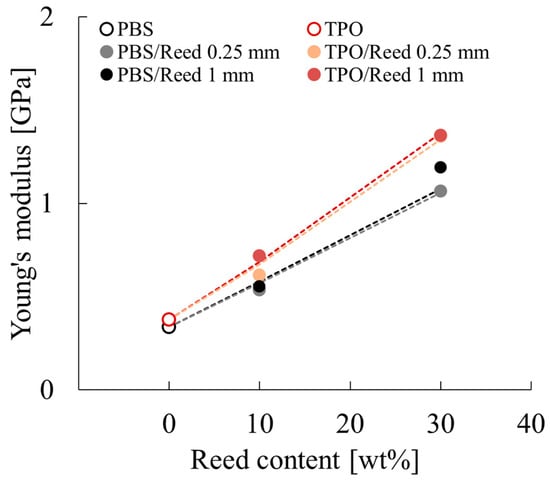
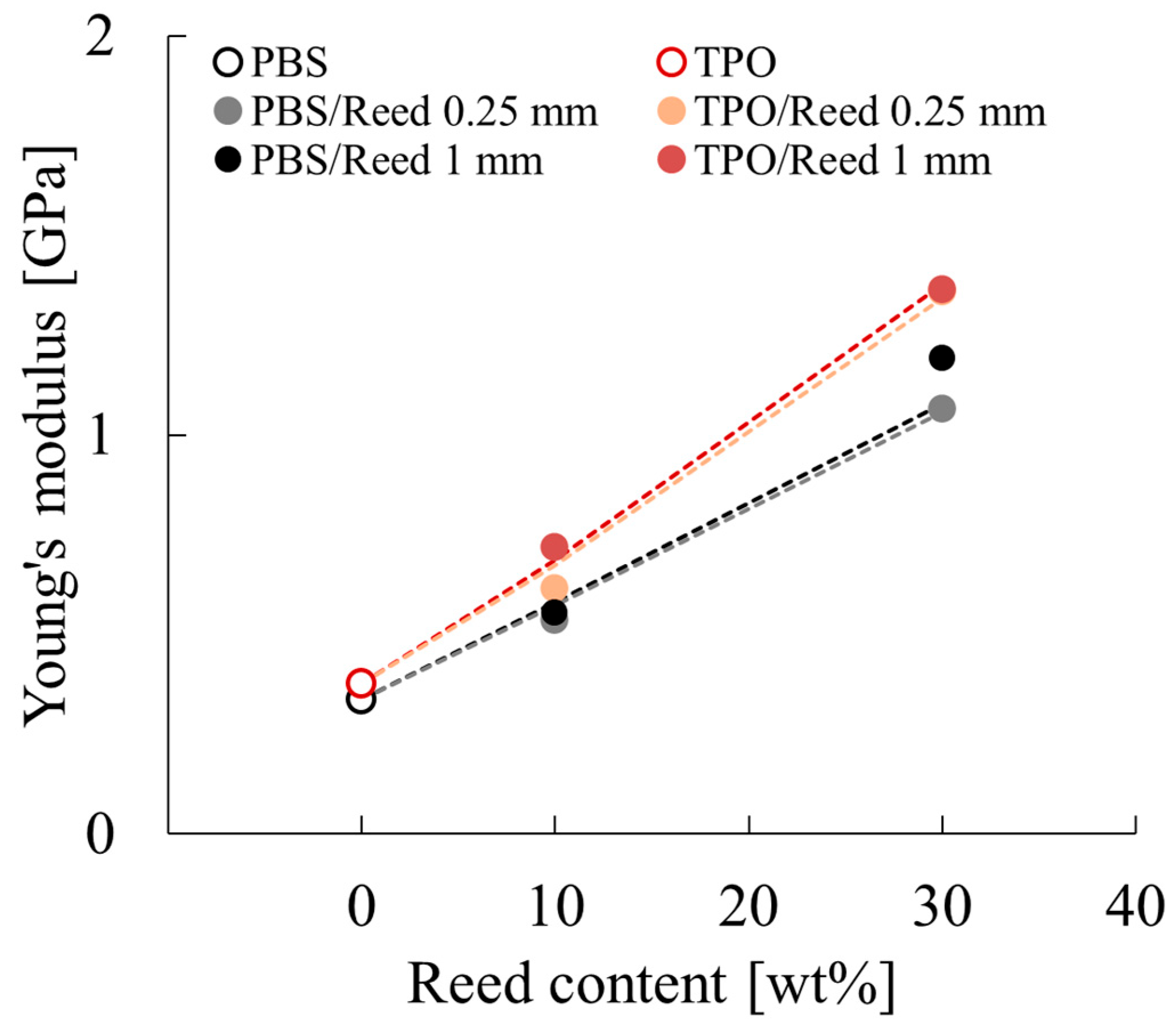
From this relation, it is understood that the primary factors causing the change in flexural modulus because of pulverized particle size are Young’s modulus and Poisson’s ratio. Figure 6 presents results obtained from calculating Young’s modulus using Equation (2). Irrespective of the matrix type, the Young’s modulus tended to increase linearly as the reinforcement filler content increased. This suggests that the composite rule shown in Equation (3) can be applied to the Young’s modulus of the composite material prototyped in this study [15].
Figure 6.
Young’s modulus of PBS/Reed and TPO/Reed composites as a function of reed content. The dashed lines represent theoretical values calculated based on the rule of mixtures. In these calculations, the Young’s modulus of the reed was assumed to be 3000 Mpa for the PBS system and 5000 Mpa for the TPO system.
Therein, EF means the Young’s modulus of reed, and V represents the volume fraction. Subscripts m and f respectively denote the matrix and reinforcement filler. The results of calculating the Young’s modulus of the composite material according to Equation (3) are shown as dashed lines in Figure 6. Calculating EF as 3000 MPa for the PBS system and 5000 Mpa for the TPO system showed good agreement with the experimental results. This suggests that the mechanical properties of the reed vary depending on the base material type, and it is thought that the expansion deformation arising from the interaction described later is one contributing factor. However, the difference in Young’s modulus because of the pulverized particle size was small, suggesting that the dependence of flexural modulus on the pulverized particle size is mainly attributable to the change in Poisson’s ratio.
The Poisson’s ratio of the filler can be evaluated approximately using the following Equation (4) [16].
Therein, V represents the volume fraction. Subscripts f, c and m respectively denote the reinforcement filler, composite and matrix. If the Poisson’s ratio of the reinforcement filler is smaller than that of the matrix, then Equation (4) shows that the Poisson’s ratio of the entire composite decreases monotonically with increasing filler content. Indeed, as shown in Figure 3c, Poisson’s ratio decreased as the reed content increased, confirming that the Poisson’s ratio of the reeds is smaller than that of the matrices, PBS and TPO.
Based on Equation (4), the Poisson’s ratio of the reeds was estimated from the Poisson’s ratio of the TPO system, resulting in 0.25 for the 1 mm pulverized product and 0.18 for the 0.25 mm pulverized product. However, when these values were applied to the PBS system, the Poisson’s ratio of the composite calculated using Equation (4) was smaller than the measured value. This lower value suggests that the reeds dispersed in PBS undergo physical property changes because of interfacial interaction with the matrix. Specifically, the interfacial stress in the expansion direction is greater in PBS, which is expected to cause the interior of the reeds to expand.
Evidence supporting this inference includes the trend of interfacial shear strength (IFSS) shown in Section 2.3. Figure 4 shows that the PBS matrix exhibited higher IFSS than TPO. This IFSS is explained by the following Equation (5) [17].
In that equation, α is the average coefficient of linear expansion between the molding temperature and the test temperature, Tinj stands for the molding temperature, Ttest denotes the test temperature, and σi represents the interfacial interaction stress. EcT signifies the modulus of the composite when the fibers are oriented perpendicularly to the loading direction, as obtained by the following Equation (6) [18].
From Equation (4), the increase in IFSS is attributed mainly to the increase in σi. Therefore, findings suggest that σi generated at the interface is larger in the PBS matrix than in the TPO system. When this interfacial stress acts as tensile stress on the filler in the expansion direction, it is possible that the reed itself expands, causing an increase in internal porosity.
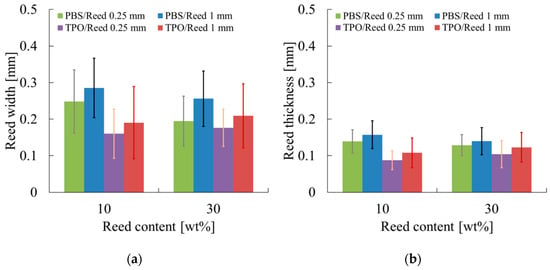
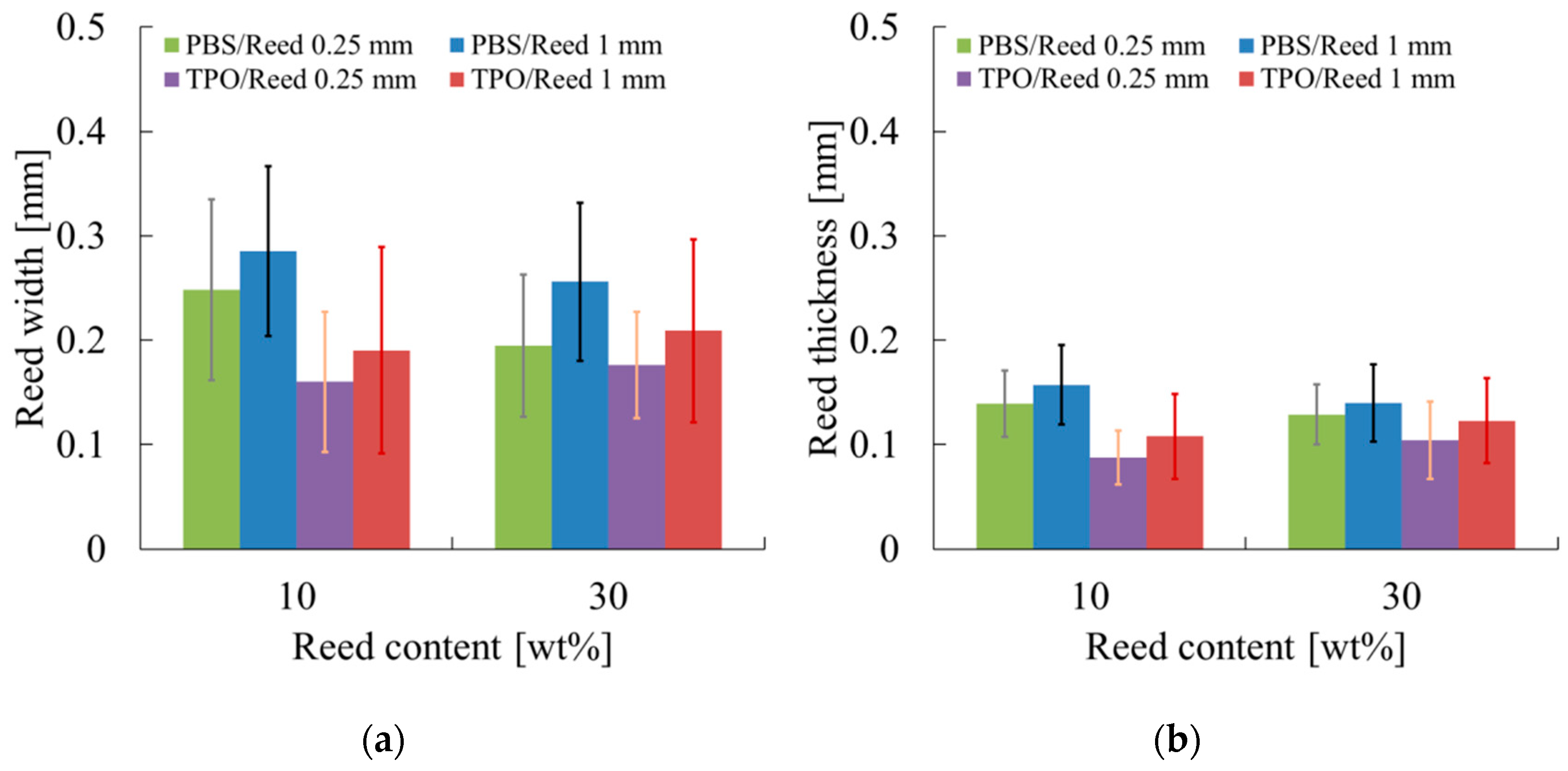
To verify this supposition, images observed in the WD–TD direction using X-ray CT were analyzed to evaluate the reed cross-sectional shape quantitatively. The results are presented in Figure 7. First, specific examination of the effect of initial filler size confirmed that in all compositions, samples prepared using a 1 mm sieve retained significantly greater width and thickness after molding compared to those with 0.25 mm. This result indicates that the size difference at the time of initial input is reflected in the residual dimensions after molding. A more important finding is the dimensional difference caused by the matrix resin. In Figure 7a, PBS/Reed shows clearly greater reed width than that of TPO/Reed. For example, under conditions of 10 wt% reed content and 1 mm initial size, the filler width in the PBS/Reed system was approximately 0.28 mm, whereas it remained at approximately 0.19 mm in the TPO/Reed system. A similar trend is shown in Figure 7b, which shows filler thickness, although to a lesser extent. Thicker fillers remained in the PBS system than those in the TPO system.
Figure 7.
Dimensional analysis of reed fibers within the composites: (a) reed width and (b) reed thickness. Error bars denote the standard deviation.
Factors contributing to variations in filler size depending on the matrix material include fragmentation and deformation caused by shear stress during melt mixing. For example, it has been reported that the degree of fragmentation of glass fibers during composite formation via melt mixing varies with screw rotation speed and mixing temperature [19,20]. If a similar trend were observed for the lead, one would expect the lead size to be larger for TPO, where interactions are weaker, compared to PBS, where interactions are stronger. However, this expectation contradicts the results of this paper. This suggests that the lead size observed in this paper is unlikely to be caused by fragmentation or deformation due to shear stress during melt mixing.
The results presented above confirmed that when PBS was used as the matrix, the reed cross-sectional shape was clearly larger than that of the TPO system, indicating that expansion had occurred. Within PBS, strong interfacial constraints are thought to convert the matrix’s shrinkage energy into a force that expands the hollow reeds. This results in an increase (or maintenance) of the void ratio within the reeds, leading to a tendency for the reeds’ Poisson’s ratio to be higher.
3.3. Matrix Dependence of Interfacial Interaction Stress
In Section 3.2, it was pointed out that the interfacial shear strength is higher in the PBS system than in the TPO system because σi is higher. This section discusses the microscopic mechanism creating this difference in σi based on spectroscopic and thermal analysis results, particularly from the perspective of matrix phase structure and interfacial interaction.
In fact, PBS is a representative semi-crystalline bio-polyester synthesized from succinic acid and 1,4-butanediol. Molecular chain constraint in semi-crystalline polymers such as PBS is defined mainly as a phase transition from a highly mobile amorphous state to a regularly and densely packed crystalline state, or as the restriction of molecular chain movement at the crystal interface. This structural ordering alters the vibrational environment of specific functional groups through formation of intermolecular interactions such as hydrogen bonds. Structural analysis of PBS has confirmed that the carbonyl group (C=O) stretching vibration region (approx. 1700–1800 cm−1) of the ester bond reflects changes in the degree of constraint most sensitively [19]. Analysis of this region is crucially important for spectroscopic identification and quantification of the complex three-phase structure of the polymer: the Mobile Amorphous Fraction (MAF), the Rigid Amorphous Fraction (RAF), and the Crystalline phase. Reportedly, the relative intensity of the highly mobile MAF (1736 cm−1) decreases as crystallization progresses, whereas the intensities of the regular and stable crystalline (1711 cm−1) phases increase. Simultaneously, the relative intensity of the RAF (1720 cm−1), an intermediate constrained state in which molecular chains are drawn to the crystal surface and movement is restricted, also increases [21]. This result indicates spectroscopically that the change in the degree of constraint is established not through a discontinuous two-phase transition but through a stepwise ordering process: MAF → RAF → Crystalline.
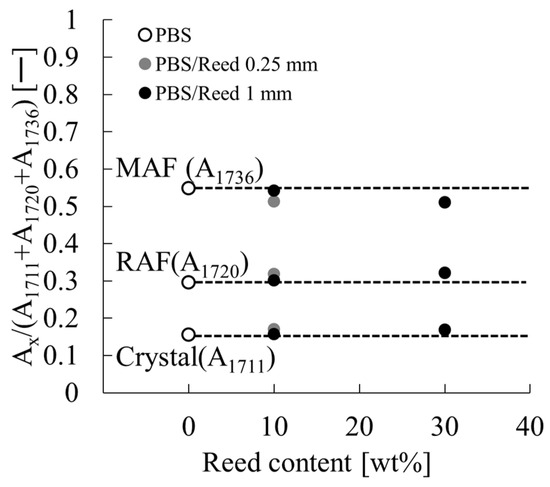
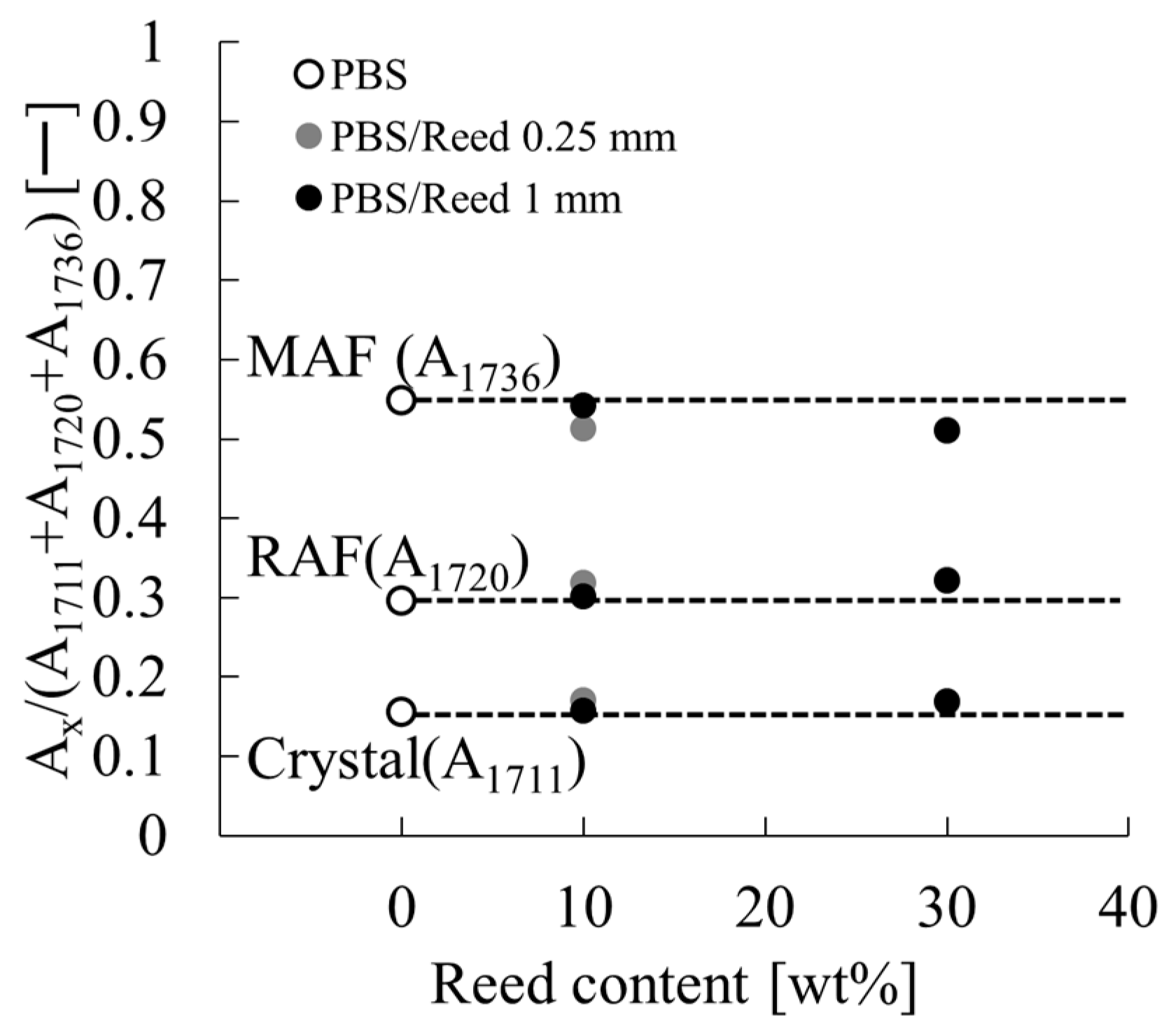
Based on these interpretations, the relative abundance ratio of each phase was calculated using peak deconvolution to evaluate the effect of adding reed fibers to the PBS matrix. Figure 8 shows the calculation results. The measurements revealed that the ratio of the crystalline phase and RAF increased with increasing reed content, whereas the ratio of MAF decreased correspondingly. This trend was confirmed irrespective of reed fiber length. It was particularly pronounced in the case of 30 wt% content.
Figure 8.
Variation of the crystalline and amorphous phase fractions of the PBS matrix as a function of reed fiber content. The graph presents the phase distribution calculated from the integrated area ratios of deconvoluted FTIR carbonyl stretching bands: the crystalline phase (A1711), the rigid amorphous fraction (RAF, A1720), and the mobile amorphous fraction (MAF, A1736).
These results suggest that reed fibers not only function as heterogeneous nucleation sites that thermodynamically promote PBS crystallization: they also suggest that strong intermolecular interactions, such as hydrogen bonds, occur between the hydroxyl groups on the reed surface and the carbonyl groups of PBS. Near the filler interface, this strong adsorption force causes a portion of the amorphous chains to transition to RAF, consequently forming a robust interfacial constraint layer around the fibers. This RAF-dominated layer not only functions as a buffer for stress transfer: it also maintains interfacial adhesion during matrix thermal shrinkage in the cooling process, thereby generating normal stress on the fibers, and improving σi considerably.
On the other hand, a literature review of the mechanical properties of RAF itself revealed that they remain poorly understood [22]. However, it has been reported that dispersing clay or Laponite in PBS increases the RAF content [23,24]. According to these reports, while the overall elastic modulus of the system increases, toughness and elongation decrease, resulting in so-called embrittlement. From this, it can be considered that increasing the RAF content promotes embrittlement of the entire system.
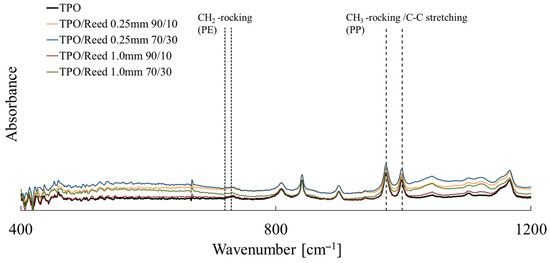
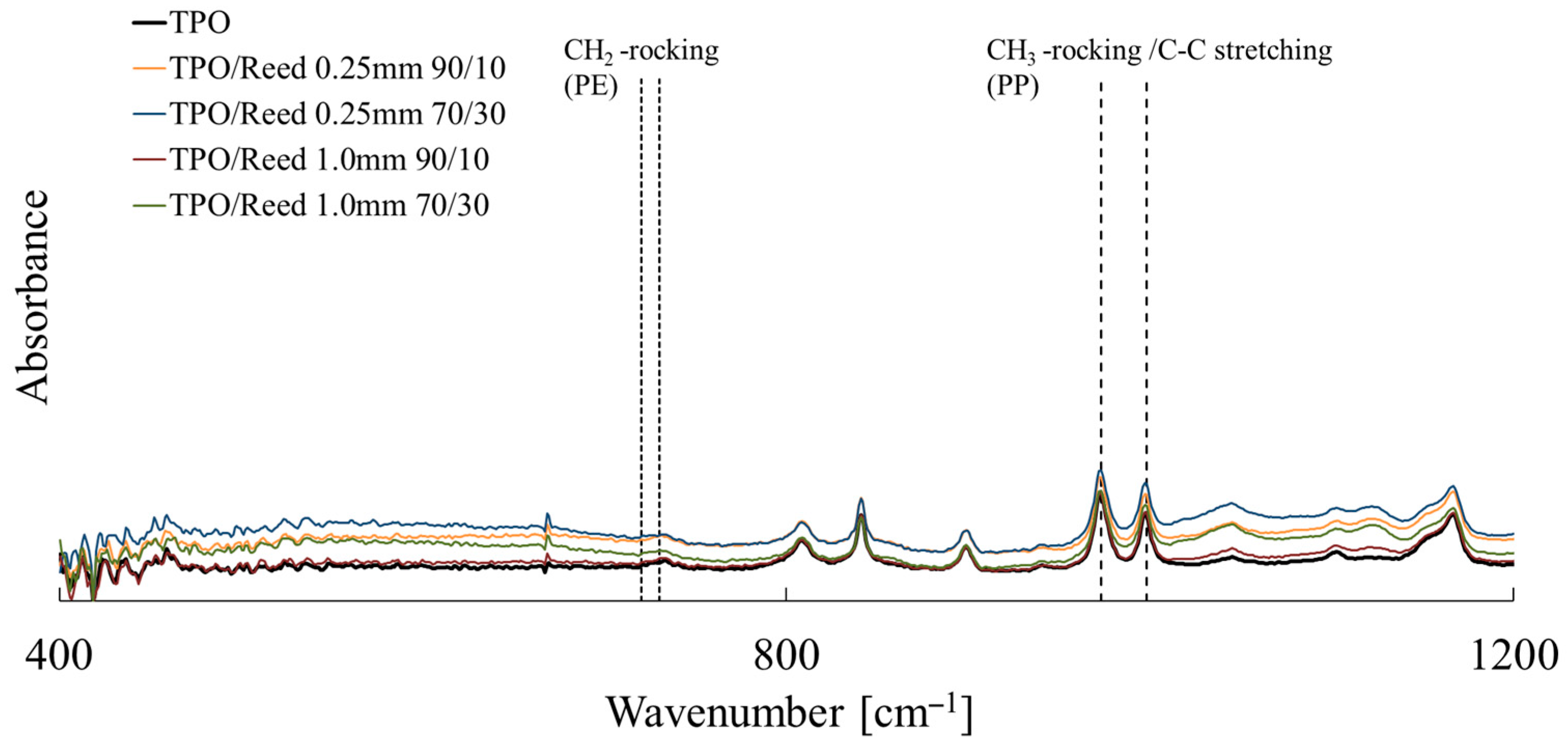
In contrast, TPO is a multiphase structure with a continuous phase composed mainly of isotactic polypropylene (iPP). Figure 9 shows the FT-IR of the TPO matrix in the fingerprint region (400–1200 cm−1). Peaks at 973 cm−1 and 998 cm−1, derived from the helical structure of iPP, were confirmed, identifying this sample as composed mainly of PP. The stereoregularity of PP can be evaluated by the “crystallinity index,” which is the absorbance ratio of the regularity band (998 cm−1) to the reference band (973 cm−1).
Figure 9.
FTIR spectra of TPO and TPO/Reed composites with varying reed content and particle sizes (400–1200 cm−1). Vertical dashed lines show the specific vibrational modes assigned to the constituent phases.
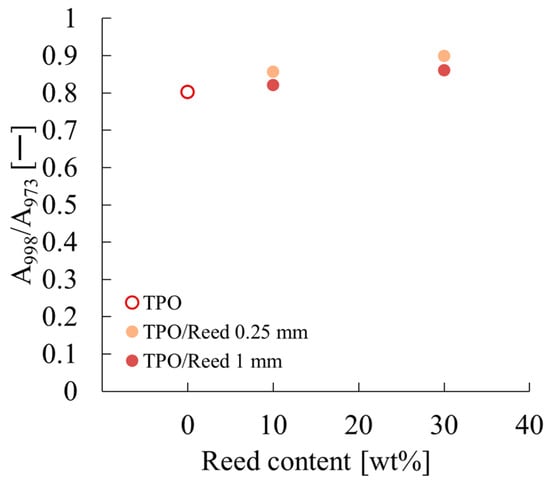
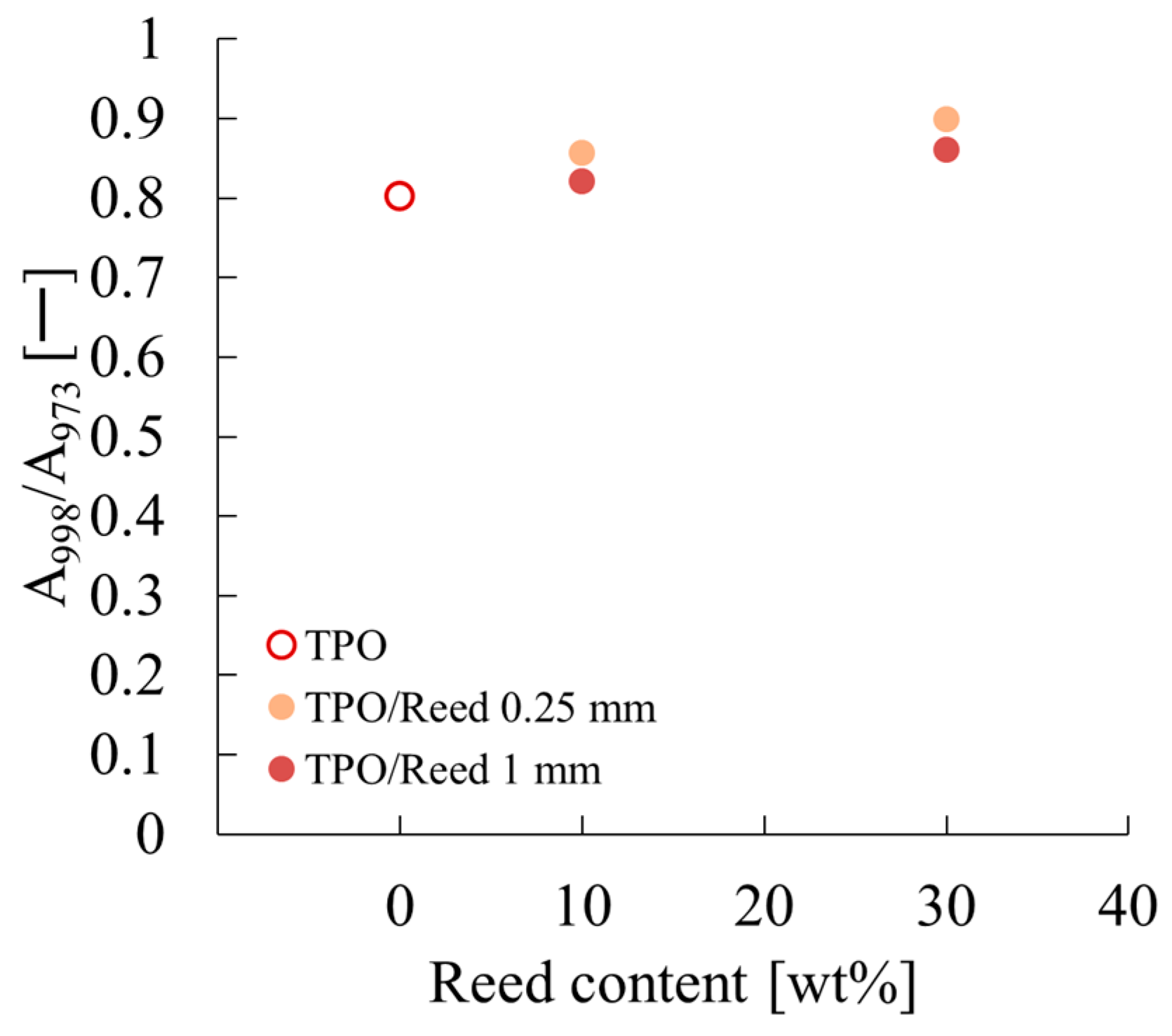
Figure 10 shows the calculation results of the crystallinity index. As the figure shows, the crystallinity index increased monotonically with the addition of reeds in the TPO system as well, showing particularly high values for reeds with small particle size (0.25 mm sieve). This result is interpreted as the reeds acting as heterogeneous nucleating agents, with the nucleation site density increasing as the specific surface area increased. However, because chemical affinity between non-polar TPO and highly polar reeds is poor, the binding force at the interface is extremely weak. Therefore, molecular chains easily maintain the mobility necessary for rearrangement into the crystal lattice. Although regularity as a bulk improves, it is regarded as being in a state of “physical contact” that does not lead to the formation of a strong constraint layer (RAF) at the interface.
Figure 10.
Variation of the infrared absorbance ratio (A998/A973) for the polypropylene (PP) phase within the TPO matrix as a function of reed fiber content.
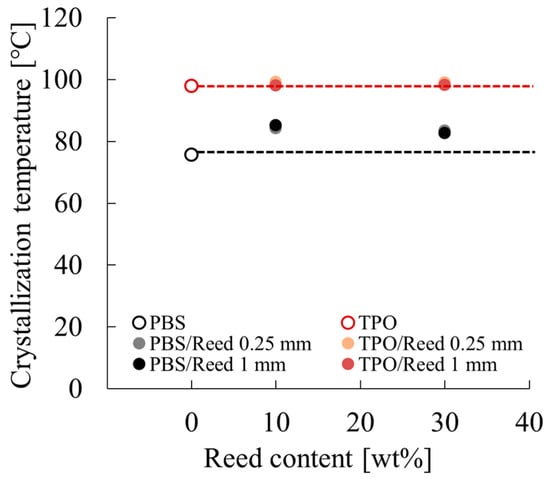
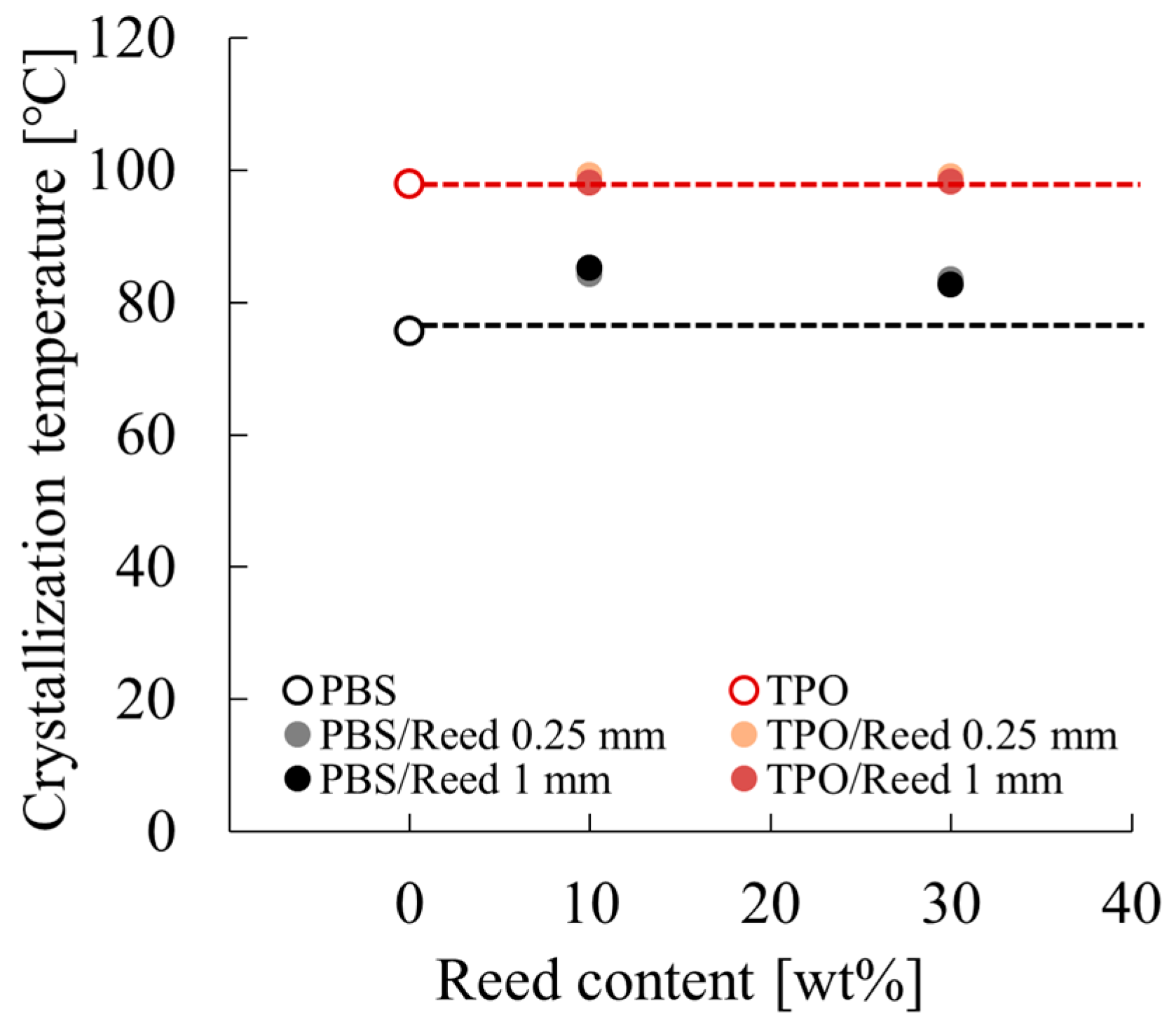
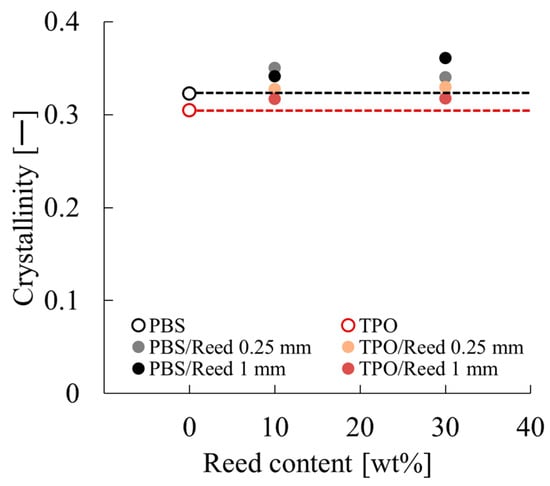
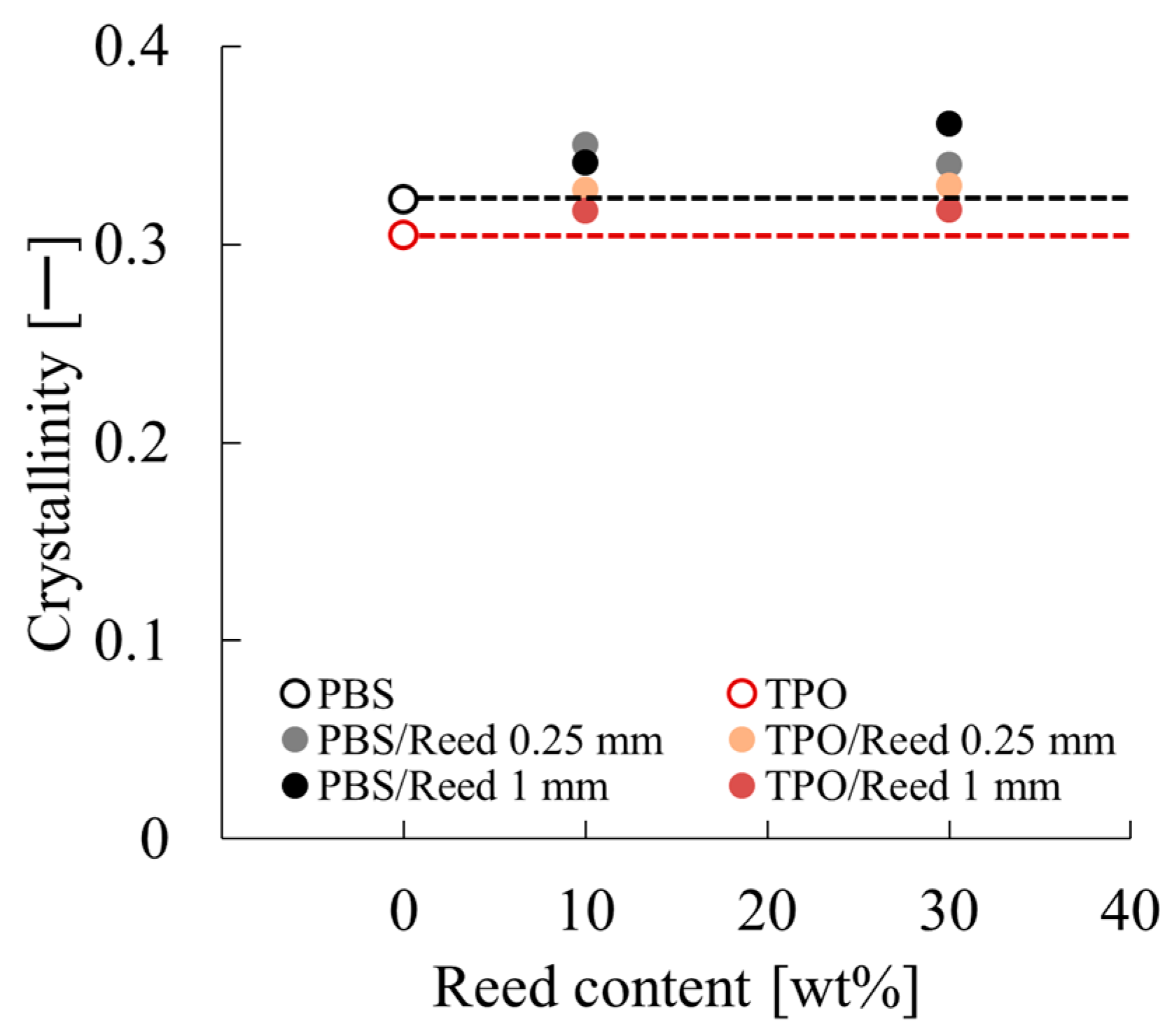
The crystallization temperature (Tc) and crystallinity (Xc) obtained from DSC measurements are shown respectively in Figure 11 and Figure 12 and Table 1. The DSC results support the inferences derived from FT-IR. In the PBS system, the addition of reeds drastically raised Tc from 76 °C to approximately 85 °C, but in the TPO system, it remained nearly constant at approximately 98 °C. Furthermore, the increase in crystallinity was less than that in the PBS system.
Figure 11.
Crystallization temperature (Tc) of PBS and TPO matrices as a function of reed fiber content.
Figure 12.
Degree of crystallinity (Xc) of PBS and TPO composites as a function of reed fiber content. Horizontal dashed lines show the baseline crystallinity values for the neat PBS (black) and TPO (red) control samples.
Table 1.
Thermal properties of Reed fiber reinforced composites with PBS and TPO matrices. The table presents the crystallization temparature (Tc), melting enthalpy (ΔHm) and crystallinity (Xc) calculated from DSC measurements.
These differences in thermal behavior originate from the difference in interaction strength at the matrix–reed interface. In the PBS system, strong interfacial interaction lowers the activation energy for nucleation dramatically, whereas in the TPO system, the ability of the reed surface to induce PP nucleation is low, or PP’s own spontaneous crystallization ability is already sufficiently high.
From the considerations presented above, it is concluded that the factor yielding high σi in the PBS system is not merely the increase in crystal amount but the formation of a strong RAF based on chemical interaction. Although a crystallization-promoting effect exerted by reed contents is observed in the TPO system, the weak molecular constraint at the interface makes it difficult to generate efficient stress transfer or clamping stress during shrinkage. The interfacial shear strength therefore remains low.
3.4. Future Issues and Outlook
Finally, the following challenges and outlook can be envisioned based on the results of this study.
These study findings confirmed that, in the PBS matrix, good interfacial adhesion and a high reinforcing effect (flexural strength approx. 1.7 times that of unfilled resin) can be obtained without additives because of the interaction between its polar groups and the hydroxyl groups on the reed surface. In the non-polar TPO, the reinforcing effect of reeds was found to be weaker. The interfacial shear strength (IFSS) remained lower than that of the PBS system. Some room remains for dramatic improvement in mechanical properties for the TPO system by improving interfacial adhesion through the addition of compatibilizers such as maleic anhydride-modified polypropylene (MAPP) or surface modification of reed fibers (e.g., silane coupling treatment). For the PBS system, it might be possible to improve water and heat resistance through further interfacial control.
This study specifically evaluated static mechanical properties (flexural strength, modulus) and impact properties. However, guaranteeing long-term durability is necessary for practical application. Particularly because reeds are naturally derived lignocellulose materials, some concerns persist about dimensional changes and strength reduction caused by water absorption, as well as resistance to fungal growth and decay. Therefore, to clarify the degradation behavior of the materials, future work must include the conduct of water absorption tests in high-humidity environments and accelerated weathering tests assuming outdoor use. Furthermore, although “biodegradability” is a feature of PBS composites, conducting soil burial tests to confirm the balance between maintaining properties during product life and controlling decomposition after disposal are important tasks.
Filling instrument reed powder at a high concentration of 30 wt% might reduce moldability because of increased melt viscosity. This experiment succeeded in fabricating specimens using a small injection molding machine, but securing flowability and controlling fiber orientation within the mold are expected to pose challenges when molding actual products with larger and more complex shapes (e.g., instrument cases, daily necessities). It is also necessary to examine processing conditions with mass production in mind, such as shortening the molding cycle to increase production efficiency and optimizing molding temperature and pressure while considering the thermal decomposition temperature of lignocellulose.
This study assessed the effective utilization of waste instrument reeds. However, clarifying the superiority of reeds over existing natural fiber fillers such as wood flour, bamboo, kenaf, and hemp is extremely important from the viewpoint of material selection. Reeds might possess unique characteristics such as light weight derived from their porous (hollow) structure and vibration damping properties. In future studies, comparative evaluations with other biomass fillers should be conducted to discover functional values unique to reeds (e.g., density reduction, sound absorption, vibration damping) rather than merely “reusing waste,” thereby establishing the status of reeds as high-value-added materials.
4. Experiment Methods
4.1. Materials
For this study, thermoplastic polyolefin (TPO, melting point 130 °C, Welnex RMG06; Japan Polypropylene Corp., Tokyo, Japan) and polybutylene succinate (PBS, melting point 115 °C, BioPBS FZ71PM; Mitsubishi Chemical Corp., Tokyo, Japan) were used as matrix materials. The respective melting points of TPO and PBS are 130 °C and 115 °C. These polymers were selected because their melting points are sufficiently lower than the thermal decomposition temperature of lignocellulose: the main component of reeds. Reeds were collected from brass bands at junior high schools, high schools, and universities in Japan, irrespective of type. They were used as raw materials without pretreatment.
4.2. Pulverization
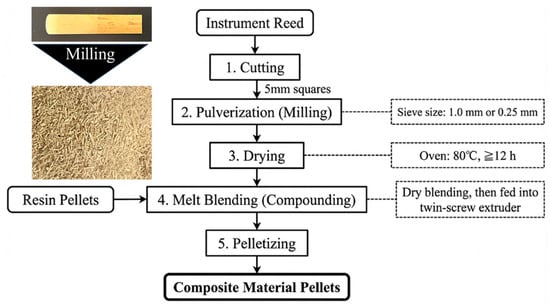
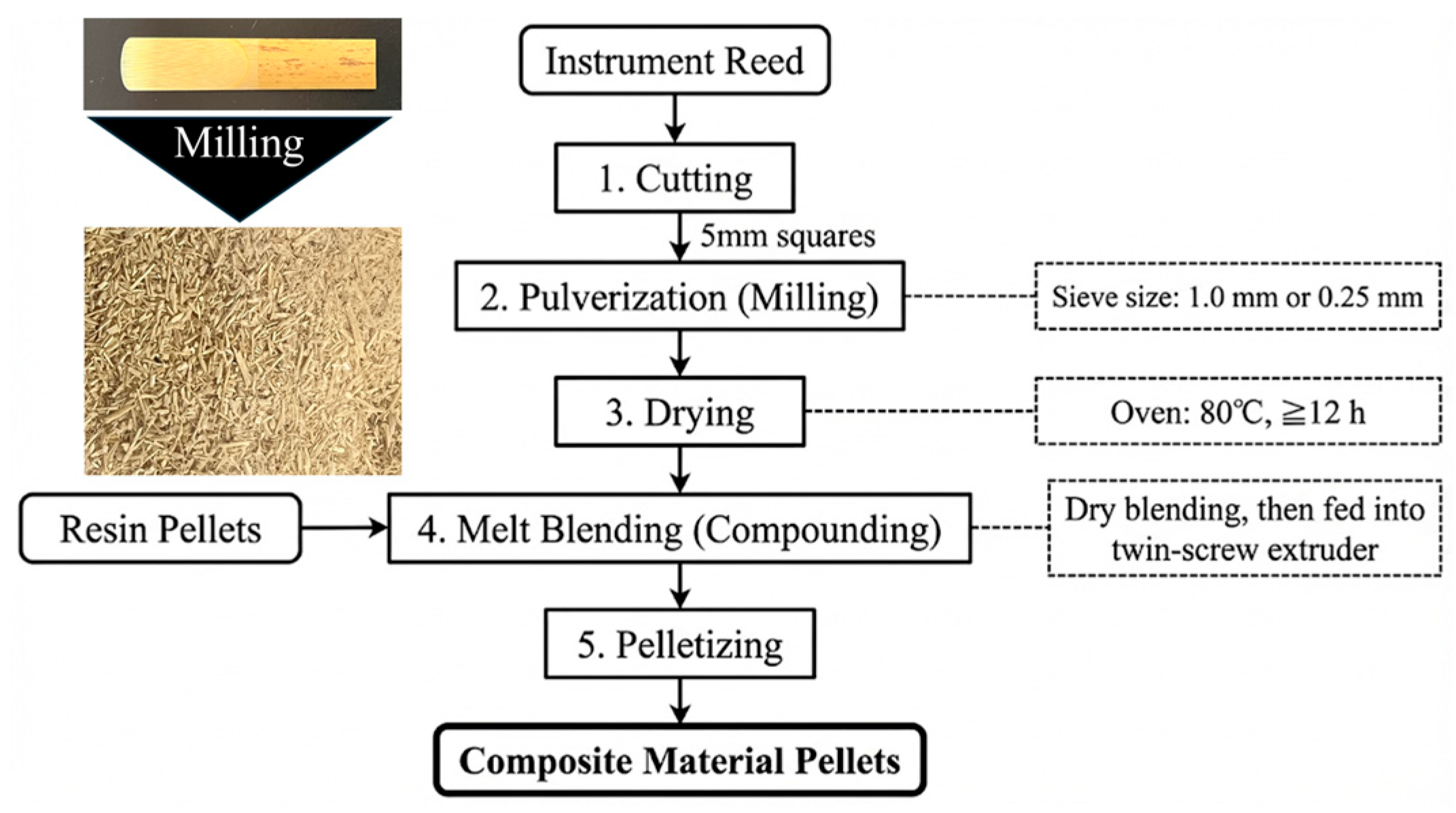
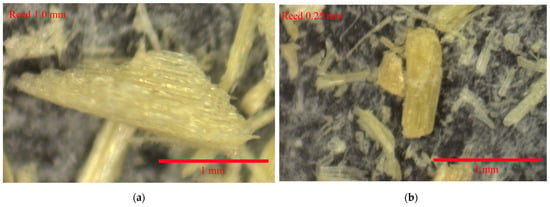
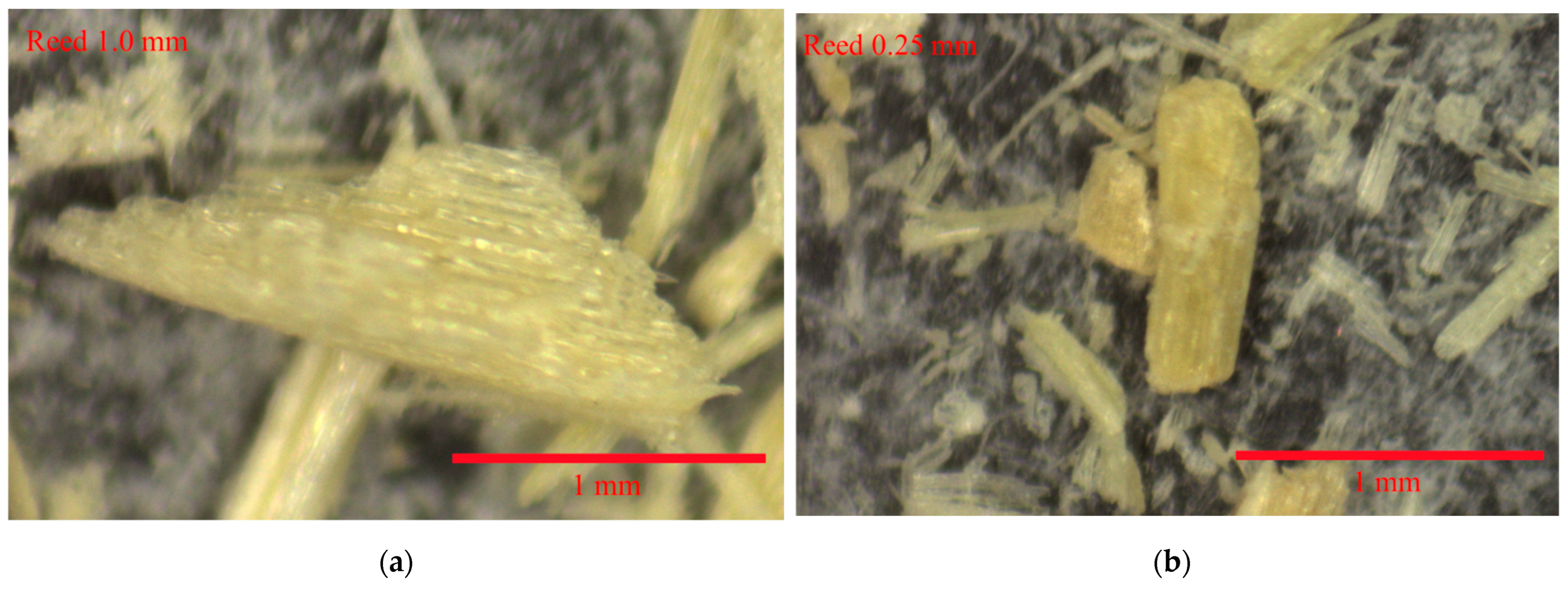
Figure 13 shows the process from crushing musical instrument reeds to melt mixing. After cutting the collected lead into 5 mm squares, they were filled into a cutting mill (Pulverisette 29; Fritsch GmbH, Idar-Oberstein, Germany), they were pulverized. The particle size distribution of the pulverized filler was adjusted by attaching sieves with 1.0 mm and 0.25 mm aperture sizes to the cutting mill. Figure 14 portrays the reed powder morphology after pulverization. The pulverized reeds exhibited more or less random shapes.
Figure 13.
Process flow from crushing musical instrument reeds to melt mixing.
Figure 14.
Optical micrographs of reed powders pulverized using different sieve sizes: (a) 1.0 mm sieve and (b) 0.25 mm sieve. The red scale bars represent 1 mm.
4.3. Melt Mixing
The pulverized reed powder and matrix pellets were fed simultaneously into a twin-screw melt-mixing extruder (Model IMC0-00; Imoto Machinery Co., Ltd., Kyoto, Japan) for melt mixing. Later, PBS and reed powder were used after drying at 80 °C for more than 12 h. Reed powder and matrix pellets were adjusted to the specified composition, then dry blended. They were fed from the hopper using a screw-type constant-speed feeder (manufactured by Ishizuka M&E Co., Ltd., PF-compact, Aichi, Japan). The feed rate was approximately 1 g/min, and the residence time was approximately 15 min. The obtained composite materials were granulated into pellets of 3 mm length using a cold-cut pelletizer (Toyo Seiki Seisaku-sho, Ltd., Tokyo, Japan). The compositions examined for this study are presented in Table 2. The compositions are expressed in weight percentages (wt%) for poly(butylene succinate) (PBS), thermoplastic polyolefin (TPO), and reed fibers. The reed fibers were pulverized using sieves with mesh sizes of 0.25 mm and 1.0 mm to regulate filler dimensions. Experimental parameters include the melt-mixing temperature (Tmix) and screw rotation speed. Neat PBS and TPO served as control samples. Processing temperatures were maintained at 200 °C for PBS-based composites and 160 °C for TPO-based composites, with a constant screw speed of 60 rpm for all mixing procedures.
Table 2.
Experimental compositions and melt-processing parameters for PBS and TPO-based Reed filler composites.
Thermal decomposition of reeds occurs in stages, with full-scale decomposition reported to begin at 200 °C [25]. TPO could be melt-mixed at 160 °C, 30 °C above its melting point. However, PBS exhibited high melt viscosity below 190 °C, preventing stable melt mixing. Stable melt mixing was achieved at 200 °C, indicating potential for significant thermal decomposition to begin, so the temperature was set to 200 °C.
4.4. Injection Molding
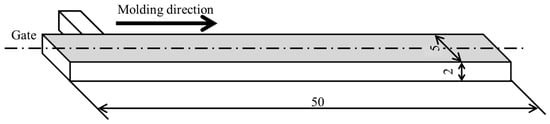
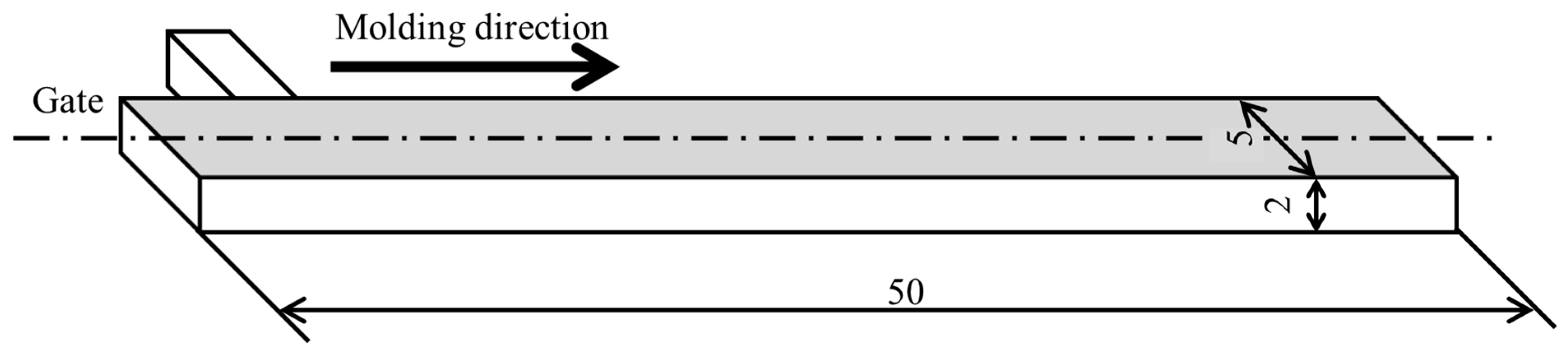
The granulated composite pellets were filled into a compact electric injection molding machine (C. Mobile 0813; Shinko Sellbic Co., Ltd., Tokyo, Japan) to perform injection molding. Composite pellets from both systems were dried at 80 °C for at least 12 h before use. Rectangular specimens for three-point bending and impact tests were obtained as molded products. Figure 15 presents the specimen shape. The injection molding temperature was set as 160 °C for TPO and as 190 °C for PBS. The mold temperature was set as 50 °C for TPO and 60 °C for PBS. Details of the injection molding conditions are presented in Table 3. Tinj represents the injection temperature, and Tmold represents the mold temperature. Vinj denotes the injection velocity, while Pinj and Phold represent the injection pressure and holding pressure, respectively. The holding pressure was adjusted for each composition to ensure the production of defect-free parts. tinj and tcool indicate the injection and cooling times.
Figure 15.
Specimen geometry (unit: mm).
Table 3.
Experimental compositions and injection molding parameters for PBS and TPO-based Reed filler composites.
4.5. Density Evaluation
The density of the rectangular specimens was measured using the Archimedes method with an electronic densimeter (MDS-300; Alfa Mirage Co., Ltd., Osaka, Japan) [26]. This evaluation was performed three times for each composition. The average value and standard deviation were calculated.
4.6. Mechanical Property Evaluation
In accordance with ISO 178, a three-point bending test of the rectangular specimens was performed with 40 mm span distance and 10 mm/min loading speed. The flexural stress–strain curve was determined from the load–deflection data. The flexural modulus was calculated from the initial slope. The flexural strength was calculated from the maximum flexural stress [27]. This test was conducted using a compact universal testing machine (MCT-2150; A&D Co., Ltd., Tokyo, Japan). In addition, the formula for Poisson’s ratio proposed by Takayama et al. for tensile tests was applied to bending. Poisson’s ratio at the onset of flexural yielding was found using Equation (7) [28].
Therein, σfy stands for the flexural yield initiation stress, Ef denotes the flexural modulus, and εfy expresses the flexural yield initiation strain. Poisson’s ratio obtained using this method indicates the value near the skin layer of the rectangular specimen.
To evaluate the interfacial shear strength, a short-beam shear test was conducted according to an earlier report by Jiang et al. [29]. This test was conducted using a compact universal testing machine (MCT-2150; A&D Co., Ltd., Tokyo, Japan). A three-point bending test was conducted for the rectangular specimens with 10 mm span distance and 10 mm/min loading speed. The stiffness–average shear stress curve was obtained from the load–deflection curve. Three points at which the stiffness decreased discontinuously were extracted from this curve. The values combined using the three-dimensional Pythagorean theorem shown in Equation (8) were evaluated as the interfacial shear strength (IFSS).
In that equation, τ represents the average shear stress at the point where the stiffness decreases discontinuously. Subscripts denote the values in ascending order: 1, 2, and 3. Each mechanical evaluation was performed five times. The average value and standard deviation of the calculated property values were found.
4.7. Observation of Reed Powder Dispersion
To confirm the dispersion state of the reeds inside the rectangular specimens, X-ray CT imaging was performed using a micro-focus X-ray CT system (ScanXmate-D225RSS270; Comscantechno Co., Ltd., Yokohama, Japan). The imaging conditions were set as the following: 60 kV tube voltage, 150 µA tube current, and 25× magnification. The imaging precision was 5.1 µm/pixel. To discuss the flexural properties, emphasis was assigned to the skin layer region of the rectangular molded product to observe the reed powder dispersion state. Based on the observation results obtained for this region, the reed powder orientation angle was ascertained using image analysis software (Winroof ver. 7.4).
The reed powder morphology of the composite materials examined for this study was confirmed clearly. Quantitative analysis of the reed powder size was also performed using these X-ray CT images. This analysis also used the image analysis software described above. The reed powder has particles of more or less random shape. Therefore, the length was measured from two directions: the major axis and minor axis. The average value and standard deviation of each were calculated. Furthermore, the reed powder particle thickness was measured from the cross-sectional image. The average value and standard deviation were found. These analyses were performed on more than 100 powder particles.
4.8. Fourier Transform Infrared Spectroscopy (FT-IR)
To evaluate interaction occurring at the interface, FT-IR measurements were performed using a Fourier transform infrared spectrometer (Nicolet iS5; Thermo Fisher Scientific Inc., Waltham, MA, USA). The measurement method was attenuated total reflection (ATR), with 32 scans, a wavenumber range of 4000–400 cm−1, and air as the background.
If the matrix is constrained by the reed dispersion, then the vibrational spectrum of the functional groups present in the side chains is expected to decrease. Therefore, after baseline correction of the obtained spectra, differences in the vibrational spectra of the functional groups occurring in the matrix because of reed dispersion were confirmed by comparison among compositions.
4.9. Differential Scanning Calorimetry (DSC)
The molded products obtained by injection molding were cut using a microtome (RX-860; Yamato Kohki Industrial Co., Ltd., Saitama, Japan). Differential scanning calorimetry (DSC, Q-2000; TA Instruments, New Castle, DE, USA) was performed using the obtained samples. Measurements were taken in the range of 40 °C to 230 °C. The heat flow curve during the cooling process was examined. The cooling rate was fixed at 10 °C/min. Measurements were taken in an atmosphere purged with nitrogen at a flow rate of 50 mL/min.
From the obtained results, the exothermic enthalpy ΔHc during cooling crystallization was determined. The degree of crystallinity Xc was calculated according to Equation (9).
In that equation, Wf represents the reed weight content. Also, ΔHm0 denotes the endothermic enthalpy obtained when the degree of crystallinity is 100%; values of 207 J/g for TPO and 210 J/g for PBS were used [30,31].
5. Conclusions
For this study, waste woodwind instrument reeds scheduled for incineration were reevaluated as unutilized biomass resources. The potential for material recycling was investigated by compositing them with thermoplastics, specifically PBS and TPO. Through detailed investigation of the effects of reed filler loading and particle size on the mechanical properties, interfacial properties, and microstructure of the composites, the following conclusions were drawn.
Experiment results clarified that waste reeds, when subjected to appropriate pulverization treatment, function effectively as reinforcing fillers for thermoplastic resins. Particularly when PBS, a biodegradable resin, was used as the matrix, a remarkable reinforcing effect was confirmed: at 30 wt% reed content, flexural strength reached approximately 1.7 times and flexural modulus approximately 2.8 times that of the neat resin. Although some improvement in rigidity was found with TPO (a general-purpose polyolefin), the effect was weaker than that found for PBS.
Findings suggest that the differences in reinforcing effects depending on the matrix resin are attributable to the interfacial interaction between the filler and the matrix. In the PBS system, strong interactions, such as hydrogen bonds, were formed between the carbonyl groups of the matrix and the hydroxyl groups on the reed surface, producing high IFSS. This strong interfacial constraint force is considered to have generated expansion stress within the reeds, maintaining or expanding their porous structure. Consequently, the Poisson’s ratio of the entire composite increased, thereby contributing to realization of a high flexural modulus.
Structural analysis using FT-IR and DSC revealed that the influence of reed powder on the crystallization behavior and phase structure of the matrix is strongly dependent on the polarity of the base material. In the PBS system, the strong interfacial interaction with reeds lowered the activation energy for crystallization. A marked rise in crystallization temperature (Tc) was confirmed. Furthermore, spectroscopic analysis confirmed the formation of a “Rigid Amorphous Fraction (RAF)” derived from the constraint of molecular chains at the filler interface, clarifying that this functions as a robust buffer layer responsible for stress transfer. By contrast, in the TPO system, reeds acted as heterogeneous nucleating agents to improve the crystallinity index (regularity), but the change in Tc was not great. This finding indicates that the chemical affinity between TPO and reeds is poor, remaining as physical contact without molecular constraint at the interface. The presence or absence of this interfacial constraint layer (RAF) can be inferred as the primary factor determining the difference in mechanical reinforcement efficiency between the two composites.
The PBS/Reed composite developed for this study not only contributes to reducing petroleum-derived resin usage and CO2 emissions by avoiding incineration; it also serves as a “bio-based composite” with biodegradability, thereby contributing to the construction of a sustainable resource-circulating society. Benefits were also clarified for the TPO/Reed composite: a recyclable, high-rigidity material.
Based on these findings, it has been demonstrated that waste reeds are not merely waste. They are extremely promising as next-generation bio-fillers able to contribute to high functionality and reduced environmental load through appropriate matrix selection and process control. The results of this research are expected to contribute not only to the upcycling of niche unutilized resources such as musical instrument waste but also broadly to the advancement of biomass filler utilization technologies.
Author Contributions
Conceptualization, T.T.; methodology, T.T. and S.O.; validation, T.T. and S.O.; formal analysis, T.T. and S.O.; investigation, T.T. and S.O.; resources, S.O.; data curation, T.T. and S.O.; writing—original draft preparation, T.T. and S.O.; writing—review and editing, T.T.; visualization, T.T. and S.O.; supervision, T.T.; project administration, T.T.; funding acquisition, T.T. All authors have read and agreed to the published version of the manuscript.
Funding
This research received no external funding.
Data Availability Statement
The data presented for this study are sufficient for the purposes of this investigation. However, they are available for further analysis upon request from the corresponding author.
Acknowledgments
The reeds used for this study were provided by the wind ensembles of Yonezawa First Junior High School, Yonezawa Kojokan Senior High School, and Yamagata University. The microfocus X-ray CT imaging conducted for this study was supported by the Industrial Technology Institute of the Miyagi Prefectural Government.
Conflicts of Interest
The authors declare that they have no conflict of interest.
References
- IPCC. Climate Change 2022: Mitigation of Climate Change. Contribution of Working Group III to the Sixth Assessment Report of the Intergovernmental Panel on Climate Change; Cambridge University Press: Cambridge, UK; New York, NY, USA, 2022. [Google Scholar]
- UNEP. Waste Management Outlook for Asia and the Pacific; United Nations Environment Programme: Nairobi, Kenya, 2019. [Google Scholar]
- European Environment Agency (EEA). Greenhouse Gas Emissions from Waste Management; EEA: Copenhagen, Denmark, 2020. [Google Scholar]
- Bucur, V. Traditional and new materials for the reeds of woodwind musical instruments. Wood Sci. Technol. 2019, 53, 1157–1187. [Google Scholar] [CrossRef] [Scilit]
- Archive Market Research. Reed Instrument Unlocking Growth Potential: Analysis and Forecasts 2026–2033. Available online: https://www.archivemarketresearch.com/reports/reed-instrument-269754?tab=summary (accessed on 5 February 2025).
- Abou-Zeid, R.E.; El-Wakil, N.A.; Fahmy, Y. Thermoplastic composites from natural reed fibers. Egypt. J. Chem. 2015, 58, 67–79. [Google Scholar] [CrossRef] [Scilit]
- Ortega, Z.; Linderbäck, P.; Suárez, L.; Castro, A.M.; Gñuñi, F.; Saporiti, F.; Terenzi, A. Common reed as a novel biosource for composite production. In Proceedings of the 21st European Conference on Composite Materials (ECCM21), Nantes, France, 2–5 July 2024. [Google Scholar]
- Suárez, L.; Billham, M.; Cunningham, E. A New Image Analysis Assisted Semi-Automatic Geometrical Measurement of Fibers in Thermoplastic Composites: A Case Study on Giant Reed Fibers. J. Compos. Sci. 2023, 7, 326. [Google Scholar] [CrossRef] [Scilit]
- Suárez, L.; Ortega, Z.; Romero, F.; Paz, R.; Marrero, M.D. Influence of Giant Reed fibers on mechanical, thermal, and disintegration behavior of rotomolded PLA and PE composites. J. Polym. Environ. 2022, 30, 4848–4862. [Google Scholar] [CrossRef] [Scilit]
- Mohanty, A.; Vivekanandhan, S.; Pin, J.; Misra, M. Composites from renewable and sustainable resources: Challenges and innovations. Science 2018, 362, 536–542. [Google Scholar] [CrossRef] [Scilit] [PubMed]
- Das, O.; Babu, K.; Shanmugam, V.; Sykam, K.; Tebyetekerwa, M.; Neisiany, R.; Försth, M.; Sas, G.; Gonzalez-Libreros, J.; Capezza, A.; et al. Natural and industrial wastes for sustainable and renewable polymer composites. Renew. Sustain. Energy Rev. 2022, 158, 112054. [Google Scholar] [CrossRef] [Scilit]
- Taurino, R.; Bondioli, F.; Messori, M. Use of different kind of waste in the construction of new polymer composites: Review. Mater. Today Sustain. 2022, 19, 100298. [Google Scholar] [CrossRef] [Scilit]
- Formela, K.; Kurańska, M.; Barczewski, M. Recent Advances in Development of Waste-Based Polymer Materials: A Review. Polymers 2022, 14, 1050. [Google Scholar] [CrossRef] [Scilit]
- Takayama, T.; Motoyama, Y. Injection molding temperature dependence of elastic coefficients obtained using three-point bending tests to ascertain thermoplastic polymer coefficients. Mech. Eng. J. 2021, 8, 20–00414. [Google Scholar] [CrossRef] [Scilit]
- Rodrigue, D. Elastic modulus prediction for hybrid polymer composites. Mater. Eng. Res. 2019, 1, 64–68. [Google Scholar] [CrossRef] [Scilit]
- Chung, S.M.; Yap, A.U.; Koh, W.K.; Tsai, K.T.; Lim, C.T. Measurement of Poisson’s ratio of dental composite restorative materials. Biomaterials 2004, 25, 2455–2460. [Google Scholar] [CrossRef] [Scilit]
- Takayama, T.; Yuasa, Y.; Jiang, Q. Polyvinyl butyral addition effects on notched Charpy impact strength of injection-molded glass fiber-reinforced polypropylene. Polymers 2024, 16, 3472. [Google Scholar] [CrossRef] [Scilit] [PubMed]
- Takayama, T. Weld strength of injection molded short fiber reinforced polypropylene. Mech. Mater. 2019, 136, 103064. [Google Scholar] [CrossRef] [Scilit]
- Kang, J.; Huang, M.; Zhang, M.; Zhang, N.; Song, G.; Liu, Y.; Shi, X.; Liu, C. An effective model for fiber breakage prediction of injection-molded long fiber reinforced thermoplastics. J. Reinf. Plast. Comp. 2020, 39, 473–484. [Google Scholar] [CrossRef] [Scilit]
- Chang, T.; Bechara, A.; Çelik, H.; Brands, D.; Yanev, A.; Osswald, T. Validation of Fiber Breakage in Simple Shear Flow with Direct Fiber Simulation. J. Compos. Sci. 2020, 4, 134. [Google Scholar] [CrossRef] [Scilit]
- Yao, S.-F.; Chen, X.-T.; Ye, H.-M. Investigation of structure and crystallization behavior of poly(butylene succinate) by Fourier transform infrared spectroscopy. J. Phys. Chem. B 2017, 121, 9476–9485. [Google Scholar] [CrossRef] [Scilit]
- Righetti, M.; Di Lorenzo, M.; Cinelli, P.; Gazzano, M. Temperature dependence of the rigid amorphous fraction of poly(butylene succinate). RSC Adv. 2021, 11, 25731–25737. [Google Scholar] [CrossRef] [Scilit]
- Sikhosana, T.; Malebo, N.; Motloung, M.; Mofokeng, T.; Mochane, M. The Influence of Halloysite Clay on the Properties of the Polybutylene Succinate (PBS)/Sawdust, PBS/Sugarcane Bagasse, and PBS/Sawdust/Sugarcane Bagasse Hybrid Composites. Polymers 2025, 17, 2120. [Google Scholar] [CrossRef] [Scilit]
- Malinowski, R.; Krasinskyi, V.; Moraczewski, K.; Raszkowska-Kaczor, A.; Grytsenko, O.; Moravskyi, V.; Miklaszewski, A. The Effect of Laponite on the Structure, Mechanical and Thermal Properties of Poly(butylene Succinate). Polymers 2024, 16, 3186. [Google Scholar] [CrossRef] [Scilit] [PubMed]
- Tsapko, Y.; Tsapko, A.; Bondarenko, O. Establishment of heat-exchange process regularities at inflammation of reed samples. East.-Eur. J. Enterp. Technol. 2019, 1, 36–42. [Google Scholar] [CrossRef] [Scilit]
- Bensch, J.; Brynard, H. New approach to density measurements using Archimedes’s principle. Nature 1972, 239, 96. [Google Scholar] [CrossRef] [Scilit]
- ISO 178:2019; Plastics—Determination of Flexural Properties. The British Standards Institution: London, UK, 2019.
- Takayama, T.; Takahashi, R.; Konno, N.; Sato, N. Evaluation of polypropylene reusability using a simple mechanical model derived from injection-molded products. Polymers 2025, 17, 2107. [Google Scholar] [CrossRef] [Scilit]
- Jiang, Q.; Takayama, T.; Nishioka, A. Improving the accuracy of the evaluation method for interfacial shear strength of FRTP through short beam shear test. Polymers 2024, 16, 883. [Google Scholar]
- Wang, Y.; Shi, Y.; Shao, W.; Ren, Y.; Dong, W.; Zhang, F.; Liu, L. Crystallization, structures, and properties of different polyolefins with similar grafting degree of maleic anhydride. Polymers 2020, 12, 675. [Google Scholar] [CrossRef] [Scilit] [PubMed]
- Papageorgiou, G.Z.; Bikiaris, D.N. Crystallization and melting behavior of three biodegradable poly(alkylene succinates): A comparative study. Polymer 2005, 46, 12081–12092. [Google Scholar] [CrossRef] [Scilit]

Disclaimer/Publisher’s Note: The statements, opinions and data contained in all publications are solely those of the individual author(s) and contributor(s) and not of MDPI and/or the editor(s). MDPI and/or the editor(s) disclaim responsibility for any injury to people or property resulting from any ideas, methods, instructions or products referred to in the content. |
© 2026 by the authors. Licensee MDPI, Basel, Switzerland. This article is an open access article distributed under the terms and conditions of the Creative Commons Attribution (CC BY) license.