


Abstract
Polyethylene terephthalate (PET) recycling technology has developed into a mature system, providing a key paradigm for the circular utilization of polyester waste. Its pathways are primarily divided into mechanical recycling and chemical recycling. Mechanical recycling converts waste PET into rPET through physical processes such as efficient sorting, deep cleaning, and melt extrusion. However, the resulting product often faces issues of decreased intrinsic viscosity and thermal oxidative degradation. Chemical recycling, particularly depolymerization techniques like saccharification, hydrolysis, and methanolysis, can reduce PET waste back to monomers. After purification, these monomers can be repolymerized into virgin-quality PET, achieving a closed-loop cycle. However, this approach faces challenges related to cost and process complexity. Against this backdrop, this paper further explores potential recycling methods for polyethylene terephthalate-1,4-cyclohexanedimethyleneterephthalate (PETG). This paper argues that the experience of PET recycling provides a crucial foundation for addressing PETG challenges but is not a direct solution. Future development directions include: developing intelligent sorting technologies, creating highly efficient selective catalysts to optimize depolymerization reactions, and other initiatives. These measures are essential for establishing an efficient recycling system for complex polyester waste.
1. Introduction
The IPCC Sixth Assessment Report points out that human activities have led to numerous risk escalations, such as rising temperatures and decreasing biodiversity, significantly affecting global ecosystems and human health [1]. One of the causes of these phenomena is the massive use of plastic products. Since the birth of plastic in 1907, it has become an indispensable daily necessity in people’s lives. According to statistics, the global annual production of plastic waste reaches 52.1 million metric tons, of which 53% is treated by open burning and only 9% is recycled [2,3]. The large-scale incineration of plastics releases harmful gases such as CO2 and dioxins into the air, contributing to global warming. Therefore, recycling has become a key force in advancing a green circular economy.
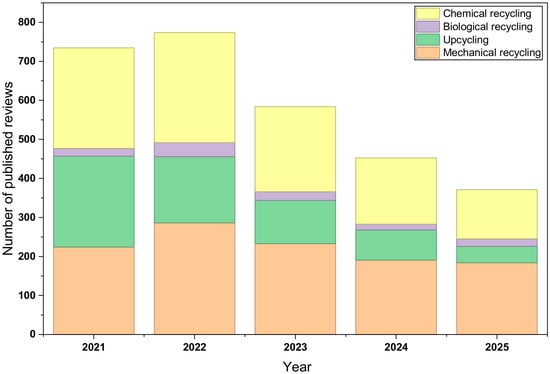
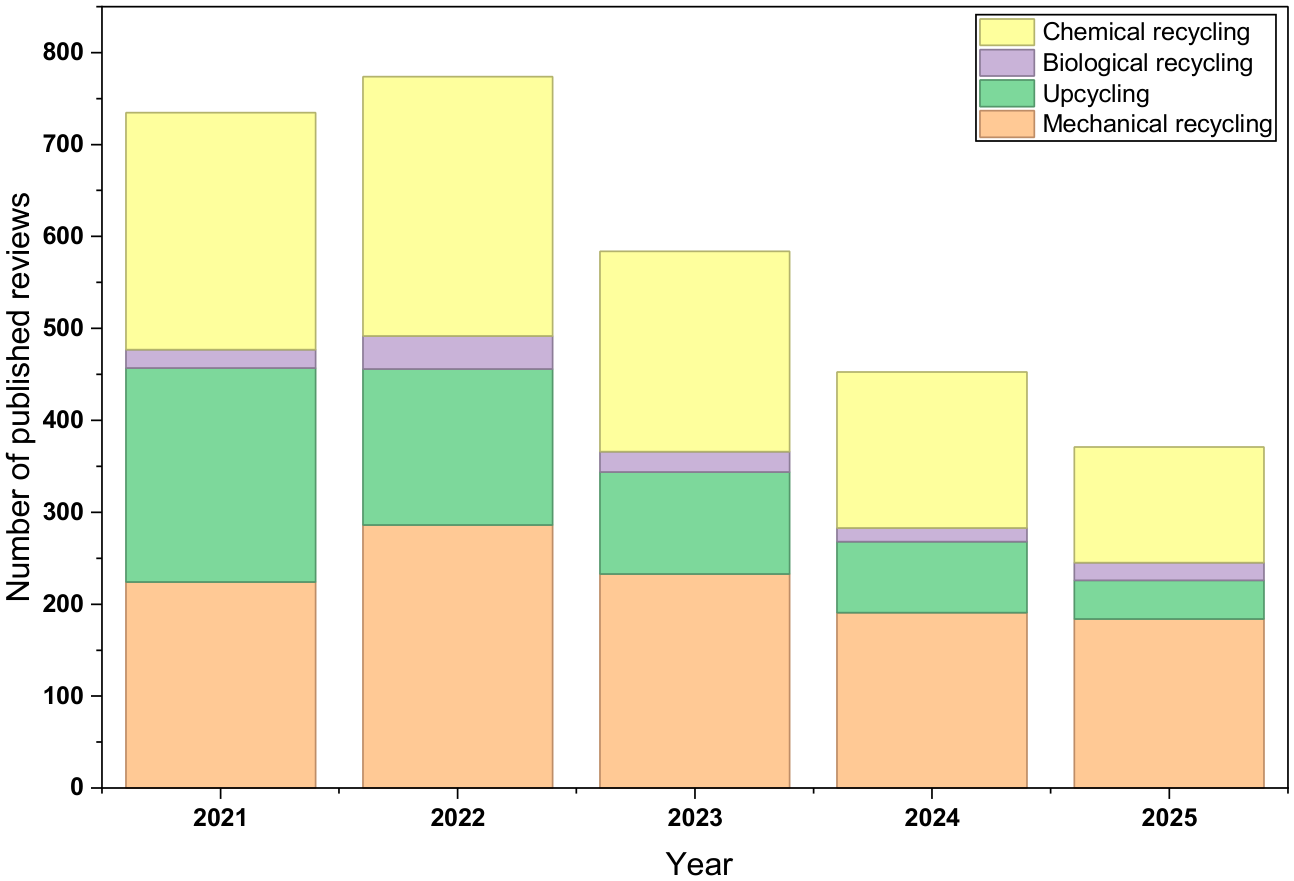
Polyethylene terephthalate (PET), as an excellent material among polyester recyclables, has been widely reported in the literature related to recycling every year. The literature on its recycling can be traced back to around the year 2000. In contrast, polyethylene terephthalate-1,4-cyclohexanedimethyleneterephthalate (PETG), as a relatively emerging material, currently has less mature recycling technologies. In early October 2025, we conducted a comprehensive search of the Web of Science database using keywords including ‘mechanical recycling,’ ‘chemical recycling,’ ‘biological recycling,’ ‘PET,’ and ‘PETG.’ The statistical results are shown in Figure 1. Between 2021 and early October 2025, research on PET waste recycling was distributed as follows: 38.33% focused on mechanical recycling, 36.13% on chemical recycling, 21.70% on upcycling, with the remaining covering energy recovery and biological recycling. In contrast, articles related to PETG recycling are extremely scarce.
Figure 1.
Number of PET recycling papers.
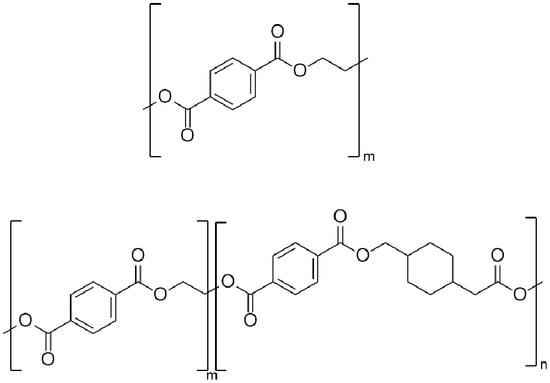
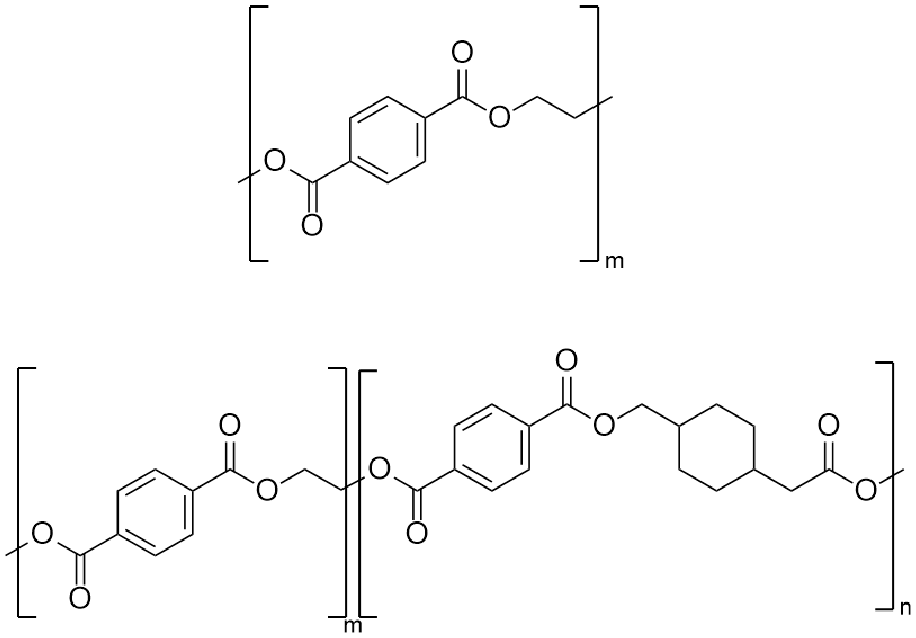
Although there are relatively few literature reports on PETG recycling, PET and PETG are two thermoplastic polyester materials with similar structures. As shown in Figure 2, the molecular formulas of PET and PETG are displayed. We can start from the mature recycling system of PET, focusing on the similarities and differences in their structures to explore possible recycling methods for PETG. PET is synthesized by polycondensation of terephthalic acid (TPA) and ethylene glycol (EG), possessing excellent mechanical strength, chemical resistance, and thermal stability. It is widely used in fibers, packaging, battery separators, and other fields [4,5,6]. PETG, by introducing 1,4-cyclohexanedimethanol (CHDM) into the PET molecular chain, increases steric hindrance and disrupts the crystalline structure, forming an amorphous material with high transparency, high impact resistance, and low tendency to crystallize. This slight structural difference leads to disparities in their recycling behavior and product performance. In terms of specific performance, the high crystallinity of PET gives it higher rigidity and heat resistance, with a melting point of around 250 °C but relatively high brittleness. In contrast, PETG, due to its amorphous structure, exhibits better impact resistance, lower molding shrinkage, and a higher melting temperature generally around 260–270 °C, making it suitable for 3D printing, medical devices, and shape-memory materials [7,8,9,10]. The following Table 1 provides a comparison of PET and PETG properties.
Figure 2.
From top to bottom are the structural formulas of PET and PETG, respectively.
Table 1.
Properties of PET and PETG.
2. Mechanical Recycling of Polyester Wastes
2.1. Mechanical Recycling of PET: Industrial Practice and Degradation Challenges
Mechanical recycling, which involves the physical reprocessing of plastic wastes through washing, sorting, shredding, and re-melting, remains the most widely adopted method for PET recycling due to its cost-effectiveness and operational simplicity. Mechanical recycling processes, including hydrolysis, thermal oxidation degradation, and mechanical degradation, cause a decrease in the molecular weight and viscosity of recycled PET, leading to processing difficulties [17,18,19,20,21,22,23].
Therefore, secondary modification is often required to enhance the relative molecular weight of recycled materials rPET, optimize their crystalline structure, and improve their thermomechanical properties. Among these approaches, blend modification stands as one of the most widely applied and effective strategies [24]. By blending recycled materials with high-performance polymers or additives, significant performance enhancements can be achieved [25,26,27]. For instance, Ref. [28] proposed melt blending rPET with PETG or PCTG, incorporating epoxy-functionalized chain extenders (CEs) for reactive compatibilization. This approach not only improved processing stability but also elevated the material’s heat deflection temperature (HDT) from approximately 70 °C to 95–100 °C through subsequent annealing treatment, while maintaining excellent printing precision. Ref. [29] by blending rPET with PP, the mechanical properties and degradation temperature of the blend were enhanced. Over the past decade, blending rPET with various polymers and additives has gained traction, improving its thermomechanical properties, flame retardancy, foamability, toughness, and more. Blending virgin polymers such as PP, PET, HDPE, etc., with rPET pellets reduces brittleness and enhances performance. The following Table 2 provides a summary of selected studies completed in recent years.
Table 2.
Blending PET to improve properties.
2.2. Potential Mechanical Recycling of PETG
The mechanical recycling process for PETG is identical to that of PET, and it also requires secondary recycling afterward. Table 3 summarizes recent researches on PETG blending and modification.
Table 3.
Blending PETG to improve thermo-mechanical properties.
2.3. Translating Knowledge from PET to PETG: Emerging Challenges
Although the fundamental principles of mechanical recycling apply to PETG, the introduction of CHDM groups endows the material with exceptional impact strength and transparency while significantly altering its recycling behavior. First, separation and sorting pose major bottlenecks. In post-consumer waste streams, PETG frequently coexists with PET or other engineering plastics. Due to similar density and solubility parameters, traditional separation techniques like flotation prove highly inefficient. Efficient sorting is a prerequisite for achieving high-quality mechanical recycling, yet the absence of effective sorting mechanisms for mixed PETG waste severely limits its recyclability.
In the field of PET recycling, existing research has demonstrated the feasibility of solvent-based recovery strategies, which involve dissolving PET using suitable solvents to separate it from other materials [50]. For instance, Ref. [51] systematically screened solvent systems by integrating Hansen solubility parameters (HSPs), molecular dynamics simulations (MDs), and COSMO-RS calculations. This approach successfully achieved efficient separation of PE, EVOH, and PET within multilayer plastic films, significantly enhancing separation selectivity and recovery efficiency. Building upon this approach, future research could leverage the chemical structural and physical property differences between PET and PETG. By integrating theoretical calculations with experimental screening, solvent systems capable of selectively dissolving one component could be developed. This would enable efficient separation of PET and PETG, offering a novel pathway for PETG recovery.
Secondly, the thermal stability of PETG during reprocessing requires careful investigation. Although its melting point is not defined due to its amorphous nature, its processing temperatures (typically 260–270 °C) are high. It remains unclear whether the sterically hindered CHDM unit makes PETG more or less susceptible to thermal degradation compared to PET. Refs. [15,52] indicates that CHDM content and its cis-trans isomerization significantly influence PETG’s crystallization-melting behavior, thermal stability, and mechanical properties. As CHDM content increases, PETG’s Tg, melting point, and crystallinity first decrease and then increase. Ref. [10] has found that at 30 °C, the turnover rate of low-crystallinity PETG is approximately 80 times higher than that of bottle-grade PET.
3. Chemical Recycling of Polyester Wastes
3.1. Chemical Recycling of PET
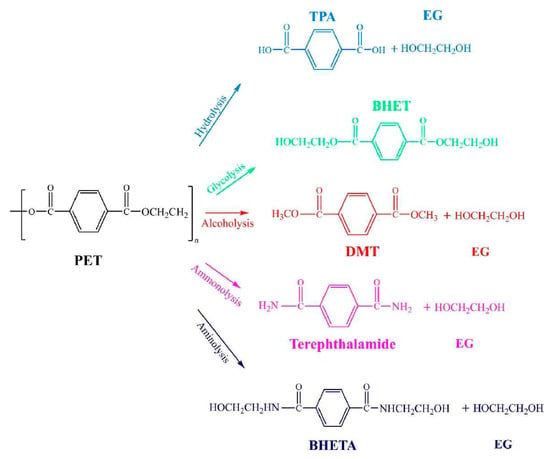
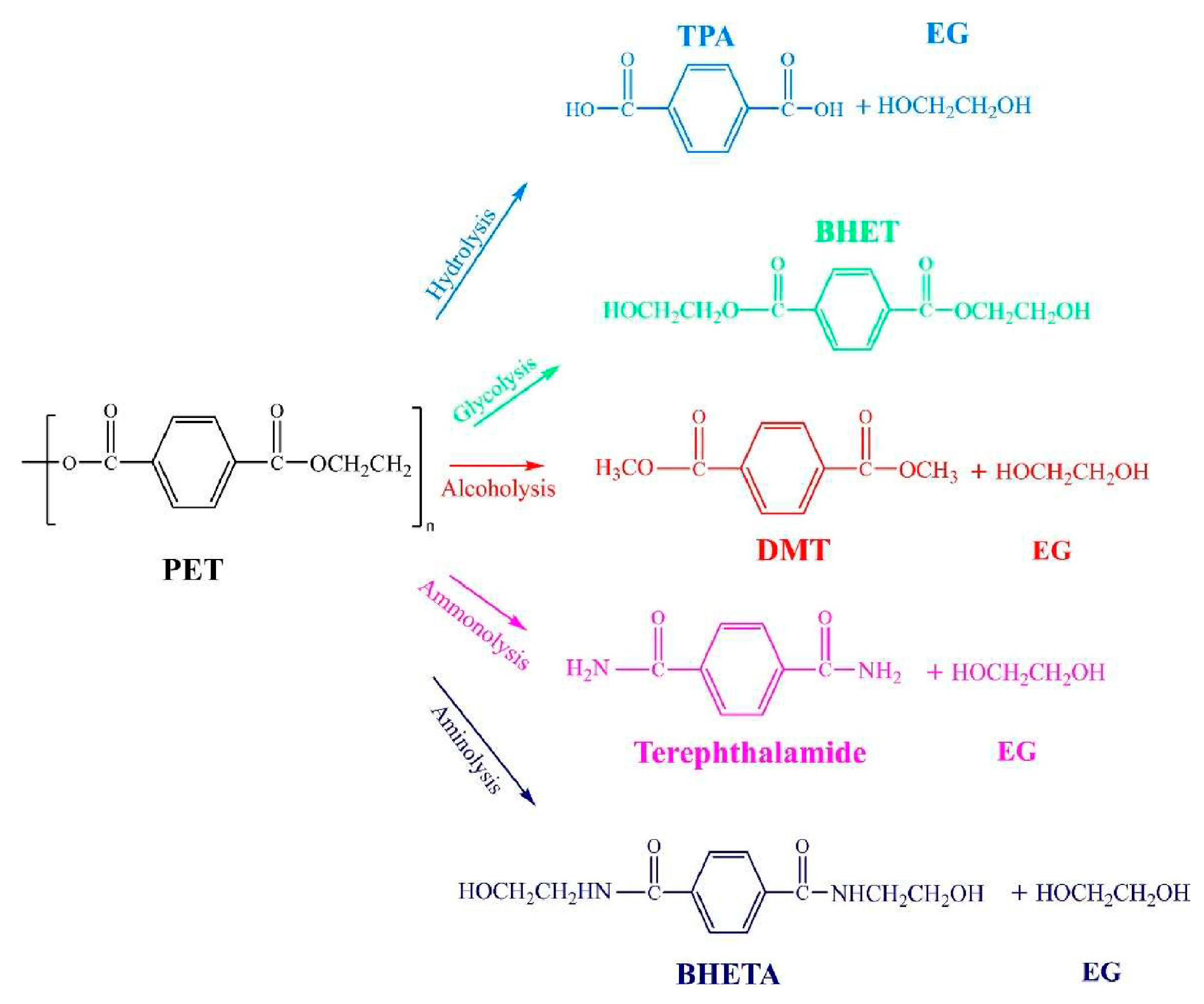
Chemical recycling depolymerizes PET into monomers by the action of a cracking agent, which is then purified and repolymerized. Depending on the cracking agent used, it is mainly divided into the following five categories: glycolysis, methanolysis, ammoniaysis, amineysis and hydrolysis (e.g., Figure 3). The PET is cracked into intermediates catalyzed by the cracking agent, and the PET monomers TPA and EG are subsequently obtained after purification, drying, etc. The monomers obtained by chemical recycling are costly, but the products obtained subsequently have the same properties as the original products. The chemical recycling of PET cracks it into its monomers, TPA and EG; and the PETG has one more monomer, CHDM, compared to PETG. At present, it is reported that the waste PET can be recycled into the monomers TPA and EG by chemical recycling. It has been reported in the literature that CHDM can be prepared from the monomer BHTE obtained after glycolysis of waste PET.
Figure 3.
Generalised reaction scheme for chemical recycling of PET [53].
Glycolysis is the most widely used method in chemical recycling due to its mild conditions and easy operation, and has been commercially applied. Ref. [54] investigated the effects of microwave-assisted glycolysis, reaction conditions such as temperature, reaction time on conversion rate, monomer yield, energy efficiency, etc., The experiments showed that the optimal reaction conditions were as follows: temperature, reaction time, and energy efficiency. The experiments showed that the optimum reaction conditions were reaction temperature of 180 °C, reaction time of 30 min, PET particle size of 75 μm, maximum conversion of PET of 66.71 ± 9.71 wt%, maximum yield of BHET of 48.08 ± 0.68 wt%, and maximum yield of BHET of 19.83 ± 5.40 wt%. The energy efficiency and recovery were 11.88% and 17.89%, respectively. It can be seen that the recovery of BHET is still low under catalyst-free conditions. Therefore, metal oxides, ionic liquids, deep eutectic solvents and some organic catalysts, etc. have received much attention in the last decade or so as efficient catalysts for PET glycolysis. The following table lists the results of PET glycolysis in recent years. (e.g., Table 4)
Table 4.
Glycolysis of PET waste.
Methanolysis was developed on the basis of too long reaction time of ethylene glycolysis, and its general reaction conditions are temperature at 180–280 °C and pressure at 2–4 MPa. The reaction time has been reduced, but the high temperature and pressure conditions will promote the generation of side reactions and reduce the yield of monomer DMT, and at the same time, the use of traditional metal catalysts produces hazardous metal ions waste liquid, which is more polluting to the environment. The selection of environmentally friendly and green sustainable catalysts is the most achievable solution at present. The following table summarizes some of the research work on methanolysis of PET waste in recent years. Ref. [63] used CO2 as a solution precursor and carried out CO2 hydrogenation, PET methanolysis and DMT hydrogenation in a one-pot method, with synergistic coupling of the reactions, and then converted PET into a high-value-added product, DMCD, under the effect of the double promotion. This method can recover two types of waste—PET and CO2, which can be recycled in the same way, and PET and CO2, which is very much in line with the concept of sustainable development. The following table lists the results of PET methanolysis in recent years (e.g., Table 5).
Table 5.
Methanolysis of PET waste.
Ammonolysis of PET is a chemical recycling method for polyester degradation by nucleophilic attack of the ester bond (-COO-) through the amino group (-NH2), but it is still in the exploratory stage and has not yet been realized for large-scale application. The reaction can be carried out under relatively mild conditions (20–200 °C) without additional catalysts, and PET can be degraded by simply placing it in an aqueous ammonia solution, generating monomers such as terephthalic acid (TPA), bis(2-hydroxyethyl)terephthalamide (BHETA), etc. Ref. [69] systematically investigated the reaction conditions, product distributions, and sustainable recycling pathways in the ammolysis of PET to provide an important opportunity for the chemical recycling of PET. PET chemical recycling provides an important reference. The study compared the differences in energy efficiency between different degradation methods and found that the microwave-assisted method significantly shortened the reaction time and reduced the energy consumption, while the solar-driven method was more time-consuming but economically superior. In addition, the study evaluated the role of several novel catalysts and solvents, among which sodium acetate showed excellent catalytic activity to maximize the yield of BHETA.
Hydrolysis is classified as acidic, neutral and alkaline hydrolysis depending on the pH value of the selected solvent. At present, HCW (hot compressed water) is widely used as a cracking agent, which can produce H″ and OH- during the reaction process, and promote the hydrolysis of PET under the dual action. Acid hydrolysis is carried out under the condition of strong acid (e.g., sulfuric acid, phosphoric acid), the concentration of which should reach more than 90%, and the temperature is at 25–100 °C, the PET is hydrolyzed to obtain the monomer, and the generated TPA needs to be neutralized and purified before use. In the case of sulfuric acid hydrolysis, the yield of TPA can reach 99% in 30 min at a temperature of 100 °C. Alkaline hydrolysis is carried out using strong alkali solutions such as NaOH or KOH at a temperature of 210–250 °C and a pressure of 1.4–2 MPa to generate water-soluble sodium salts, which need to be acidified to obtain the required TPA and EG, where a NaOH solution is used to react at 200 °C for 6 h, which can achieve a TPA yield of 97%. The acid and alkaline hydrolysis process generates a large amount of inorganic salt wastewater, the treatment of which requires a large amount of cost and is expensive. Neutral hydrolysis is the greenest and most efficient of the three methods, which can directly crack to obtain TPA and EG, the monomers required for PET, without the formation of harmful liquid wastewater in the process. However, the reaction conditions are more demanding than the first two, requiring high temperatures and pressures (200–300 °C, 10–40 bar), and a PET-to-water mass ratio between 1:2 and 1:12 [5].
3.2. Potential Chemical Recycling of PETG
Although depolymerization pathways such as polyethylene glycol decomposition and methanolysis have been maturely applied in the PET field, the presence of CHDM groups complicates the application of these methods in PETG. The core challenge lies in CHDM’s steric hindrance and differing reactivity, which alter depolymerization kinetics and result in complex product streams containing mixed diols. Consequently, the economic viability and practical potential of PETG chemical recycling fundamentally depend on developing efficient downstream separation processes to recover and purify these diols. The feasibility of converting PETG waste into high-value monomers or other useful chemical feedstocks will be explored later in the section on chemical upcycling.
4. Bio-Recycling of Polyester Wastes
4.1. Bio-Recycling of PET
Bio-recycling has emerged as a prominent research focus in plastic waste management, offering a green alternative through the enzymatic degradation of polymer chains. The process typically begins with the formation of a biofilm on the plastic surface by microorganisms, which increases porosity and leads to bio-fragmentation. Subsequently, enzymes secreted by these microbes, such as cutinases and PETases, depolymerize the plastic into oligomers and monomers. These products are ultimately mineralized into final products like CO2 and H2O under aerobic conditions or CH4 under anaerobic conditions, completing the carbon cycle. This approach represents a sustainable pathway for plastic waste management and serves as a crucial driver for the transition toward a circular economy and net-zero emissions [70].
Recent advancements in biological recycling primarily focus on two aspects: the engineering of novel enzymes and the pretreatment of plastic substrates. To enhance the economic viability of the process, Ref. [71] proposed a supramolecular engineering strategy. They developed a “SupEnzyme” by covalently linking enzymes with β-cyclodextrin, enabling reversible transition between homogeneous catalysis and heterogeneous aggregates via host-guest chemistry. This design facilitates efficient enzyme recovery and reuse. On the other hand, substrate properties significantly influence degradation efficiency. Ref. [72] demonstrated that pretreating PET and PETG via single- or twin-screw extrusion, followed by degradation with the leaf-branch compost cutinase (LCCICCG), significantly enhanced the depolymerization rate and monomer yield. They attributed the recalcitrance of undegraded fractions to their exceptionally high glass transition temperature (Tg) and crystallinity, as these physical parameters restrict enzyme accessibility to the polymer chains. Therefore, future research could explore methods to reduce the Tg or crystallinity of polymers to improve their biodegradability.
4.2. Potential Bio-Recycling of PETG
PETG also faces the same issue as chemical recycling, namely structural differences caused by CHDM. However, PETG has a lower glass transition temperature (Tg) than PET and typically exists in an amorphous state, which favors enzymatic degradation since enzymes more readily attack amorphous regions. Ref. [72] indicates that weight loss in rPET and PBT was negligible over a 3-day incubation period, whereas amorphous substrates like PETG exhibited a 15–20% weight reduction when treated with LCCICCG enzyme over the same incubation period. Future research should focus on enzyme engineering and process innovation to achieve the biorecycling of PETG, thereby maximizing the preservation of its monomer value and enabling a truly sustainable cycle.
5. Upcycling of Polyester Wastes
Although mechanical recycling and biological recycling play significant roles in plastic waste management, each faces notable limitations. Mechanical recycling processes typically involve melt reprocessing, which causes polymer chain breakage and molecular weight reduction. This leads to an irreversible “degradation cycle” in recycled materials, often resulting in degraded mechanical properties and optical characteristics that make them unsuitable for high-value applications. Furthermore, it demands stringent raw material cleanliness and homogeneity, making it difficult to effectively process complex or multi-layer composite materials. And most research designs for chemical recycling remain at the laboratory stage. Due to the high overall costs, significant energy consumption, and considerable preparation difficulties, industrialization remains challenging. Beyond economic considerations, numerous critical issues—such as the recovery and reuse of catalysts generated during the process—require resolution [73,74,75].While bio-recycling offers an environmentally friendly pathway, its efficiency heavily depends on polymer physicochemical properties. Current limitations include slow degradation rates and ineffectiveness for many plastics, hindering large-scale industrial adoption. In contrast, upcycling emerges as a novel strategy to transform plastic waste into higher-value materials or chemicals. This process purposefully reconfigures polymer chains or converts them into high-value-added products through specific physical, chemical or biological means. Essentially, it involves using waste plastic as a chemical feedstock [76].It not only overcomes the degradation trap inherent in traditional recycling but also opens new application domains for plastic waste. Consequently, it maximizes resource utilization while significantly enhancing the economic drivers of the plastic circularity process, representing a highly promising innovative pathway toward achieving circular economy goals.
5.1. Physical Upcycling
Physical upgrading recycling of rPET is progressively overcoming the limitations of traditional “downgrading recycling,” evolving toward high-value and intelligent approaches. Technological innovations not only enhance the environmental benefits of the recycling process but also drive the plastic economy toward a truly high-value cycle by generating significant economic value. For rPET, the core challenge in achieving high performance lies in molecular chain breakage during processing, which leads to reduced molecular weight and severely impacts the performance of the final product.
In recent years, researchers have widely adopted chain extension strategies to address this challenge. By incorporating chain extenders such as epoxy-functionalized ADR and anhydrides, molecular chains can be effectively repaired, enhancing melt strength and molecular weight. This optimizes the material’s mechanical, rheological, and processing properties [77,78,79,80,81,82]. Substantial progress has also been made in applying performance-enhanced rPET to flame-retardant foaming applications. By compounding flame retardants with blowing agents, rPET has been successfully transformed into lightweight materials with flame-retardant properties, paving the way for its application in emerging fields such as electronics and automotive.
For instance, in automotive component manufacturing, Ref. [79] employed Joncryl ADR 4368 for chain extension, supplemented with melamine phosphate-based halogen-free flame retardants and Tracel IM 7200 blowing agents. This yielded automotive parts with intact structures, excellent load-bearing performance, higher flame retardancy ratings, and lower densities. In the functional fiber sector, Ref. [83] incorporated phosphorus-containing flame retardants and nano-zinc oxide powder to endow recycled PET fibers with outstanding thermal insulation and antibacterial properties. Furthermore, Ref. [78] through a CO2-assisted intermittent foaming process, ADR 4468 enhanced the foaming capability of rPET. Adding 6% aluminum triethylphosphonate flame retardant successfully produced low-density microcellular foam. Furthermore, the addition of 1% natural MMT and PTFE powder as nucleating agents and synergistic flame retardants provided crucial insights for precise material performance tuning.
5.2. Chemical Upcycling
Chemical upgrading recycling is categorized into monomer upgrading recycling and direct upgrading recycling. Monomer upgrading recycling refers to the process where monomers such as DMT, TPA, and BHET obtained from the depolymerization of waste PET can be further upgraded through molecular design into a series of high-value-added products. Direct upgrading recycling denotes a method that directly produces high-value products through a single-step chemical reaction.
5.2.1. Upcycling of PET Waste Monomers
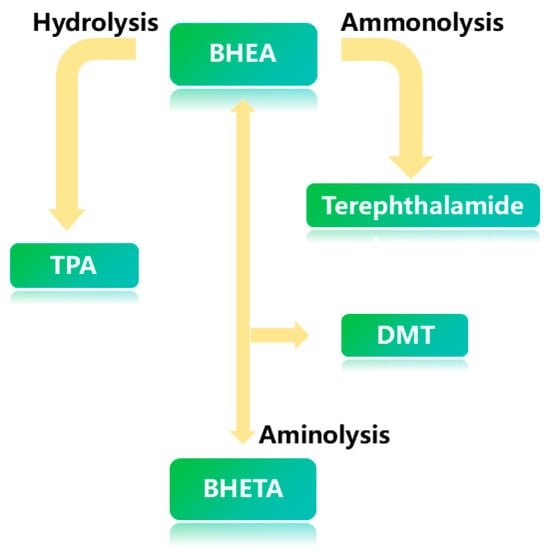
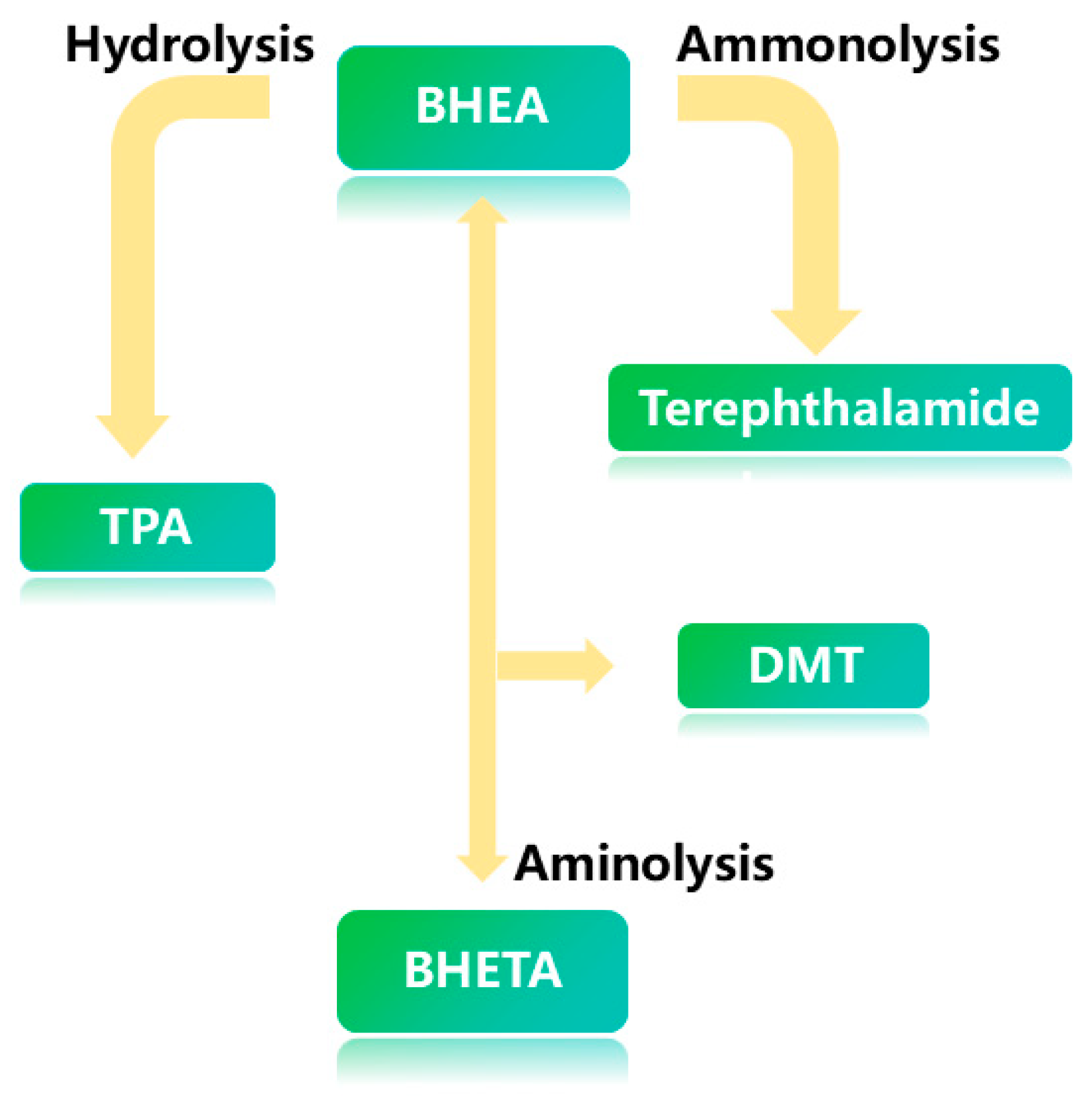
In recent years, polyurethane materials prepared using BHET derived from rPET depolymerization have been applied in multiple functional material fields, such as optoelectronic devices [84], self-healing elastomers [85], and flame-retardant polyurethanes [86]. Additionally, its depolymerization yields TPA monomers, which find extensive application as organic ligands in the synthesis of metal–organic framework (MOF) materials [87]. For instance, literature reports include synthesizing MOF-5 using TPA as an organic linker derived from depolymerization [88]; directly synthesizing hcp UIO-66 from rPET [89]; and utilizing BDC produced from RPET to prepare ZnO@NMC and UiO-66(Zr)MOF [90,91]. These applications not only promote high-value recycling of rPET materials but also advance the greening of MOF material synthesis. Figure 4 shows a schematic diagram of the monomers obtained through chemical depolymerization of PET.
Figure 4.
Schematics for the inter-conversion of PET monomers.
5.2.2. Direct Chemical Upcycling
The aforementioned upcycling methods require chemical depolymerization to obtain monomers, involving complex operations and high costs, thus remaining impractical for large-scale implementation. Consequently, numerous researchers have recently developed approaches to directly convert waste into high-value-added products through single-step physical or chemical transformations, significantly reducing costs.
Ref. [92] reported a solvent-free, catalyst-free process upgrading PET and HDA into biodegradable PHET plastic via a carboxyl-ester exchange reaction. Experimental results demonstrate that PHET exhibits excellent mechanical properties and biodegradability (achieving complete degradation within approximately 60 weeks), positioning it as a promising candidate to replace PBAT as a high-value biodegradable material. The purity of the reaction byproduct TPA is comparable to commercial TPA, achieving 100% atom utilization. This provides an environmentally friendly and economical strategy for large-scale upgrading of PET waste. A subsequent technical-economic analysis (TEA) indicates that compared to raw material costs, PHET3 and PHET4 exhibit relatively low capital costs, fixed production costs, and electricity expenses. The cost price of PHET3 is only $574 per ton, while PHET4 costs $651 per ton. Their price advantage over existing high-value biodegradable materials demonstrates the potential feasibility of large-scale production. Ref. [93] produced ion-liquid-loaded membranes from crushed PET waste. By optimizing parameters for modified plastic waste membranes, they achieved outstanding removal efficiencies: over 95% for Pb(II), over 88% for Cd(II), and over 78% for As(V). Given the chemical structural similarity between PET and PETG, Wei et al. recently proposed a PET-EG/CHDM binary mixture hydrolytic depolymerization-repolymerization strategy to produce high-value-added PETG/PCTG.
5.3. Functional Upcycling
Beyond the chemical upcycling mentioned above, the term functional upcycling has recently gained prominence. Functional upcycling refers to transforming polymer waste by altering the surface properties or converting the main polymer chain to produce new materials for specific applications. Additional functional groups are fixed onto the polymer surface via covalent or non-covalent bonds, such as hydrophobic interactions, hydrogen bonds, and van der Waals forces. Functional upcycling strategies aim to repurpose waste plastics into materials with enhanced functionality and value. This process avoids complete destruction of the polymer backbone, leaving the primary polymer chains largely intact [94]. Examples include introducing amide bonds into PE to improve recyclability and tensile properties [95], or incorporating PAHs into PET to upcycle it into UOP polymer components [96].
5.4. Potential Upcycling of PETG
Compared to PET, PETG exhibits superior performance and stability. However, the production and application of PETG are constrained by the high cost of its monomer, CHDM. In recent years, several studies have reported upgrading waste PET into CHDM to promote PETG production and reduce costs.
Ref. [97] developed a defect-type sulfonated UiO-66def-SO3H-supported Ru bifunctional catalyst for the one-step, efficient conversion of waste PET plastic into dimethylcyclohexane-1,4-dicarboxylate in methanol. This catalyst features a mesoporous structure, high acidity, and highly dispersed Ru species. Under conditions of 170 °C and 3 MPa H2, complete PET conversion was achieved within 6 h, yielding DMCD at 97.7% with excellent catalyst stability. It is suitable for the high-value recycling of various waste PET products. Ref. [98] developed a green, water-solvent-based method for converting waste PET plastic into CHDM. The process employs a Pd/C catalyst to hydrolyze and hydrogenate PET into cyclohexanedicarboxylic acid, which is then reduced to CHDM using a Ru-Sn/C catalyst, achieving a final yield of 80.1%. This method avoids organic solvents by utilizing water as the reaction medium, offering a new pathway for the environmentally friendly upgrading and recycling of PET waste. Based on this, PETG can depolymerize into CHDM monomers, reducing its own costs and enabling closed-loop recycling.
The functionalization and recycling of PET waste represents a novel sustainable technological solution, offering the potential to develop new functional materials with desired properties and broad applications. Consequently, PETG can also be advanced into high-value product domains by introducing new functional groups through surface treatment, transesterification reactions, and atom-transfer radical polymerization based on this principle.
6. Conclusions
This paper systematically reviews the established PET recycling technology framework and, building upon this foundation, explores the unique challenges and potential approaches faced by PETG in physical, chemical, and biological recycling pathways. Through comparative analysis, it aims to establish scientifically sound and feasible recycling solutions for PETG as a high-performance material. As one of the most widely recycled plastics globally, PET’s recycling technology system is relatively mature, forming the foundational knowledge and technical starting point for our exploration of PETG recycling. Mechanical recycling represents the most mature, cost-effective, and widely applied method within this system. However, it faces challenges with materials of lower cleanliness and complex multilayer structures. Chemical recycling represents a key direction for achieving closed-loop systems. Its advantage lies in processing contaminated waste while producing high-value outputs. Yet, the process demands high energy consumption and faces challenges in achieving large-scale industrial implementation. Biological recycling is an emerging green technology that utilizes enzymes to depolymerize PET under mild conditions. However, it remains in the R&D and scale-up phase, grappling with issues such as high enzyme costs and slow depolymerization rates.
The incorporation of CHDM monomer in PETG creates obstacles for directly applying PET recycling technologies. PETG’s excellent thermal stability theoretically makes it suitable for melt regranulation. In the short term, this represents the most economical solution for processing clean recycled materials. Chemical recycling can employ processes like PET alcoholysis or hydrolysis. However, the presence of CHDM may result in complex mixture products from depolymerization. Therefore, efficient separation and purification of high-value CHDM become the technical and economic linchpins of the entire process. Future research should focus on developing highly selective catalysts to optimize depolymerization reactions and innovating coupled separation processes (such as reaction distillation or advanced extraction) to reduce purification costs.
For bio-based recycling, targeted enzyme evolution and rational design, or the exploration of novel microbial enzymes, offer a mild, green depolymerization pathway for PETG.
In summary, the experience of PET recycling provides us with a toolkit and methodology, but PETG’s chemical uniqueness demands reinvention. The success of its recycling pathway hinges on the ability to economically recover and utilize CHDM, its signature monomer. This necessitates interdisciplinary innovation among materials scientists, chemical engineers, and biotechnology specialists. Only through concerted efforts across technology, policy, and industrial chains can PETG, a high-performance material, be truly integrated into the circular economy blueprint—transforming it from a “high-performance consumer product” into a “sustainable resource.”
Author Contributions
Writing—original draft, N.L.; writing—editing, N.L.; writing—review, J.C., R.D., H.L. and W.L. All authors have read and agreed to the published version of the manuscript.
Funding
This research was funded by the Joint Fund of Henan Province Science and Technology R&D Program, grant number Project NO.235200810006.
Data Availability Statement
No new data were created or analysed in this study. Data sharing is not applicable to this article.
Conflicts of Interest
The authors declare no conflicts of interest.
References
- Marques, G.G.; Couffin, A.; Hajji, P.; Inoubli, R.; Bounor-Legaré, V.; Fulchiron, R. A Review on the Formulation and Rupture Properties of Polyethylene Terephthalate in a Mechanical Recycling Context. Ind. Eng. Chem. Res. 2024, 63, 887–920. [Google Scholar] [CrossRef] [Scilit]
- Cottom, J.W.; Cook, E.; Velis, C.A. A Local-to-Global Emissions Inventory of Macroplastic Pollution. Nature 2024, 633, 101–108. [Google Scholar] [CrossRef] [Scilit]
- Singh, N.; Walker, T.R. Plastic Recycling: A Panacea or Environmental Pollution Problem. npj Mater. Sustain. 2024, 2, 17. [Google Scholar] [CrossRef] [Scilit]
- Alrefaee, S.H.; Al-Ghamdi, S.A.; Alrashdi, K.S.; Almahri, A.; Alaysuy, O.; Alatawi, N.M.; Alghasham, H.A.; El-Metwaly, N.M. Effect of Titanium Oxide (TiO2) Nanoparticles on the Opto-Mechanical Properties of Polyethylene Terephthalate (PET) Fibers. Opt. Mater. 2024, 157, 116242. [Google Scholar] [CrossRef] [Scilit]
- Umdagas, L.; Orozco, R.; Heeley, K.; Thom, W.; Al-Duri, B. Advances in Chemical Recycling of Polyethylene Terephthalate (PET) via Hydrolysis: A Comprehensive Review. Polym. Degrad. Stab. 2025, 234, 111246. [Google Scholar] [CrossRef] [Scilit]
- Hao, J.; Lei, G.; Li, Z.; Wu, L.; Xiao, Q.; Wang, L. A Novel Polyethylene Terephthalate Nonwoven Separator Based on Electrospinning Technique for Lithium Ion Battery. J. Membr. Sci. 2013, 428, 11–16. [Google Scholar] [CrossRef] [Scilit]
- El Mehtedi, M.; Buonadonna, P.; El Mohtadi, R.; Loi, G.; Aymerich, F.; Carta, M. Optimizing Milling Parameters for Enhanced Machinability of 3D-Printed Materials: An Analysis of PLA, PETG, and Carbon-Fiber-Reinforced PETG. J. Manuf. Mater. Process. 2024, 8, 131. [Google Scholar] [CrossRef] [Scilit]
- Yan, C.; Kleiner, C.; Tabigue, A.; Shah, V.; Sacks, G.; Shah, D.; DeStefano, V. PETG: Applications in Modern Medicine. Eng. Regen. 2024, 5, 45–55. [Google Scholar] [CrossRef] [Scilit]
- Lira, M.C.D.A.; Da Cunha, R.B.; Agrawal, P.; Brito, G.D.F.; Mélo, T.J.A.D. Shape Memory Effect in Supertough PETG/EGMA Thermoplastic Vulcanizates Obtained through Dynamic Vulcanization and Interfacial Compatibilization. Macromolecules 2024, 57, 7315–7330. [Google Scholar] [CrossRef] [Scilit]
- Moog, D.; Schmitt, J.; Senger, J.; Zarzycki, J.; Rexer, K.-H.; Linne, U.; Erb, T.; Maier, U.G. Using a Marine Microalga as a Chassis for Polyethylene Terephthalate (PET) Degradation. Microb. Cell Fact. 2019, 18, 171. [Google Scholar] [CrossRef] [Scilit]
- Lu, H.; Li, Z.; Chen, S.; Sun, Y.; Wang, X.; Wang, Y. Construction of a Three-Dimensional Network in Branched PETG to Prepare PETG Composite Microcellular Foam with Outstanding Mechanical Properties at Low Temperatures. Eur. Polym. J. 2024, 202, 112643. [Google Scholar] [CrossRef] [Scilit]
- Singh, A.K.; Bedi, R.; Kaith, B.S. Composite Materials Based on Recycled Polyethylene Terephthalate and Their Properties—A Comprehensive Review. Compos. Part B Eng. 2021, 219, 108928. [Google Scholar] [CrossRef] [Scilit]
- Wang, K.; Shen, J.; Ma, Z.; Zhang, Y.; Xu, N.; Pang, S. Preparation and Properties of Poly(Ethylene Glycol-Co-Cyclohexane-1,4-Dimethanol Terephthalate)/Polyglycolic Acid (PETG/PGA) Blends. Polymers 2021, 13, 452. [Google Scholar] [CrossRef] [Scilit]
- Li, W.; Zhai, Y.; Yi, P.; Zhang, Y. Fabrication of Micro-Pyramid Arrays on PETG Films by Roll-to-Roll Hot Embossing. Microelectron. Eng. 2016, 164, 100–107. [Google Scholar] [CrossRef] [Scilit]
- Wang, X.; Zheng, L.; Cao, C.; Li, S. A Synthetic Strategy for the Preparation of Petg with High Performance, Less Byproducts, and Good Comprehensive Properties. J. Appl. Polym. Sci. 2025, 142, e57312. [Google Scholar] [CrossRef] [Scilit]
- Silva, P.A.P.; Da Silva, A.B.; Santos, J.P.F.; Oréfice, R.L. Self-healing Polymer Blend Based on PETG and EMAA. J. Appl. Polym. Sci. 2021, 138, 50148. [Google Scholar] [CrossRef] [Scilit]
- Masmoudi, F.; Alix, S.; Buet, S.; Mehri, A.; Bessadok, A.; Jaziri, M.; Ammar, E. Design and Characterization of a New Food Packaging Material by Recycling Blends Virgin and Recovered Polyethylene Terephthalate. Polym. Eng. Sci. 2020, 60, 250–256. [Google Scholar] [CrossRef] [Scilit]
- Hatt, J.; Englund, K.; Li, H. Characterizing the Changes to the Material Properties of a Bottle-grade Poly(Ethylene Terephthalate) Subject to Repeated Melt Extrusion. J. Appl. Polym. Sci. 2023, 140, e53676. [Google Scholar] [CrossRef] [Scilit]
- Chen, J.; Dul, S.; Lehner, S.; Jovic, M.; Gaan, S.; Heuberger, M.; Hufenus, R.; Gooneie, A. Mechanical Recycling of PET Containing Mixtures of Phosphorus Flame Retardants. J. Mater. Sci. Technol. 2024, 194, 167–179. [Google Scholar] [CrossRef] [Scilit]
- Al-Sabagh, A.M.; Yehia, F.Z.; Eshaq, G.; Rabie, A.M.; El Metwally, A.E. Greener Routes for Recycling of Polyethylene Terephthalate. Egypt. J. Pet. 2016, 25, 53–64. [Google Scholar] [CrossRef] [Scilit]
- Nait-Ali, L.K.; Colin, X.; Bergeret, A. Kinetic Analysis and Modelling of PET Macromolecular Changes during Its Mechanical Recycling by Extrusion. Polym. Degrad. Stab. 2011, 96, 236–246. [Google Scholar] [CrossRef] [Scilit]
- Bascucci, C.; Duretek, I.; Lehner, S.; Holzer, C.; Gaan, S.; Hufenus, R.; Gooneie, A. Investigating Thermomechanical Recycling of Poly(Ethylene Terephthalate) Containing Phosphorus Flame Retardants. Polym. Degrad. Stab. 2022, 195, 109783. [Google Scholar] [CrossRef] [Scilit]
- Kruse, M.; Rolón-Garrido, V.H.; Wagner, M.H. Rheological Characterization of Degradation and Polycondensation of Poly (Ethylene Terephthalate) Melt in Air and in Nitrogen. AIP Conf. Proc. 2013, 1526, 216–229. [Google Scholar] [CrossRef] [Scilit]
- Awaja, F.; Pavel, D. Recycling of PET. Eur. Polym. J. 2005, 41, 1453–1477. [Google Scholar] [CrossRef] [Scilit]
- Ávila, A.F.; Duarte, M.V. A Mechanical Analysis on Recycled PET/HDPE Composites. Polym. Degrad. Stab. 2003, 80, 373–382. [Google Scholar] [CrossRef] [Scilit]
- Zhang, Y.; Guo, W.; Zhang, H.; Wu, C. Influence of Chain Extension on the Compatibilization and Properties of Recycled Poly(Ethylene Terephthalate)/Linear Low Density Polyethylene Blends. Polym. Degrad. Stab. 2009, 94, 1135–1141. [Google Scholar] [CrossRef] [Scilit]
- Xiao, L.; Wang, H.; Qian, Q.; Jiang, X.; Liu, X.; Huang, B.; Chen, Q. Molecular and Structural Analysis of Epoxide-modified Recycled Poly(Ethylene Terephthalate) from Rheological Data. Polym. Eng. Sci. 2012, 52, 2127–2133. [Google Scholar] [CrossRef] [Scilit]
- Andrzejewski, J.; Chmielewski, P.; Osiński, F.; Markowski, M.; Marciniak-Podsadna, L.; Piasecki, A. Use of Recycled Poly(Ethylene Terephthalate)-Based (rPET) Blends in Additive Manufacturing Techniques to Prepare Sustainable, Tough, and Heat-Resistant Parts. ACS Sustain. Chem. Eng. 2024, 12, 17383–17405. [Google Scholar] [CrossRef] [Scilit]
- Inoya, H.; Wei Leong, Y.; Klinklai, W.; Takai, Y.; Hamada, H. Compatibilization of Recycled Poly(Ethylene Terephthalate) and Polypropylene Blends: Effect of Compatibilization on Blend Toughness, Dispersion of Minor Phase, and Thermal Stability. J Appl. Polym. Sci. 2012, 124, 5260–5269. [Google Scholar] [CrossRef] [Scilit]
- Awaja, F.; Pavel, D. Injection Stretch Blow Moulding Process of Reactive Extruded Recycled PET and Virgin PET Blends. Eur. Polym. J. 2005, 41, 2614–2634. [Google Scholar] [CrossRef] [Scilit]
- Awaja, F.; Daver, F.; Kosior, E. Recycled Poly(Ethylene Terephthalate) Chain Extension by a Reactive Extrusion Process. Polym. Eng. Sci. 2004, 44, 1579–1587. [Google Scholar] [CrossRef] [Scilit]
- Awaja, F.; Daver, F.; Kosior, E.; Cser, F. The effect of chain extension on the thermal behaviour and crystallinity of reactive extruded recycled pet. J. Therm. Anal. Calorim. 2004, 78, 865–884. [Google Scholar] [CrossRef] [Scilit]
- Himmelsbach, A.; Akdevelioglu, Y.; Nofar, M.; Ruckdäschel, H. Improving rPET/PBT Bead Foam Structure via Chain Extender Modification and Blend Variance. J. Polym. Environ. 2025, 33, 1517–1527. [Google Scholar] [CrossRef] [Scilit]
- Sarkar, B.; Dharmalingam, B.; Darbandi, A.; Wong, J.C.H.; Trifkovic, M. Asphaltene-Recycled Polyethylene Terephthalate (rPET) Blends as Sustainable Carbonaceous Fiber Precursors. ACS Sustain. Chem. Eng. 2025, 13, 2210–2220. [Google Scholar] [CrossRef] [Scilit]
- Khan, Z.I.; Habib, U.; Mohamad, Z.B.; Khan, I. Mechanical and Thermal Properties of a Newly Developed Sepiolite Filler-Filled rPET/PA11 Thermoplastic Nanocomposites. Results Eng. 2024, 21, 101731. [Google Scholar] [CrossRef] [Scilit]
- Khan, Z.I.; Mohamad, Z.B.; Rahmat, A.R.B.; Habib, U.; Abdullah, N.A.S.B. A Novel Recycled Polyethylene Terephthalate/Polyamide 11 (rPET/PA11) Thermoplastic Blend. Prog. Rubber Plast. Recycl. Technol. 2021, 37, 233–244. [Google Scholar] [CrossRef] [Scilit]
- Khan, Z.I.; Habib, U.; Mohamad, Z.B.; Raji, A.M. Enhanced Mechanical Properties of a Novel Compatibilized Recycled Polyethylene Terephthalate/Polyamide 11 (rPET/PA11) Blends. Express Polym. Lett. 2021, 15, 1206–1215. [Google Scholar] [CrossRef] [Scilit]
- Jabir, R.K.; Hadi, N.J.; AL-Zubiedy, A.A.-A. Rheological and Mechanical Investigation of PET, LDPE and HDPE Wastes Blended for Re-Use in Bio-Pipes. IOP Conf. Ser. Mater. Sci. Eng. 2020, 987, 012006. [Google Scholar] [CrossRef] [Scilit]
- Khamseh, M.; Maroufkhani, M.; Moghanlou, S.; Lotfi, A.; Pourabbas, B.; Razavi Aghjeh, M.K. Development of Sustainable Cellulose-based Composite of Polypropylene Reinforced by Recycled Microfibrillar Poly (Ethylene Terephthalate). Polym. Compos. 2023, 44, 7058–7069. [Google Scholar] [CrossRef] [Scilit]
- Velásquez, E.J.; Garrido, L.; Guarda, A.; Galotto, M.J.; López De Dicastillo, C. Increasing the Incorporation of Recycled PET on Polymeric Blends through the Reinforcement with Commercial Nanoclays. Appl. Clay Sci. 2019, 180, 105185. [Google Scholar] [CrossRef] [Scilit]
- Wu, D.-Y.; Wang, S.-S.; Wu, C.-S. Textile Fabrics Containing Recycled Poly(Ethylene Terephthalate), Oyster Shells, and Silica Aerogels with Superior Heat Insulation, Water Resistance, and Antibacterial Properties. ACS Appl. Polym. Mater. 2021, 3, 3175–3184. [Google Scholar] [CrossRef] [Scilit]
- Phasawat, C. Influence of Poly(Butylene Terephthalate) and Wollastonite on Properties of Recycled Poly(Ethylene Terephthalate) Preforms. J. Met. Mater. Miner. 2020, 30, 124132. [Google Scholar] [CrossRef]
- Dominici, F.; Sarasini, F.; Luzi, F.; Torre, L.; Puglia, D. Thermomechanical and Morphological Properties of Poly(Ethylene Terephthalate)/Anhydrous Calcium Terephthalate Nanocomposites. Polymers 2020, 12, 276. [Google Scholar] [CrossRef] [Scilit] [PubMed]
- Chaudhari, S.; Switzer, C.; Azarfam, M.Y.; Maheshwari, A.; Blum, F.D.; Hanan, J.C.; Bandla, S.; Vaidyanathan, R. Process Optimization for Sustainable Composites from Post-Consumer PET Carpet and Recycled PET Resin. Compos. Part B Eng. 2025, 298, 112367. [Google Scholar] [CrossRef] [Scilit]
- Slezák, E.; Ronkay, F.; Réz, D.; Bocz, K. Recyclability of Elastomer Toughened Recycled Poly(Ethylene Terephthalate): The Effect of Grinding-Extrusion-Injection Moulding on the Mechanical and Morphological Properties of the Blend. Heliyon 2024, 10, e32096. [Google Scholar] [CrossRef] [Scilit]
- Bocz, K.; Ronkay, F.; Decsov, K.E.; Molnár, B.; Marosi, G. Application of Low-Grade Recyclate to Enhance Reactive Toughening of Poly(Ethylene Terephthalate). Polym. Degrad. Stab. 2021, 185, 109505. [Google Scholar] [CrossRef] [Scilit]
- Latko-Durałek, P.; Dydek, K.; Boczkowska, A. Thermal, Rheological and Mechanical Properties of PETG/rPETG Blends. J. Polym. Environ. 2019, 27, 2600–2606. [Google Scholar] [CrossRef] [Scilit]
- Cao, C.; Liu, D.; Zhu, L.; Gu, S.; Evsyukov, S.A.; Luo, X. Characterization and Preparation of Thermo-Responsive Shape Memory PETG / POE Blends for 4D Printing. Polym. Eng. Sci. 2025, 65, 4417–4430. [Google Scholar] [CrossRef] [Scilit]
- Jie, Y.; Yan, S.; Hao, L.; Zhang, X.; Duan, J.; Ju, H.; Wu, Z. Effect of Polyethylene Terephthalate Glycol-Rich Olefins Blends: Mechanical, Thermal, Shape Memory Effect, and Morphological Properties via Direct Material Extrusion Additive Manufacturing. J. Appl. Polym. Sci. 2025, 142, e57560. [Google Scholar] [CrossRef] [Scilit]
- Muringayil Joseph, T.; Azat, S.; Ahmadi, Z.; Moini Jazani, O.; Esmaeili, A.; Kianfar, E.; Haponiuk, J.; Thomas, S. Polyethylene Terephthalate (PET) Recycling: A Review. Case Stud. Chem. Environ. Eng. 2024, 9, 100673. [Google Scholar] [CrossRef] [Scilit]
- Walker, T.W.; Frelka, N.; Shen, Z.; Chew, A.K.; Banick, J.; Grey, S.; Kim, M.S.; Dumesic, J.A.; Van Lehn, R.C.; Huber, G.W. Recycling of Multilayer Plastic Packaging Materials by Solvent-Targeted Recovery and Precipitation. Sci. Adv. 2020, 6, eaba7599. [Google Scholar] [CrossRef] [Scilit]
- Wei, X.; Zheng, W.; Chen, X.; Qiu, J.; Sun, W.; Xi, Z.; Zhao, L. Chemical Upcycling of Poly(Ethylene Terephthalate) with Binary Mixed Alcohols toward Value-Added Copolyester by Depolymerization and Repolymerization Strategy. Chem. Eng. Sci. 2024, 294, 120103. [Google Scholar] [CrossRef] [Scilit]
- Conroy, S.; Zhang, X. Theoretical Insights into Chemical Recycling of Polyethylene Terephthalate (PET). Polym. Degrad. Stab. 2024, 223, 110729. [Google Scholar] [CrossRef] [Scilit]
- Liu, Y.; Cui, L.; Liu, H.; Zhao, W.; Zhang, Y. Conversion of Polyethylene Terephthalate (PET) Plastic Particles in a Microwave-Assisted Heating Reactor. Int. J. Chem. React. Eng. 2023, 21, 1423–1432. [Google Scholar] [CrossRef] [Scilit]
- Sun, Q.; Zheng, Y.-Y.; Yun, L.-X.; Wu, H.; Liu, R.-K.; Du, J.-T.; Gu, Y.-H.; Shen, Z.-G.; Wang, J.-X. Fe3 O4 Nanodispersions as Efficient and Recoverable Magnetic Nanocatalysts for Sustainable PET Glycolysis. ACS Sustain. Chem. Eng. 2023, 11, 7586–7595. [Google Scholar] [CrossRef] [Scilit]
- Zheng, W.; Liu, C.; Wei, X.; Sun, W.; Zhao, L. Molecular-Level Swelling Behaviors of Poly (Ethylene Terephthalate) Glycolysis Using Ionic Liquids as Catalyst. Chem. Eng. Sci. 2023, 267, 118329. [Google Scholar] [CrossRef] [Scilit]
- Wei, X.; Qiu, J.; Wang, H.; Zheng, W.; Sun, W.; Zhao, L. Efficient Glycolysis of Poly(Ethylene Terephthalate) to Bis(Hydroxyethyl) Terephthalate Catalyzed by Non-Metallic Deep Eutectic Solvent. Chem. Eng. J. 2025, 508, 161115. [Google Scholar] [CrossRef] [Scilit]
- Wang, Z.; Jin, Y.; Wang, Y.; Tang, Z.; Wang, S.; Xiao, G.; Su, H. Cyanamide as a Highly Efficient Organocatalyst for the Glycolysis Recycling of PET. ACS Sustain. Chem. Eng. 2022, 10, 7965–7973. [Google Scholar] [CrossRef] [Scilit]
- Gao, L.; Jia, Z.; Qin, L.; Sun, H.; Zhang, X.; Li, B.; Wang, X.; Liu, J.; Bai, J. Using Waste to Treat Waste: Catalysts from Spent Alkaline Batteries for Glycolysis of PET Waste. Catal. Today 2025, 447, 115143. [Google Scholar] [CrossRef] [Scilit]
- Yang, T.; He, H.; Yan, S.; Gao, J.; Yang, Z.; Xu, J. Catalytic Depolymerization of Poly(Ethylene Terephthalate) Plastic into Value-Added Monomers Using Metal-Modified Mesoporous Silica. Fuel 2025, 383, 133858. [Google Scholar] [CrossRef] [Scilit]
- Lee, P.S.; Jung, S.M. Direct Conversion of Waste PET to Regenerated Plastics Using Flame Retardants as Depolymerization Catalysts. Korean J. Chem. Eng. 2024, 41, 347–355. [Google Scholar] [CrossRef] [Scilit]
- Wang, Z.; Shi, J.; Jin, Y.; Xiao, G.; Su, H. Recyclable Zinc Cyanamide Dual-Site Catalyst Enables Efficient PET Glycolysis. ACS Appl. Polym. Mater. 2025, 7, 1609–1617. [Google Scholar] [CrossRef] [Scilit]
- Li, Y.; Wang, M.; Liu, X.; Hu, C.; Xiao, D.; Ma, D. Catalytic Transformation of PET and CO2 into High-Value Chemicals. Angew. Chem. Int. Ed. 2022, 61, e202117205. [Google Scholar] [CrossRef] [Scilit]
- Li, J.; Yan, D.; Cheng, X.; Rong, C.; Feng, J.; Feng, X.; Xin, J.; Zhou, Q.; Li, Y.; Xu, J.; et al. Efficient Methanolysis of PET Catalyzed by Nonmetallic Deep Eutectic Solvents. Ind. Eng. Chem. Res. 2024, 63, 12373–12384. [Google Scholar] [CrossRef] [Scilit]
- Jiang, Z.; Yan, D.; Xin, J.; Li, F.; Guo, M.; Zhou, Q.; Xu, J.; Hu, Y.; Lu, X. Poly(Ionic Liquid)s as Efficient and Recyclable Catalysts for Methanolysis of PET. Polym. Degrad. Stab. 2022, 199, 109905. [Google Scholar] [CrossRef] [Scilit]
- Pham, D.D.; Cho, J. Low-Energy Catalytic Methanolysis of Poly(Ethyleneterephthalate). Green Chem. 2021, 23, 511–525. [Google Scholar] [CrossRef] [Scilit]
- Laldinpuii, Z.T.; Khiangte, V.; Lalhmangaihzuala, S.; Lalmuanpuia, C.; Pachuau, Z.; Lalhriatpuia, C.; Vanlaldinpuia, K. Methanolysis of PET Waste Using Heterogeneous Catalyst of Bio-Waste Origin. J. Polym. Environ. 2022, 30, 1600–1614. [Google Scholar] [CrossRef] [Scilit]
- Muangmeesri, S.; Baddigam, K.R.; Navare, K.; Apostolopoulou-Kalkavoura, V.; Witthayolankowit, K.; Håkansson, H.; Mathew, A.P.; Acker, K.V.; Samec, J.S.M. Recycling of Polyesters by Organocatalyzed Methanolysis Depolymerization: Environmental Sustainability Evaluated by Life Cycle Assessment. ACS Sustain. Chem. Eng. 2024, 12, 4114–4120. [Google Scholar] [CrossRef] [Scilit]
- Mersha, D.A.; Gesese, T.N.; Sendekie, Z.B.; Admase, A.T.; Bezie, A.J. Operating Conditions, Products and Sustainable Recycling Routes of Aminolysis of Polyethylene Terephthalate (PET)—A Review. Polym. Bull. 2024, 81, 11563–11579. [Google Scholar] [CrossRef] [Scilit]
- Peti, D.; Dobránsky, J.; Michalík, P. Recent Advances in Polymer Recycling: A Review of Chemical and Biological Processes for Sustainable Solutions. Polymers 2025, 17, 603. [Google Scholar] [CrossRef] [Scilit]
- Wang, S.; Chen, L.; Wu, C. SupEnzyme: Combining Enzymes with Supramolecules for Recyclable Catalysis. Colloids Surf. A Physicochem. Eng. Asp. 2023, 672, 131719. [Google Scholar] [CrossRef] [Scilit]
- Patel, A.; Chang, A.C.; Abid, U.; Ayafor, C.; Wong, H.-W.; Xie, D.; Sobkowicz, M.J. Effects of Copolymer Structure on Enzyme-Catalyzed Polyester Recycling. J. Polym. Environ. 2024, 32, 3961–3972. [Google Scholar] [CrossRef] [Scilit]
- Xu, G.; Wang, Q. Chemically Recyclable Polymer Materials: Polymerization and Depolymerization Cycles. Green Chem. 2022, 24, 2321–2346. [Google Scholar] [CrossRef] [Scilit]
- Jiang, J.; Shi, K.; Zhang, X.; Yu, K.; Zhang, H.; He, J.; Ju, Y.; Liu, J. From Plastic Waste to Wealth Using Chemical Recycling: A Review. J. Environ. Chem. Eng. 2022, 10, 106867. [Google Scholar] [CrossRef] [Scilit]
- Maisels, A.; Hiller, A.; Simon, F. Chemical Recycling for Plastic Waste: Status and Perspectives. ChemBioEng Rev. 2022, 9, 541–555. [Google Scholar] [CrossRef] [Scilit]
- Zhao, X.; Boruah, B.; Chin, K.F.; Đokić, M.; Modak, J.M.; Soo, H.S. Upcycling to Sustainably Reuse Plastics. Adv. Mater. 2022, 34, 2100843. [Google Scholar] [CrossRef] [Scilit]
- Srithep, Y.; Javadi, A.; Pilla, S.; Turng, L.; Gong, S.; Clemons, C.; Peng, J. Processing and Characterization of Recycled Poly(Ethylene Terephthalate) Blends with Chain Extenders, Thermoplastic Elastomer, and/or Poly(Butylene Adipate- Co -terephthalate). Polym. Eng. Sci. 2011, 51, 1023–1032. [Google Scholar] [CrossRef] [Scilit]
- Lukács, N.; Ronkay, F.; Molnár, B.; Marosfői, B.; Bocz, K. Characterisation of Flame Retarded Recycled PET Foams Produced by Batch Foaming. Polym. Test. 2023, 124, 108104. [Google Scholar] [CrossRef] [Scilit]
- Szabó, V.A.; Kovács, A.; Jakab, S.K.; Böcz, T.Z.; Dogossy, G. Automotive Application of Chemically Foamed rPET. Polymers 2025, 17, 1251. [Google Scholar] [CrossRef] [Scilit] [PubMed]
- Morshedi Dehaghi, F.; Aberoumand, M.; Sundararaj, U. A Promising Recycling Strategy via Processing Polypropylene/Recycled Poly(Ethylene Terephthalate): Reactive Extrusion Using Dual Compatibilizers. Polymers 2024, 16, 2439. [Google Scholar] [CrossRef] [Scilit]
- Nonato, R.C.; Bonse, B.C. A Study of PP/PET Composites: Factorial Design, Mechanical and Thermal Properties. Polym. Test. 2016, 56, 167–173. [Google Scholar] [CrossRef] [Scilit]
- Gu, J.; Lu, M.; Xie, W.; Jia, J.; Liu, C.; Yang, G.; Ma, B.; Chen, Z.; Park, C.B.; Zhang, R. Mechanical Robust and Thermal Insulated rPET Microcellular Foam via Supercritical CO2 Foaming Cross-Linked Photovoltaic Backsheet. J. CO2 Util. 2025, 97, 103126. [Google Scholar] [CrossRef] [Scilit]
- Hunskunatai, D.; Pivsa-Art, W.; Roungpaisan, N.; Boonyod, S.; Yalcinkaya, F.; Pivsa-Art, S. Multi-Functional Core/Sheath Bicomponent Nonwoven of Recycled Poly(Ethylene Terephthalate) Fibres as Thermal Insulators. J. Polym. Environ. 2024, 32, 2380–2393. [Google Scholar] [CrossRef] [Scilit]
- Mariotti, N.; Viada, G.; Galliano, S.; Menozzi, A.; Tammaro, F.; Gianelli, W.; Bonomo, M.; Barolo, C. Increasing Circular and Bio-Based Content of a Thermosetting Polyurethane for Encapsulation of Optoelectronic Devices: A Multivariate Investigation. J. Clean. Prod. 2023, 408, 137161. [Google Scholar] [CrossRef] [Scilit]
- Wang, Y.; Park, B.; Vu, V.; Lee, S. Self-healing Conducting Composite Electrodes Derived from Chemical Recycling of PET Plastic Wastes for Flexible Supercapacitors. Polym. Eng. Sci. 2025, 65, 1854–1867. [Google Scholar] [CrossRef] [Scilit]
- Jung, S.M. Green Polyol Synthesis via Glycolysis and Aminolysis for Conversion of Waste Polyurethane and Polyethylene Terephthalate Into Flame-Retardant Insulation Foam. J. Appl. Polym. Sci. 2025, 142, e57805. [Google Scholar] [CrossRef] [Scilit]
- Wang, K.; Guo, C.; Li, J.; Wang, K.; Cao, X.; Liang, S.; Wang, J. High Value-Added Conversion and Functional Recycling of Waste Polyethylene Terephthalate (PET) Plastics: A Comprehensive Review. J. Environ. Chem. Eng. 2024, 12, 113539. [Google Scholar] [CrossRef] [Scilit]
- Cheng, S.; Li, Y.; Yu, Z.; Gu, R.; Wu, W.; Su, Y. Waste PET-Derived MOF-5 for High-Efficiency Removal of Tetracycline. Sep. Purif. Technol. 2024, 339, 126490. [Google Scholar] [CrossRef] [Scilit]
- Zhou, L.; Wang, S.; Chen, Y.; Serre, C. Direct Synthesis of Robust Hcp UiO-66(Zr) MOF Using Poly(Ethylene Terephthalate) Waste as Ligand Source. Microporous Mesoporous Mater. 2019, 290, 109674. [Google Scholar] [CrossRef] [Scilit]
- Ubaidullah, M.; Al-Enizi, A.M.; Shaikh, S.; Ghanem, M.A.; Mane, R.S. Waste PET Plastic Derived ZnO@NMC Nanocomposite via MOF-5 Construction for Hydrogen and Oxygen Evolution Reactions. J. King Saud Univ. Sci. 2020, 32, 2397–2405. [Google Scholar] [CrossRef] [Scilit]
- Dyosiba, X.; Ren, J.; Musyoka, N.M.; Langmi, H.W.; Mathe, M.; Onyango, M.S. Feasibility of Varied Polyethylene Terephthalate Wastes as a Linker Source in Metal–Organic Framework UiO-66(Zr) Synthesis. Ind. Eng. Chem. Res. 2019, 58, 17010–17016. [Google Scholar] [CrossRef] [Scilit]
- Fang, T.; Jiang, W.; Zheng, T.; Yao, X.; Zhu, W. Catalyst- and Solvent-Free Upcycling of Poly(Ethylene Terephthalate) Waste to Biodegradable Plastics. Adv. Mater. 2024, 36, 2403728. [Google Scholar] [CrossRef] [Scilit]
- Imdad, S.; Dohare, R.K. Conversion of Waste PET Bottles into Supported Ionic Liquid Membranes for Heavy Metal Separation from Wastewater. J. Environ. Manag. 2025, 377, 124548. [Google Scholar] [CrossRef] [Scilit]
- Guselnikova, O.; Semyonov, O.; Sviridova, E.; Gulyaev, R.; Gorbunova, A.; Kogolev, D.; Trelin, A.; Yamauchi, Y.; Boukherroub, R.; Postnikov, P. “Functional Upcycling” of Polymer Waste towards the Design of New Materials. Chem. Soc. Rev. 2023, 52, 4755–4832. [Google Scholar] [CrossRef] [Scilit] [PubMed]
- Ong, A.; Pang, J.J.M.; Loh, W.W.; Teo, J.Y.Q.; Li, K.; Koh, X.Q.; Tan, T.T.Y.; Queh, L.; Li, Z.; Lim, J.Y.C. Post-Synthetic Amide Insertion Into Polyethylenes Augments Diverse Physical Properties and Enables Branching-Dependent Recyclability. Adv. Funct. Mater. 2025, e13841. [Google Scholar] [CrossRef] [Scilit]
- Yang, Y.; Tan, J.; Jin, L.; Liu, S.; He, Z.; Wu, Z.L.; Zheng, Q.; Liu, Y. Functional Upcycling Discarded Poly(Ethylene Terephthalate) Bottles for Ultralong Organic Phosphorescence Polymer Elements. Adv. Funct. Mater. 2025, e14653. [Google Scholar] [CrossRef] [Scilit]
- Ou, W.; Ye, Y.; Zhang, Y.; Zhao, H.; Du, W.; Hou, Z. Catalytic Upgrading of Waste PET to Dimethyl Cyclohexane-1,4-Dicarboxylate over Defective Sulfonated UiO-66 -SO3H Supported Ru Catalyst. Chin. J. Catal. 2025, 71, 363–374. [Google Scholar] [CrossRef] [Scilit]
- Fang, S.; Gao, Z.; Shi, X.; Zhang, M.; Zhang, W.; Liu, Y. Upcycling of Polyethylene Terephthalate to 1,4-Cyclohexanedimethanol in Water. Sci. China Chem. 2025, 68, 2101–2109. [Google Scholar] [CrossRef] [Scilit]

Disclaimer/Publisher’s Note: The statements, opinions and data contained in all publications are solely those of the individual author(s) and contributor(s) and not of MDPI and/or the editor(s). MDPI and/or the editor(s) disclaim responsibility for any injury to people or property resulting from any ideas, methods, instructions or products referred to in the content. |
© 2026 by the authors. Licensee MDPI, Basel, Switzerland. This article is an open access article distributed under the terms and conditions of the Creative Commons Attribution (CC BY) license.