


Abstract
The growing generation of organic solid waste from small-scale agriculture poses major environmental challenges in developing countries like Ecuador, where rural areas often lack waste management infrastructure. Residues from livestock rearing and traditional brewing such as poultry manure (PM), bovine manure (BM), and barley by-product (BB) are often discarded untreated. This study evaluated the bioconversion potential of Hermetia illucens (black soldier fly larvae (BSFL), using a local Ecuadorian strain reared on these substrates under natural conditions and three feeding rates (50, 100, and 150 mg·larva−1·day−1). Larval growth and process efficiency were analyzed on a dry-matter basis. Both substrate and feeding rate significantly influenced performance (p < 0.05). PM and BB produced the highest larval dry weights (37.4 and 35.9 mg, respectively) at 100 mg·larva−1·day−1, with development completed in 35 days. BM-fed larvae reached only 17.6 mg and required up to 91 days. Bioconversion peaked at 4.6% (PM100) and 4.2% (BB50), while all BM treatments showed very low efficiency (<0.8%). Waste reduction was highest in BB100 (52.9%) and PM100 (43.5%). These results demonstrate the potential of BSFL as a biological treatment option for rural organic waste streams; however, performance strongly depended on substrate quality and feeding rate, indicating that not all locally available residues are equally suitable for larval bioconversion.
1. Introduction
It is projected that by the year 2050, the global population will reach 9.6 billion [1], which will increase the demand for food and, consequently, the generation of organic solid waste, such as animal manure, agricultural residues, and agro-industrial by products [2]. Globally, waste management represents a growing challenge, particularly in developing countries, where waste handling systems present limitations in both infrastructure and technology [3]. In many regions of the Global South, waste disposal relies on open landfills and unregulated practices, exacerbating environmental degradation and enabling the proliferation of pathogenic vectors [4,5]. Nevertheless, these residues also represent a valuable source of nutrients and energy, with the potential to be transformed into useful resources through appropriate technologies.
In Ecuador, approximately 60% of the food consumed in the country is produced by family-based farming units [6]. The agricultural sector, which is critical for the national economy, generated a large volume of waste, particularly in poultry and cattle production systems [7,8]. In rural areas, these residues are often poorly managed [8]. Although treatments such as the use of dried manure for bedding, composting, and anaerobic digestion exist, their implementation in small units is limited due to the lack of infrastructure, financial resources, and technical training, leading to incomplete or unsafe processes and increasing the risk of phytotoxicity [9].
In a circular economy framing, these conventional biological options align with established ‘recovery operations’: composting and anaerobic digestion fall under R3 (recycling/reclamation of organic substances, including composting and other biological transformation), while the beneficial application of stabilized compost/digestate to land aligns with R10 (land treatment resulting in benefit to agriculture or ecological improvement) [10,11]. We use these definitions to position manure management routes within a resource-recovery hierarchy. However, in smallholder contexts these R3/R10 routes can be constrained by longer processing times, the need for tighter operational control and monitoring, odor/emission management, and downstream handling/quality assurance of compost or digestate prior to safe land application, limitations that motivate faster, decentralized biological recovery alternatives [12,13].
Overpopulation of animals relative to the capacity of the production unit generates manure surpluses that cannot be fully utilized [14]. Ecuador’s organic production regulations restrict its application to 200 kg of nitrogen per hectare per year [9], leaving part of the manure unused and encouraging traditional practices such as open-air burning or disposal on unused land [14,15]. As a result, agricultural activities are estimated to contribute 18% of the country’s GHG emissions, with livestock accounting for 43% of that total [4,16].
According to data from the Ecuadorian Poultry Farmers Corporation (CONAVE) the poultry produced approximately 40.1 million laying hens in 2019 [17], while cattle farming produced 3.7 million heads of bovine livestock [18], equivalent to approximately 556,000 tons of poultry manure [19] and 34.8 million tons of bovine manure [20]. Likewise, by-products from the brewing industry (barley bran, BB) reach an annual production of 120,000 tons [21]; despite their nutritional value, they are discarded due to their high susceptibility to microbial degradation. Many of these residues originate from smallholder rural farms [14], highlighting the need for decentralized, low-cost solutions adapted to local conditions.
Given this scenario, Hermetia illucens, known as the black soldier fly (BSF), has gained increasing attention for its potential in organic solid waste valorization [22]. BSF has been shown to possess a greater capacity for bioconversion compared with four insect species evaluated by [23]. BSF bioconversion is increasingly positioned as a circular-economy R3-type recovery route that rapidly converts organic solid waste into higher-value outputs (larval biomass for feed/bioproducts) while generating frass that can support nutrient return to soils consistent with R10, often with shorter treatment timelines than conventional composting [24].
Additionally, and unlike certain fly species, it is not considered a pest [25]. In addition, it reduces pathogenic microorganisms and unpleasant odors and contributes to the suppression of the housefly (Musca domestica L.) [26]. Black soldier fly larvae (BSFL) can consume and transform a wide range of organic substrates, including manure [27,28], plant residues [29], and agro-industrial by-products [30], generating value-added products. Their high nutritional content (proteins 37–63%; and lipids 7–39% on a dry matter basis) [31], makes them a potential substitute for conventional feed ingredients such as fishmeal and soybean meal [22,26]. They can also be used to obtain chitin [32], and biodiesel [33], in addition to producing a residue (frass) that has shown potential as a soil amendment, with production times shorter than those of composting [34].
Although promising, the use of BFSL presents limitations that must be considered. Larval performance is sensitive to environmental conditions such as temperature and humidity [35,36]; efficiency decreases in substrates with high fiber content [37,38] and frass regulation remains uncertain in several countries, hindering its adoption as a commercial fertilizer [39]. These limitations highlight the need for studies to optimize rearing parameters and evaluate the actual bioconversion capacity.
Within this context, several studies have evaluated the optimal larval feeding rate. Diener et al. [40] identified an optimal feeding rate of 200 mg per larva per day using ground rice straw as a substrate. Paz et al. [29] reported an optimal feeding rate of 95 mg per larva per day for a colony fed with vegetable residues. Similarly, Rehman et al. [28] reported that larvae fed with chicken manure at a rate of 100 mg per larva per day reached the prepupal stage in approximately 14 days, while those fed with cattle manure required about 20 days. These results depend on variables such as environmental conditions, larval density [29], and the quality of the substrates, since increasing the feeding rate can generate suboptimal conditions in the substrate [40].
Currently, BSF is distributed across warm and temperate regions worldwide, and it has been reported in Ecuador for several years. This species exhibits phenotypic plasticity, meaning that geographically distinct strains may vary in their bioconversion efficiency [41]. However, in Ecuador, information on the use of BSFL for organic solid waste treatment remains limited. There is evidence suggesting a strong correlation between substrate quality and optimal larval development, reinforcing the need for studies evaluating its performance under local conditions.
This study aims to evaluate the bioconversion potential of BSFL using three organic solid waste commonly found in rural Ecuador: poultry manure (PM), bovine manure (BM), and barley brewing byproduct (barley bran, BB) using a local Ecuadorian BSF strain. The selection of substrates responds to their wide availability within Ecuadorian agricultural production and the challenges associated with their management. The manures come from production units that reflect the typical conditions of Ecuadorian communities, characterized by intensive practices in reduced spaces and frequent accumulation. BB, on the other hand, comes from an industry of growing activity and is often discarded without recovery due to storage limitations. These materials represent common, low-value waste streams with management challenges. The effect of different feeding rates on larval growth and development time was evaluated, along with bioconversion efficiency parameters, with the aim of generating applicable knowledge for the development and implementation of sustainable waste-management systems.
2. Results
The following sections present the results obtained from the experimental study. Data are organized to reflect the key aspects of colony development, feeding performance, and bioconversion efficiency. In addition, the physicochemical properties of the organic solid waste are considered, given their critical role in larval growth and conversion efficiency. The findings provide an overview of the effects of different experimental conditions on the growth, survival, and waste reduction capacity.
2.1. Organic Waste Composition
The physicochemical properties varied among the substrates used in the trial. Dry matter content showed differences: 50% for PM, 20% for BM, and 19% for BB (Table 1). Substrate pH also varied, with BB exhibiting a more acidic value compared with both manures. Nitrogen content also differed, being highest in PM, whereas BB presented the lowest value. In contrast, the C/N ratio did not show significant differences among the substrates; however, BM exhibited slightly higher values. Regarding moisture content, PM had the lowest level at 50%, while BM and BB showed higher values, around 80–81%, respectively.
Table 1.
Physicochemical properties of substrates used as BSFL feed. Values were determined by analysis.
2.2. Larval Development Parameters
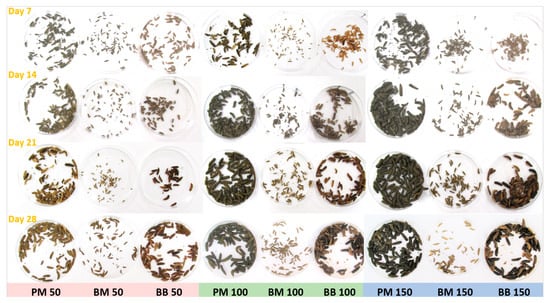
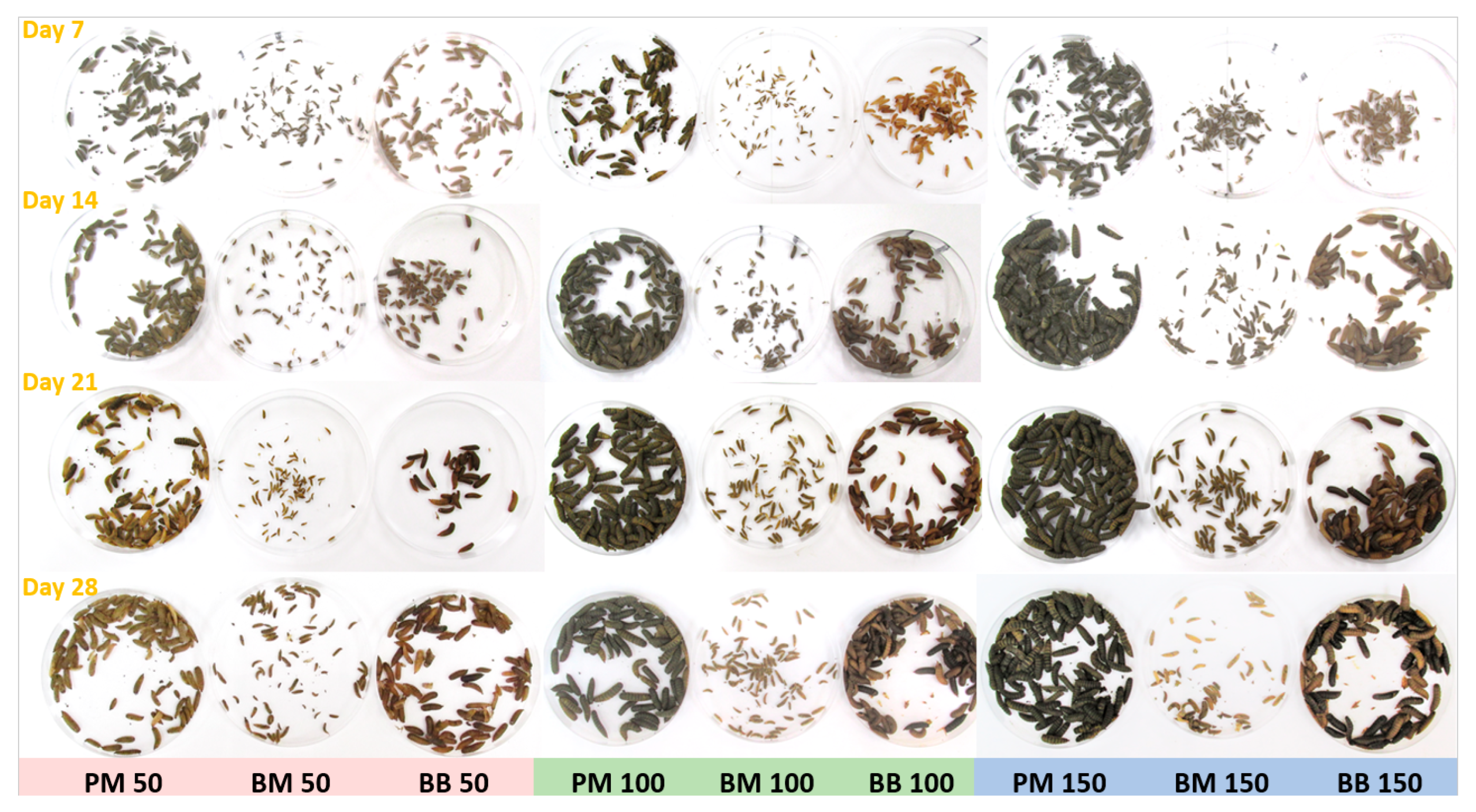
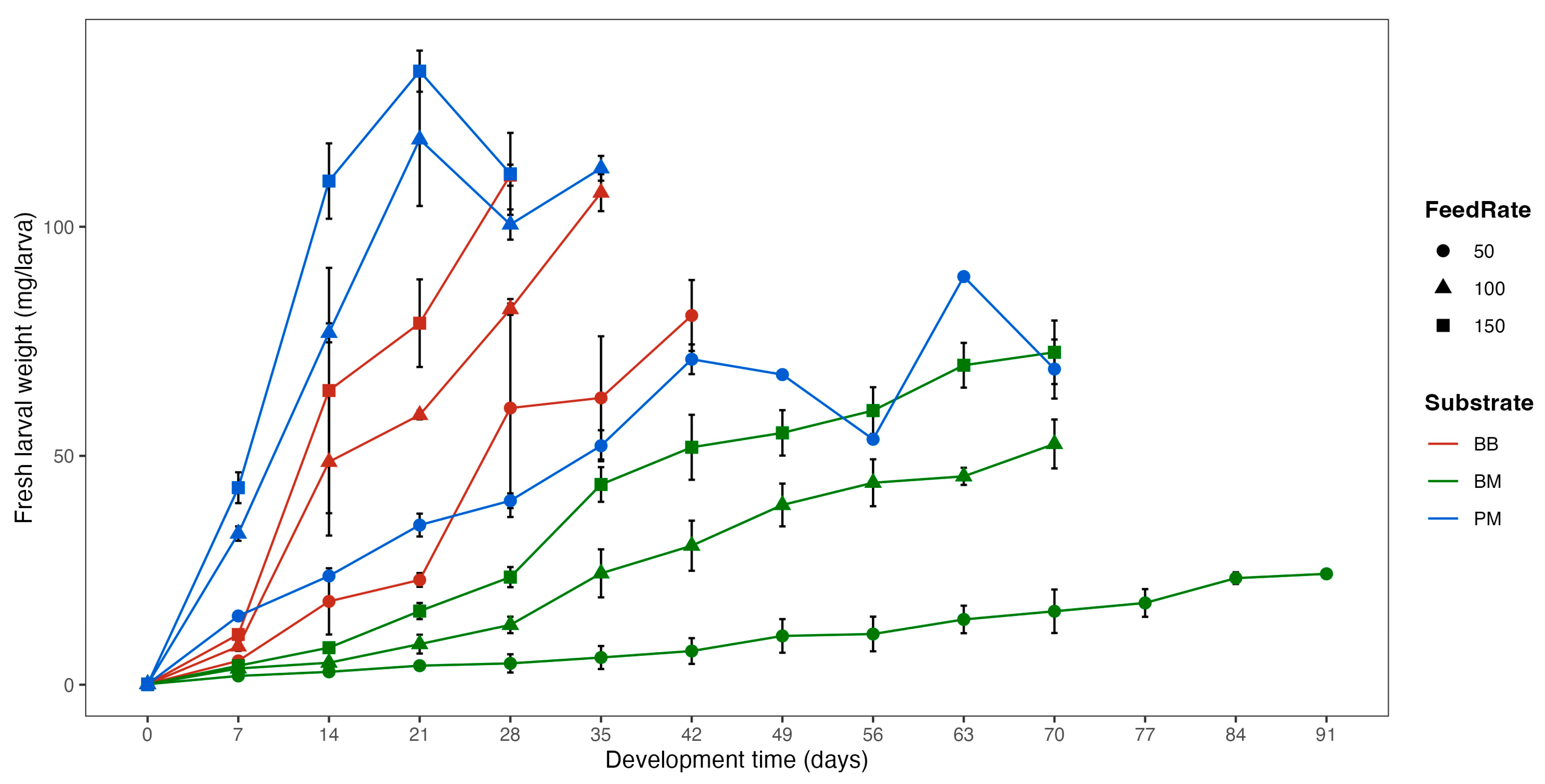
Larval development varied significantly among substrates and feeding rates (Figure 1). By day 28 of the experiment, approximately 50% of the larvae fed with BB and PM (at a feeding rate of 150 mg) reached the prepupal stage and were harvested. The final average fresh weight of these larvae was 111.3 ± 2.3 mg and 111.5 ± 8.9 mg, respectively. At 35 days, the treatments with PM and BB at a feeding rate of 100 mg also reached the prepupal stage, and following the same criteria, harvesting was carried out. The average fresh larval weight recorded was 107.4 ± 4.0 mg and 112.8 ± 2.7 mg, respectively.
Figure 1.
Larval development observed at 7, 14, 21, and 28 days from the start of the trial. Larvae were 10 days post-hatching at the beginning of the trial (day 0); therefore, the ages shown correspond to 17, 24, 31, and 38 days post-hatching. Substrates: poultry manure (PM), bovine manure (BM), barley bran (BB). Feeding rates: 50, 100, and 150 mg of substrate·larva−1·day−1.
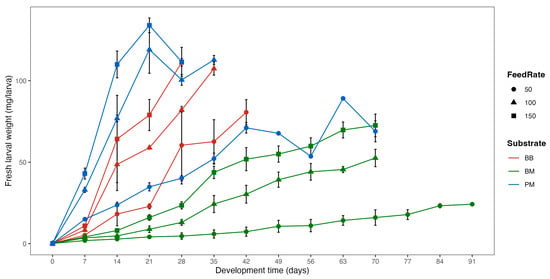
In contrast, the treatments with BM at feeding rates of 50 and 150 mg showed limited development, with average weights of 16.1 ± 4.8 mg and 72.6 ± 6.9 mg, respectively. Notably, development in BM50 was 4.5 times lower than that observed in BM150 at 70 days. Finally, by day 91, high mortality levels were recorded in the BM50 treatment (Figure 2), and no prepupal formation was observed. Consequently, the trial was concluded, and harvesting was performed.
Figure 2.
Weight of BSFL fed three types of agroindustry waste substrates at the three feeding rates. Substrates: Poultry manure (PM), bovine manure (BM), and barley bran (BB). Feeding rates: 50, 100, and 150 mg substrate·larva−1·day−1. Bars represent the standard error in the mean (n = 3). Fresh larval weight (mg/larva) over 91 days of development. Each line represents one of nine unique treatment combinations. Colors indicate the Substrate (BB, BM, or PM) and Symbols indicate the Feed Rate (● = 50, ▲ = 100, ■ = 150 mg/larva). Error bars represent standard error (n = 3).
The developmental performance of BSFL was strongly influenced by both the substrate type and feeding rate. Statistical analysis revealed significant effects of substrate on dry larval weight (F(2, 17) = 39.68, p < 0.001, = 0.824) and feeding rate (F(2, 17) = 9.53, p < 0.001, = 0.529), as well as a marginally significant interaction effect (F(4, 17) = 2.49, p = 0.081, = 0.370), suggesting a response that depends on the combination of both factors. Regarding survival, a significant interaction was observed between substrate type and feeding rate (F(4, 17) = 2331.97, p < 0.001, = 0.998). The BB100, BB150 and PM150 treatments showed the highest survival rates (~80%), while BM150 (40%) and PM100 (61%) displayed lower values (Table 2). The highest mean dry weights per larva were observed in PM100 (37.4 ± 2.72 mg) and BB100 (35.9 ± 1.04 mg), with no statistically significant differences between them (Tukey HSD post-hoc test). These values were notably higher than those recorded for BM treatments, especially BM50 (8.4 ± 0.002 mg) and BM100 (11.9 ± 1.30 mg).
Table 2.
Larval development parameters: Survival rate (%), Wet larval weight, dry larval weight, development time, and growth rate.
In terms of development time (DT), the Kruskal–Wallis test revealed highly significant differences among treatments (p = 0.003). Post hoc comparisons (Kruskal’s test) confirmed the shortest DT were observed in BB150 and PM150 (28 days), followed by BB100 and PM100 (35 days). Conversely, BM50 exhibited the longest developmental cycle, averaging 91 days, with high mortality and no prepupal formation. The growth rate (GR) exhibited a similar trend, with the BB150 (24.8 mg·larva−1·day−1) and BB100 (20.5 mg·larva−1·day−1). In contrast, the lowest GR were recorded in BM treatments, where BM50 and BM100 averaged below 5 mg·larva−1·day−1, reflecting slow development and poor assimilation capacity.
It is worth noting that feeding rates of 100 mg and 150 mg produced higher larval biomass across substrates compared with the 50 mg rate. Increasing the rate from 100 mg to 150 mg did not result in significant differences in dry larval biomass but corresponded with shorter development times.
2.3. Treatment Efficiency of Organic Wastes
Statistical analysis revealed significant effects of substrate type, feeding rate, and their interaction on the main indicators of bioconversion efficiency. For waste reduction (WR), the ANOVA indicated strong effects of substrate (F(2, 17) = 1716.46, p < 0.001, = 0.995), feeding rate (F(2, 17) = 58.30, p < 0.001, = 0.873), and their interaction (F(4, 17) = 11.75, p < 0.001, = 0.734). The highest WR values were recorded in BB100 (52.9 ± 0.5%) and BB150 (52.5 ± 0.1%), followed by PM150 and PM100 (≈43.5%). In contrast, BM treatments (BM50, BM100, BM150) all showed WR values below 14% (Table 3). Post hoc comparisons (Tukey HSD) confirmed significant differences among treatments.
Table 3.
Efficiency parameters for the BSFL process: Waste Reduction (WR), Waste Reduction Index (WRI), and Bioconversion Efficiency (BE).
For the waste reduction index (WRI), all factors had significant effects. The Kruskal–Wallis test showed highly significant differences, p < 0.001. The highest values were recorded in BB150 (1.87% ± 0.01) and PM150 (1.57% ± 0.03), followed by BB100 (1.51 ± 0.01) and PM100 (1.24 ± 0.02). BM treatments again showed very low values (<0.20), reflecting poor substrate reduction and biomass conversion.
Bioconversion Efficient (BE) results followed a similar pattern, with significant effects of substrate (F(2, 17) = 181.85, p < 0.001, = 0.955), feeding rate (F(2, 17) = 10.76, p < 0.001, = 0.559), and their interaction (F(4, 17) = 3.54, p = 0.028, = 0.455). The highest BE values were observed in PM100 (4.6% ± 0.2), BB50 (4.2% ± 0.3), and PM50 (4.1% ± 0.1), with no significant differences among them. The lowest values were recorded in BM50, BM100, and BM150 (0.8% ± 0.3, 0.7% ± 0.1, 0.4% ± 0.1, respectively). Notably, BB150, despite its high WR, showed an intermediate BE (2.5% ± 0.1). Overall, BB and PM, particularly at feeding rates of 100 and 150 mg·larva−1·day−1, supported higher process efficiency than BM, both in terms of waste reduction and biomass conversion.
3. Discussion
Previous studies have shown that larval density can affect process efficiency; however, this parameter was not considered in the present trial. A uniform density of 1.26 larvae·cm−2 was used to evaluate three substrates under three feeding rates. This study explored how different feeding rates affect the treatment of these substrates, significantly impacting the behavior of BSFL (growth rate, final larval weight, and development time) and its efficiency in terms of bioconversion and organic waste reduction.
3.1. Substrate Properties Affected the Process
The very large effect sizes obtained in the ANOVA confirm that substrate type was the dominant factor influencing BSFL performance in this study. Substrate explained almost all the variance in key parameters (e.g., = 0.824 for dry larval weight and = 0.995 for waste reduction), far exceeding the effect of feeding rate. This statistical pattern reinforces what has been widely documented in the literature: BSFL growth is highly dependent on the nutritional and physical qualities of the substrate, particularly moisture, available protein, fiber fraction and pH [29,44]. In this study, PM was exposed to sunlight and when collected it had a moisture content of 50%, potentially leading to nitrogen volatilization; yet, larvae successfully reached the prepupal stage. This aligns with Cheng et al. [45], who reported that PM with 40–60% moisture supports adequate growth. In contrast, growth may be limited for other substrates Cammack et al. [46] and Meneguz et al. [47] demonstrated that feeding larvae with diets containing 70% moisture led to faster development, with the larval cycle completed in 6 to 10 days, but with lower substrate consumption (25% to 50% less) compared to diets with 55% moisture.
Nutritional composition of the substrate—particularly crude protein and fiber content, strongly influences BFSL performance [46], and the present finding align with this. In this study, PM and BB had the highest crude protein contents of 16.0 and 13.8% DM, while BM had the lowest protein content of 12.7% DM, similar to that reported by Gold et al. [48,49].
For instance, Lalander et al. 2019 [50] observed that dietary protein level has a strong impact on the time to reach the prepupal stage. In this trial, larvae reared on BB and PM developed as expected, whereas development was limited with BM. This could be explained by the generally higher fiber content in BM, which restricted nutrient assimilation. The extremely poor performance observed with BM—namely the prolonged development cycle (up to 91 days) and high mortality, is presumed to stem from the substrate’s high lignocellulosic fraction and low nutrient bioavailability, which severely restricted larval assimilation and subsequent biomass accumulation.
Gold et al. [48] and Rehman et al. [28,38] pointed out that BSFL have difficulty digesting lignocellulosic substrates and require pretreatments or mixtures with a balanced composition (e.g., a mixture of dairy BM and PM in a 2:3 ratio). Following the same principle, Peguero et al. [51] and Xiao et al. [52] applied pretreatments (e.g., grinding and/or fermentation) and co-digesters such as bacteria and fungi, which impacted the substrate composition and, more importantly, facilitated the digestion of otherwise unavailable nutrients.
3.2. Factors Impacting Larval Development and Process Efficiency
Larval performance was strongly influenced by substrate type and feeding rate, as reflected in the observed differences in dry weight, survival, development time, and treatment efficiency. Statistical analysis confirmed these patterns: substrate type had a significant effect on larval dry weight (F(2, 17) = 39.68, p < 0.001, = 0.824) as did feeding rate (F(2, 17) = 9.53, p < 0.001, = 0.529). The interaction between the two factors was marginally significant (F(2, 17) = 39.68, p < 0.001, = 0.824) and feeding rate (F(4, 17) = 2.49, p = 0.081), indicating that larval response depends on the specific combination of substrate and feeding rate.
In general, PM and BB supported faster development, and higher biomass yields than BM. The highest dry weights were obtained in PM100 (37.4 + 2.72 mg) and BB100 (35.9 + 1.04 mg), while B50 and BM100 showed the lowest values (<12 mg), reflecting very limited assimilation capacity. Development times followed the same trend: BB150 and PM150 showed the shortest cycles (28 days), whereas BM50 required 91 days and exhibited high mortality. Manure-based treatments also resulted in slower development and lower survival overall, which reduced bioconversion efficiency. For PM, development times in this study (28–70 days) were considerably longer than those reported by Miranda et al., [27] (14 days) and Lalander et al., [50] (19 days), likely due to differences in substrate quality, including moisture content, nutrient balance, and nitrogen losses during storage. For BB, development times at 50 mg and 100 mg·larva−1·day−1 (40 and 35 days) were longer than the 22 days reported by Bava et al., [30], whereas at 150 mg·larva−1·day−1 larvae reached the prepupal stage in 28 days, consistent with previously reported values.
The poor performance of BM agrees with what has been reported for substrates with high fiber content and low nutrient availability [53]. An additional factor that may have amplified these differences is the initial diet. In this study, neonates were fed overripe bananas for ten days prior to the experiment, whereas other authors used standardized diets or the experimental substrate from the beginning. Oonincx et al., [23], fed larvae with dairy manure from early stages exhibited extremely long development cycles (7 months), precisely because the initial substrate was nutrient poor. Although PM and BB did not show severe effects in the present study, this non-standardized initial diet may have exacerbated BM’s nutritional limitations and contributed to its low biomass and high mortality.
Survival patterns further reflected substrate quality. BM survival (40–78%) was comparable to the ranges reported by Miranda et al. [27] and Myers et al. [37], suggesting that high-fiber substrates impose physiological stress across different larval density. PM survival was lower than the >80% reported by Dzepe et al. [54], potentially due to manure aging and nitrogen depletion typical of backyard production systems. Survival of larvae reared on BB (79–80%) was slightly below values reported by Meneguz et al. [47], and Resconi et al. [55], likely reflecting differences in substrate composition and storage conditions, as endogenous microbial activity begins rapidly when by-products are not stored cold [55].
Regarding process efficiency, statistical effects were even more pronounced. For WR, strong effects were observed for substrate (F(2, 17) = 1716.46, p < 0.001, = 0.995), feeding rate (F(2, 17) = 58.30, p < 0.001, = 0.873), and their interaction (F(4, 17) = 11.75, p < 0.001, = 0.734). BB100 and BB150 showed the highest WR (>52%), followed by PM150 and PM100 (~43%), while all BM treatments remained below 14%. WRI and BE showed similar trends, confirming that PM and BB were more suitable substrates, particularly at feeding rate of 100–150 mg larva−1 day−1. The BE values obtained here were lower than those reported by Lalander et al. [50] and Rehman et al. [38], likely due to differences in substrate characteristics, processing time, and larval assimilation capacity.
Finally, strain-related differences may also contribute to the observed differences in larval performance among treatments. Zhou et al. [41] reported phenotypic plasticity in the development and bioconversion capacity of the BSFL strains from China and Texas. The Wuhan strain, compared to the Guangzhou strain (both from China), achieved 40.1% and 48.4% greater reduction in BM and PM, respectively, and surpassed the Texas strain by 6.9% and 7.9% in manure reduction. This study represents the first report where an Ecuadorian strain, originating from the Milagro canton, was used. According to records, this strain may have been adapted to certain regions of the country for several decades, which could explain differences in performance compared to strains from other regions.
Together, these findings indicate that substrate type was the dominant driver of biological performance and bioconversion efficiency, followed by feeding rate, while methodological factors such as initial diet and strain identity may have modulated the observed trends.
3.3. Additional Factors That May Influence Larval Treatment
Beyond the effects of substrate type and feeding rate, several methodological and environmental aspects may have influenced the outcomes and should be considered when interpreting the results. First, this study did not characterize key physicochemical properties of the substrates (e.g., fat content, available carbon, volatile solids, or detailed fiber fractions). Previous work has shown that these parameters can substantially affect BSFL performance, waste reduction, and larval nutritional composition (Meneguz et al., [47]; Lalander et al. [50]). Without this information, it is difficult to determine the extent to which the observed differences among PM, BB, and BM were driven by nutrient composition versus other substrate-specific properties.
Environmental conditions represent an additional source of variability. Temperature and relative humidity were not controlled and fluctuated naturally (21–29 °C; 46–59% RH). Although these values fall within acceptable ranges for BSFL, fluctuations may prolong development times or alter survival compared to results obtained under strictly controlled laboratory settings (e.g., 28 °C, constant humidity). These uncontrolled conditions reflect the reality of rural Ecuadorian systems—which was an intentional aspect of this study—but they also limit the direct comparability of our results with studies performed under standardized environments.
Another consideration is the weekly feeding regime used in this experiment may have introduced additional variability, as substrate quality can change rapidly once exposed to ambient conditions. Although this mirrors farm-level manure management practices, future work could test whether more frequent feeding intervals stabilize performance metrics. Finally, this study used an Ecuadorian strain of H. Illucens. Strain-dependent differences in development and bioconversion capacity have been reported by Zhou et al. [41], suggesting that local adaptation may partly explain divergences from patterns reported in other regions. While strain identity was not the primary focus of this study, it remains a factor that future research should systematically evaluate.
Taken together, these factors do not undermine the main conclusions but clearly outline the methodological scope of this work. Addressing them in future experiments—through substrate characterization, environmental control, density standardization, and strain comparisons—will allow for a more precise understanding of the mechanisms shaping BSFL performance under tropical small-scale production conditions.
4. Materials and Methods
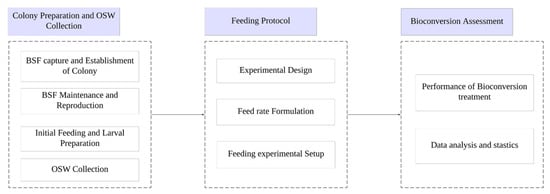
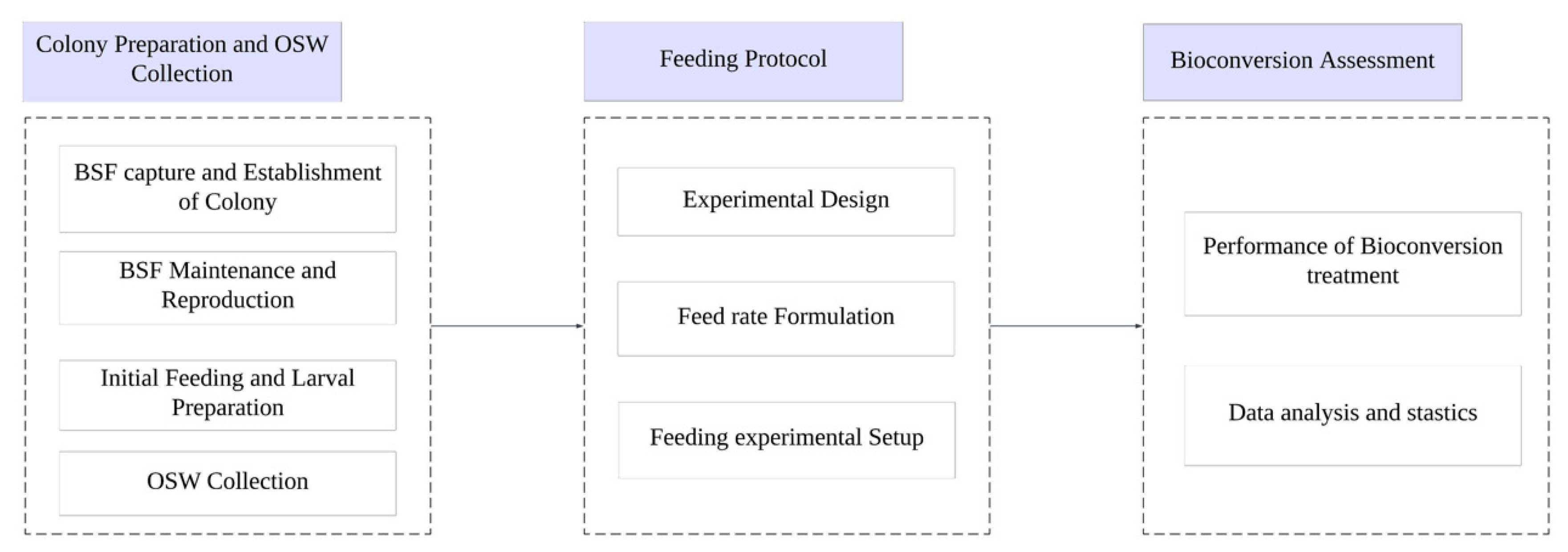
This study was conducted in three main phases to evaluate the development and performance of BSFL in the bioconversion of organic waste, as can be observed in Figure 3. The first phase (Colony Preparation and organic solid waste Collection) involved colony establishment and management, encompassing the initial capture of the flies, reproduction, larval care, and organic solid waste. The second phase (Feeding Protocol) focused on the design of the experiment, including feed rate formulation and the setup of feeding experiments. Finally, the third phase (Bioconversion Assessment) evaluated the bioconversion process performance, and the statistical analysis of the data obtained. This structure allowed for a clear and systematic organization of the study to ensure the validity and reproducibility of the results.
Figure 3.
Methodology applied to determine the optimal feeding rate when BSFL are reared on poultry manure (PM), bovine manure (BM), and barley bran (BB).
4.1. BSF Capture and Establishment of Colony
The BSF colony was initiated in early 2016 through the capture of wild adult specimens from Milagro, Guayas Province, Ecuador (UTM Coordinate 668,536 m E, 9,764,199 m S). The specimens were captured and confined in a 1.2 × 1.0 × 0.8 m box covered with a white mesh for safe transportation to the Entomology Laboratory at the Life Sciences Faculty (FCV) of the Escuela Superior Politécnica del Litoral (ESPOL). Species identification was confirmed based on the morphological descriptions provided by Cai et al. [26], Oliveira et al. [56]. Rearing procedures were adapted from the modified methodology of Sheppard et al. [57], with adjustments made to the type of organic waste used for larval feeding and to the structures employed for pupation and oviposition.
4.2. BSF Maintenance and Reproduction
A small population of flies from the initial colony was confined in a mesh-covered box, where mating occurred. Only water was provided during this period. Corrugated cardboard pieces (2.5 × 5 cm) and a 5 L bucket with an attractant substrate were placed inside the box to stimulate oviposition. BSF eggs hatched within approximately 24 h and were initially fed on fruit and vegetable residues, which served as the standard diet for colony maintenance in the laboratory. Once the BSFL reached the prepupal stage, they were transferred to trays filled with sand, where they developed until sexual maturity and sustained the continuous breeding cycle. Larve used in the experimental phase were obtained from this established colony.
4.3. Initial Feeding and Larval Preparation
Newly hatched BSFL designated for the experiment were fed ad libitum with overripe bananas sourced from local surplus produces for the first nine days, reaching an average individual weight of approximately 0.060 g (60 mg), estimated by dividing the total mass of 100 larvae by the number of individuals. On the tenth day, larvae were separated from residual matter from the initial rearing phase using a sieve and a fine brush, and subsequently transferred to the experimental substrates.
4.4. Biowaste Collection
Three types of organic solid waste from the Ecuadorian agro-industrial sector were used: PM, BM, and BB. PM was collected from a domestic henhouse in El Triunfo, Guayas, Ecuador. Fresh BM was sourced from a dual-purpose livestock farm in Milagro, Guayas, where cattle are raised under a grazing system. Fresh BB, a moist barley by product (~81% moisture), was obtained from a multinational brewing company in Guayaquil, Guayas. Although sourced from an industrial facility, BB is widely produced across Ecuador, including in small-scale rural breweries, and its physicochemical characteristics are comparable regardless of production scale. After collection in plastic containers, the organic solid waste samples were transported to the laboratory. BM and BB were stored at −20 °C for 24 h, while poultry manure was stored at room temperature in a cool place. Before each experiment, residues were thawed for 24 h (except PM).
PM and BM were analyzed to determine their pH, electrical conductivity (EC), carbon and nitrogen content, and C/N ratio. pH and EC of the manures were measured in triplicate using a Mettler Toledo multiparameter meter, (SevenDirect SE23 model) following a 5:1 water-to-substrate suspension method based on ISO 10390 [58] (pH) and ISO 11265 [59] (EC). Carbon (C) and nitrogen (N) contents were determined using an automatic elemental C/N analyzer (Elementar Vario Macro model) at the Soil and Plant Nutrition Laboratory (ESPOL), following the laboratory’s standardized protocol. For BB, the supplier provided pH, nitrogen content, and C/N ratio values, which are representative of typical brewer’s spent grain produced in both industrial and rural brewing systems. Crude protein for PM, BM, and BB was calculated by multiplying the nitrogen content by a substrate-specific conversion factor (4.8 for PM, 4.6 for BM and 6.25 for BB), as performed by Gold et al. [60].
4.5. Experimental Design
The experiment was conducted at the FCV facilities of ESPOL (Guayas, Guayaquil) from July to September under natural fluctuating environmental conditions. All trials were placed outdoors, adjacent to the laboratories building, inside a 1.2 × 1.0 × 0.8 m mesh-covered enclosure constructed entirely from mosquito netting. The enclosure prevented contamination and access by other insects while remaining exposed to the ambient outdoor climate. A black tarp was placed over the top to reduce direct sunlight exposure but did not restrict ventilation or natural airflow. No artificial climate-control systems were present; therefore, temperature and relative humidity followed the natural environmental variation in the study period (21–29 °C and relative humidity of 46–59%). Illumination consisted exclusively of natural daylight filtered through the mesh and tarp. Ventilation was maintained exclusively by natural airflow through the mesh walls.
A factorial experimental design (3 × 3) with repeated measures was used to evaluate the correlation between substrate type and feeding rate. All substrates were used in the physical condition in which they were collected, without grinding, sieving, or particle-size adjustment. Prior to each feeding cycle, substrates were manually mixed to improve homogeneity and prevent localized compaction. Substrates were supplied at their original moisture content (50%, 80%, and 81% for PM, BM, and BB, respectively), and no pH or moisture adjustment were performed during the experiment
For each combination of factors, three independent replicates were prepared resulting in a total sample size of n = 3 independent biological replicates per treatment (total of 27 experimental units). Trials were conducted in 10 cm diameter and 6cm high plastic trays, providing a test surface area of 345.58 cm2. Each trial containing one hundred randomly selected 10-day-old larvae. Initial group weights ranged from 40 to 80 mg with an average of 60 mg. This variation resulted from the random selection of larvae, a common procedure in BSFL experiments intended to avoid size-based bias and to better represent the natural variability within the cohort. This resulted in a larval density of 1.27 larvae·cm−2.
4.6. Feed Rate Formulation
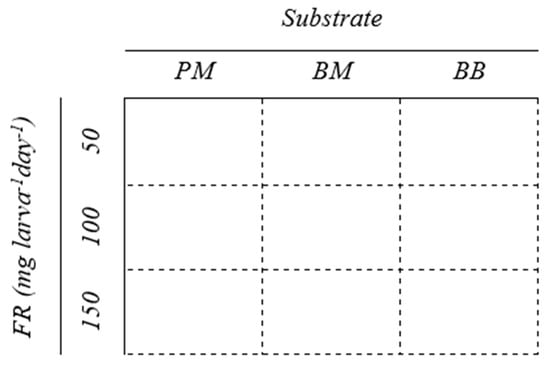
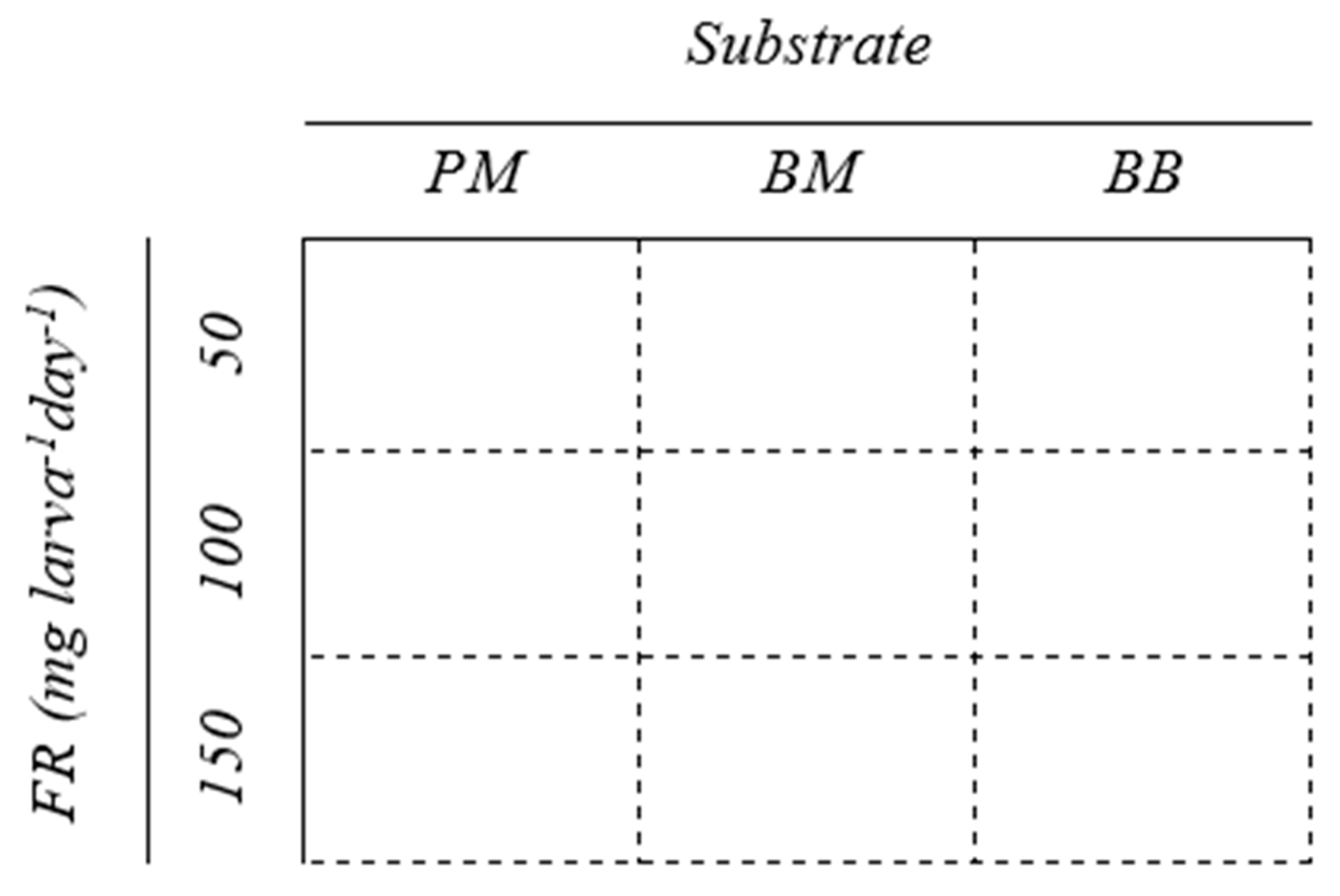
The feeding rates used in the experiment were selected based on Diener et al. [40], who found an optimal feeding rate of 100 mg·larva−1·day−1 for BSFL reared on chicken feed, with trials ranging from 25 to 200 mg·larva−1·day−1. In the present study, three feeding rates of 50, 100, and 150 mg of substrate per larva per day were established as shown in Figure 4, with each tray containing 100 larvae. Although these rates are defined on a per-day basis, feeding was carried out on a weekly schedule. Thus, each experimental unit received the total amount of substrate required to cover seven days of feeding in a single weekly ration.
Figure 4.
Factors and levels established for the factorial experiment.
4.7. Feeding Experiments Setup
At the beginning of each seven-day feeding cycle, larvae were provided with the full weekly substrate ration corresponding to their assigned feeding rate. Larvae consumed the substrate progressively during the week. At the end of each cycle, the remaining substrate was manually separated and weighed to quantify residue, and 20 larvae were randomly sampled from each tray to record live weight. After measurements, larvae were transferred to fresh substrate for another seven-day cycle. After 28 days, survival rate and bioconversion efficiency were determined. According to Diener et al. [40], the experiment concluded when 50% of the larvae had reached the prepupal stage, which was identified by darkening of the cuticle and active wandering behavior. Monitoring continued until all larvae had either pupated, ceased development, or died. Collected larvae were rinsed with potable water, dried, and euthanized by freezing. For dry weight determination, larvae were dehydrated at 55 °C for 72 h before weighing.
4.8. Performance of Bioconversion Treatment
Dry weights of larvae and residues were used to calculate BSFL bioconversion and developmental efficiency parameters as proposed by Bosch et al. [61]. All parameters were calculated on a dry matter basis. The larval survival rate was calculated using Equation (1) as the ratio between the number of larvae at the end and the number of larvae at the start of each experimental unit:
The growth rate () was determined using Equation (2), as the ratio of the final dry weight of the larvae () to the larval development time ():
The waste reduction rate () was calculated using Equation (3), which evaluates the difference between the total of the substrate supplied () and the weight of the remaining frass (), divided by the weight of the substrate supplied × 100%
The waste reduction index () was calculated using Equation (4), relating the waste reduction rate (WR) to the larval development time (td):
Bioconversion efficiency () was calculated after 28 days of the experiment using Equation (5), which relates the difference between the final weight of the larvae () and the initial weight () to the weight of the substrate supplied ()
4.9. Data Analysis and Statistics
All statistical analyses and graphical representations were conducted using R software, version 4.0.2. The verification of model assumptions was conducted in three stages: (i) normality of residuals, evaluated using the Shapiro–Wilk test; (ii) homogeneity of variances, assessed through Levene’s test; and (iii) independence of residuals, tested using the Durbin-Watson test. For each response variable that met the assumptions of normality and homogeneity, a two-way analysis of variance (ANOVA) was applied, considering substrate type, feeding rate, and their interaction as fixed factors. to quantify the magnitude of the effects, the partial Eta Squared ( effect size was reported. When significant differences were detected, multiple comparisons were carried out using Tukey’s Honest Significant Difference (HSD) test. The standard error 8SE) was used to assess variability among group means, and statistical significance for all hypothesis test was set at p < 0.05.
In cases where the assumption of normality was not satisfied, the non-parametric Kruskal–Wallis test was used to detect significant differences between treatments. When significant effects were observed, group comparisons were performed through Kruskal’s post hoc test (using the Agricolae package in R), assigning homogeneous groups by treatment. For all statistical analyses, the level of significance was established at α = 0.05.
5. Conclusions
This study demonstrates the potential of BSFL bioconversion as a sustainable, decentralized, and low-cost solution for the management of organic solid waste in rural areas settings, particularly by small-scale agricultural producers. The results confirmed that both substrate type and feeding rate significantly influence larval development, survival, and bioconversion efficiency. PM and BB emerged as the most suitable substrates, supporting accelerated larval growth, high survival rates, and substantial waste reduction, even at moderate feeding rates. Conversely, BM, despite being readily available in rural livestock systems, exhibited limited nutritional quality, resulting in prolonged development times, increased mortality, and poor substrate-to-biomass conversion.
The findings highlight that substrate nutritional composition, especially protein content and moisture level, are key factors in achieving efficient waste bioconversion. The performance of the larvae was also influenced by the feeding rate, with 100 mg·larva−1·day−1 emerging as an optimal balance for resource input and bioconversion output when using PM and BB.
Furthermore, the use of locally adapted Ecuadorian strains of BSF collected from Milagro (Guayas), highlights the importance of leveraging region-specific biological resources to enhance system performance under natural environmental conditions, thereby reducing the need for costly environmental controls. This research provides actionable insights for the development of appropriate waste treatment technologies tailored to smallholder farming communities, contributing to the advancement of circular economy models, improved resource recovery, and reduced environmental impacts.
Future research should explore strategies to improve the valorization potential of lower-quality substrates such as BM through co-digestion, pre-treatment, or substrate formulation, in order to expand the applicability and efficiency of BSFL-bases systems for sustainable waste management in low-resource settings.
Author Contributions
Conceptualization: E.Á. and M.S.; Methodology: E.Á., C.A. and M.S.; Investigation: N.G.; Resources: N.G.; Data Curation: M.T. and J.D.C.; Formal Analysis: O.R. and B.G.; Write Original Draft Preparation: M.S., J.D.C., D.P. and B.G.; Review and Editing: J.A. and M.T.; Project Administration: E.Á. and J.A.; Funding acquisition: E.Á., D.P. and C.A. All authors have read and agreed to the published version of the manuscript.
Funding
This research received no external funding.
Data Availability Statement
The original contributions presented in this study are included in the article. Further inquiries can be directed to the corresponding authors.
Acknowledgments
The authors thank ESPOL for providing laboratory facilities and technical support, particularly the Faculty of Life Sciences and the entomology Laboratory team. We also extend our gratitude to all colleagues who contributed to this study. We extend our thanks to the Universidad Agraria del Ecuador (UAE) and its Research Institute for their support. During the preparation of this manuscript, the authors used ChatGPT-5 for grammar checking and consensus for reference searching. After using these tools, the authors reviewed and edited the content as needed and took full responsibility for the content of the publication.
Conflicts of Interest
The authors declare no conflicts of interest.
References
- Gerber, P.J. Tackling Climate Change Through Livestock: A Global Assessment of Emissions and Mitigation Opportunities; Food and Agriculture Organization of the United Nations: Rome, Italy, 2013. [Google Scholar]
- Alexandratos, N.; Bruinsma, J.; FAO. World Agriculture Towards 2030/2050: The 2012 Revision. 2012. Available online: www.fao.org/economic/esa (accessed on 28 October 2025).
- Villa-Achupallas, M.; López, A.; Díez-Montero, R.; Esteban-García, A.L.; Lobo, A. Analysis of household waste production in Ecuador: Limitations for sustainable management in local communities. Waste Manag. 2024, 190, 531–537. [Google Scholar] [CrossRef] [Scilit]
- Loor, M.C.; Andrade, F.; Lizarzaburu, L.; Masache, M. Valoración Económica de los Co-Beneficios del Aprovechamiento Energético de los Residuos Agrícolas en el Ecuador; CEPAL: Santiago, Chile, 2017. [Google Scholar]
- Westerman, P.W.; Bicudo, J.R. Management considerations for organic waste use in agriculture. Bioresour. Technol. 2005, 96, 215–221. [Google Scholar] [CrossRef] [Scilit]
- Ministerio de Agricultura y Ganadería [MAG]. Lograr una Agricultura Familiar y Campesina Sostenible es el Objetivo del MAG. Available online: https://www.agricultura.gob.ec/lograr-una-agricultura-familiar-y-campesina-sostenible-es-el-objetivo-del-mag/ (accessed on 19 June 2025).
- Ministerio de Agricultura y Ganadería [MAG]. Panorama Agroestadistico. October 2024. Available online: https://sipa.agricultura.gob.ec/index.php/panorama-agroestadistico/2024-panorama-agroestadistico (accessed on 20 October 2025).
- Valverde-Orozco, V.; Gavilanes-Terán, I.; Idrovo-Novillo, J.; Carrera-Beltrán, L.; Buri-Tanguila, S.; Salazar-García, K.; Paredes, C. Characterization of Agro-Livestock Wastes for Composting in Rural Zones in Ecuador: The Case of the Parish of San Andrés. Agronomy 2022, 12, 2538. [Google Scholar] [CrossRef] [Scilit]
- AGROCALIDAD. Normativa de produccion organica del Ecuador. 2020. Available online: https://www.agrocalidad.gob.ec/wp-content/uploads/2020/05/by3.pdf (accessed on 20 October 2025).
- Chizaryfard, A.; Trucco, P.; Nuur, C. The transformation to a circular economy: Framing an evolutionary view. J. Evol. Econ. 2021, 31, 475–504. [Google Scholar] [CrossRef] [Scilit]
- Berlin, D.; Feldmann, A.; Nuur, C. The relatedness of open- and closed-loop supply chains in the context of the circular economy; Framing a continuum. Clean. Logist. Supply Chain 2022, 4, 100048. [Google Scholar] [CrossRef] [Scilit]
- Pane, C.; Spaccini, R.; Piccolo, A.; Celano, G.; Zaccardelli, M. Disease suppressiveness of agricultural greenwaste composts as related to chemical and bio-based properties shaped by different on-farm composting methods. Biol. Control 2019, 137, 104026. [Google Scholar] [CrossRef] [Scilit]
- Lin, L.; Yang, X.; Shen, Y.; Zhu, P.; Niu, S.; Alghashm, S.; Ding, G.; Wu, D.; Li, X. Inhibition of odor generation during the composting process of fecal sludge from rural toilets by decomposed compost backfilling. Bioresour. Technol. Rep. 2025, 29, 102065. [Google Scholar] [CrossRef] [Scilit]
- FAO. Buenas Prácticas Ganaderas Impulsan la Economía de Pequeños Productores en Ecuador. FAO en Ecuador. Available online: https://www.fao.org/ecuador/noticias/detail-events/es/c/1151391/ (accessed on 19 June 2025).
- Campos-Llerena, P.; Chávez-Hernández, Z.; Jiménez-Estrella, P.; Salazar-Mejía, C. Application of Accounting Standards in the Valuation of Biological Assets: An Analysis of the Poultry Sector in Tungurahua, Ecuador. J. Risk Financ. Manag. 2025, 18, 509. [Google Scholar] [CrossRef] [Scilit]
- Holmes, I.; Bitrán, D.; Zambrana, T. Hacia una Agricultura Sostenible y Resiliente en América Latina y el Caribe, 1st ed.; FAO: Rome, Italy, 2021. [Google Scholar] [CrossRef] [Scilit]
- CONAVE. Información Sector Avícola Público—CONAVE. 2019. Available online: https://conave.org/informacion-sector-avicola-publico/ (accessed on 12 December 2024).
- INEC. Encuesta de Superficie y Producción Agropecuaria Continua ESPAC. 2023. Available online: https://anda.inec.gob.ec/anda/index.php/catalog/1109 (accessed on 12 August 2025).
- Williams, C.M. Poultry Waste Management in Developing Countries; FAO: Rome, Italy, 2013. [Google Scholar]
- Garcia Lopez, J.C.; Pinos Rodriguez, J.; Rendon Huerta, J.A.; Peña Avelino, L.Y. Impactos y regulaciones ambientales del estiércol generado por los sistemas ganaderos de algunos países de América. Agrociencia 2012, 46, 359–370. [Google Scholar]
- Morales, M.A.J.; Barriga, J.C. Fraccionamiento del Bagazo Cervecero Bajo el Concepto de Biorrefineria. 2018. Available online: https://repositorio.puce.edu.ec/handle/123456789/20702 (accessed on 25 August 2025).
- Siddiqui, S.A.; Ristow, B.; Rahayu, T.; Putra, N.S.; Yuwono, N.W.; Mategeko, B.; Smetana, S.; Saki, M.; Nawaz, A.; Nagdalian, A. Black soldier fly larvae (BSFL) and their affinity for organic waste processing. Waste Manag. 2022, 140, 1–13. [Google Scholar] [CrossRef] [Scilit] [PubMed]
- Oonincx, D.G.A.B.; Van Broekhoven, S.; Van Huis, A.; Van Loon, J.J.A. Feed conversion, survival and development, and composition of four insect species on diets composed of food by-products. PLoS ONE 2015, 10, e0144601. [Google Scholar] [CrossRef] [Scilit]
- Kim, C.-H.; Ryu, J.; Lee, J.; Ko, K.; Lee, J.-y.; Park, K.Y.; Chung, H. Use of Black Soldier Fly Larvae for Food Waste Treatment and Energy Production in Asian Countries: A Review. Processes 2021, 9, 161. [Google Scholar] [CrossRef] [Scilit]
- Somroo, A.A.; ur Rehman, K.; Zheng, L.; Cai, M.; Xiao, X.; Hu, S.; Mathys, A.; Gold, M.; Yu, Z.; Zhang, J. Influence of Lactobacillus buchneri on soybean curd residue co-conversion by black soldier fly larvae (Hermetia illucens) for food and feedstock production. Waste Manag. 2019, 86, 114–122. [Google Scholar] [CrossRef] [Scilit]
- Cai, M.; Li, L.; Zhao, Z.; Zhang, K.; Li, F.; Yu, C.; Yuan, R.; Zhou, B.; Ren, Z.; Yu, Z.; et al. Morphometric Characteristic of Black Soldier Fly (Hermetia illucens) · Wuhan Strain and Its Egg Production Improved by Selectively Inbreeding. Life 2022, 12, 873. [Google Scholar] [CrossRef] [Scilit] [PubMed]
- Miranda, C.D.; Cammack, J.A.; Tomberlin, J.K. Mass production of the black soldier fly, Hermetia illucens (L.), (diptera: Stratiomyidae) reared on three manure types. Animals 2020, 10, 1243. [Google Scholar] [CrossRef] [Scilit] [PubMed]
- ur Rehman, K.; Rehman, R.U.; Somroo, A.A.; Cai, M.; Zheng, L.; Xiao, X.; Rehman, A.U.; Rehman, A.; Tomberlin, J.K.; Yu, Z.; et al. Enhanced bioconversion of dairy and chicken manure by the interaction of exogenous bacteria and black soldier fly larvae. J. Environ. Manag. 2019, 237, 75–83. [Google Scholar] [CrossRef] [Scilit]
- Paz, A.S.P.; Carrejo, N.S.; Rodríguez, C.H.G. Effects of Larval Density and Feeding Rates on the Bioconversion of Vegetable Waste Using Black Soldier Fly Larvae Hermetia illucens (L.), (Diptera: Stratiomyidae). Waste Biomass Valorization 2015, 6, 1059–1065. [Google Scholar] [CrossRef] [Scilit]
- Bava, L.; Jucker, C.; Gislon, G.; Lupi, D.; Savoldelli, S.; Zucali, M.; Colombini, S. Rearing of hermetia illucens on different organic by-products: Influence on growth, waste reduction, and environmental impact. Animals 2019, 9, 289. [Google Scholar] [CrossRef] [Scilit] [PubMed]
- Lu, S.; Taethaisong, N.; Meethip, W.; Surakhunthod, J.; Sinpru, B.; Sroichak, T.; Archa, P.; Thongpea, S.; Paengkoum, S.; Purba, R.A.P.; et al. Nutritional Composition of Black Soldier Fly Larvae (Hermetia illucens L.) and Its Potential Uses as Alternative Protein Sources in Animal Diets: A Review. Insects 2022, 13, 831. [Google Scholar] [CrossRef] [Scilit]
- Soetemans, L.; Uyttebroek, M.; Bastiaens, L. Characteristics of chitin extracted from black soldier fly in different life stages. Int. J. Biol. Macromol. 2020, 165, 3206–3214. [Google Scholar] [CrossRef] [Scilit]
- Li, Q.; Zheng, L.; Qiu, N.; Cai, H.; Tomberlin, J.K.; Yu, Z. Bioconversion of dairy manure by black soldier fly (Diptera: Stratiomyidae) for biodiesel and sugar production. Waste Manag. 2011, 31, 1316–1320. [Google Scholar] [CrossRef] [Scilit]
- Klammsteiner, T.; Turan, V.; Juárez, M.F.D.; Oberegger, S.; Insam, H. Suitability of black soldier fly frass as soil amendment and implication for organic waste hygienization. Agronomy 2020, 10, 1578. [Google Scholar] [CrossRef] [Scilit]
- Bruno, D.; Orlando, M.; Testa, E.; Miino, M.C.; Pesaro, G.; Miceli, M.; Pollegioni, L.; Barbera, V.; Fasoli, E.; Draghi, L.; et al. Valorization of organic waste through black soldier fly: On the way of a real circular bioeconomy process. Waste Manag. 2025, 191, 123–134. [Google Scholar] [CrossRef] [Scilit] [PubMed]
- Holmes, L.A.; VanLaerhoven, S.L.; Tomberlin, J.K. Lower temperature threshold of black soldier fly (Diptera: Stratiomyidae) development. J. Insects Food Feed 2016, 2, 255–262. [Google Scholar] [CrossRef] [Scilit]
- Myers, H.M.; Tomberlin, J.K.; Lambert, B.D.; Kattes, D. Development of Black Soldier Fly (Diptera: Stratiomyidae) Larvae Fed Dairy Manure. Environ. Entomol. 2008, 37, 11–15. [Google Scholar]
- ur Rehman, K.; Cai, M.; Xiao, X.; Zheng, L.; Wang, H.; Soomro, A.A.; Zhou, Y.; Li, W.; Yu, Z.; Zhang, J. Cellulose decomposition and larval biomass production from the co-digestion of dairy manure and chicken manure by mini-livestock (Hermetia illucens L.). J. Environ. Manag. 2017, 196, 458–465. [Google Scholar] [CrossRef] [Scilit]
- van Huis, A. Insects as food and feed, a new emerging agricultural sector: A review. J. Insects Food Feed 2020, 6, 27–44. [Google Scholar] [CrossRef] [Scilit]
- Diener, S.; Zurbrügg, C.; Tockner, K. Conversion of organic material by black soldier fly larvae: Establishing optimal feeding rates. Waste Manag. Res. 2009, 27, 603–610. [Google Scholar] [CrossRef] [Scilit]
- Zhou, F.; Tomberlin, J.K.; Zheng, L.; Yu, Z.; Zhang, J. Developmental and waste reduction plasticity of three black soldier fly strains (Diptera: Stratiomyidae) raised on different livestock manures. J. Med. Entomol. 2013, 50, 1224–1230. [Google Scholar] [CrossRef] [Scilit]
- Mossé, J. Nitrogen to Protein Conversion Factor for Ten Cereals and Six Legumes or Oilseeds. A Reappraisal of Its Definition and Determination. Variation According to Species and to Seed Protein Content. J. Agric. Food Chem. 1990, 38, 18–24. [Google Scholar] [CrossRef] [Scilit]
- Chen, X.; Zhao, G.; Zhang, Y.; Han, L.; Xiao, W. Nitrogen-to-Protein Conversion Factors for Crop Residues and Animal Manure Common in China. J. Agric. Food Chem. 2017, 65, 9186–9190. [Google Scholar] [CrossRef] [Scilit]
- Zhang, J.B.; Zhang, J.; Tomerlin, J.K.; ur Rehman, K.; Zheng, L.Y. Black soldier fly: A new vista for livestock and poultry manure management. J. Integr. Agric. 2021, 20, 1167–1179. [Google Scholar] [CrossRef] [Scilit]
- Cheng, J.Y.K.; Chiu, S.L.H.; Lo, I.M.C. Effects of moisture content of food waste on residue separation, larval growth and larval survival in black soldier fly bioconversion. Waste Manag. 2017, 67, 315–323. [Google Scholar] [CrossRef] [Scilit]
- Cammack, J.A.; Tomberlin, J.K. The impact of diet protein and carbohydrate on select life-history traits of the black soldier fly Hermetia illucens (L.) (Diptera: Stratiomyidae). Insects 2017, 8, 56. [Google Scholar] [CrossRef] [Scilit] [PubMed]
- Meneguz, M.; Schiavone, A.; Gai, F.; Dama, A.; Lussiana, C.; Renna, M.; Gasco, L. Effect of rearing substrate on growth performance, waste reduction efficiency and chemical composition of black soldier fly (Hermetia illucens) larvae. J. Sci. Food Agric. 2018, 98, 5776–5784. [Google Scholar] [CrossRef]
- Gold, M.; Tomberlin, J.K.; Diener, S.; Zurbrügg, C.; Mathys, A. Decomposition of biowaste macronutrients, microbes, and chemicals in black soldier fly larval treatment: A review. Waste Manag. 2018, 82, 302–318. [Google Scholar] [CrossRef] [Scilit]
- Elith, J.; Elith, J.; Leathwick, J.R.; Leathwick, J.R. Species Distribution Models: Ecological Explanation and Prediction Across Space and Time. Annu. Rev. Ecol. Evol. Syst. 2009, 40, 677–697. [Google Scholar] [CrossRef] [Scilit]
- Lalander, C.; Diener, S.; Zurbrügg, C.; Vinnerås, B. Effects of feedstock on larval development and process efficiency in waste treatment with black soldier fly (Hermetia illucens). J. Clean. Prod. 2019, 208, 211–219. [Google Scholar] [CrossRef] [Scilit]
- Peguero, D.A.; Gold, M.; Endara, A.; Niu, M.; Zurbrügg, C.; Mathys, A. Evaluation of ammonia pretreatment of four fibrous biowastes and its effect on black soldier fly larvae rearing performance. Waste Manag. 2023, 160, 123–134. [Google Scholar] [CrossRef] [Scilit] [PubMed]
- Xiao, X.; Mazza, L.; Yu, Y.; Cai, M.; Zheng, L.; Tomberlin, J.K.; Yu, J.; van Huis, A.; Yu, Z.; Fasulo, S.; et al. Efficient co-conversion process of chicken manure into protein feed and organic fertilizer by Hermetia illucens L. (Diptera: Stratiomyidae) larvae and functional bacteria. J. Environ. Manag. 2018, 217, 668–676. [Google Scholar] [CrossRef] [Scilit]
- Julita, U.; Suryani, Y.; Kinasih, I.; Yuliawati, A.; Cahyanto, T.; Maryeti, Y.; Permana, A.D.; Fitri, L.L. Growth performance and nutritional composition of black soldier fly, Hermetia illucens (L), (Diptera: Stratiomyidae) reared on horse and sheep manure. IOP Conf. Ser. Earth Environ. Sci. 2018, 187, 012071. [Google Scholar] [CrossRef] [Scilit]
- Dzepe, D.; Nana, P.; Kuietche, H.M.; Kimpara, J.M.; Magatsing, O.; Tchuinkam, T.; Djouaka, R. Feeding strategies for small-scale rearing black soldier fly larvae (Hermetia illucens) as organic waste recycler. SN Appl. Sci. 2021, 3, 252. [Google Scholar] [CrossRef] [Scilit]
- Resconi, A.; Oddon, S.B.; Ferrocino, I.; Loiotine, Z.; Caimi, C.; Gasco, L.; Biasato, I. Effects of brewery by-products on growth performance, bioconversion efficiency, nutritional profile, and microbiota and mycobiota of black soldier fly larvae. Animal 2024, 18, 101288. [Google Scholar] [CrossRef] [Scilit]
- Oliveira, F.R.; Doelle, K.; Smith, R.P. External Morphology of Hermetia illucens Stratiomyidae: Diptera (L.1758) Based on Electron Microscopy. Annu. Res. Rev. Biol. 2016, 9, 1. [Google Scholar] [CrossRef] [Scilit]
- Sheppard, D.C.; Tomberlin, J.K.; Joyce, J.A.; Kiser, B.C.; Sumner, S.M. Rearing Methods for the Black Soldier Fly (Diptera: Stratiomyidae). J. Med. Entomol. 2002, 39, 695–698. [Google Scholar] [CrossRef] [Scilit] [PubMed]
- ISO 10390:2021; Soil, Treated Biowaste and Sludge—Determination of pH. International Organization for Standardization (ISO): Geneva, Switzerland, 2021.
- ISO 11265:1994; Soil Quality—Determination of the Specific Electrical Conductivity. International Organization for Standardization (ISO): Geneva, Switzerland, 1994.
- Gold, M.; Cassar, C.M.; Zurbrügg, C.; Kreuzer, M.; Boulos, S.; Diener, S.; Mathys, A. Biowaste treatment with black soldier fly larvae: Increasing performance through the formulation of biowastes based on protein and carbohydrates. Waste Manag. 2020, 102, 319–329. [Google Scholar] [CrossRef] [Scilit]
- Bosch, G.; Oonincx, D.G.A.B.; Jordan, H.R.; Zhang, J.; Van Loon, J.J.A.; Van Huis, A.; Tomberlin, J.K. Standardisation of quantitative resource conversion studies with black soldier fly larvae. J. Insects Food Feed 2020, 6, 95–109. [Google Scholar] [CrossRef] [Scilit]

Disclaimer/Publisher’s Note: The statements, opinions and data contained in all publications are solely those of the individual author(s) and contributor(s) and not of MDPI and/or the editor(s). MDPI and/or the editor(s) disclaim responsibility for any injury to people or property resulting from any ideas, methods, instructions or products referred to in the content. |
© 2026 by the authors. Licensee MDPI, Basel, Switzerland. This article is an open access article distributed under the terms and conditions of the Creative Commons Attribution (CC BY) license.