You are currently viewing a new version of our website. To view the old version click .

Batteries, Volume 4, Issue 1

March 2018 - 13 articles

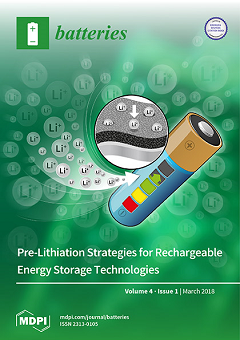
Cover Story: Pre-lithiation is considered to be a highly appealing technique to compensate for active lithium losses and, therefore, to increase the practical energy density of rechargeable energy storage devices. We provide a comprehensive overview of the various concepts for pre-lithiation and, controversially, discuss their advantages and challenges. Further, we critically discuss possible effects on cell performance and assess the techniques with regard to their possible commercial exploitation. View the paper.
  • Issues are regarded as officially published after their release is announced to the table of contents alert mailing list .
  • You may sign up for email alerts to receive table of contents of newly released issues.
  • PDF is the official format for papers published in both, html and pdf forms. To view the papers in pdf format, click on the "PDF Full-text" link, and use the free Adobe Reader to open them.

Articles (13)

  • Case Report
  • Open Access
97 Citations
27,436 Views
11 Pages

Looking Deeper into the Galaxy (Note 7)

  • Melanie J. Loveridge,
  • Guillaume Remy,
  • Nadia Kourra,
  • Ronny Genieser,
  • Anup Barai,
  • Mike J. Lain,
  • Yue Guo,
  • Mark Amor-Segan,
  • Mark A. Williams and
  • Tazdin Amietszajew
  • + 3 authors

Li-ion cell designs, component integrity, and manufacturing processes all have critical influence on the safety of Li-ion batteries. Any internal defective features that induce a short circuit, can trigger a thermal runaway: a cascade of reactions, l...

  • Communication
  • Open Access
16 Citations
11,184 Views
6 Pages

Towards Li-Ion Batteries Operating at 80 °C: Ionic Liquid versus Conventional Liquid Electrolytes

  • Gabriel Oltean,
  • Nareerat Plylahan,
  • Charlotte Ihrfors,
  • Wei Wei,
  • Chao Xu,
  • Kristina Edström,
  • Leif Nyholm,
  • Patrik Johansson and
  • Torbjörn Gustafsson

Li-ion battery (LIB) full cells comprised of TiO2-nanotube (TiO2-nt) and LiFePO4 (LFP) electrodes and either a conventional organic solvent based liquid electrolyte or an ionic liquid based electrolyte have been cycled at 80 °C. While the cell contai...

  • Article
  • Open Access
33 Citations
12,524 Views
7 Pages

25 December 2017

The stationary power market, particularly telecommunications back-up (telecom) applications, is dominated by lead-acid batteries. A large percentage of telecom powerplants are housed in outdoor enclosures where valve-regulated lead-acid (VRLA) batter...

of 2

Get Alerted

Add your email address to receive forthcoming issues of this journal.

XFacebookLinkedIn
Batteries - ISSN 2313-0105