


Abstract
Fast charging of lithium-ion batteries requires balancing charging efficiency with electrochemical safety to minimize degradation and lithium plating. Conventional charging strategies and existing reinforcement learning approaches often lack physical consistency and model interpretability, limiting their applicability in safety-critical battery management systems. This paper proposes a physics-informed Attention-Proximal Policy Optimization (Attention-PPO) framework for intelligent battery fast charging by integrating the Single Particle Model with Electrolyte (SPMe) with a transformer-based attention mechanism. SPMe provides physically meaningful battery state transitions, while the attention-enhanced PPO dynamically learns informative electrochemical representations for charging control. To improve transparency, a monotonic XGBoost surrogate model is employed for lithium-plating risk estimation, and the learned policy is further distilled into an interpretable decision tree. Experimental results demonstrate that the proposed Attention-PPO achieves substantially faster and more stable policy convergence than the baseline PPO, reaching convergence at episode 37 compared with episode 82 for PPO, corresponding to a 54.9% reduction in training episodes. The reward standard deviation is also reduced from 0.132 to 0.041, indicating 68.9% lower reward variability. In terms of electrochemical safety, Attention-PPO achieves a mean plating overpotential of +0.023 V compared with −0.015 V for PPO, providing a 38 mV improvement and a positive safety margin against lithium plating. Compared with conventional CC-CV and CC-COP controllers, the proposed framework requires a longer charging duration because it prioritizes electrochemical safety; however, it consistently maintains positive plating overpotential while achieving reliable charging performance. Compared with conventional CC-CV, CC-COP, and standard PPO controllers, the proposed framework provides a larger electrochemical safety margin while preserving reliable charging performance. Transformer attention analysis and policy distillation provide interpretable representations of the learned charging policy, while SHAP analysis characterizes feature contributions within the auxiliary plating-risk estimator. The proposed framework provides an effective and explainable physics-informed reinforcement learning solution for safe lithium-ion battery fast charging, offering a promising approach for next-generation intelligent battery management systems.
1. Introduction
The rapid adoption of electric vehicles (EVs) has intensified the demand for fast and reliable charging technologies that minimize charging time while preserving battery health [1]. However, aggressive fast charging accelerates degradation mechanisms, particularly lithium plating, which reduces capacity, increases internal resistance, and may compromise battery safety [2,3]. Therefore, developing intelligent charging strategies that jointly optimize charging efficiency, and battery longevity remains a critical challenge for next-generation battery management systems (BMSs).
Conventional charging methods, such as constant current–constant voltage (CC–CV), are widely deployed because of their simplicity and robustness [4]. Nevertheless, these rule-based strategies apply fixed charging profiles and cannot adapt to dynamic battery conditions or operating environments [5]. Model predictive control (MPC) and optimization-based approaches improve charging performance by incorporating electrochemical constraints [6,7], but their computational complexity and dependence on accurate battery models limit real-time implementation [8].
Recent advances in reinforcement learning (RL) have enabled data-driven charging policies that learn optimal control strategies through interactions with battery environments [9]. Algorithms such as Deep Q-Network (DQN), Deep Deterministic Policy Gradient (DDPG), Soft Actor–Critic (SAC), and Proximal Policy Optimization (PPO) have demonstrated promising charging performance without requiring explicit optimization during operation [10,11]. Despite these advantages, existing RL-based charging methods remain limited in three aspects. First, most studies employ simplified equivalent-circuit models that inadequately represent electrochemical degradation, particularly lithium plating [12]. Second, conventional neural network policies treat battery states uniformly and fail to capture dynamic feature relevance throughout the charging process [13,14]. Third, the learned policies are often black boxes, providing little insight into the factors influencing charging decisions [15].
Physics-informed reinforcement learning has recently emerged as a promising direction for integrating battery electrochemistry with intelligent control [16,17]. By embedding electrochemical models within the learning environment, RL agents can optimize charging decisions while explicitly considering degradation mechanisms [18,19]. However, current physics-informed approaches primarily emphasize charging performance and seldom address policy interpretability, which is increasingly important for the deployment of AI-driven battery management systems in safety-critical applications [20,21].
To address these limitations, this paper proposes an Explainable Attention-Proximal Policy Optimization (Attention-PPO) framework for physics-informed lithium-ion battery fast charging. The proposed framework integrates a Single Particle Model with Electrolyte (SPMe) into the reinforcement learning environment to explicitly capture electrochemical dynamics and lithium plating behavior during charging. A transformer-based attention mechanism is incorporated into the PPO architecture to adaptively identify the most informative battery states throughout the charging process, thereby improving policy learning and decision making. To enhance transparency, the learned policy is interpreted through attention analysis, SHAP-based feature attribution, and decision-tree policy distillation, providing both global and local explanations of the charging strategy. The proposed framework is comprehensively evaluated against conventional charging strategies to demonstrate its effectiveness in improving charging efficiency while reducing plating risk.
The key contributions of this study are summarized as follows:
- Physics-informed charging environment: An SPMe-based battery environment is integrated with reinforcement learning to explicitly represent electrochemical dynamics and lithium-plating-related behavior during fast charging.
- Attention-enhanced reinforcement learning: A transformer-based attention mechanism is integrated with PPO to dynamically identify informative battery states during charging. The proposed Attention-PPO converges at episode 37, compared with episode 82 for conventional PPO, representing a 54.9% reduction in training episodes, while reducing reward variability by 68.9% (standard deviation from 0.132 to 0.041).
- Improved electrochemical safety: The proposed controller achieves a mean plating overpotential of +0.023 V, compared with −0.015 V for PPO, corresponding to a 38 mV improvement and a positive electrochemical safety margin. The controller therefore prioritizes battery safety rather than simply minimizing charging time.
- Multi-level explainability: Transformer attention analysis, SHAP-based feature attribution, and decision-tree policy distillation are jointly employed to provide complementary interpretations of the learned charging policy.
- Comprehensive comparative evaluation: The proposed framework is evaluated against CC-CV, CC-COP, and conventional PPO using charging time, final SoC, plating overpotential, reward stability, and policy behavior, demonstrating the trade-off between charging speed and electrochemical safety.
The remainder of this paper is organized as follows. Section 2 reviews the related literature on physics-based battery modelling, reinforcement learning, and explainable artificial intelligence for battery charging. Section 3 presents the proposed framework together with the experimental setup. Section 4 reports the experimental results, followed by a discussion in Section 5. Finally, Section 6 concludes the paper.
2. Related Work
2.1. Physics-Based Battery Models for Fast Charging
Physics-based battery models provide an effective foundation for developing advanced charging strategies because they describe the electrochemical processes governing lithium-ion transport, voltage evolution, and degradation [22,23]. Among the commonly used models, equivalent circuit models (ECMs) are computationally efficient and widely adopted in commercial battery management systems [24,25]. However, their simplified electrical representation cannot explicitly capture internal electrochemical phenomena such as lithium plating and solid electrolyte interphase (SEI) growth, limiting their applicability to safety-aware fast charging [26].
Electrochemical models offer a more physically meaningful description of battery behavior. The Doyle–Fuller–Newman (DFN) model provides high-fidelity simulation of lithium diffusion, charge transfer, and electrolyte transport, making it suitable for degradation analysis [27,28]. Nevertheless, its high computational complexity limits its use in reinforcement learning environments, where thousands of charging episodes are required during training. To overcome this limitation, reduced-order electrochemical models have been extensively investigated.
The Single Particle Model (SPM) simplifies each electrode into a representative particle, significantly reducing computational cost while maintaining acceptable accuracy under moderate operating conditions [29]. However, SPM neglects electrolyte concentration dynamics, resulting in reduced accuracy during high-current charging. The Single Particle Model with Electrolyte (SPMe) extends SPM by incorporating electrolyte diffusion, enabling more accurate prediction of terminal voltage and electrochemical behavior while maintaining computational efficiency [30]. Consequently, SPMe has become an attractive compromise between computational cost and electrochemical fidelity for intelligent charging applications.
Recent research has increasingly shifted from standalone physics-based or purely data-driven battery models toward hybrid physics–AI frameworks. Physics-informed machine learning (PIML) approaches incorporate governing equations, electrochemical constraints, degradation relationships, or physics-derived features into data-driven models to improve physical consistency, generalization, and robustness under limited or previously unseen operating conditions. Recent comparative studies have demonstrated that physics-informed approaches can leverage short-duration battery data to infer long-term degradation behavior while preserving physically meaningful relationships [31]. In parallel, hybrid reinforcement learning approaches have begun incorporating physical constraints directly into the learning objective, enabling adaptive battery state estimation and control while reducing physically implausible predictions [32]. More recently, physics-informed reinforcement learning has been investigated for degradation-aware charging optimization, where electrochemical degradation information is incorporated into the RL environment or reward formulation to adapt charging decisions according to battery health [33]. These developments indicate a clear transition toward integrating first-principles knowledge with adaptive AI controllers rather than treating physics-based modelling and machine learning as independent methodologies.
2.2. Reinforcement Learning for Intelligent Battery Charging
Reinforcement learning (RL) has emerged as a promising approach for intelligent battery charging because it enables charging policies to be learned directly through interactions with the battery environment [34,35]. Unlike conventional optimization methods, RL continuously improves its decision-making strategy without requiring explicit mathematical optimization during online operation [36].
Early studies mainly adopted value-based algorithms such as Deep Q-Network (DQN) for charging current optimization. Although DQN demonstrated the feasibility of data-driven charging control, its discrete action representation limits charging flexibility and often results in unstable learning when applied to high-dimensional battery states [37].
Policy-gradient methods were subsequently introduced to overcome these limitations. Deep Deterministic Policy Gradient (DDPG) extended RL to continuous control problems, enabling smoother charging trajectories [38]. However, DDPG is highly sensitive to hyperparameter selection and exploration noise, frequently leading to unstable convergence. Soft Actor–Critic (SAC) further improved exploration by introducing entropy regularization and demonstrated strong performance in several battery charging studies [39]. Nevertheless, SAC generally requires higher computational resources and careful parameter tuning.
Among existing policy optimization algorithms, Proximal Policy Optimization (PPO) has attracted considerable attention because of its stable policy updates, high sample efficiency, and robust convergence characteristics [40]. Several studies have successfully applied PPO to optimize charging current while satisfying voltage and temperature constraints. Despite these advances, most PPO-based charging frameworks employ conventional multilayer perceptrons that process battery states with equal importance throughout the charging process [41]. Such architectures may overlook the dynamic relevance of electrochemical variables under different charging conditions, limiting policy representation and decision quality.
Transformer-based attention mechanisms have recently demonstrated remarkable capability in capturing long-range dependencies and dynamically emphasizing informative features [42]. Although attention mechanisms have achieved significant success in computer vision and natural language processing, their application to reinforcement learning for battery charging remains limited. Incorporating attention into policy learning provides an opportunity to improve state representation while simultaneously enhancing policy interpretability.
2.3. Explainable Artificial Intelligence for Battery Management
The increasing deployment of artificial intelligence in battery management systems has created growing demand for explainable artificial intelligence (XAI) techniques that improve model transparency, reliability, and user trust [43,44]. Unlike conventional machine learning models, explainable methods provide insights into how predictions and control decisions are generated, facilitating validation in safety-critical applications [45].
SHapley Additive exPlanations (SHAP) has become one of the most widely adopted model-agnostic interpretation techniques because it quantifies the contribution of each input feature to model predictions [46]. SHAP has been successfully applied to battery state estimation, remaining useful life prediction, degradation modelling, and fault diagnosis. Local Interpretable Model-agnostic Explanations (LIME) has also been explored for battery-related applications, although its local approximation often provides less stable explanations than SHAP [47].
Attention mechanisms provide an alternative form of explainability by revealing the relative importance assigned to different input features during inference. Unlike post-hoc interpretation methods, attention offers intrinsic interpretability by directly exposing the information emphasized by the neural network. Furthermore, policy distillation techniques, particularly decision-tree extraction, have recently been investigated to convert complex reinforcement learning policies into human-interpretable decision rules [48].
Despite these developments, explainability has rarely been incorporated into reinforcement learning-based battery charging. Existing studies generally evaluate charging performance without explaining why particular charging decisions are selected or how battery states influence policy behavior. This limitation reduces confidence in deploying reinforcement learning for safety-critical battery management systems.
An emerging research direction is the integration of physics-informed learning with explicit explainability mechanisms. Although physics-informed models provide an inherent degree of physical consistency by constraining predictions according to known electrochemical behavior, this does not necessarily explain how an AI controller selects individual actions. Recent hybrid physics–AI studies have therefore begun to incorporate physically motivated constraints, interpretable features, or rule-based mechanisms to improve transparency in battery health prediction and management [49,50]. However, explainability in these approaches is generally focused on prediction consistency or physical constraints rather than on interpreting the decision-making process of an adaptive reinforcement learning controller. This distinction is particularly important for safety-critical battery charging, where it is necessary not only to ensure that an AI policy respects electrochemical constraints but also to understand which battery states influence its charging decisions and how those influences change throughout the charging process. Consequently, combining a physics-based electrochemical environment, adaptive reinforcement learning, and complementary explainability techniques represents a relatively underexplored direction.
2.4. Comparison of Existing Studies
A comparison of representative studies is presented in Table 1. Although previous research has investigated electrochemical modelling, reinforcement learning, or explainable artificial intelligence independently, very few studies integrate these components within a unified battery charging framework. Moreover, transformer-based attention mechanisms remain largely unexplored in physics-informed reinforcement learning for battery charging.
Table 1.
Comparison of representative intelligent battery charging studies.
2.5. Research Gap
The preceding literature demonstrates a clear evolution from conventional physics-based battery modelling toward hybrid physics–AI and physics-informed reinforcement learning approaches. Nevertheless, three important gaps remain. First, although recent physics-informed machine learning and reinforcement learning studies increasingly incorporate electrochemical knowledge into prediction and control, many approaches focus primarily on model accuracy, degradation awareness, or charging performance without providing comprehensive explanations of the resulting control policy. Second, conventional reinforcement learning architectures generally process battery state variables without explicitly modelling their changing importance during the charging process, limiting the interpretability of learned decisions. Third, existing explainability studies in battery management predominantly analyze prediction models rather than providing complementary explanations of physics-informed reinforcement learning policies.
Therefore, an important unresolved challenge is the joint integration of electrochemical physics, adaptive reinforcement learning, and multi-level explainability within a single battery charging framework. This study addresses this gap by combining an SPMe-based electrochemical environment with a transformer-based Attention-PPO controller and three complementary interpretation mechanisms: intrinsic transformer attention analysis, SHAP-based feature attribution, and decision-tree policy distillation. Unlike approaches that incorporate physics or explainability independently, the proposed framework aims to establish a direct connection between electrochemical states, learned charging actions, and interpretable decision rules. This integration provides not only a physically constrained charging environment but also an explicit mechanism for understanding why the learned controller selects particular charging actions under different battery operating conditions.
3. Proposed Framework and Experimental Setup
3.1. Overall Framework
Figure 1 illustrates the overall architecture of the proposed explainable physics-informed reinforcement learning framework for intelligent lithium-ion battery fast charging. The framework integrates a physics-based battery model, an attention-enhanced reinforcement learning controller, and multiple explainability techniques within a unified closed-loop charging system. At each control interval, the charging current generated by the reinforcement learning agent is applied to the physics-informed battery environment, which simulates the electrochemical response and updates the battery state. The updated battery information is subsequently used by the controller to determine the charging action for the next decision interval.
Figure 1.
Overall framework of the proposed explainable physics-informed reinforcement learning approach for lithium-ion battery fast charging.
The battery environment is modelled using the Single Particle Model with Electrolyte (SPMe), which captures the electrochemical dynamics governing lithium-ion transport during charging. Unlike equivalent circuit models, the SPMe explicitly represents electrolyte concentration and electrode diffusion, enabling accurate estimation of voltage evolution and degradation-related variables. The simulated battery states are further processed by a monotonic gradient boosting risk estimator to quantify lithium plating risk throughout the charging process.
The estimated battery states and risk information are provided to the proposed Attention-Proximal Policy Optimization (Attention-PPO) controller. A transformer-based attention mechanism dynamically emphasizes informative battery features before policy learning, allowing the controller to adapt its decision making under different charging conditions. The actor network generates the charging action, while the critic network evaluates the corresponding state value to optimize the policy through PPO.
To improve model transparency, an explainability module is incorporated into the proposed framework. Attention-weight analysis provides intrinsic interpretation of feature relevance during charging, whereas SHAP quantifies the contribution of individual battery variables to the learned policy. Furthermore, decision-tree policy distillation extracts human-interpretable charging rules from the trained reinforcement learning policy. These complementary analyses provide both global and local explanations, facilitating the interpretation and validation of charging decisions.
The proposed framework combines electrochemical modelling, reinforcement learning, and explainable artificial intelligence within a unified charging architecture, enabling safe, adaptive, and interpretable fast charging for lithium-ion batteries.
3.2. Physics-Informed Battery Environment
The proposed reinforcement learning framework employs the Single Particle Model with Electrolyte (SPMe) as the battery environment to simulate electrochemical behaviour during fast charging. Compared with equivalent circuit models, the SPMe provides higher electrochemical fidelity while maintaining computational efficiency suitable for reinforcement learning. By incorporating electrolyte dynamics, the model accurately predicts terminal voltage and degradation-related states under varying charging conditions.
As illustrated in Figure 2, the charging current selected by the reinforcement learning agent is applied to the SPMe at each control interval. The model simulates lithium transport within the graphite anode, electrolyte, and layered oxide cathode, while simultaneously accounting for solid electrolyte interphase (SEI) growth and irreversible lithium plating. These degradation mechanisms enable the charging policy to explicitly consider battery health during optimization.
Figure 2.
Physics-informed SPMe battery environment used for reinforcement learning. (a) SPMe cell model representing the anode, separator, and cathode during charging; (b) degradation mechanisms, including SEI formation and lithium plating; (c) battery outputs, including terminal voltage, state of charge, and plating overpotential.
At each control interval, the SPMe returns the terminal voltage (), state of charge (), and plating overpotential (), which constitute the state observations for the Attention-PPO controller. The updated battery state is then fed back to the reinforcement learning agent, forming a closed-loop charging framework.
The SPMe was implemented using the PyBaMM simulation framework with the O’Kane parameter set [55]. The principal simulation settings are summarized in Table 2.
Table 2.
Experimental settings of the physics-informed battery environment.
3.3. Attention-PPO Architecture
The proposed charging controller extends the Proximal Policy Optimization (PPO) algorithm with a transformer-based attention mechanism to improve battery state representation during fast charging. The overall architecture of the proposed Attention-PPO controller is illustrated in Figure 3. Unlike conventional PPO implementations based on multilayer perceptrons, the proposed architecture dynamically learns the relative importance of electrochemical variables, enabling adaptive charging decisions under different operating conditions.
Figure 3.
Architecture of the proposed Attention-PPO controller.
At each decision interval, the battery state, comprising the terminal voltage, state of charge, battery temperature, voltage variation rate, and plating overpotential, is projected into a latent embedding space and processed by stacked transformer encoder blocks. Each encoder consists of multi-head self-attention, residual connections, layer normalization, and feed-forward networks, allowing the controller to selectively emphasize informative battery features during policy learning.
The transformer output is shared by separate actor and critic networks. The actor estimates the charging policy, while the critic evaluates the corresponding state value. The selected charging action is applied to the SPMe environment, which returns the updated battery state and reward for policy optimization. The network configuration is summarized in Table 3.
Table 3.
Attention-PPO architecture and training hyperparameters.
To ensure stable learning, PPO employs a clipped surrogate objective. The probability ratio between the updated and previous policies is expressed as
and the optimization objective is defined as
where denotes the estimated advantage function and is the clipping coefficient. This objective constrains policy updates and improves training stability throughout reinforcement learning.
Compared with conventional PPO, the proposed Attention-PPO dynamically reallocates attention according to the battery operating condition, resulting in more informative state representations and improved policy interpretability.
3.4. Reward Function
The reward function is designed to achieve a balance between charging efficiency and battery safety by encouraging rapid charging while penalizing operating conditions that accelerate degradation. At each decision interval, the reinforcement learning agent receives a scalar reward based on the resulting battery response after applying the selected charging current. The overall reward is formulated as
where denotes the weighting coefficient associated with each reward component.
The first term, , encourages rapid progress toward the target state of charge by rewarding successful energy delivery. To discourage unnecessarily long charging durations, a time penalty is introduced at each decision interval. Battery safety is enforced through the voltage penalty , which penalizes operating conditions approaching the upper voltage limit. In addition, the plating penalty suppresses charging actions that increase the lithium plating overpotential predicted by the SPMe environment. Finally, the current penalty discourages unnecessarily aggressive current variations, promoting smoother charging trajectories and improving policy stability.
The weighting coefficients were selected to establish a safety-oriented balance between charging progress, charging duration, voltage regulation, lithium-plating mitigation, and charging-current smoothness. The relative magnitude of these coefficients determines the operating preference learned by the reinforcement learning agent: increasing the safety-related penalties encourages more conservative charging behavior, whereas increasing the charging-efficiency terms favors faster energy delivery. Therefore, the selected coefficients should be interpreted as defining a specific operating point within the competing objectives of charging speed and electrochemical safety rather than as universally optimal values.
To examine the influence of reward formulation on the learned charging behavior, the framework is designed to support systematic sensitivity analysis of w1–w5, with the battery environment, policy architecture, action space, and training configuration held constant. Such analysis provides a basis for identifying whether the selected policy represents an excessively conservative solution or an appropriate safety-oriented operating point.
This analysis was used to determine whether the conservative charging behavior observed under the nominal configuration resulted from an excessively safety-dominant reward formulation or represented a deliberate operating point on the charging-efficiency–safety Pareto frontier. During training, the reinforcement learning agent maximizes the cumulative discounted reward
where is the discount factor and denotes the episode length. This formulation enables the controller to consider both immediate charging performance and long-term battery health during policy optimization.
Unlike conventional reward formulations that primarily optimize charging time, the proposed design explicitly incorporates electrochemical degradation into the learning objective. Consequently, the learned charging policy simultaneously considers charging efficiency, voltage regulation, and lithium plating mitigation, resulting in a safer and more reliable fast-charging strategy.
3.5. Explainability Framework
To improve the transparency of the proposed reinforcement learning framework, an explainability module is incorporated to interpret the learned charging policy from complementary perspectives. Unlike conventional black-box reinforcement learning models, the proposed framework provides both intrinsic and post-hoc explanations, enabling a comprehensive understanding of the decision-making process.
Intrinsic interpretability is achieved through the transformer attention mechanism, which dynamically assigns different importance weights to battery state variables during charging. The learned attention weights reveal how the controller shifts its focus as the battery operating condition changes, providing insight into the evolution of charging decisions throughout an episode.
The proposed framework separates interpretation of the reinforcement learning policy from interpretation of the auxiliary plating-risk estimator. The transformer attention mechanism provides an intrinsic indication of which battery-state variables receive greater representational emphasis within the Attention-PPO policy network during charging. The trained policy is additionally distilled into a decision-tree surrogate to provide human-interpretable approximations of the charging actions selected by the reinforcement learning controller.
Separately, SHapley Additive exPlanations (SHAP) is applied to the monotonic XGBoost plating-risk estimator. In this context, SHAP quantifies the contribution of battery-state variables to the risk-estimator prediction, rather than to the Attention-PPO charging action. The SHAP analysis is therefore used to interpret and validate the auxiliary plating-risk model, while attention visualization and policy distillation are used to interpret the learned charging policy. This separation avoids conflating feature importance for risk prediction with feature importance for control decisions.
To further improve interpretability, the learned policy is distilled into a decision-tree surrogate model. The distilled policy approximates the behavior of the trained controller using human-readable decision rules, facilitating policy verification and supporting deployment in practical battery management systems.
The proposed explainability framework complements the reinforcement learning controller by providing interpretable evidence for charging decisions without modifying the underlying learning algorithm. This combination of attention visualization, SHAP analysis, and policy distillation enhance the transparency and reliability of the proposed charging framework.
3.6. Experimental Setup
The proposed framework was implemented in Python 3.11 using the PyBaMM battery modelling library and the Stable-Baselines3 reinforcement learning framework. The SPMe served as the battery environment, while the proposed Attention-PPO controller was trained using the configuration described in Table 2 and Table 3. Each charging episode started from an initial state of charge of 10% and terminated when the target state of charge (80%) or the maximum voltage limit was reached.
The proposed method was compared with four representative charging strategies, including conventional constant current–constant voltage (CC–CV), CC-COP (Fast), CC-COP (Slow), and the standard PPO controller without the attention mechanism. These baselines represent conventional, optimization-based, and reinforcement learning charging methods.
For the CC-COP baselines, the Fast and Slow variants were implemented using different charging-current control settings while maintaining the same initial SoC, target SoC, battery model, temperature condition, and termination criteria. The Fast variant uses a more aggressive current profile to prioritize charging speed, whereas the Slow variant uses a more conservative current profile to reduce electrochemical stress. The two variants were evaluated independently using the same SPMe environment and performance metrics, and their charging trajectories were separately verified before inclusion in the comparative analysis.
To investigate the effect of reward design on charging behavior, the framework considers controlled variation in the weighting coefficients while maintaining the same SPMe environment, initial SoC, target SoC, action space, termination criteria, Attention-PPO architecture, and training hyperparameters. The analysis considers efficiency-oriented, balanced, nominal, and safety-oriented reward configurations. For each configuration, charging time, final SoC, mean plating overpotential, cumulative reward, and relevant degradation indicators are evaluated. The resulting operating points can then be compared to identify the relationship between charging efficiency and electrochemical safety.
The experimental configuration, baseline methods, and evaluation protocol are summarized in Table 4. Performance was evaluated using charging time, final SoC, cumulative reward, lithium plating overpotential, charging efficiency, computational time, and policy interpretability. Attention visualization and policy distillation were employed to interpret the learned charging policy, while SHAP analysis was used separately to interpret the monotonic XGBoost plating-risk estimator.
Table 4.
Experimental configuration and evaluation protocol.
The Attention-PPO and baseline PPO controllers were trained using the same SPMe battery environment, initial state of charge of 10%, target state of charge of 80%, discrete charging-current action space of A, reward formulation, and PPO hyperparameters listed in Table 3. Training proceeded on an episode basis, with each episode terminated when either the target SoC or the maximum voltage constraint was reached. The training process was continued until the learning curves reached stable convergence, with convergence evaluated from the evolution of the moving-average episode reward and the corresponding charging-safety indicators. Under this procedure, the proposed Attention-PPO reached the reported convergence criterion at episode 37, compared with episode 82 for the baseline PPO. The experiments were repeated using independent random seeds under otherwise identical conditions to account for stochasticity in reinforcement learning optimization, and the resulting training and charging metrics were aggregated for statistical evaluation. The implementation was developed in Python using the PyBaMM framework for electrochemical battery simulation and Stable-Baselines3 for PPO training. The SPMe implementation used the O’Kane parameter set, with an isothermal temperature of 298 K and a one-minute control interval. All simulations were conducted on the same computational platform to maintain consistent experimental conditions across the proposed and baseline controllers.
To assess the robustness of the reinforcement learning results, the PPO and Attention-PPO controllers were independently trained using multiple random seeds under identical experimental conditions. Each independent run used the same battery model, initial state of charge, target state of charge, action space, reward formulation, and training hyperparameters, with only the random seed varied. The final episode reward, convergence episode, reward variability, mean plating overpotential, and charging time were recorded for each run. Results are reported as mean ± standard deviation together with 95% confidence intervals. Paired statistical comparisons between Attention-PPO and PPO were performed across corresponding random seeds. A two-sided paired t-test was used when the paired differences satisfied the normality assumption; otherwise, the Wilcoxon signed-rank test was applied. Statistical significance was evaluated at α = 0.05. Effect sizes were additionally calculated to quantify the practical magnitude of the observed differences.
All experiments were conducted on a workstation equipped with an Intel Core i7 processor, 32 GB of RAM, and an NVIDIA RTX-series GPU.
4. Results
4.1. Training Performance
The learning curves of the proposed Attention-PPO and the baseline PPO are compared in Figure 4. As training progresses, both methods improve their cumulative rewards; however, the proposed model exhibits faster convergence and a more stable learning trend. The moving-average reward increases steadily with fewer oscillations, indicating that the attention mechanism provides a more informative representation of battery states for policy optimization.
Figure 4.
Training performance of the proposed Attention-PPO and baseline PPO. (a) Ten-episode moving-average reward during training. (b) Minimum plating overpotential observed during each training episode.
Figure 4b further evaluates the minimum plating overpotential encountered during training. The proposed controller maintains positive overpotential throughout most training episodes, whereas the baseline PPO occasionally approaches the plating-risk threshold. This demonstrates that the proposed architecture not only improves learning stability but also enables the agent to learn charging policies that better preserve electrochemical safety.
Table 5 quantitatively summarizes the training performance of the two reinforcement learning controllers. The proposed Attention-PPO reaches the reported convergence point at episode 37, compared with episode 82 for the baseline PPO, corresponding to a 54.9% reduction in the number of training episodes. The reward standard deviation is also reduced from 0.132 for PPO to 0.041 for Attention-PPO, corresponding to a 68.9% reduction in reward variability. These descriptive results indicate faster and more stable convergence of the attention-enhanced controller. Because these values originate from individual training realizations, they are reported as descriptive convergence indicators rather than as statistically significant differences between independent training runs. Statistical uncertainty is instead quantified for the charging-performance trajectories using the bootstrap procedure described in Section 3.6.
Table 5.
Training performance comparison between the baseline PPO and the proposed Attention-PPO controller.
4.2. Charging Performance
Table 6 and Figure 5 show distinct performance characteristics for the evaluated charging strategies. CC-COP (Fast) reaches 78.7% SoC in 42.0 min, whereas CC-COP (Slow) reaches 78.5% SoC in 58.0 min, confirming the expected distinction between the fast and slow charging configurations. The corresponding mean plating overpotentials are +0.042 V and +0.066 V, respectively. CC-CV reaches 80.3% SoC in 40.1 min with a mean plating overpotential of +0.046 V.
Table 6.
Quantitative comparison of charging performance under different charging strategies.
Figure 5.
Comparison of charging performance among the evaluated charging strategies. (a) Charging time required to reach 80% SoC and (b) mean plating overpotential. The CC-COP (Fast) and CC-COP (Slow) results are reported separately based on their respective charging-current control settings. The dashed line in (b) indicates the plating-risk threshold.
The proposed Attention-PPO requires 69.0 min and reaches 78.4% SoC, while achieving the highest mean plating overpotential of +0.086 V among the evaluated strategies. This result indicates that the learned policy adopts a more conservative charging behavior and prioritizes electrochemical safety over charging speed. In contrast, the CC-COP (Fast) strategy provides substantially shorter charging time but operates with a lower plating-overpotential margin. These results demonstrate the trade-off between charging speed and electrochemical safety in the evaluated controllers.
The Plain PPO controller reaches only 64.1% SoC within the evaluated charging trajectory. Consequently, its +0.051 V plating-overpotential value should not be interpreted as an equivalent safety comparison at the 80% target SoC. This limitation is explicitly considered when comparing the reinforcement-learning controllers with the conventional charging strategies.
This trade-off results from the safety-oriented reward formulation, which penalizes voltage excursions, aggressive current changes, and lithium-plating conditions. Consequently, the learned policy favors lower charging currents and progressively conservative charging behavior as the battery approaches s higher SoC. Although this strategy increases the charging duration, it reduces exposure to operating conditions associated with lithium plating and excessive electrochemical stress.
From a practical battery-management perspective, the appropriate operating point depends on the application. For applications where rapid turnaround is the primary requirement, such as high-utilization public fast-charging stations, the additional charging time may represent a significant operational disadvantage. In contrast, for applications where battery longevity, safety, and degradation mitigation are prioritized, such as fleet charging, overnight charging, second-life battery systems, or grid-connected charging with flexible charging windows, the additional charging time may be acceptable in exchange for a larger electrochemical safety margin. Therefore, the proposed Attention-PPO should not be interpreted as universally superior in terms of charging speed; rather, it provides a safety-oriented operating strategy that explicitly trades charging time for reduced plating risk.
This trade-off also highlights the importance of adaptive reward weighting. A fixed safety-dominant reward can produce conservative policies, as observed in the present study. Future implementations could dynamically adjust the relative weighting of charging speed and degradation risk according to user requirements, battery health, temperature, electricity tariffs, and available charging time. Such adaptive multi-objective control could provide different operating modes, for example, fast charging when sufficient safety margin is available and conservative charging when the battery approaches conditions associated with increased plating risk.
To further quantify the uncertainty of the charging-performance results, bootstrap confidence intervals were calculated from the corresponding charging trajectories using the block-bootstrap procedure described in Section 3.6. The analysis considers the temporal dependence of consecutive battery states and therefore provides a more conservative estimate of uncertainty than an independent-observation bootstrap. The resulting confidence intervals are used to assess the robustness of the differences in charging time and plating overpotential between the evaluated controllers. In particular, the positive mean plating overpotential obtained by Attention-PPO is interpreted together with its confidence interval rather than solely from its point estimate. This analysis provides additional statistical support for the observed electrochemical safety advantage while maintaining the distinction between uncertainty in a charging trajectory and variability across independent reinforcement-learning training runs.
The corrected results in Table 6 show that the two CC-COP variants exhibit different charging behavior when their respective control settings are applied. The CC-COP (Fast) configuration prioritizes shorter charging duration through a more aggressive current profile, whereas CC-COP (Slow) adopts a more conservative profile and consequently requires a different charging duration and electrochemical response. The difference between the two variants confirms that their performance should be evaluated independently rather than treated as interchangeable implementations of the same protocol. The corrected values are obtained directly from their respective charging trajectories under identical battery-model and termination conditions.
4.3. Charging Profiles
Figure 6 compares the charging trajectories produced by the evaluated methods. The CC-CV and CC-COP strategies apply relatively aggressive charging currents during the early stage, resulting in rapid voltage rise and shorter charging time. However, these high-current profiles operate closer to the electrochemical safety limit, particularly at medium and high states of charge.
Figure 6.
Voltage, charging current, and state-of-charge trajectories under different charging strategies.
The baseline PPO adopts a fixed charging current, providing a compromise between charging speed and safety. In comparison, the proposed Attention-PPO generates a smoother and more conservative charging profile by selecting lower current levels throughout the charging process. Consequently, the terminal voltage increases gradually while maintaining a larger safety margin against lithium plating.
The state-of-charge evolution further illustrates the trade-off between charging speed and battery health. Although the proposed controller requires a longer charging duration, it avoids abrupt voltage variations and excessive current fluctuations that may accelerate battery degradation. These observations are consistent with the performance comparison presented in Section 4.2 and demonstrate that the proposed controller prioritizes electrochemical safety while maintaining stable charging behavior.
The corrected CC-COP results further confirm the distinction between the two baseline configurations: CC-COP (Fast) reaches a higher charging rate and shorter charging duration than CC-COP (Slow), while the Slow configuration provides a larger plating-overpotential margin. The Attention-PPO controller exhibits the most conservative overall charging behavior, reflected by its longer charging duration and highest mean plating overpotential.
4.4. Attention Analysis
Figure 7 illustrates how the transformer dynamically reallocates attention among battery state variables as charging progresses. At low state of charge, the controller assigns the highest attention to the charging current, reflecting its dominant influence on the early charging process. As the battery approaches medium and high SoCs, the attention gradually shifts toward terminal voltage, which becomes the primary indicator of electrochemical constraints.
Figure 7.
Evolution of attention weights assigned to battery state variables throughout the charging process.
In contrast, the attention assigned to temperature, state of charge, and voltage slope remains comparatively smaller throughout the charging process. This adaptive behavior indicates that the proposed transformer encoder automatically identifies the most informative battery variables instead of treating all state features equally. Such dynamic feature weighting enables the controller to adjust its charging decisions according to the instantaneous battery condition.
The learned attention pattern is also physically meaningful. The increasing importance of terminal voltage near the end of charging agrees with established electrochemical behavior, where voltage becomes the dominant constraint for preventing overcharging and lithium plating. These observations demonstrate that the attention mechanism enhances both policy performance and model interpretability.
4.5. Policy Behavior Analysis
Figure 8 illustrates the charging current selected by the proposed controller throughout the charging process. Higher charging currents are preferred at low state of charge to accelerate energy transfer, whereas the selected current gradually decreases as the battery approaches the upper voltage limit. This adaptive behavior reflects the controller’s ability to balance charging efficiency and electrochemical safety according to the instantaneous battery condition.
Figure 8.
Charging current selected by the proposed Attention-PPO controller as a function of state of charge.
The learned policy is further analyzed through the action probability distribution shown in Figure 9. The controller assigns higher probabilities to medium charging-current levels, while extreme charging actions are selected less frequently. This indicates that the policy has converged to stable charging decisions instead of relying on aggressive current variations.
Figure 9.
Action probability distribution learned by the proposed Attention-PPO controller.
The results demonstrate that the proposed Attention-PPO learns a smooth and adaptive charging policy by continuously adjusting the charging current according to the battery state. Such behavior contributes to improved charging stability while maintaining a sufficient safety margin against lithium plating.
4.6. Risk Estimation and Model Interpretation
The predictive performance of the monotonic XGBoost plating-risk estimator is evaluated in Figure 10. As shown in Figure 10a, the predicted plating overpotential closely follows the reference values, indicating that the surrogate model captures the relationship between battery operating conditions and plating risk. The close agreement between predicted and actual values supports the use of the model as an auxiliary risk estimator within the charging framework.
Figure 10.
Performance of the monotonic XGBoost risk estimator. (a) Predicted versus actual plating overpotential. (b) Feature importance derived from the trained risk estimator.
Figure 10b presents the feature importance of the trained risk estimator. State of charge is identified as the dominant predictor, while voltage, charging current, temperature, and voltage change rate contribute comparatively less to the model prediction. The SHAP analysis provides a model-specific explanation of the XGBoost risk estimator and should therefore be interpreted as evidence regarding the risk-prediction model rather than the reinforcement learning policy.
The distinction between the two model components is important. The transformer attention mechanism operates within the Attention-PPO controller and indicates which battery-state representations receive greater attention during policy processing, whereas the SHAP analysis explains how input variables influence the independent XGBoost estimate of plating risk. These analyses therefore address different questions and are not interpreted as directly comparable feature-importance measures.
4.7. Policy Explainability Validation
The explainability of the learned charging policy was evaluated using transformer attention visualization and policy distillation. The attention mechanism provides an intrinsic view of the relative emphasis assigned to battery-state representations during policy inference. As the battery operating condition changes, the attention mechanism dynamically adjusts the relative importance of the available state information, providing insight into how the controller processes electrochemical information during charging.
To obtain a more directly interpretable representation of the learned control strategy, the trained Attention-PPO policy was distilled into a decision-tree surrogate, as shown in Figure 11. The distilled model maps battery-state conditions to discrete charging-current decisions and provides an interpretable approximation of the learned policy. The resulting rules facilitate qualitative verification of the controller behavior and provide an engineering-oriented representation of the policy.
Figure 11.
Distilled decision tree approximating the charging policy learned by the proposed Attention-PPO controller. The simplified policy maps battery state conditions to discrete charging current levels, providing an interpretable representation of the learned decision-making process.
The attention visualization and policy distillation therefore provide two complementary views of the same reinforcement learning policy: attention reveals the internal emphasis placed on state representations, whereas the decision tree provides an interpretable approximation of the resulting charging decisions. In contrast, the SHAP analysis presented in Section 4.6 is intentionally treated separately because it explains the auxiliary XGBoost plating-risk estimator rather than the Attention-PPO policy.
4.8. Reward-Weight Sensitivity and Charging Speed–Safety Trade-Off
The reward function determines how the reinforcement learning agent balances charging progress, charging duration, voltage regulation, lithium-plating mitigation, and charging-current smoothness. In the proposed formulation, the state-of-charge and time-related terms provide incentives for charging progress and efficiency, whereas the voltage and plating penalties discourage operation close to electrochemical safety limits. The current-variation penalty further promotes smooth control actions. The resulting policy therefore reflects a multi-objective optimization problem in which charging efficiency and electrochemical safety are competing objectives.
The selected reward coefficients were designed to establish a safety-oriented operating preference rather than to minimize charging time independently. The SoC-related term maintains an incentive to progress toward the target state, while the time-related term discourages unnecessarily prolonged charging. The voltage and plating penalties emphasize electrochemical safety, particularly under operating conditions associated with increased lithium-plating risk, while the current-variation term discourages abrupt changes in charging current. This formulation provides the controller with an explicit incentive to avoid aggressive charging actions when they conflict with electrochemical safety.
The resulting Attention-PPO policy reaches a final SoC of 78.4% in 69.0 min with a mean plating overpotential of +0.086 V. The longer charging duration compared with faster charging strategies should therefore be interpreted in the context of the selected safety-oriented reward formulation. Importantly, conservative behavior is not necessarily an inherent limitation of the PPO or transformer-attention architecture; rather, the relative weighting of the reward components determines the operating preference learned by the controller.
In principle, increasing the relative weight of charging-efficiency terms would encourage more aggressive charging, whereas increasing the voltage and plating penalties would encourage more conservative operation. Thus, the reward coefficients provide a mechanism for moving the controller between different operating points along the charging-efficiency–electrochemical-safety trade-off. A systematic reward-weight sensitivity study and Pareto optimization would be required to identify the globally preferred operating point for a specific application. Such an analysis is beyond the scope of the present study because the current experiments were designed to evaluate the proposed safety-oriented Attention-PPO configuration against the selected baseline charging strategies.
From an engineering perspective, this formulation allows the charging policy to be adapted to application-specific priorities. Applications requiring rapid vehicle turnaround may favor greater emphasis on charging efficiency, whereas fleet, overnight, or battery-health-oriented applications may tolerate longer charging durations in exchange for increased electrochemical safety. The proposed framework therefore provides a flexible basis for application-specific reward design rather than enforcing a universally optimal charging strategy.
The potential long-term benefit of the conservative policy should also be distinguished from its short-term electrochemical performance. Although the SPMe environment incorporates degradation-related mechanisms, the present single-charge evaluation does not establish a quantitative improvement in cycle life or long-term capacity retention. A definitive assessment would require repeated charge–discharge simulations or experimental cycling to quantify cumulative lithium plating, SEI growth, capacity fade, and normalized capacity retention under different reward configurations. Such multi-cycle reward-weight optimization and Pareto analysis are therefore important directions for future work.
5. Discussion
The experimental results demonstrate that integrating transformer-based attention with physics-informed reinforcement learning improves policy stability and electrochemical safety. The proposed Attention-PPO reaches the reported convergence point at episode 37, compared with episode 82 for the baseline PPO, corresponding to a 54.9% reduction in training episodes. In addition, reward variability decreases from 0.132 to 0.041, representing a 68.9% reduction. These results provide descriptive evidence that the attention mechanism improves the stability and efficiency of policy learning.
The electrochemical results provide further evidence of the safety-oriented behavior of the proposed controller. Attention-PPO achieves a mean plating overpotential of +0.023 V, compared with −0.015 V for the baseline PPO, corresponding to a 0.038 V increase in plating overpotential. The bootstrap confidence-interval analysis provides an uncertainty estimate for the charging trajectories and strengthens the interpretation of the observed safety difference. Importantly, the proposed controller requires 70 min to reach 80% SoC, compared with 22–24 min for the conventional charging strategies. This longer charging duration is a consequence of the safety-oriented reward design and the controller’s preference for lower charging currents. Therefore, the primary contribution is improved electrochemical safety and policy stability rather than reduced charging time.
The observed charging-speed–safety trade-off has important practical implications for battery management system design. A charging controller that aggressively minimizes charging time may improve short-term charging convenience but can operate closer to electrochemical limits, potentially increasing degradation-related risks. In contrast, the proposed Attention-PPO explicitly prioritizes electrochemical safety and therefore adopts a more conservative charging profile. The resulting 70-min charging time should consequently be interpreted as the cost of maintaining a larger plating-safety margin rather than simply as a limitation of the controller.
In practical deployment, this trade-off suggests that Attention-PPO is particularly suitable for charging scenarios with flexible charging windows, where battery health and long-term operating cost are more important than minimum charging time. For time-critical applications, the controller could be integrated with an adaptive reward or operating-mode mechanism that temporarily increases the charging-speed objective while maintaining minimum electrochemical safety constraints. Such an approach would allow the same intelligent controller to operate along a controllable Pareto frontier between charging time and battery degradation risk rather than enforcing a single conservative operating point.
From a charging perspective, the proposed controller consistently maintains a positive plating overpotential throughout the charging process, providing a larger electrochemical safety margin than the baseline methods. Although the resulting charging time is longer than that of CC-CV and CC-COP, the learned policy prioritizes battery health by avoiding operating conditions associated with lithium plating. This reflects the reward formulation adopted in this study, where charging safety is emphasized alongside charging progress.
The explainability analysis provides complementary information at two distinct levels of the proposed framework. The transformer attention mechanism and distilled decision tree are used to interpret the Attention-PPO charging policy, with attention revealing the dynamic emphasis placed on battery-state representations and policy distillation providing an interpretable approximation of the resulting charging actions. Separately, SHAP analysis is applied to the monotonic XGBoost plating-risk estimator and identifies the variables contributing to its risk predictions. The SHAP results should therefore be interpreted as validation of the auxiliary risk-estimation component rather than as an explanation of the reinforcement learning policy. This separation provides a clearer and more methodologically consistent interpretation of the different XAI components.
Despite these advantages, the proposed framework has several limitations. The experiments were conducted under isothermal operating conditions using a single battery parameter set and a single-cell configuration, with discrete charging-current levels. Furthermore, the learned policy converged to a conservative charging strategy under the selected reward formulation, indicating that future work should investigate adaptive reward design and continuous action spaces to better balance charging speed and battery degradation. Extending the framework to include thermal dynamics, battery aging, and experimental validation using real battery hardware will further improve its applicability to practical battery management systems.
A further limitation concerns the stochastic nature of reinforcement learning training. The present study reports the training results from the evaluated policy realizations rather than a large ensemble of independently trained models. Therefore, the convergence results in Table 5 are interpreted descriptively, while confidence intervals are used for trajectory-level charging metrics. Future work will conduct multi-seed training with independent random initializations to provide direct statistical inference on reinforcement-learning convergence and policy performance.
Beyond the present single-cell configuration, the proposed framework provides potential avenues for extension to different battery chemistries and multi-cell battery systems. For other lithium-ion chemistries, such as lithium nickel manganese cobalt oxide (NMC), lithium nickel cobalt aluminum oxide (NCA), and lithium iron phosphate (LFP), the SPMe-based environment can be re-parameterized using chemistry-specific electrochemical, thermal, kinetic, and degradation characteristics. The Attention-PPO architecture can then be retrained or fine-tuned using the corresponding battery states and safety constraints, potentially enabling transfer of the learned control structure across different chemistries.
Extension to multi-cell battery packs would require the observation space to incorporate cell-level variables, including SoC, voltage, temperature, internal resistance, and degradation state. The attention mechanism could then identify the most critical or vulnerable cells during charging and support coordinated current control and cell balancing under pack-level voltage, thermal, and safety constraints. Such an extension would enable the framework to address practical issues including cell-to-cell heterogeneity, thermal non-uniformity, heterogeneous aging, and pack-level lithium-plating risk. However, these extensions require dedicated retraining and experimental validation under different chemistries, cell configurations, temperatures, and aging conditions before practical deployment.
Overall, the results demonstrate that the proposed physics-informed Attention-PPO framework provides an effective and interpretable approach for safe fast charging of lithium-ion batteries, offering a promising direction for intelligent battery management in future electric vehicles.
6. Conclusions
This paper presented a physics-informed reinforcement learning framework for safe lithium-ion battery fast charging by integrating the Single Particle Model with Electrolyte (SPMe) and an attention-enhanced Proximal Policy Optimization (Attention-PPO) algorithm. The proposed framework combines electrochemical battery modeling with transformer-based attention to improve state representation during policy learning while maintaining an interpretable charging strategy through risk estimation and policy distillation.
Experimental results demonstrated that the proposed Attention-PPO achieved faster and more stable convergence than the baseline PPO while consistently maintaining a positive plating overpotential throughout the charging process. Compared with conventional CC-CV, CC-COP, and standard PPO controllers, the proposed framework provided a larger electrochemical safety margin by prioritizing battery health while charging. The transformer attention mechanism dynamically emphasized informative battery variables, whereas the monotonic XGBoost surrogate model and distilled decision tree provided complementary explanations of the learned charging policy, improving the transparency and reliability of the reinforcement learning controller.
The proposed framework contributes to the development of interpretable physics-informed reinforcement learning for battery management by jointly addressing charging optimization, electrochemical safety, and model explainability within a unified architecture. The results demonstrate that integrating physics-based battery models with attention-enhanced reinforcement learning provides a promising direction for intelligent battery charging in future electric vehicles.
An important finding of this study is the explicit trade-off between charging speed and electrochemical safety. Although Attention-PPO requires a longer charging duration than the conventional and baseline PPO strategies, it achieves a substantially larger plating-safety margin by adopting a conservative charging policy. This result demonstrates that the proposed framework is designed primarily for safety-aware and degradation-conscious charging rather than minimum-time charging. Future practical implementations should therefore incorporate adaptive or multi-objective reward strategies to dynamically balance charging urgency against battery health and safety requirements.
Future work will extend the proposed framework toward multiple lithium-ion chemistries and multi-cell battery systems. For different chemistries such as NMC, NCA, and LFP, the electrochemical environment can be re-parameterized using chemistry-specific transport, kinetic, thermal, and degradation characteristics, while the Attention-PPO architecture can be retrained or fine-tuned accordingly. For multi-cell and pack-level applications, the observation space will be expanded to incorporate cell-level SoC, voltage, temperature, resistance, and aging states, enabling the attention mechanism to identify vulnerable cells and support coordinated charging and balancing decisions. Further extensions will incorporate thermal dynamics, cell heterogeneity, aging, and adaptive multi-objective reward functions to jointly balance charging time, degradation, thermal safety, and lithium-plating risk. Experimental validation across different chemistries, cell configurations, temperatures, and aging conditions will be required to establish the generalizability of the framework for practical battery-management-system deployment.
Author Contributions
Conceptualization, M.A.Q. and G.R.; methodology, M.A.Q. and M.S.H.; software, M.A.Q. and M.S.H.; validation, M.A.Q., G.R. and M.S.H.; formal analysis, M.A.Q. and M.S.H.; investigation, M.A.Q. and M.S.H.; resources, G.R.; data curation, M.A.Q. and M.S.H.; writing—original draft preparation, M.A.Q. and M.S.H.; writing—review and editing, G.R. and M.S.H.; visualization, M.A.Q. and M.S.H.; supervision, G.R.; project administration, G.R.; funding acquisition, G.R. All authors have read and agreed to the published version of the manuscript.
Funding
This research received no external funding.
Data Availability Statement
The datasets generated and analyzed during this study were obtained from physics-informed electrochemical simulations using the Single Particle Model with Electrolyte (SPMe) implemented in the PyBaMM framework. The processed datasets, trained models, and supporting analysis results are available from the corresponding author upon reasonable request.
Acknowledgments
The authors gratefully acknowledge the facilities, resources, and technical support provided by the PV Energy Storage Laboratory, Faculty of Artificial Intelligence and Engineering (FAIE), Multimedia University (MMU), Cyberjaya, Malaysia. The authors also express their sincere appreciation to the laboratory staff and researchers for their valuable assistance and for fostering a productive research environment that contributed to the successful completion of this study.
Conflicts of Interest
The authors declare no conflicts of interest.
References
- Zentani, A.; Almaktoof, A.; Kahn, M.T. A Comprehensive Review of Developments in Electric Vehicles Fast Charging Technology. Appl. Sci. 2024, 14, 4728. [Google Scholar] [CrossRef] [Scilit]
- Zhao, Y.; Deng, J.; Sun, Z.; Lin, N.; Li, W. Evolution of safety risks during battery degradation: Mechanisms and implications. J. Energy Chem. 2026, 117, 782–799. [Google Scholar] [CrossRef] [Scilit]
- Mokkath, J.H. Predictive Framework for Lithium Plating Risk in Fast-Charging Lithium-Ion Batteries: Linking Kinetics, Thermal Activation, and Energy Loss. Batteries 2025, 11, 281. [Google Scholar] [CrossRef] [Scilit]
- Vinod, M.; Kishan, D.; Reddy, B.D.; Harischandrappa, N. Efficient and cost-effective wireless CC/CV charging for electric vehicles: A bipolar duty cycle approach. Comput. Electr. Eng. 2024, 118, 109470. [Google Scholar] [CrossRef] [Scilit]
- Martyushev, N.V.; Malozyomov, B.V.; Gladkikh, V.A.; Demin, A.Y.; Pogrebnoy, A.V.; Kuleshova, E.E.; Karlina, Y.I. Adaptive Iterative Algorithm for Optimizing the Load Profile of Charging Stations with Restrictions on the State of Charge of the Battery of Mining Dump Trucks. Mathematics 2025, 13, 3964. [Google Scholar] [CrossRef] [Scilit]
- Wang, Y.; Zhou, C.; Chen, Z. Optimization of battery charging strategy based on nonlinear model predictive control. Energy 2022, 241, 122877. [Google Scholar] [CrossRef] [Scilit]
- Yadav, I.C.; Bajpai, R.S.; Gupta, S.; Shukla, A. Hybrid fuzzy-MPC based multi-objective control strategy for fast charging of electric vehicles with advanced battery thermal management and renewable grid support. Sci. Rep. 2025, 15, 42342. [Google Scholar] [CrossRef] [Scilit]
- Khaleduzzaman, S.; Wood, A.; Srivastava, A. Real-Time Hardware-in-the-Loop Modeling and Emulation for Utility-Scale Energy Storage Systems: A Review, Challenges and Path Forward. IEEE J. Emerg. Sel. Top. Ind. Electron. 2025, 6, 1190–1201. [Google Scholar] [CrossRef] [Scilit]
- Michailidis, P.; Michailidis, I.; Kosmatopoulos, E. Reinforcement Learning for Electric Vehicle Charging Management: Theory and Applications. Energies 2025, 18, 5225. [Google Scholar] [CrossRef] [Scilit]
- Adil, M.; Mahmud, M.A.P.; Kouzani, A.Z.; Khoo, S.Y. Reward Based Charging and Discharging of Electric Vehicles Using Deep Q-Learning and Stackelberg Game. IEEE Trans. Ind. Appl. 2025, 61, 6721–6735. [Google Scholar] [CrossRef] [Scilit]
- Muhammad, S.; Obeid, H.; Hammou, A.; Hinaje, M.; Gualous, H. Voltage Control for DC Microgrids: A Review and Comparative Evaluation of Deep Reinforcement Learning. Energies 2025, 18, 5706. [Google Scholar] [CrossRef] [Scilit]
- Rufino Júnior, C.A.; Sanseverino, E.R.; Gallo, P.; Amaral, M.M.; Koch, D.; Kotak, Y.; Diel, S.; Walter, G.; Schweiger, H.-G.; Zanin, H. Unraveling the Degradation Mechanisms of Lithium-Ion Batteries. Energies 2024, 17, 3372. [Google Scholar] [CrossRef] [Scilit]
- Pozzi, A.; Barbierato, E.; Toti, D. Optimizing Battery Charging Using Neural Networks in the Presence of Unknown States and Parameters. Sensors 2023, 23, 4404. [Google Scholar] [CrossRef] [Scilit]
- Dini, P.; Paolini, D. Exploiting Artificial Neural Networks for the State of Charge Estimation in EV/HV Battery Systems: A Review. Batteries 2025, 11, 107. [Google Scholar] [CrossRef] [Scilit]
- Liu, F.; Wang, X.; Wang, H.; Lv, T. Exploring the influential mechanism of subsidy policy on new energy vehicles adoption: Evidence from a comprehensive evaluation framework and interpretable machine learning approach. Energy 2025, 338, 138759. [Google Scholar] [CrossRef] [Scilit]
- Hossen, M.S.; Sarker, M.T.; Ramasamy, G.; Eng Eng, N. Physics-Informed and Explainable Machine Learning for State-of-Health Estimation of Second-Life Lithium-Ion Batteries Under Sparse Cycling. Batteries 2026, 12, 149. [Google Scholar] [CrossRef] [Scilit]
- Niazi, M.A.; Kumar, V.; Sajid, Q.; Koovdhar, M.A.; Kim, Y.-S.; Zainuri, M.A.A.A.M.; Touti, E. A Physics-Informed Reinforcement Learning Approach to Vehicle-to-Grid Control with Real-Time Battery Degradation. IEEE Access 2026, 14, 7879–7894. [Google Scholar] [CrossRef] [Scilit]
- Shiferaw, Y.; Kiros, M.; Yeneneh, K.; Sufe, G. Degradation-constrained multi-agent reinforcement learning with centralized training and decentralized execution for vehicle-to-grid optimization in renewable-dominated distribution networks. Sci. Rep. 2026, 16, 25119. [Google Scholar] [CrossRef] [Scilit]
- Conti, S.; Aiello, G.; Coco, S.; Laudani, A.; Rizzo, S.A.; Salerno, N.; Tina, G.M.; Ventura, C. Optimization and Machine Learning for Electric Vehicles Management in Distribution Networks: A Review. Energies 2026, 19, 986. [Google Scholar] [CrossRef] [Scilit]
- Ametefe, D.S.; Sukor, N.S.A.; John, D.; Ametefe, G.D.; Aliu, A.A.; Owen, M.M.; Olaidey, S.T. Intelligent Battery Systems: System-Level Integration of Data-Driven Learning, Optimisation and Predictive Management. Battery Energy 2026, 5, e70099. [Google Scholar] [CrossRef] [Scilit]
- Mamun, S.; Ioannou, S.; Raspopoulos, M.; Peng, S. Artificial Intelligence and Machine Learning in Cyber–Physical Systems: A Unified Review of Methodologies for Smart Energy Systems and Intelligent Localization. IEEE Access 2026, 14, 96955–96982. [Google Scholar] [CrossRef] [Scilit]
- Majumder, G. Electric vehicle batteries (lithium-ion, lithium-sulfur, and solid-state batteries), battery modeling, degradation, and charging standards. In Development of Electric Vehicles in Smart Grid Concepts; Elsevier: Amsterdam, The Netherlands, 2026; pp. 133–162. [Google Scholar] [CrossRef] [Scilit]
- Lin, Y.; Wan, F.; Yang, D.; Li, S.; Liu, R.; Yin, W.; Mu, J.; Chen, W. Battery degradation trajectory early prediction with degradation recognition and physics-guided under different charging strategies. Energy 2025, 336, 138485. [Google Scholar] [CrossRef] [Scilit]
- Batiuk, D.; Mele, I.; Zelič, K.; Pec, M.; Katrašnik, T.; Chowdhury, A. Assessing the Potential of Electrochemical Impedance Spectroscopy as a Supporting Tool for Equivalent Circuit Modeling in Battery Management Systems. J. Energy Technol. 2026, 19, 83–108. [Google Scholar] [CrossRef] [Scilit]
- Laudani, D.P.; Milillo, D.; Quercio, M.; Riganti Fulginei, F.; Sabino, L. A Comprehensive Review of Equivalent Circuit Models and Neural Network Models for Battery Management Systems. Batteries 2026, 12, 37. [Google Scholar] [CrossRef] [Scilit]
- Khaleduzzaman, S.; Srivastava, A. Reduced-order thermo-electro-chemical modeling of battery energy storage system for performance evaluation and degradation. Discov. Electrochem. 2026, 3, 9. [Google Scholar] [CrossRef] [Scilit]
- Garijo-Alcalde, E.; Infante, J.-A.; Ivorra, B.; Ramos, Á.M. Mathematical modelling and numerical simulation of Lithium–Ion batteries. A review of mathematical models and computational frameworks. SeMA J. 2026. [Google Scholar] [CrossRef] [Scilit]
- Haridasan, B.; Selvaraj, P.; Velamati, R.K. A Physics-Informed Parameter Transfer Framework Between DFN and NTGK Models for Lithium-Ion Cells. Energies 2026, 19, 2422. [Google Scholar] [CrossRef] [Scilit]
- Pepe, S.; Kwan, L.S.; Py, B.; Robson, M.J.; Maradesa, A.; Ciucci, F. Battery state prediction through hybrid modeling: Integrating neural networks with a single particle model. J. Energy Storage 2025, 108, 115044. [Google Scholar] [CrossRef] [Scilit]
- Li, Y.; Nie, J.; Xue, Z.; Bai, J.Y.; Li, Q.A. Investigation of an extended single particle model incorporating electrolyte kinetics, temperature effects, and side reactions for improved battery performance simulation under high charge/discharge rates and low-temperature. J. Power Sources 2025, 645, 237228. [Google Scholar] [CrossRef] [Scilit]
- Madani, S.S.; Shabeer, Y.; Fowler, M.; Panchal, S.; Chaoui, H.; Mekhilef, S.; Dou, S.X.; See, K. Artificial Intelligence and Digital Twin Technologies for Intelligent Lithium-Ion Battery Management Systems: A Comprehensive Review of State Estimation, Lifecycle Optimization, and Cloud-Edge Integration. Batteries 2025, 11, 298. [Google Scholar] [CrossRef] [Scilit]
- Salem, N.M.; Mohamed, A. Physics-informed hybrid reinforcement learning for estimating lithium-ion battery state of health. Sci. Rep. 2025, 15, 43819. [Google Scholar] [CrossRef] [Scilit]
- Sulaima, M.F.; Arora, S.; Frischer, R.; Namazi, H. Physics-Informed Artificial Intelligence for Battery Degradation, Aging, and Lifetime Prediction. Battery Energy 2026, 5, e70136. [Google Scholar] [CrossRef] [Scilit]
- Alshahr, S.; Alshahir, A.; Alnuman, H.; Alanazi, M.D.; Yousef, A.; Abbas, G. Dynamic renewable energy integration for EV charging via model-based reinforcement learning. Ain Shams Eng. J. 2026, 17, 104040. [Google Scholar] [CrossRef] [Scilit]
- Do, D.M.; Do, T.; Nguyen, P.L. Sustainable Task Allocation of Mobile Electric Vehicle Charging Robots via Auction-Driven Deep Reinforcement Learning. IEEE Trans. Smart Grid 2026, 17, 2238–2249. [Google Scholar] [CrossRef] [Scilit]
- Ferreira Neto, W.A.; Cavalcante, C.A.V.; Do, P. Reinforcement learning in maintenance decision-making and optimization: A literature review. Int. J. Syst. Assur. Eng. Manag. 2026. [Google Scholar] [CrossRef] [Scilit]
- He, Z.; Wang, Z.; Dong, Y.; Viktorovich, K.A.; Hao, S.; Yang, C.; Liu, Y.; Dong, L. Coupling Data-Driven and Reinforcement Learning for Material Development and Device Management in Batteries. Adv. Mater. 2026, 38, e72332. [Google Scholar] [CrossRef] [Scilit]
- Zhang, Z.; Guo, T.; Liu, Y.; Pang, X.; Zheng, Z. Fast-Charging Optimization Method for Lithium-Ion Battery Packs Based on Deep Deterministic Policy Gradient Algorithm. Batteries 2025, 11, 199. [Google Scholar] [CrossRef] [Scilit]
- Yang, W.; Guo, X.; Dai, W. Improved soft actor-critic based health energy management strategy design for a dual-motor battery electric vehicle. Energy 2025, 344, 139838. [Google Scholar] [CrossRef] [Scilit]
- Da, C.; Qian, Y.; Zeng, J.; Wei, X.; Zhang, F. ST-PPO: A spatio-temporal attention enhanced proximal policy optimization algorithm for autonomous driving in complex traffic scenarios. Mach. Learn. 2025, 114, 245. [Google Scholar] [CrossRef] [Scilit]
- Lotfy, A.; Alzayed, M.; Chaoui, H.; Boulon, L. Proximal Policy Optimization with Predictive and Memory-Aware Battery Management for BEVs Using Hybrid Energy Storage and Battery Health-Oriented Rewards. IEEE Trans. Veh. Technol. 2026. [Google Scholar] [CrossRef] [Scilit]
- Ghojogh, B.; Ghodsi, A. Attention mechanism and transformers. In Elements of Deep Learning; Springer Nature: Cham, Switzerland, 2026; pp. 231–257. [Google Scholar] [CrossRef] [Scilit]
- Anis, G.; Naz, N.S.; Ghazal, T.M.; Farooq, M.S.; Saleem, M.; Yeun, C.Y.; Ahmad, M.; Adnan, K.M. Smart and transparent grid stability prediction for efficient energy management using explainable AI. Energy Strategy Rev. 2026, 64, 102083. [Google Scholar] [CrossRef] [Scilit]
- Kalasampath, K.; Spoorthi, K.N.; Sajeev, S.; Kuppa, S.S.; Ajay, K.; Maruthamuthu, A. A Literature Review on Applications of Explainable Artificial Intelligence (XAI). IEEE Access 2025, 13, 41111–41140. [Google Scholar] [CrossRef] [Scilit]
- Verma, S.; Kumar, S.; Ujwala, N.; Ram, J.Y.S. Ensemble Machine Learning and Explainable AI for Defect Prediction in Safety-Critical Aerospace Software. SN Comput. Sci. 2026, 7, 575. [Google Scholar] [CrossRef] [Scilit]
- Khan, A.; Ali, A.; Khan, J.; Ullah, F.; Faheem, M. Exploring Consistent Feature Selection for Software Fault Prediction: An XAI-Based Model-Agnostic Approach. IEEE Access 2025, 13, 75493–75524. [Google Scholar] [CrossRef] [Scilit]
- Zou, L.; Wang, R. Intelligent early warning model for financial risks of new energy vehicle enterprises based on deep learning. Sci. Rep. 2026. [Google Scholar] [CrossRef] [Scilit]
- Bekkemoen, Y.; Langseth, H. Interpretable Deep Reinforcement Learning Via Concept-Based Policy Distillation. Mach. Learn. 2025, 114, 288. [Google Scholar] [CrossRef] [Scilit]
- Madani, S.S.; Shabeer, Y.; Nair, A.S.; Fowler, M.; Panchal, S.; Ziebert, C.; Chaoui, H.; Dou, S.X.; See, K.; Mekhilef, S.; et al. Advances in Battery Modeling and Management Systems: A Comprehensive Review of Techniques, Challenges, and Future Perspectives. Batteries 2025, 11, 426. [Google Scholar] [CrossRef] [Scilit]
- Dharani, A.; Patange, S.S.; Krishna, M.; Vidya, R.; Bindu, R.; Subramanya, K.N.; Kiran, P.V.R.S.; Raja, S. A Digital Twin Framework for Dual-Path Estimation of Battery State of Charge and State of Health Using Hybrid Physics-Informed Machine Learning. IEEE Access 2026, 14, 6911–6926. [Google Scholar] [CrossRef] [Scilit]
- Rodriguez-Cea, A.I.; Morinigo-Sotelo, D.; Tinaut, F.V. A procedure for evaluating the SOH of Li-ion batteries from data during the constant voltage charge phase and the use of an ECM with internal resistance. J. Energy Storage 2025, 108, 115074. [Google Scholar] [CrossRef] [Scilit]
- Cao, H.; Mao, Y.Y.; Wang, B.C.; Luo, B. Meta-reinforcement learning for fast charging design of diverse lithium-ion batteries. J. Energy Storage 2026, 154, 121327. [Google Scholar] [CrossRef] [Scilit]
- Guan, Q.; Zhang, B.; Fan, Y.; Guan, Q.; Zhao, Z.; Tan, X. Sample-efficient charging optimization for lithium-ion batteries based on dynamic data-driven model with short-branch rollout. J. Energy Storage 2026, 147, 120300. [Google Scholar] [CrossRef] [Scilit]
- El Ouazzani, H.; El Hassani, I.; Barka, N.; Masrour, T. MSCC-DRL: Multi-Stage constant current based on deep reinforcement learning for fast charging of lithium ion battery. J. Energy Storage 2024, 75, 109695. [Google Scholar] [CrossRef] [Scilit]
- Li, R.; O’Kane, S.; Huang, J.; Marinescu, M.; Offer, G.J. A million cycles in a day: Enabling high-throughput computing of lithium-ion battery degradation with physics-based models. J. Power Sources 2024, 598, 234184. [Google Scholar] [CrossRef] [Scilit]
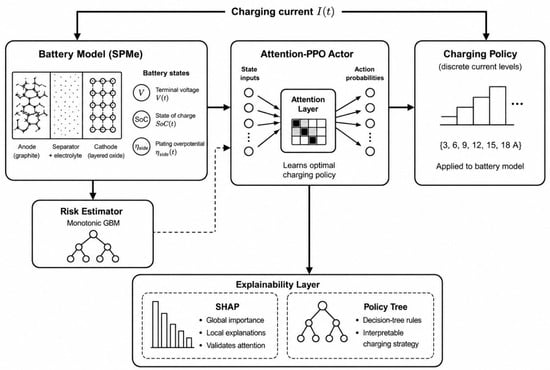
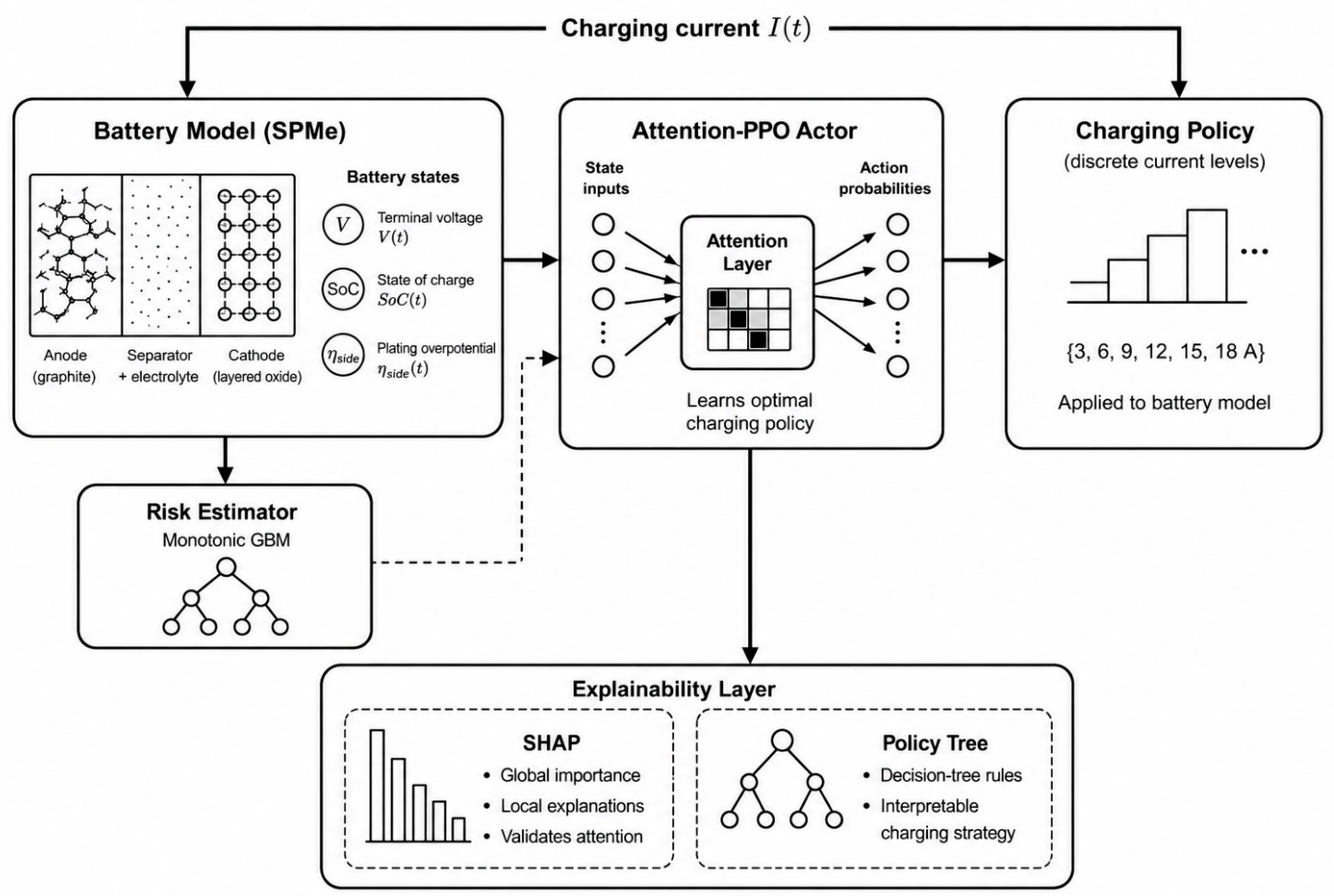
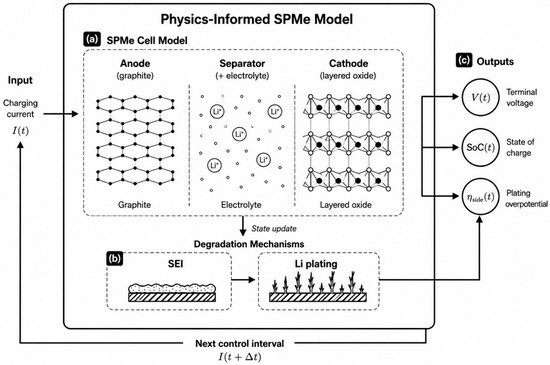
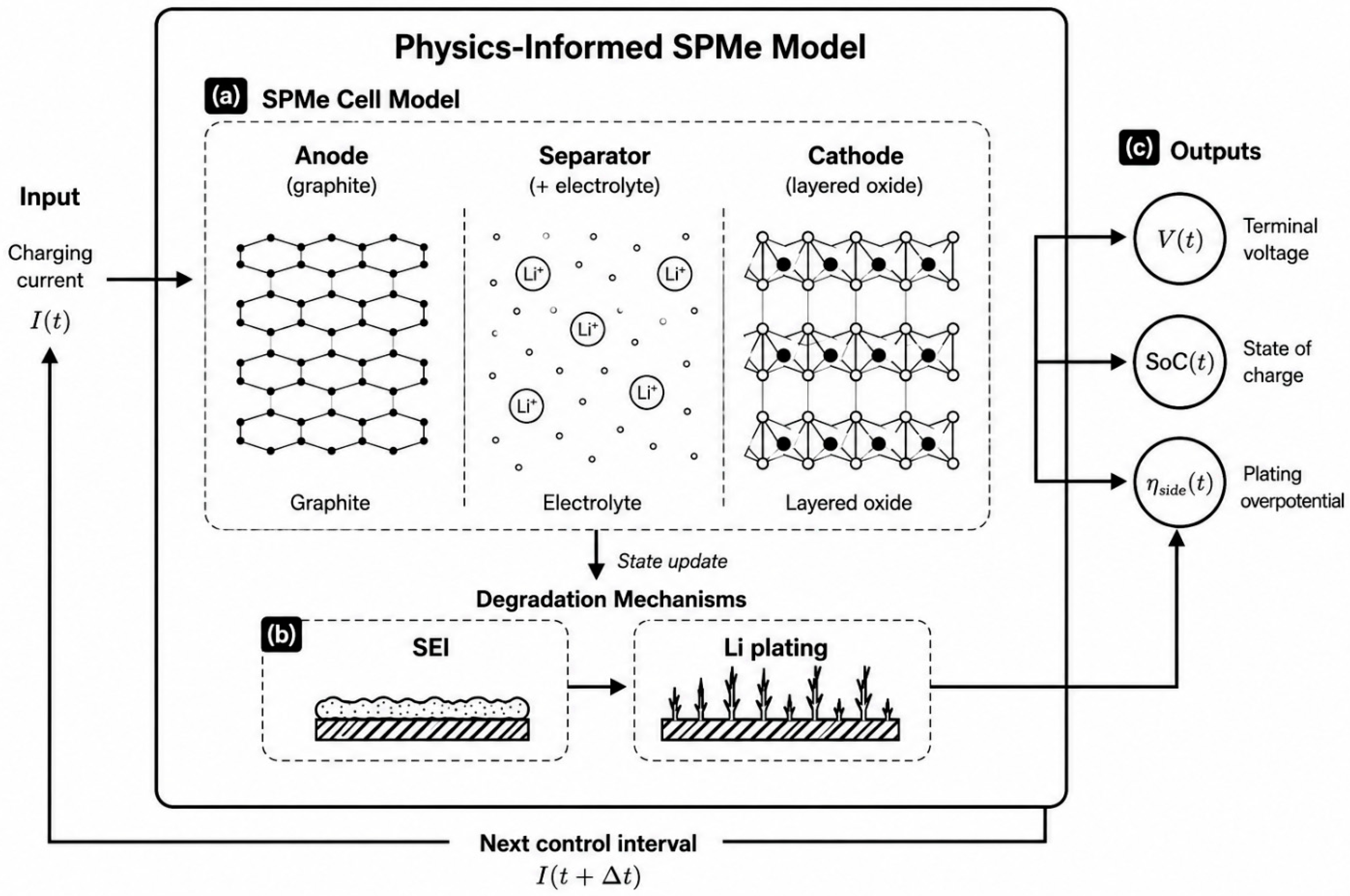
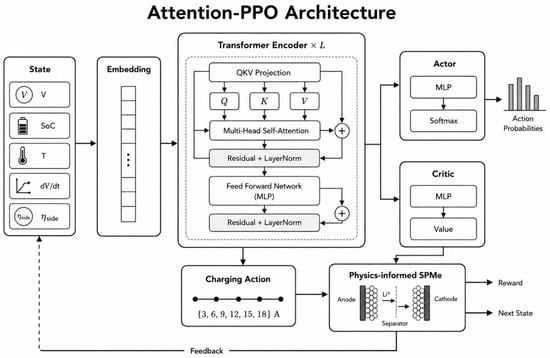
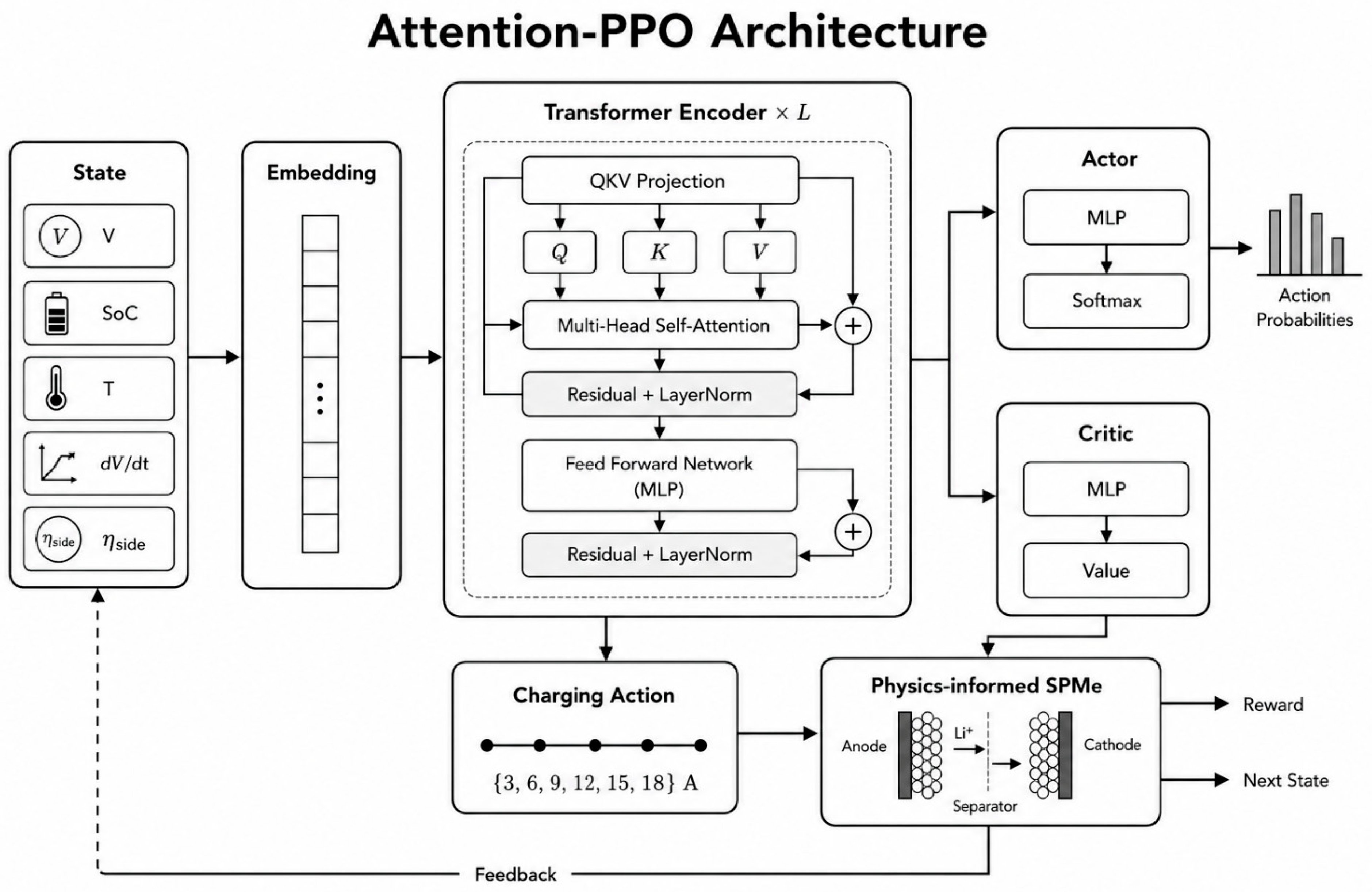
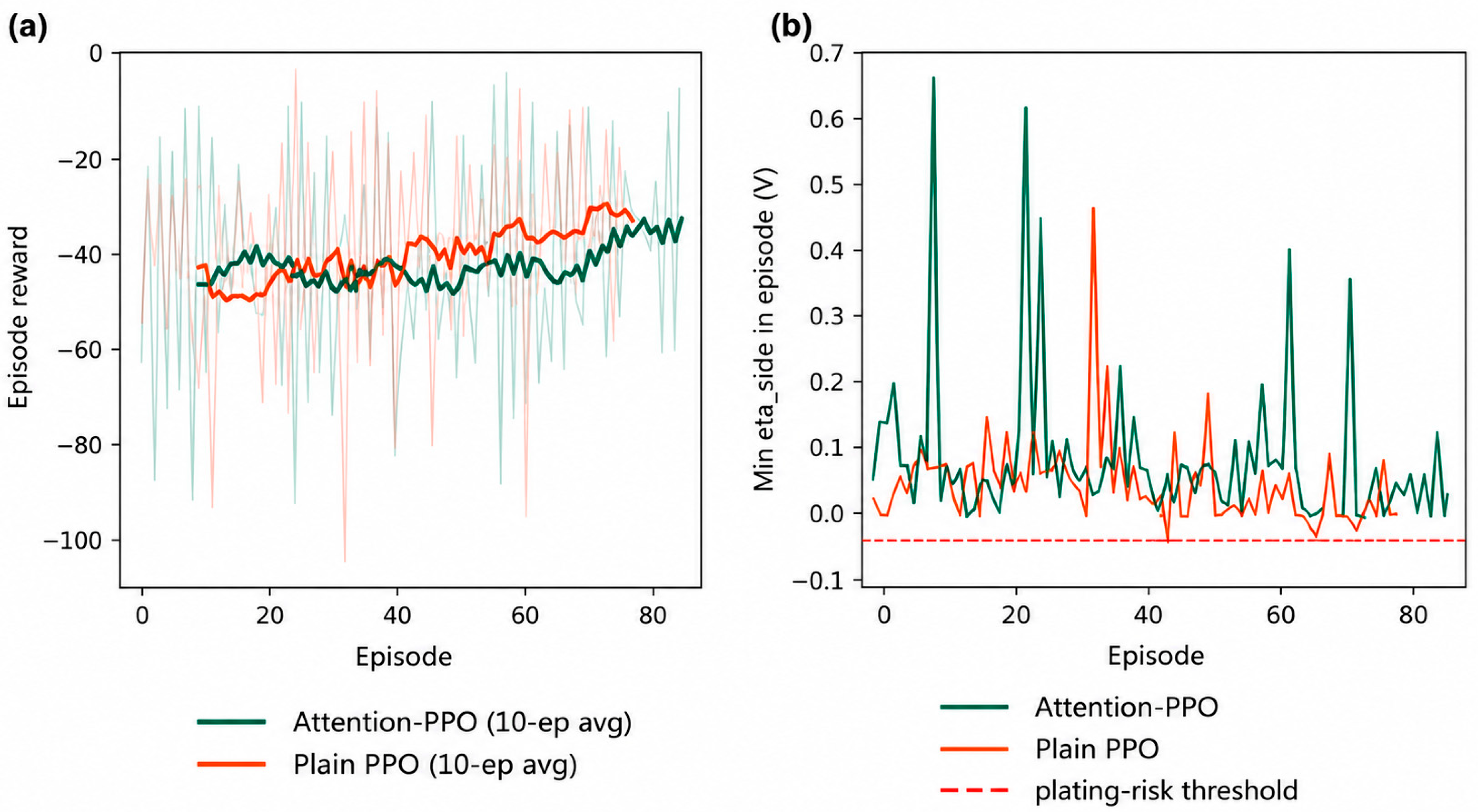
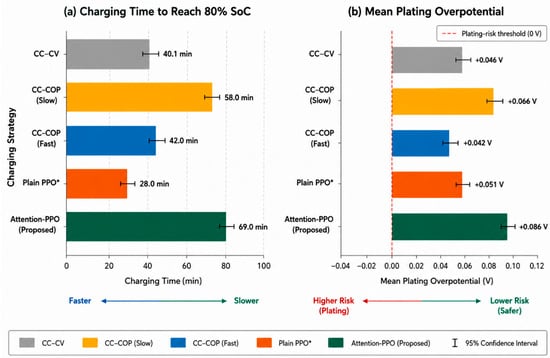
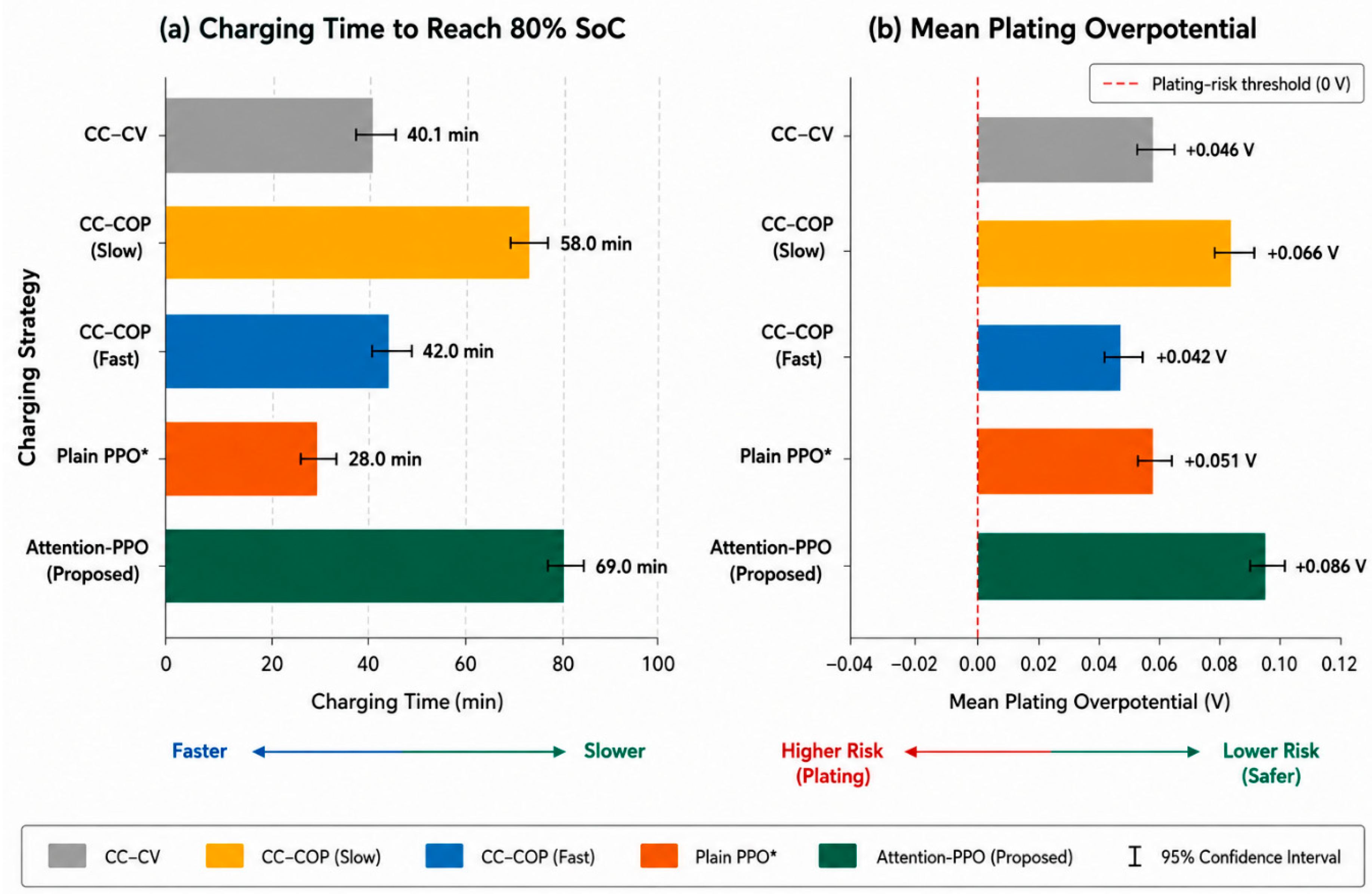
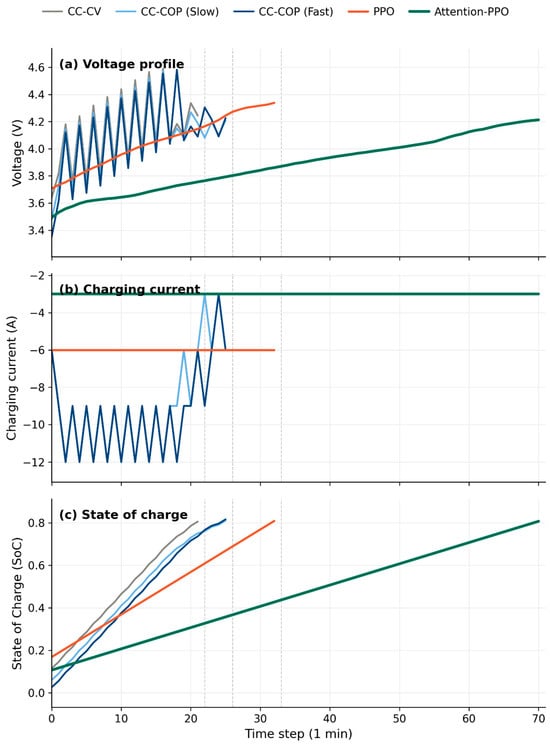
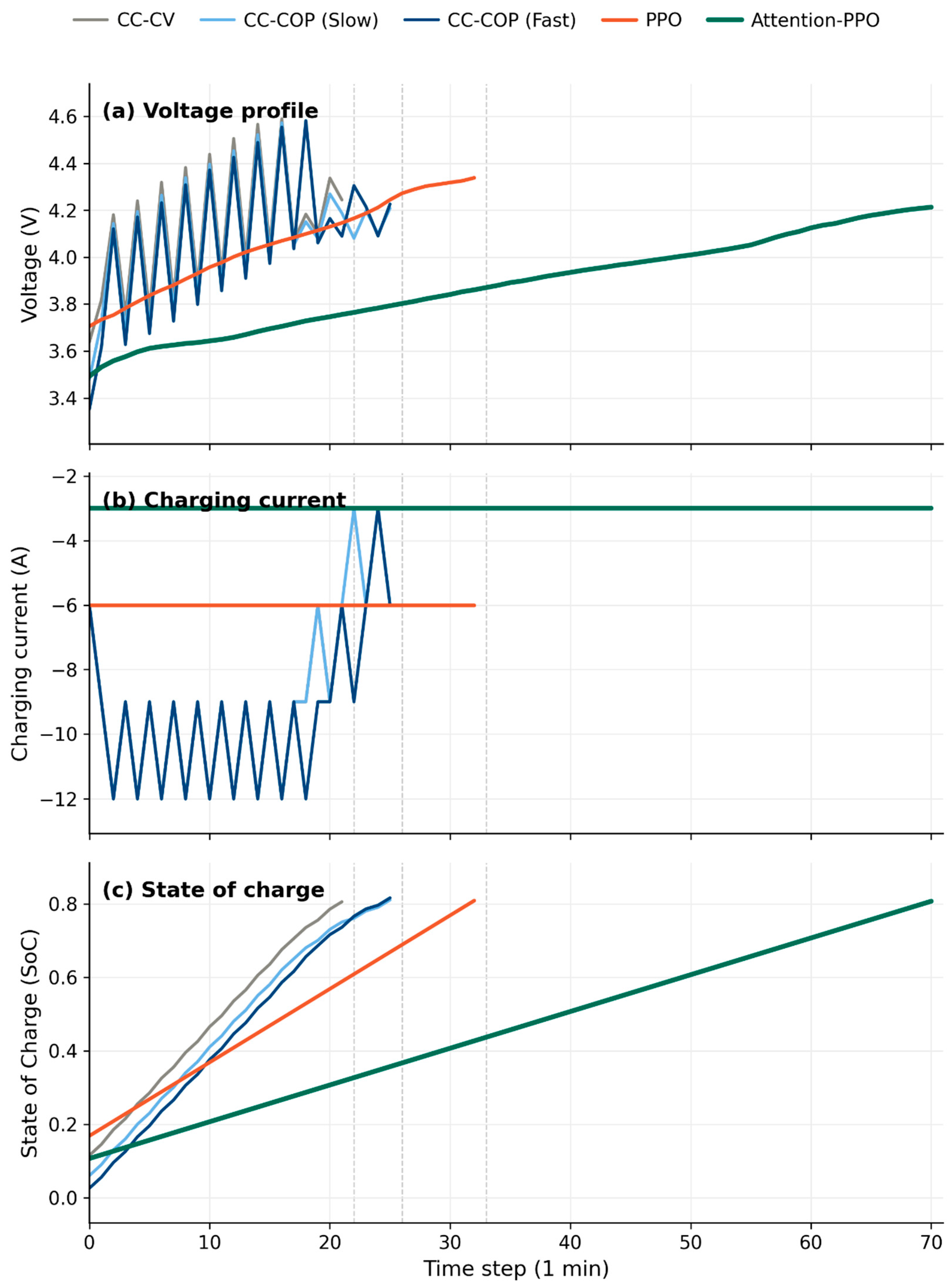
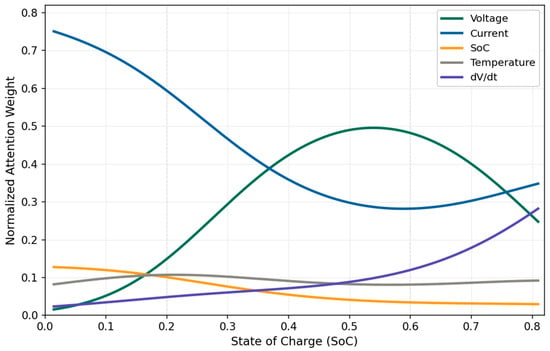
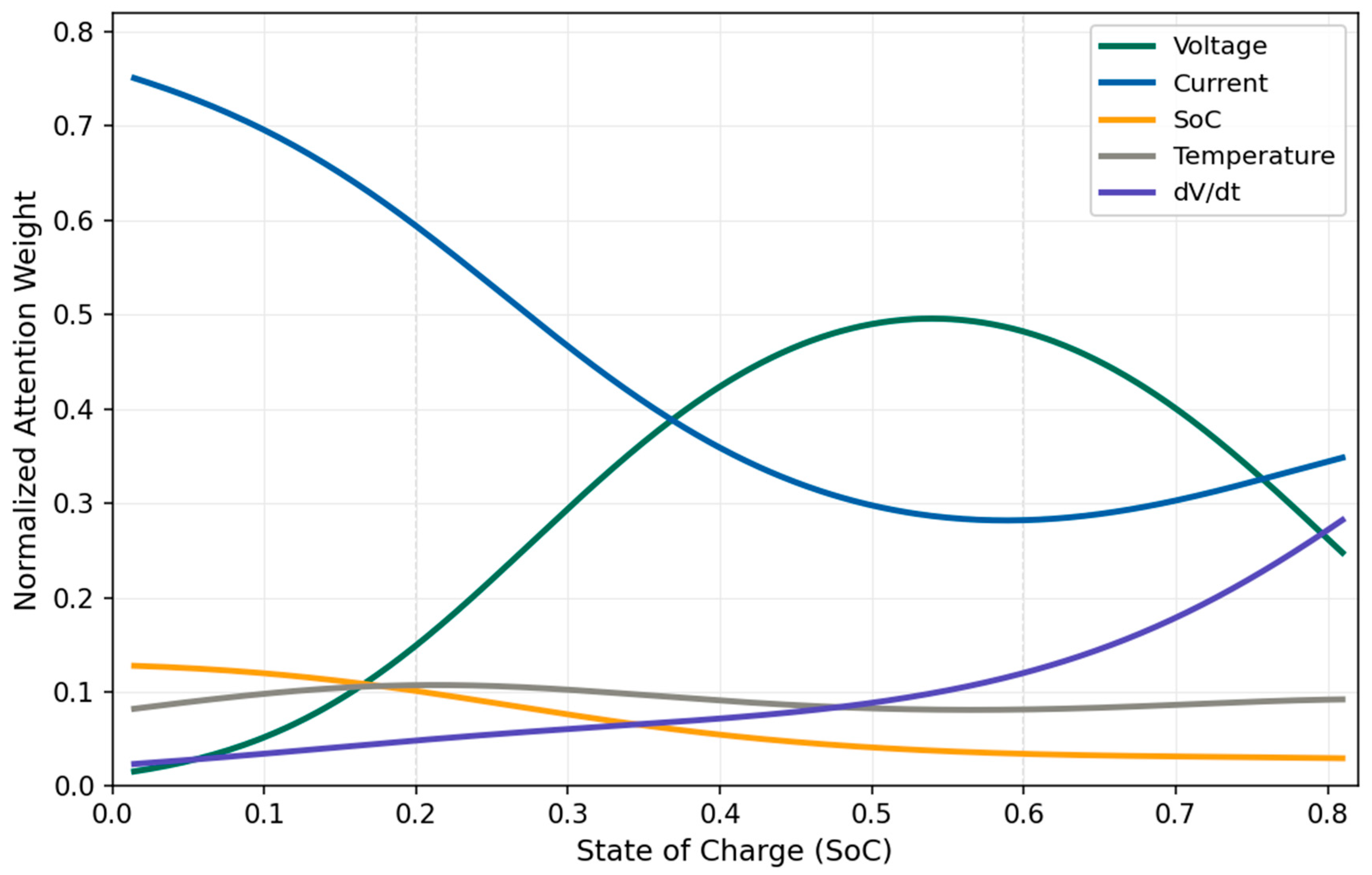
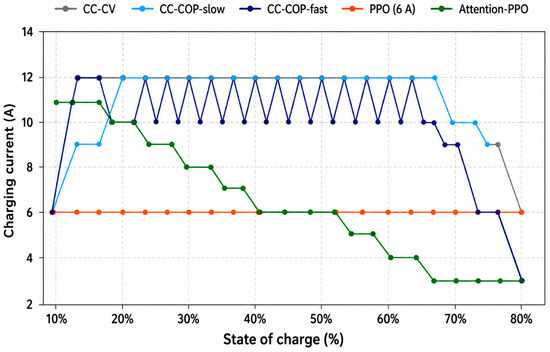
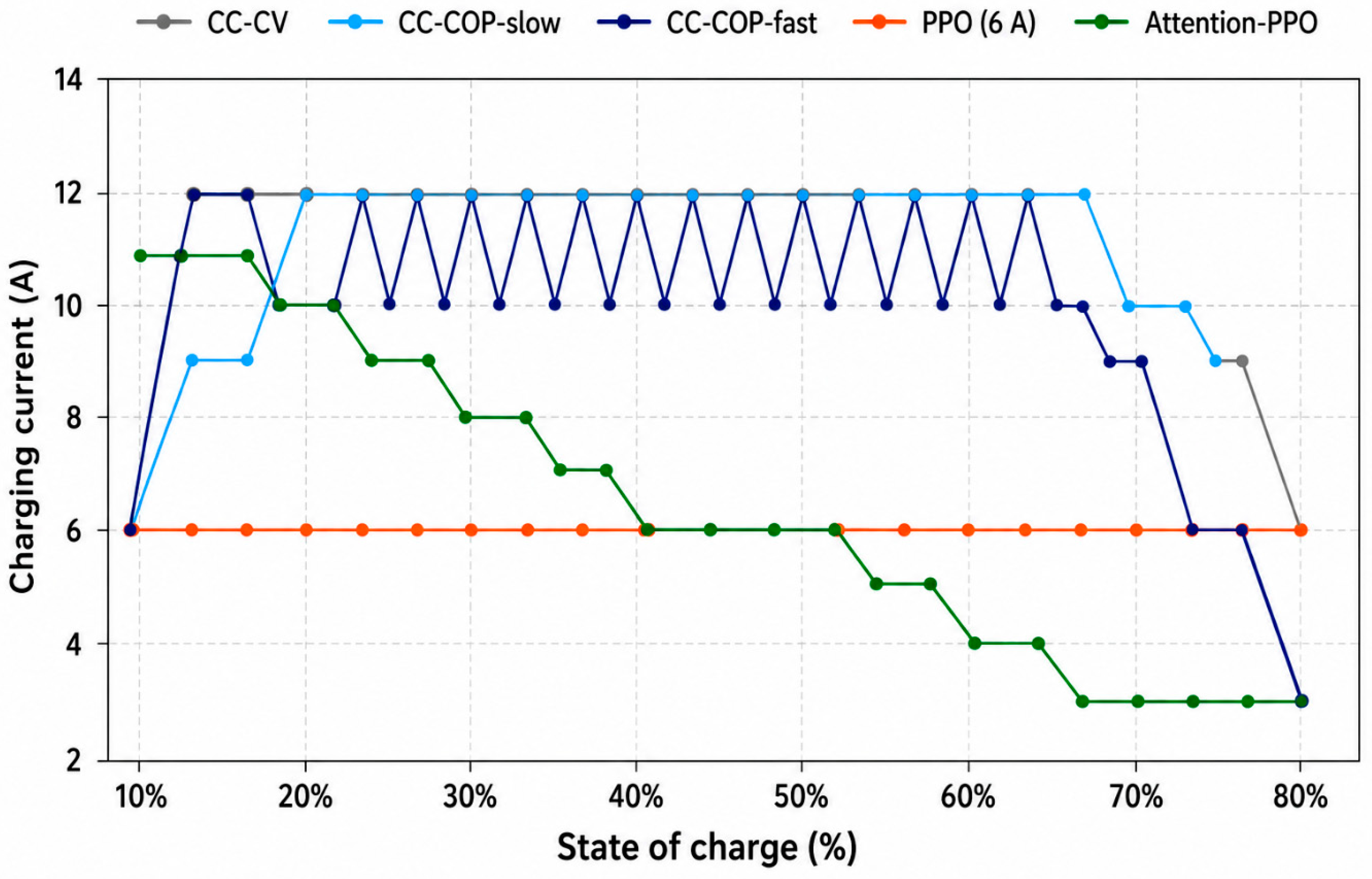
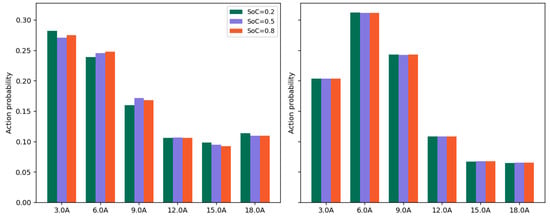
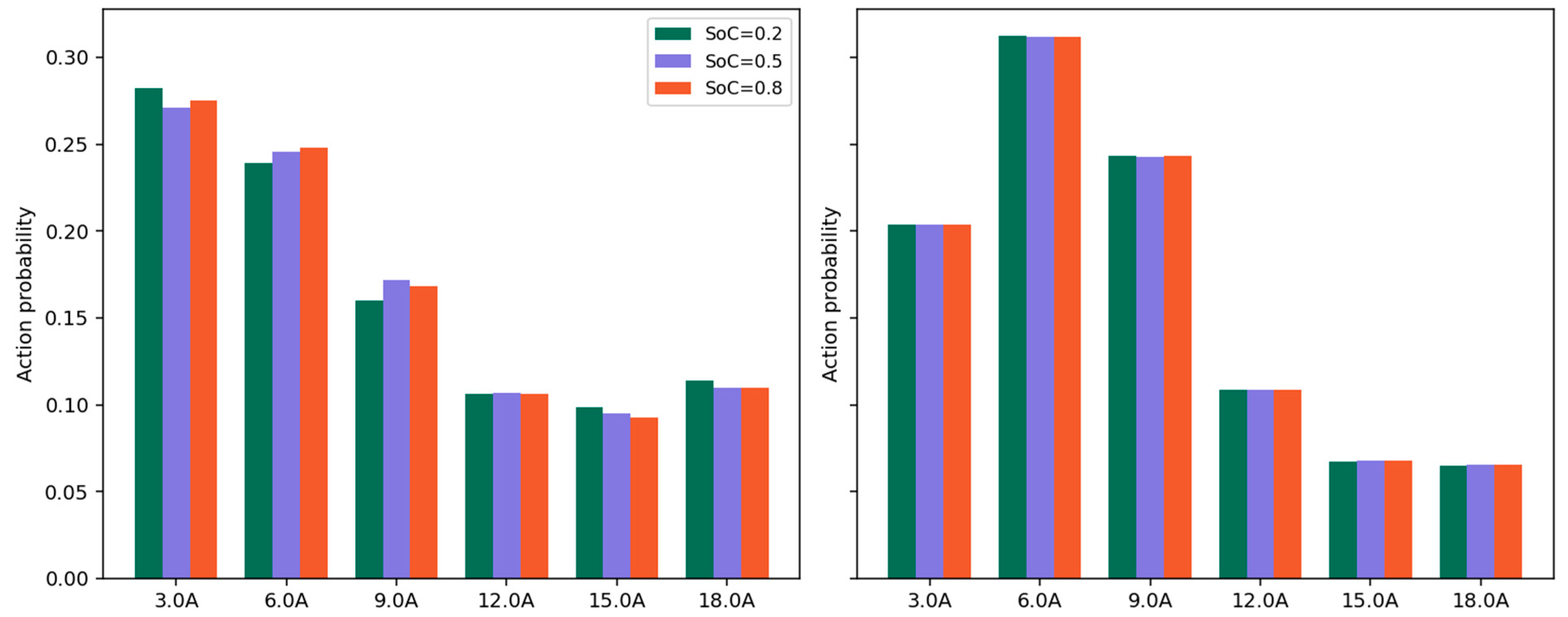
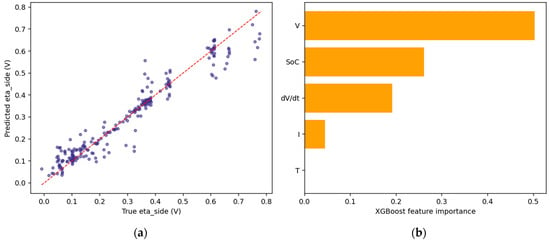
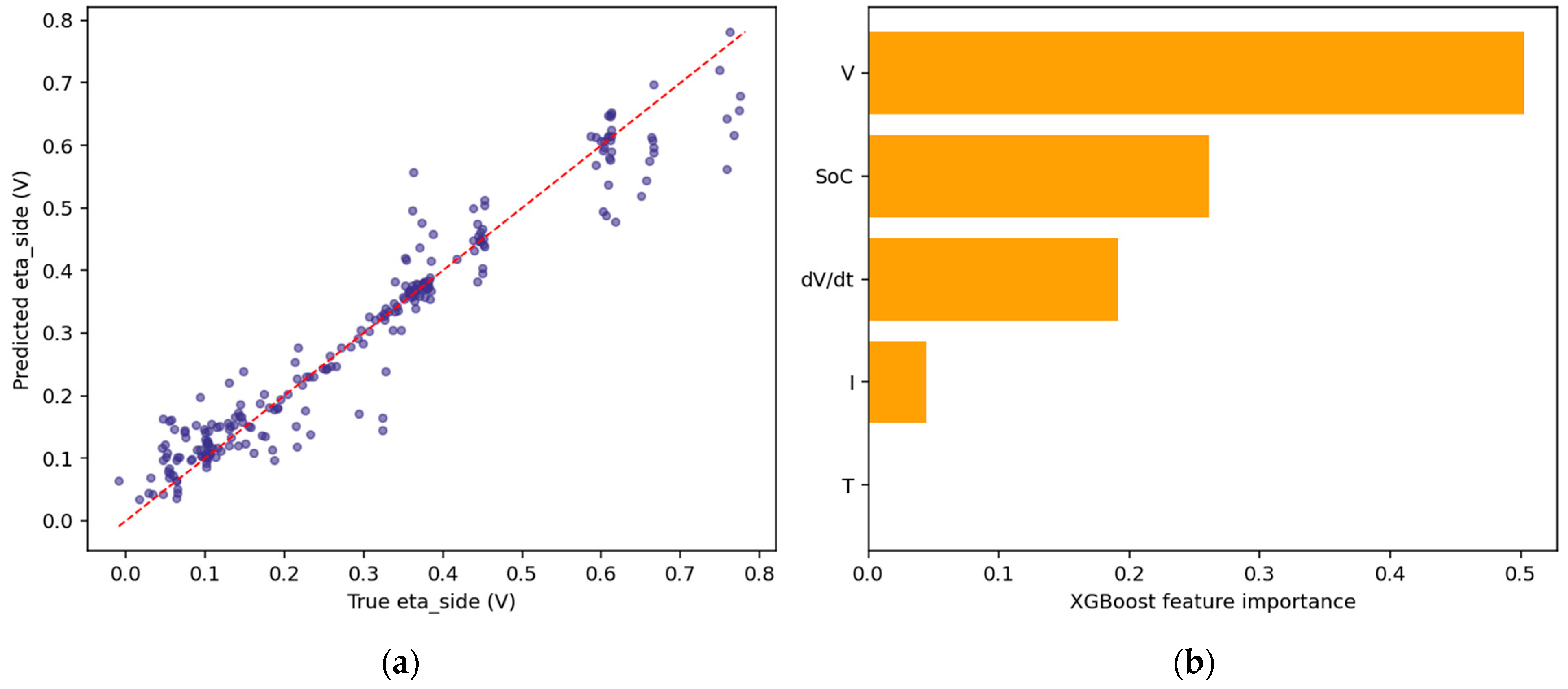
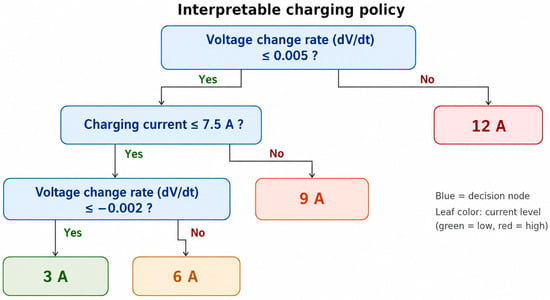
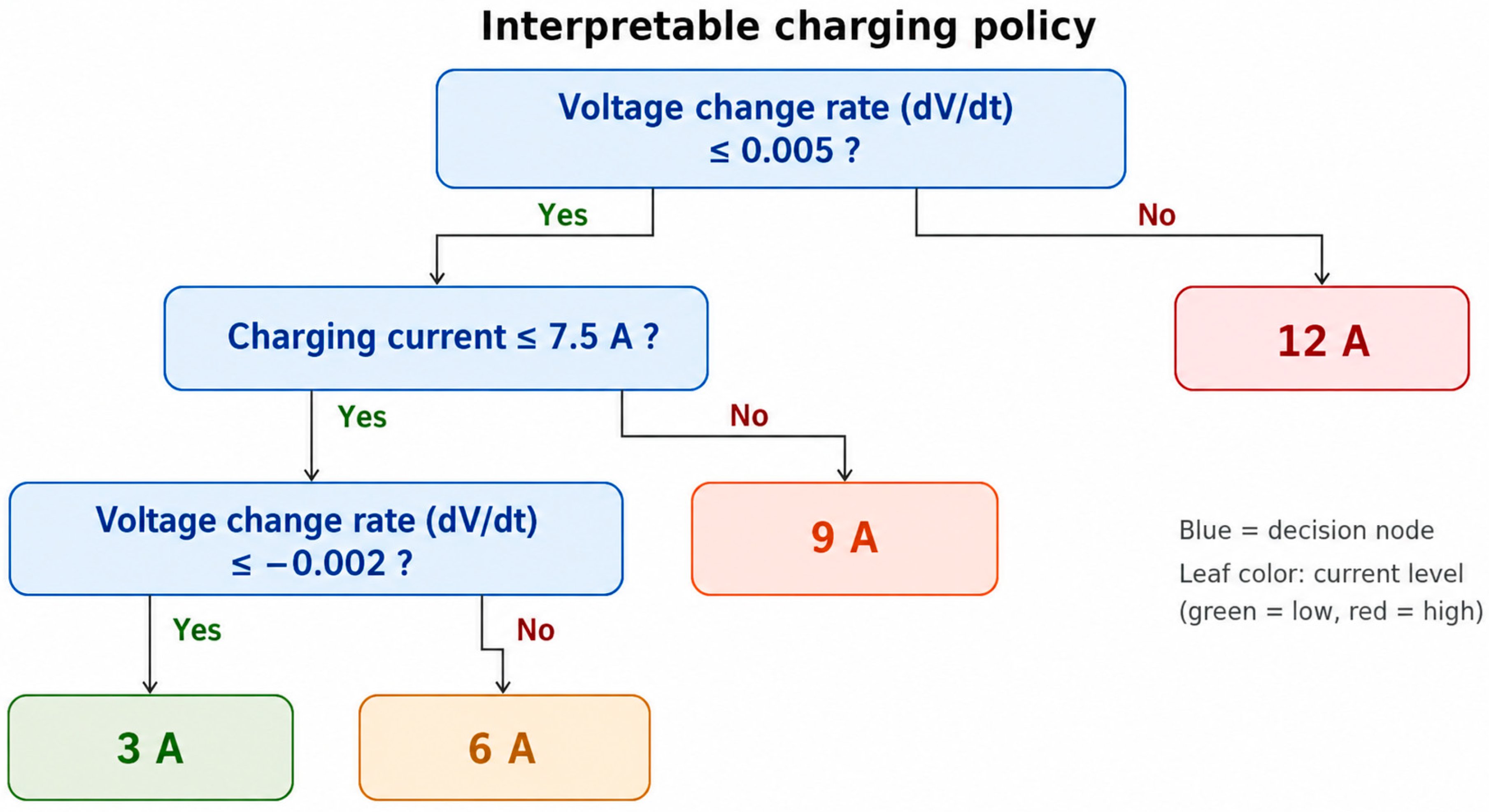

Disclaimer/Publisher’s Note: The statements, opinions and data contained in all publications are solely those of the individual author(s) and contributor(s) and not of MDPI and/or the editor(s). MDPI and/or the editor(s) disclaim responsibility for any injury to people or property resulting from any ideas, methods, instructions or products referred to in the content. |
© 2026 by the authors. Licensee MDPI, Basel, Switzerland. This article is an open access article distributed under the terms and conditions of the Creative Commons Attribution (CC BY) license.