


Abstract
In the context of an increasing demand for electricity, batteries increasingly appear as one of the main sources of power supply. In particular, research on batteries is mainly focused on new and high-performance materials, and innovative and more sustainable production processes. This work addresses both aspects by developing a gravure-printed cathode based on lithium nickel manganese cobalt oxide (NMC 111, LiNi0.33Mn0.33Co0.33O2). To this end, the formulation of a gravure-printable ink was investigated in order to meet both the printing and functional requirements. The formulation of a multicomponent dispersion able to produce a cathodic layer was particularly challenging, since such a system was found to be highly sensitive to the composition and specific interactions among the active material and the other components involved in ink preparation. Although a methodology based on Ca, aimed at obtaining layers with high macroscopic printing quality, was adopted, only a few printable inks having similar characteristics were obtained. From a microscopic point of view, printing allowed the identification of the best ink formulation able to produce the greatest layer homogeneity, thus yielding the best possible performance (150 mAh g−1 at C/20).
1. Introduction
Due to the growing demand for electrical energy to be used in a wide range of applications, from transport to lighting, covering the need to power both very large and very small devices, lithium batteries have emerged as the primary storage system thanks to their versatility, stability, and longevity [1]. During the last decade, much attention has been paid to enhancing the performance and sustainability of materials and manufacturing methods. Regarding cathodic materials for lithium-ion batteries (LiBs), lithium nickel manganese cobalt oxides (NMCs) have been widely investigated due to their balanced performance in terms of energy density, cost, and stability [2]. NMC materials are lithium cobalt oxide (LCO) derivatives and have a layered structure, like graphite, allowing the intercalation of lithium ions. In the industry, this class of materials is known as ternary cathode materials due to the presence of three metals, nickel, manganese, and cobalt, providing synergistic cooperation. In particular, nickel gives a high specific capacity, manganese improves structural stability and safety, and cobalt improves the structural stability of the layers and electrical conductivity, surpassing LCO, lithium iron phosphate (LFP), and lithium manganese oxide (LMO) [3,4].
NMC materials show a layered rock-salt structure in the R-3m space group, with lithium ions in 3a sites, transition metals (Ni, Mn, Co) in 3b sites, and oxygen in 6c sites [5]. This arrangement enables reversible Li+ intercalation/deintercalation. In NMC compounds (LiNixMnyCozO2, where x + y + z = 1), the relative quantities of the three metals are indicated by the x, y, z coefficients. The stoichiometric NMC 111 contains equal quantities of the three metals, namely 33% each. Theoretically, the capacity of NMC 111 is about 278 mAh g−1, surpassing lithium iron phosphate (LFP) and lithium cobalt oxide (LCO) in terms of power output for EVs and consumer devices, although the capacity is limited by degradation phenomena occurring at higher voltages (>4 V) [6]. Therefore, in practice, the possible reversible capacity delivered is 145–160 mAh g−1 when working at operating voltages of 3.6–3.7 V [6].
Regarding manufacturing, research is focused on more sustainable and green techniques able to guarantee the production of high-performing layers [7]. For this purpose, printing technologies are increasingly being investigated in the field of battery manufacturing, thanks to their ability to produce homogeneous layers that provide high reproducibility and stability; moreover, printing offers the possibility of using eco-friendly solvents and/or recovering them [8]. In contrast to conventional coating techniques, traditional printing methodologies enable high-resolution and highly reproducible two-dimensional (2D) patterning. Standard coating production methods inherently restrict architectural flexibility and device customizability, thereby impeding seamless integration with complex geometries. Furthermore, a critical limitation of traditional coating techniques lies in the spatial inhomogeneity of the deposited layers. In electrochemical energy storage systems, such as batteries, this structural non-uniformity severely compromises device performance; it triggers localized charge accumulation and accelerates dendrite nucleation, leading to short-circuits and inducing active material degradation, which ultimately results in a shortened cycle life. Consequently, 2D printing technologies offer a compelling alternative for the fabrication of layered devices, as they facilitate precise thickness control across diverse substrates [9]. Among the printing technologies, gravure is the only one able to work at high speeds (600 m min−1), while providing very high quality in terms of resolution (0.01 mm). Furthermore, gravure is a well-established industrial technology; thus, each lab-scale result can be easily scaled up to an industrial level. The architectural properties of gravure-printed cathodes make them ideal for low-power, structural, and custom-shaped energy storage systems. In the field of Internet of Things (IoT) nodes, this method can power micro-sensors and wireless communication devices requiring an ultra-compact energy footprint. It also enables wearable electronics and smart textiles by providing flexible energy profiles that seamlessly contour clothing or curved smart surfaces without cracking under mechanical stress. Furthermore, smart packaging and logistics can benefit from this technology through thin-film power embedded directly into electronic tracking labels and real-time temperature indicators. Biomedical devices like continuous glucose monitors and electronic skin patches also leverage these low-profile, flexible power sources for non-invasive patient care [10,11]. Given all its possible advantages, such printing technology has recently been investigated in the field of battery manufacturing, achieving very interesting results, confirming the feasibility of employing gravure printing in the industrial manufacturing of batteries [9]. To date, ink formulation remains one of the main challenges impeding the widespread adoption of gravure in functional layer production due to the necessity of maintaining a low viscosity (<100 mPa s) [12]. Such limitation implies difficulties in co-printing different substances while obtaining the proper functionality. Problems related to achieving an adequate mass loading (typically 1.5 mg cm−2) must also be considered. In a previous work, the possibility of obtaining layer functionality was found to be strongly related to the printed layer quality, thus, depending on both the ink and the printing parameters [13]. The authors demonstrated the feasibility of achieving high printing quality, and, consequently, layer functionality, using a methodology based on the Capillary number (Ca). Moreover, taking into consideration the specific issues of the materials, e.g., humidity in the case of sensitive active materials, it was found to be crucial for layer performance [14]. In this context, the present research represents a milestone in facing an important aspect of the multicomponent ink formulation related to the interplay of components, which directly affects ink homogeneity and stability and is not considered in the Ca model. Interactions between the ink components can lead to ink viscosity changes, causing possible structuring or resulting in phase separation and/or sedimentation. The above-mentioned changes strongly affect the process and consequently the layer quality. While the right amount of ink components must be respected to achieve the proper functionality, the interplay of the involved materials can determine very narrow operating windows within the gravure ink requirements.
The state of the art in printed nickel manganese cobalt (NMC) cathodes focuses mainly on environmental sustainability, driven by the replacement of conventional N-methyl-2-pyrrolidone (NMP) with green solvent alternatives or aqueous-based formulations. Current research efforts prioritize optimizing scalable deposition techniques, including screen printing for high-throughput production and inkjet printing tailored for thin-film microbattery architectures [15,16,17,18,19]. To date, no example of gravure-printed NMC-based layers has been reported in the literature.
In this work, inks based on NMC 111 were considered as a case study for investigating the effect of the components’ interplay on ink characteristics, and thus on the printability and the layer’s cathodic functionality. In particular, to obtain a printed NMC 111 cathode, the ink investigation has been conducted by changing the types, amounts, and ratio of the ink components, studying the characteristics of the prepared inks, verifying their printability, and finally evaluating the printed layer functionality in a half-cell vs. Li metal.
2. Materials and Methods
The inks have been prepared using the following materials: NMC 111 supplied by MTI Corporation (Richmond, CA, USA) as the active material, sodium carboxymethyl cellulose (CMC) by Panreac Quimica and poly(vinylidene fluoride-co-hexafluoropropylene) (PVDF-HFP) by Sigma Aldrich as binders, Super P by Thermo Fisher Scientific (Waltham, MA, USA) and Carbon Black Ketjenblack (KJB) by Akzo Nobel (Arnhem, The Netherlands) as conductive carbons and demineralized water, 2-propanol (IPA), cyclohexanone, dimethyl sulfoxide (DMSO) and acetone by Sigma Aldrich, St. Louis, MI, USA) as solvents. The surface tensions of the used solvents and solvent mixtures are reported below: water/isopropanol 90/10 wt/wt% (41 mN m−1); water/isopropanol 85/15 wt/wt% (35 mN m−1); Acetone/DMSO 70/30 wt/wt% (26 mN m−1); Cyclohexanone (34 mN m−1). The surface tension of the solvents can be considered the same as that of the inks since the solvent is the prevalent component of the formulation. In all cases, the solvent surface tensions were lower than the surface energy of the cylinder (42 mN m−1) and of the pre-treated aluminum foil (55 mN m−1) to allow printability. Ball milling was used in some ink preparations to improve mixing and material distribution. The rheological behavior of the inks has been analyzed using a rotational rheometer (by Haake, Waltham, MA, USA) at 20 °C in a shear rate range of 1–2000 s−1. A single-point viscosity at a shear rate of 100 s−1 has been considered as a reference to verify the viscosity requirements of gravure printing (1–100 mPa s). In most cases, the non-Newtonian behavior has been referred to both shear rate and time-dependent viscosity. In the case of unreported values, the dependence of viscosity on time has been so fast as to make the recording of the measurement impossible. The inks have been gravure-printed on aluminum foils (thickness of 15 μm, by Sigma-Aldrich) using an IGT G1-5 printer equipped with a cylinder having a line density of 40 lines/cm, a stylus angle of 120°, a cell depth of 72 µm, and a screen angle of 53°. The Al substrates have been pre-treated using a Corona system (by Tantec, Lunderskov, Denmark). A multilayer approach has been adopted to obtain a mass loading suitable for printed batteries by overlapping several layers of the same ink under the same conditions. After each printed layer, fast drying using hot air has been performed, while the final multilayer has been dried at 100 °C for one hour. The adhesion of the printed layers on the aluminum substrate has been successfully tested by tape tests. The printed cathodes have been studied through scanning electron microscopy (SEM, 1530, LEO Elektronenmikroskopie GmbH, Oberkochen, Germany) to assess printing quality and layer homogeneity; in particular, a quantitative image analysis has been performed using Fiji ImageJ software on the SEM micrographs. Selected printed layers have been finally tested in half-cell versus lithium metal through charge and discharge cycles at variable and constant rates using Maccor equipment, employing 1 M LiPF6 in a 3:7 (wt:wt) mixture of ethylene carbonate (EC) and diethyl carbonate (DEC) as the electrolyte. In particular, the variable rates have been C/20, C/10, C/5, C/2, and 1C; after the cycles at variable rates, some cycles at a constant rate of C/10 have also been performed. The reported electrochemical data are representative of at least three samples belonging to the same printed layer. In particular, each layer has been produced in a 4 cm × 4 cm area, and disks of 14 mm diameter have been cut from each layer and individually tested.
3. Results and Discussion
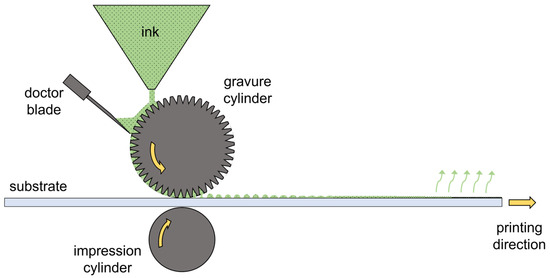
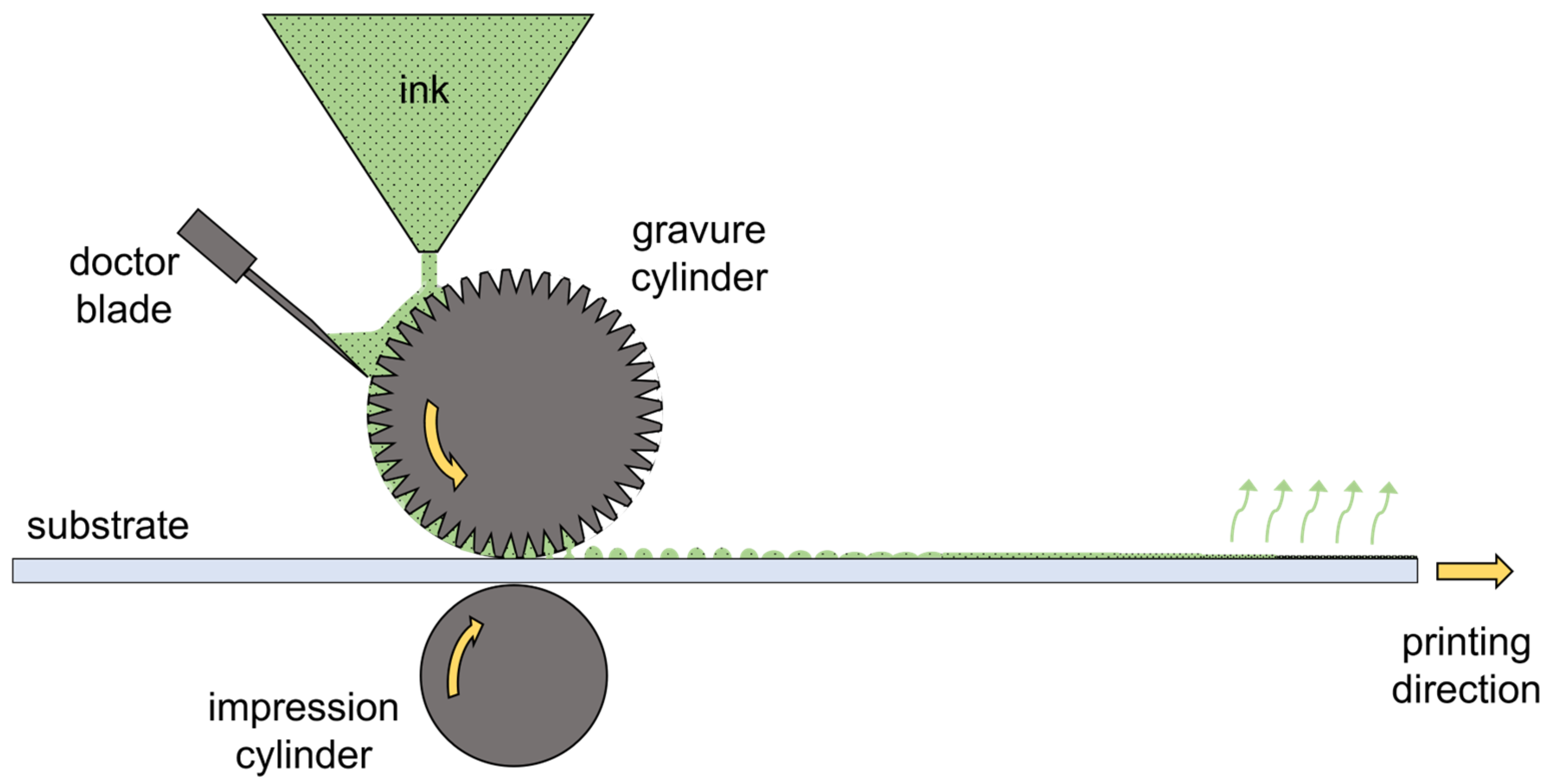
Gravure printing is a roll-to-roll process based on direct ink transfer from the cells of a micro-engraved cylinder onto a flexible substrate by the pressure of a counter-cylinder (see Figure 1) [20]. The deposited ink droplets onto the substrate coalesce, forming a continuous wet film which is finally dried by evaporating the solvent.
Figure 1.
Roll-based gravure printing process. Adapted with permission from Ref. [9].
The overall process is physically complex, involving several subprocesses, each dependent on specific parameters and having a specific ideal regime, all concurring to the quality of the final layer. The use of dimensionless analysis can help simplify the study of such a complex multi-physical system [20]. In fact, the dimensionless Capillary number (Ca) represents the ink flow at a certain printing speed (U) resulting from the balance of surface tension forces, driving ink flow, and the viscous forces, impeding the ink flow. When the ink exhibits Newtonian behavior, Ca ≈ 1 can be used as a practical rule to guide ink formulation and the choice of printing speed, representing a good driver to obtain a high-quality printed layer [9]. Ink composition determines its physicochemical properties, such as viscosity, surface tension, density, and drying rate. In particular, viscosity is the measure of ink internal flow resistance. Moreover, Newtonian inks exhibit constant viscosity over a wide range of shear rates and stresses at a specific temperature. Gravure-printable inks have to flow in and out of engraved cells at high speeds; thus, they must be highly diluted to have a low viscosity, typically <100 mPa s [9]. Ink solvents determine the ink surface tension, affecting ink wettability [9], which is fundamental in a surface-energy-dependent process like gravure. Thus, the main requirements for an ink to be gravure-printable are a viscosity lower than 100 mPa s and a surface tension lower than the surface energy of both the cylinder and the substrate. In addition, a functional ink for electrode production has to contain specific components responding to specific tasks, which are different from a physicochemical point of view and influence the stability of the ink both during preparation and the deposition process. For this reason, such functional inks are usually non-stabilized dispersions, consisting of heterogeneous particles of very different sizes. Consequently, aggregation and sedimentation can occur, especially due to the active material particle size [21,22]. Such phenomena can lead to a highly inhomogeneous final electrode, even during the drying time, strongly compromising its functional properties.
In this work, the formulation of a multicomponent ink based on NMC 111 active material has been found particularly challenging due to the components’ interplay, which has made it difficult to obtain a stable mixture having gravure-printable characteristics. To form a cathodic layer, the ink has to contain at least a binder and an electrically conductive component in addition to the active material; moreover, all the components must be highly dispersed in a solvent or a solvent mixture to obtain a printable fluid. In addition, the final formulation must meet the suitable requirements discussed above and must be stable at least during the processing time necessary for layer printing.
In our previous works, we have demonstrated that good printability can be achieved when the Ca (=viscosity × printing speed/ink surface tension) approaches unity, meaning the layer functionality is obtainable [13,23,24]. In this work, the Ca has been calculated for the inks having a viscosity suitable for gravure printing, considering the surface tension of the ink equal to that of the solvent or solvent mixture at 20 °C, as reported in the experimental section, since the solvent is the prevalent component of the formulation [9]. As an example, the Ca calculation is reported in Table 1 for the ink formulation that has given the best results in terms of printed layer quality, as reported below.
Table 1.
Ca calculation for the ink containing 15 wt% of dry content having composition 88 wt% active material, 3 wt% KJB, 3 wt% super P, 6 wt% CMC, using as solvent a mixture of water and 2-propanol (85/15 wt/wt%).
Taking into account all the discussed constraints, including the Ca methodology, different ink formulations have been investigated as reported in Table 2.
Table 2.
Investigated ink formulations. Italic text indicates the changes occurring in the subsequent ink formulations. The solvent ratio is in wt/wt%; ball milling time is in min. Changes in formulation are highlighted in italics.
First, a water-based ink has been tried with a solid content of 15 wt% and involving Super P carbon as the electric conductor and CMC as the binder. Such an ink formulation has been used as a starting point based on our previous works [9]. In fact, the prepared ink had a suitable viscosity (90 mPa s) and was printed on Al foil; however, in this case, a poor macroscopic coverage was obtained, probably due to ink inhomogeneity. For this reason, a five-minute ball milling has been performed to improve mixing, but the ink viscosity has increased up to 270 mPa s (out of the printability range), showing a gel-like, non-Newtonian behavior. Thus, the CMC polymer amount has been increased from 6 wt% to 10 wt%, and the active material percentage has been decreased from 88 wt% to 80 wt%, as a potential adjustment in the composition to improve ink mixing without using ball milling, while keeping the solvent fixed. Once more, the ink has shown a high viscosity (309 mPa s) and non-Newtonian behavior, probably due to the component ratio further promoting an ink structuring effect. Therefore, the CMC binder has been replaced by PVDF-HFP using cyclohexanone as a solvent, but again the ink has shown non-Newtonian behavior, suddenly increasing in viscosity due to the structuration of the system, which has made the viscosity measurement out of the rheometer range. Ink structuring has also been observed when acetone has been used as a solvent, even when the ink solid content was very low (5 wt%). In the cases in which the viscosity value is not reported in Table 2, the structuring phenomenon has been immediately observed. Therefore, we have focused our attention on the conductive carbon substituting Super P by graphite and have tried cyclohexanone as a solvent; the graphite has not dissolved, and sedimentation phenomena have suddenly occurred. However, the same behavior has been observed using both acetone and a mixture of graphite (3 wt%) and Super P carbon (3 wt%), keeping the total carbon percentage equal to 6 wt%. KJB carbon has been tried as an alternative electric conductor, but it alone has not been able to generate intimate mixing with the other components: the ink is not uniform, showing large and visible aggregates of powder in the solvent, even using ball-milling. The different rheological and colloidal behavior of Super P and KJB in the inks can be explained by the interplay between their specific surface area, porosity, and binder adsorption affinity. Super P promotes agglomeration and viscosity growth due to its low surface area and non-porous morphology, which limit polymer adsorption and leave a high concentration of free macromolecules. This induces depletion flocculation, where attractive Van der Waals forces overcome steric repulsion, driving the particles into a rigid, three-dimensional network that traps the solvent via structural jamming. Conversely, KJB causes phase segregation due to its high porosity and ultra-high specific surface area. Its hollow-shell structure acts as a colloidal sponge, preferentially absorbing the solvent and binder molecules into its internal pores. This localized entrapment depletes the bulk, creating a thermodynamic imbalance in local density and chemical affinity that triggers macroscopic phase separation rather than network gelation.
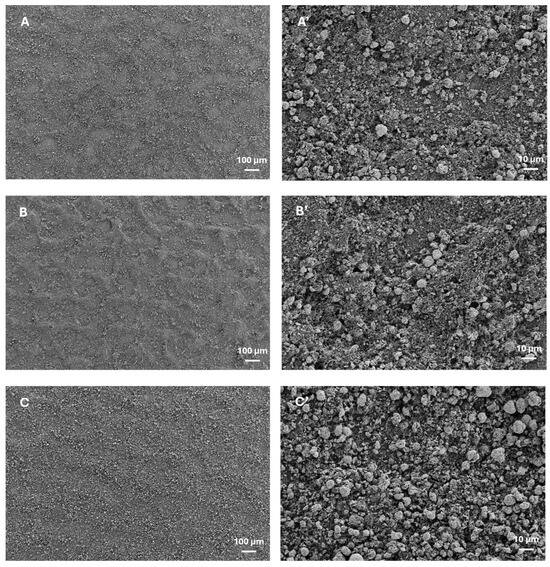
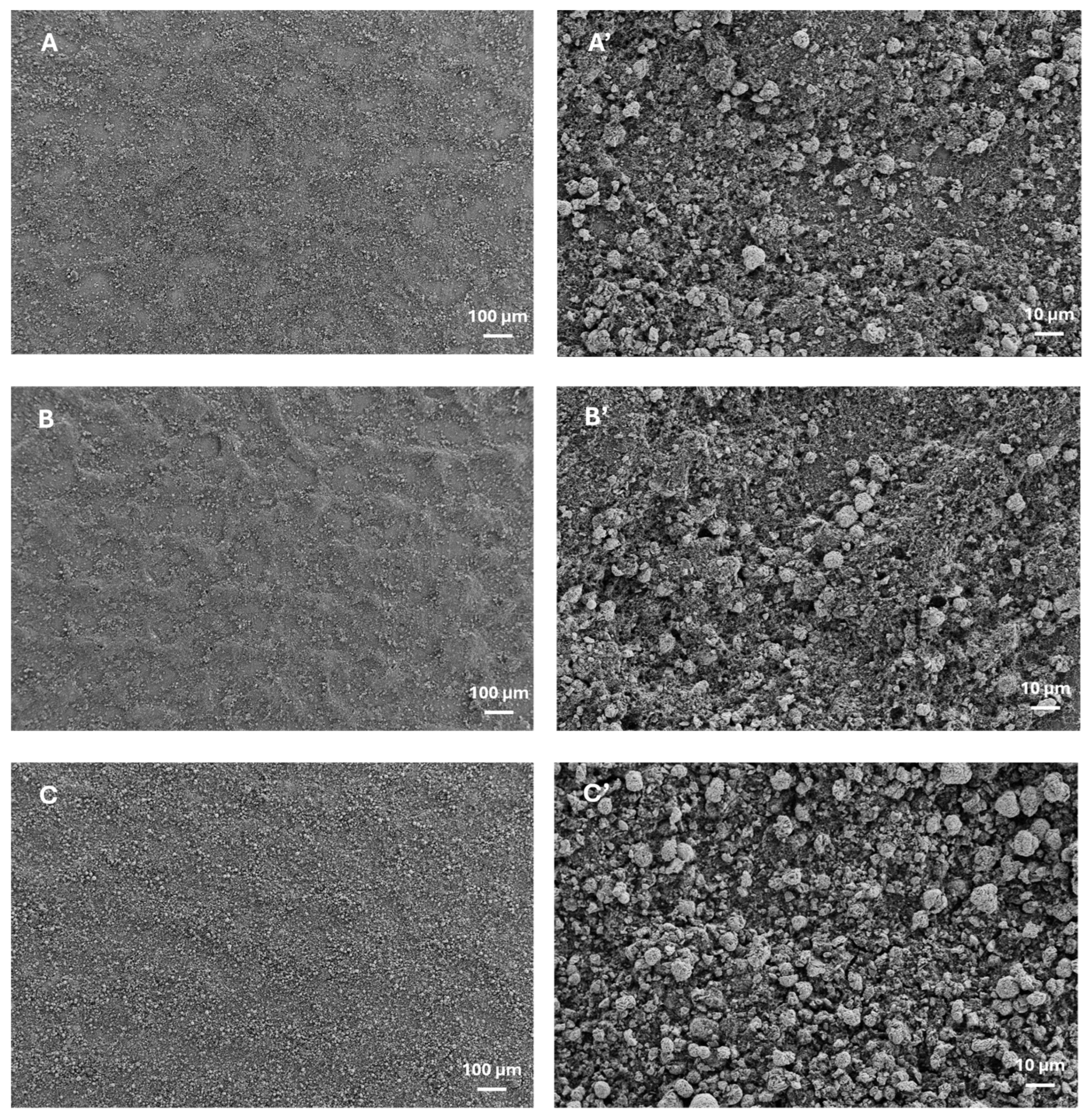
Taking into account the previously observed thickening capacity of Super P, a mixture of this carbon (3 wt%) and KJB (3 wt%) has then been tried, finally obtaining a printable ink (having a viscosity of 95.5 mPa s). In this case, a 30-minute ball milling process has also been used to improve ink homogeneity without affecting the Newtonian behavior. Such an ink has been printed by overlapping 15 layers to achieve the desired mass loading. However, microscopy has shown a non-uniform component distribution in the printed layer; thus, a lower ink dry content has been tested, aiming to improve the ink and layer homogeneity through dilution (See Figure 2A,B). However, inhomogeneity has been observed in the final printed layer, which shows polymer-rich areas and poor coverage (see Figure 2A). Finally, the same composition has been tried with the greener CMC polymer using water as the main solvent; the ink, having 22 wt%, has shown a viscosity out of the printability range (180 mPa s); thus, the solid content has been decreased to 18 wt%, obtaining an ink suitable for gravure printing (having a viscosity of 93 mPa s). In the end, all the investigated inks have provided useful information on the materials interplay and interaction windows, concurring to yield the best ink formulation, also in terms of sustainability.
Figure 2.
Top surface of gravure printed cathodic layers by different inks: 15 wt% of dry content using PVDF-HFP binder and cyclohexanone as solvent (A,A’); 22 wt% of dry content using PVDF-HFP binder and cyclohexanone as solvent (B,B’); 18 wt% of dry content using CMC as binder and water/2-propanol (85/15 wt/wt%) as solvent (C,C’).
As seen, due to the high sensitivity of this system, among all the prepared inks based on NMC 111, only a few were suitable for gravure printing. In addition, most of the gravure-printable inks have given poor-quality printed layers. The best printed layers have been obtained with the following inks:
- The ink having a 22 wt% dry content and a composition of 88 wt% active material, 3 wt% KJB, 3 wt% Super P, and 6 wt% PVDF-HFP using cyclohexanone as the solvent, showing a viscosity of 95.5 mPa s (Ca = 1.1).
- The ink having an 18 wt% dry content and a composition of 88 wt% active material, 3 wt% KJB, 3 wt% Super P, and 6 wt% CMC, using a mixture of water and 2-propanol (85/15 wt/wt%) as the solvent, showing a viscosity of 93 mPa s (Ca = 1.0).
Even though these inks had similar characteristics and provided a Ca approaching unity when printed at the same speed (24 m min−1), the obtained printed layers have proven different from a microscopic point of view, as is evident from the scanning electron microscopy (SEM) images (Figure 2B,C). In fact, the layer obtained from ink 1, based on PVDF-HFP, has appeared less homogeneous, showing polymer-rich areas and a poor distribution of the layer components when compared with the layer obtained from ink 2, which has exhibited high homogeneity having a good distribution of the components, also at high magnification, across the entire sample surface (Figure 2). The differences can be ascribed to the interaction of the components within the ink, which has been reflected in the ink deposition and in the film-forming process, such as during the coalescence of ink droplets and the final layer drying.
Therefore, when the components were well-dispersed, a stable ink was obtained, maintaining the material distribution also during the printing and post-printing steps. The materials composing the ink have remained homogeneously distributed in the ink droplets during deposition and coalescence, forming a homogeneous layer without defects such as pinholes and substrate dewetting or material segregation. In fact, during the post-printing process in particular, the ink components have time to rearrange their distribution and eventually create clusters of materials giving rise to aggregation and segregation phenomena, for example promoting the formation of polymeric islands.
The quantitative image analysis on the SEM micrographs has revealed a significant dependency of the cathode surface coverage on the active material loading in the ink. The formulation containing 18 wt% of solid content has yielded an average area coverage of 12.5% (±3.7%), whereas the 22 wt% ink has resulted in a lower coverage of 6.1% (±3.4%). This output highlights a substantial difference in terms of film homogeneity and particle dispersion quality between the two samples. The layer produced from the 18 wt% ink exhibits a better dispersion of the active phase. By maintaining a lower relative standard deviation (approximately 29% of the mean value), this sample demonstrates a more uniform and consistent distribution of particles across the analyzed area. This indicates that the 18 wt% formulation possessed better rheological stability, which successfully prevented particle clustering during the printing and drying processes. In contrast, the 22 wt% sample suffers from severe local heterogeneity and poor dispersion quality. Despite the higher solid content, the drastic drop in area coverage combined with a high relative standard deviation (exceeding 56% of the mean value) points to extensive particle agglomeration. Consequently, the 18 wt% ink has proved to be far more effective than the 22 wt% formulation in achieving a homogeneous and well-dispersed active material network.
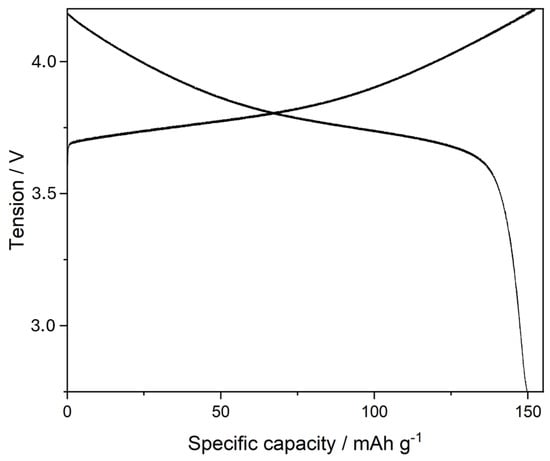
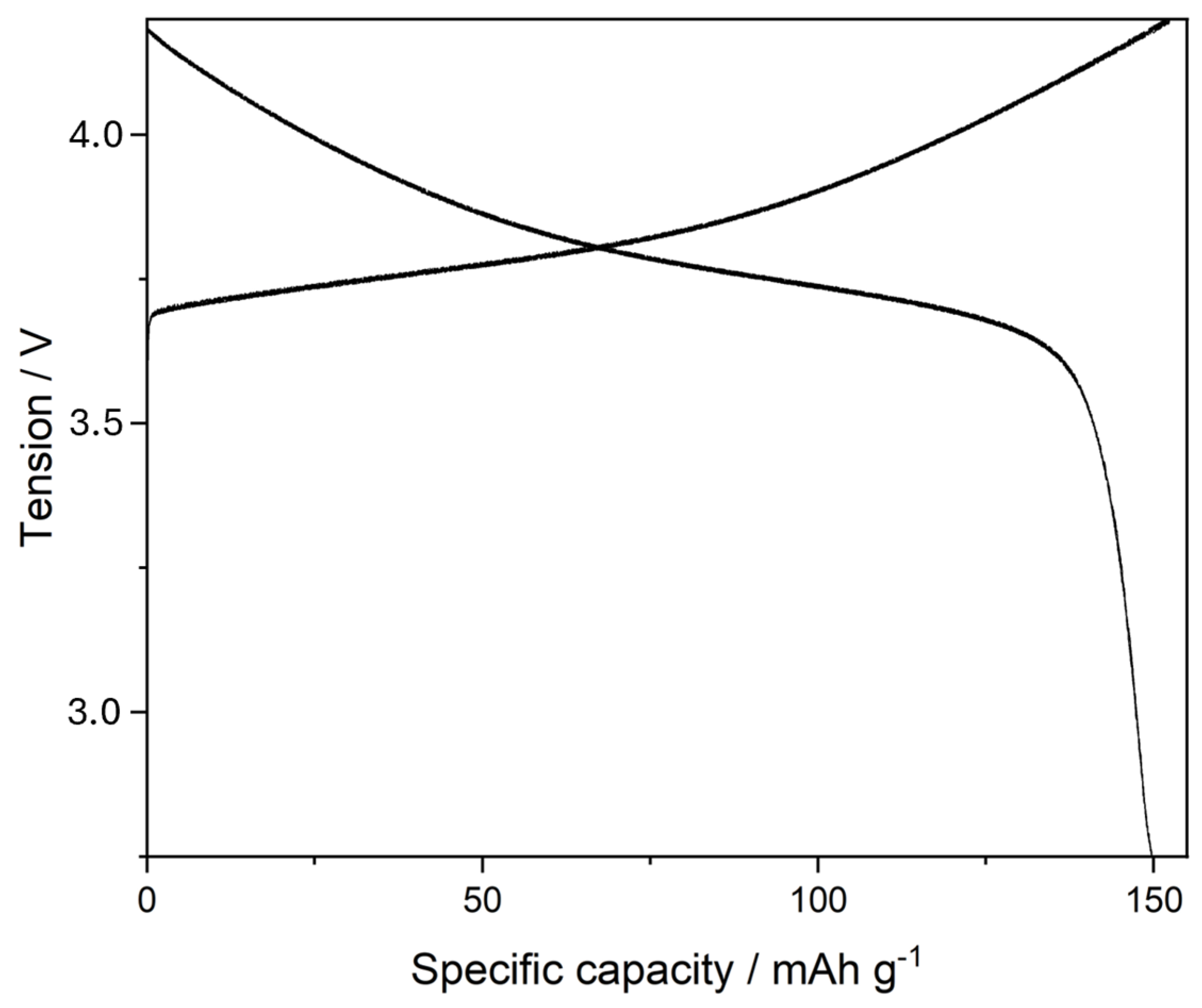
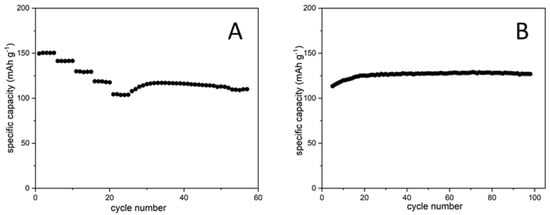
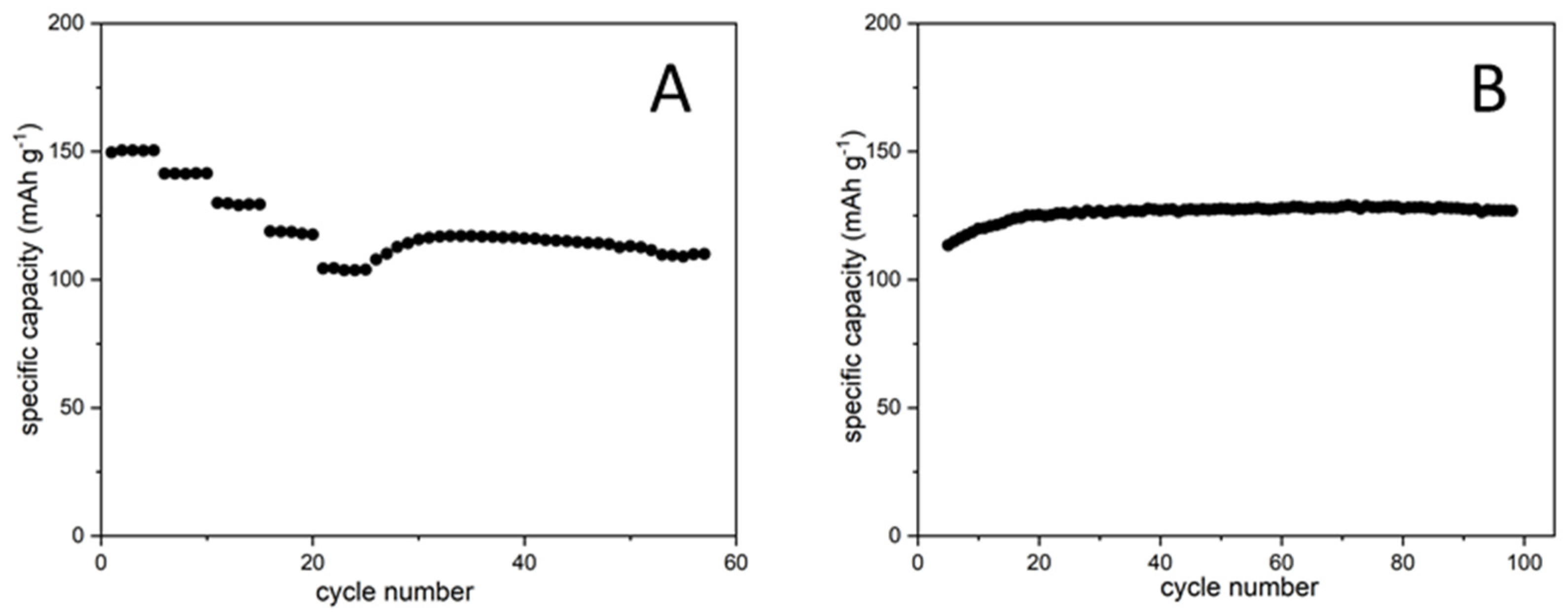
The best ink formulation (ink 2) has been used to produce cathodes which have been investigated from the electrochemical point of view in a half-cell vs. Lithium metal. Such an electrode had a thickness of 17.2 ± 3.5 µm and an active material mass loading of 2.2 ± 0.5 mg cm−2. As can be seen from Figure 3 and Figure 4, the high quality of the printed layer has resulted in good electrochemical performance, showing a featureless charge–discharge profile (Figure 3). Furthermore, the cathodic layer has shown good performance also at different rates and high stability over time (Figure 4). Considering an average value of the possible reversible capacity of about 150 mAh g−1, the calculated Coulombic efficiency has been 82% for the reported electrode. The rate capability and activation dynamics of NMC111 cathodes have been evaluated using variable and fixed galvanic cycling protocols (Figure 4). When subjected to progressive C-rates (C/20 to 1C, five cycles each), returning the cell to the C/10 baseline after 25 cycles has induced a capacity fade from ~140 mAh g−1 to ~120 mAh g−1 (Figure 4A). As is known, this degradation stems from accelerated electrolyte decomposition at aggressive rates (especially 1C), which yields highly resistive Solid Electrolyte Interphases (SEIs) and Cathode Electrolyte Interphases (CEIs) passivation layers. Upon returning to C/10, these thick interfaces cause an ohmic voltage drop (IR drop), triggering premature cut-off voltage thresholds and shortening active material utilization. Furthermore, rapid Li+ intercalation induces severe volumetric strain, causing intergranular micro-cracking within the secondary agglomerates. This disrupts primary grain connectivity, isolates active domains, and creates internal surfaces for parasitic electrolyte penetration, while cyclable lithium loss and transient relaxation impediments further restrict capacity. Conversely, pristine NMC111 cathodes directly cycled at a fixed C/10 rate have delivered a lower initial capacity of 120 mAh g−1 (Figure 4B) compared to the 140 mAh g−1 achieved at the same rate by the pre-conditioned sample (pre-cycled at C/20) (Figure 4A). This discrepancy is governed by a kinetically driven activation mechanism and interfacial stabilization. Pristine layered oxides require conditioning to optimize Li+ transport pathways; the preliminary low-current C/20 cycles facilitate gradual lattice breathing, mitigating mechanical strain and activating the secondary particle bulk. In contrast, immediate C/10 cycling creates a steep Li+ concentration gradient at the surface, prompting premature electrochemical polarization. Additionally, the extended time scale of the C/20 cycles ensures complete capillary wetting of deep intergranular voids within the spherical aggregates, maximizing the Electrochemically Active Surface Area (ECSA), and promotes the formation of a homogeneous, thin, and ionically conductive CEI. Immediate C/10 testing curtails this crucial infiltration time and accelerates side reactions, resulting in a highly resistive CEI, reduced ECSA, and the isolation of active material domains.
Figure 3.
Charge and discharge profile of gravure-printed cathode based on the ink having 18 wt% of dry content and composition of 88 wt% active material, 3 wt% KJB, 3 wt% super P, 6 wt% CMC, using a mixture of water and 2-propanol (85/15 wt/wt%) as solvent.
Figure 4.
Specific capacity vs. cycle number at variable (A) and constant rate (B) of gravure printed cathode based on the ink having the 18 wt% of dry content and composition of 88 wt% active material, 3 wt% KJB, 3 wt% super P, 6 wt% CMC, using a mixture of water and 2-propanol (85/15 wt/wt%) as solvent.
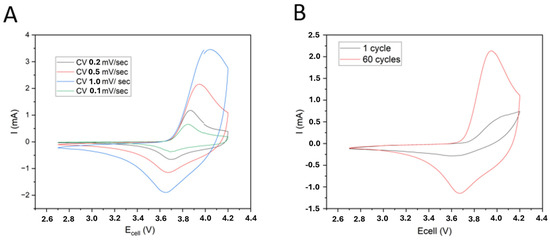
In Figure 5, examples of Cyclic Voltammetries (CVs) for the NMC 111 cathode involving CMC are reported. Panel A shows the typical redox behavior: increasing the scan rate accelerates the potential variation, significantly shortening the experimental time scale. This leaves insufficient time for the diffusion layer to extend far from the electrode surface into the bulk solution. Consequently, a thinner diffusion layer establishes a steeper concentration gradient, which, according to Fick’s laws of diffusion, enhances the mass transport flux and leads to a higher peak current. Panel B reports the CV after 1 and 60 cycles as an example: the marked increase in current observed between the pristine cell and the cell after 60 cycles has been attributed to an activation process. The small area of the first CV cycle stems from a kinetic-driven activation and incomplete initial electrolyte wetting of the pristine NMC111. The liquid electrolyte requires this initial scan to penetrate the deep intergranular voids and fully access the ECSA. Furthermore, the first cycle acts as a mandatory conditioning step that overcomes high initial charge-transfer resistance and stabilizes the CEI, gradually optimizing the Li+ diffusion pathways for the subsequent, enhanced cycles. This behavior has been primarily driven by enhanced wettability, as the electrolyte progressively penetrates the porous structure of the NMC111 cathode, thereby increasing the electrochemically active surface area available for redox reactions. Concurrently, the stabilization of protective surface films, namely the CEI and solid electrolyte interphase (SEI), optimizes charge-transfer kinetics, resulting in a substantial growth of the peak currents.
Figure 5.
Cyclic Voltammetries of NMC111 cathode between 2.5 V and 4.2 V vs. Li/Li+ after ca. 60 galvanostatic cycles at different scan rates (0.1, 0.2, 0.5, 1.0 mV s−1) (A) and after 1 and 60 cycles (B).
To highlight the significance of the developed ink formulation and deposition process, the structural parameters and electrochemical performance of the best obtained NMC111 cathode have been benchmarked against literature values for both printed and conventionally slot-die or blade-coated electrodes. The reported performance strongly competes with the state-of-the-art conventionally fabricated (doctor-blade or slot-die coated) NMC111 cathodes of similar thickness profiles. However, standard wet-coating methods frequently suffer from mass transport bottlenecks or severe binder migration toward the evaporation front under unoptimized slurry rheology and fast thermal drying regimes [25,26]. This capillary-driven component segregation induces a non-uniform distribution of the polymeric binder and conductive carbon networks across the electrode thickness direction [27]. Consequently, the current collector interface becomes depleted of binder, which triggers film delamination, compromises mechanical adhesion, and dramatically escalates interfacial charge-transfer resistance [28].
As a result, this work has demonstrated that the Ca methodology remains a good driver to obtain a gravure-printable ink, able to provide the desired functionality. Considering the different and complex interactions within multicomponent liquid dispersions represents an outstanding challenge in ink formulation. Such formulations comprise highly crowded, out-of-equilibrium environments where polymers, as well as organic and inorganic particles, continuously compete for the solvent medium. Since these constituents span different length scales and have distinct surface energy profiles, their interfacial behaviors are inherently coupled through nonlinear synergistic or competitive mechanisms. For instance, the macromolecular adsorption of a polymeric dispersant onto an inorganic core cannot be treated as an isolated event. Consequently, isolating and quantifying specific component-to-component interactions in situ remains practically unfeasible with conventional analytical frameworks. The macroscopic properties of a dispersion do not emerge from a linear superposition of individual forces, but from a collective, interdependent network of phenomena that would require a multi-scale characterization approach. In this context, printing can be a useful method to capture the real distribution of different components within such a complex system, giving definitive proof to distinguish the best formulation among similar gravure-printable inks.
4. Conclusions
In this work, we have investigated gravure-printable inks based on NMC 111 as the active material. Such a system has appeared particularly challenging due to the specific interactions of the involved materials. Taking into account all the gravure and functional requirements, several parameters such as dry content, component formulation, and ratio, as well as the solvent system, have been changed, and different inks have been prepared. In particular, we have observed that the electric conductor was the main responsible for agglomeration phenomena in most of the prepared samples, triggering an increase in viscosity within a very short time. In most cases, the viscosity was not suitable for gravure printability, revealing the high sensitivity of this system to specific interactions. Only a few printable inks have been obtained with similar characteristics. Printing has enabled the differentiation of the inks, identifying the formulation that has provided the optimal distribution of components within the printed layer, which has resulted in higher homogeneity. The layer obtained from the best printed ink has also been electrochemically tested, providing very good cathodic performance in terms of specific capacity and stability.
Author Contributions
Conceptualization, M.M. and G.S.; methodology, M.M., A.D.G.D.M., C.P. and G.S.; validation, M.M. and G.S.; formal analysis, M.M. and G.S.; investigation, M.M., A.D.G.D.M., C.P. and G.S.; resources, M.M.; data curation, M.M. and G.S.; writing—original draft preparation, M.M.; writing—review and editing, M.M. and G.S.; visualization, M.M., A.D.G.D.M. and G.S.; supervision, M.M. and G.S.; funding acquisition, M.M. All authors have read and agreed to the published version of the manuscript.
Funding
This work has been financed by the Research Fund for the Italian Electrical System (Ministero dell’Ambiente e della Sicurezza Energetica-MASE) under the Three-Year Research Plan 2025–2027 Decree n. 388 of 6 November 2024 “Approvazione del Piano Triennale 2025–2027 della Ricerca di Sistema elettrico”, in compliance with the Decree of 12 April 2024, n.139, grant number I53C24003300001.
Data Availability Statement
The raw data supporting the conclusions of this article will be made available by the authors upon request.
Conflicts of Interest
The authors declare no conflicts of interest.
References
- Armand, M.; Tarascon, J.M. Building better batteries. Nature 2008, 451, 652–657. [Google Scholar] [CrossRef] [Scilit] [PubMed]
- Schmuch, R.; Wagner, R.; Hörpel, G.; Placke, T.; Winter, M. Performance and cost of materials for lithium-based rechargeable automotive batteries. Nat. Energy 2018, 3, 267–278. [Google Scholar] [CrossRef] [Scilit]
- Chen, S.; Zhang, X.; Xia, M.; Wei, K.; Zhang, L.; Zhang, X.; Cui, Y.; Shu, J. Issues and challenges of layered lithium nickel cobalt manganese oxides for lithium-ion batteries. J. Electroanal. Chem. 2021, 895, 115412. [Google Scholar] [CrossRef] [Scilit]
- Jeevanantham, B.; Shobana, M.K.; Nikodimos, Y.; Vallal, S.A.; Su, W.-N.; Hwang, B.J. Alleviating parasitic reaction of nickel-rich layered active materials at high voltage cycling by rare-earth metal oxide coating: A comparison of cyclic performance. J. Power Sources 2025, 645, 237237. [Google Scholar] [CrossRef] [Scilit]
- Koyama, Y.; Tanaka, I.; Adachi, H.; Makimura, Y.; Ohzuku, T. Crystal and electronic structures of superstructural Li1−x[Co1/3Ni1/3Mn1/3]O2 (0≤x≤1). J. Power Sources 2003, 119–121, 644–648. [Google Scholar] [CrossRef] [Scilit]
- Park, B.-N. Electrochemical Properties of Ultrathin LiNi1/3Mn1/3Co1/3O2 (NMC111) Slurry-Cast Li-Ion Battery. Crystals 2024, 14, 882. [Google Scholar] [CrossRef] [Scilit]
- Yang, X.; Jia, X.; Sun, J.; Shang, B.; Yang, D.; Wu, Y.; Wang, S.; Zhu, L.; Wang, Z.; Liu, J. Sustainable recycling technologies for lithium-ion battery cathode materials: Recent progress. Green Technol. Sustain. 2026, 4, 100380. [Google Scholar] [CrossRef] [Scilit]
- Costa, C.M.; Gonçalves, R.; Lanceros-Méndez, S. Recent advances and future challenges in printed batteries. Energy Storage Mater. 2020, 28, 216–234. [Google Scholar] [CrossRef] [Scilit]
- Montanino, M.; Sico, G. Gravure Printing for Lithium-Ion Batteries Manufacturing: A Review. Batteries 2023, 9, 535. [Google Scholar] [CrossRef] [Scilit]
- Jiang, X.; Ding, T.; Wang, R.; Ma, W.; Lan, C.; Li, M.; Zhu, M. Photo-Assisted Flexible Energy Storage Devices: Progress, Challenges, and Future Prospects. Nano-Micro Lett. 2026, 18, 112. [Google Scholar] [CrossRef] [Scilit]
- Bariya, M.; Shahpar, Z.; Park, H.; Sun, J.; Jung, Y.; Gao, W.; Nyein, H.Y.Y.; Sun Liaw, T.; Tai, L.-C.; Ngo, Q.P.; et al. Roll-to-Roll Gravure Printed Electrochemical Sensors for Wearable and Medical Devices. ACS Nano 2018, 12, 6978–6987. [Google Scholar] [CrossRef] [Scilit] [PubMed]
- Oliveira, J.; Costa, C.M.; Lanceros-Méndez, S. Printed Batteries Materials, Technologies and Applications; John Wiley & Sons Ltd.: Chichester, UK, 2018. [Google Scholar]
- Montanino, M.; Paoletti, C.; De Girolamo Del Mauro, A.; Sico, G. The Influence of the Gravure Printing Quality on the Layer Functionality: The Study Case of LFP Cathode for Li-Ion Batteries. Coatings 2023, 13, 1214. [Google Scholar] [CrossRef] [Scilit]
- Montanino, M.; Paoletti, C.; De Girolamo Del Mauro, A.; Sico, G. Gravure Printing for Sodium-ion Batteries Manufacturing: A First Attempt of Printed Cathode. In Proceedings of the 24th EEEIC International Conference on Environment and Electrical Engineering and 8th I and CPS Industrial and Commercial Power Systems Europe, EEEIC/I and CPS Europe 2024, Rome, Italy, 17–20 June 2024. [Google Scholar]
- Tunca, F.S.; Sevinç, A.T.; Usta, S.; Çetinkaya, T.; Akbulut, H.; Tokur, M. Optimization of NMC cathode inks for cost-effective and eco-friendly screen-printed lithium-ion batteries. Electrochim. Acta 2024, 493, 144429. [Google Scholar] [CrossRef] [Scilit]
- Roy, I.S.; Taponen, H.; Välikangas, J.; Hannila, E.; Lassi, U.; Fabritius, T.; Sliz, R. Implementing Substrate Treatments to Enhance Adhesion and Facilitate Cyrene as an NMP Alternative for Sustainable Printed Nickel–Manganese–Cobalt-Based Battery Cathodes. Energy Technol. 2024, 12, 2400638. [Google Scholar] [CrossRef] [Scilit]
- Sliz, R.; Valikangas, J.; Silva Santos, H.; Vilmi, P.; Rieppo, L.; Hu, T.; Lassi, U.; Fabritius, T. Suitable Cathode NMP Replacement for Efficient Sustainable Printed Li-Ion Batteries. ACS Appl. Energy Mater. 2022, 5, 4047–4058. [Google Scholar] [CrossRef] [Scilit] [PubMed]
- Rubio, J.C.; Bolduc, M. Screen Printing for Energy Storage and Functional Electronics: A Review. Electron. Mater. 2025, 6, 7. [Google Scholar] [CrossRef] [Scilit]
- Kolchanov, D.S.; Mitrofanov, I.; Kim, A.; Koshtyal, Y.; Rumyantsev, A.; Sergeeva, E.; Vinogradov, A.; Popovich, A.; Maximov, M.Y. Inkjet Printing of Li-Rich Cathode Material for Thin-Film Lithium-Ion Microbatteries. Energy Technol. 2020, 8, 1901086. [Google Scholar]
- Sico, G.; Montanino, M.; Prontera, C.T.; De Girolamo Del Mauro, A.; Minarini, C. Gravure printing for thin film ceramics manufacturing from nanoparticles. Ceram. Int. 2018, 44, 19526–19534. [Google Scholar] [CrossRef] [Scilit]
- Vesaratchanon, S.; Nikolov, A.; Wasan, D.T. Sedimentation in nano-colloidal dispersions: Effects of collective interactions and particle charge. Adv. Colloid Interface Sci. 2007, 134–135, 268. [Google Scholar] [CrossRef] [Scilit] [PubMed]
- Aimar, P.; Bacchin, P. Concentrated phases of colloids or nanoparticles: Solid pressure and dynamics of concentration processes. In Nano-Science: Colloidal and Interfacial Aspect; Starov, V.M., Ed.; CRC Press: Boca Raton, FL, USA; Taylor and Francis Group: Oxfordshire, UK, 2010. [Google Scholar]
- Montanino, M.; Paoletti, C.; De Girolamo Del Mauro, A.; Sico, G. Gravure Printed Composites Based on Lithium Manganese Oxide: A Study Case for Li-Ion Batteries Manufacturing. Macromol. Symp. 2024, 413, 2400127. [Google Scholar] [CrossRef] [Scilit]
- Montanino, M.; Paoletti, C.; De Girolamo Del Mauro, A.; Sico, G. Gravure-Printed Anodes Based on Hard Carbon for Sodium-Ion Batteries. Batteries 2024, 10, 407. [Google Scholar] [CrossRef] [Scilit]
- Font, F.; Protas, B.; Richardson, G.; Foster, J.M. Binder migration during drying of lithium-ion battery electrodes. J. Power Sources 2018, 393, 177–185. [Google Scholar] [CrossRef] [Scilit]
- Bryntesen, S.N.; Kahrom, A.; Lamb, J.J.; Tolstorebrov, I.; Burheim, O.S. Experimental Analysis of Drying Kinetics and Quality Aspects of Convection-Dried Cathodes at Laboratory Scale. Batteries 2023, 9, 96. [Google Scholar] [CrossRef] [Scilit]
- Kumano, N.; Yamaguchi, Y.; Akimoto, Y.; Ohshima, A.; Nakamura, H.; Yamamura, M. Migration of binder and conductive agent during drying process of Li-ion battery cathodes. J. Power Sources 2024, 591, 233883. [Google Scholar] [CrossRef] [Scilit]
- Klemens, J.; Schneider, L.; Herbst, E.C.; Bohn, N.; Müller, M.; Bauer, W.; Scharfer, P.; Schabel, W. Drying of NCM Cathode Electrodes with Porous, Nanostructured Particles Versus Compact Solid Particles: Comparative Study of Binder Migration as a Function of Drying Conditions. Energy Technol. 2022, 10, 2100985. [Google Scholar] [CrossRef] [Scilit]

Disclaimer/Publisher’s Note: The statements, opinions and data contained in all publications are solely those of the individual author(s) and contributor(s) and not of MDPI and/or the editor(s). MDPI and/or the editor(s) disclaim responsibility for any injury to people or property resulting from any ideas, methods, instructions or products referred to in the content. |
© 2026 by the authors. Licensee MDPI, Basel, Switzerland. This article is an open access article distributed under the terms and conditions of the Creative Commons Attribution (CC BY) license.