Review

Failure Modes, Mitigation Strategies, and Future Directions in Battery–Supercapacitor Hybrid Energy Storage Systems: A Comprehensive Review

by
Muzamil Hussain Wadho
1,2,
Alessandro Serpi
1,3 and
Mario Porru
1,3,*
1
Department of Electrical and Electronic Engineering, University of Cagliari, 09122 Cagliari, Italy
2
Scuola Universitaria Superiore IUSS Pavia, 27100 Pavia, Italy
3
NEPSY–Novel Electric Propulsion Systems, 09127 Cagliari, Italy
*
Author to whom correspondence should be addressed.
Batteries 2026, 12(7), 233; https://doi.org/10.3390/batteries12070233
Submission received: 15 May 2026 / Revised: 19 June 2026 / Accepted: 22 June 2026 / Published: 28 June 2026

Abstract

Hybrid Energy Storage Systems (HESSs) have emerged as an inevitable solution in modern power systems and transport electrification. An HESS combines two or more complementary storage technologies—such as Batteries (BTs) with Supercapacitors (SCs), or BTs with thermal or mechanical energy storage, etc., to leverage their virtues. The robustness of HESS configurations is of utmost importance for exploring failure analysis and resilience approaches in BT-SC-based HESSs, which are crucial for long-term reliability, safety, and contributions towards future decarbonization goals. Hence, based on this motivation, this work focuses on the study of conventional and advanced HESS configurations, together with a method of configuration selection. Subsequently, the review aims to obtain a systematic identification, characterization, and understanding of the reasons behind HESS failures. This paper thus defines what HESS failures are and their possible mitigations, discussing many state-of-the-art research studies that may help researchers in finding correct and updated literature content concerning this research area. Finally, future trends and developments in BT-SC-based HESSs are discussed.

1. Introduction

Energy Storage Systems (ESSs) are a key technology in modern energy infrastructure that addresses the most significant challenges in grid flexibility, integrating renewable energy sources, and ensuring a steady supply of electricity. The diverse portfolio includes batteries, pumped hydro, flywheels, and even thermal storage, each with unique features designed for specific applications in energy management from grid stabilisation and backup power to managing the fluctuations of renewable generation. This makes their role highly important in recent times as governments around the world accelerate their shift to cleaner energy to achieve net-zero emissions and resilient power systems. Recent research has established a clear link between ESS deployment and enhanced grid stability, renewable integration, and operational performance in the top energy markets [1,2,3]. However, even if ESSs have been extensively applied, no single technology can simultaneously address the diverse power, energy, and lifecycle requirements of modern power systems, and therefore, it is necessary to focus on complementary and integrated approaches. In addition to power system applications, ESSs play a major role in modern transportation electrification. Thereby, ESSs enable higher efficiency, lower emissions, and robust integration between power grids and electric mobility. Currently, lithium-based batteries are the best selection for light-duty transportation because of their improved life cycle and high energy density, while the state-of-the-art research focuses on the importance of selecting appropriate storage technologies and configurations based on both power and energy demands, cost, and degradation characteristics. At the system level, ESSs in buses and other vehicles fulfill the dynamic power demands of specific driving cycles, while also facilitating regenerative braking and grid support functions like load leveling and vehicle-to-grid (V2G). This makes ESSs an important link between transportation and energy systems. On the other hand, for heavy-duty vehicles and trains, a single ESS technology may fail to fulfil the steady-state and dynamic power and energy demands [4].
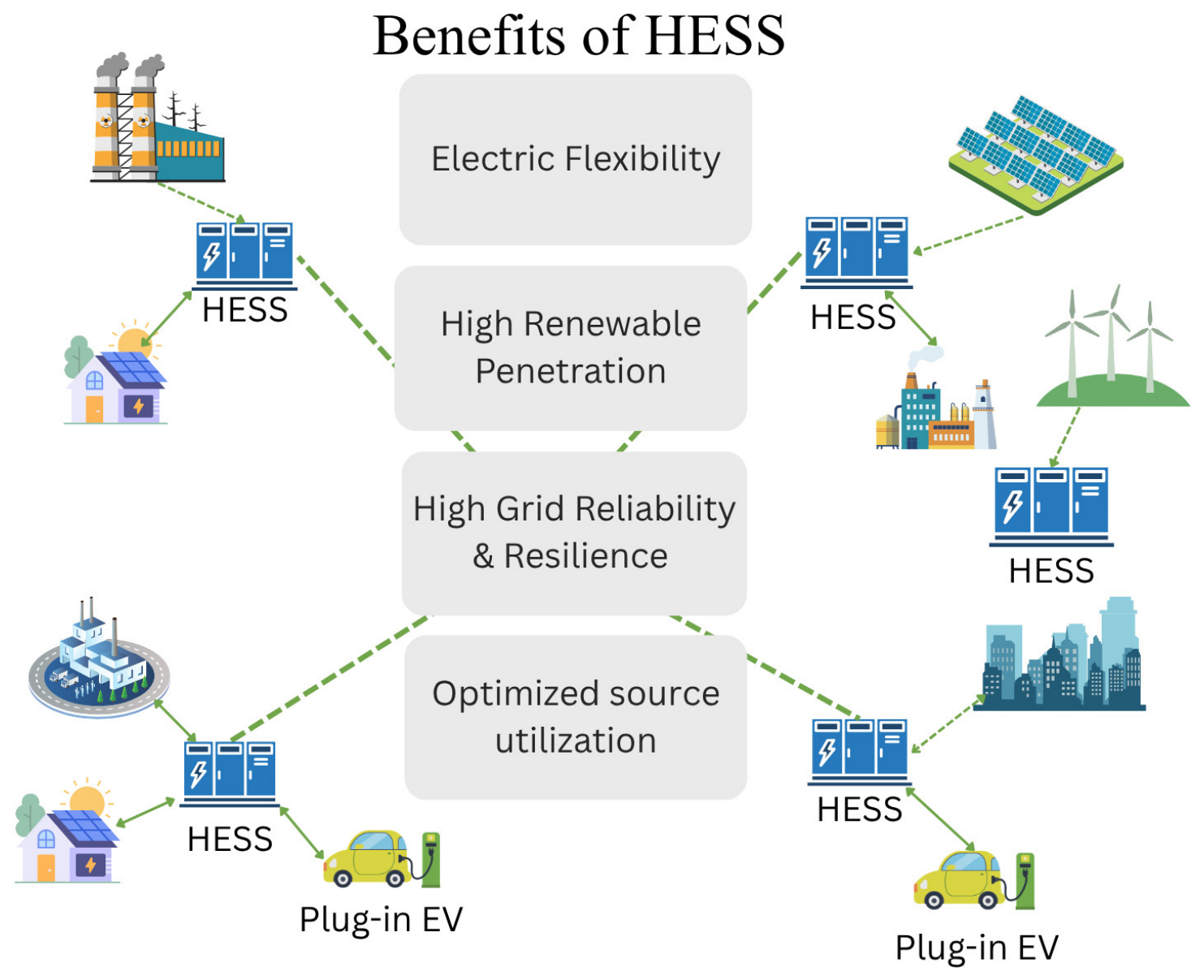
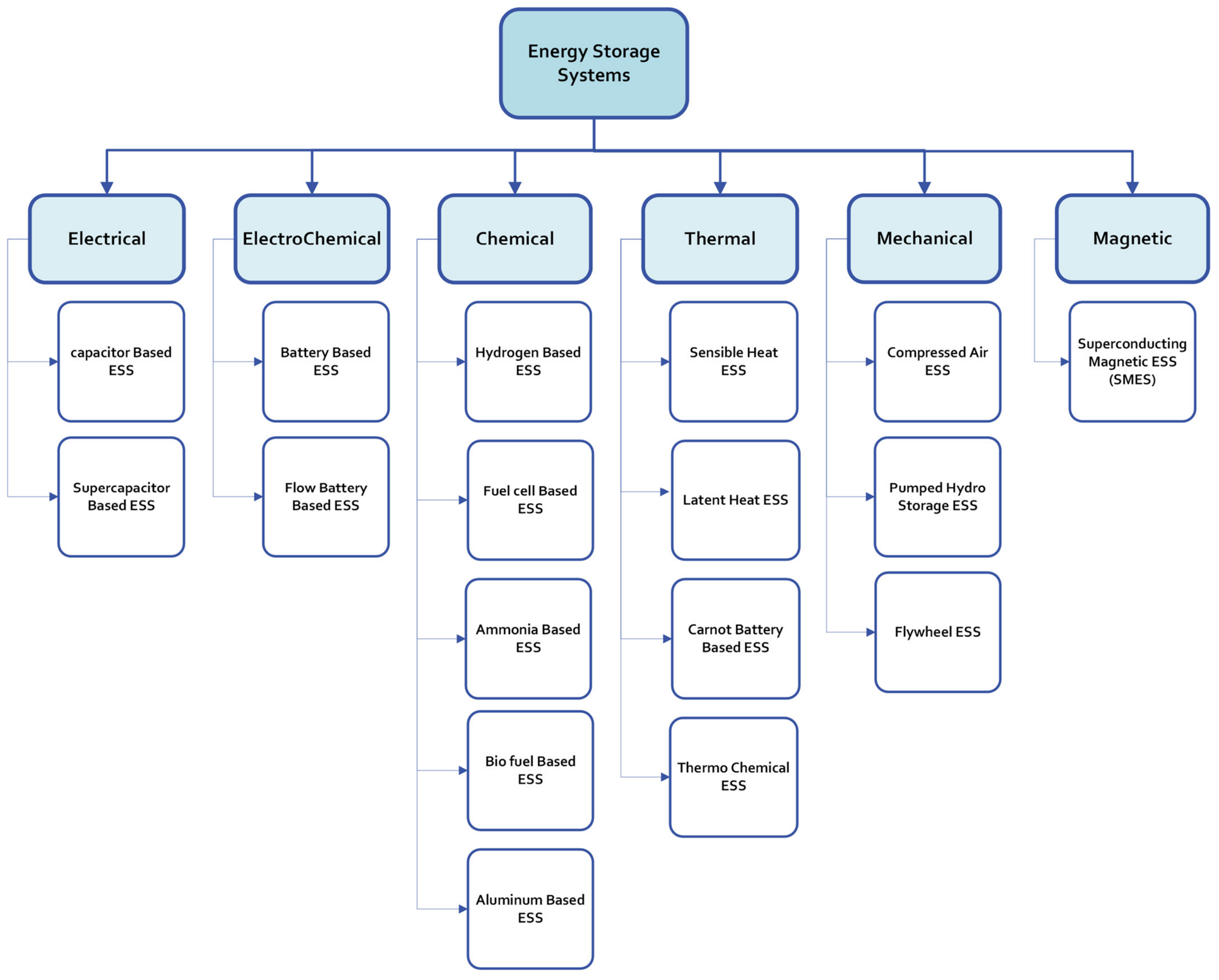
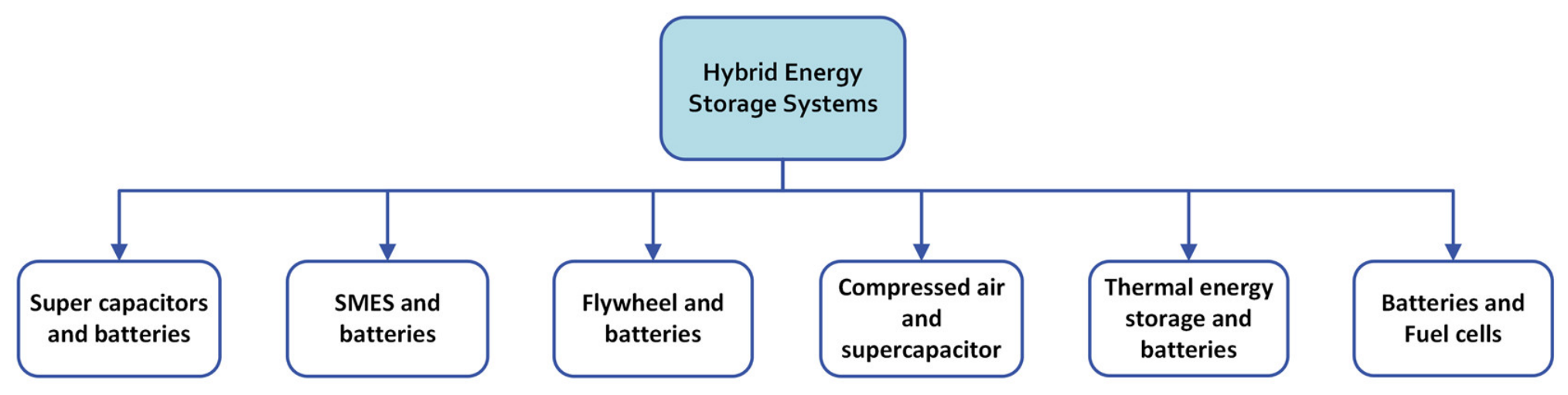
Therefore, Hybrid Energy Storage Systems (HESSs) have emerged as an inevitable solution. By combining complementary technologies, such as Batteries (BTs) with Supercapacitors (SCs) or thermal/mechanical energy storage, HESSs benefit from both high energy density and high-power density. This synergy offers both faster response and a continuous energy supply for Electric Vehicles (EVs) and other transportation applications, along with grid support and renewable energy integration, as summarised in Figure 1. These HESSs deliver enhanced cost-effectiveness, more operational flexibility, and broader application scopes. Existing research emphasises HESS as facilitators of new grid services, multi-sector energy coupling, high-penetration renewables integration, and, more importantly, transportation electrification (like hybrid EVs and fuel cell-powered vehicles), particularly in systems that intend to pursue ambitious decarbonization targets [5,6]. A possible classification of ESS technologies is given in Figure 2, and some well-known types of HESS are presented in Figure 3.
Among various HESS configurations, BT-SC systems are particularly noteworthy due to their effectiveness and versatility. This synergy combines the battery’s high energy density with the supercapacitor’s high-power density, extending the overall lifetime. In fact, these hybrid systems enhance tolerance to sudden power fluctuations, prolong battery lifetime, and improve overall system reliability. These key features make them ideally suited for grid support, electric vehicle, and renewable energy integration applications. Further experimental and industrial research has demonstrated that they perform well for short-duration peak power and medium-duration energy storage applications, thus becoming essential for power systems, transportation, and industrial uses.
This growing interest in the commercialisation of BT-SC HESSs also highlights the technological advancements of these devices. CRE’s (Wuxi CRE New Energy Technology Co., Ltd.) hybrid Lithium/Supercapacitor is one of the significant technological breakthroughs in the field. It is suitable for short-term operation and high-current applications of a few hundred amperes [7]. NASA has achieved another milestone: the Marshall Space Flight Center has unveiled a solid-state supercapacitor that exhibits high capacity and battery-like discharge characteristics, aimed at aerospace safety applications [8]. Similarly, American Lithium Energy Corporation has developed a lithium-based supercapacitor hybrid cell with high capacity to facilitate rapid energy release and quick charging–discharging cycles without suffering shattering degradation [9]. Another class of technology involves the use of hybrid supercapacitors, such as lithium-ion capacitors and solid-state hybrid ultracapacitors [10]. These devices aim to provide the same benefits as batteries but with higher power densities. Unlike systems that rely solely on batteries, using these different energy storage technologies in combination with each other increases performance in both the energy and power domains. Such an improvement is beneficial in applications that require significant power, such as marine propulsion systems. The noteworthy advancement in battery technologies includes Lithium Iron Phosphate (LFP) and Nickel–Manganese–Cobalt (NMC) batteries, which are two of the most common types of batteries still in use today. Both offer a good balance of energy density, cost, and cycle life. LFP batteries last longer and are safer, whereas NMC batteries offer more energy, making them better suited for high-energy applications such as electric mobility. However, Lithium Titanate Oxide (LTO) batteries also offer a much longer cycle life and can be charged very quickly, although at a higher cost and with less energy density. Thus, they are best suited for high-power HESSs [11]. Sodium-ion batteries, on the other hand, are becoming a cheap and plentiful alternative [12,13]. They are well-suited to applications where cost and sustainability are prioritized, such as grid and marine energy systems. Emerging technologies include solid-state batteries, which are the most recent technology considered in the battery industry. Solid-state batteries offer greater energy densities and are safer than existing battery chemistries, but they are still in their infancy in terms of commercialization [14]. In an attempt to increase the energy limits of standard Li-Ion Capacitors (LICs), [15] utilized silicon-based anodes of a micrometer size paired with highly activated carbon that featured a highly porous cathode. This resulted in a maximum energy level of 400 Wh/kg, but with a degradation of the battery and increased voltage ranges due to the tendency of the Si particles to peel off from the anode. However, by limiting the voltage range to 2.0 to 4.0 V, the authors were able to achieve excellent cycling stability with only an 88.6% reduction in energy after 2000 cycles. Details of some of the state-of-the-art batteries and supercapacitors are given in Table 1. These innovations in battery and supercapacitor technologies mark a significant step towards fault-resilient and high-performance HESS technologies. Of particular interest, reliability and fault tolerance are major research problems in managing the unique failure and degradation processes of hybrid configurations as HESSs move from lab prototypes to real-time applications.
The installation of ESSs has now reached record-high levels worldwide, underscoring its strategic importance. In 2025, China surpassed 100 GW of grid-scale battery energy storage, with vast expansion also in the United States and across Europe. Latin America, Asia-Pacific, and the Middle East are rapidly closing the gap with developing markets on the strength of amicable policies, renewable energy aspirations, and increased investment [5]. Furthermore, the European Union (EU) has published its net-zero emissions pathway based on its climate policy, which sets decarbonization ambitions for key sectors, in which HESSs will play a key role. Particularly, the two key directives dealt with by the EU are as follows [16]:
  • Renewable Energy Directive III (REDIII): This requires grid operators to consider energy storage in their planning activities, and it increases the renewable energy target to 42.5% by 2030.
  • Energy Efficiency Directive (EED): EED is supportive of intelligent demand-side energy solutions, improving ultimate savings and thereby indirectly contributing to the development of HESS technologies.

For HESSs to properly align with the decarbonization objectives of the European Union, it is essential to incorporate the principles of the circular economy into these systems, as well as to have a strategy in place for the management of these ESSs at the end of their lives. Since ESSs require critical raw materials such as lithium, cobalt, aluminum, and nickel, there is a need to incentivize the recycling of these materials. Recent European policies that relate to the circular economy and critical raw materials aim to fulfill this need. For example, the Circular Economy Act and the Critical Raw Materials (CRM) Act both provide incentives for the recycling of critical raw materials. Furthermore, the end-of-life of battery materials are now regulated by the 2023 EU Batteries Regulation. This regulation intends to increase the safety and circularity of batteries and includes a mandate of recovering certain raw materials from these batteries. For instance, ESSs must contain at least 6% of recycled lithium and nickel, as well as 16% of recycled cobalt by the year 2031. Additionally, a digital battery passport is to be utilized to keep track of the performance and lifespan of batteries. Future research should focus upon creating ESSs that are sustainable, recyclable, and scalable, including investigating potential CRM-free chemistries for these systems [16].
This present global expansion underlines the transformative potential of ESS and HESS technologies, compelling researchers and engineers to learn from and respond to system-level failures, to address performance degradation and safety concerns more quickly. In addition, it is essential to explore failure analysis and mitigation approaches for battery–supercapacitor-based HESSs to ensure long-term reliability, safety, and contributions to future decarbonization goals. Hence, motivated by this, the present work primarily addresses the study of BT–SC-based HESS failures, aiming to systematically identify, characterise, and understand their causes. Upon studying the general faults in HESSs in terms of degradation, overvoltage, communication failure, and thermal runaway, good designs, improved maintenance planning, and proper fault detection and mitigation strategies can be determined. Additionally, failure analysis facilitates the enhancement of the operational robustness of HESS topologies for challenging applications. This paper also discusses state-of-the-art research studies about the reliability and failure analysis of HESSs that may help researchers to find the relevant and up-to-date literature in this research area. Finally, future trends and developments, along with future directions in BT- SC-based HESS configurations, are discussed. This new contribution makes the study stand out by its broad scope.
The manuscript is organised as follows. Section 2 introduces the methodology used to carry out the literature review. Section 3 classifies battery–supercapacitor HESS architectures, followed by Section 4 that presents the failure analysis of existing HESS configurations. Then, Section 5 examines emerging trends, recent developments and future perspectives. Finally, Section 6 provides the conclusion of the paper.
Table 1. State-of-the-art developments in BT-SC systems.
Storage Category & TypeEnergy
Density (Wh/kg)
Power
Density (W/kg)
Nominal
Voltage (V)
Charge/
Discharge
Time
Cycle
Life
EfficiencyCost
($/kWh)
References
1. Batteries
LFP Battery150–210200–3003.2Minutes to hours3000–6000~85–90%70–150[12,17]
NMC Battery240–350200–3003.6–3.7Minutes to hours1000–2000~85–90%100–130+[12,18]
Sodium-Ion100–175200–3003Minutes to hours4000–10,000+~85–90%50–120[12,13]
LTO Battery~70–9060–1202.4Minutes to hours10,000–20,000~85–90%150–200[11,17]
Solid-State Battery (Emerging)300–500+200–300~3.7–4.0Minutes to hours1000–5000~85–90%140[14,19,20]
2. Supercapacitors
Pure Electric
Double-Layer
Capacitor (EDLC)
5–10>10,0002.7 (standard)Seconds>1,000,000>95-[19]
Adv. SCs (MXenes
Metal–Organic Frameworks MFOs)
20–5040–over 98-Seconds to minutes---[19,21,22]
3. BT-SC Hybrids
Hybrid SC
(Li-Ion Capacitor, LIC)
20–80100–300~3.8–4.0Fast charge/Slower discharge50,000–200,000--[8,19,23]
Solid-State HybridComparable to batteries400–5001Fast charge/Slower discharge---[8,19]
Advanced Lithium Capacitor Corporation>100322–4Fast charge/Slower discharge>10,00088.6%-[15]

2. Review Methodology

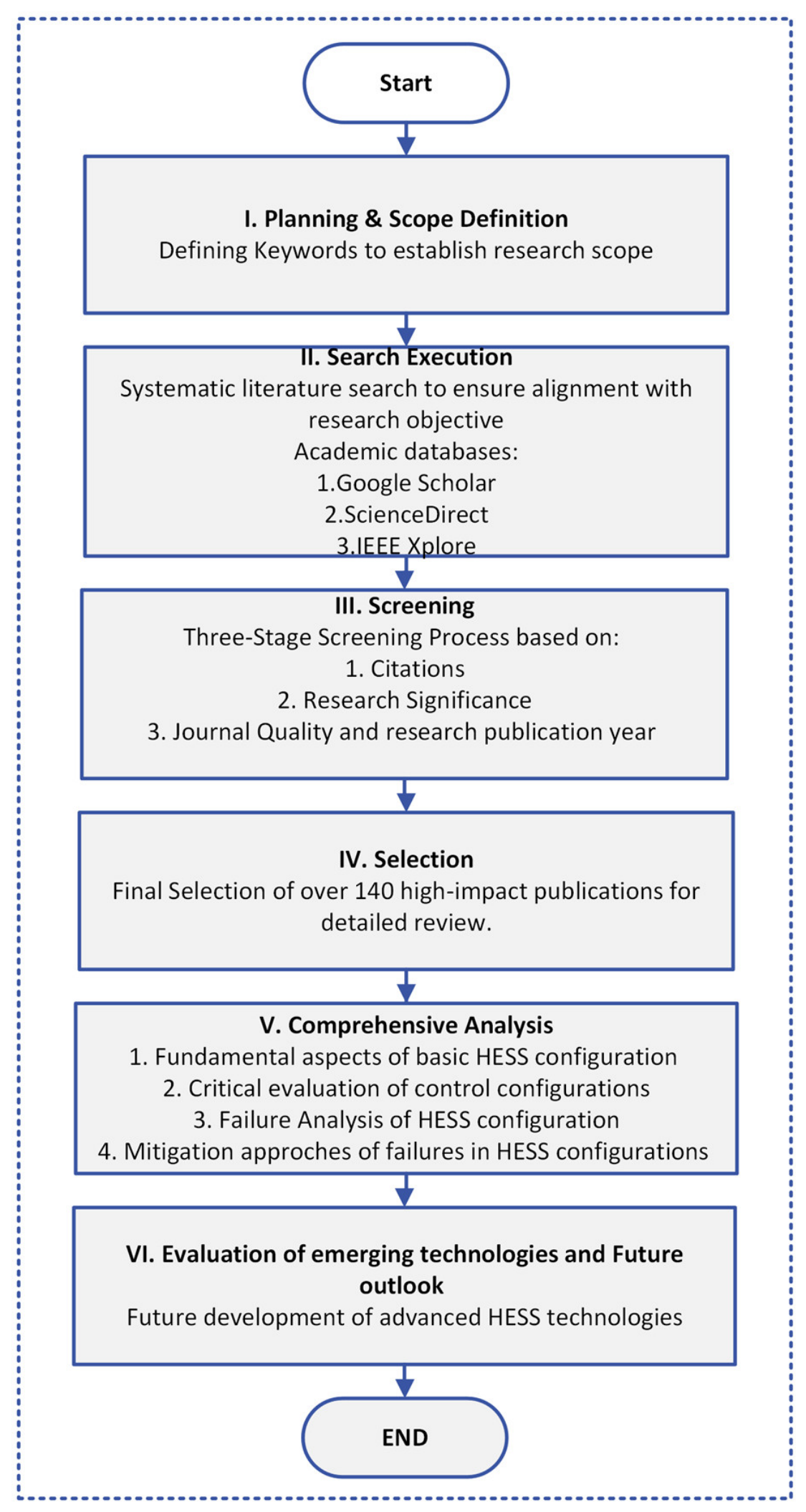
The flowchart depicted in Figure 4 illustrates the step-by-step process conducted throughout the literature review of basic HESS configurations, their failure analysis, and mitigation approaches. First, the procedure involves specifying appropriate keywords to define the research domain. Then, the relevant literature content is searched for across key academic databases, including Google Scholar, ScienceDirect, and IEEE Xplore. A three-step screening-based selection of high-impact, relevant papers relies on citation count, research importance, and journal quality. Over 140 highly relevant publications were selected through this process. The deep analysis phase covers basic HESS configurations, control strategies, modes of failure, mitigation techniques, and recent developments in this field. Finally, the methodology aims to evaluate new technologies to assist in the development of modern HESSs and to suggest a future research path in this domain.

3. Classification of Battery–Supercapacitor HESS Architectures

As previously mentioned, HESSs meet the system power demand by decoupling energy and power supply through integration of two or more distinct ESSs, i.e., a high-energy-density with a high-power-density device. Consequently, a BT-SC hybrid design yields superior performance characteristics, including enhanced power capability, longer battery lifespan, and improved system efficiency, when compared to a single ESS solution. The configuration and performance of a BT-SC HESS are fundamentally governed by its control strategy and power converter configuration.
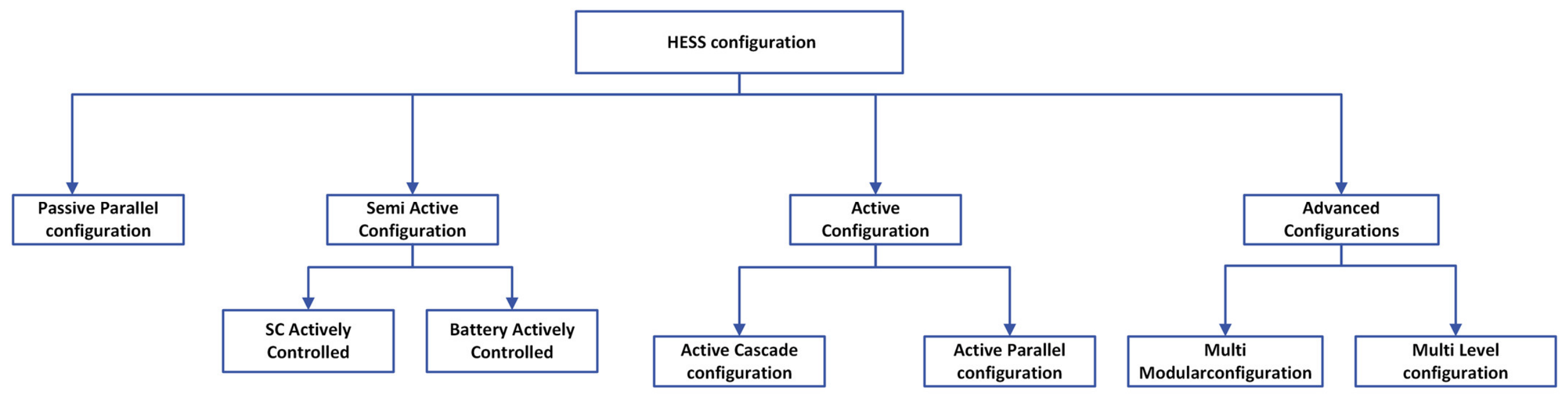
Various architectures exist, each with distinct advantages and disadvantages. The various configurations of HESSs, with batteries and supercapacitors as energy sources, can be classified as shown in Figure 5. The selection of an optimal configuration is application-dependent and is generally dictated by specific requirements for power density, energy density, efficiency, and cost.

3.1. Passive Topology

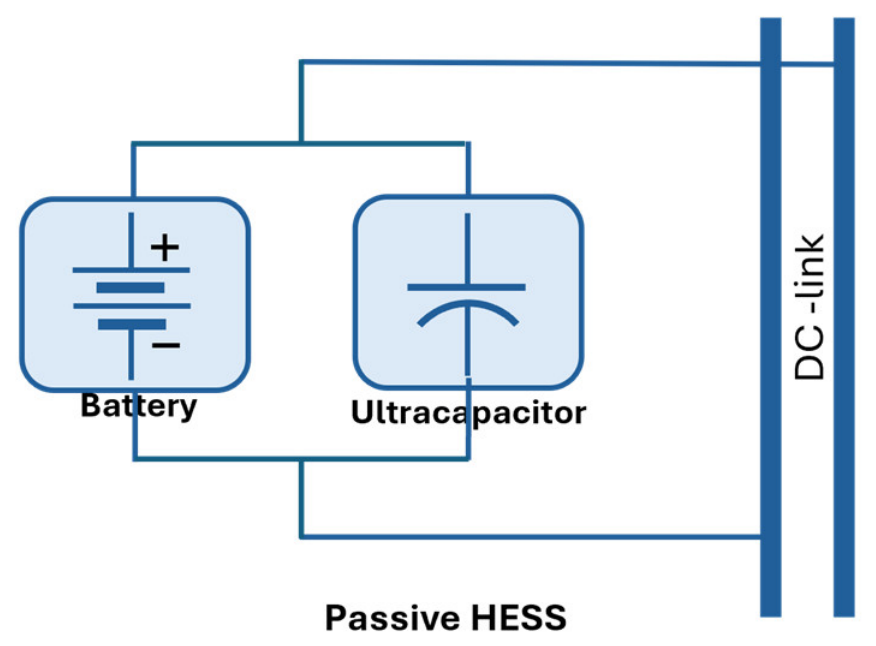
The passive topology (Figure 6) is the most straightforward approach, where the battery and the supercapacitor are connected in parallel without any additional power electronics [24]. This topology is inexpensive and easy to implement. Still, it cannot control the power flow between the energy sources, resulting in suboptimal utilisation of the energy sources and a potentially short battery life. In this configuration, the battery usually handles the steady-state power supply, while the SC handles the high-power demand due to its voltage characteristics and low internal impedance. Since no active control is required, this configuration has the advantage of low complexity and cost. This topology suffers from the inflexible power distribution (no regulation capability), and voltage coupling is necessary, i.e., both BT and SC must share the same voltage rating. Passive configuration is hazardous in case of faults because no fault tolerance mechanism is available [25].
Passive topology has been used and analysed by various authors in the available literature [26]. Among them, ref. [27] investigated the direct correlation between hybrid lithium–SC ESSs. The research looks at whether a direct coupling of dissimilar ESSs has the potential to increase lifespan, power, and energy density compared to an individual ESS. Based on the findings, the energy and power density of the hybrid system heavily depend on the voltage-level compatibility of both ESSs. They also discussed the performances of a pure lithium-based Battery Energy Storage System (BESS) compared to an HESS of the same volume and weight, finding that the HESS had a 22% increase in power density and a 15–30% reduction in load. Following ref. [27], ref. [28] conducted behaviour analysis of the HESS made up of a lithium BT and SC for various driving cycles and temperatures of different EVs. The results indicate that integration of an SC with a BT can help EVs start at shallow temperatures.
ESSs during discharge: An additional drawback of the passive topology was pointed out by [29], who explained that 64% of the stored energy of SCs remained unused; the size is comparatively greater than other HESS configurations, and also passive topology is incapable of utilizing the full high-power-density feature of SCs. This topology provides cost effectiveness, low weight, and high reliability, but compromises efficiency and power performance. While smart balancing resistances can improve the performance, they compromise energy efficiency further.

3.2. Semi-Active Topology

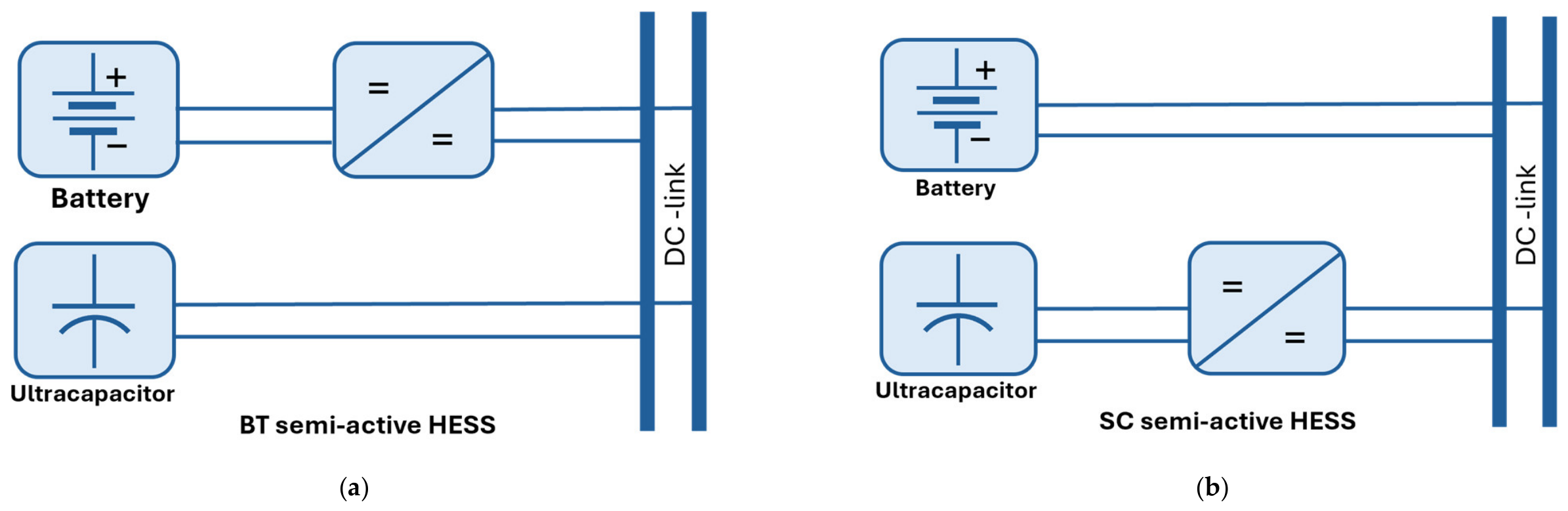
The main drawback of the passive topology is that the power flow between the energy storage systems (ESSs) is not controlled. This issue is resolved by introducing semi-active topologies (Figure 7). In these configurations, a DC-DC converter is added to connect one of the energy storage devices to the DC-link, while the other device is directly connected to the DC-link. Although the inclusion of the power electronic converter increases the cost and takes up more space in the system than a passive topology, the system can control and deliver the needed energy to the load in a far more suitable manner [30]. These configurations offer significant improvements in the management of power and battery life, despite the increased complexity and cost of the system [24,31]. Depending on which of the devices is to be actively controlled, this topology can take two different forms.
In the BT semi-active configuration, the battery is the device that is connected to the DC-link via the DC-DC converter. In this configuration, the supercapacitor is directly connected to the DC-link. This configuration allows the DC-DC converter to control the battery and protect it from voltage transients that may be directly delivered to the battery from the DC-link. The supercapacitor will absorb any transients directly. The drawback to this configuration is that the supercapacitor is directly connected to the DC-link, limiting the range of the supercapacitor’s voltage.
In the SC semi-active configuration, the supercapacitor is the device connected to the DC-link via the DC-DC converter. The battery is directly connected to the DC-link. This is the most widely used of the two configurations. The DC-DC converter controls the voltage delivered to the supercapacitor to control the rate of delivery of power from the supercapacitor. The drawback of this configuration is that the battery cannot accommodate the same range of voltage as the supercapacitor. However, the benefits of this configuration allow it to be used in applications as presented in [32], where the power delivered from the supercapacitor to the battery was controlled to improve the performance of the energy storage system and extend the battery life.
A nonlinear Model Predictive Control (MPC) approach is presented in [33] for the real-time usage of a BT semi-active HESS by using a bidirectional DC-DC converter. The results show that this coupling makes the DC-link voltage approximately constant. Later on, using the same approach, ref. [34] validated the improvements in EV performance and battery life span without considering the operational hurdles and the system efficiency under variable DC-link voltage. This drawback is overcome in [35] by employing the same HESS topology to analyse the size and operation of lithium-capacitor and lithium-ion battery HESSs in EVs through dynamic programming. The authors concluded that the topology provides a good trade-off among control complexity, cost, and weight, as well as acceptable energy and power performance.
A BT semi-active HESS topology comprising a boost converter and an Estimator Adaptive Sliding Mode Control (e-ASMC) strategy has been suggested in [36]. The solution provides robust current control in practice by taking special battery safety precautions through designing a robust current tracking control. From this research, ref. [36] experimentally validated the topology put forward by [37] for a lithium-ion battery hybridized with a lithium-ion capacitor. The research aimed at analysing the low-temperature performance of the HESS. It was observed from the findings that, at −20 °C, a battery-only system was unable to satisfy the power requirements of a typical driving cycle. On the other hand, the hybrid system with higher energy-density and power-capacity batteries was able to satisfy load demands and, significantly enhance vehicle range compared to a BT–SC HESS. The study also remarked that to manage the vehicle load demands over a particular driving cycle, the volumetric sizing ratio between the individual energy storage components (i.e., the battery and the supercapacitor) must be carefully optimized. However, despite the advantages, this configuration could not provide optimal battery state-of-charge (SoC) balancing. Moreover, the direct connection of the supercapacitor to the naturally fluctuating DC-link voltage may lead to unnecessarily high voltage levels and, thus, endanger connected loads [38].
To overcome these shortcomings, ref. [39] presented a novel HESS solution using lithium-ion and lead-acid batteries with semi-active topology inspired by the lead-acid battery used in a utility light EV application. This HESS provided competitive costs comparable to a discrete lead-acid system, with performance benefits from a lithium-ion ESS. The test results recorded a 17% range increase and a 23% efficiency gain over a continuous 24 km/h test cycle. Yet, the authors noted that batteries inherently possess slow dynamic performance, making them ineffective in taking or delivering the rapid peak currents needed during acceleration or regenerative braking. The observation justifies the need for judicious hybridization strategies to optimize the dynamic response of HESS in vehicular applications.
A few researchers have used SC semi-active HESS topologies. One study has employed this topology to achieve an adaptive power split strategy, diverting unfavorable loads to the SC for battery protection [40]. Another study has used the same configuration to analyse an Adaptive Pontryagin’s Minimum Principle (APMP)-based control strategy for optimal energy sharing [41]. However, although both studies employ adaptive power-splitting methods, both reported limitations in the impact of the topology on battery lifetime.
To alleviate these problems, ref. [42] suggests a real-time charge–discharge rate control strategy based on adaptive algorithms that take into account battery dynamic performance and previous operation. The results indicated a battery lifespan extension up to 37.7% with a moderate increase in cost compared to the utilization of a single battery system. Subsequently, ref. [43] introduces a control strategy for minimizing the electrochemical energy storage system stress, temperature, and power losses. Although the results show reduced stress and temperature, it did not account for the degree of battery lifespan extension.
A model has been introduced to expand HESS studies by integrating thermal behaviour, enabling progressive degradation analysis by incorporating electrothermal effects [44]. The results show good accuracy in modelling; however, equal temperature behaviour for both battery and HESS are assumed, which may limit general applicability [44]. Others extended this effort in hybridising the battery with Superconducting Magnetic Energy Storage (SMES) to reduce peak currents and short-term cycling for off-grid renewable systems [45].
To overcome the above-mentioned limitations, researchers suggested a multispeed electrified powertrain with a battery and SC for enhancing dynamic performance, energy efficiency, and driving range without battery size growth [46]. Then, an integrated analysis of battery cost, temperature variation, and SC size with an SC semi-active HESS topology are presented, achieving a 12% cost reduction compared to traditional battery-only configurations [47].
In the meantime, ref. [48] analysed real-time energy management strategies, i.e., lambda control and rule-based control, for BT-SC HESSs. Particularly, ref. [29] suggests an enhanced reconfigurable semi-active topology with more power converter switches, which provided enhanced battery current control and regenerative braking energy harvesting at reduced costs. Yet, ref. [49] stated the topology had reduced charging efficiency because of converter losses and lack of filtering of the DC-link voltage ripple.
Authors have tried to address the energy loss problem by developing a regenerative braking system, in which the SC is kept at a higher voltage level than the battery through a DC-DC converter, resulting in enhancing the regenerative braking efficiency by 20% and extending the driving range by five cycles [50]. Similarly, ref. [51] analyses the trajectories of energy flows in HESS under braking and accelerations, demonstrating that an appropriate control strategy has the potential to reduce battery stress and extend its lifespan.
In concurrent developments, ref. [52] suggests a lithium-ion battery and a lithium-ion capacitor in a semi-active HESS for Plug-in Hybrid Electric Vehicles (PHEVs). It optimized power distribution, improved regenerative braking energy recovery, and minimized losses. But ref. [53], which subsequently applied the same system to electric buses using pure electricity, suffered from underutilization of the supercapacitor and from system instability caused by high voltage swings, even though a 16% improvement in battery lifetime and a 30% decrease in battery size have been achieved.
The experimental validation of an SC semi-active HESS with a bidirectional DC-DC converter, which provides a compromise between system control complexity and performance, has been discussed by [54]. The authors in [55] also validated these findings by applying the same topology to a nickel–cadmium BT-SC electric bus, where the battery current and overheating were halved. However, DC-link voltage variation still posed a challenge to battery lifetime [54]. To overcome this issue, ref. [56] compared the merits of [54,55] topologies through simulations based on the United States high acceleration aggressive driving cycle (US06). They offered a 21.5% enhancement of the range of vehicles and a clear decrease in battery charging times, again highlighting the function of SCs in enhancing operation efficiency.
Overall, while semi-active HESS topologies achieve considerable improvement in the context of battery protection, energy improvement, and system efficiency, several challenges remain, such as converter losses, system complexity, voltage fluctuation issues, and underutilization of certain components. Further refinement in control strategies and comprehensive thermal–electrical modelling are necessary to advance HESS design for future employment.

3.3. Active Topology

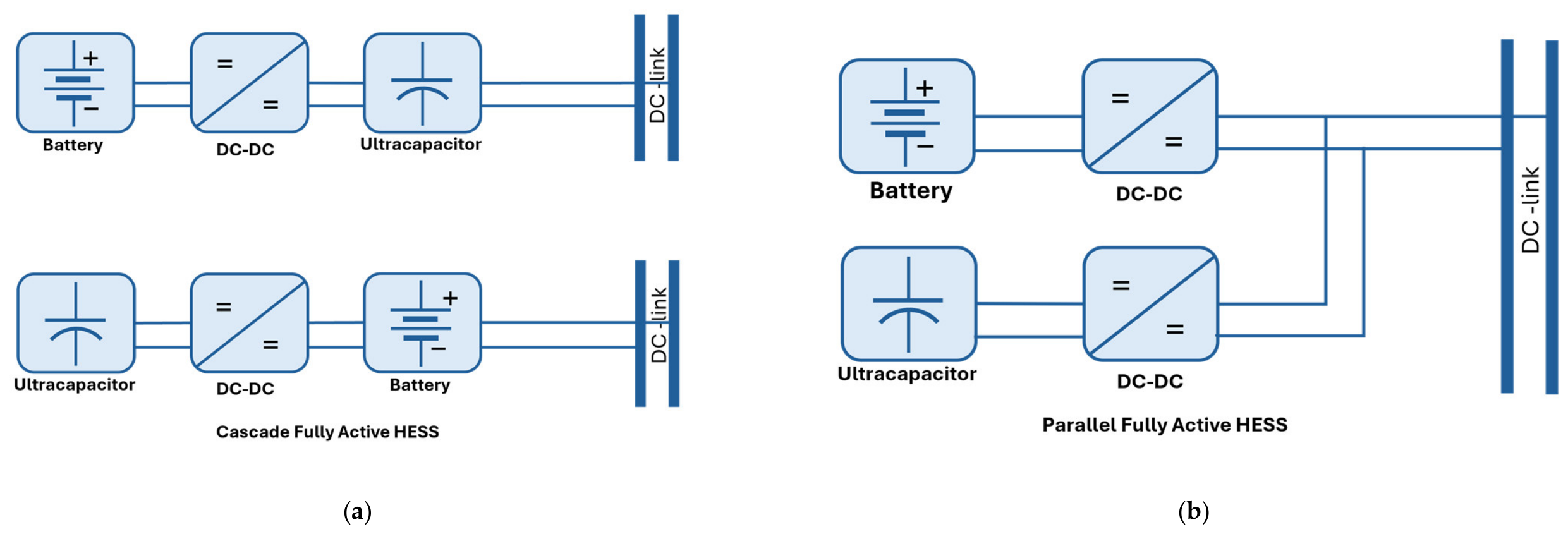
The active topology employs two dedicated bidirectional DC-DC converters, one for the BT and one for the SC (Figure 8), enabling independent voltage regulation and precise power flow control for each energy source [32]. As the most complex and costly among the four HESS configurations, it nonetheless delivers superior performance in energy efficiency, power management, and battery lifespan, representing the current state-of-the-art in terms of HESS topology [32]. This fully active architecture provides maximum flexibility for dynamic voltage matching and optimal battery protection, significantly reducing battery stress and extending its lifespan by directing fluctuating power demands to SC while maintaining steady loading on the batteries [57,58,59]. Such capabilities make this topology particularly advantageous for EVs and renewable energy applications characterized by variable power profiles [58,60,61].

3.3.1. Cascade Active Configuration

In a cascade active configuration, only one bidirectional DC-DC converter is placed in series with the battery and ultracapacitor (UC), with only one of the two energy storage devices directly interfaced with the main DC-link. Within this configuration, there are two sub-types: battery-cascaded and ultracapacitor-cascaded, shown in Figure 8a. The main advantage of this configuration is that only one DC-DC converter is required to reduce the system cost, weight, and volume. The main disadvantage of this configuration is that the power from the cascaded energy storage device must travel through the terminals of the DC-link facing energy storage device [62].

3.3.2. Parallel Active Configuration

In a parallel active configuration, each of the battery and ultracapacitor is directly interfaced with the main DC-link through its own dedicated DC-DC converters as shown in Figure 8b. This configuration offers the most freedom in the control of each of the energy storage devices. By decoupling each of the energy storage devices from the DC-link and from each other, their operation can be perfectly controlled to ensure that the DC-link voltage is regulated to provide the desired level of output from the system while also maximizing the lifespan of each of the energy storage devices. The main disadvantages to this system are physical and economic in nature; two DC-DC converters are required to provide such freedom in the control of each of the energy storage devices, increasing the system cost, and control complexity [62]. The dual bidirectional DC-DC converters are used in active HESS structures to regulate power transfer between batteries and SCs independently to support dynamic power splitting, voltage decoupling, and high efficiency (92–97%) in applications using wide-bandgap devices (SiC/GaN) [63]. The structure, however, introduces several significant failure modes that must be addressed to ensure system reliability.
Recent advancements in this area of research include robust control strategies, such as sliding mode control, exponential state observers, and linear active disturbance rejection control, that optimize power sharing, estimate unmeasured variables, and ensure stable operation under uncertain conditions [57,64,65,66]. Furthermore, sophisticated sizing and power allocation methods, grounded in technical and economic analysis, can enhance affordability and reduce both storage requirements and operational costs [30,61,67]. Furthermore, the implementation of adaptive inertia control, which utilizes the fast-responding components of each HESS to mimic the inertial characteristics of traditional generators to smooth out frequency fluctuations, along with the optimized Energy Management Systems (EMSs) for each HESS, contributes to these improvements [60,67,68]. Current research focuses on advanced modeling, co-optimization with multi-energy systems, and refined load management strategies to balance performance, cost, and reliability while enhancing overall system efficiency and sustainability [40,60,68].
The fully active topology was applied to power management in pure EVs, as demonstrated in [69]. This framework can achieve effective load current sharing and voltage stabilization of energy sources through achieving both buck and boost converter functionalities. The effectiveness of this approach is confirmed in [70], demonstrating its potential in enhancing power transfer and protecting the battery from high current peaks during charging and discharging. Both studies, however, highlighted the limitations of rule-based control methods in regulating current splitting with high precision.
To solve the above issue, ref. [71] proposes an improved control scheme using the same active structure to minimize peak current stress on the battery for driving cycles of neighborhood EVs. The results indicate possible energy savings and improved battery lifetime, although the control strategy is not detailed. Furthermore, ref. [72] also employed a parallel active HESS topology in EVs, where the battery and the supercapacitor are connected to the DC bus through DC-DC converters to provide enhanced control freedom. Although this configuration maximizes the lifespan of the battery and supercapacitor, it inherently introduces some drawbacks, including increased complexity, higher hardware costs, and greater power losses in the system. Despite these drawbacks, the performance benefits are significant; for instance, ref. [73] successfully employed a similar parallel active topology to manage and deliver the high power and energy capacity required for demanding e-mobility applications.
In a subsequent study [74], real-time fuzzy logic control is applied to a battery–SC HESS to further establish the method. While effective, the system had cost and efficiency disadvantages. Ref. [75] addressed these shortcomings by optimizing the topology, adding feedback regulation to restrict battery stress, and making it a flexible option. Lastly, ref. [76] introduced a nonlinear control technique for an HESS consisting of a fuel cell and SCs to strictly regulate DC-link voltage, track SC current, and maintain stable closed-loop performance.

3.4. Multilevel and Multi-Modular Configurations

Multilevel and multi-modular HESS configurations enable effective integration of batteries with supercapacitors in various applications. For instance, a converter-based HESS configuration incorporates supercapacitors directly into the DC bus of a medium-voltage distribution network and integrates battery units within the converter’s submodules. This type of architecture distributes energy and power from the battery–supercapacitor units across many blocks, even allowing for balancing of the SoC of the individual components [77].
Multilevel HESS concepts hierarchically organize energy storage systems. More specifically, the system may include a battery bank to supply energy to the electrical system under normal operation, a second battery bank, and a supercapacitor bank to handle power surges in the system. In one example configuration for use with photovoltaic (PV) systems that feed into a microgrid, the primary battery bank is split into primary and secondary battery bank modules to which the supercapacitor is connected. The layered storage system is constructed in such a way that the supercapacitor handles high-frequency power fluctuations, and the battery bank is protected from deep cycling operations. The use of this configuration reduces wear on the battery bank and extends its operational lifetime, while maintaining the size of the power converters and the supercapacitor bank [78,79].
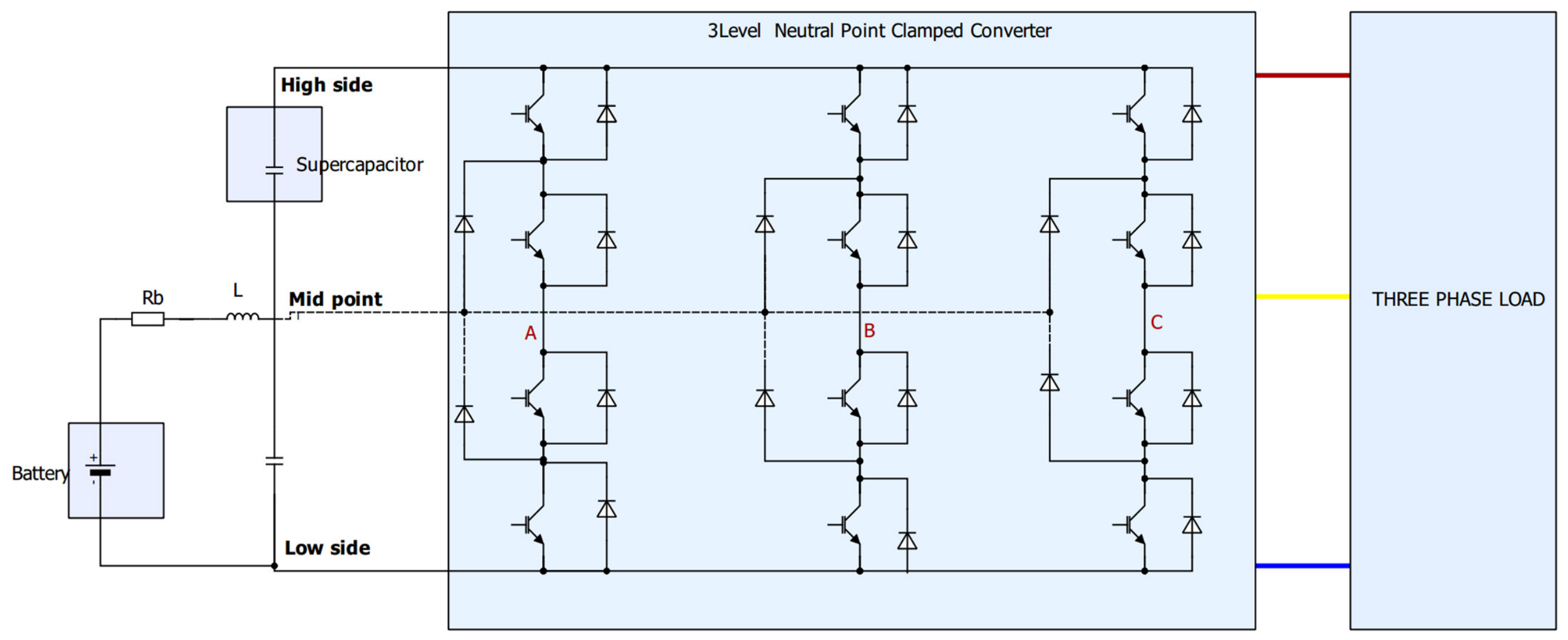
Within the multi-modular HESS, small BT-SC units are replicated to form many independent storage system modules. Each module is connected to the electrical system through a DC-DC converter or through a modular multilevel converter (MMC). One example configuration of such a system includes connecting battery units to the submodules of the MMC and connecting a bank of supercapacitors to the DC-link of the MMC. This configuration provides separate pathways for energy supplied by the battery bank and by the supercapacitor module. Such a system is useful in providing virtual inertia to the electrical system, performing primary frequency regulation, and switching between different operating modes of the electrical system. Furthermore, the modular nature of the system also allows for individual module failures without impacting the remainder of the storage system [19,77]. In an effort to further minimize the volume, weight, and number of components required for the system, novel highly integrated HESS architectures have been proposed in the literature [77,80,81,82]. For instance, ref. [77] have developed a novel system that utilizes a Three-Level Neutral-Point-Clamped (NPC) converter instead of utilizing split capacitors to provide the DC-link for the NPC converter (see Figure 9). Also, ref [77] integrated an SC to the high side capacitance of the DC-link of NPC and a battery to the other split of the DC-link. The NPC converter employs different PWM and voltage equalization algorithms [80,83] that permit the NPC converter not only to provide the AC power to the load, but also to control the power that is distributed to each of the two energy storage devices [77,81]. Thus, no DC-DC converters are required to enable the distribution of power to each of the energy storage devices, minimizing the size, weight, and complexity of the system.
Some of the potential studies that have used these topologies include the Triple Active Bridge (TAB) and multi-input DC-DC converters to enable simultaneous and bidirectional power exchange among supercapacitors, batteries, and the load. These topologies are particularly valuable in applications with variable power demands, such as electric and hybrid electric vehicles Hybrid Electric Vehicles (HEVs). For example, ref. [84] deals with multiport converters, specifically with the TAB topology and its advantages in EV fast charging and reduced hardware complexity. In another study, the authors have presented a coordinated control for a multiport bidirectional converter interfacing an HESS for EVs with emphasis on dynamic response improvement, voltage regulation, and efficiency [85]. Similarly, another study uses TAB converters in all-electric ships for onboard battery quick charging [86]. A NPC-based TAB converter has been proposed for isolated battery charging systems, giving advantages like lower voltage stress and better controllability. The converters also facilitate mode switching (e.g., SC-dominant, hybrid, battery-dominant modes) based on real-time conditions, which is critical in dynamic operations, such as marine or off-grid applications [86].
These works demonstrate the utilization of different kinds of power converters, such as MMCs, cascaded H-bridges, and multi-output multilevel converters, and innovative control and modulation techniques to enable the management of the power of each of these heterogeneous storage units in an HESS.

3.5. Generalized Approach of HESS Topology Selection

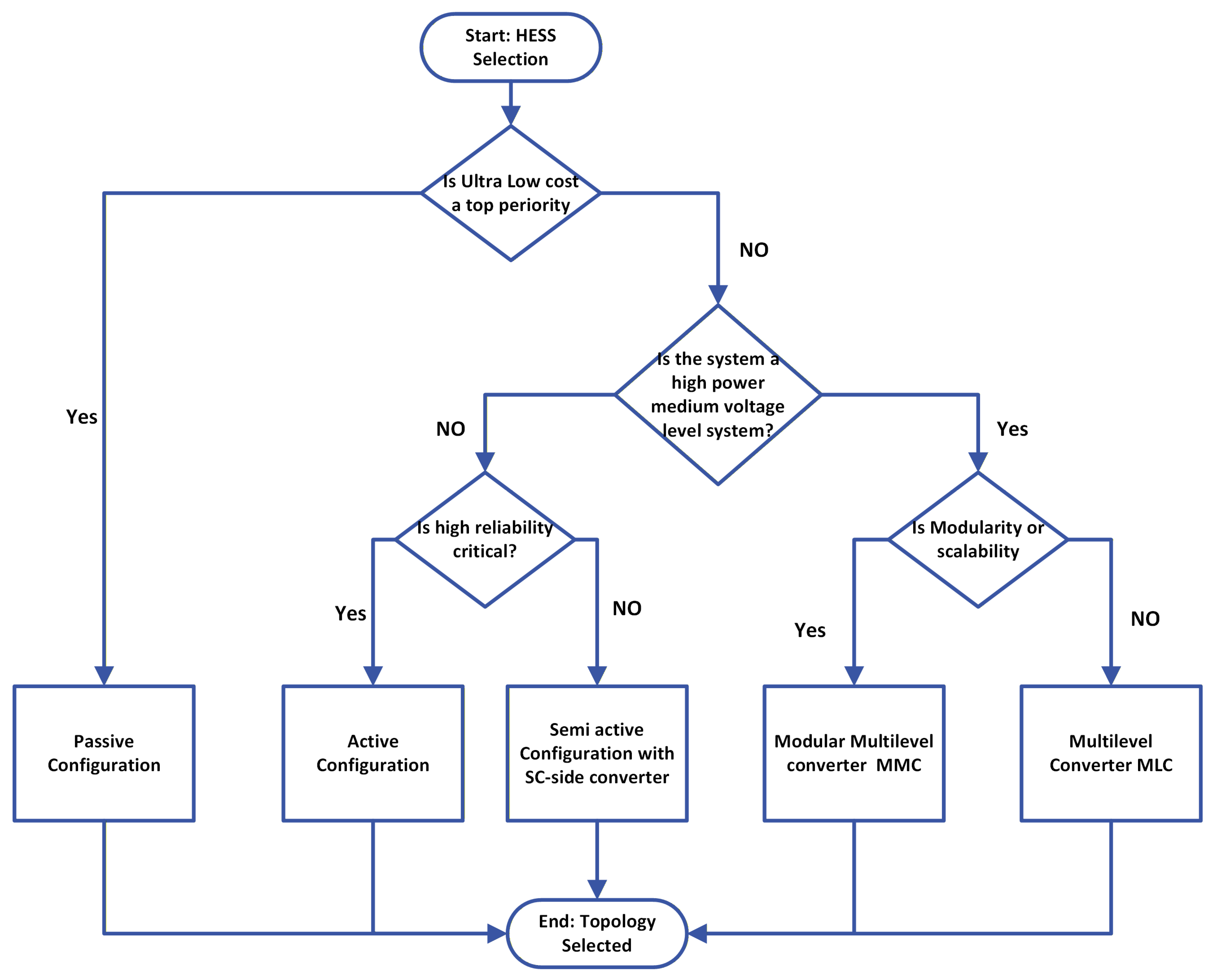
The topology selection process of an HESS is indicated in Figure 10. The flowchart directs the selection process based on key system design parameters of cost, power rating, reliability, and scalability. The decision starts by taking into consideration whether ultra-low cost is required. If so, a passive HESS configuration is suggested owing to its low cost and structural simplicity. If cost is not the major constraint, then the question is whether the high power and medium voltage level are required [87]. At or below that, the flow considers the high reliability need, and the outcome is either an active or a semi-active topology. For high-power applications the method considers whether modularity or scalability is required, recommending an MMC for modular topologies and a Multilevel Converter (MLC) for non-modular ones. The systematic method enables the best topology to be chosen to fit given performance, cost, and scalability requirements.

4. Failure Analysis and Mitigation Techniques

The performance of an HESS is heavily dependent on the topology of its power conversion structure, which determines energy flow distributions, dynamic performance, and efficiency. This section critically evaluates the state-of-the-art topologies of HESSs in terms of failures occurring in real-world applications, and discusses advanced mitigation techniques intended to enhance reliability, performance, and safety. Some common failures in the HESS topologies are given in Figure 11.
Figure 10. HESS topology selection flow chart.
Batteries 12 00233 g010

4.1. Failures in Passive Configuration
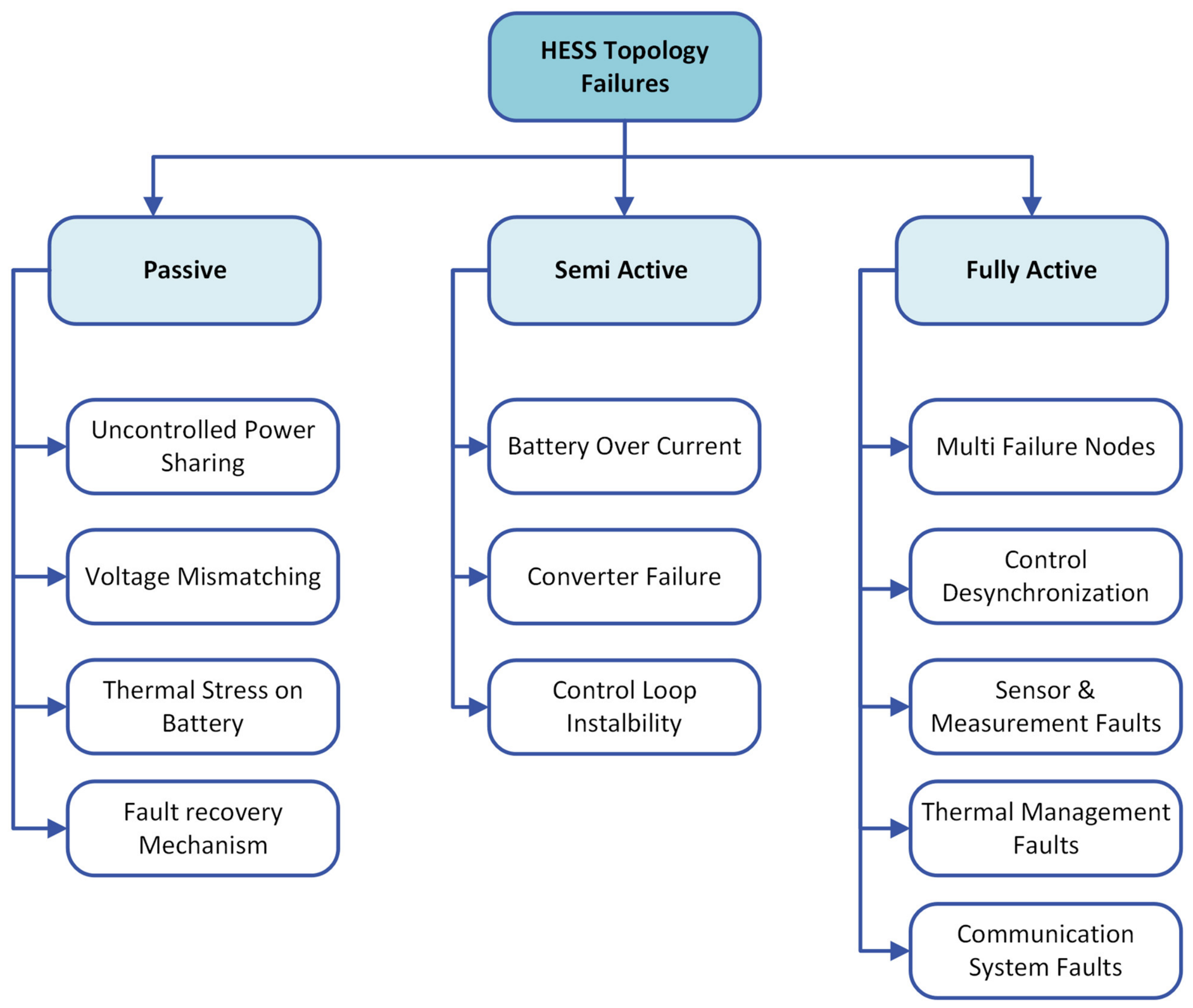
Uncontrolled Power Sharing: In a passive HESS, batteries and supercapacitors are directly paralleled to each other such that the power sharing between them is uncontrolled [88,89,90]. The supercapacitor in this configuration acts as an RC low-pass element whose charge and discharge characteristics are only dictated by the resistance and capacitance of the battery and the supercapacitor itself [88]. Thus, the entire system forms an uncontrolled HESS whose operational characteristics depend solely upon the parameters of the energy storage system components [90]. The inherent impedances of the battery and supercapacitor may lead to a large share of the load current to flow through the battery, which limits the operational capabilities of the supercapacitor by forcing it to remain within its higher current limits [29,88,89]. Furthermore, the voltage of the supercapacitor is forced to remain within the narrow voltage range of the battery, limiting its energy extraction capabilities and leading to further jeopardy in its utilization in the HESS [29]. These disadvantages of a passive HESS can only be mitigated indirectly through the proper sizing and selection of the parameters of the battery and supercapacitor components (resistance, capacitance, voltage range) to improve current sharing and reduce battery stress [29,88,89].
Figure 11. HESS topology failures.
Batteries 12 00233 g011
Voltage Mismatching: The BT voltage remains relatively stable, while the SC voltage varies rapidly with its state-of-energy (SoE). At low SoE values, the SC stops contributing to the load supply. This may lead to an insufficient energy transfer, which negatively affects system performance. Particularly, a reverse current flows from the battery to the SC may further overload the battery [91,92,93]. This voltage mismatching problem is one of the reasons many recent works favor semi-active or fully active HESS architectures with DC–DC converters and coordinated control, which can decouple battery and SC voltages, stabilize the DC bus, and allocate power while keeping SC voltage within a desired range and limiting battery current stress.
Thermal Stresses on Battery: The battery may be subjected to high current transients suddenly. Continuous overloading may result in thermal overstress on the battery, which results in an increase in its internal resistance and capacity fading [94]. To mitigate such thermal stresses, battery systems rely on protective current limitation and thermal management, where real-time temperature monitoring is essential to detect abnormal heating and prevent thermal runaway [95,96]. A range of sensor technologies, including thermocouples, thin-film or flexible temperature sensors, and fiber-optic or resistive temperature detectors, have been demonstrated for the measurement of the in situ or operando temperature (often in conjunction with the measurement of pressure and strain) of the components of interest, allowing the process to be monitored [95,96].
Fault-Recovery Mechanism: Passive HESS configurations lack a fault detection mechanism because of the lack of converters, sensors, and specific algorithms. Hence, SC short circuits and battery overcurrent generally go unnoticed, and the system continues to operate in the unsafe zone [97]. Voltage and current sensors with alarms can play a part. Although manual maintenance is suggested, this is not a solution at dynamic operation.

4.2. Failures in Semi-Active Configuration

Battery Overcurrent in SC Semi-Active Configuration: In this topology, converter failure can cause the overloading of the battery, because failure of the converter isolates the SC, and sudden load current spikes thus occur on the battery. This results in a temperature increase, which directly affects the lifespan of the battery. This risk can be mitigated by using a current-limiting circuit and BT SoC monitoring to prevent deep discharges.
Converter Failure in SC Semi-Active Configuration: There can be several reasons for converter failure, including switching device failure, and a considerable drop in the DC-link side voltage can cause an imbalance in power sharing between the SC and the BT, hence destabilising the whole system [98]. When a failure occurs on the converter interfacing the SC, it is excluded from the HESS and suddenly burdens the battery, which largely degrades its lifespan [54,58,59,99]. In the SC semi-active HESS configuration, the effectiveness of mitigation measures differs significantly between short-circuit and open-circuit converter faults due to the battery’s direct connection to the DC bus. Short-circuit faults are catastrophic: they cause immediate DC bus voltage collapse and uncontrolled currents that propagate directly to the battery, requiring fast-acting fuses for rapid isolation. During this transition, the battery experiences immediate overcurrent stress, and duty cycle reduction in redundant switches is required for their protection. Open circuit faults are non-catastrophic: the converter remains operational, but the SC cannot supply transient power to the load. Redundant switches connected in parallel with the original converter switches can automatically replace the faulty switch and clear the open-circuit fault in less than one switching period, while the battery continues normal operation. However, a robust fault-tolerant design requires a combined approach to handle both types of faults [98,100,101]. Advanced control methodologies such as adaptive Linear Quadratic Gaussian (LQG) controllers, sliding mode, and Lyapunov-based controllers can adapt dynamically to converter faults and provide fast current tracking and voltage regulation even under fault operations [90,102]. Power management algorithms, such as dynamic power sharing, filtering, and fuzzy logic-based real-time energy management, may reduce battery stress and provide system stability during converter failures [54,59,99,103]. A state-of-the-art study proposes a fault-tolerant control mechanism for the multiphase DC-DC converters using a master–slave configuration [104]. SC-side converter failure in a semi-active HESS can have serious consequences on voltage stability and battery protection. A comprehensive fault-tolerant design combining redundant switches, fast-acting fuses, and advanced control can simultaneously address both fault modes, though SC faults impose significantly higher current stress on the battery during transition and require careful fuse selection with duty cycle adaptation to prevent battery degradation [101,105].
Control Loop Instability: Instability of control loops in a semi-active HESS configuration typically arises due to a poorly designed and/or tuned control system of the bidirectional DC-DC converter. Underdamped system dynamic evolutions may cause voltage and current oscillations if control parameters such as regulator gains or control loop bandwidths are not properly set. Long regulation times of PI controllers and large ripple currents at low frequencies produced by MPC approaches are some of the reasons for instability [106,107]. These fluctuations induce unstable power flow, increased ripple currents, and stress to the battery and related power electronic devices [108]. In the meantime, unstable DC-link voltage caused by constant-bandwidth low-pass filters slows down the response of the battery current control loop, leading to instability [109]. This instability may lead to performance degradation, decreased component life, and system protection mechanism activation. Advanced, adaptive, and hybrid controller schemes, such as hybrid fuzzy logic, and rule-based and adaptive LQG controllers, can effectively allocate high-frequency power and low-frequency power components to the SC and BT, respectively [90,110]. Furthermore, ref. [108] uses an advanced tuning technique by combining PI regulators with MPC, and then incorporates fuzzy logic to account for the SoE of the supercapacitor within the control system. They found that the resulting system exhibited a reduction in current ripple through the system, indicating improved stability of the system in operation [108].

4.3. Failures in Active Configurations

Multiple Failure Points: Unlike the passive and semi-active topologies, this configuration uses separate converters for BT and SC; hence, the probability of multiple converter failures inevitably increases [111,112]. Active HESS configurations are susceptible to power semiconductor device (IGBTs/MOSFETs) and DC-link capacitor faults. Overcurrent, gate-driver fault, and thermal stress may lead to catastrophic short-circuit or open-circuit faults of switching devices [113]. DC-link capacitors also age over time because of the drying up of electrolyte, resulting in increased Equivalent Series Resistance (ESR) and eventual failure. A detailed DC-link capacitor failure has been discussed in [114]. To avoid simultaneous failures, modular design, host-swappable converters, and redundant parallel converters can be useful. Redundant parallel converters (N+1 architecture) have been explained by the authors in [115] to prevent single-point failures. In another study, the application of wide-bandgap (WBG) semiconductors such as SiC and GaN was proposed for efficiency maximization and failure rate minimization since they exhibit superior thermal and switching characteristics [113]. Ref. [114] has mentioned the condition monitoring of DC-link capacitors using capacitance and ESR measurements to prevent the drying up of the DC-link capacitors.
Instabilities in Control System (Desynchronization and Oscillations): In a fully active topology, synchronization of the two independent converter control loops during dynamic load changes (e.g., rapid acceleration) is typically achieved through a hierarchical or master–slave control architecture. In this setup, one converter (usually the battery) regulates the steady-state DC-link voltage, while the other (the supercapacitor) utilizes a fast inner current loop to rapidly track transient power demands. However, such a control system relies upon the integrity of communication between the two controllers. Both PI and MPC controllers are vulnerable to the issues related to communication between the distributed controllers. For instance, it is known that delays in the CAN bus communication systems can cause instability in the system [116,117]. In the case of MPC controllers, although the stability of the system is slightly better than for PI controllers, uncompensated delays in the communication between the distributed controllers make the system operate in a suboptimal state. The operation of both the battery and supercapacitor systems experiences ripples in their output voltages of up to ±15%, which can significantly reduce their lifespan [118,119]. To overcome these drawbacks, various control and communication approaches have been suggested in the literature. One suggestion is to use a Time-Triggered Control strategy that incorporates hardware synchronization between the distributed controllers [120]. To increase the robustness of the control system against dynamic loads and packet losses in the communication system between controllers, researchers have proposed the use of adaptive control algorithms instead of PI or MPC controllers. For instance, adaptive algorithms based on event-triggered programming or Lyapunov-based sliding mode control strategies have been published in the scientific literature [121,122]. Furthermore, implementing redundant communication networks between the distributed controllers, such as using two CAN buses or an Ethernet-based communication protocol, can significantly increase the robustness of the system, as it avoids the desynchronization of the controllers that may occur as a result of time delays in the communication system [123]. Beyond purely compensatory techniques, still further avoidance of the problem is achieved using autonomous architecture based on the DC bus. The autonomy of the fast control loops eliminates any possibility of communication delays or packet loss issues occurring at the fast transient time scales and limits the impact of such issues to the slower control layer of the system.
Sensor and Measurement Faults (SOC Estimation Errors): Estimation of SOC with accuracy is quite necessary for the proper and efficient operation of HESSs. Hall-effect current sensors were noted to display temperature drift of as much as ±3%/°C, causing SOC estimation inaccuracies up to ±5%, which again could lead to overdischarge or overcharge of battery and supercapacitor modules [124]. In addition, analog-to-digital converter (ADC) noise can add distortion to the current and voltage sensing signals, leading to the loss of system reliability. These pitfalls can be overcome by several mitigation methods proposed in the literature. Notably, many sensor combinations based on the Kalman filter have already been implemented for achieving improved SoC estimation accuracy through a variety of sensor signals, thus minimizing the noise and temperature-dependent drift effects [125,126]. For example, by integrating a temperature-dependent fractional-order model with a Dual Fractional-Order Adaptive Unscented Kalman Filter (DFOAUKF), recent methodologies have demonstrated exceptional robustness against thermal fluctuations. Quantitatively, this adaptive co-estimation strategy restricts the terminal voltage root mean square error (RMSE) to within 0.039 V, while maintaining SoC and State-of-Health (SoH) estimation errors to strictly less than 1.25% and 0.64%, respectively, across all temperature levels and battery aging degrees [127]. In addition, triple-redundant sensor configurations using voting logics have also been applied to detect and isolate faulty sensors in real-time to achieve drastic improvement in fault tolerance and ruggedness [128]. In addition, regular calibration of sensors is advisable in order to compensate for the slow aging of sensors, as well as to correct measurement drift due to long-term environmental and thermal stresses [129].
Thermal Management Failures (Overheating and Aging): As high-power-density electronic converters are used, the failure of the cooling system leads to high temperatures at the junction of the IGBTs. In the event of a cooling malfunction, these temperatures can lead to a thermal runaway reaction in the battery pack [130]. To combat these thermal management failures, there are various techniques available to improve the cooling of the IGBTs. For example, the use of heat pipes can decrease the thermal resistance of the IGBT by around 60%, which leads to a drop in the junction temperature of around 14 °C [131]. Another technique involves the use of microchannels in the IGBT to allow for the even spreading of the coolant, which can reduce the thermal resistance by around 75%. Furthermore, spray cooling techniques have been implemented in various IGBTs to allow for a rapid reduction in the temperature of the devices from around 70 °C to around 55 °C in around 75 s, which represents a 21.4% reduction in temperature [130]. Internal temperature sensors allow for the monitoring of the IGBTs, and shutdowns can be initiated when the temperature reaches specific limits. Furthermore, implementing Artificial Intelligence (AI) and predictive maintenance models to scan the status of the IGBTs will allow operators to proactively respond to the signs of aging of these components. These digital maintenance strategies have been shown to be able to accurately predict IGBT failures with 95% accuracy, leading to an improvement of the availability of the electronic converter by 5% to 15%, and reducing the costs of maintaining these components by 18% to 25% [131,132].
Communication System Failures (CAN Bus Errors and EMI): HESSs in EVs rely on instantaneous communication between controllers and are susceptible to CAN bus jitters, packet loss, and Electromagnetic Interference (EMI) due to high-frequency switching. Such disturbances can desynchronize control loops, causing power imbalances [133,134,135]. Fiber-optic communication provides immunity to noise in environments with high EMI. Error-checking protocols (cyclic redundancy checks, checksums) detect and recover from erroneous data. Redundant communication buses introduce redundancy, allowing the system to continue even if a channel fails [133].
An active HESS has improved energy management but still requires robust fault-mitigation strategies. Emerging technologies, i.e., AI-based predictive maintenance (like using long short-term memory networks) [136] and self-healing materials (microcapsule-based solder healing) [137], show promising results for enhanced reliability. Standardized fault detection frameworks and digital twin-based health monitoring are the priority areas of research in the future, in the interest of enhanced reliability.

4.4. Failures in MMC and MLC-Based Configurations

In the context of battery–supercapacitor HESSs, MMCs and MLCs are utilized to enable high-power and high-energy exchange between the storage elements. Although MMCs have a higher component count, they can produce more localized component faults. These configurations are inherently more fault-tolerant than centralized configurations [138,139]. Because the energy storage elements are distributed across the individual submodules of the MMC, any faulty packs or damaged switches can be dynamically bypassed without interrupting the operation of the converter [77]. Consequently, HESSs can be more “distributed” within these converters, so that some can be bypassed when needed, increasing system reliability and availability compared to the other HESS configurations. A small variation in capacitance or internal resistance across different submodules can cause severe SoC and voltage imbalances with MMC-based HESSs. This voltage imbalance causes the unequal power sharing between the BT and SC stacks. Consequently, such energy storage units undergo more frequent charging and discharging cycles than other units; hence their aging accelerates more significantly. To mitigate these imbalances without prematurely aging the distributed battery and supercapacitor modules, advanced control solutions are required. Methods such as reduced switching frequency control [140], analytic estimation models [141], and sliding mode control [138] have been successfully implemented to actively balance the voltage levels across all MMC submodules, thereby ensuring an extended operational lifetime for the HESS.
The failures that can occur in the MMC-MLC incorporating an HESS can be divided into three main categories: semiconductor switch faults (which can be either open- or short-circuit on switches or diodes), capacitor faults (which can be either partial or complete breakdown), and sensor faults (which can be erroneous voltage or current measurements). Each of these fault categories could impact the operation of the whole system; for example, each type of fault can alter the capacitor-balancing algorithm that is implemented within the MMC system, force the MMC control system to excessively cycle some of the submodules or the SC bank or to overload them, or contribute to the degradation of those components. For instance, short-circuit faults on the MMC switches increase the circulating currents that pass through the battery and the SC bank, which can lead to an increase in the heat generated by those components and potentially to the shutdown of the HESS [139,142,143,144].
In an effort to address these challenges, some of the most recent work on MMC-based HESSs has proposed the integration of fault-diagnosis and fault-tolerant control systems that allow for the detection of faults within the system submodules (individually within its devices and sensors), as well as the ability to reconfigure the MMC arm to bypass the faulty submodule and ensure that the remaining ones do not reach their operating limits. Furthermore, studies that simulate the failures of various system components within an MMC-based HESS propose designs that account for the failure of those components, as well as for minimizing the lifetime cost of batteries, supercapacitors, and semiconductor devices. Thus, MMC/MLC failures are still a problem that encompasses device, control, and system levels of the HESS, indicating the importance of considering such failures for both grid and transportation applications [138,142,143,145]. Although MMCs are often highlighted for their fault tolerance (provided through the safe-failed operation of the bypassing of faulty submodules and through the use of redundant submodules within the MMC), the fault tolerance of MMCs does introduce certain trade-offs into the operation of those converter modules. The faulty and bypassed SMs within MMCs, for instance, introduce physical asymmetry into the MMC module, which leads to various undesirable dynamics within the MMC (such as unequal power distribution between each arm of the MMC, and the injection of fundamental and harmonic circulating currents within the DC-link of the MMC) [87]. These circulating currents can lead to additional losses within the MMC (reducing the efficiency of the MMC), as well as impact the power quality of both the AC and DC sides of the MMC. Thus, to provide fault tolerance to MMCs without impacting the power quality of the MMC, complex control countermeasures must be implemented to mitigate these internal dynamics of MMCs created from the faulty submodules.
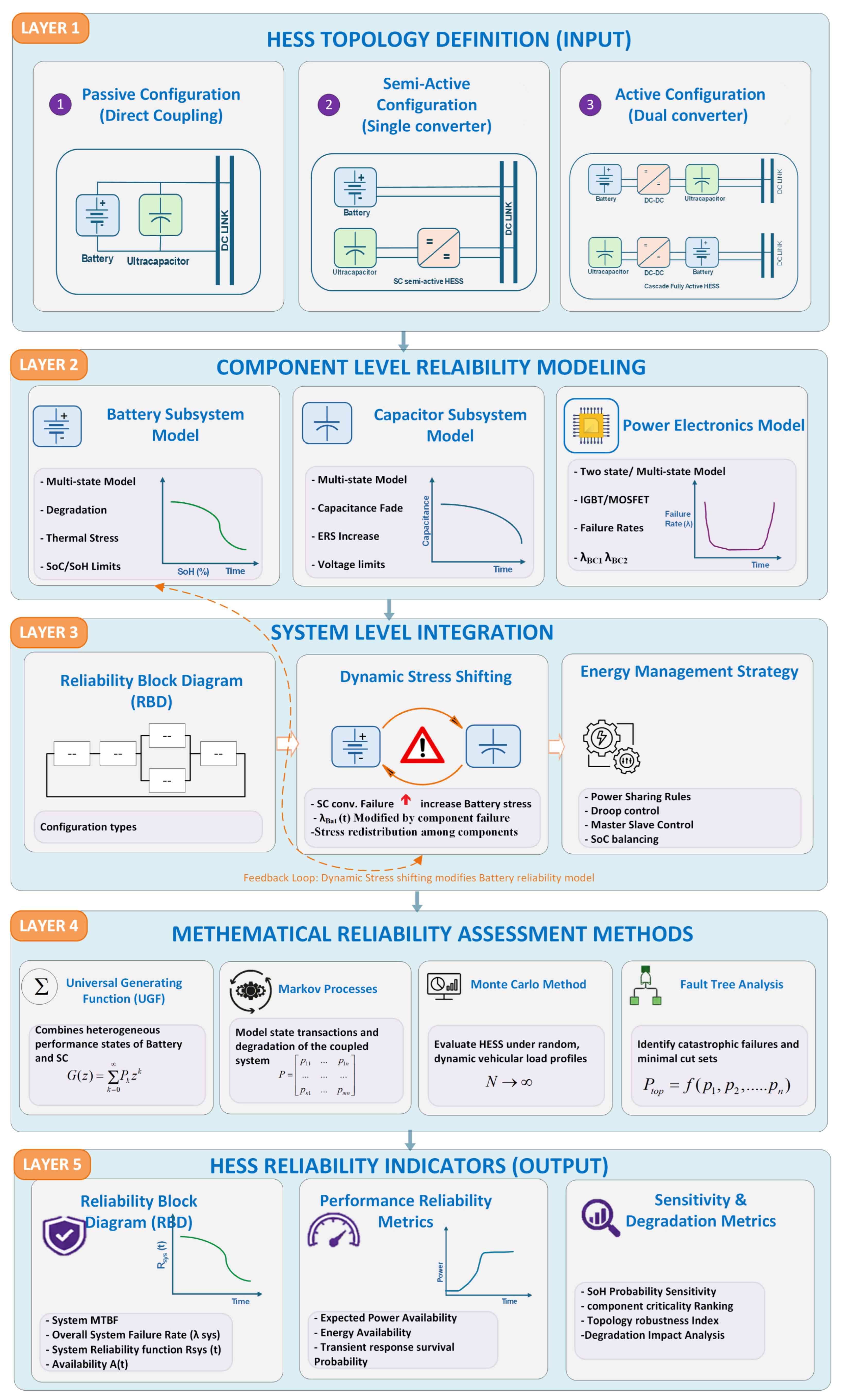
In order to provide a clear overview of the trade-offs between the system architecture and the reliability of the HESS configurations discussed, Table 2 illustrates the mathematical formulations of the reliability metrics for some important configurations of HESS used in EVs [146]. In each of these formulations, the symbol λ represents the failure rate of a specific component of the HESS (such as λbatt for the battery pack, or λBC for one of the bidirectional DC-DC converters), and the Mean Time To Failure (MTTF) of the system’s components is inversely proportional to the sum of all of the failure rates of those components that are active within the system. Table 2 indicates that active and semi-active topologies are significantly more reliable than passive configurations, even though they have more components. While adding DC-DC converters may introduce additional points of failure into the system, the reduction in stress on the battery results in a reduction in the battery failure rate (λbatt) which is the dominant failure rate of the system. For the configurations that include active switching electronics, the Markov model indicates that the cascaded system that includes the ultracapacitor in the middle of the system is the least reliable of the three configurations; a failure in either of its series-connected converters leads to complete system failure. The active and battery-middle cascaded system, however, has the highest reliability of the three active HESS configurations; the failure of only one of the system’s converters will not result in the failure of the entire system [146]. Active and semi-active topologies are significantly more reliable than passive configurations, even though they have more components. While adding DC-DC converters may introduce additional points of failure into the system, the reduction in stress on the battery results in a reduction in the battery failure rate (λbatt), which is the dominant failure rate of the system. Since a specific and comprehensive reliability analysis of the HESS is not available in the literature, potential research is recommended in this area. A detailed table with pros and cons of the failure modes is given in Table 3.

5. Emerging Research Trends, Recent Developments and Challenges in HESS Technologies

The new research directions focus on ESS technologies to improve their real-time performance. Key emerging and broad areas of research in ESS include aging-aware control of batteries and supercapacitors, hybrid supercapacitors, adaptive energy management strategies, Multi-Agent Reinforcement Learning (MARL), deep learning and fuzzy logic control for range extension, optimization-based strategies, advanced EMS, decentralized and distributed control, and multilevel and multimodal topologies. Several papers explaining these technologies are discussed in detail below.

5.1. Aging-Aware Control of Batteries and Supercapacitor

Aging-aware control techniques are being applied more frequently in different applications to extend the lifetime of energy storage devices without any loss in system performance. Batteries experience capacity loss and increase internal resistance with age, whereas supercapacitors deteriorate, particularly in terms of leakage current and ESR. Therefore, new control techniques are being used that include real-time SoH estimation and adaptive operating limits. Particularly, by incorporating aging models into energy management and control strategies, optimal performance can be achieved while also minimizing degradation.
The impact of supercapacitor aging on HEVs has been addressed by [148]; namely aging-aware control schemes are proposed to enhance performance and efficiency. An analytical impedance model of the system for simulation in MATLAB/Simulink has been used in combination with impedance spectroscopy to validate the model in the frequency domain. But the model is complex for time domain simulations. Another study defines an aging model for lithium batteries and supercapacitors, emphasizing active energy management to control aging effects [149]. The approach ensures efficient functionality of the HESS through optimal power sharing and minimized degradation. These methods adopt the thermo-electrical and HESS aging model development and vehicle dynamic simulation using MATLAB/Simulink. It has been observed that temperature affects component parameters and lifespan [149]. Another paper reports an aging-aware control strategy for a lithium-titanate BESS, with degradation effects included in optimization for load leveling [150]. The proposed technique minimizes battery aging by referring to a 280-kWh lithium-titanate BESS [150].
Ref. [151] presents an aging-aware control using empirical models of aging for regulating the power split between batteries and ultracapacitors within an HESS. This control approach regulates degradation by optimizing the power distribution to increase the lifetime of ESSs with low energy consumption without any losses. The cycle counting method for the determination of the aging model has been used, as well as simplified models for the EMS. It is found that aging-aware control extends battery lifetime compared to conventional load-levelling control, and a trade-off between battery lifetime and energy efficiency exists. However, the simplified models do not always account for all aging dynamics [151].
In [152], an aging-aware energy management strategy is proposed that ages batteries and supercapacitors equally, minimizing degradation and energy consumption. The strategy achieved a 28.2% increase in battery lifetime, while suffering only a 7.0% decline in energy efficiency. A control-oriented aging model has been used to model and simulate various aging-aware energy management strategies [152]. On the other hand, reference [153] focuses on an aging-aware adaptive control strategy specifically tailored for lithium batteries supplying smart grid flexibility services. Rather than relying on static bounds, this approach continuously evaluates the battery’s SoH and dynamically updates its allowable peak power limits in response to real-time aging, ensuring both reliable grid performance and an extended operational lifespan [153]. Another study models battery aging for optimal control of stationary batteries, considering that aging costs can recoup battery investment and increase battery lifespan by 345% compared to unaware and mildly aging-aware controllers [154].

5.2. Advanced Hybrid Supercapacitors and Lithium–Sulfur Batteries

A key area of research in HESS technologies is novel battery technologies and efficient supercapacitors. Studies indicate that lithium–sulphur batteries and hybrid supercapacitors (also known as battery–supercapacitor hybrids) can achieve high energy density, acceptable cycling stability, and enhanced electrochemical performance by utilizing advanced materials and hybrid electrode structures that combine the strengths of batteries and supercapacitors [8,11,19,23]. Some of the studies highlight the recent advances in the development of electroactive metal–organic frameworks for supercapacitors and batteries. The synthesis and design of these frameworks (pure, hybrid, and composite) are considered based on their structural tunability through various organic linkers and metal salts for the development of hybrid capacitors and lithium–sulphur batteries [155,156].

5.3. Adaptive Energy Management System

Adaptive EMSs have emerged as the core method for the control of HESSs, especially those including SC and BT. Unlike static rule-based approaches that apply pre-determined thresholds to make the power split, an adaptive EMS dynamically adjusts the control parameters as a function of time-varying system states like load demand, SoC, temperature, and component degradation. One of the most promising approaches within this framework is the MPC, which is forward-looking for future load demands over a finite horizon and computes optimal control actions to minimize targets, such as energy waste or component wear. Recent trends focus on the integration of machine learning, MPC, and multi-agent coordination to enhance decision-making EMSs for electric vehicles, smart grids, and HESSs.

5.4. Multi-Agent Reinforcement Learning

MARL is becoming more popular as a new paradigm for managing ESSs in both smart grid and transportation systems. A real-time, multi-objective and adaptive EMS based on MARL with Twin Delayed Deep Deterministic Policy Gradient (TD3) methods has been used to monitor and maximize EV performance in real time [157]. The EMS maximizes front and rear electric drive mode balance, manages cell balancing of batteries, and minimizes battery aging, while minimizing overall vehicle inefficiency. The proposed system displays a terminal SoC with only a 0.3% deviation compared to the optimal DP solution, indicating high accuracy in power management and battery usage [157]. This EMS effectively balances battery cells and optimizes temperature, suppressing long-term battery aging, and it performs better than the winning method of the 2021 Motor Vehicle Challenge [158].

5.5. Deep Learning and Fuzzy Logic for Range Extension

Combining Deep Learning (DL) and Fuzzy Logic (FL) in electric transportation systems is a compelling way to extend vehicle range, energy efficiency, and driving flexibility. DL-based algorithms are uniquely adapted to handle complex, high-dimensional data, such as driver behaviour and road terrain, while FL approaches enable an adaptive system to define its actions in uncertain situations, ideal for controlling the HESS in extended-range EVs. Together, these approaches are making next-generation electric mobility solutions more intelligent, responsive, and customized.
In this regard, a Long Short-Term Memory (LSTM) network for pattern matching between three driving patterns has been utilized to enhance condition recognition accuracy for extended-range EVs [159]. Gray Wolf Optimization (GWO) is utilized to optimize the nodes of the hidden layer, training time, and learning rate of the LSTM, whereas a genetic algorithm is utilized to optimize the coordinates of the vertex of the FL control membership function in the adaptive energy management strategy. The GWO-LSTM network achieved a high accuracy (97.7%) in recognizing working conditions, outshining the classical LSTM network (just 88.9%). The fuel saving by the adaptive energy management approach is 11.9% compared to the baseline of the conventional FC-based energy management approach, which indicates a measurable improvement in the fuel economy as a result of the integration between DL and FL techniques [159].

5.6. Optimization-Based Strategies

Optimization-based methods are the future of ship navigation control and energy management, as the industry moves towards greater fuel efficiency, reduced emissions, and autonomous operations. These methods utilize mathematical modeling, real-time analysis, and advanced control algorithms to optimize propulsion efficiency, route planning, and energy consumption. Recent advances are directed towards the integration of multi-objective optimization, MPC, and ML methods to address the complex trade-offs related to ship operations under varying environmental and load conditions [160]. In this context, an optimization-based EMS for a hybrid electric ship has been introduced, which is based on a double Proton Exchange Membrane Fuel Cell (PEMFC), batteries, and ultra-capacitors, where the Equivalent Consumption Minimization Strategy (ECMS) method is employed in distributing power, aided by a map search engine to enhance efficiency. Further, an adaptive co-state method is employed to distribute power to energy storage devices according to their real-time SoC. The incorporation of this regulation into the topology has resulted in a peak efficiency of 0.505 for the system in the simulation relative to specific rule-based EMSs and other approaches for splitting power to each PEMFC unit [160].
In ref. [161], the ECMS there proposed effectively reduces energy consumption in all-electric ships, while simultaneously curbing harmful emissions and preserving battery health, demonstrating its capability to handle high uncertainty in load profiles. The performance of the ECMS controller was evaluated with various load profiles in a series of tests, where it proved to be flexible and high-performing in managing different mission profiles and ensuring optimal energy management compared to other state-of-the-art control methods.

5.7. Advanced Energy Management Systems

Advanced EMSs (AEMSs) are at the forefront of next-generation power and mobility technologies through smart control and coordination of multiple loads and energy sources. Grounded in predictive analytics, real-time monitoring, and adaptive optimization, AEMSs offer high reliability, efficiency, and sustainability to applications from smart grids to electric transportation systems.
An AEMS for a hybrid power system has been proposed in [162], which includes a fuel cell and an HESS. The authors provide an Adaptive ECMS (A-ECMS) with the support of an FL controller to adjust the equivalent factor online for optimal power distribution and grid stability. A feedback-based variable low-pass filter from the ultracapacitor SoE enhances dynamic response [162]. A control architecture for a parallel-hybrid energy storage system consisting of batteries and ultracapacitors is proposed in [163]. It features a disturbance observer and Nonlinear State Feedback Controller (NLSFC) for enhanced traction motor speed control under external disturbances and nonlinearities. A non-inverted buck–boost H-bridge converter is used for bidirectional power flow and regenerative braking. An AEMS distributes power based on dynamic demand and energy source conditions in real-time. Simulation results show improved performance over standard PI control schemes, reducing the steady-state speed error and the maximum acceleration overshoot [163].
On the other hand, RL-based EMS approaches, such as Deep Q-Networks (DQN), are being researched to enable directly learning optimal power management policies from experiencing the system environment without an explicit model. As an example, ref. [164] proposes a deep reinforcement learning-based EMS capable of adapting to various driving cycles and aging profiles with improved performance compared to traditional EMS. Adaptive EMSs are increasingly integrated with BT and SC health monitoring systems for making real-time decisions based on operational efficiency, system reliability, and safety. Another study focuses on AEMSs for EVs, including predictive control algorithms, adaptive charging strategies, vehicle-to-grid integration, and HESSs [165]. Enhanced energy efficiency and performance can also be achieved in transportation applications, including marine propulsion. The study projects an estimated energy efficiency gain of 97% and a reduction in charging time by up to 15%, which highlights the very high potential of these solutions for transport applications. The study also points out that EVs now have their range increased by approximately 45 miles and reduced charging times by 15% compared with the previous year, showing overall performance improvements through implementing AEMSs [165].
A review of some of the latest AEMS for EVs and marine electric propulsion systems, specifically focusing on fuel cell hybrid electric vehicles, highlights the dynamic nature of electrochemical energy sources and the need for optimal power allocation using different power management strategies [166]. In this regard, recent advancements in AEMS involve the integration of AI-based algorithms, cyber-physicality, and decentralization to counter the mounting demands of decentralization and the dynamics of energy systems.

5.8. Decentralized and Distributed Control

Distributed and decentralized control systems are also becoming increasingly important to handle the scalability and fault tolerance of complex systems, such as smart ships or microgrids. In this regard, a decentralized system uses one local controller for each module of the HESS, while a central control system relies on one global controller for the whole system. This approach allows modular expansion, better fault isolation, and a reduction in communication overhead.
State-of-the-art studies in decentralized and distributed approaches include ref. [167] which proposes a decentralized fault-tolerant control approach for multilevel Cascaded H-Bridge (CHB) inverters using a multiband hysteresis modulation that enables independent module operation, load balancing, and fault tolerance in medium-voltage applications with minimal communication. In [168], where the European Economic Area Electricity Network Benchmark (EEA-ENB) has been considered, a large multi-area power network model has been used to facilitate the development and testing of distributed control methods, specifically distributed MPC. It addresses challenges in controlling renewable energy sources, whose variability may destabilize power grids, by integrating ESSs as frequency regulators. These ESS also improve reliability and security by eliminating single points of failure and can switch seamlessly from grid-forming to grid-following mode and vice versa, depending on system needs. The research trend includes integrating privacy [169], real-time optimization, and scalable learning algorithms to enable optimal operation under both physical and communication constraints. Other viable research studies for different applications of decentralized and distributed control, focusing on MPC, are given in [168,169,170,171,172,173,174,175]. The summary of the advanced emerging research and methods with related references is given in Table 4.
Future trends in SC–BT HESS control topologies are influenced by the advancements in digitalization, intelligent control, self-healing materials for power electronic components, and cybersecurity. One of the future trends is the use of digital twins (real-time virtual replicas of battery and supercapacitor systems) that enable predictive control by simulating thermal, electrical, and degradation behaviour. Such models enable closed-loop control and fault diagnosis at an early stage. Simultaneously, edge computing and the adoption of IoT are transforming HESS architectures. IoT-enabled BMS and SCMS, combined with smart sensors, will enable edge AI-based processing, reducing latency and further enhancing remote diagnostics and analytics. Finally, there is the unified power management concept that integrates power sources like batteries, supercapacitors, fuel cells, flywheels, and renewables into one. This will require a highly adaptive EMS that can optimize system performance in real time with respect to a set of efficiency, response time, and operating constraints.
Despite the promise of intelligent frameworks, emerging HESS control approaches are challenged by the high latency introduced by cloud servers. Edge AI computing offers lower latency and less dependency on data communication with the cloud. Furthermore, the lack of available datasets with ESS fault conditions limits the development of fault diagnosis algorithms. A lightweight AI algorithm with publicly available datasets can ease the development of fault diagnosis for ESSs [176,177,178,179].

6. Future Perspectives on Reliability Assessment of HESS

While the literature surveys the benefits of HESS mitigation strategies at the surrogate level, there is a lack of studies attempting to evaluate the reliability of these strategies prior to and after their implementation. Furthermore, as most of the existing literature has relied upon simulations and laboratory testing of these components, it is difficult to determine the statistical efficacy of these strategies without the performance of studies that test for reliability under extended periods of real-world application. Thus, conducting studies that aim to establish standardized protocols for testing the reliability of these components over time will help to fill this existing gap in the literature. Accordingly, future studies should focus on measuring the statistical failure rates of these components during their operation, particularly under complex and dynamic conditions, to provide a more accurate measure of their reliability.
In the context of reliability assessment, a recent study has been conducted for the standalone ESS, which comprehensively reviews reliability assessments [3]. This study establishes that Markov models and multi-state assessments are highly effective for evaluating standalone ESSs; however, applying these methodologies to HESSs introduces significant structural complexity. Unlike standalone systems, HESS architecture exhibits dynamic stress-shifting; for instance, the failure of a supercapacitor-interfacing converter dynamically accelerates the degradation rate (λ) of the battery pack. Consequently, evaluating HESSs requires advanced combinatory probabilistic models. As noted in the recent literature, approaches like the Universal Generating Function (UGF) are particularly advantageous for hybrid systems, as they allow for the mathematical aggregation of diverse performance distributions from chemically distinct storage components. Expanding these UGF and multi-state Markov models to account for the specific topological redundancies of active and semi-active HESS configurations remains a critical frontier for future research [3]. Figure 12 depicts the generalized process (following the procedure used by ) of the reliability assessment for HESSs, that can be followed for the future reliability studies of HESSs.
Figure 12 presents the general framework of the reliability assessment of the HESS, which is obtained by adapting the conventional framework for evaluating the reliability of the ESS by considering the integration of the different types of energy storage technologies that comprise the HESS. The framework includes steps for defining the topology of the HESS, modelling the reliability of each of the components of the HESS (the battery, the supercapacitor, and the power electronic converters), integrating those components to form the HESS according to its topology and operational requirements, and applying reliability assessment methods (such as UGF, Markov process, Monte Carlo method, and FTA) to the HESS to evaluate metrics that indicate the reliability of the system (such as system reliability, failure rate, availability, power capability, and degradation).

7. Conclusions

Hybrid Energy Storage Systems (HESSs) have emerged as an indispensable solution to plug performance gaps inherent in a single energy storage technology, especially in high-energy and high-power applications like electric vehicles, renewable energy source integration, and marine propulsion systems. This review has widely explored the various HESS configurations, including failure mechanisms, mitigation strategies, and future technologies, and vibrant directions of research, while discussing in detail the recent commercial developments and their future development in marine transportation.
Failure analysis has reported a range of problems in HESS configurations, such as thermal runaway, overcharge/overdischarge, power imbalance, and converter failure. These are usually exacerbated by mismatched control logic, real-time communication delay, and sensor accuracy. Mitigation strategies, including fault-tolerant control, state-of-health-aware energy scheduling, separator and converter design optimizations, and integrated thermal management, have demonstrated considerable potential for enhancing reliability and robustness of HESS operation. This work focuses on some future control topologies, such as centralized, decentralized, and hierarchical, showing that the effectiveness of an HESS depends largely on intelligent coordination among diverse subsystems. In fact, the control topologies are vital in enabling maximum power flow, enhancing efficiency, prolonging battery lifetime, and ensuring stability of the system in a wide range of operating conditions. Yet a definitive and comprehensive quantitative study and reliability assessment of these mitigation techniques in the HESS before and after implementation is unavailable in the literature. Therefore, in future studies and reviews this gap can be filled by performing the reliability assessment and quantitative analysis of the mitigation strategies before and after their implementation in HESS.
The heart of new technologies are the combinations of machine learning, multi-agent reinforcement learning, fuzzy logic, and deep learning-based predictive models that will drive a step change in adaptive energy management. The result will be intelligent systems that can optimize performance in real-time, responding to dynamic and uncertain conditions, thus unlocking greater autonomy, scalability, and resiliency for HESS architectures. In addition, emerging materials such as metal–organic frameworks and solid-state electrolytes are continuing to expand the functional envelope of energy storage components making up such hybrid systems. Future HESS research will cover co-design of hardware and control architectures, standardization of system evaluation protocols for benchmarking, and development of plug-and-play modular HESSs for a wide range of applications. Special attention must be given to cybersecurity, interoperability, and lifecycle management issues as they will be increasingly integrated into digital and grid-connected infrastructures.
In conclusion, the development of HESS technology is an interdisciplinary effort that includes material science, control theory, data-driven intelligence, comprehensive system-level integration, and market analysis. With continuous innovation and collaboration, HESS is expected to play an enabling role in next-generation sustainable and intelligent energy systems and the transition to a new power system era. These intelligent systems offer real-time optimization and responsiveness against dynamic and uncertain conditions, giving way to more autonomous, scalable, and resilient architectures.

Author Contributions

Conceptualization, M.H.W., A.S. and M.P.; methodology, M.H.W., and M.P.; formal analysis, investigation, writing—original draft preparation, M.H.W.; writing—review and editing, A.S. and M.P.; visualization, M.H.W.; supervision, A.S. and M.P.; project administration and funding acquisition, M.P. All authors have read and agreed to the published version of the manuscript.

Funding

The PhD scholarship of M.H.W. is co-financed by Ministerial Decrees no. 629/2024 and no. 630/2024, PNRR Scholarship, funding no. DM630/2024-M4C2-inv. 3.3.-Dottorati Innovativi and by the company NEPSY srl.

Data Availability Statement

No new data were created or analyzed in this study. Data sharing is not applicable to this article.

Acknowledgments

Author M.H.W. acknowledges the Italian national inter-university PhD course in Sustainable Development and Climate Change for his PhD scholarship. Authors also acknowledge financial support under the National Recovery and Resilience Plan (NRRP), Mission 4, Component 2, Investment 1.1, Call for tender No. 104 published on 2.2.2022 by the Italian Ministry of University and Research (MUR), funded by the European Union–NextGenerationEU–Project Title OPTEBUS (2022R93LP3)–CUP E53D23000840006-Grant Assignment Decree No. 1181 adopted on 27 July 2023 by the Italian Ministry of University and Research (MUR).

Conflicts of Interest

Authors Alessandro Serpi and Mario Porru are cofounders and shareholders of the company NEPSY srl, that partially funds the PhD grant of the remaining author, Muzamil Hussain Wadho. Other funders had no role in the design of the study; in the collection, analyses, or interpretation of data; in the writing of the manuscript, or in the decision to publish the results.

References

  1. Mahadevan, V.; S, S.R.; Rusho, M.A.; Yishak, S. Critical Review of Energy Storage Systems: A Comparative Assessment of Mechanisms, Advantages, Challenges, and Integration with Renewable Energy. Results Eng. 2025, 26, 105589. [Google Scholar] [CrossRef] [Scilit]
  2. De Carne, G.; Maroufi, S.M.; Beiranvand, H.; De Angelis, V.; D’Arco, S.; Gevorgian, V.; Waczowicz, S.; Mather, B.; Liserre, M.; Hagenmeyer, V. The Role of Energy Storage Systems for a Secure Energy Supply: A Comprehensive Review of System Needs and Technology Solutions. Electr. Power Syst. Res. 2024, 236, 110963. [Google Scholar] [CrossRef] [Scilit]
  3. Yan, X.; Li, J.; Zhao, P.; Liu, N.; Wang, L.; Yue, B.; Liu, Y. Review on Reliability Assessment of Energy Storage Systems. IET Smart Grid 2024, 7, 695–715. [Google Scholar] [CrossRef] [Scilit]
  4. Waseem, M.; Lakshmi, G.S.; Ahmad, M.; Suhaib, M. Energy Storage Technology and Its Impact in Electric Vehicle: Current Progress and Future Outlook. Next Energy 2025, 6, 100202. [Google Scholar] [CrossRef] [Scilit]
  5. Fang, Z.; Shek, J.K.H.; Sun, W. A Review of Grid-Connected Hybrid Energy Storage Systems: Sizing Configurations, Control Strategies, and Future Directions. J. Energy Storage 2025, 118, 116226. [Google Scholar] [CrossRef] [Scilit]
  6. Fan, R. Hybrid Energy Storage Systems: Combining Battery and Hydrogen Storage for Renewable Energy Supply Stability. In Proceedings of the Ninth International Conference on Energy System, Electricity, and Power (ESEP 2024), Tianjin, China, 29 November–1 December 2024; SPIE: Bellingham, MA, USA, 2025; Volume 13632, pp. 95–102. [Google Scholar]
  7. pat China New Developed Hybrid Supercapacitor Battery Factory and Suppliers CRE. Available online: https://www.cre-elec.com/high-quality-ultracapacitor-new-developed-hybrid-supercapacitor-battery-cre-product/ (accessed on 5 October 2025).
  8. Novel, Solid-State Hybrid Ultracapacitor Battery|T2 Portal. Available online: https://technology.nasa.gov/patent/MFS-TOPS-75 (accessed on 5 October 2025).
  9. Kathi, J.; Kadali, N. Battery-Supercapacitor Hybrid Energy Storage Systems. Scitech Patent Art. Available online: https://stg.patent-art.com/knowledge-center/battery-supercapacitor-hybrid-energy-storage-systems/ (accessed on 14 May 2026).
  10. Roule, M.; Ögmundarson, Ó.; Unnthorsson, R. Lithium-Ion Capacitors for Use in Energy Storage Systems: A Comparative Life Cycle Assessment with a Lithium Iron Phosphate Battery. J. Energy Storage 2026, 141, 119343. [Google Scholar] [CrossRef] [Scilit]
  11. NMC vs LFP vs LTO Batteries: 2026 Comparison & Cost Guide. Available online: https://www.evlithium.com/Blog/nmc-vs-lfp-vs-lto-batteries-comparison.html (accessed on 10 April 2026).
  12. Bonnen Battery. Sodium-Ion Battery vs Lithium-Ion Battery (2026 Update); Bonnen Battery: Changsha, China, 2026; Available online: https://www.bonnenbatteries.com/sodium-ion-battery-vs-lithium-ion-battery-a-friendly-comparison/ (accessed on 14 May 2026).
  13. Are Sodium Ion Batteries the Future of Energy Storage in 2026. 2025. Available online: https://www.propowenergy.com/news/are-sodium-ion-batteries-the-future-of-energy-storage-in-2026/ (accessed on 10 April 2026).
  14. Lynas, M. New European Solid-State Battery Business Targets Commercial Production. Energy Storage. 2026. Available online: https://www.pv-magazine.com/2026/01/07/new-european-solid-state-battery-business-targets-commercial-production/ (accessed on 14 May 2026).
  15. Eguchi, T.; Sawada, K.; Tomioka, M.; Kumagai, S. Energy Density Maximization of Li-Ion Capacitor Using Highly Porous Activated Carbon Cathode and Micrometer-Sized Si Anode. Electrochim. Acta 2021, 394, 139115. [Google Scholar] [CrossRef] [Scilit]
  16. EERA—European Energy Research Alliance. Available online: https://www.eera-set.eu/index.php?option=com_attachments&task=download&id=1956%3AWorking-Document---DO-NOT-DUPLICATE---StoRIES-SRIA (accessed on 5 October 2025).
  17. UK Institution of Electronics (IE). Emerging Trends in Battery Energy Storage Systems. 2026. Available online: https://institutionofelectronics.ac.uk/emerging-trends-in-battery-energy-storage-systems/ (accessed on 5 October 2025).
  18. Jalthar, R. Top 5 Battery Technologies Used in BESS: Pros, Cons & Applications. 2025. Available online: https://sunlithenergy.com/top-5-battery-technologies-bess/ (accessed on 5 October 2025).
  19. Sayed, K.; Aref, M.; Abokhalil, A.G.; Mossa, M.A. Hybrid and Advanced Energy Storage Systems: Integration, Applications, and Future Trends. In Energy Storage Devices—A Comprehensive Overview; IntechOpen: London, UK, 2025. [Google Scholar]
  20. Alkhalidi, A.; Khawaja, M.K.; Ismail, S.M. Solid-State Batteries, Their Future in the Energy Storage and Electric Vehicles Market. Sci. Talks 2024, 11, 100382. [Google Scholar] [CrossRef] [Scilit]
  21. Liu, Y.; Qian, J.; Shi, Y.; Xu, Y.; Mao, Y.; Lv, R.; Huang, B.; Sun, Y.; Zhao, Z.; Chang, Y.; et al. Latest Advances of Metal-Organic Frameworks-Based Materials for Supercapacitors. Sustain. Mater. Technol. 2023, 36, e00588. [Google Scholar] [CrossRef] [Scilit]
  22. Ji, Y.; Li, W.; You, Y.; Xu, G. Architecting MxNy-MOF@MXene Composites for Excellent Supercapacitor Electrodes. Colloids Surf. A Physicochem. Eng. Asp. 2024, 699, 134680. [Google Scholar] [CrossRef] [Scilit]
  23. Gopalakrishnan, A.; Sharma, C.S. High-Performance Dual Carbon Li-Ion Hybrid Capacitor Constructed from N, S—Co-Doped Candle Soot Derived Carbon Nanoparticles Anode and Porous Carbon Cathode. J. Energy Storage 2022, 55, 105788. [Google Scholar] [CrossRef] [Scilit]
  24. Jing, W.; Lai, C.H.; Wong, W.S.H.; Wong, M.L.D. A Comprehensive Study of Battery-Supercapacitor Hybrid Energy Storage System for Standalone PV Power System in Rural Electrification. Appl. Energy 2018, 224, 340–356. [Google Scholar] [CrossRef] [Scilit]
  25. Al Takrouri, M.; Md Ayob, S.; Nik Idris, N.R.; Aziz, M.J.A.; Ayop, R.; Said, M.F.B.M. Comparative Analysis of Passive and Semi-Active Hybrid Energy Storage System Topologies for Electric Vehicle. In 2023 IEEE Conference on Energy Conversion (CENCON); IEEE: New York, NY, USA, 2023; pp. 75–80. [Google Scholar]
  26. Lencwe, M.J.; Chowdhury, S.P.D.; Olwal, T.O. Hybrid Energy Storage System Topology Approaches for Use in Transport Vehicles: A Review. Energy Sci. Eng. 2022, 10, 1449–1477. [Google Scholar] [CrossRef] [Scilit]
  27. Grün, T.; Smith, A.; Ehrenberg, H.; Doppelbauer, M. Passive Hybrid Storage Systems: Influence of Circuit and System Design on Performance and Lifetime. Energy Procedia 2018, 155, 336–349. [Google Scholar] [CrossRef] [Scilit]
  28. Barcellona, S.; Piegari, L.; Villa, A. Passive Hybrid Energy Storage System for Electric Vehicles at Very Low Temperatures. J. Energy Storage 2019, 25, 100833. [Google Scholar] [CrossRef] [Scilit]
  29. Zhang, C.; Wang, D.; Wang, B.; Tong, F. Battery Degradation Minimization-Oriented Hybrid Energy Storage System for Electric Vehicles. Energies 2020, 13, 246. [Google Scholar] [CrossRef] [Scilit]
  30. Hajiaghasi, S.; Salemnia, A.; Hamzeh, M. Hybrid Energy Storage System for Microgrids Applications: A Review. J. Energy Storage 2019, 21, 543–570. [Google Scholar] [CrossRef] [Scilit]
  31. Shrivastava, A.; Gupta, S. Review on Super Capacitor-Battery Based Hybrid Energy Storage System for PV Application. Int. J. Adv. Eng. Manag. Sci. 2017, 3, 378–381. [Google Scholar] [CrossRef] [Scilit]
  32. Wang, J.; Xu, D.; Zhou, J.; Mao, J. Fractional-Order Modeling and Analysis of a Variable Structure Hybrid Energy Storage System for EVs. Complexity 2020, 2020, 7643812. [Google Scholar] [CrossRef] [Scilit]
  33. Golchoubian, P.; Azad, N.L. Real-Time Nonlinear Model Predictive Control of a Battery–Supercapacitor Hybrid Energy Storage System in Electric Vehicles. IEEE Trans. Veh. Technol. 2017, 66, 9678–9688. [Google Scholar] [CrossRef] [Scilit]
  34. Castaings, A.; Lhomme, W.; Trigui, R.; Bouscayrol, A. Practical Control Schemes of a Battery/Supercapacitor System for Electric Vehicle. IET Electr. Syst. Transp. 2016, 6, 20–26. [Google Scholar] [CrossRef] [Scilit]
  35. Wegmann, R.; Döge, V.; Becker, J.; Sauer, D.U. Optimized Operation of Hybrid Battery Systems for Electric Vehicles Using Deterministic and Stochastic Dynamic Programming. J. Energy Storage 2017, 14, 22–38. [Google Scholar] [CrossRef] [Scilit]
  36. Wang, B.; Xu, J.; Xu, D.; Yan, Z. Implementation of an Estimator-Based Adaptive Sliding Mode Control Strategy for a Boost Converter Based Battery/Supercapacitor Hybrid Energy Storage System in Electric Vehicles. Energy Convers. Manag. 2017, 151, 562–572. [Google Scholar] [CrossRef] [Scilit]
  37. Keil, P.; Englberger, M.; Jossen, A. Hybrid Energy Storage Systems for Electric Vehicles: An Experimental Analysis of Performance Improvements at Subzero Temperatures. IEEE Trans. Veh. Technol. 2016, 65, 998–1006. [Google Scholar] [CrossRef] [Scilit]
  38. Supatti, U.; Sungtum, S. Bidirectional Hybrid Batteries/Ultra-Capacitors Energy Storage System for Vehicular Applications. In 2015 IEEE Industry Applications Society Annual Meeting; IEEE: New York, NY, USA, 2015; pp. 1–6. [Google Scholar]
  39. Chung, S.; Trescases, O. Hybrid Energy Storage System with Active Power-Mix Control in a Dual-Chemistry Battery Pack for Light Electric Vehicles. IEEE Trans. Transp. Electrif. 2017, 3, 600–617. [Google Scholar] [CrossRef] [Scilit]
  40. Sun, L.; Feng, K.; Chapman, C.; Zhang, N. An Adaptive Power-Split Strategy for Battery–Supercapacitor Powertrain—Design, Simulation, and Experiment. IEEE Trans. Power Electron. 2017, 32, 9364–9375. [Google Scholar] [CrossRef] [Scilit]
  41. Nguyen, B.-H.; German, R.; Trovão, J.P.F.; Bouscayrol, A. Real-Time Energy Management of Battery/Supercapacitor Electric Vehicles Based on an Adaptation of Pontryagin’s Minimum Principle. IEEE Trans. Veh. Technol. 2019, 68, 203–212. [Google Scholar] [CrossRef] [Scilit]
  42. Kim, E.; Shin, K.G.; Lee, J. Real-Time Discharge/Charge Rate Management for Hybrid Energy Storage in Electric Vehicles. In 2014 IEEE Real-Time Systems Symposium; IEEE: New York, NY, USA, 2014; pp. 228–237. [Google Scholar]
  43. A Real-Time Bi-Adaptive Controller-Based Energy Management System for Battery–Supercapacitor Hybrid Electric Vehicles. Available online: https://www.mdpi.com/1996-1073/12/24/4662 (accessed on 28 April 2025).
  44. Mesbahi, T.; Bartholomeüs, P.; Rizoug, N.; Sadoun, R.; Khenfri, F.; Moigne, P.L. Advanced Model of Hybrid Energy Storage System Integrating Lithium-Ion Battery and Supercapacitor for Electric Vehicle Applications. IEEE Trans. Ind. Electron. 2021, 68, 3962–3972. [Google Scholar] [CrossRef] [Scilit]
  45. Li, J.; Gee, A.M.; Zhang, M.; Yuan, W. Analysis of Battery Lifetime Extension in a SMES-Battery Hybrid Energy Storage System Using a Novel Battery Lifetime Model. Energy 2015, 86, 175–185. [Google Scholar] [CrossRef] [Scilit]
  46. Ruan, J.; Walker, P.D.; Zhang, N.; Wu, J. An Investigation of Hybrid Energy Storage System in Multi-Speed Electric Vehicle. Energy 2017, 140, 291–306. [Google Scholar] [CrossRef] [Scilit]
  47. Song, Z.; Li, J.; Hou, J.; Hofmann, H.; Ouyang, M.; Du, J. The Battery-Supercapacitor Hybrid Energy Storage System in Electric Vehicle Applications: A Case Study. Energy 2018, 154, 433–441. [Google Scholar] [CrossRef] [Scilit]
  48. Castaings, A.; Lhomme, W.; Trigui, R.; Bouscayrol, A. Comparison of Energy Management Strategies of a Battery/Supercapacitors System for Electric Vehicle under Real-Time Constraints. Appl. Energy 2016, 163, 190–200. [Google Scholar] [CrossRef] [Scilit]
  49. Xiang, C.; Wang, Y.; Hu, S.; Wang, W. A New Topology and Control Strategy for a Hybrid Battery-Ultracapacitor Energy Storage System. Energies 2014, 7, 2874–2896. [Google Scholar] [CrossRef] [Scilit]
  50. Naseri, F.; Farjah, E.; Ghanbari, T. An Efficient Regenerative Braking System Based on Battery/Supercapacitor for Electric, Hybrid, and Plug-In Hybrid Electric Vehicles with BLDC Motor. IEEE Trans. Veh. Technol. 2017, 66, 3724–3738. [Google Scholar] [CrossRef] [Scilit]
  51. Zhao, W.; Wu, G.; Wang, C.; Yu, L.; Li, Y. Energy Transfer and Utilization Efficiency of Regenerative Braking with Hybrid Energy Storage System. J. Power Sources 2019, 427, 174–183. [Google Scholar] [CrossRef] [Scilit]
  52. Kollmeyer, P.; Wootton, M.; Reimers, J.; Stiene, T.; Chemali, E.; Wood, M.; Emadi, A. Optimal Performance of a Full Scale Li-Ion Battery and Li-Ion Capacitor Hybrid Energy Storage System for a Plug-in Hybrid Vehicle. In 2017 IEEE Energy Conversion Congress and Exposition (ECCE); IEEE: New York, NY, USA, 2017; pp. 572–577. [Google Scholar]
  53. Hybrid Battery/Lithium-Ion Capacitor Energy Storage System for a Pure Electric Bus for an Urban Transportation Application. Available online: https://www.mdpi.com/2076-3417/8/7/1176 (accessed on 28 April 2025).
  54. Zhang, Q.; Li, G. Experimental Study on a Semi-Active Battery-Supercapacitor Hybrid Energy Storage System for Electric Vehicle Application. IEEE Trans. Power Electron. 2020, 35, 1014–1021. [Google Scholar] [CrossRef] [Scilit]
  55. Vulturescu, B.; Trigui, R.; Lallemand, R.; Coquery, G. Implementation and Test of a Hybrid Storage System on an Electric Urban Bus. Transp. Res. Part C Emerg. Technol. 2013, 30, 55–66. [Google Scholar] [CrossRef] [Scilit]
  56. Yaïci, W.; Kouchachvili, L.; Entchev, E.; Longo, M. Dynamic Simulation of Battery/Supercapacitor Hybrid Energy Storage System for the Electric Vehicles. In 2019 8th International Conference on Renewable Energy Research and Applications (ICRERA); IEEE: New York, NY, USA, 2019; pp. 460–465. [Google Scholar]
  57. Asensio, E.M.; Magallán, G.A.; De Angelo, C.H.; Serra, F.M. Energy Management on Battery/Ultracapacitor Hybrid Energy Storage System Based on Adjustable Bandwidth Filter and Sliding-Mode Control. J. Energy Storage 2020, 30, 101569. [Google Scholar] [CrossRef] [Scilit]
  58. Wilberforce, T.; Anser, A.; Swamy, J.A.; Opoku, R. An Investigation into Hybrid Energy Storage System Control and Power Distribution for Hybrid Electric Vehicles. Energy 2023, 279, 127804. [Google Scholar] [CrossRef] [Scilit]
  59. Ren, J.; Lin, W.; Liu, X.; He, S.; Dongye, Z.; Diao, L. Full Current-Type Control-Based Hybrid Energy Storage System. Energies 2022, 15, 2910. [Google Scholar] [CrossRef] [Scilit]
  60. Liu, Z.; Chen, B. HESS Energy Configuration Strategy Based on Load Regulation for Wind Power. Int. J. Low-Carbon Technol. 2024, 19, 1516–1521. [Google Scholar] [CrossRef] [Scilit]
  61. Ma, W.; Wang, W.; Wu, X.; Hu, R.; Tang, F.; Zhang, W.; Han, X.; Ding, L. Optimal Allocation of Hybrid Energy Storage Systems for Smoothing Photovoltaic Power Fluctuations Considering the Active Power Curtailment of Photovoltaic. IEEE Access 2019, 7, 74787–74799. [Google Scholar] [CrossRef] [Scilit]
  62. Chmielewski, A.; Piórkowski, P.; Bogdziński, K.; Możaryn, J. Application of a Bidirectional DC/DC Converter to Control the Power Distribution in the Battery–Ultracapacitor System. Energies 2023, 16, 3687. [Google Scholar] [CrossRef] [Scilit]
  63. Chen, Y.; Jia, M.; Sun, H.; Chen, J.; Zhang, H.; Zhou, Z. SiC-Based Bidirectional Three-Phase CLLLC Resonant Converter with Integrated Magnetics for High-Power On-Board Charger Applications. In 2023 IEEE 2nd International Power Electronics and Application Symposium (PEAS); IEEE: New York, NY, USA, 2023; pp. 350–355. [Google Scholar]
  64. Deepika, D.; Singh, N. Exponential State Observer Based Finite Time Control of Fully Active Hybrid Energy Storage System. Sādhanā 2022, 47, 21. [Google Scholar] [CrossRef] [Scilit]
  65. Dong, H.; Xu, C.; Chen, W. Modeling and Configuration Optimization of the Rooftop Photovoltaic with Electric-Hydrogen-Thermal Hybrid Storage System for Zero-Energy Buildings: Consider a Cumulative Seasonal Effect. Build. Simul. 2023, 16, 1799–1819. [Google Scholar] [CrossRef] [Scilit]
  66. Li, J.; Han, Y.; Zhou, S.; Li, Z.; Fan, H.; Wang, B. Improved Linear Active Disturbance Rejection Control with Dynamic Event-Triggered Mechanism for Hybrid Energy Storage System. IEEE Trans. Transp. Electrif. 2024, 10, 2533–2546. [Google Scholar] [CrossRef] [Scilit]
  67. Fang, Y.; Hu, P.; Zhu, N.; Minfu, A.; Jiang, D. Sizing Method of a Novel Hybrid Energy Storage Considering Adaptive Inertia Control. Sustain. Energy Technol. Assess. 2024, 61, 103602. [Google Scholar] [CrossRef] [Scilit]
  68. Dong, H.; Shan, Z.; Zhou, J.; Xu, C.; Chen, W. Refined Modeling and Co-Optimization of Electric-Hydrogen-Thermal-Gas Integrated Energy System with Hybrid Energy Storage. Appl. Energy 2023, 351, 121834. [Google Scholar] [CrossRef] [Scilit]
  69. Zhang, Q.; Deng, W.; Li, G. Stochastic Control of Predictive Power Management for Battery/Supercapacitor Hybrid Energy Storage Systems of Electric Vehicles. IEEE Trans. Ind. Inform. 2018, 14, 3023–3030. [Google Scholar] [CrossRef] [Scilit]
  70. Zhang, L.; Xia, X.; Barzegar, F. Control of a Battery/Supercapacitor Hybrid Energy Storage System for Electric Vehicles. In 2017 36th Chinese Control Conference (CCC); IEEE: New York, NY, USA, 2017; pp. 9560–9565. [Google Scholar]
  71. Kagiri, C.; Xia, X. Optimal Control of a Hybrid Battery/Supercapacitor Storage for Neighborhood Electric Vehicles. Energy Procedia 2017, 105, 2145–2150. [Google Scholar] [CrossRef] [Scilit]
  72. Sellali, M.; Betka, A.; Drid, S.; Djerdir, A.; Malik, O.P. Hardware Implementation of an Improved Control Strategy for Battery–Supercapacitor Hybrid System in Electric Vehicles. IET Electr. Syst. Transp. 2020, 10, 204–212. [Google Scholar] [CrossRef] [Scilit]
  73. Castiglia, V.; Livreri, P.; Miceli, R.; Pellitteri, F.; Schettino, G.; Viola, F. Power Management of a Battery/Supercapacitor System for E-Mobility Applications. In 2019 AEIT International Conference of Electrical and Electronic Technologies for Automotive (AEIT AUTOMOTIVE); IEEE: New York, NY, USA, 2019; pp. 1–5. [Google Scholar]
  74. Sellali, M.; Betka, A.; Drid, S.; Djerdir, A.; Allaoui, L.; Tiar, M. Novel Control Implementation for Electric Vehicles Based on Fuzzy -Back Stepping Approach. Energy 2019, 178, 644–655. [Google Scholar] [CrossRef] [Scilit]
  75. Zhang, Q.; Li, G. A Predictive Energy Management System for Hybrid Energy Storage Systems in Electric Vehicles. Electr. Eng. 2019, 101, 759–770. [Google Scholar] [CrossRef] [Scilit]
  76. El Fadil, H.; Giri, F.; Guerrero, J.M.; Tahri, A. Modeling and Nonlinear Control of a Fuel Cell/Supercapacitor Hybrid Energy Storage System for Electric Vehicles. IEEE Trans. Veh. Technol. 2014, 63, 3011–3018. [Google Scholar] [CrossRef] [Scilit]
  77. Yuan, C.; Gou, J.; You, J.; Li, B.; Du, X.; Fu, Y.; Zhang, W.; Wang, X.; Shi, P. Modular Multilevel Converter-Based Hybrid Energy Storage System Integrating Supercapacitors and Batteries with Hybrid Synchronous Control Strategy. Processes 2025, 13, 1580. [Google Scholar] [CrossRef] [Scilit]
  78. Jing, W.; Lai, C.H.; Wong, W.S.H.; Wong, M.L.D. Dynamic Power Allocation of Battery-Supercapacitor Hybrid Energy Storage for Standalone PV Microgrid Applications. Sustain. Energy Technol. Assess. 2017, 22, 55–64. [Google Scholar] [CrossRef] [Scilit]
  79. Karras, G.L. Battery—Supercapacitor Hybrid Energy Storage System: A Practical Approach to Improve Lifecycle Performance of Seagoing Vessels. Master’s Thesis, Delft University of Technology, Delft, The Netherlands, 2020. Available online: https://repository.tudelft.nl/record/uuid:8a65f93b-bffc-4166-ad0f-d7d239162094 (accessed on 14 May 2026).
  80. Porru, M.; Serpi, A.; Marongiu, I.; Damiano, A. A Novel DC-Link Voltage and Current Control Algorithm for Neutral-Point-Clamped Converters. In 40th Annual Conference of the IEEE Industrial Electronics Society (IECON 2014), Dallas, TX, USA, 29 October–1 November 2014; IEEE: New York, NY, USA, 2014; pp. 4521–4527. [Google Scholar]
  81. Porru, M.; Serpi, A.; Marongiu, I.; Damiano, A. An Improved DC-Link Voltage Equalization for Three-Level Neutral-Point Clamped Converters. In 10th Conference on Ph.D. Research in Microelectronics and Electronics (PRIME 2014), Grenoble, France, 30 June–3 July 2014; IEEE: New York, NY, USA, 2014; pp. 1–4. [Google Scholar]
  82. Serpi, A.; Porru, M.; Damiano, A. A Novel Highly Integrated Hybrid Energy Storage System for Electric Propulsion and Smart Grid Applications. In Advancements in Energy Storage Technologies; Chen, X., Cao, W., Eds.; InTech: London, UK, 2018. [Google Scholar]
  83. Porru, M.; Serpi, A.; Marongiu, I.; Damiano, A. A Novel Hybrid Energy Storage System for Electric Vehicles. In 41st Annual Conference of the IEEE Industrial Electronics Society (IECON 2015), Yokohama, Japan, 9–12 November 2015; IEEE: New York, NY, USA, 2015; pp. 3732–3737. [Google Scholar]
  84. Damiano, A.; Marongiu, I.; Porru, M.; Serpi, A. A Suitable PWM for DC-Link Voltage Equalization of Three-Level Neutral-Point Clamped Converters. In 39th Annual Conference of the IEEE Industrial Electronics Society (IECON 2013), Vienna, Austria, 10–13 November 2013; IEEE: New York, NY, USA, 2013; pp. 328–333. [Google Scholar]
  85. Chen, Y.; Elkhateb, A. Multiport Rapid Charging Power Converter; Queen’s University Belfast: Belfast, UK, 2020. [Google Scholar]
  86. Nguyen, B.L.-H.; Cha, H.; Vu, T.; Nguyen, T.-T. Integrated Multiport Bidirectional DC-DC Converter for HEV/FCV Applications. In IECON 2021—47th Annual Conference of the IEEE Industrial Electronics Society; IEEE: New York, NY, USA, 2022. [Google Scholar]
  87. Meikap, S.; Kumar, C. An NPC Based Triple Active Bridge Isolated Converter for Fast Onboard Battery Charger for All Electric Ship. In 2023 11th National Power Electronics Conference (NPEC); IEEE: New York, NY, USA, 2023; pp. 1–6. [Google Scholar]
  88. Wang, S.; Alsokhiry, F.S.; Adam, G.P. Impact of Submodule Faults on the Performance of Modular Multilevel Converters. Energies 2020, 13, 4089. [Google Scholar] [CrossRef] [Scilit]
  89. Pipicelli, M.; Sessa, B.; De Nola, F.; Gimelli, A.; Di Blasio, G. Assessment of Battery–Supercapacitor Topologies of an Electric Vehicle under Real Driving Conditions. Vehicles 2023, 5, 424–445. [Google Scholar] [CrossRef] [Scilit]
  90. Ma, T.; Yang, H.; Lu, L. Development of Hybrid Battery–Supercapacitor Energy Storage for Remote Area Renewable Energy Systems. Appl. Energy 2015, 153, 56–62. [Google Scholar] [CrossRef] [Scilit]
  91. Montenegro-Oviedo, J.A.; Ramos-Paja, C.A.; Orozco-Gutierrez, M.L.; Franco-Mejía, E.; Serna-Garcés, S.I. Design and Experimental Validation of a Battery/Supercapacitor Hybrid Energy Storage System Based on an Adaptive LQG Controller. Appl. Syst. Innov. 2025, 8, 1. [Google Scholar] [CrossRef] [Scilit]
  92. Chong, L.W.; Wong, Y.W.; Rajkumar, R.K.; Isa, D. Modelling and Simulation of Standalone PV Systems with Battery-Supercapacitor Hybrid Energy Storage System for a Rural Household. Energy Proc. 2017, 107, 232–236. [Google Scholar] [CrossRef] [Scilit]
  93. Xiong, R.; Chen, H.; Wang, C.; Sun, F. Towards a Smarter Hybrid Energy Storage System Based on Battery and Ultracapacitor - A Critical Review on Topology and Energy Management. J. Clean. Prod. 2018, 202, 1228–1240. [Google Scholar] [CrossRef] [Scilit]
  94. Cabrane, Z.; Kim, J.; Yoo, K.; Ouassaid, M. HESS-Based Photovoltaic/Batteries/Supercapacitors: Energy Management Strategy and DC Bus Voltage Stabilization. Sol. Energy 2021, 216, 551–563. [Google Scholar] [CrossRef] [Scilit]
  95. Mei, W.; Liu, Z.; Wang, C.; Wu, C.; Liu, Y.; Liu, P.; Xia, X.; Xue, X.; Han, X.; Sun, J.; et al. Operando Monitoring of Thermal Runaway in Commercial Lithium-Ion Cells via Advanced Lab-on-Fiber Technologies. Nat. Commun. 2023, 14, 5251. [Google Scholar] [CrossRef] [Scilit] [PubMed]
  96. Liu, X.; Han, K. Design of Temperature Monitoring and Fault Warning System for Lithium Ternary Battery Case. Micromachines 2025, 16, 345. [Google Scholar] [CrossRef] [Scilit] [PubMed]
  97. Hemmati, R.; Saboori, H. Emergence of Hybrid Energy Storage Systems in Renewable Energy and Transport Applications—A Review. Renew. Sustain. Energy Rev. 2016, 65, 11–23. [Google Scholar] [CrossRef] [Scilit]
  98. Jiang, W.; Zhu, C.; Xue, S.; Ren, K.; Yang, C. DC-Side-Fault-Tolerant Control of a Battery-Supercapacitor Hybrid Energy Storage System Based on Cascaded Multilevel Converter and Auxiliary Power Loop. IEEE Trans. Ind. Electron. 2020, 67, 7451–7460. [Google Scholar] [CrossRef] [Scilit]
  99. Song, Z.; Hofmann, H.; Li, J.; Han, X.; Zhang, X.; Ouyang, M. A Comparison Study of Different Semi-Active Hybrid Energy Storage System Topologies for Electric Vehicles. J. Power Sources 2015, 274, 400–411. [Google Scholar] [CrossRef] [Scilit]
  100. Çorapsız, M.R.; Kahveci, H. An Overview of Frequency-Based Power Split Strategies in Electric Vehicles with Battery/Supercapacitor Hybrid Energy Storage System. Energy Storage 2023, 5, e429. [Google Scholar] [CrossRef] [Scilit]
  101. Bhakar, P.S.; Jayaraman, K. A New Fault-Tolerant Scheme for Switch Failures in Dual Active Bridge DC-DC Converter. IEEE J. Emerg. Sel. Top. Power Electron. 2022, 10, 7627–7637. [Google Scholar] [CrossRef] [Scilit]
  102. Wickramasinghe Abeywardana, D.B.; Hredzak, B.; Agelidis, V.G. A Fixed-Frequency Sliding Mode Controller for a Boost-Inverter-Based Battery-Supercapacitor Hybrid Energy Storage System. IEEE Trans. Power Electron. 2017, 32, 668–680. [Google Scholar] [CrossRef] [Scilit]
  103. Li, J.; Yao, F.; Yang, Q.; Wei, Z.; He, H. Variable Voltage Control of a Hybrid Energy Storage System for Firm Frequency Response in the U.K. IEEE Trans. Ind. Electron. 2022, 69, 13394–13404. [Google Scholar] [CrossRef] [Scilit]
  104. Ibarra, E.; Arias, A.; Martínez de Alegría, I.; Otero-Olavarrieta, A.; Matallana, A.; de Mallac, L. Fault-Tolerant Control of a Multiphase Series Capacitor Buck Converter in a Master–Slave Configuration for Powering a Particle Accelerator Electromagnet. Electronics 2025, 14, 924. [Google Scholar] [CrossRef] [Scilit]
  105. Song, Y.; Liu, Y.; Zhou, X.; Huang, X.; Zhou, C.; Jin, G. A Multi-Objective Configuration Optimization Method of Passive Hybrid Energy Storage System for Pulse Loads Operating under Very Low Temperatures. J. Energy Storage 2024, 96, 112567. [Google Scholar] [CrossRef] [Scilit]
  106. Huang, W.; Lu, Z.; Cao, X.; Hou, Y. Hierarchical Coordinated Energy Management Strategy for Hybrid Energy Storage System in Electric Vehicles Considering the Battery’s SOC. Systems 2023, 11, 498. [Google Scholar] [CrossRef] [Scilit]
  107. Model Predictive Control Based Dynamic Power Loss Prediction for Hybrid Energy Storage System in DC Microgrids. Available online: https://www.researchgate.net/publication/354376920_Model_Predictive_Control_Based_Dynamic_Power_Loss_Prediction_for_Hybrid_Energy_Storage_System_in_DC_Microgrids (accessed on 16 April 2026).
  108. Liu, X.; Suo, Y.; Zhang, Z.; Song, X.; Zhou, J. A New Model Predictive Current Control Strategy for Hybrid Energy Storage System Considering the SOC of the Supercapacitor. IEEE J. Emerg. Sel. Top. Power Electron. 2023, 11, 325–338. [Google Scholar] [CrossRef] [Scilit]
  109. C.r., A.; Manthati, U.B.; Punna, S. Supercapacitor Voltage Based Power Sharing and Energy Management Strategy for Hybrid Energy Storage System. J. Energy Storage 2022, 50, 104232. [Google Scholar] [CrossRef] [Scilit]
  110. Babaei, M.R.; Ghasemi-Marzbali, A.; Abbasalizadeh, S. Control of a Combined Battery/Supercapacitor Storage System for DC Microgrid Application. J. Energy Storage 2024, 96, 112675. [Google Scholar] [CrossRef] [Scilit]
  111. Chakraborty, S. Advanced Lifetime Assessment and Modelling of an Optimized WBG-Based Interleaved Bidirectional DC/DC Converter for Electric Drivetrain Applications. Ph.D. Thesis, Vrije Universiteit, Brussel, Belgium, 2022. Available online: https://researchportal.vub.be/en/publications/advanced-lifetime-assessment-and-modelling-of-an-optimized-wbg-ba-2/ (accessed on 14 May 2026).
  112. Optimum Energy Management Strategies for the Hybrid Sources-Powered Electric Vehicle Settings. Available online: https://www.researchgate.net/publication/381813878_Optimum_Energy_Management_Strategies_for_the_Hybrid_Sources-Powered_Electric_Vehicle_Settings (accessed on 2 May 2025).
  113. Chakraborty, S.; Hasan, M.M.; Duong Tran, D.; Jaman, S.; Van Den Bossche, P.; El Baghdadi, M.; Hegazy, O. Reliability Assessment of a WBG-Based Interleaved Bidirectional HV DC/DC Converter for Electric Vehicle Drivetrains. In 2020 Fifteenth International Conference on Ecological Vehicles and Renewable Energies (EVER); IEEE: New York, NY, USA, 2020; pp. 1–8. [Google Scholar]
  114. Hosseinabadi, F.; Chakraborty, S.; Bhoi, S.K.; Prochart, G.; Hrvanovic, D.; Hegazy, O. A Comprehensive Overview of Reliability Assessment Strategies and Testing of Power Electronics Converters. IEEE Open J. Power Electron. 2024, 5, 473–512. [Google Scholar] [CrossRef] [Scilit]
  115. Ravyts, S.; Van De Sande, W.; Vecchia, M.D.; den Broeck, G.V.; Duraij, M.; Martinez, W.; Daenen, M.; Driesen, J. Practical Considerations for Designing Reliable DC/DC Converters, Applied to a BIPV Case. Energies 2020, 13, 834. [Google Scholar] [CrossRef] [Scilit]
  116. Bana, P.R. Advanced Control Design for Grid-Connected Converters in Renewable Energy Applications. Doctoral Thesis, Norwegian University of Science and Technology, Trondheim, Norway, 2024. [Google Scholar]
  117. Muyizere, D.; Letting, L.K.; Munyazikwiye, B.B. Effects of Communication Signal Delay on the Power Grid: A Review. Electronics 2022, 11, 874. [Google Scholar] [CrossRef] [Scilit]
  118. Komulainen, V. Control of Power Converters for the Integration of Battery Storage Systems into Power Grids. Master’s Thesis, Aalto University, Espoo, Finland, 2024. [Google Scholar]
  119. Ghelani, D. LITERATURE REVIEW ON Coordinated Control of Interconnected Microgrid and Energy Storage System Dipteben Ghelani. Authorea 2022, preprint. [Google Scholar]
  120. A Secure Control Framework for Self-Triggered Control, Delft University of Technology, 2024. Available online: https://repository.tudelft.nl/file/File_b87996c6-d690-4ca2-b76f-562db6514dee?preview=1 (accessed on 14 May 2026).
  121. Dong, L.; Zhong, X.; Sun, C.; He, H. Adaptive Event-Triggered Control Based on Heuristic Dynamic Programming for Nonlinear Discrete-Time Systems. IEEE Trans. Neural Netw. Learn. Syst. 2017, 28, 1594–1605. [Google Scholar] [CrossRef] [Scilit] [PubMed]
  122. Li, M.; Chen, Y. Robust Adaptive Sliding Mode Control for Switched Networked Control Systems with Disturbance and Faults. IEEE Trans. Ind. Inform. 2019, 15, 193–204. [Google Scholar] [CrossRef] [Scilit]
  123. Short, M.; Pont, M.J. Fault-Tolerant Time-Triggered Communication Using CAN. IEEE Trans. Ind. Inform. 2007, 3, 131–142. [Google Scholar] [CrossRef] [Scilit]
  124. Piller, S.; Perrin, M.; Jossen, A. Methods for State-of-Charge Determination and Their Applications. J. Power Sources 2001, 96, 113–120. [Google Scholar] [CrossRef] [Scilit]
  125. Hannan, M.A.; Lipu, M.S.H.; Hussain, A.; Mohamed, A. A Review of Lithium-Ion Battery State of Charge Estimation and Management System in Electric Vehicle Applications: Challenges and Recommendations. Renew. Sustain. Energy Rev. 2017, 78, 834–854. [Google Scholar] [CrossRef] [Scilit]
  126. Bai, W.; Zhang, X.; Gao, Z.; Xie, S.; Chen, Y.; He, Y.; Zhang, J. State of Charge Estimation for Lithium-Ion Batteries under Varying Temperature Conditions Based on Adaptive Dual Extended Kalman Filter. Electr. Power Syst. Res. 2022, 213, 108751. [Google Scholar] [CrossRef] [Scilit]
  127. Yu, M.; Li, Y.; Zeng, Y.; Sun, Y. Co-Estimation of State-of-Charge and State-of-Health Using Dual Fractional-Order Adaptive Unscented Kalman Filter Under Different Temperature Levels. IET Power Electron. 2025, 18, e70145. [Google Scholar] [CrossRef] [Scilit]
  128. Wang, F.; Lv, M.; Bai, Y.; Xu, F. Software Implemented Fault Tolerance of Triple-Redundant Dynamic Positioning (DP) Control System. Ships Offshore Struct. 2017, 12, 545–552. [Google Scholar] [CrossRef] [Scilit]
  129. Xiong, R.; Sun, X.; Meng, X.; Shen, W.; Sun, F. Advancing Fault Diagnosis in Next-Generation Smart Battery with Multidimensional Sensors. Appl. Energy 2024, 364, 123202. [Google Scholar] [CrossRef] [Scilit]
  130. Asim, M.; Baig, T.; Siddiqui, F.R.; Khan, S.; Khan, S.A.; Babar, H.; Said, Z.; Zhao, J.; Abidi, I.H. Advancements in Thermal Management Solutions for Electric Vehicle High-Power Electronics: Innovations, Cooling Methods, and Future Perspectives. J. Energy Storage 2025, 111, 115344. [Google Scholar] [CrossRef] [Scilit]
  131. Kang, S.S. Advanced Cooling for Power Electronics. In Proceedings of the 2012 7th International Conference on Integrated Power Electronics Systems (CIPS), Nuremberg, Germany, 6–8 March 2012; pp. 1–8. [Google Scholar]
  132. Molęda, M.; Małysiak-Mrozek, B.; Ding, W.; Sunderam, V.; Mrozek, D. From Corrective to Predictive Maintenance—A Review of Maintenance Approaches for the Power Industry. Sensors 2023, 23, 5970. [Google Scholar] [CrossRef] [Scilit] [PubMed]
  133. Austermann, C.; Frei, S. Analysis of Cooperative Operating Concepts for Robust Data Transmission in Periodically Disturbed CAN FD Networks. IEEE Trans. Electromagn. Compat. 2024, 66, 626–635. [Google Scholar] [CrossRef] [Scilit]
  134. Sapkal, A.; Yadav, B.; Longani, S. Impact of Electromagnetic Interference on the Reliability of Automotive Electronic Systems in Electric Vehicles. J. Eng. Technol. Manag. 2025. [Google Scholar] [CrossRef] [Scilit]
  135. de Azpeitia, M.A.P. (Ed.) Design and Control of Power Converters 2019; MDPI—Multidisciplinary Digital Publishing Institute: Basel, Switzerland, 2021; Available online: https://mdpi-res.com/bookfiles/book/3982/Design_and_Control_of_Power_Converters_2019.pdf?v=1744247021 (accessed on 14 May 2026).
  136. Shin, W.; Han, J.; Rhee, W. AI-Assistance for Predictive Maintenance of Renewable Energy Systems. Energy 2021, 221, 119775. [Google Scholar] [CrossRef] [Scilit]
  137. Mai, W.; Yu, Q.; Han, C.; Kang, F.; Li, B. Self-Healing Materials for Energy-Storage Devices. Adv. Funct. Mater. 2020, 30, 1909912. [Google Scholar] [CrossRef] [Scilit]
  138. Xue, S.; Wang, X.; Li, X. Output Voltage Control of MMC-Based Microgrid Based on Voltage Fluctuation Compensation Sliding Mode Control. Math. Probl. Eng. 2020, 2020, 9404259. [Google Scholar] [CrossRef] [Scilit]
  139. Ahmadi, M.M.; Kardan, F.; Shekhar, M.A.; Bauer, P. Reliability Assessment of Modular Multilevel Converters: A Comparative Study of MIL and Mission Profile Methods. In Proceedings of the 13th International Conference on Integrated Power Electronics Systems, Dusseldorf, Germany, 12–14 March 2024. [Google Scholar]
  140. Luo, Y.; Jia, Z.; Xu, L.; Li, Q.; Song, Y. A Reduced Switching Frequency Capacitor Voltage Balancing Control for Modular Multilevel Converters. Int. J. Electr. Power Energy Syst. 2022, 142, 108272. [Google Scholar] [CrossRef] [Scilit]
  141. Spier, D.W. Analytic Estimation of the MMC Sub-Module Capacitor Voltage Ripple for Balanced and Unbalanced AC Grid Conditions. arXiv 2021, arXiv:2109.00310. [Google Scholar]
  142. Overview on Reliability of Modular Multilevel Cascade Converters. Chin. J. Electr. Eng. 2015, 1, 37–49. [CrossRef] [Scilit]
  143. Abdelsalam, M.; Diab, H.; Tennakoon, S.; Griffiths, A.; Marei, M.I. Detection and Diagnosis of Sub-Module Faults for Modular Multilevel Converters. In 2016 51st International Universities Power Engineering Conference (UPEC); IEEE: New York, NY, USA, 2016; pp. 1–6. [Google Scholar]
  144. Mehmood, F.; Mutarraf, M.U.; Liserre, M.; Hadjidemetriou, L. Submodule Voltage Sensor Faults Diagnosis in Modular Multilevel Converters. In Proceedings of the 2025 IEEE Kiel PowerTech; IEEE: New York, NY, USA, 2025; pp. 1–6. [Google Scholar]
  145. Kheireddine, M.; Merzouk, I.; Hafaifa, A.; Rezk, H.; Mohamed, A.F. A Novel Fault Diagnosis Methodology in Modular Multilevel Converters to Enhance Reliability and Resilience. Results Eng. 2025, 27, 105682. [Google Scholar] [CrossRef] [Scilit]
  146. Behjati, H.; Davoudi, A. Comparative Reliability Study of Hybrid Energy Storage Systems in Hybrid Electric Vehicles. In 2012 IEEE Transportation Electrification Conference and Expo (ITEC); IEEE: New York, NY, USA, 2012; pp. 1–6. [Google Scholar]
  147. Díaz-González, F.; Chillón-Antón, C.; Llonch-Masachs, M.; Galceran-Arellano, S.; Rull-Duran, J.; Bergas-Jané, J.; Bullich-Massagué, E. A Hybrid Energy Storage Solution Based on Supercapacitors and Batteries for the Grid Integration of Utility Scale Photovoltaic Plants. J. Energy Storage 2022, 51, 104446. [Google Scholar] [CrossRef] [Scilit]
  148. Bertrand, N.; Briat, O.; El Brouji, H.; Vinassa, J.-M. Impact of the Ageing of Supercapacitors in Power Cycling on the Behaviour of Hybrid Electric Vehicles Applications. In 2010 IEEE Vehicle Power and Propulsion Conference; IEEE: New York, NY, USA, 2010; pp. 1–5. [Google Scholar]
  149. Mesbahi, T.; Le Moigne, P.; Bartholomes, P.; Rizoug, N. Improved Model of Battery/Supercapacitor Hybrid Energy Storage System Based on Thermo-Electrical and Aging Behaviors. In 7th IET International Conference on Power Electronics, Machines and Drives (PEMD 2014); IET: London, UK, 2014. [Google Scholar] [CrossRef] [Scilit]
  150. Namor, E.; Torregrossa, D.; Sossan, F.; Cherkaoui, R.; Paolone, M. Assessment of Battery Ageing and Implementation of an Ageing Aware Control Strategy for a Load Leveling Application of a Lithium Titanate Battery Energy Storage System. In 2016 IEEE 17th Workshop on Control and Modeling for Power Electronics (COMPEL); IEEE: New York, NY, USA, 2016; pp. 1–6. [Google Scholar]
  151. New Energy Management Concepts for Hybrid and Electric Powertrains: Considering the Impact of Lithium Battery and Ultracapacitor Aging|IntechOpen. Available online: https://www.intechopen.com/chapters/65281 (accessed on 5 May 2025).
  152. A Study of Control Methodologies for the Trade-Off between Battery Aging and Energy Consumption on Electric Vehicles with Hybrid Energy Storage Systems. Available online: https://www.mdpi.com/1996-1073/15/2/600 (accessed on 5 May 2025).
  153. Parthasarathy, C.; Laaksonen, H.; Redondo-Iglesias, E.; Pelissier, S. Aging Aware Adaptive Control of Li-Ion Battery Energy Storage System for Flexibility Services Provision. J. Energy Storage 2023, 57, 106268. [Google Scholar] [CrossRef] [Scilit]
  154. Hogl, R.; Groß, A.; Harzer, J.; Reiners, N.; Diehl, M. Modeling Battery Aging for Optimal Control. In 2024 IEEE PES Innovative Smart Grid Technologies Europe (ISGT EUROPE); IEEE: New York, NY, USA, 2024; pp. 1–5. [Google Scholar]
  155. Cong, C.; Ma, H. Advances of Electroactive Metal–Organic Frameworks. Small 2023, 19, 2207547. [Google Scholar] [CrossRef] [Scilit] [PubMed]
  156. Shang, J.; Ma, C.; Zhang, C.; Zhang, W.; Shen, B.; Wang, F.; Guo, S.; Yao, S. Nitrogen-Doped Carbon Encapsulated Trimetallic CoNiFe Alloy Nanoparticles Decorated Carbon Nanotube Hybrid Composites Modified Separator for Lithium-sulfur Batteries. J. Energy Storage 2024, 82, 110552. [Google Scholar] [CrossRef] [Scilit]
  157. Lotfy, A.; Chaoui, H.; Kandidayeni, M.; Boulon, L. Enhancing Energy Management Strategy for Battery Electric Vehicles: Incorporating Cell Balancing and Multi-Agent Twin Delayed Deep Deterministic Policy Gradient Architecture. IEEE Trans. Veh. Technol. 2024, 73, 16593–16607. [Google Scholar] [CrossRef] [Scilit]
  158. Pereira, H.; de Castro, R.; Araújo, R.E. How to Win the 2021 IEEE VTS Motor Vehicles Challenge with a Pragmatic Energy Management Strategy. In 2021 IEEE Vehicle Power and Propulsion Conference (VPPC); IEEE: New York, NY, USA, 2021; pp. 1–6. [Google Scholar]
  159. Nie, J.; Chen, C.; Wei, C.; Wang, A.; Liu, Y. Adaptive Fuzzy Energy Management Strategy for Range-extended Electric Vehicles Integrated with Deep Learning. Energy Sci. Eng. 2024, 12, 2164–2179. [Google Scholar] [CrossRef] [Scilit]
  160. Truong, H.V.A.; Do, T.C.; Dang, T.D. Enhancing Efficiency in Hybrid Marine Vessels through a Multi-Layer Optimization Energy Management System. J. Mar. Sci. Eng. 2024, 12, 1295. [Google Scholar] [CrossRef] [Scilit]
  161. Loffler, C.; Geertsma, R.; Mitropoulou, D.; Polinder, H.; Coraddu, A. Equivalent Consumption Minimization Strategy for Full-Electric Ship Energy Management with Multiple Objectives. Model. Optim. Ship Energy Syst. 2023 2023. [Google Scholar] [CrossRef] [Scilit]
  162. Ge, Y.; Zhang, J.; Zhou, K.; Zhu, J.; Wang, Y. Research on Energy Management for Ship Hybrid Power System Based on Adaptive Equivalent Consumption Minimization Strategy. J. Mar. Sci. Eng. 2023, 11, 1271. [Google Scholar] [CrossRef] [Scilit]
  163. Prasanthi, A.; Shareef, H.; Errouissi, R.; Asna, M.; Mohamed, A. Hybridization of Battery and Ultracapacitor for Electric Vehicle Application with Dynamic Energy Management and Non-Linear State Feedback Controller. Energy Convers. Manag. X 2022, 15, 100266. [Google Scholar] [CrossRef] [Scilit]
  164. A Deep Reinforcement Learning-Based Energy Management Strategy for Fuel Cell Hybrid Buses. Available online: https://www.researchgate.net/publication/357227167_A_Deep_Reinforcement_Learning-Based_Energy_Management_Strategy_for_Fuel_Cell_Hybrid_Buses (accessed on 7 May 2025).
  165. Vigneshwar, A.S.; Kavitha, N.; Sureshbabu, J.; Chellam, S.; Chandrasekar, P.; Kalaiarasi, K. The Future Charged: Optimizing Electric Vehicle Performance through Advanced Power Management Strategies. In 2024 7th International Conference on Circuit Power and Computing Technologies (ICCPCT); IEEE: New York, NY, USA, 2024; Volume 1, pp. 775–780. [Google Scholar]
  166. Cha, M.; Enshaei, H.; Nguyen, H.; Jayasinghe, S.G. Towards a Future Electric Ferry Using Optimisation-Based Power Management Strategy in Fuel Cell and Battery Vehicle Application—A Review. Renew. Sustain. Energy Rev. 2023, 183, 113470. [Google Scholar] [CrossRef] [Scilit]
  167. Peters, L.T.; Michiel, A.D.; Kammermann, J.; Herzog, H.-G. A Decentralized Fault-Tolerant Control Strategy for Multilevel CHB Inverters Based on a Multiband Hysteresis Modulation. In 2024 International Symposium on Power Electronics, Electrical Drives, Automation and Motion (SPEEDAM); IEEE: New York, NY, USA, 2024; pp. 521–526. [Google Scholar]
  168. Riccardi, A.; Laurenti, L.; Schutter, B.D. A Benchmark for the Application of Distributed Control Techniques to the Electricity Network of the European Economic Area. In Control Systems Benchmarks; Maestre, J.M., Ocampo-Martinez, C., Eds.; Advances in Industrial Control; Springer: Cham, Switzerland, 2025. [Google Scholar] [CrossRef] [Scilit]
  169. Zhang, K.; Wang, Y.; Song, Z.; Li, Z. Differentially-Private Distributed Model Predictive Control of Linear Discrete-Time Systems with Global Constraints. IEEE Trans. Autom. Control. 2024, 71, 2676–2683. [Google Scholar] [CrossRef] [Scilit]
  170. Ge, P.; Chen, B.; Teng, F. Event-Triggered Distributed MPC for Resilient Voltage Control of an Islanded Microgrid. Int. J. Robust Nonlinear Control. 2021, 31, 1979–2000. [Google Scholar] [CrossRef] [Scilit]
  171. Stadler, P.; Ashouri, A.; Marechal, F. Distributed Model Predictive Control for Energy Systems in Microgrids. In 2016 Annual IEEE Systems Conference (SysCon); IEEE: New York, NY, USA, 2015. [Google Scholar]
  172. Wang, Y.; Manzie, C. Robust Distributed Model Predictive Control of Linear Systems: Analysis and Synthesis. Automatica 2021, 137, 110141. [Google Scholar] [CrossRef] [Scilit]
  173. Eini, R.; Abdelwahed, S. Urban Traffic Network Control in Smart Cities; a Distributed Model-Based Control Approach. arXiv 2019, arXiv:1905.09955. [Google Scholar]
  174. Lin, K. A Control Strategy for Capacity Allocation of Hybrid Energy Storage System Based on Hierarchical Processing of Demand Power. arXiv 2020, arXiv:2010.01277. [Google Scholar]
  175. Fu, J.; Nunez, A.; Schutter, B.D. A Real-Time Distributed Post-Disaster Restoration Planning Strategy for Distribution Networks. arXiv 2021, arXiv:2105.08817. [Google Scholar]
  176. Ortiz-Garces, I.; Villegas-Ch, W.; Luján-Mora, S. Implementation of Edge AI for Early Fault Detection in IoT Networks: Evaluation of Performance and Scalability in Complex Applications. Discov. Internet Things 2025, 5, 108. [Google Scholar] [CrossRef] [Scilit]
  177. Zhang, Z.; Li, J. A Review of Artificial Intelligence in Embedded Systems. Micromachines 2023, 14, 897. [Google Scholar] [CrossRef] [Scilit] [PubMed]
  178. Liu, Q.; Fu, Y.; Liu, L.; Lin, Y.; Xin, J.; Zhang, J.; Liu, C.H.; Pan, L.; Guo, D.; Zheng, Y.; et al. Battery Fault: A Comprehensive Dataset and Benchmark for Battery Fault Diagnosis. In Proceedings of the Fourteenth International Conference on Learning Representations, Singapore, 24–28 April 2025. [Google Scholar]
  179. Wang, F.; Zhai, Z.; Liu, B.; Zheng, S.; Zhao, Z.; Chen, X. Open Access Dataset, Code Library and Benchmarking Deep Learning Approaches for State-of-Health Estimation of Lithium-Ion Batteries. J. Energy Storage 2024, 77, 109884. [Google Scholar] [CrossRef] [Scilit]
Figure 1. Benefits of HESSs in stationary applications.
Batteries 12 00233 g001
Figure 2. Classification of ESS technologies.
Batteries 12 00233 g002
Figure 3. Classification of hybrid energy storage systems.
Batteries 12 00233 g003
Figure 4. Flow chart of the research method employed for drafting this literature review.
Batteries 12 00233 g004
Figure 5. Classification of HESS configurations.
Batteries 12 00233 g005
Figure 6. Passive HESS configuration.
Batteries 12 00233 g006
Figure 7. (a) BT semi-active HESS configuration and (b) SC semi-active HESS configuration.
Batteries 12 00233 g007
Figure 8. (a) Cascade fully active HESS configurations. (b) Parallel fully active HESS configuration [62].
Batteries 12 00233 g008
Figure 9. Highly integrated BT-SC HESS.
Batteries 12 00233 g009
Figure 12. Generalized framework for the reliability assessment of HESSs.
Batteries 12 00233 g012
Table 2. HESS configuration, fault tolerance, and quantitative reliability assessment [146].
HESS ConfigurationFault Tolerance MechanismReliability Function R t System MTTF
Formulation
Reliability RankingComplexity
PassiveUncontrolled power flow; battery overcurrentN/ANo switching
electronics
N/ALow
Cascaded
(UC Middle)
Bypassing faulted
converter
e λ b a t t + λ B C 1 + λ B C 2 t 1 λ b a t t + λ B C 1 + λ B C 2 3 (Least Reliable)Medium
Cascaded
(Battery Middle)
Bypassing faulted
converter
e λ b a t t + λ B C 2 t 1 λ b a t t + λ B C 2 1 (Most Reliable)Medium
Active
(Parallel)
Hardware
redundancy/bypass
e λ b a t t + λ B C 2 t 1 λ b a t t + λ B C 2 1 (Most Reliable)High
Multiple-Input Converter (MIC)Single-point converter isolation e λ b a t t + λ M I C t 1 λ b a t t + λ M I C 2 (Medium)Medium-High
Table 3. Horizontal comparison of mitigation strategies for HESS faults.
Fault CategoryMitigation StrategyMain AdvantagesMain LimitationsScenariosImplementation DifficultyReferences
SOC estimation errorKalman-filter-based multi-sensor fusionImproves SOC accuracy under noisy, biased, or partially degraded measurements; robust state estimation.Requires accurate model and filter tuning; performance depends on sensor quality.Battery systems with noise measurement, temperature variation, and limited sensor drift.Medium–high.[126,127,129]
SOC estimation errorTriple-redundant sensor voting logicStrong fault masking; simple and intuitive fail-safe structure.Increases hardware cost, wiring complexity, and weight; does not improve SOC estimation itself.Safety-critical systems where hardware redundancy is acceptable.Medium.[128]
Passive HESS faults: uncontrolled power sharing, voltage mismatch, thermal stressPassive topology selection and proper sizingLowest control complexity; fewer active failure points; simple and low-cost architecture.Limited controllability; battery stress can remain high under dynamic operation.Low-cost systems and mild-duty profiles.Low.[88,89,92,97,105,146]
Semi-active HESS faults: battery overcurrent, converter failure, control-loop instabilitySemi-active power-split controlBetter power regulation than passive HESS; reduced battery stress; good trade-off between cost and performance.Still susceptible to converter faults and control instability.EVs and renewable systems require improved controllability with moderate complexity.Medium.[29,58,93,94,99,147]
Fully active HESS faults: multi-failure nodes, control desynchronizationFully active bidirectional controlHighest flexibility for power flow management; strong degradation mitigation; best dynamic performance.More components, higher cost, and more fault-prone nodes.High-dynamic traction and performance-oriented applications.High.[58,59,90,98,101,103]
Converter switch failureFault-tolerant DC/DC reconfigurationMaintains operation after switch faults; improves resilience.Needs fault detection, supervisory logic, and reconfiguration capability.Dual active bridge and similar converter-based HESSs.High.[101]
DC-side faults in converter-based HESSCascaded multilevel converter with auxiliary power loopStrong DC-side fault tolerance; improved survivability.Higher hardware count and more complex control design.High-power HESS with converter-dominant architecture.High.[98,138]
Sensor and measurement faultsRedundant sensing and advanced diagnostic logicImproves detection of abnormal measurements and supports safer operation.Adds sensors, communication overhead, and validation effort.Systems requiring high measurement reliability.Medium.[95,96,129,144,145]
Thermal management faultsTemperature monitoring and warning systemEarly detection of overheating; enables protective shutdown.Monitoring alone does not remove heat; only limits damage.Battery packs and converters exposed to thermal stress.Low–medium.[95,96,129,130]
Thermal management faultsAdvanced cooling: heat pipes, microchannels, spray coolingSubstantially lowers thermal resistance and junction temperature.Higher cost, packaging complexity, and system integration effort.High-power-density converters and fast-charge battery systems.High.[130,131]
Communication system faultsRobust communication and fault-tolerant controlHelps maintain coordinated operation despite signal delay or disturbance.Requires extra protocol design and validation.Networked HESS and distributed converter systems.Medium–high.[117,121,122,123,133,134]
Aging and early failure predictionAI-based predictive maintenanceHigh fault prediction accuracy; improves availability and reduces maintenance cost.Needs data, training, and deployment infrastructure.Fleet-scale or industrial HESS with rich operational data.Medium–high.[129,132,136,137,145]
Table 4. Summary of emerging research and authors’ contributions to the field.
Emerging TopicResearch MethodsSystemsReferences
Aging-Aware Control of BT and SCAging-aware control schemes in a hybrid electric vehicleHEV[148]
Thermo-electrical and HESS aging model development and vehicle dynamics simulationEV[149]
Aging-aware control strategy for a lithium titanate battery energy storage system280-kWh lithium-titanate BESS[150]
Aging-aware control using empirical models of aging in regulating power between battery and ultracapacitor ESSBT and SC ESS[151]
Control-oriented aging model for energy storage devicesBT and SC ESS[152]
Ageing-aware adaptive controlLithium BESS[153]
Battery aging for optimal control of stationary batteriesBESS[154]
Advanced Hybrid Supercapacitors and Lithium–Sulphur BatteriesElectroactive metal–organic frameworks (MOFs)BT and SC ESS[155,156]
Multi-Agent Reinforcement Learning (MARL)MARL architecture with Twin Delayed Deep Deterministic Policy Gradient (TD3) methods to monitor and maximize system performance in real timeEVs and grid[159]
Deep Learning and Fuzzy Logic for Range ExtensionLong Short-Term Memory (LSTM) network for pattern matching used for range extension with the use of optimization algorithmsEVs[160]
Optimization-Based StrategiesEquivalent Consumption Minimization Strategy (ECMS) in power distribution with MSE for improved efficiencyHybrid electric ship with double proton exchange membrane fuel cells (dPEMFCs), BT, and SC[161]
Equivalent Consumption Minimization Control Strategy (ECMS)All-Electric Ships[162]
Advanced Energy Management SystemsAdaptive Equivalent Consumption Minimization Strategy (A-ECMS) with the support of a fuzzy logic controllerHESS[166]
Adaptive Energy Management Strategies (AEMS)Fuel Cell HEVs (FCHEVs)[163]
Disturbance observer and Nonlinear State Feedback Controller (NLSFC) for enhanced traction motor speed control under external disturbances and nonlinearitiesBT-SC HESS for parallel-hybrid energy storage EVs[164]
Deep reinforcement learning-based EMSBT-SC HESS-based EVs[167]
Decentralized and Distributed ControlDecentralized fault-tolerant controlMultilevel CHB inverters[84]
Distributed Model Predictive Control (DMPC) and MPC-[86]
Disclaimer/Publisher’s Note: The statements, opinions and data contained in all publications are solely those of the individual author(s) and contributor(s) and not of MDPI and/or the editor(s). MDPI and/or the editor(s) disclaim responsibility for any injury to people or property resulting from any ideas, methods, instructions or products referred to in the content.