


Abstract
Although tin disulfide (SnS2) possesses a theoretical specific capacity (645 mAh g−1) significantly superior to that of commercial graphite, along with the merits of Earth abundance and cost-effectiveness, its commercial application as an anode material for lithium-ion batteries (LIBs) is severely hindered by substantial volume expansion during cycling. Herein, N-doped SnS2 composites featuring a stacked hexagonal nanosheet architecture were synthesized via a facile one-step hydrothermal strategy. The incorporation of nitrogen significantly bolsters the long-term cycling stability of the electrode during charge/discharge processes. Electrochemical tests results reveal that the composite delivers an initial specific capacity of 500.8 mAh g−1 at a current density of 0.5 A g−1. Following 10 stabilization cycles, the capacity is recorded at 394.9 mAh g−1, and notably, it increases to 481.66 mAh g−1 after 500 cycles, corresponding to a high capacity retention of 96.17%. This superior performance is attributed to the introduced nitrogen, which provides abundant active sites and facilitates the formation of a robust solid electrolyte interphase (SEI) film. Furthermore, density functional theory (DFT) calculations demonstrate that N-doping narrows the band gap of SnS2, thereby improving electrical conductivity and electron transport efficiency.
1. Introduction
With the global energy paradigm shifting towards cleaner and low-carbon alternatives, lithium-ion batteries (LIBs) serve as the cornerstone of efficient energy storage technologies, playing an indispensable role in portable electronics, electric vehicles (EVs), and grid-scale energy storage systems [1,2,3,4]. However, the performance of conventional LIBs is increasingly insufficient to satisfy the escalating demands for high energy density, prolonged cycle life, and rapid charge/discharge capabilities required by modern energy storage devices [5]. As a critical component of LIBs, anode materials critically determine overall battery performance through their lithium storage mechanisms [6,7]. While commercial graphite anodes offer stable cycling, their limited theoretical capacity (372 mAh g−1) and tendency to form hazardous lithium dendrites at high rates restrict practical applications [8,9]. These limitations drive urgent research into novel anodes with high specific capacity, superior reaction kinetics, and robust structural stability [10].
Recent studies explore diverse anode candidates including silicon-based materials [11], transition metal sulfides (TMSs, e.g., MoS2, SnS2) [12], metal oxides (e.g., SnO2, CoO) [13] and emerging two-dimensional materials (e.g., MXenes, black phosphorene) [14]. Among these, TMSs have attracted immense research interest by virtue of their exceptional theoretical specific capacities, unique layered architectures, Earth abundance, and facile synthesis protocols, leading to their widespread application in supercapacitors, catalysis, optoelectronics, and biomedical fields [15]. Tin disulfide (SnS2) is a particularly promising candidate with a high theoretical specific capacity of 645 mAh g−1 for next-generation anode applications [16,17,18]. However, during the charging and discharging process of SnS2, its volume expansion rate changes significantly, which seriously affects the long-term service performance of the material. As an anode material for LIBs, SnS2 undergoes significant volume expansion (typically around 179%) during charging and discharging [19,20]. These factors collectively lead to rapid capacity decay and compromise its long-term cycling stability [21]. Although SnS2 exhibits a relatively high initial specific capacity, it often suffers from significant capacity decay after only 50 cycles, with the capacity fading rate reaching up to 55.5% [22].
To circumvent the aforementioned limitations, strategies such as ion doping and heterostructure engineering have been extensively employed to optimize electrochemical performance. From the perspective of electronic structure modulation Shi et al. [23] innovatively intercalated Ni atoms into the SnS2 van der Waals gap via a solvothermal method. The resulting strong Ni-S interactions induced a semiconductor-to-metal transition that significantly boosted intrinsic conductivity and yielded an initial capacity of 795 mAh g−1 at 0.1 A g−1 which stabilized at 666 mAh g−1 after 100 cycles. Extending this approach to further exploit capacity potential, Yin et al. [24] employed a synergistic design of Mo-doping and SnS2/SnO2/NG heterostructures that demonstrated an ultra-high specific capacity of 2052.4 mAh g−1 after 100 cycles at 0.1 A g−1. Addressing high-rate and long-cycling requirements, Wang et al. [25] constructed a MoS2/SnS2/NC nanosphere heterostructure, demonstrating exceptional durability by sustaining a capacity of 603 mAh g−1 even after 2000 cycles at an ultra-high current density of 10 A g−1. Similarly, Wu et al. [26] adopted a carbon-coating strategy to fabricate SnO2@NC composites which exhibited superior stability with a capacity of 471.6 mAh g−1 retained after 1000 cycles at 1 A g−1. These findings collectively demonstrate that multi-phase compositing and elemental doping are potent strategies for addressing the limitations of tin-based materials [27].
Owing to the higher electronegativity of nitrogen relative to sulfur, its incorporation into the SnS2 lattice induces a redistribution of the local charge landscape, consequently tailoring the fundamental electrical properties of the host. During electrochemical cycling, nitrogen doping significantly ameliorates the interfacial compatibility between SnS2 and the electrolyte. This modification effectively reduces interfacial resistance and facilitates lithium-ion diffusion kinetics across the electrode/electrolyte interface and ultimately enhances Coulombic efficiency and cycling stability. Chang et al. [28] engineered N-doped Sn/C nanocomposites via the hydrogen thermal reduction of a polyaniline/SnO2 precursor. Within this specific configuration, the polyaniline-derived nitrogen-enriched carbon framework functions as a mechanical cushion for the ultrafine Sn nanoparticles. Consequently, this design effectively mitigates the capacity degradation induced by the drastic volumetric fluctuations of Sn during cycling. The resultant anode delivers a high reversible capacity of 788 mAh g−1 even after 500 cycles, successfully striking a balance between high specific capacity, long-term durability. N-doping of transitional metal dichalcogenides also influences sulfur vacancies and the properties of the solid electrolyte interphase (SEI) film, thus enhancing their electrochemical performance. As demonstrated by Chong et al. [29], a novel three-dimensional (3D) sulfur-deficient SnS2 structure (S-SnS2) anchored on reduced graphene oxide (rGO) was synthesized, where glycolic acid addition promoted SnS2-rGO bonding while inducing sulfur vacancies to accelerate electron and Li-ion transport. Similarly, Hu et al. [30] fabricated few-layered MoS2 nanosheets with sulfur vacancies (NCF@V-MoS2) anchored on 3D flower-like N-doped carbon frameworks through hydrothermal synthesis and chemical etching. The introduced S-vacancies not only modulate electronic structures to improve intrinsic conductivity but also expand interlayer spacing for accelerated Na+ diffusion.
Despite the widespread adoption of hydrothermal strategies for SnS2 fabrication, current approaches still face significant limitations. Conventional synthesis methods typically rely on chloride precursors (e.g., SnCl2 or SnCl4) as the tin source [31]. However, these precursors are corrosive and toxic. Notably, SnCl4 is classified as a regulated hazardous chemical, presenting substantial safety risks. Furthermore, under the high-temperature and high-pressure hydrothermal environment, high concentrations of chloride ions induce severe corrosion to the inner liners of stainless-steel autoclaves. Consequently, developing a friendly, low-corrosive, and chlorine-free synthesis system holds profound practical significance for advancing the large-scale commercial production of SnS2.
To address the cycling degradation of SnS2 anodes for lithium-ion batteries, this study outlines three core objectives: developing a chloride-free hydrothermal synthesis route, achieving effective nitrogen (N) doping with derivative structural regulation, and realizing mid-to-long-term (500 cycles) specific capacity stability. Using sodium stannate, thiourea, and melamine precursors, we developed a low-corrosion, one-step hydrothermal method to fabricate N-doped SnS2 with unique 2D hexagonal nanosheets. This approach fundamentally eliminates the corrosion hazards introduced by chloride ions in conventional processes. Melamine-enabled nitrogen doping generated abundant Li+ storage sites while enhancing intrinsic conductivity, structural stability, and Li+ intercalation/deintercalation kinetics. This strategy critically improved cycling stability, delivering an initial capacity of 500.8 mAh g−1 at 0.5 A g−1 that retained 481.66 mAh g−1 after 500 cycles (96.17% retention). This versatile synthesis approach shows significant promise for broader applications in nitrogen-doped sulfide analogs, highlighting the substantial potential of N-doped SnS2 for advancing next-generation LIBs.
2. Experimental Methods
2.1. Sample Preparation
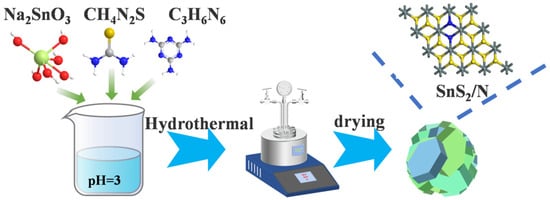
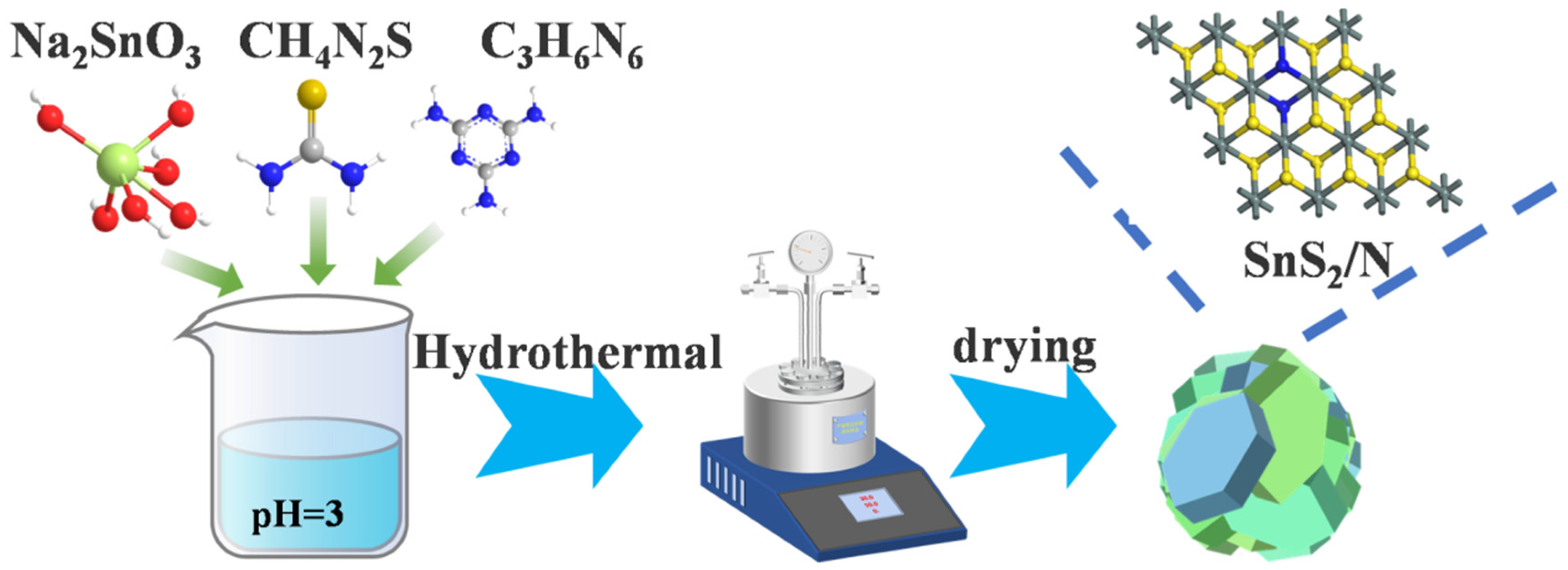
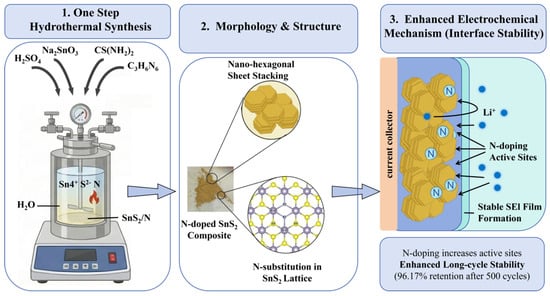
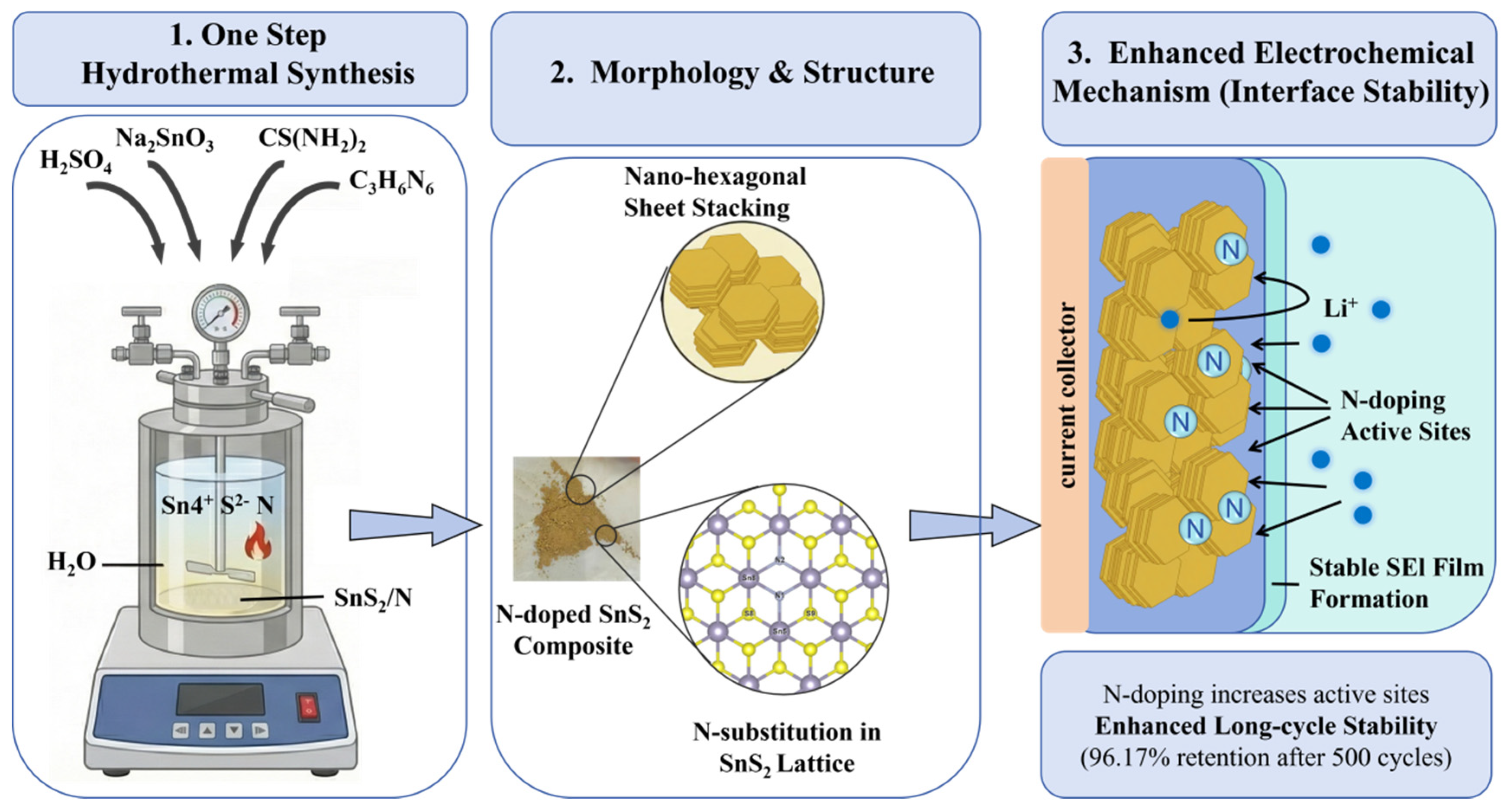
SnS2 and SnS2/N composites were synthesized via a facile one-step hydrothermal method, as schematically illustrated in Figure 1. Initially, 2 mL of H2SO4 (20 vol.%) was added to 78 mL of deionized (DI) water. Subsequently, 1.067 g of sodium stannate (Na2[Sn(OH)6], AR, Shanghai Macklin Biochemical Co., Ltd., Shanghai, China), 0.9 g of thiourea (CS(NH2)2, AR, Tianjin Tianxiang Chemical Reagent Factory, Tianjin, China), and varying amounts (0~0.3 g) of melamine (C3H6N6, AR, Tianjin Tianxiang Chemical Reagent Factory, Tianjin, China) were sequentially dissolved into the solution. The acidity of the system was modulated to pH ≈ 3 by introducing additional H2SO4 (20 vol.%). After stirring at ambient temperature for 30 min to ensure homogeneity, the precursor solution was loaded into a 200 mL polyphenylene (PPL)-lined autoclave equipped with a magnetic stirrer. Upon completion of the hydrothermal process, the reactor was cooled naturally to ambient temperature. The as-collected precipitates were rinsed alternately with deionized water and anhydrous ethanol several times, followed by drying in a vacuum oven at 60 °C for 12 h. To investigate the effect of nitrogen doping concentration, four experimental groups were prepared with melamine additions ranging from 0 to 0.3 g, with the melamine-free sample serving as the counterpart.
Figure 1.
Schematic diagram of the synthesis process for SnS2/N composite material.
2.2. Characterization
The crystal structure of the as-prepared powder samples was characterized by X-ray diffraction (XRD, D8 Advanced, Bruker; Karlsruhe, Germany) with Cu Kα radiation (λ = 0.1544 nm) at a scanning rate of 5 °/min. The surface valence states and chemical bonding configurations were analyzed using X-ray photoelectron spectroscopy (XPS, ESCALAB 250Xi Kα+, Thermo Fisher Scientific; Waltham, MA, USA). The Raman spectra was performed using Horiba Raman Spectroscopy (XploRA plus, Horiba; Kyoto, Japan) with 532 nm laser. The morphology and microstructure were investigated using field-emission scanning electron microscopy (FESEM, JSM-IT800, JEOL; Kyoto, Japan) and high-resolution transmission electron microscopy (HRTEM, JEM-2100, JEOL, Japan).
2.3. Electrochemical Measurements
The half-cells were assembled in an argon-filled glove box (H2O, O2 < 0.01 ppm) using a metallic lithium sheet as the negative electrode, the electrode sheet coated with active material as the counter electrode, and a porous polypropylene membrane (Celgard 2500, Celgard; Charlotte, NC, USA) as the separator. The electrolyte consisted of 1.0 M LiPF6 in a mixture of ethylene carbonate (EC) and dimethyl carbonate (DMC) (1:1 v/v). In this case, the slurry ratio of the working electrode is active material: acetylene black: PVDF = 8:1:1 (weight percentage), with a mass load of 1.14 mg cm−1. the area capacity is approximately 0.68 mAh/cm2. Cyclic Voltammetry (CV) and Electrochemical Impedance Spectroscopy (EIS) tests were conducted using an electrochemical workstation (CHI660E, Shanghai Chenhua Instrument Co., Ltd., Shanghai, China), while galvanostatic charge–discharge tests were performed on a Neware system between 0.01 and 3.0 V at 25 °C.
3. Results and Discussion
3.1. Crystal Structure, Morphology, and Composition
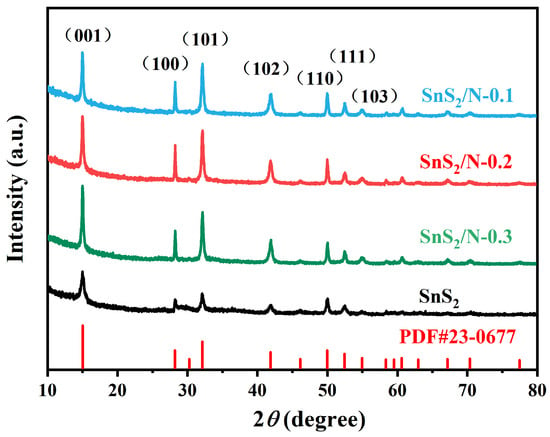
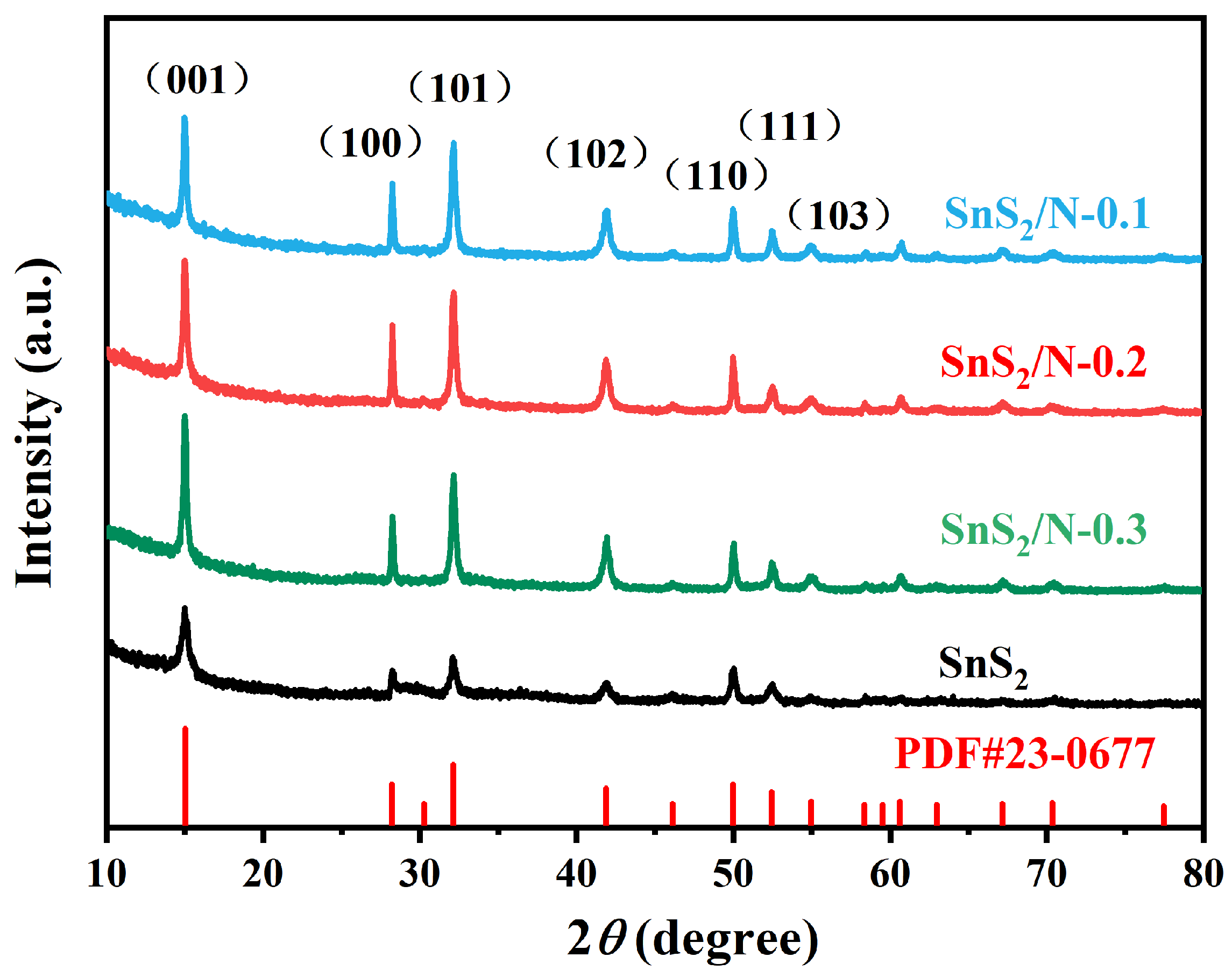
The crystalline phase of SnS2/N composites was characterized by XRD. As shown in Figure 2, all samples synthesized with varying melamine concentrations exhibit distinct diffraction peaks at 15.12°, 28.19°, 32.12°, and 41.88°, corresponding to the (001), (100), (101), and (102) crystal planes of hexagonal SnS2 (JCPDS 23-0677) [32]. The intense diffraction (001) peak at 15.12° indicates a preferential orientation of crystal growth along the layered structure. Crucially, no impurity phases (e.g., SnO2 JCPDS 41-1445 or metallic Sn JCPDS 04-0673) were detected. The remarkable uniformity of the XRD diffraction profiles across various specimens attests to the superior crystallinity and synthetic reproducibility of the as-prepared SnS2/N composites. Furthermore, as observed in Figure 2, the intensity of the (001) characteristic peak gradually increases with increased nitrogen doping levels, suggesting enhanced crystallinity. Within this specific synthesis system, we attribute the observed peak enhancement primarily to the surfactant properties melamine. This compound likely serves as a structural director during the reaction, inducing preferential orientation growth of specific crystal planes. Consequently, the diffraction peak intensity exhibits a significant macroscopic increase [33]. However, the positions and intensities of other diffraction peaks remain largely unchanged, indicating preserved host lattice integrity after nitrogen incorporation. In addition, characteristic nitrogen-related peaks remained undetectable owing to low dopant concentrations and weak diffraction intensity.
Figure 2.
XRD patterns of SnS2/N composites synthesized with different melamine addition amounts.
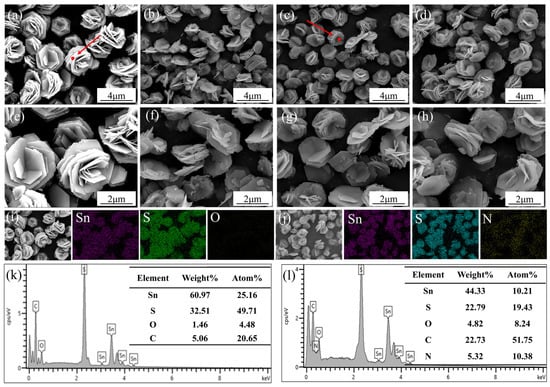
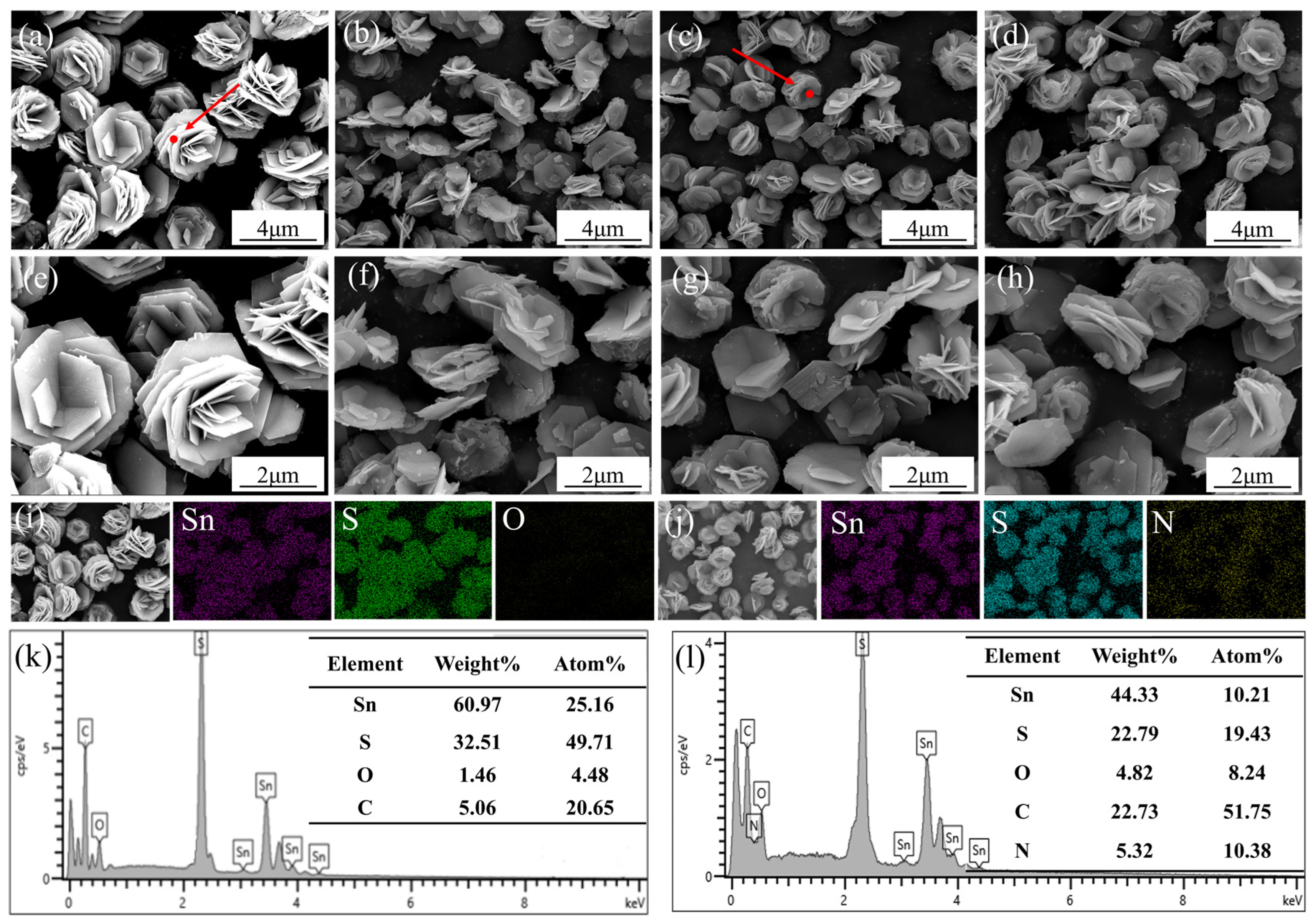
Figure 3a,e shows the FESEM images of pristine SnS2 synthesized without melamine, revealing hexagonal layered nanosheets self-assembled into well-defined microflower architectures. The elemental mapping (Figure 3i) and quantitative energy-dispersive spectroscopy (EDS) analysis (Figure 3k) confirm homogeneous distribution of Sn and S, with their atomic percentages matching the stoichiometric ratio of SnS2. Trace amounts of oxygen detected on the material surface may be attributed to slight oxygen adsorption or minor surface oxidation of the sample. Melamine serves as the nitrogen source and participates in the reaction during synthesis, influencing the crystal growth of SnS2. As shown in Figure 3a–d, compared with the pristine SnS2, the morphology of SnS2/N specimens transitions from microflowers to stacked hexagonal nanosheets, with minimal aggregation observed at 0.2 g doping (Figure 3c). This morphology evolution suggests that nitrogen doping redistributes surface charges, thereby reducing interparticle agglomeration and enhancing the electrochemical stability. However, Figure 3f–h demonstrate that varying the doping amount does not lead to pronounced morphological changes. This may be attributed to the difficulty of melamine molecules adsorbing effectively onto specific crystal planes of SnS2, preventing them from acting as a structure-directing agent to promote growth along particular directions. Given that the adjacent sheets are stacked via weak Van der Waals interactions, the interlayer coupling can be readily modulated while preserving the structural integrity. In order to evaluate the grain size distribution and the degree of aggregation, the FESEM pictures were analyzed using ImageJ-v1.5n software. As shown in Figure S4, statistical analysis reveals that the average particle size significantly decreases from 4.95 ± 1.09 μm for the original SnS2 to 3.63 ± 1.16 μm for the SnS2/N composite material. The reduction in particle size indicates that the nitrogen doping strategy inhibits the agglomeration of SnS2 grains, which can increase the specific surface area of the particles and expose more active sites for electrochemical reactions. As shown in Figure S5, statistical analysis indicates that the agglomeration area ratios for 0.1 g and 0.3 g are both higher than that for 0.2 g. The 0.2 g additive amount (Figure S5b) exhibits the most uniform distribution with the lowest agglomerated area proportion. This indicates that appropriate nitrogen doping effectively suppresses SnS2 agglomeration, resulting in more homogeneous particle distribution. Therefore, 0.2 g of melamine was selected as the optimal condition in this study, balancing doping effectiveness and morphology optimization.
Figure 3.
FESEM images and EDS results of SnS2 and SnS2/N synthesized with different melamine addition amounts. (a) FESEM images of pristine SnS2; (b–d) FESEM images of SnS2/N synthesized with 0.1–0.3 g melamine at 5k× magnification; (e–h) FESEM images of a-d at 10 k× magnification; (i) elemental mapping of SnS2; (j) elemental mapping of SnS2/N; (k) EDS data of the sample at the arrow point in Figure 3a; (l) EDS data of the sample at the arrow point in Figure 3c.
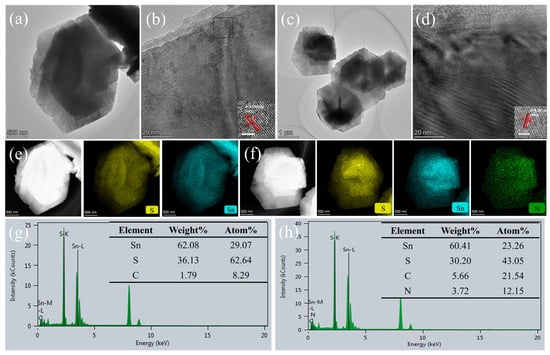
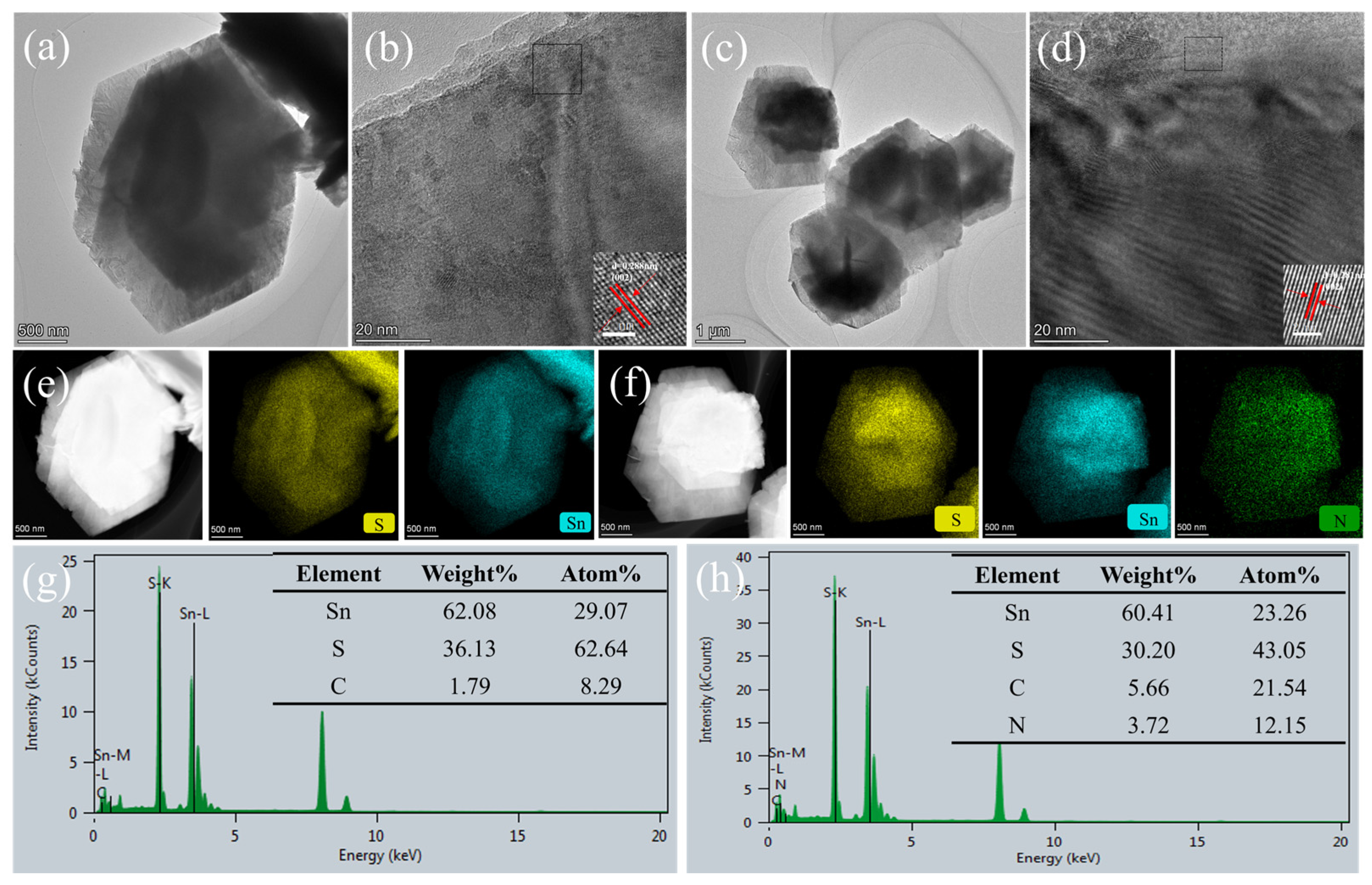
High-resolution transmission electron microscopy (HRTEM) was employed to further analyze the microstructural features of the SnS2 and SnS2/N specimens. As revealed by the HRTEM images, the undoped sample exhibits a distinct hexagonal stacked platelets structure (Figure 4a), while the doped counterpart (Figure 4c) maintains this hexagonal architecture with ~2 μm platelets, confirming preserved crystal integrity consistent with FESEM observations. This suggests that the nitrogen doping process modifies the physicochemical properties of the material without disrupting the ordered arrangement of the host lattice ordering. The interplanar spacing of pristine SnS2 is determined to be 0.288 nm (Figure 4b), which can be indexed to the (100) crystal plane. In contrast, the N-doped counterpart exhibits a reduced interplanar distance of 0.281 nm (Figure 4d) for the corresponding (100) plane. This reduced lattice spacing indicates a contraction effect. Since the atomic radius of nitrogen is smaller than that of sulfur, the substitution of S sites by N leads to a shortening of the bond length (Sn-N < Sn-S), thereby compressing the lattice. Consequently, it is inferred that the nitrogen element is incorporated into the lattice primarily through substitutional doping.
Figure 4.
HRTEM, FTT and EDS data images of SnS2 and SnS2/N. (a) HRTEM image of SnS2; (b) The arrow indicates the lattice spacing of SnS2; (c) HRTEM image of SnS2/N; (d) The arrow indicates the lattice spacing of SnS2/N; (e) EDS elemental Mapping of SnS2; (f) EDS elemental mapping of SnS2/N. (g) EDS spectrum of SnS2; (h) EDS spectrum of SnS2/N.
The elemental mapping (Figure 4e) demonstrates the homogeneous distribution of constituent Sn and S atoms throughout the whole laminar structure. This homogeneous distribution is further corroborated by the EDS stoichiometric atomic percentages shown in Figure 4g. Furthermore, the elemental mapping of SnS2/N in Figure 4f reveals a homogeneous dispersion of the N element throughout the matrix. Such homogeneous nitrogen incorporation effectively modulates surface reactivity, consequently augmenting the overall electrochemical performance of the electrode.
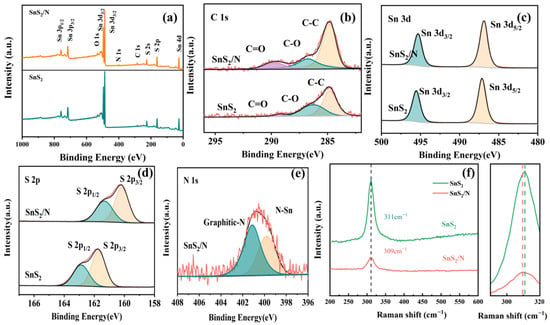
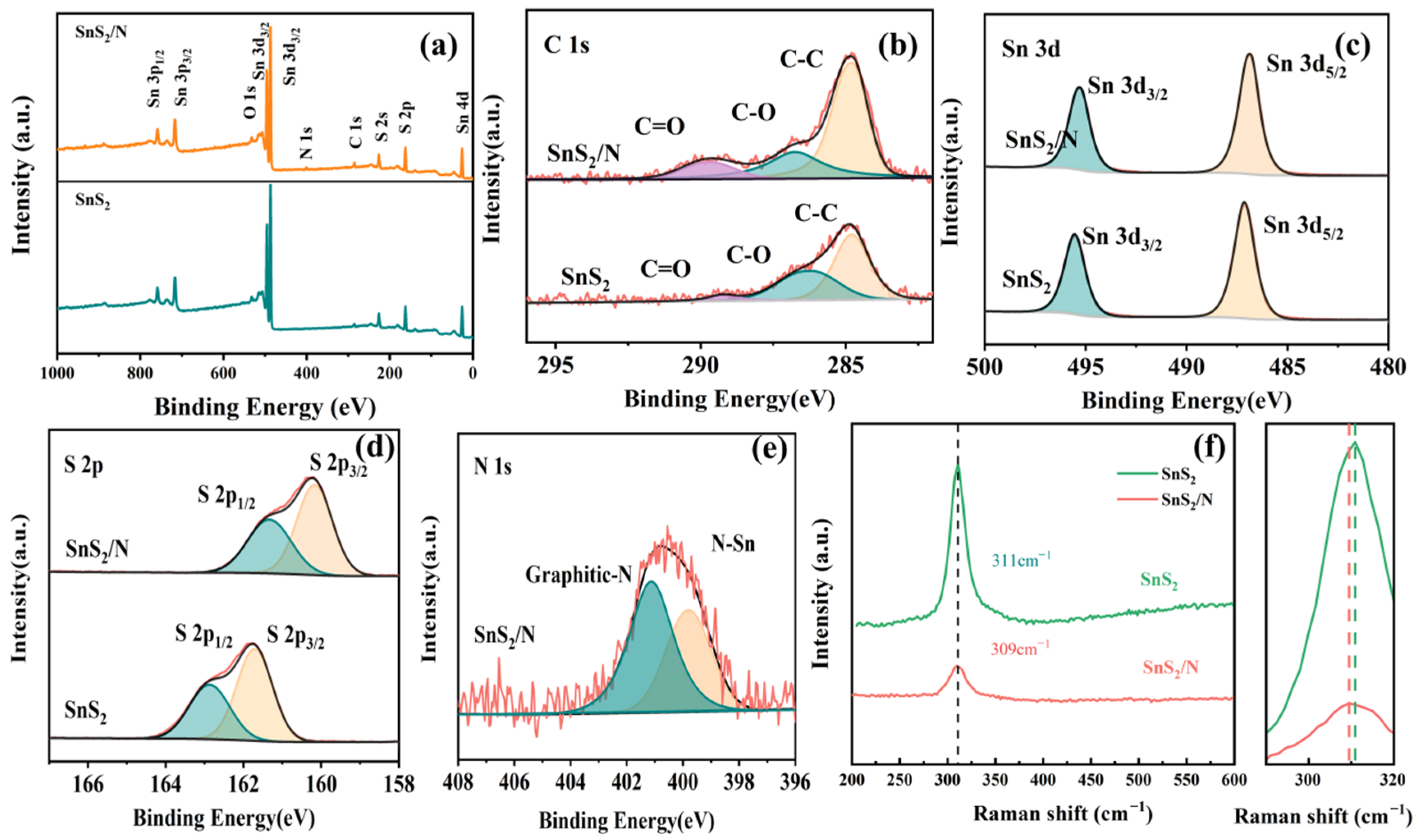
X-ray photoelectron spectroscopy (XPS) measurements were employed to probe the surface elemental composition and valence states of the SnS2/N hybrids. As illustrated in Figure 5a, the panoramic survey profile exhibits distinct characteristic peaks assigned to Sn, S, N, C, and O. In contrast to the pristine SnS2, the clear emergence of the N 1s peak indicates the successful doping of nitrogen.
Figure 5.
XPS and Raman spectra of SnS2 and SnS2/N. (a) XPS Survey spectra; (b) C 1s; (c) Sn 3d; (d) S 2p; (e) N 1s; (f) Raman spectra of SnS2 and SnS2/N, dashed lines indicate the peak position.
The high-resolution C 1s spectrum (Figure 5b) resolves into three distinct components. The prominent peak located at 284.8 eV is ascribed to graphitic sp2-C (C-C), whereas the higher binding energies at 286.75 and 289.7 eV signify the existence of C-O and C=O groups, respectively. For the pure SnS2 reference, the C 1s signals appear at 284.8 eV (C-C), 286.2 eV (C-O), and 289.25 eV (C=O). The observed upshift in binding energies for the oxygenated groups suggests a reconfiguration of the surface electronic environment triggered by N-doping, which modulates the charge transfer dynamics between oxygenated moieties and the host lattice. Furthermore, the elevated fraction of C=O moieties stems from the sulfur vacancies induced by nitrogen incorporation. These vacancies significantly enhance the capability of the material surface to chemically adsorb atmospheric CO2 and H2O, leading to an increased C=O ratio [34]. Consequently, the refining analysis of the C 1s spectrum reveals distinct variations in the chemical environment regarding surface adsorption.
Figure 5c illustrates the refined XPS spectrum of the Sn 3d region. Regarding the N-doped specimen, the Sn 3d spectrum exhibits a characteristic doublet centered at 486.85 eV (3d5/2) and 495.25 eV (3d3/2), respectively. For the undoped reference, these binding energies shift to 487.15 eV (Sn 3d5/2) and 495.55 eV (Sn 3d3/2). The binding energies of both samples align well with the typical values reported for standard Sn4+, confirming that the tin species in the samples exist in the Sn4+ oxidation state [35].
The high-resolution S 2p profile (Figure 5d) resolves into two distinct components at 160.15 eV (S 2p3/2) and 161.35 eV (S 2p1/2). Conversely, the S 2p doublet for the pristine SnS2 counterpart is shifted to higher binding energies of 161.75 and 162.95 eV. This phenomenon is attributed to the presence of sulfur vacancies, which alter the electronic environment of sulfur atoms. Specifically, the formation of vacancies leads to a redistribution of charge density around the remaining sulfur atoms, manifesting as a shift in the S 2p peak. The direction and magnitude of this displacement are consistent with the mechanism of nitrogen-induced vacancy formation [36].
As shown in Figure 5e, the N 1s spectrum can be deconvoluted into two peaks at 401.1 eV and 399.8 eV, corresponding to graphitic-N and N-Sn bonds, respectively. The presence of N-Sn bonds indicates that some N atoms have successfully substituted S atoms within the crystal lattice [37]. Subsequently, we calculated the peak areas of different elements and obtained the corresponding XPS atomic percentages (Table S1). Quantitative analysis of peak areas indicates a low Sn-N concentration (0.71 at%), suggesting limited substitution during synthesis. Notably, even minimal nitrogen doping significantly enhances the anode’s cycling stability. Figure 5f displays the Raman spectra of SnS2 and SnS2/N, where the signal peak at 311 cm−1 represents the A1g mode of SnS2, verifying its presence. In the magnified view on the right, the peak for SnS2/N shifts slightly to a lower wavenumber of 309 cm−1, indicating that N-doping distorts the local SnS2 structure and induces the generation of sulfur vacancies. Combining the lattice contraction observed in HRTEM with the compositional analysis results (S/Sn≈1.85, indicating a sulfur deficiency), it can be deduced that N atoms incorporate into SnS2 via substitutional doping and trigger the formation of abundant sulfur vacancies to maintain the charge balance of the system, which ultimately leads to a decrease in the binding energy [38]. Notably, compared to other heteroatoms such as boron, sulfur, and phosphorus, nitrogen possesses a higher electronegativity and extra free electrons, which is highly beneficial for enhancing the electron transport capability of the material [39]. This modification not only increases the number of the N-active sites but also expands the specific surface area, accelerating the Li+ transport dynamics and consequently boosting the overall energy storage metrics [40].
3.2. Synthesis Mechanism
Although the samples were prepared via a one-step hydrothermal method, the process essentially functions as a ‘black box’ system, making real-time monitoring of the reaction difficult. The formation mechanism can be deduced based on the chemical properties of the reactants. Given that sodium stannate is prone to hydrolysis in aqueous solutions to form tin dioxide (SnO2) precipitates (which cause turbidity), dilute sulfuric acid was introduced initially to adjust the system to an acidic environment. This step effectively inhibits hydrolysis and converts the precursor into soluble and stable Sn4+ salts. Subsequently, the added thiourea hydrolyzes under high-temperature and high-pressure conditions, continuously releasing hydrogen sulfide (H2S) which acts as the sulfur source. Ultimately, the Sn4+ ions react with H2S to nucleate and grow into uniformly dispersed hexagonal SnS2 nanosheets. This unique architecture significantly shortens the solid-state diffusion path for lithium ions, facilitating rapid intercalation/deintercalation kinetics. Meanwhile, the abundant edges of the nanosheets provide a high density of electrochemical active sites. As illustrated in Figure 6, the specific reaction equations are deduced as follows:
Na2SnO3 + H2SO4 → Na2SO4 + H2SnO3
H2SnO3 + 4H+ → Sn4+ + 3H2O
CS(NH2)2 + 2H2O → CO2↑ + 2NH3↑+H2S↑
Sn4+ + 2H2S → SnS2↓ + 4H+
C3H6N6 + 3H2O → 3CO↑ + 6NH3↑
SnS2 + xNH3 → SnS2−xNx + xH2S↑
Figure 6.
Illustration of synthesis mechanism for SnS2/N.
3.3. Electrochemical Performance
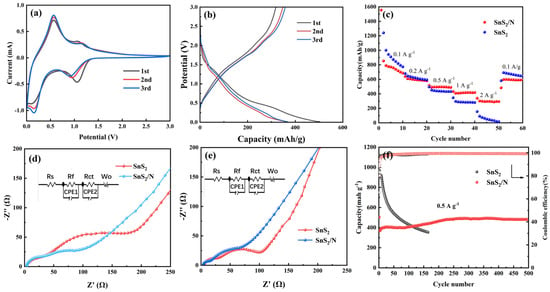
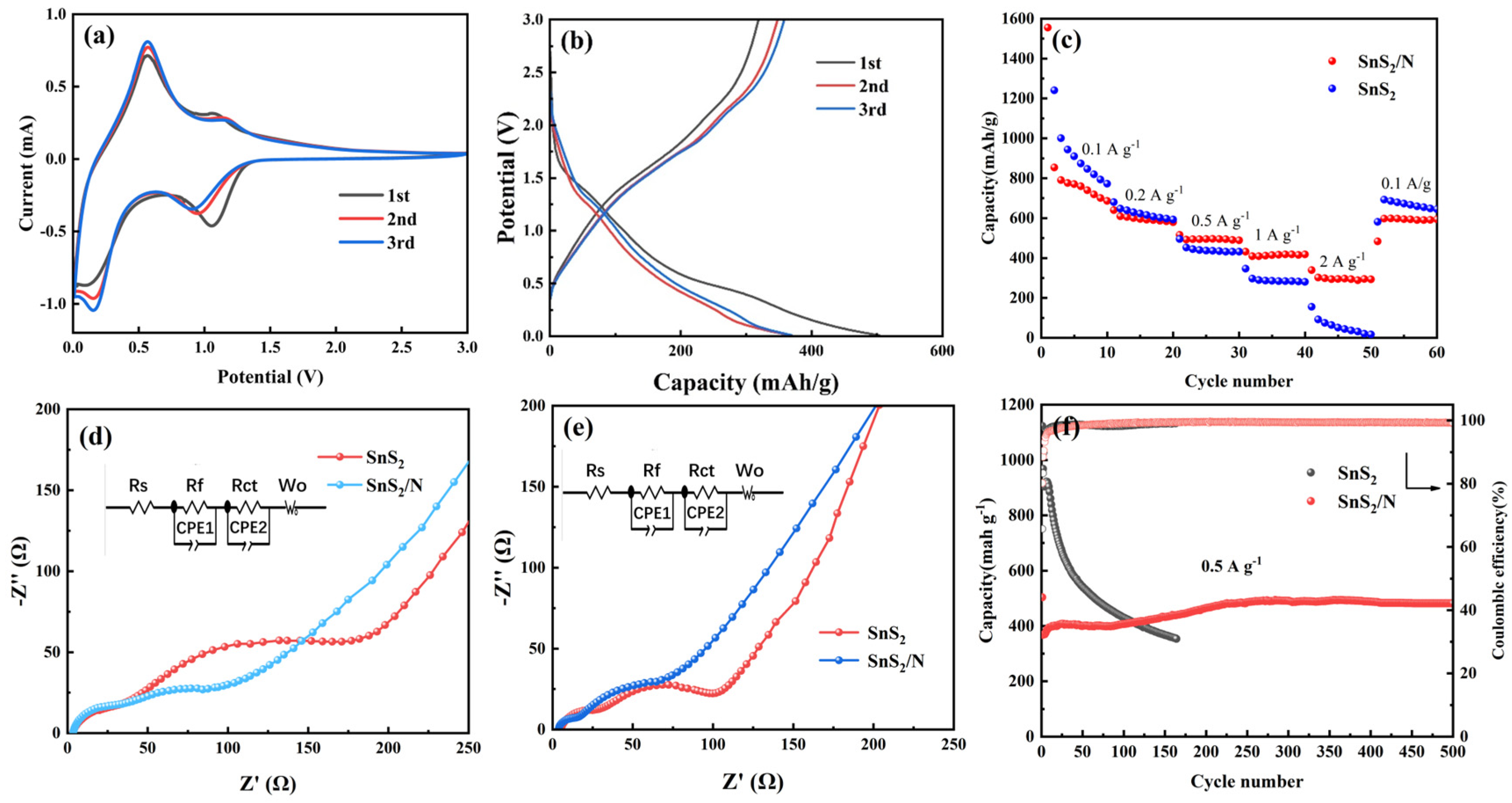
Figure 7a illustrates the first three cyclic voltammograms of the SnS2/N electrode, recorded at a sweep rate of 0.2 mV s−1 across a potential window of 0.01–3.0 V. In the first cathodic sweep, two well-defined reduction peaks emerge at 1.05 V and 0.15 V. The peak at 1.05 V is attributed to the insertion of Li+ ions into the van der Waals gaps of SnS2, yielding amorphous LixSnS2 (Equation (7)) [41]. The prominent reduction signal at 0.15 V is ascribed to the conversion process of LixSnS2 into Li2S and metallic tin (Sn) (Equation (8)). This conversion process occurs simultaneously with the formation of the solid electrolyte interphase (SEI) film. The corresponding current response progressively attenuates in successive scans, ascribed to the thickening of this SEI layer [42]. During the reverse anodic sweep, two distinguishable oxidation peaks are identified at 0.55 V and 1.05 V. The peak located at 0.55 V corresponds to the delithiation reaction of Li2S, releasing Li+ ions and electrons while regenerating sulfur (Equation (9)) [43]. The peak centered at 1.05 V is ascribed to the reaction between the generated Sn and Li2S to reform LiₓSnS2 (Equation (10)). Figure 7b depicts the galvanostatic charge/discharge (GCD) profiles of the N-doped electrode for the initial three loops at a current density of 0.5 A g−1. The electrode delivered specific discharge capacities of 503.25, 369.45, and 367.42 mAh g−1 for cycles 1, 2, and 3, respectively. The initial irreversible capacity loss is predominantly ascribed to the inevitable electrolyte decomposition and the establishment of the SEI layer. Notably, the peak potentials in the CV curves exhibit significant consistency with the lithiation/delithiation plateaus observed in the GCD profiles. Moreover, the excellent superposition of the subsequent voltammograms underscores the robust reversibility of the composite during repetitive lithiation/delithiation [44]. Specifically, the voltage plateau near 1.4 V is ascribed to the Li+ ingress into the van der Waals gaps (yielding intermediate LiₓSnS2), whereas the lower potential steps at 0.4 and 0.2 V reflect the subsequent conversion of this phase into metallic Sn and Li2S. The specific reaction equations can be expressed as follows:
SnS2 + xLi+ + xe−→ LixSnS2
LixSnS2 + (4 − x)Li+ + (4 − x)e− → Sn + 2Li2S
Li2S→S + 2Li+ + 2e−
xLi+ + Sn + xe− → LixSn
Figure 7.
Electrochemical test results of as-prepared SnS2 and SnS2/N. (a) CV curves of SnS2/N; (b) GCD curves of SnS2/N at 0.5 A g−1; (c) rate performance of SnS2/N; (d) equivalent circuit diagram and Nyquist plot of SnS2 and SnS2/N before cycling; (e) equivalent circuit diagram and Nyquist plot of SnS2 and SnS2/N after cycling; (f) long-term cycling curves of SnS2 and SnS2/N at 0.5 A g−1., the arrow indicates the range of Coulomb efficiency.
Figure 7c illustrates the rate performance of the SnS2/N composite (synthesized with 0.2 g melamine) under various current densities. The experimental data reveals that the composite exhibits only a slight decay in specific discharge capacity during the initial cycles. Compared to the pristine SnS2, the SnS2/N hybrid demonstrates enhanced capacity retention across the current density range of 0.1–2.0 A g−1. Specifically, at 1.0 A g−1, the capacity of SnS2/N stabilizes at 418.11 mAh g−1, whereas that of pristine SnS2 drops significantly to 284.48 mAh g−1. The disparity becomes most pronounced under a high current density of 2.0 A g−1.While the capacity of pristine SnS2 continues to decline rapidly, the N-doped hybrid retains a specific reversible capacity of 294.06 mAh g−1, indicating its improved structural stability. Remarkably, upon resetting the rate to 0.1 A g−1, the capacity immediately rebounds to near-initial values, verifying the robust recoverability of the electrode. Collectively, these findings underscore the improved cycling longevity of the synthesized material.
The superior performance of the material is attributed to the multiple synergistic effects induced by nitrogen doping. Fundamentally, the N-doping strategy boosts the intrinsic electron transport capability of the hybrid and substantially mitigates electrode polarization, thereby accelerating the charge transfer kinetics during the lithium intercalation/deintercalation processes. Furthermore, heteroatom doping promotes the formation of a high density of reactive defects at the composite interface. These sites effectively adsorb and store lithium ions, thus boosting the lithium-storage capability of the electrode material [45]. These favorable attributes synergistically enable the SnS2/N composite to sustain excellent electrochemical performance even under demanding high current densities.
Figure 7d displays the Nyquist plots of both SnS2 and SnS2/N anodes obtained from EIS measurements, providing further insight into their electrochemical kinetic properties. Notably, the SnS2/N composite exhibits a significantly smaller semicircle diameter in the high-frequency region compared to pristine SnS2, indicating a substantial reduction in charge transfer resistance (Rct). This confirms that N-doping effectively enhances the electrical conductivity of the material, thereby accelerating the transport processes during the charge/discharge cycles. In the low-frequency region, the steeper slope observed for the SnS2/N electrode suggests superior solid-state lithium-ion diffusion kinetics. These results conclusively demonstrate that nitrogen doping further boosts the capacity and cycling stability of the battery by simultaneously optimizing both electronic conduction and ion diffusion processes.
Figure 7d,e shows the Nyquist plots and the corresponding equivalent circuit (fitting data and quality are shown in Table S2) before and after cycling, respectively. Before cycling, the Rct of SnS2 was as high as 171.42 Ω, and the Rct of SnS2/N was 75.55 Ω. After 100 cycles, the solution resistance (Rs), SEI film resistance (Rf), and charge transfer resistance (Rct) of SnS2/N were 4.14 Ω, 11.89 Ω and 44.48 Ω, respectively. The values of the original SnS2 were even higher, at 5.41 Ω (Rs), 22.71 Ω (Rf), and 71.2 Ω (Rct), respectively. A comparison of these spectra indicates a significant reduction in the semicircle diameters for SnS2/N across both frequency regions. This suggests that nitrogen doping not only enhances the intrinsic conductivity but also facilitates the formation of a stable SEI film with lower resistance. The markedly lower charge transfer resistance of the SnS2/N composite, compared to that of pristine SnS2, provides conclusive evidence of its superior electrical conductivity and accelerated charge transfer kinetics.
As shown by the long-term specific capacity curves in Figure 7f, the initial coulombic efficiencies (ICE) of SnS2 and SnS2/N are 65.69% and 80.22%, The Coulomb efficiency of SnS2/N remains stable at 99.29%. The SnS2/N composite exhibits superior stability and significantly lower capacity decay over repeated charge–discharge cycles. After 500 cycles at a current density of 500 mA g−1, the composite retains a specific capacity of 481.66 mAh g−1, corresponding to a high retention rate of 96.17%. The observed capacity increase during prolonged cycling is primarily driven by continuous electrochemical activation coupled with progressive amorphization [46,47]. These processes provide additional capacity contribution in the initial stages until the material structure reaches its ultimate thermodynamically stable state. In sharp contrast to the rapid capacity degradation observed in pristine SnS2, the SnS2/N composite displays a significant performance advantage.
Table 1 lists a literature survey of some reported advanced SnS2-based anode materials. In this study, SnS2/N maintained a specific capacity of 481.66 mAh g−1 even after 500 cycles at a current density of 0.5 A g−1, successfully achieving the stability goal of specific capacity for medium to long cycle periods.
Table 1.
Electrochemical performance of some reported SnS2-based anode materials.
3.4. Theoretical Calculations
To further investigate the mechanism of nitrogen doping in SnS2, first-principles calculations based on Density Functional Theory (DFT) were performed to systematically examine the structural stability and electronic properties of the doped system [54,55,56]. All calculations were implemented using the Vienna Ab initio Simulation Package (VASP). The electron–ion interactions were described by the Projector Augmented Wave (PAW) method, while the exchange-correlation energy was treated using the Perdew–Burke–Ernzerhof (PBE) functional under the Generalized Gradient Approximation (GGA) framework [57,58,59,60]. To accurately simulate the doping environment, a 3 × 3 × 1 supercell was constructed from the pristine hexagonal SnS2 unit cell (space group P-3m1).
Regarding calculation parameter settings, the plane wave cutoff energy was set to 400 eV, and the Brillouin zone integration used a Γ-centered 7 × 7 × 1 Monkhorst–Pack grid for k-point sampling. To accommodate the layered nature of this 2D material, a vacuum isolation layer with a thickness of 15 Å was set along the crystal c-axis to eliminate periodic image interactions. In geometric optimization, the convergence criteria for force and energy were set to 0.01 eV/Å and 10−5 eV, respectively, ensuring the system reached a ground-state stable configuration. Structural optimization calculations revealed that the lattice constants of a = b = 3.69 Å for the SnS2 monolayer, showing less than 5% deviation from reported literature values, which validates the reliability of the calculation method [61].
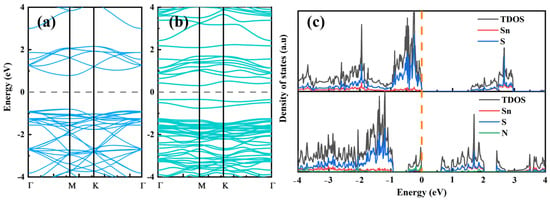
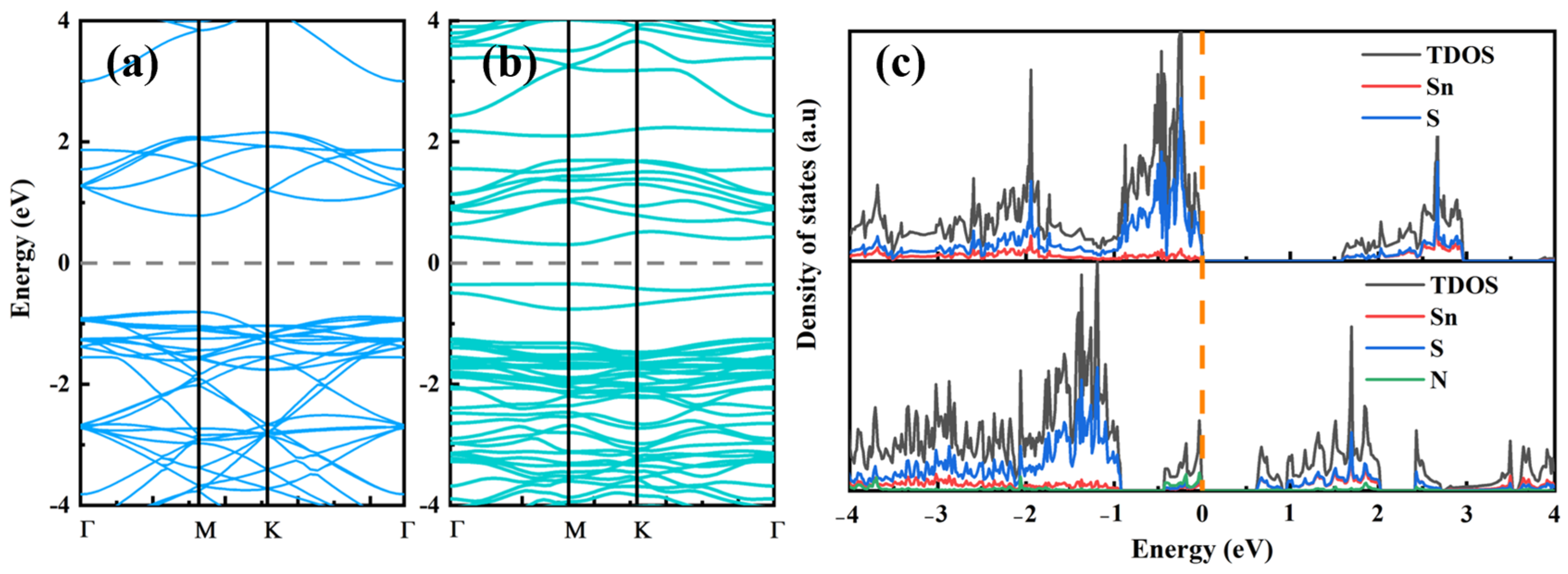
The electronic band structure serves as a critical determinant of conductivity, where a narrower band gap generally indicates superior electron transport [62]. Our calculations indicate a bandgap of 1.58 eV for pristine SnS2, consistent with reported values [63]. This bandgap width lies between insulators and metallic materials, belonging to the semiconductor range. However, the bandgap of SnS2/N exhibits a reduced bandgap of 0.65 eV, thus further suggesting significantly improved electrical conductivity.
The Density of States (DOS) reveals the electron distribution within materials, where high-DOS regions typically indicate a larger number of electrons participating in conduction [64]. As depicted in Figure 8c, S atoms dominate the density of states near the Fermi level of SnS2. The valence band mainly originates from S orbitals, while the conduction band arises from the joint contributions of S and Sn elements [65]. Although the total density of states (TDOS) for both SnS2 and SnS2/N is zero at the Fermi level, the contribution of N atoms to the electronic states near the Fermi level in the SnS2/N system is greater than that of S atoms. This is precisely because the higher electronegativity of N atoms compared to S atoms induces a redistribution of the local charge density. Consequently, the additional electronic states introduced by the orbital hybridization of N atoms shift toward the Fermi level, leading to a significant narrowing of the bandgap (Eg) from 1.56 eV to 0.65 eV [66]. This theoretical prediction is corroborated by electrochemical impedance spectroscopy (EIS) testing: the charge transfer resistance (Rct) after activation decreased from 71.2 Ω to 44.48 Ω, as the reduced bandgap effectively lowers the activation energy for electron transport [67].
Figure 8.
Band structure and DOS diagrams of SnS2/N and SnS2. (a,b) Band diagrams of SnS2 and SnS2/N; (c) DOS diagrams of SnS2 and SnS2/N.
Specifically, the quantitative EDS analysis reveals a significant decrease in the S/Sn atomic ratio (~1.35), confirming that nitrogen doping indeed induces a high concentration of sulfur vacancies. Morphologically, the substitutional doping of N elements leads to a decrease in lattice spacing. These two factors collectively contribute to the reduction in Rct in the EIS measurements. Furthermore, by fitting the EIS impedance data, we obtained the Warburg impedance coefficients (σw). As shown in Figure S6, the σw values for SnS2 and SnS2/N are 386.82 and 169.35, respectively. Accordingly, the calculated lithium-ion diffusion coefficient (DLi+) of SnS2/N is approximately 5.22 times higher than that of SnS2. These results further demonstrate that N-doping can accelerate ion/charge diffusion and enhance the overall electrical conductivity of the electrode.
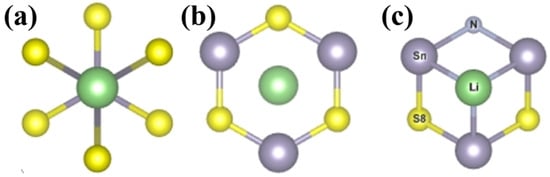
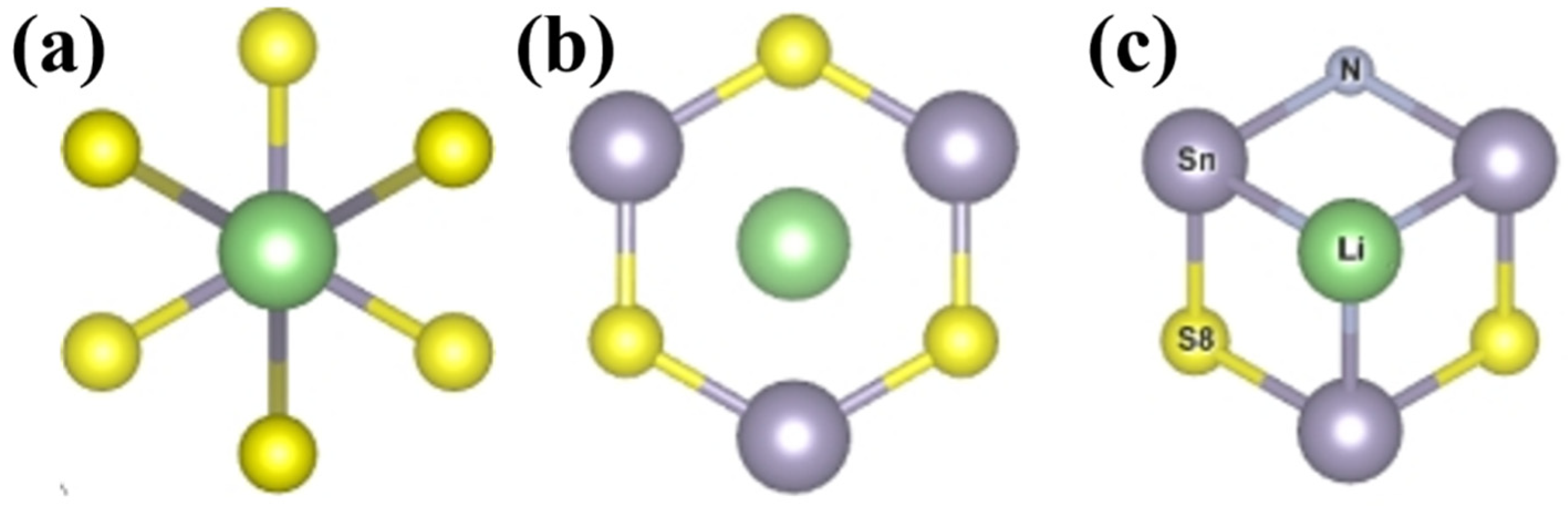
Subsequently, we calculated the Li+ adsorption energies of SnS2. As illustrated in Figure 9a,b, calculations on the Sn-top and S-top sites of SnS2 reveal that Li+ exhibits a stronger adsorption at the Sn-top site. We then evaluated the adsorption energy for the SnS2/N system. As summarized in Table 2, the calculated value is approximately −2.18 eV. Generally, a lower (more negative) adsorption energy indicates that Li+ can more readily intercalate into the interlayers.
Figure 9.
Different adsorption sites on SnS2 and SnS2/N. (a) SnS2 point 1; (b) SnS2 point 2; (c) SnS2/N point 3.
Table 2.
Adsorption energies at the Sn and S top sites of SnS2, and the N top site of SnS2/N.
4. Conclusions
In summary, SnS2/N composites featuring a stacked hexagonal nanosheet architecture were successfully synthesized via a facile hydrothermal method, achieving uniform nitrogen incorporation into the SnS2 lattice through substitutional doping. The sample synthesized with 0.2 g of nitrogen source exhibited optimal dispersion, effectively suppressing particle agglomeration and ensuring stable lithium storage. Moreover, the abundant active sites introduced by N-doping reduce the diffusion barrier for Li+, resolving the inherent stability limitations of pristine SnS2. Consequently, the SnS2/N material demonstrates a superior electrochemical performance, delivering an initial discharge capacity of 500.8 mAh g−1 at a current density of 0.5 A g−1 and maintaining 481.66 mAh g−1 after 500 cycles. This corresponds to a high capacity retention of 96.17%, significantly outperforming pristine SnS2 and demonstrating exceptional potential as a lithium-ion battery anode.
Supplementary Materials
The following supporting information can be downloaded at: https://www.mdpi.com/article/10.3390/batteries12030091/s1, Figure S1: XRD patterns of specimens prepared at varied pH values; Figure S2: FESEM images and EDS data of synthesized samples at different pH values; Figure S3: Electrochemical cycling tests of specimens synthesized at different pH values; Figure S4: Particle size distribution diagram; Figure S5: FESEM images and statistical distribution of aggregation area with different doping amounts; Figure S6: The Warburg impedance coefficients (σw) of SnS2 and SnS2/N; Table S1: Atomic Ratio of SnS2 and SnS2/N from XPS measurement; Table S2: Equivalent circuit models fitting data and quality.
Author Contributions
Resources, W.L.; data curation, L.Z., Y.H., S.W. and H.L.; writing—original draft preparation, W.L., L.Z., J.Z. and M.L.; writing—review and editing, W.L., L.Z., J.Z., M.L., Y.H., S.W. and H.L.; supervision, W.L.; project administration, W.L.; funding acquisition, W.L. All authors have read and agreed to the published version of the manuscript.
Funding
This research was funded by Natural Science Foundation of Henan Province (No. 252300420028), Henan Provincial Science and Technology Research Project (No. 24B430007), and Student Research Training Program of Henan University of Science and Technology (No. 2024049).
Data Availability Statement
The data supporting the findings of this study are available within the article. Further inquiries can be directed to the corresponding author.
Acknowledgments
All authors gratefully acknowledge the support from the “Collaborative Innovation Center for New Materials and Advanced Processing Technologies of Nonferrous Metals” and the “Advanced Wear Resistant Material of Changjiang Scholars and Innovative Research Team in University of Ministry of Education of China”.
Conflicts of Interest
The authors declare no conflicts of interest.
Abbreviations
The following abbreviations are used in this manuscript:
| SnS2 | Tin disulfide |
| LIBs | Lithium-ion batteries |
| SEI | Solid electrolyte interphase |
| DFT | density functional theory |
| EVs | Electric vehicles |
| TMSs | Transition metal sulfides |
| 2D | Two-dimensional |
| DI | Deionized |
| PPL | Polyphenylene |
| XRD | X-ray diffraction |
| XPS | X-ray photoelectron spectroscopy |
| FESEM | Field-emission scanning electron microscopy |
| HRTEM | High-resolution transmission electron microscopy |
| EC | Ethylene carbonate |
| DMC | Dimethyl carbonate |
| CV | Cyclic Voltammetry |
| EIS | Electrochemical Impedance Spectroscopy |
| EDS | Energy-dispersive spectroscopy |
| SnO2 | Tin dioxide |
| H2S | Hydrogen sulfide |
| Rct | Charge transfer resistance |
| Rs | Solution resistance |
| Rf | Film resistance |
| VASP | Vienna Ab initio Simulation Package |
| PAW | Projector Augmented Wave |
| PBE | Perdew–Burke–Ernzerhof |
| GGA | Generalized Gradient Approximation |
| DOS | Density of States |
| CBM | Conduction band minimum |
References
- Ghahari, A.; Raissi, H. Architectural design of anode materials for superior alkali-ion (Li/Na/K) batteries storage. Sci. Rep. 2024, 14, 3959. [Google Scholar] [CrossRef] [Scilit]
- Zhu, Z.; Jiang, T.; Ali, M.; Meng, Y.; Jin, Y.; Cui, Y.; Chen, W. Rechargeable batteries for grid scale energy storage. Chem. Rev. 2022, 122, 16610–16751. [Google Scholar] [CrossRef] [Scilit] [PubMed]
- Fan, L.Q.; Deng, X.G.; Zhu, X.T.; Song, X.Y.; Wang, L.N.; Deng, F.F.; Yu, F.D.; Huang, Y.F.; Wu, J.H. Superior-performance SnS2 anodes enabled by Ti3C2Tx and carbon for lithium-ion hybrid capacitors. J. Electroanal. Chem. 2025, 996, 119436. [Google Scholar] [CrossRef] [Scilit]
- Liu, D.; Zhong, J.; Cai, Z.; Zhan, Z.; Zheng, C.; Huang, S. Tuning crystalline preferred orientation of SnSe2 anode by Co-doping to enhance pseudocapacitive behaviors for high-performance sodium storage. ACS Appl. Mater. Interfaces 2024, 16, 57180–57189. [Google Scholar] [CrossRef] [Scilit]
- Guan, J.; Liu, M.; Zhu, L.; Wang, J.; Han, Q.; Yang, X.; Hua, W.; Xie, L.; Cao, X. Ni/Co bimetallic organic frameworks nanospheres for high-performance electrochemical energy storage. Nano Res. 2024, 17, 5122–5130. [Google Scholar] [CrossRef] [Scilit]
- Cheng, W.-X.; Mao, T.-T.; Chen, Y.-Z.; Cui, S.-F.; Chen, J.; Deng, D.-R.; Feng, R.-M.; Liao, S.-Y.; Min, Y.-G. In-situ synthesis and application of hollow H-SnS/MXene@C nanobox for advanced LIBs and NIBs anodes. J. Energy Storage 2024, 84, 110709. [Google Scholar] [CrossRef] [Scilit]
- Liu, W.; Yang, S.; Fan, D.; Wu, Y.; Zhang, J.; Lu, Y.; Fu, L. PEG–PVP-assisted hydrothermal synthesis and electrochemical performance of N-doped MoS2/C composites as anode material for lithium-ion batteries. ACS Omega 2024, 9, 9792–9802. [Google Scholar] [CrossRef] [Scilit]
- Glibo, A.; Eshraghi, N.; Surace, Y.; Mautner, A.; Flandorfer, H.; Cupid, D.M. Comparative study of electrochemical properties of SnS and SnS2 as anode materials in lithium-ion batteries. Electrochim. Acta. 2023, 441, 141725. [Google Scholar] [CrossRef] [Scilit]
- Cha, E.; Yun, J.H.; Ponraj, R.; Kim, D.K. A mechanistic review of lithiophilic materials: Resolving lithium dendrites and advancing lithium metal-based batteries. Mater. Chem. Front. 2021, 5, 6294–6314. [Google Scholar] [CrossRef] [Scilit]
- Yuan, K.; Lin, Y.; Li, X.; Ding, Y.; Yu, P.; Peng, J.; Wang, J.; Liu, H.; Dou, S. High-Safety Anode Materials for Advanced Lithium-Ion Batteries. Energy Environ. Mater. 2024, 7, e12759. [Google Scholar] [CrossRef] [Scilit]
- Tomov, R.I.; Yarmolich, D.; Kumar, V. Layered Binder-Free C/Si Anodes for Li Ion Batteries. Batteries 2025, 11, 400. [Google Scholar] [CrossRef] [Scilit]
- Bekzhanov, A.; Mohammad, I.; Sallfeldner, L.; Kleitz, F.; Cupid, D. One-Step Solid-State Synthesis of Sandwich-like, Porous C–SnS2 Matrix Composites as Anode Materials for Rechargeable Lithium Ion Batteries. Small Sci. 2025, 5, 2500192. [Google Scholar] [CrossRef] [Scilit]
- Hu, C.; Zhou, C.; Xia, F.; Wang, H.; Zhou, C.; Zhang, Y.; Tao, Q.; Meng, Y.; Li, X. Mesoporous CoO@SnO2 yolk–shell nanospheres as enhanced anode materials for lithium-ion batteries. J. Energy Storage 2025, 111, 115390. [Google Scholar] [CrossRef] [Scilit]
- Shi, Z.; Wang, B.; Zhang, Z.; Chen, H.; Shi, Y.; Sui, Y.; Wu, L. Hierarchical MXene/SnS2 with honeycomb architecture for high performance anode material of Li-ion batteries. Appl. Surf. Sci. 2025, 711, 164021. [Google Scholar] [CrossRef] [Scilit]
- Xiang, Y.; Yu, K.; Guo, J.; Liang, C.; Li, Y. Biomass porous carbon spheres decorated with SnS2 used as high performance anode for lithium-ion batteries. Diam. Relat. Mater. 2025, 158, 112687. [Google Scholar] [CrossRef] [Scilit]
- Bekzhanov, A.; Daniyeva, N.; Jiang, Q.; Surace, Y.; Kleitz, F.; Cupid, D. Hydrothermally Synthesized SnS2 Anode Materials with Selectively Tuned Crystallinity. Small Sci. 2025, 5, 2400516. [Google Scholar] [CrossRef] [Scilit]
- Hao, P.; Ma, F.; Lu, G.; Deng, T.; Sun, S.; Xu, C. Three-dimensional flexible framework synergized with sodiophilic SnS2 nanosheet arrays to realize high-performance sodium-metal battery. J. Power Sources 2025, 644, 237095. [Google Scholar] [CrossRef] [Scilit]
- Su, W.; Xie, Y.; Wu, K.; Xiong, D.; Chen, L.; Feng, Z.; Wen, K.; Li, Z.; He, M. SnS2/B4C@OUCNTs as a high-performance anode material for lithium-ion batteries. Ionics 2023, 29, 3955–3969. [Google Scholar] [CrossRef] [Scilit]
- Liu, W.; Zhang, J.; Fan, D.; Lu, Y.; Fu, L.; Zhang, L.; Li, M. Hydrothermal Synthesis and Electrochemical Performance of the Ce2Mo3O12/MoS2/C Composite as Anode Material for Lithium-Ion Batteries. ACS Omega 2025, 10, 18539–18551. [Google Scholar] [CrossRef] [Scilit]
- Bounbaâ, M.; Khuili, M.; Allaoui, I.; Maher, K.; Atmani, E.H.; Fazouan, N. First-principles DFT study of Janus MoSY (Y = Se, Te) monolayers as high-performance anodes for lithium-ion batteries. J. Energy Storage 2025, 132, 117696. [Google Scholar] [CrossRef] [Scilit]
- Shi, L.; Jiao, R.; Liang, H.; Zhao, Y.; Sun, B.; Lan, D.; Liu, K.; Chen, X.; Lang, Z.; Cui, J. Amorphous carbon-anchored SnS2 microspheres constructed from ultrathin nanosheets for high initial coulombic efficiency anodes in sodium-ion batteries. Electrochim. Acta 2025, 541, 147350. [Google Scholar] [CrossRef] [Scilit]
- Kim, H.S.; Chung, Y.H.; Kang, S.H.; Sung, Y.E. Electrochemical behavior of carbon-coated SnS2 for use as the anode in lithium-ion batteries. Electrochim. Acta 2009, 54, 3606–3610. [Google Scholar] [CrossRef] [Scilit]
- Shi, X.; Chen, S.; Fan, H.; Chen, X.; Yuan, D.; Tang, Q.; Hu, A.; Luo, W.; Liu, H. Metallic-State SnS2 Nanosheets with Expanded Lattice Spacing for High-Performance Sodium-Ion Batteries. ChemSusChem 2019, 12, 4046–4053. [Google Scholar] [CrossRef] [Scilit]
- Yin, S.; Wang, Y.; Zhang, X.; Wei, C.; Huang, X.; Wen, G. External and internal Cultivation: Design for Mo-doped SnS2/SnO2 heterostructure on N-doped graphene achieves Kinetics-Enhanced and Superior-Lithium storage performance. Appl. Surf. Sci. 2023, 609, 155435. [Google Scholar] [CrossRef] [Scilit]
- Wang, Y.; Liu, Q.; Liu, Y.; Shuying, L. Facile synthesis of MoS2/SnS2/NC heterojunction nanosphere composite as high-performance anode material for sodium-ion batteries. J. Alloys Compd. 2023, 967, 171562. [Google Scholar] [CrossRef] [Scilit]
- Wu, C.P.; Xie, K.X.; He, J.P.; Wang, Q.P.; Ma, J.M.; Yang, S.; Wang, Q.H. SnO2 quantum dots modified N-doped carbon as high-performance anode for lithium ion batteries by enhanced pseudocapacitance. Rare Met. 2020, 40, 48–56. [Google Scholar] [CrossRef] [Scilit]
- Liu, Y.; Wei, Z.; Zhong, B.; Wang, H.; Xia, L.; Zhang, T.; Duan, X.; Jia, D.; Zhou, Y.; Huang, X. O-, N-Coordinated single Mn atoms accelerating polysulfides transformation in lithium-sulfur batteries. Energy Storage Mater. 2021, 35, 12–18. [Google Scholar] [CrossRef] [Scilit]
- Chang, X.; Wang, T.; Liu, Z.; Zheng, X.; Zheng, J.; Li, X. Ultrafine Sn nanocrystals in a hierarchically porous N-doped carbon for lithium ion batteries. Nano Res. 2017, 10, 1950–1958. [Google Scholar] [CrossRef] [Scilit]
- Chong, P.; Zhou, Z.; Li, Y.; Wang, J.; Xiu, J.; Wei, M. Three-dimensional structure S-SnS2/NSG with sulfur vacancies for high-performance lithium-ion batteries. J. Alloys Compd. 2023, 939, 168828. [Google Scholar] [CrossRef] [Scilit]
- Hu, J.; Yuan, J.; Zhao, L.; Li, G.; Chen, D.; Han, W.; Zhang, Y. Few-layered MoS2 with S-vacancies anchored on N-doped carbon flower for high performance sodium storage. J. Alloys Compd. 2022, 895, 162514. [Google Scholar] [CrossRef] [Scilit]
- Zhao, Z.; Sun, G.; Zhang, Y.; Hua, R.; Wang, X.; Wu, N.; Li, J.; Liu, G.; Guo, D.; Cao, A.; et al. Introduction of SnS2 to Regulate the Ferrous Disulfide Phase Evolution for the Construction of Triphasic Heterostructures Enabling Kinetically Accelerated and Durable Sodium Storage. Adv. Funct. Mater. 2024, 34, 2314679. [Google Scholar] [CrossRef] [Scilit]
- Ma, H.; Lu, Z.; Xie, J.; Hu, J.; Meng, H.; Wang, M.; Zhang, X.; Yin, X.; Cao, Y. Ultra-thin SnS2 nanosheets grown on carbon nanofibers with high-performance in sodium-ion energy storage. Chem. Eng. J. 2024, 497, 154494. [Google Scholar] [CrossRef] [Scilit]
- Wei, Y.; Duan, Y.; Li, Z.; Wu, H.; Bu, H.; Yang, C.; Yuan, P. Surfactant-Enhanced Crystallinity in Lanthanum-Doped Magnetite for High-Capacity, Regenerable Phosphate Adsorption from Wastewater. Ind. Eng. Chem. Res. 2025, 64, 24070–24080. [Google Scholar] [CrossRef] [Scilit]
- Shibuya, R.; Takeyasu, K.; Guo, D.; Kondo, T.; Nakamura, J. Chemisorption of CO2 on Nitrogen-Doped Graphitic Carbons. Langmuir 2022, 38, 14430–14438. [Google Scholar] [CrossRef] [Scilit]
- Li, C.; Pfeifer, K.; Luo, X.; Melinte, G.; Wang, J.; Zhang, Z.; Zhang, Y.; Dong, P.; Sarapulova, A.; Ehrenberg, H.; et al. Investigation of SnS2 -rGO Sandwich Structures as Negative Electrode for Sodium-Ion and Potassium-Ion Batteries. ChemSusChem 2023, 16, e202202281. [Google Scholar] [CrossRef] [Scilit]
- Li, H.; Wang, Y.; Wei, K.; He, M.; Yan, M.; Peng, F.; Gao, F. Modifying Microenvironment in Van der Waals Gap by Cu/N Co-Doping Strategy for Highly Efficient Nitrite Reduction to Ammonia. Adv. Sci. 2025, 12, e2417773. [Google Scholar] [CrossRef] [Scilit]
- Li, X.; Wang, H.; Robinson, J.T.; Sanchez, H.; Diankov, G.; Dai, H. Simultaneous nitrogen doping and reduction of graphene oxide. J. Am. Chem. Soc. 2009, 131, 15939–15944. [Google Scholar] [CrossRef] [Scilit]
- Bhattacharyya, A.; Madhusudhana Rao, N. Synthesis and characterization of Nd-doped SnS2 nanoparticles: Enhanced near-infrared luminescence and magnetic properties. J. Mater. Sci. Mater. Electron. 2025, 36, 157. [Google Scholar] [CrossRef] [Scilit]
- Chen, J.; Xu, J.; Zhou, S.; Zhao, N.; Wong, C.P. Nitrogen-doped hierarchically porous carbon foam: A free-standing electrode and mechanical support for high-performance supercapacitors. Nano Energy 2016, 25, 193–202. [Google Scholar] [CrossRef] [Scilit]
- Matsagar, B.M.; Yang, R.X.; Dutta, S.; Ok, Y.S.; Wu, K.C.W. Recent progress in the development of biomass-derived nitrogen-doped porous carbon. J. Mater. Chem. A 2021, 9, 3703–3728. [Google Scholar] [CrossRef] [Scilit]
- Chen, Q.; Lu, F.; Xia, Y.; Wang, H.; Kuang, X. Interlayer expansion of few-layered Mo-doped SnS2 nanosheets grown on carbon cloth with excellent lithium storage performance for lithium ion batteries. J. Mater. Chem. A 2017, 5, 4075–4083. [Google Scholar] [CrossRef] [Scilit]
- Wu, K.; Wu, C.J.; Tseng, C.M.; Chang, J.K.; Lee, T.C. Structure-mediated electrochemical performance of SnS2 anode for Li-ion batteries. J. Taiwan Inst. Chem. Eng. 2016, 66, 292–300. [Google Scholar] [CrossRef] [Scilit]
- Chombo, P.V.; Laoonual, Y. A review of safety strategies of a Li-ion battery. J. Power Sources 2020, 478, 228649. [Google Scholar] [CrossRef] [Scilit]
- Liu, H.; Zhu, Z.; Demir, M.; He, Y.; Saha, P.; Cheng, Q. Controllable Synthesis of Heterogeneous ZnS/SnS2 Encapsulated in Hollow Nitrogen-Doped Carbon Microcubes as Anode for High-Performance Li-ion Capacitors. Chem.—Asian J. 2025, 20, e202400926. [Google Scholar] [CrossRef] [Scilit]
- Liu, C.; Liu, X.; Tan, J.; Wang, Q.; Wen, H.; Zhang, C. Nitrogen-doped graphene by all-solid-state ball-milling graphite with urea as a high-power lithium ion battery anode. J. Power Sources 2017, 342, 157–164. [Google Scholar] [CrossRef] [Scilit]
- Choi, Y.S.; Choi, W.; Yoon, W.S.; Kim, J.M. Unveiling the genesis and effectiveness of negative fading in nanostructured iron oxide anode materials for lithium-ion batteries. ACS Nano 2022, 16, 631–642. [Google Scholar] [CrossRef] [Scilit]
- Nie, Z.; Huang, Y.; Ma, B.; Qiu, X.; Zhang, N.; Xie, X.; Wu, Z. Nitrogen-doped carbon with modulated surface chemistry and porous structure by a stepwise biomass activation process towards enhanced electrochemical lithium-ion storage. Sci. Rep. 2019, 9, 15032. [Google Scholar] [CrossRef] [Scilit]
- Sun, Y.; Yang, Y.; Shi, X.-L.; Suo, G.; Chen, H.; Noman, M.; Tao, X.; Chen, Z.-G. Hierarchical SnS2/carbon nanotube@ reduced graphene oxide composite as an anode for ultra-stable sodium-ion batteries. Chem. Eng. J. Adv. 2020, 4, 100053. [Google Scholar] [CrossRef] [Scilit]
- Yanilmaz, M.; Chen, L.; Cheng, H.; Lee, K.E.; Kim, J. Flexible centrifugally spun N, S-doped SnS2-including porous carbon nanofiber electrodes for Na-ion batteries. ACS Omega 2024, 9, 24665–24673. [Google Scholar] [CrossRef] [Scilit] [PubMed]
- Wang, Q.; Huang, Y.; Miao, J.; Zhao, Y.; Wang, Y. Synthesis and electrochemical characterizations of Ce doped SnS2 anode materials for rechargeable lithium ion batteries. Electrochim. Acta 2013, 93, 120–130. [Google Scholar] [CrossRef] [Scilit]
- Yin, L.; Chai, S.; Huang, J.; Kong, X.; Wang, J.; Liu, Y. Preparation and enhanced lithium-ion storage performance of 3D network-like SnS2 anode. J. Alloys Compd. 2017, 727, 1006–1013. [Google Scholar] [CrossRef] [Scilit]
- Zhu, W.; Yang, Y.; Ma, D.; Wang, H.; Zhang, Y.; Hu, H. Controlled growth of flower-like SnS2 hierarchical structures with superior performance for lithium-ion battery applications. Ionics 2015, 21, 19–26. [Google Scholar] [CrossRef] [Scilit]
- Wang, H.-E.; Zhao, X.; Li, X.; Wang, Z.; Liu, C.; Lu, Z.; Zhang, W.; Cao, G. rGO/SnS2/TiO2 heterostructured composite with dual-confinement for enhanced lithium-ion storage. J. Mater. Chem. A 2017, 5, 25056–25063. [Google Scholar] [CrossRef] [Scilit]
- He, Y.; Lu, X.; Kim, D.Y. A first-principles study on Si 24 as an anode material for rechargeable batteries. RSC Adv. 2018, 8, 20228–20233. [Google Scholar] [CrossRef] [Scilit]
- Tang, K.; Sun, J.; Yang, Z.; Liu, Y.; Lv, Y. Using first-principles study on the characteristics of γ-GeSe as anode of sodium-ion battery. Theor. Chem. Acc. 2024, 143, 16. [Google Scholar] [CrossRef] [Scilit]
- Zhang, L.; Zhang, T.; Wang, C.; Jin, W.; Li, Y.; Wang, H.; Ding, C.; Wang, Z. First-principles insight into SnS2/graphene heterostructure as potential anode materials for rechargeable lithium/sodium ion batteries. Chem. Phys. 2025, 594, 112664. [Google Scholar] [CrossRef] [Scilit]
- Liu, W.; Chen, R.; Peng, F.; Zhu, Z.; Chen, D.; Cheng, M. Exploring the potential of 2D Me-C8B5 monolayer as anode material for Na/K-ion batteries: Insights from first-principles calculations. Appl. Surf. Sci. 2025, 715, 164526. [Google Scholar] [CrossRef] [Scilit]
- Ma, W.; Wang, T.; Zhang, C.; Lin, L.; Dong, Z. A first-principles study on tailoring the electrochemical performance of HfSe2 as a sodium-ion battery anode via doping. Comput. Mater. Sci. 2025, 260, 114243. [Google Scholar] [CrossRef] [Scilit]
- Majid, A.; Ashfaq, R.; Tasawar, S.; Alkhedher, M.; Haider, S.; Alam, K.; Cheema, H.A. First-Principles Investigation of Lithium Titanate Oxide as an Anode Material in Li-, Na-, Mg-, Ca-, and K-Ion Batteries. ACS Omega 2025, 10, 33645–33661. [Google Scholar] [CrossRef] [Scilit]
- Reji, S.; Anusha, T.T.; Badar, A.M.; Kumar, J. First-Principles Study of a 2-D C-Silicyne Monolayer for the Anode Material in Magnesium-Ion Batteries: S. Reji et al. J. Electron. Mater. 2025, 54, 11372–11380. [Google Scholar] [CrossRef] [Scilit]
- Rehman, J.; Fan, X.; Zheng, W.T. Computational insight of monolayer SnS2 as anode material for potassium ion batteries. Appl. Surf. Sci. 2019, 496, 143625. [Google Scholar] [CrossRef] [Scilit]
- Ali, R.B.; Sial, Q.A.; Mohapatra, G.; Duy, L.T.; Lee, Y.J.; Waqas, M.; Seo, H. Donor doping effect on band structure of a multifunctional tungsten oxide photoanode for enhanced photoelectrochemical water splitting: An experimental and DFT approach. J. Colloid Interface Sci. 2025, 686, 888–902. [Google Scholar] [CrossRef] [Scilit]
- Rahman, A.; Kim, H.J.; Noor-A.-Alam, M.; Shin, Y.H. A theoretical study on tuning band gaps of monolayer and bilayer SnS2 and SnSe2 under external stimuli. Curr. Appl. Phys. 2019, 19, 709–714. [Google Scholar] [CrossRef] [Scilit]
- Ahmed, I.; Majid, A. First principles study of titanium oxychloride as an anode material in monovalent and multivalent ion batteries. Mater. Sci. Semicond. Process. 2025, 200, 109889. [Google Scholar] [CrossRef] [Scilit]
- Racke, D.A.; Neupane, M.R.; Monti, O.L. Valence and conduction band structure of the quasi-two-dimensional semiconductor SnS2. Phys. Rev. B 2016, 93, 085309. [Google Scholar] [CrossRef] [Scilit]
- Siyaka, N.; Buba, A.; Umar, M.; Johnson, A. Effect of Nitrogen position in tailoring the electronic properties of graphene quantum dot: A DFT investigation. Ann. Comput. 2025, 1, 9–18. [Google Scholar]
- Islam, M.R.; Farzana, N.; Akhond, M.R.; Rahaman, M.; Islam, M.J.; Syed, I.M. DFT-aided experimental investigation on the electrochemical performance of hetero-interface-functionalized CuO nanoparticle-decorated MoS2 nanoflowers for energy storage applications. Mater. Adv. 2024, 5, 2491–2509. [Google Scholar] [CrossRef] [Scilit]

Disclaimer/Publisher’s Note: The statements, opinions and data contained in all publications are solely those of the individual author(s) and contributor(s) and not of MDPI and/or the editor(s). MDPI and/or the editor(s) disclaim responsibility for any injury to people or property resulting from any ideas, methods, instructions or products referred to in the content. |
© 2026 by the authors. Licensee MDPI, Basel, Switzerland. This article is an open access article distributed under the terms and conditions of the Creative Commons Attribution (CC BY) license.