


Abstract
Room-temperature sodium–sulfur (RT Na–S) batteries are gaining renewed interest as a cost-effective, high-energy-density candidate for next-generation storage, owing to their high theoretical specific energy (1274 Wh kg−1) and the earth abundance of sodium. However, their practical application continues to be hampered by persistent challenges such as the polysulfide shuttle effect, uncontrolled growth of sodium (Na) dendrites and electrolyte-induced interfacial instability. This review summarizes recent progress in several key areas: cathode design (including defect engineering, single-atom catalysts, heterostructures), anode interfacial regulation (through SEI/CEI engineering and additive chemistry), and electrolyte formulation (notably localized high-concentration electrolytes and solvation-structure tuning). Although promising results have been achieved at the laboratory scale, critical challenges remain for practical deployment, particularly under high-sulfur-loading and lean-electrolyte conditions, along with fundamental interfacial issues inherent to all-solid-state battery architectures.
1. Introduction
Sodium-sulfur batteries offer a theoretical specific energy of 1274 Wh kg−1—approximately three times that of conventional lithium-ion systems (~420 Wh kg−1) [1]—while relying on sodium, an element about 1180 times more abundant in the earth than lithium [2,3]. Consequently, the raw material cost of sodium is only about 1/25 that of lithium, making RT Na–S batteries chemistry an inherently low-cost, high-energy platform for grid storage and mobility applications. Historically, Na–S batteries technology was demonstrated in the 1960s as a high-temperature (300–350 °C) system employing molten electrodes and β″-alumina solid electrolytes [4,5]. Although commercialized for stationary storage, its widespread adoption has been limited by the need for thermal management, corrosion challenges, and safety concerns associated with molten sulfur and sodium [6,7]. Over the past decade, research efforts have therefore shifted toward room-temperature operation, where polymer-gel or liquid organic electrolytes enable sufficient Na+ conductivity under ambient conditions.
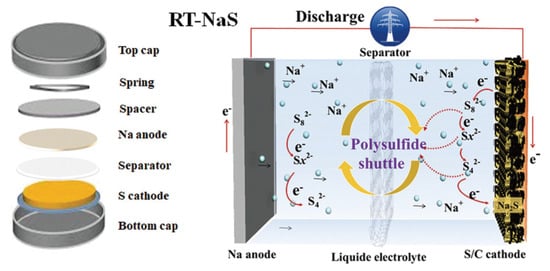
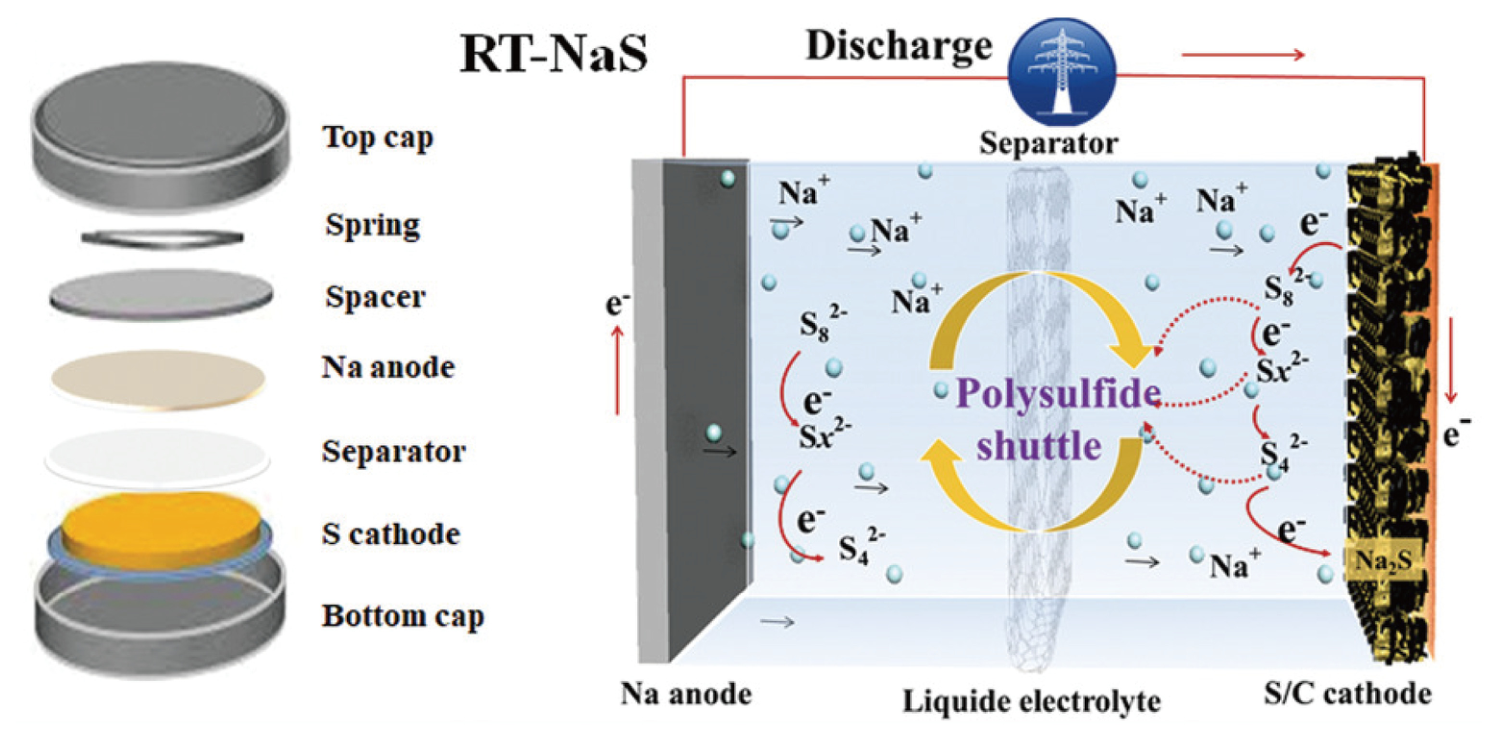
A typical room-temperature Na–S cell consists of a metallic sodium anode, a sulfur/carbon composite cathode, and an ion-conducting electrolyte [8]. During discharge, solid S8 undergoes ring-opening to form soluble long-chain sodium polysulfides (Na2S8), which are then progressively reduced to shorter-chain species and eventually to insulating Na2S [9]. The charge process reverses these steps; however, the intermediate polysulfides tend to shuttle between electrodes, leading to rapid capacity fade and low Coulombic efficiency. Since the first RT Na–S prototype was reported in 2006 [10], considerable advances have been made in cathode nanoengineering, anode interfacial protection, and electrolyte design. Nevertheless, the complex interplay between sulfur redox chemistry and interfacial stability remains a critical challenge for practical implementation. The configuration and working principle of such a typical RT Na–S coin cell are illustrated in Figure 1.
Figure 1.
Configuration of a representative coin cell and schematic operation of an RT Na–S batteries. Reproduced with permission [8], Copyright 2020, WILEY–VCH.
Several authoritative reviews have established the fundamental cell chemistry and catalogued cathode, electrolyte, separator, and anode strategies for RT Na–S batteries [2,4]. The present review is differentiated by a problem-centred framework that links molecular-scale sulfur speciation to electrode-scale transport, Na-metal inventory loss, and full-cell constraints. We therefore evaluate not only whether a material improves capacity or cycling in a coin cell, but also whether the underlying strategy remains credible at sulfur loadings ≥ 5 mg cm−2, E/S ratios ≤ 5 μL mg−1, limited Na excess (preferably N/P ≤ 3), and pouch- or full-cell formats. These thresholds are used as working screening criteria rather than universal standards, because the optimal values remain chemistry- and architecture-dependent.
2. Working Principles and Challenges of RT Na–S Batteries
RT Na–S batteries operate via a reversible two-electron reaction between metallic sodium and elemental sulfur, enabling the interconversion of electrical and chemical energy. This conversion process is inherently complex, involving sequential electron transfers and concurrent phase transitions. Consequently, a majority of the persistent challenges in these batteries arise from the electrochemical evolution of both electrodes during cycling. A primary source of degradation is the dissolution and migration of soluble polysulfides at the cathode.
2.1. Electrochemical Mechanism of RT Na–S Batteries
RT Na–S batteries offer a high theoretical specific capacity of 1675 mAh g−1 and a theoretical energy density of 1274 Wh kg−1, which originate from the reversible electrochemical reactions at both electrodes [11]. The overall cell reaction can be summarized as:
S8 + 16Na+ + 16e− → 8Na2S
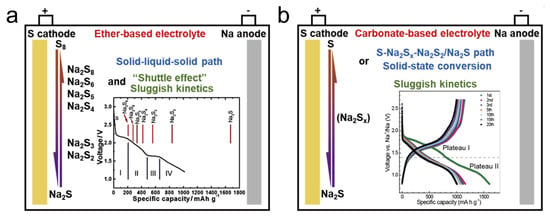
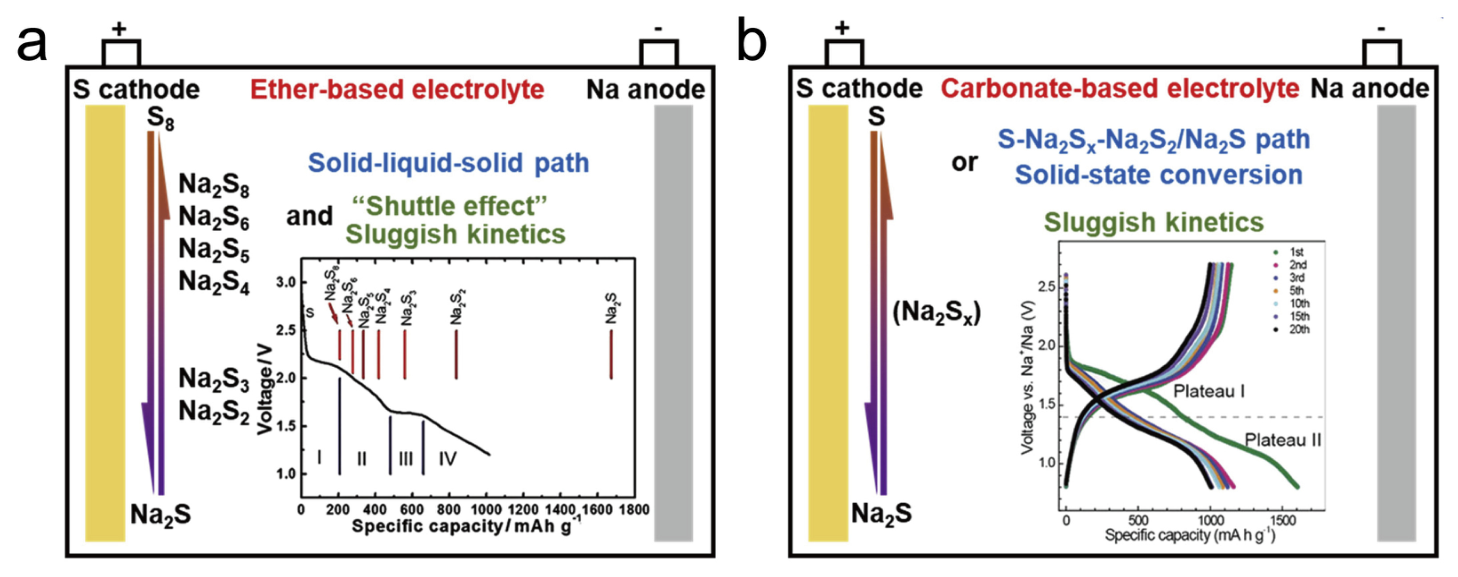
The cathodic transformation from elemental S8 to the final discharge product, Na2S, is intrinsically complex, which typically begins with the ring-opening of S8 and proceeds through sodium polysulfide intermediates of varying chain lengths. The electrochemical behavior of RT Na–S batteries is highly electrolyte-dependent, exhibiting pronounced differences between ether-based and carbonate-based liquid electrolytes. In ether-based electrolytes, sulfur conversion generally follows a solid–liquid–solid dissolution–precipitation pathway. Crystalline S8 first forms soluble long-chain Na2Sn species, which are subsequently reduced through shorter-chain intermediates before Na2S2/Na2S precipitation. Accordingly, the discharge profile of S8 exhibits two distinct voltage plateaus separated by two sloping regions, as illustrated in Figure 2a.
Figure 2.
(a) Typical discharge profile of RT Na–S battery in ether-based electrolyte; (b) Typical discharge-charge profiles for selected cycles of RT Na–S battery in carbonate-based electrolyte. Reproduced with permission [10], Copyright 2024, Elsevier Ltd.
The first plateau, typically near 2.2 V, is associated with S8 ring opening and formation of dissolved high-order polysulfides, represented by Equation (2).
S8 + 2Na+ + 2e− → Na2S8
The following sloping region (approximately 2.20–1.65 V) reflects solution-phase reduction and redistribution among high- and intermediate-order polysulfides. Equation (3) provides a balanced limiting representation for conversion of Na2S8 to Na2S4; Na2S6 and Na2S5 may also be transiently populated.
Na2S8 + 2Na+ + 2e− → 2Na2S4
The lower-voltage plateau is associated with precipitation of short-chain species and Na2S. Equations (4)–(6) show representative balanced branches from Na2S4 to Na2S3, Na2S2, or Na2S. Their relative contributions vary with solvent donor strength, salt concentration, host chemistry, and overpotential.
3Na2S4 + 2Na+ + 2e− → 4Na2S3
Na2S4 + 2Na+ + 2e− → 2Na2S2
Na2S4 + 6Na+ + 6e− → 4Na2S
The final sloping region corresponds primarily to solid-state or interfacial conversion of Na2S2 to Na2S, as represented by Equation (7). This step is often kinetically limiting because both products are electronically insulating and because precipitation can passivate catalytic and conductive surfaces.
Na2S2 + 2Na+ + 2e− → 2Na2S
In carbonate-based electrolytes, sulfur chemistry cannot be described by simply transferring the ether-based shuttle mechanism (Figure 2b). High-order Na2Sn species are nucleophilic and may react with carbonate solvents, while nanoconfinement and an evolving cathode–electrolyte interphase (CEI) can reduce their effective activity and promote quasi-solid or spatially localized conversion [12]. Thus, carbonate media often suppress long-range polysulfide transport kinetically rather than eliminating polysulfide formation thermodynamically. Partial dissolution, short-lived soluble intermediates, and CEI rupture remain possible, particularly during early activation, at high sulfur loading, or when the carbon host is insufficiently confining. The monotonically sloping voltage profile and lower operating voltage commonly observed in carbonate systems therefore reflect a coupled response of sulfur speciation, solvent decomposition, CEI formation, and solid-state transport—not definitive proof of a completely shuttle-free mechanism. This distinction reconciles reports of reduced shuttle with evidence for residual dissolution and interfacial instability.
2.2. Technical Challenges
RT Na–S batteries face mutually reinforcing limitations at the molecular, electrode, and cell levels. While these issues resemble those encountered in Li-S batteries, their severity is notably greater in the Na–S system. Key challenges include: (i) the inherently low electronic conductivity of sulfur (~10−30 S cm−1), which restricts its electrochemical activity in liquid electrolytes; (ii) structural degradation of the sulfur electrode due to the formation of Na2Sn during cycling, disrupting electronic pathways between particles; and (iii) progressive impedance growth caused by electrode passivation [13,14,15]. Compared with Li-S systems, these challenges are exacerbated in Na–S batteries, where sluggish redox kinetics and enhanced polysulfide diffusion combine to make performance improvements particularly difficult.
2.2.1. Shuttle Mechanism
In ether-based electrolytes, long-chain Na2Sn (typically 4 ≤ n ≤ 8) are thermodynamically soluble and can diffuse across the separator [16,17]. Their chemical reduction at the Na surface and subsequent return to the cathode establish a parasitic redox shuttle, lowering Coulombic efficiency and depleting both sulfur and Na inventory [18,19]. In carbonate electrolytes, by contrast, apparent shuttle suppression may arise from rapid solvent-derived CEI formation, low free-solvent activity, nanoconfinement, or conversion to less-soluble species. These mechanisms are kinetic and interfacial: they can immobilize polysulfides over experimental timescales without proving zero equilibrium solubility. Accordingly, polysulfide control should be discussed through three separate descriptors—thermodynamic solubility, kinetic transport across the separator, and interfacial conversion/immobilization—rather than through a binary ‘shuttle/no-shuttle’ classification. Although this shuttle effect is also observed in Li-S batteries, the stronger nucleophilicity of sodium widens the kinetic differences, making the shuttle more aggressive in room-temperature Na–S cells. This leads to rapid Coulombic efficiency loss and accelerated capacity fade.
2.2.2. Self-Discharge
Self-discharge represents a critical bottleneck for the practical deployment of room-temperature Na–S batteries. Under open-circuit conditions, soluble high-order polysulfides migrate along concentration gradients toward the Na anode, where they undergo spontaneous chemical reduction, leading to irreversible depletion of active species and progressive capacity fading [20,21]. While quasi-solid carbonate and solid-state electrolytes can effectively mitigate long-range polysulfide diffusion, parasitic processes—including local redox redistribution, interphase degradation, mixed ionic-electronic conduction, and direct chemical interactions—continue to drive state-of-charge decay. Consequently, rigorous evaluation of self-discharge requires standardized conditions encompassing temperature, rest duration, sulfur loading, and electrolyte composition.
2.2.3. Electronic/Ionic Transport and Electrode Passivation
Sulfur and Na2S possess extremely low electronic conductivity, so conversion proceeds only where ion-conducting electrolytes, electronic pathways, and active sulfur remain in contact. At high loading, tortuous diffusion through thick cathodes produces reaction fronts, local salt depletion, and nonuniform Na2S deposition. Precipitated products can block pores and catalytic sites, while repeated solvent decomposition increases interfacial resistance. High surface area is therefore not intrinsically beneficial: it improves reaction area but can increase electrolyte demand, side reactions, and inactive interphase mass. Practical hosts must preserve continuous electronic percolation while maintaining short Na+ transport distances and controlled electrolyte accessibility.
2.2.4. Structural Evolution and Mechanical Degradation
Conversion between S8 and Na2S is accompanied by substantial local volume redistribution. In thin electrodes, free pore volume can mask this problem; in high-loading electrodes, however, repeated precipitation and dissolution generate stress gradients, particle detachment, binder fatigue, pore closure, and current-collector delamination. Loss of conductive contact promotes isolated sulfur/Na2S domains and accelerates impedance growth. Mechanical robustness, pore-size hierarchy, binder chemistry, and electrode density must therefore be optimized together rather than treated as secondary processing variables.
2.2.5. Na-Metal Instability and Safety
The Na-metal anode experiences nonuniform plating, dendrite formation, polysulfide corrosion, and repeated SEI fracture. Excess Na can conceal these losses in coin cells but lowers cell-level energy density and delays rather than resolves failure. Reactive sodium also amplifies safety risks associated with electrolyte leakage, gas evolution, internal short circuit, and heat generation. A credible practical assessment must therefore report Na thickness or N/P ratio, cumulative plated capacity, full-cell inventory balance, and abuse-relevant safety data.
3. Recent Advances in RT Na–S Batteries
Recent advances can be grouped into four coupled design layers: (i) cathode architectures that maintain electronic/ionic percolation and regulate sulfur speciation; (ii) catalytic motifs that lower barriers for Na2Sn interconversion and Na2S nucleation/decomposition; (iii) Na-anode interphases that homogenize ion flux and suppress corrosion; and (iv) electrolyte/solid-electrolyte chemistries that control solvation, interphase formation, and transport. Because improvements in one layer can shift failure to another, performance should be compared under matched loading, E/S ratio, Na inventory, and cell format (Table 1).
Table 1.
Quantitative comparison of representative RT Na–S strategies.
Mechanistic assignment increasingly relies on complementary operando methods. Operando Raman spectroscopy and synchrotron X-ray diffraction have directly followed sulfur-species evolution and phase formation in catalytic RT Na–S cells [28]. More recently, operando transmission X-ray microscopy combined with sulfur K-edge X-ray absorption spectroscopy resolved spatially heterogeneous sulfur conversion, cathode expansion, and active-material dissolution in an ether electrolyte [29], while operando microbeam XRD, XPS, and ex situ XAS exposed pressure-dependent polysulfide formation in solid-state cells. These studies illustrate why ex situ end-point characterization alone can misidentify transient intermediates or overlook reaction heterogeneity.
3.1. Cathode: From Host Design to Catalytic Mechanism Innovation
Cathode-host engineering remains the most direct and widely explored approach for mitigating polysulfide shuttling. Conventional strategies based on physical adsorption in porous carbon matrices rely on weak, non-selective van der Waals interactions; under high sulfur loading and lean-electrolyte conditions, however, pore saturation occurs, and polysulfide shuttling continues largely unchecked [30]. Yet pore architecture also imposes fundamental trade-offs. Micropores strengthen confinement and favour short-chain or quasi-solid conversion, but restrict sulfur loading and electrolyte infiltration; mesopores shorten ion-transport paths and accommodate products, but can permit polysulfide escape; macropores improve wetting and buffer volume change, but lower volumetric energy density. A hierarchical pore network is therefore preferable only when pore volume, sulfur distribution, tortuosity, and electrolyte inventory are co-optimized. Furthermore, the non-polar surfaces of pristine carbon materials exhibit limited electronic coupling with polar polysulfides, resulting in sluggish conversion kinetics.
Conductive additives must form a continuous network through the full electrode thickness, while binders must sustain adhesion during repeated conversion. Recent SPAN studies show that poly(acrylic acid) can outperform conventional PVDF by hydrogen-bonding with polar C=N motifs, distributing stress more uniformly and sustaining an areal capacity of 2.6 mAh cm−2 for more than 200 cycles [31]. This example underscores that binder chemistry, slurry rheology, calendering density, and current-collector adhesion can determine whether a catalytic material remains accessible under practical loading.
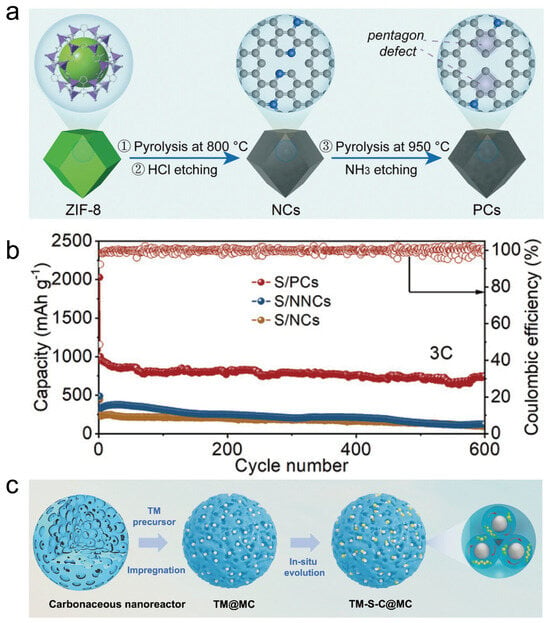
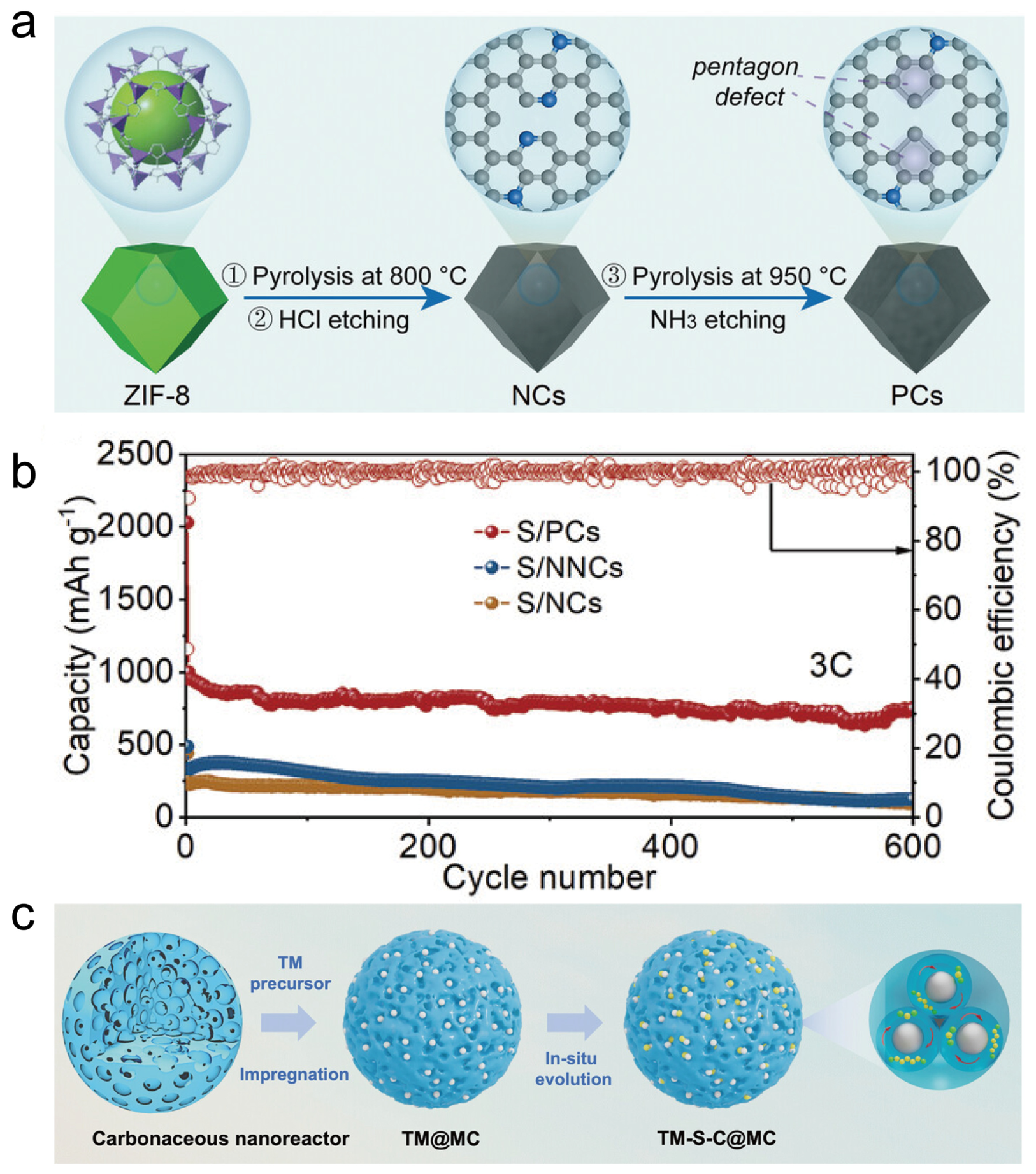
Defect engineering and heteroatom coordination modify the local electronic density of states and thereby tune the adsorption–conversion balance for Na2Sn. Pentagon defects disrupt the π-conjugated carbon lattice, localize charge, and lower barriers for S–S bond cleavage, as shown in Figure 3a; Zheng et al. reported 1275 mAh g−1 after 100 cycles at 0.1 C and a decay rate of 0.035% per cycle over 600 cycles at 3 C, as shown in Figure 3b [32]. The mechanistic objective is not maximal adsorption: excessively strong binding can immobilize intermediates and retard product desorption. Effective hosts instead approach a Sabatier-type optimum in which adsorption suppresses escape while allowing rapid interconversion and Na2S release.
Figure 3.
(a) Schematic illustration of the synthesis process for PCs; (b) Long-term cycling stability of S/PCs, S/NNCs and S/NCs at 3 C. The red hollow circle represent the Coulombic efficiency. Reproduced with permission [32], Copyright 2024, Wiley-VCH; (c) Schematic illustration of TM-S-C@MC structure and its sulfur reduction reaction catalytic process. Reproduced with permission [22], Copyright 2025, Wiley-VCH.
Wei et al. integrated catalytic sites and spatial confinement in a heterointerfaced nanoreactor [22]. Interfacial electronic coupling shifts the transition-metal d-band centre, strengthens selective chemisorption, and accelerates reduction, while the surrounding carbon shell limits species loss and accommodates expansion, as shown in Figure 3c. Importantly, the system was also evaluated at 6.2 mg cm−2 sulfur loading and an E/S ratio of 9 μL mg−1, and in a pouch-cell configuration. Although this remains above the stringent E/S ≤ 5 μL mg−1 benchmark adopted here, it represents a more informative practical test than conventional low-loading coin cells.
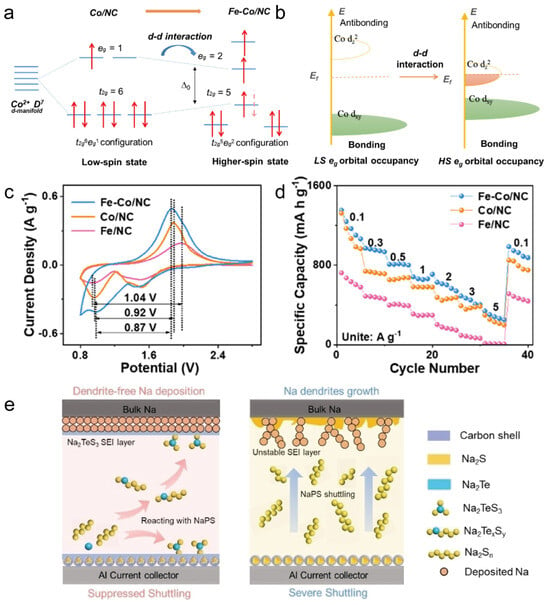
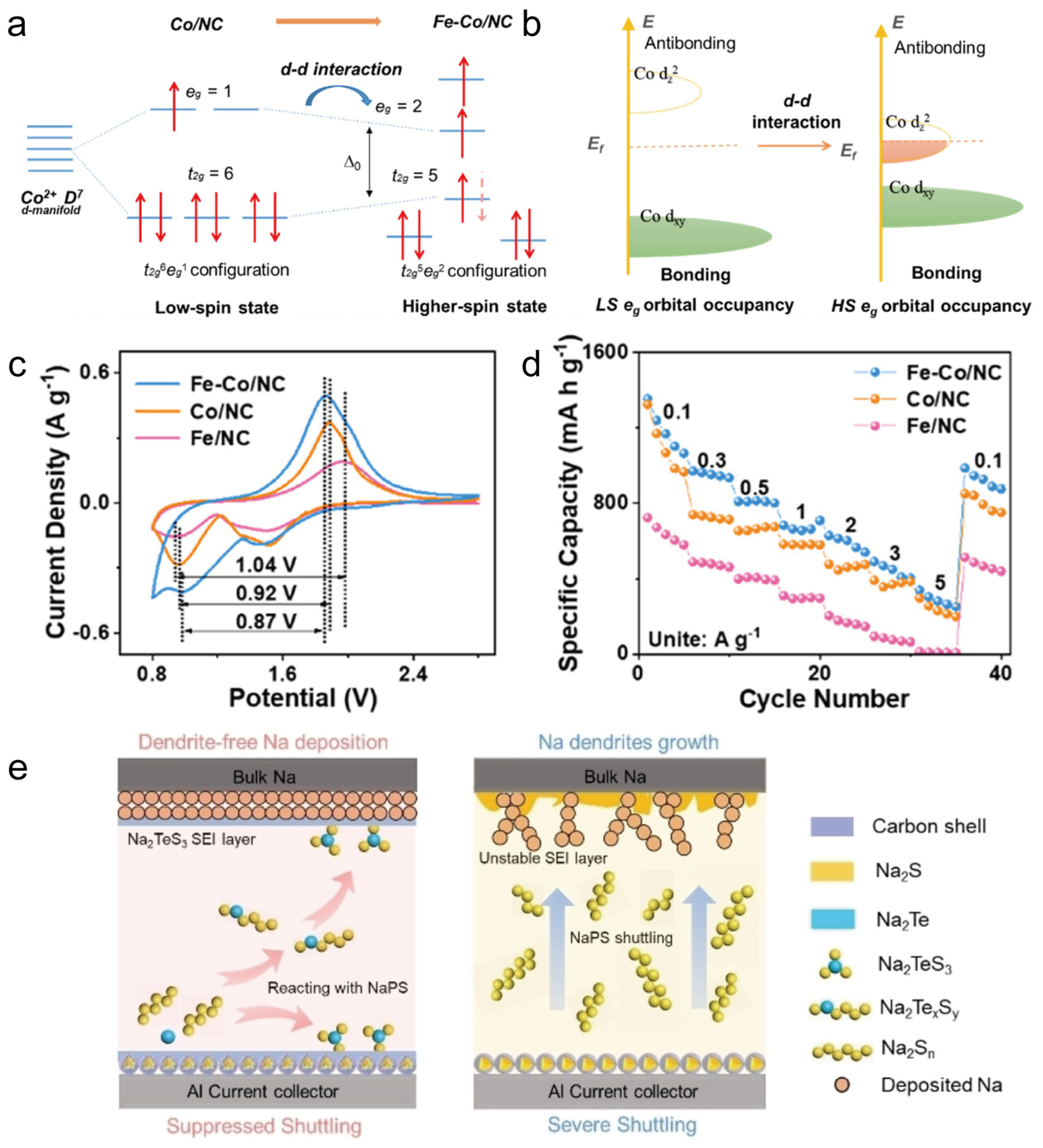
The quintessential challenge in cathode design lies in simultaneously suppressing polysulfide dissolution/shuttling and accelerating sulfur redox kinetics. Zhang et al. [33] promoted a quasi-solid-state conversion pathway by embedding MoC-W2C heterostructures within multichannel carbon nanofibers. This hetero-interface facilitates rapid electron/ion transport, enabling the electrode to retain a capacity of 200 mAh g−1 after 3500 cycles at 4 Ag−1. In parallel, Li et al. [34] engineered an asymmetric Mn-N2 coordination motif that intensifies d-p orbital hybridization, which elevated the catalytic turnover of polysulfides, resulting in a retained capacity of 458 mAh g−1 after 2300 cycles at 3 C. More strikingly, Li et al. [35] developed a Fe–Co dual-atom catalyst in which Fe incorporation switches Co(II) from a low-spin to a high-spin state, markedly accelerating sodium polysulfide interconversion (Figure 4a,b). The Fe–Co/NC/S electrode exhibits a voltage gap of merely 0.87 V between the second cathodic and anodic peaks—significantly lower than those of Co/NC (0.92 V) and Fe/NC (1.04 V) counterparts—indicating substantially reduced polarization (Figure 4c). Fe–Co dual-atom sites altered the Co spin state and reduced polarization; high-loading cells containing 5.6 mg cm−2 sulfur were also demonstrated. Figure 4d further confirms a discharge capacity of 341.1 mAh g−1 at 5 A g−1. Collectively, these studies underscore that electronic-structure modulation and interfacial engineering can fundamentally alter polysulfide reaction pathways. Extending this paradigm, Gao et al. [36] constructed a heterostructured Na2S/Na2Te@C cathode mediated by a sodium thiotellurate (Na2TeS3) interphase. The abundant electron/ion channels within this architecture enhance active-material utilization while curbing polysulfide shuttling (Figure 4e), enabling an initial discharge capacity of 634 mAh g−1 in an anode-free configuration. Nevertheless, the majority of these advances remain confined to laboratory-scale evaluations under low sulfur loadings. Their operative mechanisms under practical conditions such as high sulfur mass loading and lean electrolyte—await systematic elucidation.
Figure 4.
(a,b) Spin-state modulation and d–d interaction in Co/NC and Fe–Co/NC; (c) cyclic-voltammetry comparison and (d) rate performance of Fe–Co/NC/S, Co/NC/S, and Fe/NC/S cathodes. Reproduced with permission [35], Copyright 2025, American Chemical Society; (e) Schematic mechanism for enhancing the electrochemical performance of Na2S/Na2Te@C in RT Na–S batteries. Reproduced with permission [36], Copyright 2024, Wiley-VCH.
Dynamic active-site reconstruction must nevertheless be considered: electrochemically generated Mo single atoms on MoS2, for example, can become the true catalytic centres rather than the pristine phase identified before cycling [37]. Operando spectroscopy, post-mortem mass balance, and matched-loading controls are therefore required to establish causal structure–activity relationships.
3.2. Anode: Interface Engineering and Deposition Behaviour Regulation
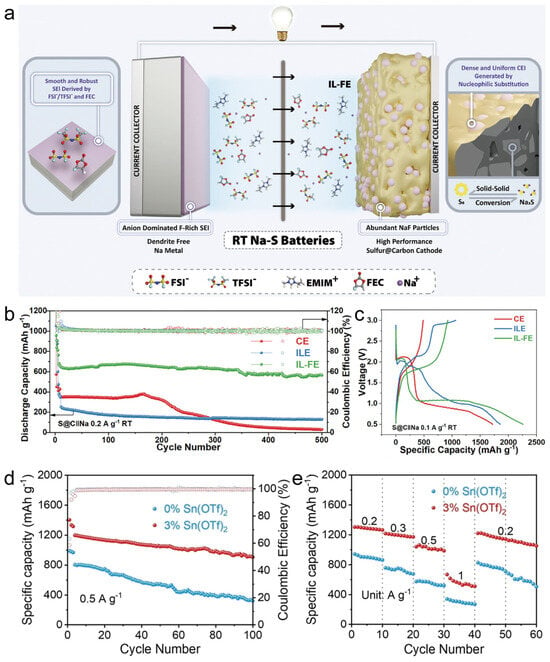
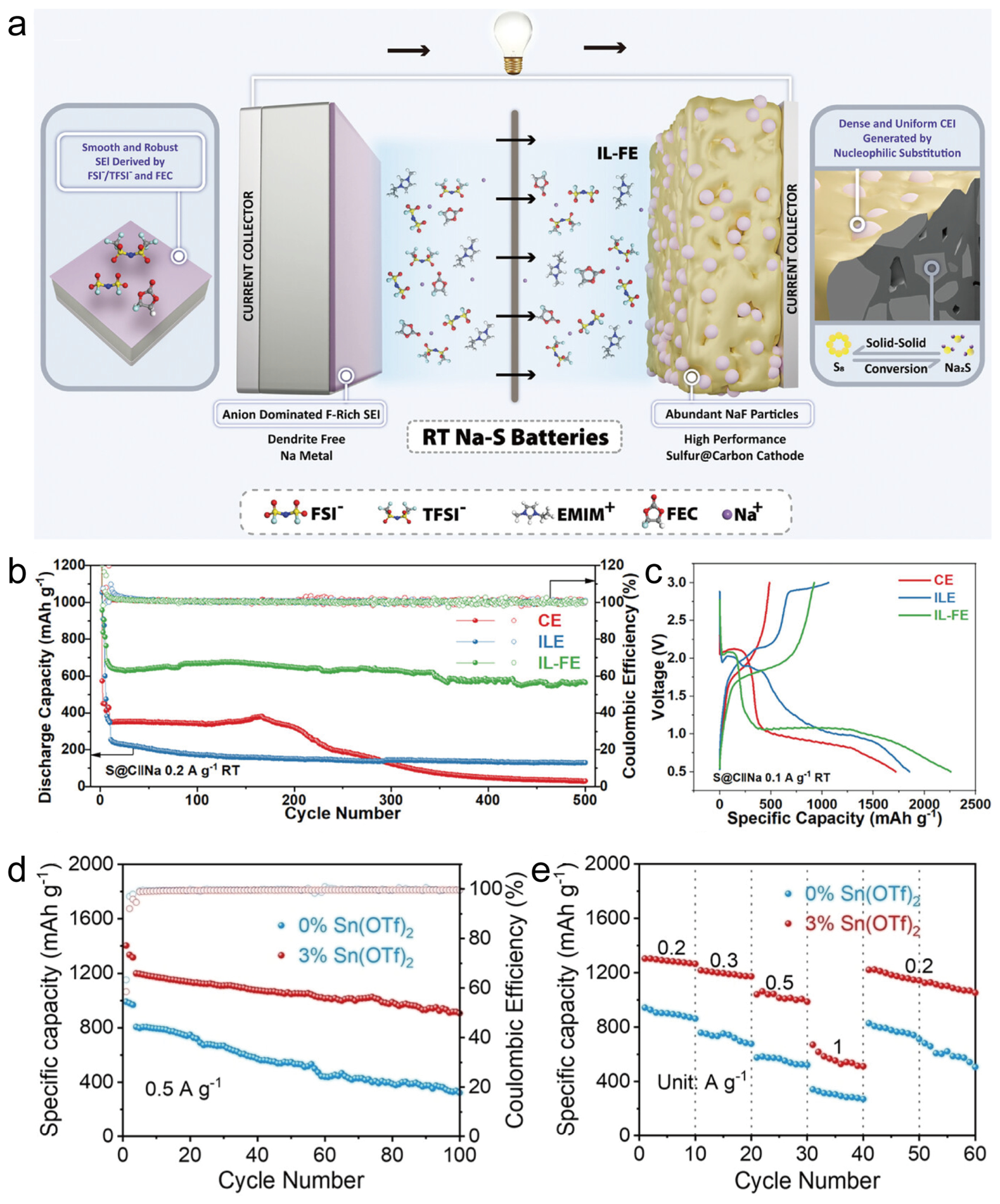
The metallic sodium anode confronts a bifurcated challenge—dendrite growth and parasitic interfacial reactions—both of which are intensified by the polysulfide-rich environment. To address this challenge, Liu et al. [38] used a nonflammable ionic-liquid electrolyte containing FSI−/TFSI− anions and FEC to generate an inorganic-rich, F-containing inorganic-rich solid-electrolyte interphase (SEI) on Na surface, which promotes uniform sodium deposition and suppresses dendrite propagation (Figure 5a). Leveraging the synergistic effect of FSI-/TFSI− anions and fluoroethylene carbonate (FEC), the electrolyte enables a capacity retention of 565 mAh g−1 after 500 cycles at 0.2 A g−1 (Figure 5b,c). By contrast, Wang et al. [39] introduced tin trifluoromethanesulfonate (Sn(OTf)2) into a non-flammable phosphate-based electrolyte. By modifying the Na+ solvation sheath and interfacial chemistry, the additive facilitates the formation of Na–Sn-alloy-containing SEI together with a cathodic CEI layers, which increase the cell capacity from 322 to 906 mAh g−1 (Figure 5d). The resulting Na–S full cell also demonstrates superior rate capability, further confirming the significant electrochemical improvement imparted by Sn(OTf)2 (Figure 5e).
Figure 5.
(a) Schematic diagram of S@C||Na cell with the IL-FE electrolyte. (b) Cycle performance at 0.2A g−1. (c) Initial charge–discharge profiles at 0.2A g−1. Reproduced with permission [38], Copyright 2025, WILEY-VCH. (d) Cycling performance at 0.5A g−1 and (e) rate performance of Na–S full cells using the electrolyte with and without Sn (OTf)2 additive. The red hollow circle represent the Coulombic efficiency. Reproduced with permission [39], Copyright 2024, WILEY-VCH.
These interphases should be compared by composition, transport, and mechanics rather than by the generic label ‘stable SEI/CEI’. NaF-rich layers offer high interfacial energy and mechanical stiffness but can become resistive if excessively thick; alloy-containing SEIs can improve sodiophilicity and lateral Na diffusion but consume additive and active Na; organic-rich components can enhance elasticity yet remain susceptible to nucleophilic attack. Long-term validation therefore requires impedance evolution, Na Coulombic efficiency, gas analysis, and morphology after a fixed cumulative areal capacity—not only short symmetric-cell tests.
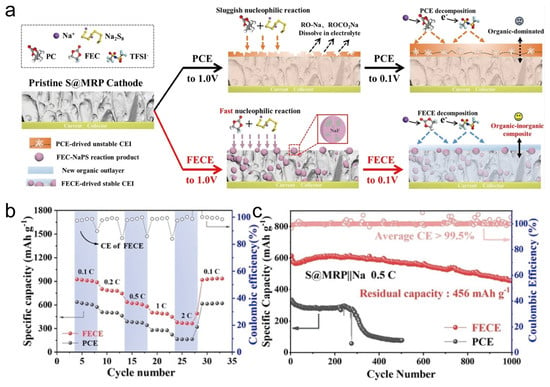
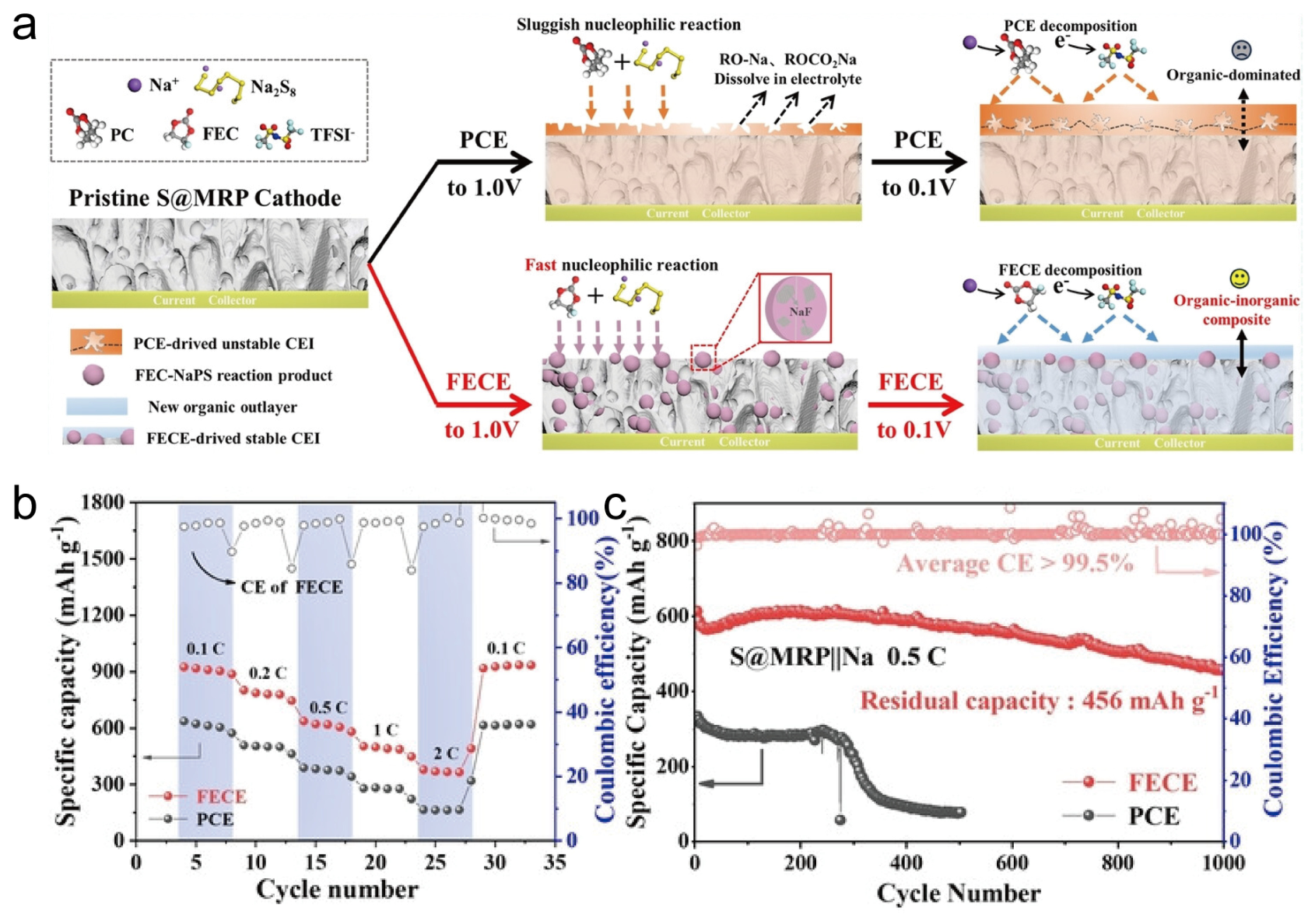
Beyond additive-based approaches, interphase design can be advanced through solvent engineering. Weng et al. [40] revealed a two-stage CEI formation mechanism when FEC is used as the sole solvent (Figure 6a): rapid nucleophilic attack combined with electrochemical cleavage produces a distinctive “chocolate-biscuit” bilayer CEI rich in NaF. Coupled with a fluorine-enriched SEI on the anode, the FEC-only S@MRP||Na full cell outperformed its PCE-containing counterpart across rates from 0.1 C to 2 C (Figure 6b) and retained 456 mAh g−1 after 1000 cycles at 0.5 C, with Coulombic efficiency approaching unity (Figure 6c). These results highlight that constructing an interphase with high ionic conductivity and mechanical robustness is crucial for dendrite suppression. However, most current studies are still based on half-cell evaluations. Stabilizing Na-metal anodes in full-cell configurations under practical conditions—such as low N/P ratio and lean electrolyte—remains a significant challenge.
Figure 6.
(a) Schematic diagram of complete CEI formation mechanism in S@MRP||Na cells with two electrolytes. (b) Rate capability. (c) Long-cycle performance at 0.5 C. The red hollow circle represent the Coulombic efficiency. Reproduced with permission [40], Copyright 2025, WILEY-VCH.
3.3. Electrolyte: Precise Design from Solvation Structure to Interfacial Chemistry
The electrolyte is simultaneously an ion-transport medium, a solvent for sulfur species, and a precursor to SEI/CEI formation. Its effect cannot be reduced to polysulfide solubility alone. Donor strength and salt association determine equilibrium speciation; viscosity and conductivity control kinetic transport; preferential interfacial decomposition determines whether dissolved species are immobilized or whether fresh surfaces remain exposed. Electrolyte design must therefore balance thermodynamic solubility, kinetic shuttle suppression, interfacial passivation, Na plating efficiency, wetting of thick electrodes, and safety.
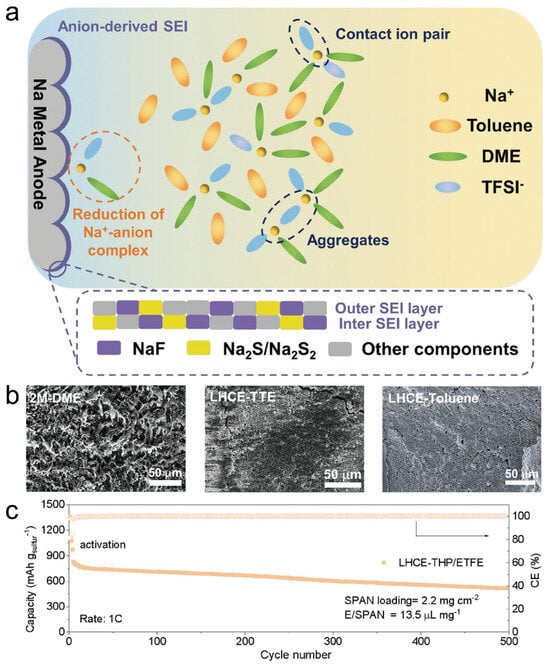
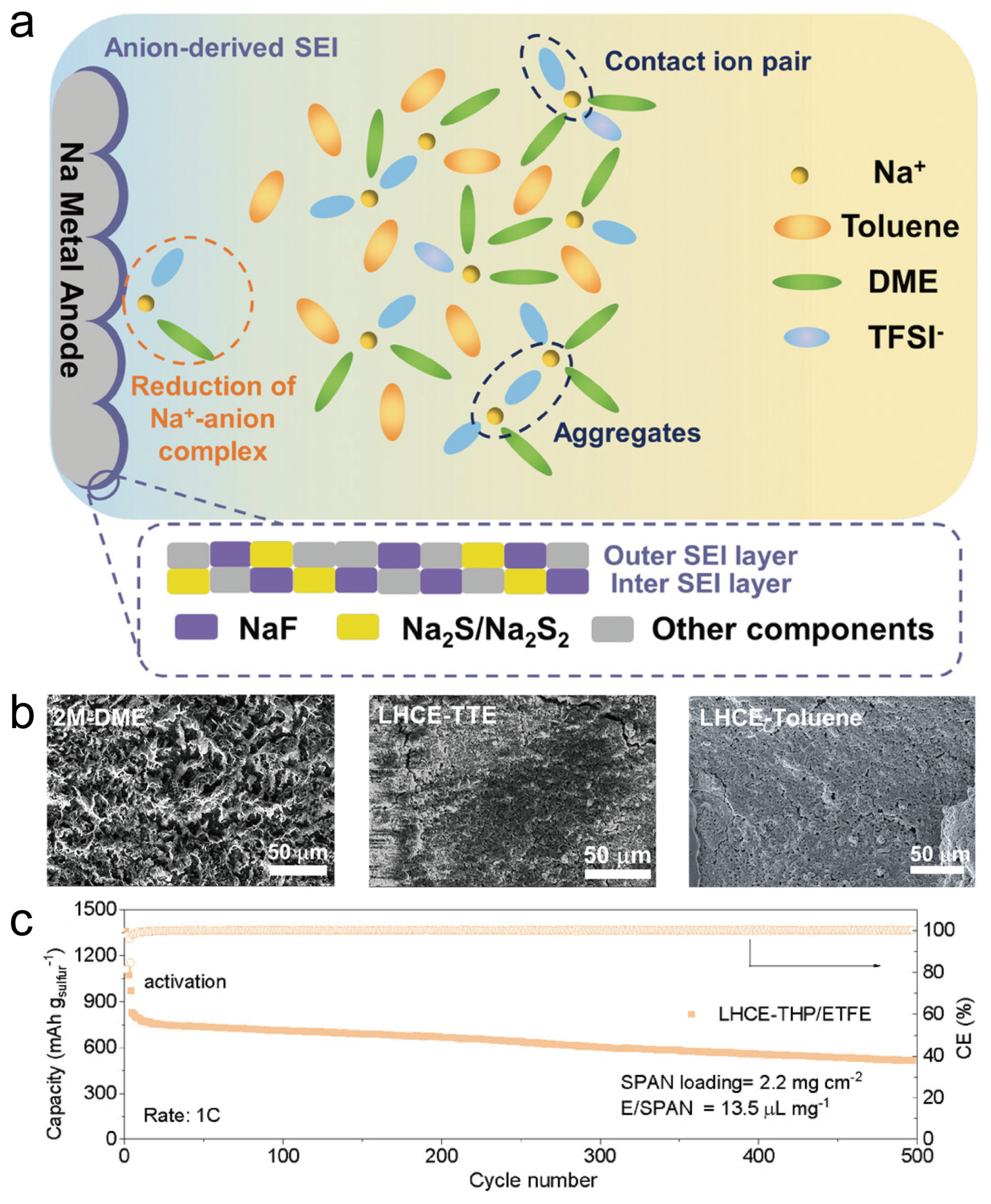
Pai et al. [41] innovatively employed toluene—a non-fluorinated, low-cost diluent—to construct a localized high-concentration electrolyte (LHCE). Toluene not only provides reductive stability but also modulates the solvation structure, promoting anion-dominated clusters that foster a dense, inorganic-rich SEI on the Na metal surface (Figure 7a). This interphase effectively suppresses dendrite growth and minimizes parasitic electrolyte–anode interactions. As shown in Figure 7b, polysulfide attack leads to rugged dendrites in 2 M-DME electrolytes, whereas the LHCE-cycled electrode retains a smooth, planar morphology. The approach trades some solvation capacity for enhanced interfacial stability, simultaneously mitigating polysulfide shuttle and dendrite formation. Extending this paradigm, Yao et al. [42] systematically investigated solvent molecular frameworks, revealing a decisive link between solvation structure and electric-double-layer (EDL) chemistry. An LHCE formulated with tetrahydropyran (THP) not only reduces polysulfide solubility through solvation restructuring but also promotes a durable inorganic SEI, enabling stable cycling over 500 cycles at 1.0 C with a minimal capacity fade rate of 0.07% per cycle (Figure 7c). These results show that bulk solvation and interfacial composition must be designed together.
Figure 7.
(a) Schematic illustration of the electrolyte solvation structure with a non-fluorinated diluent, toluene; (b) SEM images of sodium metal from the Na||Na symmetric cells after cycling for 300 h. Reproduced with permission [41], Copyright 2024, WILEY-VCH; (c) Long-cycle performances of Na–S cells with LHCE-THP/ETFE electrolyte at 1 C rate. The orange hollow circle represent the Coulombic efficiency. Reproduced with permission [42], Copyright 2025, WILEY-VCH.
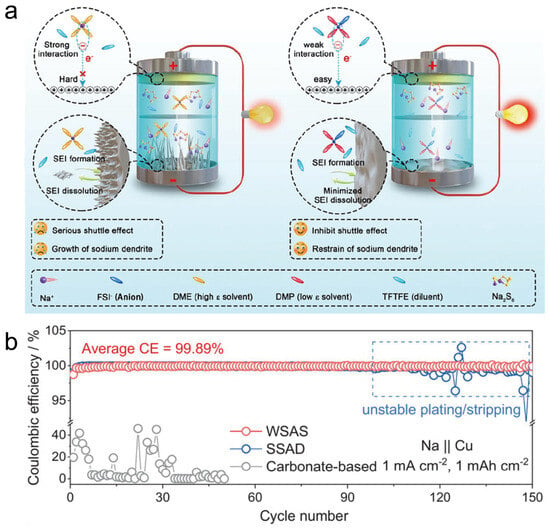
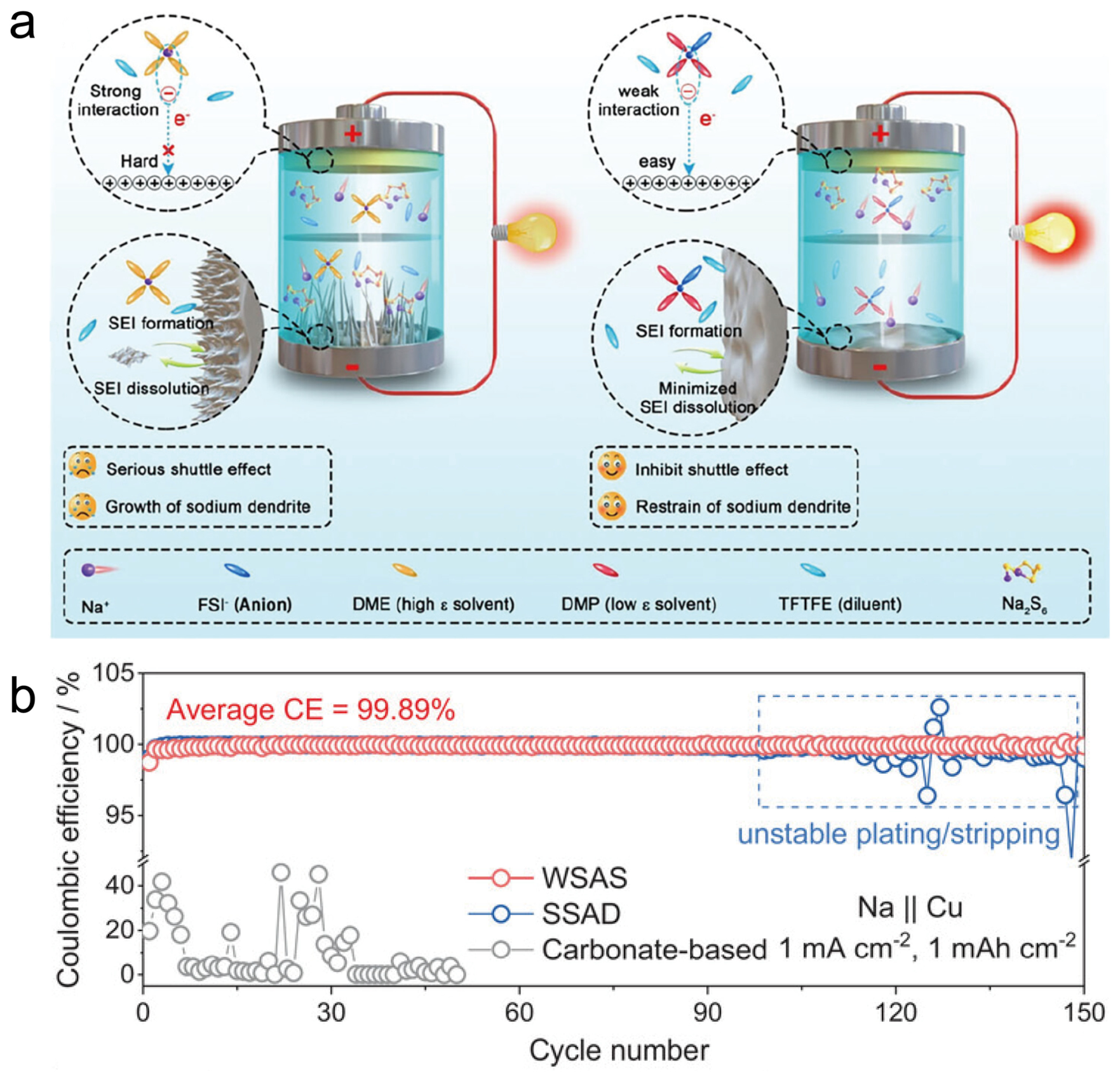
In a subsequent study, Yao et al. [43] proposed an “inner–outer sheath synergistic shielding” strategy. By employing sterically hindered 1, 2-dimethoxypropane (DMP) as the inner-shell solvent, the additional methyl group effectively excludes polysulfides from the primary solvation sheath (Figure 8a). Complementarily, a fluorinated ether (TFTFE) with low solvation power serves as the outer diluent, further suppressing polysulfide dissolution. This dual-sheath design offers a new perspective for inhibiting the shuttle effect at its origin. Parallel to this, Zou et al. [44] developed a weakly solvating anion-stabilized (WSAS) electrolyte that re-balances Na+-solvent and Na+-anion interactions, generating abundant contact ion pairs (CIPs) and aggregates (AGGs). The resulting electrolyte supports a 4.0 V-class layered-oxide cathode across a wide temperature range (−40 °C to 60 °C), and achieves an average Na plating/stripping Coulombic efficiency of 99.89% (Figure 8b). These advances highlight the progression of electrolyte design from simple component selection toward precise solvation-structure engineering. Such LHCEs, however, carry nontrivial penalties: concentrated salts and fluorinated diluents increase cost and environmental burden; viscosity can impair wetting and low-temperature transport; reduced ionic conductivity increases polarization in thick electrodes; and limited free solvent can hinder complete utilization at high sulfur loading. Developing cost-effective and recyclability yet inherently safe formulations thus remains crucial for commercial adoption.
Figure 8.
(a) Schematic diagram of Na–S batteries through different LHCE. Reproduced with permission [43], Copyright 2025, American Chemical Society; (b) Na plating/stripping Columbic efficiency (CE) of cycling performance in Na||Cu asymmetric cells at 1.0 mA cm−2. Reproduced with permission [44], Copyright 2024, WILEY-VCH.
3.4. All-Solid-State Na–S Batteries: Suppressed Long-Range Shuttle, Persistent Interfacial Chemistry
All-solid-state Na–S batteries replace liquid-mediated long-range polysulfide transport with solid–solid or locally confined conversion. This architecture can suppress macroscopic dissolution and separator-crossing shuttle, but it does not eliminate sulfur intermediates, interfacial side reactions, or chemo-mechanical failure. Sulfide electrolytes provide high Na+ conductivity and intimate chemical affinity with sulfur, yet they are moisture-sensitive and can undergo redox decomposition; borohydride or halide-containing conductors may offer wider stability windows but introduce processing, pressure, or cost constraints. In all cases, reaction kinetics depend on a percolating three-phase network of active sulfur, ionic conductor, and electronic conductor.
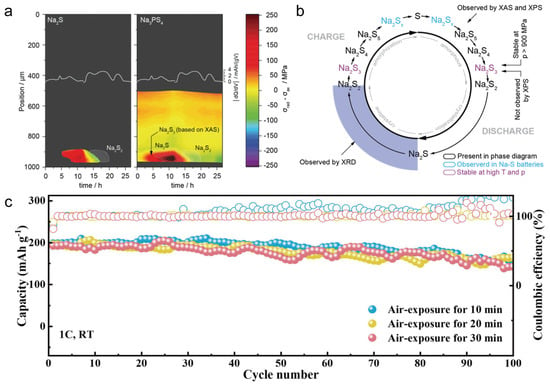
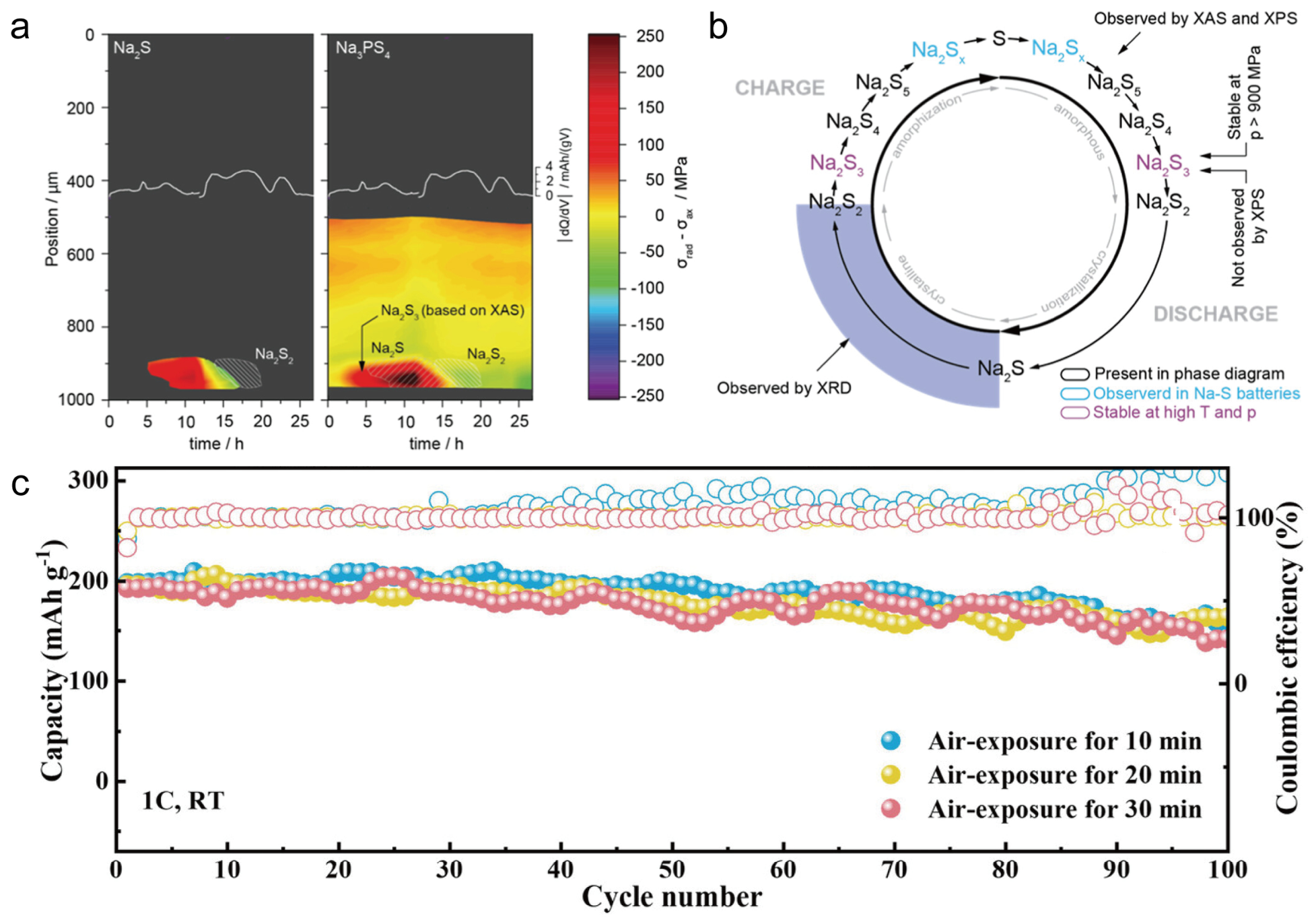
Recent research has shifted toward all-solid-state Na–S batteries, based on the premise that solid electrolytes can effectively suppress the long-range dissolution and diffusion of polysulfides that characterize liquid electrolyte systems. However, this does not imply that sulfur intermediate formation or interfacial side reactions are entirely eliminated. Nguyen et al. [45] detected “clandestine polysulfides” in solid-state cells via operando scanning microbeam XRD, operando XPS, and ex situ XAS (Figure 9a). Within Na3PS4-type electrolytes, they identified various crystalline and amorphous polysulfides—including Na2S3 phases previously stabilized only under elevated temperature and pressure—that persist throughout cycling (Figure 9b). This finding challenges the conventional understanding of interfacial chemistry in solid-state batteries, demonstrating that sulfur conversion pathways persist even without liquid media, albeit constrained by local stress, interfacial contact, and ionic percolation. Moreover, their results also demonstrate that applied pressure is both a thermodynamic variable and a transport parameter: insufficient pressure causes contact loss and ionic isolation, whereas excessive pressure can alter phase selection, densify pathways, and aggravate local stress. In essence, while solid electrolytes act as physical barriers, they cannot prevent interfacial complications arising from sulfur-redox intermediates.
Figure 9.
(a) Time-dependent evolution of stress profiles across the cross-section of the cell during charge and discharge; (b) Summary of reaction pathway during charge and discharge. Reproduced with permission [45], Copyright 2025, American Chemical Society; (c) Cycling performance of 5%SP-TiS2//Na5Sn ASSSBs at 1 C using NSS2 electrolyte exposed to 50% RH air for different times. The hollow circle represent the Coulombic efficiency. Reproduced with permission [46], Copyright 2024, WILEY-VCH.
Practical all-solid-state development must address cathode composite homogeneity, stack-pressure retention, interfacial resistance, electronic leakage, volume-change accommodation, and environmental stability during manufacturing. Addressing the moisture sensitivity of sulfide electrolytes, Guo et al. [46] designed a humid-air-tolerant Na3−xSb1−4x (SnWCaTi)xS4 phase through vacancy engineering and configurational-entropy enhancement. The corresponding solid-state cell retained stable cycling for 100 cycles at 1 C after 30 min exposure to air with a dew-point of 13.8 °C (Figure 9c), underscoring that environmental stability is as critical as electrochemical performance for the practical deployment of solid-state batteries. Vacancy and entropy engineering have improved humid-air tolerance of sulfide electrolytes, but performance should be validated after realistic dry-room exposure and in cells with industrially relevant areal capacity. Operando diffraction, XAS, Raman spectroscopy, acoustic/mechanical diagnostics, and cryogenic electron microscopy will be essential for correlating phase evolution with contact loss and fracture [47].
4. Conclusions and Outlook
Substantial progress in room-temperature sodium–sulfur (RT Na–S) batteries has been enabled by catalytic host design, Na-anode interfacial regulation, and solvation engineering. Single-atom catalysts, heterostructures, and defect-rich scaffolds suppress polysulfide shuttling and accelerate sulfur redox, while SEI regulation and tailored solvation improve Na stability. However, as summarized in Table 1, many record performances rely on low sulfur loading, excess electrolyte, high Na excess, and incomplete reporting, and the operando mechanisms of polysulfide conversion and interface evolution remain insufficiently resolved. The field must therefore shift from maximizing specific capacity toward coordinated control of sulfur chemistry, transport, finite Na inventory, interfacial mechanics, and safety.
4.1. Practical Benchmarks and Failure Modes
For the purpose of cross-study evaluation, we recommend that ‘practical’ RT Na–S cells be screened at sulfur loadings ≥ 5 mg cm−2, E/S ratios ≤ 5 μL mg−1, areal capacities ≥ 4 mAh cm−2, and limited Na excess (preferably N/P ≤ 3), followed by validation in pouch or otherwise externally pressurized full cells. These values are not rigid standards, but they expose failure modes that thin, flooded coin cells conceal. At high loading, electrolyte depletion and tortuous transport generate through-thickness reaction gradients; at low E/S, salt concentration and viscosity change dynamically as sulfur species form; and at low N/P, even small parasitic currents rapidly exhaust the Na inventory.
Future studies should report the complete mass and capacity balance: sulfur areal loading, sulfur fraction, electrode density and thickness, electrolyte volume, separator thickness, Na foil thickness or N/P ratio, formation protocol, stack pressure, temperature, self-discharge, and cumulative plated capacity. Capacity retention should be accompanied by Coulombic efficiency with sufficient precision, impedance evolution, and post-mortem quantification of inactive sulfur and Na. Gradient electrodes—combining high electronic conductivity near the current collector, controlled catalytic/polar functionality through the reaction zone, and mechanically compliant interfaces—offer a promising route to reconcile transport and stress at high loading.
4.2. Safety, Manufacturability, and Outlook
Safety assessment must extend beyond electrolyte flammability. Metallic Na can react vigorously with trace moisture and leaked electrolyte; internal short circuits can couple dendritic heating with exothermic interphase reactions; and solvent decomposition or polysulfide reactions can generate gas and pressure. Practical studies should therefore include accelerating-rate calorimetry or differential scanning calorimetry of charged components, gas analysis, nail/overcharge and external-short tests where appropriate, leak and seal validation, and procedures for Na handling, module isolation, and end-of-life deactivation.
The most credible path forward is an integrated design loop linking computation, operando characterization, scalable processing, and full-cell validation. Cathode hosts must preserve percolation and mechanical integrity under lean electrolyte; electrolytes must balance solvation, conductivity, interphase chemistry, cost, and environmental impact; and Na anodes must operate with finite inventory over industrially relevant cumulative capacity. For all-solid-state cells, the priority is not simply higher ionic conductivity but stable three-phase contact under controlled pressure and ambient exposure. Only studies that align mechanistic claims with complete practical metrics can establish whether RT Na–S batteries can deliver competitive energy density, long life, and inherent safety.
Author Contributions
Z.S.: investigation, writing—original draft, formal analysis. Z.S. and S.T. contributed equally to this study. X.Y.: resources, formal analysis, visualization. Q.W.: formal analysis, software. J.C.: visualization. D.Z.: visualization, software. C.D.: writing—review & editing, methodology, visualization, supervision. Y.D.: supervision, and writing review & editing, funding acquisition. X.L.: writing—review & editing, visualization, funding acquisition. All authors have read and agreed to the published version of the manuscript.
Funding
The work described in this paper was supported by CHN Energy Investment Group (GJNY-25-104) and Hainan Province Postdoctoral Research Funding Project (2025-154).
Data Availability Statement
The original contributions presented in this study are included in the article. Further inquiries can be directed to the corresponding authors.
Conflicts of Interest
Authors Xuechao Yang, Qi Wang and Jia Chang were employed by the company CHN Energy Yulin Chemical Co., Ltd. The remaining authors declare that the research was conducted in the absence of any commercial or financial relationships that could be construed as a potential conflict of interest.
Nomenclature
The following abbreviations, notations, parameter symbols, and units are used in this review.
| Category | Abbreviation or Notation | Definition |
| General | RT Na–S | Room-temperature sodium-sulfur battery |
| General | ASSSBs | All-solid-state sodium-sulfur batteries. |
| Interphase | SEI | Solid-electrolyte interphase |
| Interphase | CEI | Cathode-electrolyte interphase. |
| Electrolyte | LHCE | Localized high-concentration electrolyte. |
| Metric | CE | Coulombic efficiency |
| Material | SPAN | Sulfurized polyacrylonitrile. |
| Material | PVDF | Poly(vinylidene fluoride), a conventional electrode binder. |
| Method | SEM | Scanning electron microscopy. |
| Method | XRD | X-ray diffraction. |
| Method | XPS | X-ray photoelectron spectroscopy. |
| Method | XAS | X-ray absorption spectroscopy. |
| Electrolyte | DOL | 1,3-Dioxolane. |
| Electrolyte | DIGLYME | Diethylene glycol dimethyl ether (bis(2-methoxyethyl) ether). |
| Electrolyte | DME | 1,2-Dimethoxyethane. |
| Electrolyte | DMP | 1,2-Dimethoxypropane. |
| Electrolyte | THP | Tetrahydropyran. |
| Electrolyte | ETFE | Ethyl 1,1,2,2-tetrafluoroethyl ether |
| Electrolyte | TFTFE | 1,1,2,2-Tetrafluoroethyl 2,2,2-trifluoroethyl ether, used as an outer-sheath diluent. |
| Electrolyte | PC | Propylene carbonate. |
| Electrolyte | FEC | Fluoroethylene carbonate. |
| Electrolyte | FSI− | Bis(fluorosulfonyl)imide anion. |
| Electrolyte | TFSI− | Bis(trifluoromethanesulfonyl)imide anion. |
| Electrolyte | NaPF6 | Sodium hexafluorophosphate. |
| Electrolyte | NaFSI | Sodium bis(fluorosulfonyl)imide. |
| Electrolyte | NaTFSI | Sodium bis(trifluoromethanesulfonyl)imide. |
| Electrolyte | Sn(OTf)2 | Tin(II) trifluoromethanesulfonate. |
| Cell | CR2032 | 20 mm diameter, 3.2 mm height coin-cell format. |
| Cell | GF/D | Grade GF/D glass-microfiber separator. |
| Cell | Na||Na | Symmetric sodium-metal cell. |
| Cell | Na||Cu | Asymmetric sodium-copper cell for sodium plating/stripping evaluation. |
| Material | S@C | Sulfur hosted in or supported on carbon. |
| Material | MoC-W2C | Molybdenum carbide-tungsten carbide heterostructure. |
| Material | Fe–Co/NC/S | Sulfur cathode with Fe–Co dual-atom sites on N-doped carbon. |
| Material | Co/NC/S | Sulfur cathode with Co sites on N-doped carbon. |
| Material | Fe/NC/S | Sulfur cathode with Fe sites on N-doped carbon. |
| Material | Na2S/Na2Te@C | Carbon-supported Na2S/Na2Te heterostructured cathode. |
| Material | Na2TeS3 | Sodium thiotellurate interphase. |
| Material | SP | Super P conductive carbon |
| Material | SP-TiS2//Na5Sn | All-solid-state cell using an SP-TiS2 composite cathode and a Na5Sn alloy anode. |
| Species | Na | Sodium metal |
| Species | S | Sulfur active material |
| Species | S8 | Cyclooctasulfur, the molecular form of elemental sulfur used in the reaction scheme. |
| Species | Na2Sn | Sodium polysulfide with chain-length index n. The review discusses n = 2–8, with long chains typically 4 ≤ n ≤ 8. |
| Species | Na2S8/Na2S6/Na2S5/Na2S4/Na2S3/Na2S2/Na2S | Representative sodium polysulfide intermediates and the terminal sodium sulfide product. |
| Parameter | E/S | Electrolyte-to-sulfur ratio, reported as electrolyte volume per sulfur mass. |
| Parameter | N/P | Negative-to-positive capacity ratio, used here to describe sodium excess relative to cathode capacity. |
| Unit | M | Molar concentration, mol L−1. |
| Unit | V | Voltage, volt. |
| Unit | °C | Temperature in degrees Celsius. |
| Unit | mg cm−2 | Areal mass loading, particularly sulfur loading. |
| Unit | µL mg−1 | Electrolyte volume per sulfur mass, used for E/S. |
| Unit | mAh g−1 | Gravimetric specific capacity. |
| Unit | mAh cm−2 | Areal capacity. |
| Unit | mA g−1/A g−1 | Gravimetric current density. |
| Unit | mA cm−2 | Areal current density. |
| Unit | Wh kg−1 | Gravimetric specific energy or energy density, depending on the stated normalization basis. |
References
- Seh, Z.W.; Sun, Y.; Zhang, Q.; Cui, Y. Designing high-energy lithium-sulfur batteries. Chem. Soc. Rev. 2016, 45, 5605–5634. [Google Scholar] [CrossRef] [Scilit] [PubMed]
- Thangaraj, B.; Chuangchote, S.; Wongyao, N.; Solomon, P.R.; Roongraung, K.; Chaiworn, W.; Surareungchai, W. Flexible sodium-ion batteries using electrodes from Samanea saman tree leaf-derived carbon quantum dots decorated with SnO2 and NaVO3. Clean. Energy 2021, 5, 354–374. [Google Scholar] [CrossRef] [Scilit]
- Wu, Y.; Huang, J.; Zhang, Z.; Chen, D.; Yu, H.; Ma, F.; Zhang, X.; Chen, Y. Recent advances in functionalized separators for shuttle-free and dendrite-free lithium/sodium-sulfur batteries. Energy Mater. 2025, 5, 500027. [Google Scholar] [CrossRef] [Scilit]
- Wang, Y.-X.; Zhang, B.; Lai, W.; Xu, Y.; Chou, S.-L.; Liu, H.-K.; Dou, S.-X. Room-Temperature Sodium-Sulfur Batteries: A Comprehensive Review on Research Progress and Cell Chemistry. Adv. Energy Mater. 2017, 7, 1602829. [Google Scholar] [CrossRef] [Scilit]
- Guo, Q.; Sun, S.; Kim, K.-I.; Zhang, H.; Liu, X.; Yan, C.; Xia, H. A novel one-step reaction sodium-sulfur battery with high areal sulfur loading on hierarchical porous carbon fiber. Carbon Energy 2021, 3, 440–448. [Google Scholar] [CrossRef] [Scilit]
- Liu, Y.; Ma, S.; Rosebrock, M.; Rusch, P.; Barnscheidt, Y.; Wu, C.; Nan, P.; Bettels, F.; Lin, Z.; Li, T.; et al. Tungsten Nanoparticles Accelerate Polysulfides Conversion: A Viable Route toward Stable Room-Temperature Sodium-Sulfur Batteries. Adv. Sci. 2022, 9, 2105544. [Google Scholar] [CrossRef] [Scilit] [PubMed]
- Wen, Z.; Cao, J.; Gu, Z.; Xu, X.; Zhang, F.; Lin, Z. Research on sodium sulfur battery for energy storage. Solid State Ion. 2008, 179, 1697–1701. [Google Scholar] [CrossRef] [Scilit]
- Wang, Y.-X.; Lai, W.-H.; Chou, S.-L.; Liu, H.-K.; Dou, S.-X. Remedies for Polysulfide Dissolution in Room-Temperature Sodium-Sulfur Batteries. Adv. Mater. 2020, 32, 1903952. [Google Scholar] [CrossRef] [Scilit] [PubMed]
- Wang, N.; Wang, Y.; Bai, Z.; Fang, Z.; Zhang, X.; Xu, Z.; Ding, Y.; Xu, X.; Du, Y.; Dou, X.; et al. High-performance room-temperature sodium–sulfur battery enabled by electrocatalytic sodium polysulfides full conversion. Energy Environ. Sci. 2020, 13, 562–570. [Google Scholar] [CrossRef] [Scilit]
- Jin, F.; Wang, B.; Wang, J.; Wang, Y.; Ning, Y.; Yang, J.; Zhang, Z.; Liu, P.; Zhou, Y.; Wang, D.; et al. Boosting electrochemical kinetics of S cathodes for room temperature Na/S batteries. Matter 2021, 4, 1768–1800. [Google Scholar] [CrossRef] [Scilit]
- Wei, S.; Xu, S.; Agrawral, A.; Choudhury, S.; Lu, Y.; Tu, Z.; Ma, L.; Archer, L.A. A stable room-temperature sodium-sulfur battery. Nat. Commun. 2016, 7, 11722. [Google Scholar] [CrossRef] [Scilit] [PubMed]
- Jin, F.; Wang, R.; Liu, Y.; Zhang, N.; Bao, C.; Li, D.; Wang, D.; Cheng, T.; Liu, H.; Dou, S.; et al. Conversion mechanism of sulfur in room-temperature sodium-sulfur battery with carbonate-based electrolyte. Energy Storage Mater. 2024, 69, 103388. [Google Scholar] [CrossRef] [Scilit]
- Zhang, Y.; Guo, X.; Yang, Q.; Shao, Y.; Du, Y.; Qi, J.; Zhao, M.; Shang, Z.; Hao, Y.; Tang, Y.; et al. Chemical and spatial dual-confinement engineering for stable Na–S batteries with approximately 100% capacity retention. Proc. Natl. Acad. Sci. USA 2023, 120, e2314408120. [Google Scholar] [CrossRef] [Scilit] [PubMed]
- Wang, Y.; Lai, Y.; Chu, J.; Yan, Z.; Wang, Y.-X.; Chou, S.-L.; Liu, H.-K.; Dou, S.-X.; Ai, X.; Yang, H.; et al. Tunable Electrocatalytic Behavior of Sodiated MoS2 Active Sites toward Efficient Sulfur Redox Reactions in Room-Temperature Na–S Batteries. Adv. Mater. 2021, 3, 2100229. [Google Scholar] [CrossRef] [Scilit] [PubMed]
- Dong, C.; Zhou, H.; Liu, H.; Jin, B.; Wen, Z.; Lang, X.; Li, J.; Kim, J.; Jiang, Q. Inhibited shuttle effect by functional separator for room-temperature sodium-sulfur batteries. J. Mater. Sci. Technol. 2022, 113, 207–216. [Google Scholar] [CrossRef] [Scilit]
- Yu, X.; Li, H.; Liang, K.; Liu, S.; Li, L.; Zhu, Y.; Huang, H. Three-dimensional MXene coupled CoFe nanoalloys as sulfur host for long-life room-temperature sodium-sulfur batteries. Energy Mater. 2025, 5, 500086. [Google Scholar] [CrossRef] [Scilit]
- Dong, C.; Han, Z.; Su, Z.; Dong, Y.; Chen, Q.; He, G.; Sun, X.; Zhang, N.; Jiang, Q.; Pu, X. “One stone-two birds”: Reviving waste-activated carbon for stable polysulfide shuttle-free room-temperature Na–S batteries. Energy Mater. 2026, 6, 600055. [Google Scholar] [CrossRef] [Scilit]
- Luo, S.; Ruan, J.; Wang, Y.; Hu, J.; Song, Y.; Chen, M.; Wu, L. Flower-Like Interlayer-Expanded MoS2-x Nanosheets Confined in Hollow Carbon Spheres with High-Efficiency Electrocatalysis Sites for Advanced Sodium-Sulfur Battery. Small 2021, 17, 2101879. [Google Scholar] [CrossRef] [Scilit] [PubMed]
- Zhang, S.; Yao, Y.; Jiao, X.; Ma, M.; Huang, H.; Zhou, X.; Wang, L.; Bai, J.; Yu, Y. Mo2N-W2N Heterostructures Embedded in Spherical Carbon Superstructure as Highly Efficient Polysulfide Electrocatalysts for Stable Room-Temperature Na–S Batteries. Adv. Mater. 2021, 33, 2103846. [Google Scholar] [CrossRef] [Scilit] [PubMed]
- Yang, Z.; Xiao, R.; Zhang, X.; Wang, X.; Zhang, D.; Sun, Z.; Li, F. Role of Catalytic Materials on Conversion of Sulfur Species for Room Temperature Sodium-Sulfur Battery. Energy Environ. Mater. 2022, 5, 693–710. [Google Scholar] [CrossRef] [Scilit]
- Lei, Y.; Wu, C.; Lu, X.; Hua, W.; Li, S.; Liang, Y.; Liu, H.; Lai, W.-H.; Gu, Q.; Cai, X.; et al. Streamline sulfur redox reactions to achieve efficient roomtemperature sodium-sulfur batteries. Angew. Chem. Int. Ed. 2022, 61, e202200384. [Google Scholar] [CrossRef] [Scilit] [PubMed]
- Wei, X.; Zhang, Z.; Luo, D.; Wang, X. Construction of Heterointerfaced Nanoreactor Electrocatalyst via In Situ Evolution Toward Practical Room-Temperature Sodium-Sulfur Batteries. Adv. Funct. Mater. 2025, 35, 2414172. [Google Scholar] [CrossRef] [Scilit]
- Qi, Y.; Li, Q.-J.; Wu, Y.; Bao, S.-J.; Li, C.; Chen, Y.; Wang, G.; Xu, M. A Fe3N/carbon composite electrocatalyst for effective polysulfides regulation in room temperature Na–S batteries. Nat. Commun. 2021, 12, 6347. [Google Scholar] [CrossRef] [Scilit] [PubMed]
- He, J.; Bhargav, A.; Su, L.; Charalambous, H.; Manthiram, A. Intercalation-type catalyst for non-aqueous room temperature sodium-sulfur batteries. Nat. Commun. 2023, 14, 6568. [Google Scholar] [CrossRef] [Scilit] [PubMed]
- Guo, D.; Wang, J.; Lai, T.; Henkelman, G.; Manthiram, A. Electrolytes with Solvating Inner Sheath Engineering for Practical Na–S Batteries. Adv. Mater. 2023, 35, 2300841. [Google Scholar] [CrossRef] [Scilit] [PubMed]
- Bai, R.; Yao, Y.; Lin, Q.; Wu, L.; Li, Z.; Wang, H.; Ma, M.; Mu, D.; Hu, L.; Yang, H.; et al. Preferable single-atom catalysts enabled by natural language processing for high energy density Na–S batteries. Nat. Commun. 2025, 16, 5827. [Google Scholar] [CrossRef] [Scilit] [PubMed]
- Zheng, F.; Zhang, Y.; Li, Z.; Yao, G.; Wei, L.; Wang, C.; Chen, Q.; Wang, H. Axial ligand induces the charge localization of Ca single-atom sites for efficient Na–S batteries. Nat. Commun. 2025, 16, 4372. [Google Scholar] [CrossRef] [Scilit] [PubMed]
- Zhang, B.-W.; Sheng, T.; Liu, Y.-D.; Wang, Y.-X.; Zhang, L.; Lai, W.-H.; Wang, L.; Yang, J.; Gu, Q.-F.; Chou, S.-L.; et al. Atomic cobalt as an efficient electrocatalyst in sulfur cathodes for superior room-temperature sodium-sulfur batteries. Nat. Commun. 2018, 9, 4082. [Google Scholar] [CrossRef] [Scilit] [PubMed]
- Jagadeesan, S.N.; Hao, H.; Sinha, A.; Xue, Z.; Nanda, J.; Zheng, X. Elucidating sodium-sulfur battery chemistry using operando transmission X-ray microscopy and X-ray absorption spectroscopy. J. Electrochem. Soc. 2025, 172, 110508. [Google Scholar] [CrossRef] [Scilit]
- Zhao, C.; Amine, K.; Xu, G.-L. Nontraditional Approaches To Enable High-Energy and Long-Life Lithium-Sulfur Batteries. Acc. Chem. Res. 2023, 56, 2700–2712. [Google Scholar] [CrossRef] [Scilit] [PubMed]
- Park, H.; Jeon, C.; Kansara, S.; Lee, C.; Xiong, S.; Sun, Z.; Hwang, J.-Y. Investigating the effect of binder for stabilizing a sulfurized polyacrylonitrile cathode in sodium-sulfur batteries. J. Power Sources 2026, 661, 238587. [Google Scholar] [CrossRef] [Scilit]
- Zheng, F.; Zhang, Y.; Ding, G.; Xiao, Y.; Wei, L.; Su, J.; Wang, C.; Chen, Q.; Wang, H. Pentagon Defects Accelerating Polysulfides Conversion Enabled High-Performance Sodium-Sulfur Batteries. Adv. Funct. Mater. 2024, 34, 2310598. [Google Scholar] [CrossRef] [Scilit]
- Zhang, S.; Huang, M.; Wang, Y.; Wang, Z.; Wang, H.; Liu, X. Achieving a Quasi-Solid-State Conversion of Polysulfides via Building High Efficiency Heterostructure for Room Temperature Na–S Batteries. Adv. Energy Mater. 2024, 14, 2303925. [Google Scholar] [CrossRef] [Scilit]
- Li, Z.; Chen, X.; Yao, G.; Wei, L.; Chen, Q.; Luo, Q.; Zheng, F.; Wang, H. Strengthening d-p Orbital-Hybridization via Coordination Number Regulation of Manganese Single-Atom Catalysts Toward Fast Kinetic and Long-Life Sodium-Sulfur Batteries. Adv. Funct. Mater. 2024, 34, 2400859. [Google Scholar] [CrossRef] [Scilit]
- Li, C.; Yu, J.; Yang, D.; Li, H.; Cheng, Y.; Ren, Y.; Bi, X.; Ma, J.; Zhao, R.; Zhou, Y.; et al. Balancing Electronic Spin State via Atomically-Dispersed Heteronuclear Fe–Co Pairs for High-Performance Sodium-Sulfur Batteries. J. Am. Chem. Soc. 2025, 147, 8250–8259. [Google Scholar] [CrossRef] [Scilit] [PubMed]
- Gao, W.; Su, L.; Yu, Y.; Lu, Y.; Liu, X.; Peng, Y.; Xiong, X.; He, J.; Chen, Y.; Wu, Y. Stable Dendrite-Free Room Temperature Sodium-Sulfur Batteries Enabled by a Novel Sodium Thiotellurate Interface. Angew. Chem. Int. Ed. 2024, 63, e202412287. [Google Scholar] [CrossRef] [Scilit] [PubMed]
- Zhong, X.; Huang, Y.; Cai, J.; Li, Y.; He, Z.; Cai, D.; Geng, Z.; Deng, W.; Zou, G.; Hou, H.; et al. Origin of the high catalytic activity of MoS2 in Na–S batteries: Electrochemically reconstructed Mo single atoms. J. Am. Chem. Soc. 2024, 146, 32124–32134. [Google Scholar] [CrossRef] [Scilit] [PubMed]
- Liu, Y.; Lu, S.; Weng, S.; Xu, J.; Tu, H.; Wang, Z.; Xue, J.; Liu, L.; Zhang, F.; Sun, G.; et al. Interphase-Regulated Room-Temperature Sodium-Sulfur Batteries Enabled by a Nonflammable Dual-Functional Electrolyte. Adv. Energy Mater. 2025, 15, 2404890. [Google Scholar] [CrossRef] [Scilit]
- Wang, L.; Ren, N.; Jiang, W.; Yang, H.; Ye, S.; Jiang, Y.; Ali, G.; Song, L.; Wu, X.; Rui, X.; et al. Tailoring Na+ Solvation Environment and Electrode-Electrolyte Interphases with Sn(OTf)2 Additive in Non-flammable Phosphate Electrolytes towards Safe and Efficient Na–S Batteries. Angew. Chem. Int. Ed. 2024, 63, e202320060. [Google Scholar] [CrossRef] [Scilit] [PubMed]
- Weng, S.; Liu, Y.; Lu, S.; Xu, J.; Xue, J.; Tu, H.; Wang, Z.; Liu, L.; Gao, Y.; Sun, G.; et al. Unraveling the Multifunctional Mechanism of Fluoroethylene Carbonate in Enhancing High-Performance Room-Temperature Sodium-Sulfur Batteries. Angew. Chem. Int. Ed. 2025, 64, e202421602. [Google Scholar] [CrossRef] [Scilit] [PubMed]
- Pai, M.-H.; Lai, T.; Manthiram, A. Sodium-Sulfur Cells with a Sulfurized Polyacrylonitrile Cathode and a Localized High Concentration Electrolyte with Toluene as a Nonfluorinated Diluent. Adv. Funct. Mater. 2024, 34, 2407450. [Google Scholar] [CrossRef] [Scilit]
- Yao, W.; Pai, M.-H.; Manthiram, A. Deciphering the Impact of Polysulfide Solvation Structure on Electrical Double Layer Chemistry in Sodium-Sulfur Batteries. Angew. Chem. Int. Ed. 2025, 64, e202424547. [Google Scholar] [CrossRef] [Scilit] [PubMed]
- Yao, W.; Pai, M.-H.; Manthiram, A. Inner-Outer Sheath Synergistic Shielding of Polysulfides in Asymmetric Solvent-Based Electrolytes for Stable Sodium-Sulfur Batteries. J. Am. Chem. Soc. 2025, 147, 12061–12074. [Google Scholar] [CrossRef] [Scilit] [PubMed]
- Zou, Y.; Zhang, B.; Luo, H.; Yu, X.; Yang, M.; Zheng, Q.; Wang, J.; Jiao, C.; Chen, Y.; Zhang, H.; et al. Electrolyte Solvation Engineering Stabilizing Anode-Free Sodium Metal Battery with 4.0 V-Class Layered Oxide Cathode. Adv. Mater. 2024, 36, 2410261. [Google Scholar] [CrossRef] [Scilit] [PubMed]
- Nguyen, H.Q.; Kanedal, M.D.; Todt, J.; Jin, F.; Do, Q.; Zalka, D.; Maximenko, A.; Stoian, D.; Schell, N.; van Beek, W.; et al. Revealing the Hidden Polysulfides in Solid-State Na–S Batteries: How Pressure and Electrical Transport Control Kinetic Pathways. J. Am. Chem. Soc. 2025, 147, 23492–23503. [Google Scholar] [CrossRef] [Scilit] [PubMed]
- Guo, Y.; Liu, K.; Li, C.; Song, D.; Zhang, H.; Wang, Z.; Yan, Y.; Zhang, L.; Dai, S. A Sulfide-Based Solid Electrolyte with High Humid Air Tolerance for Long Lifespan All-Solid-State Sodium Batteries. Adv. Energy Mater. 2024, 14, 2401504. [Google Scholar] [CrossRef] [Scilit]
- Deng, J.; Ren, X.; Lin, H.; Hu, L.; Bai, Y.; Yu, X.; Mo, J.; Zhang, Q.; Kang, F.; Li, B. Functionally gradient materials for sustainable and high-energy rechargeable lithium batteries: Design principles, progress, and perspectives. J. Energy Chem. 2024, 99, 426–449. [Google Scholar] [CrossRef] [Scilit]

Disclaimer/Publisher’s Note: The statements, opinions and data contained in all publications are solely those of the individual author(s) and contributor(s) and not of MDPI and/or the editor(s). MDPI and/or the editor(s) disclaim responsibility for any injury to people or property resulting from any ideas, methods, instructions or products referred to in the content. |
© 2026 by the authors. Licensee MDPI, Basel, Switzerland. This article is an open access article distributed under the terms and conditions of the Creative Commons Attribution (CC BY) license.