


Abstract
Magnetically controlled continuum robots (MCRs) emerge as a novel type of flexible robotic system that overcomes the physical limitations of traditional rigid-link structures, exhibiting high compliance, minimal invasiveness, and high spatial freedom. Through non-invasive, precise manipulation using magnetic fields, MCRs can achieve navigation and positioning in complex and confined microenvironments such as blood vessels and cavities in the human body. Furthermore, MCRs have attracted increasing attention for minimally invasive intervention because they combine structural compliance with remote magnetic actuation. In this study, we first introduce the driving control of MCRs, including the driving principle and driving system. Next, we discuss different types of robots, such as guiding and steering robots, variable stiffness robots, multimodal motion robots, and bio-inspired continuum robots, as well as their fabrication materials and manufacturing processes. Subsequently, we analyze the achievements of these robots in the medical field, including cardiovascular treatment, cavity diagnosis and treatment, and bone and joint treatment. The review also discusses current challenges in control accuracy, biocompatibility, system integration, and clinical translation. Finally, we briefly summarize the research and discuss the current challenges and future development directions of MCRs.
1. Introduction
Continuum robots (CRs) are characterized by flexible and deformable structures, usually regarded as continuous or multi-segment robot systems composed of many interconnected compliant components [1,2]. They are capable of performing complex movements and various tasks and have many or even an infinite number of degrees of freedom [3]. Attributed to their high compliance, flexibility, and minimal invasiveness, CRs have demonstrated significant potential in biomedical research and clinical treatment [4,5,6]. In minimally invasive surgery (MIS), CRs can access narrow anatomical regions, such as nerves [7], blood vessels [8], and lung peripheries [9], that are difficult to reach using rigid instruments. For safe operation in these environments, CRs should be designed with controllability [10], visibility [11], and functionality [12] in mind. Therefore, the development of new CR systems focuses on the synergistic optimization of their structural design and motion control.
Magnetically controlled continuum robots (MCRs) have become a promising technology to achieve highly controllable locomotion of flexible continuum arms and functional end effectors [13,14]. Compared with conventional mechanical wire drives, magnetic field control has unique advantages such as non-contact manipulation, precise location, and strong penetration. Among the typical mechanical principles are the classical Euler beam theory, the Kirchhoff rod model for bending and torsion, and the Cosserat rod approach that comprehensively considers the effects of deformation coupling. Based on the principle of magnetic field generation, magnetic navigation systems are generally categorized into three types: permanent magnets [15], magnetic coils [16], and hybrid platforms [17]. Permanent magnets rely on movable mechanisms and servo motors to adjust their arrangement distance and orientation in a 3D workspace, to generate a stable magnetic field with high intensity and sufficient gradient pulling force [18]. The permanent magnet system offers significant advantages, such as a reliable structure, high field strength, and low power consumption. However, its dynamic response is restricted by the moving mechanical parts, and it is difficult to switch on and off the magnetic field in a short time [19]. In contrast, the magnetic coil system principally adjusts the currents to generate the dynamic magnetic field with high accuracy and instantaneous response [20]. Owing to its excellent controllability, magnetic coils can be combined with sensors and vision feedback to achieve the closed-loop control of targeted objects. Nevertheless, the bulky coil system often occupies a large space, and the heat generation and magnetic saturation limit the achievable field strength and operating frequency [21]. In addition, hybrid magnetic navigation systems, especially some commercial platforms, combine navigation technology with electromagnetic control to achieve clinical submillimeter-level positioning accuracy, achieving deep integration with clinical imaging systems while maintaining operational stability [22]. Despite this, they face ongoing challenges in coordinating multi-degree-of-freedom (Multi-DOF) control and miniaturizing the system. To accurately describe the deformation of robots under these complex magnetic fields, researchers have established a series of mechanical modeling frameworks, laying a solid theoretical foundation for motion prediction and closed-loop control of MCRs [23,24,25].
MCRs enable the real-time guidance of the end location at the submillimeter scale by precisely adjusting the frequency and intensity of the magnetic field. Furthermore, MCRs can facilitate the performance in high-difficulty surgical tasks with minimal mechanical damage, such as coil embolization [26], thrombus removal [27], and targeted drug delivery [28]. To meet different requirements, various types of MCRs have been developed. For clinically oriented interventional tools, magnetic guidewires (MGs) and magnetic catheters/conduits (MCs) usually incorporate hard magnetic materials at the distal end. This design enables precise tip steering under external magnetic guidance and helps navigate complex vascular branches [29]. To balance structural compliance and operational stability during device–tissue interaction [30], researchers have explored variable stiffness magnetic continuum robots (VS-MCRs). Specifically, material property switching or structural optimization are utilized to achieve the stiffness adjustment, to make them respond to changes in the micro-environment in real time and improve the interaction stability with biological tissues [31]. As the continuum structure expands from one-dimensional rod-like to two-dimensional membrane-like structures, versatile robots with multimodal motion capabilities are no longer limited to single bending deformation. Instead, by non-uniformly magnetizing embedded magnetic response units, the robot can flexibly perform various complex motion modes such as rolling, crawling, and spiral propulsion in confined spaces or fluid environments according to the dynamic changes in the external magnetic field [32,33,34]. When the scale is reduced to the millimeter or even micrometer scale, bio-inspired CRs have become the core of research. Magnetic actuation has also been integrated with biomimetic mechanisms, such as helical flagellar propulsion and wave propagation. These mechanisms improve swimming efficiency in biological fluids, but their biocompatibility and reliability still require further validation [35].
MCRs combine the principles of magnetic control with the flexibility of continuum structures to create robotic systems with excellent adaptability and functionality. Currently, MCRs have made significant progress in precision medicine fields such as neurointervention, cardiovascular treatment, and lung diagnosis [36] (Figure 1). However, improving the navigation accuracy of robots in narrow and tortuous cavities, optimizing the materials used to ensure their biocompatibility, and improving the compatibility of the magnetic manipulation system in clinical operations remain serious challenges [37]. Existing reviews typically focus on magnetically driven platforms, continuum/soft robot mechanics, or specific biomedical applications. Therefore, the current research gap is not a lack of examples, but rather a lack of comprehensive analysis linking actuation architecture, mechanics, and control assumptions, robot morphology, and translational applicability. In this review, we position MCRs as an integrated systems problem, rather than a series of isolated demonstrations. Specifically, we provide: (i) a comparative framework linking magnetic field sources to modeling controllability, workspace, and clinical compatibility; (ii) a comprehensive, function-oriented analysis covering steering, variable stiffness, multimodal, and biomimetic MCRs, explicitly discussing engineering advantages and disadvantages; and (iii) a translational perspective distinguishing between proof-of-concept studies, preclinical research, and clinically integrated systems.
Figure 1.
Research on MCRs: principles and system setup, classification and characteristics, and application areas.
2. Principles and System Setup
For MCRs, the controllable external magnetic fields exert forces and torques on the continuum robots with magnetic components, and eventually enable them to perform the sophisticated motions (including rotation and translation) and complex deformations (such as bending and stretching) [38,39,40]. In general, the principles of MCRs encompass three aspects: (1) the motion behavior of MCRs where magnetic forces and torques dominate; (2) the deformation mechanism of MCRs under the above conditions; (3) the generation methods of the requisite magnetic fields.
2.1. Principles of Magnetically Controlled Continuum Robots
2.1.1. Principles of Magnetic Actuation
Magnetic actuation provides the necessary energy conversion and control mechanism of MCRs. As illustrated in Figure 2A, when a permanent magnet generates an external magnetic field, the MCR embedded with magnetic materials experiences the magnetic force and torque, resulting in the desired orientations and locations [41]. In an external non-uniform magnetic field, each volume element of a magnetized body is subjected to a magnetic gradient force, as shown in Equation (1):
where is the magnetic moment, is the magnetic flux density, and is the magnetic force, respectively. When the magnetization direction of the material makes an angle with the direction of the external magnetic field, its expression becomes Equation (2):
where is the magnetic torque. It exists when the magnetization direction of the magnetic object is not collinear with the external uniform magnetic field. The direction of the magnetic torque is determined by the cross product of the magnetic moment and the magnetic field [42,43]. The magnetic torque will drive the magnetic object to rotate until its magnetization direction is aligned with the direction of the magnetic field [44,45], and finally achieve the control of the object’s posture (Figure 2B). In a non-uniform gradient magnetic field, a magnetized continuum robot is mainly subjected to bending deformation by the combined action of magnetic gradient force and magnetic torque (Figure 2C). Finally, the magnetized robot will be subjected to a torque that makes the magnetic moment vector and the magnetic field vector tend to be collinear [46].
Figure 2.
Schematic diagram of magnetic actuation. (A) Soft magnetic microrobots in the cardiovascular system driven by magnets. Adapted from Ref. [41]. distributed under the terms of the Creative Commons Attribution 4.0 International License. (B) Magnetic torque drives the directional deflection of a uniformly magnetized ferromagnetic soft continuum robot. (C) Driving conditions under uniform and non-uniform magnetic fields. Arrows indicate magnetic-field direction, magnetic moment direction, magnetic torque-induced rotation, magnetic force direction, or magnetically induced bending/steering direction, as labeled in the corresponding figure.
The coupling effect of and presents a variety of driving forms depending on the structural design and magnetization strategy. Magnetic force mainly governs the translational degree of freedom of the robot, while the magnetic torque dominates its rotational and bending degrees of freedom. It mainly controls the rotation and bending behavior of the robot around its axis. The combined effect of and provides the key to driving and control for the research of MCRs, and is the basis for our analysis and research on MCRs [3,47].
2.1.2. Modeling of Continuum Robots
Because continuous use of flexible materials inevitably leads to large deformations, a continuum mechanics modeling framework is typically employed [48]. Initially, classical elasticity theory based on Euler–Bernoulli beams can be adopted as simplified models. For rod models considering bending and torsion, Kirchhoff rods can be employed. If all deformations and their couplings are comprehensively considered, the Cosserat rod method can be used [49,50,51]. The basic characteristics of common models are summarized in Table 1.
Table 1.
Comparative analysis of the characteristics of common mechanical modeling theories.
Euler–Bernoulli beam theory is primarily used to describe the bending behavior of slender, flexible beams. Because of its simple form and high computational efficiency, this theory is suitable for small-deformation analysis. It is often used for local bending prediction and real-time control of small-scale MCR structures. Based on this, Liu et al. established a static equilibrium model of magnetic flexible beams and solved the deformation by balancing magnetic torque and elastic bending moment, realizing the directional prediction of microscale structures and significantly reducing the computational complexity [41]. Zhang et al. combined the basic model with the piecewise constant curvature approximation and incorporated magnetoelastic coupling stress to characterize multi-DOF bending deformation, taking into account both accuracy and real-time performance [55]. For structural function expansion, Chen et al. combined Euler–Bernoulli beam theory with Yeoh’s hyperelastic model to propose a hollow magnetic continuum structure, which can achieve higher output force and liquid sampling capability, and overcome the problem of insufficient load of traditional solid structures [33]. Meng et al. combined beam theory with the fluid–structure interaction method to establish an axial and radial deformation model of a hydraulic soft actuator. Through structural optimization, the control accuracy can reach a 0.01 mm level, which is suitable for high-precision intervention scenarios such as blood vessel opening [56].
Further, the Kirchhoff rod model utilizes the fact that the cross-section of the rod remains rigid during deformation and is perpendicular to the tangent of the centerline, while ignoring transverse shear and axial elongation. In this case, the model can describe bending and torsional coupling at a low computational complexity, and is a medium-complexity model between the two basic theories. Based on this, Wang et al. introduced a magnetization direction field into the Kirchhoff theory and used an evolutionary algorithm to achieve automated optimization of the magnetization mode, providing a feasible approach for the design of magnetic material distribution [57]. Wang et al. developed an analytical model for centimeter-scale hard-magnetic soft robots based on the minimum potential energy principle. The model incorporated variable magnetization, gravity, and large-deformation coupling. By considering gravity, it reduced prediction bias and enabled inverse design of complex configurations and multimodal biomimetic motion [58]. On this basis, the researchers also constructed a three-dimensional simulation model of MGs, which significantly improved the accuracy of deformation prediction of MGs in complex vascular environments by combining it with real-time simulation. For energy analysis, Wei’s group constructed an energy analysis framework for multi-segment magnetic continuum based on elastic potential energy and magnetic potential energy, and adopted a simplified form of the Kirchhoff model to achieve morphological prediction and control of multi-segment magnetized structures by introducing gravitational potential energy and gradient descent [59].
The Cosserat rod theory is the most complete and universal continuum mechanics model for describing the large deformation behavior of CRs in space. Peyron et al. established equilibrium equations for magnetic flexible rods in three-dimensional space. They also analyzed multistable shape evolution using variational energy and continuation methods. This work supports nonlinear deformation prediction under complex magnetic fields [60]. This theory uses geometric curve relationships to realize and complete various deformations of flexible robots, such as bending, torsion, stretching, and shearing. For example, Wang et al. constructed a hard magnetic elastic body model, which expresses the permanent magnetization of materials and the deformation gradient of the rod, and can effectively predict the programmable deformation of hard MCRs under non-uniform magnetic fields [61]. In recent years, researchers have continuously expanded the theory, such as by using flexible catheters with embedded permanent magnets to derive the balance relationship of magnetic torque, contact force, and internal force coupling, laying the modeling foundation for the control of clinical MCs [62]. Other studies used energy minimization to solve large deformations in non-uniform magnetic fields. The variational Cosserat rod formulation avoids directly solving partial differential equations and improves modeling efficiency [63]. Traditional Cosserat rod models suffer from large computational loads and are not easy to implement in real time. In response, Kolahi et al. proposed a geometric discretization method based on constant strain elements, which simplifies the continuum equations into a set of second-order differential equations that can be solved in real time, making online control possible [64]. Cosserat rod theory is also useful for continuum-structure design. For example, Wang et al. combined the theory with a pre-stiffened stiffness structure to establish a mapping relationship between tendon actuation and joint curvature, solving the problem of deformation-force coupling modeling under non-uniform stiffness [65]. Moreover, Zhang’s research group proposed a modular axial magnetization strategy, which, for the first time, quantitatively evaluated the deformability of different magnetization distributions, providing a theoretical basis for magnetization optimization [66]. In addition, Kolahi et al. combined the Cosserat equations with optimal control to realize multi-objective path planning and attitude control of the magnetic flexible rod, further verifying the accuracy and robustness of the theory in multi-DOF magnetically controlled robots [67].
It is worth noting that these three modeling methods are not in a hierarchical relationship from simple to complex. When computational speed and prediction of small local deformations are primary requirements, the Euler–Bernoulli beam remains attractive; the Kirchhoff rod provides a practical compromise for slender robots with relevant bending-torsional couplings; and the Cosserat rod is preferable when stretching, shearing, contact, or large 3D deformations significantly impact task performance. For intravascular manipulation and closed-loop operations, reduced-order or discretized large deformation models are increasingly important because they preserve clinically relevant mechanical properties while achieving near-real-time performance.
2.1.3. Principles of Magnetic Field Generation
The magnetic fields generated by coils follow the Biot–Savart law, that is
where is current in the coil , and is the distance of the target position with respect to the coil.
When the target position is not on the axis of coils, the elliptic integral cannot be converted to a closed-form analytical formulation. In practice, the field distribution can be measured and fitted as a multivariate function of currents and locations. Obviously, the magnetic field generated is linear to the input currents in coils, Equation (4).
The summation can be rewritten as a matrix, so the required current in all coils can be calculated to generate the desired magnetic field. As long as the target position is far away from the coils, the coils can be regarded as magnetic dipoles.
Similarly, the permanent magnets are usually regarded as magnetic dipoles. The magnetic field can be written as
where and are the magnitude and unit vector of the distance, respectively. The magnetic force exerted on object by magnetic dipole are written as
The magnetic force exerted on an object by multiple permanent magnets can be given as
2.2. Systems of Magnetic Manipulation
Magnetic field control is a typical non-contact manipulation method. It is widely used in medical intervention, precision machinery, and fluid control because of its flexible and precise actuation [68,69]. According to the differences in the generation of magnetic fields, magnetic manipulation systems can be divided into permanent magnets, magnetic coils, and hybrid platforms. Different magnetic manipulation systems have distinct advantages and practical constraints, and their characteristics are summarized in Table 2.
Table 2.
Comparative analysis of the characteristics of different magnetic manipulation systems.
2.2.1. Permanent Magnets
Magnetic fields are mainly generated through permanent magnets, magnetic coils, and other hybrid methods [73,74]. Permanent-magnet systems use fixed or movable magnets to generate specific field distributions. These fields provide force or torque for MCRs and other magnetic devices [75,76,77]. Permanent magnets rely on externally fixed or movable permanent magnets to generate static or adjustable magnetic fields. Their advantages are a simple structure, low energy consumption, and high magnetic field strength. Based on the spatial distribution, they can be mainly divided into two forms: uniform magnetic field and gradient magnetic field [78,79].
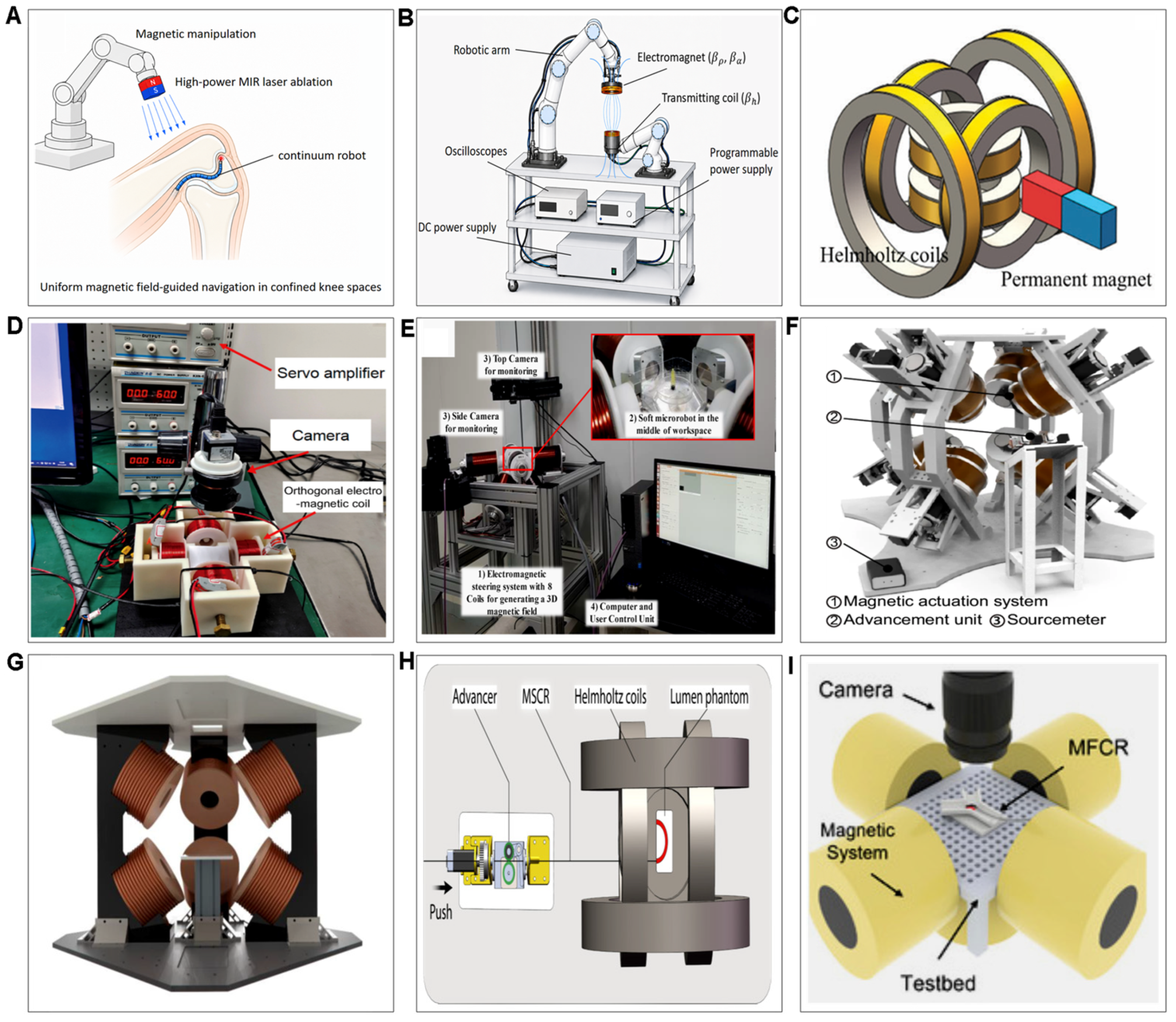
A uniform magnetic field is a magnetic field in which the magnitude and direction of the magnetic induction intensity remain constant within a certain area. Permanent magnets can form an approximately uniform magnetic field in a local space by arranging them at a distance, using large-sized magnets, or using magnetic flux focusing structures [80,81]. In a uniform magnetic field, internal magnetic units experience little net force. However, misalignment between their magnetic moments and the external field generates magnetic torque. Therefore, uniform fields are commonly used for attitude adjustment, bending control, and multi-DOF deformation of MCRs. For navigation and control of movement (Figure 3A), Zou et al. used axially magnetized neodymium iron boron (NdFeB) to generate a uniform field within the clinical safety range and used a robotic arm to control the direction of the magnetic field, thus solving the navigation problem of flexible robots in confined cavities [82]. Similarly, Mao et al. used large-sized permanent magnets and adjustable magnet arrays to form a uniform field and gradient field, and achieved “guide” and “follower” translational locomotion and spatial following through the relative motion of two magnets [83]. In addition, Wang et al. verified that a uniform magnetic field can generate a large-angle deflection for hard magnetic elastomers embedded with NdFeB particles. This research provides a theoretical basis for vascular navigation and curved catheter design [61]. Huang et al. used a device equipped with a robotic arm and an external permanent magnet to generate a uniform field, realizing 3D spatial diversification and precise navigation [84]. Liu’s team developed a dual-DOF multimodal MCR with an internal permanent-magnet-powder composite structure. The robot achieved large bending in multiple directions under a uniform field and used geometric anisotropy for multiplanar obstacle avoidance [85]. Wei et al. designed a coaxial structure with multiple embedded permanent magnets. By adjusting magnet position and angle, they controlled the bending radius and achieved multimodal deformation for coronary-artery navigation [59]. Chathuranga et al. generated a rotating uniform field through a dual permanent magnet synchronous rotation device, enabling a high aspect ratio soft robot to produce serpentine propulsion, reducing the insertion force while increasing the insertion distance [86]. In addition, Zhao’s team further realized controllable contact force output under uniform and gradient combined fields based on the hard magnetic elastic beam model, providing support for safe contact in interventional surgery [62].
The gradient magnetic field is the magnetic induction intensity that varies with position in space. When a permanent magnet is placed near the operating area, its magnetic field intensity decreases significantly as the distance increases, thus naturally forming a gradient magnetic field [87]. At this time, the internal magnetized material will be subjected to a magnetic force along the gradient direction. Therefore, the gradient magnetic field is often used to realize the traction, propulsion, elongation, and hybrid modal deformation of MCRs. Sun’s team used a gradient field generated by a non-uniform permanent-magnet array to achieve simultaneous elongation and bending control. The model supported real-time pose prediction of cardiovascular catheters and performed well in confined spaces [76]. Abolfathi et al. [13] further used the dual-arm permanent magnet to generate a push-pull adjustable gradient magnetic field (Figure 3B) to realize the precise heating, magnetization reprogramming, and locomotion control of the robots. Lin’s team [32] used a single moving permanent magnet to generate a non-uniform gradient magnetic field to realize multimodal deformation replacement, and the reachable space of the tip was significantly improved, overcoming the limitation that the traditional uniform magnetization structure can only generate a single C-shaped bend. For controlling robot deformation, Wu et al. [68] used a single rotatable permanent magnet to generate a gradient magnetic field, and combined visual servoing and Jacobian matrix solving to achieve the switching of 10 feature shapes. In addition, the permanent magnet gradient magnetic field also plays an important role in adsorption and separation. Xue et al. [88] proposed a CR that can be magnetically reprogrammed in situ, and used the gradient magnetic field to achieve active adsorption and separation between modules, which significantly improved the end motion range and solved the problems of insufficient freedom and limited workspace of traditional permanent-magnet manipulation. In addition, the gradient magnetic field can also be used to reduce errors. In terms of task load and MIS, Chen et al. used a robotic arm to carry a permanent magnet to generate a gradient magnetic field, and drove a hollow MCR to position and operate in a 3D blood vessel model, realizing the liquid sampling and stirring function under low intensity gradient field, making up for the shortcomings of traditional magnetic robots that are difficult to carry tools [33].
Figure 3.
Common magnetic manipulation systems. (A) A robotic arm controls a permanent magnet to generate a uniform field. A continuum robot enters the human body through a tiny incision and, driven by an external magnetic field, can navigate and turn within the narrow space of the knee joint. (B) A dual-arm permanent-magnet system generates an adjustable gradient magnetic field for robot actuation and reprogramming. (C) A hybrid platform of an electromagnetic coil and a permanent magnet. Adapted with permission from Ref. [41]. Copyright 2023, Cardiovascular Innovations and Applications, published by Compuscript Ltd. (D) Four-axis electromagnetic coil magnetic manipulation system. Reproduced from Ref. [33] under the terms of the Creative Commons Attribution 4.0 International License. Copyright 2022, The Authors, published by MDPI, Basel, Switzerland. (E) The electromagnetic manipulation system controls robot guidance. Adapted from Ref. [89] under the terms of the Creative Commons Attribution 4.0 International License. Copyright 2018, The Authors, published by MDPI, Basel, Switzerland. (F) Large-size N52 permanent magnets and adjustable magnet arrays form uniform and gradient fields. Adapted from Ref. [83] under the terms of the Creative Commons Attribution 4.0 International License. Copyright 2024, The Authors, published by Springer Nature. (G) Schematic diagram of the main structure of an eight-coil electromagnetic system. Adapted from Ref. [90] under the terms of the Creative Commons Attribution 4.0 International License. Copyright 2023, The Authors, published by MDPI, Basel, Switzerland. (H) A multi-coil electromagnetic system enables navigation within a vascular model by being propelled by a driving magnetic field. eproduced from Ref. [25] under the terms of the Creative Commons Attribution 4.0 International License. Copyright 2025, The Authors, published by Elsevier Ltd. (I) The composite system consists of five orthogonal electromagnets and a camera. Adapted from Ref. [8] under the terms of the Creative Commons Attribution 4.0 International License. Copyright 2023, The Authors, published by MDPI, Basel, Switzerland.
2.2.2. Magnetic Coils
Magnetic coils adjust current inputs in real time to control field strength, direction, gradient, and temporal pattern [75,91]. Because of their programmable field output and rapid response, magnetic coils are widely used for attitude control, trajectory tracking, and navigation [92]. This programmability makes magnetic coil systems more suitable than permanent-magnet systems for dynamic tasks, such as targeted delivery and cell manipulation [48,87]. Based on the mechanical configuration and workspace requirements, electromagnetic coil systems can be categorized into fixed coil systems and mobile coil systems.
Fixed-coil systems typically consist of an array of multiple coils positioned in a fixed spatial location, with the magnetic field controlled in real time by adjusting the current [93,94]. Based on the magnetic field distribution characteristics, these systems primarily provide magnetic torque by generating a uniform magnetic field or provide magnetic pull by using a gradient magnetic field [95]. Among them, the uniform magnetic field system mainly generates a constant magnetic field with a controllable direction to provide a stable magnetic torque control. In the uniform magnetic field system, the magnetic field generated by Helmholtz coils or a three-dimensional multi-coil array maintains the same strength in the local area, and the gradient term can be ignored [96]. Figure 3C shows that Liu et al. used Helmholtz coils to generate an oscillating uniform magnetic field [41]. Chen et al. used triaxial orthogonal magnetic coils to generate an oscillating uniform magnetic field. They all used the uniform magnetic field generated by the magnetic coils to enable the bending and motion of the robot (Figure 3D) [33]. The application of multi-axis coils has promoted the motion development of MCRs. Figure 3E shows that the robot can move along an arbitrary path by adjusting the magnetic field using eight magnetic coils [89]. At the same time, Mao et al. constructed an eight-pole electromagnetic coil system (Figure 3F) to generate a uniform magnetic field in an arbitrary direction by linear superposition of current, realizing real-time steering control in complex cavities and avoiding collision with the blood vessel wall [83]. Researchers also used four orthogonally arranged magnetic coils to generate periodic magnetic fields in low-Reynolds-number fluids. This system manipulated twin-tailed soft microrobots and enabled flagellar propulsion, selective actuation, synchronized motion, and independent position control [97]. To achieve multimodal motion, Wang et al. built a three-axis orthogonal coil system to realize the bending and extension motion of a centimeter-scale magnetic robot in a uniform field of 0–22 mT, and to complete obstacle crossing and bidirectional walking tasks [58]. In order to meet the requirements of precise navigation, Wang et al. used a three-dimensional Helmholtz coil system to construct a uniform field environment of 0–15 mT, which effectively realized the compliant control and high-precision path tracking of the robot [98]. Figure 3G shows a custom eight-coil electromagnetic system. It provides a stable and controllable uniform field for precise MCR delivery [90].
To generate the magnetic pulling force required for the translation of magnetic microrobots, researchers typically construct gradient magnetic field systems using electromagnets with iron cores or arrays of multipole coils [99,100]. Compared to uniform fields, the intensity of gradient fields varies significantly with spatial position, offering a natural advantage in navigation tasks within complex lumens such as blood vessels. For example, Peyron et al. used the non-uniform magnetic field of the CardioMag MNS system to achieve 3D pose reconstruction of microrobots [101]. On this basis, in order to improve the navigation performance in complex and confined environments, Tong et al. further introduced discrete differential geometry modeling and real-time simulation technology. The team used a multi-coil electromagnetic system to generate an adjustable gradient field Figure 3H) and successfully realized automatic tracking and obstacle avoidance of the path in the blood vessel, significantly improving the control response accuracy and system robustness under the gradient magnetic field [25].
While fixed coil systems are technologically mature, they face the physical limitation of rapidly decreasing magnetic field strength with distance. Expanding the workspace typically requires a significant increase in coil size and power consumption, resulting in poor system scalability [102,103]. To address this contradiction, researchers have proposed mobile coil systems. By mounting magnetic coils on a robotic arm or mobile platform, the magnetic source can move with the robot. This expands the effective workspace while maintaining field strength and gradient [104]. Sikorski et al. designed a magnetic manipulation system consisting of a 6-DOF robotic arm and an electromagnetic coil, which can control the magnetic field strength and gradient within the space accessible to the end effector of the robotic arm [105]. Yang et al. developed a magnetic manipulation system that can control the magnetic field strength and direction in a specific area within a large space by controlling the end position of a parallel device and the magnitude and direction of the current in the three magnetic coils [106]. Edelmann et al. designed a mobile electromagnetic coil system device that achieves multi-DOF motion and precise control of the magnetic field and its gradient within a large space by adjusting eight magnetic coils in combination with a precision motor and guide rails [107]. Building on this, Yang et al. further enhanced the performance of the mobile coil system and, by controlling this mobile coil system, achieved autonomous navigation and obstacle avoidance for a magnetic microrobot in a complex maze environment [108]. Mobile coil systems can partly compensate for magnetic-field attenuation by moving the magnetic source, which is useful for enlarging the effective workspace.
2.2.3. Hybrid Platforms
Hybrid platforms integrate magnetic actuation, imaging navigation, and intelligent control. They represent an important direction for minimally invasive interventional robotics [109,110]. Hybrid platforms are more than combinations of coils and magnets. They also integrate visual feedback, in vivo imaging, closed-loop control, or teleoperation algorithms. They mainly rely on permanent magnet-electromagnetic hybrid systems and magnetic resonance imaging (MRI) magnetic field systems, which together constitute important magnetic navigation technologies in modern medicine [111,112,113].
Permanent magnet-electromagnetic hybrid systems combine the strong gradient magnetic field generated by permanent magnets with the adjustable uniform magnetic field generated by electromagnetic coils. These systems combine remote traction with local attitude control. This makes them useful for MCR tasks that require both force output and precise steering [114]. In clinical systems, the CorPath GRX system achieves precise navigation in percutaneous coronary intervention surgery by combining master-slave operation with permanent magnet-assisted actuation [115], and is one of the most mature magnetically controlled intervention platforms in clinical practice. The Niobe® and Genesis systems developed by Stereotaxis use large symmetrically arranged permanent magnets to generate directionally adjustable fields. These fields enable compliant remote control of endocardial catheters and have been used in cardiac ablation [116]. To expand the research on manipulation systems, Wang et al. used five orthogonal electromagnets and mounted a camera to capture motion to verify the deformation accuracy and steering capability of the MCRs, providing experimental support for its application in vascular interventional navigation surgery (Figure 3I) [8]. In addition, a hybrid configuration of two permanent magnets and one electromagnetic coil was proposed, and combined with the Euler–Bernoulli model to complete whole-body morphology prediction and complex path navigation. This work first proposed a dual-mode strategy of independent control and hybrid control, and achieved high-precision obstacle avoidance and morphological adaptive control in narrow blood vessels. The researchers also tested a hybrid strategy in narrow anatomical regions such as the lungs. In this strategy, permanent magnets provide the main driving force, whereas electromagnetic coils fine-tune the attitude. The results suggest improved stability and safety in confined channels [86]. Furthermore, the Abolfathi team [13] systematically evaluated the strategy by introducing quantitative performance indicators. The results showed that under the synergistic effect of gradient field coarse adjustment and 1–15 mT uniform field fine adjustment, the control accuracy of the tip deflection angle of the soft magnetic robot can reach ±2°, and stable non-contact navigation is achieved in the blood vessel model.
MRI-based magnetic systems directly use the strong static field and native gradient coils of clinical MRI scanners. They enable non-contact actuation while providing high-resolution imaging. This configuration also avoids the spatial interference caused by additional magnetic sources in conventional magnetic-control systems [117,118]. Its high integration and imaging characteristics make the MRI system show significant advantages in cerebrovascular intervention, deep targeted delivery, and high-precision magnetic resonance interventional therapy. In addition, Francescon et al. [119] proposed a miniaturized Helmholtz magnetic actuation scheme that can be integrated with commercial endoscope systems and combined with optical feedback to achieve closed-loop control of the magnetic field in the endoscope channel. Eight-coil systems and standard Helmholtz platforms are also widely used as academic magnetic-control platforms. They provide standardized testbeds for evaluating MCR control strategies [88,120].
Overall, the three types of magnetic manipulation systems show different practical characteristics. Permanent magnets offer strong fields and low power consumption, but their dynamic response is limited. Magnetic coils provide more flexible and rapid field control, while heat generation, power demand, and workspace size remain important constraints. Hybrid platforms can improve navigation accuracy by integrating magnetic actuation with imaging or feedback, but they also increase system complexity. Thus, the system choice should depend on the required workspace, control accuracy, safety, and clinical applicability.
2.3. Evolution of Motion Control Strategies
In recent years, MCR control strategies have gradually shifted from open-loop physical models and single closed-loop feedback to multi-constraint shared control, and ultimately to highly adaptive AI algorithms [121,122,123]. Early control strategies mainly use open-loop strategies based on static or quasi-static physical models, which, due to the lack of environmental feedback, are highly susceptible to dynamic disturbances [124,125]. To address this, researchers employ a closed-loop control strategy based on visual servo and feedback, obtaining the robot’s pose error in real time and continuously correcting magnetic field input using PID controllers and Kalman filtering algorithms to achieve stable trajectory tracking [126]. When microrobots perform tasks in complex terrain or unstructured environments, a single mode of motion is often limited. To this end, control strategies have begun to evolve toward multimodal and hierarchical control. For example, Zhong [127] and others developed a multimodal motion strategy for soft millimeter robots, and Nie [128] proposed a hierarchical multimodal movement control framework to enhance the system’s multi-environment adaptability. To satisfy multiple constraints, researchers proposed a shared control strategy based on constraint optimization. Raphalen et al. [129] proposed a safe shared control strategy with visual perception for magnetically driven microrobots, cleverly transforming control problems into real-time quadratic programming problems. Faced with more complex physical environments, Zhong et al. [130] proposed an adaptive shared cascaded navigation control strategy, enabling magnetically controlled microrobots to maintain safe and efficient navigation capabilities even under unstructured dynamic interference. To tackle the enormous computational challenges of precise dynamic modeling at extremely small scales, AI control methods such as neural networks and reinforcement learning are gradually showing great potential [131]. Traditional deep learning frameworks often come with large network parameter counts and face long training cycles during actual deployment. To better address these issues, Xu et al. [132] combined BLS with Lyapunov theory and applied it to microrobots, successfully balancing AI’s generalization capability with strict error convergence. Subsequently, the team [133] extended this model strategy to spatial navigation for bionic robotic fish, achieving precise trajectory tracking and obstacle avoidance without the need for complex fluid and magnetic coupling modeling.
3. Classification of Magnetically Controlled Continuum Robots
Here, the classification of MCRs is based on their primary clinical function rather than mere morphology, because the same magnetic structure can support different functions when magnetization, stiffness distribution, or control strategies are varied. This functional classification helps compare different devices based on key factors in practical applications: guiding capability in tortuous lumens, the balance between compliance and stability during interventional procedures, adaptability to environmental changes, and propulsion efficiency at small scales. Importantly, this classification clarifies design trade-offs and applicability. Table 3 summarizes the four categories by comparing their main functions, key advantages, and current limitations, thereby providing a basis for evaluating the application scope and remaining challenges of different MCR designs.
Table 3.
Comparative summary of functional categories, key advantages, and current limitations.
3.1. Guiding/Steering Continuum Robot
3.1.1. Magnetic Guidewires
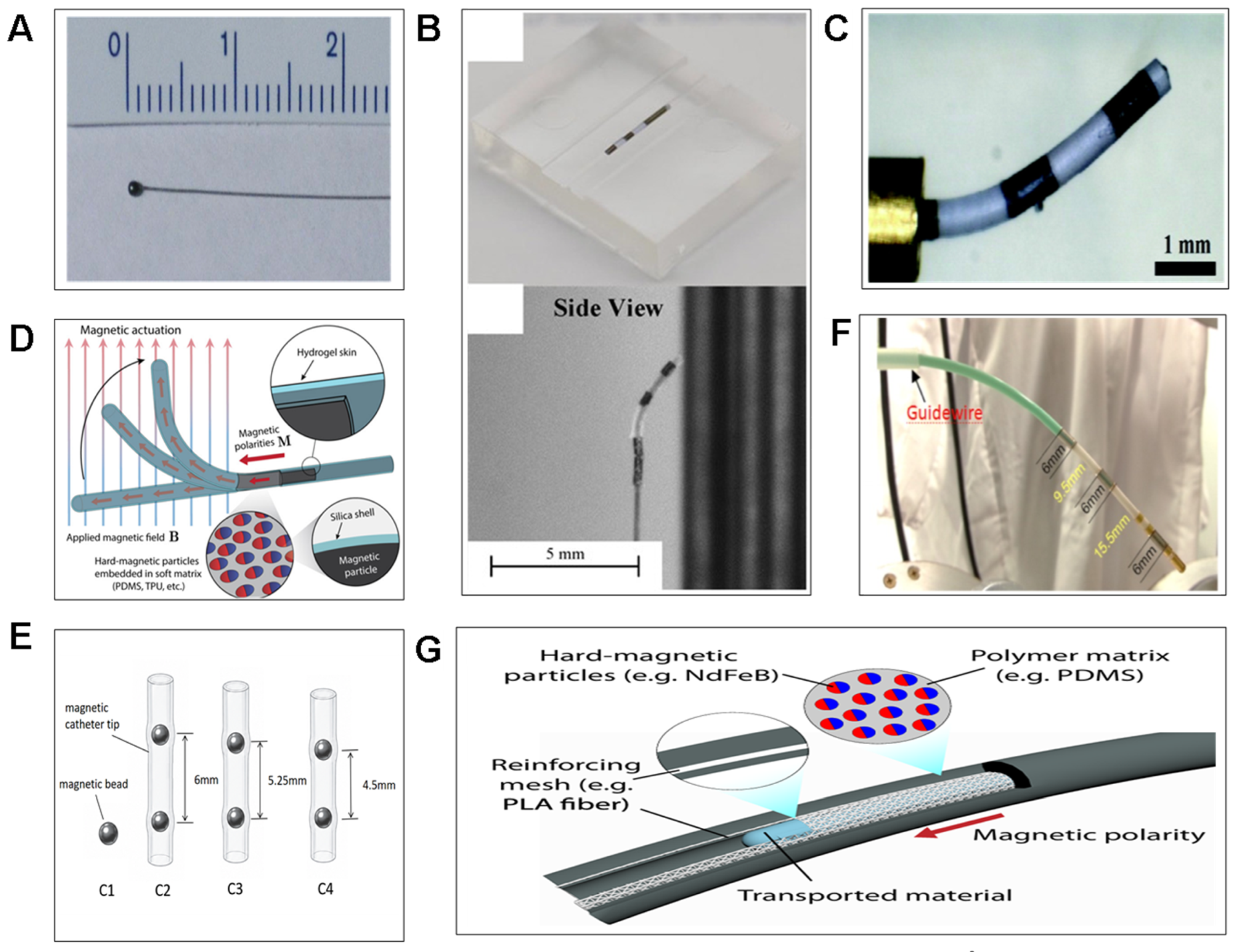
In experimental studies of complex vascular models, the use of MGs can reduce fluoroscopy and surgical time. Tsuchida [138] was the first to successfully apply magnetic navigation to guidewires in surgery, providing a novel, safe, and feasible method for treating coronary artery lesions. Early approaches focused on integrating small permanent magnets at the end of standard guidewires. Krings studied a magnetic guidewire composed of a 0.014-inch guidewire and a 2 mm long small permanent magnet [139]. The magnetic navigation system allows the microguidewire to rotate in all directions and tests its accuracy in tortuous vascular structures and its ability to navigate in extracorporeal arterial aneurysms. Lalande continued to optimize the device. Figure 4A shows the fabrication of a ferromagnetic guidewire by attaching 0.9 mm ferromagnetic beads to the tip of a 0.007-inch guidewire, successfully demonstrating the selective passage of the guidewire through aortic branches and the successful insertion of an MG in the renal artery [140]. To overcome the limitations of single magnets on configuration changes, researchers began to explore multi-magnet integrated designs. Hoshiar et al. [89] used a composite molding process to construct a flexible microrobot from flexible polydimethylsiloxane, two permanent magnets, and a micro spring. This modular design gave the guidewire better obstacle avoidance performance in the three-dimensional coronary artery model (Figure 4B). Jeon’s team also had the same structural design, which further enhanced the maneuverability of the guidewire [94]. The robot was made of deformable material and could be deformed from 0° to 80° under the control of a low-intensity magnetic field of 15 mT. Subsequently, the team optimized the magnetization distribution by introducing finite element analysis, reduced the overall diameter of the guidewire to less than 1 mm (Figure 4C), and achieved a large-angle bending of up to 132.7°, which significantly improved the spatial accessibility of the device under the physiological constraints of stenosis [99].
In addition, many researchers have proposed a variety of heterogeneous structure designs to meet the needs of medical applications, which can both meet the needs of effective navigation and have high flexibility to ensure safety. Yang et al. [141] developed an MG composed of a rigid shaft and a flexible end. The end is made of polydimethylsiloxane, and the guidewire has a core-shell structure, which can balance the rigidity of the two parts and minimize the damage to the vascular endothelium while ensuring efficient guiding force. The magnetically controlled steering strategy mentioned above is limited to a low magnetic field environment, which hinders its integration with medical systems that operate in ultra-high magnetic fields (such as MRI scanners). In this regard, Tiryaki et al. proposed a magnetic guidewire framework based on fiber rods and neodymium magnets. This study successfully demonstrated the steering principle in an ultra-high magnetic field environment of 7T, laying the foundation for the operation of magnetic robots under real-time imaging guidance in clinical practice [142]. MG is usually composed of a layer of ferromagnetic material that generates a magnetic response and an elastomer that will deform under the action of an external magnetic field. In addition to permanent magnets providing magnetic response, magnetic micro/nanoparticles can also be dispersed in a polymer matrix to form a controllable elastomer. Figure 4D shows a submillimeter-scale, self-lubricating ferromagnetic soft continuum robot [44] whose main body is composed of a soft polymer matrix of uniformly dispersed ferromagnetic particles. The innovation of this design is the introduction of a hydrogel coating with a thickness of only a few hundred micrometers, which reduces the frictional force of motion by more than 10 times, and the silica coating effectively prevents the bio-corrosion of magnetic particles. Subsequently, the same team proposed a system consisting of an MG, a mechanical device with magnets, a set of electric linear actuators, and a remote control console [143]. They successfully demonstrated navigation under tortuous vascular pathways in a live pig model and verified its clinical potential in cerebral aneurysm embolization and ischemic stroke thrombus removal. In pursuit of even greater flexibility, Zhang et al. [144] combined commercial guidewires with soft actuators made of Ecoflex and magnetic powder to develop a guidewire system with the ability to make 180° sharp turns in 3D space. This ultra-flexible design enables it to cope with extremely tortuous anatomical pathways, marking a step towards highly autonomous and bio-adaptive MGs [145].
Figure 4.
Guiding and steering CRs include magnetically guided MGs and MCs. (A) A physical image of an improved guidewire, made by attaching a 0.9 mm diameter ferromagnetic bead to a 0.007-inch guidewire end. Reproduced with permission from Ref. [140]. Copyright 2015, American Association of Physicists in Medicine, published by John Wiley & Sons, Inc. (B) Fabrication of a microrobot on a Polydimethylsiloxane (PDMS) mold and the microrobot during steering tests. Reproduced from Ref. [89] under the terms of the Creative Commons Attribution 4.0 International License. Copyright 2018, The Authors, published by MDPI, Basel, Switzerland. (C) Attaching the microrobot to the guidewire allows it to steer. Adapted from Ref. [99] under the terms of the Creative Commons Attribution 4.0 International License. Copyright 2019, Sungwoong Jeon et al., published by Mary Ann Liebert, Inc. (D) Schematic diagram of a core-shell structure magnetically controlled guidewire consisting of a rigid shaft and a flexible end. Adapted with permission from Ref. [44]. Copyright 2019, The American Association for the Advancement of Science, published by AAAS. (E) Magnetic catheter tips with single or paired ferromagnetic beads at different spacings. (F) A flushing gold-tipped conduit probe and its dimensions are used in gradient force measurement experiments. Adapted with permission from Ref. [146]. Copyright 2016, American Association of Physicists in Medicine, published by John Wiley & Sons, Inc. (G) A magnetically controlled continuum consisting of a soft polymer matrix of dispersed hard magnetic particles and a polylactic acid reinforced mesh. Adapted under the terms of the CC BY license [147]. Copyright 2021, The Authors, published by Springer Nature.
3.1.2. Magnetic Conduits
Here, MGs refer to guidewire-like devices mainly used for directional steering and vessel selection, whereas MCs refer to catheter- or conduit-like devices that can provide a lumen or functional platform for delivery, sensing, or therapeutic operations. The complexity of MCs’ design usually requires the use of a multi-layer structure, including a ferromagnetic core and an insulating intermediate layer, as well as a protective outer sheath [148,149]. This layered design not only enhances their operational versatility but also improves their tolerance under the harsh conditions of complex operating environments [150,151,152]. With this advanced design, MCs have the potential to improve the precision and safety of MIS and usher in a new era of refined treatment [153]. The earliest attempts at MCs can be traced back to the 1950s, when Tillander [154] attached a small steel plate to the tip of the catheter and explored magnetic guidance using an electromagnet. Subsequently, several teams explored various magnetic methods, with the structure gradually becoming more diverse and various performances gradually improving. Zhang et al. [155] proposed a catheter design based on a ferromagnetic ball, in which the ball is fixed to the tip of an 8Fr catheter by a highly flexible silicone tube as a connector. This decoupled design significantly reduces the frictional resistance of the blood vessel wall while supporting the heavy magnetic end. Using a similar geometric topology, a magnetic manipulation system suitable for large spaces was demonstrated, which can manipulate MC models in a workspace with a diameter of more than 200 mm, filling the gap in flexible manipulation in large spaces [106].
As interventional needs become more refined, the magnetic layout of catheter tips has shifted from a single magnetic dipole to a multi-polarized distribution. Gosselin et al. [156] studied the deflection effect of magnetic gradients on single/double ferromagnetic ball guidewires in MRI scanners, pointing out the trade-off between the increase in magnetic force brought about by the increase in ferromagnetic materials and the imaging artifacts caused by dipole-dipole interactions (Figure 4E). In the same year, MCs with two magnetic beads were used as experimental probes to simulate anisotropic robots to record the gradient steering force generated on the catheter, and a new magnetic resonance navigation platform architecture independent of MRI scanner types was proposed, which has the potential to be integrated with commercial scanners [157]. To obtain more diverse functionality, the number of magnets embedded in the catheter has gradually increased from a single magnet to adapt to different medical needs and application scenarios. Le et al. proposed a tripolar catheter design, and Figure 4F shows that seed magnets are embedded in the X, Y, and Z planes of the catheter tip, which eliminates the need for controlling the hyperelastic drawing of the catheter tip [147]. Compared with single-polar catheters, it can achieve flexibility with less force and higher precision. They also derived a comprehensive mathematical model to predict torque and deflection, achieving submillimeter-level flexibility. In addition, Sikorski et al. [158] developed an MC for loading microrobot infrastructure; the MC uses three miniaturized electromagnets as a small system for microrobot tasks. Building on this, the same team further developed a flexible conduit equipped with a miniature electromagnetic coil at the tip of the flexible conduit, enabling the controlled release and retrieval of tractionless magnetic capsules [159].
To achieve different functions to meet the needs of more medical scenarios, some novel MC structures have been designed. Lin et al. [160] designed a catheter with two opposing axially polarized magnets. Unlike the design where all magnets are magnetized in the same direction, the orthogonal and pivotal motion capability is significantly enhanced by inducing nonlinear deflections of C-shape, S-shape, and J-shape by externally moving the magnet. In recent years, Pittiglio et al. [161] innovatively proposed using a ball chain as a magnetic field to generate a specific shape. The ball chain is encapsulated in a flexible polymer sheath and can be inserted into the cavity of any CRs to provide real-time feedback. The team further derived a shape-aware model of the steerable catheter tip, which has extremely high objectivity and sensitivity. In response to the problem that the maneuverability of traditional catheters decreases due to the increase in insertion depth, Chautems et al. [162] proposed the concept of a tethered magnet, which shows that the flexible catheter tip is replaced with a rope-like tether and multiple magnets are replaced with a single magnet. By converting the tension on the tether into the force at the contact point, the dependence on the bending radius and insertion length of the catheter is eliminated, which is not possible in the current catheter operating system. They also proposed a manipulable magnetic sheath. Specifically, a permanent magnet is fixed to the distal end of the sheath rather than to the catheter [163]. This decouples the control of the tip direction from the catheter insertion process, enabling more robust and intuitive catheter manipulation while providing sufficient force and stability. In addition, Lloyd et al. [164] proposed a braided reinforced catheter with a high aspect ratio that achieves 180° autonomous bending without tissue interaction using a curved magnetized profile (Figure 4G). The team further optimized the design and proposed a multi-segment continuum device consisting of pure Ecoflex segments and magnetic Ecoflex segments, with the magnetization direction of each magnetic segment being handled individually [165]. They further proposed a novel design method based on a neural network trained by finite element simulation, taking the first step in designing and manufacturing tentacles with customized magnetic properties to adapt to anatomical constraints. Meanwhile, the introduction of cutting-edge technologies, such as in vivo bioprinting of ferromagnetic soft catheters [166], millimeter-scale 3D printing of soft robots [147], and magnetic spraying [167], has not only greatly simplified the manufacturing process but also opened up broad prospects for in situ diagnosis and treatment of MCRs in complex physiological cavities.
3.2. Variable Stiffness Continuum Robot
3.2.1. Variable Stiffness Based on Material Properties
VS has become a core function of flexible minimally invasive surgical robots. By dynamically adjusting mechanical properties, the insertion compliance and operational precision of catheters can be significantly improved [168,169]. Design based on material properties enables CRs to adjust stiffness on demand according to external stimuli (such as temperature or magnetic field), showing broad prospects in medical scenarios requiring precise operation in complex environments [170,171].
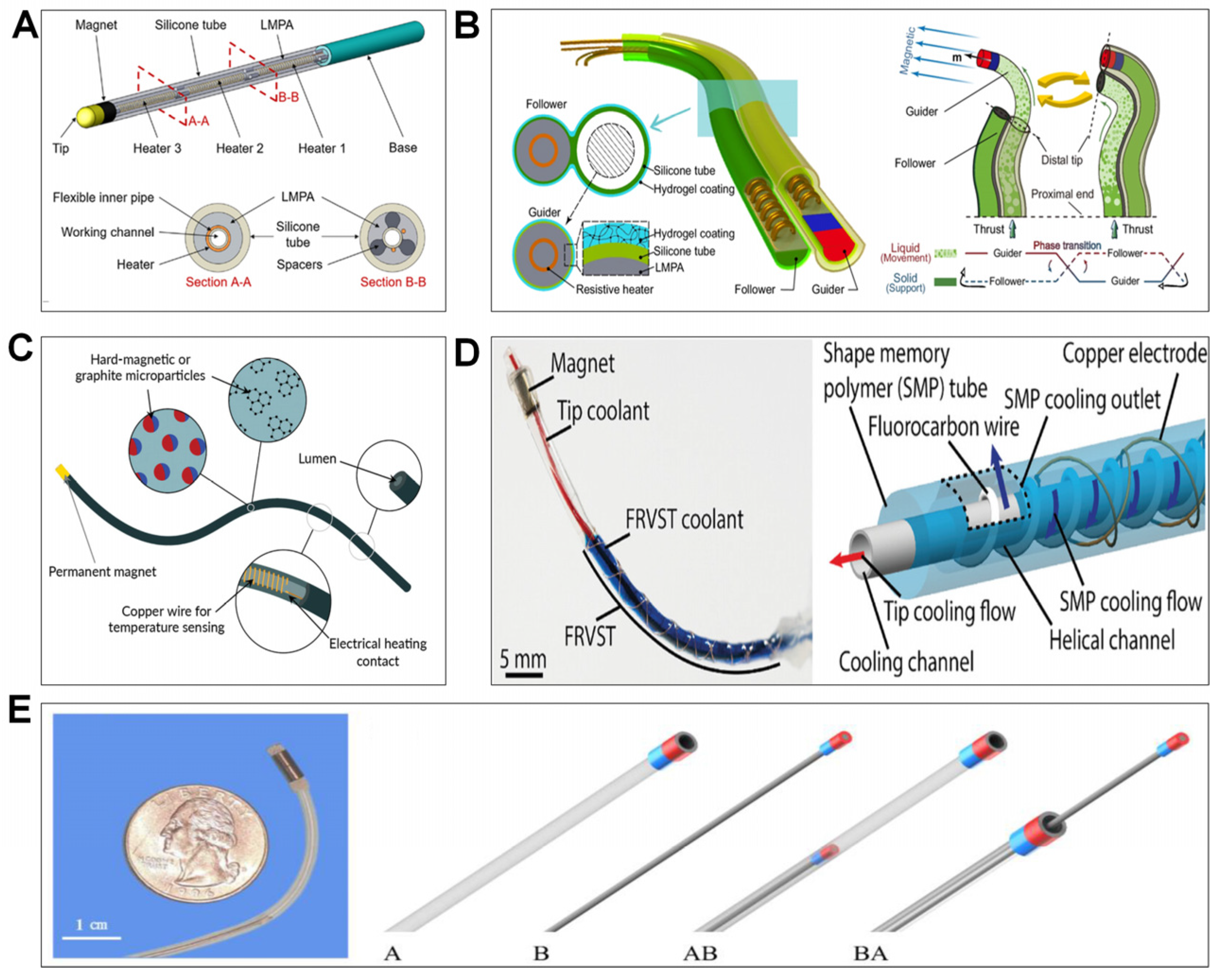
Endoscopic surgical instruments need to have both flexibility during advancement and rigidity at the target position in order to resist external forces and improve accuracy. Recent research focuses on integrating low-melting-point alloys (LMPA) into magnetic continuums. Zhao et al. [172] proposed a VS-MCR based on an LMPA, which can complete the switching between soft and hard states in about 18 s through an integrated heating and cooling system, and is equipped with a heat insulation layer to protect biological tissue. For miniaturization, Figure 5A shows a series of segment continua with a diameter of only 2.33 mm. By inducing independent softening of each segment by current, a deep integration of magnetic navigation accuracy and multi-DOF configuration was achieved [173]. Subsequently, Lussi et al. [174] further broke through the scale bottleneck and developed a submillimeter-level catheter. The radial temperature gradient generated by the heating coil induced the formation of a solid-liquid interface, which made the contact force adjustment range reach 400 times. The fully robotic minimally invasive operation was demonstrated on an eyeball model. To enhance safety and coordination, Figure 5B shows a millimeter-scale system combining a “guide” and a “follower” that uses the alternating cycle of phase change components to achieve autonomous propulsion, demonstrating the outstanding potential of LMPA technology in delivering tools in fragile lumens [83].
Traditional VS catheters usually require an elastic material to encapsulate the core, which limits miniaturization. To eliminate the encapsulation layer, Mattmann et al. [175] used a biocompatible thermosetting polymer to fabricate a submillimeter-scale 4D robotic catheter (Figure 5C). The catheter is heated by embedded copper wires, which causes the polymer to switch between a glassy and rubbery state, with modulus changes spanning two orders of magnitude. The team subsequently introduced an active heating/cooling hybrid strategy, which further improved the system response rate and manufacturing scalability [176]. In surgical applications, the transition time between soft and hard states is crucial. Piskarev et al. [177] designed a fast-response catheter with an encapsulated spiral cooling channel (Figure 5D), which improved the transition performance by 26 times compared to conventional designs. This multi-segment design can also serve as a cooling channel for the ablation tip during surgery, reflecting the trend of functional integration. Currently, MCRs are moving from a single temperature-controlled phase transition to a multimodal adaptive stage supported by intelligent composite systems. Xu et al. [178] designed a composite system of magnetic particles and non-Newtonian fluid soft materials, and used surface adhesion and on-demand hardening mechanisms to enable robots to grasp objects 300 times their own weight, opening up new paths for functional magnetic control applications. These advances collectively highlight the great potential of VS-CRs in complex medical tasks.
Figure 5.
VS-CRs based on material properties and structure. (A) A submillimeter-scale variable stiffness continuum catheter based on LMPA, containing a heating coil, which can form a controllable radial temperature gradient at the solid-liquid interface. Adapted from Ref. [173] under the terms of the Creative Commons Attribution 4.0 International License. Copyright 2020, The Authors, published by Wiley-VCH GmbH. (B) Design principle of a millimeter-scale magnetically steered continuum robot for endovascular surgery. The yellow curved arrows indicate the alternating transition between the Guider and Follower components; colors distinguish the Guider/Follower, embedded magnet, resistive heaters, and liquid/solid states. Adapted from Ref. [83] under the terms of the Creative Commons Attribution 4.0 International License. Copyright 2024, The Authors, published by Springer Nature. (C) Schematic diagram of a 4D magnetically controlled continuum robot catheter. Adapted from Ref. [175] under the terms of the Creative Commons Attribution 4.0 International License. Copyright 2022, The Authors, published by Wiley-VCH GmbH. (D) A fast-response variable-stiffness catheter with integrated spiral cooling channels for cardiac ablation procedures; red and blue indicate tip-cooling and SMP-layer cooling flows, respectively. Adapted from Ref. [177] under the terms of the Creative Commons Attribution 4.0 International License. Copyright 2024, The Authors, published by Wiley-VCH GmbH. (E) Schematic diagram of four working modes of the continuum robot. Adapted from Ref. [90] under the terms of the Creative Commons Attribution 4.0 International License. Copyright 2023, The Authors, published by MDPI, Basel, Switzerland.
3.2.2. Variable Stiffness Based on Structural Design
VS-CRs mainly regulate their stiffness through material physical property transformation or mechanical structure design. Soft and flexible magnetic robots have attracted widespread attention in the past decade, but how to empower and precisely adjust their stiffness distribution at the microscale remains a core challenge [179,180,181]. To achieve an enhanced local support force under the action of an external magnetic field, Lloyd et al. [182] designed a sliding iron–nickel–titanium alloy rod structure. The device regulates stiffness by adjusting the insertion length of the alloy backbone: when the backbone is fully inserted, its high elastic modulus provides strong, rigid support for the structure and suppresses bending deformation; as the backbone is gradually removed, the support effect weakens, and the structural stiffness decreases significantly. However, the stiffness adjustment range relying solely on nickel–titanium alloy is relatively limited. To achieve more continuous and large-amplitude adjustment [12], some studies have introduced an internally growable and stiffness-variable “spine” structure, which consists of an inflatable chamber filled with glass microspheres. By utilizing the particle blocking effect under vacuum, the robot can quickly change from an extremely flexible state to a rigid state. By precisely controlling its growth length and locking position, stepless and programmable stiffness distribution can be achieved inside the robot, thus ensuring its safe passage through narrow and complex anatomical structures. Unlike continuous material response, Li et al. [90] proposed a discrete mechanical reconstruction scheme (Figure 5E). This scheme achieves a step-by-step switching of stiffness by disassembling and combining the relative positions of concentric nested MGs and MCs. When the two work independently, they exhibit high flexibility or high rigidity, respectively; while in a nested combination mode (such as AB/BA mode), the soft and hard structures mutually constrain each other to form an intermediate stiffness, and the effective stiffness area can be precisely controlled by adjusting the relative insertion depth. In addition, Pogue et al. [183] further explored a wirelessly driven mechanical locking mechanism, using an external magnetic field to rotate the internal plate, making it engage with the rope bead chain passing through the mechanism, thereby locking the robot shape and increasing the stiffness sharply. Subsequently, continuous actuation of the tendon can make the distal segment continue to bend, achieving multi-curvature deformation within a single segment.
The integration of high stiffness and high flexibility is crucial for the remote delivery of nanomedicines in MIS. A concentric tube continuum composed of nested silicone tubes of different diameters and wall thicknesses possesses varying inherent stiffness in each segment and supports free assembly and disassembly [184]. In this system, strong magnetic particles embedded within the flexible tubes can move under the guidance of an external three-dimensional magnetic field, dynamically altering the robot’s local bending characteristics. The utilization of an external moving magnetic module is beneficial to achieve the components’ extension and retraction, large deflection motions, and various curvatures, which promise to improve the robot’s maneuverability in tortuous blood vessels.
3.3. Multimodal Motion Continuum Robot
3.3.1. Motion Pattern Reconstruction
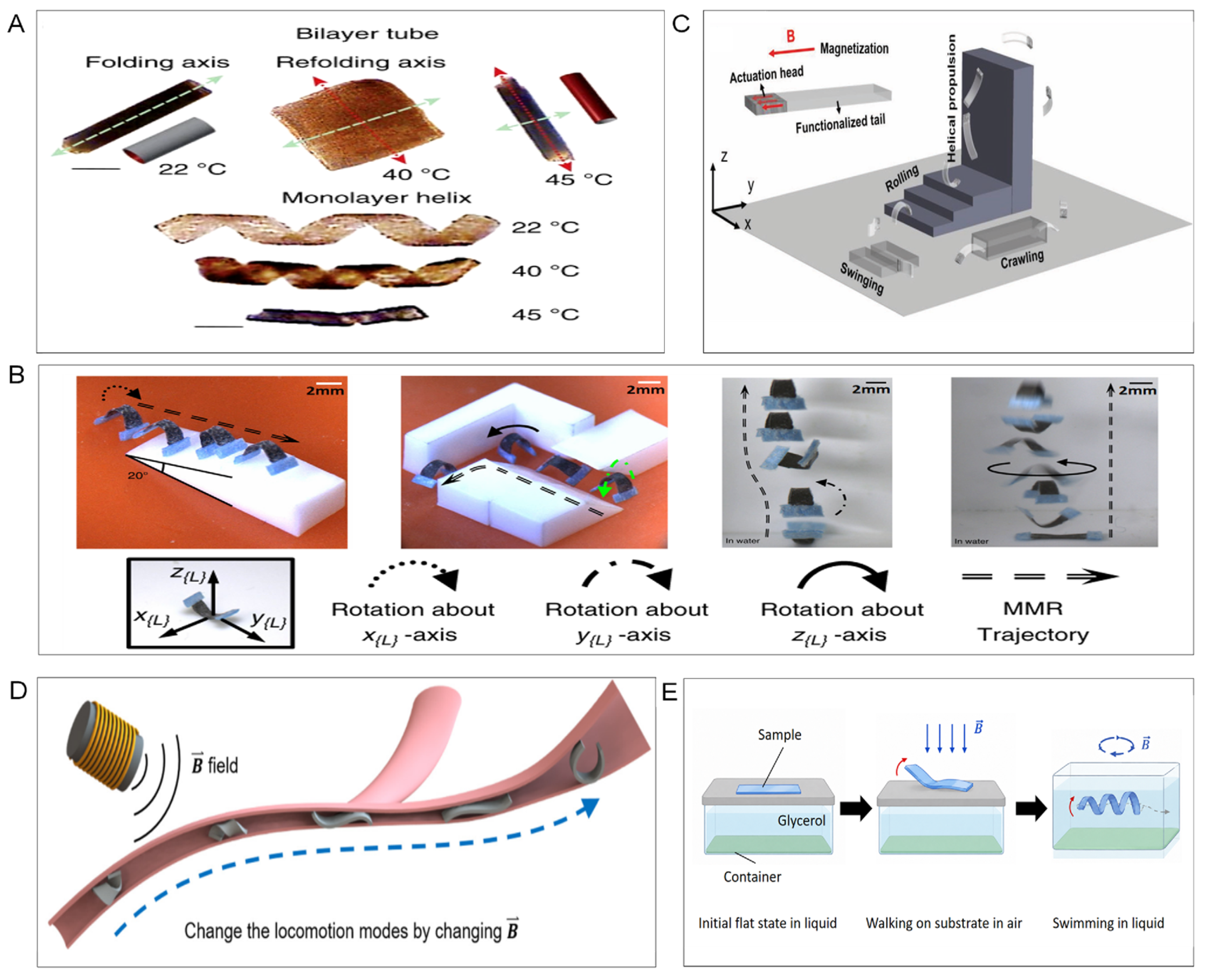
Based on motion mode reconstruction, the MCRs enable the same physical structure to switch flexibly between different motion modes by programming control of the external magnetic field [185,186,187]. This non-invasive manipulation capability enables small robots to penetrate narrow enclosed spaces and perform targeted drug delivery and MIS tasks [188]. As the research dimensions of MCRs continue to expand, the definition range is evolving from traditional linear structures to two-dimensional thin films with in-plane flexibility. Its core lies in achieving continuous and controlled large deformation of materials through distributed magnetization. In order to improve the robot’s maneuverability in unstructured environments, Hu et al. [93] mixed neodymium iron boron ferromagnetic particles with silica gel and prepared a soft millimeter-level CR with a sinusoidal magnetization direction along the long axis by applying a pulsed magnetic field. This design utilizes a preset single-wavelength magnetization profile to enable the robot to have multi-dimensional maneuverability in the same configuration, including crawling, jumping, climbing over obstacles, and traveling on the water surface. On this basis, Manamanchaiyaporn et al. [189] expanded the application of millimeter-level deformable structures and realized a self-driving mechanism. A triangular magnetic continuum with a non-uniform magnetic moment intensity distribution was designed. By responding to the magnetic torque of the head and driving the tail to swing, the robot can generate lateral body waves to achieve self-propulsion and can dynamically adjust its body shape according to the diameter of the pipe, which significantly improves its adaptability to complex application scenarios. Inspired by origami structures, some studies have developed self-folding microrobots by selectively adjusting the magnetic anisotropy of different parts of the body. Figure 6A shows that such robots can dynamically adjust their swimming characteristics and switch from swimming in a slender shape to rolling/crawling in a short and thick shape, proving that the selection of magnetic field parameters can finely adjust the motion boundary of the soft swimming device [190]. In response to the problem of the limited motion degrees of freedom of traditional robots, a team proposed a 6-DOF microrobot. By optimizing the phase angle of the harmonic profile, the robot greatly enhances the torque around its net magnetic moment axis while maintaining the 5-DOF driving capability. Figure 6B shows seven soft motion modes, including double-anchor crawling and jellyfish-like movement, and can perform complex three-dimensional picking and placing operations [191].
Unlike complex full-scale magnetization designs, some studies have achieved efficient mode switching by simplifying the magnetization region. For example, some scholars have developed a soft millimeter robot with only a magnetized head [192], which uses an external magnetic field to apply torque to the head, driving its hydrogel tail to produce asymmetric deformation, thereby achieving crawling, swinging, rolling, and spiraling forward (Figure 6C). In addition, through dynamic magnetization programming schemes, such as uniformly dispersing neodymium iron boron powder in silicone and presetting the magnetization distribution, the robot can exhibit three continuous deformation modes of C-shape, J-shape, and S-shape under magnetic control, further verifying the potential of magnetic-elastic composite materials in multimodal motion [8].
The preparation of materials relying on continuous magnetization distribution is relatively complex. Researchers have begun to explore the use of pre-magnetized permanent magnets to achieve motion control and functional integration. Wei et al. [59] proposed a multimodal robot with segmental control capability. By embedding three oppositely magnetized permanent magnets coaxially in the main body, the robot generates segmented magnetic torque by using the attraction and repulsion between the magnets to enable the robot to achieve various controllable deformations. Chen et al. [33] used the polarity configuration of the micro magnets at both ends to enable the robot to switch between ring and arch configurations. The robot, combined with a hollow silicone cavity, successfully realized liquid sampling, drug delivery, stirring, and micro-manipulation functions, providing a new paradigm for the functional expansion of biomedical scenarios. For the preparation process, the combination of magnetic actuation and multi-scale 3D printing technology provides a means to construct complex heterogeneous structures. Joyee et al. [193] used magnetic field-assisted projection stereolithography to manufacture a robot with material heterogeneity and structural layering. The robot integrates wireless magnetic actuation and exhibits excellent multimodal motion performance. It can complete load handling, obstacle removal, and precise grasping tasks in crowded and harsh environments.
Figure 6.
Millimeter-scale continuum robot with multimodal motion. (A) Optical images of a double-layered tube and a single-helix structure (45° helix angle) moving under different ambient temperatures. Adapted from Ref. [190] under the terms of the Creative Commons Attribution 4.0 International License. Copyright 2016, The Authors, published by Springer Nature. (B) A six-DOF microrobot is precisely controlled by angular displacement about the x, y, and z axes. Adapted from Ref. [191] under the terms of the Creative Commons Attribution 4.0 International License. Copyright 2021, The Authors, published by Wiley-VCH GmbH. (C) A head-magnetized soft millimeter robot. Adapted with permission from Ref. [192]. Copyright 2020, WILEY-VCH Verlag GmbH & Co. KGaA, Weinheim. (D) An adaptive multimodal motion of a plate-like robot in various confined spaces with different cross-sectional geometries and sizes. Adapted from Ref. [194] under the terms of the Creative Commons Attribution 4.0 International License. Copyright 2021, The Authors, published by AAAS. (E) A thermo-magnetic responsive film switches from surface walking to helical swimming under magnetic actuation.
3.3.2. Based on Structural Morphology Transformation
Based on the transformation of the structure of the MCRs, the design focus is on the ability of the robot body to undergo macroscopic shape or stiffness reconstruction under the trigger of the magnetic field through material or structural innovation [195]. For basic deflection control, Lin et al. [32] designed a conduit with two relatively magnetized magnets. By utilizing the difference in magnetization direction between the magnets, the device can generate a variety of motion forms under the control of the external magnetic field. By applying differentiated magnetic moments and magnetic forces, C-shaped, S-shaped, and J-shaped deflections can be achieved. However, traditional non-traction soft millimeter robots usually lack the ability to stay on unstructured three-dimensional surfaces for a long time and to adhere in a controlled manner [39]. In response to this bottleneck, Wu et al. [196] proposed a biomimetic magnetic robot based on the breaking symmetry mechanism. Through the design of an asymmetric joint structure, the robot can spontaneously reconstruct into a C-shape, sine wave, or spiral shape according to environmental constraints. The breakthrough of this design lies in its excellent surface adhesion and long-term residence ability. Experiments have confirmed that the robot can stably crawl on the wet and dynamically changing surface of pig tissue. This structural reconstruction complements the sheet-like soft millimeter robot proposed by Ren [194]. Ren’s solution focuses on material flexibility and geometric adaptability: the sheet-like structure, guided by a Permanent magnet, can both curl up in wide gaps to achieve rolling and twist into a helix in liquid channels to perform helical propulsion. Figure 6D illustrates the adaptive multimodal motion in different cross-sectional geometries, which makes wireless medical intervention possible in narrow, liquid-filled human cavities in the future.
In addition, the introduction of smart response materials provides a new path for the realization of multimodal motion. Zhang et al. embedded magnetic particles into the liquid crystal elastomer matrix to construct a composite film with temperature/magnetic dual response characteristics [197]. The uniqueness of this device lies in its spontaneous morphological evolution. It performs magnetically-driven walking on the surface at room temperature, while when entering the hot liquid environment, the thermal phase change of liquid crystal elastomer induces the structure to automatically spiral, thereby switching to a swimming mode with better hydrodynamic performance (Figure 6E). With the deepening of research, MCRs are expanding from a single movement function to complex micro-manipulation tasks. Zhao [198] proposed a mass-producible articulated multifunctional micro-gripper. This device relies entirely on magnetic fields to achieve capture, release, and transportation tasks. Its microstructure consists of two partially magnetized claws. It uses wall adhesion and friction to achieve relative movement between the magnetized claws and develops three biomimetic modes: bird beak opening and closing, armadillo rolling, and inchworm crawling, for performing precision cargo transportation. To further address the size contradiction when large interventional devices enter tiny orifices in the human body, Mao et al. [83] innovatively proposed a magnetic soft robotic chain, which can self-fold into a large assembly with a stable configuration by utilizing a combination of elastic and magnetic energy. Through pushing and pulling relative to the catheter sheath, programmable shapes and functions can be repeatedly assembled and disassembled. This strategy can be further customized and applied to a wide range of MIS.
3.4. Bio-Inspired and Biotemplated Continuum Robots
MCRs, as typical microrobot systems driven by external magnetic fields, possess flexible or multi-DOF motion capabilities. MCRs can achieve seamless multi-scale manipulation from macroscopic to microscopic scales through non-contact magnetic control [199,200,201]. At the macroscopic level, magnetic navigation systems have successfully guided interventional instruments to navigate within complex cavities; while at the microscopic scale, this control logic has been further extended, giving rise to magnetically controlled entities with biomimetic motion characteristics, such as flagellated microorganisms, spirulina, and sperm-like swimming microrobots [202,203].
In the construction of micro-scale CRs, Spirulina, as a natural biotemplate, provides an ideal carrier for achieving high motion efficiency due to its perfect geometric spiral structure. Researchers have successfully prepared superparamagnetic bio-hybrid magnetic spiral microrobots by loading magnetic nanoparticles such as iron oxide inside/outside Spirulina cells and combining them with functional materials [204]. This robot not only retains the biocompatibility, but also achieves diverse applications through functional modification: for example, using manganese dioxide to remove heavy metals in the aquatic environment [205]; or integrating photothermal materials to perform targeted tumor ablation under near-infrared light guidance (Figure 7A) [206]. However, the bio-template method has natural limitations in terms of structural precision and material selection, prompting researchers to start using advanced 3D printing, photolithography, and other technologies to precisely design new magnetically controlled robots in order to obtain more flexible geometric structures and functional integration. For example, by using two-photon polymerization technology to make a spiral structure in negative photoresist, and after development and drying, depositing a nickel–titanium bilayer film on the surface, magnetic actuation and improved biocompatibility can be achieved at the same time [207]. In addition, some scholars have used 3D printing combined with electron beam evaporation to prepare a conical spiral structure microrobot with sensing function [208]. The nickel layer deposited on its surface provides magnetic responsiveness, and the gold nanoparticles grown at the tip integrate sampling and sensing functions. The robot has demonstrated the ability to traverse complex airway networks and sample on demand in in vitro pig lung and in vivo rabbit experiments, marking a key step in the clinical translation of microscopic continuum (Figure 7B).
Figure 7.
Bio-inspired miniature MCRs. (A) Spirulina as a biological template for preparing robots, enabling targeted tumor ablation via water heavy metal adsorption or near-infrared light guidance. Adapted from Ref. [206] under the terms of the Creative Commons Attribution 4.0 International License. Copyright 2022, The Authors, published by Wiley-VCH GmbH. (B) Artificial nanorobots for targeted biopsy. Adapted with permission from Ref. [208]. Copyright 2025, Wiley-VCH GmbH, published by Wiley-VCH GmbH. (C) Scanning electron microscopy image and schematic illustration of bacterial biohybrid microrobots carrying magnetic nanoparticles (mNPs) and nanoliposomes (NLs). Red dots indicate DOX, green molecules indicate ICG, brown spheres indicate magnetic nanoparticles, and the green rod-shaped body indicates E. coli MG1655. Adapted from Ref. [209] under the terms of the Creative Commons Attribution 4.0 International License. Copyright 2022, The Authors, published by AAAS. (D) Dimensionless velocity and angular velocity of artificial nanobiorobots in wave motion. Adapted with permission from Ref. [210]. Copyright 2016, WILEY-VCH Verlag GmbH & Co. KGaA, Weinheim. (E) Self-assembled sperm-like nanorobots. The colors in the schematic panels are used only to distinguish different materials, structural components, and do not represent quantitative values. Adapted from Ref. [211] under the terms of the Creative Commons Attribution 4.0 International License. Copyright 2021, The Authors, published by Springer Nature.
Beyond the simulation of helical propulsion, biomimetic studies on bacterial flagella and fish segment oscillation have further enriched the motion modes of MCRs [209] (Figure 7C). Inspired by the natural structure of bacterial flagella, artificial bacterial flagella are prepared using self-coiling technology. It consists of a helical tail and a thin soft magnetic “head”, and its shape and size are comparable to those of natural flagella [212]. As the first artificial micro-swimmer to demonstrate helical propulsion, artificial bacterial flagella prove the feasibility of generating propulsion force in a rotating magnetic field for flexible elastomers. Research on single flexible rotating flagella has been widely applied to various artificial micro-swimmers, while the design of multiple flexible artificial flagella has further explored the influence of the number of flagella on swimming characteristics. Studies have shown that linearly increasing the number of additional flagella can significantly improve swimming speed, providing a theoretical path for performance optimization [213]. The movement of biomimetic fish has also become a new approach to robot manufacturing. Figure 7D shows a fish-shaped artificial nano-swimmer with magnetic propulsion. Gold–nickel multi-segment nanowires were constructed using template electrosynthesis technology [210] and connected with flexible silver hinges to mimic the body segments and tail fins of fish for propulsion. This nanofish with multi-joint continuous deformation capability exhibits extremely high propulsion efficiency and flexibility in complex biological fluid environments.
In the realization of bio-like structures of MCRs, although the helical propulsion design is efficient, its motion efficiency may be limited in highly viscous or confined fluid environments [214,215,216]. To address this scenario, researchers have created a sperm-like magnetic microrobot with a tail made of polystyrene electrospun ultrafine fibers and an iron oxide nanoparticle embedded in the head to provide a magnetic dipole moment. Driven by an oscillating magnetic field, the asymmetric wave generated by the tail enables it to achieve precise propulsion in low Reynolds number environments [217]. In addition, there is a microscale bio-hybrid motor that selectively cultures cardiomyocytes on PDMS flexible filaments and uses cell contraction to induce structural deformation, becoming a basic platform for studying complex biomechanical interactions [218]. The final form of MCRs at the nanoscale is embodied in highly integrated self-assembly systems and self-driven nanowires. Whether it is the “micro-train” constructed by the periodic interaction between ferromagnetic nanorods and paramagnetic microspheres, or the Au/Polypyrrole flexible nanowires formed by template-assisted electrochemical deposition [211] (Figure 7E), both demonstrate the possibility of delivering complex payloads at the microscale. In particular, studies on attaching nanoparticles to bovine sperm cells through electrostatic self-assembly have revealed how magnetoelastic and viscous forces jointly determine the wave pattern of flagella [219]. Biomimetic magnetically controlled entities reproduce the bending and deformation characteristics of macroscopic CRs at the microscale. This cross-scale unification not only proves the universality of continuum mechanics modeling in the micro-nano field but also indicates that future magnetically controlled robots will be able to penetrate the smallest anatomical structures of the human body and perform cell-level precision medical tasks.
4. Biomedical Application
4.1. Cardiovascular and Neurointervention
In cardiovascular and neurointervention, the compliance of MCRs is useful for navigating narrow and curved vessels, while magnetic actuation allows remote steering of the distal tip or functional module. For targeted therapy and drug delivery, MCs can precisely control the location and time of drug release through external magnetic fields, which may help improve local treatment accuracy and reduce unnecessary intervention [220,221].
For example, by using a programmable magnetic field to guide two phase change components to elongate alternately, the precise delivery of microsurgical tools in tortuous and fragile cavities was achieved [83]. Figure 8A shows that this robot can establish a cerebrovascular intervention pathway from the radial artery to the internal carotid artery. It can also navigate magnetically from the inferior vena cava to the superior vena cava or right atrium in pigs. These results support its feasibility for minimally invasive vascular navigation. However, existing CRs are often limited to millimeter or centimeter scale, and the frictional resistance during navigation is still a key challenge. In response to this, Zhao’s team reduced the robot diameter to less than several hundred micrometers by integrating the outer hydrogel skin with the soft polymer matrix, and reduced the interfacial friction by nearly 10 times [44]. Experiments have shown that the robot can operate flexibly in a tortuous cerebral blood vessel model with multiple aneurysms, and can emit lasers at specific locations in the carotid artery using integrated fiber optic components to achieve additional functions such as ablation (Figure 8B). For extremely narrow or hard-to-reach areas in the cardiovascular system, Liu et al. further developed a flexible robot with a diameter of only 200 micrometers [36]. The hydrogel layer on its surface effectively overcomes the adhesion and friction forces at the microscale, enabling it to accurately push microspheres and flexibly turn them in the microfluidic channel through its own vibration. In recent years, with the proposal of a flexible microtube continuum based on the thermal-stretching drawing method, researchers have achieved ultra-fine tubular structures with a diameter as low as 45 micrometers. The cross-sectional size of these structures is several orders of magnitude smaller than the smallest commercially available pipes, and they can be manufactured in shapes that are not limited by length. They have integrated functions such as laser ablation, targeted drug delivery, and in-situ biological 3D printing [95].
In addition, due to the lack of appropriate guidance technology, many complex surgical scenarios in the body are still difficult to reach, such as the cerebrovascular system. Pancaldi et al. [222] proposed a tethered ultra-flexible intravascular microprobe. Figure 8C shows that the device uses a hydrodynamic interaction and magnetic probe deformation to perform dynamic navigation at bifurcation vessels. Its extremely small cross-sectional area significantly reduces the risk of iatrogenic injury. Experiments show that the U-shaped probe can operate efficiently in an in vitro rabbit ear perfusion model and supports the simultaneous deployment of multiple leads through standard saline perfusion. At present, magnetically controlled continuum manipulation is moving from relying on passive catheter assistance to a new stage of autonomous perception and navigation. In intracardiac interventions, such as paravalvular leak closure, endoscopic imaging and machine-learning algorithms have been combined for feedback-assisted catheter navigation. These methods allow catheters to distinguish blood, tissue, and valve structures. They also support safer navigation from femoral arterial access to the valve annulus along the ventricular wall [223]. At the same time, in order to reduce the radiation exposure of physicians in interventional surgery and improve maneuverability, magnetically controlled robot systems have been developed to enhance the turning and propulsion capabilities in complex blood vessels. In vivo experiments have confirmed that the MCR system can complete precise navigation from the femoral artery puncture point to the target vessel, providing a system-level solution for magnetic navigation automatic control [224]. Recently, the submillimeter-level magnetically controlled flexible rotating tip microcatheter developed by Zhang Moqiu’s team [225] has further realized the acceleration of drug-thrombus interaction, mechanical thrombectomy, and emboli retrieval, and successfully verified its effectiveness in treating thrombus from three dimensions in rabbits (Figure 8D). For cardiovascular and neurointerventional use, real-time imaging, hemocompatibility, and safe retrieval remain important issues.
Figure 8.
Multiple applications of MCRs. (A) Motion of a magnetically guided continuum robot within blood vessels and cavities. Adapted from Ref. [83] under the terms of the Creative Commons Attribution 4.0 International License. Copyright 2024, The Authors, published by Springer Nature. (B) Navigation and active manipulation of a submillimeter-scale soft continuum robot in complex aneurysm vascular systems. Adapted with permission from Ref. [44]. Copyright 2019, The American Association for the Advancement of Science, published by AAAS. (C) Flow-driven deployment of a tethered ultra-flexible intravascular microprobe. Adapted from Ref. [222] under the terms of the Creative Commons Attribution 4.0 International License. Copyright 2020, The Authors, published by Springer Nature. (D) Working principle of a magnetically controlled flexible rotating tip microcatheter system. Adapted from Ref. [225] under the terms of the Creative Commons Attribution 4.0 International License. Copyright 2025, The Authors, published by AAAS. (E) Clinical setup for ocular membrane dissection surgery using a magnetically guided robot. Adapted from Ref. [174] under the terms of the Creative Commons Attribution 4.0 International License. Copyright 2021, The Authors, published by Wiley-VCH GmbH. (F) Comparison of minimally invasive bioprinting in vivo with traditional printing systems. Adapted from Ref. [147] under the terms of the Creative Commons Attribution 4.0 International License. Copyright 2021, The Authors, published by Springer Nature.
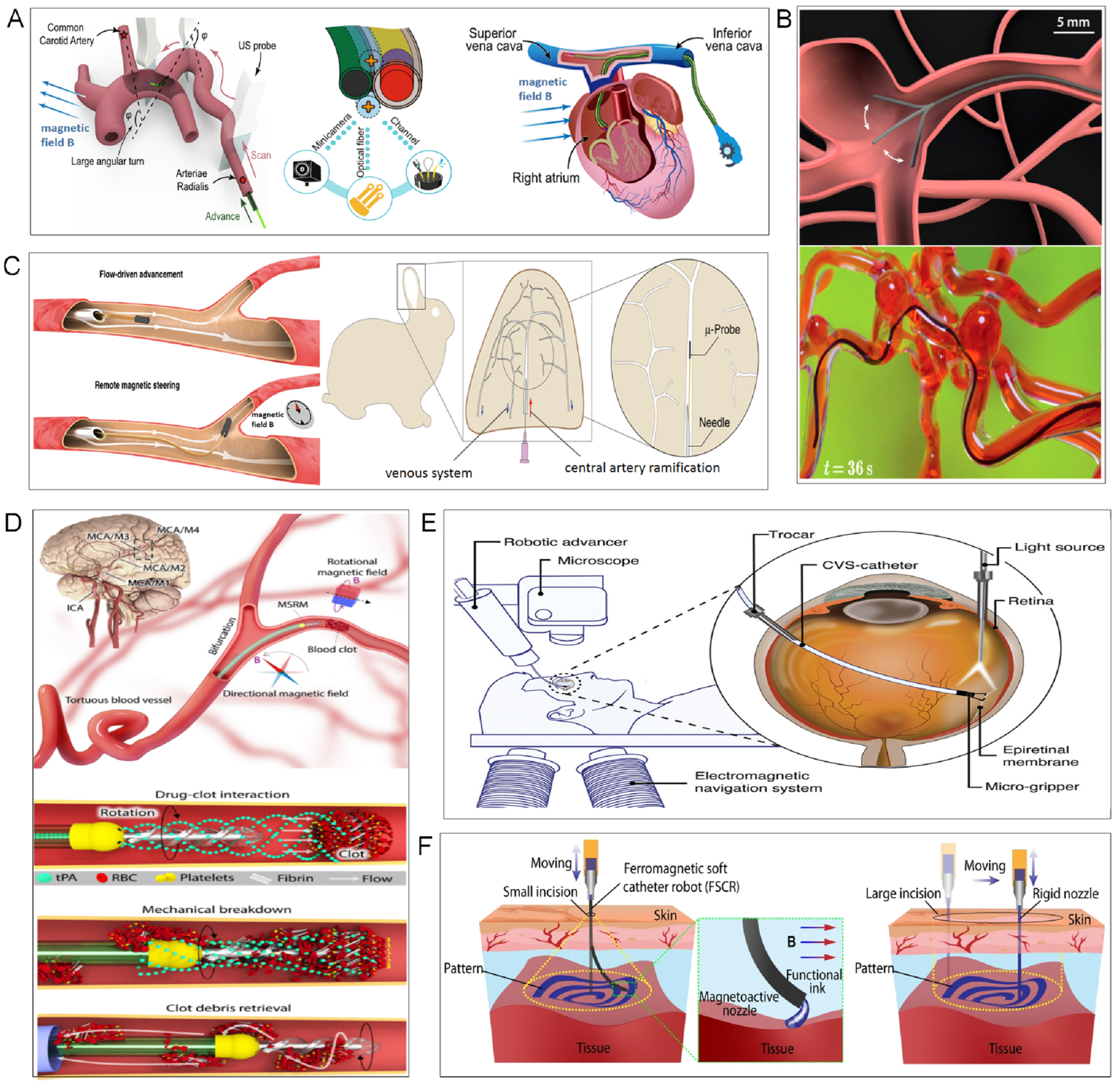
4.2. Intracavitary Intervention
For intracavitary intervention, especially bronchoscopic diagnosis and treatment, MCRs may help reach peripheral or narrow anatomical regions that are difficult to access with conventional instruments [226,227]. To address this challenge, Swaney et al. [228] proposed an image-guided bronchoscopic system, which innovatively combines a concentric tube robot with a magnetically tracked oblique tip manipulable needle. The concentric tube penetrates the bronchial wall, and the needle is guided through the lung tissue to reach the lesion under closed-loop control. Its precise positioning ability has been verified in isolated pig lungs. To further enhance the spatial positioning of the distal end of the catheter, Kato et al. [229] developed an MC with a double-curved segment, which uses multi-segment interaction to enhance the flexibility of movement, enabling the tip to be guided to lesions around the bronchus and dispersed in a controlled manner at multiple points. This follow-the-leader navigation strategy has been further applied in the fully shape-formable soft magnetic catheter designed by Pittiglio et al. [230]. The catheter has a field of 80 mm and a diameter of 2 mm, demonstrating the feasibility of magnetically assisted endoscopic navigation in anatomically relevant models. Based on the realization of precise navigation, the integration of diagnostic sampling and in situ treatment has become a new focus. The team further integrated shape sensing function into the catheter, realized supervised autonomous full shape control, and completed navigation and laser photothermal ablation experiments of eight major bronchial lumens in a phantom through embedded laser fiber [231]. In the same year, a bronchoscope system composed of a relatively small end effector and a navigation system was proposed [232]. It balances the size and flexibility of the device, integrates multiple sensors to realize complex airway network navigation, and has good environmental adaptability.
In addition, the need for MIS to adapt to complex anatomical channels has also promoted the development of high-volume, miniaturized, and sophisticated equipment. For example, some studies have proposed a magnetic tubular micromachine integrating three configurations, which has shown excellent operability in complex channels of simulated tissues, 3D printed models, and live mice [233]. In addition, the active movement ability of MCRs provides new possibilities for targeted therapy. For brain lesions, a “marsupial” robot system combining chemical/magnetic hybrid nanorobots and CRs has been proposed [234]. In this system, CRs enter the cranial cavity through a minimally invasive cranial channel, bypass the blood-brain barrier, and deliver the nanorobots to the lesion area for release. Its feasibility has been confirmed in in vitro porcine brain experiments. Similar high aspect ratio catheter technology has also performed well in pancreatic and bile duct interventions. Through the use of NdFeB-doped silicone polymers and a preset longitudinal magnetization distribution, the catheter can achieve serpentine locomotion under the actuation of a rotating magnetic field, effectively avoiding the problem of bending in winding and narrow cavities [86]. Multimodal sensing components can greatly expand the function of MCs. Yang et al. [235] used four-dimensional multi-channel printing technology to manufacture a flexible ferromagnetic catheter with six liquid metal microchannels embedded in it. While realizing magnetically controlled active steering, the device completed in situ multi-metabolite sensing of the renal vein and intestine in rabbit and pig models. Finally, the combination of magnetic continuum navigation system and nuclear MRI driving technology marks that surgical treatment is moving towards higher precision. This integrated scheme can not only realize the precise localization of tumors, but also control the grasper to perform tissue handling [236] or atrial fibrillation ablation [237]. Compared with traditional invasive surgery, it significantly improves the treatment effect and safety of surgery. For intracavitary applications, reliable tracking under limited visual feedback, safe tissue contact, and compatibility with existing endoscopic channels still require further investigation.
4.3. Minimally Invasive Surgery and Tissue Repair
In high-risk surgical procedures such as subretinal injection, flexible MCs have shown significant advantages in flexibility and safety compared to traditional rigid instruments [238]. To solve the problem of visual feedback in deep tissue operations, Samuel et al. [239] achieved real-time tracking of the surgical process by configuring a near-infrared illumination module at the tip of the catheter and completed multiple precise subretinal injections in an isolated pig eye model. In response to the dynamic requirements of the surgical environment for instrument rigidity, Lussi et al. [174] further developed a VS-CRs. This device is equipped with magnets and micro clamps, and achieves rapid compliance control in different surgical stages through magnetic coils, completing a fully robotic operation demonstration of minimally invasive ophthalmic surgery (Figure 8E). At the same time, MC achieves precise in situ restoration of articular cartilage defects with minimal incision. The catheter size is in the millimeter range, which allows it to enter the joint cavity through a tiny skin incision, and adopts a hybrid control strategy that combines neural networks and visual servoing for precise positioning. In vitro and ex vivo experiments were conducted on 3D-printed human femoral models and isolated pig femora, respectively [240,241].
In addition, in vivo bioprinting, as a promising cutting-edge technology, is making a leap from laboratory to clinical application through MCRs [242,243]. Zhou et al. reported a ferromagnetic soft catheter robot system that utilizes the non-contact high-precision characteristics of magnetic actuation to achieve in situ bioprinting under computer control. In response to the complex curved surface environment in anatomical structures (Figure 8F), the team proposed a corresponding printing compensation strategy and completed the molding of hydrogel tissue in a rat model [147]. Further research combined the magnetically assisted minimally invasive bioprinting system with laparoscopic technology, using an external magnetic field to precisely control the flexible MCs. This system achieved high-precision printing on ex vivo curved tissue models. It also generated functional liver patches in a live pig liver-defect model, suggesting possible use in organ-repair applications [244,245]. The combination of magnetic manipulation systems and CRs may reduce tissue damage through non-contact manipulation and expand local treatment functions by integrating real-time sensing and in situ manufacturing modules [246]. However, further work is still needed to evaluate long-term safety, material degradation, and reproducibility in clinically relevant environments.
From a translational medicine perspective, current MCR research can be broadly divided into three phases. The first phase is proof-of-concept laboratory research, primarily validating the feasibility of steering, shape deformation, or multimodal motion in a simplified benchtop environment. The second phase is preclinical validation, evaluating the system in anatomically realistic models, ex vivo tissues, or animal models, focusing on navigation accuracy, imaging compatibility, and surgical procedures. The third phase is clinical integration systems, embedding magnetic navigation into regulated interventional procedures and evaluating it based on safety, reproducibility, and usability requirements. Currently, most MCRs are still in the first phase, while MGs and MCs systems validated in realistic models or in vivo are moving towards the second phase.
5. Conclusions and Perspectives
Over the past few decades, MCRs have made significant progress and breakthroughs. From the initial emergence of traditional mechanically driven flexible robots, the research focus has gradually evolved to miniaturized, highly integrated, and complexly deformable magnetically controlled systems. Conventional CRs often rely on mechanical or hydrodynamic actuation. These methods are effective in many macroscopic interventions. However, miniaturizing them to the millimeter scale increases fabrication difficulty, mechanical friction, and transmission errors in bodily fluids. In contrast, magnetically driven CRs use external fields for non-contact energy transfer. Precise magnetization programming also enables spatially decoupled manipulation of soft materials. This approach reduces several limitations of microscale actuation, including mechanical transmission, friction, and miniaturization constraints. When applied to the human body, it can significantly reduce the risk of tissue damage caused by mechanical transmission. These features make MCRs promising for in vivo navigation and targeted therapy. However, clinical adoption still depends on reliable localization, safety validation, and workflow integration.
This review summarizes recent advances in MCRs from the perspectives of magnetic manipulation systems, mechanical modeling, structural classification, and biomedical applications. The development of MCRs is governed by several coupled challenges, including scalable and biocompatible structural design, robust control in dynamic biological environments, compatibility with clinical imaging and surgical workflows, and reliable validation for clinical translation. Structural design determines how MCRs deform under external magnetic fields. Magnetic torque mainly controls orientation and bending, whereas magnetic gradients generate translational forces and local deformation. Common system solutions include permanent magnets, magnetic coils, and hybrid platforms. Permanent-magnet systems provide high field strength and low power consumption, but their field adjustability is limited. Electromagnetic-coil systems offer rapid response and flexible control, although heat generation and power demand remain important constraints. Hybrid navigation platforms show high integration and clinical maturity, but they often involve high cost and limited compatibility with surgical workspace. For structural classification, common designs encompass MCs and MGs with basic steering capabilities, VS-CRs, multimodal motion mechanisms, and biomimetic designs. These solutions are suitable for different biomedical scenarios. For vascular intervention, magnetically guided guidewires and catheters can achieve distal tip steering through magnetic programming. This capability improves path selection in complex vascular branches and reduces the manipulation difficulty of conventional mechanical guidewires. To further balance compliance and operational stability during interventional procedures, this article introduces VS-CRs that integrate phase change materials or structural adjustments, such as low-melting-point alloys or shape memory polymers. Their main advantage is stiffness switching. They remain compliant during navigation to reduce tissue damage and become stiffer near the target to provide mechanical support. As research scales extend to millimeter and micrometer levels, the design logic of CRs has shifted from macroscopic geometric deformation to more refined magnetization distribution programming. Magnetization programming enables multimodal locomotion beyond simple bending. MCRs can roll, crawl, contract, or propel helically by changing field frequency and gradient. These modes improve obstacle avoidance and movement in unstructured fluid environments. This shift from macroscopic interventional tools to microscopic biomimetic forms signifies that MCRs are moving towards greater refinement and intelligence. Finally, this article focuses on analyzing the outstanding performance of MCRs in typical cases such as cardiovascular interventional embolization, targeted drug delivery, foreign body retrieval in gastric models, and minimally invasive bone and joint repair. Compared with chemical or cable-driven methods, magnetic control offers non-contact actuation and submillimeter positioning. These features may reduce surgical risk and improve diagnostic and therapeutic precision.
Based on the current state of this field, we prioritize the following four challenges. First, closed-loop localization and control should be a top priority, as precise navigation under conditions of tissue contact and anatomical uncertainty is a prerequisite for almost all clinical tasks. Second, material safety and device reliability (including biocompatibility, fatigue resistance, and sterilization compatibility) must be standardized to support reproducible biomedical applications. Third, scalable manufacturing processes and reproducible magnetization/programming methods are needed to move beyond the laboratory prototype stage. Fourth, system-level integration with imaging, clinical workflows, and task-specific end effectors will determine whether magnetically controlled robots can deliver clinical value, not just technological innovation.
We believe the most influential near-term development direction is the development of tethered or semi-tethered MCR platforms, combining magnetic control technology with image-guided feedback, task-specific tools, and standardized preclinical assessments. Simultaneously, the development of untethered and biomimetic MCRs should continue, with greater emphasis on localization, retrieval, and translational applications for specific procedures, thereby accelerating the transformation of MCRs from laboratory demonstrations to clinically reliable interventional tools.
Author Contributions
Writing—original draft preparation and writing—review and editing, M.Z., L.S. and W.Y.; investigation, X.A. and S.R.; data curation, J.Z., S.W. and J.L. (Jiefei Li); supervision and funding acquisition, Y.L., J.L. (Jianing Li), P.L. and J.L. (Junyang Li). All authors have read and agreed to the published version of the manuscript.
Funding
This work was supported by the Shandong Province Science and Technology SMES Innovation Ability Improvement Project (No. 2024TSGC0203), National Major Science and Technology Projects (Laoshan Laboratory Special Program No. LSKJ202502600), State Capital Funding Program (Special Program of CETC Academy of Electronics and Information Technology No. CG-2025-0182), the Qingdao Key Technology Breakthrough Project for Industrial Cultivation and Leadership (International and Hong Kong Science and Technology Cooperation) (NO. 25-1-1-gjgg-95-hz) and the Joint Key Innovation Project of the Yangtze River Delta Science and Technology Innovation Community (2023CSJZN0203). This work was supported by the Excellent Youth Science Fund Project (Overseas) of Shandong Provincial Natural Science Foundation (Grant No. 2026HWYQ-076). This work was supported by the Shandong Provincial Natural Science Foundation (Grant No. ZR2025QC1530) and the Taishan Scholars Program.
Institutional Review Board Statement
Not applicable.
Informed Consent Statement
Not applicable.
Data Availability Statement
No new data were created or analyzed in this study.
Conflicts of Interest
The authors declare no conflict of interest.
References
- Pan, L.; Jia, X.; Sun, X.; Li, J.; Zhang, N.; Wang, L. PINNs-enabled inverse programming of magnetic soft continuum robots: Shape morphing and tip trajectory. Sci. China Phys. Mech. Astron. 2025, 69, 224612. [Google Scholar] [CrossRef] [Scilit]
- Yang, Y.; Shi, W.; Yang, B.; Xiong, T.; Li, Z.A.; Ren, H. Regrafting submillimeter-scale ferromagnetic soft continuums. Nat. Commun. 2025, 16, 7023. [Google Scholar] [CrossRef] [Scilit]
- Fu, S.; Dong, S.; Shen, H.; Chen, Z.; Ma, G.; Cai, M.; Huang, C.; Peng, Q.; Bai, C.; Dong, Y.; et al. Multifunctional Magnetic Catheter Robot with Triaxial Force Sensing Capability for Minimally Invasive Surgery. Research 2025, 8, 0681. [Google Scholar] [CrossRef] [Scilit]
- Kwok, K.-W.; Hung Tsoi, K.; Vitiello, V.; Clark, J.; Chow, G.C.T.; Luk, W.; Yang, G.-Z. Dimensionality Reduction in Controlling Articulated Snake Robot for Endoscopy Under Dynamic Active Constraints. IEEE Trans. Robot. 2013, 29, 15–31. [Google Scholar] [CrossRef] [Scilit]
- Mitros, Z.; Sadati, S.; Seneci, C.; Bloch, E.; Leibrandt, K.; Khadem, M.; da Cruz, L.; Bergeles, C. Optic Nerve Sheath Fenestration with a Multi-Arm Continuum Robot. IEEE Robot. Autom. Lett. 2020, 5, 4874–4881. [Google Scholar] [CrossRef] [Scilit]
- Wang, X.; Fang, G.; Wang, K.; Xie, X.; Lee, K.-H.; Ho, J.D.L.; Tang, W.L.; Lam, J.; Kwok, K.-W. Eye-in-Hand Visual Servoing Enhanced with Sparse Strain Measurement for Soft Continuum Robots. IEEE Robot. Autom. Lett. 2020, 5, 2161–2168. [Google Scholar] [CrossRef] [Scilit]
- Kim, Y.; Genevriere, E.; Harker, P.; Choe, J.; Balicki, M.; Patel, A.B.; Zhao, X. Telerobotically Controlled Magnetic Soft Continuum Robots for Neurovascular Interventions. In Proceedings of the 2022 International Conference on Robotics and Automation (ICRA), Philadelphia, PA, USA, 23–27 May 2022. [Google Scholar]
- Wang, Z.; Weng, D.; Li, Z.; Chen, L.; Ma, Y.; Wang, J. A Magnetic-Controlled Flexible Continuum Robot with Different Deformation Modes for Vascular Interventional Navigation Surgery. Actuators 2023, 12, 247. [Google Scholar] [CrossRef] [Scilit]
- Dupourqué, L.; Masaki, F.; Colson, Y.L.; Kato, T.; Hata, N. Transbronchial biopsy catheter enhanced by a multisection continuum robot with follow-the-leader motion. Int. J. Comput. Assist. Radiol. Surg. 2019, 14, 2021–2029. [Google Scholar] [CrossRef] [Scilit]
- Shi, J.; Abad, S.-A.; Dai, J.S.; Wurdemann, H.A. Position and Orientation Control for Hyperelastic Multisegment Continuum Robots. IEEE/ASME Trans. Mechatron. 2024, 29, 995–1006. [Google Scholar] [CrossRef] [Scilit]
- Pekris, S.; Williams, R.D.; Atkins, T.; Georgilas, I.; Bailey, N. Model-based trajectory tracking of a compliant continuum robot. Front. Robot. AI 2024, 11, 1358857. [Google Scholar] [CrossRef] [Scilit] [PubMed]
- Wang, X.; Lu, Q.; Lee, D.; Gan, Z.; Rojas, N. A Soft Continuum Robot with Self-Controllable Variable Curvature. IEEE Robot. Autom. Lett. 2024, 9, 2016–2023. [Google Scholar] [CrossRef] [Scilit]
- Abolfathi, K.; Rosales-Medina, J.A.; Khaksar, H.; Chandler, J.H.; McDonald-Maier, K.D.; Ashkan, K.; Valdastri, P.; Hoshiar, A.K. Independent and Hybrid Magnetic Manipulation for Full Body Controlled Soft Continuum Robots. IEEE Robot. Autom. Lett. 2023, 8, 4235–4242. [Google Scholar] [CrossRef] [Scilit]
- Yang, P.; Mao, L.; Tian, C.; Meng, X.; Xie, H. A Cooperative and Multifunctional Magnetic Continuum Robot for Noninteractive Access, Dexterous Navigation, and Versatile Manipulation. Adv. Funct. Mater. 2024, 35, 2412543. [Google Scholar] [CrossRef] [Scilit]
- Yao, S.; Luo, P.; Liu, L.; Yan, H.; Meng, M.Q.H. Fast-Adaptive Permanent Magnetic Positioning-based Navigation Framework for Continuum Robots in Colonoscopic Biopsy. IEEE/ASME Trans. Mechatron. 2025, 30, 3953–3965. [Google Scholar] [CrossRef] [Scilit]
- Li, X.; Lu, C.; Song, Z.; Ding, W.; Zhang, X.-P. Planar Magnetic Actuation for Soft and Rigid Robots Using a Scalable Electromagnet Array. IEEE Robot. Autom. Lett. 2022, 7, 9264–9270. [Google Scholar] [CrossRef] [Scilit]
- Lee, W.; Jung, E.; Kim, N.; Lee, D.; Kim, S.; Lee, Y.; Jang, G. Robotically Adjustable Magnetic Navigation System for Medical Magnetic Milli/Microrobots. IEEE/ASME Trans. Mechatron. 2024, 29, 3949–3959. [Google Scholar] [CrossRef] [Scilit]
- Moezi, A.; Sedaghati, R.; Rakheja, S. Three-dimensional modeling of hard-magnetic soft continuum robots with composite magnetoactive elastomers under nonuniform magnetic fields. Compos. Part B Eng. 2026, 311, 113174. [Google Scholar] [CrossRef] [Scilit]
- Wang, C.; Frazelle, C.G.; Wagner, J.R.; Walker, I.D. Dynamic Control of Multisection Three-Dimensional Continuum Manipulators Based on Virtual Discrete-Jointed Robot Models. IEEE/ASME Trans. Mechatron. 2021, 26, 777–788. [Google Scholar] [CrossRef] [Scilit]
- Gan, L.T.; Blumenschein, L.H.; Huang, Z.; Okamura, A.M.; Hawkes, E.W.; Fan, J.A. 3D Electromagnetic Reconfiguration Enabled by Soft Continuum Robots. IEEE Robot. Autom. Lett. 2020, 5, 1704–1711. [Google Scholar] [CrossRef] [Scilit]
- Tsang, R.K.; Chung, J.C.K. Adapting Electromagnetic Navigation System for Transoral Robotic-Assisted Skull Base Surgery. Laryngoscope 2019, 130, 1922–1925. [Google Scholar] [CrossRef] [Scilit]
- Zhang, T.; Li, G.; Ren, H.; Yang, L.; Yang, X.; Tan, R.; Tang, Y.; Guo, D.; Zhao, H.; Shang, W.; et al. Sub-millimeter fiberscopic robot with integrated maneuvering, imaging, and biomedical operation abilities. Nat. Commun. 2024, 15, 10874. [Google Scholar] [CrossRef] [Scilit] [PubMed]
- Lin, D.; Li, N.; Jiao, N.; Wang, Z.; Liu, L. Kinematic Analysis of Multi-Section Opposite Magnetic Catheter Robots with Solution Multiplicity. IEEE Trans. Autom. Sci. Eng. 2024, 21, 123–134. [Google Scholar] [CrossRef] [Scilit]
- Wang, B.; Sun, H.; Du, J.; Yi, Z.; Liu, X.; Hua, D.; Li, Z.; Chauhan, S.; Vashishtha, G. Kinematic modelling and closed-loop control of a novel soft continuum robot. Knowl.-Based Syst. 2025, 316, 113367. [Google Scholar] [CrossRef] [Scilit]
- Tong, D.; Hao, Z.; Li, J.; Sun, B.; Liu, M.; Wang, L.; Huang, W. Real-time simulation enabled navigation control of magnetic soft continuum robots in confined lumens. J. Mech. Phys. Solids 2025, 203, 106198. [Google Scholar] [CrossRef] [Scilit]
- Zhang, S.; Yang, W.; Ge, J. Endovascular embolization by a magnetic microfiberbot. Natl. Sci. Rev. 2024, 11, nwae117. [Google Scholar] [CrossRef] [Scilit]
- Xu, Y.; Lou, C.; Leung, K.C.-F.; Gong, X.; Xuan, S. Cross-scale magnetic catheter-magnetic swarm strategy for precise thrombus clearance. Extrem. Mech. Lett. 2025, 80, 102411. [Google Scholar] [CrossRef] [Scilit]
- Wang, Y.; Ye, H.; von Arx, D.; Li, Y.; Wang, Y.; Mesot, A.; Franco, C.; Chen, X.-Z.; Wang, Y.; Zhang, S.; et al. Magnetic continuum soft robot-driven precise delivery of prodrug nanoassemblies for gastric cancer chemo-immunotherapy. Asian J. Pharm. Sci. 2025, 20, 101103. [Google Scholar] [CrossRef] [Scilit]
- Wang, Z.; Wang, T.; Zhao, B.; He, Y.; Hu, Y.; Li, B.; Zhang, P.; Meng, M.Q.H. Hybrid Adaptive Control Strategy for Continuum Surgical Robot Under External Load. IEEE Robot. Autom. Lett. 2021, 6, 1407–1414. [Google Scholar] [CrossRef] [Scilit]
- Xu, S.; He, B.; Zhou, Y.; Wang, Z.; Zhang, C. A Hybrid Position/Force Control Method for a Continuum Robot with Robotic and Environmental Compliance. IEEE Access 2019, 7, 100467–100479. [Google Scholar] [CrossRef] [Scilit]
- Wang, P.; Guo, S.; Wang, X.; Wu, Y. Design and Analysis of a Novel Variable Stiffness Continuum Robot with Built-in Winding-Styled Ropes. IEEE Robot. Autom. Lett. 2022, 7, 6375–6382. [Google Scholar] [CrossRef] [Scilit]
- Lin, D.; Jiao, N.; Wang, Z.; Liu, L. A Magnetic Continuum Robot with Multi-Mode Control Using Opposite-Magnetized Magnets. IEEE Robot. Autom. Lett. 2021, 6, 2485–2492. [Google Scholar] [CrossRef] [Scilit]
- Chen, Y.; Xu, Z.; Xu, Q. Design and Testing of a Hollow Continuum Magnetic Millirobot with Multimodal Motion. Actuators 2022, 11, 269. [Google Scholar] [CrossRef] [Scilit]
- Wu, Z.; Luo, Q.; Zhan, S.; Yao, L.; Lv, Z.; Wei, F. Multimodal Motion Soft Magnetic Reconfigurable Robot Based on Penetrating Heating. Adv. Mater. Technol. 2025, 11, e01526. [Google Scholar] [CrossRef] [Scilit]
- Deng, L.; Zhou, C.; Wang, J.; Fan, J.; Liao, X.; Zhu, C. Design and Modeling of a Sperm-Inspired Helical Propulsion Robot. IEEE Robot. Autom. Lett. 2023, 8, 8168–8175. [Google Scholar] [CrossRef] [Scilit]
- Liu, D.; Liu, X.; Chen, Z.; Zuo, Z.; Tang, X.; Huang, Q.; Arai, T. Magnetically Driven Soft Continuum Microrobot for Intravascular Operations in Microscale. Cyborg Bionic Syst. 2022, 2022, 9850832. [Google Scholar] [CrossRef] [Scilit]
- Sun, Y.; Zhu, X.; Li, J.; Chen, S.; Li, L.; Cao, Q. Design and implementation of a hybrid magnetic actuation system for magnetic continuum intervention robots. Sens. Actuators A Phys. 2025, 396, 117167. [Google Scholar] [CrossRef] [Scilit]
- Yang, Z.; Yang, H.; Cao, Y.; Cui, Y.; Zhang, L. Magnetically Actuated Continuum Medical Robots: A Review. Adv. Intell. Syst. 2023, 5, 2200416. [Google Scholar] [CrossRef] [Scilit]
- Lin, D.; Wang, J.; Jiao, N.; Wang, Z.; Liu, L. A Flexible Magnetically Controlled Continuum Robot Steering in the Enlarged Effective Workspace with Constraints for Retrograde Intrarenal Surgery. Adv. Intell. Syst. 2021, 3, 2000211. [Google Scholar] [CrossRef] [Scilit]
- Mallahi Kolahi, P.; Habibnejad Korayem, M. Dynamic model-based design of a hybrid neural network and sliding mode controller for real-time and accurate control of ferromagnetic continuum robots. Int. J. Dyn. Control 2025, 13, 313. [Google Scholar] [CrossRef] [Scilit]
- Liu, D.; Liu, X.; Du, J.; Zuo, Z.; Tang, X.; Huang, Q.; Arai, T.; Hu, Y.; Jin, H. A Flexible Magnetic Soft Continuum Robot for Manipulation and Measurement at Microscale. Cardiovasc. Innov. Appl. 2023, 8, e950. [Google Scholar] [CrossRef] [Scilit]
- Sangsefidi, N.; Korayem, H. Body Shape Control of Magnetic Soft Continuum Robots with PID Controller. In Proceedings of the 2023 11th RSI International Conference on Robotics and Mechatronics (ICRoM), Tehran, Iran, 19–21 December 2023. [Google Scholar]
- Zhang, Z.; Klingner, A.; Misra, S.; Khalil, I.S.M. Design and control of a permanent magnet-based robotic system for navigating tetherless magnetic devices in viscous environments. Sci. Rep. 2025, 15, 31041. [Google Scholar] [CrossRef] [Scilit]
- Kim, Y.; Parada, G.A.; Liu, S.; Zhao, X. Ferromagnetic soft continuum robots. Sci. Robot. 2019, 4, eaax7329. [Google Scholar] [CrossRef] [Scilit] [PubMed]
- Xu, R.; Wang, X.; Chen, Y.; Tam, L.M.; Xu, Q. Bio-inspired magnetic soft robots with omnidirectional climbing for multifunctional biomedical applications. Int. J. Extrem. Manuf. 2025, 8, 015502. [Google Scholar] [CrossRef] [Scilit]
- Yang, Z.; Zhang, L. Magnetic Actuation Systems for Miniature Robots: A Review. Adv. Intell. Syst. 2020, 2, 2000082. [Google Scholar] [CrossRef] [Scilit]
- Dreyfus, R.; Boehler, Q.; Nelson, B.J. A Simulation Framework for Magnetic Continuum Robots. IEEE Robot. Autom. Lett. 2022, 7, 8370–8376. [Google Scholar] [CrossRef] [Scilit]
- Liu, T.; Zhang, G.; Du, F.; Zhang, X.; He, C.; Li, Y.; Song, R. Magnetic continuum robot: Design, modeling and verification. Int. J. Mech. Sci. 2025, 301, 110460–110472. [Google Scholar] [CrossRef] [Scilit]
- Alessi, C.; Agabiti, C.; Caradonna, D.; Laschi, C.; Renda, F.; Falotico, E. Rod models in continuum and soft robot control: A review. arXiv 2024, arXiv:2407.05886. [Google Scholar]
- Liu, J.; Yang, Y.; Li, M.; Xu, F. A meshfree model of hard-magnetic soft materials. Int. J. Mech. Sci. 2023, 258, 108566–108575. [Google Scholar] [CrossRef] [Scilit]
- Kalekeyeva, M.; Konakbay, Z.; Imanbekova, M.; Shakbutova, A.; Garmash, O.; Muratbekova, G.; Mambetalin, D. Continuum Robots: Current Trends in Design, Control, and Applications. IEEE Access 2025, 13, 106771–106792. [Google Scholar] [CrossRef] [Scilit]
- Civalek, Ö.; Demir, Ç. Bending analysis of microtubules using nonlocal Euler–Bernoulli beam theory. Appl. Math. Model. 2011, 35, 2053–2067. [Google Scholar] [CrossRef] [Scilit]
- Hafner, C.; Bickel, B. The Design Space of Kirchhoff Rods. ACM Trans. Graph. 2023, 42, 171. [Google Scholar] [CrossRef] [Scilit]
- Alqumsan, A.A.; Khoo, S.; Norton, M. Robust control of continuum robots using Cosserat rod theory. Mech. Mach. Theory 2019, 131, 48–61. [Google Scholar] [CrossRef] [Scilit]
- Zhang, T.; Yang, L.; Yang, X.; Tan, R.; Lu, H.; Shen, Y. Millimeter-Scale Soft Continuum Robots for Large-Angle and High-Precision Manipulation by Hybrid Actuation. Adv. Intell. Syst. 2021, 3, 2000189. [Google Scholar] [CrossRef] [Scilit]
- Meng, L.W.; Xie, X.L.; Zhou, X.H.; Liu, S.Q.; Hou, Z.G. Design, Optimization, and Modeling of a Hydraulic Soft Robot for Chronic Total Occlusions. Biomimetics 2024, 9, 163. [Google Scholar] [CrossRef] [Scilit]
- Wang, L.; Zheng, D.; Harker, P.; Patel, A.B.; Guo, C.F.; Zhao, X. Evolutionary design of magnetic soft continuum robots. Proc. Natl. Acad. Sci. USA 2021, 118, e2021922118. [Google Scholar] [CrossRef] [Scilit]
- Wang, J.; Wang, D.; Dong, L.; Zhang, M.; Gu, G. Analytical Modeling and Inverse Design of Centimeter-Scale Hard-Magnetic Soft Robots. IEEE Trans. Autom. Sci. Eng. 2024, 21, 5558–5569. [Google Scholar] [CrossRef] [Scilit]
- Wei, S.; Wu, Z.; Zhang, J. Multimodal Motion Control of Magnetic Continuum Robot for Endovascular Intervention Navigation. IEEE/ASME Trans. Mechatron. 2025, 30, 5734–5744. [Google Scholar] [CrossRef] [Scilit]
- Peyron, Q.; Boehler, Q.; Rabenorosoa, K.; Nelson, B.J.; Renaud, P.; Andreff, N. Kinematic Analysis of Magnetic Continuum Robots Using Continuation Method and Bifurcation Analysis. IEEE Robot. Autom. Lett. 2018, 3, 3646–3653. [Google Scholar] [CrossRef] [Scilit]
- Wang, L.; Kim, Y.; Guo, C.F.; Zhao, X. Hard-magnetic elastica. J. Mech. Phys. Solids 2020, 142, 104045. [Google Scholar] [CrossRef] [Scilit]
- Wang, L.; Guo, C.F.; Zhao, X. Magnetic soft continuum robots with contact forces. Extrem. Mech. Lett. 2022, 51, 101604. [Google Scholar] [CrossRef] [Scilit]
- Li, J.; Wang, L. Modeling magnetic soft continuum robot in nonuniform magnetic fields via energy minimization. Int. J. Mech. Sci. 2024, 282, 109688. [Google Scholar] [CrossRef] [Scilit]
- Mallahi Kolahi, P.; Habibnejad Korayem, M. Dynamic modeling and guidance analysis of a ferromagnetic continuum robot with geometric discretization and base linear motion. Eng. Res. Express 2025, 7, 015232. [Google Scholar] [CrossRef] [Scilit]
- Wang, C.; Jin, T.; Ren, H.; Zhang, H.; Zhao, J. Modeling and design of pre-set stiffness continuum robot. Int. J. Mech. Sci. 2025, 295, 110224. [Google Scholar] [CrossRef] [Scilit]
- Cao, Y.; Cai, M.; Sun, B.; Qi, Z.; Xue, J.; Jiang, Y.; Hao, B.; Zhu, J.; Liu, X.; Yang, C.; et al. Magnetic Continuum Robot with Modular Axial Magnetization: Design, Modeling, Optimization, and Control. IEEE Trans. Robot. 2025, 41, 1513–1532. [Google Scholar] [CrossRef] [Scilit]
- Kolahi, P.M.; Korayem, M.H. Investigation and improving modeling and control for continuum magnetic robots using Cosserat theories and optimal control. Acta Mech. 2024, 235, 3095–3110. [Google Scholar] [CrossRef] [Scilit]
- Wu, Z.; Zhang, J. Closed-Loop Magnetic Control of Medical Soft Continuum Robots for Deflection. IEEE/ASME Trans. Mechatron. 2025, 30, 3607–3618. [Google Scholar] [CrossRef] [Scilit]
- Shao, Y.; Fahmy, A.; Li, M.; Li, C.; Zhao, W.; Sienz, J. Study on Magnetic Control Systems of Micro-Robots. Front. Neurosci. 2021, 15, 736730. [Google Scholar] [CrossRef] [Scilit]
- Zablotskii, V.; Polyakova, T. Permanent magnets in magnetic medicine: Applications and advances. Magn. Med. 2025, 1, 100024. [Google Scholar] [CrossRef] [Scilit]
- Sokolich, M.; Rivas, D.; Yang, Y.; Duey, M.; Das, S. ModMag: A modular magnetic micro-robotic manipulation device. MethodsX 2023, 10, 102171. [Google Scholar] [CrossRef] [Scilit]
- Hwang, J.; Jeon, S.; Kim, B.; Kim, J.y.; Jin, C.; Yeon, A.; Yi, B.J.; Yoon, C.H.; Park, H.J.; Pané, S.; et al. An Electromagnetically Controllable Microrobotic Interventional System for Targeted, Real-Time Cardiovascular Intervention. Adv. Healthc. Mater. 2022, 11, 2102529. [Google Scholar] [CrossRef] [Scilit]
- Zhang, P.; Qing, W.; Lai, X.; Wang, Y.; Wu, M. Cooperative control of multiple magnetically controlled soft robots. Inf. Sci. 2024, 677, 120790. [Google Scholar] [CrossRef] [Scilit]
- Hou, Y.; Wang, H.; Fu, R.; Wang, X.; Yu, J.; Zhang, S.; Huang, Q.; Sun, Y.; Fukuda, T. A review on microrobots driven by optical and magnetic fields. Lab. Chip 2023, 23, 848–868. [Google Scholar] [CrossRef] [Scilit] [PubMed]
- Kong, T.; Zheng, Q.; Sun, J.; Wang, C.; Liu, H.; Gao, Z.; Qiao, Z.; Yang, W. Advances in Magnetically Controlled Medical Robotics: A Review of Actuation Systems, Continuum Designs, and Clinical Prospects for Minimally Invasive Therapies. Micromachines 2025, 16, 561. [Google Scholar] [CrossRef] [Scilit]
- Sun, Y.; Sun, B.; Cui, X.; Li, W.; Zhang, Y.; He, L.; Nong, S.; Zhu, Z.; Wu, J.; Li, D.; et al. Addressable and perceptible dynamic reprogram of ferromagnetic soft machines. Nat. Commun. 2025, 16, 2267. [Google Scholar] [CrossRef] [Scilit]
- Li, H.; Zhang, Z.; Yi, X.; Jin, S.; Chen, Y. Control of Self-Winding Microrobot Using an Electromagnetic Drive System: Integration of Movable Electromagnetic Coil and Permanent Magnet. Micromachines 2024, 15, 438. [Google Scholar] [CrossRef] [Scilit] [PubMed]
- Li, M.; Wu, J.; Li, N.; Zhou, J.; Cheng, W.; Wu, A.; Liu, L.; Jiao, N. Cross-Scale Drug Delivery of Diatom Microrobots Based on A Magnetic Continuum Robot for Combined Chemical and Photodynamic Therapy of Glioblastoma. Adv. Funct. Mater. 2024, 34, 2402333. [Google Scholar] [CrossRef] [Scilit]
- Chen, Y.; Tong, D.; Zhao, Y.; Chen, T.; Fan, X. SCMAS: An IMU-based 6-DOF closed-loop permanent magnet actuation system for magnet agent. Sci. Rep. 2025, 15, 17808. [Google Scholar] [CrossRef] [Scilit]
- Mehrkish, A.; Janabi-Sharifi, F. Grasp synthesis of continuum robots. Mech. Mach. Theory 2022, 168, 104575. [Google Scholar] [CrossRef] [Scilit]
- Yang, P.-a.; Han, Y.; Mo, C.; Luo, J.; Shou, M.; Gong, X.; Zhou, Z. A review and perspective of magnetic-controlled microbots for medical applications. Chem. Eng. J. 2025, 520, 165814. [Google Scholar] [CrossRef] [Scilit]
- Zou, Y.; Liu, Y.; Li, Y.; Yang, L.; Liu, Y.; He, K.; Xiang, Y.; Ouyang, J.; Li, P.; Liang, J.; et al. Magnetically actuated multimaterial fiberbot for precise minimally invasive knee laser surgery. Sci. Adv. 2025, 11, eadt1809. [Google Scholar] [CrossRef] [Scilit]
- Mao, L.; Yang, P.; Tian, C.; Shen, X.; Wang, F.; Zhang, H.; Meng, X.; Xie, H. Magnetic steering continuum robot for transluminal procedures with programmable shape and functionalities. Nat. Commun. 2024, 15, 3759. [Google Scholar] [CrossRef] [Scilit] [PubMed]
- Huang, Y.; Zhao, Q.; Hu, J.; Liu, H. Design and Modeling of a Multi-DoF Magnetic Continuum Robot with Diverse Deformation Modes. IEEE Robot. Autom. Lett. 2024, 9, 3956–3963. [Google Scholar] [CrossRef] [Scilit]
- Li, J.; Wan, S.; Tan, L.; Shah, K.; Wang, L. Hard-magnetic soft continuum robots: Modeling, design and applications. Sci. China Phys. Mech. Astron. 2025, 68, 104601. [Google Scholar] [CrossRef] [Scilit]
- Chathuranga, D.; Lloyd, P.; Chandler, J.H.; Harris, R.A.; Valdastri, P. Assisted Magnetic Soft Continuum Robot Navigation via Rotating Magnetic Fields. IEEE Robot. Autom. Lett. 2024, 9, 183–190. [Google Scholar] [CrossRef] [Scilit]
- Wang, H.; Mao, Y.; Du, J. Continuum Robots and Magnetic Soft Robots: From Models to Interdisciplinary Challenges for Medical Applications. Micromachines 2024, 15, 313. [Google Scholar] [CrossRef] [Scilit]
- Xue, J.; Zhang, M.; Liu, X.; Zhu, J.; Cao, Y.; Zhang, L. A Magnetic Continuum Robot with In-situ Magnetic Reprogramming Capability. In Proceedings of the 2024 IEEE International Conference on Robotics and Automation (ICRA), Yokohama, Japan, 13–17 May 2024. [Google Scholar]
- Hoshiar, A.K.; Jeon, S.; Kim, K.; Lee, S.; Kim, J.-y.; Choi, H. Steering Algorithm for a Flexible Microrobot to Enhance Guidewire Control in a Coronary Angioplasty Application. Micromachines 2018, 9, 617. [Google Scholar] [CrossRef] [Scilit] [PubMed]
- Li, N.; Lin, D.; Wu, J.; Gan, Q.; Hu, X.; Jiao, N. Novel Concentric Magnetic Continuum Robot with Multiple Stiffness Modes for Potential Delivery of Nanomedicine. Magnetochemistry 2023, 9, 129. [Google Scholar] [CrossRef] [Scilit]
- Kaur, M.; Sondhi, S.; Yanumula, V.K. Design and Optimization of Controller-Based Approach for Magnetic-Field Driven Robotic Arm Joints and End-Effector. J. Field Robot. 2025, 42, 3285–3307. [Google Scholar] [CrossRef] [Scilit]
- Alrumayh, A.; Alhassoon, K.; Alsaleem, F.; Shaban, M.; Alsunaydih, F.N. Electromagnetically Driven Robot for Multipurpose Applications. Appl. Sci. 2025, 15, 973. [Google Scholar] [CrossRef] [Scilit]
- Hu, W.; Lum, G.Z.; Mastrangeli, M.; Sitti, M. Small-scale soft-bodied robot with multimodal locomotion. Nature 2018, 554, 81–85. [Google Scholar] [CrossRef] [Scilit]
- Jeon, S.; Hoshiar, A.K.; Kim, S.; Lee, S.; Kim, E.; Lee, S.; Kim, K.; Lee, J.; Kim, J.-y.; Choi, H. Improving guidewire-mediated steerability of a magnetically actuated flexible microrobot. Micro Nano Syst. Lett. 2018, 6, 15. [Google Scholar] [CrossRef] [Scilit]
- Wang, X.; Liu, W.; Luo, Q.; Yao, L.; Wei, F. Thermally Drawn-Based Microtubule Soft Continuum Robot for Cardiovascular Intervention. ACS Appl. Mater. Interfaces 2024, 16, 29783–29792. [Google Scholar] [CrossRef] [Scilit]
- Rodrigue, H.; Kim, J. Soft actuators in surgical robotics: A state-of-the-art review. Intell. Serv. Robot. 2023, 17, 3–17. [Google Scholar] [CrossRef] [Scilit]
- Khalil, I.S.M.; Tabak, A.F.; Hamed, Y.; Tawakol, M.; Klingner, A.; Gohary, N.E.; Mizaikoff, B.; Sitti, M. Independent Actuation of Two-Tailed Microrobots. IEEE Robot. Autom. Lett. 2018, 3, 1703–1710. [Google Scholar] [CrossRef] [Scilit]
- Wang, J.; Liu, Y.; Lu, X.; Zhu, Y.; Bai, C. Design and Optimization of a Tapered Magnetic Soft Continuum Robot for Enhanced Navigation in Cerebral Vasculature. Micromachines 2025, 16, 701. [Google Scholar] [CrossRef] [Scilit] [PubMed]
- Jeon, S.; Hoshiar, A.K.; Kim, K.; Lee, S.; Kim, E.; Lee, S.; Kim, J.Y.; Nelson, B.J.; Cha, H.J.; Yi, B.J.; et al. A Magnetically Controlled Soft Microrobot Steering a Guidewire in a Three-Dimensional Phantom Vascular Network. Soft Robot. 2019, 6, 54–68. [Google Scholar] [CrossRef] [Scilit] [PubMed]
- Wang, Q.; Zhang, Z.; Li, B.; Wang, J.; Gu, H. Hard-Magnetic Soft Millirobots in Underactuated Systems. Adv. Robot. Res. 2025, e202500071. [Google Scholar] [CrossRef] [Scilit]
- Kim, Y.; Zhao, X. Magnetic Soft Materials and Robots. Chem. Rev. 2022, 122, 5317–5364. [Google Scholar] [CrossRef] [Scilit]
- Nguyen, K.T.; Lee, H.-S.; Kim, J.; Choi, E.; Park, J.-O.; Kim, C.-S. A composite electro-permanent magnetic actuator for microrobot manipulation. Int. J. Mech. Sci. 2022, 229, 107516. [Google Scholar] [CrossRef] [Scilit]
- Chen, H.; Sitti, M. Physical Intelligence in Small-Scale Robots and Machines. Adv. Mater. 2025, 38, e10332. [Google Scholar] [CrossRef] [Scilit]
- Du, X.; Zhang, M.; Yu, J.; Yang, L.; Chiu, P.W.Y.; Zhang, L. Design and Real-Time Optimization for a Magnetic Actuation System with Enhanced Flexibility. IEEE/ASME Trans. Mechatron. 2021, 26, 1524–1535. [Google Scholar] [CrossRef] [Scilit]
- Sikorski, J.; Heunis, C.M.; Franco, F.; Misra, S. The ARMM System: An Optimized Mobile Electromagnetic Coil for Non-Linear Actuation of Flexible Surgical Instruments. IEEE Trans. Magn. 2019, 55, 5600109. [Google Scholar] [CrossRef] [Scilit]
- Yang, L.; Du, X.; Yu, E.; Jin, D.; Zhang, L. DeltaMag: An Electromagnetic Manipulation System with Parallel Mobile Coils. In Proceedings of the 2019 International Conference on Robotics and Automation (ICRA), Montreal, QC, Canada, 20–24 May 2019; pp. 9814–9820. [Google Scholar]
- Edelmann, J.; Petruska, A.J.; Nelson, B.J. Magnetic control of continuum devices. Int. J. Robot. Res. 2017, 36, 68–85. [Google Scholar] [CrossRef] [Scilit]
- Yang, Z.; Yang, L.; Zhang, L. Autonomous Navigation of Magnetic Microrobots in a Large Workspace Using Mobile-Coil System. IEEE/ASME Trans. Mechatron. 2021, 26, 3163–3174. [Google Scholar] [CrossRef] [Scilit]
- Jha, M.; Chauhan, N.R. A review on Snake-like Continuum Robots for Medical Surgeries. IOP Conf. Ser. Mater. Sci. Eng. 2019, 691, 012093. [Google Scholar] [CrossRef] [Scilit]
- Ma, Y.; An, X.; Yang, Q.; Cai, M.; Tang, Z.; Chang, J.; Iacovacci, V.; Xu, T.; Zhang, L.; Wang, Q. Magnetic Continuum Robot for Intelligent Manipulation in Medical Applications. SmartBot 2025, 1, e12011. [Google Scholar] [CrossRef] [Scilit]
- da Veiga, T.; Chandler, J.H.; Lloyd, P.; Pittiglio, G.; Wilkinson, N.J.; Hoshiar, A.K.; Harris, R.A.; Valdastri, P. Challenges of continuum robots in clinical context: A review. Prog. Biomed. Eng. 2020, 2, 032003. [Google Scholar] [CrossRef] [Scilit]
- Zhong, Y.; Hu, L.; Xu, Y. Recent Advances in Design and Actuation of Continuum Robots for Medical Applications. Actuators 2020, 9, 142. [Google Scholar] [CrossRef] [Scilit]
- Iqbal, F.; Esfandiari, M.; Amirkhani, G.; Hoshyarmanesh, H.; Lama, S.; Tavakoli, M.; Sutherland, G.R. Continuum and Soft Robots in Minimally Invasive Surgery: A Systematic Review. IEEE Access 2025, 13, 24053–24079. [Google Scholar] [CrossRef] [Scilit]
- Huo, Y.; Yang, L.; Xu, T.; Sun, D. Design, Control, and Clinical Applications of Magnetic Actuation Systems: Challenges and Opportunities. Adv. Intell. Syst. 2024, 7, 2400403. [Google Scholar] [CrossRef] [Scilit]
- Mendes Pereira, V.; Rice, H.; De Villiers, L.; Sourour, N.; Clarencon, F.; Spears, J.; Tomasello, A.; Hernandez, D.; Cancelliere, N.M.; Liu, X.Y.E.; et al. Evaluation of effectiveness and safety of the CorPath GRX robotic system in endovascular embolization procedures of cerebral aneurysms. J. Neurointerv. Surg. 2024, 16, 405–411. [Google Scholar] [CrossRef] [Scilit]
- Kiemeneij, F.; Patterson, M.S.; Amoroso, G.; Laarman, G.; Slagboom, T. Use of the Stereotaxis Niobe Magnetic Navigation System for Percutaneous Coronary Intervention: Results from 350 Consecutive Patients. Catheter. Cardiovasc. Interv. 2008, 71, 510–516. [Google Scholar] [CrossRef] [Scilit] [PubMed]
- Liu, W.; Luo, Q.; Zhu, X.; Liu, M.; Yao, L.; Wei, F. A Multichannel Continuum Robot for In Situ Diagnosis and Treatment of Vascular Lesions. Sci. Eng. 2025, 11, 3071–3081. [Google Scholar] [CrossRef] [Scilit] [PubMed]
- Hu, A.; Sun, Y. Contact Force Estimation of Continuum Robots without Embedded Sensors: A Review. Adv. Intell. Syst. 2025, 8, e202500786. [Google Scholar] [CrossRef] [Scilit]
- Francescon, V.; Murasovs, N.; Lloyd, P.; Onaizah, O.; Chathuranga, D.S.; Valdastri, P. Closed-Loop Shape-Forming Control of a Magnetic Soft Continuum Robot. IEEE Robot. Autom. Lett. 2025, 10, 6071–6078. [Google Scholar] [CrossRef] [Scilit]
- Brockdorff, M.; Calmé, B.; Wang, T.; Tinsley, L.J.; Davy, J.; Lloyd, P.; Chandler, J.H.; Harris, R.A.; Sitti, M.; Valdastri, P. Combining tethered and untethered magnetic robots via a magnetically triggerable latch for target payload delivery and retrieval. Sci. Adv. 2026, 12, eadu6025. [Google Scholar] [CrossRef] [Scilit]
- Fan, Q.; Hou, Z.; Liu, X.; Liu, Y. Collaborative Task Planning for PCB-Driven Magnetic Microrobots Using Deep Reinforcement Learning. IEEE/ASME Trans. Mechatron. 2026, 31, 479–489. [Google Scholar] [CrossRef] [Scilit]
- Beaver, L.E.; Shah, Z.H.; Sokolich, M.; Yilmaz, A.E.; Yang, Y.; Belta, C.; Das, S. Closed-Loop Control for a Heterogeneous Group of Magnetically-Actuated Microrobots. In Proceedings of the 2023 International Conference on Manipulation, Automation and Robotics at Small Scales (MARSS), Abu Dhabi, United Arab Emirates, 9–13 October 2023. [Google Scholar]
- Zhao, Y.; Dong, X.; Li, Y.; Cui, J.; Shi, Q.; Huang, H.-W.; Huang, Q.; Wang, H. Integrated Cross-Scale Manipulation and Modulable Encapsulation of Cell-Laden Hydrogel for Constructing Tissue-Mimicking Microstructures. Research 2024, 7, 0414. [Google Scholar] [CrossRef] [Scilit]
- Tang, X.; Li, Y.; Liu, X.; Liu, D.; Chen, Z.; Arai, T. Vision-Based Automated Control of Magnetic Microrobots. Micromachines 2022, 13, 337. [Google Scholar] [CrossRef] [Scilit]
- Xu, T.; Yu, J.; Yan, X.; Choi, H.; Zhang, L. Magnetic Actuation Based Motion Control for Microrobots: An Overview. Micromachines 2015, 6, 1346–1364. [Google Scholar] [CrossRef] [Scilit]
- Wang, F.; Zhang, Y.; Jin, D.; Jiang, Z.; Liu, Y.; Knoll, A.; Jiang, H.; Ying, Y.; Zhou, M. Magnetic Soft Microrobot Design for Cell Grasping and Transportation. Cyborg Bionic Syst. 2024, 5, 0109. [Google Scholar] [CrossRef] [Scilit]
- Zhong, S.; Hou, Y.; Zheng, Z.; Huang, H.-W.; Shi, Q.; Huang, Q.; Fukuda, T.; Wang, H. Adaptive Shared Cascade Navigation Control of Magnetic Microrobots in Unstructured Dynamic Environments. IEEE Trans. Cybern. 2026, 1–14. [Google Scholar] [CrossRef] [Scilit]
- Zhong, S.; Nie, R.; Zheng, Z.; Hou, Y.; Shi, Q.; Huang, Q.; Fukuda, T.; Wang, H. Magnetically controlled multimodal motion for environmentally adaptive soft millirobots with transformable wheel-leg morphology. Innovation 2026, 7, 101146. [Google Scholar] [CrossRef] [Scilit]
- Raphalen, L.; Ferro, M.; Posselli, N.R.; Robuffo Giordano, P.; Misra, S.; Pacchierotti, C. Constrained Optimization for Safe and Visibility-Aware Shared Control of Magnetically Actuated Microrobots. IEEE Trans. Autom. Sci. Eng. 2026, 23, 7396–7408. [Google Scholar] [CrossRef] [Scilit]
- Nie, R.; Zhong, S.; Hou, Y.; Zheng, Z.; Shi, Q.; Huang, Q.; Fukuda, T.; Wang, H. Hierarchical Multimodal Motion Control of Magnetic Pivot-Walking Millirobotic-Grippers for Autonomous Target Acquisition in Complex Terrains. IEEE Trans. Robot. 2026, 42, 1749–1768. [Google Scholar] [CrossRef] [Scilit]
- Li, Y.; Huo, Y.; Chu, X.; Yang, L. Automated Magnetic Microrobot Control: From Mathematical Modeling to Machine Learning. Mathematics 2024, 12, 2180. [Google Scholar] [CrossRef] [Scilit]
- Xu, S.; Liu, J.; Yang, C.; Wu, X.; Xu, T. A Learning-Based Stable Servo Control Strategy Using Broad Learning System Applied for Microrobotic Control. IEEE Trans. Cybern. 2022, 52, 13727–13737. [Google Scholar] [CrossRef] [Scilit]
- Xu, S.; Xu, T.; Li, D.; Yang, C.; Huang, C.; Wu, X. A Robot Motion Learning Method Using Broad Learning System Verified by Small-Scale Fish-Like Robot. IEEE Trans. Cybern. 2023, 53, 6053–6065. [Google Scholar] [CrossRef] [Scilit]
- Yu, K.; Wu, D.; Zhang, H.; Yu, Z.; Cong, H.; Zhang, Y.; Sun, M. Magnetic navigation of photoacoustic/ultrasound catheters via vision-ultrasound fusion servo control for embodied medical robots. Pattern Recognit. Lett. 2026, 204, 134–141. [Google Scholar] [CrossRef] [Scilit]
- Tang, Y. The Magnetic Continuum Robots for the Treatment of Atrial Fibrillation. IEEE Access 2025, 13, 155355–155366. [Google Scholar] [CrossRef] [Scilit]
- Ju, Y.; Hu, R.; Xie, Y.; Yao, J.; Li, X.; Lv, Y.; Han, X.; Cao, Q.; Li, L. Reconfigurable magnetic soft robots with multimodal locomotion. Nano Energy 2021, 87, 106169. [Google Scholar] [CrossRef] [Scilit]
- Zhang, L.; Chen, Z.; Ran, H.; Azechi, M.; Yang, X.; Huang, W.; Tian, H.; Shen, L.; Peng, F.; Tu, Y. Biomimetic magnetobacterial microrobots for active pneumonia therapy. Nat. Commun. 2025, 16, 7856. [Google Scholar] [CrossRef] [Scilit]
- Tsuchida, K.; Garcia-Garcia, H.M.; van der Giessen, W.J.; McFadden, E.P.; van der Ent, M.; Sianos, G.; Meulenbrug, H.; Ong, A.T.; Serruys, P.W. Guidewire navigation in coronary artery stenoses using a novel magnetic navigation system: First clinical experience. Catheter. Cardiovasc. Interv. 2006, 67, 356–363. [Google Scholar] [CrossRef] [Scilit]
- Krings, T.; Finney, J.; Niggemann, P.; Reinacher, P.; Luck, N.; Drexler, A.; Lovell, J.; Meyer, A.; Sehra, R.; Schauerte, P.; et al. Magnetic versus manual guidewire manipulation in neuroradiology: In vitro results. Neuroradiology 2006, 48, 394–401. [Google Scholar] [CrossRef] [Scilit]
- Lalande, V.; Gosselin, F.P.; Vonthron, M.; Conan, B.; Tremblay, C.; Beaudoin, G.; Soulez, G.; Martel, S. In vivo demonstration of magnetic guidewire steerability in a MRI system with additional gradient coils. Med. Phys. 2015, 42, 969–976. [Google Scholar] [CrossRef] [Scilit]
- Yang, Z.; Yang, L.; Zhang, M.; Wang, Q.; Simon, C.H.; Zhang, L. Magnetic Control of a Steerable Guidewire Under Ultrasound Guidance Using Mobile Electromagnets. IEEE Robot. Autom. Lett. 2021, 6, 1280–1287. [Google Scholar] [CrossRef] [Scilit]
- Tiryaki, M.E.; Elmacıoğlu, Y.G.; Sitti, M. Magnetic guidewire steering at ultrahigh magnetic fields. Sci. Adv. 2023, 9, eadg6438. [Google Scholar] [CrossRef] [Scilit]
- Kim, Y.; Genevriere, E.; Harker, P.; Choe, J.; Balicki, M.; Regenhardt, R.W.; Vranic, J.E.; Dmytriw, A.A.; Patel, A.B.; Zhao, X. Telerobotic neurovascular interventions with magnetic manipulation. Sci. Robot. 2022, 7, eabg9907. [Google Scholar] [CrossRef] [Scilit]
- Zhang, S.; Yin, M.; Lai, Z.; Huang, C.; Wang, C.; Shang, W.; Wu, X.; Zhang, Y.; Xu, T. Design and Characteristics of 3D Magnetically Steerable Guidewire System for Minimally Invasive Surgery. IEEE Robot. Autom. Lett. 2022, 7, 4040–4046. [Google Scholar] [CrossRef] [Scilit]
- Hwang, J.; Kim, J.-y.; Choi, H. A review of magnetic actuation systems and magnetically actuated guidewire- and catheter-based microrobots for vascular interventions. Intell. Serv. Robot. 2020, 13, 1–14. [Google Scholar] [CrossRef] [Scilit]
- Le, V.N.; Nguyen, N.H.; Alameh, K.; Weerasooriya, R.; Pratten, P. Accurate modeling and positioning of a magnetically controlled catheter tip. Med. Phys. 2016, 43, 650–663. [Google Scholar] [CrossRef] [Scilit]
- Zhou, C.; Yang, Y.; Wang, J.; Wu, Q.; Gu, Z.; Zhou, Y.; Liu, X.; Yang, Y.; Tang, H.; Ling, Q.; et al. Ferromagnetic soft catheter robots for minimally invasive bioprinting. Nat. Commun. 2021, 12, 5072. [Google Scholar] [CrossRef] [Scilit]
- Paquet, L.; Solignac, A.; Tse Ve Koon, K.; Ohta, M.; Tsuruoka, N.; Haga, Y.; Fermon, C.; Pannetier-Lecoeur, M.; Ducharne, B. Magnetic tracking for catheterization procedure, using giant-magnetoresistance and space-varying magnetic field free point. Sens. Actuators A Phys. 2025, 383, 116199. [Google Scholar] [CrossRef] [Scilit]
- Li, Z.; Li, J.; Yeerbulati, M.; Liang, S.; Zhang, Y.; Xu, Q. Collaborative Multirobot Navigation-Assisted Magnetic Catheter Guidance and Shape Perception with Vascular Ultrasound and Electromagnetic Tracking. Adv. Intell. Syst. 2025, 7, 2500193. [Google Scholar] [CrossRef] [Scilit]
- Armstrong, A.K.; Liu, Y.; Kelly, J.M.; Krishnamurthy, R.; Swinning, J.; Liu, Y.; Joseph, M.; Jin, N.; Pang, J.; Maier, F.; et al. Feasibility of magnetic resonance imaging-guided cardiac catheterization, angioplasty, and stenting in a commercial wide-bore 0.55T scanner. J. Cardiovasc. Magn. Reson. 2025, 27, 101858. [Google Scholar] [CrossRef] [Scilit]
- Orczykowski, M.; Bak, M.; Kaczmarek, K.; Urbanek, P.; Robert, B.; Dubowski, K.; Warminski, G.; Derejko, P.; Ptaszynski, P.; Sterlinski, M.; et al. Factors Influencing Contact Force in Robotic Magnetic Navigation Ablation. J. Cardiovasc. Electrophysiol. 2025, 36, 855–862. [Google Scholar] [CrossRef] [Scilit]
- Cunningham, L.O.; Ganapathy, A.; Eldeniz, C.; Weisman, J.A.; Lindsay, K.E.; Jammalamadaka, U.; Tappa, K.; Salter, A.; An, H.; Woodard, P.K.; et al. 3D printed vitamin D impregnated catheters for magnetic resonance-guided interventions: Proof of concept and imaging characteristics. 3D Print. Med. 2025, 11, 27. [Google Scholar] [CrossRef] [Scilit]
- Liu, Y.; Mohanraj, T.G.; Rajebi, M.R.; Zhou, L.; Alambeigi, F. Multiphysical Analytical Modeling and Design of A Magnetically Steerable Robotic Catheter for Treatment of Peripheral Artery Disease. IEEE ASME Trans. Mechatron. 2022, 27, 1873–1881. [Google Scholar] [CrossRef] [Scilit]
- Tillander, H. Magnetic guidance of a catheter with articulated steel tip. Acta Radiol. 1951, 35, 62–64. [Google Scholar] [CrossRef] [Scilit]
- Zhang, K.; Krafft, A.J.; Umathum, R.; Maier, F.; Semmler, W.; Bock, M. Real-time MR navigation and localization of an intravascular catheter with ferromagnetic components. Magn. Reson. Mater. Phys. Biol. Med. 2010, 23, 153–163. [Google Scholar] [CrossRef] [Scilit]
- Gosselin, F.P.; Lalande, V.; Martel, S. Characterization of the deflections of a catheter steered using a magnetic resonance imaging system. Med. Phys. 2011, 38, 4994–5002. [Google Scholar] [CrossRef] [Scilit]
- Vonthron, M.; Lalande, V.; Bringout, G.; Tremblay, C.; Martel, S. A MRI-based Integrated Platform for the Navigation of Microdevices and Microrobots. In Proceedings of the 2011 IEEE/RSJ International Conference on Intelligent Robots and Systems, San Francisco, CA, USA, 25–30 September 2011; pp. 1285–1290. [Google Scholar]
- Sikorski, J.; Mohanty, S.; Misra, S. MILiMAC: Flexible Catheter with Miniaturized Electromagnets as a Small-Footprint System for Microrobotic Tasks. IEEE Robot. Autom. Lett. 2020, 5, 5260–5267. [Google Scholar] [CrossRef] [Scilit]
- Sikorski, J.; Heunis, C.M.; Obeid, R.; Venkiteswaran, V.K.; Misra, S. A Flexible Catheter System for Ultrasound-Guided Magnetic Projectile Delivery. IEEE Trans. Robot. 2022, 38, 1959–1972. [Google Scholar] [CrossRef] [Scilit]
- Lin, D.; Chen, W.; He, K.; Jiao, N.; Wang, Z.; Liu, L. Position and Orientation Control of Multisection Magnetic Soft Microcatheters. IEEE/ASME Trans. Mechatron. 2023, 28, 907–918. [Google Scholar] [CrossRef] [Scilit]
- Pittiglio, G.; Donder, A.; Dupont, P.E. Continuum Robot Shape Estimation Using Magnetic Ball Chains. In Proceedings of the 2024 IEEE/RSJ International Conference on Intelligent Robots and Systems (IROS), Abu Dhabi, United Arab Emirates, 14–18 October 2024; pp. 11004–11009. [Google Scholar]
- Chautems, C.; Nelson, B.J. The Tethered Magnet: Force and 5-DOF Pose Control for Cardiac Ablation. In Proceedings of the 2017 IEEE International Conference on Robotics and Automation (ICRA), Singapore, 29 May–3 June 2017; pp. 4837–4842. [Google Scholar]
- Chautems, C.; Lyttle, S.; Boehler, Q.; Nelson, B.J. Design and Evaluation of a Steerable Magnetic Sheath for Cardiac Ablations. IEEE Robot. Autom. Lett. 2018, 3, 2123–2128. [Google Scholar] [CrossRef] [Scilit]
- Lloyd, P.; Hoshiar, A.K.; da Veiga, T.; Attanasio, A.; Marahrens, N.; Chandler, J.H.; Valdastri, P. A Learnt Approach for the Design of Magnetically Actuated Shape Forming Soft Tentacle Robots. IEEE Robot. Autom. Lett. 2020, 5, 3937–3944. [Google Scholar] [CrossRef] [Scilit]
- Lloyd, P.; Onaizah, O.; Pittiglio, G.; Vithanage, D.K.; Chandler, J.H.; Valdastri, P. Magnetic Soft Continuum Robots with Braided Reinforcement. IEEE Robot. Autom. Lett. 2022, 7, 9770–9777. [Google Scholar] [CrossRef] [Scilit]
- Kamaraj, M.; Moghimi, N.; Joshi, A.; Rezayof, O.; Barer, A.; Cao, S.; Orkin, R.; Alambeigi, F.; John, J.V. Recent Advances in Handheld and Robotic Bioprinting Approach for Tissue Engineering. Adv. Mater. Technol. 2025, 10, 2500206. [Google Scholar] [CrossRef] [Scilit]
- Yang, X.; Shang, W.; Lu, H.; Liu, Y.; Yang, L.; Tan, R.; Wu, X.; Shen, Y. An agglutinate magnetic spray transforms inanimate objects into millirobots for biomedical applications. Sci. Robot. 2020, 5, eabc8191. [Google Scholar] [CrossRef] [Scilit]
- Lin, B.; Song, S.; Wang, J. Variable stiffness methods of flexible robots for minimally invasive surgery: A review. Biomim. Intell. Robot. 2024, 4, 100168. [Google Scholar] [CrossRef] [Scilit]
- Manti, M.; Cacucciolo, V.; Cianchetti, M. Stiffening in Soft Robotics: A Review of the State of the Art. IEEE Robot. Autom. Mag. 2016, 23, 93–106. [Google Scholar] [CrossRef] [Scilit]
- Tonazzini, A.; Mintchev, S.; Schubert, B.; Mazzolai, B.; Shintake, J.; Floreano, D. Variable Stiffness Fiber with Self-Healing Capability. Adv. Mater. 2016, 28, 10142–10148. [Google Scholar] [CrossRef] [Scilit]
- Gaeta, L.T.; McDonald, K.J.; Kinnicutt, L.; Le, M.; Wilkinson-Flicker, S.; Jiang, Y.; Atakuru, T.; Samur, E.; Ranzani, T. Magnetically induced stiffening for soft robotics. Soft Matter 2023, 19, 2623–2636. [Google Scholar] [CrossRef] [Scilit] [PubMed]
- Zhao, R.; Yao, Y.; Luo, Y. Development of a Variable Stiffness over Tube Based on Low-Melting-Point-Alloy for Endoscopic Surgery. J. Med. Devices 2016, 10, 021002. [Google Scholar] [CrossRef] [Scilit]
- Chautems, C.; Tonazzini, A.; Boehler, Q.; Jeong, S.H.; Floreano, D.; Nelson, B.J. Magnetic Continuum Device with Variable Stiffness for Minimally Invasive Surgery. Adv. Intell. Syst. 2019, 2, 1900086. [Google Scholar] [CrossRef] [Scilit]
- Lussi, J.; Mattmann, M.; Sevim, S.; Grigis, F.; De Marco, C.; Chautems, C.; Pane, S.; Puigmarti-Luis, J.; Boehler, Q.; Nelson, B.J. A Submillimeter Continuous Variable Stiffness Catheter for Compliance Control. Adv. Sci. 2021, 8, 2101290. [Google Scholar] [CrossRef] [Scilit]
- Mattmann, M.; De Marco, C.; Briatico, F.; Tagliabue, S.; Colusso, A.; Chen, X.Z.; Lussi, J.; Chautems, C.; Pane, S.; Nelson, B. Thermoset Shape Memory Polymer Variable Stiffness 4D Robotic Catheters. Adv. Sci. 2022, 9, e2103277. [Google Scholar] [CrossRef] [Scilit]
- Mattmann, M.; Boehler, Q.; Chen, X.-Z.; Pané, S.; Nelson, B.J. Shape memory polymer variable stiffness magnetic catheters with hybrid stiffness control. In Proceedings of the 2022 IEEE/RSJ International Conference on Intelligent Robots and Systems (IROS), Kyoto, Japan, 23–27 October 2022. [Google Scholar]
- Piskarev, Y.; Sun, Y.; Righi, M.; Boehler, Q.; Chautems, C.; Fischer, C.; Nelson, B.J.; Shintake, J.; Floreano, D. Fast-Response Variable-Stiffness Magnetic Catheters for Minimally Invasive Surgery. Adv. Sci. 2024, 11, e2305537. [Google Scholar] [CrossRef] [Scilit] [PubMed]
- Xu, Z.; Chen, Y.; Xu, Q. Spreadable Magnetic Soft Robots with On-Demand Hardening. Research 2023, 6, 0262. [Google Scholar] [CrossRef] [Scilit]
- Qiao, Z.; Gao, Z.; Feng, X.; Liu, H.; Ge, Z.; Yang, W. Engineering a multi-stiffness nested cooperative magnetic continuum robot based on low melting point alloy. Sci. China Technol. Sci. 2025, 68, 1820301. [Google Scholar] [CrossRef] [Scilit]
- Mesot, A.; Boehler, Q.; Heemeyer, F.; Lyttle, S.; Aktaş, B.; Nelson, B.J. Parametric Design of Continuum Robots Using Interlocking Ball Joints. Adv. Intell. Syst. 2025, 7, 2500180. [Google Scholar] [CrossRef] [Scilit]
- Sun, Y.; Piskarev, Y.; Hofstetter, E.H.; Fischer, C.; Boehler, Q.; Stárek, Z.; Nelson, B.J.; Floreano, D. Instant variable stiffness in cardiovascular catheters based on fiber jamming. Sci. Adv. 2025, 11, eadn1207. [Google Scholar] [CrossRef] [Scilit]
- Lloyd, P.; Thomas, T.L.; Venkiteswaran, V.K.; Pittiglio, G.; Chandler, J.H.; Valdastri, P.; Misra, S. A Magnetically-Actuated Coiling Soft Robot with Variable Stiffness. IEEE Robot. Autom. Lett. 2023, 8, 3262–3269. [Google Scholar] [CrossRef] [Scilit]
- Pogue, C.; Rao, P.; Peyron, Q.; Kim, J.; Burgner-Kahrs, J.; Diller, E. Multiple Curvatures in a Tendon-Driven Continuum Robot Using a Novel Magnetic Locking Mechanism. In Proceedings of the 2022 IEEE/RSJ International Conference on Intelligent Robots and Systems (IROS), Kyoto, Japan, 23–27 October 2022. [Google Scholar]
- Liu, H.; Teng, X.; Qiao, Z.; Yu, H.; Cai, S.; Yang, W. A concentric tube magnetic continuum robot with multiple stiffness levels and high flexibility for potential endovascular intervention. J. Magn. Magn. Mater. 2024, 597, 172023. [Google Scholar] [CrossRef] [Scilit]
- Nong, S.; Sun, Y.; Sun, B.; Li, X.; Zhu, Z.; Wu, J.; Li, D.; Li, W.; Zhang, S.; Li, M. Annelids-Inspired Modular Design of Multi-Modal Deformation for Magnetic Soft Robots. Adv. Funct. Mater. 2024, 35, 2415690. [Google Scholar] [CrossRef] [Scilit]
- Xiao, B.; Lin, H.; Buckner, E.; Pierce, J.M.; Tosoian, J.J.; Dong, X. Wireless microfluidics-enabled multifunctional miniature soft robots with multimodal locomotion for fluid manipulation. Device 2025, 3, 100713. [Google Scholar] [CrossRef] [Scilit]
- Li, P.; Chen, Y.; Lin, X.; Ye, C.; Zhang, J.; Fang, D.; Liang, C. A survey on magnetically driven continuum robots for biomedical application. Robot. Auton. Syst. 2026, 198, 105316. [Google Scholar] [CrossRef] [Scilit]
- Ren, Z.; Sitti, M. Design and build of small-scale magnetic soft-bodied robots with multimodal locomotion. Nat. Protoc. 2024, 19, 441–486. [Google Scholar] [CrossRef] [Scilit]
- Manamanchaiyaporn, L.; Xu, T.; Wu, X. Magnetic Soft Robot with the Triangular Head–Tail Morphology Inspired by Lateral Undulation. IEEE/ASME Trans. Mechatron. 2020, 25, 2688–2699. [Google Scholar] [CrossRef] [Scilit]
- Huang, H.W.; Sakar, M.S.; Petruska, A.J.; Pane, S.; Nelson, B.J. Soft micromachines with programmable motility and morphology. Nat. Commun. 2016, 7, 12263. [Google Scholar] [CrossRef] [Scilit] [PubMed]
- Xu, C.; Yang, Z.; Tan, S.W.K.; Li, J.; Lum, G.Z. Magnetic Miniature Actuators with Six-Degrees-of-Freedom Multimodal Soft-Bodied Locomotion. Adv. Intell. Syst. 2022, 4, 2100259. [Google Scholar] [CrossRef] [Scilit]
- Du, X.; Cui, H.; Xu, T.; Huang, C.; Wang, Y.; Zhao, Q.; Xu, Y.; Wu, X. Reconfiguration, Camouflage, and Color-Shifting for Bioinspired Adaptive Hydrogel-Based Millirobots. Adv. Funct. Mater. 2020, 30, 1909202. [Google Scholar] [CrossRef] [Scilit]
- Joyee, E.B.; Szmelter, A.; Eddington, D.; Pan, Y. 3D Printed Biomimetic Soft Robot with Multimodal Locomotion and Multifunctionality. Soft Robot. 2022, 9, 1–13. [Google Scholar] [CrossRef] [Scilit] [PubMed]
- Ren, Z.; Zhang, R.; Soon, R.H.; Liu, Z.; Hu, W.; Onck, P.R.; Sitti, M. Soft-bodied adaptive multimodal locomotion strategies in fluid-filled confined spaces. Sci. Adv. 2021, 7, eabh2022. [Google Scholar] [CrossRef] [Scilit] [PubMed]
- Zhang, T.; Li, G.; Yang, X.; Ren, H.; Guo, D.; Wang, H.; Chan, K.; Ye, Z.; Zhao, T.; Zhang, C.; et al. A Fast Soft Continuum Catheter Robot Manufacturing Strategy Based on Heterogeneous Modular Magnetic Units. Micromachines 2023, 14, 911. [Google Scholar] [CrossRef] [Scilit]
- Wu, Y.; Dong, X.; Kim, J.-k.; Wang, C.; Sitti, M. Wireless soft millirobots for climbing three-dimensional surfaces in confined spaces. Sci. Adv. 2022, 8, eabn3431. [Google Scholar] [CrossRef] [Scilit]
- Zhang, J.; Guo, Y.; Hu, W.; Soon, R.H.; Davidson, Z.S.; Sitti, M. Liquid Crystal Elastomer-Based Magnetic Composite Films for Reconfigurable Shape-Morphing Soft Miniature Machines. Adv. Mater. 2021, 33, e2006191. [Google Scholar] [CrossRef] [Scilit]
- Zhao, H.; Li, J.; Chen, Z.; Zhang, Q.; Yang, M.; Sun, D. Design of a Versatile Microrobot for Cargo Delivery. IEEE/ASME Trans. Mechatron. 2024, 29, 2463–2474. [Google Scholar] [CrossRef] [Scilit]
- Zhu, A.; Li, Y.; Zheng, Y.; Yang, L. Bio-inspired Magnetic Helical Miniature Robots: Mechanisms, Control and Biomedical Applications. J. Bionic Eng. 2025, 22, 2805–2830. [Google Scholar] [CrossRef] [Scilit]
- Jia, L.; Su, G.; Zhang, M.; Wen, Q.; Wang, L.; Li, J. Propulsion Mechanisms in Magnetic Microrobotics: From Single Microrobots to Swarms. Micromachines 2025, 16, 181. [Google Scholar] [CrossRef] [Scilit] [PubMed]
- Dodampegama, S.; Mudugamuwa, A.; Konara, M.; Perera, N.; De Silva, D.; Roshan, U.; Amarasinghe, R.; Jayaweera, N.; Tamura, H. A Review on the Motion of Magnetically Actuated Bio-Inspired Microrobots. Appl. Sci. 2022, 12, 1542. [Google Scholar] [CrossRef] [Scilit]
- Che, Y.; Song, X.; Zhang, L. Engineering microalgae-based biohybrid robots for biomedical applications. Cell Biomater. 2025, 1, 100103. [Google Scholar] [CrossRef] [Scilit]
- Li, J.; Yu, J. Biodegradable Microrobots and Their Biomedical Applications: A Review. Nanomaterials 2023, 13, 1590. [Google Scholar] [CrossRef] [Scilit]
- Gong, D.; Celi, N.; Xu, L.; Zhang, D.; Cai, J. CuS nanodots-loaded biohybrid magnetic helical microrobots with enhanced photothermal performance. Mater. Today Chem. 2022, 23, 100694. [Google Scholar] [CrossRef] [Scilit]
- Gong, D.; Li, B.; Celi, N.; Cai, J.; Zhang, D. Efficient Removal of Pb(II) from Aqueous Systems Using Spirulina-Based Biohybrid Magnetic Helical Microrobots. ACS Appl. Mater. Interfaces 2021, 13, 53131–53142. [Google Scholar] [CrossRef] [Scilit]
- de la Asuncion-Nadal, V.; Franco, C.; Veciana, A.; Ning, S.; Terzopoulou, A.; Sevim, S.; Chen, X.Z.; Gong, D.; Cai, J.; Wendel-Garcia, P.D.; et al. MoSBOTs: Magnetically Driven Biotemplated MoS(2) -Based Microrobots for Biomedical Applications. Small 2022, 18, e2203821. [Google Scholar] [CrossRef] [Scilit]
- Tottori, S.; Zhang, L.; Qiu, F.; Krawczyk, K.K.; Franco-Obregon, A.; Nelson, B.J. Magnetic helical micromachines: Fabrication, controlled swimming, and cargo transport. Adv. Mater. 2012, 24, 811–816. [Google Scholar] [CrossRef] [Scilit] [PubMed]
- Wang, Y.; Jin, D.; Liu, X.; Lin, L.; Cao, H.; Guo, Z.; Sun, X.; Yan, X.; Wang, Q.; Guo, J.; et al. Magnetic Microrobot with Drilling-Sensing Dual Functionality for Targeted Biopsy of Deep-Seated Tracheal Microlesions. Adv. Mater. 2026, 38, e14664. [Google Scholar] [CrossRef] [Scilit]
- Akolpoglu, M.B.; Alapan, Y.; Dogan, N.O.; Baltaci, S.F.; Yasa, O.; Tural, G.A.; Sitti, M. Magnetically steerable bacterial microrobots moving in 3D biological matrices for stimuli-responsive cargo delivery. Sci. Adv. 2022, 8, eabo6163. [Google Scholar] [CrossRef] [Scilit]
- Li, T.; Li, J.; Zhang, H.; Chang, X.; Song, W.; Hu, Y.; Shao, G.; Sandraz, E.; Zhang, G.; Li, L.; et al. Magnetically Propelled Fish-Like Nanoswimmers. Small 2016, 12, 6098–6105. [Google Scholar] [CrossRef] [Scilit]
- Celi, N.; Gong, D.; Cai, J. Artificial flexible sperm-like nanorobot based on self-assembly and its bidirectional propulsion in precessing magnetic fields. Sci. Rep. 2021, 11, 21728. [Google Scholar] [CrossRef] [Scilit]
- Zhang, L.; Abbott, J.J.; Dong, L.; Kratochvil, B.E.; Bell, D.; Nelson, B.J. Artificial bacterial flagella: Fabrication and magnetic control. Appl. Phys. Lett. 2009, 94, 064107. [Google Scholar] [CrossRef] [Scilit]
- Zhou, Y.; Regnier, S.; Sitti, M. Rotating Magnetic Miniature Swimming Robots with Multiple Flexible Flagella. IEEE Trans. Robot. 2014, 30, 3–13. [Google Scholar] [CrossRef] [Scilit]
- Garcia-Torres, J.; Calero, C.; Sagues, F.; Pagonabarraga, I.; Tierno, P. Magnetically tunable bidirectional locomotion of a self-assembled nanorod-sphere propeller. Nat. Commun. 2018, 9, 1663. [Google Scholar] [CrossRef] [Scilit]
- Li, M.; Wu, J.; Lin, D.; Yang, J.; Jiao, N.; Wang, Y.; Liu, L. A diatom-based biohybrid microrobot with a high drug-loading capacity and pH-sensitive drug release for target therapy. Acta Biomater. 2022, 154, 443–453. [Google Scholar] [CrossRef] [Scilit]
- Su, G.; Zheng, L.; Wang, C.; Wang, S.; Wen, Q.; Chen, J.; Jia, L.; Guo, Y.; Li, F.; Huang, H.; et al. Automated Actuation of Biodegradable and Self-Fluorescent Chlorella Swarms Using Magnetic Tweezers. Small 2025, 21, e2408407. [Google Scholar] [CrossRef] [Scilit] [PubMed]
- Khalil, I.S.M.; Tabak, A.F.; Hosney, A.; Mohamed, A.; Klingner, A.; Ghoneima, M.; Sitti, M. Sperm-Shaped Magnetic Microrobots: Fabrication using Electrospinning, Modeling, and Characterization. In Proceedings of the 2016 IEEE International Conference on Robotics and Automation (ICRA), Stockholm, Sweden, 16–21 May 2016; pp. 1939–1944. [Google Scholar]
- Williams, B.J.; Anand, S.V.; Rajagopalan, J.; Saif, M.T. A self-propelled biohybrid swimmer at low Reynolds number. Nat. Commun. 2014, 5, 3081. [Google Scholar] [CrossRef] [Scilit]
- Magdanz, V.; Vivaldi, J.; Mohanty, S.; Klingner, A.; Vendittelli, M.; Simmchen, J.; Misra, S.; Khalil, I.S.M. Impact of Segmented Magnetization on the Flagellar Propulsion of Sperm-Templated Microrobots. Adv. Sci. 2021, 8, 2004037. [Google Scholar] [CrossRef] [Scilit]
- Heunis, C.; Sikorski, J.; Misra, S. Flexible Instruments for Endovascular Interventions: Improved Magnetic Steering, Actuation, and Image-Guided Surgical Instruments. IEEE Robot. Autom. Mag. 2018, 25, 71–82. [Google Scholar] [CrossRef] [Scilit]
- Kang, J.; Wang, Y.; Liu, J.; Wang, Z.; Yang, X.; Wang, J.; Wu, J.; Ning, G.; Zhang, B.; Liao, H. A Soft-Tip Hydraulically Steerable Catheter for Enhanced Flexibility and Safety in Vascular Interventions. Adv. Intell. Syst. 2025, 8, 2500099. [Google Scholar] [CrossRef] [Scilit]
- Pancaldi, L.; Dirix, P.; Fanelli, A.; Lima, A.M.; Stergiopulos, N.; Mosimann, P.J.; Ghezzi, D.; Sakar, M.S. Flow driven robotic navigation of microengineered endovascular probes. Nat. Commun. 2020, 11, 6356. [Google Scholar] [CrossRef] [Scilit]
- Fagogenis, G.; Mencattelli, M.; Machaidze, Z.; Rosa, B.; Price, K.; Wu, F.; Weixler, V.; Saeed, M.; Mayer, J.E.; Dupont, P.E. Autonomous robotic intracardiac catheter navigation using haptic vision. Sci. Robot. 2019, 4, eaaw1977. [Google Scholar] [CrossRef] [Scilit]
- Fu, S.; Chen, B.; Li, D.; Han, J.; Xu, S.; Wang, S.; Huang, C.; Qiu, M.; Cheng, S.; Wu, X.; et al. A Magnetically Controlled Guidewire Robot System with Steering and Propulsion Capabilities for Vascular Interventional Surgery. Adv. Intell. Syst. 2023, 5, 2300267. [Google Scholar] [CrossRef] [Scilit]
- Zhang, M.; Yang, L.; Yang, H.; Su, L.; Xue, J.; Wang, Q.; Hao, B.; Jiang, Y.; Chan, K.F.; Sung, J.J.Y.; et al. A magnetically actuated microcatheter with soft rotatable tip for enhanced endovascular access and treatment efficiency. Sci. Adv. 2025, 11, eadv1682. [Google Scholar] [CrossRef] [Scilit]
- Carpi, F.; Pappone, C. Stereotaxis Niobe magnetic navigation system for endocardial catheter ablation and gastrointestinal capsule endoscopy. Expert Rev. Med. Devices. 2009, 6, 487–498. [Google Scholar] [CrossRef] [Scilit]
- Sun, T.; Chen, J.; Zhang, J.; Zhao, Z.; Zhao, Y.; Sun, J.; Chang, H. Application of micro/nanorobot in medicine. Front. Bioeng. Biotechnol. 2024, 12, 1347312. [Google Scholar] [CrossRef] [Scilit]
- Swaney, P.J.; Mahoney, A.W.; Hartley, B.I.; Remirez, A.A.; Lamers, E.; Feins, R.H.; Alterovitz, R.; Webster, R.J., 3rd. Toward Transoral Peripheral Lung Access: Combining Continuum Robots and Steerable Needles. J. Med. Robot. Res. 2017, 2, 1750001. [Google Scholar] [CrossRef] [Scilit]
- Kato, T.; King, F.; Takagi, K.; Hata, N. Robotized Catheter with Enhanced Distal Targeting for Peripheral Pulmonary Biopsy. IEEE/ASME Trans. Mechatron. 2021, 26, 2451–2461. [Google Scholar] [CrossRef] [Scilit]
- Pittiglio, G.; Lloyd, P.; da Veiga, T.; Onaizah, O.; Pompili, C.; Chandler, J.H.; Valdastri, P. Patient-Specific Magnetic Catheters for Atraumatic Autonomous Endoscopy. Soft Robot. 2022, 9, 1120–1133. [Google Scholar] [CrossRef] [Scilit]
- Pittiglio, G.; Chandler, J.H.; da Veiga, T.; Koszowska, Z.; Brockdorff, M.; Lloyd, P.; Barry, K.L.; Harris, R.A.; McLaughlan, J.; Pompili, C.; et al. Personalized magnetic tentacles for targeted photothermal cancer therapy in peripheral lungs. Commun. Eng. 2023, 2, 50. [Google Scholar] [CrossRef] [Scilit]
- Duan, X.; Xie, D.; Zhang, R.; Li, X.; Sun, J.; Qian, C.; Song, X.; Li, C. A Novel Robotic Bronchoscope System for Navigation and Biopsy of Pulmonary Lesions. Cyborg Bionic Syst. 2023, 4, 0013. [Google Scholar] [CrossRef] [Scilit]
- Chen, Z.; Rivkin, B.; Castellanos-Robles, D.; Soldatov, I.; Beyer, L.; Medina-Sanchez, M. Rapid Fabrication of Self-Propelled and Steerable Magnetic Microcatheters for Precision Medicine. Adv. Mater. 2025, e06591, Early View. [Google Scholar] [CrossRef] [Scilit]
- Wu, J.; Jiao, N.; Lin, D.; Li, N.; Ma, T.; Tung, S.; Cheng, W.; Wu, A.; Liu, L. Dual-Responsive Nanorobot-Based Marsupial Robotic System for Intracranial Cross-Scale Targeting Drug Delivery. Adv. Mater. 2024, 36, e2306876. [Google Scholar] [CrossRef] [Scilit]
- Yang, J.; Zhang, Y.; Liu, Z.; Huang, S.; Huang, X.; Wang, Y.; Li, M.; Zheng, S.; Chen, F.; Liu, J.; et al. Magnetically actuated multimodal bioelectronic catheter for minimally invasive surgery and sensing. Nat. Mater. 2025, 24, 2019–2031. [Google Scholar] [CrossRef] [Scilit]
- Phelan, M.F.; Dogan, N.O.; Lazovic, J.; Sitti, M. Design and Development of a Lorentz Force-Based MRI-Driven Neuroendoscope. In Proceedings of the 2022 IEEE/RSJ International Conference on Intelligent Robots and Systems (IROS), Kyoto, Japan, 23–27 October 2022. [Google Scholar]
- Pappone, C.; Vicedomini, G.; Manguso, F.; Gugliotta, F.; Mazzone, P.; Gulletta, S.; Sora, N.; Sala, S.; Marzi, A.; Augello, G.; et al. Robotic magnetic navigation for atrial fibrillation ablation. J. Am. Coll. Cardiol. 2006, 47, 1390–1400. [Google Scholar] [CrossRef] [Scilit]
- Charreyron, S.L.; Boehler, Q.; Danun, A.N.; Mesot, A.; Becker, M.; Nelson, B.J. A Magnetically Navigated Microcannula for Subretinal Injections. IEEE Trans. Biomed. Eng. 2021, 68, 119–129. [Google Scholar] [CrossRef] [Scilit]
- Charreyron, S.L.; Zeydan, B.; Nelson, B.J. Shared Control of a Magnetic Microcatheter for Vitreoretinal Targeted Drug Delivery. In Proceedings of the 2017 IEEE International Conference on Robotics and Automation (ICRA), Singapore, 29 May–3 June 2017; pp. 4843–4848. [Google Scholar]
- Charreyron, S.L.; Gabbi, E.; Boehler, Q.; Becker, M.; Nelson, B.J. A Magnetically Steered Endolaser Probe for Automated Panretinal Photocoagulation. IEEE Robot. Autom. Lett. 2019, 4, xvii–xxiii. [Google Scholar] [CrossRef] [Scilit]
- Hu, J.; Hou, Y.; Wangxie, G.; Hu, S.; Liu, A.; Cui, W.; Yang, W.; He, Y.; Fu, J. Magnetic Soft Catheter Robot System for Minimally Invasive Treatments of Articular Cartilage Defects. Soft Robot. 2024, 11, 1032–1042. [Google Scholar] [CrossRef] [Scilit]
- Wang, Y.; Pereira, R.F.; Peach, C.; Huang, B.; Vyas, C.; Bartolo, P. Robotic in situ bioprinting for cartilage tissue engineering. Int. J. Extrem. Manuf. 2023, 5, 032004. [Google Scholar] [CrossRef] [Scilit]
- Jain, P.; Kathuria, H.; Ramakrishna, S.; Parab, S.; Pandey, M.M.; Dubey, N. In Situ Bioprinting: Process, Bioinks, and Applications. ACS Appl. Bio Mater. 2024, 7, 7987–8007. [Google Scholar] [CrossRef] [Scilit]
- Yang, Y.; Yu, Z.; Lu, X.; Dai, J.; Zhou, C.; Yan, J.; Wang, L.; Wang, Z.; Zang, J. Minimally invasive bioprinting for in situ liver regeneration. Bioact. Mater. 2023, 26, 465–477. [Google Scholar] [CrossRef] [Scilit]
- Wang, G.; Mao, X.; Wang, W.; Wang, X.; Li, S.; Wang, Z. Bioprinted research models of urological malignancy. Exploration 2024, 4, 20230126. [Google Scholar] [CrossRef] [Scilit]
- Yang, G.H.; Yeo, M.; Koo, Y.W.; Kim, G.H. 4D Bioprinting: Technological Advances in Biofabrication. Macromol. Biosci. 2019, 19, e1800441. [Google Scholar] [CrossRef] [Scilit]
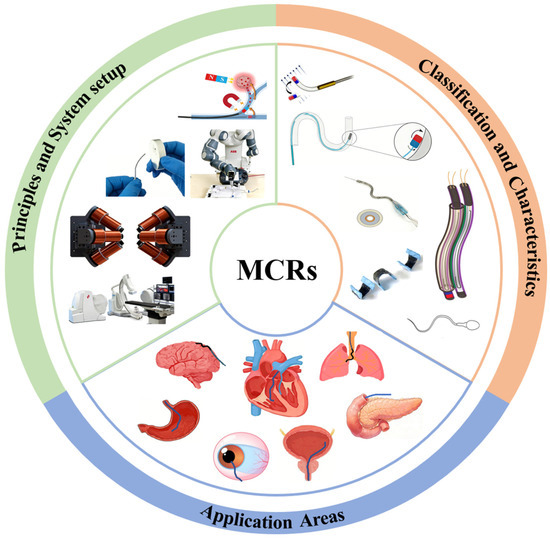
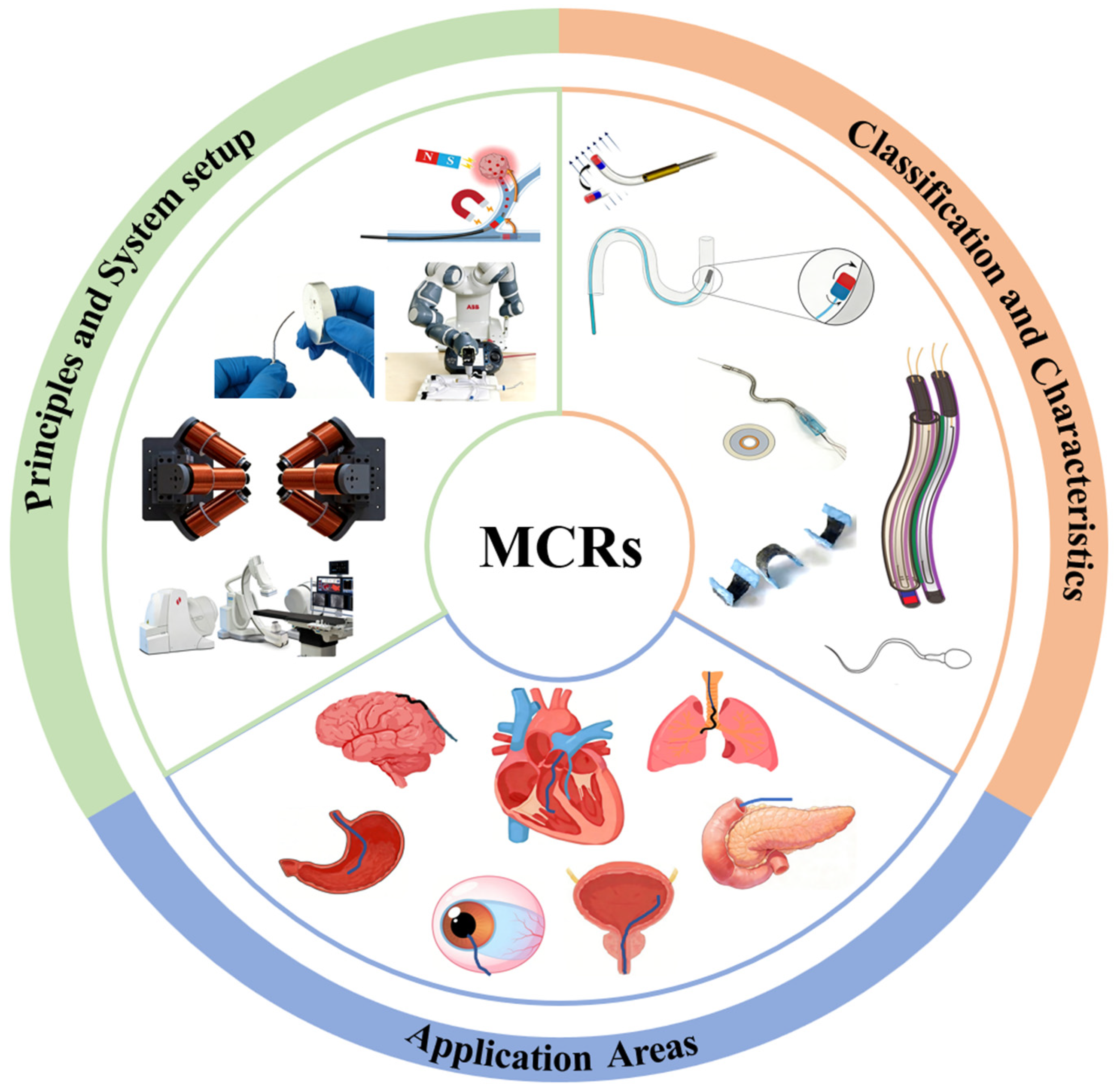
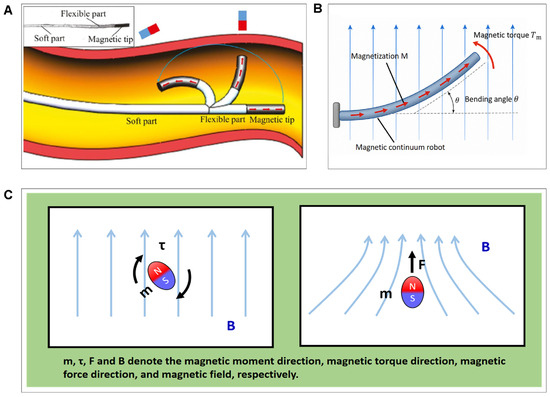
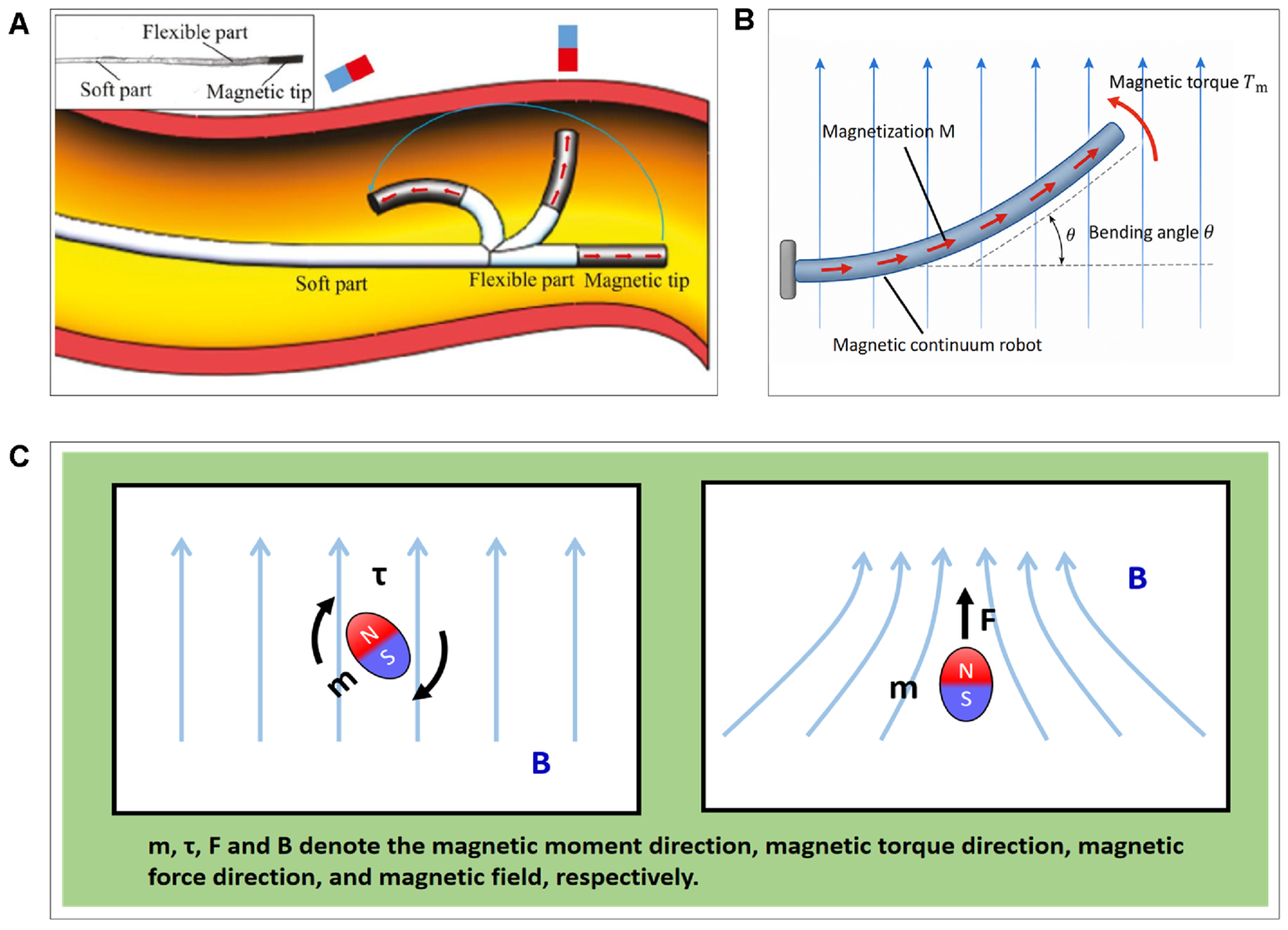
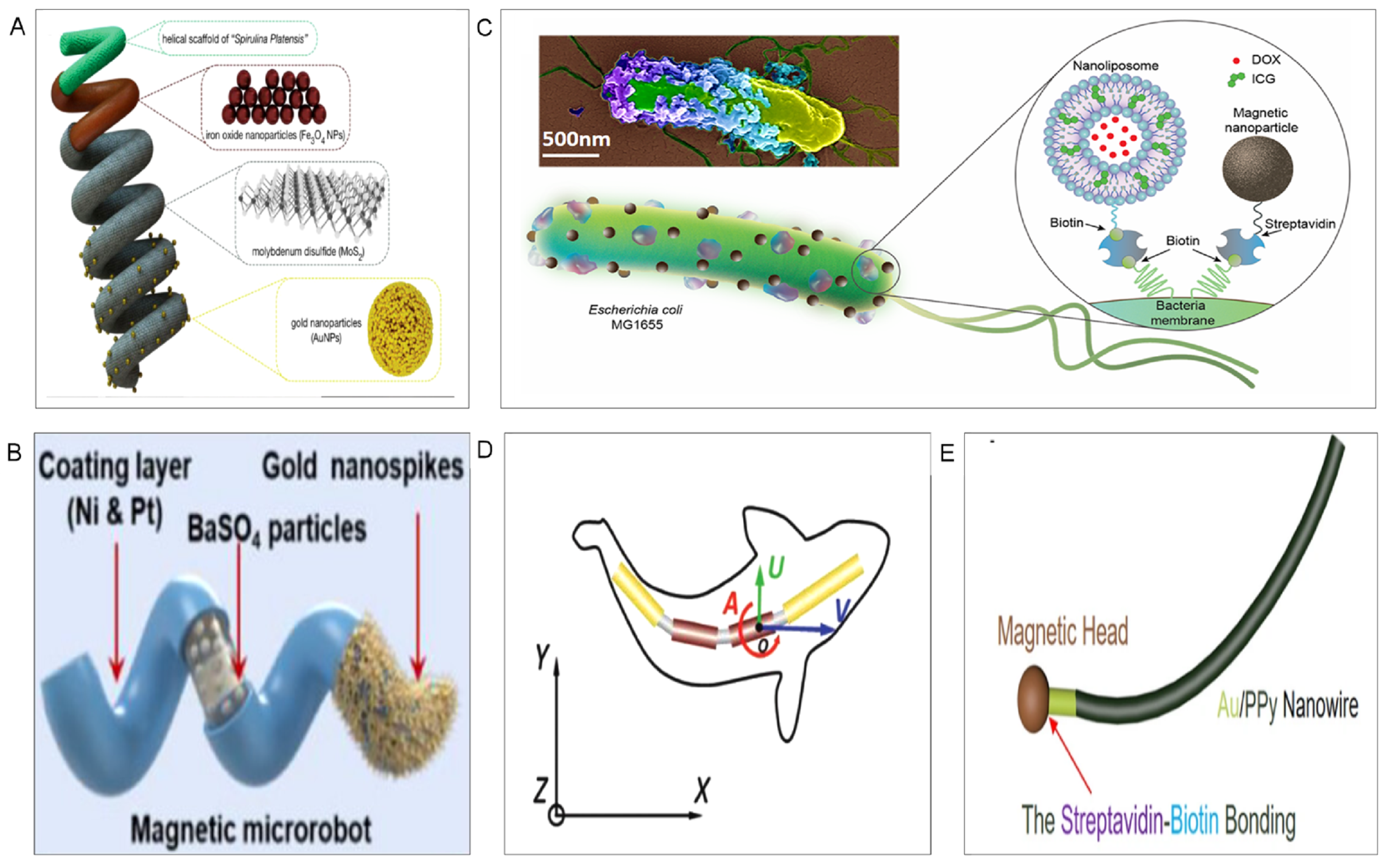

Disclaimer/Publisher’s Note: The statements, opinions and data contained in all publications are solely those of the individual author(s) and contributor(s) and not of MDPI and/or the editor(s). MDPI and/or the editor(s) disclaim responsibility for any injury to people or property resulting from any ideas, methods, instructions or products referred to in the content. |
© 2026 by the authors. Licensee MDPI, Basel, Switzerland. This article is an open access article distributed under the terms and conditions of the Creative Commons Attribution (CC BY) license.