
A Gd-Dimer Benchmark Study: Is DFT an Accurate Method for the Prediction of Gadolinium Exchange Coupling Constants?


Abstract
1. Introduction
2. Testbed Molecules
- Only have one crystallographic distinct molecule in the unit cell.
- Include exactly two paramagnetic Gd(III) and no other paramagnetic ions.
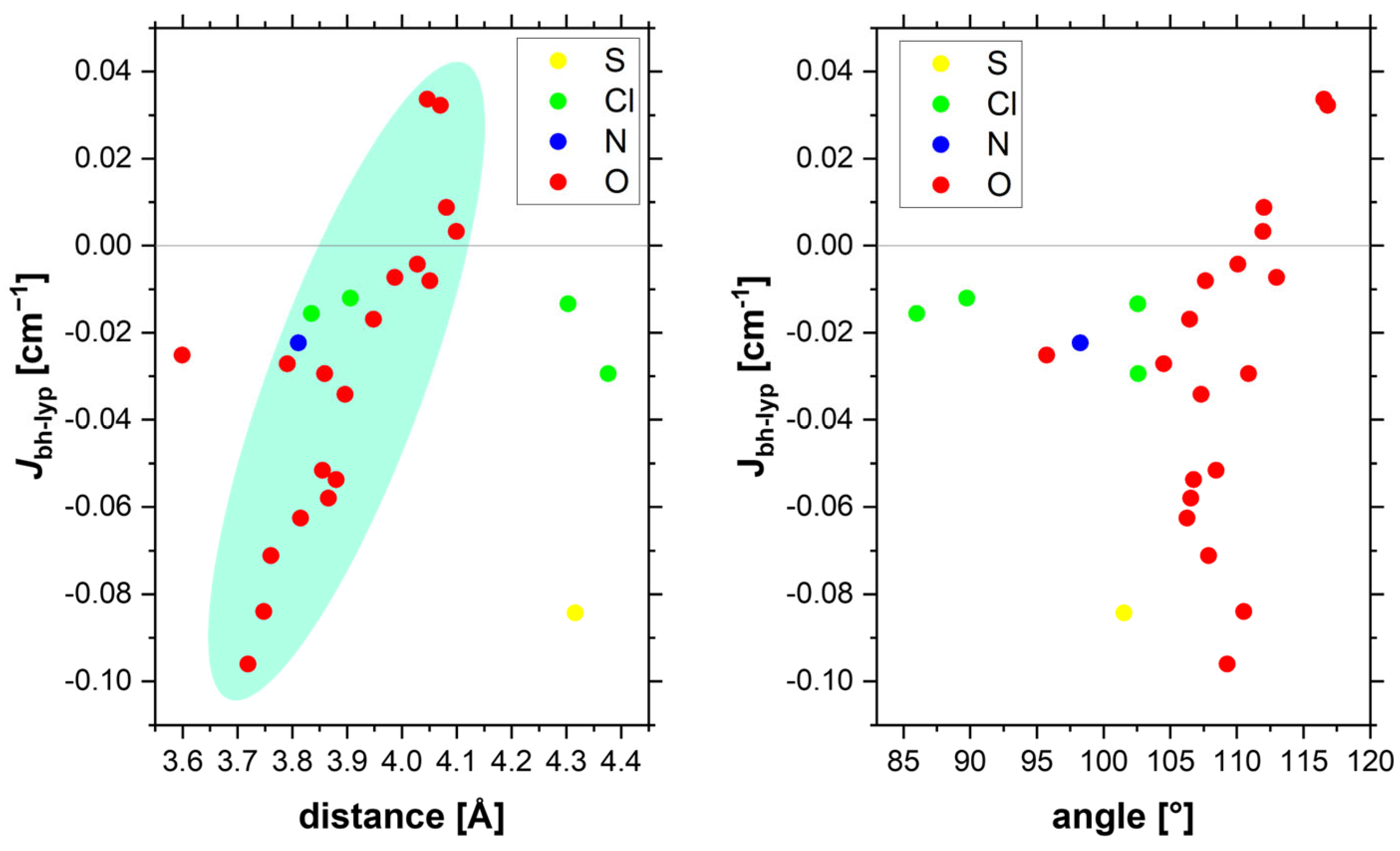
- Cover a wide range of bridging modes and different bridging atoms in order to capture possible changes in the electronic structure as a result of the different nature and different distortions of bridging units. The latter is known to have a significant influence on both the sign and the strength of exchange coupling in transition metal compounds as described by the Goodenough-Kanamori-Anderson rules [47,48,49].
- Be magnetically characterized with at least DC SQUID measurements in order to get experimental reference values.
- Cover a wide range of both ferromagnetic and antiferromagnetic interactions.
3. Computational Workflow
4. Fitting Procedures
5. Results and Discussion I: Influences of DFT-Options
6. Results and Discussion II: Influence of the Exchange Correlation Functional
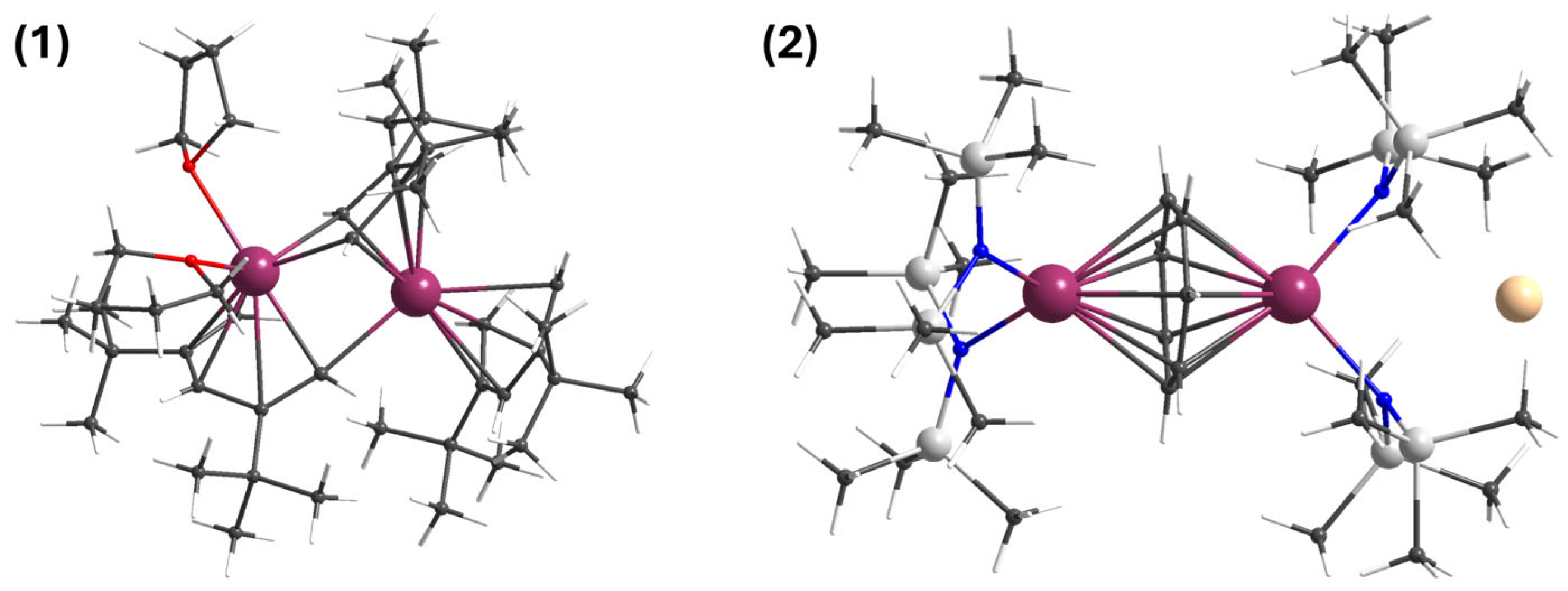
7. Results and Discussion III: Gd-Dimers Bridged via Carboanions
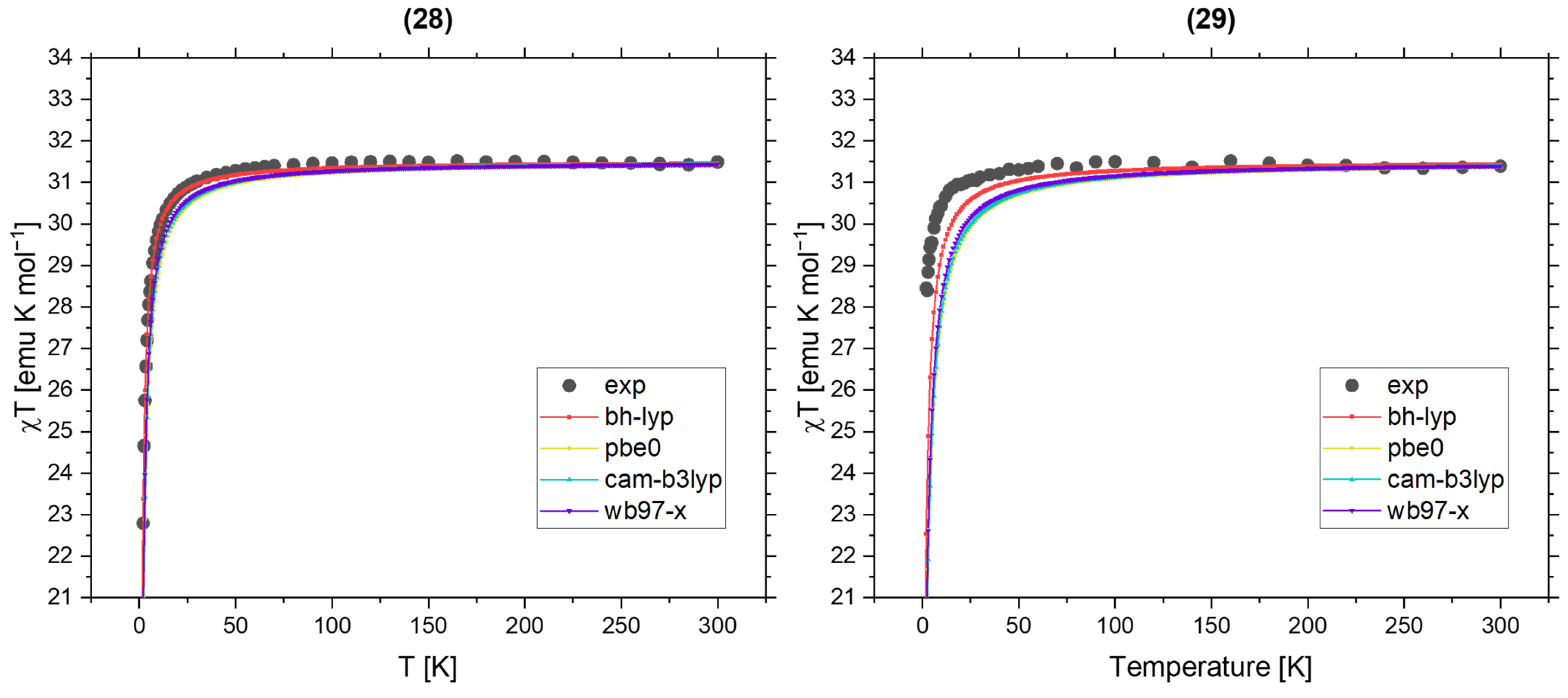
8. Results and Discussion IV: Application Example: Gd4-Clusters
9. Conclusions
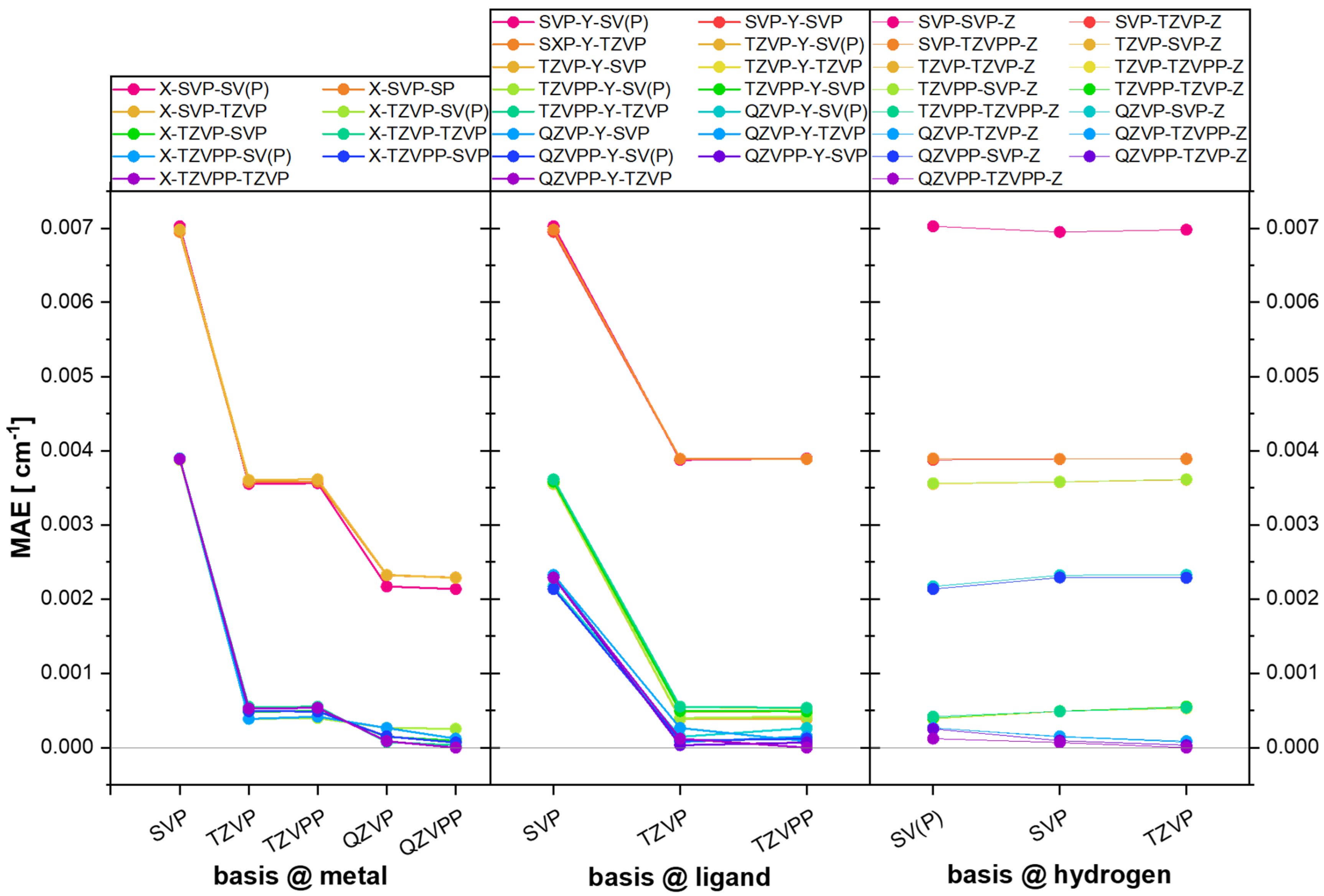
- A triple-ζ basis is necessary to describe the central ion and the surrounding ligands satisfactorily.
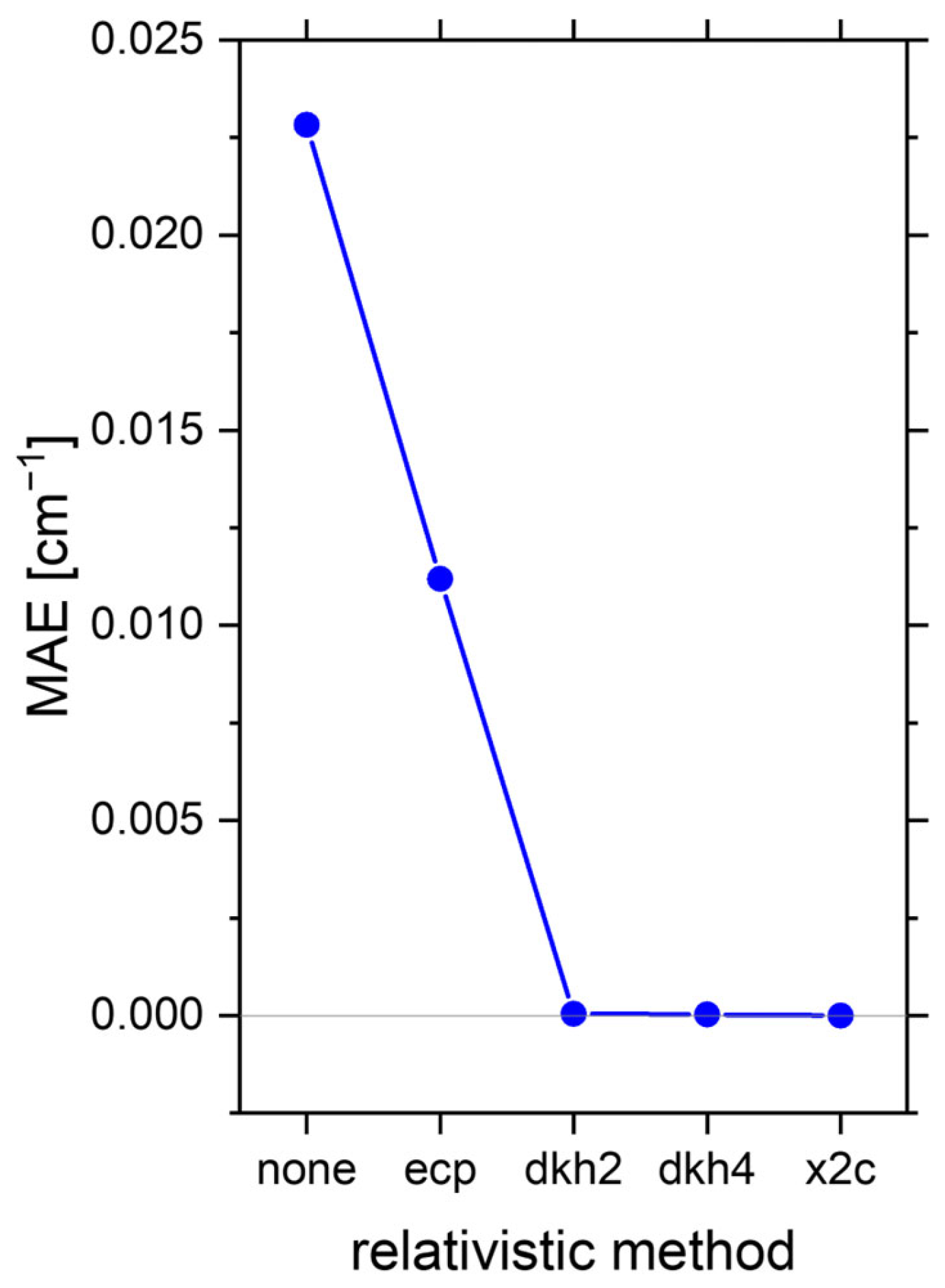
- Scalar relativistic effects should be taken into account explicitly. Similar results were obtained using DKH2, DKH4, and X2C. Neglecting scalar relativistic effects or using ECPs leads to inaccuracies in the same order of magnitude as those induced by the DFT functional.
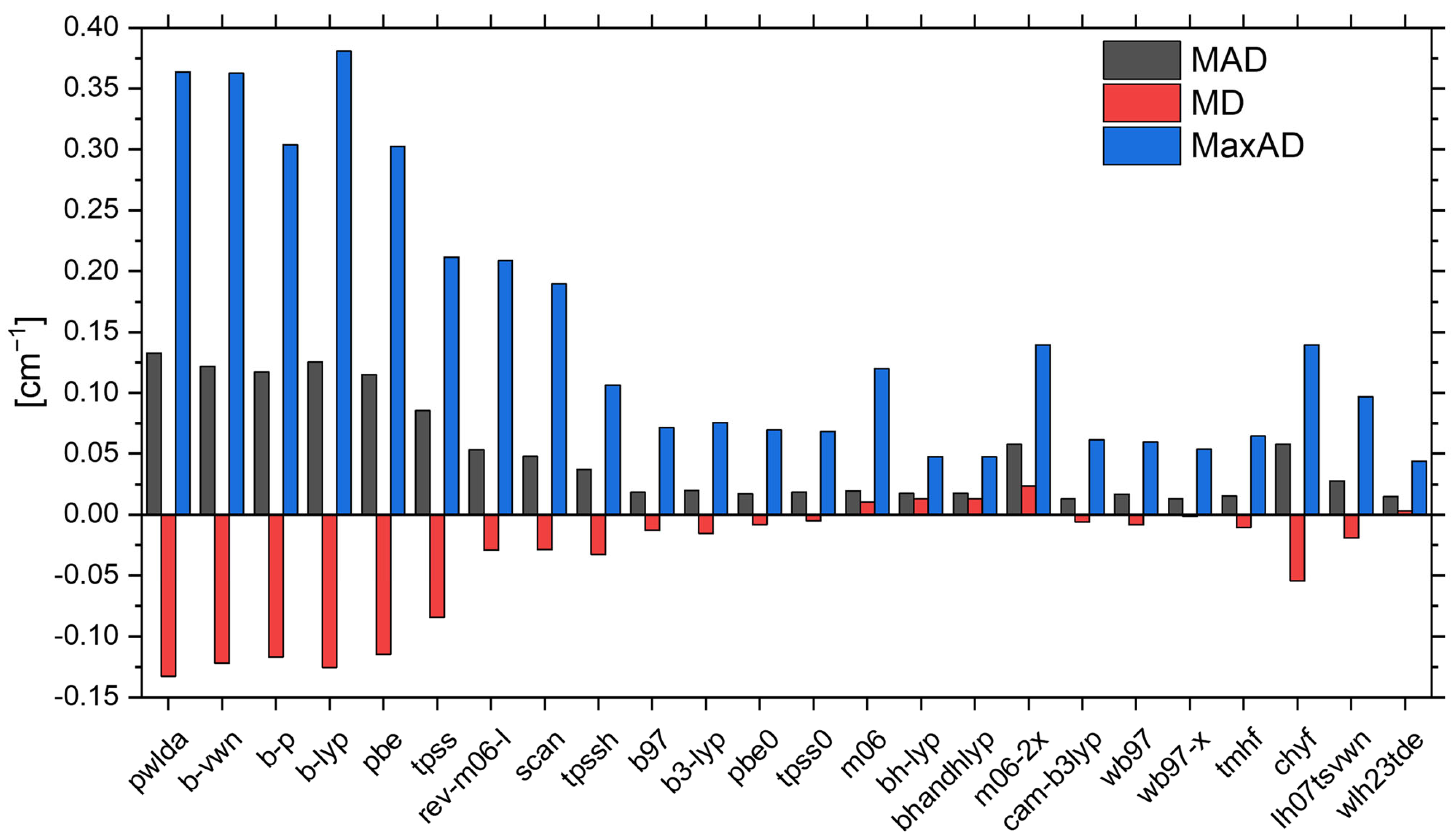
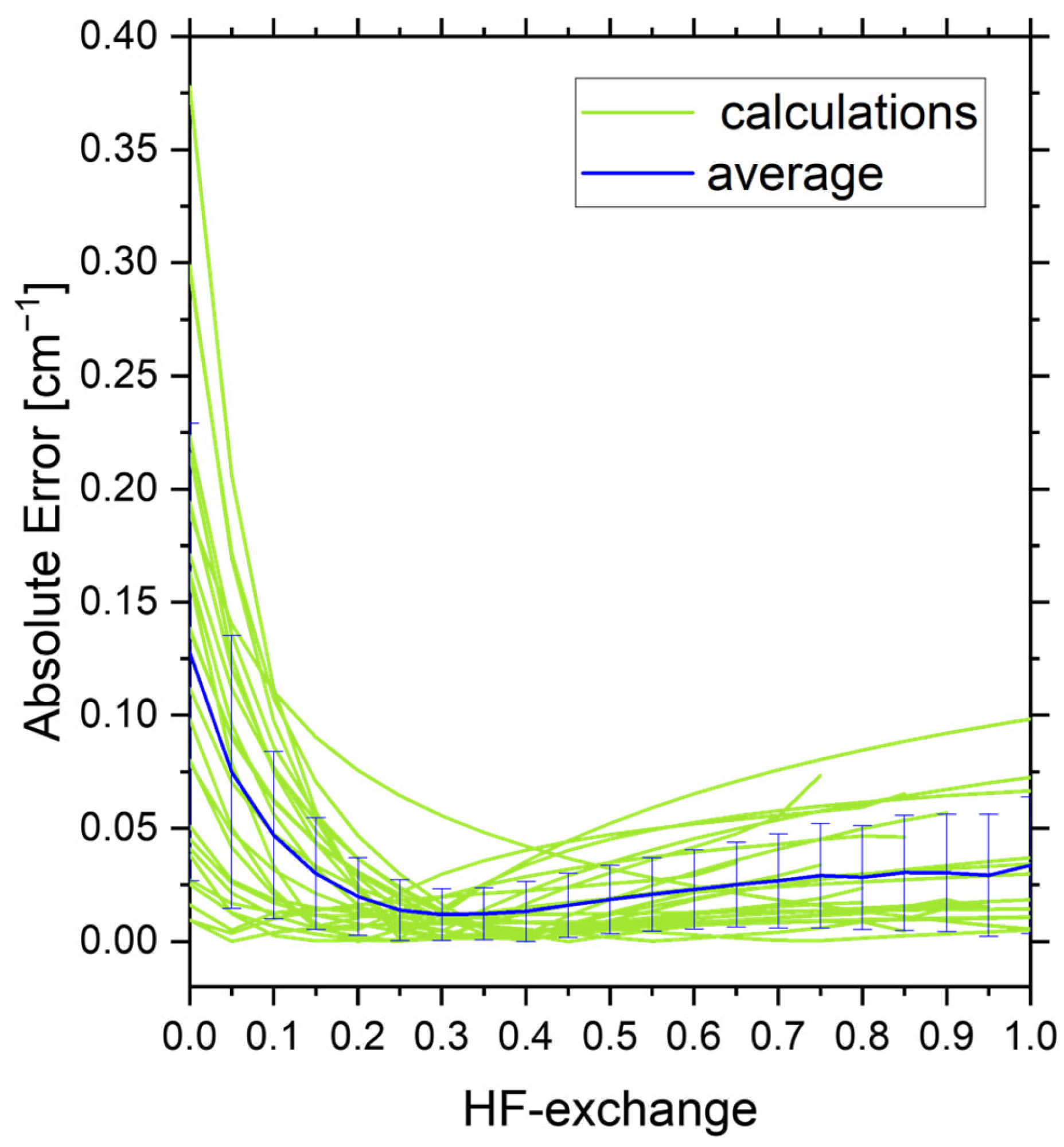
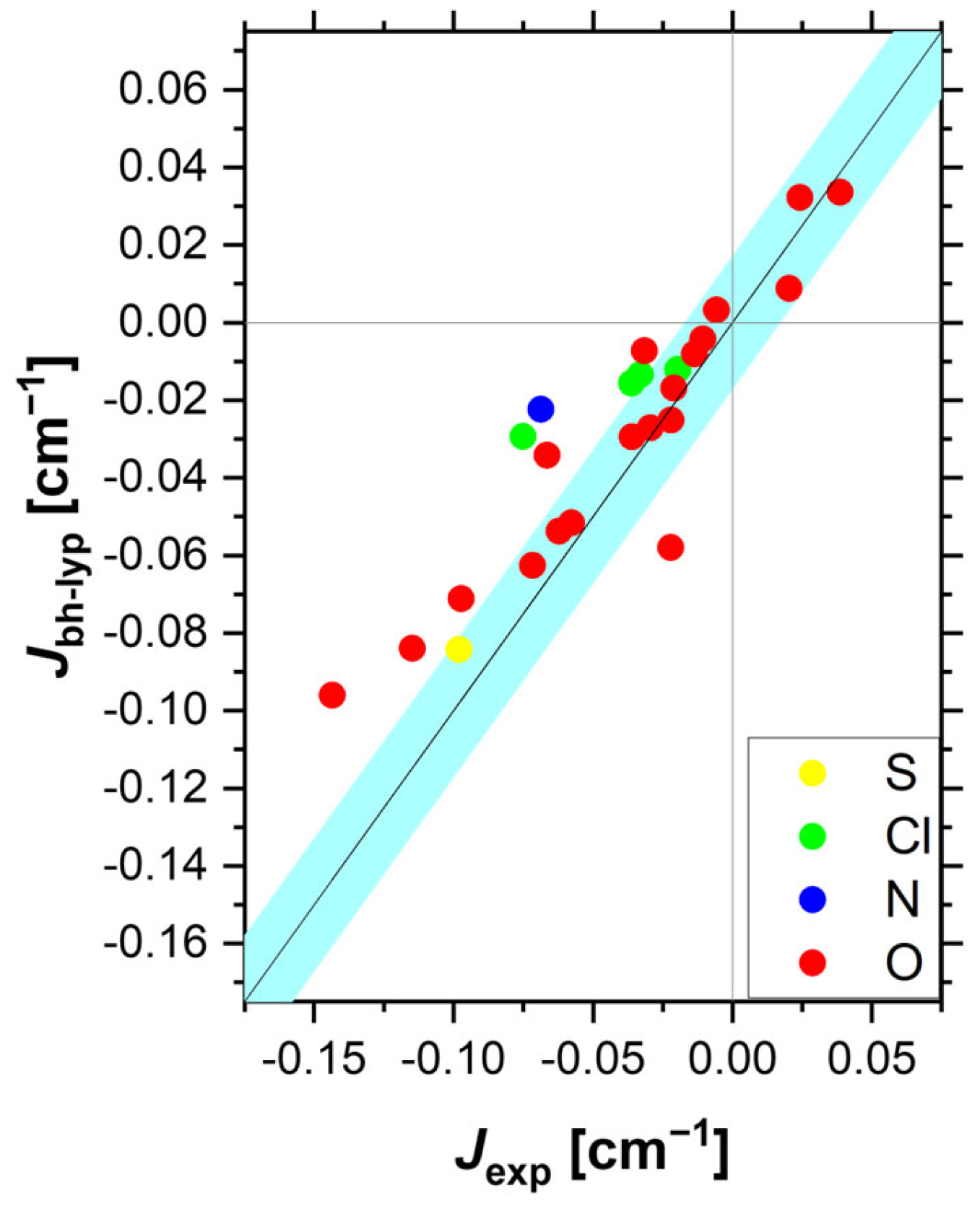
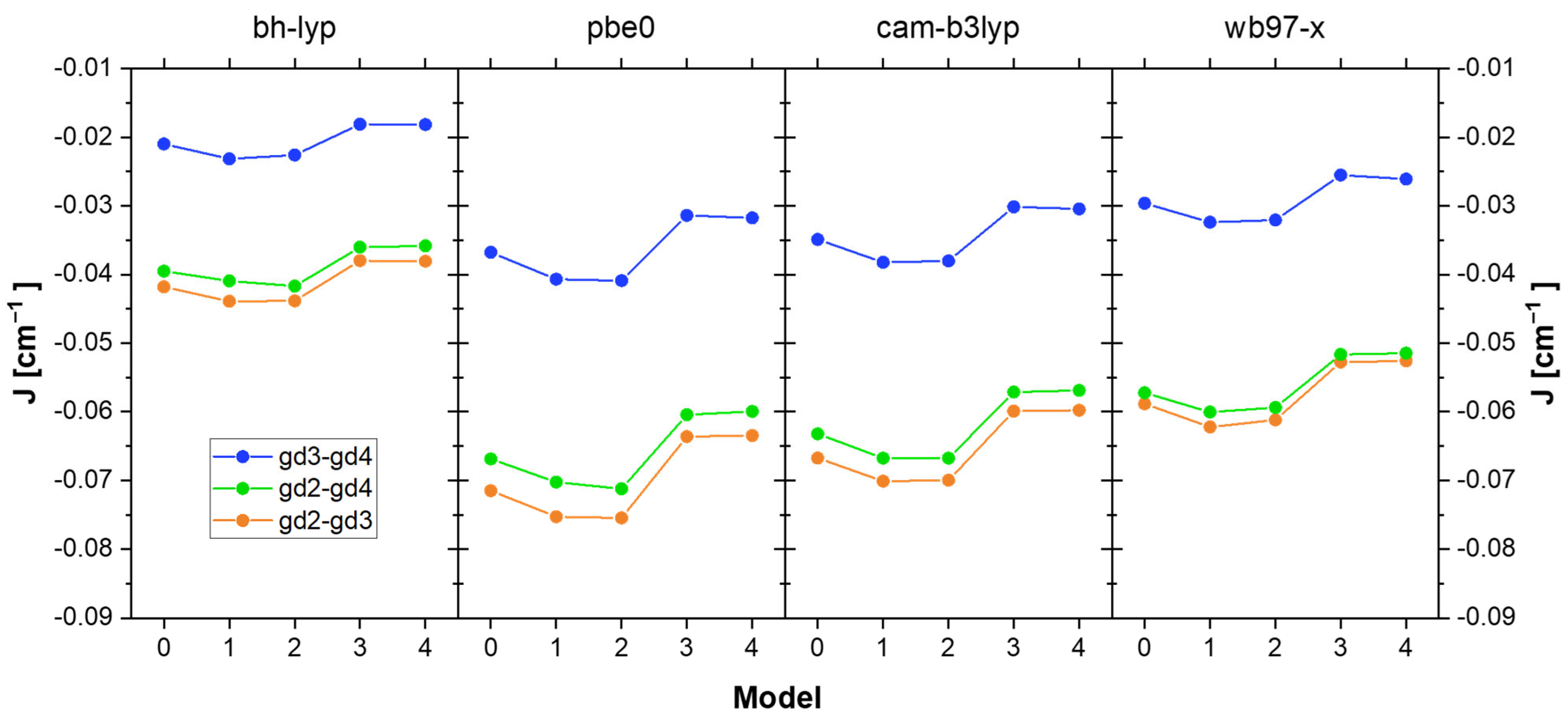
- We tested 25 different DFT functionals and would like to discourage the use of LDAs, GGAs, and meta-GGAs since they did not yield sufficiently accurate values. Considering a balance between computational cost and accuracy, we suggest using four functionals in parallel: the hybrid functionals bh-lyp and pbe0, as well as the range-separated functionals cam-b3lyp and ωb97-x. Using these four functionals will give a range of values close to the experimental value. Other hybrid functionals such as tpss0, b3-lyp, b97, and bhandhlyp, as well as the range-separated ωb97, and the local hybrid tmhf perform similarly well.
- We have shown that truncating the model complex is a feasible way to reduce the computational cost significantly. For example, replacing isobutyl groups with methyl groups has resulted in no significant change in the calculated coupling constants for all tested functionals. However, changes to atoms with a significant influence on the coordination site of the ligand may have an influence on the calculated coupling constant.
Supplementary Materials
Author Contributions
Funding
Data Availability Statement
Acknowledgments
Conflicts of Interest
References
- Zhu, Z.; Paul, S.; Zhao, C.; Wu, J.; Ying, X.; Ungur, L.; Wernsdorfer, W.; Meyer, F.; Tang, J. Record Quantum Tunneling Time in an Air-Stable Exchange-Bias Dysprosium Macrocycle. J. Am. Chem. Soc. 2024, 146, 18899–18904. [Google Scholar] [CrossRef] [Scilit] [PubMed]
- Yi, X.; Bernot, K.; Cador, O.; Luzon, J.; Calvez, G.; Daiguebonne, C.; Guillou, O. Influence of Ferromagnetic Connection of Ising-Type Dy(III)-Based Single Ion Magnets on Their Magnetic Slow Relaxation. Dalton Trans. 2013, 42, 6728–6731. [Google Scholar] [CrossRef] [Scilit]
- Moreno-Pineda, E.; Chilton, N.F.; Marx, R.; Dörfel, M.; Sells, D.O.; Neugebauer, P.; Jiang, S.-D.; Collison, D.; van Slageren, J.; McInnes, E.J.L.; et al. Direct Measurement of Dysprosium(III)···dysprosium(III) Interactions in a Single-Molecule Magnet. Nat. Commun. 2014, 5, 5243. [Google Scholar] [CrossRef] [Scilit]
- Pfleger, R.F.; Briganti, M.; Bonde, N.; Ollivier, J.; Braun, J.; Bergfeldt, T.; Piligkos, S.; Ruppert, T.; Anson, C.E.; Perfetti, M.; et al. Dinuclear Dysprosium Compounds: The Importance of Rigid Bridges. Chem. Eur. J. 2025, 31, e202403002. [Google Scholar] [CrossRef] [Scilit]
- Tziotzi, T.G.; Gracia, D.; Dalgarno, S.J.; Schnack, J.; Evangelisti, M.; Brechin, E.K.; Milios, C.J. A {Gd12Na6} Molecular Quadruple-Wheel with a Record Magnetocaloric Effect at Low Magnetic Fields and Temperatures. J. Am. Chem. Soc. 2023, 145, 7743–7747. [Google Scholar] [CrossRef] [Scilit] [PubMed]
- Braun, J.; Seufert, D.; Anson, C.E.; Tang, J.; Powell, A.K. An Effectively Uncoupled Gd8 Cluster Formed through Fixation of Atmospheric CO2 Showing Excellent Magnetocaloric Properties. Int. J. Mol. Sci. 2023, 25, 264. [Google Scholar] [CrossRef] [Scilit]
- Sharples, J.W.; Zheng, Y.-Z.; Tuna, F.; McInnes, E.J.L.; Collison, D. Lanthanide Discs Chill Well and Relax Slowly. Chem. Commun. 2011, 47, 7650. [Google Scholar] [CrossRef] [Scilit] [PubMed]
- Tishin, A.M.; Spichkin, Y.I. The Magnetocaloric Effect and Its Applications, 1st ed.; CRC Press: Boca Raton, FL, USA, 2003. [Google Scholar]
- Zheng, Y.-Z.; Zhou, G.-J.; Zheng, Z.; Winpenny, R.E.P. Molecule-Based Magnetic Coolers. Chem. Soc. Rev. 2014, 43, 1462–1475. [Google Scholar] [CrossRef] [Scilit]
- Sharples, J.W.; Collison, D.; McInnes, E.J.L.; Schnack, J.; Palacios, E.; Evangelisti, M. Quantum Signatures of a Molecular Nanomagnet in Direct Magnetocaloric Measurements. Nat. Commun. 2014, 5, 5321. [Google Scholar] [CrossRef] [Scilit]
- Tang, J.; Hewitt, I.; Madhu, N.T.; Chastanet, G.; Wernsdorfer, W.; Anson, C.E.; Benelli, C.; Sessoli, R.; Powell, A.K. Dysprosium Triangles Showing Single-Molecule Magnet Behavior of Thermally Excited Spin States. Angew. Chem. Int. Ed. 2006, 45, 1729–1733. [Google Scholar] [CrossRef] [Scilit]
- Chibotaru, L.F.; Ungur, L.; Soncini, A. The Origin of Nonmagnetic Kramers Doublets in the Ground State of Dysprosium Triangles: Evidence for a Toroidal Magnetic Moment. Angew. Chem. Int. Ed. 2008, 47, 4126–4129. [Google Scholar] [CrossRef] [Scilit]
- Hymas, K.; Soncini, A. The Role of Magnetic Dipole—Dipole Coupling in Quantum Single-Molecule Toroics. Magnetochemistry 2022, 8, 58. [Google Scholar] [CrossRef] [Scilit]
- Dolai, M.; Moreno-Pineda, E.; Wernsdorfer, W.; Ali, M.; Ghosh, A. Exchange-Bias Quantum Tunneling of the Magnetization in a Dysprosium Dimer. J. Phys. Chem. A 2021, 125, 8230–8237. [Google Scholar] [CrossRef] [Scilit] [PubMed]
- Wernsdorfer, W.; Aliaga-Alcalde, N.; Hendrickson, D.N.; Christou, G. Exchange-Biased Quantum Tunnelling in a Supramolecular Dimer of Single-Molecule Magnets. Nature 2002, 416, 406–409. [Google Scholar] [CrossRef] [Scilit] [PubMed]
- Guo, Y.-N.; Xu, G.-F.; Wernsdorfer, W.; Ungur, L.; Guo, Y.; Tang, J.; Zhang, H.-J.; Chibotaru, L.F.; Powell, A.K. Strong Axiality and Ising Exchange Interaction Suppress Zero-Field Tunneling of Magnetization of an Asymmetric Dy2 Single-Molecule Magnet. J. Am. Chem. Soc. 2011, 133, 11948–11951. [Google Scholar] [CrossRef] [Scilit] [PubMed]
- Dunstan, M.A.; Mole, R.A.; Boskovic, C. Inelastic Neutron Scattering of Lanthanoid Complexes and Single-Molecule Magnets. Eur. J. Inorg. Chem. 2019, 2019, 1090–1105. [Google Scholar] [CrossRef] [Scilit]
- Kettles, F.J.; Milway, V.A.; Tuna, F.; Valiente, R.; Thomas, L.H.; Wernsdorfer, W.; Ochsenbein, S.T.; Murrie, M. Exchange Interactions at the Origin of Slow Relaxation of the Magnetization in {TbCu3} and {DyCu3} Single-Molecule Magnets. Inorg. Chem. 2014, 53, 8970–8978. [Google Scholar] [CrossRef] [Scilit]
- Loewenhaupt, M.; Tils, P.; Buschow, K.H.J.; Eccleston, R.S. Exchange Interactions in GdFe Compounds Studied by Inelastic Neutron Scattering. J. Magn. Magn. Mater. 1996, 152, 10–16. [Google Scholar] [CrossRef] [Scilit]
- Chibotaru, L.F. Theoretical Understanding of Anisotropy in Molecular Nanomagnets. In Molecular Nanomagnets and Related Phenomena; Gao, S., Ed.; Structure and Bonding; Springer: Berlin/Heidelberg, Germany, 2014; Volume 164, pp. 185–229. [Google Scholar]
- Schray, D.; Westerbeck, D.; Braun, J.; Lan, Y.; Gómez-Coca, S.; Wernsdorfer, W.; Ruiz, E.; Anson, C.E.; Schnack, J.; Powell, A.K. Fe–Gd Ferromagnetic Cyclic Coordination Cluster [FeIII4 GdIII4 (teaH)8 (N3)8 (H2O)] with Magnetic Anisotropy—Theory and Experiment. Inorg. Chem. 2023, 62, 6642–6648. [Google Scholar] [CrossRef] [Scilit]
- Essajai, R.; Ennassiri, N.; Balli, M.; Zidane, M.; Salmani, E.; Mounkachi, O.; Rouchdi, M.; Abbassi, A.; Ez-Zahraouy, H.; Mzerd, A.; et al. Revisiting the Magnetic and Magnetocaloric Properties of Bulk Gadolinium: A Combined DFT and Monte Carlo Simulations. Phys. Scr. 2020, 96, 015808. [Google Scholar] [CrossRef] [Scilit]
- Rajaraman, G.; Totti, F.; Bencini, A.; Caneschi, A.; Sessoli, R.; Gatteschi, D. Density Functional Studies on the Exchange Interaction of a Dinuclear Gd(III)-Cu(II) Complex: Method Assessment, Magnetic Coupling Mechanism and Magneto-Structural Correlations. Dalton Trans. 2009, 17, 3153–3161. [Google Scholar] [CrossRef] [Scilit]
- Rajeshkumar, T.; Singh, S.K.; Rajaraman, G. A Computational Perspective on Magnetic Coupling, Magneto-Structural Correlations and Magneto-Caloric Effect of a Ferromagnetically Coupled {GdIII–GdIII} Pair. Polyhedron 2013, 52, 1299–1305. [Google Scholar] [CrossRef] [Scilit]
- Langley, S.K.; Wielechowski, D.P.; Vieru, V.; Chilton, N.F.; Moubaraki, B.; Abrahams, B.F.; Chibotaru, L.F.; Murray, K.S. A {Cr(III)2Dy(III)2} Single-Molecule Magnet: Enhancing the Blocking Temperature through 3d Magnetic Exchange. Angew. Chem. Int. Ed. 2013, 52, 12014–12019. [Google Scholar] [CrossRef] [Scilit] [PubMed]
- Ungur, L.; van den Heuvel, W.; Chibotaru, L.F. Ab Initio Investigation of the Non-Collinear Magnetic Structure and the Lowest Magnetic Excitations in Dysprosium Triangles. New J. Chem. 2009, 33, 1224–1230. [Google Scholar] [CrossRef] [Scilit]
- Noodleman, L. Valence Bond Description of Antiferromagnetic Coupling in Transition Metal Dimers. J. Chem. Phys. 1981, 74, 5737–5743. [Google Scholar] [CrossRef] [Scilit]
- Onishi, T.; Yamaki, D.; Yamaguchi, K.; Takano, Y. Theoretical Calculations of Effective Exchange Integrals by Spin Projected and Unprojected Broken-Symmetry Methods. I. Cluster Models of K2NiF4-Type Solids. J. Chem. Phys. 2003, 118, 9747–9761. [Google Scholar] [CrossRef] [Scilit]
- Jin, P.-B.; Luo, Q.-C.; Gransbury, G.K.; Winpenny, R.E.P.; Mills, D.P.; Zheng, Y.-Z. Rare Earth Benzene Tetraanion-Bridged Amidinate Complexes. Chem. Sci. 2025, 16, 1907–1924. [Google Scholar] [CrossRef] [Scilit]
- Roy, L.E.; Hughbanks, T. Magnetic Coupling in Dinuclear Gd Complexes. J. Am. Chem. Soc. 2006, 128, 568–575. [Google Scholar] [CrossRef] [Scilit]
- Costa, R.; Reta, D.; Moreira, I.D.P.R.; Illas, F. Post-B3LYP Functionals Do Not Improve the Description of Magnetic Coupling in Cu(II) Dinuclear Complexes. J. Phys. Chem. A 2018, 122, 3423–3432. [Google Scholar] [CrossRef] [Scilit]
- Phillips, J.J.; Peralta, J.E. Magnetic Exchange Couplings from Semilocal Functionals Evaluated Nonself-Consistently on Hybrid Densities: Insights on Relative Importance of Exchange, Correlation, and Delocalization. J. Chem. Theory Comput. 2012, 8, 3147–3158. [Google Scholar] [CrossRef] [Scilit]
- Moreira, I.D.P.R.; Costa, R.; Filatov, M.; Illas, F. Restricted Ensemble-Referenced Kohn−Sham versus Broken Symmetry Approaches in Density Functional Theory: Magnetic Coupling in Cu Binuclear Complexes. J. Chem. Theory Comput. 2007, 3, 764–774. [Google Scholar] [CrossRef] [Scilit]
- Valero, R.; Costa, R.; De P.R. Moreira, I.; Truhlar, D.G.; Illas, F. Performance of the M06 Family of Exchange-Correlation Functionals for Predicting Magnetic Coupling in Organic and Inorganic Molecules. J. Chem. Phys. 2008, 128, 114103. [Google Scholar] [CrossRef] [Scilit]
- David, G.; Wennmohs, F.; Neese, F.; Ferré, N. Chemical Tuning of Magnetic Exchange Couplings Using Broken-Symmetry Density Functional Theory. Inorg. Chem. 2018, 57, 12769–12776. [Google Scholar] [CrossRef] [Scilit]
- Rivero, P.; Moreira, I.D.P.R.; Illas, F.; Scuseria, G.E. Reliability of Range-Separated Hybrid Functionals for Describing Magnetic Coupling in Molecular Systems. J. Chem. Phys. 2008, 129, 184110. [Google Scholar] [CrossRef] [Scilit]
- Singh, G.; Gamboa, S.; Orio, M.; Pantazis, D.A.; Roemelt, M. Magnetic Exchange Coupling in Cu Dimers Studied with Modern Multireference Methods and Broken-Symmetry Coupled Cluster Theory. Theor. Chem. Acc. 2021, 140, 139. [Google Scholar] [CrossRef] [Scilit]
- López, C.; Costa, R.; Illas, F.; De Graaf, C.; Turnbull, M.M.; Landee, C.P.; Espinosa, E.; Mata, I.; Molins, E. Magneto-Structural Correlations in Binuclear Copper(II) Compounds Bridged by a Ferrocenecarboxylato(–1) and an Hydroxo- or Methoxo-Ligands. Dalton Trans. 2005, 13, 2322–2330. [Google Scholar] [CrossRef] [Scilit]
- Paulovič, J.; Cimpoesu, F.; Ferbinteanu, M.; Hirao, K. Mechanism of Ferromagnetic Coupling in Copper(II)-Gadolinium(III) Complexes. J. Am. Chem. Soc. 2004, 126, 3321–3331. [Google Scholar] [CrossRef] [Scilit] [PubMed]
- Yan, F.; Chen, Z. Magnetic Coupling Constants and Spin Density Maps for Heterobinuclear Complexes GdCu(OTf)3(Bdmap)2(H2O)·THF, [Gd(C4H7ON)4(H2O)3][Fe(CN)6]·2H2O, and [Gd(C4H7ON)4 (H2O)3][Cr(CN)6]·2H2O: A Density Functional Study. J. Phys. Chem. A 2000, 104, 6295–6300. [Google Scholar] [CrossRef] [Scilit]
- Rajeshkumar, T.; Jose, R.; Remya, P.R.; Rajaraman, G. Theoretical Studies on Trinuclear {MnIII2 GdIII} and Tetranuclear {MnIII2 GdIII2} Clusters: Magnetic Exchange, Mechanism of Magnetic Coupling, Magnetocaloric Effect, and Magneto–Structural Correlations. Inorg. Chem. 2019, 58, 11927–11940. [Google Scholar] [CrossRef] [Scilit] [PubMed]
- Singh, S.K.; Pedersen, K.S.; Sigrist, M.; Thuesen, C.A.; Schau-Magnussen, M.; Mutka, H.; Piligkos, S.; Weihe, H.; Rajaraman, G.; Bendix, J. Angular Dependence of the Exchange Interaction in Fluoride-Bridged GdIII–CrIII Complexes. Chem. Commun. 2013, 49, 5583. [Google Scholar] [CrossRef] [Scilit]
- Singh, S.K.; Rajaraman, G. Decisive Interactions That Determine Ferro/Antiferromagnetic Coupling in {3d–4f} Pairs: A Case Study on Dinuclear {V(IV)–Gd(III)} Complexes. Dalton Trans. 2013, 42, 3623. [Google Scholar] [CrossRef] [Scilit]
- Singh, S.K.; Tibrewal, N.K.; Rajaraman, G. Density Functional Studies on Dinuclear {NiIIGdIII} and Trinuclear {NiIIGdIIINiII} Complexes: Magnetic Exchange and Magneto-Structural Maps. Dalton Trans. 2011, 40, 10897. [Google Scholar] [CrossRef] [Scilit]
- Gupta, T.; Rajeshkumar, T.; Rajaraman, G. Magnetic Exchange in {GdIII–Radical} Complexes: Method Assessment, Mechanism of Coupling and Magneto-Structural Correlations. Phys. Chem. Chem. Phys. 2014, 16, 14568–14577. [Google Scholar] [CrossRef] [Scilit]
- Cirera, J.; Ruiz, E. Exchange Coupling in CuIIGdIII Dinuclear Complexes: A Theoretical Perspective. Comptes Rendus Chim. 2008, 11, 1227–1234. [Google Scholar] [CrossRef] [Scilit]
- Anderson, P.W. Antiferromagnetism. Theory of Superexchange Interaction. Phys. Rev. 1950, 79, 350–356. [Google Scholar] [CrossRef] [Scilit]
- Goodenough, J.B. Theory of the Role of Covalence in the Perovskite-Type Manganites [La, M(II)] MnO3. Phys. Rev. 1955, 100, 564–573. [Google Scholar] [CrossRef] [Scilit]
- Kanamori, J. Superexchange Interaction and Symmetry Properties of Electron Orbitals. J. Phys. Chem. Solids 1959, 10, 87–98. [Google Scholar] [CrossRef] [Scilit]
- Raeder, J.; Reiners, M.; Baumgarten, R.; Münster, K.; Baabe, D.; Freytag, M.; Jones, P.G.; Walter, M.D. Synthesis and Molecular Structure of Pentadienyl Complexes of the Rare-Earth Metals. Dalton Trans. 2018, 47, 14468–14482. [Google Scholar] [CrossRef] [Scilit]
- Harriman, K.L.M.; Le Roy, J.J.; Ungur, L.; Holmberg, R.J.; Korobkov, I.; Murugesu, M. Cycloheptatrienyl Trianion: An Elusive Bridge in the Search of Exchange Coupled Dinuclear Organolanthanide Single-Molecule Magnets. Chem. Sci. 2017, 8, 231–240. [Google Scholar] [CrossRef] [Scilit]
- Tuna, F.; Smith, C.A.; Bodensteiner, M.; Ungur, L.; Chibotaru, L.F.; McInnes, E.J.L.; Winpenny, R.E.P.; Collison, D.; Layfield, R.A. A High Anisotropy Barrier in a Sulfur-Bridged Organodysprosium Single-Molecule Magnet. Angew. Chem. Int. Ed. 2012, 51, 6976–6980. [Google Scholar] [CrossRef] [Scilit]
- Lu, Y.-B.; Wu, J.-W.; Zhu, S.-D.; Wang, S.-Q.; Zhang, S.-Y.; Liu, C.-M.; Li, R.; Li, J.; Ai, J.-H.; Xie, Y.-R. 3-Pyridylacetic-Based Lanthanide Complexes Exhibiting Magnetic Entropy Changes, Single-Molecule Magnet, and Fluorescence. ACS Omega 2022, 7, 2604–2612. [Google Scholar] [CrossRef] [Scilit]
- Rasamsetty, A.; Mehta, S.; Ansari, K.U.; Kumar, P.; Mondal, A.; Shanmugam, M. Six-Coordinated Dinuclear Lanthanide(III) Amide Complexes: Investigation of Magnetization Relaxation Dynamics and Their Electronic Structures. Dalton Trans. 2022, 51, 63–68. [Google Scholar] [CrossRef] [Scilit]
- Han, T.; Ding, Y.-S.; Li, Z.-H.; Yu, K.-X.; Zhai, Y.-Q.; Chilton, N.F.; Zheng, Y.-Z. A Dichlorido-Bridged Dinuclear Dy(III) Single-Molecule Magnet with an Effective Energy Barrier Larger than 600 K. Chem. Commun. 2019, 55, 7930–7933. [Google Scholar] [CrossRef] [Scilit]
- Jung, J.; Benner, F.; Herbst-Irmer, R.; Demir, S.; Stalke, D. Slow Magnetic Relaxation in Mono- and Bimetallic Lanthanide Tetraimido-Sulfate S(N t Bu)42− Complexes. Chem. Eur. J. 2021, 27, 12310–12319. [Google Scholar] [CrossRef] [Scilit]
- Layfield, R.A.; Bashall, A.; McPartlin, M.; Rawson, J.M.; Wright, D.S. A Structural and Magnetic Study of Organolanthanide(III) Amides. Dalton Trans. 2006, 13, 1660–1666. [Google Scholar] [CrossRef] [Scilit]
- Mukherjee, S.; Lu, J.; Velmurugan, G.; Singh, S.; Rajaraman, G.; Tang, J.; Ghosh, S.K. Influence of Tuned Linker Functionality on Modulation of Magnetic Properties and Relaxation Dynamics in a Family of Six Isotypic Ln2 (Ln = Dy and Gd) Complexes. Inorg. Chem. 2016, 55, 11283–11298. [Google Scholar] [CrossRef] [Scilit]
- Liu, C.; Hao, X.; Zhang, D. CO2-fixation into Carbonate Anions for the Construction of 3d-4f Cluster Complexes with Salen-type Schiff Base Ligands: From Molecular Magnetic Refrigerants to Luminescent Single-molecule Magnets. Appl. Oganomet. Chem. 2020, 34, e5893. [Google Scholar] [CrossRef] [Scilit]
- Kalita, P.; Goura, J.; Manuel Herrera Martínez, J.; Colacio, E.; Chandrasekhar, V. Homodinuclear {LnIII2} (LnIII = GdIII, TbIII, HoIII, and DyIII) Complexes: Field-Induced SMM Behavior of the DyIII and TbIII Analogues. Eur. J. Inorg. Chem. 2019, 2019, 212–220. [Google Scholar] [CrossRef] [Scilit]
- Liu, Z.; Huang, X.; Chen, Z.; Liu, D.; Zou, H.; Liang, F. Exploring the Functional Relation of Magnetic Density and Magnetocaloric Effect Based on a Dinuclear System. Appl. Oganomet. Chem. 2021, 35, e6325. [Google Scholar] [CrossRef] [Scilit]
- John, D.; Urland, W. Crystal Structure and Magnetic Behaviour of the New Gadolinium Carboxylates Gd2 (ClF2CCOO)6 (Hypy)2, Gd2 (F3CCOO)6 (Hypy)2, Gd2 (F2HCCOO)6 (Hypy)2 and Gd2 (Cl2HCCOO)6 (H2O)2 (Hypy)2. Eur. J. Inorg. Chem. 2006, 2006, 3503–3509. [Google Scholar] [CrossRef] [Scilit]
- Wang, H.; Liu, C.; Liu, T.; Zeng, S.; Cao, W.; Ma, Q.; Duan, C.; Dou, J.; Jiang, J. Mixed (Phthalocyaninato)(Schiff-Base) Di-Dysprosium Sandwich Complexes. Effect of Magnetic Coupling on the SMM Behavior. Dalton Trans. 2013, 42, 15355–15360. [Google Scholar] [CrossRef] [Scilit] [PubMed]
- Machata, M.; Herchel, R.; Nemec, I.; Trávníček, Z. Crystal Structures and Magnetic Properties of Two Series of Phenoxo-O Bridged Dinuclear Ln2 (Ln = Gd, Tb, Dy) Complexes. Dalton Trans. 2017, 46, 16294–16305. [Google Scholar] [CrossRef] [Scilit] [PubMed]
- Zhou, M.; Wu, L.-H.; Wu, X.-Y.; Yao, S.-L.; Zheng, T.-F.; Xie, X.; Liu, S.-J. Two Dinuclear GdIII Clusters Based on Isobutyric Acid and Nicotinic Acid with Large Magnetocaloric Effects. J. Mol. Struct. 2021, 1227, 129689. [Google Scholar] [CrossRef] [Scilit]
- Zhang, H.; Lin, S.-Y.; Xue, S.; Wang, C.; Tang, J. Acetato-Bridged Dinuclear Lanthanide Complexes with Single Molecule Magnet Behaviour for the Dy2 Species. Dalton Trans. 2014, 43, 6262–6268. [Google Scholar] [CrossRef] [Scilit]
- Meng, Z.-S.; Guo, F.-S.; Liu, J.-L.; Leng, J.-D.; Tong, M.-L. Heterometallic Cubane-like {M2Ln2} (M = Ni, Zn; Ln =, Gd, Dy) and {Ni2Y2} Aggregates. Synthesis, Structures and Magnetic Properties. Dalton Trans. 2012, 41, 2320–2329. [Google Scholar] [CrossRef] [Scilit]
- Chu, X.-Y.; Wang, W.-M.; Nie, Y.-Y.; Cui, J.-Z.; Gao, H.-L. Regulating the Luminescent and Magnetic Properties of Rare-Earth Complexes with β-Diketonate Coligands. New J. Chem. 2018, 42, 11417–11429. [Google Scholar] [CrossRef] [Scilit]
- Mylonas-Margaritis, I.; Mayans, J.; Sakellakou, S.-M.; Raptopoulou, C.P.; Psycharis, V.; Escuer, A.; Perlepes, S.P. Using the Singly Deprotonated Triethanolamine to Prepare Dinuclear Lanthanide(III) Complexes: Synthesis, Structural Characterization and Magnetic Studies. Magnetochemistry 2017, 3, 5. [Google Scholar] [CrossRef] [Scilit]
- Bao, S.; Ma, L.; Wang, Y.; Fang, L.; Zhu, C.; Li, Y.; Zheng, L. Anion-Directed Self-Assembly of Lanthanide–Notp Compounds and Their Fluorescence, Magnetic, and Catalytic Properties. Chem. Eur. J. 2007, 13, 2333–2343. [Google Scholar] [CrossRef] [Scilit]
- Ehama, K.; Ohmichi, Y.; Sakamoto, S.; Fujinami, T.; Matsumoto, N.; Mochida, N.; Ishida, T.; Sunatsuki, Y.; Tsuchimoto, M.; Re, N. Synthesis, Structure, Luminescent, and Magnetic Properties of Carbonato-Bridged ZnII2 LnIII2 Complexes [(μ4-CO3)2 {ZnII LnLnIII (NO3)}2] (LnIII = GdIII, TbIII, DyIII.; L1 = N,N′-Bis(3-Methoxy-2-Oxybenzylidene)-1,3-Propanediaminato, L2 = N,N′-Bis(3-Ethoxy-2-Oxybenzylidene)-1,3-Propanediaminato). Inorg. Chem. 2013, 52, 12828–12841. [Google Scholar] [CrossRef] [Scilit]
- Xiong, J.; Ding, H.-Y.; Meng, Y.-S.; Gao, C.; Zhang, X.-J.; Meng, Z.-S.; Zhang, Y.-Q.; Shi, W.; Wang, B.-W.; Gao, S. Hydroxide-Bridged Five-Coordinate DyIII Single-Molecule Magnet Exhibiting the Record Thermal Relaxation Barrier of Magnetization among Lanthanide-Only Dimers. Chem. Sci. 2017, 8, 1288–1294. [Google Scholar] [CrossRef] [Scilit]
- Ullmann, S.; Hahn, P.; Blömer, L.; Mehnert, A.; Laube, C.; Abel, B.; Kersting, B. Dinuclear Lanthanide Complexes Supported by a Hybrid Salicylaldiminato/Calix [4]Arene-Ligand: Synthesis, Structure, and Magnetic and Luminescence Properties of (HNEt3)[Ln2 (HL)(L)] (Ln = SmIII, EuIII, GdIII, TbIII). Dalton Trans. 2019, 48, 3893–3905. [Google Scholar] [CrossRef] [Scilit] [PubMed]
- Hutchings, A.-J.; Habib, F.; Holmberg, R.J.; Korobkov, I.; Murugesu, M. Structural Rearrangement Through Lanthanide Contraction in Dinuclear Complexes. Inorg. Chem. 2014, 53, 2102–2112. [Google Scholar] [CrossRef] [Scilit]
- Weigend, F.; Ahlrichs, R. Balanced Basis Sets of Split Valence, Triple Zeta Valence and Quadruple Zeta Valence Quality for H to Rn: Design and Assessment of Accuracy. Phys. Chem. Chem. Phys. 2005, 7, 3297–3305. [Google Scholar] [CrossRef] [Scilit] [PubMed]
- Becke, A.D. A New Mixing of Hartree–Fock and Local Density-functional Theories. J. Chem. Phys. 1993, 98, 1372–1377. [Google Scholar] [CrossRef] [Scilit]
- Becke, A.D. Density-Functional Exchange-Energy Approximation with Correct Asymptotic Behavior. Phys. Rev. A 1988, 38, 3098–3100. [Google Scholar] [CrossRef] [Scilit]
- Becke, A.D. Density-Functional Thermochemistry. III. The Role of Exact Exchange. J. Chem. Phys. 1993, 98, 5648–5652. [Google Scholar] [CrossRef] [Scilit]
- Lee, C.; Yang, W.; Parr, R.G. Development of the Colle-Salvetti Correlation-Energy Formula into a Functional of the Electron Density. Phys. Rev. B 1988, 37, 785–789. [Google Scholar] [CrossRef] [Scilit]
- Eichkorn, K.; Weigend, F.; Treutler, O.; Ahlrichs, R. Auxiliary Basis Sets for Main Row Atoms and Transition Metals and Their Use to Approximate Coulomb Potentials. Theor. Chim. Acta 1997, 97, 119–124. [Google Scholar] [CrossRef] [Scilit]
- Weigend, F. A Fully Direct RI-HF Algorithm: Implementation, Optimised Auxiliary Basis Sets, Demonstration of Accuracy and Efficiency. Phys. Chem. Chem. Phys. 2002, 4, 4285–4291. [Google Scholar] [CrossRef] [Scilit]
- Caldeweyher, E.; Ehlert, S.; Hansen, A.; Neugebauer, H.; Spicher, S.; Bannwarth, C.; Grimme, S. A Generally Applicable Atomic-Charge Dependent London Dispersion Correction. J. Chem. Phys. 2019, 150, 154122. [Google Scholar] [CrossRef] [Scilit]
- Caldeweyher, E.; Bannwarth, C.; Grimme, S. Extension of the D3 Dispersion Coefficient Model. J. Chem. Phys. 2017, 147, 034112. [Google Scholar] [CrossRef] [Scilit] [PubMed]
- A Development of University of Karlsruhe and Forschungszentrum Karlsruhe GmbH, TURBOMOLE V7.7 2022; University of Karlsruhe: Karlsruhe, Germany; Forschungszentrum Karlsruhe GmbH: Karlsruhe, Germany, 1989–2007, TURBOMOLE GmbH, Since 2007. Available online: https://www.turbomole.org (accessed on 6 June 2026).
- Balasubramani, S.G.; Chen, G.P.; Coriani, S.; Diedenhofen, M.; Frank, M.S.; Franzke, Y.J.; Furche, F.; Grotjahn, R.; Harding, M.E.; Hättig, C.; et al. TURBOMOLE: Modular Program Suite for Ab Initio Quantum-Chemical and Condensed-Matter Simulations. J. Chem. Phys. 2020, 152, 184107. [Google Scholar] [CrossRef] [Scilit] [PubMed]
- Pollak, P.; Weigend, F. Segmented Contracted Error-Consistent Basis Sets of Double- and Triple-ζ Valence Quality for One- and Two-Component Relativistic All-Electron Calculations. J. Chem. Theory Comput. 2017, 13, 3696–3705. [Google Scholar] [CrossRef] [Scilit]
- Peng, D.; Middendorf, N.; Weigend, F.; Reiher, M. An Efficient Implementation of Two-Component Relativistic Exact-Decoupling Methods for Large Molecules. J. Chem. Phys. 2013, 138, 184105. [Google Scholar] [CrossRef] [Scilit]
- van Wüllen, C. Relation between Different Variants of the Generalized Douglas-Kroll Transformation through Sixth Order. J. Chem. Phys. 2004, 120, 7307–7313. [Google Scholar] [CrossRef] [Scilit] [PubMed]
- van Wüllen, C.; Michauk, C. Accurate and Efficient Treatment of Two-Electron Contributions in Quasirelativistic High-Order Douglas-Kroll Density-Functional Calculations. J. Chem. Phys. 2005, 123, 204113. [Google Scholar] [CrossRef] [Scilit]
- Bodenstein, T.; Heimermann, A.; Fink, K.; van Wüllen, C. Development and Application of a Complete Active Space Spin-Orbit Configuration Interaction Program Designed for Single Molecule Magnets. Chemphyschem 2022, 23, 202100648. [Google Scholar] [CrossRef] [Scilit]
- Van Vleck, J.H. The Theory of Electric and Magnetic Susceptibilities; Monographs on Physics; Oxford University Press: Oxford, UK, 1932. [Google Scholar]
- Bleaney, B.; Bowers, K.D. Anomalous Paramagnetism of Copper Acetate. Proc. R. Soc. Lond. A 1952, 214, 451–465. [Google Scholar] [CrossRef] [Scilit]
- O’Connor, C.J. Magnetochemistry—Advances in Theory and Experimentation. In Progress in Inorganic Chemistry; Lippard, S.J., Ed.; Wiley: Hoboken, NJ, USA, 1982; Volume 29, pp. 203–283. [Google Scholar]
- Chilton, N.F.; Anderson, R.P.; Turner, L.D.; Soncini, A.; Murray, K.S. PHI: A Powerful New Program for the Analysis of Anisotropic Monomeric and Exchange-Coupled Polynuclear d- and f-Block Complexes. J. Comput. Chem. 2013, 34, 1164–1175. [Google Scholar] [CrossRef] [Scilit]
- Lines, M.E. Orbital Angular Momentum in the Theory of Paramagnetic Clusters. J. Chem. Phys. 1971, 55, 2977–2984. [Google Scholar] [CrossRef] [Scilit]
- Palii, A.; Tsukerblat, B.; Clemente-Juan, J.M.; Coronado, E. Magnetic Exchange between Metal Ions with Unquenched Orbital Angular Momenta: Basic Concepts and Relevance to Molecular Magnetism. Int. Rev. Phys. Chem. 2010, 29, 135–230. [Google Scholar] [CrossRef] [Scilit]
- Stevens, K.W.H. Matrix Elements and Operator Equivalents Connected with the Magnetic Properties of Rare Earth Ions. Proc. Phys. Soc. A 1952, 65, 209–215. [Google Scholar] [CrossRef] [Scilit]
- Bleaney, B.; Stevens, K.W.H. Paramagnetic Resonance. Rep. Prog. Phys. 1953, 16, 108–159. [Google Scholar] [CrossRef] [Scilit]
- Franzke, Y.J.; Spiske, L.; Pollak, P.; Weigend, F. Segmented Contracted Error-Consistent Basis Sets of Quadruple-ζ Valence Quality for One- and Two-Component Relativistic All-Electron Calculations. J. Chem. Theory Comput. 2020, 16, 5658–5674. [Google Scholar] [CrossRef] [Scilit]
- Slater, J.C. A Simplification of the Hartree-Fock Method. Phys. Rev. 1951, 81, 385–390. [Google Scholar] [CrossRef] [Scilit]
- Vosko, S.H.; Wilk, L.; Nusair, M. Accurate Spin-Dependent Electron Liquid Correlation Energies for Local Spin Density Calculations: A Critical Analysis. Can. J. Phys. 1980, 58, 1200–1211. [Google Scholar] [CrossRef] [Scilit]
- Perdew, J.P.; Wang, Y. Accurate and Simple Analytic Representation of the Electron-Gas Correlation Energy. Phys. Rev. B 1992, 45, 13244–13249. [Google Scholar] [CrossRef] [Scilit] [PubMed]
- Perdew, J.P. Density-Functional Approximation for the Correlation Energy of the Inhomogeneous Electron Gas. Phys. Rev. B 1986, 33, 8822–8824. [Google Scholar] [CrossRef] [Scilit]
- Perdew, J.P.; Burke, K.; Ernzerhof, M. Generalized Gradient Approximation Made Simple. Phys. Rev. Lett. 1996, 77, 3865–3868. [Google Scholar] [CrossRef] [Scilit] [PubMed]
- Staroverov, V.N.; Scuseria, G.E.; Tao, J.; Perdew, J.P. Comparative Assessment of a New Nonempirical Density Functional: Molecules and Hydrogen-Bonded Complexes. J. Chem. Phys. 2003, 119, 12129–12137. [Google Scholar] [CrossRef] [Scilit]
- Tao, J.; Perdew, J.P.; Staroverov, V.N.; Scuseria, G.E. Climbing the Density Functional Ladder: Nonempirical Meta-Generalized Gradient Approximation Designed for Molecules and Solids. Phys. Rev. Lett. 2003, 91, 146401. [Google Scholar] [CrossRef] [Scilit]
- Wang, Y.; Jin, X.; Yu, H.S.; Truhlar, D.G.; He, X. Revised M06-L Functional for Improved Accuracy on Chemical Reaction Barrier Heights, Noncovalent Interactions, and Solid-State Physics. Proc. Natl. Acad. Sci. USA 2017, 114, 8487–8492. [Google Scholar] [CrossRef] [Scilit] [PubMed]
- Sun, J.; Ruzsinszky, A.; Perdew, J.P. Strongly Constrained and Appropriately Normed Semilocal Density Functional. Phys. Rev. Lett. 2015, 115, 036402. [Google Scholar] [CrossRef] [Scilit]
- Becke, A.D. Density-Functional Thermochemistry. V. Systematic Optimization of Exchange-Correlation Functionals. J. Chem. Phys. 1997, 107, 8554–8560. [Google Scholar] [CrossRef] [Scilit]
- Grimme, S. Accurate Calculation of the Heats of Formation for Large Main Group Compounds with Spin-Component Scaled MP2 Methods. J. Phys. Chem. A 2005, 109, 3067–3077. [Google Scholar] [CrossRef] [Scilit] [PubMed]
- Perdew, J.P.; Ernzerhof, M.; Burke, K. Rationale for Mixing Exact Exchange with Density Functional Approximations. J. Chem. Phys. 1996, 105, 9982–9985. [Google Scholar] [CrossRef] [Scilit]
- Adamo, C.; Barone, V. Toward Reliable Density Functional Methods without Adjustable Parameters: The PBE0 Model. J. Chem. Phys. 1999, 110, 6158–6170. [Google Scholar] [CrossRef] [Scilit]
- Yanai, T.; Tew, D.P.; Handy, N.C. A New Hybrid Exchange–Correlation Functional Using the Coulomb-Attenuating Method (CAM-B3LYP). Chem. Phys. Lett. 2004, 393, 51–57. [Google Scholar] [CrossRef] [Scilit]
- Chai, J.-D.; Head-Gordon, M. Systematic Optimization of Long-Range Corrected Hybrid Density Functionals. J. Chem. Phys. 2008, 128, 084106. [Google Scholar] [CrossRef] [Scilit]
- Holzer, C.; Franzke, Y.J. A Local Hybrid Exchange Functional Approximation from First Principles. J. Chem. Phys. 2022, 157, 034108. [Google Scholar] [CrossRef] [Scilit]
- Holzer, C.; Franzke, Y.J. A General and Transferable Local Hybrid Functional for Electronic Structure Theory and Many-Fermion Approaches. J. Chem. Theory Comput. 2025, 21, 202–217. [Google Scholar] [CrossRef] [Scilit]
- Bahmann, H.; Rodenberg, A.; Arbuznikov, A.V.; Kaupp, M. A Thermochemically Competitive Local Hybrid Functional without Gradient Corrections. J. Chem. Phys. 2007, 126, 011103. [Google Scholar] [CrossRef] [Scilit]
- Fürst, S.; Kaupp, M.; Wodyński, A. Range-Separated Local Hybrid Functionals with Small Fractional-Charge and Fractional-Spin Errors: Escaping the Zero-Sum Game of DFT Functionals. J. Chem. Theory Comput. 2023, 19, 8639–8653. [Google Scholar] [CrossRef] [Scilit]
- Moreira, I.D.P.R.; Illas, F.; Martin, R.L. Effect of Fock Exchange on the Electronic Structure and Magnetic Coupling in NiO. Phys. Rev. B 2002, 65, 155102. [Google Scholar] [CrossRef] [Scilit]
- Spearman, C. The Proof and Measurement of Association between Two Things. Am. J. Psychol. 1904, 15, 72. [Google Scholar] [CrossRef] [Scilit]
- Pearson, K. Note on Regression and Inheritance in the Case of Two Parents. Proc. R. Soc. Lond. 1895, 58, 240–242. [Google Scholar] [CrossRef] [Scilit]
- Le Roy, J.J.; Jeletic, M.; Gorelsky, S.I.; Korobkov, I.; Ungur, L.; Chibotaru, L.F.; Murugesu, M. An Organometallic Building Block Approach To Produce a Multidecker 4f Single-Molecule Magnet. J. Am. Chem. Soc. 2013, 135, 3502–3510. [Google Scholar] [CrossRef] [Scilit]
- Huang, W.; Le Roy, J.J.; Khan, S.I.; Ungur, L.; Murugesu, M.; Diaconescu, P.L. Tetraanionic Biphenyl Lanthanide Complexes as Single-Molecule Magnets. Inorg. Chem. 2015, 54, 2374–2382. [Google Scholar] [CrossRef] [Scilit]
- McClain, K.R.; Vincent, A.H.; Rajabi, A.; Ngo, D.X.; Meihaus, K.R.; Furche, F.; Harvey, B.G.; Long, J.R. Linear Inverse Sandwich Complexes of Tetraanionic Benzene Stabilized by Covalent δ-Bonding with Late Lanthanides. J. Am. Chem. Soc. 2024, 146, 32708–32716. [Google Scholar] [CrossRef] [Scilit]
- Liu, M.; Chen, Y.-C.; Mondal, A.; Wang, H.; Tong, M.-L.; Layfield, R.A.; Guo, F.-S. η6-Benzene Tetra-Anion Complexes of Early and Late Rare-Earth Metals. J. Am. Chem. Soc. 2025, 147, 11359–11367. [Google Scholar] [CrossRef] [Scilit]
- She, Y.; Lu, Y.; Jia, C.; Li, Y.; Zhang, Y.-Q.; Yao, J. Organolanthanide η1- and η5-Pyrrolyl Half-Sandwich Compounds: Synthesis, Structures, and Magnetic Properties. New J. Chem. 2023, 47, 15650–15657. [Google Scholar] [CrossRef] [Scilit]
- Iwahara, N.; Huang, Z.; Mansikkamäki, A.; Chibotaru, L.F. Breakdown of Broken-Symmetry Approach to Exchange Interaction. J. Chem. Phys. 2025, 162, 164701. [Google Scholar] [CrossRef] [Scilit]
- Moreno-Pineda, E.; Lan, Y.; Fuhr, O.; Wernsdorfer, W.; Ruben, M. Exchange-Bias Quantum Tunnelling in a CO2-Based Dy4-Single Molecule Magnet. Chem. Sci. 2017, 8, 1178–1185. [Google Scholar] [CrossRef] [Scilit]
- Zangana, K.H.; Pineda, E.M.; Winpenny, R.E.P. Tetrametallic Lanthanide(III) Phosphonate Cages: Synthetic, Structural and Magnetic Studies. Dalton Trans. 2014, 43, 17101–17107. [Google Scholar] [CrossRef] [Scilit]





| Nr. | Formula | Bridging Atoms | Gd-Gd Dist. (Å) | Gd-L-Gd Angles (°) | Coupling | Ref. |
|---|---|---|---|---|---|---|
| (1) | [(pdl’)(pdl’−1H)(pdl’−2H)Gd2(thf)2] | C | 3.246 | 81.0–82.3 | FM | [50] |
| (2) | [KGd2(C7H7)(N(SiMe3)2)4] | C | 4.087 | 102.9–103.5 | AF | [51] |
| (3) | [{Cp’2Gd(μ-SSiPh3)}2] | S | 4.316 | 101.5 | AF | [52] |
| (4) | [Gd2(3-PAA)2(μ-Cl)2(phen)4](ClO4)2 | Cl, O | 3.906 | 89.7 | AF | [53] |
| (5) | [Gd2(μ-Cl)2Cl4Li2(L)2(THF)6] | Cl | 4.376 | 102.6 | AF | [54] |
| (6) | [Gd(Cy2N)2(μ-Cl)(THF)]2 | Cl | 4.303 | 102.6 | AF | [55] |
| (7) | [{(THF)2Li(NtBu)2S(tBuN)2GdCl2}2•ClLi(thf)2] | Cl | 3.835 | 86.0/89.4 | AF | [56] |
| (8) | [Cp2Gd{2-NH-4,6-Me2pm}]2 | N | 3.811 | 98.3/100.2 | AF | [57] |
| (9) | [Gd2(L3)2(L’)2(MeOH)2] | O | 3.859 | 110.8 | AF | [58] |
| (10) | [Zn2Gd2(μ3-CO3)2(Lb)2(NO3)2]•2MeOH | O | 4.070 | 116.8 | FM | [59] |
| (11) | [NHEt3]2[Gd2(μ-NO3)2(NO3)2(HL)2] | O | 3.761 | 107.9 | AF | [60] |
| (12) | [Gd2(HL)2(NO3)4]•2MeCN | O | 3.855 | 108.4 | AF | [61] |
| (13) | [Gd2(F2HCCOO)6(hypy)2] | O | 3.880 | 106.8 | AF | [62] |
| (14) | [Gd2(ClF2CCOO)6(hypy)2] | O | 3.866 | 106.5 | AF | [62] |
| (15) | [Gd2(Cl2HCCOO)6(H2O)2(hypy)2] | O | 4.051 | 107.6 | AF | [62] |
| (16) | [Zn2Gd2L2Cl2(OAc)4(MeOH)2] | O | 4.081 | 112.0 | FM | [63] |
| (17) | [Gd2(3m-L4)2(L2)2(DMF)2] | O | 3.815 | 106.3 | AF | [64] |
| (18) | [Gd2(iba)6(bipy)2] | O | 3.948 | 106.4 | AF | [65] |
| (19) | [Gd2L2(OAc)4(MeOH)2]•2MeOH | O | 4.099 | 112.0 | AF | [66] |
| (20) | [Zn2Gd2(μ-OH)2(L)2(OAc)5(EtOH)(H2O)] •2EtOH•1.5H2O | O | 3.791 | 105.6/104.5 | AF | [67] |
| (21) | [Gd2(dbm)2L2(MeOH)2]•nMeOH | O | 3.987 | 113.0 | AF | [68] |
| (22) | [Gd2(NO3)4(teaH2)2] | O | 3.719 | 109.3 | AF | [69] |
| (23) | [Gd{C9N3H20(PO3H)2(PO3)}(NO3)(H2O)]2•8H2O | O | 4.028 | 110.1 | AF | [70] |
| (24) | [(μ4-CO3)2{ZnL1Gd(NO3)}2]•acetone•2H2O | O | 4.045 | 116.5 | FM | [71] |
| (25) | [Gd(μ-OH)(DBP)2(THF)2]2 | O | 3.748 | 110.5 | AF | [72] |
| (26) | (HNEt3)[Gd2(HL)(L)] | O | 3.896 | 107.9 | AF | [73] |
| (27) | [Gd2(Hhmb)3(NCS)3]•2MeOH•py | O | 3.599 | 101.1/95.7/100.8 | AF | [74] |
| Bridge | J (cm−1) | Bridge | J (cm−1) | Bridge | J (cm−1) | |||
|---|---|---|---|---|---|---|---|---|
| (1) | C | 0.302 (6) | (10) | O | 0.024 (0) | (19) | O | −0.006 (0) |
| (2) | C | −0.096 (1) | (11) | O | −0.097 (1) | (20) | O | −0.029 (0) |
| (3) | S | −0.098 (1) | (12) | O | −0.058 (0) | (21) | O | −0.032 (0) |
| (4) | Cl/O | −0.020 (1) | (13) | O | −0.062 (1) | (22) | O | −0.143 (1) |
| (5) | Cl | −0.075 (2) | (14) | O | −0.022 (1) | (23) | O | −0.011 (0) |
| (6) | Cl | −0.033 (1) | (15) | O | −0.014 (0) | (24) | O | 0.039 (1) |
| (7) | Cl | −0.036 (1) | (16) | O | 0.020 (0) | (25) | O | −0.115 (0) |
| (8) | O | −0.069 (1) | (17) | O | −0.072 (1) | (26) | O | −0.066 (0) |
| (9) | O | −0.036 (1) | (18) | O | −0.021 (1) | (27) | O | −0.022 (0) |
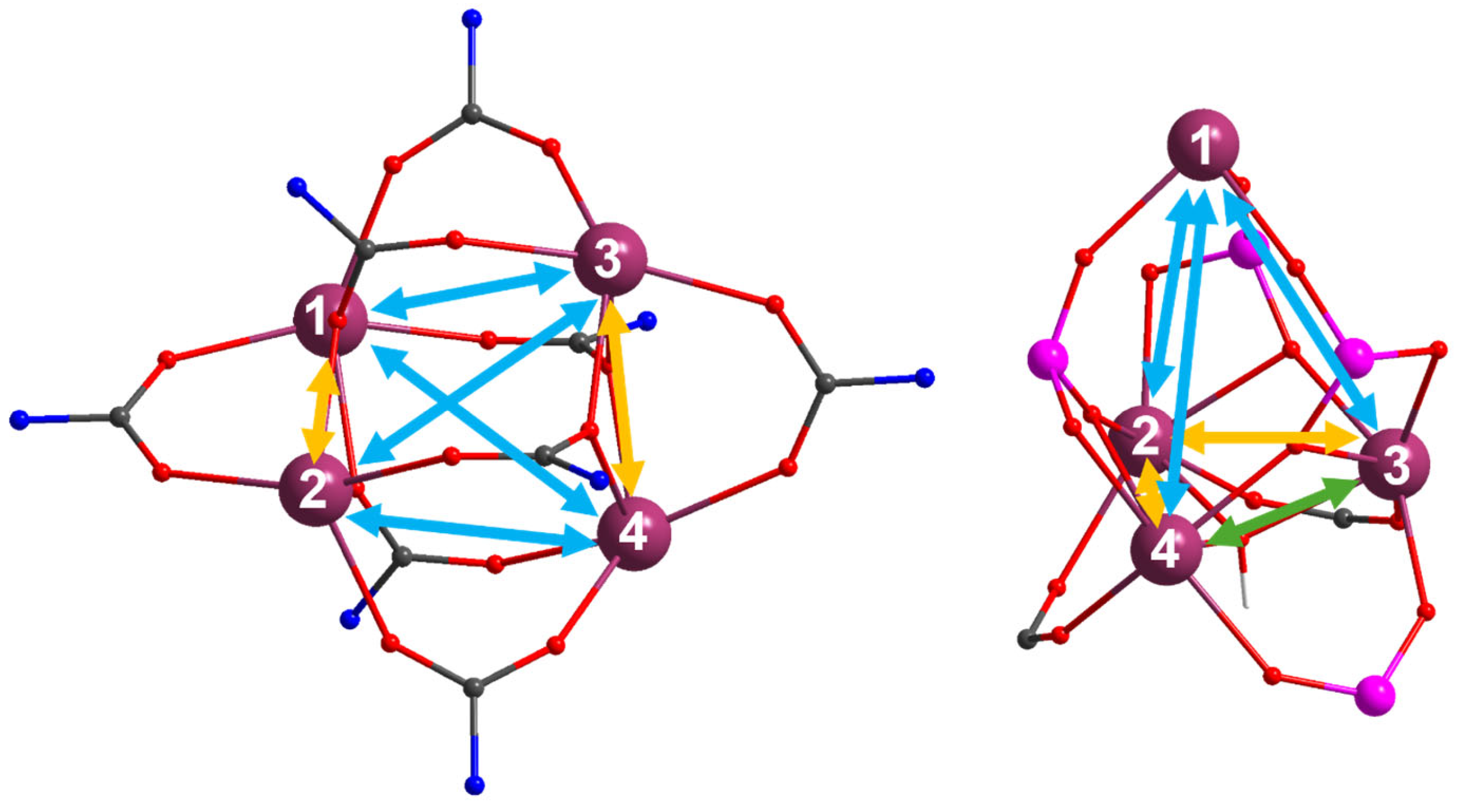
| Interaction | (28) DFT/Exp. (Ref [128]) | (29) DFT/Exp. (Ref [129]) |
|---|---|---|
| Gd1-Gd2 | −0.035/−0.058 | 0.001/0.00 |
| Gd1-Gd3 | 0.002/0.012 | 0.001/0.00 |
| Gd1-Gd4 | −0.001/0.000 | 0.001/0.00 |
| Gd2-Gd3 | −0.001/0.000 | −0.042/−0.01 |
| Gd2-Gd4 | 0.000/0.012 | −0.040/−0.01 |
| Gd3-Gd4 | −0.035/−0.058 | −0.021/−0.01 |
Disclaimer/Publisher’s Note: The statements, opinions and data contained in all publications are solely those of the individual author(s) and contributor(s) and not of MDPI and/or the editor(s). MDPI and/or the editor(s) disclaim responsibility for any injury to people or property resulting from any ideas, methods, instructions or products referred to in the content. |
© 2026 by the authors. Licensee MDPI, Basel, Switzerland. This article is an open access article distributed under the terms and conditions of the Creative Commons Attribution (CC BY) license.
Share and Cite
Pachl, C.F.; Braun, J.; Anson, C.E.; Fink, K. A Gd-Dimer Benchmark Study: Is DFT an Accurate Method for the Prediction of Gadolinium Exchange Coupling Constants? Magnetochemistry 2026, 12, 67. https://doi.org/10.3390/magnetochemistry12060067
Pachl CF, Braun J, Anson CE, Fink K. A Gd-Dimer Benchmark Study: Is DFT an Accurate Method for the Prediction of Gadolinium Exchange Coupling Constants? Magnetochemistry. 2026; 12(6):67. https://doi.org/10.3390/magnetochemistry12060067
Chicago/Turabian StylePachl, Christian F., Jonas Braun, Christopher E. Anson, and Karin Fink. 2026. "A Gd-Dimer Benchmark Study: Is DFT an Accurate Method for the Prediction of Gadolinium Exchange Coupling Constants?" Magnetochemistry 12, no. 6: 67. https://doi.org/10.3390/magnetochemistry12060067
APA StylePachl, C. F., Braun, J., Anson, C. E., & Fink, K. (2026). A Gd-Dimer Benchmark Study: Is DFT an Accurate Method for the Prediction of Gadolinium Exchange Coupling Constants? Magnetochemistry, 12(6), 67. https://doi.org/10.3390/magnetochemistry12060067