


Highlights
What are the main findings?
- Single-stem training maximized total yield and dry matter production in parthenocarpic eggplants grown in soilless culture under a uniform stem density.
- Single-stem training significantly accelerated early-season leaf area expansion and improved cumulative light interception compared with multi-stem systems.
What are the implications of the main findings?
- Single-stem training provides an effective agronomic strategy for optimizing canopy architecture, balancing source–sink relationships, and maximizing yield in greenhouse eggplant production.
- Further yield improvements may be achieved by integrating this canopy management approach with environmental control technologies that enhance whole-canopy photosynthetic capacity.
Abstract
In eggplant production, parthenocarpic cultivars are increasingly adopted to reduce labor associated with exogenous hormone applications for fruit set. Although optimizing training systems is essential to maximize the potential of these cultivars, associated quantitative evaluations of key physiological determinants, such as dry matter production and source–sink balance, remain limited. In this study, we investigated the effects of stem numbers on the yield and physiology of parthenocarpic eggplants grown in a soilless culture. Three treatments were established with varying stem numbers per plant (one, two, and four stems) and uniform stem density per area (3.75 stems m−2). The total yield and fruit number per unit area were highest in the one-stem treatment (1S) (8.5 kg m−2 and 60.0 fruits m−2, respectively), followed by the two-stem (2S) (7.1 kg m−2 and 50.9 fruits m−2) and four-stem (4S) (6.4 kg m−2 and 46.6 fruits m−2) treatments. Total dry matter production (TDM) varied similarly and was significantly higher in the 1S treatment than in the other systems. The 1S treatment exhibited rapid canopy development, reaching a higher leaf area index in the early stages, which contributed to greater cumulative light interception. Light use efficiency did not differ significantly among the treatments (5.2, 4.6, and 4.3 g MJ−1 for the 1S, 2S, and 4S treatments, respectively). Correlation analysis revealed a strong positive relationship between TDM and yield, whereas dry matter partitioning to fruit remained stable across treatments. These results indicated that the yield under these conditions was strongly driven by source capacity. We conclude that this single-stem training system represents an effective strategy for enhancing the canopy development and yield of parthenocarpic eggplants.
1. Introduction
Eggplant (Solanum melongena L.) is a globally important solanaceous crop with substantial economic value in agricultural production [1,2]. Nutritionally, the fruits are highly regarded for their rich content of dietary fibers, vitamins, minerals, and health-promoting bioactive compounds such as anthocyanins and phenolic acids [3,4]. Eggplant production is typically labor-intensive, prompting the widespread adoption of parthenocarpic cultivars to reduce the significant workload associated with fruit-set hormone applications [5,6]. Although these genetic improvements effectively contribute to labor savings, the introduction of such varieties alone does not guarantee high productivity. Optimizing planting density and production systems is considered one of the most critical agronomic techniques for achieving high productivity [7]. Increasing the planting density typically enhances light interception by the crop canopy, leading to higher estimated dry matter production and yield [8,9,10]. However, the relationship between the plant spacing and crop productivity is multifaceted. Although high planting densities generally increase total yield, they can negatively affect fruit quality and individual plant vigor owing to mutual shading and increased competition for water and nutrients, as detected in cucumbers [11] and tomatoes [12]. Moreover, previous research on tomato and cucumber has largely focused on the variation in planting density, associated with different stem densities per unit area. For instance, studies on pepper [13] and tomato [7] have revealed that higher densities increase fruit number, but may reduce the size or marketable quality of fruits if the canopy becomes overcrowded. Therefore, the plant architecture, their spatial arrangement, and total stem density are considered interconnected factors that exert confounded effects in standard plant density experiments.
An effective approach to analyze the individual factors is to manipulate the number of stems per plant to maintain a constant stem density per unit area while varying the planting density. In this system, growers can adopt high planting density via single-stem training or low planting density through multi-stem training. Agronomic trials have been conducted to compare these configurations and identify the most labor-efficient and productive strategy. In soilless tomato cultivation, the number of stems per plant significantly affected the vegetative growth and yield components [14]. Similarly, a single-stem system with high planting density resulted in higher yields in the parthenocarpic eggplant [15] than a conventional multi-stem system with low planting density [16,17], even when the total number of stems per area was identical.
However, despite the practical implications of these findings, the mechanism underlying the yield superiority of high-planting-density systems under a constant stem density remains to be quantified for parthenocarpic eggplants. Moreover, further research is needed to clarify whether the yield advantage of single-stem high-density planting is driven by improved source capacity (e.g., plant architecture, light interception, and canopy photosynthesis) or an altered sink–source balance.
Therefore, in the present study, we aimed to quantitatively evaluate the effects of different training methods (one-, two-, and four-stem systems) on the growth, yield, and dry matter production of parthenocarpic eggplants under uniform stem density.
2. Materials and Methods
2.1. Plant Material and Growth Conditions
The experiment was conducted in a greenhouse (4.7 m eave height, 171 m2 floor area) at the Institute of Vegetable and Floriculture Science, NARO (Tsukuba, Ibaraki, Japan), which was covered with a fluoropolymer film (F-Clean GR Nashiji, AGC Green-Tech Co., Ltd., Tokyo, Japan). The cultivation period spanned from 12 August to 24 November 2022. The parthenocarpic eggplant cultivar ‘PC Chikuyo’ (Takii & Co., Ltd., Kyoto, Japan) was grafted onto the rootstock ‘Tonashim’ (Takii & Co., Ltd.). For this process, seeds for rootstocks and scions were sown on 9 June and 17 June 2022, respectively, and grafting was performed on 7 July. On 29 July (42 d after sowing), seedlings with 2–3 true leaves were transplanted into rockwool blocks (10 × 10 × 6.5 cm; Grodan Delta, Grodan, Roermond, The Netherlands) and grown for 11 d. During the secondary nursery period, plants were supplied with a nutrient solution (OAT A recipe; OAT Agrio Co., Ltd., Tokyo, Japan) prepared using well water (EC of 0.29 dS m−1 and pH of 7.9) and adjusted to an electrical conductivity (EC) of 1.8 dS m−1. The macronutrient composition was 18.6 me L−1 NO3-N, 5.1 me L−1 PO4-P, 8.6 me L−1 K, 8.2 me L−1 Ca, and 3.0 me L−1 Mg. Additionally, the concentrations of micronutrients were 2.03 mg L−1 Fe, 1.13 mg L−1 MnO, 1.13 mg L−1 B2O3, 0.07 mg L−1 Zn, 0.02 mg L−1 Cu, and 0.02 mg L−1 Mo.
On 12 August, plants were transplanted into Rockwool slabs arranged in six north–south rows with 160 cm inter-row spacing. Subsequently, the same nutrient solution was maintained, with EC adjusted between 1.5 and 2.0 dS m−1 depending on plant growth. Environmental conditions were controlled using an integrated system (YoshiMax, Sanki Keiso Co., Ltd., Tokyo, Japan). The ventilation setpoints were 25 °C for roof vents and 27 °C for side vents. A heater (HK2027TCN, Nepon Inc., Tokyo, Japan) operated from 12 October onwards, maintaining minimum temperatures of 20 °C and 15 °C during the day and night, respectively. Indoor environmental parameters (temperature, humidity, CO2 concentration) were recorded at one-minute intervals at a height of 1.6 m above the floor in the centre of the greenhouse. CO2 enrichment was applied for 10 s with 60 s intervals when the concentration fell below 370 ppm. Mist cooling was activated (10 s spray followed by a 10 s interval) when the temperature exceeded 20 °C, and the vapor pressure deficit was greater than 5.0 g m−3. Irrigation was managed to maintain a drainage rate > 20% using two scheduled irrigations and solar radiation-based control triggered by every 1 MJ m2 of accumulated radiation.
2.2. Treatments and Experimental Design
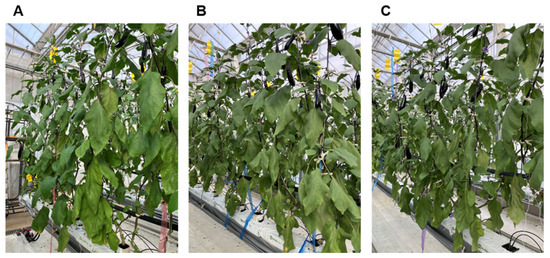
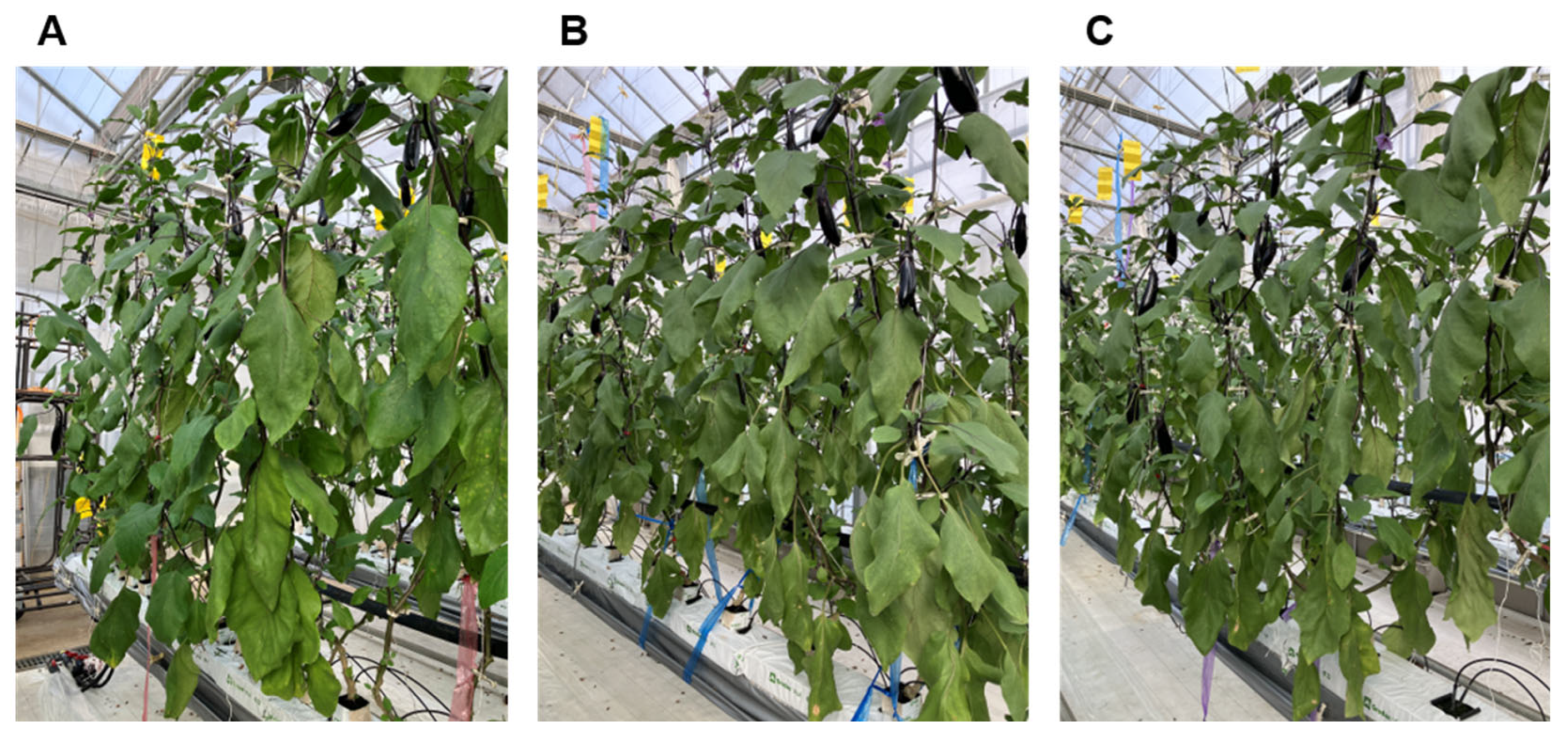
To evaluate the effect of the number of stems on productivity, three training treatments were included in this study, which were referred to as one-stem (1S), two-stem (2S), and four-stem (4S) systems (Figure 1). In the 1S system, only the main stem was trained. In the 2S system, the main stem and lateral branch immediately below the first flower were trained. In the 4S system, the main stem, two lateral branches below the first flower, and one lateral branch below the second flower were trained.
Figure 1.
Different plant density treatment in eggplant grown by hydroponic system with rockwool slab. (A–C) indicate 1S (one-stem), 2S (two-stem), 4S (four-stem) treatments at 3.75 stem m−2.
The experiment was designed to maintain a uniform stem density of 3.75 stems m−2 after main stem elongation across all treatments. Accordingly, planting density per slab varied: 6 plants (15 cm spacing) for the 1S, 3 plants (30 cm spacing) for the 2S, and 1.5 plants (60 cm spacing) for the 4S. The experiment consisted of four replicates, with each of the four inner rows serving as a block. Within each row, the experimental unit for each treatment comprised three slabs, accommodating a total of 18 stems. To avoid shading and interference from differing canopy structures of adjacent treatments, the plots were not completely randomized. Instead, treatments were systematically arranged from south to north in each row in the order of four-, two- and one-stem systems. Because the greenhouse was relatively small in size, potential environmental gradients along the south–north axis were considered minimal, making the prevention of canopy interference the primary priority for the experimental layout. Plants in the first and sixth rows, as well as the northmost and southmost plants in the inner rows, served as guard plants. Plants were trained vertically using clips once per week. Lateral shoots were pinched, leaving one leaf above the flower bud around the time of anthesis of the first flower, and were cut back to one bud near the base at harvest. Old or diseased leaves were removed as necessary.
2.3. Calculation of Leaf Area Index (LAI) and Light Use Efficiency (LUE)
Destructive sampling was performed three times: 27 September (46 days after transplanting; DAT), 21 October (70 DAT), and 24 November (104 DAT). On each sampling date, four plants per treatment were sampled from four independent slabs to measure the fresh weight (FW) and dry weight (DW) of the leaves, stems, and fruits, as well as the leaf area. For the final destructive sampling at 104 DAT, four of the plants that had been continuously monitored for yield evaluation were utilized. Leaf area was measured using an area meter (LI-3100C; LI-COR, Lincoln, NE, USA). To estimate continuous leaf area development, a correlation factor was established from the first sample (individual leaf area = leaf length × width × 0.65; n = 39, p < 0.01). This calibration included leaves with an actual area ranging from 24 to 487 cm2, yielding a highly accurate estimation (R2 > 0.99) with a standard error of the slope of 0.0092. From 28 DAT (9 September) onwards, the length and width of all leaves (>5 cm in length) were measured weekly to estimate the total leaf area.
Fruits longer than 19 cm were harvested daily during 19–104 DAT. Fruit FW was recorded for six plants per treatment selected from the inner rows. However, because one plant in the 4S treatment was lost after 20 September, all data associated with this individual were completely excluded from the dataset. Consequently, the sample size for the cumulative yield and statistical analyses in the 4S treatment was consistently evaluated as n = 5 throughout the entire cultivation period. Each of these monitored plants was located on a separate independent slab. Fruit dry matter content was determined by drying fruit samples (n = 20–28) at 100 °C for 72 h between 4 and 11 October (0.052 for 1 and 2S, 0.054 for 4S). For the other periods, fruit DW was calculated using the average dry matter content. Total dry matter (TDM) was calculated as the sum of vegetative organ DW (leaves and stems) and cumulative fruit DW.
The light extinction coefficient (k) was determined at 68 DAT. Photosynthetic photon flux density (PPFD) was measured at the canopy top and at three heights within the canopy using a line quantum sensor (LI-190, LI-COR), and the leaf area index (LAI) at the corresponding heights was determined the following day through destructive sampling. k was calculated following the previously reported method [14]. Daily light interception was calculated using the estimated daily LAI (linear interpolation between measurements) and indoor photosynthetically active radiation (PAR) according to the following equation:
where IL represents the intercepted light and e represents the base of the natural logarithm [18].
The indoor PAR was estimated as 50% of the solar radiation inside the greenhouse [19], which was calculated based on the outdoor radiation using a transmission coefficient of 0.51 (determined from actual measurements). The missing radiation data for 29 October were supplemented with data acquired by the Japan Meteorological Agency (Tsukuba Station). Light-use efficiency (LUE) was defined as the slope of the linear regression between the cumulative light interception and TDM. To calculate this, data from all destructive measurement dates (46, 70, and 104 DAT) were pooled for each treatment, and a linear regression line passing through the origin was fitted (R2 > 0.99). Statistical comparisons of LUE among treatments were based on the 95% confidence intervals of these slopes; substantial overlap of the confidence intervals indicated no significant differences among the treatments.
2.4. Statistical Analysis
The statistical unit for all parameters was the individual plant. Because the primary parameters evaluated in this study were the above-ground responses to the light environment and microclimate where individual stems independently occupy space and intercept light, the plant level was considered the appropriate scale for analysis. Furthermore, to ensure true statistical independence and avoid pseudo replication at the root zone, all sampled plants were strictly sourced from independent slabs. Thus, plants sharing the same slab were not treated as independent replicates, satisfying the assumptions for one-way ANOVA at the plant level. Statistical analyses were performed using Microsoft Excel (Microsoft Corporation, Redmond, WA, USA). Data was analyzed using one-way analysis of variance (ANOVA). When significant differences were detected (p < 0.05), means were separated using Tukey’s honestly significant difference (HSD) test. Correlations among yield components were analyzed with Benjamini–Hochberg adjustment and visualized using Python (version 3.14.2), scikit-learn library, and Matplotlib (version 3.10.5). Significance was evaluated at a level of p < 0.05.
3. Results
3.1. Environmental Parameters
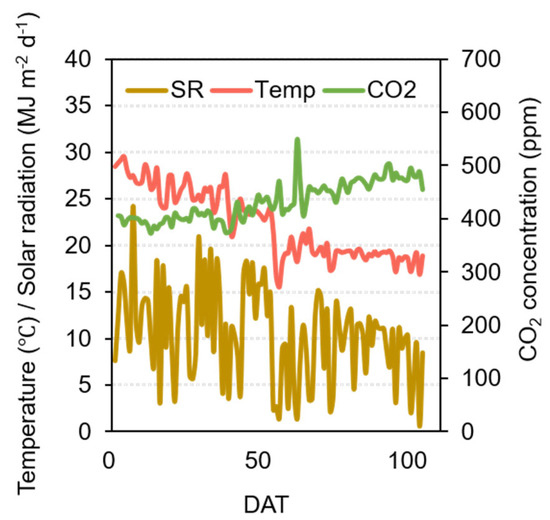
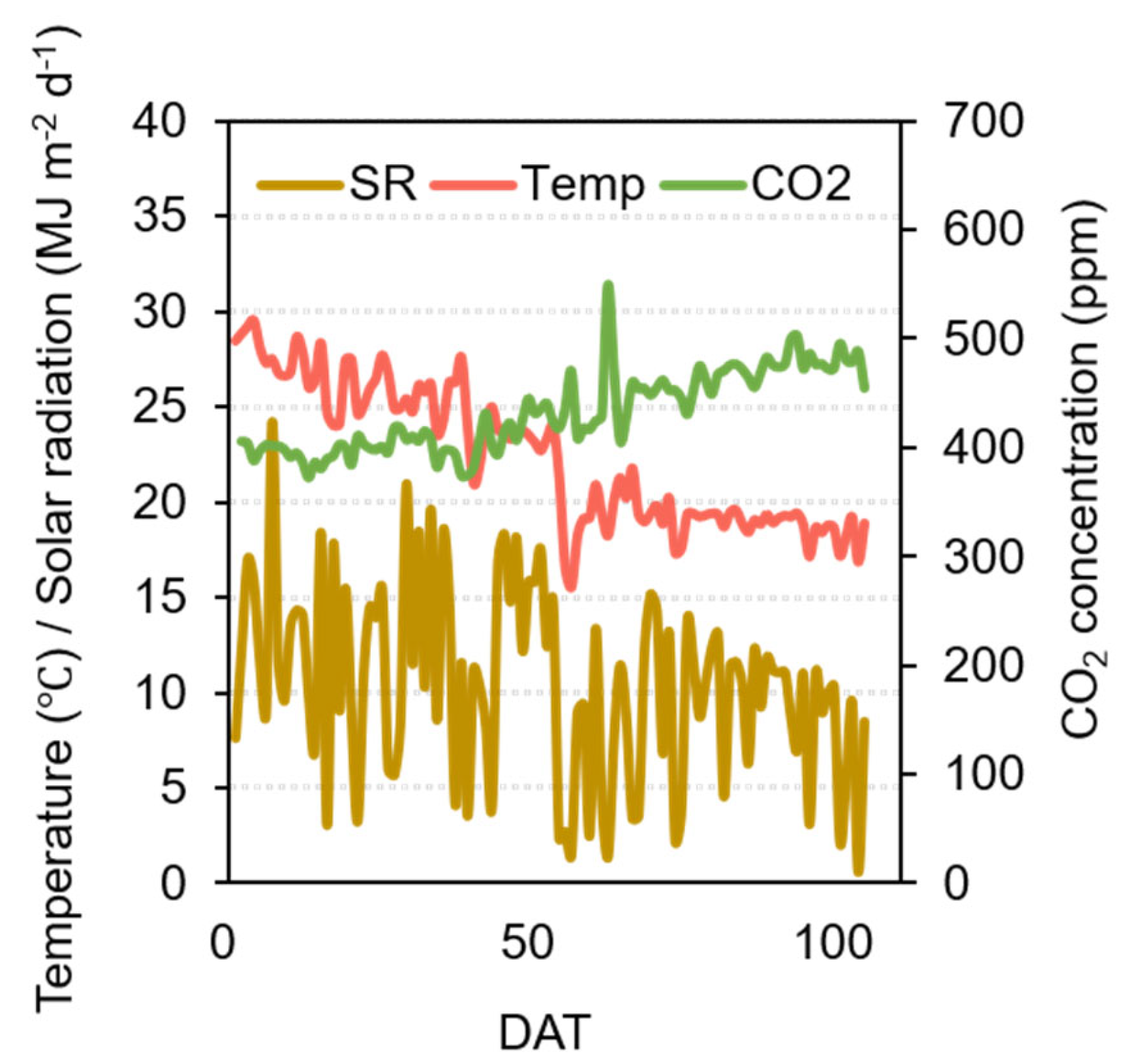
Daily integrated solar radiation decreased throughout the cultivation period following transplantation (Figure 2). The mean daily temperature consistently remained above 15 °C. The CO2 concentration was maintained at approximately 400–500 ppm.
Figure 2.
Changes in environmental parameters. Daytime CO2 concentration (CO2), daily average temperature within the greenhouse (Temp), and cumulative daily solar radiation (SR) during cultivation are shown.
3.2. Yield, Growth, and Dry Matter Production
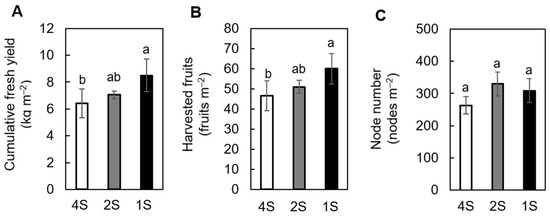
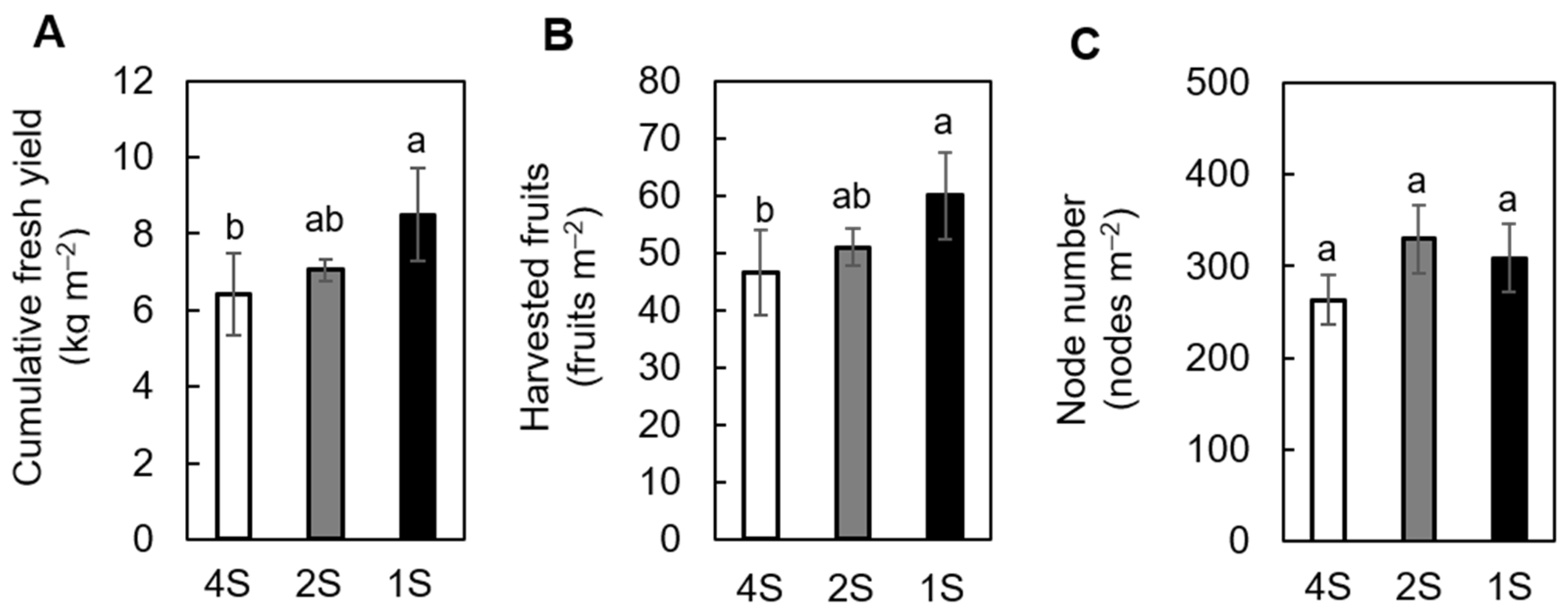
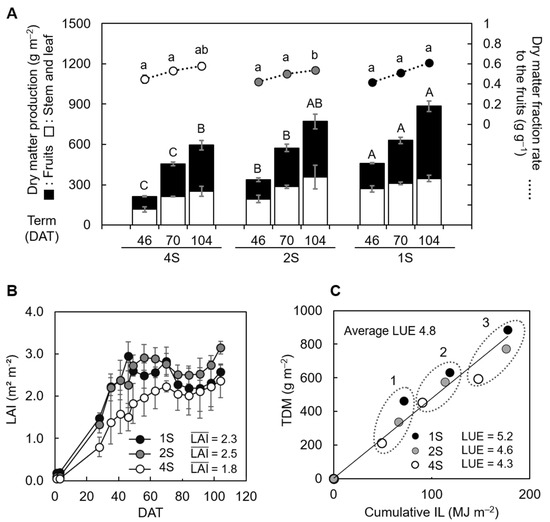
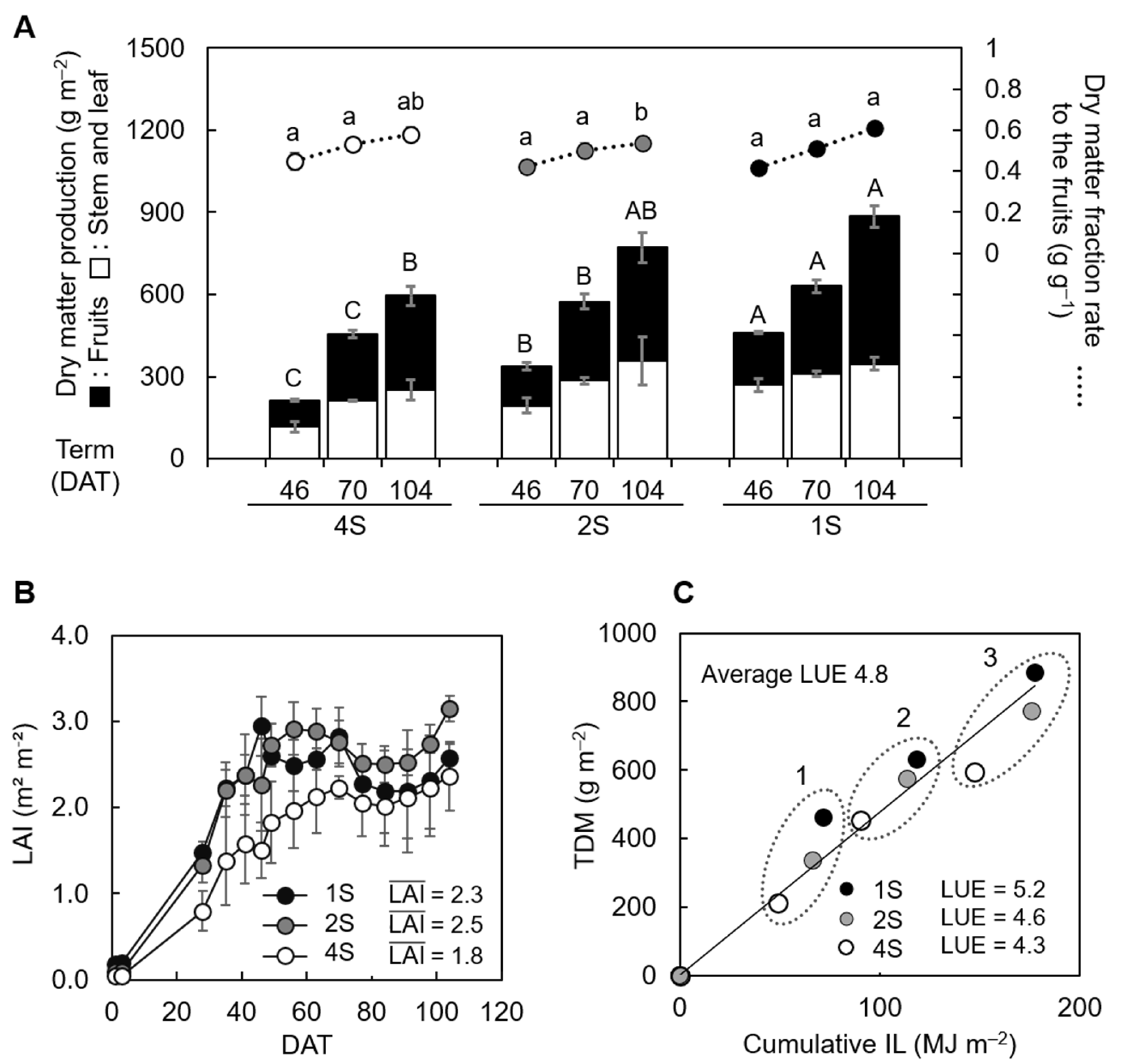
The highest yield per unit area was detected in the 1S system, followed by 2S and 4S (Figure 3A). The number of harvested fruits varied similarly (Figure 3B). Furthermore, the average fruit weight, which could be calculated from the total yield and fruit number, showed no significant differences among the treatments. In contrast, the node number was recorded as an indicator of the plant developmental rate; no significant differences in the total number of nodes that developed during the cultivation period were detected across the treatments (Figure 3C). Total dry matter (TDM) production at the end of the experiment (104 DAT) followed the order 1S > 2S > 4S (Figure 4A). The dry matter partitioning to fruits exhibited no significant differences among the treatments until 70 DAT. At the final destructive sampling (104 DAT), 2S tended to have a lower dry matter partitioning to fruits compared with the other treatments.
Figure 3.
Cumulative fresh yields (A), total amount of harvested fruits (B) and node number (C) per square meter. Data represents means and 95% Cis (n = 5–6). Different letters indicate significant difference among the final value in each treatment (p < 0.05, Tukey’s test).
Figure 4.
DM production and ratio of DM fraction rate to fruits (A). DM production and fraction were analyzed for three intervals between destructive measurements. Bar and line charts represent the DM production (closed bars: fruits, open bars: the other parts of the plant) and the DM fraction rate, respectively. Data represent means of four plants with 95% CIs. Different letters indicate statistical difference among the treatments (p < 0.05; Tukey’s test). Uppercase and lowercase letters represent the comparison of the TDM and DM fraction rate, respectively, within the same intervals. Comparison of LAI among treatments (B). Data represent means with 95% Cis (n = 3). LAI averaged throughout the investigation is shown in the graph. LUE among the treatments (C). Each plot represents mean of four plants from destructive measurement. The plots enclosed in dotted circles represent samples from the destructive measurements conducted at the same time. LUE was estimated as a regression coefficient of the relationship between the cumulative amount of intercepted light (IL) and TDM. Line indicates the regression lines.
3.3. Canopy Development and Light Use Efficiency
The LAI varied among the treatments, with a rapid increase detected in the 1S system in the early stages, peaking at 3.0, followed by a decline, resulting in a lower value than the 2S counterpart at the end of cultivation (Figure 4B). The 2S system exhibited an LAI comparable to that of the 1S at 70 DAT and maintained higher values thereafter. The 4S system consistently exhibited a lower LAI up to 70 DAT, with large variation among individuals; subsequently, it showed a trend equivalent to that of the 1S treatment. The light extinction coefficient (k) did not differ significantly among the treatments (Supplementary Figure S1). The lowest cumulative light interception was consistently detected in the 4S system across all sampling data (46, 70, and 104 DAT) (Figure 4C). LUE, calculated using the slope of the regression line between cumulative light interception and TDM, ranged from 4.3 to 5.2 g MJ−1 PAR. A comparison of the 95% confidence intervals indicated no significant differences in LUE among treatments.
3.4. Correlation Analysis
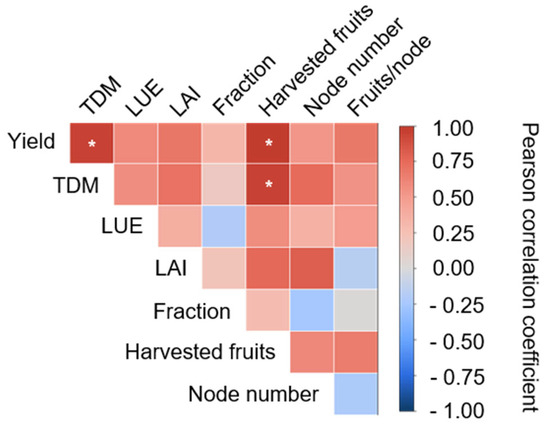
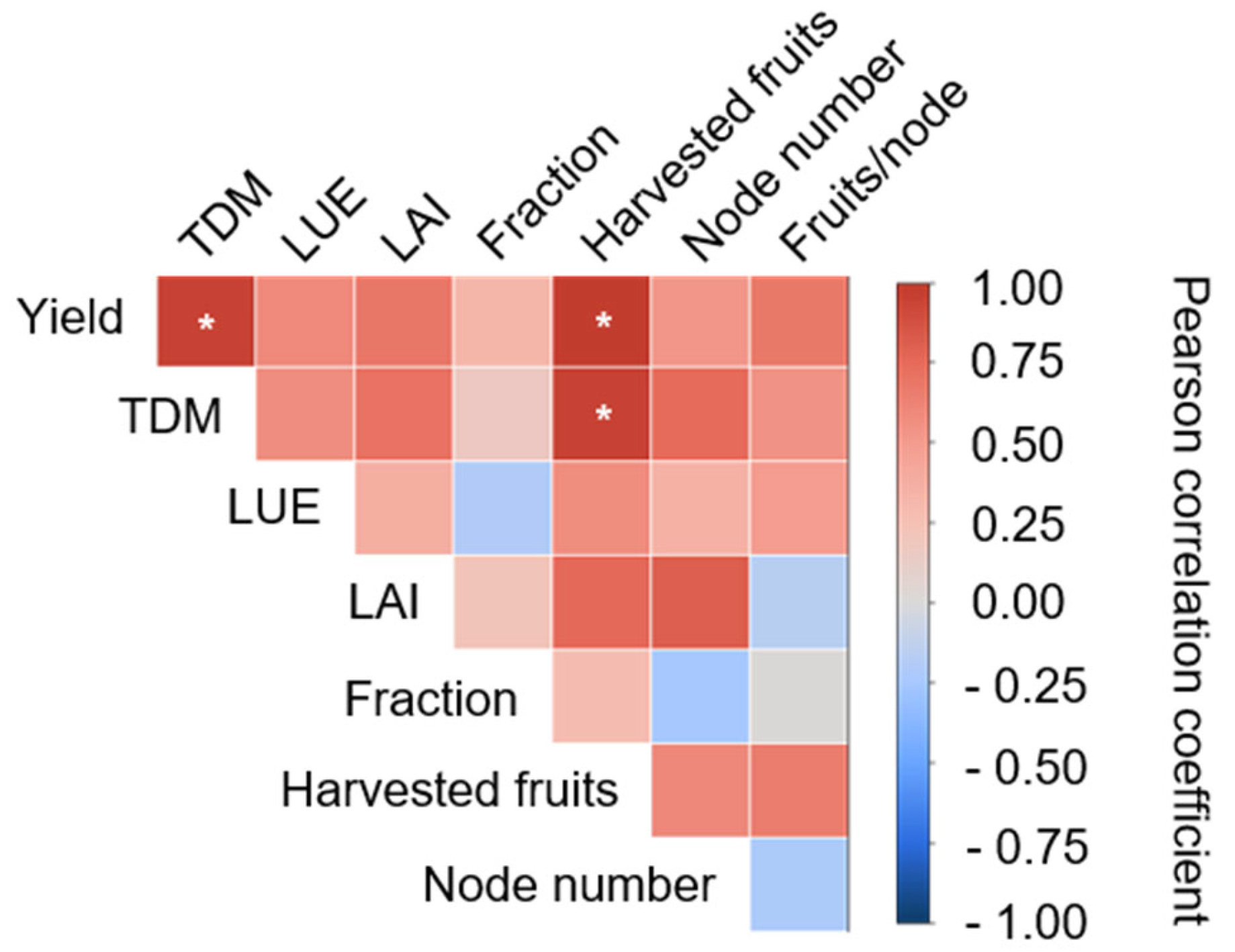
Pearson’s correlation analysis revealed three significant relationships among the examined variables across treatments (Figure 5). Yield was positively correlated with TDM and the number of harvested fruits (p < 0.01). In addition, a significant positive correlation was observed between TDM and harvested fruits (p < 0.01). No other combinations of yield components, growth parameters, or architectural traits showed significant correlations.
Figure 5.
Assessment of the different plant density treatments based on the yield components. Data obtained for each treatment in this study were pooled and the correlation among them were analyzed. Correlation matrix was visualized as a heatmap. Asterisks indicate the significant correlation (p < 0.01; adjusted by Benjamini–Hochberg’s method).
4. Discussion
In this study, the 1S treatment system exhibited the highest yield and total dry matter (TDM) per unit area, despite the uniform final stem density (3.75 stems m−2) across all treatments. Standard planting density trials in greenhouse crops, such as cucumbers [11], peppers [20], and tomatoes [7], typically vary in both plant density and final stem density. In these systems, higher densities often increase early yield, but can lead to mutual shading, which reduces light use efficiency (LUE) and fruit quality in later growth stages [12]. Our experimental design minimized this confounding factor by maintaining a constant stem density. These results suggest that manipulating the number of stems per plant influences yield potential, supporting the previous findings for tomatoes [14] and eggplants [15].
The physiological mechanisms underlying the differences in yield varied across treatments. The advantage of 1S over 4S can be majorly attributed to early canopy development; the 4S plants experience delayed leaf area index (LAI) expansion, resulting in lower early-season light interception [10]. Conversely, the trend of LAI in 2S was comparable to that in 1S during the early stages and exceeded in the later stage. However, vegetative growth in 2S did not translate to a higher TDM. The slightly lower TDM in 2S than in 1S, despite its higher LAI, indicated a reduction in LUE. These reductions are potentially related to increased respiration and mutual shading, which are proposed to counterbalance the increase in total photosynthetic production [17].
The tendency of 2S plants to maintain a more vegetative state may be linked to early sink competition and the source–sink hierarchy. In indeterminate solanaceous crops, carbon partitioning is primarily regulated by the relative sink strength of actively growing organs [21]. In 1S plants, the presence of a single apical meristem enabled the first developing fruit to act as a strong sink. The establishment of this early reproductive sink demands the shift toward a generative state of the plant, restricting excessive vegetative expansion [22]. Conversely, in the 2S system, plants required the development of a secondary main shoot concurrent with early anthesis, which acted as a strong competing vegetative sink [23] and likely delayed the transition of 2S plants to the generative phase. Furthermore, the limited root-zone volume per plant may have influenced the vegetative-reproductive balance. In our soilless system, although the final stem density was constant across treatments, the 1S treatment was associated with twice the plant density per slab compared to the 2S counterpart, resulting in a 50% reduction in the available root volume per plant. Restricted root volume suppresses vegetative growth and promotes a shift toward a generative state in solanaceous greenhouse crops [24]. Therefore, the restricted root-zone volume in the 1S treatment likely promoted early fruit set and limited leaf area expansion, whereas the greater root volume facilitated the maintenance of an extensive canopy in the 2S treatment. Consequently, the observed differences among treatments cannot be attributed solely to the stem number per plant, as the varying root-zone volume inherently acted as a confounding factor.
These dynamics could explain the shift in the source–sink balance and associated final yield. Although the positive correlation between TDM and yield highlights the critical role of source capacity [25,26,27], the assimilate allocation strategy diverged between the 1S and 2S treatments over time. At 104 DAT, the fruit dry matter partitioning rate tended to be lower in 2S plants than in other treatments, which indicates that the 2S system partitioned a larger portion of late-season assimilates toward maintaining its expanded leaf area rather than toward fruit development.
The dominance of source or sink limitation can vary with crop species, developmental stage, and cultivation system [28,29,30,31,32]. For instance, while early fruit set or specific vegetative phases may occasionally exhibit sink limitation, continuous fruit development in solanaceous crops generally drives the system toward source limitation during the prolonged harvesting phase [26]. Therefore, the productivity of the 1S system was highly dependent on source capacity, and further yield improvements may be difficult to achieve through training methods. Consequently, integrating this optimal canopy architecture with environmental controls and cultivation strategies that directly enhance source capacity, such as supplemental LED lighting [33] and grafting onto vigorous rootstocks [34], would be highly effective.
5. Conclusions
In conclusion, managing soilless parthenocarpic eggplant with a single-stem (1S) training system under a constant stem density maximized total dry matter production and yield. The superiority of the 1S system was primarily attributed to rapid early-season leaf area expansion, which optimized cumulative light interception. Furthermore, the absence of competing secondary shoots and the restricted root-zone volume per plant in the 1S configuration might mitigate vegetative sink competition, facilitating an earlier shift to a generative state. Our findings suggest that productivity in this system is closely associated with, and primarily driven by, source capacity.
Supplementary Materials
The following supporting information can be downloaded at: https://www.mdpi.com/article/10.3390/horticulturae12091158/s1, Supplemental Figure S1: Light extinction coefficient (k) of eggplant among treatments. k value was estimated as a regression coefficient of the relationship between the LAI and light extinction rate.
Author Contributions
Conceptualization, K.M., A.O. and D.-H.A.; methodology, K.M.; software, K.M. and A.O.; validation, K.M. and A.O.; formal analysis, K.M. and A.O.; investigation, K.M. and A.O.; resources, K.M., A.O. and D.-H.A.; data curation, K.M. and A.O.; writing—original draft preparation, K.M. and A.O.; writing—review and editing, K.M., A.O. and D.-H.A.; visualization, K.M. and A.O.; supervision, K.M. and D.-H.A. All authors have read and agreed to the published version of the manuscript.
Funding
This research received no external funding.
Data Availability Statement
The data presented in this study are available within the article. Further inquiries can be directed to the corresponding author.
Conflicts of Interest
The authors declare no conflicts of interest.
References
- Taher, D.; Solberg, S.Ø.; Prohens, J.; Chou, Y.; Rakha, M.; Wu, T. World vegetable center eggplant collection: Origin, composition, seed dissemination and utilization in breeding. Front. Plant Sci. 2017, 8, 1484. [Google Scholar] [CrossRef] [Scilit] [PubMed]
- Plazas, M.; Andujar, I.; Vilanove, S.; Hurtado, M.; Gramazio, P.; Herraiz, F.J.; Prohens, J. Breeding for chlorogenic acid content in eggplant: Interest and prospects. Not. Bot. Horti Agrobot. 2013, 41, 26–35. [Google Scholar] [CrossRef] [Scilit]
- Gürbüz, N.; Uluişik, S.; Frary, A.; Frary, A.; Doğanlar, S. Health benefits and bioactive compounds of eggplant (Solanum melongena L.). Food Chem. 2018, 268, 602–610. [Google Scholar] [PubMed]
- Niño-Medina, G.; Urías-Orona, V.; Muy-Rangel, M.D.; Heredia, J.B. Structure and content of phenolics in eggplant (Solanum melongena L.)—A review. S. Afr. J. Bot. 2017, 111, 161–169. [Google Scholar] [CrossRef] [Scilit]
- Koga, T.; Ishizaka, A.; Shimomura, K.; Sueyoshi, T. The effects of nighttime temperature, shading and branch training on the bearing and yield of parthenocarpic eggplant in forcing culture. Bol. Fukuoka Agric. Res. Cent. 2006, 25, 33–36. [Google Scholar]
- Koga, T.; Shimomura, K.; Inoue, K.; Hamachi, Y. Effects of training methods of lateral branches on growth and yield of parthenocarpic eggplant ‘Shota’. Hort. Res. 2015, 14, 191–195. [Google Scholar] [CrossRef] [Scilit][Green Version]
- Amundson, S.; Deyton, D.E.; Kopsell, D.A.; Hitch, W.; Moore, A.; Sams, C.E. Optimizing plant density and production systems to maximize yield of greenhouse-grown ‘Trust’ tomatoes. hortTechnology 2012, 22, 44–48. [Google Scholar] [CrossRef] [Scilit]
- Ayala-Tafoya, F.; López-Orona, C.A.; Yáñez-Juárez, M.G.; Díaz-Valdez, T.; Velázquez-Alcaraz, T.J.; Parra Delgado, J.M. Plant density and stem pruning in greenhouse cucumber production. Rev. Mex. Cienc. Agríc. 2019, 10, 79–90. [Google Scholar]
- Kaneko, S.; Higashide, T.; Yasuba, K.; Ohmori, H.; Nakano, A. Effects of planting stage and density of tomato seedlings on growth and yield component in low-truss cultivation. Hort. Res. 2015, 14, 163–170. [Google Scholar] [CrossRef] [Scilit]
- Zhang, Y.; Henke, M.; Li, Y.; Xu, D.; Liu, A.; Liu, X.; Li, T. Analyzing the impact of greenhouse planting strategy and plant architecture on tomato plant physiology and estimated dry matter. Front. Plant Sci. 2022, 13, 828252. [Google Scholar] [CrossRef] [Scilit] [PubMed]
- Ding, X.; Nie, W.; Qian, T.; He, L.; Zhang, H.; Jin, H.; Cui, J.; Wang, H.; Zhou, Q.; Yu, J. Low plant density improves fruit quality without affecting yield of cucumber in different cultivation periods in greenhouse. Agronomy 2022, 12, 1441. [Google Scholar] [CrossRef] [Scilit]
- Karpe, M.; Marcelis, L.F.M.; Heuvelink, E. Dynamic plant spacing in tomato results in high yields while mitigating the reduction in fruit quality associated with high planting densities. Front. Plant Sci. 2024, 15, 1386950. [Google Scholar] [CrossRef] [Scilit] [PubMed]
- Daşgan, H.Y.; Abak, K. Effects of plant density and number of shoots on yield and fruit characteristics of peppers grown in glasshouses. Turk. J. Agric. For. 2003, 27, 29–35. [Google Scholar]
- Perin, L.; Peil, R.M.N.; Signorini, C.; Grolli, P.R.; Streck, E.A.; da Rosa, D.S.B.; Neutzling, C.; Marques, G.N.; Wieth, A.R. Effect of grafting and number of stems on plant growth, yield and fruit quality of soilless tomatoes. Aust. J. Crop Sci. 2023, 17, 99–106. [Google Scholar] [CrossRef] [Scilit]
- Maehara, M.; Tsutsumi, S. Effect of Number of Stems on Yield in Parthenocarpic Eggplant Cultivar ‘PC Chikuyo’; Research Bulletin of the Kumamoto Prefectural Agricultural Research Center: Koshi City, Japan, 2020. [Google Scholar]
- Moriyama, T.; Fushihara, H.; Oku, K. Effects of Basal Stem Heating on Fruit Set, Yield and Fruit Quality in Forcing Culture of Eggplant. Hort. Res. 2011, 10, 545–550. [Google Scholar] [CrossRef] [Scilit][Green Version]
- Nomura, K.; Ito, M.; Kusaba, Y.; Saito, M.; Mori, M.; Yamane, S.; Iwao, T.; Tada, I.; Yamazaki, T.; Kitano, M. Estimation of the optimal leaf area index (LAI) of an eggplant canopy based on the relationship between the nighttime respiration and daytime photosynthesis of the lowermost leaves. Sci. Hortic. 2023, 307, 111525. [Google Scholar] [CrossRef] [Scilit]
- Monsi, M.; Saeki, T. On the factor light in plant communities and its importance for matter production. Ann. Bot. 2005, 95, 549–567. [Google Scholar] [CrossRef] [Scilit] [PubMed]
- Monteith, J.L. Climate and the efficiency of crop production in Britain. Philos. Trans. R. Soc. Lond. B Biol. Sci. 1977, 281, 277–294. [Google Scholar] [CrossRef] [Scilit]
- Jovicich, E.; Cantliffe, D.J.; Stoffella, P.J. Fruit yield and quality of greenhouse-grown bell pepper as influenced by density, container, and trellis system. hortTechnology 2004, 14, 507–513. [Google Scholar] [CrossRef] [Scilit]
- Osorio, S.; Ruan, Y.L.; Fernie, A.R. An update on source-to-sink carbon partitioning in tomato. Front. Plant Sci. 2014, 5, 516. [Google Scholar] [CrossRef] [Scilit] [PubMed]
- Heuvelink, E. Effect of fruit load on dry matter partitioning in tomato. Sci. Hortic. 1997, 69, 51–59. [Google Scholar] [CrossRef] [Scilit]
- Marcelis, L.F. Sink strength as a determinant of dry matter partitioning in the whole plant. J. Exp. Bot. 1996, 47, 1281–1291. [Google Scholar] [CrossRef] [Scilit] [PubMed]
- Ruffel, M.; Krizek, D.T.; Mirecki, R.M.; Inouye, D. Restricted root zone volume: Influence on growth and development of tomato. J. Am. Soc. Hortic. Sci. 1987, 112, 763–769. [Google Scholar] [CrossRef] [Scilit]
- Homma, M.; Watabe, T.; Ahn, D.H.; Higashide, T. Dry matter production and fruit sink strength affect fruit set ratio of greenhouse sweet pepper. J. Am. Soc. Hortic. Sci. 2022, 147, 270–280. [Google Scholar] [CrossRef] [Scilit]
- Li, T.; Heuvelink, E.; Marcelis, L.F.M. Quantifying the source–sink balance and carbohydrate content in three tomato cultivars. Front. Plant Sci. 2015, 6, 416. [Google Scholar] [CrossRef] [Scilit] [PubMed]
- Matsuda, R.; Suzuki, K.; Nakano, A.; Higashide, T.; Takaichi, M. Responses of leaf photosynthesis and plant growth to altered source–sink balance in a Japanese and a Dutch tomato cultivar. Sci. Hortic. 2011, 127, 520–527. [Google Scholar] [CrossRef] [Scilit]
- Ando, E.; Maeda, K.; Aimi, N.; Ahn, D.-H. Comparative analyses of cucumber (Cucumis sativus L.) cultivars with varying node formation rate in greenhouse. BMC Plant Biol. 2025, 25, 1547. [Google Scholar] [CrossRef] [Scilit] [PubMed]
- Maeda, K.; Ahn, D.-H. Analysis of growth and yield of three types cucumbers (Cucumis sativus L.) based on yield components. Horticulturae 2022, 8, 33. [Google Scholar] [CrossRef] [Scilit]
- Ando, E.; Maeda, K.; Aimi, N.; Ahn, D.-H. Effects of rejuvenation pinching on yield and its components of winter-spring lowering cultivation of cucumber (Cucumis sativus L.) in greenhouse. Hort. Res. 2025, 24, 231–240. [Google Scholar] [CrossRef] [Scilit]
- Heuvelink, E. Dry matter partitioning in tomato: Validation of a dynamic simulation model. Ann. Bot. 1996, 77, 71–80. [Google Scholar] [CrossRef] [Scilit]
- Maeda, K.; Nomura, K.; Ahn, D.-H. Effect of training method to separate sink and source organs on the fresh yield and dry matter production of cucumber (Cucumis sativus L.) under greenhouse conditions. Hort. J. 2024, 93, 389–396. [Google Scholar] [CrossRef] [Scilit]
- Maeda, K.; Masuda, E.; Tamashiro, T.; Maharjan, G.; Maruo, T. Comparison of supplemental LED top- and interlighting for year-round production of cherry tomato. Agronomy 2022, 12, 1878. [Google Scholar] [CrossRef] [Scilit]
- Musa, I.; Rafii, M.Y.; Ahmad, K.; Ramlee, S.I.; Md Hatta, M.A.; Oladosu, Y.; Muhammad, I.; Chukwu, S.C.; Mat Sulaiman, N.N.; Ayanda, A.F. Effects of grafting on morphophysiological and yield characteristic of eggplant (Solanum melongena L.) grafted onto wild relative rootstocks. Plants 2020, 9, 1583. [Google Scholar] [CrossRef] [Scilit] [PubMed]
Disclaimer/Publisher’s Note: The statements, opinions and data contained in all publications are solely those of the individual author(s) and contributor(s) and not of MDPI and/or the editor(s). MDPI and/or the editor(s) disclaim responsibility for any injury to people or property resulting from any ideas, methods, instructions or products referred to in the content. |
© 2026 by the authors. Licensee MDPI, Basel, Switzerland. This article is an open access article distributed under the terms and conditions of the Creative Commons Attribution (CC BY) license.