


Abstract
High-temperature stress impairs plant growth and alters secondary metabolism. Polymethoxyflavones (PMFs) are citrus-specific flavonoids with important nutritional benefits; however, their transcriptional responses to heat stress remain poorly understood. Here, five-month-old ‘Ponkan’ citrus seedlings were exposed to 40 °C for 6, 11, and 21 days. HPLC analysis showed that the accumulation of four major PMFs (sinensetin, nobiletin, tangeretin, and 5-demethylnobiletin) was significantly reduced in leaves under heat stress. RNA-seq identified 3424 differentially expressed genes shared across all three time points, which were enriched in pathways associated with microtubule cytoskeleton organization, cell cycle regulation, and glyoxylate and dicarboxylate metabolism. Further analysis of the PMF biosynthetic pathway revealed that 14 of 18 key structural genes, including CHS, CHI, FNSII, and OMT family members, were downregulated by heat treatment. In addition, several bHLH, AP2/EREBP, and MYB transcription factors, known regulators of flavonoid biosynthesis, exhibited expression patterns closely associated with PMF accumulation. RT-qPCR analysis validated the transcriptome results. Collectively, these findings suggest that heat stress suppresses PMF accumulation through coordinated repression of PMF biosynthetic genes and their potential regulators. This study provides new insights into the molecular basis of heat-responsive PMF metabolism and offers potential targets for maintaining citrus nutritional quality under elevated temperatures.
1. Introduction
Global climate warming has emerged as a major environmental challenge threatening agricultural production. High-temperature stress severely affects plant growth and photosynthetic efficiency [1,2]. Citrus (Rutaceae, Citrus genus) is one of the most economically important fruit crops worldwide, and its yield and quality are highly sensitive to ambient temperature changes [3]. Citrus accumulates abundant flavonoids in fruits, leaves, flowers, and roots. These flavonoids are mainly classified into flavanones (i.e., hesperitin) and polymethoxyflavones (PMFs), which are characteristic of Citrus and generally contain four or more methoxy groups, occurring mainly as aglycones [4]. PMFs are highly enriched in fruit peels and leaves, and representative compounds such as nobiletin, tangeretin, sinensetin, and 5-demethylnobiletin exhibit diverse biological activities, including anticancer, anti-inflammatory, antioxidant, lipid-lowering, and neuroprotective effects [5]. These compounds thus represent important determinants of citrus nutritional quality, and environmental factors influencing their accumulation have been extensively investigated, particularly light quality, UV-B, and blue light [6,7]. However, how high temperature affects PMF accumulation remains largely unclear. Elucidating this response is important for understanding the stability of citrus nutritional traits under increasingly frequent heat events.
The biosynthesis of PMFs has been increasingly elucidated. Naringenin is synthesized via chalcone synthase (CHS) and chalcone isomerase (CHI), converted into the flavone backbone by flavone synthase (FNS), and subsequently modified by hydroxylation and O-methylation reactions to generate diverse PMFs. Early-stage enzymes, including CitCHS1, CitCHS2, CitCHI, and CitCHIL1, contribute significantly to flavonoid accumulation [8,9]. Two FNSII enzymes act at the branch point toward PMF biosynthesis, and CitFNSII-1 interacts with CitCHI-1, suggesting the formation of a metabolon that coordinates flavone formation [10,11]. In contrast, hydroxylation steps remain poorly characterized, with only CitF3′H reported to date [12]. Among the downstream modification enzymes, O-methyltransferases (OMTs) are the most extensively studied because they generate the structural diversity of PMFs. A systematic analysis of the citrus OMT family identified 58 members [13]. Numerous OMTs with distinct positional specificities have been characterized, and here we highlight several representative genes, including CrOMT1, CrOMT2 (also reported as CcOMT1 and CitOMT in orthologous citrus species), CsCCoAOMT1, CsOMT5, CitOMT2, and the CreOMT3/4/5 cluster, among many others reported in the literature [7,14,15,16,17,18,19,20,21,22]. Taken together, these studies have substantially advanced our understanding of the molecular mechanisms underlying PMF production.
Flavonoid accumulation, however, is not determined solely by structural and modification enzymes; it is also tightly controlled by complex transcriptional regulatory networks. Transcription factor families such as MYB, bHLH, AP2/ERF, and WRKY play central roles in coordinating flavonoid biosynthesis [23]. In citrus, only a few AP2/ERF factors, including CitERF32/33, CitRAV1, and CsERF003, have been shown to influence flavanone and flavone accumulation [8,24]. Consequently, the transcriptional regulation of PMF biosynthesis remains largely unexplored, particularly under high-temperature stress. Integrating knowledge of both structural enzymes and transcriptional regulators is therefore essential to fully understand the molecular mechanisms governing PMF accumulation in citrus.
Temperature is an important environmental factor influencing flavonoid accumulation, but its effects vary among flavonoid subclasses and species [25]. Anthocyanins are generally reduced by heat stress, leading to petal fading in chrysanthemum and poor fruit coloration in grape and apple [26,27,28]. In contrast, other flavonoid branches show more variable responses. Flavonols are reduced in grape berries [29], while isoflavonoids accumulate in lily petals under high temperature [30]. These findings indicate that heat effects on flavonoid metabolism are highly pathway- and species-dependent. PMFs, which require multiple hydroxylation and O-methylation steps downstream of core flavonoid biosynthesis, may therefore respond differently to high temperature compared with other flavonoid subclasses. Elucidating the molecular basis of heat-responsive PMF metabolism is crucial for understanding flavonoid adaptation to environmental stress in citrus.
In this study, five-month-old ‘Ponkan’ citrus seedlings were exposed to prolonged high-temperature treatment (40 °C), and changes in PMF accumulation and gene expression were investigated using HPLC and RNA-seq analyses. Our results provide new insights into the transcriptional regulation of PMF biosynthesis under heat stress and identify candidate structural genes and transcription factors associated with heat-responsive PMF metabolism. Understanding these mechanisms not only advances fundamental knowledge of flavonoid regulation but also provides potential targets for breeding or cultivation practices aimed at maintaining or enhancing PMF content and nutritional quality in citrus under warming climates.
2. Materials and Methods
2.1. Plant Materials and Treatment
Ponkan (Citrus reticulata) seeds were sown in a growth medium (peat soil:perlite:vermiculite = 2:1:1) and germinated in an artificial climate chamber at 25 °C under a 16 h/8 h photoperiod. After five months of growth, healthy and uniformly sized seedlings were subjected to high-temperature treatment (40 °C) in climate chambers, with control seedlings maintained at 25 °C. Seedling phenotypes were recorded at 0, 6, 11, and 21 days, whereas leaf samples for metabolite and transcriptomic analyses were collected at 6, 11, and 21 days. Day-0 samples were not collected because the experimental design focused on time-matched comparisons between the heat-treated and control groups at each post-treatment time point rather than on absolute changes from the pretreatment baseline. At each sampling time, all leaves from each sampled plant were collected to represent the whole-plant leaf tissue. Three biological replicates were included for each treatment and time point, with each replicate consisting of leaves collected from one independent seedling. The harvested leaves were immediately frozen in liquid nitrogen and stored at −80 °C until further use.
2.2. Extraction and Detection of Flavonoids
Flavonoids were extracted from citrus leaves following a modified protocol based on [19]. Ground leaf tissue powder (50 mg) was mixed with 0.5 mL of 80% ethanol and subjected to ultrasonic-assisted extraction. After centrifugation, the supernatant was collected. The extraction was repeated once, and the two supernatants were combined (approximately 1 mL) for HPLC-DAD analysis. Chromatographic separation was performed on a Waters e2695 HPLC system equipped with a DAD detector (Waters Corp., Milford, MA, USA) using a Waters Sunfire C18 column (4.6 × 250 mm, 5 μm). The mobile phase consisted of (A) acetonitrile and (B) ultrapure water containing 0.1% (v/v) formic acid. The gradient elution program was as follows: 0–5 min 20% A, 5–10 min 20–27% A, 10–15 min 27% A, 15–25 min 27–40% A, 25–35 min 40–60% A, 35–40 min 60–80% A, 40–42 min 80–100% A, 42–45 min 100–20% A, and 45–50 min 20% A, with a constant flow rate of 1.0 mL/min. Flavanones and PMFs were detected at 280 nm and 330 nm, respectively, and quantified by external calibration curves of authentic standards (R2 > 0.99).
2.3. RNA Sequencing and DEG Analysis
Total RNA was extracted from 0.2 g of fresh leaf powder using the CTAB method. RNA quality was assessed by agarose gel electrophoresis and a NanoDrop 2000 spectrophotometer (Thermo Fisher Scientific, Waltham, MA, USA). mRNA library construction and sequencing were performed by BGI (Wuhan, China) on the DNBSEQ-T7 platform. Raw sequencing data were filtered using SOAPnuke (v1.4.0) to obtain high-quality clean reads. The clean reads were then aligned to the reference genome (Citrus clementina v1.0) using HISAT2 (v2.1.0). This reference genome was selected because of its high-quality annotation and the widespread use of its Ciclev gene identifiers in previous functional studies of citrus flavonoid- and PMF-biosynthetic genes [7,8,10,12,14,15,19]. Gene expression levels were calculated as FPKM using RSEM (v1.2.8). Functional annotation of known genes was performed against KEGG, GO, NR, NT, SwissProt, Pfam, and KOG databases. Transcription factors were predicted using the PlantTFDB database. Differential expression analysis was performed using the DESeq2 R package (v1.44.0) to compare gene expression between the 25 °C control and 40 °C treatment groups at each time point (6, 11, and 21 days) separately. Genes with an absolute log2 fold change > 0 and an adjusted p-value < 0.05 were considered differentially expressed genes (DEGs). A relatively relaxed fold-change threshold was applied to comprehensively capture heat-responsive transcriptional changes, including regulatory genes and specialized metabolic pathway genes that may exhibit moderate but biologically meaningful expression alterations. Principal component analysis was performed using variance-stabilized read-count data to assess the reproducibility and relationships among biological replicates. Additionally, a clustered heatmap of the DEGs was generated using ChiPlot (https://www.chiplot.online/ accessed on 5 January 2026).
2.4. GO and KEGG Pathway Enrichment Analysis
Functional annotation of DEGs was performed using public databases. Gene Ontology (GO) and Kyoto Encyclopedia of Genes and Genomes (KEGG) classification were conducted according to official annotation schemes. GO enrichment analysis was carried out using the GO::TermFinder package in R (https://metacpan.org/pod/GO::TermFinder, accessed on 27 April 2026), and KEGG enrichment analysis was performed using the phyper function in R (https://www.genome.jp/kegg/, accessed on 27 April 2026). Significance was determined using an adjusted Q-value ≤ 0.05.
2.5. RNA Extraction and RT-qPCR Analysis
Total RNA was isolated from frozen leaves using the EASYspin Plus Plant RNA Kit (Aidlab, Beijing, China) following the manufacturer’s instructions. First-strand cDNA synthesis was performed with HiScript III 1st Strand cDNA Synthesis Kit with gDNA wiper (Vazyme, Nanjing, China). Reverse transcription qPCR (RT-qPCR) was carried out on a CFX96TM Real-time PCR System (Bio-Rad, Hercules, CA, USA) with ChamQ Universal SYBR qPCR Master Mix (Vazyme), using primers designed through NCBI Primer-BLAST (sequences listed in Supplementary Table S1). Citrus β-actin served as an internal reference, and relative gene expression levels were calculated using the 2−∆Ct method [31].
2.6. Statistical Analysis
All data were obtained from at least three independent replicates, with error bars representing the standard error of the mean (SE). Graphical presentations were generated using GraphPad Prism 8.0 (GraphPad Software, San Diego, CA, USA) and Microsoft PowerPoint (Microsoft Corporation, Redmond, WA, USA). Because plants were sampled destructively and the primary objective was to evaluate the effect of temperature at each predefined sampling time, the 25 °C and 40 °C groups were compared separately at 6, 11, and 21 days using two-tailed unpaired Student’s t-tests. These analyses represent time-matched temperature comparisons. Asterisks denote statistical significance levels: * p < 0.05, ** p < 0.01, *** p < 0.001, **** p < 0.0001. Pearson correlation analysis was performed to assess associations between flavonoid concentrations and the expression levels of PMF-pathway genes. For each of the six temperature–time combinations (25 °C and 40 °C at 6, 11, and 21 days), metabolite concentrations were averaged across three biological replicates and matched with the corresponding mean gene-expression values.
3. Results
3.1. High Temperature Suppresses PMF Accumulation in Citrus Leaves
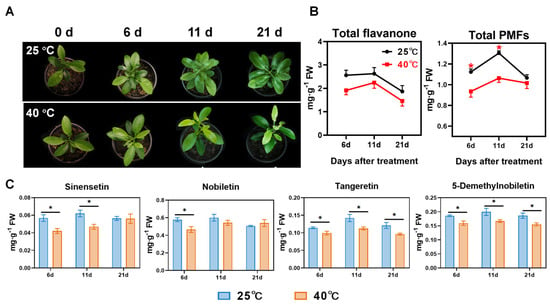
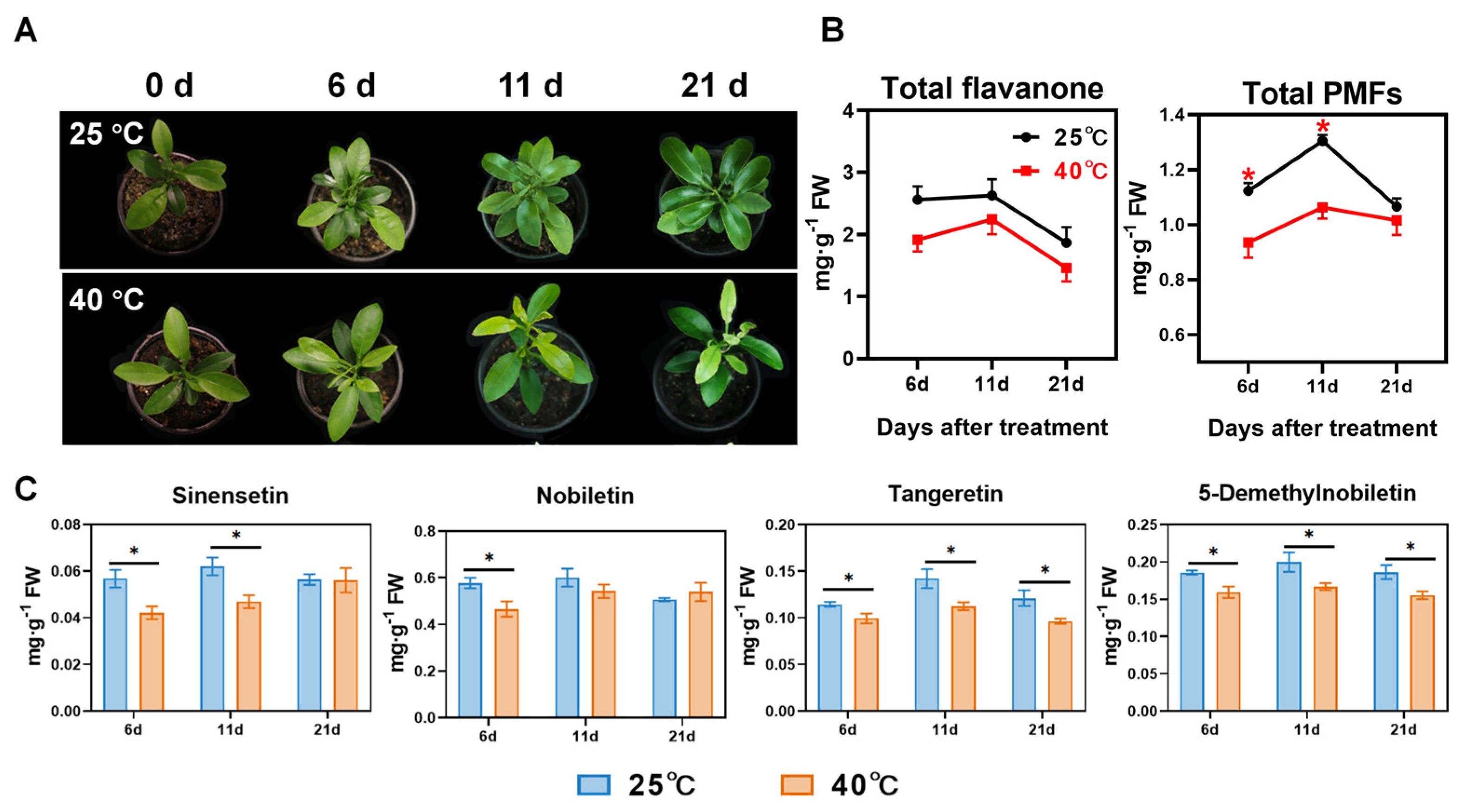
High-temperature stress severely compromises plant growth and alters secondary metabolism [32]. In citrus, PMFs constitute a unique subclass of flavonoids that are preferentially accumulated in specific tissues, such as leaves and peels. To elucidate how heat stress affects PMF dynamics, five-month-old ‘Ponkan’ (Citrus reticulata) seedlings were exposed to 40 °C heat treatment. Compared with the 25 °C control, heat-stressed seedlings exhibited marked growth retardation and leaf scorching (Figure 1A). HPLC analysis identified five major flavonoid monomers in leaves, the flavanone hesperidin and four PMFs (sinensetin, nobiletin, tangeretin, and 5-demethylnobiletin) in citrus leaves (Supplementary Figure S1). Under heat stress, flavanone content showed a non-significant decrease, whereas total PMF levels dropped significantly at days 6 and 11, with a non-significant reduction by day 21 (Figure 1B). Specifically, the maximum reduction of sinensetin (26.3%) and nobiletin (19.4%) occurred at day 6, while that of tangeretin (21.0%) and 5-demethylnobiletin (16.7%) peaked at day 11 and day 21, respectively. These findings demonstrate that high-temperature stress significantly suppresses PMF accumulation in citrus leaves, with the most pronounced inhibitory effect occurring during the early stage of stress.
Figure 1.
Phenotypic alterations and flavonoid accumulation in citrus leaves under heat stress. (A) Phenotypes of five-month-old ‘Ponkan’ mandarin (Citrus reticulata) seedlings subjected to 25 °C or 40 °C for 0, 6, 11, and 21 days. (B,C) Accumulation levels of total flavanones and total PMFs (B), and four individual PMF monomers (sinensetin, nobiletin, tangeretin, and 5-demethylnobiletin) (C) in leaves under 25 °C or 40 °C treatments for 6, 11, and 21 days. Values represent means ± SE (n = 3). Asterisks indicate significant differences compared with the control (p < 0.05).
3.2. Transcriptome Sequencing and Differentially Expressed Gene Analysis
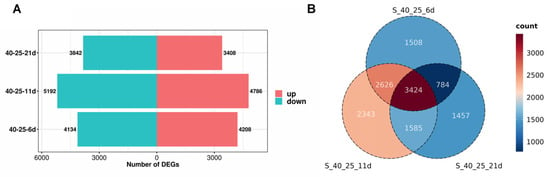
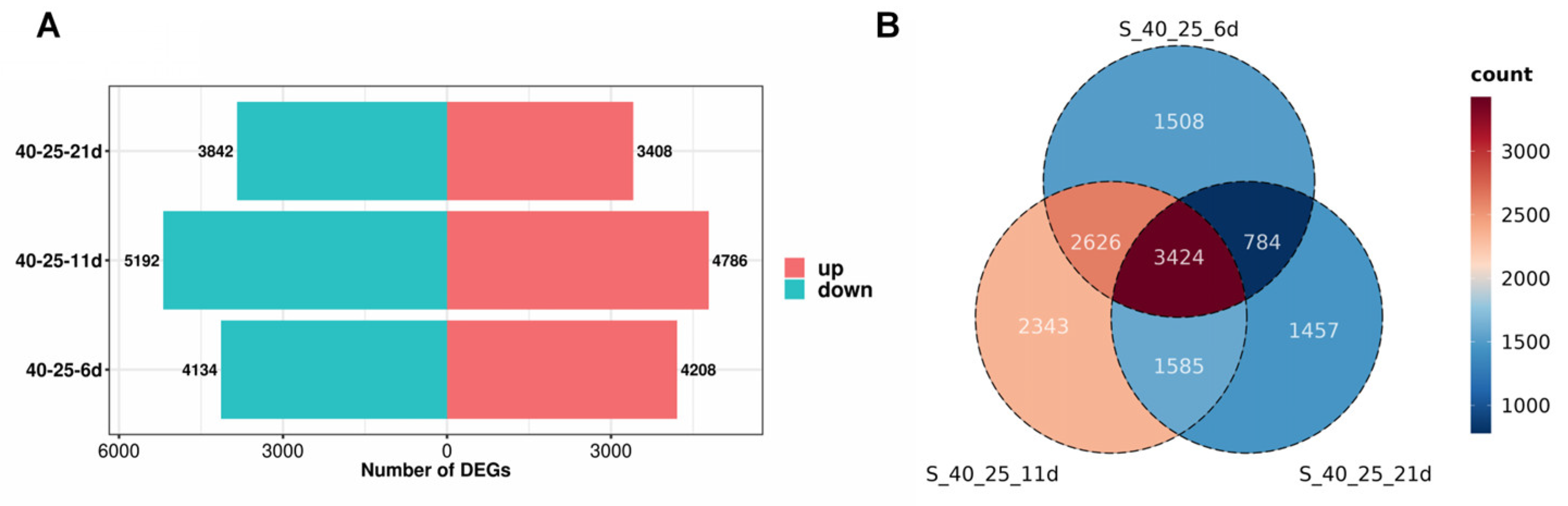
To dissect the transcriptional response of citrus leaves to heat stress, RNA-seq was performed on 18 samples comprising 25 °C controls and 40 °C-treated samples at 6, 11, and 21 days. Sequencing yielded an average of 6.39 Gb of clean data per sample, with Q20 and Q30 quality scores exceeding 98.3% and 94.1%. Clean reads were mapped to the Citrus clementina v1.0 reference genome with an average mapping rate of 84.44%, and 76.83% were uniquely mapped to the gene set (Supplementary Table S2). A total of 22,864 expressed genes were detected, including 21,788 annotated genes and 1076 novel genes. Additionally, 14,779 novel transcripts were identified, of which 13,689 represented novel isoforms of known protein-coding genes and 1090 derived from novel protein-coding genes. Principal component analysis (PCA) revealed close clustering of most biological replicates, supporting the overall reproducibility of the RNA-seq dataset, and showed transcriptomic variation associated with temperature and treatment duration, although partial overlap was observed among some groups (Supplementary Figure S2). Compared with the 25 °C control, substantial transcriptomic reprogramming was induced by heat stress across all time points. At 6 days, 8342 DEGs were identified (4208 upregulated and 4134 downregulated), which increased to a maximum of 9978 DEGs at 11 days (4786 upregulated and 5192 downregulated), and subsequently declined to 7250 DEGs at 21 days (3408 upregulated and 3842 downregulated) (Figure 2A). Venn analysis revealed substantial overlap among these groups. Specifically, 6050 DEGs were shared between 6 and 11 days, 4208 between 6 and 21 days, and 5009 between 11 and 21 days. Notably, a core set of 3424 DEGs was found to be differentially expressed across all three time points (Figure 2B, Supplementary Table S3).
Figure 2.
Transcriptomic reprogramming of citrus leaves under heat stress. (A) Number of differentially expressed genes (DEGs) at 6, 11, and 21 days under 40 °C heat stress compared with the 25 °C control. Upregulated and downregulated genes are shown in red and blue, respectively. (B) Venn diagram showing the overlap of DEGs across the three time points.
3.3. Functional Annotation and Enrichment Analysis of Heat-Responsive DEGs
To elucidate the biological functions of genes consistently responsive to heat stress, GO and KEGG analyses were performed on the 3424 DEGs shared across all three time points (6, 11, and 21 days).
GO annotation assigned the DEGs to three major categories: biological process (BP), cellular component (CC), and molecular function (MF). In the BP category, genes involved in cellular processes and metabolic processes were most abundant, each exceeding 1000 members. The CC category was dominated by cell anatomical entity-related genes (over 2000), while catalytic activity and binding represented the largest MF subcategories, comprising approximately 1500 genes each (Figure 3A). GO enrichment analysis further revealed significant overrepresentation of microtubule binding, microtubule cytoskeleton organization, and cell cycle-related terms. Microtubule binding and tubulin binding emerged as the most significantly enriched terms, implicating cytoskeletal dynamics and cell cycle regulation as key biological processes perturbed by heat stress (Figure 3B).
Figure 3.
GO and KEGG enrichment analyses of DEGs in response to heat stress in citrus leaves. (A) GO functional classification of the shared DEGs. (B) Top 20 significantly enriched GO terms. (C) KEGG functional classification across five major categories. (D) Top 18 significantly enriched KEGG pathways. The x-axis indicates the rich factor, dot color represents the adjusted p-value, and dot size reflects the number of enriched genes. A total of 3424 DEGs were shared across 6, 11, and 21 days of heat stress.
KEGG functional classification distributed the DEGs across five categories: cellular processes, environmental information processing, genetic information processing, metabolism, and organismal systems. Among these, global overview pathways within the metabolism category contained the largest gene set (over 800 members). KEGG pathway enrichment analysis identified glyoxylate and dicarboxylate metabolism, cofactor biosynthesis, biotin metabolism, and nitrogen metabolism as the most significantly enriched pathways, suggesting that these fundamental metabolic processes constitute core biological pathways affected by high-temperature stress (Figure 3C,D).
3.4. Heat Stress Suppresses PMF Biosynthesis Through Coordinated Downregulation of Pathway Genes
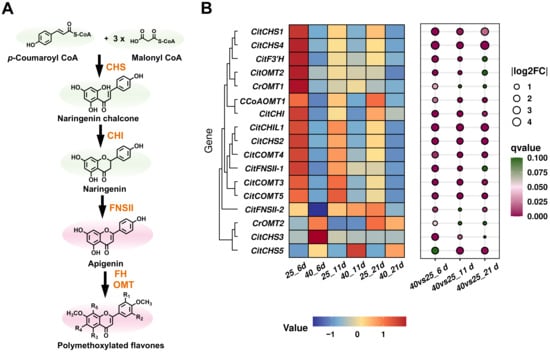
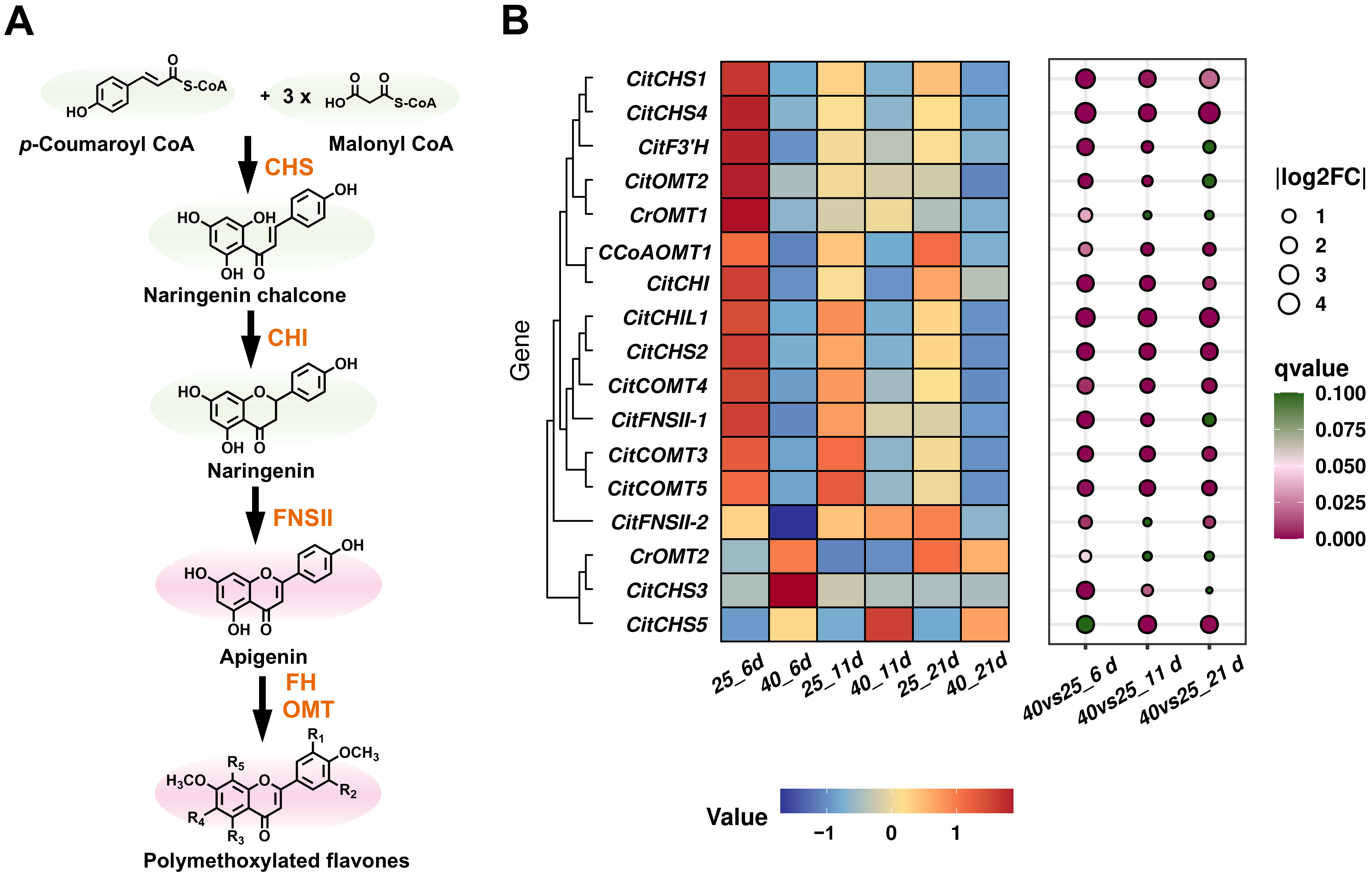
The biosynthetic pathway of PMFs in citrus has been reported previously [22]. Briefly, p-coumaroyl CoA derived from the phenylpropanoid pathway is sequentially converted to naringenin via CHS and CHI. FNS then transforms naringenin into apigenin, which undergoes subsequent hydroxylation and O-methylation mediated by FHs and OMTs to generate downstream PMFs (Figure 4A).
Figure 4.
Polymethoxyflavone biosynthesis pathway and heat-responsive expression of key structural genes in citrus. (A) Proposed PMF biosynthetic pathway in citrus. Key enzymes include CHS, chalcone synthase; CHI, chalcone isomerase; F3′H, flavanone 3′-hydroxylase; FNSII, flavone synthase II; FH, flavone hydroxylase; OMT, O-methyltransferase. (B) Expression patterns of key structural genes. Left panel, scaled FPKM values (range −1 to 1) under 25 °C (control) and 40 °C (heat stress) at 6, 11, and 21 days. Right panel, absolute log2 fold change (40 °C/25 °C) for each time point.
Key structural genes in this pathway have been characterized [7,8,10,12,14,15,17,19]. Here, we analyzed expression changes under high-temperature stress. Among 18 candidate genes, 14 were downregulated under heat (Figure 4B). These included the early-step gatekeepers CitCHS1 (Ciclev10005133m), CitCHS2 (Ciclev10015535m), CitCHI (Ciclev10032697m), and CitCHIL1 (Ciclev10032749m), all of which were repressed. CitFNSII-1 (Ciclev10019810m), which converts flavanones into the flavone skeleton, was also downregulated. Moreover, one hydroxylase (CitF3′H, Ciclev10019637m) and six methylation enzymes were repressed. The methylation enzymes comprised CitOMT2 (Ciclev10015724m); CitOMT3/4/5 (Ciclev10031951m/Ciclev10031949m/Ciclev10031952m, homologs of CreOMT3/4/5 [7]), CitCCoAOMT1 (Ciclev10029158m, a homolog of CsCCoAOMT1 [19]), and CrOMT1 (Ciclev10026344m). These results indicate that heat stress suppresses PMF accumulation through coordinated transcriptional repression of multiple biosynthetic enzymes.
Further Pearson correlation analysis identified nine gene–metabolite pairs with strong positive correlations (r > 0.80, p < 0.05; Supplementary Table S4). In particular, 5-demethylnobiletin concentrations were positively correlated with the expression of CreOMT5, CreOMT3, CitCHIL1, CreOMT4, CitCHS2, and CsCCoAOMT1. CreOMT5 expression was also positively correlated with tangeretin concentration, whereas CitFNSII-1 and CitOMT2 expression were positively correlated with hesperidin concentration. These results support coordinated changes between flavonoid accumulation and PMF-pathway gene expression under heat stress, although they do not establish direct causality.
3.5. Heat Stress Differentially Regulates Flavonoid-Related Transcription Factors
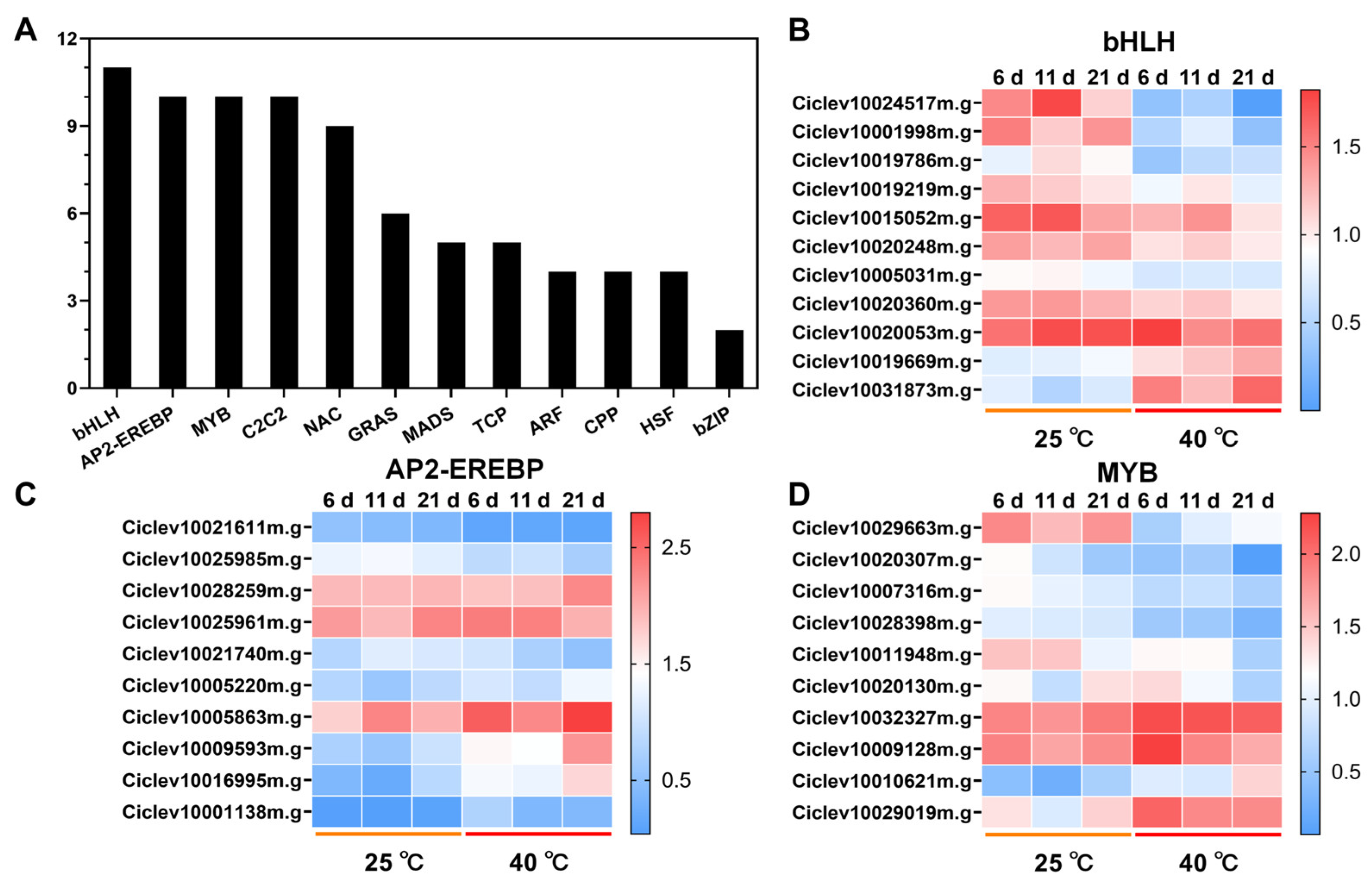
Plant flavonoid biosynthesis is known to be closely regulated by elevated temperatures through the modulation of various transcription factors (TFs), including MYBs, bHLH, AP2-EREBP, HSF, and WRKY [23,33]. Given that structural genes involved in citrus flavonoid biosynthesis were suppressed under heat stress, a potential involvement of transcriptional control was consequently investigated. TF annotation was performed on the 3424 DEGs identified as differentially expressed at all three time points (6, 11, and 21 days) (Figure 2B). Among the shared DEGs, 122 encoded transcription factors belonging to 31 families. Among the 12 most highly represented families, bHLH, AP2-EREBP, MYB, C2C2, and NAC were found to rank as the top five prominent classes, with each family comprising more than nine distinct members (Figure 5A).
Figure 5.
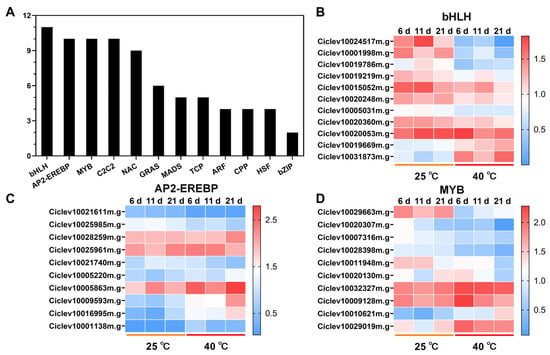
Identification and expression analysis of heat-responsive transcription factors in citrus leaves. (A) Number of differentially expressed transcription factors in the 12 most abundant TF families under heat stress. (B–D) Heatmaps showing the expression profiles of the three largest TF families, bHLH (B), AP2-EREBP (C), and MYB (D). Color scale represents log10 (FPKM + 1)-normalized expression levels.
The three largest families, bHLH, AP2-EREBP, and MYB, were further selected for expression pattern analysis under high temperature (Figure 5B–D). In the bHLH family, three members (Ciclev10024517m, Ciclev10001998m, and Ciclev10019786m) were significantly downregulated after heat treatment, whereas two others (Ciclev10019669m and Ciclev10031873m) were significantly upregulated (Figure 5B). Although the AP2-EREBP family generally exhibited low expression levels, three highly expressed members (Ciclev10028259m, Ciclev10025961m, and Ciclev10005863m) were detected, among which Ciclev10005863m was continuously increased by heat stress (Figure 5C). In the MYB family, Ciclev10029663m and Ciclev10011948m were significantly downregulated, whereas Ciclev10032327m and Ciclev10029019m were significantly upregulated under high temperature (Figure 5D). Given their close positive or negative correlations with the alterations in flavonoid accumulation, these differentially expressed members across the three families represent potential upstream candidates for regulating citrus flavonoid biosynthesis in response to heat stress.
3.6. Validation of RNA-Seq Results by RT-qPCR
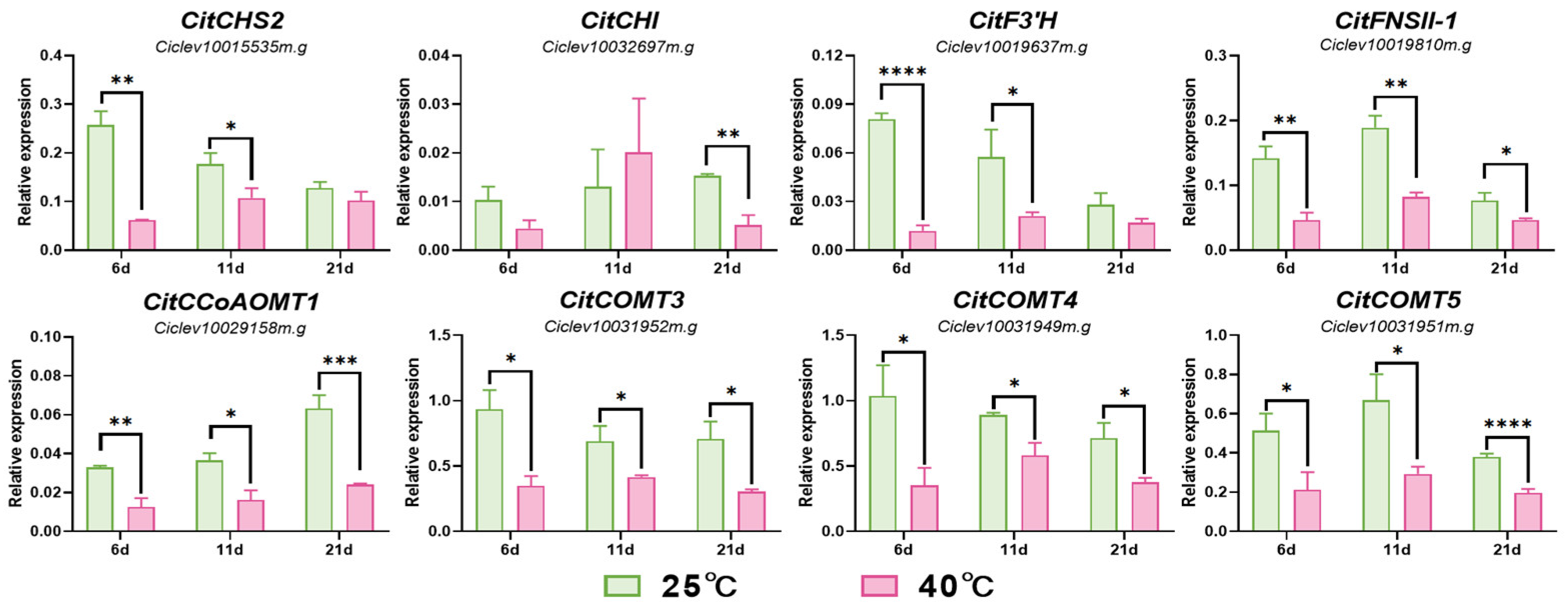
To validate the transcriptome data, eight genes involved in PMF biosynthesis were selected for RT-qPCR analysis. The results showed that the relative expression levels of CitCHS2, CitF3′H, CitFNSII-1, CrOMT1, CitCCoAOMT1, and CitOMT3/4/5 were significantly downregulated under high-temperature treatment (CitCHS1 expression was too low to be reliably detected). Among these, FNSII and OMT are key modifying enzymes in the PMF biosynthetic pathway and are essential for PMF formation. Notably, CitFNSII-1, CitCCoAOMT1, and CitOMT3/4/5 exhibited significant and sustained downregulation at all three time points after heat treatment, suggesting that these three genes are key structural genes mediating the heat response in PMF biosynthesis (Figure 6). These RT-qPCR results were highly consistent with the RNA-Seq data, confirming the reliability of the transcriptomic analysis.
Figure 6.
RT-qPCR validation of heat-responsive gene expression. Relative transcript levels of flavonoid/PMF biosynthesis-related genes (CitCHS2, CitF3′H, CitFNSII-1, CrOMT1, CitCCoAOMT1, and CitOMT3/4/5) in citrus leaves at 25 °C (control) or 40 °C (heat stress) at 6, 11, and 21 days. Data were normalized to Citrus β-actin and calculated using the 2^−∆Ct method; values are means ± SE (n = 3). Asterisks indicate significant differences versus control (* p < 0.05, ** p < 0.01, *** p < 0.001, **** p < 0.0001). Primers used are listed in Supplementary Table S1.
4. Discussion
In this study, high-temperature stress markedly reduced PMF accumulation in citrus leaves. Transcriptomic analysis identified 3424 DEGs shared across all three heat-treatment time points, which were predominantly enriched in pathways related to primary metabolism and cellular functions. Most structural genes involved in PMF biosynthesis were downregulated, and several bHLH, AP2/EREBP, and MYB transcription factors displayed expression patterns closely associated with PMF levels, suggesting their potential involvement in heat-responsive regulation of PMF biosynthesis.
Global climate warming is becoming a major threat to crop productivity and quality. For cash crops such as tea, rice, wheat, and citrus, prolonged heat stress reduces yield and impairs the accumulation of starch, protein, fatty acids, fiber, and phenolic compounds [1]. In our experiment, citrus seedlings exposed to 40 °C exhibited leaf scorching, curling, and growth retardation, and these symptoms worsened over time, confirming that the treatment caused heat damage.
In addition to impairing plant growth, high temperature can substantially alter the accumulation of secondary metabolites [34,35]. In the present study, prolonged heat treatment significantly reduced the levels of four major PMF monomers (nobiletin, tangeretin, sinensetin, and 5-demethylnobiletin) in citrus leaves, whereas the flavanone hesperidin showed only a slight and non-significant decline. Notably, PMF and hesperidin concentrations also fluctuated in dependence on temperature over time. These temporal changes may reflect normal leaf development and expansion, as flavonoid accumulation is developmentally regulated, as well as growth-related dilution or concentration effects independent of heat stress [23]. Similar effects have been reported for other flavonoids in diverse plant species. For example, high temperature markedly reduced anthocyanin accumulation in grape berries, accompanied by repression of anthocyanin biosynthetic genes [36]. In apple fruit, elevated temperature inhibited anthocyanin production through suppression of the transcriptional activator complex (MYB10, bHLH300) [28]. Likewise, anthocyanin content decreased substantially in potato tubers [37] and chrysanthemum petals [27] under heat stress. These studies collectively indicate that flavonoid biosynthesis is highly sensitive to elevated temperature.
However, the responses of different flavonoid subclasses are often distinct. In grape berries, anthocyanins are consistently reduced by heat stress, whereas flavonol responses are more variable [26,29]. In oriental lily, high temperature decreases anthocyanin accumulation but simultaneously promotes isoflavonoid biosynthesis, indicating a redistribution of metabolic flux among flavonoid branches [30]. Similarly, heat-induced anthocyanin loss in potato is accompanied by increased expression of genes involved in lignin and chlorogenic acid biosynthesis [37]. Collectively, these studies indicate that heat stress can differentially regulate flavonoid branches, suggesting that the stronger reduction in PMFs than the flavanone hesperidin in citrus may reflect branch-specific metabolic regulation under heat stress. It should be noted that PMFs were quantified on a fresh-weight basis, whereas total leaf biomass per plant was not measured. Thus, the results represent changes in leaf-tissue PMF concentrations rather than changes in the whole-plant PMF pool. Future studies combining metabolite concentrations with total leaf biomass measurements will provide a more comprehensive assessment of heat-induced changes in PMF accumulation at the whole-plant level.
A focused analysis of the PMF biosynthetic pathway revealed that the majority of previously reported key structural genes were strongly downregulated under heat stress, including CitCHS1/2, CitCHI, CitCHIL1, CitFNSII-1, CitF3′H, and multiple OMTs [7,8,10,12,14,15,17,19]. The greater decline in PMFs compared with hesperidin may reflect the higher metabolic complexity of PMF biosynthesis, which relies on multiple downstream hydroxylation and O-methylation reactions that appear particularly sensitive to heat-induced transcriptional regulation.
The transcriptomic data further revealed extensive heat-induced reprogramming of gene expression. The 3424 DEGs shared across 6, 11, and 21 days of heat treatment were primarily enriched in pathways associated with cytoskeleton organization, cell cycle regulation, and primary metabolism. Similar enrichment patterns have been reported in other plant species exposed to heat stress, reflecting the high sensitivity of microtubule dynamics, cell division, and energy metabolism to elevated temperatures [38,39,40]. Notably, flavonoid- or PMF-related pathways were not significantly enriched in the global GO and KEGG analyses. One possible explanation is that the PMF biosynthetic branch contains relatively few structural genes compared with the large number of DEGs involved in fundamental cellular responses to heat stress. Thus, although enrichment analysis highlights the major transcriptional responses to heat, targeted pathway analysis can still reveal strong repression of specialized metabolic branches such as PMF biosynthesis.
Transcription factors are major regulators of flavonoid biosynthesis and stress responses [22,41]. In our heat-stress dataset, 122 differentially expressed TFs were identified, with bHLH, AP2/EREBP, and MYB as the most abundant families. These families are well known to regulate flavonoid metabolism. For example, citrus MYB factors CsRuby1 activate anthocyanin accumulation [42], whereas heat-induced MYB repressors can inhibit flavone biosynthesis in other species, such as CmMYB012 in chrysanthemum [27]. Similarly, bHLH proteins often function as components of the MBW complex and cooperate with MYB factors to activate flavonoid structural genes [43]. The mixed expression patterns of bHLH and MYB genes in our study therefore suggest that heat stress may alter PMF biosynthesis through both activation loss and repressor induction. AP2/ERF factors may also contribute to flavonoid regulation [8,24,44]. For example, citrus CitERF32 and CitERF33 directly activate flavonoid biosynthesis by promoting CitCHIL1 expression, showing that AP2/ERF proteins can regulate this pathway at the transcriptional level [8]. In our data, one AP2/ERF gene (Ciclev10005863m) was continuously induced by heat, suggesting that AP2/ERF-mediated regulation may also participate in the heat response of PMF biosynthesis. Together, these TF changes indicate a coordinated regulatory network linking heat stress to PMF accumulation repression.
5. Conclusions
In this study, we demonstrated that prolonged high-temperature stress markedly suppresses the accumulation of polymethoxyflavones (PMFs) in citrus leaves while exerting a weaker effect on flavanones. Transcriptome analysis revealed extensive heat-induced transcriptional reprogramming, with 3424 core differentially expressed genes commonly responsive across three time points. Functional enrichment highlighted basic cellular processes such as cytoskeleton organization and primary metabolism, reflecting the broad physiological impact of heat. Notably, pathway-focused analysis revealed that 14 of 18 key structural genes in the PMF biosynthetic pathway were coordinately downregulated. Among these DEGs, multiple bHLH, AP2-EREBP, and MYB transcription factors showed expression patterns closely associated with PMF content, suggesting their potential roles as upstream regulators. RT-qPCR confirmed the reliability of the transcriptome data. Overall, these findings indicate that high temperature suppresses PMF accumulation through extensive transcriptional reprogramming, characterized by widespread downregulation of PMF biosynthetic genes and differential regulation of candidate transcription factors. This work provides a mechanistic basis for understanding heat-induced declines in PMF nutritional quality and identifies candidate genes and transcription factors for future metabolic engineering or cultivation strategies aimed at preserving PMF content under warming climates.
Supplementary Materials
The following supporting information can be downloaded at: https://www.mdpi.com/article/10.3390/horticulturae12091053/s1, Figure S1: HPLC chromatogram of flavonoids extracted from Ponkan (Citrus reticulata) leaves, Figure S2: Principal component analysis (PCA) of 18 RNA-seq samples from citrus leaves exposed to 25 °C or 40 °C for 6, 11, and 21 days. Table S1: Primers used for RT-qPCR, Table S2: RNA-seq data quality and mapping statistics, Table S3: FPKM values of the 3424 differentially expressed genes (DEGs) commonly shared across three time points (6, 11, and 21 days) of heat stress, Table S4: Strong positive Pearson correlations (r > 0.80, p < 0.05) between flavonoid concentrations and PMF-pathway gene expression across six temperature–time combinations.
Author Contributions
X.L. and Z.L. contributed equally to this work. Conceptualization, C.S., X.L. and Z.L.; methodology, X.L., Z.L., H.H. and C.Z.; validation, X.L. and Z.L.; formal analysis, X.L., Z.L. and Y.W.; investigation, X.L., Z.L., H.H., C.Z. and Y.W.; resources, D.W., L.L. and C.S.; data curation, X.L., Z.L. and Y.W.; writing—original draft preparation, X.L. and Z.L.; writing—review and editing, X.L., Z.L. and C.S.; visualization, X.L. and Z.L.; supervision, C.S.; project administration, C.S.; funding acquisition, C.S. All authors have read and agreed to the published version of the manuscript.
Funding
This research was funded by the National Natural Science Foundation of China (3302507, U25A20688), the Hangzhou Joint Fund of the Zhejiang Provincial Natural Science Foundation of China under Grant No. LHZSD24C150001, the National Key R&D Program of China (2023YFD2300604), the National Natural Science Foundation of China (32302507), the Fundamental Research Funds for the Central Universities (226-2026-00062), and the Zhejiang A&F University Scientific Research Development Fund (Start-up Project, Grant No. 2024LFR039).
Data Availability Statement
Data available upon request from the authors. The data that support the findings of this study are available from the corresponding author upon reasonable request.
Acknowledgments
We would like to thank Researcher Rong Jin for providing experimental materials for this study.
Conflicts of Interest
The authors declare no conflicts of interest.
Abbreviations
The following abbreviations are used in this manuscript:
| PMF | polymethoxyflavones |
| CHS | chalcone synthase |
| CHI | chalcone isomerase |
| FNS | flavone synthase |
| FH | flavone hydroxylase |
| OMT | O-methyltransferase |
| FPKM | Fragments Per Kilobase of transcript per Million mapped reads |
| DEGs | differentially expressed genes |
| GO | Gene Ontology |
| KEGG | Kyoto Encyclopedia of Genes and Genomes |
| BP | biological process |
| CC | cellular component |
| MF | molecular function |
References
- Kumar, S.; Bhushan, B.; Wakchaure, G.C.; Dutta, R.; Jat, B.S.; Meena, K.K.; Rakshit, S.; Pathak, H. Unveiling the Impact of Heat Stress on Seed Biochemical Composition of Major Cereal Crops: Implications for Crop Resilience and Nutritional Value. Plant Stress 2023, 9, 100183. [Google Scholar] [CrossRef] [Scilit]
- Kan, Y.; Mu, X.; Gao, J.; Lin, H.; Lin, Y. The Molecular Basis of Heat Stress Responses in Plants. Mol. Plant 2023, 16, 1612–1634. [Google Scholar] [CrossRef] [Scilit] [PubMed]
- Khan, M.S.; Khan, I.A. Citrus: Research, Development and Biotechnology; BoD-Books on Demand: Hamburg, Germany, 2021; ISBN 978-1-83968-723-5. [Google Scholar]
- Peng, Z.; Zhang, H.; Li, W.; Yuan, Z.; Xie, Z.; Zhang, H.; Cheng, Y.; Chen, J.; Xu, J. Comparative Profiling and Natural Variation of Polymethoxylated Flavones in Various Citrus Germplasms. Food Chem. 2021, 354, 129499. [Google Scholar] [CrossRef] [Scilit] [PubMed]
- Toledo, R.; Tomás-Navarro, M.; Yuste, J.E.; Crupi, P.; Vallejo, F. An Update on Citrus Polymethoxyflavones: Chemistry, Metabolic Fate, and Relevant Bioactivities. Eur. Food Res. Technol. 2024, 250, 2179–2192. [Google Scholar] [CrossRef] [Scilit]
- Yamaga, I.; Nakamura, S. Penicillium Growth Inhibition, Fruit Decay Reduction, and Polymethoxyflavones and Scoparone Induction in Satsuma Mandarin Irradiated with Ultraviolet-A Light-Emitting Diodes. Sci. Hortic. 2022, 303, 111197. [Google Scholar] [CrossRef] [Scilit]
- Peng, Z.; Song, L.; Chen, M.; Liu, Z.; Yuan, Z.; Wen, H.; Zhang, H.; Huang, Y.; Peng, Z.; Yang, H.; et al. Neofunctionalization of an OMT Cluster Dominates Polymethoxyflavone Biosynthesis Associated with the Domestication of Citrus. Proc. Natl. Acad. Sci. USA 2024, 121, e2321615121. [Google Scholar] [CrossRef] [Scilit] [PubMed]
- Zhao, C.; Liu, X.; Gong, Q.; Cao, J.; Shen, W.; Yin, X.; Grierson, D.; Zhang, B.; Xu, C.; Li, X.; et al. Three AP2/ERF Family Members Modulate Flavonoid Synthesis by Regulating Type IV Chalcone Isomerase in Citrus. Plant Biotechnol. J. 2021, 19, 671–688. [Google Scholar] [CrossRef] [Scilit] [PubMed]
- Wang, Z.; Yu, Q.; Shen, W.; El Mohtar, C.A.; Zhao, X.; Gmitter, F.G. Functional Study of CHS Gene Family Members in Citrus Revealed a Novel CHS Gene Affecting the Production of Flavonoids. BMC Plant Biol. 2018, 18, 189. [Google Scholar] [CrossRef] [Scilit] [PubMed]
- Zheng, J.; Zhao, C.; Liao, Z.; Liu, X.; Gong, Q.; Zhou, C.; Liu, Y.; Wang, Y.; Cao, J.; Liu, L.; et al. Functional Characterization of Two Flavone Synthase II Members in Citrus. Hortic. Res. 2023, 10, uhad113. [Google Scholar] [CrossRef] [Scilit] [PubMed]
- Liu, X.; Chen, B.; Luo, L.; Zhong, Q.; Teo, C.H.; Huang, S. Genome-Wide Analysis of the FNSII Gene Family and the Role of CitFNSII-1 in Flavonoid Synthesis in Citrus. Plants 2025, 14, 1936. [Google Scholar] [CrossRef] [Scilit] [PubMed]
- Liu, X.; Gong, Q.; Zhao, C.; Wang, D.; Ye, X.; Zheng, G.; Wang, Y.; Cao, J.; Sun, C. Genome-Wide Analysis of Cytochrome P450 Genes in Citrus clementina and Characterization of a CYP Gene Encoding Flavonoid 3′-Hydroxylase. Hortic. Res. 2023, 10, uhac283. [Google Scholar] [CrossRef] [Scilit] [PubMed]
- Liu, X.; Luo, Y.; Wu, H.; Xi, W.; Yu, J.; Zhang, Q.; Zhou, Z. Systematic Analysis of O-Methyltransferase Gene Family and Identification of Potential Members Involved in the Formation of O-Methylated Flavonoids in Citrus. Gene 2016, 575, 458–472. [Google Scholar] [CrossRef] [Scilit] [PubMed]
- Liu, X.; Wang, Y.; Chen, Y.; Xu, S.; Gong, Q.; Zhao, C.; Cao, J.; Sun, C. Characterization of a Flavonoid 3’/5’/7-O-Methyltransferase from Citrus reticulata and Evaluation of the In Vitro Cytotoxicity of Its Methylated Products. Molecules 2020, 25, 858. [Google Scholar] [CrossRef] [Scilit] [PubMed]
- Liu, X.; Zhao, C.; Gong, Q.; Wang, Y.; Cao, J.; Li, X.; Grierson, D.; Sun, C. Characterization of a Caffeoyl-CoA O-Methyltransferase-like Enzyme Involved in Biosynthesis of Polymethoxylated Flavones in Citrus reticulata. J. Exp. Bot. 2020, 71, 3066–3079. [Google Scholar] [CrossRef] [Scilit] [PubMed]
- Seoka, M.; Ma, G.; Zhang, L.; Yahata, M.; Yamawaki, K.; Kan, T.; Kato, M. Expression and Functional Analysis of the Nobiletin Biosynthesis-Related Gene CitOMT in Citrus Fruit. Sci. Rep. 2020, 10, 15288. [Google Scholar] [CrossRef] [Scilit] [PubMed]
- Ma, G.; Zhang, L.; Seoka, M.; Nakata, A.; Yahata, M.; Shimada, T.; Fujii, H.; Endo, T.; Yoshioka, T.; Kan, T.; et al. Characterization of a Caffeic Acid 8-O-Methyltransferase from Citrus and Its Function in Nobiletin Biosynthesis. J. Agric. Food Chem. 2022, 70, 543–553. [Google Scholar] [CrossRef] [Scilit] [PubMed]
- Xian, L.; Sahu, S.K.; Huang, L.; Fan, Y.; Lin, J.; Su, J.; Bai, M.; Chen, Y.; Wang, S.; Ye, P.; et al. The Draft Genome and Multi-Omics Analyses Reveal New Insights into Geo-Herbalism Properties of Citrus grandis ‘Tomentosa’. Plant Sci. 2022, 325, 111489. [Google Scholar] [CrossRef] [Scilit] [PubMed]
- Liao, Z.; Liu, X.; Zheng, J.; Zhao, C.; Wang, D.; Xu, Y.; Sun, C. A Multifunctional True Caffeoyl Coenzyme A O-Methyltransferase Enzyme Participates in the Biosynthesis of Polymethoxylated Flavones in Citrus. Plant Physiol. 2023, 192, 2049–2066. [Google Scholar] [CrossRef] [Scilit] [PubMed]
- Wen, J.; Wang, Y.; Lu, X.; Pan, H.; Jin, D.; Wen, J.; Jin, C.; Sahu, S.K.; Su, J.; Luo, X.; et al. An Integrated Multi-Omics Approach Reveals Polymethoxylated Flavonoid Biosynthesis in Citrus reticulata Cv. chachiensis. Nat. Commun. 2024, 15, 3991. [Google Scholar] [CrossRef] [Scilit] [PubMed]
- Pan, H.; Su, J.; Bai, M.; Chen, M.; He, Z.; Rong, N.; Lin, X.; Wang, H.; Wu, H. Two Caffeoyl-CoA O-Methyltransferase-like Enzyme Are Involved in the Biosynthesis of Polymethoxyflavones in Citrus reticulata ‘Chachiensis’. Int. J. Biol. Macromol. 2025, 310, 143277. [Google Scholar] [CrossRef] [Scilit] [PubMed]
- Hu, H.; Liao, Z.; Zhou, C.; Liao, B.; Liu, X.; Zhao, C.; Wang, D.; Liu, L.; Cao, J.; Wang, Y.; et al. A Novel C5-O-Methyltransferase for Naringenin Refines the Biosynthetic Strategy for Polymethoxyflavones. Hortic. Res. 2026, 13, uhag128. [Google Scholar] [CrossRef] [Scilit] [PubMed]
- Chen, L.; Cheng, Y.; Hong, G. Molecular Insights into the Regulation of Flavonoid Biosynthesis in Fruits. Hortic. Res. 2026, 13, uhaf306. [Google Scholar] [CrossRef] [Scilit] [PubMed]
- Wan, H.; Liu, Y.; Wang, T.; Jiang, P.; Wen, W.; Nie, J. Combined Transcriptomic and Metabolomic Analyses Identifies CsERF003, a Citrus ERF Transcription Factor, as Flavonoid Activator. Plant Sci. 2023, 334, 111762. [Google Scholar] [CrossRef] [Scilit] [PubMed]
- Shomali, A.; Das, S.; Arif, N.; Sarraf, M.; Zahra, N.; Yadav, V.; Aliniaeifard, S.; Chauhan, D.K.; Hasanuzzaman, M. Diverse Physiological Roles of Flavonoids in Plant Environmental Stress Responses and Tolerance. Plants 2022, 11, 3158. [Google Scholar] [CrossRef] [Scilit] [PubMed]
- Gouot, J.C.; Smith, J.P.; Holzapfel, B.P.; Walker, A.R.; Barril, C. Grape Berry Flavonoids: A Review of Their Biochemical Responses to High and Extreme High Temperatures. J. Exp. Bot. 2019, 70, 397–423. [Google Scholar] [CrossRef] [Scilit] [PubMed]
- Zhou, L.-J.; Geng, Z.; Wang, Y.; Wang, Y.; Liu, S.; Chen, C.; Song, A.; Jiang, J.; Chen, S.; Chen, F. A Novel Transcription Factor CmMYB012 Inhibits Flavone and Anthocyanin Biosynthesis in Response to High Temperatures in Chrysanthemum. Hortic. Res. 2021, 8, 248. [Google Scholar] [CrossRef] [Scilit] [PubMed]
- Lin-Wang, K.; Micheletti, D.; Palmer, J.; Volz, R.; Lozano, L.; Espley, R.; Hellens, R.P.; Chagnè, D.; Rowan, D.D.; Troggio, M.; et al. High Temperature Reduces Apple Fruit Colour via Modulation of the Anthocyanin Regulatory Complex. Plant Cell Environ. 2011, 34, 1176–1190. [Google Scholar] [CrossRef] [Scilit] [PubMed]
- Wei, Y.; Meng, N.; Wang, Y.; Cheng, J.; Duan, C.; Pan, Q. Transcription Factor VvWRKY70 Inhibits Both Norisoprenoid and Flavonol Biosynthesis in Grape. Plant Physiol. 2023, 193, 2055–2070. [Google Scholar] [CrossRef] [Scilit] [PubMed]
- Yang, J.; Guo, C.; Chen, F.; Lv, B.; Song, J.; Ning, G.; He, Y.; Lin, J.; He, H.; Yang, Y.; et al. Heat-Induced Modulation of Flavonoid Biosynthesis via a LhMYBC2-Mediated Regulatory Network in Oriental Hybrid Lily. Plant Physiol. Biochem. 2024, 214, 108966. [Google Scholar] [CrossRef] [Scilit] [PubMed]
- Pillitteri, L.J.; Lovatt, C.J.; Walling, L.L. Isolation and Characterization of LEAFY and APETALA1 Homologues from Citrus Sinensis L. Osbeck `washington’. J. Am. Soc. Hortic. Sci. 2004, 129, 846–856. [Google Scholar] [CrossRef] [Scilit]
- Rehman, A.; Khan, I.; Farooq, M. Secondary Metabolites Mediated Reproductive Tolerance under Heat Stress in Plants. J. Plant Growth Regul. 2024, 43, 2993–3011. [Google Scholar] [CrossRef] [Scilit]
- Naik, J.; Rajput, R.; Singh, S.; Stracke, R.; Pandey, A. Heat-Responsive MaHSF11 Transcriptional Activator Positively Regulates Flavonol Biosynthesis and Flavonoid B-Ring Hydroxylation in Banana (Musa acuminata). Plant J. 2025, 121, e70084. [Google Scholar] [CrossRef] [Scilit] [PubMed]
- Glaubitz, U.; Erban, A.; Kopka, J.; Hincha, D.K.; Zuther, E. High Night Temperature Strongly Impacts TCA Cycle, Amino Acid and Polyamine Biosynthetic Pathways in Rice in a Sensitivity-Dependent Manner. J. Exp. Bot. 2015, 66, 6385–6397. [Google Scholar] [CrossRef] [Scilit] [PubMed]
- Qaderi, M.M.; Martel, A.B.; Strugnell, C.A. Environmental Factors Regulate Plant Secondary Metabolites. Plants 2023, 12, 447. [Google Scholar] [CrossRef] [Scilit] [PubMed]
- Movahed, N.; Pastore, C.; Cellini, A.; Allegro, G.; Valentini, G.; Zenoni, S.; Cavallini, E.; D’Incà, E.; Tornielli, G.B.; Filippetti, I. The Grapevine VviPrx31 Peroxidase as a Candidate Gene Involved in Anthocyanin Degradation in Ripening Berries under High Temperature. J. Plant Res. 2016, 129, 513–526. [Google Scholar] [CrossRef] [Scilit] [PubMed]
- Liu, Y.; Lin-Wang, K.; Espley, R.V.; Wang, L.; Li, Y.; Liu, Z.; Zhou, P.; Zeng, L.; Zhang, X.; Zhang, J.; et al. StMYB44 Negatively Regulates Anthocyanin Biosynthesis at High Temperatures in Tuber Flesh of Potato. J. Exp. Bot. 2019, 70, 3809–3824. [Google Scholar] [CrossRef] [Scilit] [PubMed]
- Bita, C.; Gerats, T. Plant Tolerance to High Temperature in a Changing Environment: Scientific Fundamentals and Production of Heat Stress-Tolerant Crops. Front. Plant Sci. 2013, 4, 273. [Google Scholar] [CrossRef] [Scilit] [PubMed]
- Ohama, N.; Sato, H.; Shinozaki, K.; Yamaguchi-Shinozaki, K. Transcriptional Regulatory Network of Plant Heat Stress Response. Trends Plant Sci. 2017, 22, 53–65. [Google Scholar] [CrossRef] [Scilit] [PubMed]
- Kumar, S.; Jeevaraj, T.; Yunus, M.H.; Chakraborty, S.; Chakraborty, N. The Plant Cytoskeleton Takes Center Stage in Abiotic Stress Responses and Resilience. Plant Cell Environ. 2023, 46, 5–22. [Google Scholar] [CrossRef] [Scilit] [PubMed]
- Luo, H.; Luo, Q.; Bao, T.; Nie, J.; Sun, Z. Advancements in the Regulation of Flavonoid Compounds in Monocotyledons and Dicotyledons by Plant MYB Transcription Factors. Horticulturae 2025, 11, 1244. [Google Scholar] [CrossRef] [Scilit]
- Huang, D.; Wang, X.; Tang, Z.; Yuan, Y.; Xu, Y.; He, J.; Jiang, X.; Peng, S.-A.; Li, L.; Butelli, E.; et al. Subfunctionalization of the Ruby2–Ruby1 Gene Cluster during the Domestication of Citrus. Nat. Plants 2018, 4, 930–941. [Google Scholar] [CrossRef] [Scilit] [PubMed]
- Cui, D.; Zhao, S.; Xu, H.; Allan, A.C.; Zhang, X.; Fan, L.; Chen, L.; Su, J.; Shu, Q.; Li, K. The Interaction of MYB, bHLH and WD40 Transcription Factors in Red Pear (Pyrus pyrifolia) Peel. Plant Mol. Biol. 2021, 106, 407–417. [Google Scholar] [CrossRef] [Scilit] [PubMed]
- Ma, H.; Yang, T.; Li, Y.; Zhang, J.; Wu, T.; Song, T.; Yao, Y.; Tian, J. The Long Noncoding RNA MdLNC499 Bridges MdWRKY1 and MdERF109 Function to Regulate Early-Stage Light-Induced Anthocyanin Accumulation in Apple Fruit. Plant Cell 2021, 33, 3309–3330. [Google Scholar] [CrossRef] [Scilit] [PubMed]
Disclaimer/Publisher’s Note: The statements, opinions and data contained in all publications are solely those of the individual author(s) and contributor(s) and not of MDPI and/or the editor(s). MDPI and/or the editor(s) disclaim responsibility for any injury to people or property resulting from any ideas, methods, instructions or products referred to in the content. |
© 2026 by the authors. Licensee MDPI, Basel, Switzerland. This article is an open access article distributed under the terms and conditions of the Creative Commons Attribution (CC BY) license.