


Highlights
What are the main findings?
- •
- The pathogenic effects of Beauveria bassiana on the ectoparasitoid Sclerodermus guani were characterized using a time–dose–mortality model, revealing concentration-dependent effects on parasitoid survival.
- •
- The results revealed that Sclerodermus guani was still capable of suppressing Monochamus alternatus larvae under fungal exposure, while its parasitism success rate and offspring performance declined in a dose-dependent way with the rising concentration of Beauveria bassiana.
What are the implications of the main findings?
- •
- The compatibility between Beauveria bassiana and Sclerodermus guani depends strongly on fungal concentration, highlighting the importance of balancing fungal transmission potential and parasitoid fitness.
- •
- This study provides insights into optimizing fungus-associated parasitoid strategies for sustainable management of wood-boring pests.
Abstract
Pine wilt disease, caused by Bursaphelenchus xylophilus and vectored by Monochamus alternatus, is a devastating forest disease. The parasitoid Sclerodermus guani and entomopathogenic fungus Beauveria bassiana are effective biocontrol agents against wood-boring pests, but their compatibility remains poorly understood. We exposed adult female S. guani to three concentrations of B. bassiana conidia (1 × 10⁵, 1 × 10⁶, and 1 × 10⁷ conidia mL−1) and assessed parasitoid mortality, infection, reproduction, and parasitism capacity against M. alternatus larvae. Mortality and infection rates increased significantly with concentration and exposure time. At 30 days post-exposure, corrected mortalities were 72.47%, 91.30%, and 100% for the three concentrations, respectively. Time–dose–mortality analysis yielded LT50 values of 27.69, 20.00, and 5.92 days, confirming faster kill at higher doses. Fungal exposure reduced offspring production and development at high concentrations, yet fungus-carrying females still successfully parasitized M. alternatus. Importantly, low fungal concentrations caused only minor reductions in parasitism success and offspring survival. These findings demonstrate that the compatibility between B. bassiana and S. guani is strongly concentration-dependent. Therefore, optimizing fungal dosage is essential to balance fungal dispersal and parasitoid fitness in fungus-carrying biocontrol systems. Our study provides valuable insights into ecological interactions between entomopathogenic fungi and parasitoids, facilitating integrated pest management strategies for wood-boring pests.
1. Introduction
Pine wilt disease (PWD), caused by the pinewood nematode Bursaphelenchus xylophilus (Steiner and Bührer) Nickle (Nematoda: Aphelenchoididae), is one of the most destructive forest diseases worldwide [1,2,3]. The disease has spread to multiple regions and poses serious threats to pine ecosystems, particularly because of its rapid transmission and severe impacts on susceptible pine species [4,5]. The pine sawyer beetle Monochamus alternatus (Coleoptera: Cerambycidae) serves as the primary insect vector of B. xylophilus and is also an important wood-boring pest that directly damages pine trees [6,7,8]. Therefore, effective suppression of M. alternatus populations is essential for reducing the transmission risk of PWD and protecting forest ecosystems.
The ectoparasitoid Sclerodermus guani Xiao et Wu (Hymenoptera: Bethylidae) has been widely used as a biological control agent against wood-boring insects, including M. alternatus, owing to its efficient host-searching behavior, strong reproductive capacity, and adaptability to concealed habitats [9,10,11]. In parallel, the entomopathogenic fungus Beauveria bassiana (Hypocreales: Cordycipitaceae) is widely recognized as an effective microbial control agent due to its broad host range, strong pathogenicity, and environmental compatibility [12,13,14,15]. Compared with conventional chemical insecticides, biological control agents provide environmentally sustainable alternatives for pest management. Consequently, increasing attention has been paid to integrating entomopathogenic fungi with natural enemies to enhance pest suppression efficiency [16,17,18].
The combination of parasitoids and entomopathogenic fungi is based on the concept that parasitoids may facilitate pathogen dispersal through their host-searching activities and ecological interactions with target pests. Several studies have demonstrated that parasitoid-mediated delivery of B. bassiana can improve pest suppression efficiency, including systems involving Trichogramma species and wood-boring pest parasitoids [17,18,19,20]. However, the successful application of this strategy requires a balance between fungal transmission efficiency and parasitoid fitness. Exposure to entomopathogenic fungi may negatively affect parasitoid survival, reproduction, and offspring development, thereby reducing the long-term effectiveness of biological control programs [19,20,21,22].
Although interactions between entomopathogenic fungi and parasitoids have received increasing attention, most previous studies have focused on direct pathogenic effects of fungi on parasitoids rather than whether fungus-exposed parasitoids can maintain their biological control functions. For fungus-carrying parasitoid systems, determining the appropriate fungal concentration is particularly important because excessive pathogen pressure may reduce parasitoid fitness, whereas insufficient fungal loading may compromise pathogen transmission [23,24]. Therefore, evaluating the concentration-dependent effects of B. bassiana on S. guani and its subsequent parasitization ability is essential for developing effective and sustainable biological control strategies.
In this study, we investigated the compatibility between B. bassiana and S. guani within a tripartite interaction system involving M. alternatus. Specifically, we aimed to (1) evaluate the pathogenicity of different concentrations of B. bassiana against adult female S. guani; (2) quantify the time-dose-dependent mortality response using a time–dose–mortality model; and (3) determine whether S. guani females exposed to B. bassiana could retain their parasitization ability and support offspring development. We hypothesized that B. bassiana exposure would negatively influence parasitoid fitness in a concentration-dependent manner, but appropriate fungal concentrations could maintain parasitoid-mediated pest suppression.
2. Materials and Methods
2.1. Insect and Fungal Materials
Sclerodermus guani were raised by the Pest Control and Resource Utilization Laboratory of Guizhou Normal University for 56 consecutive generations before the experiments. The parasitoids were reared under controlled environmental conditions (26 ± 0.5 °C, 75 ± 5% relative humidity, and a 12:12 h light:dark photoperiod) (RXZ intelligent type, Ningbo Jiangnan Instrument Factory, Ningbo, China). Newly emerged female adults were provided with 10% honey solution and used for subsequent experiments. Larvae of M. alternatus were collected from naturally infested pine trees in Kaili City, Guizhou Province, China (107.981° E, 26.566° N). Individual larvae were transferred into ventilated 10 mL tubes (Nanjing Kaixin Biological Technology Co., Ltd., Nanjing, China) containing sawdust and stored at 4–5 °C until use as hosts for S. guani. The strain of B. bassiana (GZUIFR-AS1) used in this study was obtained from the Institute of Fungus Resources, Guizhou University. The fungus was maintained on potato dextrose agar (PDA) plates before experiments.
2.2. Preparation of B. bassiana Suspensions
The B. bassiana strain was cultured on PDA plates (90 mm diameter) (Nanjing Kaixin Biological Technology Co., Ltd., Nanjing, China) at 25 °C in darkness for 14 days to induce conidial production. Conidia were gently harvested from the surface of the plates using a sterile spatula and suspended in sterile distilled water containing 0.05% Tween-80 (Nanjing Kaixin Biological Technology Co., Ltd., Nanjing, China). The suspension was thoroughly homogenized by vortex mixing to obtain a uniform conidial suspension (Nanjing Kaixin Biological Technology Co., Ltd., Nanjing, China). The concentration of conidia was determined using a hemocytometer (XB-K-25, Shanghai Qiujing Biochemical Reagent and Instrument Co., Ltd., Shanghai, China) under a light microscope (Shanghai BM Optical Instrument Manufacturing Co., Ltd., Shanghai, China). The suspension was adjusted to the desired concentrations (1 × 10⁵, 1 × 10⁶, and 1 × 10⁷ conidia mL−1) by dilution with sterile 0.05% Tween-80 solution. The conidial viability was confirmed before bioassays, and only suspensions with germination rates higher than 95% were used.
2.3. Pathogenicity of B. bassiana to S. guani
Adult females of S. guani that were 5–6 days post-emergence and had mated were selected for pathogenicity assays. Following the method described by Chen (2026) with minor modifications [25], female parasitoids were immersed in 10 mL of B. bassiana conidia suspension at different concentrations (1 × 10⁵, 1 × 10⁶, and 1 × 10⁷ conidia mL−1). During immersion, the suspension was gently agitated using a sterile brush to ensure uniform contact between fungal conidia and parasitoid cuticles. After 5 s, treated parasitoids were removed and placed on sterile filter paper to eliminate excess suspension [26].
After treatment, parasitoids were transferred into sterile Petri dishes (100 mm diameter) and maintained under controlled conditions (26 ± 0.5 °C, 75 ± 5% relative humidity, and 12:12 h light:dark photoperiod). Each treatment consisted of three biological replicates, with 30 female adults per replicate (n = 90). The control group was treated with sterile 0.05% Tween-80 solution only. Parasitoid survival and mortality were recorded daily for 30 days. Dead individuals were transferred to moist chambers to confirm fungal infection based on external mycelial growth. The mortality, corrected mortality, infection rate, and corrected infection rate were calculated according to the following equations:
Mortality (%) = (Number of dead tested insects/Total number of tested insects) × 100
Corrected Mortality (%) = (Treatment Mortality − Control Mortality) × 100/(1 − Control Mortality)
Infection Rate (%) = (Number of infected tested insects/Total number of tested insects) × 100
Corrected Infection Rate (%) = (Treatment Infection Rate − Control Infection Rate) × 100/(1 − Control Infection Rate)
2.4. Effects of B. bassiana Exposure on the Parasitization Performance of S. guani
Female adult S. guani were treated with different concentrations of B. bassiana conidial suspensions as described above. Immediately following fungal inoculation, treated females were individually introduced to healthy M. alternatus larvae to evaluate whether fungal exposure affected parasitoid-mediated host suppression. Healthy M. alternatus larvae weighing 0.45–0.55 g were selected as hosts. Larvae were washed with sterile water, surface sterilized with 10% ethanol, and rinsed again with sterile distilled water. After removing excess moisture with sterile filter paper, larvae were transferred individually into sterile glass tubes (75 mm diameter). One treated female S. guani was introduced into each tube containing a host larva. The parasitoid-to-host ratio was standardized according to host weight (1:0.1 g) following Huang and Li (2017) [27]. Twenty independent replicates were established for each treatment, and females treated with sterile 0.05% Tween-80 solution served as the control. All treatments were maintained under controlled conditions (26 ± 0.5 °C, 75 ± 5% relative humidity, and 12:12 h light: dark photoperiod). Host mortality, parasitization, parasitoid emergence, and offspring development were recorded daily until adult emergence. The following parameters were calculated [26,27]:
Mortality (%) = (number of host deaths/total number of test hosts) × 100
Parasitism rate (%) = (number of parasitized hosts/total number of test hosts) × 100
Parasitism success rate (%) = (number of hosts from which offspring wasps successfully emerged/number of test hosts) × 100
Infestation rate (%) = (number of infested hosts/total number of test hosts) × 100
Number of female offspring per female (individuals/female) = (number of emerged female adult offspring)/(number of parental female adults) female adult parasitoids
Egg survival rate (%) = (number of viable eggs/total number of eggs laid) × 100
Larval survival rate (%) = (number of surviving larvae/total number of eggs laid) × 100
Pupal survival rate (%) = (number of emerged offspring wasps/total number of eggs laid) × 100
Total number of eggs laid (in grains): the total number of progeny counted when the offspring of S. guani no longer emerge from the host.
Number of emergences (individuals): the number of offspring wasps that successfully emerged from each host.
Pre-oviposition period (d): number of days from the introduction of wasps to the onset of oviposition by female adult parasitoids.
Egg duration (d): number of days from egg to larva.
Larval duration (d): number of days from larva to pupation.
Cocoon-pupal duration (d): number of days from cocoon-pupal stage to emergence.
2.5. Data Analysis
All statistical analyses were performed using IBM SPSS Statistics 27.0 and DPS 7.05. Data were tested for normality and homogeneity of variance before analysis. Differences among treatments were evaluated using one-way analysis of variance (ANOVA), followed by Tukey’s honestly significant difference (HSD) test for multiple comparisons. Survival data of adult parasitoids were analyzed using Kaplan–Meier survival analysis, and differences among survival curves were compared using the log-rank test. The time–dose–mortality (TDM) model implemented in DPS 7.05 was used to characterize the effects of fungal concentration and exposure time on parasitoid mortality. The model was applied to estimate lethal time values, including LT50 and LT90. All figures were generated using Origin 2024.
3. Results
3.1. Dose-Dependent Pathogenicity of B. bassiana to Adult S. guani
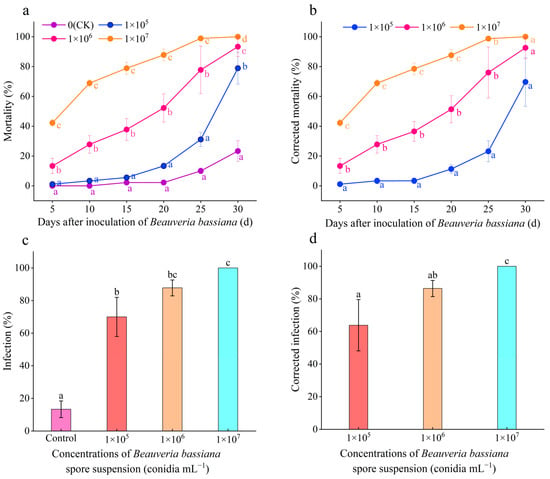
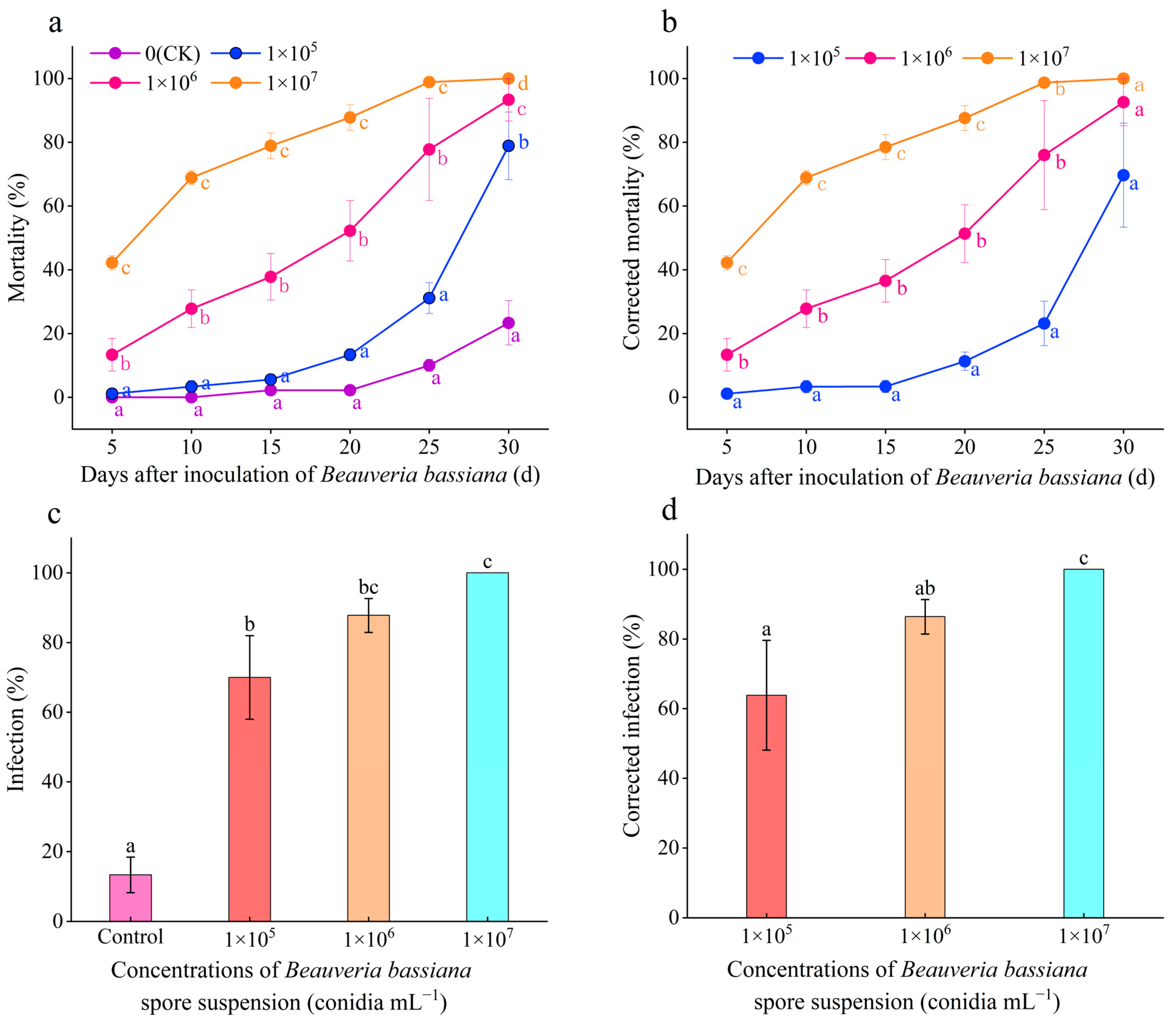
Exposure to B. bassiana significantly increased mortality of female S. guani adults in a concentration- and time-dependent manner (F3,8 = 23.685, p < 0.001; Figure 1a). During the 30-day observation period, parasitoid mortality gradually increased in all fungal treatments, whereas mortality remained low in the control group. At 30 days post-treatment, corrected mortality of S. guani adults reached 72.47%, 91.30%, and 100% following exposure to 1 × 10⁵, 1 × 10⁶, and 1 × 10⁷ conidia mL−1, respectively (Figure 1b). A similar concentration-dependent pattern was observed for fungal infection rates (F3,8 = 30.301, p < 0.001; Figure 1c). Corrected infection rates increased from 65.39% at 1 × 10⁵ conidia mL−1 to 100% at 1 × 10⁷ conidia mL−1 (Figure 1d).
Figure 1.
Effects of Beauveria bassiana concentration on mortality and infection rates of female Sclerodermus guani adults. (a) Mortality; (b) corrected mortality; (c) infection rate; (d) corrected infection rate. Different letters indicate significant differences among treatments (one-way ANOVA followed by Tukey’s HSD test, p < 0.05). Data are presented as mean ± SE. The error bars in the figure represent the standard error.
3.2. Effects of Fungal Concentration on Lethal Time of S. guani
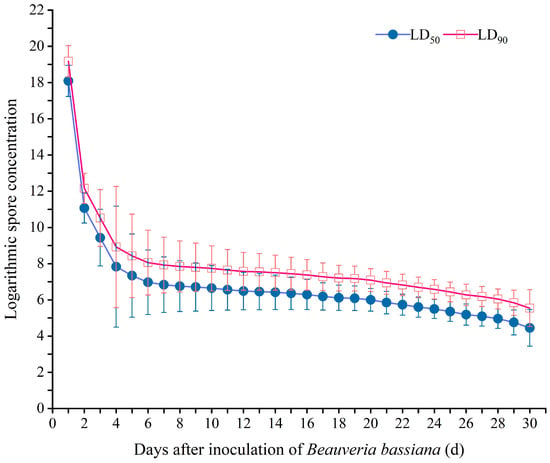
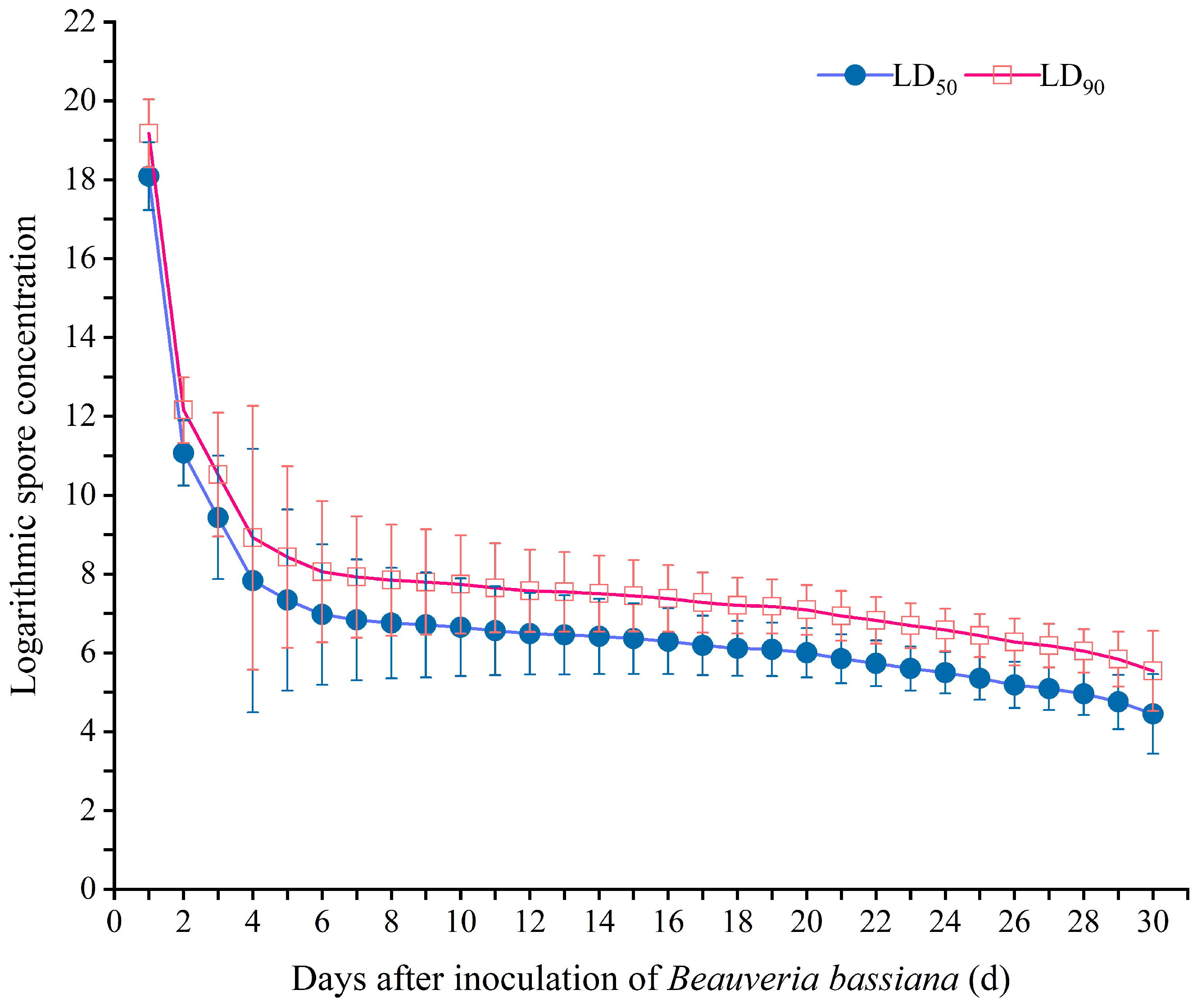
Figure 2 presents the temporal dynamics of dose effects on adult female S. guani following exposure to a conidial suspension of B. bassiana. The results showed that the conidial concentration gradually decreased over time after inoculation, with a more pronounced decline during the early stage. As the days post-inoculation increased, the logarithmic value of the conidial concentration exhibited an overall downward trend: the log-concentration decreased rapidly during the initial period (0–4 d), and then the decline rate gradually slowed, with the curve leveling off. This indicates that higher inoculation concentrations led to shorter times required to achieve 50% and 90% mortality, corresponding to a more significant time effect; meanwhile, as the infection days increased, the LD50 and LD90 values continued to decrease, reflecting a progressively intensified dose effect. The lethal time required to kill S. guani adults decreased with increasing fungal concentration. The estimated LT50 values were 27.69, 20.00, and 5.92 days for 1 × 10⁵, 1 × 10⁶, and 1 × 10⁷ conidia mL−1 treatments, respectively (Table 1). Similarly, LT90 values decreased from 28.26 days at 1 × 10⁶ conidia mL−1 to 20.61 days at 1 × 10⁷ conidia mL−1. The LT90 value was not estimated for the lowest concentration because mortality did not reach 90% during the experimental period. The time–dose–mortality model showed a good fit to the observed mortality data of S. guani after B. bassiana exposure (Hosmer Lemeshow test: χ2 = 4.8969, df = 8, p = 0.7685). The nonsignificant goodness-of-fit test indicated that the predicted mortality closely matched the observed values. The model demonstrated that both fungal concentration and exposure duration significantly influenced parasitoid mortality. The estimated slope parameter (β = 1.1042, p < 0.001) indicated a positive relationship between fungal dose and mortality risk (Table S1). Linear regression fitting plots (Figure S1a–c) showed that the corrected mortality, corrected infection rate, and parasitization success rate of female S. guani adults were significantly linearly related to B. bassiana concentration.
Figure 2.
Temporal dynamics of estimated lethal dose of the female adults of Sclerodermus guani infected by Beauveria bassiana.
Table 1.
Estimated lethal time of Sclerodermus guani after treatment of female adults with Beauveria bassiana across various time periods.
3.3. Effects of B. bassiana Exposure on Parasitization Performance and Offspring Development of S. guani
Exposure to B. bassiana did not prevent female S. guani from attacking and suppressing M. alternatus larvae. Host mortality reached 100% in all treatments, including the control group, indicating that fungal exposure did not impair the host-killing ability of S. guani (Table 2). However, the parasitism success rate significantly decreased with increasing fungal concentration (F3,12 = 4.222, p < 0.05), dropping to 55.0% at the highest concentration (Table 2).
Table 2.
Effects of Beauveria bassiana exposure on host mortality, parasitization performance, and fungal infection of Monochamus alternatus by Sclerodermus guani.
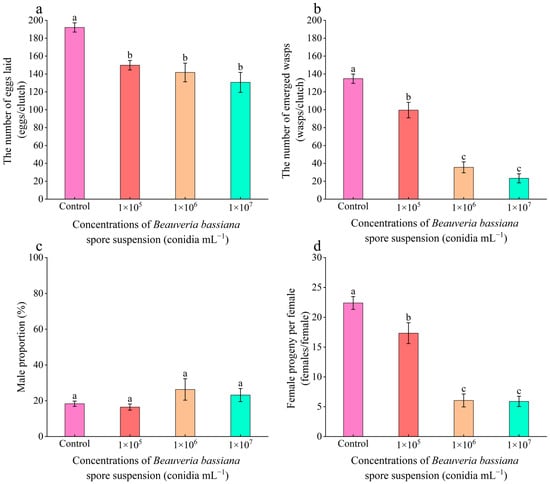
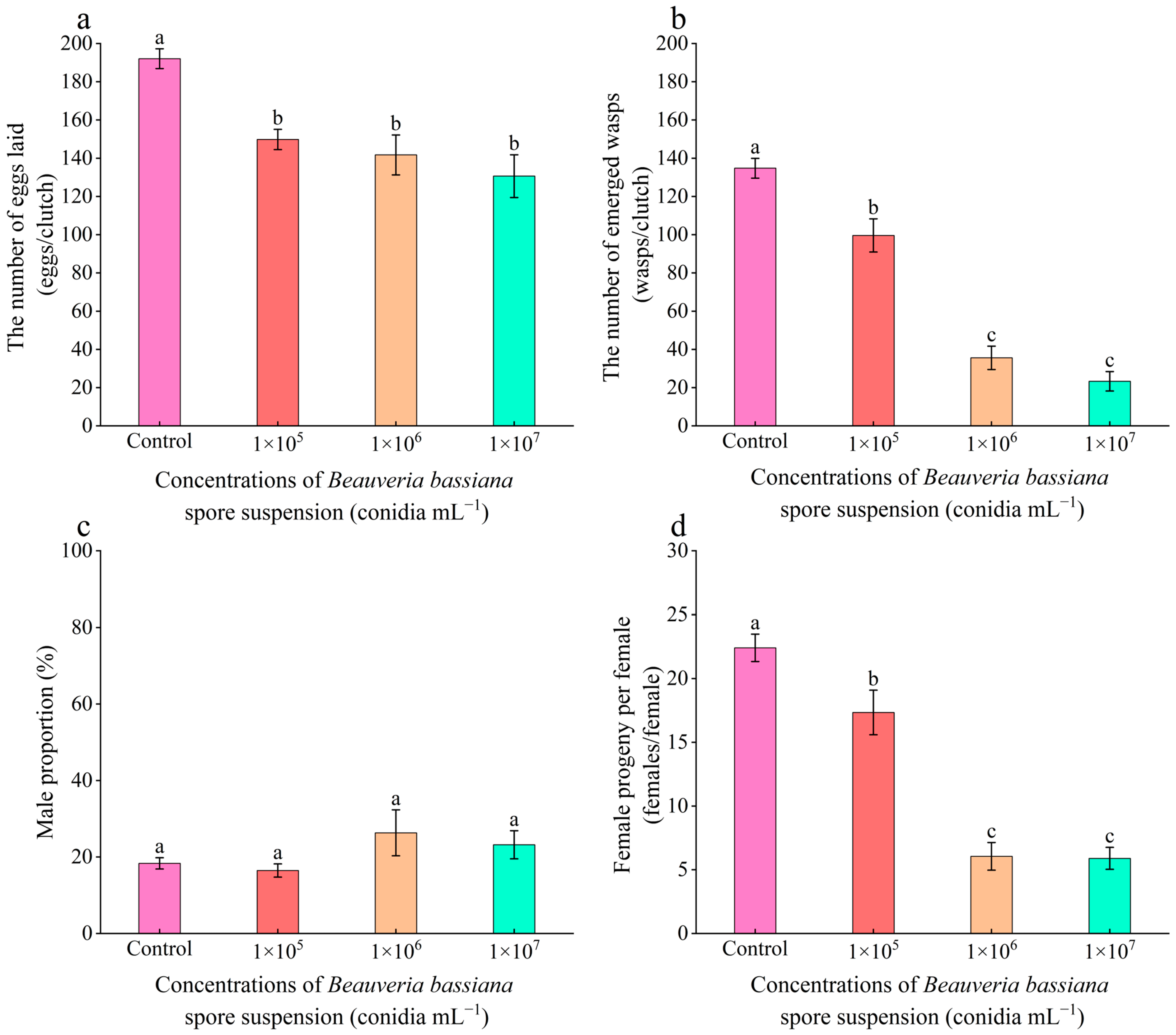
Fungal exposure also influenced the reproductive performance of female S. guani. The number of eggs produced per clutch decreased significantly with increasing fungal concentration (F3,76 = 5.240, p < 0.05), although females exposed to the lowest fungal concentration still produced an average of 130.61 eggs per clutch (Figure 3a). Similarly, the number of emerged offspring per clutch and female offspring produced per female were significantly reduced under higher fungal exposure levels (F3,76 = 59.887, p < 0.001), whereas the proportion of male offspring was not significantly affected (F3,76 = 1.590, p > 0.05) (Figure 3b–d).
Figure 3.
Fecundity of Sclerodermus guani after being inoculated with various concentrations of Beauveria bassiana. (a) The number of eggs laid per clutch, (b) the number of emerged wasps per clutch, (c) male proportion, (d) female progeny per female. Different letters above the bars show statistically significant differences (LSD, p < 0.05) among the values (means ± SEs).
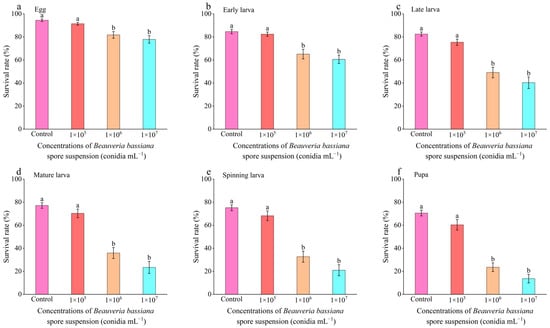
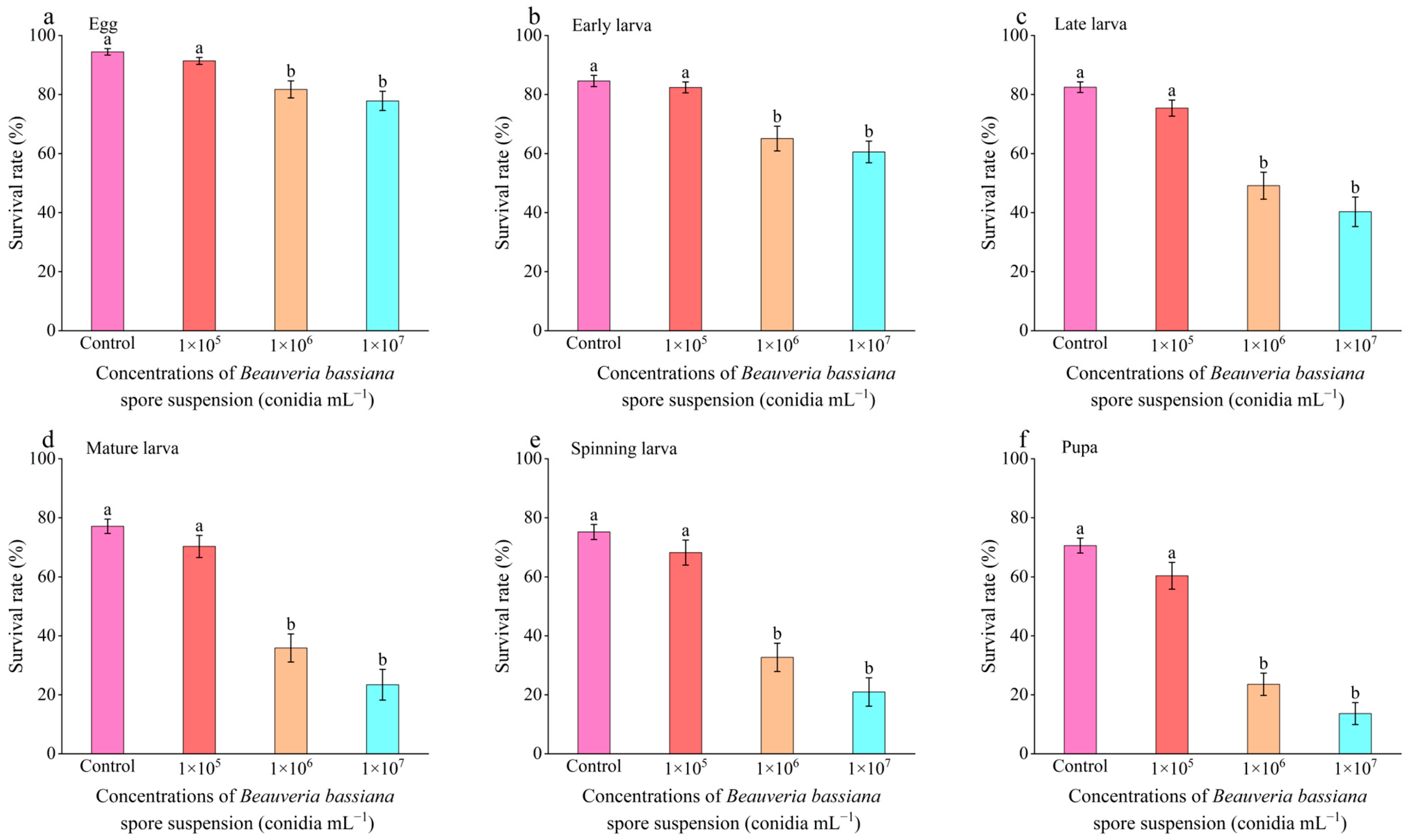
Fungal exposure significantly decreased offspring survival, especially during the late-larval and pupal periods (egg stage: F3,76 = 11.870, p < 0.001; early larval stage: F3,76 = 15.592, p < 0.001; late larval stage: F3,76 = 29.931, p < 0.001; mature larval stage: F3,76 = 36.613, p < 0.001; spinning larval stage: F3,76 = 39.781, p < 0.001; pupal stage: F3,76 = 54.591, p < 0.001) (Figure 4). Meanwhile, B. bassiana treatment also delayed offspring development; relative to the control group, fungus-exposed parasitoids exhibited markedly prolonged developmental time at the mature-larval stage (F3,76 = 11.612, p < 0.001), pupal stage (F3,76 = 16.663, p < 0.001) and the whole-generation duration (F3,76 = 29.292, p < 0.001) (Table 3).
Figure 4.
Survival rates of Sclerodermus guani offspring at different developmental stages following inoculation with various concentrations of Beauveria bassiana. (a) Egg stage, (b) early larva stage, (c) late larva stage, (d) mature larva stage, (e) spinning larva stage, (f) pupa stage. Different letters above the bars show statistically significant differences (LSD, p < 0.05) among the values (means ± SEs).
Table 3.
Average developmental period of offspring after Sclerodermus guani female adults inoculated with various concentrations of Beauveria bassiana.
4. Discussion
The combined use of entomopathogenic fungi and natural enemies has attracted increasing attention as a sustainable strategy to enhance biological control efficacy [16,28,29]. In this study, we established an interaction system involving S. guani, M. alternatus, and B. bassiana to investigate the pathogenicity of B. bassiana to adult parasitoids and to determine whether fungal infection interferes with the parasitoid’s host-control ability and offspring development. Our results showed that female S. guani that had been exposed to the fungus were still able to parasitize M. alternatus normally; however, high fungal concentrations negatively affected parasitoid reproduction and offspring fitness. After exposure to B. bassiana, the mortality of female adult S. guani increased with increasing fungal concentration. Nevertheless, the lethal effect of the fungus was delayed, with no mortality observed on the first day post-exposure. Even at the highest spore concentration (1 × 10⁷ conidia mL−1), a prolonged exposure time was required to achieve complete mortality. In contrast, mortality occurred even later in the lower-concentration groups (1 × 10⁵ and 1 × 10⁶ conidia mL−1). Notably, when the fungal concentration was increased tenfold, the LT50 decreased from 20.00 to 5.92 days, whereas the LT90 only declined from 28.26 to 20.61 days. Such heterogeneity in susceptibility may arise from inter-individual variation in physiological condition, immune competence, or cuticular barriers. At later stages of infection, host defense mechanisms or nutritional constraints may become more influential, thereby attenuating the dose-dependent effect [30,31]. Nevertheless, previous studies have demonstrated that Trichogramma dendrolimi (Hymenoptera: Trichogrammatidae) carrying B. bassiana can reduce pest damage caused by the Asian corn borer under field conditions [19], and that Sclerodermus sichuanensis (Hymenoptera: Braconidae) loaded with fungal microcapsules can effectively infect M. alternatus larvae [20]. However, the effectiveness of a fungus-parasitoid combined biocontrol system depends not only on the pathogen’s dispersal ability, but also on the compatibility between fungal infection pressure and the fitness of the parasitoid itself.
The delayed mortality observed in S. guani suggests that parasitoids may tolerate fungal stress for a certain period after exposure, potentially allowing them to maintain essential biological functions before severe infection develops. However, increasing fungal concentration reduced parasitoid fitness, indicating that fungal exposure imposes a concentration-dependent physiological cost. Although host mortality caused by parasitoid activity remained unaffected among fungal treatments, high fungal exposure (1 × 10⁷ conidia mL−1) reduced parasitism rate and significantly decreased parasitization success. In contrast, parasitoids exposed to the low fungal concentration (1 × 10⁵ conidia mL−1) maintained parasitization success comparable with untreated individuals. These findings indicate that the application potential of fungus-associated S. guani depends on achieving an appropriate balance between fungal pathogenicity and parasitoid performance. Excessive fungal loading may accelerate parasitoid mortality and reduce population persistence, whereas moderate fungal exposure may allow parasitoids to retain sufficient host suppression ability while facilitating fungal dissemination. Therefore, optimizing fungal concentration will be critical for improving the compatibility and effectiveness of B. bassiana–S. guani combined biological control systems.
This study also revealed that the effect of B. bassiana on S. guani exhibited a clear dose-dependent pattern. At the highest conidial concentration (1 × 10⁷ conidia mL−1), the corrected mortality of the parasitoid reached 100%, and the parasitism success rate dropped to 55%, accompanied by reduced offspring survival and prolonged developmental duration, indicating that high-concentration fungal infection severely impaired the fitness of S. guani. Although the parasitism success rate remained above 50% at this concentration, it came at the cost of massive individual mortality of the parasitoid, and thus cannot be regarded as good compatibility between the two agents. At moderate concentrations, the biological control function of the parasitoid was not completely abolished but was suppressed to a certain extent; only at the lowest concentration (1 × 10⁵ conidia mL−1) did offspring survival show no significant difference from the control, suggesting that the parasitoid exhibited some tolerance under low fungal stress, possibly related to physiological compensation mechanisms under sublethal pressure. Overall, B. bassiana and S. guani are not universally compatible; rather, they show limited compatibility only at low concentrations, and this compatibility rapidly diminishes with increasing concentration. Previous studies have also found that sublethal doses of avermectin can affect offspring survival and adult reproductive capacity in Sclerodermus species, but the impact on overall population proliferation is limited [32,33]. Although moderate fungal infection caused only minor fitness costs, female S. guani were still able to perform basic life activities such as host searching and progeny production, though the underlying physiological mechanisms remain unclear [21,22,34].
However, we observed fungal infection symptoms on the surface of M. alternatus larvae following parasitism by female S. guani that had been exposed to B. bassiana, which may hint at the potential for parasitoid-mediated fungal dispersal [35,36,37]. In addition, we did not include a control treatment in which M. alternatus was exposed to B. bassiana alone without parasitoids, which prevents us from distinguishing parasitoid-mediated transmission from residual fungal contamination. Consequently, the relative importance of these two pathways remains unclear in our data. Future experiments could be directed toward targeted quantitative studies, including the assessment of fungal carriage and transmission efficiency under both laboratory and field conditions. Although fungus-associated parasitoid strategies have potential advantages, possible ecological risks should not be overlooked. The dispersal of B. bassiana by parasitoids may increase pathogen exposure to non-target arthropods under field conditions [12]. Therefore, future applications should consider establishing a multi-factor optimization framework that integrates fungal concentration, release timing, parasitoid-to-host ratios, and environmental conditions, so as to maximize the suppression of wood-boring pests such as M. alternatus while minimizing non-target effects. We suggest that initial field trials adopt a stepwise approach. First, the minimum effective fungal concentration that achieves satisfactory target pest mortality without compromising parasitoid fitness should be determined based on dose–response assays under semi-field conditions. Simultaneously, release timing should be optimized to synchronize parasitoid activity with the peak vulnerability period of the host, thereby reducing fungal persistence in the environment and the associated risks of non-target exposure [38,39,40]. Adjusting the parasitoid-to-host ratio according to local pest density is equally important to avoid over-application. Before large-scale implementation, long-term ecological studies are needed to assess fungal persistence, horizontal transmission dynamics, and cascading effects on non-target organisms [41]. Ultimately, optimizing the compatibility between parasitoid fitness and fungal transmission efficiency through iterative feedback between laboratory experiments and field monitoring will determine the practical value of this combined biological control strategy [42,43].
5. Conclusions
This study clearly demonstrated the concentration-dependent pathogenicity of B. bassiana against S. guani and evaluated the effects of fungal exposure on the parasitoid-mediated suppression of M. alternatus. The results showed that B. bassiana negatively affected adult survival and offspring fitness of S. guani, and these effects intensified with increasing concentration. At the highest concentration (1 × 10⁷ conidia mL−1), offspring survival decreased, and developmental duration was prolonged, indicating that high fungal concentrations are incompatible with the parasitoid; only at the lowest concentration (1 × 10⁵ conidia mL−1) did offspring survival remain unaffected. Moderate concentrations retained partial parasitism capacity but incurred significant fitness costs. Therefore, the compatibility between B. bassiana and S. guani is conditional, depending on the applied concentration, rather than universal. In practical combined applications, low-concentration fungal formulations should be prioritized to avoid the serious impacts of high-concentration treatments on parasitoid populations. Overall, the combined use of the fungus and the parasitoid for controlling M. alternatus holds some potential, but this potential is highly dependent on concentration optimization, and further quantification of fungal carriage efficiency, evaluation of field transmission dynamics, and assessment of ecological safety are still required to provide a reliable basis for practical application.
Supplementary Materials
The following supporting information can be downloaded at https://www.mdpi.com/article/10.3390/horticulturae12081003/s1, Table S1. The TDM model simulation and parameter estimation of Beauveria bassiana on Sclerodermus guani. Figure S1. Log10-transformed concentration-dependent linear regressions for corrected mortality, corrected infection rate, and parasitism success rate in Sceloderma guani infected with Beauveria bassiana. (a) Fitted curve of corrected mortality versus Beauveria bassiana spore concentration; (b) fitted curve of corrected infection rate versus Beauveria bassiana spore concentration; (c) fitted curve of parasitism success rate versus Beauveria bassiana spore concentration.
Author Contributions
Conceptualization: L.L. and S.W.; data curation: H.Y. and S.W.; formal analysis: S.W. and L.L.; funding acquisition: L.L.; methodology: H.Y., L.L. and Y.W.; project administration: L.L.; resources: L.L.; supervision: L.L.; validation: H.Y., S.W. and M.F.; visualization: H.Y. and S.W.; writing—original draft: L.L., H.Y. and S.W.; writing—review and editing: L.L. and H.Y. All authors have read and agreed to the published version of the manuscript.
Funding
This research was funded by open access funding supported by the National Natural Science Foundation of China (grant no. 32060342), Guizhou Normal University National Natural Science Foundation Cultivation Project Funding (grant no. GJPY [2026] 16), Guizhou Key Laboratory of Forest Cultivation in Plateau Mountain [Qiankehepingtai ZSYS (2025) 025].
Data Availability Statement
The raw data supporting the conclusions of this article will be made available by the authors on request.
Acknowledgments
We sincerely thank Qinghuai Luo for advice on parasitoid biological attributes.
Conflicts of Interest
The authors declare no conflict of interest.
Abbreviations
The following abbreviations are used in this manuscript:
| PWD | Pine wilt disease |
| TDM | Time–dose–mortality model |
| S. guani | Sclerodermus guani (Hymenoptera: Bethylidae) |
| B. bassiana | Beauveria bassiana (Hypocreales: Cordycipitaceae) |
| M. alternatus | Monochamus alternatus (Coleoptera: Cerambycidae) |
References
- Fonseca, L.; Silva, H.; Cardoso, S.M.J.; Esteves, I.; Maleita, C.; Lopes, S.; Abrantes, I. Bursaphelenchus xylophilus in Pinus sylvestris—The First Report in Europe. Forests 2024, 15, 1556. [Google Scholar] [CrossRef] [Scilit]
- Abelleira, A.; Picoaga, A.; Mansilla, J.P.; Aguin, O. Detection of Bursaphelenchus xylophilus, causal agent of pine wilt disease on Pinus pinaster in Northwestern Spain. Plant Dis. 2011, 95, 776. [Google Scholar] [CrossRef] [Scilit] [PubMed]
- Futai, K. Pine wood nematode, Bursaphelenchus xylophilus. Annu. Rev. Phytopathol. 2013, 51, 61–83. [Google Scholar] [CrossRef] [Scilit] [PubMed]
- Wu, W.B.; Zhang, Z.B.; Zheng, L.J.; Han, C.Y.; Wang, X.M.; Xu, J.; Wang, X.R. Research progress on the early monitoring of pine wilt disease using hyperspectral techniques. Sensors 2020, 20, 3729. [Google Scholar] [CrossRef] [Scilit] [PubMed]
- Ye, Z.X.; Lin, Y.; Chen, F.M.; Ye, J.R.; Chen, J.P.; Zhu, L.H. Identification and characterization of two novel RNA viruses in the pine wood nematode Bursaphelenchus xylophilus. Phytopathol. Res. 2025, 7, 70. [Google Scholar] [CrossRef] [Scilit]
- Jikumaru, S.; Togashi, K. Temperature effects on the transmission of Bursaphelenchus xylophilus (Nemata: Aphelenchoididae) by Monochamus alternatus (Coleoptera: Cerambycidae). J. Nematol. 2000, 32, 110–116. [Google Scholar]
- Katsumi, T.; Yoh, A. Horizontal transmission of Bursaphelenchus xylophilus between sexes of Monochamus alternatus. J. Nematol. 2003, 35, 7–16. [Google Scholar]
- Ozawa, S.; Maehara, N.; Takatsuka, J.; Aikawa, T.; Nakamura, K. Insecticidal effect of the entomopathogenic nematode Heterorhabditis megidis (Nematoda: Heterorhabditidae) baited from the soil on the larvae of Monochamus alternatus (Coleoptera: Cerambycidae). Appl. Entomol. Zool. 2023, 58, 197–203. [Google Scholar] [CrossRef] [Scilit]
- Yang, Z.Q.; Wang, X.Y.; Cao, L.M.; Yao, Y.X.; Tang, Y.L. Re-description of Sclerodermus guani and revision of the genus (Hymenoptera: Bethylidae) in China. Chin. J. Biol. Control. 2014, 30, 1–12. [Google Scholar] [CrossRef]
- Lai, Y.X.; Yang, Z.Q.; Wang, X.Y.; Wang, Y.H.; Cen, D.H.; Wei, J.R.; Tang, Y.L. Preliminary study on the phenomenon of delayed development of Monochamus alternatus larvae induced by Scleroderma guani. Chin. J. Biol. Control. 2015, 31, 305–311. [Google Scholar] [CrossRef]
- Zeng, J.Y.; Bai, J.W.; Wang, H.L.; Su, X.Y.; Wang, X.F.; Fu, N.N.; Li, H.P. Beauveria bassiana (Ascomycota: Hypocreales) spores carried by Scleroderma guani (Hymenoptera: Bethylidae): A novel strategy for improving the control efficiency of Semanotus bifasciatus (Coleoptera: Cerambycidae) in the field. BioControl 2024, 69, 427–436. [Google Scholar] [CrossRef] [Scilit]
- Zimmermann, G. Review on safety of the entomopathogenic fungi Beauveria bassiana and Beauveria brongniartii. Biocontrol Sci. Technol. 2007, 17, 553–596. [Google Scholar] [CrossRef] [Scilit]
- McGuire, A.V.; Northfield, T.D. Tropical occurrence and agricultural importance of Beauveria bassiana and Metarhizium anisopliae. Front. Sustain. Food Syst. 2020, 4, 6. [Google Scholar] [CrossRef] [Scilit]
- Wang, Y.; Fan, Q.; Wang, D.; Zou, W.Q.; Tang, D.X.; Hongthong, P.; Yu, H. Species diversity and virulence potential of the Beauveria bassiana complex and Beauveria scarabaeidicola complex. Front. Microbiol. 2022, 13, 841604. [Google Scholar] [CrossRef] [Scilit] [PubMed]
- Shah, P.A.; Pell, J.K. Entomopathogenic fungi as biological control agents. Appl. Microbiol. Biotechnol. 2003, 61, 413–423. [Google Scholar] [CrossRef] [Scilit] [PubMed]
- Mohammed, A.A.; Hatcher, P.E. Combining entomopathogenic fungi and parasitoids to control the green peach aphid Myzus persicae. Biol. Control. 2017, 110, 44–55. [Google Scholar] [CrossRef] [Scilit]
- Wang, P.; Li, M.J.; Bai, Q.R.; Ali, A.; Desneux, N.; Dai, H.J.; Zang, L.S. Performance of Trichogramma japonicum as a vector of Beauveria bassiana for parasitizing eggs of rice striped stem borer, Chilo suppressalis. Entomol. Gen. 2021, 41, 147–155. [Google Scholar] [CrossRef] [Scilit] [PubMed]
- Zhao, Z.P.; Ji, B.Z.; Liu, S.W.; Cao, D.D.; Wang, L.P.; Xu, Z.X. Research progress on biological control utilizing insect-carried pathogens. J. Nanjing For. Univ. (Nat. Sci. Ed.) 2015, 39, 155–162. [Google Scholar] [CrossRef]
- Yang, Z.; Lu, Y.; Mao, G.; Zhao, Y.; Zhang, Q.H.; Sui, L.; Zhao, Y.; Li, Q.Y.; Zhang, Z.K. Use of Trichogramma phoretic Beauveria bassiana in control of Asian corn borer in field. Chin. J. Biol. Control. 2020, 36, 52–57. [Google Scholar] [CrossRef]
- Lei, L.; Li, Y.; Lu, L.; Yang, S.B.; Yang, H. Scleroderma sichuanensis carrying Beauveria bassiana microcapsules to control Monochamus alternatus. J. Sichuan For. Sci. Technol. 2023, 44, 38–43. [Google Scholar] [CrossRef]
- Cappa, F.; De Fazi, L.; Baracchi, D.; Cervo, R. Adverse effects of the fungal biopesticide Beauveria bassiana on a predatory social wasp. Sci. Total Environ. 2024, 908, 168202. [Google Scholar] [CrossRef] [Scilit] [PubMed]
- Martínez-Barrera, O.Y.; Toledo, J.; Liedo, P.; Gómez, J.; Valle-Mora, J.; Cancino, J.; Montoya, P. Does Beauveria bassiana (Hypocreales: Cordycipitaceae) Affect the Survival and Fecundity of the Parasitoid Coptera haywardi (Hymenoptera: Diapriidae)? Environ. Entomol. 2019, 48, 156–162. [Google Scholar] [CrossRef] [Scilit] [PubMed]
- Miranda-Fuentes, P.; Yousef-Yousef, M.; Valverde-García, P.; Rodríguez-Gómez, I.M.; Garrido-Jurado, I.; Quesada-Moraga, E. Entomopathogenic fungal endophyte-mediated tritrophic interactions between Spodoptera littoralis and its parasitoid Hyposoter didymator. J. Pest Sci. 2021, 94, 933–945. [Google Scholar] [CrossRef] [Scilit]
- Miranda-Fuentes, P.; Quesada-Moraga, E.; Aldebis, H.K.; Yousef-Naef, M. Compatibility between the endoparasitoid Hyposoter didymator and the entomopathogenic fungus Metarhizium brunneum: A laboratory simulation for the simultaneous use to control Spodoptera littoralis. Pest Manag. Sci. 2020, 76, 1060–1070. [Google Scholar] [CrossRef] [Scilit] [PubMed]
- Chen, Y.N.; Wu, S.S.; Li, L. Effects of the Stress of Beauveria bassiana on the Reproductive Success of an Idiobiont Parasitoid, Sclerodermus guani. Insects 2026, 17, 278. [Google Scholar] [CrossRef] [Scilit]
- Wei, Y.; Li, L.; Zhang, M.M.; Pan, S.M. Intergenerational effects of the entomopathogen Beauveria bassiana on the mortality and parasitism of the ectoparasitoid Sclerodermus guani (Hymenoptera: Bethylidae). Acta Entomol. Sin. 2023, 66, 1385–1403. [Google Scholar] [CrossRef]
- Huang, W.Y.; Li, L. Parental care behavior of Sclerodermus guani benefits offspring growth and development. Acta Entomol. Sin. 2017, 60, 441–449. [Google Scholar] [CrossRef]
- Roy, E.H.; Pell, J.K. Interactions Between Entomopathogenic Fungi and Other Natural Enemies: Implications for Biological Control. Biocontrol Sci. Technol. 2000, 10, 737–752. [Google Scholar] [CrossRef] [Scilit]
- Li, H.; Han, X.; Zhao, Y. Potential use of Beauveria bassiana in combination with Scleroderma guani for improved control of Apriona germari. Can. J. For. Res. 2017, 47, 10–15. [Google Scholar] [CrossRef] [Scilit]
- Asadi, A.; Karimi, J.; Abbasipour, H. The effect of sublethal concentrations of malathion on some biological parameters of the ectoparasitoid wasp, Habrobracon hebetor (Say, 1836). Acta Agric. Slov. 2018, 111, 639–646. [Google Scholar] [CrossRef] [Scilit][Green Version]
- Yang, Q.P.; Li, L. Negative influence of Beauveria bassiana infection on female adults of a cryptoparasitoid Scleroderma guani (Hymenoptera: Bethylidae). Acta Entomol. Sin. 2017, 60, 53–59. [Google Scholar] [CrossRef]
- Li, F.; He, S.L.; Zhou, C.; Chen, Z.Y.; Xu, S.; Li, X.D.; Zhang, B.C. Sublethal effects of abamectin on the parasitoid wasp of Monochamus alternatus based on age-stage two-sex life table. Acta Entomol. Sin. 2024, 67, 1221–1228. [Google Scholar] [CrossRef]
- Li, M.; Wang, W.Z.; Xu, C.L.; Yang, S.H.; Chen, C.; Xie, H. Sublethal effects of abamectin on Blattisocius sp. (a predatory mite) and control efficacy against root-knot nematodes by releasing the mite in different ways. Chin. J. Biol. Control. 2018, 34, 818–824. [Google Scholar] [CrossRef]
- Kong, Y.J.; Nan, Y.H.; Sun, H.Q.; Wei, K.; Wei, J.R. Non-contact effects of the parsitoid Scleroderma guani on its two cerambycid host species. BioControl 2026, 71, 283–293. [Google Scholar] [CrossRef] [Scilit]
- Li, H.; Zhou, G.Y.; Liu, J.N.; Zhang, H.Y. Control method, pathogenic mechanism, pathogeny, pine, pine wilt disease. Appl. Mech. Mater. 2011, 55–57, 567–572. [Google Scholar] [CrossRef] [Scilit]
- Silva, R.J.; Alencar, J.R.; Silva, K.P.; Cividanes, F.J.; Duarte, R.T.; Agostini, L.T.; Polanczyk, R.A. Interactions between the entomopathogenic fungi Beauveria bassiana (Ascomycota: Hypocreales) and the aphid parasitoid Diaeretiella rapae (Hymenoptera: Braconidae) on Myzus persicae (Hemiptera: Aphididae). J. Econ. Entomol. 2014, 107, 933–938. [Google Scholar] [CrossRef] [Scilit] [PubMed]
- Kryukov, V.Y.; Kryukova, N.A.; Tyurin, M.V.; Yaroslavtseva, O.N.; Glupov, V.V. Passive vectoring of entomopathogenic fungus Beauveria bassiana among the wax moth Galleria mellonella larvae by the ectoparasitoid Habrobracon hebetor females. Insect Sci. 2017, 25, 643–654. [Google Scholar] [CrossRef] [Scilit] [PubMed]
- Itioka, T.; Inoue, T.; Matsumoto, T.; Ishida, N. Biological control by two exotic parasitoids: Eight-year population dynamics and life tables of the arrowhead scale. Exp. Appl. 1997, 85, 65–74. [Google Scholar] [CrossRef] [Scilit]
- Labbé, R.M.; Gillespie, D.R.; Cloutier, C.; Brodeur, J. Compatibility of an entomopathogenic fungus with a predator and a parasitoid in the biological control of greenhouse whitefly. Biocontrol Sci. Technol. 2009, 19, 429–446. [Google Scholar] [CrossRef] [Scilit]
- Kang, W.T.; Tang, C.S.; Liang, N.; Chen, S.Y.; Huang, J.S.; Chen, Q.L.; Chen, J.W.; He, X.Y.; Yang, X. Forest control of Monochamus alternatus using Scleroderma guani. J. Fujian Agric. For. Univ. (Nat. Sci. Ed.) 2008, 278, 575–579. [Google Scholar] [CrossRef]
- Shields, M.W.; Wratten, S.D.; Van Koten, C.; Phillips, C.B.; Gerard, P.J.; Goldson, S.L. Behaviour drives contemporary evolution in a failing insect-parasitoid importation biological control programme. Front. Ecol. Evol. 2022, 10, 923248. [Google Scholar] [CrossRef] [Scilit]
- Liu, J.X.; Zhu, Z.Y.; Tian, L.X.; Wang, J.; Wang, S.; Zhang, F.; Di, N. Evaluation of the combined application of Orius sauteri and Metarhizium anisopliae on controlling Frankliniella occidentalis and Bemisia tabaci. Plant Prot. 2023, 49, 310–316+322. [Google Scholar] [CrossRef]
- George, D.; Duan, J.J.; Tallamy, D.; Slager, B.H. Effects of parental diapause status and release time on field reproductive biology of the introduced egg parasitoid, Oobius agrili (Hymenoptera: Encyrtidae) in the Mid-Atlantic: Implications for biocontrol of the emerald ash borer (Coleoptera: Buprestidae). Biol. Control. 2020, 149, 104342. [Google Scholar] [CrossRef] [Scilit]

Disclaimer/Publisher’s Note: The statements, opinions and data contained in all publications are solely those of the individual author(s) and contributor(s) and not of MDPI and/or the editor(s). MDPI and/or the editor(s) disclaim responsibility for any injury to people or property resulting from any ideas, methods, instructions or products referred to in the content. |
© 2026 by the authors. Licensee MDPI, Basel, Switzerland. This article is an open access article distributed under the terms and conditions of the Creative Commons Attribution (CC BY) license.