
Use of White Non-Woven Polyester Sheets (TNTs) to Control Photoinhibition, Berry Dehydration, and Extreme Heat in the Vineyard

 ,
,  , ,
, ,
Abstract
1. Introduction
2. Materials and Methods
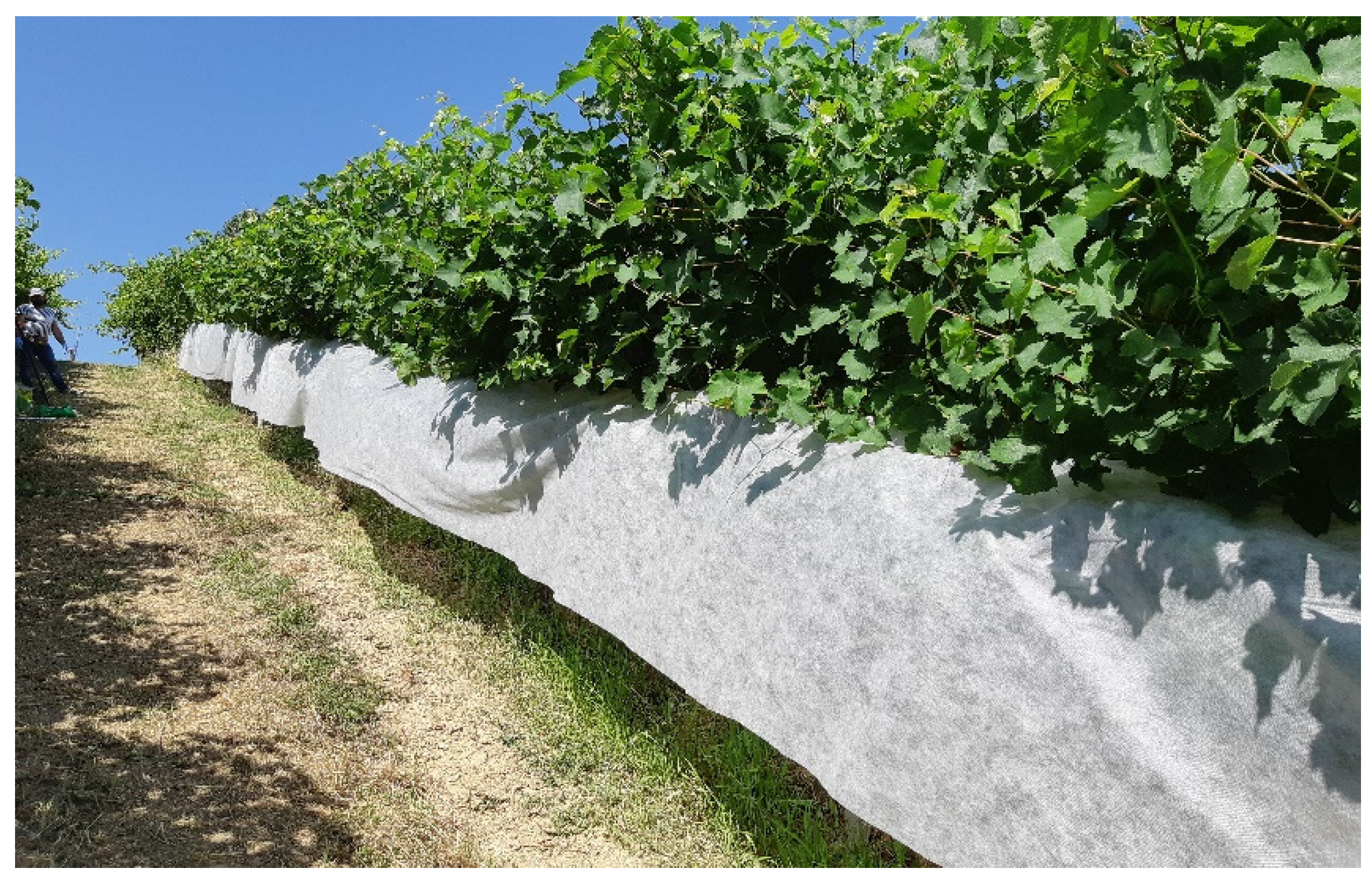
2.1. Plant Material, Site Location, and Experimental Design
2.2. Gas Exchange and Chlorophyll Fluorescence Measurements and Canopy Light Characteristics
2.3. Yield and Grape Composition
2.4. Statistical Analysis
3. Results
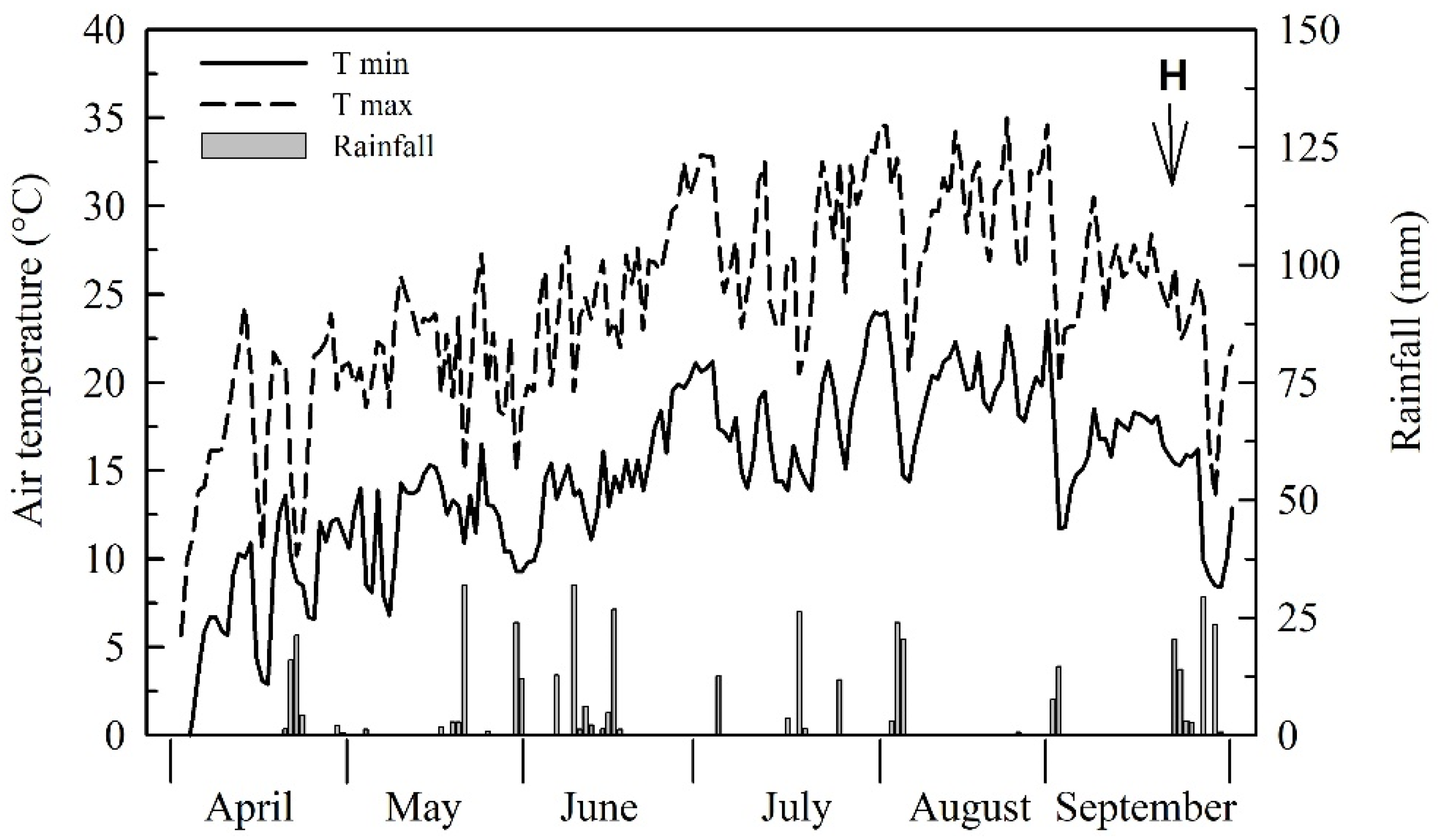
3.1. Meteorological Data
3.2. Physiological Parameters
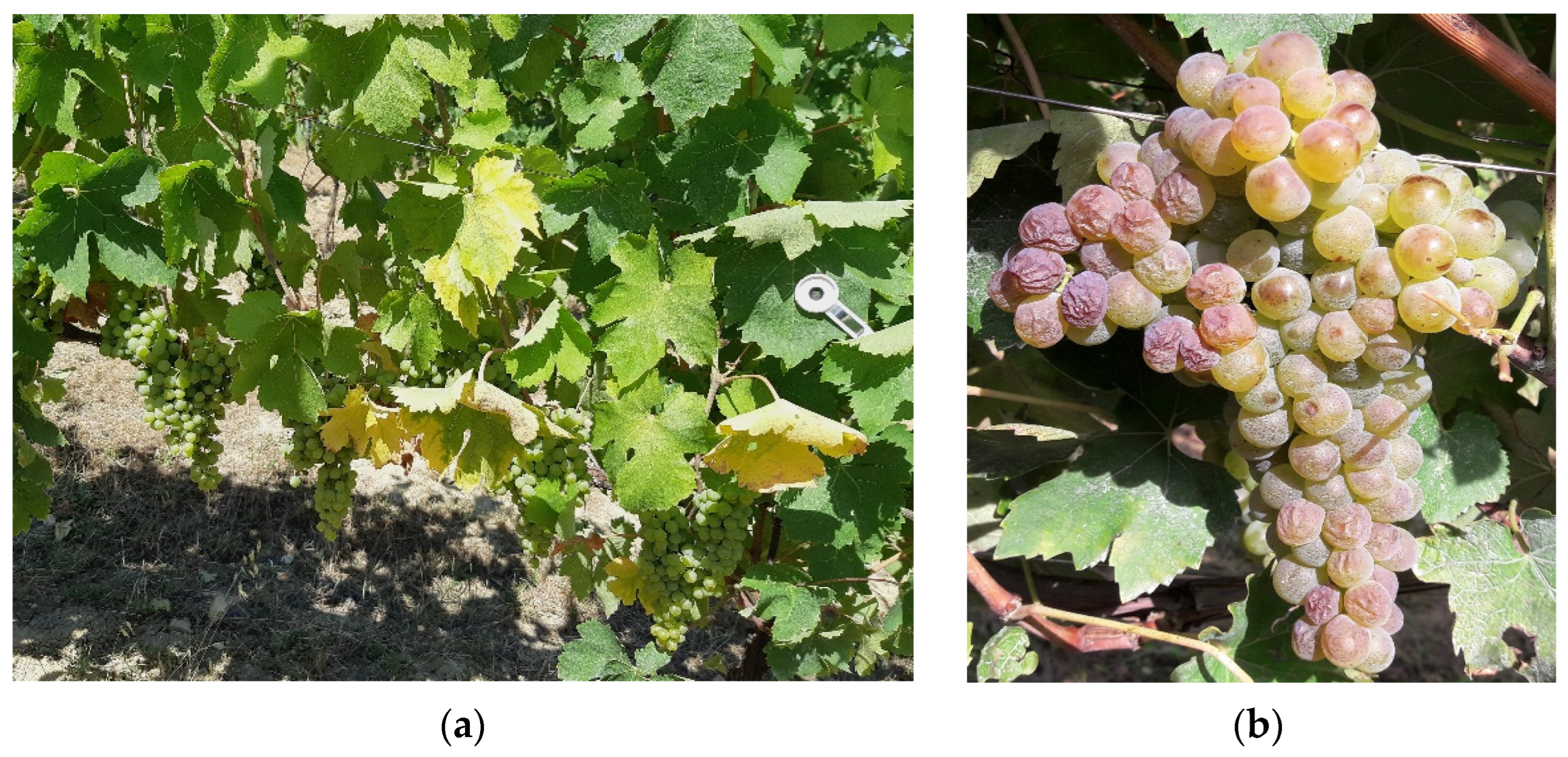
3.3. Vine Yield and Grape Composition at Harvest
4. Discussion
5. Conclusions
Author Contributions
Funding
Data Availability Statement
Conflicts of Interest
References
- Lionello, P.; Scarascia, L. The relation between climate change in the Mediterranean region and global warming. Reg. Environ. Change 2018, 18, 1481–1493. [Google Scholar] [CrossRef] [Scilit]
- Van Leeuwen, C.; Destrac-Irvine, A.; Dubernet, M.; Duchêne, E.; Gowdy, M.; Marguerit, E.; Pieri, P.; Parker, A.; De Rességuier, L.; Ollat, N. An update on the impact of climate change in viticulture and potential adaptations. Agronomy 2019, 9, 514. [Google Scholar] [CrossRef] [Scilit]
- Torres, N.; Martínez-Lüscher, J.; Porte, E.; Kurtural, S.K. Optimal ranges and thresholds of grape berry solar radiation for flavonoid biosynthesis in warm climates. Front. Plant Sci. 2020, 11, 931. [Google Scholar] [CrossRef] [Scilit]
- Martínez-Lüscher, J.; Chen, C.; Brillante, L.; Kurtural, S.K. Mitigating heat wave and exposure damage to Cabernet Sauvignon wine grape with partial shading under two irrigation amounts. Front. Plant Sci. 2020, 11, 579192. [Google Scholar] [CrossRef] [Scilit]
- Jones, G.V. Climate, grapes, and wine: Structure and suitability in a changing climate. Acta Hortic. 2012, 931, 19–28. [Google Scholar] [CrossRef] [Scilit]
- Friedel, M.; Frotscher, J.; Nitsch, M.; Hofmann, M.; Bogs, J.; Stoll, M.; Dietrich, H. Light promotes expression of monoterpene and flavonol metabolic genes and enhances flavour of winegrape berries (Vitis vinifera L. cv. Riesling). Aust. J. Grape Wine Res. 2016, 22, 409–421. [Google Scholar] [CrossRef] [Scilit]
- Mori, K.; Goto-Yamamoto, G.; Kitayama, M.; Hashizume, K. Loss of anthocyanins in red-wine grape under high temperature. J. Exp. Bot. 2007, 58, 1935–1945. [Google Scholar] [CrossRef] [Scilit] [PubMed]
- Keller, M. Managing grapevines to optimise fruit development in a challenging environment: A climate change primer for viticulturists. Aust. J. Grape Wine Res. 2010, 16, 56–69. [Google Scholar] [CrossRef] [Scilit]
- Dinis, L.-T.; Bernardo, S.; Matos, C.; Malheiro, A.; Flores, R.; Alves, S.; Costa, C.; Rocha, S.; Correia, C.; Luzio, A.; et al. Overview of kaolin outcomes from vine to wine: Cerceal white variety case study. Agronomy 2020, 10, 1422. [Google Scholar] [CrossRef] [Scilit]
- Smart, R.E.; Dick, J.K.; Gravett, I.M.; Fisher, B.M. Canopy management to improve grape yield and wine quality—Principles and practices. S. Afr. J. Enol. Vitic. 1990, 11, 3–17. [Google Scholar] [CrossRef] [Scilit]
- Palliotti, A.; Tombesi, S.; Silvestroni, O.; Lanari, V.; Gatti, M.; Poni, S. Changes in vineyard establishment and canopy management urged by earlier climate-related grape ripening: A review. Sci. Hortic. 2014, 178, 43–54. [Google Scholar] [CrossRef] [Scilit]
- Gambetta, J.M.; Holzapfel, B.P.; Stoll, M.; Friedel, M. Sunburn in grapes: A review. Front. Plant Sci. 2021, 11, 604691. [Google Scholar] [CrossRef] [Scilit]
- Giordano, L.; Frioni, T.; Nicolosi, E.; Rapisarda, L.; Ferlito, F.; Las Casas, G.; Alfieri, G.; Bellincontro, A.; Collins, C.; Cinosi, N.; et al. New bio-protector for combating heat and light stress across different grape cultivars and environments. OENO One 2025, 59, 4. [Google Scholar] [CrossRef] [Scilit]
- Cartechini, A.; Palliotti, A. Effect of shading on vine morphology and productivity and leaf gas exchange characteristics in grapevines in the field. Am. J. Enol. Vitic. 1995, 46, 227–234. [Google Scholar] [CrossRef] [Scilit]
- Martìnez-Luscher, J.; Lee Chen, C.C.; Brillante, L.; Kurtural, S.K. Partial solar radiation exclusion with color shade nets reduces the degradation of organic acids and flavonoids of grape berry (Vitis vinifera L.). J. Agric. Food Chem. 2017, 65, 10693–10702. [Google Scholar] [CrossRef] [Scilit]
- Pallotti, L.; Silvestroni, O.; Dottori, E.; Lattanzi, T.; Lanari, V. Effects of shading net as a form of adaptation to climate change on grapes production: A review. OENO One 2023, 57, 467–476. [Google Scholar] [CrossRef] [Scilit]
- Pallotti, L.; Dottori, E.; Lattanzi, T.; Lanari, V.; Brillante, L.; Silvestroni, O. Anti-hail shading net and kaolin application: Protecting grape production to ensure grape quality in Mediterranean vineyards. Horticulturae 2025, 11, 110. [Google Scholar] [CrossRef] [Scilit]
- Marigliano, L.E.; Yu, R.; Torres, N.; Tanner, J.D.; Battany, M.; Kurtural, S.K. Photoselective shade films mitigate heat wave damage by reducing anthocyanin and flavonol degradation in grapevine (Vitis vinifera L.) berries. Front. Agron. 2022, 4, 898870. [Google Scholar] [CrossRef] [Scilit]
- Russel, A.W.; Cricthely, C.R.; Robinson, R.A.; Franklin, L.A.; Seaton, G.G.R.; Chow, W.S.; Anderson, J.M.; Osmond, C.B. Photosystem II regulation and dynamics of the chloroplast D1 protein in Arabidopsis leaves during photosynthesis and photoinhibition. Plant Physiol. 1995, 107, 943–952. [Google Scholar] [CrossRef] [Scilit]
- Strasser, R.J.; Srivastava, A.; Govindjee. Polyphasic chlorophyll a fluorescence transient in plants and cyanobacteria. Photochem. Photobiol. 1995, 61, 32–42. [Google Scholar] [CrossRef] [Scilit]
- Masneuf, I.; Dubourdieu, D. L’azote assimilable: Intérêt de son dosage par formoltitration; étude de quelques paramètres à l’origine des variations de sa teneur dans les moûts. Rev. Fr. Œnol. 1999, 93, 31. [Google Scholar]
- Vincent, L.A.; Peterson, T.C.; Barros, V.R.; Marino, M.B.; Rusticucci, M.; Caravajal, G.; Dias, C.G.; Garcia, R.R.; Guedes, M.G.; Alves, L.M.; et al. Observed trends in indices of daily temperature extremes in South America 1960–2000. J. Clim. 2005, 18, 5011–5023. [Google Scholar] [CrossRef] [Scilit]
- Greer, D.H.; Weston, C.; Weedon, M. Shoot architecture, growth and development dynamics of Vitis vinifera cv. Semillon vines grown in an irrigated vineyard with and without shade covering. Funct. Plant Biol. 2010, 37, 1061–1070. [Google Scholar] [CrossRef] [Scilit]
- Oliveira, M.; Teles, J.; Barbosa, P.; Olazabal, F.; Queiroz, J. Shading of the fruit zone to reduce grape yield and quality losses caused by sunburn. OENO One 2014, 48, 179–187. [Google Scholar] [CrossRef] [Scilit]
- Crouchett-Rojas, R.; Araya-Alman, M.; Verdugo-Vásquez, N.; Fourment, M.; Gutiérrez-Gamboa, G. Shading nets: A current viticultural strategy to mitigate the negative impacts of global warming on grape and wine quality. Aust. J. Grape Wine Res. 2025, 2025, 9729885. [Google Scholar] [CrossRef] [Scilit]
- Osmond, C.B.; Grace, S.C. Perspectives on photoinhibition and photorespiration in the field: Quintessential inefficiencies of the light and dark reactions of photosynthesis? J. Exp. Bot. 1995, 46, 1351–1362. [Google Scholar] [CrossRef] [Scilit]
- Lu, H.-C.; Wei, W.; Wang, Y.; Duan, C.-Q.; Chen, W.; Li, S.-D.; Wang, J. Effects of sunlight exclusion on leaf gas exchange, berry composition, and wine flavour profile of Cabernet-Sauvignon. OENO One 2021, 55, 267–283. [Google Scholar] [CrossRef] [Scilit]
- Cataldo, E.; Fucile, M.; Mattii, G.B. Effects of kaolin and shading net on the ecophysiology and berry composition of Sauvignon Blanc grapevines. Agriculture 2022, 12, 491. [Google Scholar] [CrossRef] [Scilit]
- Martínez-Lüscher, J.; Morales, F.; Sánchez-Díaz, M.; Delrot, S.; Aguirreolea, J.; Gomès, E.; Pascual, I. Climate change conditions (elevated CO2 and temperature) and UV-B radiation affect grapevine (Vitis vinifera cv. Tempranillo) leaf carbon assimilation, altering fruit ripening rates. Plant Sci. 2015, 236, 168–176. [Google Scholar] [CrossRef] [Scilit]
- Scafidi, P.; Pisciotta, A.; Patti, D.; Tamborra, P.; Di Lorenzo, R.; Barbagallo, M.G. Effect of artificial shading on the tannin accumulation and aromatic composition of the Grillo cultivar (Vitis vinifera L.). BMC Plant Biol. 2013, 13, 175. [Google Scholar] [CrossRef] [Scilit]
- Bouloumpasi, E.; Skendi, A.; Soufleros, E.H. Survey on Yeast assimilable nitrogen status of musts from native and international grape varieties: Effect of variety and climate. Fermentation 2023, 9, 773. [Google Scholar] [CrossRef] [Scilit]



| PAR | TL | Pn | gs | WUE | Fv/Fm | Area | |
|---|---|---|---|---|---|---|---|
| 12:00–13:00 | |||||||
| Leaves under the TNT | 1149 b | 31.4 b | 9.6 a | 245 a | 39.2 a | 0.77 a | 28,900 a |
| Control | 1883 a | 34.0 a | 11.7 a | 280 a | 40.8 a | 0.70 a | 27,800 a |
| 15:00–16:00 | |||||||
| Leaves under the TNT | 913 b | 31.9 b | 8.5 a | 210 a | 40.5 a | 0.78 a | 25,600 a |
| Control | 1760 a | 34.1 a | 9.2 a | 227 a | 40.9 a | 0.73 a | 26,900 a |
| PAR | TL | Pn | gs | WUE | Fv/Fm | Area | |
|---|---|---|---|---|---|---|---|
| 12:00–13:00 | |||||||
| Leaves under the TNT | 1250 b | 32.2 b | 6.2 a | 171 a | 36.0 a | 0.78 a | 25,600 a |
| Control leaves | 1956 a | 37.4 a | 6.4 a | 182 a | 34.2 a | 0.64 b | 24,600 a |
| 15:00–16:00 | |||||||
| Leaves under the TNT | 1120 b | 30.8 b | 4.8 a | 155 a | 29.5 a | 0.80 a | 22,800 a |
| Control leaves | 1890 a | 35.8 a | 4.1 a | 146 a | 28.6 a | 0.63 b | 21,500 a |
| 2020 | 2021 | Year × Treatment Interaction a | |||
|---|---|---|---|---|---|
| Control | TNT | Control | TNT | ||
| Yield/vine (kg) | 4.70 | 4.35 | 3.25 b | 3.96 a | * |
| Number of clusters/vine | 10.4 | 9.7 | 9.6 | 10.1 | ns |
| Cluster weight (g) | 455 | 448 | 336 b | 392 a | * |
| Berry weight (g) | 2.8 | 2.9 | 2.3 b | 2.9 a | * |
| Number of berries/cluster | 160 | 151 | 143 | 137 | ns |
| Number of seeds/berry | 2.3 | 2.4 | 2.5 | 2.6 | ns |
| Rachis length (cm) | 21.3 | 21.0 | 21.9 | 22.3 | ns |
| Cluster compactness b | 7.2 | 7.0 | 7.1 | 7.3 | ns |
| Sunburn clusters (%) | 13.8 a | 0 b | 24.9 a | 1.3 b | ** |
| Pruning weight (kg/vine) | 1.34 | 1.39 | 1.51 | 1.62 | ns |
| 2020 | 2021 | Year × Treatment Interaction a | |||
|---|---|---|---|---|---|
| Control | TNT | Control | TNT | ||
| Total Soluble Solids (°Brix) | 23.0 | 22.4 | 23.6 a | 21.8 b | * |
| Titratable Acidity (g/L) | 6.6 b | 7.1 a | 6.1 b | 7.0 a | * |
| Malic Acid (g/L) | 2.03 b | 2.58 a | 2.01 b | 2.60 a | * |
| Must pH | 3.10 | 3.04 | 3.18 a | 3.06 b | * |
| YAN (mg/L) b | 196 b | 284 a | 156 b | 202 a | ** |
Disclaimer/Publisher’s Note: The statements, opinions and data contained in all publications are solely those of the individual author(s) and contributor(s) and not of MDPI and/or the editor(s). MDPI and/or the editor(s) disclaim responsibility for any injury to people or property resulting from any ideas, methods, instructions or products referred to in the content. |
© 2026 by the authors. Licensee MDPI, Basel, Switzerland. This article is an open access article distributed under the terms and conditions of the Creative Commons Attribution (CC BY) license.
Share and Cite
Giordano, L.; Pallotti, L.; Lanari, V.; Silvestroni, O.; Garcia Berrios, J.; Palliotti, A. Use of White Non-Woven Polyester Sheets (TNTs) to Control Photoinhibition, Berry Dehydration, and Extreme Heat in the Vineyard. Horticulturae 2026, 12, 523. https://doi.org/10.3390/horticulturae12050523
Giordano L, Pallotti L, Lanari V, Silvestroni O, Garcia Berrios J, Palliotti A. Use of White Non-Woven Polyester Sheets (TNTs) to Control Photoinhibition, Berry Dehydration, and Extreme Heat in the Vineyard. Horticulturae. 2026; 12(5):523. https://doi.org/10.3390/horticulturae12050523
Chicago/Turabian StyleGiordano, Lucia, Luca Pallotti, Vania Lanari, Oriana Silvestroni, Julian Garcia Berrios, and Alberto Palliotti. 2026. "Use of White Non-Woven Polyester Sheets (TNTs) to Control Photoinhibition, Berry Dehydration, and Extreme Heat in the Vineyard" Horticulturae 12, no. 5: 523. https://doi.org/10.3390/horticulturae12050523
APA StyleGiordano, L., Pallotti, L., Lanari, V., Silvestroni, O., Garcia Berrios, J., & Palliotti, A. (2026). Use of White Non-Woven Polyester Sheets (TNTs) to Control Photoinhibition, Berry Dehydration, and Extreme Heat in the Vineyard. Horticulturae, 12(5), 523. https://doi.org/10.3390/horticulturae12050523