


Abstract
Understanding of carrot growth dynamics and ecophysiological functioning in tropical highland environments remains limited, despite the crop’s productive importance in the Colombian Andean region. This study aimed to characterize biomass accumulation and partitioning, as well as the photosynthetic response to radiation, in two carrot (Daucus carota L.) cultivars (Berlicum- and Flakkee-type) grown under high-altitude Andean tropical conditions in Rionegro, Antioquia. To account for field spatial heterogeneity, four beds were used as blocks, and both cultivars were evaluated in parallel under comparable field conditions. Weekly destructive samplings were performed to quantify total dry biomass, shoot biomass, root biomass, leaf number, and leaf area. In addition, the response of net CO2 assimilation to photosynthetically active radiation was evaluated using a portable gas-exchange system. Total and root biomass were described using logistic models, shoot biomass using a Gaussian model, and the photosynthetic response using an exponential model. Berlicum showed higher biomass accumulation, whereas Flakkee exhibited an earlier response of growth and photosynthetic activity. In both cultivars, the highest functional capacity was concentrated in stage III, coinciding with the strengthening of the storage-root sink. Overall, the results indicate contrasting temporal patterns in biomass partitioning and photosynthetic performance between the two carrot cultivars and provide a useful ecophysiological framework for interpreting crop management and harvest timing under high-altitude Andean tropical conditions.
1. Introduction
Carrot (Daucus carota L.) is a vegetable of high importance for food security due to its nutritional contribution and regular dietary consumption [1]; it also constitutes a relevant source of income for small and medium-scale producers in the Colombian Andean region, where most of the national planted area is concentrated [2]. In Colombia, Municipal Agricultural Evaluation (EVA) records show that Andean departments such as Boyacá, Cundinamarca, and Antioquia, along with Nariño and Norte de Santander, concentrate practically the entire cultivated area of the country, with a national surface area of approximately ten thousand hectares in 2024 [2]. Under these conditions, improving agronomic management is essential to sustain profitability, yield stability, and market quality in high-altitude Andean tropical production systems [2].
In root crops, productivity and quality depend on the synchrony between crop developmental dynamics and management practices (planting density and thinning, irrigation, fertilization, weed control, and determination of harvest timing) [3,4]. Therefore, characterizing and modeling growth dynamics, including biomass partitioning between the shoot and the storage root, provides a technical basis for more efficient management decisions tailored to each genetic plant material [3]. In carrots, the root constitutes the primary sink, and its development occurs within specific temporal windows [4]; thus, the agronomic value of describing growth stages lies not only in calendar dates but in identifying inflection points (transitions in biomass accumulation rates and leaf expansion) that allow for aligning resource supply (water and nutrients) with actual crop demand. Recent evidence under Colombian high-altitude Andean tropical conditions illustrates this need from a nutritional perspective: nutrient uptake curves and biomass accumulation vary throughout the cycle, supporting the relevance of synchronizing inputs with developmental stages [5].
A distinctive and often underestimated aspect when extrapolating recommendations from temperate zones is the behavior of biennial species like the carrot under intertropical regimes with low thermal seasonality. In the classic temperate climate model, floral induction (bolting) is a process strongly conditioned by vernalization and ontogenetic state; its premature occurrence reduces marketable yield due to lignification and decreased root quality [6]. Recent studies confirm that, without cold exposure, flowering is not observed, supporting vernalization as a key requirement for the reproductive transition in carrots [6]. Along these lines, recent studies indicate that the annual or biennial growth habit and bolting susceptibility have a strong genetic component, the expression of which is modulated by environmental signals associated with cold exposure, with direct implications for breeding programs and crop adaptation to different agroclimatic conditions [7]. Accordingly, in high-altitude Andean tropical environments, where intra-annual temperature variation may be insufficient to accumulate effective chilling comparable to a temperate winter, the absence of flowering may prolong canopy functionality and modify the duration of vegetative phases, with potential consequences for source-sink balance and harvest timing [6,7].
From an ecophysiological perspective, quantifying net CO2 assimilation and its response to photosynthetically active radiation (PAR/PPFD) allows linking canopy function with agronomic performance [8]. In root crops like carrots, the storage root functions as a dominant sink whose expansion rate is strictly dependent on the photosynthetic output of the canopy (the source) [4,9]. However, this relationship is dynamic; sink strength can exert feedback control on source activity, where an increasing demand for photoassimilates may stimulate or sustain higher photosynthetic rates [9,10]. While growth analysis through non-linear models effectively quantifies the cumulative kinetics of biomass partitioning, it remains a descriptive approach that does not reveal the underlying metabolic efficiency [11]. Therefore, integrating light-response curve parameters such as the light-saturated net CO2 assimilation rate (Am), apparent quantum yield, and light compensation point (LCP) is essential to decouple source capacity from efficiency at specific phenological milestones [12]. This combined methodology allows for identifying whether yield limitations in high-altitude tropical environments arise from a reduced photosynthetic factor or from a failure in carbon translocation during the critical transition to the root-filling stage, providing a robust basis for agronomic interventions such as precision fertilization and irrigation timing [8,13,14,15].
Although a broad base of studies exists in temperate environments regarding yield, quality, bolting, and management of carrot [4,6,7,16,17,18], a knowledge gap persists in the Andean intertropical region [19] concerning the following: (i) the quantitative characterization of growth stages, (ii) the modeling of biomass accumulation and partitioning, and (iii) the ecophysiological parameterization (A-PAR curves and their components) for carrot cultivars with contrasting agronomic profiles under high-altitude tropical conditions. This gap is consistent with a broader deficit in ecophysiological knowledge for horticultural crops in the high tropical Andes, where most research has focused on fruit species while root vegetable crops remain largely uncharacterized at the physiological level [5,19]. In this context, the objective of the present study was to characterize the temporal dynamics of growth, biomass partitioning, and photosynthetic performance of two carrot cultivars, Berlicum- and Flakkee-type, under high-altitude Andean tropical conditions, using functionally defined developmental stages derived from growth analysis.
2. Materials and Methods
2.1. Location and Agroclimatic Conditions
The experiment was carried out in July 2023 at the La Selva Research Center of the Corporación Colombiana de Investigación Agropecuaria (AGROSAVIA), located in Rionegro, Antioquia, Colombia (6°07′44″ N, 75°24′56″ W), within the intertropical Andean region. Based on IDEAM standard climatological normals for the 1991–2020 period, derived from the station “La Selva—AUT, Rionegro, Antioquia”, the site is characterized by a mean annual air temperature of 17.1 °C and an annual precipitation of approximately 2300 mm [20]. According to the pre-sowing soil analysis, the experimental plot had a sandy loam texture (58% sand, 28% silt, and 14% clay), a pH of 6.0, and low electrical conductivity (0.16 dS m−1). Soil organic matter was high (15.9%), whereas available phosphorus (7 mg kg−1, Bray II) and sulfur (6 mg kg−1) were low. Exchangeable Ca, Mg, and K were high, with values of 17.4, 3.7, and 1.12 cmol(+) kg−1, respectively, and the effective cation exchange capacity was also high (22.23 cmol(+) kg−1), with no exchangeable Al detected. Micronutrient analysis indicated medium Fe and Mn contents, but low Cu, Zn, and B availability.
2.2. Plant Material
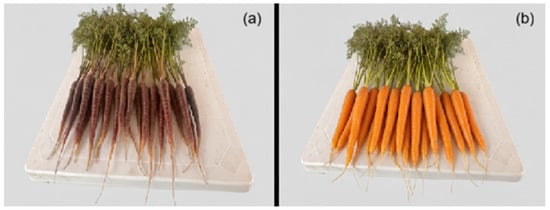
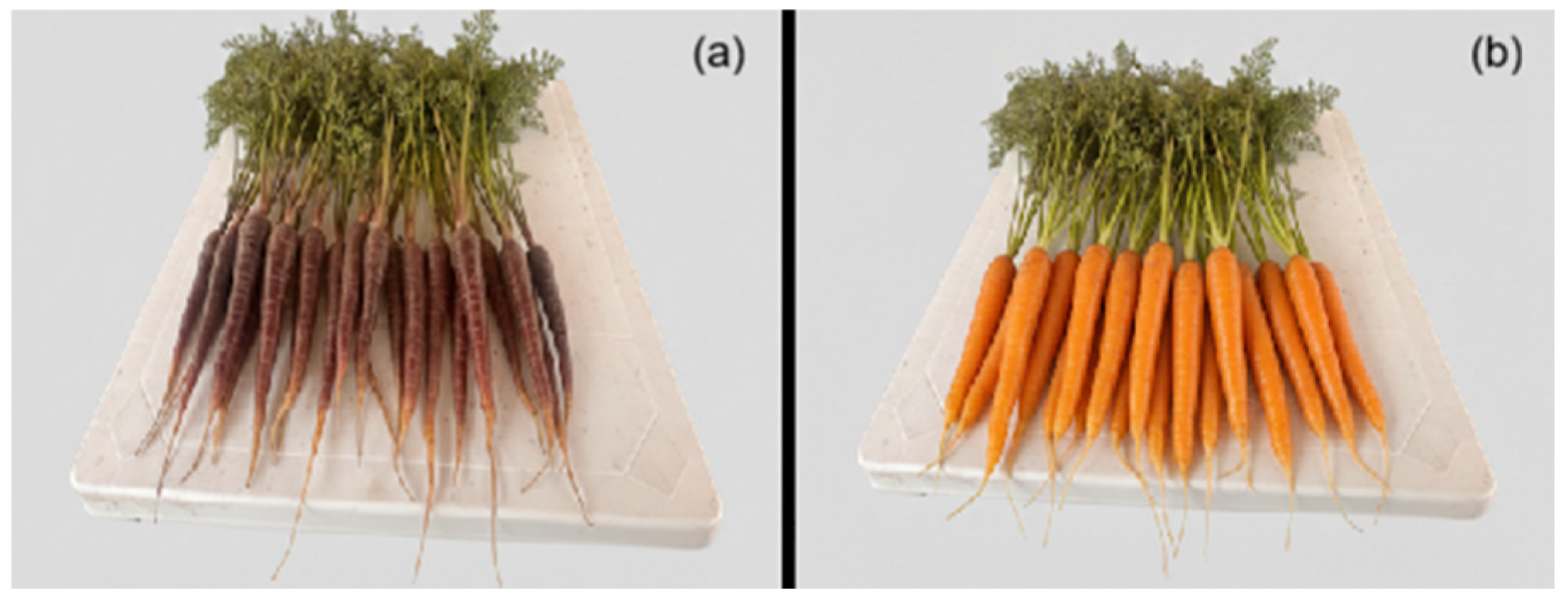
The experiment was conducted using two specific carrot (Daucus carota L.) genotypes selected for their contrasting morphological and phenological traits under high-altitude conditions: (i) genotype 10BER, a Berlicum-type carrot characterized by straight cylindrical orange roots (25–30 cm length; 5–8 cm basal diameter) with a growth cycle of 115–120 days, primarily intended for the high-quality fresh market; and (ii) genotype 13FLA, a Flakkee-type carrot featuring cylindrical purple roots (25–30 cm length; 4–5 cm basal diameter) and a shorter growth cycle (100–120 days), utilized for its high anthocyanin content in both fresh and agro-industrial markets. These genotypes represent the main phenotypic diversity in root architecture and pigment composition currently under study for the Andean tropical highlands (Figure 1).
Figure 1.
Phenotypic and morphological characterization of the two carrot (Daucus carota L.) genotypes evaluated: (a) 13FLA (Flakkee type), featuring deep purple pigmentation and a robust cylindrical-obtuse root shape, typically used for agro-industrial and functional food markets; and (b) 10BER (Berlicum type), displaying the characteristic orange coloration and straight cylindrical architecture associated with the fresh market.
2.3. Crop Establishment and Management
Soil preparation consisted of one pass with a disk plow followed by two passes with a rotary tiller, incorporating 0.5 t ha−1 of dolomitic lime and 10 t ha−1 of composted poultry manure. Raised beds 1.2 m wide, 10 m long, and 0.30 m high were constructed. Sowing was performed manually at a spacing of 0.1 × 0.1 m between plants and rows, placing three seeds per site. Upon reaching the three-true-leaf stage, the herbicide Metribuzin C 480 was applied for weed control. Thirty days after sowing (DAS), manual thinning was performed, leaving one plant per site. Edaphic fertilization was applied at 45 DAS using 770 kg ha−1 of a 10-30-10 fertilizer, equivalent to 77.0 kg ha−1 N, 231.0 kg ha−1 P2O5, and 77.0 kg ha−1 K2O. In addition, foliar fertilization was performed with a liquid fertilizer containing 160 g L−1 N, 160 g L−1 P2O5, and 120 g L−1 K2O, enriched with EDTA-chelated micronutrients (B, Cu, Fe, Mn, Mo, and Zn). Six applications were made between 30 and 105 DAS at 14-day intervals, at a rate of 1 L ha−1 per application and a spray volume of 400 L ha−1. These agronomic practices were implemented to emulate the average management conditions commonly used in carrot production systems in Eastern Antioquia.
2.4. Environmental and Soil Monitoring
Meteorological variables (temperature, air humidity, rainfall, solar radiation, and wind speed) were recorded hourly using a WatchDog 2000 Series portable weather station (Spectrum Technologies, Aurora, IL, USA). Soil moisture was monitored at a depth of 15 cm with a CS616 sensor (Campbell Scientific, Inc., Logan, UT, USA) to ensure conditions close to field capacity throughout the cycle.
2.5. Experimental Design
To account for spatial heterogeneity in the field, four beds were used as blocks, considering differences in bed height and soil penetrability. Each block consisted of a 12 m2 bed (10 m × 1.2 m) subdivided into two 6.0 m2 experimental units (5 linear meters per plant material). One plot of each carrot cultivar was established within each block, resulting in a total of eight experimental units. This arrangement provided replicated observations for the independent evaluation of each cultivar under comparable field conditions. Accordingly, all growth and physiological analyses were performed separately for each cultivar, and no formal inferential comparison between cultivars was intended.
2.6. Growth and Development Variables
Dry biomass: Weekly destructive samplings of 12 plants per experimental unit were conducted starting at 28 DAS and continuing for 14 weeks. Samples were dried in a Venticell® 111 oven at 70 °C until reaching a constant weight, using a KERN EW precision electronic balance (KERN & Sohn GmbH, Balingen, Germany) for weighing.
Root diameter: This was determined using an L&W Tools® digital caliper, taking measurements at 2 cm from the stem insertion and at 2 cm from the distal end.
Leaf area: The total leaf structure was quantified using an LI-3000C leaf area meter (LI-COR Biosciences, Lincoln, NE, USA).
Leaf number: The total number of fully expanded leaves per sampled plant was recorded at each destructive sampling date.
For each weekly destructive sampling, 12 plants per plot were selected using a systematic random approach. To ensure data accuracy and avoid edge effects, no plants were collected from the two outermost rows or from the first 0.5 m at the ends of each bed. Only plants from the inner rows were sampled, as these represent the real growth conditions and plant-to-plant competition of a typical carrot field.
2.7. Ecophysiological Variables
Net CO2 assimilation was evaluated weekly starting at 28 DAS using an LCpro portable infrared gas analyzer (ADC BioScientific Ltd., Hoddesdon, UK). Measurements were conducted at hourly intervals between 08:00 and 17:00, completing 10 daily records per sampling day. For each measurement, three fully expanded young leaves per experimental unit were randomly selected. Inside the leaf chamber, microclimatic conditions were maintained to ensure consistency across light-response curves: CO2 concentration was controlled at , air flow at , and leaf temperature was monitored to reflect ambient conditions (). Three readings were taken on each leaf, generating nine subsamples per experimental unit, which were averaged to represent the cultivar’s behavior. The relationship between net CO2 assimilation and incident photosynthetically active radiation (PAR) was subsequently modeled using these field-stabilized measurements, allowing for the characterization of the photosynthetic machinery under actual high-altitude tropical conditions.
2.8. Analysis of Variables
Data analysis focused on the characterization of growth kinetics and physiological performance through non-linear modeling. While the trends between 10BER and 13FLA are described to highlight their contrasting developmental strategies, no formal inferential comparisons (e.g., ANOVA) were performed between genotypes. Differences are presented based on the fit of the models, their estimated parameters, and the observed biological trends under the study conditions.
2.8.1. Dry Weight and Phenological Stages
The dynamics of dry matter accumulation were determined using a functional growth analysis approach, which allows for a continuous biological interpretation of crop kinetics through the fitting of nonlinear curves [11]. This approach was used to describe temporal patterns in biomass accumulation and to identify biologically relevant transition points in each cultivar. Under this methodology, the data for each cultivar (Flakkee-type and Berlicum-type) were processed independently to describe their specific experimental behavior under the same agroclimatic conditions of Eastern Antioquia, without formal inferential comparison between cultivars. Total and root dry biomass data were fitted as a function of days after sowing (DAS) using an asymptotic logistic model of the form:
In this equation, represents the theoretical maximum dry weight (asymptote), is the relative growth rate, and corresponds to the time in DAS when the inflection point of the curve is reached [11].
For shoot dynamics, a Gaussian function of the following form was used:
This model was selected for its ability to describe bell-shaped curves, allowing it to capture biomass accumulation and the subsequent decline in leaf dry mass at advanced crop stages; in this model, represents the maximum biomass value reached, indicates the time (DAS) when this maximum is achieved, and describes the dispersion or amplitude of the curve, which reflects the duration of the stage of greatest vegetative activity [11].
The parameters of the functions were estimated using the nonlinear least squares method. From the logistic model, the different developmental stages of the carrot for each cultivar were analytically derived as follows: the transition from Stage I to Stage II corresponds to the day after sowing on which 5% of the asymptote is reached; the transition from Stage III to Stage IV occurs when 95% of the asymptote is reached; and the transition from Stage II to Stage III is equivalent to the day after sowing when the concavity of the curve changes (inflection point ) [21]. Statistical processing was performed using R software version 4.4.0 [22].
2.8.2. Net CO2 Assimilation
The response of net CO2 assimilation (A) to changes in photosynthetically active radiation (PAR) intensity was modeled independently for each plant material and for each of the four previously identified phenological stages. To describe this relationship, an exponential light response model was used [15,23,24]. The function used was of the following form:
In this equation, represents net CO2 assimilation (µmol m−2 s−1), is the maximum CO2 assimilation or asymptotic photosynthetic rate, corresponds to dark respiration, and defines the apparent quantum yield of the leaf (the initial slope of the curve), which reflects the plant’s efficiency in photon capture under light limitation [25]. This modeling approach was used to summarize stage-specific changes in carbon assimilation under the field conditions evaluated.
The exponential model was chosen to describe the A/PAR relationship due to its high statistical reliability and biological interpretability in field-grown carrot crops. While mechanistic models can provide further detail on biochemical constraints, the exponential approach ensured stable parameter estimation and avoided over-parameterization, facilitating a consistent comparison of photosynthetic performance between genotypes throughout their developmental stages.
2.8.3. Light Compensation Point (LCP):
This was determined for each developmental stage in each cultivar through the initial linear phase of the light response curve, where net assimilation (A) is primarily limited by photon availability [26]. This parameter, which represents the intensity of photosynthetically active radiation (PAR) at which the photosynthesis rate equals the respiration rate (A = 0), was calculated using the relationship between dark respiration (Rd) and quantum efficiency () through the equation . This approach allows for the identification of the minimum energy threshold required by the canopy to initiate net biomass accumulation [27].
3. Results
3.1. Analysis of Growth Kinetics and Assimilate Partitioning
3.1.1. Growth Dynamics and Phenological Stages of the Berlicum Cultivar
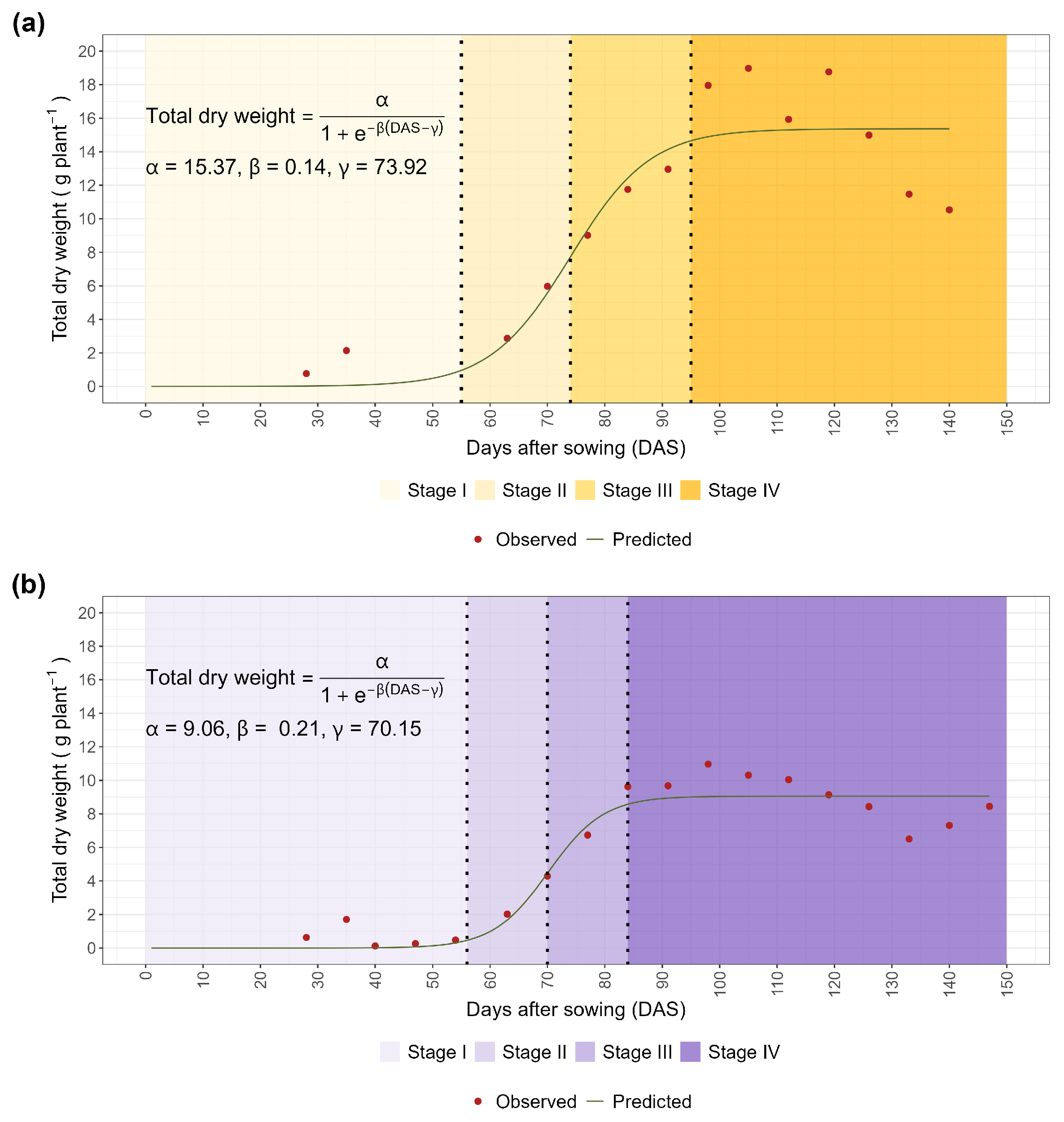
The accumulation of total dry biomass in the Berlicum cultivar was fitted to an asymptotic logistic model, allowing for the identification of the critical parameters of its development (Figure 2a). The maximum dry matter accumulation potential () was estimated at 15.37 g plant−1, reaching the theoretical stabilization phase around 95 days after sowing (DAS). The parameter , which represents the relative growth rate, was 0.14, while the inflection point (), the moment at which the growth kinetics transitions from an acceleration phase to a deceleration phase, was located at 73.92 DAS. Based on the dynamics of the model, four developmental stages were defined for the conditions of Eastern Antioquia:
- Stage I (establishment): It comprises the period from sowing up to 55 DAS. In this initial phase, the plant prioritizes the development of the absorbing root system and the basic foliar architecture, with resource accumulation at reduced rates.
- Stage II (vegetative expansion): Located between 55 and 74 DAS, it showed an accelerated increase in shoot biomass oriented towards light interception, which was reflected in the exponential rise of the curve.
- Stage III (root sink filling): Begins at 74 DAS and extends up to 95 DAS. In this period, the inflection point (γ) is reached, coinciding with the maximum flow of photoassimilates towards the storage root, the organ of commercial interest.
- Stage IV (stabilization and physiological maturity): It is observed from 95 DAS and lasts until 140 DAS. In this phase, the asymptotic curve stabilizes, indicating that the net increase in dry weight ceases and the plant reaches its functional maturity. Commercial maturity and the optimal harvest time were determined to be between 115 and 125 DAS, based on physicochemical quality parameters.
Figure 2.
Dynamics of total dry biomass accumulation in two carrot (Daucus carota L.) cultivars under Eastern Antioquia conditions: (a) Berlicum type and (b) Flakkee type. The solid line represents the fit to the asymptotic logistic model; the points correspond to the averages observed in the field. : maximum dry biomass potential (asymptote); : expansion rate coefficient; : inflection point (moment of maximum growth rate). The numbered bands (I, II, III, and IV) delimit the phenological stages identified from the critical points of the model.
3.1.2. Growth Dynamics and Phenological Stages of the Flakkee Cultivar
Similarly to the Berlicum, biomass accumulation in the Flakkee-type cultivar was fitted to a logistic function, although with parameters reflecting earlier developmental kinetics (Figure 2b). For this cultivar, the maximum accumulation potential () was estimated at 9.06 g plant−1. With a tissue expansion rate () of 0.14 and an inflection point () at 70.15 DAS, the developmental stages were delimited under the following chronological intervals:
- Stage I (establishment): Extends from sowing up to 52 DAS. In this phase, initial growth was slow, with a biological priority on the consolidation of the root system and basic foliar architecture.
- Stage II (vegetative expansion and differentiation): Located between 52 and 70 DAS. This period was characterized by the exponential rise of the curve, with an acceleration in shoot biomass generation prior to the filling of the main sink.
- Stage III (root sink filling): Takes place from 70 to 84 DAS. It is in this interval where the inflection point () is reached, coinciding with the maximum transport speed of photoassimilates towards the root to consolidate yield.
- Stage IV (stabilization with foliar persistence): Begins at 84 DAS (the moment when 95% of the theoretical biomass is reached) and lasts until harvest at 140 DAS. During this phase, the asymptotic curve showed stability in dry weight; however, the cultivar maintained the viability of the photosynthetic apparatus and the absence of reproductive structures (flowering) throughout the evaluated cycle under high tropic conditions.
3.1.3. Dynamics of Biomass Accumulation in the Storage Organ (Root)
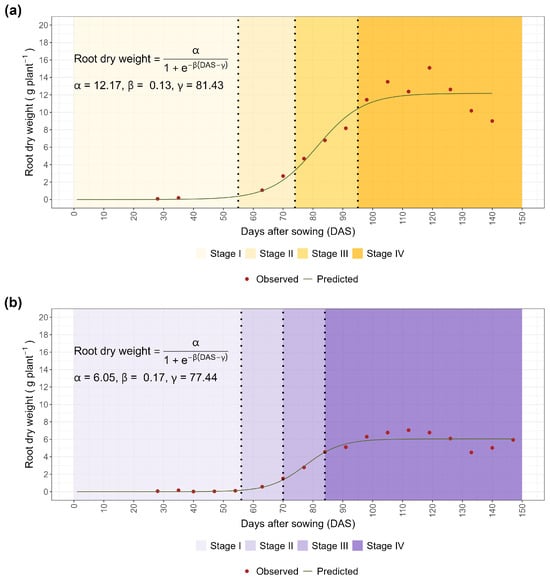
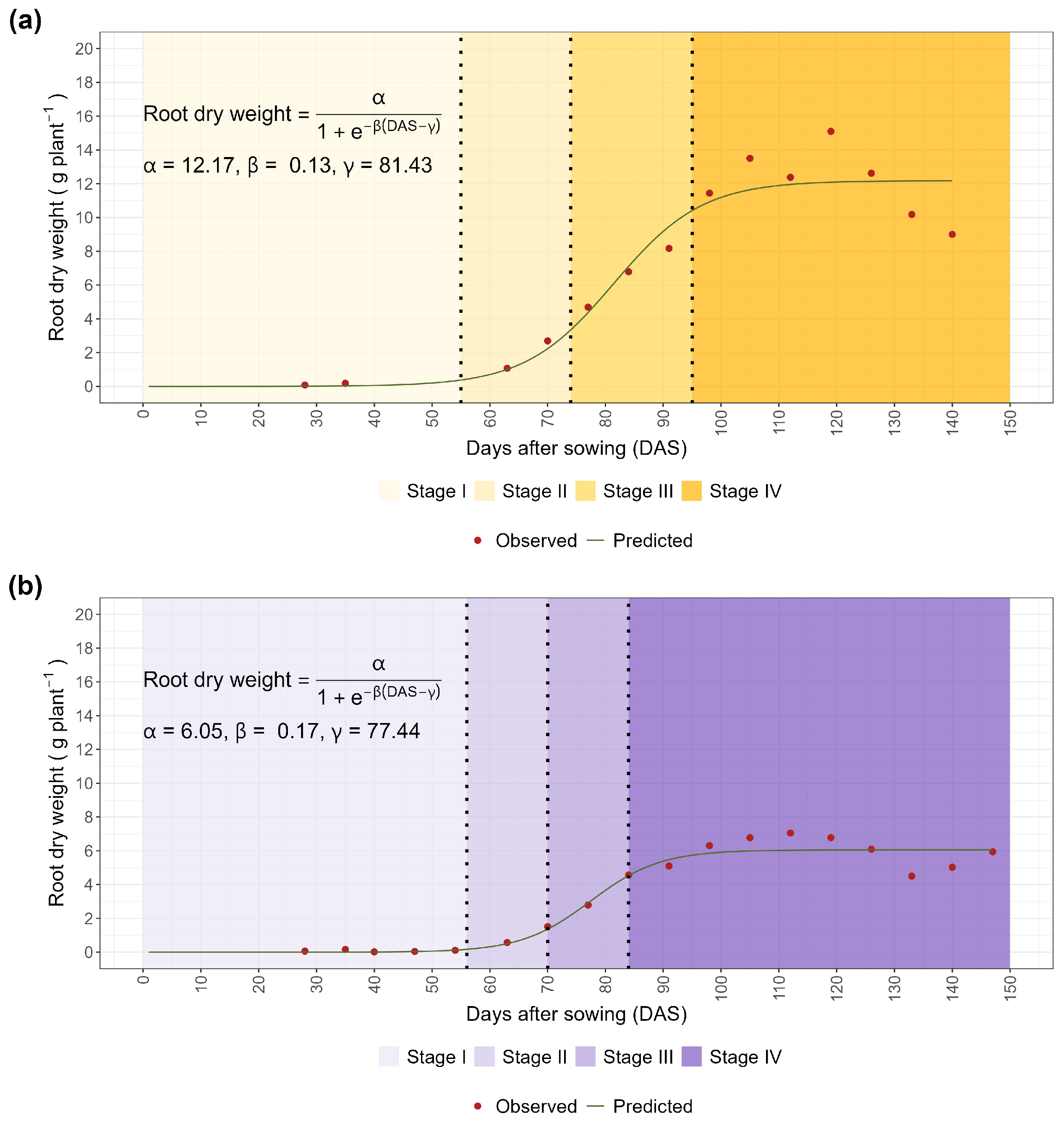
Dry matter accumulation in the root for both cultivars exhibited sigmoidal kinetics and closely paralleled the shape of the total plant growth curve. In the Berlicum-type cultivar, root development showed a phase of relative latency during Stages I and II; however, after surpassing the threshold of 74 DAS (Stage III), the root consolidated as the dominant carbon sink. This behavior showed an allometric synchrony with total biomass, where the exponential increase in root dry weight explained the trajectory toward the asymptote of 15.37 g plant−1, stabilizing from 95 DAS onward as the plant reaches its functional maturity (Figure 3a).
Figure 3.
Dynamics of dry biomass accumulation in the storage root of two carrot (Daucus carota L.) cultivars under Eastern Antioquia conditions: (a) Berlicum type and (b) Flakkee type. The solid line represents the fit to the asymptotic logistic model; the points correspond to the average values observed in the field. : maximum root dry biomass potential (asymptote); : expansion rate coefficient; : inflection point, which indicates the moment of maximum transport rate and photoassimilate accumulation in the storage organ. The numbered bands (I, II, III, and IV) represent the phenological stages derived from the total growth model.
On the other hand, the Flakkee-type cultivar presented a root filling dynamic that replicated the logistic nature of its overall growth, although under a more accelerated timeline. The transition towards sink dominance occurred from 70.15 DAS, at which point the root began its maximum expansion phase. This increase in the accumulation rate defined the biomass limit of the entire system (α = 9.06 g), reaching asymptotic horizontality at 84 DAS (Figure 3b).
3.1.4. Dynamics of Aboveground Biomass and Source-Sink Coupling
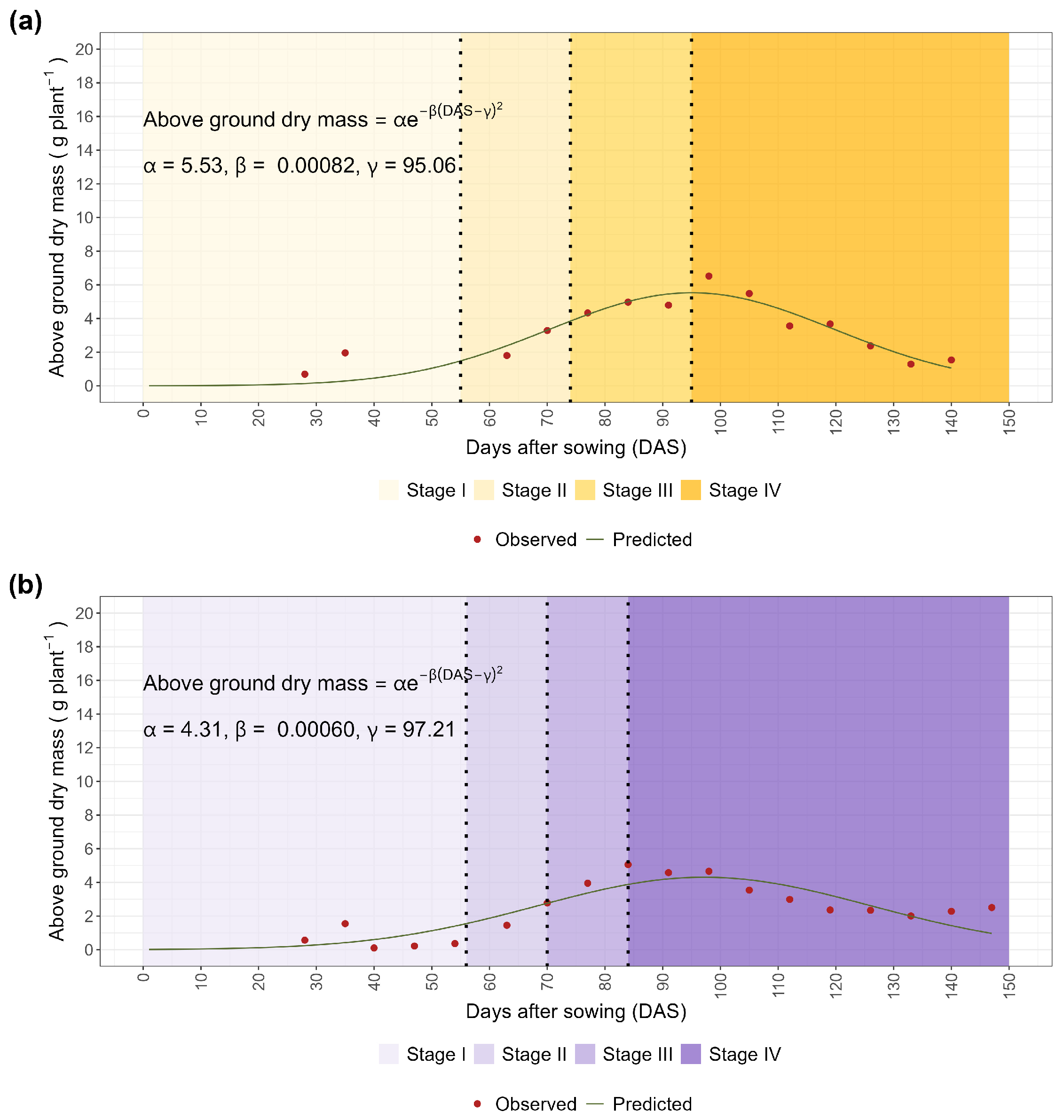
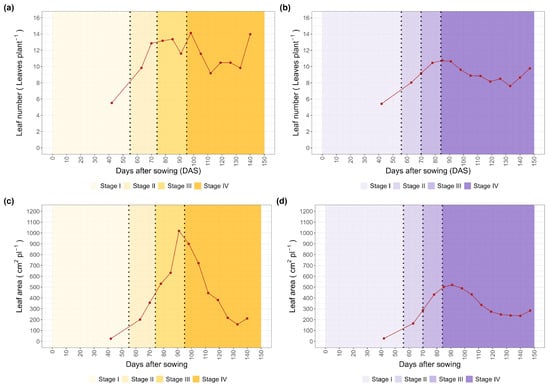
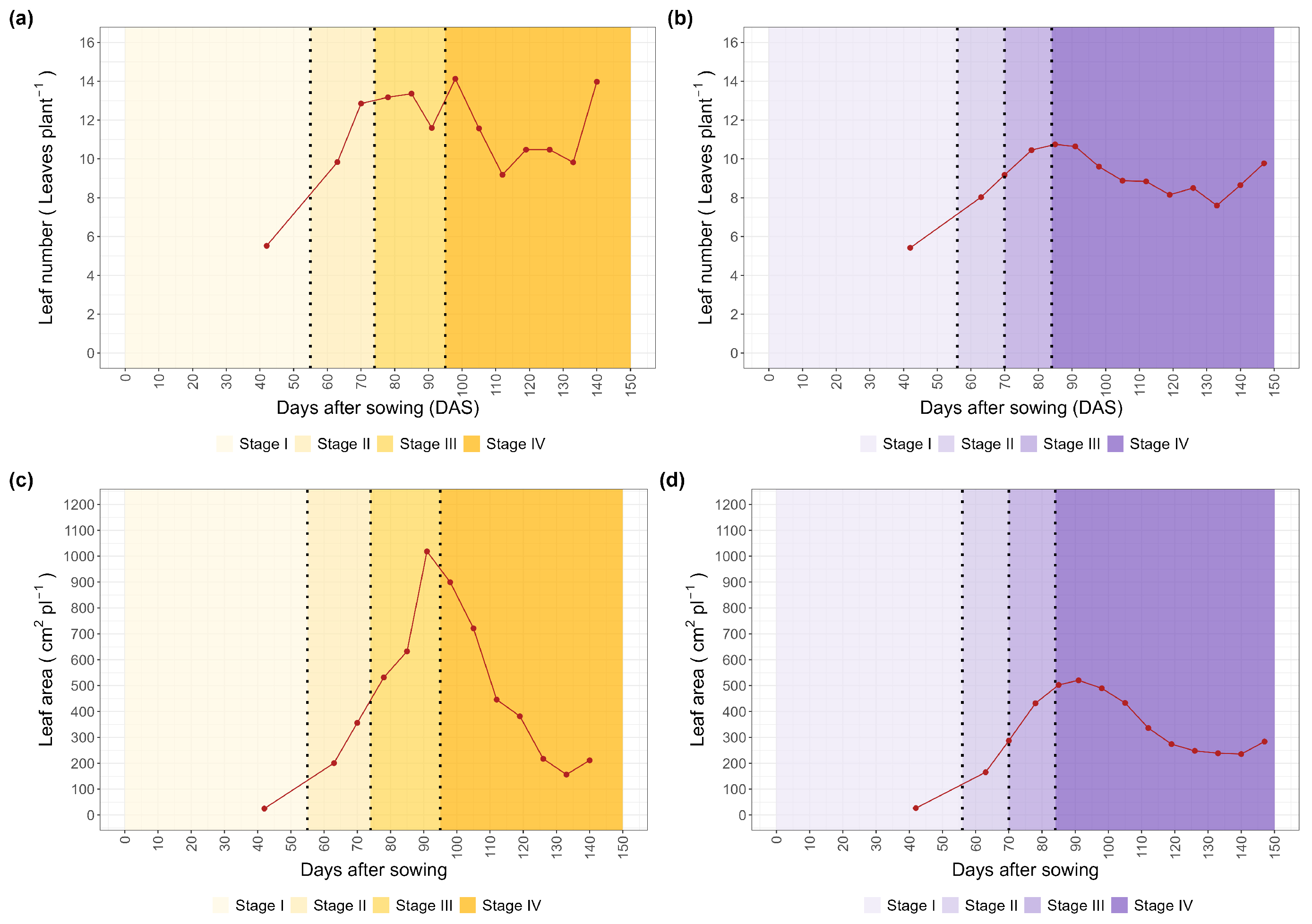
The evolution of aboveground biomass (Figure 4) and the expansion of leaf area (Figure 5) described the capacity of the source for the metabolic maintenance of the storage organ. The canopy behavior in both cultivars reflected contrasting temporal patterns of biomass allocation under the evaluated conditions.
Figure 4.
Dynamics of aboveground dry biomass (foliage) accumulation in two carrot (Daucus carota L.) cultivars under Eastern Antioquia conditions: (a) Berlicum type and (b) Flakkee type. The solid line represents the fit to the Gaussian model; the points correspond to the averages observed in the field. The peak of the curve indicates the moment of maximum availability of the “source” (photosynthetic apparatus) prior to the massive translocation of assimilates towards the root. The numbered bands (I, II, III, and IV) delimit the phenological stages identified for the crop.
Figure 5.
Dynamics of foliar apparatus development in two carrot (Daucus carota L.) cultivars in Eastern Antioquia. The upper panels (a,b) illustrate the evolution of the number of leaves per plant for the Berlicum and Flakkee types, respectively. The lower panels (c,d) present the leaf area expansion () for both cultivars. The points represent the average values observed in the field, and the lines indicate the growth trend over time. The numbered bands (I, II, III, and IV) correspond to the phenological stages of the crop.
Canopy Development in the Berlicum-Type Cultivar
In the Berlicum cultivar, aboveground biomass reached its maximum value (approximately 6 g plant−1) during Stage III. This accumulation peak showed synchrony with the maximum leaf area expansion, which reached values close to 1000 cm2 plant−1, consolidating the maximum light interception capacity prior to the intensive root filling. Although the fitted Gaussian model suggests a theoretical senescence, experimental data indicated that the plant maintained a remaining aboveground biomass of around 2 g plant−1 at the end of the cycle. This persistence is attributed to the emergence of new leaves during Stage IV, where the number of leaves increased to reach an average of 14 leaves plant−1 by 140 DAS.
Canopy Development in the Flakkee-Type Cultivar
The Flakkee cultivar exhibited earlier foliar development, positioning its maximum aboveground biomass near 70 DAS. At this point, foliar dry weight reached 4.5 g plant−1, synchronizing with a maximum leaf area of approximately 600 cm2 plant−1. As in Berlicum, Flakkee did not present terminal foliar senescence; the number of leaves (Figure 4b) showed a recovery towards the end of the cycle, stabilizing at 10 leaves plant−1.
3.2. Photosynthetic Response to Photosynthetically Active Radiation (A/PAR)
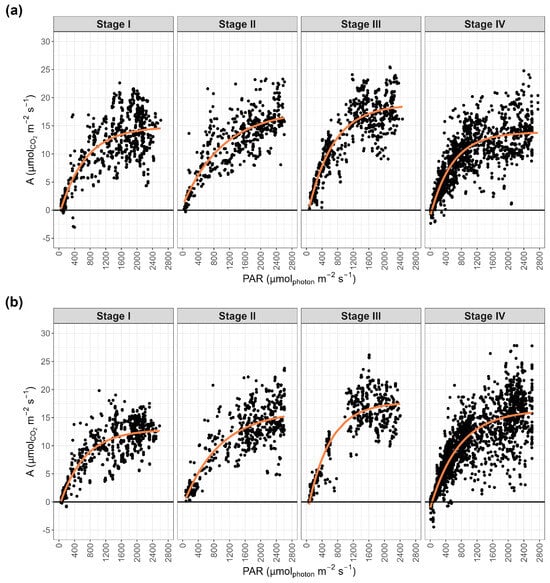
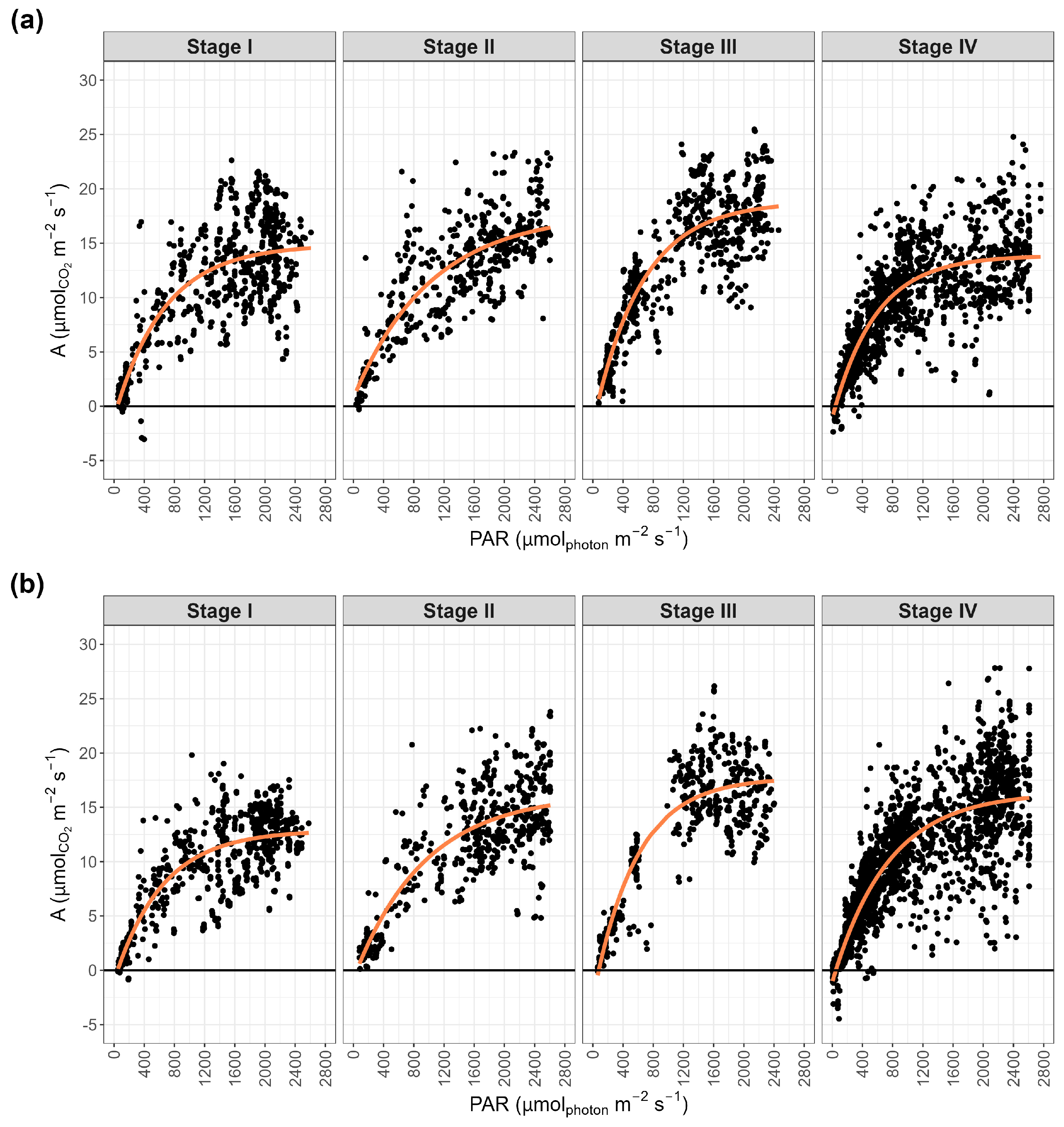
The relationship between net CO2 assimilation () and photosynthetically active radiation (PAR) for both cultivars is presented in Figure 6. The parameters derived from the exponential light response model fit are detailed by developmental stage in Table 1, which allow for the quantification of the canopy’s metabolic efficiency: Maximum Assimilation () represents the carbon fixation potential under light saturation conditions; initial quantum efficiency () indicates the plant’s capacity to convert photons into assimilates in the light-limiting range; the light compensation point (LCP) indicates the radiation level where photosynthetic fixation equals respiration losses; and dark respiration () quantifies the CO2 flux emitted by foliar tissue in the absence of light, reflecting the energetic maintenance cost of the photosynthetic apparatus.
Figure 6.
Response curves of net assimilation (A) to photosynthetically active radiation (PAR) in two carrot (Daucus carota L.) cultivars by phenological stage: (a) Berlicum type and (b) Flakkee type. The lines represent the fit to the non-linear exponential model for each of the four identified stages (I, II, III, and IV); the points correspond to the experimental measurements conducted using the gas exchange system.
Table 1.
Ecophysiological parameters derived from light response curves (A/PAR) for two carrot (Daucus carota L.) cultivars across four phenological stages under Eastern Antioquia conditions.
3.2.1. Photosynthetic Dynamics in the Berlicum Cultivar
The Berlicum cultivar reached its maximum photosynthetic potential during Stage III, recording the highest value of the study at 20.4 (Table 1). During this same phase, the material showed its highest light efficiency with an LCP of 2.60 . This increase in fixation capacity coincided chronologically with the intensive root-filling phase and the leaf area peak described previously. In the final stages (Stage IV), assimilation values remained within the same general range, with no marked decline in the fitted values.
3.2.2. Photosynthetic Dynamics in the Flakkee Cultivar
For the Flakkee cultivar, the highest efficiency values were recorded early on. In Stage II, this material presented its lowest light compensation point (2.54 ) indicating an earlier shift in the fitted light-response parameters across stages. Light saturation and values for this cultivar (Figure 6b) stabilized earlier than in Berlicum, correlating with the precocity observed in its growth inflection point ().
The importance of identifying these parameters lies in the possibility of designing precision management strategies that protect canopy viability. By knowing the and LCP values per stage, it is possible to adjust planting density and fertilization plans to avoid premature senescence of basal leaves due to self-shading and to prevent photoinhibition during peak radiation hours, a phenomenon visible in the scatter plot of Figure 6 at high PAR levels. Precise modeling of these curves allows the captured energy to be effectively translated into root yield, preventing the plant from wasting resources on repair processes caused by environmental stress during extended vegetative cycles [28].
4. Discussion
The results obtained indicate that, under high-altitude Andean tropical conditions, carrot growth dynamics can be interpreted as a functional transition between source formation and sink consolidation. In both materials, the storage root transitioned from an initial slow-growth phase to an accelerated filling stage, though with temporal and magnitude differences between cultivars: Berlicum exhibited higher total and root biomass, whereas Flakkee showed a more precocious chronology toward sink dominance. In ecophysiological terms, this pattern is consistent with the expected behavior in root crops, where total biomass accumulation depends not only on instantaneous photosynthetic capacity but also on the timing of carbon redirection from the canopy to the storage organ [10,29]. Reid [4] proposed, in a mechanistic model for carrot, that dry matter partitioning between the shoot and the root is closely linked to canopy development and the fraction of intercepted radiation, such that changes in leaf area and growth indirectly regulate root sink strength. Additionally, Fernández-Pérez et al. [5] showed for carrot in the high tropics that biomass accumulation and nutrient absorption are not uniform throughout the cycle but rather present defined windows of increased demand, supporting the interpretation of Stages II and III identified in this study as critical periods for root filling and, therefore, for the synchronization of agronomic management.
The difference between materials suggests contrasting developmental patterns under the evaluated conditions. Berlicum developed a larger canopy, with aboveground biomass maximums near 6 g plant−1 and a leaf area close to 1000 cm2 plant−1, indicating a strategy of greater investment in radiation capture capacity before intensive root filling. In contrast, Flakkee reached a smaller and earlier foliar maximum, suggesting a shorter cycle strategy and a faster transition toward storage. This divergence is consistent with recent evidence showing that carrot cultivars exhibit significant genetic variation in establishment vigor, canopy cover, height, and shoot growth traits, all of which have potential effects on final yield and the physiological competitiveness of the crop [17]. Likewise, Mulugeta et al. [18] documented that the productive response of carrots depends on the interaction between genotype, growing season, and nutrient availability; therefore, the patterns observed here are consistent with differences in carbon allocation chronology between materials, rather than with purely morphological contrasts, but as an expression of differentiated genetic carbon allocation strategies. Within this framework, the Berlicum-type cultivar appears to approach yield maximization through a higher source capacity [30], while the Flakkee-type material showed a more precocious developmental trajectory, potentially favorable for agro-industrial schemes where a shorter cycle and an early entry into root filling are desired.
A particularly relevant finding was the persistence of the photosynthetic apparatus until the end of the cycle in both materials, without evidence of marked terminal senescence associated with reproductive transition. In Berlicum, even when the Gaussian model suggests a decrease in aboveground biomass, empirical data show remaining foliar biomass and the emergence of new leaves toward the final stage; in Flakkee, a recovery in leaf number and the maintenance of young tissues were also observed. This foliar persistence is consistent with the biology of the species in environments where the cold signaling required to induce flowering is not reached [6]. Loarca et al. [7] demonstrated that the flowering habit in carrots has a strong genetic component, but its expression remains modulated by environmental signals associated with cold; in fact, they identified a broad set of predominantly biennial accessions with high genetic control of the trait. Consequently, in intertropical conditions such as those of Rionegro, the absence of effective vernalization may prolong canopy functioning and modify the relative duration of vegetative phases [6,7]. Under the conditions evaluated, this pattern suggests that commercial maturity may not necessarily coincide with complete physiological senescence, but rather with a point where the marginal increase of the sink begins to decrease even though the source system remains active. This helps explain why the materials maintained foliar activity even after total biomass entered the stabilization phase.
In relation to the photosynthetic response to radiation, the values of maximum assimilation () and apparent quantum efficiency (ε) show that both materials reached their highest functional capacity in Stage III, coinciding with the filling phase of the storage organ. This result is physiologically consistent, because during that stage, the demand from the root sink increases and may reduce the probability of limitation due to carbohydrate accumulation in the source, favoring high net carbon fixation rates [9,29]. The exponential model employed in this work provided a useful functional description of the A/PAR response and allowed for the estimation of ecophysiological parameters useful for each material and developmental stage. Under this framework, the maximums observed in Stage III indicate a greater carbon fixation capacity at the highest demand by the root, while the low LCP values suggest a foliar apparatus capable of operating efficiently under moderate radiation levels, a condition consistent with high tropic environments where cloudiness and incident radiation variability are frequent [31]. Furthermore, the fact that Flakkee reached high values earlier, while Berlicum sustained a greater interception and total accumulation capacity, reinforces the idea that the materials differ not only in canopy size but also in the timing with which they articulate the source-sink relationship.
Recent literature further shows that the model form influences the estimation of parameters such as maximum photosynthesis, dark respiration, and light compensation point; therefore, the use of a consistent and stable fit is key when the central objective is the physiological comparison between materials and developmental stages [14,15].
The higher root biomass accumulation observed in Berlicum relative to Flakkee can be interpreted as the joint outcome of three interacting components: source size, photosynthetic efficiency per unit leaf area, and sink duration. Within the framework of source–sink theory, yield is understood as the cumulative result of both source strength, determined primarily by net photosynthetic rate and total light-intercepting surface area, and sink strength, defined as the product of sink size and activity [9,10,30,32]. In terms of source size, Berlicum developed a canopy approximately 67% larger in leaf area (~1000 cm2 plant−1 versus ~600 cm2 plant−1 in Flakkee); when combined with comparable maximum assimilation rates at the leaf level during Stage III (Am = 20.5 and 20.2 µmol CO2 m−2 s−1, respectively), this difference in intercepting surface implies a substantially greater whole-plant carbon uptake capacity, since comparable per-unit-area efficiency operating over a larger canopy translates proportionally into higher total photoassimilate availability for root translocation [32]. In terms of sink duration, the root-filling window defined by Stage III was longer in Berlicum (~21 days, from 74 to 95 DAS) than in Flakkee (~14 days, from 70 to 84 DAS), extending the period over which the storage organ maintained dominant carbon sink activity. Finally, sink capacity itself, reflected by the asymptote α, was markedly higher in Berlicum (15.37 g plant−1) than in Flakkee (9.06 g plant−1), suggesting a larger and more active storage organ that sustained elevated photoassimilate demand throughout Stage III; a sustained sink demand of this nature may, in turn, help maintain elevated photosynthetic rates by preventing the feedback inhibition that arises from photoassimilate accumulation in source leaves when sink activity is insufficient [9,29]. Taken together, these findings indicate that the yield advantage of Berlicum does not arise from superior leaf-level photosynthetic efficiency alone, but from the coordinated expression of a larger source surface, an extended sink-active period, and a higher maximum sink capacity [29,30]. Flakkee partially compensates through its earlier developmental precocity, a strategy that may be functionally advantageous in production systems where a shorter cycle and rapid entry into root filling are prioritized over maximum biomass accumulation.
The low light compensation point recorded for Flakkee during Stage II (LCP = 2.54 µmol photon m−2 s−1) warrants closer ecophysiological interpretation, as it may reflect a functional adaptation that is coherent with both the high-altitude Andean tropical radiation environment and this cultivar’s early-maturing trait. In intertropical Andean environments such as Rionegro, Antioquia, incident PAR at the surface is frequently modulated by cloudiness, which shifts the radiation regime from predominantly direct to diffuse, often reducing total irradiance to sub-saturating levels for extended periods throughout the crop cycle [31,33]. Under such conditions, net carbon gain at the leaf level is governed less by light-saturated assimilation capacity (Am) and more by the initial slope of the light-response curve, which reflects the apparent quantum yield (ε) and is mechanistically linked to the LCP; a lower LCP indicates that the photosynthetic apparatus can sustain net positive carbon fixation at minimal radiation thresholds, thereby extending the effective photosynthetic window beyond clear-sky conditions [31,34]. The particularly low LCP observed for Flakkee in Stage II, coinciding with the period of maximum vegetative expansion and canopy consolidation, suggests that this material is capable of sustaining a net positive carbon balance across a wider range of sub-saturating irradiances than Berlicum during the same stage. This capacity may have direct functional consequences for precocity: by maintaining net carbon gain even during frequent cloudy periods typical of the Andean high-altitude tropical environment, Flakkee may accumulate sufficient photoassimilates to trigger the transition toward root-filling without requiring extended windows of high solar radiation. In this sense, a low LCP could act as a functional buffer against radiation variability, enabling an earlier activation of the photosynthetic source and, consequently, an earlier onset of sink dominance, a pattern consistent with the more compressed Stage III observed in Flakkee (70–84 DAS versus 74–95 DAS in Berlicum). Recent evidence further supports the agronomic relevance of this mechanism: the leaf-scale low-light photosynthetic response, captured precisely by ε and LCP, has been identified as a primary determinant of crop-scale radiation use efficiency under field conditions [34], indicating that genotypic differences in these parameters have consequences beyond the leaf scale. Collectively, these observations suggest that Flakkee’s photosynthetic behaviour under fluctuating radiation conditions may represent a functional adaptation to the light variability of high-altitude Andean tropical environments that is mechanistically linked to, and may partially explain, its characteristically earlier developmental trajectory.
Recent literature on carrots also supports the idea that an early and efficient allocation of carbon to the root favors secondary thickening and sugar accumulation. Gonzalez-Calquin et al. [12] reported that certain lighting conditions promoted earlier storage root development in carrots, accompanied by greater accumulation of sucrose and starch, which was interpreted as a signal of more efficient carbon allocation to the storage organ. Similarly, Zhao et al. [35] found that coordinated water and fertilization management can improve quality and yield, partly because it facilitates the translocation of carbohydrates from vegetative tissues toward the storage organs. Although the present study did not manipulate light quality or contrasting water-fertilizer treatments, it did demonstrate that maximum canopy expansion precedes or closely coincides with the intensification of root filling, suggesting a comparable functional sequence: first, the capacity for capture and photoassimilate production is consolidated, and subsequently, partitioning toward the root is intensified. This sequence was more extended and sustained in Berlicum and more compressed in Flakkee, which may help explain differences in the temporal organization of biomass accumulation between materials.
From an agronomic perspective, the developmental-stage framework derived from the growth models provides specific, functionally grounded reference points for crop management under high-altitude Andean tropical conditions, replacing calendar-based schedules with biologically meaningful thresholds. Regarding fertilization, Stages II and III represent the critical window for nutrient supply in both cultivars, as they encompass both the maximum expansion of the photosynthetic source and the peak accumulation rate of the storage root sink. For Berlicum, this window spans from approximately 55 to 95 DAS, with the highest instantaneous demand concentrated around the inflection point at 74 DAS, which marks the onset of the most rapid root-filling phase; for Flakkee, the equivalent window is narrower and earlier, from approximately 52 to 84 DAS, with peak demand at 70 DAS. Fertilization plans should therefore prioritize the period immediately preceding each cultivar’s respective inflection point, ensuring that nitrogen, phosphorus, and potassium availability aligns with maximum sink activity rather than being applied on uniform weekly schedules. Regarding irrigation, the root-filling stage (Stage III) defines the most sensitive window for water supply, as moisture deficits during this period have been documented to cause severe reductions in fresh mass, dry mass, and root diameter in carrot [36]. For Berlicum, this critical irrigation window extends from 74 to 95 DAS; for Flakkee, from 70 to 84 DAS. Given that root filling is completed in approximately 21 days in Berlicum and 14 days in Flakkee, the shorter window in Flakkee implies that any irrigation deficit during this period carries a proportionally greater penalty per unit time. Regarding harvest timing, the foliar persistence observed in both cultivars until the end of the cycle confirms that foliage appearance is not a reliable indicator of commercial maturity; the canopy remains active even after the total biomass asymptote has been reached, so harvest decisions should prioritize root quality criteria over canopy status. For Berlicum, the optimal commercial harvest window is estimated between 115 and 125 DAS, based on the stabilization of root biomass from 95 DAS onward and the physicochemical quality parameters evaluated in this study. For Flakkee, given that the theoretical biomass asymptote is reached at 84 DAS and the declared growth cycle of this genotype is 100–120 days, a provisional commercial harvest window of 100–115 DAS is proposed, with the caveat that this range should be validated against root diameter, firmness, and pigment concentration criteria under the specific production conditions of Eastern Antioquia. An excessive delay beyond these windows in either cultivar is unlikely to yield proportional increases in commercial biomass and may compromise root quality.
This study contributes to reducing the ecophysiological knowledge gap for carrots under intertropical Andean conditions by integrating growth analysis and A/PAR modeling in two materials evaluated under the same field environment. Nevertheless, extrapolation must be done with caution, as the results correspond to a single site, one soil-climate condition, and two specific materials. In future research, it will be important to incorporate contrasts between environments, water and nutrient availability, as well as multi-site and multi-cycle validations that allow these ecofisiological trajectories to be converted into predictive management rules for commercial production systems. In addition, integrating molecular or genomic characterization of the evaluated materials would help disentangle the relative contribution of genetic background and environmental conditions to the observed differences in developmental timing, biomass partitioning, and photosynthetic behavior.
5. Conclusions
Both carrot cultivars evaluated under high-altitude Andean tropical conditions followed a consistent four-stage developmental sequence yet exhibited contrasting growth strategies reflecting distinct genetic carbon allocation programs. Berlicum accumulated substantially higher total and root biomass (α = 15.37 g plant−1), developed a larger photosynthetic canopy (~1000 cm2 plant−1), and sustained a more extended root-filling phase (~21 days), reflecting a strategy oriented toward maximizing source capacity before peak sink activity. Flakkee, in contrast, showed greater developmental precocity, with an earlier inflection point (γ = 70.15 DAS versus 73.92 DAS in Berlicum), a more compressed root-filling window (~14 days), and a lower light compensation point during Stage II (LCP = 2.54 µmol photon m−2 s−1), suggesting a functional adaptation to the fluctuating radiation conditions of the high-altitude Andean tropical environment that may contribute to its characteristically earlier transition toward sink dominance.
Stage III emerged as the most critical developmental phase in both cultivars, coinciding with peak photosynthetic capacity (Am = 20.5 and 20.2 µmol CO2 m−2 s−1 for Berlicum and Flakkee, respectively), maximum photoassimilate flux toward the storage root, and the highest whole-plant carbon demand. The persistence of an active foliar apparatus beyond the biomass asymptote in both materials, without evidence of terminal senescence, confirms that the absence of effective vernalization under intertropical conditions maintains the crop in a state of vegetative continuity, decoupling commercial maturity from physiological depletion.
These findings provide a functionally grounded framework for crop management in the Colombian Andean region. Fertilization and irrigation efforts should be concentrated within the Stage II–III transition, corresponding to 55–95 DAS in Berlicum and 52–84 DAS in Flakkee, with peak demand at 74 and 70 DAS respectively. Harvest timing should be guided by root quality criteria rather than canopy appearance, with provisional commercial windows of 115–125 DAS for Berlicum and 100–115 DAS for Flakkee, the latter subject to validation against root diameter, firmness, and anthocyanin content under Eastern Antioquia production conditions.
This study is limited to a single site, one agroclimatic condition, and two specific genotypes evaluated over one production cycle, which constrains the generalizability of the ecophysiological trajectories described. Future research should incorporate multi-site and multi-cycle validations across contrasting environments and soil-water-nutrient conditions to convert these stage-based frameworks into predictive management tools. Additionally, integrating molecular or genomic characterization of the evaluated materials would help disentangle the relative contributions of genetic background and environmental conditions to the observed differences in developmental timing, biomass partitioning, and photosynthetic performance.
Author Contributions
Conceptualization, A.M.C.-M., L.E.C.-G. and L.F.L.-H.; methodology, A.M.C.-M., L.E.C.-G., L.F.L.-H. and G.A.G.-V.; software, G.A.G.-V. and L.F.L.-H.; validation, A.M.C.-M. and G.A.G.-V.; formal analysis, A.M.C.-M., G.A.G.-V. and V.G.-V.; investigation, A.M.C.-M., G.A.G.-V., P.A.H.-M., L.E.C.-G., L.F.L.-H., J.D.P.-R., C.Z.-M., C.D.-P., V.G.-V. and J.C.H.R.; resources, A.M.C.-M. and J.C.H.R.; data curation, A.M.C.-M. and L.E.C.-G.; writing—original draft preparation, A.M.C.-M., G.A.G.-V. and P.A.H.-M.; writing—review and editing, A.M.C.-M., G.A.G.-V., P.A.H.-M., L.E.C.-G., L.F.L.-H., J.D.P.-R., C.Z.-M., C.D.-P., V.G.-V. and J.C.H.R.; visualization, A.M.C.-M., G.A.G.-V. and V.G.-V.; supervision, A.M.C.-M., L.E.C.-G. and C.D.-P.; project administration, J.C.H.R.; funding acquisition, J.C.H.R. All authors have read and agreed to the published version of the manuscript.
Funding
This research was funded by the Science, Technology and Innovation Fund of the General Royalties System (SGR) of Colombia through the project called “Fortalecimiento de la cadena productiva de la zanahoria mediante la creación de prototipos de productos innovadores en el Oriente del departamento de Antioquia” (code BPIN: 2020000100192) and the Colombian Agricultural Research Corporation—Agrosavia.
Data Availability Statement
The raw data supporting the conclusions of this article will be made available by the authors on request.
Acknowledgments
The authors gratefully acknowledge Germán Franco for his valuable contribution to the conception of the experimental approach underlying this study and the Zana Alliance for its support in the implementation of activities derived from this research. Finally, we thank the La Selva Research Center (AGROSAVIA) for the time and expertise their researchers contributed to this work.
Conflicts of Interest
The authors declare no conflicts of interest.
References
- Motegaonkar, S.; Shankar, A.; Tazeen, H.; Gunjal, M.; Payyanad, S. A Comprehensive Review on Carrot (Daucus carota L.): The Effect of Different Drying Methods on Nutritional Properties and Its Processing as Value-Added Foods. Sustain. Food Technol. 2024, 2, 667–688. [Google Scholar] [CrossRef] [Scilit]
- Unidad de Planificación Rural Agropecuaria. Precios En Primer Mercado: Boletín, Octubre 2025, Segunda Quincena; Unidad de Planificación Rural Agropecuaria: Bogotá, Colombia, 2025. [Google Scholar]
- Paul, M.J.; Watson, A.; Griffiths, C.A. Linking Fundamental Science to Crop Improvement through Understanding Source and Sink Traits and Their Integration for Yield Enhancement. J. Exp. Bot. 2020, 71, 2270–2280. [Google Scholar] [CrossRef] [Scilit] [PubMed]
- Reid, J.B. Modelling Growth and Dry Matter Partitioning in Root Crops: A Case Study with Carrot (Daucus carota L.). New Zealand J. Crop. Hortic. Sci. 2019, 47, 99–124. [Google Scholar] [CrossRef] [Scilit]
- Fernández-Pérez, C.J.; Cely-Reyes, G.E.; Serrano-Cely, P.A. Macronutrient Absorption Curves of Carrot in the High Tropics. Rev. Colomb. Ciencias Hortic. 2023, 17, e16508. [Google Scholar] [CrossRef] [Scilit]
- Wohlfeiler, J.; Alessandro, M.S.; Morales, A.; Cavagnaro, P.F.; Galmarini, C.R. Vernalization Requirement, but Not Post-Vernalization Day Length, Conditions Flowering in Carrot (Daucus carota L.). Plants 2022, 11, 1075. [Google Scholar] [CrossRef] [Scilit]
- Loarca, J.; Liou, M.; Dawson, J.C.; Simon, P.W. Advancing Utilization of Diverse Global Carrot (Daucus carota L.) Germplasm with Flowering Habit Trait Ontology. Front. Plant Sci. 2024, 15, 1342513. [Google Scholar] [CrossRef] [Scilit]
- Ye, Z.P.; Kang, H.J.; An, T.; Duan, H.L.; Wang, F.B.; Yang, X.L.; Zhou, S.X. Modeling Light Response of Electron Transport Rate and Its Allocation for Ribulose Biphosphate Carboxylation and Oxygenation. Front. Plant Sci. 2020, 11, 581851. [Google Scholar] [CrossRef] [Scilit]
- Paul, M.J.; Foyer, C.H. Sink Regulation of Photosynthesis. J. Exp. Bot. 2001, 52, 1383–1400. [Google Scholar] [CrossRef] [Scilit]
- Rosado-Souza, L.; Yokoyama, R.; Sonnewald, U.; Fernie, A.R. Understanding Source–Sink Interactions: Progress in Model Plants and Translational Research to Crops. Mol. Plant 2023, 16, 96–121. [Google Scholar] [CrossRef] [Scilit] [PubMed]
- Archontoulis, S.V.; Miguez, F.E. Nonlinear Regression Models and Applications in Agricultural Research. Agron. J. 2015, 107, 786–798. [Google Scholar] [CrossRef] [Scilit]
- Gonzalez-Calquin, C.; Munizaga, F.; Salvatierra, A.; Villalobos, L.; Pimentel, P.; Stange, C. LED Lighting Enhances Early Storage Root Development and Sucrose Accumulation in Carrot (Daucus carota L.) without Altering Carotenoid Content. Sci. Hortic. 2025, 348, 114220. [Google Scholar] [CrossRef] [Scilit]
- He, K.; Wang, L.; Ratkowsky, D.A.; Shi, P. Comparison of Four Light-Response Models Using Relative Curvature Measures of Nonlinearity. Sci. Rep. 2024, 14, 24058. [Google Scholar] [CrossRef] [Scilit]
- Yao, X.; Sun, H.; Zhou, S.; Li, L. Evaluating Photosynthetic Light Response Models for Leaf Photosynthetic Traits in Paddy Rice (Oryza sativa L.) Under Field Conditions. Plants 2025, 14, 23. [Google Scholar] [CrossRef] [Scilit]
- Guo, Y.; Lv, Y. Evaluation of Models for Describing Photosynthetic Light–Response Curves and Estimating Parameters in Rice Leaves at Various Canopy Positions. Agronomy 2025, 15, 125. [Google Scholar] [CrossRef] [Scilit]
- Paparella, A.; Kongala, P.R.; Serio, A.; Rossi, C.; Shaltiel-Harpaza, L.; Husaini, A.M.; Ibdah, M. Challenges and Opportunities in the Sustainable Improvement of Carrot Production. Plants 2024, 13, 2092. [Google Scholar] [CrossRef] [Scilit]
- Loarca, J.; Liou, M.; Dawson, J.C.; Simon, P.W. Evaluation of Shoot-Growth Variation in Diverse Carrot (Daucus carota L.) Germplasm for Genetic Improvement of Stand Establishment. Front. Plant Sci. 2024, 15, 1342512. [Google Scholar] [CrossRef] [Scilit]
- Mulugeta, A.; Asrat, F.; Asres, D.; Mebrat, S. Evaluation of Carrot (Daucus carota L.) Varieties for Growth and Yield as Affected by NPSB Fertilizer Rates in Gondar District, Ethiopia. Front. Plant Sci. 2025, 16, 1505302. [Google Scholar] [CrossRef] [Scilit]
- Flórez-Velasco, N.; Fischer, G.; Balaguera-López, H.E. Photosynthesis in Fruit Crops of the High Tropical Andes: A Systematic Review. Agron. Colomb. 2024, 42, e113887. [Google Scholar] [CrossRef] [Scilit]
- Instituto de Hidrología, Meteorología y Estudios Ambientales (IDEAM), Normales Climatológicas Estándar 1991–2020. Available online: https://www.ideam.gov.co/sala-de-prensa/informes/Normales%20clim%C3%A1ticas%20est%C3%A1ndar (accessed on 1 February 2026).
- Vega Rojas, T.; Soto, C.M.; Montero, W.R. Análisis del crecimiento de cinco híbridos de zanahoria (Daucus carota L.) mediante la metodología del análisis funcional 1. Agron. Costarric. 2012, 36, 29–46. [Google Scholar] [CrossRef] [Scilit]
- R Core Team R. A Language and Environment for Statistical Computing, Version 4.4.0; R Foundation for Statistical Computing: Vienna, Austria, 2023. [Google Scholar]
- Tagesson, T.; Fensholt, R.; Cropley, F.; Guiro, I.; Horion, S.; Ehammer, A.; Ard??, J. Dynamics in Carbon Exchange Fluxes for a Grazed Semi-Arid Savanna Ecosystem in West Africa. Agric. Ecosyst. Environ. 2015, 205, 15–24. [Google Scholar] [CrossRef] [Scilit]
- Martínez-Maldonado, F.E.; Castaño-Marin, A.M.; Góez-Vinasco, G.A.; Marin, F.R. Gross Primary Production of Rainfed and Irrigated Potato (Solanum tuberosum L.) in the Colombian Andean Region Using Eddy Covariance Technique. Water 2021, 13, 3223. [Google Scholar] [CrossRef] [Scilit]
- Samanta, S.; Banerjee, S.; Mukherjee, A.; Patra, P.K.; Chakraborty, P.K. Determining the Radiation Use Efficiency of Potato Using Sunshine Hour Data: A Simple and Costless Approach. Spanish J. Agric. Res. 2020, 18, e0801. [Google Scholar] [CrossRef] [Scilit]
- Sharp, R.E.; Matthews, M.A.; Boyer, J.S. Kok Effect and the Quantum Yield of Photosynthesis. Plant Physiol. 1984, 75, 95–101. [Google Scholar] [CrossRef] [Scilit]
- Liu, Q.; Jia, W.; Li, F. Determination of the Most Effective Design for the Measurement of Photosynthetic Light-Response Curves for Planted Larix Olgensis Trees. Sci. Rep. 2020, 10, 11664. [Google Scholar] [CrossRef] [Scilit] [PubMed]
- Wang, Y. Improving Photosynthetic Efficiency in Fluctuating Light to Enhance Yield of C3 and C4 Crops. Crop Environ. 2024, 3, 184–193. [Google Scholar] [CrossRef] [Scilit]
- Fernie, A.R.; Bachem, C.W.B.; Helariutta, Y.; Neuhaus, H.E.; Prat, S.; Ruan, Y.L.; Stitt, M.; Sweetlove, L.J.; Tegeder, M.; Wahl, V.; et al. Synchronization of Developmental, Molecular and Metabolic Aspects of Source–Sink Interactions. Nat. Plants 2020, 6, 55–66. [Google Scholar] [CrossRef] [Scilit]
- Reynolds, M.; Atkin, O.K.; Bennett, M.; Cooper, M.; Dodd, I.C.; Foulkes, M.J.; Frohberg, C.; Hammer, G.; Henderson, I.R.; Huang, B.; et al. Addressing Research Bottlenecks to Crop Productivity. Trends Plant Sci. 2021, 26, 607–630. [Google Scholar] [CrossRef] [Scilit]
- Durand, M.; Murchie, E.H.; Lindfors, A.V.; Urban, O.; Aphalo, P.J.; Robson, T.M. Diffuse Solar Radiation and Canopy Photosynthesis in a Changing Environment. Agric. For. Meteorol. 2021, 311, 108684. [Google Scholar] [CrossRef] [Scilit]
- Yan, Y.; Duan, F.; Li, X.; Zhao, R.; Hou, P.; Zhao, M.; Li, S.; Wang, Y.; Dai, T.; Zhou, W. Photosynthetic Capacity and Assimilate Transport of the Lower Canopy Influence Maize Yield under High Planting Density. Plant Physiol. 2024, 195, 2652–2667. [Google Scholar] [CrossRef] [Scilit]
- Slattery, R.A.; Walker, B.J.; Weber, A.P.M.; Ort, D.R. The Impacts of Fluctuating Light on Crop Performance. Plant Physiol. 2018, 176, 990–1003. [Google Scholar] [CrossRef] [Scilit]
- Wu, A.; Truong, S.H.; McCormick, R.; van Oosterom, E.J.; Messina, C.D.; Cooper, M.; Hammer, G.L. Contrasting Leaf-Scale Photosynthetic Low-Light Response and Its Temperature Dependency Are Key to Differences in Crop-Scale Radiation Use Efficiency. New Phytol. 2024, 241, 2435–2447. [Google Scholar] [CrossRef] [Scilit] [PubMed]
- Zhao, Y.; Gong, Y.; Li, Y.; Xin, H.; Chi, R.; Chen, Y. High-Quality Carrots in Relation to the Superior Phloem Parenchyma Cells and Proportion of Xylem Vessel in Coordinated Water-Fertilizer Management. Front. Plant Sci. 2025, 16, 1590774. [Google Scholar] [CrossRef] [Scilit] [PubMed]
- Geem, K.R.; Lee, Y.J.; Lee, J.; Hong, D.; Kim, G.E.; Sung, J. Role of Carrot (Daucus carota L.) Storage Roots in Drought Stress Adaptation: Hormonal Regulation and Metabolite Accumulation. Metabolites 2025, 15, 56. [Google Scholar] [CrossRef] [Scilit] [PubMed]

Disclaimer/Publisher’s Note: The statements, opinions and data contained in all publications are solely those of the individual author(s) and contributor(s) and not of MDPI and/or the editor(s). MDPI and/or the editor(s) disclaim responsibility for any injury to people or property resulting from any ideas, methods, instructions or products referred to in the content. |
© 2026 by the authors. Licensee MDPI, Basel, Switzerland. This article is an open access article distributed under the terms and conditions of the Creative Commons Attribution (CC BY) license.