


Abstract
‘Mollar de Elche’ pomegranate is highly valued for its sweet flavor but faces significant commercial hurdles due to pale coloration and sensitivity to postharvest disorders. This study investigates the impact of preharvest foliar applications of L-α-amino acids, applied alone (AA) or combined with 2.5% sorbitol (Sor–AA), on secondary metabolism and physiological resilience, defined here as the fruit’s capacity to maintain metabolic homeostasis and stabilize antioxidant pigments during cold storage (7 °C). Our results show that both treatments triggered a substantial shift in secondary metabolism, doubling anthocyanin concentrations at harvest and effectively overcoming the cultivar’s color deficit. While the AA treatment maximized fruit quantity per tree, the Sor–AA combination achieved the highest total yield (83.58 ± 6.82 kg) and individual fruit weight (469.00 ± 16.00 g) through a ‘metabolic bypass’ that optimizes energy use. Crucially, the physiological resilience of the fruit was uniquely bolstered by the Sor–AA treatment, which was the only strategy to stabilize anthocyanin levels (~108 mg L−1) and maximize free ellagic acid in the husk (371.72 mg kg−1) throughout 42 days of storage. Multivariate PCA (explaining 79.79% of variance) confirmed that the synergy of amino acids and sorbitol triggers systemic metabolic reprogramming. Consequently, this targeted agronomic approach could provide significant economic benefits by increasing the proportion of export-grade fruit and extending the commercial window for the pomegranate sector.
1. Introduction
Pomegranate (Punica granatum L.) is a fruit crop of great cultural and economic importance in the Mediterranean region that has undergone global expansion due to its functional properties and high content of bioactive compounds [1,2]. Spain is the leading producer of pomegranates in the European Union, with production primarily concentrated in the southeast of the country [3]. Within this context, the ‘Mollar de Elche’ cultivar is the most representative, accounting for more than 95% of the pomegranates grown in Spain [4]. This cultivar is highly valued by consumers and holds a Protected Designation of Origin (PDO) status thanks to its unique organoleptic profile, characterized by a sweet flavor, low acidity, and small, soft seeds that are imperceptible during consumption [5,6]. However, ‘Mollar de Elche’ faces a significant commercial challenge: a physiological deficit in both external and internal coloration, typically exhibiting cream or pale pink hues rather than the intense red associated with premium cultivars like ‘Wonderful’ [7]. Since consumers strongly associate red coloration with fruit quality and antioxidant content, this color deficit substantially reduces its competitiveness in international markets [6,8]. While various agronomic interventions have been explored to address this limitation [9], improvements have remained largely modest and inconsistent. Understanding the biochemical basis of this deficiency, rooted in limited anthocyanin biosynthesis through the phenylpropanoid pathway, and developing effective preharvest strategies to enhance secondary metabolism remain priorities for improving the commercial value of this unique cultivar. Pomegranate is recognized as a remarkable healthy food due to its exceptional concentration of phytochemicals. It is a rich source of hydrolysable tannins, especially punicalagins and punicalins, anthocyanins, phenolic acids, and essential minerals such as potassium [2,10]. These compounds confer significantly higher antioxidant activity compared to other phenolic beverages, translating into health benefits such as anti-inflammatory, cardioprotective, and anticancer properties, particularly against prostate and colon cancer [6,11]. Fruit quality is defined by coloration and the balance between total soluble solids (TSS) and titratable acidity (TA), with ‘Mollar de Elche’ being highly appreciated for its high maturity index [5]. Beyond harvest quality, the postharvest life of pomegranates is generally limited by sensitivity to chilling injury when stored below 7 °C. A critical symptom is internal browning, a physiological disorder characterized by the darkening of carpellary membranes and internal husk tissues, often without visible external symptoms [12]. This phenomenon is associated not only with temperature but also with nutritional imbalances, particularly a low calcium-to-potassium (Ca/K) ratio in the husk [7,12]. Recent studies have demonstrated that preharvest nutritional interventions can modulate mineral balance and enhance stress tolerance mechanisms, thereby improving postharvest resilience [13]. In the context of pomegranate, postharvest resilience is defined as the fruit’s physiological capacity to withstand cold-induced stress and oxidative senescence by maintaining membrane integrity and cellular homeostasis through the accumulation of protective solutes and antioxidant metabolites. To address the associated storage challenges sustainably, modern horticulture increasingly relies on biostimulants, substances that activate natural plant processes to enhance nutrient uptake, abiotic stress tolerance, and overall crop quality [14,15].
Among the biostimulants, protein hydrolysate-based formulations have gained prominence, particularly those obtained through enzymatic hydrolysis, which preserves the biologically active L-α-amino acid (FAA) forms that plants can rapidly assimilate [16,17]. Unlike chemical hydrolysis, enzymatic processing avoids conversion to D-forms, which are often metabolically ineffective or even toxic, and ensures the absence of harmful chemical residues like salts or sulfates [16]. Applied FAAs act as precursors for phytohormones (auxins, gibberellins) and enzymes, stimulating root development, chlorophyll synthesis, and nutrient use efficiency [16,18,19]. Their capacity to mitigate abiotic stress (drought, salinity, extreme temperatures) has been demonstrated through activation of antioxidant defense mechanisms and modulation of stress markers [18,19,20]. Recent research in fruit crops has shown promising results: amino acid applications improved yield and fruit quality in peach [21], while in pomegranate, proline and tryptophan treatments enhanced productivity and biochemical composition in the ‘Manfalouty’ cultivar [22], suggesting cultivar-specific responses. Importantly, FAAs provide significant energy savings by supplying directly assimilable organic nitrogen, allowing plants to redirect metabolic resources toward commercial biomass, yield, and quality parameters such as protein and phenolic compound content [16,18,19,20,23,24]. Furthermore, recent evidence indicates that amino acids can influence anthocyanin stability through copigmentation mechanisms [25,26], and that specific amino acids like phenylalanine can directly stimulate phenolic biosynthesis pathways [27]. However, the potential of enzymatically derived amino acid formulations to simultaneously address the color deficit and postharvest quality challenges in ‘Mollar de Elche’ pomegranate has not been systematically investigated.
The use of sugar alcohols, such as sorbitol, in combination with amino acids, represents a promising agronomic innovation. Sorbitol can act as a translocation-enhancing agent, facilitating the transport of minerals, nutrients, and carbon skeletons toward the fruits, which function as the primary metabolic sink [28]. Furthermore, a strong interaction with the accumulation and synthesis of polyphenols has been confirmed [29]. Several studies have demonstrated that preharvest treatments with amino acids, such as γ-aminobutyric acid (GABA), or elicitors increase anthocyanin and total phenol content, resulting in redder fruits with higher antioxidant potential at harvest [8,30]. These interventions not only address the initial color deficit but can also prime the fruit for storage. By enhancing membrane stability and the concentration of protective solutes, the postharvest life can be extended by 30 to 60 days, delaying the occurrence of internal browning and preserving the quality parameters demanded by the market [8,12,30].
Despite the documented individual effects of amino acid and polyol applications in fruit crops, their synergistic potential for enhancing secondary metabolism, anthocyanin biosynthesis, and postharvest quality remains largely unexplored. This represents a critical knowledge gap, particularly given the complementary nature of their documented individual effects.
The aim of this study is to evaluate the impact of preharvest foliar applications of a biostimulant based on L-α-amino acids obtained by enzymatic processes, applied alone and in combination with sorbitol, on the ‘Mollar de Elche’ pomegranate crop. The research intends to analyze its effect on productivity (yield and fruit weight) and physicochemical quality (coloration, firmness, and sugar content) at harvest. Furthermore, the study focuses on determining the evolution of the metabolic profile of bioactive compounds, specifically FAAs, anthocyanins, and tannins, as well as antioxidant activity during postharvest storage. Ultimately, this research seeks to validate a sustainable technological solution to optimize the functional value and commercial competitiveness of this unique cultivar.
2. Materials and Methods
2.1. Plant Material and Experimental Design
Pomegranate fruits (Punica granatum L.) of the ‘Mollar de Elche’ cultivar were obtained from a commercial orchard managed by Hebegu S.L. (Alicante, Spain), grown under Mediterranean climatic conditions. The pomegranate trees were 12 years old and in full commercial production and trained to an open vase system with a planting density of 4 × 5 m. Standard orchard management practices were applied uniformly across the entire experimental area, including drip irrigation and fertigation. No additional biostimulants or growth regulators were applied apart from the experimental treatments.
The experiment followed a randomized complete block design with three blocks and three trees per treatment per block, resulting in nine trees per treatment for yield and productivity assessments. Blocks were established to account for potential spatial variability within the orchard. Within each block, treatments were randomly assigned to groups of three adjacent trees, with untreated buffer trees left between treatment groups and around the orchard perimeter to minimize cross-contamination and drift effects.
Three treatments were evaluated: (1) Control: foliar application of water supplemented with a non-ionic surfactant (Polyglycol alkyl 20%, w/v; Elogium, Sipcam Iberia S.L., Barcelona, Spain) at 0.05% v/v; (2) AA: foliar application of a commercial L-α-amino acid biostimulant (Terra-Sorb® Foliar, Bioibérica S.A.U., Barcelona, Spain) at 3 mL/L supplemented with the same surfactant; and (3) Sor–AA: foliar application of the amino acid biostimulant at the same concentration plus 2.5% (w/v) sorbitol (D-sorbitol, Barcelonesa de Drogas and Productos Químicos SAU, Barcelona, Spain), also supplemented with the same surfactant. The amino acid biostimulant is obtained from porcine intestinal mucosa through controlled enzymatic hydrolysis using proteolytic enzymes at mild temperatures, which prevents racemization and maintains amino acids entirely in the biologically active L-α form [31]. The formulation contains a complete profile of 18 L-α-amino acids (9.3% w/w total amino acid content), with naturally high levels of proline, glycine, and glutamic acid. The remaining components (>90% of the formulation) consist primarily of water (solvent), short-chain peptides derived from enzymatic cleavage (contributing to the total 14.8% organic matter), and trace micronutrients (B, Mn, Zn; <0.07%) [32]. The sorbitol concentration (2.5%) was selected based on our previous findings in blood oranges and nectarines [33,34], where this specific dosage proved most effective in promoting nutrient translocation and secondary metabolism while maintaining excellent crop safety. Importantly, all treatments, including the control, were supplemented with the same non-ionic surfactant to ensure that any observed differences were strictly attributable to the biostimulant components rather than the surfactant’s influence on foliar absorption.
Foliar treatments were initiated after fruit set, on 10 June 2025, and applied every 15 days until 16 September 2025, resulting in a total of eight applications throughout the fruit development and maturation cycle. The post-fruit set application timing was selected based on evidence that biostimulant applications during fruit development effectively modulate ripening-related physiology, activate phenylpropanoid pathways, and enhance secondary metabolite accumulation in pomegranate and similar fruit crops [33,34]. Specifically, applications during this developmental window target the period of active cell expansion, sugar accumulation, and anthocyanin biosynthesis, which are critical determinants of final fruit quality.
Applications were performed early morning (6:00–8:00 AM) under calm weather conditions (wind speed < 5 km/h) to minimize drift and ensure uniform coverage. Treatments were applied using a backpack sprayer (1.5 L per tree). Spray solutions were freshly prepared immediately before each application and applied to runoff, ensuring thorough coverage of the canopy, including both adaxial and abaxial leaf surfaces and developing fruits.
2.2. Agronomic and Yield Evaluation
Fruit harvesting was conducted on two harvest dates, 4 and 22 October 2025, following the commercial maturity criteria established by the orchard company, which are based on external color development. Harvesting was performed manually, and all fruits from each of the nine trees per treatment were individually counted and weighed to determine the number of fruits per tree, average fruit weight, and total yield per tree.
Following harvest, 100 representative fruits per treatment (selected to represent the range of sizes and visual quality within each treatment) were transported under refrigerated conditions (approximately 7 °C) to the Postharvest Laboratory of the Miguel Hernández University (UMH) within 4 h of harvest. In the laboratory, individual fruit weight and diameter were measured, and 45 fruits per treatment were allocated into three batches of 15 fruits each (three replicates, n = 3, of five fruits per replicate), corresponding to the three scheduled sampling times: harvest (D0) and storage for 21 (M1) or 42 (M2) days at 7 °C followed by 2 days at 20 °C and 90% of relative humidity (RH).
2.3. Physiological Measurements: Respiration Rate
Respiration rate was assessed by placing each of the three replicates per treatment (five pomegranates per replicate) inside airtight 5 L containers and incubating them at 20 °C for 1 h. A 1 mL gas sample was withdrawn from the headspace for CO2 quantification using a Shimadzu GC-14B gas chromatograph (Shimadzu Corporation, Kyoto, Japan) equipped with a thermal conductivity detector and a 6′ length, ¼″ (outer diameter) activated molecular sieve 80/100, 1/8″ (inner diameter) porous polymer mixture CTR I (ALLTECH, Nicholasville, Kentucky) column. The chromatograph was calibrated with standard gas mixtures of known CO2 concentrations prior to analysis. Respiration rate was calculated from the CO2 concentration increase in the headspace, accounting for container volume, fruit weight, and incubation time, following the procedure described by Guirao et al. (2025) [33]. Results were expressed as mg CO2 kg−1 h−1.
2.4. Physicochemical Quality: Firmness, Color, TSS, and TA
Fruit firmness was determined using a TA.XT2i texture analyzer (Stable Microsystems, Godalming, UK) connected to a personal computer. The force required to achieve a 5% deformation of the equatorial region of the fruit was measured using a flat cylindrical probe (100 mm diameter) (Stable Microsystems, Godalming, UK). Measurements were performed on 15 fruits per treatment (organized into three independent replicates of five fruits each), with two duplicate measurements taken at the equatorial region of each fruit. Firmness was expressed as N mm−1. External and internal husk color, as well as seed color, were measured using a CR-200 colorimeter (Konica Minolta, Tokyo, Japan).
The hue angle (h°) (1), calculated from the a and b* values of the CIELAB (L*, a*, b*) color space, was used as the primary color index. Duplicate measurements were taken on the external and internal husk surfaces, as well as on the seeds, for each of the fifteen fruits per treatment.
Seeds were manually pressed through cotton cloths to obtain the juice used for TSS and TA determinations from each replicate of five fruits. TSS was measured in duplicate at 20 °C using a digital refractometer (Atago PR-101, Atago Co., Ltd., Tokyo, Japan), and the values were expressed as g 100 g−1 on a fresh weight (FW) basis. Titratable acidity was also quantified in duplicate by diluting 1 mL of juice in 25 mL of distilled water and titrating the solution with 0.1 N NaOH to an endpoint of pH 8.1 using an automatic titrator (785 DMP Titrino, Metrohm, Herisau, Switzerland). Results were expressed as g citric acid equivalents 100 mL−1 FW.
2.5. Biochemical and Metabolomic Assays
2.5.1. Antioxidant Activity Assays
To determine the total antioxidant activity (TAA), 5 mL of juice or 5 g of husk or seeds from each pomegranate replicate were mixed with 10 mL of 50 mM phosphate buffer (pH 7.8) and 5 mL of ethyl acetate. The mixture was centrifuged at 10.000× g for 15 min at 4 °C, after which the upper organic phase and lower aqueous phase were separated to evaluate the hydrophilic (H-TAA) and lipophilic (L-TAA) total antioxidant activities, respectively. Each extract was analyzed in duplicate using a reaction medium containing ABTS (2,2′-azino-bis-(3-ethylbenzothiazoline-6-sulfonic acid) diammonium salt), horseradish peroxidase, and hydrogen peroxide as the oxidizing agent. The formation of ABTS+ radicals was monitored at 730 nm, and the reduction in absorbance following sample addition was used to quantify antioxidant capacity. TAA values were calculated using a Trolox calibration curve (0–20 nmol; Sigma Aldrich, Madrid, Spain) and expressed as milligrams of Trolox equivalents (TE) per 100 g FW.
2.5.2. Anthocyanins and Tannins
To quantify phenolic compounds, 5 mL of juice or 5 g of husk from each replicate were mixed with 10 mL of a methanol/water/hydrochloric acid solution (80:19:1, v/v/v). The mixture was centrifuged at 15,000× g for 15 min, and the resulting supernatant was collected for duplicate analysis. Anthocyanins (ACNs) and tannins (ellagitannins, ellagic acid, and ellagic acid derivatives) were identified using a triple quadrupole LC-MS/MS system (Shimadzu 8050, Shimadzu Corporation, Kyoto, Japan). The electrospray ionization (ESI) source operated with a nebulizing gas flow of 3 L min−1, a drying gas flow of 10 L min−1, a desolvation line temperature of 250 °C, and a heat block temperature of 400 °C. Selected ion monitoring (SIM) was performed with a collision energy of −35 V, and full mass scans were recorded in positive mode over the m/z range 100–1000. Chromatographic separation was achieved using a Mediterranea SEA18 column (10 mm × 0.21 mm, 2.2 μm particle size; Teknokroma, Barcelona. Spain) maintained at 50 °C. The mobile phase consisted of (A) water with 0.1% formic acid and (B) acetonitrile with 0.1% formic acid. The gradient program was: 0–2 min, 90% A; 2–17 min, linear decrease to 0% A; 17–21 min. return to 90% A. The flow rate was 0.4 mL min−1, and the injection volume was 1 μL. ACNs and tannins were tentatively identified based on their retention behavior, UV–visible spectra, and mass fragmentation patterns, by comparison with authentic standards analyzed under identical conditions and with published data [35,36].
Quantification of the main ACNs and tannins was performed using a high-performance liquid chromatograph (HPLC1100, Hewlett-Packard, Palo Alto, CA, USA) equipped with a diode-array detector (DAD) scanning from 190 to 650 nm. Separation was carried out on a Mediterranea SEA C18 column (4.6 mm × 250 mm, 5 μm; Teknokroma, Barcelona, Spain). Juice samples (20 μL) were injected in triplicate. Cyanidins were quantified using a calibration curve of cyanidin 3-O-glucoside, whereas tannins: ellagitannins, ellagic acid, and ellagic acid derivatives were quantified using standard curves of punicalagins α, β, and ellagic acid. The following calibration models were used: cyanidin 3-O-glucoside (y = 67.9x − 0.6333, R2 = 0.9997) at 520 nm; punicalagin α (y = 0.028x + 1.31, R2 = 0.99), punicalagin β (y = 0.022x + 1.01, R2 = 0.99), and ellagic acid (y = 0.085x + 0.98, R2 = 0.99) at 360 nm. Standards of cyanidin 3-O-glucoside chloride, punicalagin α, β, ellagic acid were obtained from Sigma-Aldrich (Steinheim, Germany). Concentrations of ACNs, ellagitannins, ellagic acid, and their derivatives were expressed as mg L−1 of juice or mg g−1 FW.
2.5.3. Free Amino Acid Analysis
FAAs were separated and quantified in the seed and husk (peel) using a triple quadrupole LC-MS/MS system (Shimadzu 8050, Shimadzu Corporation, Kyoto, Japan). Approximately 50 mg of each sample was mixed with 200 μL of a 20 mM 2-morpholinoethanesulfonic acid solution and 200 μL of ethanol. The mixture was vortexed, centrifuged at 1500× g for 15 min and subsequently filtered through a 0.45 μm nylon membrane. The resulting filtrate was diluted 1:500 with ethanol prior to analysis. External calibration standards, prepared over a concentration range of 0.0005–2.25 ppm, were used for quantification following the procedure described by the Shimadzu Corporation [37]. Results were expressed as mg 100 g−1 FW.
2.6. Statistical Analysis
Statistical analysis was performed using IBM SPSS Statistics v.31 for Windows, IBM Corp., Armonk, NY, USA. Prior to parametric testing, data normality was assessed using the Shapiro–Wilk test, and homogeneity of variances (homoscedasticity) was evaluated using Levene’s test. Since all response variables met the criteria for normality and equal variance, Pearson’s correlation coefficient (r) was selected as the most appropriate and powerful parametric measure to evaluate the strength and direction of the linear relationships among the measured traits. A two-way analysis of variance (ANOVA) was conducted to evaluate the main effects of treatment (Control, AA, and Sor–AA), storage period (Day 0, M1, and M2), and their interaction on each response variable. When significant effects were detected, pairwise comparisons among treatment means were performed using Tukey’s honestly significant difference (HSD) post hoc test. For all statistical tests, the significance level was set at α = 0.05 (p < 0.05).
To address our central research objective, evaluating whether combined foliar application of L-α-amino acids and sorbitol triggers synergistic enhancements in secondary metabolism and physiological resilience, we employed two complementary multivariate approaches. First, Pearson correlation coefficients were calculated to establish mechanistic associations between physicochemical parameters (respiration rate, firmness, color indices, total soluble solids, titratable acidity), bioactive compounds (individual anthocyanins, hydrolyzable and derived tannins), and antioxidant activity (hydrophilic and lipophilic fractions in husk, seeds, and juice). These correlations provide insight into how treatment-induced changes in fruit physiology relate to the accumulation and functionality of secondary metabolites, thereby revealing the underlying biochemical mechanisms driving the observed responses. Second, an unsupervised Principal Component Analysis (PCA) was conducted to reduce the dimensionality of the dataset and visualize the global variance structure. The model included 32 input variables (physicochemical, biochemical, and antioxidant capacity data). The extraction was based on eigenvalues > 1.0, and factor axes were transformed using Varimax rotation with Kaiser normalization. This unsupervised approach was chosen to evaluate whether the treatments (Control, AA, and Sor–AA) naturally clustered into distinct metabolic phenotypes without the prior group labelling required by supervised discriminant analyses.
3. Results
3.1. Effects of Treatments on Yield and Fruit Quality Parameters During Storage
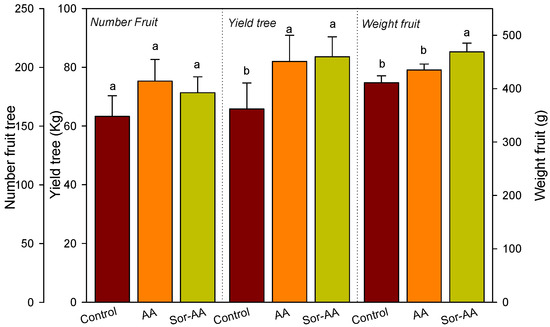
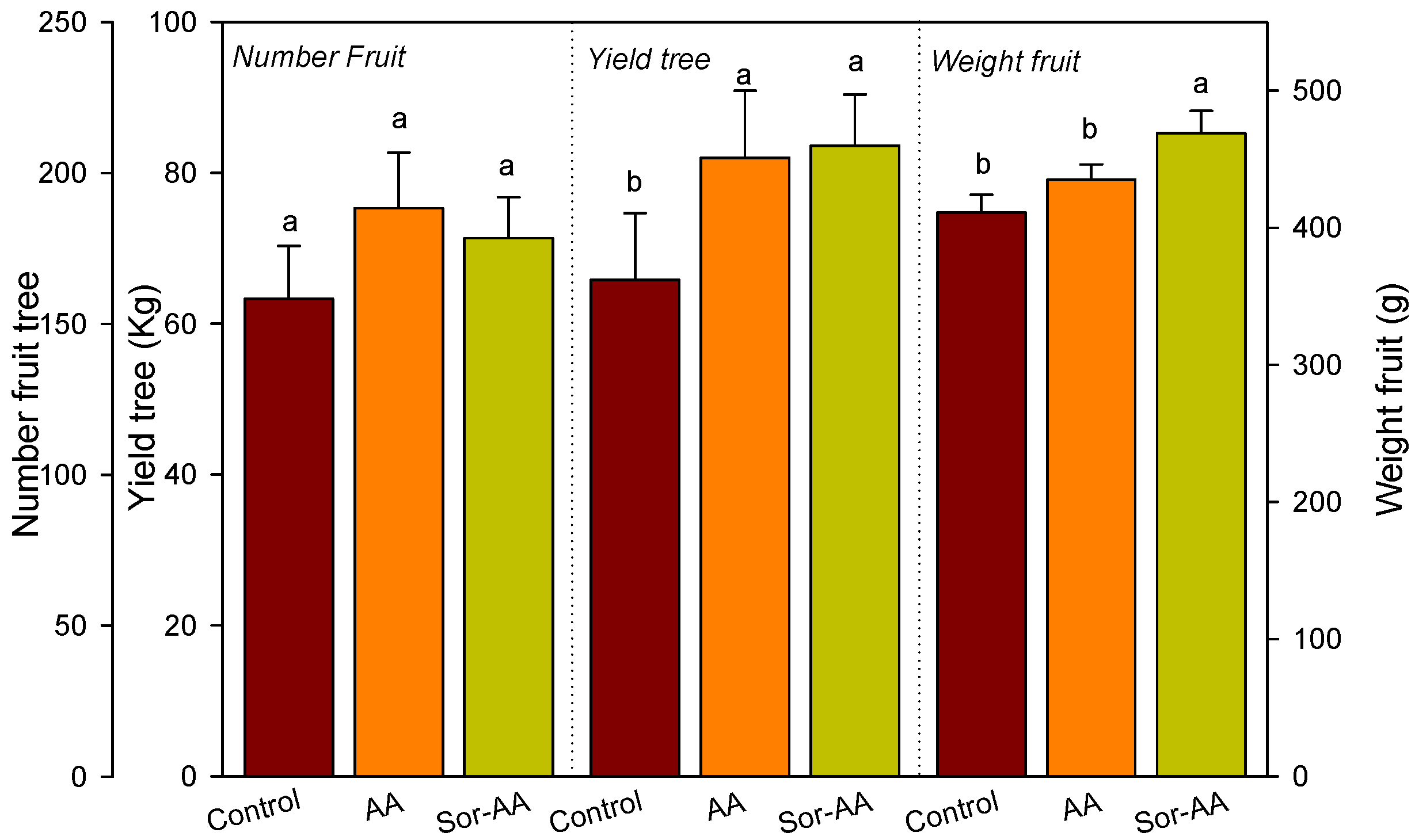
Foliar application of amino acids (AA) and their combination with sorbitol (Sor–AA) in ‘Mollar de Elche’ pomegranate trees enhanced harvest parameters compared to the control. Notably, the Sor–AA treatment achieved the highest yield per tree (83.58 ± 6.82 kg) and the highest average fruit weight (469.00 ± 16.00 g) (Figure 1). Control trees exhibited the lowest values (p < 0.05) for both production (65.81 ± 8.84 kg tree−1) and average fruit weight (411.00 ± 13.00 g). In all cases, the average number of fruits harvested per tree was similar, ranging between 158.29 and 188.29 fruits tree−1.
Figure 1.
Harvest parameters of ‘Mollar de Elche’ pomegranate trees. The charts compare the number of fruits, total yield per tree (kg), and average fruit weight (g) across three treatments: Control (dark red bars), AA (amino acids; orange bars), and Sor–AA (amino acids + sorbitol; yellow bars). Data are presented as mean ± standard error. Different lowercase letters indicate statistically significant differences (p < 0.05) between treatments.
The application of treatments significantly influenced the physicochemical quality of ‘Mollar de Elche’ pomegranates both at harvest and during postharvest storage (Table 1). Specifically, fruits treated with amino acids (AA) and their combination with sorbitol (Sor–AA) exhibited a higher TSS content and more intense coloration starting from day 0. This was evidenced by significantly lower hue angle values in both the external husk and the seeds compared to the control (p < 0.05). This trend of enhanced seed coloration and higher sugar content remained superior in treated fruits during the 21- and 42-day storage periods, with the Sor–AA treatment achieving the reddest seeds by the end of the trial (p < 0.05). Although the Sor–AA treatment initially showed a higher respiration rate (p < 0.05), this difference disappeared during storage. However, control fruits maintained significantly higher firmness than treated ones during storage (p < 0.05), with no significant variations in TA recorded between groups at any sampling point.
Table 1.
Physiological and physicochemical characteristics of ‘Mollar de Elche’ pomegranates at harvest and throughout storage at 7 °C, as influenced by preharvest biostimulant treatments. The values describe the evolution of respiration rate (mg CO2 kg−1 h−1), fruit firmness (N mm−1), and coloration in husk and seed hue angle (h°), as well as total soluble solids (TSS) (g 100g−1) and titratable acidity (TA) (g citric acid equivalents 100 mL−1) across the Control, AA, and Sor–AA groups. Each value represents the mean ± standard error, with different lowercase letters in the same row indicating statistically significant differences (p < 0.05) among treatments as determined by Tukey’s post hoc test.
3.2. Effects of Treatments on FAA Profile and Content in Pomegranate Seeds and Husk at Harvest
Chromatographic analysis (LC-MS/MS) revealed that although the qualitative amino acid composition was similar in both tissues, the foliar treatments induced specific and statistically significant metabolic shifts, particularly in the seeds (Table 2). Regardless of the tissue, the FAA profile was dominated by glutamine and lysine, which together accounted for approximately 45–55% of the total amino acid nitrogen content. Other quantitatively relevant amino acids included aspartic acid and serine. In the seeds, biostimulant application led to a progressive and significant decrease (p < 0.05) in the total concentration of FAAs. The Control group maintained the highest levels (129.04 ± 2.94 mg kg−1), whereas the concentration dropped to 120.82 ± 1.29 mg kg−1 in AA-treated fruits and reached a minimum of 102.43 ± 3.37 mg kg−1 in the Sor–AA treatment, representing a total reduction of 20.62% relative to the control. This downward trend was consistent across almost all individual amino acids. For instance, glutamine decreased from 33.45 mg kg−1 (Control) to 29.45 mg kg−1 (Sor–AA), and aspartic acid fell from 21.67 mg kg−1 to 17.86 mg kg−1. Notably, the most pronounced relative decreases under the Sor–AA treatment were observed in alanine (54.20% decrease), methionine (49.20% decrease), and tryptophan (66.20% decrease).
Table 2.
Free amino acid profile and relative composition in the seeds and peel (husk) of ‘Mollar de Elche’ pomegranates at harvest in response to preharvest foliar treatments. The data quantify the individual and total concentration of amino acids (mg kg−1 FW) and their respective percentages (%) across the Control, AA, and Sor–AA groups. Each value is presented as the mean ± standard error (n = 3), where different lowercase letters in the same row and for each specific tissue denote statistically significant differences (p < 0.05) among treatments, as determined by Tukey’s post hoc test.
In contrast to the seeds, the total FAA concentration in the husk showed no significant differences (p ≥ 0.05) among the groups, with values ranging from 101.29 ± 4.67 mg kg−1 in the control to 109.38 ± 11.31 and 104.04 ± 4.64 mg kg−1 in the AA and Sor–AA treatments, respectively. Most individual amino acids, including the dominant glutamine and lysine fractions, remained stable across all treatments in this tissue. Significant variations in the husk were limited to tyrosine, which reached its highest level in the AA treatment (0.12 ± 0.03 mg kg−1), and histidine, which showed a significant reduction in the Sor–AA group (0.20 ± 0.03 mg kg−1) compared to the Control (0.45 ± 0.10 mg kg−1).
3.3. Effects of Treatments on Anthocyanin Profile and Evolution During Storage
Chromatographic analysis using HPLC-DAD and LC-MS/MS allowed for the identification of the anthocyanin profile in ‘Mollar de Elche’ pomegranate juice, which consisted of five main compounds: delphinidin-3,5-diglucoside (delf-3.5-diglc), cyanidin-3,5-diglucoside (cyn-3.5-diglc), pelargonidin-3,5-diglucoside (pel-3.5-diglc), cyanidin-3-glucoside (cyn-3-o-glc), and pelargonidin-3-glucoside (pel-3-o-glc) (Table 3). Among these, cyn-3.5-diglc was confirmed as the major pigment in all samplings, accounting for the most abundant fraction (>50%) of the characteristic red coloration of the seeds. No anthocyanins were identified in the husk fraction.
Table 3.
Individual and total anthocyanin concentrations in ‘Mollar de Elche’ pomegranate juice at harvest and during storage at 7 °C, as influenced by preharvest biostimulant treatments. The data quantify the levels (mg L−1) of delphinidin-3,5-diglucoside, cyanidin-3,5-diglucoside, pelargonidin-3,5-diglucoside, cyanidin-3-glucoside, and pelargonidin-3-glucoside across the Control, AA, and Sor–AA groups. Each value represents the mean ± standard error (n = 3), with different lowercase letters in the same row indicating statistically significant differences (p < 0.05) among treatments at each sampling point (Day 0, M1, and M2).
When evaluating the effect of the treatments at harvest (Day 0), it was observed that the foliar application of biostimulants induced a significantly higher synthesis of anthocyanins (p < 0.05) compared to the control. Both the amino acid treatment (AA) and its combination with sorbitol (SOR–AA) doubled the total anthocyanin concentration (100.13 ± 7.55 and 98.62 ± 2.60 mg L−1, respectively) compared to the untreated trees (48.18 ± 2.88 mg L−1) (Table 3). At harvest time, cyn-3-O-glc and pel-3-O-glc showed the highest proportional increase in concentration (>200%) in the seeds of treated fruits.
Cold storage at 7 °C influenced the kinetics of these compounds, exhibiting dynamic behavior over time. After 21 days of storage (M1), a generalized increase in total anthocyanin content was recorded across all groups, reaching a peak during this period; at this point, the SOR–AA (116.69 ± 7.78 mg L−1) and AA (108.87 ± 5.13 mg L−1) treatments remained statistically superior to the control (76.44 ± 5.83 mg L−1) (Table 3). However, the interaction between prolonged storage and the treatments became evident by the end of the trial (42 days, M2), where the SOR–AA treatment proved to be the most effective strategy for mitigating pigment degradation. While the total content in the control and AA treatments declined relative to the previous sampling, fruits treated with SOR–AA maintained high and stable levels (108.18 ± 6.35 mg L−1), which were significantly higher (p < 0.05) than the control (66.53 ± 8.44 mg L−1). Specifically, this stability in the SOR–AA treatment was reflected in a higher concentration of anthocyanidins compared to both the AA treatment and the control throughout the entire storage period.
3.4. Effects of Treatments on Tannin Profile in Husk and Juice During Storage
The analysis revealed a highly uneven distribution among the different parts of the fruit. The husk exhibited a complex and rich profile, accumulating substantial amounts of both hydrolyzable tannins (punicalin, α- and β-punicalagin) and derived tannins (free ellagic acid and its glycosylated forms). Derived tannins constituted the major fraction, representing between 85% and 90% of the total phenolic content and reaching concentrations of up to 1151.36 mg kg−1 in the SOR–AA treatment at the end of storage (Table 4).
Table 4.
Concentration of hydrolyzable and derived tannins in the husk and juice of ‘Mollar de Elche’ pomegranates at harvest and during 42 days of storage at 7 °C, as affected by preharvest biostimulant treatments. The values (mg kg−1) detail the evolution of individual compounds, including punicalin, punicalagins (α and β), and ellagic acid derivatives (pentoside and glucoside) across the Control, AA, and Sor–AA groups. Each value represents the mean ± standard error of three independent replicates, where different lowercase letters in the same row indicate statistically significant differences (p < 0.05) among treatments at each sampling interval (Day 0, M1, and M2) according to Tukey’s test.
In contrast, hydrolyzable tannins showed much lower concentrations in this tissue, with a maximum of 116.52 mg kg−1. Furthermore, the tannin concentration in the seeds was considerably lower; only hydrolyzable tannins (punicalagins) were detected at very low concentrations, which did not exceed 1.60 mg kg−1, and there was no quantifiable presence of ellagic acid derivatives or punicalin (Table 4). Foliar biostimulant application significantly stimulated both hydrolyzable tannins and, especially, derived tannins. At harvest (Day 0), fruits treated with amino acids (AA) and the sorbitol mixture (SOR–AA) exhibited a significantly higher total tannin content in the husk (778 and 730 mg kg−1, respectively) compared to the control (610 mg kg−1) (p < 0.05). In the seeds, although the quantities were lower, the SOR–AA treatment stood out for achieving the highest initial concentration (1.60 mg kg−1), statistically surpassing both the AA treatment and the Control (Table 4).
Tannin behavior during postharvest storage at 7 °C followed opposing trends depending on the tissue (Table 4). While a progressive degradation of punicalagins was observed in the seeds over the 42 days of storage, a continuous and significant increase in the concentration of all identified compounds occurred in the husk (p < 0.05). The treatments demonstrated a modulating effect; specifically, in the husk, SOR–AA application significantly enhanced the accumulation of bioactive compounds by the end of storage (42 days), reaching the highest levels of free ellagic acid (371.72 mg kg−1) and total tannins (1267.88 mg kg−1) compared to the Control. In the seeds, where the natural trend was toward loss, the SOR–AA treatment acted as an effective protector. By day 42, it was the only treatment capable of maintaining punicalagin levels (0.55 mg kg−1) significantly higher than those of the Control (0.36 mg kg−1) and the AA treatment, suggesting a superior capacity to preserve the functional quality of the edible portion until the end of its shelf-life.
3.5. Effects of Treatments on Hydrophilic (H-AA) and Lipophilic (L-AA) Antioxidant Activity in Pomegranate Tissues During Storage
Total antioxidant capacity was determined by separately evaluating the hydrophilic (H-TAA) and lipophilic (L-TAA) fractions in the husk, seeds, and juice. In general, the H-TAA was predominant across all studied tissues, significantly exceeding the values obtained for the lipophilic fraction, regardless of the treatment or storage duration (Table 5).
Table 5.
Hydrophilic (H-TAA) and lipophilic (L-TAA) total antioxidant activity in the husk, seeds, and juice of ‘Mollar de Elche’ pomegranates at harvest and during 42 days of storage at 7 °C. The values, expressed as mg TE 100 g−1 FW, illustrate the impact of preharvest Control, AA, and Sor–AA treatments on the antioxidant potential of different fruit tissues. Each value represents the mean ± standard error (n = 3), where different lowercase letters in the same row for each tissue indicate statistically significant differences (p < 0.05) among treatments at each sampling interval (Day 0, M1, and M2), as determined by Tukey’s post hoc test.
The husk tissue exhibited the highest overall antioxidant activity, with a progressive increase in H-TAA across all groups during storage. However, preharvest treatments significantly enhanced these levels starting from harvest. Specifically, the combined Sor–AA treatment reached its maximum potential after 21 days of storage, recording values of 13,297.76 ± 519.43 mg TE 100 g−1 FW, which were significantly higher than the Control (9260.94 ± 435.69 mg TE 100 g−1 FW) and the AA treatment (Table 5). On the other hand, L-TAA in the husk also increased over time, ranging between 615 and 1182 over the 42-day period in the control group. Nevertheless, by day 42, the treated fruits showed stabilization or a slight decrease compared to the Control, which maintained the highest value (1182.13 ± 36.56 mg TE 100 g−1 FW).
Regarding the edible portions, the seeds showed a positive and sustained response to the treatments. From day 0, both the application of AA and Sor–AA increased the H-AA (106.95 ± 2.23 and 117.24 ± 8.00 mg TE 100 g−1 FW, respectively) compared to the Control (85.80 ± 4.71 mg TE 100 g−1 FW). This trend was maintained throughout storage at 7 °C, where treated fruits preserved a significantly higher antioxidant capacity than those untreated. Regarding the L-TAA of the seeds, although the absolute values were low, a significant effect of the treatments was observed at harvest, increasing activity by approximately 40–50% relative to the Control, although these differences attenuated toward the end of the storage period. In the juice, H-TAA exhibited a behavior similar to that of the husk, with a general increase during postharvest. The Sor–AA treatment stood out notably, maintaining the highest levels of hydrophilic antioxidants throughout the experiment, with a peak of 187.74 ± 5.98 mg TE 100 g−1 FW at 21 days, compared to 139.42 ± 1.48 mg TE 100 g−1 FW in the Control. It is important to highlight that in the L-TAA of the juice, the Sor–AA treatment was the only one capable of increasing and maintaining antioxidant activity until the end of storage (14.23 ± 0.18 at 42 days), suggesting a synergistic effect of sorbitol in preserving lipophilic bioactive compounds in the juice.
3.6. Pearson Correlation Analysis (PCA) and Multivariate Integration
The Pearson correlation analysis (Table 6) identified a highly integrated physiological response, where the correlation structure serves to map the biological synergy between primary precursors and secondary metabolites. Rather than simple variable reduction, these linear associations reveal how the metabolic energy captured in total soluble solids (TSS) is channeled toward the biosynthesis of anthocyanins and protective tannins (r > 0.80), providing a functional basis for the treatment-induced changes observed in the PCA model.
Table 6.
Pearson correlation matrix showing the linear relationships between physicochemical parameters, bioactive compounds, and antioxidant activity in ‘Mollar de Elche’ pomegranates. The coefficients (r) describe the associations among ripening indices (respiration rate, firmness, color, TSS, and TA), individual and total anthocyanins in the juice, hydrolyzable and derived tannins in the husk and juice, and the hydrophilic (H-TAA) and lipophilic (L-TAA) total antioxidant fractions across different fruit tissues.
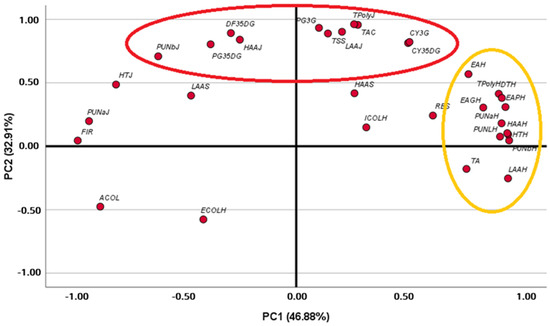
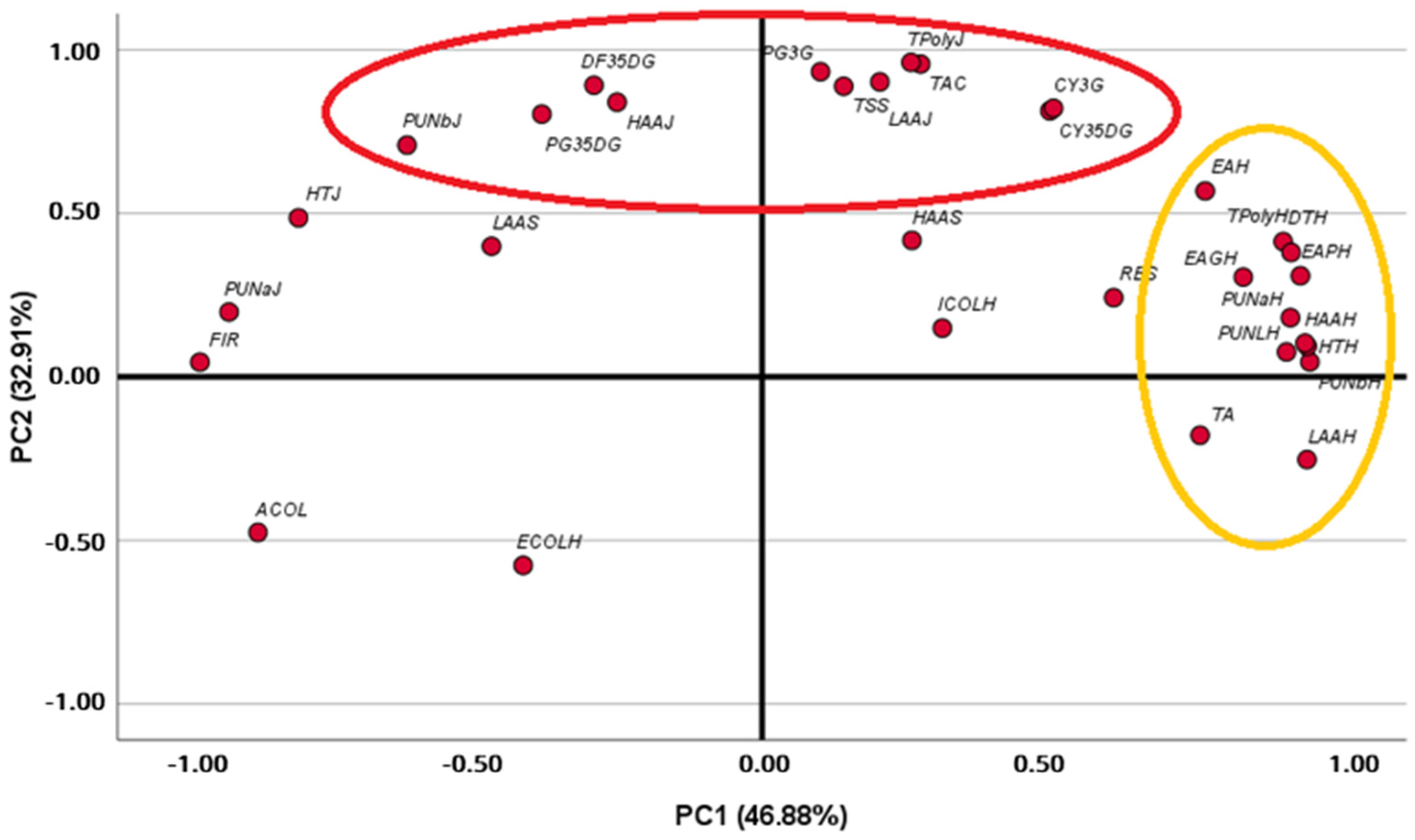
The two-component model, extracted using Varimax rotation, accounted for 79.79% of the total cumulative variance (PC1 = 46.88% and PC2 = 32.91%). This multivariate approach successfully partitioned the variables into two distinct metabolic blocks: the husk/physical properties and the juice quality profile (Figure 2). These loading vectors illustrate how each original variable aligns with orthogonal components, allowing for the clear identification of the physiological drivers behind the treatment-induced shifts.
Figure 2.
Loading plot of the first two principal components (PC1, 46.88%; PC2, 32.91%) after Varimax rotation. The vectors represent the loading of each original variable on the orthogonal components. PC1 (X-axis) groups husk variables (yellow circle) and firmness, while PC2 (Y-axis) groups juice quality variables (red circle).
Principal Component 1 (PC1) was primarily defined by the biochemical properties of the husk and fruit ripening indicators. High positive loadings were observed for hydrolyzable tannins in the husk (HTH, r = 0.940), punicalagins (PUNbH, r = 0.945; PUNaH, r = 0.911), and hydrophilic antioxidant activity in the husk (HAAH, r = 0.936). These results align with the Pearson matrix, which showed very strong correlations (r > 0.90) between these phenolic compounds and the antioxidant capacity of the husk. Furthermore, fruit firmness (FIR) showed a strong negative loading on PC1 (r = −0.969) and significant negative correlations with color and pigment markers. This confirms that as the fruit matures and accumulates bioactive compounds in the husk, there is a coordinated decrease in structural firmness.
Principal Component 2 (PC2) integrated the variables related to juice quality and seed coloration. High positive loadings were recorded for total anthocyanins (TAC, r = 0.957), total soluble solids (TSS, r = 0.889), and total polyphenols in the juice (TPolyJ, r = 0.962) (Figure 2). These findings corroborate the Pearson analysis, where TSS exhibited a significant positive association with total anthocyanin concentration. Similarly, the strong correlation between total anthocyanins and the hydrophilic antioxidant activity of the juice (HAAJ, r = 0.840) was clearly evidenced by their proximity in the rotated space.
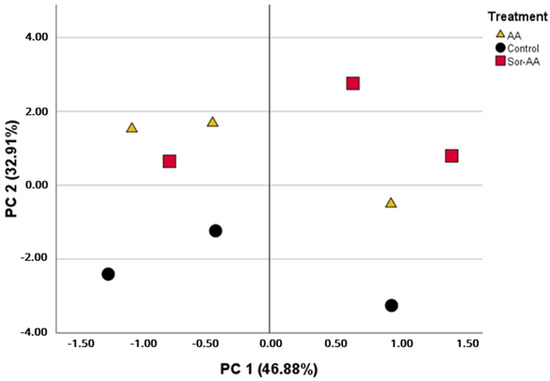
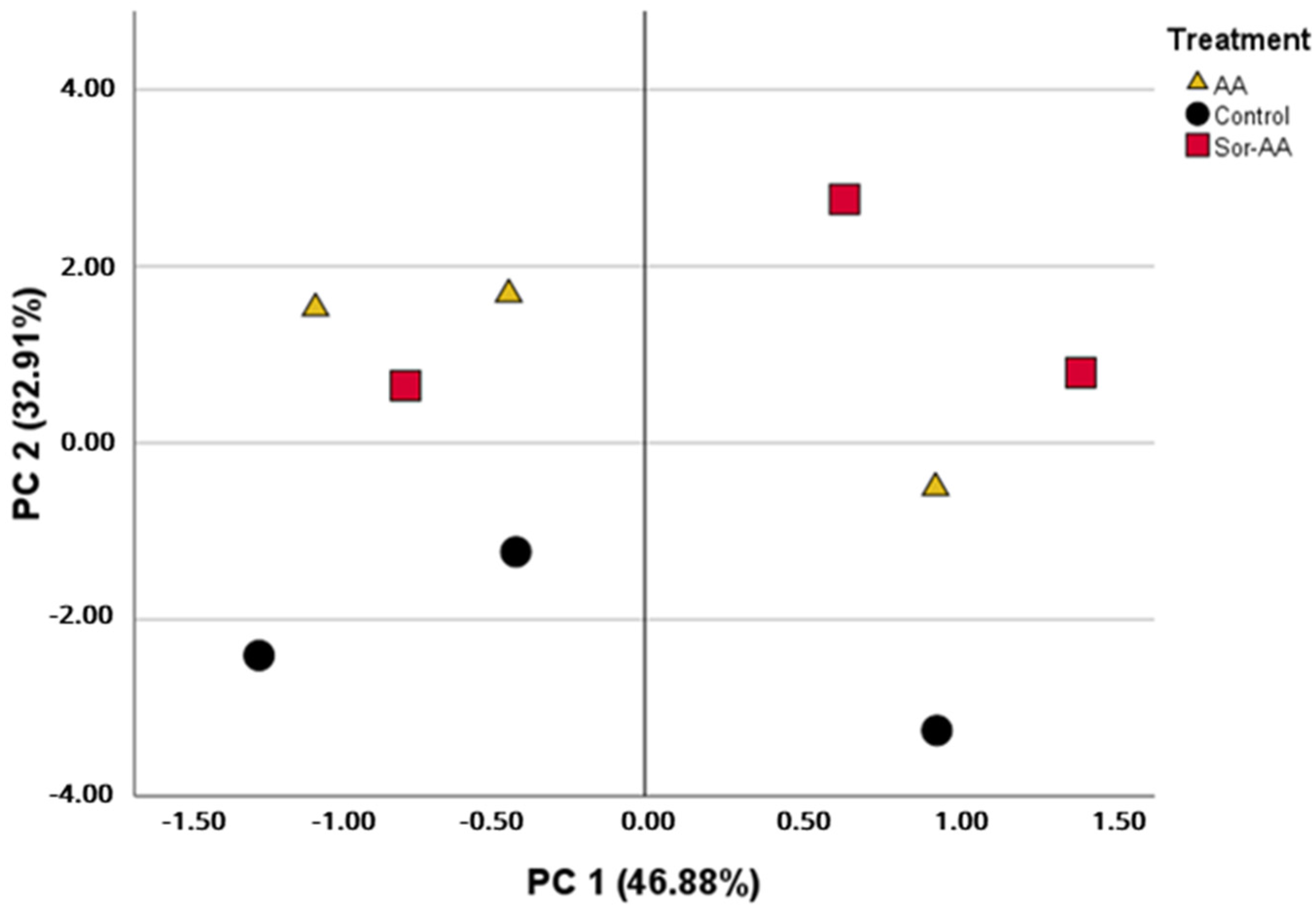
It is noteworthy that the independence between husk ellagitannins and juice anthocyanins, initially suggested by the Pearson matrix, was confirmed by their separation into distinct principal components. This implies that the biosynthetic pathways for these bioactive compounds operate as separate metabolic sinks in the husk and juice. The spatial distribution in the PCA scores plot clearly separated the treatments, with the Sor–AA group shifting toward the upper-right quadrant (positive scores for both PC1 and PC2), reflecting its superior performance in enhancing both the functional value of the husk and the organoleptic quality of the juice (Figure 3).
Figure 3.
PCA scores plot (PC1, 46.88%; PC2, 32.91%) illustrating the spatial distribution and clustering of Control and treatment (AA and Sor–AA) samples based on their integrated metabolic profiles.
4. Discussion
The role of biostimulants in modern horticulture has shifted; they are no longer viewed merely as growth enhancers but as precise metabolic regulators that optimize physiological pathways beyond the scope of traditional fertilization [14]. The performance of ‘Mollar de Elche’ under the Sor–AA treatment reflects a broader scientific pattern where enzymatically derived L-α-amino acids provide a metabolic bypass, allowing the fruit to save vital energy and redirect it toward biomass accumulation and bioactive quality [15,24]. While comparable research in other horticultural crops often reports yield gains or stress mitigation as isolated effects [16,18], our findings highlight a coordinated systemic response. This study confirms that targeted biostimulation can simultaneously overcome specific genotypic quality constraints, such as the pale color of this cultivar, while significantly enhancing postharvest resilience.
4.1. Effects of Treatments on Yield and Optimization of Physicochemical Quality During Storage
Foliar application of amino acid (AA)-based biostimulants and their synergy with sorbitol (Sor–AA) significantly improved productivity. The Sor–AA treatment achieved the highest yield per tree (83.58 kg) and the highest average fruit weight (469 g), while the treatment with isolated amino acids maximized the number of fruits. This yield enhancement is driven by the fact that enzymatic protein hydrolysates (PHs) provide ready-made building blocks that bypass the energy-expensive nitrate reduction and endogenous synthesis pathways. This ‘metabolic bypass’ allows the plant to conserve significant amounts of ATP and NADPH, which are directly redirected toward fruit biomass accumulation and cell expansion [15,24]. This observed increase in yield through the use of biostimulants based on protein hydrolysates aligns with findings in peach [21] and other pomegranate cultivars, such as ‘Manfalouty’ [22]. In those cases, the exogenous application of specific amino acids not only improved the fruit weight but also significantly reduced the percentage of cracked fruit by enhancing husk elasticity [22]. Furthermore, the use of enzymatically-derived L-amino acids ensures higher bioavailability and environmental safety compared to chemical hydrolysis, as it avoids the formation of non-functional D-isomers or residual toxic chemicals [15]. Consequently, this energy saving is redirected toward critical processes, such as the development of reproductive structures and the increase in commercial yield [16,18]. Additionally, sorbitol and amino acids act as translocation agents, facilitating the transport of nutrients and photosynthates toward the sink organs [16,38].
Regarding internal quality, treated fruits exhibited a higher TSS content compared to the Control from harvest and throughout storage. This increase is a characteristic response to biostimulants, which act as ripening signals and enhance carbohydrate mobilization [8,39]. As TA did not vary significantly, this stability, combined with the increase in TSS, suggests a more balanced and attractive organoleptic profile for consumers in the treated fruits [6,40]. The FAA profile in pomegranate was dominated by glutamine and lysine, which represented between 45% and 55% of the total amino acid nitrogen. An inverse relationship between tissues was observed: while FAAs in the husk increased significantly under the AA treatment (+20%), they decreased drastically in the seeds, especially in the Sor–AA treatment (−20.19%).
While glutamine (Gln) dominance is a common trait in pomegranates, the free amino acid profile can vary significantly depending on the cultivation region and genotype. For instance, a higher proportion of serine and alanine has been detected in the juice of various Chinese cultivars [41]. In our study, biostimulant treatments, particularly Sor–AA, significantly reduced the FAA pool in the seeds, with sharp declines in alanine, methionine, and tryptophan. Rather than a deficiency, this decrease reflects a ‘metabolic acceleration’ facilitated by the exogenous L-alpha-amino acids. By providing readily available building blocks, the biostimulant allows the plant to perform a metabolic bypass, conserving energy (ATP) and reducing power (NADPH) that would otherwise be spent on nitrate absorption and endogenous synthesis. The metabolic advantage of foliar-applied amino acids derives from fundamental differences in nitrogen assimilation energetics. De novo amino acid synthesis from inorganic nitrogen requires substantial ATP and reducing equivalents through the glutamine synthetase/glutamate synthase pathway [42,43], whereas interconversion among amino acids proceeds primarily through aminotransferase reactions that do not consume ATP directly [42,44]. Modeling studies have confirmed that nitrogen source significantly affects the amino acid synthesis costs, with the initial assimilation of inorganic nitrogen representing the major energetic burden [45,46]. By providing amino acids directly through foliar application, plants can bypass this energy-intensive pathway for a portion of their nitrogen supply, redirecting photosynthate and reducing power toward fruit development and secondary metabolism. Although the precise proportion of foliar-applied amino acids incorporated into fruit tissues is difficult to quantify under field conditions, controlled feeding experiments have demonstrated that exogenous amino acids can contribute substantially to sink tissue metabolism [47], and field studies across multiple fruit crops have consistently documented yield improvements following foliar amino acid application [39,48,49]. Consequently, these FAAs are rapidly incorporated into seed storage proteins, such as globulins and albumins, or utilized in the synthesis of secondary metabolites required to complete the ripening process [15,16,24].
4.2. Effects of Treatments on Anthocyanin Biosynthesis and Stabilization During Storage
The red color deficit is the primary commercial limitation of the ‘Mollar de Elche’ cultivar. This study confirmed that cyanidin-3,5-diglucoside is the major pigment (>50%), which is consistent with previous characterizations of this cultivar [2,5]. Biochemically, the diglucoside structure confers greater chemical and thermal stability against oxidative degradation [25]. At harvest, the biostimulant treatments doubled the anthocyanin levels. This is because amino acids such as phenylalanine (Phe) activate key regulatory enzymes in the phenylpropanoid pathway, such as phenylalanine ammonia-lyase (PAL) and flavonoid 3-O-glucosyltransferase (GT) [8,13,27]. By the end of storage (42 days), only the Sor–AA treatment maintained high and stable concentrations (~108 mg L−1). This phenomenon could suggest a copigmentation effect, where sorbitol and amino acids form non-covalent complexes that protect the flavylium nucleus against nucleophilic attacks and degradation by polyphenol oxidases (PPOs) [9,26]. This effect is particularly relevant for 3,5-diglucosides; because their C6 and C8 positions are less nucleophilic, they exhibit greater resistance to electrophilic attack when stabilized by these non-covalent molecular complexes [25]. Biochemically, the glucose substitution at the C5 position in 3,5-diglucosides reduces the molecule’s nucleophilic character. This structural trait renders these pigments more resistant to hydration and subsequent enzymatic oxidation by polyphenol oxidases (PPO) during storage, explaining the superior color stability in Sor–AA fruits [25].
4.3. Effects of Treatments on Tannin Compartmentalization and Antioxidant Activity During Storage
The analysis confirmed a marked biochemical compartmentalization: the husk is the primary reservoir of ellagitannins (punicalagins and ellagic acid), while the seeds exhibit minimal levels [10,11,50]. Sor–AA treatments significantly stimulated the synthesis of these compounds before harvest by activating the shikimate pathway. At a biochemical level, the foliar application of amino acids stimulates the shikimic acid pathway, a precursor to the synthesis of phenolic compounds and flavonoids. This increase in secondary metabolites enhances the antioxidant capacity of the tissues, protecting cell membranes against oxidative damage caused by reactive oxygen species (ROS) [18,19].
During postharvest, a divergent evolution was observed: tannins decreased in the seeds but increased in the husk due to the release of compounds bound to the cell wall and concentration resulting from water loss [12]. The Sor–AA treatment was the most effective strategy for maximizing free ellagic acid, which provides the fruit with greater functional value due to its anticancer and anti-inflammatory properties [2,25]. The hydrophilic fraction (H-AA) was predominant in all tissues, which is consistent with a profile rich in ellagitannins and anthocyanins [2,10]. The husk exhibited the highest antioxidant activity, which correlated closely (r > 0.90) with the punicalagin levels. Meanwhile, the Sor–AA treatment not only maintained the highest H-TAA in the juice, but was also the only one capable of stabilizing the lipophilic activity (L-TAA), suggesting comprehensive protection of cell membranes against oxidative damage.
4.4. Integration and the Basis of Postharvest Resilience
Pearson correlation analysis confirmed that the increase in TSS provides the metabolic energy necessary for the synthesis of pigments and phenols [7,8]. A critical aspect is that the higher antioxidant load in the treated fruits could improve resistance to internal browning, a physiological disorder that affects visual quality during postharvest [12,44]. Resilience to internal browning depends on maintaining a specific ionic homeostasis. Recent evidence suggests that physiological resilience in ‘Mollar de Elche’ depends on a composite mineral ratio in the crown tissue, specifically [(P + Ca + Mg)/(N + K)]. A ratio above 0.15 acts as a robust mechanistic predictor of tolerance to chilling injury. In our study, the synergy of sorbitol facilitated the translocation of Ca and Mg to the fruit’s crown while moderating the N and K levels, thereby preventing the subepidermal collapse observed in sensitive fruits [12]. Finally, the lack of correlation between husk ellagitannins and juice anthocyanins validates the functional independence of the fruit sinks and the effectiveness of sorbitol in mobilizing resources toward both simultaneously, optimizing the fruit in a comprehensive manner [23].
The multivariate integration identified a fundamental metabolic divergence between untreated and biostimulant-treated fruits. The PCA model accounted for 79.79% of the total variance, effectively partitioning the physiological response into rind integrity (PC1) and juice nutraceutical density (PC2). The specific clustering of Sor–AA samples in the upper-right quadrant validates a systemic shift driven by the synergy between L-α-amino acids and sorbitol. This transition is characterized by a simultaneous doubling of total anthocyanins (r = 0.957) and a significant increase in total soluble solids (r = 0.889), while maintaining the functional barrier of the husk through enhanced ellagitannin accumulation. These data confirm that foliar AA and Sor–AA applications represent an effective agronomic tool to address the coloration deficit and improve the storage stability of ‘Mollar de Elche’ pomegranates.
5. Conclusions
This study confirms that the synergistic preharvest application of L-α-amino acids and sorbitol (Sor–AA) triggers a systemic metabolic shift in ‘Mollar de Elche’ pomegranate. By facilitating a ‘metabolic bypass’ that optimizes energy use, this strategy simultaneously maximizes commercial yield and successfully overcomes the cultivar’s inherent color deficit through the stabilization of juice anthocyanins (~108 mg L−1). Conceptually, these findings demonstrate that targeted biostimulation is a powerful tool to redefine the metabolic phenotype and postharvest resilience of high-value fruits with genotypic quality limitations. The robust multivariate analysis presented here conclusively supports the efficacy of the Sor–AA treatment; nevertheless, expanding these trials across different environmental conditions will further reinforce the multi-seasonal robustness of this innovative agronomic tool for large-scale commercial application.
Author Contributions
Conceptualization, D.M.-R. and J.M.V.; methodology, A.S.-G., A.G. and F.G.-A.; validation, D.M.-R.; formal analysis, A.S.-G., A.G. and F.G.-A.; investigation, D.M.-R. and J.M.V.; resources, J.M.V.; data curation, D.M.-R. and M.E.G.-P.; writing—original draft preparation, A.S.-G. and D.M.-R.; writing—review and editing: M.E.G.-P., D.V. and D.M.-R.; supervision, J.M.V.; project administration, J.M.V.; funding acquisition, D.M.-R. All authors have read and agreed to the published version of the manuscript.
Funding
This research was funded by MICIU/AEI/10.13039/501100011033 and by FEDER, UE, grant number PID2022-137282OB-I00.
Data Availability Statement
The original contributions presented in this study are included in the article. Further inquiries can be directed to the corresponding authors.
Acknowledgments
The authors thank Generalitat Valenciana, the Conselleria of Education, Universities and Employment, for funding Alberto Guirao Carrascosa with a PhD scholarship (CIACIF/2022/270) that enabled him to undertake doctoral studies, and to the European Social Fund for co-financing these grants.
Conflicts of Interest
The authors declare no conflicts of interest, financial or otherwise, that could have influenced the research outcomes or conclusions presented in this work.
References
- Mena, P.; García-Viguera, C.; Navarro-Rico, J.; Moreno, D.A.; Bartual, J.; Saura, D.; Martí, N. Phytochemical characterisation for industrial use of pomegranate (Punica granatum L.) cultivars grown in Spain. J. Sci. Food Agric. 2011, 91, 1893–1906. [Google Scholar] [CrossRef] [Scilit] [PubMed]
- Melgarejo-Sánchez, P.; Núñez-Gómez, D.; Martínez-Nicolás, J.J.; Hernández, F.; Legua, P.; Melgarejo, P. Pomegranate variety and pomegranate plant part, relevance from bioactive point of view: A review. Bioresour. Bioprocess. 2021, 8, 2. [Google Scholar] [CrossRef] [Scilit] [PubMed]
- Nuncio-Jáuregui, N.; Calín-Sánchez, A.; Carbonell-Barrachina, A.; Hernández, F. Changes in quality parameters, proline, antioxidant activity and color of pomegranate (Punica granatum L.) as affected by fruit position within tree, cultivar and ripening stage. Sci. Hortic. 2014, 165, 181–189. [Google Scholar] [CrossRef] [Scilit]
- Calín-Sánchez, Á.; Figiel, A.; Hernández, F.; Melgarejo, P.; Lech, K.; Carbonell-Barrachina, Á.A. Chemical composition, antioxidant capacity, and sensory quality of pomegranate (Punica granatum L.) arils and rind as affected by drying method. Food Bioprocess Technol. 2013, 6, 1644–1654. [Google Scholar] [CrossRef] [Scilit]
- Legua, P.; Melgarejo, P.; Martínez, J.J.; Martínez, R.; Hernández, F. Evaluation of Spanish pomegranate juices: Organic acids, sugars, and anthocyanins. Int. J. Food Prop. 2012, 15, 481–494. [Google Scholar] [CrossRef] [Scilit]
- Tozzi, F.; Legua, P.; Martínez-Nicolás, J.J.; Núñez-Gómez, D.; Giordani, E.; Melgarejo, P. Morphological and nutraceutical characterization of six pomegranate cultivars of global commercial interest. Sci. Hortic. 2020, 272, 109557. [Google Scholar] [CrossRef] [Scilit]
- Lorente-Mento, J.M.; Carrión-Antolí, A.; Guillén, F.; Serrano, M.; Valero, D.; Martínez-Romero, D. Relationship among sugars, organic acids, mineral composition, and chilling injury sensitivity on six pomegranate cultivars stored at 2 °C. Foods 2023, 12, 1364. [Google Scholar] [CrossRef] [Scilit]
- García-Pastor, M.E.; Serrano, M.; Guillén, F.; Giménez, M.J.; Martínez-Romero, D.; Valero, D.; Zapata, P.J. Preharvest application of methyl jasmonate increases crop yield, fruit quality and bioactive compounds in pomegranate ‘Mollar de Elche’ at harvest and during postharvest storage. J. Sci. Food Agric. 2020, 100, 145–153. [Google Scholar] [CrossRef] [Scilit]
- Bartual, J.; Perez-Gago, M.B.; Pomares, F.; Palou, L.; Intrigliolo, D.S. Nutrient status and irrigation management affect anthocyanins in ‘Mollar de Elche’ pomegranate. Acta Hortic. 2015, 1106, 85–92. [Google Scholar] [CrossRef] [Scilit]
- Gil, M.I.; Tomás-Barberán, F.A.; Hess-Pierce, B.; Holcroft, D.M.; Kader, A.A. Antioxidant activity of pomegranate juice and its relationship with phenolic composition and processing. J. Agric. Food Chem. 2000, 48, 4581–4589. [Google Scholar] [CrossRef] [Scilit]
- Seeram, N.P.; Adams, L.S.; Henning, S.M.; Niu, Y.; Zhang, Y.; Nair, M.G.; Heber, D. In vitro antiproliferative, apoptotic and antioxidant activities of punicalagin, ellagic acid and a total pomegranate tannin extract are enhanced in combination with other polyphenols as found in pomegranate juice. J. Nutr. Biochem. 2005, 16, 360–367. [Google Scholar] [CrossRef] [Scilit]
- Morales, J.; Marzal, A.; Primo-Capella, A.; Peris-Costa, P.; Rodríguez-Carretero, I.; Pérez-Piqueres, A.; Pérez-Gago, B.; Quiñones, A. Unraveling the nutritional and storage factors behind internal browning in ‘Mollar de Elche’ pomegranate. Postharvest Biol. Technol. 2026, 233, 114051. [Google Scholar] [CrossRef] [Scilit]
- Lorente-Mento, J.M.; Valero, D.; Martínez-Romero, D.; Badiche, F.; Serrano, M.; Guillén, F. Preharvest multiple applications of GABA improve quality traits and antioxidant compounds of pomegranate fruit during storage. Horticulturae 2023, 9, 534. [Google Scholar] [CrossRef] [Scilit]
- du Jardin, P. Plant biostimulants: Definition, concept, main categories and regulation. Sci. Hortic. 2015, 196, 3–14. [Google Scholar] [CrossRef] [Scilit]
- Dhanasekaran, P.; Chittibabu, S.; Mouzeyar, S.; Boulaflous-Stevens, A.; Delattre, C.; Roche, J. From waste to wonder: The potential of protein hydrolysates as plant biostimulants in agriculture. Bioresour. Technol. Rep. 2025, 32, 102333. [Google Scholar] [CrossRef] [Scilit]
- Utgés-Minguell, L.; Sierras-Serra, N.; Marín, C.; Pintó-Marijuan, M. Enhanced production by terra-sorb® symbiotic biostimulant in two model species under nitrogen stress. Plants 2025, 14, 1087. [Google Scholar] [CrossRef] [Scilit]
- Moreno-Hernández, J.M.; Benítez-García, I.; Mazorra-Manzano, M.A.; Ramírez-Suárez, J.C.; Sánchez, E. Strategies for production, characterization and application of protein-based biostimulants in agriculture: A review. Chil. J. Agric. Res. 2020, 80, 274–289. [Google Scholar] [CrossRef] [Scilit]
- Kocira, S.; Szparaga, A.; Hara, P.; Treder, K.; Findura, P.; Bartoš, P.; Filip, M. Biochemical and economical effect of application biostimulants containing seaweed extracts and amino acids as an element of agroecological management of bean cultivation. Sci. Rep. 2020, 10, 17759. [Google Scholar] [CrossRef] [Scilit]
- Kocira, A.; Lamorska, J.; Kornas, R.; Nowosad, N.; Tomaszewska, M.; Leszczyńska, D.; Kozłowicz, K.; Tabor, S. Changes in biochemistry and yield in response to biostimulants applied in bean (Phaseolus vulgaris L.). Agronomy 2020, 10, 189. [Google Scholar] [CrossRef] [Scilit]
- Zydlik, P.; Zydlik, Z.; Wieczorek, R. The effectiveness of using a preparation containing amino acids in the cultivation of strawberries under thermal stress conditions. Pol. J. Agron. 2021, 44, 39–43. [Google Scholar]
- Al-Saif, A.M.; Sas-Paszt, L.; Saad, R.M.; Mosa, W.F. Amino acids as safe biostimulants to improve the vegetative Growth, yield, and fruit quality of peach. Bioresources 2024, 19, 5978–5993. [Google Scholar] [CrossRef] [Scilit]
- El Sayed, O.M.; El Gammal, O.H.M.; Salama, A.S.M. Effect of proline and tryptophan amino acids on yield and fruit quality of Manfalouty pomegranate variety. Sci. Hortic. 2014, 169, 1–5. [Google Scholar] [CrossRef] [Scilit]
- Ilie, A.V.; Petrisor, C.; Hoza, D. Influence of foliar application of amino acids to yield and quality attributes of apple. J. Hortic. For. Biotechnol. 2017, 21, 104–107. [Google Scholar]
- Popko, M.; Michalak, I.; Wilk, R.; Gramza, M.; Chojnacka, K.; Górecki, H. Effect of the new plant growth biostimulants based on amino acids on yield and grain quality of winter wheat. Molecules 2018, 23, 470. [Google Scholar] [CrossRef] [Scilit]
- Türkyılmaz, M.; Hamzaoğlu, F.; Ünal, H.; Özkan, M. Influence of amino acid addition on the thermal stability of anthocyanins in pomegranate (Punica granatum L., cv. Hicaznar) and orange (Citrus sinensis L. Osbeck, cv. Valencia) juice blend. Food Chem. 2022, 370, 131061. [Google Scholar] [CrossRef] [Scilit] [PubMed]
- Hamzaoğlu, F.; Türkyılmaz, M.; Özkan, M. Increase in color stability through amino acid copigmentation in pomegranate juice during storage. ACS Food Sci. Technol. 2025, 5, 4119–4128. [Google Scholar] [CrossRef] [Scilit]
- Cheng, X.; Wang, X.; Zhang, A.; Wang, P.; Chen, Q.; Ma, T.; Li, W.; Liang, Y.; Sun, X.; Fang, Y. Foliar phenylalanine application promoted antioxidant activities in cabernet sauvignon by regulating phenolic biosynthesis. J. Agric. Food Chem. 2020, 68, 15390–15402. [Google Scholar] [CrossRef] [Scilit]
- Guirao, A.; Valverde, J.M.; Díaz-Mula, H.M.; Valero, D.; Serrano, M.; Martínez-Romero, D. Role of pre-harvest sorbitol–calcium treatments in controlling berry drop in bagged table grapes of the “Doña María” variety. Horticulturae 2024, 10, 698. [Google Scholar] [CrossRef] [Scilit]
- Guirao, A.; García-Pastor, M.E.; Solana-Guilabert, A.; Valverde, J.M.; Martínez-Romero, D. Enhancing calcium transport in table grapes using sorbitol: A sustainable strategy for promoting fruit quality. Horticulturae 2025, 11, 1320. [Google Scholar] [CrossRef] [Scilit]
- Lorente-Mento, J.M.; Guillén, F.; Martínez-Romero, D.; Carrión-Antolí, A.; Valero, D.; Serrano, M. γ-Aminobutyric acid treatments of pomegranate trees increase crop yield and fruit quality at harvest. Sci. Hortic. 2023, 309, 111633. [Google Scholar] [CrossRef] [Scilit]
- Colla, G.; Nardi, S.; Cardarelli, M.; Ertani, A.; Lucini, L.; Canaguier, R.; Rouphael, Y. Protein hydrolysates as biostimulants in horticulture. Sci. Hortic. 2015, 196, 28–38. [Google Scholar] [CrossRef] [Scilit]
- Bioibérica, S.A.U. Terra-Sorb® Foliar Technical and Safety Data Sheet. 2023. Available online: https://www.bioiberica.com/en/products/plants-health/terra-sorb-foliar (accessed on 25 February 2026).
- Guirao, A.; Martinez-Romero, D.; Solana-Guilabert, A.; Agulló, V.; Diaz-Mula, H.M.; Valverde, J.M. Influence of preharvest sorbitol and calcium-sorbitol applications on the ripening process and anthocyanin biosynthesis in blood Orange (Citrus sinensis cv. Sanguinelli). Food Chem. 2025, 481, 144105. [Google Scholar] [CrossRef] [Scilit] [PubMed]
- Solana-Guilabert, A.; Martínez-Romero, D.; Guirao, A.; Díaz-Mula, H.M.; Garrido-Auñón, F.; Serrano, M.; Valero, D.; Valverde, J.M. Preharvest sorbitol application modulates phytohormone profiles and enhances nutraceutical quality of extra-early nectarine (Prunus persica). Food Chem. 2026, 508, 148427. [Google Scholar] [CrossRef] [Scilit] [PubMed]
- Díaz-Mula, H.M.; Tomás-Barberán, F.A.; García-Villalba, R. Pomegranate fruit and juice (cv. Mollar), rich in ellagitannins and anthocyanins, also provide a significant content of a wide range of proanthocyanidins. J. Agric. Food Chem. 2019, 67, 9160–9167. [Google Scholar] [CrossRef] [Scilit]
- Cebadera-Miranda, L.; Domínguez, L.; Dias, M.I.; Barros, L.; Ferreira, I.C.; Igual, M.; Martínez-Navarrete, N.; Fernández-Ruiz, V.; Morales, P.; Cámara, M. Sanguinello and Tarocco (Citrus sinensis [L.] Osbeck): Bioactive compounds and colour appearance of blood oranges. Food Chem. 2019, 270, 395–402. [Google Scholar] [CrossRef] [Scilit]
- Shimadzu Corporation. Analytical Application Note. 2016. Available online: https://www.shimadzu.com/an/sites/shimadzu.com.an/files/pim/pim_document_file/applications/application_note/10803/jpo116075.pdf (accessed on 8 December 2024).
- Hadavi, E.; Ghazijahani, N. Simple organic acids as plant biostimulants. In Biostimulants: Exploring Sources and Applications; Ramawat, N., Bhardwaj, V., Eds.; Springer Nature: Singapore, 2022; pp. 71–105. [Google Scholar]
- Henderson, B.C.; Sanderson, J.M.; Fowles, A. A review of the foliar application of individual amino acids as biostimulants in plants. Discov. Agric. 2025, 3, 69. [Google Scholar] [CrossRef] [Scilit]
- Pons-Gómez, A.; Delpozo, B.; Bartual, J.; Besada, C. Pomegranate quality from consumers’ perspective: Drivers of liking, preference patterns, and the relation between sensory and physico-chemical properties. Foods 2024, 13, 2118. [Google Scholar] [CrossRef] [Scilit]
- Li, Y.; Gu, P.; Wang, L.; Wang, S.; Yang, H.; Zhang, B.; Zhu, B.; Ma, C. Comparison of amino acid profile in the juice of six pomegranate cultivars from two cultivation regions in China. J. Food Process. Preserv. 2017, 41, e13197. [Google Scholar] [CrossRef] [Scilit]
- Suzuki, A.; Knaff, D.B. Glutamate synthase: Structural, mechanistic and regulatory properties, and role in the amino acid metabolism. Photosynth. Res. 2005, 83, 191–217. [Google Scholar] [CrossRef] [Scilit]
- Pratelli, R.; Pilot, G. Regulation of amino acid metabolic enzymes and transporters in plants. J. Exp. Bot. 2014, 65, 5535–5556. [Google Scholar] [CrossRef] [Scilit]
- Aghdam, M.S.; Kakavand, F.; Rabiei, V.; Zaare-Nahandi, F.; Razavi, F. γ-Aminobutyric acid and nitric oxide treatments preserve sensory and nutritional quality of cornelian cherry fruits during postharvest cold storage by delaying softening and enhancing phenols accumulation. Sci. Hortic. 2019, 246, 812–817. [Google Scholar] [CrossRef] [Scilit]
- Arnold, A.; Sajitz-Hermstein, M.; Nikoloski, Z. Effects of varying nitrogen sources on amino acid synthesis costs in Arabidopsis thaliana under different light and carbon-source conditions. PLoS ONE 2015, 10, e0116536. [Google Scholar] [CrossRef] [Scilit]
- Zerihun, A.; McKenzie, B.A.; Morton, J.D. Photosynthate costs associated with the utilization of different nitrogen–forms: Influence on the carbon balance of plants and shoot–root biomass partitioning. New Phytol. 1998, 138, 1–11. [Google Scholar] [CrossRef] [Scilit]
- Allen, D.K.; Young, J.D. Carbon and nitrogen provisions alter the metabolic flux in developing soybean embryos. Plant Physiol. 2013, 161, 1458–1475. [Google Scholar] [CrossRef] [Scilit]
- Teixeira, W.F.; Fagan, E.B.; Soares, L.H.; Soares, J.N.; Reichardt, K.; Neto, D.D. Seed and foliar application of amino acids improve variables of nitrogen metabolism and productivity in soybean crop. Front. Plant Sci. 2018, 9, 396. [Google Scholar] [CrossRef] [Scilit]
- Kheir, A.M.; Ding, Z.; Gawish, M.S.; Abou El Ghit, H.M.; Hashim, T.A.; Ali, E.F.; Eissa, M.A.; Zhou, Z.; Al-Harbi, M.S.; El-Gioushy, S.F. The exogenous application of micro-nutrient elements and amino acids improved the yield, nutritional status and quality of mango in arid regions. Plants 2021, 10, 2057. [Google Scholar] [CrossRef] [Scilit]
- Bar-Ya’akov, I.; Tian, L.; Amir, R.; Holland, D. Primary metabolites, anthocyanins, and hydrolyzable tannins in the pomegranate fruit. Front. Plant Sci. 2019, 10, 620. [Google Scholar] [CrossRef] [Scilit] [PubMed]

Disclaimer/Publisher’s Note: The statements, opinions and data contained in all publications are solely those of the individual author(s) and contributor(s) and not of MDPI and/or the editor(s). MDPI and/or the editor(s) disclaim responsibility for any injury to people or property resulting from any ideas, methods, instructions or products referred to in the content. |
© 2026 by the authors. Licensee MDPI, Basel, Switzerland. This article is an open access article distributed under the terms and conditions of the Creative Commons Attribution (CC BY) license.