


Abstract
The tomato processing industry is among the most widespread food industries worldwide, generating residues that pose an important issue due to their abundance and the rising negative environmental impacts associated with waste. This paper summarizes potential products that can be obtained from these sources, with a focus on the production of a specific biopolymer, cutin, which has great potential as a food packaging material. It emphasizes the development of an integration proposal model for the biorefinery process of tomato pomace, in line with the zero-waste concept, by performing comparative techno-economic analysis (TEA) of two processing scenarios: (1) a biorefinery pathway that valorizes tomato pomace utilization by producing cutin and (2) an integrated process designed for the simultaneous production of cutin and phenolic antioxidants. The study identifies current research gaps and outlines strategic directions for potential integration pathways that can enhance not only the economic viability and profitability of the process but also its environmental benefits through more complete. The techno-economic analysis model for cutin extraction showed an internal rate of return (IRR) of only 2%, which is five times lower than the IRR achieved in our integrated model for cutin and phenolic compounds. Additionally, the payback time in the integrated approach improved significantly from 9.56 to 5.7 years. This paper assesses the potential of tomato pomace as a sustainable source for the production of high-value bioproducts that can economically justify investments in sustainable bioprocessing technologies and reduce waste through an integrated approach.
1. Introduction
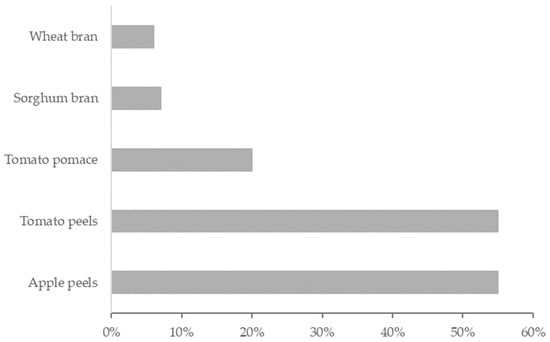
The current trend in the bioeconomy is directed towards the production of platform and special chemicals and advanced biomaterials, including furfural, lactic acid, aromas, nutraceuticals, biopolymers, bioplastics, and functional protein products. They are characterized as high-margin, low-volume products. This trend is significant from the economic perspective of biomass valorization because revenues from these high-value co-products can have a significant impact on the costs associated with fuel and energy production, which have a lower margin, and thus improve the overall profitability of the process. The development of advanced biorefinery concepts is enabling this transition. The model for the future is an integrated, multi-product, and potentially multi-feedstock biorefinery that incorporates a zero-waste approach [1,2]. Based on data from Towards Chem & Materials (2025) [3], the bio-based polymer market was valued at USD 12.08 billion in 2024 and is projected to reach approximately USD 58.36 billion by 2034. Therefore, it targets the need to improve the extraction efficiency and scalability of underutilized polymers. Currently, the main challenges in producing bio-based polymers are the limited availability of bio-based materials and more expensive production processes compared to their petroleum-based alternatives. Consequently, as a structural biopolyester, cutin comprises 40–80% of plant cuticles, implying that plant wastes contain varying amounts of cutin. The highest proportion of cutin is present in apple and tomato waste, as shown in Figure 1. Other important sources of cutin include wheat bran, rice bran, and watermelon peels [4,5]. Therefore, in this context, isolation of cutin from food processing by-products represents a promising route for valorizing agro-industrial residues within the high-value biorefinery framework.
Figure 1.
Agro-industrial waste as a source of cutin.
Recently, cutin has attracted significant attention from researchers as a sustainable material for the production of biodegradable films. A key role of cutin in the cuticle structure is to provide defense against potential pathogens. Cutin predominantly consists of oxygenated C16 or C18 long-chain fatty acids, cross-linked by ester bonds. These fatty acids usually have a terminal hydroxyl group (ω-OH) and one or more hydroxyl, epoxy, or oxo groups in the mid-chain. In addition, α,ω-dicarboxylic acids, fatty alcohols, and phenolics such as ferulic acid and coumaric acid make up a comparatively small percentage of the cutin polymer [6,7]. Films based on cutin polymer are emerging as a promising alternative to traditional petrochemical plastics. Due to their biodegradability and excellent barrier properties against moisture and gas permeation, cutin polymers could be ideal for food packaging. In line with current popular circular economy principles, utilizing agro-waste, cutin-based materials have begun to offer viable alternatives to single-use plastics in the food and consumer goods sectors. Additionally, due to its resistance to UV radiation, microbial growth, and corrosion, cutin could be a suitable material for use in protective coatings. Furthermore, because of its non-toxicity and good biocompatibility, cutin has become an attractive alternative to synthetic ingredients such as waxes and silicones across various formulations, especially creams and lip balms. Additionally, a previous study showed that cutin derived from tomato pomace forms highly hydrophobic films with UV-attenuation properties, offering potential as a protective barrier in cosmetics [8].
Despite these advanced polymer properties, their commercial utilization is limited. Since cutin is present in agro-industrial by-products, which offer a significant opportunity to valorize agricultural waste into high-value products, and a techno-economic analysis (TEA) of current extraction methodologies has not been conducted before, this study is both timely and necessary.
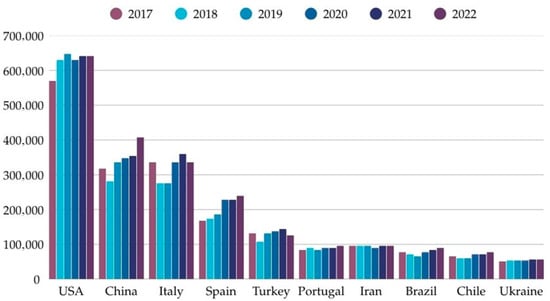
Tomatoes are among the most widely produced and consumed vegetables, after potatoes, with worldwide production rising each year [9]. The most extensively studied relevant source for cutin extraction is tomato pomace [10,11]. According to date obtained from Food and Agriculture Organization of the United Nations (FAO) [12], global tomato production amounted to over 186 million tons in 2022. Furthermore, World Tomato Processing Data (2022) [13] reported that approximately one quarter of total annual production is used for processing, making tomatoes the world’s leading vegetable for processing. Tomato processing industries generate different amounts of pomace, ranging from 2% to 10% of the total weight of processed tomato fruits, consisting mainly of peel, seeds, and pulp residue [14]. The yearly production of tomato pomace in the top 10 countries, where processing is strongly concentrated (according to the World Tomato Processing Data, 2022) [13], was calculated based on the values obtained for processing tomatoes and the average proportion of pomace reported in the literature. As shown in Figure 2, the US and China are leaders in both tomato processing and tomato pomace production. Considering this, the world tomato processing industry currently generates around 6.2 million tons of tomato pomace per year [15]. More than 16% of global production is located in the US and China.
Figure 2.
Top 10 countries in tomato processing and pomace production (according to the World Tomato Processing Data, 2022) [13].
Due to the growing interest in new packaging materials and the focus on a circular bioeconomy, understanding the composition of tomato pomace is important to find efficient methods that can be used for transforming this abundant agricultural residue into high-value products. Tomato pomace represents an important agro-waste material with considerable potential for valorization. Valuable and complex composition makes tomato pomace an attractive, low-cost, renewable source of functional compounds that can be used to produce various value-added products, including sustainable food packaging materials. This material is rich in dietary fiber, which amounted from 38% to 59%. Furthermore, it contains approximately 20% proteins and 5–13% lipids, as shown in Table 1. Moreover, due to its rich nutritional and bioactive composition, tomato pomace is considered a source of various high-value products, including carotenoids (e.g., lycopene), phenolic compounds, vitamins, and dietary fiber [16]. Various extraction methods have been applied depending on the target compound, which affect both the yield and the composition of the obtained extracts [16,17]. Additionally, the polysaccharide fraction, particularly pectin and hemicellulosic oligosaccharides, has attracted considerable interest due to its functional and economic value [17].
Cutin is a major lipid-derived biopolymer present in tomato pomace and generally occurs as a cross-linked polyester and forms a highly hydrophobic, structurally resilient polymer network, which gives the tomato cuticle its barrier properties [18] and at the same time makes tomato pomace one of the richest agricultural residues in naturally occurring cutin [19]. Therefore, due to its diverse composition, it offers multiple extraction routes and conversion pathways, making it an attractive feedstock for biorefinery-based approaches. According to both its abundance and its chemically functional polyester structure, tomato pomace represents an excellent source for the extraction and valorization of cutin as a bio-based packaging material [19], but all of the mentioned components could contribute to its functional and techno-economic relevance. However, most studies focus on the recovery of single components from tomato pomace, while, to the best of our knowledge, techno-economic analyses of cutin production remain limited. Furthermore, techno-economic estimation by integrating multiple co-products obtained from tomato pomace within a single processing framework remains underexplored.
Table 1.
Tomato pomace composition.
The present study aims to evaluate the economics of a biorefinery process for tomato pomace by performing a comparative techno-economic analysis of two processing scenarios: (1) a biorefinery pathway that valorizes tomato pomace by producing cutin and (2) an integrated process designed for the simultaneous production of cutin and phenolic antioxidants. Both processing scenarios were modeled in detail using SuperPro Designer, and economic performance was evaluated based on internal rate of return, net present value, and payback period. Sensitivity analyses were conducted to determine the most influential variables affecting the economic performance of the process. Results from this study will provide information that could be important for the tomato industry and help direct waste pomace management.
2. Results
2.1. Equipment Costs
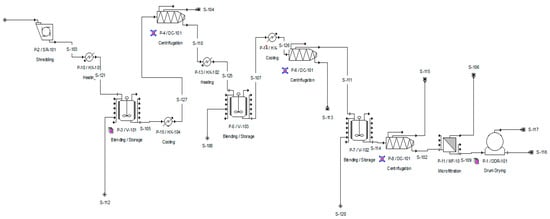
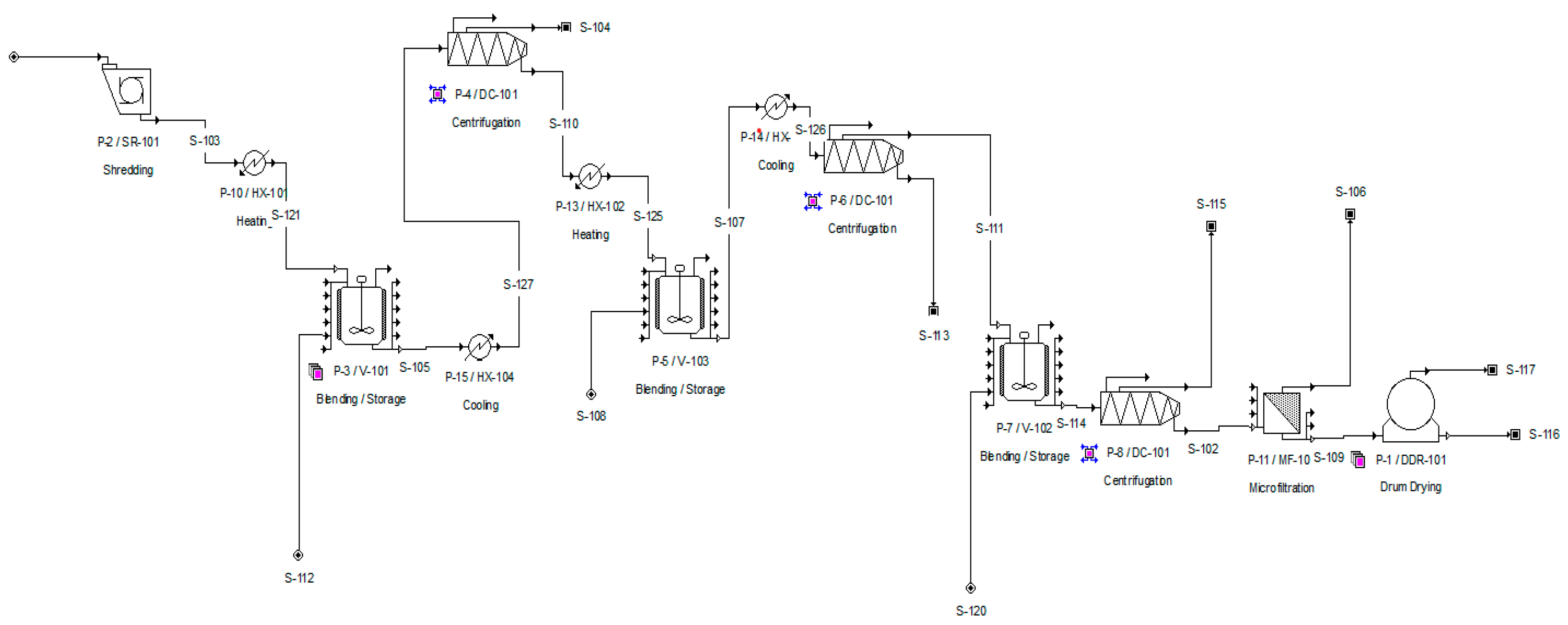
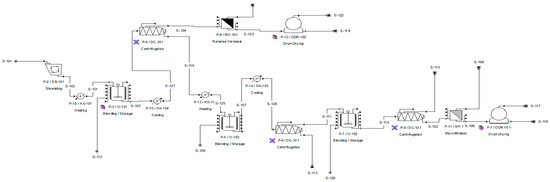
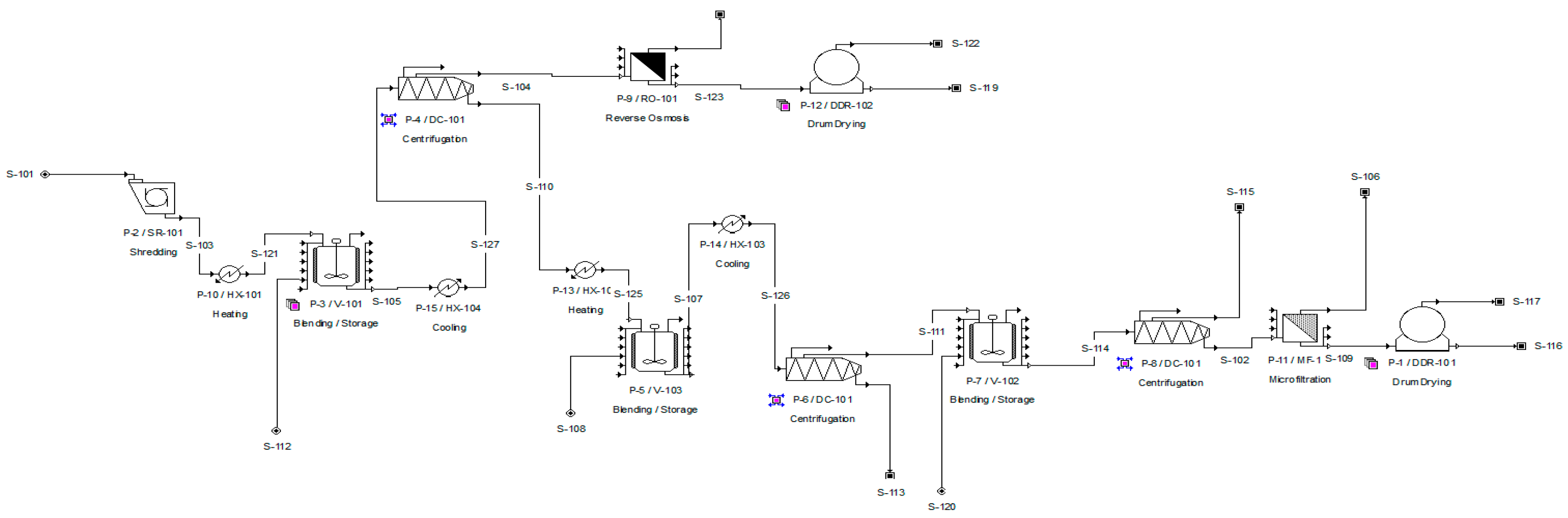
This section presents a comparison of equipment costs for extraction technologies used to recover cutin from tomato pomace in Scenarios 1 and 2. The equipment selected for the processes in Scenarios 1 and 2 is shown in Figure 3 and Figure 4, respectively, while a list of all equipment with corresponding prices is provided in Table 2 and Table 3. The equipment costs obtained from the models for Scenarios 1 and 2 amounted to 8.6 and 9.5 million USD, respectively. From the comparison of equipment needs between the two scenarios obtained from our models, it can been seen that capital investment for Scenario 2 was higher. The most significant difference is due to the drying section, where Scenario 2 includes additional drum dryers (DDR-102 units) and a larger overall drying capacity, resulting in substantially higher equipment costs. Scenario 2 also includes a reverse osmosis system (RO-101), which introduces additional capital costs and recurring operating expenses for membrane replacement.
Figure 3.
Extraction scheme for obtaining cutin from tomato pomace.
Figure 4.
Extraction scheme for obtaining cutin from tomato pomace, including valorization of the phenolic-rich fraction.
Table 2.
Equipment cost of Scenario 1 cutin extraction process.
Table 3.
Equipment cost of Scenario 2 cutin extraction process.
Furthermore, the expanded process flowsheet in Scenario 2 requires additional supporting equipment, larger utility loads, and a more complex installation, that can increase investment costs. Results from our models showed that Scenario 2 has a higher total equipment cost and will lead to increased operating expenses due to greater energy consumption, maintenance requirements, and more complex system operation. As stated above, these differences must be taken into account when evaluating the overall economic feasibility of the two extraction processes.
2.2. Economic Evaluation of Scale-Up Cutin Extraction from Tomato Pomace
An economic evaluation was performed to assess the feasibility of a biorefinery process for extracting cutin from agro-industrial residues based on the scheme presented in Figure 3 and Figure 4 for Scenarios 1 and 2, respectively. In both cases, the simulations were conducted at the same production scale. For the proposed model, the simulation results indicate a batch output of 434 kg and 1980 batches per year, corresponding to an annual production of approximately 859,000 kg of the main product (cutin extract). The total capital investment (TCI) was estimated at 56.57 million USD for Scenario 1 and 62.26 million USD for Scenario 2. The approximately 10% increase in capital cost for Scenario 2 is due to the additional unit operations required for the recovery and purification of phenolic compounds. The annual operating cost (AOC) generally includes raw material costs, consumables costs, labor-related costs, utilities costs (heating/cooling utilities and electricity), waste treatment/disposal costs and facility-related costs. Tomato pomace generated during tomato processing and the management of this waste have always been important concerns for the food industry. It not only contributes to disposal problems but also increases environmental pollution. To avoid waste disposal discouraged by the EU waste hierarchy approach, and due to its low potential for energy production, food producers have given the tomato residues away for free [22]. Therefore, in this model, a zero-cost raw material is used. Waste water treatment price of 0.45 USD for 1 m3 according to Latif [23] was used in Scenario 1 when liquid fraction was generated without purpose. The other costs used to calculate the operating costs were the default values considered in SuperPro Designer. The annual operating costs have grown from 19.83 million USD to 20.86 million USD, mainly due to increased energy and utility demands in the extended process. However, this increase was offset by the substantial rise in total revenue.
For the Revenue and Profitability calculation, it was necessary to add the selling price of products to the SuperPro Designer. The selling price of cutin, as determined by the average biopolymer market and based on Periyasamy et al. [24], amounted to 22.5 USD per kilogram. The selling price of the phenolic compounds obtained was assumed to be 191 USD per kilogram of polyphenols, which is approximately consistent with the values previously reported by Dávila et al. [25]. As Table 3 shows, in Scenario 1, the only revenue considered in the simulations was that of the extracted cutin sales, generating 21.34 million USD per year. Based on the obtained model, Scenario 2 included an additional revenue stream of phenolic extract, contributing 8.20 million USD per year, leading to a total revenue of 29.67 million USD per year. As a result, the gross margin increased from 7.05% to 29.72%, and the return on investment (ROI) almost doubled (from 10.52% to 17.44%).
The unit production cost in our model calculation increased slightly from 23.08 to 24.26 USD/kg, while the unit production revenue increased significantly from 24.83 to 34.52 USD/kg, confirming the substantial economic benefit of by-product valorization. As shown in Table 4, cutin extraction from tomato pomace has a payback period of 9.50 years. The payback period in Scenario 2 improved significantly compared to Scenario 1, decreasing to 5.7 years.
Table 4.
Techno-economic analysis of cutin extraction from tomato pomace.
Similarly, the internal rate of return (IRR) increased from 2.14% to 10.62%, and the net present value (NPV) changed from −14 million USD to +14 million USD. These financial metrics clearly indicate that the integrated process (Scenario 2) is economically viable and more attractive for industrial applications. When the economic evaluation of obtaining cutin includes phenolic compounds recovery, the process profitability has improved. Although capital and operating costs are slightly higher, the additional product streams provide substantial revenue, reducing payback time by almost half and converting the project from marginally unprofitable to strongly profitable. The results demonstrate that a biorefinery approach, which integrates the utilization of all fractions of agro-industrial waste, is a more sustainable and economically justified strategy for cutin production. To evaluate the economic competitiveness of the proposed model, key indicators such as ROI, IRR, and payback time were compared with reported techno-economic studies on other agricultural waste valorization systems. For example, the TEA model for pectin extraction from orange peels reported an IRR of no more than 5% [26] which is half the IRR achieved in our integrated model for cutin and phenolic compounds. In contrast, the economic analysis of pectin production from passion fruit waste reported an IRR of 50% and a payback time of around 2 years, which are much better financial indicators than those in our model. However, the sales price of pectin in that study was more than twice as high as the price of cutin in our study [27]. Therefore, compared with the economic indicators obtained in another study, the proposed model remains economically viable within the context of similar biomass valorization strategies.
2.3. Sensitivity Analysis
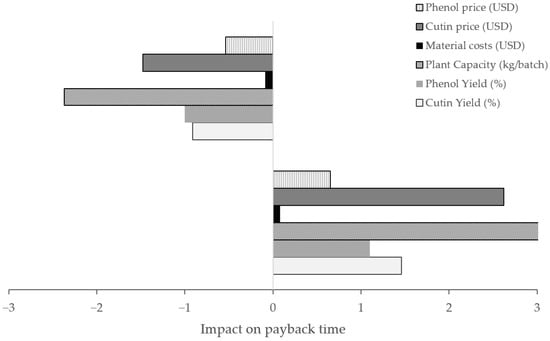
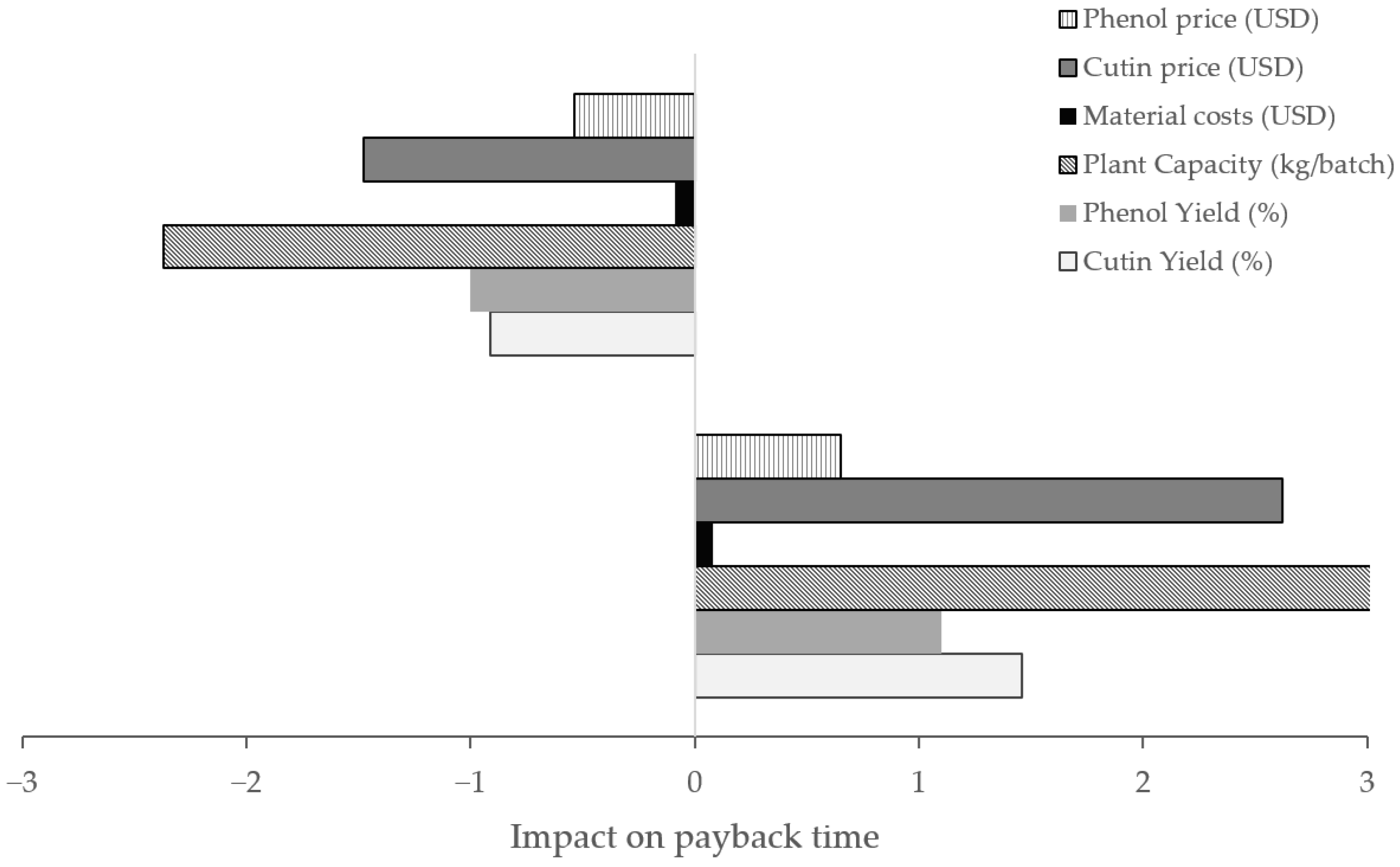
Because extraction yields and sales prices of cutin and phenolic compounds could fluctuate, the influence of these parameters, along with plant capacity, on payback time was evaluated. Moreover, the calculation of supplementary costs related to tomato pomace transportation and storage and the impact of these costs on payback time were estimated. According to one study [28], which included a comprehensive analysis of biomass storage and transfer costs, the approximate cost of olive pomace is 40 dollars per ton of material. This value is applied in the sensitivity analysis to examine how different prices (20, 40, and 60 dollars per ton for tomato pomace) for storage and transfer included in the model can affect the payback time. The results of sensitivity analysis are presented in Figure 5. For cutin yield, varying the extraction efficiency from 8% to 13% changed the payback period with an impact range of 1.46–0.91 years relative to the base case while phenol compounds yield showed a similar but slightly smaller effect corresponding to an impact range of 1.1–1.0 years. In contrast, plant capacity had the most pronounced effect on economic performance. Reducing capacity from 4000 to 2000 kg per batch increased the payback time dramatically, while increasing capacity to 6000 kg per batch reduced it. This translates to an extensive impact range (64.82–2.37 years), confirming that plant capacity is the dominant parameter influencing the payback period. Overall, higher extraction yields of cutin and phenolic compounds improve profitability by directly increasing product output and revenues, whereas scaling up plant capacity provides the greatest economic leverage, significantly reducing unit production costs and shortening the investment payback period. Also, it can be concluded that the cost of tomato pomace does not have a significant effect on payback time in this model, while the sale price of products, especially the cutin price, has a significant influence.
Figure 5.
Tornado chart of the impact of different parameters on payback time.
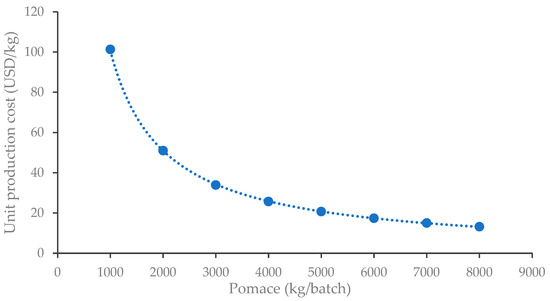
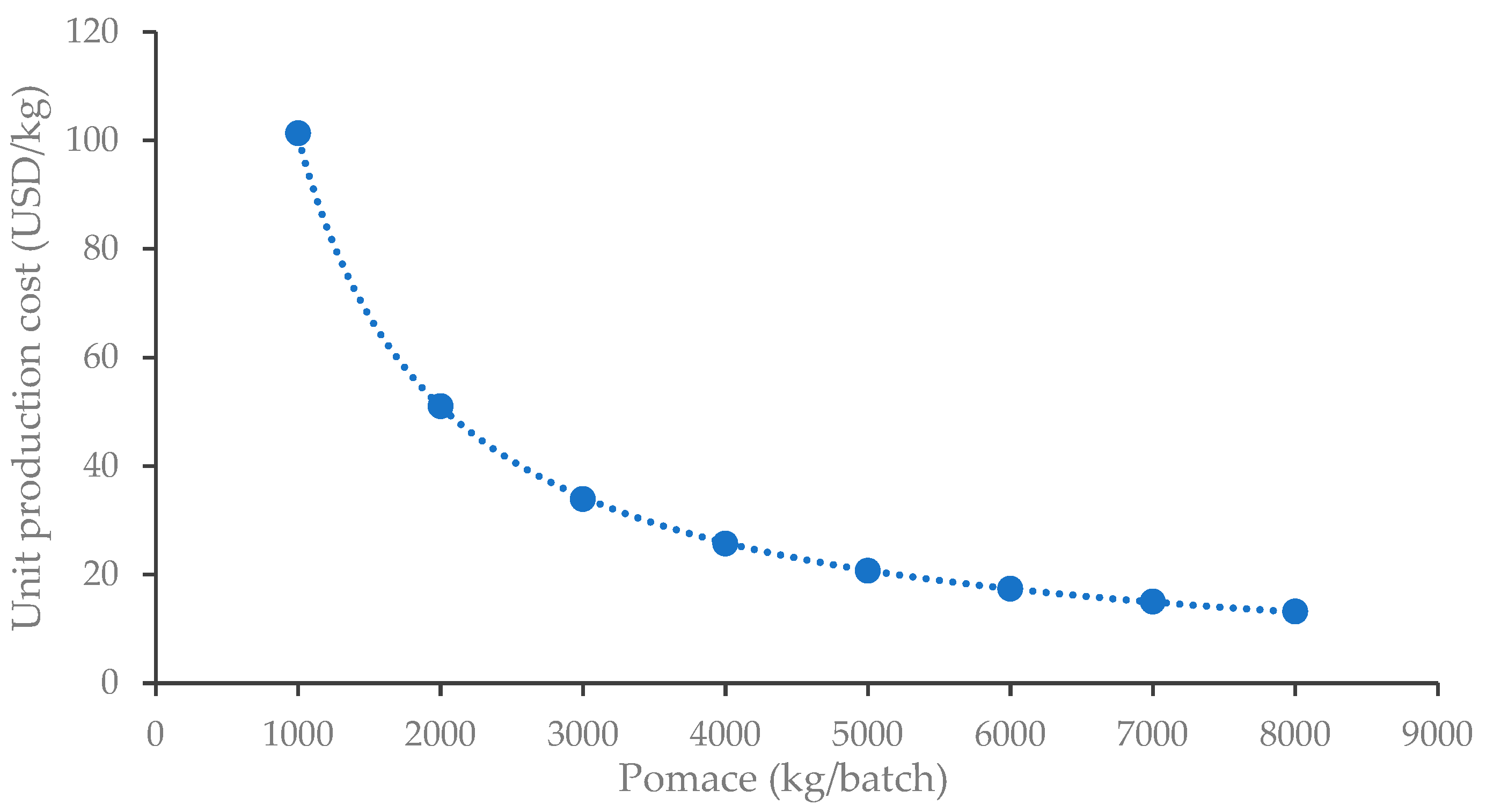
The model capacity was set based on the results of a sensitivity analysis, which showed that plant capacity was the most important parameter influencing the payback period of this process, as presented in Figure 6. The proposed model showed that unit production cost decreases nonlinearly, which is consistent with the literature [29]. As the batch scale increases from 1000 to 8000 kg, the unit production cost decreases drastically at lower batch sizes, while remaining flat at higher batch sizes. The relationship between processing capacity and unit production cost was described using a power-law model (R2 = 0.99), which is a typical phenomenon in techno-economic assessments. The obtained results could provide a solid basis for preliminary economic estimation. However, during industrial implementation, several limitations may arise due to increased energy consumption, which typically occurs during scale-up. Intensified heating and solvent recovery in the scale-up process may change the financial indicators of the proposed model unless additional process integration strategies are applied. Additionally, the seasonal availability of raw materials affects continuous large-scale operation, which is connected to higher costs for appropriate storage strategies or the need to find and integrate other stable feedstock supplies.
Figure 6.
Economic assessment of plant capacity for cutin production.
2.4. Market and Risk Analysis
Nowadays, the cost of producing bio-based polymers is higher than that of petroleum-based plastics. The primary cause of this disproportion is the high expense of processes for biopolymer production and raw materials [30]. This issue shows the need to obtain biopolymers from alternative, abundant, and cheap agro-industrial sources, which promotes circular economy aspects. In addition, comparative market analysis reveals that agro-waste biorefineries exhibit significant fluctuations in product prices and market conditions (e.g., 1–70 EUR/kg for essential oils or polyphenols around 360 EUR/kg and €10–360/kg for pectin), highlighting the sensitivity of economic viability to market fluctuations [31]. Also, our sensitivity analysis revealed a significant influence of the sale price of products, particularly cutin, on payback time. Therefore, it can be concluded that product price variation is an important parameter and can change the economic viability of processes. On the other hand, the potential impact of policy support and environmental protection regulations, as well as environmental awareness, directs the market and consumers towards more sustainable bio-based polymer products that provide a more eco-friendly alternative to traditional plastics [30]. In the future, the scalable industrial approach for obtaining bio-based polymers from agro-industrial waste for application in food packaging could help significantly reduce plastic waste, promote a circular economy, and minimize the environmental impact of the food packaging industry. However, for products with a great change in market price, the desirable situation for investors would be a project with a very low payback time (2–3 years) to reduce investment risk [31].
3. Discussion
The processing of fruits and vegetables generates significant quantities of pomace as a by-product, which has traditionally been treated as low-value waste or used as animal feed. However, under the principles of the circular economy, pomace is usually recognized as a valuable raw material that can be converted into a biopolymer product while reducing environmental impact. In addition, cutin can be extracted from various pomaces and can be used for film production, which is important from a circular economy perspective. Generally, cutin-derived polymers are becoming a promising, eco-friendly alternative to conventional petroleum-based plastics due to their unique chemical properties, including biodegradability, hydrophobicity, and the ability to form protective barriers. Based on the TEA, the novelty of our study lies not only in the current potential of agro-industrial waste pomace as a source of cutin but also in the proposed economic utilization strategies for cutin extraction. However, for future scale-up, it is crucial to select suitable extraction methods that can optimize cutin yield and reduce operating costs. In addition, it is advisable to incorporate the zero-waste aspect into the extraction process. In the economic evaluation, it is essential to include other valuable components that are present in pomace. Pomace is a rich source of pectin, fiber, phenolic compounds, and lycopene, which could contribute when incorporated into the proposed models. In addition, the sensitivity analysis results indicate that the amount of pomace input is the most important parameter for reducing the process payback time. The results also showed that as plant capacity increases, unit production cost decreases significantly. However, since tomato pomace is produced in large quantities only during the annual tomato processing period, which typically coincides with the peak tomato harvest season, and because the amount of this by-product is periodic and often unpredictable, it is challenging to secure enough volume for continuous processing throughout the year. In addition, the high moisture content of tomato pomace, can complicate long-term storage and increase the risk of microbial contamination, which is not considered in the present model. For these reasons, the proposed model focuses on the effective utilization of tomato pomace during the harvest season. To address these challenges, stabilization strategies such as drying can be applied, or immediate use after generation is recommended. Silage quality can be improved by adding cotton stalk as a moisture regulator, as previously demonstrated for grape pomace storage [32]. To address these limitations, other agro-industrial residues with similar structural and compositional characteristics could be used as alternative or complementary sources, providing longer operational periods and improved process utilization but extensive research is needed because cutin extraction from other sources is still limited. Moreover, in the future, application of Industry 4.0 technologies, such as advanced sensor systems, data-driven classification, and automated sorting, could enable the selection of different waste with similar structures and compositions. In this context, the process models developed in the present study could be transferable to other agro-industrial plant-based residues with analogous properties, thereby extending their applicability beyond tomato pomace.
4. Materials and Methods
Based on the data presented in Figure 2, the annual production of tomato pomace appears substantial, indicating that assessing the economic feasibility of cutin extraction from this material would be useful. The process and cost models were developed using the software SuperPro Designer Version 11.0 (Intelligen, Inc., Freehold, NJ, USA). Parameter extractions such as time, temperature, solid load, sodium hydroxide concentration, and cutin yield are based on extraction processes described in the literature [33].
4.1. The Process Flow Descriptions
The process flow diagram for a plant designed to produce cutin compounds from tomato pomace via conventional alkaline extraction is shown in Figure 3. The process consists of three main sections: (a) preparation of the pomace for extraction, (b) the extraction step, and (c) separation and recovery of cutin. The first step in the process is the mechanical grinding of the raw material in a grinding device (SR-101) in order to reduce the particle size and facilitate subsequent extraction The ground material is then washed in a blending/storage tank (V-101) for one hour at 50 °C, followed by removal of soluble components by centrifugation (DC-101) over 20 min. Extraction is performed using a 0.75 M alkali solution (NaOH) at a solid-to-liquid ratio of 1:20 for 2 h at 90 °C. The material is mixed and heated in a blending/storage tank (V-103), to allow the release of the cutin from the plant matrix into the solution. After extraction, the suspension is centrifuged in the same previously used DC-101 for 20 min. Centrifugation separates solid residues (other plant material) from the liquid extract containing dissolved cutin. Subsequent precipitation of cutin is performed by adjusting the pH to 5 by adding HCl in another blending/storage tank (V-102). Salts are removed by ultrafiltration, and the retentate contains concentrated cutin, which is then final-dried in a drum dryer (DDR-101).
The process flow diagram of a plant designed to produce cutin compounds from tomato pomace, including an additional section for phenolic recovery, is shown in Figure 4. Cutin was obtained as previously described, while water was removed from the phenolic-rich fraction by reverse osmosis (RO-101), followed by drying in a drum dryer (DDR-102).
4.2. Economic Analysis
The economic analysis for the proposed process model is provided as an executive summary of key project indices. It includes calculations of total capital and operating costs, as well as projected revenues, allowing evaluation of profitability under different scenarios. Total capital costs (TCCs) include direct costs (equipment, installation, utilities) and indirect costs (engineering, contingency, working capital), while operating costs (OCs) cover raw materials, labor, utilities, maintenance, and waste disposal. After calculating total capital and operating costs, revenues, and analyzing profitability, we evaluate selling the product for Scenario 1 and products and by-products for Scenario 2.
4.3. Sensitivity Analysis
Sensitivity analysis was performed to evaluate the influence of key process parameters on the payback time of the proposed biorefinery system. The impact of changes on cutin yield, phenol yield, and plant capacity was estimated and the corresponding payback time (low, base, high) was calculated using SuperPro Designer.
5. Conclusions
Since cutin extraction yields are low and the process is highly complex and economically challenging, a comprehensive TEA is used to design a model that could be profitable. TEA evaluates the financial feasibility of a proposed process by modeling capital and operating costs and revenue streams. However, relying on a single, low-margin product is a common reason for economic failure, as can be seen in the TEA for individual cutin extraction. To overcome this, a crucial strategy is the valorization of co-products. A more systematic comparison of the structural diversity among plant wastes is necessary to connect their composition with potential valorization pathways in biorefinery applications and to incorporate this information into their TEA. Additionally, this research could be a solid base for creating of optimized model for various types of pomaces as a source of cutin and other similar value-added products.
6. Future Outlook
The profitability potential of biorefinery cutin production from tomato pomace in two different scenarios has been presented. Our model indicates that an integrative approach can improve economic parameters in cutin production. Although the yield of cutin extraction is low, its potential application in packaging materials is significant due to its excellent water barrier properties compared to other biopolymers. Therefore, developing marketable co-products from tomato is critical in achieving a more profitable and sustainable process. Future studies should focus on optimizing the experimental design for cutin extraction and developing specific co-products from tomato pomace, such as pectin, dietary fiber, carotenoids, and seed oil, for targeted market applications following a cascade biorefinery concept. For example, in a fully integrated biorefinery process that incorporates a zero-waste concept, tomato pomace can be valorized through a sequential extraction strategy. Phenolic compounds would be recovered in the initial water extraction step, as proposed in this study, with additional equipment units. This would be followed by mild-acid pectin extraction prior to cutin depolymerization. Pectin precipitates from the liquid phase, while the remaining solid is subsequently used for cutin extraction. Finally, cutin would precipitate from the liquid phase, and the residual solid matrix would be used as a high-fiber source for feed or for incorporation into functional food products. This proposed integration could reduce raw material losses and waste management costs. Obtaining all these co-products from tomato pomace would enhance resource efficiency and support the environmental performance and profitability of the main production line, followed by strengthening the economic and environmental sustainability of the process using the zero-waste biorefinery concept.
Additionally, the combined utilization of multiple agro-industrial cutin-rich residues with comparable compositional characteristics, such as apple pomace and cereal bran fractions, should be explored to ensure continuous feedstock availability and process scalability. This strategy would reduce seasonal fluctuations in raw material supply and enable the development of detailed biorefinery scenarios for cutin production, providing accurate estimates of process profitability and environmental impact.
Author Contributions
Conceptualization T.Đ., I.P., M.P.P., J.K., D.Z. and L.P.; methodology T.Đ., L.P. and J.K.; software T.Đ.; writing—original draft preparation, T.Đ. and L.P.; writing—review and editing, T.Đ., I.P., M.P.P., J.K., D.Z. and L.P.; visualization, T.Đ., I.P. and M.P.P.; project administration, T.Đ., I.P., J.K. and L.P.; funding acquisition, I.P. and J.K. All authors have read and agreed to the published version of the manuscript.
Funding
This research was funded by Ministry of Science, Technological Development and Innovation of the Republic of Serbia within the framework of scientific cooperation with the People’s Republic of China, grant ‘Development of sustainable active packaging for food based on fruits pomace’. Additionally, the research was supported by the Croatian Science Foundation (CSF (HRZZ)) and the Slovenian Research Agency (ARIS) under the WEAVE initiative bilateral project nos. HRZZ IP-2022-10-8305 and N4-0346 (PROGRESS).
Data Availability Statement
The original contributions presented in this study are included in the article. Further inquiries can be directed to the corresponding authors.
Conflicts of Interest
The authors declare no conflicts of interest.
References
- Mykolenko, S.; Soon, W.L.; Mezzenga, R. Production and characterization of amaranth amyloid fibrils from food protein waste. Food Hydrocoll. 2024, 149, 109604. [Google Scholar] [CrossRef] [Scilit]
- Woźniak, A.; Kuligowski, K.; Świerczek, L.; Cenian, A. Review of lignocellulosic biomass pretreatment using physical, thermal and chemical methods for higher yields in bioethanol production. Sustainability 2025, 17, 287. [Google Scholar] [CrossRef] [Scilit]
- Towards Chem and Materials. Bio-Based Polymers Market Insights. Available online: https://www.towardschemandmaterials.com/insights/bio-based-polymers-market (accessed on 20 February 2026).
- Jeyakumar, D.T.; Shresta, S.; Khatiwada, J.R.; Boteju, R.; Chio, C.; Qin, W. Harnessing cutin and suberin from plant waste: Challenges and advancements in extraction methods. Bioresour. Technol. Rep. 2025, 31, 102274. [Google Scholar] [CrossRef] [Scilit]
- Chaudhari, S.A.; Singhal, R.S. Cutin from watermelon peels: A novel inducer for cutinase production and its physicochemical characterization. Int. J. Biol. Macromol. 2015, 79, 398–404. [Google Scholar] [CrossRef] [Scilit] [PubMed]
- Fich, E.A.; Segerson, N.A.; Rose, J.K.C. The plant polyester cutin: Biosynthesis, structure, and biological roles. Annu. Rev. Plant Biol. 2016, 67, 207–233. [Google Scholar] [CrossRef] [Scilit]
- Pollard, M.; Beisson, F.; Li, Y.; Ohlrogge, J.B. Building lipid barriers: Biosynthesis of cutin and suberin. Trends Plant Sci. 2008, 13, 236–246. [Google Scholar] [CrossRef] [Scilit]
- Vasyliev, G.; Lyudmyla, K.; Hladun, K.; Skiba, M.; Vorobyova, V. Valorization of tomato pomace: Extraction of value-added components by deep eutectic solvents and their application in cosmetic emulsions. Biomass Convers. Biorefinery 2022, 12, 95–111. [Google Scholar] [CrossRef] [Scilit]
- Simões, A.; Coelhoso, I.M.; Alves, V.D.; Brazinha, C. Recovery and purification of cutin from tomato by-products for application in hydrophobic films. Membranes 2023, 13, 261. [Google Scholar] [CrossRef] [Scilit]
- Tedeschi, G.; Benitez, J.J.; Ceseracciu, L.; Dastmalchi, K.; Itin, B.; Stark, R.E.; Heredia-Guerrero, J.A. Sustainable fabrication of plant cuticle-like packaging films from tomato pomace agro-waste, beeswax, and alginate. ACS Sustain. Chem. Eng. 2018, 6, 14955–14966. [Google Scholar] [CrossRef] [Scilit]
- Benítez, J.J.; Castillo, P.M.; Del Río, J.C.; León-Camacho, M.; Domínguez, E.; Heredia, A.; Heredia-Guerrero, J.A. Valorization of tomato processing by-products: Fatty acid extraction and production of bio-based materials. Materials 2018, 11, 2211. [Google Scholar] [CrossRef] [Scilit]
- FAO. World Food and Agriculture—Statistical Yearbook 2022; FAO: Rome, Italy, 2022; Available online: https://www.fao.org (accessed on 9 October 2025).
- World Processing Tomato Council (WPTC). World Production Data. Available online: https://www.wptc.to/production/ (accessed on 9 October 2025).
- Radić, K.; Galić, E.; Vinković, T.; Golub, N.; Vitali Čepo, D. Tomato waste as a sustainable source of antioxidants and pectins: Processing, pretreatment and extraction challenges. Sustainability 2024, 16, 9158. [Google Scholar] [CrossRef] [Scilit]
- Lu, Z.; Wang, J.; Gao, R.; Ye, F.; Zhao, G. Sustainable valorisation of tomato pomace: A comprehensive review. Trends Food Sci. Technol. 2019, 86, 172–187. [Google Scholar] [CrossRef] [Scilit]
- Chabi, I.B.; Zannou, O.; Dedehou, E.S.; Ayegnon, B.P.; Odouaro, O.B.O.; Maqsood, S.; Kayodé, A.P.P. Tomato pomace as a source of valuable functional ingredients for improving physicochemical and sensory properties and extending the shelf life of foods: A review. Heliyon 2024, 10, e25261. [Google Scholar] [CrossRef] [Scilit] [PubMed]
- Brighina, S.; Pulvirenti, L.; Siracusa, L.; Arena, E.; Faulisi, M.V.; Restuccia, C. Small-sized tomato pomace: Source of bioactive compounds and ingredient for sustainable production of functional bread. Foods 2024, 13, 3492. [Google Scholar] [CrossRef] [Scilit] [PubMed]
- Petit, J.; Bres, C.; Mauxion, J.P.; Tai, F.W.J.; Martin, L.B.; Fich, E.A.; Rothan, C. The glycerol-3-phosphate acyltransferase GPAT6 from tomato plays a central role in fruit cutin biosynthesis. Plant Physiol. 2016, 171, 894–913. [Google Scholar] [CrossRef] [Scilit]
- Eslami, E.; Donsì, F.; Ferrari, G.; Pataro, G. Enhancing cutin extraction efficiency from industrially derived tomato processing residues by high-pressure homogenization. Foods 2024, 13, 1415. [Google Scholar] [CrossRef] [Scilit] [PubMed]
- Lu, S.; Chen, S.; Li, H.; Paengkoum, S.; Taethaisong, N.; Meethip, W.; Paengkoum, P. Sustainable valorization of tomato pomace in animal nutrition: A review. Animals 2022, 12, 3294. [Google Scholar] [CrossRef] [Scilit]
- Del Valle, M.; Cámara, M.; Torija, M.E. Chemical characterization of tomato pomace. J. Sci. Food Agric. 2006, 86, 1232–1236. [Google Scholar] [CrossRef] [Scilit]
- Scaglia, B.; Squillace, P.; Abbasi-Parizad, P.; Papa, G.; De Nisi, P.; Tambone, F. Valorization of tomato pomace to obtain lycopene, carbohydrate-rich fraction and oil by applying a hydrolytic enzyme-based approach. Bioresour. Technol. Rep. 2023, 24, 101693. [Google Scholar] [CrossRef] [Scilit]
- Latif, E.F. Economic comparison between wastewater treatment systems using simulation software. Desalin. Water Treat. 2022, 264, 91–101. [Google Scholar] [CrossRef] [Scilit]
- Periyasamy, T.; Asrafali, S.P.; Lee, J. Recent advances in functional biopolymer films with antimicrobial and antioxidant properties for enhanced food packaging. Polymers 2025, 17, 1257. [Google Scholar] [CrossRef] [Scilit]
- Dávila, J.A.; Rosenberg, M.; Castro, E.; Cardona, C.A. A model biorefinery for avocado processing. Bioresour. Technol. 2017, 243, 17–29. [Google Scholar] [CrossRef] [Scilit] [PubMed]
- Dávila, J.A.; Rosenberg, M.; Cardona, C.A. Techno-economic and environmental assessment of p-cymene and pectin production from orange peel. Waste Biomass Valorization 2015, 6, 253–261. [Google Scholar] [CrossRef] [Scilit]
- de Freitas, C.M.P.; Júnior, D.B.S.; Martins, R.D. Simulation of ethanol recovery and economic analysis of pectin production on an industrial scale. Bioprocess Biosyst. Eng. 2021, 44, 1639–1647. [Google Scholar] [CrossRef] [Scilit] [PubMed]
- Zema, D.A.; Marciano, C.; Andiloro, S.; Tamburino, V. Logistics in the biomass supply chain of bio-energy plants in southern Italy. Chem. Eng. Trans. 2018, 65, 853–858. [Google Scholar] [CrossRef] [Scilit]
- Ferreira, R.D.G.; Azzoni, A.R.; Freitas, S. Techno-economic analysis of the industrial production of a low-cost enzyme using Escherichia coli: The case of recombinant β-glucosidase. Biotechnol. Biofuels 2018, 11, 81. [Google Scholar] [CrossRef] [Scilit]
- Şomoghi, R.; Mihai, S.; Oancea, F. An overview of bio-based polymers with potential for food packaging applications. Polymers 2025, 17, 2335. [Google Scholar] [CrossRef] [Scilit]
- Cristóbal, J.; Caldeira, C.; Corrado, S.; Sala, S. Techno-economic and profitability analysis of food waste biorefineries at European level. Bioresour. Technol. 2018, 259, 244–252. [Google Scholar] [CrossRef] [Scilit]
- Xu, K.; Zhang, J.; Mirizati, A. Improving silage characteristics in high-moisture grape residues using cotton stalk as a moisture regulator. BMC Microbiol. 2025, 25, 619. [Google Scholar] [CrossRef] [Scilit]
- Bučko, S.; Spasojević, L.; Milinković Budinčić, J.; Fraj, J.; Petrović, L.; Katona, J.; Sharipova, A. Comparative analyses of different routes to prepare cutin colloidal- and nano-particle dispersions from tomato peels. Polymers 2025, 17, 2348. [Google Scholar] [CrossRef] [Scilit]

Disclaimer/Publisher’s Note: The statements, opinions and data contained in all publications are solely those of the individual author(s) and contributor(s) and not of MDPI and/or the editor(s). MDPI and/or the editor(s) disclaim responsibility for any injury to people or property resulting from any ideas, methods, instructions or products referred to in the content. |
© 2026 by the authors. Licensee MDPI, Basel, Switzerland. This article is an open access article distributed under the terms and conditions of the Creative Commons Attribution (CC BY) license.