


Abstract
Yellow pitaya (Hylocereus megalanthus) is highly photosensitive and therefore strongly influenced by light availability. In winter, insufficient sunlight often induces a “yin–yang effect”, characterized by physiological disparities between the sunlit and shaded sides of east–west-oriented orchards. To elucidate the effects of supplemental lighting parameters on flowering, yield, and fruit quality of shade-grown yellow pitaya, we systematically examined four factors: lighting angle (45°, 60°, 90°), power (12, 15, and 18 W), duration (3, 4, and 5 h per day), and lighting period (10, 20, and 30 days). Compared with no supplemental lighting (net photosynthetic rate = 10.60/11.73 μmol m−2 s−1, yield = 903/3536.5 kg ha−1, net profit = 6435/72,675 CNY ha−1 in two seasons), a 90° angle in the first season and a 60° angle in the second season increased the net photosynthetic rate by 45.87% and 60%, yield by 165.98% and 145.16%, and net profit by 373.82% and 159.42%, respectively. 18 W lighting power raised average yield and net profit by 176.37% and 278.7%, while 5 h lighting duration enhanced them by 161.29% and 267.66%. Meanwhile, a 20-day lighting period increased yield and profit by 128.91% and 240.6% on average. The recommended parameter set of a 60°/90° angle, 18 W power, 5 h duration, and 20-day lighting period markedly improved photosynthetic performance, yield, and net economic returns of shaded-side yellow pitaya. These improvements were attributed to enhanced carbon assimilation and reallocation from source to sink tissues, which contributed to higher fruit yield and quality and effectively mitigated winter shading stress.
1. Introduction
Yellow pitaya (Hylocereus megalanthus), also known as yellow dragon fruit, belongs to the family Cactaceae (Hylocereus spp.). As a high-value tropical fruit crop, its cultivation has expanded rapidly in recent years. Yellow pitaya is rich in vitamins, organic acids, and plant proteins, conferring both high nutritional and economic value, and its market demand continues to grow [1]. However, as a photosensitive species, its flowering and fruit-setting processes are strongly regulated by the photoperiod, and adequate light is essential for normal floral induction and reproductive development [2]. In production systems in Hainan Province, China, a pronounced “yin–yang effect” has been observed during winter due to the low solar elevation angle, shortened daylength, and weakened light intensity. Plants planted in an east–west orientation exhibit substantially higher yields on the sunny side compared with the shaded side [3]. This is primarily attributable to reduced daytime light interception and lower photosynthetic efficiency on the shaded side. Light deficit on the shaded side constrains absorbed photosynthetically active radiation and thereby limits electron transport and CO2 assimilation, which reduces carbohydrate availability [4,5]. This reduction in carbon supply can further restrict source–sink allocation required for floral bud differentiation and fruit growth, ultimately exacerbating the yield and quality disparity between the sunny and shaded sides [6,7]. Meanwhile, nighttime supplemental lighting is typically applied uniformly to both sides, which fails to compensate for the daytime light deficit. Consequently, uneven accumulation of photosynthates may occur, leading to suppressed floral bud differentiation, impaired fruit development, and reduced yield and quality on the shaded side [8]. Therefore, developing targeted supplemental lighting strategies for the shaded side of yellow pitaya is of great theoretical and practical significance for mitigating the “yin–yang effect” disparity and improving winter yield and fruit quality.
Research on yellow pitaya has mainly focused on fruit quality formation, physiological and biochemical changes, postharvest storage, germplasm improvement, and the development of cultivation management systems [9,10]. In contrast, systematic studies on light-related ecological regulation in this crop remain limited. In comparison, supplemental lighting has been widely demonstrated as an effective approach for regulating photosynthetic performance, promoting flowering, and enhancing fruit quality in other crops [11]. Light not only serves as the primary energy source for photosynthesis but also acts as a crucial environmental factor governing plant morphogenesis and metabolic regulation, thereby exerting a decisive influence on crop yield and quality [7,12]. Scientific regulation of lighting parameters—including lighting angle, light intensity, supplemental lighting duration, and lighting period—can significantly improve photosynthetic characteristics and yield-quality outcomes across diverse crops [13,14,15,16]. For example, optimizing the lighting angle can enhance light-use efficiency; increasing light intensity can improve Rubisco activity and the accumulation of photosynthates [14]; and extending the duration or number of supplemental lighting periods can facilitate floral bud differentiation and fruit development [17]. These findings provide a valuable theoretical foundation for advancing supplemental lighting regulation strategies in yellow pitaya production.
Regarding different supplemental lighting factors, the effects of lighting angle, power, duration, and number of lighting periods have been investigated in several plant species. In terms of lighting angle, variations in solar elevation directly influence light distribution and absorption efficiency; when incident light approaches a perpendicular angle, leaf light interception increases and energy utilization becomes more efficient [18]. Similar principles apply to artificial lighting systems, where adjusting the light source angle can improve photosynthetic efficiency and thereby enhance crop yield [14,19]. For instance, modifying the supplemental lighting angle has been shown to enhance chlorophyll fluorescence and the quantum yield of photosystem II, thereby promoting photosynthesis and significantly improving leaf development in chrysanthemum [14]. In strawberry, angled lighting facilitates runner formation by upregulating runner induction-related genes and gibberellin biosynthesis-related genes [20]. With respect to lighting power, numerous studies have demonstrated that appropriately increasing light intensity can enhance photosynthesis and carbon assimilation rates [5,21]. Increased supplemental lighting power significantly improves the net photosynthetic rate (Pn), Rubisco activity, and transpiration rate (Tr) in leaves [22,23], thus promoting the accumulation and transport of photosynthates [24]. For example, higher lighting power increases vitamin C (Vc), soluble sugar, soluble protein, and anthocyanin contents in lettuce, markedly improving its quality and yield [25], whereas insufficient intensity may restrict photosynthesis and suppress plant growth [26]. Regarding lighting duration, the photoperiod plays a decisive role in floral induction [27]. Extending supplemental lighting during the nighttime not only induces floral bud differentiation but also enhances photosynthetic performance and fruit development [28,29]. Nighttime lighting has been shown to increase winter flowering and yield in pitaya by modulating the CO–FT signaling pathway and interacting hormone networks [30]. In crops such as tomato and lettuce, prolonged lighting duration increases Pn and the accumulation of soluble sugars, proteins, and Vc [31,32]. Similarly, extending the number of supplemental lighting periods enables greater cumulative light energy capture, promoting photosynthate accumulation and ultimately increasing biomass and economic yield [33]. Collectively, these studies indicate that regulating supplemental lighting from the perspectives of angle, intensity, duration, and lighting period can comprehensively enhance photosynthetic efficiency as well as crop yield and quality.
However, although supplemental lighting technologies have been widely applied in other crops [11,15,17,21,22,32], research on the supplemental lighting responses of yellow pitaya—particularly on the shaded side during winter—remains scarce, constituting a critical constraint to stable winter production and quality improvement in this crop. Therefore, there is a strong need to establish a systematic supplemental lighting experiment to quantitatively evaluate how different lighting parameters influence photosynthetic physiology, yield, and fruit quality on the shaded side of yellow pitaya. Such insights are essential for elucidating the underlying regulatory mechanisms and providing scientific guidance for precise light environment management. To address this gap, the present study investigated winter-grown yellow pitaya in Hainan Province, employing four single-factor supplemental lighting treatments, including lighting angle, power, duration, and number of lighting periods. The objective was to systematically determine the effects of these lighting parameters on photosynthetic performance, yield, and fruit quality on the shaded side. Through a comprehensive assessment of the above indices, we aimed to identify an efficient, safe, and cost-effective supplemental lighting strategy, thereby offering theoretical support and practical guidance for optimizing winter lighting management and promoting the industrial development of yellow pitaya.
2. Materials and Methods
2.1. Study Site and Experimental Design
Yellow pitaya supplemental lighting experiments were conducted in Lemei Village, Datian Town, Dongfang City, Hainan Province (19°04′ N, 108°51′ E). The first season of yellow pitaya was planted from 25 November 2022 to 10 April 2023, and the second season was planted from 1 January to 5 June 2023. The area has a tropical maritime monsoon climate with distinct dry and wet seasons, a small annual temperature difference, an annual precipitation of 1600 mm, and an average annual temperature of 24 °C. The soil at the experimental site was classified as Latosol, with flat topography and convenient drainage and irrigation. The experimental site is shown in Figure S1.
Four single-factor supplemental lighting experiments were conducted in the field to investigate the effects of lighting angle, power, duration, and number of lighting periods on the photosynthetic performance, yield, and fruit quality of yellow pitaya. The four factors included lighting angle (45°, 60°, and 90°), lighting power (12 W, 15 W, and 18 W), lighting duration (3 h, 4 h, and 5 h per night), and lighting period (10 d, 20 d, and 30 d). A randomized block design was employed with three replicates per treatment, resulting in a total of 39 plots. Each plot covered an area of 30 m2. Supplemental lighting was applied after sunset (18:30–22:30) using LED plant growth lamps mounted at a height of 1.5 m and spaced 1 m apart. The experimental plants were 2.5-year-old yellow pitaya, grown in a single-row ridge planting system at a density of approximately 850 plants per mu (1 mu ≈ 666.7 m2), with 0.5 m spacing between plants. The LED lamps (12 W, 15 W, and 18 W) emitted yellow light with a dominant wavelength of 590–610 nm, supplied by Zhongshan Chaoge Lighting Electrical Co., Ltd., (Zhongshan, China) and the thermometers (−30 °C to 50 °C range) were provided by Zhengzhou Jinshiji Horticultural Supplies Co., Ltd., (Zhengzhou, China). Details of the treatment combinations are presented in Table 1.
Table 1.
Details of the experimental design and treatments. CK, control, no supplemental lighting; A45/A60/A90, lighting angle (°); W12/W15/W18, power (W); H3/H4/H5, duration (h); D10/D20/D30, lighting period (d).
2.2. Sample and Determination
The indicators in this study primarily included measurements of photosynthetic characteristics, yield, fruit quality, and economic benefit. During the flowering stage of yellow pitaya, photosynthetic parameters were determined to assess plant physiological responses under different supplemental lighting treatments. In each plot, one branch (~10 cm) of similar maturity was randomly selected for measurements (n = 3 per treatment). Gas-exchange parameters, including Pn, stomatal conductance (Gs), intercellular CO2 concentration (Ci), and Tr, were measured in situ on attached branches between 09:00 and 11:00 a.m. using a LI-6400 portable photosynthesis system(LI-COR Biosciences, Lincoln, NE, USA). During LI-6400 measurements, the reference CO2 concentration was set to 400 μmol mol−1, the chamber flow rate was maintained at 500–700 μmol s−1, and the vapor pressure deficit was kept at 1.0–1.5 kPa. Ci was calculated by the LI-6400 software (version 5.3.2) using standard gas-exchange equations [34].
where Ca is the chamber CO2 mole fraction, A is net CO2 assimilation (Pn), and gc is conductance to CO2.
After the gas-exchange measurements, part of each sample was immediately transported to the laboratory, stored at 4 °C, and used to determine Rubisco enzyme activity. Rubisco activity was quantified using a commercial plant Rubisco ELISA assay kit (Jiangsu Enzyme Immunity Industry Co., Yancheng, China) according to the manufacturer’s instructions, with quantification based on the kit-provided standard curve. The number of flowers per plot was recorded during the flowering stage and converted to the number of flowers per hectare. Fruit yield was measured at harvest by weighing all fruits within each plot and converting the total fresh weight to yield per hectare. For fruit quality analysis, three representative fruits per treatment were selected after harvest. Soluble sugar content was determined using the anthrone colorimetric method. Titratable acidity was measured by acid–base neutralization titration with standardized NaOH. The sugar–acid ratio was calculated as soluble sugar/titratable acidity. Vitamin C content was quantified using the 2,6-dichlorophenolindophenol titrimetric method. Soluble protein content was determined using the Coomassie Brilliant Blue colorimetric assay. Edible rate was calculated as edible pulp mass/whole fruit mass × 100%. Throughout the experiment, economic benefit was calculated based on agricultural input and output for each treatment. The total cost included expenditures for supplemental lighting (lamps and electricity), fertilizers, pesticides, and labor. Total revenue was calculated as fruit yield multiplied by the market price of mature fruits (60 CNY kg−1). Net profit was obtained as the difference between total revenue and total cost, while the output–input ratio was computed as total revenue divided by total cost.
2.3. Statistical Analyses
One-way ANOVA was used to evaluate the effects of supplemental lighting treatments (angle, power, duration, and number of days) on photosynthetic parameters, yield, and quality indices, followed by Fisher’s least significant difference test for pairwise comparisons between treatments (p < 0.05). All data were recorded and organized using Microsoft Office Excel 2021 and analyzed in R (version 4.4.1). Visualization of mean ± SE bar plots and stacked column charts was performed using the “ggplot2” package. Economic benefit indices (revenue, cost, net profit, and output–input ratio) were analyzed using dual-axis composite charts that integrated grouped bars and scatter points, enabling comparison between two production seasons.
A two-tier principal component analysis (PCA) was conducted with the “FactoMineR” and “factoextra” packages to comprehensively evaluate treatment performance. In the first tier, individual indices within four functional groups—photosynthesis, yield development, fruit quality, and economic efficiency—were standardized and reduced by PCA, and the first principal component of each group was taken as the group score. In the second tier, these four group scores were subjected to another PCA to generate an integrated composite score weighted by PC1-PC2 eigenvalue contributions.
Partial least squares regression was performed with the “pls” package to identify the major predictors of net profit, yield, and the output–input ratio. The optimal number of latent components was determined by minimizing the root mean square error of prediction through leave-one-out cross-validation. Variable importance in projection (VIP) values were calculated, and variables with VIP > 1 were regarded as influential. Pairwise correlations among all variables were calculated using Pearson’s method, and significance levels (p < 0.05) were visualized in correlation heatmaps generated by the “corrplot” package.
A path analysis was conducted within the structural equation modeling framework using the “lavaan” and “semPlot” packages. Four composite variables—photosynthetic capacity, yield development, fruit quality, and economic benefit—were derived from their corresponding indicator sets using principal component analysis, with the first principal component (PC1) of each group representing the integrated score. The structural model tested was
Yield ~ Photo; Quality ~ Photo; Economy ~ Yield + Quality + Photo.
Standardized path coefficients and model fit indices were estimated, and the resulting path diagram was visualized using the semPaths function in the “semPlot” package.
3. Results
3.1. Supplemental Lighting Enhanced Photosynthetic Performance of Shaded Yellow Pitaya
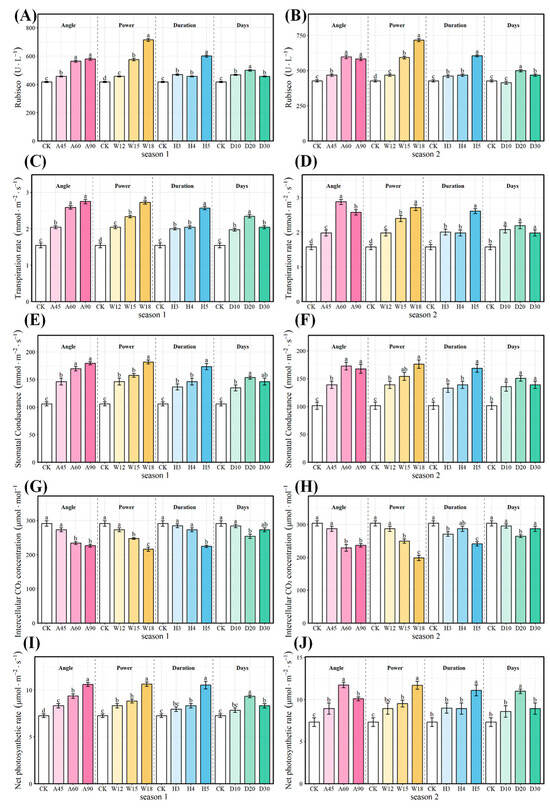
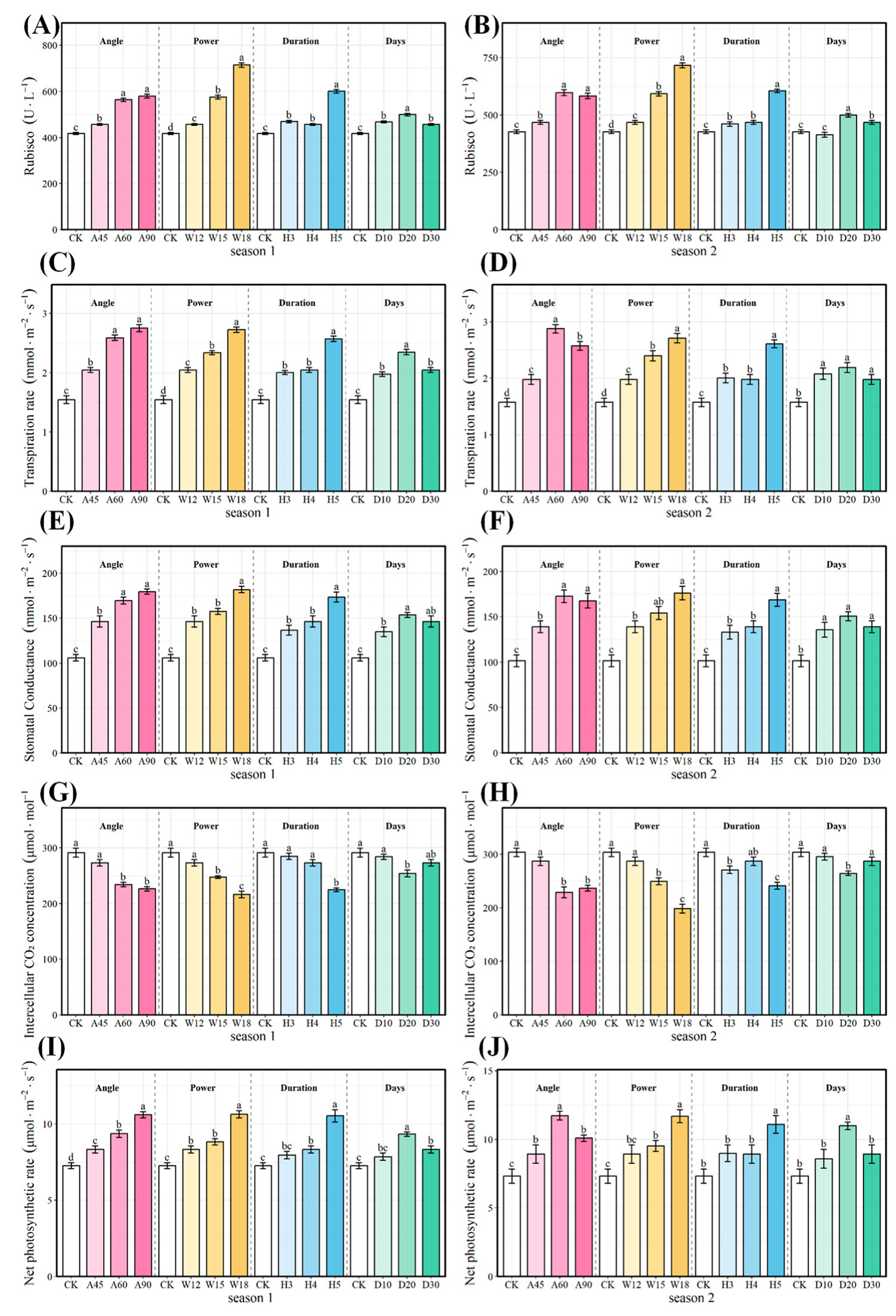
All supplemental lighting treatments enhanced the photosynthetic performance of shaded yellow pitaya to varying degrees, reflected in increased Rubisco activity, Tr, Gs, and Pn, and decreased Ci (Figure 1).
Figure 1.
Effects of supplemental lighting treatments on the photosynthetic characteristics of shade-grown yellow pitaya. (A,B) Rubisco; (C,D) Transpiration rate; (E,F) Stomatal Conductance; (G,H) Intercellular CO2 concentration; (I,J) Net photosynthetic rate. The left column displays the yellow pitaya data for the first season, while the right column shows the data for the second season. Values are means ± SE (n = 3). Different lowercase letters indicate significant differences among treatments (one-way ANOVA followed by LSD test, p < 0.05). CK, control; A45/A60/A90, lighting angle (°); W12/W15/W18, power (W); H3/H4/H5, duration (h); D10/D20/D30, lighting period (d).
In the first season, the A90 treatment produced the highest Rubisco activity, 26.67% and 38.70% higher than A45 and CK, respectively, whereas in the second season, A60 achieved the greatest enhancement, with increases of 27.69% and 39.57% compared with A45 and CK. The effects of lighting angle on Tr followed a similar pattern: A90 resulted in the greatest increase in the first season (34.15% and 77.42% higher than A45 and CK), while A60 showed the strongest effect in the second season (45.45% and 82.28% higher than A45 and CK). For Gs, A60 and A90 did not differ significantly from each other, but both were markedly higher than CK in both seasons, with increases of 60.07% and 69.50% in the first season, and 69.83% and 64.92% in the second season, respectively. In contrast, Ci decreased under supplemental lighting, reaching its lowest value under A90 in the first season (22.29% lower than CK) and under A60 in the second season (24.59% lower than CK). Regarding Pn, the greatest enhancement occurred at A90 in the first season (45.80% higher than CK) and at A60 in the second season (60.03% higher than CK).
Rubisco activity increased significantly with increasing lighting power in both seasons. In the first season, W18 enhanced Rubisco activity by 71.0%, 56.2%, and 24.2% compared with CK, W12, and W15, respectively, while in the second season, the corresponding increases were 67.3%, 53.1%, and 20.9%. Tr exhibited a similar trend, with W18 being 76.1% and 71.5% higher than CK in the first and second seasons, respectively. Gs also rose significantly under W18, exceeding CK by 71.7% and 73.4% in the two seasons. In contrast, Ci declined with increasing lighting power, showing the greatest reduction under W18, which decreased by 25.8% and 34.7% relative to CK in the first and second seasons, respectively. Pn followed the same increasing pattern, with W18 producing the highest values, 45.2% and 60.3% above CK in the first and second seasons, respectively.
Supplemental lighting duration significantly affected Rubisco activity, Tr, Gs, and Pn, with H5 showing the most pronounced improvements. Compared with CK, Rubisco activity under H5 increased by 43.7% and 41.3% in the first and second seasons, respectively; Tr rose by 65.8% and 65.2%; Gs by 63.9% and 65.9%; and Pn by 43.8% and 52.1%. In contrast, Ci decreased markedly under H5, reaching the lowest values of 224.7 μmol mol−1 in the first season and 241.3 μmol mol−1 in the second season.
The supplemental lighting period also had a significant impact on the photosynthetic characteristics of yellow pitaya, with D20 showing the most pronounced promotive effect across all measured indicators. Compared with CK, D10, and D30, D20 significantly increased Rubisco activity, Tr, Gs, and Pn. In the first season, the values under D20 reached 499.93 U L−1 for Rubisco activity, 2.34 mmol m−2 s−1 for Tr, 153.67 mmol m−2 s−1 for Gs, and 9.33 μmol m−2 s−1 for Pn. In the second season, the corresponding values were 500.10 U L−1, 2.19 mmol m−2 s−1, 150.67 mmol m−2 s−1, and 11.00 μmol m−2 s−1, respectively. Conversely, Ci responded oppositely to lighting period, with D20 resulting in the lowest Ci values in both seasons, at 254.33 μmol mol−1 and 264.67 μmol mol−1, respectively.
These results indicate that the lighting angle A60/A90, lighting power W18, lighting duration H5, and lighting period D20 markedly enhanced photosynthetic performance by accelerating CO2 uptake and utilization, thus representing the optimal supplemental lighting parameters for improving photosynthetic rate.
3.2. Supplemental Lighting Increased Floral Induction and Yield of Shaded Yellow Pitaya
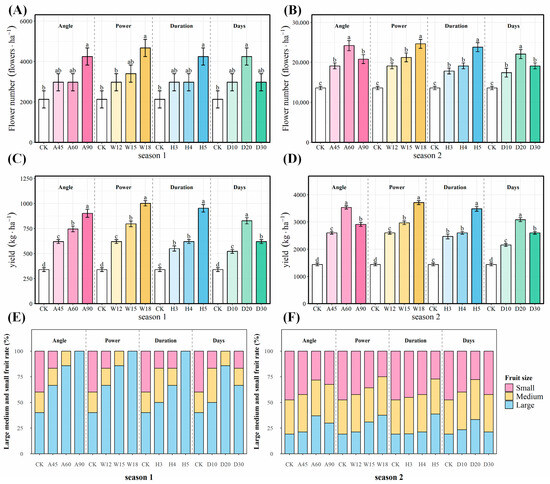
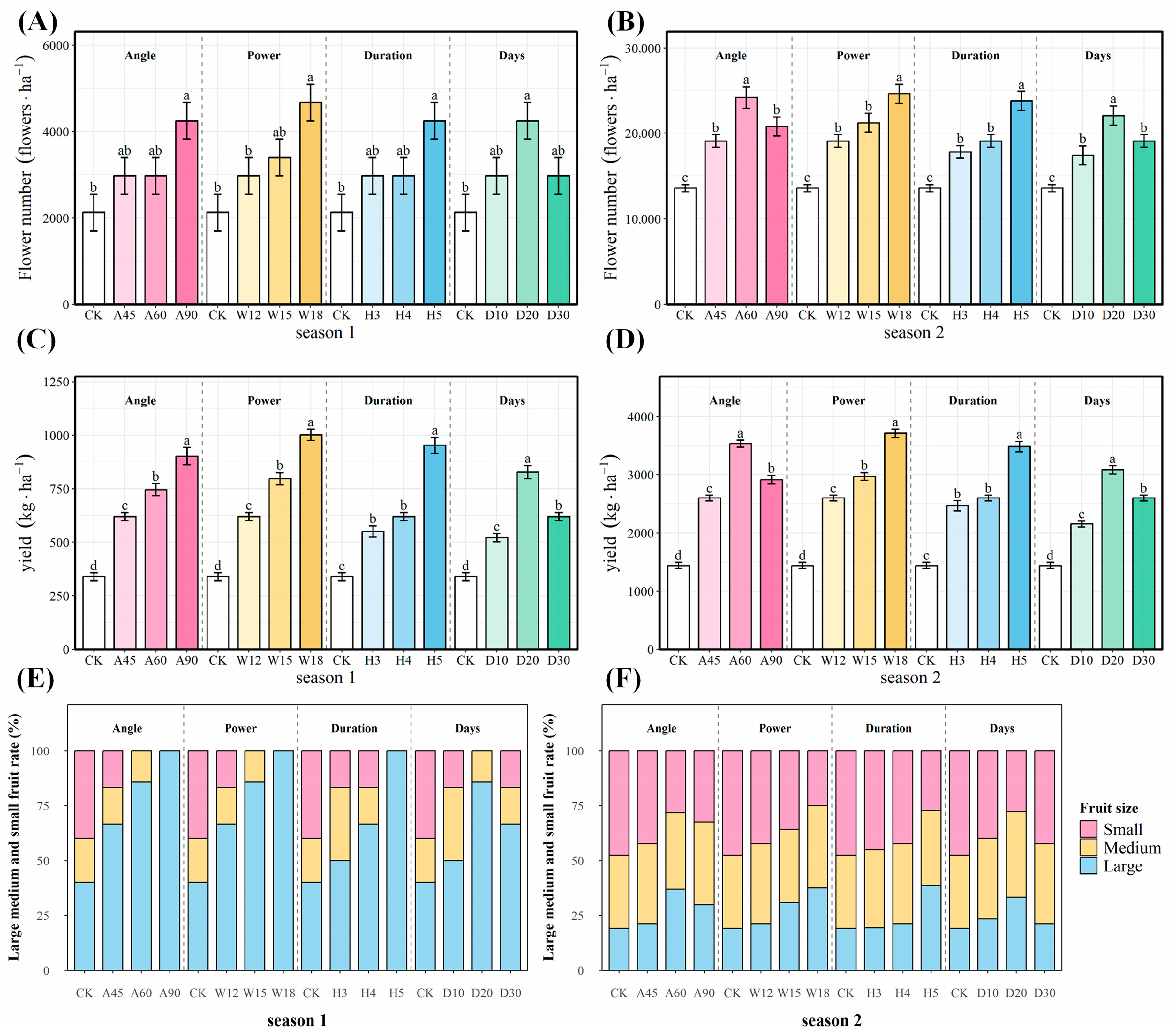
All supplemental lighting treatments promoted flower formation, yield, and large-fruit rate of shaded yellow pitaya to varying extents, but significant differences were observed among lighting angles, power levels, durations, and lighting periods (Figure 2). In the first season, the A90 treatment produced the highest flower number, yield, and large-fruit rate, increasing them by 100%, 166%, and 150% compared with CK, respectively. In the second season, A60 exhibited the strongest promotive effects, with corresponding increases of 53.1%, 102.1%, and 56.1%. Among lighting power treatments, W18 consistently showed the greatest improvements in both seasons. Relative to CK, W18 increased flower number, yield, and large-fruit rate by 120%, 195.3%, and 150% in the first season, and by 81.3%, 157.4%, and 96.9% in the second season, respectively. Prolonging lighting duration to 5 h significantly enhanced all three parameters, with increases of 100%, 180.9%, and 150% in the first season, and 75%, 141.7%, and 102.8% in the second season, respectively. Similarly, applying supplemental lighting for 20 days produced the highest increases among lighting period treatments, improving flower number, yield, and large-fruit rate by 100%, 143.9%, and 112.5% in the first season, and by 62.5%, 113.9%, and 75% in the second season, respectively. Collectively, these results indicate that lighting angles of 60°/90°, lighting power of 18 W, lighting duration of 5 h, and a lighting period of 20 days represent the optimal supplemental lighting parameters for enhancing floral induction, yield, and large-fruit rate of shaded yellow pitaya.
Figure 2.
Effects of supplemental lighting treatments on the yield characteristics of shade-grown yellow pitaya. (A,B) Flower number; (C,D) Yield; (E,F) Large medium and small fruit rate. The left column displays the yellow pitaya data for the first season, while the right column shows the data for the second season. Values are means ± SE (n = 3). Different lowercase letters indicate significant differences among treatments (one-way ANOVA followed by LSD test, p < 0.05). CK, control; A45/A60/A90, lighting angle (°); W12/W15/W18, power (W); H3/H4/H5, duration (h); D10/D20/D30, lighting period (d).
3.3. Supplemental Lighting Improved Fruit Quality of Shaded Yellow Pitaya
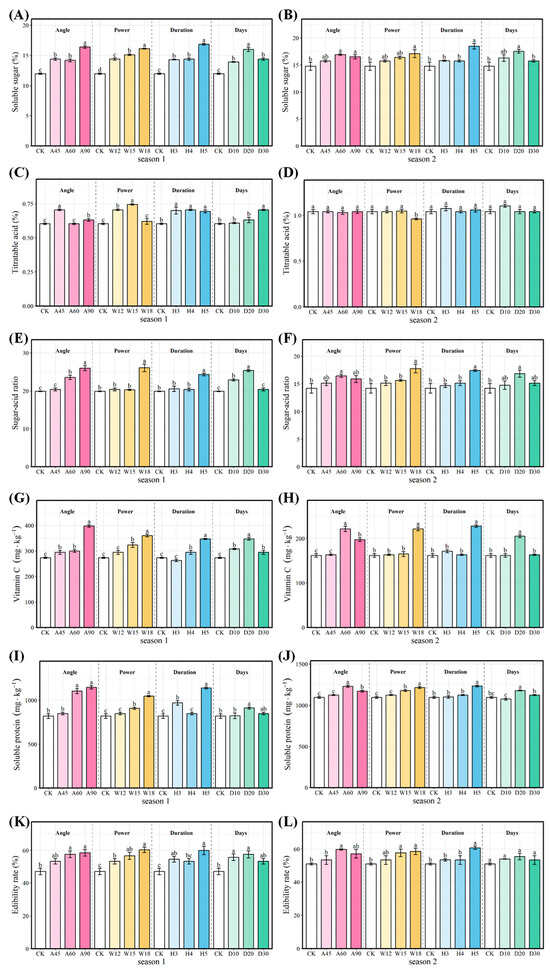
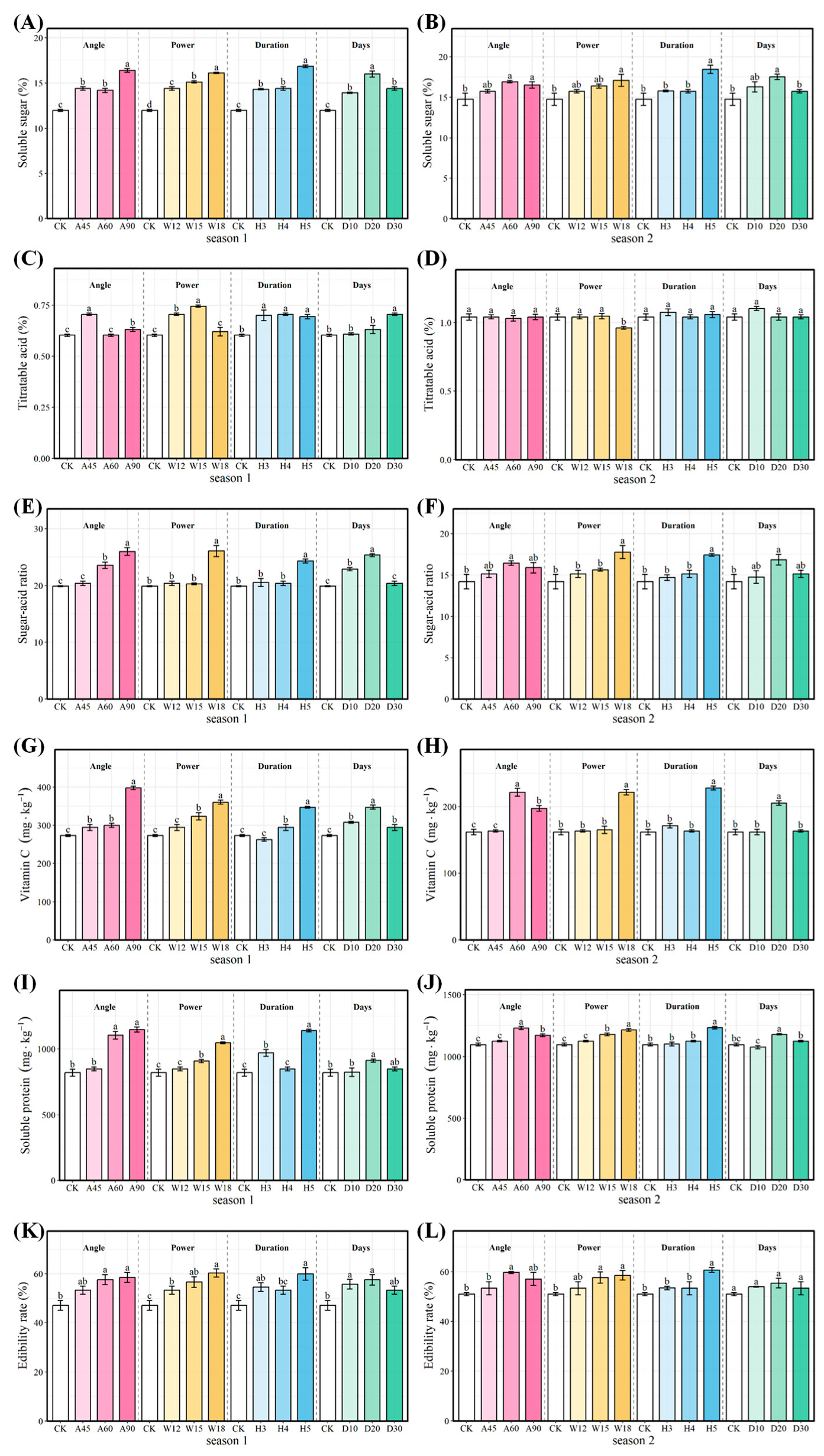
All supplemental lighting treatments enhanced fruit quality of shaded yellow pitaya to varying degrees, including soluble sugar, titratable acidity, sugar–acid ratio, Vc, soluble protein, and edible rate (Figure 3). Significant differences, however, were observed among lighting angles, power levels, lighting durations, and lighting periods.
Figure 3.
Effects of supplemental lighting treatments on the fruit quality of shade-grown yellow pitaya. (A,B) Soluble sugar; (C,D) Titratable acid; (E,F) Sugar–acid ratio; (G,H) Vitamin C; (I,J) Soluble protein; (K,L) Edibility rate. The left column displays the yellow pitaya data for the first season, while the right column shows the data for the second season. Values are means ± SE (n = 3). Different lowercase letters indicate significant differences among treatments (one-way ANOVA followed by LSD test, p < 0.05). CK, control; A45/A60/A90, lighting angle (°); W12/W15/W18, power (W); H3/H4/H5, duration (h); D10/D20/D30, lighting period (d).
Regarding lighting angle, A90 showed the highest soluble sugar content in the first season (13.9% higher than A60), whereas A60 exhibited the greatest increase in the second season (2.4% higher than A90). For titratable acidity, CK and A60 recorded the lowest values (0.60%) in the first season without significant difference, while in the second season, A60 had the lowest value (1.03%) among all treatments. The sugar–acid ratio increased significantly under supplemental lighting; A90 yielded the largest increase in the first season (10.3% higher than A60), whereas A60 performed best in the second season (3.5% higher than A90). Vc content responded most strongly to lighting angle, with A90 reaching the highest level in the first season (397.88 mg kg−1, 45.7% higher than CK) and A60 in the second season (221.83 mg kg−1, 37% higher than CK). Similarly, soluble protein and edible rate followed the same trend—A90 achieved the highest values in the first season (1148.02 mg kg−1 and 58.50%), while A60 was highest in the second season (1230.82 mg kg−1 and 59.75%).
Across lighting power treatments, W18 produced the best overall fruit quality. It yielded the highest soluble sugar content (16.13% and 17.10% in the first and second seasons, respectively). Titratable acidity did not differ significantly from CK in either season (0.60% vs. 0.62% in the first; 0.96% vs. 1.04% in the second). W18 also led to the highest sugar–acid ratio, Vc, soluble protein, and edible rate, with values of 26.08, 360.74 mg kg−1, 1048.02 mg kg−1, and 60.34% in the first season, and 17.79, 221.83 mg kg−1, 1216.21 mg kg−1, and 58.58% in the second season.
Lighting duration also exerted significant effects on fruit quality. H5 showed the highest soluble sugar content (16.87% and 18.47% in the first and second seasons, respectively). Titratable acidity varied slightly, with CK lowest in the first season (0.60%) and H5 at 0.69%, while in the second season, CK and H4 were lowest (1.04%) and not significantly different from H5 (1.06%). For the sugar–acid ratio, Vc, soluble protein, and edible rate, H5 consistently produced the greatest increases, reaching 24.31, 347.48 mg kg−1, 1140.21 mg kg−1, and 59.96% in the first season, and 17.40, 228.30 mg kg−1, 1233.56 mg kg−1, and 60.77% in the second season, respectively.
Supplemental lighting period significantly influenced fruit quality, with D20 producing the highest soluble sugar content—33.3% and 18.7% higher than CK in the first and second seasons, respectively. For titratable acidity, CK showed the lowest value (0.60%) in the first season, while D20 was slightly higher (0.63%) without a significant difference. In the second season, both D20 and CK exhibited the lowest titratable acidity values (1.04%), also with no significant difference. Regarding the sugar–acid ratio, Vc content, soluble protein, and edible rate, D20 showed the most pronounced improvements in both seasons, reaching 25.35, 347.48 mg kg−1, 913.13 mg kg−1, and 57.56% in the first season, and 16.87, 205.63 mg kg−1, 1180.14 mg kg−1, and 55.46% in the second season, respectively. Therefore, the optimal supplemental lighting parameters for enhancing soluble sugar, sugar–acid ratio, Vc content, soluble protein, and edible rate, while reducing titratable acidity in shaded yellow pitaya, are lighting angles of 60° and 90°, lighting power of 18 W, lighting duration of 5 h, and a lighting period of 20 days.
3.4. Supplemental Lighting Enhanced Economic Benefits of Shaded Yellow Pitaya
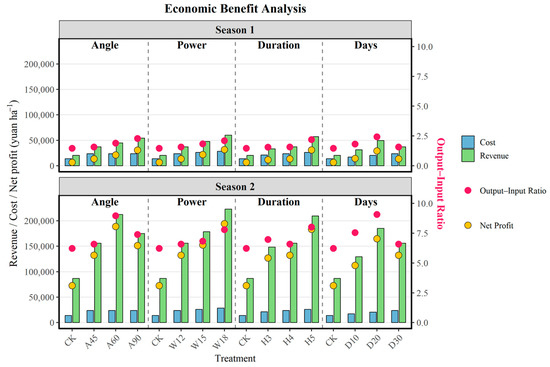
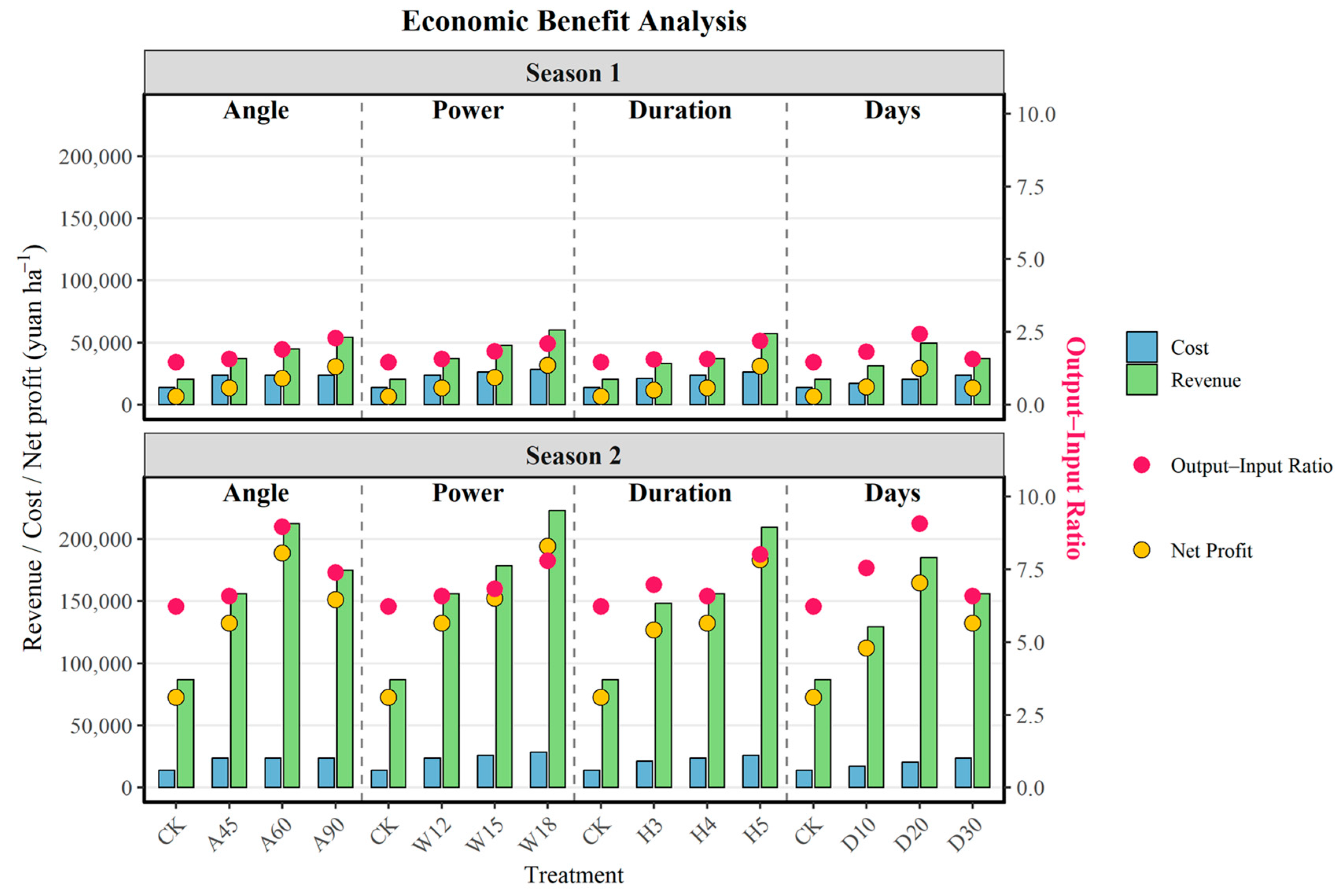
Supplemental lighting further affected the economic performance of shaded yellow pitaya. Overall, lighting treatments had relatively smaller effects on economic indicators in the first season, whereas much greater effects were observed in the second season, particularly for total revenue, net profit, and output–input ratio (Figure 4). In the first season, A90, W18, H5, and D20 produced the most significant increases in total revenue, net profit, and output–input ratio. Compared with CK, A90 improved these indicators by 166.4%, 373.8%, and 56.8%, respectively; W18 by 195.6%, 390.1%, and 43.8%; H5 by 181.4%, 383.4%, and 50.0%; and D20 by 144.2%, 354.6%, and 66.4%. In the second season, economic responses to supplemental lighting were more pronounced. A60, W18, H5, and D20 achieved the greatest improvements, with increases over CK of 145.1%, 159.4%, and 43.8% for A60; 157.4%, 167.3%, and 25.2% for W18; 141.7%, 152.0%, and 28.6% for H5; and 113.8%, 126.6%, and 45.4% for D20, respectively. Collectively, these results indicate that lighting angles of 60°/90°, lighting power of 18 W, lighting duration of 5 h, and a lighting period of 20 days represent the optimal supplemental lighting parameters for improving the economic benefits of shaded yellow pitaya.
Figure 4.
Economic benefit analysis of shaded-side supplemental lighting treatments for yellow pitaya in two seasons. Bars represent cost (blue) and revenue (green), and points represent net profit (yellow) and output–input ratio (red). The left y-axis indicates cost, revenue, and net profit (CNY ha−1), and the right y-axis indicates output–input ratio. CK, control; A45/A60/A90, lighting angle (°); W12/W15/W18, power (W); H3/H4/H5, duration (h); D10/D20/D30, lighting period (d).
3.5. Integrated Evaluation of Supplemental Lighting Effects on Shaded Yellow Pitaya
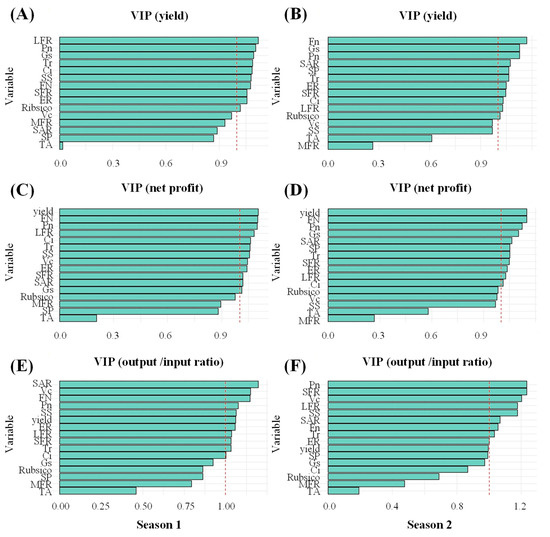
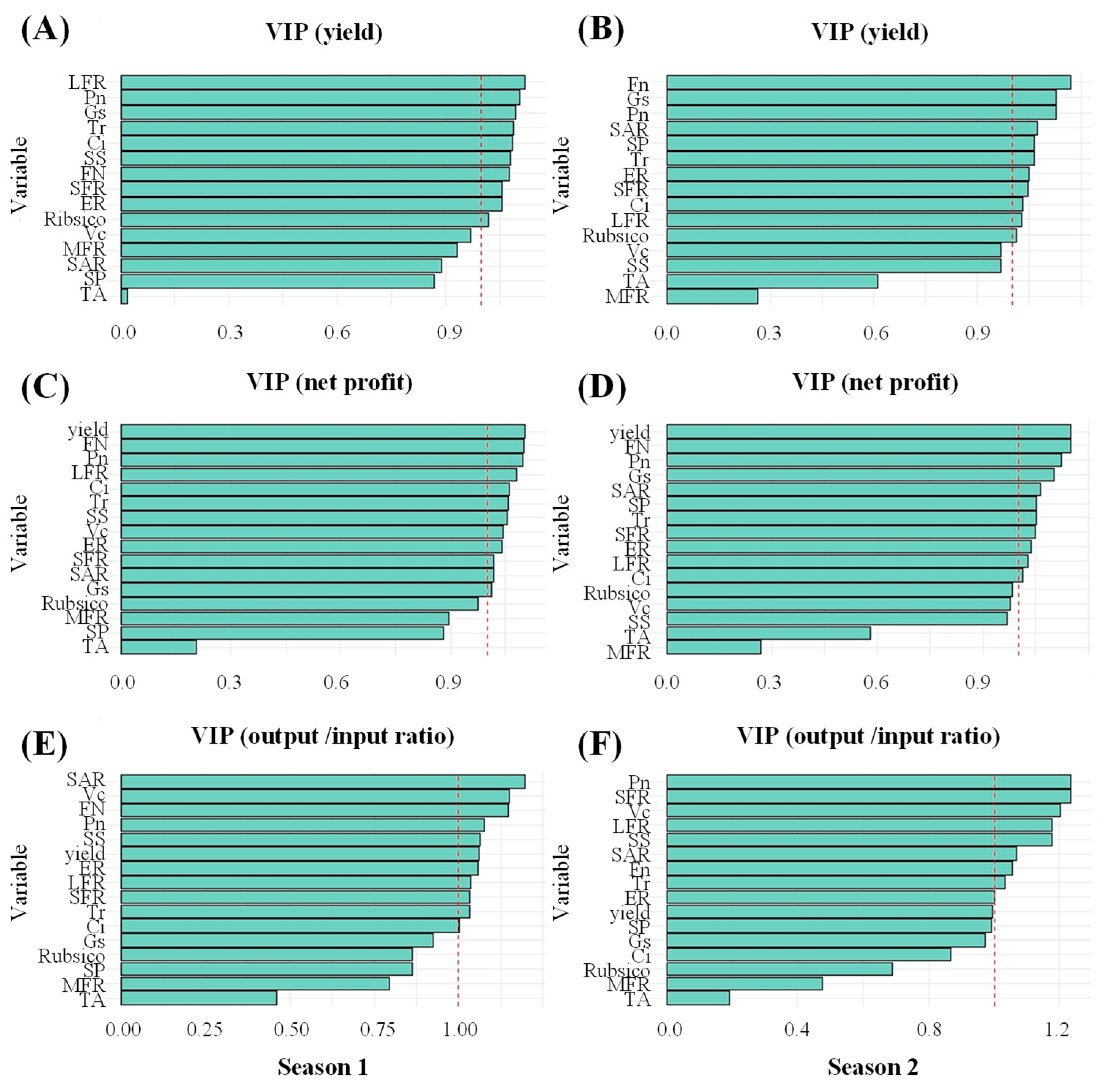
The partial least squares regression analysis revealed seasonal variations in the relative importance of individual variables to different response functions, as indicated by variable importance in projection values (Figure 5). In the yield model, large-fruit rate and Pn were the major contributors in the first season, whereas yield in the second season was additionally influenced by the sugar–acid ratio and soluble protein content. In the net profit model, yield, flower number, and Pn ranked as the top contributors in both seasons, while fruit quality indicators, particularly titratable acidity, exhibited relatively minor effects. In contrast, the output–input ratio in the first season was more strongly affected by fruit quality, mainly the sugar–acid ratio and Vc content, followed by flower number and Pn. In the second season, this ratio was jointly influenced by fruit quality (e.g., Vc), Pn, and yield components (large- and small-fruit rates).
Figure 5.
Key predictors of yield (A,B), net profit (C,D), and output–input ratio (E,F) under partial least squares regression analysis. The left column displays the yellow pitaya data for the first season, while the right column shows the data for the second season. The red dashed line indicates where the VIP value equals 1; variables exceeding this threshold are considered as influential. FN: flower number, Pn: net photosynthetic rate, LFR: large-fruit rate, Ci: intercellular CO2 concentration, Tr: transpiration rate, SS: soluble sugar content, Vc: vitamin C content, ER: edibility rate, SFR: small-fruit rate, SAR: sugar–acid ratio, Gs: stomatal conductance, MFR: medium-fruit rate, SP: soluble protein content, TA: titratable acidity.
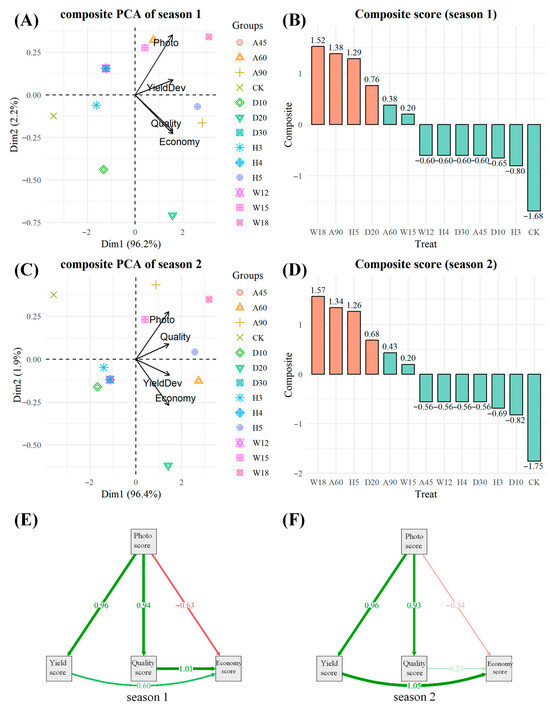
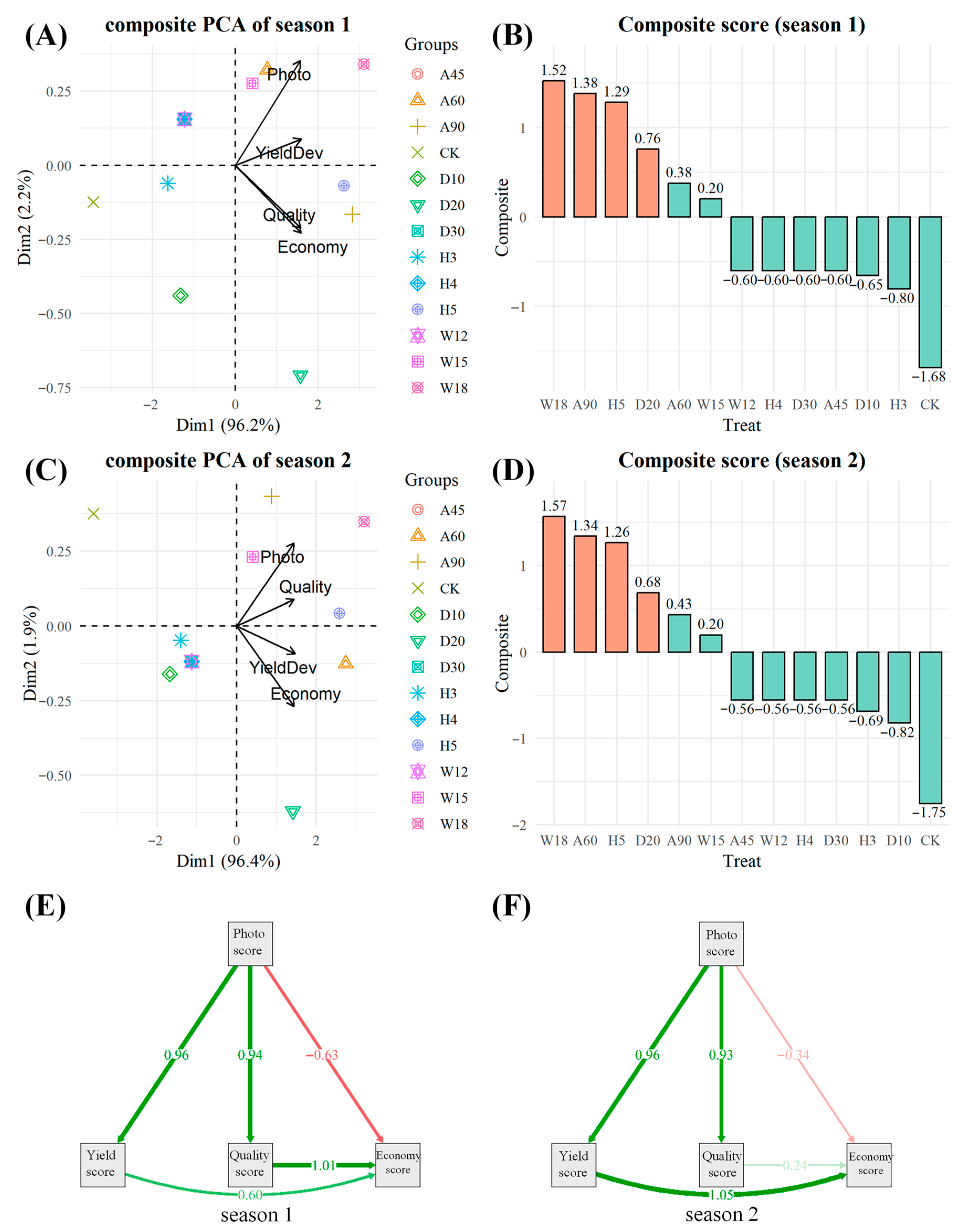
PCA demonstrated clear differences in the integrated scores of the four functional groups—photosynthetic performance, reproductive development, fruit quality, and economic benefits—among supplemental lighting treatments (Figure 6A–D). In both seasons, Dim1 accounted for the majority of total variance (96.2% and 96.4%, respectively), reflecting strong consistency among indices along a common gradient. In the first season, treatments W18, A90, H5, and D20 achieved the highest integrated scores (1.52, 1.38, 1.29, and 0.76, respectively), all significantly exceeding CK (−1.68). In the second season, W18, A60, H5, and D20 again ranked highest (1.57, 1.34, 1.26, and 0.68, respectively), outperforming CK (−1.75). These results indicate that high-power lighting (18 W), large lighting angles (60° or 90°), and extended lighting regimes (5 h or 20 days) markedly improved the comprehensive performance of shaded yellow pitaya, whereas low-power and short-duration lighting (e.g., D10) yielded the weakest results.
Figure 6.
PCA under supplemental lighting treatments (A,C) along with composite score ranking on the PC1 and PC2 axes following PCA (B,D). Path analysis under first season and second season (E,F). Path analysis was performed on standardized variables. In the path model, numbers on arrows represent standardized path coefficients; solid arrows indicate significant paths (p < 0.05), and dashed arrows indicate non-significant paths. CK, control; A45/A60/A90, lighting angle (°); W12/W15/W18, power (W); H3/H4/H5, duration (h); D10/D20/D30, lighting period (d).
Path coefficient analysis further clarified the causal relationships among integrated functional indicators (Figure 6E,F). In both seasons, photosynthetic performance exerted strong positive effects on yield (0.96 in both seasons) and fruit quality (0.94 and 0.93 in the first and second seasons, respectively), but a negative effect on economic indicators. This negative path likely reflects the cost of supplemental lighting (electricity and lamp-related expenses), whereby stronger photosynthetic stimulation is accompanied by higher input costs, partially offsetting revenue gains. Fruit quality significantly promoted economic performance in the first season (β = 1.01), but not in the second. The positive impact of yield on economic benefits strengthened over time, increasing from 0.60 in the first season to 1.05 in the second. Overall, photosynthetic performance acted as the upstream driver within the indicator pathway network and served as the primary determinant influencing yield, fruit quality, and economic outcomes.
4. Discussion
4.1. Effects of Supplemental Lighting on Photosynthetic Regulation and Energy Utilization Efficiency
Photosynthetic efficiency forms the foundation of material and energy accumulation during plant growth and directly determines assimilate production and yield formation [35]. Rubisco is the key rate-limiting enzyme for CO2 fixation in the Calvin cycle and is also involved in photorespiration in C3 plants. Its activity strongly influences carbon assimilation and the efficiency of light energy conversion [36,37]. A significant positive association between Pn and Rubisco activity has been widely reported, supporting the use of Rubisco as an indicator of photosynthetic performance under variable light conditions [38,39].
In this study, the single-factor manipulations of lighting angle, power, and duration consistently altered photosynthetic characteristics on the shaded side, as reflected by coordinated changes in Rubisco activity and gas-exchange traits. Mechanistically, lighting angles reshape the direction and distribution of incident light, expanding the effectively illuminated surface and improving the uniformity of light absorption, which enhances electron transport and energy conversion efficiency [26]. In addition, increased photosynthetically active radiation may activate Rubisco activation, thereby increasing carboxylation and promoting the conversion of light energy into chemical energy for assimilate accumulation [40].
Lighting power primarily regulates the magnitude of irradiance. Within the tested range and under our single-factor design, increasing power was associated with higher Rubisco activity and improved gas-exchange performance, which is consistent with the interpretation that supplemental irradiance can alleviate winter light limitation and support carbon assimilation [41,42]. Moreover, the concurrent increase in Gs and decrease in Ci under higher power may indicate that increased Gs facilitated CO2 uptake and fixation and improved light energy utilization [4,43]. Consistently, Ci dropped markedly in the most efficient treatments (Figure 1G,H), as it decreased by 25.83–34.69% and 20.53–22.97% under W18 and H5 treatments in two seasons, respectively, which may indicate more efficient drawdown and use of available CO2 under supplemental lighting. Likewise, extending lighting duration lengthens the daily period of photochemical reactions and carbon gain, which can sustain assimilate supply and support subsequent yield formation. Similar improvements in photosynthetic rate and protein/biomass accumulation under longer or intensified supplemental lighting have been reported in crops such as mung bean and tomato [44,45].
Overall, lighting angle determines the distribution and uniformity of light, power regulates light intensity, and duration controls the period of energy accumulation. Together, these factors enhance Rubisco carboxylation activity, increase Gs, promote CO2 fixation, and strengthen electron transport, thereby improving photosynthetic activity and carbon assimilation efficiency in shaded yellow pitaya.
4.2. Quantitative Relationship Between Photosynthetic Enhancement and Yield Response
Light is the primary energy source for photosynthesis and dry matter accumulation, and variation in the light environment has profound effects on plant growth, development, and yield formation [7]. In this study, the single-factor manipulations of lighting angle, power, duration, and lighting period all produced clear yield responses in yellow pitaya, reflected by changes in flower number, fruit-size distribution, and total yield.
Lighting angle mainly determines the spatial distribution and penetration of incident light within the canopy. Under winter shade, an appropriate lamp angle can increase the effectively illuminated area on the shaded side, improve energy distribution, and compensate for insufficient natural radiation, thereby promoting assimilate accumulation and fruit development [46]. In addition, the lower yield in the first season compared with the second may be attributed to a shorter growth duration (137 vs. 156 days) and lower ambient temperature. Previous studies have shown that climatic factors can explain 56.7% of yield variation, whereas management practices account for only 29.4% [47].
Lighting power primarily regulates irradiance intensity [48]. Under light-limited conditions, increasing irradiance can enhance electron transport and carbon assimilation, promote electron transport and carbon assimilation, and improve assimilate accumulation [49], thereby significantly enhancing yield in shaded fruits. The positive association between increasing power and yield-related traits suggests that light intensity is a dominant limiting factor for shaded winter production, while supplemental lighting effectively alleviates this constraint [50]. Meanwhile, lighting duration determines the period of photosynthate accumulation and plays a crucial role in fruit development and yield formation [51]. Supplemental lighting has been reported to induce floral bud differentiation in pitaya [30,52]. For example, LED lighting increased strawberry fruit weight (by 55.6%), fruit number (by 46.6%), and total yield (by 136.7%) [53]. Similarly, significant yield improvements in tomato, grape, and cucumber have been observed under supplemental lighting [51,54,55]. In this study, extending lighting duration enhanced yield formation (Figure 2C,D), indicating that moderate extension of illumination duration supports sustained photosynthesis and fruit enlargement.
Lighting period also played an important role in fruit development and yield formation. Previous studies have shown that supplemental lighting improves single-fruit weight and fruit diameter in tomato [11] and enhances fruit set rate and fruit weight in pitaya [28]. Here, the 20-day treatment achieved the best results in both seasons, suggesting that an appropriate lighting period helps maintain the balance between assimilate supply and nutrient accumulation. An excessively short lighting period may result in insufficient assimilate production, whereas overly prolonged lighting may cause excessive assimilate allocation to vegetative organs, thereby limiting fruit development [56].
In summary, optimizing lighting angle, enhancing light intensity, extending illumination duration, and adjusting the lighting cycle collectively improved light interception and light-use efficiency in shaded yellow pitaya. Supplemental lighting significantly increased the absorption of photosynthetically active radiation by leaves, promoted assimilate synthesis and translocation to fruits [57], and ultimately enhanced floral induction, large-fruit rate, and yield.
4.3. Mechanisms Underlying Fruit Quality Improvement and Economic Benefit Enhancement Under Supplemental Lighting
Light conditions not only affect photosynthetic performance and yield formation but also directly determine fruit internal quality and economic benefits. Previous studies have shown that the chemical composition of fruits is highly dependent on variations in the light environment [58]. Supplemental lighting can promote the synthesis of reducing sugars and inhibit the accumulation of titratable acidity [6], thereby increasing sugar, Vc, and protein contents while reducing acidity, ultimately improving flavor quality and commercial value [59,60,61].
In this study, supplemental lighting improved multiple quality attributes of shaded yellow pitaya, and the quality enhancement was generally accompanied by improved profitability. Lighting angle is a key determinant of light distribution on the shaded side; by expanding the effectively illuminated surface and improving light absorption and assimilate accumulation, a balanced metabolism of sugars, organic acids, and vitamins is promoted, thereby improving flavor and nutritional quality [14,62]. The corresponding economic advantage was mainly driven by increased output value rather than major differences in total costs among angle treatments, highlighting the importance of optimizing light angle for both quality and profitability (Figure 2 and Figure 4).
Increasing lighting power likewise improved fruit quality. Previous studies have reported that enhanced light intensity significantly increases fruit Vc content, sugar–acid ratio, and soluble sugar level [63,64], likely because greater light energy input elevates photosynthetic rate and energy accumulation, thereby promoting carbon metabolism and sugar–protein synthesis [65]. From an economic perspective, the improvement in photosynthetic efficiency and product value can outweigh the added electricity and equipment inputs, resulting in higher net profit and output–input ratio under higher power within the tested range.
Lighting duration and lighting period further shape the cumulative assimilate supply and its allocation to fruits. Previous studies have demonstrated that extending supplemental lighting increased soluble sugars in blueberry, leaf starch in tomato, and soluble protein in cucumber [31,66,67]. Here, the 5 h treatment resulted in the highest edible rate, soluble sugar content, sugar–acid ratio, Vc, and soluble protein content in yellow pitaya, and fruit quality improved progressively with increasing lighting duration (Figure 3). Meanwhile, total revenue, net profit, and output–input ratio were also highest under the 5 h treatment, suggesting that moderate extension of lighting duration slightly increased electricity costs but substantially enhanced fruit quality and profitability. However, the response to lighting period suggests an effective application window: insufficient days may not fully alleviate assimilate limitation, whereas overly prolonged lighting may disrupt metabolic balance or shift assimilate partitioning toward vegetative sinks, thereby reducing marginal gains in fruit sugar accumulation and quality improvement [56,68]. These physiological responses translate directly into economic outcomes because fruit price and marketability are highly sensitive to sugar–acid balance and nutritional traits.
Overall, supplemental lighting measures jointly influenced fruit photosynthetic metabolism and nutrient accumulation by regulating light distribution, intensity, duration, and period. Appropriate lighting combinations enhanced light absorption and sugar metabolic activity in shaded yellow pitaya fruits, promoted the synthesis and translocation of soluble sugars, Vc, and proteins, improved sugar–acid balance and flavor quality, and thereby significantly increased both nutritional quality and commercial value.
4.4. Integrative Analysis of Comprehensive Effects and Optimization of Supplemental Lighting Strategies
The VIP model results indicated that major photosynthetic and growth characteristics (e.g., LFR, Pn, and Gs) were the key contributors to yield improvement, while yield was the most critical factor determining net profit and the output–input ratio (Figure 5). Among these variables, Pn and Gs reflect leaf carbon-fixation and gas-exchange capacities, serving as the physiological basis for assimilate formation [69]. FN and LFR directly determine fruit number and the proportion of marketable fruits, acting as essential links that transform yield into economic benefits. In contrast, quality indicators such as soluble sugar content, Vc, and edibility rate showed relatively lower importance for yield but stronger influence on the output–input ratio, suggesting that quality enhancement mainly improves economic returns indirectly through yield rather than directly (Figure 6).
PCA further revealed differences in integrated performance among supplemental lighting treatments and the underlying sources of variation (Figure 6A–D). Photosynthesis-, yield-, and quality-related variables were oriented in the same direction along the principal axis, whereas economic variables were positioned oppositely, indicating that improvements in photosynthetic potential were generally accompanied by increased lighting energy costs. This pattern explains the statistically direct negative effect between photosynthetic capacity and economic indicators [70]. Nevertheless, despite the higher lighting-related inputs in A60/A90, W18, H5, and D20, the increased net profit still supports the economic justification of supplemental lighting (Figure 4). Meanwhile, the PCA ranking clearly demonstrated that supplemental lighting ultimately resulted in significantly higher comprehensive benefits, implying that the profit gain outweighed the cost increase. Additionally, the total cost was comparable between seasons, so the higher revenue and higher net profit in the second season mainly reflect higher yield, which is likely associated with the longer growth duration (156 vs. 137 days) and relatively lower temperatures in the first season (Table S1).
Path analysis (Figure 6E,F) suggested a multilevel pathway whereby photosynthetic potential affected yield, which subsequently influenced fruit quality and economic benefits. Standardized path coefficients showed that photosynthetic potential exerted the strongest direct positive effect on yield (β = 0.96, p < 0.001 in both seasons), indicating that improving Gs and Pn through supplemental lighting directly enhanced carbon-fixation capacity and fruit development [11]. Yield also had a significant positive effect on economic performance (β = 0.60 in first season; β = 1.05 in second season), suggesting that economic gains were mainly driven by yield rather than cost reduction, consistent with the “yield-priority” principle in protected-cultivation systems [71].
Notably, photosynthetic potential exhibited a direct negative effect on economic indicators (β = −0.63 in first season; β = −0.34 in second season), reflecting that enhanced photosynthesis is typically accompanied by higher energy expenditure resulting from increased lighting power, duration, and frequency. However, the positive yield-mediated indirect effect—with photosynthetic potential strongly promoting yield (β = 0.96), and yield in turn positively affecting economic performance (β = 0.60 in first season and 1.05 in second season)—outweighed this negative direct effect (Figure 6E,F). Photosynthetic potential also had a strong positive effect on fruit quality (β = 0.94 in first season; β = 0.93 in second season), indicating that improved light supply promoted sugar accumulation and acidity regulation, thereby enhancing commercial attributes and marketability [6,60]. Together, these effects constituted a positive cascade in which enhanced photosynthetic potential increased yield, thereby improving fruit quality and economic returns. Supplemental lighting optimized the spatial distribution of light, increased light input, and prolonged light exposure, thereby improving Gs, Pn, and Rubisco activity and enhancing light energy conversion and carbon-fixation capacity [72]. Specifically, lighting angle influenced canopy light interception, lighting power regulated light intensity, and lighting duration and period determined the carbon-accumulation timeframe [70,72], together forming a dynamic energy-supply system that supports efficient photosynthesis of shaded fruits under low-light conditions.
In addition, the seasonal shift in optimal lighting angle—from A90 in the first season to A60 in the second—reflected environmental adaptability. This pattern likely resulted from seasonal changes in solar elevation angle during winter in Hainan: vertical lighting (A90) was more effective for canopy penetration in early winter, whereas inclined lighting (A60) better improved lateral illumination in mid-to-late winter [73]. These findings suggest that lighting geometry should be adjusted according to natural light incidence dynamics in practical production to maximize light-use efficiency.
This study has certain limitations, including the lack of detailed analysis of energy cost structure and equipment depreciation in the economic assessment, as well as restricted regional and seasonal scope. Future studies should expand the experimental area and integrate molecular–physiological analyses of light responses, and evaluate the long-term effects of intensive supplemental lighting on plant longevity and soil health. In conclusion, under the independent single-factor experiments conducted in this study, supplemental lighting on the shaded side improved photosynthetic performance and was accompanied by increases in yield, fruit quality, and economic returns of yellow pitaya during winter. Within the treatment ranges, higher lighting power (18 W), appropriate lighting angles (60°–90°), a longer lighting duration (5 h), and an intermediate lighting period (20 d) tended to perform better than other options. However, the optimal multi-factor combination and energy–profit trade-offs should still be confirmed in future factorial optimization trials.
5. Conclusions
This study systematically evaluated the effects of supplemental lighting angle, power, duration, and lighting period on the photosynthetic characteristics, yield, fruit quality, and economic benefits of shaded yellow pitaya during winter in Hainan, where insufficient light is a major production constraint. Based on the independent single-factor field experiments, higher lighting power (18 W) improved performance under the fixed settings of 45°, 4 h, and 30 d; larger lighting angles (60° and 90°) performed better under the fixed settings of 12 W, 4 h, and 30 d; a longer nightly lighting duration (5 h) was superior to the other factors held constant at 45°, 4 h, and 30 d; and an intermediate lighting period (20 d) performed best under the fixed settings of 45°, 12 W, and 4 h. Across these single-factor trials, improvements in Pn were accompanied by increases in yield components, fruit quality traits (Vc, soluble sugar, and soluble protein), and net profit. Because interactions among lighting factors were not evaluated, the optimal multi-factor combination remains to be determined. Future factorial optimization trials are therefore warranted to test candidate combinations. Furthermore, we recommend conducting localized calibration trials prior to large-scale rollout outside Hainan.
Supplementary Materials
The following supporting information can be downloaded at https://www.mdpi.com/article/10.3390/horticulturae12030274/s1. Figure S1: Geographical location of the experimental site. Figure S2: Effects of supplemental lighting treatments on the photosynthetic characteristics of shade-grown yellow pitaya. Figure S3: Effects of supplemental lighting treatments on the yield characteristics of shade-grown yellow pitaya. Figure S4: Effects of supplemental lighting treatments on the fruit quality of shade-grown yellow pitaya. Table S1: Monthly average temperature at the experimental site during the two growing seasons.
Author Contributions
Y.W.: data curation, formal analysis, visualization, writing—original draft. W.L.: data curation, formal analysis, visualization, writing—original draft. Y.H.: supervision. J.L.: validation. C.W.: data curation, formal analysis, project administration. J.G.: project administration. J.Q.: resources. Y.R.: conceptualization, methodology, funding acquisition. X.J.: conceptualization, formal analysis, writing—review and editing. All authors have read and agreed to the published version of the manuscript.
Funding
This research and APC were both funded by the Scientific Fertilization Technology System for Characteristic Crops in Hainan (HXKJ-145-2023-0005-YX).
Data Availability Statement
The original contributions presented in this study are included in the article/Supplementary Materials. Further inquiries can be directed to the corresponding author(s).
Acknowledgments
This work was supported by the Scientific Fertilization Technology System for Characteristic Crops in Hainan (HXKJ-145-2023-0005-YX).
Conflicts of Interest
Author Junfeng Qu was employed by the company CNOOC Chemical Sales (Hainan) Co., Ltd., Haikou 570100, China. The remaining authors declare that the research was conducted in the absence of any commercial or financial relationships that could be construed as a potential conflict of interest.
Abbreviations
| Ci | intercellular CO2 concentration |
| ER | edibility rate |
| FN | flower number |
| Gs | stomatal conductance |
| LFR | large-fruit rate |
| MFR | medium-fruit rate |
| PCA | principal component analysis |
| Pn | net photosynthetic ratio |
| SAR | sugar–acid rate |
| SFR | small-fruit rate |
| SP | soluble protein content |
| SS | soluble sugar content |
| TA | titratable acidity |
| Tr | transpiration rate |
| Vc | vitamin C |
| VIP | variable importance in projection |
References
- Morillo-Coronado, A.C.; Manjarres Hernández, E.H.; Forero-Mancipe, L. Phenotypic diversity of morphological characteristics of pitahaya (Selenicereus Megalanthus Haw.) germplasm in colombia. Plants 2021, 10, 2255. [Google Scholar] [CrossRef] [Scilit] [PubMed]
- Jiang, Y.-L.; Liao, Y.-Y.; Lin, T.-S.; Lee, C.-L.; Yen, C.-R.; Yang, W.-J. The photoperiod-regulated bud formation of red pitaya (Hylocereus sp.). HortScience 2012, 47, 1063–1067. [Google Scholar] [CrossRef] [Scilit]
- van der Meer, M.; de Visser, P.H.B.; Heuvelink, E.; Marcelis, L.F.M. Row orientation affects the uniformity of light absorption, but hardly affects crop photosynthesis in hedgerow tomato crops. in silico. Plants 2021, 3, diab025. [Google Scholar] [CrossRef] [Scilit]
- Shafiq, I.; Hussain, S.; Raza, M.A.; Iqbal, N.; Asghar, M.A.; Raza, A.; Mumtaz, M.; Shoaib, M.; Ansar, M.; Manaf, A. Crop photosynthetic response to light quality and light intensity. J. Integr. Agric. 2021, 20, 4–23. [Google Scholar] [CrossRef] [Scilit]
- Tang, W.; Guo, H.; Baskin, C.C.; Xiong, W.; Yang, C.; Li, Z.; Song, H.; Wang, T.; Yin, J.; Wu, X.; et al. Effect of light intensity on morphology, photosynthesis and carbon metabolism of alfalfa (Medicago sativa) seedlings. Plants 2022, 11, 1688. [Google Scholar] [CrossRef] [Scilit]
- Tang, W.; Chen, C.; Zhang, Y.; Chu, Y.; Yang, W.; Cui, Y.; Kou, G.; Chen, H.; Song, H.; Gong, R. Effect of low-light stress on sugar and acid accumulation during fruit development and ripening of sweet cherry. Horticulturae 2023, 9, 654. [Google Scholar] [CrossRef] [Scilit]
- Wu, W.; Chen, L.; Liang, R.; Huang, S.; Li, X.; Huang, B.; Luo, H.; Zhang, M.; Wang, X.; Zhu, H. The role of light in regulating plant growth, development and sugar metabolism: A review. Front. Plant Sci. 2025, 15, 1507628. [Google Scholar] [CrossRef] [Scilit]
- Lombardini, L.; Restrepo-Diaz, H.; Volder, A. Photosynthetic light response and epidermal characteristics of sun and shade pecan leaves. J. Am. Soc. Hortic. Sci. 2009, 134, 372–378. [Google Scholar] [CrossRef] [Scilit]
- Tel-Zur, N. Breeding an underutilized fruit crop: A long-term program for Hylocereus. Hortic. Res. 2022, 9, uhac078. [Google Scholar] [CrossRef] [Scilit]
- Vilaplana, R.; Alba, P.; Valencia-Chamorro, S. Sodium bicarbonate salts for the control of postharvest black rot disease in yellow pitahaya (Selenicereus megalanthus). Crop Prot. 2018, 114, 90–96. [Google Scholar] [CrossRef] [Scilit]
- Paponov, M.; Kechasov, D.; Lacek, J.; Verheul, M.J.; Paponov, I.A. Supplemental light-emitting diode inter-lighting increases tomato fruit growth through enhanced photosynthetic light use efficiency and modulated root activity. Front. Plant Sci. 2020, 10, 1656. [Google Scholar] [CrossRef] [Scilit]
- Li, Y.; Yao, Q.; Huang, C.; Wen, J.; Wang, S. LED light treatment modulates metabolite accumulation and gene expression to enhance flavor and alter pigmentation in litchi fruits. J. Integr. Agric. 2025. [Google Scholar] [CrossRef] [Scilit]
- Fang, L.; Ma, Z.; Wang, Q.; Nian, H.; Ma, Q.; Huang, Q.; Mu, Y. Plant growth and photosynthetic characteristics of soybean seedlings under different LED lighting quality conditions. Plant Growth Regul. 2021, 40, 668–678. [Google Scholar] [CrossRef] [Scilit]
- Yang, J.; Song, J.; Jeong, B.R. Lighting from top and side enhances photosynthesis and plant performance by improving light usage efficiency. Int. J. Mol. Sci. 2022, 23, 2448. [Google Scholar] [CrossRef] [Scilit]
- Niu, Y.; Lyu, H.; Liu, X.; Zhang, M.; Li, H. Effects of supplemental lighting duration and matrix moisture on net photosynthetic rate of tomato plants under solar greenhouse in winter. Electron. Agric. 2022, 198, 107102. [Google Scholar] [CrossRef] [Scilit]
- Jin, X. Metabolomic and transcriptomic analysis reveals the molecular mechanism by which blue light promotes lutein synthesis in strawberry. J. Integr. Agric. 2023, 22, 1695–1703. [Google Scholar] [CrossRef] [Scilit]
- Sidhu, V.; Bernier-English, V.; Lamontagne-Drolet, M.; Gravel, V. Effect of light quality and extended photoperiod on flower bud induction during transplant production of day-neutral strawberry cultivars. Can. J. Plant Sci. 2021, 102, 356–367. [Google Scholar] [CrossRef] [Scilit]
- Yang, X.; Li, R.; Jablonski, A.; Stovall, A.; Kim, J.; Yi, K.; Ma, Y.; Beverly, D.; Phillips, R.; Novick, K.; et al. Leaf angle as a leaf and canopy trait: Rejuvenating its role in ecology with new technology. Ecol. Lett. 2023, 26, 1005–1020. [Google Scholar] [CrossRef] [Scilit]
- Slattery, R.A.; Ort, D.R. Perspectives on improving light distribution and light use efficiency in crop canopies. Plant Physiol. 2020, 185, 34–48. [Google Scholar] [CrossRef] [Scilit] [PubMed]
- Yang, J.; Song, J.; Jeong, B.R. Side lighting enhances morphophysiology and runner formation by upregulating photosynthesis in strawberry grown in controlled environment. Agron. J. 2022, 12, 24. [Google Scholar] [CrossRef] [Scilit]
- Feng, L.; Raza, M.A.; Li, Z.; Chen, Y.; Khalid, M.H.B.; Du, J.; Liu, W.; Wu, X.; Song, C.; Yu, L.; et al. The influence of light intensity and leaf movement on photosynthesis characteristics and carbon balance of soybean. Front. Plant Sci. 2019, 9, 1952. [Google Scholar] [CrossRef] [Scilit]
- Muneer, S.; Kim, E.J.; Park, J.S.; Lee, J.H. Influence of green, red and blue light emitting diodes on multiprotein complex proteins and photosynthetic activity under different light intensities in lettuce leaves (Lactuca sativa L.). Int. J. Mol. Sci. 2014, 15, 4657–4670. [Google Scholar] [CrossRef] [Scilit]
- Cao, B.; Lv, X.; Chen, Z.; Xu, K. Supplementing green light under strong sunlight improves growth and functional ingredients of ginger (Zingiber officinale Rosc.) in summer. Ind. Crop. Prod. 2021, 167, 113527. [Google Scholar] [CrossRef] [Scilit]
- He, J.; Jawahir, N.K.B.; Qin, L. Quantity of supplementary LED lightings regulates photosynthetic apparatus, improves photosynthetic capacity and enhances productivity of Cos lettuce grown in a tropical greenhouse. Photosynth. Res. 2021, 149, 187–199. [Google Scholar] [CrossRef] [Scilit] [PubMed]
- Song, J.; Huang, H.; Hao, Y.; Song, S.; Zhang, Y.; Su, W.; Liu, H. Nutritional quality, mineral and antioxidant content in lettuce affected by interaction of light intensity and nutrient solution concentration. Sci. Rep. 2020, 10, 2796. [Google Scholar] [CrossRef] [Scilit] [PubMed]
- Wang, H.; Wu, F.; Li, M.; Zhu, X.; Shi, C.; Ding, G. Morphological and physiological responses of pinus massoniana seedlings to different light gradients. Forests 2021, 12, 523. [Google Scholar] [CrossRef] [Scilit]
- Imaizumi, T.; Kay, S.A. Photoperiodic control of flowering: Not only by coincidence. Trends Plant Sci. 2006, 11, 550–558. [Google Scholar] [CrossRef] [Scilit]
- Chen, R.; Ding, Y.; Liu, W.; Zhan, X.; Lin, K.; Lian, K.; Chen, W.; Wang, K.; Lin, S. Physiological effects and technical strategies of LED supplemental lighting for pitaya cultivation: A review. PeerJ 2025, 13, e19720. [Google Scholar] [CrossRef] [Scilit] [PubMed]
- Meng, Q.; Kramer, T.J. Increasing the nighttime lighting duration can hasten flowering of long-day plants. HortScience 2024, 59, 1833–1837. [Google Scholar] [CrossRef] [Scilit]
- Xiong, R.; Liu, C.; Xu, M.; Wei, S.-s.; Huang, J.-q.; Tang, H. Transcriptomic analysis of flower induction for long-day pitaya by supplementary lighting in short-day winter season. BMC Genom. 2020, 21, 329. [Google Scholar] [CrossRef] [Scilit]
- Demers, D.-A.; Dorais, M.; Wien, C.H.; Gosselin, A. Effects of supplemental light duration on greenhouse tomato (Lycopersicon esculentum Mill.) plants and fruit yields. Sci. Hortic. 1998, 74, 295–306. [Google Scholar] [CrossRef] [Scilit]
- Song, J.; Huang, H.; Song, S.; Zhang, Y.; Su, W.; Liu, H. Effects of photoperiod interacted with nutrient solution concentration on nutritional quality and antioxidant and mineral content in lettuce. Agron. J. 2020, 10, 920. [Google Scholar] [CrossRef] [Scilit]
- Shen, Y.Z.; Guo, S.S.; Ai, W.D.; Tang, Y.K. Effects of illuminants and illumination time on lettuce growth, yield and nutritional quality in a controlled environment. Life Sci. Space Res. 2014, 2, 38–42. [Google Scholar] [CrossRef] [Scilit]
- Farquhar, G.D.; Sharkey, T.D. Stomatal Conductance and Photosynthesis. Annu. Rev. Plant Biol. 1982, 33, 317–345. [Google Scholar] [CrossRef] [Scilit]
- Zhu, X.-G.; Long, S.P.; Ort, D.R. Improving photosynthetic efficiency for greater yield. Annu. Rev. Plant Biol. 2010, 61, 235–261. [Google Scholar] [CrossRef] [Scilit] [PubMed]
- Jin, K.; Chen, G.; Yang, Y.; Zhang, Z.; Lu, T. Strategies for manipulating Rubisco and creating photorespiratory bypass to boost C3 photosynthesis: Prospects on modern crop improvement. Plant Cell Environ. 2023, 46, 363–378. [Google Scholar] [CrossRef] [Scilit]
- Busch, F.A. Photorespiration in the context of Rubisco biochemistry, CO2 diffusion and metabolism. Plant J. 2020, 101, 919–939. [Google Scholar] [CrossRef] [Scilit]
- Khan, A.; Wang, Z.; Xu, K.; Li, L.; He, L.; Hu, H.; Wang, G. Validation of an enzyme-driven model explaining photosynthetic rate responses to limited nitrogen in crop plants. Front. Plant Sci. 2020, 11, 533341. [Google Scholar] [CrossRef] [Scilit]
- Amaral, J.; Lobo, A.K.M.; Carmo-Silva, E. Regulation of Rubisco activity in crops. New Phytol. 2024, 241, 35–51. [Google Scholar] [CrossRef] [Scilit]
- Wijewardene, I.; Shen, G.; Zhang, H. Enhancing crop yield by using Rubisco activase to improve photosynthesis under elevated temperatures. Stress. Biol. 2021, 1, 2. [Google Scholar] [CrossRef] [Scilit]
- Salesse-Smith, C.E.; Wang, Y.; Long, S.P. Increasing Rubisco as a simple means to enhance photosynthesis and productivity now without lowering nitrogen use efficiency. New Phytol. 2025, 245, 951–965. [Google Scholar] [CrossRef] [Scilit]
- Kunz, L.Y.; Redekop, P.; Ort, D.R.; Grossman, A.R.; Cargnello, M.; Majumdar, A. A phytophotonic approach to enhanced photosynthesis. Energy Environ. Sci. 2020, 13, 4794–4807. [Google Scholar] [CrossRef] [Scilit]
- Flexas, J.; Ribas-CarbÓ, M.; Diaz-Espejo, A.; GalmÉS, J.; Medrano, H. Mesophyll conductance to CO2: Current knowledge and future prospects. Plant Cell Environ. 2008, 31, 602–621. [Google Scholar] [CrossRef] [Scilit] [PubMed]
- Dong, W.; Zhang, Y.; Zhang, Y.; Ren, S.; Wei, Y.; Zhang, Y. Short-day photoperiod effects on plant growth, flower bud differentiation, and yield formation in adzuki bean (Vigna angularis). Int. J. Agric. Biol. 2016, 18, 337–345. [Google Scholar] [CrossRef] [Scilit]
- Song, J.; Zhang, R.; Yang, F.; Wang, J.; Cai, W.; Zhang, Y. Nocturnal LED supplemental lighting improves quality of tomato seedlings by increasing biomass accumulation in a controlled environment. Agron. J. 2024, 14, 1888. [Google Scholar] [CrossRef] [Scilit]
- Ishii, H.; Hamada, Y.; Utsugi, H. Variation in light-intercepting area and photosynthetic rate of sun and shade shoots of two Picea species in relation to the angle of incoming light. Tree Physiol. 2012, 32, 1227–1236. [Google Scholar] [CrossRef] [Scilit]
- Islam, M.U.; Guo, Z.; Jiang, F.; Peng, X. Does straw return increase crop yield in the wheat-maize cropping system in China? A meta-analysis. Field Crops Res. 2022, 279, 108447. [Google Scholar] [CrossRef] [Scilit]
- Moher, M.; Llewellyn, D.; Jones, M.; Zheng, Y. Light intensity can be used to modify the growth and morphological characteristics of cannabis during the vegetative stage of indoor production. Ind. Crop. Prod. 2022, 183, 114909. [Google Scholar] [CrossRef] [Scilit]
- Sytar, O.; Zivcak, M.; Brestic, M.; Toutounchi, P.M.; Allakhverdiev, S.I. Plasticity of the photosynthetic energy conversion and accumulation of metabolites in plants in response to light quality. In Photosynthesis: Molecular Approaches to Solar Energy Conversion; Shen, J.-R., Satoh, K., Allakhverdiev, S.I., Eds.; Springer International Publishing: Cham, Switzerland, 2021; pp. 533–563. [Google Scholar]
- Behrenfeld, M.J.; Prasil, O.; Babin, M.; Bruyant, F. In search of a physiological basis for covariations in light-limited and light-saturated photosynthesis. J. Phycol. 2004, 40, 4–25. [Google Scholar] [CrossRef] [Scilit]
- Yuan, Y.; Liu, S.; Xie, Y.; Nie, J.; Yang, X.; Huang, R. The effects of light duration and intensity with supplemental light-emitting diode lights on grape photosynthesis, yield, and fruit quality. Agron. J. 2025, 15, 518. [Google Scholar] [CrossRef] [Scilit]
- Wang, M.; Li, J.; Li, T.; Kang, S.; Jiang, S.; Huang, J.; Tang, H. Light supplementation in pitaya orchards induces pitaya flowering in winter by promoting phytohormone biosynthesis. Int. J. Mol. Sci. 2024, 25, 4794. [Google Scholar] [CrossRef] [Scilit]
- Hidaka, K.; Dan, K.; Imamura, H.; Miyoshi, Y.; Takayama, T.; Sameshima, K.; Kitano, M.; Okimura, M. Effect of supplemental lighting from different light sources on growth and yield of strawberry. Environ. Control. Biol. 2013, 51, 41–47. [Google Scholar] [CrossRef] [Scilit]
- Hashemi, S.M.; Kurenda, A.; Karatepe, S.; Savidov, N.A. Balancing yield and sustainability: A comparative analysis of supplemental lighting in commercial-scale cucumber cultivation. Horticulturae 2025, 11, 79. [Google Scholar] [CrossRef] [Scilit]
- Yang, X.; Wang, S.; Liu, W.; Huang, S.; Xie, Y.; Meng, X.; Li, Z.; Jin, N.; Jin, L.; Lyu, J.; et al. Different spatial configurations of LED light sources enhance growth in tomato seedlings by influencing photosynthesis, CO2 assimilation, and endogenous hormones. Plants 2025, 14, 1369. [Google Scholar] [CrossRef] [Scilit] [PubMed]
- Paponov, I.A.; Paponov, M. Supplemental lighting in controlled environment agriculture: Enhancing photosynthesis, growth, and sink activity. CABI Rev. 2025, 20, 0008. [Google Scholar] [CrossRef] [Scilit]
- Li, Q.; Liu, Y.; Tian, S.; Liang, Z.; Li, S.; Li, Y.; Wei, M.; Zhang, D. Effect of supplemental lighting on water transport, photosynthetic carbon gain and water use efficiency in greenhouse tomato. Sci. Hortic. 2019, 256, 108630. [Google Scholar] [CrossRef] [Scilit]
- Wang, S.Y.; Chen, C.-T.; Wang, C.Y. The influence of light and maturity on fruit quality and flavonoid content of red raspberries. Food Chem. 2009, 112, 676–684. [Google Scholar] [CrossRef] [Scilit]
- Tewolde, F.T.; Lu, N.; Shiina, K.; Maruo, T.; Takagaki, M.; Kozai, T.; Yamori, W. Nighttime supplemental LED inter-lighting improves growth and yield of single-truss tomatoes by enhancing photosynthesis in both winter and summer. Front. Plant Sci. 2016, 7, 448. [Google Scholar] [CrossRef] [Scilit]
- Gao, S.; Kong, Y.; Lv, Y.; Cao, B.; Chen, Z.; Xu, K. Effect of different LED light quality combination on the content of vitamin C, soluble sugar, organic acids, amino acids, antioxidant capacity and mineral elements in green onion (Allium fistulosum L.). Food Res. Int. 2022, 156, 111329. [Google Scholar] [CrossRef] [Scilit]
- Sun, Q.; Li, J.; Kumar, S.; Yao, R.; Su, H. Increasing fruit weight and altering flavour of pitaya by supplementing blue light during fruit growth. J. Integr. Agric. 2025; in press. [CrossRef] [Scilit]
- Bacelar, E.; Pinto, T.; Anjos, R.; Morais, M.C.; Oliveira, I.; Vilela, A.; Cosme, F. Impacts of climate change and mitigation strategies for some abiotic and biotic constraints influencing fruit growth and quality. Plants 2024, 13, 1942. [Google Scholar] [CrossRef] [Scilit] [PubMed]
- Gautier, H.; Diakou-Verdin, V.; Bénard, C.; Reich, M.; Buret, M.; Bourgaud, F.; Poëssel, J.L.; Caris-Veyrat, C.; Génard, M. How does tomato quality (sugar, acid, and nutritional quality) vary with ripening stage, temperature, and irradiance? J. Agric. Food Chem. 2008, 56, 1241–1250. [Google Scholar] [CrossRef] [Scilit] [PubMed]
- Fu, Y.; Li, H.; Yu, J.; Liu, H.; Cao, Z.; Manukovsky, N.; Liu, H. Interaction effects of light intensity and nitrogen concentration on growth, photosynthetic characteristics and quality of lettuce (Lactuca sativa L. Var. youmaicai). Sci. Hortic. 2017, 214, 51–57. [Google Scholar] [CrossRef] [Scilit]
- Zhou, C.; Gu, X.; Li, J.; Su, X.; Chen, S.; Tang, J.; Chen, L.; Cai, N.; Xu, Y. Physiological characteristics and transcriptomic responses of Pinus yunnanensis lateral branching to different shading environments. Plants 2024, 13, 1588. [Google Scholar] [CrossRef] [Scilit]
- Wei, Z.; Yang, H.; Shi, J.; Duan, Y.; Wu, W.; Lyu, L.; Li, W. Effects of different light wavelengths on fruit quality and gene expression of anthocyanin biosynthesis in blueberry (Vaccinium corymbosm). Cells 2023, 12, 1225. [Google Scholar] [CrossRef] [Scilit]
- Hamedalla, A.M.; Ali, M.M.; Ali, W.M.; Ahmed, M.A.; Kaseb, M.O.; Kalaji, H.M.; Gajc-Wolska, J.; Yousef, A.F. Increasing the performance of cucumber (Cucumis sativus L.) seedlings by LED illumination. Sci. Rep. 2022, 12, 852. [Google Scholar] [CrossRef] [Scilit]
- Mei, Z.; Li, Z.; Lu, X.; Zhang, S.; Liu, W.; Zou, Q.; Yu, L.; Fang, H.; Zhang, Z.; Mao, Z. Supplementation of natural light duration promotes accumulation of sugar and anthocyanins in apple (Malus domestica Borkh.) fruit. Environ. Exp. Bot. 2023, 205, 105133. [Google Scholar] [CrossRef] [Scilit]
- Lambers, H.; Oliveira, R.S. Photosynthesis, respiration, and long-distance transport: Photosynthesis. In Plant Physiological Ecology; Lambers, H., Oliveira, R.S., Eds.; Springer International Publishing: Cham, Switzerland, 2019; pp. 11–114. [Google Scholar]
- Appolloni, E.; Orsini, F.; Pennisi, G.; Gabarrell Durany, X.; Paucek, I.; Gianquinto, G. Supplemental LED lighting effectively enhances the yield and quality of greenhouse truss tomato production: Results of a meta-analysis. Front. Plant Sci. 2021, 12, 596927. [Google Scholar] [CrossRef] [Scilit]
- Wei, X.; Khachatryan, H.; Rihn, A. Production costs and profitability for selected greenhouse grown annual and perennial Crops: Partial enterprise budgeting and sensitivity Analysis. HortScience 2020, 55, 637–646. [Google Scholar] [CrossRef] [Scilit]
- Paucek, I.; Pennisi, G.; Pistillo, A.; Appolloni, E.; Crepaldi, A.; Calegari, B.; Spinelli, F.; Cellini, A.; Gabarrell, X.; Orsini, F.; et al. Supplementary LED interlighting improves yield and precocity of greenhouse tomatoes in the mediterranean. Agron. J. 2020, 10, 1002. [Google Scholar] [CrossRef] [Scilit]
- Ge, Z.; Huang, J.; Li, H.; Wang, H. Analysis of the changing solar radiation angle on hainan island. MATEC Web Conf. 2017, 95, 18005. [Google Scholar] [CrossRef] [Scilit]

Disclaimer/Publisher’s Note: The statements, opinions and data contained in all publications are solely those of the individual author(s) and contributor(s) and not of MDPI and/or the editor(s). MDPI and/or the editor(s) disclaim responsibility for any injury to people or property resulting from any ideas, methods, instructions or products referred to in the content. |
© 2026 by the authors. Licensee MDPI, Basel, Switzerland. This article is an open access article distributed under the terms and conditions of the Creative Commons Attribution (CC BY) license.