


Abstract
Cadmium (Cd) is a highly toxic heavy metal that severely impairs plant growth and poses ecological and health risks. Chrysanthemum indicum (L.), a dominant species in Cd-contaminated regions, represents a valuable germplasm for phytoremediation. In this study, we cloned and characterized CiWRKY50, a WRKY transcription factor containing a conserved WRKY domain and C2H2-type zinc finger. CiWRKY50 was localized to the nucleus but lacked intrinsic transcriptional activation activity. Overexpression of CiWRKY50 in Arabidopsis thaliana and C. indicum significantly enhanced Cd tolerance, as shown by reduced root Cd accumulation, improved transport efficiency, lower ROS and MDA levels, and increased chlorophyll, proline, and soluble protein contents. Antioxidant enzyme activities and Cd-chelating compounds (GSH, NPT, PCs) were also upregulated. Furthermore, combined Cd and ABA treatments promoted Cd sequestration in roots and activated ABA-responsive genes (CiABF1, CiABF2, CiABF4), alleviating shoot toxicity. These findings indicate that CiWRKY50 enhances Cd tolerance in association with enhanced ABA-mediated signaling and redox homeostasis, providing new insights for breeding Cd-resistant plants and improving phytoremediation strategies.
1. Introduction
With the rapid expansion of industrialization, agriculture, and urbanization, heavy metal contamination of soils has emerged as a global environmental challenge. It is estimated that approximately 2.35 × 10⁸ hm2 of arable land worldwide is contaminated with heavy metals, among which cadmium (Cd) has been recognized by the United Nations Environment Programme (UNEP) as one of the most hazardous elements [1,2,3]. Cd is a non-essential element for plant growth and development, characterized by its high solubility and mobility. Even at low concentrations, Cd can be readily absorbed by plant roots and subsequently accumulate in the human body via the food chain, thereby posing a serious threat to ecosystem stability and human health [4,5]. Therefore, elucidating the molecular mechanisms underlying plant responses to Cd stress is of critical importance for enhancing plant tolerance and developing strategies for ecological remediation.
Plants have evolved multiple defense strategies to mitigate Cd toxicity, including enhanced antioxidant activity, cellular compartmentalization, tissue immobilization, metallothionein biosynthesis, and active efflux mechanisms [6,7]. Exposure to Cd stress typically results in the excessive accumulation of reactive oxygen species (ROS), leading to oxidative damage and redox imbalance [8]. To counteract this, plants employ a sophisticated antioxidant defense system that maintains ROS homeostasis through enzymatic antioxidants, such as superoxide dismutase (SOD), peroxidase (POD), and catalase (CAT), as well as non-enzymatic compounds including glutathione and flavonoids [9,10,11].
Abscisic acid (ABA) is a central phytohormone that plays a pivotal role in regulating plant growth and development, as well as responses to abiotic stresses such as drought, low temperature, and heavy metal exposure. Often referred to as the “stress hormone,” ABA functions as an internal signaling molecule to regulate gene expression and enhance stress tolerance [12]. For example, exogenous ABA application has been shown to decrease the transpiration rate in Malus hupehensis, thereby reducing Cd uptake and alleviating Cd-induced damage [13]. Furthermore, ABA enhances detoxification capacity by modulating heavy metal transporter genes. Expression of HMA3 and HMA4 are induced by ABA, promoting Cd sequestration and tolerance, whereas HMA2 expression is negatively correlated with ABA content [14]. In addition, ABA regulates phytochelatin synthase (PCS) expression, thereby enhancing Cd chelation in species such as Boehmeria nivea and Populus canescens [15,16]. ABA has also been shown to stimulate antioxidant defense by elevating the activity of enzymes such as SOD, CAT, and APX, thereby scavenging Cd-induced ROS and maintaining cellular homeostasis [17].
The WRKY transcription factor family, one of the largest and most functionally diverse in higher plants, is broadly implicated in growth regulation and stress responses. WRKY proteins typically act by binding to W-box cis-elements in target gene promoters to activate or repress downstream gene expression [18]. Recent studies have highlighted the role of WRKY transcription factors in ABA signaling, where they regulate ABA-responsive genes during stress adaptation. For instance, WRKY18, WRKY40, WRKY57 and WRKY60 directly regulate ABA-responsive element-binding factors (ABF/AREB) by binding to W-box motifs [19,20]. In tomato, overexpression of SlWRKY52 promoted ABA-induced stomatal closure under drought, enhanced ROS scavenging, and upregulated stress-responsive genes [21]. In the context of Cd stress, WRKY transcription factors have also been shown to play pivotal roles. For example, TaWRKY22 reduces Cd accumulation in wheat by activating TaCOPT3D, thereby alleviating Cd-induced damage [22]. Similarly, Cd-induced expression of WRKY13 enhances Cd tolerance in Arabidopsis by activating the Cd efflux pump gene PDR8, whereas wrky13 mutants exhibit increased Cd accumulation and sensitivity [23].
Chrysanthemum indicum (L.) is a perennial herbaceous species of the Asteraceae family, widely distributed across China. In addition to its high medicinal and ornamental value, C. indicum is notable for its strong resistance to cold and drought, allowing it to overwinter in open fields in northeastern China, where it is one of the most important ornamental species during the autumn [24,25]. Importantly, C. indicum has been reported to possess the ability to absorb, transport, and accumulate heavy metals such as Cd, Pb, and Zn, making it a promising candidate for phytoremediation [26]. Therefore, identifying and characterizing Cd-responsive genes in C. indicum is of great significance for both germplasm innovation and the development of heavy metal-tolerant ornamental plants.
In this study, based on Cd-stress transcriptome data of C. indicum, we identified and cloned the WRKY transcription factor CiWRKY50 [27]. Its functional role was further characterized in both Arabidopsis thaliana and C. indicum. Our results demonstrate that overexpression of CiWRKY50 significantly enhances Cd tolerance, providing new insights into the molecular mechanisms of Cd detoxification and offering valuable genetic resources for phytoremediation and ornamental breeding.
2. Materials and Methods
2.1. Plant Materials and Growth Conditions
C. indicum used in this study was propagated from materials preserved in our laboratory collection. Arabidopsis thaliana (ecotype Columbia-0, Col-0) seeds were initially obtained from the Arabidopsis Biological Resource Center. C. indicum plants were cultivated in the culture room of the Flower Research Center, College of Horticulture, Northeast Forestry University. Transgenic C. indicum was obtained via the Agrobacterium-mediated leaf disk method [28], and transgenic A. thaliana was obtained via the floral dip method [29]. Growth conditions were maintained at 23 ± 1 °C, with a 16 h light/8 h dark photoperiod and a relative humidity of 65–75%.
2.2. Cd Stress Treatment
Arabidopsis Col-0 seeds and three T3-generation transgenic lines with significantly upregulated expression were vernalized at 4 °C for 3 d and sown in sterilized substrate (Jiffy, Oslo, Norway). Seedlings were grown in a growth chamber at 25 °C and 80% relative humidity until ~40 d old. Roots were rinsed and pre-cultured in 1/4 Hoagland solution (pH 5.7 ± 0.1) for 2 d, then transferred to 1/2 Hoagland solution containing 0 (control) or 100 μmol·L−1 CdCl2 ·2.5H2O for 3 d. Col-0 and T3 transgenic Arabidopsis seeds were germinated on 1/2 MS medium, vernalized for 3 d, and grown under normal conditions. Five-day-old seedlings were transferred to 1/2 MS medium containing 0 or 100 μmol·L−1 CdCl2·2.5H2O. After 7 d of vertical culture, root length and fresh weight were measured. For C. indicum, two-month-old wild-type and three independent transgenic lines were pre-cultured in 1/2 Hoagland solution for 2 d and then treated with 0 (control), 200 μmol·L−1 CdCl2·2.5H2O, or 200 μmol·L−1 CdCl2·2.5H2O + 100 μmol·L−1 ABA for 7 d. Each treatment included three replicates of six plants, and the nutrient solution was refreshed every 2 d. Samples were collected and photographed at the end of treatment.
2.3. Gene Cloning and Sequence Analysis
Total RNA and DNA were extracted from chrysanthemum samples using the Plant RNA/DNA Kit (Omega Bio-tek, Norcross, GA, USA). Subsequently, first-strand cDNA synthesis was carried out using ReverTra Ace qPCR RT Master Mix with gDNA Remover (TOYOBO, Tsuruga, Japan) to remove genomic DNA and generate cDNA. The coding sequence (CDS) of CiWRKY50 was amplified with gene-specific primers (CiWRKY50-F/R: ATGGTCGAGACTTCTCTTGG/CGTCATAGTTAAAACAAATCATTTTCG) with the KOD-Plus-Neo High Fidelity PCR Kit (TOYOBO, Japan). PCR products were verified by agarose gel electrophoresis and purified with the Gel Extraction Kit D2500 (Omega Bio-tek, Norcross, GA, USA). Positive transgenic lines were identified via PCR using primers pBI121-GFP-F and pBI121-GFP- CiWRKY50-SpeI-R, with genomic DNA from C. indicum and A. thaliana serving as templates, respectively. The deduced amino acid sequence was first subjected to homology alignment via NCBI BLASTp (https://blast.ncbi.nlm.nih.gov/Blast.cgi accessed on 13 February 2026). Subsequently, a phylogenetic tree was constructed using MEGA 11 software, based on the Neighbor-Joining method with 1000 bootstrap replicates [30].
2.4. Quantitative Real-Time PCR (qRT-PCR)
CiWRKY50 expression patterns were analyzed in C. indicum roots, stems, and leaves. RNA was extracted from tissues sampled at 0, 1, 6, 12, and 24 h after treatment. qRT-PCR was performed using Novostart SYBR qPCR SuperMix Plus (Novoprotein, Suzhou, China) on the Roche LightCycler®96 PCR real-time system (Roche, Basel, Switzerland). EF1α (GenBank accession number: KF305681) served as the internal reference gene [31], and the relative expression levels were calculated using the 2−ΔΔCT method. Primer sequences are provided in Table S1.
2.5. Subcellular Localization and Transcriptional Activation Assay
The CDS of CiWRKY50 was inserted into the linearized (KpnI and SpeI) pBI121-GFP vector (ZYBio, Chongqing, China) using the homologous recombination kit C112 (Vazyme, Nanjing, China). Both the recombinant vector and the empty vector (pBI121-GFP) were transformed into Agrobacterium tumefaciens strain GV3101 (pSoup-p19) (Weidi, Shanghai, China) via the freeze–thaw method. Following the protocol described by Chen et al. (2026) [32], the bacterial suspensions were individually infiltrated into the leaves of Nicotiana benthamiana. The infiltrated plants were incubated in the dark for 12 h, followed by a 2–3 day incubation under light conditions. The subcellular localization of the target protein was visualized using a laser scanning confocal microscope (Zeiss LSM800, Oberkochen, Germany). The CDS of CiWRKY50 was inserted into the linearized (EcoRI and BamHI) pGBKT7 vector using the homologous recombination method (Vazyme, Nanjing, China). The recombinant vector was transformed into Y2HGold yeast cells (Weidi, Shanghai, China). The transformed yeast cells were incubated at 28 °C for 3 days on SD/-Trp (Coolaber, Beijing, China) and SD/-Trp/-His/-Ade + X-α-gal media, followed by imaging.
2.6. Cd Content Analysis
After Cd treatment, roots were rinsed in 10 mmol·L−1 EDTA-Na2 for 30 min and washed with distilled water [33]. Plant tissues (roots, stems, and leaves for C. indicum; roots and shoots for Arabidopsis) were oven-dried at 80 °C to constant weight, ground to fine powder, and digested using the HNO3–HClO4 method [34]. Cd concentrations were measured by microwave plasma atomic emission spectrometry (Agilent 4210 MP-AES, Santa Clara, CA, USA). The translocation factor (TF) was calculated as the ratio of Cd concentration in shoots to that in roots [16].
2.7. Physiological and Biochemical Measurements
Physiological indices were determined using standard protocols: Chlorophyll content was measured via extraction with 80% acetone [35]. Relative electrolyte leakage (REL) was assessed using a conductivity meter [36]. Malondialdehyde (MDA) content was determined by the thiobarbituric acid method [37]. Proline content was quantified using the sulfosalicylic acid method [38]. Soluble sugar content was measured by the phenol method [39]. The activities of antioxidant enzymes in the leaves, namely superoxide dismutase (SOD), catalase (CAT), and peroxidase (POD), were assayed using kits manufactured by Keming (Suzhou, China). Simultaneously, the contents of superoxide radical (O2.−), hydrogen peroxide (H2O2), glutathione (GSH), and non-protein thiol (NPT) were measured using kits supplied by Geruisi (Suzhou, China). The concentration of phytochelatins (PCs) was determined by subtracting the GSH level from the total non-protein thiol (NPT) content (PCs = NPT − GSH). It is important to recognize that, although this indirect method is commonly used, it might also include non-protein thiols other than PCs. Such a methodological aspect aligns with earlier research [40,41], including studies by Brunetti et al. (2015) and Seth et al. (2008).
2.8. Statistical Analysis
All experiments were independently replicated three times. One-way analysis of variance (ANOVA) was conducted using SPSS (version: 27.0.1) software, followed by post hoc Duncan’s multiple range test. A p-value ≤ 0.05 was considered statistically significant. Data are expressed as mean ± SD (n = 3).
3. Results
3.1. Cloning and Bioinformatics Analysis of CiWRKY50
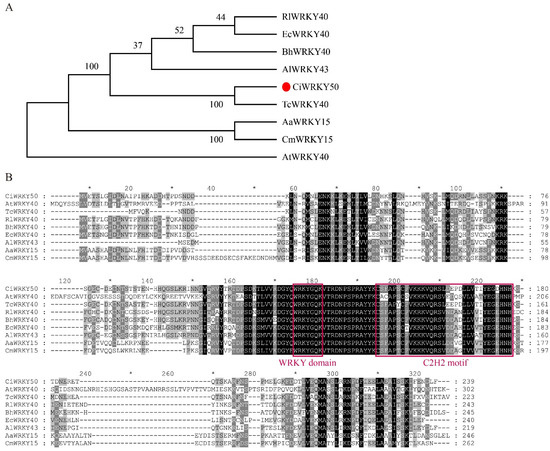
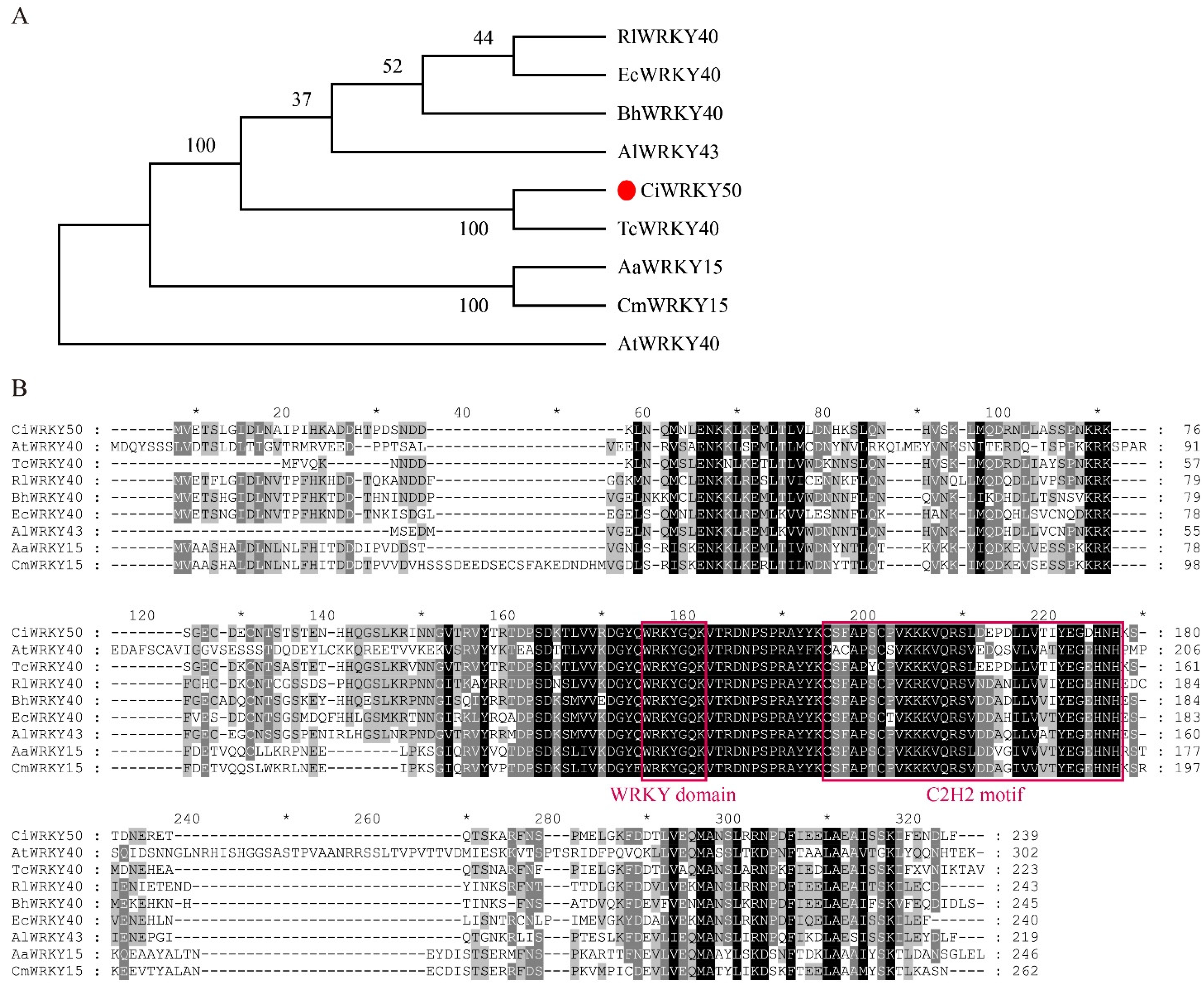
To investigate the role of CiWRKY50 in response to Cd stress, the CDS of CiWRKY50 was isolated from C. indicum in this study. Sequencing analysis revealed that the CDS spans 720 bp and encodes a 239-amino-acid protein, which was designated as CiWRKY50 (NCBI accession number: PQ857541) based on its chromosomal localization. Phylogenetic analysis demonstrated that CiWRKY50 shares high homology with WRKY proteins from Arabidopsis thaliana, Tanacetum cinerariifolium, Rutidosis leptorrhynchoides, Bidens hawaiensis, Erigeron canadensis, Atractylodes lancea, Artemisia annua, Chrysanthemum × morifolium. Notably, it exhibits the closest phylogenetic relationship with TcWRKY40 from T. cinerariifolium (Figure 1A). Amino acid sequence alignment further identified that CiWRKY50 contains a conserved WRKY domain and a C2H2-type zinc finger motif, classifying it into group II of the WRKY transcription factor family (Figure 1B).
Figure 1.
Sequence comparison and phylogenetic relationship analysis of CiWRKY50 with WRKY transcription factors from other plants. (A) Evolutionary tree analysis of CiWRKY50 (indicated by a red dot) and other plant WRKY proteins. (B) Homologous comparison of CiWRKY50 protein with WRKY proteins from other plant species. The accession numbers are as follows: AtWRKY40 (AT1G80840.1), TcWRKY40 (GFA79038.1), RlWRKY40 (XP_071730522.1), BhWRKY40 (XP_076909269.1), EcWRKY40 (XP_043630860.1), AlWRKY43 (XZP16187.1), AaWRKY15 (PWA52888.1), CmWRKY15 (AHC54620.1). * indicate that the amino acids at these positions are highly conserved across all aligned sequences. The red box denotes the WRKYGQK motif and the C2H2 zinc finger structure.
3.2. The Expression Pattern of CiWRKY50 Under ABA or Cd Treatment
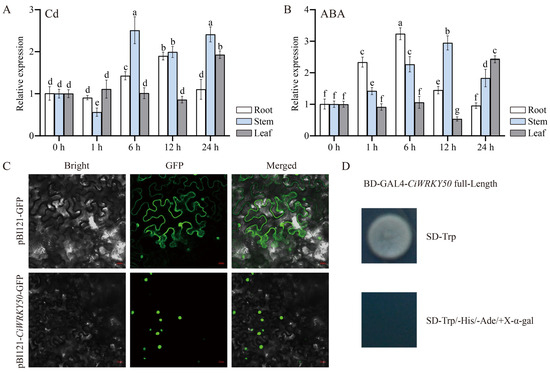
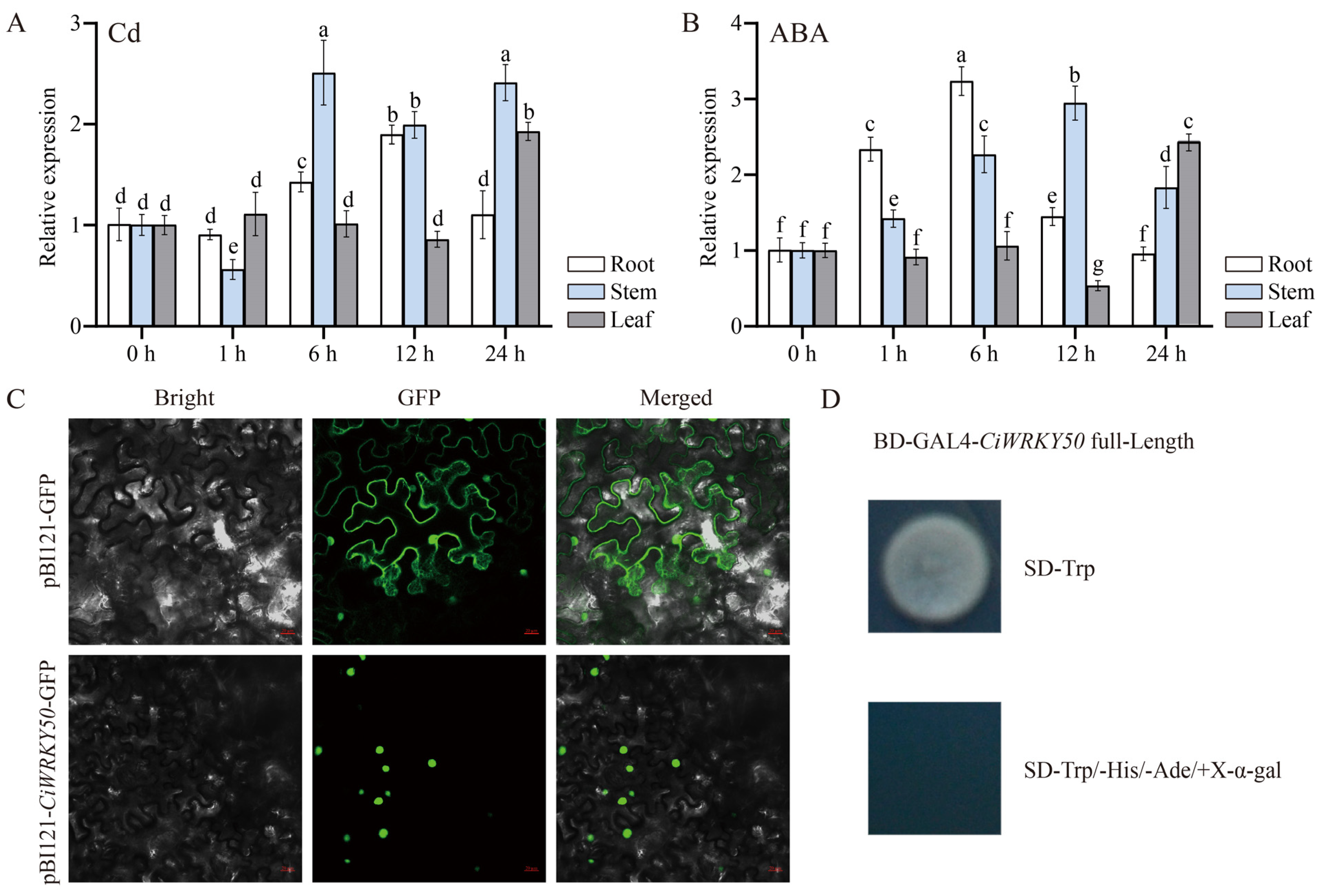
To examine the expression dynamics of CiWRKY50 under Cd stress, C. indicum plants were treated with Cd or ABA, and transcript levels were measured at different time points. During the treatment period, the expression level of CiWRKY50 in stems of Cd-treated plants peaked at 6 h, reaching 2.50-fold that of the control group. Maximum expression in roots was observed at 12 h, whereas in leaves, it occurred at 24 h (Figure 2B). Under ABA signaling treatment, the expression of CiWRKY50 in roots and stems both exhibited a trend of first increasing and then decreasing. Specifically, the relative expression level in roots peaked at 6 h, reaching 3.21-fold that of the control group. The expression level in stems was maximal at 12 h. In contrast, the expression of CiWRKY50 in leaves showed a significant lag, with a notable increase observed only after 24 h of treatment. Overall, the expression of CiWRKY50 exhibited distinct tissue-specific and temporal patterns under both Cd and ABA treatments. This dual responsiveness suggests its potential role in the mechanism by which ABA mitigates Cd-induced stress.
Figure 2.
Expression characterization, subcellular localization and transcriptional activity assay of CiWRKY50. (A) Relative expression level of the CiWRKY50 gene following Cd treatment. (B) Relative expression of CiWRKY50 gene under abscisic acid treatment. Data are mean ± SD, n = 3. Different lowercase letters indicate significant differences at the p < 0.05 level (one-way ANOVA, Duncan’s test). (C) The subcellular localization of CiWRKY50. (D) Transcriptional activation activity analysis of CiWRKY50.
3.3. Subcellular Localization and Transcriptional Activation Activity of CiWRKY50
To determine its subcellular localization, the coding sequence of CiWRKY50 was fused with GFP in the pBI121 vector and transiently expressed in Nicotiana benthamiana leaves via Agrobacterium-mediated infiltration. Confocal microscopy revealed that GFP signals from the empty vector were distributed in the cytoplasm and cell membrane, whereas fluorescence from CiWRKY50-GFP was exclusively localized in the nucleus, indicating that CiWRKY50 is a nuclear-localized protein (Figure 2C). To assess whether CiWRKY50 has transcriptional activation activity, the pGBKT7-CiWRKY50 construct was introduced into Y2HGold yeast cells and cultured on selective media. Yeast carrying pGBKT7-CiWRKY50 grew normally on SD/-Trp medium but failed to grow on SD/-Trp/-His/-Ade+X-α-Gal medium (Figure 2D). These results indicate that CiWRKY50 lacks intrinsic transcriptional self-activation activity.
3.4. Overexpression of CiWRKY50 Enhances Cd Tolerance in Arabidopsis
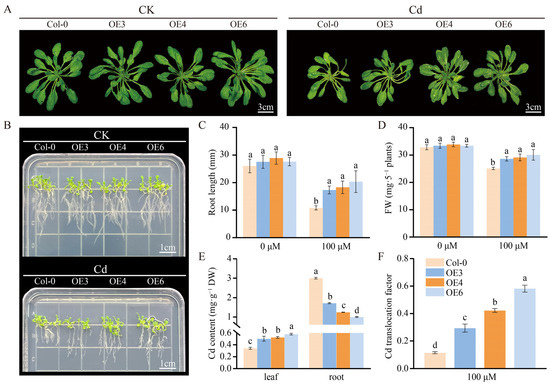
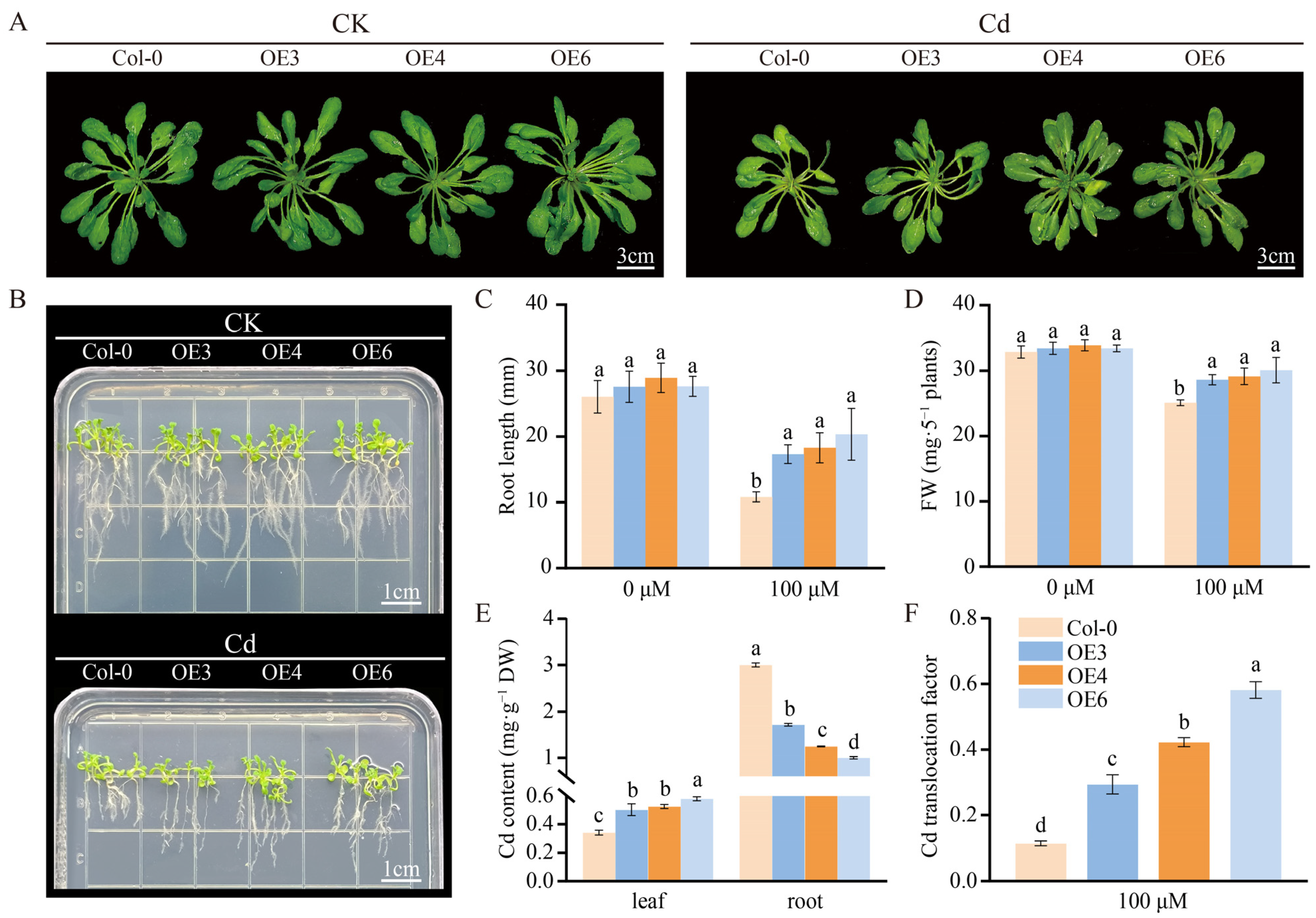
To further investigate the functional role of CiWRKY50 in Cd stress response, we generated three independent CiWRKY50-overexpressing transgenic lines of A. thaliana and assessed their phenotypic performance (Figure S1). As depicted in Figure 3A, no significant phenotypic differences were observed between the overexpression lines and Col-0 plants under normal growth conditions; however, after 3 days of Cd treatment, Col-0 plants exhibited more pronounced chlorosis and wilting. After 7 days of vertical growth on 1/2 MS medium, no significant difference in root length was observed between Col-0 and OE lines under non-stress conditions. However, when exposed to 100 μmol·L−1 Cd, OE seedlings exhibited significantly enhanced primary root elongation compared with Col-0 (Figure 3B,C). Similarly, fresh weight measurements revealed that OE lines maintained higher relative biomass than Col-0 under Cd stress (Figure 3D). Taken together, these results demonstrate that overexpression of CiWRKY50 enhances Cd stress tolerance in A. thaliana.
Figure 3.
Tolerance analysis of Col-0 and CiWRKY50 transgenic Arabidopsis to Cd stress. (A) Phenotypes of Col-0 and CiWRKY50-OE lines under 0, 100 μmol·L−1 Cd stress for 3 d. (B) Phenotypic analysis of root elongation in A. thaliana under Cd treatment. (C) Root length. (D) Fresh weight. (E) Cd content. (F) The translocation factor of Cd. Data are mean ± SD, n = 3, and different lowercase letters indicate significant differences at the p < 0.05 level (one-way ANOVA, Duncan’s test).
3.5. Overexpression of CiWRKY50 Promotes Cd Translocation and Enhances ROS Detoxification in Arabidopsis
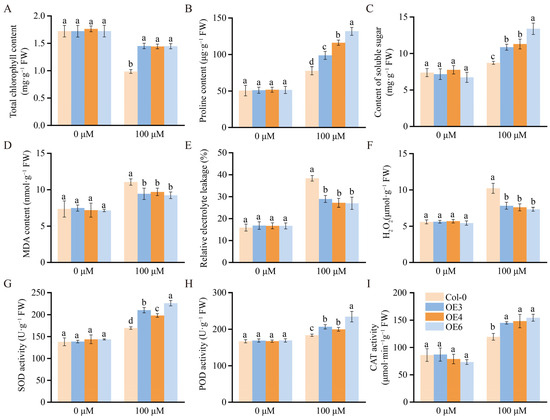
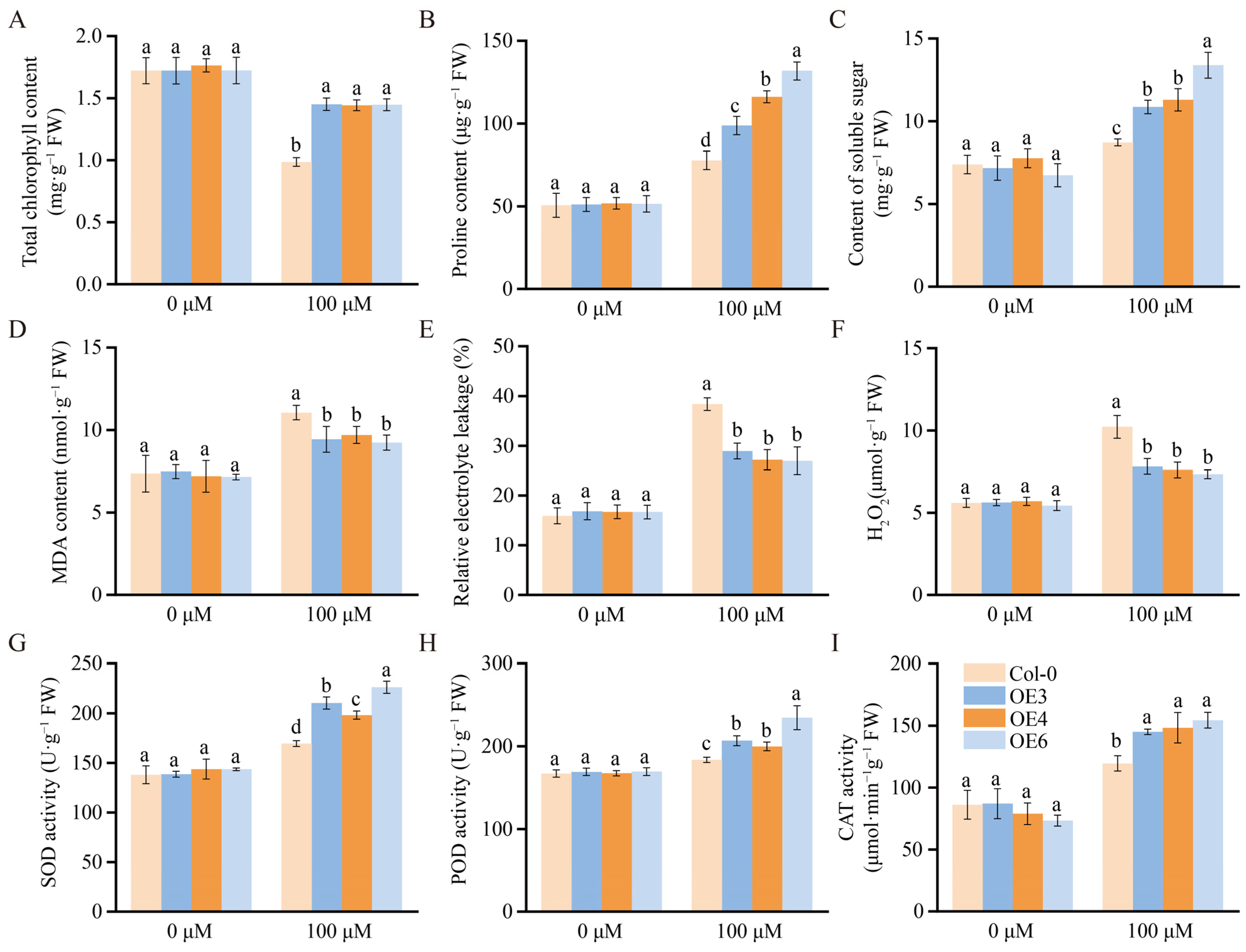
Cd quantification revealed that CiWRKY50-OE lines accumulated higher Cd levels in leaves but lower levels in roots than Col-0, resulting in a significantly increased root-to-leaf translocation factor (Figure 3E,F). Physiological assays further demonstrated that, under Cd stress, OE plants maintained higher chlorophyll, proline, and soluble sugar levels, whereas MDA, REL, and H2O2 levels were markedly reduced compared with Col-0 (Figure 4A–F). Moreover, antioxidant enzyme activities (SOD, POD, CAT) were significantly enhanced in OE lines following Cd exposure, but not under control conditions (Figure 4G–I). These results indicate that CiWRKY50 improves Cd tolerance by facilitating Cd translocation to aerial tissues, maintaining metabolic homeostasis, and activating the antioxidant defense system to mitigate ROS accumulation.
Figure 4.
Overexpression of CiWRKY50 enhances tolerance to Cd stress in Arabidopsis. (A) Chlorophyll content. (B) Proline content. (C) Content of soluble sugar. The contents of (D) MDA, (E) REL and (F) H2O2. The activities of (G) SOD, (H) POD and (I) CAT. Data are mean ± SD, n = 3, and different lowercase letters indicate significant differences at the p < 0.05 level (one-way ANOVA, Duncan’s test).
3.6. Overexpression of CiWRKY50 Enhances Cd Tolerance and ABA-Mediated Stress Mitigation in C. indicum
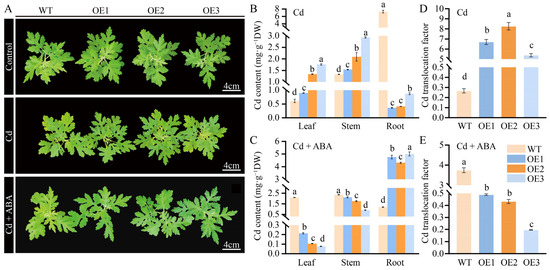
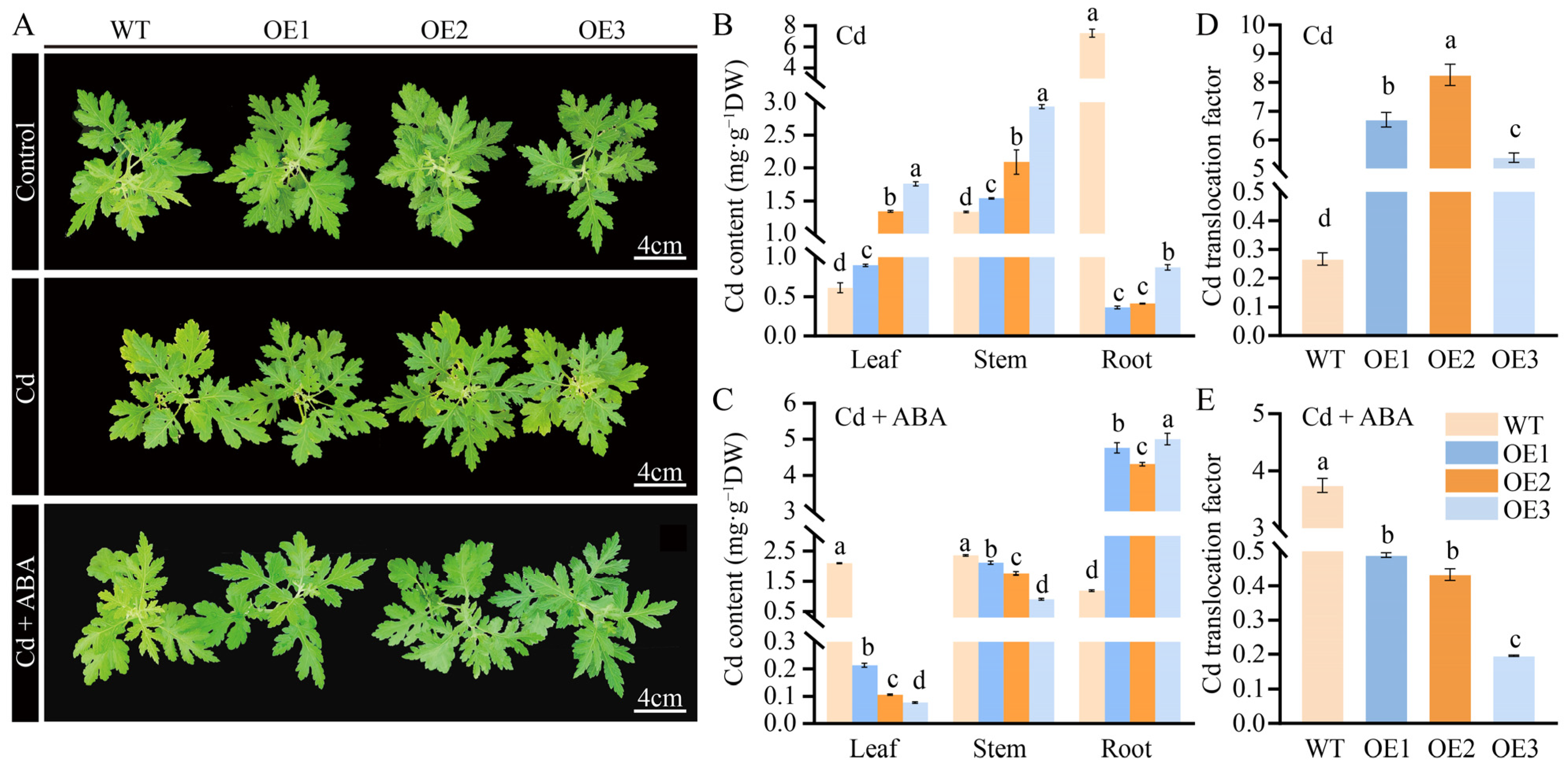
To investigate the role of CiWRKY50 in Cd stress tolerance, transgenic C. indicum lines overexpressing CiWRKY50 were subjected to 200 μmol·L−1 Cd and 100 μmol·L−1 ABA treatments. qRT-PCR analysis confirmed that three independent OE lines exhibited significantly elevated CiWRKY50 expression compared with the WT (Figure S2). Phenotypic analysis revealed that both WT and OE plants grew normally under control conditions. After 7 days of Cd exposure, chlorosis and leaf yellowing were observed in all plants; however, WT plants exhibited more severe symptoms, whereas OE lines maintained relatively healthier growth and reduced chlorosis. Importantly, under the combined Cd + ABA treatment, leaf yellowing was markedly alleviated compared with Cd alone, and OE lines retained greener leaves and more robust growth compared with WT plants (Figure 5A). These findings demonstrate that CiWRKY50 overexpression improves Cd tolerance in C. indicum, and that exogenous ABA supplementation synergistically reduces Cd-induced damage, highlighting a potential interaction between CiWRKY50-mediated regulation and ABA signaling pathways.
Figure 5.
Phenotypic characteristics and Cd accumulation in CiWRKY50-overexpressing C. indicum. plants exposed to ABA and Cd treatments. (A) Representative images of growth performance of WT and transgenic lines after 7 days of treatment. (B) Cd content after Cd treatment. (C) Cd content after Cd + ABA treatment. (D) The TF of Cd after Cd treatment. (E) The TF of Cd after Cd + ABA treatment. Data are mean ± SD, n = 3, and different lowercase letters indicate significant differences at the p < 0.05 level (one-way ANOVA, Duncan’s test).
3.7. Cd Distribution and Translocation in CiWRKY50-Overexpressing C. indicum
To dissect the physiological mechanisms underlying CiWRKY50-mediated Cd tolerance, we quantified Cd accumulation in different tissues of WT and OE lines. Under Cd exposure, all OE lines exhibited significantly higher Cd content in stems and leaves but markedly lower levels in roots relative to WT. Among the transgenic lines, OE3 displayed the highest Cd accumulation in all examined organs (Figure 5B). In sharp contrast, under the combined Cd + ABA treatment, Cd partitioning showed an opposite trend: Cd levels in stems and leaves of the OE lines were significantly reduced compared with WT, whereas root Cd content was substantially elevated (Figure 5C). We further calculated TFs to evaluate Cd redistribution from roots to aerial tissues. Under Cd treatment alone, the TF values of OE lines were consistently higher than those of WT, indicating enhanced Cd mobility, with OE2 showing the highest TF among the transgenic lines. By contrast, Cd + ABA treatment resulted in significantly reduced TF of Cd in OE plants compared with WT, with OE3 displaying the lowest values (Figure 5D,E). Taken together, these results demonstrate that CiWRKY50 facilitates Cd translocation from roots to shoots under Cd stress, thereby contributing to Cd tolerance, whereas exogenous ABA alters Cd partitioning by restricting long-distance Cd transport to aerial tissues in transgenic C. indicum.
3.8. Physiological Responses of WT and CiWRKY50-Overexpressing C. indicum Under Cd and ABA Treatments
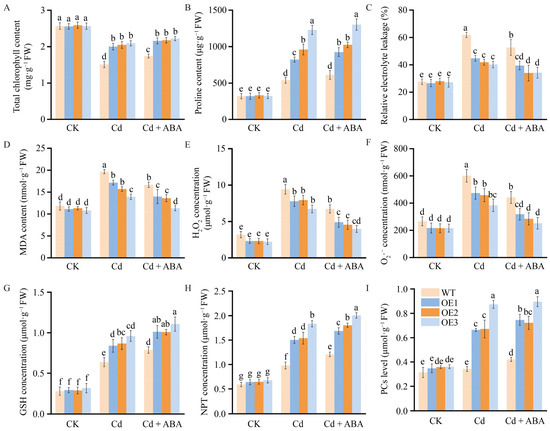
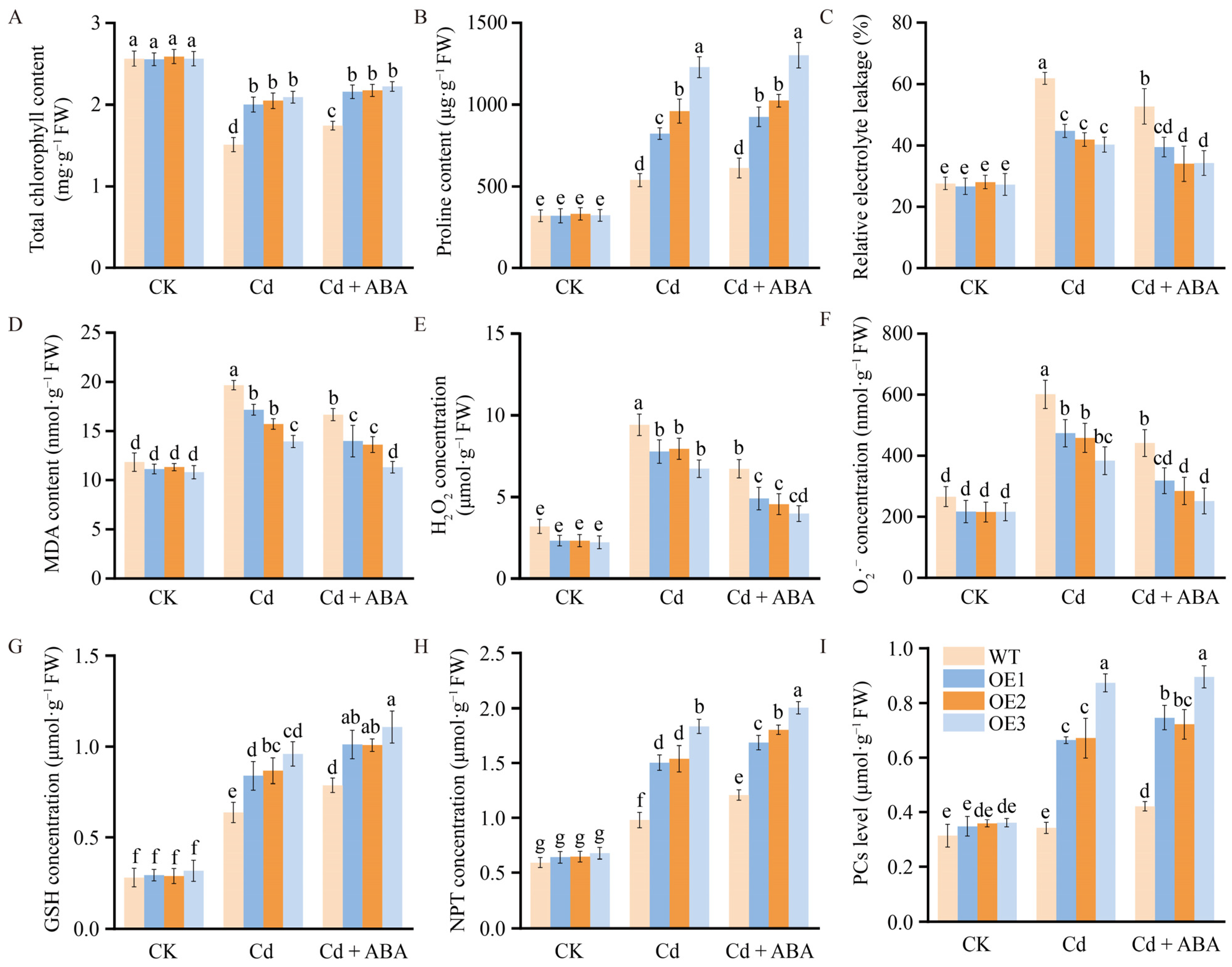
Under control conditions, WT and CiWRKY50-overexpressing (OE) lines exhibited similar physiological traits. However, under Cd stress, OE plants consistently performed better than WT, and exogenous ABA further alleviated Cd-induced damage in all lines. Cd exposure significantly reduced chlorophyll levels, but OE plants retained higher contents, while ABA supplementation mitigated chlorophyll loss (Figure 6). Levels of proline and soluble sugars were elevated in OE lines and further enhanced by ABA, suggesting improved osmotic adjustment. Oxidative stress markers (REL, MDA, H2O2, O2.−) increased in all lines under Cd stress but were lower in OE plants, and ABA application further reduced their accumulation. Similarly, thiol-containing compounds (GSH, NPTs, PCs) increased more strongly in OE lines than WT under Cd stress, and ABA further boosted their levels. Collectively, these results indicate that CiWRKY50 overexpression enhances photosynthesis, osmotic regulation, antioxidant defenses, and heavy metal chelation under Cd stress, while ABA provides additional protection by further reducing oxidative injury and promoting Cd detoxification.
Figure 6.
Overexpression of CiWRKY50 enhances tolerance to Cd stress in Chrysanthemum indicum (A) Chlorophyll content. (B) Proline content. (C) Relative electrolyte leakage. The contents of (D) MDA, (E) H2O2, (F) O2.−, (G) NPT, (H) GSH and (I) PC. Data are mean ± SD, n = 3, and different lowercase letters indicate significant differences at the p < 0.05 level (one-way ANOVA, Duncan’s test).
3.9. CiWRKY50 Overexpression Enhances ABA Signaling Under Cd Stress in C. indicum
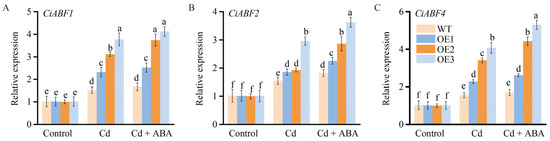
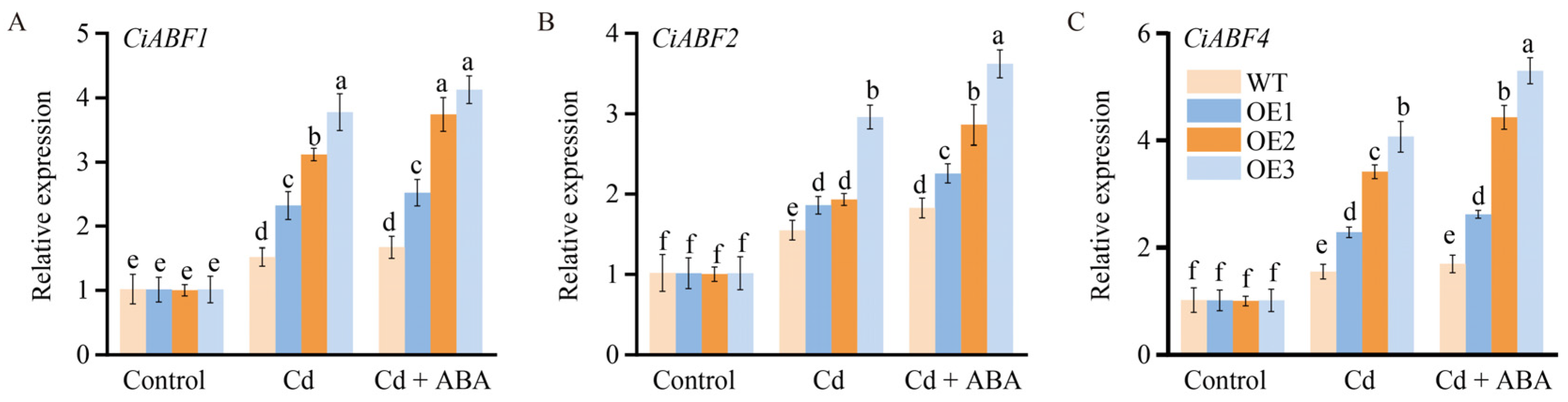
To clarify whether ABA signaling is involved in CiWRKY50-mediated Cd tolerance, we examined the transcript levels of CiABF1, CiABF2, and CiABF4 in WT and transgenic C. indicum lines. Under control conditions, expression levels of all three genes were comparable between WT and OE plants. After exposure to 200 μmol·L−1 Cd, however, all strains exhibited significant upregulation of CiABF1, CiABF2, and CiABF4. Notably, the OE lines displayed significantly stronger induction than WT, with OE3 showing the highest transcript levels, reaching 2.48-, 1.91-, and 2.62-fold those of WT for CiABF1, CiABF2, and CiABF4, respectively (Figure 7). When plants were treated with Cd + ABA, the expression of all three genes was further enhanced compared with Cd treatment alone. Again, OE plants exhibited stronger induction than WT, with OE3 showing the highest transcript levels (2.47-, 1.98-, and 3.12-fold those of WT, respectively). These consistent trends suggest that CiWRKY50 overexpression sensitizes C. indicum to ABA signaling under Cd stress, leading to stronger activation of ABA-responsive transcription factors. Collectively, these findings indicate that CiABF1, CiABF2, and CiABF4 are likely downstream targets of CiWRKY50 during Cd stress response, and may play critical roles in mediating ABA-dependent pathways that contribute to enhanced Cd tolerance in transgenic C. indicum.
Figure 7.
Effects of Cd and Cd + ABA stress on the expression levels of genes related to ABA signaling pathway of C. indicum. (A) The relative expression level of CiABF1. (B) The relative expression level of CiABF2. (C) The relative expression level of CiABF4. Data are mean ± SD, n = 3, and different lowercase letters indicate significant differences at the p < 0.05 level (one-way ANOVA, Duncan’s test).
4. Discussion
Cd contamination of agricultural soils has become a pressing environmental challenge driven by rapid industrialization, urbanization, and intensive farming practices. Owing to its high mobility in soils and efficient uptake by plants, Cd poses severe risks to food security and human health [42]. Once accumulated in plant tissues, Cd disrupts photosynthesis, impairs cellular structures, induces oxidative stress, and ultimately compromises growth and productivity [43,44]. Understanding the molecular mechanisms underlying Cd tolerance in plants is therefore of critical importance. Transcription factors are central regulators of plant growth, development, and stress adaptation. Among them, the WRKY family represents one of the largest and most evolutionarily conserved groups, with members widely implicated in responses to drought, salinity, and heavy metal toxicity [45,46,47]. Notably, recent studies have highlighted their integration into ABA signaling pathways, positioning WRKY proteins as pivotal regulators within the transcriptional network governing Cd detoxification [20]. Despite these advances, the roles of WRKYs in C. indicum, a species of both medicinal and ornamental significance with ecological potential, remain largely unexplored. Our study adds to this understanding by elucidating the function of CiWRKY50 in Cd stress responses.
4.1. Structural and Functional Insights into CiWRKY50
Sequence analysis confirmed that CiWRKY50 encodes a Group II WRKY transcription factor containing the canonical WRKY domain and C2H2-type zinc finger motif (Figure 1). Phylogenetic comparisons revealed its close evolutionary relationship with WRKY homologs from T. cinerariifolium, suggesting a conserved role in stress responses across this lineage. Subcellular localization experiments further verified that CiWRKY50 is targeted to the nucleus, consistent with the majority of WRKY proteins. Interestingly, CiWRKY50 lacks intrinsic transcriptional activation activity, implying that its regulatory function may rely on protein–protein interactions. This characteristic exemplifies a broader extensive principle in WRKY protein biology, wherein combinatorial regulation via dimerization or association with cofactors modulates transcriptional activity with precision.
Consistent with earlier findings in other species, WRKY50 homologs are widely implicated in abiotic stress responses. For instance, AtWRKY40 contributes to salt tolerance by regulating osmotic adjustment and antioxidant activity [48], FcWRKY40 enhances salt stress tolerance in Fortunella crassifolia [49], and through regulation of SOS2 and P5CS1 homologs and SmWRKY40 promotes salt tolerance in Arabidopsis by reducing ROS accumulation and enhancing antioxidant enzyme activities [50]. Similar functions have been reported for GsWRKY40 [51] in Glycine soja and MbWRKY40 [52] in Malus baccata under cold and drought stress via ABA-mediated signaling. Here, CiWRKY50 expression was significantly induced by both Cd and ABA treatments in C. indicum, though with tissue-specific dynamics: Cd stress strongly induced expression in stems, whereas ABA stress triggered rapid induction in roots, peaking at 6 h (Figure 2A,B). These expression kinetics align with reports in wheat (TaWRKY74) [53], maize (ZmWRKY64 and ZmWRKY114) [54,55], and other species, suggesting a conserved role of WRKY50 homologs in Cd and ABA responsiveness. Subcellular localization assays further revealed that CiWRKY50 is targeted to the nucleus (Figure 2C), consistent with other WRKY proteins such as LcWRKY40 and MfWRKY40 [56,57]. This finding underscores the need for further studies on the regulatory partners and downstream targets of CiWRKY50.
4.2. CiWRKY50 Might Act as a Conditional Regulator of Cd Tolerance
The results of this study identify CiWRKY50 as a central transcriptional regulator that orchestrates multiple defense strategies against Cd stress. Cd is not redox-active, but its toxicity arises from disruption of ion homeostasis, displacement of essential metals, and inhibition of antioxidant enzymes, leading to secondary bursts of ROS [58,59]. For plant survival, three objectives are paramount: sequestration of free Cd through chelation and vacuolar deposition, maintenance of nutrient ion selectivity, and stabilization of cellular redox balance. CiWRKY50 contributes to all three, as indicated by the enhanced antioxidant enzyme activities (SOD, POD, CAT), increased accumulation of osmolytes and thiol compounds, and modulation of Cd distribution [60,61]. These findings place CiWRKY50 within a framework where WRKY transcription factors function as stress integrators, coordinating metabolic and signaling pathways to fine-tune tolerance outcomes.
4.3. Mechanistic Insights into Plasticity of Cd Translocation
Herein, we demonstrate that overexpression of CiWRKY50 significantly enhances Cd translocation from roots to aerial tissues in both A. thaliana and C. indicum, characterized by elevated Cd accumulation in shoots and reduced Cd retention in roots (Figure 3 and Figure 5). While hyperaccumulator plants typically translocate substantial Cd loads from roots to shoots for detoxification, non-hyperaccumulating species tend to sequester Cd within root tissues. For most Asteraceae plants, including Cichorium intybus, Bidens frondosa, Lactuca indica, and Bidens pilosa, Cd concentrations in shoots exceed those in roots, with shoot-to-root Cd ratios exceeding 2.2 [62]. Conversely, Poaceae species exhibit shoot-to-root ratios ≤0.05. This divergence is likely attributed to interspecific variations in the repertoire and expression levels of transporters involved in Cd homeostasis. CiWRKY50 may exert a conserved pro-translocation function across species by modulating the activity of specific transporters or facilitating xylem loading processes. For instance, OsNRAMP1 plays a pivotal role in Cd accumulation in rice (Oryza sativa) shoots, and its overexpression enhances root-to-leaf Cd translocation [63].
Notably, exogenous ABA treatment significantly attenuated Cd translocation from roots to aerial tissues in CiWRKY50-overexpressing C. indicum lines, leading to a marked increase in root Cd retention in transgenic plants (Figure 5C,E). This observation implies that the transcriptional regulatory activity of CiWRKY50 is plastic, with ABA signaling exerting a pivotal regulatory role in CiWRKY50-mediated Cd translocation. ABA may enhance Cd immobilization on root cell walls by modulating the composition and structure of root cell walls, thereby reducing Cd entry into the xylem for long-distance transport [64]. For instance, in Cosmos bipinnatus [65], ABA mitigates Cd toxicity by strengthening root cell wall Cd immobilization and inducing antioxidant defense systems. While ABA typically inhibits Cd accumulation in most studies, exogenous ABA conversely promotes Cd accumulation and translocation in Hylotelephium spectabile (Boreau) H. Ohba [66]. Given that total cadmium accumulation has not been systematically assessed in the present study, whether CiWRKY50 participates in regulating root Cd uptake processes remains elusive. In future research, techniques including isotope tracing and non-invasive micro-testing could be employed to systematically evaluate the effects of CiWRKY50 on Cd uptake and subcellular distribution.
4.4. Integration of CiWRKY50 with ABA and ROS Networks
Our findings underscore the CiWRKY50–ABA–ROS signaling interplay as a critical, multilayered defense mechanism. Overexpression of CiWRKY50 in Chrysanthemum increased sensitivity to abscisic acid (ABA), evidenced by the enhanced induction of CiABF1, CiABF2, and CiABF4—transcription factors integral to ABA-dependent stress response pathways [67,68]. This observation implies that CiWRKY50 functions to prime ABA signaling, thereby reinforcing both molecular and anatomical defense strategies. ABA is known to facilitate osmotic adjustment and upregulate antioxidant gene expression, in addition to fortifying root apoplastic barriers that limit Cd translocation to aerial tissues [69]. Within this context, CiWRKY50 may be conceptualized as an amplifier of ABA signaling, linking the transcriptional activation of ABFs with enhanced ROS detoxification. The absence of inherent transcriptional activation activity in CiWRKY50 further supports the proposition that it exerts its regulatory effects via protein–protein interactions, potentially forming complexes with bZIP or NAC transcription factors to co-regulate stress-responsive genes. This integrative framework aligns with contemporary perspectives that stress tolerance emerges from coordinated regulatory networks rather than isolated signaling pathways, highlighting the functional versatility of WRKY transcription factors as central nodes within these networks [70].
From an applied standpoint, the bifunctional nature of CiWRKY50 presents significant translational potential. In species or scenarios characterized by robust shoot detoxification capabilities, CiWRKY50 may be harnessed to enhance phytoremediation efforts, specifically by promoting Cd phytoextraction from contaminated soils. Conversely, in agricultural crops and ornamental plants where food safety and visual quality are critical, the modulation of CiWRKY50 in conjunction with ABA signaling pathways could be employed to mitigate Cd accumulation in edible or aesthetically important tissues. Advanced genome editing techniques, such as CRISPR, offer the possibility of precisely regulating CiWRKY50 expression or ABA responsiveness, thereby facilitating the development of targeted breeding strategies optimized for either environmental remediation or the improvement of crop safety.
5. Conclusions
This study provides insights into the role of CiWRKY50 in enhancing Cd tolerance and its association with ABA signaling in A. thaliana and C. indicum. Overexpression of CiWRKY50 significantly improved root growth, biomass, and chlorophyll retention under Cd stress, while promoting osmolyte accumulation, strengthening antioxidant capacity, and elevating thiol-containing compounds, thereby mitigating oxidative damage and facilitating Cd detoxification. Metal distribution analyses further revealed that CiWRKY50 enhanced Cd translocation from roots to shoots, whereas exogenous ABA treatment restricted long-distance Cd transport, suggesting that ABA signaling may modulate Cd partitioning to minimize shoot toxicity. At the transcriptional level, CiWRKY50-overexpressing lines exhibited upregulated expression of ABA-responsive transcription factors (CiABF1, CiABF2, CiABF4), and this upregulation was amplified by ABA treatment, implying a potential regulatory interaction between CiWRKY50 and ABA signaling in reinforcing Cd stress responses. Taken together, these results suggest that CiWRKY50 acts as a positive regulator of Cd tolerance, with its function closely linked to redox homeostasis, Cd detoxification, and ABA-associated responses. This work offers mechanistic clues regarding WRKY-mediated stress regulation and highlights CiWRKY50 as a promising candidate gene for developing crops with enhanced heavy metal tolerance and resilience.
Supplementary Materials
The following supporting information can be downloaded at: https://www.mdpi.com/article/10.3390/horticulturae12030260/s1, Figure S1: PCR confirmation of transgene integration in CiWRKY50-overexpressing Arabidopsis thaliana lines. M: DNA Marker 2000 bp; 1: Negative control using water as the template; 2: Positive control with bacterial liquid as template; 3: negative control with wild-type A. thaliana as template; 4–9: CiWRKY50 overexpressing A. thaliana lines; Figure S2: Molecular characterization of CiWRKY50-overexpressing Chrysanthemum indicum lines. M: DNA Marker 2000 bp; 1: Negative control using water as the template; 2: Positive control with bacterial liquid as template; 3: Negative control with wild-type C. indicum as template; 4–6: CiWRKY50 overexpressing C. indicum lines. (B) Relative expression levels of CiWRKY50 overexpressing C. indicum lines. Data are presented as Mean ± SD (n = 3); Different lowercase letters indicate significant differences at the p < 0.05 level (one-way ANOVA,Duncan’s test). Table S1: Primer sequences used in this study.
Author Contributions
Conceptualization, L.Y.; methodology, X.Y.; software, Y.Z.; validation, Y.Y.; formal analysis, Y.Z.; investigation, K.Z.; resources, S.C.; data curation, X.N.; writing—original draft preparation, S.C.; writing—review and editing, Q.L.; visualization, Y.S.; supervision, S.X.; project administration, X.Y.; funding acquisition, L.Y. All authors have read and agreed to the published version of the manuscript.
Funding
This study was financially supported by the Natural Science Foundation of Heilongjiang Province (No. LH2021C018).
Data Availability Statement
The original contributions presented in this study are included in the article and Supplementary Materials. Further inquiries can be directed to the corresponding authors.
Acknowledgments
We sincerely acknowledge the National Key Laboratory of Tree Genetics and Breeding for providing the experimental platform.
Conflicts of Interest
The authors declare no conflicts of interest.
References
- Nagajyoti, P.C.; Lee, K.D.; Sreekanth, T.V.M. Heavy Metals, Occurrence and Toxicity for Plants: A Review. Environ. Chem. Lett. 2010, 8, 199–216. [Google Scholar] [CrossRef] [Scilit]
- Bermudez, G.M.A.; Jasan, R.; Plá, R.; Pignata, M.L. Heavy Metals and Trace Elements in Atmospheric Fall-out: Their Relationship with Topsoil and Wheat Element Composition. J. Hazard. Mater. 2012, 213–214, 447–456. [Google Scholar] [CrossRef] [Scilit] [PubMed]
- Shi, T.; Zhang, Y.; Gong, Y.; Ma, J.; Wei, H.; Wu, X.; Zhao, L.; Hou, H. Status of Cadmium Accumulation in Agricultural Soils across China (1975–2016): From Temporal and Spatial Variations to Risk Assessment. Chemosphere 2019, 230, 136–143. [Google Scholar] [CrossRef] [Scilit] [PubMed]
- Matz, C.J.; Treble, R.G.; Krone, P.H. Accumulation and Elimination of Cadmium in Larval Stage Zebrafish Following Acute Exposure. Ecotoxicol. Environ. Saf. 2007, 66, 44–48. [Google Scholar] [CrossRef] [Scilit] [PubMed]
- Zhang, J.; Zhang, M.; Song, H.; Zhao, J.; Shabala, S.; Tian, S.; Yang, X. A Novel Plasma Membrane-Based NRAMP Transporter Contributes to Cd and Zn Hyperaccumulation in Sedum Alfredii Hance. Environ. Exp. Bot. 2020, 176, 104121. [Google Scholar] [CrossRef] [Scilit]
- Peng, J.-S.; Wang, Y.-J.; Ding, G.; Ma, H.-L.; Zhang, Y.-J.; Gong, J.-M. A Pivotal Role of Cell Wall in Cadmium Accumulation in the Crassulaceae Hyperaccumulator Sedum Plumbizincicola. Mol. Plant 2017, 10, 771–774. [Google Scholar] [CrossRef] [Scilit]
- Baruah, N.; Gogoi, N.; Roy, S.; Bora, P.; Chetia, J.; Zahra, N.; Ali, N.; Gogoi, P.; Farooq, M. Phytotoxic Responses and Plant Tolerance Mechanisms to Cadmium Toxicity. J. Soil Sci. Plant Nutr. 2023, 23, 4805–4826. [Google Scholar] [CrossRef] [Scilit]
- Das, K.; Roychoudhury, A. Reactive Oxygen Species (ROS) and Response of Antioxidants as ROS-Scavengers during Environmental Stress in Plants. Front. Environ. Sci. 2014, 2, 53. [Google Scholar] [CrossRef] [Scilit]
- Mittler, R.; Vanderauwera, S.; Gollery, M.; Van Breusegem, F. Reactive Oxygen Gene Network of Plants. Trends Plant Sci. 2004, 9, 490–498. [Google Scholar] [CrossRef] [Scilit]
- Ghosh, R.K.; Basak, P.; Ghosh, A.; Choudhury, B. Effect of Cadmium Toxicity on Different Antioxidant Enzymes in Growing Wheat (Triticum aestivum L.) Seedlings. Int. J. Exp. Res. Rev. 2023, 36, 198–208. [Google Scholar] [CrossRef] [Scilit]
- Saleem, M.H.; Parveen, A.; Perveen, S.; Akhtar, N.; Abasi, F.; Ehsan, M.; Ali, H.; Okla, M.K.; Saleh, I.A.; Zomot, N.; et al. Alleviation of Cadmium Toxicity in Pea (Pisum sativum L.) through Zn−Lys Supplementation and Its Effects on Growth and Antioxidant Defense. Environ. Sci. Pollut. Res. 2024, 31, 10594–10608. [Google Scholar] [CrossRef] [Scilit]
- Jeong, C.Y.; Lee, S.A.; Kang, C.-S.; Cheong, Y.-K.; Lee, H. Overexpression of Abiotic Stress-Induced AtMYBL-O Results in Negative Modulation of Abscisic Acid Signaling through the Downregulation of Abscisic Acid-Responsive Genes in Arabidopsis Thaliana. Plant Growth Regul. 2018, 84, 25–36. [Google Scholar] [CrossRef] [Scilit]
- Deng, B.; Zhang, W.; Yang, H. Abscisic Acid Decreases Cell Death in Malus Hupehensis Rehd. Under Cd Stress by Reducing Root Cd2+ Influx and Leaf Transpiration. J. Plant Growth Regul. 2022, 41, 639–646. [Google Scholar] [CrossRef] [Scilit]
- Lu, Q.; Chen, S.; Li, Y.; Zheng, F.; He, B.; Gu, M. Exogenous Abscisic Acid (ABA) Promotes Cadmium (Cd) Accumulation in Sedum Alfredii Hance by Regulating the Expression of Cd Stress Response Genes. Environ. Sci. Pollut. Res. 2020, 27, 8719–8731. [Google Scholar] [CrossRef] [Scilit] [PubMed]
- Shi, W.-G.; Liu, W.; Yu, W.; Zhang, Y.; Ding, S.; Li, H.; Mrak, T.; Kraigher, H.; Luo, Z.-B. Abscisic Acid Enhances Lead Translocation from the Roots to the Leaves and Alleviates Its Toxicity in Populus × Canescens. J. Hazard. Mater. 2019, 362, 275–285. [Google Scholar] [CrossRef] [Scilit] [PubMed]
- Zhu, S.; Shi, W.; Jie, Y. Overexpression of BnPCS1, a Novel Phytochelatin Synthase Gene from Ramie (Boehmeria Nivea), Enhanced Cd Tolerance, Accumulation, and Translocation in Arabidopsis Thaliana. Front. Plant Sci. 2021, 12, 639189. [Google Scholar] [CrossRef] [Scilit]
- Han, Y.; Wang, S.; Zhao, N.; Deng, S.; Zhao, C.; Li, N.; Sun, J.; Zhao, R.; Yi, H.; Shen, X.; et al. Exogenous Abscisic Acid Alleviates Cadmium Toxicity by Restricting Cd2+ Influx in Populus Euphratica Cells. J. Plant Growth Regul. 2016, 35, 827–837. [Google Scholar] [CrossRef] [Scilit]
- Yamasaki, K.; Kigawa, T.; Watanabe, S.; Inoue, M.; Yamasaki, T.; Seki, M.; Shinozaki, K.; Yokoyama, S. Structural Basis for Sequence-Specific DNA Recognition by an Arabidopsis WRKY Transcription Factor. J. Biol. Chem. 2012, 287, 7683–7691. [Google Scholar] [CrossRef] [Scilit]
- Jiang, Y.; Yu, D. The WRKY57 Transcription Factor Affects the Expression of Jasmonate ZIM-Domain Genes Transcriptionally to Compromise Botrytis Cinerea Resistance. Plant Physiol. 2016, 171, 2771–2782. [Google Scholar] [CrossRef] [Scilit]
- Wang, T.; Huang, S.; Zhang, A.; Guo, P.; Liu, Y.; Xu, C.; Cong, W.; Liu, B.; Xu, Z. JMJ17–WRKY40 and HY5–ABI5 Modules Regulate the Expression of ABA-responsive Genes in Arabidopsis. New Phytol. 2021, 230, 567–584. [Google Scholar] [CrossRef] [Scilit]
- Jia, C.; Wang, J.; Guo, B.; Li, X.; Yang, T.; Yang, H.; Li, N.; Wang, B.; Yu, Q. A Group III WRKY Transcription Factor, SlWRKY52, Positively Regulates Drought Tolerance in Tomato. Environ. Exp. Bot. 2023, 215, 105513. [Google Scholar] [CrossRef] [Scilit]
- Liu, X.; Wang, H.; He, F.; Du, X.; Ren, M.; Bao, Y. The TaWRKY22–TaCOPT3D Pathway Governs Cadmium Uptake in Wheat. Int. J. Mol. Sci. 2022, 23, 10379. [Google Scholar] [CrossRef] [Scilit] [PubMed]
- Sheng, Y.; Yan, X.; Huang, Y.; Han, Y.; Zhang, C.; Ren, Y.; Fan, T.; Xiao, F.; Liu, Y.; Cao, S. The WRKY Transcription Factor, WRKY13, Activates PDR8 Expression to Positively Regulate Cadmium Tolerance in Arabidopsis. Plant Cell Environ. 2019, 42, 891–903. [Google Scholar] [CrossRef] [Scilit] [PubMed]
- Vilvanathan, S.; Shanthakumar, S. Ni (II) Adsorption onto Chrysanthemum Indicum: Influencing Factors, Isotherms, Kinetics, and Thermodynamics. Int. J. Phytorem. 2016, 18, 1046–1059. [Google Scholar] [CrossRef] [Scilit]
- Zhao, Y.; Huo, B.; Lin, S.; Zhang, S.; Mao, C.; Jiang, J.; Chen, S.; Fang, W.; Guan, Z.; Liao, Y.; et al. Germplasm Innovation and Establishment of Comprehensive Evaluation System for Hedgerow Garden Chrysanthemum. Agronomy 2022, 12, 1736. [Google Scholar] [CrossRef] [Scilit]
- Wu, B.; Peng, H.; Sheng, M.; Luo, H.; Wang, X.; Zhang, R.; Xu, F.; Xu, H. Evaluation of Phytoremediation Potential of Native Dominant Plants and Spatial Distribution of Heavy Metals in Abandoned Mining Area in Southwest China. Ecotoxicol. Environ. Saf. 2021, 220, 112368. [Google Scholar] [CrossRef] [Scilit]
- Chen, S.; Zhang, Y.; Zhang, K.; Liu, S.; Yang, Y.; Xu, X. Genome-Wide Identification and Expression Profiling of the bZIP Gene Family in Chrysanthemum Indicum and the Functional Analysis of CibZIP29 under Cadmium Stress. Ornam. Plant Res. 2025, 5, e013. [Google Scholar] [CrossRef] [Scilit]
- Ledger, S.E.; Deroles, S.C.; Given, N.K. Regeneration and Agrobacterium-Mediated Transformation of Chrysanthemum. Plant Cell Rep. 1991, 10, 195–199. [Google Scholar] [CrossRef] [Scilit]
- Clough, S.J.; Bent, A.F. Floral Dip: A Simplified Method for Agrobacterium-Mediated Transformation of Arabidopsis Thaliana. Plant J. 1998, 16, 735–743. [Google Scholar] [CrossRef] [Scilit]
- Tamura, K.; Stecher, G.; Kumar, S. MEGA11: Molecular Evolutionary Genetics Analysis Version 11. Mol. Biol. Evol. 2021, 38, 3022–3027. [Google Scholar] [CrossRef] [Scilit]
- Yang, X.; Luo, Y.; Bai, H.; Li, X.; Tang, S.; Liao, X.; Zhang, L.; Liu, Q. DgMYB2 Improves Cold Resistance in Chrysanthemum by Directly Targeting DgGPX1. Hortic. Res. 2022, 9, uhab028. [Google Scholar] [CrossRef] [Scilit] [PubMed]
- Chen, S.; Yue, L.; Yang, X.; Xia, B.; Li, H.; Chen, B.; Yang, Y.; Sun, Y.; Li, Q.; Yan, J.; et al. CiPCS Regulated by CiMYB4 Enhances the Tolerance of Chrysanthemum Indicum to Cadmium Stress. Plant Cell Rep. 2026, 45, 2–19. [Google Scholar] [CrossRef] [Scilit] [PubMed]
- Wei, W.; Peng, H.; Xie, Y.; Wang, X.; Huang, R.; Chen, H.; Ji, X. The Role of Silicon in Cadmium Alleviation by Rice Root Cell Wall Retention and Vacuole Compartmentalization under Different Durations of Cd Exposure. Ecotoxicol. Environ. Saf. 2021, 226, 112810. [Google Scholar] [CrossRef] [Scilit] [PubMed]
- Jin, D.; Zhang, Q.; Liu, Y.; Liang, M.; Li, A.; Wu, J. Overexpression of the Maize Phytochelatin Synthase Gene (ZmPCS1) Enhances Cd Tolerance in Plants. Acta Physiol. Plant 2022, 44, 114. [Google Scholar] [CrossRef] [Scilit]
- Arnon, D.I. Copper enzymes in isolated chloroplasts. Polyphenoloxidase in Beta vulgaris. Plant Physiol. 1949, 24, 1–15. [Google Scholar] [CrossRef] [Scilit]
- Guo, J.; Huang, Y.; Yang, X.; Bu, W.; Tian, J.; Zhang, M.; Huang, K.; Luo, X.; Ye, Y.; Xing, W.; et al. Effects of Three Exogenous Substances on Heat Tolerance of Peony Seedlings. Horticulturae 2023, 9, 765. [Google Scholar] [CrossRef] [Scilit]
- Dionisio-Sese, M.L.; Tobita, S. Antioxidant Responses of Rice Seedlings to Salinity Stress. Plant Sci. 1998, 135, 1–9. [Google Scholar] [CrossRef] [Scilit]
- Bates, L.S.; Waldren, R.P.; Teare, I.D. Rapid Determination of Free Proline for Water-Stress Studies. Plant Soil 1973, 39, 205–207. [Google Scholar] [CrossRef] [Scilit]
- Gulzar, F.; Fu, J.; Zhu, C.; Yan, J.; Li, X.; Meraj, T.A.; Shen, Q.; Hassan, B.; Wang, Q. Maize WRKY Transcription Factor ZmWRKY79 Positively Regulates Drought Tolerance through Elevating ABA Biosynthesis. Int. J. Mol. Sci. 2021, 22, 10080. [Google Scholar] [CrossRef] [Scilit]
- Seth, C.S.; Kumar Chaturvedi, P.; Misra, V. The Role of Phytochelatins and Antioxidants in Tolerance to Cd Accumulation in Brassica juncea L. Ecotoxicol. Environ. Saf. 2008, 71, 76–85. [Google Scholar] [CrossRef] [Scilit]
- Brunetti, P.; Zanella, L.; De Paolis, A.; Di Litta, D.; Cecchetti, V.; Falasca, G.; Barbieri, M.; Altamura, M.M.; Costantino, P.; Cardarelli, M. Cadmium-Inducible Expression of the ABC-Type Transporter AtABCC3 Increases Phytochelatin-Mediated Cadmium Tolerance in Arabidopsis. J. Exp. Bot. 2015, 66, 3815–3829. [Google Scholar] [CrossRef] [Scilit] [PubMed]
- Latif, M.; Nasim, I.; Ahmad, M.; Nawaz, R.; Tahir, A.; Irshad, M.A.; Al-Mutairi, A.A.; Irfan, A.; Al-Hussain, S.A.; Zaki, M.E.A. Human Health Risk Assessment of Drinking Water Using Heavy Metal Pollution Index: A GIS-Based Investigation in Mega City. Appl. Water Sci. 2025, 15, 12. [Google Scholar] [CrossRef] [Scilit]
- Paunov, M.; Koleva, L.; Vassilev, A.; Vangronsveld, J.; Goltsev, V. Effects of Different Metals on Photosynthesis: Cadmium and Zinc Affect Chlorophyll Fluorescence in Durum Wheat. Int. J. Mol. Sci. 2018, 19, 787. [Google Scholar] [CrossRef] [Scilit] [PubMed]
- Abbas, T.; Rizwan, M.; Ali, S.; Adrees, M.; Zia-ur-Rehman, M.; Qayyum, M.F.; Ok, Y.S.; Murtaza, G. Effect of Biochar on Alleviation of Cadmium Toxicity in Wheat (Triticum aestivum L.) Grown on Cd-Contaminated Saline Soil. Environ. Sci. Pollut. Res. 2018, 25, 25668–25680. [Google Scholar] [CrossRef] [Scilit]
- Cai, Z.; Xian, P.; Wang, H.; Lin, R.; Lian, T.; Cheng, Y.; Ma, Q.; Nian, H. Transcription Factor GmWRKY142 Confers Cadmium Resistance by Up-Regulating the Cadmium Tolerance 1-Like Genes. Front. Plant Sci. 2020, 11, 724. [Google Scholar] [CrossRef] [Scilit]
- Dong, T.; Su, J.; Li, H.; Du, Y.; Wang, Y.; Chen, P.; Duan, H. Genome-Wide Identification of the WRKY Gene Family in Four Cotton Varieties and the Positive Role of GhWRKY31 in Response to Salt and Drought Stress. Plants 2024, 13, 1814. [Google Scholar] [CrossRef] [Scilit]
- Wang, J.; Rong, Z.; Shi, W.; Zhang, Y.; Wang, W.; Zheng, Y.; Han, X.; Sun, H. Characterization of the WRKY Family Transcription Factors in Astragalus Membranaceus and Their Expression under Drought Stress. BMC Plant Biol. 2025, 25, 593. [Google Scholar] [CrossRef] [Scilit]
- Loo, E.P.; Tajima, Y.; Yamada, K.; Hirase, T.; Ariga, H.; Fujiwara, T.; Tanaka, K.; Taji, T.; Somssich, I.E.; Parker, J.E.; et al. Pattern Recognition Receptors Confer Plant Salt Tolerance via WRKY18/WRKY40 Transcription Factors. BioRxiv 2020. [Google Scholar] [CrossRef] [Scilit]
- Dai, W.; Wang, M.; Gong, X.; Liu, J. The Transcription Factor Fc WRKY 40 of Fortunella Crassifolia Functions Positively in Salt Tolerance through Modulation of Ion Homeostasis and Proline Biosynthesis by Directly Regulating SOS 2 and P5 CS 1 Homologs. New Phytol. 2018, 219, 972–989. [Google Scholar] [CrossRef] [Scilit]
- Zhang, A.; Shang, J.; Xiao, K.; Zhang, M.; Wang, S.; Zhu, W.; Wu, X.; Zha, D. WRKY Transcription Factor 40 from Eggplant (Solanum melongena L.) Regulates ABA and Salt Stress Responses. Sci. Rep. 2024, 14, 19289. [Google Scholar] [CrossRef] [Scilit]
- Li, M.; Xue, M.; Ma, H.; Feng, P.; Chen, T.; Sun, X.; Li, Q.; Ding, X.; Zhang, S.; Xiao, J. Wild Soybean (Glycine Soja) Transcription Factor GsWRKY40 Plays Positive Roles in Plant Salt Tolerance. Crop J. 2024, 12, 766–775. [Google Scholar] [CrossRef] [Scilit]
- Han, J.; Li, X.; Li, W.; Yao, A.; Niu, C.; Hou, R.; Liu, W.; Wang, Y.; Zhang, L.; Han, D. Overexpression of Malus Baccata WRKY40 (MbWRKY40) Enhances Stress Tolerance in Arabidopsis Subjected to Cold and Drought. Plant Stress 2023, 10, 100209. [Google Scholar] [CrossRef] [Scilit]
- Li, G.-Z.; Zheng, Y.-X.; Chen, S.-J.; Liu, J.; Wang, P.-F.; Wang, Y.-H.; Guo, T.-C.; Kang, G.-Z. TaWRKY74 Participates Copper Tolerance through Regulation of TaGST1 Expression and GSH Content in Wheat. Ecotoxicol. Environ. Saf. 2021, 221, 112469. [Google Scholar] [CrossRef] [Scilit] [PubMed]
- Bo, C.; Chen, H.; Luo, G.; Li, W.; Zhang, X.; Ma, Q.; Cheng, B.; Cai, R. Maize WRKY114 Gene Negatively Regulates Salt-Stress Tolerance in Transgenic Rice. Plant Cell Rep. 2020, 39, 135–148. [Google Scholar] [CrossRef] [Scilit]
- Gu, L.; Hou, Y.; Sun, Y.; Chen, X.; Wang, G.; Wang, H.; Zhu, B.; Du, X. The Maize WRKY Transcription Factor ZmWRKY64 Confers Cadmium Tolerance in Arabidopsis and Maize (Zea mays L.). Plant Cell Rep. 2024, 43, 44. [Google Scholar] [CrossRef] [Scilit]
- Huang, Z.; Wang, J.; Li, Y.; Song, L.; Chen, D.; Liu, L.; Jiang, C.-Z. A WRKY Protein, MfWRKY40, of Resurrection Plant Myrothamnus Flabellifolia Plays a Positive Role in Regulating Tolerance to Drought and Salinity Stresses of Arabidopsis. Int. J. Mol. Sci. 2022, 23, 8145. [Google Scholar] [CrossRef] [Scilit]
- Guo, J.; Zhao, Y.; Cheng, H.; Yu, R.; Gu, B.; Wang, Q.; Zhang, J.; Li, S.; Guan, Q. Enhancing Plant Stress Tolerance: The Role of LcWRKY40 Gene in Drought and Alkaline Salt Resistance in Tobacco and Yeast. Int. J. Mol. Sci. 2024, 25, 10149. [Google Scholar] [CrossRef] [Scilit]
- Shvaleva, A.; Coba De La Peña, T.; Rincón, A.; Morcillo, C.N.; García De La Torre, V.S.; Lucas, M.M.; Pueyo, J.J. Flavodoxin Overexpression Reduces Cadmium-Induced Damage in Alfalfa Root Nodules. Plant Soil 2010, 326, 109–121. [Google Scholar] [CrossRef] [Scilit]
- Hasanuzzaman, M.; Bhuyan, M.H.M.; Zulfiqar, F.; Raza, A.; Mohsin, S.; Mahmud, J.; Fujita, M.; Fotopoulos, V. Reactive Oxygen Species and Antioxidant Defense in Plants under Abiotic Stress: Revisiting the Crucial Role of a Universal Defense Regulator. Antioxidants 2020, 9, 681. [Google Scholar] [CrossRef] [Scilit]
- Rushton, P.J.; Somssich, I.E.; Ringler, P.; Shen, Q.J. WRKY Transcription Factors. Trends Plant Sci. 2010, 15, 247–258. [Google Scholar] [CrossRef] [Scilit]
- Huang, Y.; Sun, Z.; Zhou, X. WRKY Transcription Factors in Response to Metal Stress in Plants: A Review. Int. J. Mol. Sci. 2024, 25, 10952. [Google Scholar] [CrossRef] [Scilit]
- Abe, T.; Fukami, M.; Ogasawara, M. Cadmium Accumulation in the Shoots and Roots of 93 Weed Species. Soil Sci. Plant Nutr. 2008, 54, 566–573. [Google Scholar] [CrossRef] [Scilit]
- Takahashi, R.; Ishimaru, Y.; Senoura, T.; Shimo, H.; Ishikawa, S.; Arao, T.; Nakanishi, H.; Nishizawa, N.K. The OsNRAMP1 Iron Transporter Is Involved in Cd Accumulation in Rice. J. Exp. Bot. 2011, 62, 4843–4850. [Google Scholar] [CrossRef] [Scilit] [PubMed]
- Meng, Y.; Huang, J.; Jing, H.; Wu, Q.; Shen, R.; Zhu, X. Exogenous Abscisic Acid Alleviates Cd Toxicity in Arabidopsis Thaliana by Inhibiting Cd Uptake, Translocation and Accumulation, and Promoting Cd Chelation and Efflux. Plant Sci. 2022, 325, 111464. [Google Scholar] [CrossRef] [Scilit] [PubMed]
- Yu, X.; Yang, L.; Fan, C.; Hu, J.; Zheng, Y.; Wang, Z.; Liu, Y.; Xiao, X.; Yang, L.; Lei, T.; et al. Abscisic Acid (ABA) Alleviates Cadmium Toxicity by Enhancing the Adsorption of Cadmium to Root Cell Walls and Inducing Antioxidant Defense System of Cosmos Bipinnatus. Ecotoxicol. Environ. Saf. 2023, 261, 115101. [Google Scholar] [CrossRef] [Scilit] [PubMed]
- Cheng, L.; Pu, L.; Li, A.; Zhu, X.; Zhao, P.; Xu, X.; Lei, N.; Chen, J. Implication of Exogenous Abscisic Acid (ABA) Application on Phytoremediation: Plants Grown in Co-Contaminated Soil. Environ. Sci. Pollut. Res. 2022, 29, 8684–8693. [Google Scholar] [CrossRef] [Scilit]
- Wu, J.; Yan, G.; Duan, Z.; Wang, Z.; Kang, C.; Guo, L.; Liu, K.; Tu, J.; Shen, J.; Yi, B.; et al. Roles of the Brassica Napus DELLA Protein BnaA6.RGA, in Modulating Drought Tolerance by Interacting with the ABA Signaling Component BnaA10.ABF2. Front. Plant Sci. 2020, 11, 577. [Google Scholar] [CrossRef] [Scilit]
- Li, Y.; He, Z.; Xu, J.; Jiang, S.; Han, X.; Wu, L.; Zhuo, R.; Qiu, W. SpSIZ1 from Hyperaccumulator Sedum Plumbizincicola Orchestrates SpABI5 to Fine-Tune Cadmium Tolerance. Front. Plant Sci. 2024, 15, 1382121. [Google Scholar] [CrossRef] [Scilit]
- Shen, C.; Yang, Y.-M.; Sun, Y.-F.; Zhang, M.; Chen, X.-J.; Huang, Y.-Y. The Regulatory Role of Abscisic Acid on Cadmium Uptake, Accumulation and Translocation in Plants. Front. Plant Sci. 2022, 13, 953717. [Google Scholar] [CrossRef] [Scilit]
- Ma, Z.; Hu, L. WRKY Transcription Factor Responses and Tolerance to Abiotic Stresses in Plants. Int. J. Mol. Sci. 2024, 25, 6845. [Google Scholar] [CrossRef] [Scilit]
Disclaimer/Publisher’s Note: The statements, opinions and data contained in all publications are solely those of the individual author(s) and contributor(s) and not of MDPI and/or the editor(s). MDPI and/or the editor(s) disclaim responsibility for any injury to people or property resulting from any ideas, methods, instructions or products referred to in the content. |
© 2026 by the authors. Licensee MDPI, Basel, Switzerland. This article is an open access article distributed under the terms and conditions of the Creative Commons Attribution (CC BY) license.