


Abstract
In line with sustainability goals, biological alternatives to chemical fumigants are increasingly in demand to support intensive baby leaf lettuce cultivation systems. This study evaluated the combined effects of soil disinfestation strategies and foliar biostimulants on crop performance and nutritional quality. With the aim of evaluating the interactive effects of biofumigation and the application of Trichoderma spp., Ascophyllum nodosum extract, and vegetable protein hydrolysate, an experiment was conducted under controlled growing conditions, integrating microbial and foliar treatments on two lettuce cycles. Soil microbial load, plant biometric traits, ionic profiles, antioxidant activity, and polyphenolic compounds were quantified. Biofumigation induced a marked recovery of bacterial populations, while both soil treatments resulted in sustained fungal suppression and the absence of detectable Fusarium spp. Biofumigation consistently increased fresh and dry biomass, highlighting its dual sanitizing and fertilizing role. Foliar biostimulants, particularly vegetable protein hydrolysate, significantly enhanced dry matter accumulation, reduced nitrate concentration, and improved cation uptake. Antioxidant activity and phenolic metabolism were strongly stimulated by Trichoderma spp. and protein hydrolysate, with significant synergistic effects on key hydroxycinnamic acids and flavonoids. These findings indicate that integrating biological soil disinfestation with foliar biostimulation improves yield stability and nutritional quality, supporting a sustainable framework for high-value baby leaf lettuce production.
1. Introduction
The rising global demand for minimally processed, health-oriented produce has placed baby-leaf lettuce (Lactuca sativa L.) at the forefront of modern horticultural systems. Lettuce owes its appeal to its interesting nutritional profile (high content of antioxidants, polyphenols, carotenoids, vitamins, and folates), which is in line with growing consumer interest in functional foods and the prevention of chronic diseases [1]. Even though Volpe et al. [2] state that greenhouse-grown lettuce tends to have higher pigment content than open-field varieties, the resulting soil fatigue and degradation should not be underestimated. Furthermore, this type of intensification, combined with continuous cultivation systems, often results in lower yields and a higher risk of pathogen accumulation [3]. To address these challenges, the increasing use of synthetic chemical fumigants has been observed for years, with proven significant damage to soil and plant health [4,5]. Consequently, to ensure the long-term sustainability of high-value horticultural systems, integrated management strategies that improve plant health and product quality while reducing dependence on synthetic pesticides are urgently needed [6,7,8].
Among the proposed strategies, biological soil disinfestation through biofumigation with brassica meal extracts is increasingly adopted in various cropping systems for the suppression of pests and pathogens [9]. In particular, biofumigation has been shown to be effective not only in suppressing major soil-borne pathogens, such as Rhizoctonia solani and Sclerotinia sclerotiorum in greenhouse systems, but also in improving the vigor of asparagus (Asparagus officinalis L.) plants, thus demonstrating both its biocidal capacity and its broader plant-promoting effects [10,11]. In addition to biofumigation, fungal biocontrol agents such as Trichoderma spp. have been extensively studied for their dual role in pathogen suppression and plant growth promotion. These fungi, through mechanisms such as enzyme production, antibiotics and ecological competition, not only suppress soil pathogens and improve nutrient uptake, but also stimulate secondary metabolism, increasing phenolics, carotenoids and antioxidants, thus affecting the nutritional quality of horticultural products [12,13].
At the same time, several studies have shown that Trichoderma spp. acts not only as a biological control agent, but also as a biostimulant, capable of improving the secondary metabolism of plants and promoting the accumulation of phenolic compounds, carotenoids, and other antioxidants [14,15]. In this same perspective, foliar and non-microbial root biostimulants, such as seaweed extracts and protein hydrolysates, are emerging as effective tools to improve crop growth, physiology, and quality, even under stressful conditions. As pointed out by Celebi et al. [16], non-microbial biostimulants contain specific organic compounds that are fundamental to plant metabolic processes and promote the growth and development of treated plants. Compounds such as specific amino acids and peptides improve fertilizer utilization, facilitate more efficient nutrient and water absorption, and enhance photosynthetic performance [17]. Since formulated seaweed extracts are rich in polysaccharides, polyphenols, and osmolytes, several studies have reported their benefits in germination, biomass, and nutritional quality of lettuce [18,19]. Among seaweeds used for agronomic purposes, Ascophyllum nodosum (ANE) is one of the most studied and commercially employed, thanks to its richness in bioactive compounds and its documented efficacy in improving tolerance to environmental stress [20,21,22]. Complementary to seaweed extracts, protein hydrolysates have also achieved considerable success as biostimulants. These bioactive molecules, in fact, by providing amino acids and peptides with hormone-like activity, stimulate nitrogen metabolism, enhance photosynthesis, and modulate stress-related responses [23,24,25,26]. Recent evidence confirms that foliar or root application of plant-derived protein hydrolysates can significantly improve lettuce yield, nitrogen use efficiency, chlorophyll content, photosynthesis, and antioxidant activity, with significant increases in fresh weight, phenolic compounds, flavonoids, and vitamin C concentrations under both optimal and nitrogen-deficient conditions [27,28]. Furthermore, regarding the combined use of Trichoderma spp. with protein hydrolysates and seaweed extracts, recent studies have already reported a synergistic effect in improving yield, physiological performance, and quality traits in various horticultural crops [29,30,31]. However, two aspects remain little explored in the literature: on the one hand, the lack of evidence of a possible synergistic effect between biofumigants and biostimulants; on the other, the absence of studies comparing this synergy with that resulting from the integration of Trichoderma spp. with biostimulants.
Based on our previous research, which initially examined the impact of some sustainable soil pest management practices on the qualitative and nutritional characteristics of baby lettuce [32], this study expands the investigation by integrating foliar biostimulation strategies into the same experimental framework. By combining soil management approaches (biofumigation and biological control) with biostimulant applications—an Ascophyllum nodosum extract (ANE) and a plant protein hydrolysate (PH)—we aim to assess whether synergistic effects can further improve plant performance and product quality, thus promoting sustainable production models for baby lettuce. The study aimed to: (i) evaluate the impact of soil treatments on the pathogen microbiome; (ii) analyze the effects of biostimulants on growth and quality parameters; and (iii) explore potential interactions between soil treatments and foliar biostimulants.
2. Materials and Methods
2.1. Experimental Design, Set-Up and Sampling
The experiment was conducted from 28 April to 30 May 2025, in a polyethylene-covered greenhouse tunnel at Ortomad s.r.l. (Bellizzi, Salerno, Italy). The experiment was conducted using a randomized design with three replicates in a factorial arrangement (3 × 3), with three soil disinfection treatments (SD)—non-treated soil (NT), biofumigation (BF), and Trichoderma spp. (T. spp.)—and the application of two different biostimulant treatments (B)—an Ascophyllum nodosum extract (ANE), and a plant protein hydrolysate (PH)—plus an untreated control (CTRL). The factorial design described generated nine treatment combinations, each replicated three times, for a total of 27 plots measuring 6.25 m × 2 m (12.5 m2) each plus two additional controls (one without disinfectants and one without biostimulants). Field operations began on 28 April 2025, following the preparation of the seedbeds, the delimitation of the experimental area and the application of soil disinfectants. Biofumigation was carried out on 28 April 2025, using a liquid Brassica-based biofumigant (Biofence FL Fast, Vivo BioSolution S.r.l., Roccapiemonte, SA, Italy) applied at a field-equivalent dosage of 15 L ha−1 (18.75 mL per plot) and containing 5% total organic nitrogen, of which 5% soluble organic nitrogen, and 10% organic carbon. The calculated amount of biofumigant was diluted with water directly into a 16 L battery-powered backpack sprayer (maximum flow rate: 10 L min−1) and applied as a surface soil spray, adjusting the application time to ensure uniform coverage of the plot area (10–15 s per plot). On the same date, a Trichoderma-based biological control agent (Condor Shield®, Hello Nature International Srl, Biandrate, NO, Italy)—a microbial formulation with a declared concentration of Trichoderma koningii TK7 of 1 × 10⁹ CFU g−1—was applied at 2 kg ha−1 (2.5 g per plot), following the same dilution and application procedure. To avoid drift, the plots were manually screened at the time of treatment with plastic panels. Blond baby leaf lettuce (Lactuca Sativa L., cv Luna verde—Maraldi sementi S.R.L., Cesena, FC, Italy, henceforth blond lettuce) sowing took place on 29 April, followed by 30-min sprinkler irrigation, both to ensure moist soil for germination and to allow the surface-applied disinfectants to fully absorb. Subsequently, irrigation was carried out automatically by the company according to its protocol for this crop. Sowing was performed using a precision seeder, calibrated to ensure uniform seed distribution across all plots, with an inter-row spacing of 4 cm and a sowing depth of 0.5 cm, resulting in a planting density of 2400 plants m−2. No fungicides or herbicides were applied throughout the experimental period to avoid confounding effects. The first foliar biostimulant application was performed on 12 May 2025, followed by a second application on 19 May. The treatments consisted of a plant-based protein hydrolysate (Trainer®, Hello Nature International Srl, Biandrate, NO, Italy) applied at a field-equivalent dose of 3 L ha−1 (3.75 mL per plot) and an Ascophyllum nodosum extract (Biomaris®, Yara International ASA, Norway) applied at 2 L ha−1 (2.50 mL per plot). Foliar applications were performed using the same spraying equipment and general procedure as the soil treatments. Trainer (henceforth PH) is a plant-derived protein hydrolysate obtained through LISIVEG® enzymatic hydrolysis technology and is characterized by a high content of amino acids and peptides, whereas Biomaris, Yara Italia S.p.A., Milano, MI, Italy (henceforth ANE) is a seaweed extract derived from the brown macroalga Ascophyllum nodosum and contains polysaccharides, mannitol, phlorotannins, and mineral nutrients. Both applications followed the same procedure as soil disinfectants, using a 16 L battery-powered backpack sprayer with solutions prepared in larger volumes of water to ensure uniform coverage across all plots. A second foliar application of the same products was performed on 19 May.
2.2. Soil Physicochemical Properties
Lettuce leaves were harvested twice during the crop cycle, corresponding to the first cut on 22 May (23 days after sowing, DAS) and the second cut on 30 May (31 DAS). In each plot, plants were collected from the designated 1 m2 subplot to avoid border effects. Harvesting was performed manually using a sterile stainless-steel knife, cutting the leaves at approximately 4 cm above the soil surface, consistent with the standard practice for baby leaf production. Immediately after collection, samples were placed in sterile polyethylene bags, transported under cooled conditions to the laboratory, and processed within 24 h. The harvested leaf samples were weighed immediately and expressed in kg m−2 fresh weight (FW); one part was stored at −80 °C for qualitative analysis and lyophilization purposes, and another part was placed in a forced-air oven in order to deduce the dry weight (DW) and to calculate the dry matter percentage (DM). Both lyophilized and dried leafy materials, for each cut, were ground (841 microns screen) for chemical and qualitative analysis.
2.3. Soil Sampling
Soil samples were collected at three key stages of the trial: (i) before the application of soil disinfectants (28 April), (ii) 14 days after treatment (12 May), and (iii) at the end of the crop cycle (30 May). Sampling was performed at a depth of 15–20 cm using a soil auger, with five subsamples taken randomly from each plot and subsequently pooled to form one composite sample per experimental unit. The collected samples were placed in sterile polyethylene bags, transported under cooled conditions, and stored at 4 °C until processing. Samples were used to assess microbiological composition, with particular focus on fungal and bacterial communities potentially associated with soil-borne pathogens.
2.4. Soil Microbial Quantification and Visual Observation of Cultivable Microbiota
To determine the microbial load, a 10 g aliquot of a representative soil sample was subjected to serial decimal dilutions. The stock dilution (10−1) was prepared by adding 90 mL of Ringer’s solution containing 0.162 g of sodium pyrophosphate to the 10 g of soil, in order to promote the disaggregation of the soil particles and release the microorganisms adsorbed on them into the dilution liquid. The sample was then homogenized by mechanical shaking for 45 min at room temperature. Subsequently, 1 mL of homogenate was collected in a sterile environment and added to a tube containing 9 mL of Ringer's solution. This operation was repeated until a 1 × 10⁻⁹ dilution was achieved. 100 µL of the various decimal dilutions obtained (10−2 to 10−8) were spread, using appropriate L-shaped microbiological loops, onto Petri dishes containing different substrates for microbial growth. In particular, Plate Count Agar (PCA) enriched with cycloheximide was used to determine the culturable bacterial load. The plates (3 for each dilution) were incubated at 30 °C for 72 h. For the isolation and quantification of the fungal load, Potato Dextrose Agar (PDA) enriched with ampicillin and Igepal, and Pink-Bengal Chloramphenicol Agar (RBC) enriched with Igepal were used. The plates (3 for each dilution) were incubated at 25 °C for 7 days. The total count of bacterial and fungal colonies on the plates containing the different substrates was expressed in Colony Forming Units (CFU g−1 of soil).
The identification of microbial isolates was conducted primarily on a morphological basis. Fungal colonies showing distinct macroscopic and microscopic characteristics were examined under optical microscopy to determine their genus when possible, following conventional taxonomic keys for hyphomycetes and soil fungi. However, a comprehensive molecular identification of all fungal and bacterial isolates was not performed within the scope of this study. Bacterial colonies were not subjected to microscopic characterization, as morphological criteria alone are generally insufficient for reliable taxonomic identification in bacteria. Therefore, the presented results refer to the cultivable microbial load and the predominant fungal morphotypes observed microscopically, rather than to a complete molecular characterization of the soil microbiome.
2.5. Leaf Colorimetric Parameters
Leaf colour of blond baby leaf lettuce was evaluated within two hours after harvest at both the first and second cut. Measurements were taken using a portable colorimeter (CR-400, Minolta Co. Ltd., Osaka, Japan) equipped with an 8 mm aperture. Colour coordinates were recorded according to the CIELAB system, which provides the parameters L* (lightness), a* (from green to red), and b* (from blue to yellow). For each replicate plot, seven leaves were randomly selected and analysed. From these primary values, Chroma (C* = √[a2 + b2]) and Hue angle (h° = arctan[b/a]) were calculated to further describe the intensity and tonal characteristics of leaf coloration.
2.6. Assessment of Ionic Content via Ion Chromatography
The mineral composition of oven-dried baby blond lettuce leaf samples was determined following the protocol described by Rouphael et al. [33]. Briefly, 250 mg of dried plant material were extracted with 50 mL of Milli-Q water and incubated at 80 °C for 10 min in a thermostated shaking water bath (ShakeTemp SW 22, Julabo, Seelbach, Germany). After centrifugation, the supernatant was analyzed by ion chromatography (ICS-3000, Dionex, Sunnyvale, CA, USA) equipped with a conductivity detector. This procedure enabled the quantification of nitrate (NO3−), phosphate (PO43−), sodium (Na+), potassium (K+), magnesium (Mg2+), and calcium (Ca2+), and results were expressed as mg kg−1 FW.
2.7. Analysis of Hydrophilic and Lipophilic Antioxidant Activities
The antioxidant potential of blond baby-leaf lettuce was assessed in both the first and second harvests, by separately analysing the hydrophilic (HAA) and lipophilic (LAA) fractions. The hydrophilic fraction was obtained from 0.2 g of freeze-dried tissue extracted in distilled water, and its activity was determined according to the DMPD radical cation decolorization assay [34]. In this method, antioxidants reduce the stable DMPD+ radical, leading to a decrease in absorbance at 505 nm proportional to their concentration. The lipophilic fraction was extracted from the same amount of tissue using methanol, and its activity was evaluated using the ABTS radical cation decolorization assay, in which antioxidants reduce the ABTS+ radical, producing a decrease in absorbance at 734 nm measured after 2.5 min. Both assays were conducted by UV–Vis spectrophotometry (HACH DR/4000, Hach Co., Loveland, CO, USA). Antioxidant activities were quantified against calibration curves using ascorbic acid as the reference compound for the hydrophilic fraction and Trolox for the lipophilic fraction. Results were expressed as mg ascorbic acid (AA) 100 g−1 FW for HAA and as mg Trolox (T) 100 g−1 FW for LAA.
2.8. Polyphenol Profiling and Quantification via UHPLC-HRMS
The qualitative and quantitative profile of polyphenols in blond baby leaf lettuce was determined using ultra-high-performance liquid chromatography coupled with high-resolution mass spectrometry (UHPLC-HRMS), performed exclusively on samples collected at the second harvest, in order to evaluate the cumulative effects of soil and foliar treatments on phenolic metabolism during the regrowth phase. Extracts were prepared according to the procedure of Vallverdú-Queralt et al. [35], and 5 µL aliquots were injected into a Dionex Ultimate 3000 UHPLC system (Thermo Fisher Scientific™, Waltham, MA, USA) interfaced with an Orbitrap HRMS (Thermo Fisher Scientific™). Chromatographic separation was performed on a Kinetex F5 column (100 × 2.1 mm, 2,6 µm) thermostated at 30 °C (Phenomenex, Castel Maggiore, Italy). Phases used consisted of 0.1% FA water (A) and 0,1% FA methanol (B), both acidified with 0.1% formic acid (v/v) to improve ionization. Detection was performed using an electrospray ionization (ESI) source in negative mode, employing a dual acquisition strategy combining full-scan MS and all-ion fragmentation (AIF) for targeted compound identification. Data acquisition and processing were conducted with Xcalibur Quan/Qual Browser software, version number 4.7.69.37 was used for data processing (Thermo Fisher, Waltham, MA, USA). Results were expressed as µg g−1 FW. Phenolic compounds were determined exclusively on samples from the second harvest to evaluate the cumulative effects of soil and foliar treatments on secondary metabolite accumulation after regrowth. We based our choice of second cutting on the results of studies by Corrado et al. [36] and Šic Žlabur et al. [37], which demonstrate that successive cuttings in baby leaf lettuce enhance treatment-dependent differentiation of secondary metabolism, resulting in greater accumulation and variability of phenolic compounds compared to the first harvest.
2.9. Statistical Analysis
All data were analyzed using IBM SPSS Statistics software (version 26.0; SPSS Inc., Chicago, IL, USA) on a Windows 10 platform. The experimental design was a randomized complete block with two fixed factors: soil disinfestation (Biofence, Trichoderma, untreated) and foliar biostimulants (protein hydrolysate, Ascophyllum nodosum extract, control). A two-way analysis of variance (ANOVA) was performed to assess the main effects of each factor and their interaction. When significant effects were detected, mean separations were carried out using Tukey’s Honest Significant Difference (HSD) test. Analyses were conducted separately for the first and second harvests to avoid confounding effects. For soil microbial data, temporal differences between 15 and 33 days after treatment (DAT) were assessed using independent t-tests, while the main effect of soil treatments (SD) was evaluated with one-way ANOVA, followed by Tukey’s HSD. The DAT × SD interaction was analysed through two-way ANOVA. Statistical significance was set at p < 0.05, and results are reported as means ± standard error (SE).
3. Results
3.1. Soil Microbial Quantification and Visual Observation
The survey conducted before the start of the experiment showed a high soil microbial load, with bacterial and fungal concentrations averaging 4.8 × 10⁶ and 4.0 × 10⁵ CFU g−1, respectively, typical of intensively managed greenhouse soils (Supplementary Table S1). Subsequent soil assessments were then conducted 15 and 33 days after the treatments (DAT) to evaluate the response of these initial microbial communities over time to the different soil disinfestation strategies (SD).
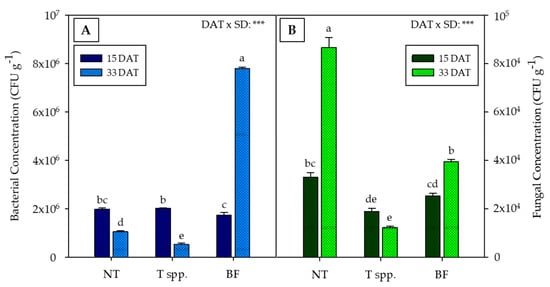
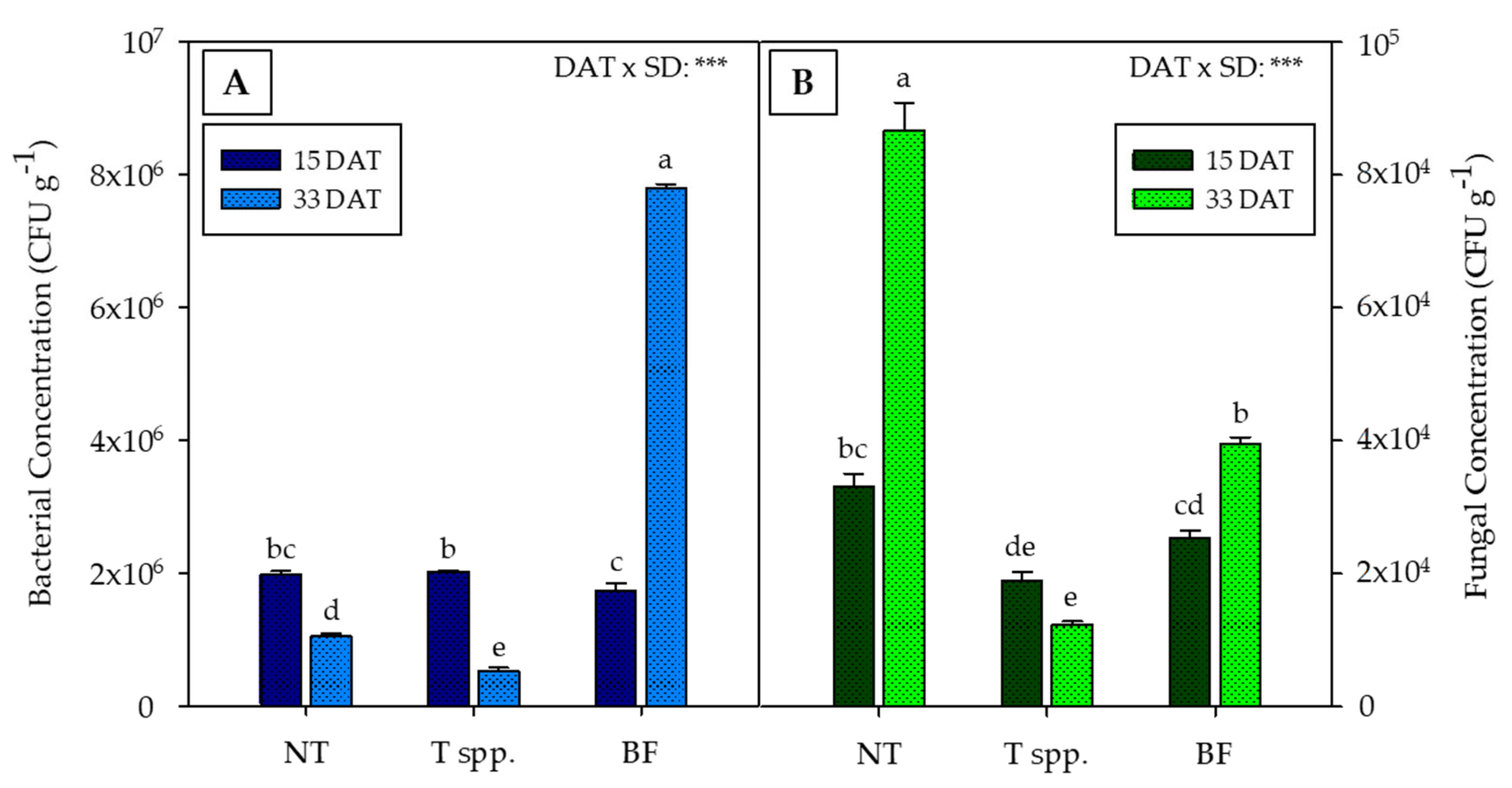
As showed in Figure 1A,B, both bacterial and fungal populations were significantly affected by DAT × SD interaction (p < 0.001). Specifically, in NT soils, bacterial abundance decreased by approximately 50%, while fungal populations increased by over 160% between 15 and 33 DAT. Under T. spp., however, both microbial groups remained consistently inhibited, with bacterial concentrations decreasing by approximately 74% and fungal counts by approximately 37%. In contrast, BF promoted a pronounced temporal increase in bacterial abundance of approximately 360% and a more moderate increase in fungal concentrations of approximately 60%, although the fungal levels measured at 33 DAT remained significantly lower than those observed under NT conditions.
Figure 1.
(A)—Bacterial concentration (CFU g−1) and (B)—Fungal concentration (CFU g−1) at 15 and 33 days after treatment (DAT) under three soil disinfestation strategies: untreated control (NT), Trichoderma spp. (T spp.), and biofumigation (BF). *** denotes significant effect at p ≤ 0.001. All data expressed as mean ± SE, n = 6. Different letters above the bars indicate significant differences according to Tukey’s HSD test (p = 0.05).
Visual observation of the fungal colonies (Supplementary Table S2) indicated that, before treatment, the culturable community was mainly represented by Fusarium spp., Aspergillus sesamicola, Penicillium spp., and Phytium spp. After 15 days, Fusarium colonies were still detected in NT but were absent in soils treated with T. spp. and BF, where only Aspergillus sesamicola, Penicillium spp., and Phytium spp. were recovered. In the final sampling, Fusarium was no longer detected in any treatment, and the culturable fungal community consisted mainly of saprophytic genera such as Aspergillus and Penicillium.
3.2. Yield and Dry Matter
Table 1 presents the effects of soil disinfestation treatments (SD), biostimulants (B) and their interactions (SD × B) on biometric traits—fresh weight (FW), dry matter (DM) and dry weight (DW)—of baby leaf lettuce in two consecutive harvests.
Table 1.
Fresh weight (FW), dry matter (DM), and dry weight (DW) of baby leaf lettuce at the first and second harvest under different soil disinfestation (SD) and foliar biostimulant (B) treatments and their interaction (SD × B).
At the first harvest, SD significantly influenced FW and DW but not DM. Compared to NT, BF increased FW and DW by approximately 19% and 23% respectively, while T. spp. showed intermediate values. In contrast, B exerted stronger effects: both PH and ANE increased FW by more than a quarter compared to CTRL, while also enhancing DM. These improvements translated into clear gains in DW, particularly with PH, which produced more than 50% higher values than CTRL.
At the second harvest, BF raised FW by around 26% compared to NT, while T. spp. produced values statistically comparable to NT. A similar pattern was observed for DW, with BF exceeding NT by roughly 30%. Foliar treatments did not result in significant differences in fresh weight. Conversely, regardless of soil treatments (BF, T. spp., and NT), plants treated with both biostimulants showed an increase in DM and DW of approximately 16–20% compared to CTRL. These increases translated into greater DW, with both biostimulants producing about one quarter more than CTRL. A significant SD × B interaction emerged for DM. Specifically, within NT plants the highest values were obtained following the application of ANE, whereas in T. spp. plants the greatest increase occurred under PH.
3.3. Colorimetric Parameters
Leaf colour parameters (a*, C*, and h°) were generally stable across treatments, although specific interaction effects were observed at the first harvest (Table 2). Notably, the interaction indicates that, in the absence of biostimulant application (CTRL), the T. spp. treatment resulted in a less negative a* value compared with NT and BF, whereas NT × CTRL and BF × CTRL maintained the greenest tones. The remaining combinations showed intermediate values.
Table 2.
CIELAB color space parameter (a*), chroma (C*) and hue angle (h°) of baby leaf lettuce at the first and second harvest under different soil disinfestation (SD) and foliar biostimulant (B) treatments and their interaction (SD × B).
3.4. Ionic Composition
Leaf ionic composition was significantly influenced by both SD and foliar B treatments, with distinct patterns observed for nitrate, macronutrient cations, and calcium across the two harvests.
As showed in Table 3, at the first harvest, only NO3− concentration was significantly affected by the SD × B interaction (p < 0.01). The highest NO3− value occurred in NT × CTRL, whereas BF × PH showed a reduction of almost 40%, resulting in the lowest concentration. NT × PH also exhibited a marked decrease—approximately 33% lower than NT × CTRL—while the other combinations, including T. spp. × ANE and T. spp. × PH, displayed intermediate values. For the remaining ions, no significant SD × B interaction was detected. Among the main effects, foliar biostimulants influenced only Mg2+ (p < 0.05) and Ca2+ (p < 0.01), with PH increasing their concentrations by approximately 14% and 31%, respectively, compared with CTRL; ANE showed intermediate responses. No significant differences among SD treatments were observed for any mineral at this harvest.
Table 3.
Leaf mineral composition of baby leaf lettuce at the first harvest under different soil disinfestation (SD), foliar biostimulant (B), and their interaction (SD × B).
At the second harvest, treatment effects were more pronounced (Table 4). Significant SD × B interactions were detected for NO3−, K+, and Ca2+. In particular, NO3− levels were substantially lower in several combinations—including NT × PH, NT × ANE, T. spp. × ANE, T. spp. × PH, BF × ANE, and BF × PH—all of which showed markedly reduced concentrations compared with NT × CTRL, T. spp. × CTRL and BF × CTRL. For K+, the value resulted in T. spp. × PH combination exceeded NT × CTRL by approximately 65%. A similar pattern was observed for Ca2+, which peaked in NT × ANE and T. spp. × PH, corresponding to increases of about 75% and 64%, respectively, relative to NT × CTRL.
Table 4.
Leaf mineral composition of baby leaf lettuce at the second harvest under different soil disinfestation (SD), foliar biostimulant (B), and their interaction (SD × B).
3.5. Antioxidant Activity
For both harvests, antioxidant traits—expressed as total ascorbic acid (HAA) and lipophilic antioxidant activity (LAA)—were significantly influenced by SD and B applications, with distinct responses across treatments (Table 5).
Table 5.
Hydrophilic antioxidant activity and lipophilic antioxidant activity of baby leaf lettuce at the first and second harvest under different soil disinfestation (SD), foliar biostimulant (B), and their interaction (SD × B).
At the first harvest, SD significantly affected HAA but not LAA. The strongest response was found in T. spp., which showed about 27% higher HAA than NT, while BF gave intermediate values. Foliar applications exerted a greater influence: both ANE and PH markedly increased HAA compared to CTRL, by around 45%. These effects were mirrored in LAA, which rose by nearly 40% with ANE and 45% with PH compared to CTRL. Although the overall interaction was not significant, Tukey’s test highlighted clear contrasts, with NT × CTRL showing the lowest antioxidant activity and T. spp. × PH the highest.
At the second harvest, both SD and B significantly influenced HAA. Once again, T. spp. recorded the highest values, about 27% above NT. Among the biostimulants, PH produced the strongest effect, raising HAA by almost 50% compared to CTRL, while ANE showed only a modest and nonsignificant increase. For LAA, both biostimulants enhanced activity compared with CTRL, although the effect was more consistent with PH.
3.6. Polyphenolic Profile
The analysis of phenolic compounds was performed exclusively on samples collected at the second harvest, allowing the assessment of treatment effects on phenolic metabolism during the regrowth stage of baby-leaf lettuce. The effects of SD, B, and their interaction (SD × B) on the main phenolic acids of baby-leaf lettuce are presented in Table 6.
Table 6.
Effects of soil disinfestation (SD), foliar biostimulants (B), and their interaction (SD × B) on individual phenolic acids (µg g−1 FW) and total phenolic acids of baby-leaf lettuce.
Although the total phenolic acid content remained statistically unchanged by the SD × B interaction, a significant interaction was still observed for quinic, chlorogenic, and caffeic acids (p ≤ 0.001). Specifically, for these compounds, a general trend was observed whereby the highest values were recorded in the T. spp. × B interactions. In particular, the T. spp. × ANE and T. spp. × PH combinations for quinic and caffeic acids led to corresponding increases of approximately 44% and 35% compared to NT × ANE. For chlorogenic acid, however, BF × PH exceeded the mean value of the untreated combinations (SD × CTRL ≈ 120 µg g−1 FW) by approximately 60%.
Soil treatments significantly affected p-cumaric acid (p < 0.05), ferulic acid (p < 0.05) the total phenolic content (p < 0.001). Specifically, both BF and T. spp. increased the total amount of phenolic acids compared to NT by 38% and 35%, respectively.
Similarly, foliar biostimulants significantly influenced ferulic acid (p ≤ 0.01) and total phenolic acid content (p < 0.001), where PH showed a significant increase of 27% and 14%, respectively, compared to CTRL.
Flavonoid accumulation was also significantly influenced by SD, B, and their interaction (SD × B) (Table 7).
Table 7.
Effects of soil disinfestation (SD), foliar biostimulants (B), and their interaction (SD × B) on individual flavonoid compounds (µg g−1 FW), total flavonoids, and total phenolic compounds in baby-leaf lettuce.
The interaction SD × B was significant for kaempferol-3-O-glucoside (p < 0.01), rutin hydrate (p < 0.001), and isoquercetrin (p < 0.001), as well as for the total flavonoid content (p < 0.001), but it did not affect the total phenolic compounds. Overall, the highest mean values were observed in the T. spp. × B combinations (both ANE and PH), for both total and individual flavonoids, except for rutin hydrate. In particular, kaempferol-3-O-glucoside showed its greatest accumulation in NT × ANE, with T. spp. × ANE and T. spp. × PH displaying comparable levels; together, these treatments represented increases of roughly 50–80% relative to NT × PH. For isoquercetrin, T. spp. × PH showed the greatest accumulation, with T. spp. × ANE, T. spp. × CTRL, and BF × PH yielding statistically comparable levels, all of which were roughly double those of the lowest interaction. Total flavonoids followed a similar pattern, with the highest amounts occurring in T. spp. × ANE—about 60% higher than the NT combinations—while BF × ANE and BF × PH showed intermediate increases.
Among SD treatments, T. spp. and BF showed increases in the amount of total phenolic compounds of approximately 35% and 38%, respectively, compared to NT. At the same time, foliar biostimulants showed a significant difference for both vitexin (p < 0.001) and total phenolic compounds (p < 0.001). Specifically, for vitexin, both PH and ANE reported an increase of 22% and 33%, respectively, compared to CTRL, while for total phenolic compounds, only PH showed a significant increase of 24% compared to CTRL.
4. Discussion
4.1. Soil Microbial Dynamics in Response to Biofumigation and Trichoderma Application
Biological soil disinfestation is increasingly adopted in protected horticulture to suppress soil-borne pathogens while reducing reliance on chemical fumigants. Among the most widely adopted approaches, biofumigation and the application of Trichoderma spp. represent two complementary strategies capable of suppressing soil-borne fungal pathogens while reshaping the structure and functional dynamics of the soil microbial community. In this context, our study assessed how these two methods influenced microbial dynamics in lettuce soil. Our findings show that biofumigation promoted a strong bacterial rebound, while both BF and T. spp. independently induced sustained fungal suppression and the complete loss of Fusarium spp. compared to the untreated soil. Such bacterial stimulation under BF, exactly 33 days after treatment, can be explained by reports showing that glucosinolate-derived ITCs cause an initial decline of sensitive microorganisms, followed by rapid recolonization by copiotrophic and antagonistic bacteria as suggested by Hu et al. [38]. Similar bacterial enrichment has been documented in Brassica-based biofumigation trials, where beneficial taxa associated with carbon turnover, yield increase and pathogen suppression intensification after fumigation [39]. In contrast, T. spp. did not stimulate bacterial populations, consistent with studies showing that Trichoderma-based biocontrol often preserves bacterial abundance despite effectively suppressing pathogens [40,41]. Conversely, both BF and T. spp. produced sustained fungal suppression across the sampling period, while NT showed a pronounced resurgence of fungal CFU between 15 and 33 DAT. The long-lasting reduction in culturable fungi in BF soils agrees with findings that Brassica-derived ITCs disproportionately inhibit fungal propagules, producing durable declines in fungal abundance and diversity [42,43]. Similarly, the suppression in T. spp. plots reflects extensive evidence that Trichoderma spp. reduces pathogenic Ascomycetes—including Fusarium, Penicillium, and Alternaria—through direct antagonism and competitive exclusion [44,45,46,47]. A particularly relevant outcome is the complete disappearance of Fusarium spp. after 15 DAT in both BF and T. spp. soils. This finding is consistent with studies demonstrating rapid pathogen decline following BF due to ITC toxicity and following T. spp. inoculation through targeted biocontrol mechanisms [44,45,48,49], as well as with evidence showing that both BF and T. spp. complexes effectively suppress Fusarium circinatum through fungicidal ITC release and complementary antagonistic activity [50]. In particular, several studies have demonstrated that Brassica-based biofumigation selectively suppresses soil-borne pathogens through isothiocyanate (ITC) toxicity while promoting shifts toward disease-suppressive microbial communities rather than complete soil sterilization [49,51]. The limited fungal resurgence in treated soils—contrasting with the clear increase observed in NT—suggests reduced niche availability for opportunistic pathogens, supporting the development of disease-suppressive soil conditions [52]. While our results are broadly consistent with the prevailing literature, they contrast with some findings reported by Ganuza et al. [53] and Wei et al. [42], which highlight rapid microbial recovery and minimal long-term effects, suggesting greater resilience than observed here. These discrepancies likely reflect system-specific factors, including fumigant formulation, soil organic matter, and the low-input greenhouse environment typical of baby leaf production, where microbial communities may be more sensitive to disturbance and less protected from background diversity.
4.2. Yield, Nutritional Quality, and Metabolic Responses to Soil Disinfestation and Biostimulants
The leafy green vegetable sector is increasingly committed to improving both productivity and nutritional quality, a goal that requires evaluating a wide range of inputs, from soil pest management strategies to the stimulation of natural plant processes. From this perspective, biofumigation and Trichoderma-based biological control, along with foliar applications of biostimulants based on seaweed extracts and protein hydrolysates, represent promising alternatives to conventional inputs. This study demonstrates that these approaches, applied individually or in combination, significantly influenced the performance of baby-leaf lettuce, with evident effects on yield parameters, mineral composition, antioxidant activity and polyphenolic profile.
Both soil disinfestation and foliar biostimulant treatments significantly affected lettuce growth. The higher fresh and dry biomass in both crops produced with BF likely reflects the ability of Biofence FL Fast, a liquid organic formulation combining fertilizing and biofumigant properties, to improve soil fertility and microbial activity. Similar growth-promoting effects of biofumigation were also observed in cabbage lettuce enriched with Brassicaceae residues or manure [54]. Conversely, T. spp. showed moderate effects on yield but notably increased dry matter at the second harvest, consistent with its role in enhancing root functionality, and stimulated secondary metabolism under repeated cutting or moderate stress conditions [13,55]. Regarding foliar applications, both formulations improved fresh biomass and dry matter. Indeed, protein hydrolysates are known to supply amino acids and peptides with hormone-like activity, thereby stimulating nitrogen assimilation and photosynthetic processes [56,57,58]. According to [21], the amino acids present in commercial biostimulant formulations such as protein hydrolysates are often considered the building blocks of proteins, playing a crucial role in metabolic processes by providing key enzymes that stimulate cell growth. It has been proven that amino acids improve fertilizer assimilation, enhancing the assimilation of nutrients and water.
Similarly, Ascophyllum nodosum extracts enhance growth and quality by modulating plant hormonal balance and stress-related responses [19,59]. The soil–biostimulant interaction was generally weak, except for dry matter at the second harvest, where T. spp. × PH showed the highest values, suggesting complementary root–foliar effects on nutrient assimilation consistent with previous reports of microbial–biostimulant synergy [31].
Beyond yield, leaf colour, a key quality trait for market acceptance, was largely unaffected by treatments, with only minor variation in a* at the first harvest. This stability indicates that the visual quality of lettuce was largely preserved regardless of soil or foliar applications, in line with studies showing that biostimulant or plant-extract applications do not significantly modify lettuce colorimetric or pigment indices, with most variation attributable to cultivar traits rather than treatment effects [60,61].
Conversely, more pronounced effects were observed in mineral composition. More precisely, SD generated significant changes only in the second harvest, where T. spp. had higher concentrations of Na+ and K+. This result is consistent with the known ability of Trichoderma spp. to enhance root growth and cation uptake by enhancing rhizosphere activity and ion exchange [55]. The limited impact of SD indicates a minor role in shaping ion profiles over the short crop cycle, whereas foliar biostimulants were the main drivers of ionic balance. Both PH and ANE reduced nitrate accumulation while simultaneously enhancing the uptake of major cations. The reduction in nitrate concentration is most plausibly associated with enhanced nitrate assimilation and improved nitrogen use efficiency, processes commonly linked to biostimulant-induced modulation of carbon–nitrogen balance and nitrogen metabolism. In this context, protein hydrolysates may act through amino acid signaling and precursor supply, whereas algal extracts may influence nitrate partitioning and ion transport via hormone-like activity, ultimately limiting nitrate accumulation in leaf tissues [20,59,62,63,64]. Since lettuce is one of the crops most prone to accumulating high levels of nitrates in its leaves, limiting its concentration in edible tissues remains desirable, although the health risks are still debated [65,66]. According to Commission Regulation (EU) No. 1258/2011, the maximum permitted nitrate level in fresh lettuce grown in greenhouses is 4000 mg NO3− kg−1 FW if harvested between 1 April and 30 September. It is important to note that, in our study, conducted in May, none of the treatments exceeded the applicable threshold. Moreover, the lower nitrate levels observed at the second cut likely reflect both the shorter regrowth period and a cumulative priming effect enhancing nitrate assimilation over time [67,68,69]. The negligible variation among SD × CTRL combinations confirms that soil disinfestation alone had limited impact, whereas foliar treatments were primarily responsible for nitrate reduction. Furthermore, higher K+ and Ca2+ levels in combinations such as T. spp. × PH, T. spp. × ANE, and BF × ANE suggest that integrating biostimulants with soil treatments can strengthen cation uptake—key for osmotic balance and tissue integrity [13,70].
The observed patterns in antioxidant activity highlight the distinct contributions of soil disinfestation and foliar biostimulants, with T. spp. emerging as the most effective soil treatment and PH as the most consistent foliar biostimulant in both crops. The superiority of T. spp. in enhancing HAA in both crops can be attributed to its well-documented ability to stimulate secondary metabolism and activate antioxidant pathways in plants through root colonization and signaling processes. Indeed, T. spp. is also known to promote ascorbic acid biosynthesis while enhancing ROS detoxification systems, which explains the consistently higher HAA values recorded in our study [71]. Regarding foliar biostimulants, both PH and ANE effectively improved antioxidant characteristics at the first harvest, supporting the idea that seaweed extracts and protein hydrolysates can induce stress-related responses and increase enzymatic and non-enzymatic antioxidant activity in lettuce [19]. However, only PH maintained this effect at the second harvest. This may be related to its amino acid and peptide composition, which improves nitrogen metabolism, chlorophyll biosynthesis, and ascorbate accumulation, thus prolonging its impact across different growth stages [57,62,72,73]. Finally, although the SD × B interaction did not produce significant effects, the trend observed for the T. spp. × PH combination suggests the potential for local synergistic responses between soil microbial inoculants and foliar biostimulants, as previously reported in other horticultural crops [31].
Regarding secondary metabolite accumulation, the enhancement of secondary metabolites under both T. spp. and BF treatments likely reflects their capacity to stimulate phenylpropanoid metabolism through distinct but complementary mechanisms. Trichoderma spp is well known to activate the phenylpropanoid pathway via root colonization and mild defence priming, thereby increasing the biosynthesis of phenolic acids and flavonoids [74,75,76]. Biofumigation, by contrast, may promote phenolic accumulation indirectly by improving soil health and reducing pathogen pressure, which can modulate plant metabolic investment during regrowth [77]. When considering the foliar biostimulant factor, however, the selective increase in secondary metabolites under PH reflects its amino acid– and peptide-based mode of action, which provides precursors and regulators for the phenylpropanoid pathway and enhances the synthesis of hydroxycinnamic acids and flavonoids [62,72]. By improving nitrogen assimilation and C–N homeostasis, protein hydrolysates further create metabolic conditions that favour phenolic accumulation and antioxidant activity in leafy vegetables [58]. Furthermore, the higher concentrations of quinic and caffeic acids observed in the T. spp. × ANE and T. spp. × PH combinations, as well as in BF × PH and BF × CTRL, confirm that integrating soil biocontrol or biofumigation with foliar biostimulation can enhance specific branches of the phenylpropanoid pathway. This is consistent with previous studies demonstrating that the combined use of microbial inoculants and plant-derived biostimulants can amplify secondary metabolism and antioxidant activity through complementary mechanisms of root–shoot signaling, metabolic activation and regulation of reactive oxygen species metabolism [58,78,79,80]. In particular, microbial elicitors such as T. spp. are known to induce early defense-related metabolic reprogramming, including changes in membrane lipid composition and phytosterol biosynthesis, which contribute to signal perception and activation of plant immunity [81]. These membrane-associated responses can subsequently promote the accumulation of phenylpropanoid-derived compounds with antioxidant and defensive functions, as demonstrated by metabolomic studies on Trichoderma-mediated elicitation of secondary metabolism [82,83]. Moreover, chlorogenic and caffeic acids are hydroxycinnamic acid derivatives produced through the phenylpropanoid pathway and closely associated with phenylalanine ammonia-lyase (PAL) activity, which is commonly induced under stress and elicitation conditions [84]. Their enhanced accumulation under soil and foliar treatments indicates activation of stress-responsive phenylpropanoid metabolism during regrowth. Both PH and ANE have been shown to stimulate PAL-related phenylpropanoid activity and increase phenolic acids, while Trichoderma spp. inoculation—alone or combined with biostimulants—consistently enhances hydroxycinnamate accumulation through upregulated phenylpropanoid flux linked to plant defense and antioxidant responses [85,86,87,88,89]. In addition, the increased amount of total flavonoid compounds recorded under the combinatorial effect of T. spp. × ANE confirms that such interactions can stimulate broader secondary metabolic responses, likely by strengthening hormonal and antioxidant signaling networks. Although total phenolic compounds did not show significant changes following the SD × B combination, the selective increase in phenolic acids and flavonoids suggests a targeted metabolic reallocation rather than a generalized upregulation of secondary metabolism, consistent with previous observations in Trichoderma-treated lettuce and other horticultural crops [72,73].
Future research should further investigate the physiological and microbiological processes underlying the interactions between soil disinfestation strategies and foliar biostimulants. In particular, additional studies conducted over multiple crop cycles would help to clarify the persistence of the observed effects on microbial dynamics and plant nutritional quality. Complementary analyses focusing on key indicators of nitrogen metabolism and secondary metabolite accumulation may also support a more detailed interpretation of the mechanisms proposed in this study.
5. Conclusions
This work demonstrates that combining biological soil disinfestation with foliar biostimulants represents a promising strategy for simultaneously improving soil health, crop performance, and nutritional quality in baby-leaf lettuce systems. Soil microbial analyses revealed that BF and T. spp. distinctly reshaped microbial dynamics: BF induced a strong bacterial resurgence, whereas both treatments achieved sustained suppression of fungal communities and the absence of detectable Fusarium spp., supporting the development of disease-suppressive soil conditions, particularly relevant in intensive greenhouse systems. Yield responses reflected the contribution of both soil and foliar inputs, with BF consistently enhancing fresh and dry biomass across harvests, highlighting its dual fertilizing and sanitizing function. Foliar applications of PH and ANE further increased dry matter and antioxidant capacity, with PH exerting the most stable effect over time. Mineral composition was primarily modulated by biostimulants: both ANE and PH reduced nitrate concentration—remaining below the regulatory thresholds—and enhanced cation uptake. Secondary metabolism responded strongly to the integrated treatments: T. spp. and BF increased total phenolic acids, while PH enhanced key hydroxycinnamates and flavonoids. Significant SD × B interactions, especially in T. spp. × PH and × ANE combinations, suggest complementary root–shoot activation of the phenylpropanoid pathway. Overall, these findings indicate that foliar biostimulants can potentiate the benefits of biological soil disinfestation, improving yield stability, mineral and antioxidant profiles, and specialized metabolite accumulation without compromising visual quality traits.
Supplementary Materials
The following supporting information can be downloaded at: https://www.mdpi.com/article/10.3390/horticulturae12030261/s1; Table S1: Bacterial and fungal concentrations (CFU g−1) in soil before treatment and at 15 and 33 days after treatment (DAT), and effects of soil disinfestation treatments (SD): non-treated soil (NT), Trichoderma-based biological control (T. spp.), and biofumigation (BF). Table S2: Predominant soilborne fungal genera in soil samples collected before and after the application of soil disinfestation treatments; Raw Data S1.
Author Contributions
Conceptualization, A.M., M.C., C.A., M.F., Y.R., and C.E.-N.; methodology, A.M., M.C., C.A., M.F., Y.R., and C.E.-N.; software, A.M., M.C., and C.E.-N.; validation, A.M., M.C., L.I., and C.E.-N.; formal analysis, A.M., M.C., and C.E.-N.; investigation, A.M., M.C., and C.E.-N.; resources, C.A., and Y.R.; data curation, A.M. and M.C.; writing—original draft preparation, A.M. and M.C.; writing—review and editing, A.M., M.C., L.I., C.A., M.F., Y.R., and C.E.-N.; visualization, Y.R. and C.E.-N.; supervision, C.A., Y.R., and C.E.-N.; project administration, C.A., Y.R., M.F. and C.E.-N.; funding acquisition, C.A., Y.R., and C.E.-N. All authors have read and agreed to the published version of the manuscript.
Funding
This research received no external funding.
Data Availability Statement
The original contributions presented in this study are included in the article/Supplementary Materials. Further inquiries can be directed to the corresponding author.
Acknowledgments
The authors gratefully acknowledge the technical and administrative support provided during the execution of the experimental work, in particular Abel Navarré Dopazo and Stefania Lanzuise for the laboratory analysis. The authors also thank the suppliers who kindly provided materials used in the experiments. During the preparation of this manuscript, the authors used ChatGPT (GPT-5, OpenAI) for the purposes of drafting, refining, and formatting sections of the text. The authors have carefully reviewed and edited the output and take full responsibility for the content of this publication.
Conflicts of Interest
Author Marco Facchetti was employed by the company “O.P. Sole e Rugiada S.A.C.p.A.”. The remaining authors declare that the research was conducted in the absence of any commercial or financial relationships that could be construed as potential conflicts of interest.
Abbreviations
The following abbreviations are used in this manuscript:
| AA | Ascorbic acid |
| AIF | All-ion fragmentation |
| ANE | Ascophyllum nodosum extract |
| B | Foliar biostimulants |
| BF | Biofumigation |
| CFU | Colony-forming units |
| CIELab | Commission Internationale de l’Éclairage L*a*b* (color space system) |
| CTRL | Untreated control (biostimulant) |
| DAS | Days after sowing |
| DAT | Days after treatment |
| DM | Dry matter |
| DW | Dry weight |
| ESI | Electrospray ionization |
| FW | Fresh weight |
| HAA | Hydrophilic antioxidant activity |
| ITCs | Isothiocyanates |
| LAA | Lipophilic antioxidant activity |
| MS | Mass spectrometry |
| NT | Untreated soil |
| NUE | Nitrogen use efficiency |
| PCA | Plate Count Agar |
| PDA | Potato Dextrose Agar |
| PH | Protein hydrolysate |
| RBC | Rose-Bengal Chloramphenicol agar |
| SD | Soil disinfestation |
| SD × B | Soil disinfestation × Biostimulant interaction |
| SE | Standard error |
| T | Trolox |
| T. spp. | Trichoderma spp. |
| TPA | Total phenolic acids |
| TPC | Total phenolic compounds |
| UHPLC-HRMS | Ultra-high-performance liquid chromatography–high-resolution mass spectrometry |
References
- Shi, M.; Gu, J.; Wu, H.; Rauf, A.; Emran, T.B.; Khan, Z.; Mitra, S.; Aljohani, A.S.M.; Alhumaydhi, F.A.; Al-Awthan, Y.S.; et al. Phytochemicals, Nutrition, Metabolism, Bioavailability, and Health Benefits in Lettuce—A Comprehensive Review. Antioxidants 2022, 11, 1158. [Google Scholar] [CrossRef] [Scilit] [PubMed]
- Volpe, M.L.; Vargas, V.C.S.; Morón, A.; González, R.E. Bioactive Compounds, Antioxidant Activity and Growth Behavior in Lettuce Cultivars Grown under Field and Greenhouse Conditions. Proceedings 2020, 70, 52. [Google Scholar] [CrossRef] [Scilit]
- Yan, B.; Deng, T.; Shi, L. Towards Sustainable Productivity of Greenhouse Vegetable Soils: Limiting Factors and Mitigation Strategies. Plants 2024, 13, 2885. [Google Scholar] [CrossRef] [Scilit] [PubMed]
- Gullino, M.L.; Garibaldi, A.; Gamliel, A.; Katan, J. Soil Disinfestation: From Soil Treatment to Soil and Plant Health. Plant Dis. 2022, 106, 1541–1554. [Google Scholar] [CrossRef] [Scilit]
- Pahalvi, H.N.; Rafiya, L.; Rashid, S.; Nisar, B.; Kamili, A.N. Chemical Fertilizers and Their Impact on Soil Health. In Microbiota and Biofertilizers, Vol 2: Ecofriendly Tools for Reclamation of Degraded Soil Environs; Dar, G.H., Bhat, R.A., Mehmood, M.A., Hakeem, K.R., Eds.; Springer International Publishing: Cham, Switzerland, 2021; pp. 1–20. ISBN 978-3-030-61010-4. [Google Scholar]
- Ediagbonya, T.F.; Areo, I.O.; Mupenzi, C.; Mind’je, R.; Kamuhanda, J.K.; Kabano, S. Reduced Pesticide Dependency through Crop Management. Discov. Appl. Sci. 2025, 7, 776. [Google Scholar] [CrossRef] [Scilit]
- Li, X.; Hu, X.; Song, S.; Sun, D. Greenhouse Management for Better Vegetable Quality, Higher Nutrient Use Efficiency, and Healthier Soil. Horticulturae 2022, 8, 1192. [Google Scholar] [CrossRef] [Scilit]
- FAO. The Future of Food and Agriculture: Trends and Challenges; Food and Agriculture Organization of the United Nations: Rome, Italy, 2017; ISBN 978-92-5-109551-5. [Google Scholar]
- Batistič, L.; Bohinc, T.; Trdan, S. Biofumigation with Brassica Species and Their Derivatives: A Comprehensive Review of an Innovative Pest Control Strategy Targeting Wireworms (Coleoptera: Elateridae). Agronomy 2025, 15, 967. [Google Scholar] [CrossRef] [Scilit]
- López-Moreno, F.J.; Navarro-León, E.; de Cara, M.; Soriano, T.; Ruiz, J.M. Physiological Responses of Asparagus Plants to Soil Disinfection Strategies Targeting Asparagus Decline Syndrome. Plants 2025, 14, 1992. [Google Scholar] [CrossRef] [Scilit]
- Morales-Rodríguez, C.; Vettraino, A.M.; Vannini, A. Efficacy of Biofumigation with Brassica carinata Commercial Pellets (BioFence) to Control Vegetative and Reproductive Structures of Phytophthora cinnamomi. Plant Dis. 2016, 100, 324–330. [Google Scholar] [CrossRef] [Scilit]
- Asghar, W.; Craven, K.D.; Kataoka, R.; Mahmood, A.; Asghar, N.; Raza, T.; Iftikhar, F. The Application of Trichoderma spp., an Old but New Useful Fungus, in Sustainable Soil Health Intensification: A Comprehensive Strategy for Addressing Challenges. Plant Stress 2024, 12, 100455. [Google Scholar] [CrossRef] [Scilit]
- Chen, X.; Lu, Y.; Liu, X.; Gu, Y.; Li, F. Trichoderma: Dual Roles in Biocontrol and Plant Growth Promotion. Microorganisms 2025, 13, 1840. [Google Scholar] [CrossRef] [Scilit]
- Modrzewska, M.; Bryła, M.; Kanabus, J.; Pierzgalski, A. Trichoderma as a Biostimulator and Biocontrol Agent against Fusarium in the Production of Cereal Crops: Opportunities and Possibilities. Plant Pathol. 2022, 71, 1471–1485. [Google Scholar] [CrossRef] [Scilit]
- Silva, L.G.; Camargo, R.C.; Mascarin, G.M.; de Olivera Nunes, P.S.; Dunlap, C.; Bettiol, W. Dual Functionality of Trichoderma: Biocontrol of Sclerotinia sclerotiorum and Biostimulant of Cotton Plants. Front. Plant Sci. 2022, 13, 983127. [Google Scholar] [CrossRef] [Scilit] [PubMed]
- Celebi, G.C.; Balik, S.; Dasgan, H.Y. Fulvic Acid, Chitosan, and Amino Acids Improve Productivity and Bioactive Composition of Hydroponically Grown Parsley. Horticulturae 2026, 12, 68. [Google Scholar] [CrossRef] [Scilit]
- Ikiz, B.; Dasgan, H.Y.; Balik, S.; Aldiyab, A.; Gruda, N.S. Improved Salt Stress Resilience, Growth, and Quality of Soilless Basil through Biostimulant Application. Sci. Rep. 2025, 15, 35522. [Google Scholar] [CrossRef] [Scilit] [PubMed]
- Hariharan, G.; Vathshalyan, N.; Galahitigama, H.; Wimalasiri, U.; Don Kapila Kumara, G. Potential of Foliar Application of Seaweed Extracts as a Biostimulant for Abiotic Stress Alleviation on Crop Production. Rev. Agric. Sci. 2024, 12, 295–312. [Google Scholar] [CrossRef] [Scilit]
- Kumari, S.; Sehrawat, K.D.; Phogat, D.; Sehrawat, A.R.; Chaudhary, R.; Sushkova, S.N.; Voloshina, M.S.; Rajput, V.D.; Shmaraeva, A.N.; Marc, R.A.; et al. Ascophyllum nodosum (L.) Le Jolis, a Pivotal Biostimulant toward Sustainable Agriculture: A Comprehensive Review. Agriculture 2023, 13, 1179. [Google Scholar] [CrossRef] [Scilit]
- Chrysargyris, A.; Xylia, P.; Anastasiou, M.; Pantelides, I.; Tzortzakis, N. Effects of Ascophyllum nodosum Seaweed Extracts on Lettuce Growth, Physiology and Fresh-Cut Salad Storage under Potassium Deficiency. J. Sci. Food Agric. 2018, 98, 5861–5872. [Google Scholar] [CrossRef] [Scilit]
- Shukla, P.S.; Prithiviraj, B. Ascophyllum Nodosum Biostimulant Improves the Growth of Zea mays Grown Under Phosphorus Impoverished Conditions. Front. Plant Sci. 2021, 11, 601843. [Google Scholar] [CrossRef] [Scilit]
- Subramaniyan, L.; Veerasamy, R.; Prabhakaran, J.; Selvaraj, A.; Algarswamy, S.; Karuppasami, K.M.; Thangavel, K.; Nalliappan, S. Biostimulation Effects of Seaweed Extract (Ascophyllum nodosum) on Phytomorpho-Physiological, Yield, and Quality Traits of Tomato (Solanum lycopersicum L.). Horticulturae 2023, 9, 348. [Google Scholar] [CrossRef] [Scilit]
- Dhanasekaran, P.; Chittibabu, S.; Mouzeyar, S.; Boulaflous-Stevens, A.; Delattre, C.; Roche, J. From Waste to Wonder: The Potential of Protein Hydrolysates as Plant Biostimulants in Agriculture. Bioresour. Technol. Rep. 2025, 32, 102333. [Google Scholar] [CrossRef] [Scilit]
- Sun, W.; Shahrajabian, M.H.; Kuang, Y.; Wang, N. Amino Acids Biostimulants and Protein Hydrolysates in Agricultural Sciences. Plants 2024, 13, 210. [Google Scholar] [CrossRef] [Scilit] [PubMed]
- Navarro-León, E.; López-Moreno, F.J.; Borda, E.; Marín, C.; Sierras, N.; Blasco, B.; Ruiz, J.M. Effect of L-Amino Acid-Based Biostimulants on Nitrogen Use Efficiency (NUE) in Lettuce Plants. J. Sci. Food Agric. 2022, 102, 7098–7106. [Google Scholar] [CrossRef] [Scilit] [PubMed]
- Bulgari, R.; Franzoni, G.; Ferrante, A. Biostimulants Application in Horticultural Crops under Abiotic Stress Conditions. Agronomy 2019, 9, 306. [Google Scholar] [CrossRef] [Scilit]
- Choi, S.; Colla, G.; Cardarelli, M.; Kim, H.-J. Effects of Plant-Derived Protein Hydrolysates on Yield, Quality, and Nitrogen Use Efficiency of Greenhouse Grown Lettuce and Tomato. Agronomy 2022, 12, 1018. [Google Scholar] [CrossRef] [Scilit]
- Di Serio, A.; Aquino, G.; Prete, F.D.; Sansone, F.; Salviati, E.; Basilicata, M.G.; Manfra, M.; Campiglia, P.; Ronga, D.; Pepe, G. Protein Hydrolysates Derived from Residual after Polysaccharide Extraction of Chlorella vulgaris Biomass Improves Yield and Quality of Baby Leaf Lettuce. Sci. Rep. 2025, 15, 29612. [Google Scholar] [CrossRef] [Scilit]
- Mendez, A.; Martinez, S.; Leal, A.; Hernandez, A.; García, J.; Sánchez, M. Synergism of Microorganisms and Seaweed Extract on Vegetative Growth, Yield and Quality of Cucumber Fruit. Not. Bot. Horti Agrobot. 2023, 51, 12888. [Google Scholar] [CrossRef] [Scilit]
- Khazal, M.; Ibrahim, F.F.R. Impact of Seaweed Extract and Trichoderma Fungus on Some Traits of Lettuce. J. Agric. Aquac. Anim. Sci. 2025, 2, 38–44. [Google Scholar] [CrossRef] [Scilit]
- Vultaggio, L.; Allevato, E.; Consentino, B.B.; Bellitto, P.; Napoli, S.; Cannata, C.; Ntatsi, G.; Vasto, S.; Baldassano, S.; La Bella, S.; et al. Joint Action of Trichoderma atroviride and a Vegetal Derived-Protein Hydrolysate Improves Performances of Woodland Strawberry in Italy. Horticulturae 2024, 10, 459. [Google Scholar] [CrossRef] [Scilit]
- Mirabella, A.; Ciriello, M.; Izzo, L.; Altucci, C.; Facchetti, M.; Ledenko, I.; Rouphael, Y.; El-Nakhel, C. Valorizing Fresh-Cut Lettuce Quality Following Sustainable Soil Disinfestation Practices. Horticulturae 2025, 11, 1359. [Google Scholar] [CrossRef] [Scilit]
- Rouphael, Y.; Colla, G.; Giordano, M.; El-Nakhel, C.; Kyriacou, M.C.; De Pascale, S. Foliar Applications of a Legume-Derived Protein Hydrolysate Elicit Dose-Dependent Increases of Growth, Leaf Mineral Composition, Yield and Fruit Quality in Two Greenhouse Tomato Cultivars. Sci. Hortic. 2017, 226, 353–360. [Google Scholar] [CrossRef] [Scilit]
- Fogliano, V.; Verde, V.; Randazzo, G.; Ritieni, A. Method for Measuring Antioxidant Activity and Its Application to Monitoring the Antioxidant Capacity of Wines. J. Agric. Food Chem. 1999, 47, 1035–1040. [Google Scholar] [CrossRef] [Scilit] [PubMed]
- Vallverdú-Queralt, A.; Medina-Remón, A.; Martínez-Huélamo, M.; Jáuregui, O.; Andres-Lacueva, C.; Lamuela-Raventos, R.M. Phenolic Profile and Hydrophilic Antioxidant Capacity as Chemotaxonomic Markers of Tomato Varieties. J. Agric. Food Chem. 2011, 59, 3994–4001. [Google Scholar] [CrossRef] [Scilit] [PubMed]
- Corrado, G.; Vitaglione, P.; Soteriou, G.A.; Kyriacou, M.C.; Rouphael, Y. Configuration by Osmotic Eustress Agents of the Morphometric Characteristics and the Polyphenolic Content of Differently Pigmented Baby Lettuce Varieties in Two Successive Harvests. Horticulturae 2021, 7, 264. [Google Scholar] [CrossRef] [Scilit]
- Šic Žlabur, J.; Radman, S.; Fabek Uher, S.; Opačić, N.; Benko, B.; Galić, A.; Samirić, P.; Voća, S. Plant Response to Mechanically-Induced Stress: A Case Study on Specialized Metabolites of Leafy Vegetables. Plants 2021, 10, 2650. [Google Scholar] [CrossRef] [Scilit]
- Hu, P.; Hollister, E.B.; Somenahally, A.C.; Hons, F.M.; Gentry, T.J. Soil Bacterial and Fungal Communities Respond Differently to Various Isothiocyanates Added for Biofumigation. Front. Microbiol. 2015, 5, 729. [Google Scholar] [CrossRef] [Scilit]
- Ji, Y.; Zhang, Y.; Chen, X.; Guo, A.; Zhang, W.; Liu, X.; Wang, H.; Sun, H.; Yan, D.; Li, Y.; et al. Sustainable Reuse of Plant Waste through Biofumigation: Controlling Soil-Borne Pathogens and Enhancing Soil Health via Microbial Regulation. Pest Manag. Sci. 2025, 81, 4481–4492. [Google Scholar] [CrossRef] [Scilit]
- Mao, T.; Jiang, X. Changes in Microbial Community and Enzyme Activity in Soil under Continuous Pepper Cropping in Response to Trichoderma hamatum MHT1134 Application. Sci. Rep. 2021, 11, 21585. [Google Scholar] [CrossRef] [Scilit]
- Pastor, N.; Palacios, S.; Torres, A.M. Microbial Consortia Containing Fungal Biocontrol Agents, with Emphasis on Trichoderma spp.: Current Applications for Plant Protection and Effects on Soil Microbial Communities. Eur. J. Plant Pathol. 2023, 167, 593–620. [Google Scholar] [CrossRef] [Scilit]
- Wei, F.; Passey, T.; Xu, X. Amplicon-Based Metabarcoding Reveals Temporal Response of Soil Microbial Community to Fumigation-Derived Products. Appl. Soil Ecol. 2016, 103, 83–92. [Google Scholar] [CrossRef] [Scilit]
- Zhu, J.; Ren, Z.; Huang, B.; Cao, A.; Wang, Q.; Yan, D.; Ouyang, C.; Wu, J.; Li, Y. Effects of Fumigation with Allyl Isothiocyanate on Soil Microbial Diversity and Community Structure of Tomato. J. Agric. Food Chem. 2020, 68, 1226–1236. [Google Scholar] [CrossRef] [Scilit] [PubMed]
- Xie, Y.; Li, C.; Zhang, Y.; Yue, X.; Zhong, Y.; Yang, T.; Jin, Y.; Geng, X. Trichoderma harzianum DQ002 Enhances Oriental Melon Resistance Against Fusarium oxysporum f. sp. Melonis by Regulating Soil Microbial Communities in the Rhizosphere. Agronomy 2025, 15, 1931. [Google Scholar] [CrossRef] [Scilit]
- Zhang, Y.; Tian, C.; Xiao, J.; Wei, L.; Tian, Y.; Liang, Z. Soil Inoculation of Trichoderma asperellum M45a Regulates Rhizosphere Microbes and Triggers Watermelon Resistance to Fusarium Wilt. AMB Expr. 2020, 10, 189. [Google Scholar] [CrossRef] [Scilit] [PubMed]
- Sui, L.; Li, J.; Philp, J.; Yang, K.; Wei, Y.; Li, H.; Li, J.; Li, L.; Ryder, M.; Toh, R.; et al. Trichoderma atroviride Seed Dressing Influenced the Fungal Community and Pathogenic Fungi in the Wheat Rhizosphere. Sci. Rep. 2022, 12, 9677. [Google Scholar] [CrossRef] [Scilit]
- Senkovs, M.; Nikolajeva, V.; Makarenkova, G.; Petrina, Z. Influence of Trichoderma asperellum and Bacillus subtilis as Biocontrol and Plant Growth Promoting Agents on Soil Microbiota. Ann. Microbiol. 2021, 71, 34. [Google Scholar] [CrossRef] [Scilit]
- Wang, H.; Tang, W.; Mao, Y.; Ma, S.; Chen, X.; Shen, X.; Yin, C.; Mao, Z. Isolation of Trichoderma virens 6PS-2 and Its Effects on Fusarium proliferatum f. sp. Malus domestica MR5 Related to Apple Replant Disease in China. Hortic. Plant J. 2024, 10, 1291–1308. [Google Scholar] [CrossRef] [Scilit]
- Zhang, D.; Yan, D.; Cheng, H.; Fang, W.; Huang, B.; Wang, X.; Wang, X.; Yan, Y.; Ouyang, C.; Li, Y.; et al. Effects of Multi-Year Biofumigation on Soil Bacterial and Fungal Communities and Strawberry Yield. Environ. Pollut. 2020, 256, 113415. [Google Scholar] [CrossRef] [Scilit]
- Morales-Rodríguez, C.; Bastianelli, G.; Aleandri, M.; Chilosi, G.; Vannini, A. Application of Trichoderma spp. Complex and Biofumigation to Control Damping-Off of Pinus radiata D. Don Caused by Fusarium circinatum Nirenberg and O’Donnell. Forests 2018, 9, 421. [Google Scholar] [CrossRef] [Scilit]
- Dhingra, O.D.; Schurt, D.A.; Oliveira, R.D.L.; Rodrigues, F.A. Potential of Soil Fumigation with Mustard Essential Oil to Substitute Biofumigation by Cruciferous Plant Species. Trop. Plant pathol. 2013, 38, 337–342. [Google Scholar] [CrossRef] [Scilit]
- Yuan, X.; Hong, S.; Xiong, W.; Raza, W.; Shen, Z.; Wang, B.; Li, R.; Ruan, Y.; Shen, Q.; Dini-Andreote, F. Development of Fungal-Mediated Soil Suppressiveness against Fusarium Wilt Disease via Plant Residue Manipulation. Microbiome 2021, 9, 200. [Google Scholar] [CrossRef] [Scilit]
- Ganuza, M.; Pastor, N.; Erazo, J.; Andrés, J.; Reynoso, M.M.; Rovera, M.; Torres, A.M. Efficacy of the Biocontrol Agent Trichoderma harzianum ITEM 3636 against Peanut smut, an Emergent Disease Caused by Thecaphora frezii. Eur. J. Plant Pathol. 2018, 151, 257–262. [Google Scholar] [CrossRef] [Scilit]
- Ghoname, A.A.; Riad, G.S.; El-basiouny, A.-M.M.; Hegazi, A.M.; El-Mohamady, R.S. Finding Natural Alternatives to Methyl Bromide in Greenhouse Cantaloupe for Yield, Quality and Disease Control. Int. J. Chem. Tech. Res. 2015, 8, 84–92. [Google Scholar]
- Woo, S.L.; Hermosa, R.; Lorito, M.; Monte, E. Trichoderma: A Multipurpose, Plant-Beneficial Microorganism for Eco-Sustainable Agriculture. Nat. Rev. Microbiol. 2023, 21, 312–326. [Google Scholar] [CrossRef] [Scilit] [PubMed]
- Pasković, I.; Popović, L.; Pongrac, P.; Polić Pasković, M.; Kos, T.; Jovanov, P.; Franić, M. Protein Hydrolysates—Production, Effects on Plant Metabolism, and Use in Agriculture. Horticulturae 2024, 10, 1041. [Google Scholar] [CrossRef] [Scilit]
- Malécange, M.; Sergheraert, R.; Teulat, B.; Mounier, E.; Lothier, J.; Sakr, S. Biostimulant Properties of Protein Hydrolysates: Recent Advances and Future Challenges. Int. J. Mol. Sci. 2023, 24, 9714. [Google Scholar] [CrossRef] [Scilit]
- Cristofano, F.; El-Nakhel, C.; Colla, G.; Cardarelli, M.; Pii, Y.; Lucini, L.; Rouphael, Y. Tracking the Biostimulatory Effect of Fractions from a Commercial Plant Protein Hydrolysate in Greenhouse-Grown Lettuce. Antioxidants 2022, 12, 107. [Google Scholar] [CrossRef] [Scilit]
- Keskin, B.; Akhoundnejad, Y.; Dasgan, H.Y.; Gruda, N.S. Fulvic Acid, Amino Acids, and Vermicompost Enhanced Yield and Improved Nutrient Profile of Soilless Iceberg Lettuce. Plants 2025, 14, 609. [Google Scholar] [CrossRef] [Scilit]
- Asadi, M.; Rasouli, F.; Amini, T.; Hassanpouraghdam, M.B.; Souri, S.; Skrovankova, S.; Mlcek, J.; Ercisli, S. Improvement of Photosynthetic Pigment Characteristics, Mineral Content, and Antioxidant Activity of Lettuce (Lactuca sativa L.) by Arbuscular Mycorrhizal Fungus and Seaweed Extract Foliar Application. Agronomy 2022, 12, 1943. [Google Scholar] [CrossRef] [Scilit]
- Franzoni, G.; Ferrante, A. Plant Extract Improves Quality Traits of Green and Red Lettuce Cultivars. Heliyon 2024, 10, e39224. [Google Scholar] [CrossRef] [Scilit]
- Choi, S.; Colla, G.; Cardarelli, M.; Kim, H.-J. Effects of Vegetal Protein Hydrolysate Application Method, Nitrogen Level, and Nitrate-to-Ammonium Ratio on Growth and Composition of Hydroponic Lettuce. J. Sci. Food Agric. 2025, 105, 599–610. [Google Scholar] [CrossRef] [Scilit]
- Ali, M.A.M. Response of yield and head quality of lettuce to nitrogen fertilization and seaweed extract foliar application under new valley conditions. Zagazig J. Agric. Res. 2024, 51, 461–478. [Google Scholar] [CrossRef] [Scilit]
- Voutsinos-Frantzis, O.; Savvas, D.; Antoniadou, N.; Karavidas, I.; Ntanasi, T.; Sabatino, L.; Ntatsi, G. Innovative Cultivation Practices for Reducing Nitrate Content in Baby Leaf Lettuce Grown in a Vertical Farm. Horticulturae 2024, 10, 375. [Google Scholar] [CrossRef] [Scilit]
- Brkić, D.; Bošnir, J.; Bevardi, M.; Bošković, A.G.; Miloš, S.; Lasić, D.; Krivohlavek, A.; Racz, A.; Ćuić, A.M.; Trstenjak, N.U. Nitrate in leafy green vegetables and estimated intake. Afr. J. Tradit. Complement. Altern. Med. 2017, 14, 31–41. [Google Scholar] [CrossRef] [Scilit] [PubMed]
- Conversa, G.; Bonasia, A.; Lazzizera, C.; La Rotonda, P.; Elia, A. Reduction of Nitrate Content in Baby-Leaf Lettuce and Cichorium endivia Through the Soilless Cultivation System, Electrical Conductivity and Management of Nutrient Solution. Front. Plant Sci. 2021, 12, 645671. [Google Scholar] [CrossRef] [Scilit]
- Bian, Z.; Wang, Y.; Zhang, X.; Li, T.; Grundy, S.; Yang, Q.; Cheng, R. A Review of Environment Effects on Nitrate Accumulation in Leafy Vegetables Grown in Controlled Environments. Foods 2020, 9, 732. [Google Scholar] [CrossRef] [Scilit]
- Chang, A.C.; Yang, T.Y.; Riskowski, G.L. Changes in Nitrate and Nitrite Concentrations over 24 h for Sweet Basil and Scallions. Food Chem. 2013, 136, 955–960. [Google Scholar] [CrossRef] [Scilit]
- Gent, M.P.N. Effect of Daily Light Integral on Composition of Hydroponic lettuce. HortScience 2014, 49, 173–179. [Google Scholar] [CrossRef] [Scilit]
- Thor, K. Calcium—Nutrient and Messenger. Front. Plant Sci. 2019, 10, 440. [Google Scholar] [CrossRef] [Scilit]
- Xu, X.; Du, X.; Wang, F.; Sha, J.; Chen, Q.; Tian, G.; Zhu, Z.; Ge, S.; Jiang, Y. Effects of Potassium Levels on Plant Growth, Accumulation and Distribution of Carbon, and Nitrate Metabolism in Apple Dwarf Rootstock Seedlings. Front. Plant Sci. 2020, 11, 904. [Google Scholar] [CrossRef] [Scilit]
- Colla, G.; Hoagland, L.; Ruzzi, M.; Cardarelli, M.; Bonini, P.; Canaguier, R.; Rouphael, Y. Biostimulant Action of Protein Hydrolysates: Unraveling Their Effects on Plant Physiology and Microbiome. Front. Plant Sci. 2017, 8, 2202. [Google Scholar] [CrossRef] [Scilit]
- Choi, S. The Effects of Plant-Derived Protein Hydrolysates on the Growth, Quality, and Physiology of Greenhouse Crops. Ph.D. Thesis, Purdue University Graduate School, West Lafayette, IN, USA, 2021. [Google Scholar] [CrossRef] [Scilit]
- Coppola, M.; Diretto, G.; Digilio, M.C.; Woo, S.L.; Giuliano, G.; Molisso, D.; Pennacchio, F.; Lorito, M.; Rao, R. Transcriptome and Metabolome Reprogramming in Tomato Plants by Trichoderma harzianum Strain T22 Primes and Enhances Defense Responses Against Aphids. Front. Physiol. 2019, 10, 745. [Google Scholar] [CrossRef] [Scilit]
- Alzyoud, L.; Othman, Y.A.; Alananbeh, K.M.; Ayad, J.; Al-Amir, F.M. Influence of Trichoderma harzianum on Growth, Yield and Quality of Lettuce (Lactuca Sativa L.) Grown under a Hydroponic System. Not. Bot. Horti Agrobot. 2025, 53, 14516. [Google Scholar] [CrossRef] [Scilit]
- Iannucci, A.; Beleggia, R.; Galletti, S.; Pecchioni, N.; Trono, D. Impact of Seed Inoculation with Trichoderma afroharzianum Strains on Plant Growth, Root Morphology, and Leaf Phenolic Content in Hemp (Cannabis sativa L.) at Early Growth Stages. Agriculture 2024, 14, 511. [Google Scholar] [CrossRef] [Scilit]
- Lu, P.; Gilardi, G.; Gullino, M.L.; Garibaldi, A. Biofumigation with Brassica Plants and Its Effect on the Inoculum Potential of Fusarium Yellows of Brassica Crops. Eur. J. Plant Pathol. 2010, 126, 387–402. [Google Scholar] [CrossRef] [Scilit]
- Rouphael, Y.; Carillo, P.; Colla, G.; Fiorentino, N.; Sabatino, L.; El-Nakhel, C.; Giordano, M.; Pannico, A.; Cirillo, V.; Shabani, E.; et al. Appraisal of Combined Applications of Trichoderma virens and a Biopolymer-Based Biostimulant on Lettuce Agronomical, Physiological, and Qualitative Properties under Variable N Regimes. Agronomy 2020, 10, 196. [Google Scholar] [CrossRef] [Scilit]
- Cristofano, F.; El-Nakhel, C.; Pannico, A.; Giordano, M.; Colla, G.; Rouphael, Y. Foliar and Root Applications of Vegetal-Derived Protein Hydrolysates Differentially Enhance the Yield and Qualitative Attributes of Two Lettuce Cultivars Grown in Floating System. Agronomy 2021, 11, 1194. [Google Scholar] [CrossRef] [Scilit]
- Hasanuzzaman, M.; Parvin, K.; Bardhan, K.; Nahar, K.; Anee, T.I.; Masud, A.A.C.; Fotopoulos, V. Biostimulants for the Regulation of Reactive Oxygen Species Metabolism in Plants under Abiotic Stress. Cells 2021, 10, 2537. [Google Scholar] [CrossRef] [Scilit]
- Griebel, T.; Zeier, J. A Role for β-Sitosterol to Stigmasterol Conversion in Plant–Pathogen Interactions. Plant J. 2010, 63, 254–268. [Google Scholar] [CrossRef] [Scilit]
- Iula, G.; Miras-Moreno, B.; Lucini, L.; Trevisan, M. The Mycorrhiza-and Trichoderma-Mediated Elicitation of Secondary Metabolism and Modulation of Phytohormone Profile in Tomato Plants. Horticulturae 2021, 7, 394. [Google Scholar] [CrossRef] [Scilit]
- Xing, J.; Zhang, L.; Duan, Z.; Lin, J. Coordination of Phospholipid-Based Signaling and Membrane Trafficking in Plant Immunity. Trends Plant Sci. 2021, 26, 407–420. [Google Scholar] [CrossRef] [Scilit]
- Vogt, T. Phenylpropanoid Biosynthesis. Mol. Plant 2010, 3, 2–20. [Google Scholar] [CrossRef] [Scilit]
- Hermosa, R.; Rubio, M.B. The Contribution of Trichoderma to Balancing the Costs of Plant Growth and Defense. Int. Microbiol. 2013, 16, 69–80. [Google Scholar] [CrossRef] [Scilit]
- Mpai, S.; Mokganya, L.M.; Raphoko, L.; Masoko, P.; Ndhlala, A.R. Untargeted Metabolites and Chemometric Approach to Elucidate the Response of Growth and Yield Attributes on Different Concentrations of an Amino Acid Based Biostimulant in Two Lettuce Cultivars. Sci. Hortic. 2022, 306, 111478. [Google Scholar] [CrossRef] [Scilit]
- Shi, J.; Zhao, L.; Yue, E.; Luo, L.; Yu, B.; Yu, X.; Zhao, B. Physiological, Metabolic, and Transcriptomic Analyses Reveal the Effect of Sweet Corn Plants Treated with a New Biostimulant on the Growth Enhancement, Focusing on Enhancing Gibberellin Synthesis and Signal Transduction. ACS Agric. Sci. Technol. 2023, 3, 973–986. [Google Scholar] [CrossRef] [Scilit]
- Małolepsza, U.; Nawrocka, J.; Szczech, M. Trichoderma virens 106 Inoculation Stimulates Defence Enzyme Activities and Enhances Phenolic Levels in Tomato Plants Leading to Lowered Rhizoctonia solani Infection. Biocontrol Sci. Technol. 2017, 27, 180–199. [Google Scholar] [CrossRef] [Scilit]
- García-Cano, C.; Ferrández-Gómez, B.; Sánchez-Sánchez, A.; Jordá, J.D.; Cerdán, M. Enhancing of Quality, Yield and Aromatic Profile of Sweet Cherries: Comparison between Organic and Conventional Biostimulant Systems. BMC Plant Biol. 2025, 25, 869. [Google Scholar] [CrossRef] [Scilit]

Disclaimer/Publisher’s Note: The statements, opinions and data contained in all publications are solely those of the individual author(s) and contributor(s) and not of MDPI and/or the editor(s). MDPI and/or the editor(s) disclaim responsibility for any injury to people or property resulting from any ideas, methods, instructions or products referred to in the content. |
© 2026 by the authors. Licensee MDPI, Basel, Switzerland. This article is an open access article distributed under the terms and conditions of the Creative Commons Attribution (CC BY) license.