


Abstract
This study evaluated productive performance, nutrient use efficiency, and nitrogen and phosphorus mass balance in an intensive aquaponic polyculture system combining Nile tilapia (Oreochromis niloticus), channel catfish (Ictalurus punctatus), lettuce (Lactuca sativa), and spinach (Spinacia oleracea) under high biomass density (40 kg m−3). Nine treatments were established through a 3 × 3 factorial combination of fish (tilapia:catfish = 75:25, 50:50, 25:75) and plant (lettuce:spinach = 75:25, 50:50, 25:75) species ratios and evaluated over three consecutive 60-day production cycles. Nitrogen and phosphorus use efficiencies differed significantly among treatments, reaching maximum values above 50% for NUE and 47% for PUE in catfish-dominant systems with higher spinach proportions, indicating improved nutrient recovery and reduced losses. These treatments also produced greater fish biomass, whereas lettuce-dominant combinations favored plant yield. Water quality remained within acceptable ranges, although higher catfish proportions were associated with lower dissolved oxygen and increased nitrogen availability. Overall, results demonstrate that optimizing fish–plant species ratios enhances nutrient retention and sustainable productivity in intensive aquaponic systems. Future research should explore adaptive species ratio management and economic feasibility to support large-scale implementation of polyculture aquaponics.
1. Introduction
Aquaponic systems have emerged as a sustainable and efficient alternative for food production, by combining aquaculture and hydroponics in a single closed system with controlled conditions [1,2,3]. In these systems, waste generated by fish is converted by microbial activity into nutrients for plants, while the plants uptake these nutrients and simultaneously purify the water by removing nitrogenous compounds and other wastes [4,5,6]. This approach allows for highly efficient water and nutrient reuse, addressing challenges of food security in regions with limited water or arable land resources. Indeed, aquaponics has been recognized as a potential driver of integrated food production, particularly benefiting arid or water-scarce areas through its high water-use efficiency [7].
The implementation of polycultures in aquaponic systems can significantly enhance yield and offers the advantage of diversifying food products. Integrating different aquatic and plant species allows for more effective resource utilization in each cycle [8,9]. The combination of aquatic organisms with complementary behaviors and different trophic requirements reduces and favors the effective use of available food and space [8,10]; while introducing multiple plant species with intermediate nutritional requirements maximizes absorption of nitrogen compounds generated by fish, helping to maintain system balance and improve nutrient recycling [11,12]. This not only increases overall production but also contributes to long-term sustainability by reducing the need for external inputs, such as fertilizers and nutritional supplements. However, the benefits of polyculture systems strongly depend on the relative proportion of the species involved, as imbalanced combinations may limit nutrient utilization efficiency and system stability.
A key aspect in the management of polyculture systems is the proportion of the species involved, both aquatic and plant [8,9]. The proportion of aquatic species directly influences the competition for food resources and the generation of waste, affecting water quality and fish growth. Likewise, the proportion of plants directly impacts the system’s ability to absorb and process nutrients present in the water, preventing their accumulation at harmful levels; Therefore, identifying appropriate fish–plant ratios is essential for maintaining system balance, optimizing productivity, and minimizing nutrient losses.
In food production systems, nutrient use efficiency represents the proportion of nutrients supplied to the system that is effectively converted into harvestable biomass, rather than being lost through accumulation, discharge, or transformation into non-recoverable forms. High nutrient use efficiency is considered a key indicator of sustainability, as it reflects both resource conservation and reduced environmental impact. In aquaponics, improving nutrient use efficiency implies a more effective coupling between nutrient generation by fish and nutrient uptake by plants, allowing greater biomass production per unit of nutrient input [13].
Within this framework, nutrient use efficiency commonly expressed as nitrogen and phosphorus use efficiency (NUE and PUE) has emerged as a central quantitative indicator for evaluating the sustainability of aquaponic systems, as it reflects the proportion of feed-derived nutrients effectively converted into biomass rather than lost to the environment [14,15]. Likewise, sustainable productivity integrates biomass yield with efficient resource utilization, particularly under intensive production conditions characterized by high nutrient loading. Consequently, optimizing fish and plant species combinations and their relative proportions represents a key strategy to simultaneously enhance nutrient recovery and productive performance in polyculture aquaponic systems. Therefore, accurately quantifying the effects of different species ratios on nutrient use efficiency, nutrient retention pathways, and water quality is essential to fully exploit the dual potential of aquaponic systems for productivity and sustainability.
Despite the recognized potential of aquaponic polycultures, quantitative evidence evaluating how fish and plant species proportions simultaneously affect nutrient cycling dynamics, nutrient use efficiency, and sustainable productivity remains limited. Most previous studies have focused on single-species systems or have evaluated polycultures without explicitly linking species ratio optimization to integrated indicators such as NUE, PUE, and nitrogen and phosphorus mass balances [9,16]. In particular, there is a lack of comprehensive assessments under high-intensity production conditions. This study aimed to evaluate how different species ratios involving Nile tilapia (Oreochromis niloticus), channel catfish (Ictalurus punctatus), lettuce (Lactuca sativa), and spinach (Spinacia oleracea) on productive performance, nutrient use efficiency (NUE and PUE), and nitrogen and phosphorus mass balance in an intensive polyculture aquaponic system, with the aim of identifying and enhancing species combinations that improve nutrient recovery, reduce losses, and promote sustainable productivity [17].
Nile tilapia (Oreochromis niloticus) and channel catfish (Ictalurus punctatus) were selected due to their widespread use in intensive aquaculture systems and their contrasting ecological and physiological characteristics. Nile tilapia is characterized by rapid growth, omnivorous feeding behavior, and high tolerance to variable water quality conditions, whereas channel catfish exhibits efficient protein utilization, distinct nitrogen excretion patterns, and robust performance under high biomass densities [18,19]. These differences make their combination particularly suitable for evaluating how fish species composition influences nutrient generation and availability within aquaponic systems. Lettuce (Lactuca sativa) and spinach (Spinacia oleracea) were selected as representative leafy vegetables commonly cultivated in aquaponics due to their relatively high nitrogen demand and fast growth cycles, while differing in nutrient uptake rates and biomass allocation. This contrast enabled assessment of how plant species composition modulates nutrient recovery and system productivity under intensive aquaponic conditions.
2. Materials and Methods
This study was conducted in a 50 m2 area inside a greenhouse covered with 720-gauge plastic, located in the Aquaculture Unit of the Amazcala Campus of the Autonomous University of Querétaro, Mexico (20°38′43.3″ N, 100°25′10.3″ W; altitude: 1980 m.a.s.l.). The experiment took place over three successive production cycles, each lasting 60 days, between the months of March and August 2025. The organisms were handled in accordance with the animal welfare standards established in the SENASICA Good Aquaculture Practices. The use of the organisms was approved by the Research Ethics Committee of the Faculty of Engineering of the Autonomous University of Querétaro under file No. 02308 (August 2024).
2.1. System Description
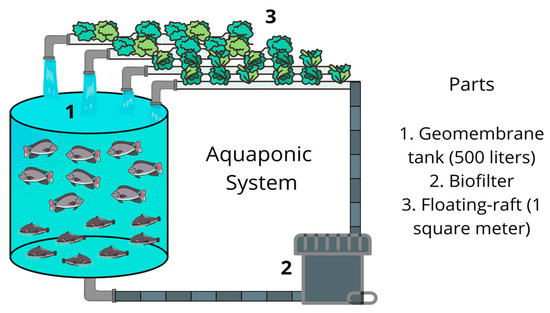
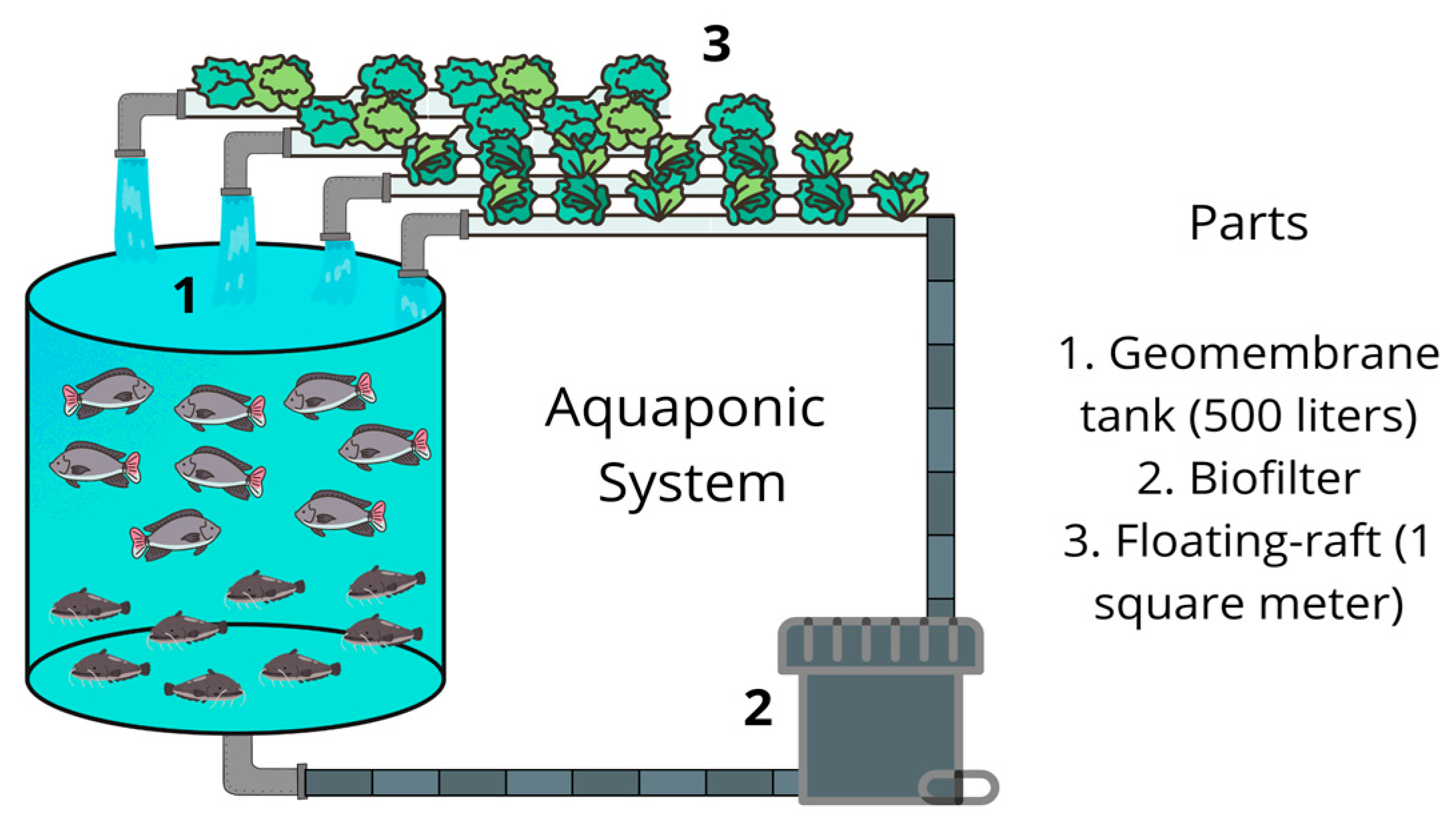
Nine aquaponic systems were employed, each comprising a 500 L geomembrane tank, a canister-type biofilter (1200 L h−2) (Aquakril, model 1059, Zhongshan City, China), and a 1 m2 floating raft area (Figure 1). Intensive fish farming conditions were maintained at a density of 40 kg m−3, based on a harvest weight of 250 g per fish, resulting in an initial stock of 80 fish per system. Plant density was set at 24 plants m−2.
Figure 1.
General diagram of the aquaponic system.
2.2. Biological Material
A total of 360 Nile tilapia fingerlings (Oreochromis niloticus) with an initial mean weight of 8.57 ± 1.04 and 360 channel catfish fingerlings (Ictalurus punctatus) with an initial mean weight of 10.82 ± 1.37 g were used. In addition, 324 lettuce plants (Lactuca sativa) and 324 spinach plants (Spinacia oleracea) at 21 days post-germination, with an average initial height of 5.85 ± 0.64 cm for lettuce and 5.27 ± 0.32 cm for spinach, were included. Fish were cultured for a single 180-day growth period. Throughout the experiment, fish fed three times a day with a commercial diet and feeding plan of the MaltaCleyton® brand (MaltaCleyton S.A. de C.V., Guadalajara, México) (Table 1), and the feeding regimen was adjusted weekly based on measured fish biomass. Plants were cultivated in three successive 60-day cycles with continuous water recirculation from the fish tank, without the addition of external fertilizers. Plant cultivation was conducted in three consecutive 60-day cycles to standardize nutrient demand and biomass turnover across treatments and species. Although lettuce and spinach differ slightly in their physiological growth durations, the use of fixed-length production cycles allowed consistent comparison of nutrient uptake dynamics and system performance under intensive aquaponic conditions.
Table 1.
Description of the feeding plan used (MaltaCleyton® brand).
2.3. Experimental Design
To evaluate the effects of fish–plant species ratios on nutrient use efficiency and system productivity under high-intensity aquaponic conditions, the experimental design was based on three core assumptions: (1) fish species differ in trophic requirements and nutrient generation. (2) plant species differ in nutrient uptake capacity and growth dynamics. (3) the interaction between fish and plant proportions determines nutrient recovery and system-level performance. Based on these assumptions, nine treatments were established using factorial combinations of fish and plant species ratios to evaluate contrasting dominance and balance scenarios.
Nine experimental treatments were designed combining contrasting proportions of fish and plant species in an intensive aquaponic system. The selected species ratios were designed to represent contrasting dominance and balance scenarios for both fish and plant components, including treatments dominated by a single species (75:25), balanced combinations (50:50), and inverse dominance (25:75). This approach allowed assessment of how shifts in species composition affect nutrient generation, uptake capacity, and overall system performance under intensive production conditions. (Table 2). For each treatment, 80 fish and 24 plants were stocked and distributed according to designated proportions. The experiment spanned 180 days, divided into three sequential 60-day production cycles. Each cycle comprised all treatments conducted in parallel, and each cycle was treated as a temporal replicate in the statistical analysis, with production cycle included as a random factor to account for potential environmental variability.
Table 2.
Description of the proportion of fish and plants in each treatment. The proportion of fish is established on a basis of 80 individuals, while the proportion of plants is based on 24 organisms.
2.4. Water Quality
Water samples were taken prior to scheduled feeding times to minimize short-term variability associated with feeding activity (7:30 a.m., 12:30 p.m., and 5:30 p.m.). Sampling was consistently conducted at the mid-water column, to obtain representative water quality measurements. In the fish tank water, temperature, dissolved oxygen (DO), and pH were monitored daily using a Hach HQ40d® meter (Hach Company, Loveland, CO, USA). In addition, phosphate (PO4), nitrate (NO3), nitrite (NO2), and total ammonia nitrogen (TAN) concentrations were determined twice weekly using a Hach DR6000® spectrophotometer (Hach Company, Loveland, CO, USA) with methods 8180, 8039, 8057, and 8038, respectively. In the pond water, pH and DO were also monitored using the Hach HQ40d, and electrical conductivity (EC) was monitored with a Hanna HI 98,130 m (Hanna Instruments Inc., Woonsocket, RI, USA). The system pH was maintained between 6.0 and 6.5, adjusting as necessary [20]. Due to biological processes, pH values increased between monitoring events, resulting in observed values ranging from 6.3 to 6.9, as reported in Table 3.
Table 3.
Water quality parameters in fishponds monitored throughout the experimental period.
2.5. Productive Performance
To evaluate fish productivity under different species ratios, total growth rate (Equation (1)), feed conversion factor (Equation (2)), protein efficiency ratio (Equation (3)), and survival rate (Equation (4)) were considered as response variables. For plants, dry weight (Equation (5)), relative growth rate (Equation (6)), crop growth rate (Equation (7)), and plant survival rate (Equation (8)) were considered.
where Wf is the final weight and Wi is the initial weight.
where dry weight was determined using three randomly selected plants per species from each treatment at harvest.
where InDWf is the natural logarithm of the final dry weight, InDWi is the natural logarithm of the initial dry weight and t is the time in days.
where DW2, DW1 is the final and initial dry weight of the plant; SS is the soil surface expressed in m2; t2, t1 time in days.
Total Weight Gain TWG (g) = Wf − Wi
Feed Conversion Factor FCF = grams of feed consumed/grams of biomass increase
Protein Efficiency Ratio PER = grams of biomass increase/grams of protein ingested
Survival Rate SR (%) = (final number of animals/initial number of animals) × 100
Dry Weight DW (g) = Plant weight after dehydration for 72 h at 70 °C
Relative Growth Rate RGR (g g−1day−1) = (InDWf − InDWi)/t
Crop Growth Rate CGR (g m−2day−1) = (1) (DW2 − DW1)/(SS) (t2 − t1)
Plant Survival Rate PSR = (final number of plants/initial number of plants) × 100
Additionally, nitrogen and phosphorus use efficiencies (NUE and PUE, respectively) were calculated following the methodology of Yang and Kim [14], based on the proportion of total nitrogen and phosphorus assimilated into fish and plant biomass relative to the total nutrient input from feed. Subsequently, the nitrogen and phosphorus mass balances were calculated following the dynamic formulation described by Wongkiew [15], considering both nutrient inputs from feed and outputs through harvested biomass, sediment accumulation, gaseous losses, and water exchange. Dissolved nutrient concentrations in the recirculating water were monitored periodically during each production cycle, and changes over time were integrated to obtain total nutrient variations for each cycle. Plant samples were oven-dried at 70 °C until constant weight to determine dry biomass at harvest. Fish nutrient incorporation was estimated based on whole-body biomass accumulation at the end of each production cycle.
These data were used to calculate nitrogen and phosphorus recovery in fish and plants following mass balance approaches commonly applied in aquaponic systems. Sediment samples were collected from biofilters and solid accumulation zones at the end of each production cycle, oven-dried at 70 °C, and used to estimate nutrient retention in solid waste. Nitrogen losses through gaseous pathways and phosphorus losses via precipitation were not measured directly but were calculated by difference, accounting for nutrient inputs from feed and outputs in harvested biomass, dissolved nutrients, and sediments, following established aquaponic mass balance methodologies.
where FN and FP are the Nitrogen and Phosphorus content in the fish feed (gN g−1 and gP g−1, respectively, MF is the feeding rate (g day−1), T is the duration of production (days), Nplant and Pplant are the average nitrogen and phosphorus assimilated by the plants at harvest (g), Nfish and Pfish are the average nitrogen and phosphorus incorporated in the fish (g).
where FN and FP are the fractions of N and P in fish feed (g N/g feed; g P/g feed), respectively; MF is the feeding rate (g/day); CTAN, CNO2, CNO3, and CPO4 are the concentrations of total ammonia nitrogen, nitrite, nitrate, and phosphate in the water (g N/L; g P/L); V is the volume of recirculating water (L); Nplant and Pplant are the average N and P assimilated in plants at harvest (g N; g P), respectively; Nfish and Pfish are the average N and P assimilated in fish (including meat, viscera, scales, and bones; (g N; g P), respectively; T is the production duration (days); Nsed and Psed are the N and P in solid waste accumulated in biofilters at the end of each trial (g N; g P); and Ngas/T and Pprecp/T are the rate of N loss denitrification (g N/day) and the rate of P loss via organic P precipitation (g P/day).
Efficiency in the use of nitrogen NUE = Nplant + Nfish/(FN) (MF) (T)
Efficiency in the use of phosphorus PUE = Pplant + Pfish/(FP) (MF) (T)
2.6. Data Analysis
Statistical analyses were performed using JMP® software (version 9.0.1, SAS Institute Inc., Cary, NC, USA). The experimental design consisted of one aquaponic system per treatment, without spatial replication. Therefore, the study followed a completely randomized design with temporal replication, where three consecutive production cycles were used as repeated measures. To address potential pseudo-replication, production cycle was included as a random factor in the statistical model, allowing separation of treatment effects from temporal environmental variability. Depending on the response variable, one-way or two-way ANOVA was applied considering fish species ratio and plant species ratio as fixed factors, and their interaction was tested. As interaction effects were not statistically significant for most variables (p > 0.05), results are presented primarily in terms of main effects. When significant differences were detected, Tukey’s HSD test was applied for multiple comparisons. Prior to analysis, data normality and homogeneity of variances were verified using the Shapiro–Wilk and Levene’s tests, respectively. Data were additionally screened for potential outliers using boxplot inspection and standardized residual analysis. No data points were removed unless measurement error was clearly identified. Missing data were not observed during the experimental period, as all treatments were consistently monitored across the three production cycles. Results are reported as mean ± standard deviation, and statistical significance was set at p < 0.05.
3. Results
To address the objective of evaluating how fish–plant species ratios influence nutrient use efficiency, productivity, and nutrient mass balance under intensive aquaponic conditions, the main experimental outcomes are presented below.
3.1. Water Quality
The physicochemical conditions maintained during the 180-day experimental period are summarized to provide a general overview of the environment in which fish and plants developed. These variables include temperature, pH, dissolved oxygen, and concentrations of phosphates, nitrates, nitrites, and Non-ionized ammonia. Together, they describe the stability and suitability of the culture conditions across treatments, allowing comparison of environmental variation associated with species proportions and feeding inputs (Table 3).
3.2. Productive Performance
Fish growth performance differed significantly among treatments as a function of fish species ratio (Table 4). Tilapia growth rate was significantly higher in tilapia-dominant treatments (75% tilapia) compared to treatments where tilapia represented 50% or 25% of the stock (p < 0.05). Conversely, catfish growth rate was significantly higher in catfish-dominant treatments (75% catfish). Treatments with balanced fish proportions (50:50) showed intermediate growth values for both species. Plant growth variables differed significantly among treatments depending on plant species ratio (Table 5). Lettuce dry weight, relative growth rate, and crop growth rate were significantly higher in lettuce-dominant treatments (75% lettuce) compared to balanced or spinach-dominant treatments (p < 0.05). In contrast, spinach exhibited significantly higher growth values in spinach-dominant treatments. Balanced plant ratios (50:50) resulted in intermediate biomass production for both species.
Table 4.
Productive performance of O. niloticus and I. punctatus values are presented as the means ± standard deviation of growth rate (GR), feed conversion factor (FCF), protein efficiency rate (PER) and fish survival rate (SR).
Table 5.
Productive performance of L. sativa and S. oleracea values are presented as the means ± standard deviation of dry weight (DW), relative growth rate (RGR), crop growth rate (CGR) and survival rate (SR).
Nitrogen and phosphorus use efficiencies differed significantly among treatments (Table 6). The highest NUE and PUE values were observed in treatments characterized by catfish-dominant fish ratios combined with higher spinach proportions, with NUE exceeding 50% and PUE reaching up to 47% (p < 0.05). In contrast, tilapia-dominant treatments showed significantly lower nutrient use efficiencies. Treatments with balanced fish–plant ratios exhibited intermediate NUE and PUE values. These results indicated that species combinations integrating higher nutrient-generating fish biomass with greater plant nutrient uptake capacity achieved more effective nutrient recovery. This supports the hypothesis that complementary fish–plant ratios enhance resource utilization in intensive aquaponic systems.
Table 6.
Nitrogen and phosphorus use efficiency (NUE and PUE) in the aquaponic treatments.
Nitrogen mass balance differed significantly among treatments, indicating contrasting nutrient partitioning patterns (Table 7). In tilapia-dominant treatments, a larger proportion of nitrogen input was recovered in fish biomass, whereas catfish-dominant treatments showed greater nitrogen assimilation in plant biomass. Sediment-associated nitrogen and gaseous losses represented a substantial fraction of nitrogen output in all treatments but were significantly lower in treatments characterized by catfish-dominant fish ratios combined with higher spinach proportions (p < 0.05). These treatments retained a greater proportion of total nitrogen in harvestable biomass, indicating more efficient nutrient locking and reduced environmental losses. Phosphorus mass balance also showed significant differences among treatments (Table 8). Treatments with higher spinach proportions exhibited greater phosphorus accumulation in plant biomass, whereas phosphorus retention in fish biomass was higher in treatments with greater tilapia proportions. Phosphorus losses through sedimentation and precipitation were observed in all treatments but were significantly lower in treatments combining catfish-dominant fish ratios with higher spinach proportions (p < 0.05), resulting in improved phosphorus retention in harvestable biomass.
Table 7.
Nitrogen mass balance in the aquaponic treatments.
Table 8.
Phosphorus mass balance in the aquaponic treatments.
Across treatments, water quality conditions were closely associated with productive performance and nutrient utilization outcomes. Treatments maintaining dissolved oxygen and pH values within optimal ranges exhibited higher fish growth rates, whereas treatments with reduced dissolved oxygen showed lower growth performance (Table 3 and Table 4). Higher plant biomass production, particularly in treatments with greater spinach proportions, coincided with increased nutrient use efficiencies (NUE and PUE; Table 5 and Table 6). Furthermore, treatments exhibiting the highest NUE and PUE also showed reduced nutrient accumulation in sediments and lower estimated nutrient losses in nitrogen and phosphorus mass balances (Table 7 and Table 8), indicating a consistent relationship between water quality, productivity, nutrient recovery, and system sustainability.
Together, these results directly address the study objective by demonstrating how specific fish–plant species ratios determine nutrient utilization efficiency, productivity, and nutrient retention in intensive aquaponic systems.
4. Discussion
4.1. Water Quality
Water quality conditions modulated nutrient transformation processes and indirectly influenced NUE and PUE across treatments; however, over the 180-day trial, water quality in all treatments remained within tolerance ranges for O. niloticus and I. punctatus culture. (Table 3). The temperature variable did not show significant differences between the treatments, indicating that it did not influence the observed behavior. The pH value showed slight variations with significant differences among treatments. All pH values were well within a safe range for both fish and plants. Dissolved oxygen (DO) levels showed notable differences related to fish species composition. Treatments with the highest number of catfish (T7-31, T8-32, T9-33, each with 75% catfish) had significantly lower DO concentrations, while treatments with the highest number of tilapia had the highest concentrations (T1-11, T2-12, T3-13, each with 75% tilapia). This reduction in DO with higher catfish densities is primarily associated with the greater respiratory demand imposed by this species. Catfish have been reported to exhibit higher oxygen consumption rates than tilapia under comparable conditions due to their metabolic activity and reliance exclusively on aquatic respiration [10]. In contrast, tilapia possess physiological adaptations that allow them to tolerate lower oxygen levels, including efficient oxygen uptake and the ability to supplement respiration at the water surface [21,22]. Furthermore, treatments dominated by catfish also exhibited higher total fish biomass, which proportionally increases collective respiratory demand within the system. As oxygen consumption in aquaculture systems is directly related to fish biomass and species-specific metabolism, this explains the consistent pattern of lower DO values observed in catfish-dominant treatments. Consequently, the differences in dissolved oxygen among treatments can be mechanistically attributed to the combined effect of species-specific respiration rates and total biomass-driven oxygen demand. Nitrate levels in all treatments remained well below the toxic threshold for tilapia (>300 mg L−1), indicating a favorable environment for both fish and plants. The highest concentrations were found in treatments with a higher proportion of catfish, suggesting greater availability of nitrogen in the system for plant uptake. Nitrite levels remained well below harmful concentrations, suggesting efficient nitrification. Likewise, total ammonia nitrogen (TAN) was below the toxic threshold, likely due to proper nitrification and pH management. Phosphate levels differed among treatments; however, all values remained below the toxic threshold. Concentrations were directly related to the amount of feed supplied, with the lowest values in T4-21, where the least feed was supplied. Overall, water quality parameters remained adequate, with nitrate, nitrite, TAN, and phosphate levels within acceptable ranges for aquaponic systems.
4.2. Productive Performance
From a nutrient utilization perspective, fish growth performance reflected the efficiency with which feed-derived nutrients were converted into biomass. During the 180 days of culture, productive performance showed significant differences among treatments (Table 4). Tilapia growth was greater in treatments with a high proportion of this species. In contrast, catfish growth showed the opposite pattern: catfish weight gain was significantly greater in treatments with a higher proportion of this species. Both trends indicate that growth benefits the dominant species, likely due to interspecific competition or stress. However, treatments with equal portions of both species allowed acceptable growth, indicating that the balanced species ratio does not limit productive performance [8,23]. Furthermore, it favors crop diversification, which expands sales options for producers. Feed conversion factor (FCF) values ranged from 1.27 ± 0.03 to 1.34 ± 0.04 across treatments, indicating efficient feeding across all systems. Generally, treatments with a higher proportion of tilapia tended to have higher FCR and PER. The highest FCR was observed in the T2-12 treatment and was associated with the highest protein efficiency ratio. This suggests that this species combination in the treatment (75–25% tilapia-squid and 50–50% lettuce-spinach) created favorable conditions for feed optimization.
Survival rates (SR) were consistently highest in treatments with a higher proportion of tilapia, reaching up to 97% for tilapia and 96% for catfish. In contrast, treatments with a higher proportion of catfish showed the lowest rates for both species (87–89%). This, together with the water quality data, could indicate that the environment in systems with a high concentration of catfish was less suitable for the development of both species. These results coincide with those reported by Baßmann et al. [24], Majhi et al. [25] and Khumaidi et al. [26], who observed that very high catfish stocking densities can increase stress and mortality when water quality variables are not adequately adjusted. In this case, implementing additional aeration or a higher water recirculation rate in systems [27] with a higher proportion of catfish could overcome the mortality variation. However, all survival rates were within an acceptable range for culture and show that tilapia and catfish can be successfully cocultured in a recirculating aquaponic system. The observed differences in fish growth performance among treatments can be linked to species-specific feeding behavior, metabolic rates, and tolerance to stocking density. Channel catfish exhibit greater tolerance to elevated organic loading and lower dissolved oxygen levels compared to tilapia, which may explain their superior growth under catfish-dominant conditions.
Plant productivity played a key role in determining nutrient recovery efficiency, particularly for nitrogen and phosphorus. Plant performance variables showed significant differences (p < 0.05) between treatments (Table 5). Lettuce dry weight (DW) was higher in treatments with a higher proportion of lettuce. Spinach dry weight was higher in treatments where lettuce predominated. This trend held true for relative growth rate (RGR); lettuce had the highest RGR in treatments where lettuce predominated, while spinach showed an opposite trend: high RGR when it was the majority and low RGR when it was the minority. This suggests that the best yield is achieved when grown at a higher relative proportion, possibly due to less interspecific competition for nutrients [28].
Crop growth rate (CGR) further highlighted the differences in productivity. In the case of lettuce, the highest CGR were obtained in treatments with high proportions of lettuce. In treatments with low proportions of lettuce, the CGR was drastically lower due to the production of smaller lettuces. For spinach, the performance was inversely proportional. However, the production of the 50–50% treatments achieved a balance in the yields of each species, favoring the intention of crop diversification.
Plant survival rates (PSR) were high in all treatments, with the majority above 95% for both species, indicating that almost all planted seedlings survived to harvest under aquaponic conditions. In the case of spinach in treatments T4-21 and T7-31, survival was reduced to 92–93%. In these two treatments, spinach was in the minority and possibly subject to more competition for nutrients. These results highlight the importance of plant ratio and planting density in optimizing growth in mixed aquaponic systems. That is, the choice of plant ratio can significantly modulate the overall productivity of the system [29,30].
Nitrogen and phosphorus use efficiencies (NUE and PUE) varied significantly among the aquaponic treatments evaluated (Table 6). The highest NUE values were recorded in treatments T9-33 (50.6 ± 2.3%) and T8-32 (46.9 ± 2.5%), which also showed the highest PUE values (47.1 ± 2.0% and 44.0 ± 1.8%, respectively). These results indicate a more efficient assimilation of nutrients into biomass under conditions with higher catfish densities. In contrast, the lowest NUE and PUE were observed in T1-11 (41.7 ± 2.1% and 39.2 ± 2.2%, respectively), which conversely had a lower proportion of catfish (25%). The other treatments showed intermediate efficiencies, reflecting the combined influence of species ratio, food input, and nutrient uptake capacity. These results are consistent with previous studies reporting approximately 50% nitrogen recovery in biomass, with the remainder lost to the ambient environment [27,31,32].
It is noteworthy that all treatments still lost a considerable portion of nutrients (approximately 50–60% of N and P) in forms such as sediment, gaseous losses, or in solution, which is common in aquaponics due to unavoidable physicochemical and biological processes. A fraction of nitrogen is lost through ammonia volatilization, particularly at higher pH values, while part of the nitrate can be removed from the system through denitrification under localized low-oxygen microenvironments within sediments or biofilter structures [6]. These processes reduce the measurable nitrogen available for plant uptake without being directly incorporated into biomass. Similarly, a fraction of phosphorus precipitates as sludge through chemical interactions with calcium, magnesium, and iron naturally present in the water, forming poorly soluble phosphate compounds that are not readily available for plant uptake [33]. These precipitation reactions are favored under near-neutral pH conditions, where phosphorus can shift from dissolved forms to particulate phases. In addition, phosphorus can be physically retained through adsorption onto biofilter media, suspended particles, and accumulated sediments. This retained phosphorus remains within the system but becomes temporarily unavailable in the water column, leading to an apparent loss when nutrient balances are calculated based only on dissolved concentrations and biomass incorporation. These combined nitrogen and phosphorus transformation and retention mechanisms provide a more comprehensive explanation for the nutrient fractions not accounted for in biomass measurements and contribute to a deeper understanding of nutrient dynamics in intensive aquaponic systems [34].
The data generated demonstrate that manipulating species ratios is a viable strategy to reduce nutrient waste. Treatments T8-32 and T9-33 minimized these losses, which is a key indicator of sustainability. In fact, improving nutrient and water use efficiency is a major challenge for the advancement of aquaponics. The higher NUE and PUE observed in treatments characterized by catfish-dominant fish ratios combined with higher spinach proportions (T7–31, T8–32, and T9–33) can be attributed to improved coupling between nutrient generation by fish and nutrient uptake by plants. Under these combinations, nutrient release rates closely matched plant assimilation capacity, minimizing nutrient accumulation and losses and resulting in higher overall system efficiency. Reported nitrogen and phosphorus use efficiencies in aquaponic systems typically range between 20 and 45% for NUE and 15–40% for PUE, depending on species composition, stocking density, and management intensity. In the present study, maximum NUE values exceeding 50% and PUE values approaching 47% were achieved in catfish-dominant systems combined with higher spinach proportions, placing these results at above the ranges commonly reported for comparable fish-vegetable aquaponic systems [14,15,32]. This improvement highlights the quantitative benefit of optimizing species ratios under intensive production conditions, beyond previously reported single-species or loosely balanced polyculture configurations.
The nitrogen mass balance showed marked differences in the fate of nitrogen across treatments, reflecting the influence of fish composition, feed input, and plant uptake capacity (Table 7). Nitrogen input ranged from 242.48 g in T4-21 to over 318 g in T1-11, T8-32, and T7-31, driven by higher feeding rates associated with greater fish biomass. Treatments with increased catfish proportions (T7-31, T8-32, T9-33) displayed significantly higher nitrate concentrations (CNO3 >19 mg L−1), indicating intensified nitrification activity. Conversely, nitrate levels remained significantly lower (<15.2 mg L−1) in T1-11, T2-12, and T3-13, possibly due to greater nitrogen assimilation into biomass or reduced nitrification dynamics. Regarding nitrogen assimilation in biomass, the highest nitrogen recovery in plants occurred in T9-33 (127.83 ± 4.82 g), which also achieved the highest utilization efficiency of phosphorus (PUE = 47.1%) and nitrogen (NUE = 50.6%), suggesting highly effective nutrient uptake by the plant component. This is likely due to the combination of high nutrient availability in the feed and an efficient plant composition (25% lettuce and 75% spinach). In contrast, the highest nitrogen recovery in fish was observed in T3-13 (104.17 ± 6.42 g) and T2-12 (99.21 ± 4.13 g), associated with the 75% to 25% tilapia-catfish ratio. Nitrogen accumulation in sediments was highest in T1-11 and T4-21 (>66 g), potentially indicating increased particle waste. Similarly, nitrogen losses due to gaseous emissions (Ngas) were highest in T1-11 (73.28 ± 4.54 g) and T4-21 (70.94 ± 4.87 g), and lowest in T9-33 (53.19 ± 4.87 g). Overall, the integration of fish and plant species played a key role in shaping nitrogen dynamics within the system. Treatments such as T9-33 and T8-32, characterized by a 75–25% tilapia-catfish ratio, exhibited efficient nutrient transformation, offering a promising relationship for improving aquaponic productivity in a polyculture strategy while maintaining water quality and minimizing waste.
Phosphorus mass balance revealed significant differences among aquaponic treatments (Table 8). The highest phosphorus inputs were observed in T1-11, T7-31, and T8-32, consistent with their greater food supply due to higher fish biomass. Phosphate (CPO4) concentrations varied significantly, with T8-32 showing the highest value followed by T9-33. In contrast, T4- recorded the lowest phosphate concentration (8.59 ± 0.31 mg), corresponding to lower food input and possibly greater plant uptake. 21 Phosphorus accumulation in plants was significantly higher in T9-33 (11.69 ± 0.34 a) and T6-23 (11.68 ± 0.25 a), followed by T7-31 (11.26 ± 0.41 a) and T8-32 (10.81 ± 0.57 ab), treatments that also showed higher PUE values and productive plant biomass. This suggests that the different combinations of spinach and lettuce did not affect nutrient uptake. Phosphorus assimilation in fish was higher in treatments T2-12, T6-23, and T5-22, with at least 50% tilapia present. In contrast, T8-32 and T9-33 showed lower phosphorus content in fish tissue (<12.4 g), consistent with their lower proportion of tilapia. Phosphorus sedimentation showed less variability. Although the differences were statistically significant, the relative consistency suggests similar solid waste capture across treatments. The greatest loss of precipitated phosphorus occurred in T8-32, which coincides with a high phosphate concentration in the water. This loss could be associated with chemical saturation of P.
This study was conducted using a single aquaponic system per treatment, with temporal replication across consecutive production cycles. While this design allowed evaluation of nutrient dynamics under controlled intensive conditions, it limits the extrapolation of results across different system configurations or environmental settings. In addition, nutrient losses through gaseous pathways and phosphorus precipitation were estimated indirectly through mass balance approaches rather than measured directly, which may introduce uncertainty in the absolute magnitude of these fluxes.
From a practical perspective, the results indicate that catfish-dominant fish ratios combined with higher spinach proportions are particularly effective for maximizing nutrient retention and use efficiency under intensive aquaponic conditions. Practitioners aiming to improve sustainability and reduce nutrient losses may consider prioritizing these combinations, especially in systems operated at high density. Future research should evaluate whether these optimized ratios remain effective under different stocking densities, system scales, and environmental conditions. Additionally, incorporating economic performance and market acceptance analyses would be essential to support the broader adoption of optimized polyculture aquaponic systems.
5. Conclusions
This study demonstrates that species proportioning in polyculture aquaponic systems is a critical determinant of nutrient recovery, system stability, and overall sustainable productivity. Rather than focusing solely on yield, the findings highlight the importance of matching fish nutrient generation capacity with plant nutrient uptake characteristics to enhance resource use efficiency under intensive production conditions.
From a practical perspective, prioritizing fish–plant combinations in which species exhibit complementary metabolic and physiological traits can substantially improve nitrogen and phosphorus retention, reduce environmental losses, and promote balanced biomass production. Systems integrating fish species with higher nutrient output alongside plants with greater nutrient assimilation capacity represent an effective strategy for optimizing aquaponic performance.
Despite the robustness of the experimental design, certain limitations should be acknowledged. The use of a single aquaponic system per treatment, although temporally replicated, limits spatial replication and may constrain broader generalization of the results. In addition, the study focused primarily on biological and physicochemical performance indicators without incorporating an economic assessment of the evaluated species combinations. Furthermore, some nutrient losses, particularly gaseous nitrogen pathways, were inferred indirectly through mass balance rather than directly measured.
Future research should aim to validate the robustness of the species-ratio optimization identified here under different stocking densities, production scales, and environmental conditions. Integrating economic performance indicators with nutrient use efficiency metrics would further support the practical adoption of optimized fish–plant combinations. Additional studies evaluating how changes in biomass distribution throughout the production cycle affect nutrient recovery could contribute to more adaptive and efficient management of intensive aquaponic systems.
Author Contributions
Conceptualization, L.F.-C. and J.J.D.l.-R.; methodology, L.F.-C. and J.J.D.l.-R.; validation, J.J.D.l.-R., L.F.-C. and S.L.-T.; formal analysis, L.F.-C. and S.L.-T.; investigation, J.J.D.l.-R. and L.F.-C.; data curation, J.J.D.l.-R., L.F.-C. and P.S.F.-A.; writing—original draft preparation, J.J.D.l.-R., G.M.S.-Z. and P.S.F.-A.; writing—review and editing, J.J.D.l.-R. and P.S.F.-A. All authors have read and agreed to the published version of the manuscript.
Funding
This research received no external funding.
Data Availability Statement
The data that has been used is confidential.
Acknowledgments
We are grateful for the support provided by SECIHTI in the form of scholarship for the first author’s postgraduate studies.
Conflicts of Interest
The authors declare no conflicts of interest.
References
- Endut, A.; Jusoh, A.; Ali, N.A. Nitrogen budget and effluent nitrogen components in aquaponics recirculation system. Desalin. Water Treat. 2014, 52, 744–752. [Google Scholar] [CrossRef] [Scilit]
- Forchino, A.A.; Lourguioui, H.; Brigolina, D.; Pastresa, R. Aquaponics and sustainability: The comparison of two different aquaponic techniques using the Life Cycle Assessment (LCA). Aquac. Eng. 2017, 77, 80–88. [Google Scholar] [CrossRef] [Scilit]
- Nair, C.S.; Manoharan, R.; Nishanth, D.; Subramanian, R.; Neumann, E.; Jaleel, A. Recent advancements in aquaponics with special emphasis on its sustainability. J. World Aquac. Soc. 2025, 56, e13116. [Google Scholar] [CrossRef] [Scilit]
- Wongkiew, S.; Hu, Z.; Chandran, K.; Lee, J.W.; Khanal, S.K. Nitrogen transformations in aquaponic systems: A review. Aquac. Eng. 2017, 76, 9–19. [Google Scholar] [CrossRef] [Scilit]
- Asadujjaman, M.; Salam, M.A.; Chowdhury, M.T.H.; Alam, S.M.R.; Albeshr, M.F.; Arai, T.; Hossain, M.B. Optimizing Aquaponic Systems for Improved Food Production Efficiency in Climate-Vulnerable Coastal Regions. Aquac. Res. 2024, 2024, 9467236. [Google Scholar] [CrossRef] [Scilit]
- Nishanth, D.; Somanathan Nair, C.; Manoharan, R.; Subramanian, R.; Salim, I.; Maqsood, S.; Jaleel, A. Current technologies for nutrient recovery in aquaponic systems: A review. Front. Sustain. Food Syst. 2025, 9, 1681638. [Google Scholar] [CrossRef] [Scilit]
- Ibrahim, L.A.; Shaghaleh, H.; El-Kassar, G.M.; Abu-Hashim, M.; Elsadek, E.A.; Alhaj Hamoud, Y. Aquaponics: A sustainable path to food sovereignty and enhanced water use efficiency. Water 2023, 15, 4310. [Google Scholar] [CrossRef] [Scilit]
- Thomas, M.; Pasquet, A.; Aubin, J.; Nahon, S.; Lecocq, T. When more is more: Taking advantage of species diversity to move towards sustainable aquaculture. Biol. Rev. 2021, 96, 767–784. [Google Scholar] [CrossRef] [Scilit]
- Chary, K.; Jaeger, C.; Jansen, H.M.; Harchaoui, S.; Aubin, J. Evaluating nutrient circularity in integrated aquaculture systems: Criteria and indicators. J. Clean. Prod. 2025, 504, 145414. [Google Scholar] [CrossRef] [Scilit]
- Boyd, C.E.; D’Abramo, L.R.; Glencross, B.D.; Huyben, D.C.; Juarez, L.M.; Lockwood, G.S.; Valenti, W.C. Achieving sustainable aquaculture: Historical and current perspectives and future needs and challenges. J. World Aquac. Soc. 2020, 51, 578–633. [Google Scholar] [CrossRef] [Scilit]
- Huang, Y.; Li, L.; Li, R.; Li, B.; Wang, Q.; Song, K. Nitrogen cycling and resource recovery from aquaculture wastewater treatment systems: A review. Environ. Chem. Lett. 2024, 22, 2467–2482. [Google Scholar] [CrossRef] [Scilit]
- Khater, E.S.; Bahnasawy, A.; Ali, S.; Abbas, W.; Morsy, O.; Sabahy, A. Study on the plant and fish production in the aquaponic system as affected by different hydraulic loading rates. Sci. Rep. 2023, 13, 17505. [Google Scholar] [CrossRef] [Scilit] [PubMed]
- Aslanidou, M.; Elvanidi, A.; Mourantian, A.; Levizou, E.; Mente, E.; Katsoulas, N. Nutrients use efficiency in coupled and decoupled aquaponic systems. Horticulturae 2023, 9, 1077. [Google Scholar] [CrossRef] [Scilit]
- Yang, T.; Kim, H.J. Comparisons of nitrogen phosphorus mass balance for tomato-, basil-, and lettuce-based aquaponic hydroponic systems. J. Clean. Prod. 2020, 274, 122619. [Google Scholar] [CrossRef] [Scilit]
- Wongkiew, S.; Popp, B.N.; Kim, H.J.; Khanal, S.K. Fate of nitrogen in floating-raft aquaponic systems using natural abundance nitrogen isotopic compositions. Int. Biodeterior. Biodegrad. 2017, 125, 24–32. [Google Scholar] [CrossRef] [Scilit]
- Wang, M.; Feng, W.; Wang, Y.; Li, B.; Wang, J.; Zhu, X.; Zhang, L. Water quality, plankton composition, and growth performance of juvenile yellow catfish (Pelteobagrus fulvidraco) in mono-and polyculture systems. Aquaculture 2022, 552, 738017. [Google Scholar] [CrossRef] [Scilit]
- Lecocq, T.; Amoussou, N.; Aubin, J.; Butruille, G.; Liarte, S.; Pasquet, A.; Thomas, M. Stronger together: A workflow to design new fish polycultures. Rev. Aquac. 2024, 16, 1374–1394. [Google Scholar] [CrossRef] [Scilit]
- Emam, W.; Lambert, H.; Brown, C. The welfare of farmed Nile tilapia: A review. Front. Vet. Sci. 2025, 12, 1567984. [Google Scholar] [CrossRef] [Scilit]
- Segaran, T.C.; Azra, M.N.; Piah, R.M.; Lananan, F.; Téllez-Isaías, G.; Gao, H.; Noordin, N.M. Catfishes: A global review of the literature. Heliyon 2023, 9, e20081. [Google Scholar] [CrossRef] [Scilit]
- Acharya, S.; Kumar, K.; Sharma, N.; Tiwari, V.K.; Chaurasia, O.P. Yield and quality attributes of lettuce and spinach grown in different hydroponic systems. J. Soil Water Conserv. 2021, 20, 342–349. [Google Scholar] [CrossRef] [Scilit]
- Obirikorang, K.A.; Acheampong, J.N.; Duodu, C.P.; Skov, P.V. Growth, metabolism and respiration in Nile tilapia (Oreochromis niloticus) exposed to chronic or periodic hypoxia. Comp. Biochem. Physiol. Part A Mol. Integr. Physiol. 2020, 248, 110768. [Google Scholar] [CrossRef] [Scilit] [PubMed]
- Ott, B.D.; Chisolm, D.O.; Pfeiffer, T.J. Postprandial oxygen consumption, ammonia excretion and carbon dioxide production of channel and blue catfish. J. Fish Biol. 2025, 107, 603–612. [Google Scholar] [CrossRef] [Scilit] [PubMed]
- Khalil, A.H.; Badrey, A.E.; Harabawy, A.S.; Ibrahim, A.T.; Kloas, W.; Osman, A.G. Effect of polyculture and monoculture of Nile tilapia (Oreochromis niloticus) and common carp (Cyprinus carpio) on water quality, growth performance and productivity of vegetables in an aquaponics system (ASTAF-PRO). Aquac. Aquar. Conserv. Legis. 2022, 15, 3171–3180. [Google Scholar]
- Baßmann, B.; Hahn, L.; Rebl, A.; Wenzel, L.C.; Hildebrand, M.C.; Verleih, M.; Palm, H.W. Effects of stocking density, size, and external stress on growth and welfare of African catfish (Clarias gariepinus Burchell, 1822) in a commercial RAS. Fishes 2023, 8, 74. [Google Scholar] [CrossRef] [Scilit]
- Majhi, S.S.; Singh, S.K.; Biswas, P.; Debbarma, R.; Parhi, J.; Ngasotter, S.; Patel, A.B. Effect of stocking density on growth, water quality changes and cost efficiency of butter catfish (Ompok bimaculatus) during seed rearing in a biofloc system. Fishes 2023, 8, 61. [Google Scholar] [CrossRef] [Scilit]
- Khumaidi, A.; Muqsith, A.; Wafi, A.; Aiysah Jamil, S.N. Optimal Stocking Density of Catfish (Clarias gariepinus) Cultivated in Round Pond at a Small Scale. J. Aquac. Fish Health 2025, 14, 202–210. [Google Scholar] [CrossRef] [Scilit]
- Endut, A.; Lananan, F.; Hamid, S.H.A.; Jusoh, A.; Nik, W.N.W. Balancing of nutrient uptake by water spinach (Ipomoea aquatica) and mustard green (Brassica juncea) with nutrient production by African catfish (Clarias gariepinus) in scaling aquaponic recirculation system. Desalination Water Treat. 2016, 57, 29531–29540. [Google Scholar] [CrossRef] [Scilit]
- Maucieri, C.; Nicoletto, C.; Schmautz, Z.; Sambo, P.; Komives, T.; Borin, M.; Junge, R. Vegetable intercropping in a small-scale aquaponic system. Agronomy 2017, 7, 63. [Google Scholar] [CrossRef] [Scilit]
- Endut, A.; Jusoh, A.; Ali, N.; Nik, W.W.; Hassan, A. A study on the optimal hydraulic loading rate and plant ratios in recirculation aquaponic system. Bioresour. Technol. 2010, 101, 1511–1517. [Google Scholar] [CrossRef] [Scilit]
- Hu, Z.; Lee, J.W.; Chandran, K.; Kim, S.; Brotto, A.C.; Khanal, S.K. Effect of plant species on nitrogen recovery in aquaponics. Bioresour. Technol. 2015, 188, 92–98. [Google Scholar] [CrossRef] [Scilit]
- Gao, X.; Xu, Y.; Shan, J.; Jiang, J.; Zhang, H.; Ni, Q.; Zhang, Y. Effects of different stocking density start-up conditions on water nitrogen and phosphorus use efficiency, production, and microbial composition in aquaponics systems. Aquaculture 2024, 585, 740696. [Google Scholar] [CrossRef] [Scilit]
- Goda, A.M.S.; Aboseif, A.M.; Taha, M.K.; Mohammady, E.Y.; Aboushabana, N.M.; Nazmi, H.M.; Ashour, M. Optimizing nutrient utilization, hydraulic loading rate, and feed conversion ratios through freshwater IMTA-aquaponic and hydroponic systems as an environmentally sustainable aquaculture concept. Sci. Rep. 2024, 14, 14878. [Google Scholar] [CrossRef] [Scilit] [PubMed]
- Ramut, R.; Chochura, P.; Jama-Rodzenska, A. Effect of nutrient solution pH on the quality of Lactuca sativa L. in a hydroponic system under struvite fertilization. J. Elem. 2024, 29, 863–880. [Google Scholar]
- Dalbem Barbosa, A.P.; Kosten, S.; Muniz, C.C.; Oliveira-Junior, E.S. From feed to fish—Nutrients’ fate in aquaculture systems. Appl. Sci. 2024, 14, 6056. [Google Scholar] [CrossRef] [Scilit]

Disclaimer/Publisher’s Note: The statements, opinions and data contained in all publications are solely those of the individual author(s) and contributor(s) and not of MDPI and/or the editor(s). MDPI and/or the editor(s) disclaim responsibility for any injury to people or property resulting from any ideas, methods, instructions or products referred to in the content. |
© 2026 by the authors. Licensee MDPI, Basel, Switzerland. This article is an open access article distributed under the terms and conditions of the Creative Commons Attribution (CC BY) license.