


Highlights
Main findings:
- A progressive water deficit significantly reduced gas exchange, chlorophyll content, PSII efficiency, and leaf water potential in all grapevine cultivars.
- Müller Thurgau showed the strongest physiological decline under reduced irrigation, indicating a high sensitivity to water deficit.
- Blue Portugal maintained a more stable pigment content and water status, while Sauvignon Blanc showed intermediate, anisohydric-like responses.
- Grapevine cultivars differ markedly in drought response strategies, reflecting contrasting positions along the isohydric–anisohydric continuum.
- Cultivar selection is a key tool for improving drought resilience and optimizing irrigation strategies under increasing water scarcity.
Abstract
The response of selected physiological parameters to water deficit was investigated in three grapevine cultivars (Vitis vinifera L.): ‘Blue Portugal’, ‘Müller Thurgau’, and ‘Sauvignon Blanc’. The aim of the greenhouse experiment was to evaluate genotype-specific responses to reduced water availability and to assess the effects of water deficit on gas exchange, pigment content, chlorophyll fluorescence, and leaf water potential. Grapevine plants were grown in pots filled with perlite and subjected to five irrigation treatments ranging from 15 to 120 mL per container, applied to create a gradient of water availability. Measurements were performed over a one-month period at regular weekly intervals. Reduced irrigation generally resulted in decreased physiological performance compared to control plants. ‘Müller Thurgau’ showed the strongest reduction in chlorophyll content and gas exchange parameters under low irrigation, indicating high sensitivity to water deficit. In contrast, ‘Blue Portugal’ exhibited relatively stable pigment content under reduced water availability. Differences among cultivars in leaf water potential and gas exchange suggest contrasting water-use strategies. Overall, the results indicate higher drought tolerance in ‘Sauvignon Blanc’, while ‘Müller Thurgau’ appears to be the most sensitive cultivar.
1. Introduction
Globally, water deficit (drought) is the primary factor that reduces crop yields, more so than the combined effect of all other factors affecting crop production [1]. The impacts of drought stress will almost certainly be exacerbated by rising temperatures associated with global warming [2]. According to Yang et al. (2021) [3], drought can inhibit plant respiration, photosynthesis, and stomatal movement, thereby affecting plant growth and metabolism. Roots and leaves are the two most important plant organs for regulating drought stress. They not only work together but also play different roles. Given the complexity of biological processes between above and below ground tissues, it is essential to understand the common and specific gene expression profiles and metabolites associated with stress from drought resistance in grapevine [4,5].
Visual symptoms of water deficit during the growing season include leaf wilting and changes in leaf number and area [6]. The reason for the decrease in leaf chlorophyll content may be due to chlorophyll degradation directly caused by drought, as confirmed by Monteoliva et al. (2021) [7]; Khayatnezhad and Gholamin (2021) [8] confirmed that durum wheat results in leaf discoloration—yellowing, browning [9]. Leaves of plants growing under drought conditions have smaller leaf area, greater thickness and higher leaf density [10,11], which, according to [12], is due to a reduction in turgor.
A reduction in turgor subsequently reduces photosynthetic rate, formation and availability of assimilates [13]. Water deficit directly reduces photosynthesis by reducing CO2 availability, leading to reduced diffusion of stomata and mesophyll [14]. Reduced photosynthetic rates in stressed plants are also due to a reduction in photosynthetic pigments [15]. In addition, changes in photochemical and biochemical processes, such as reduced electron transfer rates [16] and photophosphorylation [3], are also observed. Another important response of plants to water deficit is the change in osmotic potential of leaves, where the accumulation of solutes in cells, such as sugars or amino acids (e.g., proline), is energy demanding.
According to Sorek et al. (2021) [17], these changes help maintain turgor, reduce hydraulic dysfunction and close stomata. The osmotic potential of leaves is usually more negative in plant species that are adapted to warmer and drier climates, thereby achieving higher yields under drought conditions [18].
In addition, they also serve as osmoprotectants that increase drought tolerance by stabilizing protein and membrane structures, thereby reducing dehydration damage [19,20]. Water deficit causes overproduction of reactive oxygen species (ROS) and consequently oxidative stress [21]. Reactive oxygen species (ROS) can serve as a beneficial signaling molecule for perceiving stress and sending various signals, while excessive amounts of ROS can cause cell damage [22].
However, plants activate enzymatic and non-enzymatic antioxidant defense mechanisms in response to an increase in ROS [23]. Changes underlying the levels of endogenous hormones such as abscisic acid (ABA), indole acetic acid (IAA) and gibberellin (GA) play a key role in response to water deficit when plants are exposed to drought stress [24].
Grapevine is one of the most economically important fruit crops in the world [25]. According to FAOSTAT (2025) [26], the global area under grapevines in 2023 was 6,595,680 ha, with the largest area being in Europe (3,382,515 ha). Within Europe, vineyards are located south of approximately 50° N latitude [27].
Due to global climate change, grapevines are exposed to frequent droughts, so selecting suitable genotypes more resistant to drought is an important strategy for their cultivation in traditional wine-growing areas [28]. Another option, according to Leeuwen et al. (2024) [27], is the cultivation of grapevines in new wine-growing areas that were previously unsuitable for their cultivation, given their cool and subhumid climate.
There is a correlation between root and leaf growth in the correlation of different plant organs, with [29] suggesting that root growth is more favorable than leaf growth under drought conditions. Blum (2017) [18] states that there are two features of the relationship between leaves and water. They have osmotic potential at full hydration and osmotic adaptation. Both these traits reduce the rate of leaf damage by dehydration [30].
Dehydration, according to Scoffoni et al. (2018) [31], is caused by the loss of cell turgor because turgor supports cell walls and controls cell expansion [32]. Loss of turgor impairs growth and causes collapse and deformation of cell walls, which impedes water and CO2 transport and causes leaf wilting [31]. The ability to maintain turgor during dehydration is mainly due to the osmotic potential under full hydration [33].
Grapevines osmotically adapt during the growing season or during drought [17]. Grapevine varieties grown in warmer and drier regions tend to exhibit more economical stomatal behavior, including lower maximum stomatal conductance [34]. Work by Ju et al. (2018) [35] shows that grapevine plants decrease photosynthesis and increase proline levels in response to water stress, as well as the expression of genes related to chlorophyll synthesis and the ROS system [36].
However, due to the genetic diversity of grapevine resources, there are often significant differences in drought tolerance among different cultivars, so we tested whether (1) there are significant differences in osmotic potential; (2) whether there are significant differences in gas exchange parameters; (3) whether these differences correspond to differences among cultivars; and (4) whether these traits correlate with potential drought tolerance. Addressing these hypotheses should provide key insights into the physiological mechanisms of grapevine adaptation to stressful growing conditions.
2. Material and Methods
2.1. Plant Material and Experimental Conditions
The effect of reduced water availability was studied in three grapevine (Vitis vinifera L.) cultivars: ‘Sauvignon Blanc’ (Sg), an ancient French cultivar; ‘Blue Portugal’ (MP), a cultivar of uncertain origin, probably originating from Austria; and ‘Müller Thurgau’ (MT), originating from the Swiss canton of Thurgau.
Woody cuttings were obtained from the Botanical Garden of Prague, Vineyard of St. Clare (Czech Republic). Plants were grown individually in containers with a volume of 825 cm3 in a greenhouse located at the Czech University of Life Sciences Prague. Air temperature was maintained at 25 °C during the day and 19 °C at night, with a photoperiod of 14 h light and 10 h darkness and a relative air humidity of approximately 66%.
Grapevine plants were cultivated in a uniform inert substrate (sterile perlite). At the beginning of the experiment, all plants were irrigated to approximately 70% of volumetric substrate moisture. Subsequently, five irrigation treatments were established to create a gradient of water availability: 120 mL per container (control), 90 mL (D1), 60 mL (D2), 30 mL (D3), and 15 mL (D4). Irrigation volumes were applied repeatedly throughout the experimental period and were intended to induce progressive differences in substrate water availability rather than to define absolute levels of soil water deficit.
Soil water status was characterized by continuous monitoring of volumetric water content using a ThetaProbe sensor (Delta-T Devices, Cambridge, UK). Leaf physiological responses were assessed through measurements of gas exchange, chlorophyll fluorescence, pigment content, and leaf water potential. These physiological characteristics were measured in juvenile grapevine plants at the vegetative developmental stage (BBCH 14–16, four to six fully expanded leaves). All measurements were conducted at regular weekly intervals, and a total of six measurements were performed during the experiment.
2.2. Measurement of Physiological Characteristics
2.2.1. Pigments Content
Pigment content was determined according to [37]. Leaf discs with an area of 1 cm2 were excised from grapevine leaves and placed in plastic vials containing 1 mL of undiluted dimethylformamide (DMF; Merck KGaA, Darmstadt, Germany). Pigments were extracted for 24 h in darkness at low temperature under continuous shaking. Absorbance was measured using a UV–Vis spectrophotometer (Evolution 2000, Thermo Fisher Scientific, Waltham, MA, USA), with pure DMF used as a blank.
2.2.2. Fluorescence Parameters
Chlorophyll fluorescence parameters, including the maximum quantum yield of photosystem II (Fv/Fm), were measured on the same leaves used for gas exchange measurements using an integrated fluorometer and gas exchange system (iFL, ADC Bioscientific Ltd., Hoddesdon, UK).
2.2.3. Gas Exchange Parameters
Leaf gas exchange was measured on fully expanded leaves in the central part of the leaf blade using a non-destructive method with the iFL system (ADC Bioscientific Ltd., Hoddesdon, UK). Net photosynthetic rate (Pn; μmol CO2 m−2 s−1), transpiration rate (E; mmol H2O m−2 s−1), and stomatal conductance (gs; mol m−2 s−1) were measured in the morning (08:00–13:00 h UTC) at a photon flux density of 650 μmol m−2 s−1 and a temperature of 25 °C [38].
2.2.4. Water Potential Analysis
Leaf water potential (Ψleaf) was determined using a dewpoint water potential meter (WP4C, Decagon Devices, Pullman, WA, USA). Freshly harvested leaves were sealed in syringes with parafilm and temporarily frozen at −18 °C to allow subsequent determination of osmotic potential. Prior to measurement, samples were thawed at room temperature and expressed cell sap was applied onto filter paper discs for analysis. Water potential was expressed in MPa.
2.3. Statistical Analysis
Data from technical replicates were averaged across four independent biological replicates (pots) per treatment. Results are presented as mean values ± standard error of the mean (SEM). Data were tested for normality and homogeneity of variance using the Shapiro–Wilk and Levene tests. Differences among treatments were evaluated using factorial analysis of variance (ANOVA), followed by Tukey’s HSD test at p ≤ 0.05. Principal Component Analysis (PCA) was also used. Statistical analyses were performed using Statistica version 14.0 (StatSoft, Tulsa, OK, USA).
3. Results
Temporal dynamics of individual physiological parameters across measurement terms are provided in the Supplementary Materials (Figures S1–S7).
3.1. Pigments Contents
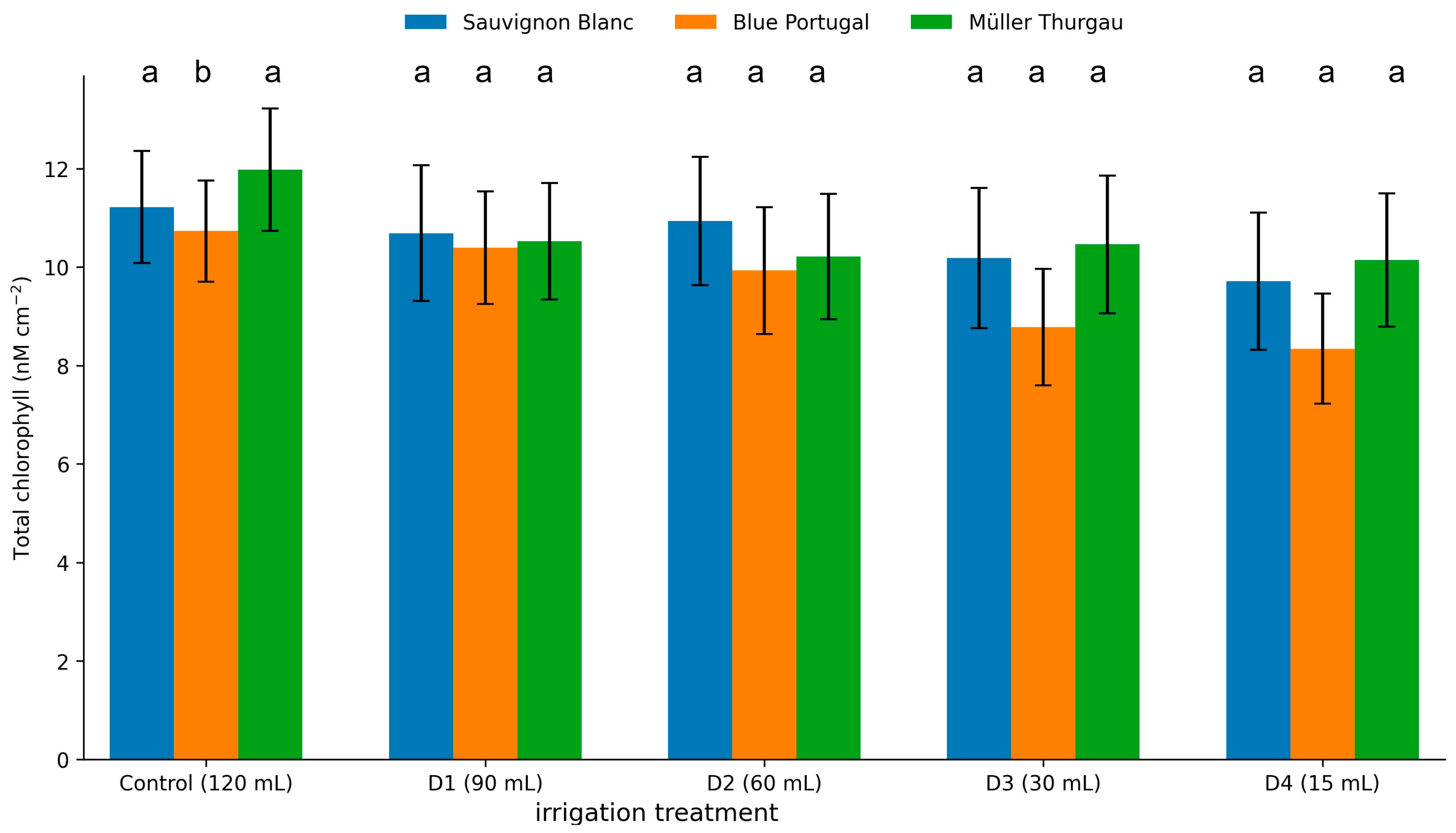
Photosynthetic pigment contents were significantly affected by irrigation regime and cultivar (Figure 1). Across cultivars, mean total chlorophyll content was lowest in ‘Müller Thurgau’ and highest in ‘Sauvignon Blanc’, whereas mean carotenoid content was highest in ‘Blue Portugal’ and lowest in ‘Müller Thurgau’.
Figure 1.
Effect of irrigation regime on total chlorophyll content (Chltot, nM cm−2) in leaves of three grapevine cultivars (Vitis vinifera L.). Values represent means ± SEM (n = 4). Control plants (C) and increasing levels of water deficit (D1–D4) are shown. Different letters indicate statistically significant differences among treatments at p ≤ 0.05.
Reduced irrigation led to a progressive decrease in chlorophyll content, with the lowest mean values observed under the most severe water deficit (D4, 15 mL) and the highest values in control plants (120 mL). Intermediate treatments followed the order D3 < D2 < D1 < control, with no significant differences between D1 and D2 or between D3 and D4. Detailed changes in pigment content across individual measurement terms are presented in the Supplementary Materials (Figure S1).
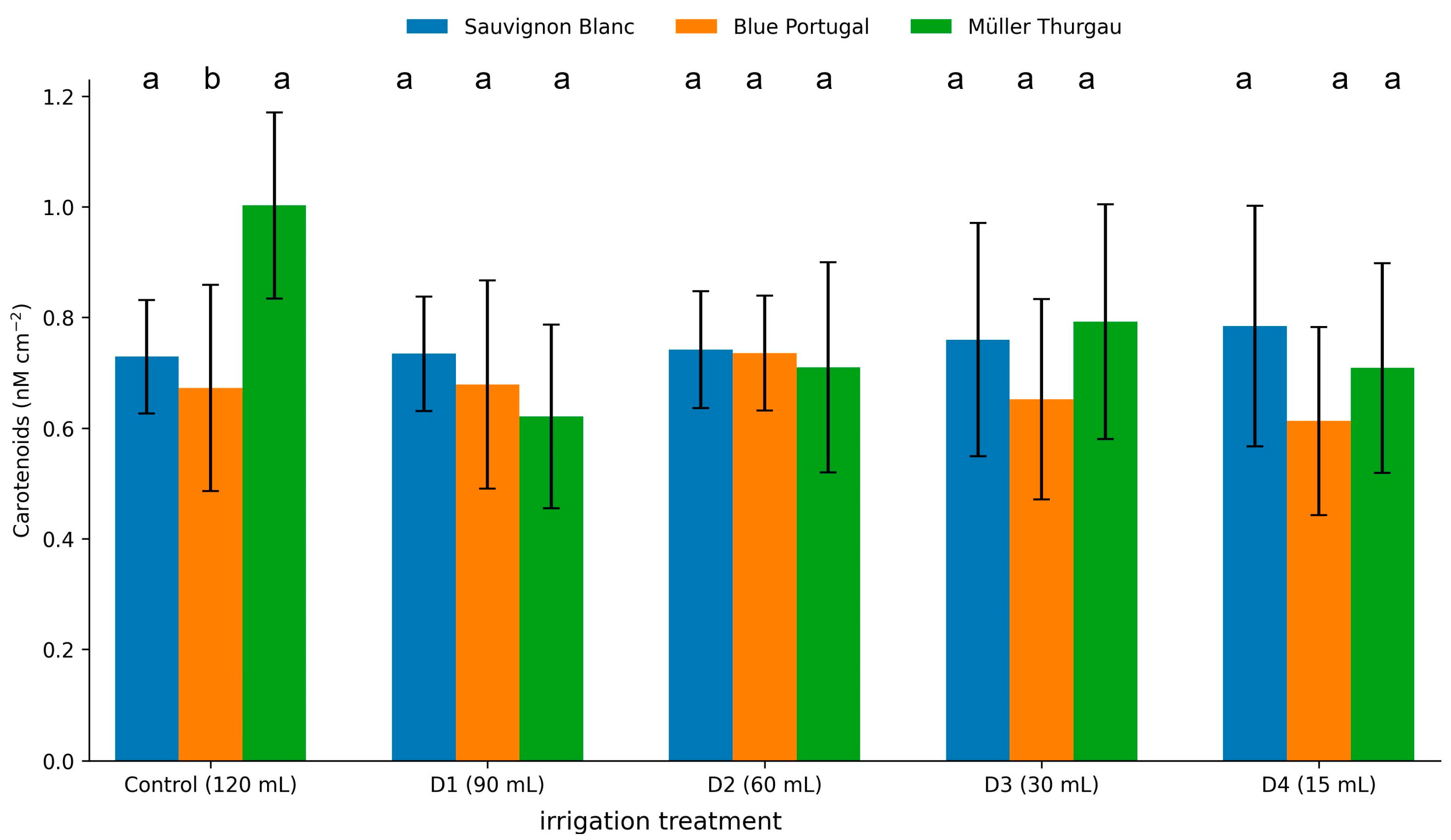
Carotenoid content responded differently to water deficit (Figure 2). The highest mean carotenoid content was observed in D4, while the lowest occurred in D3. No significant differences were detected among D1, D2, and D3. Across cultivars, the lowest carotenoid values were recorded in ‘Müller Thurgau’, whereas the highest values occurred in ‘Blue Portugal’. Temporal variation in carotenoid content was observed but showed no consistent directional trend (Supplementary Figure S2).
Figure 2.
Effect of irrigation regime on carotenoid content (Car, nM cm−2) in leaves of three grapevine cultivars (Vitis vinifera L.). Values represent means ± SEM (n = 4). Control plants (C) and increasing levels of water deficit (D1–D4) are shown. Different letters indicate statistically significant differences among treatments at p ≤ 0.05.
3.2. Fluorescence Parameters
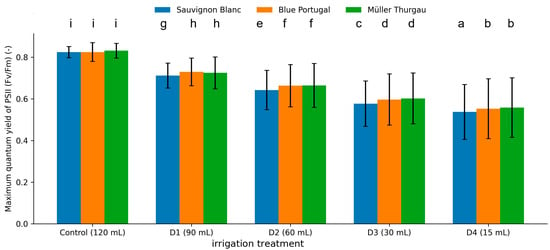
Maximum quantum yield of PSII (Fv/Fm) was significantly affected by irrigation treatment and stress duration (Figure 3). Across treatments, the highest mean Fv/Fm values were recorded in control plants, while reduced irrigation resulted in progressively lower values. Mean Fv/Fm declined in the order D1 > D2 > D3 > D4, with no significant difference between D3 and D4.
Figure 3.
Effect of water deficit on the maximum quantum yield of photosystem II (Fv/Fm) in grapevine cultivars ‘Müller Thurgau’, Blue Portugal, and ‘Sauvignon Blanc’ under different irrigation treatments (D1–D4, C). Values represent means ± standard error of the mean (SEM). Different letters indicate statistically significant differences among treatments at p ≤ 0.05.
Across cultivars, mean Fv/Fm values did not differ significantly; however, ‘Sauvignon Blanc’ exhibited slightly lower average values than ‘Müller Thurgau’. Fv/Fm values decreased following stress imposition and reached their lowest levels at the end of the experiment. Detailed temporal dynamics of fluorescence parameters across measurement terms are provided in the Supplementary Materials (Figure S3).
3.3. Gas Exchange Parameters
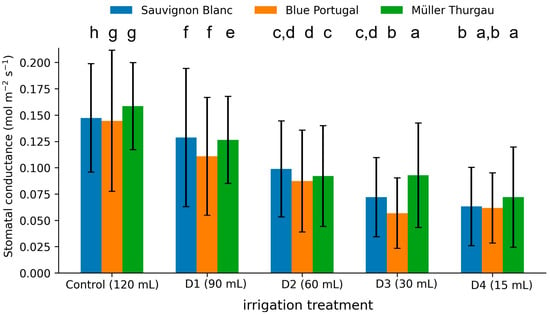
Stomatal conductance (gs) decreased significantly with reduced irrigation (Figure 4). Mean gs values were highest in control plants and D1, with no significant difference between these treatments, indicating mild stress under D1 conditions. In contrast, gs declined markedly in the more severe treatments, reaching the lowest values in D4.
Figure 4.
Effect of water deficit on the stomatal conductance (gs) (mol m−2 s−1) in grapevine cultivars ‘Müller Thurgau’, ‘Blue Portugal’, and ‘Sauvignon Blanc’ under different irrigation treatments (D1–D4, C). Values represent means ± standard error of the mean (SEM). Different letters indicate statistically significant differences among treatments at p ≤ 0.05.
Cultivar effects were evident, with the highest mean gs observed in ‘Sauvignon Blanc’ and the lowest in ‘Müller Thurgau’. Stomatal conductance varied considerably across measurement terms, particularly in control plants and under severe water deficit, reflecting dynamic stomatal regulation during stress progression (Supplementary Figure S4).
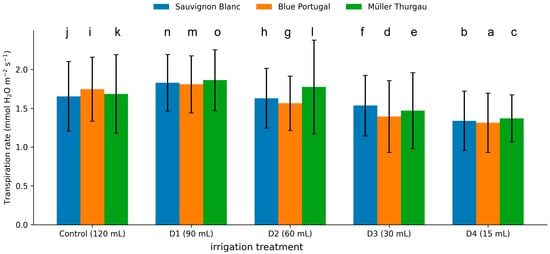
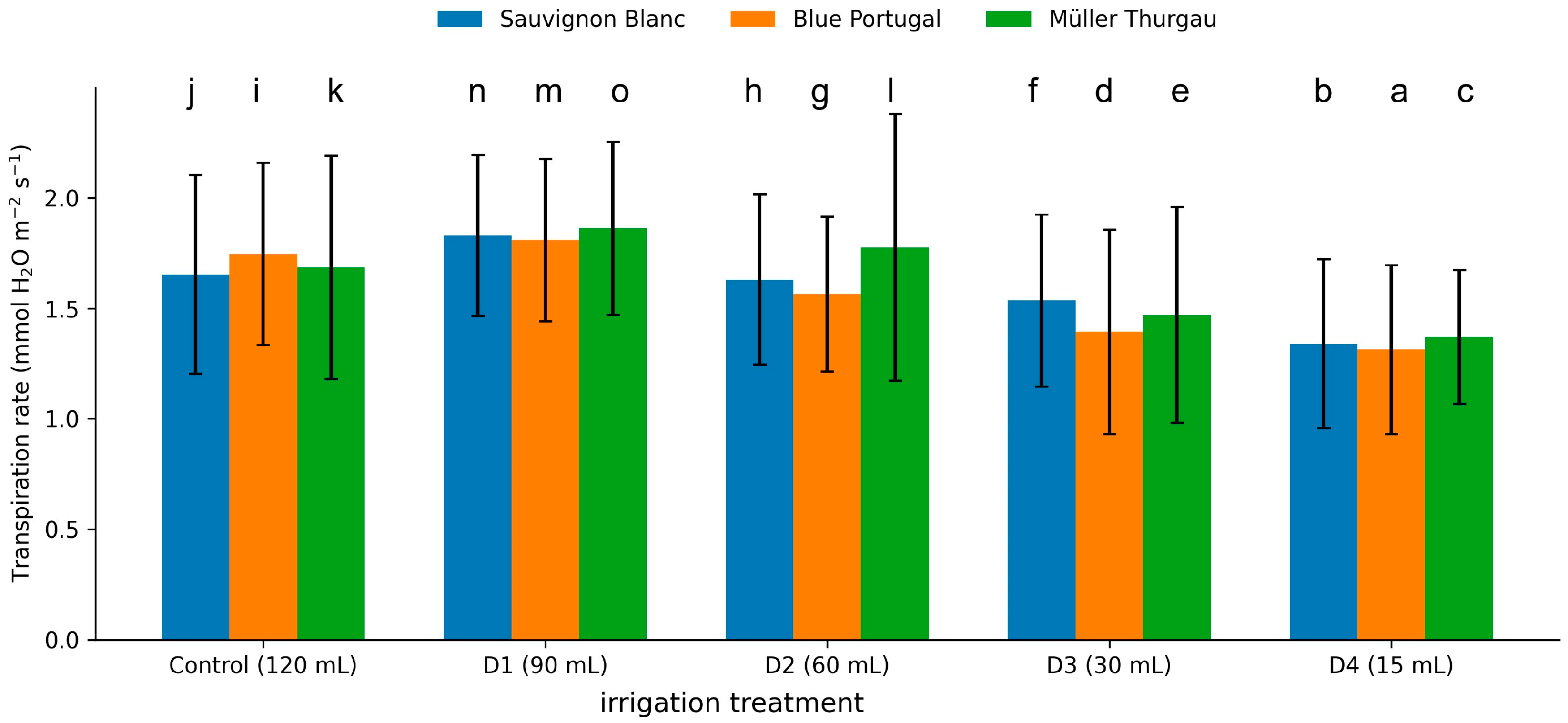
Transpiration rate (E) followed a pattern similar to gs (Figure 5). The highest mean transpiration was recorded in control plants and D1, while the lowest values occurred in D4. A significant positive relationship was found between transpiration and stomatal conductance (r = 0.436, p < 0.001), indicating stomatal control of water vapor exchange. Genotype effects on transpiration were minor compared to the influence of the irrigation regime. Temporal changes in transpiration across measurement terms are shown in Supplementary Figure S5. A positive relationship between transpiration and stomatal conductance was observed (r = 0.436, r2 = 0.190, p < 0.001), described by the regression equation y = 1.250 + 3.456x.
Figure 5.
Effect of water deficit on the transpiration rate (E) (mmol H2O m−2 s−1) in grapevine cultivars ‘Müller Thurgau’, ‘Blue Portugal’, and ‘Sauvignon Blanc’ under different irrigation treatments (D1–D4, C). Values represent means ± standard error of the mean (SEM). Different letters indicate statistically significant differences among treatments at p ≤ 0.05.
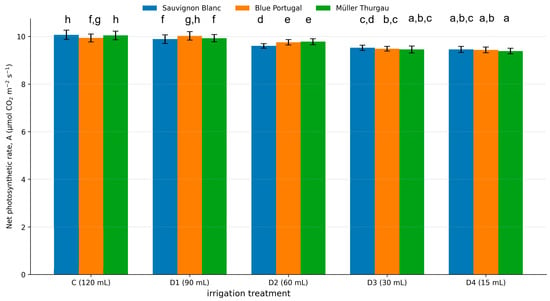
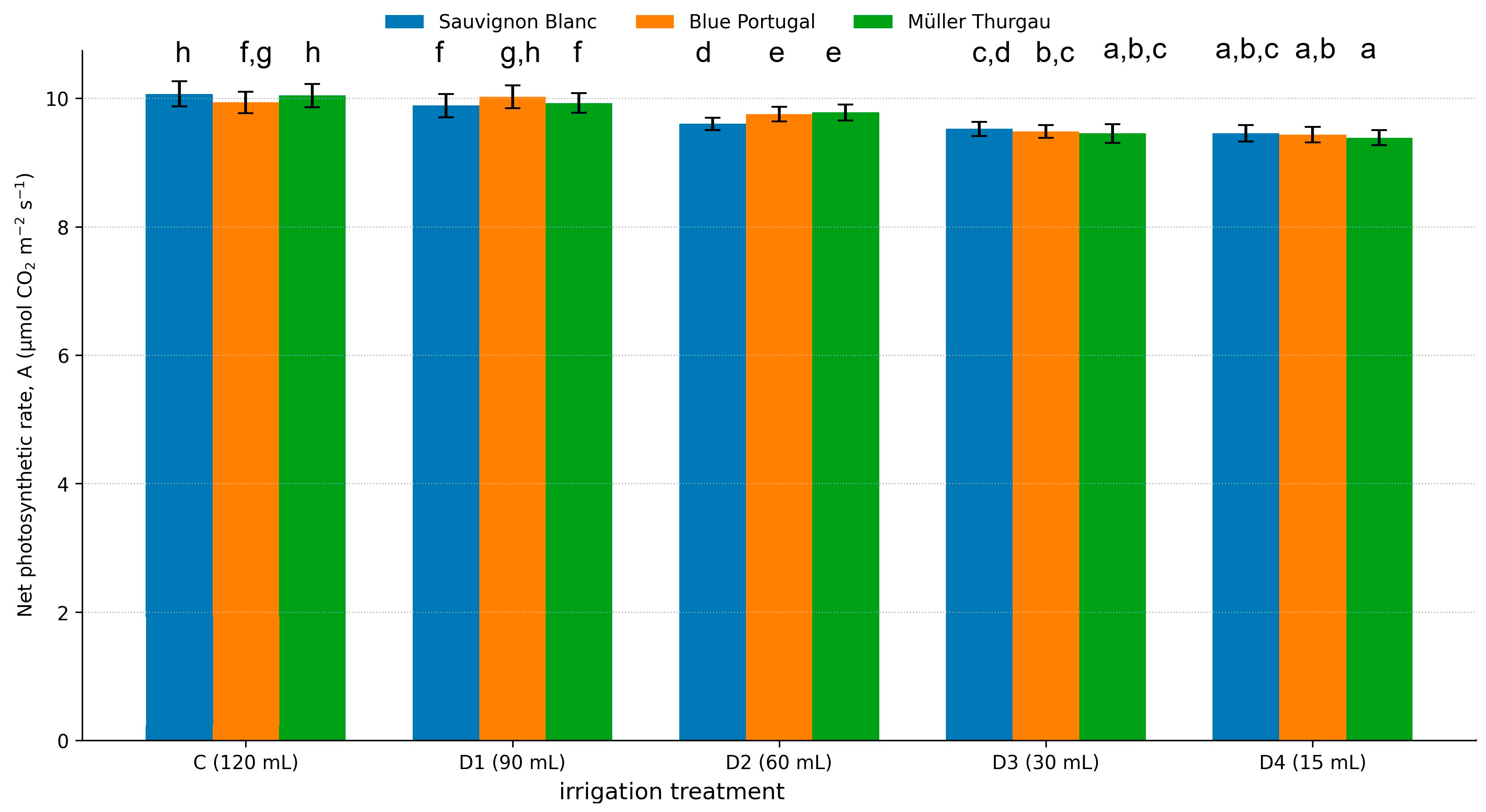
Net photosynthetic rate (Pn) declined significantly under reduced irrigation (Figure 6). Mean Pn was highest in control plants and decreased progressively with increasing water deficit, reaching the lowest values in D4. No significant differences among cultivars were detected; however, ‘Blue Portugal’ showed slightly higher average photosynthesis under stress conditions. Photosynthesis was positively correlated with stomatal conductance (r = 0.440, p < 0.001) and Fv/Fm (r = 0.468, p < 0.001), indicating combined stomatal and photochemical limitations.
Figure 6.
Effect of water deficit on the net photosynthetic rate (Pn) (mmol CO2 m−2 s−1) in grapevine cultivars ‘Müller Thurgau’, ‘Blue Portugal’, and ‘Sauvignon Blanc’ under different irrigation treatments (D1–D4, C). Values represent means ± standard error of the mean (SEM). Different letters indicate statistically significant differences among treatments at p ≤ 0.05.
Detailed temporal trends in photosynthetic rate are presented in Supplementary Figure S6.
3.4. Leaf Water Potential (Ψleaf)
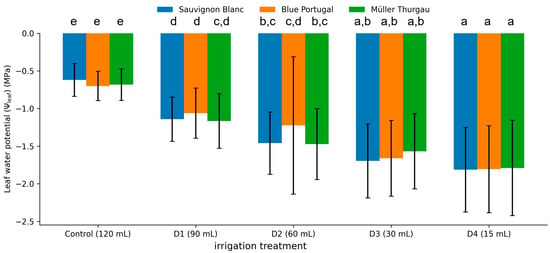
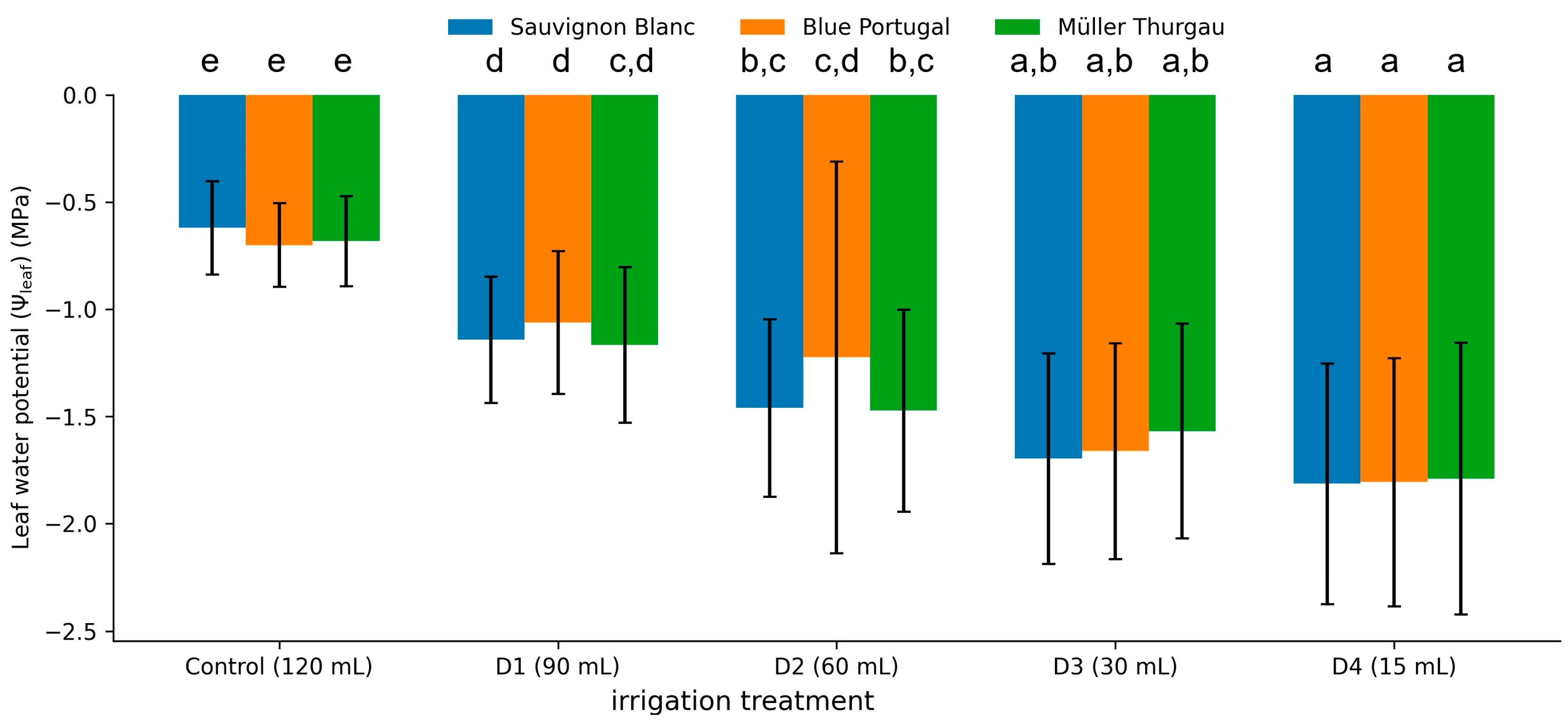
Leaf water potential differed significantly among irrigation treatments (Figure 7). Mean Ψleaf values declined progressively with reduced irrigation, with the highest values observed in control plants and the lowest in D4, indicating moderate to severe water stress.
Figure 7.
Effect of water deficit on the leaf water potential (Ψleaf) (MPa) in grapevine cultivars ‘Müller Thurgau’, ‘Blue Portugal’, and ‘Sauvignon Blanc’ under different irrigation treatments (D1–D4, C). Values represent means ± standard error of the mean (SEM). Different letters indicate statistically significant differences among treatments at p ≤ 0.05.
Across cultivars, mean Ψleaf values did not differ significantly, although ‘Blue Portugal’ tended to maintain slightly higher water potential than ‘Sauvignon Blanc’. Within stressed treatments, Ψleaf decreased gradually over time, with the lowest values recorded at the end of the experiment under D4 conditions. Detailed temporal patterns of leaf water potential are provided in the Supplementary Materials (Figure S7).
3.5. PCA
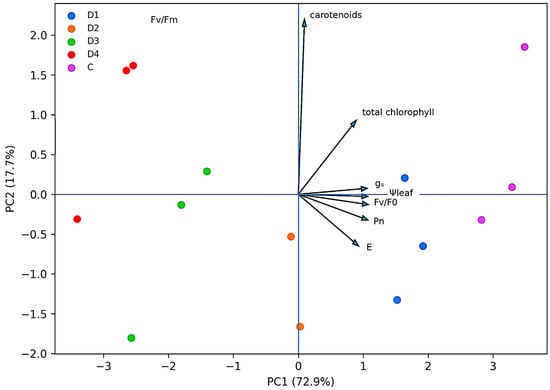
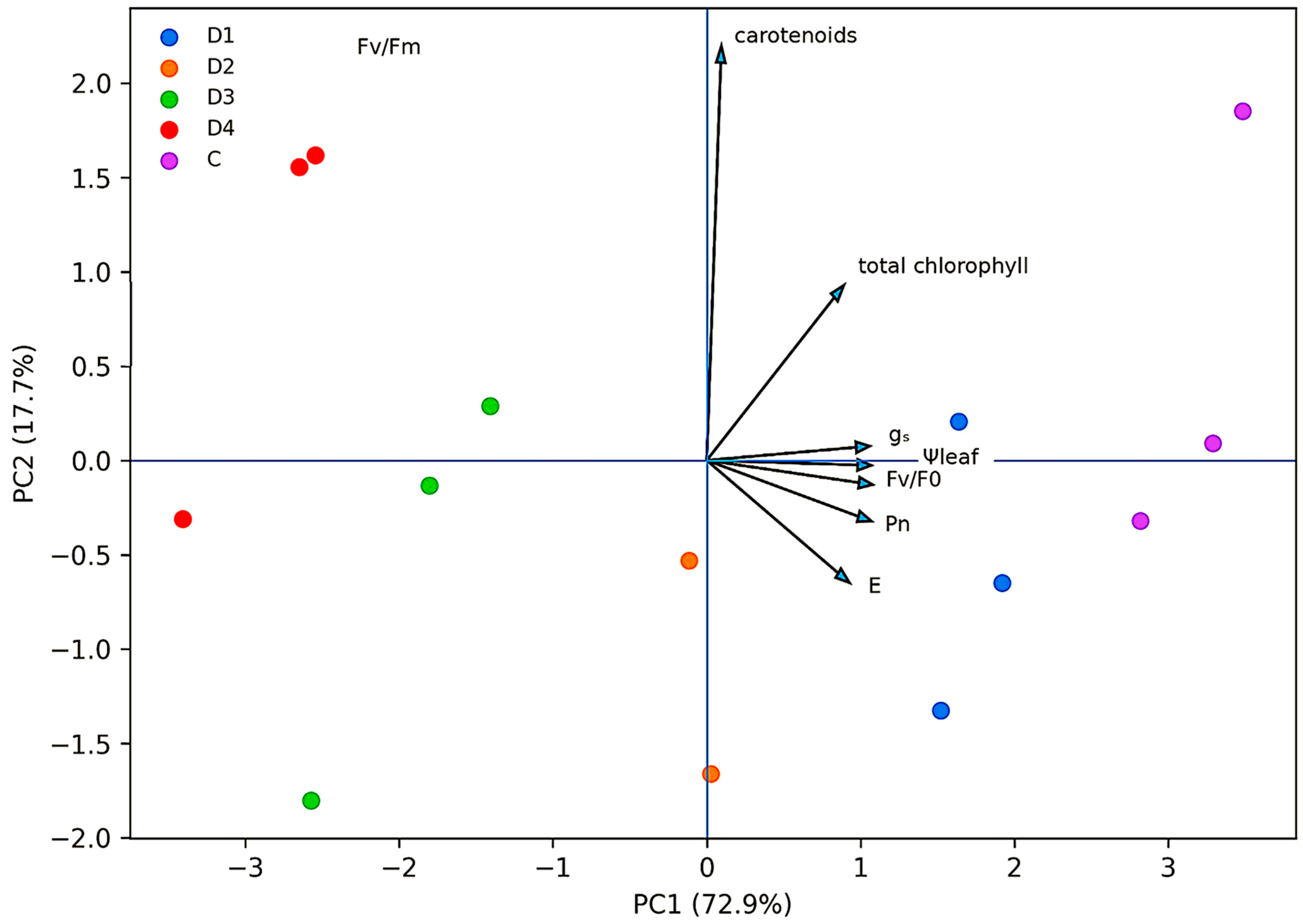
Principal component analysis (PCA) was used to integrate all measured physiological parameters and to visualize cultivar and irrigation treatment responses (Figure 8). The first two principal components explained the majority of total variance.
Figure 8.
Principal component analysis (PCA) biplot showing the relationships between physiological parameters and the distribution of grapevine cultivars under different irrigation treatments. Arrows represent loadings of gas exchange parameters (transpiration (E), stomatal conductance (gₛ), net photosynthesis (Pn)), chlorophyll fluorescence (Fv/Fm), pigment contents (total chlorophyll, carotenoids), and leaf water potential (Ψleaf). Points represent cultivar × irrigation treatment means. PC1 reflects a water stress gradient, while PC2 separates pigment- and transpiration-related responses.
PC1 was positively associated with photosynthesis, stomatal conductance, chlorophyll content, and Fv/Fm, and negatively associated with leaf water potential, representing a clear gradient of water availability and stress intensity. Control plants clustered at higher PC1 values, while severely stressed treatments (D3–D4) shifted toward lower PC1 values.
PC2 was mainly influenced by carotenoid content and transpiration rate, separating cultivars according to their pigment-related and water-use responses rather than stress intensity alone. ‘Blue Portugal’ showed a tendency toward higher pigment-associated loadings under water deficit. The PCA score plot and variable loadings are presented in Figure 8, with additional visualization provided in the Supplementary Materials (Figure S8).
4. Discussion
The present study provides a comprehensive assessment of grapevine responses to short-term water deficit and reveals distinct physiological strategies among the three cultivars examined. By integrating pigment composition, chlorophyll fluorescence, gas exchange parameters, and leaf water status, a coherent picture emerges of how drought stress affects photosynthetic performance and plant water relations in Vitis vinifera. These findings are consistent with recent studies emphasizing the multidimensional nature of drought tolerance in grapevine and the importance of cultivar-specific responses [39,40].
4.1. Pigment Content
The decline in chlorophyll content with increasing water deficit observed across cultivars reflects the well-documented sensitivity of photosynthetic pigments to drought stress [41,42]. This reduction was most pronounced under severe irrigation limitation (D4), likely resulting from drought-induced oxidative stress, destabilization of thylakoid membranes, and enhanced chlorophyll degradation [35,43,44], potentially mediated by increased chlorophyllase activity [45,46].
In the present study, ‘Müller Thurgau’ showed the greatest chlorophyll loss, indicating high sensitivity to water deficit. In contrast, ‘Blue Portugal’ maintained relatively higher chlorophyll levels even under severe stress, suggesting enhanced drought tolerance. Similar cultivar-dependent differences in pigment stability have been reported in other grapevine varieties [47,48]. Higher pigment contents in control plants confirm that chlorophyll degradation was primarily driven by water deficit rather than ontogenetic decline [48,49].
Carotenoid responses differed from those of chlorophyll. While chlorophyll content declined markedly, carotenoid levels remained relatively stable or increased under severe water deficit. Elevated carotenoid concentrations under D4 indicate activation of photoprotective mechanisms, consistent with the role of carotenoids in dissipating excess excitation energy and mitigating oxidative stress [50,51]. The absence of a clear trend across measurement terms suggests that carotenoid accumulation was stress-induced rather than developmentally regulated [52]. Notably, enhanced carotenoid retention in ‘Blue Portugal’ supports its greater drought resilience [53,54].
4.2. Fluorescence Parameters
The reduction in Fv/Fm values under water deficit reflects impairment or downregulation of photosystem II (PSII) activity [55]. Control plants exhibited values close to the optimal range, whereas severe water deficit (D4) resulted in significant declines, indicating photoinhibition. The progressive decrease in Fv/Fm with stress duration highlights the sensitivity of grapevine PSII to prolonged drought [56,57,58], which may shift PSII limitations from reversible regulatory responses to chronic photoinhibition [59,60].
Although mean Fv/Fm values did not differ significantly among cultivars, consistently lower values in ‘Sauvignon Blanc’ suggest higher susceptibility of PSII to drought-induced damage. In contrast, ‘Blue Portugal’ maintained slightly higher Fv/Fm values, consistent with its higher pigment stability and photosynthetic resilience [61,62]. Partial recovery of Fv/Fm during intermediate stages suggests transient acclimation [63], a response previously observed in drought-stressed grapevines [64,65].
4.3. Gas Exchange Parameters
Stomatal conductance (gs) declined with decreasing irrigation, confirming its sensitivity to water deficit [66,67]. High gs values in control plants indicate optimal physiological functioning, whereas the lack of significant differences between control and D1 treatments suggests only mild stress. Under more severe treatments, reductions in leaf water potential and cell turgor likely drove progressive stomatal closure [53], thereby limiting transpiration and photosynthesis [54,68,69].
Among cultivars, ‘Sauvignon Blanc’ exhibited higher gs values. The position on the isohydric–anisohydric continuum indicates a tendency toward anisohydric behavior [53,70,71], whereas ‘Blue Portugal’ and ‘Müller Thurgau’ displayed characteristics more consistent with isohydric regulation [72,73]. The observed relationships among gs, transpiration, and photosynthesis indicate that stomatal limitation predominated under mild stress, while non-stomatal limitations increasingly constrained photosynthesis under severe drought [74,75].
Transpiration closely mirrored changes in gs, reflecting effective stomatal regulation of water loss [76]. The relatively stable gas exchange performance of ‘Blue Portugal’ under stress corresponds with its higher pigment retention and supports a more robust drought adaptation strategy [77,78,79,80,81].
4.4. Leaf Water Potential
Leaf water potential is a widely recognized indicator of drought stress in grapevine [82]. In this study, water potential measurements clearly delineated a gradient of water availability, with control plants maintaining values typical of well-hydrated vines and D4 plants reaching levels associated with moderate to severe stress (<−1.8 MPa) [83].
The coordinated responses of stomatal conductance and leaf water potential indicate that the studied cultivars differ in their position along the isohydric–anisohydric continuum rather than exhibiting strictly defined hydraulic behaviors. From a viticultural perspective, the observed cultivar-specific differences in water status regulation and gas exchange responses have important implications for irrigation management. Cultivars such as ‘Blue Portugal’, which maintained relatively higher leaf water potential and physiological stability under reduced irrigation, appear more suitable for the application of deficit irrigation strategies such as regulated deficit irrigation (RDI) or partial root-zone drying (PRD). In contrast, more sensitive cultivars such as ‘Müller Thurgau’ may require carefully optimized irrigation thresholds to avoid excessive physiological stress and potential yield or quality losses.
Although mean water potential did not differ significantly among cultivars, ‘Blue Portugal’ consistently exhibited slightly higher values, indicating a greater capacity to maintain plant water status under stress. Grapevine is generally considered a drought-avoiding, predominantly isohydric species with strong stomatal control over transpiration [62,72,84], although genotypic variation exists. The comparatively higher water potential and physiological stability of ‘Blue Portugal’ suggest superior drought tolerance, whereas ‘Müller Thurgau’ exhibited the strongest decline across measured parameters.
Overall, the integrated physiological responses indicate that the studied cultivars occupy different positions along the isohydric–anisohydric continuum, reflecting contrasting drought response strategies rather than uniform tolerance or sensitivity.
Such differences in hydraulic regulation emphasize that drought tolerance in grapevine is a relative and dynamic trait, strongly dependent on the balance between stomatal control and the maintenance of leaf water status [85,86].
5. Conclusions
This study demonstrated clear cultivar-specific differences in the physiological responses of grapevine to water deficit under controlled greenhouse conditions, with direct implications for irrigation management and cultivar selection in viticulture. Progressive reduction in irrigation negatively affected gas exchange parameters, pigment content, chlorophyll fluorescence, and leaf water potential, confirming the high sensitivity of grapevine photosynthetic and hydraulic processes to limited water availability.
Among the studied cultivars, ‘Müller Thurgau’ exhibited the highest sensitivity to water deficit, as evidenced by pronounced declines in chlorophyll content, photosynthesis, fluorescence efficiency, and leaf water potential under severe stress. In contrast, ‘Blue Portugal’ maintained relatively stable pigment levels, photosynthetic performance, and plant water status, indicating a more effective protective and adaptive response to drought conditions. ‘Sauvignon Blanc’ showed an intermediate response pattern, characterized by comparatively stable photosynthetic activity and fluorescence parameters despite a pronounced decrease in leaf water potential, suggesting a tendency toward more anisohydric water-use behavior.
Taken together, these results indicate that the studied cultivars occupy different positions along the isohydric–anisohydric continuum, reflecting contrasting drought response strategies rather than uniform tolerance or sensitivity. These findings highlight the importance of cultivar selection as a key strategy to mitigate the negative impacts of increasing drought frequency in viticulture.
However, further studies integrating soil water potential measurements, root traits, and molecular analyses are required to better elucidate the regulatory mechanisms underlying drought tolerance in grapevine and to improve cultivar-specific adaptation strategies under future water-limited conditions.
In the context of ongoing climate change and increasing drought frequency in viticultural regions, these results emphasize the importance of selecting cultivars with higher physiological resilience and implementing adaptive irrigation strategies, such as regulated deficit irrigation, to sustain grapevine productivity and stability under future water-limited conditions.
Supplementary Materials
The following supporting information can be downloaded at https://www.mdpi.com/article/10.3390/horticulturae12020128/s1. Figure S1: Temporal changes in leaf chlorophyll content (nmol cm−2) in grapevine cultivars ‘Müller Thurgau’, ‘Blue Portugal’, and ‘Sauvignon Blanc’ under different irrigation treatments (Control, D1–D4). Values represent means ± SEM (n = 4). Measurements were taken at successive sampling terms during the experiment. The y-axis range was adjusted to biologically relevant values (0.98–17.94 nmol cm−2) to enhance visualization of treatment effects; Figure S2: Temporal changes in leaf carotenoids content (nmol cm−2) in grapevine cultivars ‘Müller Thurgau’, ‘Blue Portugal’, and ‘Sauvignon Blanc’ under different irrigation treatments (Control, D1–D4). Values represent means ± SEM (n = 4). Measurements were conducted across successive sampling terms. The y-axis range (0.33−2.85 nmol cm−2) reflects biologically meaningful variation in grapevine water status; Figure S3: Temporal changes in stomatal conductance (gs, mol m−2 s−1) in grapevine cultivars ‘Müller Thurgau’, ‘Blue Portugal’, and ‘Sauvignon Blanc’ under different irrigation treatments (Control, D1–D4). Values represent means ± SEM (n = 4). The y-axis range (0.02–0.18 mol m−2 s−1) was adjusted to highlight treatment- and cultivar-specific responses over time; Figure S4: Temporal changes in net photosynthetic rate (Pn, μmol CO2 m−2 s−1) in grapevine cultivars ‘Müller Thurgau’, ‘Blue Portugal’, and ‘Sauvignon Blanc’ under different irrigation treatments (Control, D1–D4). Values represent means ± SEM (n = 4). Measurements were taken at successive sampling terms; the y-axis range (8.5–10.8 μmol CO2 m−2 s−1) reflects the observed biological variability; Figure S5: Temporal changes in transpiration rate (E, mmol H2O m−2 s−1) in grapevine cultivars ‘Müller Thurgau’, ‘Blue Portugal’, and ‘Sauvignon Blanc’ under different irrigation treatments (Control, D1–D4). Values represent means ± SEM (n = 4). Data illustrates treatment- and cultivar-specific dynamics of transpiration during progressive water deficit. Measurements were taken at successive sampling terms; the y-axis range (0.85–2.81 mmol H2O m−2 s−1) reflects the observed biological variability; Figure S6: Temporal changes in maximum quantum yield of PSII (Fv/Fm) in grapevine cultivars ‘Müller Thurgau’, ‘Blue Portugal’, and ‘Sauvignon Blanc’ under different irrigation treatments (Control, D1–D4). Values represent means ± SEM (n = 4). Measurements were taken at successive sampling terms during the experiment. The y-axis range was adjusted to biologically relevant values (0.4–0.9) to enhance visualization of treatment effects; Figure S7: Temporal changes in leaf water potential (Ψ_leaf, MPa) in grapevine cultivars ‘Müller Thurgau’, ‘Blue Portugal’, and ‘Sauvignon Blanc’ under different irrigation treatments (Control, D1–D4). Values represent means ± SEM (n = 4). Measurements were conducted across successive sampling terms. The y-axis range (−2.6 to −0.4 MPa) reflects biologically meaningful variation in grapevine water status; Figure S8: Principal component analysis (PCA) based on cultivar × irrigation treatment means of physiological parameters, including gas exchange traits, chlorophyll fluorescence, pigment contents, and leaf water potential. PC1 and PC2 explain the majority of total variance. Points represent treatment × cultivar combinations, while vectors indicate variable loadings.
Author Contributions
F.H. and R.S. designed and supervised the project. O.S. statistical analysis, graphic editing of the manuscript. F.H. and R.S. analyzed the data and wrote the manuscript. F.H., J.K.K. and T.R. participated in the determination of physiological parameters. O.S., L.Z. and T.R. participated in the material preparation. All authors discussed the results and commented on the manuscript. All authors have read and agreed to the published version of the manuscript.
Funding
This work was created with the support of the grant project of the Ministry of Agriculture of the Czech Republic—NAZV QK21010189: Implementation of ecosystem services with a focus on water balance in viticultural practice.
Institutional Review Board Statement
Not applicable.
Informed Consent Statement
Not applicable.
Data Availability Statement
The raw data supporting the conclusions of this article will be made available by the authors on request.
Conflicts of Interest
The authors declare no conflicts of interest. The funders had no role in the design of the study; in the collection, analyses, or interpretation of data; in the writing of the manuscript; or in the decision to publish the result.
References
- Manivannan, P.; Jaleel, C.A.; Somasundaram, R.; Panneerselvam, R. Osmoregulation and antioxidant metabolism in drought–stressed Helianthus annuus under triadimefon drenching. Comptes Rendus Biol. 2008, 331, 418–425. [Google Scholar] [CrossRef] [Scilit]
- Choat, B.; Brodribb, T.J.; Brodersen, C.R.; Duursma, R.A.; López, R.; Medlyn, B.E. Triggers of tree mortality under drought. Nature 2018, 558, 531–539. [Google Scholar] [CrossRef] [Scilit] [PubMed]
- Yang, X.; Lu, M.; Wang, Y.; Wang, Y.; Liu, Z.; Chen, S. Response mechanism of plants to drought stress. Horticulturae 2021, 7, 50. [Google Scholar] [CrossRef] [Scilit]
- Tan, J.W.; Shinde, H.; Tesfamicael, K.; Hu, Y.; Fruzangohar, M.; Tricker, P.; Baumann, U.; Edwards, E.J.; Rodríguez López, C.M. Global transcriptome and gene co–expression network analyses reveal regulatory and non–additive effects of drought and heat stress in grapevine. Front. Plant Sci. 2023, 14, e1096225., 1–15. [Google Scholar] [CrossRef] [Scilit]
- Patmi, Y.S.; Pitoyo, A.; Solichatun, S. Effect of drought stress on morphological, anatomical, and physiological characteristicscof Cempo Ireng cultivar mutant rice (Oryza sativa L.) strain 51 irradiated by gamma–ray. J. Phys. Conf. Ser. 2020, 1436, 012015. [Google Scholar] [CrossRef] [Scilit]
- Bhattacharya, A. Effect of Soil Water Deficit on Growth and Development of Plants: A Review. In Soil Water Deficit and Physiological Issues in Plants; Springer: Singapore, 2021; pp. 393–488. [Google Scholar] [CrossRef] [Scilit]
- Monteoliva, M.I.; Guzzo, M.C.; Posada, G.A. Breeding for drought tolerance by monitoring chlorophyll content. Gene Technol. 2021, 10, 165. [Google Scholar] [CrossRef]
- Khayatnezhad, M.; Gholamin, R. The effect of drought stress on the superoxide dismutase and chlorophyll content in durum wheat genotypes. Adv. Life Sci. 2021, 8, 119–123. [Google Scholar] [CrossRef] [Scilit]
- Bigler, C.; Vitasse, Y. Premature leaf discoloration of European deciduous trees is caused by drought and heat in late spring and cold spells in early fall. Agric. For. Meteorol. 2021, 307, e108492. [Google Scholar] [CrossRef] [Scilit]
- Dong, N.; Prentice, I.C.; Wright, I.J.; Evans, B.J.; Togashi, H.F.; Caddy-Retalic, S.; McInerney, F.A.; Sparrow, B.; Leitch, E.; Lowe, A.J. Components of leaf-trait variation along environmental gradients. New Phytol. 2020, 228, 82–94. [Google Scholar] [CrossRef] [Scilit]
- Seleiman, M.F.; Al–Suhaibani, N.; Ali, N.; Akmal, M.; Alotaibi, M.; Refay, Y.; Dindaroglu, T.; Haleem Abdul–Wajid, H.; Battaglia, M.L. Drought stress impacts on plants and different approaches to alleviate its adverse effects. Plants 2021, 10, 259. [Google Scholar] [CrossRef] [Scilit]
- Prasad, P.V.V.; Djanaguiraman, M.; Jagadish, S.V.K.; Ciampitti, I.A. Drought and high temperature stress and traits associated with tolerance. In Sorghum: A State of the Art and Future Perspectives; Ciampitti, I.A., Prasad, P.V.V., Eds.; ASA: Madison, WI, USA, 2019; Volume 58, pp. 245–265. [Google Scholar] [CrossRef] [Scilit]
- Zhang, Y.; Kaiser, E.; Li, T.; Marcelis, L.F. NaCl affects photosynthetic and stomatal dynamics by osmotic effects and reduces photosynthetic capacity by ionic effects in tomato. J. Exp. Bot. 2022, 73, 3637–3650. [Google Scholar] [CrossRef] [Scilit]
- Nardini, A. Hard and tough: The coordination between leaf mechanical resistance and drought tolerance. Flora 2022, 288, e152023. [Google Scholar] [CrossRef] [Scilit]
- Sapeta, H.; Yokono, M.; Takabayashi, A.; Ueno, Y.; Cordeiro, A.M.; Hara, T.; Tanaka, A.; Akimoto, S.; Margarida, M.O.; Tanaka, R. Reversible down–regulation of photosystems I and II leads to fast photosynthesis recovery after long–term drought in Jatropha curcas. J. Exp. Bot. 2023, 74, 336–351. [Google Scholar] [CrossRef] [Scilit]
- Todorova, D.; Aleksandrov, V.; Anev, S.; Sergiev, I. Photosynthesis alterations in wheat plants induced by herbicide, soil drought or flooding. Agronomy 2022, 12, 390. [Google Scholar] [CrossRef] [Scilit]
- Sorek, Y.; Greenstein, S.; Netzer, Y.; Shtein, I.; Jansen, S.; Hochberg, U. An increase in xylem embolism resistance of grapevine leaves during the growing season is coordinated with stomatal regulation, turgor loss point and intervessel pit membranes. New Phytol. 2021, 229, 1955–1969. [Google Scholar] [CrossRef] [Scilit] [PubMed]
- Blum, A. Osmotic adjustment is a prime drought stress adaptive engine in support of plant production. Plant Cell Environ. 2017, 40, 4–10. [Google Scholar] [CrossRef] [Scilit] [PubMed]
- Gagneul, D.; Aïnouche, A.; Duhazé, C.; Lugan, R.; Larher, F.R.; Bouchereau, A. A reassessment of the function of the so–called compatible solutes in the halophytic Plumbaginaceae Limonium latifolium. Plant Physiol. 2007, 144, 1598–1611. [Google Scholar] [CrossRef] [Scilit] [PubMed]
- Patakas, A.; Nikolaou, N.; Zioziou, E.; Radoglou, K.; Noitsakis, B. The role of organic solute and ion accumulation in osmotic adjustment in drought–stressed grapevines. Plant Sci. 2002, 163, 361–367. [Google Scholar] [CrossRef] [Scilit]
- Kar, R.K. Plant responses to water stress: Role of reactive oxygen species. Plant Signal. Behav. 2011, 6, 1741–1745. [Google Scholar] [CrossRef] [Scilit]
- Miller, G.; Suzuki, N.; Ciftci–Yilmaz, S.; Mittler, R. Reactive oxygen species homeostasis and signalling during drought and salinity stresses. Plant Cell Environ. 2010, 33, 453–467. [Google Scholar] [CrossRef] [Scilit]
- Al Hassan, M.; Chaura, J.; Donat–Torres, M.P.; Boscaiu, M.; Vicente, O. Antioxidant responses under salinity and drought in three closely related wild monocots with different ecological optima. AoB Plants 2017, 9, plx009. [Google Scholar] [CrossRef] [Scilit]
- Lin, Z.; Li, Y.; Wang, Y.; Liu, X.; Ma, L.; Zhang, Z.; Mu, C.; Zhang, Y.; Peng, L.; Xie, S.; et al. Initiation and amplification of SnRK2 activation in abscisic acid signaling. Nat. Commun. 2021, 12, e2456. [Google Scholar] [CrossRef] [Scilit] [PubMed]
- Alston, J.M.; Sambucci, O. Grapes in the World Economy. In The Grape Genome; Cantu, D., Walker, M., Eds.; Compendium of Plant Genomes; Springer: Cham, Switzerland, 2019. [Google Scholar]
- FAO. FAOSTAT Statistical Database: Grapes and Wine [Database]. Food and Agriculture Organization of the United Nations, 2025. Available online: https://www.fao.org/faostat (accessed on 11 December 2025).
- van Leeuwen, C.; Sgubin, G.; Bois, B.; Ollat, N.; Swingedouw, D.; Zito, S.; Gambetta, G.A. Climate change impacts and adaptations of wine production. Nat. Rev. Earth Environ. 2024, 5, 258–275. [Google Scholar] [CrossRef] [Scilit]
- Paleari, L.; Brancadoro, L.; Rusconi, C.; Movedi, E.; Poni, S.; Bolognini, M.; Bolognini, M.; Modina, D.; Cunial, L.; Gatti, M.; et al. Quantifying water stress in vineyards using a smartphone. Biosyst. Eng. 2024, 238, 89–93. [Google Scholar] [CrossRef] [Scilit]
- Hsiao, T.C.; Xu, L.K. Sensitivity of growth of roots versus leaves to water stress: Biophysical analysis and relation to water transport. J. Exp. Bot. 2000, 51, 1595–1616. [Google Scholar] [CrossRef] [Scilit] [PubMed]
- Sinclair, G.; Galarneau, E.R.; Hnizdor, J.F.; McElrone, A.J.; Walker, M.A.; Bartlett, M.K. Grape cultivars adapted to hotter, drier growing regions exhibit greater photosynthesis in hot conditions despite less drought–resistant leaves. Ann. Bot. 2024, 134, 205–218. [Google Scholar] [CrossRef] [Scilit]
- Scoffoni, C.; Albuquerque, C.; Cochard, H.; Buckley, T.N.; Fletcher, L.R.; Caringella, M.A.; Barlett, M.; Brodersen, C.R.; Jansen, S.; Sack, L. The causes of leaf hydraulic vulnerability and its influence on gas exchange in Arabidopsis thaliana. Plant Physiol. 2018, 178, 1584–1601. [Google Scholar] [CrossRef] [Scilit] [PubMed]
- Morgan, J.M. Osmoregulation and water stress in higher plants. Annu. Rev. Plant Physiol. 1984, 35, 299–319. [Google Scholar] [CrossRef]
- Hsiao, T.C.; Acevedo, E.; Fereres, E.; Henderson, D.W. Water stress, growth and osmotic adjustment. Philos. Trans. R. Soc. Lond. B Biol. Sci. Biol. Sci. 1976, 273, 479–500. [Google Scholar] [CrossRef] [Scilit]
- Bartlett, K.M.; Gabriela Sinclair, G. Temperature and evaporative demand drive variation in stomatal and hydraulic traits across grape cultivars. J. Exp. Bot. 2021, 72, 1995–2009. [Google Scholar] [CrossRef] [Scilit]
- Ju, Y.L.; Yue, X.F.; Zhao, X.F.; Zhao, H.; Fang, Y.L. Physiological, Micro–Morphological and Metabolomic Analysis of Grapevine (Vitis vinifera L.) Leaf of Plants under Water Stress. Plant Physiol. Biochem. 2018, 130, 501–510. [Google Scholar] [CrossRef] [Scilit]
- Haider, M.S.; Zhang, C.; Kurjogi, M.M.; Pervaiz, T.; Zheng, T.; Zhang, C.; Lide, C.; Shangguan, L.; Fang, J. Insights into grapevine defense response against drought as revealed by biochemical, physiological and RNA–Seq analysis. Sci. Rep. 2017, 7, 13134. [Google Scholar] [CrossRef] [Scilit]
- Porra, R.J.; Thompson, W.A.; Kriedemann, P.E. Determination of accurate extinction coefficients and simultaneous equations for assaying chlorophylls a and b extracted with four different solvents: Verification of the concentration of chlorophyll standards by atomic absorption spectroscopy. Biochim. Biophys. Acta Rev. Bioenerg. 1989, 975, 384–394. [Google Scholar] [CrossRef] [Scilit]
- Kuklová, M.; Hniličková, H.; Hnilička, F.; Pivková, I.; Kukla, J. Impact of expressway on physiology of plants and accumulation of risk elements in forest ecosystems. Plant Soil Environ. 2019, 65, 46–53. [Google Scholar] [CrossRef] [Scilit]
- Costa, J.M.; Vaz, M.; Escalona, J.M.; Egipto, R.; Lopes, C.M.; Medrano, H.; Chaves, M.M. Modern viticulture in southern Europe: Vulnerabilities and strategies for adaptation to water scarcity. Agric. Water Manag. 2016, 164, 5–18. [Google Scholar] [CrossRef] [Scilit]
- Dayer, S.; Scharwies, J.D.; Ramesh, S.A.; Sullivan, W.; Doerflinger, F.C.; Pagay, V.; Tyerman, S.D. Physiology of drought stress in grapevine: Towards an integrative definition of drought tolerance. J. Exp. Bot. 2020, 71, 4658–4676. [Google Scholar] [CrossRef] [Scilit]
- Fahim, S.; Ghanbari, A.; Naji, A.M.; Shokohian, A.A.; Lajayer, H.M.; Gohari, G.; Hano, C. Multivariate discrimination of some grapevine cultivars under drought stress in Iran. Horticulturae 2022, 8, 871. [Google Scholar] [CrossRef] [Scilit]
- Iqbal, S.; Elatafi, E.; Shaonan, L.; Ali, S.; Hakeem, A.; Badar Aziz, R.; Mauligen, E.; Tariq, K.; Elhendawy, B.; Shangguan, L.; et al. Drought stress and the modulation of physiochemical parameters and antioxidant enzymes in grapevine rootstocks: Insights into the protective role of methyl jasmonate. Horticulturae 2025, 11, 164. [Google Scholar] [CrossRef] [Scilit]
- Ashraf, M.; Harris, P.J.C. Photosynthesis under stressful environments: An overview. Photosynthetica 2013, 51, 163–190. [Google Scholar] [CrossRef] [Scilit]
- Poni, S.; Gatti, M.; Tombesi, S.; Squeri, C.; Sabbatini, P.; Lavado Rodas, N.; Frioni, T. Double cropping in Vitis vinifera L. Pinot noir: Myth or reality? Agronomy 2020, 10, 799. [Google Scholar] [CrossRef] [Scilit]
- Đurić, M.; Subotić, A.; Prokić, L.; Trifunović–Momčilov, M.; Milošević, S. Alterations in physiological, biochemical, and molecular responses of Impatiens walleriana to drought by methyl jasmonate foliar application. Genes 2023, 14, 1072. [Google Scholar] [CrossRef] [Scilit]
- Karimi, R.; Gavili–Kilaneh, K.; Khadivi, A. Methyl jasmonate promotes salinity adaptation responses in two grapevine (Vitis vinifera L.) cultivars differing in salt tolerance. Food Chem. 2022, 375, 131667. [Google Scholar] [CrossRef] [Scilit]
- Chaves, M.M.; Zarrouk, O.; Francisco, R.; Costa, J.M.; Santos, T.; Regalado, A.P.; Rodrigues, M.L.; Lopes, C.M. Grapevine under deficit irrigation: Hints from physiological and molecular data. Ann. Bot. 2010, 105, 661–676. [Google Scholar] [CrossRef] [Scilit]
- Monteiro, A.; Pereira, S.; Bernardo, S.; Gómez-Cadenas, A.; Moutinho-Pereira, J.; Dinis, L.T. Biochemical analysis of three red grapevine varieties during three phenological periods grown under Mediterranean climate conditions. Plant Biol. 2024, 26, 855–867. [Google Scholar] [CrossRef] [Scilit]
- Correia, M.J.; Chaves, M.M.; Pereira, J.S. Afternoon Depression In Photosynthesis in Grapevine Leaves—Evidence for a High Light Stress Effect. J. Exp. Bot. 1990, 41, 417–426. [Google Scholar] [CrossRef] [Scilit]
- Charuvi, D.; Nevo, R.; Aviv–Sharon, E.; Gal, A.; Kiss, V.; Shimoni, E.; Farrant, J.M.; Kirchhoff, H.; Reich, Z. Chloroplast breakdown during dehydration of a homoiochlorophyllous resurrection plant proceeds via senescence–like processes. Environ. Exp. Bot. 2019, 157, 100–111. [Google Scholar] [CrossRef] [Scilit]
- Demmig–Adams, B.; Adams, W.W. Photoprotection in an ecological context. New Phytol. 2006, 72, 11–21. [Google Scholar] [CrossRef] [Scilit]
- Mahdavian, M.; Sarikhani, H.; Hadadinejad, M.; Dehestani, A. Exogenous application of putrescine positively enhances the drought stress response in two citrus rootstocks by increasing expression of stress–related genes. J. Soil Sci. Plant Nutr. 2021, 21, 1934–1948. [Google Scholar] [CrossRef] [Scilit]
- Flexas, J.; Baron, M.; Bota, J.; Ducruet, J.M.; Galle, A.; Galmes, J.; Jiménez, M.; Pou, A.; Ribas–Carbó, M.; Sajnani, C.; et al. Photosynthesis limitations during water stress acclimation and recovery in the drought–adapted Vitis hybrid Richter–110 (V. Berlandieri × V. rupestris). J. Exp. Bot. 2009, 60, 2361–2377. [Google Scholar] [CrossRef] [Scilit]
- Anić, M.; Karoglan, M.; Osrečak, M.; Karoglan–Kontić, J. The Influence of Environmental Conditions and Vineyard Management Practices on the Composition and Content of Carotenoids in Grapevines (Vitis vinifera L.). A Review. S. Afr. J. Enol. Vitic. 2024, 45, 35–43. [Google Scholar] [CrossRef] [Scilit]
- Savoi, S.; Herrera, J.C.; Carlin, S.; Lotti, C.; Bucchetti, B.; Peterlunger, E.; Castellarin, S.D.; Mattivi, F. From grape berries to wines: Drought impacts on key secondary metabolites. Oeno One 2020, 54, 569–582. [Google Scholar] [CrossRef] [Scilit]
- Maxwell, K.; Johnson, G.N. Chlorophyll fluorescence—A practical guide. J. Exp. Bot. 2000, 51, 659–668. [Google Scholar] [CrossRef]
- Palliotti, A.; Silvestroni, O.; Petoumenou, D. Photosynthetic and photoinhibition behavior of two field–grown grapevine cultivars under multiple summer stresses. Am. J. Enol. Vitic. 2009, 60, 189–198. [Google Scholar] [CrossRef] [Scilit]
- Villalobos–González, L.; Alarcón, N.; Bastías, R.; Pérez, C.; Sanz, R.; Peña–Neira, Á.; Pastenes, C. Photoprotection is achieved by photorespiration and modification of the leaf incident light, and their extent is modulated by the stomatal sensitivity to water deficit in grapevines. Plants 2022, 11, 1050. [Google Scholar] [CrossRef] [Scilit] [PubMed]
- Benyahia, F.; Bastos Campos, F.; Ben Abdelkader, A.; Basile, B.; Tagliavini, M.; Andreotti, C.; Zanotelli, D. Assessing grapevine water status by integrating vine transpiration, leaf gas exchanges, chlorophyll fluorescence and sap flow measurements. Agronomy 2023, 13, 464. [Google Scholar] [CrossRef] [Scilit]
- Simkin, A.J.; Kapoor, L.; Doss, C.G.P.; Hofmann, T.A.; Lawson, T.; Ramamoorthy, S. The role of photosynthesis related pigments in light harvesting, photoprotection and enhancement of photosynthetic yield in planta. Photosynth. Res. 2022, 152, 23–42. [Google Scholar] [CrossRef] [Scilit]
- Iqbal, S.; Elatafi, E.; Tariq, K.; Ali, S.; Hakeem, A.; Shaonan, L.; Aziz, R.B.; Mauligen, E.Q.; Fang, J. Drought Stress in Viticulture: An Update Review of the Effects, Mechanisms, Tolerance Strategies, and Mitigation Approaches. J. Soil Sci. Plant Nutr. 2025, 25, 9049–9091. [Google Scholar] [CrossRef] [Scilit]
- Montanaro, G.; Carlomagno, A.; Giorio, P.; Petrozza, A.; Cellini, F.; Nuzzo, V. Are leaf chlorophyll fluorescence and Dark Green stressor–specific fingerprints in grapevine under drought or salt stress? A reanalysis study. Plant Stress 2025, 17, 100948. [Google Scholar] [CrossRef] [Scilit]
- Schultz, H.R. Differences in hydraulic architecture account for near–isohydric and anisohydric behaviour of two field–grown Vitis vinifera L. cultivars during drought. Plant Cell Environ. 2003, 26, 1393–1405. [Google Scholar] [CrossRef] [Scilit]
- Wang, R.; Zhong, H.; Zhang, F.; Zhou, X.; Cheng, M.; Liu, H.; Liu, H.; Wang, L.; Wu, X.; Liu, L. Evaluation of Photosynthetic Performance and Adaptability of Grape Varieties in Arid Regions. Horticulturae 2025, 11, 1041. [Google Scholar] [CrossRef] [Scilit]
- Palliotti, A.; Tombesi, S.; Frioni, T.; Famiani, F.; Silvestroni, O.; Zamboni, M.; Poni, S. Morpho–Structural and Physiological Response of Container–Grown Sangiovese and Montepulciano Cvv. (Vitis vinifera) to Re–Watering after a Pre–Veraison Limiting Water Deficit. Funct. Plant Biol. 2014, 41, 634–647. [Google Scholar] [CrossRef] [Scilit]
- Flexas, J.; Bota, J.; Escalona, J.M.; Sampol, B.; Medrano, H. Effects of drought on photosynthesis in grapevines under field conditions: An evaluation of stomatal and mesophyll limitations. Funct. Plant Biol. 2002, 29, 461–471. [Google Scholar] [CrossRef] [Scilit]
- Sperry, J.S.; Alder, N.N.; Eastlack, S.E. The effect of reduced hydraulic conductance on stomatal conductance and xylem cavitation. J. Exp. Bot. 1993, 44, 1075–1082. [Google Scholar] [CrossRef] [Scilit]
- Tardieu, F.; Davies, W.J. Integration of hydraulic and chemical signalling in the control of stomatal conductance and water status of droughted plants. Plant Cell Environ. 1993, 16, 341–349. [Google Scholar] [CrossRef] [Scilit]
- Mancha, L.A.; Uriarte, D.; Prieto, M.D.H. Characterization of the transpiration of a vineyard under different irrigation strategies using sap flow sensors. Water 2021, 13, 2867. [Google Scholar] [CrossRef] [Scilit]
- Zufferey, V.; Verdenal, T.; Dienes, A.; Belcher, S.; Lorenzini, F.; Koestel, C.; Blackford, M.; Bourdin, G.; Gindro, K.; Spangenberg, J.E.; et al. The influence of vine water regime on the leaf gas exchange, berry composition and wine quality of Arvine grapes in Switzerland. Oeno One 2020, 54, 553–568. [Google Scholar] [CrossRef] [Scilit]
- Tardieu, F.; Simonneau, T. Variability among species of stomatal control under fluctuating soil water status and evaporative demand. J. Exp. Bot. 1998, 49, 419–432. [Google Scholar] [CrossRef] [Scilit]
- Soar, C.J.; Dry, P.R.; Loveys, B.R. Scion photosynthesis and leaf gas exchange in Vitis vinifera L. vv. Shiraz: Mediation of rootstock effects via xylem sap ABA. Aust. J. Grape Wine R. 2006, 12, 82–96. [Google Scholar] [CrossRef] [Scilit]
- Blanco–Cipollone, F.; Lourenço, S.; Silvestre, J.; Conceição, N.; Moñino, M.J.; Vivas, A.; Ferreira, M.I. Plant water status indicators for irrigation scheduling associated with iso–and anisohydric behavior: Vine and plum trees. Horticulturae 2017, 3, 47. [Google Scholar] [CrossRef] [Scilit]
- Pou, A.; Flexas, J.; Alsina, M.D.M.; Bota, J.; Carambula, C.; De Herralde, F.; Galmés, J.; Lovisolo, C.; Jiménez, M.; Ribas–Carbó, M.; et al. Adjustments of Water Use Efficiency by Stomatal Regulation during Drought and Recovery in the Drought–Adapted Vitis Hybrid Richter–110 (V. berlandieri × V. rupestris). Physiol. Plant. 2008, 134, 313–323. [Google Scholar] [CrossRef] [Scilit]
- Flexas, J.; Medrano, H. Drought–inhibition of photosynthesis in C3 plants: Stomatal and non–stomatal limitations revisited. Ann. Bot. 2002, 89, 183–189. [Google Scholar] [CrossRef] [Scilit] [PubMed]
- Jiao, S.; Zeng, F.; Huang, Y.; Zhang, L.; Mao, J.; Chen, B. Physiological, biochemical and molecular responses associated with drought tolerance in grafted grapevine. BMC Plant Biol. 2023, 23, 110. [Google Scholar] [CrossRef] [Scilit]
- Farquhar, G.D.; Sharkey, T.D. Stomatal conductance and photosynthesis. Annu. Rev. Plant Physiol. 1982, 33, 317–345. [Google Scholar] [CrossRef] [Scilit]
- Amaral, J.; Lobo, A.K.; Carmo-Silva, E. Regulation of Rubisco activity in crops. New Phytol. 2024, 241, 35–51. [Google Scholar] [CrossRef] [Scilit]
- Karimi, R.; Ershadi, A.; Rezaei Nejad, A.; Khanizadeh, S. Abscisic acid alleviates the deleterious effects of cold stress on ‘Sultana’ grapevine (Vitis vinifera L.) plants by improving the antioxidant activity and photosynthetic capacity of leaves. J. Hortic. Sci. Biotechnol. 2016, 91, 386–395. [Google Scholar] [CrossRef] [Scilit]
- Cornic, G. Drought stress inhibits photosynthesis by decreasing stomatal aperture–not by affecting ATP synthesis. Trends Plant Sci. 2000, 5, 187–188. [Google Scholar] [CrossRef] [Scilit]
- Liang, B.; Ma, C.; Zhang, Z.; Wei, Z.; Gao, T.; Zhao, Q.; Ma, F.; Li, C. Long–term exogenous application of melatonin improves nutrient uptake fluxes in apple plants under moderate drought stress. Environ. Exp. Bot. 2018, 155, 650–661. [Google Scholar] [CrossRef] [Scilit]
- Gambetta, G.A.; Delmas, C.E.; Marguerit, E.; Ollat, N.; Saint Cast, C.; van Leeuwen, C.; Delzon, S. Drought tolerance in grapevine involves multiple interacting physiological mechanisms. IVES Tech. Rev. 2024, 31, 1–2. [Google Scholar] [CrossRef] [Scilit]
- Loveys, B.R.; Düring, H. Diurnal changes in water relations and abscisic acid in field-grown Vitis vinifera cultivars. New Phytol. 1984, 97, 37–47. [Google Scholar] [CrossRef] [Scilit]
- Bota, J.; Tomás, M.; Flexas, J.; Medrano, H.; Escalona, J.M. Differences among grapevine cultivars in their stomatal behavior and water use efficiency under progressive water stress. Agr. Water Manag. 2016, 164, 91–99. [Google Scholar] [CrossRef] [Scilit]
- Jones, H.G. Monitoring plant and soil water status: Established and novel methods revisited and their relevance to studies of drought tolerance. J. Exp. Bot. 2007, 58, 119–130. [Google Scholar] [CrossRef] [Scilit] [PubMed]
- Chaves, M.M.; Harley, P.C.; Tenhunen, J.D.; Lange, O.L. Gas exchange studies in two Portuguese grapevine cultivars. Physiol. Plant. 1987, 70, 639–647. [Google Scholar] [CrossRef] [Scilit]
Disclaimer/Publisher’s Note: The statements, opinions and data contained in all publications are solely those of the individual author(s) and contributor(s) and not of MDPI and/or the editor(s). MDPI and/or the editor(s) disclaim responsibility for any injury to people or property resulting from any ideas, methods, instructions or products referred to in the content. |
© 2026 by the authors. Licensee MDPI, Basel, Switzerland. This article is an open access article distributed under the terms and conditions of the Creative Commons Attribution (CC BY) license.