


Highlights
What are the main findings?
- In a field experiment in the Brazilian semiarid region, silicon combined with plant-residue mulch achieved a maximum yield of 31.29 t ha−1.
- With mulch, maximum predicted fruit mass and seedless pulp mass reached 327.86 and 114.68 g, respectively.
- Fruit physical and chemical attributes varied with silicon dose and soil cover.
What are the implications of the main findings?
- Field results indicate the potential of intermediate silicon doses combined with plant-residue mulch to improve yellow passion fruit production under semiarid conditions.
- Silicon management should consider yield and fruit quality attributes jointly, as their maximum responses occurred at different doses.
Abstract
High evaporative demand under semiarid conditions can constrain leaf hydration and carbon assimilation in yellow passion fruit, motivating integrated silicon application and soil mulching strategies. This study evaluated soil-applied silicon (Si) and plant-residue mulch effects on physiology, yield, and fruit quality of Passiflora edulis Sims. A field experiment used a randomized complete block design with a 5 × 2 factorial arrangement, comprising five cumulative Si doses (0, 27, 54, 81, and 108 g plant−1), two mulch conditions (presence and absence), and four replicates. Mulch consisted of Cenchrus ciliaris and Megathyrsus maximus residues. Mulched plants exhibited higher predicted stomatal conductance and CO2 assimilation and lower transpiration throughout the evaluated dose range. Increasing Si doses increased relative water content and reduced electrolyte leakage under both conditions. Maximum predicted yields were 31.29 t ha−1 with mulch at approximately 58 g plant−1 and 21.64 t ha−1 without mulch at approximately 55 g plant−1. With mulch, maximum predicted fruit mass and seedless pulp mass reached 327.86 and 114.68 g, respectively. Pulp pH, titratable acidity, total soluble solids, and the TSS/TA ratio showed quadratic responses. Intermediate Si doses combined with plant-residue mulch favored yield under the evaluated conditions, whereas doses associated with maximum physiological responses and fruit attributes differed.
1. Introduction
Yellow passion fruit (Passiflora edulis Sims) is economically important to Brazilian fruit production, with fruits intended for fresh consumption and industrial processing. Its cultivation in semiarid regions offers production opportunities but requires strategies that maintain plant performance under high evaporative demand and variable water availability. In this context, management practices should simultaneously support physiological activity, yield, and fruit attributes, considering that these components may respond to agricultural practices to different extents [1].
Water availability and temperature influence processes that determine passion fruit performance. In Australia, Menzel et al. [2] demonstrated that soil moisture stress reduced vegetative growth and flowering in passion fruit hybrids, with responses associated with lower leaf water potential and nutrient uptake. Furthermore, increasing leaf temperature can reduce net CO2 assimilation, with responses associated with stomatal conductance and photochemical impairment, the severity of which depends on the genotype [3]. In this context, practices that help maintain tissue hydration and photosynthetic activity may contribute to sustaining carbon assimilation and fruit formation in environments with high evaporative demand.
Silicon (Si) has been investigated as a beneficial element capable of supporting plant performance under water limitations. Brazilian Decree No. 4954/2004 includes Si among micronutrients but defines nutrients as either essential or beneficial elements, without specifically establishing Si as essential [4]. In contrast, Si is not included among the macro- or micronutrients listed for fertilizers under Regulation (EU) 2019/1009 [5]. Its effects may involve water transport, mineral nutrition, and protection against oxidative damage. In tomato plants subjected to water stress, Shi et al. [6] observed increased root hydraulic conductance and improved plant water status, associated with reduced oxidative damage.
Evidence from passion fruit also supports a physiological response to Si. Costa et al. [7] reported increased photosynthetic rates and stomatal conductance, together with changes in epidermal thickness and stomatal characteristics, following silicic acid application to seedlings. These findings indicate that Si can modify leaf structure and function, although seedling responses cannot be directly extrapolated to fruit-bearing plants under field conditions.
Evidence from perennial fruit crops grown in other agroecological contexts broadens this rationale. In Australian avocado orchards, Dann and Le [8] reported improvements in yield and fruit quality following potassium silicate soil drenches, although visual tree health responses were not consistently improved. In South Africa, Tesfay et al. [9] found that postharvest potassium silicate treatments affected avocado fruit firmness, water loss, membrane-related indicators, and antioxidant systems. These studies demonstrate responses beyond seedling physiology, while highlighting differences associated with application method, developmental stage, and growing conditions. In passion fruit grown under semiarid conditions, Diniz et al. [1] also identified changes in water status, gas exchange, and yield following Si and organic fertilization. Together, these findings support evaluating Si application alongside complementary soil management practices.
In addition to physiological responses, the evaluation of Si should consider its effects on yield components and fruit attributes. In tomato plants, de Moraes et al. [10] demonstrated that foliar application of this element modified gas exchange under different water availability conditions, whereas Wang et al. [11] observed benefits for fruit mass and soluble solids and soluble sugar contents. The evidence from avocado further indicates that Si treatments can influence fruit quality [8,9], supporting the joint assessment of physiological performance, production, and fruit composition.
Plant-residue mulching constitutes a complementary strategy by modifying the environment at the soil surface and within the root zone. Plant residues can promote moisture conservation and modify the soil thermal regime, with effects depending on the material used and environmental conditions [12]. In yellow passion fruit, Uchôa et al. [13] observed earlier harvesting and increases in fruit number and yield with plant-residue mulch. Souto et al. [14] also identified yield benefits from plastic mulch in sour passion fruit irrigated with saline water. Although these materials have different properties, these results demonstrate the relevance of soil surface management to crop production.
The mulch materials evaluated here, Cenchrus ciliaris and Megathyrsus maximus (syn. Panicum maximum), were locally available grass residues. Their suitability as soil cover depends partly on residue composition and decomposition, which determine surface persistence and nutrient release. In a hot-arid silvopastoral system in India, Tripathi et al. [15] evaluated mixtures containing C. ciliaris litter and showed that decomposition and nutrient turnover depended on litter composition, canopy conditions, and placement relative to the soil surface. This evidence highlights the importance of the decomposition environment rather than a fixed persistence rate for the species. In a Brazilian banana system, Espindola et al. [16] found that residues of spontaneous vegetation dominated by P. maximum had higher C:N ratios and cellulose and hemicellulose contents than the evaluated legumes and decomposed more slowly. Decomposition was slower during the dry season, indicating that residue persistence depends on both material properties and seasonal conditions. These findings support investigating the grasses as surface cover while recognizing that decomposition rates measured in other systems cannot be assigned directly to the residue mixture used here.
Despite evidence of responses to Si in passion fruit and avocado [1,7,8,9], it remains unclear how soil-applied Si interacts with surface-applied grass residues under semiarid field conditions. Organic amendments incorporated into the soil and residues retained on its surface differ in their placement, decomposition environment, and influence on the root zone. Therefore, it remains necessary to clarify how plant-residue mulch modifies passion fruit responses to Si doses and whether changes in water status, membrane integrity, and gas exchange are accompanied by changes in yield and fruit attributes. This approach allows the complementarity between Si application and soil water conservation to be evaluated by jointly considering physiological and agronomic components.
This study hypothesizes that plant-residue mulch modifies the response of passion fruit to Si application, promoting the maintenance of water status and leaf function, with implications for production and fruit attributes. The objective was to evaluate the effects of soil-applied Si doses, with and without plant-residue mulch, on physiological parameters, yield, and fruit physical and chemical attributes of yellow passion fruit grown under semiarid conditions.
2. Materials and Methods
2.1. Experimental Site and Soil Characterization
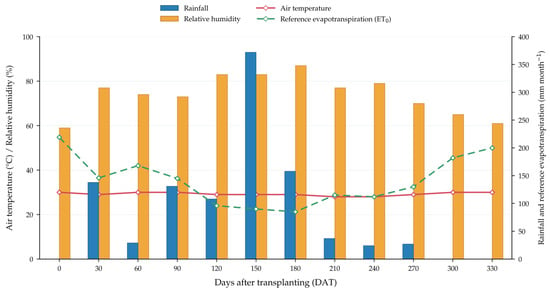
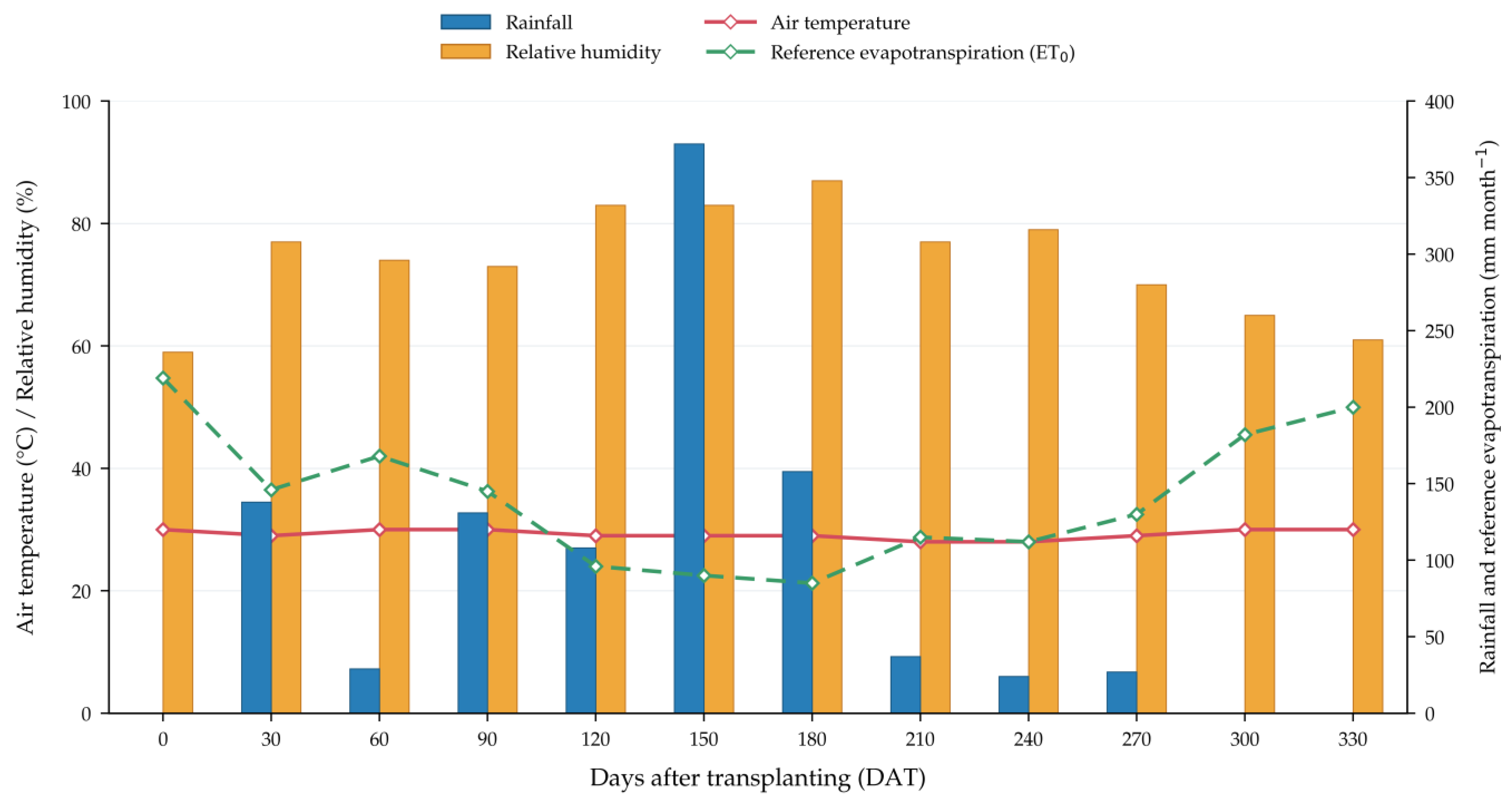
The field experiment was conducted from October 2022 to September 2023 at the Center for Human and Agricultural Sciences of Paraíba State University, in Catolé do Rocha, Paraíba, Brazil (6°20′38″ S; 37°44′48″ W; 275 m above sea level). The region has a hot semiarid climate, with irregular rainfall and a prolonged dry season [17]. Monthly records of mean air temperature, relative humidity, rainfall, reference evapotranspiration, and irrigation depth during the experimental period are presented in Figure 1.
Figure 1.
Mean air temperature and relative humidity, and monthly accumulated rainfall and reference evapotranspiration (ET0) during the field experiment in Catolé do Rocha, Paraíba, Brazil, from October 2022 to September 2023.
The soil was classified as an Entisol (Fluvent) [18]. Before the experiment was established, soil samples were collected from the 0–20 cm layer and homogenized to obtain a composite sample. Chemical and physical properties were determined following Teixeira et al. [19], and the initial soil characterization is presented in Table 1.
Table 1.
Initial chemical and physical properties of the soil at the experimental site.
2.2. Experimental Design and Treatments
A randomized block design was adopted in a 5 × 2 factorial arrangement with four replicates. The treatments consisted of five soil-applied elemental Si doses (0, 27, 54, 81, and 108 g plant−1) and two soil cover conditions: with and without plant-residue mulch. Each plot comprised four plants, with the two central plants used for evaluations, totaling 40 plots and 160 plants.
The commercial product Sifol® (silicic acid) was used as the Si source, with a declared composition of 92% SiO2 and 42.9% elemental Si by mass. Based on this elemental Si content, the cumulative doses of 0, 27, 54, 81, and 108 g Si plant−1 corresponded to total quantities of 0, 62.94, 125.87, 188.81, and 251.75 g of commercial product plant−1, respectively. Each treatment dose was divided into six equal soil applications, performed approximately 20 cm from the plant collar at transplanting and at 45, 90, 135, 180, and 225 DAT. Each application supplied 0, 4.5, 9.0, 13.5, or 18.0 g elemental Si plant−1, depending on the treatment. Throughout the article, including the regression analyses, treatment doses refer to the cumulative elemental Si supplied over the six applications.
The mulch consisted of dried plant residues from buffel grass (Cenchrus ciliaris) and Guinea grass (Megathyrsus maximus) available on the property, mixed in equal proportions (50% of each species). The material was distributed over the soil surface in an 8 cm thick layer within a radius of 80 cm around the plant collar, covering approximately 2.01 m2 per plant. The mulch was replenished whenever the layer thickness decreased to approximately 4 cm, restoring the initial thickness of 8 cm. Replenishment was therefore based on layer thickness rather than a fixed schedule.
2.3. Plant Material and Crop Management
Seed-propagated yellow passion fruit plants (Passiflora edulis Sims), accession ‘Guinezinho’, were used. Seedlings were grown in 1.5 L black polyethylene bags filled with a mixture of soil from the 0–20 cm layer and well-rotted cattle manure at a 1:1 ratio (v/v). Two seeds were sown per container, and seedlings were thinned at 30 days after sowing, retaining the most vigorous plant.
Seedlings were transplanted at 60 days after sowing at a spacing of 3.0 × 2.0 m, corresponding to approximately 1666 plants ha−1. Plants were trained on a vertical trellis with a single wire installed at a height of 2.0 m.
Planting holes measured 40 × 40 × 40 cm. Basal fertilization consisted of incorporating 7.7 kg of well-rotted cattle manure, 95 g of single superphosphate, and 50 g of FTE-BR12 per planting hole. Starting at 30 days after transplanting (DAT), urea, calcium nitrate, and potassium sulfate were applied monthly, with rates adjusted to crop developmental stages. The reported total amounts applied over the experimental cycle were 116, 200, and 350 g plant−1, respectively. Supplemental phosphorus fertilization began at 60 DAT, with single superphosphate applied every three months, totaling 250 g plant−1.
Phytosanitary management was performed throughout the cycle, with preventive and curative applications to control pests and diseases. During the flowering period, flowers were manually pollinated daily, following technical recommendations for yellow passion fruit cultivation.
2.4. Irrigation Management
Plants were irrigated daily by drip irrigation using two pressure-compensating emitters per plant, each with a nominal flow rate of 10 L h−1, positioned on opposite sides approximately 20 cm from the plant collar. The irrigation water had an electrical conductivity of 1.01 dS m−1 and a pH of 6.9.
Reference evapotranspiration (ET0) was estimated from the daily evaporation measured in a Class A pan installed near the experimental site, using a pan coefficient of 0.75, according to Equation (1).
where Epan represents Class A pan evaporation (mm day−1) and Kpan is the pan coefficient.
Crop evapotranspiration (ETc) was calculated using Equation (2):
where Kc is the crop coefficient. Values of 0.30 up to 60 DAT, 0.80 from 61 to 110 DAT, 1.20 during flowering and fruit formation up to approximately 160 DAT, and 0.80 during harvest were used [20]. These coefficients were adopted as the available reference for local growing conditions because Kc values specifically validated for passion fruit at the experimental site were unavailable. Their use represents an approximation of crop water requirements rather than a locally validated determination. Daily irrigation was determined based on ETc, and the applied irrigation depths are presented in Figure 1.
2.5. Experimental Assessments
2.5.1. Gas Exchange
Gas exchange was assessed at full flowering, at 220 DAT (40 days after the fifth Si application), between 07:00 and 9:00 h. Measurements were taken on the two central plants of each plot, using one leaf per plant. The fourth leaf of a tertiary branch, which was fully expanded and exposed to light, was selected. Measurements were performed using an infrared gas analyzer (CIRAS-3; PP Systems, Amesbury, MA, USA) at a photosynthetic photon flux density of 1200 μmol m−2 s−1. The chamber airflow rate was set to 300 mL min−1, and vapor pressure deficit was allowed to vary with ambient conditions. Readings were recorded once gas exchange variables had stabilized and no longer showed substantial fluctuations. For each variable, measurements from the two plants were averaged to obtain one value per plot for statistical analysis. The plot was the experimental unit, and individual plants were treated as subsamples.
Stomatal conductance (gs), net CO2 assimilation (A), and transpiration rate (E) were determined and expressed in mmol H2O m−2 s−1, μmol CO2 m−2 s−1, and mmol H2O m−2 s−1, respectively.
2.5.2. Relative Water Content and Electrolyte Leakage
Leaf relative water content (RWC) was determined during flowering (220 DAT) using leaves from the middle portion of the plants, following Cairo [21]. Ten leaf discs, each 1.0 cm in diameter, were collected per sample and immediately weighed to determine fresh weight. The discs were immersed in 20 mL of distilled water overnight and, after surface water was removed with absorbent paper, weighed to obtain turgid weight. They were then oven-dried at 65 °C for 48 h to determine dry weight. RWC was calculated using Equation (3).
where RWC is relative water content (%), and FW, TW, and DW are fresh, turgid, and dry weights, respectively.
Electrolyte leakage was determined at 220 DAT, using five leaf discs, each with an area of 113 mm2, immersed in 20 mL of distilled water. After overnight incubation at room temperature, the initial electrical conductivity of the solution was measured. The samples were subsequently heated in a water bath at 100 °C for 60 min, and the final electrical conductivity was determined. Electrolyte leakage was expressed as a percentage, following the procedure adapted from Campos and Pham Thi [22] (Equation (4)):
where EL is electrolyte leakage (%), and ECi and ECf are the initial and final electrical conductivities of the incubation solution, respectively.
2.5.3. Yield and Fruit Physical Attributes
Fruits were harvested daily when at least 30% of the peel surface was yellow. Harvest records were accumulated throughout the experimental harvest period for the two central plants of each plot. The number of fruits per plant was determined by dividing the cumulative number of fruits harvested from these plants by two. Average fruit mass was calculated as the ratio of cumulative fruit mass to the number of healthy fruits. The cumulative fruit mass used in this calculation corresponded to the same healthy fruits included in the count. Yield was estimated from the average production per plant and planting density and expressed in t ha−1. Specifically, cumulative fruit mass per plot (kg) was divided by the number of evaluated plants and multiplied by the planting density of approximately 1666 plants ha−1, with the result divided by 1000 to convert kilograms to tonnes.
When all treatments had fruits at the harvest stage, after the eighth month following transplanting, 10 fruits per plot were selected for physical and chemical characterization at the Soil and Water Laboratory of Paraíba State University. The ten fruits were treated as subsamples. For each physical attribute, individual fruit measurements were averaged to obtain one value per plot for statistical analysis. The plot was the experimental unit, represented by its mean.
The fruit shape index was calculated as the ratio of longitudinal to transverse fruit diameters, measured using a caliper with a precision of 0.1 mm. After the fruits were opened, seeds were separated from the pulp and counted. Seed mass and seedless pulp mass were determined using a balance with a precision of 0.01 g and expressed in g per fruit.
2.5.4. Pulp Chemical Attributes
Pulp pH, titratable acidity, and total soluble solids were determined following AOAC procedures [23]. The pulp was manually extracted, and the seeds were separated using a sieve. Pulp pH was measured using a digital benchtop pH meter (DL-PH; Del Lab, Araraquara, SP, Brazil), and total soluble solids were measured using a portable digital refractometer (PAL-1; Atago Co., Ltd., Tokyo, Japan). For titratable acidity, a 5 mL pulp aliquot was transferred to a 125 mL Erlenmeyer flask and diluted with 25 mL of distilled water. Two drops of 1% phenolphthalein were added, and the sample was titrated with 0.1 N NaOH previously standardized against potassium hydrogen phthalate. The endpoint was defined as a pink coloration persisting for 30 s. Titratable acidity was expressed as a percentage of citric acid, and total soluble solids were expressed in °Brix. The total soluble solids-to-titratable acidity ratio (TSS/TA) was calculated by dividing the values of these two attributes.
2.6. Statistical Analysis
Residual normality and homogeneity of variances were assessed using the Shapiro–Wilk and Bartlett tests, respectively (p ≤ 0.05). Data were subjected to analysis of variance, considering the effects of blocks, Si doses, mulch, and the interaction between Si doses and mulch. The significance of the effects was assessed using the F-test (p ≤ 0.05). The Si dose × mulch interaction tested whether dose responses differed between soil cover conditions. Comparisons between fitted curves or predicted extrema were descriptive and did not establish significant differences at individual doses.
Responses to Si doses were evaluated using linear and quadratic regression models within the factorial ANOVA framework. Dose responses were evaluated within each soil cover condition using treatment means across four blocks. Linear and quadratic components were tested against the residual mean square from the plot-level factorial ANOVA, accounting for replication, with 1 and 27 numerator and denominator degrees of freedom, respectively. Model selection considered the statistical significance of the regression, the coefficient of determination (R2), and the biological consistency of the responses. Doses associated with the maxima or minima of the quadratic models were estimated using x = –b/(2a), considering Equation (5) and the experimental range of 0–108 g plant−1. Given the five dose levels evaluated, these estimates were interpreted as model-based approximations rather than experimentally validated optima. Relative increases and decreases were calculated in relation to the predicted values at the zero dose.
where is the predicted response, x is the Si dose (g plant−1), and a, b, and c are the quadratic, linear, and intercept coefficients, respectively.
Analyses were performed in R version 4.5.1 using the RStudio interface [24]. Points in the figures represent the means of four replicates, with error bars indicating the standard error of the mean, while the curves represent the values predicted by the regression models.
3. Results
The ANOVA results for silicon doses, mulch, and their interaction are presented in Table S1. Dose responses were evaluated by regression under each soil cover condition. The equations presented in the figures express the predicted values of the variables (ŷ) as a function of silicon doses (x, in g plant−1), with and without mulch. Comparisons between fitted curves or predicted extrema are descriptive and do not establish statistically significant differences between mulch conditions at individual doses.
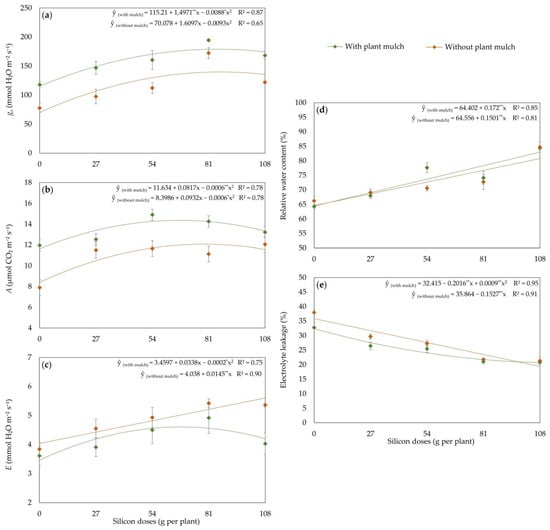
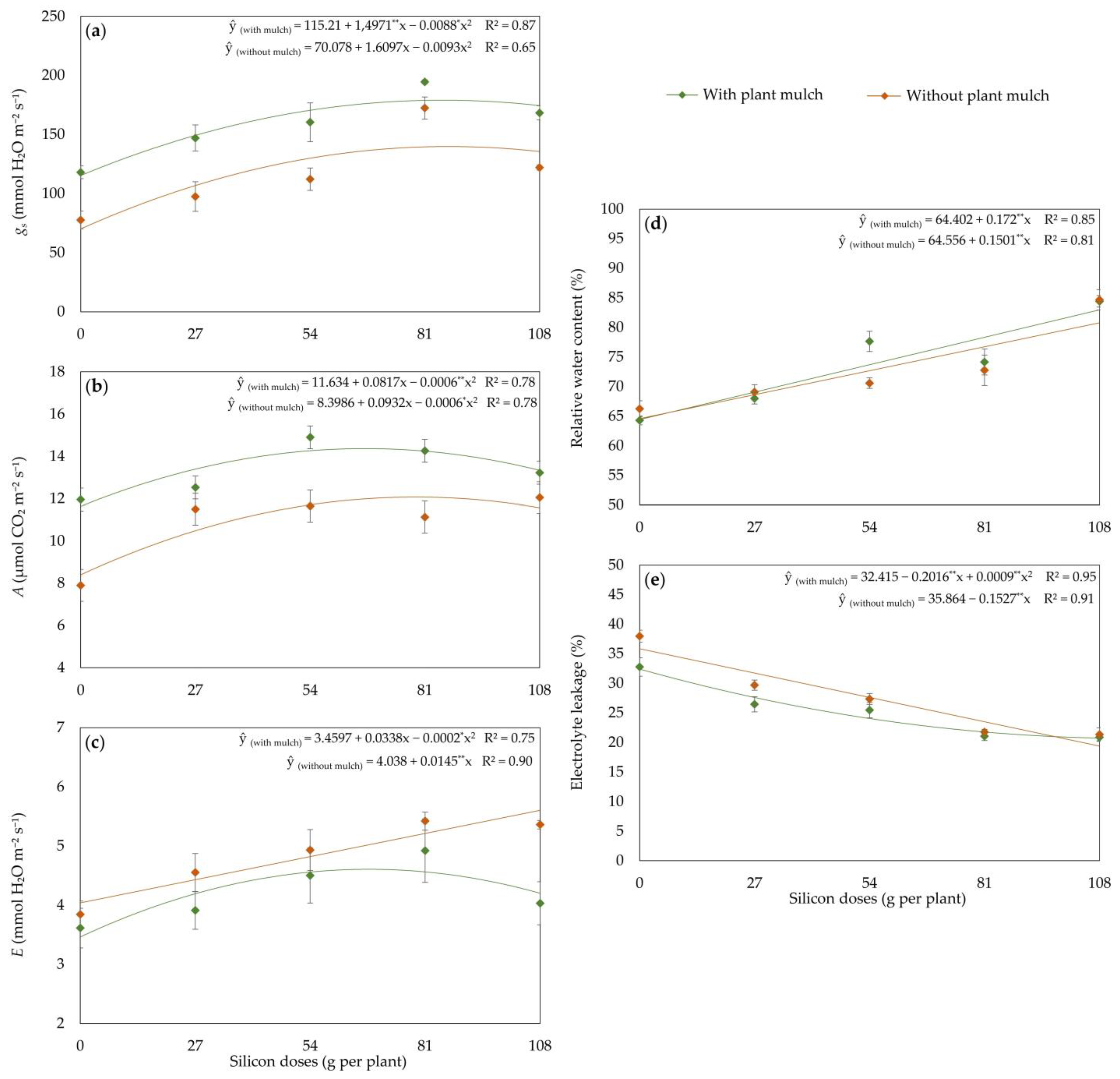
Stomatal conductance and net CO2 assimilation in yellow passion fruit showed quadratic responses to silicon doses under both soil cover conditions (Figure 2a,b). With and without mulch, the predicted maxima for gs occurred at doses of 85.06 and 86.54 g Si plant−1, corresponding to increases of 55.27% and 99.40%, respectively, relative to the zero dose. For A, the maxima occurred at doses of 68.08 and 77.67 g Si plant−1, with increases of 23.91% and 43.09%, respectively. Both variables decreased beyond the doses associated with the maximum responses.
Figure 2.
Stomatal conductance (gs) (a), net CO2 assimilation rate (A) (b), transpiration rate (E) (c), relative water content (d), and electrolyte leakage (e) in leaves of yellow passion fruit plants grown under different silicon doses, with or without mulch. Green and brown lines represent the fitted regression models for plants grown with and without mulch, respectively. ** and * indicate regression coefficients significant at p < 0.01 and p < 0.05, respectively, according to the F-test. Error bars represent the standard error of the mean (n = 4).
For transpiration, the fitted response pattern differed between soil cover conditions (Figure 2c). In mulched plants, the quadratic fit indicated an increase up to 84.50 g Si plant−1, followed by a decrease. This predicted maximum exceeded the value at the zero dose by 41.28%. In plants without mulch, transpiration increased linearly, reaching its highest predicted value at 108 g Si plant−1, an increase of 38.78% relative to the absence of Si. Across the evaluated range, the fitted curves predicted higher stomatal conductance and CO2 assimilation and lower transpiration with mulch.
Leaf relative water content increased linearly with silicon doses under both soil cover conditions (Figure 2d). Predicted values at the zero dose were 64.40% with mulch and 64.56% without mulch. At 108 g Si plant−1, predicted RWC values were 82.98% with mulch and 80.77% without mulch, corresponding to increases of 28.84% and 25.11%, respectively, relative to the zero dose. Thus, the absolute increases were 18.58 and 16.21 percentage points, respectively.
Electrolyte leakage decreased with silicon application, following a quadratic fit in mulched plants and a linear fit in plants without mulch (Figure 2e). The lowest predicted values within the evaluated range occurred at 108 g Si plant−1, reaching 21.14% with mulch and 19.37% without mulch, corresponding to reductions of 34.78% and 45.98%, respectively, relative to the absence of Si. At the zero dose, predicted values were 32.42% and 35.86%, respectively. Predicted leakage was numerically higher without mulch at zero Si, whereas the reverse pattern occurred at the highest dose evaluated.
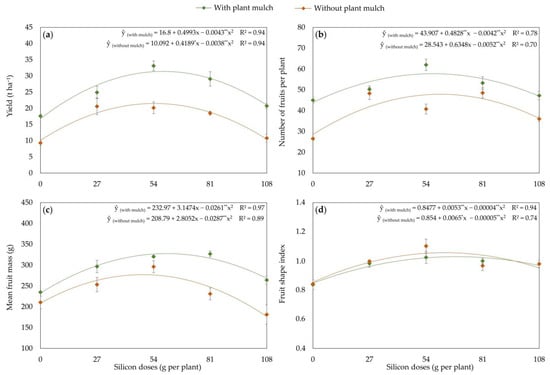
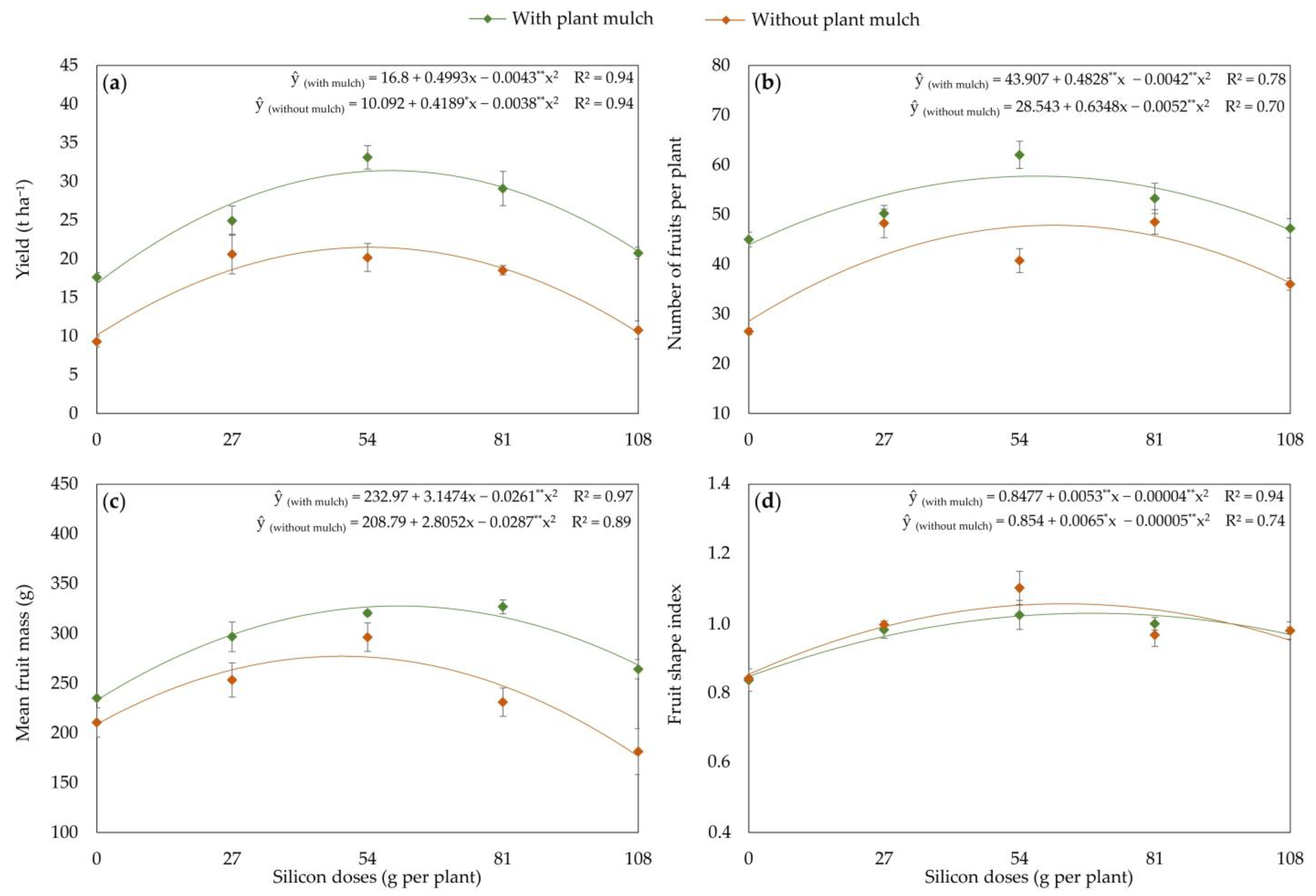
Yellow passion fruit yield showed a quadratic response to silicon doses under both soil cover conditions (Figure 3a). With mulch, the predicted maximum was 31.29 t ha−1 at 58.06 g Si plant−1; without mulch, it reached 21.64 t ha−1 at 55.12 g Si plant−1. These values represent model-based estimates rather than observed treatment means. Increases relative to the predicted values at zero dose were 86.28% and 114.39%, respectively, followed by decreases beyond the doses associated with the maximum responses. Despite the greater relative increase in plants without mulch, the predicted maximum yield was numerically higher in mulched plants. The fitted curves predicted higher yield with mulch throughout the evaluated range.
Figure 3.
Yield (a), number of fruits per plant (b), mean fruit mass (c), and fruit shape index (d) of yellow passion fruit plants grown under different silicon doses, with or without mulch. Green and brown lines represent the fitted regression models for plants grown with and without mulch, respectively. ** and * indicate regression coefficients significant at p < 0.01 and p < 0.05, respectively, according to the F-test. Error bars represent the standard error of the mean (n = 4).
The number of fruits per plant increased up to intermediate silicon doses, following quadratic fits under both conditions (Figure 3b). The predicted maxima were 57.78 fruits with mulch and 47.92 fruits without mulch, at doses of 57.48 and 61.04 g Si plant−1, respectively. These values exceeded those predicted at the zero dose by 31.60% and 67.88%, respectively. The doses associated with the highest fruit number were close to those associated with maximum yield under both soil cover conditions. At higher doses, the predicted fruit number decreased, with numerically higher predictions for mulched plants throughout the evaluated range.
For average fruit mass, the quadratic fit indicated maxima of 327.86 g with mulch and 277.34 g without mulch, obtained at doses of 60.30 and 48.87 g Si plant−1, respectively (Figure 3c). Relative to the zero dose, the increases were 40.73% and 32.83%, respectively. The predicted maximum with mulch was numerically 18.22% higher than that obtained without mulch and occurred at a higher Si dose. Beyond the respective maxima, the models indicated a decrease in average fruit mass under both conditions.
The fruit shape index showed a quadratic response under both soil cover conditions (Figure 3d), reaching predicted maxima of 1.02 with mulch and 1.07 without mulch at doses of 66.25 and 65.00 g Si plant−1, respectively. Increases relative to the zero dose were 20.71% and 24.74%, respectively, followed by decreases at doses above those associated with the maximum responses. Unlike average fruit mass, the predicted maximum fruit shape index (FSI) was numerically higher without mulch, although the corresponding doses were similar under both conditions.
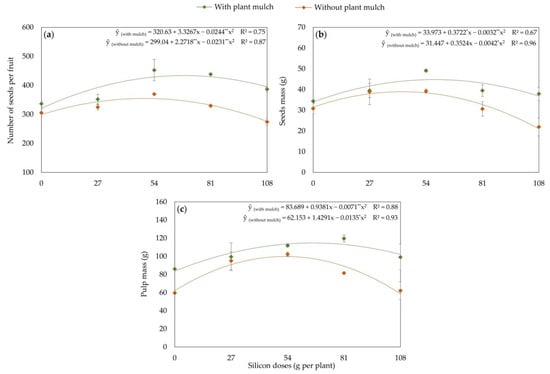
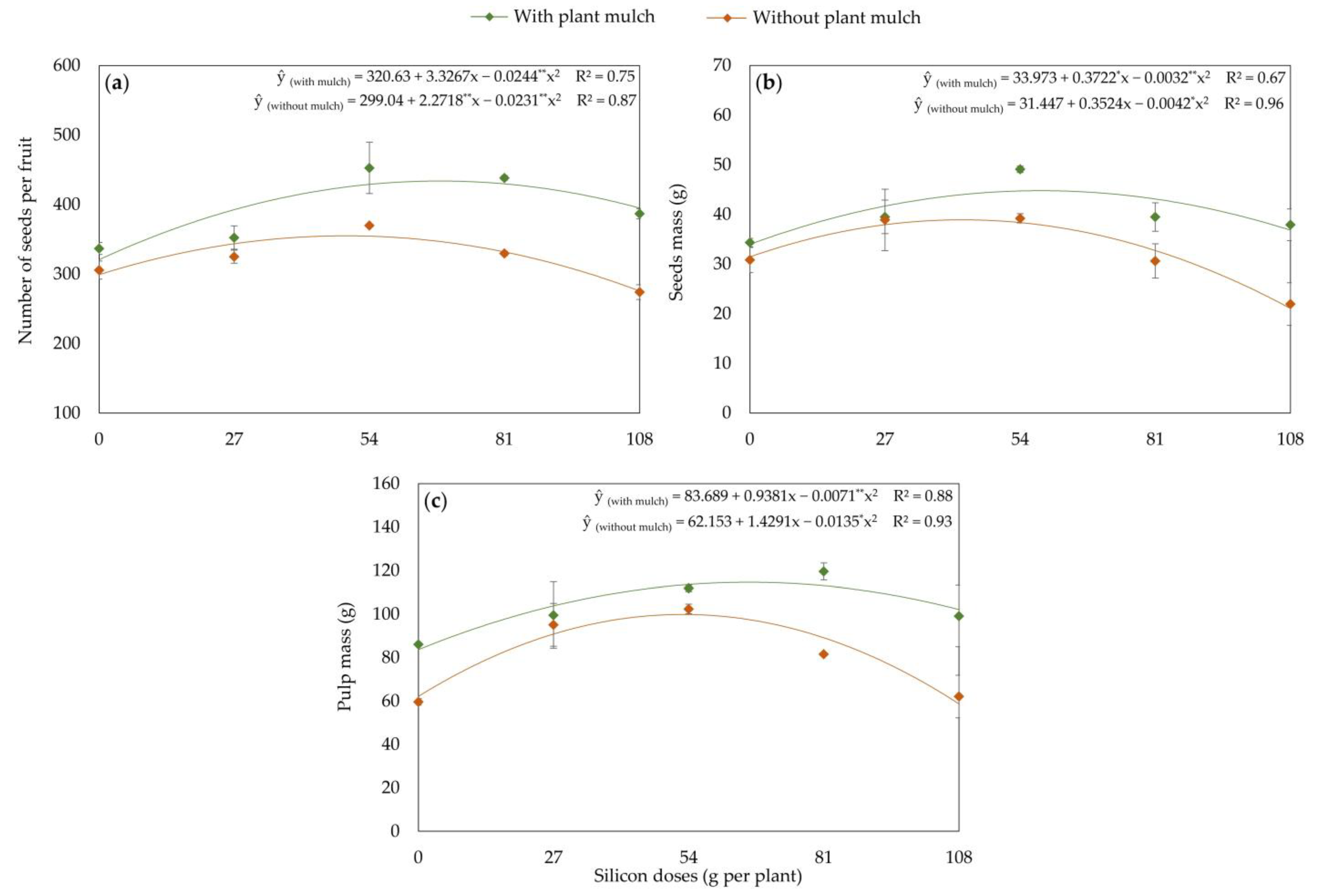
Seed number (Figure 4a) and seed mass (Figure 4b) per fruit showed quadratic responses to silicon doses under both soil cover conditions. With and without mulch, the predicted maximum numbers were 434.02 and 354.90 seeds per fruit at doses of 68.17 and 49.17 g Si plant−1, representing increases of 35.36% and 18.68%, respectively, relative to the zero dose. For seed mass, the maxima reached 44.80 and 38.84 g per fruit at doses of 58.16 and 41.95 g Si plant−1, with increases of 31.86% and 23.51%, respectively. The predicted maxima with mulch were numerically 22.30% and 15.34% higher for seed number and seed mass, respectively. Under both conditions, the dose associated with maximum seed mass was lower than that corresponding to maximum seed number. Both variables decreased beyond their respective doses associated with the maximum responses.
Figure 4.
Number of seeds per fruit (a), seed mass (b), and pulp mass (c) of yellow passion fruit plants grown under different silicon doses, with or without mulch. Green and brown lines represent the fitted regression models for plants grown with and without mulch, respectively. ** and * indicate regression coefficients significant at p < 0.01 and p < 0.05, respectively, according to the F-test. Error bars represent the standard error of the mean (n = 4).
Seedless pulp mass increased up to intermediate silicon doses and decreased at higher doses, following quadratic fits (Figure 4c). In mulched plants, the predicted maximum was 114.68 g per fruit at 66.06 g Si plant−1; without mulch, it was 99.97 g per fruit at 52.93 g Si plant−1. These values corresponded to increases of 37.03% and 60.85%, respectively, relative to the zero dose, with the predicted maximum under mulch being 14.71% higher than that obtained without mulch. As observed for average fruit mass and seed mass, the predicted maximum pulp mass occurred at a higher Si dose in mulched plants.
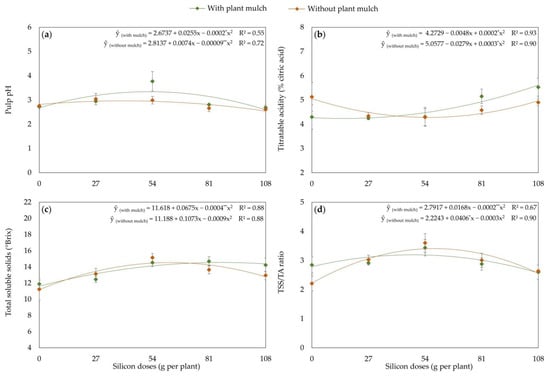
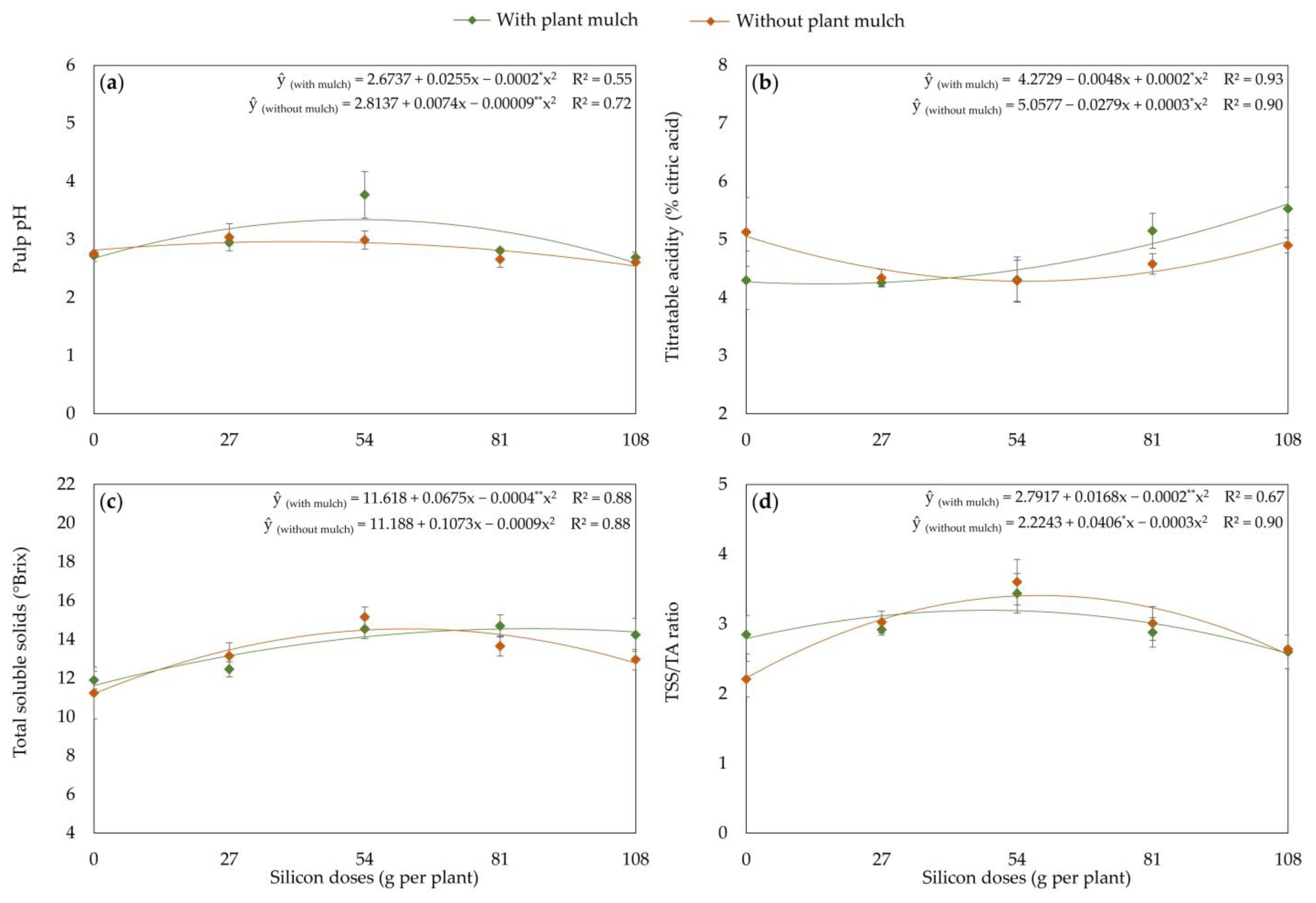
Regarding fruit chemical attributes, pulp pH showed a quadratic response to silicon doses under both soil cover conditions (Figure 5a). With mulch, the predicted maximum was 3.49 at 63.75 g Si plant−1; without mulch, it reached 2.97 at 41.11 g Si plant−1. Predicted values in the absence of Si were 2.67 and 2.81, respectively. Beyond the doses associated with the maximum responses, the models indicated a decrease in pH.
Figure 5.
Pulp pH (a), titratable acidity (b), total soluble solids (c), and total soluble solids-to-titratable acidity ratio—TSS/TA ratio (d) in fruits of yellow passion fruit plants grown under different silicon doses, with or without mulch. Green and brown lines represent the fitted regression models for plants grown with and without mulch, respectively. ** and * indicate regression coefficients significant at p < 0.01 and p < 0.05, respectively, according to the F-test. Error bars represent the standard error of the mean (n = 4).
Titratable acidity decreased to predicted minima of 4.24% citric acid with mulch and 4.41% without mulch at doses of 12.00 and 46.50 g Si plant−1, respectively (Figure 5b). Reductions relative to the zero dose were 0.67% and 12.83%, respectively, followed by increases at higher doses, according to the quadratic fits. The predicted relative reduction was greater without mulch, whereas the predicted minimum acidity was numerically lower with mulch.
For total soluble solids, the predicted maxima were 14.47 °Brix with mulch and 14.39 °Brix without mulch, obtained at doses of 84.38 and 59.61 g Si plant−1, respectively (Figure 5c). These values exceeded those predicted at the zero dose by 24.51% and 28.59%, respectively. Although the maxima were numerically similar, the corresponding dose was higher in mulched plants. Under both conditions, the response was quadratic, with decreases beyond the doses associated with the maximum responses.
The TSS/TA ratio also followed quadratic fits, reaching predicted maxima of 3.14 with mulch and 3.60 without mulch at doses of 42.00 and 67.67 g Si plant−1, respectively (Figure 5d). Increases relative to the absence of Si were 12.64% and 61.76%, respectively, followed by declines at higher doses. For this ratio, both the predicted maximum and the relative increase were numerically greater in plants without mulch.
4. Discussion
The results indicate that silicon application and soil cover management can contribute to the performance of yellow passion fruit under semiarid conditions, with distinct effects on physiological processes, yield components, and fruit attributes. Higher CO2 assimilation (Figure 2b), accompanied by changes in leaf hydration (Figure 2d) and membrane integrity (Figure 2e), provides a physiological basis for interpreting the yield gains. However, the different doses associated with maximum responses indicate that these benefits were not uniform.
The increase in stomatal conductance (Figure 2a), accompanied by higher net CO2 assimilation (Figure 2b), is consistent with reduced diffusional limitations to carbon entry into the leaves up to intermediate Si doses. Costa et al. [7] also observed increased photosynthetic rates and stomatal conductance in passion fruit seedlings following silicic acid application, accompanied by changes in epidermal thickness and stomatal characteristics. These findings support the responsiveness of passion fruit leaf structure and function to Si, although they do not establish the mechanisms operating in mature plants under field conditions. The dose associated with maximum assimilation was lower than that corresponding to maximum conductance under both soil cover conditions. This difference suggests that stomatal opening alone may not explain the photosynthetic response, as limitations related to the biochemical capacity for carbon fixation and the functioning of the photosynthetic apparatus may coexist.
Ferreira et al. [25] demonstrated that the responses of passion fruit seedlings to Si depend on the application method and genotype. Under salinity, Si mitigated changes in nutrition, gas exchange, and growth, with benefits from combined soil and foliar application, particularly in the cultivar ‘BRS Gigante Amarelo’. Although salt stress and the seedling stage preclude direct extrapolation of these responses to fruit-bearing plants, these results reinforce that the effects of Si should be interpreted according to growing conditions, plant material, and application method.
A possible non-stomatal contribution is supported by Wang et al. [26], who demonstrated effects of Si on photosynthetic performance and the protein composition of thylakoid membranes in rice under water deficit. Although this mechanism was not investigated in passion fruit, it indicates that responses to Si may involve processes beyond stomatal regulation. Thus, the higher assimilation observed should be interpreted as an integrated leaf response to the treatment.
The transpiration curves (Figure 2c) indicate that the maintenance of leaf hydration did not depend on a general reduction in E with increasing Si doses. The increasing response in plants without mulch and the quadratic response in mulched plants demonstrate that greater hydration can coexist with higher transpiration, provided that water supply meets leaf demand. The combination of higher predicted assimilation (Figure 2b) and lower predicted transpiration (Figure 2c) in mulched plants suggests a more favorable relationship between carbon acquisition and water loss during the evaluations.
The increase in relative water content (Figure 2d) with Si doses may result from changes in water uptake and transport, as well as changes in leaf water loss. In tomato plants subjected to polyethylene glycol-induced water stress, Shi et al. [6] demonstrated that Si increased root hydraulic conductance and improved plant water status, associated with reduced oxidative damage to root membranes. This study provides a plausible physiological explanation for the greater hydration observed in passion fruit, without restricting the effects of Si to the formation of a physical barrier on the leaf surface. In passion fruit, Diniz et al. [1] reported changes in water status and gas exchange in response to silicon and organic fertilization under semiarid conditions, reinforcing the relevance of soil management to the physiological response to Si.
The predicted RWC values near 64% at zero Si indicate that daily irrigation based on estimated ETc did not necessarily maintain high leaf hydration at sampling. Atmospheric demand and uncertainty in crop water requirement estimates may have contributed to these values, although their individual contributions could not be established. Accordingly, the increase in RWC with Si application should be interpreted as a relative improvement among treatments rather than evidence of fully hydrated tissues.
Mulch may contribute to maintaining plant water status by modifying root-zone conditions, particularly soil moisture conservation and temperature fluctuations. Zhang et al. [12] demonstrated that organic mulching materials altered soil moisture, daily soil temperature variation, and tomato yield, with responses depending on the material used. Although that experiment was conducted under protected cultivation in a cold climate, its results demonstrate that the thermal effects of mulch depend on the growing context. For passion fruit under semiarid conditions, reduced direct soil exposure and evaporative losses provide a consistent hypothesis for explaining part of the observed benefits.
The reduction in electrolyte leakage (Figure 2e) complements this interpretation, as it indicates lower release of cellular solutes under the assay conditions. Xu et al. [27] observed lower electrolyte leakage and lower hydrogen peroxide and malondialdehyde concentrations following Si application in wheat under osmotic stress. In avocado fruit from South Africa, Tesfay et al. [9] reported reduced electrolyte leakage and lipid peroxidation, together with increased catalase expression and activity, following postharvest potassium silicate treatments. These findings support a possible association between Si treatment, antioxidant protection, and membrane integrity.
Cellular protection may also involve biochemical mechanisms. Gong et al. [28] demonstrated that Si application increased superoxide dismutase, catalase, and glutathione reductase activities and reduced hydrogen peroxide accumulation in drought-stressed wheat. These findings provide a plausible biochemical explanation for the lower electrolyte leakage observed here.
The higher predicted yield in mulched plants (Figure 3a) is supported by studies conducted with the same species. Uchôa et al. [13] found that plant biomass mulch advanced harvest and increased fruit number and yield in organically grown passion fruit. Souto et al. [14] also observed yield benefits from soil mulching in yellow passion fruit irrigated with moderately saline water, associated with changes in plant mineral composition. However, the latter study used plastic film, which acts differently from plant residues. Together, these studies support the importance of protecting the soil surface for crop performance.
Gaturuku and Isutsa [29] compared wheat straw, black plastic film, and bare soil in purple passion fruit grown under a rain shelter in the Kenyan highlands. Mulching benefits depended on irrigation supply, with greater relevance under the lowest irrigation rate, whereas the evaluated fruit quality attributes did not differ significantly. These findings indicate that mulch responses depend on both material and water management. However, the highland environment and protected experimental conditions differ from the Brazilian semiarid field conditions evaluated here. In the present experiment, the mixture of Cenchrus ciliaris and Megathyrsus maximus residues was compared only with bare soil. Consequently, the results establish its performance relative to the absence of mulch but do not demonstrate superiority over other organic residues or plastic films.
Evidence from Australian avocado orchards provides an independent comparison. Dann and Le [8] reported improvements in yield and fruit quality following potassium silicate soil drenches, although visual tree health was not consistently improved. Their findings indicate that production responses to Si-containing treatments can occur in perennial fruit crops under field conditions. In the present study, the predicted yield maxima at approximately 55–58 g Si per plant should therefore be interpreted within the evaluated soil, irrigation, and mulch conditions rather than as a general recommendation for other production systems.
The proximity between the doses associated with maximum yield (Figure 3a) and maximum fruit number (Figure 3b) suggests that the yield response was partly linked to the number of fruits produced. The concurrent increase in average fruit mass (Figure 3c) indicates that production gains also involved individual fruit growth. Higher CO2 assimilation and improved leaf hydration provide a plausible physiological basis for supporting these components by favoring assimilate supply and tissue expansion.
The decline in yield, fruit number, and average fruit mass (Figure 3a–c) beyond intermediate doses indicates that the favorable response to Si had a limit within the range studied. This pattern alone does not demonstrate toxicity or nutritional imbalance, which would require additional evidence regarding tissue composition and soil conditions. The continued increase in relative water content up to the highest dose, alongside the decline in yield after its maximum, shows that improvement in a physiological indicator does not necessarily ensure higher production. The differences among the doses associated with maximum hydration, assimilation, and yield suggest that reproductive performance probably depends on the integration of resource acquisition, resource allocation, and the capacity of fruits to use these resources.
Fruit shape index maxima close to 1 (Figure 3d) indicate similar longitudinal and transverse dimensions. Its response to Si demonstrates changes in fruit proportions. This attribute should be interpreted together with pulp mass and other physical characteristics, without attributing higher juice yield solely to fruit shape.
The increases in seed number (Figure 4a) and seed mass (Figure 4b) suggest more favorable conditions for reproductive development within the fruits. The contribution of pollination deserves attention: Souza et al. [30] demonstrated that pollination timing influenced fruit characteristics and seed number in yellow passion fruit. Thus, the observed increases are consistent with more favorable conditions for fruit development but do not allow a direct effect of Si on pollination or fertilization to be established.
The higher seedless pulp mass in mulched plants (Figure 4c) represents a relevant outcome for the utilization of the harvested production. Mesquita et al. [31] reported responses of pulp volume, seed number, and chemical attributes of yellow passion fruit to Si and organic matter application under semiarid conditions, corroborating the sensitivity of these characteristics to management.
Pulp pH (Figure 5a) and titratable acidity (Figure 5b) did not reach their respective extrema at entirely coincident doses. This pattern is consistent with the fact that pH expresses hydrogen ion activity, whereas titratable acidity quantifies the acidity neutralized up to the titration endpoint. Therefore, changes in these attributes do not necessarily occur in inverse proportion or reach their extrema at the same dose. The small predicted reduction in acidity under mulch suggests a narrower response range under this condition, whereas the subsequent increase indicates that higher doses did not continuously reduce acidity. Thus, the quadratic responses indicate that increasing Si application did not produce a uniform change in pulp acidity, and the responses should be interpreted separately for each soil cover condition.
The soluble solids responses (Figure 5c) suggest that the effects of Si also extended to pulp composition. The increase up to intermediate doses is consistent with changes in assimilate supply to the fruits and solute concentration during their development. Wang et al. [11] observed increases in soluble solids, soluble sugars, and tomato fruit mass following foliar Si application under normal growing conditions. In passion fruit, Mesquita et al. [31] reported soluble solids responses to Si and organic matter application. These findings indicate that pulp composition can respond to Si-containing treatments, although the contribution of assimilate supply cannot be distinguished from changes in fruit water content or maturation in the present experiment.
The similar predicted soluble solids maxima under the two soil cover conditions, contrasting with the difference in yield, suggest responses of different magnitudes for production and pulp solute concentration. Larger fruits and higher production in mulched plants were not accompanied by a marked reduction in soluble solids maxima. However, these maxima occurred at different doses; therefore, their numerical similarity does not represent a comparison between treatments receiving the same dose or establish statistical equivalence. This result highlights the need to consider production quantity and pulp attributes jointly when evaluating management practices.
The higher predicted TSS/TA ratio in plants without mulch (Figure 5d) demonstrates that the more favorable yield response did not necessarily coincide with the highest value of this compositional indicator. Because the ratio depends on both components, its increase may result from higher soluble solids, lower acidity, or a combination of these responses. Therefore, the higher predicted value without mulch indicates a different relationship between soluble solids and acidity, whose implications for flavor perception and consumer preference require sensory evaluation. This response emphasizes that fruit quality encompasses attributes serving different purposes and cannot be defined exclusively by yield, fruit size, or the TSS/TA ratio. Ripoll et al. [32] showed that water deficit altered tomato fruit sugar and organic acid contents differently according to genotype and the developmental stage exposed to treatment. Although that experiment did not involve Si or mulch, it demonstrates that fruit composition responses to water availability are development-dependent, supporting caution when interpreting changes in TSS/TA as a uniform improvement in quality.
For passion fruit management under semiarid conditions, the results identify intermediate Si doses as candidates for validation when yield is the primary objective, whereas higher doses favored certain physiological indicators. Dose selection should consider production objectives, application costs, and pulp characteristics, as well as initial soil Si availability and the source used.
The combination with mulch showed potential to improve production. Because the experiment evaluated management responses under field conditions, the specific contribution of heat stress mitigation remains to be distinguished from other environmental effects. Advancing this approach requires integrating physiological assessments with water consumption, root-zone conditions, and economic performance to determine the extent to which the observed benefits persist at the commercial production scale. Direct comparisons with other mulch materials would also help determine whether the observed benefits depend on the selected grass residues or reflect a broader response to soil surface protection.
5. Conclusions
Silicon application and plant-residue mulch improved the physiological performance and yield of yellow passion fruit under the semiarid conditions evaluated, with responses depending on the dose and attribute evaluated. Mulch provided higher CO2 assimilation and lower transpiration, whereas increasing Si doses increased relative water content and reduced electrolyte leakage under both soil cover conditions.
The maximum predicted yield of 31.29 t ha−1 occurred with mulch at approximately 58 g Si per plant, indicating the potential of intermediate doses combined with this practice to improve production under the conditions evaluated. However, the doses associated with maximum responses differed among the physical and chemical fruit attributes, highlighting that management decisions should jointly consider yield and the desired quality characteristics. Because the experiment covered a single production cycle at one location, the estimated dose should be regarded as a model-based approximation rather than a general recommendation. Validation across additional production cycles and locations is needed before defining dose recommendations.
Supplementary Materials
The following supporting information can be downloaded at https://www.mdpi.com/article/10.3390/horticulturae12111360/s1, Table S1. F-statistics and p-values from the analysis of variance for stomatal conductance (gs), net CO2 assimilation (A), transpiration rate (E), relative water content (RWC), electrolyte leakage (EL), yield, number of fruits per plant (NFP), mean fruit mass (MFM), fruit shape index (FSI), number of seeds per fruit (NS), seeds mass, seedless pulp mass, pulp pH, titratable acidity (TA), total soluble solids (TSS), and the TSS/TA ratio of yellow passion fruit grown under different silicon doses, with and without plant-residue mulch.
Author Contributions
Conceptualization, W.M.B., R.F.P. and E.F.d.M.; methodology, W.M.B., R.F.P., C.d.S.S., J.P.C.D., I.D.d.M., M.S.d.S.; G.L.E.P., M.R.G.L., M.d.F.C.O., A.S.d.M., J.F.d.B.N., R.M.d.S. and E.F.d.M.; validation, W.M.B., R.F.P., C.d.S.S., A.S.d.M., J.F.d.B.N. and E.F.d.M.; formal analysis, R.F.P., C.d.S.S. and E.F.d.M.; investigation, W.M.B., R.F.P., C.d.S.S., J.P.C.D., I.D.d.M., M.S.d.S., G.L.E.P., M.R.G.L., M.d.F.C.O., A.S.d.M., J.F.d.B.N., R.M.d.S. and E.F.d.M.; resources, E.F.d.M. and A.S.d.M.; data curation, E.F.d.M.; writing—original draft, W.M.B. and R.F.P.; writing—review and editing, C.d.S.S., J.P.C.D., I.D.d.M., M.S.d.S., G.L.E.P., M.R.G.L., M.d.F.C.O., A.S.d.M., J.F.d.B.N., R.M.d.S. and E.F.d.M.; visualization, R.F.P.; supervision, E.F.d.M. and R.F.P.; project administration, E.F.d.M.; funding acquisition, E.F.d.M. All authors have read and agreed to the published version of the manuscript.
Funding
This study was financed in part by Paraiba State University, grant #01/2026, Coordination of Superior Level Staff Improvement—CAPES (Finance Code 001), National Council for Scientific and Technological Development—CNPq (Proc. CNPq 408952/2021-0), and Paraíba State Research Foundation—FAPESQ (Grant #09/2023).
Data Availability Statement
The raw data supporting the conclusions of this article will be made available by the authors on request.
Conflicts of Interest
The authors declare no conflicts of interest.
Abbreviations
The following abbreviations are used in this manuscript:
| ANOVA | Analysis of variance |
| AOAC | Association of Official Analytical Chemists |
| DAT | Days after transplanting |
| DW | Dry weight |
| ECi | Initial electrical conductivity |
| ECf | Final electrical conductivity |
| EL | Electrolyte leakage |
| Epan | Class A pan evaporation |
| ET0 | Reference evapotranspiration |
| ETc | Crop evapotranspiration |
| FW | Fresh weight |
| Kc | Crop coefficient |
| Kpan | Pan coefficient |
| RWC | Relative water content |
| TW | Turgid weight |
| FSI | Fruit shape index |
| TA | Titratable acidity |
| TSS | Total soluble solids |
| TSS/TA | Total soluble solids-to-titratable acidity ratio |
References
- Diniz, J.P.C.; Sousa, C.S.; Mesquita, E.F.; Soares, L.A.A.; Alves, S.B.; Sousa, F.S.; Pereira, R.F.; Soares, V.C.S. Physiology and yield of yellow passion fruit under organic and silicon fertilization in a semiarid environment. Pesqui. Agropecu. Trop. 2025, 55, e81389. [Google Scholar] [CrossRef] [Scilit]
- Menzel, C.M.; Simpson, D.R.; Dowling, A.J. Water relations in passionfruit: Effect of moisture stress on growth, flowering and nutrient uptake. Sci. Hortic. 1986, 29, 239–249. [Google Scholar] [CrossRef] [Scilit]
- Matsuda, H.; Takaragawa, H. Leaf photosynthetic reduction at high temperatures in various genotypes of passion fruit (Passiflora spp.). Hortic. J. 2023, 92, 412–423. [Google Scholar] [CrossRef] [Scilit]
- Brasil. Decreto nº 4.954, de 14 de janeiro de 2004. Available online: https://www.planalto.gov.br/ccivil_03/_ato2004-2006/2004/decreto/d4954compilado.htm (accessed on 21 October 2026).
- European Parliament; Council of the European Union. Regulation (EU) 2019/1009 of the European Parliament and of the Council of 5 June 2019 Laying Down Rules on the Making Available on the Market of EU Fertilising Products. Off. J. Eur. Union 2019, L 170, 1–114. Available online: https://eur-lex.europa.eu/eli/reg/2019/1009/oj (accessed on 21 October 2026).
- Shi, Y.; Zhang, Y.; Han, W.; Feng, R.; Hu, Y.; Guo, J.; Gong, H. Silicon enhances water stress tolerance by improving root hydraulic conductance in Solanum lycopersicum L. Front. Plant Sci. 2016, 7, 196. [Google Scholar] [CrossRef] [Scilit]
- Costa, B.N.S.; Costa, I.J.S.; Dias, G.M.G.; Assis, F.A.; Pio, L.A.S.; Soares, J.D.R.; Pasqual, M. Morpho-anatomical and physiological alterations of passion fruit fertilized with silicon. Pesqui. Agropecu. Bras. 2018, 53, 163–171. [Google Scholar] [CrossRef] [Scilit]
- Dann, E.K.; Le, D.P. Effects of silicon amendment on soilborne and fruit diseases of avocado. Plants 2017, 6, 51. [Google Scholar] [CrossRef] [Scilit]
- Tesfay, S.Z.; Bertling, I.; Bower, J.P. Effects of postharvest potassium silicate application on phenolics and other anti-oxidant systems aligned to avocado fruit quality. Postharvest Biol. Technol. 2011, 60, 92–99. [Google Scholar] [CrossRef] [Scilit]
- Moraes, D.H.M.; Mesquita, M.; Bueno, A.M.; Flores, R.A.; de Oliveira, H.F.E.; de Lima, F.S.R.; Prado, R.M.; Battisti, R. Combined effects of induced water deficit and foliar application of silicon on the gas exchange of tomatoes for processing. Agronomy 2020, 10, 1715. [Google Scholar] [CrossRef] [Scilit]
- Wang, L.; Jin, N.; Xie, Y.; Zhu, W.; Yang, Y.; Wang, J.; Lei, Y.; Liu, W.; Wang, S.; Jin, L.; et al. Improvements in the appearance and nutritional quality of tomato fruits resulting from foliar spraying with silicon. Foods 2024, 13, 223. [Google Scholar] [CrossRef] [Scilit]
- Zhang, P.; Zhang, Z.; Xiao, M.; Chao, J.; Dai, Y.; Liu, G.; Senge, M. Effects of organic mulching on moisture and temperature of soil in greenhouse production of tomato under unheated greenhouse cultivation in the cold zone of China. Food Sci. Nutr. 2023, 11, 4829–4842. [Google Scholar] [CrossRef] [Scilit]
- Uchôa, T.L.; Araújo Neto, S.E.; Selhorst, P.O.; Rodrigues, M.J.S.; Galvão, R.O. Yellow passion fruit performance in organic crop under mulch. Rev. Bras. Frutic. 2018, 40, e-212. [Google Scholar] [CrossRef] [Scilit]
- Souto, A.G.L.; Cavalcante, L.F.; Melo, E.N.; Cavalcante, Í.H.L.; Silva, R.Í.L.; Lima, G.S.; Gheyi, H.R.; Pereira, W.E.; Paiva Neto, V.B.; Oliveira, C.J.A.; et al. Salinity and mulching effects on nutrition and production of grafted sour passion fruit. Plants 2023, 12, 1035. [Google Scholar] [CrossRef] [Scilit]
- Tripathi, G.; Deora, R.; Singh, G. The influence of litter quality and micro-habitat on litter decomposition and soil properties in a silvopasture system. Acta Oecol. 2013, 50, 40–50. [Google Scholar] [CrossRef] [Scilit]
- Espindola, J.A.A.; Guerra, J.G.M.; Almeida, D.L.; Teixeira, M.G.; Urquiaga, S. Decomposição e liberação de nutrientes acumulados em leguminosas herbáceas perenes consorciadas com bananeira. Rev. Bras. Cienc. Solo 2006, 30, 321–328. [Google Scholar] [CrossRef] [Scilit]
- Alvares, C.A.; Stape, J.L.; Sentelhas, P.C.; Gonçalves, J.L.M.; Sparovek, G. Köppen’s climate classification map for Brazil. Meteorol. Z. 2013, 22, 711–728. [Google Scholar] [CrossRef] [Scilit]
- USDA—United States Department of Agriculture. Keys to Soil Taxonomy; USDA: Washington, DC, USA, 2014. [Google Scholar]
- Teixeira, P.C.; Donagemma, G.K.; Fontana, A.; Teixeira, W.G. (Eds.) Manual de Métodos de Análise de Solo, 3rd ed.; Embrapa: Brasília, Brazil, 2017. [Google Scholar]
- Souza, J.T.A.; Cavalcante, L.F.; Nunes, J.C.; Bezerra, F.T.C.; Nunes, J.A.S.; Silva, A.R.; Oresca, D.; Cavalcante, A.G. Effect of saline water, bovine biofertilizer and potassium on yellow passion fruit growth after planting and on soil salinity. Afr. J. Agric. Res. 2016, 11, 2994–3003. [Google Scholar] [CrossRef] [Scilit]
- Cairo, P.A.R. Curso Básico de Relações Hídricas de Plantas; Universidade Estadual do Sudoeste da Bahia: Vitória da Conquista, Brazil, 1995. [Google Scholar]
- Campos, P.S.; Pham Thi, A.T. Effects of an abscisic acid pretreatment on membrane leakage and lipid composition of Vigna unguiculata leaf discs subjected to osmotic stress. Plant Sci. 1997, 130, 11–18. [Google Scholar] [CrossRef] [Scilit]
- Association of Official Analytical Chemists. Official Methods of Analysis, 15th ed.; AOAC: Arlington, VA, USA, 1990. [Google Scholar]
- R Core Team. R: A Language and Environment for Statistical Computing; R Foundation for Statistical Computing: Vienna, Austria, 2020; Available online: https://www.R-project.org/ (accessed on 21 October 2026).
- Ferreira, R.S.; Pereira, R.F.; Silva, A.C.Z.; Brito Neto, J.F.; Lins, L.K.S.; Sousa, C.S.; Diniz, J.P.C.; Fernandes, F.S.; Maia, O.S.; Gomes, E.A.; et al. Silicon application methods differentially modulate nutrient uptake and morphophysiology in Passiflora edulis seedlings under salt stress. Horticulturae 2025, 11, 1396. [Google Scholar] [CrossRef] [Scilit]
- Wang, Y.; Zhang, B.; Jiang, D.; Chen, G. Silicon improves photosynthetic performance by optimizing thylakoid membrane protein components in rice under drought stress. Environ. Exp. Bot. 2019, 158, 117–124. [Google Scholar] [CrossRef] [Scilit]
- Xu, L.; Islam, F.; Ali, B.; Pei, Z.; Li, J.; Ghani, M.A.; Zhou, W. Silicon and water-deficit stress differentially modulate physiology and ultrastructure in wheat (Triticum aestivum L.). 3 Biotech 2017, 7, 273. [Google Scholar] [CrossRef] [Scilit]
- Gong, H.; Zhu, X.; Chen, K.; Wang, S.; Zhang, C. Silicon alleviates oxidative damage of wheat plants in pots under drought. Plant Sci. 2005, 169, 313–321. [Google Scholar] [CrossRef] [Scilit]
- Gaturuku, J.K.; Isutsa, D.K. Irrigation and mulch significantly enhance yield but not quality of purple passion fruits. ARPN J. Agric. Biol. Sci. 2011, 6, 47–53. [Google Scholar]
- Souza, M.M.; Pereira, T.N.S.; Viana, A.P.; Pereira, M.G.; do Amaral Júnior, A.T.; Madureira, H.C. Flower receptivity and fruit characteristics associated to time of pollination in the yellow passion fruit Passiflora edulis Sims f. flavicarpa Degener (Passifloraceae). Sci. Hortic. 2004, 101, 373–385. [Google Scholar] [CrossRef] [Scilit]
- Mesquita, E.F.; Mesquita, F.O.; Sousa, C.S.; Diniz, J.P.C.; Queiroz, L.L.G.; Soares, V.C.S.; Targino, F.N.; Jales, D.V.D.; Brito Neto, J.F.; Rocha, J.L.A.; et al. Silício e adubação orgânica sobre os atributos físico-químicos de frutos de maracujá-amarelo no semiárido Brasil. Rev. Bras. Geogr. Fís. 2024, 17, 100–116. [Google Scholar] [CrossRef] [Scilit]
- Ripoll, J.; Urban, L.; Brunel, B.; Bertin, N. Water deficit effects on tomato quality depend on fruit developmental stage and genotype. J. Plant Physiol. 2016, 190, 26–35. [Google Scholar] [CrossRef] [Scilit]

Disclaimer/Publisher’s Note: The statements, opinions and data contained in all publications are solely those of the individual author(s) and contributor(s) and not of MDPI and/or the editor(s). MDPI and/or the editor(s) disclaim responsibility for any injury to people or property resulting from any ideas, methods, instructions or products referred to in the content. |
© 2026 by the authors. Licensee MDPI, Basel, Switzerland. This article is an open access article distributed under the terms and conditions of the Creative Commons Attribution (CC BY) license.