


Abstract
Hot-water emasculation is used to inactivate pollen during artificial pollination; however, its application is limited to few plant species. Thermal sensitivity of reproductive organs in the Asteraceae family remains unclear. We investigated the effects of hot-water treatment on floral development and seed production in Artemisia princeps. Inflorescences at the bud stage were treated with water at different temperatures (38–50 °C), and the effects on male and female fertility, floral morphology, seed yield, and germination rate were evaluated. Reproductive performance gradually declined with increasing treatment temperature and duration. Flowers treated <46 °C, regardless of duration, and those treated at 46 °C for <10 min retained the ability to produce achenes and viable seeds. However, treatment at 46 °C for 10 min or at 48 °C and above substantially reduced reproductive success, decreased pollen viability, and only shriveled, non-viable seeds were produced. Contrary to greater thermal sensitivity of male reproductive organs commonly reported in several plant species, our findings suggest that female reproductive function appeared to be more sensitive than pollen viability in A. princeps. These findings indicate that both male and female reproductive organs are highly sensitive to hot-water treatment, limiting the applicability of hot-water emasculation in A. princeps.
1. Introduction
The genus Artemisia (Asteraceae) comprises a diverse group of plants with substantial ecological and medicinal value. Among these species, Artemisia princeps, a perennial herb native to East Asia, particularly Japan, has traditionally been used for its bioactive compounds, including sesquiterpenes, flavonoids, and essential oils, which exhibit anti-inflammatory, antimicrobial, and antioxidant properties. In addition to its pharmacological applications, A. princeps has attracted agricultural interest because of its medicinal value and potential as a cash crop [1]. However, the unique floral structure of Artemisia, characterized by small, wind-dispersed pollen grains and dense inflorescence clusters containing small, inconspicuous individual flowers [2] significantly hinders effective artificial pollination efforts, thereby limiting breeding progress. Information regarding the breeding system and natural selfing rate of A. princeps remains limited. Like many members of the Asteraceae, A. princeps produces capitula composed of numerous small florets, making manual emasculation and controlled pollination technically challenging. Consequently, the development of an efficient emasculation method would greatly facilitate breeding and genetic studies in this species.
Heat stress is a well-documented abiotic factor that can profoundly affect plant reproductive success, particularly during critical developmental stages such as gametogenesis, flowering, and fertilization [3]. Elevated temperatures can impair pollen viability, ovule function, and subsequent seed set, resulting in reproductive failure in many plant species [4]. Previous studies have shown that reproductive tissues are generally more sensitive to heat stress than vegetative tissues. Even short periods of elevated temperature can disrupt floral development, pollen maturation, fertilization, and seed formation. Male reproductive organs are particularly vulnerable to heat stress, often resulting in reduced pollen viability and reproductive failure [5,6]. Therefore, understanding the differential responses of reproductive tissues to heat treatment is important for both plant reproductive biology and practical breeding applications.
In rice (Oryza sativa), temperatures often exceeding 35 °C during flowering can cause anther indehiscence through disrupted programmed cell death and lignin deposition, as well as reduced pollen germination and ovule fertility, ultimately resulting in severe spikelet sterility and unfilled grains [7]. Similarly, in wheat, temperatures above 30 °C during heading and flowering can cause tapetal degeneration, shrinkage of stigmatic and ovarian tissues, and pollen tube arrest, significantly reducing pollen viability and seed set [8]. These effects have been attributed largely to heat-induced oxidative stress, altered regulation of heat shock proteins, and disruption of sugar and hormone metabolism in developing reproductive tissues [9]. However, the effects of heat stress vary considerably among species, with some exhibiting substantial thermotolerance, whereas others sustain irreversible reproductive damage even under moderate heat stress [5,10].
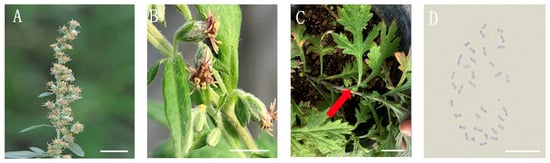
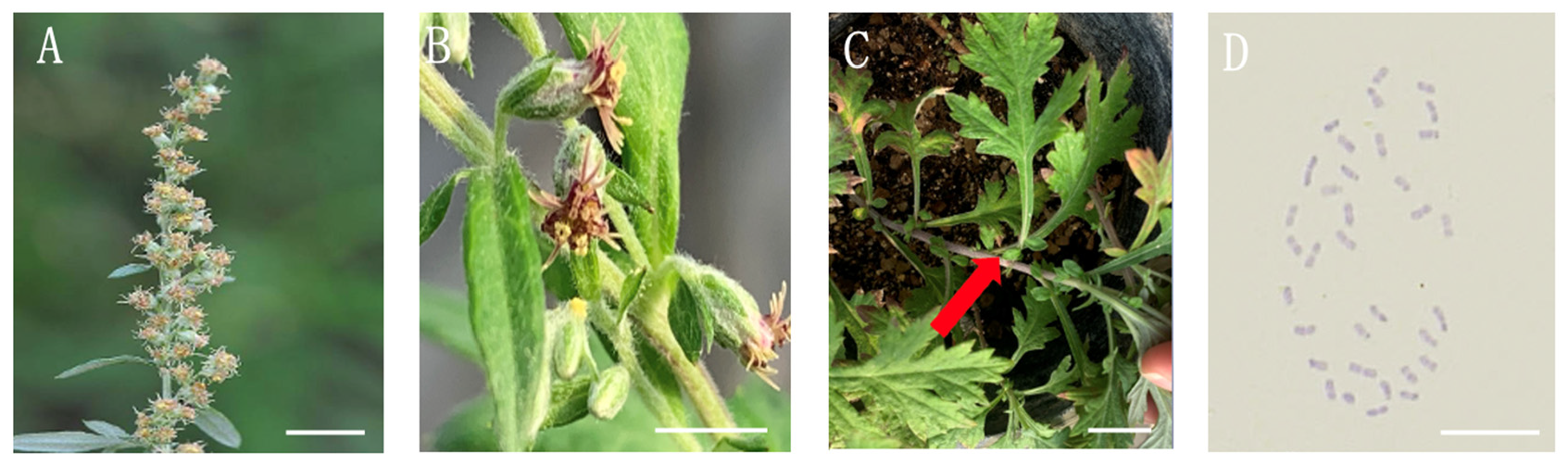
To investigate the susceptibility of reproductive tissues to heat in crop breeding, hot-water emasculation has been developed as a technique to artificially induce male sterility. This method involves applying heated water to floral organs at a specific developmental stage to selectively impair pollen function while preserving pistil function. It has been successfully applied in several crop species, including buckwheat and tomatoes [11,12]. However, little information is available regarding heat-induced reproductive sterility in the Asteraceae family. Asteraceae inflorescences comprise numerous small, structurally complex florets (Figure 1A,B), making manual emasculation impractical. This limitation underscores the need to explore and develop alternative methods of controlling fertility in these plants. Given that heat stress can induce male sterility, hot-water emasculation may offer a targeted physical approach to fertility control in Asteraceae.
Figure 1.
Identification of wild Artemisia specimens as A. princeps. (A) The inflorescence. Scale bar = 1 cm. (B) Blooming florets. Scale bar = 1 cm. (C) Leaves with pseudo-stipules (arrow) observed in the plants. Scale bar = 1 cm. (D) Chromosomal observation indicating 2n = 34. Scale bar = 100 µm.
However, the applicability of hot-water emasculation to A. princeps remains unknown. In particular, it is unclear whether male and female reproductive tissues of A. princeps differ in their sensitivity to hot-water treatment, and whether a temperature-duration combination exists that can selectively impair pollen function while maintaining female reproductive function. Addressing this knowledge gap is essential for evaluating the feasibility of hot-water emasculation as a tool for artificial hybridization in this species.
In this study, we aimed to investigate heat-induced reproductive sterility in A. princeps and evaluate the potential of hot-water treatment as an emasculation technique. Specifically, we examined whether pollen function could be selectively impaired while female reproductive function remained intact under different temperature-duration combinations. We also evaluated seed production and germination responses to identify treatment conditions suitable for artificial hybridization.
2. Materials and Methods
2.1. Plant Materials
Wild Artemisia specimens used in this study were collected from their natural habitats at the Nakamozu Campus of Osaka Metropolitan University. Species identity was confirmed based on chromosome number and morphological characteristics. Chromosome observations were conducted using the Feulgen staining method with Schiff’s reagent (Fujifilm Wako Pure Chemical Co., Osaka, Japan) [13]. Chromosome observations revealed 2n = 34 chromosomes, which is consistent with previous reports for A. princeps. Morphological identification was performed according to the diagnostic characteristics described in the Flora of Japan [14], including leaf morphology, plant habit, and inflorescence characteristics. The collected specimens exhibited morphological characteristics consistent with those described for A. princeps [14] (Figure 1). Plants were cultivated in pots (15 cm diameter, 12 cm deep) filled with a 1:3 mixture of vermiculite (Type GS; Nittai, Osaka, Japan) and culture soil (Sakata Super Mix A; Sakata Seed Co., Yokohama, Japan) in a greenhouse under natural daylight at 27 °C. Prior to the present study, preliminary bagging experiments were conducted to assess the reproductive capability of A. princeps under self-pollination conditions. Inflorescences isolated from external pollen sources successfully produced viable seeds, indicating that self-fertilization can occur in this species under experimental conditions.
2.2. Hot-Water Treatment
Before flowering, unopened capitula with similar stage were selected for treatment and immersed in hot water using a temperature-controlled water bath (TM-1; As One, Osaka, Japan) in a greenhouse. Treatments were applied at the pre-anthesis stage, when all florets had not yet opened, and anthers had not yet dehisced. During treatment, the entire capitulum and the upper portion of the peduncle were submerged in the water bath, and care was taken to ensure that the capitula remained completely immersed throughout the treatment period. The water bath was preheated to the target temperature before treatment, and treatment duration was recorded after the water temperature had stabilized at the designated temperature. Water temperature was continuously maintained at the designated temperature by the thermostatically controlled water bath throughout the treatment period.
In 2023, the experiment employed a factorial design with seven treatment temperatures (38 °C, 40 °C, 42 °C, 44 °C, 46 °C, 48 °C, and 50 °C) and five treatment durations (2, 4, 6, 8, and 10 min). Twenty flower buds were used per treatment replicate. Three biological replicates were conducted using buds collected from three independent plants. As controls, inflorescences of some plants were treated either with water at 27 °C or left untreated. Both control and treated inflorescences were enclosed in pollination bags throughout the experiment, allowing only self-pollination and excluding open pollination. Seeds produced by self-pollination were collected and used for germination tests. The 2024 experiment was designed as a follow-up study based on the results of the 2023 screening experiment to distinguish male and female reproductive responses under treatment conditions identified as causing severe reductions in normal seed production. Rather than repeating all temperature-duration combinations evaluated in 2023, selected treatment conditions were investigated further. These conditions were subsequently used to assess pollen viability and female reproductive function through artificial-pollination experiments. The same experimental procedures used in 2023 were applied during the flowering season. Based on the results of the 2023 screening experiment, flower buds were treated with hot water at 46 °C for 10 min, 48 °C for 2, 4, 6, 8, and 10 min, and 50 °C for 2, 4, 6, 8, and 10 min. Each treatment consisted of three biological replicates using flower buds collected from three independent plants. Each biological replicate consisted of 30 flower buds collected from a single plant. Pollen viability was evaluated using the acetocarmine staining method, whereas female reproductive function was assessed through artificial pollination using untreated pollen. The resulting seeds were subsequently used for germination tests.
2.3. Pollen Staining
Unopened flower buds collected 7 days after hot-water treatment were crushed on a glass slide, treated with 20 μL of 2% (w/v) acetocarmine per sample, and incubated for 10 min before microscopic examination. Pollen grains were examined and counted using a BX50 light microscope (Olympus, Tokyo, Japan). Acetocarmine-stained pollen grains were classified as viable, whereas unstained grains were classified as non-viable (Figure S1). Each treatment was performed in triplicate, with three flower buds analyzed per replicate.
2.4. Pollination and Seed Germination Experiment
After hot-water treatment, inflorescences assigned to the self-pollination treatment were enclosed in pollination bags and allowed to self-pollinate naturally. For the artificial pollination treatment conducted in 2024, pollen was collected from untreated flowers and manually transferred to the stigmas of hot-water-treated inflorescences. Immediately after pollination, the treated inflorescences were isolated to prevent secondary pollination and unintended pollen contamination. The inflorescences were subsequently maintained under these conditions until seed maturation. Germination was monitored daily for 14 days because A. princeps is a nondormant species that typically completes its germination within 7–14 days under optimal conditions [15]. For data collection, the number of mature seed-bearing structures obtained after each treatment was recorded. Normal seeds were defined as fully developed seeds, whereas defective seeds were defined as malformed or incompletely developed seeds observed within harvested achenes. Achenes containing only defective seeds were recorded as defective-seed-bearing achenes. For seed germination experiments, achenes were placed on moist filter paper in Petri dishes and incubated at a constant temperature of 25 °C. Seeds that were visibly shriveled and failed to germinate were classified as defective seeds.
3. Results
3.1. Hot-Water Treatment in 2023
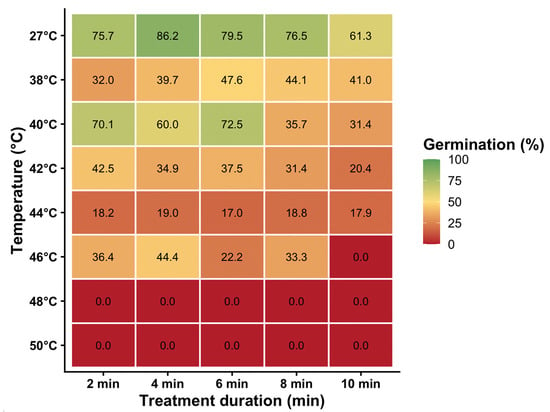
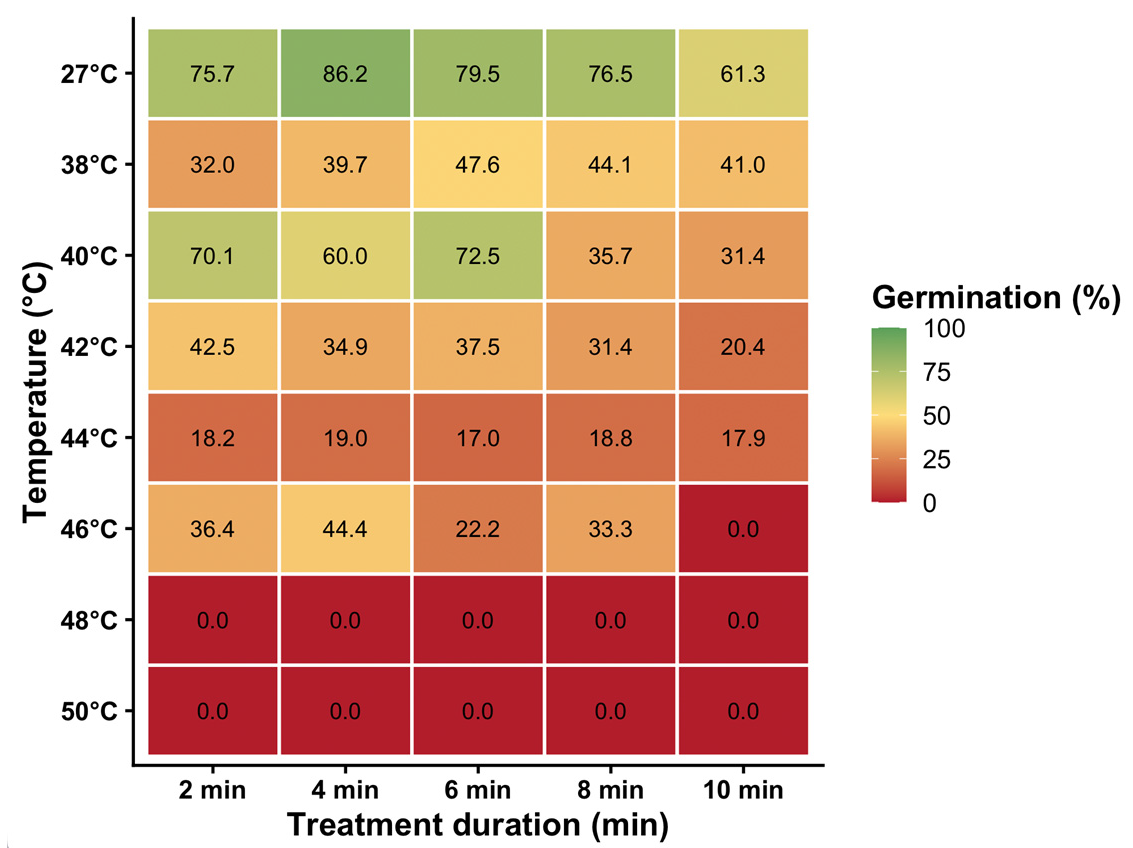
The production of achenes and seeds varied with hot-water treatment temperature and duration (Table 1, Figure 2). Similarly, the 27 °C control maintained high achene formation (19–20 achenes) and seed yield (65–78 seeds) across all treatment durations, although the seed germination rate decreased from 75.7% to 61.3% with prolonged exposure. A decline in reproductive performance was apparent at 38 °C. While achene production was only slightly reduced at longer treatment durations, with 18 achenes produced after 8 and 10 min of treatment, seed yield and germination rate decreased substantially to 45–49 seeds and 41–44%, respectively. This decline became more pronounced at 40 °C and 42 °C, where achene production decreased to 16–20 and seed production to 35–70 seeds, accompanied by a further general decline in germination rates. The impact became severe at 44 °C, where only 13–17 achenes and 28–55 seeds were produced, and germination rates were critically reduced to 17–19%. At 46 °C, germination rates ranged from 0 to 44.4% (Table 1, Figure 2), while seed production reduced to 27–33 seeds and achene production to 0–5 achenes per treatment. At 46 °C for 10 min and at higher temperatures (48 °C and 50 °C), achene and seed production were almost completely inhibited regardless of treatment duration.
Table 1.
Results of the hot-water treatment in the Year 2023.
Figure 2.
Seed germination rate under different hot-water treatments. Values shown in each cell represent germination percentages (%) under different combinations of treatment temperature and duration, and the color scale indicates the magnitude of germination rate.
3.2. Hot-Water Treatment in 2024
The 2024 experiment repeatedly implemented treatments at 46 °C for 10 min and at 48 and 50 °C for 2, 4, 6, 8 and 10 min assessing female reproductive function through pollination with normal pollen (Table 2) and male viability through pollen staining method (Table 3).
Table 2.
Results of hot-water treatments in 2024.
Table 3.
Pollen viability after hot-water treatment evaluated by acetocarmine staining in 2024.
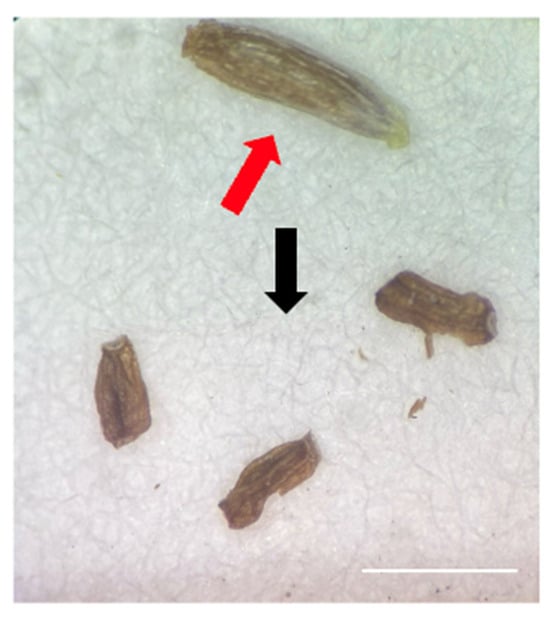
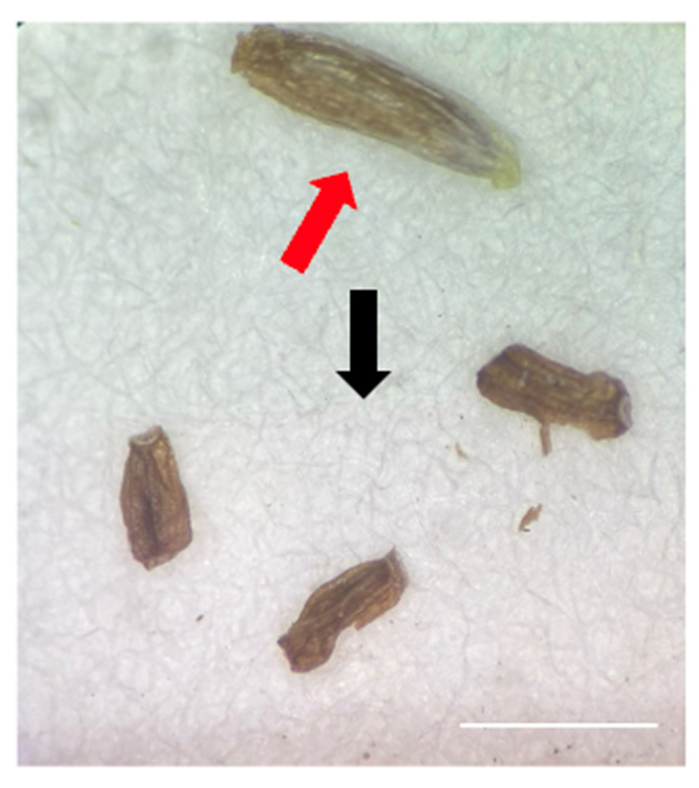
Under all treatment conditions, only non-viable seeds were observed in the self-pollinated group (Table 2, Figure 3). After treatment at 46 °C for 10 min, all 30 treated buds formed achenes, but only defective seeds were obtained. Similarly, at 48 °C, achene formation remained high, with 28-30 achenes depending on treatment duration; however, all seeds were defective and the germination rate was 0%. At 50 °C, achene production progressively declined with increasing treatment duration, and no achenes were produced after treatments for 8 or 10 min (Table 2).
Figure 3.
A normal seed (red arrow) and three defective seeds (black arrow). Representative examples of normally developed and defective seeds observed in this study. Scale bar = 1 mm.
In contrast, pollen viability remained relatively high after treatment at 46 °C for 10 min and at 48 °C, ranging from 67.7% to 82.4% (Table 3). Although pollen viability gradually decreased with increasing treatment duration at 48 °C, a substantial proportion of pollen grains remained stained. A marked reduction in pollen viability was observed only at 50 °C, where viability declined from 31.6% after 2 min of treatment to 0% after 10 min of treatment (Table 3).
Artificial pollination with normal pollen also resulted in complete loss of seed viability. Although some achenes and defective seeds were produced after treatments of up to 50 °C for 6 min, the germination rate remained 0% across all treatments. No seeds were produced after treatment at 50 °C for 8 or 10 min.
4. Discussion
This study demonstrated that both the temperature and duration of hot-water treatment critically affected achene formation, seed yield, and germination in A. princeps. In the first year, treatments with water at 27 °C minimally affected achene formation or seed production, although germination rates declined with prolonged exposure. Reductions in seed germination were already observed at 38 °C, whereas complete reproductive failure occurred at 46 °C for 10 min or at temperatures of 48 °C and above (Figure 2), as seed production was nearly abolished beyond this range. The second-year treatment confirmed that treatment at 46 °C for 10 min and higher temperatures might be suitable for inducing sterility. In contrast, the pollen viability results revealed a notable dissociation: high pollen viability (~82.4%) at 46–48 °C as assessed by acetocarmine staining contrasted with the failure to produce normal seeds. Furthermore, when the female flowers treated at 46–48 °C were pollinated with normal pollen, they produced only defective seeds. The prevalence of defective seeds under heat stress, despite apparently viable pollen, suggests that female reproductive function occurring after pollination was more severely affected by hot-water treatment. This aligns with previous studies showing that heat stress can disrupt multiple stages of plant sexual reproduction, including pollen tube growth, female gametophyte development, fertilization, and seed set [5]. In wheat, combined heat and drought stress have been reported to reduce stigma functionality and fertility [16]. In rice, heat stress inhibits pollen tube elongation by disrupting auxin homeostasis in pollinated pistils [17]. Furthermore, heat stress during gametogenesis can cause persistent damage to female reproductive tissues and reduce seed set [18].
Although previous studies have primarily examined chronic or prolonged heat stress rather than short-term heat treatment, they indicate that female reproductive tissues are particularly susceptible to elevated temperatures. Heat-induced reproductive failure has been associated with oxidative stress and damage to reproductive tissues. In rice, heat stress during gametogenesis has been reported to impair female reproductive organs and reduce seed set [19]. In the present study, the increased production of defective seeds under severe heat treatment indicates substantial disruption of reproductive development. Such reproductive failure may have resulted from fertilization failure, abnormal embryo development, impaired endosperm formation, or a combination of these processes. Heat stress during the bud stage can impair post-fertilization development, even when fertilization occurs, as shown in rice [19] and maize, where heat stress can disrupt endosperm development [20]. Although the present study provides no direct evidence, the defective seeds observed in A. princeps may reflect abnormalities in endosperm or embryo development. Cytological and physiological analyses of ovule, embryo, and endosperm development will be necessary to determine whether the defective seeds result from fertilization failure, impaired embryogenesis, or abnormal endosperm formation following heat treatment.
In this study, hot-water-treated flowers failed to produce viable seeds both following self-pollination and following pollination with normal pollen under the severe treatment conditions, implying that hot-water emasculation cannot be applicable to A. princeps. In rice (Oryza sativa), male reproductive development is highly sensitive to elevated temperatures, and heat stress during flowering can substantially reduce fertility through effects on anther and pollen development [7]. However, information regarding the effects of hot-water treatment on reproductive organs in Asteraceae species remains limited. In the present study, hot-water treatment in A. princeps appeared to affect both male and female reproductive functions. These results suggest that the reproductive responses to heat treatment may differ among plant species and that the effectiveness of hot-water emasculation may therefore be species-dependent. Although the present study clearly demonstrated the effects of hot-water treatment on reproductive performance in A. princeps, the underlying mechanisms responsible for reproductive failure remain to be fully elucidated. In particular, the developmental processes of the ovule, embryo, and endosperm after heat treatment were not directly examined. Future studies integrating cytological and physiological analyses will provide further insight into the reproductive tissues most vulnerable to heat stress and the pathways leading to defective seed formation. In addition, comparative investigations across other Asteraceae species may help determine whether species-specific differences in thermal sensitivity influence the feasibility of hot-water emasculation. Such studies will contribute to a better understanding of reproductive heat tolerance and may support the development of alternative fertility-control methods for hybrid breeding. Several aspects of the present study warrant further investigation. The 2024 artificial-pollination experiment was designed primarily to compare female reproductive function among treatment groups under the same pollination procedure. Future studies may benefit from incorporating untreated female × untreated pollen controls, which could provide additional support for validating the artificial-pollination procedure and further strengthen the interpretation of treatment effects.
5. Conclusions
In conclusion, reproductive failure occurred following hot-water treatment at 46 °C for 10 min or at temperatures of 48 °C and above, indicating a narrow transition zone between reproductive survival and sterility. While pollen viability assessed by acetocarmine staining markedly decreased at 50 °C, female reproductive function was also negatively affected by treatments at 46 °C for 10 min or at higher temperatures. The near-complete failure of seed set suggests that heat stress may affect female reproductive function or post-fertilization developmental processes before complete pollen inactivation was observed. Ultimately, these findings provide a basis for further investigation of the thermal sensitivity of reproductive development in A. princeps and the responses of male and female reproductive functions to heat stress.
Supplementary Materials
The following supporting information can be downloaded at https://www.mdpi.com/article/10.3390/horticulturae12111346/s1: Figure S1: Pollen after staining with acetocarmine. Red-stained pollen grains were considered viable, whereas unstained pollen grains were considered non-viable.
Author Contributions
Conceptualization, T.X. and T.T.; Methodology, T.X.; Validation, T.X. and T.T.; Formal Analysis, T.X.; Investigation, T.X.; Resources, T.X. and T.T.; Data curation, T.X. and T.T.; Writing—Original Draft Preparation, T.X.; Writing—Review and Editing, T.X. and T.T.; Visualization, T.X.; Supervision, K.S., S.Y. and T.T.; Project Administration, T.T. All authors have read and agreed to the published version of the manuscript.
Funding
This research was funded by JST SPRING grant number JPMJSP2139.
Data Availability Statement
The original contributions presented in this study are included in the article and Supplementary Material. Further inquiries can be directed to the corresponding author.
Conflicts of Interest
The authors declare no conflicts of interest.
References
- Yu, D.; Huang, N.-N.; Du, X.-W. Review of the Chemical Composition and Biological Activities of Essential Oils from Artemisia argyi, Artemisia princeps, and Artemisia montana. Curr. Top. Med. Chem. 2023, 23, 1522–1541. [Google Scholar] [CrossRef] [Scilit] [PubMed]
- Wetzstein, H.Y.; Porter, J.A.; Janick, J.; Ferreira, J.F.S. Flower morphology and floral sequence in Artemisia annua (Asteraceae). Am. J. Bot. 2014, 101, 875–885. [Google Scholar] [CrossRef] [Scilit] [PubMed]
- Resentini, F.; Orozco-Arroyo, G.; Cucinotta, M.; Mendes, M.A. The impact of heat stress in plant reproduction. Front. Plant Sci. 2023, 14, 1271644. [Google Scholar] [CrossRef] [Scilit] [PubMed]
- Mehmood, M.; Tanveer, N.A.; Joyia, F.A.; Ullah, I.; Mohamed, H.I. Effect of high temperature on pollen grains and yield in economically important crops: A review. Planta 2025, 261, 141. [Google Scholar] [CrossRef] [Scilit] [PubMed]
- Zinn, K.E.; Tunc-Ozdemir, M.; Harper, J.F. Temperature stress and plant sexual reproduction: Uncovering the weakest links. J. Exp. Bot. 2010, 61, 1959–1968. [Google Scholar] [CrossRef] [Scilit] [PubMed]
- De Storme, N.; Geelen, D. The impact of environmental stress on male reproductive development in plants: Biological processes and molecular mechanisms. Plant Cell Environ. 2014, 37, 1–18. [Google Scholar] [CrossRef] [Scilit] [PubMed]
- Matsui, T.; Omasa, K. Rice (Oryza sativa L.) cultivars tolerant to high temperature at flowering: Anther characteristics. Ann. Bot. 2002, 89, 683–687. [Google Scholar] [CrossRef] [Scilit] [PubMed]
- Gao, C.H.; Sun, M.; Anwar, S.; Feng, B.; Ren, A.X.; Lin, W.; Gao, Z.Q. Response of physiological characteristics and grain yield of winter wheat varieties to long-term heat stress at anthesis. Photosynthetica 2021, 59, 640–651. [Google Scholar] [CrossRef] [Scilit]
- Hemantaranjan, A.; Bhanu, A.N.; Singh, M.N.; Yadav, D.K.; Patel, P.K.; Singh, R.; Katiyar, D. Heat stress responses and thermotolerance. Adv. Plants Agric. Res. 2014, 1, 62–70. [Google Scholar] [CrossRef] [Scilit]
- Hedhly, A.; Hormaza, J.I.; Herrero, M. Global warming and sexual plant reproduction. Trends Plant Sci. 2009, 14, 30–36. [Google Scholar] [CrossRef] [Scilit] [PubMed]
- Mukasa, Y.; Suzuki, T.; Honda, Y. Emasculation of Tartary buckwheat (Fagopyrum tataricum Gaertn.) using hot water. Euphytica 2007, 156, 319–326. [Google Scholar] [CrossRef] [Scilit]
- Peet, M.M.; Sato, S.; Gardner, R.G. Comparing heat stress effects on male-fertile and male-sterile tomatoes. Plant Cell Environ. 1998, 21, 225–231. [Google Scholar] [CrossRef] [Scilit]
- Feulgen, R.; Rossenbeck, H. Mikroskopisch-chemischer Nachweis einer Nucleinsäure vom Typus der Thymonucleinsäure und die darauf beruhende elektive Färbung von Zellkernen in mikroskopischen Präparaten. Hoppe-Seyler’s Z. Für Physiol. Chem. 1924, 135, 203–248. [Google Scholar] [CrossRef] [Scilit]
- Kimura, M. Mugwort Botany and Cultivation; Japan Medical Herb Association: Tokyo, Japan, 2022. [Google Scholar]
- Ito, K.; Ide, K.; Inouye, J. Physiological and Ecological Studies on Artemisia princeps Pamp. II. Seed Propagation. J. Weed Sci. Technol. 1967, 6, 100–107. [Google Scholar]
- Fábián, A.; Sáfrán, E.; Szabó-Eitel, G.; Barnabás, B.; Jäger, K. Stigma functionality and fertility are reduced by heat and drought co-stress in wheat. Front. Plant Sci. 2019, 10, 244. [Google Scholar] [CrossRef] [Scilit] [PubMed]
- Zhang, C.; Li, G.; Chen, T.; Feng, B.; Fu, W.; Yan, J.; Fu, G. Heat stress induces spikelet sterility in rice at anthesis through inhibition of pollen tube elongation interfering with auxin homeostasis in pollinated pistils. Rice 2018, 11, 14. [Google Scholar] [CrossRef] [Scilit] [PubMed]
- Shi, W.; Yang, J.; Kumar, R.; Zhang, X.; Impa, S.M.; Xiao, G.; Jagadish, S.V.K. Heat stress during gametogenesis irreversibly damages female reproductive organ in rice. Rice 2022, 15, 32. [Google Scholar] [CrossRef] [Scilit] [PubMed]
- Satake, T.; Yoshida, S. High temperature-induced sterility in indica rices at flowering. Jpn. J. Crop Sci. 1978, 47, 6–17. [Google Scholar] [CrossRef] [Scilit]
- Commuri, P.D.; Jones, R.J. High temperatures during endosperm cell division in maize: A genotypic comparison under in vitro and field conditions. Crop Sci. 2001, 41, 1122–1130. [Google Scholar] [CrossRef] [Scilit]

Disclaimer/Publisher’s Note: The statements, opinions and data contained in all publications are solely those of the individual author(s) and contributor(s) and not of MDPI and/or the editor(s). MDPI and/or the editor(s) disclaim responsibility for any injury to people or property resulting from any ideas, methods, instructions or products referred to in the content. |
© 2026 by the authors. Licensee MDPI, Basel, Switzerland. This article is an open access article distributed under the terms and conditions of the Creative Commons Attribution (CC BY) license.