


Abstract
Plasma-activated water (PAW) is an emerging non-thermal sanitization technology with potential applications in postharvest preservation. In this study, nine PAW treatments, generated by varying discharge voltage, O2 flow rate, and activation time, were first evaluated for their effects on surface microbial counts, rot incidence, weight loss, and fruit firmness in stored peaches (Prunus persica (L.) Batsch). Compared with untreated control, all PAW treatments significantly inhibited the proliferation of surface microorganisms and delayed rot development. Fruits treated with PAW exhibited reduced weight loss and retarded softening. Among these treatments, T9 (8 kV, O2 flow rate 12 mL/min, activation time 30 min; pH 4.28, EC 42.83 μS·cm−1) achieved the best comprehensive performance across the measured indicators and was selected for further analysis. Total soluble solids (TSS) content on a fresh-weight basis was significantly lower in T9-treated fruit at day 4 but higher on days 16 and 20 compared with the control, while titratable acidity (TA) showed no significant difference throughout storage. Physiological and biochemical analyses showed that T9 treatment modulated ROS homeostasis, reduced H2O2 and MDA accumulation, and altered the rise-and-decline dynamics of O2•−, accompanied by enhanced antioxidant enzyme activities (SOD, POD, CAT, and APX) at several storage time-points and changes in PAL activity during storage. Total phenolic content and DPPH radical-scavenging capacity were higher in T9-treated fruit, while PAL activity differed significantly from the control only on days 8 and 20. Untargeted metabolomic analysis of fruit collected on days 0, 4, 12, and 20 revealed time-dependent changes in phenylpropanoid, flavonoid, and amino acid metabolism. Overall, PAW treatment may delay postharvest quality deterioration and decay in peach fruits, possibly through a combination of reducing surface microbial loads and modulating antioxidant and phenylpropanoid metabolism. These findings provide a basis for PAW application as a residue-free preservation technology.
1. Introduction
Peach (Prunus persica (L.) Batsch) is one of the world’s most economically important deciduous fruit crops, with annual production exceeding 24 million metric tons [1]. Its nutritional value, distinctive aroma, and visual appeal drive substantial commercial demand in both fresh and processed markets [1,2]. However, peaches are typical climacteric fruits. They exhibit vigorous postharvest physiological metabolism and senesce extremely rapidly at room temperature. Consequently, during storage, the fruit exhibits signs of severe loss of commercial quality, such as tissue softening, browning of the flesh, and loss of characteristic aroma [3]. In addition to postharvest physiological disorders, because peaches have thin skins and are juicy, they are highly susceptible to mechanical damage during harvesting, grading, packaging, and transportation, which provides a pathway for pathogen invasion and further exacerbates rot-related losses. Recent studies estimate that the global postharvest loss rate for peaches is as high as 20–40%, and this problem is particularly severe in developing countries that lack cold chain infrastructure [4]. The characteristic aroma is an important sensory attribute affecting consumer acceptance. However, it is highly susceptible to postharvest deterioration, and its loss, along with tissue softening, compromises the fruit’s commercial value [3,4]. Therefore, the development of effective preservation technologies is critically needed.
Current methods fall into physical and chemical categories. Low-temperature storage, the most common physical method, inhibits microbial growth and enzymatic activity [4]. However, peaches are cold-sensitive fruits and are highly susceptible to chilling injury when stored at temperatures between 2–8 °C, as evidenced by typical symptoms such as browning of the flesh, a crumbly texture, juice loss, and flavor deterioration. Chilling injury is most severe at temperatures around 5 °C [5,6]. Controlled-atmosphere storage, which inhibits fruit respiration by adjusting the ratio of O2 to CO2 in the storage environment, is another effective physical preservation method. However, it requires significant capital investment, entails high operating costs, and demands strict operational techniques, posing numerous challenges to its commercial adoption [7]. In the field of chemical preservation, 1-methylcyclopropene (1-MCP), as a competitive inhibitor of ethylene receptors, is widely used to delay the ripening and senescence of climacteric fruits. However, its effectiveness on peaches is inconsistent, in certain varieties and storage conditions, 1-MCP treatment may exacerbate physiological imbalances and inhibit the biosynthesis of aromatic compounds [8]. Disinfectants may promote pathogen resistance, chemical residues raise food-safety concerns, and the efficacy of edible coatings remains limited [9]. More importantly, most of the strategies focus on “delaying” rather than “regulating,” and lack the capacity for in-depth intervention in the complex physiological and metabolic networks involved in postharvest fruit senescence. These shared limitations highlight the urgent need to develop green, safe, and cost-effective alternative preservation technologies [10].
Low-temperature plasma (LTP), as an emerging non-thermal processing technology, has shown broad application prospects in the field of food preservation in recent years. Through gas discharge, this technology generates reactive oxygen and nitrogen species (RONS), ultraviolet photons, and electric fields, enabling efficient surface sterilization and metabolic regulation near room temperature [11]. However, applying plasma directly to the surface of food may cause oxidative damage or surface oxidation, and the large-scale application of high-voltage equipment still faces technical challenges. To overcome these limitations, researchers have developed plasma-activated water (PAW) technology, which uses water treated by plasma discharge as a medium to indirectly treat fruits through immersion or spraying, thereby achieving indirect plasma treatment. PAW typically has a low pH and a high redox potential, and is known to contain a complex mixture of reactive species whose composition depends on the preparation parameters [12,13]. The preservative effect of PAW is generally attributed to the dual functions of its active components: on the one hand, PAW exerts a broad-spectrum antimicrobial effect by disrupting microbial cell membranes and interfering with core metabolic pathways; on the other hand, appropriate levels of active species may act as mild oxidative cues that modulate the fruit’s antioxidant system [14]. In blueberries, strawberries, and leafy vegetables, PAW has been shown to inhibit pathogens such as Botrytis cinerea while maintaining storage quality [15,16]. Additional studies report that cold plasma-derived species suppress polyphenol oxidase (PPO), peroxidase (POD), and pectinolytic enzymes, thereby delaying cell wall degradation and preserving firmness [17].
Despite these encouraging results, systematic studies on PAW-treated peaches are lacking. Peach fruits possess an active metabolism, a fragile epidermis, and respond sensitively to external treatments, exactly the type of produce most likely to benefit from, and most at risk from, novel preservation interventions [18]. To date, it remains unclear how PAW affects peach surface microbial counts, postharvest physiology, and quality retention. We therefore treated peach fruits with PAW and evaluated its effects on postharvest quality, surface microbial counts, and softening-related changes. The results showed that, compared with other treatments, T9 significantly inhibited microbial growth on the fruit surface, reduced the rates of rot and weight loss, and delayed the decline in firmness and soluble solids, while maintaining titratable acidity at a level comparable to the control. At the biochemical level, PAW modulated ROS homeostasis by enhancing antioxidant enzyme activities and reducing excessive ROS accumulation. Non-targeted metabolomics revealed that PAW induced time-dependent metabolic adjustments, initially dominated by phenylpropanoid and flavonoid biosynthesis, as well as ABC transporters and aminoacyl-tRNA biosynthesis, shifting to secondary metabolite, alpha-linolenic acid, and linoleic acid metabolism in the middle phase, and culminating in the enrichment of plant hormone signal transduction and flavonoid biosynthesis in the late phase. In conclusion, T9 delays postharvest senescence, which is closely associated with reduced surface microbial loads, alleviated oxidative stress, and changes in phenylpropanoid and flavonoid metabolism. These findings provide a basis for its application as a residue-free preservation technology.
2. Materials and Methods
2.1. Test Materials
Peaches (Prunus persica (L.) Batsch cv. Okubao) were harvested at commercial maturity on 17 July 2026, from an orchard located in Nanpaozhuang Village, Xiaowangzhuang Town. Fruits were selected for uniform size and the absence of mechanical damage or visible disease, with individual fruit weight within the range of 200–220 g to ensure consistent fruit quality [19]. The selected fruits were randomly divided into ten groups: nine groups served as treatment groups (T1–T9) and one group served as the control. For each group, the fruits were further divided into two independent subsets. One subset was used for non-destructive measurements (rot incidence, weight loss, and firmness), divided into three biological replicates of 50 fruits each. The other subset was used for destructive sampling, also divided into three biological replicates. The flesh tissues of these fruits were pooled, ground in liquid nitrogen, and homogenized to generate a single composite sample per replicate for subsequent biochemical and metabolomic analyses.
2.2. PAW Preparation and Fruit Treatment
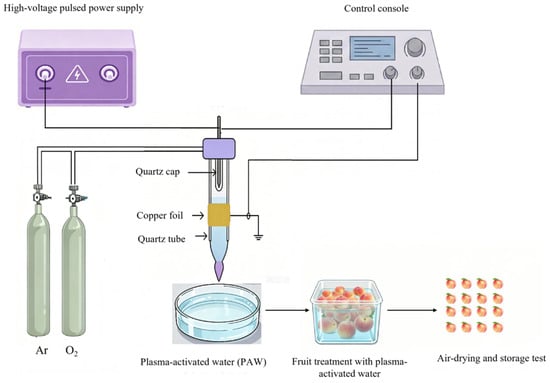
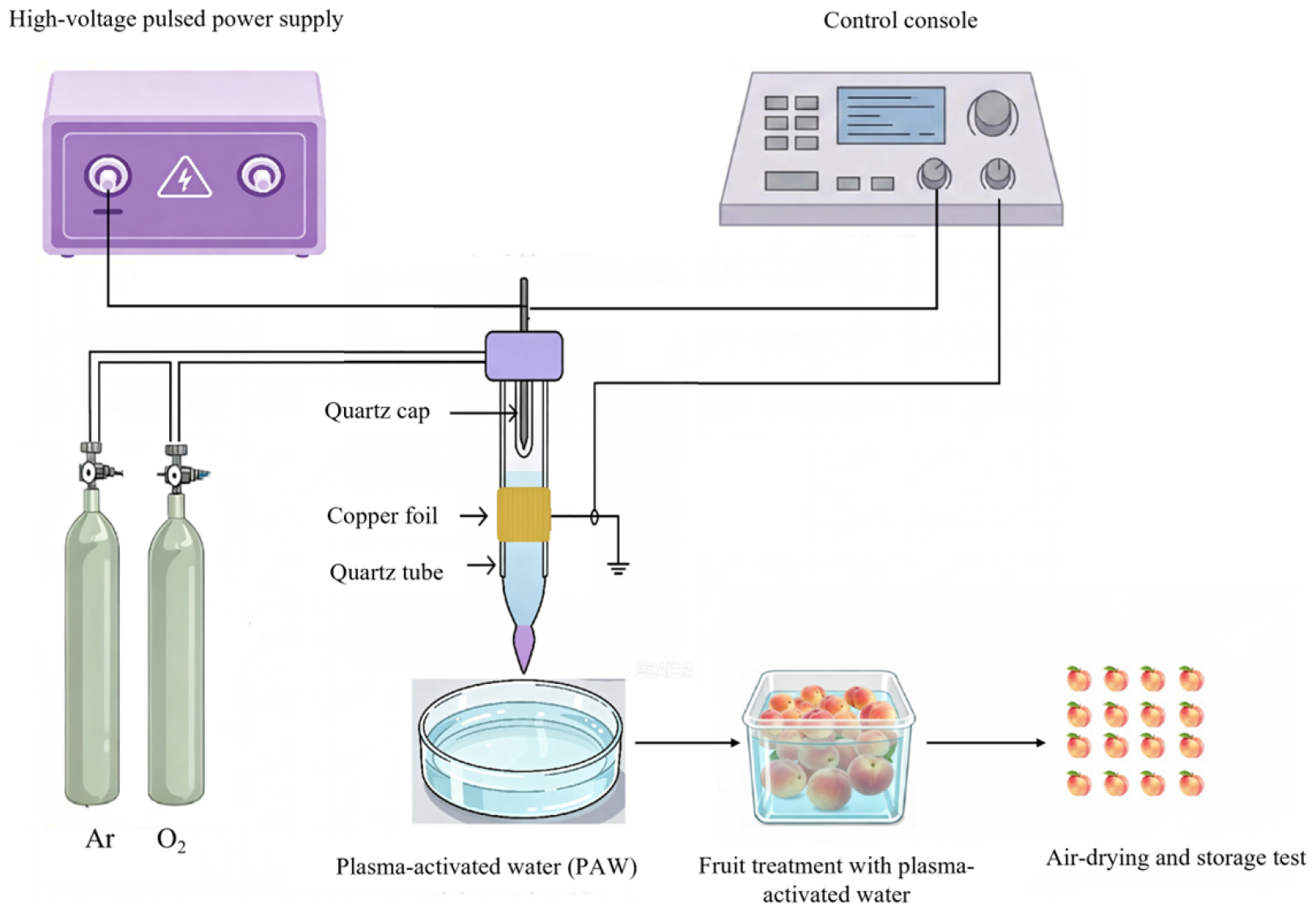
Plasma-activated water (PAW) was produced using a dielectric barrier discharge (DBD) device (Figure 1). DBD(designed and assembled by the collaborating laboratory at Hebei University of Technology, Tianjin, China) is a common method for generating low-temperature plasma at atmospheric pressure. It offers advantages such as simple equipment, easy operation, high yield of reactive particles, low processing temperature, and no chemical residues [13], and has been widely used in postharvest preservation of fruits and vegetables [20].
Figure 1.
Schematic diagram of the dielectric barrier discharge (DBD) system for plasma-activated water (PAW) preparation and peach treatment. The system mainly consists of a power supply, a control console, gas cylinders (Ar and O2), and a quartz reactor. Argon served as the working gas to sustain the discharge, and the O2 flow rate was regulated by the control console. Peach fruits were immersed in PAW, air-dried, and stored for further experiments.
Following the method described by Ma et al., three factors were selected for the orthogonal design: discharge voltage (6, 7, 8 kV), activation time (10, 20, 30 min), and oxygen flow rate (4, 8, 12 mL·min−1), forming an L9(34) orthogonal array [12]. These parameters represent the electrical, temporal, and gas-flow parameters of PAW preparation, determining the concentration and composition of RONS [21]. Based on this array, nine PAW solutions (T1–T9) were prepared with specific parameters as listed (Table 1). During the preparation, the discharge was operated at a constant frequency of 10 kHz. Argon was used as the working gas at a constant flow rate of 60 mL/min. It not only provides a stable discharge environment but also plays a crucial role in transferring energy and promoting the generation of RONS [22]. For each batch, 1 L of purified water was activated. To minimize the decay of reactive species, the freshly prepared PAW was used within 5 min after activation. Untreated purified water without plasma treatment served as the control. The pH and electrical conductivity (EC) of each PAW were measured immediately after activation.
Table 1.
Preparation of Plasma-Activated Water (PAW) under Different Conditions.
For fruit treatment, due to the short half-life of RONS, the treatments were conducted in batches. Briefly, fruits were immersed in the freshly prepared PAW for 5 min. This process was repeated with fresh PAW until all fruits in each group were treated. The control group was immersed in untreated purified water following the identical batch procedure. After immersion, all fruits were removed and air-dried at 25 °C for 2 h, then stored at 25 ± 1 °C and 50 ± 5% RH for 20 days [23]. Sampling and measurements were conducted at 4-day intervals throughout the storage period.
2.3. Enumeration of Surface Microorganisms
Following the method described by Zhang et al. [24] with minor modifications, a sterile cotton swab was dipped in sterile saline and used to uniformly swab a specified area (25 cm2) on the surface of the fruit’s equatorial region. The sampling site was chosen to avoid the areas around the fruit stalk and calyx to minimize interference from wounds and natural openings on microbial counts [24]. The swab was placed in 10 mL of sterile saline and thoroughly vortexed to prepare a microbial suspension. After a series of dilutions (10−1 to 10−5), 0.1 mL of the appropriately diluted microbial suspension was spread onto LB (Luria–Bertani) agar (for bacterial counting; incubated inverted at 37 °C for 24–48 h) and potato dextrose agar (PDA) (for fungal counting; incubated inverted at 28 °C for 3–5 days). Plates with colony counts ranging from 30 to 300 (bacteria) or 10 to 100 (fungi) were selected for counting. Microbial counts were expressed as Log CFU·cm−2 [25].
2.4. Determination of Rot Rate, Weight Loss Rate, and Fruit Firmness
Rot incidence was assessed by counting the number of rotten fruits in each group at each sampling time. Fruits were considered rotten when visible mycelial growth or a necrotic lesion diameter > 1 cm appeared on the surface. The rot rate was expressed as the percentage of rotten fruits relative to the total number of fruits in each specific replicate [26]. The weight loss rate was determined gravimetrically and calculated as follows: Weight loss (%) = [(Initial weight − Weight at measurement)/Initial weight] × 100. Measurements were taken every 4 days (n = 3 biological replicates per group) [27].
Fruit firmness was determined using a texture analyzer (TA. XT Plus, Stable Micro Systems, Godalming, Surrey, United Kingdom) equipped with a cylindrical probe (5 mm diameter). Texture profile analysis (TPA) was performed at two equidistant points on the equatorial region of each fruit after peeling. The probe compressed the fruit flesh twice to 20% deformation of the original fruit height at a constant speed of 30 mm·min−1, with a 5 s interval between the two compressions. The maximum force (N) recorded during the first compression was defined as firmness [28].
2.5. Orthogonal Experimental Design and Comprehensive Evaluation
An L9 (34) orthogonal array was used to optimize three PAW preparation parameters: applied voltage (6, 7, 8 kV), preparation time (10, 20, 30 min), and oxygen flow rate (4, 8, 12 mL/min). Range analysis was performed by calculating the mean response (kᵢ) at each factor level and the range (R = kmax − kmin) to determine the primary and secondary factors. ANOVA was further performed to test the significance of each factor (p < 0.05) [29].
A comprehensive evaluation integrating five storage indicators (total bacterial count, total fungal count, decay incidence, weight loss rate, and firmness) was conducted using fuzzy membership functions. Indicators were normalized to 0–1 using descending functions for negative indicators (microbial counts, decay, weight loss) and an ascending function for the positive indicator (firmness). The membership values were averaged with equal weighting (1/5 each) to obtain a comprehensive score (0–1) for treatment ranking [30].
2.6. Determination of Total Soluble Solids (TSS) and Titratable Acidity (TA)
Total soluble solids (TSS) were determined using a digital refractometer (ATAGO PAL-1; ATAGO CO., LTD., Tokyo, Japan) at 20 °C and expressed as °Brix. Titratable acidity (TA) was measured by titration with 0.1 mol·L−1 NaOH to pH 8.2 using phenolphthalein as the indicator, and expressed as citric acid (%) [31].
2.7. Determination of Reactive Oxygen Species Metabolism and Antioxidant Capacity Indices
O2•− and H2O2 contents were determined using commercial kits (Beijing Solarbio Science & Technology Co., Ltd., Beijing, China) following the manufacturer’s protocols and expressed as μmol·g−1, respectively. MDA content was measured by the thiobarbituric acid method [32] and expressed as nmol·g−1.
SOD activity was assayed by the nitroblue tetrazolium (NBT) photochemical reduction method [33], with one unit defined as the amount of enzyme required to inhibit 50% of NBT reduction. POD activity was determined by the guaiacol oxidation method, monitored at 470 nm [34]. CAT activity was measured by the ultraviolet absorption method [35], monitoring the decomposition of H2O2 at 240 nm. APX and PAL activities were measured using commercial kits (Solarbio, China) according to the manufacturer’s instructions, with all enzyme activities expressed as U·g−1 FW.
DPPH scavenging activity was evaluated spectrophotometrically at 517 nm [36] and calculated as the percentage of inhibition. Total phenolic content was determined by the Folin–Ciocalteu method and expressed as mg gallic acid equivalents (GAE) per 100 g FW.
2.8. Non-Targeted Metabolomics Analysis
For untargeted metabolomics analysis, fruit samples from the control and T9 groups were collected on days 4, 12, and 20, with day 0 sampled once as a common baseline. The sample collection, pooling of three biological replicates (10 fruits per replicate), and liquid nitrogen storage were performed as described in Section 2.1. The samples were then sent to Majorbio (Shanghai, China) for untargeted metabolomics analysis.
Metabolites were analyzed using an ultra-high-performance liquid chromatography–tandem mass spectrometry (UHPLC-Q Exactive HF-X system, Thermo Fisher Scientific, Waltham, MA, USA), with data acquired in both positive and negative ion modes. Raw data were processed using Progenesis QI software (version 3.0; Waters Corporation, Milford, MA, USA) for peak detection, extraction, alignment, and integration. Metabolite annotation was performed by searching against the HMDB database (http://www.hmdb.ca; accessed on 28 October 2026), the Metlin database (https://metlin.scripps.edu; accessed on 28 October 2026), and the Majorbio in-house plant-specific database (MJDBPM). Quality control (QC) samples were prepared by mixing equal volumes of all test samples and used to monitor instrument stability. After sum normalization, principal component analysis (PCA) and orthogonal partial least squares discriminant analysis (OPLS-DA) were performed using the ropls package (version 1.6.2) in R (version 4.1.2; R Foundation for Statistical Computing, Vienna, Austria). Differentially expressed metabolites were identified according to the criteria VIP > 1 and FDR < 0.05. The differentially expressed metabolites were annotated against the KEGG database for pathway enrichment analysis, with FDR < 0.05 set as the threshold for significant enrichment.
2.9. Statistical Analysis
All experiments were conducted with three independent biological replicates (n = 3). All data are presented as mean ± standard deviation (SD). For percentage data (rot incidence and weight loss), the data met the assumptions of normality and homogeneity of variance and were therefore analyzed directly without transformation. Prior to parametric testing (ANOVA and t-tests), the normality and homogeneity of variance of all datasets were confirmed using the Shapiro–Wilk and Levene’s tests, respectively. All statistical analyses were performed using SPSS 27.0 (IBM Corp., Armonk, NY, USA).
For the multi-treatment screening stage (T1–T9 and the control), differences among the ten treatments at each sampling time point were analyzed using one-way ANOVA followed by Duncan’s new multiple range test (DMRT) [37]. For the subsequent mechanistic validation stage (T9 vs. control), differences in TSS, TA, ROS, MDA, and antioxidant indices between the two groups across multiple time points were analyzed using independent samples t-tests with Holm-Šídák correction [38]. The probability level of p < 0.05 was considered statistically significant. All graphs were generated using GraphPad Prism 8.0 (GraphPad Software, San Diego, CA, USA).
3. Results
3.1. Characterization of PAW
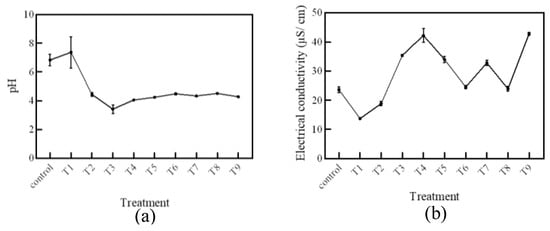
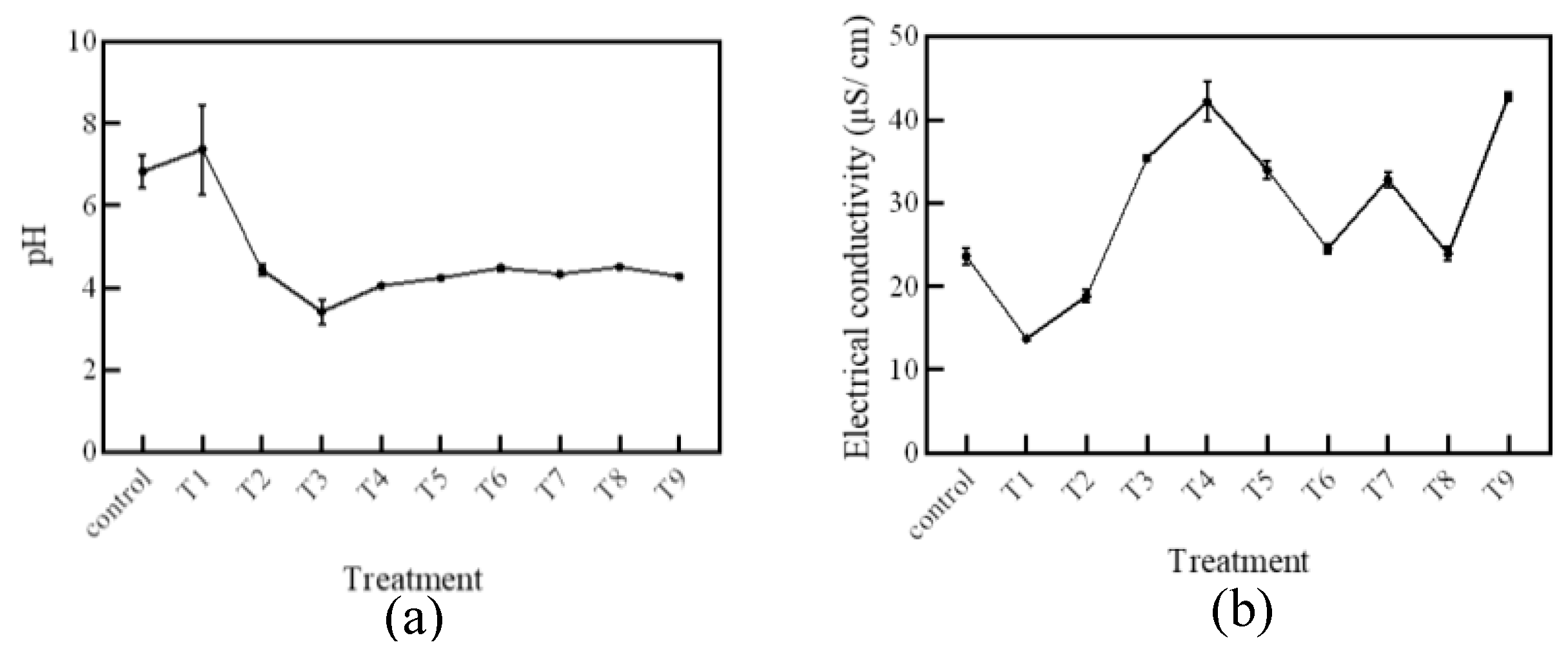
To characterize the physicochemical properties of PAW generated under varying discharge parameters, the pH and electrical conductivity (EC) of nine treatment groups (T1–T9) were measured, using untreated purified water as the control. Compared with the control group (pH 6.83, EC 23.6 μS/cm), the pH in most PAW treatments decreased (ranging from 3.42 to 7.37), with only T1 showing a slight increase. The EC values ranged from 13.70 to 42.83 μS/cm. Specifically, T1 (13.70 μS/cm) and T2 (18.83 μS/cm) exhibited lower values than the control, whereas the other seven treatments showed increased EC levels (Figure 2).
Figure 2.
Physicochemical properties of plasma-activated water (PAW) prepared under nine different conditions (T1–T9) and deionized water (control). (a) pH values; (b) electrical conductivity (EC). Data are presented as mean ± SD (n = 3).
3.2. Effects of PAW Treatments on Surface Microorganisms, Decay, and Quality Attributes
To investigate the actual preservative effect of the PAW treatment, the nine orthogonal treatment groups (T1–T9) and a control group were simultaneously applied in a peach storage experiment to compare the inhibitory effects of each treatment on the surface microflora.
PAW treatments significantly inhibited the growth of total bacteria and total fungi on peach surfaces during postharvest storage, expressed as log10 CFU/cm2 (Table 2 and Table 3). After 4 days of storage, colony counts increased in all treatment groups. However, compared with the control group, the PAW treatments significantly reduced the total number of bacteria and fungi on the fruit surface throughout the storage period (p < 0.05). After 20 days, the surface colony counts in the T9 treatment group were significantly lower than those in the control group and in most of the other treatment groups. Notably, the antimicrobial effect of T6 (EC 24.53 μS/cm, pH 4.49) was weaker than that of T5 (EC 33.93 μS/cm, pH 4.24). These results indicate that the antimicrobial efficacy of PAW varied depending on its generation parameters.
Table 2.
Effect of plasma-activated water (PAW) treatment on the total bacterial count on the surface of peach fruits during postharvest storage (log10 CFU/cm2).
Table 3.
Effect of plasma-activated water (PAW) treatment on the total fungal count on the surface of peach fruits during postharvest storage (log10 CFU/cm2).
Based on the established antimicrobial efficacy of PAW, its effect on the macroscopic storage quality of the fruit was further evaluated. After 20 days of storage, the decay rate in the T9 treatment group was 30%, compared with 65% in the control group (Table 4). The weight loss rate in all treatment groups showed a continuous upward trend during storage. The T9 treatment group was significantly lower than the control group at 4 days (p < 0.05), and by 20 days the weight loss rate was 46.63% in the control group versus 25.52% in the T9 treatment group (Table S1). Fruit firmness showed a continuous downward trend during storage, which was significantly slowed by the T9 treatment: firmness in the T9 group was significantly higher than that in the control group at 4 days, and this difference remained significant through 16 days (p < 0.05). At 20 days, the firmness of the T9 group was 25.1% higher than that of the control; however, this difference was no longer statistically significant (p > 0.05) (Table 5).
Table 4.
Effect of plasma-activated water (PAW) treatment on postharvest decay incidence in peach fruits during postharvest storage (%).
Table 5.
Effects of different low-temperature plasma-activated water (PAW) treatments on firmness of peach fruits during postharvest storage (N) during storage.
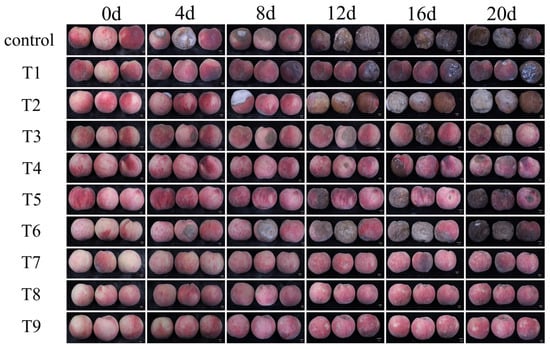
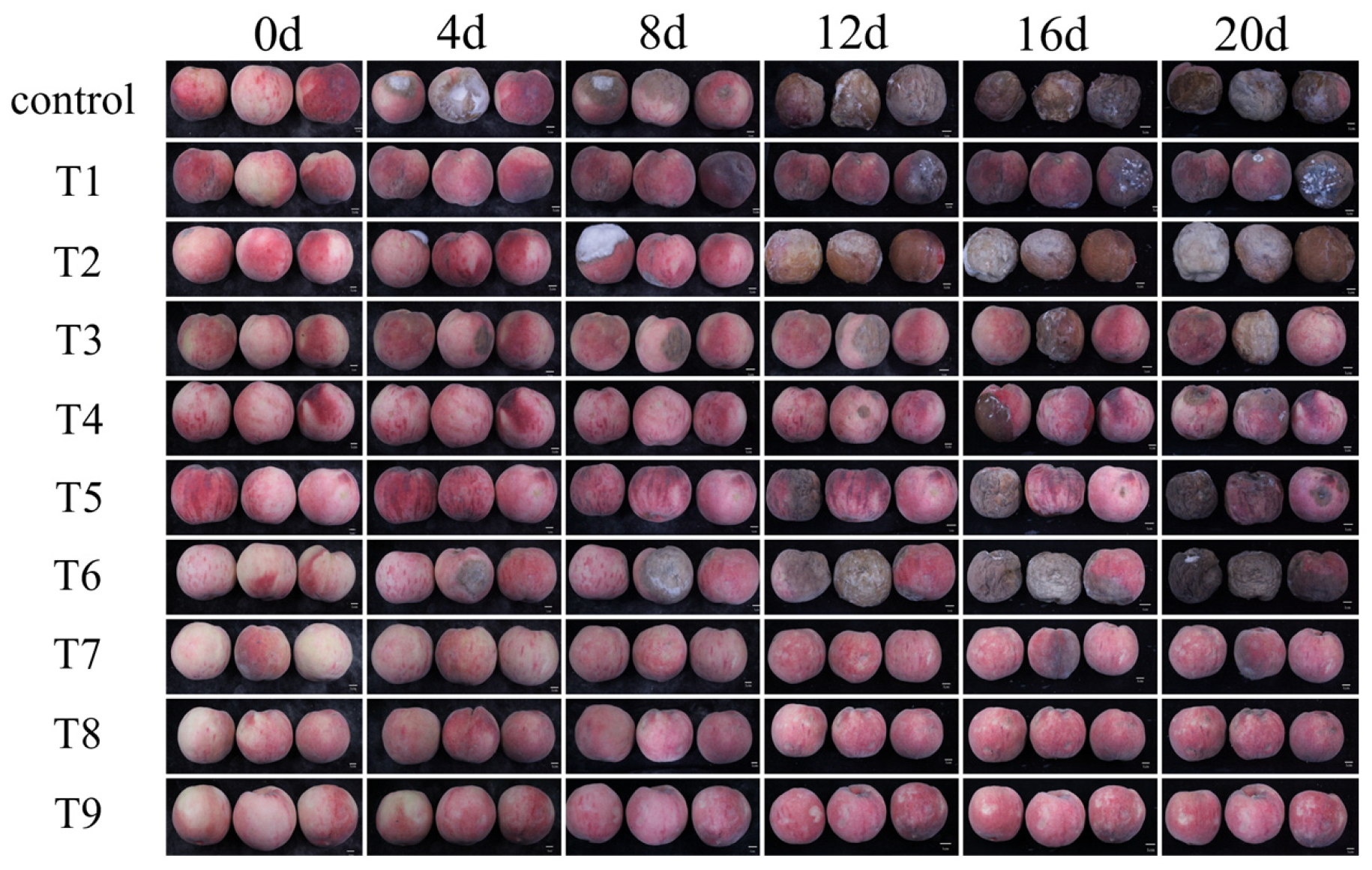
Photographs of fruit appearance show that after 8 days of storage, the fruits in the control group began to exhibit extensive shriveling, whereas the fruit surfaces of the T5 and T9 groups showed no obvious signs of decay. After 20 days, the T9 treatment group still maintained good color and fruit integrity (Figure 3).
Figure 3.
Appearance of peach fruits during 20 d of storage (25 ± 1 °C, 50 ± 5% RH). Representative photographs of the control and T1–T9 taken at 4-d intervals, with the same fruits monitored at each time point. Control: non-activated purified water, T1–T9: PAW treatments.
3.3. Orthogonal Analysis and Comprehensive Evaluation
Range analysis of the L9(34) orthogonal design showed that preparation time was the dominant factor influencing both pH (R = 1.536) and EC (R = 19.433), followed by oxygen flow rate for pH (R = 1.193) and voltage for EC (R = 10.944) (Table S2). As preparation time increased from 10 to 30 min, the mean pH continuously decreased, and the mean EC increased. In contrast, the mean values for voltage and oxygen flow rate showed intermediate optima (e.g., lowest pH at level 2 of voltage and oxygen flow rate) rather than monotonic trends. ANOVA confirmed that all three factors significantly affected pH and EC (p < 0.05) (Table S3).
To determine the optimal treatment, a comprehensive evaluation integrating five storage indicators was conducted using fuzzy membership functions. T9 ranked first among all treatments (score 0.993), followed by T8 (0.728) and T7 (0.721), while the control ranked last (0.084) (Table S4). Balancing physicochemical properties, antibacterial efficacy, and fruit safety, T9 (8 kV, 30 min, 12 mL/min; pH 4.28, EC 42.83 μS/cm) was preliminarily selected as the preferred treatment for subsequent mechanistic studies.
3.4. Effects of PAW on TSS and TA
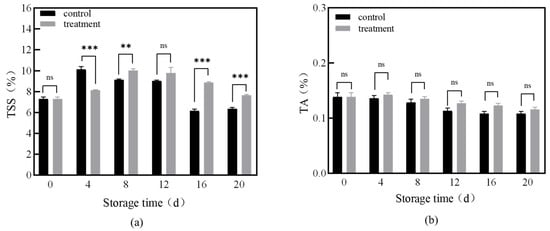
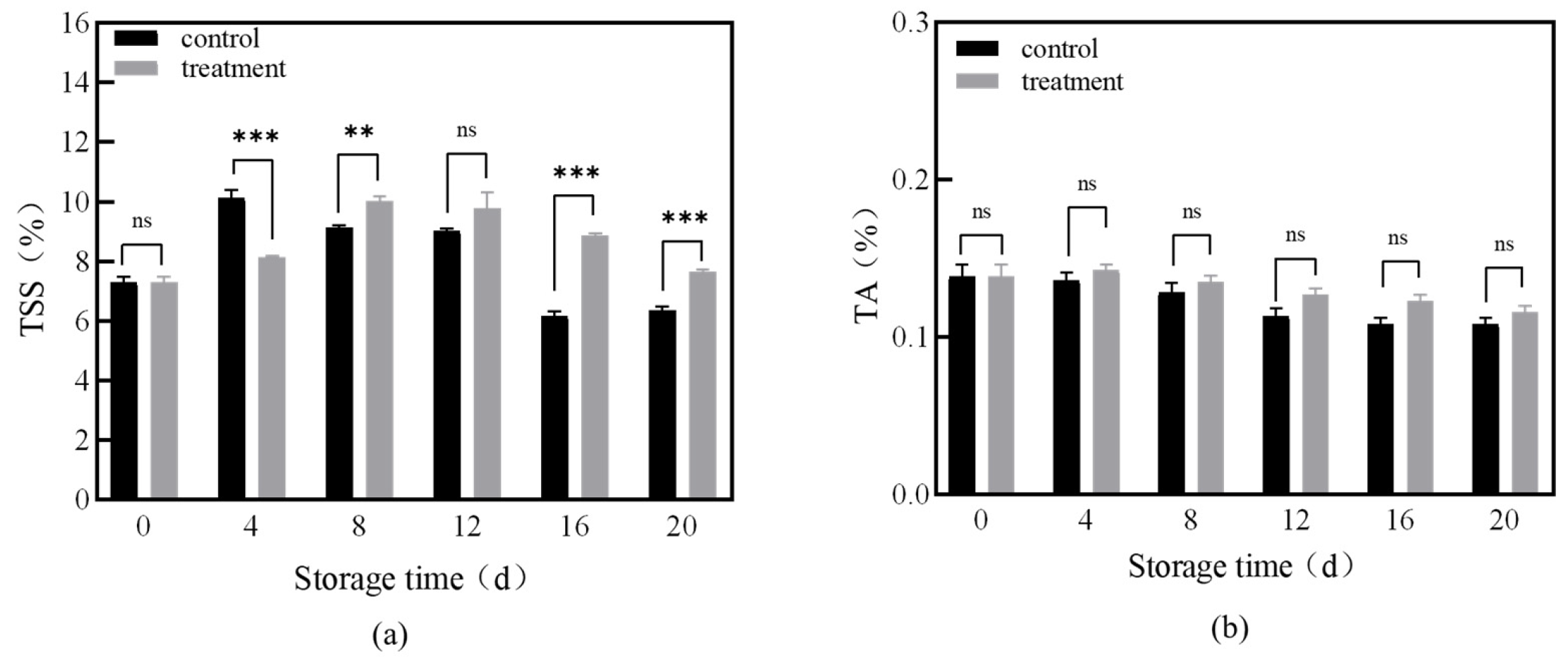
Total soluble solids (TSS) and titratable acidity (TA) are key parameters of peach flavor quality. The TSS content in the T9 treatment group was significantly lower than that in the control group at 4 d of storage (p < 0.05). As storage time increased, the TSS of the treatment group gradually approached that of the control group at 8 and 12 days and became significantly higher than that of the control group after 16 days (p < 0.05), remaining at a relatively high level at 20 days (Figure 4a). The TA content showed a gradual decline in both groups, with no significant difference between the T9 treatment and the control group during storage (Figure 4b).
Figure 4.
TSS and TA of peach fruits during storage. (a) TSS; (b) TA. Data are mean ± SD (n = 3). Asterisks indicate significant differences between the treatment group (T9) and the control group at the same time point ( ** p < 0.01, *** p < 0.001; ns, not significant ). Control (untreated purified water); treatment, T9 (8 kV, 30 min, 12 mL/min).
3.5. Effects of PAW Treatment on Reactive Oxygen Species Metabolism and the Antioxidant System in Peaches During Postharvest Storage
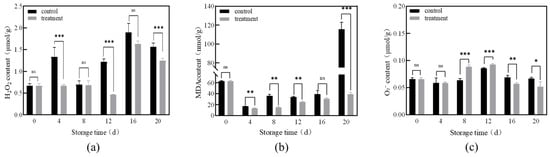
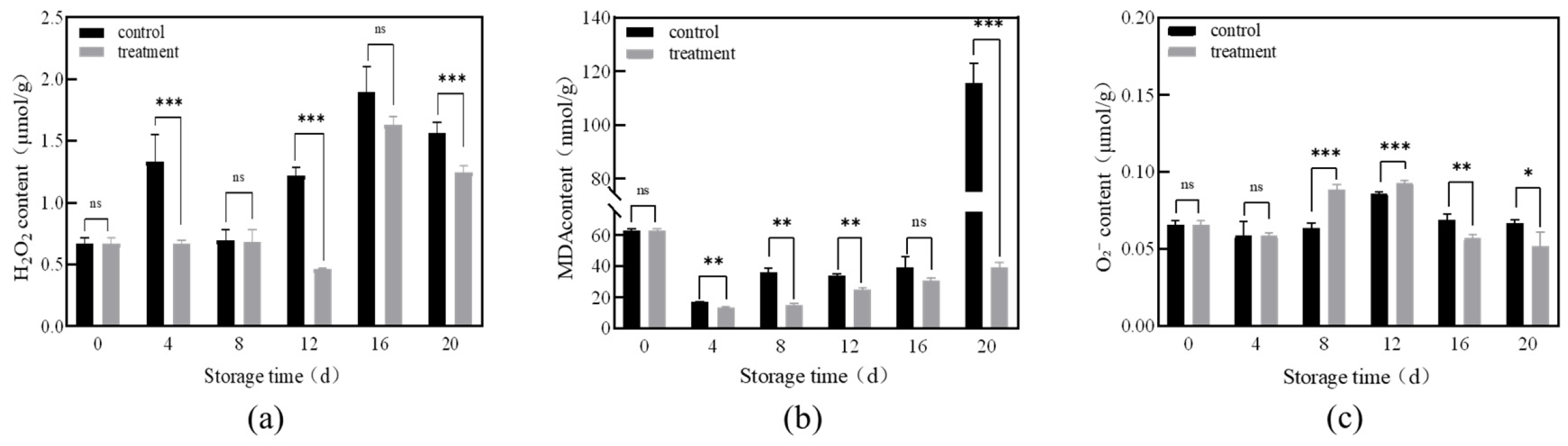
During storage, H2O2 levels in the control group fluctuated dramatically, rising sharply at 4 days (p < 0.05) and peaking at 16 days before declining. In contrast, H2O2 levels in the treatment group changed relatively gradually, remaining significantly lower than those in the control group on days 4, 12, and 20 (p < 0.05) and generally maintaining a lower level throughout (Figure 5a). This indicates that PAW treatment did not trigger excessive accumulation of H2O2. In the control group, MDA content decreased initially at day 4, then gradually increased, and exhibited a sharp surge between days 16 and 20, reflecting intensified membrane lipid peroxidation during the late stages of aging. The treatment group showed a similar initial decrease, but its MDA levels remained relatively stable thereafter. Compared with the control, the treatment significantly reduced MDA accumulation at days 4, 8, 12, and 20 (Figure 5b). O2•− levels increased and then decreased in both groups. During mid-storage, O2•− was significantly higher in the T9 group than in the control group on days 8 and 12 (p < 0.05), whereas during late storage it was significantly lower in the T9 group on days 16 and 20 (p < 0.05) (Figure 5c).
Figure 5.
ROS accumulation and membrane lipid peroxidation in peach fruits during storage. (a) H2O2 content (μmol·g−1); (b) MDA content (nmol·g−1); (c) O2•− content (μmol·g−1). Data are presented as mean ± SD (n = 3). Asterisks indicate significant differences between the treatment group (T9) and the control group at the same time point (* p < 0.05, ** p < 0.01, *** p < 0.001; ns, not significant). Control (untreated purified water); treatment, T9 (8 kV, 30 min, 12 mL/min).
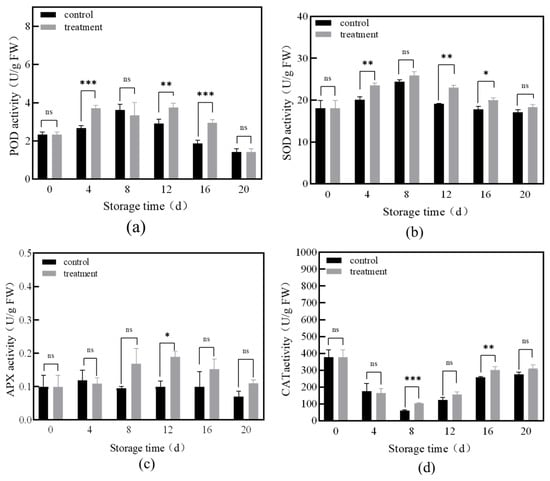
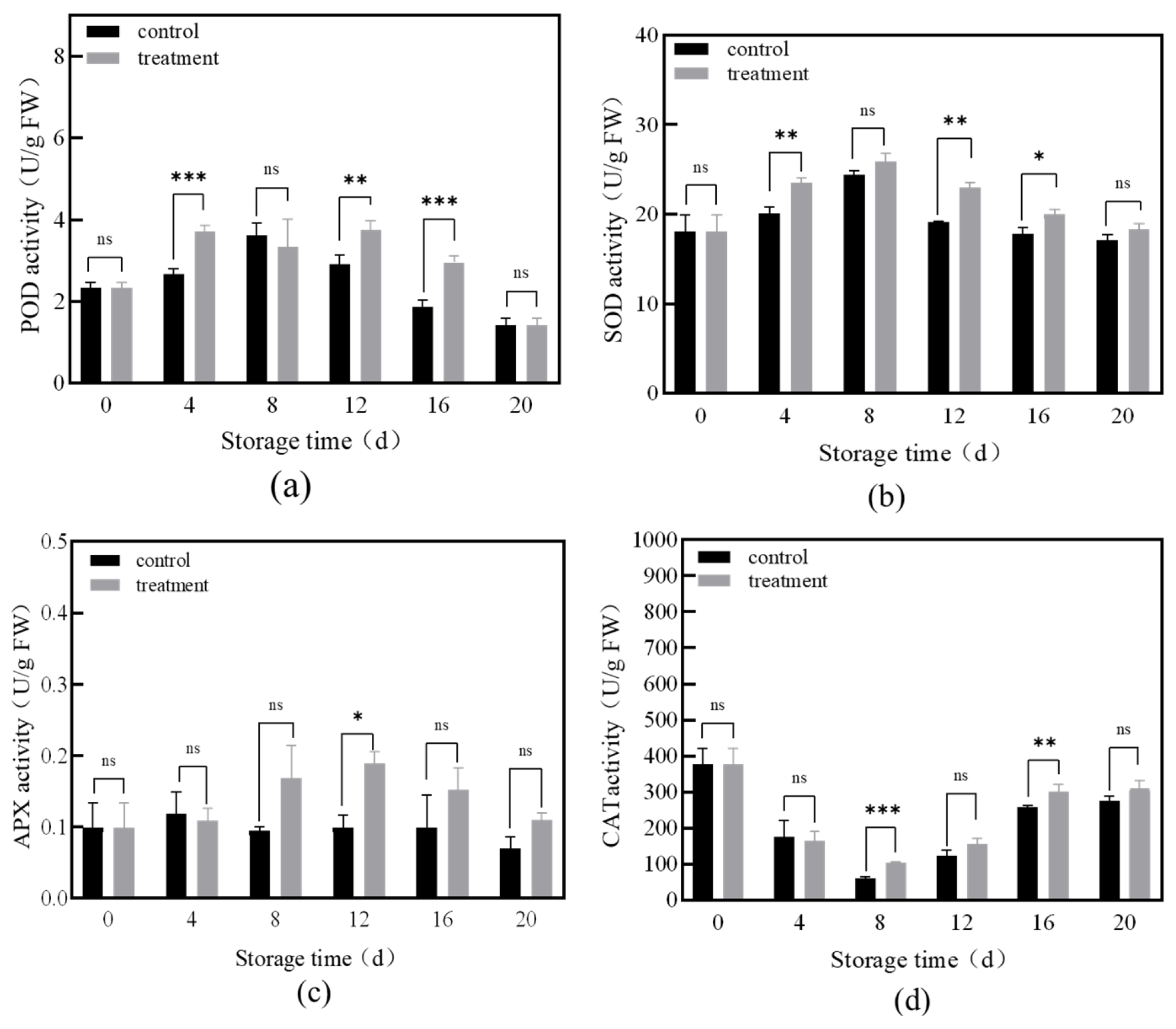
POD activity in all groups increased initially and then decreased during storage. However, the decline was significantly slower in the treatment group than in the control group. At 4 days of storage, POD activity in the treatment group was already significantly higher than that in the control group (p < 0.001). Although no significant difference was observed at day 8, the treatment group showed significantly higher POD activity again at days 12 (p < 0.01) and 16 (p < 0.001). By 20 days, both groups had declined to low levels with no significant difference between them (Figure 6a). SOD activity in both groups showed a trend of first increasing and then decreasing, peaking at 8 days in both the control and treatment groups. However, the post-peak decline was more gradual in the treatment group than in the control group. SOD activity in the treatment group was significantly higher than that in the control group at 4 and 12 days (p < 0.01); there was no significant difference between the two groups at 8 days; the treatment group still maintained higher activity at 16 days (p < 0.05); and the difference disappeared at 20 days (Figure 6b). Changes in APX activity were relatively stable. The treatment group was significantly higher than the control group at 12 days (p < 0.05), with no significant differences at other time points (Figure 6c). CAT activity fluctuated significantly. The control group exhibited two distinct troughs during storage (at 8 and 12 days), while changes in the treatment group were relatively mild. CAT activity in the treatment group was significantly higher than that in the control group at 8 days (p < 0.05) and significantly higher at 16 days (p < 0.05); at the remaining points, the two groups were similar (Figure 6d).
Figure 6.
Antioxidant enzyme activities of peach fruits during storage. (a) POD, (b) SOD, (c) APX, and (d) CAT activities (U·g−1 FW). Data are mean ± SD (n = 3). Asterisks indicate significant differences between the treatment group (T9) and the control group at the same time point (* p < 0.05, ** p < 0.01, *** p < 0.001; ns, not significant ). Control (untreated purified water), PAW treatment, T9 (8 kV, 30 min, 12 mL/min).
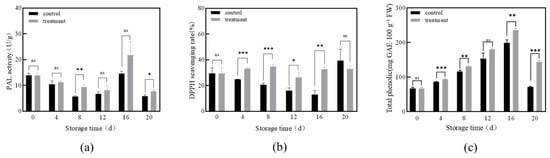
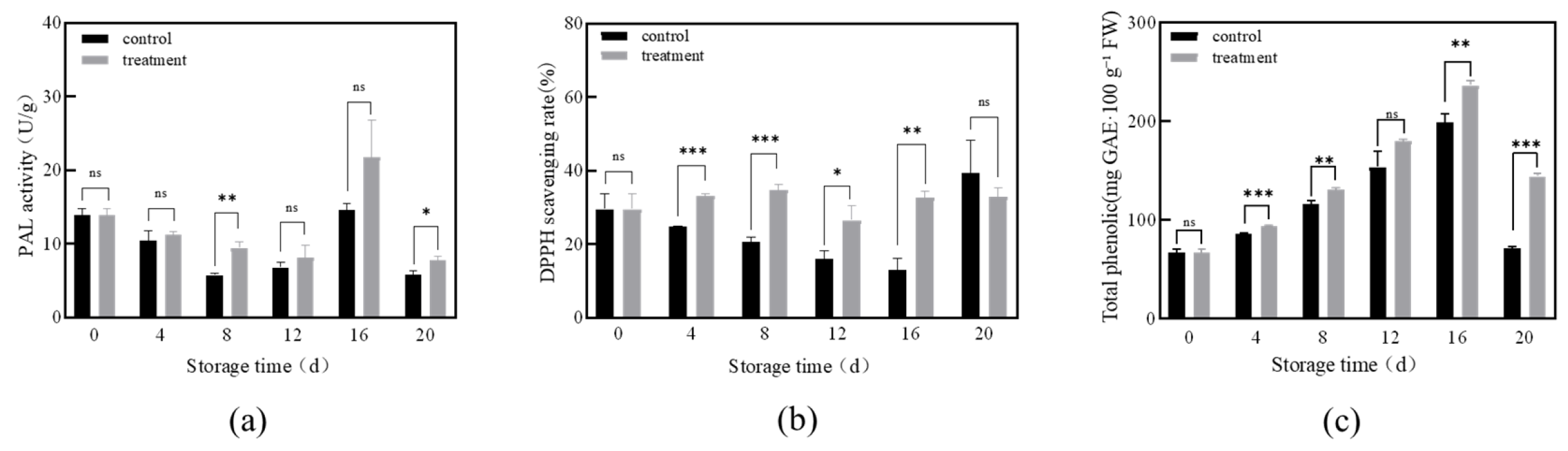
PAL activity in the treatment group was significantly higher than that in the control group at 8 d and 20 d (p < 0.05) (Figure 7a). Accordingly, the DPPH radical scavenging rate in the control group first decreased and then increased, reaching a minimum at 16 days, whereas the treatment group fluctuated only slightly and maintained a higher overall level than the control group during most of the storage period. The treatment group showed a significantly higher DPPH radical scavenging rate than the control group on days 4, 8, 12, and 16 (p < 0.05), while no significant differences were found on days 0 and 20 (Figure 7b). The total phenolic content in the treatment group remained higher than that in the control group throughout the storage period, with a significant difference observed as early as 4 days (p < 0.001), a significant difference at 8 and 16 days (p < 0.01), and the total phenolic content in the treatment group still significantly higher than that in the control group at 20 days (p < 0.001) (Figure 7c).
Figure 7.
PAL activity, DPPH scavenging activity, and total phenolic content of peach fruits during storage. (a) PAL (U·g−1); (b) DPPH (%); (c) Total phenolics (mg GAE·100 g−1 FW). Data are mean ± SD (n = 3). Asterisks indicate significant differences between the treatment group (T9) and the control group at the same time point (* p < 0.05, ** p < 0.01, *** p < 0.001; ns, not significant ). Control (untreated purified water), PAW treatment, T9 (8 kV, 30 min, 12 mL/min).
3.6. Effects of PAW Treatment on the Metabolic System of Peaches
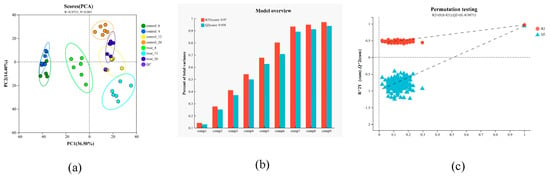
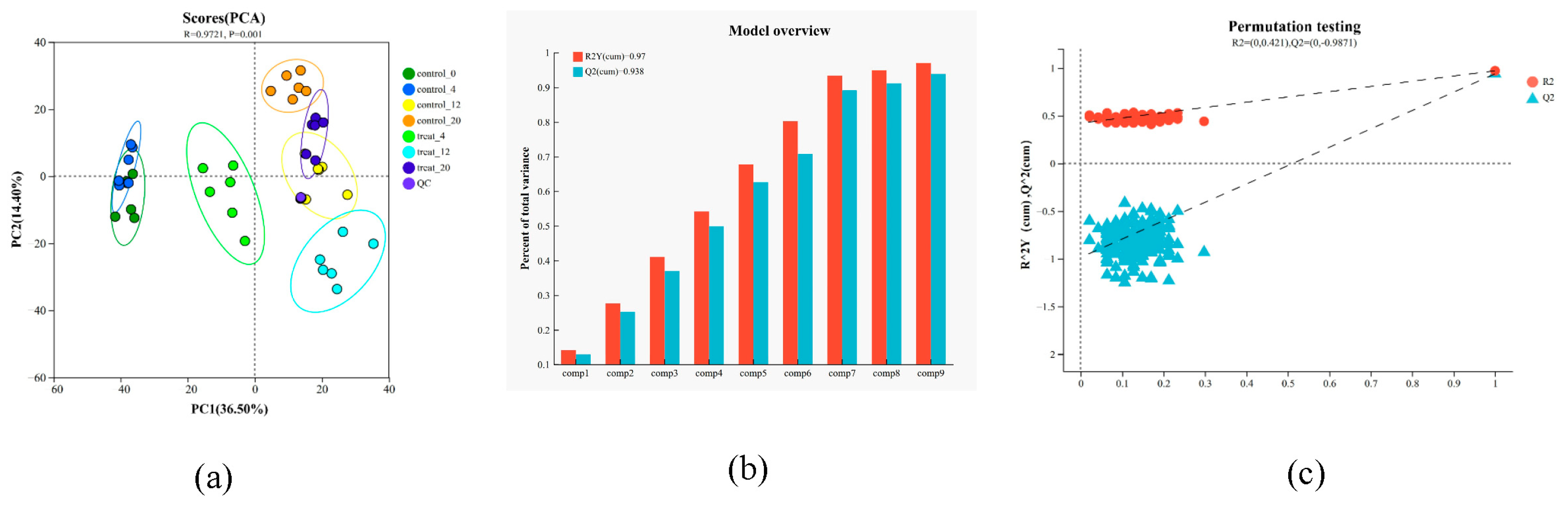
Non-targeted metabolomics of control and T9 peach fruits (0, 4, 12, 20 d storage) was performed to identify PAW-triggered metabolic alterations. Tight clustering of QC samples in PCA confirmed reliable data quality (Figure 8). PC1 (36.50%) and PC2 (14.40%, cumulative 50.90%) separated samples: controls shifted along PC1 with senescence, whereas T9 samples diverged along PC2, with 12 d T9 samples forming an independent cluster indicative of substantial mid-storage metabolic adjustments.
Figure 8.
Multivariate statistical analysis of metabolomic profiles in PAW-treated (T9) and control peach fruits during storage. (a) PCA score plot showing the distribution of samples at different storage times (0, 4, 12, and 20 d). QC samples (quality control) were tightly clustered, indicating good instrument stability and data reproducibility. PC1 and PC2 explained 36.50% and 14.40% of the total variance, respectively. (b) OPLS-DA score plot discriminating T9 and control groups; the model parameters were R2Y = 0.97 and Q2 = 0.938, indicating good explanatory and predictive ability. (c) Validation plot of the OPLS-DA model by 200 permutation tests; the negative intercept of the Q2 regression line with the y-axis confirmed that the model was not overfitted. Each point represents an individual biological replicate (n = 3 per treatment per time point).
Based on thresholds of VIP > 1 and FDR < 0.05, the numbers of differentially expressed metabolites (DEMs) were 767 (678 up, 89 down) at 4 d, 381 (160 up, 221 down) at 12 d, and 495 (300 up, 195 down) at 20 d (Figure S1). Upregulated DEMs dominated at 4 d (88.4%), indicating rapid activation of fruit secondary metabolism by PAW in early storage. At 12 d, DEM quantity reached the minimum and downregulated metabolites became predominant (58.0%), marking a metabolic turning point. DEMs rebounded at 20 d, with upregulated metabolites accounting for 60.6%.
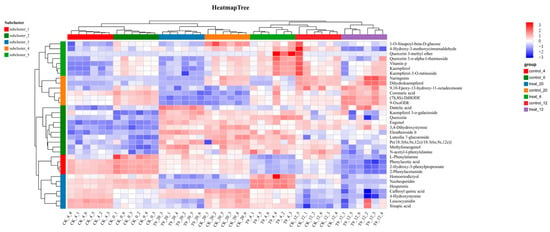
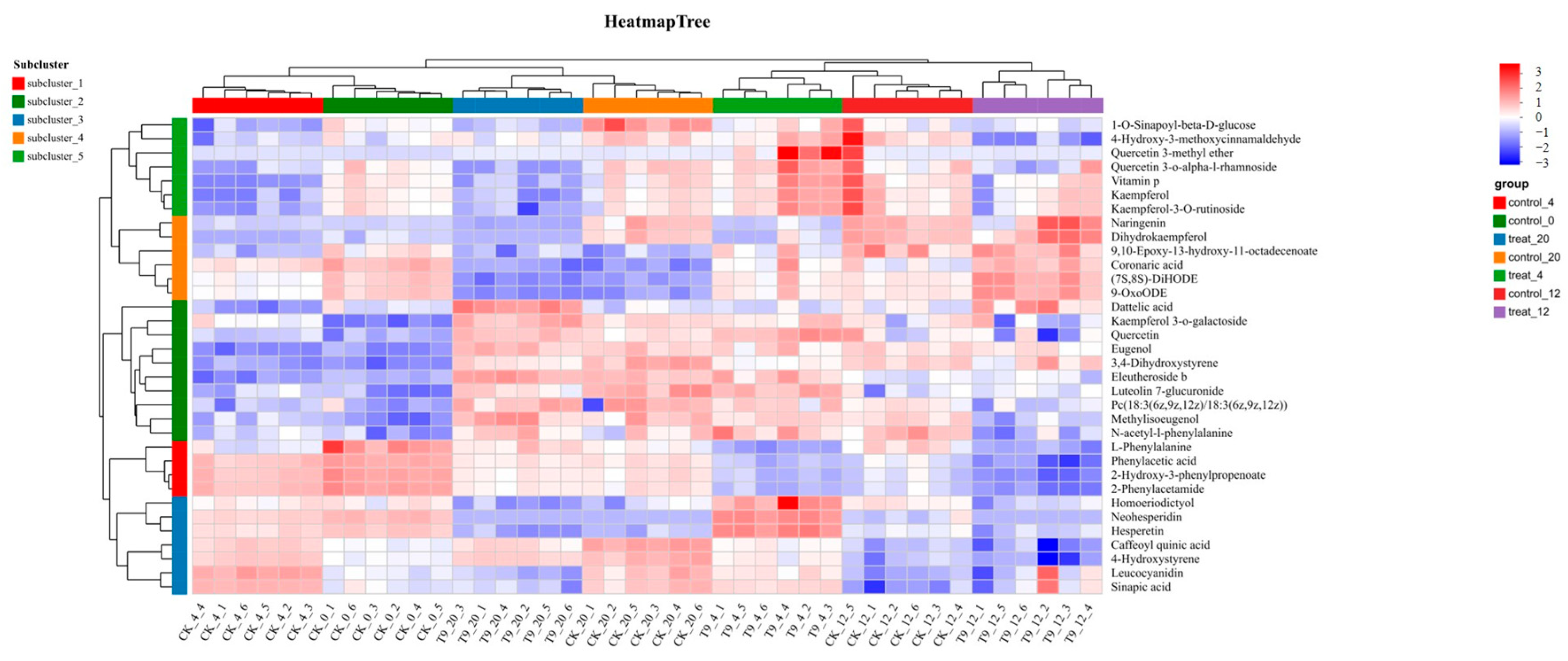
KEGG enrichment revealed time-dependent regulation of metabolic pathways by PAW (Figure S2). At 4 d, DEMs were significantly enriched in phenylpropanoid biosynthesis, flavonoid biosynthesis, ABC transporters, and aminoacyl-tRNA biosynthesis. At 12 d, enriched pathways mainly included the biosynthesis of various plant secondary metabolites, phenylpropanoid biosynthesis, as well as alpha-linolenic acid and linoleic acid metabolism. At 20 d, plant hormone signal transduction, flavone and flavonol biosynthesis, and flavonoid biosynthesis were significantly enriched. To further visualize these dynamic changes, the DEMs from five core pathways (Phenylpropanoid biosynthesis, Flavone and flavonol biosynthesis, Flavonoid biosynthesis, Phenylalanine metabolism, and Linoleic acid metabolism) were merged, yielding 34 key metabolites. A hierarchical clustering heatmap was generated to display their accumulation patterns across storage (Figure 9). Detailed information regarding a subset of these representative key metabolites, including VIP values, fold changes, FDR values, and annotation confidence levels, is provided (Table S5).
Figure 9.
Hierarchical clustering heatmap of key differential metabolites in control and PAW-treated (T9) peach fruit during storage. The columns (x-axis) represent the samples (Control and T9 at 0, 4, 12, and 20 d), and the rows (y-axis) represent the 34 key metabolites. The color scale indicates the relative abundance based on row-scaled Z-scores: red indicates higher abundance and blue indicates lower abundance. Dendrograms on the top and left indicate the hierarchical clustering of samples and metabolites, respectively.
4. Discussion
4.1. PAW Preserves Peach Fruits Quality Through Direct Microbial Suppression and Modulation of Physiological Responses
The orthogonal design provided insights into the parameter contributions. Preparation time was the dominant factor for both pH and EC, reflecting the time-dependent accumulation of reactive species and acidification in PAW. Notably, while T9 represents the highest tested level for voltage, time, and oxygen flow rate, the k-value profiles for voltage and oxygen flow rate were not monotonic. Both pH and EC reached their optima at the intermediate levels (level 2) and plateaued or slightly declined thereafter. This suggests that the response surface approached a plateau near the upper boundary, rather than rising indefinitely, indicating that the optimum lies at or within the tested range. However, because preparation time still showed a monotonic trend at 30 min, a longer activation time cannot be entirely excluded and warrants future verification. Ultimately, the multi-index comprehensive scoring based on fuzzy membership functions at 20 days of storage (Table S4) that T9 provided the best preservation performance, supporting the reliability of our orthogonal screening.
This study demonstrated that plasma-activated water (PAW) treatment significantly reduced microbial growth on the peach surface, decreased decay incidence and weight loss, and delayed fruit softening during storage. These effects may be associated with the combined action of active species present in PAW. On the one hand, the active species in PAW may contribute to the inactivation of surface microorganisms by inducing oxidative stress, damaging cellular membranes, and disturbing microbial redox homeostasis [13]. Moreover, the antimicrobial activity of PAW is unlikely to be attributable to a single component, because its biological effects depend on the complex interplay of various active species [39].
Studies conducted in other fruits provide indirect support for this interpretation. In strawberries, PAW treatment was reported to suppress the expression of several Botrytis cinerea-associated genes related to virulence, stress response, and cellular metabolism, including BCBCG1, BCATG1, BCSTR2, and BCSOD1 [16]. In apples, PAW delayed anthracnose symptom development and affected the expression of genes associated with Colletotrichum gloeosporioides pathogenicity [40]. These findings support the potential antimicrobial effects of PAW against postharvest pathogens. On the other hand, PAW treatment appeared to modulate endogenous physiological responses in peach fruits. PAW treatment may have altered ROS accumulation and induced redox modulation, contributing to the regulation of the fruit’s antioxidant enzyme system [41]. Similar changes in ROS metabolism and antioxidant system regulation have been reported in PAW-treated strawberries, fresh-cut mangoes, goji berries, and grapes [16,42,43,44].
PAW treatment also affected the maintenance of peach fruits quality attributes (TSS and TA). The TSS content in T9-treated fruit was slightly lower than that in the control on day 4, but it became significantly higher during late storage (Figure 4a). The early decrease in TSS in T9 fruit might be related to a transient stress response, whereas the higher TSS in late storage suggests that PAW delayed senescence and reduced sugar depletion [45]. Although the control fruit suffered severe weight loss, which should theoretically concentrate solutes, its advanced senescence led to excessive sugar consumption that surpassed this concentrating effect, ultimately resulting in a lower final TSS [46]. Titratable acidity (TA) showed no statistically significant change, indicating that PAW did not significantly affect fruit acidity. Similar effects have been reported in apples, where PAW treatment helped maintain soluble sugars and vitamin C [28], and in fresh-cut mangoes, where PAW delayed the decline in soluble solids and titratable acidity [42].
Overall, PAW treatment may preserve peach fruits quality through the combined effects of external microbial suppression and internal physiological modulation. This is consistent with the view that PAW treatment can induce physiological and metabolic adjustments [47]. As a non-thermal treatment, PAW minimizes concerns regarding chemical residues while simultaneously providing dual benefits of antimicrobial action and physiological regulation, positioning it as a highly promising alternative preservation method.
4.2. Temporal Coordination of the Enzymatic and Non-Enzymatic Antioxidant Systems by PAW Treatment
PAW treatment affected both the enzymatic and non-enzymatic antioxidant systems of peach fruits, and these responses displayed a temporal pattern during storage. SOD activity was significantly enhanced at 4 days, suggesting an early increase in SOD to mediate O2•− scavenging. POD activity was significantly higher in the treatment group at 4 days and remained generally elevated through 16 days, while CAT activity was significantly enhanced at 8 days; these enzymes may have cooperated in H2O2 removal. APX activity was significantly higher at 12 days, suggesting a contribution of ascorbic acid (AsA)-dependent H2O2 detoxification during the middle stage of storage [48]. Thus, rather than a strict sequential “takeover,” the antioxidant response is better described as a temporally overlapping, cooperative induction of SOD, POD, CAT, and APX. Similar coordinated changes in SOD, CAT, APX, and other antioxidant enzymes have been observed in PAW-treated fresh-cut mangoes and other fruits [42,43,44,47].
PAL activity in both groups fluctuated and generally declined during storage. T9 treatment maintained a significantly higher PAL activity than the control on days 8 and 20 (p < 0.05). This difference, together with the higher total phenolic content and improved DPPH radical-scavenging capacity, may be associated with changes in phenylpropanoid-related metabolism in PAW-treated fruit. PAW and cold plasma treatments have been reported to enhance phenolic accumulation and antioxidant capacity in postharvest fruits, although the response varies according to treatment conditions and fruit species [47]. The increase in DPPH radical-scavenging activity indicates a higher chemical radical-scavenging capacity of fruit extracts, which may be partly associated with the accumulation of phenolic compounds.
The coordinated changes in enzymatic and non-enzymatic antioxidants may explain the lower MDA levels observed in PAW-treated fruit during the middle and late stages of storage. Similar reductions in MDA and increases in antioxidant enzyme activities have been reported in PAW-treated goji berries and grapes [43,44]. In this study, PAW treatment may have altered ROS accumulation in peach fruits. H2O2 levels in T9 fruit were lower than those in the control at several time points, while O2•− was higher in T9 during mid-storage and lower during late storage. This suggests that PAW modulated the redox balance between ROS production and scavenging. The enhanced antioxidant enzyme activities and phenolic accumulation may have contributed to this regulation, thereby alleviating lipid peroxidation and helping maintain membrane function.
Notably, total phenolic content in both groups peaked at day 16 and then declined, with a particularly sharp drop observed in the control fruit by day 20 (Figure 7c). This drastic decline in the control is likely a consequence of advanced senescence. As MDA increased, membrane integrity was disrupted, allowing phenolic compounds to come into contact with polyphenol oxidase (PPO) and undergo enzymatic oxidation and polymerization into brown pigments, thereby reducing the extractable total phenolic content [49]. This is further supported by the concurrent decline in PAL activity in the control group during late storage, indicating a loss of phenolic biosynthesis capacity. In contrast, PAW-treated fruit maintained significantly higher phenolic levels at day 20, which may be attributed to the ability of PAW treatment to delay fruit senescence and better preserve membrane integrity, thereby reducing phenolic oxidation.
4.3. Regulation of the Metabolic Network in Peach Fruits by PAW Treatment
Metabolomic analysis indicated that the effects of PAW treatment on peach fruits metabolism were strongly dependent on storage time, with distinct metabolic responses at different stages of storage. At 4 days, differentially accumulated metabolites were predominantly upregulated and pathways related to phenylpropanoid biosynthesis, flavonoid biosynthesis, ABC transporters, and aminoacyl-tRNA biosynthesis were significantly enriched. These changes suggest an early physiological and metabolic adjustment associated with redox regulation and protein synthesis. Previous studies have suggested that PAW may mimic a mild abiotic stress and promote physiological adjustments in harvested fruits [16,42,47]. In the present study, the early enrichment of phenylpropanoid and flavonoid biosynthesis provides indirect support for this rapid metabolic adjustment in peach fruits, which is also consistent with the increased PAL activity and phenolic accumulation observed in the physiological assays. At 12 days, the number of differential metabolites reached its minimum, and downregulated metabolites outnumbered upregulated metabolites. At this stage, the biosynthesis of various plant secondary metabolites, phenylpropanoid biosynthesis, as well as alpha-linolenic acid and linoleic acid metabolism were significantly enriched. Because α-linolenic acid and linoleic acid are precursors of jasmonates and critical components of membrane lipids, this pattern suggests a possible relationship between PAW treatment and lipid-related signaling [50]. The alteration of fatty acid metabolism may reflect changes in membrane-lipid remodeling, which is consistent with the significantly lower MDA accumulation observed in PAW-treated fruit. At 20 days, plant hormone signal transduction, flavone and flavonol biosynthesis, and flavonoid biosynthesis were significantly enriched. The continued enrichment of flavonoid pathways indicates a sustained accumulation of antioxidant secondary metabolites in the late storage stage, which helps mitigate oxidative damage caused by senescence. Meanwhile, the enrichment of plant hormone signal transduction suggests that PAW treatment may help maintain hormonal homeostasis to delay fruit senescence. Similar relationships between secondary metabolism/hormone signaling and postharvest fruit quality have been discussed in peach fruits [4].
In summary, PAW treatment delayed peach fruits senescence through the combined effects of direct microbial suppression and the modulation of physiological and metabolic processes. This treatment was accompanied by the regulation of enzymatic and non-enzymatic antioxidant systems, as well as key pathways such as phenylpropanoid metabolism, hormone signal transduction, and membrane lipid metabolism. Overall, these findings provide a basis for applying PAW as a residue-free preservation technology for postharvest peach fruits.
Supplementary Materials
The following supporting information can be downloaded at: https://www.mdpi.com/article/10.3390/horticulturae12111345/s1. Table S1: Data are presented as means ± standard deviation (n = 3). Different lowercase letters within the same column indicate significant differences among treatments at the same storage time (p < 0.05, Duncan's multiple range test). Table S2: Level 1, Level 2, and Level 3 represent the mean values of each factor at the corresponding levels. Range (R) indicates the difference between the maximum and minimum mean values; a larger R value indicates a greater influence of the factor on the response variable. The highest R value for each response is highlighted in bold. Table S3a: SS, sum of squares; df, degrees of freedom; MS, mean square. p ≤ 0.05 indicates statistical significance. Table S3b: SS, sum of squares; df, degrees of freedom; MS, mean square. p ≤ 0.05 indicates statistical significance. Table S4: μ represents the fuzzy membership value (ranging from 0 to 1) for each indicator. For negative indicators (bacterial count, fungal count, decay incidence, and weight loss), a higher μ indicates a lower measured value; for the positive indicator (firmness), a higher μ indicates a higher measured value. The comprehensive score was calculated as the equal-weighted average of the five membership values (1/5 each), and a higher score indicates better overall preservation performance. Figure S1: Volcano plots of differential metabolites in PAW-treated (T9) versus control peach fruit at different storage times. (a) 4 d; (b) 12 d; (c) 20 d. The x-axis represents the fold change (log2FC), and the y-axis represents the statistical significance (−log10P). Red and blue dots indicate significantly upregulated and downregulated metabolites, respectively (|log2FC| > 1 and FDR < 0.05), while gray dots represent metabolites with no significant changes. Figure S2: KEGG pathway enrichment analysis of differential metabolites in PAW-treated (T9) versus control peach fruit at different storage times. (a) 4 d; (b) 12 d; (c) 20 d. Bubble plots show the significantly enriched metabolic pathways. The x-axis (Rich Factor) represents the proportion of differential metabolites to the total annotated metabolites in each pathway, and the y-axis indicates the pathway names. Bubble size represents the number of differential metabolites enriched in each pathway, and bubble color indicates the significance level (p-value), with redder colors indicating higher enrichment significance (smaller p-values). Only significantly enriched pathways (p < 0.05) are displayed.
Author Contributions
Conceptualization, B.L. and Y.Y.; methodology, B.L. and Y.Y.; software, B.L.; validation, B.L.; formal analysis, B.L.; investigation, B.L., Y.P., S.C., Y.X. and X.J.; resources, B.L., Y.Y. and Y.W.; data curation, B.L., Y.P., S.C., Y.X. and X.J.; writing—original draft preparation, B.L.; writing—review and editing, B.L. and Y.Y.; visualization, B.L.; supervision, Y.Y. and Y.W.; project administration, Y.W.; funding acquisition, Y.Y. and Y.W. All authors have read and agreed to the published version of the manuscript.
Funding
This research was funded by the Scientific Project of Tianjin Municipal Education Commission, grant number 2023KJ002.
Data Availability Statement
The original data supporting the results of this study were provided in the article. For further questions, please contact the corresponding authors.
Conflicts of Interest
The authors declare no conflicts of interest.
Abbreviations
The following abbreviations were used in this manuscript:
| PAW | Plasma-activated water |
| TSS | Total soluble solids |
| TA | Titratable acidity |
| SOD | Superoxide Dismutase |
| POD | Peroxidase |
| CAT | Catalase |
| PDA | Potato dextrose agar |
| FW | Fresh weight |
| ROS | Reactive oxygen species |
| APX | Ascorbate Peroxidase |
| PAL | Phenylalanine Ammonia-Lyase |
References
- U.S. Department of Agriculture. Peaches and Nectarines: Global Growth in Production Slowing While Exports Plateau; International Agricultural Trade Report; U.S. Department of Agriculture: Washington, DC, USA, 2023.
- Mohammed, J.; Belisle, C.E.; Wang, S.; Itle, R.A.; Adhikari, K.; Chavez, D.J. Volatile Profile Characterization of Commercial Peach (Prunus persica) Cultivars Grown in Georgia, USA. Horticulturae 2021, 7, 516. [Google Scholar] [CrossRef] [Scilit]
- Xi, W.; Zhang, B.; Liang, L.; Shen, J.; Wei, W.; Xu, C.; Allan, A.C.; Ferguson, I.B.; Chen, K. Postharvest Temperature Influences Volatile Lactone Production via Regulation of acyl-CoA Oxidases in Peach Fruit. Plant Cell Environ. 2012, 35, 534–545. [Google Scholar] [CrossRef] [Scilit] [PubMed]
- Cao, S.; Zhang, G.; Luo, Y.; Qiu, J. Recent Advances in Postharvest Physiology and Preservation Technology of Peach Fruit: A Systematic Review. Horticulturae 2025, 11, 1007. [Google Scholar] [CrossRef] [Scilit]
- Zhang, Y.; Dan, Q.; Zhou, D.; Yan, Y.; Pan, L.; Tu, K. Low-Temperature Storage Affects the Quality and Antioxidant Capacity of “Xiahui No. 8” Peach Fruit: Mechanisms Involving the Regulation of the Antioxidant System and Pentose Phosphate Pathway. Postharvest Biol. Technol. 2026, 234, 114098. [Google Scholar] [CrossRef] [Scilit]
- Lurie, S.; Crisosto, C.H. Chilling Injury in Peach and Nectarine. Postharvest Biol. Technol. 2005, 37, 195–208. [Google Scholar] [CrossRef] [Scilit]
- Mahajan, P.V.; Caleb, O.J.; Singh, Z.; Watkins, C.B.; Geyer, M. Postharvest Treatments of Fresh Produce. Phil. Trans. R. Soc. A 2014, 372, 20130309. [Google Scholar] [CrossRef] [Scilit] [PubMed]
- Cai, H.; An, X.; Han, S.; Jiang, L.; Yu, M.; Ma, R.; Yu, Z. Effect of 1-MCP on the Production of Volatiles and Biosynthesis-Related Gene Expression in Peach Fruit during Cold Storage. Postharvest Biol. Technol. 2018, 141, 50–57. [Google Scholar] [CrossRef] [Scilit]
- El Maazouzi, S.; Asfers, A.; Cano, A.; Hernández-Ruiz, J.; Hamdache, A.; Ait Houssa, A.; Ezziyyani, M.; Arnao, M.B. Peach Postharvest Fungal Diseases: Sustainable Management and an Integrative Review of Emerging Strategies. Crops 2025, 5, 84. [Google Scholar] [CrossRef] [Scilit]
- Qin, Q.; Wang, L.; Wang, Q.; Wang, R.; Li, C.; Qiao, Y.; Liu, H. Postharvest Flavor Quality Changes and Preservation Strategies for Peach Fruits: A Comprehensive Review. Plants 2025, 14, 1310. [Google Scholar] [CrossRef] [Scilit] [PubMed]
- Bourke, P.; Ziuzina, D.; Han, L.; Cullen, P.J.; Gilmore, B.F. Microbiological Interactions with Cold Plasma. J. Appl. Microbiol. 2017, 123, 308–324. [Google Scholar] [CrossRef] [Scilit] [PubMed]
- Ma, R.; Wang, G.; Tian, Y.; Wang, K.; Zhang, J.; Fang, J. Non-Thermal Plasma-Activated Water Inactivation of Food-Borne Pathogen on Fresh Produce. J. Hazard. Mater. 2015, 300, 643–651. [Google Scholar] [CrossRef] [Scilit] [PubMed]
- Thirumdas, R.; Kothakota, A.; Annapure, U.; Siliveru, K.; Blundell, R.; Gatt, R.; Valdramidis, V.P. Plasma Activated Water (PAW): Chemistry, Physico-Chemical Properties, Applications in Food and Agriculture. Trends Food Sci. Technol. 2018, 77, 21–31. [Google Scholar] [CrossRef] [Scilit]
- Zahir, A.; Dhillon, G.K.; Akhter, S.; Rasmi, P.K.; Bora, P.P.; Hosseinvand, A. Cold Plasma Treatment in Plant-Based Food Processing: A Non-Thermal Strategy for Microbiological Safety and Quality Preservation. NFS J. 2026, 44, 100288. [Google Scholar] [CrossRef] [Scilit]
- Gan, Z.; Zhang, Y.; Gao, W.; Wang, S.; Liu, Y.; Xiao, Y.; Zhuang, X.; Sun, A.; Wang, R. Effects of Nonthermal Plasma-Activated Water on the Microbial Sterilization and Storage Quality of Blueberry. Food Biosci. 2022, 49, 101857. [Google Scholar] [CrossRef] [Scilit]
- Gao, Y.; Zhu, Y.; Guan, P.; Zhang, L.; Li, X.; Wei, G.; Hu, C.; Sha, R.; Du, N.; Ma, R.; et al. Postharvest Application of Plasma-Activated Water to Extend Shelf Life of Strawberries. Food Chem. 2026, 508, 148453. [Google Scholar] [CrossRef] [Scilit] [PubMed]
- Pankaj, S.; Wan, Z.; Keener, K. Effects of Cold Plasma on Food Quality: A Review. Foods 2018, 7, 4. [Google Scholar] [CrossRef] [Scilit] [PubMed]
- Wu, Q.; Shen, C.; Li, J.; Wu, D.; Chen, K. Application of Indirect Plasma-Processed Air on Microbial Inactivation and Quality of Yellow Peaches during Storage. Innov. Food Sci. Emerg. Technol. 2022, 79, 103044. [Google Scholar] [CrossRef] [Scilit]
- Zhang, B.; Chen, X.; Wang, N.; Guo, S.; Jiang, W.; Yu, M.; Ma, R. Effects of Harvest Maturity on the Fruit Quality of Different Flesh-Type Peach Stored at Near-Freezing Point Temperature. Foods 2022, 11, 2200. [Google Scholar] [CrossRef] [Scilit] [PubMed]
- Im, S.; Min, S.C. Development and Optimization of an Ultrasonic Plasma-Activated Water Mist System for the Inactivation of Escherichia Coli O157:H7 on Grape Tomatoes. Food Control 2026, 179, 111573. [Google Scholar] [CrossRef] [Scilit]
- Dhungana, S.; Chalise, R.; Singh, A.K.; Khanal, R.; Baniya, H.B. Effect of Operating Conditions on Physicochemical Properties of Plasma Activated Water Prepared from a Low-Cost Gliding Arc Discharge System. Desalin. Water Treat. 2026, 326, 101741. [Google Scholar] [CrossRef] [Scilit]
- Rathore, V.; Nisoa, M.; Gopinath, S.C.B.; Zala, A.B.; Pachchigar, V.; Desai, V.; Dheerawan, B. Modulation of Plasma-Activated Water Properties via Power Supply Frequency Control. Sādhanā 2026, 51, 178. [Google Scholar] [CrossRef] [Scilit]
- Huan, C.; An, X.; Yu, M.; Jiang, L.; Ma, R.; Tu, M.; Yu, Z. Effect of Combined Heat and 1-MCP Treatment on the Quality and Antioxidant Level of Peach Fruit during Storage. Postharvest Biol. Technol. 2018, 145, 193–202. [Google Scholar] [CrossRef] [Scilit]
- Zhang, D.; Spadaro, D.; Garibaldi, A.; Gullino, M.L. Efficacy of the Antagonist Aureobasidium Pullulans PL5 against Postharvest Pathogens of Peach, Apple and Plum and Its Modes of Action. Biol. Control 2010, 54, 172–180. [Google Scholar] [CrossRef] [Scilit]
- Williamson, K.; Pao, S.; Dormedy, E.; Phillips, T.; Nikolich, G.; Li, L. Microbial Evaluation of Automated Sorting Systems in Stone Fruit Packinghouses during Peach Packing. Int. J. Food Microbiol. 2018, 285, 98–102. [Google Scholar] [CrossRef] [Scilit] [PubMed]
- Li, Z.; Zeng, X.; Chen, Y.; Shi, H.; Shao, B.; Gong, R.; Li, Z. Regulation of Nectarine Flesh Browning through Pre-Harvest Application of Chitosan Coatings. Sci. Hortic. 2026, 356, 114613. [Google Scholar] [CrossRef] [Scilit]
- Silva, D.F.P.; Ribeiro, M.R.; Silva, J.O.D.C.E.; Matias, R.G.P.; Bruckner, C.H. Cold Storage of Peaches Cv. Aurora Grown in the Zona Da Mata Mineira, Minas Gerais State, Brazil. Rev. Ceres 2013, 60, 833–841. [Google Scholar] [CrossRef] [Scilit][Green Version]
- Liu, C.; Chen, C.; Jiang, A.; Sun, X.; Guan, Q.; Hu, W. Effects of Plasma-Activated Water on Microbial Growth and Storage Quality of Fresh-Cut Apple. Innov. Food Sci. Emerg. Technol. 2020, 59, 102256. [Google Scholar] [CrossRef] [Scilit]
- Rathore, V.; Patil, C.; Sanghariyat, A.; Nema, S.K. Design and Development of Dielectric Barrier Discharge Setup to Form Plasma-Activated Water and Optimization of Process Parameters. Eur. Phys. J. D 2022, 76, 77. [Google Scholar] [CrossRef] [Scilit]
- Yu, M.; Wang, L.; Chen, Y.; Fan, W.; Wang, H.; Guo, K.; Tao, S.; Gong, X.; Bao, J. The Impact of the Natural Grass-Growing Model on the Development of Korla Fragrant Pear Fruit, as Well as Its Influence on Post-Harvest Sugar Metabolism and the Expression of Key Enzyme Genes Involved in Fruit Sugar Synthesis. Agriculture 2025, 15, 792. [Google Scholar] [CrossRef] [Scilit]
- Lobit, P.; Soing, P.; Génard, M.; Habib, R. Theoretical analysis of relationships between composition, PH, and titratable acidity of peach fruit. J. Plant Nutr. 2002, 25, 2775–2792. [Google Scholar] [CrossRef] [Scilit]
- Hodges, D.M.; DeLong, J.M.; Forney, C.F.; Prange, R.K. Improving the Thiobarbituric Acid-Reactive-Substances Assay for Estimating Lipid Peroxidation in Plant Tissues Containing Anthocyanin and Other Interfering Compounds. Planta 1999, 207, 604–611. [Google Scholar] [CrossRef] [Scilit]
- Beauchamp, C.; Fridovich, I. Superoxide Dismutase: Improved Assays and an Assay Applicable to Acrylamide Gels. Anal. Biochem. 1971, 44, 276–287. [Google Scholar] [CrossRef] [Scilit] [PubMed]
- Zhang, Y.-J.; Huang, Q.; Li, A.-R.; Gan, Z.-Y.; Zeng, J.-K.; Kai, W.-B.; Chen, C.-Y.; Chen, J.-Y. Apple Polyphenols Delay Postharvest Senescence and Quality Deterioration of ‘Jinshayou’ Pummelo Fruit during Storage. Front. Plant Sci. 2023, 13, 1117106. [Google Scholar] [CrossRef] [Scilit] [PubMed]
- Sun, M.; Li, S.; Gong, Q.; Xiao, Y.; Peng, F. Leucine Contributes to Copper Stress Tolerance in Peach (Prunus persica) Seedlings by Enhancing Photosynthesis and the Antioxidant Defense System. Antioxidants 2022, 11, 2455. [Google Scholar] [CrossRef] [Scilit] [PubMed]
- Brand-Williams, W.; Cuvelier, M.E.; Berset, C. Use of a Free Radical Method to Evaluate Antioxidant Activity. LWT-Food Sci. Technol. 1995, 28, 25–30. [Google Scholar] [CrossRef] [Scilit]
- Duncan, D.B. Multiple Range and Multiple F Tests. Biometrics 1955, 11, 1–42. [Google Scholar] [CrossRef] [Scilit]
- Holm, S. A Simple Sequentially Rejective Multiple Test Procedure. Scand. J. Stat. 1979, 6, 65–70. [Google Scholar]
- Pogoda, A.; Hahn, V.; Weltmann, K.-D.; Kolb, J.F. Sporicidal and Bactericidal Efficacy of Plasma-Treated Liquids Based on Reaction Kinetics of Peroxynitrous Acid. Front. Microbiol. 2026, 17, 1788374. [Google Scholar] [CrossRef] [Scilit] [PubMed]
- Gao, Y.; Sha, R.; Wei, G.; Yang, L.; Zhu, Y.; Liu, Y.; Ma, R.; Jiao, Z.; Li, B. Postharvest Application of Plasma-Activated Water Delays Anthracnose Symptom Development in Apples. Postharvest Biol. Technol. 2025, 230, 113760. [Google Scholar] [CrossRef] [Scilit]
- Meitha, K.; Pramesti, Y.; Suhandono, S. Reactive Oxygen Species and Antioxidants in Postharvest Vegetables and Fruits. Int. J. Food Sci. 2020, 2020, 8817778. [Google Scholar] [CrossRef] [Scilit] [PubMed]
- Song, C.; Wang, J.; Wu, L.; Liu, J.; Liu, G.; Gong, D.; Zhang, W.; Wei, J.; Zhang, Z. Quality and Physiological Changes in Fresh-Cut Mango Fruit as Affected by Cold Plasma-Activated Water. Postharvest Biol. Technol. 2025, 225, 113524. [Google Scholar] [CrossRef] [Scilit]
- Cong, K.-P.; Li, T.-T.; Wu, C.-E.; Zeng, K.-F.; Zhang, J.-H.; Fan, G.-J.; Pan, Y.; Wang, J.-H.; Suo, A.-D. Effects of Plasma-Activated Water on Overall Quality of Fresh Goji Berries during Storage. Sci. Hortic. 2022, 293, 110650. [Google Scholar] [CrossRef] [Scilit]
- Wang, J.; Lv, S.; Zhou, H.; Shataer, D.; Lu, J.; Zheng, L.; Xing, J. Application of Ultrasound-Assisted Atomized Plasma-Activated Water to Improve the Quality Properties of Grapes. Ultrason. Sonochem. 2025, 123, 107667. [Google Scholar] [CrossRef] [Scilit] [PubMed]
- Tamanna, M.H.; Sarmin, S.; Irin, U.A.; Khatun, M.K.; Talukder, M.R.; Hasan, M.M. Plasma-Activated Water: Mechanism and Treatment Duration for Postharvest Disease Control and Shelf-Life Enhancement of Mango under Ambient Storage. PLoS ONE 2026, 21, e0347546. [Google Scholar] [CrossRef] [Scilit] [PubMed]
- Mlambo, B.; Kutu, F.R.; Belay, Z.A.; Mphahlele, R.R.; Suinyuy, T.; Mokwena, L.; Caleb, O.J. Low-pressure Cold Plasma Pretreatment: Impact on Quality Attributes of “Fan Retief” Guava and Efficacy against Colletotrichum gloeosporioides. J. Food Sci. 2025, 90, e70058. [Google Scholar] [CrossRef] [Scilit] [PubMed]
- Lin, X.; Huang, S.; Li, L.; Guo, J. Impact of Plasma-Activated Water and Cold Plasma Treatment on the Firmness and Antioxidant of Postharvest Fruits: A Review. Food Sci. Biotechnol. 2025, 34, 2697–2706. [Google Scholar] [CrossRef] [Scilit] [PubMed]
- Lu, J.; Xue, Z.; Zhao, X.; Qi, X.; Qiao, L.; Wu, C.; Kou, X. Ascorbic Acid in Plants: Biosynthetic Regulation and Biotechnology Strategies for Enhancing Human Health. Plant Sci. 2026, 371, 113343. [Google Scholar] [CrossRef] [Scilit] [PubMed]
- Franck, C.; Lammertyn, J.; Ho, Q.T.; Verboven, P.; Verlinden, B.; Nicolaï, B.M. Browning Disorders in Pear Fruit. Postharvest Biol. Technol. 2007, 43, 1–13. [Google Scholar] [CrossRef] [Scilit]
- Wasternack, C.; Hause, B. Jasmonates: Biosynthesis, Perception, Signal Transduction and Action in Plant Stress Response, Growth and Development. An Update to the 2007 Review in Annals of Botany. Ann. Bot. 2013, 111, 1021–1058. [Google Scholar] [CrossRef] [Scilit] [PubMed]

Disclaimer/Publisher’s Note: The statements, opinions and data contained in all publications are solely those of the individual author(s) and contributor(s) and not of MDPI and/or the editor(s). MDPI and/or the editor(s) disclaim responsibility for any injury to people or property resulting from any ideas, methods, instructions or products referred to in the content. |
© 2026 by the authors. Licensee MDPI, Basel, Switzerland. This article is an open access article distributed under the terms and conditions of the Creative Commons Attribution (CC BY) license.