


Highlights
What are the main findings?
- •
- Some alternative packages provided quality comparable to PET packaging for several fruit quality attributes.
- •
- Packaging effects on firmness, color, and biochemical attributes differed between blueberry cultivars.
What is the implication of the main finding?
- •
- Alternative packaging shows potential for short-term blueberry storage.
- •
- Both packaging design and cultivar should be considered when selecting sustainable packaging alternatives.
Abstract
This study compared polyethylene terephthalate (PET), corrugated cardboard (CB), cardboard with a cellulose lid (CBC), and rice-straw packages with a polylactic acid lid (RPLA) for half-highbush ‘Northblue’ and highbush ‘Draper’ blueberries. Fruits were stored for 7–8 days at 5 ± 1 °C and 40 ± 2% relative humidity to represent short local distribution conditions in Estonia. Packaging treatments influenced postharvest quality, and responses differed between the two cultivars. In ‘Northblue’, PET maintained lower weight loss (2.4%) and higher firmness (0.51 N) than CB (6.8% and 0.35 N), while CBC and RPLA showed intermediate weight loss and firmness. In ‘Draper’, CB resulted in the highest weight loss (10.6%) and a significant decline in total anthocyanin content from 90 to 49 mg 100 g−1 FW, whereas RPLA showed the highest total phenolic content (207 vs. 144 mg 100 g−1 FW in CB) and organic acid content (0.88 g 100 mL−1). RPLA also maintained the highest organic acid content in ‘Northblue’ (0.65 g 100 mL−1). RPLA showed potential for short-term storage under the low-RH conditions tested, although its performance differed between the two cultivars.
1. Introduction
The fresh blueberry market has expanded considerably in recent years [1], driven by increasing consumer demand for nutrient-rich foods and by the fruit’s suitability for fresh consumption [2,3]. As global production and consumption continue to increase, the need for effective and sustainable postharvest packaging has become increasingly important. The recently adopted Packaging and Packaging Waste Regulation (EU) 2025/40 [4] aims to reduce packaging waste, increase recycling and reuse, reduce the use of virgin materials, and support the European Union’s climate-neutrality objectives. From 1 January 2030, the Regulation restricts single-use plastic packaging for pre-packed fresh fruit and vegetables weighing less than 1.5 kg. However, exemptions may apply where packaging is necessary to prevent water loss, loss of turgor, microbiological hazards, physical damage, or oxidation.
At present, most fresh blueberries are marketed in plastic packages because of their low cost and ability to protect fruit quality [5,6]. Alongside conventional plastic packaging, fiber-based and bio-based packaging systems are increasingly being developed and evaluated for fresh produce [7,8]. However, their suitability for blueberries depends on their ability to maintain fruit quality during storage and distribution [5]. Different packaging materials and designs may create different storage microenvironments, particularly with respect to moisture retention and gas exchange, which may influence postharvest quality [5,9]. Therefore, the present study focused on the functional performance of different packaging systems during short-term blueberry storage.
Major factors contributing to quality loss in blueberries include moisture loss, softening, respiration, and biochemical changes [6]. Respiration is closely associated with postharvest quality deterioration and storage life. Although blueberries continue to respire after harvest, respiration rate can be influenced by storage conditions, including rapid cooling, modified-atmosphere storage, and packaging systems that regulate gas exchange and relative humidity [5,8,9,10]. Packaging can therefore modify the storage microenvironment and reduce moisture loss, potentially slowing postharvest quality deterioration [11].
Blueberry production in the Nordic and Baltic region is relatively small compared to the main blueberry production areas worldwide [1,12]. These conditions also affect the commercial circulation of blueberries in the region. Official area-based support was requested for approximately 174 hectares of blueberry plantations in Estonia in 2025, with organic cultivation area under 124 hectares [12]. Local domestic production is almost exclusively oriented toward the local fresh market. This localized context highlights the importance of optimizing the short “producer-to-retail” distribution chain. Evaluating and maintaining the short-term shelf life of blueberries during this rapid transition from production to retail shelves is essential to prevent postharvest losses. Since local producers have to comply with EU packaging requirements, plastic alternatives suitable for short-term storage under commercial and retail conditions should be investigated.
Although various packaging materials have been evaluated for fresh produce, information comparing conventional plastics with fiber-based and bio-based packaging alternatives under identical short-term storage conditions remains limited. Less attention has been given to the ability of different packaging materials to maintain blueberry quality during a short commercial circulation period of approximately one week. Therefore, comparing plastic and biodegradable packaging materials under standardized short-term storage conditions is important for assessing their suitability for fresh-market distribution and their potential as alternatives to conventional plastic packaging.
We hypothesized that packaging materials with different material compositions would differ in their effects on the postharvest quality of blueberries during short-term cold storage.
The aim of this study was to determine the effects of polyethylene terephthalate, corrugated cardboard, corrugated cardboard with a cellulose lid, and rice-straw with a polylactic acid lid packages on the postharvest quality of the half-highbush blueberry ‘Northblue’ and the highbush blueberry ‘Draper’ during short-term cold storage.
2. Materials and Methods
2.1. Plant Material and Experimental Design
Half-highbush blueberry (Vaccinium × atlanticum E.P. Bicknell) fruits of the cultivar ‘Northblue’ were used in the 2023 experiment, and fruits of the highbush blueberry (Vaccinium corymbosum L.) cultivar ‘Draper’ were used in 2024. ‘Northblue’ fruits were hand-harvested at full maturity on the evening of 26 July from a commercial plantation in Tartu County, southern Estonia (58.2685° N, 26.8236° E), precooled on site, and placed into storage the following day. In 2024, ‘Draper’ fruits were hand-harvested on 31 July from the Rõhu Experimental Station of the Estonian University of Life Sciences (58.3580° N, 26.5209° E) and placed into storage on the same day. In both years, fruits were stored at 5 ± 1 °C and 40 ± 2% relative humidity in the cold storage facility of the Organic Farming Center of the Estonian University of Life Sciences. To simulate short supply chains for the local market, fruits were stored for 7 days in 2023 (July 27–August 3) and for 8 days in 2024 (July 31–August 8). The storage duration was adjusted to maintain a comparable postharvest period from harvest to the end of cold storage in both experiments. In 2023, ‘Northblue’ fruits underwent approximately 24 h of precooling and transport before the 7-day storage period, resulting in an overall postharvest period of approximately 8 days. In 2024, ‘Draper’ fruits were placed into storage on the day of harvest and were therefore stored for 8 days. Two experiments were conducted independently, and statistical comparisons were performed within each cultivar. Measurements were performed before and after the cold storage; chemical analyses were conducted from frozen samples. Before measuring weight loss, firmness, and color, fruits were equilibrated at room temperature for 24 h to simulate retail shelf-life conditions.
The “initial” values represent fruit quality before the storage treatment and were used as baseline measurements. All measurements were performed in triplicate throughout the storage period. Four packaging treatments were included (Table 1), with three replicate packages per treatment. Each package was considered a separate biological replicate. From each biological replicate, 40 g of berries were collected, from which three analytical replicates were taken for the chemical analyses. Analyses were conducted from homogenized biological replicates.
Table 1.
Characteristics of packaging treatments used for postharvest storage of blueberries.
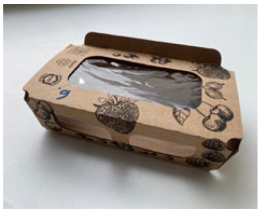
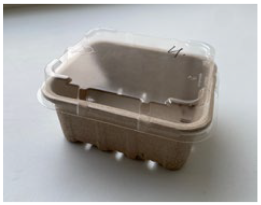
Four packaging types were evaluated: polyethylene terephthalate (PET), corrugated cardboard (CB), corrugated cardboard with a cellulose lid (CBC), and a molded rice-straw package with a polylactic acid (PLA) lid (RPLA) (Table 1). According to Regulation (EU) 2025/40 [4], CB and CBC are classified as biodegradable packages, whereas PET and RPLA are classified as plastic packages.
The tare weight of each empty package was determined before storage using a precision balance (PG503-S, Mettler Toledo, Greifensee, Switzerland; readability 0.001 g). The empty packages were weighed before and after storage to verify whether moisture absorption by the packaging material could influence weight measurements. No changes in package tare weight were observed during storage. Before storage, an equal amount of fruit was placed in each package, with an initial fruit weight of approximately 226 g per package in 2023 and 230 g per package in 2024.
Weight loss was calculated as the percentage reduction in sample mass relative to the initial mass using the following equation, where and represent the fruit mass before and after storage, respectively (Equation (1)):
The internal volume and total ventilation opening area of each package were determined experimentally. Internal volume was estimated by filling the package to its usable internal capacity with semolina and then measuring the semolina volume using a graduated cylinder. The dimensions of the ventilation openings were measured manually using a ruler, and the area of each opening was calculated according to its shape. The areas of all ventilation openings in the tray and lid were summed to obtain the total ventilation opening area (cm2) for each packaging treatment.
2.2. Weather Conditions During the Growing Season
Meteorological observations from the Tartu-Tõravere meteorological station (Estonian Environment Agency) were used to characterize weather conditions during the 2023 and 2024 growing seasons. Monthly air temperature, precipitation, and sunshine duration were evaluated relative to the 1991–2020 climatic normals for the station. In 2023, May had near-average air temperature (11.5 vs. 11.4 °C), exceptionally low precipitation (10 vs. 54 mm), and above-average sunshine duration (325 vs. 266 h). June was warmer than normal (16.7 vs. 15.5 °C), considerably drier (36 vs. 88 mm), and sunnier than average (348 vs. 258 h). In contrast, July was cooler than normal (16.7 vs. 18.0 °C), wetter than average (98 vs. 67 mm), and received less sunshine (244 vs. 269 h). In 2024, May was substantially warmer than normal (14.4 vs. 11.5 °C), with exceptionally low precipitation (2.2 mm; approximately 4% of the long-term average) and very high sunshine duration (368 h). June also remained warmer than normal (17.1 vs. 15.5 °C), with below-average precipitation (56 vs. 88 mm) and slightly above-average sunshine duration (277 h). July was warmer than average (19.1 vs. 18.0 °C) and exceptionally wet, receiving 180 mm of precipitation (approximately 270% of the long-term average), while sunshine duration was below normal (221 vs. 269 h). Both growing seasons were exceptionally dry and sunny in May and June, whereas July differed from the long-term average in both years. July 2023 was cooler and wetter than normal, while July 2024 was both warmer and substantially wetter than the climatic norm.
2.3. Temperature and Relative Humidity Monitoring During Storage
Temperature and relative humidity (RH) were recorded using LogTag HAXO-8 and TRIX-8 data loggers (LogTag Recorders Ltd., Northcote, Auckland, New Zealand) at 30 min intervals. The devices were equipped with an internal real-time clock to ensure date- and time-stamped recordings. The measurement ranges were −40 to +85 °C (resolution < 0.1 °C) for temperature and >0.1% for RH. In 2023, one data logger was placed inside each packaging type; however, no logger was installed outside the packages in the storage chamber. In 2024, two loggers were placed inside each packaging type. Data from the CBC treatment was excluded due to a logger malfunction. In the RPLA treatment, loggers recorded only temperature; therefore, RH data were not available for this packaging type. Additionally, in 2024, two loggers were placed outside the packages to monitor ambient storage chamber temperature and RH.
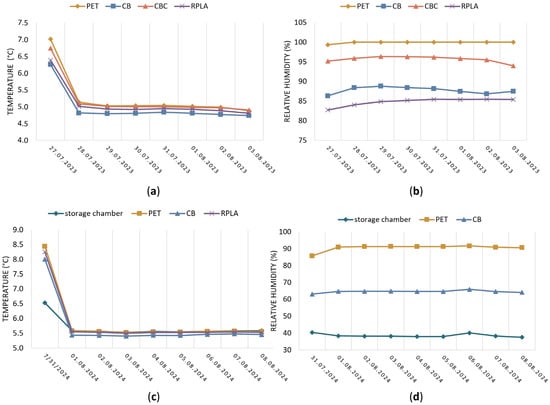
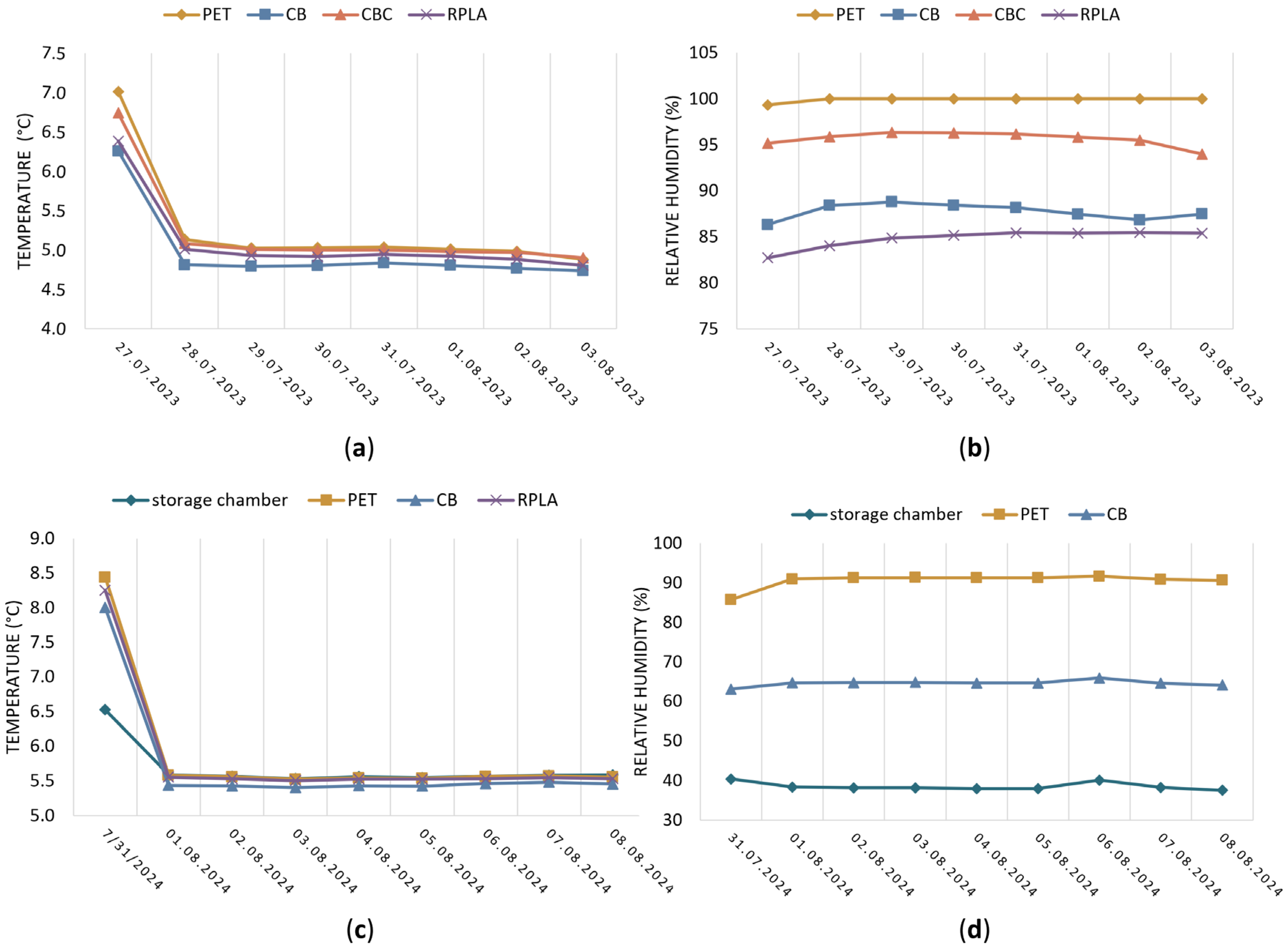
Temperature decreased similarly across all packages in ‘Northblue’, from initial values of 6.3–7.0 °C to approximately 4.8–5.1 °C during storage (Figure 1a). No clear differences in cooling patterns were observed among packaging treatments. Relative humidity differed among packaging treatments, with the highest values in PET (99.3–100.0%), followed by CBC (94.0–96.4%), CB (86.3–88.8%), and RPLA (82.7–85.5%) (Figure 1b).
Figure 1.
Temperature (a,c) and relative humidity (b,d) during cold storage of ‘Northblue’ for 7 days in 2023 (a,b) and ‘Draper’ for 8 days in 2024 (c,d) under different packaging treatments. Complete records were unavailable for all treatments in 2024 because of logger malfunction. PET, polyethylene terephthalate packaging; CB, corrugated cardboard; CBC, corrugated cardboard with a cellulose lid; RPLA, rice-straw packaging with a polylactic acid lid.
In ‘Draper’, temperature decreased similarly in all packages from approximately 8 °C at the beginning of storage to around 5.5 °C (Figure 1c). Relative humidity varied among packaging treatments, ranging from 38.5–40.0% in the storage chamber for the packages to 63.0–66.0% in CB and 86.0–92.0% in PET (Figure 1d).
2.4. Physical Quality Measurements
Fruit firmness was determined using a TMS-PRO texture analyzer (Mecmesin, Slinfold, West Sussex, UK) equipped with a 5 kg load cell and a 25 mm cylindrical aluminum probe. The protocol was adapted from Chiabrando et al. [13], Saftner et al. [14], and Schotsmans et al. [15]. Thirty medium-sized fruits free from visible defects were randomly selected per treatment. Firmness was measured using a non-destructive compression test simulating gentle finger pressure. The probe advanced at a pre-test speed of 30 mm min−1 until it reached a trigger force of 0.05 N. After zeroing, fruits were compressed equatorially at a test speed of 50 mm min−1 to a deformation depth of 1.0 mm. The maximum force (N) required to achieve this deformation was recorded as firmness. The probe subsequently retracted at a rate of 120 mm min−1.
For color measurements, 20 fruits were randomly selected per treatment in 2023, and 60 fruits were selected per treatment in 2024. The natural wax layer was removed mechanically following Kalt et al. [16]. Fruit surface color was measured using a reflectance colorimeter (CR-400, Minolta Co., Ltd., Tokyo, Japan). Two readings were taken on opposite sides of each fruit. Color parameters were expressed in the CIELAB system as lightness (L*), red/green coordinate (a*), yellow/blue coordinate (b*), chroma (C*), and hue angle (h°). Instrument calibration was performed using a standard white reference plate.
2.5. Chemical Analyses
Total phenolic content (TPC) was determined using the Folin–Ciocalteu method as described by Wrolstad et al. [17]. Phenolics were extracted with ethanol–acetone (7:3, v/v). Absorbance was measured at 765 nm using a Cary 60 UV–Vis spectrophotometer (Agilent Technologies, Santa Clara, CA, USA). Results were expressed as mg gallic acid equivalents per 100 g fresh weight (FW). Total anthocyanin content (TAC) was determined by the pH differential method [17] using extracts prepared in 0.1 M HCl and 96% ethanol (15:85, v/v). Absorbance was measured at 510 and 700 nm in buffers at pH 1.0 and pH 4.5. Results were expressed as mg cyanidin-3-glucoside equivalents per 100 g FW.
Total soluble solids (TSS) and estimated total organic acid content (TOA) were determined using a PAL-BX|ACID7 Master Kit digital refractometer (Atago, Tokyo, Japan). Juice was obtained from each homogenized biological replicate, and three analytical replicates were taken for each analysis. The homogenized mass was filtered, and the juice was collected for TSS analysis. TSS was measured directly in the undiluted juice and expressed as °Brix. Total organic acid content, expressed as citric acid equivalents, was estimated using the instrument’s acidity mode after diluting the juice 1:50 (v/v) with distilled water. The results were corrected for the dilution factor and expressed as g 100 mL−1 of juice. The TSS/TOA ratio was calculated for each biological replicate by dividing the TSS by the TOA.
2.6. Statistical Analysis
Data were analyzed using BlueSky Statistics software (Version 7). One-way analysis of variance (ANOVA) was used to assess the effect of treatment on fruit quality parameters, including weight loss, firmness, color characteristics (L*, a*, b*, C*, and h°), TPC, TAC, TSS, TOA, and the TSS/TOA ratio. The experimental factor was treatment, consisting of the initial fruit and four packaging treatments (PET, CB, CBC, and RPLA). Each packaging treatment consisted of three biological replicates, with one replicate package representing one biological replicate.
Mean comparisons were performed using Tukey’s HSD test at p ≤ 0.05. Results are presented as mean ± standard deviation (SD).
Pearson correlation and principal component analyses (PCA) were conducted using R Statistics (version 4.5.2) and BlueSky Statistics to explore relationships among fruit quality parameters and packaging treatments. PCA and Pearson correlation analysis were performed using individual biological replicates. Variables were standardized before PCA. Graphs were prepared using Microsoft Excel (Microsoft 365, Microsoft Corporation, Redmond, WA, USA) and R Statistics.
3. Results
3.1. Weight Loss and Firmness
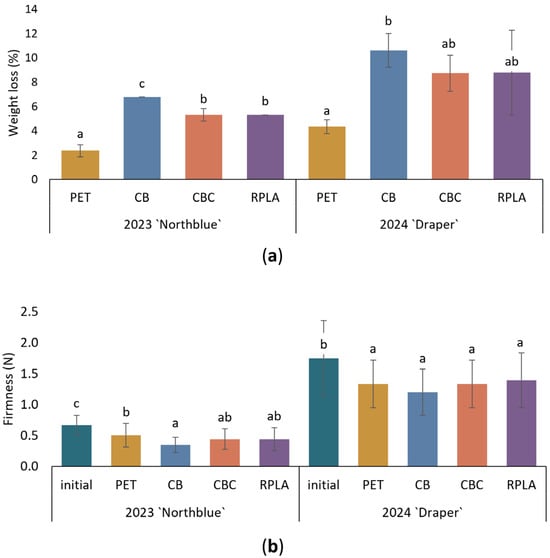
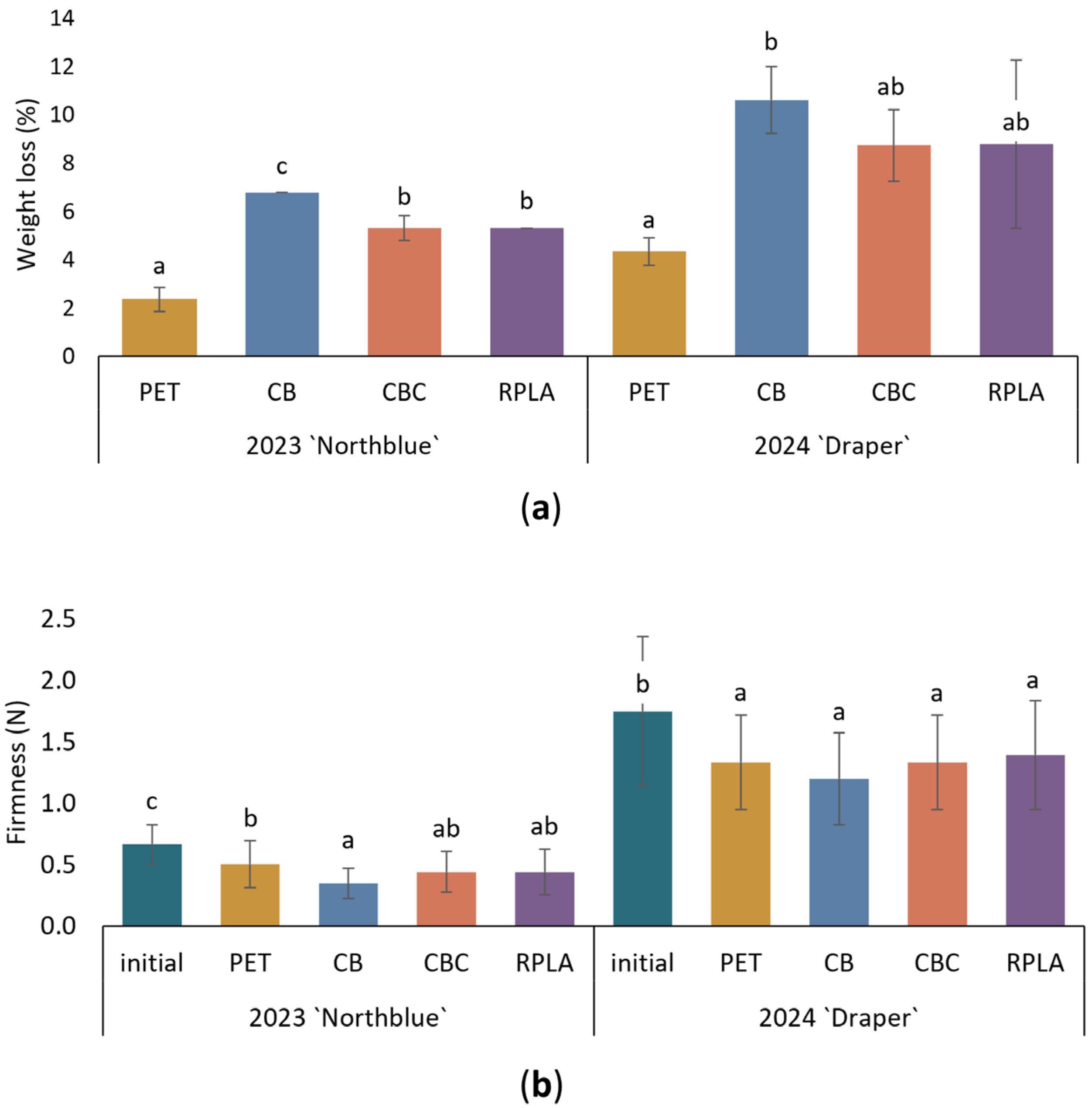
Weight loss differed significantly among packaging treatments in both cultivars (Figure 2a). In ‘Northblue’, fruits in PET exhibited the lowest weight loss (2.4%) and those in CB the highest (6.8%), while CBC and RPLA showed intermediate values (5.3% in both treatments) and differed significantly from both PET and CB. In ‘Draper’, the lowest weight loss was observed in PET (4.3%) and the highest in CB (10.6%). CBC (8.7%) and RPLA (8.8%) showed intermediate values and did not differ significantly from either PET or CB.
Figure 2.
Weight loss (%) (a) and firmness (b) of ‘Northblue’ (2023) and ‘Draper’ (2024) fruits stored in different packages for 7 and 8 days (respectively) in cold storage. Bars represent mean values ± SD. Within each cultivar–year combination, means followed by different letters differ significantly according to Tukey’s HSD test (p ≤ 0.05). Initial, fruit analyzed before storage; PET, polyethylene terephthalate package; CB, biodegradable corrugated cardboard package; CBC, biodegradable corrugated cardboard package with a cellulose lid; RPLA, biodegradable rice-straw with a polylactic acid lid package.
Firmness decreased significantly during storage in both cultivars (Figure 2b). In ‘Northblue’, the initial firmness of 0.67 N decreased to 0.35–0.51 N after storage. Fruits in PET exhibited the highest firmness (0.51 N), significantly exceeding those in CB (0.35 N), while CBC and RPLA showed intermediate values (0.44 N in both treatments) and did not differ significantly from either PET or CB. In ‘Draper’, firmness decreased from an initial value of 1.75 N to 1.20–1.40 N after storage, with no significant differences among packaging treatments.
3.2. Color Parameters
In ‘Northblue’, significant packaging effects were detected for L*, b*, and h° (Table 2). Fruits stored in PET exhibited higher L* (23.8) and more negative b* (−1.23) values than those stored in CB (22.6 and −0.40, respectively). Similarly, h° was lower in fruits stored in PET (319) than in CB (340). No significant treatment effects were detected for a* or C*. In ‘Draper’, storage-related changes were more pronounced. Compared with initial values, fruits exhibited lower a*, b*, and h° values and higher C* values after storage. After storage, packaging effects were limited to a* and h°, with fruits stored in RPLA showing the lowest values. No significant differences among packaging treatments were detected for L*, b*, or C*.
Table 2.
Effect of packaging treatments on the color parameters of postharvest ‘Northblue’ and ‘Draper’ blueberries.
In ‘Draper’, storage-related changes were more pronounced (Table 2). Compared with the initial, stored fruits exhibited lower a*, b*, and h° values and higher C* values. Packaging effects after storage were limited to a* and h°, with fruits stored in RPLA exhibiting the lowest values. No significant differences among packaging treatments were detected for L*, b*, or C*.
3.3. Chemical Quality Parameters
TPC of ‘Northblue’ fruits ranged from 223 to 295 mg 100 g−1 FW (Table 3) and increased significantly after storage in all packaging treatments. Among stored ‘Northblue’ fruits, TPC was 295, 287, 265, and 285 mg 100 g−1 FW in PET, CB, CBC, and RPLA, respectively (Table 3). TPC was significantly higher in PET and CB than in CBC, whereas RPLA did not differ from the other packaging treatments. In ‘Draper’, TPC ranged from 144 to 207 mg 100 g−1 FW. Fruits in RPLA exhibited the highest value (207 mg 100 g−1 FW), differing significantly from all other treatments, whereas CB showed the lowest (144 mg 100 g−1 FW). PET (150 mg 100 g−1 FW), the initial (168 mg 100 g−1 FW), and CBC (175 mg 100 g−1 FW) showed intermediate values. The initial fruit differed significantly from CB and RPLA but not from PET or CBC.
Table 3.
Effects of packaging treatments on the chemical quality of postharvest ‘Northblue’ and ‘Draper’ fruits.
TAC of ‘Northblue’ fruits ranged from 228 to 251 mg 100 g−1 FW (Table 3), with no significant effects of storage or packaging treatment. In ‘Draper’, TAC ranged from 49 to 90 mg 100 g−1 FW and decreased significantly after storage. Among the packaging treatments, fruits in CB exhibited the lowest TAC (49 mg 100 g−1 FW) and differed significantly from PET (61 mg 100 g−1 FW), CBC (60 mg 100 g−1 FW), and RPLA (67 mg 100 g−1 FW), which did not differ significantly from each other.
TSS of ‘Northblue’ fruits ranged from 12.7 to 14.2 °Brix (Table 3) and increased after storage. The highest values were observed in CB (14.2 °Brix) and RPLA (14.0 °Brix), both significantly higher than the initial value (12.7 °Brix). PET (13.0 °Brix) did not differ significantly from the initial value, while CBC (13.3 °Brix) showed an intermediate value. In ‘Draper’, TSS ranged from 10.3 to 14.2 °Brix (Table 3). RPLA exhibited the highest value (14.2 °Brix) and differed significantly from all other treatments, whereas the initial showed the lowest value (10.3 °Brix). CB (12.1 °Brix) was also significantly higher than the initial, while PET and CBC (11.0 °Brix in both treatments) did not differ significantly from the initial value.
TOA of ‘Northblue’ fruits ranged from 0.36 to 0.65 g 100 mL−1 (Table 3). RPLA exhibited the highest value (0.65 g 100 mL−1) and differed significantly from all other treatments, whereas CB showed the lowest (0.36 g 100 mL−1). PET (0.49 g 100 mL−1), CBC (0.40 g 100 mL−1), and the initial (0.53 g 100 mL−1) showed intermediate values. For ‘Draper’, the highest TOA values were observed in RPLA (0.88 g 100 mL−1) and PET (0.81 g 100 mL−1), both significantly higher than the initial (0.67 g 100 mL−1) and CB (0.50 g 100 mL−1). CBC (0.53 g 100 mL−1) showed an intermediate value and did not differ significantly from the initial fruit or the other packaging treatments.
TSS/TOA ratios of ‘Northblue’ fruits ranged from 21.6 to 40.5 (Table 3). CB exhibited the highest ratio (40.5), which was significantly higher than RPLA (21.6) and the initial value (25.0). PET (27.9) and CBC (34.4) showed intermediate values and did not differ significantly from the other treatments. For ‘Draper’, CB also exhibited the highest TSS/TOA ratio (21.8), differing significantly from PET (13.3), RPLA (16.1), and the initial (15.5). CBC (19.6) showed an intermediate value and differed significantly only from PET.
3.4. Relationships Among Quality Attributes and Packaging Treatments
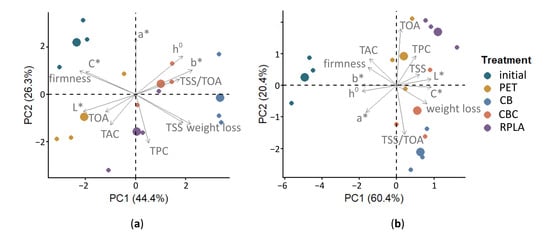
For ’Northblue’, PC1 and PC2 explained 44.4% and 26.3% of the total variance, respectively (Figure 3a). The PCA revealed clear differences among the storage treatments. Fruits stored in PET were mainly associated with L*, TOA, and TAC, whereas fruits stored in CB were more closely associated with weight loss, TSS, the TSS/TOA ratio, b, and h°. Fruits stored in RPLA were more closely associated with TPC, whereas CBC showed an intermediate pattern between the other packaging treatments. The initial fruits were clearly separated from the stored fruits and were primarily associated with firmness and C*.
Figure 3.
PCA (principal component analysis) biplots of blueberry cultivars ‘Northblue’ (2023) and ‘Draper’ (2024) stored in different packages for 7 and 8 days (respectively) in cold storage. (a) ‘Northblue’ fruits in 2023 and (b) ‘Draper’ fruits in 2024. Arrows represent the direction and relative contribution of the measured variables to the first two principal components. Initial, fruit analyzed before storage; PET, polyethylene terephthalate package; CB, biodegradable corrugated cardboard package; CBC, biodegradable corrugated cardboard package with a cellulose lid; RPLA, biodegradable rice-straw with a polylactic acid lid package; L*, lightness; a*, red/green; b*, yellow/blue; C*, chroma; h°, hue angle; TPC, total phenolic content; TAC, total anthocyanin content; TSS, total soluble solids; TOA, total organic acid content.
For ’Draper’, PC1 and PC2 explained 60.4% and 20.4% of the total variance, respectively (Figure 3b). Fruits stored in PET showed a distinct quality profile and were associated with L*, C*, TSS, and TPC. Fruits stored in CB and CBC were more closely associated with weight loss and TSS/TOA and were positioned opposite to firmness. Fruits stored in RPLA formed a distinct group, particularly associated with TOA and TPC. The initial were clearly separated from all storage treatments and were primarily associated with firmness and TAC.
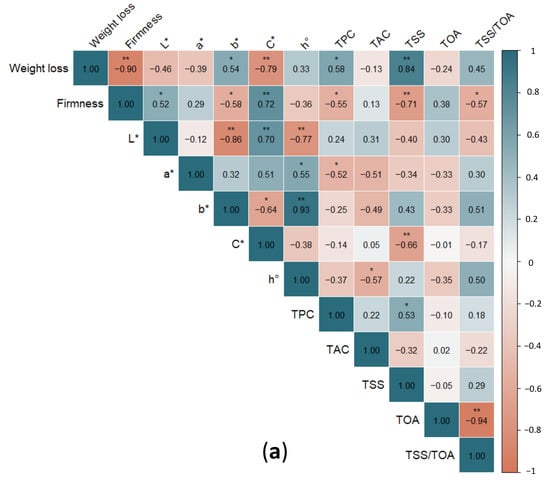
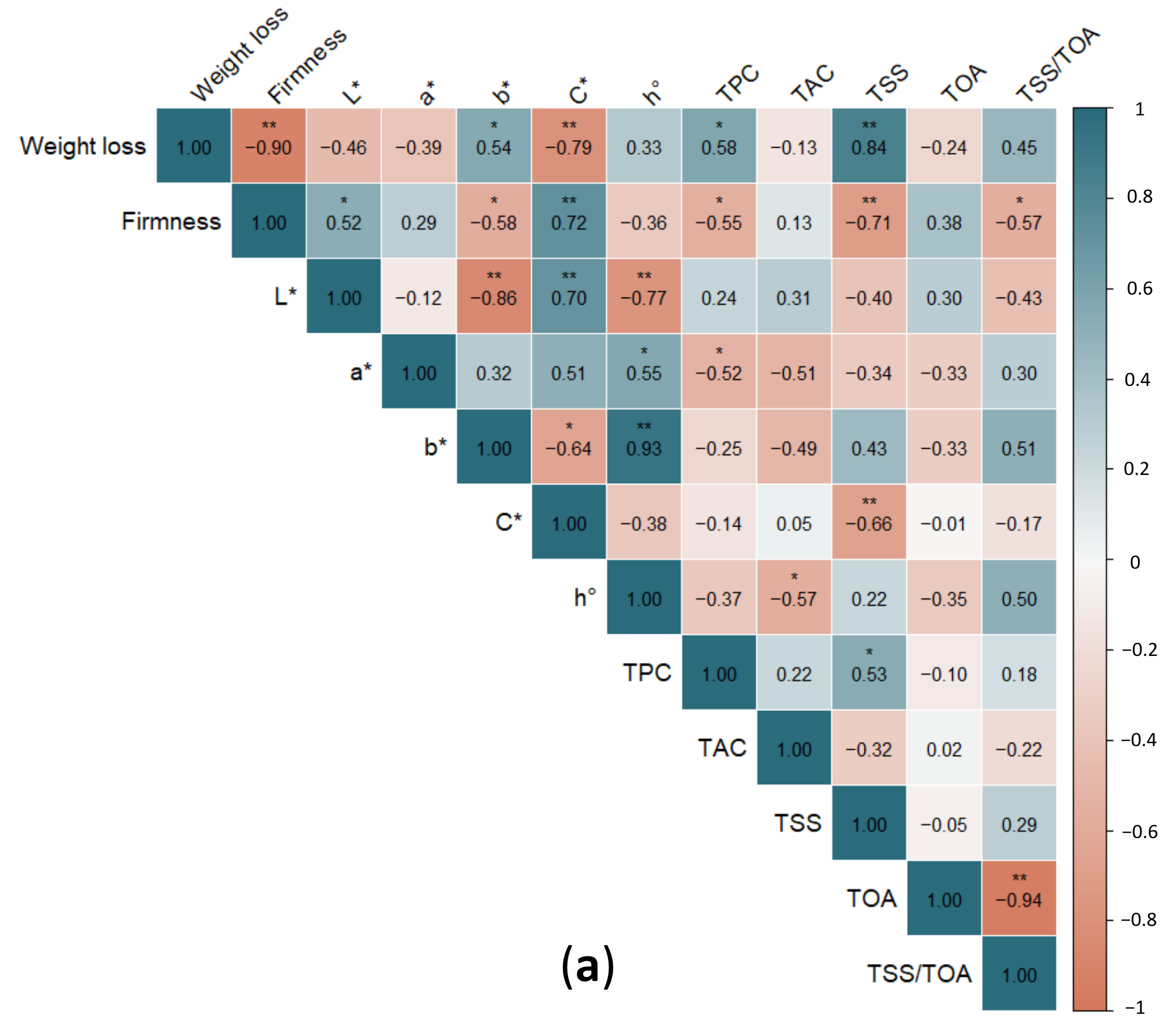
Correlation analysis of ‘Northblue’ quality parameters in 2023 identified several strong relationships (Figure 4a). Weight loss was strongly positively correlated with TSS (r = 0.84) and strongly negatively correlated with firmness (r = −0.90) and C* (r = −0.79). Firmness was positively correlated with C* (r = 0.72) and negatively correlated with TSS (r = −0.71).
Figure 4.
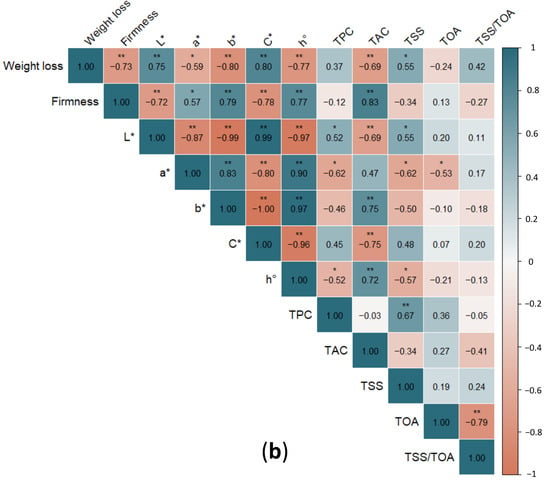
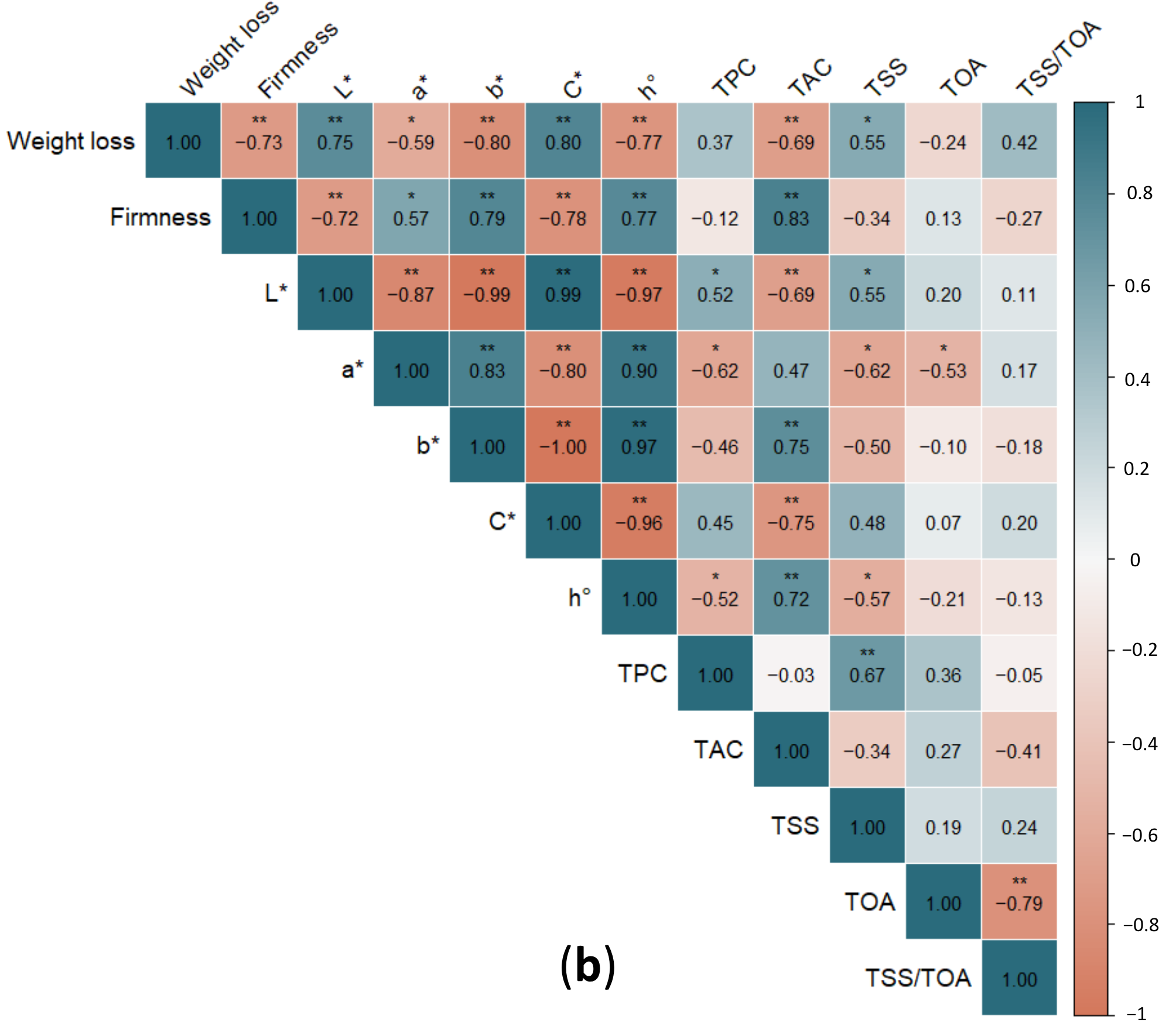
Pearson correlation matrices of quality attributes of ‘Northblue’ (a) and ‘Draper’ (b). Cell values represent Pearson correlation coefficients (r); colors indicate the direction and strength of the correlations. Asterisks indicate statistically significant correlations (* p ≤ 0.05; ** p ≤ 0.01). L*, lightness; a*, red-green; b*, yellow-blue; C*, chroma; h°, hue angle; TPC, total phenolic content; TAC, total anthocyanin content; TSS, total soluble solids; TOA, total organic acid content.
Correlation analysis of ‘Draper’ quality parameters showed several strong associations among physical, chemical, and color characteristics (Figure 4b). Weight loss was strongly positively correlated with L* (r = 0.75) and C* (r = 0.80), and strongly negatively correlated with firmness (r = −0.73) and h° (r = −0.77). Firmness was strongly positively correlated with TAC (r = 0.83), b* (r = 0.79), and h° (r = 0.77), and negatively correlated with C* (r = −0.78). Among the chemical and color parameters, TAC was positively correlated with b* (r = 0.75) and h° (r = 0.72).
4. Discussion
Weight loss was influenced by packaging treatment, whereas packaging effects on firmness were less consistent. PET resulted in significantly lower weight loss in ‘Northblue’, while in ‘Draper’ its lower mean value did not differ significantly from CBC or RPLA. Significant packaging effects on firmness were also detected only in ‘Northblue’, where fruits stored in PET were firmer than those in CB. These responses coincided with the relatively high RH recorded in PET, supporting previous findings that higher humidity reduces transpiration, fruit weight loss, and subsequent loss of firmness [18,19].
However, RH alone did not fully explain the differences among packaging treatments. In ‘Northblue’, RH was lowest in RPLA, whereas the greatest weight loss and lowest firmness were observed in fruits stored in CB. The measured package characteristics further indicate that packaging design may have contributed to these differences (Table 1). CB had a substantially larger total ventilation opening area than the other packaging types, which may have facilitated greater water-vapor exchange with the surrounding environment. However, PET showed the lowest fruit weight loss despite having a larger ventilation area than CBC and RPLA, indicating that ventilation area alone cannot explain the observed responses. Material composition and the resulting package microenvironment may therefore also have influenced moisture transfer. Previous studies have similarly shown that increased airflow can accelerate fruit dehydration [19], while differences in package permeability can affect the internal storage environment and postharvest physiological processes [7]. Almenar et al. [5] also reported greater weight loss in ventilated plastic packages than in sealed biodegradable packages. This apparent contradiction suggests that material permeability and moisture sorption may also have influenced fruit water loss. The relatively impermeable PET likely retained transpired water vapor and maintained a high RH microenvironment, whereas the more porous fiber-based materials may have facilitated moisture transfer through the package structure despite their smaller ventilation openings.
Multivariate analyses were also consistent with an association between fruit water loss and firmness. In the PCA, weight loss and firmness were positioned in opposite directions, indicating contrasting responses of these quality attributes. The correlation analysis supported this pattern, as weight loss was strongly negatively correlated with firmness in both ‘Northblue’ and ‘Draper’. Similar relationships have been reported previously and are commonly associated with loss of cell turgor during fruit dehydration [19]. Nevertheless, firmness is influenced not only by water loss but also by structural changes in fruit tissue, including cell-wall degradation, as well as cultivar-specific differences in softening [20,21,22]. This may explain why packaging effects were more consistent for weight loss than for firmness.
Differences between ‘Northblue’ and ‘Draper’ may reflect both inherent cultivar characteristics and year-specific preharvest conditions. Because the two cultivars were evaluated in different growing seasons, these effects cannot be separated in the present study. ‘Draper’ fruits were firmer but showed greater weight loss during storage. Cultivar-specific differences in postharvest firmness have been reported previously [22], and softer fruit texture has been associated with a greater contribution of lowbush (Vaccinium angustifolium) ancestry [23].
In ‘Draper’, the excessive weight loss in CB packaging (10.6%), which exceeded the 10% commercial quality threshold [24], directly resulted in fruit shriveling and a significant loss of TAC. The substantial water loss observed may have been partly related to the exceptionally wet pre-harvest weather in July 2024, potentially through effects on the integrity of the protective cuticular wax layer. When these weather-affected fruits were placed in a drier environment (40% RH) within a package with a large ventilation area (CB), greater water loss was observed, which may have contributed to the subsequent loss of pigmentation. These findings suggest that cardboard packaging with large ventilation openings may be less suitable for cultivars harvested under humid or rainy pre-harvest conditions. Previous studies have shown that changes in the fruit wax layer can increase susceptibility to postharvest moisture loss and quality deterioration [25,26].
From a commercial perspective, Paniagua et al. [19] reported visible shriveling at approximately 8% fruit weight loss, whereas Pavlovski [24] proposed a commercial acceptability threshold of approximately 10%. In the present study, ‘Draper’ fruits stored in CB, CBC, and RPLA exceeded 8% weight loss, while fruits stored in CB exceeded 10%. These results emphasize that, although some alternative packaging systems may be suitable for short-term storage conditions, controlling fruit water loss remains an important consideration in package design.
The higher weight loss observed in fruits packaged in CB may be related to the relatively low relative humidity used in this study (40 ± 2% RH), particularly in combination with the large ventilation area of the CB packaging. Under higher RH conditions (e.g., 85% to 89%), as commonly applied in long-term postharvest storage [27,28], the weight loss from fruits packaged in CB might be reduced, potentially resulting in a longer shelf life. However, higher RH conditions may also influence the moisture content of the cardboard and, consequently, its mechanical and handling properties. Therefore, the RH level used in this study was selected to reflect the intended short-term postharvest handling conditions while considering the potential effects of elevated humidity on the structural and functional properties of the cardboard packages (CB and CBC). Because complete RH records for RPLA were not available in the ‘Draper’ experiment, the quality responses observed for this treatment cannot be directly related to package RH.
The effects of storage and packaging on fruit color differed between the two cultivars. In ‘Northblue’, packaging significantly affected L*, b*, and h°, with fruits stored in PET showing higher L* and more negative b* values than those stored in CB, corresponding to a lighter and stronger blue color. Lower h° values in PET also indicated a shift toward the blue region. The PCA supported these differences, with PET positioned closer to L* and CB closer to b* and h°. These color differences coincided with lower fruit weight loss in PET and greater weight loss in CB, suggesting that differences in fruit water status may have contributed to the observed color response. Similar associations between moisture loss and postharvest appearance have been reported previously [29].
In ‘Draper’, packaging effects were less pronounced and were detected only for a* and h°, whereas storage-related changes occurred in several color parameters. These changes coincided with a significant decrease in TAC, and correlation analysis showed positive relationships between TAC and both b* and h°. Anthocyanins are major contributors to blueberry skin pigmentation, and changes in anthocyanin concentration have previously been associated with both color development and postharvest color variation [30,31].
Overall, the factors associated with color variation appeared to differ between the two cultivars. In ‘Northblue’, packaging-related color differences coincided more closely with variation in fruit weight loss, whereas in ‘Draper’, storage-related color changes were more closely associated with the decline in TAC.
Chemical responses to storage and packaging differed between the two cultivars. In ‘Northblue’, TPC increased during storage in all packaging treatments, whereas in ‘Draper’ the response was more treatment-dependent, with the highest TPC observed in RPLA and the lowest in CB. Increases in blueberry TPC during cold storage and following delayed harvest have also been reported previously [32,33,34]. The consistently close association of RPLA with TPC in the PCA suggests that the package microenvironment may have contributed to phenolic retention or accumulation. However, the absence of a clear relationship between TPC and fruit weight loss suggests that dehydration alone may not explain this response. The higher TPC in RPLA may be related to its package-specific microenvironment, which could have influenced phenolic metabolism or stress responses during storage. Similar effects of storage and packaging conditions on blueberry phytochemical composition have also been reported [9]. Overall, the TPC results were associated with both differences between the cultivar experiments and the specific package microenvironment.
TAC showed a different pattern. It remained relatively stable in ‘Northblue’, with no significant differences among packaging treatments, whereas in ‘Draper’ it decreased after storage and was lowest in fruits stored in CB. These differences are consistent with previous findings that postharvest anthocyanin responses depend on genotype and storage conditions [31]. The greater decrease in TAC in ‘Draper’ also coincided with more pronounced changes in fruit color, and TAC was positively correlated with b* and h°. This supports the close relationship between anthocyanin composition and blueberry surface color reported previously [30,31]. Thus, TAC responses differed between the two cultivars tested, but these findings cannot be generalized to other blueberry genotypes. Changes in TSS and TOA were also closely linked. TSS generally increased after storage, with the highest values in CB and RPLA for ‘Northblue’ and in RPLA for ‘Draper’. Increases in TSS during storage may result partly from the concentration of soluble compounds as water is lost and partly from ongoing postharvest metabolism [35]. In the present study, higher TSS tended to coincide with greater fruit weight loss, particularly in ‘Northblue’, and PCA also positioned TSS close to weight loss and the TSS/TOA ratio. These relationships suggest that dehydration may have contributed to the observed increase in soluble solids, although packaging and differences between the two cultivar experiments influenced the magnitude of the response.
TOA varied substantially among packaging treatments. RPLA showed the highest TOA in ‘Northblue’, whereas CB had the lowest value; in ‘Draper’, higher values were observed in RPLA and PET than in CB. Organic acids are consumed as respiratory substrates during postharvest storage; therefore, differences in the package microenvironment may have contributed to the observed changes in TOA [36,37]. However, as headspace O2 and CO2 concentrations and fruit respiration were not measured, the potential role of package atmosphere in influencing respiration and organic acid metabolism cannot be directly established.
Because gas composition and respiration were not measured in the present study, these mechanisms cannot be confirmed directly, but they provide a possible explanation for the treatment-related differences in TOA. Packaging-related effects on soluble solids and acidity have likewise been reported in stored blueberries [9]. Thus, the observed TOA differences may reflect both differences between the two cultivar experiments and packaging-dependent storage conditions rather than a single underlying factor.
The combined changes in TSS and TOA were reflected in the TSS/TOA ratio. CB produced the highest ratio in both cultivars, resulting from the combination of relatively high TSS and low TOA, whereas the other packaging treatments showed less consistent responses. The TSS/TOA ratio reflects the balance between sweetness and acidity and is commonly used as an indicator of fruit maturity and postharvest quality [38,39,40]. Its increase may be associated with the concentration of soluble solids, depletion of organic acids, or both. Therefore, the consistently high TSS/TOA ratio in CB indicates that this packaging treatment produced the clearest shift in the soluble solids–acid balance during storage, while responses in the other treatments differed between the two cultivar experiments.
5. Conclusions
Under the conditions evaluated in this study, packaging effects on postharvest quality differed between ‘Northblue’ and ‘Draper’ and among quality attributes. Because only two cultivars were evaluated in different growing seasons, these findings cannot be generalized to other blueberry genotypes. In this study, packaging types that maintained lower internal RH were more prone to fruit dehydration, indicating that moisture retention is an important consideration for short local supply chains. In ‘Northblue’, weight loss was lowest in PET and highest in CB; however, in ‘Draper’, neither PET nor CB differed significantly from CBC or RPLA. RPLA had the highest organic acid content in both experiments and the highest TPC in ‘Draper’, although the TPC response differed in ‘Northblue’. These results indicate that package performance depends on the quality attribute considered and the cultivar being tested. CBC and RPLA showed potential for short-term cold storage under the conditions evaluated in this study.
These results demonstrate that package performance is highly dependent on both the specific quality attribute and the cultivar being tested. Overall, while CBC and RPLA showed promising potential for preserving key physical and chemical attributes during short-term cold storage, their recommendation as viable packaging alternatives remains conditional. Further research should assess the applicability of these packages in local supply chains through targeted trials incorporating sensory quality, shelf-life performance, headspace gas composition (O2/CO2), and conditions representative of commercial storage and distribution. For future postharvest packaging design, particular attention should be given to the ventilation opening area to optimize the balance between gas exchange and water-vapor retention based on the specific physiological requirements of the intended cultivars.
Author Contributions
Conceptualization, A.K.; methodology, A.K., P.P. and U.M.; software, P.P.; validation, A.K., H.V. and K.K.; formal analysis, A.K., H.V. and U.M.; investigation, A.K., H.V., U.M., L.M. and M.M.-K.; resources, A.K.; data curation, P.P., H.V. and A.K.; writing—original draft preparation, A.K. and H.V.; writing—review and editing, H.V., A.K., M.M.-K., L.M., K.K. and U.M.; visualization, H.V. and R.R.; supervision, A.K.; project administration, U.M.; funding acquisition, U.M. All authors have read and agreed to the published version of the manuscript.
Funding
This work was supported by the project 8-2/T10036PKAI “Blueberry (Vaccinium) breeding” (1 March 2010–15 January 2031), funded by the Ministry of Regional Affairs and Agriculture (Estonia), and by the long-term knowledge transfer program in the field of agriculture, food and rural economy—horticulture ( Procurement Contract No. 257107/1, 30 May 2023–31 December 2025), funded by the Agricultural Registers and Information Board (Estonia).
Data Availability Statement
The raw data supporting the conclusions of this article will be made available by the authors on request.
Acknowledgments
During the preparation of this manuscript, the authors used ChatGPT (OpenAI, GPT-5.6) for language editing, improving the clarity and structure of the text, and for assistance in developing R code used for data visualization. The authors reviewed and verified all generated content and code and take full responsibility for the content of this publication.
Conflicts of Interest
The authors declare no conflicts of interest.
Abbreviations
The following abbreviations are used in this manuscript:
| PET | Polyethylene terephthalate package |
| CB | Corrugated cardboard package |
| CBC | Corrugated cardboard package with a cellulose lid |
| RPLA | Rice-straw package with a polylactic acid lid |
| L* | Lightness |
| a* | Red/green coordinate |
| b* | Yellow/blue coordinate |
| C* | Chroma |
| h° | Hue angle |
| TPC | Total phenolic content |
| TAC | Total anthocyanin content |
| TSS | Total soluble solids |
| TOA | Total organic acids |
| FW | Fresh weight |
| RH | Relative humidity |
| PCA | Principal component analysis |
| SD | Standard deviation |
References
- 2025 Report—International Blueberry Organization. Available online: https://www.internationalblueberry.org/2025-report (accessed on 3 June 2026).
- Peano, C.; Girgenti, V.; Baudino, C.; Giuggioli, N.R. Blueberry Supply Chain in Italy: Management, Innovation and Sustainability. Sustainability 2017, 9, 261. [Google Scholar] [CrossRef] [Scilit]
- Wu, Y.; Han, T.; Yang, H.; Lyu, L.; Li, W.; Wu, W. Known and Potential Health Benefits and Mechanisms of Blueberry Anthocyanins: A Review. Food Biosci. 2023, 55, 103050. [Google Scholar] [CrossRef] [Scilit]
- Regulation—EU—2025/40—EN—PPWR—EUR-Lex. Available online: https://eur-lex.europa.eu/legal-content/EN/TXT/?uri=CELEX:32025R0040 (accessed on 10 July 2026).
- Almenar, E.; Samsudin, H.; Auras, R.; Harte, B.; Rubino, M. Postharvest Shelf Life Extension of Blueberries Using a Biodegradable Package. Food Chem. 2008, 110, 120–127. [Google Scholar] [CrossRef] [Scilit] [PubMed]
- Cao, S.; Qiao, L.; Wang, X.; Huang, T.; Wu, C.; Zhang, Y.; Xue, Z.; Kou, X. Discussion on Postharvest Quality, Strategies of Storage and Transportation Techniques of Blueberries: A Comprehensive Review. Food Qual. Saf. 2025, 9, fyaf038. [Google Scholar] [CrossRef] [Scilit]
- Liu, X.; Yi, J.; Ma, W.; Fan, M.; Dong, Q.; Qian, K.; Li, L. Regulating the Permeability of Poly(Lactic Acid)/Poly(3-Hydroxybutyrate-Co-4-Hydroxybutyrate) Composite Films for Peach Preservation. Int. J. Biol. Macromol. 2025, 334, 149090. [Google Scholar] [CrossRef] [Scilit] [PubMed]
- Li, H.; Li, M.; Xu, Y.; Gao, Z.; Chi, H.; Wang, H. Characterization of Excellent Performance Tea Polyphenol-Loaded Polyethylene Oxide/Ethyl Cellulose Nanofiber Films Prepared by Centrifugal Spinning and Application in Blueberry Preservation. Food Biosci. 2025, 71, 107376. [Google Scholar] [CrossRef] [Scilit]
- Koort, A.; Moor, U.; Põldma, P.; Kaiser, C.; Starast, M. Comparison of Regular Atmospheric Storage versus Modified Atmospheric Packaging on Postharvest Quality of Organically Grown Lowbush and Half-Highbush Blueberries. Sustainability 2018, 10, 3916. [Google Scholar] [CrossRef] [Scilit]
- Duarte Sierra, A.; Jha, D.K. Extending the Postharvest Life of Wild Blueberries with Proprietary Plastic Pallet Covers. Future Foods 2023, 8, 100277. [Google Scholar] [CrossRef] [Scilit]
- Sanchez-Ballesta, M.T.; Marti-Anders, C.; Álvarez, M.D.; Escribano, M.I.; Merodio, C.; Romero, I. Are the Blueberries We Buy Good Quality? Comparative Study of Berries Purchased from Different Outlets. Foods 2023, 12, 2621. [Google Scholar] [CrossRef] [Scilit] [PubMed]
- Põllud|PRIA. Available online: https://www.pria.ee/infokeskus/statistika/pollud#kasvatatavad-kultuurid (accessed on 2 October 2026).
- Chiabrando, V.; Giacalone, G.; Rolle, L. Mechanical Behaviour and Quality Traits of Highbush Blueberry during Postharvest Storage. J. Sci. Food Agric. 2009, 89, 989–992. [Google Scholar]
- Saftner, R.; Polashock, J.; Ehlenfeldt, M.; Vinyard, B. Instrumental and Sensory Quality Characteristics of Blueberry Fruit from Twelve Cultivars. Postharvest Biol. Technol. 2008, 49, 19–26. [Google Scholar] [CrossRef] [Scilit]
- Schotsmans, W.; Molan, A.; MacKay, B. Controlled Atmosphere Storage of Rabbiteye Blueberries Enhances Postharvest Quality Aspects. Postharvest Biol. Technol. 2007, 44, 277–285. [Google Scholar] [CrossRef] [Scilit]
- Kalt, W.; Forney, C.F.; Martin, A.; Prior, R.L. Antioxidant Capacity, Vitamin C, Phenolics, and Anthocyanins after Fresh Storage of Small Fruits. J. Agric. Food Chem. 1999, 47, 4638–4644. [Google Scholar] [CrossRef] [Scilit] [PubMed]
- Wrolstad, R.E.; Durst, R.W.; Lee, J. Tracking Color and Pigment Changes in Anthocyanin Products. Trends Food Sci. Technol. 2005, 16, 423–428. [Google Scholar] [CrossRef] [Scilit]
- Li, M.; Rivera, S.; Franklin, D.; Nowak, E.; Hallett, I.; Kolenderska, S.; Urbańska, M.; Vanholsbeeck, F.; East, A. Use of Optical Coherence Tomography and Light Microscopy for Characterisation of Mechanical Properties and Cellular Level Responses of ‘Centurion’ Blueberries during Weight Loss. J. Food Eng. 2021, 303, 110596. [Google Scholar] [CrossRef] [Scilit]
- Paniagua, A.C.; East, A.R.; Hindmarsh, J.P.; Heyes, J.A. Moisture Loss Is the Major Cause of Firmness Change during Postharvest Storage of Blueberry. Postharvest Biol. Technol. 2013, 79, 13–19. [Google Scholar] [CrossRef] [Scilit]
- Chen, H.; Cao, S.; Fang, X.; Mu, H.; Yang, H.; Wang, X.; Xu, Q.; Gao, H. Changes in Fruit Firmness, Cell Wall Composition and Cell Wall Degrading Enzymes in Postharvest Blueberries during Storage. Sci. Hortic. 2015, 188, 44–48. [Google Scholar] [CrossRef] [Scilit]
- Dong, J.; Li, X.; Li, Y.; Lyu, L.; Wu, W.; Wu, Y.; Li, W.; Zhang, C. Firmness Loss in Blueberry (Vaccinium Corymbosum) Is Associated With Increased PG Activity, Upregulation of Softening-Related Genes, and Pectin Metabolism. J. Food Sci. 2025, 90, e70410. [Google Scholar] [CrossRef] [Scilit] [PubMed]
- Moggia, C.; Peñaloza, O.; Torres, J.; Romero-Bravo, S.; Sepulveda, D.; Jara, R.; Vivanco, S.; Valdés, M.; Zúñiga, M.; Beaudry, R.M.; et al. Within-Plant Variability in Blueberry (Vaccinium Corymbosum L.) II: Is a Shorter Harvest Interval Always the Ideal Strategy to Maximize Fruit Firmness? Postharvest Biol. Technol. 2022, 186, 111815. [Google Scholar] [CrossRef] [Scilit]
- Ehlenfeldt, M.K.; Martin, R.B., Jr. A Survey of Fruit Firmness in Highbush Blueberry and Species-Introgressed Blueberry Cultivars. HortScience 2002, 37, 386–389. [Google Scholar] [CrossRef] [Scilit]
- Pavlovski, N. Estimation of Berry Storage Life of Blueberries Grown in Belarus. Int. J. Fruit. Sci. 2014, 14, 58–68. [Google Scholar] [CrossRef] [Scilit]
- Chu, W.; Gao, H.; Chen, H.; Fang, X.; Zheng, Y. Effects of Cuticular Wax on the Postharvest Quality of Blueberry Fruit. Food Chem. 2018, 239, 68–74. [Google Scholar] [CrossRef] [Scilit] [PubMed]
- Sanford, K.A.; Lidster, P.D.; McRae, K.B.; Jackson, E.D.; Lawrence, R.A.; Stark, R.; Prange, R.K. Lowbush Blueberry Quality Changes in Response to Mechanical Damage and Storage Temperature. J. Am. Soc. Hortic. Sci. 2019, 116, 47–51. [Google Scholar] [CrossRef] [Scilit]
- Godara, A.; Ames, Z.R.; Deltsidis, A. Delayed Harvest Reduces Postharvest Quality and Storability of Southern Highbush Cv. Meadowlark and Rabbiteye Blueberry Cv. Brightwell. HortScience 2025, 60, 182–190. [Google Scholar] [CrossRef] [Scilit]
- Moggia, C.; González, C.; Lobos, G.A.; Bravo, C.; Valdés, M.; Lara, I.; Graell, J. Changes in Quality and Maturity of ‘Duke’ and ‘Brigitta’ Blueberries during Fruit Development: Postharvest Implications. Acta Hortic. 2018, 1194, 1495–1501. [Google Scholar] [CrossRef] [Scilit]
- Varaldo, A.; Alchera, F.; Giuggioli, N.R.; Giacalone, G. Blueberry (Vaccinium Corymbosum L.) Postharvest UVB Treatments Induce Changes in Bioactive Compounds and Reduce Weight Losses during Cold Storage. Acta Hortic. 2024, 1396, 537–544. [Google Scholar] [CrossRef] [Scilit]
- Chung, S.W.; Yu, D.J.; Lee, H.J. Changes in Anthocyanidin and Anthocyanin Pigments in Highbush Blueberry (Vaccinium Corymbosum Cv. Bluecrop) Fruits during Ripening. Hortic. Environ. Biotechnol. 2016, 57, 424–430. [Google Scholar] [CrossRef] [Scilit]
- Yan, Y.; Pico, J.; Gerbrandt, E.M.; Dossett, M.; Castellarin, S.D. Comprehensive Anthocyanin and Flavonol Profiling and Fruit Surface Color of 20 Blueberry Genotypes during Postharvest Storage. Postharvest Biol. Technol. 2023, 199, 112274. [Google Scholar] [CrossRef] [Scilit]
- Connor, A.M.; Luby, J.J.; Hancock, J.F.; Berkheimer, S.; Hanson, E.J. Changes in Fruit Antioxidant Activity among Blueberry during Cold-Temperature Storage. J. Agric. Food Chem. 2002, 50, 893–898. [Google Scholar] [CrossRef] [Scilit] [PubMed]
- Jiang, H.; Sun, Z.; Jia, R.; Wang, X.; Huang, J. Effect of Chitosan as an Antifungal and Preservative Agent on Postharvest Blueberry. J. Food Qual. 2016, 39, 516–523. [Google Scholar] [CrossRef] [Scilit]
- Mallik, A.U.; Hamilton, J. Harvest Date and Storage Effect on Fruit Size, Phenolic Content and Antioxidant Capacity of Wild Blueberries of NW Ontario, Canada. J. Food Sci. Technol. 2017, 54, 1545. [Google Scholar] [CrossRef] [Scilit] [PubMed]
- Tumbarski, Y.D.; Todorova, M.M.; Topuzova, M.G.; Georgieva, P.I.; Petkova, N.T.; Ivanov, I.G. Postharvest Biopreservation of Fresh Blueberries by Propolis-Containing Edible Coatings Under Refrigerated Conditions. Curr. Res. Nutr. Food Sci. 2022, 10, 99–112. [Google Scholar] [CrossRef] [Scilit]
- Falagán, N.; Miclo, T.; Terry, L.A. Graduated Controlled Atmosphere: A Novel Approach to Increase “Duke” Blueberry Storage Life. Front. Plant Sci. 2020, 11, 514750. [Google Scholar] [CrossRef] [Scilit] [PubMed]
- Jiang, B.; Fang, X.; Fu, D.; Wu, W.; Han, Y.; Chen, H.; Liu, R.; Gao, H. Exogenous Salicylic Acid Regulates Organic Acids Metabolism in Postharvest Blueberry Fruit. Front. Plant Sci. 2022, 13, 1024909. [Google Scholar] [CrossRef] [Scilit] [PubMed]
- Dragišić Maksimović, J.; Milivojević, J.; Djekić, I.; Radivojević, D.; Veberič, R.; Mikulič Petkovšek, M. Changes in Quality Characteristics of Fresh Blueberries: Combined Effect of Cultivar and Storage Conditions. J. Food Compos. Anal. 2022, 111, 104597. [Google Scholar] [CrossRef] [Scilit]
- Gasdick, M.; Austin, C.; DuBois, A.; Wei, L.; Mayhew, E.; VanderWeide, J. Delayed Harvest Improves Consumer Liking of Firm Northern Highbush Blueberry Cultivars by Decreasing Berry Acidity and Sourness. Sci. Hortic. 2026, 365, 114993. [Google Scholar] [CrossRef] [Scilit]
- Moggia, C.; Lara, I.; Graell, J.; Schmeda-hirschmann, G.; Thomas-valdés, S.; Lobos, G.A. Are Fruit Surface Differences in Two Blueberry Cultivars Major Drivers of Contrasting Postharvest Dynamics? Horticulturae 2022, 8, 607. [Google Scholar] [CrossRef] [Scilit]

Disclaimer/Publisher’s Note: The statements, opinions and data contained in all publications are solely those of the individual author(s) and contributor(s) and not of MDPI and/or the editor(s). MDPI and/or the editor(s) disclaim responsibility for any injury to people or property resulting from any ideas, methods, instructions or products referred to in the content. |
© 2026 by the authors. Licensee MDPI, Basel, Switzerland. This article is an open access article distributed under the terms and conditions of the Creative Commons Attribution (CC BY) license.