


Abstract
Thyme (Thymus vulgaris L.) is a widely cultivated aromatic and medicinal plant valued for its culinary use, essential oils, and diverse bioactive compounds with nutritional and pharmaceutical significance. Zinc biofortification using nanoparticles (NPs) represents a promising approach for improving the nutritional value of aromatic and medicinal plants. This study evaluated the effects of foliar application of ZnO nanoparticles (ZnO NPs) on growth, biomass production, and mineral composition of thyme grown under controlled conditions. Plants were treated three times at seven-day intervals with ZnO NP suspensions at 0, 30, 60, and 90 mg L−1 (43; 86 and 129 µg Zn plant−1 respectively). Foliar Zn application did not significantly affect plant height, branching, shoot length, fresh or dry biomass, or derived morphological indices, although Zn60 showed the highest plant height and biomass per branch. In contrast, Zn accumulation showed a pronounced dose-dependent response. Zn concentration increased from 31.83 mg kg−1 in the control to 68.41 and 99.94 mg kg−1 under Zn60 and Zn90 treatments, representing approximately 2.15- and 3.14-fold higher Zn concentrations, respectively. Foliar treatments also modified the concentrations of several macro- and micronutrients, while Fe and Cu remained relatively stable. Zinc concentration was positively correlated with Fe, N, Cu, S, and Ca, while Fe and Cu concentrations remained relatively stable across treatments. In general, ZnO NP foliar application effectively enhanced Zn accumulation in thyme without significantly compromising plant growth, indicating its potential for agronomic biofortification.
1. Introduction
Medicinal, culinary, and aromatic herbs have always been an integral part of human diet, prevention, and treatment, especially in the time when medicine was not so developed [1,2,3,4,5]. Today, alongside all synthetically obtained active substances, people are more and more turning to plants as the best and natural source of secondary metabolites [6,7,8,9]. Thyme, which belongs to the Lamiaceae family, is a perennial plant species used around the world in various industries like the culinary and pharmaceutical industries, all because it is a rich source of secondary metabolites that possess antioxidant, antibacterial, and anti-inflammatory properties [10,11,12]. The chemical profile of thyme essential oils is mostly characterized by a high proportion of monoterpenes, especially phenolic compounds like thymol and carvacrol, whose concentrations can vary depending on chemotype, geographical origin, and agrotechnical measures [13,14]. Due to all these biologically active compounds, thyme is today increasingly investigated as a great potential natural preservative and functional ingredient in the food industry [15,16].
With growing demand for natural products and the concept of a „green pharmacy,” agrotechnical measures that do not just enhance the yield but also the nutritional quality of thyme is becoming a topic of strong scientific interest [17,18]. Although food today is mostly globally available, deficiency of essential microelements, also known as „hidden hunger,” still remains a really serious health issue affecting millions of people, especially in developing countries. Deficiencies in zinc (Zn) are linked to weakened immunity, growth disorders, cognitive deficits, and an increased risk of chronic diseases [19,20,21]. Traditional ways to combat these deficiencies, such as oral supplements and industrial fortification of processed food or using biofortified plants for functional food products [22], are often expensive, need constant application, and are difficult to access for rural populations that rely on their own agricultural production [23,24,25]. As a sustainable and budget-friendly alternative, agronomic biofortification has emerged as a process of enhancing the concentration of target nutrients in edible plant parts through fertilization during cultivation [26,27]. Unlike genetic biofortification, which takes a long time and involves breeding, agronomic biofortification allows a quick adjustment of microelement doses according to soil conditions and crop requirements [28,29,30].
Zinc plays crucial yet distinct roles in plant physiology and crop quality. Zinc is an essential micronutrient needed for the activity of numerous enzymes (e.g., dehydrogenases, RNA polymerase), protein synthesis, cell membrane maintenance, and growth regulation [31]. Zinc (Zn), which is regarded as a crucial micronutrient for plants, is considered to be a vital micronutrient for plants. Zn has a significant role in the biochemistry and metabolism of plants owing to its significance and toxicity for biological systems at specific Zn concentrations, i.e., insufficient or harmful above the optimal range. It contributes to several cellular and physiological activities of plants and promotes plant growth, development, and yield. Zn is an important structural, enzymatic, and regulatory component of many proteins and enzymes. Consequently, it is essential to understand the interplay and chemistry of Zn in soil, its absorption, transport, and the response of plants to Zn deficiency, as well as to develop sustainable strategies for Zn deficiency in plants. Zn deficiency appears to be a widespread and prevalent issue in crops across the world, resulting in severe production losses that compromise nutritional quality. Considering this, enhancing Zn usage efficiency is the most effective strategy, which entails improving the architecture of the root system, absorption of Zn complexes by organic acids, and Zn uptake and translocation mechanisms in plants.
Applying Zn foliar on aromatic plants, including thyme, has shown that it can increase tissue zinc concentrations while also modulating essential oil biosynthesis. For example, Asle Mohammadi et al. [32] reported that foliar zinc application (2%) significantly increased thyme essential oil yield and thymol content (up to 54.4%), and p-cymene content increased by 7% even under nitrogen deficiency conditions. On the other hand, selenium, although not considered essential for all plants, acts as a powerful antioxidant protecting the plant from oxidative stress caused by abiotic factors (drought, salinity, heavy metals) [33,34]. Studies on related species of the Lamiaceae family, such as basil (Ocimum basilicum) and sage (Salvia officinalis), showed that selenium biofortification can increase plant antioxidant capacity and stimulate the accumulation of phenolic compounds [35,36].
Recent research draws attention to the potential of microelement nano-forms, which exhibit higher uptake efficiency and lower phytotoxicity compared to conventional salts [37,38]. For example, Hegab [39] found that foliar application of nano-zinc (100 mg L−1) increased thyme growth and productivity even under desert soil conditions, while Pandiyan et al. [40] showed that selenium can be reduced into biologically active nanoparticles in thyme, showing how, in a good way, these species correspond with selenium metabolism. Also, similar positive effects of foliar ZnO NP application were reported by Mohit Rabary et al. [41] in several medicinal plants, including valerian, chicory, purple coneflower, and withania. The authors state that the highest concentration tested (3 g L−1 ZnO NPs) generally resulted in the maximum improvements in plant growth, biomass accumulation, and photosynthetic pigments, although the level of the response depended on plant species.
We hypothesized that foliar application of ZnO nanoparticles would increase Zn accumulation in thyme biomass in a concentration-dependent manner, while maintaining plant growth and biomass production without significant adverse effects. Taking it all into account, the aim of this study was to evaluate the effects of foliar application of ZnO nanoparticles at different concentrations on the morphological traits, growth, biomass production, mineral composition, Zn accumulation, and apparent Zn recovery efficiency of thyme (T. vulgaris L.) grown under controlled conditions. These results are intended to determine whether ZnO nanoparticles can increase Zn concentration in the aboveground biomass of thyme without adversely affecting plant growth and to identify a concentration that provides an effective balance between Zn enrichment and plant performance.
2. Materials and Methods
2.1. Plant Cultivation
The experiment was conducted from March to June 2026 at the Faculty of Agrobiotechnical Sciences Osijek, Josip Juraj Strossmayer University of Osijek, Croatia. Thyme seeds were sown on 25 March 2026 in plastic seedling trays (30 × 50 × 4.5 cm) containing 60 individual cells arranged in a 6 × 10 configuration. Klasmann Potgrond H growing substrate (Klasmann-Deilmann GmbH, Geeste, Germany) was used both at the beginning of the experiment and after transplanting the plants into individual pots. The exact Zn concentration of the commercial substrate was not specified by the manufacturer. The same substrate batch was used for all treatments. After sowing, the plants were maintained under controlled conditions at 23 ± 1 °C and irrigated daily with water to maintain adequate substrate moisture. Irrigation was performed individually for each pot, without the use of a drip or trickle irrigation system. Irrigation volume was not used as an experimental factor and the exact amount of water applied per pot was therefore not recorded. After two months of growth, the plants were transplanted into individual plastic pots (20 × 8 cm) on 25 May 2026. Pots were distributed across the growing area and periodically repositioned to minimize positional effects. The experiment consisted of four biological replicates per treatment, with 30 plants in each replicate, resulting in a total of 120 plants per foliar treatment. The first foliar treatment was applied on the same day, on 25 May 2026.
2.2. Preparation of Nanoparticle Suspensions
Zinc oxide nanoparticles (ZnO NPs, 99% (metal basis); particle size 20–30 nm; Alfa Aesar, Ward Hill, MA, USA) were used to prepare the suspensions. No additional characterization of particle size distribution, hydrodynamic diameter, polydispersity index, zeta potential, or suspension stability was performed in the present study. Appropriate amounts of the nanoparticles were weighed using an analytical balance and dispersed in distilled water. Individual treatments contained ZnO NPs at concentrations of 30, 60, and 90 mg L−1. To obtain homogeneous nanoparticle dispersions, each suspension was sonicated for 15 min using a UP400St ultrasonic homogenizer (Hielscher Ultrasonics GmbH, Teltow, Germany; rated power, 400 W; frequency, 24 kHz). Sonication was performed at an amplitude setting of 70% (A = 70%) in continuous mode without pulse intervals (C = 100%).
2.3. Foliar NPs Zn Treatment
Foliar treatments were initiated on 25 May. At the beginning of foliar treatments, plants were approximately 15 cm tall and were at an advanced vegetative growth stage, corresponding approximately to BBCH 29–30 according to the BBCH scale (Biologische Bundesanstalt, Bundessortenamt und Chemische Industrie) [42]. Foliar applications were performed using a standard household hand-trigger spray bottle adjusted to produce a fine mist, delivering 0.6 mL per full trigger actuation. Each thyme plant received one full trigger actuation, applied from above to the aerial parts of the plant. Foliar treatments were applied three times at 7-day intervals, on 25 May, 1 June, and 8 June 2026. Therefore, plants received a total of 1.8 mL of foliar ZnO NPs per plant (0.6 mL in 3 sprays). The final harvest was carried out on 15 June 2026, seven days after the last foliar application. Control plants were sprayed with distilled water following the same application schedule. The 7-day interval between foliar applications was selected to allow repeated treatment during the active vegetative growth stage and is consistent with treatment intervals previously used for repeated foliar applications in T. vulgaris [43,44]. The timing of harvest in thyme experiments varies according to the experimental objective. The final harvest was performed seven days after the last application to assess the cumulative short-term response to the three foliar treatments while minimizing additional changes associated with plant development.
2.4. Harvest and Morphological Measurements
At the end of the experiment, 11 plants were randomly selected from each treatment for morphological measurements and were used as individual observations (n = 11 per treatment; 44 plants in total).
Plant height (PH, cm) was measured from the substrate surface to the highest point of the plant. The number of lateral branches (LB) was counted manually, while the length of the longest shoot (LSL, cm) was measured using a ruler graduated in millimeters (precision: 1 mm). After harvest, the fresh mass of the whole aboveground plant (FM, g plant−1) was determined immediately using an analytical balance with a readability of 0.01 g. For dry mass determination, plant samples were dried in a forced-air oven at 70 °C for 72 h and subsequently weighed. Drying was performed in a laboratory oven (Kambič d.o.o., Semič, Slovenia) at 70 °C for 72 h. The obtained value was expressed as dry mass (DM, g plant−1).
In addition to the directly measured traits, several derived morphological indices were calculated to better describe plant architecture and biomass distribution (Table 1).
Table 1.
Derived morphological indices used to describe plant architecture and biomass distribution.
2.5. Macro and Micro Elements Status
Before drying, the aboveground plant material was carefully rinsed with deionized water to remove possible residues of the foliar ZnO suspension from the plant surface. For elemental analysis, the aboveground plant material from all 30 plants within each biological replicate was pooled to form one composite sample, to ensure sufficient dry biomass for elemental analysis. Thus, four independent composite biological samples were obtained for each treatment (n = 4). The plant material was dried, ground and thoroughly homogenized.
Dried plant material was ground to a fine powder using an ultracentrifugal mill (Retsch ZM 200, Haan, Germany). For mineral element determination, 500 mg of each sample was transferred into Teflon digestion vessels, followed by the addition of 8 mL of 65% HNO3 and 2 mL of 30% H2O2. Samples were digested using a microwave digestion system (CEM Mars 6, CEM Corporation, Matthews, NC, USA). After digestion, the solutions were filtered and diluted to a final volume of 50 mL with deionized water.
The concentrations of Na, Mg, P, S, K, Ca, Mn, Fe, Cu, and Zn were determined by inductively coupled plasma mass spectrometry (ICP-MS; Agilent 7800, Agilent Technologies, Santa Clara, CA, USA). Na, Mg, P, S, K, and Ca concentrations were expressed as g kg−1 dry matter, whereas Mn, Fe, Cu, and Zn were expressed as mg kg−1 dry matter.
Total nitrogen (N) was determined in dried and finely ground plant samples using a Skalar carbon/nitrogen analyzer (Skalar Analytical B.V., Breda, The Netherlands). Total nitrogen was determined according to the Dumas combustion principle using thermal conductivity detection. Results were expressed as percentages of dry matter.
2.6. Zn Uptake and Recovery Efficiency (RE)
Zinc uptake per plant was calculated based on the Zn concentration in the dry plant material and the dry mass of the aboveground biomass:
where CZn is the Zn concentration in dry plant material and DM is the dry mass per plant.
The foliar treatments were applied three times, with 0.6 mL of suspension applied per plant during each application, resulting in a total application volume of 1.8 mL plant−1. Therefore, for ZnO nanoparticle concentrations of 30, 60, and 90 mg L−1, this corresponded to 0.054, 0.108, and 0.162 mg ZnO plant−1, respectively. The amount of elemental Zn supplied with ZnO NPs was calculated considering the molecular mass of ZnO and the declared purity of the product. The molecular mass of ZnO was calculated from the atomic masses of Zn (65.38 g mol−1) and O (16.00 g mol−1), giving 81.38 g mol−1. Thus, Zn represents 80.34% of the ZnO molecular mass. Considering the declared ZnO purity of 99%, the Zn 30, Zn 60, and Zn 90 treatments supplied approximately 43, 86, and 129 µg Zn plant−1, respectively. Thus Zn recovery efficiency (RE) was calculated as:
where Zn uptake etreatment and Zn uptakecontrol represent Zn accumulation in treated and untreated plants, respectively, and Zn applied represents the amount of elemental Zn applied by foliar treatment.
2.7. Statistical Analysis
The experiment included four experimental replicates per treatment. Morphological analyses were based on 11 individual plants per treatment (n = 11), resulting in 44 observations in total. For elemental composition, four independent composite biological samples per treatment were analyzed (n = 4), each consisting of pooled aboveground plant material from 30 plants.
A one-way analysis of variance (ANOVA) was performed in SAS Enterprise Guide 7.1 [45] to evaluate the effect of foliar Zn treatments on elemental composition and morphological traits of thyme. Zn treatment (Zn 0, Zn 30, Zn 60, and Zn 90) was considered as the single fixed factor. When significant differences were detected, treatment means were separated using the least significant difference (LSD) test at p ≤ 0.05.
3. Results
3.1. Morphological Parameters of Thyme
Foliar Zn treatment did not significantly affect any of the measured or derived morphological traits of thyme (p > 0.05) (Table A1, Appendix A). However, some differences among treatments were observed. Plant height showed the strongest response, with the highest value recorded under Zn 60 (28.8 ± 1.15 cm), followed by Zn 30 (27.0 ± 1.99 cm) and the control (25.2 ± 1.27 cm), while the lowest plants were observed under Zn 90 (23.5 ± 0.96 cm). Although this effect was not statistically significant, the ANOVA indicated a tendency toward treatment-related differences (F = 2.64, p = 0.0626).
A similar tendency was observed for biomass allocation per branch. (Table 2) Fresh biomass per branch (FMB) was highest in Zn 60 plants (0.14 ± 0.009 g branch−1), followed by Zn 30 (0.13 ± 0.012 g branch−1), whereas both the control and Zn 90 treatments showed values of approximately 0.11 g branch−1 (F = 2.50, p = 0.0732). Dry biomass per branch (DMB) followed a comparable pattern, reaching 0.03 ± 0.003 g branch−1 under Zn 60 and Zn 30, compared with approximately 0.02 g branch−1 in the control and Zn 90 treatments (F = 2.40, p = 0.0820).
Table 2.
Morphological traits of thyme as affected by foliar Zn treatment. Values are presented as mean ± standard error (SE).
The branching index (BI) was numerically highest under Zn 90 (1.22 ± 0.14 branches cm−1) and in the control (1.16 ± 0.13 branches cm−1), while lower values were recorded under Zn 30 (0.88 ± 0.07 branches cm−1) and Zn 60 (0.85 ± 0.11 branches cm−1). This difference also remained below the level of statistical significance (F = 2.35, p = 0.0866). In contrast, the number of lateral branches, longest shoot length, total fresh and dry mass, biomass indices, and relative shoot length showed only minor variation among treatments and were not significantly affected by Zn application (p > 0.05).
3.2. Macroelements Status
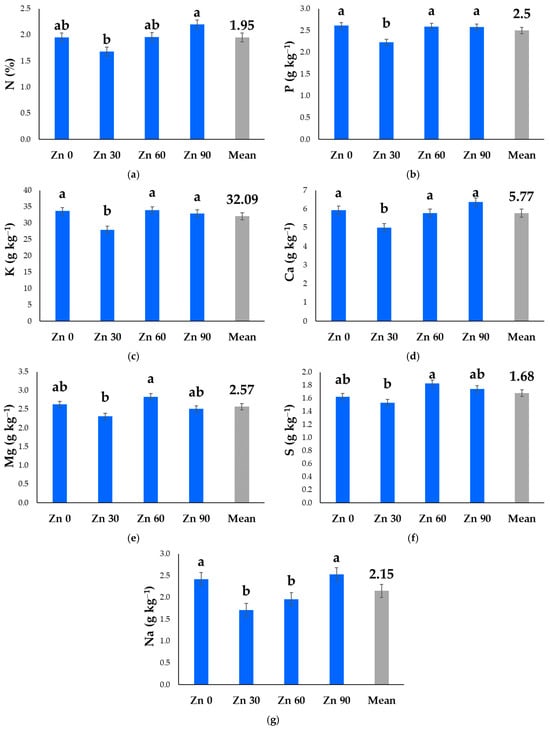
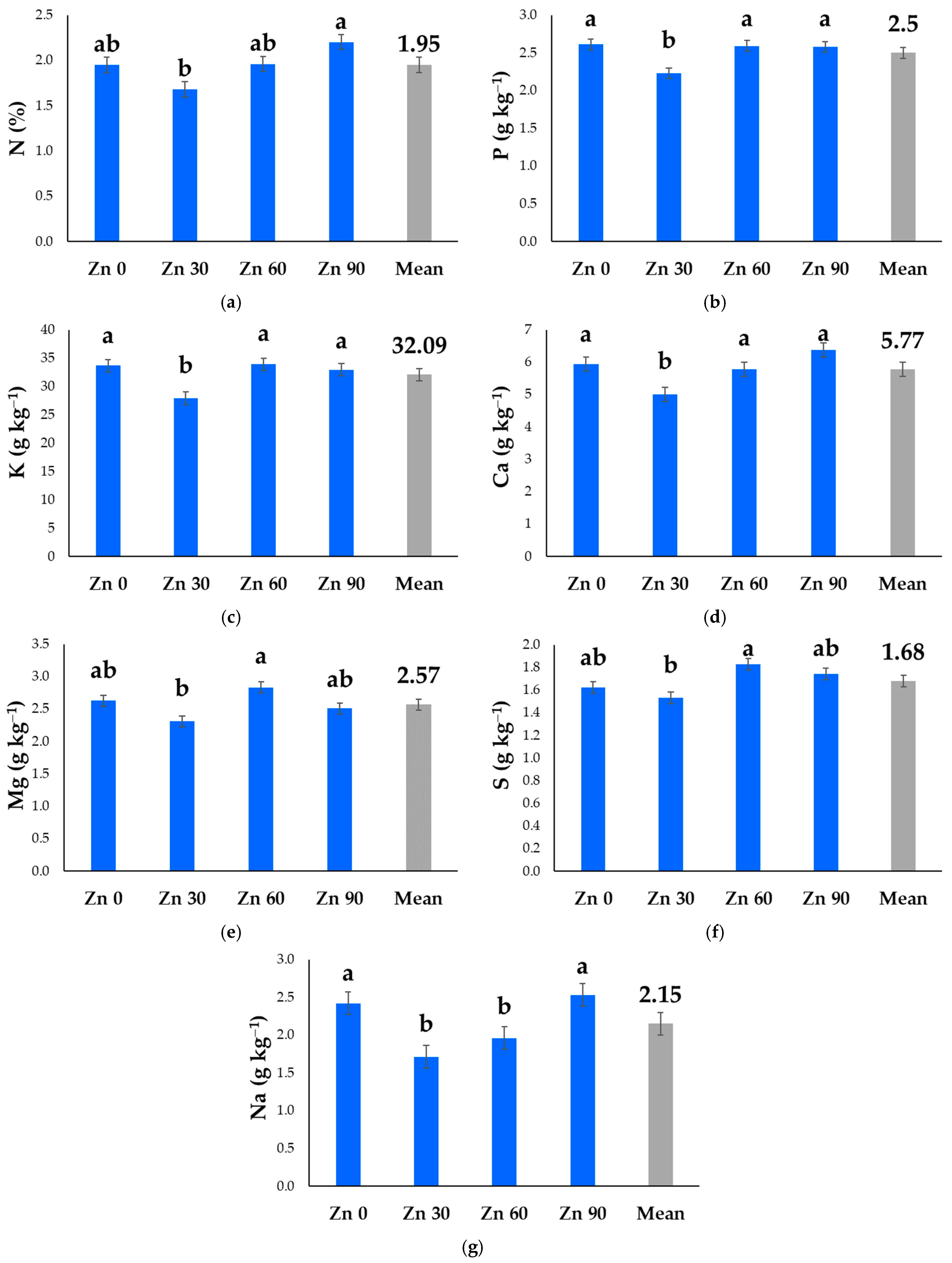
The one-way ANOVA showed significant treatment effects on several macroelements (Table A2, Appendix A). Significant differences were observed for N (F = 3.56, p = 0.0473, R2 = 0.471), K (F = 6.00, p = 0.0097, R2 = 0.600), and Ca (F = 3.58, p = 0.0468, R2 = 0.472). Among the macroelements, the strongest treatment effect was observed for K. Significant treatment effects were also reported for P, Mg, and S according to the values presented in Table A2, Appendix A. As shown in Figure 1a, total N concentration ranged from 1.68% in Zn 30 to 2.20% in Zn 90, with an overall mean of 1.95%. The Zn 90 treatment had the highest N concentration, while Zn 30 had the lowest value.
Figure 1.
Effect of Zn treatments on the concentration of selected macroelements and Na in thyme: (a) Nitrogen (N), (b) Phosphorus (P), (c) Potassium (K), (d) Calcium (Ca), (e) Magnesium (Mg), (f) Sulfur (S), and (g) Sodium (Na). Different lowercase letters indicate significant differences among treatments according to the LSD test at p ≤ 0.05. Vertical bars represent the standard error (SE). The grey bar represents the overall mean across treatments. Blue bars represent the mean values of individual treatments, while the grey bar represents the overall mean of the experiment.
For P, the Zn 30 treatment had a significantly lower concentration (2.23 g kg−1) compared with Zn 0, Zn 60 and Zn 90, which showed similar values (Figure 1b). A similar response was observed for K and Ca. The lowest K concentration was recorded in Zn 30 (27.90 g kg−1), while the other treatments ranged from 32.95 to 33.88 g kg−1 (Figure 1c). The Zn 30 treatment also had the lowest Ca concentration (5.01 g kg−1), whereas the highest value was found in Zn 90 (6.37 g kg−1) (Figure 1d).
Mg concentration was highest in Zn 60 (2.83 g kg−1) and lowest in Zn 30 (2.31 g kg−1) (Figure 1e). A similar trend was observed for S, where Zn 60 had the highest concentration (1.83 g kg−1) and Zn 30 the lowest (1.53 g kg−1) (Figure 1f).
Na concentration showed a different response. The highest value was recorded in Zn 90 (2.53 g kg−1), followed by Zn 0 (2.42 g kg−1), while significantly lower values were observed in Zn 30 and Zn 60 (1.71 and 1.96 g kg−1, respectively) (Figure 1g). In general, the Zn 30 treatment generally resulted in lower concentrations of most measured macroelements, while the response at higher Zn rates depended on the individual element.
3.3. Microelements Status
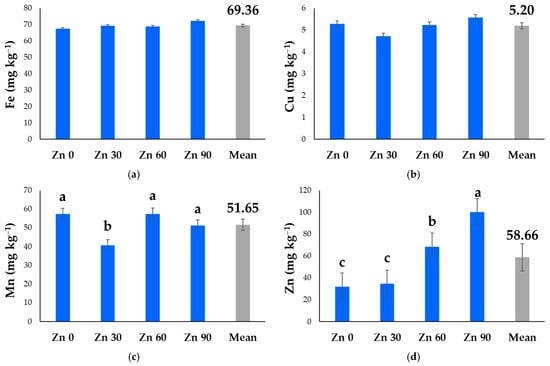
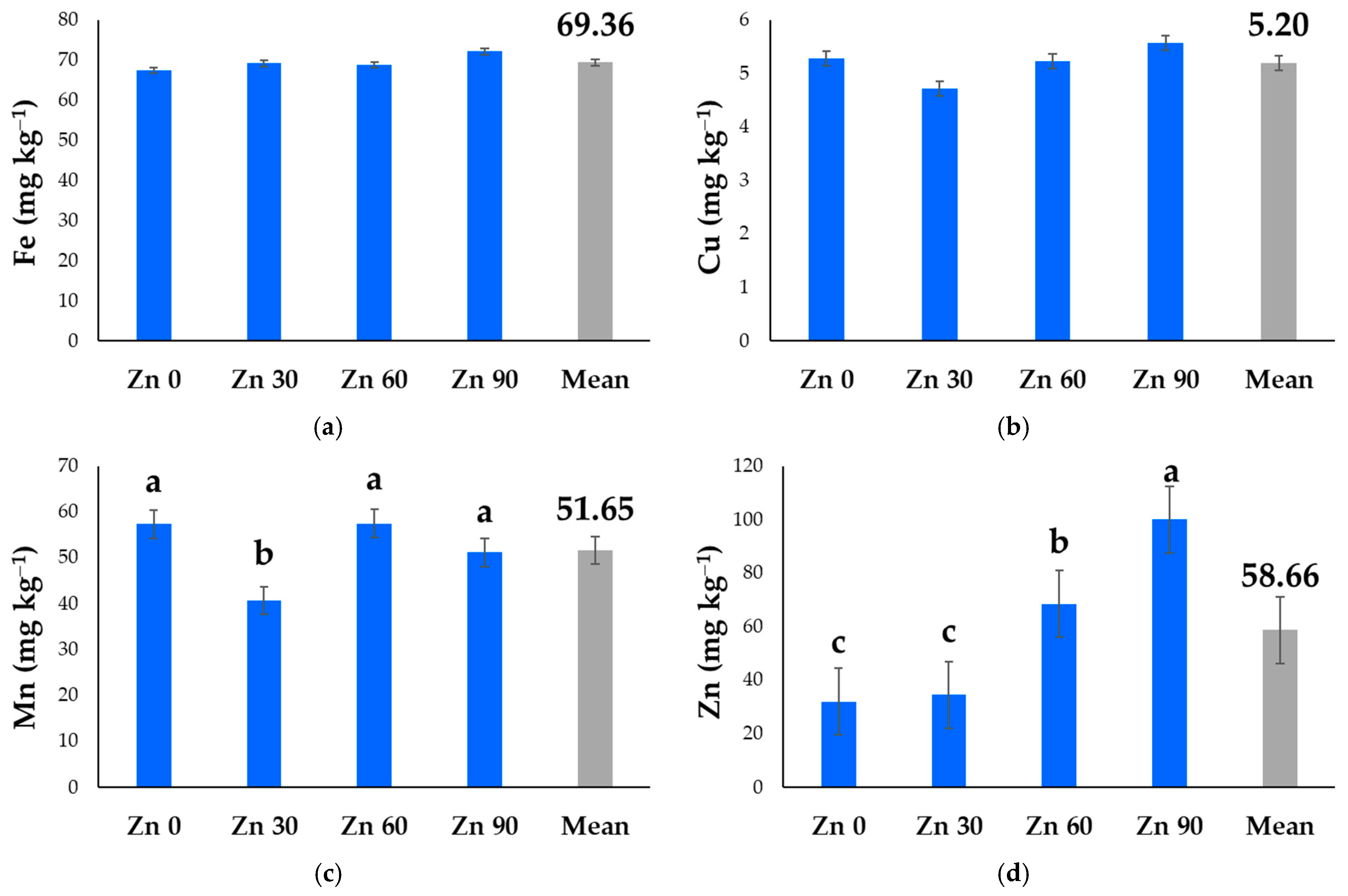
For the analyzed microelements, the treatment effect was most pronounced for Zn (F = 71.02, p < 0.0001, R2 = 0.947), indicating that 94.7% of the variation in Zn concentration was explained by the treatment (Table A2, Appendix A). A significant effect was also observed for Mn (F = 5.54, p = 0.0128, R2 = 0.581), whereas Fe (F = 0.07, p = 0.9724) and Cu (F = 1.24, p = 0.3390) were not significantly affected by the treatment.
Iron concentration varied only slightly among Zn treatments, ranging from 67.39 mg kg−1 in Zn 0 to 72.14 mg kg−1 in Zn 90, with an overall mean of 69.36 mg kg−1 (Figure 2a). There were no significant differences among treatments were observed. A similar response was found for Cu, where values ranged from 4.72 mg kg−1 in Zn 30 to 5.57 mg kg−1 in Zn 90 (Figure 2b).
Figure 2.
Effect of Zn treatments on the concentration of selected microelements in thyme: (a) Iron (Fe), (b) Copper (Cu), (c) Manganese (Mn), and (d) Zinc (Zn). Different lowercase letters indicate significant differences among treatments according to the LSD test at p ≤ 0.05. Vertical bars represent the standard error (SE). The grey bar represents the overall mean across treatments. Blue bars represent the mean values of individual treatments, while the grey bar represents the overall mean of the experiment.
Biofortification treatments of NPs Zn significantly affected Mn concentration in thyme (Figure 2c). The lowest value was recorded in Zn 30 (40.69 mg kg−1), while Zn 0 and Zn 60 showed the highest concentrations, 57.32 and 57.45 mg kg−1, respectively. Zn concentration showed the clearest response to increasing Zn application (Figure 2d). The lowest concentrations were found in Zn 0 and Zn 30, with 31.83 and 34.45 mg kg−1, respectively. Zn concentration increased to 68.41 mg kg−1 in Zn 60 and reached the highest value of 99.94 mg kg−1 in Zn 90. The overall mean Zn concentration was 58.66 mg kg−1.
3.4. Zn Accumulation and Apparent Recovery Efficiency
Foliar ZnO NP application clearly increased Zn accumulation in thyme plants (Table 3).
Table 3.
Calculated Zn uptake and apparent Zn recovery efficiency in thyme following foliar application of ZnO nanoparticles.
Calculated Zn uptake increased from 19.45 µg plant−1 in the control to 59.42 µg plant−1 in Zn 90, corresponding to an approximately threefold increase. Apparent Zn recovery efficiency was low at Zn 30 (2.70%) but increased markedly at Zn 60 (28.92%) and Zn 90 (31.02%). Although Zn 90 resulted in the highest Zn uptake, the relatively small increase in ZnRE compared with Zn 60 indicates that increasing the ZnO NP concentration from 60 to 90 mg L−1 provided only a limited additional improvement in recovery efficiency.
4. Discussion
Zinc is an essential micronutrient involved in numerous enzymatic and metabolic processes, but stimulation of vegetative growth after Zn application is strongly dependent on the initial Zn status of the plant, application rate, species, and growing conditions. In the present study, foliar application of ZnO NPs resulted in a clear concentration-dependent increase in Zn accumulation in thyme, while plant growth and biomass production remained largely unaffected. This separation between the nutritional response and the morphological response represents one of the main findings of the present study. None of the measured or derived morphological traits differed significantly among treatments, although plant height and biomass allocation per branch showed some numerical variation. In particular, plants treated with 60 mg L−1 ZnO NPs had the highest mean plant height and fresh and dry mass per branch, whereas the highest concentration, Zn 90 mg L−1, did not further improve these traits. These results indicate that the applied ZnO NP concentrations were generally well tolerated by thyme and that substantial Zn enrichment could be achieved without a measurable penalty in aboveground biomass production.
In other aromatic and medicinal plants, Salachna et al. [46] found that ZnO NP application has sometimes increased biomass. For example, ZnO nanoparticles enhanced leaf biomass and Zn accumulation in red perilla, particularly at relatively low concentrations, whereas foliar ZnO NP application to dragonhead increased Zn bioaccumulation together with biomass and secondary metabolite production. Similarly, Rossi et al. [47] reported a pronounced effect of foliar ZnO NP application in coffee (Coffea arabica L.), where leaf Zn concentration reached 1267.1 mg kg−1 DW, compared with 344.1 mg kg−1 DW after ZnSO4 application and only 53.6 mg kg−1 DW in the control. The authors attributed the greater effectiveness of ZnO NPs to their enhanced penetration and absorption by leaf tissues. Similarly, Ahmed et al. found foliar application of ZnO NPs significantly improved the growth, nutrient uptake, yield, and fruit quality of tomato (Solanum lycopersicum L.), with 100 mg L−1 ZnO NPs increasing yield by approximately 200% compared with the control. Moreover, ZnO NPs were more effective than conventional Zn fertilizer, indicating their greater efficiency as a foliar Zn source. Reshma and Meenal [48] reported that foliar application of biosynthesized Zn nanoparticles improved growth, yield, and Zn accumulation in amaranth, with 10 mg L−1 providing the highest plant height and fresh biomass together with improved Zn use efficiency.
In the present experiment, the relatively stable fresh and dry biomass across treatments suggests that Zn availability was not a major growth-limiting factor under the controlled growing conditions and that the additional Zn was preferentially reflected in tissue Zn concentration rather than biomass production.
The most pronounced response to ZnO NP application was observed for Zn concentration in the aboveground biomass. Zn concentration increased from 31.83 mg kg−1 in untreated plants to 68.41 mg kg−1 at Zn 60 and 99.94 mg kg−1 at Zn 90, corresponding to increases of approximately 115% and 214%, respectively, compared with the control. Similarly, Nekoukhou et al. [49] reported a dose-dependent increase in leaf Zn concentration in dragonhead (Dracocephalum moldavica), reaching 152.6 mg kg−1 after foliar application of 160 mg L−1 ZnO NPs. At the same concentration, ZnO NPs also increased total chlorophyll to 0.93 g kg−1 FW, shoot biomass to 2168 kg ha−1, essential oil content to 3.4 g kg−1, and essential oil yield to 7.4 kg ha−1, confirming their potential to simultaneously enhance Zn biofortification and plant productivity.
The increase in Zn concentration in the present study was also reflected in calculated Zn uptake per plant, which increased from 19.45 µg plant−1 in the control to 44.29 and 59.42 µg plant−1 in the Zn 60 and Zn 90 treatments, respectively. However, apparent Zn recovery efficiency provides additional insight into the efficiency of the applied Zn. Recovery was only 2.70% at Zn 30, compared with 28.92% at Zn 60 and 31.02% at Zn 90. Thus, although Zn 90 produced the highest absolute Zn concentration and uptake, increasing the concentration from 60 to 90 mg L−1 resulted in only a relatively small additional increase in apparent recovery efficiency. This finding suggests that 60 mg L−1 may represent a particularly efficient treatment in terms of Zn recovered relative to the applied amount, whereas 90 mg L−1 is preferable when maximum Zn enrichment of the plant material is the primary objective.
In addition to Zn enrichment, foliar ZnO NP application altered the concentrations of several macro- and micronutrients, demonstrating that the response was not restricted to Zn alone. An unexpected response was observed at the lowest ZnO NP concentration, where Zn 30 resulted in lower concentrations of several macroelements compared with the untreated control. This non-linear response may indicate a transient disturbance in nutrient uptake or internal nutrient balance at low ZnO NP exposure rather than a simple dose-dependent effect. At higher ZnO NP concentrations, the concentrations of most elements returned to or exceeded control levels, suggesting that the interaction between foliar Zn application and mineral composition was concentration-dependent. The most distinct pattern was observed at the lowest ZnO NP concentration, where Zn 30 generally resulted in lower concentrations of P, K, Ca, Mg, S, and Na than the other treatments. Among micronutrients, Fe and Cu remained comparatively stable, indicating that the substantial increase in Zn concentration did not cause a corresponding depletion of these elements.
The contribution of the present study extends beyond confirming that foliar Zn application can increase tissue Zn concentration. In thyme, Zn enrichment showed a clear concentration-dependent response without a significant reduction in vegetative growth or biomass production. Moreover, the response differed markedly among the tested concentrations: 30 mg L−1 resulted in only limited Zn enrichment and very low apparent recovery efficiency, whereas 60 and 90 mg L−1 substantially increased Zn concentration and uptake. Importantly, the relatively small difference in apparent Zn recovery efficiency between 60 and 90 mg L−1 suggests that 60 mg L−1 may provide a more efficient balance between Zn input and Zn accumulation, while 90 mg L−1 is more suitable when maximum tissue Zn enrichment is the primary objective. These findings provide concentration-specific information for thyme biofortification rather than merely confirming the general effectiveness of foliar Zn application.
A limitation of the present study is the absence of a conventional Zn fertilizer treatment. Therefore, the observed responses cannot be attributed specifically to the nanoparticulate form of Zn, as similar effects may also result from an increased Zn supply from conventional Zn sources. In Hibiscus syriacus, Zhao et al. [50] stated that foliar application of ZnO nanoparticles showed the strongest growth-promoting effect at 50 mg L−1 using 50 nm particles, while both ZnSO4 and ZnO NPs increased leaf Zn concentration; however, ZnO NPs produced more sustained growth benefits than the conventional Zn fertilizer. In field-grown winter wheat, Zhang et al. [51] reported that both ZnSO4 and ZnO NPs increased grain Zn concentration, but the mean increase was approximately 10 mg kg−1 following ZnO NP application compared with 5 mg kg−1 for ZnSO4. However, Salehi et al. [52] reported that foliar application of ZnO NPs and ZnSO4 at 250–2000 mg L−1 caused concentration-dependent responses in bean (Phaseolus vulgaris L.), with the highest Zn concentrations producing the greatest growth inhibition and stress symptoms, whereas the lowest ZnSO4 dose (250 mg L−1) slightly promoted plant growth and improved physiological and antioxidative responses. Thus, direct comparisons between ZnO nanoparticles and conventional Zn fertilizers are needed to determine whether the nanoparticulate form provides any specific advantage. A limitation of the present study is that the physicochemical characteristics and stability of ZnO NPs in the prepared suspensions were not experimentally determined. Therefore, possible changes in particle size due to aggregation during suspension preparation and application cannot be excluded.
5. Conclusions
The results demonstrate that thyme can accumulate substantial amounts of Zn following foliar application of ZnO nanoparticles without a significant reduction in vegetative growth or biomass production. The response was strongly concentration dependent: 30 mg L−1 produced only limited Zn enrichment and low apparent recovery, whereas 60 and 90 mg L−1 markedly increased both Zn concentration and Zn uptake. From an efficiency perspective, the relatively small difference in Zn recovery between Zn 60 and Zn 90 suggests diminishing returns at the highest concentration, despite the continued increase in tissue Zn concentration. These findings support the potential use of foliar ZnO NPs for Zn enrichment of thyme biomass. However, because the experiment was conducted under controlled conditions and focused on a single growth stage and ZnO NP source, further studies should evaluate a broader concentration range, conventional Zn sources for direct comparison, Zn speciation within plant tissues, and the effects on essential oil composition and other bioactive compounds before practical application can be recommended.
Author Contributions
Conceptualization, I.V. and M.T.K.; methodology, I.V., M.T.K. and D.A.; validation, M.T.K., T.V., J.J. and D.I.; formal analysis, I.V., J.J. and D.I.; investigation, I.V., D.A., T.V. and D.I.; resources, M.T.K. and T.V.; data curation, I.V. and D.I.; writing—original draft preparation, I.V.; writing—review and editing, I.V., M.T.K., J.J., D.A., T.V. and D.I.; visualization, I.V. and D.I.; supervision, M.T.K. and T.V.; project administration, M.T.K.; funding acquisition, M.T.K. All authors have read and agreed to the published version of the manuscript.
Funding
This research was a part of the project Biofortification of Vegetables and Medicinal Plants with Micronutrients (BioHORT) 581-UNIOS-29, funded by the European Union—Next Generation EU. However, the views and opinions expressed are solely those of the author(s) and do not necessarily reflect those of the European Union or the European Commission. Neither the European Union nor the European Commission can be held responsible for them.
Data Availability Statement
The original contributions presented in this study are included in the article. Further inquiries can be directed to the corresponding author.
Conflicts of Interest
The authors declare no conflicts of interest.
Appendix A
Table A1.
One-way ANOVA for morphological traits of thyme as affected by foliar Zn treatment.
Table A2.
One-way ANOVA for elemental composition.
References
- Siber, T.; Vrandečić, K.; Lekić, M.; Ćosić, D.; Ćosić, J. Volatile Antifungal Activity of Essential Oils Against Fusarium Culmorum: The Effects of Concentration and Temperature. Poljoprivreda 2026, 32, 47–55. [Google Scholar] [CrossRef] [Scilit]
- Sany, H.; Said-Al Ahl, H.; Astatkie, T. Essential Oil Content, Yield, and Components from the Herb, Leaf, and Stem of Curly-Leafed Parsley at Three Harvest Days. J. Cent. Eur. Agric. 2022, 23, 54–61. [Google Scholar] [CrossRef] [Scilit]
- Jelenić, J.; Ilić, J.; Ćosić, J.; Vrandečić, K.; Velki, M. Antifungal effect of essential oils from the native croatian flora on the suppression of the Botrytis cinerea fungus in grapevines. Poljoprivreda 2020, 26, 58–64. [Google Scholar] [CrossRef] [Scilit]
- Petrović, E.; Siber, T.; Ćosić, J.; Vrandečić, K. Natural Preservation Techniques: Using Essential Oils to Extend the Shelf Life of Cherry Tomatoes. J. Cent. Eur. Agric. 2025, 26, 680–693. [Google Scholar] [CrossRef] [Scilit]
- Đopa, M.; Pustahija, F.; Bašić, N.; Parić, A. Allelopathic Effect of Lavandula Angustifolia Mill. and Thymus serpyllum L. Essential Oils on Five Selected Plant Species. Ann. Inst. Biol. Univ. Sarajevo 2023, 45, 21–28. [Google Scholar] [CrossRef] [Scilit]
- Kümmritz, S.; Tron, N.; Tegtmeier, M.; Schmidt, A.; Strube, J. Resource-Efficient Use of Residues from Medicinal and Aromatic Plants for Production of Secondary Plant Metabolites. In Plants as Factories for Bioproduction; Steingroewer, J., Ed.; Advances in Biochemical Engineering/Biotechnology; Springer International Publishing: Cham, Switzerland, 2024; Volume 188, pp. 145–168. ISBN 978-3-031-60279-5. [Google Scholar]
- Varga, I.; Andraković, M.; Crljić, P.; Đaković, M.; Antunović, M.; Tkalec Kojić, M.; Agić, D. Industrial Hemp and Tobacco as Multipurpose Crops: Traditional Uses, Contemporary Applications, and Future Perspectives. Plants 2026, 15, 2888. [Google Scholar] [CrossRef] [Scilit] [PubMed]
- Hilal, B.; Khan, M.M.; Fariduddin, Q. Recent Advancements in Deciphering the Therapeutic Properties of Plant Secondary Metabolites: Phenolics, Terpenes, and Alkaloids. Plant Physiol. Biochem. 2024, 211, 108674. [Google Scholar] [CrossRef] [Scilit] [PubMed]
- Kosakowska, O.; Węglarz, Z.; Styczyńska, S.; Synowiec, A.; Gniewosz, M.; Bączek, K. Activity of Common Thyme (Thymus vulgaris L.), Greek Oregano (Origanum vulgare L. ssp. hirtum), and Common Oregano (Origanum vulgare L. ssp. vulgare) Essential Oils against Selected Phytopathogens. Molecules 2024, 29, 4617. [Google Scholar] [CrossRef] [Scilit] [PubMed]
- Silva, A.S.; Tewari, D.; Sureda, A.; Suntar, I.; Belwal, T.; Battino, M.; Nabavi, S.M.; Nabavi, S.F. The Evidence of Health Benefits and Food Applications of Thymus vulgaris L. Trends Food Sci. Technol. 2021, 117, 218–227. [Google Scholar] [CrossRef] [Scilit]
- Waheed, M.; Hussain, M.B.; Saeed, F.; Afzaal, M.; Ahmed, A.; Irfan, R.; Akram, N.; Ahmed, F.; Hailu, G.G. Phytochemical Profiling and Therapeutic Potential of Thyme (Thymus Spp.): A Medicinal Herb. Food Sci. Nutr. 2024, 12, 9893–9912. [Google Scholar] [CrossRef] [Scilit] [PubMed]
- Grigore-Gurgu, L.; Dumitrașcu, L.; Aprodu, I. Aromatic Herbs as a Source of Bioactive Compounds: An Overview of Their Antioxidant Capacity, Antimicrobial Activity, and Major Applications. Molecules 2025, 30, 1304. [Google Scholar] [CrossRef] [Scilit] [PubMed]
- Lunder, M.; Ghassani Shabrina, S.; Krištof, R.; Šunta, U.; Oder, M.; Fink, R. Chemical Fingerprints of Lamiaceae Essential Oils: Targeting Biofilm Viability, Biomass, Metabolic Activity, and Membrane Integrity. Biofouling 2026, 42, 648–667. [Google Scholar] [CrossRef] [Scilit] [PubMed]
- Miličić, M.; Furlan, V.; Knez Marevci, M.; Bren, U. Thymus vulgaris and Thymus serpyllum: Extraction, Distillation, and Encapsulation Strategies, Phytochemical Composition and Bioactivity. Phytochem Rev. 2026. [Google Scholar] [CrossRef] [Scilit]
- Nieto, G. A Review on Applications and Uses of Thymus in the Food Industry. Plants 2020, 9, 961. [Google Scholar] [CrossRef] [Scilit] [PubMed]
- Ricardo-Rodrigues, S.; Rouxinol, M.I.; Agulheiro-Santos, A.C.; Potes, M.E.; Laranjo, M.; Elias, M. The Antioxidant and Antibacterial Potential of Thyme and Clove Essential Oils for Meat Preservation—An Overview. Appl. Biosci. 2024, 3, 87–101. [Google Scholar] [CrossRef] [Scilit]
- Rahimi, A.; Mohammadi, M.M.; Siavash Moghaddam, S.; Heydarzadeh, S.; Gitari, H. Effects of Stress Modifier Biostimulants on Vegetative Growth, Nutrients, and Antioxidants Contents of Garden Thyme (Thymus vulgaris L.) Under Water Deficit Conditions. J. Plant Growth Regul. 2022, 41, 2059–2072. [Google Scholar] [CrossRef] [Scilit]
- Saied, A.M.; Attia, A.I.; Reda, F.M.; El-Kholy, M.S.; Al-Badwi, M.A.; Azzam, M.; Di Cerbo, A.; Alagawany, M.; El-Tarabily, K.A.; El Nagar, A.G. Harnessing Natural Feed Additives for Sustainable Production and Economics: The Role of Thymus vulgaris L. Oil as an Antimicrobial Agent and a Growth Promoter in Improving Production and Health of Broiler Chickens. Front. Immunol. 2025, 16, 1695478. [Google Scholar] [CrossRef] [Scilit] [PubMed]
- Kumar, M.; Narwal, E.; Rakshit, S.; Bishi, S.K.; Bhadana, V.P.; Kumar, M.; Lal, S.K.; Monika; Jha, U.C.; Roy, S.; et al. Zinc Homeostasis and Biofortification in Crop Plants: Towards Efficient Zinc Utilization. J. Plant Growth Regul. 2025, 44, 5926–5945. [Google Scholar] [CrossRef] [Scilit]
- Lončarić, Z.; Varga, I.; Sudarić, A.; Zebec, V.; Jović, J.; Perić, K.; Nemet, F. Zinc Biofortification to Enhance Soybean Seed Quality and Lower Cadmium Under Alkaline Conditions: The Role of Genotypes. Agronomy 2026, 16, 1471. [Google Scholar] [CrossRef] [Scilit]
- Jalal, A.; Júnior, E.F.; Teixeira Filho, M.C.M. Interaction of Zinc Mineral Nutrition and Plant Growth-Promoting Bacteria in Tropical Agricultural Systems: A Review. Plants 2024, 13, 571. [Google Scholar] [CrossRef] [Scilit] [PubMed]
- Tsang, B.L.; Holsted, E.; McDonald, C.M.; Brown, K.H.; Black, R.; Mbuya, M.N.N.; Grant, F.; Rowe, L.A.; Manger, M.S. Effects of Foods Fortified with Zinc, Alone or Cofortified with Multiple Micronutrients, on Health and Functional Outcomes: A Systematic Review and Meta-Analysis. Adv. Nutr. 2021, 12, 1821–1837, Correction in Adv. Nutr. 2021, 12, 1821–1837. https://doi.org/10.1093/advances/nmab094. [Google Scholar] [CrossRef] [Scilit] [PubMed]
- Rafi, K.N.S.; Aziz, M.G.; Islam, M.A.; Akash, S.I.; Jakariya, M.; Rahman, M. Assessment of the Bioaccessibility of Zinc in the Selected Biofortified Food Grains. Sci. Rep. 2025, 15, 7457. [Google Scholar] [CrossRef] [Scilit] [PubMed]
- Bhardwaj, A.K.; Chejara, S.; Malik, K.; Kumar, R.; Kumar, A.; Yadav, R.K. Agronomic Biofortification of Food Crops: An Emerging Opportunity for Global Food and Nutritional Security. Front. Plant Sci. 2022, 13, 1055278. [Google Scholar] [CrossRef] [Scilit] [PubMed]
- Okur, B.; Okur, N.; Yağmur, B. The Effect of Nitrogen, Magnesium and Iron Applications on the Nutrient Content of Parsley (Petroselinum crispum). Poljoprivreda 2022, 28, 3–8. [Google Scholar] [CrossRef] [Scilit]
- Nemet, F.; Perić, K.; Zebec, V.; Ivezić, V.; Galić, L.; Nikolin, I.; Rékási, M.; Ragályi, P.; Lončarić, Z. Enrichment of Sunflower Seeds and Harvest Residues with Zn and Se Through Agronomic Biofortification. Poljoprivreda 2026, 32, 19–26. [Google Scholar] [CrossRef] [Scilit]
- Pannico, A.; El-Nakhel, C.; Graziani, G.; Kyriacou, M.C.; Giordano, M.; Soteriou, G.A.; Zarrelli, A.; Ritieni, A.; De Pascale, S.; Rouphael, Y. Selenium Biofortification Impacts the Nutritive Value, Polyphenolic Content, and Bioactive Constitution of Variable Microgreens Genotypes. Antioxidants 2020, 9, 272. [Google Scholar] [CrossRef] [Scilit] [PubMed]
- Kong, L.; Liu, Y.; Qian, X.; Liu, J.; Wang, Q.; Li, H.; Wan, Y. Interactions between Zinc and Selenium with Foliar Spraying and Their Effects on Cadmium Accumulation in Wheat Grains. Plant Soil 2025, 515, 1315–1331. [Google Scholar] [CrossRef] [Scilit]
- Ei, H.H.; Zheng, T.; Farooq, M.U.; Zeng, R.; Su, Y.; Zhang, Y.; Liang, Y.; Tang, Z.; Ye, X.; Jia, X.; et al. Impact of Selenium, Zinc and Their Interaction on Key Enzymes, Grain Yield, Selenium, Zinc Concentrations, and Seedling Vigor of Biofortified Rice. Environ. Sci. Pollut. Res. 2020, 27, 16940–16949. [Google Scholar] [CrossRef] [Scilit] [PubMed]
- Bordoloi, D.J.; Buragohain, K.; Sonowal, S.; Nath, R.; Das, B.K.; Gogoi, R.K.; Saha, B.; Awasthi, J.P.; Chowardhara, B. Selenium and Micronutrients (Iron, Zinc, Manganese, Magnesium, Etc.) Interaction in Crops. In Selenium in Sustainable Agriculture: A Soil to Spoon Prospective; Moulick, D., Choudhury, S., Eds.; Environmental Science and Engineering; Springer Nature Switzerland: Cham, Switzerland, 2025; pp. 95–118. ISBN 978-3-031-93956-3. [Google Scholar]
- Hamzah Saleem, M.; Usman, K.; Rizwan, M.; Al Jabri, H.; Alsafran, M. Functions and Strategies for Enhancing Zinc Availability in Plants for Sustainable Agriculture. Front. Plant Sci. 2022, 13, 1033092. [Google Scholar] [CrossRef] [Scilit] [PubMed]
- Asle Mohammadi, Z.; Mohammadkhani, N.; Servati, M. Effect of foliar application of iron and zinc on growth parameters and essential oil components of garden thyme (Thymus vulgaris L.) under nitrogen deficiency. Iran. J. Med. Aromat. Plants Res. 2020, 36, 155–166. [Google Scholar] [CrossRef] [Scilit]
- Gupta, M.; Gupta, S. An Overview of Selenium Uptake, Metabolism, and Toxicity in Plants. Front. Plant Sci. 2017, 7, 2074. [Google Scholar] [CrossRef] [Scilit] [PubMed]
- Galić, L.; Vinković, T.; Ravnjak, B.; Lončarić, Z. Agronomic Biofortification of Significant Cereal Crops with Selenium—A Review. Agronomy 2021, 11, 1015. [Google Scholar] [CrossRef] [Scilit]
- Skrypnik, L.; Feduraev, P.; Golubkina, N.; Maslennikov, P.; Antipina, M.; Katserov, D.; Murariu, O.C.; Tallarita, A.V.; Caruso, G. Foliar Spraying of Selenium in Inorganic and Organic Forms Stimulates Plant Growth and Secondary Metabolism of Sage (Salvia officinalis L.) through Alterations in Photosynthesis and Primary Metabolism. Sci. Hortic. 2024, 338, 113633. [Google Scholar] [CrossRef] [Scilit]
- Asghari, J.; Mahdavikia, H.; Rezaei-Chiyaneh, E.; Banaei-Asl, F.; Amani Machiani, M.; Harrison, M.T. Selenium Nanoparticles Improve Physiological and Phytochemical Properties of Basil (Ocimum basilicum L.) under Drought Stress Conditions. Land 2023, 12, 164. [Google Scholar] [CrossRef] [Scilit]
- El-Ramady, H.; Faizy, S.E.-D.; Abdalla, N.; Taha, H.; Domokos-Szabolcsy, É.; Fari, M.; Elsakhawy, T.; Omara, A.E.-D.; Shalaby, T.; Bayoumi, Y.; et al. Selenium and Nano-Selenium Biofortification for Human Health: Opportunities and Challenges. Soil Syst. 2020, 4, 57. [Google Scholar] [CrossRef] [Scilit]
- Pudhuvai, B.; Koul, B.; Das, R.; Shah, M.P. Nano-Fertilizers (NFs) for Resurgence in Nutrient Use Efficiency (NUE): A Sustainable Agricultural Strategy. Curr. Pollut. Rep. 2024, 11, 1. [Google Scholar] [CrossRef] [Scilit]
- Hegab, R.H. Influence of foliar application of mineral, chelated and nano zinc on growth, some biochemical aspects and productivity of thyme in baloza-north sinai area. Egypt. J. Desert Res. 2024, 74, 149–173. [Google Scholar] [CrossRef] [Scilit]
- Pandiyan, I.; Sri Sakthi, D.; Indiran, M.A.; Rathinavelu, P.K.; Rajeshkumar, S. Thymus vulgaris mediated selenium nanoparticles, characterization and its antimicrobial activity: An in vitro study. Int. J. Dent. Oral Sci. 2021, 8, 3516–3521. [Google Scholar] [CrossRef] [Scilit]
- Mohit Rabary, P.; Movahedi, Z.; Ghabooli, M.; Rostami, M. Effects of Foliar Application of Zinc Oxide Nanoparticles on Traits of Several Medicinal Plants Under Aeroponic System Conditions. Int. J. Hortic. Sci. Technol. 2022, 9, 445–452. [Google Scholar] [CrossRef]
- Meier, U. (Ed.) Entwicklungsstadien Mono- Und Dikotyler Pflanzen: BBCH Monografie; Julius Kühn-Institut (JKI): Quedlinburg, Germany, 2018; ISBN 978-3-95547-070-8. [Google Scholar] [CrossRef]
- Cardone, L.; Polito, F.; Denora, M.; Casiello, D.; Castronuovo, D.; Cicco, N.; Perniola, M.; De Feo, V.; Candido, V. Effects of Biostimulant Foliar Applications on Morphological Traits, Yield, Antioxidant Capacity, and Essential Oil Composition of Thymus vulgaris L. Under Field Conditions. Agronomy 2025, 15, 442. [Google Scholar] [CrossRef] [Scilit]
- Waly, A.; Abd El-Fattah, Y.; Hassan, M.; El-Ghadban, E.-M.; Abd Alla, A. Enhancing growth, productivity and essential oil percentage of Thymus vulgaris L. plant using seaweeds extract, chitosan and potassium silicate in sandy soil. Sci. J. Flowers Ornament. Plants 2020, 7, 549–562. [Google Scholar] [CrossRef] [Scilit]
- SAS Institute Inc. SAS Enterprise Guide 7.1.; SAS Institute Inc.: Cary, NC, USA, 2014. [Google Scholar]
- Salachna, P.; Mizielińska, M.; Płoszaj-Witkowska, B.; Jaszczak, A. Zinc Oxide Nanoparticles Enhanced Biomass and Zinc Content and Induced Changes in Biological Properties of Red Perilla Frutescens. Materials 2021, 14, 6182. [Google Scholar] [CrossRef] [Scilit] [PubMed]
- Rossi, L.; Fedenia, L.N.; Sharifan, H.; Ma, X.; Lombardini, L. Effects of Foliar Application of Zinc Sulfate and Zinc Nanoparticles in Coffee (Coffea arabica L.) Plants. Plant Physiol. Biochem. 2019, 135, 160–166. [Google Scholar] [CrossRef] [Scilit] [PubMed]
- Reshma, Z.; Meenal, K. Foliar Application of Biosynthesised Zinc Nanoparticles as a Strategy for Ferti-Fortification by Improving Yield, Zinc Content and Zinc Use Efficiency in Amaranth. Heliyon 2022, 8, e10912. [Google Scholar] [CrossRef] [Scilit] [PubMed]
- Nekoukhou, M.; Fallah, S.; Abbasi-Surki, A.; Pokhrel, L.R.; Rostamnejadi, A. Improved Efficacy of Foliar Application of Zinc Oxide Nanoparticles on Zinc Biofortification, Primary Productivity and Secondary Metabolite Production in Dragonhead. J. Clean. Prod. 2022, 379, 134803. [Google Scholar] [CrossRef] [Scilit]
- Zhao, Y.; Tang, Y.; Hu, L.; Xu, J.; Zhang, X.; Dou, X.; Zhang, S.; Huang, L.; Wang, X. Growth and Physiology Effects of Seed Priming and Foliar Application of ZnO Nanoparticles on Hibiscus syriacus L. Sci. Rep. 2025, 15, 22606. [Google Scholar] [CrossRef] [Scilit] [PubMed]
- Zhang, T.; Sun, H.; Lv, Z.; Cui, L.; Mao, H.; Kopittke, P.M. Using Synchrotron-Based Approaches To Examine the Foliar Application of ZnSO4 and ZnO Nanoparticles for Field-Grown Winter Wheat. J. Agric. Food Chem. 2018, 66, 2572–2579. [Google Scholar] [CrossRef] [Scilit] [PubMed]
- Salehi, H.; De Diego, N.; Chehregani Rad, A.; Benjamin, J.J.; Trevisan, M.; Lucini, L. Exogenous Application of ZnO Nanoparticles and ZnSO4 Distinctly Influence the Metabolic Response in Phaseolus vulgaris L. Sci. Total Environ. 2021, 778, 146331. [Google Scholar] [CrossRef] [Scilit] [PubMed]

Disclaimer/Publisher’s Note: The statements, opinions and data contained in all publications are solely those of the individual author(s) and contributor(s) and not of MDPI and/or the editor(s). MDPI and/or the editor(s) disclaim responsibility for any injury to people or property resulting from any ideas, methods, instructions or products referred to in the content. |
© 2026 by the authors. Licensee MDPI, Basel, Switzerland. This article is an open access article distributed under the terms and conditions of the Creative Commons Attribution (CC BY) license.