


Highlights
What are the main findings?
- Tuta absoluta completed its lifecycle on all six potato cultivars, with significant variation in life–history parameters.
- Hezuo No. 88 and Lishu No. 6 were highly susceptible; in comparison, Qingshu No. 9 and Qingshu No. 10 exhibited antibiosis resistance, which prolonged development and suppressed population growth.
- Zhongshu No. 5 and Weiyu No. 3 delayed Tuta absoluta development and reduced fecundity, extending the activity window for natural enemies.
- This study provides fundamental data and candidate materials for breeding potato varieties resistant to Tuta absoluta and supports the development of host resistance-based IPM strategies.
- The findings can guide regional cultivar selection and deployment to reduce pest population growth, thereby contributing to sustainable potato production in China.
Abstract
The South American tomato leaf miner, Tuta absoluta (Meyrick, 1917) (Syn.: Phthorimaea absoluta), is a pest of great economic importance worldwide. Although T. absoluta shows a strong preference for tomato, it can also attack potato, eggplant, and various wild solanaceous plants, thereby posing new challenges for pest control. To assess the adaptability of this pest to different potato varieties, an age-stage, two-sex life table method was used to determine the development, survival, reproduction, and key population parameters of the pest on six common potato varieties (Hezuo No. 88, Lishu No. 6, Weiyu No. 3, Zhongshu No. 5, Qingshu No. 9, and Qingshu No. 10) in China. The results showed that T. absoluta could complete its entire life cycle on all cultivars. However, key life history parameters varied significantly. On cultivars Qingshu No. 9 and Qingshu No. 10, the pest exhibited significantly prolonged preadult duration and total pre-oviposition period (TPOP), as well as reduced adult fecundity. In contrast, Hezuo No. 88 supported the highest intrinsic rate of increase (r) and net reproductive rate (R0). The 60-day population projections further highlighted this contrast, showing that the T. absoluta population on Hezuo No. 88 increased by a factor of 4.26 and 3.52 times compared to that on Qingshu No. 9 and Qingshu No. 10, respectively. We conclude that cultivars Qingshu No. 9 and Qingshu No. 10 exhibit antibiosis resistance against T. absoluta. This study not only provides a theoretical foundation and candidate materials for breeding pest-resistant potato varieties, but also establishes a basis for IPM strategies against T. absoluta that are founded on host resistance.
1. Introduction
The South American tomato leaf miner, Tuta absoluta (Meyrick, 1917) (Syn.: Phthorimaea absoluta) (Lepidoptera: Gelechiidae), is native to Peru and western South America [1,2]. Since its initial invasion of Spain in 2006, this species has rapidly spread across Afro–Eurasia and has become a highly destructive invasive pest globally [3,4]. This pest primarily affects Solanaceae crops, including not only tomato (Solanum lycopersicum) but also potato (S. tuberosum), eggplant (S. melongena), tobacco (Nicotiana tabacum), and various wild solanaceous weeds [5]. Among these host plants, tomato is the most severely impacted, as T. absoluta affects tomato plants across all developmental stages. Besides mining plant leaves, larval feeding can damage fruits, stems, apical buds, and flower buds [2]. In China, T. absoluta was first detected in Xinjiang in August 2017, after which the pest spread rapidly in the southwestern and northwestern regions. As of 2024, the leaf miner reached 23 provinces across the country, posing a severe threat to the production of Solanaceae crops, particularly tomatoes and potatoes [6,7,8]. Although tomato is considered the most suitable host for T. absoluta [9,10], field surveys conducted in China’s major potato-producing regions (Xinjiang Uygur Autonomous Region and Yunnan Province) have confirmed its substantial damage to potato crops, with leaf infestation rates reaching up to 66.7% in heavily infested fields [7]. Importantly, in actual production, T. absoluta often cooccurs with its close relative, the equally damaging potato tuber moth Phthorimaea operculella Zeller (Lepidoptera: Gelechiidae) [11,12]. The overlapping host range and ecological niche of these two pests often result in compounded damage, making pest control increasingly challenging.
The threat to potatoes is of particular concern within this context of rapid pest expansion, especially given the critical role of this crop in ensuring the food security system of China. As the world’s largest potato producer, China has experienced remarkable growth in potato production over the past two decades [13,14,15]. In 2015, the Chinese Ministry of Agriculture formally proposed the strategy of developing potato as a staple food to enhance national food security, thus positioning it as the fourth most important staple crop after rice, wheat, and corn [16]. According to FAO statistics, the global total potato production in 2023 was approximately 383 million tons, with China accounting for 93.4918 million tons, ranking first in the world. About 15% of China’s total potato output is processed into value-added products such as frozen French fries, potato chips, and starch, with the domestic processing industry boasting a market size of around 38 billion yuan. This underscores the crop’s vital contribution to the development of China’s local agricultural economy [17]. Cultivation is concentrated in four main agroecological regions: the northern single-cropping zone, the central double-cropping zone, the southwestern mixed-cropping zone (encompassing both single and double cropping), and the southern winter-cropping zone [17]. This regional diversity in production, coupled with the strategic importance of the crop, underscores the critical need to quantify the susceptibility of common regionally adapted potato cultivars to emerging pests such as T. absoluta, particularly through comparative studies on their influences on pest population development and damage potential. Although recent work by Yang et al. offers valuable insights into the bottom-up effects of specific potato cultivars on T. absoluta, their study focused mainly on cultivars from Yunnan Province [10]. It is important to note that at the time of their research, the distribution of T. absoluta in China was relatively limited, primarily concentrated in Yunnan and a few other areas, making the selection of local cultivars contextually appropriate. However, in recent years, the pest has rapidly spread to most provinces and regions across the country [18]. Given the vast geographic and agroecological variation in potato cultivation throughout China, along with the significant expansion of the pest’s range, a comprehensive assessment incorporating common cultivars from the principal production zones is now essential for a nationwide risk evaluation and the development of broadly effective integrated pest management (IPM) strategies.
In this context, host-plant resistance (HPR) has been shown to negatively impact pest growth, development, survival, and reproduction parameters, and is considered a critical component of IPM systems [19,20]. Therefore, selecting potato varieties resistant to T. absoluta is an effective and sustainable strategy to reduce yield losses. To evaluate HPR, life table analysis is commonly used in arthropod population ecology, pest management, and host-plant resistance studies [21]. In particular, age-stage and sex-specific life tables have become valuable tools for assessing how HPR affects insect population parameters and for determining whether a host plant is suitable for pest development [22,23], as they provide a comprehensive overview of both developmental and reproductive responses across all life stages for both sexes.
To address this gap, the present study employs the age-stage, two-sex life table method to evaluate the potential damage risk of T. absoluta to six representative potato varieties widely cultivated across China. Detailed data on key demographic parameters, including developmental duration, survival rate, reproduction parameters, and population parameters, were collected and analyzed. This research aims to: (1) provide a comparative assessment of pest population dynamics across different hosts, thereby supporting the development of targeted control measures while contributing to sustainable potato production, and (2) provide direct and reliable experimental data for the breeding of potato cultivars for insect resistance and eco-regulation-based IPM strategy development for T. absoluta.
2. Materials and Methods
2.1. Insects
A colony of T. absoluta was collected from a tomato field in Yangrui Organic Agriculture Base, Hongta District, Yuxi City, Yunnan Province, in December 2018. The colonies were reared on Solanum lycopersicum (cv. Provence) at a temperature of 26 ± 1 °C, a relative humidity (RH) of 65 ± 10%, and a photoperiod of 16:8 h (L:D) for one generation before being used for life table analysis.
2.2. Potato Cultivars
In this study, six potato cultivars (Hezuo No. 88, Lishu No. 6, Weiyu No. 3, Zhongshu No. 5, Qingshu No. 9, and Qingshu No. 10) were selected as experimental materials, ensuring representation of the four major potato cropping zones in China. The selected cultivars and their respective cropping zones were as follows: Hezuo No. 88 and Weiyu No. 3 from the southwestern mixed-cropping zone; Zhongshu No. 5 and Lishu No. 6 from the northern single-cropping zone; and Qingshu No. 9 and Qingshu No. 10 from the southern winter-cropping zone. The central double-cropping zone is represented by the early maturity of Zhongshu No. 5. All healthy plants were cultivated and provided in the greenhouse of the Institute of Plant Protection, Chinese Academy of Agricultural Sciences (IPPCAAS), Beijing. These plants were grown individually in round pots (20 cm in diameter × 40 cm in height) containing a mixture of nutrient soil and vermiculite at a 2:1 ratio. The plants were utilized for experiments when they reached the growth stage and had 7–10 fully expanded true leaves.
2.3. Life Table Study
In this study, an age-stage, two-sex life table approach was used to evaluate the effects of six potato cultivars (Hezuo No. 88, Lishu No. 6, Weiyu No. 3, Zhongshu No. 5, Qingshu No. 9, and Qingshu No. 10) on the population development of T. absoluta. The experiment was conducted in a climate-controlled chamber (Saifu, Ningbo, China) under the same conditions of a temperature of 26 ± 1 °C, an RH of 65 ± 10%, and a photoperiod of 16L:8D. For each cultivar, a replicate unit was established in a separate oviposition cage (40 × 40 × 60 cm). Fifty pairs of newly emerged adults were introduced into each cage and allowed to lay eggs for 4 h during the species-specific oviposition peak (20:00–24:00). The eggs were individually transferred onto uniformly sized compound leaves with similar developmental status from the corresponding potato cultivars. Each compound leaf contained at least five leaflets, and one egg was placed on each leaflet. To maintain leaf freshness, the base of each leaf was inserted into a 1.5-mL centrifuge tube containing sterile water. Egg hatching, larval development, and survival were observed daily at 20:00 under a microscope (Zeiss, Oberkochen, Germany), and the durations of the egg and larval stages were recorded. During the observation period, leaf moisture was continuously maintained, and leaves were replaced regularly to ensure an adequate food supply for larvae. After pupation, pupal development was recorded daily, and the sexes were distinguished prior to adult emergence. Newly emerged males and females were paired at a 1:1 ratio and reared individually in specially designed insect oviposition devices (20 cm in height and 10 cm in diameter) [24]. Fresh potato leaves were provided daily in the devices as oviposition substrates for T. absoluta. The potato leaves replaced each day were examined under the microscope to count the number of eggs, which was recorded as the daily fecundity per female. Observations continued until all adults died, and adult longevity was recorded.
2.4. Life Table Analysis
The life history data of T. absoluta were analyzed using the computer program TWOSEX–MSChart (https://www.faas.cn/cms/sitemanage/index.shtml?siteId=810640925913080000; accessed on 23 May 2025) according to age-stage, two-sex life table theory [25,26,27]. The raw age-stage life table data of the whole cohort were employed to calculate the age-stage-specific survival rate (sxj, where x is the age in days and j is the stage), female age-stage-specific fecundity (fx) (the daily number of eggs produced by a female at age x), population age-specific survival rate (lx), population age-specific fecundity (mx), age-specific life expectancy (exj), and age-stage-specific reproductive values (vxj). The sxj, fx, lx, mx, exj, and vxj curves were drawn using OriginPro 2021 (OriginLab, Northampton, MA, USA).
The following life table parameters were calculated:
Age-specific survival rate (lx) and age-specific maternity (mx):
Net reproductive rate (R0):
Intrinsic rate of increase (r) was estimated according to the Euler–Lotka equation with its age indexed from zero [28]:
Finite rate (λ):
Mean generation time (T):
Age-specific life expectancy (exj) represents that an individual of age x and stage j is expected to live [29]:
s′iy is the probability that an individual of age x and stage j will survive to age i and stage y.
Age-stage specific reproductive value (vxj), which indicates the contribution of individuals of age x and stage j to the future generation [30]:
2.5. Population Projection
The TIMING-MSChart program (https://www.faas.cn/cms/sitemanage/index.shtml?siteId=810640925913080000; accessed on 23 May 2025) was used to predict the population growth rate and the age-stage structure of ten T. absoluta eggs over the next 60 days [31,32]. This prediction was based on multiple data inputs, including the developmental duration of each stage, survival rate, and fecundity [21,33].
2.6. Statistical Analysis
Prior to statistical analysis, all data were tested for normality and homogeneity of variances using the Shapiro–Wilk test. The developmental time, longevity, pre-oviposition, oviposition period, and lifetime fecundity of T. absouta reared on six potato varieties were compared by using one-way analysis of variance (ANOVA) followed by Tukey’s honestly significant difference (HSD) test. Statistical significance was set at p = 0.05, and analyses were performed in IBM SPSS Statistics 26.0. A paired bootstrap test was used to detect significant differences in the r, λ, R0, T, gross reproduction rate (GRR), and Preadult survival rate (sa) of T. absoluta across the six potato varieties [34]. This procedure was embedded in the TWOSEX–MSChart program.
3. Results
3.1. Basic Life History Statistics of T. absoluta on the Six Potato Cultivars
Life table analysis revealed that although T. absoluta completed its development on all tested potato cultivars, its life history parameters varied significantly among them. The pest exhibited pronounced developmental delays on the resistant cultivars (Table 1). Specifically, the durations of the egg stages across different treatments ranged from 3.89 to 4.39 d (F5,482 = 13.595, p < 0.05). The longest egg stage was observed on Qingshu No. 9, and the shortest duration occurred on Lishu No. 6. Compared with those on the other five cultivars, the larval stage of Qingshu No. 10 was significantly longer (F5,333 = 105.068, p < 0.05). T. absoluta exhibited a significantly longer pupal stage and preadult period on Qingshu No. 9 than on the other five cultivars (pupa: F5,234 = 29.324, p < 0.05; preadult: F5,234 = 100.169, p < 0.05), whereas the shortest preadult period (18.75 days) was recorded on Lishu No. 6. There was no significant difference in female longevity between T. absoluta fed on Qingshu No. 9 and those fed on Qingshu No. 10, both of which were significantly shorter than that of T. absoluta fed on other potato cultivars (females: F5,118 = 7.719, p < 0.05). The longest male longevity in T. absoluta was observed on Zhongshu No. 5, and the shortest on Qingshu No. 9 (males: F5,115 = 7.675, p < 0.05). Across all cultivars, T. absoluta fed on Hezuo 88 displayed the highest fecundity (fecundity: F5,118 = 7.509, p < 0.05), while those fed on Zhongshu No. 5 had the longest oviposition period (oviposition period: F5,118 = 4.774, p < 0.05).
Table 1.
Durations of the different developmental stages, lifetime fecundity, and offspring sex ratio (mean ± SE) of Tuta absoluta present on the six potato cultivars.
3.2. Survival Rate (Sxj), Fecundities (fx, mx), and Age-Specific Maternities (lxmx)
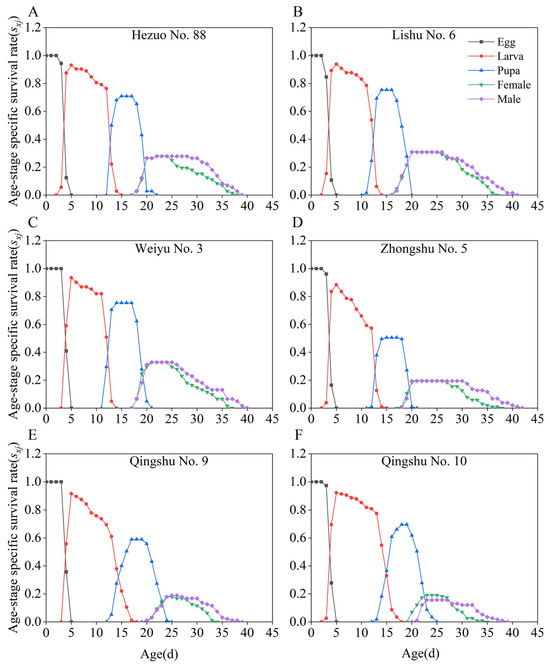
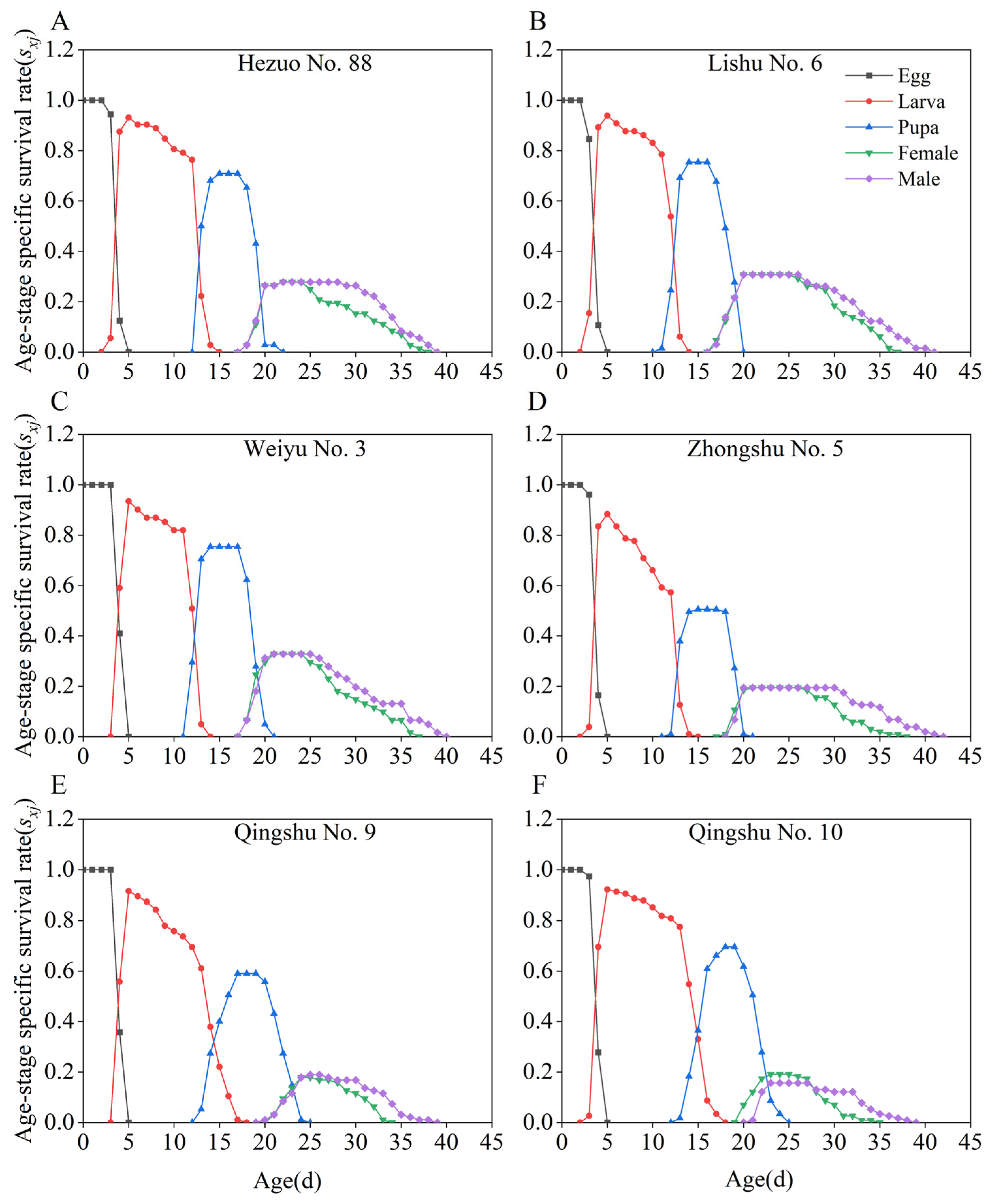
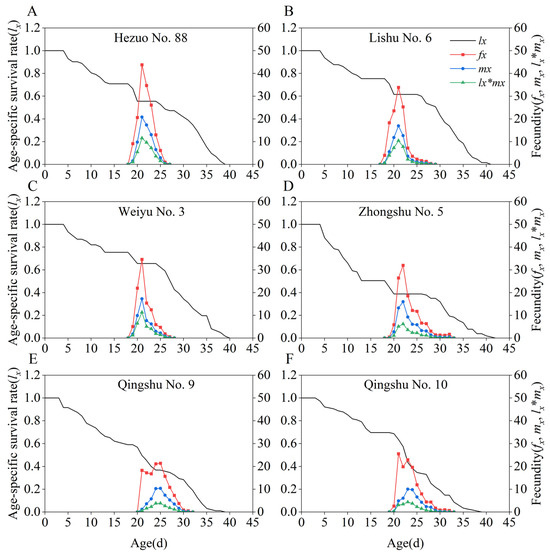
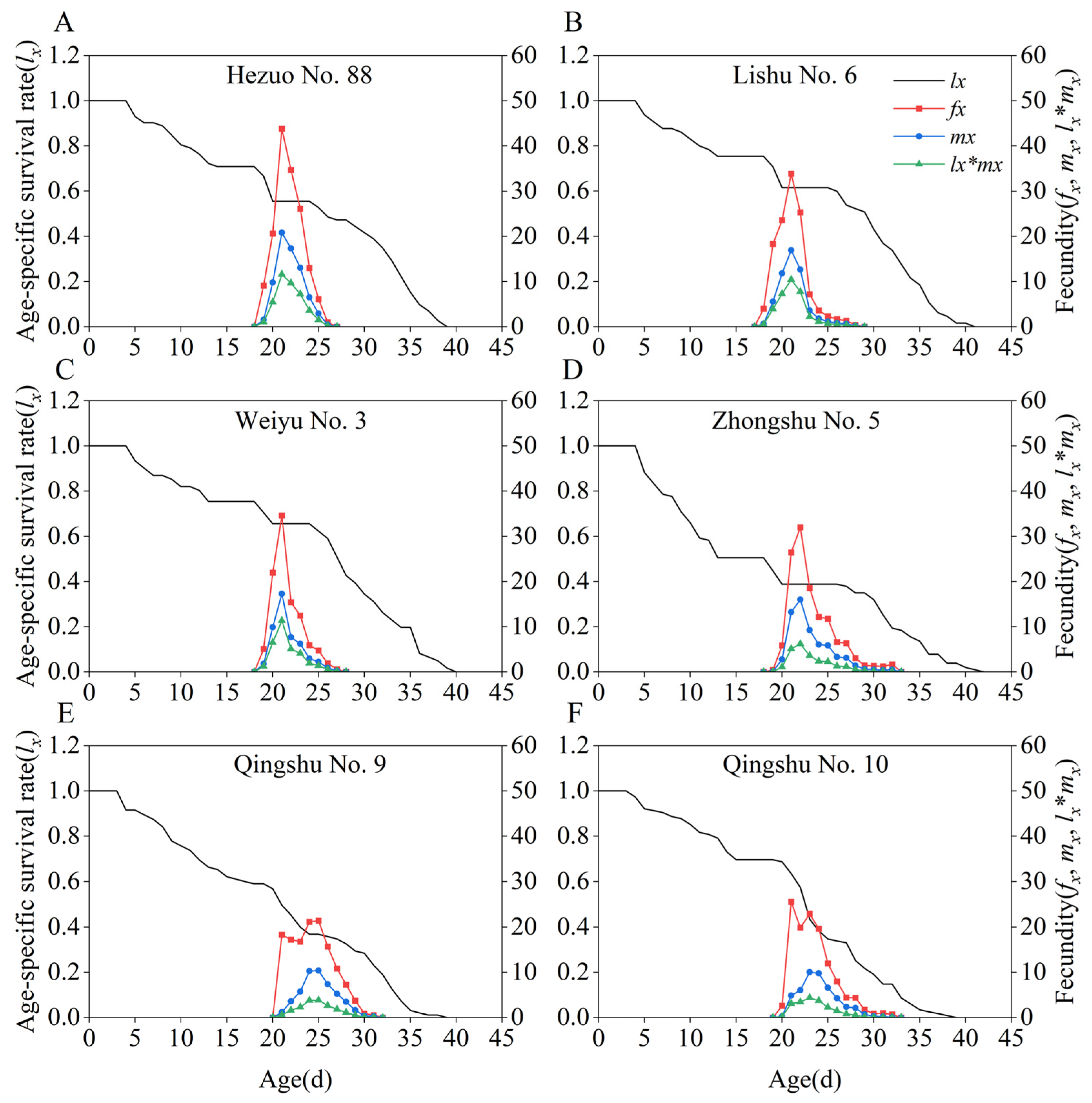
On the basis of the age-stage-specific survival rate (sxj) curves, the overlapping survival curves across all stages indicated asynchronous development among individual T. absoluta (Figure 1). The maximum survival rate of the pupae of T. absoluta fed on Zhongshu No. 5 was significantly lower (50.49%) than that of T. absoluta fed on Weiyu No. 3 (75.41%). Regardless of cultivar, males consistently outlived females (Figure 1). The onset of mx was observed earliest in T. absoluta reared on Lishu No. 6 (Day 18), followed by Hezuo No. 88, Weiyu No. 3 and Zhongshu No. 5 (both beginning on Day 19), and then Qingshu No. 10 (Day 20); populations fed on Qingshu No. 9 exhibited a later onset compared to the others. For T. absoluta reared on Hezuo No. 88, Lishu No. 6, and Weiyu No. 3, the peak values of lxmx appeared earlier (all on day 21) than those on other cultivars. The corresponding peak values for these three cultivars were 11.56, 10.42, and 11.34, respectively (Figure 2).
Figure 1.
Age-stage-specific survival rates (Sxj) at different developmental stages of Tuta absoluta feeding on different potato cultivars. The Sxj on Hezuo No. 88 (A), Lishu No. 6 (B), Weiyu No. 3 (C), Zhongshu No. 5 (D), Qingshu No. 9 (E), and Qingshu No. 10 (F).
Figure 2.
Age-specific survival rates (lx), age-specific fecundity (mx), and female age-stage-specific fecundities (fx), and age-specific maternity (lx × mx) of Tuta absoluta feeding on the different potato cultivars (Hezuo No. 88 (A), Lishu No. 6 (B), Weiyu No. 3 (C), Zhongshu No. 5 (D), Qingshu No. 9 (E), and Qingshu No. 10 (F)).
3.3. Age-Stage Specific Reproductive Value (vxj)
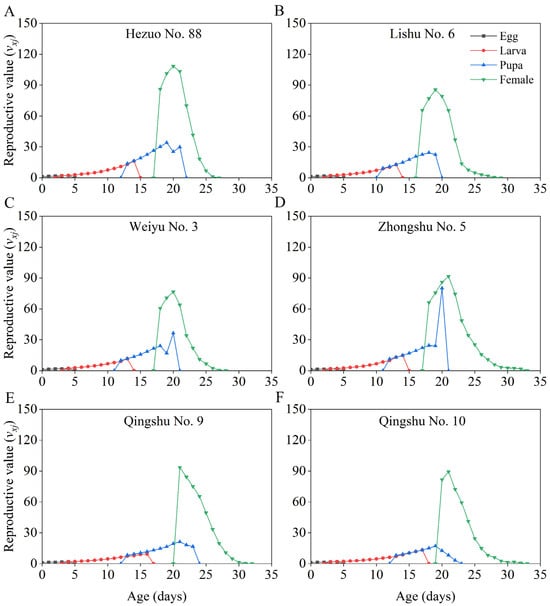
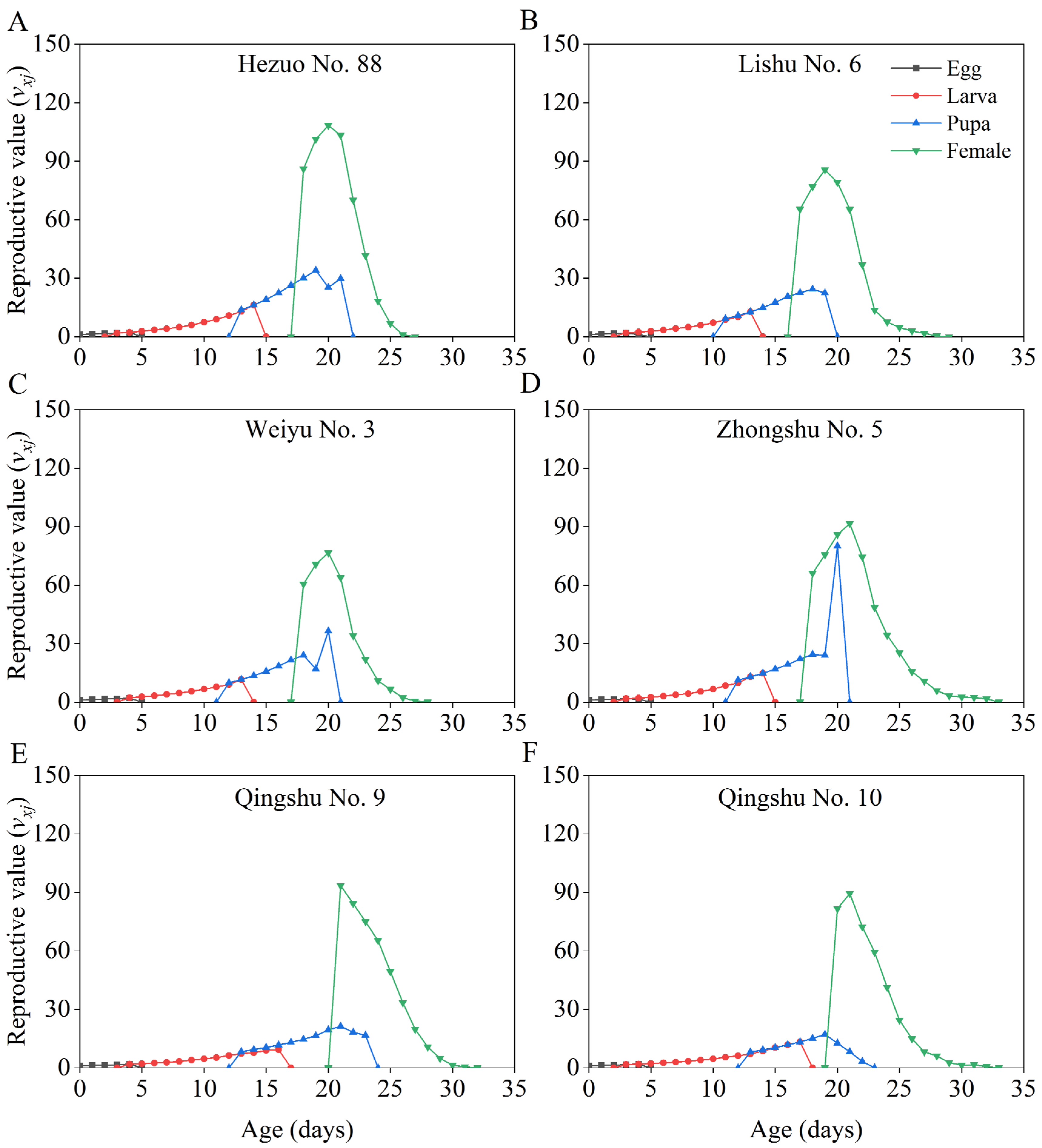
The age-stage-specific reproductive values (vxj) of T. absoluta increased significantly when adults emerged (17 days on Lishu No. 6; 18 days on Hezuo No. 88, Weiyu No. 3, and Zhongshu No. 5; 21 days on Qingshu No. 9; and 20 days on Qingshu No. 10) (Figure 3). Compared with those of the other five potato cultivars, the vxj values of T. absoluta fed on Hezuo No. 88 were significantly greater. The major peaks in the vxj curves of females occurred after 19 days for T. absoluta on Lishu No. 6 (v19,4 = 85.6), 20 days on Hezuo No. 88 (v20,4 = 108.4) and Weiyu No. 3 (v20,4 = 76.6), and 21 days on Zhongshu No. 5 (v21,4 = 91.6), Qingshu No. 9 (v21,4 = 93.5), and Qingshu No. 10 (v21,4 = 89.4).
Figure 3.
Age-stage specific reproductive value (vxj) at each development stage of Tuta absoluta feeding on different potato cultivars. The vxj on Hezuo No. 88 (A), Lishu No. 6 (B), Weiyu No. 3 (C), Zhongshu No. 5 (D), Qingshu No. 9 (E), and Qingshu No. 10 (F).
3.4. The Age-Stage Specific Life Expectancy (exj)
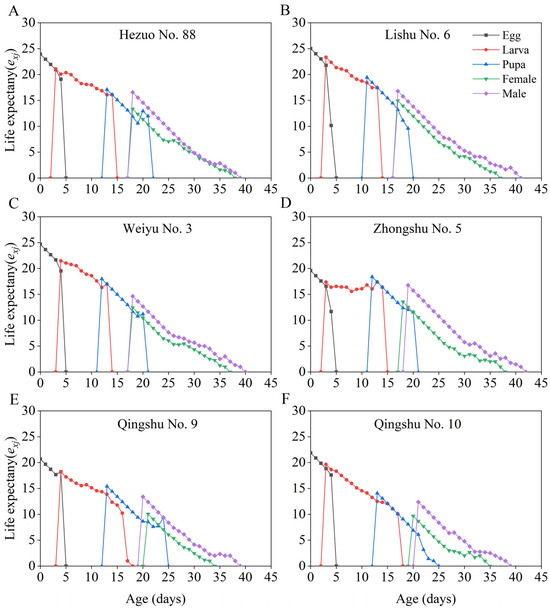
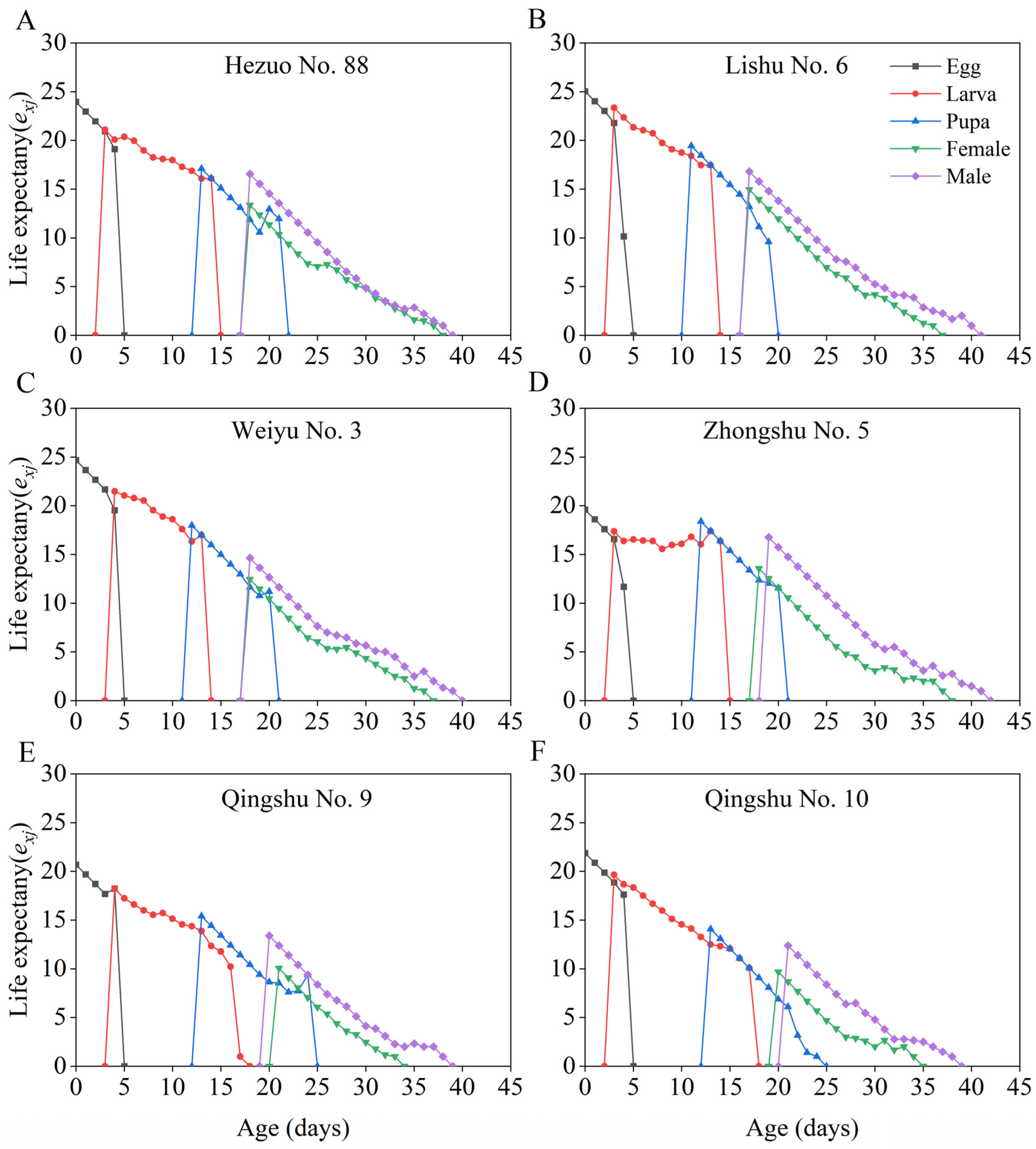
The exj of T. absoluta fed on different potato cultivars is plotted in Figure 4. Given that all conditions except host plants were maintained at optimal levels for T. absoluta, the curves for exj decreased with increasing age. Among the six potato cultivars tested, T. absoluta fed on Lishu No. 6 exhibited the highest exj value of newly laid eggs. Furthermore, T. absoluta fed on Lishu No. 6 presented the highest exj value across all subsequent developmental stages: larvae, pupae, and both male and female adults (Figure 4).
Figure 4.
Age-stage-specific life expectancy (exj) at each development stage of Tuta absoluta feeding on different potato cultivars. The exj on Hezuo No. 88 (A), Lishu No. 6 (B), Weiyu No. 3 (C), Zhongshu No. 5 (D), Qingshu No. 9 (E), and Qingshu No. 10 (F).
3.5. Population Parameters
The intrinsic rate of increase (r) and the finite rate of increase (λ) of the T. absoluta population fed on Hezuo No. 88 and Lishu No. 6 were greater than those on the other potato cultivars (p < 0.05). Among the six tested potato cultivars, T. absoluta fed on Hezuo No. 88 exhibited the highest net reproductive rate (R0). The gross reproduction rate (GRR) of T. absoluta did not significantly differ among the six potato cultivars tested (p > 0.05). T. absoluta fed on Lishu No. 6 exhibited the shortest mean generation time (T), whereas those fed on Hezuo No. 88 presented the fastest doubling time (Table 2).
Table 2.
Population parameters (mean ± SE) of Tuta absoluta present on the six potato cultivars.
3.6. Prediction of the Population Growth of T. absoluta on the Six Potato Cultivars
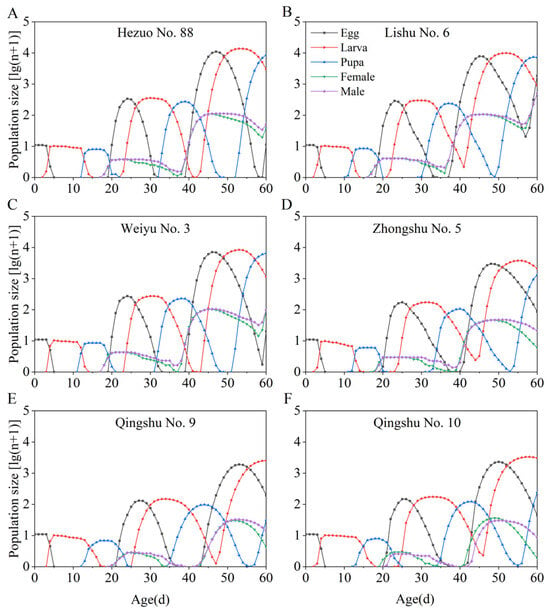
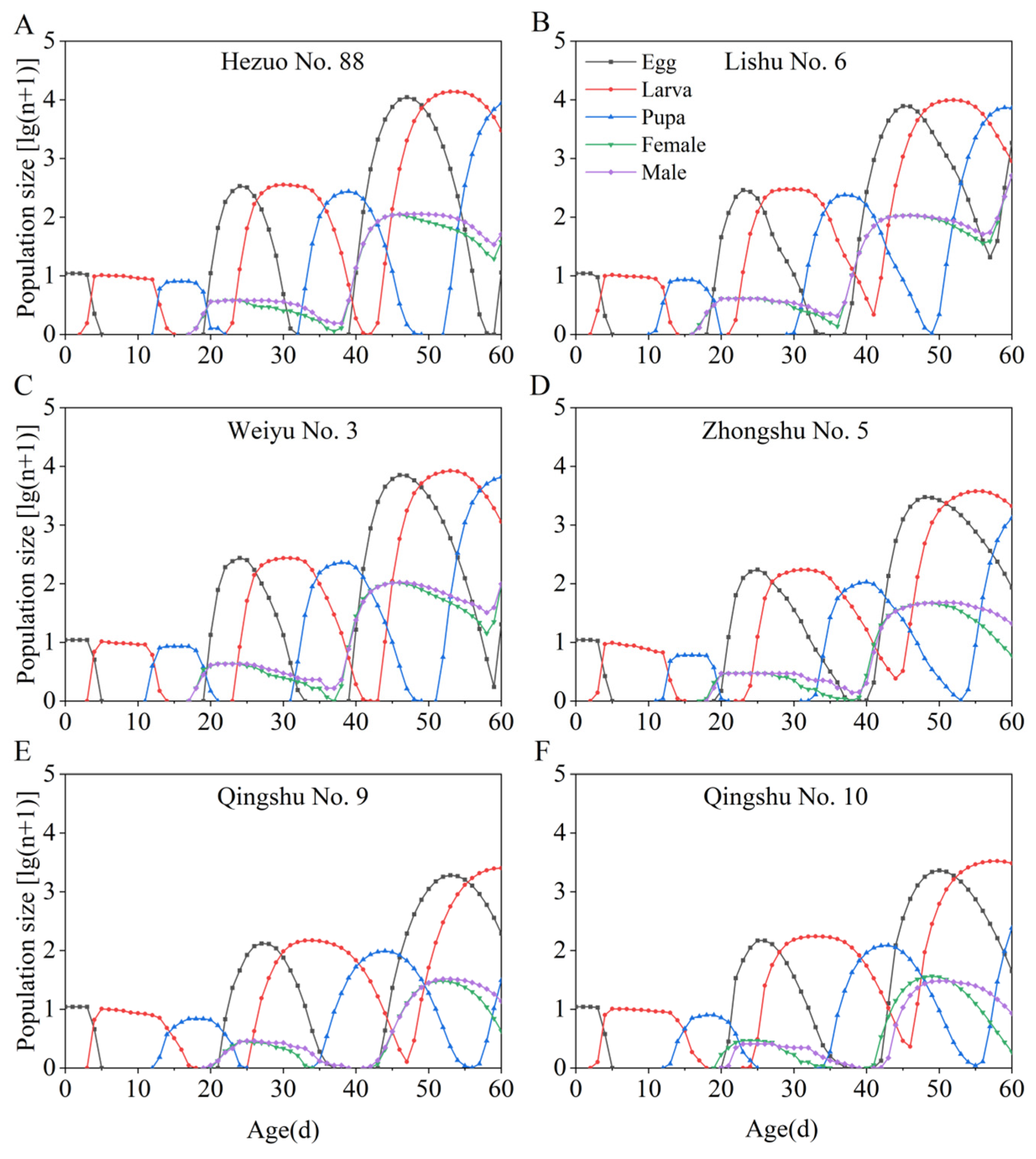
To comprehensively assess the population growth of T. absoluta on the six potato cultivars, we simulated 60-day population dynamics via TIMING–MSChart, with simulations initiated using a cohort of ten eggs. The results revealed that ten selected eggs of T. absoluta fed on Hezuo No. 88, Lishu No. 6, Weiyu No. 3, Zhongshu No. 5, Qingshu No. 9, and Qingshu No. 10 produced 11,766, 11,034, 7941, 3537, 2764, and 3342 offspring, respectively, on the 60th day. Among all six potato cultivars, the population of T. absoluta that was fed on Hezuo No. 88 exhibited the fastest growth. The numbers of eggs, larvae, pupae, female adults, and male adults of T. absoluta that were fed on Hezuo No. 88 on the 60th day were 10, 2999, 8669, 37, and 50, respectively. After 60 days, the predicted population of T. absoluta fed on Hezuo No. 88 was 1.07, 1.48, 3.33, 4.26, and 3.52 times greater than those on Lishu No. 6, Weiyu No. 3, Zhongshu No. 5, Qingshu No. 9, and Qingshu No. 10, respectively (Figure 5).
Figure 5.
Population projection of Tuta absoluta feeding on six potato cultivars by using the life tables of the original cohort with an initial population of ten eggs. Simulation of the population growth of T. absoluta after feeding on Hezuo No. 88 (A), Lishu No. 6 (B), Weiyu No. 3 (C), Zhongshu No. 5 (D), Qingshu No. 9 (E), and Qingshu No. 10 (F), respectively.
4. Discussion
Our findings indicate that T. absoluta successfully completed a complete generation on all six cultivars, confirming its adaptability to diverse commercial potato varieties as an invasive species. Nevertheless, the ability of the cultivars to sustain population growth differed significantly, as evidenced by notable variations in survival rates, developmental duration, fecundity, and key life-table parameters. These results clearly demonstrate distinct levels of resistance or susceptibility among the six tested potato cultivars to T. absoluta.
In the current study, different potato cultivars significantly affected the duration of the preadult stage and survival rate of T. absoluta. The shortest duration of the preadult stage was observed on Lishu No. 6 (18.75 days), and the longest was seen on Qingshu No. 9 (22.66 days). In contrast, the highest preadult survival rate was observed on Weiyu No. 3 (65.6%), while the lowest was recorded on Qingshu No. 10 (34.8%). Similarly, Caparros Megido et al. (2013) found that potato cultivars significantly affected the duration of the preadult stage of T. absoluta [35]. In their study [35], among the four cultivars tested, the duration of the preadult stage was longest on S. tuberosum cv. Bintje (up to 31.26 days) and shortest on S. tuberosum cv. Charlotte (about 24.12 days). Concurrently, they reported that preadult mortality of T. absoluta ranged from 44.0% on S. tuberosum cv. Nicola to 53.0% on Bintje among the four potato cultivars. The preadult stage duration observed in our study was generally shorter than that reported by Caparros Megido et al. (2013) [35], and slightly shorter than the 20.4-day duration documented by Bawin et al. (2015) [36]. This discrepancy is likely attributable to differences in experimental temperature. Our study was conducted at a higher temperature than the 24 °C used by Caparros Megido et al., and elevated temperatures typically accelerate development [37,38]. In addition, a shorter developmental duration combined with a higher survival rate suggests that a particular cultivar may serve as a more suitable host for T. absoluta, thereby promoting rapid population growth and potentially leading to more severe crop damage [39,40].
In our study, the highest fecundity of T. absoluta on potato was 144.9 eggs (Hezuo No. 88), while the lowest was 98.2 eggs (Weiyu No. 3). This is notably higher than the fecundity reported in previous studies. For instance, Yang et al. recorded only 40.67 eggs on the same cultivar (Hezuo No. 88) [10], and Caparros Megido et al. (2013) [35] reported a maximum of merely 55.8 eggs on potato. Based on a comparison of the experimental conditions described in those studies, we suggest that the lower fecundity observed in those studies could be attributed to their combination of lower experimental temperatures and the use of smaller oviposition arenas, both of which may have constrained egg-laying behavior. This explanation is supported by other reports. For instance, Younes et al. (2019), using a larger arena, recorded a higher fecundity of 172.2 eggs on potato [41]. Furthermore, Silva et al. (2021), employing both a higher temperature and a larger arena, observed an even greater fecundity of 188 eggs [42]. However, under actual field conditions, T. absoluta adults have a vastly greater range of movement. The spatial confinement inherent in small laboratory enclosures may therefore artificially limit their natural oviposition behavior, leading to a potential discrepancy between experimental results and true field performance.
Life-table parameters, including the net reproductive rate (R0), intrinsic rate of increase (r), finite rate of increase (λ), and mean generation time (T), collectively reflect changes in insect growth, development, reproduction, and survival, and together indicate the population growth potential of insects under specific environmental conditions [22]. This study demonstrated significant differences in the population parameters of T. absoluta among different potato varieties. The values of R0, r, and λ ranked from highest to lowest as follows: Hezuo No. 88 > Lishu No. 6 > Weiyu No. 3 > Zhongshu No. 5 > Qingshu No. 10 > Qingshu No. 9. This ranking directly reflects differences in the relative host suitability of T. absoluta among potato varieties, with Hezuo No. 88 representing the most suitable host and Qingshu No. 9 the least suitable. Insect fitness on host plants is strongly influenced by plant resistance traits, which may involve specific secondary metabolites that interfere with insect digestion and physiological metabolism [43]. Based on these findings, Qingshu No. 10 and Qingshu No. 9 could be recommended for cultivation in regions where T. absoluta is a major pest, as their relatively lower suitability for this pest may help reduce its population growth potential and support integrated pest management strategies.
5. Conclusions
Collectively, our findings revealed significant differences in host suitability among common Chinese potato cultivars for T. absoluta, indicating variation in their effects on pest development and population performance. Specifically, cultivars such as Hezuo No. 88 and Lishu No. 6 were identified as highly susceptible, supporting rapid pest population growth and high fecundity. In contrast, Qingshu No. 9 and Qingshu No. 10 provided less favorable conditions for pest performance, as evidenced by prolonged development time and suppressed population growth parameters. Furthermore, cultivars such as Zhongshu No. 5 and Weiyu No. 3, which delay T. absoluta development and reduce fecundity, can enhance biological control by extending the activity window for natural enemies. Overall, tailoring cultivar selection on the basis of regional pest pressure and climatic conditions while implementing a rational mix of varieties with complementary resistance traits could facilitate the establishment of a more robust and sustainable bottom-up regulation system against T. absoluta within an IPM framework.
Author Contributions
Conceptualization, S.-Y.Y.; data curation, S.-Y.Y., H.-S.Y., G.-F.Z. and C.H.; formal analysis, S.-Y.Y. and H.-S.Y.; investigation, S.-Y.Y.; methodology, S.-Y.Y. and H.-S.Y.; visualization, S.-Y.Y.; writing—original draft, S.-Y.Y. and H.-S.Y.; writing—review and editing, H.-Y.G., F.-Z.D., G.-F.Z., C.-R.L., F.-H.W., W.-X.L., C.H. and Y.-B.Z.; validation, C.-R.L., F.-H.W. and W.-X.L.; funding acquisition, C.H. and Y.-B.Z.; project administration, Y.-B.Z.; resources, Y.-B.Z. All authors have read and agreed to the published version of the manuscript.
Funding
This research was funded by the Yunnan Province Science and Technology Department “Yunnan International Joint Laboratory of Fruit-Vegetable-Flower Invasive Insect Pest Management (Yunnan FVF-IPM Joint Lab)” (No. 202303AP140018).
Data Availability Statement
The original contributions presented in this study are included in the article. Further inquiries can be directed to the corresponding authors.
Conflicts of Interest
The authors declare that they have no known competing financial interests or personal relationships that could have appeared to influence the work reported in this paper.
References
- Desneux, N.; Luna, M.G.; Guillemaud, T.; Urbaneja, A. The Invasive South American Tomato Pinworm, Tuta absoluta, Continues to Spread in Afro-Eurasia and beyond: The New Threat to Tomato World Production. J. Pest Sci. 2011, 84, 403–408. [Google Scholar] [CrossRef] [Scilit]
- Desneux, N.; Wajnberg, E.; Wyckhuys, K.A.G.; Burgio, G.; Arpaia, S.; Narváez-Vasquez, C.A.; González-Cabrera, J.; Catalán Ruescas, D.; Tabone, E.; Frandon, J.; et al. Biological Invasion of European Tomato Crops by Tuta absoluta: Ecology, Geographic Expansion and Prospects for Biological Control. J. Pest Sci. 2010, 83, 197–215. [Google Scholar] [CrossRef] [Scilit]
- Biondi, A.; Guedes, R.N.C.; Wan, F.H.; Desneux, N. Ecology, Worldwide Spread, and Management of the Invasive South American Tomato Pinworm, Tuta absoluta: Past, Present, and Future. Annu. Rev. Entomol. 2018, 63, 239–258. [Google Scholar] [CrossRef] [Scilit] [PubMed]
- Campos, M.R.; Biondi, A.; Adiga, A.; Guedes, R.N.C.; Desneux, N. From the Western Palaearctic Region to beyond: Tuta Absoluta 10 Years after Invading Europe. J. Pest Sci. 2017, 90, 787–796. [Google Scholar] [CrossRef] [Scilit]
- Pandey, M.; Bhattarai, N.; Pandey, P.; Chaudhary, P.; Katuwal, D.R.; Khanal, D. A Review on Biology and Possible Management Strategies of Tomato Leaf Miner, Tuta absoluta (Meyrick), Lepidoptera: Gelechiidae in Nepal. Heliyon 2023, 9, e16474. [Google Scholar] [CrossRef] [Scilit]
- Wang, M.H.; Ismoilov, K.; Liu, W.X.; Bai, M.; Bai, X.S.; Chen, B.; Chen, H.L.; Chen, H.S.; Dong, Y.C.; Fang, K.; et al. Tuta absoluta Management in China: Progress and Prospects. Entomol. Gen. 2024, 44, 269–278. [Google Scholar] [CrossRef] [Scilit]
- Zhang, G.F.; Xian, X.Q.; Zhang, Y.B.; Liu, W.X.; Liu, H.; Feng, X.D.; Ma, D.Y.; Wang, Y.S.; Gao, Y.H.; Zhang, R.; et al. Outbreak of the South American Tomato Leafminer, Tuta absoluta, in the Chinese Mainland: Geographic and Potential Host Range Expansion. Pest Manag. Sci. 2021, 77, 5475–5488. [Google Scholar] [CrossRef] [Scilit] [PubMed]
- Zhang, G.F.; Ma, D.Y.; Wang, Y.S.; Gao, Y.H.; Liu, W.X.; Zhang, R.; Fu, W.J.; Xian, X.Q.; Wang, J.; Kuang, M.; et al. First Report of the South American Tomato Leafminer, Tuta absoluta (Meyrick), in China. J. Integr. Agric. 2020, 19, 1912–1917. [Google Scholar] [CrossRef] [Scilit]
- Han, P.; Bayram, Y.; Shaltiel-Harpaz, L.; Sohrabi, F.; Saji, A.; Esenali, U.T.; Jalilov, A.; Ali, A.; Shashank, P.R.; Ismoilov, K.; et al. Tuta absoluta Continues to Disperse in Asia: Damage, Ongoing Management and Future Challenges. J. Pest Sci. 2019, 92, 1317–1327. [Google Scholar] [CrossRef] [Scilit]
- Yang, Y.; Wang, Y.; Du, G.Z.; Wang, W.Q.; Sun, G.L.; Chen, B.; Zhang, L.M. Bottom-up Effects of Various Potato Cultivars on the Performance of Tuta absoluta. Entomol. Gen. 2024, 44, 315–323. [Google Scholar] [CrossRef] [Scilit]
- Du, X.; Yan, J.J.; Zhang, M.D.; Ali, A.; Gao, Y.L.; Hu, X.Q. Population Dynamics of Eight Pests on Different Potato Cultivars in Southwest China. Int. J. Pest Manag. 2024, 70, 1046–1055. [Google Scholar] [CrossRef] [Scilit]
- Zhang, M.Z.; Yan, J.J.; Chen, L.L.; Reitz, S.; Gao, Y.L. Reproductive Interference between Phthorimaea absoluta and Phthorimaea operculella (Lepidoptera: Gelechiidae) on 2 Host Plants. J. Econ. Entomol. 2025, 118, 2309–2317. [Google Scholar] [CrossRef] [Scilit]
- Bamberg, J.; Greenway, G. Nutritional and Economic Prospects for Expanded Potato Outlets. Am. J. Potato Res. 2019, 96, 206–215. [Google Scholar] [CrossRef] [Scilit]
- Lu, Y.; Kear, P.; Lu, X.P.; Gatto, M. The Status and Challenges of Sustainable Intensification of Rice-Potato Systems in Southern China. Am. J. Potato Res. 2021, 98, 361–373. [Google Scholar] [CrossRef] [Scilit]
- Zhang, H.; Xu, F.; Wu, Y.; Hu, H.H.; Dai, X.F. Progress of Potato Staple Food Research and Industry Development in China. J. Integr. Agr. 2017, 16, 2924–2932. [Google Scholar] [CrossRef] [Scilit]
- Zhang, K.X.; Ma, Y.; Li, C.C.; Quandahor, P.; Haq, I.U.; Zhang, Q.; Kong, L.L.; Tao, Y.; Liu, C.-Z. Population Growth of Tetranychus truncatus (Acari: Tetranychidae) on Different Drought-Tolerant Potato Cultivars. J. Econ. Entomol. 2023, 116, 405–415. [Google Scholar] [CrossRef] [Scilit]
- Hu, X.Y.; Lv, H.Z.; Ren, C.T.; Zeng, F.K. A Comparitive Review of the Potato Industries in China and India. Potato Res. 2025, 68, 3901–3924. [Google Scholar] [CrossRef] [Scilit]
- Xue, Y.T.; Huang, C.; Xian, X.Q.; Liu, W.X.; Wan, F.H.; Desneux, N.; Zhang, G.F.; Zhang, Y.B. Modeling the Spread Patterns and Climatic Niche Dynamics of the Tomato Leaf Miner Tuta absoluta Following Its Invasion of China. J. Pest Sci. 2025, 98, 2417–2426. [Google Scholar] [CrossRef] [Scilit]
- Gao, Y.L.; Alyokhin, A.; Prager, S.M.; Reitz, S.; Huseth, A. Complexities in the Implementation and Maintenance of Integrated Pest Management in Potato. Annu. Rev. Entomol. 2025, 70, 45–63. [Google Scholar] [CrossRef] [Scilit]
- Zhang, K.X.; Lin, C.Y.; Liu, H.P.; Haq, I.U.; Quandahor, P.; Gou, Y.P.; Li, C.C.; Yang, Z.Y.; Liu, C.Z. Drought Reduced the Adaptability of Myzus persicae on Drought-Tolerant Potato Cultivars. Entomol. Gen. 2024, 44, 563–571. [Google Scholar] [CrossRef] [Scilit]
- Chi, H.; You, M.S.; Atlihan, R.; Smith, C.L.; Kavousi, A.; Ozgokce, M.S.; Guncan, A.; Tuan, S.J.; Fu, J.W.; Xu, Y.Y.; et al. Age-Stage, Two-Sex Life Table: An Introduction to Theory, Data Analysis, and Application. Entomol. Gen. 2020, 40, 103–124. [Google Scholar] [CrossRef] [Scilit]
- Chi, H.; Kavousi, A.; Gharekhani, G.; Atlihan, R.; Salih Özgökçe, M.; Güncan, A.; Gökçe, A.; Smith, C.L.; Benelli, G.; Guedes, R.N.C.; et al. Advances in Theory, Data Analysis, and Application of the Age-Stage, Two-Sex Life Table for Demographic Research, Biological Control, and Pest Management. Entomol. Gen. 2023, 43, 705–732. [Google Scholar] [CrossRef] [Scilit]
- Wei, M.F.; Chi, H.; Guo, Y.F.; Li, X.W.; Zhao, L.L.; Ma, R.Y. Demography of Cacopsylla chinensis (Hemiptera: Psyllidae) Reared on Four Cultivars of Pyrus bretschneideri (Rosales: Rosaceae) and P. communis Pears with Estimations of Confidence Intervals of Specific Life Table Statistics. J. Econ. Entomol. 2020, 113, 2343–2353. [Google Scholar] [CrossRef] [Scilit]
- Zhang, Y.B.; Tian, X.C.; Wang, H.; Castene, C.; Arno, J.; Collatz, J.; Romeis, J.; Wu, S.; Xian, X.Q.; Liu, W.X.; et al. Host Selection Behavior of the Host-Feeding Parasitoid Necremnus tutae on Tuta absoluta. Entomol. Gen. 2022, 42, 445–456. [Google Scholar] [CrossRef] [Scilit]
- Chi, H. Life-table Analysis Incorporating both Sexes and Variable Development Rates among Individuals. Environ. Entomol. 1988, 17, 26–34. [Google Scholar] [CrossRef] [Scilit]
- Chi, H.; Liu, H. Two New Methods for the Study of Insect Population Ecology. Bull Inst. Zool. Acad. Sin. 1985, 24, 225–240. [Google Scholar]
- Chi, H. TWOSEX-MSChart: A Computer Program for the Age-Stage, Two-Sex Life Table Analysis; Fujian Academy of Agricultural Sciences: Fuzhou, China, 2025; Available online: https://www.faas.cn/cms/sitemanage/index.shtml?siteId=810640925913080000 (accessed on 23 May 2025).
- Goodman, D. Optimal Life Histories, Optimal Notation, and the Value of Reproductive Value. Am. Nat. 1982, 119, 803–823. [Google Scholar] [CrossRef] [Scilit]
- Chi, H.; Su, H.Y. Age-Stage, Two-Sex Life Tables of Aphidius gifuensis (Ashmead) (Hymenoptera: Braconidae) and Its Host Myzus persicae (Sulzer) (Homoptera: Aphididae) with Mathematical Proof of the Relationship between Female Fecundity and the Net Reproductive Rate. Environ. Entomol. 2006, 35, 10–21. [Google Scholar] [CrossRef] [Scilit]
- Tuan, S.J.; Lee, C.C.; Chi, H. Population and Damage Projection of Spodoptera litura (F.) on Peanuts (Arachis hypogaea L.) under Different Conditions Using the Age-Stage, Two-Sex Life Table. Pest Manag. Sci. 2014, 70, 805–813. [Google Scholar] [CrossRef] [Scilit] [PubMed]
- Chi, H. Timing of Control Based on the Stage Structure of Pest Populations: A Simulation Approach. J. Econ. Entomol. 1990, 83, 1143–1150. [Google Scholar] [CrossRef] [Scilit]
- Chi, H. TIMING-MSChart: A Computer Program for the Population Projection Based on Age-Stage, Two-Sex Life Table; Fujian Academy of Agricultural Sciences: Fuzhou, China, 2025; Available online: https://www.faas.cn/cms/sitemanage/index.shtml?siteId=810640925913080000 (accessed on 23 May 2025).
- Chi, H.; Güncan, A.; Kavousi, A.; Gharakhani, G.; Atlihan, R.; Salih Özgökçe, M.; Shirazi, J.; Amir-Maafi, M.; Maroufpoor, M.; Roya, T. TWOSEX-MSChart: The Key Tool for Life Table Research and Education. Entomol. Gen. 2022, 42, 845–849. [Google Scholar] [CrossRef] [Scilit]
- Efron, B.; Tibshirani, R.J. An Introduction to the Bootstrap; Chapman and Hall/CRC: New York, NY, USA, 1993. [Google Scholar] [CrossRef] [Scilit]
- Caparros Megido, R.; Brostaux, Y.; Haubruge, E.; Verheggen, F.J. Propensity of the Tomato Leafminer, Tuta absoluta (Lepidoptera: Gelechiidae), to Develop on Four Potato Plant Varieties. Am. J. Potato Res. 2013, 90, 255–260. [Google Scholar] [CrossRef] [Scilit]
- Bawin, T.; Dujeu, D.; De Backer, L.; Fauconnier, M.-L.; Lognay, G.; Delaplace, P.; Francis, F.; Verheggen, F.J. Could Alternative Solanaceous Hosts Act as Refuges for the Tomato Leafminer, Tuta absoluta? Arthropod-Plant Interact. 2015, 9, 425–435. [Google Scholar] [CrossRef] [Scilit]
- Skendžić, S.; Zovko, M.; Živković, I.P.; Lešić, V.; Lemić, D. The Impact of Climate Change on Agricultural Insect Pests. Insects 2021, 12, 440. [Google Scholar] [CrossRef] [Scilit] [PubMed]
- Juszczak, R.; Kuchar, L.; Leśny, J.; Olejnik, J. Climate Change Impact on Development Rates of the Codling Moth (Cydia pomonella L.) in the Wielkopolska Region, Poland. Int. J. Biometeorol. 2013, 57, 31–44. [Google Scholar] [CrossRef] [Scilit] [PubMed]
- Guo, J.F.; Zhang, M.D.; Gao, Z.P.; Wang, D.J.; He, K.L.; Wang, Z.Y. Comparison of Larval Performance and Oviposition Preference of Spodoptera frugiperda among Three Host Plants: Potential Risks to Potato and Tobacco Crops. Insect Sci. 2021, 28, 602–610. [Google Scholar] [CrossRef] [Scilit]
- Pereyra, P.C.; Sánchez, N.E. Effect of Two Solanaceous Plants on Developmental and Population Parameters of the Tomato Leaf Miner, Tuta absoluta (Meyrick) (Lepidoptera: Gelechiidae). Neotrop. Entomol. 2006, 35, 671–676. [Google Scholar] [CrossRef] [Scilit]
- Younes, A.A.; Zohdy, N.Z.M.; Abulfadl, H.A.; Fathy, R. Life Table Parameters of the Tomato Leafminer, Tuta absoluta (Lepidoptera: Gelechiidae), on Three Solanaceous Host Plants. Afr. Entomol. 2019, 27, 461. [Google Scholar] [CrossRef] [Scilit]
- Silva, G.A.; Queiroz, E.A.; Arcanjo, L.P.; Lopes, M.C.; Araújo, T.A.; Galdino, T.S.V.; Samuels, R.I.; Rodrigues-Silva, N.; Picanço, M.C. Biological Performance and Oviposition Preference of Tomato Pinworm Tuta absoluta When Offered a Range of Solanaceous Host Plants. Sci. Rep. 2021, 11, 1153. [Google Scholar] [CrossRef] [Scilit]
- Awmack, C.S.; Leather, S.R. Host Plant Quality and Fecundity in Herbivorous Insects. Annu. Rev. Entomol. 2002, 47, 817–844. [Google Scholar] [CrossRef] [Scilit]

Disclaimer/Publisher’s Note: The statements, opinions and data contained in all publications are solely those of the individual author(s) and contributor(s) and not of MDPI and/or the editor(s). MDPI and/or the editor(s) disclaim responsibility for any injury to people or property resulting from any ideas, methods, instructions or products referred to in the content. |
© 2025 by the authors. Licensee MDPI, Basel, Switzerland. This article is an open access article distributed under the terms and conditions of the Creative Commons Attribution (CC BY) license.