


Abstract
2-Pyrone-4,6-dicarboxylic acid (PDC) is a promising pseudo-aromatic bio-based monomer for the production of biodegradable polyesters. Here, we combined metabolic engineering with fermentation process optimization to establish efficient de novo PDC biosynthesis in Corynebacterium glutamicum. To enhance the availability of protocatechuic acid (PCA), the direct precursor of PDC, endogenous PCA degradation was blocked, and precursor supply through the shikimate pathway was strengthened. Subsequently, the ligABC cluster from Sphingomonas paucimobilis SYK-6 was heterologously introduced to enable PDC formation from glucose. Medium screening identified a corn steep liquor-containing formulation that increased the PDC titer by 1.4-fold in shake-flask cultures. Further optimization of corn steep liquor concentration, dissolved oxygen, and glucose feeding rate in a 5-L bioreactor increased the PDC titer to 71.1 g/L at 90 h, with an average productivity of 0.8 g/L/h, the highest productivity for C. glutamicum-based PDC production reported to date.
1. Introduction
The development of bio-based polymer monomers has become an important strategy for reducing reliance on fossil-derived chemicals and expanding the portfolio of sustainable materials [1,2]. Among these, biodegradable polymers are particularly attractive for applications in packaging, agricultural films, disposable products, and biomedical materials where recycling is difficult [3,4,5]. Although several biodegradable plastics, including poly (lactic acid), polyhydroxyalkanoates, and poly (butylene succinate), have been commercialized, their broader application is still limited by insufficient thermal stability, suboptimal mechanical performance, and relatively high production costs [6,7]. Thus, the development of renewable monomers with excellent material properties, coupled with efficient biosynthetic processes, is critical for advancing next-generation bio-based polyesters.
2-Pyrone-4,6-dicarboxylic acid (PDC) possesses a pseudo-aromatic structure analogous to terephthalic acid (TPA), making it a promising sustainable alternative to this petroleum-derived monomer [8]. Owing to its two carboxyl groups and conjugated pyrone ring, PDC can be polymerized with diols to produce polyesters with melt processability, elasticity, adhesiveness, and biodegradability [9,10], making it a promising building block for sustainable polymers. PDC naturally exists as a key intermediate during the microbial catabolism of lignin aromatics in soil bacteria [11]. Correspondingly, multiple biosynthetic strategies have been established for PDC manufacturing, including microbial bioconversion of lignin extracts [12], whole-cell transformation of monoaromatics [13], and de novo biosynthesis from glucose [6,7]. Among these strategies, de novo biosynthesis from glucose is particularly attractive because it uses an abundant renewable carbon source and is more compatible with scalable fermentation processes than routes relying on heterogeneous lignin-derived substrates or aromatic intermediates [7]. In the de novo biosynthetic pathway, phosphoenolpyruvate (PEP) and erythrose-4-phosphate (E4P) generated from central carbon metabolism enter the shikimate pathway to form 3-dehydroshikimate (DHS), which can be converted to protocatechuic acid (PCA) [14]. The subsequent conversion of PCA to PDC is catalyzed by the PCA 4,5-cleavage pathway, involving PCA 4,5-dioxygenase (LigAB) and 4-carboxy-2-hydroxymuconate-6-semialdehyde (CHMS) dehydrogenase (LigC), and has been most extensively characterized in the natural PDC-producing bacterium Sphingomonas paucimobilis SYK-6 [6]. Therefore, the de novo PDC pathway consists of two core modules: the PCA supply module and the LigABC enzyme cascade for PCA-to-PDC conversion.
Currently, systematic metabolic engineering strategies have been widely applied to construct high-yield PDC cell factories. For instance, Zhou et al. engineered Escherichia coli by introducing heterologous pathways for both PCA supply and PDC biosynthesis, producing 49.2 g/L PDC from glucose [6]. However, limited intracellular PCA availability remains a major bottleneck in many microbial hosts, including E. coli, greatly restraining PDC biosynthesis capacity [7]. Corynebacterium glutamicum is a well-established generally recognized as safe (GRAS) host that natively possesses a PCA biosynthetic pathway, offering a distinct advantage for PDC production [15,16,17,18]. Recent studies have demonstrated that engineered C. glutamicum can produce over 76 g/L PDC through metabolic engineering, highlighting the potential of this host for industrial PDC biomanufacturing [14]. However, that study relied on a dual-route precursor strategy involving both DHS and its downstream metabolite chorismate, potentially introducing metabolic complexity and carbon flux competition. In contrast, the single DHS route offers a shorter and more efficient pathway for PCA and its derivatives [19]. Moreover, compared with strain engineering, systematic optimization of fermentation parameters for PDC production remains relatively underexplored. Medium composition, nitrogen source, oxygen supply, and glucose feeding rate are key factors affecting cell growth, precursor supply, enzymatic conversion, and carbon partitioning between biomass and product formation [20]. Thus, fermentation process optimization is still required to improve the production intensity of C. glutamicum-based PDC biosynthesis.
In this study, an engineered C. glutamicum strain capable of de novo PDC biosynthesis was constructed, followed by systematic fermentation optimization to improve production intensity. PCA accumulation was first enhanced by blocking competing pathways and strengthening precursor DHS supply, after which the heterologous ligABC gene cluster was introduced to establish PDC biosynthesis. Subsequently, fermentation medium composition was screened in shake flasks, and key process parameters, including corn steep liquor concentration, dissolved oxygen supply, and glucose feeding rate, were optimized in a 5-L bioreactor. Integrated pathway engineering and fermentation regulation enabled a final PDC titer of 71.1 g/L and a volumetric productivity of 0.8 g/L/h, paving the way for large-scale PDC bioproduction.
2. Materials and Methods
2.1. Strains and Cultivation Conditions
The strains and plasmids used in this study are listed in Table 1. E. coli DH5α was used for plasmid construction and was cultivated in Luria–Bertani (LB) medium containing 10 g/L tryptone, 5 g/L yeast extract, and 5 g/L NaCl. When required, kanamycin was added at a final concentration of 50 μg/mL. C. glutamicum ATCC 13032 and its derivatives were cultivated aerobically at 30 °C in LBB medium, which consisted of LB broth supplemented with 18.5 g/L brain heart infusion. For C. glutamicum strains carrying plasmids, kanamycin was added at a final concentration of 25 μg/mL.
Table 1.
Strains and plasmids used in this study.
2.2. Plasmid Construction and Genome Manipulation
Genetic designs and sequence analyses were performed using SnapGene 7.0.1. Plasmids were constructed using the ClonExpress II One Step Cloning Kit (Nanjing Vazyme Biotech Co., Ltd., Nanjing, China) with 20–30 bp homologous overlaps. The genetic parts used in this study are listed in Table S1. The GenBank accession numbers of the genes used in this study are as follows: pcaG, CAF21062.1; pcaH, CAF21063.1; aroE, CAF19140.1; qsuB, CAF19138.1; aroG, NP_415275.1; ligA, BAB88742.1; ligB, BAB88743.1; and ligC, BAB88744.1. Primers were synthesized, and DNA sequencing was performed by Tsingke Biotech (Shanghai Branch, Shanghai, China). Competent cells of C. glutamicum were prepared and transformed by electroporation according to a previously described protocol [21]. Genome editing of C. glutamicum was performed using a CRISPR-Cpf1-assisted system [22]. The plasmid pEC-XK99E was used as the expression vector in C. glutamicum.
2.3. Shake-Flask Cultivation
Seed cultures were grown in LBB medium for 16 h and then inoculated into 50 mL fermentation medium at an initial cell density of 1.6. The fermentation medium was supplemented with 0.1% (v/v) 1000× trace nutrient stock. The trace nutrient stock contained 10 g/L CaCl2·2H2O, 10 g/L FeSO4·7H2O, 10 g/L MnSO4·H2O, 1 g/L ZnSO4·7H2O, 0.2 g/L CuSO4·5H2O, 0.02 g/L NiCl2·6H2O, 5 mg/L biotin and 200 mg/L thiamine hydrochloride dissolved in dilute hydrochloric acid. Kanamycin was added at 25 μg/mL to maintain plasmid stability. For strains carrying inducible expression plasmids, 0.6 mM IPTG was added at inoculation. Shake-flask cultivation was performed for 72 h, and samples were collected periodically to determine cell density, PCA titer, and PDC titer.
2.4. 5-L Fed-Batch Fermentation
Seed cultures grown in LBB medium were inoculated into 5-L bioreactors at an inoculation ratio of 1%, with an initial working volume of 2.6 L. The basal fermentation medium contained 30 g/L glucose and 0.1% (v/v) 1000× trace nutrient stock. Kanamycin was added at 25 μg/mL to maintain plasmid stability. The culture temperature was maintained at 30 °C, and the pH was automatically controlled at 6.8 ± 0.1 by the addition of ammonia solution. After the initial glucose was depleted, 0.6 mM IPTG was added to induce target gene expression. Corn steep liquor concentration and dissolved oxygen were optimized separately to improve fermentation performance, with dissolved oxygen by agitation (400 to 1000 rpm) and aeration (2 to 6 L/min). During fed-batch cultivation, the glucose feeding rate was adjusted to maintain the residual glucose concentration below 1 g/L. Culture samples were collected at regular intervals to determine cell density, residual glucose concentration, and PCA and PDC titers.
2.5. Analytical Methods
Cell density was determined by measuring OD600 after appropriate dilution with deionized water. Glucose, PCA, and PDC concentrations were quantified by high-performance liquid chromatography (HPLC; Agilent 1260, Agilent Technologies Inc., Santa Clara, CA, USA) equipped with a Bio-Rad HPX-87H column (Bio-Rad Laboratories Inc., Hercules, CA, USA), a refractive index detector, and a diode array detector. PCA and PDC were detected at 210 nm. The column was maintained at 55 °C and eluted with 5 mM H2SO4 at a flow rate of 0.8 mL/min. Before analysis, fermentation samples were centrifuged at 12,000 rpm for 10 min, and the supernatants were filtered through 0.22 μm membranes.
2.6. Quantification and Statistical Analysis
All experiments were performed with at least three independent biological replicates, and the results are presented as the mean ± standard deviation (SD).
3. Results
3.1. Construction of De Novo PDC Biosynthetic Pathway in C. glutamicum
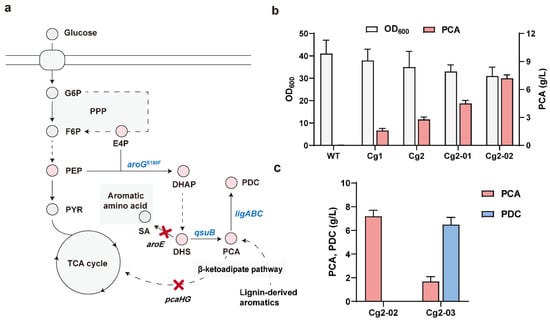
In C. glutamicum, glucose is metabolized through glycolysis and the pentose phosphate pathway to generate PEP and E4P. These two intermediates condense to form 3-deoxy-D-arabino-heptulosonate 7-phosphate (DAHP) via DAHP synthase (encoded by aroG), which initiates the shikimate pathway to produce PCA [23], the direct precursor of PDC (Figure 1a). However, endogenous PCA 3,4-dioxygenase encoded by pcaHG rapidly degrades PCA via the β-ketoadipate pathway [15]. This competing pathway limits PCA accumulation and thereby restricts precursor availability for PDC biosynthesis. Therefore, establishing an efficient PCA-producing chassis was the first step toward constructing a de novo PDC-producing strain.
Figure 1.
Stepwise metabolic engineering of C. glutamicum to realize de novo PDC synthesis. (a) Overview of the shikimate pathway and competing metabolic fluxes limiting PCA accumulation in wild-type C. glutamicum. The “✕” symbol indicates gene deletion. Two competing branches (AroE-mediated shikimate synthesis and PcaHG-dependent PCA degradation) consume pathway intermediates and PCA precursors. G6P (glucose-6-phosphate), F6P (fructose-6-phosphate), DHAP (dihydroxyacetone phosphate), PYR (pyruvate), PEP (phosphoenolpyruvate), E4P (erythrose-4-phosphate), DHS (3-dehydroshikimate); PPP denotes pentose phosphate pathway. (b) Gradual elevation of PCA titers and OD600 through sequential gene knockout and overexpression modifications in engineered strains. PCA concentrations were measured after 72 h cultivation in CGXII medium. (c) PDC production by chassis strain Cg2-03 heterologously expressing ligABC.
To eliminate PCA degradation, the pcaHG gene cluster was knocked out, generating strain Cg1. After 72 h of cultivation in CGXII medium, Cg1 accumulated 1.6 g/L PCA, whereas no detectable PCA was observed in the wild-type strain (Figure 1b). This result indicates that disruption of the β-ketoadipate pathway effectively prevented PCA catabolism and redirected carbon flux toward PCA accumulation. Nevertheless, PCA production remained limited because its upstream precursor, DHS, can be diverted to shikimate by native shikimate dehydrogenase AroE [15]. Subsequent deletion of aroE in Cg1 yielded strain Cg2, which raised PCA titer to 2.8 g/L by eliminating this competing DHS consumption route (Figure 1b). This improvement suggests that blocking the competing DHS-to-shikimate branch enhanced precursor availability for PCA biosynthesis. To further strengthen DHS conversion to PCA, qsuB, encoding DHS dehydratase, was overexpressed in Cg2 to construct strain Cg2-01. This modification increased the PCA titer to 4.5 g/L (Figure 1b), indicating that DHS dehydration represents an important limiting step in the engineered PCA-producing pathway. Previous studies have shown that the feedback-insensitive DAHP synthase variant encoded by aroGS180F accelerates PEP-E4P condensation and boosts DHS synthesis [15,23]. We thus overexpressed aroGS180F in Cg2-01, resulting in Cg2-02. The resulting strain produced 7.2 g/L PCA, corresponding to a 1.6-fold increase compared with Cg2-01 (Figure 1b). These results demonstrate that the combined reinforcement of precursor supply and DHS-to-PCA conversion established an efficient PCA-producing chassis.
Because C. glutamicum lacks the native pathway for PDC production [14], the ligABC gene cluster from S. paucimobilis SYK-6 was heterologously introduced into Cg2-02 to generate strain Cg2-03. This cluster encodes PCA 4,5-dioxygenase LigAB and CHMS dehydrogenase LigC, which together catalyze the conversion of PCA to PDC. After 72 h of cultivation, Cg2-03 accumulated 6.5 g/L PDC together with 1.7 g/L residual PCA (Figure 1c). LC-MS analysis further confirmed the identity of PDC and PCA (Figure S1), demonstrating the successful construction of a de novo PDC biosynthetic pathway in engineered C. glutamicum.
3.2. Screening of Fermentation Media for Optimized PDC Biosynthesis in Shake Flasks
Medium composition exerts a profound influence on cell growth and target metabolite biosynthesis [23,24]. To identify a suitable medium for PDC biosynthesis, the engineered strain Cg2-03 was cultivated separately in four media, namely CGXII, Medium 1, Medium 2, and Medium 3, as listed in Table 2. All cultures were inoculated with the same initial biomass and cultivated under identical glucose and trace element concentrations. Biomass, PDC titer, and residual PCA titer were measured after 72 h of cultivation. At this time point, glucose was completely consumed in all cultures (Figure S2), indicating that differences in PDC production were mainly associated with medium composition rather than incomplete glucose utilization.
Table 2.
Composition of different fermentation media used in this study.
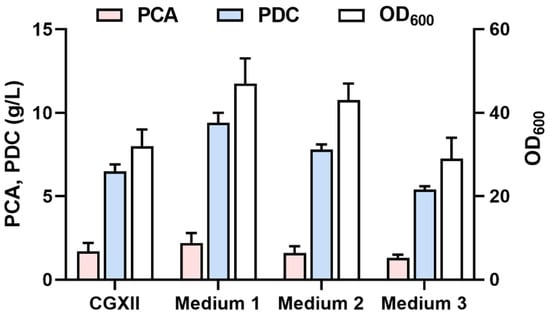
As illustrated in Figure 2, Medium 1 yielded the maximum PDC titer of 9.4 g/L alongside 2.2 g/L residual PCA, followed by Medium 2 with 7.8 g/L PDC and 1.6 g/L PCA. In comparison, PDC concentrations in CGXII and Medium 3 both fell below 7.0 g/L. A similar trend was observed for cell growth, with significantly higher biomass obtained in Medium 1 and Medium 2 than in CGXII and Medium 3. To understand these differences, we compared the nutrient compositions of the media (Table 2). Medium 1 and Medium 2 were supplemented with organic nitrogen sources, whereas CGXII and Medium 3 relied mainly on inorganic nitrogen. These results suggest that organic nitrogen supplementation promoted cell growth and improved the metabolic capacity of Cg2-03 for PDC biosynthesis. Notably, Medium 1 (containing corn steep liquor) gave a higher PDC titer than Medium 2. Therefore, Medium 1 was selected as the basal medium for subsequent fermentation optimization.
Figure 2.
PDC titer, residual PCA, and OD600 of strain Cg2-03 cultivated in four different media for 72 h. All cultures shared identical initial biomass, glucose dosage and trace nutrient supply, with other cultivation parameters kept consistent. Error bars represent standard deviations from three independent biological replicates (n = 3). CGXII: minimal medium; Medium 1: corn steep liquor-containing medium; Medium 2: yeast extract-containing medium; Medium 3: citrate-based medium.
3.3. Fed-Batch Fermentation Optimization for PDC Production in a 5-L Bioreactor
3.3.1. Effect of Corn Steep Concentrations on PDC Fermentation
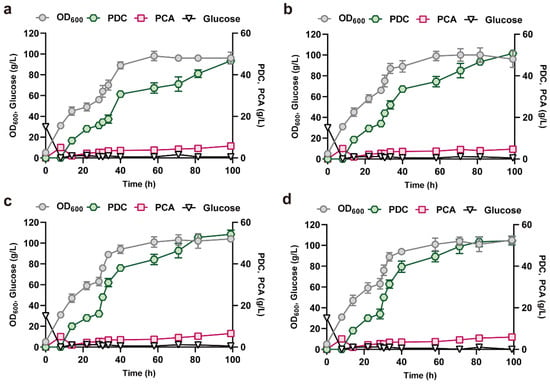
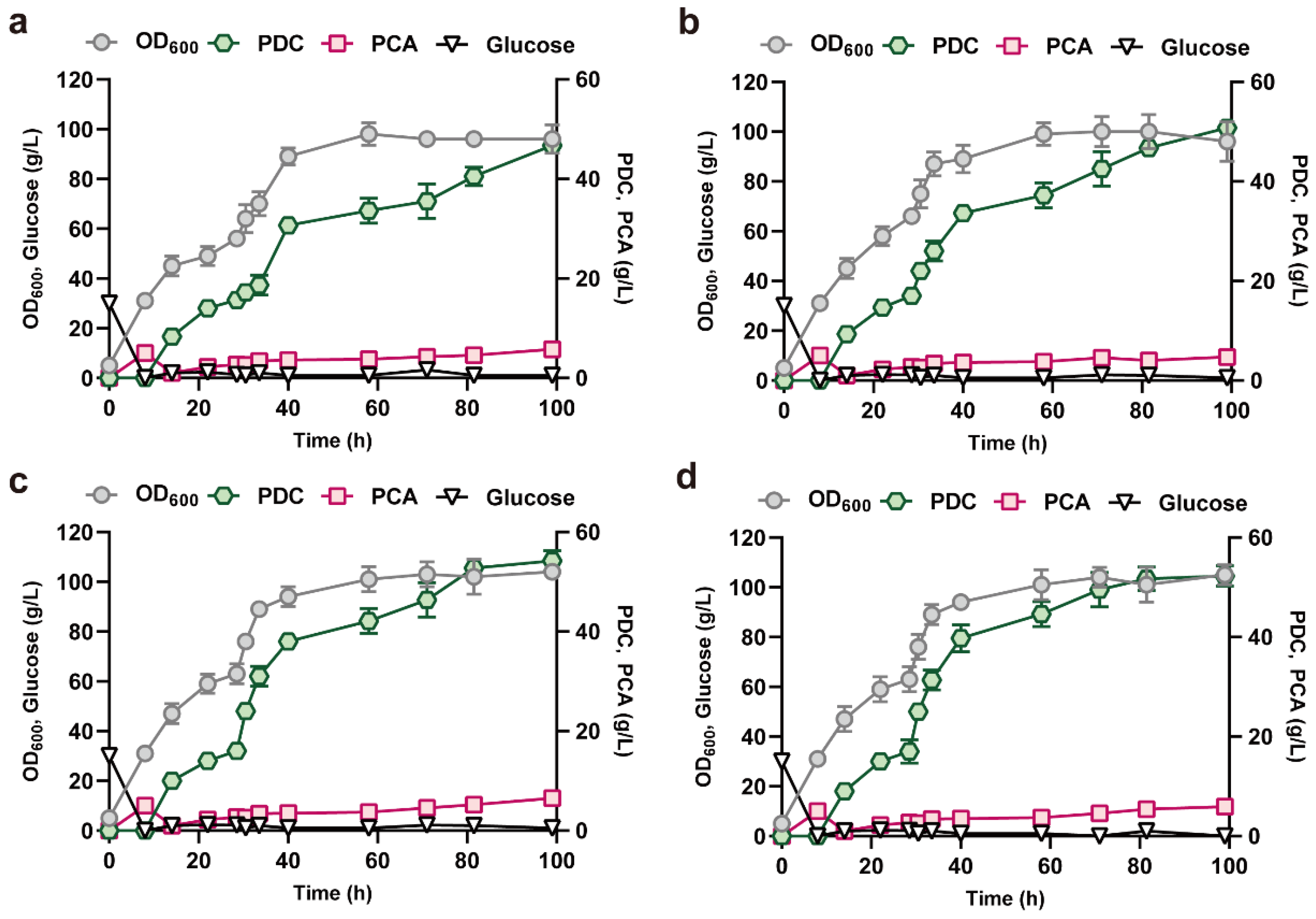
After identifying Medium 1 as the preferred medium in shake-flask cultures, fed-batch fermentation of strain Cg2-03 was performed in a 5-L bioreactor to evaluate its PDC production capacity. Because corn steep liquor was the main organic nitrogen source in Medium 1 and strongly affected PDC production in shake flasks, its concentration was further optimized during fed-batch fermentation. Four initial corn steep liquor concentrations, 10, 15, 20, and 30 g/L, were tested while all other fermentation parameters were kept constant. As shown in Figure 3a–d, the PDC titer increased as the corn steep liquor concentration was raised from 10 to 20 g/L. The highest PDC titer, 54.2 g/L, was obtained with 20 g/L corn steep liquor, whereas 10 and 15 g/L corn steep liquor resulted in lower PDC titers of 46.7 and 50.8 g/L, respectively. These results suggest that insufficient corn steep liquor limited metabolic activity required for PDC biosynthesis. However, further increasing the corn steep liquor concentration to 30 g/L slightly reduced the PDC titer to 52.3 g/L, indicating that excessive corn steep liquor did not further improve PDC production under the tested conditions. Therefore, 20 g/L corn steep liquor was selected for subsequent fermentation optimization.
Figure 3.
Fed-batch fermentation profiles of strain Cg2-03 under four different initial corn steep liquor concentrations. (a) 10 g/L corn steep liquor; (b) 15 g/L corn steep liquor; (c) 20 g/L corn steep liquor; (d) 30 g/L corn steep liquor. All fermentation parameters except corn steep liquor dosage were identical. PDC titers were enhanced as corn steep liquor increased from 10 to 20 g/L, reaching a maximum of 54.2 g/L at 20 g/L. Excess corn steep liquor (30 g/L) slightly reduced the final PDC titer to 52.3 g/L, indicating that 20 g/L was the optimal dosage for PDC biosynthesis.
3.3.2. Effect of Dissolved Oxygen Supply on PDC Biosynthesis
Although optimization of corn steep liquor concentration increased the final PDC titer, 6.5 g/L residual PCA remained at the end of fermentation, suggesting incomplete conversion of PCA to PDC. The first step of PCA conversion is catalyzed by PCA 4,5-dioxygenase LigAB, which requires molecular oxygen as a co-substrate [20]. Therefore, dissolved oxygen (DO) supply was further optimized to improve PCA-to-PDC conversion. Fed-batch fermentations were conducted at DO setpoints of 30% and 35%, and the results were compared with those obtained at 20% DO. Increasing the DO level from 20% to 30% markedly reduced residual PCA accumulation and promoted PDC production, resulting in a maximum PDC titer of 64.6 g/L (Figure 4a). Compared with 20% DO, the PDC titer at 30% DO increased from 54.2 to 64.6 g/L, with volumetric productivity rising from 0.5 to 0.7 g/L/h and PDC yield from 0.22 to 0.28 g/g (Table 3). The glucose consumption rate also increased from 1.05 to 1.31 g/L/h, indicating that improved oxygen supply enhanced both carbon utilization and metabolic activity. When the DO level was increased from 30% to 35%, the PDC titer decreased to 59.8 g/L (Figure 4b). Although glucose consumption remained similar (1.31 g/L/h), PDC yield dropped from 0.28 to 0.26 g/g and biomass-specific productivity from 0.022 to 0.020 g/g DCW/h (Table 3), suggesting that the additional oxygen was not efficiently used for product synthesis. This may be attributed to oxidative stress, which could have diverted carbon flux toward maintenance metabolism rather than PDC biosynthesis. Therefore, 30% DO was selected as the optimal oxygen supply condition for subsequent fed-batch fermentation.
Figure 4.
Comparison of fermentation profiles under 30% and 35% dissolved oxygen (DO). (a) 30% DO cultivation; (b) 35% DO cultivation. Increasing DO from 20% to 30% reduced residual PCA and improved PDC accumulation, reaching the highest titer of 64.6 g/L at 30% DO. Further elevation to 35% eliminated residual PCA but decreased PDC production to 59.8 g/L, indicating that excessive oxygen supply was detrimental to PDC biosynthesis.
Table 3.
Summary of fed-batch fermentation optimization for PDC production in a 5-L bioreactor.
3.3.3. Optimization of Glucose Feeding Rate for Enhanced PDC Titer
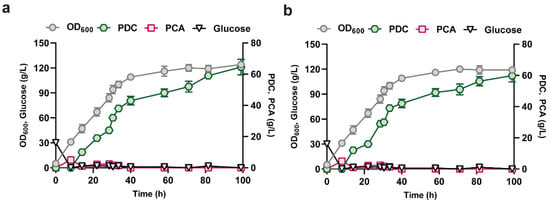
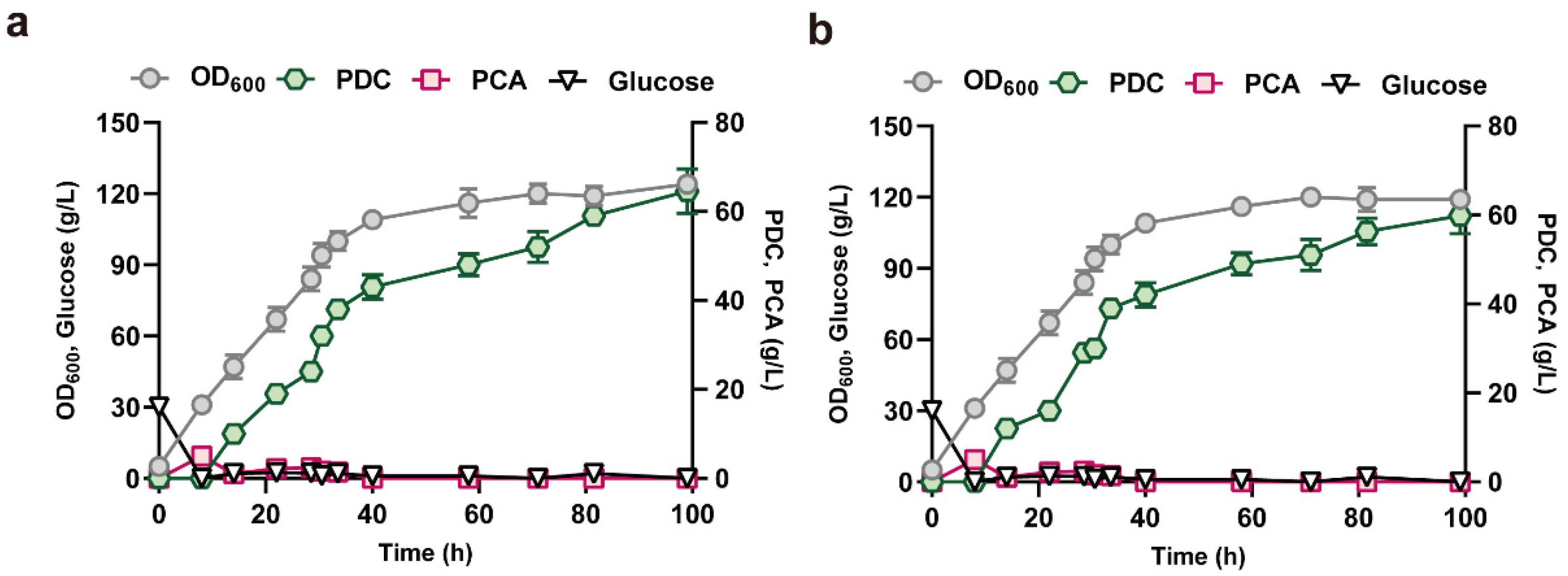
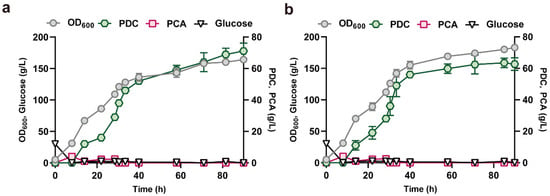
Glucose feeding rate is a critical operational parameter in fed-batch fermentation because it directly influences carbon availability, cell growth, and product formation [26]. Under the optimized corn steep liquor and DO conditions, the glucose feeding rate of 2 g/L/h allowed complete glucose utilization without residual glucose accumulation, suggesting that carbon supply might still limit PDC production. Since the initial 30 g/L glucose was depleted within approximately 7 h during the batch phase, corresponding to an apparent consumption rate of about 4 g/L/h, the feeding rate was increased to 4 g/L/h. At 4 g/L/h, strain Cg2-03 produced 71.1 g/L PDC at 90 h with a volumetric productivity of 0.8 g/L/h (Figure 5a). Residual glucose remained negligible throughout fermentation, indicating efficient glucose consumption. To test whether further increasing carbon supply could improve production, a higher feeding rate of 6 g/L/h was also evaluated. However, this strategy did not enhance PDC accumulation; instead, the maximum PDC titer decreased to 62.7 g/L, with a volumetric productivity of 0.7 g/L/h (Figure 5b and Table 3). Among the three feeding rates tested, 4 g/L/h gave the highest PDC titer (71.1 g/L), productivity (0.8 g/L/h), yield (0.31 g/g), and biomass-specific productivity (0.025 g/g DCW/h) (Table 3). Although 6 g/L/h led to the highest glucose consumption rate (2.11 g/L/h) and maximum OD600 (183.2), its PDC yield and biomass-specific productivity decreased to 0.27 g/g and 0.019 g/g DCW/h, respectively, indicating that excessive glucose was diverted to biomass rather than PDC. Together, under the optimized conditions of 20 g/L corn steep liquor, 30% DO, and a glucose feeding rate of 4 g/L/h, the engineered strain achieved the highest PDC titer of 71.1 g/L with a volumetric productivity of 0.8 g/L/h (Table 3).
Figure 5.
Effects of glucose feeding rate on fermentation performance in 5 L fed-batch culture. (a) Time-course profiles of PDC, residual glucose, and OD600 at a glucose feeding rate of 4 g/L/h; (b) Time-course profiles at a glucose feeding rate of 6 g/L/h. Negligible residual glucose was detected in both fermentations. The higher feeding rate increased the final OD600 but reduced the maximum PDC titer and volumetric productivity, revealing that excess carbon was preferentially channeled to cell proliferation rather than PDC biosynthesis.
4. Discussion
PDC is a pseudo-aromatic dicarboxylic acid with considerable potential as a bio-based building block for biodegradable polyesters [14]. However, efficient microbial PDC production remains constrained by insufficient precursor supply and limited process-level optimization. In this study, C. glutamicum was engineered for de novo PDC biosynthesis from glucose, and fermentation conditions were systematically optimized to improve production performance.
To increase PCA availability, endogenous PCA degradation was blocked by deleting pcaHG, and precursor competition was reduced by deleting aroE. Further overexpression of qsuB and the feedback-resistant DAHP synthase variant aroGS180F strengthened DHS-to-PCA conversion and carbon flux into the shikimate pathway. These modifications enabled 6.5 g/L PDC at shake-flask level, which was further increased to 9.4 g/L in Medium 1. In contrast, a previous study employing a dual-route strategy involving both DHS and chorismate required more extensive genetic manipulations, including deletions of pcaHG, qsuD, poxF, ptsH, and iolR, along with promoter engineering, to reach 10.9 g/L in shake-flask cultivation [14]. Although our shake-flask titer was slightly lower, it was achieved with significantly fewer genetic modifications. This comparison highlights the simplicity and efficiency of the single DHS route for PDC synthesis. In addition, the approximately 1.4-fold enhancement in PDC titer achieved by medium optimization further highlights the importance of fermentation medium optimization. Furthermore, the concentration of corn steep liquor in Medium 1 was also optimized in fed-batch fermentation, which substantially increased PDC production to 54.2 g/L. These results collectively underscore the importance of corn steep liquor as a key nutritional component for PDC production in C. glutamicum. Indeed, corn steep liquor has been widely used as a cost-effective organic nitrogen source in C. glutamicum fermentations [27,28,29]. However, the composition of corn steep liquor is complex and varies with raw material and processing conditions, particularly in terms of its C/N/P content [30,31]. Therefore, optimizing its composition and treatment methods is necessary to fully exploit its nutritional potential in future studies.
Importantly, optimization of DO further improved PDC accumulation and reduced residual PCA, consistent with the oxygen-dependent catalytic function of LigAB. Moreover, glucose feeding rate also strongly influenced fermentation performance. A moderate feeding rate improved PDC titer and productivity, whereas excessive glucose feeding promoted biomass accumulation at the expense of product formation. To clarify the relationship between cell growth and PDC production, we performed a phase-resolved analysis under different glucose feeding rates (Table S2). The growth-phase biomass-specific productivity qp remained nearly constant across all feeding conditions (0.074–0.076 g/g DCW/h), whereas the non-growth-phase qp was only 5–16% of that in the growth phase. Accordingly, the growth phase contributed 66.6–89.3% of the total PDC production. These results confirm that PDC formation is predominantly growth-associated, with only a minor non-growth-associated component. The differences observed among feeding rates were mainly attributed to changes in growth-phase biomass accumulation rather than non-growth-phase activity. At 4 g/L/h, non-growth-phase production was sustained without compromising growth-phase performance, while at 6 g/L/h, non-growth-phase production was suppressed and excess glucose was channeled toward biomass rather than PDC. Overall, PDC biosynthesis follows a mixed kinetics model, predominantly growth-associated with a minor non-growth-associated component. Under the optimized fermentation conditions, the engineered strain produced 71.1 g/L PDC at 90 h, with an average productivity of 0.8 g/L/h. This productivity exceeds the previously reported productivity of 0.6 g/L/h for C. glutamicum-based PDC production [14]. Although our maximum titer is close to the reported 76.2 g/L PDC in C. glutamicum [14], a notable gap still exists compared with the state-of-the-art E. coli system that accumulates 129.3 g/L PDC within 78 h, corresponding to a productivity of 1.65 g/L/h [7].
Given the predominantly growth-associated nature of PDC biosynthesis, future strategies should aim to enhance biomass formation during the growth phase while simultaneously sustaining non-growth-phase activity to maximize both growth-associated and non-growth-associated production. First, a two-stage glucose feeding strategy could be explored: a higher feeding rate during the exponential growth phase to boost biomass accumulation and growth-associated PDC synthesis, followed by a reduced rate after growth slows to avoid carbon flux diversion toward maintenance metabolism and to sustain non-growth-associated production. Second, given that PCA-to-PDC conversion was sensitive to DO supply, improving intracellular oxygen utilization—for example, through heterologous expression of Vitreoscilla hemoglobin (VHb)—could enhance LigAB-dependent catalysis and also support cell growth [7]. Third, the native aromatic metabolism of C. glutamicum offers an additional opportunity for non-growth-phase substrate supplementation. Although pcaHG was deleted to block PCA degradation (Figure 1a), the upstream pathways for converting lignin-derived aromatics to PCA remain intact. Fed-batch supplementation of lignin-related substrates such as vanillic acid during the late fermentation stage could boost intracellular PCA availability and further improve PDC production [32].
In summary, this study established a de novo PDC-producing C. glutamicum cell factory and improved its production performance through coordinated metabolic engineering and fermentation optimization, providing a promising platform for industrial-scale PDC biomanufacturing.
Supplementary Materials
The following supporting information can be downloaded at: https://www.mdpi.com/article/10.3390/fermentation12090418/s1, Table S1: Sequences of genetic parts used in this study; Table S2: Phase-resolved kinetic comparison of PDC production under different glucose feeding rates; Figure S1: LC-MS spectra of PCA and PDC quantified from fermentation broth of strain Cg2-03 [33]; Figure S2: Time-course profiles of residual glucose over 72 h shake-flask fermentation with four fermentation media.
Author Contributions
M.C.: Conceptualization, Methodology, Investigation, Formal analysis, Data curation, Visualization, Writing—original draft, Writing—review and editing. R.-T.Y.: Investigation (bioreactor fermentation). Y.-T.L.: Investigation (sample processing). F.-Q.W.: Conceptualization, Resources, Supervision, Project administration, Funding acquisition, Writing—review and editing. D.-Z.W.: Resources, Supervision, Project administration, Writing—review and editing. All authors have read and agreed to the published version of the manuscript.
Funding
This work was supported by grants from the National Key R&D Program of China (Grant No. 2024YFC3407100) and the Shanghai Science and Technology Commission (Grant No. 24HC2810700).
Institutional Review Board Statement
Not applicable.
Informed Consent Statement
Not applicable.
Data Availability Statement
The data presented in this study are available from the corresponding author upon reasonable request.
Conflicts of Interest
The authors declare no conflicts of interest.
References
- Pei, F.; Liu, L.; Zhu, H.; Guo, H. Recent advances in lignocellulose-based monomers and their polymerization. Polymers 2023, 15, 829. [Google Scholar] [CrossRef] [Scilit]
- Chen, C.; Chen, X.; Liu, L.; Wu, J.; Gao, C. Engineering microorganisms to produce bio-based monomers: Progress and challenges. Fermentation 2023, 9, 137. [Google Scholar] [CrossRef] [Scilit]
- Han, X.; Liu, J.; Tian, S.; Tao, F.; Xu, P. Microbial cell factories for bio-based biodegradable plastics production. iScience 2022, 25, 105462. [Google Scholar] [CrossRef] [Scilit]
- Zhang, F.-L.; Zhang, L.; Zeng, D.-W.; Liao, S.; Fan, Y.; Champreda, V.; Runguphan, W.; Zhao, X.-Q. Engineering yeast cell factories to produce biodegradable plastics and their monomers: Current status and prospects. Biotechnol. Adv. 2023, 68, 108222. [Google Scholar] [CrossRef] [Scilit]
- Samrot, A.V.; Sean, T.C.; Kudaiyappan, T.; Bisyarah, U.; Mirarmandi, A.; Faradjeva, E.; Abubakar, A.; Ali, H.H.; Angalene, J.L.A.; Suresh Kumar, S. Production, characterization and application of nanocarriers made of polysaccharides, proteins, bio-polyesters and other biopolymers: A review. Int. J. Biol. Macromol. 2020, 165, 3088–3105. [Google Scholar] [CrossRef] [Scilit]
- Zhou, D.; Wu, F.; Peng, Y.; Qazi, M.A.; Li, R.; Wang, Y.; Wang, Q. Multi-step biosynthesis of the biodegradable polyester monomer 2-pyrone-4,6-dicarboxylic acid from glucose. Biotechnol. Biofuels 2023, 16, 92. [Google Scholar] [CrossRef] [Scilit]
- Wu, F.; Wang, S.; Zhou, D.; Gao, S.; Song, G.; Liang, Y.; Wang, Q. Metabolic engineering of Escherichia coli for high-level production of the biodegradable polyester monomer 2-pyrone-4,6-dicarboxylic acid. Metab. Eng. 2024, 83, 52–60. [Google Scholar] [CrossRef] [Scilit]
- Otsuka, Y.; Nakamura, M.; Shigehara, K.; Sugimura, K.; Masai, E.; Ohara, S.; Katayama, Y. Efficient production of 2-pyrone 4,6-dicarboxylic acid as a novel polymer-based material from protocatechuate by microbial function. Appl. Microbiol. Biotechnol. 2006, 71, 608–614. [Google Scholar] [CrossRef] [Scilit]
- Michinobu, T.; Hishida, M.; Sato, M.; Katayama, Y.; Masai, E.; Nakamura, M.; Otsuka, Y.; Ohara, S.; Shigehara, K. Polyesters of 2-pyrone-4,6-dicarboxylic acid (PDC) obtained from a metabolic intermediate of lignin. Polym. J. 2008, 40, 68–75. [Google Scholar] [CrossRef] [Scilit]
- Michinobu, T.; Bito, M.; Tanimura, M.; Katayama, Y.; Masai, E.; Nakamura, M.; Otsuka, Y.; Ohara, S.; Shigehara, K. Synthesis and characterization of hybrid biopolymers of L-lactic acid and 2-pyrone-4,6-dicarboxylic acid. J. Macromol. Sci. A 2010, 47, 564–570. [Google Scholar] [CrossRef] [Scilit]
- Notonier, S.; Werner, A.Z.; Kuatsjah, E.; Dumalo, L.; Abraham, P.E.; Hatmaker, E.A.; Hoyt, C.B.; Amore, A.; Ramirez, K.J.; Woodworth, S.P.; et al. Metabolism of syringyl lignin-derived compounds in Pseudomonas putida enables convergent production of 2-pyrone-4,6-dicarboxylic acid. Metab. Eng. 2021, 65, 111–122. [Google Scholar] [CrossRef] [Scilit]
- Kim, B.; Hall, B.W.; Haak, D.V.; Coplien, J.; Karlen, S.D.; Donohue, T.J.; Noguera, D.R. Using Novosphingobium aromaticivorans for concurrent production of intracellular and extracellular products from aromatics extracted from poplar biomass. ACS ES&T Eng. 2026, 6, 1106–1117. [Google Scholar] [CrossRef] [Scilit]
- Suzuki, Y.; Okamura-Abe, Y.; Otsuka, Y.; Araki, T.; Nojiri, M.; Kamimura, N.; Masai, E.; Nakamura, M. Integrated process development for grass biomass utilization through enzymatic saccharification and upgrading hydroxycinnamic acids via microbial funneling. Bioresour. Technol. 2022, 363, 127836. [Google Scholar] [CrossRef] [Scilit]
- Cho, J.S.; Luo, Z.W.; Moon, C.W.; Prabowo, C.P.S.; Lee, S.Y. Metabolic engineering of Corynebacterium glutamicum for the production of pyrone and pyridine dicarboxylic acids. Proc. Natl. Acad. Sci. USA 2024, 121, e2415213121. [Google Scholar] [CrossRef] [Scilit]
- Kogure, T.; Suda, M.; Hiraga, K.; Inui, M. Protocatechuate overproduction by Corynebacterium glutamicum via simultaneous engineering of native and heterologous biosynthetic pathways. Metab. Eng. 2021, 65, 232–242. [Google Scholar] [CrossRef] [Scilit]
- Becker, J.; Rohles, C.M.; Wittmann, C. Metabolically engineered Corynebacterium glutamicum for bio-based production of chemicals, fuels, materials, and healthcare products. Metab. Eng. 2018, 50, 122–141. [Google Scholar] [CrossRef] [Scilit]
- Chung, J.; Shin, W.; Park, C.; Cho, J. Enhancement strategy for protocatechuic acid production using Corynebacterium glutamicum with focus on continuous fermentation scale-up and cytotoxicity management. Int. J. Mol. Sci. 2025, 26, 396. [Google Scholar] [CrossRef] [Scilit]
- Kind, S.; Neubauer, S.; Becker, J.; Yamamoto, M.; Völkert, M.; von Abendroth, G.; Zelder, O.; Wittmann, C. From zero to hero-production of bio-based nylon from renewable resources using engineered Corynebacterium glutamicum. Metab. Eng. 2014, 25, 113–123. [Google Scholar] [CrossRef] [Scilit]
- Li, M.; Chen, J.; He, K.; Su, C.; Wu, Y.; Tan, T. Corynebacterium glutamicum cell factory design for the efficient production of cis, cis-muconic acid. Metab. Eng. 2024, 82, 225–237. [Google Scholar] [CrossRef] [Scilit]
- Otsuka, Y.; Araki, T.; Suzuki, Y.; Nakamura, M.; Kamimura, N.; Masai, E. High-level production of 2-pyrone-4,6-dicarboxylic acid from vanillic acid as a lignin-related aromatic compound by metabolically engineered fermentation to realize industrial valorization processes of lignin. Bioresour. Technol. 2023, 377, 128956. [Google Scholar] [CrossRef] [Scilit]
- Chai, M.; Xu, X.; Liu, Y.; Li, J.; Du, G.; Lv, X.; Liu, L. Combinatorial protein engineering and metabolic engineering for efficient synthesis of L-histidine in Corynebacterium glutamicum. ACS Synth. Biol. 2023, 12, 1275–1286. [Google Scholar] [CrossRef] [Scilit]
- Jiang, Y.; Qian, F.; Yang, J.; Liu, Y.; Dong, F.; Xu, C.; Sun, B.; Chen, B.; Xu, X.; Li, Y.; et al. CRISPR-cpf1 assisted genome editing of Corynebacterium glutamicum. Nat. Commun. 2017, 8, 15179. [Google Scholar] [CrossRef] [Scilit]
- Shi, H.; Zhu, H.; Tan, T. Reprogramming Corynebacterium glutamicum metabolism to efficiently synthesis protocatechuic acid from flask to pilot scale. Bioresour. Technol. 2025, 435, 132879. [Google Scholar] [CrossRef] [Scilit]
- Zhu, Z.; Hu, Y.; Teixeira, P.G.; Pereira, R.; Chen, Y.; Siewers, V.; Nielsen, J. Multidimensional engineering of Saccharomyces cerevisiae for efficient synthesis of medium-chain fatty acids. Nat. Catal. 2020, 3, 64–74. [Google Scholar] [CrossRef] [Scilit]
- Ding, N.; Yan, J.; Luo, Q.; Chen, H.; Qin, Y.; Ye, J.; Tian, K.; Shao, Q.; Volkov, P.V.; Liang, R.; et al. Engineering xylose metabolism and coutilization with glucose in Corynebacterium glutamicum for efficient microbial cell factories. J. Agric. Food Chem. 2025, 73, 19587–19598. [Google Scholar] [CrossRef] [Scilit]
- Dong, Q.; Chen, P.; Guo, Z.; Wei, H.; Zeng, Y.; Zhang, J.; Men, Y.; Liu, W.; Sun, Y.; Yang, J. Computational design of allulose-responsive biosensor toolbox for auto-inducible protein expression and CRISPRi mediated dynamic metabolic regulation. Nat. Commun. 2025, 16, 11562. [Google Scholar] [CrossRef] [Scilit]
- Deng, C.; Xin, R.; Li, X.; Zhang, J.; Fan, L.; Qiu, Y.; Zhao, L. Optogenetic control of Corynebacterium glutamicum gene expression. Nucleic Acids Res. 2024, 52, 14260–14276. [Google Scholar] [CrossRef] [Scilit]
- Kim, M.; Jeong, D.W.; Oh, J.W.; Jeong, H.J.; Ko, Y.J.; Park, S.E.; Han, S.O. Efficient synthesis of food-derived antioxidant L-ergothioneine by engineered Corynebacterium glutamicum. J. Agric. Food Chem. 2022, 70, 1516–1524. [Google Scholar] [CrossRef] [Scilit]
- Chai, M.; Deng, C.; Chen, Q.; Lu, W.; Liu, Y.; Li, J.; Du, G.; Lv, X.; Liu, L. Synthetic biology toolkits and metabolic engineering applied in Corynebacterium glutamicum for biomanufacturing. ACS Synth. Biol. 2021, 10, 3237–3250. [Google Scholar] [CrossRef] [Scilit]
- Ma, Y.; Chen, X.; Khan, M.Z.; Xiao, J.; Alugongo, G.M.; Liu, S.; Wang, J.; Cao, Z. Effect of the combining corn steep liquor and urea pre-treatment on biodegradation and hydrolysis of rice straw. Front. Microbiol. 2022, 13, 916195. [Google Scholar] [CrossRef] [Scilit]
- Byanju, B.; Sen, S.; Mansell, T.; Lamsal, B.P. Evaluation of corn steep liquor as fermentation media for recombinant Lactococcus lactis producing antifreeze proteins. J. Sci. Food Agric. 2023, 103, 2512–2521. [Google Scholar] [CrossRef] [Scilit]
- Weiland, F.; Barton, N.; Kohlstedt, M.; Becker, J.; Wittmann, C. Systems metabolic engineering upgrades Corynebacterium glutamicum to high-efficiency cis, cis-muconic acid production from lignin-based aromatics. Metab. Eng. 2023, 75, 153–169. [Google Scholar] [CrossRef] [Scilit]
- Kim, H.I.; Beauchamp, J.L. Cluster phase chemistry: Collisions of vibrationally excited cationic dicarboxylic acid clusters with water molecules initiate dissociation of cluster components. J. Phys. Chem. A. 2007, 111, 5954–5967. [Google Scholar] [CrossRef] [Scilit]

Disclaimer/Publisher’s Note: The statements, opinions and data contained in all publications are solely those of the individual author(s) and contributor(s) and not of MDPI and/or the editor(s). MDPI and/or the editor(s) disclaim responsibility for any injury to people or property resulting from any ideas, methods, instructions or products referred to in the content. |
© 2026 by the authors. Licensee MDPI, Basel, Switzerland. This article is an open access article distributed under the terms and conditions of the Creative Commons Attribution (CC BY) license.