


Abstract
This study evaluated the effects of milk type, UV-C treatment condition and refrigerated storage on selected quality characteristics of ayran. Cow and buffalo milk was standardised to 1.5% fat and subjected to UV-C treatment at flow rates of 20 or 40 mL/min, corresponding to calculated nominal doses of 54 and 27 J/mL, respectively. Conventionally pasteurised milks were used as controls. During ayran production, all samples were subsequently heated at 90 °C for 5 min, fermented to pH 4.30 and stored at 4 °C for 14 days. Physicochemical, instrumental textural, colour, starter culture and organic acid characteristics were evaluated during storage. The measured responses varied according to milk matrix, UV-C treatment condition and storage duration, and no single treatment was consistently favourable for all parameters. At day 14, C20 showed the highest dry matter content (5.12%), firmness (15.43 g), consistency (292.32 g·s) and Lactobacillus delbrueckii subsp. bulgaricus count (7.52 log CFU/mL). In contrast, B40 showed the highest Streptococcus thermophilus count (8.14 log CFU/mL), lactic acid concentration (15,092.95 mg/kg) and concentrations of most of the other organic acids evaluated, whereas C20 showed the highest acetic acid concentration (1122.14 mg/kg). During storage, pH, dry matter, citric acid, ascorbic acid and starter culture counts generally decreased, while most other organic acids increased. Instrumental colour parameters also changed according to treatment group and storage duration. These findings provide preliminary laboratory-scale evidence that UV-C pretreatment can influence selected quality characteristics of ayran. However, because UV-C-treated samples subsequently underwent thermal processing, the results represent a combined UV-C and thermal processing sequence rather than an exclusively non-thermal process. Sensory acceptability, pathogenic and spoilage microorganisms, oxidative stability, extended shelf life, and scale-up performance should be evaluated before practical application is considered.
1. Introduction
Ayran is a ready-to-drink fermented dairy beverage widely consumed in Türkiye and neighbouring regions. It is traditionally prepared by diluting yoghurt with water and may contain added salt; alternatively, it can be produced industrially by fermenting milk that has been standardised to the desired total solids content. Ayran is characterised by an acidic and mildly salty flavour, a fluid consistency and a homogeneous appearance. Its quality and consumer acceptability are influenced by milk composition, starter culture activity, processing conditions and storage stability [1].
Thermal processing is commonly used to ensure the microbiological safety of milk, but it may also cause changes in heat-sensitive nutrients, proteins and sensory properties [2]. UV-C irradiation, generally applied within the 200–280 nm range, has therefore attracted interest as a non-thermal treatment for reducing microbial populations in liquid foods. Its antimicrobial action is primarily associated with photochemical damage to microbial DNA and RNA [3]. However, UV-C treatment may also affect milk components, including proteins, lipids, pigments and vitamins, thereby influencing the physicochemical, textural and colour characteristics of fermented dairy products [4,5,6].
The application of UV-C to milk is technically challenging because milk is an opaque and highly scattering medium. Proteins, fat globules and other suspended components limit UV-C penetration, potentially resulting in non-uniform exposure. Treatment efficiency consequently depends not only on the nominal UV-C dose but also on milk composition, optical properties, reactor geometry, film thickness, flow conditions and residence time. Continuous-flow systems can improve exposure by promoting product movement through the irradiation zone, but complete dose uniformity cannot be assumed. Previous research confirms that turbidity, opacity, composition and processing geometry are major determinants of UV-C efficiency in dairy matrices [3,4,5,6,7,8].
In the present study, flow rates of 20 and 40 mL/min were selected to provide two different residence times and UV-C exposure levels within the operating range of the continuous-flow reactor. The lower flow rate of 20 mL/min resulted in a longer residence time and a higher calculated dose of 54 J/mL, whereas the higher flow rate of 40 mL/min resulted in a shorter residence time and a lower calculated nominal UV-C dose of 27 J/mL. These conditions enabled the effects of two contrasting UV-C exposure levels to be compared while maintaining the same reactor configuration. Nevertheless, because the dose was calculated from lamp output and flow rate, it represents a nominal delivered dose and may not fully describe the dose distribution within the opaque milk matrix.
Milk composition may further influence the response to UV-C treatment. Under natural conditions, buffalo milk generally contains higher concentrations of protein, fat, minerals and total solids than cow milk and has distinctive casein micelle and buffering characteristics [9,10,11,12,13]. In the present study, both milks were standardised to 1.5% fat; therefore, the comparison does not represent their full-fat natural compositions. However, differences in protein and total solids remained and could influence UV-C exposure, fermentation behaviour and the properties of the resulting ayran.
Although UV-C treatment has been investigated in drinking milk, yoghurt and other fermented dairy products, limited information is available on how cow and buffalo milk matrices respond to UV-C treatment during ayran production and refrigerated storage. In particular, the combined effects of milk type, UV-C exposure level and storage duration on the physicochemical, instrumental textural, colour, starter culture and organic acid characteristics of ayran have not been comprehensively compared. We hypothesised that UV-C treatment would alter these quality characteristics and that the magnitude of the changes would depend on the UV-C exposure level and the composition of the milk matrix. Accordingly, this study aimed to determine the effects of two UV-C flow-rate/dose conditions on the physicochemical, textural, colour, starter culture and organic acid properties of fat-standardised cow and buffalo milk ayran during 14 days of refrigerated storage.
2. Materials and Methods
2.1. Materials
Both milks were standardised to 1.5% fat to obtain a low-fat ayran formulation and to minimise the confounding effect of differences in fat concentration when evaluating the influence of milk matrix and UV-C treatment. Therefore, the milk-type comparison in this study represents cow and buffalo milk matrices at an equal fat level rather than their natural, full-fat compositions. Although the fat contents were equalised, differences in protein and total solids remained, with buffalo milk containing 3.81% protein and 12.78% total solids compared with 3.11% protein and 11.08% total solids in cow milk.
A direct-inoculation (DVS) starter culture containing Streptococcus thermophilus and Lactobacillus delbrueckii subsp. bulgaricus (Yoflex M780, Chr. Hansen, İstanbul, Türkiye) was used to produce ayran.
2.2. Experimental Design
Six treatment groups were prepared using two milk types and three processing conditions. Sample codes beginning with “C” represent cow milk, whereas those beginning with “B” represent buffalo milk. The number in each code indicates the UV-C flow rate. Accordingly, C20 and B20 were treated at 20 mL/min, corresponding to a calculated dose of 54 J/mL, whereas C40 and B40 were treated at 40 mL/min, corresponding to 27 J/mL. Samples C0 and B0 were the corresponding non-UV-C control groups. The treatment groups are defined in Table 1.
Table 1.
Experimental design and treatment groups used in the study.
2.3. UV-C Treatment of Milk
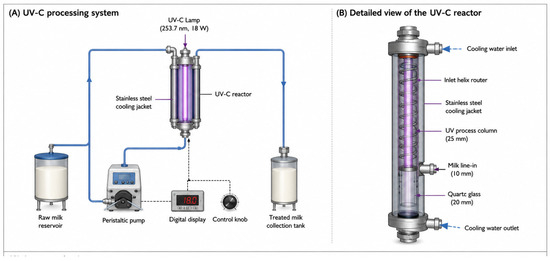
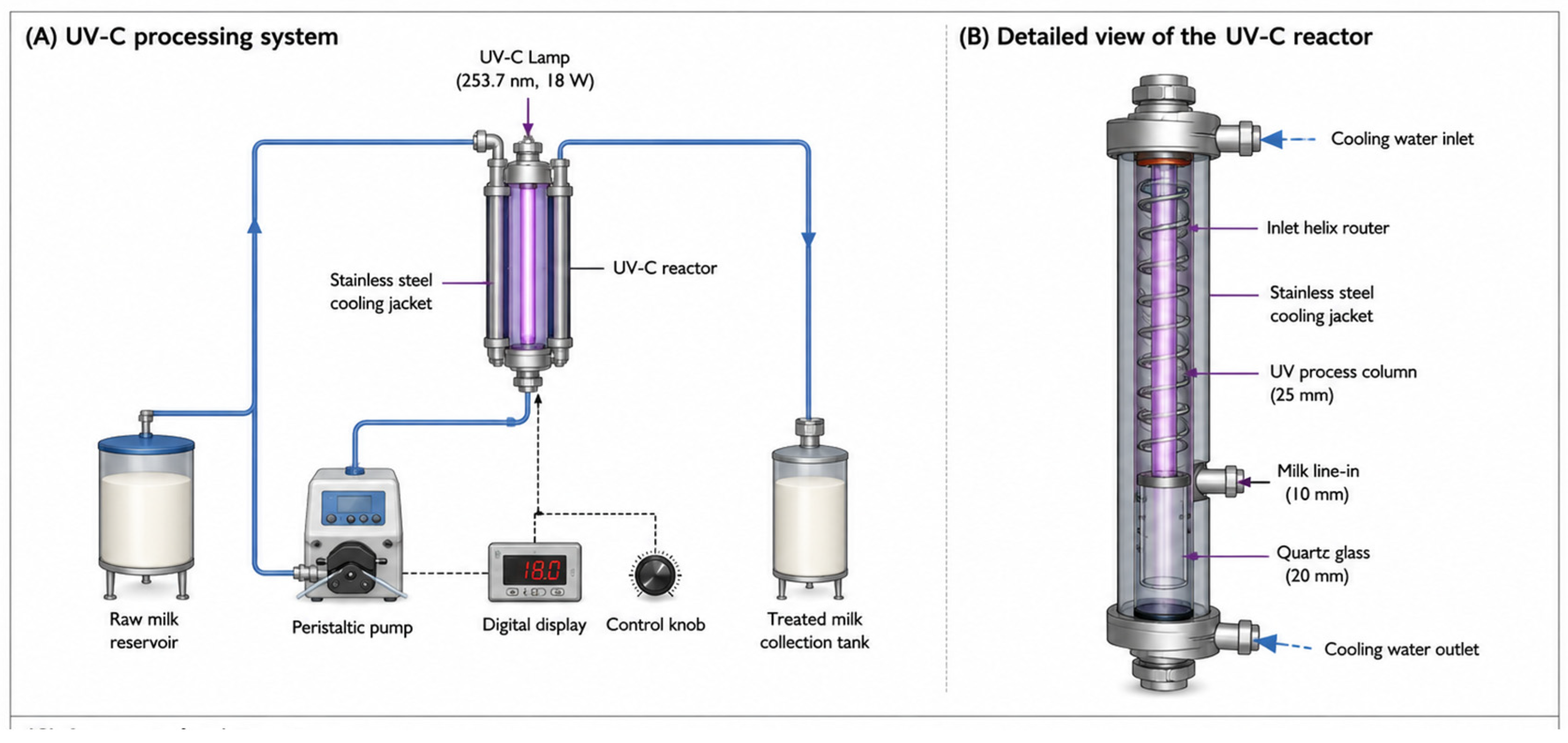
UV-C treatment of raw milk was performed using a laboratory-scale continuous-flow UV-C reactor manufactured by Defne Engineering Laboratory Equipment (Afyonkarahisar, Türkiye), according to the method described by Atik [8]. A GPH846T5L/HO/4 low-pressure mercury UV-C lamp (Lightech, Dunakeszi, Hungary), operating at a principal wavelength of 253.7 nm and having a manufacturer-specified UV-C output of 18 W, was used as the radiation source (Figure 1).
Figure 1.
UV-C processing system (A) and detailed view of the UV-C reactor (B).
Before each treatment, the UV-C lamp was switched on for 15 min to allow output stabilisation and to disinfect the reactor. Raw milk was then passed continuously through the reactor at flow rates of 20 or 40 mL/min. These flow conditions corresponded to calculated nominal UV-C doses of 54 and 27 J/mL, respectively. The lower flow rate provided a longer nominal exposure per unit volume and consequently a higher calculated nominal UV-C dose.
The UV-C system consisted of a continuous-flow column surrounding the UV-C lamp. However, the effective irradiated volume, milk residence-time distribution, optical path length and spatial irradiance distribution within the reactor were not measured directly. Therefore, the actual UV-C energy delivered to or absorbed by the milk could not be determined. The reported values should consequently be interpreted as calculated nominal UV-C doses derived from the manufacturer-specified lamp output and the milk flow rate, rather than as experimentally validated absorbed doses.
2.4. Calculation of Nominal UV-C Dose
The calculated nominal UV-C dose was estimated from the manufacturer-specified UV-C lamp output and the volumetric flow rate using the following equation:
where W is equivalent to J/s. Based on the manufacturer-specified UV-C output of 18 W, flow rates of 20 and 40 mL/min corresponded to calculated nominal UV-C doses of 54 and 27 J/mL, respectively.
Calculated nominal UV-C dose (J/mL) = manufacturer-specified UV-C output (W)/milk flow rate (mL/s)
This calculation assumes that the stated UV-C output was continuously and uniformly available to the flowing milk. It does not account for lamp ageing, reactor-wall losses, reflection, fouling, scattering, absorption by milk components, spatial variations in irradiance or the residence-time distribution of milk within the reactor. In addition, the effective UV-C output reaching the milk was not measured using radiometric, actinometric or biodosimetric methods. Therefore, the calculated values represent nominal process indicators and should not be interpreted as validated incident or absorbed UV-C doses.
2.5. Cleaning the UV-C Reactor
Following each treatment, the reactor was cleaned using the clean-in-place (CIP) system. For this purpose, 250 mL of sterile water, 250 mL of 0.1 N NaOH, and again 250 mL of sterile water were passed through the system in that order. Following the preliminary wash, the reactor was reassembled, and the final wash was completed using 1 L of 0.1 N NaOH and 1 L of sterile water [7].
2.6. Production of Ayran
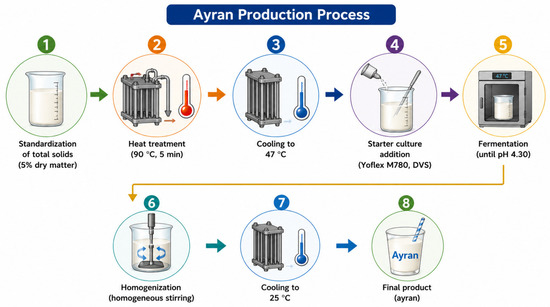
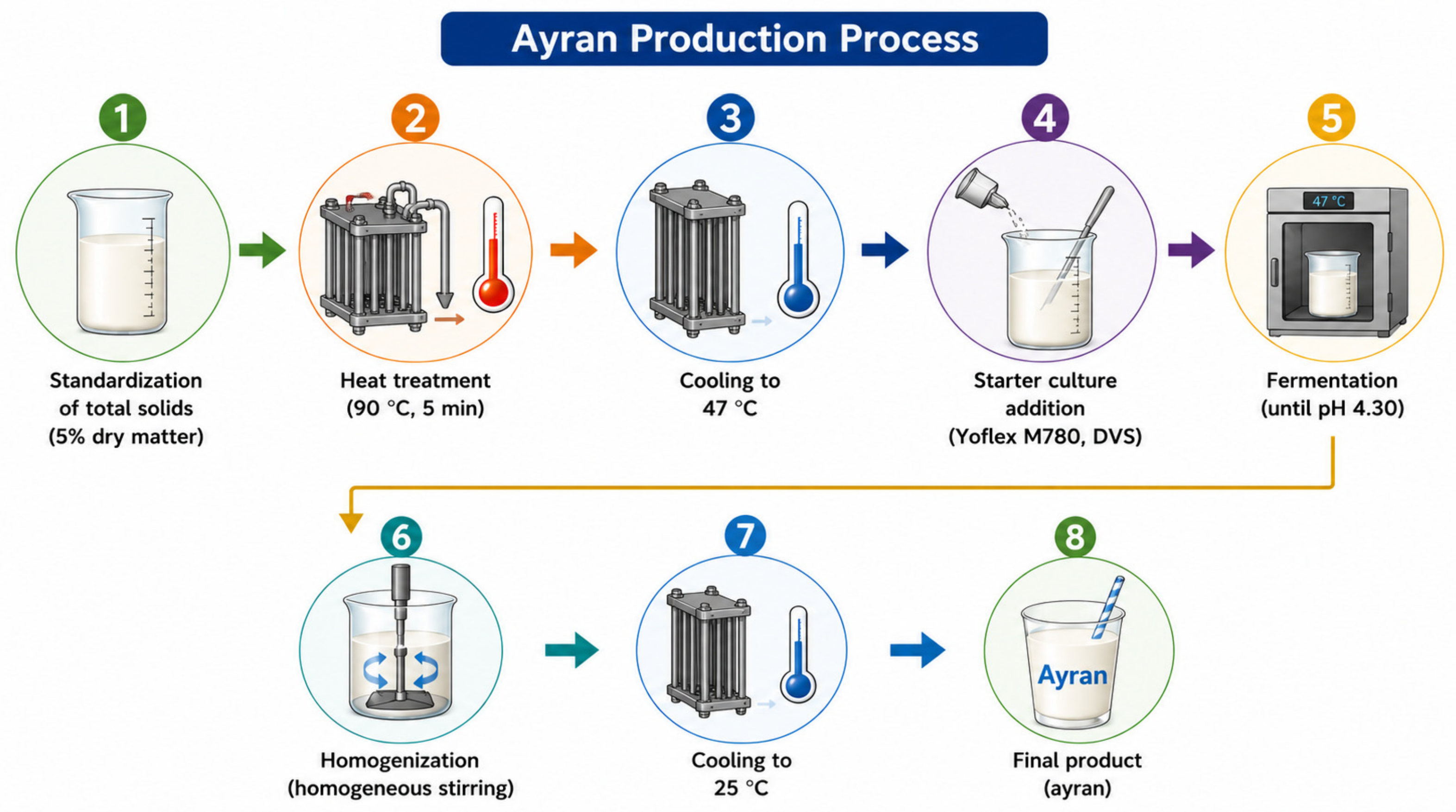
Ayran was produced using a modified version of the method described by Atik [8]. The dry matter content of the milk used in production was standardised to 5% by adding pure water. The milk was then heat-treated at 90 °C for 5 min and rapidly cooled to 47 °C.
All samples were incubated under the same temperature conditions until reaching a pH of 4.30; however, the time required for each treatment group to reach this target pH was not recorded separately. At the end of the incubation period, the resulting curd was stirred until homogeneous, then cooled to 25 °C and stored at 4 °C until analyses were finished (Figure 2).
Figure 2.
Ayran production process.
2.7. Physicochemical Analyses
The pH values of the samples were determined in accordance with the AOAC method 981.12 [14] using a digital pH metre (HI 2215 pH/ORP, Hanna Instruments, Singapore), which was calibrated before use with pH 4.00, 7.00, and 10.00 buffer solutions. Dry matter analyses were carried out in accordance with the AOAC method 990.20 [15].
The colour parameters (L*, a* and b*) were determined using a calibrated colourimeter (CR-400, Minolta Co., Osaka, Japan) [16]. The hue angle and chroma values were calculated using the equations reported in the literature [17].
2.8. Textural Analyses
The texture parameters of the ayran samples (firmness, consistency, cohesiveness and index of viscosity) were measured using a TA.XT Plus Texture Analyser (Stable Micro Systems, Godalming, Surrey, UK) fitted with a back extrusion rig (TA-30A: 7.62 cm in diameter, cylindrical acrylic, 10 mm high) [18].
Using the reverse extrusion technique, force-time curves were plotted based on the positive areas when the probe was immersed in each sample and the negative areas when it was withdrawn. The Texture Exponent 32 (2007) software (Stable Micro Systems, Godalming, UK) was used to determine the textural properties of the samples. Among the evaluated parameters, firmness (g) was defined as the maximum positive force, consistency (g·s) as the positive area under the force–time curve, cohesiveness (g) as the maximum negative force, and viscosity index (g·s) as the negative area under the curve.
2.9. Determination of Organic Acid Profiles by HPLC
Organic acid concentrations were determined using a Shimadzu Prominence high-performance liquid chromatography system (Shimadzu Corporation, Kyoto, Japan) equipped with a CBM-20A communication module, an LC-20AT pump, a SIL-20ACHT autosampler, a CTO-10ASVp column oven and an SPD-M20A diode-array detector. Chromatographic data were acquired and processed using LCsolution software (version: 1.23 sp1). Separation was performed using an Inertsil ODS-4 reversed-phase column (250 × 4.6 mm, 5 µm; GL Sciences, Tokyo, Japan), according to the procedures described previously [19,20]. Ultrapure water adjusted to pH 3.0 with orthophosphoric acid was used as the mobile phase.
For sample preparation, 4 mL of ayran was mixed with 20 mL of 0.01 N H2SO4. The mixture was vortexed and filtered through a 0.45 µm membrane filter before injection into the HPLC system. Organic acid concentrations were expressed as mg/kg of ayran. Each sample was analysed in duplicate within each independently produced batch, and the duplicate analytical measurements were averaged before statistical analysis.
Detailed information on the calibration conditions, detector wavelength, mobile-phase flow rate, injection volume, column temperature and compound-specific retention times was not available in the retained analytical records and could not be reconstructed retrospectively with sufficient reliability. In addition, matrix-specific analytical recovery, intra-day and inter-day precision, and limits of detection and quantification were not determined separately for the present ayran matrix. Complete method-validation characteristics could therefore not be reported. This limitation should be considered when interpreting the absolute organic acid concentrations, and future studies should include full matrix-specific validation of the HPLC method.
2.10. Microbiological Analyses
Before analysis, serial dilutions were prepared from the ayran samples, and the analyses were performed using the plate spread method on these dilutions. The bacterial counts for Streptococcus thermophilus were determined on Kf Streptococcus agar (110707, Merck Millipore, Darmstadt, Germany), whilst those for L. delbrueckii subsp. bulgaricus were determined on Lactobacillus bulgaricus agar (17154, Merck Millipore, Germany), under anaerobic conditions, following incubation at 42 °C for 48–72 h [21].
2.11. Experimental Design and Statistical Analysis
The experiment followed a 2 × 3 factorial pretreatment design with repeated measurements during storage. The fixed factors were milk type (cow and buffalo milk), pretreatment condition (conventional pasteurisation control, UV-C at 20 mL/min and UV-C at 40 mL/min), and storage time (0, 7 and 14 days). The control samples underwent conventional pasteurisation at 75 °C for 15 s without UV-C pretreatment, whereas the other samples received UV-C pretreatment at flow rates of 20 or 40 mL/min instead of this initial conventional pasteurisation step. All experimental groups subsequently underwent the same heating step at 90 °C for 5 min during ayran production. Thus, the study compared different pretreatment conditions followed by a common heating and production procedure, rather than untreated and UV-C-treated samples. All two-way and three-way interactions among milk type, pretreatment condition and storage time were included in the statistical model. Storage time was treated as a repeated-measures factor because measurements at the three storage times were obtained from the same independently produced batches.
The experimental unit was an independently produced batch of ayran corresponding to a specific milk type × pretreatment condition combination. Two independent production batches were prepared for each combination (n = 2 biological replicates), resulting in a total of 12 independent experimental units. Each analysis was performed in duplicate within each production batch. These duplicate measurements were considered technical replicates and were averaged before statistical analysis; therefore, they were not treated as independent experimental observations.
Data were analysed using a linear mixed-effects model. Milk type, pretreatment condition, storage time, and their two-way and three-way interactions were included as fixed effects. Production batch was included as a random blocking effect, and storage time was specified as a repeated factor for observations obtained from the same experimental unit. Candidate covariance structures for the repeated measurements were compared using the Akaike information criterion, and the structure with the lowest Akaike information criterion value was selected for the final model. Fixed effects were evaluated using F statistics with their associated numerator and denominator degrees of freedom and p values.
The normality of the model residuals was evaluated using normal Q–Q plots and the Shapiro–Wilk test, while homogeneity of variance was assessed using Levene’s test. When significant effects were detected, pairwise comparisons of estimated marginal means were performed using the Bonferroni adjustment. Differences were considered statistically significant at p < 0.05. Statistical analyses were performed using IBM SPSS Statistics 23 (IBM Corp., Armonk, NY, USA).
Because only two independent production batches were available for each milk type × pretreatment condition combination, the statistical power and precision of the interaction estimates were limited. Duplicate analytical measurements and repeated observations during storage improved measurement precision but did not increase the number of biologically independent experimental units. Therefore, two-way and particularly three-way interactions were interpreted cautiously and should be confirmed in studies involving a larger number of independent production batches.
3. Results and Discussion
3.1. pH and Dry Matter
Milk type, UV-C treatment and storage time affected the pH and dry matter values of the ayran samples. The effects of these factors and their two- and three-way interactions are presented in Table 2.
Table 2.
pH and dry matter (%) values of the samples.
The pH values decreased during storage in all treatment groups, although the magnitude of the decrease varied among samples (Table 2). At day 14, C0 had the highest pH, whereas B40 had the lowest value. The response was not directly proportional to pretreatment flow rate, indicating that it depended on the interaction between milk matrix, pretreatment condition and storage.
Differences in pH may partly reflect the compositional and buffering differences that remained between the cow and buffalo milk matrices after fat standardisation, including protein, total solids, casein and mineral contents [6,11,12,13,22]. Treatment-specific fermentation times required to reach pH 4.30 were not recorded; consequently, the pH differences observed during storage cannot be attributed exclusively to UV-C pretreatment.
Dry matter content decreased during storage in all treatment groups, although the magnitude of the decline differed among samples (Table 2). At the beginning and end of storage, C20 showed the highest dry matter values, whereas C40 showed the lowest values. However, UV-C treatment did not produce a consistent directional response across the two milk types. For example, C20 had a higher dry matter content than C0, whereas both B20 and B40 had lower initial values than B0. Therefore, the dry matter response cannot be described as a uniform increase caused by UV-C treatment.
The differences in dry matter content may reflect variation in the initial milk matrices, formulation, subsequent heating, fermentation and sampling. Cow and buffalo milk differed in protein, total solids and casein characteristics, even though both formulations were adjusted to the target dry matter content before ayran production [9,23]. Because dry matter analysis quantifies the non-aqueous fraction of the product [15], these findings should not be interpreted as direct evidence of changes in gel structure or water-holding capacity.
3.2. Textural Properties
Milk type, UV-C treatment and storage time significantly affected the instrumental textural properties of the ayran samples (p < 0.05). Significant interactions among these factors indicated that the textural response to UV-C treatment varied according to milk type and storage duration (Table 3).
Table 3.
Textural values of the samples.
Firmness and consistency decreased during storage in all treatment groups, whereas the cohesiveness and viscosity index values generally became less negative (Table 3). However, the magnitude of these changes varied according to milk type and UV-C treatment condition. At day 14, C20 showed the highest firmness and consistency values, while B40 showed the least negative cohesiveness and viscosity index values. Thus, no single milk type or flow-rate condition produced consistently higher values for all instrumental texture parameters.
Because both milks were standardised to the same fat concentration, the textural differences cannot be attributed to bulk fat content. Differences in protein, total solids and casein characteristics may have contributed to the matrix-dependent responses [4,8,24,25,26]. However, protein structure and product microstructure were not examined, so the present data do not establish the molecular basis of the observed textural changes.
3.3. Colour Characteristics
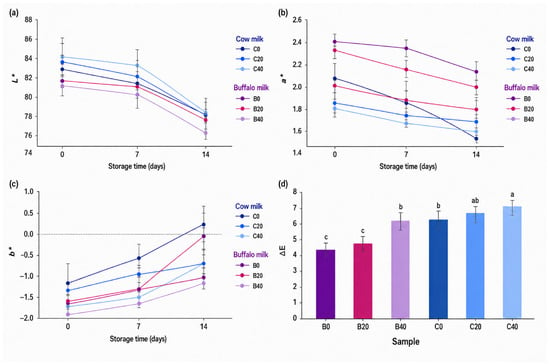
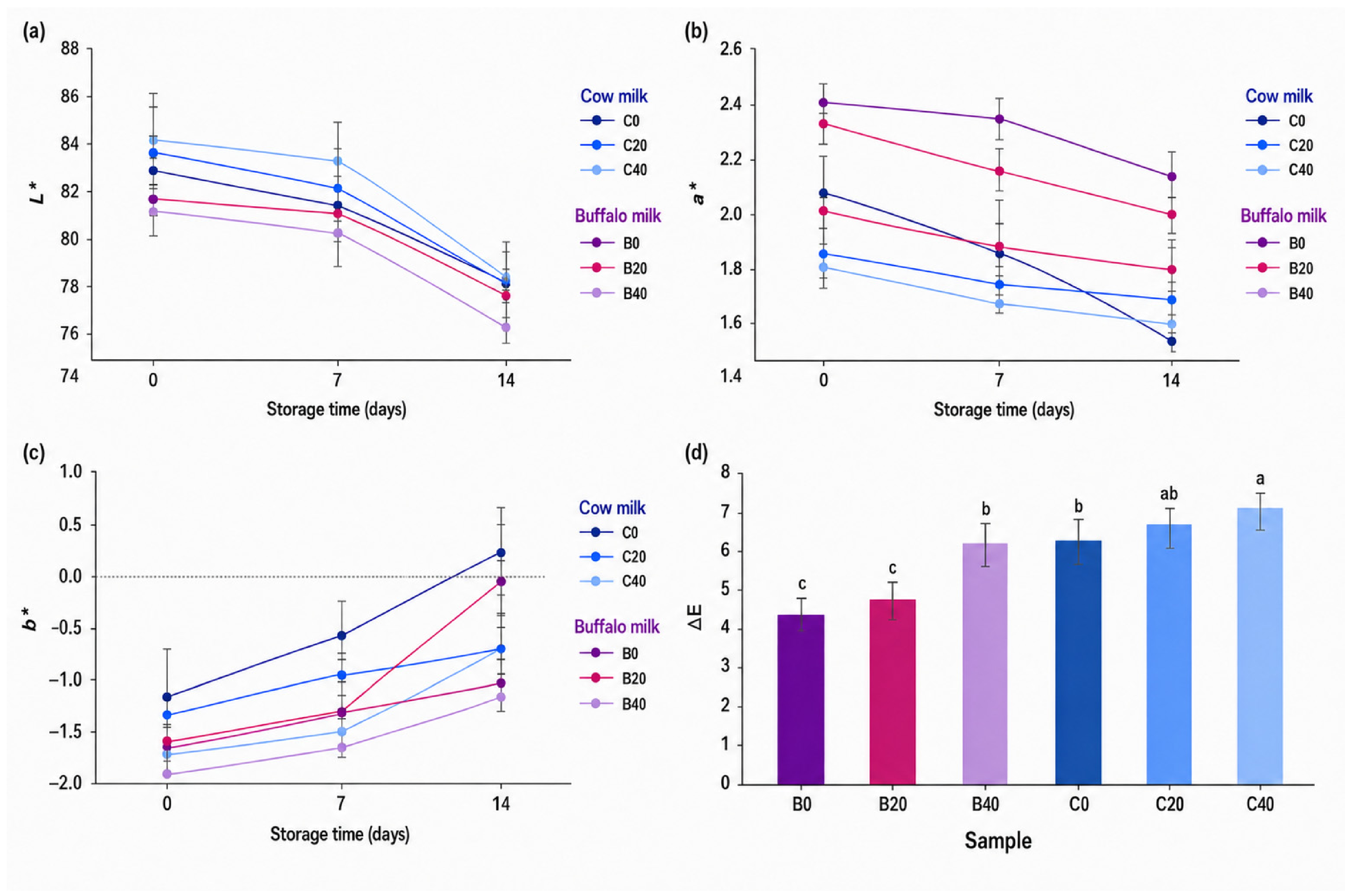
The L*, a* and b* values changed during storage, although the magnitude and direction of these changes varied according to milk type and UV-C treatment condition (Figure 3). UV-C-treated samples generally showed lower L* and b* values and higher a* values than their corresponding controls. However, the colour response was not directly proportional to flow rate because 20 mL/min corresponded to the higher calculated nominal UV-C dose of 54 J/mL, whereas 40 mL/min corresponded to the lower dose of 27 J/mL. The effects of treatment should therefore be interpreted according to the specific milk matrix and exposure condition rather than flow rate alone.
Figure 3.
Changes in the L* (a), a* (b), and b* (c) parameters and ΔE—total colour difference (d) of cow and buffalo milk-based ayran samples during storage. Changes in the colour parameters (L*, a* and b*) and total colour difference (ΔE) of cow and buffalo milk-based ayran samples during storage. C0 and B0 are the conventional-pasteurisation controls (75 °C for 15 s; no UV-C pretreatment). C20 and B20 received UV-C pretreatment at 20 mL/min (calculated nominal UV-C dose: 54 J/mL), whereas C40 and B40 received UV-C pretreatment at 40 mL/min (calculated nominal UV-C dose: 27 J/mL). Data are presented as mean ± standard deviation of two independent production batches, with each analysis performed in duplicate. Different letters indicate significant differences among samples (p < 0.05).
The observed colour differences may be associated with changes in the optical properties of the milk matrices during processing and storage. Milk colour is influenced by the light-scattering behaviour of casein micelles and fat globules, as well as by pigment composition and particle distribution [5,27,28]. Because both milks were standardised to 1.5% fat, differences between cow and buffalo milk samples cannot be explained by differences in bulk fat concentration. Instead, they may partly reflect differences in protein concentration, casein micelle characteristics, total solids and naturally occurring pigments.
Previous studies indicate that UV-C exposure may affect light-sensitive milk components and thereby influence instrumental colour measurements [5,27,28,29,30]. In the present study, however, pigment and oxidative changes were not measured; therefore, their contribution to the colour response remains uncertain.
Total colour difference (ΔE) varied among treatment groups and during storage (Figure 3). The UV-C-treated samples generally exhibited greater colour differences than the corresponding controls, although the magnitude of the response depended on milk type, treatment condition and storage time. Because the calculated nominal UV-C dose decreased as flow rate increased, the ΔE response should not be described as increasing in parallel with both dose and flow rate.
The ΔE value provides an instrumental estimate of the magnitude of colour difference. Previous studies have proposed that ΔE values above approximately 2.5 may represent colour differences that are readily perceptible under controlled viewing conditions [31]. Accordingly, the ΔE values observed in the present study suggest that some treatment-related colour differences could be visually perceptible. However, because a sensory evaluation was not performed, actual consumer perception and acceptability cannot be determined from the instrumental colour measurements alone.
Differences in ΔE reflected the combined changes in L*, a* and b* and varied with milk matrix, pretreatment condition and storage [2,5,27,28,29,30,31,32,33]. The relative contribution of individual optical or chemical changes could not be determined from the measurements performed.
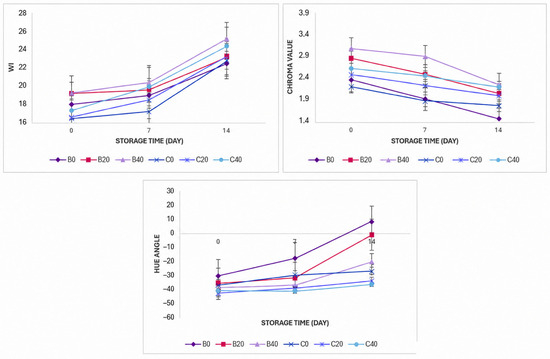
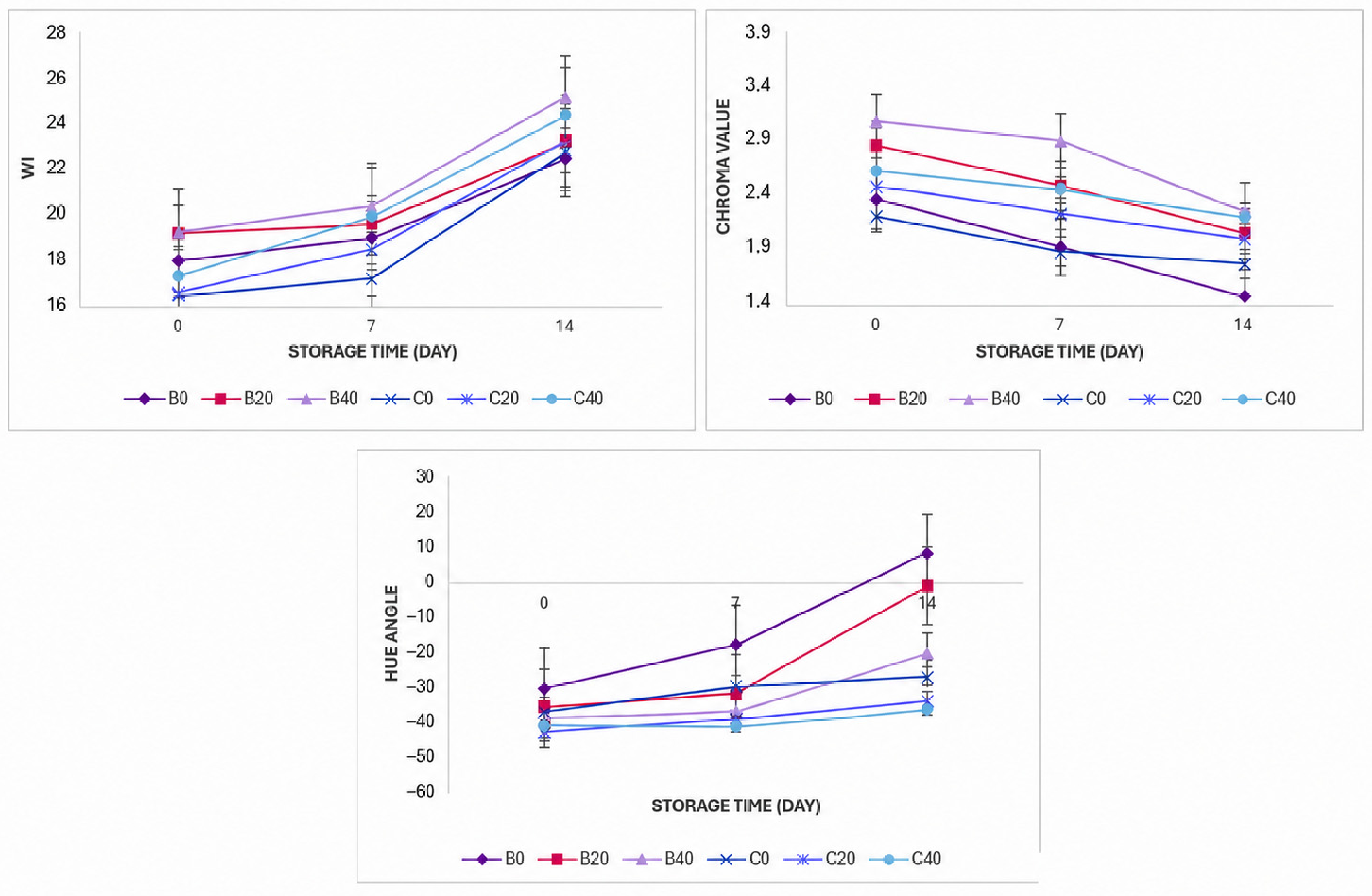
The whiteness index (WI), hue angle and chroma values varied according to milk type, UV-C treatment condition and storage time (Figure 4). During storage, WI and hue angle generally increased, whereas chroma generally decreased. However, the magnitude of these changes differed among the treatment groups, indicating that the response was not uniform across the cow and buffalo milk matrices. The changes should not be described as increasing in parallel with UV-C dose and flow rate because these two processing variables were inversely related in the present system.
Figure 4.
Changes in the whiteness index (WI), chroma and hue angle values of cow and buffalo milk-based ayran samples during storage. C0 and B0 are the conventional-pasteurisation controls (75 °C for 15 s; no UV-C pretreatment). C20 and B20 received UV-C pretreatment at 20 mL/min (calculated nominal UV-C dose: 54 J/mL), whereas C40 and B40 received UV-C pretreatment at 40 mL/min (calculated nominal UV-C dose: 27 J/mL). Data are presented as mean ± standard deviation of two independent production batches, with each analysis performed in duplicate.
Variations in WI, hue angle and chroma were consistent with matrix-dependent differences in light scattering and pigment composition [2,5,28,34]. Because both milks contained 1.5% fat, these differences should not be attributed to a higher bulk fat concentration in buffalo milk.
Differences between the present findings and earlier UV-C studies may also reflect variation in milk composition, reactor design, optical conditions and subsequent thermal processing. These methodological differences should be considered when comparing colour responses among studies.
3.4. Starter Culture Viability
Milk type, UV-C treatment and storage time significantly affected the counts of L. delbrueckii subsp. bulgaricus and S. thermophilus (p < 0.05). Significant interactions among these factors indicated that the response of the starter cultures to treatment varied according to milk type and storage duration (Table 4).
Table 4.
Counts of Lactobacillus delbrueckii subsp. bulgaricus and Streptococcus thermophilus in the ayran samples during storage (log CFU/mL).
The counts of both starter culture organisms decreased during refrigerated storage, although the magnitude of the decline varied among the treatment groups (Table 4). At day 14, C20 showed the highest L. delbrueckii subsp. bulgaricus count (7.52 log CFU/mL), whereas B40 showed the highest S. thermophilus count (8.14 log CFU/mL). Thus, UV-C treatment did not produce a uniform response across the two starter culture organisms or milk matrices.
Differences in starter culture counts may reflect variation in milk composition, buffering capacity, substrate availability and fermentation history [29,35]. The present data nevertheless show that neither starter organism responded uniformly across the milk matrices and pretreatment conditions.
The decline in starter culture counts during storage may be associated with continued post-acidification, nutrient depletion and increasing environmental stress. Continued acid production can reduce pH and adversely affect cell membrane stability and metabolic activity, while the progressive depletion of available nutrients may further reduce cell survival [1,36]. The extent of these effects can vary according to bacterial species, milk composition and storage conditions.
The species-specific responses observed in C20 and B40 may be related to differences in initial culture activity, fermentation endpoint, milk composition and processing conditions [6,35,36,37]. They should not be interpreted as a simple linear response to increasing flow rate or UV-C exposure.
Because the time required for each treatment group to reach the target fermentation pH of 4.30 was not recorded, differences in fermentation duration may have contributed to the observed starter culture counts. Consequently, the differences among treatment groups cannot be attributed exclusively to UV-C exposure. Continuous monitoring of fermentation kinetics is required in future studies to distinguish direct treatment effects from fermentation-time-related effects.
3.5. Organic Acid Profile
Organic acid concentrations varied according to milk type, UV-C treatment condition and storage time, although the statistical significance and magnitude of these effects differed among individual organic acids. The main effects and corresponding two- and three-way interactions are presented in Table 5.
Table 5.
Organic acid concentrations of the ayran samples during storage (mg/kg).
Citric and ascorbic acid concentrations decreased during storage, whereas the concentrations of most other organic acids increased (Table 5). At day 14, B40 showed the highest lactic acid concentration (15,092.95 mg/kg) and the highest concentrations of most of the other organic acids evaluated. In contrast, C20 showed the highest acetic acid concentration (1122.14 mg/kg). Thus, the response depended on the specific acid and treatment combination rather than on milk type or flow rate alone.
The increase in most organic acids during refrigerated storage is consistent with continued starter culture activity and post-acidification, while citric acid may be utilised during storage and ascorbic acid is susceptible to oxidation [38,39,40]. These interpretations are consistent with previous reports, although the relevant metabolic and oxidative pathways were not measured directly.
Differences in organic acid concentrations between the cow and buffalo milk samples may partly reflect variation in protein and mineral composition, buffering capacity, substrate availability and starter culture activity [41,42]. However, these compositional effects interacted with UV-C treatment and storage time, and neither milk type consistently produced the highest concentration of every organic acid. Because both milks were standardised to 1.5% fat, the differences should not be attributed to variation in bulk fat concentration.
Some UV-C-pretreated groups showed higher organic acid concentrations than their corresponding controls, but the response was not uniform across milk types, pretreatment conditions or individual acids. The observed variation should therefore be interpreted as treatment- and matrix-specific rather than as a general increase caused by UV-C pretreatment [43,44].
The organic acid response was not directly proportional to flow rate. Organic acid formation in fermented milk is influenced by starter culture composition, buffering capacity, fermentation endpoint and storage conditions [38,39,40,41,42,43,44]. Differences in these factors and in subsequent thermal processing should be considered when comparing the present findings with earlier studies.
Treatment-specific fermentation times required to reach pH 4.30 were not recorded. Differences in fermentation duration may therefore have contributed to the starter culture and organic acid responses. Future studies should continuously monitor pH and record fermentation time for each independently produced batch to distinguish pretreatment effects from fermentation-time-related variation.
The present study evaluated measured physicochemical, textural, colour, microbiological and organic acid responses rather than their underlying molecular mechanisms. Protein conformation, casein–whey protein associations, gel microstructure, starter culture metabolic activity and oxidative changes were not assessed directly. Mechanistic explanations should therefore be regarded as the literature-supported possibilities rather than mechanisms demonstrated by the present results.
3.6. Industrial Feasibility and Scale-Up Considerations
The present study was conducted using a laboratory-scale continuous-flow UV-C reactor at flow rates of 20 and 40 mL/min. Thus, the findings demonstrate responses under the specific experimental conditions but do not establish a validated industrial process. Treatment capacity, energy consumption, operating and cleaning costs, and reproducibility at larger scales were not evaluated. The reported values of 54 and 27 J/mL are calculated nominal UV-C doses derived from the manufacturer-specified lamp output and volumetric flow rate; they are not direct measurements of incident or absorbed dose.
Milk opacity and scattering limit UV-C penetration and may cause non-uniform exposure [4,5]. Moreover, the effective irradiated volume, residence-time distribution, optical path length, spatial irradiance distribution and effective UV-C output reaching the milk were not measured directly. Future studies should characterise reactor geometry and hydrodynamics and verify the delivered dose using radiometric, actinometric, biodosimetric or validated computational methods.
Before practical implementation is considered, the process should be validated against relevant pathogenic and spoilage microorganisms under realistic production conditions. Future work should also evaluate sensory acceptability, lipid and protein oxidation, extended storage stability, regulatory compliance, process reproducibility, treatment capacity, energy requirements, operating and cleaning costs, and integration with existing ayran production lines.
All samples were subsequently heated at 90 °C for 5 min during ayran production. The evaluated process therefore represents different pretreatments followed by a common thermal step, rather than an exclusively non-thermal process. Future studies should separate the individual and combined effects of UV-C pretreatment and subsequent heating on microbial safety, product quality and processing efficiency.
4. Conclusions
This study demonstrated that milk type, UV-C treatment condition and storage duration influenced the physicochemical, instrumental textural, colour, starter culture and organic acid characteristics of ayran. However, the direction and magnitude of the responses varied according to the property evaluated, and no single treatment condition was consistently favourable for all quality parameters. At the end of storage, C20 showed the highest dry matter, firmness and consistency values and the highest Lactobacillus delbrueckii subsp. bulgaricus count. In contrast, B40 showed the highest Streptococcus thermophilus count and the highest concentrations of most of the organic acids evaluated, whereas C20 showed the highest acetic acid concentration. Colour parameters also varied according to milk type, UV-C treatment condition and storage duration. These findings demonstrate that the effects of processing depended on the specific response variable and the interaction between the milk matrix and treatment condition.
Although UV-C irradiation is itself a non-thermal technology, all samples were subsequently heated at 90 °C for 5 min during ayran production. Therefore, the observed differences represent the combined effects of UV-C exposure, milk composition, fermentation, subsequent thermal treatment and refrigerated storage. The present results do not establish UV-C treatment as an alternative to thermal processing, nor do they demonstrate microbiological safety, because pathogenic or spoilage microorganisms were not evaluated. Similarly, conclusions regarding sensory acceptability, extended shelf life, processing costs, scale-up feasibility or industrial performance cannot be drawn from the variables measured in this study.
The findings should also be interpreted in view of the study limitations. Both milks were standardised to 1.5% fat, and the results therefore do not represent ayran manufactured from milk at its natural fat level. Only two independent production batches were prepared for each treatment combination, which may have limited the statistical power to detect treatment interactions. In addition, treatment-specific fermentation times were not recorded, and direct protein structural, microstructural, oxidative and sensory analyses were not performed. Future studies should optimise UV-C exposure by considering dose, flow rate, residence time, reactor geometry and milk optical properties; validate microbial safety using relevant pathogenic and spoilage microorganisms; continuously monitor fermentation kinetics; and evaluate sensory quality, lipid and protein oxidation, and extended storage stability. The reproducibility, processing cost and performance of the combined UV-C and thermal process should also be confirmed under pilot- and industrial-scale conditions before its commercial applicability is considered.
Author Contributions
Conceptualization, İ.A. and G.A.; methodology, İ.A. and A.A.; validation, İ.A., A.A. and G.A.; formal analysis, İ.A. and G.A.; investigation, İ.A. and A.A.; resources, G.A.; data curation, İ.A. and G.A.; writing—original draft preparation, İ.A.; writing—review and editing, İ.A., A.A. and G.A.; visualisation, İ.A.; supervision, G.A.; project administration, G.A. All authors have read and agreed to the published version of the manuscript.
Funding
This research received no external funding.
Institutional Review Board Statement
Not applicable. This study did not involve humans or animals.
Informed Consent Statement
Not applicable.
Data Availability Statement
The data supporting the findings of this study are available from the corresponding author upon reasonable request.
Acknowledgments
The authors have no additional acknowledgments to declare.
Conflicts of Interest
The authors declare no conflicts of interest.
References
- Tamime, A.Y.; Robinson, R.K. Yoghurt: Science and Technology (Third Edt.). In Food Science, Technology and Nutrition; Woodhead Publishing: Cambridge, UK; Elsevier: Amsterdam, The Netherlands; CRC: Boca Raton, FL, USA, 2007; 808p. [Google Scholar]
- Walstra, P.; Wouters, J.T.M.; Geurts, T.J. Dairy Science and Technology; Taylor and Francis: New York, NY, USA, 2006; 768p. [Google Scholar]
- Ledina, T.; Lončina, J.; Kovandžić, M.; Bulajic, S. Non-Thermal Technologies for Milk and Dairy Processing. Meat Technol. 2023, 64, 149–154. [Google Scholar] [CrossRef] [Scilit]
- Guamán-Lozada, D.F.; Chuquin Vasco, D.; Parada Rivera, M.; Pilco Bonilla, G. Effect of milk film thickness on the efficiency of UVC radiated sterilization of raw cow’s milk. Int. J. Food Prop. 2023, 26, 1497–1505. [Google Scholar] [CrossRef] [Scilit]
- Delorme, M.M.; Guimarães, J.T.; Coutinho, N.M.; Balthazar, C.F.; Rocha, R.S.; Silva, R.; Margalho, L.P.; Pimentel, T.C.; Silva, M.C.; Freitas, M.Q.; et al. Ultraviolet radiation: An interesting technology to preserve quality and safety of milk and dairy foods. Trends Food Sci. Technol. 2020, 102, 146–154. [Google Scholar] [CrossRef] [Scilit]
- Atik, A.; Gümüş, T.; Karasu, S.; Sagdıç, O. Physicochemical and Sensory Properties of Bovine Milk Treated by Different UV-C Dose: The Effect on Vitamin D3, Cholesterol, Fatty Acid, and Formation of Volatile Compounds. Acta Sci. Sci. Food Technol. Food Eng. 2025, 47, e71447. [Google Scholar] [CrossRef] [Scilit]
- Atik, A.; Gümüş, T. The Effect of Different Doses of UV-C Treatment on Microbiological Quality of Bovine Milk. LWT 2021, 136, 110322. [Google Scholar] [CrossRef] [Scilit]
- Atik, A. Non-Thermal UV-C Processing as an Alternative to Pasteurisation in Fermented Dairy Beverages: Ayran and Kefir. Fermentation 2025, 11, 557. [Google Scholar] [CrossRef] [Scilit]
- Garau, V.; Manis, C.; Scano, P.; Caboni, P. Compositional Characteristics of Mediterranean Buffalo Milk and Whey. Dairy 2021, 2, 469–488. [Google Scholar] [CrossRef] [Scilit]
- Liao, J.; Yang, J.; Suo, H.; Song, J. Buffalo milk: Nutritional composition, bioactive properties, and advances in processing technologies-a comprehensive review. Food Chem. X 2025, 10, 102647. [Google Scholar] [CrossRef] [Scilit] [PubMed]
- Nguyen, H.T.H.; Ong, L.; Lefèvre, C.; Kentish, S.E.; Gras, S.L. The Microstructure and Physicochemical Properties of Probiotic Buffalo Yoghurt During Fermentation and Storage: A Comparison with Bovine Yoghurt. Food Bioprocess Technol. 2014, 7, 937–953. [Google Scholar] [CrossRef] [Scilit]
- Barakat, H.; Mohamed, A.; Gemiel, D.G.; Atallah, A.A. Microstructural, Volatile Compounds, Microbiological and Organoleptical Characteristics of Low-Fat Buffalo Milk Yogurt Enriched with Whey Protein Concentrate and Ca-Caseinate during Cold Storage. Fermentation 2021, 7, 250. [Google Scholar] [CrossRef] [Scilit]
- Vargas-Ramella, M.; Pateiro, M.; Maggiolino, A.; Faccia, M.; Franco, D.; De Palo, P.; Lorenzo, J.M. Buffalo Milk as a Source of Probiotic Functional Products. Microorganisms 2021, 9, 2303. [Google Scholar] [CrossRef] [Scilit] [PubMed]
- AOAC (Association of Official Analytical Chemists). Official Methods of Analysis of AOAC International (pH of Acidified Foods. 981.12), 19th ed.; AOAC: Gaithersburg, MD, USA, 2012. [Google Scholar]
- AOAC (Association of Official Analytical Chemists). Official Methods of Analysis of AOAC International (Solids (Total) in Milk. 990.20), 19th ed.; AOAC: Gaithersburg, MD, USA, 2012. [Google Scholar]
- Wang, X.; Kong, X.; Zhang, C.; Hua, Y.; Chen, Y.; Li, X. Comparison of Physicochemical Properties and Volatile Flavor Compounds of Plant-Based Yoghurt and Dairy Yoghurt. Food Res. Int. 2023, 164, 112375. [Google Scholar] [CrossRef] [Scilit] [PubMed]
- Mclellan, M.R.; Lind, L.R.; Kime, R.W. Hue Angle Determinations and Statistical Analysis for Multiquadrant Hunter L, a, b; Data Department of Food Science and Technology Institute of Food Science Cornell University: Geneva, NY, USA, 1994. [Google Scholar]
- Sert, D.; Mercan, E.; Dertli, E. Characterization of Lactic Acid Bacteria from Yogurt-Like Products Fermented with Pinecone and Determination of Their Role on Physicochemical, Textural and Microbiological Properties of Product. LWT-Food Sci. Technol. 2017, 78, 70–76. [Google Scholar] [CrossRef] [Scilit]
- Guzel Seydim, Z.B.; Seydim, A.C.; Greene, A.K.; Bodine, A.B. Determination of organic acids and volatile flavor substances in kefir during fermentation. J. Food Compos. Anal. 2000, 13, 35–43. [Google Scholar] [CrossRef] [Scilit]
- Aktaş, A.H.; Şen, S.; Yılmazer, M.; Cubuk, E. Determination of carboxylic acids in apple juice by RP HPLC. Iran. J. Chem. Chem. Eng. 2005, 24, 1–6. [Google Scholar]
- Bracquart, P. An agar medium for the differential enumeration of Streptococcus thermophilus and Lactobacillus bulgaricus in Yoghurt. J. Appl. Bacteriol. 1981, 51, 303–305. [Google Scholar] [CrossRef] [Scilit]
- Comaposada, J.; Marcos, B.; Bou, R.; Gou, P. Influence of Surfactants and Proteins on the Properties of Wet Edible Calcium Alginate Meat Coatings. Food Res. Int. 2018, 108, 539–550. [Google Scholar] [CrossRef] [Scilit] [PubMed]
- Cilliers, F.P.; Gouws, P.A.; Koutchma, T.; Engelbrecht, Y.; Adriaanse, C.; Swart, P. A Microbiological, Biochemical and Sensory Characterization of Bovine Milk Treated by Heat and Ultraviolet (UV) Light for Manufacturing Cheddar Cheese. Innov. Food Sci. Emerg. Technol. 2014, 23, 94–106. [Google Scholar] [CrossRef] [Scilit]
- Lucey, J.A. Formation and physical properties of milk protein gels. J. Dairy Sci. 2002, 85, 281–294. [Google Scholar] [CrossRef] [Scilit] [PubMed]
- Lee, W.J.; Lucey, J.A. Structure and Physical Properties of Yogurt Gels: Effect of Inoculation Rate and Incubation Temperature. J. Dairy Sci. 2004, 87, 3153–3164. [Google Scholar] [CrossRef] [Scilit] [PubMed]
- Fox, P.F.; McSweeney, P.L.H. Dairy Chemistry and Biochemistry; Springer Science & Business Media: Berlin/Heidelberg, Germany, 1998; 478p. [Google Scholar]
- Popov-Raljić, J.V.; Lakić, N.S.; Laličić-Petronijević, J.G.; Barać, M.B.; Sikimić, V.M. Color Changes of UHT Milk During Storage. Sensors 2008, 8, 5961–5974. [Google Scholar] [CrossRef] [Scilit] [PubMed]
- Goyal, M.R.; Ranvir, S.; Malik, J.A. (Eds.) The Chemistry of Milk and Milk Products Physicochemical Properties, Therapeutic Characteristics, and Processing Methods; CRC Press: New York, NY, USA, 2023; 400p. [Google Scholar]
- Atik, A.; Atik, İ.; Akarca, G. Determining Changes in Quality Criteria During Storage in Kefir Produced from Raw Milk Treated with Non-Thermal UV-C Radiation: Comparison of Starter Culture and Kefir Grains in Fermentation. Fermentation 2026, 12, 181. [Google Scholar] [CrossRef] [Scilit]
- Jankowska, A.; Wachowska, M.; Dąbrowska, A.; Bielecka, M.; Warechowski, J.; Potaś, A. Evaluation of the Fermentation Profiles and Quality Attributes of Yogurts Made from Cow, Goat, and Mixed Milk. Foods 2026, 15, 314. [Google Scholar] [CrossRef] [Scilit] [PubMed]
- Berndt, W.L.; Karcher, D.E.; Richardson, M.D. Color-Distance Modeling Improves Differentiation of Colors in Digital Images of Hybrid Bermudagrass. Crop Sci. 2020, 60, 2138–2148. [Google Scholar] [CrossRef] [Scilit]
- Srinivasarao Bandla, S.; Choudhary, R.; Watson, D.G.; Haddock, J. Impact of UV-C processing of raw cow milk treated in a continuous flow coiled tube ultraviolet reactor. Agric. Eng. Int. CIGR J. 2012, 14, 86–93. [Google Scholar]
- Urgu-Ozturk, M. Possibilities of using the continuous type of UV light on the surface of lor (whey) cheese: Impacts on mould growth, oxidative stability, sensory and colour attributes during storage. J. Dairy Res. 2022, 89, 335–341. [Google Scholar] [CrossRef] [Scilit] [PubMed]
- Pathare, P.B.; Opara, U.L.; Al-Said, F.A.J. Colour Measurement and Analysis in Fresh and Processed Foods. Food Bioprocess Technol. 2013, 6, 36–60. [Google Scholar] [CrossRef] [Scilit]
- Sieuwerts, S.; de Bok, F.A.; Hugenholtz, J.; van Hylckama Vlieg, J.E. Unraveling Microbial Interactions in Food Fermentations: From Classical to Genomics Approaches. Appl. Environ. Microbiol. 2008, 74, 4997–5007. [Google Scholar] [CrossRef] [Scilit] [PubMed]
- Vinderola, G.; Ouwehand, A.; Salminen, S.; Von Wright, A. Lactic Acid Bacteria: Microbiological and Functional Aspects, 5th ed.; CRC Press: Boca Raton, FL, USA, 2019; 764p. [Google Scholar]
- Wu, T.; Guo, S.; Kwok, L.Y.; Zhang, H.; Wang, J. Temperature-dependent metabolic interactions between Streptococcus thermophilus and Lactobacillus delbrueckii ssp. bulgaricus in milk fermentation: Insights from gas chromatography-ion mobility spectrometry metabolomics. J. Dairy Sci. 2025, 108, 242–256. [Google Scholar] [CrossRef] [Scilit] [PubMed]
- Adhikari, K.; Mustapha, A.; Grün, I. Changes in the Profile of Organic Acids in Plain Set and Stirred Yogurts During Manufacture and Refrıgerated Storage. J. Food Qual. 2002, 25, 435–451. [Google Scholar] [CrossRef] [Scilit]
- Akgun, A.; Yazici, F.; Gulec, H.A. The Combined Effect of Probiotic Cultures and Incubation Final pH on The Quality of Buffalo Milk Yogurt during Cold Storage. Food Sci. Nutr. 2017, 6, 492–502. [Google Scholar] [CrossRef] [Scilit] [PubMed]
- Yin, X.; Chen, K.; Cheng, H.; Chen, X.; Feng, S.; Song, Y.; Liang, L. Chemical Stability of Ascorbic Acid Integrated into Commercial Products: A Review on Bioactivity and Delivery Technology. Antioxidants 2022, 11, 153. [Google Scholar] [CrossRef] [Scilit] [PubMed]
- Ahmad, S.; Anjum, F.M.; Huma, N.; Sameen, A.; Zahoor, T. Composition and Physico-Chemical Characteristics of Buffalo Milk with Particular Emphasis on Lipids, Proteins, Minerals, Enzymes and Vitamins. J. Anim. Plant Sci. 2013, 23, 62–74. [Google Scholar]
- Muehlhoff, E.; Bennett, A.; McMahon, D. Milk and Dairy Products in Human Nutrition; Food and Agriculture Organization of the United Nations (FAO): Rome, Italy, 2013. [Google Scholar]
- Matak, K.E.; Sumner, S.S.; Duncan, S.E.; Hovingh, E.; Worobo, R.W.; Hackney, C.R.; Pierson, M.D. Effects of Ultraviolet Irradiation on Chemical and Sensory Properties of Goat Milk. J. Dairy Sci. 2005, 88, 1622–1626. [Google Scholar]
- Gómez-López, V.M.; Koutchma, T.; Linden, K. Ultraviolet and Pulsed Light Processing of Fluid Foods. In Novel Thermal and Non-Thermal Technologies for Fluid Foods; Cullen, P.J., Tiwari, B.K., Valdramidis, V.P., Eds.; Academic Press: Cambridge, MA, USA, 2012; pp. 185–223. [Google Scholar]

Disclaimer/Publisher’s Note: The statements, opinions and data contained in all publications are solely those of the individual author(s) and contributor(s) and not of MDPI and/or the editor(s). MDPI and/or the editor(s) disclaim responsibility for any injury to people or property resulting from any ideas, methods, instructions or products referred to in the content. |
© 2026 by the authors. Licensee MDPI, Basel, Switzerland. This article is an open access article distributed under the terms and conditions of the Creative Commons Attribution (CC BY) license.