


Abstract
This study evaluated the effects of nitrogen source, temperature, and agitation on fermentation performance and volatile compound formation in an agave juice-based beverage fermented with Saccharomyces cerevisiae. Agave juice contained a high concentration of reducing sugars (156.69 g/L), representing 83.16% of the total sugars, predominantly fructose, and a low assimilable nitrogen concentration (0.069 g/L), indicating nitrogen limitation. Fermentation assays were performed at 18 and 28 °C under static or agitated (100 rpm) conditions, with inorganic or organic nitrogen supplementation. At 28 °C, organic nitrogen supplementation under static conditions increased ethanol production to 72.26 g/L. At 18 °C, fermentation kinetics were markedly slower, but nitrogen supplementation increased ethanol production from 34.25 g/L in the control to 59.89 g/L with inorganic nitrogen, indicating that nitrogen supplementation had a greater relative effect under low-temperature fermentation. Volatile profiling revealed that under static fermentation at 18 °C, organic nitrogen supplementation increased the relative abundance of higher alcohols, particularly 2-phenylethanol, whereas ester formation varied according to both nitrogen source and fermentation temperature. Overall, nitrogen source, agitation and temperature strongly affected both fermentation efficiency and volatile formation, supporting the design of controlled processes to improve aromatic complexity and performance in agave-based fermented beverages.
1. Introduction
The development of plant-based fermented beverages has gained increasing attention due to their potential to combine functional properties, sensory complexity, and sustainable production practices. In particular, plant-based fermentation systems have emerged as a promising approach for the valorization of regional raw materials and agro-industrial residues [1,2]. Among these plant resources, agave represents a highly relevant substrate in Mexico because it is well adapted to arid and semi-arid environments and accumulates large amounts of carbohydrates through crassulacean acid metabolism (CAM) [3]. These carbohydrates are mainly present as fructans (agavins) and fructooligosaccharides concentrated in the agave head, together with some inhibitory compounds that make this matrix a challenging substrate for microbial growth [4,5]. However, the juice extracted from the agave head constitutes the basis for the production of traditional beverages such as tequila and mezcal [3,6].
Particularly, mezcal, a traditional spirit beverage, is produced from agave heads of various agave species, harvested in different Mexican regions under a Denomination of Origin, including Agave durangensis cultivated in northern Mexico [5,7]. In this process, agave heads are first separated from the leaves, then cooked in underground artisanal ovens [8]. This thermal process promotes fructan hydrolysis to obtain fermentable sugars, primarily fructose and glucose [5,7,9]. This substrate is subsequently fermented by various microorganisms, with S. cerevisiae playing a key role due to its tolerance to high sugar and ethanol concentrations. Finally, the fermented juice is distilled to produce mezcal with an ethanol content of 36–55% v/v [10,11,12,13]. Beyond its traditional application in tequila and mezcal production, agave juice has recently gained interest as a source of agavins, an emerging functional ingredient recognized for its prebiotic properties [14]. Nevertheless, to our knowledge, an agave juice-based beverage combining the properties of residual agavins from thermal processing with the high fermentable sugar content to produce metabolites through yeast fermentation has not yet been proposed. One of the main challenges associated with agave juice fermentation is its low assimilable nitrogen content [15], which constitutes a major limitation for yeast metabolism. Nitrogen is essential for cell growth, enzymatic activity, and the synthesis of aroma-active compounds, and its deficiency can negatively affect fermentation kinetics, ethanol yield, and volatile compound production [16].
Nitrogen supplementation has therefore been widely applied to improve fermentation performance. In this context, the type of nitrogen source is particularly relevant because it may differentially affect yeast metabolism [17]. Inorganic nitrogen sources, such as ammonium salts, primarily support biomass formation. In contrast, organic nitrogen sources, such as amino acids, can directly contribute to metabolic pathways involved in the formation of higher alcohols and esters via the Ehrlich pathway [18,19].
The effect of nitrogen has been widely investigated in wine fermentation using S. cerevisiae, as nitrogen is one of the major nutrients naturally present in grape must in the form of ammonium ions, amino acids, peptides, and proteins. Nitrogen plays an essential role in yeast metabolism, regulating cell growth, fermentation kinetics, and the production of secondary metabolites, including aroma-active compounds [20]. Studies on wine fermentation have demonstrated that different nitrogen supplementation strategies, including organic and inorganic nitrogen sources, significantly influence yeast metabolism, fermentation kinetics, and aroma development [21].
On the other hand, temperature is a critical operational factor affecting alcoholic fermentation, as it directly influences yeast physiology, fermentation kinetics, and the formation of aroma-active compounds. In wine fermentation, low temperatures are commonly applied to improve the sensory quality of the final product by modulating yeast metabolism and reducing the volatilization of aromatic compounds [22].
Agitation is another important operational parameter in fermentation because it improves mass transfer, oxygen availability, and nutrient distribution, thereby influencing microbial growth, fermentation kinetics, and metabolite production. However, excessive agitation may cause shear stress that adversely affects microbial viability, highlighting the importance of optimizing agitation conditions for each fermentation system. For instance, studies on kiwi kefir-like beverages fermented with kefir grains have demonstrated that agitation significantly affects nutrient consumption, microbial growth, and metabolite production, emphasizing its critical role in fermentation performance [23].
Despite the recognized importance of nitrogen supplementation, temperature, and agitation in regulating fermentation performance, limited information is available regarding their combined effects on the fermentation kinetics and aroma profile of agave juice-based beverages. Therefore, this study aimed to evaluate the fermentation performance of an agave juice-based beverage, focusing on the effects of nitrogen source and fermentation conditions on fermentation kinetics and volatile compound formation.
2. Materials and Methods
2.1. Chemicals
Yeast extract, peptone, and glucose used for culture media preparation were obtained from BD Bioxon (Mexico City, Mexico). Amino acids (>99% purity) used to formulate the organic nitrogen source, including L-tryptophan, L-phenylalanine, L-leucine, L-isoleucine, L-lysine, L-alanine, L-valine, L-threonine, L-serine, L-glutamine, L-methionine, L-arginine, and L-aspartic acid, as well as ammonium sulfate and analytical standards of glucose, fructose, and ethanol (>99%), were purchased from Sigma-Aldrich (St. Louis, MO, USA). The quantitative composition and formulation of the organic nitrogen source are described in Section 2.3. Phenol, sulfuric acid, 3,5-dinitrosalicylic acid (DNS), sodium hydroxide, sodium potassium tartrate tetrahydrate (Rochelle salt), and sodium sulfite used for sugar determination were also purchased from Sigma-Aldrich (St. Louis, MO, USA).
2.2. Yeast Strain and Inoculum Preparation
S. cerevisiae ITD00185, previously isolated from the spontaneous fermentation of A. durangensis must by Páez-Lerma [24], was preserved at −20 °C in 30% (v/v) glycerol suspensions. For inoculum preparation, the yeast was activated in yeast extract–peptone–dextrose (YPD) medium and incubated on an orbital shaker at 30 °C and 120 rpm for 24 h. Cells were harvested during the exponential growth phase and quantified using a Neubauer counting chamber and a microscope. The inoculum was adjusted to an initial concentration of 2 × 10⁶ cells/mL and transferred to the agave juice-based fermentation medium.
2.3. Agave Juice Characterization
Cooked agave juice was provided by a local mezcal producer from Mezquital, Durango, Mexico. Total assimilable nitrogen was determined according to the method used by Rutiaga-Quiñones [18]. A 25 mL aliquot of agave juice was adjusted to pH 8.1 with 0.25 M NaOH, followed by the addition of 10 mL of formaldehyde solution previously adjusted to pH 8.1. After 1 min at room temperature, the mixture was titrated with 0.25 M NaOH until the pH reached 8.1. Free amino nitrogen was expressed as mg N/L and calculated as 14 × (10 × mL of 0.25 M NaOH consumed).
Total sugars were quantified using the phenol–sulfuric acid method described by Dubois et al. [25]. An aliquot of the fermentation supernatant was mixed with phenol and concentrated sulfuric acid, forming a stable yellow-orange complex. After incubation, the absorbance was measured at 490 nm, and the total sugar concentrations were determined using a glucose standard curve. Reducing sugars were quantified using the 3,5-dinitrosalicylic acid (DNS) method described by Miller [26]. In brief, 1 mL of the fermentation supernatant was mixed with 1.5 mL of DNS reagent and heated in a boiling water bath for 15 min. After cooling, the absorbance was measured at 640 nm, and the concentrations of reducing sugars were calculated using a glucose standard curve.
Glucose, fructose, and ethanol concentrations were determined by high-performance liquid chromatography (HPLC) using an Agilent 1200 system (Agilent, Santa Clara, CA, USA) equipped with an ion-exchange column (Carbomix). Deionized water was used as the mobile phase at a flow rate of 0.4 mL/min. The column temperature was maintained at 80 °C, and the refractive index detector was set at 50 °C. The injection volume was 5 μL. Samples were diluted (1:10, v/v) and filtered through nylon membrane filters prior to analysis. Quantification was performed using external calibration curves in the ranges of 0.01–3 g/L (glucose), 0.01–13 g/L (fructose), and 0.01–8 g/L (ethanol) [27].
2.4. Agave Beverage Preparation
Fermentation experiments were conducted in sterile 20 mL serological flasks with a working volume of 15 mL using cooked agave juice as the fermentation medium. Prior to inoculation, the juice was diluted with potable water to adjust the reducing sugar concentration to 160 g/L. This concentration was selected based on previous studies conducted by our research group [18,19], as it provides suitable conditions for alcoholic fermentation while avoiding excessive osmotic stress on the yeast.
The initial assimilable nitrogen concentration of the agave juice was supplemented using either inorganic or organic nitrogen sources to achieve a final nitrogen concentration of 300 mg N/L. Inorganic supplementation consisted of ammonium sulfate ((NH4)2SO4). Organic supplementation was carried out using a defined amino acid mixture formulated according to the amino acid composition previously reported for agave juice fermentations by Rutiaga-Quiñones et al. [18]. The concentration of each amino acid was further adjusted based on preliminary experiments conducted in our laboratory according to its nitrogen contribution, providing an organic nitrogen source comparable to the inorganic supplementation. The mixture contained (g/L): L-tryptophan (0.015), L-phenylalanine (0.254), L-leucine (0.201), L-isoleucine (0.201), L-lysine (0.112), L-alanine (0.137), L-valine (0.180), L-threonine (0.183), L-serine (0.161), L-glutamine (0.152), L-methionine (0.229), L-arginine (0.112), and L-aspartic acid (0.204).
The fermentation medium was inoculated with S. cerevisiae at an initial concentration of 2 × 10⁶ cells/mL. Cultures were incubated under microaerophilic conditions for 144 h at 18 °C and 96 h at 28 °C. Agitation was evaluated by incubating cultures on an orbital shaker at 100 rpm and comparing them with static cultures. Samples were collected every 12 h to determine total sugars, reducing sugars, and ethanol concentration.
2.5. Volatile Organic Compound Analysis
Volatile organic compounds were extracted using headspace solid-phase microextraction (HS-SPME) as described by Martell-Nevárez et al. [19]. Two milliliters of sample were placed in sealed 10 mL glass vials and equilibrated at 32 °C for 2 h. Extraction was performed using a divinylbenzene/carboxen/polydimethylsiloxane (DVB/CAR/PDMS) fiber (Supelco, Bellefonte, PA, USA), exposed to the headspace under the same conditions.
Desorption was carried out in the injection port of a gas chromatograph (Hewlett-Packard 5890, Hewlett-Packard, Wilmington, DE, USA) equipped with an SPME liner (0.75 mm i.d., Supelco) at 200 °C for 30 s. The system was coupled to a Hewlett-Packard 5972 mass selective detector. Separation was achieved using an HP-FFAP fused silica capillary column (30 m × 0.32 mm i.d. × 0.25 μm film thickness). Helium was used as the carrier gas at a flow rate of 2 mL/min. Injector and detector temperatures were set at 180 °C and 230 °C, respectively.
The oven temperature program was as follows: initial temperature of 40 °C (3 min), increased at 3 °C/min to 120 °C (1 min), followed by a ramp to 200 °C with a final hold of 5 min. Mass spectra were obtained using electron impact ionization at 70 eV, with a transfer line temperature of 250 °C. Volatile organic compounds were identified by comparison of mass spectra with those in the NIST mass spectral library. The relative abundance of each compound was estimated from its relative chromatographic peak area (%) obtained by GC-MS analysis.
2.6. Experimental Design and Statistical Analysis
A factorial experimental design was used to evaluate the effects of temperature (18 and 28 °C), agitation (static and 100 rpm), and nitrogen source (inorganic and organic), as well as their interactions, on the fermentation response variables. The experimental design consisted of eight treatments, corresponding to all possible combinations of the three factors, as summarized in Table 1. Each treatment was performed in triplicate.
Statistical analysis was carried out using Statistica software (Version 7.0; StatSoft Inc., Tulsa, OK, USA). Data were analyzed by analysis of variance (ANOVA), followed by a least significant difference (LSD) test, with significance defined at p ≤ 0.05.
3. Results
3.1. Agave Juice Characterization
The agave juice used as the fermentation substrate contained 188.41 ± 14.37 g/L of total sugars, of which 156.69 ± 8.90 g/L corresponded to reducing sugars. Fructose was the predominant monosaccharide, reaching 120.76 ± 3.20 g/L, whereas glucose was present at a considerably lower concentration (9.73 ± 1.18 g/L). Other reducing sugars not individually quantified may also have been present in the agave juice. In addition to its high sugar content, the agave juice exhibited a low assimilable nitrogen concentration (0.069 ± 0.01 g/L), indicating the need for nitrogen supplementation during fermentation.
3.2. Effect of Nitrogen Source, Agitation, and Temperature on Fermentation Kinetics
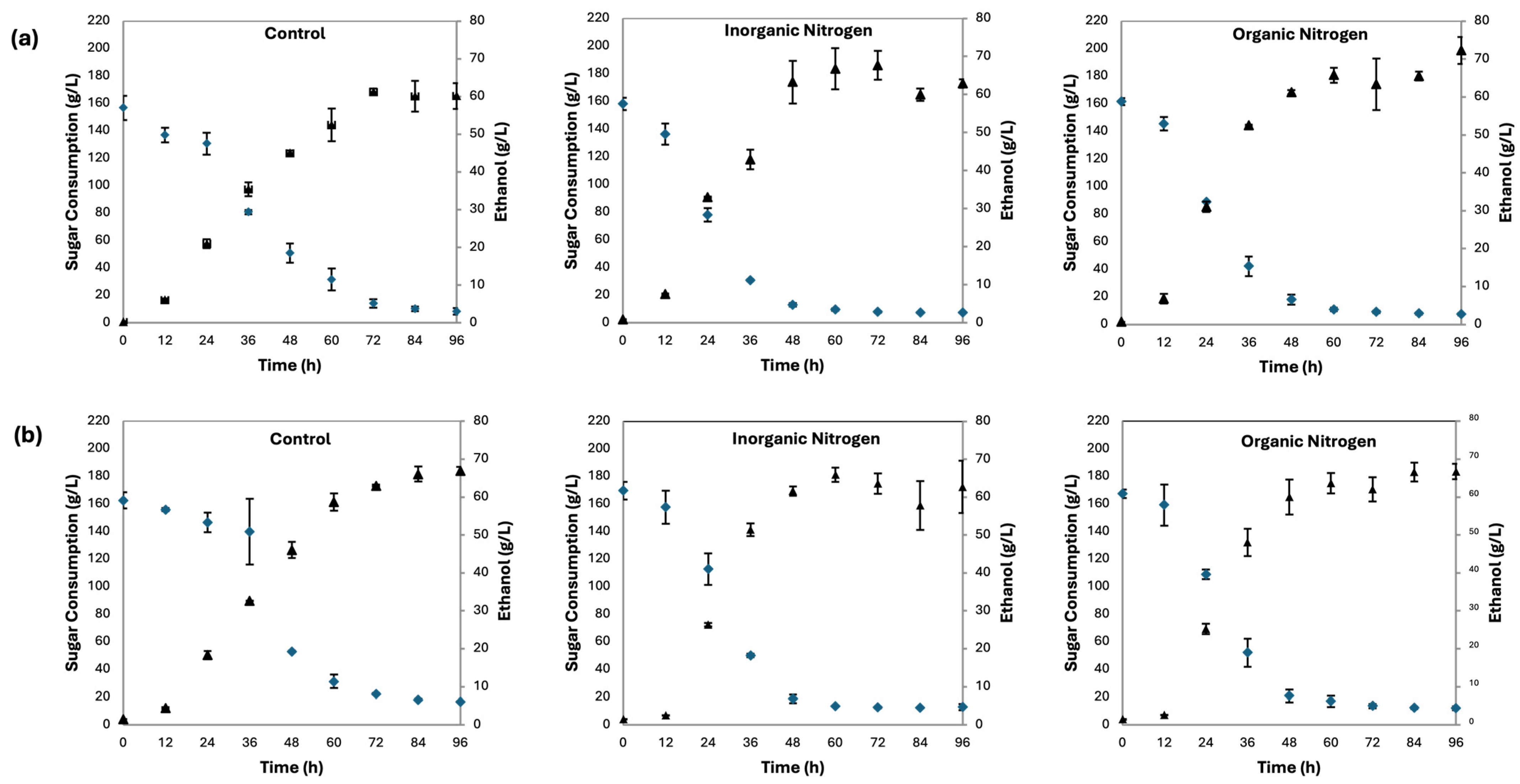
Fermentation kinetics at 28 °C are presented in Figure 1, and the corresponding kinetic parameters are summarized in Table 1. Under static conditions (Figure 1a), the control treatment, corresponding to agave juice without organic or inorganic nitrogen supplementation, showed a gradual decrease in reducing sugars until reaching 8.34 ± 2.38 g/L. Ethanol concentration with a sugar uptake of 148.35 g/L reached 60.16 ± 3.42 g/L.
Figure 1.
Fermentation kinetics of the agave juice-based beverage at 28 °C using S. cerevisiae ITD00185. Reducing sugar consumption (♦) and ethanol production (▲): (a) static conditions, (b) agitated conditions.
Inorganic nitrogen supplementation showed behavior similar to that of the control group under static conditions, achieving a sugar consumption of 150.69 ± 4.22 g/L and producing an ethanol concentration of 62.84 ± 1.11 g/L. However, both substrate consumption and product formation rates (rs and rp) increased compared to the control, although no significant difference in the final ethanol concentration was observed (Table 1).
Organic nitrogen supplementation resulted in the highest ethanol concentration (72.26 ± 3.55 g/L) and productivity (0.75 ± 0.03 g/L/h) under static conditions, highlighting the potential for improved fermentation efficiency. Significant differences between inorganic supplementation and control fermentation suggest that nitrogen source impacts performance, although no differences in ethanol yield (Yp/s) or total sugar consumption were observed under static conditions.
Under agitated conditions (100 rpm; Figure 1b), the absence of nitrogen supplementation resulted in a gradual decrease in reducing sugars, reaching 15.40 ± 2.38 g/L, which was less effective compared to static conditions.
However, this behavior favored ethanol production, reaching 66.93 ± 1.02 g/L after 96 h. Consequently, higher ethanol yield and volumetric productivity were obtained (0.45 ± 0.01 g/g and 2.63 ± 0.12 g/L/h, respectively).
With inorganic nitrogen supplementation, sugar consumption and ethanol production were higher than under static conditions (161.74 ± 2.46 g/L and 66.55 ± 2.44 g/L, respectively). Under organic nitrogen, sugar uptake was higher than under static conditions, whereas ethanol production was lower at 65.87 ± 1.79 g/L.
At agitated conditions, both inorganic and organic nitrogen supplementation significantly increased product formation rates (rs), with values of 4.24 ± 0.19 and 4.11 ± 0.51 g/L/h, respectively. However, no significant differences in final ethanol concentration and ethanol yield (Yp/s), were observed among nitrogen sources under agitation.
Table 1.
Effect of nitrogen source and agitation on fermentation parameters at 28 °C after 96 h.
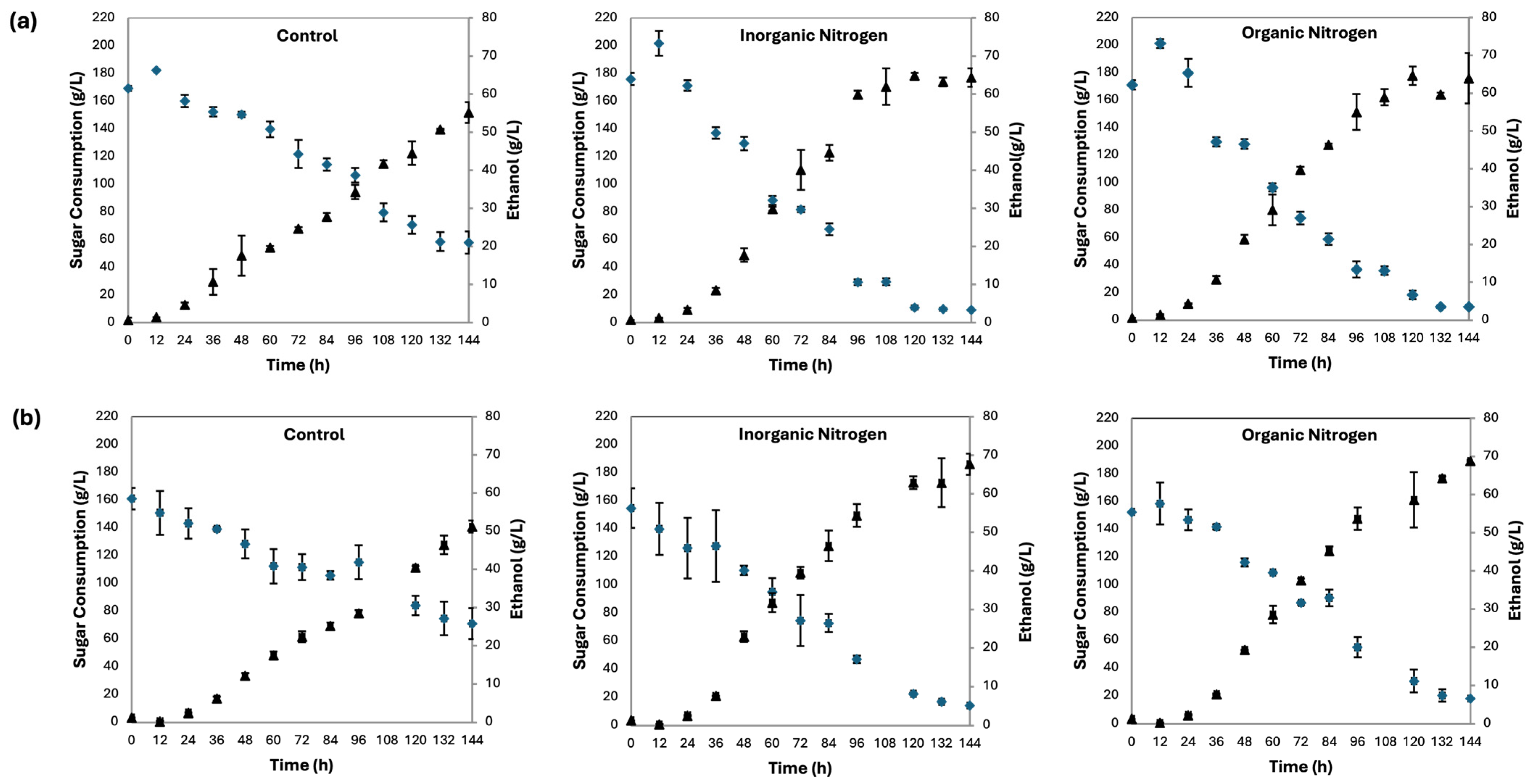
Fermentation kinetics at 18 °C are shown in Figure 2, and the corresponding parameters are presented in Table 2.
Figure 2.
Fermentation kinetics of the agave juice-based beverage at 18 °C using S. cerevisiae ITD00185. Reducing sugar consumption (♦) and ethanol production (▲): (a) static conditions, (b) agitated conditions.
Table 2.
Effect of nitrogen source and agitation on fermentation parameters at 18 °C after 96 h.
Under static conditions (Figure 2a), the control fermentation exhibited limited sugar consumption (62.79 ± 3.59 g/L) and low ethanol production (34.25 ± 1.87 g/L) after 96 h. Both inorganic and organic nitrogen supplementation significantly increased sugar uptake and ethanol production compared to the control. With inorganic nitrogen supplementation, 59.89 ± 1.05 g/L of ethanol was reached, and with organic nitrogen supplementation, 55.03 ± 4.76 g/L was obtained. No significant differences in ethanol yield or productivity were observed among nitrogen supplementation types.
Under agitated conditions (100 rpm; Figure 2b), nitrogen supplementation significantly increased sugar consumption and ethanol production compared to the control. Ethanol concentrations reached 54.33 ± 2.95 g/L and 53.61 ± 2.90 g/L in fermentations supplemented with inorganic and organic nitrogen, respectively, whereas the control remained below 30 g/L. No significant differences in ethanol concentration, yield, and productivity were observed between nitrogen sources. However, differences in kinetic parameters were observed, with higher substrate consumption rates (1.10 ± 0.23 g/L/h) in the amino acid treatment and higher ethanol production rates (0.60 ± 0.03 g/L/h) in the inorganic nitrogen treatment.
3.3. Volatile Profile of the Fermented Beverage
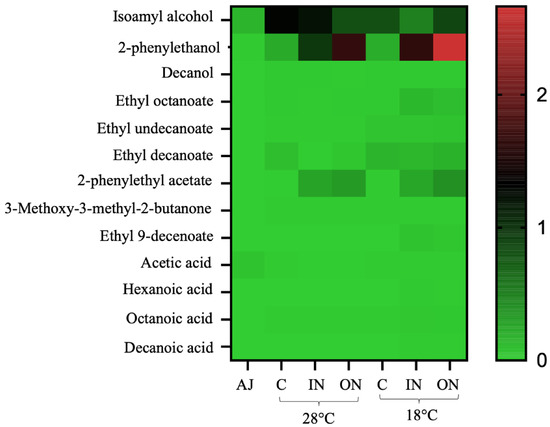
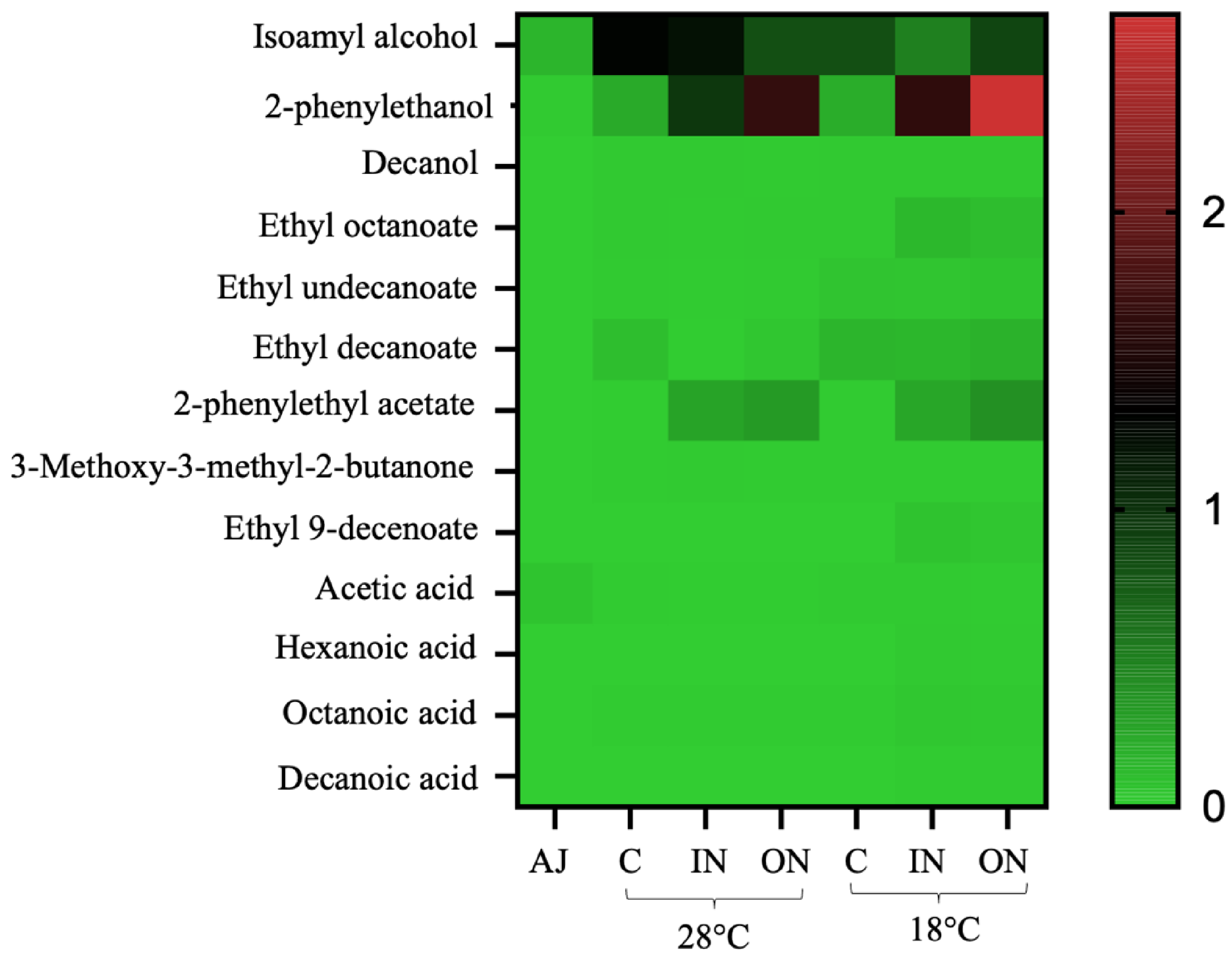
Heatmap analysis revealed differences in the volatile profiles of fermented beverages produced under static conditions at different nitrogen sources and fermentation temperatures (Figure 3). Several volatile organic compounds were absent or detected at low relative abundance in agave juice prior to fermentation. In contrast, fermented samples showed greater diversity and higher relative abundance of aroma-related compounds.
Figure 3.
Heatmap showing the relative abundance of volatile organic compounds in agave juice (AJ) and fermented beverages obtained under different nitrogen sources (inorganic nitrogen, IN; organic nitrogen, ON) under static fermentation conditions at 18 and 28 °C. Red indicates higher relative abundance, whereas green indicates lower relative abundance.
Higher alcohols showed the most evident differences among treatments at 18 and 28 °C. Isoamyl alcohol showed higher relative abundance at 28 °C in the control and in the supplemented inorganic nitrogen beverages. 2-phenylethanol exhibited a markedly higher relative abundance in fermentations supplemented with organic nitrogen at 18 °C than in the other conditions. Decanol showed considerably lower relative abundance in all the fermented beverages.
Differences in ester profiles were also observed depending on fermentation conditions. Compounds such as ethyl octanoate, ethyl undecanoate, ethyl decanoate, and 2-phenylethyl acetate were mainly associated with fermented beverages and showed variable relative abundances depending on nitrogen source and temperature. The most representative ester at 18 and 28 °C was 2-phenylethyl acetate, especially under supplemented nitrogen conditions.
The ketone 3-methoxy-3-methyl-2-butanone was detected at low relative abundance under all fermentation conditions, with limited variation among treatments.
Fermented beverages contain various organic acids, such as acetic, hexanoic, octanoic, and decanoic acids. Additionally, acetic acid was found in agave juice before the fermentation process.
4. Discussion
4.1. Agave Juice Characterization
The agave juice used in this study contained 188.41 ± 14.37 g/L of total sugars, of which 156.69 ± 8.90 g/L (83.16%) corresponded to reducing sugars. HPLC analysis showed that fructose (120.76 ± 3.20 g/L) was the predominant fermentable sugar, representing 64.1% of the total sugar content, whereas glucose (9.73 ± 1.18 g/L) accounted for 5.16%. The remaining fraction of total sugars may include other soluble carbohydrates, such as sucrose, xylose, and residual fructooligosaccharides, which have previously been reported in agave-based substrates [10].
The sugar composition observed in the present study is consistent with previous reports for cooked agave juices used in mezcal production. Martell-Nevárez et al. [19] reported total sugar and reducing sugar concentrations of 245 g/L and 178 g/L, respectively, with 101 g/L fructose and 8.8 g/L glucose in A. durangensis juice. Likewise, Ávila-Reyes et al. [28] reported that fructose is the predominant fermentable sugar in cooked agave juices, whereas glucose is present at considerably lower concentrations as a result of fructan hydrolysis during the cooking process. The determination of total sugars, reducing sugars, and individual monosaccharides provides complementary information on the carbohydrate composition of agave juice. Total sugars represent the overall carbohydrate content, reducing sugars estimate the readily reactive sugar fraction, and HPLC enables the specific quantification of glucose and fructose, the principal fermentable sugars consumed by S. cerevisiae during alcoholic fermentation.
The assimilable nitrogen concentration was low (0.069 ± 0.01 g/L), confirming that agave juice constitutes a nitrogen-deficient medium. This low nitrogen content may be partially attributed to thermal degradation during agave cooking, which can reduce the availability of nitrogenous compounds [19]. Similar values have been reported in agave-based substrates; for instance, Arrizon and Gschaedler [29] reported an initial nitrogen concentration of approximately 40 mg/L in Agave tequilana Weber blue variety.
Under these conditions, the imbalance between carbon and nitrogen availability can limit yeast growth and fermentation performance, underscoring the importance of nitrogen-supplementation strategies in agave fermentations.
4.2. Effect of Nitrogen Source, Agitation, and Temperature on Fermentation Kinetics
At 28 °C, nitrogen supplementation improved fermentation performance under static conditions, particularly when organic nitrogen sources were used. The higher ethanol concentration and productivity (72.26 ± 3.55 g/L and 0.75 ± 0.03 g/L/h) observed in these treatments suggest more efficient nitrogen assimilation compared to inorganic nitrogen. Similar observations have been reported in wine fermentations, where the nature of the nitrogen source significantly influences yeast growth, cell vitality, and fermentation performance. Martínez-Moreno et al. [30] demonstrated that amino acid-based nitrogen sources promoted greater biomass production, improved cell vitality, and more efficient sugar utilization than inorganic nitrogen sources, particularly under conditions of high sugar concentration. These findings are consistent with the preferential assimilation of amino acids by Saccharomyces cerevisiae, as described by Crépin et al. [31], who showed that amino acids are sequentially assimilated through tightly regulated transport systems that support yeast growth and fermentation progress. Amino acids can be directly incorporated into cellular metabolism or catabolized via the Ehrlich pathway, contributing to biomass formation, metabolite production, and ultimately to the improved ethanol production observed in the present study [18]. Similarly, Martell Nevárez et al. [19] reported that S. cerevisiae fermenting Agave duranguensis juice at 28 °C exhibited rapid sugar consumption (2.56 g/L/h) and an ethanol production rate of 1.17 g/L/h. Although their study did not evaluate nitrogen supplementation, these results indicate that 28 °C favors yeast fermentative activity; however, the higher ethanol concentration obtained in the present study suggests that supplementing the fermentation medium with organic nitrogen further enhances the efficiency of sugar conversion into ethanol.
On the other hand, under agitated conditions (100 rpm) at 28 °C, the effect of nitrogen source on ethanol production and yield was less pronounced. However, agitation enhanced sugar consumption and ethanol production rates compared with static fermentations, especially when nitrogen was supplemented. This effect may be attributed to improved mixing, mass transfer, and oxygen availability, which promote a more homogeneous distribution of nutrients and facilitate yeast metabolic activity, partially alleviating nitrogen-deficiency-associated metabolic limitations and altering carbon utilization [32]. Agitation has been reported to improve nitrogen and oxygen availability in yeast cultures, thereby enhancing substrate utilization and fermentation performance [33]. Rollero et al. [34] demonstrated that agitated fermentations resulted in more complete nitrogen consumption than static fermentations, leading to faster fermentation kinetics and enhanced yeast activity.
Interestingly, despite the enhanced fermentation kinetics promoted by nitrogen supplementation and agitation, ethanol concentration slightly decreased during the final stages of fermentation. Although ethanol production increased rapidly during the first 60–72 h of fermentation, a slight decrease in ethanol concentration was subsequently observed in the fermentations supplemented with both inorganic and organic nitrogen at 28 °C under static and agitated conditions (Figure 1a,b). This decrease was more evident in the fermentation supplemented with inorganic nitrogen under static conditions. One possible explanation is the partial reassimilation of ethanol by S. cerevisiae after the depletion of fermentable sugars. Under these conditions, yeast cells may oxidize ethanol through its sequential conversion to acetaldehyde, acetate, and subsequently acetyl-CoA, which enters the tricarboxylic acid (TCA) cycle to support cellular metabolism [35]. Similar behavior was reported by Cordero-Soto et al. [36]. A decrease in ethanol concentration after glucose depletion was observed during the bioconversion of 2-phenylethanol by Kluyveromyces marxianus isolated from the natural fermentation of A. durangensis, the same agave fermentation from which S. cerevisiae ITD00185 was isolated. The authors suggested that ethanol was reassimilated by the yeast as a carbon and energy source to sustain cellular metabolism. However, additional studies are required to confirm whether ethanol reassimilation occurred under the fermentation conditions evaluated in the present study.
At 18 °C, fermentation kinetics were significantly slower, demonstrating the strong influence of temperature on yeast metabolic activity [19]. Lower temperatures reduce enzymatic activity and metabolic fluxes, resulting in lower fermentation rates and longer fermentation times. In addition, low-temperature conditions can alter metabolic pathways and affect the synthesis of fermentation metabolites, influencing the final volatile profile of the beverage. Similar effects have been reported in alcoholic beverage fermentations, where low fermentation temperatures restrict yeast growth and prolong fermentation time [37,38].
These effects are associated with changes in microbial physiological activity and the regulation of compound production under low-temperature conditions [39]. Similar results were reported by Martell-Nevárez [19] for agave juice fermentations conducted at 18 °C without nitrogen supplementation during mezcal production. Under these conditions, S. cerevisiae exhibited a sugar consumption rate of 1.32 g/L/h and an ethanol production rate of 0.58 g/L/h, reaching a final ethanol concentration of 49 g/L.
In this study, nitrogen supplementation had a more pronounced effect on fermentation performance at 18 °C than at 28 °C, indicating that nutrient limitations become more critical as metabolic activity decreases. Both inorganic and organic nitrogen sources improved sugar consumption and ethanol production, suggesting that nitrogen availability is a key limiting factor under low-temperature conditions.
Agitation resulted in lower sugar uptake and ethanol production after 96 h compared with static fermentations at 18 °C. This behavior may be related to changes in oxygen availability during fermentation. Although oxygen is required for some yeast growth and the synthesis of essential cellular components, increased oxygen exposure can modify metabolic activity and promote cellular responses associated with oxidative stress [40]. Under low-temperature conditions, these responses may reduce the efficiency of sugar conversion into ethanol, contributing to the lower fermentation performance observed under agitation [32].
4.3. Volatile Profile of the Fermented Beverage
Based on the fermentation performance obtained under the evaluated conditions, volatile compound analysis was conducted using beverages produced under static conditions to evaluate the effect of fermentation temperature and nitrogen source on aroma formation. This approach was selected because, at 18 °C, agitation negatively affected sugar consumption, whereas nitrogen supplementation improved substrate utilization under both agitation conditions.
Both nitrogen source and fermentation temperature strongly influenced the volatile profile of the fermented beverages. Heatmap analysis showed that fermented samples exhibited greater diversity and relative abundance of volatile organic compounds than unfermented agave juice, indicating that fermentation promoted the formation of aroma-active metabolites. Similar increases in volatile diversity have been reported during agave fermentations, where yeast metabolism converts sugars and amino acids into higher alcohols, esters, organic acids, and other aroma-active compounds that define the sensory characteristics of fermented and distilled agave beverages [19].
Higher alcohols showed the most pronounced differences among the beverages, particularly 2-phenylethanol, which was enhanced in fermentations supplemented with organic nitrogen at 28 °C and 18 °C. This behavior is consistent with amino acid catabolism through the Ehrlich pathway, in which amino acids are converted into higher alcohols that contribute to the aromatic complexity of fermented beverages [41]. The increased abundance of this compound under organic nitrogen supplementation suggests that amino acid availability favored fusel alcohol synthesis during fermentation. In particular, L-phenylalanine likely served as a precursor for 2-phenylethanol production via the Ehrlich pathway, directing metabolic flux toward its synthesis [42,43,44]. Besides contributing floral sensory notes, 2-phenylethanol is recognized as one of the major aroma-active higher alcohols produced during alcoholic fermentation and has been associated with improved aromatic complexity in fermented beverages [42,43].
In addition to higher alcohol formation, the nitrogen source also influenced ester production, particularly 2-phenylethyl acetate, which is produced from 2-phenylethanol via enzymatic esterification in yeast metabolism [44,45]. This ester is widely associated with pleasant floral and honey-like aromas and is considered an important contributor to the sensory quality of fermented beverages [46]. Acetate ester synthesis has been associated with the regulation of alcohol acetyltransferase genes, such as Alcohol Acetyltransferase II Gene (ATF2), which encode enzymes involved in acetate ester formation. Previous studies have reported that nitrogen supplementation during fermentation can activate ATF2 expression, thereby enhancing acetate ester synthesis [47]. Therefore, the greater abundance of 2-phenylethyl acetate observed under organic nitrogen supplementation is consistent with the increased availability of amino acid precursors and enhanced synthesis of its corresponding higher alcohol.
Temperature also played a key role in volatile compound formation, with fermentations supplemented with organic nitrogen at 18 °C showing a higher relative abundance of 2-phenylethanol. Previous studies have reported that low fermentation temperatures can modify yeast metabolic activity and redirect carbon fluxes toward the synthesis of aroma-active compounds, including higher alcohols and esters [48].
Overall, these results highlight the complex interactions between nitrogen source and fermentation conditions in shaping the volatile profiles of agave-based beverages. Organic nitrogen supplementation favored the formation of higher alcohols, while both nitrogen source and temperature influenced ester production in a compound-specific manner. The presence of aroma-active compounds such as 2-phenylethanol and 2-phenylethyl acetate, which are associated with floral and fruity sensory notes, suggests that fermentation conditions may substantially influence the aromatic complexity, sensory potential, and acceptability of agave-based fermented beverages. Because volatile compounds were evaluated as relative abundances rather than absolute concentrations, the present discussion focuses on comparative differences among treatments rather than quantitative aroma contributions. Nevertheless, these results clearly demonstrate that nitrogen source and fermentation temperature significantly influenced aroma development.
Although the present study focused on the development of a fermented agave juice-based beverage, the volatile compounds produced during fermentation are also relevant for the production of distilled agave spirits because fermentation determines the pool of aroma-active metabolites available before distillation. Higher alcohols and esters, such as isoamyl alcohol, 2-phenylethanol, and 2-phenylethyl acetate, are well-recognized contributors to the floral, fruity, and sweet notes characteristic of tequila and mezcal [28,49]. Therefore, fermentation conditions that favor the formation of these compounds may also influence the sensory quality of distilled products. Nevertheless, unlike distillation, which removes most non-volatile constituents, the fermented beverage developed in this study retains residual agavins and other non-volatile compounds present in cooked agave juice, providing a matrix with potential functional properties in addition to its aroma profile.
5. Conclusions
This study demonstrated that nitrogen availability, temperature, and agitation are key factors influencing fermentation performance and volatile formation in agave juice-based beverages. The low assimilable nitrogen content of agave juice confirms its limitation as a fermentation substrate and highlights the need for appropriate nitrogen supplementation strategies.
Organic nitrogen supplementation promoted the formation of higher alcohols, particularly 2-phenylethanol, thereby increasing the aromatic complexity of the fermented beverage. Fermentation kinetics were significantly affected by temperature and agitation, higher temperature and agitation accelerated fermentation, whereas low-temperature conditions increased the dependence of yeast metabolism on nitrogen availability. Overall, the evaluated conditions modulated the formation of aroma-active compounds associated with floral and fruity notes, providing a basis for designing controlled fermentations to improve the quality, aromatic complexity, and consistency of agave-based fermented beverages.
Author Contributions
I.N.C.-S.: Conceptualization, Methodology, Original Draft Preparation, Writing—Review & Editing. M.A.M.-N.: Supervision, Original Draft Preparation, Writing—Review & Editing. M.G.C.-H.: Supervision, Original Draft Preparation, Writing-Review & Editing. I.C.N.-G.: Supervision, Original Draft Preparation, Writing—Review & Editing. N.O.S.-C.: Supervision, Original Draft Preparation, Writing—Review & Editing. J.B.P.-L.: Supervision, Original Draft Preparation, Writing—Review & Editing. O.M.R.-Q.: Supervision, Conceptualization, Original Draft Preparation, Writing—Review & Editing, Funding Acquisition. All authors have read and agreed to the published version of the manuscript.
Funding
This research received no external funding.
Institutional Review Board Statement
Not applicable.
Informed Consent Statement
Not applicable.
Data Availability Statement
The original contributions presented in this study are included in the article material. Further inquiries can be directed to the corresponding author.
Acknowledgments
The authors thank the Secretaría de Ciencia, Humanidades, Tecnología e Innovación (SECIHTI-Mexico) for financial support through the postdoctoral research stay program (Cordero-Soto 344260 and Contreras-Hernández 489313).
Conflicts of Interest
The authors declare no conflicts of interest.
References
- Duque-Buitrago, L.F.; Solórzano-Lugo, I.E.; González-Vázquez, M.; Jiménez-Martínez, C.; Hernández-Aguirre, M.A.; Osorio-Díaz, P.; Calderón-Domínguez, G.; Loera-Castañeda, V.; Mora-Escobedo, R. Health-Related Composition and Bioactivity of an Agave Sap/Prickly Pear Juice Beverage. Molecules 2024, 29, 2742. [Google Scholar] [CrossRef] [Scilit]
- Cordero-Soto, I.N.; Contreras-Hernández, M.G.; Palmerín-Carreño, D.M.; Nuñez-García, I.C.; Rutiaga-Quiñones, O.M. Microbial-Based Technologies for the Reuse of Food By-Products. In Reducing Food Loss and Waste; Aguilar-Zárate, P., Haghi, A.K., Gómez-García, R., Eds.; Springer: Cham, Switzerland, 2025; pp. 121–144. [Google Scholar] [CrossRef] [Scilit]
- Skogberg, M.; Kohonen, K.; Lohila, A.; Merbold, L. Ecosystem-Scale Crassulacean Acid Metabolism (CAM) Gas Exchange of a Sisal (Agave sisalana) Plantation. Agric. Ecosyst. Environ. 2025, 381, 109435. [Google Scholar] [CrossRef] [Scilit]
- Kirchmayr, M.R.; Segura-García, L.E.; Lappe-Oliveras, P.; Moreno-Terrazas, R.; de la Rosa, M.; Gschaedler-Mathis, A. Impact of Environmental Conditions and Process Modifications on Microbial Diversity, Fermentation Efficiency and Chemical Profile During the Fermentation of Mezcal in Oaxaca. LWT-Food Sci. Technol. 2017, 79, 160–169. [Google Scholar] [CrossRef] [Scilit]
- Lappe-Oliveras, P.; Arredondo-Fernández, R.; Valadez-Blanco, R.; Martínez-Monterrosa, Á.; Ojeda-Linares, C.I.; Moreno-Terrazas-Casildo, R.; Huerta-Beristain, G.; Astudillo-Melgar, F.; Flores-Montesinos, M.S.; Giles-Gómez, M.; et al. Mexican Traditional Alcoholic Beverages: Production Process, History, Economy, Social, and Scientific Importance. In Microbiology and Health Benefits of Traditional Alcoholic Beverages; Tamang, J.P., Ed.; Academic Press: London, UK, 2025; pp. 145–240. [Google Scholar] [CrossRef] [Scilit]
- Combie, J.; Toksoy, E. Fructan Production Processes. In The Book of Fructans; Van den Ende, W., Toksoy Öner, E., Eds.; Academic Press: London, UK, 2023; pp. 187–199. [Google Scholar] [CrossRef] [Scilit]
- Martínez-Estrada, S.C.; Narváez-Zapata, J.A.; Rodríguez-Herrera, R.; Grijalva-Ávila, J.; Gurrola-Reyes, J.N.; Larralde-Corona, C.P.; Chairez-Hernández, I. Diversity of Culturable Yeasts Associated with the Technification Level in the Process of Mezcal Production in the State of Durango. Fermentation 2024, 10, 147. [Google Scholar] [CrossRef] [Scilit]
- Arellano-Plaza, M.; Páez-Lerma, J.B.; Soto-Cruz, N.O.; Kirchmayr, M.R.; Gschaedler-Mathis, A. Mezcal Production in Mexico: Between Tradition and Commercial Exploitation. Front. Sustain. Food Syst. 2022, 6, 832532. [Google Scholar] [CrossRef] [Scilit]
- Silva-Mendoza, J.; Gómez-Treviño, J.A.; Chávez-Guerrero, L.; Sánchez-González, M.N.; Cantú-Cárdenas, M.E. Production of Inulinases and Ethanol by Hanseniaspora uvarum from the Juice of Agave salmiana Leaves. Appl. Biochem. Microbiol. 2025, 61, 882–888. [Google Scholar] [CrossRef] [Scilit]
- Camacho-Ruíz, R.M.; Plaza, M.A.; Pérez-Martínez, F.J.; Prado-Ramírez, R. Agave Juice Recovery: Traditional and Modern Extraction Methods. In The Science of Tequila; Gschaedler-Mathis, A., Herrera-López, E.J., Kirchmayr, M.R., Plaza, M.A., Eds.; Academic Press: London, UK, 2025; pp. 97–119. [Google Scholar] [CrossRef] [Scilit]
- Terán-Bustamante, A.; Leyva-Hernández, S.N.; Martínez-Velasco, A. Knowledge and Innovation Management Model in the Mezcal Industry in Mexico. Heliyon 2025, 11, e42032. [Google Scholar] [CrossRef] [Scilit] [PubMed]
- Spedding, G. Mezcal and Tequila. In Distilled Spirits: Science, Technology and Manufacturing; Russell, I., Stewart, G., Eds.; Academic Press: London, UK, 2023; pp. 173–228. [Google Scholar] [CrossRef] [Scilit]
- Martínez, S.; Nuñez-Guerrero, M.E.; Gurrola-Reyes, J.N.; Rutiaga-Quiñones, O.M.; Paredes-Ortíz, A.; Soto-Cruz, N.O.; Flores-Gallegos, A.C.; Rodríguez-Herrera, R. Mescal an Alcoholic Beverage from Agave spp. with Great Commercial Potential. In Alcoholic Beverages: The Science of Beverages; Grumezescu, A.M., Holban, A.M., Eds.; Woodhead Publishing: Cambridge, UK, 2019; Volume 7, pp. 113–140. [Google Scholar] [CrossRef] [Scilit]
- López, M.G.; Salomé-Abarca, L.F. The Agavins (Agave Carbohydrates) Story. Carbohydr. Polym. 2024, 327, 121671. [Google Scholar] [CrossRef] [Scilit] [PubMed]
- Nuñez-Guerrero, M.E.; Páez-Lerma, J.B.; Rutiaga-Quiñones, O.M.; González-Herrera, S.M.; Soto-Cruz, N.O. Performance of Mixtures of Saccharomyces and Non-Saccharomyces Native Yeasts during Alcoholic Fermentation of Agave duranguensis Juice. Food Microbiol. 2016, 54, 91–97. [Google Scholar] [CrossRef] [Scilit]
- Díaz-Montaño, D.M. Influence of Selected Native Yeast Strains on Fermentation Behavior and Chemical Profile in Agave tequilana (Blue Weber Agave) Juice Fermentation for Tequila Production. Food Biosci. 2025, 63, 105552. [Google Scholar] [CrossRef] [Scilit]
- Seguinot, P.; Ortiz-Julien, A.; Camarasa, C. Impact of Nutrient Availability on the Fermentation and Production of Aroma Compounds under Sequential Inoculation with Metschnikowia pulcherrima and Saccharomyces cerevisiae. Front. Microbiol. 2020, 11, 305. [Google Scholar] [CrossRef] [Scilit] [PubMed]
- Rutiaga-Quiñones, O.M.; Córdova, É.; Martell-Nevárez, M.A.; Guillamón, J.M.; Rozès, N.; Páez, J. Volatile Compound Production in Agave duranguensis Juice Fermentations Using Four Native Yeasts and NH4Cl Supplementation. Eur. Food Res. Technol. 2012, 235, 29–35. [Google Scholar] [CrossRef] [Scilit]
- Martell-Nevárez, M.A.; Páez-Lerma, J.B.; Rutiaga-Quiñones, O.M.; López-Bucio, J.; Cira-Chávez, L.A.; Soto-Cruz, N.O. Effect of Fermentation Temperature on Chemical Composition of Mescals Made from Agave duranguensis Juice with Different Native Yeast Genera. Afr. J. Microbiol. Res. 2011, 5, 3669–3676. [Google Scholar] [CrossRef] [Scilit]
- Li, J.; Yuan, M.; Meng, N.; Li, H.; Sun, J.; Sun, B. Influence of Nitrogen Status on Fermentation Performances of Non-Saccharomyces Yeasts: A Review. Food Sci. Hum. Wellness 2024, 13, 556–567. [Google Scholar] [CrossRef] [Scilit]
- Ramírez-Aroca, L.; Querol, A.; Ferreira, V.; Minebois, R. Specific impact of nitrogen supplementation on the metabolism of Saccharomyces and hybrids during wine fermentation. Int. J. Food Microbiol. 2026, 445, 111493. [Google Scholar] [CrossRef] [Scilit] [PubMed]
- Du, Q.; Ye, D.; Zang, X.; Nan, H.; Liu, Y. Effect of low temperature on the shaping of yeast-derived metabolite compositions during wine fermentation. Food Res. Int. 2022, 162, 112016. [Google Scholar] [CrossRef] [Scilit] [PubMed]
- Bazán, D.L.; Del-Río, P.G.; Pérez-Guerra, N. Microbiological and chemical profiles of kiwi kefir-like beverages produced using different agitation speeds and kefir grain weights. Foods 2025, 14, 1681. [Google Scholar] [CrossRef] [Scilit] [PubMed]
- Páez-Lerma, J.B.; Arias-García, A.; Rutiaga-Quiñones, O.M.; Barrio, E.; Soto-Cruz, N.O. Yeasts Isolated from the Alcoholic Fermentation of Agave duranguensis during Mezcal Production. Food Biotechnol. 2013, 27, 342–356. [Google Scholar] [CrossRef] [Scilit]
- DuBois, M.; Gilles, K.A.; Hamilton, J.K.; Rebers, P.A.; Smith, F. Colorimetric Method for Determination of Sugars and Related Substances. Anal. Chem. 1956, 28, 350–356. [Google Scholar] [CrossRef] [Scilit]
- Miller, G.L. Use of Dinitrosalicylic Acid Reagent for Determination of Reducing Sugar. Anal. Chem. 1959, 31, 426–428. [Google Scholar] [CrossRef] [Scilit]
- Jiménez-Islas, D.; Páez-Lerma, J.; Soto-Cruz, N.O.; Gracida, J. Modelling of Ethanol Production from Red Beet Juice by Saccharomyces cerevisiae Under Thermal and Acid Stress Conditions. Food Technol. Biotechnol. 2014, 52, 93–100. [Google Scholar] [CrossRef] [Scilit]
- Ávila-Reyes, S.V.; Jiménez-Aparicio, A.R.; Melgar-Lalanne, G.; Fajardo-Espinoza, F.S.; Hernández-Sánchez, H. Mezcal: A Review of Chemistry, Processing, and Potential Health Benefits. Foods 2025, 14, 1408. [Google Scholar] [CrossRef] [Scilit] [PubMed]
- Arrizon, J.; Gschaedler, A. Increasing Fermentation Efficiency at High Sugar Concentrations by Supplementing an Additional Source of Nitrogen During the Exponential Phase of the Tequila Fermentation Process. Can. J. Microbiol. 2002, 48, 965–970. [Google Scholar] [CrossRef] [Scilit] [PubMed]
- Martínez-Moreno, R.; Morales, P.; Gonzalez, R.; Mas, A.; Beltran, G. Biomass Production and Alcoholic Fermentation Performance of Saccharomyces cerevisiae as a Function of Nitrogen Source. FEMS Yeast Res. 2012, 12, 477–485. [Google Scholar] [CrossRef] [Scilit] [PubMed]
- Crépin, L.; Nidelet, T.; Sanchez, I.; Dequin, S.; Camarasa, C. Sequential Use of Nitrogen Compounds by Saccharomyces cerevisiae during Wine Fermentation: A Model Based on Kinetic and Regulation Characteristics of Nitrogen Permeases. Appl. Environ. Microbiol. 2012, 78, 8102–8111. [Google Scholar] [CrossRef] [Scilit] [PubMed]
- Arellano-Plaza, M.; Gschaedler-Mathis, A.; Noriega-Cisneros, R.; González-Muñoz, C.; Manzo-Ávalos, S.; González-Hernández, J.C.; Saavedra-Molina, A. Respiratory Capacity of the Kluyveromyces marxianus Yeast Isolated from the Mezcal Process during Oxidative Stress. World J. Microbiol. Biotechnol. 2013, 29, 1279–1287. [Google Scholar] [CrossRef] [Scilit] [PubMed]
- Rodríguez, J.; Villavicencio, D.; Raza, A.; Hernández-Alomía, F.; Bastidas-Caldes, C.; Cruz, M.A. Low-Cost Production Process of Saccharomyces cerevisiae Yeast for Craft Beer Fermentation. Fermentation 2025, 11, 688. [Google Scholar] [CrossRef] [Scilit]
- Rollero, S.; Roberts, S.; Bauer, F.F.; Divol, B. Agitation Impacts Fermentation Performance as Well as Carbon and Nitrogen Metabolism in Saccharomyces cerevisiae under Winemaking Conditions. Aust. J. Grape Wine Res. 2018, 24, 360–367. [Google Scholar] [CrossRef] [Scilit]
- Pons, M.-N.; Rajab, A.; Engasser, J.-M. Influence of Acetate on Growth Kinetics and Production Control of Saccharomyces cerevisiae on Glucose and Ethanol. Appl. Microbiol. Biotechnol. 1986, 24, 193–198. [Google Scholar] [CrossRef] [Scilit]
- Cordero-Soto, I.N.; Castillo-Araiza, C.O.; Rutiaga-Quiñones, O.M.; Moussa, M.; Béal, C.; Gallegos-Infante, A.; Soto-Cruz, N.O.; Ochoa-Martínez, L.A.; Huerta-Ochoa, S. Intensification of 2-Phenylethanol Production Using an Aerated System Assisted by a Membrane-Based Solvent Extraction Technique. Rev. Mex. Ing. Quim. 2021, 20, 739–750. [Google Scholar] [CrossRef] [Scilit]
- Zhao, Y.; Liu, S.; Han, X.; Zhou, Z.; Mao, J. Combined Effects of Fermentation Temperature and Saccharomyces cerevisiae Strains on Free Amino Acids, Flavor Substances, and Undesirable Secondary Metabolites in Huangjiu Fermentation. Food Microbiol. 2022, 108, 104091. [Google Scholar] [CrossRef] [Scilit] [PubMed]
- García-Ríos, E.; Pardo, J.; Su, Y.; Guillamón, J.M. Different Nitrogen Consumption Patterns in Low Temperature Fermentations in the Wine Yeast Saccharomyces cerevisiae. Foods 2024, 13, 2522. [Google Scholar] [CrossRef] [Scilit] [PubMed]
- Liang, C.; Liu, L.; Liu, J.; Aihaiti, A.; Tang, X.; Liu, Y.; Fish, H. New Insights on Low-Temperature Fermentation for Food. Fermentation 2023, 9, 477. [Google Scholar] [CrossRef] [Scilit]
- Duncan, J.D.; Devillers, H.; Camarasa, C.; Setati, M.E.; Divol, B. Oxygen Alters Redox Cofactor Dynamics and Induces Metabolic Shifts in Saccharomyces cerevisiae during Alcoholic Fermentation. Food Microbiol. 2024, 124, 104624. [Google Scholar] [CrossRef] [Scilit] [PubMed]
- Hazelwood, L.A.; Daran, J.M.; van Maris, A.J.A.; Pronk, J.T.; Dickinson, J.R. The Ehrlich Pathway for Fusel Alcohol Production: A Century of Research on Saccharomyces cerevisiae Metabolism. Appl. Environ. Microbiol. 2008, 74, 2259–2266. [Google Scholar] [CrossRef] [Scilit] [PubMed]
- Cordero-Soto, I.N.; Castillo-Araiza, C.O.; García-Martínez, L.E.; Prado-Barragán, A.; Huerta-Ochoa, S. Solid/Gas Biocatalysis for Aroma Production: An Alternative Process of White Biotechnology. Biochem. Eng. J. 2020, 164, 107767. [Google Scholar] [CrossRef] [Scilit]
- Bernardino, A.R.S.; Torres, C.A.V.; Crespo, J.G.; Reis, M.A.M. Biotechnological 2-Phenylethanol Production: Recent Developments. Molecules 2024, 29, 5761. [Google Scholar] [CrossRef] [Scilit] [PubMed]
- Adame-Soto, P.J.; Aréchiga-Carvajal, E.T.; González-Herrera, S.M.; Moreno-Jiménez, M.R.; Rutiaga-Quiñones, O.M. Characterization of Mating Type on Aroma Production and Metabolic Properties of Wild Kluyveromyces marxianus Yeasts. World J. Microbiol. Biotechnol. 2023, 39, 281. [Google Scholar] [CrossRef] [Scilit] [PubMed]
- Wilson, A.; Johnson, J.B.; Naiker, M. Biotechnological Modification of Cider Brewing Processes for the Enhanced Production of 2-Phenylethanol. Beverages 2022, 8, 64. [Google Scholar] [CrossRef] [Scilit]
- Janković, T.; Straathof, A.J.J.; Kiss, A.A. Advanced downstream process design for recovery of 2-phenylethanol and 2-phenylethyl acetate after biotransformation. J. Chem. Technol. Biotechnol. 2025, 100, 2019–2028. [Google Scholar] [CrossRef] [Scilit]
- Godillot, J.; Baconin, C.; Sanchez, I.; Baragatti, M.; Perez, M.; Sire, Y.; Aguera, E.; Sablayrolles, J.-M.; Farines, V.; Mouret, J.-R. Analysis of Volatile Compounds Production Kinetics: A Study of the Impact of Nitrogen Addition and Temperature during Alcoholic Fermentation. Front. Microbiol. 2023, 14, 1124970. [Google Scholar] [CrossRef] [Scilit] [PubMed]
- Beltran, G.; Novo, M.; Guillamón, J.M.; Mas, A.; Rozès, N. Effect of Fermentation Temperature and Culture Media on the Yeast Lipid Composition and Wine Volatile Compounds. Int. J. Food Microbiol. 2008, 121, 169–177. [Google Scholar] [CrossRef] [Scilit] [PubMed]
- Huang, X.; Cadwallader, K.R. A Critical Review of the Flavor Chemistry of Tequila. In Chemistry of Alcoholic Beverages; Flynn, T., Ed.; ACS Symposium Series; American Chemical Society: Washington, DC, USA, 2023; Volume 1460, Chapter 1, pp. 1–36. [Google Scholar] [CrossRef] [Scilit]

Disclaimer/Publisher’s Note: The statements, opinions and data contained in all publications are solely those of the individual author(s) and contributor(s) and not of MDPI and/or the editor(s). MDPI and/or the editor(s) disclaim responsibility for any injury to people or property resulting from any ideas, methods, instructions or products referred to in the content. |
© 2026 by the authors. Licensee MDPI, Basel, Switzerland. This article is an open access article distributed under the terms and conditions of the Creative Commons Attribution (CC BY) license.