


Abstract
Xylitol is a sugar alcohol of interest in the food, pharmaceutical, and healthcare industries due to its applications as a food sweetener and sugar substitute. A wild-type Saccharomyces cerevisiae yeast strain designated 202-3 was isolated from a Colombian distillery located near sugarcane fields. This diploid 202-3 strain showed non-common, modest but noticeable xylose consumption and xylitol production in lignocellulosic hydrolysates. To enhance its natural xylose consumption ability, the strain was genetically engineered and submitted to adaptive laboratory evolution (ALE). Firstly, it was considered the deletion of the GAL80 gene to enable continuous expression of GAL genes, enhancing the uptake and assimilation of xylose. While the deletion of one copy of GAL80 (strain 202-3/∆) showed improved xylose consumption and xylitol production, better results were obtained when both copies of GAL80 were silenced (strain 202-3/∆∆). Subsequently, ALE experiments were conducted for these three strains in rich medium containing 20 g/L xylose. While the parental 202-3 strain consumed 2.46 g/L xylose and produced 0.42 g/L xylitol, the evolved 202-3/∆∆/ALE strain was able to consume 5.61 g/L xylose and produced 4.87 g/L xylitol, with a xylitol yield of 0.87 g xylitol/g xylose, and also the highest xylitol volumetric productivity (0.034 g xylitol/L/h) among the strains. Thus, our engineered and evolutionary experiments allowed a significant improvement in terms of xylose consumption, xylitol production and xylitol yield.
1. Introduction
Xylitol is a sugar alcohol with a sweetness level like sucrose. Owing to its low caloric content and non-cariogenic properties, it has gained application in the food, pharmaceutical, and healthcare industries. Its use instead of traditional sugar can lead to health benefits and can help prevent or treat diseases. It has been used for aid in dental health, it is suitable for diabetic patients helping in managing blood sugar levels, and promotes the growth of beneficial gut bacteria. In the food industry, xylitol is commonly used in a variety of consumer products, including tablets, wafer fillings, hard candies, sugar-free confectioneries for diabetic individuals, chewing gum, and chocolate [1].
Industrial production is primarily based on catalytic hydrogenation of xylose, which offers high conversion efficiency but requires high energy input, metal catalysts, and complex purification processes [2]. In recent years, biotechnological production of xylitol has attracted considerable attention as a sustainable alternative to conventional chemical synthesis, as it operates under milder temperature and pressure conditions while requiring lower energy inputs, thereby reducing production costs and environmental impact [3,4,5]. Producing xylitol from lignocellulosic biomass involves a sequence of processes where agricultural residues rich in hemicellulose, such as sugarcane bagasse, are first pretreated and hydrolyzed to release xylose sugars from xylan, which are then converted into xylitol either through microbial fermentation (using yeasts or other fungi) or catalytic hydrogenation. This approach not only valorizes waste streams but also reduces reliance on fossil-derived chemicals, aligning with circular economy principles by transforming low-value residues into a high-value, low-calorie sweetener while simultaneously promoting sustainable biorefining practices that integrate energy efficiency, waste reduction, and economic development [6].
Biotechnological methods using microorganisms are preferred over chemical methods due to several advantages, including the absence of the need for xylose purification and crystallization, the absence of high-pressure and high-temperature requirements, and the ability to use certain hemicellulose hydrolysate impurities as nutrients, which reduces production costs [2,4]. Although most research focuses on Candida species, xylitol is produced by bacteria, filamentous fungi, and yeasts. Genetic modifications to these microorganisms have also significantly improved xylitol production [5,6].
Saccharomyces cerevisiae is one of the preferred platform for microbial engineering due to its robust nature, ease of genetic manipulation, and capacity to support high carbon fluxes through central metabolic pathways [7]. It is also non-pathogenic and relatively inexpensive to culture. This makes it a safe and cost-effective platform for microbial engineering. One of the great attractions of this yeast as a main eukaryotic host cell and model organism is that it is extremely genetically tractable. Thus, this species of yeast is an important synthetic biology chassis for the microbial production of valuable molecules [8].
S. cerevisiae is used in various biotechnological applications, including the beverage and food industry, the wine industry, the bread industry, the chocolate industry, and biofuel production, such as ethanol [9]. It is an efficient sugar fermenter, capable of producing ethanol under both aerobic and anaerobic conditions. Furthermore, S. cerevisiae exhibits high tolerance to its main fermentation product, with some strains tolerating ethanol concentrations above 15%, and is able to withstand acidic conditions, temperature fluctuations, and osmotic stress [10,11]. These characteristics make it one of the most important microorganisms for industrial fermentation processes. However, wild-type S. cerevisiae strains are not naturally efficient at metabolizing pentose sugars like xylose and arabinose, which are abundant in hemicellulose hydrolysates. This inefficiency has been a limiting factor in using lignocellulosic biomass as a feedstock for biofuel production employing yeasts, as the sugars present in hemicellulose are not effectively utilized.
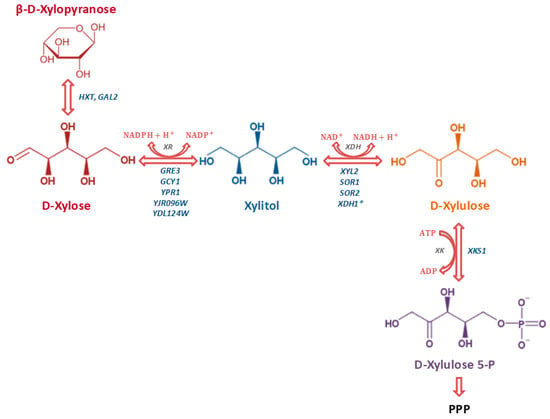
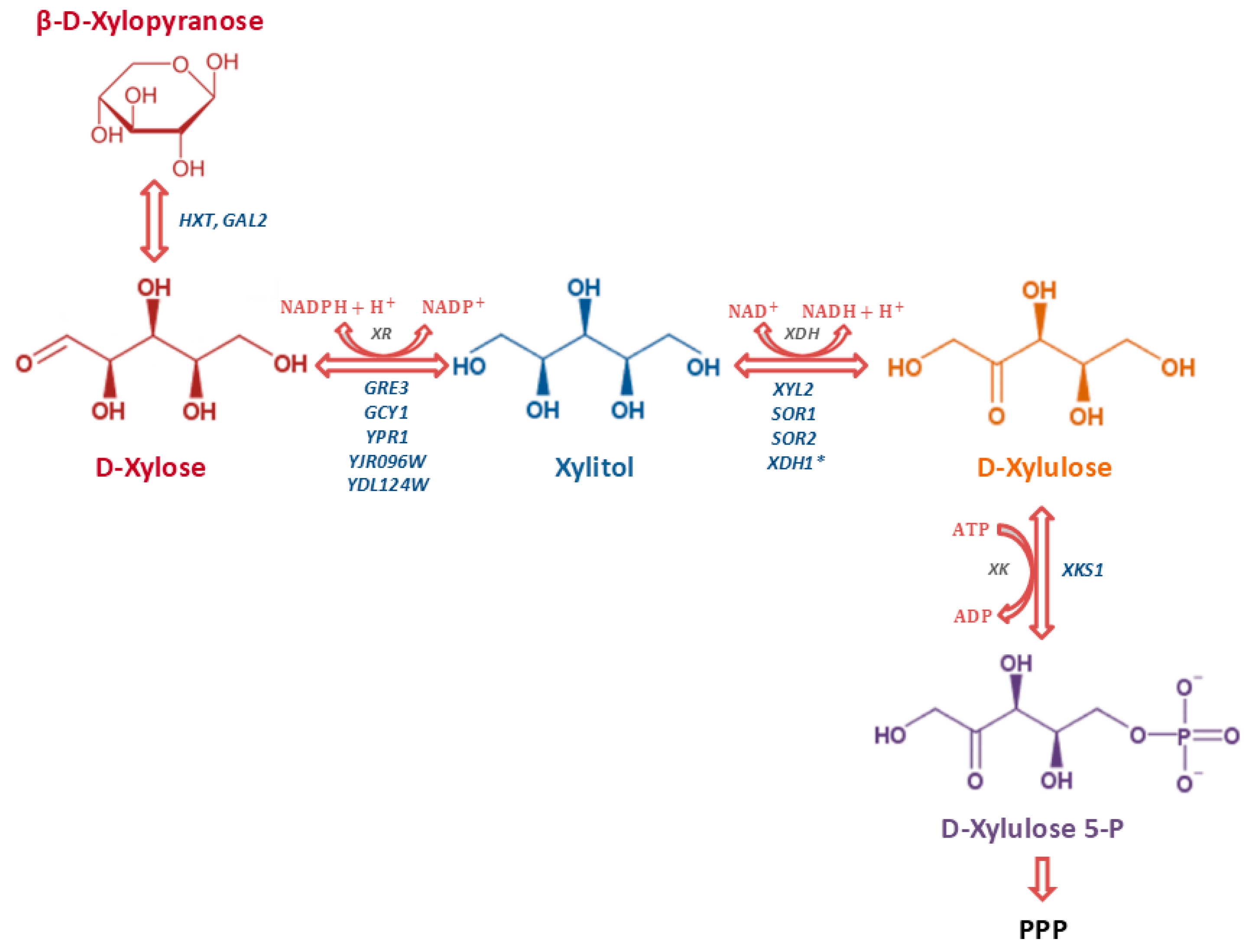
In yeasts, xylose is metabolized by an oxi-reductive pathway where, after entering the cell, xylose is reduced to xylitol by a NAD(P)H-dependent xylose reductase (XR), followed by the oxidation of xylitol to xylulose by a NAD+-dependent xylitol dehydrogenase (XDH), and finally xylulose is phosphorylated by xylulokinase (XK), entering into the non-oxidative part of the pentose phosphate pathway (Figure 1). Curiously, S. cerevisiae has genes encoding all the enzymes required to metabolize xylose ([12], Figure 1), but it does not recognize this pentose as a sugar to be consumed [13,14,15]. Indeed, it has been shown that if some of the endogenous genes (e.g., GRE3 and SOR1) are overexpressed, then S. cerevisiae will consume and ferment xylose [16,17].
Figure 1.
d-Xylose utilization pathway in yeasts. After entering the cell trough the HXT or GAL2 permeases, xylose is reduced to xylitol by xylose reductase (XR) using NADPH, then xylitol is oxidized to xylulose by xylitol dehydrogenase (XDH) using NAD+, followed by xylulose phosphorylation by xylulokinase (XK) that will enter the nonoxidative part of the pentose phosphate pathway (PPP). The genes present in the genome of S. cerevisiae are in blue, and the asterisk indicates a gene found only in some wine yeast strains.
Thus, although S. cerevisiae is generally considered incapable of assimilating xylose, some studies have shown that certain natural strains of Saccharomyces can consume xylose aerobically [18,19]. In this work, we aimed to enhance the phenotype of xylose consumption of the S. cerevisiae wild-type 202-3 strain [20]. This natural strain has been shown to consume some xylose and arabinose in hemicellulose hydrolysates. Although the consumption of these pentoses is slow and incomplete, this makes it an excellent candidate for genetic engineering and adaptive laboratory evolution (ALE), also known as evolutionary engineering, to improve its xylose consumption capacity.
Considering that two genes in the xylose utilization pathway of S. cerevisiae (Figure 1), the GAL2 gene encoding the galactose permease, and the GCY1 gene encoding for a glycerol (and xylose) dehydrogenase, are both induced by galactose, we decided to delete the GAL80 transcriptional repressor and analyze if such approach could enhance xylose consumption by the wild-type 202-3 strain. The Gal2 permease has been shown to transport xylose efficiently, and mutant versions of this permease can further improve its xylose transport capacity [21,22,23,24]. The GCY1 gene encodes for a glycerol dehydrogenase with NADPH aldo-keto reductase activity, and is also regulated by the presence of galactose [25]. Genes encoding enzymes required for galactose metabolism in S. cerevisiae are controlled at the transcriptional level by a genetic switch consisting of three proteins: a transcriptional activator Gal4, a transcriptional repressor Gal80 that binds to Gal4 in the absence of galactose, and a ligand sensor Gal3 that, upon the presence of galactose, binds to Gal80 and relieves the inhibition of Gal4 [26]. Deleting the GAL80 gene turn the GAL genes continuously expressed, even in non-inducing media or absence of galactose [27].
On the other hand, ALE has been widely applied to strains of S. cerevisiae, leading to strains with improved xylose consumption capacity [28,29,30,31,32]. This strategy is appealing as it facilitates the attainment of desired phenotypes by inducing mutations in strains through selective pressure. Thus, besides deleting the GAL80 gene in strain 202-3, we also performed ALE experiments with the obtained strains, and analyzed its xylose consumption capacity.
2. Materials and Methods
2.1. Microorganisms, Plasmids, and Culture Media
The yeast strains and plasmids used in this study are listed in Table 1. The S. cerevisiae strain 202-3 is deposited in the Bank of Strains and Genes of the Institute of Biotechnology of Universidad Nacional de Colombia with IBUN code 090-03602 and used under the certification IB-159-17. For the construction of the disruption (silencing) cassettes, the plasmids pUG6 [33] and pUG66 [34] were used. Plasmid conservation was carried out in Escherichia coli DH5α bacteria. Yeasts were cultivated on rich YP medium (containing 20 g/L peptone and 10 g/L yeast extract [35]) with 20 g/L glucose or xylose as carbon source. When required, 20 g/L agar, 200 mg/L geneticin (G418 Sigma-Aldrich, St. Louise, MI, USA) or 20 mg/L pleomycin (P9524 Sigma-Aldrich) were added to the medium. These antibiotics were sterilized by filtration using sterile 0.2 µm filters.
Table 1.
Yeast strains and plasmids used in this study.
2.2. Preparation of Competent Bacterial Cells
A colony of E. coli DH5α bacteria was inoculated in LB medium (10 g/L tryptone, 5 g/L yeast extract, 5 g/L sodium chloride) overnight until saturation. The next day when the bacteria were grown, 1 mL of the pre-inoculum was transferred to 100 mL of LB medium and incubated at 37 °C with shaking until an absorbance of 0.6 at 600 nm was reached. The bacteria culture was transferred to 50 mL tubes, left on ice for 10 min and centrifuged for 10 min at 2000 g. The supernatant was discarded, and the precipitate was resuspended in 10 mL of calcium (Ca) solution at 0 °C (60 mM CaCl2, 15 g/L glycerol, 10 mM piperazine-1, 4-bis (2-ethanesulfonic acid), pH 7.0). The suspension was left on ice for 30 min. After that time, it was centrifuged at 2000 g for 10 min, the supernatant was removed, and a new wash was carried out with the Ca solution. The precipitate was resuspended in 2 mL of Ca solution and kept on ice for 15 min. Then, 80 µL aliquots were made in sterile 1.5 mL tubes and stored at −80 °C until use [36].
2.3. Transformation of Bacteria
To each aliquot of DH5α competent cells, 1–5 µL (approximately 50 ng) of plasmid of interest were added, kept on ice for 10 min and incubated in a water bath at 42 °C for 2 min. Cells were placed on ice for 1 min and then 500 µL of LB medium were added. Cells were incubated for 1 h at 37 °C with shaking. The cells were then centrifuged and re-suspended in 200 µL of LB. The suspension was plated on solid media with ampicillin (100 mg/L) and incubated at 37 °C for 24–48 h [36].
2.4. Extraction of Plasmid DNA from Bacteria
Colonies of the transformants obtained previously were inoculated in LB medium with ampicillin and incubated overnight at 37 °C with shaking. Then, 1.5 mL of the culture were transferred to a microtube, which was centrifuged for 3 min at 4000 g. The supernatant was discarded, and the pellet was resuspended in 100 µL of GTE (50 mM glucose, 10 mM EDTA and 25 mM Tris-HCl buffer, pH 8.0). Afterward, 1 µL of RNAse was added at a concentration of 1 g/mL, mixed by inverting the tube and left for 5 min at room temperature. Next, 200 mL of a NaOH/SDS solution (0.2 M NaOH and 10 g/L SDS) was added, mixed, and incubated on ice for 5 min. Subsequently, 150 µL of a 5 M potassium acetate solution at a pH of 4.8 was added, left on ice for 5 min, shaken, and then centrifuged at 9000 g for 5 min. A total of 400 µL of the supernatant were transferred to a tube and 800 µL of 95% ethanol were added and left at −20 °C for 30 min. The tube was centrifuged for 15 min at 16,000 g and the supernatant was discarded. The precipitate was washed with 1 mL of 70% ethanol, centrifuged again for 5 min at 16,000 g and the supernatant was discarded. The tube with the pellet was dried in a laminar flow cabinet under sterile conditions and the DNA was resuspended in 40 µL of sterile ultrapure water [36].
2.5. Design of Primers for GAL80 Silencing, Disruption Cassettes, and Yeast Transformation
The GAL80 gene was deleted using a polymerase chain reaction (PCR)-based gene replacement procedure [37]. The KanMX cassette from plasmid pUG6 was amplified with primers F-GAL80-EXT and R-GAL80-EXT (Table 2), that contain 45 pb of sequence homologous to a region 400–500 pb upstream and downstream of the GAL80 ORF, respectively, using the Q5® High-Fidelity DNA Polymerase enzyme (New England Biolabs, Ipswich, MA, USA). The resulting PCR product, a 1704 pb fragment (Supplementary Figure S1), was used to transform competent yeast cells from strain 202-3 [38]. After a 3 h cultivation on YP-20 g/L glucose, the transformed cells were plated on solid YP-20 g/L glucose medium containing geneticin, and incubated at 28 °C. Transformants obtained were tested for the proper genomic integration of the KanMX disruption cassette at the GAL80 locus by PCR, using primers F-GAL80-A and R-GAL80-D (Table 2). This resulted in a 2332 bp product for the normal GAL80 locus in the parental strain and 2638 pb for recombinant gal80Δ strains with geneticin resistance. Additional confirmation was performed using primers F-GAL80-A and V-KAN-R (Table 2), amplifying a 1322 pb fragment to verify correct integration of the KanMX cassette (Supplementary Figure S2). Given that strain 202-3 is diploid, primers F-GAL80-B and R-GAL80-C (Table 2) were employed to check for any remaining copy of the GAL80 gene in recombinants. This amplified a 458 pb fragment, indicating the presence of a copy of the GAL80 gene (Supplementary Figure S2), yielding strain 202-3/Δ (gal80Δ::KanMX/GAL80, Table 1).
Table 2.
Primer sequences for GAL80 gene silencing strategies in S. cerevisiae strain 202-3.
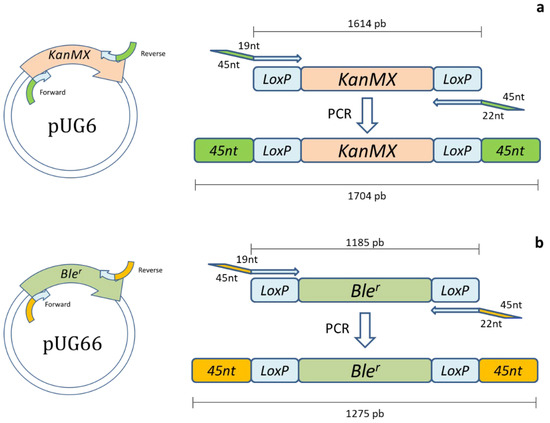
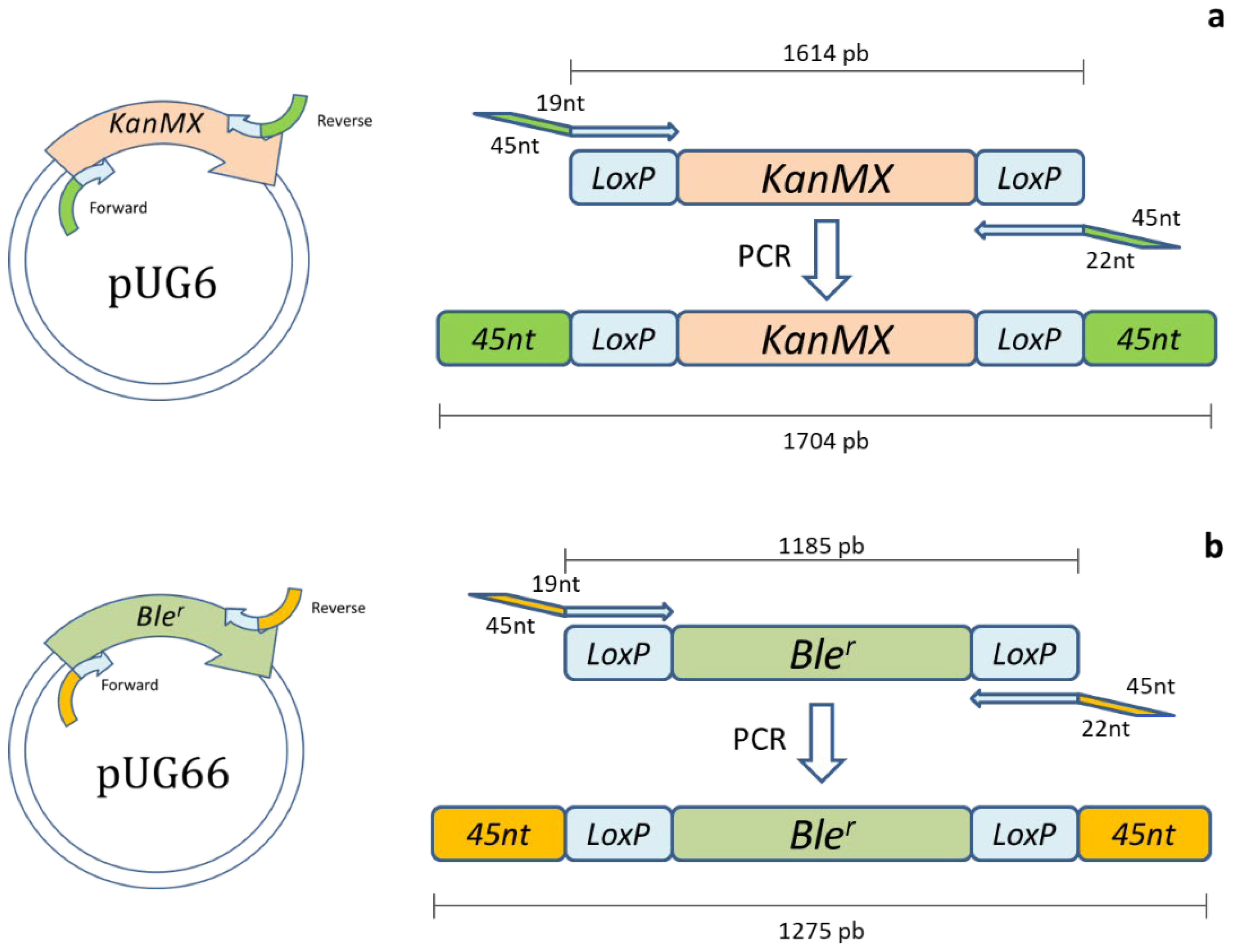
Using the above strategy, the second copy of the gene was deleted. The Bler cassette from plasmid pUG66 was amplified with primers F-INT-GAL80 and R-INT-GAL80 (Table 2) containing 45 pb of homology to the start and end of the GAL80 gene, respectively. The resulting PCR product, a 1275 pb fragment (Supplementary Figure S1), was used to transform competent yeast cells from strain 202-3/Δ. After cultivation on YP-20 g/L glucose, the transformed cells were plated on solid YP-20 g/L glucose medium containing pleomycin and incubated at 28 °C. Transformants obtained were tested for the proper genomic integration of the Bler disruption cassette at the GAL80 locus by PCR, using primers F-GAL80-A and R-GAL80-D (Table 2). This resulted in a 2332 bp product for the normal GAL80 locus in the parental strain and 2209 pb for recombinant strains with pleomycin resistance. Additional confirmation was performed using the V-BLE-F and R-GAL80-D primers (Table 2), amplifying a 1229 pb fragment to verify the correct integration of the Bler cassette (Supplementary Figure S3). Further confirmation was obtained by amplifying a 1127 bp fragment using primers F-GAL80-B and R-GAL80-D (Table 2). This fragment was present in the wild-type strain but not in the recombinant strain (Supplementary Figure S4). Primers F-GAL80-B and R-GAL80-C (Table 2) were employed to check for any remaining copies of the GAL80 gene in recombinants. No amplification of the fragment confirmed the complete deletion of the GAL80 gene (Supplementary Figure S5), yielding strain 202-3/ΔΔ (gal80Δ::KanMX/gal80Δ::Bler, Table 1). Figure 2 shows a schematic of the construction of 2 disruption cassettes: one using plasmid pUG6 and another using plasmid pUG66 [33,34].
Figure 2.
Construction strategy for GAL80 gene disruption cassettes using (a) the KanMX marker (1704 bp) and (b) the Bler marker (1275 bp). The primers used have a region of homology (19–22 nt) to plasmids pUG6 and pUG66 and a region of homology (45 nt) to the yeast genome.
2.6. Adaptive Laboratory Evolution (ALE)
The three strains (202-3, 202-3/∆ and 202-3/∆∆) were submitted to an ALE experiment (adapted from [30,31]) at 29 °C and 150 rpm in cotton-plugged 250 mL shake flasks containing 50 mL of rich YP-20 g/L xylose-medium grown for 6 d, in triplicate for each strain. Cell growth was monitored by measuring OD600nm, and one unit of OD600nm corresponds to a cell dry weight of 0.5 g/L. After 6 d, a new batch was prepared using the sample from the triplicate that exhibited the highest growth, as determined by the greatest absorbance reading, and inoculated into three new flacks with an absorbance of approximately 0.5 at OD600nm. This procedure was repeated iteratively in the same way 8 times over a span of 54 days, allowing the isolation of the 202-3/ALE, 202-3/∆/ALE and 202-3/∆∆/ALE strains. The abbreviation ALE was used to indicate the corresponding strain after adaptive laboratory evolution.
2.7. Quantitative Analysis
Metabolite quantification was carried out using a High-Performance Liquid Chromatography (HPLC) with an Aminex HPX-87 H column from BioRad Laboratories (Hercules, CA, USA), coupled to a Shodex RI-101 refractive index detector (JM Science Inc., Grand Island, NY USA). The operation conditions were set as follows: 5 mM H2SO4 solution, column temperature 65 °C, eluent flowrate of 0.60 mL/min, and 0.02 mL injection volume.
The maximum specific growth rate was estimated by plotting the natural logarithm of the biomass concentration (ln X) against the cultivation time during the exponential growth phase. The μmax (h−1) was taken as the slope of the linear portion of the curve. The xylitol yield (YP/S = g xylitol/g xylose) and the volumetric productivity of xylitol (QP = g xylitol/L/h) were calculated using Equations (1) and (2):
where:
Pmax: maximum concentration of the product in g/L;
Si: initial substrate concentration in g/L;
Sf: final substrate concentration in g/L.
where:
Pmax: maximum concentration of the product in g/L;
t: time in h.
The results were analyzed, and significant differences were verified using Statistix 8.0® software (Analytical Software, Tallahassee, FL, USA). A completely randomized analysis of variance (ANOVA) was performed, followed by a comparison test between means (Tukey) at a significance level of 0.05.
3. Results and Discussion
Strain 202-3 is a diploid yeast that sequencing of its ITS region showed similarity (>99%) to the reported sequences of S. cerevisiae in the NCBI GenBank database [20]. This strain has in its genome (determined through PCR and specific primers) all the genes putatively involved in xylose metabolism shown in Figure 1 (see Supplementary Figure S6), with the exception of the XDH1 gene found in some S. cerevisiae wine strains [39]. To improve xylose consumption by the natural strain 202-3 two different approaches were employed: silencing of the GAL80 gene and adaptive laboratory evolution (ALE), also known as evolutionary engineering.
3.1. Silencing of the GAL80 Gene
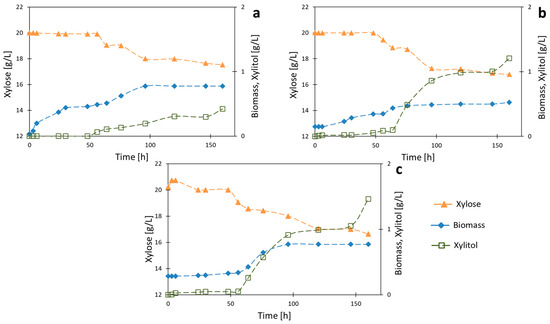
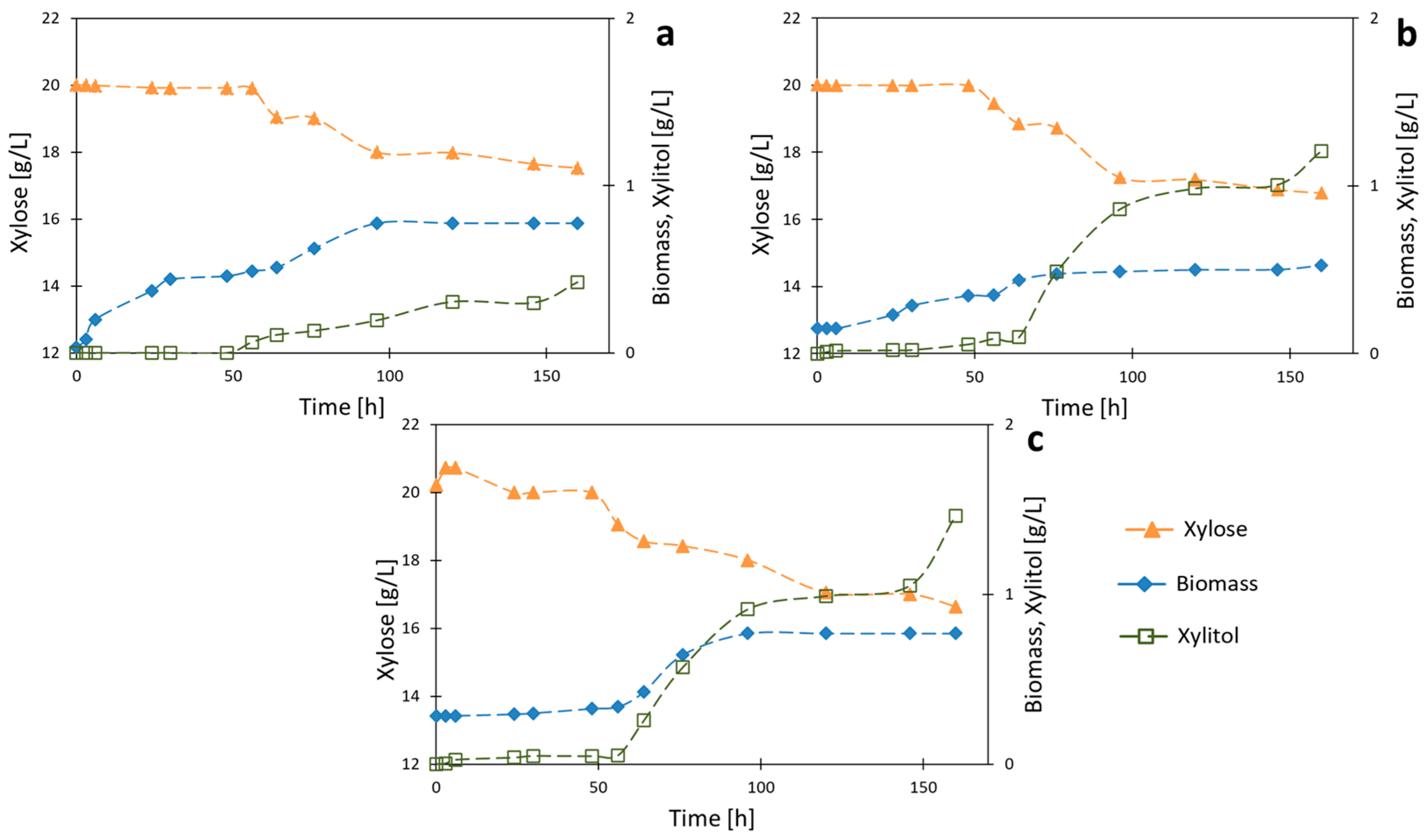
Since strain 202-3 is diploid, two different disruption cassettes using the KanMX and the Bler markers were used. The KanMX disruption cassette was designed to delete the GAL80 gene and 400–500 bp of the upstrem and downstream region of the gene (creating strain 202-3/∆ with one copy of the GAL80 gene silenced, Table 1), while the Bler disruption cassette was designed to delete the entire GAL80 ORF in strain 202-3/∆ (creating strain 202-3/∆∆ with GAL80 completely silenced, Table 1). Xylose assimilation by these three strains was evaluated in YP-20 g/L xylose medium, and the results obtained are shown in Figure 3.
Figure 3.
Xylose assimilation by the parental and recombinant strains in rich YP-20 g/L xylose medium. (a) wild-type strain 202-3, (b) strain 202-3/Δ (one copy of GAL80 deleted) and (c) strain 202-3/ΔΔ (both copies of GAL80 deleted). The error bars represent the standard deviation of three independent experiments and are not visible at the plotted scale.
Although after genetic modification xylose is not completely consumed, it does show an improvement in the consumption of this pentose relative to the parental strain, as well as a higher xylitol output. Strain 202-3 consumed 12% of the available xylose (2.47 g/L), while strain 202-3/∆ consumed 16% of the available xylose (3.23 g/L), and strain 202-3/∆∆ consumed 18% of the available xylose (3.59 g/L). This improved xylose consumption was followed by an increase in xylitol production, from 0.42 g/L xylitol produced by strain 202-3 into 1.46 g/L xylitol produced by strain 202-3/∆∆, and thus the xylitol yield also increased in the gal80 silenced strains, from 0.171 g/g by strain 202-3 to 0.407 g/g by strain 202-3/∆∆. Very low volumetric productivities were determined for the strains, with a slight increase for strain 202-3/∆ and 202-3/∆∆ (Table 3).
Table 3.
Summary of results of xylose consumption by the wild-type strain 202-3, and the engineered strains 202-3/∆ and 202-3/∆∆ after 160 h of growth in rich YP-20 g/L xylose medium.
Although the wild yeast strain used in this study exhibits an intrinsic capacity to metabolize xylose [20], this ability is limited, and the engineering strategy implemented here significantly improved this phenotype. It is important to note that the improved xylose consumption (an increase of 1.46 times between strains 202-3 and 202-3/∆∆) is followed by an even more improved xylitol production (3.46 times more) and xylitol yield (2.38 times more) when the two copies of the GAL80 gene were deleted. Thus, the probably increased expression of GAL2 and GCY1 genes (due to GAL80 deletion) contributed to the improved xylose consumption and increased xylitol yield. Indeed, overexpression of GAL2 and/or deletion of GAL80 have already be shown to improve xylose consumption by recombinant xylose fermenting yeast strains [40,41], and our results indicate that the NADPH-dependent GCY1 aldo-keto reductase might have also contributed to increase the production of xylitol from xylose by the engineered yeast strains. Although not characterized in detail in S. cerevisiae, the GCY genes from Scheffersomyces stipitis expressed in Candida tropicalis improve xylitol production by this yeast [42]. The accumulation of xylitol in yeast strains is mainly associated with a redox imbalance between XR and XDH enzymes with different specificity for the coenzymes NADPH and NAD+ [43,44,45]. Nevertheless, the results obtained regarding the improvement in xylose consumption are similar to those reported by [46], where xylose consumption was improved by 13–18% by overexpression of CTT1 and PRX1 genes in the natural S. cerevisiae strain YB-2625.
Several yeast species, including C. tropicalis, S. stipitis, Debaromyces hansenii and Debaromyces nepalensis [4,47,48], are capable of xylose consumption and xylitol production. However, the development of a natural and improved S. cerevisiae strain for xylitol production represents an attractive industrial alternative because of the extensive knowledge available regarding its physiology and genetic manipulation. In addition, S. cerevisiae is considered a GRAS microorganism (Generally Recognized As Safe microorganism) [9], which further supports its industrial applicability. Inactivating GAL80, a key repressor of the GAL gene regulatory network in S. cerevisiae, suggests that the removal of the inhibitory control that normally reduces the GAL pathway activity, also creates a more favorable cellular environment for channeling carbon flux toward biosynthetic pathways of interest. As our results suggest, engineered yeast strains can achieve higher yields not only of xylitol but other valuable biotechnological products such as biofuels, pharmaceuticals, and specialty chemicals derived from biomass compounds. Moreover, GAL80 inactivation simplifies strain design by reducing the need for complex regulatory tuning, offering a versatile and scalable approach for industrial biotechnology applications where a strong and consistent gene expression is important for efficient production considering its potential industrial application.
3.2. ALE of the 202-3, 202-3/∆ and 202-3/∆∆ Strains
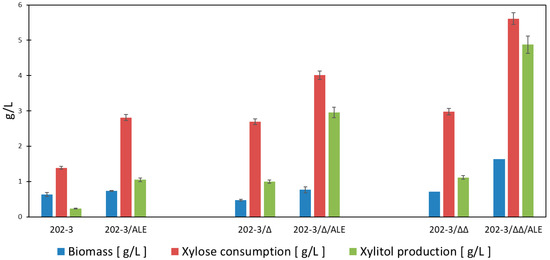
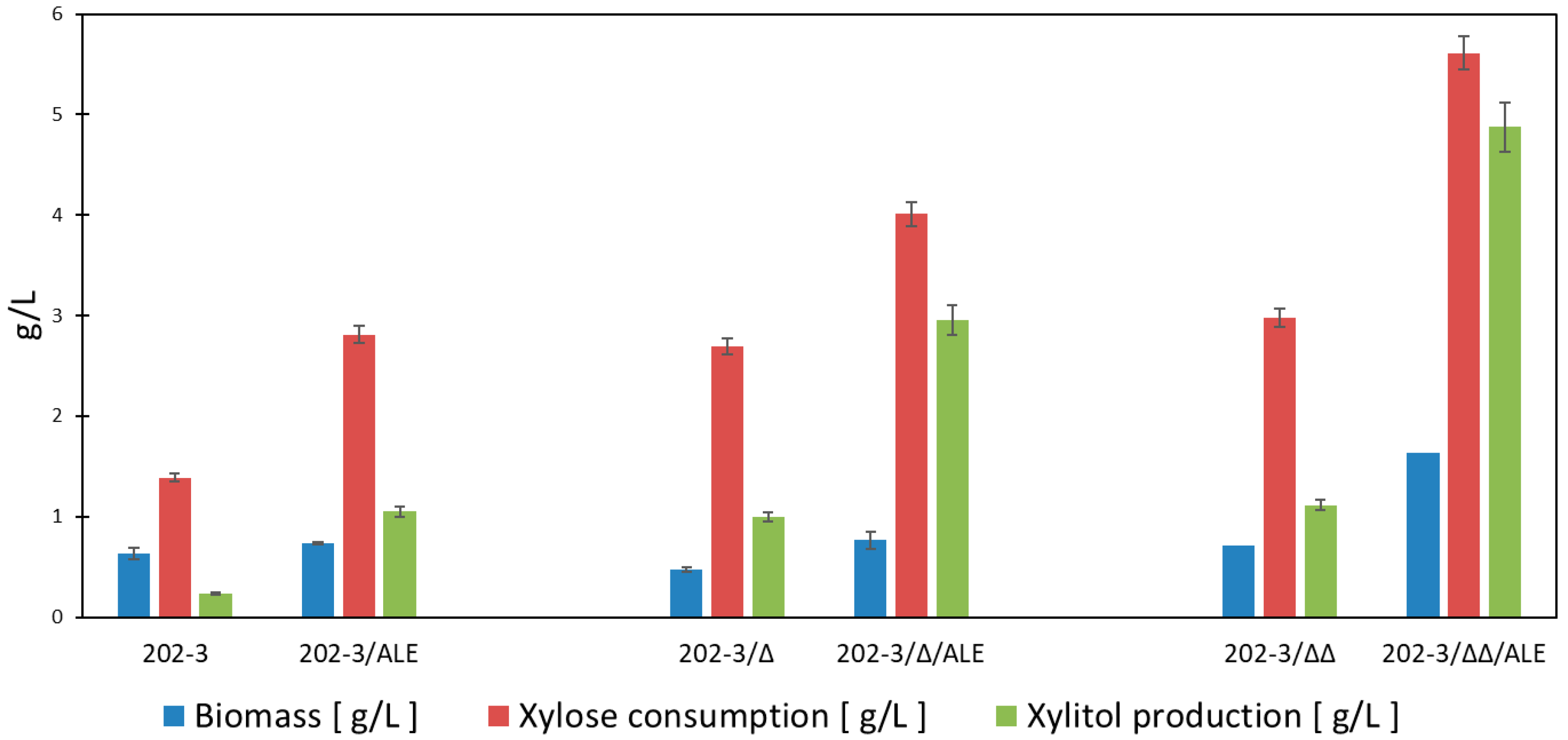
ALE or evolutionary engineering is a strategy based on the principles of spontaneous mutation and natural selection for the improvement of lineages, allowing us to obtain strains with differentiated characteristics. After eight serial inoculations in YP-20 g/L xylose medium, we obtained the 202-3/ALE strain (evolved 202-3 strain), the 202-3/∆/ALE strain (evolved 202-3/∆ strain), and the 202-3/∆∆/ALE strain (evolved 202-3/∆∆ strain). All evolved strains demonstrated an increased capacity for xylose consumption, xylitol production and xylitol yield (Figure 4 and Table 4).
Figure 4.
Comparison of ALE strains with the corresponding parental strains 202-3, 202-3/∆ and 202-3/∆∆, in relation to biomass produced, xylose consumption, and xylitol production during 6 d of growth in rich YP-20 g/L xylose medium. The error bars represent the standard deviation of three independent experiments.
Table 4.
Summary of the most significant results of the strains obtained by ALE, and their corresponding parental strains, after 6 d of growth in rich YP-20 g/L xylose medium.
In general, all evolved (ALE) strains double the amount of xylose consumed from the media, reaching 5.61 g/L (28% of the available xylose) by the evolved 202-3/∆∆/ALE strain. As far as xylitol is concerned, its production increased 4.45 times by the 202-3/ALE strain (when compared to strain 202-3), 2.96 times when comparing 202-3/∆/ALE to 202-3/∆, and 4.37 times when strain 202-3/∆∆/ALE is compared to strain 202-3/∆∆ (or more than 20-times more xylitol produced by this 202-3/∆∆/ALE strain, when compared to the original 202-3 strain). This significant increase in xylitol production was followed by also a significant increase in the xylitol yield, from 0.170 g xylitol/g xylose by strain 202-3 into 0.869 xylitol/g xylose by strain 202-3/∆∆/ALE (a 5.1-fold increase). All ALE strains had significantly higher xylitol yield and volumetric xylitol production than their corresponding parental strains (Table 4), although it is important to note that both the maximum specific growth rates (µmax) and the volumetric xylitol production (QP) are very low in these strains. The maximal expected theoretical yield for the biotransformation of xylose into xylitol is 0.905–0.917 g xylitol/g xylose consumed, depending on how the cells will regenerate the NADH/NADPH consumed in the reduction of xylose, and that no carbon is used for cell growth or production of other metabolites [49,50]. Thus, the xylitol yield obtained with strain 202-3/∆∆/ALE corresponds to 95–96% of the maximal expected theoretical xylitol yield (Table 4). Indeed, no ethanol was detected during growth of the strains on xylose, and very low levels of glycerol (0.062–0.085 g/L) were observed at the end of growth by strains 202-3 and 202-3/∆ (which indeed showed the lowest xylitol yields).
The production by strain 202-3/∆∆/ALE of 4.88 g/L of xylitol from 28% of the available xylose is remarkable, and as high as other S. cerevisiae strains expressing XR and XDH from other yeasts [50]. Thus, the obtained 202-3/∆∆/ALE strain demonstrates significant potential for industrial xylitol production through the implementation of an appropriate biotechnological process. It would be interesting to analyze and characterize which mutations and/or metabolic adaptations occurred and were selected for in the genome of the ALE yeast strains, particularly in strain 202-3/∆∆/ALE, but this was not explored in this study and it thus remains unclear. Although commercially xylitol has a high added value (in the order of USD 5 per kilogram in 2023), if one wanted to convert this chemical into another compound such as ethanol, an approach could be followed in which the overexpression of a xylose dehydrogenase enzyme would drive this carbon flow towards ethanol production. Alternatively, other strategies could be tested to improve xylose consumption by the native S. cerevisiae strain, like deleting the PHO13 gene, a gene encoding for an alkaline phosphatase known to suppress xylose utilization by recombinant yeast strains [50,51,52,53], or even the expression, for example, of heterologous xylose transporters from other xylose fermenting yeasts [54,55].
4. Conclusions
This study demonstrates the potential of the wild-type diploid S. cerevisiae 202-3 strain isolated from a sugarcane distillery environment in Colombia, for the conversion of xylose into xylitol. It was shown that the 202-3 strain exhibited a non-common xylose-metabolizing capacity compared with reported S. cerevisiae strains in the literature. Targeted genetic engineering through GAL80 silencing carrying partial and complete inactivation of this gene, generated the recombinant strains 202-3/∆ and 202-3/∆∆, respectively. Both recombinants displayed enhanced xylose assimilation and at least a 2–3 fold increase in xylitol production relative to the parental strain, suggesting the important role of GAL regulatory pathway in facilitating pentose metabolism. Among the engineered strains, 202-3/∆∆ exhibited the most favorable xylose-assimilation profile, indicating that complete GAL80 silencing provides a stronger metabolic advantage than partial gene deletion. The performance of both the parental strain and the two recombinant strains was further improved by applying an ALE strategy over eight sequential cultivation cycles. The evolved strain 202-3/∆∆/ALE, which combines complete GAL80 deletion with adaptive evolution, showed the best overall phenotype. Compared with the original 202-3 strain, 202-3/∆∆/ALE achieved more than 4-times increase in xylose consumption, more than 5-times increase in xylitol yield, and over 20-times increase in xylitol production, reaching a final xylitol concentration of 4.876 g/L. Taken together, these findings demonstrate the synergistic effect of combining genetic engineering and ALE to significantly improve xylose utilization and xylitol biosynthesis by a natural S. cerevisiae strain. It would be interesting to analyze and characterize which mutations occurred and were selected for in the genome of the ALE yeast strains, particularly in strain 202-3/∆∆/ALE, but this was not explored in this study and it thus remains unclear. Further improvements in xylitol production might be obtained by overexpressing other NADPH-dependent xylose reductases and/or xylose-specific permeases, as well as increasing the flux through the pentose-phosphate pathway, but unfortunately the transcriptional regulators involved are still unknown.
Supplementary Materials
The following supporting information can be downloaded at: https://www.mdpi.com/article/10.3390/fermentation12080354/s1, Figure S1: Electrophoresis gel confirming the construction of GAL80 disruption cassettes (silencing modules). Wells 1–4 show disruption cassette with Bler selection marker and 5–8 show disruption cassette with KanMX selection marker. Figure S2: Verification of recombinants using the F-GAL80-A and V-KAN-R primers, as well as the F-GAL80-B and R-GAL80-C primers. (a) Silencing module, with the location of the verification primers indicated by the arrows; (b) Electrophoresis showing wells 1: Molecular weight marker; 2: Another recombinant; 3: 202-3/∆, 4: Sc 202-3 no amplification; 5: Negative control; 6: Another recombinant; 7: 202-3/∆; 8: 202-3. The presence of the band in well 7 confirms the presence of one copy of the GAL80 gene in the recombinant 202-3/∆. Figure S3: Verification of recombinants with the Bler module using the V-BLE-F and R-GAL80-D primers. (a) Silencing module, with the location of the verification primers indicated by the arrows; (b) Electrophoresis showing wells, 1: Molecular weight marker; 2: Another recombinant; 3: 202-3/∆∆; 4: Another recombinant; 5: Negative control; 6: Another recombinant; 7: 202-3/∆∆; 8: Another recombinant; 9: 202-3; 10: Negative control. Figure S4: Verification of recombinants using the F-GAL80-B and R-GAL80-D primers. (a) Silencing module, with the location of the verification primers indicated by the arrows; (b) Electrophoresis showing wells, molecular weight marker 1 Kb NEB; 1: 202-3; 2: 202-3/∆∆; 3: Another recombinant; 4: negative control. Figure S5: Verification of complete silencing of GAL80 gene. (a) Representation of copy 2 GAL80 gene, with the location of the verification primers indicated by the arrows. (b) Electrophoresis showing wells 1: molecular weight marker; 2: another recombinant; 3: 202-3/∆∆; 4: 202-3. Figure S6: PCR amplification of genes involved in xylose metabolism in strain S. cerevisiae 202-3. (A) Electrophoresis showing wells: 1 kb molecular weight marker; 1: confirmation of GCY1; 2: confirmation of YPR1; 3: confirmation of SOR2; 4: confirmation of YDL124W; 5: confirmation of GRE3; 6: confirmation of YJR096W; 7: confirmation of XYL2; 8: confirmation of SOR1; 9: confirmation of XKS1. (B) Electrophoresis showing wells: 1 kb molecular weight marker; 1: absence of XDH1 in strain 202-3; 2: confirmation of XDH1 in the wine strain Lavin EC1118; 3: negative control. The primers used for confirmation of genes are detailed in the Table below; Table S1: Primer sequences for the amplification of genes involved in xylose metabolism.
Author Contributions
Project Design and Conceptualization: M.A.P.L., M.E.V.L. and B.U.S. M.A.P.L. conducted the experiments, analyzed the results, and drafted the initial version of the article. Funding acquisition and resource management: M.A.P.L. and M.E.V.L. Analysis of results: M.A.P.L., D.C.T.P., J.A.C.C. and B.U.S. Manuscript review, and editing: M.A.P.L., D.C.T.P., J.A.C.C., M.E.V.L. and B.U.S. All authors have read and agreed to the published version of the manuscript.
Funding
This research is partially supported by the Ministry of Science, Technology, and Innovation of Colombia—Minciencias (Former Administrative Department of Science, Technology and Innovation of Colombia—COLCIENCIAS)—through Call 647 of 2014, Call 727 of 2015 and Convocatoria Orquídeas: Mujeres en Inteligencia Artificial, Ciencias y tecnologías Cuánticas—through Call 963 of 2025 (process n° SIGP 114201). Additionally, it receives partial support from Universidad Nacional de Colombia through Projects No. 40811/2017 and No. 49997/2020. B.U.S. acknowledges a researcher fellowship from the Brazilian agency CNPq (process n° 309047/2023-4).
Institutional Review Board Statement
Not applicable.
Informed Consent Statement
Not applicable.
Data Availability Statement
The original contributions presented in this study are included in the article and Supplementary Material. Further inquiries can be directed to the corresponding authors.
Acknowledgments
The authors would like to thank the Ministerio de Medio Ambiente y Desarrollo Sostenible (Ministry of the Environment and Sustainable Development) for granting us access to the genetic resources that allowed us the use of yeast strain 202-3 through the contract “Contrato marco de acceso a recursos genéticos y sus productos derivados No. 121 de 2016, Otrosí No 8 de 2018—RGE-152-8” Project “Producción de alcoholes empleando cepas nativas de levaduras colombianas”.
Conflicts of Interest
The authors declare no conflicts of interest.
References
- Gasmi Benahmed, A.; Gasmi, A.; Arshad, M.; Shanaida, M.; Lysiuk, R.; Peana, M.; Pshyk-Titko, I.; Adamiv, S.; Shanaida, Y.; Bjørklund, G. Health benefits of xylitol. Appl. Microbiol. Biotechnol. 2020, 104, 7225–7237. [Google Scholar] [CrossRef] [Scilit] [PubMed]
- Delgado Arcaño, Y.; Valmaña García, O.D.; Mandelli, D.; Carvalho, W.A.; Magalhães Pontes, L.A. Xylitol: A review on the progress and challenges of its production by chemical route. Catal. Today 2020, 344, 2–14. [Google Scholar] [CrossRef] [Scilit]
- Sukkasem, T.; Lakhani, P.; Srifa, A. A comprehensive review on xylitol production: Experimental and theoretical insights, research gaps, and future perspectives. Adv. Energy Sustain. Res. 2026, 7, e70208. [Google Scholar] [CrossRef] [Scilit]
- Tusso Pinzón, D.C.; Patiño Lagos, M.A.; Tusso Pinzón, R.A.; Suárez Osorio, L.; Pinzón Velasco, A.M.; Velásquez Lozano, M.E. Xylitol: A promising sweetener produced by Candida sp. Indian J. Microbiol. 2025, 1–10. [Google Scholar] [CrossRef] [Scilit]
- Pandey, N.; Ahmad, D.; Hasan, M.; Choudhary, D.K.; Kumar, A.; Tripathi, M.K.; Siddiqui, S.A.; Shah, M.A. Current trends in the production of xylitol and paving the way for metabolic engineering in microbes. Biotechnol. Biofuels. Bioprod. 2025, 18, 106. [Google Scholar] [CrossRef] [Scilit] [PubMed]
- Kumari, P.; Mathur, P.; Sharma, C.; Chaturvedi, P. Xylitol production from lignocellulosic biowastes. Bioresour. Technol. Rep. 2025, 29, 102025. [Google Scholar] [CrossRef] [Scilit]
- Zhang, F.; Rodriguez, S.; Keasling, J.D. Metabolic engineering of microbial pathways for advanced biofuels production. Curr. Opin. Biotechnol. 2011, 22, 775–783. [Google Scholar] [CrossRef] [Scilit] [PubMed]
- Deng, J.; Wu, Y.; Zheng, Z.; Chen, N.; Luo, X.; Tang, H.; Keasling, J.D. A synthetic promoter system for well-controlled protein expression with different carbon sources in Saccharomyces cerevisiae. Microb. Cell Fact. 2021, 20, 202. [Google Scholar] [CrossRef] [Scilit] [PubMed]
- Parapouli, M.; Vasileiadis, A.; Afendra, A.-S.; Hatziloukas, E. Saccharomyces cerevisiae and its industrial applications. AIMS Microbiol. 2020, 6, 1–31. [Google Scholar] [CrossRef] [Scilit] [PubMed]
- Varize, C.S.; Bücker, A.; Lopes, L.D.; Christofoleti-Furlan, R.M.; Raposo, M.S.; Basso, L.C.; Stambuk, B.U. Increasing ethanol tolerance and ethanol production in an industrial fuel ethanol Saccharomyces cerevisiae strain. Fermentation 2022, 8, 470. [Google Scholar] [CrossRef] [Scilit]
- Tsegaye, K.N.; Alemnew, M.; Berhane, N. Saccharomyces cerevisiae for lignocellulosic ethanol production: A look at key attributes and genome shuffling. Front. Bioeng. Biotechnol. 2024, 12, 1466644. [Google Scholar] [CrossRef] [Scilit] [PubMed]
- Patiño, M.A.; Ortiz, J.P.; Velásquez, M.; Stambuk, B.U. D-Xylose consumption by nonrecombinant Saccharomyces cerevisiae: A review. Yeast 2019, 36, 541–556. [Google Scholar] [CrossRef] [Scilit] [PubMed]
- Osiro, K.O.; Brink, D.P.; Borgström, C.; Wasserstrom, L.; Carlquist, M.; Gorwa-Grauslund, M.F. Assessing the effect of d-xylose on the sugar signaling pathways of Saccharomyces cerevisiae in strains engineered for xylose transport and assimilation. FEMS Yeast Res. 2018, 18, fox096. [Google Scholar] [CrossRef] [Scilit] [PubMed]
- Endalur-Gopinarayanan, V.; Nair, N.U. Pentose metabolism in Saccharomyces cerevisiae: The need to engineer global regulatory systems. Biotechnol. J. 2019, 14, 1800364. [Google Scholar] [CrossRef] [Scilit] [PubMed]
- Brink, D.P.; Borgström, C.; Persson, V.C.; Ofuji Osiro, K.; Gorwa-Grauslund, M.F. d-Xylose sensing in Saccharomyces cerevisiae: Insights from d-Glucose signaling and native d-Xylose utilizers. Int. J. Mol. Sci. 2021, 22, 12410. [Google Scholar] [CrossRef] [Scilit] [PubMed]
- Konishi, J.; Fukuda, A.; Mutaguchi, K.; Uemura, T. Xylose fermentation by Saccharomyces cerevisiae using endogenous xylose assimilating genes. Biotechnol. Lett. 2015, 37, 1623–1630. [Google Scholar] [CrossRef] [Scilit] [PubMed]
- Fukuda, A.; Kuriya, Y.; Konishi, J.; Mutaguchi, K.; Uemura, T.; Miura, D.; Okamoto, M. Kinetic modeling and sensitivity analysis for higher ethanol production in self-cloning xylose-using Saccharomyces cerevisiae. J. Biosci. Bioeng. 2019, 127, 563–569. [Google Scholar] [CrossRef] [Scilit] [PubMed]
- Nasir, A.; Rahman, S.S.; Hossain, M.M.; Choudhury, N. Isolation of Saccharomyces cerevisiae from pineapple and orange and study of metal’s effectiveness on ethanol production. Eur. J. Microbiol. Immunol. 2017, 7, 76–91. [Google Scholar] [CrossRef] [Scilit] [PubMed]
- Sharma, S.; Varghese, E.; Arora, A.; Singh, K.N.; Singh, S.; Nain, L.; Paul, D. Augmenting pentose utilization and ethanol production of native Saccharomyces cerevisiae LN using medium engineering and response surface methodology. Front. Bioeng. Biotechnol. 2018, 6, 132. [Google Scholar] [CrossRef] [Scilit] [PubMed]
- Lagos, M.A.P.; Caviativa, J.A.C.; Pinzón, D.C.T.; Roa, D.H.R.; Basso, T.O.; Lozano, M.E.V. Xylose metabolization by a Saccharomyces cerevisiae strain isolated in Colombia. Indian J. Microbiol. 2023, 63, 84–90. [Google Scholar] [CrossRef] [Scilit] [PubMed]
- Sedlak, M.; Ho, N.W. Characterization of the effectiveness of hexose transporters for transporting xylose during glucose and xylose co-fermentation by a recombinant Saccharomyces yeast. Yeast 2004, 21, 671–684. [Google Scholar] [CrossRef] [Scilit] [PubMed]
- Farwick, A.; Bruder, S.; Schadeweg, V.; Oreb, M.; Boles, E. Engineering of yeast hexose transporters to transport d-xylose without inhibition by d-glucose. Proc. Natl. Acad. Sci. USA 2014, 111, 5159–5164. [Google Scholar] [CrossRef] [Scilit] [PubMed]
- Reznicek, O.; Facey, S.J.; de Waal, P.P.; Teunissen, A.W.; de Bont, J.A.; Nijland, J.G.; Driessen, A.J.; Hauer, B. Improved xylose uptake in Saccharomyces cerevisiae due to directed evolution of galactose permease Gal2 for sugar co-consumption. J. Appl. Microbiol. 2015, 119, 99–111. [Google Scholar] [CrossRef] [Scilit] [PubMed]
- Rojas, S.A.T.; Schadeweg, V.; Kirchner, F.; Boles, E.; Oreb, M. Identification of a glucose-insensitive variant of Gal2 from Saccharomyces cerevisiae exhibiting a high pentose transport capacity. Sci. Rep. 2021, 11, 24404. [Google Scholar] [CrossRef] [Scilit] [PubMed]
- Angermayr, M.; Bandlow, W. Permanent nucleosome exclusion from the Gal4p-inducible yeast GCY1 promoter. J. Biol. Chem. 2003, 278, 11026–11031. [Google Scholar] [CrossRef] [Scilit] [PubMed]
- Timson, D.J.; Ross, H.C.; Reece, R.J. Gal3p and Gal1p interact with the transcriptional repressor Gal80p to form a complex of 1:1 stoichiometry. Biochem. J. 2002, 363, 515–520. [Google Scholar] [CrossRef] [Scilit] [PubMed]
- Torchia, T.E.; Hamilton, R.W.; Cano, C.L.; Hopper, J.E. Disruption of regulatory gene GAL80 in Saccharomyces cerevisiae: Effects on carbon-controlled regulation of the galactose/melibiose pathway genes. Mol. Cell. Biol. 1984, 4, 1521–1527. [Google Scholar] [CrossRef] [Scilit] [PubMed]
- Sonderegger, M.; Sauer, U. Evolutionary engineering of Saccharomyces cerevisiae for anaerobic growth on xylose. Appl. Environ. Microbiol. 2003, 69, 1990–1998. [Google Scholar] [CrossRef] [Scilit] [PubMed]
- Kuyper, M.; Toirkens, M.J.; Diderich, J.A.; Winkler, A.A.; Van Dijken, J.P.; Pronk, J.T. Evolutionary engineering of mixed-sugar utilization by a xylose-fermenting Saccharomyces cerevisiae strain. FEMS Yeast Res. 2005, 5, 925–934. [Google Scholar] [CrossRef] [Scilit] [PubMed]
- Peng, B.; Shen, Y.; Li, X.; Chen, X.; Hou, J.; Bao, X. Improvement of xylose fermentation in respiratory-deficient xylose-fermenting Saccharomyces cerevisiae. Metab. Eng. 2012, 14, 9–18. [Google Scholar] [CrossRef] [Scilit] [PubMed]
- Scalcinati, G.; Otero, J.M.; Van Vleet, J.R.H.; Jeffries, T.W.; Olsson, L.; Nielsen, J. Evolutionary engineering of Saccharomyces cerevisiae for efficient aerobic xylose consumption. FEMS Yeast Res. 2012, 12, 582–597. [Google Scholar] [CrossRef] [Scilit] [PubMed]
- Basso, T.P.; Procópio, D.P.; Petrin, T.H.C.; Giacon, T.G.; Jin, Y.S.; Basso, T.O.; Basso, L.C. Engineering xylose fermentation in an industrial yeast: Continuous cultivation as a tool for selecting improved strains. Lett. Appl. Microbiol. 2023, 76, ovad077. [Google Scholar] [CrossRef] [Scilit] [PubMed]
- Güldener, U.; Heck, S.; Fielder, T.; Beinhauer, J.; Hegemann, J.H. A new efficient gene disruption cassette for repeated use in budding yeast. Nucleic Acids Res. 1996, 24, 2519–2524. [Google Scholar] [CrossRef] [Scilit] [PubMed]
- Gueldener, U.; Heinisch, J.; Koehler, G.J.; Voss, D.; Hegemann, J.H. A second set of loxP marker cassettes for Cre-mediated multiple gene knockouts in budding yeast. Nucleic Acids Res. 2002, 30, e23. [Google Scholar] [CrossRef] [Scilit] [PubMed]
- Sherman, F. Getting started with yeast. Meth. Enzymol. 2002, 350, 3–41. [Google Scholar] [CrossRef] [Scilit] [PubMed]
- Ausubel, F.M.; Brent, R.; Kingston, R.E.; Moore, D.D.; Seidman, J.G.; Smith, J.A.; Struhl, K. Short Protocols in Molecular Biology, 3rd ed.; John Wiley & Sons: New York, NY, USA, 1995. [Google Scholar]
- Petracek, M.E.; Longtine, M.S. PCR-Based engineering of yeast genome. Meth. Enzymol. 2002, 350, 445–469. [Google Scholar] [CrossRef] [Scilit] [PubMed]
- Gietz, R.D.; Woods, R.A. Transformation of yeast by lithium acetate/single-stranded carrier DNA/polyethylene glycol method. Meth. Enzymol. 2002, 350, 87–96. [Google Scholar] [CrossRef] [Scilit] [PubMed]
- Wenger, J.W.; Schwartz, K.; Sherlock, G. Bulk segregant analysis by high-throughput sequencing reveals a novel xylose utilization gene from Saccharomyces cerevisiae. PLoS Genet. 2010, 6, e1000942. [Google Scholar] [CrossRef] [Scilit] [PubMed]
- Tani, T.; Taguchi, H.; Fujimori, K.E.; Sahara, T.; Ohgiya, S.; Kamagata, Y.; Akamatsu, T. Isolation and characterization of xylitol-assimilating mutants of recombinant Saccharomyces cerevisiae. J. Biosci. Bioeng. 2016, 122, 446–455. [Google Scholar] [CrossRef] [Scilit] [PubMed]
- Tani, T.; Taguchi, H.; Akamatsu, T. Analysis of metabolisms and transports of xylitol using xylose- and xylitol-assimilating Saccharomyces cerevisiae. J. Biosci. Bioeng. 2017, 123, 613–620. [Google Scholar] [CrossRef] [Scilit] [PubMed]
- Ahmad, I.; Shim, W.Y.; Kim, J.-H. Enhancement of xylitol production in glycerol kinase disrupted Candida tropicalis by co-expression of three genes involved in glycerol metabolic pathway. Bioprocess Biosyst. Eng. 2012, 36, 1279–1284. [Google Scholar] [CrossRef] [Scilit] [PubMed]
- Bruinenberg, P.M.; de Bot, P.H.M.; Dijken, J.; Scheffers, W.A. NADH-linked aldose reductase: The key to anaerobic alcoholic fermentation of xylose by yeasts. Appl. Microbiol. Biotechnol. 1984, 19, 256–260. [Google Scholar] [CrossRef] [Scilit]
- Hou, X. Anaerobic xylose fermentation by Spathaspora passalidarum. Appl. Microbiol. Biotechnol. 2012, 94, 205–214. [Google Scholar] [CrossRef] [Scilit] [PubMed]
- Cadete, R.M.; de Las Heras, A.M.; Sandström, A.G.; Ferreira, C.; Gírio, F.; Gorwa-Grauslund, M.-F.; Rosa, C.A.; Fonseca, C. Exploring xylose metabolism in Spathaspora species: XYL1.2 from Spathaspora passalidarum as the key for efficient anaerobic xylose fermentation in metabolic engineered Saccharomyces cerevisiae. Biotechnol. Biofuels 2016, 9, 167. [Google Scholar] [CrossRef] [Scilit] [PubMed]
- Cheng, C.; Tang, R.-Q.; Xiong, L.; Hector, R.E.; Bai, F.-W.; Zhao, X.-Q. Association of improved oxidative stress tolerance and alleviation of glucose repression with superior xylose-utilization capability by a natural isolate of Saccharomyces cerevisiae. Biotechnol. Biofuels 2018, 11, 28. [Google Scholar] [CrossRef] [Scilit] [PubMed]
- Carvalheiro, F.; Duarte, L.C.; Medeiros, R.; Gírio, F.M. Xylitol production by Debaryomyces hansenii in brewery spent grain dilute-acid hydrolysate: Effect of supplementation. Biotechnol. Lett. 2007, 29, 1887–1891. [Google Scholar] [CrossRef] [Scilit] [PubMed]
- West, T.P. Xylitol production by candida species from hydrolysates of agricultural residues and grasses. Fermentation 2021, 7, 243. [Google Scholar] [CrossRef] [Scilit]
- Barbosa, M.F.S.; de Medeiros, M.B.; de Mancilha, I.M.; Schneider, H.; Lee, H. Screening of yeasts for production of xylitol from d-xylose and some factors which affect xylitol yield in Candida guilliermondii. J. Ind. Microbiol. 1988, 3, 241–251. [Google Scholar] [CrossRef] [Scilit]
- Mouro, A.; dos Santos, A.A.; Agnolo, D.D.; Gubert, G.F.; Bon, E.P.S.; Rosa, C.A.; Fonseca, C.; Stambuk, B.U. Combining xylose reductase from Spathaspora arborariae with xylitol dehydrogenase from Spathaspora passalidarum to promote xylose consumption and fermentation into xylitol by Saccharomyces cerevisiae. Fermentation 2020, 6, 72. [Google Scholar] [CrossRef] [Scilit]
- Ni, H.; Laplaza, J.M.; Jeffries, T.W. Transposon mutagenesis to improve the growth of recombinant Saccharomyces cerevisiae on D-xylose. Appl. Environ. Microbiol. 2007, 73, 2061–2066. [Google Scholar] [CrossRef] [Scilit] [PubMed]
- van Vleet, J.H.; Jeffries, T.W.; Olsson, L. Deleting the para-nitrophenyl phosphatase (pNPPase), PHO13, in recombinant Saccharomyces cerevisiae improves growth and ethanol production on d-xylose. Metab. Eng. 2008, 10, 360–369. [Google Scholar] [CrossRef] [Scilit] [PubMed]
- Xu, H.; Kim, S.; Sorek, H.; Lee, Y.; Jeong, D.; Kim, J.; Oh, E.J.; Yun, E.J.; Wemmer, D.E.; Kim, K.H.; et al. PHO13 deletion-induced transcriptional activation prevents sedoheptulose accumulation during xylose metabolism in engineered Saccharomyces cerevisiae. Metab. Eng. 2016, 34, 88–96. [Google Scholar] [CrossRef] [Scilit] [PubMed]
- de Sales, B.B.; Scheid, B.; Gonçalves, D.L.; Knychala, M.M.; Matsushika, A.; Bon, E.P.; Stambuk, B.U. Cloning novel sugar transporters from Scheffersomyces (Pichia) stipitis allowing d-xylose fermentation by recombinant Saccharomyces cerevisiae. Biotechnol. Lett. 2015, 37, 1973–1982. [Google Scholar] [CrossRef] [Scilit] [PubMed]
- Knychala, M.M.; dos Santos, A.A.; Kretzer, L.G.; Gelsleichter, F.; Leandro, M.J.; Fonseca, C.; Stambuk, B.U. Strategies for efficient expression of heterologous monosaccharide transporters in Saccharomyces cerevisiae. J. Fungi 2022, 8, 84. [Google Scholar] [CrossRef] [Scilit] [PubMed]

Disclaimer/Publisher’s Note: The statements, opinions and data contained in all publications are solely those of the individual author(s) and contributor(s) and not of MDPI and/or the editor(s). MDPI and/or the editor(s) disclaim responsibility for any injury to people or property resulting from any ideas, methods, instructions or products referred to in the content. |
© 2026 by the authors. Licensee MDPI, Basel, Switzerland. This article is an open access article distributed under the terms and conditions of the Creative Commons Attribution (CC BY) license.