


Abstract
Nitrogen metabolite repression (NMR) represents a conserved regulatory system governing nitrogen utilization in filamentous fungi. The GATA-type transcription factor AreA serves as an activator under nitrogen-limited conditions, while AreB functions as a negative antagonist that competes with AreA for GATA cis-elements within target promoters. Previous studies in Mucor circinelloides have demonstrated that AreA can regulate key nitrogen metabolic genes and orchestrates carbon–nitrogen balance to promote lipid accumulation. Nevertheless, the function of AreB remains uncharacterized in this oleaginous fungus. In this study, the areB homologous gene was identified from the genome of M. circinelloides through bioinformatic prediction. Subsequently, we constructed the areB-knockout and areB-overexpression strains to elucidate the regulatory role of AreB in cell growth, carbon and nitrogen utilization, and lipid accumulation. Fermentation phenotypic assays showed that deletion of areB significantly improved cell growth, yielding a 15.81% increase in biomass compared with the wild-type, while the lipid content showed a moderate increase of 9.7%. In contrast, overexpression of areB exerted negligible effects on biomass (17.84 g/L versus 17.08 g/L in the control) and slightly reduced the lipid content (from 25.85% to 25.17%). When cultivated under diverse nitrogen sources, the ΔareB strain displayed markedly enhanced lipid content with glutamate as the sole nitrogen source. Subsequent transcriptomic analysis revealed that deletion of areB redirects carbon flux towards fatty acid biosynthesis. This work extends the nitrogen regulatory network in M. circinelloides and provides potential targets for metabolic engineering aimed at improving lipid production.
1. Introduction
Nitrogen serves as a fundamental building block of biological macromolecules, including proteins and nucleic acids. As a crucial nutritional factor, its quality and quantity have a significant impact on the microbial growth and metabolic profiles [1]. To adapt to complex and fluctuating environments, microorganisms have evolved sophisticated nitrogen regulatory networks [2]. They preferentially consume nitrogen sources with high assimilation efficiency, including glutamate, glutamine, and ammonium, rather than secondary nitrogen sources (nitrate, nitrite, and so on). Once these favored nitrogen sources are deficient, cells alleviate the repression of genes required for the assimilation of less-preferred nitrogen sources. In filamentous fungi, this regulatory mechanism is defined as nitrogen metabolite repression (NMR) [3], which is governed by a family of conserved GATA-type transcription factors [4]. These proteins contain a characteristic zinc finger motif (Cys-X2-Cys-X17-Cys-X2-Cys) that enables specifically recognizing and binding to the GATA element located in the promoter region [5].
These GATA-type transcription factors can function as either positive or negative regulators, forming an antagonistic effect by competing for the shared GATA elements [6]. In filamentous fungi, the activator AreA possesses a conserved GATA zinc finger at its C-terminus, whereas the repressor AreB carries a structurally distinct N-terminal GATA domain [7]. Accumulating evidence has validated AreA as a central role in nitrogen utilization. Its triggers the expression of genes necessary for assimilating less-favored nitrogen sources, thus alleviating NMR. AreB and its orthologs have been characterized in diverse fungal species. The areB gene of Aspergillus nidulans encodes multiple protein isoforms, all of which retain the conserved DNA-binding domain [8]. The gene knockout and overexpression further demonstrated that AreB represses AreA-dependent NMR gene expression, and participates in growth, asexual development, and conidiation [7]. AreB shares homology with Dal80 and Gzf3 in Saccharomyces cerevisiae, which serve as negative regulators in NMR [9]. Moreover, its ortholog NreB negatively regulates nitrate assimilation genes in Penicillium chrysogenum [10], while the homolog Asd4 from Neurospora crassa is not engaged in NMR but functions in ascus and ascospore formation [11]. In Fusarium fujikuroi, AreB exhibits dual functionality, acting as both transcriptional activator and repressor to modulate gibberellins (GAs), biosynthetic gene clusters [12]. Notably, AreB also regulates nitrogen-induced secondary metabolites, including cephalosporin, gibberellins, and pullulan [13,14].
Oleaginous microorganisms are defined as microbes that can store intracellular lipids at levels above 20% of their cell dry weight [15]. Nitrogen depletion serves as the core trigger for microbial lipid overaccumulation. Once nitrogen sources are exhausted, the synthesis of nitrogen-containing macromolecules is blocked, then the excess carbon sources are converted into lipids for storage. Mucor circinelloides is a well-characterized oleaginous filamentous fungus that can trigger intracellular lipid accumulation under nitrogen-limiting culture conditions, and its underlying lipogenic mechanism has been extensively clarified. Upon nitrogen depletion, adenosine monophosphate deaminase (AMPD) is activated, converting AMP into IMP and ammonium ions. This process inhibits the tricarboxylic acid (TCA) cycle and results in the build-up of mitochondrial citrate. The accumulated citrate is subsequently exported to the cytoplasm and cleaved to generate acetyl-CoA, an indispensable building block for de novo fatty acid biosynthesis.
In recent years, research on microbial lipid accumulation has gradually shifted towards transcriptional regulatory networks. Kerkhoven et al. confirmed that amino acid metabolic flux serves as a determinant in redirecting carbon flow towards lipid biosynthesis in Yarrowia lipolytica [16]. Subsequently, Pomraning et al. employed multi-omics analysis to identify the regulatory factors responding to nitrogen limitation, revealing that genes containing G(AC)TAAGC motifs within their promoter regions were upregulated [17]. Further genetic manipulation demonstrated that knockout of the GATA factors gzf2 and gzf3 in Y. lipolytica enhanced lipid accumulation [18]. In M. circinelloides, the NMR activator AreA has been identified and functionally characterized [19]. Deletion of AreA caused impaired nitrogen assimilation and the lipid content increased, whereas its overexpression distinctly suppressed lipid accumulation [20]. AreA has been proven to indirectly modulate lipid biosynthesis probably through the direct regulation of downstream genes, such as mep2 (encoding ammonium transporter) and uga2 (encoding succinate semialdehyde dehydrogenase) [21,22]. Despite the well-established role of AreA, the function of AreB remains unexplored in this oleaginous filamentous fungus.
Given that AreB acts as a transcriptional repressor in the NMR, it is reasonable to speculate that AreB could also modulate lipid metabolism in M. circinelloides. Herein, we identified the AreB homolog in this fungus and generated gene knockout and overexpression strains to investigate its regulatory role in cell growth, carbon and nitrogen utilization, and lipid accumulation. Further transcriptomic results demonstrate that AreB functions as a negative regulator of nitrogen metabolism, and its deletion redirects carbon flux towards fatty acid synthesis. This study provides new insights into the nitrogen regulatory network in oleaginous fungi and provide novel targets for the rational design of high-lipid-producing strains.
2. Materials and Methods
2.1. Strains and Cultivated Condition
The wild-type M. circinelloides WJ11 was used in this study to identify the gene encoding AreB (areB, scaffold00172.23). The uridine-auxotrophic strain M65 (derived from WJ11, pyrF−) was adopted as the recipient strain for genetic modification. For sporulation, all strains were maintained on YPG agar medium (pH 4.5) at 28 °C. For seed cultivation, approximately 100 μL of spore suspension (1 × 10⁷ spores/mL) was inoculated into baffled flasks with seed medium. The seed medium consisted of glucose (30 g), ammonium tartrate (3.3 g), MgSO4⋅7H2O (1.5 g), CaCl2⋅2H2O (0.1 g), KH2PO4 (7 g), Na2HPO4 (2 g), and trace metal solution (100 μL) per liter of distilled water. Seed cultivation was performed at 28 °C with continuous shaking at 130 rpm for 24 h. Then, the seed culture was inoculated into a 1.5 L bioreactor containing 1 L K & R fermentation medium at an inoculation ratio of 10% (v/v). Submerged fermentation was carried out at 28 °C and pH 6.0, with stirring at 600 rpm and aeration of 1 v/v⋅min−1. The fermentation medium shared the same basic components as the seed medium, with modified concentrations of glucose (80 g/L) and ammonium tartrate (2.14 g/L). For subsequent fermentation with different nitrogen sources at a constant molar C/N ratio of 100, glucose (80 g/L) was still used as the sole carbon source, and glutamate (3.51 g/L), phenylalanine (4.09 g/L), or sodium nitrate (1.94 g/L) was added as the sole nitrogen source. Mycelia samples were harvested at 24 h intervals until 120 h.
2.2. Bioinformatic Analysis
Based on the whole-genome dataset of M. circinelloides WJ11, the areB gene was retrieved via homologous sequence alignment using the BLAST tool (NCBI BLAST web server, https://blast.ncbi.nlm.nih.gov/Blast.cgi, accessed on 15 October 2025) at the NCBI database. Multiple-sequence alignment between AreB and its orthologs from diverse fungal species was carried out with Clustal Omega 1.2.4. A phylogenetic tree was built in MEGA 11 software adopting the neighbor-joining method, and bootstrap resampling with 10,000 replicates was implemented to evaluate its reliability [23]. Physicochemical features of the deduced AreB protein, such as molecular weight, grand average of hydropathicity (GRAVY) value, instability index, and theoretical isoelectric point (pI), were calculated using the ExPASy ProtParam tool (https://web.expasy.org/protparam/, accessed on 15 October 2025). Subcellular localization was predicted with Cell-PLoc 2.0 (http://www.csbio.sjtu.edu.cn/bioinf/Cell-PLoc-2/, accessed on 15 October 2025) and WoLF PSORT (https://wolfpsort.hgc.jp/, accessed on 15 October 2025). NLStradamus was applied to predict nuclear localization signals (http://www.moseslab.csb.utoronto.ca/NLStradamus/, accessed on 15 October 2025). Additionally, ProtScale (https://web.expasy.org/protscale/, accessed on 15 October 2025) was utilized to generate the hydrophilicity and hydrophobicity profile of AreB, and signal peptide sequences were screened by SignalP 5.0 (https://services.healthtech.dtu.dk/services/SignalP-5.0/, accessed on 15 October 2025). Default parameters were used except where otherwise noted.
2.3. Construction of the Mutants
For the knockout construct, roughly 1.0 kb fragments corresponding to the upstream and downstream flanking regions of areB were amplified and cloned into a plasmid vector carrying the pyrF selection marker, generating the knockout plasmid pCRC172 (Figure S1). For the overexpression construct, the areB coding sequence (CDS) was ligated into the empty plasmid pMAT2075, which contains pyrF selection marker and pzrt1 promoter flanked by upstream and downstream of the carotenogenic carRP gene [24], generating the overexpression plasmid pCRC173 (Figure S1). The recombinant plasmids were linearized and transformed into the M65 (pyrF−) protoplasts by electroporation [25]. Following homologous recombination, the designed cassettes were integrated into the fungal genome, thereby achieving gene knockout and overexpression. Positive transformants were screened on uridine-deficient selective medium and then verified by PCR. All primers used here are summarized in Table S1.
2.4. Determination of Biomass and Lipid Content
Mycelia samples were harvested at 24 h intervals until 120 h, filtered, rinsed several times, and lyophilized to constant weight. Biomass was calculated as cell dry weight (CDW, g/L) through gravimetric measurement based on the weight of dried mycelia obtained from a certain volume of fermentation broth. Then, the total intracellular lipids were extracted with a chloroform–methanol mixture (2:1, v/v) [26]. The obtained crude lipids were methyl-esterified using 10% (v/v) H2SO4 in methanol. Fatty acid methyl esters (FAMEs) were subsequently analyzed by gas chromatography (Agilent 7890B, Agilent Technologies, Santa Clara, CA, USA) equipped with a DB-Waxetr capillary column (Agilent Technologies, Santa Clara, CA, USA, 30 m × 0.32 mm, 0.25 µm). Nitrogen served as the carrier gas with a constant flow rate (1.0 mL/min). Fatty acid composition was identified by comparing retention times with the internal standard. Pentadecanoic acid (C15:0, 0.2 g/100 mL) was added as the internal standard for quantification. The total fatty acid (TFA) content, expressed as a percentage of cell dry weight, was calculated using the following formula:
where AT = sum of FAME peak areas (excluding the internal standard); A0 = peak area of internal standard; c = concentration of the internal standard solution; V = volume of internal standard added; m = dry cell weight of mycelia samples.
2.5. Determination of Glucose and Ammonium Consumption, and Enzyme Activities
The supernatants of the fermentation broth were collected at the same time to determine residual glucose and ammonium concentrations. The amount of remaining glucose was detected via a glucose colorimetric assay kit according to the manufacturer’s instructions (Beijing Leagene Biotechnology Co., Ltd., Beijing, China). The indophenol blue method was applied to measure ammonium levels [27].
Fungal mycelia were harvested at 24 h of cultivation and fully homogenized by grinding in liquid nitrogen. Then, the homogenate was resuspended in ice-cold extraction buffer (50 mM Tris-HCL, pH 7.5, containing 1 mM EDTA, 1 mM DTT, and 1 mM PMSF) and centrifuged at 12,000 rpm for 10 min at 4 °C. The supernatant was collected as the crude enzyme extract. The enzyme activities of key NADPH-generating and lipogenic enzymes, including malic enzyme (ME, EC 1.1.1.40), glucose-6-phosphate dehydrogenase (G6PDH, EC 1.1.1.49), 6-phosphogluconate dehydrogenase (6PGDH, EC 1.1.1.43), fatty acid synthase (FAS, EC 2.3.1.85), acetyl-CoA carboxylase (ACC, EC 6.4.1.2), and ATP-citrate lyase (ACL, EC 4.1.3.8), were determined using matched commercial assay kits (Suzhou Grace Biotechnology Co., Ltd., Suzhou, China). Enzyme activities were monitored spectrophotometrically. One unit of enzyme activity was defined as the amount of enzyme that generates 1 nmol of NADH/NADPH per minute per gram of fresh weight (nmol/min/g FW). The relative enzyme activity was calculated by normalizing the values measured in mutant strains to that of the WT strain (set as 1.0) for visualization. All assays were performed with three independent biological replicates.
2.6. RNA Extraction and Relative Gene Expression Level
Fresh mycelia harvested at 24 h were rapidly ground in liquid nitrogen, and TRIzol reagent (Sangon Biotech Co., Ltd., Shanghai, China) was applied to isolate total RNA. Then, the RNA was reverse transcribed into cDNA using Evo M-MLV RT Premix for qPCR (Accurate Biology, Changsha, China, AG11706). Quantitative real-time polymerase chain reaction (RT-qPCR) was performed on a Roche LightCycler 96 system (Roche Diagnostics, Basel, Switzerland) with an SYBR Green Premix Pro Taq HS qPCR Kit (Accurate Biology, Changsha, China, AG11701). The 2−ΔΔCt method was applied to calculate relative gene expression, with actin serving as the internal reference gene. All primers used for RT-qPCR are listed in Table S1.
2.7. Transcriptomic Analysis
RNA-Seq was carried out on the Illumina platform (Illumina, Inc., San Diego, CA, USA), and the resulting raw reads were filtered to obtain high-quality clean reads, which were aligned to the genome assembly of M. circinelloides strain 1006PhL (GCA_000401635.1) using HISAT2 software (v2.2.1) [28]. Differentially expressed genes (DEGs) were screened via DESeq2 R package (v1.34.0) [29] with the threshold of adjusted p-value < 0.05 and |log2(fold change)| ≥ 1. Subsequently, Gene Ontology (GO) functional annotation and Kyoto Encyclopedia of Genes and Genomes (KEGG) pathway enrichment were performed to elucidate the functions of DEGs. Multiple-testing correction (FDR) was applied during GO and KEGG enrichment analyses.
2.8. Statistical Analysis
For the physiological and biochemical experiments, three independent biological replicates were performed. All values are shown as mean ± standard deviation (SD). Differences among multiple groups were assessed by one-way ANOVA in SPSS 21.0, and a threshold of p < 0.05 was used to define statistical significance.
3. Results
3.1. Identification and Bioinformatics Analysis of AreB in M. circinelloides
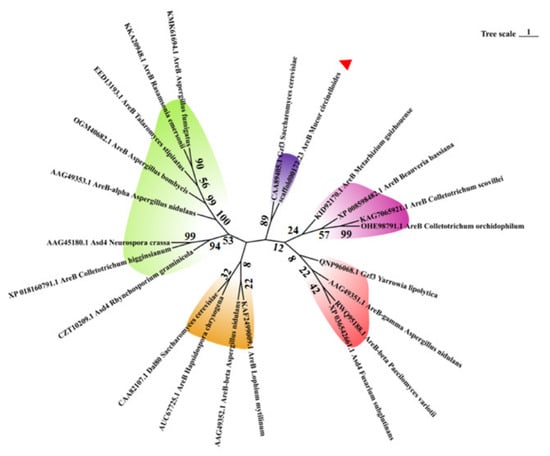
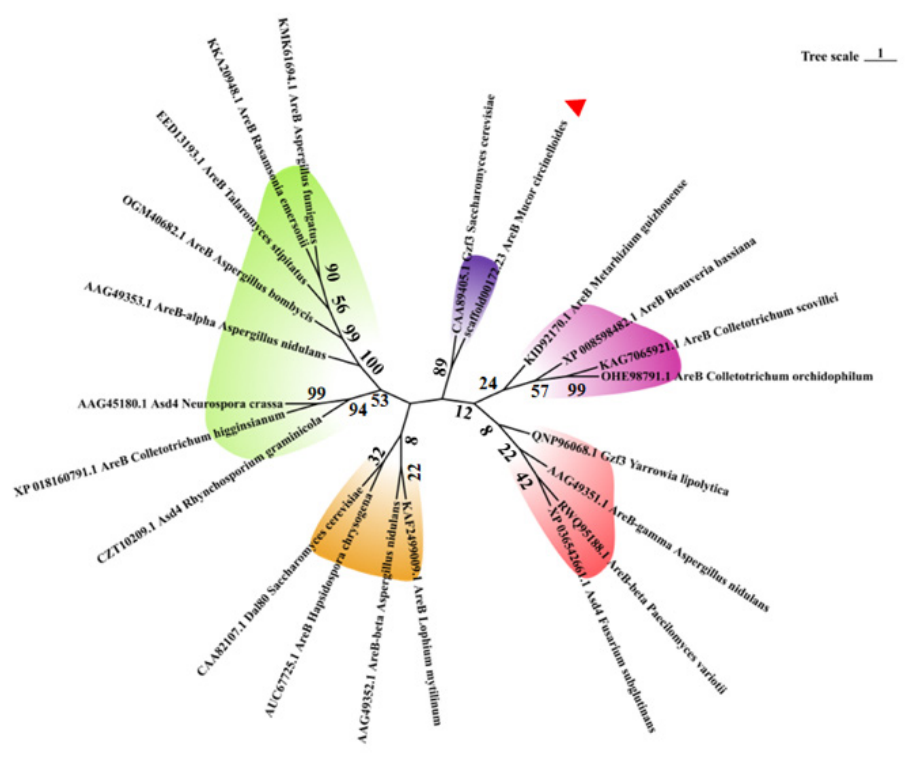
A candidate gene, located on scaffold00172.23 of M. circinelloides genome, was identified and designated as areB. As shown in the phylogenetic tree (Figure 1), the AreB protein of M. circinelloides is closely clustered with GATA factors from other filamentous fungi and yeasts, including orthologs such as AreB, Gzf3, Dal80 and Asd4. Sequence analysis revealed that M. circinelloides AreB contains a conserved GATA-type zinc finger domain (Cys-X2-Cys-X17-Cys-X2-Cys) at the N-terminal region, which is characteristic of GATA transcription factors (Figure S2). Multiple sequence alignment of M. circinelloides AreB with characterized fungal GATA factors, including Asd4 from N. crassa, AreB from A. nidulans, Gzf3 and Dal80 from S. cerevisiae, confirmed the conserved GATA zinc finger domain (Figure S2).
Figure 1.
Phylogenetic analysis of AreB and its orthologs. The phylogenetic tree was constructed using the neighbor-joining method with 10,000 bootstrap replicates. Bootstrap values are shown at each node. The red triangle indicates the AreB protein of M. circinelloides.
The deduced AreB protein consists of 689 amino acids with a calculated molecular weight of 77.17 kDa and a theoretical pI of 8.94 (Table 1). The instability index of 63.77 suggests that AreB is an unstable protein, and the negative GRAVY value (−0.368) indicates its hydrophilic nature. No signal peptide was detected in the full-length AreB protein. The hydrophilicity and hydrophobicity profile of AreB is detailed in Figure S3. The region spanning residues 1–400 exhibited predominantly negative hydrophilic scores, whereas the remaining residues displayed positive scores, reflecting a hydrophobicity feature. Additionally, a putative nuclear localization signal (NLS), 176KRRK179, was predicted in the hydrophilic region.
Table 1.
The properties of AreB in M. circinelloides WJ11.
3.2. Construction and Verification of the ΔareB and OE-areB Strains
The auxotrophic strain M65 (pyrF−, derived from WJ11) was used as the recipient for genetic transformation. All mutant constructs were generated via homologous recombination. For the knockout construct, the areB gene was replaced by the pyrF selection marker to generate the areB-knockout strain (ΔareB). The prototrophic revertant (pyrF+), obtained by introducing the pyrF fragment at its native locus, was designated as the wild-type strain (WT). For the overexpression construct, the areB coding sequence was inserted into the empty plasmid pMAT2075, which carries the pyrF selection marker and the pzrt1 promoter, and the recombinant cassette was integrated at the carRP locus, generating the areB-overexpression strain (OE-areB). The empty plasmid cassette was also inserted into the carRP locus to achieve uridine prototrophy restoration, generating the Mc2075 strain. At least three independent transformants were obtained for each construct. The positive transformants were verified by PCR (Figure S4). Three positive ΔareB transformants and seven positive OE-areB transformants were obtained, and one clone from each construct was selected for subsequent experiments. Since the WT and Mc2075 strains exhibited nearly identical phenotypes (Figure S5), the empty vector integration at the carRP locus was considered not to affect the phenotype. The WT strain was used as the control.
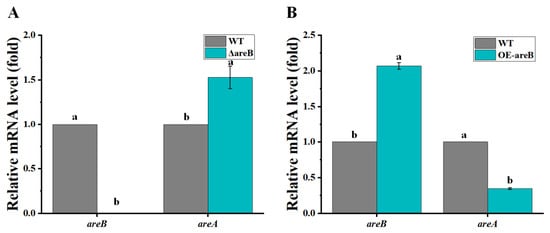
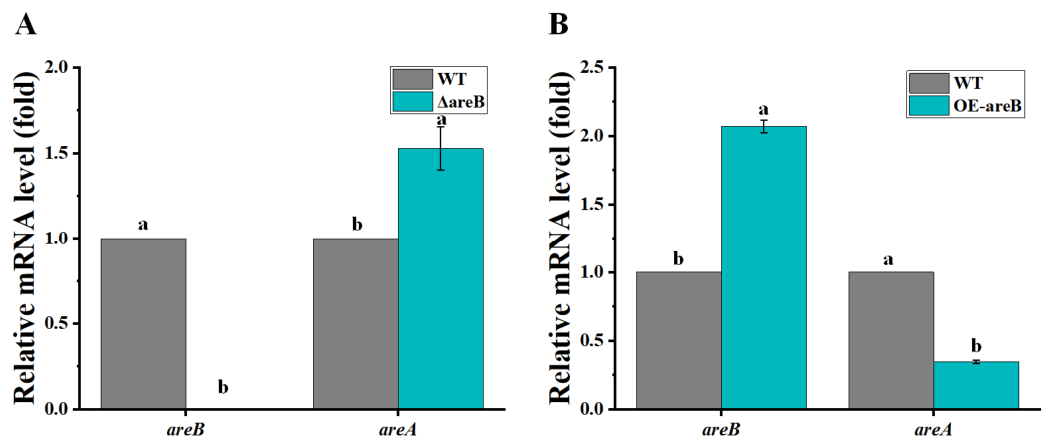
RT-qPCR analysis was further conducted to detect the transcriptional levels of areB. As illustrated in Figure 2, the expression of areB was nearly undetectable in the ΔareB strain and approximately 2-fold higher in the OE-areB strain relative to the WT strain. In addition, the transcriptional level of areA was also examined, revealing that areA was upregulated in the ΔareB strain but downregulated in the OE-areB strain. These results confirmed the successful construction of the ΔareB and OE-areB strains for subsequent phenotypic analysis.
Figure 2.
Relative expression levels of areB and areA in the WT, ΔareB, and OE-areB strains. (A) Relative expression levels of areB and areA in the WT and ΔareB strains. (B) Relative expression levels of areB and areA in the WT and OE-areB strains. The expression levels were normalized to the internal control (actin gene) and presented relative to the WT (set as 1.0). Data are presented as the mean ± SD (n = 3). Statistical analysis was performed using the Student’s t-test. Different lowercase letters (a, b) above bars indicate significant differences at p < 0.05. WT: wild-type strain; ΔareB: areB-knockout strain; OE-areB: areB-overexpression strain.
3.3. Effects of areB Deletion and Overexpression on Carbon and Nitrogen Utilization, Cell Growth, and Lipid Accumulation
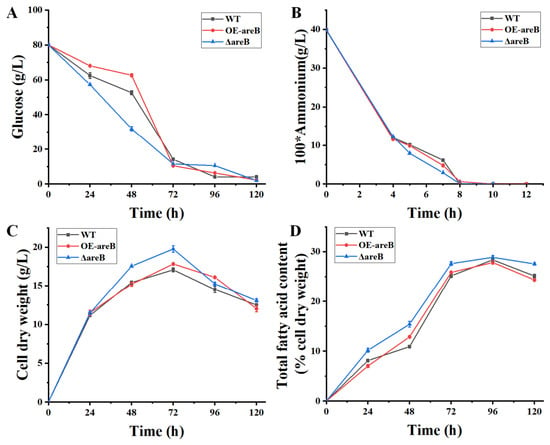
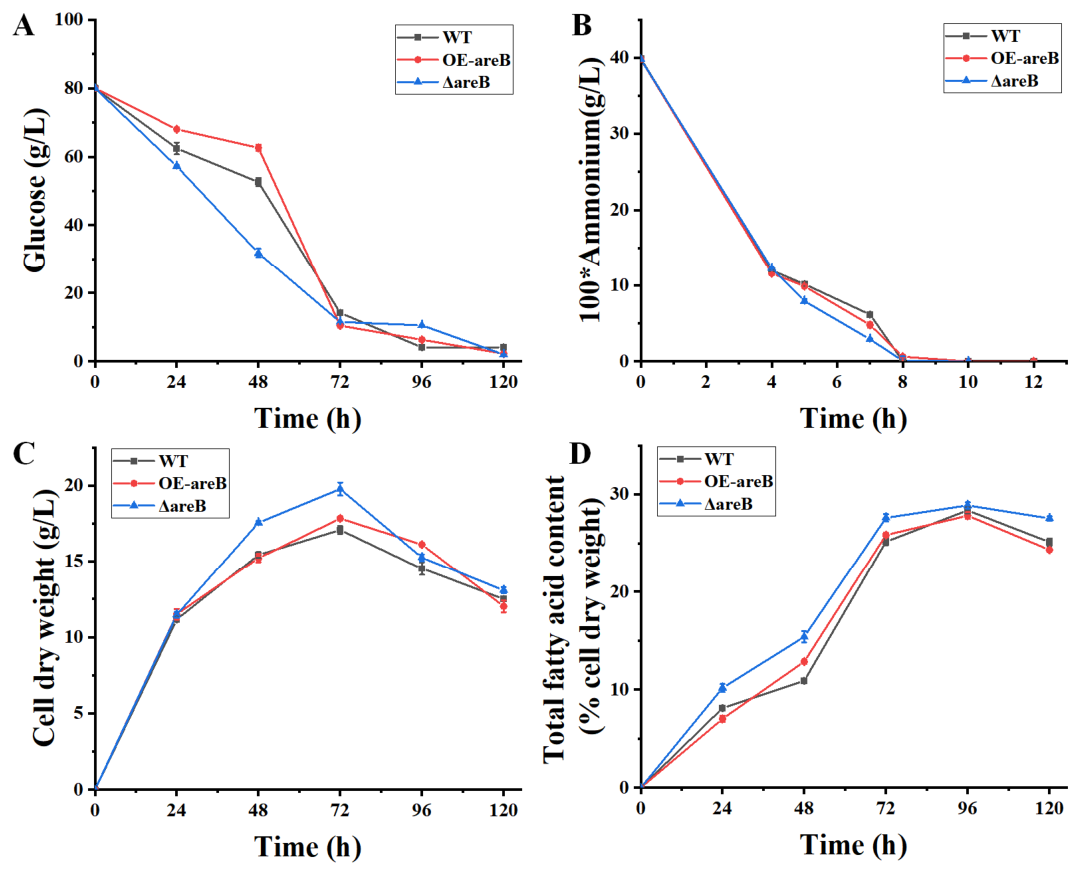
To characterize the physiological roles of areB in M. circinelloides, the ΔareB, OE-areB, and WT strains were cultivated under submerged fermentation for 120 h. As shown in Figure 3A, the ΔareB strain possessed the fastest glucose consumption rate, with residual glucose decreasing dramatically from 80 g/L to below 10 g/L after 72 h of cultivation, whereas the WT and the OE-areB strain displayed a relatively moderate glucose consumption pattern. To assess the role of AreB in nitrogen assimilation, the concentration of ammonium nitrogen was monitored hourly until complete depletion (Figure 3B). The ΔareB strain showed the most rapid ammonium utilization, with ammonium being exhausted at around 10 h, while the OE-areB strain achieved complete depletion by 12 h. These results suggest that AreB negatively regulates nitrogen assimilation, and its deletion can accelerate nitrogen utilization.
Figure 3.
Effects of areB deletion and overexpression on carbon and nitrogen utilization, cell growth, and lipid accumulation in M. circinelloides. (A) Residual glucose concentration. (B) Residual ammonium concentration. (C) Cell dry weight. (D) Total fatty acid content. WT: wild-type strain; ΔareB: areB-knockout strain; OE-areB: areB-overexpression strain.
The ΔareB strain exhibited the highest biomass, reaching 19.78 g/L at 72 h of fermentation (Figure 3C), which was higher than that of the WT (17.08 g/L) and the OE-areB strain (17.84 g/L). In terms of lipid accumulation (Figure 3D), the ΔareB strain showed a lipid content of 27.61% at 72 h, which was 9.7% higher than that of the WT (25.17%). In contrast, the lipid content of the overexpression strain was 25.85%, with little change compared to the WT. Collectively, these results demonstrate that deletion of areB promotes cell growth and lipid content, suggesting an essential role of AreB in coordinating nitrogen/carbon metabolism and lipid biosynthesis.
3.4. Relative Expression of Key Genes Related to Lipid Biosynthesis and Analysis of Critical Enzyme Activities
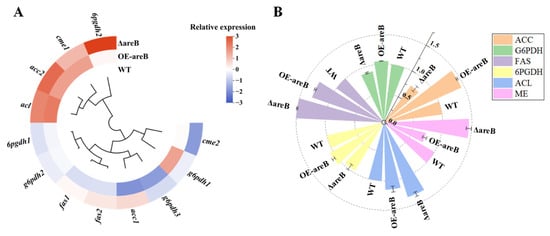
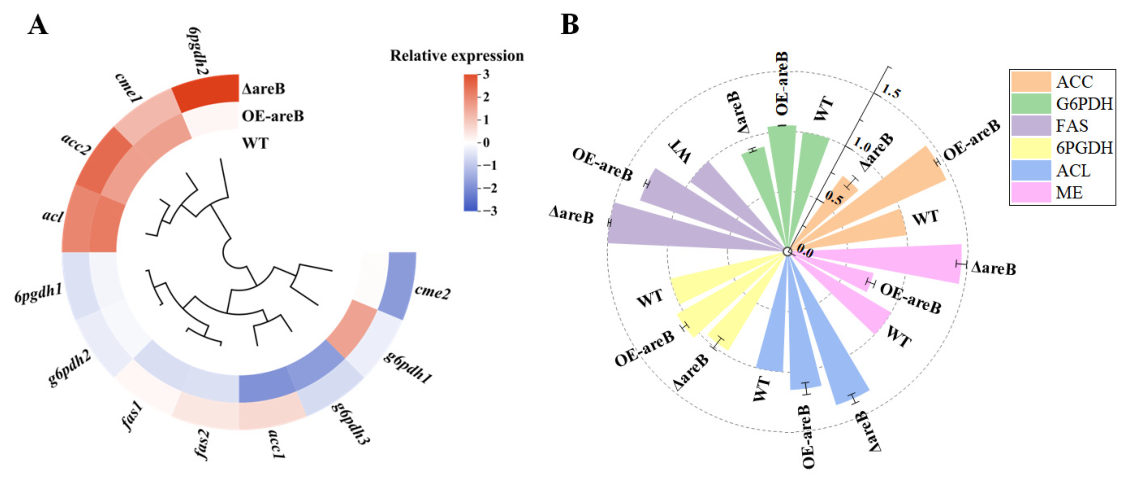
To investigate the molecular mechanism underlying the regulatory role of AreB in lipid accumulation, the transcriptional levels of core genes in the ΔareB and OE-areB strains were examined by RT-qPCR. The genes included acl (encoding ATP-citrate lyase, ACL), acc1 and acc2 (encoding acetyl CoA carboxylase, ACC), as well as fas1 and fas2 (encoding fatty acid synthase, FAS), which are responsible for de novo fatty acid biosynthesis. In addition, genes from the pentose phosphate pathway (PPP) and cytoplasmic malate enzymes (cME), which provide NADPH for fatty acid synthesis, were also determined, including g6pdh (encoding glucose-6-phosphate dehydrogenase), 6pgdh (encoding 6-phosphogluconate dehydrogenase), and cme (encoding malic enzyme). As shown in Figure 4A, the ΔareB strain exhibited significant upregulation of several genes, especially the expression levels of acl, acc2, cme1, and 6pgdh2. In addition, the transcription of fas1, fas2, and acc1 was slightly upregulated in the ΔareB strain. In contrast, the OE-areB strain showed upregulation of acl, acc2, cme1 and g6pdh1, but moderate downregulation of fas1, fas2, acc1 and g6pdh3.
Figure 4.
Relative gene expression (A) and relative enzyme activities (B) related to fatty acid biosynthesis. Heatmap of relative gene expression was presented as −ΔΔCt values, with red indicating upregulation and blue indicating downregulation. Relative enzyme activities are expressed as fold change relative to the WT strain (set as 1.0). WT: wild-type strain; ΔareB: areB-knockout strain; OE-areB: areB-overexpression strain.
To further validate the transcriptional changes at the protein level, the activities of corresponding key enzymes were measured (Figure 4B). Consistent with the transcriptional changes, the ΔareB strain exhibited increased activities of FAS (1.50-fold), ACL (1.34-fold), and ME (1.45-fold) compared with the WT, while the ACC activity was slightly reduced. These results indicate that the deletion of areB could activate key lipogenic genes and enzymes, thereby promoting fatty acid synthesis.
3.5. Effects of Different Nitrogen Sources on Growth and Lipid Accumulation of the ΔareB and OE-areB Strains
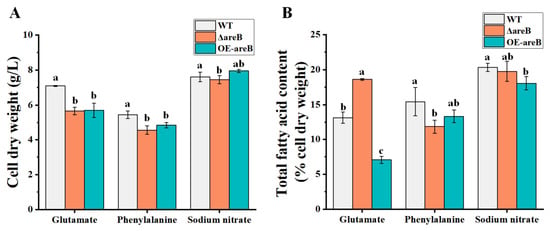
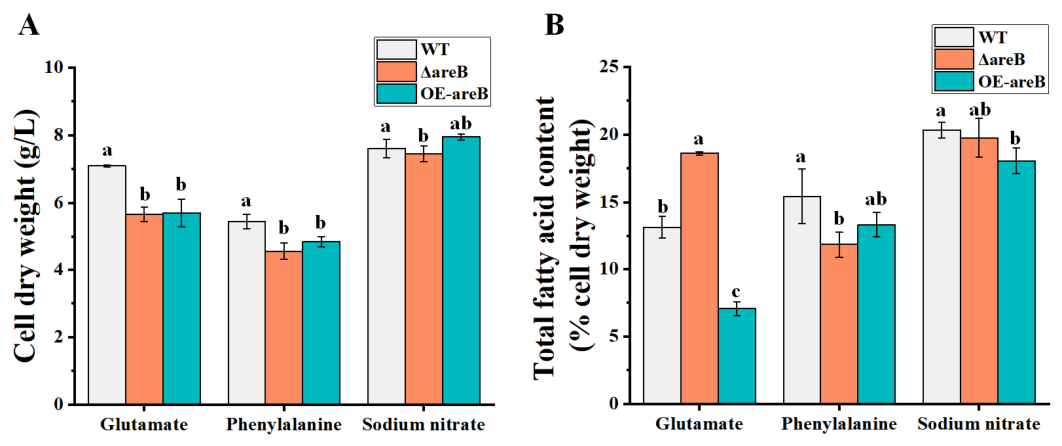
Previous studies have demonstrated that different nitrogen sources exert distinct effects on lipid accumulation in oleaginous fungi [30,31]. Given that AreB functions as a key regulator of nitrogen metabolism, we evaluated the growth and lipid accumulation capacity of the ΔareB, OE-areB, and WT strains cultured with three sole nitrogen sources (glutamate, phenylalanine, and sodium nitrate). As shown in Figure 5A, the biomass varied significantly depending on both nitrogen source and strain genotype. Under glutamate and phenylalanine conditions, the ΔareB and OE-areB strains exhibited lower cell dry weight than the WT strain. In sodium nitrate medium, no significant differences in biomass were detected among the three strains. For lipid accumulation (Figure 5B), the ΔareB strain showed a maximum 41% increase in TFA content when glutamate served as the sole nitrogen source. Further assessment of volumetric lipid production showed that the ΔareB strain reached 1.05 g/L under glutamate, relative to 0.93 g/L for the WT and 0.41 g/L for the OE-areB strain. In contrast, the TFA content decreased in the ΔareB strain with phenylalanine supplementation. Under sodium nitrate, no significant differences in either TFA content or volumetric lipid production were observed across the WT (20.32%, 1.54 g/L), ΔareB (19.76%, 1.46 g/L), and OE-areB (18.05%, 1.43 g/L) strains. These results suggest that the lipid phenotypes of ΔareB and OE-areB are most strongly affected when glutamate was used as the nitrogen source, supporting a proposed nitrogen-source dependent regulatory effect of AreB on lipid metabolism. Therefore, glutamate was selected as the optimal nitrogen source for subsequent transcriptomic analysis.
Figure 5.
Growth and lipid accumulation of the WT, ΔareB, and OE-areB strains under different nitrogen sources. (A) Biomass of the three strains cultured with glutamate, phenylalanine, or sodium nitrate as the sole nitrogen source. (B) Total fatty acid content of these three strains cultured with glutamate, phenylalanine, or sodium nitrate as the sole nitrogen source. Data are presented as mean ± SD (n = 3). Different letters above the bars indicate significant differences among strains within the same nitrogen source (p < 0.05, one-way ANOVA). WT: wild-type strain; ΔareB: areB-knockout strain; OE-areB: areB-overexpression strain.
3.6. Transcriptome Sequencing and DEGs Identification
To further uncover how AreB modulates lipid metabolism, RNA sequencing was performed. Fresh mycelia of the ΔareB and WT strains cultured with glutamate were harvested at 24 h, with three independent biological replicates for each group. Each sample generated tens of millions clean reads per sample, with an average mapping rate of 97.45% to the M. circinelloides WJ11 reference genome. The sequencing data quality was reliable, as indicated by Q30 scores above 99.38% for all samples. Principal component analysis (PCA) revealed a clear separation between the WT and ΔareB groups, demonstrating strong biological reproducibility and significant transcriptomic differences (Figure S6).
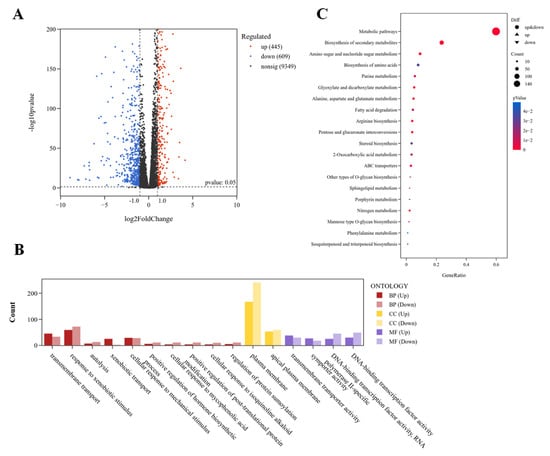
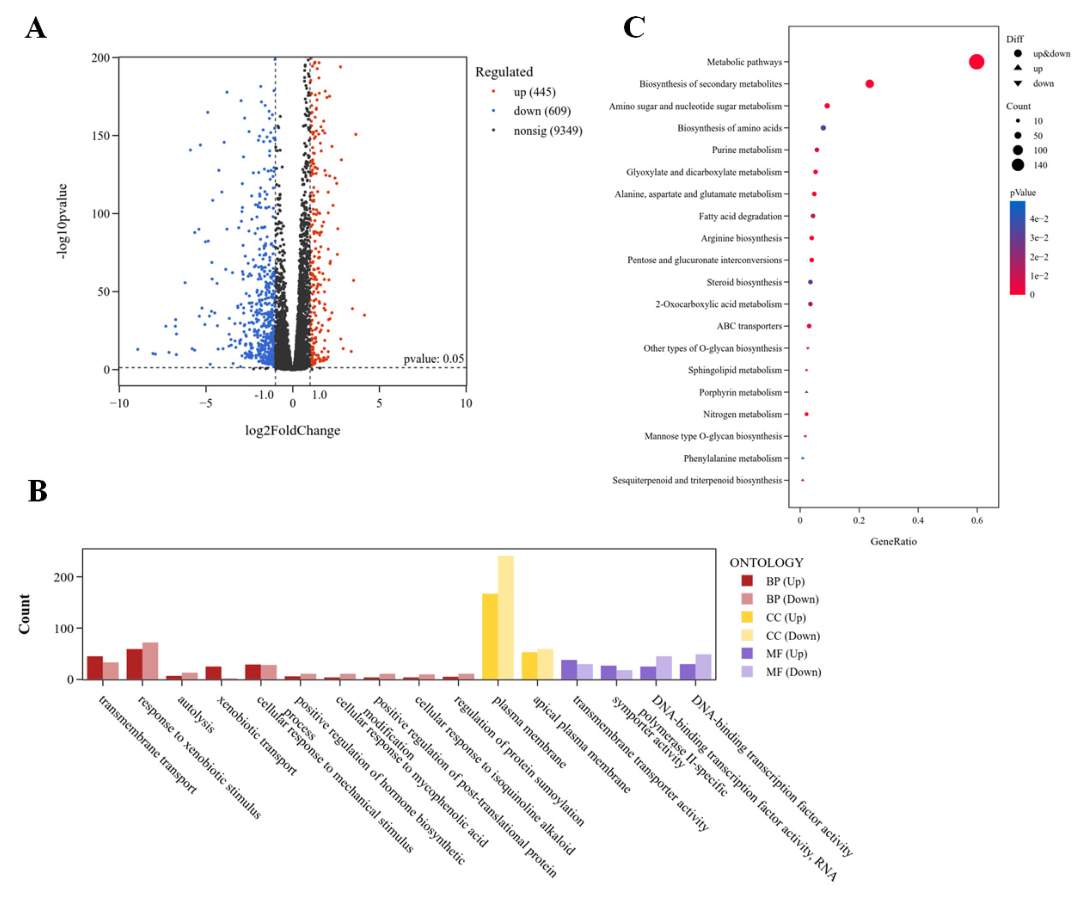
As shown in Figure 6A, the distribution of DEGs across the genome is presented in the volcano plot, and a total of 1054 differentially expressed genes (DEGs) were identified in the ΔareB strain compared with the WT, of which 445 genes were upregulated and 609 genes were downregulated (Table S2). These DEGs were further subjected to GO functional classification and KEGG pathway enrichment analysis to identify the key biological processes and metabolic pathways affected by areB deletion (Table S2). GO functional enrichment was classified into three basic categories, including biological process (BP), cellular component (CC), and molecular function (MF). As shown in Figure 6B, the DEGs were significantly enriched in plasma membrane (belongs to cellular component). For molecular function, the DEGs mainly participated in transmembrane transport activity. In terms of biological process, these DEGs were enriched in the pathway of response to environmental stimulus. These results indicate that the deletion of areB extensively influences cellular stress responses and signal sensing processes. KEGG pathway enrichment analysis (Figure 6C) further revealed that these DEGs were primarily enriched in metabolic pathways and secondary metabolite biosynthesis pathways, demonstrating that the loss of areB profoundly remodels the metabolic networks of M. circinelloides. Considering that the enriched metabolic pathways cover carbohydrate metabolism, lipid metabolism, and amino acid metabolism, we further focused on central carbon and nitrogen metabolism.
Figure 6.
Transcriptomic analysis of the ΔareB strain compared with the WT strain. (A). Volcano plot of differentially expressed genes (DEGs). Red dots: significantly upregulated genes; blue dots: significantly downregulated genes; gray dots: non-significant genes. The vertical dashed lines indicate |log2(fold change)| = 1, and the horizontal dashed line indicates p-value < 0.05. (B). Gene Ontology (GO) functional classification of DEGs. BP: Biological Process; CC: Cellular Component; MF: Molecular Function. (C). KEGG pathway enrichment analysis of DEGs. The x-axis represents GeneRatio (ratio of the number of DEGs enriched in the pathway to the total number of genes annotated to this pathway). The y-axis lists the top 20 enriched pathway. The dot size indicates the number of DEGs, and the color gradient represents the adjusted p-value. All data are based on three independent biological replicates.
3.7. DEGs in Central Carbon and Nitrogen Metabolism
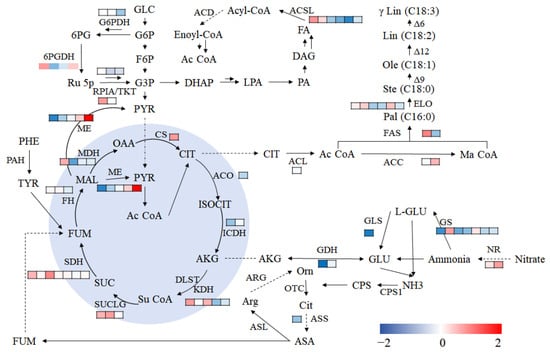
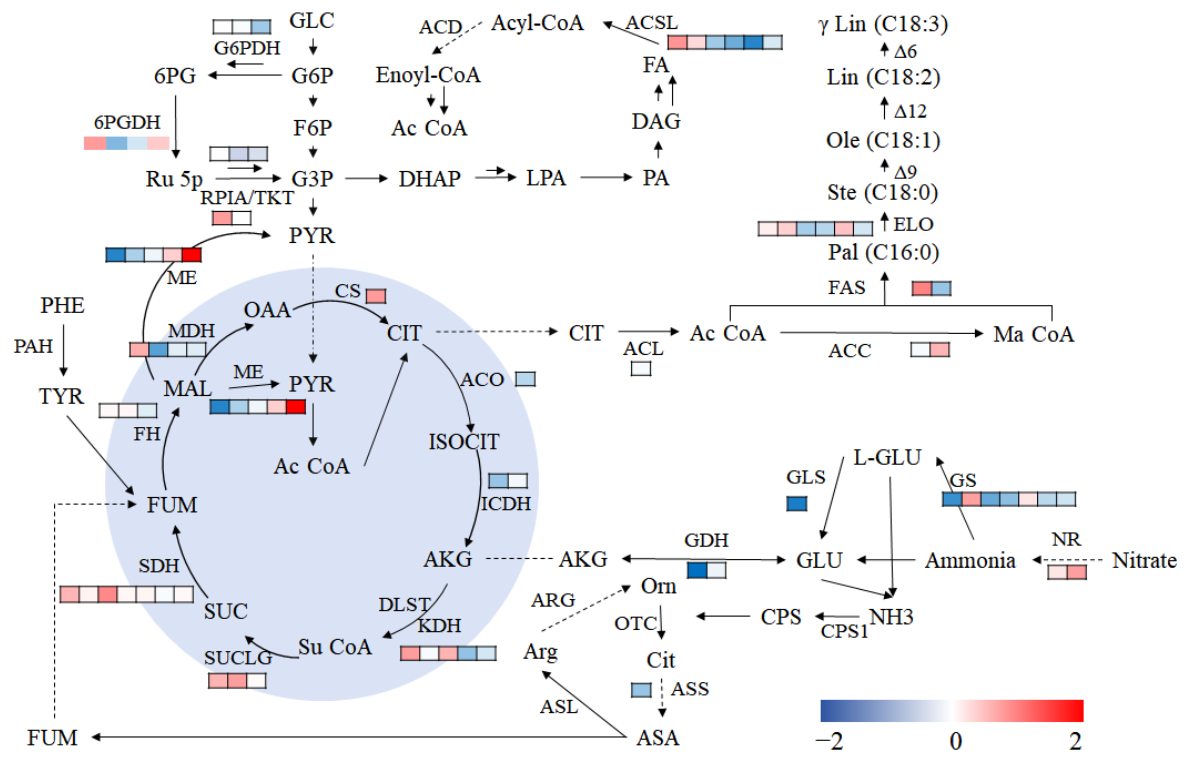
To reveal the AreB-mediated metabolic reprogramming, DEGs involved in central carbon and nitrogen metabolism were further analyzed (Figure 7). In nitrogen metabolism, genes involved in glutamine synthetase (gln), glutamate synthase (glt), and glutamate dehydrogenase (gdh) were downregulated, while the gene encoding nitrate reductase (nr) was significantly upregulated in the ΔareB strain, indicating that AreB negatively regulates its transcription. For central carbon metabolism, numerous key genes participating in the tricarboxylic acid (TCA) cycle were differentially expressed, indicating that the carbon metabolism was extensively remodeled. Several genes encoding the G6PDH and malic enzymes, which supply NADPH for fatty acid biosynthesis, showed increased transcript levels. In addition, the cs gene encoding citrate synthase was upregulated, providing an increased supply of citrate as a precursor for acetyl-CoA generation. Consistently, genes encoding acetyl-CoA carboxylase and fatty acid synthase were upregulated, further supporting the activation of the lipid biosynthetic pathway. Collectively, these results suggest that deletion of areB redirects carbon flux towards lipid biosynthesis.
Figure 7.
Heatmap of differentially expressed genes (DEGs) involved in central carbon and nitrogen metabolism. The color scale represents log2 fold change (ΔareB vs. WT), with red indicating upregulation and blue indicating downregulation. Each colored block represents the expression level of a gene. The abbreviations for genes and metabolites are listed in Table S3. Solid arrows represent direct metabolic reactions, whereas dashed arrows indicate indirect reactions, multi-step pathways, or substance transport.
4. Discussion
Nitrogen is a key limiting nutrient for fungal development and metabolism. Filamentous fungi have evolved a sophisticated regulatory system known as nitrogen metabolite repression (NMR), which enables cells to rapidly adapt to fluctuating environmental nitrogen conditions [32]. The GATA-type transcription factors AreA and AreB act as central regulators of this network, functioning as activator and repressor, respectively, to prioritize the utilization of preferred nitrogen sources while repressing the secondary nitrogen sources [33]. This regulatory interplay may allow cells to precisely control nitrogen assimilation and carbon partitioning in response to changing nitrogen availability.
In this study, we identified and characterized the AreB homolog in M. circinelloides. Bioinformatic analysis indicated that AreB possesses a conserved zinc finger domain (Cys-X2-Cys-X17-Cys-X2-Cys), which is characteristic of GATA-type transcription factors. A putative nuclear localization signal (NLS, residues 176KRRK179) was predicted within the N-terminal hydrophilic region, while no signal peptide was detected, suggesting that AreB may function as an intracellular transcriptional regulator rather than entering the secretory pathway. The nuclear transport of NIT-2 in N. crassa is mediated by importin-α through recognition of its NLS sequence [34]. In A. nidulans, the GATA activator AreA contains multiple NLSs that function redundantly to ensure efficient nuclear import [35]. In contrast, the nuclear accumulation of yeast Gln3p is regulated by phosphorylation and Ure2p-dependent cytoplasmic anchoring [36]. Collectively, these bioinformatically predicted structural features suggest that AreB may function as a nuclear GATA transcription factor.
We therefore constructed the ΔareB and OE-areB strains to investigate the regulatory role of AreB in M. circinelloides. Notably, the transcription level of areA was upregulated in the ΔareB strain but downregulated in the OE-areB strain, suggesting a potential cross-regulation between these two GATA factors. This is consistent with the previous findings in A. nidulans, where AreA and AreB may function as antagonists by competing for the overlapping GATA binding sites [37]. Phenotypic assays further revealed that deletion of areB led to enhanced cell growth, accelerated carbon and nitrogen utilization, and increased lipid accumulation, whereas overexpression of areB had negligible effects. Specifically, the ΔareB strain exhibited faster nitrogen consumption, suggesting that AreB may repress nitrogen assimilation. These observations support a proposed negative regulatory role of AreB in nitrogen metabolism.
To further investigate the molecular mechanism underlying the regulatory role of AreB in fatty acid biosynthesis, we performed RT-qPCR to examine the transcription levels of key lipogenic genes and measured the corresponding enzyme activities in mutant strains. ACL can provide sufficient acetyl-CoA precursors by cleaving cytoplasmic citrate. Heterologous expression of acl in non-oleaginous S. cerevisiae resulted in a 15.4% increase in lipid content [38], suggesting its critical role in acetyl-CoA supply. ACC then catalyzes the conversion of acetyl-CoA to malonyl-CoA, which is condensed by FAS to elongate fatty acid chains. ME is the first identified enzyme responsible for generating NADPH, which serves as the essential reducing power for lipid biosynthesis. Inhibition of ME activity by sesamol reduced the lipid content to only 2% in M. circinelloides CBS108.16, highlighting its indispensable role in providing NADPH for lipogenesis [39]. In addition, PPP serves as an alternative compensatory source of cellular NADPH. Overexpression of g6pdh and 6pgdh genes from PPP in M. circinelloides CBS277.49 improved the lipid content by 20–30% [40]. In our study, the ΔareB strain exhibited significant upregulation of acl, acc2, fas1, fas2, cme1 and 6pgdh2, accompanied by the increased enzyme activities of ACL, FAS, and ME. The coordinated upregulation of these lipogenic genes and enzymes may support sufficient substrate supply and reducing power for de novo fatty acid biosynthesis. Collectively, these results suggest that deletion of areB may activate the lipogenic gene expression and enzyme activity, thereby potentially contributing to lipid accumulation.
Our phenotypic assays across glutamate, phenylalanine, and nitrate demonstrated that the regulatory influence of AreB on lipid accumulation is nitrogen-source dependent. The most prominent phenotypic changes in the mutant strains were observed when glutamate served as the sole nitrogen source; in contrast, lipid phenotypes changed little under other nitrogen sources. Transcriptomic analysis further unveiled the global transcriptional reprogramming in the ΔareB strain when cultured with glutamate as the sole nitrogen source. GO analysis revealed that loss of areB primarily affects the membrane transport system in response to environmental stimuli. KEGG enrichment indicated that DEGs were predominantly enriched in metabolic pathways. Notably, genes within the same pathway exhibited divergent expression patterns. In the TCA cycle, several key genes (e.g., aco, icdh) were downregulated in the ΔareB strain, whereas others were upregulated, suggesting possible citrate accumulation, which serve as a precursor for acetyl-CoA. Concurrently, genes encoding 6PGDH and ME were upregulated and may supply NADPH for fatty acid synthesis. Moreover, lipogenic genes, including acc2 and fas, were upregulated, potentially supporting enhanced acetyl-CoA supply and de novo fatty acid synthesis. In nitrogen metabolism, the downregulation of gln, glt, and gdh suggests impaired primary nitrogen assimilation, while the upregulation of nr (nitrate reductase) suggests an alternative nitrogen utilization pathway. Collectively, these results indicate that the deletion of areB may promote lipid accumulation by redirecting carbon flux towards fatty acid synthesis.
5. Conclusions
In this study, we identified the GATA-type transcription factor AreB in the oleaginous fungus M. circinelloides and explored its regulatory function by constructing the ΔareB and OE-areB strains. Fermentation assays showed that the deletion of areB promoted cell growth and moderately increased cellular lipid content, while overexpression of areB slightly inhibited lipid biosynthesis with little influence on biomass. Transcriptomic analysis further indicated that the deletion of areB may redirect carbon flux towards fatty acid biosynthesis. These findings suggest that AreB may function as a key negative regulator on nitrogen metabolism, thereby modulating carbon-nitrogen metabolic balance and influencing lipid accumulation in M. circinelloides.
Supplementary Materials
The following supporting information can be downloaded at: https://www.mdpi.com/article/10.3390/fermentation12100483/s1, Table S1. Primers and their sequences used in this study; Table S2. Differentially expressed genes (DEGs) and GO/KEGG enrichment analysis identified in the ΔareB strain compared with the WT strain; Table S3. List of abbreviations used in Figure 7; Figure S1. The map of areB-knockout (pCRC172) and areB-overexpression (pCRC173) plasmids; Figure S2. Sequence analysis of AreB in M. circinelloides; Figure S3. The hydrophilicity and hydrophobicity profile of the deduced AreB; Figure S4. PCR verification of the ΔareB and OE-areB strains; Figure S5. Phenotypic comparison of the WT and Mc2075 strains; Figure S6. Principal component analysis (PCA) of transcriptomic data from the WT and ΔareB strains.
Author Contributions
Writing—original draft preparation, X.W.; writing—review and editing, X.L.; data curation, W.Y.; methodology, Y.F.; funding acquisition, Y.S. All authors have read and agreed to the published version of the manuscript.
Funding
This research was funded by the Special Research Start-up Fund for the Introduction of High-level Talents of Qilu Medical University (004080340).
Institutional Review Board Statement
Not applicable.
Informed Consent Statement
Not applicable.
Data Availability Statement
The original contributions presented in the study are included in the article, further inquiries can be directed to the corresponding author.
Conflicts of Interest
The authors declare no conflicts of interest.
References
- Conrad, M.; Schothorst, J.; Kankipati, H.N.; Van Zeebroeck, G.; Rubio-Texeira, M.; Thevelein, J.M. Nutrient sensing and signaling in the yeast Saccharomyces cerevisiae. FEMS Microbiol. Rev. 2014, 38, 254–299. [Google Scholar] [CrossRef] [Scilit]
- Nair, A.; Sarma, S.J. The impact of carbon and nitrogen catabolite repression in microorganisms. Microbiol. Res. 2021, 251, 126831. [Google Scholar] [CrossRef] [Scilit]
- Wong, K.H.; Hynes, M.J.; Davis, M.A. Recent advances in nitrogen regulation: A comparison between Saccharomyces cerevisiae and filamentous fungi. Eukaryot. Cell 2008, 7, 917–925. [Google Scholar] [CrossRef] [Scilit]
- Macios, M.; Caddick, M.X.; Weglenski, P.; Scazzocchio, C.; Dzikowska, A. The GATA factors AREA and AREB together with the co-repressor NMRA, negatively regulate arginine catabolism in Aspergillus nidulans in response to nitrogen and carbon source. Fungal Genet. Biol. 2012, 49, 189–198. [Google Scholar] [CrossRef] [Scilit]
- Milhomem Cruz-Leite, V.R.; Salem-Izacc, S.M.; Novaes, E.; Neves, B.J.; de Almeida Brito, W.; O’Hara Souza Silva, L.; Paccez, J.D.; Parente-Rocha, J.A.; Pereira, M.; Maria de Almeida Soares, C.; et al. Nitrogen Catabolite Repression in members of Paracoccidioides complex. Microb. Pathog. 2020, 149, 104281. [Google Scholar] [CrossRef] [Scilit]
- Oliveira, E.M.; Martins, A.S.; Carvajal, E.; Bon, E.P. The role of the GATA factors Gln3p, Nil1p, Dal80p and the Ure2p on ASP3 regulation in Saccharomyces cerevisiae. Yeast 2003, 20, 31–37. [Google Scholar] [CrossRef] [Scilit]
- Wong, K.H.; Hynes, M.J.; Todd, R.B.; Davis, M.A. Deletion and overexpression of the Aspergillus nidulans GATA factor AreB reveals unexpected pleiotropy. Microbiology 2009, 155, 3868–3880. [Google Scholar] [CrossRef] [Scilit]
- Conlon, H.; Zadra, I.; Haas, H.; Arst, H.N., Jr.; Jones, M.G.; Caddick, M.X. The Aspergillus nidulans GATA transcription factor gene areB encodes at least three proteins and features three classes of mutation. Mol. Microbiol. 2001, 40, 361–375. [Google Scholar] [CrossRef] [Scilit]
- Magasanik, B.; Kaiser, C.A. Nitrogen regulation in Saccharomyces cerevisiae. Gene 2002, 290, 1–18. [Google Scholar] [CrossRef] [Scilit]
- Haas, H.; Angermayr, K.; Zadra, I.; Stöffler, G. Overexpression of nreB, a new GATA factor-encoding gene of Penicillium chrysogenum, leads to repression of the nitrate assimilatory gene cluster. J. Biol. Chem. 1997, 272, 22576–22582. [Google Scholar] [CrossRef] [Scilit]
- Feng, B.; Haas, H.; Marzluf, G.A. ASD4, a new GATA factor of Neurospora crassa, displays sequence-specific DNA binding and functions in ascus and ascospore development. Biochemistry 2000, 39, 11065–11073. [Google Scholar] [CrossRef] [Scilit]
- Michielse, C.B.; Pfannmüller, A.; Macios, M.; Rengers, P.; Dzikowska, A.; Tudzynski, B. The interplay between the GATA transcription factors AreA, the global nitrogen regulator and AreB in Fusarium fujikuroi. Mol. Microbiol. 2014, 91, 472–493. [Google Scholar] [CrossRef] [Scilit]
- Kang, X.X.; Wang, Q.Q.; Chi, Z.; Liu, G.L.; Hu, Z.; Chi, Z.M. The GATA type transcriptional factors regulate pullulan biosynthesis in Aureobasidium melanogenum P16. Int. J. Biol. Macromol. 2021, 192, 161–168. [Google Scholar] [CrossRef] [Scilit]
- Tudzynski, B. Nitrogen regulation of fungal secondary metabolism in fungi. Front. Microbiol. 2014, 5, 656. [Google Scholar] [CrossRef] [Scilit]
- Ratledge, C. Fatty acid biosynthesis in microorganisms being used for Single Cell Oil production. Biochimie 2004, 86, 807–815. [Google Scholar] [CrossRef] [Scilit]
- Kerkhoven, E.J.; Pomraning, K.R.; Baker, S.E.; Nielsen, J. Regulation of amino-acid metabolism controls flux to lipid accumulation in Yarrowia lipolytica. npj Syst. Biol. Appl. 2016, 2, 16005. [Google Scholar] [CrossRef] [Scilit]
- Pomraning, K.R.; Kim, Y.M.; Nicora, C.D.; Chu, R.K.; Bredeweg, E.L.; Purvine, S.O.; Hu, D.; Metz, T.O.; Baker, S.E. Multi-omics analysis reveals regulators of the response to nitrogen limitation in Yarrowia lipolytica. BMC Genom. 2016, 17, 138. [Google Scholar] [CrossRef] [Scilit]
- Pomraning, K.R.; Bredeweg, E.L.; Baker, S.E. Regulation of Nitrogen Metabolism by GATA Zinc Finger Transcription Factors in Yarrowia lipolytica. mSphere 2017, 2, e00038-17. [Google Scholar] [CrossRef] [Scilit]
- Hu, H.; Li, P.; Li, S.; Wang, X.; Mohamed, H.; López-García, S.; Liu, Q.; Garre, V.; Song, Y. The role of areA in lipid accumulation in high lipid-producing fungus Mucor circinelloides WJ11. Biochim Biophys. Acta Mol. Cell Biol. Lipids 2024, 1869, 159450. [Google Scholar] [CrossRef] [Scilit]
- Wang, X.; Li, S.; Pang, S.; Liu, Q.; Song, Y. Regulation of AreA on lipid biosynthesis under different nitrogen sources and C/N ratios in the model oleaginous fungus Mucor circinelloides. Biochim Biophys. Acta Mol. Cell Biol. Lipids 2024, 1869, 159537. [Google Scholar] [CrossRef] [Scilit]
- Wang, X.; Mohamed, H.; Hina, K.; Liu, Q.; Fan, Z.; Song, Y. Role of AreA in regulating lipid metabolism through modulation of MEP2 in the oleaginous fungus Mucor circinelloides. Food Biosci. 2025, 68, 106476. [Google Scholar] [CrossRef] [Scilit]
- Wang, X.; Mohamed, H.; Liu, Q.; Fan, Z.; Song, Y. The nitrogen regulator AreA modulates lipid metabolism through uga2 in Mucor circinelloides. Fungal Biol. 2025, 129, 101616. [Google Scholar] [CrossRef] [Scilit]
- Xie, J.; Chen, Y.; Cai, G.; Cai, R.; Hu, Z.; Wang, H. Tree Visualization By One Table (tvBOT): A web application for visualizing, modifying and annotating phylogenetic trees. Nucleic Acids Res. 2023, 51, W587–W592. [Google Scholar] [CrossRef] [Scilit]
- Li, S.; Yang, J.; Mohamed, H.; Wang, X.; Pang, S.; Wu, C.; López-García, S.; Song, Y. Identification and Functional Characterization of Adenosine Deaminase in Mucor circinelloides: A Novel Potential Regulator of Nitrogen Utilization and Lipid Biosynthesis. J. Fungi 2022, 8, 774. [Google Scholar] [CrossRef] [Scilit]
- Garre, V.; Barredo, J.L.; Iturriaga, E.A. Transformation of Mucor circinelloides f. lusitanicus Protoplasts. In Genetic Transformation Systems in Fungi; Springer: Berlin/Heidelberg, Germany, 2015; Volume 1, pp. 49–59. [Google Scholar]
- Wang, X.; Yang, J.; Mohamed, H.; Shah, A.M.; Li, S.; Pang, S.; Wu, C.; Xue, F.; Shi, W.; Sadaqat, B.; et al. Simultaneous overexpression of ∆6-, ∆12- and ∆9-desaturases enhanced the production of γ-linolenic acid in Mucor circinelloides WJ11. Front. Microbiol. 2022, 13, 1078157. [Google Scholar] [CrossRef] [Scilit]
- Chaney, A.L.; Marbach, E.P. Modified reagents for determination of urea and ammonia. Clin. Chem. 1962, 8, 130–132. [Google Scholar] [CrossRef] [Scilit]
- Kim, D.; Langmead, B.; Salzberg, S.L. HISAT: A fast spliced aligner with low memory requirements. Nat. Methods 2015, 12, 357–360. [Google Scholar] [CrossRef] [Scilit]
- Love, M.I.; Huber, W.; Anders, S. Moderated estimation of fold change and dispersion for RNA-seq data with DESeq2. Genome Biol. 2014, 15, 550. [Google Scholar] [CrossRef] [Scilit]
- Lu, J.; Peng, C.; Ji, X.J.; You, J.; Cong, L.; Ouyang, P.; Huang, H. Fermentation characteristics of Mortierella alpina in response to different nitrogen sources. Appl. Biochem. Biotechnol. 2011, 164, 979–990. [Google Scholar] [CrossRef] [Scilit]
- Tang, X.; Zhang, H.; Chen, H.; Chen, Y.Q.; Chen, W.; Song, Y. Effects of 20 standard amino acids on the growth, total fatty acids production, and γ-linolenic acid yield in Mucor circinelloides. Curr. Microbiol. 2014, 69, 899–908. [Google Scholar] [CrossRef] [Scilit]
- Kerkaert, J.D.; Huberman, L.B. Regulation of nutrient utilization in filamentous fungi. Appl. Microbiol. Biotechnol. 2023, 107, 5873–5898. [Google Scholar] [CrossRef] [Scilit]
- Hu, D.; Zhao, R.; Lin, Y.; Jiang, C. Evolution and Functional Diversity of GATA Transcription Factors in Filamentous Fungi: Structural Characteristics, Metabolic Regulation and Environmental Response. Microbiol. Res. 2025, 16, 120. [Google Scholar] [CrossRef] [Scilit]
- Bernardes, N.E.; Takeda, A.A.S.; Dreyer, T.R.; Cupertino, F.B.; Virgilio, S.; Pante, N.; Bertolini, M.C.; Fontes, M.R.M. Nuclear transport of the Neurospora crassa NIT-2 transcription factor is mediated by importin-α. Biochem J. 2017, 474, 4091–4104. [Google Scholar] [CrossRef] [Scilit]
- Hunter, C.C.; Siebert, K.S.; Downes, D.J.; Wong, K.H.; Kreutzberger, S.D.; Fraser, J.A.; Clarke, D.F.; Hynes, M.J.; Davis, M.A.; Todd, R.B. Multiple nuclear localization signals mediate nuclear localization of the GATA transcription factor AreA. Eukaryot. Cell 2014, 13, 527–538. [Google Scholar] [CrossRef] [Scilit]
- Kulkarni, A.A.; Abul-Hamd, A.T.; Rai, R.; El Berry, H.; Cooper, T.G. Gln3p nuclear localization and interaction with Ure2p in Saccharomyces cerevisiae. J. Biol. Chem. 2001, 276, 32136–32144. [Google Scholar] [CrossRef] [Scilit]
- Chudzicka-Ormaniec, P.; Macios, M.; Koper, M.; Weedall, G.D.; Caddick, M.X.; Weglenski, P.; Dzikowska, A. The role of the GATA transcription factor AreB in regulation of nitrogen and carbon metabolism in Aspergillus nidulans. FEMS Microbiol. Lett. 2019, 366, fnz066. [Google Scholar] [CrossRef] [Scilit]
- Tang, X.; Feng, H.; Chen, W.N. Metabolic engineering for enhanced fatty acids synthesis in Saccharomyces cerevisiae. Metab. Eng. 2013, 16, 95–102. [Google Scholar] [CrossRef] [Scilit]
- Wynn, J.P.; Kendrick, A.; Ratledge, C. Sesamol as an inhibitor of growth and lipid metabolism in Mucor circinelloides via its action on malic enzyme. Lipids 1997, 32, 605–610. [Google Scholar] [CrossRef] [Scilit]
- Zhao, L.; Tang, X.; Luan, X.; Chen, H.; Chen, Y.; Chen, W.; Song, Y.; Ratledge, C. Role of pentose phosphate pathway in lipid accumulation of oleaginous fungus Mucor circinelloides. RSC Adv. 2015, 5, 97658–97664. [Google Scholar] [CrossRef] [Scilit]

Disclaimer/Publisher’s Note: The statements, opinions and data contained in all publications are solely those of the individual author(s) and contributor(s) and not of MDPI and/or the editor(s). MDPI and/or the editor(s) disclaim responsibility for any injury to people or property resulting from any ideas, methods, instructions or products referred to in the content. |
© 2026 by the authors. Licensee MDPI, Basel, Switzerland. This article is an open access article distributed under the terms and conditions of the Creative Commons Attribution (CC BY) license.