


Abstract
The chirality-specific study of single-walled carbon nanotubes (SWCNTs) necessitates their solution-phase processing with tip-horn sonication in the presence of a stabilizing surfactant such as sodium dodecyl sulfate (SDS), a process that has been shown to introduce sonochemical side-products such as dodecanol, dodecanal, and dodecene. This work employs single-column interactions within the overloading regime to quantitatively assess the impacts of dodecanol, dodecanal, and dodecene on the ability to purify SWCNTs using Sephacryl S-200 hydrogel. Increasing concentrations of each additive caused a corresponding decrease in the number of SWCNTs adsorbed to the gel, with a 50% reduction in SWCNT uptake realized at 0.75–1.00 mM for all three additives. Per-chirality adsorption selectivity was unaffected by relatively low additive concentration, but it was significantly hindered nearer the solubility limit of each additive. Elution efficiency from each gel was independent of additives, additive concentration, and SWCNT chirality. Mechanistically, these findings suggest the integration of each additive within the micelle structure of SDS. While the concentration of each additive introduced during tip-horn sonication is insufficient to impact gel-based SWCNT purification, the presence of dodecanol impurities within as-purchased SDS have the potential to significantly impact the purification outcome, suggesting that future studies of gel-based SWCNT purification should be carried out with SDS purified by recrystallization.
1. Introduction
Single-walled carbon nanotubes (SWCNTs) exhibit structurally dependent properties that have made them enticing candidates for the enhancement of devices and schemes, including within nanoscale electronics [1,2], photovoltaics [3,4], batteries [5,6], composites [7,8], and biosensors [9]. Further, their sole composition of earth-abundant carbon makes them an attractive nanomaterial for future applications in each of these areas. Depending on their characteristic chiral wrapping indices (n,m), which describe the structure of a SWCNT relative to its two-dimensional graphene counterpart [10], SWCNTs exhibit either metallic or semiconducting band structures [11], with those of the semiconducting variety exhibiting narrow absorbance and emission bands in the near-infrared, ranging from 850 nm to 1800 nm. To take full advantage of these structurally dependent properties necessitates the generation of chirally pure materials, that is, SWCNTs that are highly enriched in a single (n,m) chirality. Unfortunately, due to inherent thermodynamic limitations in bulk-scale synthetic methods [12], preparative quantities of SWCNTs inevitably contain many chiralities, necessitating post-synthetic purification to generate chirally pure materials. While many methods have been developed to achieve this aim [13,14], perhaps the most efficient and scalable method is gel-based purification [15], which takes advantage of type- and chirality-dependent interactions between aqueous suspensions of SWCNTs and hydrogel microspheres in a column format [16]. This work explores the impact of a series of byproducts of the SWCNT processing method on the ability to achieve purification using gel-based methods.
Preparative quantities of SWCNTs are commercially available as powders comprising bundled “ropes” of SWCNTs that do not exhibit characteristic absorbance or emission bands due to electronic coupling between neighboring tubes [17]. To afford the chirality-dependent properties of SWCNTs, bundles must be separated using high-energy tip-horn sonication in the presence of a surfactant [18] or some other polymeric stabilizer [19,20] that prevents aggregation of tubes through thermodynamically stable sidewall–sidewall interactions. Subjecting SWCNTs to tip-horn sonication to create colloidally stable suspensions of tubes is a nearly ubiquitous step within investigations or implementations of bulk-scale SWCNTs. Mechanistically, tip-horn sonication creates microscale cavitations that, upon their collapse, corresponds with a local temperature spike of up to 5000 K [21]. This energy is sufficient to break apart bundled SWCNTs into individualized tubes [22], cut individualized tubes along their length [23], and impart sidewall defects into individualized tubes through oxidation [24]. While the impact of sonochemical treatment on SWCNTs has been reported extensively, the effects of such treatment on surfactants present alongside the SWNTs have only been elucidated recently. Specifically, our group developed a low-cost gas chromatography-based analytical method (Mastalka-Tatro et al., in preparation; see Supporting Information Section S1 for brief description of methodology) to identify and quantify the presence of three sonochemical side-products resulting from subjecting sodium dodecyl sulfate (SDS) to tip-horn sonication under atmospheric conditions, namely: dodecanol (DDO), dodecene (DDE), and dodecanal (DDA) (Mastalka-Tatro et al., in preparation). Additionally, this study identified the maximum solubility of each in the presence of a 2 wt% (75 mM) aqueous solution of SDS, a common concentration used for SWCNT processing [25].
In a previous investigation utilizing pH-based eluent gradients to achieve gel-based SWCNT purification, Flavel and coworkers observed that larger diameters of semiconducting SWCNTs (sc-SWCNTs) eluted from a gel column at pH 4, whereas smaller diameters of sc-SWCNTs eluted at pH 1 [26]. This change contributed to the formation of DDO through hydrolysis of SDS in the presence of hydrogen ions, and investigation of the DDO as an eluent in the 1–5 µM range was reported [26]. Herein, we apply newfound information regarding the co-formation of DDO, DDE, and DDA during SWCNT processing to explore the impact of each on the chirality dependence of SWCNT–gel interaction during gel-based SWCNT purification.
Given the recent identification and quantitation of DDO, DDE, and DDA during tip-horn sonication of SWCNTs, a near-ubiquitous procedure in solution-phase SWCNT processing, it is of critical importance to address the knowledge gap in how the presence of these compounds impacts established areas of both basic and applied SWCNT research. In this study, the area of gel-based SWCNT purification is explored. Specifically, a single-column protocol is employed to determine the impact of a wide range of DDO, DDA, and DDE concentrations on the ability of four semiconducting chiralities (6,4), (7,3), (6,5), and (7,5) to adsorb to and elute from a column of Sephacryl S-200 hydrogel microspheres. Because structurally similar molecules have been shown to integrate within surfactant micelles [27], and because SDS has been shown to take on a micelle-like structure around SWCNTs [28], we hypothesize that each of these byproducts has the capacity to disrupt SWCNT–gel interaction at a threshold concentration, the magnitude of which is a central focus of this work. Further, the per-chirality impact of each concentration of DDO, DDA, and DDE is discussed in terms of, first, typical concentrations observed during SWCNT processing; second, the potential for targeting purification of specific chirality; and third, implications for better understanding mechanistic aspects of gel-based SWCNT purification. Finally, owing to the applied nature of gel-based SWCNT purification, these results are discussed in terms of the extent to which these newfound side-products have the potential to impact established purification processes.
2. Experimental Section
2.1. Recrystallization of Sodium Dodecyl Sulfate
Given the presence of dodecanol (DDO) in commercially available sodium dodecyl sulfate (SDS, Sigma-Aldrich, Inc., St. Louis, MO, USA, ≥99.0% dust-free pellets, 74255-250G, Lot: STBL1273) (Mastalka-Tatro et al., in preparation), as-received SDS was purified thrice by recrystallization. Specifically, SDS was dissolved at 4.80 wt% within 200 proof ethanol (Decon Labs, King of Prussia, PA, USA, Lot# A03121902N) and refluxed for 1 h within a round bottom flask. Following natural cooling at room temperature and subsequent cooling within an ice bath, SDS crystals were recovered through vacuum filtration and dried under vacuum overnight. This process was repeated twice more, with typical recovery of the thrice recrystallized SDS (R-SDS) exceeding 85% of the original SDS mass.
2.2. Preparation of Single-Walled Carbon Nanotube Suspension
Single-walled carbon nanotube powder (Sigma Aldrich, Signis SG65i, 95% semiconducting species with an enrichment of 41% in the (6,5) chirality) produced via the CoMoCAT method was weighed directly into 15 mL of a 70 mM aqueous solution of thrice recrystallized sodium dodecyl sulfate at a concentration of 1 mg/mL. The solution was bath sonicated (Fischer Scientific FS5; Pittsburgh, PA, USA) for ten minutes to afford a greater degree of homogeneity ahead of tip-horn sonication. The SWCNT suspension was transferred to a 50 mL jacketed beaker and subjected to tip-horn sonication (Branson Digital Sonifier 250, 1/2” tip; Danbury, CT, USA) at 20 W for 180 min, with the end of the sonicator tip placed approximately 1 cm from the bottom of the vessel. Chilled water (PolyScience LM6 Benchtop Chiller; Niles, IL, USA) was flowed through the jacketed beaker to ensure the temperature did not deviate significantly from 25 °C to prevent both solvent evaporation at high temperatures and cooling below the SDS Krafft temperature of 15 °C [29]. These conditions produce a carbon nanotube suspension with a “sonication-state” of 4 watt-hours/mL, which is common among both gel-based SWCNT purification schemes and in SWCNT processing generally [30].
During sonication, exfoliation and scissioning of individual tubes occurs, shortening average tubular length and narrowing the length-distribution of tubes—the assumed length of all SWCNTs used in this work is 300 nm [23,31,32,33,34,35]. To remove bundled SWCNTs and residual catalyst nanoparticles, the SWCNT suspension was ultracentrifuged (Thermo Scientific Sorvall MX 120 Plus Micro-Ultracentrifuge, S50-ST rotor; Waltham, MA, USA) at 45,000 RPM (204,700× g) for two hours at 25 °C and the top 90% of the supernatant was retained. Finally, to afford accurate assessment of the impacts of each sonochemical side-product using a single-column interaction, amorphous carbon was removed from the post-ultracentrifuged SWCNT suspension through its interaction with sacrificial Sephacryl S-200 (High Resolution, Lot: 10240334) in a batch configuration using a method and procedure detailed elsewhere [36]. In brief, the majority of amorphous carbon was removed through the combination of 10 mL of post-centrifugation SWCNT suspension with 4.5 mL (settled volume) of Sephacryl S-200 that had been equilibrated with a 75 mM aqueous solution of thrice recrystallized SDS within a 50 mL centrifuge tube. The centrifuge tube was gently inverted for 10 min, and the SWCNT suspension (hereafter referred to as the concentrated SWCNT suspension) isolated from the gel using a porous frit. An analytical method (Mastalka-Tatro et al., in preparation) was employed to quantitate the concentration of dodecanol (DDO), dodecanal (DDA), and dodecene (DDE) within the concentrated SWCNT suspension following ultracentrifugation, which was determined to be 1.10 ± 0.04 ng/µL (5.37 µM), 0.72 ± 0.03 ng/µL (4.23 µM), and 1.20 ± 0.02 ng/µL (7.13 µM), with 95% confidence across three replicates, respectively.
Absorbance spectroscopy was used to characterize SWCNT suspensions in terms of the type and number of each chirality present. The measured mass of the control, flow-through, and elution suspensions were recorded to correct each spectrum relative to its precise volume. An Agilent 8453 Spectrophotometer and 1 cm Sub-Micro Quartz Spectrophotometer Cell (Starna Cells, Inc.; Atascadero, CA, USA) were used to measure absorbance spectra, using corresponding aqueous solutions of thrice recrystallized SDS as reference. Spectra were analyzed using a customized algorithm written in Wolfram Mathematica designed to fit the region of the spectrum containing the lowest energy electronic transitions, 800 nm–1100 nm, to a linear background (due to amorphous carbon [37]) combined with a sum of Lorentzian line shapes of fixed width and position, each corresponding with a singular SWCNT chirality of known molar absorptivity [38]. The least-squares best-fit of each fitted spectrum was obtained, and the goodness of each fit quantified in terms of its chi-squared () value. An in-depth description of this algorithm can be found in earlier work [30], including a comparison between this algorithm and another developed by Flavel and coworkers [39], which was published within Supporting Information Section S3 of our recent study [40]. Here, tables listing the quantitative results of all best-fits performed in this work, including per-fit goodness-of-fit chi-squared () values, are provided in Supporting Information Tables S1–S5. Given that the SWCNT sources used in this investigation contain approximately 95% semiconducting species of relatively low diameter, there were eight SWCNT chiralities identified as necessary to achieve high-quality fits of obtained spectra, namely the (6,5), (6,4), (7,5), (7,3), (8,3), (9,1), (10,2), and (6,2) chiralities.
2.3. Introduction of Dodecanol, Dodecene, and Dodecanal Additives
We recently quantitated the maximum solubility of dodecanol (DDO), dodecanal (DDA), and dodecene (DDE) in the presence of 75 mM thrice recrystallized SDS to be 4.30 mM, 6.59 mM, and 1.67 mM, respectively (Mastalka-Tatro et al., in preparation). For this work, solutions of DDO (TCI, Lot# LKOBF-TQ, >99.0% purity; Tokyo, Japan), DDA (AmBeed Lot# A672671-100, 95.00% purity; Buffalo Grove, IL, USA), and DDE (TCI, Lot# W2IPM-PA, >95.0% purity) were made at concentrations of 3.30 mM, 3.30 mM, and 1.67 mM, respectively, by weighing out each reagent, adding the corresponding volume of aqueous 75 mM thrice recrystallized SDS, subjecting to bath sonication for 30 min, and stirring overnight, after which no solids or liquid bilayers were observed. While no visible phase separation was observed at the highest DDE concentration used (1.50 mM), we cannot completely exclude the presence of sub-visible DDE-rich aggregates, which could theoretically influence SWCNT–gel interactions. The pH of each solution was confirmed to be slightly alkaline, affording the stability of each over the course of weeks (Mastalka-Tatro et al., in preparation). These solutions of DDO (3.30 mM), DDA (3.30 mM), and DDE (1.67 mM), each within aqueous 75 mM R-SDS, are hereafter referred to as the DDO, DDA, and DDE stock solution, respectively. Each stock solution was stored in the dark within a sealed vessel.
The concentrated SWCNT suspension was diluted by a factor of 10.0 with a combination of neat 75 mM R-SDS and a stock aqueous solution of either DDO, DDA, or DDE. The SWCNT dilution factor of 10.0 was chosen to afford a diluted suspension exhibiting a maximum optical density of approximately 3 within the region of the spectrum used to analyze per-chirality SWCNT concentration, 800–1100 nm. For example, in the series of SWCNT suspensions with the addition of the DDO stock solution, the final concentrations of DDO, DDE, and DDA ranged from 5.36 × 10⁻⁴ mM, 4.23 × 10⁻⁴ mM, and 7.13 × 10⁻⁴ mM, respectively (in the control sample created through 10.0 times dilution of the concentrated SWCNT suspension containing trace amounts of each compound diluted with neat R-SDS) to 3.00 mM, 4.23 × 10⁻⁴ mM, and 7.13 × 10⁻⁴ mM, respectively (created through 10.0 times dilution of the concentrated SWCNT suspension with the stock DDO solution). Further, the series of SWCNT suspensions with the addition of the DDA stock solution also contained trace amounts of DDO and DDE, and ranged in DDA concentration from 4.23 × 10⁻⁴ mM to 3.00 mM; meanwhile, the series of SWCNT suspensions with the addition of the DDE stock solution also contained trace amounts of DDO and DDA, and ranged in DDE concentration from 7.13 × 10⁻⁴ mM to 1.50 mM. To simplify the reporting of findings presented herein, the concentration of DDO, DDA, and DDE is specified with precision of 0.01 mM, meaning that the trace amounts of, for example, DDA and DDE within the series of varying DDO concentrations, are considered zero (or “trace”) within the context of the impacts of each on SWCNT/gel interaction. The concentration of DDO, DDA, and DDE in each of eight SWCNT suspensions studied for systematic perturbation of additive concentration is listed in Table 1.
Table 1.
Concentrations of dodecanol (DDO), dodecanal (DDA), and dodecene (DDE) present in each SWCNT suspension studied. Trace concentrations are <0.001 mM and taken as negligible in the discussions herein.
2.4. Single-Column Gel-Based Purification
To quantitatively assess the impact of additives DDO, DDA, and DDE on SWCNT–gel interaction, each SWCNT suspension listed in Table 1 was integrated within a single-column gel-based SWCNT purification scheme. Specifically, columns of 7 mm inner diameter fitted with a polypropylene frit were loaded with 300 µL of Sephacryl S-200 hydrogel slurry containing 50% v/v settled gel beads. Excess liquid was allowed to flow through the column into waste by gravity, after which an aliquot of 1.50 mL of SWCNT-free surfactant solution (also containing DDO, DDA, or DDE at the concentration of interest) was gently added to the top of the gel bed and allowed to pass under gravitational force. This was repeated with two additional 1.50 mL aliquots to remove any ethanol stabilizer present in as-received Sephacryl and to equilibrate the gel to the relevant solvent for SWCNT–gel interaction. Following complete passage of equilibration solution, 1.50 mL of diluted SWCNT suspension (with peak optical density within the 800 nm–1100 nm region of approximately 3) was gently added to the top of the gel bed, allowed to pass under gravitational force, and collected in a clean vial of known dry mass. During this passage, SWCNTs adsorb to the surface [30] of the hydrogel microspheres in a chirality-dependent manner, as modeled by their chirality-specific first-order binding rate constants [41], a phenomenon that affords chiral purification in gel-based schemes [42]. Specifically, this SWCNT–gel interaction constitutes so-called overloading conditions in which the number of passed SWCNTs is significantly greater than the number of available gel binding sites, approximately a 3.3 ± 0.2 to 1 ratio in this study. This ratio was calculated using a combination of data obtained from our previous work, which determined that (1.58 ± 0.02) × 1010 carbon nanotubes adsorb per square cm of Sephacryl S-200 surface area [30]; spectroscopic analysis of the SWCNT suspensions added to the top of gel beds in this work determined to contain (1.17 ± 0.07) × 1013 SWCNTs, and the analysis that each Sephacryl S-200 gel bed employed herein presented 224 cm2 of hydrogel surface area. Importantly, this ratio represents a collective average over the entire hydrogel surface presented across many microspheres loaded within the column and does not account for the hypothesized inhomogeneity of binding site density on the surface of Sephacryl, which can be traced to an inhomogeneous distribution of component allyl dextran on the surface of gel microspheres [40].
Following passage of the concentrated SWCNT suspension, 1.50 mL of SWCNT-free surfactant solution (also containing DDO, DDA, or DDE at the concentration of interest) was added to the top of the gel bed, allowed to pass under gravitational force, and collected within the vial containing the concentrated SWCNT suspension that passed through the gel bed. This washing step simultaneously affords collection of any residual SWCNTs present in the interstitial space between hydrogel microspheres not bound to the surface of the gel, whilst also diluting the passed SWCNT suspension by an approximate factor of two, making its peak optical density within the range of spectral analysis no greater than 1.5 and affording high signal analysis of its absorbance spectrum.
In parallel with the column loaded with Sephacryl is a gel-free control column used to assess the character of the SWCNT suspension itself. Specifically, 1.50 mL of SWCNT suspension of same concentration and DDO, DDA, or DDE content as that introduced to the gel-containing column was introduced to the top of the porous frit in the gel-free column, allowed to pass through under gravitational force, and collected in a clean vial of known dry mass. Following such passage, 1.50 mL of SWCNT-free surfactant solution (also containing DDO, DDA, or DDE at the concentration of interest) was added to the top of the frit and collected within the same vial as the concentrated SWCNT suspension. Importantly, an absorbance spectrum of the SWCNT suspension that passed through the gel-containing column can be subtracted from that of the suspension that passed through the gel-free column, creating a differential absorbance spectrum representative of the absorbance character of the SWCNT materials adsorbed to the gel.
Finally, to the gel bed that has been washed of interstitial SWCNTs, 1.0 mL of neat 175 mM R-SDS was added to the top and allowed to pass through under gravitational force into a clean vial of known mass. During this interaction, some fraction of the SWCNTs adsorbed to the surface of the gel is released into the surfactant solution and recovered as eluent [40]. After using the respective mass of each solution to correct for slight differences in solution volume, absorbance spectra of the suspension passing through the gel-free control, the gel-containing column, and eluted from the gel-containing column were analyzed. Each spectrum, along with the calculated differential absorbance spectrum representing SWCNTs adsorbed to the gel, was fit using the per-chirality least-squares fitting algorithm.
To establish variance associated with this method, six equal volume aliquots originating from the same SWCNT solution absent of added DDO, DDA, or DDE were independently passed through one of three gel-free control columns or one of three gel-containing columns and subjected to the same adsorption, washing, and elution protocol described earlier. Following the collection and quantitative deconvolution of SWCNTs associated with each, the overall experimental variance of this method was determined to exhibit a relative standard deviation (RSD) of 6.1% and 5.1% for number of total SWCNT adsorbed to and eluted from a bed of Sephacryl hydrogel, respectively. While further experimentation in the presence of DDO, DDA, and DDE additives was executed as single-runs of SWCNT/gel interaction at a given additive concentration, the established RSD in the absence of additive is consistent with our previous work [25] and taken to be generally representative of the variance associated with the single-column method performed in overloading conditions.
To quantitate the statistical significance of per-chirality analysis of SWCNT/gel interaction during the adsorption and elution events, a one-way ANOVA test across chiralities (6,4), (6,5), (7,3), and (7,5) was performed. Specifically, statistical analysis was conducted in JMP Statistical Discovery software (version 18) using a Fit Y by X function. In the Fit Y by X one-way set-up, the adsorption and elution efficiencies were specified as continuous response variables, and SWCNT chirality was used as a nominal grouping factor.
3. Results and Discussion
3.1. Quantitative Assessment of Single-Column Gel-Based SWCNT Purification
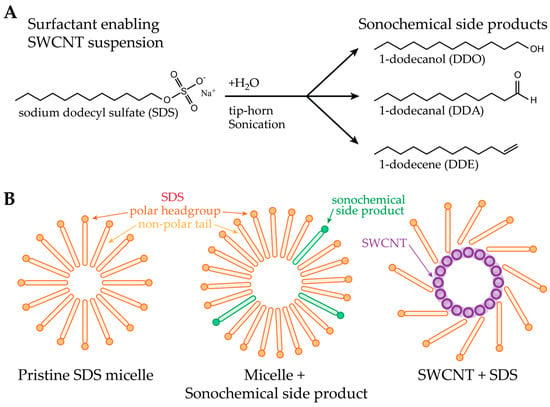
Preparation of bulk quantity aqueous suspensions of SWCNTs necessitates their processing using tip-horn sonication in the presence of a stabilizing surfactant such as sodium dodecyl sulfate (SDS). Due to the extreme environments created during sonication, a 75 mM solution of SDS, typical for the stabilization of SWCNTs, also undergoes chemical transformation to form dodecanol (DDO), dodecanal (DDA), and dodecene (DDE); the structure of each, along with that of SDS, is shown in Figure 1A. Importantly, our recent findings (Mastalka-Tatro et al., in preparation) demonstrate that despite each of these compounds being practically insoluble in water, the solubility of each increases dramatically in the presence of 75 mM SDS to 4.30 mM, 6.59 mM, and 1.67 mM for DDO, DDA, and DDE, respectively. This increase is attributed to the surfactant nature of SDS, as its micellular structure is capable of either integrating DDO, DDA, and DDE alongside SDS molecules within micelles, or alternatively, encapsulating these hydrophobic molecules in their interior. In comparison, the mechanism for the stabilization of SWCNTs by SDS involves van der Walls interactions between the hydrophobic tail of SDS and the sidewall of SWCNTs, in conjunction with ion–dipole interactions between the SDS polar headgroup and solvent water molecules. A pristine SDS micelle, along with the integration of DDO, DDA, and DDE within an SDS micelle, as well as the micelle-like coverage of SDS on the tubular cross-section of a SWCNT are each shown in Figure 1B. Given the hypothesized ability of each concentration of DDO, DDA, and DDE to interact directly with SDS micelles and the corresponding role that such micelles play in gel-based SWCNT purification schemes, the focus of this work is to explore how each of the three sonochemical side-products of SDS affects per-chirality SWCNT–gel interactions. Additionally, the previous work of Flavel and coworkers [26] suggested that DDO can desorb SWCNTs from a Sephacryl gel bed at concentrations as low as 1 µM, so further investigation of all three compounds, each at varying concentrations, is warranted.
Figure 1.
The structure (A) of each of the three SDS sonochemical side-products investigated herein: DDO, DDA, and DDE. In neat aqueous solution SDS forms pristine micelles (B), which integrate with co-surfactants in the presence of DDO, DDA, and DDE, suggesting that the SWCNT and SDS complex could also be impacted by these molecules.
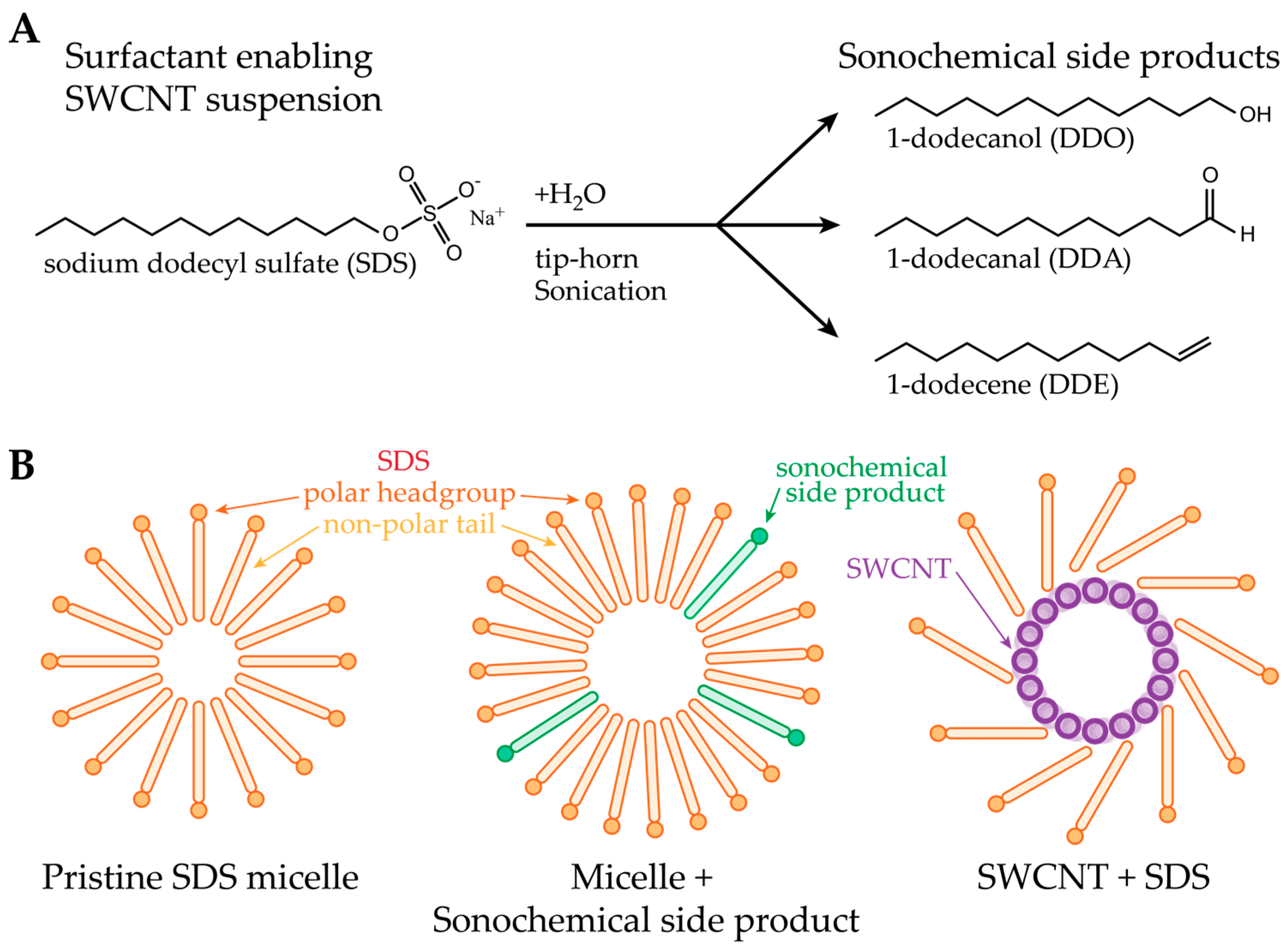
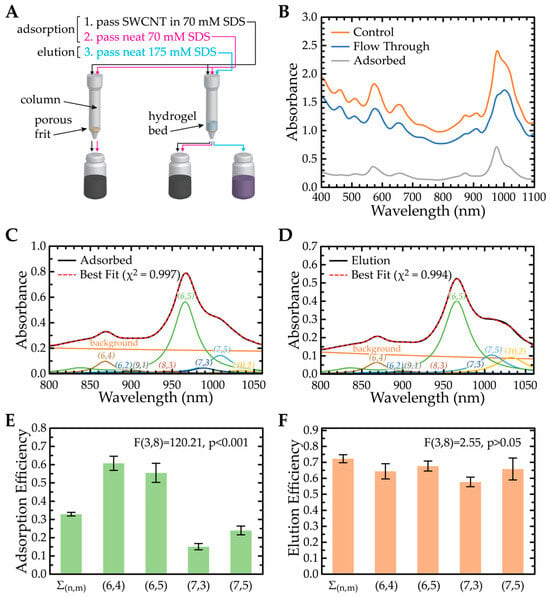
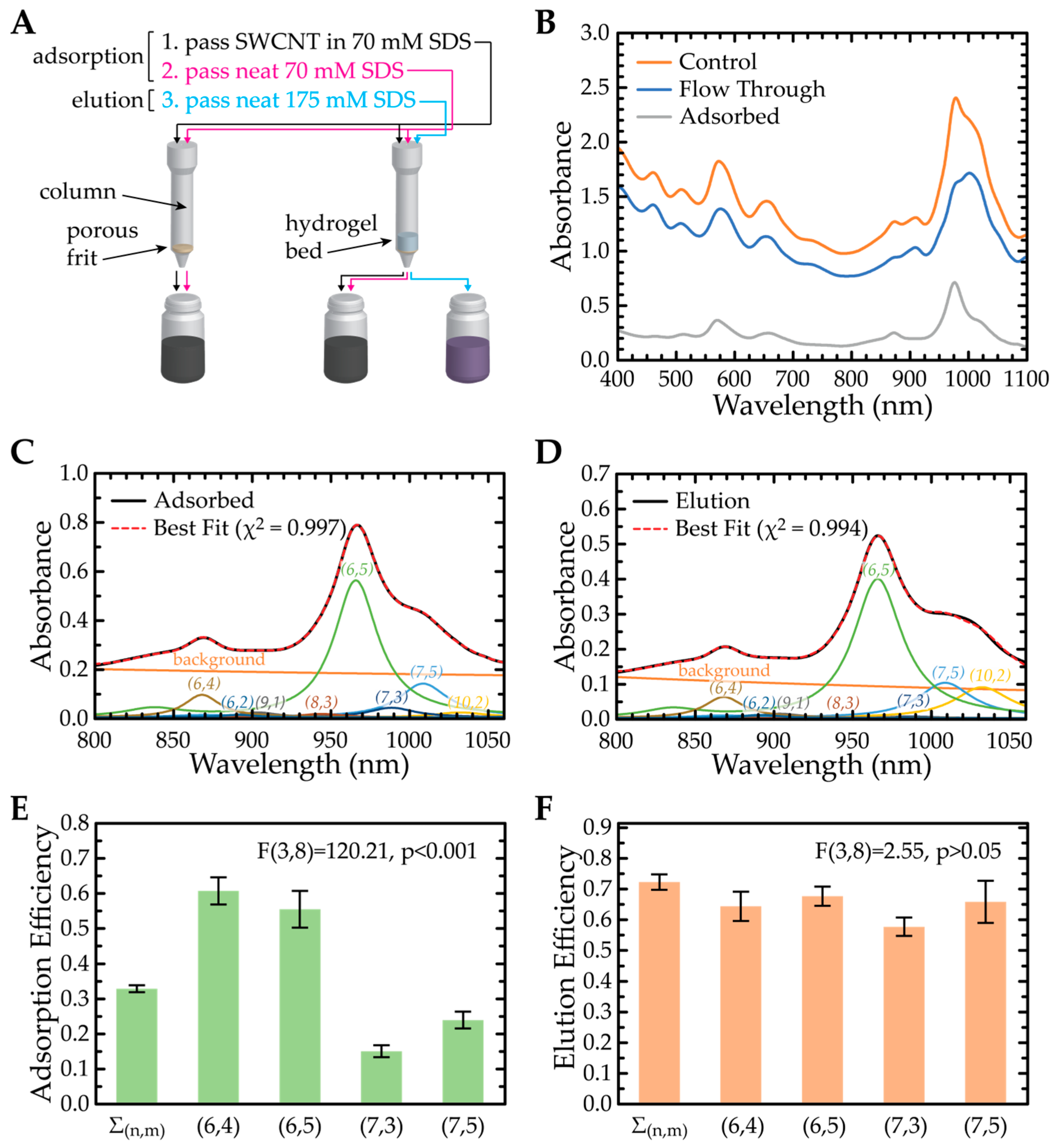
To quantitate the impact of each concentration of DDO, DDA, and DDE on gel-based SWCNT purification, a single-column interaction scheme was employed whereby the SWCNTs in suspension were added to, passed through, and eluted from, a column loaded with Sephacryl S-200 hydrogel and tracked using absorbance spectroscopy. Further, a differential absorbance spectrum representative of the material adsorbed to each gel bed was calculated. The general method of single-column gel-based purification and its subsequent analysis is shown in Figure 2 (following page). Importantly, this method was chosen to determine the threshold concentration at which DDO, DDA, and DDE impacts SWCNT–gel interaction both in a general and chirality-specific sense because it offers robust quantitation of per-chirality SWCNT adsorbed to and eluted from Sephacryl under overloading conditions, which are necessary to afford single-chirality purification. In contrast, alternative methods such as single-column underloading [25] and iterative multi-column interactions [16,30,36] remain robust approaches to probe interaction mechanisms and optimize system performance, respectively, but are not employed within this study.
Figure 2.
Methodology for the single-column investigation of SWCNT/gel interaction in the presence of varying surfactants (A) involving analysis by absorbance spectroscopy (B) to quantitate presence of various SWCNT (n,m) chiralities (C,D) which can be interpreted in terms of the efficiency with which SWCNT adsorb to (E) and elute from (F) the gel. In panels (C,D), the chiral wrapping vector (n,m) of the SWCNT chirality corresponding with each absorbance peak contributing to the best-fit model is shown above that peak. In panels (E,F), error bars represent ± one standard deviation of variance among independent SWCNT/gel interactions performed in triplicate; the text in the upper righthand corner represents the F-statistic results of a one-way ANOVA test across chiralities (6,4), (6,5), (7,3), and (7,5).
Returning to the method of single-column interaction under overloading conditions, each suspension contained an equivalent concentration and chiral distribution of SWCNTs, 75 mM of SDS surfactant, and one of three additives DDO, DDA, or DDE at varying concentrations, and each suspension was studied via interaction with a bed of Sephacryl S-200 of equivalent settled gel volume and total gel microsphere surface area. The choice to standardize SWCNT suspensions within SDS at a concentration of 75 mM was made to afford straightforward comparison between the results presented herein and the large body of gel-based SWCNT purification work that employs that concentration. Further, to fully capture the impact of each sonochemical side-product on the interaction of the SWCNT-SDS complex with Sephacryl, each was studied at varying concentrations, with each approaching its respective solubility limit in 75 mM SDS. Following their generation, aqueous suspensions containing SWCNT, SDS, and varying quantities of an additive were passed through a bed of Sephacryl gel, with the sequential addition of SWCNT suspension, surfactant wash, and surfactant elution depicted schematically in Figure 2A.
Two important aspects of single-column analysis of SWCNT–gel interaction are first, the preservation of overloading conditions such that the number of SWCNTs added to the top of the gel bed is significantly greater than the number of binding sites on the surface of the gel microspheres, which effectively allows for per-chirality purification through kinetically driven competitive binding [41]. In this work, this ratio was 3.3 SWCNTs introduced per gel binding site, which is within the regime for overloading conditions. A second important aspect of this method is the parallel addition of SWCNT suspension to a gel-free control column, which allows for a direct spectroscopic comparison between the gel-containing and gel-free columns and the calculation of a differential absorbance spectrum representative of the SWCNT material adsorbed to the gel. Absorbance spectra of the SWCNT suspension absent of added DDO, DDA, or DDE after having passed through both the gel-free and gel-containing columns are shown in Figure 2B, along with the calculated differential absorbance spectrum for this interaction.
Clearly visible within the calculated differential absorbance spectrum in Figure 2B are the characteristic per-chirality SWCNT absorbance peaks within both the E11 region (800 nm–1100 nm) and E22 region (450 nm–750 nm) of the spectrum, which demonstrates the ability to use such calculated spectra to quantitate SWCNTs adsorbed to the gel. Specifically, quantitation was achieved through fitting of the E11 region to a sum of per-chirality Lorentzian line shapes of constant width and position, and varying height to account for differing concentrations of each SWCNT chirality, all atop a linear background accounting for amorphous carbon present within the suspension [37]. The SWCNT suspensions used in this study were found to contain eight unique chiralities in quantitative amounts: (6,5), (6,4), (7,5), (7,3), (8,3), (9,1), (10,2), and (6,2), each of which has a known per-atom absorbance cross-section [38] that can be used, alongside an assumption of uniform SWCNT length of 300 nm following prolonged tip-horn sonication [41], to calculate the per-chirality number of SWCNTs from a given absorbance spectrum. The result of the best-fit of the differential absorbance spectrum representing SWCNTs adsorbed to the gel in the absence of added DDO, DDA, or DDE is shown in Figure 2C, with the total fitted spectrum, the per-chirality contributions to that spectrum, and a qualitative assessment of the goodness-of-fit () shown.
To recover purified SWCNTs, a neat surfactant of relatively higher concentration (175 mM) is passed through the gel bed to elute SWCNTs into a liquid suspension collected beneath the column. Importantly, only a fraction of adsorbed SWCNTs are eluted, a phenomenon that has been attributed to inhomogeneities in both the gel surface and SWCNT defects [25]. To quantify the eluted SWCNTs, the absorbance spectrum is collected and fitted using the same methods described for the differential absorbance spectrum, with both the experimental and best-fit results shown in Figure 2D for SWCNTs eluted in the absence of added DDO, DDA, or DDE. The relative height of per-chirality peaks appears similar in Figure 2C,D, indicating that the distribution of SWCNT chiralities eluted from the gel is similar to that adsorbed to the gel, or in other words, chiral selectivity is realized mechanistically during adsorption [30,43].
The results of the per-chirality best-fits can be further analyzed to gain quantitative insight into the extent to which SWCNTs are taken up and subsequently released by the gel. Specifically, we define adsorption efficiency, , as the fraction of SWCNTs introduced to a given gel bed that is adsorbed by that bed:
and further, elution efficiency, , as the fraction of SWCNTs eluted from a given gel bed that were adsorbed by that bed:
while each of and can be calculated in terms of either an individual (n,m) chirality, or a sum over all fitted chiralities. In this work, the four most abundant chiralities within the SWCNT suspensions studied are (6,5), (6,4), (7,3), and (7,5), which constitute 34%, 6%, 15%, and 22%, respectively, of the SWCNTs introduced to each column. The absorbance efficiency both in terms of these four chiralities and as a sum over all fitted chiralities, is shown in Figure 2E, with error bars representing one standard deviation of independent SWCNT–gel interactions and subsequent spectral analysis, performed in triplicate. As is typical in single-column analysis of SWCNT–gel interactions [43], there is a stark difference between the efficiency with which early eluting chiralities such as (6,4) and (6,5) adsorb to the gel, which tends to be higher than that with which later eluting chiralities such as (7,3) and (7,5) adsorb to the gel. Such differences demonstrate the mechanism of action for the ability of a gel such as Sephacryl S-200 to afford purification by SWCNT chirality. To establish this quantitatively, a one-way ANOVA test of absorbance efficiency across (6,5), (6,4), (7,3), and (7,5) chiralities was performed, and resulted in F-value 120.21 and p < 0.001, rejecting the null hypothesis and implying a significant statistical difference in the adsorption efficiency of differing chiralities—or in other words, chiral selectivity for SWCNT interaction with Sephacryl occurs during the adsorption event.
Finally, the elution efficiency , also in terms of both these four chiralities and as a sum over all fitted chiralities, is shown in Figure 2F. In contrast to the chiral dependence of the adsorption step, the elution efficiency is similar across each chirality, confirming previous reports that for Sephacryl S-200 chiral selectivity occurs during adsorption, not elution [43]. As further quantitative demonstration of this claim, a one-way ANOVA test of elution efficiency across (6,5), (6,4), (7,3), and (7,5) chiralities resulted in an F-value of 2.55 and p > 0.05, which confirms the null hypothesis that differences observed in the chirality elution efficiency are not statistically significant—or in other words, the process of SWCNT elution from Sephacryl is independent of SWCNT chirality. In the following section, these analyses are applied to single-column SWCNT/gel interactions performed in the presence of each of the three sonochemical side-products DDO, DDA, and DDE, each at varying concentrations.
3.2. Impact of Sonochemical Side-Products on Adsorption of SWCNT by Sephacryl
Given the maximum solubility of DDO, DDA, and DDE within 75 mM aqueous SDS, a stock solution of each was generated and used in combination with neat aqueous 75 mM SDS to create a series of suspensions of equal SWCNT and SDS concentrations but differing across eight concentrations of each DDO, DDA, and DDE side-product (see Table 1). Importantly, owing to their generation as sonochemical side-products during the tip-horn sonication of SWCNTs, a baseline of trace quantities of non-target additive—for example, DDA and DDE within the series of varying concentration of DDO—was present across all SWCNT suspensions. However, such quantities are orders of magnitude lower than the lowest added concentration of each side-product and considered to have negligible impact on SWCNT/gel interaction. Each of these SWCNT suspensions was integrated into the single-column gel-based purification scheme, with SWCNT suspensions containing DDO, DDA, or DDE passing through Sephacryl-S200 gel beds equilibrated with 75 mM SDS at the corresponding additive concentration.
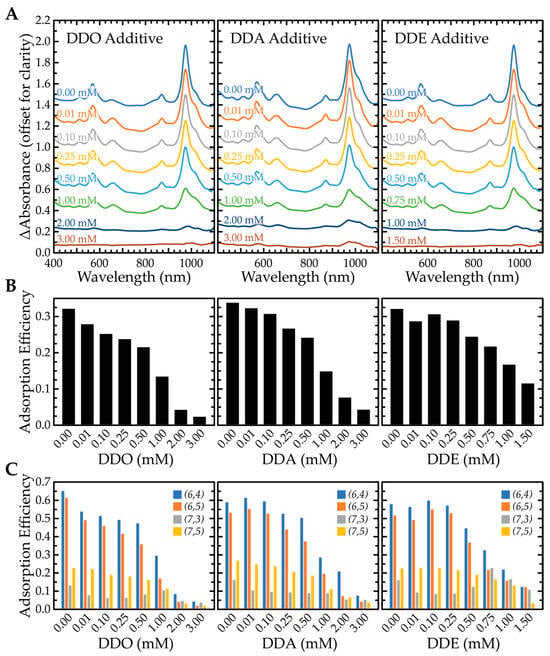
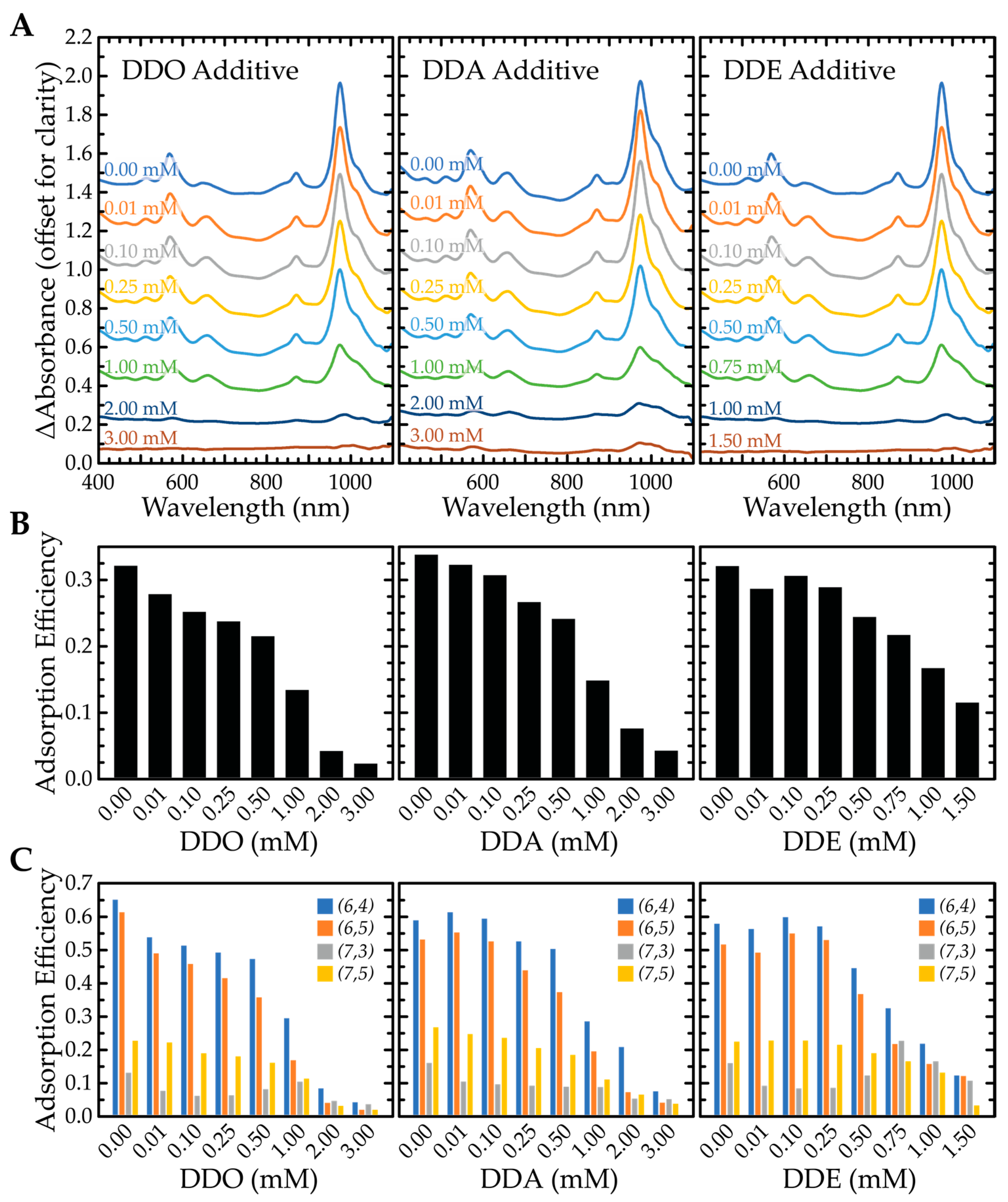
The calculated differential absorbance spectra representing materials adsorbed to each column across varying concentrations of DDO, DDA, and DDE are shown in Figure 3A (following page), which have been offset for clarity of comparison between suspensions of differing additive concentration, with increasing amounts of such shown from top to bottom—see Figure S1 within the Supporting Information for an overlayed presentation of the same data, affording direct comparison of peak height. As the concentration of DDO, DDA, or DDE within the SWCNT suspension increases, the SWCNT material adsorbing to the gel decreases, as indicated by the decrease in height of SWCNT absorbance peaks. Further, the offset spectra clearly demonstrate that the absorbance character of each spectrum is derived from the same handful of SWCNT chiralities, which absorb with the highest oscillator strength in the E11 spectral region.
Figure 3.
Analysis of SWCNT suspension characteristics related to the adsorption of SWCNT to Sephacryl in the presence of various concentrations of DDO, DDA, and DDE additives. Offset differential absorbance spectra (A) demonstrate the SWCNT character of adsorbed materials, each of which can be fit to a sum of per-SWCNT chirality contributions and analyzed in terms of either a sum over all chiralities (B) or each of the four most abundant chiralities (C). Data points for each additive concentration represent a single-column run; method variance (RSD = 6.1%) was established from independent replicates of the additive-free control (see Section 3.1).
To quantitatively assess how each additive adsorbed to Sephacryl S-200 at varying concentrations, each spectrum shown in Figure 3A was fit to a sum of contributions from individual SWCNT chiralities and analyzed in terms of adsorption efficiency . Specifically, the absorbance efficiency for each DDO, DDA, and DDE additive was first considered in terms of a sum across all SWCNT chiralities, as shown in Figure 3B, which demonstrate that as the concentration of each additive is increased, the adsorption efficiency gradually decreases to approximately 2%, 4%, and 10% in the case of DDO, DDA, and DDE, respectively. Interestingly, despite the significantly larger solubility limit of DDO and DDA in comparison with DDE, the concentration at which 50% inhibition of binding occurs lies within the range of 0.75–1.00 mM for all three additives, suggesting a common mechanism for binding inhibition between the three.
The impact of each additive on the ability of specific SWCNT chiralities to adsorb to the gel was assessed by considering the chirality-specific adsorption efficiency, , of chiralities (6,5), (6,4), (7,3), and (7,5), as shown in the colored bars of Figure 3C. Across each additive series, the additive-free control demonstrates a stark difference between the (6,4) and (6,5) chiralities, which are both adsorbed with 50–60% efficiency, the (7,5) chirality which is adsorbed at approximately 20% efficiency, and the (7,3) chirality which is adsorbed at approximately 15% efficiency. This per-chirality difference is ascribed to the inherently higher binding rate constant of the (6,4) and (6,5) chiralities with Sephacryl S-200, which enables these two species to outcompete (7,3) and (7,5) for gel binding sites, ultimately resulting in a greater fraction of those chiralities being adsorbed in overloading conditions. As the concentration of each additive is increased, the adsorption efficiency of each chirality is reduced to be less than or equal to 10%. Further, the segregation between the more competitive chiralities, (6,4) and (6,5), and the less competitive chiralities, (7,3) and (7,5), gradually decreases with increasing additive concentration. A comparison between the three additives in terms of the relative adsorption efficiency of each chirality shows an interesting distinction between DDO and DDA, each of which shows little-to-no SWCNT uptake at additive concentrations near their saturation limit, and DDE, which still exhibits adsorption efficiency of three of the four chiralities at 10% near its saturation limit. This distinction is further demonstrated through an examination of the bottommost absorbance spectrum associated with each additive shown in Figure 3A. Specifically, despite the presence of DDE additives near its solubility limit, much more SWCNTs adsorb to Sephacryl than they do in the presence of relatively high-concentration DDO and DDA, and further, the chirality distribution of adsorbed SWNCTs is unique from all other differential adsorption spectra. This finding suggests that DDE may be uniquely able to alter the chiral selectivity among SDS sonochemical side-products, a property that may prove useful in the design of gel-based purification schemes tailored to target specific SWCNT chiralities, as discussed later in this work.
3.3. Impact of Sonochemical Side-Products on Elution of SWCNTs from Sephacryl
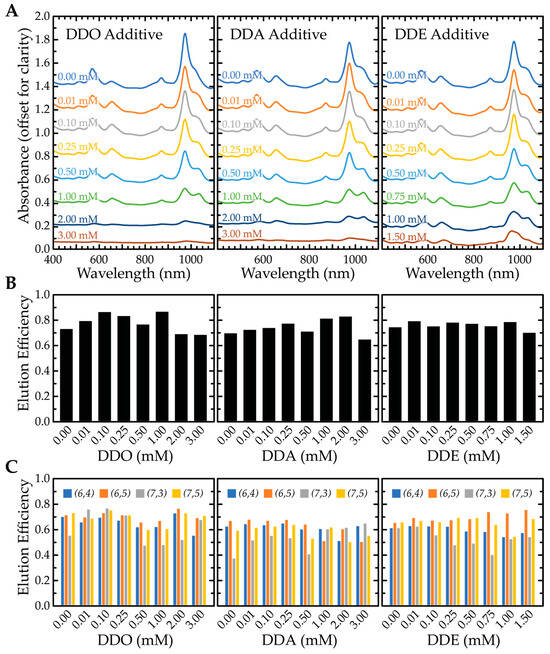
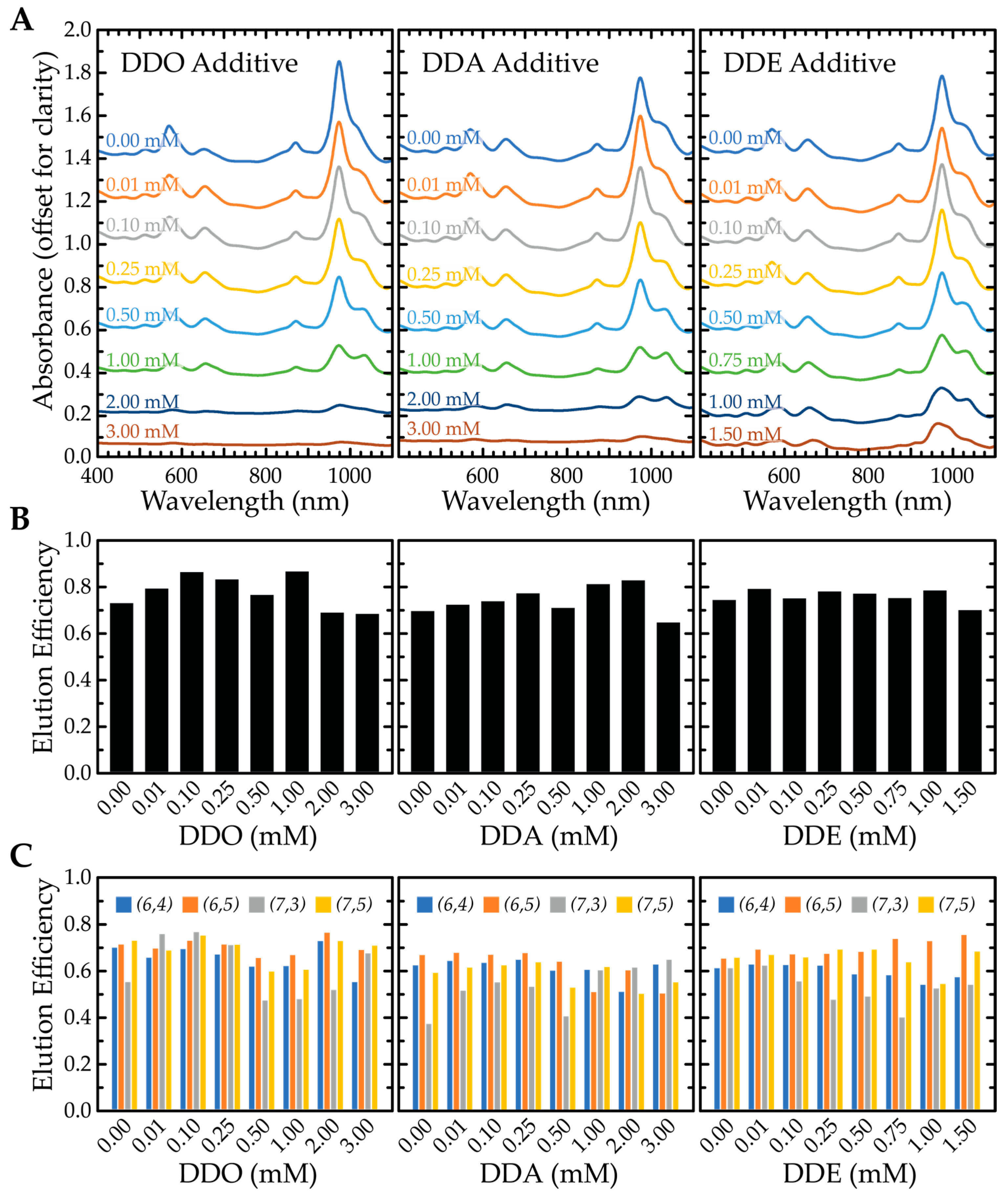
Following their uptake to the surface of Sephacryl S-200, a fraction of adsorbed SWCNTs were eluted through the addition of a neat solution of increased SDS concentration. Importantly, such elution is a necessary step in the isolation of purified SWCNTs for fundamental or applied applications and remains the parameter of interest in any SWCNT purification scheme. To assess the contents of each, the absorbance spectrum of each eluted SWCNT suspension was collected, which are shown for DDO, DDA, and DDE across eight additive concentrations in Figure 4A (following page). Since increasing additive concentration correlates directly with decreased uptake of SWCNTs, it is expected that less SWCNTs will elute from the columns corresponding with increased concentrations of DDO, DDA, and DDE, a trend that is realized experimentally.
Figure 4.
Analysis of SWCNT suspension characteristics related to the elution of SWCNT from Sephacryl in the presence of various concentrations of DDO, DDA, and DDE additives. Offset absorbance spectra of eluted SWCNT suspensions (A) can be fit to a sum of per-SWCNT chirality contributions and analyzed in terms of either a sum over all chiralities (B) or each of the four most abundant chiralities (C). Data points for each additive concentration represent a single-column run; method variance (RSD = 6.1%) was established from independent replicates of the additive-free control (see Section 3.1).
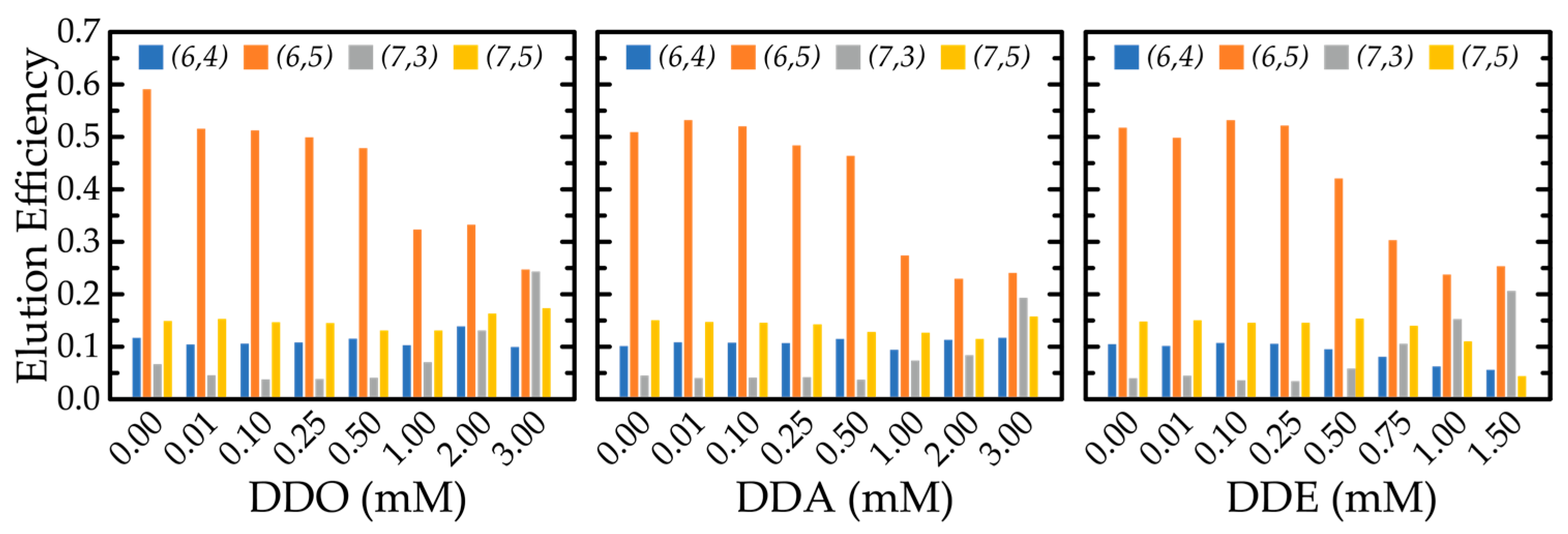
To quantitatively assess SWCNTs eluted from each column, each absorbance spectrum in Figure 4A was fit to a sum of contributions from individual SWCNT chiralities and analyzed in terms of elution efficiency . The total elution efficiency summed over all chiralities for each additive at varying concentrations is shown in Figure 4B, which indicates that over 60% of adsorbed SWCNTs are recovered through elution, regardless of additive or its respective concentration. This elution efficiency is consistent with that found in our previous single-column studies of SWCNT/gel interaction carried out in overloading conditions [40]. Unlike adsorption efficiency , which showed a clear negative correlation with increasing additive concentration, elution efficiency is not correlated with additive concentration for DDO, DDA, or DDE. The average elution efficiency observed here, across all additives and concentrations, exhibits a small standard deviation, demonstrating the lack of correlation between additive type or additive concentration and elution efficiency . Importantly, while the elution efficiency of SWCNTs can be increased using kosmotropic additives [40] or co-surfactants [44], these data demonstrate that, once adsorbed to the gel, the SWCNT/SDS/additive complex responds to an increased SDS concentration of 175 mM in a manner that is independent of additive type or concentration.
The elution efficiency of specific SWCNT chiralities (6,5), (6,4), (7,3), and (7,5) is shown for each studied concentration of DDO, DDA, and DDE additives Figure 4C. Unlike chirality differences in adsorption efficiency , which affords gel-based SWCNT purification at low additive concentrations and prevents such at relatively high additive concentrations, the presence of DDO, DDA, or DDE does not impact elution efficiency in a chirality-dependent manner. Across all additives and concentrations, the (6,5), (6,4), (7,3), and (7,5) chiralities exhibit average elution efficiencies of , , , and , respectively. The small standard deviation associated with each indicates the lack of correlation between additive concentration and elution efficiency on a per-chirality basis.
To better understand the lack of impact of additive concentration on elution efficiency, it is necessary to first consider the origins of irreversible adsorption of SWCNTs to the hydrogel surface. Specifically, our previous work suggested that lack of complete elution from gels may be due to inherent inhomogeneities in the hydrogel surface where SWCNTs adsorb [25]. Here, the lack of clear correlation between either the nature or concentration of the additive with elution efficiency suggests that each of the additives studied here affects the SWCNT–gel interaction mechanistically through its interaction with the SWCNTs in suspension rather than the gel surface. In other words, while the presence of additives can affect SWCNT chirality discrimination during the adsorption step (see Figure 3), the lack of such during elution suggests that discrimination between reversibly adsorbed and irreversibly adsorbed SWCNTs, which may be due to gel surface inhomogeneity, demonstrates that the mechanistic impact of DDO, DDA, and DDE is at the SWCNT surface rather than the gel surface. Further discussion of mechanistic implications is provided later in this work.
3.4. Fractional Purity of SWCNT Eluants
In addition to understanding the fundamental impact of DDO, DDA, and DDE on SWCNT/gel interactions, this study suggests that additives such as these could be used in tailored gel-based SWCNT purifications targeting the isolation of specific (n,m) chiralities. As a demonstration of such, the fractional purity of each chirality, (6,5), (6,4), (7,3), and (7,5), eluted from each column investigated was calculated according to:
where schemes that produce eluents with single chiralities of fractional purity approaching 1 are indicative of a “chirally pure” SWCNT separation process.
The fractional purity of (6,5), (6,4), (7,3), and (7,5) for each additive studied across all respective concentrations is shown in Figure 5 (following page). At low additive concentration, the (6,5) chirality is most abundant among eluents, with its fractional purity exceeding 0.5 across all additives. However, as additive concentration increases the fractional purity of eluted (6,5) decreases to approximately 0.25, a phenomenon attributed to diminished selectivity during the adsorption step. In contrast, however, is the (7,3) chirality which exhibits fractional purity of approximately 0.05 at low additive concentration but increases significantly in the case of increased concentration of each concentration of DDO, DDA, and DDE to approximately 0.2 at the highest additive concentration of each.
Figure 5.
Fractional purity of each of the four most abundant chiralities within SWCNT suspensions eluted from Sephacryl in the presence of various concentrations of DDO, DDA, and DDE additives. Data points for each additive concentration represent a single-column run; method variance (RSD = 6.1%) was established from independent replicates of the additive-free control (see Section 3.1).
While none of the three additives demonstrated an ability to boost the fractional purity of (7,3) beyond that of (6,5), the chirality-dependent effects of each additive on the relative fractional purity between these two chiralities are of important note. Specifically, this finding represents a novel approach toward tailoring gel-based SWCNT purification schemes using additives that impact the SWCNT/gel interaction in a chirality-dependent manner. While the mechanism for such impact is not immediately clear, it is well documented that the manner in which SDS molecules interact with the SWCNT surface is itself chirality-dependent [45], and it is entirely plausible that such SDS-SWCNT interaction is disrupted by DDO, DDA, and DDE in a manner that is also dependent on the SWCNT chirality. To that end, a lack of disruption of the SDS organization around chiralities such as (7,3) may allow for a marked increase in their fractional purity within eluents obtained in the presence of additives such as DDO, DDA, and DDE. Further exploration of this possible mechanism of action is discussed in the following section.
3.5. Mechanistic Insights and Implications for Gel-Based SWCNT Purification
The results presented herein provide both mechanistic insights into the general process of surfactant-mediated SWCNT–gel interaction as well as provide important insights into the impact of tip-horn sonochemical processing on the ability to use Sephacryl as a SWCNT purification agent. Mechanistically, sonochemical side-products DDO, DDA, and DDE are each expected to integrate within SDS micelles, as demonstrated by the substantial solubility increase in each in the presence of 75 mM SDS (Mastalka-Tatro et al., in preparation). Such interaction likely also impacts the manner in which SDS is able to arrange itself on the SWCNT sidewall, which ultimately impacts the ability of SWCNTs to adsorb to the hydrogel. A study of the impact of alcohol additives on the critical micelle concentration (CMC) of SDS—that is the concentration below which micelles are no longer thermodynamically favorable—found lowering of the CMC with increasing additive concentration, a phenomenon attributed to decreased charge on the micelle surface [46]. Additionally, the aggregation number of SDS—that is, the number of molecules in each micelle—was found to increase in the presence of alcohol additives [47], suggesting that additives act as co-surfactants and have the potential to screen repulsion between negatively charged SDS headgroups [48].
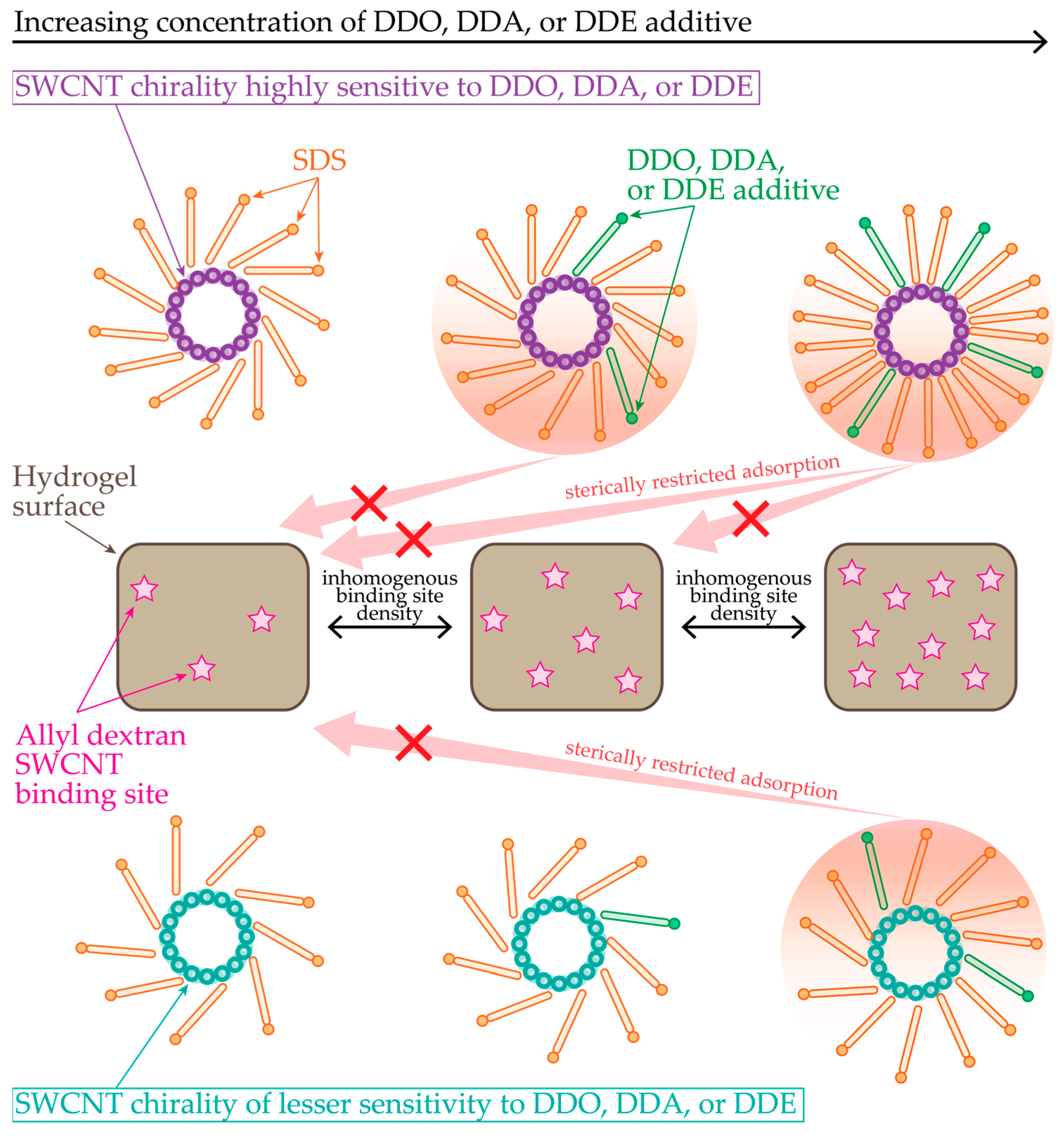
Given this, it is expected that SDS sonochemical side-products DDO, DDA, and DDE readily integrate into the micelle-like structure of SDS around individualized SWNT, effectively increasing the density of surfactant or additive molecules on that surface, and providing additional steric hindrance that provides a barrier for SWCNTs to adsorb to the gel surface. This concept is illustrated schematically in the top portion of Figure 6 (following page). However, as noted in Figure 3C, increasing concentrations of additives cause a reduction in SWCNT uptake across all chiralities, albeit in a manner that impacts some chiralities more than others. Practically, it can be surmised that, as SWCNTs of differing chiralities have been shown to have differing densities of SDS associated with their sidewalls [49,50], the impact of added DDO, DDA, or DDE can also impact the surfactant corona around SWCNTs in a chirality-dependent manner. The differing impacts of SDS orientation and additive concentration on an alternative SWCNT chirality is illustrated in the bottom portion of Figure 6.
Figure 6.
Schematic demonstration of the varied reactions between SWCNT chiralities of differing sensitivity to DDO, DDA, or DDE additives and regions of the Sephacryl S-200 hydrogel surface exhibiting low, moderate, and high relative concentration of allyl dextran.
Finally, it is necessary to consider these mechanistic insights along with data presented in Figure 3B, which demonstrate that increasing concentrations of additives have an overall impact of reducing the ability of SWCNTs to adsorb to the gel surface. Further, as noted by the elution efficiencies observed in Figure 4B that are independent of additive or concentration, the reduction in SWCNT adsorption to the gel with increasing additive concentration is likely driven through the interaction of additive molecules with the SWCNT-SDS complex and not the gel. If the gel itself is not impacted by the additive, then one must consider why there appears to be less, but still nonzero, binding of SWCNTs at higher additive concentrations, mimicking the presence of fewer gel binding sites. Mechanistically, we consider the gel surface as an inhomogeneous combination of allyl dextran, methylene bisacrylamide, and void space, with globular allyl dextran as the molecular-scale site that supports SWCNT binding [25]. Given this, only the regions of the gel with relatively high density of allyl dextran are capable of binding SWCNTs with swelled surfactants due to the integration of DDO, DDA, or DDE additives. Alternatively, at relatively lower additive concentration, some SWCNT chiralities are more impacted by such integration than others, demonstrating a chirality-dependent effect of inhibited binding. These concepts are further illustrated in the center portion of Figure 6, specifically, in its relationship with the two SWCNT chiralities impacted differently by additive illustrated on the top and bottom of that figure.
In terms of the three additives under investigation here, the molar ratio of SDS to additive at the upper end of the solubility range is approximately 25:1 for DDO and DDA, and approximately 50:1 for DDE, which should be contextualized alongside the experimentally determined aggregation number of 75 mM SDS falling within the range of 70–90 [51]. Given this, it is likely that micelles in this study exhibit a Poisson distribution in terms of the number of additive molecules integrated per micelle ranging from zero to five or more [52]. Further, because SDS molecules form a micellular-like structure around SWCNTs, it is likely that molecules of DDO, DDA, and DDE interact with SWCNTs in an inhomogeneous manner both along the length of a single tube and among a statistical population of tubes of the same chirality. Such inhomogeneities likely exist within the systems studied here but nonetheless appear to be less impactful than SWCNT chirality itself.
In terms of its implication for gel-based SWCNT purification, this study also provides insight into the practical impact of known SDS sonochemical side-product contaminants on gel-based SWCNT purification. Regarding the proposed mechanism for chirality-dependent inhibition of SWCNTs binding on the gel surface, this finding has the potential to springboard an effort to identify other molecules capable of integration within SDS micelles that could target specific SWCNT chiralities in multi-column gel-based purification schemes. Target molecules for such a study would include long-chain hydrocarbons, both saturated and unsaturated, with a headgroup of varying polarity. Screening of the impact of such additives could aid in the identification of co-surfactant pairs (along with SDS) capable of isolating specific SWCNT chiralities.
Finally, the implications of this work with respect to the broader practice of gel-based SWCNT purification lie in the reporting of at what concentrations SDS sonochemical side-products DDO, DDA, and DDE impact SWCNT–gel interaction. Our findings demonstrate that, following tip-horn sonication of SWCNTs in the presence of 75 mM (2 wt%) recrystallized SDS and subsequent ultracentrifugation, each of DDO, DDA, and DDE was generated within the 5–10 µM range (Mastalka-Tatro et al., in preparation). Further, we found that as-purchased SDS (99+% pure) contains DDO contamination such that a 75 mM aqueous solution contains DDO ranging from approximately 25–250 µM, with the lower end of this range typically realized in powdered SDS and the higher end within dust-free pellets of SDS. In terms of the findings presented within Figure 3, the act of tip-horn sonication at levels typically utilized in SWCNT processing is not expected to have a significant impact on the interaction of SWCNTs with Sephacryl S-200. While Flavel and co-workers reported SWCNT elution with DDO additive within the 1–5 µM range [28], the findings presented herein suggest DDO concentration must be several orders of magnitude greater to affect SWCNT–gel interaction. Given this, however, DDO introduced through the use of as-purchased SDS (without its recrystallization) has the potential to impact interaction of SWCNTs with gel. We estimate that adsorption efficiency could decrease by as much as 25% (reduction from 0.321 to 0.237, as seen in Figure 3B) simply by the choice to use SDS in the form of dust-free pellets instead of that in the form of a powder. For this reason, it is strongly recommended that studies of gel-based SWCNT purification be carried out using recrystallized SDS, and more generally, any study in which the SWCNT-surfactant orientation or density may play a role also use recrystallized SDS.
4. Conclusions
In summary, single-walled carbon nanotubes (SWCNTs) within aqueous suspensions containing both sodium dodecyl sulfate (SDS) and SDS sonochemical side-products dodecanol (DDO), dodecanal (DDA), and dodecene (DDE) as additives show a negative correlation in their tendency to absorb to Sephacryl S-200 with increasing additive concentration. The additive concentration whereby a 50% reduction in SWCNT uptake is realized is approximately 0.75–1.00 mM for all three additives, suggesting a common mechanism for adsorption inhibition. As expected within a gel-based SWCNT purification scheme, SWCNTs of differing chiralities adsorbed to the gel with differing efficiency. Further, SWCNT exhibited inhibition due to DDO, DDA, and DDE additives that were dependent on the SWCNT chirality, the additive, and its respective concentration. Unlike the chiral selectivity observed during the adsorption event, elution efficiencies were found to be independent of SWCNT chirality, additive, and additive concentration. Unique among the chiralities investigated in this work was (7,3), which eluted with increasing chiral purity in the presence of increased additive concentration, suggesting that tailored additives may be a useful means of targeting specific chiralities in gel-based SWCNT purification—potentially within a two-column scheme [53] whereby, following depletion of early eluting chiralities such as (6,5), additives are introduced to afford efficient elution of chiralities such as (7,3). While tip-horn sonication consistent with common solution-phase SWCNT processing has been shown to introduce DDO, DDA, and DDE within the 5–10 µM range, such concentrations are not high enough to appreciably impact SWCNT–gel interaction. However, DDO as a contaminant in as-purchased SDS has been shown to exist within the 25–250 µM range, which has the potential to hinder adsorption of SWCNTs to Sephacryl S-200 and supports the practice of recrystallizing as-purchased SDS before its integration within gel-based SWCNT purification schemes.
Supplementary Materials
The following supporting information can be downloaded at: https://www.mdpi.com/article/10.3390/c12020039/s1, Section S1: Analytical Method Employed in the Quantitation of SDS Sonochemical Byproducts within Aqueous Solutions of SDS; Section S2: Numerical Origins of Data Presented in Figure 2 of the Main Text; Section S3: Alternative Presentation and Numerical Origins of Data Presented in Figure 3 of the Main Text; Section S4: Numerical Origins of Data Presented in Figure 4 of the Main Text; Table S1: Quantitative results of best-fit spectral deconvolution of spectra associated with Figure 2 within the main text; Figure S1: Overlapped representation of differential spectral data presented in Figure 3C within the main text; Table S2: Quantitative results of best-fit spectral deconvolution of spectra associated with dodecanol (DDO) additive in Figure 3 within the main text; Table S3: Quantitative results of best-fit spectral deconvolution of spectra associated with dodecanal (DDA) additive in Figure 3 within the main text; Table S4: Quantitative results of best-fit spectral deconvolution of spectra associated with dodecene (DDE) additive in Figure 3 within the main text; and Table S5: Quantitative results of best-fit spectral deconvolution of spectra associated with Figure 4 within the main text.
Author Contributions
Conceptualization, methodology validation, and data curation, L.N.H., N.M.-T. and K.T.; formal analysis and investigation, L.N.H. and K.T.; software, writing—original draft preparation, and funding acquisition, K.T.; writing—review and editing, L.N.H. and N.M.-T. All authors have read and agreed to the published version of the manuscript.
Funding
This material is based upon work supported by the National Science Foundation under grant no. 2107748.
Data Availability Statement
The original contributions presented in this study are included in the article/Supplementary Materials. Further inquiries can be directed to the corresponding author.
Acknowledgments
L.N.H. acknowledges support from the UCCS College of Letters, Arts & Sciences and from the UCCS Graduate School and K.T. would like to thank the UCCS BioFrontiers Center for instrumentation access. L.N.H., N.M.-T. and K.T. would like to thank Logan Elmore for fruitful conversations during the development, execution, and analysis of this work as well as Shawn R. Hughes for his careful reading and editing of the manuscript.
Conflicts of Interest
The authors declare no conflicts of interest.
Abbreviations
The following abbreviations are used in this manuscript:
| SWCNTs | Single-walled carbon nanotubes |
| sc-SWCNTs | Semiconducting single-walled carbon nanotubes |
| SDS | Sodium dodecyl sulfate |
| DDO | Dodecanol |
| DDA | Dodecanal |
| DDE | Dodecene |
| CMC | Critical micelle concentration |
References
- Franklin, A.D.; Hersam, M.C.; Wong, H.-S.P. Carbon Nanotube Transistors: Making Electronics from Molecules. Science 2022, 378, 726–732. [Google Scholar] [CrossRef] [Scilit] [PubMed]
- Wang, C.; Takei, K.; Takahashi, T.; Javey, A. Carbon Nanotube Electronics—Moving Forward. Chem. Soc. Rev. 2013, 42, 2592–2609. [Google Scholar] [CrossRef] [Scilit]
- Zhang, J.; Hu, X.-G.; Ji, K.; Zhao, S.; Liu, D.; Li, B.; Hou, P.-X.; Liu, C.; Liu, L.; Stranks, S.D.; et al. High-Performance Bifacial Perovskite Solar Cells Enabled by Single-Walled Carbon Nanotubes. Nat. Commun. 2024, 15, 2245. [Google Scholar] [CrossRef] [Scilit]
- Jain, R.M.; Howden, R.; Tvrdy, K.; Shimizu, S.; Hilmer, A.J.; McNicholas, T.P.; Gleason, K.K.; Strano, M.S. Polymer-Free Near-Infrared Photovoltaics with Single Chirality (6, 5) Semiconducting Carbon Nanotube Active Layers. Adv. Mater. 2012, 24, 4436–4439. [Google Scholar] [CrossRef] [Scilit]
- Utsumi, S.; Ujjain, S.K.; Takahashi, S.; Shimodomae, R.; Yamaura, T.; Okuda, R.; Kobayashi, R.; Takahashi, O.; Miyazono, S.; Kato, N.; et al. Giant Nanomechanical Energy Storage Capacity in Twisted Single-Walled Carbon Nanotube Ropes. Nat. Nanotechnol. 2024, 19, 1007–1015. [Google Scholar] [CrossRef] [Scilit] [PubMed]
- Guo, Z.; Zhong, S.; Zhou, F.; Tang, X.; Hu, J. High-Quality Single-Walled Carbon Nanotubes for Lithium-Ion Battery Cathodes. ACS Appl. Nano Mater. 2025, 8, 23629–23639. [Google Scholar] [CrossRef] [Scilit]
- Chalin, D.V.; Nazarov, A.D.; Shaposhnikov, P.D.; Shaposhnikov, D.G. Flexible Bulk Composite Materials Based on Single-Walled Carbon Nanotubes with High Electrical Conductivity. Phys. Rev. Mater. 2025, 9, 076001. [Google Scholar] [CrossRef] [Scilit]
- Wang, Q.; Ng, M.-F.; Yang, S.-W.; Yang, Y.; Chen, Y. The Mechanism of Single-Walled Carbon Nanotube Growth and Chirality Selection Induced by Carbon Atom and Dimer Addition. ACS Nano 2010, 4, 939–946. [Google Scholar] [CrossRef] [Scilit]
- Cohen, Z.; Williams, R.M. Single-Walled Carbon Nanotubes as Optical Transducers for Nanobiosensors In Vivo. ACS Nano 2024, 18, 35164–35181. [Google Scholar] [CrossRef] [Scilit]
- Dresselhaus, M.S. On the Past and Present of Carbon Nanostructures. Phys. Status Solidi (B) 2011, 248, 1566–1574. [Google Scholar] [CrossRef] [Scilit]
- Saito, R.; Fujita, M.; Dresselhaus, G.; Dresselhaus, M.S. Electronic Structure of Chiral Graphene Tubules. Appl. Phys. Lett. 1992, 60, 2204–2206. [Google Scholar] [CrossRef] [Scilit]
- Hedman, D.; Reza Barzegar, H.; Rosén, A.; Wågberg, T.; Andreas Larsson, J. On the Stability and Abundance of Single Walled Carbon Nanotubes. Sci. Rep. 2015, 5, 16850. [Google Scholar] [CrossRef] [Scilit]
- Komatsu, N.; Wang, F. A Comprehensive Review on Separation Methods and Techniques for Single-Walled Carbon Nanotubes. Materials 2010, 3, 3818–3844. [Google Scholar] [CrossRef] [Scilit]
- McNicholas, T.P.; Cantu, V.; Hilmer, A.J.; Tvrdy, K.; Jain, R.; Han, R.; Bellisario, D.; Ahn, J.; Barone, P.W.; Mu, B.; et al. Magnetoadsorptive Particles Enabling the Centrifugation-Free, Preparative-Scale Separation, and Sorting of Single-Walled Carbon Nanotubes. Part. Part. Syst. Charact. 2014, 31, 1097–1104. [Google Scholar] [CrossRef] [Scilit]
- Moshammer, K.; Hennrich, F.; Kappes, M.M. Selective Suspension in Aqueous Sodium Dodecyl Sulfate According to Electronic Structure Type Allows Simple Separation of Metallic from Semiconducting Single-Walled Carbon Nanotubes. Nano Res. 2009, 2, 599–606. [Google Scholar] [CrossRef] [Scilit]
- Liu, H.; Nishide, D.; Tanaka, T.; Kataura, H. Large-Scale Single-Chirality Separation of Single-Wall Carbon Nanotubes by Simple Gel Chromatography. Nat. Commun. 2011, 2, 309. [Google Scholar] [CrossRef] [Scilit]
- Khan, I.A.; Afrooz, A.R.M.N.; Flora, J.R.V.; Schierz, P.A.; Ferguson, P.L.; Sabo-Attwood, T.; Saleh, N.B. Chirality Affects Aggregation Kinetics of Single-Walled Carbon Nanotubes. Environ. Sci. Technol. 2013, 47, 1844–1852. [Google Scholar] [CrossRef] [Scilit] [PubMed]
- O’Connell, M.J.; Bachilo, S.M.; Huffman, C.B.; Moore, V.C.; Strano, M.S.; Haroz, E.H.; Rialon, K.L.; Boul, P.J.; Noon, W.H.; Kittrell, C.; et al. Band Gap Fluorescence from Individual Single-Walled Carbon Nanotubes. Science 2002, 297, 593–596. [Google Scholar] [CrossRef] [Scilit] [PubMed]
- Gigliotti, B.; Sakizzie, B.; Bethune, D.S.; Shelby, R.M.; Cha, J.N. Sequence-Independent Helical Wrapping of Single-Walled Carbon Nanotubes by Long Genomic DNA. Nano Lett. 2006, 6, 159–164. [Google Scholar] [CrossRef] [Scilit]
- Li, Y.; Wen, Y.; Beltrán, L.C.; Zhu, L.; Tian, S.; Liu, J.; Zhou, X.; Chen, P.; Egelman, E.H.; Zheng, M.; et al. Understanding DNA-Encoded Carbon Nanotube Sorting and Sensing via Sub-Nm-Resolution Structural Determination. Sci. Adv. 2025, 11, eadt9844. [Google Scholar] [CrossRef] [Scilit] [PubMed]
- Behin, J.; Shahabazi, H. Prandtl and Ohnesorge Numbers Dependent of Ultrasonic Horn Energy in Newtonian Liquid under Batch and Continuous Flow. Ultrason. Sonochem. 2024, 105, 106869. [Google Scholar] [CrossRef] [Scilit]
- Sabet, S.M.; Mahfuz, H.; Hashemi, J.; Nezakat, M.; Szpunar, J.A. Effects of Sonication Energy on the Dispersion of Carbon Nanotubes in a Vinyl Ester Matrix and Associated Thermo-Mechanical Properties. J. Mater. Sci. 2015, 50, 4729–4740. [Google Scholar] [CrossRef] [Scilit]
- Stegen, J. Mechanics of Carbon Nanotube Scission under Sonication. J. Chem. Phys. 2014, 140, 244908. [Google Scholar] [CrossRef] [Scilit]
- Zhang, C.; Chen, X. Different Effects of Sonication Pretreatment on Carbon Nanomaterials under Low Hydrogen Peroxide Concentrations. Ultrason. Sonochem. 2017, 34, 19–26. [Google Scholar] [CrossRef] [Scilit] [PubMed]
- Dolan, M.; Hughes, L.N.; Tvrdy, K. Hydrogel Composition Effects on Performance as Single-Walled Carbon Nanotube Purification Media. J. Phys. Chem. C 2024, 128, 15923–15936. [Google Scholar] [CrossRef] [Scilit]
- Flavel, B.S.; Kappes, M.M.; Krupke, R.; Hennrich, F. Separation of Single-Walled Carbon Nanotubes by 1-Dodecanol-Mediated Size-Exclusion Chromatography. ACS Nano 2013, 7, 3557–3564. [Google Scholar] [CrossRef] [Scilit] [PubMed]
- Paruchuri, V.K.; Nalaskowski, J.; Shah, D.O.; Miller, J.D. The Effect of Cosurfactants on Sodium Dodecyl Sulfate Micellar Structures at a Graphite Surface. Colloids Surf. A Physicochem. Eng. Asp. 2006, 272, 157–163. [Google Scholar] [CrossRef] [Scilit]
- Alizadehmojarad, A.A.; Bachilo, S.M.; Kolomeisky, A.B.; Weisman, R.B. Morphology Transitions of SDS Coatings on Single-Walled Carbon Nanotubes. J. Phys. Chem. C 2024, 128, 6126–6132. [Google Scholar] [CrossRef] [Scilit]
- Vautier-Giongo, C.; Bales, B.L. Estimate of the Ionization Degree of Ionic Micelles Based on Krafft Temperature Measurements. J. Phys. Chem. B 2003, 107, 5398–5403. [Google Scholar] [CrossRef] [Scilit]
- Watts, B.P.; Barbee, C.H.; Tvrdy, K. Exploiting the Physiochemical Interactions between Single-Walled Carbon Nanotubes and Hydrogel Microspheres to Afford Chirally Pure Nanotubes. ACS Appl. Nano Mater. 2019, 2, 3615–3625. [Google Scholar] [CrossRef] [Scilit]
- Cheng, Q.; Debnath, S.; Gregan, E.; Byrne, H.J. Ultrasound-Assisted SWNTs Dispersion: Effects of Sonication Parameters and Solvent Properties. J. Phys. Chem. C 2010, 114, 8821–8827. [Google Scholar] [CrossRef] [Scilit]
- Lucas, A.; Zakri, C.; Maugey, M.; Pasquali, M.; van der Schoot, P.; Poulin, P. Kinetics of Nanotube and Microfiber Scission under Sonication. J. Phys. Chem. C 2009, 113, 20599–20605. [Google Scholar] [CrossRef] [Scilit]
- Huang, Y.Y.; Knowles, T.P.J.; Terentjev, E.M. Strength of Nanotubes, Filaments, and Nanowires from Sonication-Induced Scission. Adv. Mater. 2009, 21, 3945–3948. [Google Scholar] [CrossRef] [Scilit]
- Heller, D.A.; Mayrhofer, R.M.; Baik, S.; Grinkova, Y.V.; Usrey, M.L.; Strano, M.S. Concomitant Length and Diameter Separation of Single-Walled Carbon Nanotubes. J. Am. Chem. Soc. 2004, 126, 14567–14573. [Google Scholar] [CrossRef] [Scilit]
- Hennrich, F.; Krupke, R.; Arnold, K.; Rojas Stütz, J.A.; Lebedkin, S.; Koch, T.; Schimmel, T.; Kappes, M.M. The Mechanism of Cavitation-Induced Scission of Single-Walled Carbon Nanotubes. J. Phys. Chem. B 2007, 111, 1932–1937. [Google Scholar] [CrossRef] [Scilit] [PubMed]
- Dolan, M.; Watts, B.P.; Tvrdy, K. Tailored Synthesis of Hydrogel Media for Chirality Separation of Single Walled Carbon Nanotubes. Carbon N. Y. 2021, 171, 597–609. [Google Scholar] [CrossRef] [Scilit]
- Naumov, A.V.; Ghosh, S.; Tsyboulski, D.A.; Bachilo, S.M.; Weisman, R.B. Analyzing Absorption Backgrounds in Single-Walled Carbon Nanotube Spectra. ACS Nano 2011, 5, 1639–1648. [Google Scholar] [CrossRef] [Scilit] [PubMed]
- Sanchez, S.R.; Bachilo, S.M.; Kadria-Vili, Y.; Lin, C.-W.; Weisman, R.B. (N, m)-Specific Absorption Cross Sections of Single-Walled Carbon Nanotubes Measured by Variance Spectroscopy. Nano Lett. 2016, 16, 6903–6909. [Google Scholar] [CrossRef] [Scilit]
- Pfohl, M.; Tune, D.D.; Graf, A.; Zaumseil, J.; Krupke, R.; Flavel, B.S. Fitting Single-Walled Carbon Nanotube Optical Spectra. ACS Omega 2017, 2, 1163–1171. [Google Scholar] [CrossRef] [Scilit]
- Watts, B.P.; Rolsma, C.; Dolan, M.; Tvrdy, K. Mechanism and Mitigation of Irreversible Material Loss within Gel-Based Single-Walled Carbon Nanotube Purification Schemes. J. Phys. Chem. C 2021, 125, 26084–26098. [Google Scholar] [CrossRef] [Scilit]
- Tvrdy, K.; Jain, R.M.; Han, R.; Hilmer, A.J.; McNicholas, T.P.; Strano, M.S. A Kinetic Model for the Deterministic Prediction of Gel-Based Single-Chirality Single-Walled Carbon Nanotube Separation. ACS Nano 2013, 7, 1779–1789. [Google Scholar] [CrossRef] [Scilit]
- Jain, R.M.; Tvrdy, K.; Han, R.; Ulissi, Z.; Strano, M.S. Quantitative Theory of Adsorptive Separation for the Electronic Sorting of Single-Walled Carbon Nanotubes. ACS Nano 2014, 8, 3367–3379. [Google Scholar] [CrossRef] [Scilit] [PubMed]
- Zanoni, S.; Watts, B.P.; Tvrdy, K. Single-Walled Carbon Nanotube Chiral Selectivity Exhibited by Commercially Available Hydrogels of Varying Composition. ACS Appl. Mater. Interfaces 2021, 13, 33635–33643. [Google Scholar] [CrossRef] [Scilit]
- Jain, R.M.; Ben-Naim, M.; Landry, M.P.; Strano, M.S. Competitive Binding in Mixed Surfactant Systems for Single-Walled Carbon Nanotube Separation. J. Phys. Chem. C 2015, 119, 22737–22745. [Google Scholar] [CrossRef] [Scilit]
- Tummala, N.R.; Striolo, A. SDS Surfactants on Carbon Nanotubes: Aggregate Morphology. ACS Nano 2009, 3, 595–602. [Google Scholar] [CrossRef] [Scilit]
- Shirahama, K.; Kashiwabara, T. The CMC-Decreasing Effects of Some Added Alcohols on the Aqueous Sodium Dodecyl Sulfate Solutions. J. Colloid Interface Sci. 1971, 36, 65–70. [Google Scholar] [CrossRef] [Scilit]
- Almgren, M.; Swarup, S. Size of Sodium Dodecyl Sulfate Micelles in the Presence of Additives i. Alcohols and Other Polar Compounds. J. Colloid Interface Sci. 1983, 91, 256–266. [Google Scholar] [CrossRef] [Scilit]
- James-Smith, M.A.; Alford, K.; Shah, D.O. Effect of Long-Chain Alcohols on SDS Partitioning to the Oil/Water Interface of Emulsions and on Droplet Size. J. Colloid Interface Sci. 2007, 315, 307–312. [Google Scholar] [CrossRef] [Scilit]
- Nair, N.; Kim, W.-J.; Braatz, R.D.; Strano, M.S. Dynamics of Surfactant-Suspended Single-Walled Carbon Nanotubes in a Centrifugal Field. Langmuir 2008, 24, 1790–1795. [Google Scholar] [CrossRef] [Scilit]
- Backes, C.; Karabudak, E.; Schmidt, C.D.; Hauke, F.; Hirsch, A.; Wohlleben, W. Determination of the Surfactant Density on SWCNTs by Analytical Ultracentrifugation. Chem. A Eur. J. 2010, 16, 13176–13184. [Google Scholar] [CrossRef] [Scilit]
- Quina, F.H.; Nassar, P.M.; Bonilha, J.B.S.; Bales, B.L. Growth of Sodium Dodecyl Sulfate Micelles with Detergent Concentration. J. Phys. Chem. 1995, 99, 17028–17031. [Google Scholar] [CrossRef] [Scilit]
- Rharbi, Y.; Chen, L.; Winnik, M.A. Exchange Mechanisms for Sodium Dodecyl Sulfate Micelles: High Salt Concentration. J. Am. Chem. Soc. 2004, 126, 6025–6034. [Google Scholar] [CrossRef] [Scilit] [PubMed]
- Yang, D.; Li, L.; Li, X.; Xi, W.; Zhang, Y.; Liu, Y.; Wei, X.; Zhou, W.; Wei, F.; Xie, S.; et al. Preparing High-Concentration Individualized Carbon Nanotubes for Industrial Separation of Multiple Single-Chirality Species. Nat. Commun. 2023, 14, 2491. [Google Scholar] [CrossRef] [Scilit] [PubMed]

Disclaimer/Publisher’s Note: The statements, opinions and data contained in all publications are solely those of the individual author(s) and contributor(s) and not of MDPI and/or the editor(s). MDPI and/or the editor(s) disclaim responsibility for any injury to people or property resulting from any ideas, methods, instructions or products referred to in the content. |
© 2026 by the authors. Licensee MDPI, Basel, Switzerland. This article is an open access article distributed under the terms and conditions of the Creative Commons Attribution (CC BY) license.