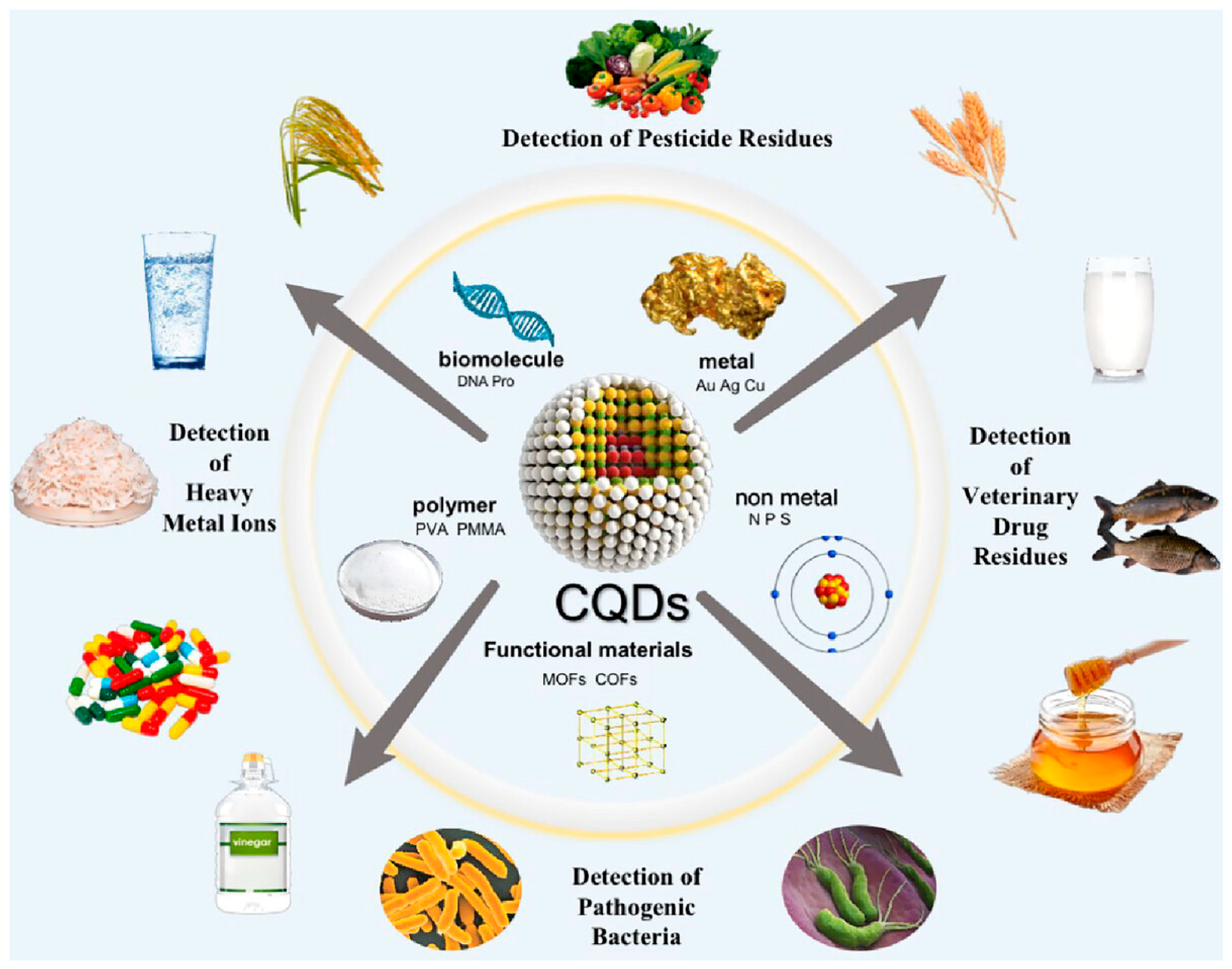

Rational Functional Design of Carbon Quantum Dots for Food Safety and Preservation: A Critical Review

Abstract
1. Introduction
2. Fundamentals of CQDs Relevant to Functional Design and Food-Related Applications
2.1. Brief Overview of Synthesis Approaches
2.2. Surface Functional Groups: Origin and Roles
2.3. Photophysical Mechanisms Underpinning Fluorescence Sensing
2.4. Biocompatibility and Safety Considerations for Food Contact
3. Strategies for Functional Design: Surface Engineering and Heteroatom Doping
3.1. Surface Functionalization: Tailoring Surface Chemistry for Recognition and Reactivity
3.2. Heteroatom Doping: Modulating Electronic Structure and Optical Properties
3.3. Metal and Lanthanide Doping: Expanding Functionality
3.4. Practical Comparison of Doping Strategies for Food-Relevant Applications
4. Applications of Functionalized CQDs in Food Safety Detection
4.1. Detection of Heavy Metal Ions
4.2. Detection of Pesticide and Veterinary Drug Residues
4.3. Detection of Foodborne Pathogens
4.4. Detection of Food Additives and Nutritional Components
5. Applications of Functionalized CQDs in Food Preservation
5.1. Antioxidative and Antimicrobial Coatings and Films
5.2. CQD-Mediated Photodynamic Inactivation (PDI)
5.3. Intelligent Packaging: Freshness Indicators
6. Current Advantages, Key Challenges, and Future Perspectives
6.1. Core Advantages
6.2. Key Challenges
6.3. Future Directions
7. Concluding Remarks
Author Contributions
Funding
Data Availability Statement
Acknowledgments
Conflicts of Interest
References
- FAO. 13.3% of Total Food Production Lost Between Harvest and Retail. Available online: https://www.fao.org/sustainable-development-goals-data-portal/data/indicators/1231-global-food-losses/en#:~:text=The%20percentage%20of%20food%20lost%20globally%20after%20harvest,13.0%20percent%20in%202015%2C%20when%20global%20monitoring%20began (accessed on 20 April 2026).
- FSANZ. Foodborne Illness Costs Australian Economy Around $3 Billion Annually. Available online: https://www.foodstandards.gov.au/news/FSANZ%20updates%20estimate%20of%20annual%20cost%20of%20foodborne%20illness#:~:text=Foodborne%20illness%20costs%20the%20Australian%20economy%20around%20%243,%242.81%20billion%20in%202023%2C%20updated%20FSANZ%20estimates%20show (accessed on 20 April 2026).
- U.S. Department of Agriculture, Economic Research Service. Cost Estimates of Foodborne Illnesses—Expanded Coverage. Available online: https://www.ers.usda.gov/data-products/cost-estimates-of-foodborne-illnesses/documentation#:~:text=The%202025%20estimates%20expand%20coverage%20beyond%2015%20major,illnesses%2C%20and%20update%20disease%20modeling%20and%20cost%20estimates (accessed on 20 April 2026).
- Halonen, N.; Pálvölgyi, P.S.; Bassani, A.; Fiorentini, C.; Nair, R.; Spigno, G.; Kordas, K. Bio-based smart materials for food packaging and sensors—A review. Front. Mater. 2020, 7, 521914. [Google Scholar] [CrossRef]
- Jeddi, M.Z.; Boon, P.E.; Cubadda, F.; Hoogenboom, R.; Mol, H.; Verhagen, H.; Sijm, D.T.H.M. A vision on the ‘foodture’ role of dietary exposure sciences in the interplay between food safety and nutrition. Trends Food Sci. Technol. 2022, 120, 288–300. [Google Scholar] [CrossRef]
- Singh, A.K.; Itkor, P.; Lee, M.; Saenjaiban, A.; Lee, Y.S. Synergistic integration of carbon quantum dots in biopolymer matrices: An overview of current advancements in antioxidant and antimicrobial active packaging. Molecules 2024, 29, 5138. [Google Scholar] [CrossRef] [PubMed]
- Das, S.; Mondal, S.; Ghosh, D. Carbon quantum dots in bioimaging and biomedicines. Front. Bioeng. Biotechnol. 2024, 11, 1333752. [Google Scholar] [CrossRef] [PubMed]
- Sharma, N.; Pandey, T.; Pandey, V. Biomass-derived carbon quantum dots as sustainable nanosensors for pesticides and toxic metabolites. Environ. Sci. Nano 2026, 13, 14–37. [Google Scholar] [CrossRef]
- Xu, X.; Ray, R.; Gu, Y.; Ploehn, H.J.; Gearheart, L.A.; Raker, K.; Scrivens, W.A. Electrophoretic analysis and purification of fluorescent single-walled carbon nanotube fragments. J. Am. Chem. Soc. 2004, 126, 12736–12737. [Google Scholar] [CrossRef]
- Sun, Y.-P.; Zhou, B.; Lin, Y.; Wang, W.; Fernando, K.A.S.; Pathak, P.; Meziani, M.J.; Harruff, B.A.; Wang, X.; Wang, H.; et al. Quantum-sized carbon dots for bright and colorful photoluminescence. J. Am. Chem. Soc. 2006, 128, 7756–7757. [Google Scholar] [CrossRef]
- Molaei, M.J. Carbon quantum dots and their biomedical and therapeutic applications: A review. RSC Adv. 2019, 9, 6460–6481. [Google Scholar] [CrossRef]
- Zhu, Z.; Zhai, Y.; Li, Z.; Zhu, P.; Mao, S.; Zhu, C.; Du, D.; Belfiore, L.A.; Tang, J.; Lin, Y. Red carbon dots: Optical property regulations and applications. Mater. Today 2019, 30, 52–79. [Google Scholar] [CrossRef]
- Ghahremani, H.; Molaei, M.J.; Salimi, E. Dextran-derived carbon quantum dots for drug delivery and food preservation. Diam. Relat. Mater. 2025, 158, 112615. [Google Scholar] [CrossRef]
- Kumar, J.V.; Rhim, J.-W. Fluorescent carbon quantum dots for food contaminants detection applications. J. Environ. Chem. Eng. 2024, 12, 111999. [Google Scholar] [CrossRef]
- Altaylı, B.; Toprak, Y.E.; Çubuk, S.; Uyumaz, F.; Kahraman, M.V. Fluorescent carbon quantum dots for toxic mercury (ii) ions detection in environmental waters. Surf. Interfaces 2025, 74, 107668. [Google Scholar] [CrossRef]
- Li, R.; Yue, J.; Zhu, F.; Zhou, J.; Liu, X. Application progress of carbon quantum dot composites in fluorescent detection of food safety. J. Food Sci. 2025, 90, e70299. [Google Scholar] [CrossRef]
- Mohandoss, S.; Roy, P.; Velu, K.S.; Ahmad, N.; Ahmed, M.; Palanisamy, S.; You, S.; Mani, D.; Lee, S.W.; Kim, S.C. Yellow-emissive nd-doped carbon quantum dots for ratiometric detection of anthrax biomarker with applications in food analysis and cellular imaging. Spectrochim. Acta A Mol. Biomol. Spectrosc. 2026, 349, 127326. [Google Scholar] [CrossRef] [PubMed]
- Rosales, S.; Medina, O.E.; Garzon, N.; Zapata, K.; Taborda, E.A.; Ordóñez, J.C.; Cortés, F.B.; Franco, C.A. Systematic review of carbon quantum dots (cqd): Definition, synthesis, applications and perspectives. Renew. Sustain. Energy Rev. 2025, 219, 115854. [Google Scholar] [CrossRef]
- Karki, D.; Thapa, Y.N.; Rajchal, B.; Adhikari, R. Recent advances in the synthesis of tailored carbon quantum dots and their biomedical applications. ACS Appl. Bio Mater. 2025, 8, 8401–8420. [Google Scholar] [CrossRef]
- Mujahid, M. Carbon quantum dots: Sustainable synthesis, enhanced properties, and cross-disciplinary applications. Adv. Nat. Sci. Nanosci. Nanotechnol. 2025, 16, 033001. [Google Scholar] [CrossRef]
- Sharma, A.K.; Kuamri, N.; Chauhan, P.; Thakur, S.; Kumar, S.; Shandilya, M. Comprehensive insights into carbon quantum dots: Synthesis strategies and multidomain applications. J. Fluoresc. 2025, 35, 12051–12085. [Google Scholar] [CrossRef]
- Collins, J.; Yang, L.; Dong, X.; Sun, Y.-P. Antimicrobial properties of carbon “quantum” dots for food safety applications. J. Nanopart. Res. 2025, 27, 35. [Google Scholar] [CrossRef]
- Naseer, M.S.; Imran, A.; Jameel, Q.Y.; Bishoyi, A.K.; Ahmed, F.; Elawady, A.; Rajput, P.; Islam, F.; Zahoor, T.; Kinki, A.B.; et al. Application of carbon quantum dots in food business: A comprehensive review. eFood 2025, 6, e70054. [Google Scholar] [CrossRef]
- Murugesan, A.; Li, H.; Shoaib, M. Recent advances in functionalized carbon quantum dots integrated with metal–organic frameworks: Emerging platforms for sensing and food safety applications. Foods 2025, 14, 2060. [Google Scholar] [CrossRef] [PubMed]
- Solayman, H.M.; Leong, K.H.; Hossain, M.K.; Khan, M.B.; Kang, K.; Jiang, J.-J.; Abd Aziz, A. Carbon quantum dots: Comparative analysis of synthesis strategies and their environmental application. Next Mater. 2025, 8, 100787. [Google Scholar] [CrossRef]
- Kohli, H.K.; Parab, D. Green synthesis of carbon quantum dots and applications: An insight. Next Mater. 2025, 8, 100527. [Google Scholar] [CrossRef]
- Gupta, D.; Priyadarshi, R.; Tammina, S.K.; Rhim, J.-W.; Agrawal, G. Fruit processing wastes as sustainable sources to produce multifunctional carbon quantum dots for application in active food packaging. Food Bioprocess Technol. 2025, 18, 2145–2169. [Google Scholar] [CrossRef]
- Rasal, A.S.; Subrahmanya, T.M.; Kizhepat, S.; Getachew, G.; Ghule, A.V.; Devan, R.S.; Hung, W.-S.; Fahmi, M.Z.; Wibrianto, A.; Chang, J.-Y. Carbon quantum dots: Classification-structure-property-application relationship for biomedical and environment remediation. Coord. Chem. Rev. 2025, 533, 216510. [Google Scholar] [CrossRef]
- Lin, X.; Sun, C.; Du, W.; Li, W.; Wang, R.; Wang, C.; Su, Z.; Wang, Q.; Tian, J.; Li, W.; et al. Research progress on functional carbon dots for detecting heavy metal ions in the fields of environmental protection and food safety. Talanta 2026, 302, 129405. [Google Scholar] [CrossRef]
- Riahi, Z.; Khan, A.; Kim, J.T. Chapter 28—Global regulatory aspects of carbon dot applications in the food industry. In Carbon Dots in Food Packaging and Preservation; Rhim, J.W., Ed.; Elsevier: Amsterdam, The Netherlands, 2026; pp. 575–585. [Google Scholar] [CrossRef]
- Overview of Carbon Quantum Dots Synthesis Strategies—Photochemistry. Available online: https://photochem.alfa-chemistry.com/overview-of-carbon-quantum-dots-synthesis-strategies.html (accessed on 24 April 2026).
- Solayman, H.M.; Leong, K.H.; Hossain, M.K.; Kang, K.; Khan, M.B.; Jiang, J.-J.; Abd Aziz, A. State-of-the-art advances in hydrothermally synthesized carbon quantum dots: An extensive review. Nano-Struct. Nano-Objects 2025, 43, 101533. [Google Scholar] [CrossRef]
- Wang, Z.; Changotra, R.; Dasog, M.; Singh Selopal, G.; Yang, J.; He, Q.S. Carbon quantum dots: Synthesis via hydrothermal processing, doping strategies, integration with photocatalysts, and their application in photocatalytic hydrogen production. Sustain. Mater. Technol. 2025, 44, e01386. [Google Scholar] [CrossRef]
- Rastgar, S.; Elboughdiri, N. Environmentally friendly synthesis of carbon quantum dots (cqds) to enhance photocatalytic activity for the photodegradation of various organic dyes and the evolution of hydrogen and oxygen. J. Fluoresc. 2025, 35, 13497–13543. [Google Scholar] [CrossRef]
- Sharma, N.; Sharma, A.; Lee, H.-J. The antioxidant properties of green carbon dots: A review. Environ. Chem. Lett. 2025, 23, 1061–1109. [Google Scholar] [CrossRef]
- Luo, J.; Ma, Y.; Chen, W.; Pang, J. Green synthesis of biomass carbon nanodots and their multifunctional applications. Bioresour. Technol. 2026, 448, 134292. [Google Scholar] [CrossRef]
- Shabbir, H.; Csapó, E.; Wojnicki, M. Carbon quantum dots: The role of surface functional groups and proposed mechanisms for metal ion sensing. Inorganics 2023, 11, 262. [Google Scholar] [CrossRef]
- Giordano, M.G.; Seganti, G.; Bartoli, M.; Tagliaferro, A. An overview on carbon quantum dots optical and chemical features. Molecules 2023, 28, 2772. [Google Scholar] [CrossRef]
- Yan, F.; Jiang, Y.; Sun, X.; Bai, Z.; Zhang, Y.; Zhou, X. Surface modification and chemical functionalization of carbon dots: A review. Microchim. Acta 2018, 185, 424. [Google Scholar] [CrossRef]
- Li, Y.; Wang, K.; Hou, W.; Wang, L. Carbon quantum dots for environmental catalysis: Green synthesis, surface functionalization, and interface engineering. Chem. Commun. 2025, 61, 18784–18797. [Google Scholar] [CrossRef] [PubMed]
- Molaei, M.J. Principles, mechanisms, and application of carbon quantum dots in sensors: A review. Anal. Methods 2020, 12, 1266–1287. [Google Scholar] [CrossRef]
- Mohammed, A.S. Nitrogen-doped carbon dots in food sensing: A review of detection mechanisms and applications. RSC Adv. 2025, 15, 48727–48756. [Google Scholar] [CrossRef] [PubMed]
- Zu, F.; Yan, F.; Bai, Z.; Xu, J.; Wang, Y.; Huang, Y.; Zhou, X. The quenching of the fluorescence of carbon dots: A review on mechanisms and applications. Microchim. Acta 2017, 184, 1899–1914. [Google Scholar] [CrossRef]
- Sun, Y.; Huang, L. Regulation of brightness attributes of high-stability carbon quantum dots applicable in led digital color display. J. Fluoresc. 2025, 35, 5035–5044. [Google Scholar] [CrossRef]
- Pan, L.; Sun, S.; Zhang, A.; Jiang, K.; Zhang, L.; Dong, C.; Huang, Q.; Wu, A.; Lin, H. Truly fluorescent excitation-dependent carbon dots and their applications in multicolor cellular imaging and multidimensional sensing. Adv. Mater. 2015, 27, 7782–7787. [Google Scholar] [CrossRef]
- Malavika, V.; Rajan, M.R.; Krishnamoorthi, R.; Adithya, K.C.; Kim, K.-S. Citrus-derived carbon quantum dots: Synthesis, characterization, and safety evaluation in zebrafish (Danio rerio) for potential biomedical and nutritional applications. Micro 2025, 5, 50. [Google Scholar] [CrossRef]
- Nataraj, B.H.; Srivastava, S.K.; Vishwakarma, S.; Mallappa, R.H.; Singh Parmar, A. Hydrothermal synthesis and characterization of carbon quantum dots from paneer whey and evaluation of their in-vitro safety, anti-oxidant and antagonistic properties. J. Food Meas. Charact. 2025, 19, 5958–5970. [Google Scholar] [CrossRef]
- Das, P.; Nath, P.C.; Pandey, V.K.; Singh, R.; Rustagi, S.; Shaikh, A.M.; Kovács, B. Carbon quantum dots as emerging biosensors for food safety and environmental applications: Advances and challenges. Appl. Food Res. 2025, 5, 101255. [Google Scholar] [CrossRef]
- Xiao, M.; Mei, L.; Qi, J.; Zhu, L.; Wang, F. Functionalized carbon quantum dots fluorescent sensor array assisted by a machine learning algorithm for rapid foodborne pathogens identification. Microchem. J. 2024, 201, 110701. [Google Scholar] [CrossRef]
- Mohandoss, S.; Roy, P.; Ahmad, N.; Gomez, P.L.A.M.; Velu, K.S.; Somu, P.; Kim, S.-C. A comprehensive review of multifunctional carbon quantum dots (cqds): Heteroatom, metal, and lanthanide doping for advanced sensing applications. Inorg. Chem. Commun. 2026, 183, 115698. [Google Scholar] [CrossRef]
- Sethulekshmi, A.S.; Aparna, A.; Parvathi, P.; Pathak, R.; Punetha, V.D.; Selvaraj, M.; Saritha, A. Advances in doped carbon quantum dots: Synthesis, mechanisms, and applications in sensing technologies. Chem. Eng. J. 2025, 514, 163262. [Google Scholar] [CrossRef]
- Nguyen, K.G.; Baragau, I.-A.; Gromicova, R.; Nicolaev, A.; Thomson, S.A.J.; Rennie, A.; Power, N.P.; Sajjad, M.T.; Kellici, S. Investigating the effect of n-doping on carbon quantum dots structure, optical properties and metal ion screening. Sci. Rep. 2022, 12, 13806. [Google Scholar] [CrossRef]
- Ren, H.; Labidi, A.; Sun, J.; Allam, A.A.; Ajarem, J.S.; Abukhadra, M.R.; Wang, C. Facile synthesis of nitrogen, sulfur co-doped carbon quantum dots for selective detection of mercury (ii). Environ. Chem. Lett. 2024, 22, 35–41. [Google Scholar] [CrossRef]
- Zhao, W.; Wan, R.; Sun, X.; Wang, Z.; Gong, Z.; Guo, L.; Marzouki, R.; Luo, M.; Li, A.; Ning, H.; et al. Inhibition mechanism of phosphorus-doped carbon quantum dots on anodic corrosion in neutral mg-air batteries. J. Alloys Compd. 2025, 1037, 182609. [Google Scholar] [CrossRef]
- Zhang, Y.; Qin, H.; Huang, Y.; Zhang, F.; Liu, H.; Liu, H.; Wang, Z.J.; Li, R. Highly fluorescent nitrogen and boron doped carbon quantum dots for selective and sensitive detection of Fe(3). J. Mater. Chem. B 2021, 9, 4654–4662. [Google Scholar] [CrossRef] [PubMed]
- Li, X.; Wang, C.; Li, P.; Sun, X.; Shao, Z.; Xia, J.; Liu, Q.; Shen, F.; Fang, Y. Beer-derived nitrogen, phosphorus co-doped carbon quantum dots: Highly selective on–off-on fluorescent probes for the detection of ascorbic acid in fruits. Food Chem. 2023, 409, 135243. [Google Scholar] [CrossRef]
- Liang, J.M.; Zhang, F.; Zhu, Y.L.; Deng, X.Y.; Chen, X.P.; Zhou, Q.J.; Tan, K.J. One-pot hydrothermal synthesis of Si-doped carbon quantum dots with up-conversion fluorescence as fluorescent probes for dual-readout detection of berberine hydrochloride. Spectrochim. Acta A Mol. Biomol. Spectrosc. 2022, 275, 121139. [Google Scholar] [CrossRef]
- Li, Z.; Zhou, L.; Zhang, F.; Yang, H.; Guo, L.; Chai, F. High sensitive and selective multivariate detection of Hg2+ and Ag+ in real food samples via ca, n-co-doped carbon dots based dual-mode platform. Spectrochim. Acta Part A Mol. Biomol. Spectrosc. 2025, 343, 126536. [Google Scholar] [CrossRef] [PubMed]
- Ali, A.-M.B.H.; Elmasry, M.R.; Bin Jardan, Y.A.; El-Wekil, M.M. Smart fluorometric sensing of metal contaminants in canned foods: A carbon dot-based dual-response system for quantifying aluminum and cobalt ions. RSC Adv. 2025, 15, 6962–6973. [Google Scholar] [CrossRef]
- Shan, D.; Yu, H.; Yang, Z.; Li, H.; Jia, R.; Zhang, Y. Nitrogen-doped carbon quantum dots (ncqds) detected to mercury ions in food monitoring. Food Chem. 2025, 463, 141308. [Google Scholar] [CrossRef] [PubMed]
- Mkhize, A.; Nocanda, X.; Booysen, I.N.; Mambanda, A. Enhanced absorption and fluorescence quenching methods for the quantitative analysis of cr(vi) ions using avocado seed-derived carbon quantum dots as pseudo-derivatising reagents. Nanoscale 2026, 18, 8278–8296. [Google Scholar] [CrossRef]
- Ali, R.; Alhazzani, K.; Alanazi, A.Z.; Barker, J.; Mostafa, A.M.; El-Wekil, M.M.; Goda, M.N.; Ali, A.-M.B.H. Selective detection of terminal alkyne acaricide via click-reactive carbon dots: Applications in food safety monitoring. Anal. Methods 2025, 17, 8923–8934. [Google Scholar] [CrossRef]
- Pawar, R.V.; Patil, P.O.; Khalid, M.; Wahab, S.; Taleuzzaman, M.; Pardeshi, S.R.; Khan, Z.G. Design of a facile fluorescent nano-sensor using nitrogen and sulfur dual doped carbon quantum dots for carbendazim detection: A turn-off-on approach for food safety and environmental monitoring. J. Fluoresc. 2025, 35, 11175–11190. [Google Scholar] [CrossRef] [PubMed]
- Asri, N.A.N.; Fen, Y.W.; Fauzi, N.I.M.; Kamaruzzaman, N.A.; Khaidir, R.E.M.; Hashim, H.S.; Anuar, M.F.; Zailani, M.A.Z.M.; Fadzil, A.D.I.M.; Basari, N.N.A.M.; et al. Mango peels-assisted synthesis of carbon quantum dots for potential optical sensing of diazinon. Sci. Rep. 2026, 16, 4341. [Google Scholar] [CrossRef]
- Vijaybhai, B.M.; Singh, A.; Singh, G.; Tangra, A.K.; Sankhla, M.S. Advances in carbon quantum dot-based nanocomposites for targeted detection of food toxins: A focus on safety applications. J. Food Compos. Anal. 2025, 148, 108321. [Google Scholar] [CrossRef]
- Tian, J.; Yang, R.; Ren, X.; Wang, Q.; Qing, J.; Li, W.; Wang, R.; Su, Z.; Wang, C.; Lin, X.; et al. Research progress on functional carbon quantum dots fluorescent probes for detecting pesticide residues in food. Microchim. Acta 2026, 193, 156. [Google Scholar] [CrossRef]
- Chen, M.; Wu, D.; Deng, X.; Ma, J.; Fan, H.; Huang, X.; Wang, P.; Li, Y.; Liao, X.; Si, L.; et al. Ultrasensitive detection of tetracycline in animal-origin foods using self-nitrogen doped carbon dots as fluorescent probes. J. Food Compos. Anal. 2025, 142, 107414. [Google Scholar] [CrossRef]
- Zhang, Q.; Xie, M.; Tian, X.; Luo, X.; Zheng, B.; Mou, S.; Wang, M.; Luo, X.; Zou, Q. A one-stone-two-birds strategy: Cerium-doped carbon dots as a dual probes platform for quantification of tetracycline and carmine in foods. Microchim. Acta 2026, 193, 130. [Google Scholar] [CrossRef]
- Lin, X.; Wang, J.; Xia, M.; Li, S.; Xu, Y.; Sun, J.; Leng, H.; Song, T.; Xing, Y.; Yang, M. A dual-functional fluorescent sensor based on a single soybean-derived carbon dots for discrimination and quantification of tetracyclines in food. Food Chem. 2026, 514, 149094. [Google Scholar] [CrossRef]
- Pei, S.; Yan, K.; Cai, S.; Hou, Y.; Luo, K.; Xiang, P.; Peng, Y. Preparation of carbon quantum dot fluorescent probe from Caesalpinia sappan L. for the detection of ciprofloxacin and antibacterial applications. Sci. Rep. 2026. [Google Scholar] [CrossRef] [PubMed]
- Li, J.; Ma, G.; Wang, X.; Cai, J.; Wang, X. A mannose-functionalized carbon dot and boronic acid–graphene oxide nanocomposite fluorescent probe for salmonella typhimurium detection. Anal. Methods 2025, 17, 7468–7481. [Google Scholar] [CrossRef]
- Xie, L.; Sun, Z.; Zhang, X.; Li, B.; Liu, M. A novel fluorescent sensing system based on ph-responsive carbon dots for the identification and detection of bacteria. New J. Chem. 2025, 49, 15973–15979. [Google Scholar] [CrossRef]
- Tohamy, H.-A.S. Beet root carbon dots cellulose sulfate film as a novel naked eye ph sensor for chromium and bacterial detection in tomatoes. Sci. Rep. 2025, 15, 30235. [Google Scholar] [CrossRef]
- Kang, L.; Wang, J.; Lin, X.; Feng, J.; Duan, N.; Wang, Z.; Wu, S. A full-color carbon quantum dots fluorescence sensing array combined with machine learning for rapid bacterial detection and classification. Adv. Healthc. Mater. 2026, 15, e02916. [Google Scholar] [CrossRef] [PubMed]
- Ahn, J.M.; Kim, Y.H.; Rhim, J.-W.; Yoon, K.S. Onion-peel carbon quantum dots: Antimicrobial effect and biofilm control on food contact surfaces. Foods 2025, 14, 4296. [Google Scholar] [CrossRef] [PubMed]
- Safaei, A.; Giyahban, F.; Ebrahimzadeh, H. Development of a ratiometric fluorescence sensor based on blue- and orange-emissive carbon dots for the determination of tartrazine in food products. Food Chem. 2025, 477, 143582. [Google Scholar] [CrossRef]
- Gao, F.; An, K.; Chen, X.; Fu, Y.; Li, J.; Zhang, A.; Zhang, L.; Jia, H.; Bian, W. Carbon dot- and curcumin dye-based dual-emission fluorescence ratiometric probes for rapid smartphone detection of brilliant blue in food. ACS Appl. Nano Mater. 2025, 8, 12322–12328. [Google Scholar] [CrossRef]
- Chaudhari, S.S.; Patil, P.O.; Mali, S.S.; Alam, M.S.; Nangare, S.N.; Bari, S.B.; Khan, Z.G. Design and synthesis of surface-decorated zinc-doped carbon quantum dots as fluorescent probes for tartrazine detection in real food samples exploiting the inner filter effect mechanism. Food Control 2025, 168, 110925. [Google Scholar] [CrossRef]
- Wang, J.; Li, Q.; Wang, W.; Wang, Q.; Fu, Y. Fluorescent probes based on n-cqds: For direct detection of food additives stpp and Al3+. Spectrochim. Acta Part A Mol. Biomol. Spectrosc. 2025, 324, 125036. [Google Scholar] [CrossRef]
- Wang, Y.; Wang, Y.; Zou, J.; Tan, S.; Yan, F.; Yang, B.; Li, C.; Wu, S. A green synthesis of fluorescent carbon dots and their application to the determination of sunset yellow. Foods 2025, 14, 3221. [Google Scholar] [CrossRef] [PubMed]
- Zhu, Y.; Deng, X.; Chen, J.; Hu, Z.; Wu, F. Coffee grounds-derived carbon quantum dots as peroxidase mimetics for colorimetric and fluorometric detection of ascorbic acid. Food Chem. 2023, 429, 136957. [Google Scholar] [CrossRef] [PubMed]
- Nath, P.; Dey, A.; Kundu, T.; Pathak, T.; Chatterjee, M.; Roy, P.; Satapathi, S. Highly fluorescent nitrogen doped carbon dots as analytical probe for sensitive detection of curcumin through smartphone integrated 3d-printed platform: A new horizon in food safety. Spectrochim. Acta Part A Mol. Biomol. Spectrosc. 2025, 326, 125260. [Google Scholar] [CrossRef]
- Cai, Z.; Yang, C.; Zhang, Z.; Xing, W.; Yang, S. Ratiometric fluorescence sensor based on carbon quantum dots for hydrocortisone detection in food samples. Food Chem. 2025, 495, 146636. [Google Scholar] [CrossRef]
- Li, M.; Chen, X.; Xia, X.; Zhang, T.; Zhang, W.; Xu, Q.; Zhao, X. A ratiometric fluorescent sensor for Al3+ and Cu2+ detection in food samples. Front. Nutr. 2025, 12, 1707179. [Google Scholar] [CrossRef]
- Niu, K.; Yao, F.; Ma, Y.; Lv, D.; Chen, F. Multifunctional peanut shell-derived carbon dots/chitosan-polyvinyl alcohol composite films for preservation of fruits. J. Food Sci. 2026, 91, e71016. [Google Scholar] [CrossRef]
- Na, G.; Kang, J.-W. Sustainable agar-based film with zinc oxide/carbon quantum dot (zno/cqd) nanocomposite for photocatalytic antimicrobial and antioxidant packaging of chicken breast. Food Hydrocoll. 2025, 168, 111568. [Google Scholar] [CrossRef]
- Sharma, S.; Riahi, Z.; Khan, A.; Mishra, N.C.; Priyadarshi, R.; Rhim, J.-W. Carbon dots as sustainable antioxidants in active food packaging applications: A review. Trends Food Sci. Technol. 2026, 170, 105602. [Google Scholar] [CrossRef]
- Jafarzadeh, S.; Golgoli, M.; Qazanfarzadeh, Z.; Forough, M.; Wu, P.; Timms, W.; Barrow, C.J.; Naebe, M.; Zargar, M. Evaluating the influence of carbon quantum dots on starch-based bioplastics: Toward potential food packaging applications. Food Packag. Shelf Life 2025, 50, 101555. [Google Scholar] [CrossRef]
- Zheng, Y.; Ma, X.; Su, X.; Li, J.; Li, D.; Li, Y. Development of highly transparent and multifunctional lignin-derived carbon quantum dots/pva composite films for active food packaging. Polym. Eng. Sci. 2025, 65, 6010–6020. [Google Scholar] [CrossRef]
- Liu, Z.; Yang, F.; Zhang, G.; Liao, Y.; Cui, M.; Li, H.; Hu, L.; Mo, H. Carbon quantum dots: A green and efficient material for fruits and vegetables preservation. Food Rev. Int. 2025, 42, 694–719. [Google Scholar] [CrossRef]
- Qazanfarzadeh, Z.; Baptista, H.; Nunes, C.; Kumaravel, V. Development of smart food packaging from bread waste-derived starch and carbon quantum dots. Ind. Crops Prod. 2025, 233, 121426. [Google Scholar] [CrossRef]
- Sheng, L.; Li, X.; Wang, L. Photodynamic inactivation in food systems: A review of its application, mechanisms, and future perspective. Trends Food Sci. Technol. 2022, 124, 167–181. [Google Scholar] [CrossRef]
- Du, J.; Ni, Z.-J.; Wang, W.; Thakur, K.; Ma, R.-H.; Ma, W.-P.; Wei, Z.-J. Carbon dot-mediated photodynamic treatment improves the quality attributes of post-harvest goji berries (Lycium barbarum L.) via regulating the antioxidant system. Foods 2024, 13, 955. [Google Scholar] [CrossRef]
- Xia, F.; Zhang, H.; Yu, Y.; Jiang, C.; Kang, Y.; Zhang, Z.; Zhang, P.; Sun, W. Novel photodynamic antimicrobial films loaded with chinese artichoke carbon dots for chilled mutton preservation. Food Chem. 2025, 495, 146492. [Google Scholar] [CrossRef]
- Priyadarshi, R.; Uzun, S.; Rhim, J.-W. Edible coating using carbon quantum dots for fresh produce preservation: A review of safety perspectives. Adv. Colloid Interface Sci. 2024, 331, 103211. [Google Scholar] [CrossRef] [PubMed]
- Riahi, Z.; Khan, A.; Rhim, J.-W.; Shin, G.H.; Kim, J.T. Carbon dot-based ph-responsive indicators for intelligent food packaging and food safety control. Trends Food Sci. Technol. 2025, 163, 105200. [Google Scholar] [CrossRef]
- Sasikumar, T.; Shin, G.H.; Kim, J.T. N, s, and p-doped carbon dots for intelligent paper sensors: Vapor-phase biogenic amine detection and freshness evaluation of foods. Food Packag. Shelf Life 2025, 52, 101647. [Google Scholar] [CrossRef]
- Han, S.; Ansari, J.R.; Park, K.; Sadeghi, K.; Seo, J. Carbon quantum dots synthesized from a lemon extract in ethyl acetate to enhance the performance of polylactic acid films for packaging applications. J. Ind. Eng. Chem. 2026, 153, 395–408. [Google Scholar] [CrossRef]
- Liu, Y.; Wang, X.; Shi, X.; Wu, S. Nitrogen and sulfur co-doped fluorescent carbon dots constructing pva@n, s-cds composite film: A next-generation food packaging material with dual functions of chlortetracycline detection and ultraviolet shielding. Small 2026, 22, e14630. [Google Scholar] [CrossRef]
- Li, M.; Du, Y.; Zhao, J.; Jiang, Y.; Zhang, Y.; Yi, J. Carbon quantum dot-enhanced stimulus-responsive hydrogels for smart food packaging: Sensing, preservation, and ai-enabled predictive quality management. Food Packag. Shelf Life 2026, 53, 101701. [Google Scholar] [CrossRef]
- Jena, T.; Shinde, S.; Roselin, S.E.; Sujana, C.; Rao, V.S.; Immanuvel Arokia James, K. Deep learning-optimized carbon quantum dot biosensors for emerging contaminant monitoring. Microchem. J. 2025, 218, 115389. [Google Scholar] [CrossRef]
- Mohammed, A.S.; Mohammed, S.J. Carbon dot-integrated edible films: Emerging synergies for advanced food packaging applications. RSC Adv. 2026, 16, 12012–12036. [Google Scholar] [CrossRef] [PubMed]
- Li, L.; Wang, Y.; Fan, K. Recent advances in carbon dots-loaded composite films for food preservation and freshness monitoring: A review. Food Biosci. 2025, 74, 107839. [Google Scholar] [CrossRef]


| Synthesis Method | Typical Precursors | Key Advantages | Limitations | Relevance to Food Applications | Ref. |
|---|---|---|---|---|---|
| Hydrothermal | Citric acid, glucose, biomass | High quantum yield; abundant surface groups; green solvent | Batch-to-batch variation; requires autoclave | Most widely used for food sensors and preservation coatings | [32,33,34] |
| Microwave-assisted | Citric acid, urea, amino acids | Rapid synthesis; energy-efficient; good dispersibility | Non-uniform particle size | Rapid screening of functionalized CQDs | [21,27] |
| Pyrolytic carbonization | Biomass waste (peels, shells, whey) | Sustainable, low-cost; waste valorization | Complex purification; lower quantum yield | Green synthesis for active food packaging | [27] |
| Electrochemical | Graphite, carbon nanotubes | Strong fluorescence stability; controllable size | Low quantum yield; requires post-treatment | Limited food applications | [21] |
| Laser ablation | Graphite powder, carbon targets | Abundant raw materials; no chemical additives | Expensive equipment; low yield | Rarely used in food-related research | [21] |
| Functional Group | Property Conferred | Role in Sensing | Role in Preservation | Ref. |
|---|---|---|---|---|
| Carboxyl (−COOH) | Hydrophilicity; negative charge | Conjugation anchor; electrostatic attraction of cations | Enhances aqueous dispersibility | [37,39] |
| Hydroxyl (−OH) | Hydrophilicity; hydrogen bonding | Stabilizes CQDs in aqueous media; H-bonding recognition | Radical scavenging (antioxidant) | [37,38] |
| Amine (-NH2) | Positive charge (acidic pH); electron donor | Metal ion coordination; PET-based sensing | Antimicrobial activity via membrane disruption | [37,41] |
| Carbonyl (−C=O) | Electron-withdrawing | Modulates band gap and emission | Minor contribution to antioxidant activity | [37] |
| Thiol (-SH) | Strong metal affinity; redox activity | Selective binding of heavy metals (Hg2+, Pb2+) | Potential antioxidant effects | [41] |
| Dopant | Typical Precursors | Imparted Properties | Representative Food Safety Application | Ref. |
|---|---|---|---|---|
| Nitrogen (N) | Urea, ethylenediamine | Enhanced QY; n-type doping | Detection of antibiotics, pesticides, heavy metals | [52] |
| Sulfur (S) | Sodium sulfide, cysteine | Thiol-related states; affinity for Hg2+, Pb2+ | Selective heavy metal detection in seafood | [53] |
| Phosphorus (P) | Phosphoric acid | Expanded bandgap; enhanced ROS generation | Photodynamic inactivation; antioxidant packaging | [54] |
| Boron (B) | Boric acid | p-type doping; enhanced sensing | Detection of phenolic contaminants | [27] |
| Silicon (Si) | APTES, APTMS | Up-conversion fluorescence; enhanced photostability | Dual-readout detection of alkaloids | [57] |
| N/S co-doping | Urea + thiourea | Synergistic QY enhancement; dual active sites | Simultaneous multi-metal detection | [53,58] |
| N/P co-doping | Ethylenediamine + phosphoric acid | Enhanced ROS generation | Photodynamic antibacterial coatings | [56] |
| Design Strategy | Key Advantages | Limitations | Best Suited for | Ref. |
|---|---|---|---|---|
| Surface functionalization | Direct control over surface chemistry; covalent attachment of biorecognition elements | May reduce QY; biomolecule stability in food matrices may be limited | Selective pathogen detection; aptamer/antibody-based sensing | [39,40] |
| Single-element doping | Significant QY enhancement; simple one-step synthesis | Limited tunability; predominantly blue-green emission | General fluorescence sensing; metal ion detection | [52,53] |
| Co-doping | Synergistic property enhancement; multifunctional capabilities | Complex optimization; reproducibility challenges | Ratiometric sensing; photodynamic inactivation | [55,56] |
| Metal/Lanthanide doping | Catalytic/redox activity; ratiometric sensing | Potential toxicity concerns; expensive precursors | Electrochemical sensors; high-precision ratiometric sensing | [17,50] |
| CQD System | Functional Design | Target | Food Matrix | LOD | Recovery (%) | Ref. |
|---|---|---|---|---|---|---|
| E-CDs (Ca,N-co-doped) | Ca/N co-doping; dual-mode | Hg2+, Ag+ | Real food samples | 11.28 nM; 128.23 nM | 96.3–105.7 | [59] |
| N,S-doped CQDs | Dual-emission; ratiometric | Al3+, Co2+ | Canned tomato sauce, tuna | 0.06 μM; 0.012 μM | 97.0–100.7 | [60] |
| N-CQDs | N-doping; IFE | Hg2+ | Shrimp, crab, carp, rice | 42.4 nmol/L | Satisfactory | [61] |
| Avocado seed-derived CQDs | Biomass-derived | Cr(VI) | Water/food samples | Enhanced absorption/fluorescence | — | [62] |
| CQD System | Functional Design | Target | Food Matrix | LOD | Recovery (%) | Ref. |
|---|---|---|---|---|---|---|
| Az-CDs | Azide surface functionalization | Propargite | Citrus, tea | 0.35 ng mL−1 | 95.2–97.6 | [63] |
| N-S@CQDs | N,S-co-doping; turn-off-on | Carbendazim | Real food samples | 27.84 ng/mL | 96.9–99.36 | [58] |
| Mango peel-derived CQDs | Biomass-derived; SPR sensing | Diazinon | Environmental/food | 0.01 nM | — | [64] |
| N-CDs (shrimp shell) | Self-N-doping | Tetracycline | Milk, egg | 96 nM | 98.2–109.7 | [67] |
| Ce-CDs | Ce-doping | Tetracycline, Carmine | Meat | 0.037; 0.035 μM | 92.0–115 | [68] |
| N-BCDs | Soybean-derived N-doping | Tetracyclines | Milk, chicken | 0.12 μM | 97.2–110.4 | [69] |
| P-CQDs | P-doping; C. sappan L. | Ciprofloxacin | Milk | 2.06 nM | — | [70] |
| CQD System | Functional Design | Target | Food Matrix | LOD | Performance Notes | Ref. |
|---|---|---|---|---|---|---|
| g-CDs-M/GO-PBA | Mannose grafting | S. typhimurium | Buffer | 117 CFU·mL−1 | Linear range: 102–107 CFU·mL−1 | [71] |
| pH-CDs | pH-responsive | S. aureus, E. coli | Water | 3–6 CFU·mL−1 | Species differentiation | [72] |
| N-CDs-CS-CMC film | N-doping; composite | E. coli, S. aureus | Tomato | — | Shelf life: 4 to 10 days | [73] |
| Full-color CQDs array | ML-assisted; multichannel | 5 pathogenic bacteria | Pork matrix | >93% accuracy | Machine learning integration | [74] |
| Onion-peel CQDs | Biomass-derived | S. typhimurium, L. monocytogenes | Food contact surfaces | MIC: 1200–2200 μg/mL | Biofilm reduction: 74–91% | [75] |
| CQD System | Functional Design | Matrix | Target Food | Key Performance | Ref. |
|---|---|---|---|---|---|
| Peanut shell-CDs | Biomass-derived; photocatalytic ROS | CS/PVA | Strawberry | 80.19% DPPH scavenging; >94% antibacterial | [85] |
| ZnO/CQD | CQDs improve ZnO dispersion | Agar | Chicken breast | >3-log CFU/g reduction | [85] |
| N-CDs | N-doping | Sago starch | Model system | 56–74% UV reduction; improved hydrophobicity | [87] |
| LCQDs/PVA | Lignin-derived | PVA | Active packaging | >90% antioxidant/UV blocking; 49.6% tensile strength increase | [88] |
| Bread waste-CQDs | Waste valorization | Starch film | Smart packaging | 79.13% DPPH scavenging; pH-responsive | [90] |
Disclaimer/Publisher’s Note: The statements, opinions and data contained in all publications are solely those of the individual author(s) and contributor(s) and not of MDPI and/or the editor(s). MDPI and/or the editor(s) disclaim responsibility for any injury to people or property resulting from any ideas, methods, instructions or products referred to in the content. |
© 2026 by the authors. Licensee MDPI, Basel, Switzerland. This article is an open access article distributed under the terms and conditions of the Creative Commons Attribution (CC BY) license.
Share and Cite
Zhang, Z.; Du, J. Rational Functional Design of Carbon Quantum Dots for Food Safety and Preservation: A Critical Review. C 2026, 12, 40. https://doi.org/10.3390/c12020040
Zhang Z, Du J. Rational Functional Design of Carbon Quantum Dots for Food Safety and Preservation: A Critical Review. C. 2026; 12(2):40. https://doi.org/10.3390/c12020040
Chicago/Turabian StyleZhang, Ziting, and Juan Du. 2026. "Rational Functional Design of Carbon Quantum Dots for Food Safety and Preservation: A Critical Review" C 12, no. 2: 40. https://doi.org/10.3390/c12020040
APA StyleZhang, Z., & Du, J. (2026). Rational Functional Design of Carbon Quantum Dots for Food Safety and Preservation: A Critical Review. C, 12(2), 40. https://doi.org/10.3390/c12020040