


Abstract
Direct-fired supercritical CO2 cycles are considered a promising way to reduce CO2 emissions in the energy sector. One of the key elements of such cycles is a combustor, in which natural gas is burned at supercritical pressures up to 300 atm in an O2/CO2 environment. Understanding the chemical combustion kinetics of C1–C4 alkanes, the main components of natural gas, in a supercritical CO2-diluted medium is important for designing such combustors. This article provides an overview of studies on the chemical kinetics of C1–C4 alkanes combustion in CO2 at ultra-high pressures. It has been established that with increasing pressure, regardless of the diluent, CH3O2 and HO2 chemistries start to significantly influence the combustion of alkanes, but at the moment this influence is not sufficiently understood. Influence of CO2 dilution on kinetics is mainly thermal, but the chemical effect is also significant. At the same time, the direct chemical effect of CO2 is more important for the laminar burning velocity, while the indirect third-body effect is more important for the ignition delay time. However, the available literature lacks experimental measurements of the laminar burning velocity in a CO2 environment at pressures above 70 atm, which limits the current understanding of chemical kinetics at supercritical pressures.
1. Introduction
The increasing concentration of greenhouse gases in Earth’s atmosphere, the main of which is CO2, leads to global warming and threatens the sustainable development of humanity. According to the recent 2024 data, the largest source of carbon pollution is the energy sector, which accounts for 29% of all global greenhouse gas emissions in CO2 equivalent [1]. Direct-fired supercritical CO2 (sCO2) cycles are considered one of the promising ways to reduce CO2 emissions from power plants. By using pure oxygen for fuel oxidation and supercritical CO2 as a working fluid and diluent, direct-fired sCO2 cycles can produce electricity capturing almost 100% of CO2 emissions, while maintaining the ability to burn fossil fuels. The Allam cycle is the most effective direct-fired sCO2 cycle—its efficiency can reach up to 59% when burning natural gas, according to the cycle’s creators [2]. Thus, in terms of efficiency, the Allam cycle is comparable to the best combined cycle gas turbine units (CCGTUs) operating without CO2 capture (about 60%), and, according to article [3], surpasses CCGTUs with CO2 capture by about 12% in efficiency, while capturing more CO2 (98% vs. 89.8%). Although independent authors often show a lower efficiency of the Allam cycle—in the range of 41.5–64.3% [4]—than stated by its creators, direct-fired sCO2 plants based on the Allam cycle remain not only an environmentally, but also an economically promising technology.
One of the most important elements of any direct-fired sCO2 cycle is a combustion chamber, in which the gaseous fuel burns at a pressure of up to 300 atm (in the Allam cycle) in an O2/CO2 environment. This significantly distinguishes CO2-diluted combustors from traditional gas turbine unit (GTU) combustors, that burn fuel at subcritical pressures and use air (O2/N2 mixture) as an oxidizer. For these reasons, GTU combustion chamber designing techniques may not be applicable to direct-fired sCO2 cycles, which makes it urgent to adapt existing or develop new combustor design techniques specifically for CO2-diluted combustion. The main fuel for direct-fired cycles is natural gas—a mixture of C1–C4 alkanes. Accordingly, understanding the chemical kinetics of C1–C4 alkanes combustion under sCO2-diluted conditions is necessary to solve this problem.
High pressures affect combustion both directly, by increasing the partial pressures of species which accelerates the reaction, and indirectly through certain third-body reactions that are highly pressure-dependent, such as H + O2 (+M) = HO2 (+M). This reaction is recombinant and leads to the formation of a larger amount of the less reactive HO2, which replaces the highly reactive H- and OH-radicals, thus slowing combustion.
Regarding the effect of CO2 dilution, comparative studies show that the effect of CO2 on the chemical kinetics of combustion, compared to N2, can be divided into transport, thermal, radiative, and chemical effects [5,6,7,8,9,10,11,12,13,14,15,16,17,18,19,20,21]. The transport and thermal effects are due to the difference in physical properties between CO2 and N2: CO2 has a lower diffusion coefficient (transport properties) and a higher heat capacity (thermal properties) [22]. As a result, CO2 absorbs a higher proportion of the released energy for its own heating, which leads to a decrease in the combustion temperature, thus slowing down the overall reaction rate. The transport and thermal effects are often combined into a single physical effect [6,7,8,10,11,12,13,14,15,17,19,20,21]. The radiative effect is due to higher Planck absorption coefficients. As a result, a CO2-diluted flame has higher radiative heat losses than an N2-diluted flame, which also reduces the combustion temperature [16,23,24]. Finally, carbon dioxide is not as chemically inert as nitrogen, which causes the chemical effect of CO2. Carbon dioxide participates in the combustion process both directly, for example, through the reaction CO + OH = CO2 + H [5,7,8,9,10,15,16,17,18,19,20], and indirectly as a collision partner in third-body reactions [7,14]. The ratio of the effects varies with pressure [5,8,10,12,13,14,21], temperature [5,8,10,12], fuel-oxidizer ratio [7,14] and the degree of CO2 dilution [5,6,7,8,12]. Due to these effects, CO2 is a much stronger combustion inhibitor than N2: all other things being equal, in a CO2-diluted environment the laminar burning velocity of methane is two to six times lower than in an N2-diluted environment [22,25].
As can be seen, at the moment, there is already a significant number of studies devoted to C1–C4 alkanes combustion in CO2-diluted medium. However, as far as we know, there are currently no articles summarizing their results. This article provides a review of existing studies on the chemical kinetics of natural gas combustion at both supercritical pressures and in a CO2 environment. The review is divided into two sections. The first section examines the effect of ultra-high pressures and CO2 dilution on the chemical kinetics of C1–C4 alkanes combustion based on available research. The second section reviews existing experimental measurements of kinetics-relevant characteristics that can be used to study chemical combustion kinetics, as well as to develop and validate kinetic mechanisms for supercritical combustion of C1–C4 alkanes in a CO2 environment. The review is based on all the available literature devoted to studying C1–C1 alkanes CO2-diluted combustion we were able to find. The work is based on the laminar burning velocity (LBV), ignition delay time (IDT) and species concentration measurements since these kinetic characteristics are universal and have the largest number of experimental measurements. The review aims to identify priority areas for research into the kinetics of natural gas combustion in a supercritical CO2 environment, which is necessary for designing combustors of direct-fired sCO2 cycles.
2. Influence of CO2 Dilution and Ultra-High Pressures on the Chemical Kinetics of C1–C4 Alkanes Combustion
For ease of reading the text, Table 1 contains all the symbols used for reactions important for the combustion of C1–C4 alkanes in a supercritical CO2 environment, as mentioned in Section 2.
Table 1.
Symbols used for reactions important for supercritical CO2-diluted combustion.
2.1. Influence of High Pressures and Temperatures on Chemical Kinetics of C1–C4 Alkanes Combustion in a CO2 Environment
The effect of supercritical CO2 on the combustion kinetics of C1–C4 alkanes should be divided into the effect of high pressures and the effect of CO2-diluent. Research shows that the reaction pathways of alkanes oxidation are largely determined by increasing pressures, while the effect of CO2 is mostly thermal rather than chemical, and affects reaction rates but does not globally change the reaction pathway [14,26,27,28].
First of all, it is noteworthy that with increasing pressure, the HO2/H2O2 chemistry becomes very important [14,26,29,30]. This is due to the reactions H + O2 (+M) ⇄ HO2 (+M) (R1) and 2 HO2 ⇄ O2 + H2O2 (R2), which promote the active formation of HO2-radicals and hydrogen peroxide. In addition, reaction H + O2 (+M) ⇄ HO2 (+M) (R1) competes with reaction H + O2 ⇄ O + OH (R3; independent of pressure) for H-radicals and displaces it at high pressures. This leads to a sharp decrease in the concentration of O-, H- and OH-radicals in the mixture as they are replaced by HO2 radicals. This effect is especially relevant for stoichiometric and fuel-rich mixtures. Article [29] shows, that in an N2 environment at a pressure of 500 atm, HO2 radicals are formed 10 times faster than H- and OH-radicals. In CO2 environment, the rates of production of various radicals under low and high pressures are presented in Figure 1.
Figure 1.
Rates of production of various radicals during ignition of a CO2-diluted natural gas/O2 mixture under low (2 bar) and ultra-high (250 bar) pressures at 1300 K, based on data from [14].
As a result, with increasing pressure, HO2 oxidation reactions displace reactions involving O-, H- and OH-radicals. As shown in article [14], when burning natural gas (90/9/1 CH4/C2H6/C3H8) in a CO2 environment (66–75%) at a pressure of 2 bar, the H-OH reaction H + O2 ⇄ O + OH (R3) is the first most sensitive reaction promoting ignition, while the HO2 reaction CH3 + HO2 ⇄ CH3O + OH (R4) is only the second or third (depending on ϕ). Among the reactions inhibiting ignition at 2 bar in a CO2 environment, the most important are reactions involving H- and OH-radicals: CH4 + OH ⇄ CH3 + H2O (R5) and CH4 + H ⇄ CH3 + H2 (R6), while the HO2 reaction CH3 + HO2 ⇄ O2 + CH4 (R7) is only the fourth most important. With an increase in pressure to 250 bar, the situation changes: the HO2 reactions CH3 + HO2 ⇄ CH3O + OH (R4) and CH2O + HO2 ⇄ HCO + H2O2 (R8) become the most important reactions promoting ignition, while the H-OH reaction H + O2 ⇄ O + OH (R3) becomes only the fifth to seventh most important (depending on ϕ). Among the inhibitory reactions, the HO2 reaction CH3 + HO2 ⇄ O2 + CH4 (R7) becomes the most significant, while reactions CH4 + OH ⇄ CH3 + H2O (R5) and CH4 + H ⇄ CH3 + H2 (R6), involving H- and OH-radicals, disappear from the sensitivity analysis. Also, with increasing pressure, the main HO2/H2O2-forming reactions H + O2 (+M) ⇄ HO2 (+M) (R1) and 2 HO2 ⇄ O2 + H2O2 (R2) appear in the sensitivity analysis, which at a low pressure of 2 bar are absent or have no significant effect on ignition. The sensitivity analyses are presented in Figure 2.
Figure 2.
Rates of production of various radicals during ignition of a CO2-diluted natural gas/O2 mixture under low (2 bar) and ultra-high (250 bar) pressures at 1300 K and ϕ = 1, based on data from [14].
The increase in the influence of HO2 chemistry on the ignition process is mainly caused by the increase in pressure and depends weakly on the type of diluent. This is confirmed by studies [29,30], where a similar effect was found in measurements of the methane IDTs in N2- and Ar-diluted environments at pressures up to 500 atm. For a CO2-diluted environment, this effect is probably more pronounced, since the H + O2 (+M) ⇄ HO2 (+M) (R1) reaction, responsible for the formation of HO2, is a third-body reaction with the third-body collision efficiency of CO2, which is much higher than that of other diluents (except H2O) (CO2: 3.8; N2: 1.0; Ar: 0.5; H2O: 10—from the OXY-NG mechanism [14]). This allows for studying the effect of high pressures on HO2 chemistry using other diluents, rather than CO2, thereby avoiding problems associated with CO2 studies, such as reflected shock wave bifurcation in shock tubes. Studying HO2 chemistry is essential for developing kinetic mechanisms capable of accurately modeling combustion at ultra-high pressures, including supercritical CO2-diluted combustion.
The effect of temperature on the reaction pathway is expressed primarily in the shift of oxidation reactions towards CH3O2. Research shows that in the first stage of the combustion process, methane (CH4) is oxidized to methyl (CH3). Then, two main pathways for the oxidation of CH3 to CO are possible: (1) recombination of CH3 to C2H6 via reaction 2 CH3 (+M) ⇄ C2H6 (+M) (R9), followed by stepwise oxidation to CO; (2) oxidation of CH3 to HCO through CH3O or CH2O. The ratio of these two pathways—recombination and direct oxidation—determines the ignition delay times at high pressures at temperatures above 1250 K. The predominance of recombination slows down ignition (R9 is the main ignition-inhibiting reaction), while the predominance of direct oxidation promotes ignition. An example of a methane oxidation reaction pathway is shown in Figure 3.
Figure 3.
Example of a reaction pathway for methane oxidation in CO2 environment from article [31] (Aramco 2.0 mechanism, 200 bar, 1200 K). (The numbers show what proportion of the original fuel (CH4) is converted into the next species; the most important reaction pathways are indicated by colors).
However, at temperatures below 1250 K, a strong shift in the reaction occurs towards direct oxidation of CH3 to CH3O2, which starts to have a strong effect on the ignition delay time. As a result, the dependence of the logarithm of the IDT on temperature at temperatures below 1250 K becomes nonlinear [31]. This effect is due specifically to temperature and pressure, since the importance of CH3O2 chemistry for low-temperature oxidation of methane at high pressures was also discovered for an N2-diluted environment [32]. In paper [31], devoted to measuring the IDT of methane in a CO2 and Ar environment at pressures of 100 and 200 atm, only the HP and Aramco 2.0 mechanisms, which include CH3O2 chemistry, were able to predict the IDT nonlinearity. The addition of CH3O2 chemistry in the FFCM-1 mechanism greatly improved its accuracy at temperatures below 1250 K and also made the IDT predictions nonlinear. A comparison of the mechanisms’ accuracy is shown in Figure 4. In [27], a similar effect was achieved for the USC II mechanism—the inclusion of CH3O2 chemistry from the Aramco 2.0 mechanism greatly improved the accuracy of methane IDT modeling over a wide pressure range from 0.6 to 286 atm, especially at pressures above 200 atm. These studies show that the most important CH3O2 reaction for methane ignition is CH3O2 + CH3 ⇄ 2 CH3O (R10) [9,14,26,27,28,31]. Depending on the temperature (1100–1300 K) and the equivalence ratio ϕ, R10 ranks second to fourth most important among the reactions that reduce the ignition delay time.
Figure 4.
Comparison of the accuracy of the various kinetic mechanisms with and without CH3O2 chemistry when modeling the ignition delay time at 1139 K, taken from [31].
The effect of CH3O2 on the kinetics of methane combustion at ultra-high pressures was studied in detail in [28]. The authors updated the CH3O2 chemistry in the UoS sCO2 2.0 (University of Sheffield) mechanism according to the most recent measurements of reaction rates. However, the comparison showed that the UoS sCO2 1.0 mechanism with non-optimized CH3O2 chemistry models the methane IDTs in a CO2 environment at pressures above 200 atm more accurately than UoS sCO2 2.1 with optimized CH3O2 chemistry. The analysis has shown that CH3O2 chemistry has a significant effect on methane ignition at pressures above 20 bar and temperatures below 1250 K (Figure 5). Although the importance of CH3O2 increases with increasing pressures regardless of the type of diluent, this effect is more pronounced for CO2 than for other diluents due to its higher heat capacity, which reduces the combustion temperature. An analysis of the sensitivity, reaction pathways, and rates of production and consumption of important intermediates (CH3O, CH3O2, CH3OH) allowed for identifying three of the most important CH3O2 reactions: CH3 + O2 (+M) ⇄ CH3O2 (+M) (R11; responsible for the formation of CH3O2), CH3O2 + HO2 ⇄ CH3O2H + O2 (R12), and CH3O2 + CH3 ⇄ 2 CH3O (R10). It was found that the rates for R10 and R12 were originally obtained for air-fuel combustion at atmospheric pressure and were never optimized for supercritical CO2-diluted oxy-fuel combustion. To the best of our knowledge, since the publication of that article (2023), new measurements of the rate constants for R10 and R12 reactions have yet to be presented.
Figure 5.
Comparison of accuracy modeling the IDT using UoS sCO2 2.1 kinetic mechanism with and without CH3O2 chemistry, taken from [28].
The conclusion about the great importance of CH3O2 and HO2 reactions for C1–C4 alkanes combustion at ultra-high pressures was reached based on the analysis of the available IDT measurements. The possibility of using the LBV data is strongly limited, since the existing LBV measurements of C1–C4 alkanes combustions at elevated pressures are limited to 70 atm [33,34,35,36,37,38,39,40,41,42,43] and a significant part of them were carried out in the absence of CO2 in the mixture [38,39,40,41,42,43] and do not contain an analysis of chemical kinetics. For these reasons, the study [43], in which the LBVs of methane were measured at pressures up to 60 atm, although not in a CO2 environment, and their kinetic analysis was carried out, is of great interest. The conducted analysis indicates the importance of HO2 chemistry not only for the ignition delay time, but also for the laminar burning velocities: with increasing pressures from 1 to 20 atm, the sensitivity of the total order of the combustion reaction n to the HO2 reactions CH3 + HO2 ⇄ CH3O + OH (R4) and OH + HO2 ⇄ O2 + H2O (R13) increases significantly. HO2 chemistry becomes important at pressures above 5 atm. However, in the case of the LBV, R4 and R13 do not displace reaction H + O2 ⇄ O + OH (R3), which remains the most important for modeling the LBV in the pressure range of 1–20 atm. At higher pressures, a sensitivity analysis was not conducted, which does not allow us to assess the influence of CH3O2 chemistry on the LBV. The sensitivity analysis is presented in Figure 6.
Figure 6.
Sensitivity analysis based on the laminar burning velocity, based on data from [43].
Therefore, with increasing pressure, the importance of HO2 and CH3O2 reactions on the chemical kinetics of C1–C4 alkanes combustion increases significantly. This effect is independent of the diluent, but is slightly more pronounced for CO2 than for N2 or Ar due to its relatively high heat capacity, which reduces the combustion temperature and shifts reactions toward CH3O2, and its active participation in the third-body reaction H + O2 (+M) ⇄ HO2 (+M) (R1), which generates additional HO2. Understanding of CH3O2 and HO2 chemistry at ultra-high pressures is currently insufficient, complicating the development of kinetic mechanisms capable of accurately modeling the combustion of C1–C4 alkanes at ultra-high pressures. For this reason, research into reactions involving CH3O2 and HO2 should become a priority in studying the chemical kinetics of natural gas combustion at ultra-high pressures, including supercritical CO2-diluted combustion. The key HO2 reactions are H + O2 (+M) ⇄ HO2 (+M) (R1), 2 HO2 ⇄ O2 + H2O2 (R2), CH3 + HO2 ⇄ CH3O + OH (R4), CH3 + HO2 ⇄ O2 + CH4 (R7) and CH2O + HO2 ⇄ HCO + H2O2 (R8), while the CH3O2 most important reactions are CH3O2 + CH3 ⇄ 2 CH3O (R10), CH3 + O2 (+M) ⇄ CH3O2 (+M) (R11) and CH3O2 + HO2 ⇄ CH3O2H + O2 (R12).
2.2. Comparison of Physical and Chemical Effects of CO2 on C1–C4 Alkanes Combustion
Although CO2 dilution does not globally affect the reaction pathways of C1–C4 alkanes oxidation, its impact on reaction rates can be significant, since CO2 not only differs significantly in its thermophysical properties from N2 or Ar, but also takes an active part in oxidation reactions both directly and indirectly as a collision partner in third-body reactions. To study the chemical effect of CO2 on chemical kinetics, it is necessary to separate it from the physical and radiative effects. For this purpose, various studies use the method of “fictitious (or artificial) species” [5,6,7,8,10,11,12,13,14,15,16,18,19,20,21]. A “fictitious species” has the physical properties of one species and the chemical properties of another. Comparison of a “fictitious species” with a real one when modeling kinetics using kinetic mechanisms allows for separating its physical and chemical effects.
The most popular “fictitious species” in studies, devoted to the effect of CO2 on the chemical combustion kinetics is FCO2 (fictitious CO2) [5,6,7,8,15,16,19,20]. FCO2 has the thermophysical properties of CO2, but is chemically inert. Studies carried out using FCO2 allow for making the following conclusions. First, the ratio of the physical and chemical effects of CO2 on the LBV strongly depends on the level of dilution [7,8,20] (Figure 7a). At low dilution (20% of CO2 in the oxidizer), the chemical and physical effects of CO2 are comparable (Figure 7b). With an increase in dilution to 40–60% both effects increase and weaken with further increase in dilution. At the same time, with increasing dilution, the dominance of the physical effect of CO2 steadily increases—at 75% dilution, the physical effect is nine times stronger than the chemical one [7,20] (Figure 7c). The second important conclusion is that the effect of CO2 on the LBV also strongly depends on the equivalence ratio ϕ [7,8,15,19,20]. The chemical effect of CO2 is maximum at the stoichiometric ratio of fuel and oxidizer and rapidly decreases with deviation from stoichiometry [7,20]. The behavior of the physical effect of CO2 with a change in the equivalence ratio strongly depends on the level of dilution. At low degrees of CO2 dilution (20–40% in the oxidizer), the physical effect weakens with an increase in ϕ almost continuously. At higher degrees of dilution, the maximum effect at ϕ = 1 becomes increasingly pronounced. Pressure and temperature also have a strong influence on the ratio of the physical and thermal effects of CO2 on the LBV [8,16,19]. With an increase in pressure from 1 to 9 bar, the physical and chemical effects of CO2 weaken, but the chemical effect weakens faster than the physical one [8] (Figure 8a). As the temperature increases from 300 to 900 K, the influence of CO2 increases, with the chemical effect increasing much faster than the physical one [8] (Figure 8b). It is important to note that the influence of CO2 on LBV does not depend on the alkane burned: the trends for methane [7,8,15,16] and propane [19,20] are the same.
Figure 7.
Ratio of physical, chemical and radiative effects of CO2 dilution on the laminar burning velocity at 1 atm, based on data from [7]. (On the figure, oxygen fraction is the fraction of oxygen in oxidizer O2 + CO2).
Figure 8.
Ratio of physical, chemical and radiative effects of CO2 dilution on the laminar burning velocity at 1 atm, based on data from [8].
Studies using FCO2 show that the greatest chemical effect of CO2 on the laminar burning velocity is exerted by reaction CO + OH ⇄ CO2 + H (R14) [7,8,15,16,19,20]. An increase in the CO2 concentration leads to the reverse R14 reaction starting to compete with reactions H + O2 (+M) ⇄ HO2 (+M) (R1) and H + O2 ⇄ O + OH (R3) for H-radicals, which leads to a decrease in their concentration in the mixture and greatly reduces the overall reaction rate and, accordingly, the laminar burning velocity. Reaction R14 is especially important for fuel-lean mixtures: at ϕ 0.8, it is the second most important reaction increasing the LBV, after R3 [15] (Figure 9a). In addition to reaction R14, article [8] also identifies reaction CH2 + O2 ⇄ 2 H + CO2 (R15) as an important reaction with CO2 participation; with increasing pressure, reactions CH2 + CO2 ⇄ CH2O + CO (R16) and CH2 + O2 ⇄ H2 + CO2 (R17) also become important (Figure 9b). In addition, a separate study in a laminar flow reactor (LFR) shows that at temperatures above 1200 K, the thermal decomposition of CO2 to CO via reaction CO2 (+M) ⇄ CO + O (+M) (R18) becomes significant [44]. In article [8], this effect was not detected for methane, since at the maximum temperature studied (900 K), the thermal dissociation of CO2 is insignificant. However, as shown in article [45], although it is devoted to the oxidation of syngas, the chemical effect of CO2 indeed quickly displaces the physical one with an increase in temperatures above 1250 K.
Figure 9.
Sensitivity analyses, showing the most important reactions with direct CO2 participation, based on data from [15] (a) and [8] (b).
As for the indirect chemical effect of CO2 on the LBV via third-body reactions, this issue was studied in papers [7,15]. Sensitivity analysis shows that the most important indirect combustion-inhibiting reaction for methane in a CO2 environment is reaction CH3 + H (+M) ⇄ CH4 (+M) (R19) [15] (Figure 9a and Figure 10a). However, as shown in papers [7,15], the effect of third-body reactions on the laminar burning velocity is insignificant compared to reactions with direct CO2 participation: the effect of third-body reactions on the LBV is no more than 3% of the total chemical effect [7] (Figure 10b). The probable reason is that a strong decrease in the concentration of H-radicals through reaction CO + OH ⇄ CO2 + H (R14) greatly slows down reaction CH3 + H (+M) ⇄ CH4 (+M) (R19), in which H-radicals participate directly, and that effect cannot be compensated by the catalytic effect of CO2. In addition to R19, third-body reactions HCO (+M) ⇄ H + CO (+M) (R20), H + O2 (+M) ⇄ HO2 (+M) (R1) and 2 CH3 (+M) ⇄ C2H6 (+M) (R9) are also significant. It should be noted that the effect of third-body reactions on the LBV strongly depends on the level of dilution and the equivalence ratio [7] (Figure 10c). Third-body reactions promote combustion at low dilution levels (up to 55% of CO2 in the oxidizer) and inhibit it at high levels, with the effect of third-body reactions—both catalytic and inhibitory—being the most significant at stoichiometry and weakening with deviation from it. Promotion is due to reaction HCO (+M) ⇄ H + CO (+M) (R20), which produces H-radicals, and inhibition is due to reactions H + O2 (+M) ⇄ HO2 (+M) (R1), 2 CH3 (+M) ⇄ C2H6 (+M) (R9), and CH3 + H (+M) ⇄ CH4 (+M) (R19), which absorb H-radicals, while being more sensitive to CO2 concentration [7].
Figure 10.
Effect of third-body reactions on LBV at 1 atm depending on equivalence ratio and level of CO2 dilution, based on data from [7] (a), (c) and [15] (b).
Research using FCO2 is focused on the laminar burning velocity and atmospheric pressure. Investigations of the LBVs at elevated pressures are difficult due to the severe limitations of experimental studies on pressure levels. In addition, FCO2 is not a completely chemically inert species: it does not participate in reactions with the direct participation of CO2, but participates in third-body reactions the way ordinary CO2 does [44]. As a result, when using FCO2, the chemical effect of CO2 from third-body reactions is mixed with the physical effect, which distorts the results of the studies. In the case of the LBV at atmospheric pressure, this drawback is insignificant, since, as shown in articles [7,15], the effect of third-body reactions on the LBV is negligible compared to reactions with the direct participation of CO2. However, in the case of the IDT and higher pressures, this may not be the case.
For studying the chemical effect of CO2 on the ignition delay times of C1–C4 alkanes, papers [10,11,12,13,14,18,21] are of interest. Instead of FCO2, the authors used fictitious species X and Y. X has the thermophysical properties of CO2, but is completely chemically inert, that is, does not participate in reactions neither directly nor indirectly as a collision partner. Y, in turn, also has the physical properties of CO2 and does not participate directly in reactions, but does participate as a collision partner.
The key conclusion that can be drawn from the results of studies [10,11,12,13,14,21] carried out using “fictitious species” X and Y is that for the C1–C4 alkanes IDTs, unlike the LBVs, both direct and indirect chemical effects of CO2 are important, and the ratio of these effects and the ration of physical and chemical effects depend on pressures [10,11,12,14,21], temperatures [10,12], equivalence ratios [14], dilution levels [12], and the type of fuel used [10,12,13,21]. First of all, the strong dependence of the physical and chemical effects on pressure and excess fuel is strong [14]: for fuel-lean mixtures (ϕ = 0.5, Figure 11a) both effects inhibit ignition, while for fuel-rich mixtures (ϕ = 2, Figure 11b) they inhibit ignition at pressures below 15 atm, but at higher pressures the indirect chemical effect catalyzes ignition. The direct chemical effect weakens with increasing pressure, becoming almost negligible at pressures above 100 atm. It is also evident from the analysis that the maximum influence of third-body reactions on ignition occurs at pressures of 25–50 atm. The authors did not provide any explanation for this phenomenon, but we assume that it is associated with CH3O2 chemistry, the influence of which becomes significant at pressures above 25 atm and was not considered by the authors. With a further increase in pressure, the indirect chemical effect weakens, however, remaining significant up to 300 atm (25% of the physical effect). The physical effect of CO2 on the ignition of methane at low pressures and equivalence ratios is inferior to the chemical one and increases with increasing ϕ and pressure, exceeding the combined chemical effect at pressures of about 50 atm [10,14]. At high pressures (250 bar), an increase in ϕ weakens the physical effect, but in the range of ϕ 0.5–2.0 it is always more significant than the combined chemical effect [14]. As for the influence of fuel on the effect of CO2, it is interesting to note that for both n- and i-butane, with an increase in pressure to 10 atm, the direct and indirect chemical effects increase at the same rate and, as a result, almost completely cancel each other—the influence of CO2 on butane ignition is determined only by physical effects [21]. For lower-order alkanes (methane, ethane, propane) a similar phenomenon was not observed [10,11,12,13,14].
Figure 11.
Ratio of CO2 effects on the IDT of natural gas/O2 depending on pressure, based on data from [14].
The sensitivity analysis (Figure 12) carried out by the authors of articles [13,14] allows for identifying four third-body reactions that are the most important for ignition of natural gas (90/9/1 CH4/C2H6/C3H8 in the study [14]) in a CO2 environment: H + O2 (+M) ⇄ HO2 (+M) (R1), 2 CH3 (+M) ⇄ C2H6 (+M) (R9), CH3 + H (+M) ⇄ CH4 (+M) (R19), and C3H8 (+M) ⇄ CH3 + C2H5 (+M) (R21). Reactions R9 and R19 inhibit ignition regardless of pressure or equivalence ratio, while the effect of R1 reaction changes from inhibitory to promoting with increasing ϕ, the boundary is ϕ 0.8–1.1 (depending on pressure) (Figure 13). A probable explanation for the effect of third-body reactions on the IDT lies in HO2 and CH3O2 chemistries. With increasing pressure, the reaction pathway of CH3 oxidation shifts from inhibitory recombination to C2H6 (R9) to direct oxidation to HCO through CH3O2—this weakens the effect of R9 reaction with increasing pressure. An increase in pressure also enhances reaction H + O2 (+M) ⇄ HO2 (+M) (R1), since this reaction is highly pressure-dependent. Furthermore, the enhanced R1 reaction actively absorbs H-radicals, which slows down CH3 + H (+M) ⇄ CH4 (+M) (R19) reaction. As a result, at high pressures, H + O2 (+M) ⇄ HO2 (+M) (R1) becomes the dominant third-body reaction. The effect of R1 reaction is the most noticeable at a pressure of 50 bar, which is likely due to CH3O2 chemistry. As for the influence of the equivalence ratio on H + O2 (+M) ⇄ HO2 (+M) (R1) reaction, its explanation likely lies in CH3 + HO2 ⇄ CH3O + OH (R4) and CH2O + HO2 ⇄ HCO + H2O2 (R8) reactions—the main HO2 oxidation reactions. In the fuel-rich mixtures (ϕ = 2), an excessive amount of CH3 radicals is formed, which accelerates R4 and R8 reactions. The HO2 radical also participates in these reactions; accordingly, the increased formation of HO2 radicals via H + O2 (+M) ⇄ HO2 (+M) (R1) reaction contributes to the promotion of ignition, thus the R1 reaction becomes catalytic. In the fuel-lean mixtures (ϕ = 0.5), less amount of CH3 radicals is formed, and CH3 + HO2 ⇄ CH3O + OH (R4) and CH2O + HO2 ⇄ HCO + H2O2 (R8) reactions slow down. As a result, a higher proportion of HO2 radicals is converted to low-reactive H2O2 via reaction 2 HO2 ⇄ O2 + H2O2 (R2), which inhibits ignition. In this case, the production of additional HO2 radicals will contribute to an increase in the IDT, making reaction H + O2 (+M) ⇄ HO2 (+M) (R1) inhibitory. Finally, as for reaction HCO (+M) ⇄ H + CO (+M) (R20), it is only important in the presence of propane. With 30% propane in the fuel, it is the third most important reaction accelerating ignition at 1300 K and 10 atm [13]. However, even with a very small proportion of propane in the fuel (1% in the study [14]) reaction HCO (+M) ⇄ H + CO (+M) (R20) appears in the sensitivity analysis. In any case, the study of the effect of CO2 on natural gas ignition through third-body reactions requires more thorough investigation.
Figure 12.
Sensitivity analysis, showing the most important reactions for supercritical oxidation of natural gas/O2 mixtures, based on data from [14].
Figure 13.
Effect of the most important third-body reaction on the IDT of natural gas/O2 mixture, based on data from [14].
As for the direct chemical effect of CO2 on methane ignition, as shown in [10], CO + OH ⇄ CO2 + H (R14) is the only reaction with direct CO2 participation that can appear in the sensitivity analysis for the methane IDTs in a CO2 environment. This reaction is significant only at very high temperatures and low pressures. The probable reason for its decrease in influence with increasing pressure up to disappearance at 100 atm [14] is the enhancement of reaction H + O2 (+M) ⇄ HO2 (+M) (R1), which, competing with reaction H + O2 ⇄ O + OH (R3) for H-radicals, greatly reduces the concentration of both H- and OH-radicals in the mixture, which slows down both the forward and reverse CO + OH ⇄ CO2 + H (R14) reactions. Heating the mixture leads to the formation of a greater number of H-radicals, which accelerates reaction R14. For higher-order alkanes (ethane, propane, butane), the direct chemical effect of CO2 has not been studied in such detail [11,12,13,14,21]. It is known that the direct chemical effect of CO2 remains almost unchanged with increasing pressure; however, studies only cover pressures up to 10 atm. During propane combustion at relatively low temperatures (1250 K), the direct chemical effect of CO2 promotes ignition, while at higher temperatures (1450 K) it slows ignition down [12]. This is likely due to the increased formation of H-radicals at higher temperatures, which catalyze the reverse CO + OH ⇄ CO2 + H (R14) reaction, slowing ignition. This is consistent with the findings of methane combustion studies [10]. However, neither the R14 reaction nor other reactions with direct CO2 participation are represented in the sensitivity analysis for the ethane [11], propane [12,13] or butane [21] IDTs. In any case, the direct chemical effect of CO2 on the ignition of C1–C4 alkanes also requires more thorough study.
The influence of temperature and dilution level on ignition of natural gas in a CO2 environment has not been studied as thoroughly as the influence of equivalence ratio or pressure. The influence of dilution can be estimated in article [12], devoted to measurements of the propane IDTs at pressures of 1–10 atm. It was found that chemical and physical effects of CO2—both catalytic and inhibitory—increase with increasing dilution as expected (Figure 14a). However, the studied pressure range is rather narrow. As for the influence of temperature (Figure 14b), it was studied in articles [12,13]. For methane at ϕ = 0.5, the physical effect always inhibits ignition, while the chemical effect is catalytic at high temperatures (1900 K) and inhibitory at low temperatures (1400 K). This difference is caused by the ratio between two third-body reactions: catalytic CH3 + H (+M) ⇄ CH4 (+M) (R19) and inhibitory 2 CH3 (+M) ⇄ C2H6 (+M) (R9)—their rates strongly depend on temperature. With increasing temperatures, the influence of reaction O + HO2 ⇄ O2 + H2O (R13), which is most important for the direct chemical effect of CO2, also becomes noticeable. With a further increase in pressure to 10 atm, the direct effect of CO2 increases, and the indirect effect weakens, thus the combined chemical effect of CO2 at any temperature becomes inhibitory and more significant than the physical effect [10]. In the case of propane, the effect of temperature on ignition in a CO2 environment is similar [12].
Figure 14.
Ratio of CO2 effects on the IDT of oxy-fuel mixture depending on a level of dilution and temperature, based on data from [12] (a) and [10] (b).
Finally, it is necessary to separately consider the radiative effect of CO2 on chemical kinetics. This problem is considered in the papers [7,16,20,23,24]. It has been established that CO2-diluted flames do indeed have higher radiative heat losses than N2-diluted flames due to the higher absorption coefficient of CO2 [24]. There is also a radiation model adapted for CO2-diluted flames [23]. However, the influence of the radiative effect of CO2 on chemical kinetics is negligible and does not depend on dilution level [7,16,20], which may be seen in Figure 7. But it is important to remember that these results were obtained for the LBVs and at atmospheric pressure; in the case of the IDT and higher pressures, the radiative effect of CO2 may be higher. This is very likely, given that with increasing pressure, the density of the mixture and soot formation strongly increase. Thus, the influence of radiative losses on the combustion kinetics of C1–C4 alkanes in a CO2 environment definitely requires more careful study, especially at ultra-high pressures.
Thus, a comparison of the effects of CO2 dilution on the chemical kinetics of C1–C4 alkanes combustion shows that these effects for the LBV and the IDT differ significantly. For the laminar burning velocities, the chemical effect of CO2 from third-body reactions is negligible compared to the chemical effect from reactions with direct CO2 participation. For the LBV, the most important third-body reactions are H + O2 (+M) ⇄ HO2 (+M) (R1), 2 CH3 (+M) ⇄ C2H6 (+M) (R9), CH3 + H (+M) ⇄ CH4 (+M) (R19), and HCO (+M) ⇄ H + CO (+M) (R20), while the most important reaction with the direct CO2 participation is CO + OH ⇄ CO2 + H (R14). However, kinetic studies based on the LBVs in a CO2 environment are limited to a pressure of 9 bar, which is much lower than the operating pressures in combustors of direct-fired sCO2 cycles (300 atm). Studies based on the IDT cover a much wider pressure range (up to 286 atm) and show that, at atmospheric pressure, both direct and indirect participation of CO2 in reactions is important for ignition. With increasing pressure, the direct chemical effect weakens, becoming negligible at 100 atm. The indirect chemical effect also weakens, but remains significant—at 300 atm, it is responsible for approximately 25% of the overall effect of CO2 on the IDT. The most important third-body reactions for the IDT are H + O2 (+M) ⇄ HO2 (+M) (R1), 2 CH3 (+M) ⇄ C2H6 (+M) (R9), CH3 + H (+M) ⇄ CH4 (+M) (R19) and C3H8 (+M) ⇄ CH3 + C2H5 (+M) (R21), the last one is significant only in the presence of propane in the fuel, but even in small quantities (1% in the study [14]). The only reaction with the direct participation of CO2 that is important for ignition is CO + OH ⇄ CO2 + H (R14), but in the sensitivity analysis it appears only at very high temperatures, despite the fact that the direct chemical effect of CO2 is obvious at lower temperatures as well. This indicates the need to take into account other reactions with the direct participation of CO2, primarily CH2 + O2 ⇄ 2 H + CO2 (R15), CH2 + CO2 ⇄ CH2O + CO (R16), CH2 + O2 ⇄ H2 + CO2 (R17) and CO2 (+M) ⇄ CO + O (+M) (R18), which were found significant for the LBV. As for the physical effect of CO2, it is inhibitory and equally significant for both the LBV and the IDT. The radiative effect has only been studied for the LBV and at atmospheric pressure, and it has been found to be negligible under these conditions. At higher pressures and for the IDT, the radiative effect of CO2 on chemical kinetics has not been studied, which is a significant omission in existing research, since radiative heat loss should increase with increasing pressure due to the increasing mixture density and soot formation.
The established difference in the effect of CO2 on the LBVs and the IDTs of C1–C4 alkanes combustion indicates the need for a comprehensive study of chemical kinetics in a CO2 environment using the widest possible range of kinetic characteristics. Since the possibility of measuring the LBVs is severely limited by pressure level, we believe that emphasis should be placed on measuring parameters in shock tubes and reactors, since they allow for measurements to be carried out at ultra-high pressures. As an alternative approach, one can consider the use of quantum chemistry methods, which were actively used, for example, in the development of the FFCM-1 kinetic mechanism [45]. The most important reactions involving CO2 that require careful study are reactions with direct participation of CO2—CO + OH ⇄ CO2 + H (R14), CH2 + O2 ⇄ 2 H + CO2 (R15), CH2 + CO2 ⇄ CH2O + CO (R16), CH2 + O2 ⇄ H2 + CO2 (R17), CO2 (+M) ⇄ CO + O (+M) (R18), third-body reactions—H + O2 (+M) ⇄ HO2 (+M) (R1), 2 CH3 (+M) ⇄ C2H6 (+M) (R9), CH3 + H (+M) ⇄ CH4 (+M) (R19), HCO (+M) ⇄ H + CO (+M) (R20), C3H8 (+M) ⇄ CH3 + C2H5 (+M) (R21).
3. Experimental Measurements of Combustion Characteristics of C1–C4 Alkanes in a CO2 Environment
The most important combustion parameters characterizing chemical kinetics are the ignition delay time (IDT) and the laminar burning velocity (LBV). The ignition delay time is the period of time from the moment of ignition initiation (rapid heating of the mixture to the autoignition temperature using a spark, laser, or other means) to the moment of mixture ignition, experimentally determined by the greatest gradient of pressures, temperatures, or emissions of radiating radicals (usually OH* or CH*). The laminar burning velocity is the velocity at which the flame front propagates through a stationary combustible mixture in laminar mode. The IDTs and the LBVs are highly dependent on chemical kinetics, universal (depend on the widest range of reactions), and have practical significance (determine flame stability). Their existing measurement methods are well-established and allow one to obtain “pure” kinetic parameters. For these reasons, IDTs and LBVs are widely used in kinetic studies of combustion and validation of kinetic mechanisms. Other combustion characteristics, such as concentration measurements or flammability limits, lack the advantages of IDTs of LBVs and are therefore used much less often. Kinetic studies in both CO2 environment and under supercritical pressures are no exception.
3.1. Ignition Delay Time
The main method for measuring the ignition delay times at ultra-high pressures is a shock tube. A shock tube is divided into two sections: the driver section and the driven section. The driven section is filled with the mixture under study, while the driver section is filled with an inert gas at ultra-high pressures. The two sections are separated by a membrane. When the membrane ruptures, the released inert gas generates a shock wave in the studied mixture. Passing twice through the measurement point near the end of the tube (the second time after reflection from the endwall), the shock wave almost instantly (~1 ms) compresses the working mixture to the required high pressures and heats it to the autoignition temperature (or even higher), which corresponds to the moment of ignition initiation. High-speed sensors and cameras mounted on the sidewall and/or endwall of the driven section measure the pressure and emission intensity at the measurement point to accurately determine the moment of flame ignition. The temperature at the measurement point is determined based on the assumption that the entire volume of the mixture ignites simultaneously and that it is initially stationary. The calculation method requires to know the shock wave velocity, which is determined using pressure sensors installed along the tube. Shock tubes provide almost momentary heating and compression of the mixture, allowing for eliminating the influence of hydrodynamics on the ignition process and obtaining the “pure” kinetic ignition delay time. Furthermore, this is the only ignition delay measurement tool capable of achieving ultra-high pressures under experimental conditions, making shock tubes essentially the only available method for measuring the ignition delay at supercritical pressures.
When applied to the IDT measurements in supercritical CO2 environments, the use of shock tubes is associated with a number of difficulties. First, the need to withstand ultra-high pressures causes extremely high demands on safety, making the design of ultra-high-pressure shock tubes an extremely complex and expensive undertaking. However, this problem has been successfully addressed by researchers since, at least, the 1990s. Currently, at least five experimental shock tube setups capable of withstanding ultra-high pressures exist and have been used for the IDT measurements under such conditions. These include the High-Pressure Extended Range Shock Tube for Advanced Research (HiPER-STAR) at the University of Central Florida (up to 1000 atm) [9,46], the high-pressure shock tube at Stanford University (up to 1000 atm) [26,30], one of the shock tubes at the Moscow Institute of Physics and Technology (MIPT) (up to at least 500 atm in the driven section) [29], one of the shock tubes at the Georgia Institute of Technology (up to 376 atm) [31], and the high-pressure shock tube (HPST) at King Abdullah University of Science and Technology (KAUST) (up to 300 atm) [47].
The second difficulty lies in the influence of supercritical CO2 on measurement methods. At ultra-high pressures, when using a CO2 diluent, determining both the ignition initiation moment (the arrival of the reflected shock wave at the controlled point) and the ignition moment is greatly complicated by the need to account for real-gas effects, primarily the bifurcation of the reflected shock wave. Bifurcation involves the splitting of the initial shock wave upon its interaction with the boundary layer into two separate “oblique” waves near the walls, creating a λ-shaped shock wave configuration. As a result, the condition of homogeneity (i.e., simultaneity) of mixture ignition throughout the entire volume is violated, and vortices form near the walls, complicating the acquisition of “pure” kinetic data. Shock wave bifurcation is characteristic primarily of di- or polyatomic gases, which include N2 and CO2. They have a much higher heat capacity and viscosity compared to monoatomic gases. As a result, the boundary layer becomes thicker and is more easily torn off by the shock wave, which causes bifurcation. As shown in article [48], in the presence of a bifurcation, the proportion of the tube cross-section in which ignition occurs can drop to as low as 30%. The same article shows that in the presence of a strong bifurcation, a significant difference arises between the IDT measurements obtained by different methods (that is, pressure, emissions, laser and direct visual observation); therefore, when presenting the results of such measurements, an exact indication of the method used is always required. In the presence of a bifurcation, it is recommended to conduct measurements using sensors installed at the endwall of a shock tube—this allows for collecting data from the central volume of the tube, unaffected by bifurcation.
As for the influence of other real gas effects, they are important mostly for the validation of kinetic mechanisms. In [31], a comparison of the modelled methane IDTs in a CO2 environment using the ideal gas equation of state (EoS) and the Redlich-Kwong real gas EoS is presented. It was found that the discrepancy between the models increases with increasing pressure, but at 200 bar it is no more than 5%, which is much less than the typical measurement uncertainty of IDT in a shock tube (15–18%). In [49], a comparison of the ideal gas EoS and the real gas EoSes by van der Waals, Redlich-Kwong, Peng-Robinsson, and Soave-Redlich-Kwong is made for the IDTs of methane and hydrogen in a CO2 environment at pressures of 200–300 atm. It was found that for methane, the choice of gas EoS does not significantly affect the measurement results, but for hydrogen combustion the EoS used is very important. This is due to the high critical pressure of water (220 atm), the main product of hydrogen combustion, versus the low critical pressure of CO2 (74 atm), the main product of methane combustion. Real gas effects are most significant in the near-critical zone, which for a hydrogen flame is shifted into the measurement zone due to the large amount of water vapor generated. As one moves away from the near-critical zone, the choice of an EoS for a gas ceases to significantly distort the simulation results. Thus, to validate the kinetic mechanisms of natural gas combustion in a CO2 environment at pressures above 200 atm, it is permissible to use the ideal gas model, but in the near-critical zone of CO2 (40–100 atm), real gas effects must be taken into account.
Despite all the difficulties of conducting experiments under supercritical conditions, there are currently a large number of experimental measurements of the ignition delay time of methane, the main alkane in natural gas, in an O2/CO2 environment: the measurements presented in the literature cover pressures from 0.6 to 286 [9,10,11,12,13,14,26,31,47,48,50,51,52]. Measurements using other diluents (N2, Ar) cover pressures up to 477 atm [29,30]. This creates a large amount of experimental data for validating supercritical oxy-fuel kinetic mechanisms using the IDTs. All the data is collected in Table 2 (the list may not be complete).
Table 2.
Experimental measurements of ignition delay times in a CO2 environment and/or at ultra-high pressures and/or dilutions (shock tube).
Since the amount of experimental data on IDT is extremely large, in order to assess the degree of coverage by pressures, dilutions, and equivalence ratios in a mixture, Figure 15 shows a diagram of the coverage of experimental data by the parameters of the studied mixtures. Every point corresponds to one dataset of experimental measurements, all studied C1–C4 alkanes and their blends are included.
Figure 15.
Diagram covering the experimentally studied mixture parameters for C1–C4 alkanes IDTs under ultra-high pressures or CO2 environment.
As can be seen from Figure 15, there are significant gaps in experimental data. First of all, it is noteworthy that for CO2-diluted mixtures there is only one study covering pressures above 200 atm [26]. In this study, only relatively low temperatures (1045–1144 K) and stoichiometric (ϕ = 1) and fuel-lean (ϕ = 0.79) mixtures at very high CO2 dilutions (77.5–86.2%) were considered. As shown in Section 2, temperatures, fuel-oxidizer ratios, and dilution levels significantly affect the chemical kinetics of methane combustion, so a wider range of experimental data is important for kinetic studies and validation of kinetic mechanisms.
The next thing that draws attention is that the existing measurements consider pressures up to 100 atm in detail: measurements are available at pressures < 1 atm [10,48,51,53], 1 atm [10,48,51,52,53], 2 atm [10,50,53], 4 atm [53], 8 atm [51], 10 atm [50,52], 20 atm [47], 30 atm [26,51], 40 atm [47], 75–80 atm [26,61] and 100 atm [26,31]. Although there is a noticeable gap in measurements between 40 and 75 atm, it can be concluded that the IDT measurements in a CO2 environment up to 100 atm have been considered in detail. At the same time, in the pressure range of 100–200 atm, measurements are available only at the boundary pressure values, that is, at 100 and 200 atm. Under the conditions of experimental measurements of the supercritical oxy-fuel combustion chambers, a shock wave is used to ignite and compress the mixture, but in real direct-fired sCO2 cycles, igniting the mixture at an operating pressure of 300 atm is extremely difficult and dangerous for the equipment. For this reason, in the available tests of supercritical oxy-fuel combustion chambers, carried out under full-scale conditions [62,63,64], the fuel ignition was carried out at pressures of 10–20 atm, while the operating pressure is gradually reached only after ignition. In industrial sCO2 cycles, fuel ignition will probably be carried out in a similar manner. For this reason, the combustion chamber design must take into account the need for a gradual increase in pressure. Therefore, it is important to understand the chemical kinetics not only at an operating pressure of 300 atm, but also across the entire pressure range from 1 to 300 atm. Consequently, gaps in the IDT measurements between 40 and 200 atm must be addressed.
It is also necessary to expand the range of IDT measurements in terms of CO2 dilution levels and equivalence ratios. As can be seen from Figure 15, only at pressures up to 20 atm, a wide range of CO2 dilutions from 20 to 90% covered, while at higher pressures, measurements are available only at 75–90% CO2 dilution (Figure 15a). In the case of equivalence ratios, a wide range (0.5–2.0) has been studied only at pressures up to 40 atm; at higher pressures, measurements are available only for stoichiometric (ϕ = 1) or moderately lean fuel mixtures (ϕ = 0.8) (Figure 15b). Conducting IDT measurements at ultra-high pressures in a narrow dilution range and at stoichiometry can be considered practically justified, since the degree of CO2 dilution in the designed oxy-fuel combustion chambers is very high (up to 96%) and the value of ϕ is close to 1 to prevent underburning and excessive growth in oxygen production costs. However, as already established in Section 2, CO2 and oxygen content in a mixture significantly affects the chemical kinetics of combustion. The ability to use data over a wider range of mixture compositions at ultra-high pressures for research would allow us to expand our understanding of the chemical kinetics and develop more accurate kinetic mechanisms for CO2-diluted oxy-fuel combustion. However, in general, the available data are sufficient to develop a supercritical kinetic mechanism suitable for modeling practical combustion, since the available experimental data cover precisely the area of industrial combustion applications: a stoichiometric mixture at ultra-high CO2 dilutions.
As for the combustion of higher-order alkanes than methane (ethane, propane, butane) and natural gas itself in an O2/CO2 environment, there are much fewer measurements of the ignition delay times under such conditions. There are measurements for ethane, propane, butane and methane-propane blends (from 90/10 to 70/30 ratios) at pressures of 1–10 atm [11,12,13,21], as well as for methane-ethane blends at a pressure of 200 atm [9]. Measurements of the ignition delay time for natural gas itself in a CO2 environment are limited to pressures of 2 atm, 10 atm [14] and 200 atm [9]. Pure methane is often used in studies as a model natural gas, since it constitutes its main part (from 65 to 98%). Despite this, the fraction of higher-order alkanes can also be significant; therefore, understanding their influence on the chemical kinetics of natural gas combustion is also of great importance.
3.2. Laminar Burning Velocity
Laminar burning velocity is one of the most important combustion characteristics, yet the LBV measurements in a CO2 environment are severely limited by pressure. Table 3 summarizes all the LBV measurements for C1–C4 alkanes in O2/CO2 environment we know. Measurements obtained using other diluents at elevated pressures (greater than 1 atm) are also included. This list may also not be complete.
Table 3.
Experimental measurements of the laminar burning velocities in a CO2 environment and/or at high pressures.
Table 3 draws attention to the fact that the maximum pressure at which the LBVs were obtained in a CO2 environment is only 3 atm [24,41]. Significantly more measurements were carried out with N2/CO2 dilution, and they cover pressures up to 70 atm [33]. However, in all such measurements, N2 (oxidizer is air) sharply predominates over CO2 (blended with fuel), which does not allow for conducting a detailed study of the CO2 effect on the chemical kinetics of C1–C4 alkanes combustion with an emphasis on the LBV. The LBV measurements are overall very limited in pressure—we were unable to find any measurements of the natural gas LBVs at pressures greater than 70 atm, regardless of the diluent used.
Measuring the natural gas LBVs at supercritical pressures in a CO2-diluted environment presents numerous challenges. Among them are the overall extremely low burning velocities under such conditions, close to the flammability limit, and extreme flame instability due to high heat loss. Until now, only spherical bombs allow for measuring the LBVs at ultra-high pressures, but even this method cannot reach up to the operating pressures in the Allam cycle combustion chamber (300 atm). To the best of our knowledge, no research group is currently pursuing the goal of adapting the spherical bomb method to pressures up to 300 atm due to the extreme complexity of this task.
We recognize the extreme complexity of the CO2-diluted LBVs measurements at supercritical pressures and believe that direct measurements of flame velocity in CO2 at pressures up to 300 atm for validation of supercritical oxy-fuel kinetic mechanisms should not become a priority for supercritical combustor designers. However, we believe that the LBV measurements in CO2 should nevertheless be performed at least in the pressure range up to 50 atm. The pressure of 50 atm was chosen because, as shown in Section 2, at pressures above 5–25 atm, the chemistry of CH3O2 and HO2 becomes important. These results were obtained from the ignition delay time studies, and the LBV-based studies will allow for further expanding these results. Such measurements are within the capabilities of modern science (see Table 3) and will allow for the precise determination of the most important reactions for the LBVs in CO2. Subsequently, the rates of these reactions could be determined using other methods capable of withstanding ultra-high pressures, such as shock tubes or flow reactors. Direct modeling of molecular interactions using quantum chemistry methods could also be considered as an alternative approach. This would yield kinetic mechanisms capable of accurately modeling flame speeds in CO2 at ultra-high pressures without the need for direct validation using experimental data on the LBVs.
3.3. Concentration Measurements
Concentration measurements, particularly for key intermediates, are important kinetic characteristics, as they can be used to validate kinetic mechanisms with a focus on the most important reactions. Furthermore, flow reactors allow for measurements at ultra-high pressures, making them a possible alternative to the LBV measurements for determining the rates of the most important reactions. Table 4 summarizes all concentration measurements in CO2 and/or at high pressures we know. The list may not be complete.
Table 4.
Experimental concentration measurements in a CO2 environment and/or at high pressures.
As can be seen from Table 4, concentration measurements in a CO2 environment are limited to a pressure of 10 atm, while the highest pressure ever achieved in a flow reactor is 100 atm. Due to the design features of flow reactors (heated tube), we believe that the pressure measurement limit of flow reactors is much higher and measurements are possible at pressures of at least up to 200 atm. Such measurements would be extremely useful for studying the chemical kinetics of C1–C4 alkanes oxidation in a CO2 environment and validating supercritical oxy-fuel kinetic mechanisms.
4. Conclusions
Based on the analysis of literature devoted to studying chemical kinetics of C1–C4 alkanes and natural gas combustion in an O2/CO2 environment, the following was established:
- An increase in pressure significantly changes the oxidation reaction pathways. Based on the results of studies on available measurements of the IDTs, LBVs and concentration measurements of C1–C4 alkanes combustion at elevated pressures, it was established that at pressures above 5 atm HO2 chemistry becomes important, and with an increase in pressure above 20 atm CH3O2 chemistry becomes important, although only at temperatures below 1250 K. The most important HO2 reactions are H + O2 (+M) ⇄ HO2 (+M); 2 HO2 ⇄ O2 + H2O2; CH3 + HO2 ⇄ CH3O + OH; CH2O + HO2 ⇄ HCO + H2O2 and CH3 + HO2 ⇄ O2 + CH4; the most important CH3O2 reactions are CH3 + O2 (+M) ⇄ CH3O2 (+M); CH3O2 + CH3 ⇄ 2 CH3O and CH3O2 + HO2 ⇄ CH3O2H + O2. The rates of these reactions require clarification under the conditions of supercritical CO2 dilution. However, it should be noted that these results were obtained from studies based on ignition delay time, since there is a lack of data on laminar burning velocity at high pressures. Studying high-pressure reactions based on the LBV can expand the presented list of reactions.
- Influence of CO2 on the combustion kinetics of C1–C4 alkanes and natural gas can be divided into physical, chemical, and radiative effects. The chemical effect can also be divided into the effect of reactions with direct CO2 participation and the effect of third-body reactions. It has been established that the ratio of these effects is highly dependent on temperatures, pressures, dilution levels, and fuel-oxidizer ratio.
- The physical effect of CO2 is dominant for the LBV, regardless of the mixture parameters; however, for LBVs, pressures above 1 atm have not been studied. The physical effect of CO2 on the methane IDT is inferior to the chemical effect at pressures up to 50 atm and for fuel-lean mixtures (ϕ = 0.5), but is greater in other cases. For ethane and propane, the situation is probably similar, but only pressures of 1–10 atm and stoichiometric mixtures have been studied. For butane, the physical effect of CO2 is likely more significant than the chemical effect, regardless of the mixture parameters, since the direct and indirect chemical effects of CO2 cancel each other out in the case of butane; however, only pressures of 1–10 atm have been studied.
- The chemical effect of CO2 on the LBV and the IDT varies greatly. For flame velocities, the direct chemical effect is the main one, but it is inferior to the physical effect regardless of the mixture parameters, while the indirect chemical effect from third-body reactions is negligible. However, in the case of the LBVs, only atmospheric pressures have been studied. In the case of the IDTs, both direct and indirect participation of CO2 in reactions is important, with these effects being comparable at low pressures. However, at pressures above 100 atm, the direct chemical effect almost disappears, while the indirect effect remains significant. The most important reactions involving CO2 that require careful study are reactions with direct CO2 participation—CO + OH ⇄ CO2 + H, CH2 + O2 ⇄ 2 H + CO2, CH2 + CO2 ⇄ CH2O + CO, CH2 + O2 ⇄ H2 + CO2, CO2 (+M) ⇄ CO + O (+M), third-body reactions—H + O2 (+M) ⇄ HO2 (+M), 2 CH3 (+M) ⇄ C2H6 (+M), CH3 + H (+M) ⇄ CH4 (+M), HCO (+M) ⇄ H + CO (+M), C3H8 (+M) ⇄ CH3 + C2H5 (+M).
- The radiative effect of CO2 on the combustion kinetics of C1–C4 alkanes has been insufficiently studied. It has been established that at atmospheric pressure, the radiative effect has virtually no effect on the LBVs of C1–C4 alkanes, but higher pressures and other combustion characteristics have not been studied.
- Despite the complexity of studies, there are currently a significant number of experimental measurements of the IDTs of C1–C4 alkanes in a CO2 environment, covering pressures from 0.6 to 286 atm. However, there are significant gaps in the data: there are no measurements of the IDT of methane in the pressure ranges of 40–75 atm and 100–200 atm; measurements at pressures above 200 atm are severely limited by temperature levels, equivalence ratios, and dilution levels. There is also a significant lack of measurements of the IDTs of higher-order alkanes than methane—they are limited to pressures of 1–10 atm. Measurements of the IDTs of natural gas itself are also severely limited: data are available only at 2, 10, and 200 atm.
- Available LBV measurements in pure CO2 are limited to pressures of 1–3 atm, while measurements in N2/CO2-diluted mixtures are limited to 70 atm. Due to the extreme complexity of experimental LBV measurements at high pressures, it is unlikely that experimental LBVs can be extended to pressures above 70 atm. However, even under severe limitations of experiments, the LBV measurements of C1–C4 alkanes in pure CO2 are possible and should be performed at pressures of at least up to 50 atm. These measurements will allow for determining the most important reactions involving CO2 for flame velocities, while their rates can be subsequently refined using other measurement methods.
- Species concentration measurements in a CO2 environment are also currently limited, but their possible pressure levels are much greater than for the LBVs. For this reason, concentration measurements, especially for important intermediates, should be considered an alternative to flame velocities, which can be used to refine the rates of the most important reactions.
The carried out literature review identified gaps in our understanding of the chemical kinetics of C1–C4 alkanes combustion in supercritical CO2. Additional measurements of kinetic measurements are needed, as well as refinement of the rates for the important CH3O2, HO2 and CO2 reactions. Clarification of the rate coefficients for these reactions will improve the accuracy of modeling combustion processes in oxy-fuel combustion chambers, which will reduce the costs of their design, as the accuracy of predicting flame stability, torch length (which affects the length of the combustion chamber and, accordingly, metal consumption) and underburning will increase. The complete list of reactions which rates require refinement for supercritical CO2 combustion is provided in Table 1.
Author Contributions
Conceptualization, S.O. and A.R.; formal analysis, V.Y.; investigation, V.Y. and P.G.; resources, S.O., D.P. and A.R.; writing—original draft preparation, V.Y. and P.G.; writing—review and editing, S.O. and V.Y.; visualization, V.Y.; supervision, S.O.; project administration, S.O., D.P. and A.R.; funding acquisition, S.O. and A.R. All authors have read and agreed to the published version of the manuscript.
Funding
This study was supported by the Russian Science Foundation under Agreement No. 23-79-10291, https://rscf.ru/project/23-79-10291/ (accessed on 21 February 2026).
Data Availability Statement
No new data was created during this study.
Conflicts of Interest
The authors declare no conflicts of interest.
Abbreviations
| sCO2 | Supercritical CO2 |
| CCGTUs | Combined cycle gas turbine unit |
| GTU | Gas turbine unit |
| IDT | Ignition delay time |
| LBV | Laminar burning velocity |
| EoS | Equation of state |
| LFR | Laminar flow reactor |
| RPM | Rapid compression machine |
| JSR | Jet-stirred reactor |
| BSPB | Botha-Spalding plain burner |
References
- Statista. The Statistics Portal. Available online: https://www.statista.com/markets/408/topic/949/emissions/ (accessed on 21 February 2026).
- Allam, R.; Martin, S.; Forrest, B.; Fetvedt, J.; Lu, X.; Freed, D.; Brown, G.W.; Sasaki, T.; Itoh, M.; Manning, J. Demonstration of the Allam Cycle: An Update on the Development Status of a High Efficiency Supercritical Carbon Dioxide Power Process Employing Full Carbon Capture. Energy Procedia 2017, 114, 5948–5966. [Google Scholar] [CrossRef] [Scilit]
- Rogalev, A.; Rogalev, N.; Kindra, V.; Komarov, I.; Zlyvko, O. Research and Development of the Oxy-Fuel Combustion Power Cycles with CO2 Recirculation. Energies 2021, 14, 2927. [Google Scholar] [CrossRef] [Scilit]
- Reale, F. The Allam Cycle: A Review of Numerical Modeling Approaches. Energies 2023, 16, 7678. [Google Scholar] [CrossRef] [Scilit]
- Wei, H.; Hu, X.; Huang, B. The Effect of CO2 on the Lower Flammability Limit of C3H8 in O2/CO2 Atmosphere at High Temperature and Pressure. Fuel 2022, 308, 122023. [Google Scholar] [CrossRef] [Scilit]
- Song, D.; Hu, X. Effects of CO2 on the Flammability Limits of Ethane in O2/CO2 Atmosphere. Fuel 2022, 324, 124543. [Google Scholar] [CrossRef] [Scilit]
- Hu, X.; Yu, Q.; Liu, J. Chemical Effect of CO2 on the Laminar Flame Speeds of Oxy-Methane Mixtures in the Condition of Various Equivalence Ratios and Oxygen Concentrations. Int. J. Hydrogen Energy 2016, 41, 15068–15077. [Google Scholar] [CrossRef] [Scilit]
- Xie, M.; Fu, J.; Zhang, Y.; Shu, J.; Ma, Y.; Liu, J.; Zeng, D. Numerical Analysis on the Effects of CO2 Dilution on the Laminar Burning Velocity of Premixed Methane/Air Flame with Elevated Initial Temperature and Pressure. Fuel 2020, 264, 116858. [Google Scholar] [CrossRef] [Scilit]
- Kinney, C.; Urso, J.; Pierro, M.; Dennis, C.W.; McGaunn, J.; Klopp, S.; Gupta, S.; Vasu, S.S. Methane and Natural Gas Autoignition Measurements near 200 Bar Pressure in Carbon Dioxide and Argon Diluents. Fuel 2026, 414, 138360. [Google Scholar] [CrossRef] [Scilit]
- Liu, Y.; Zou, C.; Cheng, J.; Jia, H.; Zheng, C. Experimental and Numerical Study of the Effect of CO2 on the Ignition Delay Times of Methane under Different Pressures and Temperatures. Energy Fuels 2018, 32, 10999–11009. [Google Scholar] [CrossRef] [Scilit]
- Liu, Y.; Cheng, J.; Zou, C.; Lu, L.; Jing, H. Ignition Delay Times of Ethane under O2/CO2 Atmosphere at Different Pressures by Shock Tube and Simulation Methods. Combust. Flame 2019, 204, 380–390. [Google Scholar] [CrossRef] [Scilit]
- Xia, W.; Peng, C.; Zou, C.; Liu, Y.; Lu, L.; Luo, J.; Lin, Q.; Shi, H. Shock Tube and Modeling Study of Ignition Delay Times of Propane under O2/CO2/Ar Atmosphere. Combust. Flame 2020, 220, 34–48. [Google Scholar] [CrossRef] [Scilit]
- Xia, W.; Zou, C.; Yuan, Y.; Fu, R.; Liu, J.; Peng, C. Experimental and Numerical Study on the Ignition Delay Times of Methane/Propane Mixtures Diluted in Carbon Dioxide. Fuel 2023, 343, 127991. [Google Scholar] [CrossRef] [Scilit]
- Xia, W.; Huang, C.; Yang, J.; Zou, C.; Song, Y. Experimental and Modeling Study of Ignition Delay Times of Natural Gas with CO2 Dilution. Fuel 2024, 358, 130148. [Google Scholar] [CrossRef] [Scilit]
- Shang, R.; Zhuang, Z.; Yang, Y.; Li, G. Laminar Flame Speed of H2/CH4/Air Mixtures with CO2 and N2 Dilution. Int. J. Hydrogen Energy 2022, 47, 32315–32329. [Google Scholar] [CrossRef] [Scilit]
- Hu, X.; Yu, Q. Effect of the Elevated Initial Temperature on the Laminar Flame Speeds of Oxy-Methane Mixtures. Energy 2018, 147, 876–883. [Google Scholar] [CrossRef] [Scilit]
- Zhong, F.; Li, Q.; Ding, X.; Liu, X.; Li, B.; Yu, Z. Experimental and Chemical Kinetics Analysis on the Combustion Behaviors and Flame Instabilities of Diluted Methane/Air Mixtures. Int. J. Heat Mass Transf. 2024, 232, 125957. [Google Scholar] [CrossRef] [Scilit]
- Lin, Q.; Wei, B.; Zou, C.; Konnov, A.A. Oxy-Ethane Combustion: Measurements of the Laminar Burning Velocities and Kinetic Insights into CO2 Effects. Fuel 2026, 403, 136101. [Google Scholar] [CrossRef] [Scilit]
- Akram, M.; Kishore, V.R.; Kumar, S. Laminar Burning Velocity of Propane/CO2/N2–Air Mixtures at Elevated Temperatures. Energy Fuels 2012, 26, 5509–5518. [Google Scholar] [CrossRef] [Scilit]
- Hu, X.; Wei, H. Experimental Investigation of Laminar Flame Speeds of Propane in O2/CO2 Atmosphere and Kinetic Simulation. Fuel 2020, 268, 117347. [Google Scholar] [CrossRef] [Scilit]
- Peng, C.; Zou, C.; Xia, W.; Lin, Q.; Luo, J.; Shi, H.; Lu, L.; Wang, S. Ignition Delay Times of N-Butane and i-Butane under O2/CO2 Atmospheres: Shock Tube Experiments and Kinetic Model. Combust. Flame 2021, 234, 111646. [Google Scholar] [CrossRef] [Scilit]
- Komarov, I.; Kharlamova, D.; Makhmutov, B.; Shabalova, S.; Kaplanovich, I. Natural Gas-Oxygen Combustion in a Super-Critical Carbon Dioxide Gas Turbine Combustor. E3S Web Conf. 2020, 178, 01027. [Google Scholar] [CrossRef] [Scilit]
- Chen, Z.; Qin, X.; Xu, B.; Ju, Y.; Liu, F. Studies of Radiation Absorption on Flame Speed and Flammability Limit of CO2 Diluted Methane Flames at Elevated Pressures. Proc. Combust. Inst. 2007, 31, 2693–2700. [Google Scholar] [CrossRef] [Scilit]
- Xie, Y.; Wang, J.; Zhang, M.; Gong, J.; Jin, W.; Huang, Z. Experimental and Numerical Study on Laminar Flame Characteristics of Methane Oxy-Fuel Mixtures Highly Diluted with CO2. Energy Fuels 2013, 27, 6231–6237. [Google Scholar] [CrossRef] [Scilit]
- Hu, X.; Yu, Q.; Liu, J.; Sun, N. Investigation of Laminar Flame Speeds of CH4/O2/CO2 Mixtures at Ordinary Pressure and Kinetic Simulation. Energy 2014, 70, 626–634. [Google Scholar] [CrossRef] [Scilit]
- Shao, J.; Choudhary, R.; Davidson, D.F.; Hanson, R.K.; Barak, S.; Vasu, S. Ignition Delay Times of Methane and Hydrogen Highly Diluted in Carbon Dioxide at High Pressures up to 300 Atm. Proc. Combust. Inst. 2019, 37, 4555–4562. [Google Scholar] [CrossRef] [Scilit]
- Harman-Thomas, J.M.; Hughes, K.J.; Pourkashanian, M. The Development of a Chemical Kinetic Mechanism for Combustion in Supercritical Carbon Dioxide. Energy 2022, 255, 124490. [Google Scholar] [CrossRef] [Scilit]
- Harman-Thomas, J.M.; Ingham, D.B.; Hughes, K.J.; Pourkashanian, M. Role of Methyldioxy Radical Chemistry in High-pressure Methane Combustion in CO2. Int. J. Chem. Kinet. 2023, 55, 629–641. [Google Scholar] [CrossRef] [Scilit]
- Zhukov, V.P.; Sechenov, V.A.; Starikovskii, A.Y. Spontaneous Ignition of Methane–Air Mixtures in a Wide Range of Pressures. Combust. Explos. Shock Waves 2003, 39, 487–495. [Google Scholar] [CrossRef] [Scilit]
- Petersen, E.L.; Röhrig, M.; Davidson, D.F.; Hanson, R.K.; Bowman, C.T. High-Pressure Methane Oxidation behind Reflected Shock Waves. Symp. Int. Combust. 1996, 26, 799–806. [Google Scholar] [CrossRef] [Scilit]
- Karimi, M.; Ochs, B.; Liu, Z.; Ranjan, D.; Sun, W. Measurement of Methane Autoignition Delays in Carbon Dioxide and Argon Diluents at High Pressure Conditions. Combust. Flame 2019, 204, 304–319. [Google Scholar] [CrossRef] [Scilit]
- Hashemi, H.; Christensen, J.M.; Gersen, S.; Levinsky, H.; Klippenstein, S.J.; Glarborg, P. High-Pressure Oxidation of Methane. Combust. Flame 2016, 172, 349–364. [Google Scholar] [CrossRef] [Scilit]
- Elia, M.; Ulinski, M.; Metghalchi, M. Laminar Burning Velocity of Methane–Air–Diluent Mixtures. J. Eng. Gas Turbines Power 2001, 123, 190–196. [Google Scholar] [CrossRef] [Scilit]
- Stone, R.; Clarke, A.; Beckwith, P. Correlations for the Laminar-Burning Velocity of Methane/Diluent/Air Mixtures Obtained in Free-Fall Experiments. Combust. Flame 1998, 114, 546–555. [Google Scholar] [CrossRef] [Scilit]
- Bai, Z.; Wang, Z.; Yu, G.; Yang, Y.; Metghalchi, H. Experimental Study of Laminar Burning Speed for Premixed Biomass/Air Flame. J. Energy Resour. Technol. 2019, 141, 022206. [Google Scholar] [CrossRef] [Scilit]
- Yelishala, S.C.; Wang, Z.; Metghalchi, H.; Levendis, Y.A.; Kannaiyan, K.; Sadr, R. Effect of Carbon Dioxide on the Laminar Burning Speed of Propane–Air Mixtures. J. Energy Resour. Technol. 2019, 141, 082205. [Google Scholar] [CrossRef] [Scilit]
- Mouze-Mornettas, A.; Benito, M.M.; Dayma, G.; Chauveau, C.; Cuenot, B.; Halter, F. Laminar Flame Speed Evaluation for CH4/O2 Mixtures at High Pressure and Temperature for Rocket Engine Applications. Proc. Combust. Inst. 2023, 39, 1833–1840. [Google Scholar] [CrossRef] [Scilit]
- Halter, F.; Dayma, G.; Serinyel, Z.; Dagaut, P.; Chauveau, C. Laminar Flame Speed Determination at High Pressure and Temperature Conditions for Kinetic Schemes Assessment. Proc. Combust. Inst. 2021, 38, 2449–2457. [Google Scholar] [CrossRef] [Scilit]
- Metghalchi, M.; Keck, J.C. Laminar Burning Velocity of Propane-Air Mixtures at High Temperature and Pressure. Combust. Flame 1980, 38, 143–154. [Google Scholar] [CrossRef] [Scilit]
- Goswami, M.; Bastiaans, R.J.M.; de Goey, L.P.H.; Konnov, A.A. Experimental and Modelling Study of the Effect of Elevated Pressure on Ethane and Propane Flames. Fuel 2016, 166, 410–418. [Google Scholar] [CrossRef] [Scilit]
- Wang, S.; Wang, Z.; He, Y.; Han, X.; Sun, Z.; Zhu, Y.; Costa, M. Laminar Burning Velocities of CH4/O2/N2 and Oxygen-Enriched CH4/O2/CO2 Flames at Elevated Pressures Measured Using the Heat Flux Method. Fuel 2020, 259, 116152. [Google Scholar] [CrossRef] [Scilit]
- Goswami, M.; Derks, S.C.R.; Coumans, K.; Slikker, W.J.; de Andrade Oliveira, M.H.; Bastiaans, R.J.M.; Luijten, C.C.M.; de Goey, L.P.H.; Konnov, A.A. The Effect of Elevated Pressures on the Laminar Burning Velocity of Methane + Air Mixtures. Combust. Flame 2013, 160, 1627–1635. [Google Scholar] [CrossRef] [Scilit]
- Rozenchan, G.; Zhu, D.L.; Law, C.K.; Tse, S.D. Outward Propagation, Burning Velocities, and Chemical Effects of Methane Flames up to 60 ATM. Proc. Combust. Inst. 2002, 29, 1461–1470. [Google Scholar] [CrossRef] [Scilit]
- Liu, F.; Guo, H.; Smallwood, G.J. The Chemical Effect of CO2 Replacement of N2 in Air on the Burning Velocity of CH4 and H2 Premixed Flames. Combust. Flame 2003, 133, 495–497. [Google Scholar] [CrossRef] [Scilit]
- Wang, H.; Smith, G.P. Foundational Fuel Chemistry Model 1.0. Available online: https://web.stanford.edu/group/haiwanglab/FFCM1/pages/FFCM1.html (accessed on 21 February 2026).
- Urso, J.J.; Kinney, C.; Terracciano, A.C.; Barak, S.; Laich, A.; Albright, M.A.; Pierro, M.; McGaunn, J.; Vasu, S.S. Characterization of a New Ultra-High Pressure Shock Tube Facility for Combustion and Propulsion Studies. Rev. Sci. Instrum. 2022, 93, 063905. [Google Scholar] [CrossRef] [Scilit] [PubMed]
- Harman-Thomas, J.M.; Kashif, T.A.; Hughes, K.J.; Pourkashanian, M.; Farooq, A. Autoignition of Methane and Methane/Hydrogen Blends in CO2 Bath Gas. Fuel 2025, 381, 133229. [Google Scholar] [CrossRef] [Scilit]
- Pryor, O.; Barak, S.; Koroglu, B.; Ninnemann, E.; Vasu, S.S. Measurements and Interpretation of Shock Tube Ignition Delay Times in Highly CO2 Diluted Mixtures Using Multiple Diagnostics. Combust. Flame 2017, 180, 63–76. [Google Scholar] [CrossRef] [Scilit]
- Manikantachari, K.R.V.; Vesely, L.; Martin, S.; Bobren-Diaz, J.O.; Vasu, S. Reduced Chemical Kinetic Mechanisms for Oxy/Methane Supercritical CO2 Combustor Simulations. J. Energy Resour. Technol. 2018, 140, 092202. [Google Scholar] [CrossRef] [Scilit]
- Hargis, J.W.; Petersen, E.L. Methane Ignition in a Shock Tube with High Levels of CO2 Dilution: Consideration of the Reflected-Shock Bifurcation. Energy Fuels 2015, 29, 7712–7726. [Google Scholar] [CrossRef] [Scilit]
- Pryor, O.; Koroglu, B.; Barak, S.; Lopez, J.; Ninnemann, E.; Nash, L.; Vasu, S. Ignition Delay Times of High Pressure Oxy-Methane Combustion with High Levels of CO2 Dilution. In Proceedings of the Turbo Expo: Power for Land, Sea, and Air, American Society of Mechanical Engineers. Charlotte, NC, USA, 26–30 June 2017; Volume 50848. [Google Scholar]
- Zeng, W.; Ma, H.; Liang, Y.; Hu, E. Experimental and Modeling Study on Effects of N2 and CO2 on Ignition Characteristics of Methane/Air Mixture. J. Adv. Res. 2015, 6, 189–201. [Google Scholar] [CrossRef] [Scilit]
- Koroglu, B.; Pryor, O.M.; Lopez, J.; Nash, L.; Vasu, S.S. Shock Tube Ignition Delay Times and Methane Time-Histories Measurements during Excess CO2 Diluted Oxy-Methane Combustion. Combust. Flame 2016, 164, 152–163. [Google Scholar] [CrossRef] [Scilit]
- Petersen, E.L.; Davidson, D.F.; Hanson, R.K. Ignition Delay Times of Ram Accelerator CH/O/Diluent Mixtures. J. Propuls. Power 1999, 15, 82–91. [Google Scholar] [CrossRef] [Scilit]
- de Vries, J.; Hall, J.M.; Simmons, S.L.; Rickard, M.J.A.; Kalitan, D.M.; Petersen, E.L. Ethane Ignition and Oxidation behind Reflected Shock Waves. Combust. Flame 2007, 150, 137–150. [Google Scholar] [CrossRef] [Scilit]
- Hu, E.; Zhang, Z.; Pan, L.; Zhang, J.; Huang, Z. Experimental and Modeling Study on Ignition Delay Times of Dimethyl Ether/Propane/Oxygen/Argon Mixtures at 20 Bar. Energy Fuels 2013, 27, 4007–4013. [Google Scholar] [CrossRef] [Scilit]
- Lam, K.-Y.; Hong, Z.; Davidson, D.F.; Hanson, R.K. Shock Tube Ignition Delay Time Measurements in Propane/O2/Argon Mixtures at near-Constant-Volume Conditions. Proc. Combust. Inst. 2011, 33, 251–258. [Google Scholar] [CrossRef] [Scilit]
- Healy, D.; Curran, H.J.; Dooley, S.; Simmie, J.M.; Kalitan, D.M.; Petersen, E.L.; Bourque, G. Methane/Propane Mixture Oxidation at High Pressures and at High, Intermediate and Low Temperatures. Combust. Flame 2008, 155, 451–461. [Google Scholar] [CrossRef] [Scilit]
- Healy, D.; Curran, H.J.; Simmie, J.M.; Kalitan, D.M.; Zinner, C.M.; Barrett, A.B.; Petersen, E.L.; Bourque, G. Methane/Ethane/Propane Mixture Oxidation at High Pressures and at High, Intermediate and Low Temperatures. Combust. Flame 2008, 155, 441–448. [Google Scholar] [CrossRef] [Scilit]
- Petersen, E.L.; Kalitan, D.M.; Simmons, S.; Bourque, G.; Curran, H.J.; Simmie, J.M. Methane/Propane Oxidation at High Pressures: Experimental and Detailed Chemical Kinetic Modeling. Proc. Combust. Inst. 2007, 31, 447–454. [Google Scholar] [CrossRef] [Scilit]
- Barak, S.; Pryor, O.; Ninnemann, E.; Neupane, S.; Vasu, S.; Lu, X.; Forrest, B. Ignition Delay Times of Oxy-Syngas and Oxy-Methane in Supercritical CO2 Mixtures for Direct-Fired Cycles. J. Eng. Gas Turbines Power 2020, 142, 021014. [Google Scholar] [CrossRef] [Scilit]
- Iwai, Y.; Itoh, M.; Morisawa, Y.; Suzuki, S.; Cusano, D.; Harris, M. Development Approach to the Combustor of Gas Turbine for Oxy-Fuel, Supercritical CO2 Cycle. In Proceedings of the Turbo Expo: Power for Land, Sea, and Air, American Society of Mechanical Engineers. Montreal, QC, Canada, 15–19 June 2015; Volume 56802. [Google Scholar]
- Nomoto, H.; Itoh, M.; Brown, W.; Fetvedt, J.; Sato, I. ICOPE-15-1176 Cycle and Turbine Development for the Supercritical Carbon Dioxide Allam Cycle. In Proceedings of the International Conference on Power Engineering (ICOPE) 2015; The Japan Society of Mechanical Engineers: Tokyo, Japan, 2015. [Google Scholar]
- Suzuki, S.; Iwai, Y.; Itoh, M.; Morisawa, Y.; Jain, P.; Kobayashi, Y. High Pressure Combustion Test of Gas Turbine Combustor for 50 MWth Supercritical CO2 Demonstration Power Plant on Allam Cycle. In Proceedings of the International Gas Turbine Congress, Tokyo, Japan, 17–22 November 2019. [Google Scholar]
- Han, X.; Ling, Z.; Zhang, G.; Yuan, D.; Xu, J. Experimental and Modelling Study on the Laminar Burning Velocity Correlation of CH4 Flames Diluted by Different Diluents. Fuel 2024, 370, 131860. [Google Scholar] [CrossRef] [Scilit]
- Konnov, A.A.; Dyakov, I.V. Measurement of Propagation Speeds in Adiabatic Cellular Premixed Flames of CH4 + O2 + CO2. Exp. Therm. Fluid Sci. 2005, 29, 901–907. [Google Scholar] [CrossRef] [Scilit]
- Khan, A.R.; Anbusaravanan, S.; Kalathi, L.; Velamati, R.; Prathap, C. Investigation of Dilution Effect with N2/CO2 on Laminar Burning Velocity of Premixed Methane/Oxygen Mixtures Using Freely Expanding Spherical Flames. Fuel 2017, 196, 225–232. [Google Scholar] [CrossRef] [Scilit]
- Almansour, B.; Thompson, L.; Lopez, J.; Barari, G.; Vasu, S.S. Laser Ignition and Flame Speed Measurements in Oxy-Methane Mixtures Diluted with CO2. J. Energy Resour. Technol. 2016, 138, 032201. [Google Scholar] [CrossRef] [Scilit]
- Konnov, A.A.; Dyakov, I.V. Measurement of Propagation Speeds in Adiabatic Flat and Cellular Premixed Flames of C2H6+O2+CO2. Combust. Flame 2004, 136, 371–376. [Google Scholar] [CrossRef] [Scilit]
- Liu, G.; Zhou, J.; Wang, Z.; Yang, W.; Liu, J.; Cen, K. Adiabatic Laminar Burning Velocities of C3H8-O2-CO2 and C3H8-O2-N2 Mixtures at Ambient Conditions-PART II: Mechanistic Interpretation. Fuel 2020, 276, 117946. [Google Scholar] [CrossRef] [Scilit]
- Konnov, A.A.; Dyakov, I.V. Experimental Study of Adiabatic Cellular Premixed Flames of Methane (Ethane, Propane) + Oxygen + Carbon Dioxide Mixtures. Combust. Sci. Technol. 2007, 179, 747–765. [Google Scholar] [CrossRef] [Scilit]
- Cardona, C.A.; Amell, A.A. Laminar Burning Velocity and Interchangeability Analysis of Biogas/C3H8/H2 with Normal and Oxygen-Enriched Air. Int. J. Hydrogen Energy 2013, 38, 7994–8001. [Google Scholar] [CrossRef] [Scilit]
- Ratna Kishore, V.; Duhan, N.; Ravi, M.R.; Ray, A. Measurement of Adiabatic Burning Velocity in Natural Gas-like Mixtures. Exp. Therm. Fluid Sci. 2008, 33, 10–16. [Google Scholar] [CrossRef] [Scilit]
- de Persis, S.; Foucher, F.; Pillier, L.; Osorio, V.; Gökalp, I. Effects of O2 Enrichment and CO2 Dilution on Laminar Methane Flames. Energy 2013, 55, 1055–1066. [Google Scholar] [CrossRef] [Scilit]
- Hinton, N.; Stone, R. Laminar Burning Velocity Measurements of Methane and Carbon Dioxide Mixtures (Biogas) over Wide Ranging Temperatures and Pressures. Fuel 2014, 116, 743–750. [Google Scholar] [CrossRef] [Scilit]
- Mazas, A.N.; Lacoste, D.A.; Schuller, T. Experimental and Numerical Investigation on the Laminar Flame Speed of CH4/O2 Mixtures Diluted with CO2 and H2O. In Proceedings of the Turbo Expo: Power for Land, Sea, and Air, Glasgow, UK, 14–18 June 2010; Volume 43970, pp. 411–421. [Google Scholar]
- Amato, A.; Hudak, R.; Noble, D.R.; Scarborough, D.; D’Carlo, P.A.; Seitzman, J.M.; Lieuwen, T.C. Methane Oxy-Combustion for Low CO2 Cycles: Measurements and Modeling of CO and O2 Emissions. In Proceedings of the Turbo Expo: Power for Land, Sea, and Air, Glasgow, UK, 14–18 June 2010; Volume 43970, pp. 213–222. [Google Scholar]
- Giménez-López, J.; Millera, A.; Bilbao, R.; Alzueta, M.U. Experimental and Kinetic Modeling Study of the Oxy-Fuel Oxidation of Natural Gas, CH4 and C2H6. Fuel 2015, 160, 404–412. [Google Scholar] [CrossRef] [Scilit]
- Glarborg, P.; Bentzen, L.L.B. Chemical Effects of a High CO2 Concentration in Oxy-Fuel Combustion of Methane. Energy Fuels 2008, 22, 291–296. [Google Scholar] [CrossRef] [Scilit]
- Le Cong, T.; Dagaut, P.; Dayma, G. Oxidation of Natural Gas, Natural Gas/Syngas Mixtures, and Effect of Burnt Gas Recirculation: Experimental and Detailed Kinetic Modeling. J. Eng. Gas Turbines Power 2008, 130, 041502. [Google Scholar] [CrossRef] [Scilit]
- Shmakov, A.G.; Knyazkov, D.A.; Bolshova, T.A.; Dmitriev, A.M.; Korobeinichev, O.P. Effect of CO2 Addition on the Structure of Premixed Fuel-Rich CH4/O2/N2 and C3H8/O2/N2 Flames Stabilized on a Flat Burner at Atmospheric Pressure. Energy Fuels 2016, 30, 2395–2406. [Google Scholar] [CrossRef] [Scilit]
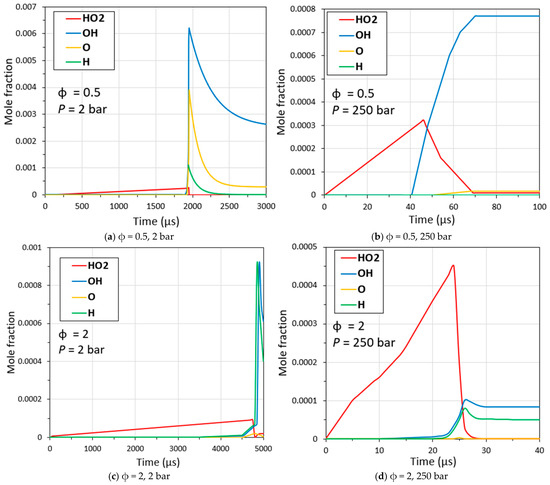
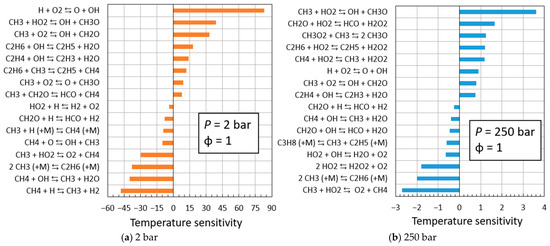
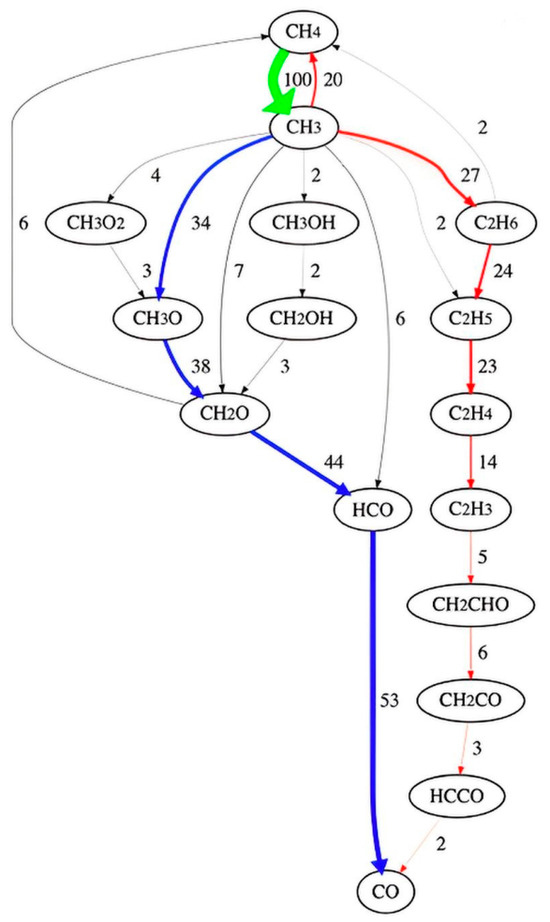
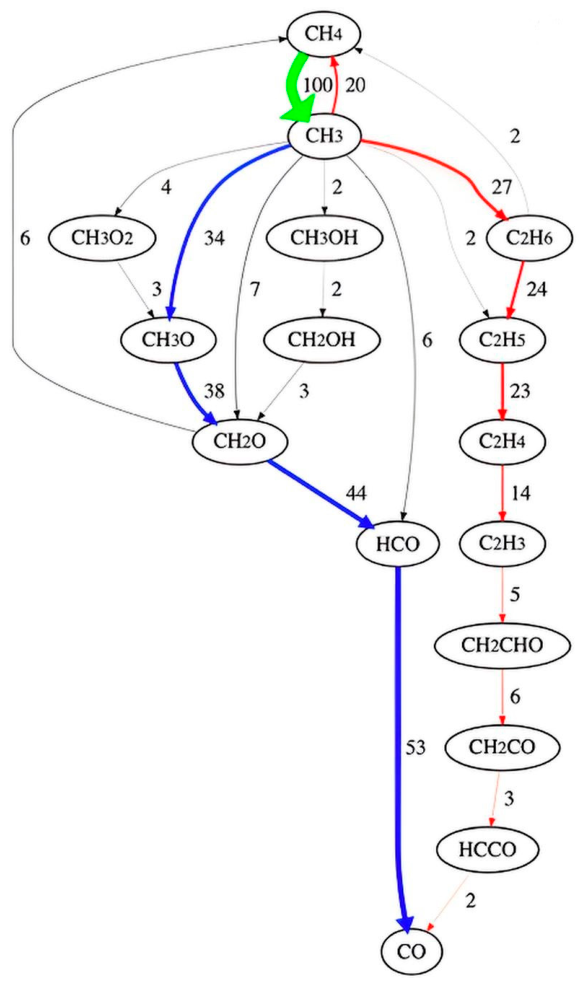
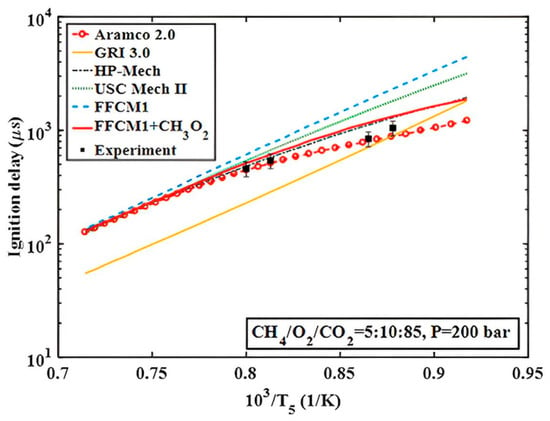
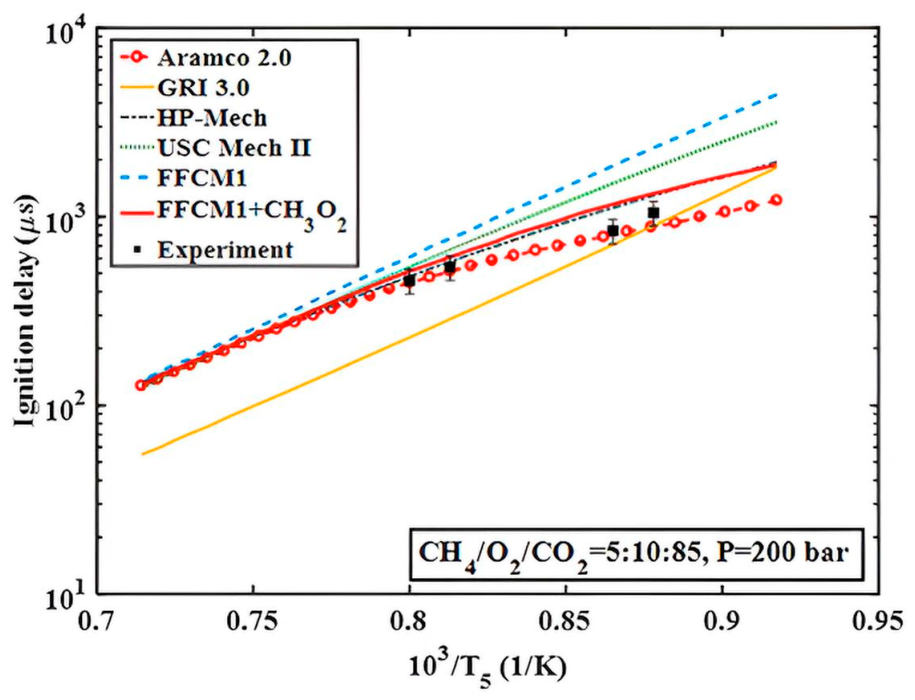
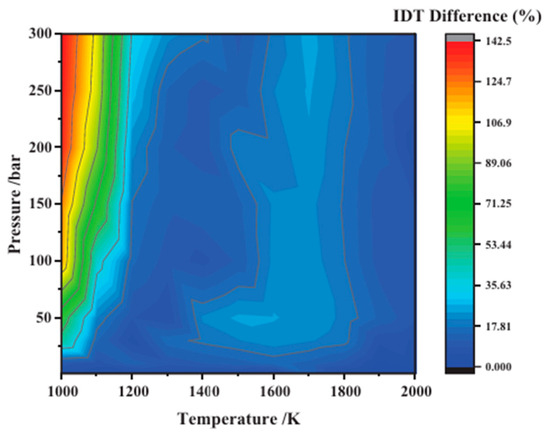
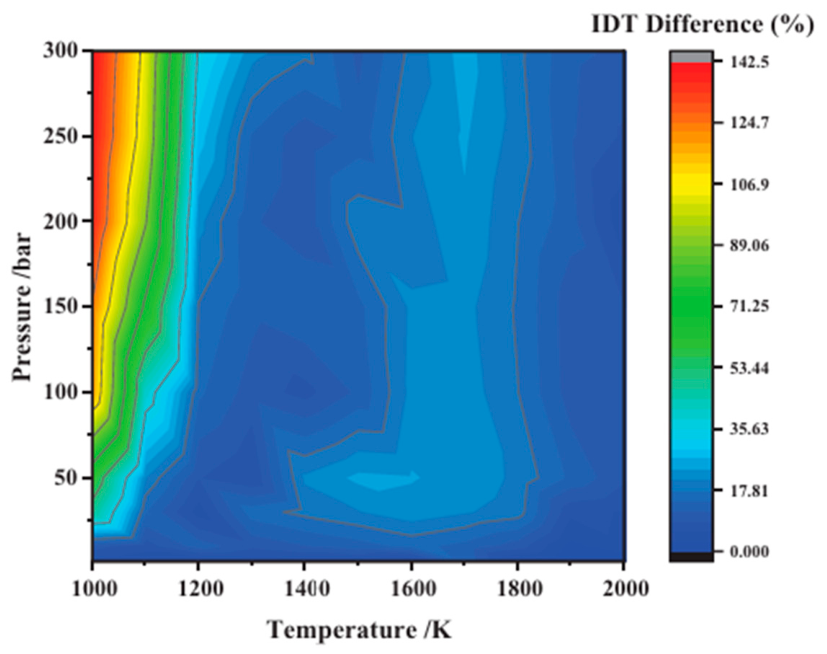
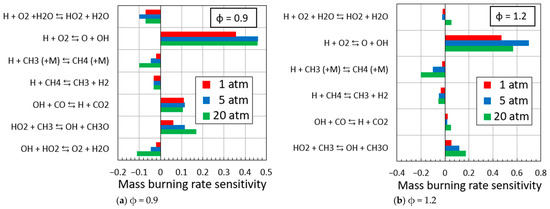
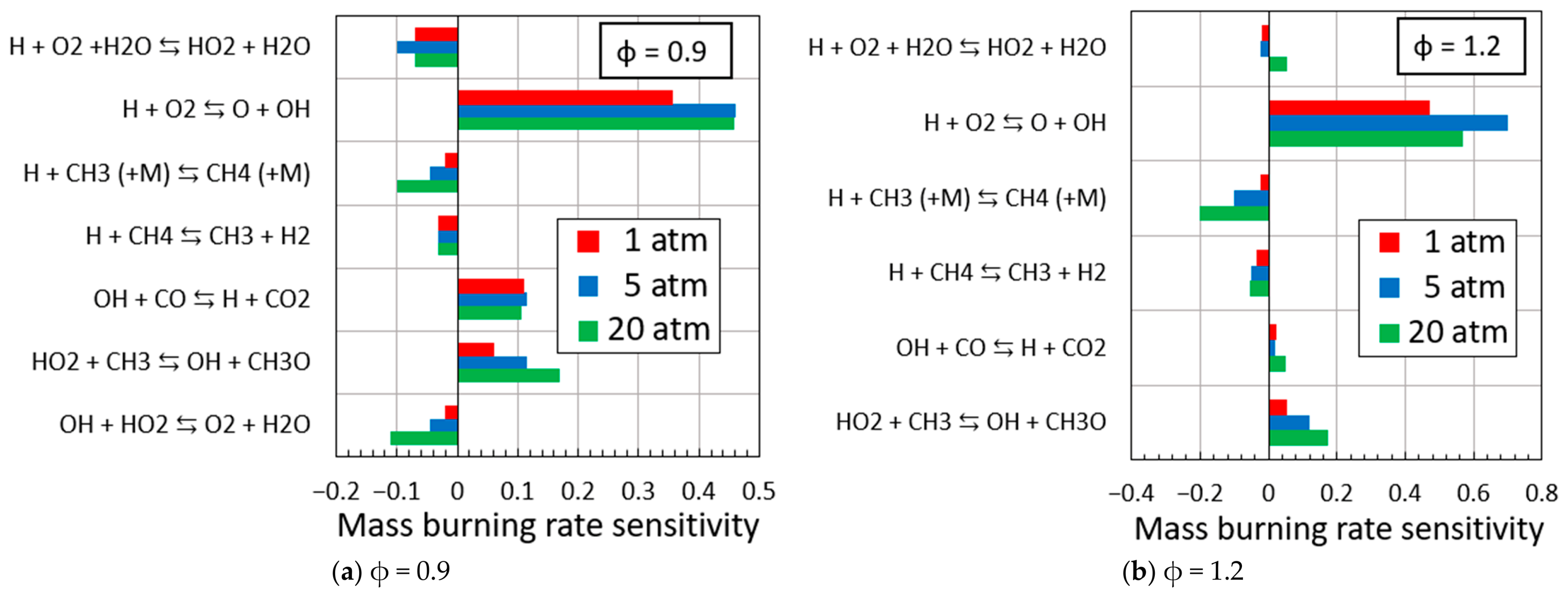
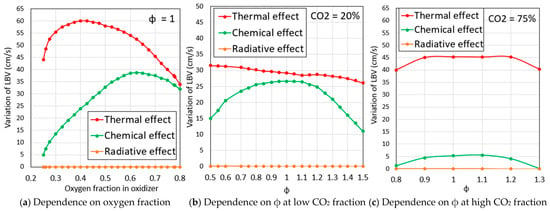
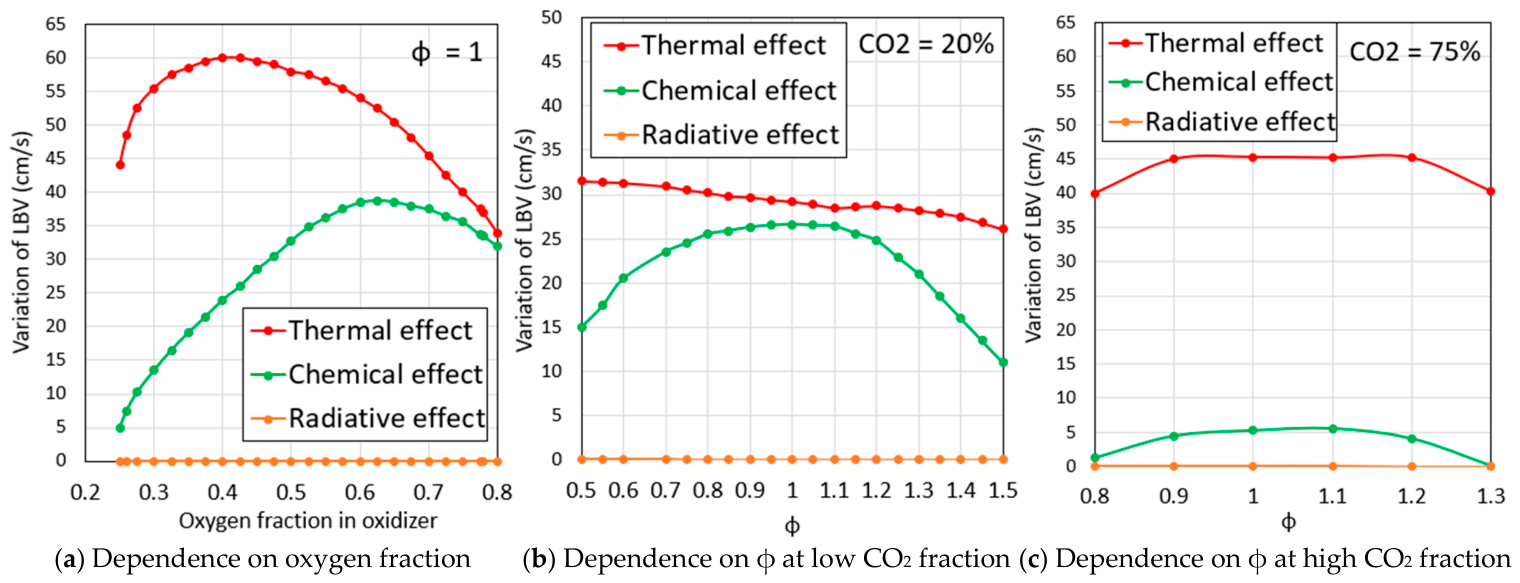
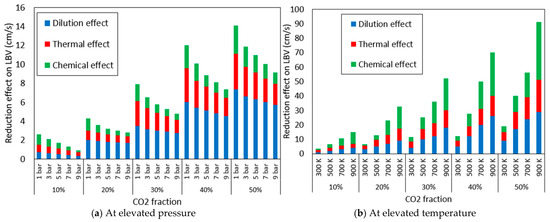
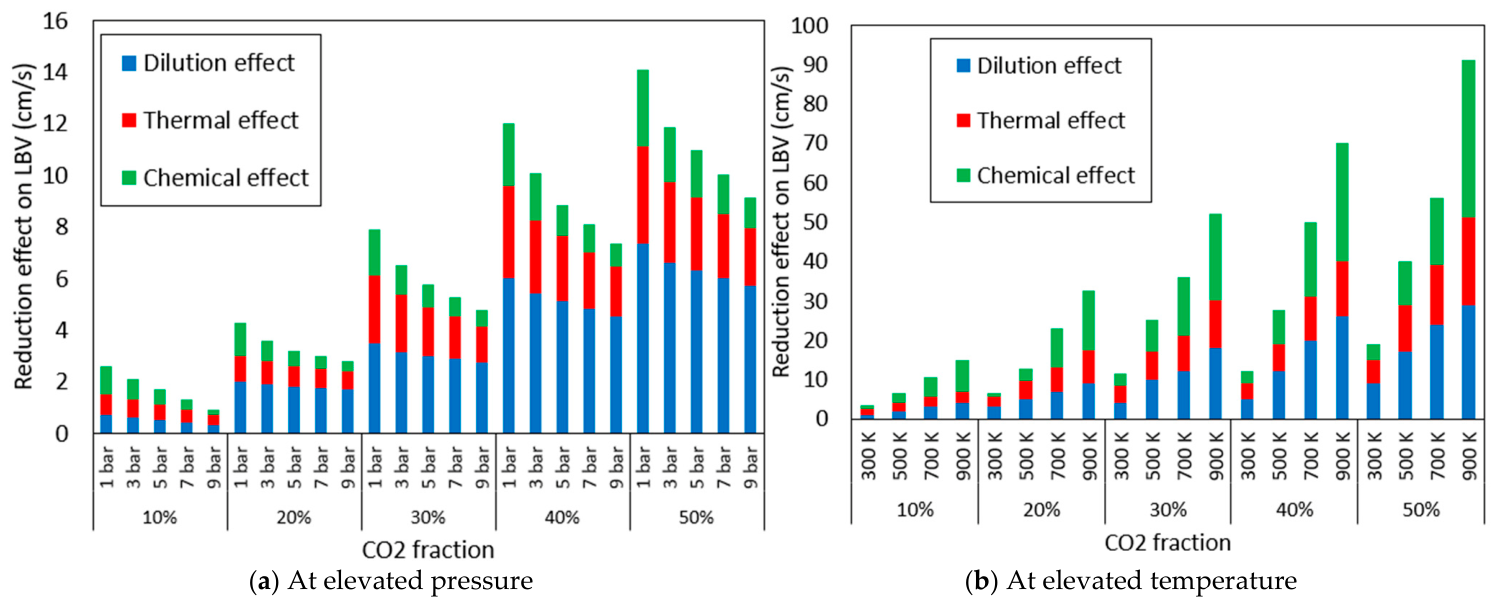
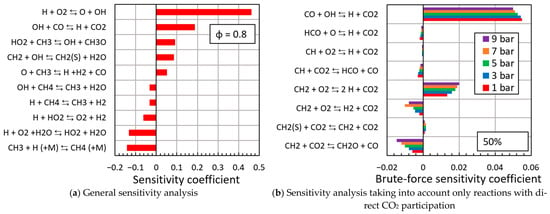
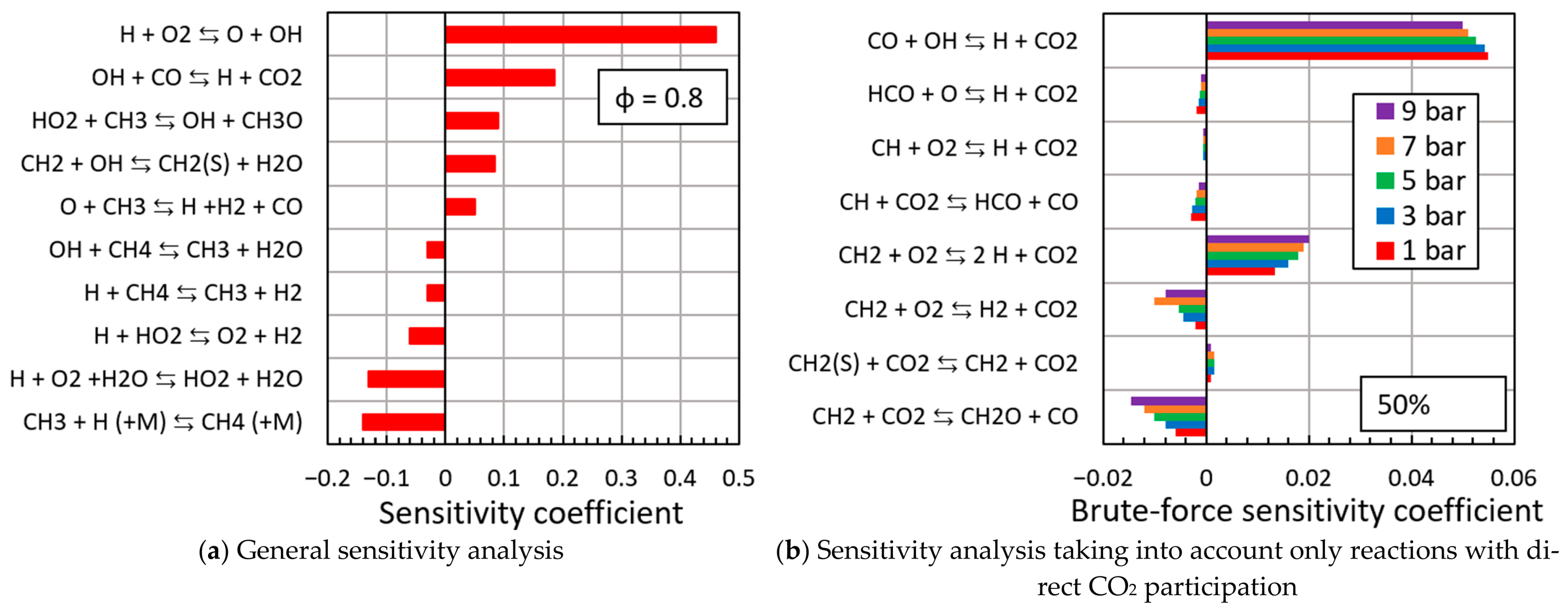
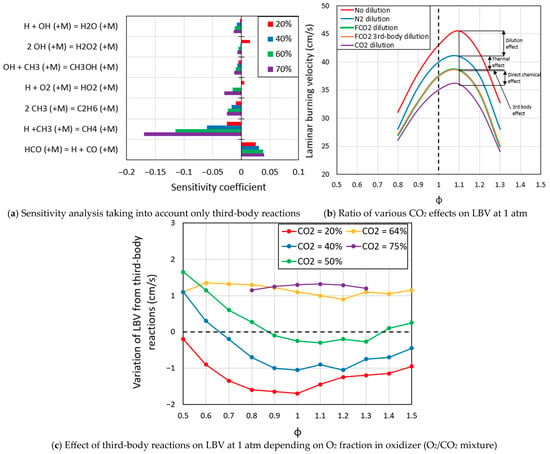
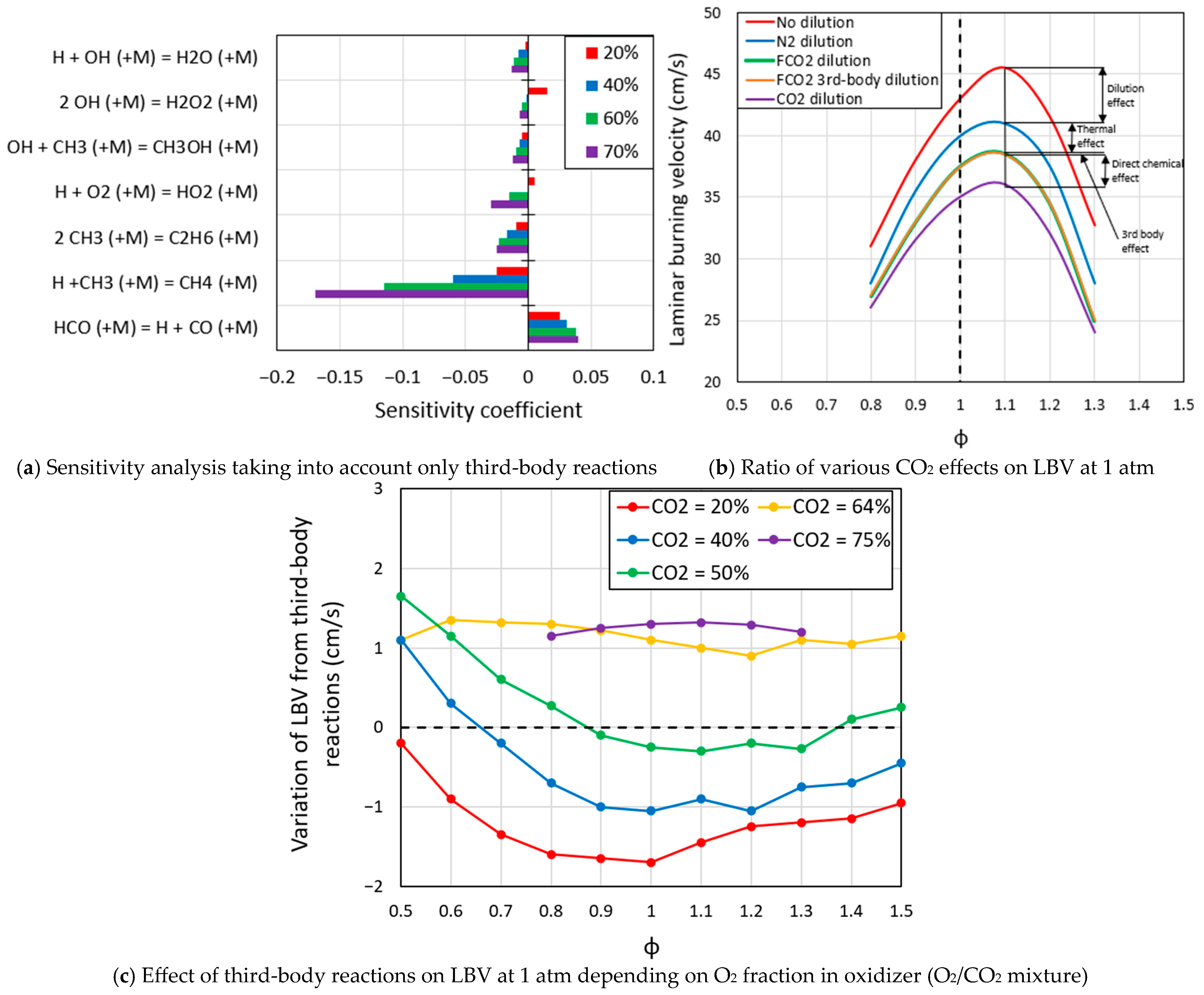
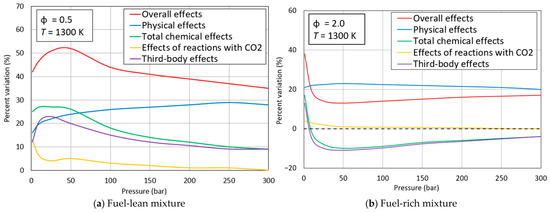
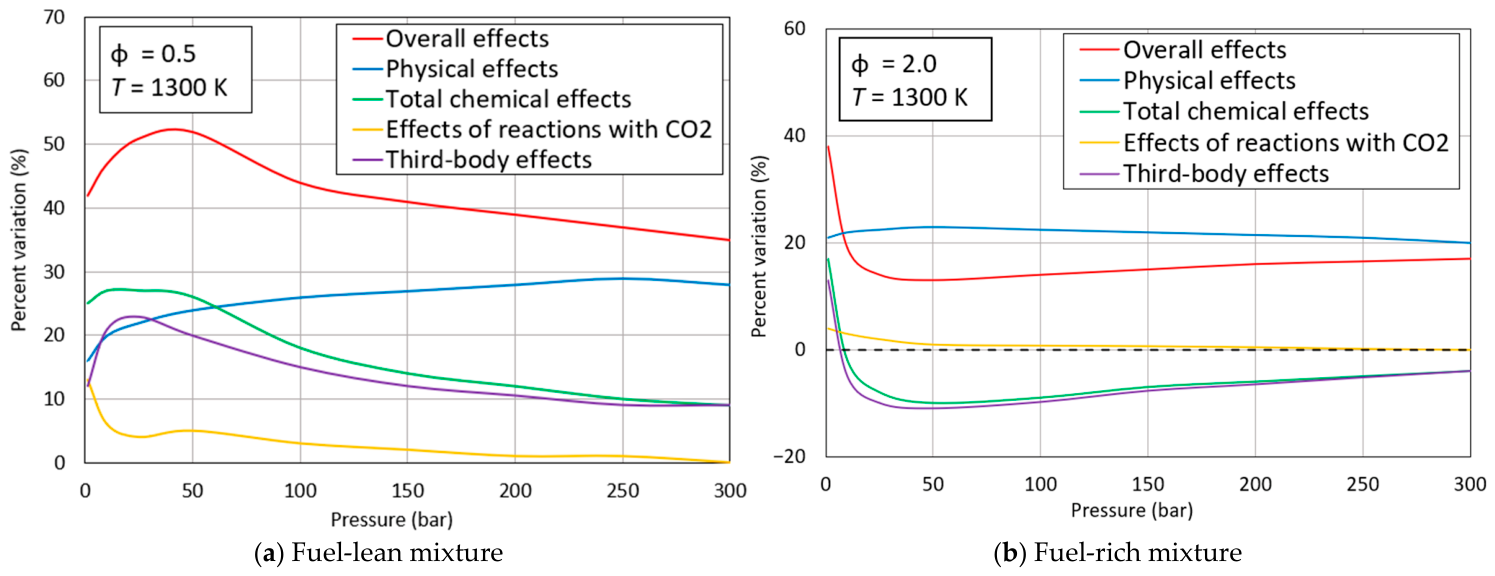
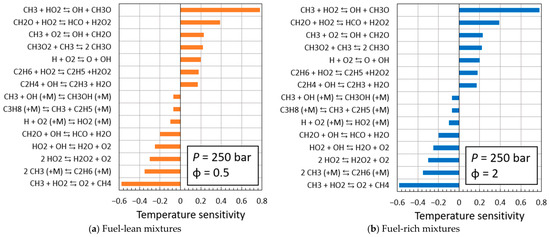
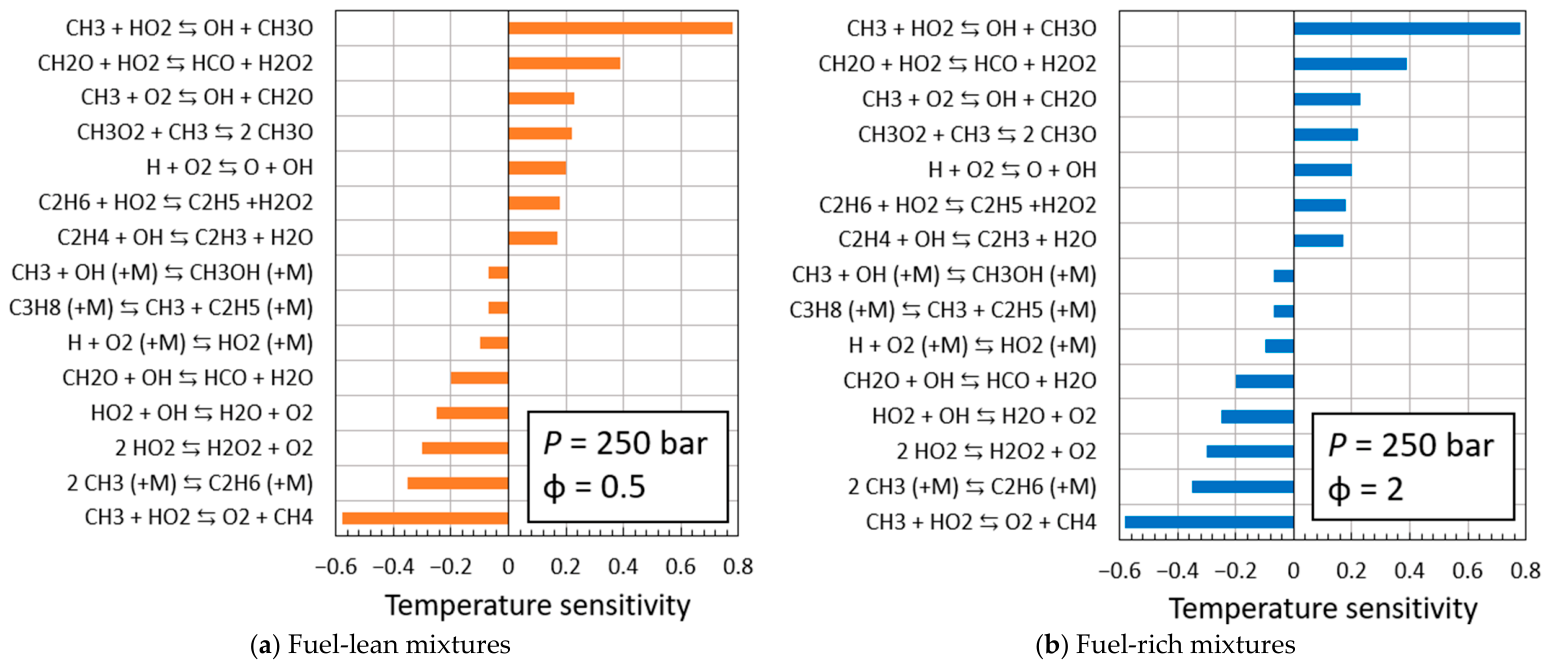
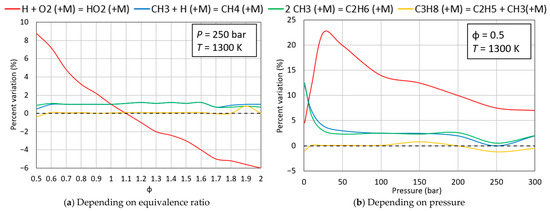
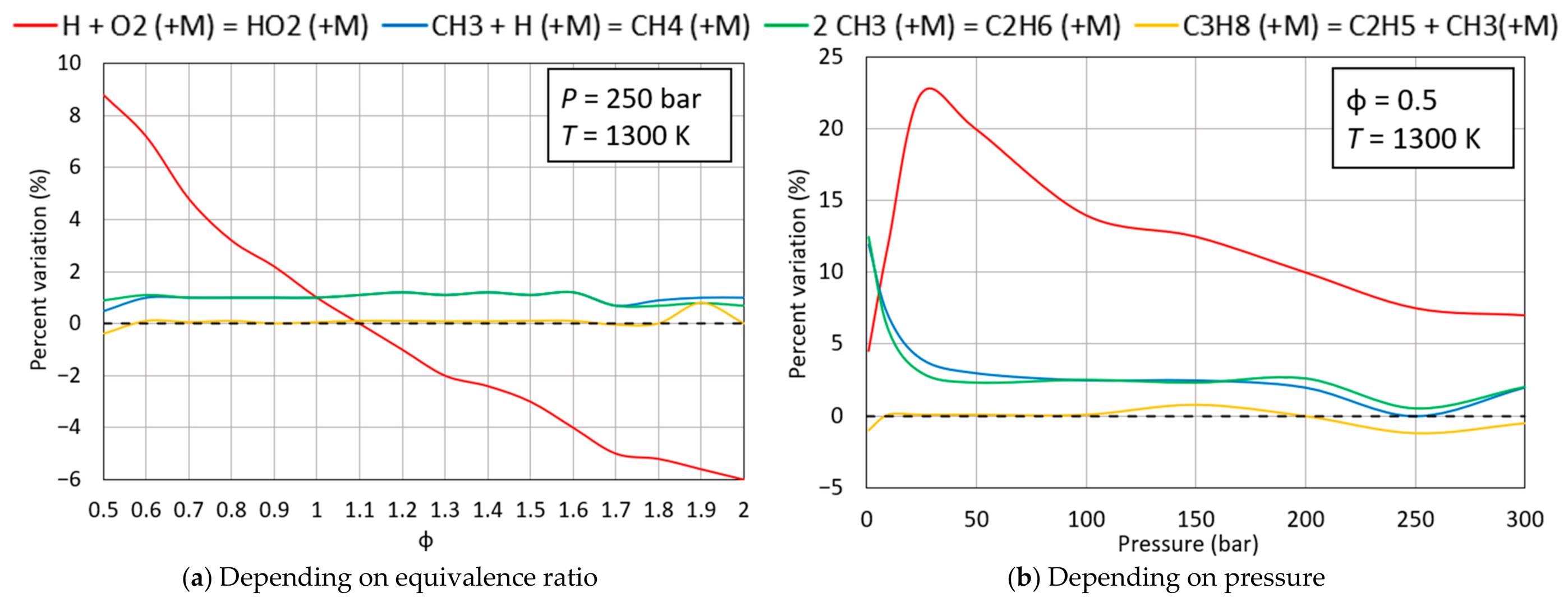
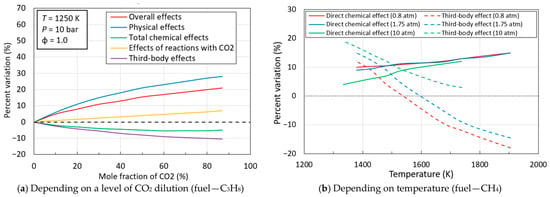
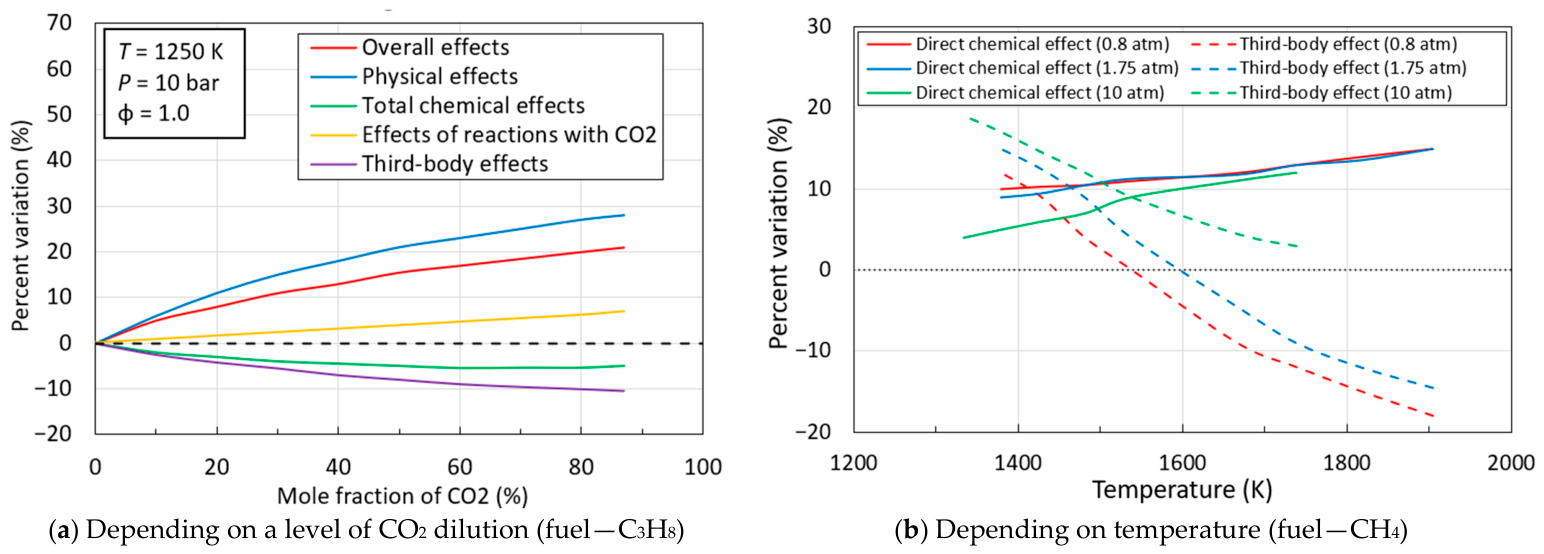
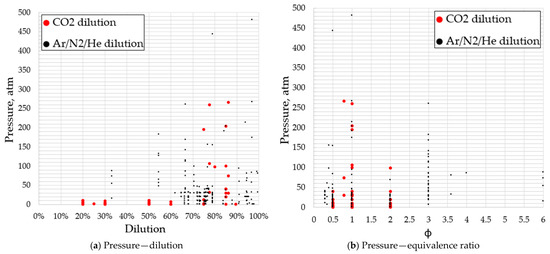
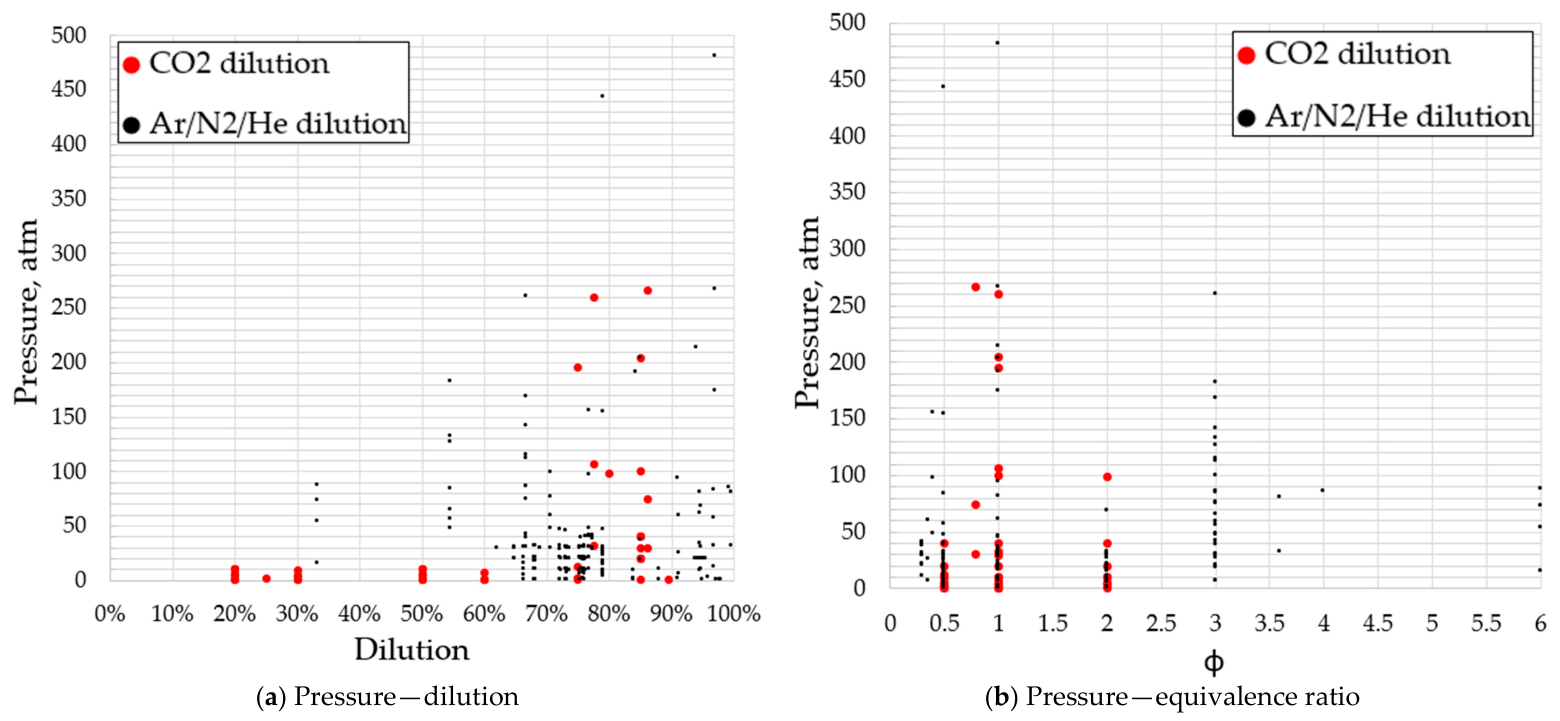

Disclaimer/Publisher’s Note: The statements, opinions and data contained in all publications are solely those of the individual author(s) and contributor(s) and not of MDPI and/or the editor(s). MDPI and/or the editor(s) disclaim responsibility for any injury to people or property resulting from any ideas, methods, instructions or products referred to in the content. |
© 2026 by the authors. Licensee MDPI, Basel, Switzerland. This article is an open access article distributed under the terms and conditions of the Creative Commons Attribution (CC BY) license.