


Abstract
Flexible hydrogel sensors hold great promise in wearable electronics, smart healthcare, and human–machine interfaces, yet their practical applications are often hindered by poor mechanical robustness, insufficient low-temperature tolerance, lack of self-healing ability, and inferior biocompatibility. Herein, we present a multifunctional ionic hydrogel composed of poly (acrylic acid), L-lysine, and aluminum ions (PAA-Lys-Al3+) for high-performance flexible strain sensors. Benefiting from its supramolecular network structure, the hydrogel exhibits efficient self-healing behavior and favorable antibacterial activity, as well as good biocompatibility. Impressively, the gel maintains stable gel-like properties even at −10 °C, overcoming the typical freezing-induced embrittlement of conventional hydrogels. When assembled into a flexible ionic sensor, the PAA-Lys-Al3+ hydrogel delivers high sensitivity, fast response, and reliable signal output toward various mechanical deformations. This integrated combination of antifreeze-resistant, self-healing, tough, elastic, antibacterial, and biocompatible features makes the hydrogel highly competitive in flexible sensing devices operated under harsh environments and biomedical scenarios.
1. Introduction
Flexible strain sensors have garnered widespread research interest in wearable electronics, human motion monitoring, electronic skin, and intelligent biomedical devices due to their unique capacity to convert mechanical deformation into measurable electrical signals [1,2,3,4,5]. As one of the most competitive sensing materials, ionic conductive hydrogels exhibit prominent advantages including tissue-mimicking softness, tunable electrical conductivity, and excellent skin compatibility [6]. Nevertheless, traditional hydrogel-based sensors still suffer from inherent drawbacks that severely limit their practical applicability, especially in complex working environments and long-term service conditions [7,8,9]. Conventional hydrogels generally lack satisfactory mechanical robustness, are prone to fracture under cyclic deformation, and possess poor fatigue resistance [10,11], which greatly shortens their service life [12,13]. Furthermore, the abundant free water inside hydrogel networks readily freezes at subzero temperatures [14,15], resulting in a sharp deterioration in flexibility, electrical conductivity, and sensing performance. In addition, the absence of self-healing capability, antibacterial property, and optimal biocompatibility further hinders their large-scale application in wearable and biomedical fields [16,17,18]. It remains highly desirable yet challenging to develop a multifunctional integrated hydrogel that achieves high toughness [19], superior elasticity [20], efficient self-healing behavior [21], excellent antifreezing capability [22], favorable antibacterial activity [23], and reliable biocompatibility [24].
Poly (acrylic acid) (PAA) is regarded as a classic and promising hydrogel matrix for flexible sensing devices due to its excellent hydrophilicity, favorable polymerization performance, facile fabrication procedure, and abundant carboxyl groups available for crosslinking and functional modification [25,26]. However, pure PAA hydrogels suffer from weak network interactions, insufficient mechanical strength, and poor structural stability. Meanwhile, the lack of antibacterial and antifreezing characteristics greatly limits their practical applications in complex and advanced scenarios. Metal ion coordination has been proven as an effective strategy to optimize the performance of PAA hydrogels. Metal ions can dynamically coordinate with carboxyl groups on PAA molecular chains to construct reversible supramolecular networks [27,28], which effectively enhance the toughness, elasticity, and fatigue resistance of hydrogels while imparting stable ionic conductivity [29,30]. As a natural biological amino acid, L-lysine exhibits superior biocompatibility [31], inherent antibacterial activity [32], and abundant active amino groups, which can serve as auxiliary crosslinking sites and functional modifiers to optimize the network structure and biological performance of hydrogels [33]. The synergistic introduction of metal ions and amino acid ligands into the PAA matrix integrates the mechanical reinforcement effect of metal coordination and the biological functional advantages of amino acids [34]. Such composite hydrogels comprehensively achieve optimized mechanical properties, dynamic self-healing capability, stable ionic conductivity, favorable biocompatibility, and excellent antibacterial activity, effectively compensating for the inherent defects of pure PAA hydrogels and realizing multifunctional integration of hydrogel materials [35,36].
Herein, we design a multifunctional poly (acrylic acid)-lysine-aluminum ion (PAA-Lys-Al3+) hydrogel via a facile one-step polymerization and dynamic coordination crosslinking strategy. L-Lysine is introduced as a biocompatible functional monomer and auxiliary crosslinking site, while Al3+ ions form reversible coordination interactions with carboxyl groups on the polymer chains, constructing a robust yet dynamic supramolecular network [37]. The as-prepared hydrogel exhibits outstanding mechanical performance, including high toughness, excellent elasticity [38], and superior antifatigue performance. Impressively, the hydrogel maintains stable flexibility and gel state even at −10 °C, showing excellent anti-freezing capability. Furthermore, the dynamic reversible network endows the hydrogel with efficient self-healing ability, and the introduction of lysine endows the hydrogel with favorable antibacterial properties and good biocompatibility. When employed as a flexible strain sensor, the PAA-Lys-Al3+ hydrogel exhibits high sensitivity and reliable sensing performance toward various mechanical stimuli [39]. This work provides a simple and effective strategy for constructing multifunctional hydrogel sensors, showing great potential in flexible electronics, wearable devices, and biomedical applications under low-temperature environments.
2. Results and Discussion
2.1. Formation of the PAA-Lys-Al Hydrogel
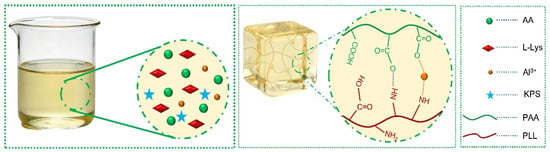
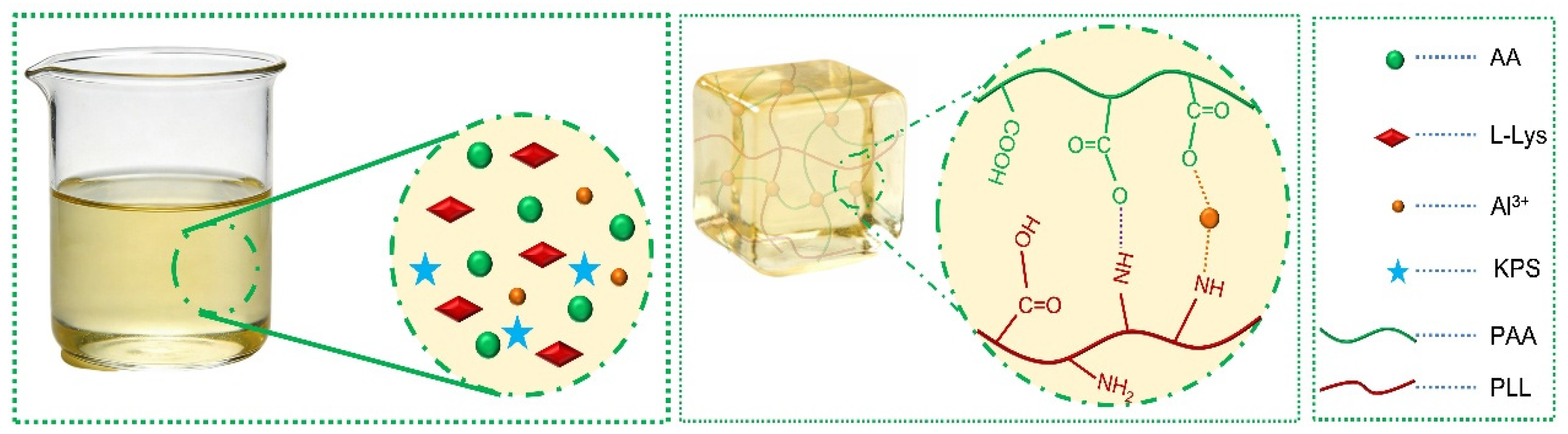
The PAA-Lys-Al hydrogel forms a dual physical cross-linking network through intermolecular hydrogen bonding and metal–ligand coordination interactions, as schematically shown in Figure 1. In the pregel solution, acrylic acid (AA) monomers, L-lysine (L-Lys), Al3+ ions, and KPS initiator are homogeneously dispersed. Under water bath conditions, AA monomers are polymerized into poly(acrylic acid) (PAA) chains upon KPS initiation, and L-lysine is incorporated into the network to generate poly(L-lysine) (PLL) segments [39,40]. Abundant carboxyl groups (–COOH) along PAA chains form extensive intermolecular hydrogen bonds with amino groups (–NH2 and –NH–) on PLL segments. Meanwhile, Al3+ acts as dynamic multidentate coordination cross-linking sites, forming metal coordination bonds with carboxylate oxygen and amino nitrogen atoms on polymer chains. The synergy of hydrogen bonds and Al3+ coordination bonds builds the complete cross-linked hydrogel network [30,41]. Owing to the dynamically reversible structure originating from the multidentate coordination of Al3+, the hydrogel possesses ionic conductivity and self-healing capability. The dual dynamic cross-linking network also imparts outstanding toughness to the material, revealing great potential for practical applications.
Figure 1.
Schematic illustration of the formation process of the PAA-Lys-Al hydrogel from precursor solution to bulk hydrogel.
2.2. Characterization of the PAA-Lys-Al Hydrogel
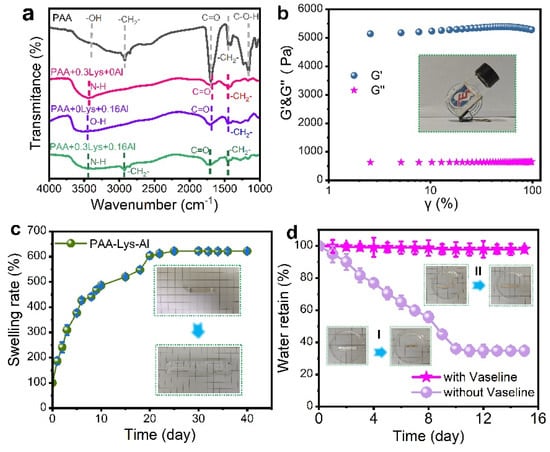
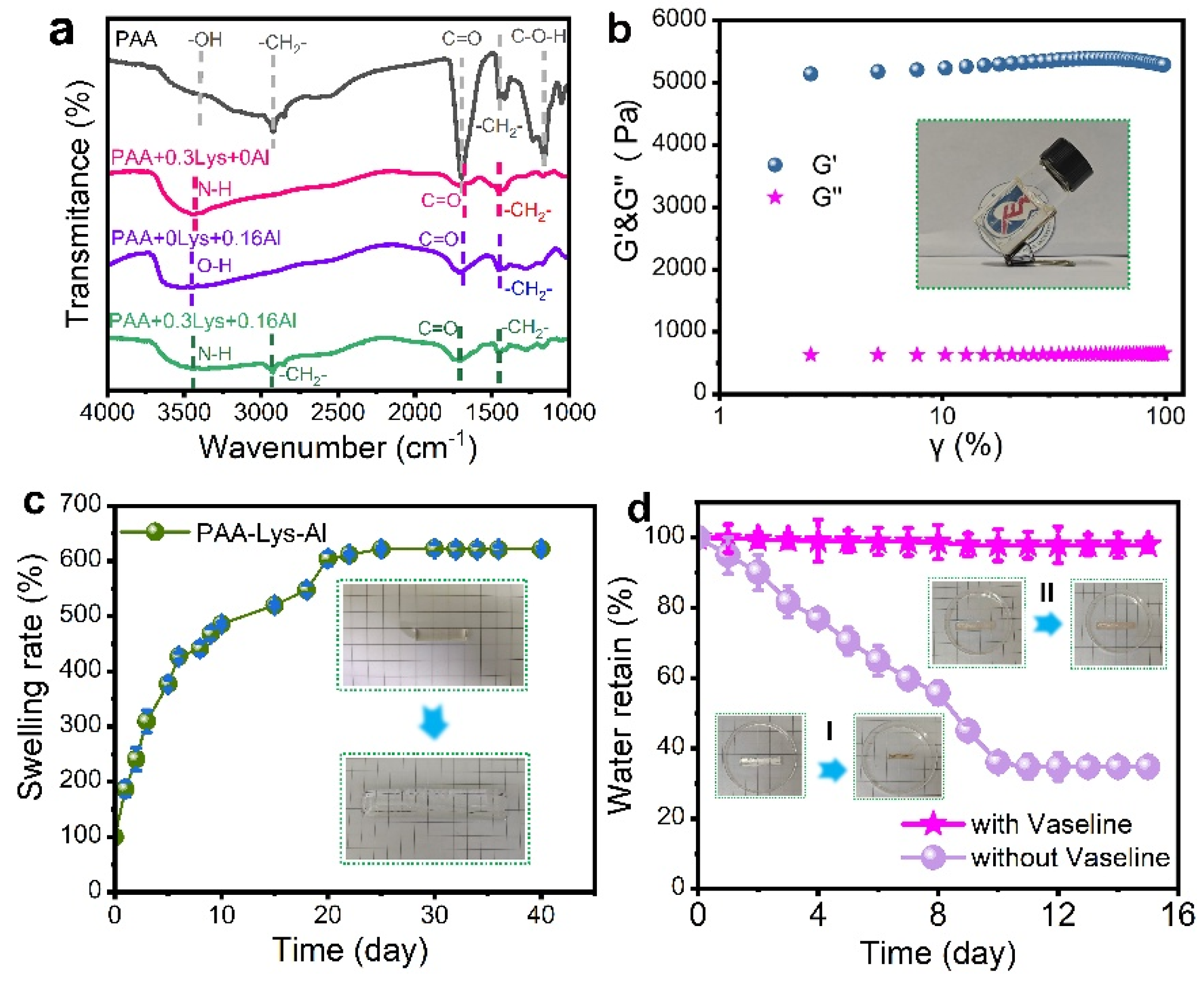
The PAA-Lys-Al hydrogel with optimal gelation behavior was obtained at 60 °C in a water bath, where both lysine and Al3+ are required for gelation. As shown in Figure S1, neat PAA is a viscous liquid, and the lysine-free PAA-Al and Al3+-free PAA-Lys controls remain flowable without gel formation [42]. Only the ternary PAA-Lys-Al system forms an intact, self-supporting hydrogel [33]. This arises from synergistic coordination crosslinking among PAA, lysine, and Al3+: as a multivalent center, Al3+ concurrently complexes with carboxylate groups on PAA chains and amino/carboxyl moieties of lysine to build a hierarchical physical crosslinking network [12]. Direct Al3+–PAA coordination cannot form a continuous robust network in the absence of lysine, whereas only weak electrostatic interactions between PAA and lysine in the absence of Al3+ result in inadequate crosslinking density [43]. All three controls thus remain fluid and fail to achieve the sol–gel transition. FTIR spectra in Figure 2a were used to identify the intermolecular interactions in the hydrogel systems. The broad band centered at ~3425 cm−1, observed in all samples, is assigned to the O–H stretching of hydrogen-bonded carboxylic groups and adsorbed water; this band overlaps with N–H stretching from amino groups in lysine-containing samples. The resolved peaks at 2930 cm−1 and 2913 cm−1 correspond to the asymmetric and symmetric stretching of aliphatic -CH2- on the PAA backbone. These two distinct peaks are clearly resolved in neat PAA and the ternary PAA-Lys-Al sample, while they are suppressed in the two binary systems. Relative to neat PAA, the -CH2- stretching band of the ternary hydrogel shifts to a lower wavenumber, which is attributed to the constrained motion of PAA chains induced by hydrogen bonding and Al3+–carboxylate coordination, altering the local chemical environment of the alkyl backbone. The strong absorption near 1700 cm−1 originates from the C=O stretching of undissociated –COOH. Compared with neat PAA, the C=O bands of the other three samples all shift to lower wavenumbers, indicating reduced C=O bond order. For the PAA-Lys binary sample, this red-shift arises from hydrogen bonding between -NH2- of lysine and carboxyl groups; for the PAA-Al binary sample, it originates from coordination between Al3+ and carboxylate oxygen; for the ternary system, it reflects the synergistic effect of hydrogen bonding and metal–ligand coordination. The characteristic band at ~1450 cm−1 in neat PAA is assigned to the scissoring deformation of the backbone -CH2-, and its intensity decreases obviously after introducing lysine or Al3+. This intensity attenuation is related to partial deprotonation of carboxyl groups and the formation of interchain noncovalent crosslinks. Upon hydrogen bonding and coordination, chain rearrangement and electron redistribution reduce the dipole change associated with the -CH2- scissoring vibration. The absorption at ~1150 cm−1, prominent only in neat PAA, corresponds to the C–O stretching of neutral C–O–H in undissociated carboxylic acid. After partial deprotonation and conversion to COO- in lysine- or Al3+-containing samples, this characteristic C–O signal of neutral carboxylic acid nearly disappears. Compared with pure PAA, the newly appeared amino-associated characteristic peaks upon L-Lys modification demonstrate the successful incorporation of L-Lys chains [44]. Furthermore, the distinct red shifts of the C=O and N–H stretching peaks after the introduction of Al3+ strongly verify the formation of abundant hydrogen bonds and metal–ligand coordination interactions within this dual-crosslinked network [45].
Figure 2.
(a) FT-IR spectra of pure PAA, PAA-Lys, PAA-Al, and PAA-Lys-Al hydrogels. (b) Rheological behavior (storage modulus G′ and loss modulus G″) of the PAA-Lys-Al hydrogel (inset: photograph of the self-standing hydrogel). (c) Swelling behavior of PAA-Lys-Al during 40 days (insets: hydrogel before and after swelling). (d) Water retention of Vaseline-treated and untreated PAA-Lys-Al hydrogels over 15 days. Insets I and II show photographs of untreated and Vaseline-coated hydrogels before and after environmental exposure, respectively.
Rheological results in Figure 2b reveal that the storage modulus (G′) is markedly higher than the loss modulus (G″) over the tested strain range, confirming the elastic-solid characteristic and favorable structural rigidity of the hydrogel. The inset photograph demonstrates that the hydrogel exhibits no fluidity and shows typical gel features, in good agreement with the rheological results. To further analyze its intrinsic network structure, a frequency sweep was performed at 10% strain within the linear viscoelastic region determined by a strain amplitude sweep. As shown in Figure S2, G′ remains consistently higher than G″ over the whole frequency range, confirming a stable elastic cross-linked network. At very low frequencies, G′ rises sharply and shows weak frequency dependence above ~10 rad/s, characteristic of Al3+-mediated dynamic physical cross-links. Unlike covalently cross-linked hydrogels with nearly frequency-invariant modulus, G′ drifts slightly upward with increasing frequency due to restricted polymer-chain relaxation under fast shear. At low frequencies, reversible Al3+ coordination bonds can dissociate and re-associate for energy dissipation, keeping G″ low. At higher frequencies, bond-exchange kinetics lag behind rapid deformation, triggering an increase in G″ and viscous dissipation originating from chain-segment motion and dynamic- coordination rearrangement [35]. The low loss factor (tanδ, G″/G′) throughout the measurement demonstrates that elasticity originating from dynamic-coordination networks dominates over viscous dissipation [36].
Figure 2c shows the swelling behavior of the PAA-Lys-Al hydrogel. The sample achieves swelling equilibrium at approximately 20 days. Its swelling ratio plateaus at ~620% after day 20 with barely any change until day 40. The insets display photographs of the sample before and after swelling, and the hydrogel volume remains constant once equilibrium is reached. Although the swollen sample exhibited volume expansion, it retained structural integrity and its morphology remained largely consistent with the initial state. This favorable property originates from the synergistic coordination crosslinking network constructed by PAA, lysine, and Al3+ [46]. Abundant hydrophilic groups within the network endow the material with water-absorbing and swelling capacity, while the coordination crosslinking nodes exert physical confinement to suppress excessive stretching of polymer chains and prevent network rupture. Such features indicate that this hydrogel holds great potential for applications in sustained drug release.
To suppress water evaporation from the PAA-Lys-Al hydrogel during testing, a thin layer of Vaseline was uniformly applied to the hydrogel surface prior to the electrical sensing and tensile tests. Consistent with previous reports, Vaseline serves as an effective occlusive barrier for water-retention comparison [38]. Figure 2d compares the water retention performance of the Vaseline-coated hydrogel and bare hydrogel under ambient conditions at room temperature and 40% relative humidity (RH). The bare hydrogel without Vaseline gradually lost water upon air exposure, and its residual mass stabilized at approximately 35% of the initial value after 10 days. In contrast, the hydrogel protected by the Vaseline layer retained more than 90% of its initial mass after a 15-day standing test, demonstrating that the Vaseline barrier can effectively inhibit water loss and enable long-term cyclic testing of the hydrogel.
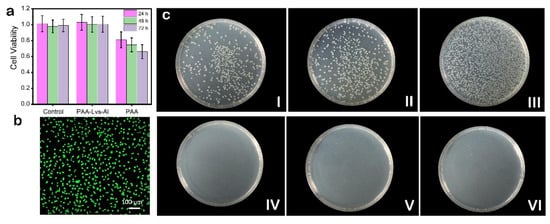
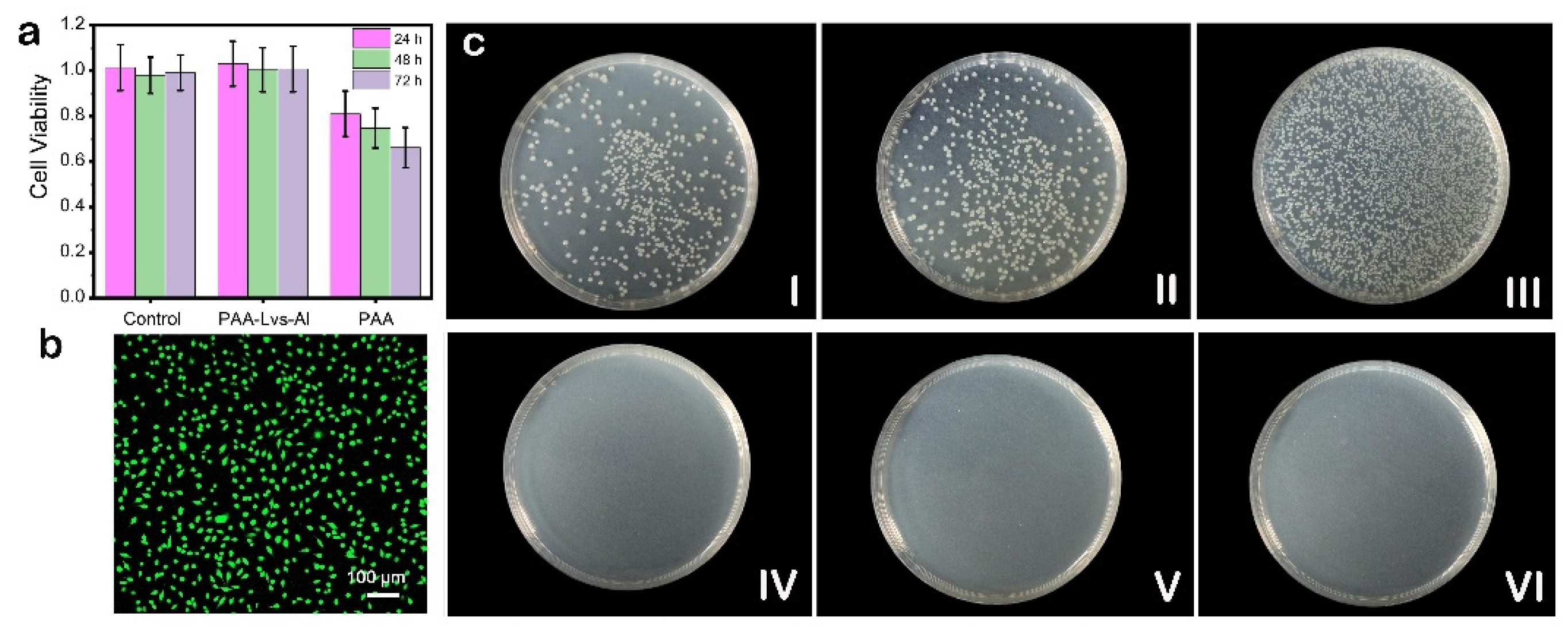
Good biocompatibility is a prerequisite for biomedical applications. As presented in Figure 3a, CCK-8 results revealed that the PAA-Lys-Al hydrogel extracts maintained cell viability above 99% after 24, 48, and 72 h of co-culture, exhibiting superior cytocompatibility. The PAA-Lys-Al hydrogel exhibits favorable cytocompatibility, whereas pure PAA leads to decreased cell viability after prolonged incubation. Pure PAA hydrogel carries abundant negatively charged carboxyl groups. During extraction, dissociation of carboxyl-containing fragments may locally alter medium pH and produce unfavorable electrostatic interactions with cell membranes. The loosely single-crosslinked network of pure PAA facilitates the leaching of short-chain oligomer fragments, which further impairs cell survival over extended culture. After incorporation of lysine and Al3+, amino groups from lysine partially neutralize excessive negative charges originating from PAA. Meanwhile, Al3+ forms dynamic metal-ligand coordination cross-links with carboxyl and amino groups to construct a denser hydrogel network. This optimized network suppresses the release of acidic and cytotoxic fragments, stabilizes the culture microenvironment, and thus improves the cytocompatibility of the PAA-Lys-Al hydrogel [24,31]. In addition, the live-cell fluorescence staining image (Figure 3b) showed uniform cell adhesion and healthy spreading, further confirming the excellent biosafety of the as-prepared hydrogel.
Figure 3.
(a) Cell viability of L929 fibroblasts cultured with hydrogel extracts. (b) Live/dead staining images of L929 cells after co-culture with the hydrogel. (c) Antibacterial activity of the hydrogel against Escherichia coli (E. coli). Top row (I–III): three parallel replicates of control groups (no hydrogel); bottom row (IV–VI): experimental groups: three parallel replicates treated with PAA-Lys-Al hydrogel extracts.
As shown in Figure 3c, the PAA-Lys-Al hydrogel exhibits prominent antibacterial activity against E. coli ATCC 25922 with an antibacterial rate of 99.79%. The positively charged amino groups originating from lysine can bind to negatively charged bacterial membranes via electrostatic interaction, disrupting membrane integrity and triggering bacterial damage [32]. Meanwhile, partially released Al3+ can interfere with bacterial metabolic processes and further inhibit bacterial reproduction [47]. Therefore, the excellent antibacterial capacity of PAA-Lys-Al hydrogel arises from the combined contributions of lysine and Al3+.
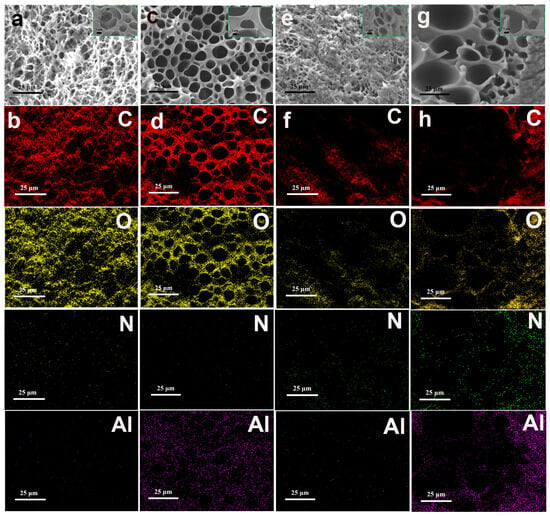
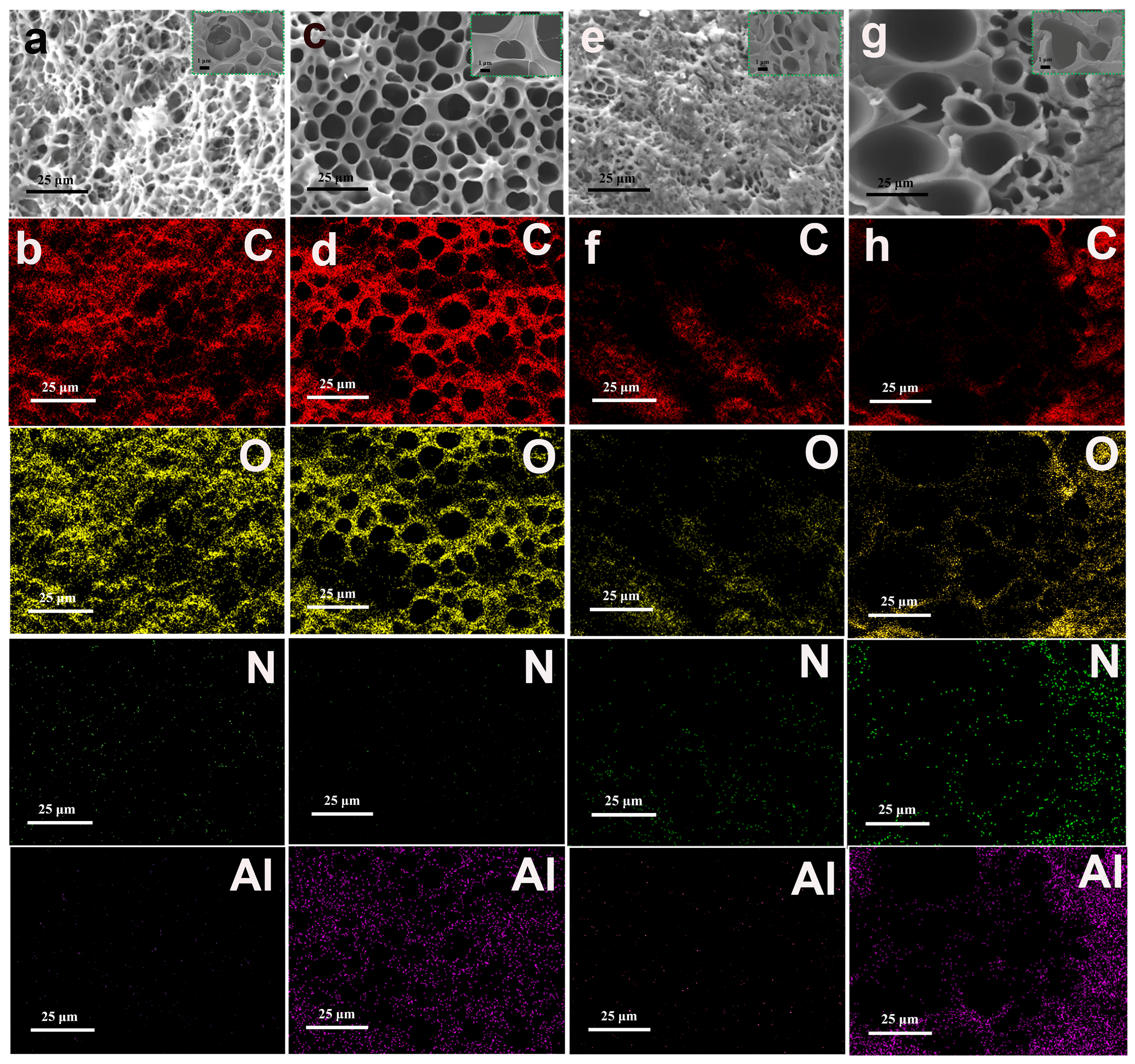
Figure 4 shows the SEM morphologies and corresponding EDS elemental mappings (C, O, N, and Al) of PAA (a,b), PAA-Al (c,d), PAA-Lys (e,f), and PAA-Lys-Al (g,h) samples. Insets in SEM panels are high-magnification views; scale bar = 1 μm. Scale bars for main panels are 25 μm. The pristine PAA, PAA-Al, and PAA-Lys precursors were viscous liquids before freeze-drying, whereas the PAA-Lys-Al system formed a crosslinked hydrogel prior to lyophilization. For pure PAA (Figure 4a,b), only loose and uneven porous frameworks with non-uniform pore sizes are observed. Without additional crosslinkers, poly(acrylic acid) chains cannot construct a stable crosslinked network, and weak intermolecular interactions fail to resist structural shrinkage and pore collapse during freeze-drying. The EDS mappings only reveal uniformly distributed C and O signals originating from the PAA backbone, with negligible background signals of N and Al. After introducing Al3+ alone (PAA-Al, Figure 4c,d), relatively regular macropores are formed compared with pure PAA. Al3+ coordinates with carboxylate groups of PAA to induce partial physical crosslinking, which offers limited support for the porous skeleton [34]. Nevertheless, single metal coordination is insufficient to build a robust, stable network, and the precursor remains liquid before freezing. EDS results confirm homogeneous dispersion of Al within the C/O matrix, while no obvious N signal is detected. For PAA-Lys with lysine incorporated individually (Figure 4e,f), a denser and more compact pore structure is obtained. Lysine interacts with the carboxyl groups of PAA via hydrogen bonding and electrostatic attraction, restricting chain mobility but failing to trigger bulk gelation. The liquid precursor still suffers severe pore collapse after freeze-drying. A uniform N signal derived from lysine can be clearly identified in the EDS mapping, and no Al signal appears. Benefiting from the synergistic coordination between lysine and Al3+, PAA-Lys-Al (Figure 4g,h) forms a continuous crosslinked hydrogel before freeze-drying. Its stable three-dimensional crosslinked network supports well-developed, large interconnected porous channels. Such porous architecture provides sufficient pathways for ion migration and is favorable for improving the conductivity of this ionogel. It is worth noting that the pore sizes of the PAA-Lys-Al hydrogel are not uniform. This heterogeneity arises from two factors: the randomly distributed coordination crosslinking sites among Al3+, lysine, and carboxylate groups of PAA, as well as the stochastic nucleation and growth of ice crystals during freeze-casting. Ice crystals act as sacrificial pore templates, and their variable sizes lead to polydisperse pores [33]. EDS mappings demonstrate the co-uniform distribution of C, O, N, and Al, proving that both lysine and Al3+ are successfully incorporated into the hydrogel network. Overall, the synergistic effect of lysine and Al3+ can construct a mechanically stable 3D network capable of resisting pore collapse during freeze-drying.
Figure 4.
SEM images and EDS elemental mappings (C, O, N, and Al) of PAA (a,b), PAA-Al (c,d), PAA-Lys (e,f), and PAA-Lys-Al (g,h) hydrogels. Insets in SEM panels are high-magnification views with a scale bar of 1 μm. Scale bars for main images: 25 μm.
2.3. Mechanical Properties
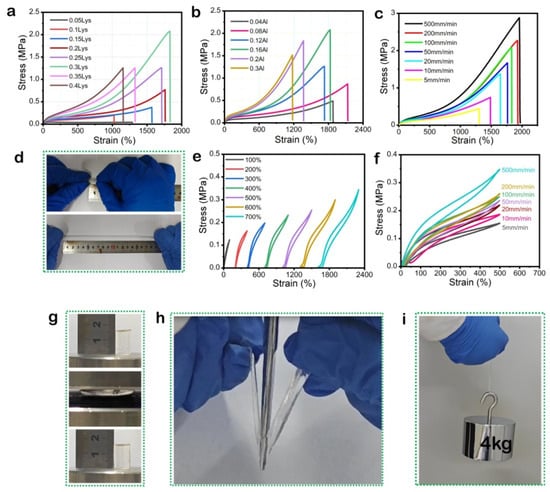
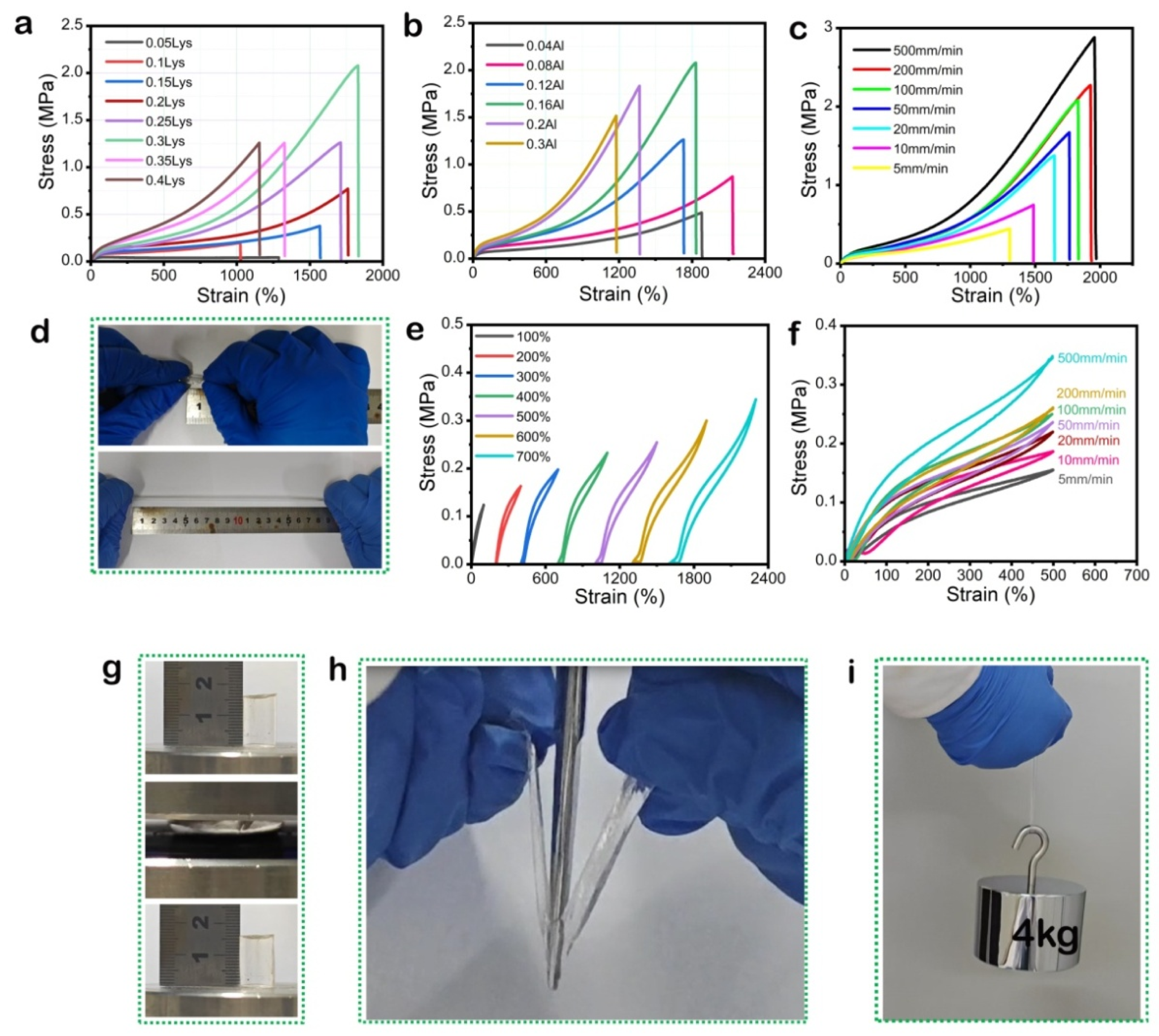
As depicted in Figure 5a,b, the mechanical performance of the as-prepared hydrogels with different dosages of lysine and Al3+ was investigated. The tensile properties are governed by the dosages of lysine and Al3+, which originate from the dual dynamic cross-linking network consisting of hydrogen bonds and metal–ligand coordination bonds. When the dosage was insufficient, the cross-linking network was sparse, and the dynamic hydrogen-bond/metal-coordination interactions were inadequate, resulting in low network density, weak energy dissipation, and low tensile strength. In this scenario, the polymer chains could not be effectively anchored, and the network was prone to fracture under external stretching. Moderate dosage enabled the construction of a synergistic dual dynamic cross-linked structure, simultaneously improving the tensile strength (2.1 MPa) and ultra-high stretchability (≈1800%). During stretching, the dual dynamic bonds can reversibly rupture and re-form to efficiently dissipate energy, endowing the hydrogel with excellent ductility [48]. In contrast, excessive dosage induces over-cross-linking, restricts polymer chain segments, and causes internal defects, eventually leading to material embrittlement and reduced toughness [13]. The highly compact cross-linked network severely limits the sliding and rearrangement of polymer chains, preventing the hydrogel from achieving large deformation prior to fracture.
Figure 5.
(a) Stress–strain curves of hydrogels with varying L-Lys contents. (b) Stress–strain curves of hydrogels with varying Al3+ contents. (c) Stress–strain curves of PAA-Lys-Al hydrogel tested at different stretching rates. (d) Digital photographs showing PAA-Lys-Al hydrogel under stretching. (e) Stress–strain tests under different stretching ratios. (f) Loading-unloading cyclic curves tested at different stretching rates. (g) Photographs of PAA-Lys-Al hydrogel during compression and recovery. (h) Photographs of PAA-Lys-Al hydrogel’s resistance to sharp puncture. (i) Photograph of PAA-Lys-Al hydrogel supporting a 4 kg weight.
The hydrogel exhibited remarkable strain-rate sensitivity during tensile deformation. As shown in Figure 5c, both the tensile strength and fracture strain of the hydrogel increased significantly when the tensile rate rose from 5 mm/min to 500 mm/min. This rate-dependent enhancement of mechanical properties originates from the intrinsic viscoelastic behavior and dynamically reversible cross-linking network of the PAA-Lys-Al hydrogel. At low stretching rates, the deformation was quasi-static. The dynamic coordination bonds and hydrogen bonds had sufficient time to dissociate, reconstruct, and undergo stress relaxation, and the polymer chain segments could fully slip and rearrange. Sufficient relaxation of dynamic bonds greatly reduced the energy dissipation efficiency of the network, resulting in low tensile strength, insufficient deformation resistance, and poor overall mechanical performance of the hydrogel. Under high-speed stretching, the relatively fast deformation rate greatly restricted the kinetic relaxation and recombination of dynamic bonds. A large number of sacrificial bonds ruptured synchronously rather than gradually relaxing, which markedly improved the energy dissipation capacity of the hydrogel network [49]. Meanwhile, rapid stretching drove disordered polymer chains to rapidly and orderly orient along the tensile direction, effectively mitigating structural defects and obviously suppressing the initiation, propagation, and penetration of internal cracks. This unique strain rate-sensitive mechanical characteristic provides a reliable structural guarantee for the hydrogel to realize high-precision, high-stability, and wide-range dynamic electrical signal monitoring in practical wearable sensing scenarios.
The physical photographs displayed in Figure 5d clearly record the uniaxial stretching process of the hydrogel sample. The upper panel presents the original hydrogel specimen with an initial length of 1 cm. Upon applying a gentle tensile force, the sample can be continuously elongated and reach a stretched length of 19 cm, as illustrated in the lower photograph. Remarkably, the hydrogel maintains its structural integrity throughout the entire stretching process without cracking or breaking. This straightforward visual observation powerfully confirms that the hydrogel possesses extraordinary stretchability, which is a critical mechanical property for flexible wearable applications.
The above results demonstrate that the PAA-Lys-Al3+ hydrogel possesses favorable elasticity. Figure 5e,f further reveal its outstanding elastic recovery performance. Figure 5e presents cyclic loading–unloading tests with progressively increasing maximum strains from 100% to 700%. As summarized in Table S3, the dissipated energy increases gradually with the elevation of stretch ratio. This phenomenon originates from the continuous rupture and reconstruction of dynamic ionic coordination crosslinks during cyclic loading and unloading, which is a typical characteristic of ionic-crosslinked hydrogels [28]. As shown in Table S4, the hysteresis ratio remains consistently below 15% within the stretch ratio range from 100% to 700%. Such a low and stable hysteresis ratio indicates that most of the input mechanical energy can be recovered after unloading, further verifying the excellent elastic resilience of the PAA-Lys-Al hydrogel. Figure 5f shows cyclic measurements carried out at various tensile rates ranging from 5 to 500 mm/min under a fixed maximum strain. Both sets of tests indicate that the hydrogel exhibits negligible residual deformation and nearly complete shape recovery after unloading [50]. Such remarkable resilience originates from the dynamically reversible crosslinked network: internal Al3+ coordination interactions and hydrogen bonds act as efficient sacrificial motifs to dissipate energy during stretching, and these interactions can rapidly re-associate once the external load is removed. Meanwhile, the robust polymer backbone prevents permanent network rupture, endowing the hydrogel with superior elasticity and favorable fatigue resistance under large deformation and diverse stretching rates [51]. Such excellent cyclic elastic performance allows the hydrogel to withstand repeated mechanical deformation in practical scenarios, rendering it highly promising for flexible wearable sensors that require stable mechanical responses under cyclic motions.
Macroscopic mechanical tests (Figure 5g–i) demonstrate that the PAA-Lys-Al3+ hydrogel possesses outstanding mechanical robustness and damage tolerance. As shown in Figure 5g, the hydrogel can fully recover its original morphology after compressive deformation without permanent wrinkling or structural damage, exhibiting favorable compression resilience. In Figure 5h, the hydrogel can effectively resist piercing using scissor tips. The sample remains intact and free from penetration under sharp loading, confirming its excellent toughness. Furthermore, as illustrated in Figure 5i and Video S1, the hydrogel strip can stably support a 4 kg weight without fracture. These intuitive macroscopic results collectively verify the prominent load-bearing capacity of the hydrogel. Such combined merits of compression resilience, piercing resistance, and high load-bearing capability are highly desirable for flexible wearable devices, enabling the hydrogel to withstand accidental mechanical impacts including squeezing and scratching in practical service.
2.4. Self-Healing and Anti-Freezing Properties
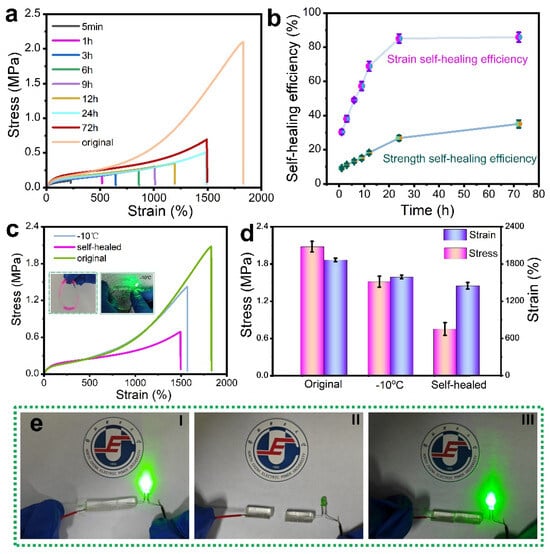
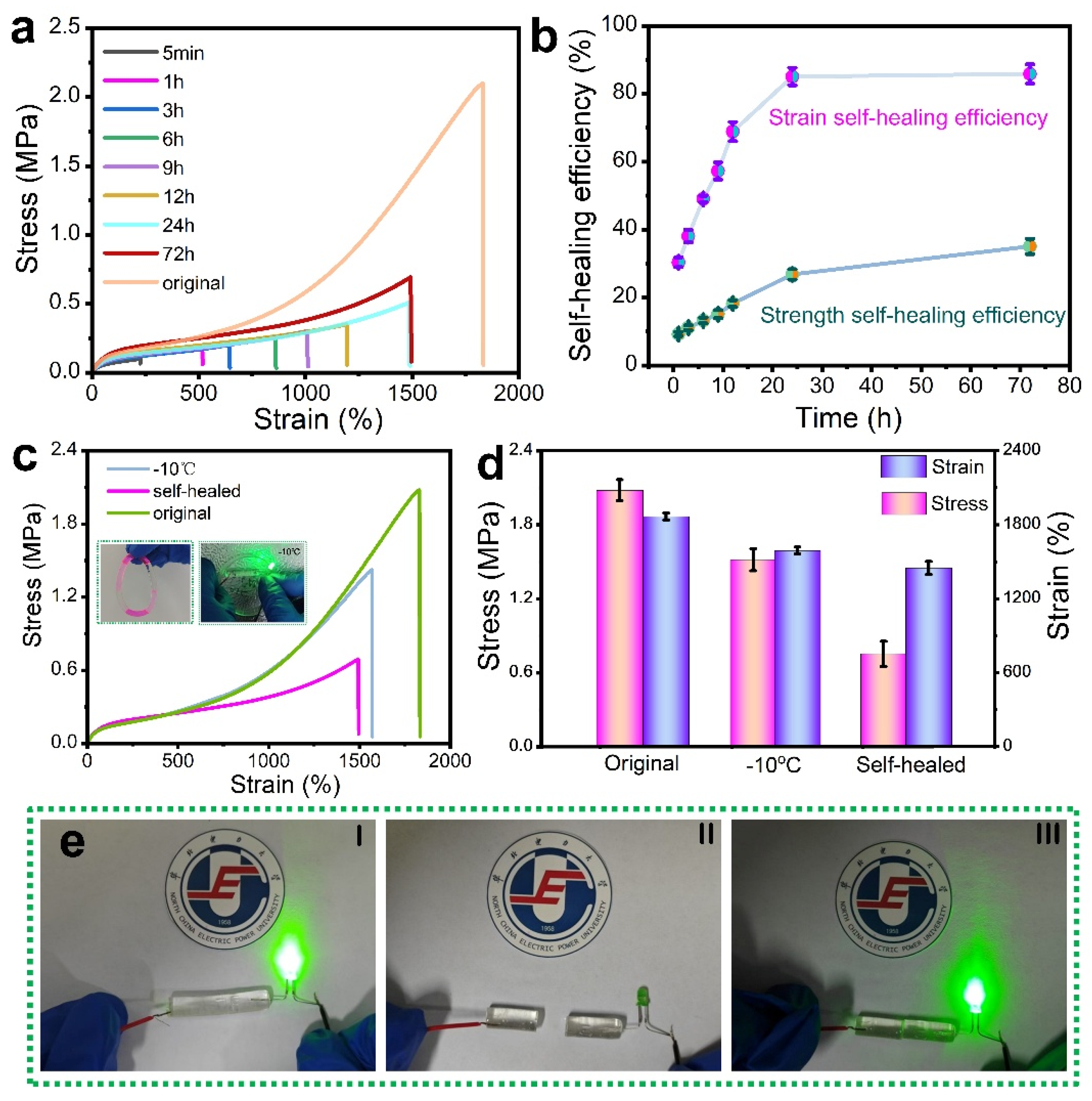
At room temperature and in the absence of external stimuli, both the elongation at break and tensile strength of fractured hydrogel samples recover gradually with increasing healing duration. The time-dependent self-healing performance of the PAA-Lys-Al hydrogel was quantitatively investigated using tensile tests, and the corresponding stress–strain curves and self-healing efficiency results are displayed in Figure 6a,b. The strain self-healing efficiency rises rapidly and plateaus at around 85% after 24 h, whereas the recovery of tensile strength proceeds much more slowly, with only ~34% strength self-healing efficiency achieved after 72 h of healing. This kinetic discrepancy indicates that sufficient time is necessary for the re-association and reconstruction of reversible coordination bonds at the fracture interface [30]. Figure 6c shows the stress–strain curves of the pristine sample, the sample treated at −10 °C, and the self-healed sample. Figure 6d presents the corresponding statistical comparison of fracture stress and fracture strain (with no less than five parallel tests for each group). The pristine hydrogel exhibits a relatively high fracture stress (approximately 2.1 MPa) and ultra-high stretchability (approximately 1800% strain). Even after storage at −10 °C, it retains over 80% of its original mechanical performance, confirming its excellent frost resistance and low-temperature mechanical stability. Notably, it still maintains stable electrical conductivity at low temperatures, which is sufficient to light up an LED, as demonstrated in Video S2 and the photographic insets in Figure 6c. We further investigated the electrical sensing performance of the hydrogel at −10 °C. In the LED demonstration test, the hydrogel retained its elasticity under low-temperature conditions, and the brightness of the LED varied reversibly and synchronously with stretching–releasing cycles of the hydrogel (Video S3). In the wearable finger-bending test, cyclic electrical signals corresponding to bending angles of 180°, 135°, and 90° were recorded using an electrochemical workstation. These results verify that the hydrogel maintains stable strain-sensing functionality at −10 °C (Figure S3, Video S4). The favorable sensing behavior at −10 °C originates from the ion-induced freezing-point depression effect. The incorporated ions suppress ice crystallization and preserve mobile bound water within the network to sustain continuous ionic conduction. Mechanical deformation rearranges the ion migration pathways and modulates the electrochemical impedance of the hydrogel, enabling strain sensing at subzero temperatures. Collectively, these measurements demonstrate the great potential of the hydrogel for electrical strain sensing in subzero environments.
Figure 6.
(a) Stress–strain curves of fractured hydrogels after self-healing for different durations. (b) Evolution of strength and strain self-healing efficiencies with increasing healing time. (c) Stress–strain curves of the original hydrogel, hydrogel at −10 °C, and self-healed hydrogel (inset: photographs of the hydrogel at −10 °C and self-healed PAA-Lys-Al hydrogel bracelet). (d) Statistical comparison of tensile strength and fracture strain of the original, −10 °C-treated, and self-healed hydrogels. (e) Demonstration of the self-healing and electrical conductivity of the hydrogel: (I) the original hydrogel lights up an LED; (II) the cut hydrogel disconnects the circuit; (III) the healed hydrogel restores the LED brightness.
After self-healing at room temperature, the self-healed hydrogel retains over 70% of its initial extensibility, demonstrating effective mechanical recovery capability after damage. As shown in Video S5, the self-healed hydrogel remains flexible and can be freely wrapped around a finger, intuitively proving the restoration of its deformability. Such integrated merits of frost resistance and self-healing help overcome the drawbacks of conventional hydrogels, such as easy freezing and irreversible performance degradation after damage, promoting their applications in all-weather flexible sensing devices.
The electrical self-healing performance of the hydrogel is visually demonstrated in Video S6 and Figure 6e. As shown in panel I, the pristine hydrogel serves as a conductive medium to light up an LED in the circuit. Once the hydrogel is completely cut off with a blade, the conductive circuit is broken, and the LED turns off (panel II). After bringing the two fractured surfaces into intimate contact at room temperature to trigger self-healing, continuous conductive pathways are re-established across the healed interface. As presented in panel III, the LED lights up again, which directly verifies the excellent recovery of both structural integrity and electrical conductivity of the hydrogel after damage.
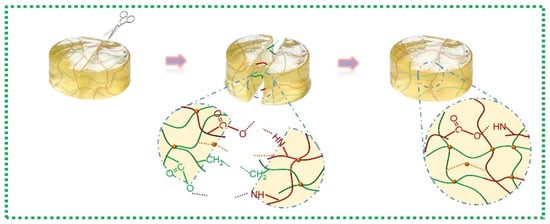
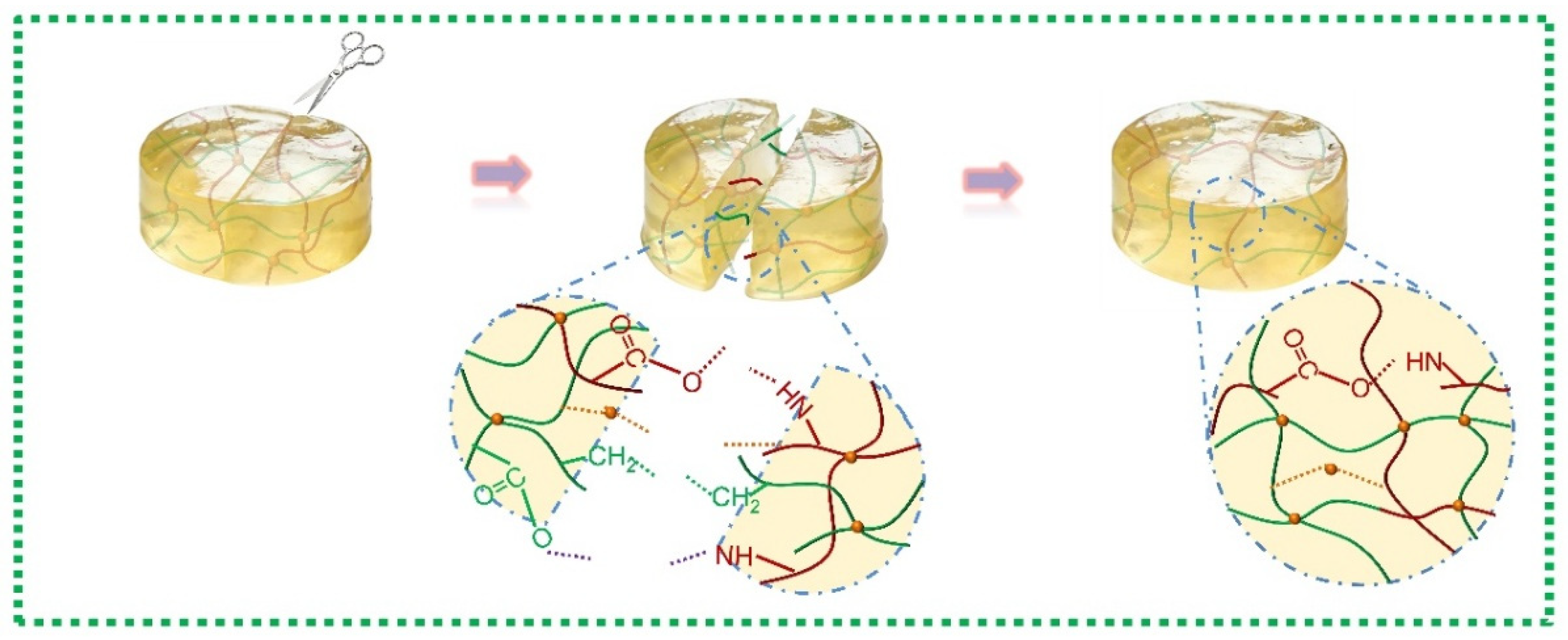
As illustrated in Figure 7, the excellent self-healing performance of the PAA-Lys-Al3+ hydrogel originates from dual reversible dynamic interactions within the network. The intact three-dimensional network is cross-linked via Al3+–carboxyl metal-ligand coordination bonds and intermolecular hydrogen bonds [52]. Once the hydrogel is cut, a large number of active functional groups are exposed on the freshly generated fracture surfaces. When the fractured surfaces are brought into contact, the ruptured coordination bonds and hydrogen bonds can rapidly re-form, accompanied by the interdiffusion and entanglement of polymer chains across the interface. Consequently, the integral hydrogel network is reconstructed, which endows the material with recovered mechanical and conductive properties and enables spontaneous self-healing.
Figure 7.
Schematic illustration of the self-healing mechanism of the PAA-Lys-Al hydrogel.
2.5. Electromechanical Behaviors of Hydrogel
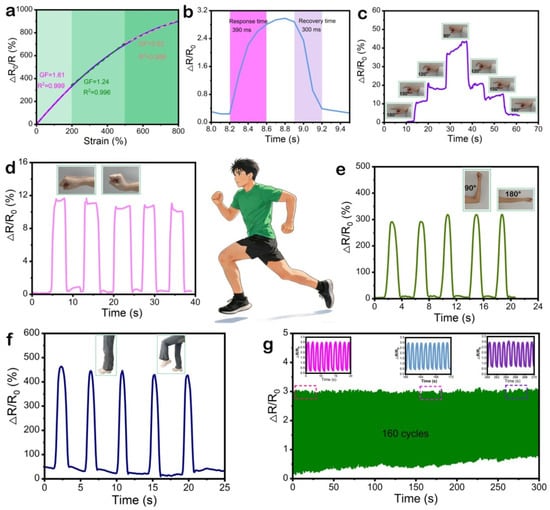
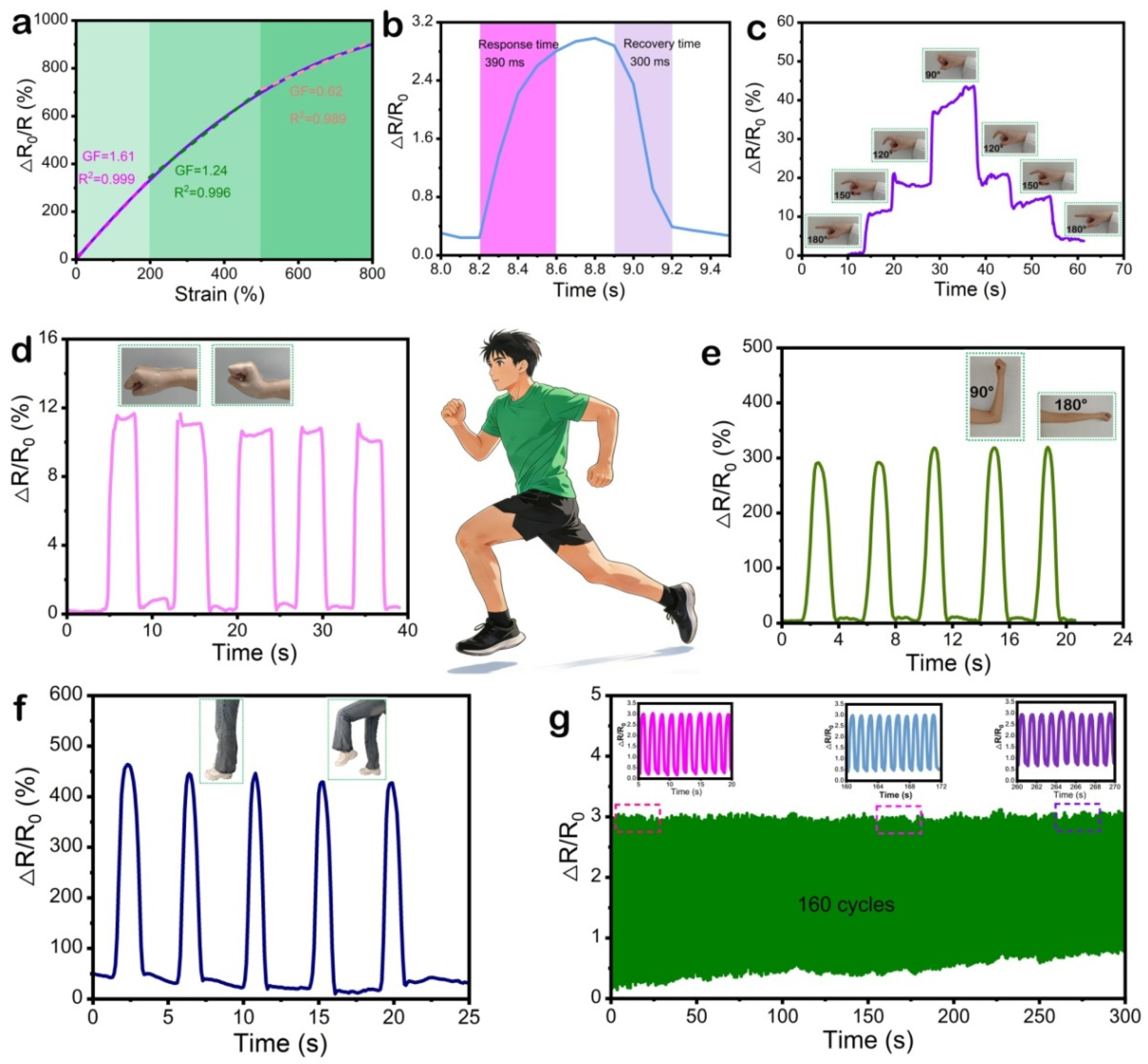
The electrical conductivity of the PAA-Lys-Al hydrogel was measured by the two-electrode method with a digital multimeter (Figure S4). The calculated conductivity is 0.27 S/m. This desirable ionic conductivity allows the hydrogel to translate mechanical deformation into detectable resistance signals, showing promising potential for flexible strain sensors. The electromechanical sensing properties, dynamic response characteristics, wearable human motion detection ability, and long-term cycling stability of the fabricated flexible hydrogel strain sensor are systematically explored in Figure 8.
Figure 8.
(a) GF of PAA-Lys-Al hydrogel. (b) Response time and recovery time. (c) Bending finger to various angles. Monitoring of (d) wrist, (e) elbow, and (f) knee movements. (g) The resistance change rate of the PAA-Lys-Al hydrogel strain sensor during 160 manual stretching cycles at 200% strain.
As presented in Figure 8a, the PAA-Lys-Al hydrogel achieves GF values of 1.61, 1.24, and 0.62 over 0–200%, 200–500%, and 500–800% strain. The gradual decline in sensitivity with increasing strain arises from the fully oriented internal conductive network at large elongation, where limited newly fractured conductive paths lead to slower resistance variation. Such hierarchical sensing behavior endows the sensor with distinctive application superiority: high GF at small strain guarantees accurate recognition of subtle physiological movements, while mild stable signals under ultra-large strain prevent data saturation and ensure reliable monitoring of extreme body bending.
The response and recovery times were recorded during one complete cycle of rapid elbow bending to 90° followed by straightening, as shown in Figure 8b. The results indicate that the hydrogel sensor can capture motions in real time without obvious delay. This can be attributed to the efficient ion diffusion kinetics and excellent elastic resilience.
Figure 8c presents the angle-resolved sensing performance of the hydrogel sensor during finger bending from 180° to 150°, 120°, and 90°. The relative resistance change ΔR/R0 gradually increases with the rising degree of finger bending (i.e., the decrease in bending angle). The sensor can maintain stable plateau signals at each fixed bending angle. When the finger returns to the initial straight state, the signal can be fully and reversibly recovered. This result strongly demonstrates that the as-prepared sensor can produce corresponding electrical signals in response to different bending deformations [53]. The stable and reversible signals at various bending states guarantee real-time monitoring of continuous hand movements, endowing the sensor with application potential in wearable gesture recognition, human motion rehabilitation assessment, and other fields.
Figure 8d–f further validate the practical wearable application potential of the sensor. Highly repeatable and drift-free sensing waveforms are observed during cyclic wrist flexion-extension movements (d), large-angle elbow bending at 90° and 180° (e), and repeated knee squatting-standing motions (f). Owing to superior stretchability and skin-compliant mechanical flexibility, the sensor can perfectly fit human skin and synchronize with multi-scale joint movements, delivering stable, reversible, and consistent sensing signals for both subtle micro-motions and large-amplitude limb movements.
The long-term operational durability of the strain sensor was evaluated through 160 consecutive stretching-unstretching cycles at 200% strain (Figure 8g). After prolonged repeated mechanical deformation, no obvious attenuation in the baseline resistance and response amplitude was detected. The magnified insets further confirmed that the single-cycle sensing waveforms remained highly regular and intact. This remarkable long-term cycling stability stems from the dynamic reversible crosslinking effect of the hydrogel network, which can effectively dissipate external mechanical stress and prevent irreversible structural damage during long-term cyclic operation.
3. Conclusions
In summary, a high-performance polyacrylic acid–lysine–aluminum (PAA-Lys-Al) hydrogel was prepared via a facile one-pot polymerization method. The hydrogel network is constructed based on synergistic dynamic hydrogen bonding and Al3+ coordination cross-linking. The as-prepared hydrogel exhibits excellent mechanical toughness, ultrahigh stretchability (strain > 1800%), and outstanding tensile strength of 2.1 MPa. The reversible dynamic interactions also endow the hydrogel with remarkable low-temperature resistance and efficient self-healing performance. As verified by biocompatibility and antibacterial evaluations, the hydrogel possesses satisfactory biosafety for wearable applications. Moreover, it shows excellent piezoresistive sensing properties, including high sensitivity, fast response/recovery, and long-term cycling stability, enabling accurate real-time monitoring of diverse human motions. This work develops an effective amino acid–metal co-crosslinking strategy for fabricating robust multifunctional hydrogels and provides a promising candidate material for flexible wearable sensors and healthcare electronics.
4. Materials and Methods
4.1. Materials
All chemicals used here were of analytical grade without further purification. L-Lysine (≥98%), acrylic acid (AA, >99%), and aluminum chloride hexahydrate (AlCl3·6H2O, ≥97%) were purchased from Aladdin. Potassium persulfate (KPS, ≥98%) was received from Macklin.
4.2. Experimental
Poly (acrylic acid)-lysine-aluminum ion hybrid hydrogels (PAA-Lys-Al) were synthesized via one-pot free radical polymerization. Acrylic acid (3.0 g) was dissolved in 10.0 mL of deionized water, followed by the addition of 0.3 g lysine and 0.16 g aluminum chloride hexahydrate. The mixture was stirred for 1 h to achieve complete dissolution. Afterward, 0.06 g potassium persulfate was introduced as an initiator, and the homogeneous precursor solution was transferred into a mold and heated in a water bath at 60 °C for 4 h to complete gelation. The as-obtained hydrogel was then demolded and stored for further use. Control samples with varied contents of lysine and aluminum chloride were also prepared for comparison (as shown in Tables S1 and S2).
4.3. Characterizations
Functional groups of the as-prepared hydrogel samples were analyzed via Fourier transform infrared (FT-IR) spectroscopy (Thermo Fisher Scientific, Madison, WI, USA). The spectra were recorded over the wavenumber range of 4000–1000 cm−1 to identify characteristic absorption bands. Rheological properties were characterized to evaluate viscoelastic behavior using an Anton Paar MCR 102 rheometer. To investigate the swelling behavior, hydrogel samples were submerged in deionized water at room temperature for 40 days. Cylindrical hydrogel segments were immersed in deionized water. Mass measurements were carried out daily in the initial stage, and the sampling interval was then extended to several days until swelling equilibrium was achieved. Five parallel specimens were tested. The weight increase ratio (WR) was calculated by the formula: WR = (W2 − W1)/W1 × 100%, where W1 and W2 represent the initial dry weight and the swollen weight measured at predetermined time points, respectively. The cytocompatibility of hydrogel samples was evaluated via CCK-8 assay using L929 mouse fibroblasts. Before extraction, hydrogel fragments were repeatedly rinsed with sterile PBS to remove unreacted monomers and residual reactants. Washed hydrogels were immersed in complete MEM medium (basal MEM medium, Procell, PM150410 supplemented with 10% (v/v) premium fetal bovine serum) at 0.2 g/mL and incubated at 37 °C for 24 h. The obtained extracts were sterile-filtered and serially diluted with complete MEM medium to prepare working solutions. L929 cells in logarithmic growth phase were seeded into 96-well plates at 4 × 10³ cells per well and cultured overnight. After cell adhesion, the culture medium was discarded, and cells were rinsed twice with PBS, followed by incubation with hydrogel extracts for 24 h, 48 h, and 72 h, respectively. At predetermined time points, 100 μL of medium containing 10% CCK-8 reagent was added to each well, and plates were incubated at 37 °C under 5% CO2 for 2 h. The absorbance was measured at 450 nm using a microplate reader. Relative cell viability (%) = [(As − Ab)/(Ac − Ab)] × 100%, where As, Ac, and Ab represent the absorbance of sample, control, and blank wells, respectively. The antibacterial performance of hydrogel samples was evaluated via the plate colony-counting method using Escherichia coli (ATCC 25922). Prior to testing, cubic hydrogel samples (1 cm × 1 cm × 1 cm) were repeatedly rinsed with sterile PBS to remove residual unreacted reactants and sterilized by ultraviolet irradiation. A single bacterial colony was inoculated into sterile LB broth and incubated overnight at 37 °C in a shaking incubator (200–250 rpm, 12–16 h). The overnight bacterial suspension was diluted with sterile PBS to 104 CFU/mL. Each sterilized hydrogel cube was immersed in 2 mL of diluted bacterial suspension and statically incubated at 37 °C for 18 h. Three biological replicates were set for each group. After co-culture, bacterial suspensions were collected and serially diluted with sterile normal saline. 100 μL of bacterial solution of a suitable dilution gradient was spread on LB agar plates and incubated at 37 °C for 18 h. Colonies were counted using an Interscience SCAN1200 automatic colony counter. Bacterial concentration (CFU/mL) = colony number × dilution factor × 10. Antibacterial rate (%) = (1 − Cs/Cc) × 100%. where Cs is the bacterial concentration of the experimental group, and Cc is the average bacterial concentration of the blank control group. The hydrogel specimens underwent vacuum freeze-drying for 24 h on a SCIENTZ-12 N/A system. Scanning electron microscopy (SEM, Hitachi SU8600, Hitachi High-Tech Corporation, Tokyo, Japan) was employed to observe their microstructures. Elemental composition and spatial distribution were determined using energy-dispersive X-ray spectroscopy (EDS) elemental mapping.
4.4. Mechanical Tests
Mechanical properties of the samples were characterized using a universal tensile testing machine (FBS-500NS tensile tester at room temperature). The specimens are cylindrical hydrogel strips with a diameter of 4 mm. For tensile measurement, both ends of the cylindrical hydrogel were clamped using tensile grips, leaving an initial gauge length of 10 mm between the grips. Tensile tests were performed at a crosshead speed of 100 mm/min until sample fracture. More than ten parallel samples from both the experimental group and control group were tested under identical conditions for comparative analysis. In addition, cyclic tensile tests were carried out under various stretching rates and elongation ratios to evaluate the cyclic deformation and fatigue resistance of the materials.
4.5. Electrical Tests
The resistance of the cylindrical PAA-Lys-Al hydrogel specimen was measured using a digital multimeter (VICTOR VC97). The effective length of the sample was 0.02 m, and the cross-sectional diameter was 0.004 m. Five parallel measurements were carried out. The electrical conductivity was calculated according to σ = L/(R·S), where σ is electrical conductivity (S/m), L is the length of the hydrogel sample (m), R is the measured resistance Ω, and S is the cross-sectional area of the hydrogel sample (m2). A two-probe method was adopted, and conductive tape covering both end cross-sections was used to reduce the electrode–hydrogel contact resistance. The strain-sensitive electrical response of the hydrogel was characterized using a CHI760E electrochemical workstation (CH Instruments Co., Ltd., Shanghai, China). The piezoresistive hydrogel sensor produced real-time electrical signals in response to deformation-induced resistance variation. Hydrogel strips were fixed on the finger, wrist, elbow, and knee joints, with nickel foam wrapped around both ends as current collectors. A two-electrode setup was adopted. The relative resistance change was defined as ΔR/R0 = (R−R0)/R0, where R0 and R are the initial and real-time resistance under strain, respectively. The electrical response under stretching was recorded according to the resistance variations. The gauge factor (GF) was used to evaluate strain sensitivity, which was calculated as GF = [(R−R0)/R0]/ε, where ε denotes the applied strain.
Supplementary Materials
The following supporting information can be downloaded at: https://www.mdpi.com/article/10.3390/gels12111000/s1, Figure S1: Photographs of four PAA-based samples (PAA-0Lys-0Al, PAA-0Lys-Al, PAA-Lys-0Al, PAA-Lys-Al) in the vial inversion test; Figure S2: Storage modulus (G′) and loss modulus (G″) of PAA-Lys-Al hydrogel from oscillatory frequency sweep at a strain amplitude of 10%; Figure S3: Gradient electrical sensing response of the hydrogel sensor during five finger-bending cycles (180° → 135° → 90°) at −10 °C; Figure S4: Photograph showing two-probe resistance testing of PAA-Lys-Al hydrogel by a VICTOR VC97 multimeter; Table S1: Fabrication formula of poly (acrylic acid) (PAA) hydrogel and poly (acrylic acid)-lysine-aluminum ion (PAA-Lys-Al3+) hydrogels with fixed AlCl3 content and varied lysine contents; Table S2: Fabrication formula of poly(acrylic acid)-lysine-aluminum ion (PAA-Lys-Al3+) hydrogels with fixed lysine content and varied AlCl3 contents; Table S3: Hysteresis value (kJ/m3) of the PAA-Lys-Al hydrogel under cyclic stretching at different stretch ratios (100–700%) with a stretching rate of 100 mm/min; Table S4: Hysteresis ratio (%) of the PAA-Lys-Al hydrogel under cyclic stretching at different stretch ratios (100–700%) with a stretching rate of 100 mm/min.; Video S1: The PAA-Lys-Al hydrogel can support a 4 kg weight; Video S2: The PAA-Lys-Al hydrogel can light up LED under −10 °C; Video S3: LED brightness variation of the hydrogel upon stretching–releasing cycles at −10 °C; Video S4: Five cycles of finger bending (180°, 135°, 90°) for the hydrogel sensor at −10 °C; Video S5: The self-healing hydrogel “bracelet” can be wrapped around; Video S6: The self-healed PAA-Lys-Al hydrogel is capable of lighting up an LED.
Author Contributions
Y.L.: supervision, writing—original draft, methodology, writing—review and editing, funding acquisition, project administration, resources; Y.C.: investigation, validation; Z.W.: data curation. All authors have read and agreed to the published version of the manuscript.
Funding
This research was funded by the Fundamental Research Funds for the Central University No. 2026SL005.
Institutional Review Board Statement
Only the authors of this manuscript took part in the non-invasive finger bending demonstration tests. No external human participants were recruited, and no personally identifiable information was collected.
Informed Consent Statement
Consent was obtained from the authors who participated in the demonstrations.
Data Availability Statement
All data generated or analyzed during this study are included in this published article and its Supplementary Materials files.
Conflicts of Interest
The authors declare no conflicts of interest.
References
- Roy, A.; Afshari, R.; Jain, S.; Zheng, Y.; Lin, M.H.; Zenkar, S.; Yin, J.; Chen, J.; Peppas, N.A.; Annabi, N. Advances in conducting nanocomposite hydrogels for wearable biomonitoring. Chem. Soc. Rev. 2025, 54, 2595–2652. [Google Scholar] [CrossRef] [Scilit]
- Shevtsov, V.Y.; Guerrero, J.A.; Glinsek, S.; Nosov, D.R.; Plesse, C.; Raquez, J.M.; Schmidt, D.F.; Odent, J.; Shaplov, A.S. Flexible Crosslinked Poly(ionic liquid)s for All-Solid-State High-Performance Self-Powered Ionic Pressure Sensors. ACS Sens. 2026, 11, 3350–3361. [Google Scholar] [CrossRef] [Scilit]
- Hang, T.; Chen, Y.; Yin, F.; Shen, J.; Li, X.; Li, Z.; Zheng, J. Highly stretchable polyvinyl alcohol composite conductive hydrogel sensors reinforced by cellulose nanofibrils and liquid metal for information transmission. Int. J. Biol. Macromol. 2024, 258, 128855. [Google Scholar] [CrossRef] [Scilit]
- Chen, J.; Peng, Q.; Thundat, T.; Zeng, H. Stretchable, Injectable, and Self-Healing Conductive Hydrogel Enabled by Multiple Hydrogen Bonding toward Wearable Electronics. Chem. Mater. 2019, 31, 4553–4563. [Google Scholar] [CrossRef] [Scilit]
- Wang, F.; Yong, X.; Deng, J.; Wu, Y. Poly(N,N-dimethylacrylamide-octadecyl acrylate)-clay hydrogels with high mechanical properties and shape memory ability. RSC Adv. 2018, 8, 16773–16780. [Google Scholar] [CrossRef] [Scilit]
- Zhang, S.; Ren, D.; Zhao, Q.; Peng, M.; Wang, X.; Zhang, Z.; Liu, W.; Huang, F. Observation of topological hydrogen-bonding domains in physical hydrogel for excellent self-healing and elasticity. Nat. Commun. 2025, 16, 2371. [Google Scholar] [CrossRef] [Scilit]
- Zhang, Y.; Yang, C.; Bai, C.; Wang, X.; Feng, C.; Wei, H. PAM-co-VI-based bimetallic-doped single-network conductive hydrogel for stress sensing and ECG signal monitoring applications. Polym. Test. 2025, 153, 109025. [Google Scholar] [CrossRef] [Scilit]
- Revathi, D.; Panda, S.; Deshmukh, K.; Khotele, N.; Murthy, V.R.K.; Pasha, S.K.K. Smart hydrogels for sensing and biosensing—Preparation, smart behaviours, and emerging applications—A comprehensive review. Polym. Test. 2025, 150, 108912. [Google Scholar] [CrossRef] [Scilit]
- Huo, H.; Shen, J.; Wan, J.; Shi, H.; Yang, H.; Duan, X.; Gao, Y.; Chen, Y.; Kuang, F.; Li, H.; et al. A tough and robust hydrogel constructed through carbon dots induced crystallization domains integrated orientation regulation. Nat. Commun. 2025, 16, 6221. [Google Scholar] [CrossRef] [Scilit]
- Bai, R.; Yang, Q.; Tang, J.; Morelle, X.P.; Vlassak, J.; Suo, Z. Fatigue fracture of tough hydrogels. Extreme Mech. Lett. 2017, 15, 91–96. [Google Scholar] [CrossRef] [Scilit]
- Gong, Z.; Zhang, G.; Zeng, X.; Li, J.; Li, G.; Huang, W.; Sun, R.; Wong, C. High-Strength, Tough, Fatigue Resistant, and Self-Healing Hydrogel Based on Dual Physically Cross-Linked Network. ACS Appl. Mater. Interfaces 2016, 8, 24030–24037. [Google Scholar] [CrossRef] [Scilit]
- Muñoz-García, R.O.; Ruiz-Casillas, C.A.; Lomelí-Rosales, D.A.; Cortés-Ortega, J.A.; Sánchez-Díaz, J.C.; Cruz-Barba, L.E. A Poly(Acrylic Acid)-Based Hydrogel Crosslinked with Hydroxypropyl cellulose as a Clarifying Agent in Nickel(II) Solutions. Gels 2025, 11, 560. [Google Scholar] [CrossRef] [Scilit]
- Liu, X.; Sun, Y.; Wang, J.; Kang, Y.; Wang, Z.; Cao, W.; Ye, J.; Gao, C. A tough, antibacterial and antioxidant hydrogel dressing accelerates wound healing and suppresses hypertrophic scar formation in infected wounds. Bioact. Mater. 2024, 34, 269–281. [Google Scholar] [CrossRef] [Scilit]
- Morelle, X.P.; Illeperuma, W.R.; Tian, K.; Bai, R.; Suo, Z.; Vlassak, J.J. Highly Stretchable and Tough Hydrogels below Water Freezing Temperature. Adv. Mater. 2018, 30, e1801541. [Google Scholar] [CrossRef] [Scilit]
- Jian, Y.; Handschuh, W.S.; Zhang, J.; Lu, W.; Zhou, X.; Chen, T. Biomimetic anti-freezing polymeric hydrogels: Keeping soft-wet materials active in cold environments. Mater. Horiz. 2021, 8, 351–369. [Google Scholar] [CrossRef] [Scilit]
- Zhao, L.; Ren, Z.; Liu, X.; Ling, Q.; Li, Z.; Gu, H. A Multifunctional, Self-Healing, Self-Adhesive, and Conductive Sodium Alginate/Poly(vinyl alcohol) Composite Hydrogel as a Flexible Strain Sensor. ACS Appl. Mater. Interfaces 2021, 13, 11344–11355. [Google Scholar] [CrossRef] [Scilit]
- Yang, X.; Zhang, B.; Li, J.; Shen, M.; Liu, H.; Xu, X.; Shang, S. Self-healing, self-adhesive, and stretchable conductive hydrogel for multifunctional sensor prepared by catechol modified nanocellulose stabilized poly(alpha-thioctic acid). Carbohydr. Polym. 2023, 313, 120813. [Google Scholar] [CrossRef] [Scilit]
- Ge, G.; Lu, Y.; Qu, X.; Zhao, W.; Ren, Y.; Wang, W.; Wang, Q.; Huang, W.; Dong, X. Muscle-Inspired Self-Healing Hydrogels for Strain and Temperature Sensor. ACS Nano 2020, 14, 218–228. [Google Scholar] [CrossRef] [Scilit]
- Awasthi, S.; Gaur, J.K.; Pandey, S.K.; Bobji, M.S.; Srivastava, C. High-Strength, Strongly Bonded Nanocomposite Hydrogels for Cartilage Repair. ACS Appl. Mater. Interfaces 2021, 13, 24505–24523. [Google Scholar] [CrossRef] [Scilit]
- Li, X.; Gong, J.P. Design principles for strong and tough hydrogels. Nat. Rev. Mater. 2024, 9, 380–398. [Google Scholar] [CrossRef] [Scilit]
- Zhang, J.; Wang, Y.; Wei, Q.; Wang, Y.; Lei, M.; Li, M.; Li, D.; Zhang, L.; Wu, Y. Self-Healing Mechanism and Conductivity of the Hydrogel Flexible Sensors: A Review. Gels 2021, 7, 216. [Google Scholar] [CrossRef] [Scilit]
- Duan, Z.; Hou, Y.; Chang, Y.; Zhao, Q.; Guo, M.; Wu, S.; Zhou, S.; Ma, Y. Low-temperature 3D-printing conductive hydrogel based sensing materials for highly sensitive soft strain sensors. Sens. Actuators A Phys. 2025, 389, 116571. [Google Scholar] [CrossRef] [Scilit]
- Yang, Q.; Chen, R.; Li, M.; Song, H.; Zhao, X.; Zhang, L.; Zhou, Y.; Chen, J.; Li, J.; Chen, M. High Antimicrobial Electrotherapy and Wound Monitoring Hydrogel with Bimetal Phenolic Networks for Smart Healthcare. Adv. Funct. Mater. 2024, 35, 2413080. [Google Scholar] [CrossRef] [Scilit]
- Xie, X.; Feng, X.; Hong, L.; Yu, X.; Li, H.; Zhang, H.; Liu, M.; Wang, Y. Evaluation of antibacterial and osteogenic properties of a novel Poly (acrylic acid)-calcium-zinc biomineralized hydrogel. Front. Mater. 2024, 11, 1444750. [Google Scholar] [CrossRef] [Scilit]
- Bhatia, M.; Rajulapati, S.B.; Sonawane, S.; Girdhar, A. Synthesis and implication of novel poly(acrylic acid)/nanosorbent embedded hydrogel composite for lead ion removal. Sci. Rep. 2017, 7, 16413. [Google Scholar] [CrossRef] [Scilit]
- Wang, M.; Zhang, P.; Shamsi, M.; Thelen, J.L.; Qian, W.; Truong, V.K.; Ma, J.; Hu, J.; Dickey, M.D. Tough and stretchable ionogels by in situ phase separation. Nat. Mater. 2022, 21, 359–365. [Google Scholar] [CrossRef] [Scilit]
- Wang, Y.; Xie, Y.; Xie, X.; Wu, D.; Wu, H.; Luo, X.; Wu, Q.; Zhao, L.; Wu, J. Compliant and Robust Tissue-Like Hydrogels via Ferric Ion-Induced of Hierarchical Structure. Adv. Funct. Mater. 2023, 33, 2210224. [Google Scholar] [CrossRef] [Scilit]
- Ghosh, A.; Kumar, S.; Singh, P.P.; Nandi, S.; Mandal, M.; Pradhan, D.; Khatua, B.B.; Das, R.K. Dynamic Metal-Coordinated Adhesiveand Self-Healable Antifreezing Hydrogels for Strain Sensing, Flexible Supercapacitors, and EMI Shielding Applications. ACS Omega 2024, 9, 33204–33223. [Google Scholar] [CrossRef] [Scilit]
- Bao, B.; Zeng, Q.; Li, K.; Wen, J.; Zhang, Y.; Zheng, Y.; Zhou, R.; Shi, C.; Chen, T.; Xiao, C.; et al. Rapid fabrication of physically robust hydrogels. Nat. Mater. 2023, 22, 1253–1260. [Google Scholar] [CrossRef] [Scilit]
- Zhang, H.; He, J.; Qu, J. Metal-coordinated amino acid hydrogels with ultra-stretchability, adhesion, and self-healing properties for wound healing. Eur. Polym. J. 2022, 179, 111548. [Google Scholar] [CrossRef] [Scilit]
- Benitez-Duif, P.A.; Breisch, M.; Kurka, D.; Edel, K.; Gökcay, S.; Stangier, D.; Tillmann, W.; Hijazi, M.; Tiller, J.C. Ultrastrong Poly(2-Oxazoline)/Poly(Acrylic Acid) Double-Network Hydrogels with Cartilage-Like Mechanical Properties. Adv. Funct. Mater. 2022, 32, 2204837. [Google Scholar] [CrossRef] [Scilit]
- Oliveira Junior, N.G.; Souza, C.M.; Buccini, D.F.; Cardoso, M.H.; Franco, O.L. Antimicrobial peptides: Structure, functions and translational applications. Nat. Rev. Microbiol. 2025, 23, 687–700. [Google Scholar] [CrossRef] [Scilit]
- Kargaki, M.E.; Arfara, F.; Iatrou, H.; Tsitsilianis, C. pH-Sensitive Poly(acrylic acid)-g-poly(L-lysine) Charge-Driven Self-Assembling Hydrogels with 3D-Printability and Self-Healing Properties. Gels 2023, 9, 512. [Google Scholar] [CrossRef] [Scilit]
- Das, S.; Martin, P.; Vasilyev, G.; Nandi, R.; Amdursky, N.; Zussman, E. Processable, Ion-Conducting Hydrogel for Flexible Electronic Devices with Self-Healing Capability. Macromolecules 2020, 53, 11130–11141. [Google Scholar] [CrossRef] [Scilit]
- Rahmani, P.; Shojaei, A.; Dickey, M.D. A highly conductive and ultra-stretchable polyaniline/cellulose nanocrystal/polyacrylamide hydrogel with hydrophobic associations for wearable strain sensors. J. Mater. Chem. A 2024, 12, 9552–9562. [Google Scholar] [CrossRef] [Scilit]
- Rahmani, P.; Shojaei, A.; Sakorikar, T.; Wang, M.; Apodaca, Y.M.; Dickey, M.D. Liquid Metal Nanoparticles Physically Hybridized with Cellulose Nanocrystals Initiate and Toughen Hydrogels with Piezoionic Properties. ACS Nano 2024, 18, 8038–8050. [Google Scholar] [CrossRef] [Scilit]
- Huang, X.; Wang, N.; Liu, J.; Sun, W.; Sun, G.; Zhang, Z.; Lu, S.; Wang, Y. Flexible hydrogels with in-situ grown cobalt-based metal-organic frameworks for high-performance electrochemical detection of 2,4,6-trichloropshenol. Chin. Chem. Lett. 2026, 37, 112067. [Google Scholar] [CrossRef] [Scilit]
- Vickery, W.; Coskun, H.I.; Wang, J.; Sydlik, S. Hands-on Laboratory Modules for Polymer Education within Biomedical Materials Applications. J. Chem. Educ. 2025, 102, 1160–1168. [Google Scholar] [CrossRef] [Scilit]
- Guo, X.; Zhang, L.; Zhuo, H.; Chen, C.; Yang, H.; Li, T.; Qi, H.; Zhai, W. Robust zwitterionic hydrogels enabled by consolidated supramolecular networks and spatially hierarchical structures. Nat. Commun. 2025, 16, 9454. [Google Scholar] [CrossRef] [Scilit]
- Niu, W.; Tian, Q.; Liu, Z.; Liu, X. Solvent-Free and Skinlike Supramolecular Ion-Conductive Elastomers with Versatile Processability for Multifunctional Ionic Tattoos and on-Skin Bioelectronics. Adv. Mater. 2023, 35, 2304157. [Google Scholar] [CrossRef] [Scilit]
- Yang, L.; Song, L.; Feng, Y.; Cao, M.; Zhang, P.; Zhang, X.F.; Yao, J. Zinc ion trapping in a cellulose hydrogel as a solid electrolyte for a safe and flexible supercapacitor. J. Mater. Chem. A 2020, 8, 12314–12318. [Google Scholar] [CrossRef] [Scilit]
- Chen, R.; Zhang, Y.Y.; Huang, X.; Wang, L.; Zhang, L.; Song, C.; Dai, L.; Zhang, M.; Wang, J.; Jian, Y.; et al. Unexpected strong paramagnetism of hydrogels containing carbon-oxygen double bonds induced by calcium cations. Nat. Mater. 2026, 25, 848–855. [Google Scholar] [CrossRef] [Scilit]
- Zhang, Y.; Li, T.; Miao, L.; Kaur, P.; Men, S.; Wang, Q.; Gong, X.; Fang, Y.; Zhai, C.; Zhang, S.; et al. A highly sensitive and ultra-stretchable zwitterionic liquid hydrogel-based sensor as anti-freezing ionic skin. J. Mater. Chem. A 2022, 10, 3970–3988. [Google Scholar] [CrossRef] [Scilit]
- Li, J.; Ding, Q.; Wang, H.; Wu, Z.; Gui, X.; Li, C.; Hu, N.; Tao, K.; Wu, J. Engineering Smart Composite Hydrogels for Wearable Disease Monitoring. Nano-Micro Lett. 2023, 15, 105. [Google Scholar] [CrossRef] [Scilit]
- Di, X.; Hou, J.; Yang, M.; Wu, G.; Sun, P. A bio-inspired, ultra-tough, high-sensitivity, and anti-swelling conductive hydrogel strain sensor for motion detection and information transmission. Mater. Horiz. 2022, 9, 3057–3069. [Google Scholar] [CrossRef] [Scilit]
- Li, M.; Zhang, H. Metal-Ion-Coordinated Conductive Hydrogels for Strain Sensing from Coordination Design to Wearable Applications. Appl. Sci. 2026, 16, 4450. [Google Scholar] [CrossRef] [Scilit]
- Far, B.F.; Naimi-Jamal, M.R.; Jahanbakhshi, M.; Hadizadeh, A.; Dehghan, S.; Hadizadeh, S. Enhanced antibacterial activity of porous chitosan-based hydrogels crosslinked with gelatin and metal ions. Sci. Rep. 2014, 14, 7505. [Google Scholar]
- Dias, O.A.T.; Konar, S.; Graziano, A.; Leao, A.L.; Tjong, J.; Jaffer, S.; Sain, M. One-pot fabrication of flexible and luminescent nanofilm by in-situ radical polymerization of vinyl carbazole on nanofibrillated cellulose. Carbohydr. Polym. 2021, 262, 117934. [Google Scholar] [CrossRef] [Scilit]
- Cao, Z.; Zhang, Y.; Luo, K.; Wu, Y.; Gao, H.; Cheng, J.; Liu, C.; Tao, G.; Guan, Q.; Zhang, L. Preparation and Properties of Polyacrylamide/Sodium Alginate Hydrogel and the Effect of Fe Adsorption on Its Mechanical Performance. J. Renew. Mater. 2021, 9, 1447–1462. [Google Scholar] [CrossRef] [Scilit]
- Tan, P.; Wang, H.; Xiao, F.; Lu, X.; Shang, W.; Deng, X.; Song, H.; Xu, Z.; Cao, J.; Gan, T.; et al. Solution-processable, soft, self-adhesive, and conductive polymer composites for soft electronics. Nat. Commun. 2022, 13, 358. [Google Scholar] [CrossRef] [Scilit]
- Liang, X.; Chen, G.; Lin, S.; Zhang, J.; Wang, L.; Zhang, P.; Wang, Z.; Wang, Z.; Lan, Y.; Ge, Q.; et al. Anisotropically Fatigue-Resistant Hydrogels. Adv. Mater. 2021, 33, e2102011. [Google Scholar] [CrossRef] [Scilit]
- Wang, A.; Wang, Y.; Zhang, B.; Wan, K.; Zhu, J.; Xu, J.; Zhang, C.; Liu, T. Hydrogen-bonded network enables semi-interpenetrating ionic conductive hydrogels with high stretchability and excellent fatigue resistance for capacitive/resistive bimodal sensors. Chem. Eng. J. 2021, 411, 128506. [Google Scholar] [CrossRef] [Scilit]
- Zhang, W.; Feng, P.; Chen, J.; Sun, Z.; Zhao, B. Electrically conductive hydrogels for flexible energy storage systems. Prog. Polym. Sci. 2019, 88, 220–240. [Google Scholar] [CrossRef] [Scilit]
Disclaimer/Publisher’s Note: The statements, opinions and data contained in all publications are solely those of the individual author(s) and contributor(s) and not of MDPI and/or the editor(s). MDPI and/or the editor(s) disclaim responsibility for any injury to people or property resulting from any ideas, methods, instructions or products referred to in the content. |
© 2026 by the authors. Licensee MDPI, Basel, Switzerland. This article is an open access article distributed under the terms and conditions of the Creative Commons Attribution (CC BY) license.