




J. Fungi, Volume 12, Issue 2 (February 2026) – 80 articles
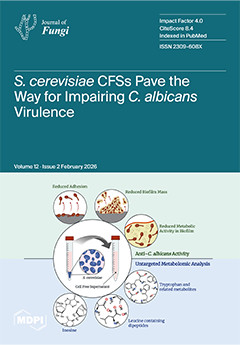
Cover Story (view full-size image):
The anti-Candida albicans effect of cell-free supernatants (CFSs) from three different faecal isolates and one ATCC strain of Saccharomyces cerevisiae was assessed. The CFSs activity on C. albicans virulence traits demonstrates that CFSs significantly reduce C. albicans capacity to adhere and to form a biofilm and decrease the metabolic activity of biofilm-embedded fungal cells. The untargeted metabolomic analysis of the CFSs shows that compared to the reference strain, faecal isolates overexpress N-acetyl-DL-tryptophan and other molecules derived from its metabolism, L-leucine containing dipeptides, and the nucleotide inosine, suggesting that one or more of such molecules may impair C. albicans virulence, paving the way for a possible future employment of these CFSs as postbiotics. View this paper
- Issues are regarded as officially published after their release is announced to the table of contents alert mailing list.
- You may sign up for e-mail alerts to receive table of contents of newly released issues.
- PDF is the official format for papers published in both, html and pdf forms. To view the papers in pdf format, click on the "PDF Full-text" link, and use the free Adobe Reader to open them.
Previous Issue
Next Issue
